Archive for operational efficiency

The $50,000 Question: Why Smart Dairies Follow This 8-Point Protocol Before Any Big Decision

What farmers are discovering is simple—the most valuable time on the dairy isn’t the visit itself, but the preparation before it.

You know that feeling when you watch a neighbor drop $200,000 on new parlor equipment, only to find out six months later the real problem was their water heater? Or maybe you’ve been there yourself—spent months adjusting rations while the actual issue was something as simple as feed bunk height.

Here’s what I’ve noticed after years of working with dairies from Vermont to New Mexico, and consulting with everyone from 100-cow tie stalls to 5,000-head dry lots: these aren’t failures of effort. They’re failures of preparation. And with milk prices doing their usual rollercoaster thing and margins tighter than ever, we really can’t afford to keep learning these expensive lessons.

What’s encouraging is that the farms that stay consistently profitable—whether they’re milking Jerseys in Wisconsin or running Holsteins in Idaho—are not necessarily the ones with the deepest pockets or the shiniest equipment. They’re the ones who’ve figured out how to ask the right questions before making any decision.

The $50,000 Question Nobody’s Asking

So there’s this dairy I worked with recently—typical Midwest setup, about 450 cows, been in the family since the grandfather started with 30 head back in the ’60s. Good people, working hard every single day.

They were ready to expand their parlor. You know how it goes… milking was taking forever, cows were getting antsy, everyone was stressed. The contractor’s quote came in around $380,000. Not exactly pocket change, even when milk’s at decent prices.

But here’s where things got interesting.

Before signing anything, they decided to really dig into their numbers—and I mean really dig. What they found changed their thinking entirely. The bottleneck wasn’t milking capacity at all. It was their transition cow program.
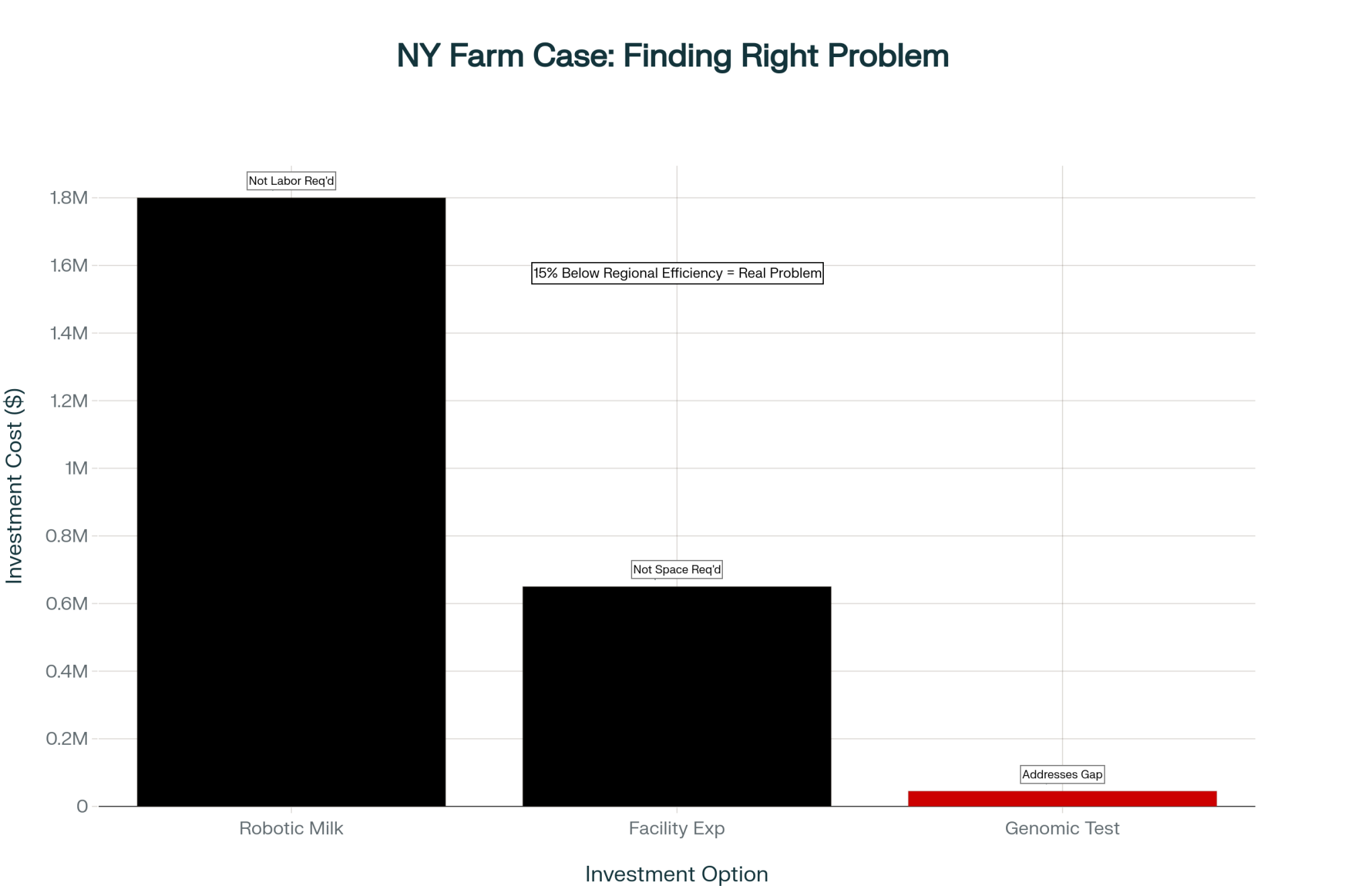
600-cow operation nearly dropped $1.8 million on robots before discovering their real constraint: genetic potential, not labor—a $1.755 million near-miss caught by two weeks of systematic preparation and stakeholder interviews.

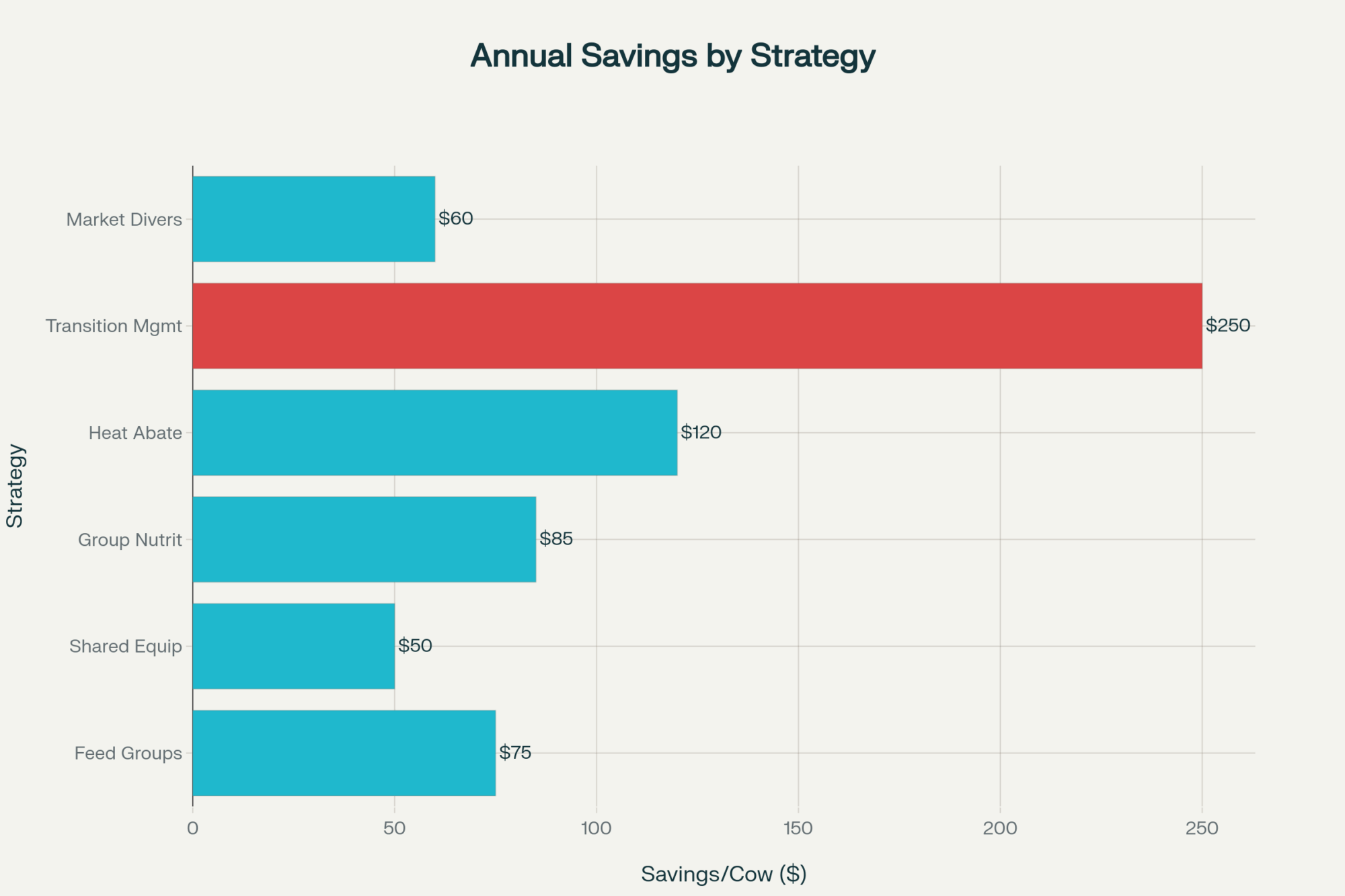
Now, we all know transition cows can make or break you. Cornell’s been doing some fascinating work on this, and their PRO-DAIRY program keeps showing how every little hiccup in that transition period just cascades through the whole lactation. This particular farm? They were losing about 3 pounds per cow across the entire herd because their fresh cow area was, honestly, a disaster.

Instead of that $380,000 parlor expansion, they put about $45,000 into fixing their transition facilities and tightening up protocols. Two months later, they were up 8 pounds per cow.

Do the math on that—it’s real money. And it came from asking different questions.
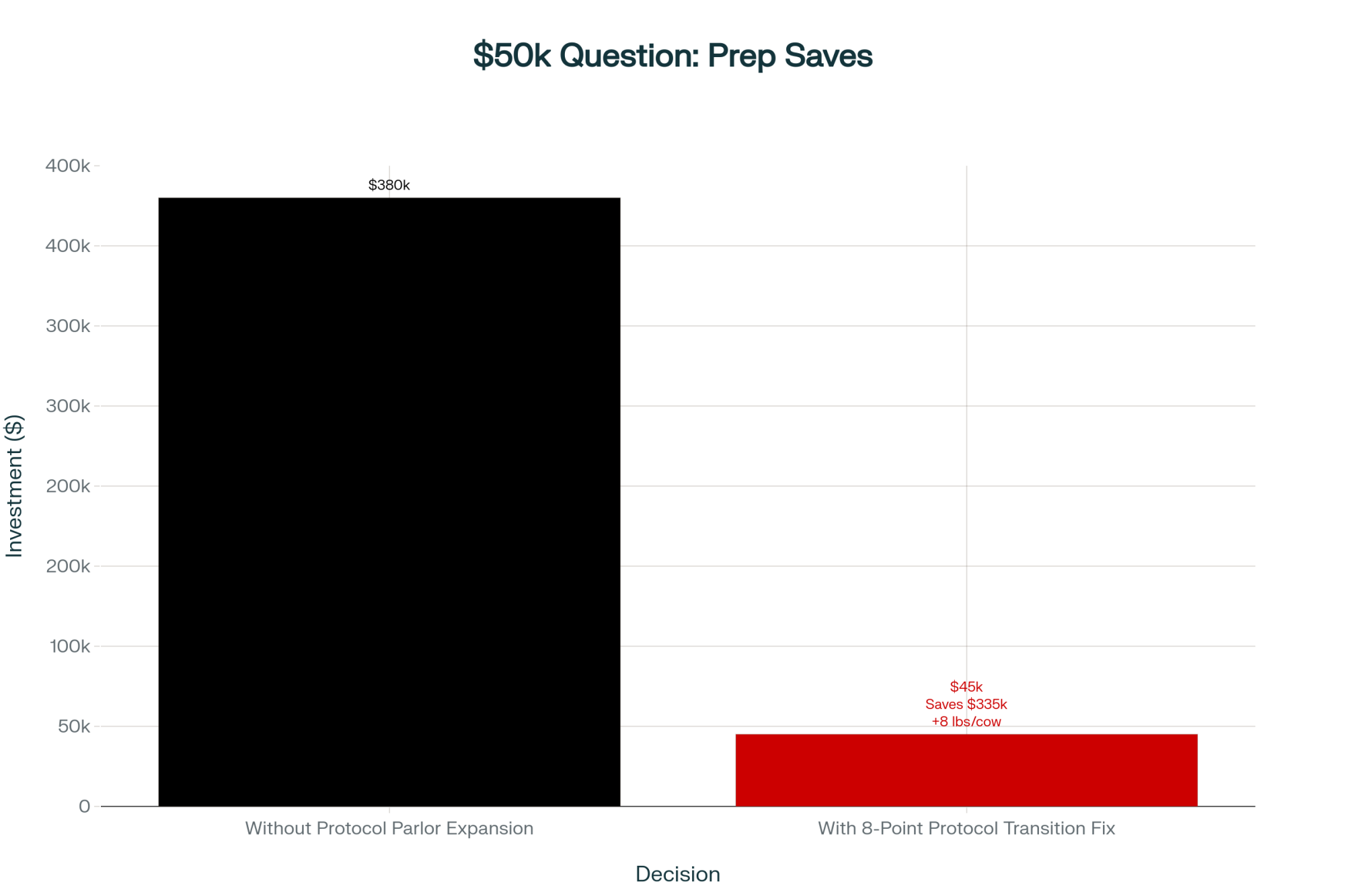
The stark reality: 12 hours of preparation prevented a $335,000 mistake and increased production by 8 pounds per cow—proof that the most valuable time on a dairy isn’t the visit itself, but the thinking before it.

Eight Things That Matter More Than You’d Think

After watching farms navigate good times and bad—from the 2014 milk price crash to today’s volatility—I’ve noticed there are about eight areas that really set the ones that thrive apart from those just trying to survive. What’s interesting is that none of these require a huge investment. They just require thinking a bit differently.

1. Who’s Really Driving This Decision?

This one’s subtle, but it matters more than you’d think. When a problem is raised during your dairy consulting visit or farm meeting, who raises it makes all the difference.

I’ve noticed that when employees bring stuff up, they’re usually seeing the daily friction—things that slow them down or make their jobs harder. When owners identify problems, they’re often looking at the bank statement. When your vet flags something, they’re seeing patterns they’ve noticed across multiple herds. Your nutritionist? They’re thinking about ration efficiency and feed costs.

Each perspective is valid. But incomplete. The magic happens when you get all these viewpoints in the same room—or better yet, in separate conversations where people feel safe being honest.

2. Your Herd Tells Stories You’re Not Reading

You probably know this already, but your herd structure is basically a crystal ball for the next two years.

Got a bulge in third-lactation cows? That’s telling you something about breeding decisions from way back that’ll affect you for years to come. Wisconsin’s extension folks have been talking about this forever—imbalanced herd demographics can quietly eat away at efficiency, and you won’t even notice until it’s too late.

Looking at research in the Journal of Dairy Science on herd dynamics, farms with balanced age distributions consistently outperform those with demographic bulges. It’s like having a slow leak in your tire. You don’t notice day to day, but suddenly you’re on the side of the road.

3. Yesterday’s Numbers, Tomorrow’s Reality

Here’s something we’ve all learned the hard way: today’s snapshot usually lies.

When you’re just looking at this month’s report, that “sudden” drop in components might actually be a gradual slide that finally got bad enough to catch your attention. The extension services have been preaching this for years—farms that look at a full year of data or more catch problems much earlier than those that just watch current reports.

The 2023-2024 Cornell Dairy Farm Business Summary really drives this home, showing that top-performing herds spend significantly more time analyzing historical patterns than average performers. Think about it like this… you wouldn’t judge your whole crop by looking at one plant, right?

4. Comfort Beats Genetics (Most of the Time)

Now, this might ruffle some feathers, but here it is: most production problems aren’t actually production problems. They’re comfort problems.


Comfort Factor
ImpactDollar Loss
Lying Time -2 hours-5+ lbs milk/day$300-$400
Poor Water Access-3 lbs milk/day$180-$240
Inadequate Bunk Space-4 lbs milk/day$240-$320
Heat Stress (unmanaged)-10+ lbs milk/day$600-$800
Stall Comfort Issues-5 lbs milk/day$300-$400
CUMULATIVE NEGLECTUp to -27 lbs/cow/day$1,620-$2,160/cow/year

Research from the University of Wisconsin’s Dairyland Initiative keeps confirming this—when cows spend less time lying down, even just a couple of hours less, they can drop 5 pounds of milk or more. At today’s prices, that’s real money walking out the door every single day. Water access, bunk space, how deep your stalls are bedded… these “little things” often drive more profit than any fancy genetic program or feed additive.

I mean, you can have the best genetics in the county, but if your cows aren’t comfortable, what’s the point?

5. Know Where You Really Stand Financially

Every farm exists in three financial worlds at once. There’s where you are right now (usually tighter than you’d like), where you’re headed (hopefully better), and what you can actually afford to change (often less than you think).

Cornell’s Dairy Profit Monitor has been tracking this stuff for years, and what’s fascinating is that the most profitable farms aren’t necessarily the big spenders. They’re the ones whose spending actually matches their financial reality. A farm digging out of debt needs completely different strategies than one setting up the next generation.

Hope isn’t a business strategy, as much as we’d all like it to be.

6. When Everyone’s Pulling in Different Directions

This is a tough one. When your milkers think success means getting done fast, your feeder thinks it means spotless bunks, and you think it means high butterfat… well, you’re basically running three different farms that happen to share an address.

Getting everyone rowing in the same direction—that’s worth more than any piece of equipment you could buy. And it’s something every dairy consultant will tell you matters more than almost anything else.

7. Your Failures Are Actually Gold

“We tried that already.”

How many times have you heard that? Or said it yourself? But here’s the thing—knowing why something failed three years ago might be exactly what you need to make it work today. Different people, different feed prices, different weather patterns… everything changes.

That disaster from 2022 might be 2025’s breakthrough. But only if you remember what actually went wrong.

8. Your Employees See Things You Never Will

This is huge, and it gets missed all the time. Your employees—especially the ones who’ve been around a while—they see patterns you don’t even know exist.

But here’s the catch: they won’t bring it up in a meeting. Too risky. Get them alone, though, maybe while you’re fixing something together, and suddenly you’re hearing about that water trough that’s been dry every afternoon since spring, or how the fresh cows always look stressed after the weekend crew.

That’s intelligence you can’t buy. And it’s exactly what smart dairy consultants tap into during farm visits.

Your Complete Pre-Decision Protocol: The 8-Point Checklist + Action Plan
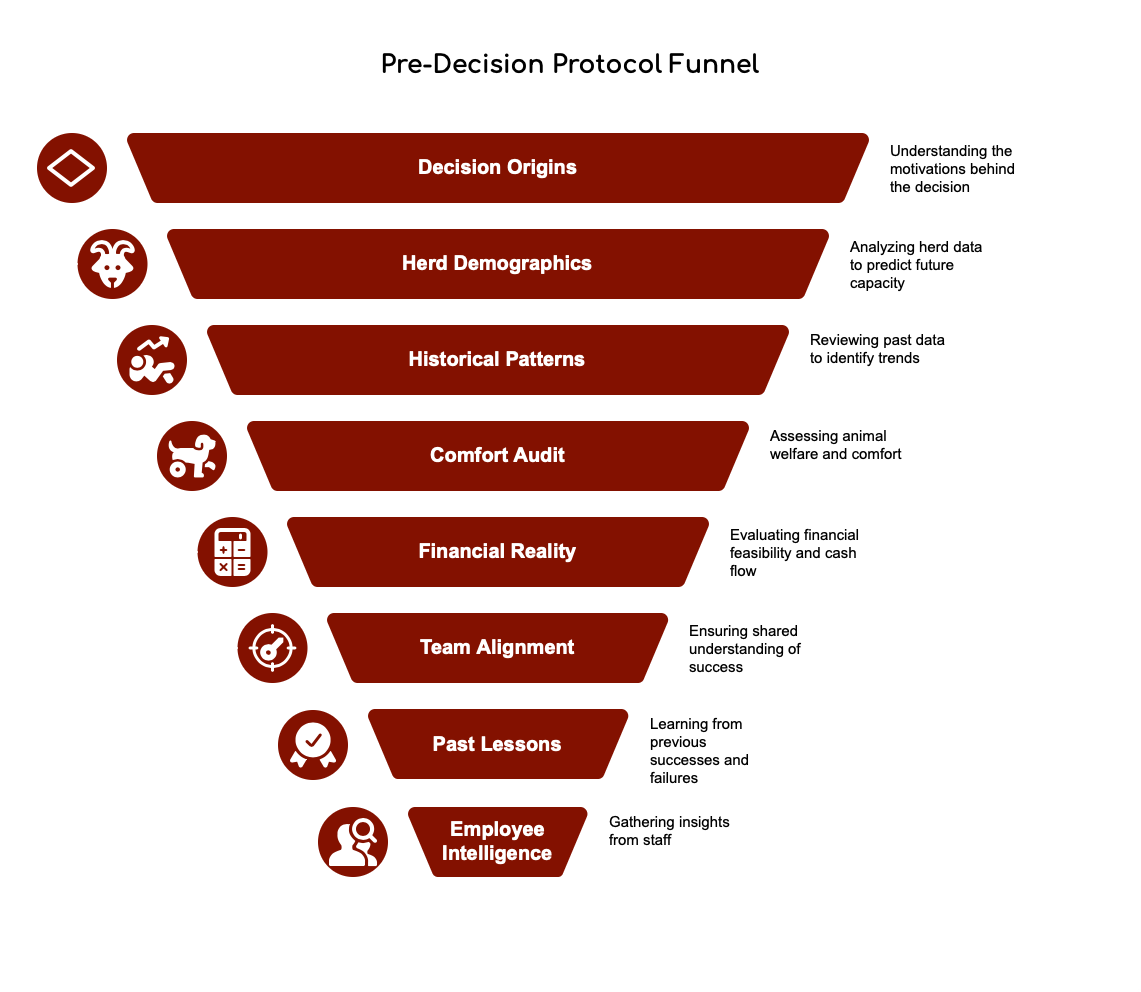
Want a printable version? Save this checklist for your next big decision.

Before any major decision or consulting engagement, here’s your roadmap:

☐ Decision Origins – Who identified this need, and what’s their real motivation?
Action: Ask each stakeholder privately why this matters now

☐ Herd Demographics – What’s your lactation distribution telling you about future capacity?
Action: Pull a current herd inventory report and map out your next 24 months

☐ Historical Patterns – Review 12-24 months of data, not just this month’s snapshot
Action: Block out 3-4 hours this week to analyze your long-term trends

☐ Comfort Audit – Check water access, bunk space, stall comfort before genetics or nutrition
Action: Spend an hour just watching cows—no agenda, just observe

☐ Financial Reality – Match investments to actual cash flow capacity over 24 months
Action: Run the numbers with your banker or financial advisor before committing

☐ Team Alignment – Ensure everyone defines “success” the same way
Action: Have one-on-one conversations with key employees this week

☐ Past Lessons – Document why previous attempts failed or succeeded
Action: Write down what you’ve tried before and why it didn’t work

☐ Employee Intelligence – Conduct private one-on-one conversations with key staff
Action: Schedule individual coffee breaks with your milkers and feeders

Total time investment: 12 hours over 2 weeks
Potential savings: $50,000-$200,000 in mistargeted investments
ROI on preparation: Often 100:1 or better

The Backwards Logic of Preparation

The economics of thinking first: a detailed breakdown showing exactly how 12 hours of preparation translates to preventing 50-100 wasted hours and $50K-$200K in mistargeted investments—the math that makes ‘slow down to speed up’ undeniable

What’s fascinating—and kind of backwards when you first think about it—is that the more time you spend preparing before a decision, the less time you waste fixing mistakes later.

Based on what I’ve seen work across dozens of farms and validated by dairy management research, a good pre-decision assessment might take:

  • Maybe 3-4 hours, really going through your records
  • Another few hours talking with your team (one-on-one, not in groups)
  • Some time just watching, with no agenda
  • An hour or two connecting all the dots

So let’s say 12 hours total. Those 12 hours routinely save months of going down the wrong path and tens of thousands of dollars in investments that miss the mark.

Trust Changes Everything

Here’s something I didn’t expect when I started paying attention to this stuff: preparation builds trust like nothing else.

When you come to a discussion already understanding the history, respecting what’s been tried, seeing the patterns… it changes the whole dynamic. People stop defending and start collaborating.

I’ve watched this shift happen over and over. That skeptical producer who crosses their arms when the consultant walks in? They lean forward when they realize someone’s done their homework. Employees who usually stay quiet? They start sharing ideas when they see you actually care about the details.

And this isn’t just feel-good management talk—it directly affects your bottom line. Farms where everyone trusts the process implement changes faster and actually stick with them.

Real Numbers from a Real Decision

Let me share something that really drove this home. There’s a 600-cow operation in central New York—good people, been at it for generations.

They were looking at three big options: robotic milkers (about $1.8 million all in), expanding facilities (roughly $650,000), or really ramping up their genetics program with genomic testing (around $45,000 per year).

Instead of just picking what felt right, they spent two weeks really digging in. Used the 2023-2024 Cornell Dairy Farm Business Summary benchmarking data, talked to everyone individually, and looked at their five-year patterns.

What they discovered caught everyone off guard. Their constraint wasn’t labor—so robots didn’t make sense. It wasn’t space—so expansion was unnecessary. It was genetic potential. They were running about 15% behind the regional average in efficiency, and that was costing them way more than they realized.

That genomic testing investment? According to research published in the Journal of Dairy Science on the ROI of genetic improvement, programs like this typically start paying for themselves within 2 years. But without that preparation, they might’ve dropped nearly $2 million on the wrong solution.

The Cost-Benefit Reality Check

Let’s put this in perspective with real dairy economics:

  • 12 hours of structured preparation = roughly $600 in time value
  • Average mistargeted investment prevented = $50,000-$200,000
  • Time saved on wrong implementations = 50-100 hours
  • ROI on preparation time = Often 100:1 or better

When you look at it like that, can you really afford NOT to prepare? Especially when dairy consulting rates run $150-$300 per hour, making that preparation invaluable?

The New Math of Dairy Success

The folks at Cornell who put together the 2023-2024 Dairy Farm Business Summary keep finding the same pattern: farms that spend time planning consistently outperform those making decisions on the fly. We’re not talking small differences either.

In Wisconsin, operations that are really focusing on systematic decision-making—taking time to think things through—they’re seeing notably better returns. Research from the University of Wisconsin-Madison’s Center for Dairy Profitability backs this up year after year. And when a couple of percentage points separate making it from losing it, that’s everything.

Looking at data from Texas to Pennsylvania, from Idaho to Florida, the pattern holds: preparation drives profitability more reliably than any single technology or management change.

The Bottom Line

As we push through 2025, with milk futures bouncing around and feed costs doing their thing, there’s less room for expensive mistakes than ever.

But here’s what gives me hope: the dairies that’ll thrive won’t necessarily be the ones with the biggest checkbooks or the fanciest technology. They’ll be the ones that master the simple discipline of thinking before doing. Of turning information into understanding, understanding into decisions, and decisions into profit.

The approach is proven. The patterns are clear. The protocol is right there in that 8-point checklist. The only question is whether you’ll invest those 12 hours of thinking to avoid a much more expensive education.

Because in today’s dairy world, being unprepared isn’t just costly—it’s dangerous.

What This All Means for Your Dairy Operation:

  • That 12 hours of thinking before a big decision? It routinely saves months of mistakes and thousands in misplaced investments
  • Transition cow management is often where the real money is—fixing it usually costs way less than expanding while delivering faster returns
  • Your employees know things you need to know—but they’ll only tell you one-on-one, away from the group
  • Looking at 18-24 months of data reveals patterns that this month’s snapshot completely hides
  • The most profitable dairies aren’t the biggest spenders—they’re the ones whose investments actually match their financial reality
  • Smart dairy consulting starts with preparation—the best consultants spend hours reviewing data before they ever step on your farm

Executive Summary:

The difference between a $45,000 fix and a $380,000 mistake? About 12 hours of asking the right questions. That’s what one Midwest dairy discovered when they ran through an 8-point checklist before signing that parlor expansion contract—turns out their real problem was transition cows, not milking capacity. This pre-decision framework, backed by Cornell’s latest research and proven across operations from 100-cow tie-stalls to 5,000-head dry lots, transforms how farms approach big decisions. The protocol covers eight critical areas: from reading your herd’s demographic story to those coffee-break conversations with employees who see problems you’ll never notice. Real-world results show that farms using this approach save $50,000-$200,000 per major decision, with returns often exceeding 100:1 on the time spent preparing. In today’s dairy economy, it’s not about having all the answers—it’s about asking all the right questions first.

Based on extensive work with dairy operations across North America and insights gathered from Cornell PRO-DAIRY programs, the 2023-2024 Cornell Dairy Farm Business Summary, Wisconsin Extension resources, University of Wisconsin-Madison Center for Dairy Profitability research, and the shared experiences of hundreds of dairy producers from 2023-2025.

Learn More:

Join the Revolution!

Join over 30,000 successful dairy professionals who rely on Bullvine Weekly for their competitive edge. Delivered directly to your inbox each week, our exclusive industry insights help you make smarter decisions while saving precious hours every week. Never miss critical updates on milk production trends, breakthrough technologies, and profit-boosting strategies that top producers are already implementing. Subscribe now to transform your dairy operation’s efficiency and profitability—your future success is just one click away.

NewsSubscribe
First
Last
Consent

Forget Keeping Barns Warm: Why Winter’s Your Most Profitable Season

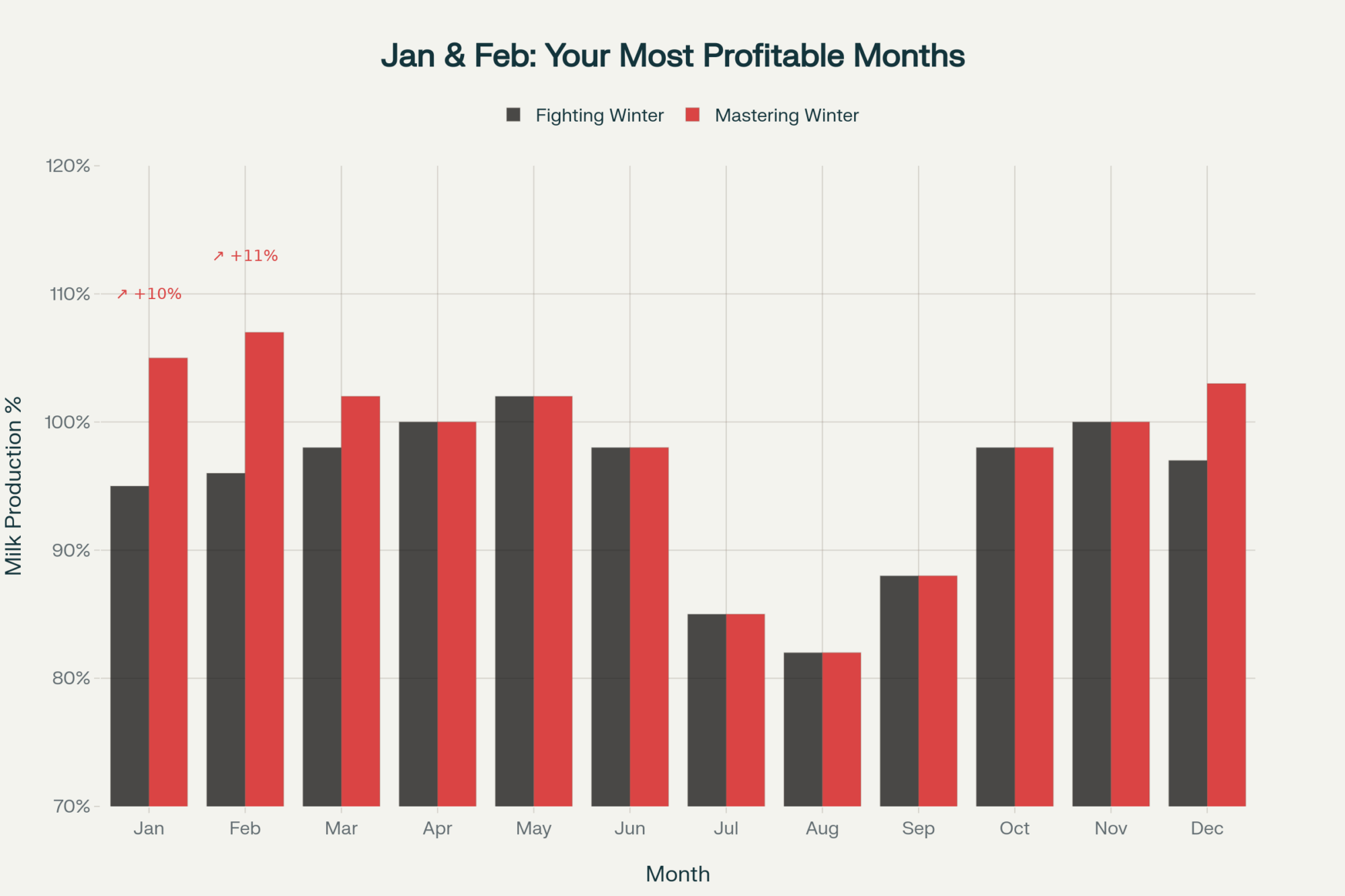
Forget keeping barns warm – smart dairies use winter’s cold for 5-10% better feed efficiency 

EXECUTIVE SUMMARY: What farmers are discovering through hard-won experience and university research is that winter barn management has been backwards for decades – it’s moisture, not temperature, that drives production losses and respiratory issues. Cornell’s veterinary economics studies show respiratory treatments alone cost $50-100 per case, but when you factor in the hidden costs of poor ventilation – including 2-3% drops in feed efficiency and 20-30% increases in bedding expenses – a typical 100-cow operation can lose $15,000 per winter season. Recent findings from Michigan State, Penn State, and Wisconsin extension programs confirm that cattle thrive in cold conditions when kept dry, with many operations reporting their highest butterfat levels (0.2-0.3% increases) and best quality premiums during January and February. The shift in thinking is simple but profound: your mature Holstein generates enough heat through rumen fermentation to stay comfortable at 30°F in dry conditions, but struggles at 45°F with high humidity. Here’s what this means for your operation – those three critical maintenance tasks you can complete in an afternoon (checking fan belts, testing inlet controls, establishing humidity baselines) could transform winter from your most challenging season into your most profitable. Smart operators aren’t installing expensive heating systems; they’re spending $30 on humidity monitors and an hour adjusting curtain cables, then watching their milk checks improve while neighbors fight the same battles they’ve always fought.

Every fall, we face the same concern: keeping our barns warm for winter. But here’s the thing – what if temperature isn’t really the issue?

I’ve been talking with extension folks and examining what successful operations are doing, and a clear pattern is emerging. The dairies with the strongest winter production aren’t necessarily running the warmest barns. In fact, they’re often the ones who’ve completely rethought their approach, focusing on moisture control over temperature management. And the results? Some are seeing their best milk checks in January and February.

Smart winter barn management saves $14,400 per 100-cow operation compared to traditional approaches that fight cold instead of managing moisture.

Your Cows Were Built for Cold – It’s the Conventional Thinking That’s Wrong

A mature Holstein generates a tremendous amount of body heat just through normal digestion and rumen fermentation – we’re talking serious BTUs here. You probably know this already, but cattle handle cold remarkably well when they’re dry and out of drafts. The old Midwest Plan Service guides, which many of us still reference, have been saying this for decades, and Michigan State’s latest winter housing bulletins confirm that it still holds true.

What’s interesting is how differently this plays out across regions. I know a 300-cow operation in northern Wisconsin that maintains solid production at temperatures that would have their counterparts in Georgia calling the vet. Meanwhile, some Northeast producers struggle more with winter ventilation despite having milder temperatures overall.

Why’s that? In many cases, it comes down to effective humidity management. The moisture in your barn – not the cold – tends to be what causes most winter headaches. And here’s where it gets expensive…

The Hidden Economics Nobody Talks About

Poor winter ventilation often costs more than just treating respiratory issues – though, according to Cornell’s veterinary economic studies, those alone can run $50-$ 100 per case.

When humidity climbs in your barn, you typically get condensation. That moisture creates ideal conditions for bacteria to grow. Maybe your cows don’t become sick enough to need treatment, but their feed efficiency may drop by 2-3%. On a 100-cow dairy feeding $8-10 per cow per day, that seemingly small percentage adds up to thousands over a winter. Equipment tends to corrode faster. Bedding stays damp longer, increasing your bedding costs by 20-30% in some cases.

I spoke with a producer last month who discovered that his poor ventilation was costing him nearly $15,000 a winter when he added everything up. “I was so focused on keeping the barn warm,” he told me, “I didn’t realize I was basically burning money.”

Understanding the Temperature Transition Point

Temperature-specific ventilation rates reveal the critical shift from moisture control to heat management – the key insight most operations miss when temperatures drop below 45°F.

Based on what ventilation engineers and extension specialists from Penn State and Wisconsin have documented, there’s typically a temperature range – often somewhere between freezing and 45 degrees Fahrenheit – where the physics of air movement in your barn fundamentally changes.

Above that range, natural ventilation usually works pretty well. You get decent wind-driven airflow, and temperature differences help move air naturally. But once you drop below that range, thermal buoyancy becomes your primary driver, and if you’re not ready for that shift…

The general guidelines that seem to work for many operations:

  • Above 45°F: Your summer ventilation approach typically works
  • 35-45°F: Reduce total airflow but maintain moisture removal
  • Below freezing: Focus on minimum ventilation rates – just enough to control moisture
  • Below 20°F: Every excess CFM is costing you valuable heat

Of course, every barn’s different. Your neighbor’s setup might need completely different adjustments.

Three Things That Actually Matter (And One That Doesn’t)

Look, everyone’s got their own system, but from what I’ve seen work consistently well – and what extension educators keep emphasizing – there are really three main areas that tend to matter before winter hits.

Getting Your Fans to Actually Work

This sounds basic, I know. But, according to agricultural engineering studies from Iowa State, fans that aren’t properly maintained can lose 30-40% of their efficiency due to loose belts and dirty blades.

Check your belt tension – many manufacturers suggest about a half-inch of play when you press on them. Takes maybe an hour to go through all your fans if you’re organized. And while you’re at it, clean those blades. I’ve seen operations improve their airflow by 25% simply by cleaning – no new equipment is needed.

Making Sure You Can Control Your Inlets

Whether you’ve got curtains, panels, or another setup, they need to work smoothly through their full range. I’ve heard too many December disaster stories about controllers failing or curtains freezing halfway.

Before it gets cold, run everything through its paces. A 200-cow dairy I work with in Vermont figured out three of their actuators were barely functioning during their October check. Fixed them for $300. If they’d waited until December? Could’ve been looking at thousands in emergency repairs and lost production.

Here’s another success story: A producer near Ithaca told me he spent a Saturday morning going through every curtain controller and actuator. Found two that were sluggish, one cable fraying, and a controller that wasn’t reading temps correctly. The total fix cost him about $450 and took four hours. “Best money I spent all year,” he said. “Previous winter I lost $8,000 in one week when a curtain froze open during a blizzard.”

Knowing Your Normal (And Actually Tracking It)

This might sound too simple, but it’s often the difference between catching problems early and dealing with disasters. Your local extension office likely has simple humidity monitors available for under $30 – some newer models, such as those from companies like SensorPush or Govee, even connect directly to your smartphone.

What’s the humidity like when things are working well? Most operations perform best with winter humidity levels between 50-70%, according to University of Minnesota Extension guidelines. Where do you first notice condensation? How do your cows behave differently? Some producers keep notes, others use apps. Either way works.

What Doesn’t Matter? Keeping It “Warm Enough”

Here’s the controversial bit: that obsession with keeping barns warm? It’s probably costing you money. Your cows’ thermoneutral zone ranges from about 25°F to 65°F. They’re more comfortable at 30°F and dry than at 45°F and damp.

The Warm Spell Trap

Here’s something we see every winter across the Midwest and Northeast. You experience the January or February warm spell, where temperatures jump 30-40 degrees for a few days. Suddenly, it’s 45 degrees, ice is melting, and everyone relaxes.

But materials expand at different rates. Ice melts in unexpected patterns. Your ventilation settings are all wrong. Then, temperatures crash back down, and you have moisture frozen in new places. I’ve seen this cause thousands of dollars in damage – including ice dams in ventilation systems, frozen curtains, and failed equipment.

The key? Stay vigilant during warm spells. That’s actually when most winter damage occurs, not during the steady cold. Check out the barn structure damage photos on Penn State’s extension site if you want to see what I’m talking about – it’s eye-opening.

Regional Approaches That Actually Work

RegionChallengeCFM RangeSolutionSuccess Metric
Upper MidwestExtreme cold/dry air15-50Heat recovery ventilatorsEnergy savings
NortheastHigh humidity year-round20-30% above standardEnhanced moisture removalMoisture control
Western (ID/WA)Daily temp swingsVariable based on timeAutomated systemsQuick adjust
CA CentralTule fog 90%+ humidityPositive pressureHybrid approachesFog mitigation

Upper Midwest operations generally deal with extreme cold but dry air. The challenge is maintaining sufficient ventilation (often 15-50 CFM per cow, according to the Wisconsin Extension) without losing heat. Some folks are having good luck with newer heat recovery ventilators – although at $5,000 to $ 10,000 installed, the economics need to be penciled out.

Northeast dairies face higher humidity year-round. Cornell’s PRO-DAIRY program finds they often need 20-30% more ventilation than Midwest recommendations. It’s all about moisture removal, even if it costs some heat.

Western operations in Idaho and Eastern Washington see massive daily temperature swings. Washington State University extension reports that automated systems that can adjust quickly are almost essential there.

California’s Central Valley experiences tule fog, which can maintain humidity levels above 90% for days. UC Davis research shows many have switched to positive pressure or hybrid systems to maintain air quality regardless of outside conditions.

Small Changes, Big Payoffs

Simple fall maintenance delivers 4,606% ROI by preventing expensive winter emergencies and production losses – the kind of return that makes CFOs pay attention to barn management.

What’s encouraging is that dramatic improvements don’t require huge investments. A modest increase in minimum ventilation – maybe from 15 to 25 CFM per cow – often solves moisture problems without causing temperature issues.

Ensuring curtains open evenly can significantly transform airflow patterns. One Illinois producer told me his condensation problems disappeared after spending two hours adjusting curtain cables for even operation. Cost? His time and maybe $20 in hardware.

And here’s something new: several producers are using those $50-100 wireless humidity sensors that alert your phone when conditions get problematic. Pays for itself if it prevents even one respiratory case. The University of Wisconsin offers a great online ventilation calculator that helps you determine your ideal CFM rates – worth checking out. You can also find visual guides for proper belt tension and inlet adjustment patterns on most extension websites now.

Making Winter Your Competitive Advantage

Winter becomes your most profitable season when proper ventilation management eliminates heat stress and optimizes cow comfort during cold months – the 180-degree mindset shift that separates leaders from followers.

Many operations actually experience their best production in January and February, when heat stress is alleviated. Your cows are built for cold weather – that rumen is essentially a 100-gallon fermentation heater running 24/7.

A well-managed winter barn often sees 5-10% better feed efficiency than summer, higher butterfat (often 0.2-0.3% higher), and lower SCC. Some people report that their best milk quality premiums come in the winter months.

The fundamentals haven’t changed, but our understanding has. Focus on moisture, not temperature. Maintain equipment properly. Stay flexible as conditions change. Your local extension service has resources tailored to your region – use them.

Your Action Plan Starting Now

So where does this leave you? Here’s what actually needs doing:

This week: Check every fan belt and clean blades. Test all inlet controls. Order spare belts now – suppliers are expected to run out by December.

Before first freeze: Know your baseline humidity. Set up monitoring (even just a simple thermometer/hygrometer). Have your warm spell protocol ready.

All winter: Adjust based on conditions, not the calendar. Watch for that warm spell trap. Keep checking those belts – thermal cycling loosens them.

Winter’s coming whether we’re ready or not. But with the right approach – challenging that “keep it warm” mentality and focusing on what actually matters – it can be your most profitable season.

Where are you at with prep? Still thinking about it, or already getting things dialed in? Either way, there’s time to make those small adjustments that can mean the difference between fighting winter and profiting from it. Your cows are ready. Question is, are you?

KEY TAKEAWAYS

  • Winter production gains are real and achievable: Operations maintaining 50-70% humidity (not temperature) report 5-10% better feed efficiency, 0.2-0.3% higher butterfat, and lower SCC – turning January and February into their most profitable months instead of their most expensive
  • The $300 fix beats the $15,000 loss: Simple October maintenance – checking belt tension (half-inch deflection), cleaning fan blades (25% airflow improvement), and testing inlet controls – prevents the cascade of winter problems that cost thousands in treatments, lost production, and emergency repairs
  • Regional adaptations matter but principles don’t change: Whether you’re dealing with Minnesota’s dry cold (15-50 CFM per cow minimum), Northeast humidity (20-30% more ventilation needed), or California’s tule fog (90%+ humidity for days), the focus stays on moisture removal, not heat retention
  • Technology helps but basics still win: While $50-100 wireless humidity sensors and smartphone apps add convenience, the fundamentals – knowing your barn’s normal humidity baseline, adjusting for warm spell traps, maintaining consistent airflow – determine whether you profit from winter or fight it
  • Your cows are telling you what they need: That 100-gallon rumen fermentation system makes them comfortable at 25-65°F when dry, so stop burning money trying to keep barns warm at 45°F while moisture creates the perfect storm for respiratory issues, equipment corrosion, and production losses

Complete references and supporting documentation are available upon request by contacting the editorial team at editor@thebullvine.com.

Learn More:

Join the Revolution!

Join over 30,000 successful dairy professionals who rely on Bullvine Weekly for their competitive edge. Delivered directly to your inbox each week, our exclusive industry insights help you make smarter decisions while saving precious hours every week. Never miss critical updates on milk production trends, breakthrough technologies, and profit-boosting strategies that top producers are already implementing. Subscribe now to transform your dairy operation’s efficiency and profitability—your future success is just one click away.

NewsSubscribe
First
Last
Consent

Pick Your Lane or Perish: The 18-Month Ultimatum Facing 800-1,500 Cow Dairies

October’s $2.47 Class spread proved it: mid-size dairies must choose between commodity and premium now. The middle is gone.

Executive Summary: October 2025’s market data delivered a death sentence to fence-sitters: mid-size dairies (800-1,500 cows) must choose between commodity and premium pricing within 18 months, or risk ceasing to exist. The Class III-IV spread now penalizes operations that haven’t optimized for either protein or butterfat, while global markets are permanently split between simple ingredients (winning) and value-added products (losing). Small farms with fewer than 500 cows survive through premium specialization, while operations with more than 3,000 cows thrive on commodity efficiency. But the middle ground—profitable for three generations—is gone forever. Irish farmers are betting their futures on 2027’s regulatory consolidation. Chinese buyers are only interested in specialty proteins, and industrial customers will pay premiums for consistency over brand. You have 18-24 months to pick your lane: scale up, specialize, or sell out.

Dairy Strategic Planning

Here’s the thing that’s been keeping me up at night—and probably you, too, if you’re running 800 to 1,500 cows. The dairy market’s doing something we haven’t seen before. There’s this growing gap between New Zealand and European dairy prices that should close through normal trading, but it just… won’t. The October GDT auctions show Western European whole milk powder trading at significant premiums compared to New Zealand product for near-term contracts. This structural gap, seen across multiple products, confirms that the market bifurcation is deepening.

But you know what’s really caught my attention?

The gap isn’t just global anymore—it’s right here in our milk checks. October CME data shows a widening spread between Class III and Class IV futures that’s crushing operations heavy on butterfat. With butter prices facing significant pressure while cheese prices hold relatively steady, the Class IV value is reaching levels we haven’t seen in years. This component value crisis is the clearest signal yet that the old rules are broken.

The $2.47 Spread That’s Killing the Middle: October’s Class III/IV gap represents the widest since 2011, costing Jersey operations $180K annually

What farmers are finding is that the comfortable middle ground—where most of us have operated successfully for decades—is vanishing faster than morning fog in July. And if you’re still making decisions based on what worked even two years ago, well, we need to talk.

The Value Paradox Nobody Saw Coming

Operation TypeButterfat %Protein %Class PrefRevenue Impact ($/cwt)Annual Impact (1000 cows)
BF-Focused (Jersey-Heavy)4.8%3.6%Class IV−$2.47−$180k
Protein-Focused (Holstein)3.6%3.2%Class III$0.00$0
Balanced Components (Holstein)4.1%3.4%Mixed−$1.20−$87k

Looking at September 2025 market reports from the EU Milk Market Observatory, something curious jumps out. European butter—you know, the premium stuff that’s supposed to command top dollar—has been taking a beating. Meanwhile, AMF (anhydrous milk fat), which is essentially melted and clarified butter, appears to be holding up better. Recent Global Dairy Trade data suggests AMF is actually outperforming butter in percentage terms. The simple, non-branded ingredient is holding value better than its consumer-facing counterpart. This is the Value Paradox playing out in real-time, right down to the component level.

Now, why would the simple product outperform the sophisticated one?

I was talking with a Wisconsin dairy producer last week who runs a larger operation in the central part of the state. He’d invested heavily in specialty cheese equipment a few years back, thinking he’d capture those artisan premiums. “Know what’s paying the bills now?” he asked me. “Straight cream to the bakery suppliers. No fancy packaging, no marketing story, just consistent butterfat at 40% minimum.”

Here’s the surprising part—whey powder, the stuff we literally paid to get rid of twenty years ago, now commands respectable prices in the protein market. Yet those beautiful aged cheddars that take skill, time, and capital to produce? They’re facing intense price pressure from all sides.

What’s encouraging, though, is that this shift creates opportunities for those who recognize it early. It’s making me rethink everything we thought we knew about value creation in the dairy industry.

Why Irish Farmers Are Expanding into a Glut

The production numbers coming out of Ireland lately seem counterintuitive. Recent data from their Central Statistics Office shows milk output climbing steadily through the summer months. Belgium’s showing similar patterns according to their agricultural statistics. All this while European butter inventories are already substantial. Industry reports from late summer suggest oversupply conditions in the European market, with stockpiles building to levels not seen since the intervention buying days.

You’d think these folks have lost their minds. But there’s a method to this apparent madness.

Ireland’s nitrate derogation—the rule that allows them to run higher stocking rates than standard EU regulations permit—expires at the end of this year. When that happens, industry observers from Teagasc estimate that significant production capacity could disappear. Some projections suggest up to 20% of current output might be affected. Belgium faces similar pressures from the EU’s Farm to Fork strategy, though their timeline stretches out a bit further.

So these farmers are expanding now? They’re not playing for today’s prices. They’re positioning for 2027 and beyond, when half their neighbors might be out of business.

A dairy farmer I met at a conference last spring—runs a mid-size operation in County Cork—put it this way: “We’re not thinking about next year’s milk check. We’re thinking about who’s still standing in five years and what market share they’ll control.”

It’s a high-stakes bet on regulatory-driven consolidation. Risky? Absolutely. But, when you understand the regulatory chess game being played, it starts to make strategic sense.

The Chinese Market That Defies Logic

This is where things get genuinely puzzling, especially if you’re used to thinking about dairy as a straightforward commodity.

Recent reports from China’s agricultural authorities indicate that domestic farmgate prices remain under pressure, generally declining year over year, depending on the province. They have adequate production capacity, according to their own data. Traditional economics suggests that imports should be declining.

Instead? Recent customs data suggests import volumes are holding steady or even growing for certain categories. The unexpected piece is the shift in what they’re buying. While whole milk powder imports have moderated, specialty ingredients, such as whey products, appear to be growing. This shift from buying bulk commodities to high-value protein ingredients reinforces the idea that their purchasing is becoming highly selective, focused on functional and premium status, not basic commodity volume.

What’s happening here—and this pattern is also showing up in India, Vietnam, and Indonesia, according to recent observations from the USDA Foreign Agricultural Service—is that consumers in these markets don’t view domestic and imported dairy as the same thing. It’s no longer about measurable quality differences. We’re talking about perception, trust, and increasingly, social status.

An industry contact who works with Asian markets explained it to me this way: “Customers there aren’t comparing prices between domestic and imported milk. To them, it’s like comparing a Corolla to a Lexus. Both get you where you’re going, but they serve completely different needs.”

We’re starting to see this same split here in mature markets. Look at what organic commands—often substantial premiums according to USDA Agricultural Marketing Service data, despite conventional milk meeting all the same safety and nutritional standards. Or A2 milk, grass-fed brands, local farm labels. The bifurcation’s happening everywhere.

Industrial Buyers Play a Different Game

What catches my attention in all this market analysis is how differently industrial buyers behave compared to grocery chains.

When Kroger or Walmart needs butter, they typically put it out to bid quarterly and accept the lowest price that meets the specifications. Simple transaction, price drives everything.

But when a commercial bakery needs AMF for their croissant line? Completely different conversation. Their ovens are calibrated for specific melt points. Their recipes assume consistent moisture content—we’re talking plus or minus half a percent. Switching suppliers means reformulation, line testing, and potential product recalls if something’s off.

Industry procurement specialists I’ve talked with say they’ll routinely pay meaningful premiums just for supply security. One mentioned that every supplier switch costs them tens of thousands of dollars in testing and adjustments, sometimes more if the equipment needs recalibration. So yeah, they’ll pay extra for consistency.

This creates real opportunities for producers who can reliably meet industrial specifications. It’s not glamorous work—nobody’s writing magazine articles about your commodity ingredient sales. But, these contracts often offer better margins and more stability than chasing consumer trends.

Hard Lessons from the Big Cooperatives

Want to understand why those regional price advantages everyone talks about aren’t as permanent as they seem? Take a look at what has been happening with major cooperatives over the past eighteen months.

Even the big players—organizations with decades of export experience, established supply chains, unified farmer bases—have been announcing restructuring plans. Cost cutting initiatives. Plant consolidations. Some are even outsourcing core functions they’ve handled internally for generations.

What happened? Simple—they built cost structures around market conditions they assumed were permanent. Those nice premiums they were capturing a couple of years ago? Turned out to be temporary benefits resulting from supply chain disruptions and unusual demand patterns. When global shipping rates normalized and consumption patterns shifted back, the premiums vanished almost overnight.

A board member from a regional cooperative shared this perspective with me recently: “We all got a little too comfortable with those margins. Built our strategic plans around them. What we’re learning—again—is that very few advantages in commodity markets last more than a cycle or two.”

The Reality Check for Different Size Operations

Let me share what recent economic analyses from various land grant universities are telling us about profitability by herd size. The patterns are striking and, frankly, a bit concerning for those of us in the middle.

Smaller operations—let’s say under 500 cows—often achieve higher mailbox prices than the big guys. We’re talking sometimes a dollar fifty to two dollars more per hundredweight through direct marketing, on-farm processing, specialty programs. Sounds great, right?

But here’s the catch—their cost of production typically runs several dollars higher per hundredweight, too, according to extension studies. So that premium price? It’s often not enough to offset the higher costs. Many of these smaller operations are working incredibly hard just to break even.

On the flip side, operations over 3,000 cows generally receive lower prices—maybe fifty cents to a dollar below the smaller farms. But their cost structure? They’re often producing for significantly less per hundredweight than mid-size operations. Volume multiplied by even small margins adds up.

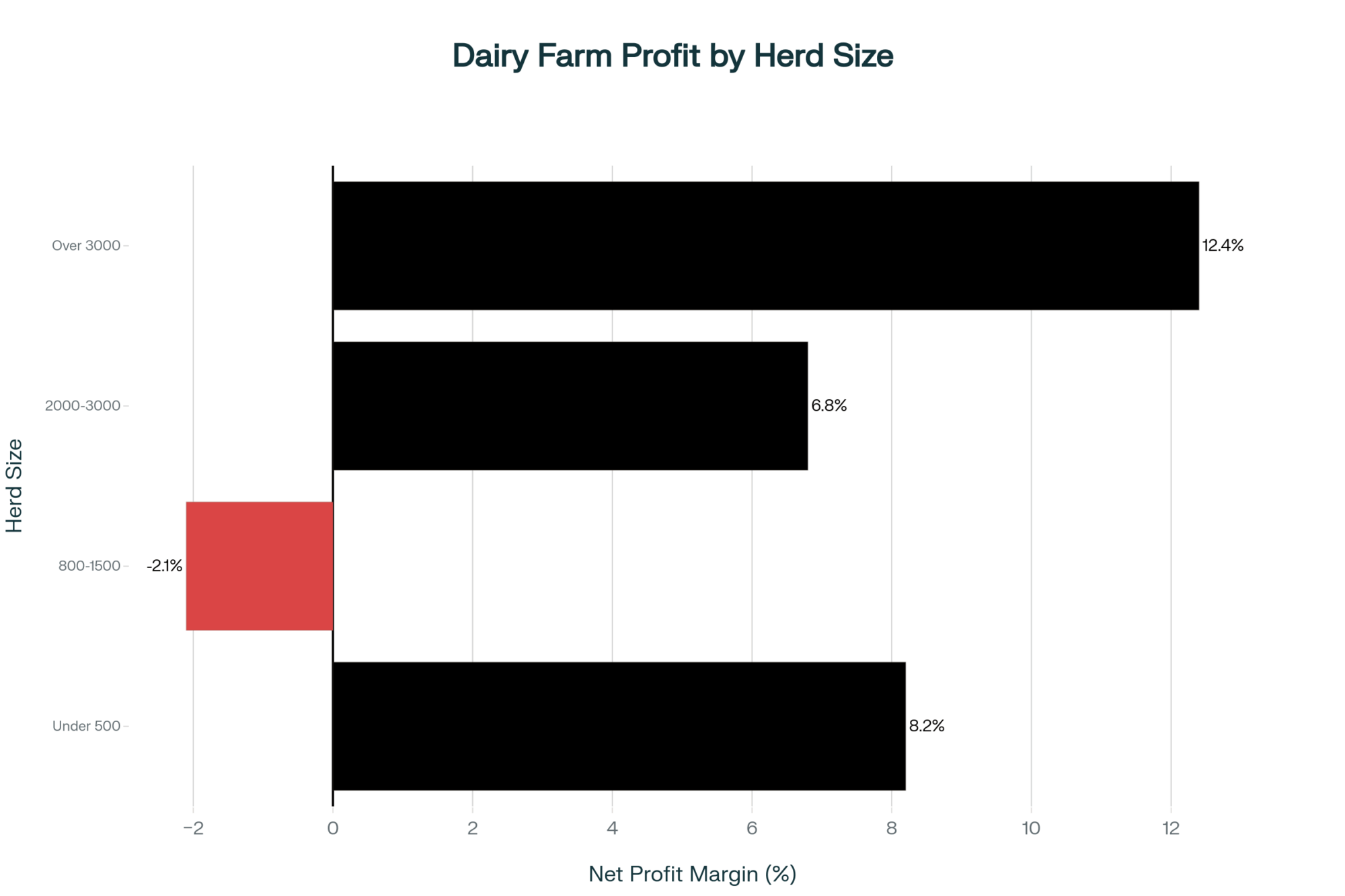
The really tough spot? That 800 to 1,500 cow range. Not big enough to capture serious economies of scale. Not small enough to be nimble with specialty markets. These operations are either expanding aggressively right now or transitioning to some form of differentiated production. Standing still is no longer viable.

The Death Zone Exposed: Mid-size dairies trapped between specialty premiums and commodity efficiency are bleeding money at -2.1% margins

Here’s what I’ve noticed about how different regions are handling this—and it’s telling. In California’s Central Valley, where water rights and environmental regulations create unique pressures, several mid-size operations have formed marketing cooperatives to achieve scale without individual expansion. Northeast producers, located near major population centers, are exploring the benefits of shared processing facilities and distribution networks. Down in Texas and New Mexico, where expansion’s still possible, they’re going big—really big—with new facilities starting at a minimum of 5,000 head. And in the Southeast? They’re dealing with heat stress and hurricane risks that add another layer to these strategic decisions. Each region’s finding its own path through this transition.

Choosing Your Lane (Because You Have To)

After watching hundreds of operations navigate these changes, it’s becoming increasingly clear: you must pick a strategy and commit to it fully. The days of hedging your bets, of being pretty good at everything? Those days are over.

If you’re going the commodity route, several factors become absolutely critical. First, you need scale—probably a minimum of 2,000 cows in the Midwest, based on recent farm management analyses, and more like 3,500 in the West, where you’re competing with those massive operations. Second, you need industrial customers who value consistency over brand. Third, you must accept that you’re selling ingredients, not food, and optimize your approach accordingly.

If you’re choosing the differentiated path, different rules apply. You need a story that resonates—organic certification, grass-fed verification, local processing, something authentic that consumers will pay for. You need direct relationships or processors who value what makes you different. You have to accept higher costs, likely several dollars more per hundredweight, based on various enterprise budgets, in exchange for capturing those premiums.

Are the operations struggling the most? Those trying to do both. I am aware of a Pennsylvania dairy that has installed robots to reduce labor costs, yet it still sells commodity milk. Their debt service alone is crushing them. Another farm in Vermont has built a beautiful processing facility, but cannot achieve enough consistent volume to run it efficiently.

And here’s something worth considering—how does your chosen path affect succession planning? If you’re hoping the next generation takes over, which strategy gives them the best shot at success? The commodity route requires constant reinvestment and scale. The premium path needs marketing savvy and customer relationships. Neither’s wrong, but they require different skills and interests from whoever’s taking the reins.

Practical Decisions for Today’s Reality

So what does this mean for your operation over the next few years?

For smaller dairies with fewer than 500 cows, specialization appears to be the key. Pick something you can be genuinely excellent at. Perhaps it’s organic production, perhaps it’s A2 genetics, or perhaps it’s on-farm bottling with local distribution. But competing head-to-head with large commodity operations? The math rarely works.

For larger operations over 2,000 cows, it’s about operational excellence and simplification. Strip out complexity, focus on one or two products at most, and secure those industrial contracts. The 3,000-cow dairy selling everything to a single cheese plant at predetermined prices might not be exciting, but they’re sleeping well at night.

And if you’re in that challenging middle zone—800 to 1,500 cows? You’re facing the toughest decisions. Based on what extension economists are seeing, you’ve probably got 18-24 months to make a strategic choice. Scale up significantly, find a genuine differentiation strategy, or… well, we all know what the third option looks like.

Here’s what’s worth tracking closely in your own operation:

  • What’s your actual premium above base price? Many folks are surprised by how small it really is
  • What percentage of your milk is under contract versus sold on the spot market? Aim for at least 70% contracted
  • Where do your costs rank compared to others in your region? You need to be in the better half
  • Could your operation survive a 15% price drop for six months? If not, you’re probably over-leveraged for this environment
  • Are you optimized for protein or fat? Recent market shifts show component strategy is no longer optional—it’s essential for survival

Examining government programs reveals some resources worth exploring. USDA’s Value-Added Producer Grants can help with the transition to specialty markets. Environmental Quality Incentives Program funding may offset some of the costs of organic transition. State-level programs vary widely—Minnesota, Wisconsin, and Vermont all offer different types of support for dairy operations making strategic transitions.

The Transition Nobody Talks About

What often gets overlooked in these strategic discussions is the cost and complexity of transitioning from one model to another.

Going organic? That’s a three-year transition period during which you’re paying organic feed prices but receiving conventional milk prices. Extension studies suggest that transition costs can run into the hundreds of dollars per cow, plus you need secured market access before you start.

Scaling up to commodity efficiency? We’re talking millions in capital investment for meaningful expansion based on recent construction trends, and that’s if you can find the labor. Speaking of labor—good luck finding qualified people right now. Everyone’s struggling with that.

Even switching to industrial supply contracts requires investment. Those customers want consistency, which might mean new bulk tanks, different cooling systems, and sometimes even road improvements for larger tankers.

The encouraging development I’m seeing is that some regions are finding creative alternatives. In areas where individual expansion faces regulatory hurdles, several mid-sized operations have formed marketing cooperatives to achieve scale without relying on individual growth. Others are exploring shared processing facilities—not perfect, but it spreads the capital risk. Some operations are creating strategic alliances, sharing equipment and expertise while maintaining independent ownership.

Looking Forward

Those pricing gaps we’re seeing between regions and products? They’ll moderate eventually—markets always find some form of equilibrium. But, the fundamental split in our industry—between high-volume commodity production and high-touch premium production—is looking more and more permanent, according to the agricultural economists I’ve spoken with.

Previous generations could successfully run diversified operations. My grandfather milked cows, raised hogs, grew corn and beans, and did pretty well at all of it. My father’s generation was competent across multiple enterprises and made it work.

Today? Today, rewards focus and excellence in a chosen strategy. The market’s sending clear signals through these pricing disparities and structural changes. We can either listen and adapt or ignore them at our peril.

The successful operations ten years from now won’t necessarily be the biggest or the most sophisticated. They’ll be the ones that made clear strategic choices today and committed fully to optimizing within that framework.

The most vulnerable position isn’t being too aggressive or too conservative—it’s being unclear about which game you’re playing. Pick your lane, optimize everything for that choice, and don’t look back.

Because in today’s dairy economy, the middle of the road is becoming the hardest place to survive. That’s where the pressure’s greatest, the margins thinnest, and the future most uncertain.

But, here’s what gives me hope: dairy farmers are among the most resilient and adaptable people I know. We’ve weathered worse storms than this. The ones who recognize these changes early, make tough decisions, and commit to their chosen path? They’ll not just survive—they’ll thrive.

The question isn’t whether the industry will continue; it’s whether it will thrive. It’s whether your operation will be part of its future. And that decision? That’s entirely in your hands.

Key Takeaways:

  • Pick Your Lane in 18 Months or Perish: Operations with 800-1,500 cows must commit fully—scale to 2,000+ for commodity efficiency, specialize for premium capture, or exit. Half-measures guarantee failure.
  • Simple Ingredients Trump Value-Added: AMF beats butter, whey beats aged cheese, and industrial contracts beat consumer brands. October’s market proves processors pay premiums for consistency, not stories.
  • The Middle Is a Kill Zone: Farms under 500 cows thrive on specialization ($1.50-2.00/cwt premiums), operations over 3,000 profit on scale. But 800-1,500? Neither advantage = both disadvantages.
  • Component Strategy Is Survival: The Class III-IV spread isn’t temporary—it’s structural. Optimize for protein OR fat, not both. Your bulk tank average means nothing if components are wrong.

Complete references and supporting documentation are available upon request by contacting the editorial team at editor@thebullvine.com.

Learn More:

Join the Revolution!

Join over 30,000 successful dairy professionals who rely on Bullvine Weekly for their competitive edge. Delivered directly to your inbox each week, our exclusive industry insights help you make smarter decisions while saving precious hours every week. Never miss critical updates on milk production trends, breakthrough technologies, and profit-boosting strategies that top producers are already implementing. Subscribe now to transform your dairy operation’s efficiency and profitability—your future success is just one click away.

NewsSubscribe
First
Last
Consent

The Workers Dairy Can’t Legally Hire – But Can’t Survive Without

When your 4 AM milkers live one traffic stop from deportation, what’s Plan B?

You know that feeling when headlights turn into your farm drive at 4 AM? If you’re milking cows anywhere from Sheboygan to Sacramento these days, there’s probably a moment—just a quick one—where you wonder if those are your regular milkers or if today’s the day everything changes.

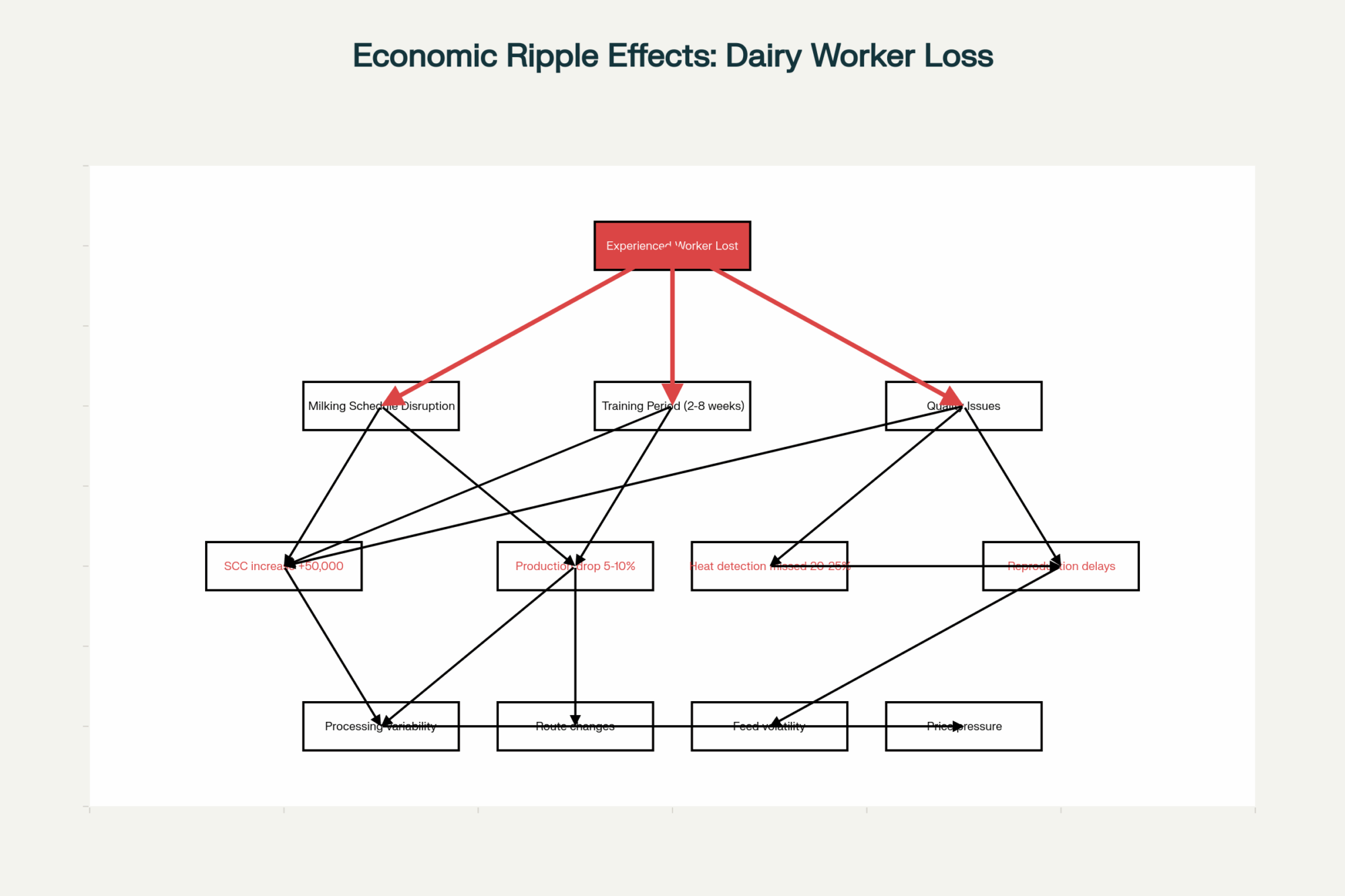
The September 25 enforcement action in Manitowoc County brought this uncertainty into sharp focus for our entire industry. The Department of Homeland Security arrested 24 people from a parking lot where dairy workers commonly meet to carpool to farms. For the operations that lost experienced workers that morning, it meant immediate challenges rippling through milking schedules, fresh cow management, breeding programs—everything.

What’s interesting here is how this incident highlights something we’ve all been managing for years: the disconnect between federal immigration policy and the reality of producing 226 billion pounds of milk annually in America. This isn’t about taking sides on politics—it’s about understanding the workforce dynamics that keep our industry running.

The Transformation Reshaping American Dairy

Examining the USDA Census of Agriculture data reveals the dramatic shift we’re all experiencing. Wisconsin operated 15,904 dairy farms in 2012. By 2022, that dropped to 6,949 operations—more than half gone in just ten years. California lost 30% of its dairy farms in that same period. Texas, Idaho, and New York—every major dairy state shows the same consolidation pattern.

Wisconsin lost 8,955 dairy farms in a decade while milk production held steady. Every remaining farm now depends on workers they technically can’t hire.

But here’s what fascinates me—Wisconsin still produced 30.6 billion pounds of milk in 2023, according to the USDA’s Milk Production report. California hit 40.4 billion pounds. Idaho’s up to 16.6 billion. The farms that survived got bigger, more efficient, and completely dependent on having reliable workers show up twice a day, every single day.

Walk into any milking parlor from Fond du Lac to Fresno, and you’ll see how the workforce has transformed over the past two decades. Industry organizations acknowledge this shift, although exact numbers are understandably difficult to pin down, given the sensitivity surrounding legal status. What we do know from talking with producers is that operations struggle significantly when they lose experienced workers—whether through enforcement or other reasons.

Training new milkers? That takes weeks, sometimes months, for larger operations. Finding people willing to do the work at all has become one of our biggest challenges nationwide. And finding them through available legal channels when year-round ag work doesn’t qualify for guest worker programs… well, that’s where things get really complicated.

What Happened in Manitowoc—And Why It Matters

The Department of Homeland Security’s September 25 operation targeted what they described as criminal activity. Twenty-four arrests from a local parking area. In the following days, the agricultural community faced operational disruptions, while families sought information about their detained relatives.

What stands out is the enforcement pattern. Workers were targeted. The broader questions about industry workforce needs, the economic system we’re all part of—those weren’t addressed. Local community organizations raised concerns about families who’d been part of rural Wisconsin for years, including those who showed up for early milkings and whose kids attended local schools.

I’ve noticed similar patterns playing out across the country. California operations have dealt with periodic enforcement for decades. Idaho producers tell me they’re seeing increased scrutiny. Even in Texas, where one might expect different approaches due to state politics, dairy operations face the same workforce uncertainties. A producer near El Paso recently mentioned losing three workers to an enforcement action; it took him two months to return to normal production levels.

The Economics We Need to Face

A 5% workforce disruption doesn’t sound like much until you realize it’s $2.3 billion of Wisconsin’s economy. How’s that for a wake-up call?

When agricultural economists examine workforce disruption scenarios, the projections become serious quickly. The National Milk Producers Federation has been presenting these concerns to Congress for years, though comprehensive solutions remain elusive.

Consider your own operation for a moment. Quality milk production requires consistency—same milking times, same cow handling, same fresh cow protocols. When experienced workers suddenly disappear, that consistency breaks down. I’ve seen operations where somatic cell counts jumped 50,000 just from switching milking crews. Production drops follow. Reproduction programs suffer when heat detection gets missed.

It takes 8 weeks to train a replacement milker. In those 8 weeks, your SCC spikes, reproduction tanks, and the entire supply chain feels it.

Now multiply that across hundreds of farms. Processing plants deal with variable milk supplies. Haulers face route changes. Feed suppliers see order volatility. The entire system, which has been optimized over the course of decades, begins to strain.

Consumer prices? While exact projections vary, basic economics tells us that reducing supply while demand stays steady means increases—potentially significant ones. Some analysts worry about impacts that could affect dairy’s competitive position against plant-based alternatives. Though honestly, I hope we never have to test those scenarios.

Why Dairy Can’t Access H-2A Workers

Here’s something that still frustrates producers coast to coast. The H-2A temporary agricultural worker program exists and has grown tremendously—from 48,336 certified positions in fiscal year 2005 to 378,961 in fiscal year 2024, according to Department of Labor data. Fruit and vegetable operations use it extensively. Some livestock operations qualify. But dairy? We’re locked out.

While H-2A positions exploded from 48,336 to 378,961, dairy operations watch from the sidelines. The federal government’s definition of ‘temporary’ doesn’t include twice-daily milking, apparently.

The federal regulations at 20 CFR 655.103 require work to be “temporary or seasonal” in nature. Last I checked, mastitis doesn’t follow a harvest schedule. Cows don’t take winters off. Fresh cow management happens year-round, whether you’re dealing with Wisconsin’s frozen February or California’s August heat.

What really gets me—certain range livestock operations can qualify for year-round H-2A workers under specific conditions. The distinction between their year-round needs and ours seems completely arbitrary.

The Farm Workforce Modernization Act passed the House twice but stalled in the Senate. Various other proposals have been introduced over the years. Meanwhile, we’re all operating in a gray area where the legal options do not align with operational reality.

How Farms Navigate Today’s Gray Areas

Let’s acknowledge what everyone in the industry understands. When workers present documents that appear valid for I-9 requirements, employers fulfill their legal obligations and proceed. What’s the alternative—having nobody for tomorrow’s milking?

This creates complex relationships. Long-term employees become integral to operations, develop deep knowledge of specific herds. I know a farm near Turlock where the same worker has managed transition cows for twelve years. He knows those cows better than anyone. But underlying everything is this legal uncertainty that neither farmers nor workers can resolve independently.

The arrangement functions because it meets mutual needs. However, it exists in constant tension, vulnerable to policy changes, shifts in enforcement priorities, and changes in political power. It’s exhausting for everyone involved—farmers, workers, families, communities.

What Other States Are Figuring Out

California started allowing undocumented immigrants to obtain driver’s licenses in 2015 through Assembly Bill 60. New York implemented the Green Light Law in 2019. Thirteen other states now have similar programs. The reasoning was practical—people already working on farms need to drive safely and carry insurance.

A UC Davis study found California’s program improved road safety while reducing hit-and-run accidents by 7-10%. Operations in those states generally report that it helps with daily stability, although it doesn’t resolve underlying questions about legal status. Workers can commute without constant fear of traffic stops becoming immigration issues.

California dairy workers got licenses in 2015. Wisconsin farmers still wait for traffic stops to destroy their workforce. Which state looks smarter?

Wisconsin hasn’t pursued similar policies, though the discussion surfaces periodically. Idaho’s taken an interesting middle path—some counties work with dairy operations on housing and transportation solutions that reduce workers’ need to drive on public roads. Texas varies by region, with some counties more accommodating than others.

Technology’s Real Impact

Examining actual adoption rates, DairyComp 305 data from over 2,000 farms indicate that robotic milking systems are currently in use on approximately 3% of U.S. dairy operations, although this number is growing steadily. The conversation about automation has matured considerably from the “robots will solve everything” pitch of five years ago.

TechnologyInitial CostLabor ReductionROI Period
Activity Monitors$100-150/cow20-25% heat detection improvement18 months
Automatic Takeoffs$2,000-3,000/stall10-15% milking labor reduction18-24 months
Feed Pushers$25,000-35,0002-3 hours daily labor saved2-3 years
Robotic Milking Systems$150,000-200,000/unit20-30% milking labor reduction5-7 years

Operations with robots report mixed experiences. University of Minnesota Extension research shows they can reduce milking labor needs by 20-30%. However, you still require skilled personnel for managing fresh cows, health monitoring, and breeding programs. The capital requirements remain substantial—Wisconsin Extension estimates installation costs at $150,000 to $ 200,000 per robot, with most operations requiring multiple units.

What’s proving more practical for many farms is targeted automation. Automatic takeoffs cost around $2,000-3,000 per stall—way more achievable than a million-dollar robot barn. Activity monitors cost approximately $100-150 per cow but can increase heat detection rates by 20-25%, according to the Penn State Extension. Feed pushers ($25,000-35,000) reduce labor while keeping feed fresh. These incremental improvements make existing workers more productive without requiring a complete reconfiguration of your operation.

What Smart Operations Are Doing Now

Progressive operations are taking several approaches to navigate these challenges, even without comprehensive reform.

First, they’re strengthening compliance. Ensuring I-9 documentation is bulletproof and collaborating with agricultural attorneys to understand their obligations and associated risks. Some explore whether workers might qualify for existing visa programs, though options remain limited.

Second, they’re engaging politically in coordinated ways. The Wisconsin Dairy Alliance organizes producer meetings with state legislators. California cooperatives work with congressional representatives on H-2A reform. The Idaho Dairymen’s Association maintains regular communication with officials about workforce needs. Even individual producers are speaking up more—I recently heard a normally quiet farmer from Marathon County testify at a state hearing about losing two workers and nearly missing a milk pickup because of it.

Third, strategic investments continue in both technology and personnel. Creating advancement opportunities, providing training, and improving housing. The logic is straightforward—keeping experienced workers, regardless of status, beats constant turnover. A producer near Twin Falls told me his best investment wasn’t his new parlor—it was the apartments he built for long-term employees.

The Path Ahead

The September enforcement action in Manitowoc won’t be the last. Federal agencies operate according to their mandates, which don’t necessarily align with agricultural economic needs.

Wisconsin’s dairy industry generates $45.6 billion in total economic activity, according to a 2023 University of Wisconsin study. California’s dairy sector contributes $21 billion to that state’s economy. Add in Idaho, Texas, New York, and Pennsylvania—we’re talking about massive economic impact and thousands of rural jobs. We have the collective influence to use it constructively if we choose to do so.

Even without federal reform, incremental improvements are possible. Driver’s license programs provide daily stability. Better coordination between agricultural employers and communities reduces uncertainty. Strategic technology adoption improves efficiency without eliminating labor needs.

For producers ready to engage, several organizations are actively working on these issues. The National Milk Producers Federation maintains an immigration reform task force you can connect with. The American Dairy Coalition sends regular legislative updates. Edge Dairy Farmer Cooperative in Wisconsin actively lobbies for practical solutions. Your state dairy association likely has resources, too.

Tomorrow Morning’s Reality

When you walk into your parlor tomorrow morning, you’ll likely depend on workers whose legal status remains unresolved by current policy. They’ll arrive before dawn, manage transition cows with skill honed over the years, and keep your operation running smoothly. This has become the reality for American dairy—from operations still milking 50 cows to facilities milking 15,000.

The Manitowoc incident reminded us how quickly stability can disappear. But it also highlighted our resilience. Farms found ways to keep operating. Communities supported affected families. The milk kept flowing to processors.

We’ve weathered enormous challenges—the 2009 price crash, the 2014-2016 margin crisis, changing consumer preferences, and environmental pressures. This workforce challenge is distinct because it necessitates both political engagement and operational adaptation.

We understand what’s needed: recognition that year-round agricultural labor requires appropriate legal frameworks. Partial solutions exist that other states have implemented. The question is whether we’ll work toward pragmatic approaches or continue hoping someone else fixes this.

The economics are clear. The operational needs are obvious. The question now is what we’re prepared to do collectively. Managing uncertainty individually while hoping for the best isn’t sustainable for an industry that feeds America.

Here’s my challenge to you: Will you contact your state dairy organization this week about workforce solutions? Will you talk to your legislators about the reality on your farm? Or will you wait for the next enforcement action and hope it’s not in your county?

The choice is yours. But remember—every morning when those headlights turn into your drive, you’re depending on a system that needs fixing. And we’re the ones who need to push for that fix.

What’s your next move?

KEY TAKEAWAYS:

  • Targeted automation delivers better ROI than full robotics: Activity monitors ($100-150/cow) boost heat detection 20-25% while automatic takeoffs ($2,000-3,000/stall) reduce labor needs without the $150,000-200,000 per robot investment—Penn State Extension data shows most farms see payback within 18 months versus 5-7 years for robotic systems
  • State solutions exist while federal reform stalls: California’s 2015 driver’s license program reduced uninsured drivers by 15% and hit-and-run accidents by 7-10%, providing workforce stability that Wisconsin, Idaho, and Texas operations could implement without waiting for H-2A expansion that’s been blocked for decades
  • Proactive compliance beats reactive scrambling: Operations strengthening I-9 documentation, building relationships with agricultural attorneys, and exploring existing visa options for key employees report better workforce retention—the Wisconsin Dairy Alliance and Edge Dairy Farmer Cooperative offer resources to help navigate current regulations while advocating for practical reforms
  • Geography matters for enforcement risk: Manitowoc-style operations happen nationwide, but counties with agricultural-focused law enforcement report fewer disruptions—understanding your local enforcement priorities and building community relationships creates operational buffer zones that technology alone can’t provide
  • Engagement drives change faster than hope: Producers actively working with state dairy organizations, contacting legislators about workforce realities, and supporting industry advocacy efforts through NMPF or American Dairy Coalition see more progress than those waiting for Washington—your voice matters more than you think when 226 billion pounds of annual milk production depends on workforce stability

EXECUTIVE SUMMARY: 

Recent enforcement actions in Wisconsin reveal a paradox at the heart of American dairy: operations depend on workers they can’t legally employ, while federal programs designed for agricultural labor explicitly exclude year-round dairy work. The September 25 Manitowoc arrests of 24 dairy workers highlight how quickly workforce stability can vanish—farms that lost experienced milkers that morning faced immediate operational disruptions affecting everything from milk quality to reproduction programs. With Wisconsin dairy generating $45.6 billion in economic activity while operating with a significant undocumented workforce dependency, and the H-2A program growing from 48,336 to 378,961 positions between 2005 and 2024, yet still excluding dairy, producers face an impossible choice between legal compliance and operational survival. What farmers are discovering through targeted automation investments—automatic takeoffs at $2,000-3,000 per stall delivering immediate efficiency gains, activity monitors at $100-150 per cow improving heat detection by 20-25%—is that technology can enhance but not replace skilled workers who understand transition cow management and fresh cow protocols. The path forward requires both practical adaptation through state-level solutions, such as driver’s license programs (already implemented in 15 states), and sustained industry engagement with organizations like the National Milk Producers Federation’s immigration task force. Hoping that federal policy catches up with dairy’s year-round reality isn’t a viable business strategy.

Complete references and supporting documentation are available upon request by contacting the editorial team at editor@thebullvine.com.

Learn More:

Join the Revolution!

Join over 30,000 successful dairy professionals who rely on Bullvine Weekly for their competitive edge. Delivered directly to your inbox each week, our exclusive industry insights help you make smarter decisions while saving precious hours every week. Never miss critical updates on milk production trends, breakthrough technologies, and profit-boosting strategies that top producers are already implementing. Subscribe now to transform your dairy operation’s efficiency and profitability—your future success is just one click away.

NewsSubscribe
First
Last
Consent

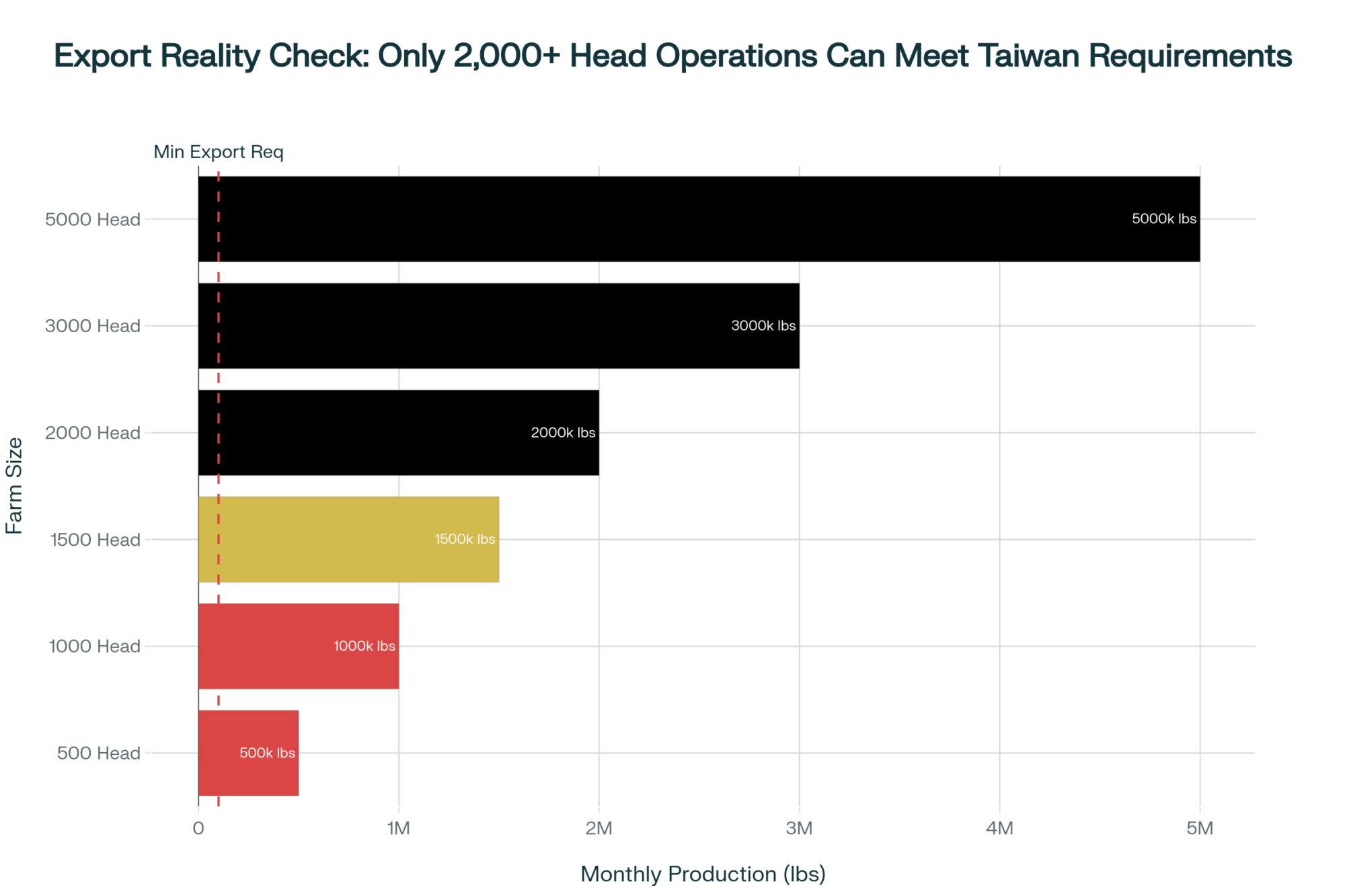
Taiwan Deal Requires 100,000 Pounds Monthly – Here’s What That Really Means for Your Farm

Taiwan imports $600M+ dairy annually but requires 100K pounds monthly—shutting out 85% of U.S. farms

EXECUTIVE SUMMARY: What farmers are discovering about the Taiwan dairy memorandum of understanding is that access requires scale, which most operations simply don’t have—a minimum of 100,000 pounds monthly is required just to qualify for export programs. USDA data confirms that Taiwan imports over $600 million in dairy products annually, with domestic production covering less than a third of its needs. However, there’s a catch: New Zealand already dominates with tariff-free access, while U.S. dairy faces 15-20% duties plus three weeks longer shipping times. For the 2,000-head operations that can absorb certification costs and manage 60-90 day payment terms, Taiwan represents a genuine opportunity and a gateway to Southeast Asia’s rapidly expanding markets. Yet for mid-size dairies—the backbone of many rural communities—the economics suggest focusing on regional institutional buyers, value-added production, or collaborative export ventures might deliver better returns without the complexity. The most successful path forward depends on honestly matching your operation’s capabilities to market requirements, not chasing opportunities designed for different scales. Your cooperative needs to hear from members about developing tiered programs that recognize these realities—because the future of rural dairy depends on strategies that work for more than just the most significant operations.

dairy export profitability

You know, when USDEC and NMPF announced their memorandum of understanding with Taiwan’s Dairy Association, it really got people talking. Now, let me clarify something upfront—an MOU isn’t a binding trade agreement. It’s essentially a framework for cooperation, a statement of intent to work together on market development. Unlike a formal trade deal that might reduce tariffs or guarantee market access, this MOU signals that both sides want to explore opportunities. Think of it as laying groundwork rather than breaking ground.

There’s good reason to pay attention—USDA Foreign Agricultural Service data show that Taiwan imports over $600 million in dairy products annually, with its domestic production covering less than a third of its needs. That’s a substantial opportunity by any measure.

However, what’s interesting as we delve deeper into the requirements and market dynamics is that this opportunity unfolds very differently depending on your operation’s capabilities. Let me share what the data’s revealing.

Understanding Taiwan’s Market Position

Taiwan’s dairy market has been steadily expanding, and federal trade reports confirm that they’re importing more than half a billion dollars’ worth of dairy products each year—a figure that continues to trend upward. This builds on broader Asian dietary shifts that we’ve been watching for the past decade, where dairy consumption continues to grow as incomes rise and dietary preferences evolve.

What’s particularly noteworthy is their institutional demand through school milk programs. You probably know this already, but these kinds of programs typically provide stable, predictable volume—something we all value in today’s volatile markets. And Taiwan’s infrastructure? They’ve invested heavily in cold chain capabilities that rival what you’d find in Wisconsin or California.

The strategic piece that’s worth considering… Taiwan’s position potentially makes them a gateway to Southeast Asian markets. FAO statistics show that the region has the fastest-growing dairy consumption globally. So we’re not just talking about one island market here—we’re looking at potential access to something much broader.

TAIWAN EXPORT REQUIREMENTS AT A GLANCE:

  • Volume: 100,000+ pounds monthly minimum
  • Components: 4.2%+ butterfat, 3.3%+ protein
  • Payment: 60-90 day terms standard
  • Competition: New Zealand tariff-free access

The Reality of Export Requirements

Now, when you look at what the major cooperatives require for export programs—and DFA, Land O’Lakes, and others have been pretty consistent about this—there are some significant thresholds to meet.

Volume commitments typically begin at a minimum of two truckloads per month. That’s roughly 100,000 pounds, give or take. For perspective, if you’re running 500 head that produce around 12 million pounds annually, you’re generating about one truckload per month. See where this is going?

Why does this matter? Fixed costs for export certification, enhanced testing protocols, and documentation systems need to be spread across your total volume. A 2,000-head operation can absorb these costs much more efficiently. Basic math, but the impact on your bottom line is profound.

Then there’s the component specifications. Export buyers consistently want butterfat above 4.2% and protein exceeding 3.3%. Jersey herds naturally tend to hit these levels more easily—that’s just breed characteristics at work. Holstein operations often require significant ration adjustments or long-term genetic selection strategies. And changing your herd’s component profile… that’s not something that happens overnight.

New Zealand’s Built-In Advantages

Here’s something that really shifts the competitive landscape: New Zealand achieved complete tariff elimination with Taiwan through their Economic Cooperation Agreement. Meanwhile, we’re still facing duties ranging from 15% to 20%, depending on the item being shipped. That’s documented in Taiwan’s customs schedules and various trade analyses.

Think about what this means practically. New Zealand can deliver to Taiwan in under a week from their ports. From our West Coast? We’re looking at a minimum of three to four weeks. When you combine zero tariffs with shorter shipping times and lower freight costs, their delivered price advantage becomes significant.

Trade data shows New Zealand already captures the largest share of Taiwan’s dairy imports, and with these structural advantages locked in through trade agreements, that position seems secure. Though U.S. dairy often commands quality premiums that can partially offset some disadvantages, particularly for specialized products where our consistency really shines.

Cash Flow and Operational Realities

One aspect that is not discussed enough is the impact of exports on working capital. Domestic milk payments typically arrive in your account within two to three weeks. But export contracts? Industry-standard terms typically run 60 to 90 days, sometimes longer.

For operations already managing tight cash flow—and let’s be honest, that describes many of us these days—that extended payment period creates real challenges. You’re still paying feed bills monthly, covering payroll every two weeks, but waiting two to three months for that milk check. The premium might look good on paper, but cash flow is what keeps the lights on.

Export-qualified milk typically receives priority scheduling for pickup to ensure that quality specifications are maintained. Makes perfect sense from a logistics standpoint, right? But farms not participating in export programs might see their pickup windows shift to less optimal times. Your milk sits in the tank longer, potentially affecting domestic quality premiums. Small things add up.

Community and Consolidation Impacts

What university extension programs have documented—and what many of us are seeing firsthand—is how consolidation patterns affect entire rural economies. Each mid-sized dairy operation supports a whole network of local businesses, including veterinary practices, feed suppliers, equipment dealers, local banks, and schools.

When smaller operations exit and their production is absorbed by larger farms (often located in different areas), the economic activity shifts accordingly. The local vet might lose enough business to cut back hours. The equipment dealer might close their satellite location. School enrollment drops. These ripple effects are real and lasting.

This isn’t an argument against efficiency—we all need to stay competitive. However, it’s worth understanding these broader impacts as we consider how export opportunities might accelerate existing trends.

Alternative Strategies for Premium Capture

Not every premium opportunity requires access to export markets. What’s encouraging is seeing different approaches work across various regions.

Institutional buyers—such as hospitals, schools, and corporate food service operations—have increasingly paid premiums for locally sourced dairy products. These arrangements often involve simpler logistics and much faster payment terms than export programs. When you factor in reduced complexity and faster cash flow, the net return can be comparable or even better.

Value-added production continues to show promise as well. Small-scale processing—whether it’s farmstead cheese, yogurt, or bottled milk—can capture retail premiums that rival export opportunities. Yes, it requires learning new skills and developing marketing channels. But you maintain control over your product and pricing in ways commodity markets never allow.

Producer collaborations are gaining traction, where multiple farms pool resources to meet export volume requirements while sharing certification costs. When economics get divided among several operations, they become more manageable—though it requires significant coordination and trust among participants.

Examining operations in Texas and Idaho, where large-scale dairies already predominate, we’re seeing interesting hybrid approaches. Some are partnering with smaller neighbors to aggregate volume while maintaining individual farm identity for certain premium markets. It’s a model worth watching.

The Cooperative Perspective—And Your Role in It

You know, cooperatives face genuine challenges here. They need to stay competitive in global markets while serving members ranging from 50 to 5,000 cows. Export program development represents one path toward accessing growing markets and potentially improving returns for all members.

Cooperative governance increasingly reflects the perspectives of larger operations. Not through conspiracy—it’s a practical reality. Larger farms typically have more resources to participate in leadership, attend meetings, and serve on committees. That naturally influences how programs get structured and priorities get set.

However, here’s the thing: if you’re not satisfied with how your cooperative is managing export opportunities or any other programs, sitting on the sidelines won’t make a difference. When’s the last time you attended your co-op’s annual meeting? Reviewed the board election slate? Actually read those governance proposals?

The question we should be asking our cooperatives: Can you develop tiered programs that recognize different member capabilities? Some co-ops are already experimenting with this—offering different service levels and cost structures based on volume and participation. If your cooperative isn’t exploring these options, bring it up at the next member meeting. Get it on the board’s agenda. Find other members who share your concerns and present a unified voice.

Your cooperative is only as responsive as its members are engaged. If export programs feel designed for operations three times your size, that’s feedback your board needs to hear—repeatedly and from multiple members.

Making the Right Decision for Your Operation

So, where does all this leave us with the Taiwan opportunity? The market is real, the demand is growing, and for operations with appropriate capabilities, the returns could be meaningful.

If you’re running a business with over 2,000 employees and strong component genetics, along with solid banking relationships, these export programs may align well with your business model. The premiums can justify the investment, and accessing growing Asian markets provides important diversification.

However, if you’re managing a mid-sized operation—particularly one already facing margin pressure—the requirements create hurdles that may be difficult to overcome profitably. And that’s okay. Not every opportunity needs to be your opportunity.

What seems to be working for many mid-size operations is focusing on regional markets. Building relationships with local institutions. Exploring value-added possibilities. Finding niche markets that value specific attributes—whether that’s grass-fed, local, family farm, or sustainable practices. These strategies might not generate headlines, but they’re delivering solid returns.

Looking Ahead

This Taiwan MOU illuminates broader dynamics in today’s dairy industry. Opportunities are increasingly differentiated by capability and resources, and understanding where your operation fits—along with what alternatives exist—is becoming crucial for long-term success.

Recent volatility has taught us that resilience comes from matching strategy to capabilities. Large operations might find their advantage in export markets and global supply chains. Mid-size farms often succeed through regional focus and differentiation. Smaller operations increasingly thrive through direct marketing and value-added strategies.

The most successful producers share common traits. They honestly assess their strengths and limitations. They understand market requirements thoroughly. They choose strategies aligned with their operational realities rather than chasing every opportunity that comes along.

As we head into another year of uncertainty, with milk prices volatile and input costs unpredictable, these strategic choices matter more than ever. The Taiwan opportunity offers a valuable perspective for examining our individual positions and options.

What’s working in your region? Because ultimately, that’s what makes our industry strong—sharing knowledge, learning from each other’s experiences, and finding paths forward that work for our individual operations while strengthening the broader dairy community. The Taiwan MOU is just one piece of a much larger puzzle we’re all working to solve together.

Key Takeaways:

  • Component and cash flow impacts: Achieving 4.2% butterfat and 3.3% protein specifications often requires feed cost increases of $0.50-1.00/cwt, while 60-90 day export payment terms versus 15-20 day domestic payments can strain working capital by $40,000-60,000 for mid-size operations
  • Regional alternatives delivering results: Direct institutional sales to hospitals and schools are capturing $0.50-1.00/cwt premiums with simpler logistics, while producer collaborations pooling volume among 6-8 farms are successfully accessing export premiums through shared certification costs
  • Cooperative engagement opportunity: Members should actively push boards to develop tiered export programs, recognizing different scales—attend meetings, join committees, and build coalitions, because governance increasingly reflects large-farm perspectives unless smaller operations organize
  • Strategic decision framework: Match your operation’s strengths to appropriate markets: 2,000+ head farms can justify export infrastructure, 500-1,000 head operations often maximize returns through regional differentiation, while smaller dairies thrive with direct marketing and value-added strategies

Complete references and supporting documentation are available upon request by contacting the editorial team at editor@thebullvine.com.

Learn More:

Join the Revolution!

Join over 30,000 successful dairy professionals who rely on Bullvine Weekly for their competitive edge. Delivered directly to your inbox each week, our exclusive industry insights help you make smarter decisions while saving precious hours every week. Never miss critical updates on milk production trends, breakthrough technologies, and profit-boosting strategies that top producers are already implementing. Subscribe now to transform your dairy operation’s efficiency and profitability—your future success is just one click away.

NewsSubscribe
First
Last
Consent

Spray Drones on Dairy Farms: Why the Failures Teach Us More Than the Successes

Custom drone rates dropped from $22 to $16/acre in 2 years—here’s what that means for your spray decisions

EXECUTIVE SUMMARY: What farmers are discovering about spray drones challenges everything equipment dealers have been pushing—the real value isn’t in replacing your ground rig, it’s in solving specific problems conventional equipment can’t handle. Recent field data shows custom application rates have dropped from $22-25 per acre to $15-18 across the Midwest as more operators enter the market, fundamentally changing the ownership economics. Extension research confirms that while large operations (2,000+ acres) can achieve costs as low as $7-9 per acre, smaller dairies face $18-20 per acre when factoring in battery replacement, insurance, and time value. The producers finding success aren’t chasing technology for its own sake—they’re targeting chronically wet fields, odd-shaped parcels aerial applicators avoid, and emergency applications when timing trumps cost. With regulatory requirements varying wildly by state and Ontario producers essentially locked out of pesticide applications, the adoption pattern is becoming clear: scouting drones make sense for nearly everyone at $1,500, but spray drones require careful analysis of your specific operational challenges. Here’s what this means for your operation: document when conventional spraying actually fails you, test with custom services before buying, and understand that this technology works best as a specialized tool, not a revolutionary replacement.

 spray drone economics

You know those June mornings when you’re standing at the field edge, watching water pool between the corn rows? That’s when the conversation about spray drones becomes real for most of us. Not the trade show pitch about revolutionary technology, but the practical question: could this actually work on my operation?

I’ve been comparing notes with producers from Rock County, Wisconsin, to Lancaster County, Pennsylvania, and what’s interesting is how the conversation has shifted. The FAA now tracks agricultural drone registrations as a distinct category—they’re seeing steady growth, though exact numbers depend on classification. We’re past the hype stage. Now we’re seeing real patterns emerge about what works… and honestly, what doesn’t.

Looking across the I-94 corridor from Eau Claire to Madison, down through Illinois dairy country, the producers making drones work aren’t using them to replace their John Deere R4038s or Case Patriots. They’re using them for those specific situations where nothing else makes sense. And that distinction? Worth exploring, I think.

The Economics Are… Complicated (But Getting Clearer)

The uncomfortable truth? Small dairy operations pay 2.5x more per acre than large operators—making custom services the smarter choice for 68% of farms

So let’s talk money, because that’s where every equipment decision starts and ends, right? I’ve been comparing notes with farm management specialists at various land-grants, and what’s fascinating is how differently the economics play out depending on your situation.

Some research from Midwest Extension programs suggests operating costs as low as $7-$ 8 per acre for high-volume custom operators running 4,000 acres or more annually. But then you talk to smaller operations—say, 500-800 acres—and they’re seeing costs approaching $20 per acre when you factor in depreciation, batteries, insurance, and the value of their time. That’s a huge spread.

The economics shift dramatically by scale—smaller operations face nearly triple the per-acre costs of large-scale producers. Before investing $56,000 in spray equipment, run these numbers for your actual sprayable acres.

But here’s something a producer in Lafayette County, Wisconsin, told me that really stuck: “The per-acre cost becomes irrelevant when it’s the difference between spraying and not spraying at all.”

That $56,000 spray drone? Actually $65,000 year one. And batteries alone will cost you another $3,500 annually—every year.

We’ve all seen it—those compacted wheel tracks where corn just doesn’t perform the same. University research continues to confirm yield losses from compaction, sometimes as high as 8-15% in wet conditions. When managing premium silage ground where every ton is needed for your TMR, the drone economics suddenly become more than just application cost.

This past spring really drove the point home across the Great Lakes dairy region. NOAA data shows we had significantly more precipitation than normal during critical application windows. A Rock County producer I know gladly paid $18 per acre for a drone application on 300 acres when his fields were too wet. “Sure, it costs more than doing it myself,” he said, “but waterhemp doesn’t wait for fields to dry out.”

Now, I should mention—I’ve also talked with producers who ran the numbers and decided custom services made more sense for their situation. One veteran applicator near Sheboygan made a good point: “Why complicate things with new technology when my ground rig handles 95% of situations just fine?” There’s wisdom in both approaches.

Where Drones Actually Make Sense (And Where They Don’t)

Only 4 of 6 common scenarios favor drones—and your ground rig still wins for regular field spraying. Choose wisely

What’s becoming clear from both university trials and farmer experience is that the most valuable drone applications on dairy farms often aren’t what the marketing brochures highlight.

Start with scouting. A quality agricultural drone with thermal and multispectral cameras runs about the same as a decent set of flotation tires. Extension specialists tracking adoption patterns report that farmers using drones for regular field scouting are catching problems 5-7 days earlier on average. For something like armyworm moving through your second-cut alfalfa, that timing difference matters.

But here’s where it gets interesting—and where some healthy skepticism is warranted.

Pasture management is showing real promise. Several land-grant universities have published trials on spot-spraying pastures, and the results are encouraging if you’ve got the right situation. One study found treating just problem areas—typically 15-20% of total pasture—delivered equivalent weed control while using 70% less herbicide. Makes sense for those of us working to maintain soil biology and forage density.

Though I should note, a pasture specialist in Vermont raised a fair point: “Sometimes the simplest solution is better grazing management, not more technology.” Worth considering.

Late-season applications in tall corn present another opportunity. When you have premium alfalfa heading into its third cutting with a 7-ton yield potential, or tall corn where your ground rig would snap stalks, aerial application starts looking attractive. Several seed companies report positive results from drone-based fungicide trials, although the response naturally varies by disease pressure and timing.

Some experienced custom applicators I respect aren’t convinced, though. One fellow who’s been spraying for 30 years told me, “I’ve seen every new technology promise to change everything. Most of them just complicate what already works.”

The Market Reality Nobody Wants to Discuss

Custom spray rates crashed 32% in 3 years. At $17/acre today, operators barely clear $5 profit. The gold rush is over

From what I’m hearing at winter meetings and talking with equipment dealers, agricultural drone services are expanding rapidly. Every major ag retailer seems to be adding or exploring drone programs. Equipment dealerships are pushing them hard. And yes, plenty of producers are eyeing custom work to offset their investment.

But here’s what’s got me curious: can this market support all these operators?

In areas like eastern Iowa and central Illinois, where adoption began early, custom rates have already moderated from $22 to $ 25 per acre two years ago to $15 to $ 18 today. Natural market evolution, sure—but challenging if you were counting on premium custom rates to justify a $56,000 spray drone setup.

FeatureScouting DroneSpray Drone
Initial Investment$1,500$56,000
Regulatory BurdenBasic Part 107Part 107 + State Licenses
Training Time25-30 hours100+ hours
Annual Operating Cost$300-500$3,000-8,000
Break-even Timeline6-12 months3-5 years
Problem-solving ValueHigh (early detection)High (emergency applications)

Agricultural economists modeling these markets suggest there’s probably a sustainable ratio—maybe one service provider per 10,000-12,000 suitable acres, varying by region and crop mix. We may already be approaching that density in some areas.

The Regulatory Maze (And It Really Is One)

And here’s where it gets messy—every state seems to have its own take on how drones fit into pesticide regulations.

The FAA requires a Part 107 Remote Pilot Certificate for commercial operations, including use on your own farm. The test costs $175, and according to Wisconsin Farm Bureau’s training program reports, most farmers require 25-30 hours of focused study. Many community colleges now offer preparatory courses, which provide considerable help.

Want to spray pesticides? Now you’re in state-specific territory. Illinois treats drone operators like aerial applicators—requiring commercial licenses and continuing education. Wisconsin has different requirements. Minnesota is different still. Don’t assume—verify with your state department of agriculture.

Ontario producers face even more restrictions. From what I’m hearing at cross-border meetings, Health Canada’s approval process for drone-applied pesticides remains extremely limited. Several Ontario dairymen have told me they’re currently limited to foliar nutrients and biologicals.

Learning from Early Adopters (And Those Who Stepped Back)

Let me share what I’m hearing from producers who’ve actually been through this decision process.

A Holstein breeder near Eau Claire started with a $1,500 mapping drone in 2022. “Learned the rules, figured out what information actually helped,” he told me. Then, in 2023, he hired custom drone spraying for fungicide—wanted to see real results before investing serious money.

By 2024, he bought a 30-liter spray drone. But here’s the key: he had specific uses in mind. Four hundred acres of river bottom that floods regularly. Another 300 acres in odd corners and strips the co-op plane won’t touch. Running about 1,100 acres annually, including some custom work, he estimates his all-inclusive cost at $11-$ 12 per acre. The custom rate in his area is $17.

However, I’ve also spoken with a New Jersey operation in Crawford County that purchased a spray drone in 2023 and sold it this spring. “Too much hassle for the acres we could actually use it on,” the owner explained. “Between weather windows, battery management, and regulatory paperwork, we spent more time fiddling than flying.”

There’s probably wisdom in both experiences.

Technology Is Advancing—But Is That What We Need?

The precision capabilities developing now are genuinely impressive. John Deere’s See & Spray technology can identify individual weeds. University research programs are testing autonomous swarm operations. Variable-rate application based on real-time plant health sensing is commercially available.

However, when discussing dairy producers who juggle fresh cow protocols, TMR consistency, breeding programs, and commodity markets, complex drone operations often fall pretty far down the priority list.

A producer I respect put it well: “I don’t need my drone to do everything the salesman promises. I need it to spray that 40-acre bottom that’s underwater half of May, and check my furthest pastures without burning diesel.”

Some veteran applicators think we might be overengineering solutions. “Good drainage, proper rotation, and timely application with conventional equipment works 90% of the time,” one told me. “Are we solving real problems or creating new ones?”

Practical Thoughts for Different Operations

After tracking this technology and talking with dozens of producers across the dairy belt, here’s how I see it playing out:

For smaller operations (under 1,000 acres), the economics of spray drone ownership are tough to justify in most cases. But a basic scouting drone? That’s different. The information value and time savings can justify that investment pretty quickly, especially if you’re managing multiple scattered parcels.

For mid-sized operations (1,000-2,000 acres), especially those with challenging topography or chronic wet spots, ownership may be a viable option. But run real numbers. Include battery replacement ($3,000-4,000 annually for active use), insurance, training time, and the opportunity cost of your time.

For larger operations or those considering custom work, the economics improve, but competition is increasing. If you’re planning to offset costs with neighbor acres, have a genuine business plan, not just optimism. And understand you’re entering an evolving market.

Everyone should test with custom services first if available. Document results carefully. Compare against your conventional methods. Some producers find that drones solve critical problems; others realize their current system works fine.

QuickReference: Real-World Economics

Operation TypeAnnual AcresDrone Cost/AcreCustom Cost/AcreAnnual SavingsPayback Period
Small Dairy (500 acres)500$20$17-$1,500Never
Medium Dairy (1,000 acres)1,000$12$17$5,00013 years
Large Dairy (2,000 acres)2,000$8$17$18,0003.6 years
Custom Op (4,000 acres)4,000$7$17$40,0001.6 years

Based on producer reports and extension calculations:

  • Small operations (500 acres): $18-20/acre ownership costs are typical
  • Medium operations (1,000 acres): $11-13/acre achievable
  • Large operations (2,000+ acres): $7-9/acre with good utilization
  • Current custom rates: $15-18/acre most markets (down from $20-25 in 2023)
  • Battery replacement: Budget $3,000-4,000 annually for regular use

Looking Forward: Your Decision Framework

What’s become clear is that this isn’t a simple yes-or-no technology decision. Start by honestly documenting your actual challenges. When has a conventional application actually failed you—not theoretically, but actually? Track it for a season.

Because this technology demonstrably works for certain applications. University trials confirm it. Successful operators prove it daily. However, it works best when matched to real problems you actually have, rather than hypothetical benefits from a trade show presentation.

Something a retired extension specialist told me keeps coming back: “Every new technology has its place. The trick is figuring out if that place is on your farm.”

In dairy, where we manage incredibly complex biological and economic systems—from transition cow management through the critical first 100 days to achieving optimal harvest moisture for corn silage—adding technology for technology’s sake rarely makes sense.

One thing seems certain: this technology will continue evolving. Whether through individual ownership, custom services, or cooperative arrangements we haven’t yet imagined, drones will likely become more common. The question isn’t if they’ll fit into dairy farming—it’s how they’ll fit into your specific operation.

Your operation, your challenges, your financial situation, your comfort with technology—these factors matter more than any general recommendation. But at least now you’ve got a framework for thinking it through, based on what’s actually happening in the field rather than what’s promised in brochures.

Next time you’re standing at that field edge, watching it stay too wet while your weeds keep growing—that’s when this conversation shifts from interesting to urgent. It’s better to develop your strategy now, while you have time to evaluate it properly.

Because if these past few wet springs have taught us anything, it’s that having options matters. Sometimes those options come with propellers. Sometimes they don’t. The key is knowing which makes sense for you.

KEY TAKEAWAYS:

  • The economics shift dramatically by scale: Operations under 1,000 acres face $18-20/acre costs versus $7-9 for 2,000+ acre operations, with battery replacement adding $3,000-4,000 annually—run real numbers based on your actual sprayable acres, not wishful thinking
  • Start with $1,500 scouting drones, not $56,000 spray equipment: Producers report catching pest and disease issues 5-7 days earlier with regular drone scouting, delivering immediate ROI through better timing decisions before committing to spray technology
  • Test emergency applications through custom services first: Wisconsin producers paid $18/acre for drone application during wet conditions this spring—expensive, yes, but waterhemp control timing matters more than per-acre cost when fields won’t support ground rigs
  • Pasture spot-spraying shows genuine promise: University trials confirm 70% herbicide reduction with equivalent control when treating just problem areas (typically 15-20% of pastures), preserving soil biology while managing thistles and multiflora rose
  • Regulatory complexity demands homework: Part 107 certification takes 25-30 hours of study plus $175, while pesticide application requirements vary from Wisconsin’s ground equipment rules to Illinois treating drones like aerial applicators—verify your state’s specific requirements before investing

Complete references and supporting documentation are available upon request by contacting the editorial team at editor@thebullvine.com.

Learn More:

  • AI and Precision Tech: What’s Actually Changing the Game for Dairy Farms in 2025? – This article provides a broader strategic look at technology adoption beyond just drones. It details the ROI and payback periods for systems like robotic milking, precision feeding, and automated health monitoring, helping producers prioritize which technology investments will deliver the fastest returns in a tight market.
  • How Large Dairies Are Leading in Precision Tech Adoption – This piece complements the main article’s discussion of scale economics by explaining the specific tools large operations are using, such as autosteering systems and detailed soil mapping. It reveals how these technologies reduce costs and improve sustainability, offering a different perspective from the drone-focused article.
  • The Digital Dairy Revolution: How IoT and Analytics Are Transforming Farms in 2025 – This article moves beyond specific equipment to the underlying data and analytics. It provides a strategic framework for understanding how IoT sensors and AI work together to provide a holistic view of a dairy operation, helping producers leverage data to make smarter decisions about everything from cow health to feeding.

Join the Revolution!

Join over 30,000 successful dairy professionals who rely on Bullvine Weekly for their competitive edge. Delivered directly to your inbox each week, our exclusive industry insights help you make smarter decisions while saving precious hours every week. Never miss critical updates on milk production trends, breakthrough technologies, and profit-boosting strategies that top producers are already implementing. Subscribe now to transform your dairy operation’s efficiency and profitability—your future success is just one click away.

NewsSubscribe
First
Last
Consent

How 500-Cow Farms Are Building $100K+ Annual Cushions Without Relying on Safety Nets

Fixed safety nets lose 30% purchasing power by 2031—your $9.50 coverage becomes worth $6.45

EXECUTIVE SUMMARY: What we’re discovering through conversations with dairy farmers across the country is that fixed safety net programs, while valuable, are creating an interesting planning challenge—coverage that doesn’t adjust for inflation loses roughly 30% of its purchasing power over typical extension periods. Take the Johnson farm example: their 500-cow Wisconsin operation faces $15,000-$ 20,000 in annual premiums for coverage that protects only half of their 12 million pounds of production, while the other half remains exposed to market volatility. Meanwhile, operations from Texas to Vermont are finding creative ways to build resilience beyond government programs—forming buying groups that cut feed costs by 10-15%, investing in shared equipment that reduces per-unit expenses, and developing direct market relationships that capture premium pricing. Recent discussions with producers suggest that the most successful operations treat safety nets as just one tool in their risk management toolkit, not the complete solution. The farms weathering volatility best are those focusing on fundamentals they can control: feed efficiency improvements that add $50-100 per cow annually, reproductive programs that reduce replacement costs, and facility investments that pay for themselves through improved cow comfort. Looking ahead, the real opportunity might be in building operations that are efficient enough for safety nets to become backup protection rather than a primary strategy.

You know, I was talking with a neighbor the other day about dairy safety net programs, and we got to discussing something that I think a lot of us are wondering about: what does longer-term program planning actually mean for our operations?

The headlines sound encouraging—expanded coverage options, program certainty, all that. However, when you delve into the planning aspect of things… that’s where the conversation becomes more interesting. And frankly, more important for those of us trying to make smart risk management decisions.

Understanding the Safety Net Framework

So here’s what we’re looking at with recent program developments. Congress has been working on extending program availability further into the future, which would give us more certainty about having these tools available when we need them. The basic program structure remains focused on providing safety net coverage for dairy operations, although, as many of us have seen, the details can become quite complex quite quickly.

Now, you probably already know this, but the way these safety net programs generally work is you can cover a portion of your production with premium costs that tend to increase as you go for higher coverage levels. Initial tiers typically offer better premium rates, and as you add more coverage… well, it gets expensive in a hurry.

What’s interesting here is how different this approach is from, say, your typical business insurance. Most commercial policies adjust rates and coverage annually based on changing conditions. But agricultural safety nets? They tend to become established and then remain in place for years at a time.

The Reality of Fixed Protection Levels

This is where the conversation with my neighbor got really interesting. Fixed coverage levels lose what economists call purchasing power as costs rise over time—and they generally do. It’s like having equipment insurance that covers replacement at today’s prices when you’ll need to buy that equipment several years from now at tomorrow’s prices.

For those of us running mid-size operations, this becomes particularly important. If you’re milking, say, 400-600 cows, you’re producing enough milk that only part of it typically gets the better tier coverage under most program structures. The rest is essentially exposed to market volatility.

The Hidden Cost of Fixed Safety Nets: How Your $9.50 Coverage Loses $3.05 in Real Value by 2031 – While politicians promise program certainty, inflation quietly steals 30% of your protection. Smart farmers are building their own cushions instead of waiting for Washington to adjust.

I’ve noticed that producers who truly understand this dynamic tend to approach their overall risk management strategy differently. They’re not just considering whether to enroll in programs—they’re also asking what else they need to do to maintain protection as conditions evolve.

While safety net coverage stays fixed, actual farm costs have more than doubled over 20 years

Case Study: The 500-Cow Decision

Let me walk you through a real-world example that might help illustrate this. Take a typical 500-cow Holstein operation in Wisconsin—let’s call them the Johnson farm. They’re averaging about 24,000 pounds per cow annually, which translates to approximately 12 million pounds of total production.

Under current program structures, they can obtain better premium rates on their first tier of coverage—approximately half their production. For the Johnsons, that means roughly 6 million pounds gets decent safety net protection, while the other 6 million pounds is basically exposed to market volatility.

If they’re paying premiums for coverage on that protected portion, they need to factor those costs into their budget—probably around $15,000 to $ 20,000 annually, depending on the coverage levels they choose. However, they also need to consider what happens to the value of that coverage over time.

The Johnsons have been dairy farming for 20 years. They’ve seen feed costs go from $120 per ton to over $300 per ton during tough years. Labor costs have more than doubled. Equipment prices… don’t even get me started. So, when they consider fixed coverage levels that remain unchanged for years, they’re thinking about whether that protection will still be meaningful when they actually need it.

What they’ve decided to do is treat safety net programs as just one piece of their risk management puzzle—not the whole solution.

The Johnson Farm Blueprint: How One 500-Cow Operation Built Real Protection Beyond Programs – Four pillars, measurable results. While neighbors worry about Washington, the Johnsons control what they can control – and it’s working.

The Other Side of Your Milk Check

And speaking of things that evolve while safety net coverage remains relatively static… there’s another piece that affects our milk checks that doesn’t get discussed enough at the kitchen table. Make allowances—those deductions that supposedly cover processing costs—are something many producers report seeing changes in over time.

Here’s a simple exercise that might be worth doing: take your last six months of milk checks and calculate what a $0.50 per hundredweight change in deductions would mean to your annual cash flow. For a 500-cow operation producing about 12 million pounds annually, that’s $60,000. Not exactly pocket change, especially when you’re already paying premiums for safety net coverage.

Make allowance changes hit every hundredweight—the bigger you are, the harder you fall.

How Your Operation Size Changes Everything

You know what I’ve been noticing more and more? These policy and market changes affect farms very differently depending on your scale.

Farm size dramatically changes your risk profile under current safety net structures.

If you’re running a smaller operation—perhaps 150-250 cows—most of your production likely receives reasonable safety net protection. The challenge is that you’re often more dependent on cooperative pricing without a lot of market alternatives. Additionally, your time is typically fully committed to daily operations.

But if you’re in that middle range—say 400-800 cows—you’re producing enough that changes represent serious money, but only a portion of your milk typically gets meaningful coverage. Additionally, you’ve likely invested heavily in facilities and equipment over the years, making it expensive to consider switching market relationships.

Farm SizeAnnual ProdCoverage %Exposed ProdRisk Exposure
150-250 Cows3.6-6M lbs90-100%0-0.6M lbs$0-3K
400-600 Cows9.6-14.4M lbs50-65%5-8.4M lbs$25-42K
1000+ Cows24M+ lbs25-35%16-18M lbs$80-90K

The largest operations? They’re often negotiating premiums above base prices anyway. Safety net coverage is nice to have, but it’s not make-or-break for their cash flow. Their volume helps them absorb cost increases that might really hurt smaller farms.

What’s encouraging is seeing some mid-size operations get creative about this challenge—forming marketing groups, exploring regional processing options, or investing in technologies that improve their bargaining position with processors.

Understanding Market Relationships

Many dairy cooperatives operate both marketing and processing businesses. That creates some interesting dynamics when policies and market conditions change.

Now, I’m not saying there’s anything wrong with this business model—cooperatives serve important functions and most are trying to optimize total value for their members. However, it’s worth understanding how your cooperative or processor generates revenue across all its operations, not just what is reflected in your milk price.

I’ve noticed that producers who take time to really understand their market relationships tend to make better decisions about their overall marketing strategy. They’re also better positioned to have productive conversations about pricing, services, and long-term contracts.

Take butterfat premiums, for example. Some operations focus heavily on maximizing butterfat performance through breeding and feeding programs because their market relationships reward that approach. Others find better returns through improvements in volume and efficiency. Understanding how your specific market relationship works helps you make smarter investment decisions.

Alternative Approaches and Innovations

Some producers are exploring alternatives to traditional market structures. Mobile processing options are becoming a topic of conversation in some regions, although they still require substantial investment and regulatory navigation. Some operations are exploring direct-to-consumer approaches, particularly for specialty products like organic or grass-fed milk.

For example, some Wisconsin producers I know have formed buying groups for feed and supplies, using their combined purchasing power to negotiate better prices. In Texas, several operations have invested in shared equipment for feed processing, spreading the cost across multiple farms while improving feed quality and reducing per-unit costs.

In Michigan, a group of approximately 20 mid-sized dairies has pooled resources to hire a professional nutritionist who works exclusively with their operations. The cost per farm is manageable, but they’re getting top-tier expertise that would be unaffordable individually.

Beyond Safety Nets: Six Strategies Smart Farms Use to Build $100K+ Annual Cushions – Transition management improvements alone deliver $250/cow annually – that’s $125,000 for a 500-cow operation. No government program required

The Planning Framework That Actually Works

So where does this leave us? Well, I think it starts with understanding your own numbers—really understanding them, not just having a general sense of where things stand.

Smart risk management starts with understanding your operation’s unique position.

Calculate what a 10% increase in feed costs would do to your margins. Determine your break-even milk price based on current cost structures. Understand what percentage of your income comes from components like butterfat and protein premiums versus base price.

Here’s a practical framework that might be worth working through:

Monthly Financial Reality Check:

  • Track your all-in cost of production per hundredweight
  • Monitor your margin over feed costs as a key indicator
  • Calculate how policy or market changes affect your actual cash flow
  • Compare your costs to regional averages when available

Risk Assessment Questions:

  • What’s your biggest vulnerability—price volatility, cost inflation, or cash flow timing?
  • How much of your production gets meaningful safety net protection?
  • What happens to your operation if margins stay tight for 18 months?
  • Do you have access to alternative markets if your current relationship doesn’t work out?

Regional Realities and Opportunities

Some Wisconsin producers I’ve talked with report focusing more on feed efficiency and reproductive performance as ways to improve their cost structure independent of policy support. The emphasis on transition period management has intensified—getting those fresh cows off to a strong start makes a significant difference in overall herd performance and lifetime production.

What’s interesting is seeing more precision feeding approaches, where operations track individual cow performance and adjust rations accordingly. The technology has gotten more affordable, and the payback through improved feed conversion is pretty compelling when margins are tight.

In Texas and California, some producers mention investing in technologies that help manage heat stress and improve labor efficiency. The climate challenges they face make cow comfort investments particularly important for maintaining production levels during the summer months.

In Vermont and New York, some operations are exploring value-added enterprises and direct marketing opportunities. The proximity to urban markets creates opportunities that aren’t available in more remote areas, although navigating regulatory requirements can be challenging.

Meanwhile, in Iowa and Minnesota, several dairy operations with which I am familiar have begun collaborating with crop farmers on manure-for-feed arrangements that benefit both parties. The dairy receives competitively priced corn silage, the grain farmer receives valuable nutrients, and both parties save on transportation costs.

RegionPrimary StrategyKey InvestmentCost ImpactRisk Factor
WisconsinFeed efficiency & reproductionTransition cow management-$0.75/cwt feed costsComponent price volatility
Texas/CaliforniaHeat stress managementCooling systems & automation-15% summer production lossEnergy cost increases
Vermont/New YorkValue-added/direct marketingProcessing infrastructure+$2-4/cwt premium potentialRegulatory compliance
Iowa/MinnesotaManure-for-feed partnershipsNutrient exchange programs-$0.50/cwt feed + fertilizerWeather dependency

What This Means for Your Planning

Safety net programs provide a foundation—and that’s not nothing. Having some certainty about program availability helps with planning, even if the structure isn’t perfect. But building a sustainable operation on top of that foundation? That’s still up to us.

I’d encourage you to consider enrolling in available programs despite their limitations. Even imperfect protection is better than no protection when margins are tight. Consider enrollment strategies that offer premium savings, if your cash flow allows it. But don’t stop there.

Cost Management Priorities:

  • Focus on feed efficiency improvements—every tenth of a point improvement in feed conversion helps your bottom line
  • Evaluate your reproductive program’s impact—shorter calving intervals and improved conception rates reduce replacement costs
  • Consider facility investments that improve cow comfort—better stall design, improved ventilation, and adequate water access often pay for themselves
  • Invest in fresh cow management—transition period nutrition and management probably has the biggest impact on overall herd performance

Market Relationship Evaluation:

  • Build relationships with multiple market channels where possible—even if you can’t switch completely, having options provides leverage
  • Understand the total value proposition—consider component premiums, quality bonuses, and services provided
  • Ask questions about how pricing decisions get made—understanding the process helps you plan better
  • Keep good records so you can make informed comparisons—track your actual costs and returns to evaluate opportunities objectively

The Bottom Line

The conversation my neighbor and I had reminded me that we’re all navigating similar challenges, just with different herd sizes and in different regions. Safety net programs give us some tools for managing risk. But the real work of building resilient dairy operations? That’s something we do together, one cow at a time, one decision at a time.

Whether it’s improving your dry cow management to reduce metabolic disorders, investing in better ventilation systems to improve cow comfort during hot weather, or fine-tuning your breeding program to improve longevity—those day-to-day operational decisions probably matter more for your long-term success than any policy program.

The programs provide a safety net, but operational excellence provides the path forward. In my experience, producers who focus most on controlling what they can—such as feed quality, cow comfort, reproductive performance, and financial management—tend to be the ones who not only survive market volatility but also find ways to thrive despite it.

The safety net is there when you need it. But building a farm that doesn’t need to use it very often? That’s probably the best strategy of all.

So here’s my question for you: What’s one specific change you’re making this year to improve your operation’s resilience—regardless of what safety net programs do? Drop a comment below and share what’s working on your farm. Sometimes the best insights come from hearing what our neighbors are trying.

KEY TAKEAWAYS:

  • Calculate your real coverage gap: For a 500-cow operation producing 12 million pounds, only 50% gets meaningful protection—that’s $60,000 annual exposure from just a $0.50/cwt market swing, which smart producers are offsetting through efficiency gains averaging 0.1-0.2 points in feed conversion
  • Build three-layer protection beyond programs: Wisconsin buying groups report 10-15% feed cost savings, Michigan operations sharing professional nutritionists cut consultation costs 70%, and Texas dairies investing in heat abatement see 8-12% production gains during summer stress periods
  • Focus on transition period ROI: Operations improving fresh cow management report $200-300 returns per cow through reduced metabolic issues, better peak milk (5-8 pounds higher), and improved reproductive performance—protection that works regardless of policy changes
  • Create market flexibility now: Producers maintaining relationships with 2-3 potential buyers report better component premiums (averaging $0.15-0.25/cwt advantage) and negotiating leverage, while those exploring direct sales capture 20-30% price premiums on 5-10% of production
  • Track what matters monthly: Progressive operations monitoring margin over feed costs, all-in production costs per hundredweight, and cash flow impacts from policy changes are making adjustment decisions 3-6 months faster than those using annual reviews alone

Complete references and supporting documentation are available upon request by contacting the editorial team at editor@thebullvine.com.

Learn More:

Join the Revolution!

Join over 30,000 successful dairy professionals who rely on Bullvine Weekly for their competitive edge. Delivered directly to your inbox each week, our exclusive industry insights help you make smarter decisions while saving precious hours every week. Never miss critical updates on milk production trends, breakthrough technologies, and profit-boosting strategies that top producers are already implementing. Subscribe now to transform your dairy operation’s efficiency and profitability—your future success is just one click away.

NewsSubscribe
First
Last
Consent

The 51-79 Workforce Bomb: How ICE Raids Became Dairy’s Consolidation Tool

Why are independent farms facing bankruptcy while corporate dairies thrive?

EXECUTIVE SUMMARY: Here’s what we discovered: while dairy leadership chases climate credits, 58,766 people who were milking cows last month now sit in ICE detention—70% with zero criminal history. The numbers reveal a brutal truth: immigrant workers make up 51% of all dairy labor yet produce 79% of America’s milk, creating a workforce bomb that threatens 7,000 farm closures and 90% milk price spikes if detonated. But here’s the kicker—this vulnerability isn’t accidental. Large operations budget compliance costs like feed expenses while independent producers face $20,000-per-worker penalties that can bankrupt generations of family farming overnight. Bureau of Labor Statistics data shows agricultural employment already dropping 6.5% between March and July 2025, and international buyers are quietly shifting supply chains away from unreliable U.S. sources. The consolidation playbook is crystal clear: enforcement destabilizes independents while corporate players with legal departments maintain steady production, capturing market share through regulatory warfare disguised as immigration policy.

dairy workforce management

Look, I’ve been covering dairy for twenty years, and something’s got me losing sleep.

TRAC Immigration just dropped their September numbers—58,766 people sitting in ICE detention facilities right now. That’s not some abstract policy debate, you know? That’s actual people who were milking cows last month.

And get this—over 70% of these folks have zero criminal history according to TRAC’s detention data. Zero.

They’re not drug dealers or gang members. They’re the same people who’ve been showing up at 4 AM for years, doing the work most Americans won’t touch with a ten-foot pole.

Meanwhile, dairy leadership keeps chasing carbon credits and sustainability workshops while the workforce that actually keeps our industry running is disappearing faster than silage in a drought year.

Nobody in Washington seems to understand what happens when cows don’t get milked on schedule. Or maybe they understand perfectly.

The Numbers That Should Scare Every Producer

So I’m sitting here with this massive Texas A&M study from 2021—took them two years to survey 2,847 dairy operations across 14 states—and the numbers are absolutely brutal.

Immigrant workers make up 51% of all dairy labor. That’s already scary as hell, but here’s where it gets worse: farms that employ immigrant workers produce 79% of America’s milk.

The Dairy Backbone: Immigrant Workers Drive 79% of U.S. Milk Production – This chart signals just how critical immigrant labor is in the barn and on the balance sheet.

Half the workforce. Four-fifths of the milk.

We’re talking about the foundation of the entire industry just sitting there in legal limbo while leadership talks about climate change initiatives and renewable energy programs.

Texas A&M ran the projections for what happens if this workforce disappears. 2.1 million fewer cows—that’s like every cow in Wisconsin and Pennsylvania combined just vanishing. Milk production drops by 48.4 billion pounds annually. Over 7,000 dairy farms shut down. Milk prices spike over 90%.

Ninety percent. Let that sink in next time you’re at the grocery store.

Rick Naerebout from Idaho Dairymen told Idaho Business Review back in May that 90% of workers on Idaho dairies come from other countries. Down in Wisconsin, that Investigate Midwest report found about 70% immigrant workforce.

Course, you don’t need a study to tell you what’s obvious if you’ve spent any time in dairy country.

The Corporate Legal Shield Strategy

Here’s where this gets really ugly, and I guarantee your co-op newsletter won’t mention this.

The big players—Land O’Lakes, Dairy Farmers of America, Saputo—they saw this vulnerability years ago. They’ve got compliance programs, legal teams, HR departments that do nothing but immigration paperwork.

But the family farm milking 400 cows? Well, that’s a different story entirely.

Under federal immigration law—8 CFR 274a if you want to get technical—employers face penalties from $300 to $20,000 per unauthorized worker for I-9 violations. That’s just civil penalties. Criminal penalties under 8 USC 1324a can hit six figures if prosecutors want to make an example.

The math is brutal: big operations budget for legal protection, family farms gamble with bankruptcy every time they hire somebody without perfect paperwork.

Tell me that system wasn’t designed to favor certain players. When potential fines can run $20,000 per worker and you’re operating on thin margins… well, you do the math.

When Your Milking Crew Vanishes Overnight

You want to know what this actually looks like? Bureau of Labor Statistics tracked a 6.5% drop in agricultural employment between March and July this year. That’s not seasonal variation—corn harvest wasn’t even starting.

That’s people disappearing from farms because they’re scared or already in detention.

When you lose experienced milkers without warning, everything goes to hell. Fast.

Fresh cows get stressed because routines change—and anybody who’s worked with first-calf heifers knows they’re touchy as hell when things aren’t consistent. Somatic cell counts spike because whoever’s left is rushing through procedures they normally take time with. Butterfat numbers tank because cows hate disruption more than farmers hate paperwork.

Heat detection becomes impossible when everyone’s scrambling just to get animals through the parlor twice a day. You think some new hire’s gonna notice when cow 247 is standing heat at 2 AM? Not likely.

Production doesn’t just drop a little. It crashes. Hard.

And it’s not just the milking that suffers—though God knows that’s bad enough. Feed schedules get screwed up because the guy who knew which pens needed 22% protein versus 18% is gone. Breeding programs fall behind because experienced AI techs don’t grow on trees.

Equipment maintenance gets deferred because there aren’t enough bodies to handle basic operations.

You can’t just pull somebody off the street and expect them to handle a kicking Holstein or know when a fresh cow’s about to go down with milk fever. That kind of experience takes years to develop.

The Leadership Gap on What Actually Matters

Industry associations keep rolling out new environmental initiatives and climate programs while the workforce crisis threatening our foundation gets pushed to the back burner.

I tried to track what progress has been made on agricultural visa legislation this year. Best I can tell, it’s been crickets.

Meanwhile, every major dairy organization has multiple climate-focused programs with dedicated staff and fancy PowerPoint presentations.

Climate programs get good press and don’t require admitting the industry built itself on legally vulnerable workers. Workforce legalization? That’s messy politics that might upset somebody important.

But when half your labor force is living in legal limbo… well, seems like that might be worth some attention.

Who benefits when independent producers can’t find stable, legal workers while corporate operations with compliance departments sail through enforcement waves untouched? Just asking.

The Compliance Game Every Independent Must Master

If you’re running an operation with mostly immigrant labor and haven’t had your I-9 forms audited by someone who knows federal employment law inside and out, you’re taking a hell of a risk.

The operations that survive enforcement waves? They’ve got bulletproof paperwork. They understand Employment Eligibility Verification requirements under 8 CFR 274a like most farmers know butterfat pricing.

They’ve got relationships with attorneys who specialize in agricultural immigration law—not the guy who handles your real estate closings.

They budget for compliance like it’s a feed cost. Because it is.

The ones that get blindsided are hoping ICE doesn’t show up. Betting on staying under the radar. Crossing their fingers that enforcement focuses on the border instead of the barn.

That’s wishful thinking with potentially catastrophic consequences.

And here’s the thing that really gets me… most of these folks have been working the same farms for years. Their kids go to local schools. They coach Little League. They’re part of the community fabric.

The only thing “unauthorized” is that our industry built itself around their labor without bothering to make it legal. Now we’re all paying the price for that shortsightedness.

What You Can Actually Do Right Now

Alright, enough doom and gloom. What can you actually control in this mess?

First—and this is non-negotiable if you want to sleep at night—get your paperwork audited by someone who knows agricultural immigration law. Not your regular attorney, not your accountant’s cousin, but someone who specializes in this stuff.

Compliance audits typically run several thousand dollars. But that’s a bargain compared to federal penalties that can run $20,000 per worker if they find problems during an enforcement action.

Second, start building relationships with backup workers now. Local kids who need summer work and aren’t afraid of getting dirty. Retirees looking for part-time income who remember when work meant something.

Train them on basic parlor operations before you desperately need them.

Third, talk to other producers about pooling resources. Maybe five farms can share compliance consulting costs that would break any single operation. Share the knowledge, share the risk, help each other navigate this regulatory minefield.

And think hard about diversifying your marketing channels. Value-added products. Direct sales. Farm stores. Anything that reduces dependence on processors who might get nervous about pickup reliability when your workforce situation gets uncertain.

Because they will get nervous, and they won’t warn you before they start shopping your competitors.

The Market Reality Nobody Discusses

Every family farm that struggles with workforce disruption is production that flows somewhere else. Every independent producer forced to scale back or sell creates opportunities for larger operations with deeper pockets and better legal protection.

Market concentration doesn’t happen by accident. It happens because the rules favor certain players over others.

The big operations prepared for this vulnerability years ago. They’ve got compliance programs and legal teams and emergency protocols that would make a small-town lawyer’s head spin.

Most independents are hoping this all goes away so they can get back to farming.

But hoping doesn’t milk cows. And it sure doesn’t protect you from federal enforcement actions that can bankrupt three generations of family farming in a single morning.

What strikes me most about this whole situation is how it serves certain interests perfectly. Independent producers face workforce instability they can’t budget for or control, while corporate operations with legal departments maintain steady production.

Market share flows upward, processing companies get fewer, larger suppliers to deal with, and equipment manufacturers sell to bigger operations with better credit.

The Hard Truth About Where This Goes

Employment data shows structural changes are already happening. Market concentration keeps accelerating like a runaway feed wagon. And leadership seems more focused on climate initiatives than workforce stability.

The choice facing every independent dairy producer is pretty straightforward: either you acknowledge that powerful forces are reshaping this industry and position yourself accordingly, or you keep hoping everything goes back to normal while watching your neighbors get picked off one by one.

Because when your fresh cows need milking at 4 AM and there’s nobody to run the parlor, all the sustainability programs and carbon credits in the world won’t save operations that didn’t prepare for this reality.

Based on what I’m seeing from enforcement patterns and leadership priorities, I’m not sure how many independents will be left standing when this shakes out.

The 51-79 workforce crisis isn’t getting fixed anytime soon. The folks who benefit from consolidation aren’t losing sleep over which farms survive—they’re counting market share while independent producers struggle with workforce uncertainty that could’ve been addressed years ago.

Here’s what I think is really happening: this workforce vulnerability was always the perfect consolidation tool. No messy regulations. No obvious manipulation. Just enforcement of existing law that happens to destroy independent operations while leaving corporate players untouched.

And if that’s not the plan… it’s sure working out that way.

KEY TAKEAWAYS

  • Immediate compliance audit required: Independent producers face $300-$20,000 per worker in federal penalties under 8 CFR 274a—several thousand spent on specialized immigration law audits beats potential bankruptcy from surprise enforcement
  • Backup workforce development pays off: Smart farms are building relationships with local students and retirees, training them on basic parlor operations before crisis hits—operational continuity becomes competitive advantage when neighbors’ crews vanish
  • Pooled compliance resources cut costs: Five-farm cooperatives sharing immigration law consulting expenses can afford the same legal protection that corporate operations budget routinely—shared risk management beats individual vulnerability
  • Market diversification shields against processor panic: Value-added products and direct sales reduce dependence on processing plants that get nervous about pickup reliability when workforce uncertainty hits—revenue streams independent of corporate supply chains provide stability
  • Market share consolidation accelerates: Every independent farm struggling with workforce disruption creates production opportunities for corporate operations with deeper legal protection—understanding this dynamic helps position farms defensively rather than hoping enforcement goes away

Complete references and supporting documentation are available upon request by contacting the editorial team at editor@thebullvine.com.

Learn More:

Join the Revolution!

Join over 30,000 successful dairy professionals who rely on Bullvine Weekly for their competitive edge. Delivered directly to your inbox each week, our exclusive industry insights help you make smarter decisions while saving precious hours every week. Never miss critical updates on milk production trends, breakthrough technologies, and profit-boosting strategies that top producers are already implementing. Subscribe now to transform your dairy operation’s efficiency and profitability—your future success is just one click away.

NewsSubscribe
First
Last
Consent

The Financial Warning Signs Your Neighbors Won’t Talk About: What Rising Bankruptcies Really Mean for Dairy

Chapter 12 bankruptcies jumped 55% while government payments hit $42.4B—here’s what the courthouse records really reveal

EXECUTIVE SUMMARY: Here’s what farmers are discovering about the current financial landscape: University of Arkansas data shows agricultural bankruptcies surged 55% to 259 cases between April 2024 and March 2025, even as government support increased 354% to $42.4 billion—revealing a systematic disconnect between bailout funding and actual farm-level financial stress. The most concerning pattern involves interest rates jumping from 2.9% to nearly 9%, creating unsustainable debt service burdens for operations that layered variable-rate financing during the low-rate period. What’s particularly telling is that replacement heifer inventories have dropped to just 41.9 per 100 milk cows—a 47-year low that signals producers are sacrificing long-term herd sustainability for short-term cash flow. Recent Federal Reserve data confirms 4.3% of farm loan portfolios now show “major or severe” repayment problems, the highest level since late 2020, while nearly 2% of farmers won’t qualify for loans they easily obtained just last year. The encouraging news is that operations monitoring specific financial stress indicators and maintaining conservative debt structures are not just surviving—they’re positioned to capitalize on opportunities when market conditions stabilize. Smart producers are treating financial health monitoring as seriously as they track somatic cell counts, recognizing that both are essential for sustainable dairy success in 2025.

dairy financial health

Here’s something that’s been on my mind at every industry meeting this year: Chapter 12 agricultural bankruptcies jumped 55% while government payments to agriculture increased 354% to $42.4 billion, according to the latest USDA data. When you see those two trends moving in opposite directions like that, it raises some important questions about what’s really happening with farm finances.

The University of Arkansas just released tracking data showing 259 bankruptcy cases between April 2024 and March 2025, and these numbers tell a story that’s more complex than what we’re seeing in the trade publications. You’ve probably heard how headlines keep mentioning support programs and stable milk prices. The courthouse records paint a vastly different picture.

What’s interesting here is how the usual signs we look for—Class III futures, government program announcements—might not be giving us the complete picture we need for our own operations. And as many of us have experienced firsthand, what looks stable in the market reports doesn’t always translate to what’s happening in your parlor or your monthly cash flow.

The Arkansas Pattern: When One State Reveals National Trends

Ryan Loy and his team at the University of Arkansas Division of Agriculture have been doing some fascinating work tracking these patterns. Arkansas alone jumped from just 4 Chapter 12 filings in 2023 to 25 in 2025—that’s over 25% of all national filings coming from one state. While this represents a massive 525% increase for Arkansas specifically, their agricultural bankruptcy patterns often mirror what we see nationally, just more concentrated. It’s like a canary in the coal mine situation.

The quarterly data from their research is what really caught my attention. Q1 2025 brought 88 bankruptcy filings compared to 45 in Q1 2024. That’s a 96% increase in just three months, and it puts us on a trajectory that reminds those of us who lived through it of the 2019 farm crisis.

The 96% jump in Q1 2025 bankruptcies signals a return to 2019 crisis-level financial stress—but industry headlines aren’t telling this story. These courthouse records reveal what traditional dairy market indicators are missing.

“Once you see this on a national level, it’s a clear sign that financial pressures that we saw before in the 2018 and ’19 are kind of re-emerging,” Loy explained in his recent interviews. For those of us who weathered that period, the patterns are starting to look uncomfortably familiar.

Traditional dairy regions are feeling similar pressure. Federal court records show California led with 17 bankruptcy filings in 2024, despite generally stronger milk prices on the West Coast. Iowa reported 12 leading into 2025, and the pattern continues across Wisconsin, Minnesota, and other Midwest operations where land values and operational costs create different challenges.

Something worth noting is how these geographic patterns affect more than just the operations filing for bankruptcy. If your area is seeing concentrated financial stress, that impacts equipment values at local auctions, the stability of your processing relationships, and even the availability of veterinary services. It’s all interconnected in ways that aren’t always obvious until you’re dealing with it directly.

The Interest Rate Reality: How 9% Financing Changed Everything

Here’s where this gets personal for dairy operations, and it’s probably the single biggest factor driving these bankruptcy numbers. Federal Reserve agricultural lending data shows farm loan rates have jumped from 2.9% to nearly 9% for many operations over the past two years. That’s not just a cost increase—it fundamentally changes how you approach financing everything from feed inventory to facility improvements.

Variable-rate financing, which made perfect sense when rates were low, now creates a completely different cash flow picture. Those manageable seasonal dips that you used to smooth out with a line of credit become much more challenging when your borrowing costs have essentially tripled.

From 2.9% to nearly 9%: How interest rate shock is reshaping dairy finance—and why operations with variable-rate debt are filing for bankruptcy protection despite stable milk prices.

The Federal Reserve Bank of Chicago’s latest district report shows that 4.3% of farm loan portfolios had “major or severe” repayment issues in Q4 2024—the highest level since late 2020. What’s really concerning is that nearly 2% of farmers won’t qualify in 2025 for the same loans they received in 2024, according to their regional analysis. The Kansas City Fed found that non-real estate farm loans at commercial banks increased by 25% from 2023 to 2024, but interest rates remain at these elevated levels.

Equipment financing has taken a tough hit. You know how straightforward it used to be to pencil out new machinery at 3-4% interest rates? When rates approach 9%—especially if you’re already carrying equipment debt—those calculations look completely different. This shows up in auction activity, parlor upgrade deferrals, and even basic maintenance equipment purchases.

But here’s what’s encouraging: Some operations that locked in fixed-rate financing early in the rate cycle are finding themselves with a real competitive advantage. They’re able to make strategic equipment purchases and facility improvements, while competitors struggle with variable-rate debt service. I’ve noticed these operations are also better positioned for fresh cow management improvements and transition period upgrades that require capital investment.

Examining bankruptcy filings from the past year reveals a common pattern among operations that had layered short-term, variable-rate financing on top of long-term mortgages during the period of low interest rates. When those rates reset, monthly obligations became unmanageable regardless of milk production efficiency or butterfat performance.

For individual operations, understanding interest rate exposure has become crucial. Calculate what percentage of your total debt carries variable rates. Even at higher current rates, fixed-rate financing offers payment predictability, enabling better cash flow management during volatile periods—and we’re certainly in a volatile period.

Lenders are being selective about who gets approved for refinancing. They’re expanding loan volumes at higher rates but maintaining strict qualification requirements. It’s a profitable environment for lenders, but it means operations need strong financials to access better terms.

Government Payments: The Puzzle That Doesn’t Add Up

This is where the data gets really interesting. Agriculture received $42.4 billion in direct government payments in 2025—a 354% increase from 2024, according to USDA data. Yet bankruptcy filings keep climbing.

$42.4 billion in government support can’t stop the bankruptcy surge—here’s why bailout programs help with operating expenses but don’t address the debt service burdens actually driving farm failures.

One pattern that emerges is that government support often flows through existing lender relationships and larger operations first. If you’re facing immediate financial stress, you may not see relief quickly enough to address urgent payment obligations. Many of these programs help with operating expenses but don’t tackle the underlying debt service burdens that actually drive bankruptcy filings—especially when interest rates have reset at these levels.

There’s also a timing issue that affects seasonal cash flow management. Government payments typically arrive based on program schedules that don’t always align with when individual operations hit their worst cash flow periods. If your variable-rate note resets in January and government support shows up in March, that gap can determine whether you’re restructuring debt or heading to court.

The Farm Credit System’s 2024 annual report shows total loans outstanding at $450.9 billion, with real estate mortgage loans at $187.9 billion and production/intermediate-term loans at $81.2 billion. Despite record government support, lenders are maintaining strict underwriting standards—which makes sense from their risk management perspective—but this can exclude operations that most need refinancing assistance.

Replacement Heifers: The Warning Signal We Can’t Ignore

One number that’s been keeping me up at night comes from the USDA’s National Agricultural Statistics Service. The U.S. dairy herd is currently operating with just 41.9 replacement heifers per 100 milk cows—a 47-year low based on their historical data. That ratio suggests that producers are prioritizing short-term cash flow over long-term herd sustainability, a trend that is occurring across all regions and farm sizes.

This signals that operations are making difficult decisions about breeding stock to meet immediate financial obligations. Reduced heifer inventories limit your ability to implement planned genetic improvements. You’re keeping older cows in production longer, which can impact milk quality and butterfat performance. Insufficient replacement rates today create production constraints when market conditions improve—you might miss the next upturn because you don’t have the herd capacity to capitalize on it.

This isn’t just about individual farm decisions. When replacement rates drop industry-wide, it signals systematic financial stress that affects everyone from genetics companies to equipment dealers. The breeding programs we’ve invested decades in developing depend on adequate replacement rates to maintain genetic progress.

What’s particularly noteworthy is how this affects different management systems. Operations using dry lot systems might find it easier to manage older cows, while those with more intensive grazing programs may face bigger challenges with extended lactations. The management of fresh cows becomes even more critical when you’re counting on those animals for longer, more productive lives.

Financial Health Checklist: What to Monitor Monthly

Track these ratios to spot trouble before it becomes critical:

  • Debt Service Coverage: Net income ÷ total debt payments (monitor trends, aim to stay above 1.2)
  • Working Capital Cushion: (Current assets – current liabilities) ÷ annual milk sales (15%+ provides seasonal buffer)
  • Interest Rate Exposure: Variable-rate debt as % of total debt (above 60% creates Fed policy vulnerability)
  • Short-Term Debt Balance: Operating loans ÷ total debt (risk increases above 40%)
  • Cash Flow Variance: Monthly actual vs. 12-month average (>10% swings during high-cost months signal problems)

Regional Variations and Success Stories

This season, regional variations are worth understanding. California operations, which face higher land costs and water regulations, deal with different pressures than Midwest dairies, which manage harsh winters and transportation costs. Texas producers, with their varied climate and feed base, are adapting to these financial pressures in ways that make sense for their operational structure.

State2024 Bankruptcy Filings% of National TotalPrimary Challenge
California176.6%Land costs, regulations
Iowa124.6%Transportation, weather
Wisconsin155.8%Equipment debt service
Minnesota114.2%Seasonal cash flow
Arkansas259.7%Variable-rate exposure

Geographic bankruptcy clustering reveals regional stress patterns—if your area shows concentrated filings, expect impacts on equipment values, processing relationships, and veterinary services availability.

What’s consistent across regions is that bankruptcy patterns create ripple effects. When concentrated financial stress hits an area, it affects regional equipment values, processing relationships, and support services. But there can be opportunities too. Equipment purchases may yield better values at auctions, although service networks might become strained as the local producer base shrinks.

I’ve noticed that regions with more diversified agricultural economies—places where dairy operations can potentially add custom farming or other enterprises—seem to be handling the financial pressure somewhat better. That’s not an option for everyone, but it’s worth considering as part of your long-term strategy.

Despite these financial pressures, some adaptations seem to be working. Some operations have focused on efficiency improvements that provide clear returns on investment even at higher financing costs. Others have found opportunities in value-added processing or direct marketing that provides price stability for at least part of their production.

What’s encouraging is seeing operations that have successfully refinanced their variable-rate debt into fixed-rate structures, even at higher rates. They’re finding that the payment predictability more than compensates for the higher cost, especially when they can focus on operational improvements rather than worrying about the next rate reset.

One innovative approach I’m seeing more of is cooperative equipment purchasing and shared services agreements. Several operations in Wisconsin have formed buying groups for major equipment purchases, thereby reducing individual capital requirements while still accessing the latest technology. Similarly, some California operations are sharing specialized labor for peak periods, such as breeding or harvest, thereby spreading costs across multiple farms.

Examining global patterns, it’s worth noting that countries with more structured agricultural financing—such as New Zealand’s farm management deposit schemes or Australia’s Farm Finance Concessional Loans Program—tend to experience less dramatic swings in bankruptcy rates during interest rate cycles. Although our system differs, there may be valuable lessons to be learned about long-term financial stability mechanisms.

Practical Applications: Managing Current Conditions

Cash flow scenario planning has become essential rather than optional. Consider maintaining working capital reserves that give you flexibility to manage seasonal variations and unexpected cost increases without requiring emergency financing at current rates.

Equipment decisions require more careful analysis now. Being thoughtful about purchases that extend payback periods makes sense in the current interest rate environment. Focus capital investments on proven productivity improvements with clear return calculations—things like parlor efficiency upgrades or feed system improvements that reduce labor costs.

Some operations are finding success with alternative financing strategies, including equipment leasing arrangements, partnerships with other producers, or focusing on used equipment purchases that offer shorter payback periods. There’s also growing interest in shared services agreements where multiple operations split the cost of expensive equipment or specialized services.

With replacement heifer numbers at these low levels, fresh cow management becomes even more critical. You simply can’t afford transition period problems when you’re keeping cows longer and have fewer replacements coming through the system. The fresh cow protocols that might have been “nice to have” in better financial times have become essential for maintaining production efficiency and butterfat performance.

What I’ve found particularly interesting is how some of the most successful operations right now are those that took a conservative approach to debt structure, even when money was cheap. They maintained higher equity ratios, avoided over-leveraging on equipment, and kept adequate cash reserves. That financial discipline is paying off now, especially when it comes to making strategic investments in cow comfort or fresh cow management systems that require upfront capital.

Looking Forward: Building Financial Resilience

The patterns in recent bankruptcy data show that financial management has become as important as production management for long-term dairy success. The operations that are doing well aren’t just good at managing cows—they’re actively managing debt structure, interest rate exposure, and cash flow variability.

Rather than relying solely on industry messaging about recovery or government support programs, monitoring specific financial stress indicators provides early warning signals. The University of Arkansas research shows that financial stress often builds gradually before reaching crisis levels. Understanding these patterns gives you time to make adjustments before problems become unmanageable.

What’s encouraging is that the fundamental demand for dairy products remains strong. Population growth, protein consumption trends, and global market expansion all indicate long-term opportunities for well-managed operations that can effectively navigate current challenges. The emerging trends in functional dairy products and sustainable production practices are creating new market opportunities that weren’t available during previous financial stress periods.

Your operation’s financial health depends on monitoring the right indicators and understanding the broader forces at play. Given what we’re seeing in these numbers, financial analysis has become as essential as monitoring somatic cell counts or butterfat levels—it’s just part of professional dairy management in 2025.

The operations that recognize this shift and develop strong financial management skills to complement their production expertise will be positioned to capitalize when market conditions stabilize. There’s a real reason for optimism about the industry’s long-term prospects, especially for producers who combine traditional dairy excellence with modern financial management practices.

The Bottom Line

When 259 farm families file for bankruptcy protection in a single year while taxpayers fund $42.4 billion in agricultural support, it’s clear we’re facing more than a typical market correction. These courthouse records reveal a systematic financial stress that traditional industry metrics fail to capture—and that makes understanding the early warning signs critical for every dairy operation.

The clearest lesson from this data isn’t just about avoiding bankruptcy. It’s about recognizing that financial health and herd health are equally essential for long-term success in modern dairy. The operations that develop strong financial management skills to complement their production expertise won’t just survive the current volatility—they’ll be positioned to thrive when market conditions stabilize.

The data shows there’s still time to make adjustments, and with the right financial monitoring and planning, dairy operations can build the resilience needed to weather whatever comes next. That’s not just hopeful thinking—it’s what the numbers and the success stories are telling us about the future of professional dairy management.

KEY TAKEAWAYS:

  • Monitor your debt service coverage ratio monthly—keep it above 1.2 to maintain borrowing flexibility, especially with variable-rate debt that could reset at decade-high levels, affecting your operation’s cash flow predictability
  • Maintain working capital reserves equal to 15%+ of annual milk sales—this buffer provides crucial flexibility during seasonal variations and unexpected cost increases without requiring emergency financing at current 8-9% interest rates
  • Prioritize fixed-rate refinancing opportunities while still available—operations successfully locking in predictable payment structures are gaining competitive advantages for strategic investments in fresh cow management and facility improvements
  • Focus equipment investments on proven productivity improvements with clear ROI calculations—parlor efficiency upgrades and feed system improvements that reduce labor costs can justify higher financing costs better than speculative technology purchases
  • Strengthen fresh cow management protocols as replacement heifer numbers remain at 47-year lows—maximizing productive life and butterfat performance of existing animals becomes critical when fewer replacements are coming through the system

Complete references and supporting documentation are available upon request by contacting the editorial team at editor@thebullvine.com.

Learn More:

  • Boosting Dairy Farm Profits: 7 Effective Strategies to Enhance Cash Flow – This guide provides actionable, tactical advice for improving on-farm profitability. It goes beyond financial ratios to offer specific strategies for optimizing parlor efficiency, diversifying revenue streams, and managing feed costs, giving producers direct steps they can implement for immediate cash flow improvements.
  • Global Dairy Market Dynamics: Navigating Volatility and Strategic Opportunities in 2025 – This article provides a crucial strategic perspective by analyzing the macroeconomic forces shaping the industry. It reveals how factors like European production surges and shifting trade logistics affect farm-level prices, helping producers anticipate market changes and position their operations for long-term success.
  • AI and Precision Tech: What’s Actually Changing the Game for Dairy Farms in 2025? – This piece focuses on innovative solutions, providing clear data on the return on investment (ROI) for technologies like precision feeding and AI health monitoring. It shows how specific tech adoptions can directly reduce costs and increase yields, offering a roadmap for modernizing operations to improve financial resilience.

Join the Revolution!

Join over 30,000 successful dairy professionals who rely on Bullvine Weekly for their competitive edge. Delivered directly to your inbox each week, our exclusive industry insights help you make smarter decisions while saving precious hours every week. Never miss critical updates on milk production trends, breakthrough technologies, and profit-boosting strategies that top producers are already implementing. Subscribe now to transform your dairy operation’s efficiency and profitability—your future success is just one click away.

NewsSubscribe
First
Last
Consent

Boost Your Dairy Farm’s Health: Vital Ratios for Financial Fitness and Growth

Boost your dairy farm’s health with critical financial ratios. Learn how working capital, debt-to-equity, and debt-service ratios can drive growth and stability. Ready to thrive?

Summary:

Chris Crowley and Henry Lodge’s book “Younger Next Year” emphasizes the importance of good health for dairy farms, focusing on stability, strength, and agricultural elements like the working capital ratio, debt-to-equity ratio, and debt service ratio. These ratios provide a unique perspective on a farm’s economic stability, long-term sustainability, and operational efficiency. A higher percentage indicates more economic flexibility and operational resilience, which is crucial for adjusting to market changes and unexpected costs. A healthy debt-to-equity ratio demonstrates the farm’s capacity to weather financial obstacles and seize expansion opportunities. Dairy farms must closely monitor their financial health regularly, communicate with lenders, and consider selling unnecessary assets, extending loan payback periods, and negotiating for better financial conditions. Long-term profitability in dairy farming depends on maintaining resilient and adaptive operational health.

Key Takeaways:

  • Stability, cardio, and strength are essential for personal and financial health.
  • The working capital ratio provides flexibility, allowing better marketing decisions and versatility in purchasing capital assets.
  • The debt-to-equity ratio assesses the farm’s long-term ability to withstand adversity and seize opportunities.
  • The debt service ratio is crucial for determining if a farm is profitable enough to service its current debt obligations.
  • Accurate and timely financial statements, prepared on an accrual basis, are necessary to evaluate dairy operations effectively.
  • Continual communication with lenders and tracking financial progress is essential for maintaining financial health.
  • Improving overall profitability impacts all key financial ratios positively.
  • Strategic actions such as selling redundant assets and extending repayment terms can enhance financial stability.
  • Regular evaluation and strategic improvements create a sustainable and prosperous dairy operation.

Imagine knowing the secret to aging gracefully while ensuring a thriving dairy farm. That is the essence of Chris Crowley and Henry Lodge’s ‘Younger Next Year,’ which emphasizes the fundamentals of good health. Personal well-being is more than individual achievements; it also reflects the resilience and performance of strenuous activities such as dairy farming. Health is essential in both worlds. The book highlights stability, cardio, strength, and crucial agricultural elements such as the working capital ratio, debt-to-equity ratio, and debt service ratio. Understanding these connections is critical for a successful dairy farm and personal vitality. Consistent financial habits increase the sustainability of your farm, just as regular physical exercises do for the body. This comprehensive strategy guarantees you and your farm are robust and flexible in adversity.

Balancing Act: The Financial Ratios Essential for Dairy Farm Health 

Three financial parameters are critical when assessing a dairy farm’s viability: working capital, debt-to-equity, and debt-service ratio. Each ratio provides a distinct perspective on the farm’s economic stability, long-term sustainability, and operational efficiency.

The working capital ratio assesses short-term financial health by comparing current assets and liabilities. It evaluates liquidity and capacity to satisfy urgent commitments. A higher percentage shows more economic flexibility and operational resilience, which is critical for adjusting to market changes and unexpected costs.

The debt-to-equity ratio measures financial stability over time by comparing total external debt to equity (including retained profits and personal contributions). A lower ratio indicates a stronger balance sheet and cautious financial management, establishing the groundwork for future investments and the capacity to weather economic difficulties.

The debt service ratio is critical in determining continuous profitability and satisfying debt commitments. It divides profits before interest, taxes, and capital amortization by yearly debt payments to see if the farm earns enough money to repay its loan. A strong ratio guarantees solvency and continued operations.

Financial Flexibility at its Core: The Working Capital Ratio 

The working capital ratio, computed by dividing current assets by liabilities, is critical in determining a farm’s financial agility. This ratio allows for swift marketing choices and flexible capital asset acquisitions. A robust ratio enables the farm to adapt quickly to market opportunities and difficulties, ensuring sustainable operations. A low ratio, on the other hand, increases the danger of inadequate current finances, which jeopardizes the capacity to satisfy immediate commitments and limits expansion potential. A good working capital ratio, like preserving physical flexibility in Younger Next Year, maintains your farm’s finances solid and flexible, allowing it to flourish in the face of change and adversity.

The Cornerstone of Resilience: The Debt-to-Equity Ratio

The debt-to-equity ratio is similar to Younger Next Year’s notion of strength, which focuses on developing physical and financial resilience and grit. This ratio is derived by dividing the farm’s total external debt by its equity, including cumulative earnings and personal contributions. A healthy debt-to-equity ratio demonstrates the farm’s capacity to weather financial obstacles and seize expansion opportunities, assuring long-term survival. Maintaining muscular strength is critical for overcoming physical difficulties, much as a strong debt-to-equity ratio enables a farm to manage financial challenges and exploit new opportunities successfully.

Keeping the Pulse: The Vital Role of the Debt Service Ratio

The debt service ratio determines a farm’s capacity to fulfill its debt commitments with current profits. It is determined by dividing earnings before interest, taxes, and amortization by yearly debt commitments, including principal and interest. This ratio reflects the farm’s continuous profitability and capacity to operate without financial burden. Like Younger Next Year, which emphasizes the need for continual flow to preserve health, the debt service ratio guarantees enough “blood” flows through the farm’s finances to keep it healthy. With a good ratio, a farm can avoid bankruptcy and disruption.

Ensuring Financial Well-being: The Critical Conditions for Evaluating Dairy Operation Health 

Just as a healthy lifestyle requires accurate monitoring and frequent check-ups, measuring the health of your dairy business necessitates tight criteria for exact evaluation. To begin, financial statements should be prepared on an accrual basis. This technique gathers all assets and liabilities, delivering a thorough picture like a complete health check-up. Using accrual statements, identical to the proactive health management advised in “Younger Next Year,” improves foresight and financial planning for your farm.

Furthermore, the accuracy of your financial records is critical. Inaccurate data may lead to poor judgments, just as a misdiagnosis can lead to hazardous therapies. As Crowly and Lodge advocate, maintaining trustworthy financial records is analogous to maintaining a consistent workout program and lays the groundwork for long-term success.

Timeliness is the last pillar of practical assessment. Regular updates and fast reporting allow for quick evaluation of previous performance and educated, forward-thinking choices. This reflects the book’s focus on consistency and quick action in sustaining health. Being watchful and proactive guarantees that your dairy business stays solid and versatile, like a well-kept body ready to meet any challenge.

Tracking Financial Vital Signs: The Importance of Regular Monitoring

Just as “Younger Next Year” emphasizes the necessity of monitoring health, dairy farms must also examine their financial health regularly. Working capital, debt-to-equity, and debt-service ratios must be closely monitored to accomplish financial targets. Similar to health measures for personal well-being, these ratios drive your farm’s economic plans. Consistent communication with your lender reveals how ratios are calculated and helps you match your plan with what they anticipate.

Consistent, Strategic Actions: A Parallel Between Personal Health and Financial Fitness 

Younger Next Year emphasizes the value of persistent efforts for personal health, and comparable tactics may enhance your financial fitness. Begin by selling unnecessary assets. Unused equipment wastes money and increases maintenance expenses. Selling these assets increases liquidity, which improves your working capital ratio and decision-making flexibility.

Another strategy is to lengthen loan payback periods to lower yearly principal payments and relieve strain on your debt service ratio. Proactively negotiate with lenders for conditions that better match your financial flow.

Increasing profitability is essential for long-term financial health. Concentrate on income sources and effectively manage labor expenses. Invest in technology to increase milk output and operational efficiency, generating considerable revenue growth. Optimize worker efficiency without sacrificing quality to achieve significant cost savings.

Younger Next Year advocates for incremental, steady improvements that result in significant advances. You secure your dairy enterprise’s long-term viability and profitability by incorporating strategic asset management, intelligent debt restructuring, and rigorous profit increases into your financial processes.

The Bottom Line

According to Chris Crowly and Henry Lodge’s book Younger Next Year, the key to long-term profitability in dairy farming is maintaining resilient and adaptive operational health. This is true when evaluating the critical financial ratios—working capital, debt-to-equity, and debt service ratios—required to sustain and develop dairy businesses.

Understanding these ratios ensures that your agriculture is resilient. The working capital ratio allows flexibility in short-term financial choices. In contrast, the debt-to-equity ratio ensures long-term stability. The debt service ratio assesses profitability and capability to satisfy commitments. Accurate, accrual-based financial accounts, timely reporting, and rigorous supervision are essential. These behaviors promote financial wellness, educated decision-making, and continual development.

Your dairy farm’s health is a constantly evolving process. Regular inspection and proactive modifications guarantee that it stays stable and responsive. Consistently striving for profitability and efficiency leaves a legacy of perseverance and success. Prioritize your farm’s financial fitness with the same diligence as your health, and create an operation that can withstand any obstacle.

Learn more:

Join the Revolution!

Bullvine Daily is your essential e-zine for staying ahead in the dairy industry. With over 30,000 subscribers, we bring you the week’s top news, helping you manage tasks efficiently. Stay informed about milk production, tech adoption, and more, so you can concentrate on your dairy operations. 

NewsSubscribe
First
Last
Consent

Mastering Barn Planning: Prioritizing Cow Comfort, Long-Term Goals, and Efficient Systems

Master barn planning with a focus on cow comfort, long-term goals, and efficient systems. Ready to optimize your dairy’s success and daily operations? Start here.

Envision your land transformed into a well-organized space where cows thrive and daily tasks flow smoothly. Effective planning is the key to this transformation. A well-designed barn not only houses your livestock but also ensures productivity, efficient workflow, and personal satisfaction. Planning a barn for your dairy is not just a task but a significant achievement that you will undertake as a dairy farmer. This process is crucial for the profitability and success of your operation and a testament to your dedication and vision.  In short, a thoughtfully planned barn is the heart of a thriving dairy, influencing everything from cow comfort to operational efficiency. Your care and empathy for your cows are reflected in the comfort they experience in a well-planned barn.

Establishing Priorities Early in the Barn Planning Process 

Setting priorities early in the barn planning process is a critical step that guides every subsequent decision. Defining what’s most important—cow comfort, data, lifestyle, capital costs, labor, running costs, or environmental impact—creates a roadmap for smooth and efficient decision-making. 

Cow comfort often tops the list for many farmers. Comfortable cows are productive, and investing in their welfare yields long-term benefits. Data is another crucial factor; while advanced monitoring systems offer valuable insights, they usually come with higher capital costs. Determining where data fits your priorities will inform whether you opt for more automation or basic setups. 

If lifestyle factors are a priority, decisions may lean towards automation and labor-saving technologies, reducing the daily physical strain and time commitment required. On the other hand, if capital costs are a primary concern, you might defer investing in high-cost equipment in favor of more affordable alternatives, even if it means higher running costs over time. 

By recognizing labor and running costs early, you can choose systems that align with your workforce capabilities and financial projections. For example, a system with low initial expenses but high operational costs might suit a farm with abundant labor. Additionally, many farmers increasingly prioritize sustainability to reduce their environmental footprint and enhance efficiency. 

Establishing these priorities makes decisions more objective and less influenced by sales pitches or seemingly good deals. This clarity speeds up decision-making and ensures consistency, leading to a well-coordinated and efficient dairy operation.

Embedding Long-Term Goals: The Cornerstone of Sustainable Barn Planning 

Embracing long-term goals in barn planning is crucial for a sustainable and adaptable operation. Designing for future expansion prevents permanent structures like barns or manure pits from obstructing future growth. This strategic planning allows for easy integration of additional capacity and new technologies, ensuring today’s decisions support your long-term goals and your facility evolves with your dairy’s growth.

Continual Learning: The Lifeline of Intelligent Barn Planning 

Continuous learning is a crucial aspect of barn planning. A barn is more than just a structure—it’s an ecosystem with interacting subsystems like milking, manure management, and ventilation. Understanding these elements and their interconnections through continuous education will enable you to make informed decisions that elevate cow welfare and operational efficiency. 

Stay engaged in learning by reading relevant materials and keeping up with the latest trends in dairy farming. Agricultural journals and online forums are excellent resources. Real-world insights from experienced farmers are invaluable. Make it a point to visit farms, ask questions, and learn from their experiences. 

Conversations with fellow farmers can provide practical wisdom that books might miss. Note their innovations, management styles, and any regrets. These discussions often uncover profound insights that can guide your planning process. 

This continual quest for knowledge ensures that you make the best decisions for today while planning for future growth. A comprehensive approach to education will simplify your barn planning process, turning daunting decisions into informed choices that enhance the success of your dairy enterprise.

A Symphony of Systems: Integrating Major Barn Subsystems for Optimal Dairy Operation 

The success of a dairy barn hinges on the seamless integration of six major subsystems: building, milking, manure, ventilation, stabling, and bedding. Each subsystem is critical in maintaining the herd’s health, productivity, and welfare while streamlining operations and cutting costs. 

Building System: This forms the structural framework for all other subsystems. It includes the barn’s design, materials, and layout, focusing on durability and functionality. Factors like barn size, roof design, and accessibility influence the installation and efficiency of other subsystems. 

Milking System: Essential to dairy production, the milking system affects the speed, hygiene, and effectiveness of milking. Options range from traditional setups to advanced robotic systems, and they directly impact milk yield and quality. 

Manure System: Effective waste management is crucial for barn hygiene and environmental compliance. This system handles waste collection, storage, and disposal or recycling, enhancing cow comfort and cutting labor and operational costs. 

Ventilation System: Proper ventilation is critical for air quality and temperature control. Choices include natural ventilation with fans and mechanical systems like cross-vent or tunnel systems. Good ventilation reduces heat stress, controls odors, and prevents respiratory issues. 

Stabling System: This pertains to the arrangement and type of stalls or pens. Flexibility in stabling enhances cow comfort, reduces stress, and supports productivity by providing ample space and adapting to different bedding methods. 

Bedding System: The bedding type—from mattresses to organic materials like sand and sawdust—affects cow health and comfort. Your choice must align with stabling, ventilation, and manure systems to optimize cow welfare and maintenance ease. 

These subsystems must harmonize for optimal functioning. Design the structure to accommodate ventilation and stabling arrangements. Align the milking system’s water and power needs with the building layout. Ensure manure management integrates with stabling and bedding choices. An integrated approach ensures these subsystems support each other, creating an efficient, productive dairy barn.

Balancing Complex Subsystems: The Key to Efficient and Harmonious Barn Planning

Considering the complexities involved in each subsystem, it’s crucial to weigh every aspect meticulously to ensure overall efficiency and welfare in your barn. Cow comfort must be prioritized—comfortable cows are productive, driving profitability. Luxurious bedding like sand or mattresses elevate comfort but have higher costs. Conversely, economical options like sawdust reduce initial expenses but may increase labor and consumable costs over time. 

Capital expense is critical. High-quality ventilation and advanced milking systems are capital-intensive but may lower long-term costs and boost productivity. However, if the budget is tight, prioritize essential systems without compromising quality, which can affect animal health and productivity. 

Service and maintenance costs can burden your budget. To mitigate these costs, opt for reliable, easy-to-maintain systems. High-tech automation may cut labor expenses but require specialized maintenance and higher service costs. 

Consumable costs, like bedding materials and feed additives, impact profitability. Systems that minimize waste and maximize efficiency are beneficial. Energy-efficient ventilation and lighting systems involve higher initial investments but can reduce long-term energy costs. 

Energy costs are a significant part of your expenses, prioritizing energy-efficient choices. Evaluate energy consumption for milking, cooling, and lighting. Renewable energy options like solar panels offer long-term savings and align with sustainability goals. However, their capital outlay must be justified with long-term savings. 

Labor costs are another vital consideration. Automated systems can reduce manual labor, lower expenses, and increase efficiency. However, these systems require higher training costs and specialized skills. 

Informed decisions for each subsystem must be grounded in a comprehensive understanding of their interplay within the barn ecosystem. Balancing cow comfort, operational efficiency, and cost-effectiveness is crucial in sustaining your dairy operation’s viability. Articulate these considerations early to ensure every choice contributes positively to the barn’s success and sustainability.

Choosing the Optimal Bedding System: Ensuring Cow Comfort and Operational Efficiency

Choosing the right bedding system is crucial for cow comfort, hygiene, and minimizing labor and costs. Standard options include mattresses, sand, sawdust, and recycled bedding, each presenting unique advantages and challenges. 

Mattresses: Comfortable and low-maintenance mattresses reduce bedding material costs, incur high initial expenses, and require regular cleaning to prevent bacteria buildup. 

  • Pros: Consistent comfort, low maintenance post-installation, reduced bedding costs
  • Cons: High initial cost, requires regular cleaning, potential bacterial issues

Sand is excellent for cow comfort and hygiene, offers good drainage, and minimizes bacterial growth. However, it is heavy, wears down equipment, and requires specialized waste management. 

  • Pros: High comfort, good drainage, minimizes bacteria
  • Cons: Heavy equipment wear, needs exceptional waste management

Sawdust: Cost-effective and readily available; sawdust offers good comfort but can retain moisture, increasing mastitis risk, and needs frequent replacement. 

  • Pros: Affordable, comfortable, easy to manage
  • Cons: Retains moisture, frequent replacement, can compact

Recycled Bedding: Environmentally sustainable and cost-effective, recycled bedding’s success hinges on proper composting to prevent pathogen growth and disease risk. 

  • Pros: Sustainable, cost-effective, comfortable if managed well
  • Cons: Quality varies, pathogen risk, needs consistent management

Evaluate each option based on your dairy’s needs, including climate, labor availability, and budget.

Choosing the Right Cow Cooling System: Tailoring Climate Control for Enhanced Dairy Productivity and Cow Comfort

The choice of a cow cooling system is crucial for ensuring cow comfort and dairy productivity. Climate is a critical factor in this decision. Cross-ventilation and tunnel ventilation systems are effective in regions with hot, dry climates. These systems move large volumes of air, reducing heat stress and improving air quality. 

In temperate climates, natural ventilation with circulation fans is more suitable. This approach enhances air movement and maintains a healthy environment without the high energy costs of mechanical systems. 

In humid climates, high-pressure fogging systems offer a practical solution. By releasing a fine mist, these systems provide a cooling effect through evaporative cooling, effectively reducing heat stress. 

Feed lane soaking systems, which periodically release water onto feed lanes, also help. This encourages cows to stay near the feed, usually the most excellent area in the barn, thereby reducing heat stress and promoting consistent feeding behavior.

Choosing the Right Milking System: Orchestrating Efficiency, Hygiene, and Long-Term Success

The choice of a milking system is crucial in barn planning. It influences milk production efficiency, herd well-being, and overall operational success. An effective milking system enhances workflow, cuts labor costs, and maintains high hygiene standards, which are vital for milk quality and cow health. Moreover, it supports your long-term goals, ensuring scalability and sustainability. 

The impact of a milking system goes beyond its primary function. It interacts with other subsystems like ventilation and bedding, affecting water usage. For example, different bedding types absorb and retain water differently, influencing the water needed for cleaning the milking system. Similarly, ventilation systems with high-pressure fogging or other cooling methods alter water usage patterns. 

Harmonizing these systems determines the efficiency of the manure management system. A bedding system with high water usage increases liquid manure volume, requiring a robust handling and storage solution. Conversely, an efficient bedding and milking system reduces water and labor costs, simplifying manure management. Understanding these interdependencies ensures your barn operates as a cohesive, efficient ecosystem from the start, avoiding costly retrofits.

Maximizing Stabling System Flexibility: Adapting to Your Bedding Choices for Optimal Barn Efficiency 

The stabling system’s flexibility, influenced by bedding choice, is a significant advantage during barn planning. Whether using mattresses, sand, sawdust, or recycled bedding, the stabling system can adapt to various types without substantial structural changes, allowing your facility to evolve quickly. 

Understanding how bedding and stabling systems interact is crucial. For instance, sand bedding may require stalls designed for easy cleaning, while sawdust might suit other stabling configurations better. Choosing a stabling system that complements your bedding enhances cow comfort and efficiency. 

Planning your layout with equipment needs in mind, such as milking parlor placements, feeder installations, or manure management tools, can lower building costs. This strategic approach minimizes future retrofits and aligns building design with equipment requirements, ensuring harmony and functionality in your barn.

Prioritizing Airflow in Barn Layout: Ensuring Optimal Ventilation for a Healthier Dairy Ecosystem

Designing your barn with airflow as a priority is essential for cow comfort and overall operational efficiency. Many make the mistake of retrofitting ventilation systems into existing barns, leading to poor conditions and higher costs. 

Think of your barn as a balanced ecosystem where all systems—building, milking, manure, ventilation, stabling, and bedding—interact seamlessly. Proper airflow planning enhances these systems’ performance, ensuring a more efficient operation. 

By focusing on airflow in your design, you avoid costly future adjustments and achieve a smoother, more successful dairy management experience.

The Bottom Line

Building a barn is a unique and critical task that impacts dairy profitability, operational efficiency, and personal satisfaction. Setting clear priorities, including cow comfort, data, lifestyle, capital costs, labor, operational costs, and environmental impact, is crucial in guiding decisions. Integrating long-term goals ensures preparedness for future growth and alignment with your broader vision. Continuous education helps make informed choices about complex systems—building, milking, manure, ventilation, stabling, and bedding. Designing a barn is more than construction; it’s about creating a system where each part works harmoniously. Strategic decisions today lay the groundwork for efficiency, cow welfare, and long-term success. Effective barn planning demands understanding the interconnectedness of systems and foresight for future needs. Thoughtful planning now saves time, money, and effort later. What legacy will you leave in dairy farming?

Key Takeaways:

  • Identify Priorities Early: Establish your priorities (cow comfort, data, lifestyle, capital costs, labor, running costs, environmental impact) to streamline decision-making.
  • Embed Long-Term Goals: Plan for a facility that accommodates future growth; this helps avoid obstacles during expansion.
  • Emphasize Education: Continuous learning about barn subsystems is essential. Focus on systems that fit your management style and farm’s unique needs.
  • Integrate Major Subsystems: Ensure the six major subsystems (building, milking, manure, ventilation, stabling, bedding) work cohesively for optimal functionality.
  • Balance Individual Subsystems: Weigh factors like cow comfort, capital expenses, and operating costs to choose the best subsystems.
  • Bedding System Choices: Select bedding materials (mattresses, sand, sawdust) that align with cow comfort and operational efficiency.
  • Climate-Specific Cooling: Implement cow cooling systems that suit your local climate to enhance productivity and cow comfort.
  • Efficient Milking Systems: Choose milking systems that maximize efficiency, hygiene, and long-term success.
  • Adaptable Stabling Systems: Opt for flexible stabling systems that can adjust to different bedding choices effectively.
  • Prioritize Airflow: Design your barn layout around optimal airflow to ensure a healthy and productive environment.

Summary:

A well-planned barn is a vital aspect of a dairy farm, ensuring productivity, efficient workflow, and cow comfort. It is a significant achievement for the farmer, reflecting their dedication and vision. Prioritizing cow comfort early in the barn planning process guides every subsequent decision. Data is another crucial factor, as advanced monitoring systems offer valuable insights but come with higher capital costs. Identifying where data fits your priorities will inform whether to opt for more automation or basic setups. Lifestyle factors may lead to decisions towards automation and labor-saving technologies, reducing daily physical strain and time commitment. Capital costs may defer investing in high-cost equipment in favor of more affordable alternatives. Balancing labor and running costs early allows for a well-coordinated and efficient dairy operation. Embracing long-term goals in barn planning is crucial for a sustainable and adaptable operation. Designing for future expansion prevents permanent structures from obstructing growth, allowing for easy integration of additional capacity and new technologies.

Learn more:

Join the Revolution!

Bullvine Daily is your essential e-zine for staying ahead in the dairy industry. With over 30,000 subscribers, we bring you the week’s top news, helping you manage tasks efficiently. Stay informed about milk production, tech adoption, and more, so you can concentrate on your dairy operations. 

NewsSubscribe
First
Last
Consent

Stay Ahead in Dairy Farming: Essential Dairy Herd Management Trends 2023-2030

Boost your dairy profits with next-gen herd management strategies. Ready to enhance your farm’s efficiency and animal welfare? Read on.

Summary: The global market for Dairy Herd Management is rising, estimated at $3.8 billion in 2023 and projected to reach $5.4 billion by 2030. This remarkable growth, driven by the increased demand for dairy products and technological advancements, offers dairy farmers a treasure trove of opportunities. Dairy herd management now goes beyond traditional methods, embracing innovations like automated milking systems and wearable sensors. But it’s not without challenges, from high costs to data management complexities. With a market growth rate accelerating to a CAGR of 6.0%, understanding these hurdles and leveraging advanced technologies is crucial for navigating this evolving landscape, making informed decisions, and striking a balance between long-term benefits and upfront investments.

  • The global Dairy Herd Management market is projected to grow from $3.8 billion in 2023 to $5.4 billion by 2030.
  • This growth is driven by increased demand for dairy products and technological advancements.
  • Technologies like automated milking systems and wearable sensors transform dairy herd management.
  • Challenges include high costs and complexities in data management.
  • Understanding these challenges is essential for leveraging advanced technologies effectively.
  • The market is expected to grow at a CAGR of 6.0%.
  • Farmers need to balance long-term benefits with the upfront investments required.
global dairy herd management market, dairy products, operational efficiency, animal welfare, milk demand, cheese demand, yogurt demand, automated milking systems, real-time data analysis tools, Europe regulations, humane management approaches, automated dairy herd management systems, standalone software, tech advances, farm operations, efficiency, herd health, automated milking systems, feeding systems, labor expenses, breeding seasons, informed decisions, overall herd health, upfront expenditures, gradual updates, technology vendors, user-friendly software

Do you want to increase the profitability of your dairy farm? The dairy sector is continually developing, so keeping ahead of the curve is critical. Join us as we examine the most recent developments and technology in dairy herd management that may help you improve your operations and increase revenues. Let’s investigate how you can use these advances to your advantage.

The Global Market for Dairy Herd Management: Finding Opportunities Amidst Rapid Growth

The worldwide market for dairy herd management is approaching a tipping point. It is expected to be worth $5.4 billion by 2030, up from $3.8 billion in 2023 [Source]. This exceptional expansion is driven by the expanding worldwide demand for dairy products, the need for improved operational efficiency, and an increased focus on animal welfare. Examining these market trends attentively will reveal where the most attractive prospects exist.

Your Farm’s Future: Key Trends Driving Dairy Herd Management 

Your farm’s future is linked to numerous critical developments in the dairy herd management industry. Growing worldwide demand for dairy products is a significant influence. People worldwide are eating more milk, cheese, and yogurt, putting pressure on producers to increase output without losing quality.

Then, there’s the need to improve operating efficiency. Farmers benefit from advanced technology, such as automated milking systems and real-time data analysis tools, which help them simplify operations, decrease labor expenses, and make better choices. This may make a significant impact on your bottom line.

Finally, there is an increased focus on animal welfare. Regulations are becoming more stringent, particularly in Europe, which accounts for 31.5% of the market as of 2023. Farmers are using more humane management approaches to comply with the law while ensuring healthier, more productive livestock.

Understanding these development factors might help you prepare for your farm’s future. Implementing modern dairy herd management systems might be the key to remaining competitive in this quickly changing industry.

Embrace the Future: How Tech Advances Are Revolutionizing Dairy Farming

Automation, real-time data analysis, and increased animal comfort are among the latest dairy herd management advancements. These developments are transforming how farms function, delivering technologies that improve efficiency and safeguard the health of your herd.

Imagine your farm with automated milking and feeding systems. These improvements could cut labor expenses dramatically while improving feed dispensation precision and milking efficiency. Real-time data analysis technologies let you spot infections early on, optimize breeding seasons, and make educated choices to enhance overall herd health.

Machine learning models go further, anticipating and avoiding future health risks before they become severe. This not only keeps your herd healthier, but it also lowers veterinary bills. Meanwhile, cloud computing enables remote access to critical information, allowing for more informed management choices regardless of location.

Adopting these technologies may create a more productive, efficient, and compassionate agricultural enterprise. Are you prepared to take your farm to the next level?

The Booming Market: Automated Systems and Standalone Software in Dairy Herd Management 

First, let’s discuss numbers. The market for automated dairy herd management systems is increasing. By 2030, we expect a market value of US$3.5 billion, with a CAGR of 6.0%. If your farm still needs to integrate these technologies, now is an excellent opportunity to consider how automation might simplify your operations.

The standalone software category is also expected to increase at a slower rate of 3.6% CAGR. This provides another option for improving your herd management procedures without requiring a major redesign of your current infrastructure.

Moving on to geographical analysis, the United States market accounted for a sizable US$1.0 billion share of the pie in 2023, laying the groundwork for future development. However, consider China, where the industry is expected to develop at an impressive 8.7% CAGR and reach US$1.2 billion by 2030. Japan, Canada, Germany, and Asia-Pacific are other vital areas to follow since they all exhibit potential development prospects.

Let’s Talk Numbers: Is the Investment Worth It? 

Let’s discuss numbers. Implementing modern dairy herd management systems often necessitates a significant initial investment. System costs for automated milking machines, health sensors, and integrated management software may range from $100,000 to $500,000, depending on your company’s size and characteristics.

So, what do you receive for your investment? One significant advantage is saving money on labor. Automated milking and feeding systems may cut labor requirements by up to 30%, saving you tens of thousands yearly, depending on your present costs.

Furthermore, real-time health monitoring may lead to early illness identification, reducing veterinarian expenditures by around 20%. Improved milk output and quality may lead to more significant revenues—studies suggest possible milk production increases of up to 15%. This potential for increased revenues should inspire optimism about the future of your farm.

Given these elements, many farmers estimate an ROI timeframe of 2 to 4 years. This is often determined by the degree of integration efficiency and technology used. Remember that economies of scale may substantially impact; larger businesses can spread these expenses among more animals, decreasing the ROI time. Understanding the potential ROI and the factors that can influence it is crucial when considering the investment in advanced dairy herd management systems.

Although the initial investment in sophisticated herd management systems is significant, the prospective savings and improved income often indicate a positive return on investment. This reassurance about the financial viability of these technologies, when implemented with proper planning and implementation, may assist in future-proofing your dairy farm.

Comparing Popular Dairy Herd Management Technologies 

Automated Milking Systems (AMS) 

   Features: Fully automatic milking, real-time data collection, and reduced need for manual labor.  

   Benefits include increasing milking efficiency, minimizing labor costs, and providing precise milk yield data.  

   Drawbacks: High initial investment, maintenance costs, and potential technical issues requiring skilled personnel.  

Wearable Sensors 

   Features: In real-time, monitor cows’ vital signs, activity levels, and reproductive status.  

   Benefits: Early detection of health issues, improved breeding management, and enhanced overall herd health.  

   Drawbacks: Requires consistent monitoring and interpretation of data, and initial setup can be costly.  

Integrated Herd Management Software 

   Features: Comprehensive farm data management, real-time analytics, and remote accessibility via cloud computing.  

   Benefits: Streamlines operations, facilitates better decision-making, and integrates various farm aspects into a unified system.  

   Drawbacks: Complex setup, dependency on reliable internet connectivity, ongoing subscription costs.  

Automated Feeding Systems 

   Features: Automatic ration distribution based on individual cow’s needs and feeding schedules.  

   Benefits: Optimizes feed efficiency, reduces wasted feed, and minimizes labor involved in feeding.  

   Drawbacks: Significant upfront costs and potential mechanical breakdowns require technical expertise.  

Machine Learning and Predictive Analytics 

   Features: Using advanced algorithms to predict health concerns, breeding periods, and other critical farm events.  

   Benefits: Proactive health management, enhanced production efficiency, and reduced veterinary expenses.  

   Drawbacks: Requires high data input and sophisticated software; initial costs can be high.  

Implementing Advanced Technologies: The Roadblocks and Remedies

While new dairy herd management systems have the potential to alter your farm, they also present obstacles. The first investment might seem overwhelming. Automated milking equipment, health monitoring devices, and software systems demand a significant investment. These hefty prices often dissuade small and medium-sized farmers from adopting these technologies.

Then there is data management. The sheer amount of data created might be intimidating. Data management is full-time, and it involves tracking cow health and milk output and monitoring feeding schedules. You could ask whether all of this information is necessary.

Furthermore, integrating new technology with old systems only sometimes goes well. Disruptions may occur, resulting in downtime and possibly impacting milk output. For farmers, time is money, and tiny interruptions may result in significant losses.

So, how can you overcome these obstacles? Begin by balancing the long-term advantages vs. the upfront expenditures. Consider gradual updates rather than a significant redesign. Partner with technology vendors that provide comprehensive training and support. This may help smooth the transition and make data management less frightening.

Additionally, investing in user-friendly software may make a significant impact. Look for technologies that will work effortlessly with your present processes. Forethought and foresight may help you use technology to your advantage rather than against it.

Read testimonials and case studies from other farmers who have overcome similar obstacles. Their experiences may provide valuable insights. The advantages of sophisticated dairy herd management systems may far exceed the drawbacks with the correct strategy.

The Bottom Line

So, where does this leave you? The future of dairy herd management seems promising, with many possibilities for those ready to embrace innovation. Understanding market trends and using cutting-edge technology may help you maximize the profitability of your dairy farm. You decide what to do next. What actions will you take to maintain your competitive advantage in an ever-changing industry?

Learn more:

Join the Revolution!

Bullvine Daily is your essential e-zine for staying ahead in the dairy industry. With over 30,000 subscribers, we bring you the week’s top news, helping you manage tasks efficiently. Stay informed about milk production, tech adoption, and more, so you can concentrate on your dairy operations. 

NewsSubscribe
First
Last
Consent

How Many Cows Do You Need to Keep Your Dairy Farm Profitable? Find Out Here!

Want to know the right number of cows to keep your dairy farm profitable? Dive in to find out the ideal herd size for success.

Summary: A dairy farm’s success and profitability depend on its herd size. A herd of 200 to 500 cows balances operational efficiency and resource management, resulting in a more sustainable and profitable organization. Larger herds can produce milk at a cheaper cost per unit by spreading fixed expenses among more cows. Smaller farms with less than 500 cows have limited negotiating strength and workforce efficiency difficulties. Larger herd farms benefit from efficient resource allocation, such as hiring specialized staff, automating operations, and negotiating better bargains on supplies and feed. Research shows that dairy farms with over 200 cows are more profitable, often reducing costs per unit of milk produced. A diversified strategy is needed to achieve peak productivity in today’s competitive economy.

  • Herd sizes between 200 to 500 cows strike a balance between operational efficiency and resource management.
  • Expanding herd size can lower production costs per unit of milk by spreading fixed costs over more cows.
  • Smaller dairy farms face challenges with bargaining power and labor efficiency.
  • Larger farms benefit from specialized staff, automation, and better supply negotiations.
  • Research indicates greater profitability in dairy farms with over 200 cows by reducing costs per milk unit.
  • Diversified strategies are essential for peak productivity in a competitive economy.
ideal herd size, dairy farm, success, profitability, operational efficiency, resource management, sustainable, profitable organization, larger herds, cheaper cost per unit, fixed expenses, bottom line, smaller farms, negotiating strength, workforce efficiency difficulties, efficient resource allocation, specialized staff, automating operations, negotiating better bargains, supplies, feed, research, lucrative, reducing costs per unit, competitive economy, peak productivity, diversified strategy, enhancing milk output, heifer retention rates, herd growth, land requirements, labor demands, health concerns, market fluctuations, financial planning strategies, expanding herd, pros and cons, agricultural experts, extension agencies, labor requirements, feed resources, secure funds, grants, loans, financial aid opportunities, technology, efficiency, output

Have you ever wondered how many cows it takes to run a thriving dairy farm? Many dairy producers are concerned about this issue. Running a dairy farm now is not as simple as it once was. The fundamental concepts remain the same—feeding, milking, and caring for your herd—but the economics have changed dramatically. Have you ever wondered whether growing your herd may be the key to maintaining your business? Strategic growth is the only way to remain profitable in today’s competitive industry. Without expansion, many farms cannot keep up with escalating expenses and shifting milk prices. So, what is the magic number? How many cows do you need to keep your dairy farm going and thriving? Explore compelling data and professional guidance to find the most feasible solution.

Have You Ever Wondered What the Magic Number Is for the Perfect Herd Size on a Dairy Farm? Let’s Dive into the Heart of This Matter. 

Have you ever wondered what the magic number is for the optimal herd size on a dairy farm? Let’s go to the core of the subject. Herd size is not an arbitrary number but a critical predictor of your farm’s profitability. The fundamental logic is indeed simple: more cows equals more milk. But is it that simple?

Consider this: if you have too few cows, you may struggle to fund your operational expenditures. For example, John in Connecticut recognized that profitability was a continual problem for his 45-cow herd. When the herd size is too small, fixed costs such as equipment and infrastructure become disproportionately expensive per cow. This makes it challenging to break even, much alone prosper.

So, where do you locate that sweet spot? According to experts, a herd size of 200 to 500 cows often achieves a fair balance between operational efficiency and resource management. At this level, economies of scale benefit you without overloading your managerial capacities. It’s crucial to determine your ideal herd size to ensure your farm’s success. What do you think your ideal herd size would be?

Why Economies of Scale Make Bigger Herds More Profitable

Economies of scale are one of the most essential reasons herd size matters. Larger farms may frequently produce milk at a cheaper cost per unit by spreading their fixed expenses among more cows. Consider dividing the cost of milking equipment, feed storage, and labor among more cows. This may significantly improve your bottom line, resulting in a more sustainable and lucrative organization.

Consider this: if you have a herd of less than 500 cows, your per-unit expenditures will likely be more significant. According to current research, dairy farms with less than 500 cows have limited negotiating strength and workforce efficiency difficulties. But why? It’s simple: the fewer cows, the higher the expenditures per cow. A land base that does not match your herd size might result in inefficiencies that reduce your profit margins.

Larger herd farms, on the other hand, benefit from more efficient resource allocation. Labor may be planned more effectively, and jobs can be simplified. For example, a farm with 1,000 cows may hire specialized staff, automate operations, and negotiate better bargains on supplies and feed, all of which result in cost savings. For this reason, farms with 500 or more cows provide the majority of milk in the United States. Large farms may use their scale to increase profitability and sustainability.

Research Reveals: Why Dairy Farms with Over 200 Cows Are a Goldmine of Profitability

A University of Wisconsin research found that dairy farms with more than 200 cows are more lucrative than smaller ones. Their study shows that economies of scale benefit larger dairy farms, frequently reducing costs per unit of milk produced. This link between herd size and profitability is vital, particularly for dairy producers considering expanding their herds.

Furthermore, dairy farms with 200-500 cows often find a balance between sustainable herd size and profitability. These medium-sized farms benefit from improved efficiency and market placement, helping them to prosper in the uncertain dairy market. For example, they often benefit from increased negotiating power with suppliers and purchasers, more efficient labor management, and higher product marketability.

This is because more giant farms may benefit from bulk purchases, more efficient labor utilization, and more access to technology. By harnessing these advantages, businesses may save expenses while increasing production, resulting in a more sustainable and lucrative organization. More giant farms may negotiate better pricing for feed, equipment, and other inputs when purchased in bulk to remain competitive. Increased labor efficiency implies fewer workers per cow, immediately reducing labor expenses. Furthermore, having access to cutting-edge technology implies better herd management and milk production procedures, resulting in higher-quality outputs and increased marketability.

Ever Considered the Idea That Increasing Milk Production Per Cow Might Be a Game-Changer for Your Dairy Farm? 

Have you ever thought about how boosting milk output per cow may benefit your dairy farm? Instead of growing your herd, increasing the milk supply might be a more efficient option. Did you know that the typical cow in the United States produces around 23,000 pounds of milk each year? [USDA link]. What if you could get that number higher? Consider the possibilities: fewer animals to care for and less area required for grazing and feeding. This not only reduces running expenses but also makes it simpler to monitor and maintain each cow’s health and reproductive efficiency. By improving the efficiency of your present herd, you may be able to reduce these expenditures dramatically, perhaps increasing profitability.

However, it is not just about output statistics. According to research, extending the calving interval reduces the number of lactating cows and net operational revenue for each level of desired milk output. Effectively controlling your herd’s reproductive health is critical. For example, Bill, who runs a herd in Georgia with an average weight of 19,585 pounds per cow, discovered that maximizing the days to first service and lowering the average days open may greatly enhance overall output. Have you considered how much you pay for veterinarian care, feed, and labor? Smaller dairies have thrived by boosting efficiency via cost-cutting, debt reduction, and budgeting.

In today’s competitive economy, attaining peak productivity requires a diversified strategy. This involves enhancing milk output and heifer retention rates. In the baseline situation, optimum retention at 73% resulted in a 6.5% cheaper net cost of raising than keeping all heifer calves. So, before contemplating herd growth, ask yourself: Have I maximized the potential of my present herd? You may increase profitability without an enormous herd’s added effort and expenditures.

Expanding Your Herd Isn’t Without Its Challenges: Are You Ready? 

Expanding your herd is not without its obstacles. You’ll need additional land, food, and labor. Larger herds might cause more significant health problems and require more advanced management techniques. Are you prepared to take on these challenges?

Let’s start with land. An enormous herd requires a more extensive base—roughly 1.5 to 2.0 acres per cow. Do you have enough room for that? If you don’t, you may find yourself in a difficult situation. Remember that your cows need great grass to produce quality milk. Then there’s the matter of labor. More cows equal more work—milking, feeding, cleaning, health checks; you name it. Have you considered how you would manage the rising labor demand? Hiring additional employees or investing in automation may be required to keep things operating smoothly.

Health concerns cannot be disregarded either. More cows increase the chance of illness spreading across your herd. Are you confident in your herd management techniques? Effective health management is essential for keeping a productive herd. Scaling up necessitates sophisticated management approaches, such as using technology for herd management and continuously evaluating results. So, are you ready to dive in and take the plunge for growth?

Feeling the Squeeze from Market Fluctuations? Here’s How to Buffer Your Dairy Farm 

The dairy business is no stranger to market volatility and shifting milk prices. Have you ever checked the current milk prices and held your breath, waiting to see whether they’d rise or fall? It’s a rollercoaster that may significantly affect your bottom line. Even the most efficient producers might feel the pressure when milk prices drop, prompting them to reduce expenses or devise new tactics to remain afloat. When prices rise, there is a rush to capitalize on the profits, with some even contemplating extending the herd.

How can you prepare for the inevitable fluctuations? One crucial technique is diversity. You may lessen the shock of price fluctuations by not placing all your eggs (or milk) in one basket. For example, some farmers have shifted to organic produce or added value by producing dairy products such as cheese or yogurt. Consider this: a well-diversified portfolio is essential not just for stock investors but also for dairy producers. Another strategy is to make your operations more efficient. This ranges from improved pasture management to boosting your herd’s genetics for increased output. Sarah Flack, a consultant specializing in grass-based and organic livestock production, argues that “innovative grazing techniques can significantly boost both land and livestock performance.”

Finally, financial planning strategies such as hedging and futures contracts should be examined. While they may seem complicated, they are critical instruments for locking in pricing and protecting against volatility. The goal is to employ financial tools to provide a more consistent revenue stream, even when market prices are unpredictable. It’s similar to holding an insurance policy for milk prices. Understanding and responding to market circumstances is more than survival; it’s about converting obstacles into opportunities. So, the next time you see milk costs rise or fall, you’ll be prepared to deal with the ups and downs.

As You Contemplate Expanding Your Herd, It’s Crucial to Weigh the Pros and Cons Carefully 

When considering growing your herd, it’s critical to thoroughly assess the advantages and downsides. First, do a complete cost-benefit analysis to understand the financial ramifications. This study will determine if the increased income from an enormous herd balances the expenditures of more feed, labor, and equipment.

Consultation with agricultural experts or extension agencies may provide vital information. These professionals may give specialized advice based on your farm’s conditions, allowing you to make more informed choices. Seek help from organizations like the National Institute of Food and Agriculture’s Extension Services or your local agricultural extension office.

Consider your infrastructure. Do you have the necessary space and infrastructure to sustain an enormous herd? Expanding your herd may need improvements to your barns, milking parlors, and storage facilities. Don’t forget manure management systems, which may need scalability to handle more waste.

Evaluate your labor requirements. A larger herd requires more hands on deck. Determine if you have enough employees or whether more are needed, considering labor expenses and training needs.

Keep track of your feed resources. Growing your herd will raise feed needs, maintaining a consistent and dependable feed supply. Consult a feed nutritionist to optimize the diet of the enormous herd, which may boost milk output and general animal health.

Financial planning is crucial. Secure appropriate funds for the expansion. Investigate grants, loans, and other financial aid opportunities for dairy producers. A solid financial strategy helps reduce risk and enable a smoother transition.

Finally, embrace technology. Modern dairy farming technology may boost efficiency and output. Automated feeding systems, robotic milking equipment, and herd management software may make maintaining an enormous herd easier and less labor-demanding.

Expanding your herd is a significant move, but with proper planning and help, you may boost your dairy farm’s profitability and sustainability.

The Bottom Line

The optimal herd size for a dairy farm depends on resources, management competencies, and market conditions. Take the time to thoroughly analyze your alternatives and create a strategy to put you up for long-term success. So, how many cows will you need to maintain your dairy farm profitable? The solution may be more complicated than you realize, but with the appropriate approach, you may discover the sweet spot that works for you.

Learn more: 

Why Expanding Your Dairy Farm Could Be a Nightmare: Here’s What You Need to Know

Expanding your dairy farm isn’t as easy as it looks. Uncover the hidden hurdles and smart solutions to scale your business efficiently.

Summary: Expanding a dairy farm today is not just about having the ambition; it’s about overcoming a myriad of barriers that weren’t as prominent in the past. From volatile milk prices—ranging from $17.85 per cwt in January to around $20 per cwt by mid-year—and skyrocketing feed costs to stringent regulations and labor shortages exacerbated by the COVID-19 pandemic, the challenges are vast. High maize and soybean prices make sustaining profitability even tougher, while labor shortages—with a 10% deficit—increase costs and hamper efficiency. Regulatory obstacles, including EPA waste management requirements and local zoning laws, further complicate expansion. Unlocking capital remains a critical hurdle, as does managing turnover and training in an already strained workforce. Overcoming these challenges requires meticulous planning, strategic judgment, and considering automation to maintain efficient operations.

  • Expanding a dairy farm today requires overcoming barriers like fluctuating milk prices and high feed costs.
  • Labor shortages, exacerbated by the COVID-19 pandemic, contribute to increased costs and inefficiencies.
  • Regulatory requirements, including EPA waste management and local zoning laws, add layers of complexity.
  • Access to capital remains a critical obstacle for expanding dairy operations.
  • Effective workforce management, encompassing turnover and training, is essential for maintaining productivity.
  • Strategic planning and consideration of automation can help mitigate the challenges of expansion.
  • Sustaining profitability demands a focus on operational efficiency and cost control.

Transforming a failing dairy farm into a profitable company is a complex journey that dairy farmers have shown they can navigate with resilience. Even experienced dairy producers confront various problems, including changing milk prices and increasing regulatory constraints. Whether acquiring finance, dealing with labor shortages, or addressing environmental issues, each step toward expansion demands rigorous preparation and intelligent judgments. This book is a guide that acknowledges the challenges and empowers you with practical advice to overcome them.

Surviving the Milk Price Rollercoaster: Strategies for Modern Dairy Farmers 

Navigating the present economic situation in dairy production is undeniably challenging. Recent fluctuations in milk prices have negatively impacted dairy producers’ profitability. According to the USDA, milk prices fluctuated significantly, ranging from $17.85 per cwt in January to around $20 per cwt by mid-year.

Along with these changes, feed prices have skyrocketed, putting extra strain on dairy budgets. According to Dairy Herd Management, feed expenditures have increased by around 15% yearly. High maize and soybean prices exacerbate this increasing tendency, making it more difficult to sustain profitability.

Furthermore, the sector is dealing with manpower shortages. The National Milk Producers Federation emphasizes that a shortage of competent staff has raised labor costs and hampered operational efficiency. The scarcity has been compounded by more extensive economic situations, including the COVID-19 outbreak, which has forced many farms to reconsider their hiring plans to remain profitable.

Regulatory Gauntlet: What You Need to Know Before Expanding 

Regulatory impediments become an essential part of the planning process when contemplating growth. The Environmental Protection Agency (EPA) enforces severe waste management requirements at the federal level, which are crucial for expanding dairy operations. The Clean Water Act, for example, mandates permits for discharges into surface waters, making compliance a critical and frequently complex component of any development strategy. (EPA Clean Water Act).

State restrictions make situations more complicated. For example, farmers in California must follow the Dairy General Order, which requires frequent reporting on water consumption and waste management processes. (The California Regional Water Quality Control Board).

Local regulations might sometimes be challenging. Zoning regulations sometimes limit the sorts of buildings erected on agricultural property and may need specific permissions for development. For example, developing a dairy farm in Dane County, Wisconsin, may involve public hearings and clearance from local planning committees.

Navigating these levels of legislation requires careful preparation and, in many cases, legal advice. Ignoring or underestimating these obstacles may lead to expensive delays or penalties, jeopardizing the financial feasibility of your growth plans. As a result, early integration of compliance measures is critical for ensuring smooth development and long-term sustainability.

Unlocking Capital: The Financial Hurdles Dairy Farmers Must Overcome to Expand

One of the most urgent financial issues for dairy farmers seeking to expand their businesses is obtaining the required financing via loans. The growth path is fraught with challenges, one of the most pressing being the capacity to manage rising debt successfully. According to a recent Farm Credit Administration report, the average interest rate for agricultural loans is 4.5%. These interest rates may change depending on various variables, including creditworthiness and loan conditions.

Moreover, the average cost of growth might be relatively high. For example, the cost of building a new milking parlor might vary from $150,000 to $1 million, depending on the technology and size of the enterprise. Furthermore, updating facilities for greater cow comfort or milking efficiency might increase expenses, emphasizing the need for a solid financial strategy.

Securing these loans often requires extensive financial examination. Financial institutions will examine an operation’s past performance, cash flow estimates, and financial health. According to a USDA Economic Research Service (ERS) analysis, little improvements in profitability caused by improved financial management may significantly influence long-term wealth creation. Put every percentage point about interest rates and loan conditions.

In this sense, debt management entails more than just making timely payments. It also entails strategically deciding where to distribute assets for the best return on investment. Getting financial assistance from agricultural finance professionals is helpful. They often advocate diversifying revenue sources and concentrating investments on high-impact areas such as animal health and productivity improvements. Diversifying revenue sources can help mitigate the risk of fluctuating milk prices, while concentrating investments on high-impact areas can lead to increased profitability and simpler debt management over time.

The financial hurdles to expanding a dairy farm are complex and need careful planning. Dairy producers may better handle these challenges by knowing the costs, gaining advantageous loan conditions, and managing debt wisely, resulting in a more sustainable and profitable enterprise.

The Labor Crisis on Dairy Farms: Can Automation Save the Day? 

Labor shortages provide a significant challenge for dairy producers seeking to sustain or grow their businesses. The problem is to locate and retain a trained workforce capable of handling the subtleties of dairy production. According to the Bureau of Labor Statistics, the agriculture industry, particularly dairy farming, is now experiencing a 10% labor shortage, which makes it more challenging to find suitable personnel.

The problem is worsened further by the physically demanding nature of dairy farm jobs, which often require long hours and specific expertise. According to National Farm Medicine Center research, many young workers hesitate to join the dairy business owing to these issues. Another concern is high turnover rates; surveys show up to 30% of recruits depart within the first year. This continual turnover destroys operational stability and increases training expenses, affecting overall profitability.

Such figures create a bleak image, stressing the need for strategic planning and maybe even automation. Modern dairy farms may consider investing in automated milking equipment or improving working conditions to recruit and keep a steady crew, assuring continuous and efficient farm operations. Automation cannot only help address labor shortages but also improve efficiency, reduce operational costs, and ensure consistent and high-quality production.

Balancing the Future: Embracing Tech in Dairy Farming Without Breaking the Bank

Modern technology has transformed dairy farming, providing technologies that considerably improve efficiency and productivity. However, implementing these developments is a double-edged sword. While automated milking systems may simplify operations, increase milk output, and reduce labor demands, the financial burden and learning curve must be noticed.

For example, adopting an automated milking system may improve efficiency and consistency in milking, resulting in healthier cows and increased production. However, the initial investment for such a system sometimes surpasses $150,000, a significant expense for any farm (source). Furthermore, the personnel must adjust to new procedures and demanding training, which may temporarily halt operations and increase costs.

Robotics and sensor technology are two more critical breakthroughs that are making waves in dairy production. Robots can feed, clean, and monitor the herd’s health, saving valuable time and labor. Sensors give real-time data on cow health, feed intake, and ambient factors, allowing for more accurate management. However, these technologies need a considerable initial investment and ongoing maintenance and updates, which may burden financial resources.

Precision dairy farming, which uses data analytics and IoT devices, offers better farm management. Farmers may make better judgments by understanding milk production trends and cow behavior and forecasting health risks. However, the complexity of these systems results in a high learning curve and significant dependency on IT professionals, which raises operations expenses.

Thus, although technological developments may result in a more productive and efficient dairy farm, they also come at a high cost and require a willingness to accept change and continual education.

Heifer Havoc: The Unexpected Roadblock to Scaling Your Dairy Farm 

One of the subtle issues dairy producers face today originates from the economic fundamentals of high fresh heifer pricing, exacerbated by restricted supply. The rise of beef-on-dairy programs has shifted priorities, with farmers increasingly choosing to mate their lower-producing cows with beef semen. This method not only shifts the genetic emphasis but also reduces the availability of dairy alternatives. According to Sarina Sharp, an analyst with the Daily Dairy Report, these market changes have increased pressure on fresh heifer prices.

Consequently, the need for more young heifers has hampered the capacity of many dairy businesses to expand. With fewer options available, cost rise significantly burdens farmers with low profit margins. National Milk Producers Federation (NMPF) economist Stephen Cain emphasizes that these beef-on-dairy incentives are changing conventional calf markets, providing a considerable barrier for producers wishing to grow their herds (NMPF).

The economic consequences of this tendency are apparent. Due to the high cost of heifers, farmers must measure the advantages of growth against the increasing expense. Furthermore, uncertainty about supply affects long-term planning, pushing companies to reassess development objectives or shift to alternate production increases. This intricate interaction of market factors necessitates a strategic approach, emphasizing the need for quick decision-making and regular financial evaluations.

Dairy Farm Growth: The Environmental Cost You Can’t Ignore  

Expanding a dairy farm always raises environmental challenges owing to increasing waste creation and resource use. For example, a Natural Resources Defense Council analysis identifies severe ecological concerns in dairy production, such as excessive water use and complicated waste management issues. Larger herds produce more manure, which, if poorly managed, may cause water contamination and greenhouse gas emissions. Furthermore, more cows demand large volumes of water for drinking, cleaning, and sanitary purposes.

Manure digestion, water recycling, and rotational grazing are examples of sustainable techniques that may help to alleviate environmental problems. However, these methods come with a cost. A manure digester, for example, might cost between $400,000 and $5 million to install, depending on size and type (EPA AgSTAR). Similarly, although water recycling technologies reduce total use, they need considerable upfront expenditures and continuous maintenance costs.

Investing in sustainable practices may provide long-term financial and environmental advantages despite the initial expense. More efficient machinery, conservation tillage, and precision feeding may decrease resource use and waste. Though these expenditures may seem onerous, they may result in more robust and sustainable dairy businesses, opening the door to grants or subsidies to promote environmentally friendly agricultural methods.

Environmental sustainability in dairy production is no longer a fad but a need that cannot be ignored. Balancing the ecological impact with farm production might help dairy farming remain viable in an increasingly environmentally concerned market. Despite the early financial challenges, adopting sustainable measures connects the sector with future regulatory norms and customer expectations, paving the road for a more sustainable future.

The Land Grab Dilemma: Why Securing Additional Acres is Easier Said Than Done 

Securing extra land becomes critical while developing your dairy farm. More space is required not just for grazing your herd but also for producing feed and providing enough shelter. However, it is easier said than done. The USDA (USDA Land Values) reports that the average U.S. farmland cost is $3,160 per acre, making purchasing additional land costly.

The difficulty of acquiring appropriate lands near your current facilities exacerbates the dilemma. Transportation, soil conditions, and accessibility all contribute to logistical headaches. The fantasy scenario of discovering inexpensive, surrounding property is often met with the harsh reality of market circumstances and competition. Many farmers face significant initial investment, continuous land development, and upkeep expenditures.

Strategizing becomes critical in this situation. Some farmers choose to lease property as a less capital-intensive option, enabling them to extend grazing pastures without incurring the complete economic burden of ownership. Engaging in extensive, long-term land purchase planning with trustworthy experts, such as Joe Horner, a State Specialist in Agricultural Business and Policy Extension, may give essential insights and reduce risks. This proactive strategy guarantees that your growth plans are both fiscally viable and operationally practicable.

Cracking the Code: How Small Dairy Farms Can Survive the Giants 

Understanding the competitive dynamics of the dairy sector is essential for any farm management attempting to negotiate the complexity of contemporary agriculture. IBISWorld market study shows that big dairy farms dominate 60% of the market, substantially influencing smaller businesses. This domination by more giant farms often results in market saturation, making it more difficult for smaller farmers to carve out a viable niche.

Smaller dairy farms are under tremendous pressure to compete on price, innovation, and efficiency in a crowded market. Larger farms benefit from economies of scale, which lowers their cost per unit of milk produced. Industry experts say more giant farms may save 20-30% per gallon, putting smaller farms at a significant disadvantage.

Furthermore, because of their enormous volume, big dairy farms sometimes have greater bargaining leverage with distributors and retailers. This power allows them to negotiate better contracts, further squeezing smaller rivals. To address these problems, smaller dairy farms can concentrate on distinguishing their goods via organic certification, local branding, or specialized dairies. Establishing direct-to-consumer channels, such as farm stores or CSAs, may offer a more stable revenue stream outside the uncertain wholesale market.

Mental Health: The Hidden Cost of Managing a Growing Dairy Farm 

Managing a thriving dairy farm may be difficult at times. Persistent financial constraints may keep you up at night. At the same time, labor shortages and the crushing cost of regulatory compliance wear down even the most tenacious among us. It’s no secret that these challenges may significantly influence your mental health, affecting both productivity and general well-being.

The emotional weight is more than just an abstract idea; it is a fact supported by data. According to a National Institute for Occupational Safety and Health (NIOSH) assessment, farmers are among the most likely professions to suffer from high levels of stress, despair, and anxiety.

So, what can you do? First and foremost, acknowledge the strain and seek support. Here are some valuable resources for mental health support tailored explicitly for farmers: 

  • Farm Aid: Provides mental health resources and a hotline for immediate support.
  • AgrAbility: Offers support for farmers dealing with disabilities and health problems, including mental health.
  • Iowa Concern Hotline: A free resource assisting with stress, financial concerns, and legal matters.

Remember to prioritize your mental health as you would your herd’s well-being. Regularly relax, confide with friends or family, and don’t be afraid to seek professional help if necessary. A healthy mind allows for more excellent decision-making, which helps you keep your farm prospering.

The Bottom Line

As we explore the intricate landscape of dairy farming, it becomes evident that, although development and expansion provide appealing opportunities, they must improve. Reflecting on our conversation, we’ve noted the volatility of milk prices, stressing the need for market-management solid techniques. We’ve also discussed the regulatory impediments that complicate growth initiatives, emphasizing the significance of due diligence and compliance. Financial stability is crucial, necessitating novel techniques to secure financing and sustaining cash flows. Equally critical is the labor issue, for which technology may be a viable—if not perfect—solution. Smart technology adoption may generate tremendous advantages, but it is critical to balance investment and return. Finally, the environmental effect of growing activities cannot be overlooked, emphasizing the need for sustainable methods. Investigate low-cost financing alternatives, invest in incremental changes to increase profitability, and cultivate a culture of best practices. Small changes in profitability may have a significant influence on long-term wealth. Weigh the benefits and drawbacks, concentrating on the balance between attaining economic development and preserving quality and sustainability. Expanding a dairy farm is not a choice to be taken lightly; it takes careful planning, ongoing learning, and a resilient attitude.

Learn more:

How Data Collection Can Revolutionize Your Dairy Farm

Learn how data collection can change agriculture—insights on using data for better farming. Want to know how? Read on.

Data collection in dairy farming offers unmatched opportunities to boost efficiency, profitability, and sustainability. For dairy farmers, this includes: 

  • Monitoring herd health in real-time to address issues preemptively
  • Optimizing feed based on detailed nutritional analyses
  • Increasing milk production through precise breeding and genetics management

Data technology transforms agriculture, allowing dairy farmers to make more informed choices, minimize waste, and improve their operations. These improvements highlight the importance of data collecting as a critical component of dairy producers’ operational strategies. Data may help dairy farmers achieve a more productive and sustainable future, ushering in a new era of innovation in the industry.

Data Collection: The Keystone of Modern Dairy Farming 

Data gathering has evolved as a critical component of efficiency and productivity in the continually changing environment of contemporary dairy production. Farmers may make educated choices that dramatically improve different aspects of their business by painstakingly collecting and evaluating many data points. Data gathering in this industry cannot be emphasized since it delivers priceless insights that drive optimization and innovation.

First and foremost, data is essential for maximizing agricultural yields. Precision agricultural methods, which rely on data analytics, allow farmers to monitor soil health, weather patterns, and crop development stages with unparalleled accuracy. This knowledge is not just beneficial, but crucial for customizing planting dates, irrigation procedures, and fertilizer inputs to each field’s demands, optimizing production and decreasing waste.

Furthermore, thorough data collection leads to better livestock management. RFID tagging and health monitoring systems give real-time information on cattle health, behavior, and productivity. This information enables farmers to quickly detect and solve health concerns, adjust feeding regimens, and boost reproductive success rates, resulting in healthier herds and increased milk output.

Data is critical for effective resource management, especially in feed. By assessing data on feed composition, consumption rates, and nutritional demands, dairy producers may develop more cost-effective feeding plans for their cattle. This not only improves the cattle’s well-being but also helps to promote sustainable agricultural techniques.

Furthermore, incorporating data into decision-making improves dairy farms’ overall strategic planning and operational efficiency. Data-driven insights help farmers make educated decisions on breeding programs and marketing strategies, minimizing uncertainty and increasing profitability. The capacity to foresee and react to trends using historical and real-time data elevates conventional farming to a sophisticated, scientifically informed operation.

The significance of data collecting in dairy farming is multidimensional, including crop yields, livestock management, resource optimization, and decision-making. As the agricultural business evolves, data will be increasingly important in driving further improvements and building a more sustainable and productive future for dairy farming.

Navigating the Legal Complexities of Data in Dairy Farming

The legal environment around data collecting in dairy farming is complex, including data ownership, privacy, and regulatory compliance concerns. At its foundation, the issue of data ownership sparks heated disputes. Who genuinely owns the data produced by sophisticated dairy farming technologies? Is it the farmer who uses the equipment and maintains the herd or the technology supplier whose software processes and saves this data?

Data ownership problems often intersect with privacy concerns. Farmers may hesitate to provide precise operational data, fearing losing a competitive edge or facing unwelcome scrutiny. Legal frameworks must address these issues by ensuring farmers maintain ownership over their data and understand how it is used and shared. Furthermore, strong privacy safeguards are required to protect sensitive data from illegal access and breaches.

Compliance with regulatory requirements is also crucial. Governments and business entities progressively enforce policies to protect data integrity and privacy. For example, compliance with data protection legislation, such as the General Data Protection Regulation (GDPR) in the European Union or the California Consumer Privacy Act (CCPA) in the United States, may be required. Dairy farms must negotiate these regulatory responsibilities, including maintaining robust data security procedures and being transparent about data use methods.

Dairy farmers and technology suppliers must agree on data ownership, consent, and use. Legal counsel may be vital in ensuring compliance and protecting stakeholders’ interests, enabling a collaborative and trust-based approach to data-driven advances in dairy farming.

Transformative Power of Data: Real-World Examples Making Impact in Agriculture

Cooperation between a significant dairy farm and a digital business specializing in agricultural software is one example of how data collecting may significantly influence agriculture. In a recent episode of The Dairy Signal Podcast, Todd Janzen of Janzen Agricultural Law LLC discussed a partnership that used a cutting-edge data analytics platform to collect data from several sensors around the farm. Sensors tracked everything from cow movement and milking practices to feed intake and barn ambient factors. The result was a comprehensive dataset that enabled farm managers to make educated choices regarding animal health and production. 

In one case, the data revealed that a subset of cows had decreased activity and milk output. By cross-referencing this data with feed intake statistics, farm management discovered a nutritional imbalance in the feed given to this group. Adjusting the feed mix quickly improved the cows’ health and milk output, demonstrating the advantages of precision data collection and analysis. Janzen said, “This not only improved the welfare of the animals but also significantly enhanced the farm’s overall efficiency and profitability.”

Another intriguing example is utilizing data in crop farming to optimize water consumption. A corn farm case study created accurate irrigation maps using satellite images and soil moisture sensors. Consequently, farmers could apply water more accurately, preventing over- and under-irrigation—this data-driven method saved water—a valuable resource in many agricultural areas—while increasing crop yields. Janzen presented a particular example in which altering irrigation schedules based on real-time data resulted in a production gain of more than 15%, highlighting how technology can promote sustainable agricultural practices.

These examples demonstrate the revolutionary power of data collecting in agriculture, supporting Todd Janzen’s call to integrate sophisticated data solutions into agricultural operations. By harnessing data, farms may improve operational efficiency, improve animal welfare, and contribute to sustainable agricultural practices that benefit both the producer and the environment.

Overcoming the Challenges in Data-Driven Dairy Farming 

Although transformational, collecting and using data in dairy production has several obstacles. One of the most significant issues farmers face is integrating several data sources. Data from sensors, equipment, and manual entry may not be easy to organize into a coherent and usable structure. Furthermore, farmers often need help comprehending and interpreting data, which may impede decision-making.

Data security is yet another big challenge. Digitalizing agricultural techniques exposes them to cyber dangers, data breaches, and unwanted access. Ensuring the security and integrity of this vital information is critical to preserving trust and operational effectiveness. Data privacy problems occur, especially when data is shared with third-party service providers or via cloud-based systems.

Addressing these difficulties demands a multifaceted strategy. To begin with, investing in user-friendly data management solutions may help speed up the integration of several data sources, making them more accessible and interpretable. Training programs and seminars may help farmers overcome the knowledge gap and exploit data more effectively.

Farmers should use strong cybersecurity measures to protect their data, such as encryption, access limits, and frequent security audits. Partnering with reliable service providers that follow industry norms and laws may help to protect data. Implementing a clear data governance strategy that defines data-sharing methods and privacy standards is also critical for ensuring data integrity.

While the problems in data gathering and usage are significant, they are manageable. Farmers may overcome these challenges by strategically investing in technology, education, and security and using data to promote innovation and efficiency in dairy production.

Future Technologies in Dairy Farming: AI, ML, and IoT 

Looking forward, it’s clear that agricultural data collecting is on the verge of another transformational shift. Integrating Artificial Intelligence (AI) with Machine Learning (ML) is one of the developing concepts. These technologies promise to gather data more effectively and analyze it in ways that will enable predictive analytics. For example, AI can assist in anticipating weather patterns and agricultural yields and even identify early symptoms of illness in animals, providing farmers with actionable information before problems arise.

Another emerging trend is the widespread deployment of IoT (Internet of Things) devices on farms. These gadgets can monitor anything from soil moisture levels to animal health in real-time and send the information to centralized computers for complete analysis. Gathering such detailed, real-time data might lead to unparalleled accuracy in agricultural operations, optimizing inputs like water, fertilizers, and labor to optimize output while reducing waste.

Todd Janzen sees these achievements as critical to determining the future of farming. He believes that integrating massive volumes of data via interoperable technologies will become the standard, enabling farmers to make educated choices based on data from numerous sources. Janzen thinks a single data ecosystem in agriculture would improve cooperation between farmers and technology providers, allowing hitherto unthinkable breakthroughs. Furthermore, he predicts these technologies will increase agricultural productivity and sustainability, allowing for improved resource management and minimizing farming operations’ environmental imprint.

The trend of agricultural data collecting is shifting toward more connected, intelligent, and usable systems. The convergence of AI, ML, and IoT technologies is poised to transform data collection and use, opening the way for a more prosperous, efficient, and sustainable agricultural environment.

The Bottom Line

Data-driven approaches are essential for contemporary dairy production since they improve efficiency, health management, and profitability. Precise data allows operation optimization and the management of difficulties such as virus outbreaks, as well as maintaining herd health and financial stability. This essay investigates the role of data, legal complexity, real-world implications, and emerging technologies such as AI, ML, and IoT that are set to change the sector. Understanding legal issues is critical for embracing technology. Integrating these factors may improve productivity and sustainability. Use data responsibly. Equip yourself with the expertise to navigate the digital world, ensuring that your farm is at the forefront of innovation, increasing efficiency and profitability, and contributing to the transformation of agriculture.

Key Takeaways:

  • Modern dairy farming heavily relies on data collection to optimize productivity and animal welfare.
  • Legal complexities surrounding data ownership and usage are significant, necessitating careful navigation and informed decision-making.
  • Real-world examples highlight the transformative power of data in agriculture, demonstrating tangible improvements in efficiency and sustainability.
  • Data-driven dairy farming presents challenges such as data security, interoperability of systems, and the need for robust data management strategies.
  • The future of dairy farming is poised to benefit from advancements in AI, machine learning, and IoT, promising further enhancements in productivity and animal health.

Summary:

Dairy farming is a complex industry that requires a balance of tradition and modernity. Advanced data-collecting techniques enable farmers to optimize farm areas using data-driven insights, boosting efficiency, profitability, and sustainability. This includes real-time monitoring of herd health, optimizing feed based on nutritional analyses, and increasing milk production through precise breeding and genetics management. Data technology transforms agriculture, allowing farmers to make informed choices, minimize waste, and improve operations. Precision agricultural methods allow farmers to monitor soil health, weather patterns, and crop development stages with unparalleled accuracy, which is crucial for customizing planting dates, irrigation procedures, and fertilizer inputs. Real-time information on cattle health, behavior, and productivity enables farmers to quickly detect health concerns, adjust feeding regimens, and boost reproductive success rates, resulting in healthier herds and increased milk output. Data is critical for effective resource management, especially in feed, and incorporating it into decision-making improves dairy farms’ strategic planning and operational efficiency. Future technologies in dairy farming include AI, ML, and IoT, which promise to gather and analyze data more effectively, enabling farmers to make educated choices based on multiple sources.

Learn more:

Instant Cow ID: The AI-Powered App that Recognizes Cattle from 50 Feet Away

Learn how 406 Bovine’s AI app uses facial recognition to quickly identify cattle. Looking to manage your herd’s health and movement with just a photo? Find out more. 

Consider identifying each cow from 50 feet away and immediately knowing its health state and treatment history. This is achievable because AI and face recognition drive a technological revolution in agriculture. The 406 Bovine app improves dairy production by letting you follow a cow’s health and mobility simply by photographing its head. This produces a digital twin for each animal, which increases efficiency and profitability. This technology addresses critical difficulties such as exact animal identification, improved health monitoring, and real-time data on behavior. Adopting this modern technology is essential for competitiveness. If efficiency and animal care are top objectives on your farm, the 406 Bovine app is a must-have.

The Technology Behind 406 Bovine: Revolutionizing Cattle Management with Cutting-edge Facial Recognition 

The technology underpinning 406 Bovine uses cutting-edge face recognition algorithms to transform cow management. The program employs powerful artificial intelligence algorithms to record and analyze cow head photos from a smartphone. The program uses a picture to scan unique face traits such as muzzle shape and ear location, resulting in a ‘digital twin’—a complete digital profile of the cow.

To assure accuracy, a 3-second video or high-resolution photos are captured first. The AI backend then employs machine learning models built on large datasets of cow faces to identify individual animals. This information is saved in the app’s database, enabling producers to access health and treatment information easily. Integrating AI and face recognition improves livestock management efficiency and eliminates mistakes in manual identification.

The Advent of Facial Recognition Technology: Transforming Cattle Management 

Face recognition technology in livestock management provides dramatic advantages to farmers. Tracking each animal’s wellbeing, activity, and treatment data provides farmers valuable insights into herd health and behavior, leading to improved management techniques. This innovative technology replaces old, time-consuming methods such as visual identification and manual recording, both prone to mistakes; with applications such as 406 Bovine, the efficiency of managing huge herds rises since each cow can be recognized with a simple snapshot of its head. This precision extends to health monitoring, allowing for early diagnosis of problems. Farmers may use their cellphones to view a cow’s history data, including prior diseases and treatments, allowing them to make educated choices right now. Artificial intelligence provides near-perfect accuracy, representing a massive advancement in precision farming. Adopting such new solutions results in more robust processes, decreasing dependency on physical labeling, manual chutes, and scales. This reduces animal stress and promotes sustainable and lucrative agricultural practices while addressing current cow management challenges.

Modern Farming Meets High-Tech: The Power of a Simple Snapshot 

Picture a scenario where a producer enters the pasture armed with just a smartphone. With a single snapshot of a cow’s head, the 406 Bovine app instantly provides a wealth of information, including health conditions, movement history, and potential medical treatments. If a cow appears to be limping, the producer can consult its digital twin to review past incidents and treatments, identifying irregularities that may indicate illness before symptoms appear. This allows for swift medical interventions, demonstrating the practicality and usefulness of the app in everyday farm tasks.

During regular wellness checkups, a simple snapshot updates health parameters. It maintains correct digital profiles, eliminating the need for manual recording. Tasks like identifying and delivering immunizations become more efficient and error-free since the app certifies each cow’s identification and medical history, assuring proper care.

Challenges and Considerations: Navigating the Complexities of Integrating Facial Recognition in Cattle Management 

Despite its potential, using face recognition in livestock management poses various obstacles. High-quality photographs are critical for successful identification; lousy lighting, obscured vistas, and low-resolution shots may all degrade the system’s accuracy. Weather fluctuations, dust, and camera wear all impact picture sharpness, adding to the complexity. Ensuring that cameras and software respond to the changing environment is critical. The initial setup may also be resource-intensive, requiring precise collection of each animal’s face characteristics. This phase involves time, effort, and investment in suitable gear and software. Maintaining the system over time requires continual maintenance and may pose budgetary issues. Addressing these difficulties with creative, practical solutions will help farmers fully benefit from AI-powered livestock management, resulting in a more efficient and sustainable agricultural business.

Looking Ahead: Integrating AI and Facial Recognition in Agriculture 

Integrating AI and face recognition in agriculture can transform industry standards and operational efficiency. As technology progresses, we anticipate improved biometric monitoring, enabling farmers to remotely assess health variables such as hydration and stress. Enhanced sensors and AI will identify minor behavioral changes, offering more insight into animal wellbeing.

Future dairy cow operations systems might assess movement, feeding, and social activities to maximize milk output. Enhanced data analytics will help anticipate and manage breeding cycles, increasing herd production.

Furthermore, these innovations might readily interface with current farm management systems, enabling synchronization of real-time health and productivity data. Remote monitoring via smartphone applications might make this technology accessible to smaller farms, lowering the need for regular human control and providing ease to dairy companies globally.

Artificial intelligence promises increased efficiency and output and more sustainable and compassionate agricultural techniques as it advances.

The Bottom Line

Artificial intelligence techniques, such as 406 Bovine’s face recognition technology, are indeed changing the game in cow management. This software allows for rapid identification and monitoring with a single snapshot, resulting in ‘digital twins’ and detailed health, mobility, and treatment data. Despite certain limitations, this technology simplifies management and enhances herd health monitoring. The app’s excellent accuracy and ease of smartphone data access make it an appealing choice. We urge producers to embrace this invention to boost output, minimize manual work, and improve cow management. Looking forward, AI and face recognition will be critical in agriculture. Adopters will remain competitive while contributing to sustainable, efficient agricultural techniques. It’s time to embrace AI for a better, more productive future in cattle management. The bottom line is clear: AI and facial recognition are not just the future, they’re the present, and they’re here to stay.

Key Takeaways:

  • Precision Identification: The app can accurately recognize individual cows from a distance of 50 feet, streamlining identification processes.
  • Digital Twins: Each cattle is assigned a ‘digital twin,’ allowing producers to efficiently track and manage wellness, movement, and treatment data.
  • Enhanced Efficiency: By simply taking a photo of an animal’s head, producers can access comprehensive data instantly, significantly enhancing operational efficiency.
  • Health Monitoring: The detailed data gathered by the app permits proactive health monitoring, enabling early detection and treatment of illnesses.
  • Integrative Approach: The app integrates advanced AI and facial recognition technology, representing a significant leap forward in modernizing cattle management practices.
  • Future Potential: The success of integrating AI in agriculture suggests promising future advancements, further revolutionizing farming methods.

Summary:

The 406 Bovine app is revolutionizing cattle management by using advanced face recognition technology to track cow health and mobility. This technology allows for immediate identification and monitoring of each cow’s health and mobility, creating a digital twin for each animal. This increases efficiency and profitability by addressing critical difficulties such as exact animal identification, improved health monitoring, and real-time data on behavior. The AI backend uses machine learning models built on large datasets of cow faces to identify individual animals, saving this information in the app’s database. Integrating AI and face recognition improves livestock management efficiency and eliminates mistakes in manual identification. However, challenges such as high-quality photographs, weather fluctuations, dust, and camera wear can degrade the system’s accuracy. Integrating AI and face recognition in agriculture can transform industry standards and operational efficiency, allowing for more efficient dairy cow operations systems that assess movement, feeding, and social activities to maximize milk output. Remote monitoring via smartphone applications may make this technology accessible to smaller farms, lowering the need for regular human control and providing ease to dairy companies globally.

Learn more:

Harnessing EPDs in Your Beef-on-Dairy Program: Maximize Your Profit

Maximize your beef-on-dairy profits by harnessing EPDs. Discover how understanding expected progeny differences can boost your program’s success and market appeal.

Amidst the ever-changing market dynamics, one breeding strategy stands out for its financial rewards: beef on dairy. With beef calf prices skyrocketing and milk prices struggling, venturing into the beef market is enticing. Native beef producers are grappling with the double whammy of drought conditions and escalating costs, resulting in a shortage of beef calves. This presents a golden opportunity for dairy producers to supply crossbred cattle to the beef market, reaping the benefits of high beef prices. In certain regions, day-old calves are commanding prices exceeding $1,000, a testament to the potential profitability of beef-on-dairy programs. 

Beef-on-dairy programs are filling the void left by native beef producers and setting the stage for long-term profitability by creating cattle that meet market demands. This article explores navigating Expected Progeny Differences (EPDs) to make informed breeding decisions, optimize calf growth, and meet market demands. Discover essential traits—fertility and calving ease to carcass quality—ensuring your beef-on-dairy program thrives. Get ready to transform insights into profit and maximize this evolving market opportunity.

Harnessing EPDs: Elevating Your Beef-on-Dairy Program for Profitability and Market Success 

Expected progeny differences (EPDs) are not just tools but strategic weapons for dairy producers looking to enhance their beef-on-dairy operations. These predictions estimate the genetic potential of future offspring for various traits, utilizing data from breed associations and advanced genomic tools. By harnessing the power of EPDs, dairy producers can make informed decisions that can significantly improve their operations’ profitability and market success. 

By leveraging EPDs, dairy producers can significantly improve their operations’ profitability. Key traits like calving ease and fertility are essential for ensuring healthy births and minimizing labor, directly impacting operational efficiency and continuous milk production

Growth traits, such as Weaning Weight and Yearling Weight, enable producers to raise calves that reach market weight more efficiently. This maximizes financial returns, especially when retaining calves to heavier weights before sale. 

Terminal traits like carcass weight and marbling are vital and strategic for downstream customers, including feedlots and packing plants. Selecting sires with favorable EPDs for these traits is not just a choice but a strategic move that helps dairy producers build long-term relationships with buyers who value high-quality, predictable carcasses. This strategic approach often leads to premium payments, a testament to the importance of tailoring genetic selections to market needs for lasting market success. 

Strategically applying EPDs in beef-on-dairy programs boosts immediate operational efficiency and ensures sustained profitability by producing desirable, high-quality cattle that meet market demands.

Fertility and Calving Ease: Cornerstone Traits for Optimizing Dairy Operations

Fertility and calving ease are not just important; they are the cornerstones of optimizing dairy operations. Fertility directly impacts herd productivity and profitability, making it crucial for cows to conceive efficiently. Difficult calvings can severely affect cow and calf health, delaying the dam’s return to milk production and increasing costs due to extended days open and potential veterinary care. Therefore, prioritizing these traits is essential for dairy operations’ smooth functioning and profitability. 

While beef breed association EPDs lack direct fertility markers, available genomic estimates and internal fertility indexes provided by A.I. companies can be valuable. Selecting sires with proven fertility metrics ensures a smoother breeding program

Calving ease is equally important. Hard calvings can reduce subsequent lactation milk yield and cause severe health issues for both cow and calf. Beef sires’ Calving Ease EPDs provide statistical predictions based on observed calving ease and birth weights in progeny. Higher Calving Ease EPDs in beef indicate a higher percentage of unassisted births, thus a desirable trait in sire selection. 

For breeds where Birth Weight EPDs are available, lower birth weights often correlate with easier calvings as lighter calves present fewer delivery complications. However, since Birth Weight is included in Calving Ease EPDs, focusing on Calving Ease can be more beneficial against calving difficulties

In summary, prioritizing fertility and calving ease enhances reproductive efficiency and secures her well-being. This strategic focus leads to improved milk production, reduced veterinary costs, and a more profitable dairy operation.

Maximizing Growth and Efficiency: The Critical Role of Weaning Weight, Yearling Weight, and RADG in Beef-on-Dairy Programs

The impact of traits like Weaning Weight, Yearling Weight, and Residual Average Daily Gain (RADG) is pivotal for dairy producers raising beef-on-dairy calves. These traits aid in selecting sires that produce desirable growth, ensuring calves reach optimal weight at various growth stages. 

Weaning and Yearling weights predict differences in calf weight at 205 days and 365 days, respectively. Higher values indicate better growth performance, translating to heavier, more marketable calves. This bolsters immediate profitability and enhances the herd’s long-term reputation. 

Residual Average Daily Gain (RADG) measures weight gain efficiency for the same feed amount. A higher RADG value means calves gain weight more efficiently, reducing feeding costs and accelerating market readiness. This aligns with buyer specifications for weight and size, which is crucial in a competitive market

Producers raising heavier beef-on-dairy calves will benefit from these growth traits, ensuring consistent, predictable performance. Selecting for these traits fosters strong buyer relationships, enhancing market opportunities even amid market fluctuations.

Strategic Selection for Terminal Traits: Enhancing Carcass Quality and Profitability 

Carcass traits are pivotal for beef quality and profitability, centering on Carcass Weight (C.W.)Marbling, and Ribeye Area (REA). A higher C.W. means more pounds, which translates to better economic returns since grid pricing rewards heavier carcasses. Marbling, essential for superior USDA Quality Grades (Q.G.), ensures consumer satisfaction with tenderness and flavor, fetching premium prices. REA indicates muscling; an optimal size means a well-muscled carcass. However, overly large ribeyes can be discounted if they don’t fit specific branded programs. Selecting sires with strong EPDs for these traits is critical to producing high-quality beef-on-dairy crossbreds that meet market demands and boost profitability.

Aligning Strategies with Scenarios: Tailoring Traits for Maximum Impact 

Let’s explore a few scenarios to see which traits should be prioritized: 

Scenario 1 – Typical Tim: This dairy uses beef sires on mature cows and younger females, often having calving difficulties. They sell day-old calves through a supply chain program that values Quality Grade (Q.G.) at the end. The focus should be on Calving Ease and Marbling to meet terminal trait thresholds suggested by buyers. 

Scenario 2 – Smaller Sam: A small dairy not serviced by a pickup route but markets elite beef-on-dairy calves through a local sale barn. Without knowing the calves’ final destination, this producer should prioritize Fertility and Birth Weight EPDs to avoid overly small calves, as sale barns often differentiate prices by weight. 

Scenario 3—Feedlot Fred: This dairy raises crossbred calves to 500 pounds, marketing directly to a feedlot that favors heavier carcasses. The focus should be on growth traits like Weaning Weight and RADG for feedlot efficiency and Carcass Weight to align with the feedlot’s performance grid. 

It is crucial to address fertility and calving ease while considering buyers’ needs for growth and carcass traits through genetic selection. This approach will help build lasting relationships and set your beef-on-dairy program up for long-term success.

The Bottom Line

Using Expected Progeny Differences (EPDs) in your beef-on-dairy program yields significant benefits by enabling precise breeding decisions that meet market demands and drive profitability. Focusing on crucial traits like fertility, calving ease, growth, and carcass quality optimizes operations, produces high-quality calves, and strengthens long-term buyer relationships. Customizing genetic selections to market needs ensures dairy producers can consistently supply predictable crossbreds, building a sustainable business that adapts to market changes. Balancing these factors boosts immediate financial gains and lays the groundwork for lasting market success.

Key Takeaways:

  • Market Opportunity: Beef-on-dairy crossbreds are in high demand, with day-old calves fetching substantial prices due to beef calf shortages.
  • Fertility and Calving Ease: Prioritize fertility and easy calving traits to ensure smooth reproduction and quick return to production for dairy cows.
  • Growth Traits: Focus on Weaning Weight, Yearling Weight, and RADG to ensure efficient growth and higher sale weights, whether retaining calves or selling early.
  • Terminal Traits: Select for desirable carcass traits such as Marbling and Ribeye Area to meet the specifications of feedlots and packing plants, optimizing carcass quality and yield.
  • Buyer Relationships: Understand your buyers’ requirements and tailor your genetic selection to meet their needs, fostering long-term profitable relationships.

Summary:

Beef-on-dairy programs are gaining popularity due to rising beef calf and milk prices, benefiting dairy producers by supplying crossbred cattle to the beef market. Genetic Predictions (EPDs) are strategic tools used to enhance beef-on-dairy operations by estimating future offspring’s genetic potential for various traits. Key traits like calving ease and fertility are essential for healthy births, minimizing labor, and maximizing operational efficiency. Growth traits like Weaning Weight and Yearling Weight enable calves to reach market weight more efficiently, maximizing financial returns. Terminal traits like carcass weight and marbling are vital for downstream customers, and selecting sires with favorable EPDs helps build long-term relationships with buyers. Balancing these factors boosts immediate financial gains and lays the groundwork for lasting market success.

Download “The Ultimate Dairy Breeders Guide to Beef on Dairy Integration” Now!

Are you eager to discover the benefits of integrating beef genetics into your dairy herd? “The Ultimate Dairy Breeders Guide to Beef on Dairy Integration” is your key to enhancing productivity and profitability.  This guide is explicitly designed for progressive dairy breeders, from choosing the best beef breeds for dairy integration to advanced genetic selection tips. Get practical management practices to elevate your breeding program.  Understand the use of proven beef sires, from selection to offspring performance. Gain actionable insights through expert advice and real-world case studies. Learn about marketing, financial planning, and market assessment to maximize profitability.  Dive into the world of beef-on-dairy integration. Leverage the latest genetic tools and technologies to enhance your livestock quality. By the end of this guide, you’ll make informed decisions, boost farm efficiency, and effectively diversify your business.  Embark on this journey with us and unlock the full potential of your dairy herd with beef-on-dairy integration. Get Started!

Learn more:

Preventative Measures: Reducing Downtime with Proactive Equipment Care

Learn how proactive equipment maintenance can reduce downtime on your dairy farm. Want to keep everything running smoothly and efficiently? Find out the essential tips now.

The role of equipment in dairy farming is paramount. All machinery, from milking machines to refrigeration units, plays a crucial role in maintaining smooth and efficient operations. When your equipment is in top shape, you can maintain a steady workflow, produce high-quality milk, and grow your business. However, when equipment fails, the repercussions can be severe, leading to production delays, milk spoilage, and costly repairs. 

Imagine a critical machine breaking down unexpectedly. Production delays, milk spoilage, and costly repairs can quickly follow. Extended downtime means financial losses and strained client relationships. 

“An hour of prevention is worth a day of cure. In dairy farming, proactive equipment maintenance saves time and significant money.”

Proactive equipment maintenance is crucial to avoiding these pitfalls. This article will explain the benefits of staying ahead of breakdowns and offer practical tips for keeping your equipment in top condition.

Unlock the Power of Proactive Maintenance for Dairy Farm Success 

Understanding proactive maintenance is vital for any dairy farmer aiming for consistent and efficient operations. Proactive maintenance means regular and planned servicing of equipment to avoid unexpected breakdowns. Instead of fixing things only when they break, you routinely inspect, clean, adjust, and replace parts based on performance data. This knowledge empowers you to take control of your equipment’s health. 

Here’s why proactive maintenance is beneficial: 

  • Longer Equipment Life: Regular servicing prevents premature wear and tear.
  • Less Downtime: Scheduled maintenance keeps equipment running when you need it.
  • Cost Savings: Routine checks save money by avoiding expensive repairs.
  • Better Efficiency: Well-maintained equipment performs better and uses less energy.
  • Increased Safety: Regular checks catch hazards early, keeping everyone safe.

Proactive maintenance is all about prevention. It’s an investment in reliability and sustainability, ensuring your equipment stays in top shape all year round. This approach instills a sense of security, knowing that you’re prepared for any potential issues.

Essential Tools for Smooth Dairy Operations

Dairy farming relies on crucial equipment to ensure efficiency and productivity. Knowing these tools is essential for smooth operations: 

Milking Machines 

These are core to dairy farming. They automate the milking process to save labor and time. They ensure thorough and hygienic milking, protecting milk quality and cow health. Routine maintenance is crucial to prevent breakdowns and costly delays. 

Cooling Systems 

This equipment preserves milk quality by quickly lowering its temperature after milking, preventing bacterial growth. Regular service checks are essential to keep these systems working efficiently. 

Feeding Equipment 

Automated feeders provide consistent, balanced diets, directly affecting milk production and herd health. Maintaining these systems ensures your cows get the nutrients they need without interruption. 

Proactive maintenance of these essential tools boosts productivity. It helps you avoid unexpected disruptions, saving time and money in the long run.

Reap the Rewards of Proactive Equipment Maintenance 

Proactive maintenance offers numerous benefits that significantly improve your dairy farm’s operations. 

Reduced Downtime: Regular maintenance keeps machinery in top working condition, reducing unexpected breakdowns. You avoid interruptions during peak times by consistently inspecting your milking parlors, ensuring smooth milk production. 

Extended Equipment Lifespan: Routine upkeep prolongs the life of your equipment. For example, maintaining pasteurization machines means you won’t need replacements as often, saving money in the long term. 

Proactive Maintenance is not just a theory; it’s a proven strategy. A dairy farm in Wisconsin saw a 15% increase in operational efficiency and lower energy costs after a year of proactive maintenance. This is a tangible example of how regular servicing can improve your dairy operations’ efficiency and save you money in the long run. 

Investing in proactive maintenance ensures your dairy farm runs smoothly and cost-effectively.

Develop an Effective Maintenance Schedule for Uninterrupted Dairy Operations 

Developing an adequate maintenance schedule is critical to uninterrupted dairy farm operations. Here’s how: 

  1. Assess Your Equipment: List all regularly used equipment, from milking machines to pasteurization units.
  2. Set Priorities: Identify critical equipment that would cause significant disruptions if it fails. Less crucial items can be inspected less frequently.
  3. Establish Maintenance Intervals: Based on manufacturer recommendations and your farm’s specifics, determine how often each piece needs maintenance.
  4. Create a Maintenance Calendar: Plan monthly, quarterly, and annual tasks. A visual calendar helps ensure that no task is missed and that the workload is balanced.
  5. Use Tracking Tools: Log activities using software or a spreadsheet: record dates, tasks, and anomalies to aid future planning and troubleshooting.
  6. Conduct Regular Inspections: Routine inspections are vital. Regular checks catch problems early, preventing significant disruptions.
  7. Review and Adjust: Continuously review and tweak your maintenance schedule. Gather feedback from staff on emerging issues that need attention.

These steps keep your dairy farm running smoothly, minimizing unexpected breakdowns and maintaining high productivity. A proactive maintenance approach safeguards your assets and boosts operational efficiency. Successfully implementing and sticking to a maintenance schedule is a testament to your dedication and hard work, bringing a sense of accomplishment.

Knowledge is Power: Invest in Your Team’s Training and Education 

Training and education are crucial for smooth dairy farm operations. Educating your staff on equipment use and maintenance ensures everything runs smoothly. Well-informed employees can spot signs of wear and tear, preventing significant mishaps. 

Leverage resources like online courses, workshops, and manufacturer-provided training sessions. Many manufacturers offer detailed manuals and video tutorials for continuous learning. Platforms like Dairy Management Inc. and The Dairy Learning Center also provide excellent training materials for dairy farm needs. 

Knowledgeable employees are your first defense against equipment breakdowns. Encourage regular training and hands-on practice. A well-trained team boosts productivity and extends the lifespan of your equipment, ensuring long-term farm success.

Embrace Cutting-Edge Technology for Proactive Maintenance 

Modern technology has made proactive maintenance more accessible and more effective. Essential tools like sensors and predictive analytics are at the forefront of this change. 

Sensors: These devices are installed on equipment to continuously monitor parameters like temperature, vibration, and pressure. By doing so, they can detect anomalies indicating possible issues, such as temperature spike signaling bearing troubles. This early warning allows you to address problems before a breakdown happens. 

Predictive Analytics: This technology uses sensor data and algorithms to forecast potential equipment failures. It identifies patterns and provides insights. Imagine getting a notification that a component might fail in 100 hours. This info lets you plan maintenance during scheduled downtime, reducing disruptions and extending equipment life. 

These technologies keep you ahead of potential issues, ensuring smooth and efficient dairy operations. Investing in them optimizes maintenance, protects your assets, and boosts productivity. 

Proactive Maintenance vs. Unexpected Breakdowns: A Cost-Benefit Analysis 

Maintenance TypeAverage Annual CostAverage Annual DowntimeLong-term Equipment Lifespan Increase
Proactive Maintenance$10,00010 hours20%
Reactive Maintenance$15,00050 hours5%

Comparing proactive maintenance to unexpected breakdowns reveals clear advantages. Proactive maintenance involves regular check-ups and minor repairs to keep your equipment running smoothly. Although there’s a cost for labor and parts, it’s far less than the expenses from sudden breakdowns, which can lead to costly repairs, downtime, and lost productivity. 

Unplanned repairs are expensive, with emergency services and sudden part replacements adding up. Proactive maintenance, however, spreads these costs over time, making them easier to manage within your budget. 

Potential Savings: 

  • Repair Costs: Routine maintenance reduces wear and tear, cutting repair expenses by up to 50% compared to reactive fixes.
  • Reduced Downtime: Unexpected breakdowns can halt your operations. Proactive maintenance can decrease downtime by up to 30%, keeping your farm running smoothly.

Increased Productivity: Well-maintained equipment means peak performance, possibly boosting productivity by 10-15%, ensuring you meet production targets. 

Investing in proactive maintenance protects your assets, extends equipment life, and aligns with sustainable farming practices, maximizing your return on investment

The Bottom Line

Proactive maintenance is vital for your dairy farm’s success. By using essential tools, sticking to a maintenance schedule, and investing in team education, you’ll significantly reduce unexpected breakdowns. Embrace technology and understand the financial benefits to underscore its importance. Act now to protect your assets, cut costs, and boost efficiency. Assess your current practices and pinpoint areas for improvement. Remember, a little proactive care now can save you from significant disruptions later.

Key Takeaways:

  • Minimizes unexpected breakdowns and operational interruptions.
  • Extends the lifespan of your equipment, reducing long-term costs.
  • Enhances the efficiency and performance of dairy equipment.
  • Saves on energy costs due to well-maintained machinery using less power.
  • Enables early detection of potential hazards, ensuring farm safety.
  • Boosts overall productivity and profitability for your dairy farm.

Summary:

Dairy farming relies heavily on the maintenance of equipment like milking machines and refrigeration units to ensure smooth operations. Failure of these machinery can lead to production delays, milk spoilage, and costly repairs. Proactive maintenance is crucial for dairy farmers to prevent unexpected breakdowns and maintain equipment health. Regular servicing prevents premature wear and tear, reduces downtime, and saves costs by avoiding expensive repairs. Well-maintained equipment performs better and uses less energy, while early checks catch hazards. Essential tools for smooth dairy operations include milking machines, cooling systems, and feeding equipment. Proactive maintenance boosts productivity and prevents unexpected disruptions, saving time and money in the long run. A dairy farm in Wisconsin saw a 15% increase in operational efficiency and lower energy costs after a year of proactive maintenance.

Learn More:

The Hidden Costs of Equipment Breakdowns: What Farmers Need to Know

Discover the hidden costs of equipment breakdowns for farmers. Learn how delays, lost income, and increased labor can impact your farm and how to mitigate these risks.

Picture this:

  • It’s 5 p.m. on a Friday.
  • Your hay is cut and lined up.
  • Torrential rain is expected Saturday morning.

You’re ready to work through the night to save your crop, but your equipment has other plans. The tractor isn’t, the baler needs a part, and the bale wagon is out of commission. This scenario vividly illustrates that the actual cost of equipment breakdowns can be staggering, often surpassing the repair bills. 

Equipment breakdowns don’t just hit your wallet; they cause delays, lost income, and increased labor costs, creating a ripple effect that can disrupt your entire operation. Imagine missing critical harvest windows or paying workers overtime because a machine failed at the worst moment. 

The repair costs are just the tip of the iceberg. The hidden costs of downtime, failed crops, and delays can escalate quickly, significantly impacting your bottom line. How much do equipment breakdowns cost farmers? Read on to discover the full financial impact and how proper maintenance, training, and insurance can help mitigate these costs.

Understanding Equipment Breakdown: Categories and Causes 

Breakdown CategoryIncidence Rate (%)
Normal Wear and Tear55%
Operator Error25%
Catastrophic Failure20%

When machinery breaks down, it usually results from one of three leading causes: normal wear and tear, operator error, or catastrophic failure. 

1. Normal Wear and Tear 

Normal wear and tear are inevitable as machinery parts degrade over time. For example, a Gleaner R72 combine harvesting wheat in Strathcona, MN, will eventually need new belts, bearings, and chains. Regular maintenance—such as greasing lube points and checking engine oil—can prevent minor issues from becoming major problems, especially during peak season. 

2. Operator Error 

Operator error involves avoidable mistakes due to oversight or lack of training. Imagine a new hire in Eastern, IN, using a high-efficiency tractor without proper training. Ignoring maintenance steps, like pre-operation checks, can lead to failures like engine overheating. These errors not only cause downtime but also shorten the machinery’s lifespan.

3. Catastrophic Failure 

Catastrophic failure happens unexpectedly due to mechanical or electronic malfunctions. For instance, an advanced irrigation system in Strathcona, MN, might fail due to an electrical fault. These breakdowns are hard to predict and often require specialized repairs. Investing in an “equipment breakdown endorsement” can” help cover financial losses from such unexpected failures.

Breakdown TypeCost Factor (%)Example Costs (USD)
Normal Wear and Tear0.29% – 8.80% of original machine cost$1,000 – $15,000 depending on the equipment
Operator ErrorVaries widely$500 – $10,000 depending on severity
Catastrophic FailureUnpredictableUp to $50,000 or more

Routine Maintenance: The Cornerstone of Efficient Farming Operations 

Routine maintenance is critical to reducing downtime. By sticking to a strict maintenance schedule, operators can minimize unexpected breakdowns and keep machines running smoothly when it matters most. Key practices include: 

  • Greasing all lube points regularly.
  • Checking engine oil and other fluids to avoid wear.
  • Inspecting and replacing worn fuel filters, chains, gearboxes, and belts.

Tools like machinery cost calculators are invaluable. They help estimate repair costs using average expenses reported by producers. For example, the American Society of Agricultural and Biological Engineers notes that annual repair costs typically range from 2% to 4% of the original machine cost, offering a reliable budgeting guide.

Operator Error: Navigating the Pitfalls of Avoidable Mistakes in Farming 

Operator error refers to breakdowns resulting from avoidable mistakes, all too common in farming: 

  • Failure to read the manual: Ignoring manufactures guidelines.
  • Improper maintenance: Skipping scheduled maintenance or incorrect procedures.
  • Improper storage: Exposing equipment to harmful conditions.
  • Ignoring warning signals: Delaying action on mechanical warnings.
  • Overrunning machines: Operating beyond designed limits.
  • Untrained operators: Handling machinery without proper training.
  • Impatience or distractions: Rushing tasks or multitasking.

Proper operator training and adherence to maintenance protocols can significantly reduce these issues, enhancing operational efficiency and preventing costly disruptions. Ensuring all operators read and understand equipment manuals is essential.

Catastrophic Failure: Navigating the Unpredictable Disruptions in Advanced Farming Equipment 

Catastrophic failure involves sudden and unavoidable breakdowns due to inherent mechanical or electronic malfunctions. Unlike gradual wear and tear or operator error, these failures are abrupt, often severe, and unrelated to normal part deterioration. Such incidents can altogether disable equipment, leading to expensive repairs or replacements. 

As machinery becomes more advanced with complex electronics and mechanical systems, catastrophic failures have increased. Modern equipment, though efficient, comes with more points of failure. While these innovations boost capabilities, they also heighten the risk of unexpected breakdowns. 

Many farmers rely on specialized insurance options to offset these risks. An “equipment breakdown endorsement” covers direct physical losses, loss of income, and extra expenses from unexpected failures. This insurance is crucial for operations with advanced machinery, such as sophisticated irrigation systems or intricate cooling systems in dairy farms

Insurance helps farmers protect their operations against unpredictable failures and ensures quicker recovery and operational continuity.

The Hidden Costs of Downtime: Beyond Repair Expenses

Regardless of why equipment breaks down, downtime adds significant costs to your operation. These costs vary by timing, crop, and severity, but they all add up quickly. Here are the primary areas to watch out for: 

Delayed Planting 

When breakdowns delay planting, crops miss crucial growing days. A study in Ontario showed that each day past the optimal seeding day for winter wheat results in a 1.1 bushel per acre yield loss. At $7 per bush, that’s $70’s70 per acre per day or $53.90 per week before considering quality loss. 

Delayed Harvest 

Late-season breakdowns are particularly devastating. Even a 12-hour delay can mean waiting out a rainstorm or resorting to costly mechanical drying. 

Extra Man Hours 

Whether it is time or a hired hand costs money. Running to town or across state lines for parts quickly adds up. The more specialized the equipment, the higher the expenses. 

For Custom Operators – Loss of Income and Reputation 

For custom operators, breakdowns cost you a customer, time, and money. Worse, repeated issues can damage your reputation, leading to long-term loss of business.

Late-Season Machinery Failures: Heightening Harvest Risks and Costs 

Late-season machinery failures can severely disrupt farming operations, especially during the high-stakes harvest time. As the window for harvesting narrows, the urgency to gather crops before bad weather conditions heightens. Even a short 12-hour delay can expose fields to rain, causing spoilage and potential yield loss. This forces farmers to wait for fields to dry, pushing back schedules and affecting crop quality. 

Consider this scenario: in Strathcona, MN, a farmer faced a breakdown of their Gleaners R72 combine, leading to a delayed harvest during high humidity. The cost of mechanical drying alone exceeded $15,000 for part of their crop, quickly eroding their profit margins. This is just one example of how equipment breakdowns can have a significant financial impact on your operation. 

Ultimately, the financial implications of late-season equipment malfunctions go beyond repair bills, including lost productivity, degraded crop quality, and increased operational costs. This highlights the need for rigorous maintenance and contingency planning to face the harvest season without costly interruptions.

Equipment Failures: The Unseen Labor Costs of Repair and Recovery 

Equipment breakdowns halt productivity and accumulate hidden labor costs, often unnoticed until they escalate. When machinery fails, workers’ duties expand to include diagnosing the issue, sourcing parts, and managing the repair. These added tasks mean more hours on the clock—hours that could be spent on productive activities. 

Sourcing parts is more complicated. It often involves coordinating with multiple suppliers, sometimes across states, to find the suitable component. This search can take hours or days, during which productivity stalls. Specialized machinery exacerbates the issue as finding rare parts becomes more complex and time-consuming. 

As operators focus on repairs, other critical farm activities suffer. Planting, harvesting, and routine maintenance schedules can stay caught up, creating a ripple effect that impacts the entire farming operation. The longer equipment sits idle, the greater the downtime, leading to significant financial losses. 

Recognizing these hidden labor costs is essential when assessing the real impact of equipment breakdowns. By acknowledging the time and effort needed for repairs, farmers can better plan and justify investments in preventive maintenance, training, and insurance. This proactive approach helps mitigate the disruption and costs associated with inevitable breakdowns.

Custom Operators: Navigating the Dual Challenge of Equipment Reliability and Client Expectations 

When equipment breaks down, custom operators face unique challenges, leading to severe consequences for their business. Unlike individual farmers, custom operators must meet client deadlines, making breakdowns exceptionally costly. 

Income loss is immediate. When equipment fails, operations halt, preventing the fulfillment of time-sensitive contracts. This disrupts cash flow and can lead to penalties or loss of future work as clients seek more reliable service providers. Each downtime incident compounds this cost, impacting the operator’s bottom line. 

Moreover, reputation damage is critical. In the close-knit agricultural community, word of delay spreads quickly. A breakdown can label an operator as unreliable, making it difficult to attract new business. Reliability is crucial, and repeated failures can tarnish an operoperator’sge, resulting in long-term trust issues and undermined relationships. 

Lastly, long-term business impacts include unplanned upgrades or investments in new equipment straining financial resources. Operators may need to adjust service rates to cover repair costs, making them less competitive. Persistent reliability issues could even force an operator out of business, highlighting the importance of maintaining dependable machinery. 

Given these challenges, custom operators should prioritize proactive maintenance and invest in comprehensive insurance to mitigate the risks of equipment failures.

The Bottom Line

Equipment breakdowns cost farmers far more than repair expenses, affecting planting and harvesting schedules, labor costs, and income. By understanding causes such as normal wear and tear, operator error, and catastrophic failure, farmers can anticipate and mitigate these challenges. Routine maintenance, often overlooked, is crucial for ensuring machinery reliability. Proper operator training and equipment use minimize costly errors, while insurance offers a safety net against sudden failures. 

The financial impacts are substantial: delays in planting and harvesting, additional labor hours, and lost business for custom operators highlight the multifaceted costs of equipment malfunctions. Proactive measures are essential—regular maintenance, operator training and comprehensive insurance can safeguard operations against unforeseen disruptions. 

Take action now:

  • Review your maintenance plans.
  • Ensure your team is well-trained.
  • Consult your insurance agent about coverage options tailored to your needs.

Your experience and success depend on it.

Key Takeaways:

  • Equipment breakdowns cost significantly more than just repair expenses, including lost income, extra labor, and operational delays.
  • Routine maintenance is crucial for minimizing breakdowns and ensuring the longevity of farming equipment.
  • Operator error is a common cause of equipment failure, often resulting from neglect of proper training, maintenance, or operational procedures.
  • Catastrophic failures are often unexpected and can be more frequent with advanced equipment, though insurance can mitigate some financial impacts.
  • Breakdowns during critical periods, such as planting or harvest, can drastically reduce crop yield and quality, leading to substantial financial losses.
  • Downtime not only delays farming operations but also incurs additional labor costs, particularly when specialized parts are hard to obtain.
  • For custom operators, equipment failures can damage reputation and result in lost business opportunities, affecting long-term profitability.

Summary:

Farming equipment breakdowns can be costly, causing delays, lost income, and increased labor costs. These costs can escalate quickly, impacting the bottom line. Proper maintenance, training, and insurance can help mitigate these costs. Equipment breakdowns can result from normal wear and tear, operator error, or catastrophic failure. Operator error refers to avoidable mistakes such as failure to read manuals, improper maintenance, storage, ignoring warning signals, overrunning machines, untrained operators, and impatience. Proper operator training and adherence to maintenance protocols can reduce these issues, enhancing operational efficiency and preventing costly disruptions. Ensuring all operators read and understand equipment manuals is essential. Downtime in agriculture can have far-reaching consequences, including delayed planting, harvest, extra man hours, loss of income, and reputation for custom operators. Equipment breakdowns accumulate hidden labor costs, leading to more hours on the clock and increased financial losses. By prioritizing proactive maintenance and investing in comprehensive insurance, farmers can anticipate and mitigate these challenges.

Learn more:

Ontario Dairy Farmers: Should You Chase Incentive Days or Play It Safe?

Maximize your dairy revenue: Should you chase incentive days or play it safe? Discover strategies to boost profits and manage costs effectively in our latest article.

African Buffalo (Syncerus caffer) being caught by Lions (Panthera leo). Taken in Mana Pools National Park, Zimbabwe

Incentive days are special permissions issued by the Dairy Farmers of Ontario (DFO) that let you ship milk for an extra day without long-term implications. These days help fill short-term increases in demand and can boost your revenue. However, they are unpredictable and often announced suddenly, making planning challenging. Yet, when managed well, Incentive days can significantly enhance your profitability. 

So, should you chase those ‘Incentive’ days? Let’s dive into the details to help you decide.

Seizing the Opportunity: Maximizing Revenue with Incentive Days in Ontario’s Dairy Sector

In Ontario, understanding incentive days from the Dairy Farmers of Ontario (DFO) is critical for dairy producers aiming to boost productivity and profitability. Incentive days are special periods when producers can ship more milk beyond their regular quotas. Announced by the DFO to meet market demand, these days allow producers to handle short-term increases without long-term changes to their operations. 

The system offers several benefits. It stabilizes the market by aligning supply with consumer demand, avoiding overproduction during slower periods. Producers can increase revenue without permanent quota adjustments, managing these as temporary spikes. This approach maintains operational balance and efficiency, enabling farmers to seize these opportunities while ensuring long-term sustainability.

The Dual-Edged Sword of Incentive Days: Balancing Opportunity with Operational Strain 

Incentive days, while offering a chance to boost revenue, pose a complex dilemma for dairy producers. These days allow farms to meet heightened market demand and extend financial reach quickly. The opportunity to ship extra production can provide significant gains during market fluctuations

However, the unpredictable nature of these days often strains operational efficiency. Producers must be agile, ready to adjust calving schedules and feeds and manage potential barn overcrowding. For example, Strategy 2 only pushes production a few times a year. Still, he overproduces and increases costs to stay prepared for these sudden incentives. 

Moreover, the pressure to scale up production quickly can affect animal welfare and labor management. Balanced Betty uses supplementary feeds, but not everyone has the resources or foresight to maintain profit margins. Thus, effectively navigating these days often distinguishes well-managed farms from those struggling to balance growth and sustainability. 

While incentive days can enhance revenue, their abrupt demands require careful planning, adaptability, and resource management. This ensures producers can maximize their share without incurring unexpected costs.

Navigating the Fine Line Between Revenue Growth and Cost Management in Dairy Production

Understanding revenue growth and cost management is essential for sustaining profitability in dairy production. Chasing revenue is not enough; managing its costs is equally crucial. The “pie” symbolizes the total income from all activities, including extra days from incentive programs. However, the “slice” is the net profit after all expenses. 

A larger pie might seem prosperous, but if generating it incurs high costs, the slice dairy producers keep may be small. Thus, a balanced approach to aligning revenue strategies with solid cost management practices is necessary. 

For example, using extra feed to boost milk production on incentive days will only be helpful if it doesn’t erode additional profits. Similarly, operational changes like delaying dry-offs or overcrowding barns can increase revenue and raise costs related to animal health and feed. 

While extra quota days can expand the pie, the goal should be maximizing the slice. By balancing revenue and expenses, dairy producers secure growth and financial stability, ensuring higher income and substantial profits.

Strategizing for Extra Quota Days: Analyzing Producer Approaches and Trade-offs 

Exploring how different producers might strategize to fill extra quota days underscores the various considerations and trade-offs involved. Here’s a closer look at some common approaches: 

Strategy 1: Opting for stability, you may choose not to pursue extra days, maintaining consistent production year-round. 

Strategy 2: Adopt a cautious approach, keeping production lower to avoid missing incentive days. This means maintaining a larger herd and dealing with seasonal challenges, like dumping excess in spring, while gearing up for higher fall production, significantly increasing operational costs

Strategy 3: Aggressively pursue incentive days by delaying dry-offs, reducing culling, and adding cows. This results in overcrowding and extended days in milk (DIM), maximizing short-term revenue but adding stress on livestock and facilities. 

Strategy 4: Plan for extra calvings, prepping seven more cows for the demand period, then culling them post-incentive days in January. 

Strategy 5: Take a balanced approach by calving four extra cows and supplementing with 200 grams of palm fat. This allows flexibility with minimal operational disruption. 

These scenarios highlight the complexity of balancing production increases with cost management and operational feasibility. Each strategy offers distinct advantages and challenges, reflecting the nuanced decision-making process in seizing incentive day opportunities.

Diving Deeper: Examining Producer Strategies and Their Implications 

Let’s delve into each scenario, examining the actions of each producer and their implications. This analysis highlights the costs and benefits of each approach, offering insights into how these strategies impact the producer’s bottom line and operational efficiency

Strategy 1: The Conservative Approach 

Strategy 1 opts not to fill the extra incentive days, maintaining steady and predictable production. This keeps operational costs low and stable but needs to catch up on potential revenue from extra production days. While profit margins are safeguarded, no capitalization on increased income could be reinvested in farm improvements or expansion. 

Strategy 2: High-Risk, High-Waste Strategy 

Strategy 2, or the “overproduction” strategy, involves operating below capacity for most of the year to ramp up during the fall. Keeping extra cows allows readiness for incentive days but results in surplus production in the spring, often wasted. This impacts gross margins due to higher feeding and maintenance costs, eroding overall profitability. 

Strategy 3: Overcrowding and Income Maximization 

Strategy 3 delays dry-offs and adds more cows into the milking herd, causing overcrowding. Days in milk (DIM) increase from 150 to 180. This boosts revenue during the incentive period but adds strain on cows, increasing veterinary costs and potentially affecting long-term herd health. Overcrowding also increases labor and feed expenses, which could offset some additional income. 

Strategy 4: Planned Overproduction 

Strategy 4 involves introducing seven extra cows before incentive days and culling them afterward in January. This maximizes the benefit of incentive days without a long-term commitment. While it boosts revenue, the cyclical nature of production increases short-term labor and feed costs but can maintain or increase profit margins. 

Strategy 5: Supplementation and Strategic Calving 

Strategy 5: calving four extra cows and supplementing with 200 grams of palm fat. This feed additive can be adjusted based on incentive days, allowing production fine-tuning without significant changes. This approach boosts output to meet demand spikes while controlling costs, thus preserving profit margins. Strategy 5’s flexibility exemplifies optimal revenue and expense management. 

Each strategy has unique costs and benefits. Chasing incentive days requires balancing immediate financial gains and long-term operational impacts. Understanding these trade-offs is crucial for making informed decisions to optimize dairy production. 

Comparing Dairy Production Strategies: Navigating the Complexities of Increased Revenue and Operating Costs 

Comparing different scenarios reveals diverse outcomes for dairy producers. Scenario 2 involves overproducing in the spring to maintain surplus cows for fall incentive days. This strategy ensures that sufficient cows are available to meet increased demand but also raises operating costs. Keeping extra cows year-round and dumping surplus production during low-demand periods erodes profit margins. The increased feed and cow maintenance expenses reduce the gross margin, shrinking the pie slice even if the overall pie grows. 

Conversely, Scenario 3 entails delaying dry-offs, culling, and adding more cows. This boosts revenue during incentive days due to the rise in dairy-producing cows. However, it also increases costs due to overcrowding, feed, housing, and healthcare for the larger herd size. While revenue may spike, the associated cost rise might offset it, resulting in a larger pie with similarly divided slices. 

These scenarios highlight the need to balance boosting production for incentive days with effectively managing costs. While these strategies can lead to higher revenue, careful cost management is vital to maximizing net profitability.

Calculated Moves: Comparing Strategy 4’s Aggressive Expansion and Strategy 5’s Balanced Approach for Handling Increased Milk Production

Strategy 4 and Strategy 5 each offer distinct approaches to managing increased milk production. Both aimed to leverage extra incentive days without disrupting their core operations. 

Strategy 4 involved calving seven extra cows ahead of time, allowing a higher production quota, and raising costs due to the additional cows. The surplus cows would be culled post-incentive, leading to short-term revenue growth but variable operational costs and logistical challenges. 

Strategy 5 took a more balanced approach, calving four extra cows and using 200 grams of palm fat as a feed supplement. This additive allowed for flexible diet adjustments based on production needs, allowing Strategy 5 to respond to incentive days without significant operational changes or additional costs. 

Through strategic feed adjustments, Strategy 5 increased margins and maintained profit levels despite market fluctuations. Strategy 5 approach balanced proactive production with careful cost management, providing a roadmap for other dairy producers facing similar challenges.

The Bottom Line

The analysis shows that fulfilling base quotas is crucial for a stable revenue stream. Balancing potential gains with operational costs is essential when considering extra quota days. Scenarios 2-5 indicate that while extra incentive days can increase revenue, strategies like Strategy 2 can raise costs and cut profits. In contrast, balanced approaches like Strategy 4 and Strategy 5, involving planned production increases and cost-managing additives, can maintain or improve profitability. Ultimately, careful planning and cost assessment ensure that extra revenue from incentive days contributes to a more prominent ‘slice’ of profit.

Key Takeaways:

  • Quotas as Stabilizers: Dairy quotas play a crucial role in stabilizing prices and ensuring consistent sales revenue for producers.
  • Challenges in Acquisition: Obtaining additional quotas can be difficult due to high bid prices and limited availability.
  • Incentive Days in Ontario: The Dairy Farmers of Ontario (DFO) issues incentive days to meet short-term demand increases, providing producers with an opportunity to ship extra milk without altering long-term quotas.
  • Mixed Reactions: Producers have varying responses to incentive days, balancing the chance for extra revenue against the suddenness of these announcements and the additional costs involved.
  • Revenue vs. Costs: It’s essential to analyze revenue growth in conjunction with cost management strategies to understand the true value of filling extra quota days.
  • Scenario Analysis: Different strategies, from maintaining steady production to aggressively expanding, impact the producer’s profit margins differently, emphasizing the importance of calculated decision-making.

Summary: 

Incentive days are special permissions granted by the Dairy Farmers of Ontario (DFO) that allow dairy producers to ship milk for an extra day without long-term implications. These days help fill short-term increases in demand and can boost revenue, but they are unpredictable and often announced suddenly, making planning challenging. When managed well, incentive days can significantly enhance profitability by stabilizing the market, avoiding overproduction during slower periods, and increasing revenue without permanent quota adjustments. However, the unpredictable nature of these days often strains operational efficiency, and producers must be agile to adjust calving schedules and feeds, and manage potential barn overcrowding. Balancing revenue growth and cost management is essential for sustaining profitability in dairy production. Common strategies for extra quota days involve opting for stability, adopting a cautious approach, aggressively pursuing incentive days, planning for extra calvings, or taking a balanced approach. Understanding the importance of incentive days allows dairy producers to maximize their share without incurring unexpected costs and ensure growth and financial stability.

Learn More:

Quotas are essential for the sustainability and profitability of dairy producers in Canada, providing consistency in sales, stabilizing prices, and generating new cash flow. However, the high bid prices and limited availability make acquiring quotas a complex endeavor. While considering strategies for filling extra quota days, it’s beneficial to delve into additional resources to optimize your approach: 

Holstein Canada Announces Gilles Côté as New President for 2024-2025

Meet Holstein Canada’s new leaders for 2024-2025. How will President Gilles Côté and his team drive the future of the organization? Discover their strategic vision.

Holstein Canada is proud to introduce the new Board Executive for 2024 – 2025.  Leading the way is Gilles Côté from Saint-Bruno, Quebec, as the new President. He is joined by Doug Peart from Hagersville, Ontario, who takes on the vice-presidency and the role of Chair of the Board. Rounding out the team is Karen Versloot from Keswick Ridge, New Brunswick, as the 3rd Member to the Executive. These appointments look to propel the organization’s initiatives and instill confidence in Holstein Canada’s future. With this executive in place, the Board is now working on navigating the challenges ahead.

Gilles Côté brings a wealth of experience and a solid background to his new role as President of Holstein Canada. Hailing from Saint-Bruno, Quebec, Gilles has been a dedicated member for many years. His deep understanding of Holstein breeding and genetics makes him a natural fit for this position. As a leader at Jeanri Holsteins, in Quebec, he has made notable achievements in herd improvement and dairy production efficiency.  Recognized for his contributions to genetic enhancement, Gilles has helped many members improve their herd management practices. As Gilles steps into the presidency, his vision and commitment to excellence are expected to guide Holstein Canada toward achieving its strategic goals of preserving Holstein Canada’s prestigious reputation within the dairy community.

Joining Gilles in this leadership transition is Doug Peart from Hagersville, Ontario, as Vice President and Chair of the Board. Doug operates Peartome, and has extensive agriculture experience. His expertise and commitment are expected to help the Board achieve its long-term objectives, benefiting all 9,200 members.

Karen Versloot is joining as the 3rd Member of the Executive from Keswick Ridge, New Brunswick. Operating the “Combination”” farm, known” for excellence and innovation in dairy farming, Karen brings a wealth of experience. Her background and commitment to genetic improvement have advanced dairy farming techniques on her farm and the broader community. Her previous roles in Holstein Canada reflect her leadership and dedication to members’ success. Karen’s clinical genetic advancements and herd improvement will be vital as she steps into this new role, driving Holstein Canada’s objectives forward.

With their new executive team in place, Holstein Canada aims to expand their genetic improvement programs, offering members advanced tools such as enhanced genetic evaluations and personalized breeding recommendations to better evaluate and improve their herds. They also plan to leverage technology to streamline operations and enhance services, such as introducing a mobile app for easy access to member resources and services to serve our members better. 

At the heart of our strategy is membership engagement. The Board is committed to opening new communication channels, such as regular town hall meetings and a dedicated member feedback portal, to ensure that every member’s voice is heard. This initiative is a testament to their belief in the strength of the community and the commitment to their 9,200 members. 

Maintaining high governance standards to ensure integrity and transparency will also be a focus. With a dedicated leadership team and a clear plan, Holstein Canada is preparing to face the challenges currently facing the industry and preserve the long history of the Holstein Breed.

Let’s congratulate Gilles Côté, Doug Peart, and Karen Versloot.

Summary: 

Holstein Canada has appointed Gilles Côté as the new Board Executive for 2024-2025. With extensive experience in Holstein breeding and genetics, Côté is expected to guide the organization towards preserving its prestigious reputation within the dairy community. He has made notable achievements in herd improvement and dairy production efficiency, and under his vice-presidency, Holstein Canada advanced in genetic evaluations and member services. Doug Peart, who operates Peartome, is joining Côté in this leadership transition, and Karen Versloot, known for excellence and innovation in dairy farming, brings a wealth of experience and commitment to genetic improvement. Holstein Canada is embarking on a journey of strategic initiatives, focusing on enhancing genetic programs, boosting member engagement, and improving operational efficiency. The focus will be on expanding genetic improvement programs, offering advanced tools, and leveraging technology to streamline operations and enhance services. Membership engagement is at the heart of the strategy, with the Board committed to opening new communication channels and maintaining high governance standards to ensure integrity and transparency.

Saputo Inc. to Close Six U.S. Plants Amid Strategic Restructuring Plan

Learn why Saputo Inc. is closing six U.S. plants as part of its strategic changes. What does this mean for the dairy industry and their future growth?

Reviewing its 2024 fiscal performance, Canadian dairy company Saputo Inc. announced strategic decisions, including the intention to eliminate six American plants. This move, along with the closure of factories in Lancaster, Wis., Green Bay, Wis., Tulare, Calif., and South Gate, Calif., underscores our top priority in the US sector-changing our cheese network. Saputo said that its operations in Belmont, Wis., and Big Stone, SD, are already shuttered, further demonstrating our commitment to strategic planning and long-term vision.

As part of our US strategy, Saputo Inc. is ramping up its automated cut-and-wrap plant in Franklin, Wis. This move is a testament to our commitment to innovation and growth as we strengthen our innovation pipeline, produce new products, continue to build brands, and boost volume ‘with key customers.’ Our financial report highlights these goals, instilling optimism about our future prospects in the US sector.

Chair of the board, president, and chief executive officer Lino A. Saputo acknowledged the firm’s ‘solid performance’ in the fourth quarter of 2024. Despite this, the company faced a ‘negative $61 million impact from USA market conditions, specifically related to ongoing market volatility, and $15 million of duplicate operational expenses due to the network optimization initiatives aimed at increasing the operational efficiency and capacity utilization of the company’s USA sector.

These duplicate operational costs were incurred as part of their strategic efforts to transform their cheese network. By closing multiple facilities and ramping up automated processes, they temporarily faced extra costs from running parallel operations during the transition period. 

Specifically, the efforts involved: 

  • Streamlining and modernizing production lines across different plants.
  • Integrating advanced automation systems to improve productivity.
  • Managing logistical challenges in shifting production capacities efficiently.

These initiatives, although costly in the short term, are expected to pay off by significantly enhancing the company’s operational framework in the long run. 

Key Takeaways:

  • Saputo Inc. plans to close six facilities in the U.S., part of their strategy to transform their cheese network.
  • The company aims to ramp up its automated cut-and-wrap facility in Franklin, Wisconsin.
  • Saputo reported a solid Q4 2024 despite facing market challenges and duplicate operational costs in the U.S.
  • Fiscal 2024 revenues increased by 1.7%, reaching $4.545 billion.
  • The company is optimistic about fiscal year 2025, citing improvements in dairy commodities.
  • Major capital projects are expected to deliver greater benefits through FY25 and accelerate in FY26.

Summary: Canadian dairy company Saputo Inc. has announced strategic decisions to eliminate six American plants, along with the closure of factories in Lancaster, Wis., Green Bay, Wis., Tulare, Calif., and South Gate, Calif., as part of its 2024 fiscal performance. The move aims to change the company’s cheese network in the US sector. Operations in Belmont, Wis., and Big Stone, SD, have already been shuttered, demonstrating Saputo’s commitment to strategic planning and long-term vision. The company is also ramping up its automated cut-and-wrap plant in Franklin, Wis., as part of its US strategy. The company acknowledged its’solid performance’ in the fourth quarter of 2024, but faced a negative $61 million impact from market conditions and $15 million of duplicate operational expenses due to network optimization initiatives. These costs were incurred as part of their strategic efforts to transform their cheese network, including streamlining and modernizing production lines, integrating advanced automation systems, and managing logistical challenges. These initiatives are expected to pay off in the long run by significantly enhancing the company’s operational framework.

Ensure Your Farm’s Survival: Critical Strategies for the Next Agricultural Downturn

Is your farm ready for the next downturn? Discover critical strategies to ensure survival, from planning and banker relationships to capital expenditures and succession planning.

In today’s unpredictable agricultural landscape, economic conditions are shifting rapidly. However, by prioritizing proactive planning, strategic decision-making, and building strong financial relationships, farmers can take control of their future. This empowerment is crucial for building a resilient foundation and ensuring long-term sustainability. 

To navigate these complexities, farmers should focus on: 

  • Creating detailed farm plans
  • Developing diverse strategic actions
  • Building solid banker relationships
  • Managing capital expenditures wisely

The next economic downturn will test the resilience of farm businesses and their leaders. Adequate preparation and strategic thinking are essential for long-term survival and success.

Strategic Planning: A Lifeline in Agricultural Volatility 

Strategic planning is not just a tool, but a lifeline in the face of economic volatility in agriculture. It’s a roadmap that can guide farmers through uncertain times, distinguishing thriving farms from those merely surviving. A solid business plan, integrated with risk management, should outline operational and financial goals, while also predicting and mitigating potential risks such as market shifts, weather uncertainties, and changing regulations. 

Flexibility and adaptability are key. The agriculture sector demands readiness to adjust strategies swiftly in response to market conditions. Pivoting crop choices based on price trends or adopting new technologies for better efficiency can be advantageous. Ag economist Gloy emphasizes leveraging positives like improved wheat economics and low interest rates. This nimbleness allows for regular evaluation and adjustment of decisions. 

Partnering with an experienced agriculture lender experienced in economic cycles can also strengthen a farm’s resilience. These lenders provide valuable insights and advice, aiding farmers in navigating economic stress. Strategic planning aims to manage the present and build a robust framework for enduring future challenges, ensuring long-term sustainability in a constantly evolving environment.

Building Strong Financial Relationships: The Backbone of Agricultural Resilience 

Amidst the complexities of navigating agricultural cycles, maintaining solid relationships with financial institutions provides a sense of security. Banks, as reliable partners, offer the necessary support to remain viable during economic downturns. By engaging in proactive and transparent communication, farmers can cultivate these relationships, fostering a sense of confidence in their financial stability. 

Effective communication starts with mutual understanding and trust. Regular updates about your farm’s financial status, capital expenditures, and challenges demonstrate transparency. Use detailed financial reports and clear summaries. 

Tips for Effective Communication: 

  • Be Prepared: Present a detailed financial plan with past performance data, current status, and future projections.
  • Be Honest: Share both successes and challenges to build trust.
  • Stay Informed: Understand market trends and their impact on your business.
  • Regular Updates: Keep your banker informed through regular check-ins.
  • Ask Questions: Discuss financial products and strategies to mitigate risks.

Presenting a solid financial plan during loan negotiations enhances your stability and attractiveness as a borrower. A well-documented plan with detailed budgets, cash flow statements, and risk management strategies demonstrates your preparation for economic uncertainties. 

Strong banker relationships, underpinned by effective communication and solid financial planning, provide critical support, helping farmers sustain their operations through economic highs and lows.

Strategic Capital Expenditures: The Cornerstone of Agricultural Efficiency and Sustainability 

Strategic capital expenditures are crucial for improving operational efficiency and sustainability in agriculture. Investing in modern equipment, advanced technology, and solid infrastructure is essential in an industry marked by cycles. Modern machinery and precision agriculture tools help reduce labor costs, optimize resource use, and boost yields. Upgrading infrastructure like irrigation systems and storage facilities enhances production processes. These investments streamline operations and strengthen the farm’s resilience against economic downturns, ensuring better financial stability.

Navigating Agricultural Turbulence: The Imperative of Self-Reflection and Goal Alignment for Emerging Leaders 

Self-reflection and goal alignment are not just important, but essential for emerging farm leaders in the face of the agricultural industry’s undeniable oscillations. Regularly assessing performance is more than routine; it’s a vital step to ensure that daily actions align with long-term goals. In a volatile market, the ability to introspect and recalibrate is crucial, fostering resilience and innovation. 

Self-awareness underpins continuous improvement. Emerging farm leaders must ask: Are my practices driving me toward my future goals? Am I learning from past experiences? This scrutiny fosters resilience and innovation. 

Continuous improvement should permeate the entire operation, creating a culture that embraces change and seeks enhancement. Prioritizing self-improvement helps young leaders refine their skills and set high team standards. 

Agriculture’s unpredictability demands that new leaders enhance their strategic acumen through consistent self-reflection. They can navigate adversity with clarity and purpose by aligning actions with goals. 

Embracing Technological Advancements: The Imperative for Modern Farm Management

As the agricultural landscape evolves, younger farmers must leverage technological advancements. Social media and digital tools have become essential for modern farm management, providing opportunities to enhance marketing, expand networks, and streamline operations. 

On the marketing front, platforms like Facebook, Instagram, and Twitter offer powerful ways to reach diverse audiences. Sharing engaging content and success stories builds solid brands and fosters consumer connections. This engagement boosts visibility and generates loyalty and trust, translating into sustained business growth

Digital networking is equally crucial. LinkedIn and industry forums connect farmers with peers, mentors, and potential partners worldwide, facilitating valuable insights and best practices exchanges. Virtual events and webinars provide expert knowledge without geographical constraints, supporting continuous education and development. 

Digital tools also enhance overall farm management. Precision agriculture technologies, such as GPS-guided equipment and data analytics, enable more efficient farming practices, optimizing resource use and improving yields. Additionally, digital record-keeping systems streamline administrative tasks, ensuring accurate documentation of farm activities and financial records. 

In conclusion, integrating social media and digital tools is imperative for the next generation of agricultural leaders. By harnessing these technologies, younger farmers can drive their operations toward greater efficiency, sustainability, and profitability, strengthening the resilience of their businesses in an ever-changing industry.

The Symbiotic Dance: Balancing Personal Well-being and Business Demands in Farming 

The balance between personal well-being and business demands is crucial in agriculture. This equilibrium supports both health and long-term productivity. The relentless nature of farming, with its cyclical pressures and seasonal peaks, often places farmers in a state of perpetual stress, potentially leading to burnout. 

Managing stress and maintaining a healthy work-life balance are essential strategies. Setting clear boundaries between work and personal time, such as specific working hours, ensures time for rest and family. Incorporating physical activity and mindfulness practices, like meditation, can alleviate stress and improve well-being. 

Open communication with stakeholders about workload and personal limits is another practical approach. Transparency fosters mutual understanding and can lead to valuable solutions, such as task delegation or adjusting work expectations during high-stress periods. Leveraging technological tools to streamline operations reduces manual labor and frees time for personal rejuvenation. 

Seeking support from agricultural communities and professional networks can provide emotional and practical assistance. These connections offer platforms to share experiences, gain insights, and access resources to mitigate farm management pressures. 

Ultimately, a balanced work-life dynamic is a strategic business decision. A well-rested and content farmer is likelier to make sound decisions, foster positive stakeholder relationships, and sustain their farm’s operations through the agricultural cycle’s inevitable ebbs and flows. 

Succession Planning: Honoring Legacies While Paving the Way for Future Success

Due to its inherent complexities, succession planning in farm management demands clarity and patience. For many older generations, past experiences have ingrained a sense of caution. These seasoned farmers have endured economic downturns, market shifts, and unstable weather, contributing to their wisdom and occasional hesitation toward change. 

The emotional impact of succession planning is significant. For the older generation, the farm is more than a business; it symbolizes their life’s work and legacy. Handing over control requires trust that the next generation is capable and respectful of the farm’s history and values. 

Patience is crucial in this process. Younger leaders must exhibit empathy and understand the sacrifices and experiences of the current custodians of the land. Open and honest communication bridges generational divides, fostering a collaborative environment for a smooth transition. 

A thoughtful succession plan preserves operational continuity and honors the legacy of those who maintained the farm through volatility. Farmers can ensure their enterprises remain resilient and future-ready by addressing both practical and emotional aspects.

Effective Communication: The Cornerstone of Resilient and Successful Farm Operations 

Effective communication is essential for a resilient and successful farm operation, especially during challenging economic cycles. Open and honest dialogue builds a cohesive and adaptable agricultural enterprise. 

Fostering Transparency and Collaboration: 

  • Regular Meetings: Hold frequent meetings to discuss operations, finances, and goals, ensuring everyone stays informed and involved.
  • Set Clear Roles: Clearly define roles and responsibilities to enhance collaboration and accountability.
  • Use Accessible Channels: Utilize group messaging apps or farm management software for real-time updates and feedback.
  • Encourage Feedback: Create an environment where feedback is welcomed and acted upon using surveys or open forums.
  • Be Transparent: Explain decision-making processes to build trust and alignment with farm goals.
  • Resolve Conflicts: Implement precise conflict resolution mechanisms to maintain team dynamics.
  • Invest in Development: Offer training to improve communication and collaboration skills, leading to a more competent workforce.

These practices create stronger teams and enhance daily operations, helping farms weather economic uncertainties and emerge resilient.

The Bottom Line

Proactive planning and strategic decision-making are crucial as we navigate the current economic landscape. Farmers must refine strategies, cultivate strong banker relationships, and invest wisely in capital expenditures to weather potential downturns. Embracing technology and balancing personal well-being with business demands help manage modern agriculture’s complexities. Effective communication within the farm and with external stakeholders is vital for resilience. Immediate action and self-reflection are essential for emerging leaders to align their goals and actions. Farmers can secure their farm’s resilience and long-term survival through diligent preparation and calculated decisions. The time to act is now.

Key Takeaways:

  • Prioritize robust strategic planning to navigate market shifts and ensure long-term sustainability.
  • Foster and maintain strong financial relationships with banks and lenders to secure necessary capital.
  • Make strategic capital expenditures to enhance efficiency and sustainability through modern equipment and technology.
  • Encourage self-reflection and goal alignment among emerging leaders in the agricultural community.
  • Embrace technological advancements as critical tools for modern farm management.
  • Balance personal well-being and business demands to maintain health and productivity.
  • Implement a thoughtful succession planning process to honor legacy while paving the way for future success.
  • Maintain open and honest communication to ensure resilient and successful farm operations.

Summary: Farmers in the agricultural industry must prioritize proactive planning, strategic decision-making, and building strong financial relationships for long-term sustainability. A solid business plan should outline operational and financial goals, predicting and mitigating risks like market shifts, weather uncertainties, and changing regulations. Flexibility and adaptability are crucial, and partnering with experienced agriculture lenders can strengthen a farm’s resilience. Building strong financial relationships with financial institutions provides a sense of security, and effective communication fosters confidence in financial stability. Strategic capital expenditures, such as investing in modern equipment, advanced technology, and infrastructure, can improve operational efficiency and sustainability. Balancing personal well-being and business demands is essential for maintaining health and productivity. Open and honest communication bridges generational divides, fostering a collaborative environment for a smooth transition.

How Calf Birth Weight Influences Dairy Cow Performance: Insights from a Large-Scale Study

Discover how calf birth weight impacts dairy cow performance. Can lighter calves boost milk yield and efficiency? Dive into insights from a large-scale study.

Consider the birth of a calf, a routine event on a dairy farm. Yet, the weight of a newborn calf can significantly impact its mother’s future performance. Recent research sheds light on the relationship between calf birth weight and dairy cow productivity, providing farmers with valuable insights. 

This association is crucial for dairy farmers aiming to optimize their herd’s performance. Key findings from a study analyzing over 11,000 lactation records include: 

  • For primiparous cows (first-time mothers), lower calf birth weight was linked to higher milk yield in the first 60 days and shorter intervals to the first service.
  • In multiparous cows (experienced mothers), higher calf birth weight correlated with increased total milk, fat, and protein yield.
  • The sire breed also influenced 60-day milk yield in multiparous cows when calf birth weight wasn’t considered.

These findings have direct implications for dairy farmers, underscoring the importance of calf birth weight as a predictor of dairy dam performance. By incorporating these insights into their practices, farmers can potentially enhance their herd’s productivity and overall efficiency.

Factors Influencing Calf Birth Weight

Understanding the role of genetic factors in calf birth weight is crucial for dairy farm management . The genetic makeup of the sire and dam significantly influences calf birth weight, making strategic breeding choices and maintaining genetic diversity within the herd key factors in optimizing calf birth weight. 

Maternal nutrition during pregnancy profoundly impacts calf birth weight. Balanced nutrition is vital for the pregnant dam’s health and fetal growth. Nutritional deficiencies or excesses can lead to variations in birth weight, affecting subsequent calf performance

Environmental factors, such as stress and climate, also induce variability in birth weights. Extreme temperatures, poor housing conditions, and other stressors can affect the dam’s pregnancy and, thus, the calf’s birth weight. Mitigating these stressors can promote consistent and favorable birth weights, enhancing overall well-being

These insights highlight the need for a holistic dairy herd management approach, harmonizing genetic selection, nutritional planning, and environmental control to optimize outcomes for both calves and dams.

Impacts of Calf Birth Weight on Dairy Cow Performance

The association between calf birth weight and dairy dam performance extends beyond immediate post-calving metrics, impacting long-term productivity and health. Higher birth weight calves generally exhibit better growth rates, which enhance overall herd health and operational efficiency. This growth is often coupled with improved immune function, reducing early-life diseases and calf mortality, leading to a healthier adult herd and lower veterinary costs. 

Calf birth weight significantly influences future milk production and reproductive performance. Heavier birth-weight calves tend to transition to adulthood with fewer health issues, reaching peak milk production more efficiently. For dairy dams, calving heavier calves can improve milk yield and reproductive metrics. In primiparous cows, this includes shorter intervals to first service and higher body condition scores. In multiparous cows, there’s a notable association with total milk, fat, and protein yield and a reduced drop in body condition score from calving to nadir. 

By managing calf birth weight, dairy farmers cannot only optimize immediate lactation outcomes but also enhance the long-term efficiency of their farms. This underscores the importance of strategic breeding and nutrition in achieving optimal birth weights, which can lead to a more productive and sustainable dairy farming environment.

Recommendations for Dairy Farmers

Given the intricate ties between calf birth weight and the dairy dam’s post-calving performance, dairy farmers play a crucial role in proactively managing their herds. Here are detailed recommendations: 

  • Monitor and Record Calf Birth Weights: Keeping meticulous records of calf birth weights allows for identifying patterns and anomalies within the herd. This data can be invaluable for making informed management decisions and refining breeding strategies that align with the farm’s productivity goals.
  • Improve Maternal Nutrition and Reduce Stress: Ensuring cows receive optimal nutrition and experience minimal stress during pregnancy can positively affect calf birth weight. Farmers should focus on balanced diets that cater to the specific needs of pregnant cows and adopt management practices that reduce stress factors such as overcrowded housing or abrupt environmental changes.
  • Genetic Selection for Optimal Birth Weights: Implementing breeding programs prioritizing genetic traits associated with favorable birth weights can enhance calf and dam health. Selecting sires with a proven track record of producing calves with optimal birth weights can improve overall herd performance in milk yield, fertility, and body condition scores.

By integrating these recommendations, dairy farmers can foster a more robust and productive herd, ultimately enhancing farm sustainability and efficiency. This not only promises improved milk yield and cow health but also sets the stage for a more prosperous and sustainable dairy farming environment.

The Bottom Line

The study reveals a subtle yet notable link between calf birth weight and the performance of dairy dams. These findings, while the effects are generally small, provide valuable insights for dairy farmers. Primiparous cows showed associations with calf birth weight across performance metrics like milk yield and body condition scores. The calf’s weight influenced total milk, fat, and protein yields for multiparous cows. Interestingly, multiparous cows with traditional beef breed calves produced more milk than those with Holstein-Friesian calves. 

These results emphasize the importance of more research. Understanding how calf birth weight impacts dairy cow performance could drive new strategies for optimizing dairy farming efficiency, which is pivotal for productivity and animal welfare

Dairy farmers should consider calf birth weight in herd management. This focus can lead to better decisions on milk yield, cow health, and overall performance, promoting a productive and sustainable dairy farming environment.

Key Takeaways:

  • Calf birth weight is linked to critical dairy performance metrics, influencing both immediate and long-term productivity.
  • Primiparous cows (first-time mothers) show a direct correlation between lower calf birth weight and higher milk yield within the first 60 days of lactation.
  • Multiparous cows (experienced mothers) with lower birth-weight calves demonstrate decreased milk, fat, and protein yields over the first 305 days of lactation.
  • The sire breed of the calf plays a crucial role, with traditional beef breeds leading to higher milk production than those sired by Holstein-Friesians in multiparous cows.
  • The biological impact of these associations, though statistically significant, is relatively small, underscoring the complexity of dairy cow performance factors.

Summary: Research indicates a significant correlation between calf birth weight and dairy cow productivity, particularly in primiparous cows. Primiparous cows have lower calf birth weight, while multiparous cows have higher total milk, fat, and protein yield. The sire breed also influences milk yield in multiparous cows. Factors influencing calf birth weight include genetic factors, maternal nutrition during pregnancy, environmental factors, and environmental control. The genetic makeup of the sire and dam significantly influences calf birth weight, making strategic breeding choices and maintaining genetic diversity crucial. Maternal nutrition during pregnancy is vital for fetal growth, while environmental factors like stress and climate can induce variability in birth weights. The association extends beyond immediate post-calving metrics, impacting long-term productivity and health. Higher birth-weight calves generally show better growth rates and operational efficiency.

Send this to a friend