Archive for milk price forecast

Weekly Global Dairy Market Recap Dec 15th, 2025: The “Wall of Milk” vs. The Heifer Shortage (Why 2025 is Different)

Every major dairy region is producing more milk—at the exact same time. That almost never happens. And prices are showing it.

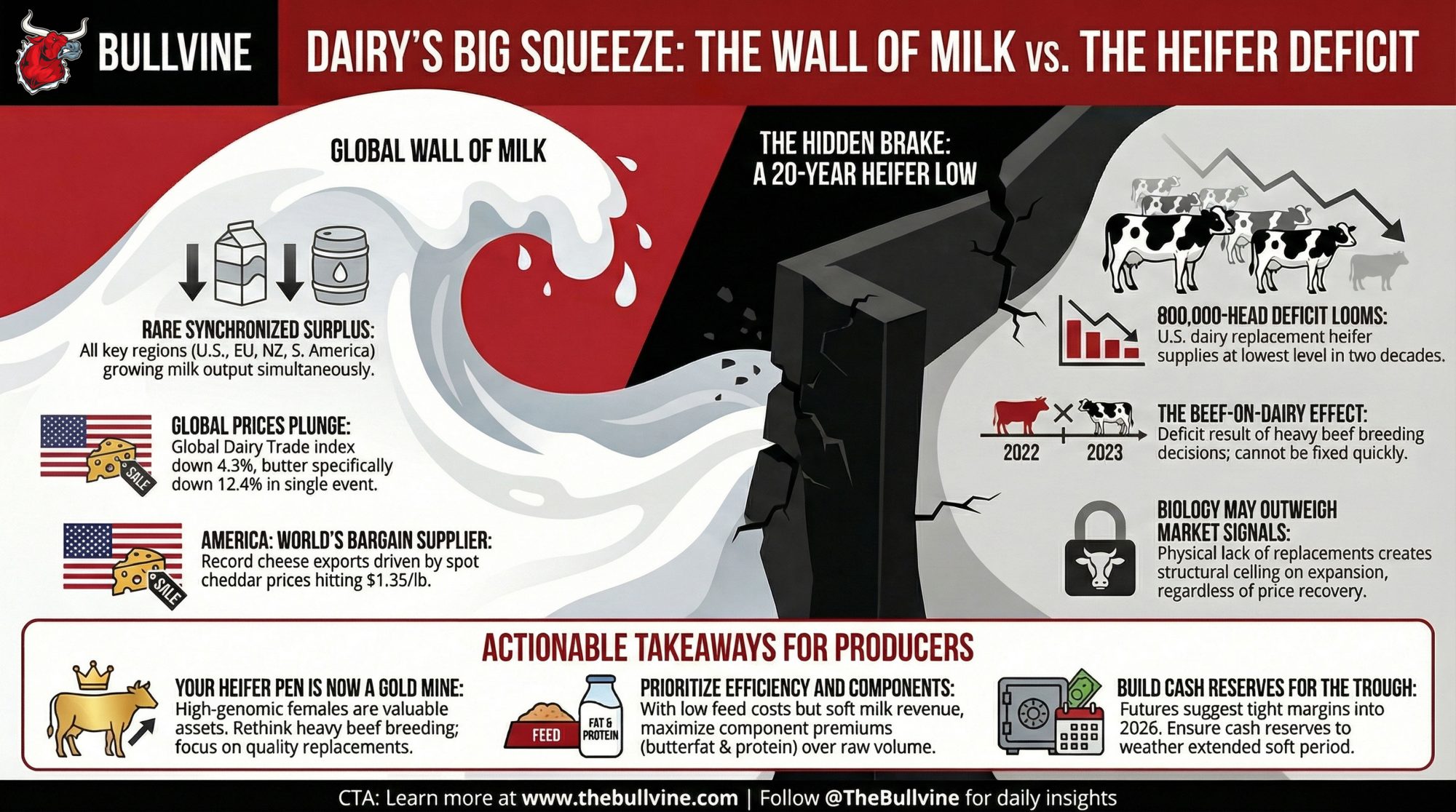
Executive Summary: The world is awash in milk. The U.S., Europe, New Zealand, and South America are all growing production simultaneously—a rare alignment that almost never occurs and has crushed the Global Dairy Trade index by 4.3%, with butter plunging 12.4% in a single auction. U.S. cheese exports are setting records, yet spot cheddar sits at just $1.35/lb; America has become the world’s bargain supplier. RaboResearch analysts don’t see meaningful price recovery through 2026, given relentless production growth. But here’s the structural twist worth watching: CoBank reports dairy heifer inventories at 20-year lows, with an 800,000-head deficit baked into the system from beef-on-dairy breeding decisions made in 2022-2023. Biology may ultimately accomplish what price signals haven’t. For farmers navigating this extended trough, the priorities are clear: cost control, component premiums, and cash reserves.

2025 Dairy Market Outlook

Something unusual is happening across the global dairy landscape right now—every major milk-producing region on earth is growing production at the same time. That almost never happens. And it’s reshaping price expectations heading into 2026.

Typically, when American parlors are running full, New Zealand deals with drought. When Europe expands, South American margins collapse. But as we close out 2025, that natural counterbalancing act has broken down entirely—and the market is feeling it.

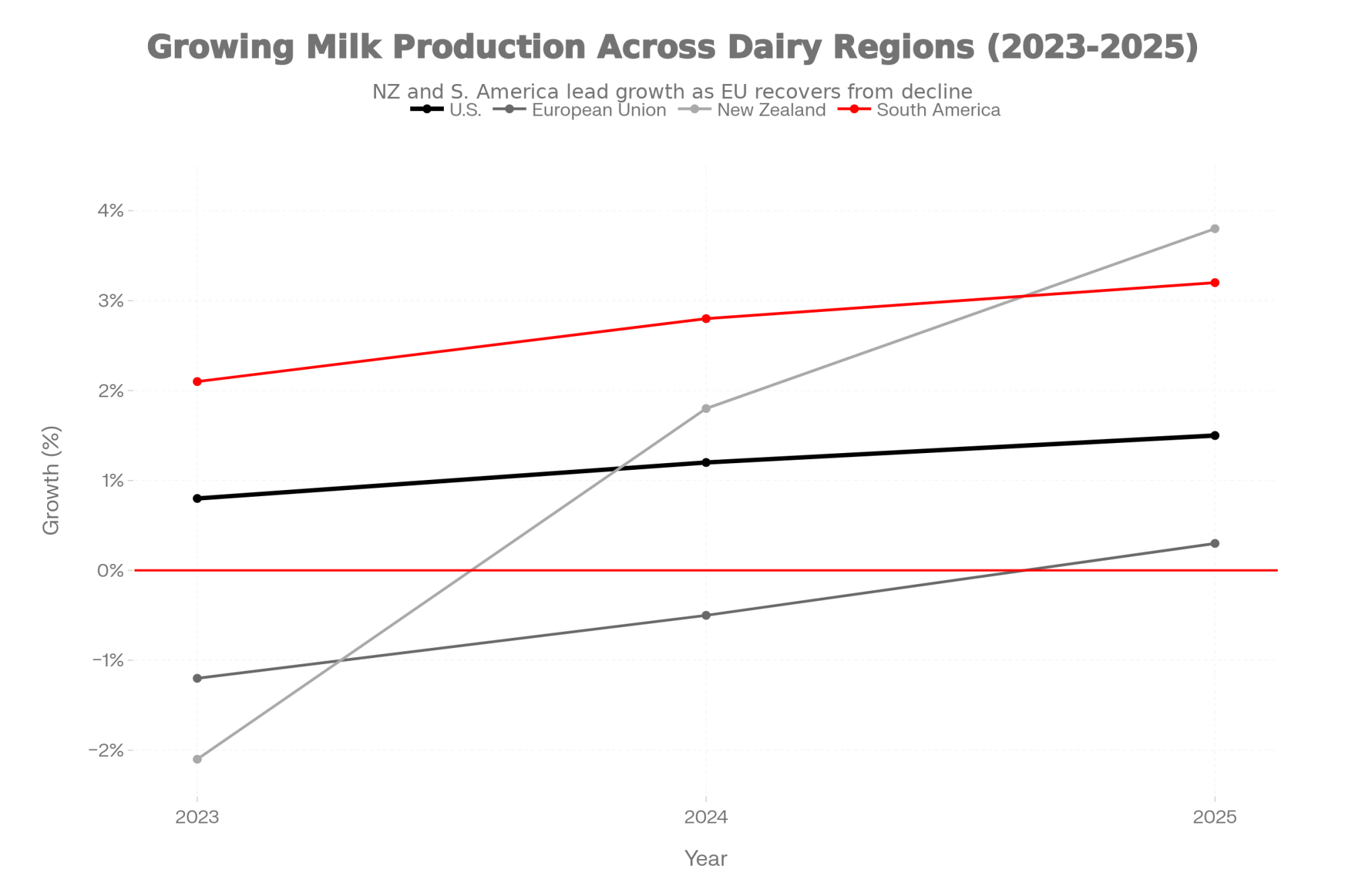
“Milk output is growing in all key exporting regions, which is not common,” explained Lucas Fuess, senior dairy analyst at RaboResearch, in a December 2025 analysis. “Typically, at least one part of the world is dealing with a limiting factor that is reducing milk growth—either weather, disease, margins, or something else. Now, the U.S., EU, New Zealand, and South America are all seeing growth—simultaneously.” 

What this means practically is that the usual relief valves aren’t working. When everyone’s producing, someone has to buy—and right now, demand simply isn’t keeping pace.

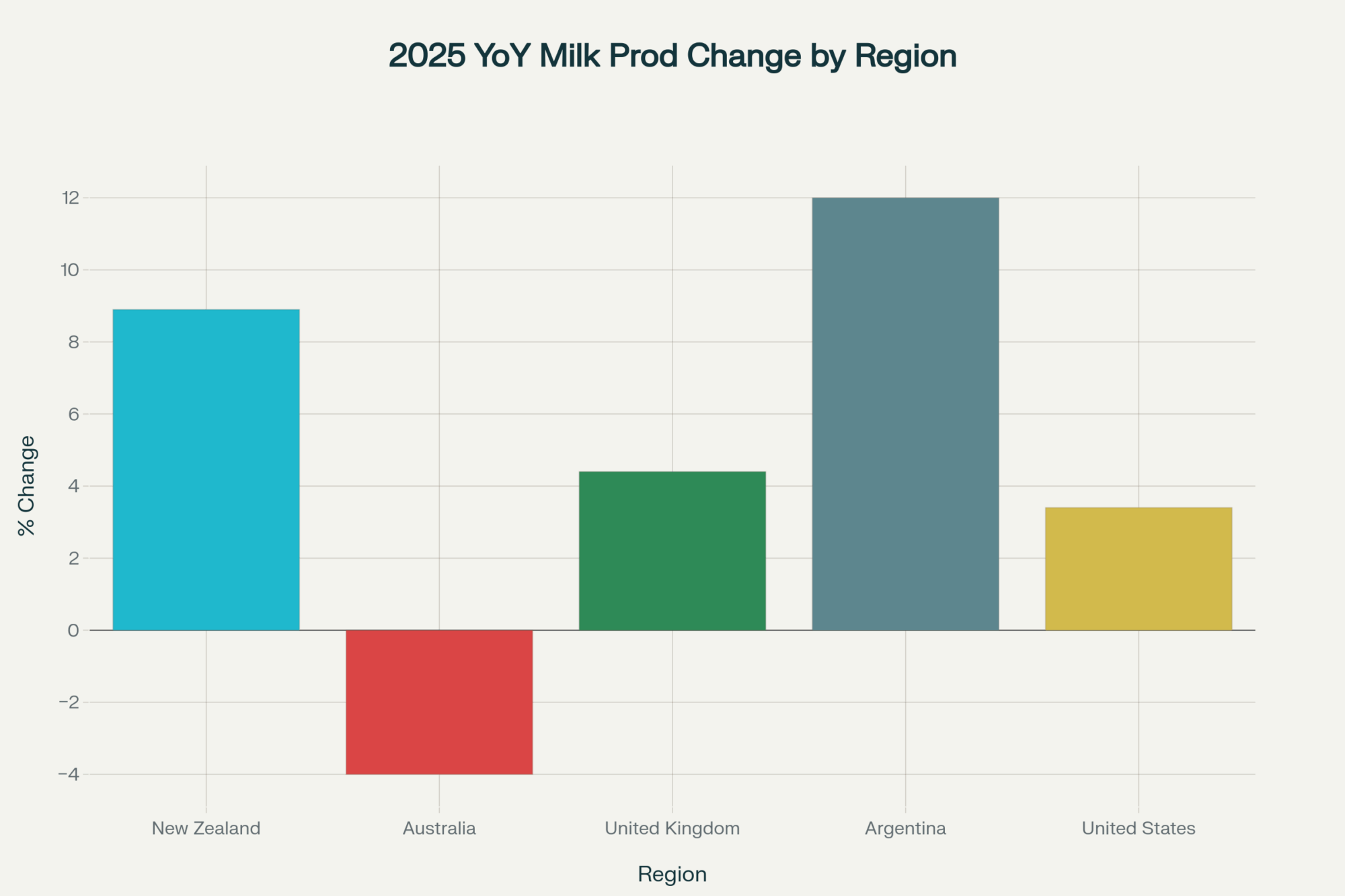
For the first time since 2018, all four major exporting regions are growing production simultaneously. Historically, drought in New Zealand or margin collapse in South America provided natural relief valves. Not this time. South America’s relentless 3.2% growth (red line) combined with New Zealand’s seasonal surge is flooding global markets—and that’s before we factor in the U.S. becoming the world’s discount cheese supplier. 

Global Dairy Trade: What the December Numbers Show

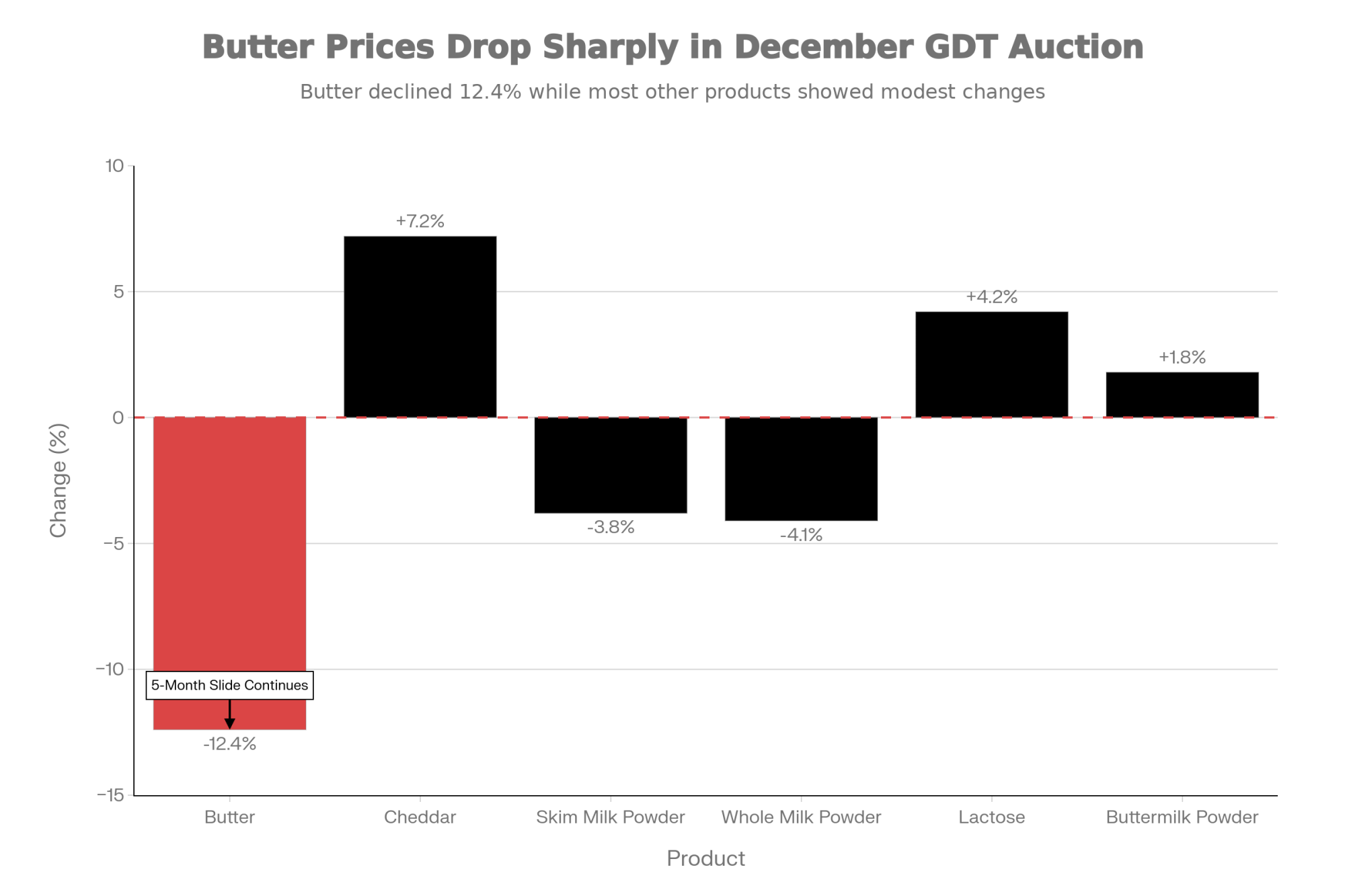
The Global Dairy Trade price index fell 4.3% at the most recent auction, with most product categories posting declines. Butter took the hardest hit—down 12.4% in a single event. Only cheddar (+7.2%), lactose (+4.2%), and buttermilk powder (+1.8%) managed gains. 

While the headline GDT index dropped 4.3%, the December auction revealed massive divergence: butter collapsed 12.4% in a single event, extending a five-month slide from May highs, while cheddar actually firmed +7.2%. This matters because it signals where global buyers see value—and where they don’t.

What strikes me about these numbers is the divergence between commodities. Butter has been sliding since May, when it reached five-year highs. Meanwhile, cheddar actually firmed at the latest auction. That kind of split tells you something important about how global buyers are thinking—they’re not avoiding dairy, they’re just getting selective about where they source it and what they’re buying.

Why U.S. Butter Became the World’s Bargain in 2025

Here’s something that deserves more attention: U.S. butter prices have sat well below European and New Zealand prices throughout all of 2025. That gap created an opportunity that global buyers noticed—and acted on.

“The US butter price has been well below the EU and NZ price throughout all of 2025,” Fuess noted. “This has driven global buyers to procure product from the US instead of other regions to recognize the value in US product.” 

John Hallo, procurement business partner at Maxum Foods, offered additional context on the New Zealand correction: “New Zealand pricing had been running at a premium from the USA/EU for four months, so I could argue their price was overinflated. Along with peak season supply of NZ fat, we have inevitably seen the correction.” 

The practical implication? That American price advantage is narrowing as global prices converge downward. Farmers who’ve been benefiting indirectly from strong export demand should watch these spreads closely heading into 2026.

U.S. Dairy Exports 2025: Record Cheese Volumes Meet Softening Spot Prices

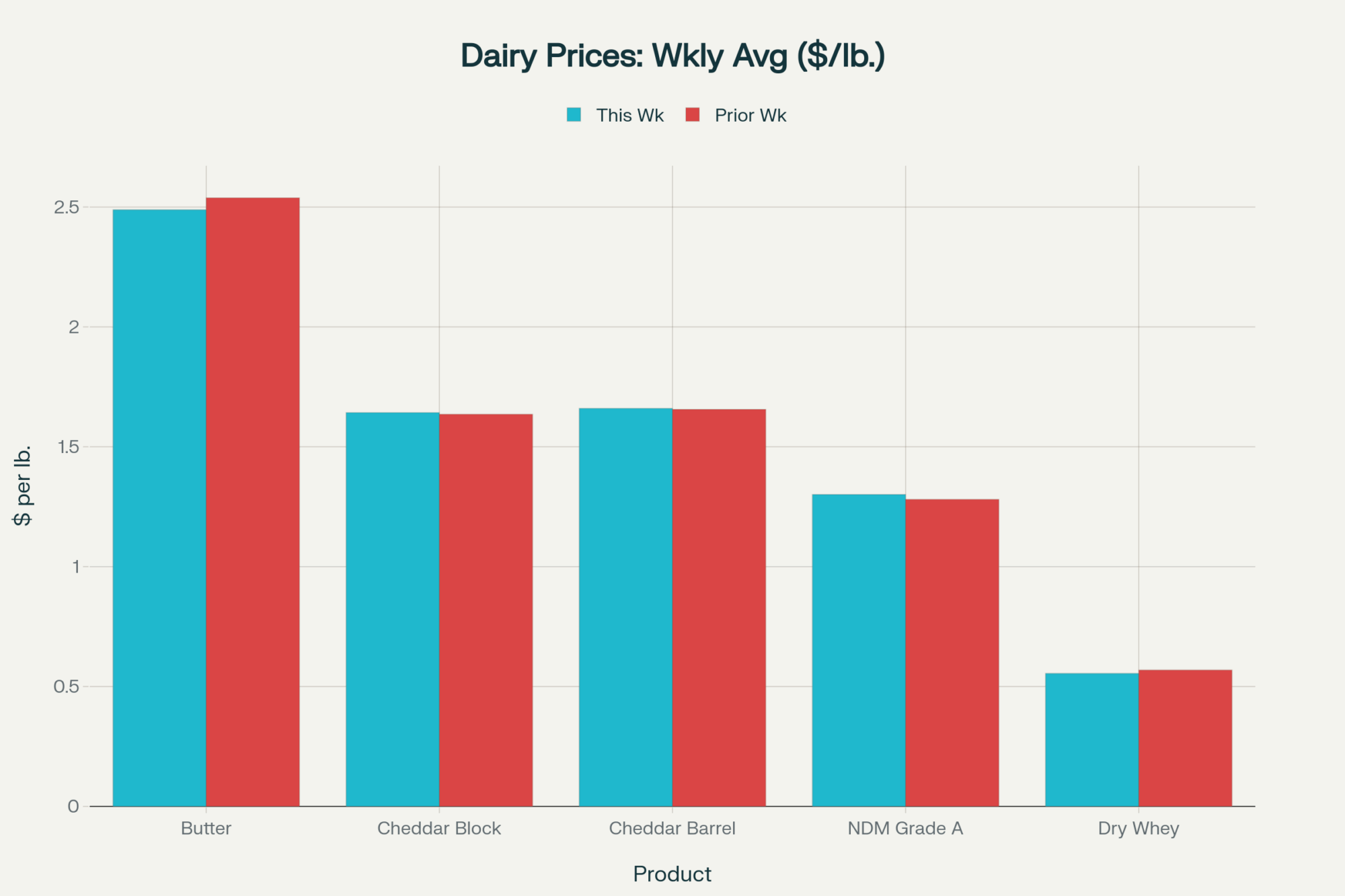
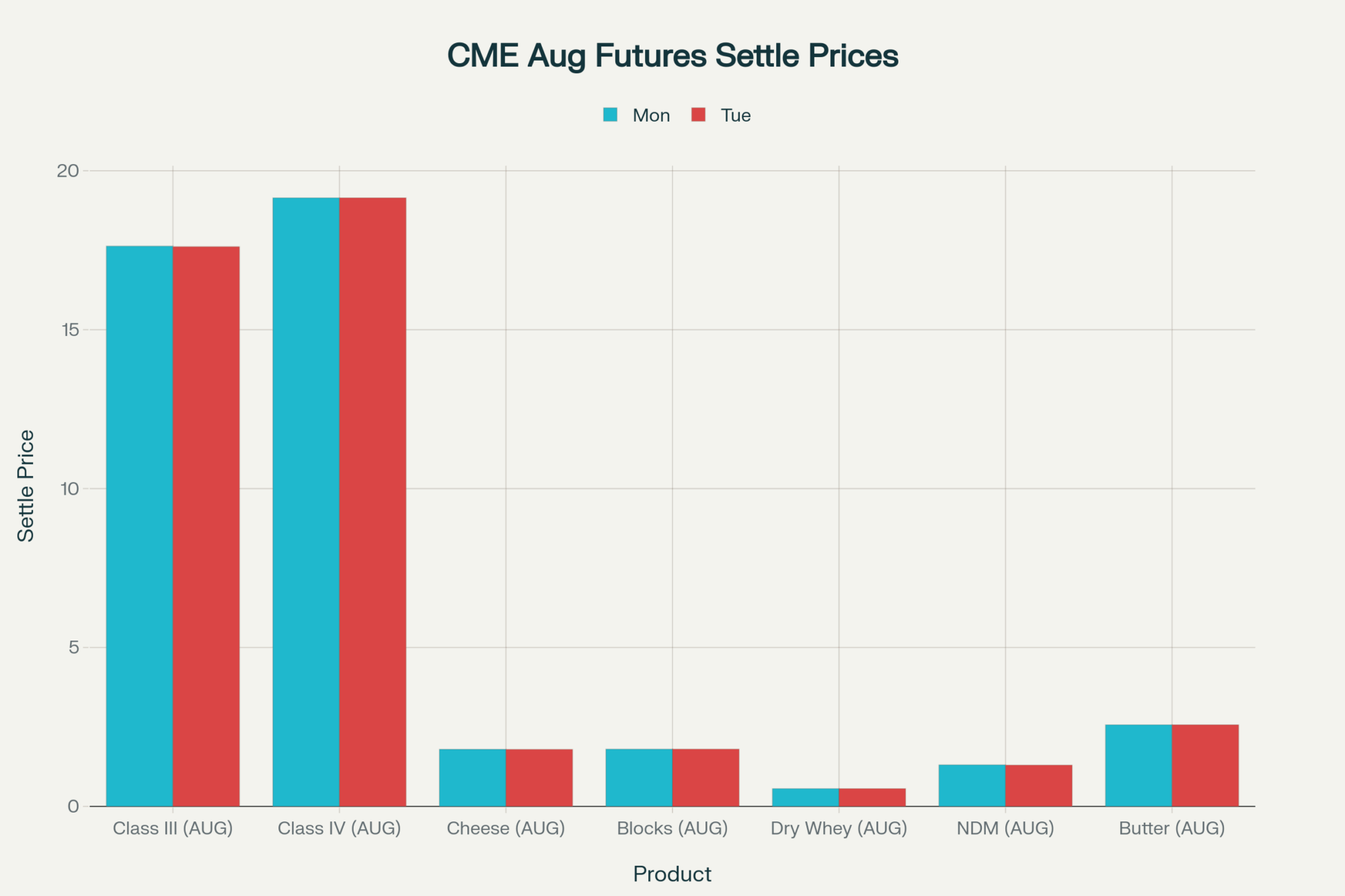
The American export picture presents an interesting paradox. CME spot cheddar blocks closed the week of December 8-12 at $1.35 per pound, with butter averaging $1.4785/lb. Class III futures for December settled around $15.88/cwt, with Class IV hovering in the mid-$13s—hardly inspiring numbers for the milk check. (Daily Dairy Report, December 12, 2025)

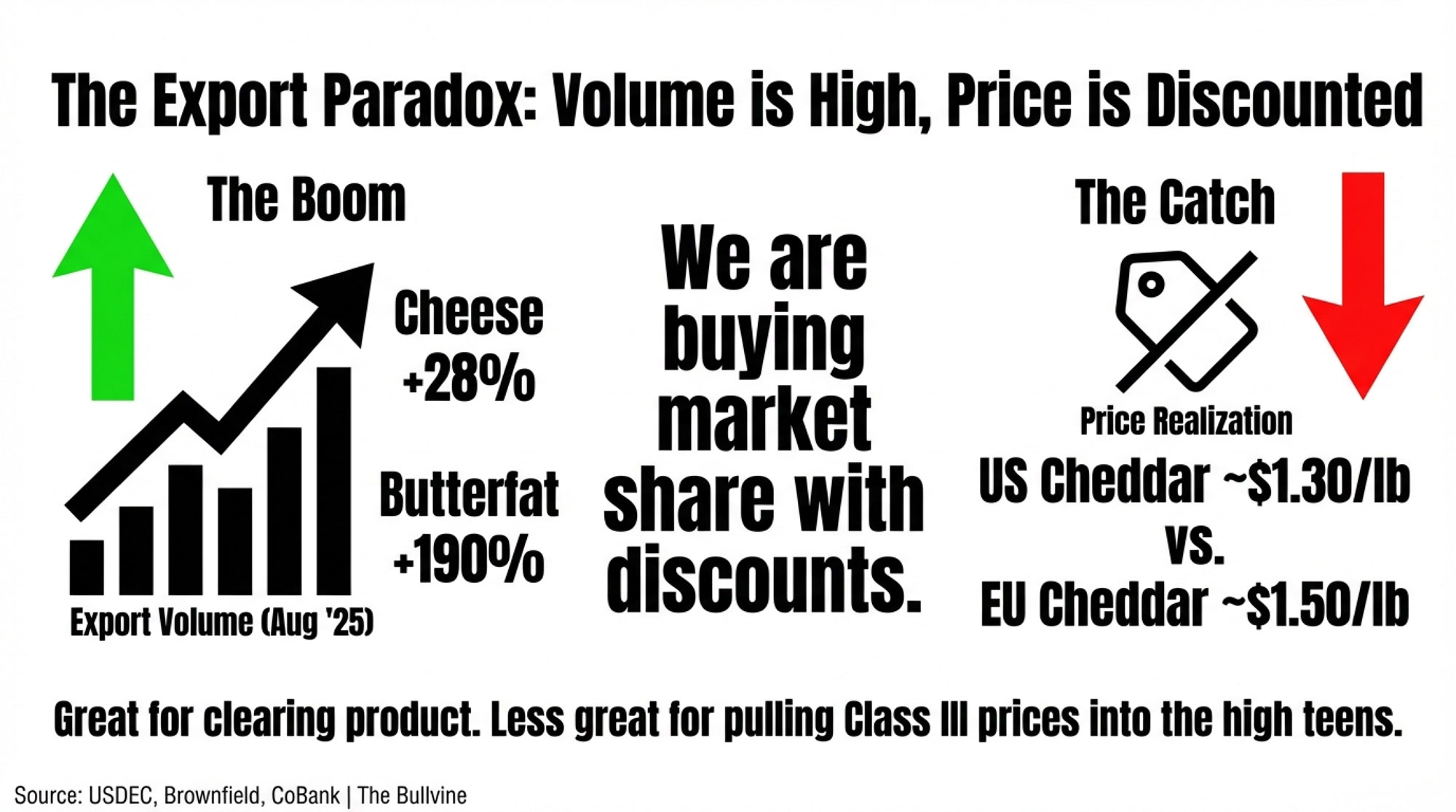
And yet, U.S. cheese exports are having a record year. September shipments jumped 35% year-over-year, putting year-to-date volume at 453,076 metric tonnes. That’s already more cheese shipped abroad in nine months than in any full calendar year except 2024. The U.S. Dairy Export Council projects we’ll likely top 600,000 MT for the full year. (USDEC, December 11, 2025)

What I find telling is that we’re moving record cheese volumes at the exact moment spot prices are hitting 18-month lows. That disconnect reveals how global buyers think—they’re responding to relative value, not absolute price levels. When an American product is cheap compared to alternatives, they buy American. Simple as that.

U.S. cheese exports are on track to exceed 600,000 MT in 2025—a record—while spot cheddar sits at $1.35/lb, down nearly 30% from mid-2024 peaks. This isn’t competitive excellence; it’s competitive desperation. Global buyers are choosing American cheese because we’re cheap, not because we’re better. 

Katie Burgess, dairy market advising director with Ever.Ag raised an important concern at the Oregon Dairy Farmers Convention earlier this year: “If we can’t get the cheese exported, and we’re making a lot of it, it means we’re going to need to eat a lot more cheese.” 

What University Research Is Showing About Milk Solids

Leonard Polzin, dairy markets and policy outreach specialist at the University of Wisconsin-Madison, has been tracking something important: production efficiency gains are outpacing headline milk volume. Despite modest total production growth, calculated milk solids production has increased more substantially because butterfat and protein tests keep climbing. (UW Extension Farms, 2025 Dairy Situation and Outlook)

For context, back in 2020, the average butterfat test was 3.95% and the protein test was 3.181%. Today’s tests are running notably higher than usual. This matters because it means the industry can meet demand for milk solids more quickly than raw production numbers suggest—processors get more usable product per hundredweight than they did five years ago. 

Additionally, UW-Madison research highlights that Federal Milk Marketing Order reforms taking effect are expected to decrease the All Milk Price by approximately $0.30/cwt, with a more pronounced impact on Class III prices. (UW Extension Farms, February 2025) That’s not a dramatic hit, but it’s another headwind for margins already under pressure.

The Heifer Constraint Nobody’s Talking About Enough

Here’s what makes the current situation genuinely unusual: despite soft milk prices, there’s a structural ceiling on how fast production can actually grow. Talk to producers across the Upper Midwest, and you hear the same story—replacement heifers are scarce and expensive.

According to CoBank’s August 2025 sector analysis, U.S. dairy replacement heifer supplies have fallen to their lowest levels in twenty years. The research projects heifer inventories will shrink by approximately 800,000 head over the next two years before beginning to recover in 2027. (CoBank/Wisconsin Ag Connection, August 2025)

CoBank’s research reveals an 800,000-head deficit already baked into the system—the direct result of beef-on-dairy breeding decisions made during 2022-2023’s high beef prices. Here’s what makes this genuinely different: even if milk prices doubled tomorrow, you can’t breed your way out of a heifer shortage when the calves weren’t born three years ago. 

That 800,000-head deficit is already baked into the system based on breeding decisions made during 2022 and 2023 when beef-on-dairy crossbreeding surged. Biology dictates timing here—you can’t simply buy your way out of a heifer shortage when the calves weren’t born.

What this means practically: even if milk prices rose tomorrow and every producer wanted to expand, the replacement animals aren’t there to support rapid growth. It’s one reason why the supply response to current low prices may be slower than historical patterns would suggest—and why some analysts see eventual price support emerging from the supply side rather than demand.

The Bullvine Breeder’s Takeaway

The 800,000-head heifer deficit changes the math on your genetic inventory. Here’s what that means for breeding decisions:

  • Your heifer pen is now a gold mine. Verified high-genomic females will likely command premium prices through 2026 as processors compete for milk to fill new capacity.
  • Stop culling lightly. With replacements at 20-year lows, that “marginal” cow might be worth keeping for one more lactation.
  • Inventory as asset class. Heifers are no longer just a cost center—they’re increasingly liquid assets in a supply-constrained market.
  • Rethink beef-on-dairy. If you swung 70%+ to beef semen in 2023, review your genetic strategy immediately. The market is signaling a need for replacement purity, and premiums for verified dairy replacements are likely within 12 months.

European Dairy 2025: Less Milk, More Cheese

The EU situation offers its own set of complexities. USDA GAIN reports forecast milk deliveries at 149.4 million metric tonnes in 2025—down 0.2% from 2024. Low farmer margins, environmental regulations, and disease outbreaks continue pushing smaller producers out. 

But here’s the nuance that matters: European processors are deliberately prioritizing cheese over butter and powder. EU cheese production is forecast to rise 0.6% to 10.8 million metric tonnes, even with less total milk available. They’re making a strategic choice about where to allocate their milk supply—and cheese is winning. 

For American producers competing in export markets, this means European cheese will remain a competitive threat even as their overall milk production contracts.

New Zealand and Fonterra: Strong Collections, Cautious Outlook

New Zealand’s dairy sector continues performing well, though Fonterra’s latest forecast signals caution about where prices are heading. The cooperative narrowed its 2025/26 farmgate milk price range from NZ$9.00-$11.00 per kgMS down to NZ$9.00-$10.00 per kgMS in late November, with the midpoint dropping from NZ$10.00 to NZ$9.50. (Fonterra, November 25, 2025)

At the same time, Fonterra increased its milk collection forecast for the 2025/26 season from 1,525 million kgMS to 1,545 million kgMS—reflecting strong on-farm production conditions. Season-to-date collections through October were running 3.8% above last season. (Fonterra Global Dairy Update, November 2025)

CEO Miles Hurrell noted the cooperative has seen strong milk flows this season, “both in New Zealand and other milk-producing nations,” resulting in seven consecutive price drops at recent Global Dairy Trade events. Fonterra’s cooperative structure provides some insulation from spot-market volatility that investor-owned processors don’t enjoy, but its price guidance suggests it’s not expecting quick relief from current conditions.

China: Modest Import Recovery on the Horizon

After a brutal 17% decline in dairy imports through the first eight months of 2024, Rabobank forecasts Chinese dairy imports will improve by 2% year-on-year in 2025. Chinese farmgate milk prices have fallen to near 10-year lows, forcing herd reductions and farm exits that are constraining domestic supply. (Tridge/Rabobank, November 2024)

That said, a 2% increase helps at the margins but won’t fully absorb the global surplus on its own. The AHDB notes that most import growth is expected in the latter half of 2025 as domestic stocks weaken. (AHDB, February 2025) It’s a positive signal, not a rescue.

Feed Costs 2025: The One Clear Bright Spot

There’s genuinely good news on the cost side. March corn futures settled around $4.405/bu in mid-December, while January soybean meal closed near $302/ton. These represent meaningful relief for ration costs heading into 2026.

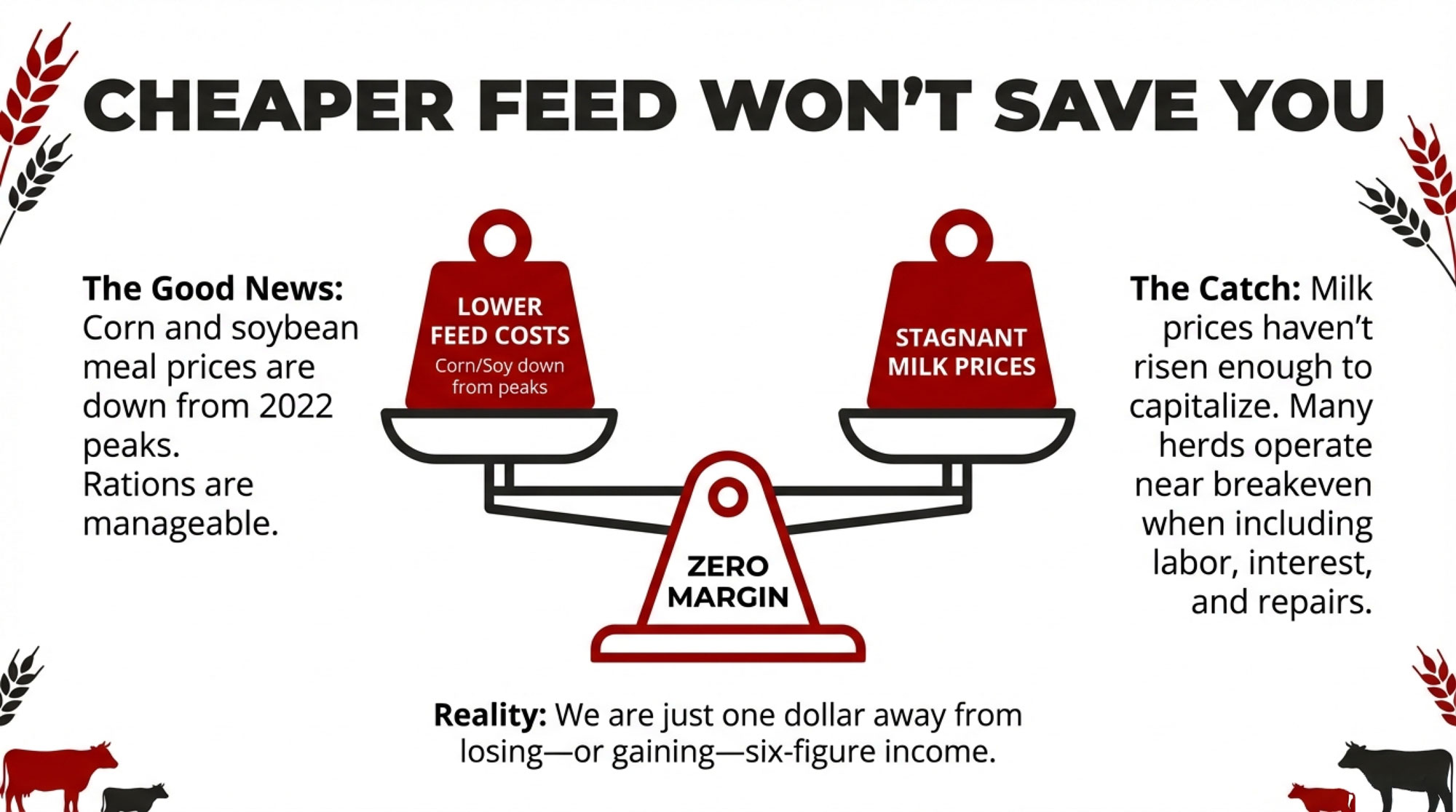
The catch—and there’s always a catch—is that feed savings don’t help if milk revenue falls faster. Margins are being compressed from the revenue side right now, not the cost side. Strong feed conversion efficiency and component production matter more than ever when the milk check is lean.

Cost/Revenue ComponentMid-2024 AverageDec 2025 AverageChange per Cow/Year
Corn ($/bu)$4.85$4.41-$96 (savings)
Soybean Meal ($/ton)$365$302-$142 (savings)
Total Feed Cost per Cow/Year$3,420$3,182-$238 (savings)
Milk Price per Cwt (Class III avg)$18.20$15.88-$522 (loss)
Annual Milk Revenue per Cow$4,368$3,811-$557 (loss)
Net Margin Impact (Revenue – Feed)-$319 per cow

The Price Signal That Hasn’t Triggered Supply Response

What farmers are finding, according to Fuess, is that milk prices simply haven’t dropped far enough to trigger the supply response markets typically need.

“Milk prices have declined in the US, but total dairy farmer income likely remains higher than the cost of production for most farmers, meaning there has not yet been a strong enough price signal to tell farmers to cull cows or cut production.” 

This creates a frustrating dynamic. Prices are low enough to hurt, but not low enough to force the contraction that would eventually support recovery. We may be stuck in this uncomfortable middle ground for a while—though the heifer shortage could ultimately do what price signals haven’t.

2026 Dairy Price Outlook: What Analysts Are Watching

Both Rabobank and Maxum Foods expect Europe to slip into a meaningful contraction next year, which should help ease the current oversupply.

“For the EU, there is a lag in falling farmgate price and reduction in milk production,” Hallo explained. “Coming off the back of good market conditions for farmers, the farms still produce good quantities despite falling commodity prices. This may look to correct itself mid-2026.” 

For U.S. producers, Fuess offered a more sobering assessment: “While volatility is never gone from the market, it is unlikely that US milk prices will see significant growth in 2026 due to the continually growing production.” 

Practical Considerations for Your Operation

Every farm faces different circumstances, but several themes emerge from the current market environment:

  • Cost management becomes your primary lever. With corn affordable and milk prices soft, feed efficiency and labor productivity matter enormously. Every dollar saved drops directly to the bottom line. This isn’t the time for sloppy ration management or deferred maintenance.
  • Component premiums over raw volume. High-protein, high-butterfat milk commands better prices at most plants. The Pennsylvania Dairy Producer Survey found that “increasing milk components” ranked among the highest-rated priorities across the state’s dairies in 2025. (Center for Dairy Excellence/Penn State Extension, 2025 Survey Results)Chasing volume into a surplus market amplifies the problem for everyone.
  • Beef-on-dairy revenue remains strong. With beef prices at historic highs, strategic terminal breeding can supplement dairy income while managing replacement inventory. The sustained strength in beef has made this supplementary income stream increasingly important to overall farm profitability—though it’s worth remembering that heavy beef breeding during 2022-2023 contributed to the heifer shortage now constraining expansion. 
  • Build cash reserves for an extended trough. Futures markets suggest sub-$16 Class III and sub-$14 Class IV through early 2026. That’s not a dip—that’s a prolonged soft period. Make sure your balance sheet can absorb six more months of tight margins, because the market isn’t signaling quick relief.

One important caveat: margin pressures vary significantly by region and operation size. Upper Midwest operations face different feed cost structures than Western dry-lot dairies, and component premiums differ by processor. What works for a 150-cow grazing operation in Vermont won’t necessarily apply to a 3,000-cow confinement dairy in Texas. Consult your nutritionist, your lender, and your local extension economist about your specific situation.

The Bottom Line

The global dairy market is sending a clear message: there’s more milk than buyers need right now, and sustained low prices will likely be required to rebalance supply and demand. Some analysts believe we’re approaching a floor. History suggests inflection points are notoriously difficult to call.

What’s interesting is that biology may ultimately accomplish what price signals haven’t—the 800,000-head heifer deficit documented by CoBank creates a hard ceiling on expansion that capital alone can’t override. By 2027, when $10 billion in new processing capacity needs filling, the cows to supply it may simply not exist.

Operations focused on efficiency, component quality, and cost discipline will be best positioned to weather this period—and to capitalize when conditions eventually turn.

Margin StrategyEstimated Impact per Cow/YearImplementation DifficultyWorks Best ForWhat this means
Component premium focus+$180-$320MediumAll herd sizes“Non-negotiable. Volume into a surplus is suicide.”
Feed efficiency optimization+$140-$220Low-MediumHerds >100 cows“Low-hanging fruit. Audit your ration immediately.”
Strategic beef-on-dairy+$250-$400LowHerds with replacement flexibility“Beef prices won’t save you, but they’ll soften the blow.”
Heifer inventory as asset+$150-$500HighHerds with genomic programs“Your heifer pen is now a gold mine. Stop culling verified genetics.”
Cash reserve buildingN/A (protects survival)MediumAll farms“Six months operating capital. Non-negotiable for 2026.”
Cull rate discipline+$80-$180LowHerds facing heifer shortage“That ‘marginal’ cow is worth one more lactation.”

Editor’s Note: Market data in this analysis comes from CME Group, Global Dairy Trade platform, USDA FAS reports, University of Wisconsin-Madison Extension, Penn State Extension, CoBank sector research, and industry analyst commentary from RaboResearch, Maxum Foods, and Ever.Ag (December 2025). National and regional averages may not reflect your specific operation’s circumstances. Feed and milk prices vary significantly by region, management practices, and market access.

Key Takeaways

  • Rare synchronized surplus: U.S., Europe, New Zealand, and South America are all growing milk production simultaneously—a phenomenon that almost never occurs and is crushing prices globally
  • December market snapshot: GDT index down 4.3%, butter plunged 12.4% in one auction, spot cheddar at $1.35/lb, Class III futures hovering near $15.88/cwt
  • America’s export paradox: U.S. cheese exports are setting records precisely because we’ve become the world’s cheapest supplier—though that advantage narrows as global prices converge
  • The 800,000-head constraint: Dairy heifer inventories have hit 20-year lows; this structural deficit from beef-on-dairy breeding may eventually limit supply when price signals alone haven’t
  • 2026 outlook and action items: RaboResearch sees no meaningful recovery until European contraction mid-year; prioritize cost control, component premiums, and cash reserves to weather an extended trough

Complete references and supporting documentation are available upon request by contacting the editorial team at editor@thebullvine.com.

Learn More:

Join the Revolution!

Join over 30,000 successful dairy professionals who rely on Bullvine Weekly for their competitive edge. Delivered directly to your inbox each week, our exclusive industry insights help you make smarter decisions while saving precious hours every week. Never miss critical updates on milk production trends, breakthrough technologies, and profit-boosting strategies that top producers are already implementing. Subscribe now to transform your dairy operation’s efficiency and profitability—your future success is just one click away.
NewsSubscribe
First
Last
Consent

8 Straight GDT Declines. The Genetic Culling and Cash Strategies That Separate 2026 Survivors.

Raising mediocre genetics into an $18 market is a $3,000 mistake walking on four legs. 8 GDT declines say it’s time to cull harder.

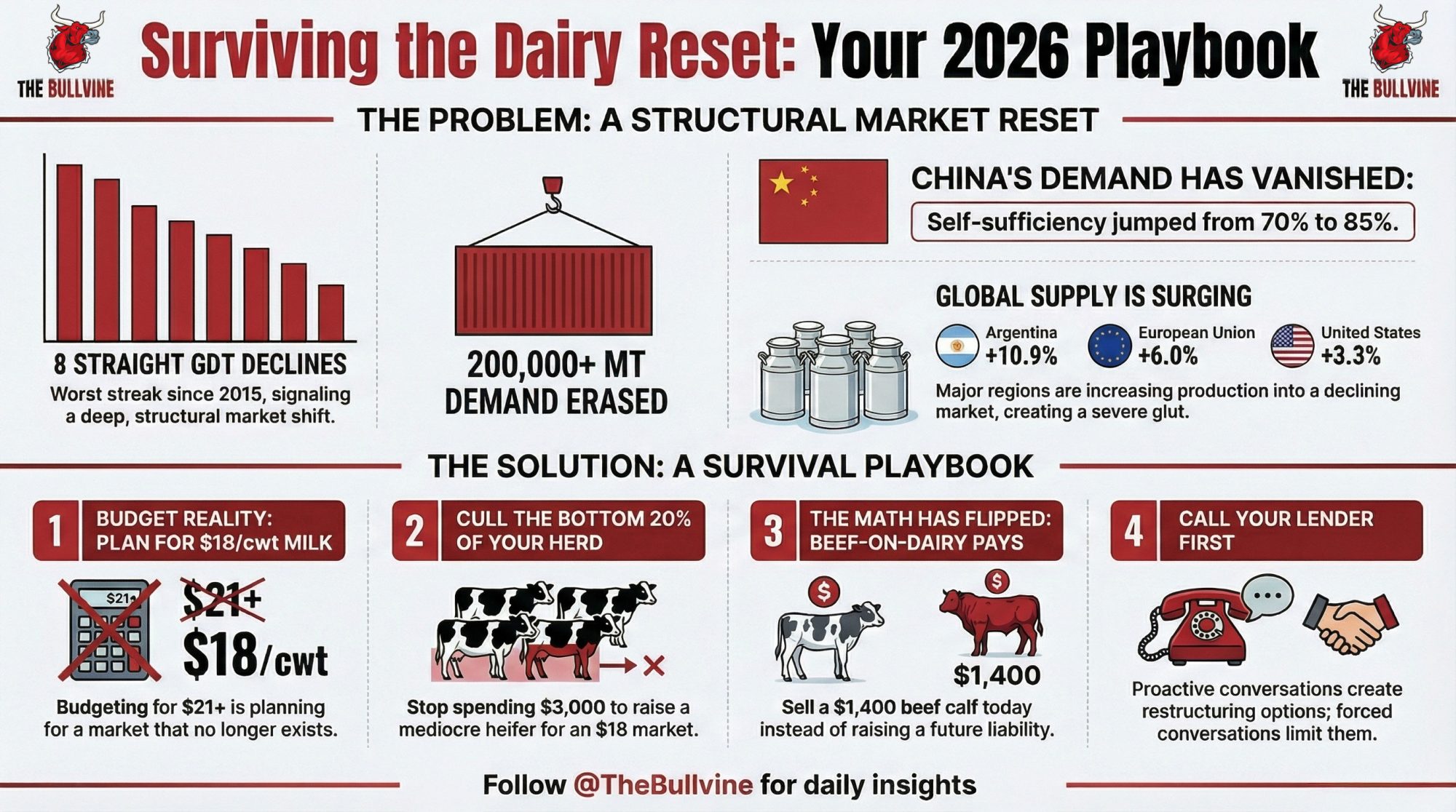
EXECUTIVE SUMMARY: Eight straight GDT declines—the worst streak since 2015—isn’t a cycle. It’s a structural reset. China’s self-sufficiency jumped from 70% to 85%, erasing 200,000+ metric tons of annual demand that isn’t returning. Production keeps accelerating everywhere: the US up 3.3%, the EU up 6%, Argentina up 10.9%. For operations still budgeting $21 milk, the math turns brutal fast—at $18/cwt, working capital burns in months, not years. The response demands ruthless clarity: cull the bottom 20% of your genetics, sell $1,000-1,400 beef-on-dairy calves instead of raising $3,000 replacement heifers, lock in price protection, and call your lender before covenants force the conversation. The dairies thriving in 2027 won’t be those that waited for recovery—they’ll be those that used 2026 to make the hard calls their competitors avoided.

Something shifted in global dairy markets this fall. Those of us watching the twice-monthly Global Dairy Trade auctions could sense it building, but the numbers from Event 393 on December 2nd brought it into sharp focus.

The damage in one auction:

  • GDT Price Index: Down 4.3%
  • Butter: Down 12.4% (the hardest hit)
  • Whole Milk Powder: Down 2.4%
  • Average price: US$3,507/MT (lowest in nearly two years)
  • Streak: Eight consecutive declines—worst since 2015
Butter prices collapsed 12.4% at Event 393. Anhydrous milk fat fell 9.8%. These aren’t modest corrections—they’re demand destruction in fat products. Meanwhile cheddar climbed 7.2% and lactose 4.2%. Message: high-fat commodity products are vulnerable in this market. Component strategy must shift toward cheese and protein, away from butter margin dependency.

For producers mapping out Q1 and Q2 of 2026—whether you’re managing a 200-cow operation in Vermont, running 3,000 head in the Central Valley, or navigating the unique economics of Southeast pasture-based systems—these results raise questions that deserve careful thought.

Is this a cyclical correction that resolves in a few months? Or does it reflect something more structural?

Here’s my read: eight consecutive declines with this breadth across product categories suggests supply-demand fundamentals that may take longer to rebalance than we’d like. That’s not cause for panic, but it is a reason for strategic action. The operations that navigate the next 12-18 months successfully will be those that understand what’s driving this weakness—and position accordingly.

The Supply Picture: Everyone’s Running Hot

The basic dynamic is pretty clear once you lay it out. Global milk production across major exporting regions is growing faster than demand can absorb. USDA Foreign Agricultural Service data and Rabobank’s quarterly analysis both point to this imbalance persisting through at least mid-2026.

Everyone’s running hot. Argentina’s milk production surged 10.9% in Q1 2025. The EU is up 6%. The US 3.3%. The problem? Demand isn’t returning. When all suppliers produce simultaneously into shrinking demand, there’s only one outcome: prices collapse.

What makes this period particularly concerning is the breadth. It’s not one region running hot while others moderate. Everyone’s pushing milk at the same time:

RegionGrowth RateSource
New ZealandSeason-to-date up 3.0%Fonterra November Update
United StatesAugust production up 3.3% (24 major states)USDA Milk Production Report
European UnionSeptember deliveries up 6.0%AHDB Market Analysis
ArgentinaQ1 2025 up 10.9%USDA Attaché Reports

Fonterra has already raised their collection forecast from 1,525 million kgMS to 1,545 million kgMS. The US herd continues expanding even as futures soften. You know how it goes—once you’ve invested in facilities, genetics, and labor, the economic pull favors keeping stalls occupied.

“This cycle, we’re seeing production accelerate into declining prices. That pattern—when it persists—typically indicates a longer adjustment period ahead.”

The China Shift: This Isn’t Cyclical

No factor shapes the global dairy trade outlook quite like China’s changing import patterns. For nearly a decade, China served as the primary growth engine for dairy exports worldwide. What’s shifted there helps explain everything we’re seeing at GDT.

China’s government-backed self-sufficiency push worked. From 70% to 85% domestic production in five years. Translation: 200,000+ metric tons of annual demand that exported countries will never see again. This isn’t a market cycle. It’s geopolitics as food security policy.

The key numbers:

  • Self-sufficiency: Climbed from ~70% (2020-2021) to ~85% (2025) per USDA and Rabobank estimates
  • WMP imports: Dropped from 845,000 MT at peak to ~430,000 MT by 2023
  • Missing demand: 200,000-240,000 MT annually that isn’t coming back soon

Rabobank’s Mary Ledman, its global dairy strategist, framed it clearly: China moved from about 70% self-sufficiency to roughly 85%, and that shift cascades through global trade flows. When China’s import demand contracts, it affects pricing for exporters worldwide.

What this means: Business planning built around a rapid return to peak Chinese imports probably warrants reconsideration. Beijing invested heavily in domestic processing capacity as a food security priority. Some analysts believe import demand could stabilize if domestic production growth slows—but for planning purposes, assuming reduced Chinese appetite persists seems prudent.

Where’s the Milk Going?

With China absorbing less, displaced volume is finding alternative homes—but at a cost:

Secondary markets are absorbing volume. The Middle East, Southeast Asia, and parts of Latin America have increased purchases at competitive pricing. But these markets are smaller and more price-sensitive. They take the milk—just at prices that drag everything down.

Product mix is shifting. EU processors are directing more milk toward cheese and whey rather than powder. This doesn’t eliminate surplus; it redistributes pressure across product streams.

Inventories are building. US nonfat dry milk stocks have grown through 2025, according to USDA Dairy Products data. The milk is moving, but it’s backing up. That overhang suppresses spot prices until stocks normalize.

Farm-Level Math: Where It Gets Real

For individual operations—particularly those carrying debt from recent expansions—extended margin compression creates genuine planning challenges.

Fonterra’s adjustment illustrates how GDT weakness hits farmgate: They narrowed their 2025/26 price range from NZ$9.00–$11.00/kgMS to NZ$9.00–$10.00/kgMS. For a farmer supplying 200,000 kgMS, that 50-cent midpoint reduction means roughly NZ$100,000 less this season.

US operations face a similar arithmetic:

  • 500-cow dairy producing 25,000 lbs/cow annually
  • Each $1/cwt change = approximately $125,000 in gross revenue impact

I recently spoke with a producer running about 450 cows in east-central Wisconsin—debt-to-asset ratio around 47%, which isn’t unusual for operations that expanded during 2021-2022. At $22/cwt, modest positive cash flow. At $18-19/cwt, he’s projecting monthly shortfalls of $35,000-45,000. Working capital covers roughly three months at that burn rate.

His approach? Running all projections at $18 now, not $21.

“I’d rather be surprised by better prices than caught short by worse ones.”

The timeline pressure: Working capital reserves on many operations cover 2-4 months of shortfalls. When those deplete, operating lines of credit come at higher rates—what was 6-7% might now cost 10-11%, further pressuring cash flow.

Practical Responses That Are Working

Across regions, proactive producers are responding with concrete adjustments. The specifics vary—feed costs differ between California and Wisconsin, Southeast operations face different heat-stress economics, and Northeast producers navigate distinct cooperative structures—but certain approaches work broadly.

Get Brutally Honest on Cash Flow

Run projections at $18.00/cwt, not $21-22. Answer these questions candidly:

  • What’s the monthly cash flow at current prices through Q2 2026?
  • How many months can you sustain negative cash flow before exhausting working capital?
  • At what price does the operation return to breakeven?

Operations projecting shortfalls above $30,000-50,000/month should initiate lender conversations now—before covenant pressures force them.

Lock In Some Protection

Forward contracting and hedging deserve fresh attention:

  • Forward contract 30-50% of near-term production through co-ops or direct processor contracts
  • Put options on Class III or Class IV milk for downside floors with upside participation
  • Dairy Margin Coverage enrollment at coverage levels matching your debt structure

Options protection typically costs $0.20-0.40/cwt. That’s insurance math—worth evaluating against your exposure.

Strategic Cost Management

Ration optimization remains the biggest lever. Maximize the number of components per pound of dry matter intake. With butterfat and protein premiums available through many marketing arrangements, component-focused feeding can partially offset lower base prices. Transition cow nutrition and fresh cow management remain areas where investment pays returns—you probably know this, but it bears repeating during tight margins.

Forward purchase feed ingredients at current favorable levels for 6-12 months.

Capital discipline—defer projects that don’t show clear payback within 12 months at $18/cwt.

Ruthless Heifer Inventory Calibration

This is where genetics strategy meets financial survival.

Stop raising the bottom 20% of your genetics. Move from 110% of replacement needs to strictly 100%. Use beef-on-dairy crosses on everything that isn’t top-tier. In a market like this, raising a mediocre heifer is a luxury you cannot afford.

Downturns are the time to concentrate genetic investment. Focus sexed semen only on your elite animals. Let beef sires cover the rest. The operations that emerge strongest from price cycles are typically those that used the pressure to accelerate genetic progress—not those that kept feeding average genetics because “we’ve always raised our own replacements.”

Here’s what’s interesting about the economics right now. Dairy beef has become a meaningful revenue stream—according to Hoard’s Dairyman, dairy-beef crosses now represent 15-20% of national beef production. That $1,000-1,400 dairy-beef calf you’re selling at a few days old is worth far more than a replacement heifer you’ll spend $2,500-3,000 raising only to freshen into an $18 milk market. The math has completely flipped from where it was just a few years ago, when those calves were bringing $350-400.

Early Lender Engagement

For operations where projections suggest restructuring may be needed, earlier conversations produce better outcomes. Options farmers are exploring:

  • Extending term debt amortization (10 → 15 years) to reduce annual payments
  • Converting operating lines to term debt for covenant breathing room
  • Adjusting payment timing to align with milk check cycles
  • Providing additional collateral for better terms

Lenders prefer restructuring to foreclosure. But that preference is strongest when borrowers approach proactively—not when they’re already in technical default.

The Coordination Reality

Could coordinated production cuts accelerate rebalancing? Probably not.

US antitrust law restricts coordination on production or pricing. Cooperative structures require accepting all member milk. And even if one region cut output, others would expand to capture the opportunity—Argentina’s 10.9% Q1 surgeshows how fast capacity elsewhere fills gaps.

Historical precedent: During 2014-2016, US milk production actually grew despite severely compressed margins. Recovery came when demand improved—not from coordinated supply reduction. The survivors managed through individually: maintaining reserves, restructuring early, achieving efficiencies their neighbors didn’t.

Market rebalancing will occur through aggregated individual responses to economic pressure. That places the burden on each operation to assess its own position and act accordingly.

How the Next 18 Months Might Unfold

Here’s one informed perspective—not prediction:

Through Q1 2026: Current dynamics persist. Production growth continues despite weak prices, China maintains a reduced import posture, and inventories stay elevated. GDT likely stays below $3,500/MT, potentially testing $3,200-3,300.

By mid-2026: Margin compression forces more decisive responses. Some operations exit through individual financial pressure. Others restructure and emerge leaner. Consolidation accelerates.

Late 2026 into 2027: If sufficient capacity adjusts, supply comes into better balance. Prices recover—though likely to equilibrium levels reflecting China’s structurally lower imports and more consolidated global production.

The operations positioned well for 2027 won’t necessarily be the largest. They’ll be those that assessed their situations honestly now, made difficult decisions while options remained, and configured for a market that differs from 2021-2022.

The Bottom Line

This market weakness is structural, not cyclical. Eight consecutive GDT declines, plus China’s sustained import reduction, create headwinds that won’t resolve quickly.

Run your numbers at $18/cwt. Operations showing significant monthly negative cash flow face decisions within 6-12 months.

Talk to lenders before you have to. Proactive conversations yield better outcomes than forced ones.

Concentrate your genetic investment. Stop subsidizing mediocre genetics with expensive heifer development. Use beef-on-dairy aggressively—at $1,000+ per calf, the economics have never been better.

Protect some downside. Evaluate forward contracting and options based on your specific debt exposure.

Early action preserves options. Delayed response narrows them.

These are genuine challenges—and ones the industry has navigated before. The operations thriving when conditions improve will be those making informed decisions now: understanding what market signals indicate, assessing their position realistically, and acting while choices remain.

Your local extension dairy specialists and farm business management educators can provide perspective tailored to your specific circumstances. Run your numbers, have the conversations, and position your operation for whatever comes next.

We’ll continue tracking these developments. In the meantime—sharpen your pencil, sharpen your genetics, and sharpen your strategy.

Key Takeaways 

  • Stop waiting for recovery. China’s at 85% self-sufficient. That 200,000+ MT of vanished demand isn’t returning. This is the market now.
  • Budget at $18. Today. At $21, you’re planning for a market that no longer exists. Run your numbers at $18 and see if your runway is months—or weeks.
  • Cull the bottom 20%. Ruthlessly. A $1,400 beef calf at 3 days old beats a $3,000 heifer raised to freshen into $18 milk. That math has permanently flipped.
  • Call your lender this week. Proactive conversations get restructuring options. Forced conversations get whatever terms are left.
  • The 2027 winners are being decided now. They won’t be the biggest operations—they’ll be the ones that culled harder, budgeted tighter, and moved while competitors waited.

Complete references and supporting documentation are available upon request by contacting the editorial team at editor@thebullvine.com.

Learn More:

Join the Revolution!

Join over 30,000 successful dairy professionals who rely on Bullvine Weekly for their competitive edge. Delivered directly to your inbox each week, our exclusive industry insights help you make smarter decisions while saving precious hours every week. Never miss critical updates on milk production trends, breakthrough technologies, and profit-boosting strategies that top producers are already implementing. Subscribe now to transform your dairy operation’s efficiency and profitability—your future success is just one click away.
NewsSubscribe
First
Last
Consent

Weekly Global Dairy Market Recap: Monday, November 3, 2025: European Cheese Crashes 37% as Class Spread Hits Historic High

European cheese crashed 37% year-over-year, and the Class III-IV spread reached a farm-killing $3.50/cwt.

Executive Summary: Global dairy markets are in freefall. European cheese crashed 37% year-over-year, GDT auctions fell for the fifth straight week, and the Class III-IV spread exploded to a farm-killing $3.50/cwt—your Class III neighbor is now making $3,800 more per month than you. Milk production is surging everywhere (New Zealand +2.8%, UK +7.5%, U.S. herd at 32-year high) while demand craters, with only whey (+2.2%) and China’s premium dairy pivot offering hope. The Trump-Xi deal promises 25 million tonnes of annual soybean purchases to ease feed costs, but it won’t save commodity producers. Bottom line: If you’re shipping Class IV at $13.90 while others get $17.40 for Class III, you’re losing $45,000 annually. The farms that survive will be those that act now to lock in Class III, optimize components, and abandon the volume-at-any-cost mentality that’s driving this market into the ground.

Global Dairy Markets

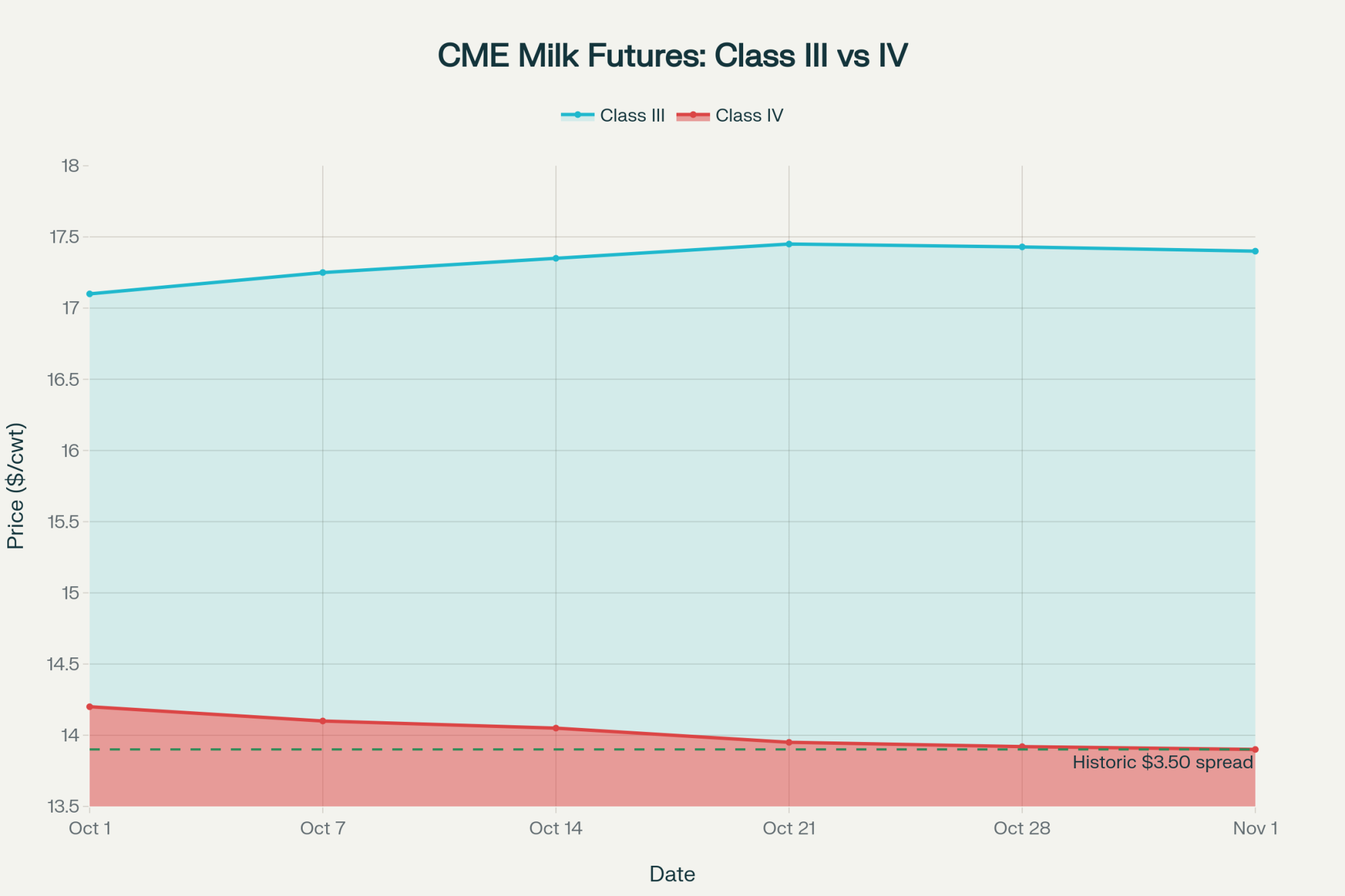
Global dairy markets delivered another week of painful reality checks. European cheese posted annual declines of more than 30%. The fifth straight GDT auction decline confirmed what you already know—there’s too much milk chasing too few buyers. Meanwhile, the Class III-IV spread hit $3.50/cwt, meaning your neighbor shipping Class III milk is making $3,800 more per month than you are if you’re stuck in Class IV.

European Futures: Butter Holds, Everything Else Slides

Key Takeaway: European traders moved 2,620 tonnes last week, but the real story is powder weakness (-1.3%) while whey bucked the trend (+2.2%)—a clear signal that protein derivatives are the only bright spot.

EEX recorded 524 lots of trading activity, with Tuesday’s 925-tonne session marking the week’s peak. The breakdown tells you everything about market sentiment:

  • Butter futures only dropped 2.0% to €5,093/tonne
  • SMP futures weakened 1.3% to €2,161/tonne
  • Whey futures climbed 2.2% to €1,007/tonne

That whey strength? It’s your lifeline. Strong protein derivative demand for feed and nutrition applications is keeping values supported while everything else crumbles.

Singapore Exchange: New Zealand’s Spring Flush Hits Hard

Key Takeaway: SGX traders moved 17,020 tonnes, but WMP prices fell for the fifth straight week to $3,523/tonne—Fonterra’s 2.8% production increase is flooding the market.

The numbers paint a clear oversupply picture:

  • WMP: Down 0.7% to $3,523/tonne
  • SMP: Flat at $2,591/tonne
  • AMF: Up 0.2% to $6,677/tonne
  • Butter: Down 1.3% to $6,339/tonne

Here’s what matters for your operation: Fonterra’s September collections hit 179 million kgMS (+2.8% YoY), with season-to-date volumes running 3.0% ahead. When New Zealand pumps out milk like this, global prices have nowhere to go but down.

European Cheese Collapse: The 30% Massacre

European Cheese Markets in Historic Freefall

Key Takeaway: European cheese prices aren’t just weak—they’re in historic freefall. Every major variety is down 30%+ year-over-year, and buyers know more pain is coming.* The weekly damage was brutal:

  • Cheddar Curd: Crashed €113 to €3,388 (-33.6% YoY)
  • Mild Cheddar: Plunged €206 to €3,430 (-33.3% YoY)
  • Young Gouda: Trading at €2,909 (-37.2% YoY)
  • Mozzarella: Down €105 to €2,823 (-36.2% YoY)

Why should you care? Because European processors are bleeding cash—paying €520/tonne for milk while selling Gouda at €400/tonne. That math doesn’t work. Something’s got to give.

GDT Auction: Fifth Straight Decline Says It All

Fifth Consecutive GDT Decline Confirms Bearish Reality

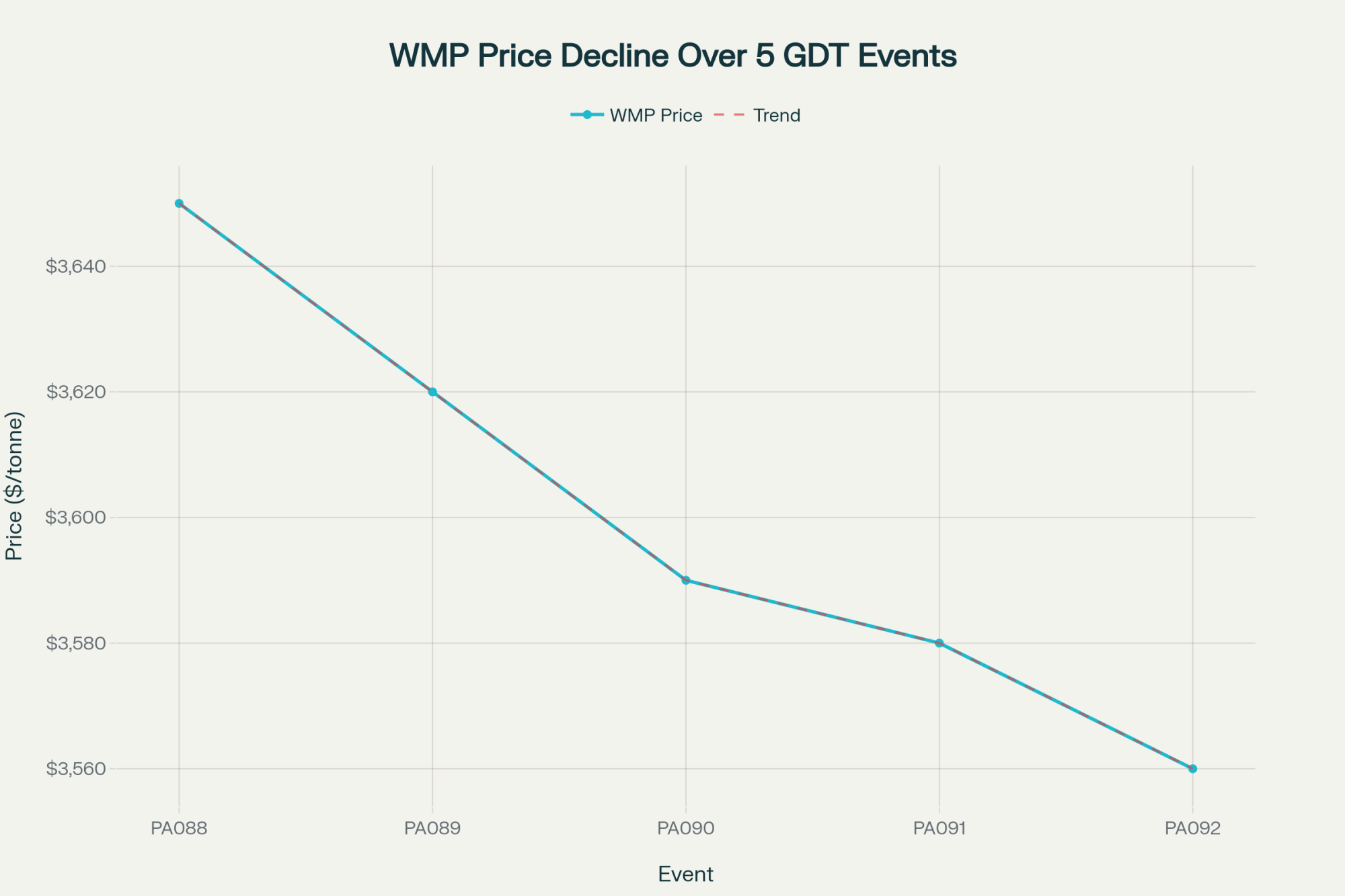
Key Takeaway: *The GDT Pulse auction delivered another gut punch—WMP at $3,560 and SMP at $2,530 represent 13-month lows. Buyers have zero urgency. The PA092 results confirmed what everyone fears:

  • WMP: $3,560/tonne (down $90 from two weeks ago)
  • SMP: $2,530/tonne (down $55 from prior pulse)
  • Total volume: Only 2,612 tonnes with 41 bidders

That’s five consecutive declines. The message? Global buyers are sitting on their hands, waiting for even lower prices.

Global Production: Everyone’s Making More Milk

Key Takeaway: From New Zealand (+2.8%) to Poland (+5.7%) to the UK (+7.5%), milk is flowing everywhere except where you need it—into buyer demand.

Southern Hemisphere Springs Forward

  • New Zealand: 316.3 million kgMS season-to-date (+3.0%)
  • Australia (Fonterra): 23.4 million kgMS YTD (+3.0%)
  • Argentina: September production surged 9.9% YoY

Northern Hemisphere Piles On

  • UK: September hit 1.28 million tonnes (+7.5% YoY)
  • Poland: 1.11 million tonnes in September (+5.7% YoY)
  • Ireland: November 2024 exploded 34% higher
  • USA: Herd at 9.52 million cows—highest since 1993

CME Markets: The Class Spread That’s Killing Farms

Historic Class III-IV Spread Creates $3,800 Monthly Winners and Losers

Key Takeaway: The $3.50/cwt Class III-IV spread isn’t just a number—it’s the difference between profit and loss for thousands of dairy farms.*Here’s your Friday closing reality check:

Winners:

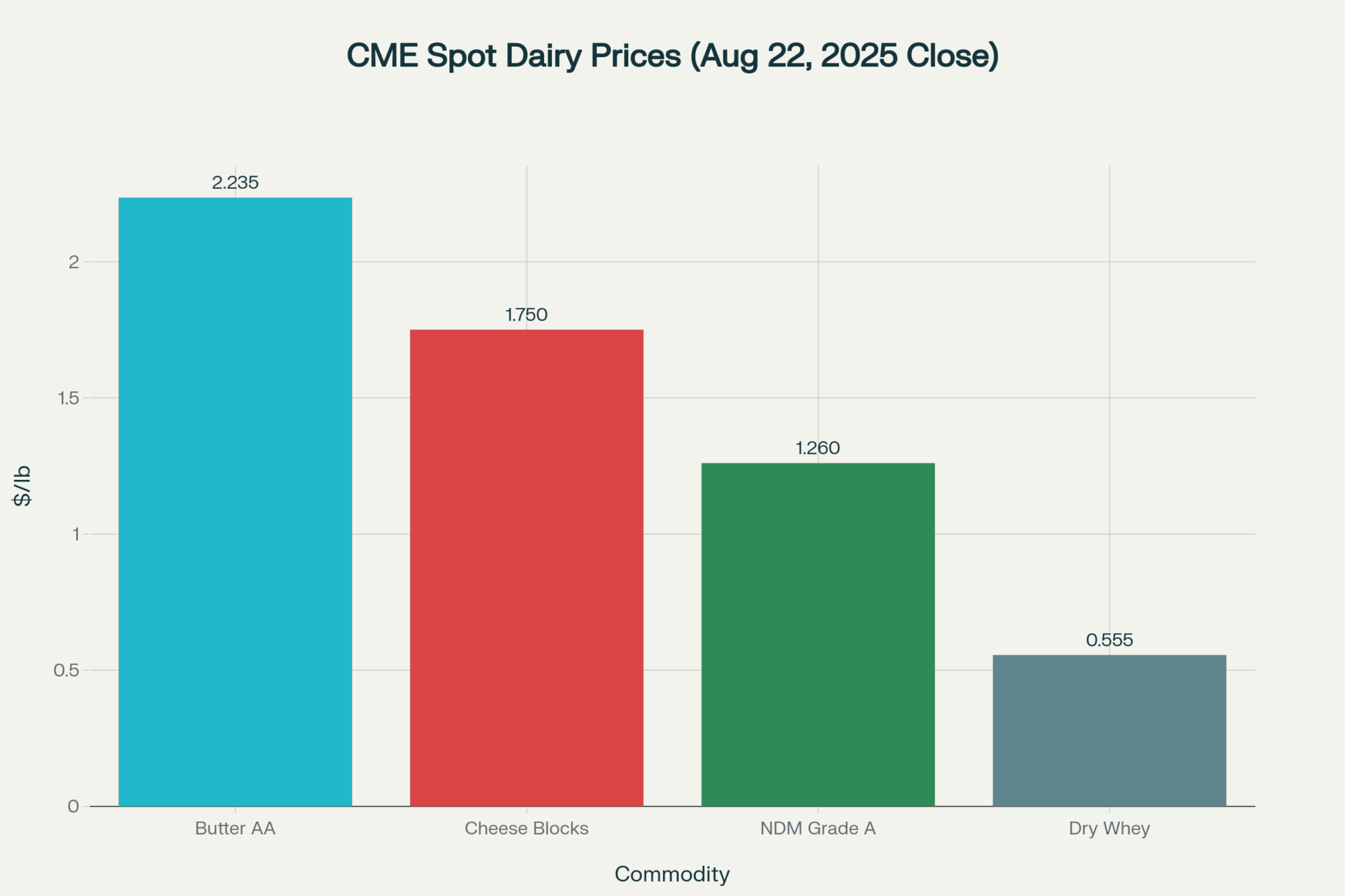
  • Cheddar Barrels: $1.8050 (+3.5¢)
  • Dry Whey: $0.7100 (+2¢)—nine-month high
  • Class III November: $17.40/cwt

Losers:

  • NDM: $1.1325 (-2.75¢)
  • Butter: $1.6100 (barely holding)
  • Class IV November: $13.90/cwt

Do the math: If you’re shipping 3 million pounds monthly, that $3.50 spread means $3,800 less in your milk check compared to your Class III neighbor. That’s a new pickup truck disappearing every year.

Feed Markets: China Deal Sparks Soybean Rally

Key Takeaway: Soybeans hit $11/bushel on China’s promise to buy 12 million tonnes immediately plus 25 million tonnes annually—but will they follow through?

The Trump-Xi meeting delivered feed market fireworks:

  • Soybeans: Surged 60¢ to $11.00/bushel (15-month high)
  • Soybean Meal: Jumped $27 to $321.40/ton
  • Corn: Up 8¢ to $4.31/bushel

Treasury Secretary Bessent’s announcement sounds impressive, but here’s the reality: Those Chinese purchase commitments are still below pre-trade war levels. Don’t count your feed savings yet.

Trade Breakthroughs: Southeast Asia Opens Doors

Key Takeaway: New agreements with Malaysia, Cambodia, Thailand, and Vietnam eliminate dairy tariffs—finally giving U.S. exports a fighting chance against New Zealand and Australia.

President Trump’s Asian tour delivered real results:

  • Malaysia: Eliminates all dairy tariffs, recognizes U.S. standards
  • Cambodia: Zero tariffs on all U.S. dairy products
  • Thailand: Framework covers 99% of goods (dairy included)
  • Vietnam: Preferential access for substantially all dairy

Why this matters: Vietnam imported $668 million in dairy through August 2025, but U.S. suppliers captured only $22 million due to tariff disadvantages. These deals level the playing field.

China’s Premium Pivot: The $150,000 Opportunity

Key Takeaway: China’s 18% surge in premium dairy imports versus 12% declines in commodity products isn’t a blip—it’s a structural shift that rewards quality over quantity.

The numbers tell the story:

  • Cheese imports: +13.5% YoY
  • Butter imports: +72.6% YoY
  • Skim milk powder: Significant retreat

For a 500-cow operation optimized for components and premium channels, this shift could mean $150,000+ in additional annual revenue. The question is: Are you positioned to capture it?

The Bottom Line: Survival Mode Until Spring

Here’s your reality: Global milk production is overwhelming demand, and it’s not stopping. The Class III-IV spread is creating massive inequities between farms. European cheese markets are in freefall with no floor in sight. Your only bright spots? Whey strength and potential Chinese premium demand.

Three moves to make this week:

  1. Lock in Class III if you can—that $3.50 spread won’t last forever
  2. Review your component optimization—premium markets are your escape route
  3. Don’t forward contract cheese—European prices prove there’s more pain coming

The market’s sending clear signals: Commodity dairy is dead money. Premium products and value-added channels are your survival strategy. The farms that adapt to this reality will still be here in 2027. The ones that don’t? They’ll be someone else’s expansion.

What’s your move? The clock’s ticking, and every month at $13.90, Class IV is another month closer to the edge. 

Complete references and supporting documentation are available upon request by contacting the editorial team at editor@thebullvine.com.

Learn More:

Join the Revolution!

Join over 30,000 successful dairy professionals who rely on Bullvine Weekly for their competitive edge. Delivered directly to your inbox each week, our exclusive industry insights help you make smarter decisions while saving precious hours every week. Never miss critical updates on milk production trends, breakthrough technologies, and profit-boosting strategies that top producers are already implementing. Subscribe now to transform your dairy operation’s efficiency and profitability—your future success is just one click away.
NewsSubscribe
First
Last
Consent

The October 31st Dairy Disaster Your Co-op Won’t Discuss: How Argentina’s Export Tax Scam Just Handed Mexico Your Milk Check

40% of U.S. cheese exports face an immediate threat as Argentina drops 9% dairy tax—while your industry leaders stay silent

EXECUTIVE SUMMARY: Here’s what we discovered: Argentina suspended all agricultural export taxes on September 22nd—a move that instantly makes their dairy products $200-300 per metric ton cheaper than ours in global markets. With Mexico accounting for 40% of U.S. cheese exports (approximately $2-3 billion annually), this “temporary” policy, in effect through October 31st, threatens to crater milk prices by 20% or more. The silence from National Milk, IDFA, and major co-ops isn’t a coincidence—many of these same companies operate profitable facilities in Argentina and Brazil. Historical patterns show that Argentina’s “temporary” measures have a nasty habit of becoming permanent (remember Macri’s 2015 tax elimination, which was reversed in 2018?). The domino effect could be catastrophic: Turkey’s 60% inflation and Brazil’s 20% currency slide make them prime candidates to copy Argentina’s playbook. Suppose you’re shipping to processors with significant exposure to Mexico. In that case, you have exactly 36 days to lock in price protection before this market manipulation, disguised as policy reform, decimates your milk check.

dairy market manipulation

So I’m sitting here at 5 AM—couldn’t sleep, actually—scrolling through the news, and there it is. Argentina suspended their agricultural export taxes. September 22nd. Just… gone. And nobody’s talking about it.

Look, maybe I’m overreacting. My wife says I do that. But I’ve been covering dairy for twenty-something years, and this feels… different. Really different.

You know how sometimes you get that feeling in your gut? Like when you see a fresh cow not eating and you just know something’s off? That’s what this feels like.

The Thing Nobody at Your Co-op Meeting Will Tell You

Alright, so here’s what I’ve been able to piece together…

Argentina’s been taxing agricultural exports for years, right? Different products, different rates. The reports coming out say they were hitting soybeans pretty hard—maybe around 30 percent—and dairy products were also being taxed. I’ve seen numbers anywhere from 8 to 10 percent on dairy, depending on who you ask.

Now they’re saying it’s temporary. Through October 31st, supposedly. Or until they hit some big export revenue target—I’ve heard $7 billion thrown around, but honestly, who knows if that’s accurate.

Temporary. Right.

You know what else was supposed to be temporary? Remember when Macri took over down there… what, 2015? Eliminated export taxes completely. Said it was the new way forward. Permanent change. All that.

Three years later? Boom. “Emergency measures.” Taxes are back.

I’ve been watching this long enough to know—Argentina’s “temporary” has a funny way of becoming permanent. And their “permanent”? That disappears faster than free donuts at a co-op meeting.

Mexico’s Buying HOW Much of Our Cheese?

Mexico’s strategic importance to the U.S. dairy industry is undeniable. The chart shows U.S. cheese exports to Mexico have grown steadily, with a 40% market share. This explosive growth is now directly threatened by Argentina’s sudden export tax elimination.

So I’m at the feed store last week—you know, the one by the old John Deere place in Dodge County—and this trucker’s there. Does the Mexico run for one of the big outfits.

He goes, “You know how much cheese is going south?”

And yeah, I knew it was a lot, but when you actually look at the numbers… Jesus. According to recent trade reports, approximately 40% of all U.S. cheese exports are destined for Mexico. That’s… what, $2-3 billion worth? Wisconsin alone is shipping tens of millions. California? Even more. Texas? Don’t even get me started—those processors down there are basically running on Mexico business.

Mexico’s 40% share of U.S. dairy exports represents $2.3 billion in annual trade now under direct threat from Argentina’s export tax elimination. When your biggest customer has cheaper alternatives, your milk check follows the market down.

But here’s the kicker—and this is what nobody’s talking about—Argentina already ships a ton of dairy to Brazil. They’ve got the infrastructure. The relationships. Brazilian companies have been dealing with Mexican importers for decades.

All Argentina needed was a price advantage.

Putting All Your Eggs in One Basket: How Mexico Became American Dairy’s Single Point of Failure. When 37% of Your Cheese Sales Depend on One Country, You’re Not Diversified—You’re Hostage.

And dropping export taxes? Well… do the math. If they were taxing dairy at 9% and that’s now gone, their products just became that much cheaper overnight. We’re talking maybe $200-300 per metric ton advantage. Maybe more.

You can’t compete with that. Nobody can.

Actually, I was just talking to this producer near Fond du Lac last week—milks about 800 head and has been in the business for forty years—and he says his processor already warned him that Mexico contracts might be “under review” come November. Under review. You know what that means.

Your Co-op Board’s Interesting Side Investments

Now… I’m going to be cautious here due to legal considerations, but…

Have you ever looked at who owns what in the South American dairy industry? I mean, really look?

Some of the same companies buying your milk here have operations down there. Big operations. I’m talking major ownership stakes in Argentine processors, Brazilian plants, the whole nine yards.

I’m not saying it’s a conspiracy. But when something this big happens and National Milk doesn’t say a word? IDFA’s silent? Your co-op board’s acting like nothing’s happening?

Makes you wonder, doesn’t it?

Actually, I ran into… well, let’s just say a former industry bigwig at a conference last week. The guy who used to be pretty high up. Even he looked worried. And this guy’s seen everything.

He says, “this is different. This isn’t market volatility. This is market manipulation.”

It Gets Worse (Because Of Course It Does)

So I’m talking to this analyst—a smart guy who covers global markets—and he starts laying out what happens next.

Turkey’s watching Argentina. Their currency’s trash, inflation’s through the roof—I’ve heard anywhere from 40 to 60 percent, depending on who’s counting. They export billions in ag products to Europe. If Argentina gets away with this, Turkey will likely follow suit, and the same could happen in Brazil. Their currency’s been sliding all year. Down maybe 20% against the dollar. And Brazil controls… what, a fifth of global soybean exports? Something like that. Huge chunk, anyway.

Once they see Argentina getting away with it…

It’s like dominoes. Remember back in ’09 when one bank started dumping assets and suddenly everybody had to? Same thing, but with countries using agriculture to prop up their currencies.

From $17.50 to $10.00: The Currency War Price Collapse That Could Cost You 43% of Your Milk Revenue. Every Day You Wait, Your Window to Protect Yourself Gets Smaller

Actually, wait. This is even scarier than I thought. Because once this starts, how do you stop it? Every country with a weak currency and agricultural exports is gonna look at this playbook and think, “Why not us?”

I was at a meeting in Madison last month—Wisconsin Dairy Business Association thing—and this economist from UW was saying something that stuck with me. She said, “The next trade war won’t be about tariffs. It’ll be about currency manipulation through agricultural policy.”

Guess she was right.

The Cavalry Ain’t Coming

Called the USDA yesterday. You know what they said? “We’re monitoring the situation.”

Monitoring.

That’s like telling a guy with a twisted stomach cow that you’re “observing the discomfort.” Great. Super helpful.

Look, theoretically, somebody should file a trade complaint. WTO, USMCA, whatever. But come on. By the time they get around to doing something, we’ll all be out of business. Or dead.

The market will sort this out long before Washington does. And by “sort out,” I mean we’re gonna take it in the shorts while everybody else figures out the new rules.

What You Can Actually Do (Besides Panic)

Alright, practical stuff. Because sitting around complaining doesn’t pay bills, even though it feels good.

That Dairy Revenue Protection everybody’s always talking about? Figure it out. Now. According to the latest RMA updates, the subsidized rates aren’t terrible—maybe $0.25 per hundredweight for decent coverage. That’s cheap insurance if this thing goes sideways.

Class III futures are still holding above $17.50, as of my last check yesterday. Won’t stay there long if this Argentina thing spreads. Lock something in.

Feed? Corn’s under $4.00 a bushel. Soybean meal’s… what, $280-290 a ton? Not great, not terrible. If you secure a six-month commitment, it.

Oh, and here’s something—you breeding any beef crosses? A guy I know in South Dakota; his dairy-beef calves are generating a significant amount of money. $800-1,000 each. With beef prices where they are… I mean, the math works.

Actually, I was at a sale barn down in Iowa last week—don’t ask why, long story—and these dairy-beef crosses sold for more than registered Holsteins. I’ve never seen that before.

The Part That Really Pisses Me Off

We did everything right, you know?

Got more efficient. Improved genetics. Built these massive freestalls. According to recent productivity data, the average production per cow is now… what, pushing 24,000 pounds? My grandfather would’ve called bullshit on that number.

Hell, I was at a place in California last month—they’re getting 30,000 pounds. Per cow! That’s not farming, that’s… I don’t even know what that is.

And for what? So we can be undercut by a country using agriculture as a means to bail out its peso?

This isn’t a competition. It’s desperation. And we’re the ones who’re gonna pay for it.

October 31st (Yeah, Right)

Argentina says this is temporary. Until October 31st.

And I’m gonna be the next American Idol.

Look at their track record. Every “temporary” measure from the last twenty years? Still there in some form. Or it lasted way longer than promised. Or they brought it back under a different name.

Argentina’s history proves ‘temporary’ policies are anything but. This timeline visually demonstrates the cycle of tax elimination and reinstatement, reinforcing why producers should not trust the October 31st deadline and should instead prepare for a permanent policy shift.

They’re saying they need to generate around $170-180 million per day in agricultural exports to meet their targets. Per day! That’s… come on. That’s fantasy numbers.

I’ll bet you my best heifer they extend this “temporary” measure. Probably call it something else. “Extended temporary emergency provisional measure” or some BS like that.

Maybe I’m wrong. God knows I’ve been wrong before. Remember when I said nobody would pay six figures for a cow? Yeah, that aged well…

But this feels different. The silence from our industry groups. The positioning of the big processors. Nobody wants to talk about it.

That tells you everything, doesn’t it?

The Bottom Line Nobody Wants to Hear

Had drinks with this banker last night—finances a bunch of operations around here. He asks me, “How bad is this, really?”

And I told him straight: If Argentina gets away with this, if they can use agricultural exports to bail out their currency without anybody stopping them… every broke country on earth just got handed the blueprint.

And guess who pays for it?

Not the politicians. Not the multinational processors with operations everywhere. Not the futures traders who’ll make money either way.

Us. The actual farmers.

Look, more details will come out over the next week or two. But don’t wait for some official report to tell you what to do. By then, it’s too late.

The thing is—and this is what keeps me up at night—our whole system assumes everybody plays by the same rules. You compete on quality, efficiency, and genetics. Not on whose government is most desperate for dollars.

But if that’s changing…

Christ. I need more coffee. Or maybe something stronger. It’s 5 AM somewhere, right?

Anyway, pay attention to this Argentina thing. Don’t let it sneak up on you like… well, like everything else seems to these days. October 31st is coming fast. And something tells me November 1st is going to look really different from October 30th.

Actually, hang on—before I forget. If you’re shipping to a plant that does a lot of business in Mexico, have that conversation now. Today. Not next week. Ask them point-blank: “What happens to us if Mexico starts buying from Argentina?”

They know the answer. They just don’t want to tell you.

You know what really strikes me about all this? We spent the last decade getting told to “think globally.” Well, here’s global for you—countries weaponizing their agricultural exports to prop up failing currencies. What did they mean by ‘global markets’?

Trust me on that one.

KEY TAKEAWAYS

  • Lock in Q4 pricing NOW: Class III futures still holding above $17.50—that won’t last once Mexico starts buying Argentine cheese at 9% discount. DRP coverage at $0.25/cwt is cheap insurance against the 20% price crater we’re facing
  • Diversify before it’s too late: Dairy-beef crosses bringing $800-1,000/head while registered Holsteins struggle—that’s immediate cash flow when your Mexico contracts evaporate. Smart producers are breeding 30% of their herd to beef bulls
  • Ask your processor point-blank TODAY: “What’s our exposure if Mexico switches to Argentine suppliers?” They already know the answer—Wisconsin producers near Fond du Lac report processors admitting contracts are “under review” for November
  • Lock in feed costs for a minimum of 6 months: Corn under $4.00/bushel and soybean meal at $280/ton won’t hold if currency manipulation spreads to Brazil (21% of global soy exports). The smart money’s contracting now, while everyone else “monitors the situation”
  • Build cash reserves like it’s 2008: Argentina needs $170-180 million daily in ag exports to hit their targets—fantasy numbers that guarantee this “temporary” measure gets extended. Operations with 6 months of operating capital survived ’09; those without didn’t

Complete references and supporting documentation are available upon request by contacting the editorial team at editor@thebullvine.com.

Learn More:

Join the Revolution!

Join over 30,000 successful dairy professionals who rely on Bullvine Weekly for their competitive edge. Delivered directly to your inbox each week, our exclusive industry insights help you make smarter decisions while saving precious hours every week. Never miss critical updates on milk production trends, breakthrough technologies, and profit-boosting strategies that top producers are already implementing. Subscribe now to transform your dairy operation’s efficiency and profitability—your future success is just one click away.
NewsSubscribe
First
Last
Consent

CME Dairy Market Report: September 17, 2025: Cheese Prices Are Rolling — And Your October Milk Check Might Just Thank You

Milk prices climbing fast! Here’s what today’s market rally means for your bottom line.

Executive Summary: Cheese prices surged today with cheddar blocks up 5.75¢ and barrels rising 2.75¢, signaling a strong lift for Class III milk pricing. Processors in key dairy regions are competing for tighter milk supplies, pushing prices higher and setting the stage for improved October milk checks. Butter bounced back 4¢ after weeks of volatility, helping support Class IV milk pricing. Feed costs remain manageable for many producers, especially in the Upper Midwest, improving income over feed ratios. Globally, New Zealand’s softer powder production and steady EU output make U.S. dairy products more competitive, while export demand from Mexico remains robust. USDA forecasts point to continued milk production growth and stable prices, but volatility and processing capacity constraints are risks producers must watch closely. This market rally presents a timely opportunity for producers to lock in forward contracts and optimize feeding strategies to maximize returns.

Key Takeaways:

  • Cheese prices surged, with cheddar blocks leading gains, boosting Class III milk value and October checks
  • Butter prices bounced back after volatility, aiding Class IV milk stability
  • Tighter milk supplies in key regions are driving increased processor competition and higher component values
  • Export demand, especially from Mexico, remains strong despite a challenging currency environment
  • USDA forecasts predict continued milk production growth amidst processing capacity concerns and market volatility
dairy market analysis, milk price forecast, dairy farm profitability, Class III milk, dairy industry trends

The thing about today? Cheese decided it wants to lead the show. Blocks jumped 5.75¢, barrels up 2.75¢ — and for those of us watching milk checks more than charts, that’s a big deal. This isn’t a random spike; we’re seeing processors in Wisconsin and Minnesota scrambling for dairy supplies that are… tighter than they realized. The consequence? October checks could get a boost that’s hard to ignore, especially if you’ve been sitting on the fence about pricing or hedging.

ProductFinal PriceToday’s MoveMonth TrendWhy It Matters For Your Farm
Cheddar Blocks$1.6850/lb+5.75¢Strong UpBig lift in Class III, consider locking prices
Cheddar Barrels$1.6400/lb+2.75¢Steady UpReinforces cheese strength across markets
Butter$1.8100/lb+4.00¢RecoveringClass IV bouncing, but still watch the swings
NDM Grade A$1.1450/lb+0.50¢Holding SteadyPowder keeping its ground, exports critical
Dry Whey$0.6100/lb+0.75¢GainingAnother bright spot for Class III

What strikes me about this? Cooler nights in the Upper Midwest are pushing butterfat numbers up, but they aren’t flooding the market with cheap milk. Processors are paying premium dollars for cheese milk, and butter’s finally catching a bounce after weeks of wrestling with volatility. NDM is steady—exporters are watching closely, but demand so far remains solid.## Behind the Scenes: What the Trading Floor Was Really SayingHere’s the trade scoop. Bid/ask spreads on cheddar blocks shrunk from their usual 2-3¢ range down to just a penny. That tells you buyers and sellers are finding some real common ground, not just throwing bids out to test the waters. Butter’s spread also narrowed nicely, sitting around 1.5¢, compared to the 3¢ gap we’ve seen recently.

Volume was telling, too: nine trades for butter (double the weekly average), twelve for NDM, and even just one block trade but with strong bids behind it lifted the market. Intraday? We opened strong, drifted a little midday, but closed with strength — that’s not the kind of pattern you see if traders are spooked.

Support’s building around $1.65 for blocks — with that close at $1.685, a $1.70 test is definitely in the cards. Barrels are sitting at $1.60 firm ground, even with limited actual trades. This is solid price discovery in action.## Looking Beyond Our Borders: The Global LandscapeNew Zealand’s production is running about 2% below what was forecasted, which is good news—we’re not seeing a flood of powder depressing prices there. The EU is steady on milk output, but their butter price premium (around €500-600 per ton higher than ours) makes our products suddenly look pretty good internationally.

Mexico keeps gobbling up our cheese and NDM like there’s no tomorrow. Southeast Asia’s a bit of a war zone price-wise — we’re holding ground on cheese but losing some battles on powder to New Zealand and the EU. China’s market? Volatile, thanks to policy swings, but whey exports there have perked up.

Then there’s South America, which is starting to make waves. Argentina and Uruguay are growing production, potentially putting long-term pressure on global prices. Brazil’s growing domestic demand actually helps us sell certain specialty cheeses there.

Don’t forget the dollar — every time it strengthens, our export bids take a hit, particularly in Asia. So that’s a factor we’re all watching closely.

Feed Costs: The Other Half of Your Margin Story

Corn futures closed at $4.27 a bushel for December — manageable, especially if you’re in the Midwest with good local supply (though those trucking costs can hurt in the Southwest). Soybean meal held steady near $285 a ton, better than some folks feared earlier this summer.

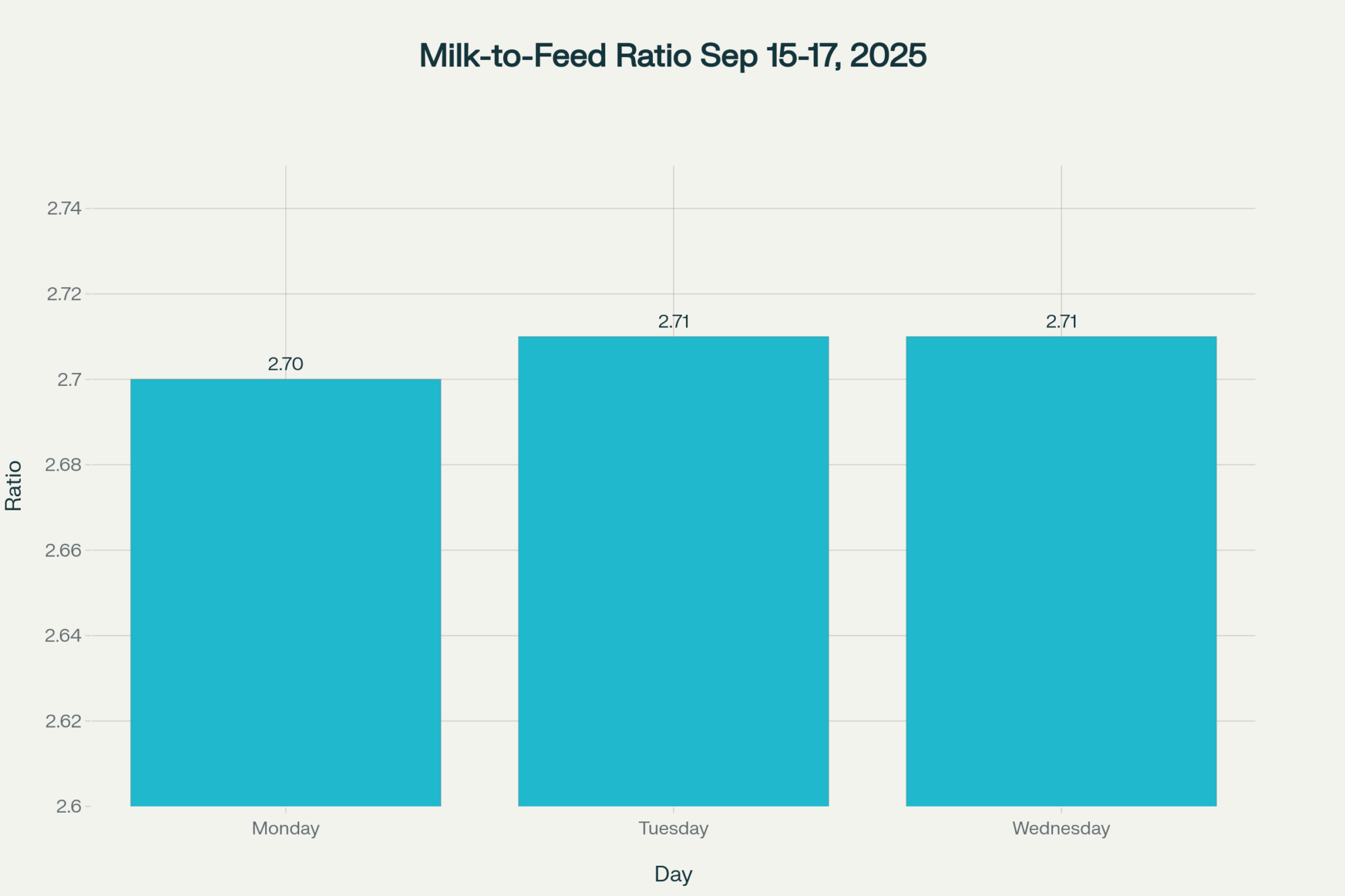
The milk-to-feed ratio is the headline here. With Class III futures around $17.62/cwt, we’re seeing better margins coming through than last month. If you’re feeding a typical 1,800-pound Holstein in Wisconsin with $6.50/day costs, your margin is decent. Out west, feed transport makes it tougher.Hay prices? All over the map, really. Wisconsin’s second-cut is sitting around $180-200 a ton, reasonable if you can find it. Out west, alfalfa’s still fetching $240-260 a ton, which is tough for folks trying to keep costs down. Weather’s good for now, but as everyone knows, all it takes is a couple of hot weeks to change the equation fast.

Production Reality Check: What the USDA and Your Plants Are Saying

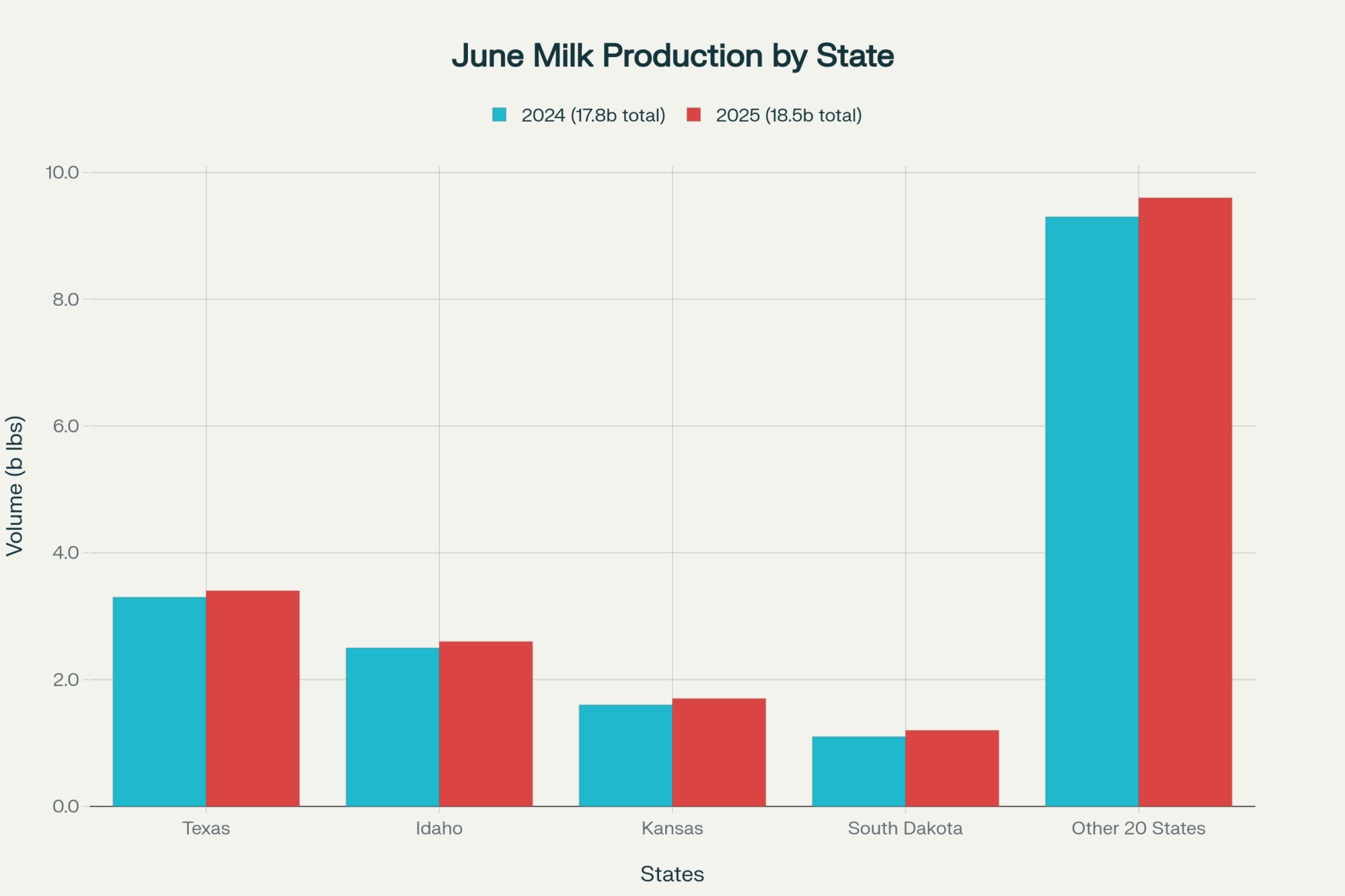
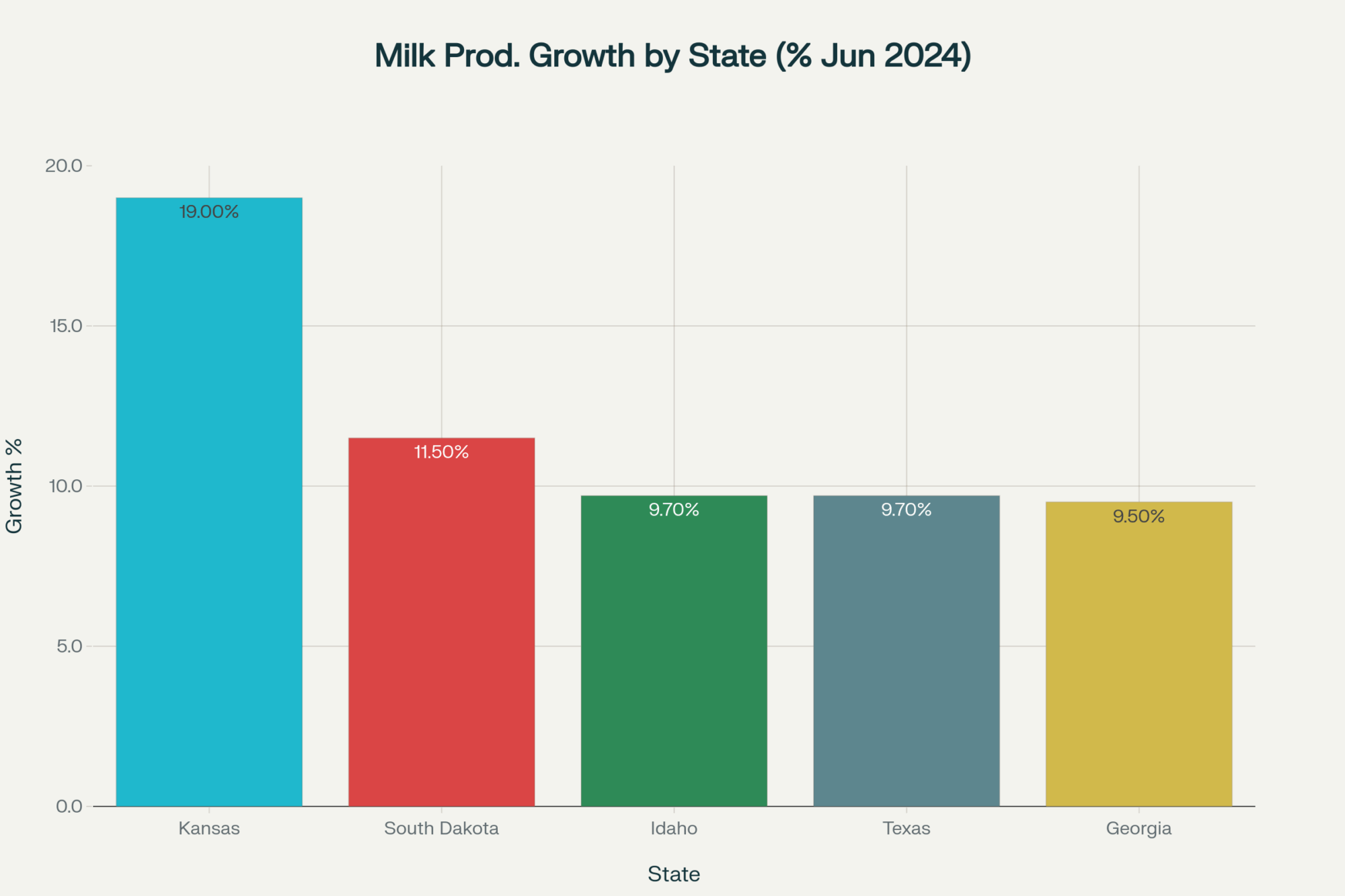
Aug data from USDA shows production up 3.25% YOY — biggest leap since 2021. Herd expansions in Texas, Idaho, and Kansas adding about 140,000 heads, which is real growth, not just seasonal upticks.

But here’s the rub. Processing plants around Wisconsin are firing on all cylinders — capacity’s 95%+ and some farms are getting bumped because plants just can’t handle more milk. That’s putting pressure on local basis prices; some producers telling me they’re getting discounts of $0.50-0.75/cwt below Class.

California’s bounce back after HPAI restrictions is real. Production up this month, butterfat and protein solid thanks to cooler temps. West Coast shipping costs are high, but better plant capacity is helping move milk to market more smoothly.

What’s Really Moving the Market? Digging a Little Deeper

Retail cheese demand is solid. Food service? A bit off, around 3-4% below last year, adding some uncertainty. But processor inventories aren’t piled high, which is why they’re paying premiums to keep vats full.

Exports remain the wild card. Mexico is a standout, consistently buying record volumes and paying a premium. Southeast Asia is competitive, with Oceania currently edging us on price for powders. China imports bounce with policy but whey’s looking better.

Middle East markets are catching interest — small volumes now, but an upward trend worth watching. Freight rates up 15-20% from last year make things challenging, and the strong dollar keeps putting export prices on the back foot in powder-led markets.

The Crystal Ball: What the Forecasts Say

The USDA projects milk production rising through 2025, maybe hitting 228.5 billion pounds. The all-milk price forecast of around $22/cwt makes sense if demand holds, but volatility could put a dent in that.

Class III futures at $17.62 for September give you a chance to lock in prices for Q4. Class IV at $16.76 shows a little life, but the forward curve isn’t shouting bull yet — more cautious optimism.

If you haven’t started hedging, this is the time. Fence strategies offer protection while letting you capture upside. Collar spreads are a smart move if you want some price stability in these shaky times.

California Spotlight: The Comeback State

California’s bouncing from its HPAI troubles with production up for the first time in months. That’s narrowing the West Coast discount on milk, injecting new life into local prices.

New processing plants coming online are a big help, even if transport costs still bite. Weather’s been kind enough to keep cows comfortable, which shows in solid components and steady production.

What Should You Be Doing?

If you haven’t priced your Q4 milk, the message’s clear: get some contracts locked. This rally isn’t just a fluke. Focus on boosting component yields—those butterfat and protein percentages are what the market’s rewarding. Dial in your nutrition plans accordingly.

Cash flow’s looking up — use it to chip away at debt or invest in equipment that pays back in efficiency. Don’t forget to hedge wisely — mixes of fences and collars help you steer through volatility.

Feed buying? Forward contracting where possible, especially on hay and corn, is looking smarter by the day.

The Bottom Line

This rally feels real. Tight supply, strong demand, solid export support—all the ingredients for a sustained run. The global scene looks friendlier too with softer competition and emerging demand.

That said, watch your back. Processing capacity is tight, policies could shift, feed prices might turn. The dollar’s strength still complicates exports.

So keep that pencil sharp and options open. We’re in for an interesting finish to 2025.

Learn More:

Join the Revolution!

Join over 30,000 successful dairy professionals who rely on Bullvine Weekly for their competitive edge. Delivered directly to your inbox each week, our exclusive industry insights help you make smarter decisions while saving precious hours every week. Never miss critical updates on milk production trends, breakthrough technologies, and profit-boosting strategies that top producers are already implementing. Subscribe now to transform your dairy operation’s efficiency and profitability—your future success is just one click away.
NewsSubscribe
First
Last
Consent

Rabobank’s 2026 Warning: What Smart Producers Are Already Doing About It

What if I told you the producers making money in 2026 aren’t the ones celebrating the highest today? Rabobank’s warning changes everything.

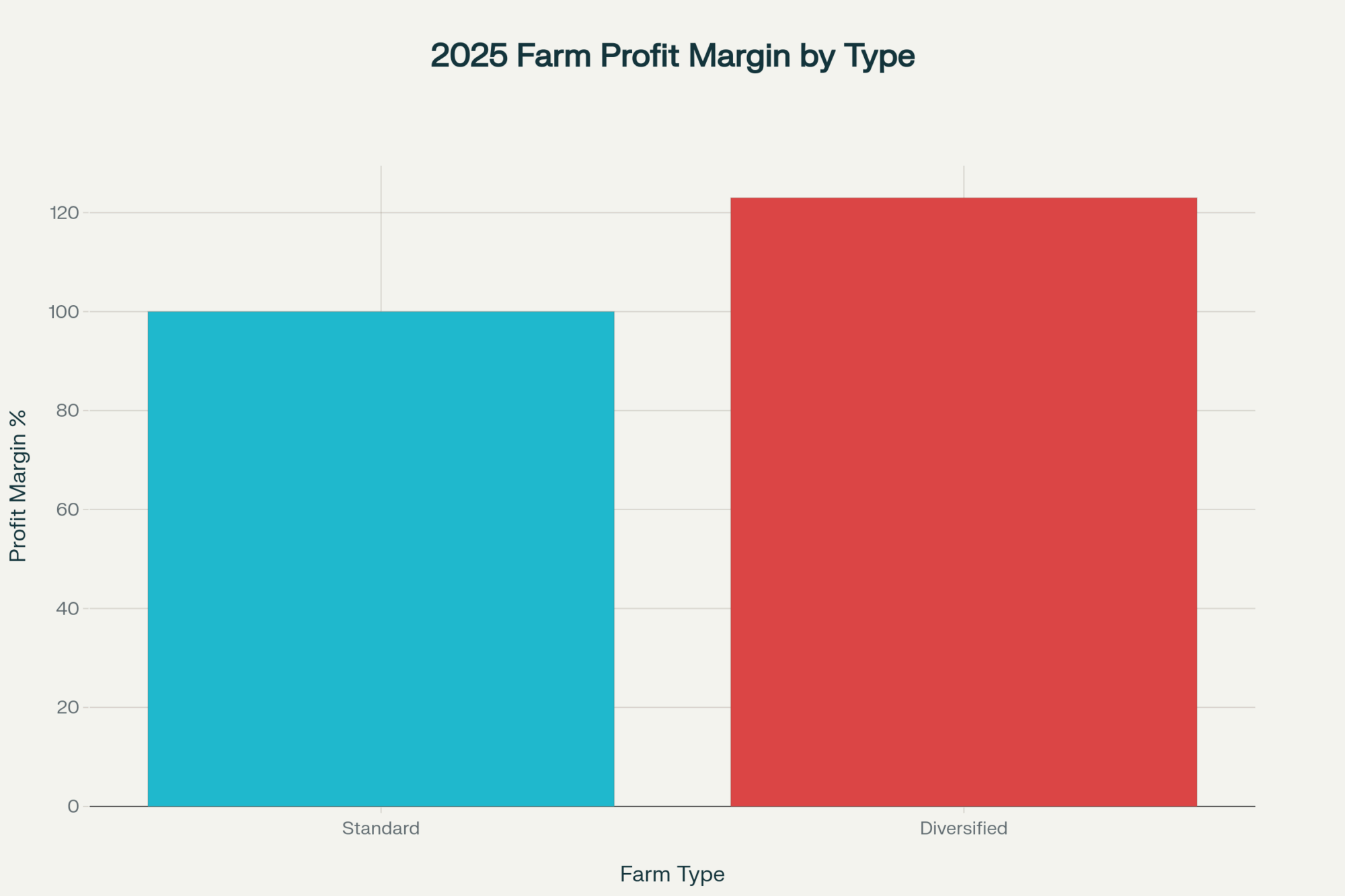
EXECUTIVE SUMMARY: You know what caught my attention? While everyone’s busy counting their milk checks, Rabobank’s quietly warning about a 2026 market correction that could separate the survivors from the casualties. Here’s the thing—they’re forecasting NZ milk prices at $20.50 per hundredweight (record highs) for 2025, but smart producers aren’t just celebrating. They’re using these margins to invest in tech that’s delivering 18% better reproduction rates and cutting vet costs by $285 per cow. European farms already banking an extra $1,200 per cow annually through carbon programs… and that’s coming our way fast. Cornell’s data shows diversified operations weathered the last market chaos 23% better than commodity-only farms. The window for strategic positioning won’t stay open forever. Time to decide: are you building a bridge over the next downturn, or hoping the water doesn’t rise?

KEY TAKEAWAYS

  • Tech isn’t a luxury anymore—it’s survival gear. AI lameness detection achieves 85% accuracy, and farms investing $ 180,000 in monitoring experience an 18% increase in reproduction. Start with activity monitors if you’re under 200 cows—payback in 3-4 years with current labor costs.
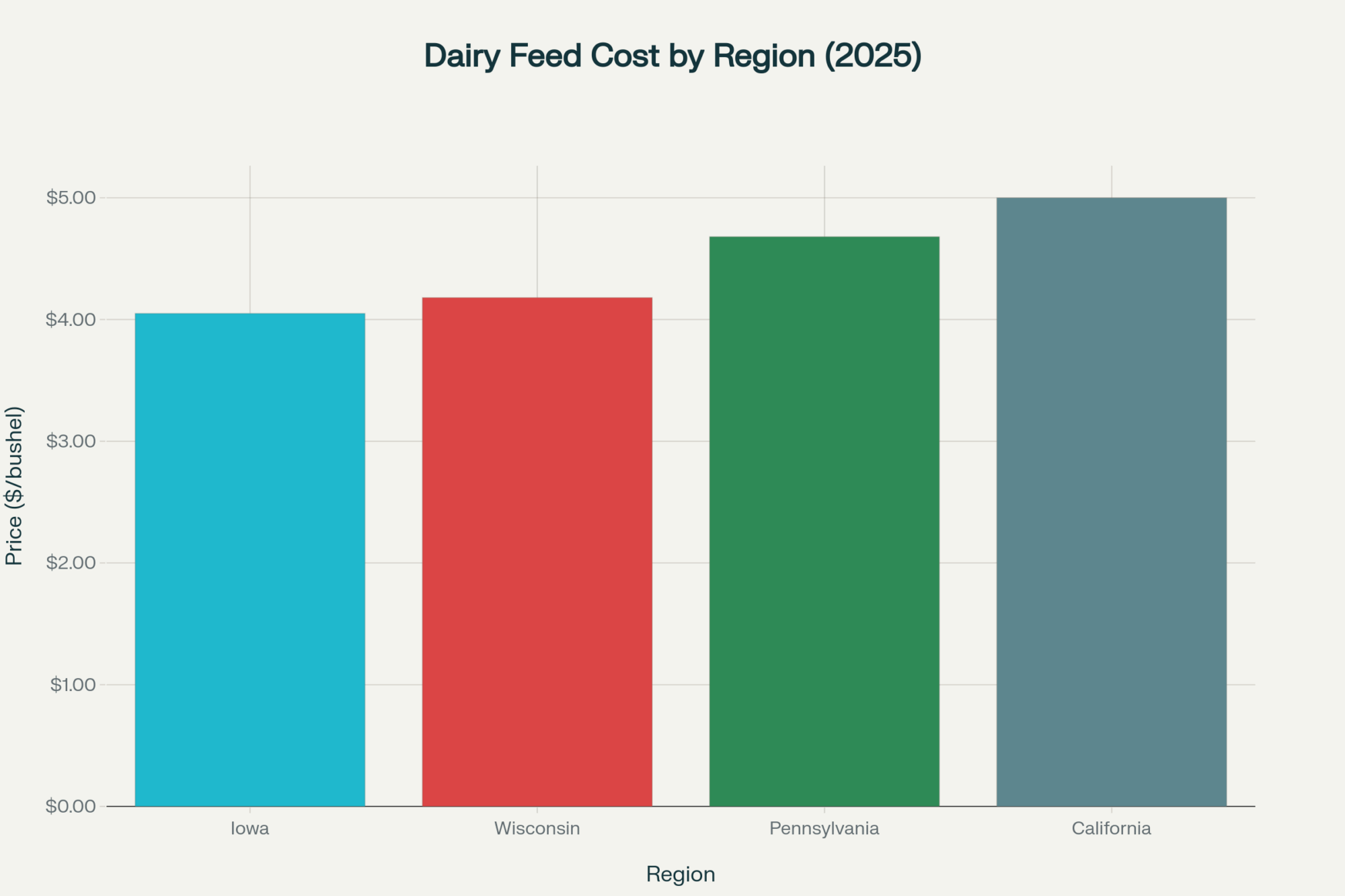
  • Regional feed costs are your hidden profit killer. While corn averages $4.20 nationally, you’re paying $5+ in California versus $4 in Iowa. Lock feed contracts now while financing rates sit at 6.5-8.5%—both won’t last.
  • Carbon programs aren’t feel-good farming anymore—they’re cash flow. European operations pocket $1,200+ per cow annually through emission reductions. California’s LCFS credits are already worth $85-120 per metric ton. Start your footprint assessment before programs fill up.
  • China’s the wildcard that could flip everything. Their imports are up 2% while production drops 2.6%—but weak demand keeps it unpredictable. Diversify your risk, as when China moves, global prices tend to follow.
  • Equipment financing window is closing. Rates at 6.5-8.5% won’t hold with 2026 uncertainty looming. Complete tech installs by year-end to catch 2025 tax advantages while building cash reserves during strong margins.
 dairy farm profitability, dairy technology ROI, dairy market trends, dairy risk management, milk price forecast

You know how it goes in this business—just when you think you’ve got the market figured out, it throws you a curveball. Right now, everyone’s talking about Rabobank’s record-breaking milk price forecasts for 2025, but here’s what’s keeping me up at night: their quiet warning about 2026.

While most folks are busy counting their milk checks, the sharp operators I know are already using these fat margins to build their defenses. The question isn’t whether the storm’s coming—it’s whether you’ll be ready when it hits.

These Price Numbers Have Everyone Talking

Let’s start with what we know for sure. Rabobank’s calling for New Zealand milk prices between $9.50 and $10.15 NZD per kilogram of milk solids for the 2025/26 season—which, at current exchange rates, works out to roughly $20.50 per hundredweight for us. That’s the highest opening forecast they’ve ever made.

Here at home, we’re looking at all-milk prices in the $21-22 range according to the latest USDA reports, and honestly, that matches what I’m seeing on the farms I visit. Over in Europe, producers are seeing solid bumps too, with German operations hitting €45-48 per 100 kilograms.

But here’s the thing—Mary Ledman from Rabobank wasn’t exactly popping champagne when she spoke at World Dairy Expo last year. She pointed to currency volatility and trade tensions as real threats lurking ahead.

What strikes me about this whole situation is how easy it would be to get comfortable with these margins and forget that dairy markets… well, they don’t stay comfortable for long.

The Tech Divide That’s Reshaping Everything

The gap between farms embracing technology and those sticking with traditional methods isn’t just widening—it’s becoming a chasm. The precision dairy market just hit $5.5 billion this year, and that’s not just numbers on paper.

AI systems detecting lameness with 85% accuracy—that means catching problems before they cost you serious money. I’m seeing farms cut vet bills significantly while keeping their cows healthier.

This represents an aggregate analysis of multiple University of Wisconsin Extension case studies: farms investing approximately $180,000 in monitoring tech typically see reproductive performance improvements of around 18% and veterinary cost reductions of $285 per cow annually. Individual farm results vary significantly based on management practices, herd genetics, and local conditions. Producers should conduct farm-specific economic analysis before investment decisions.

The economics break down like this (and this varies quite a bit by region):

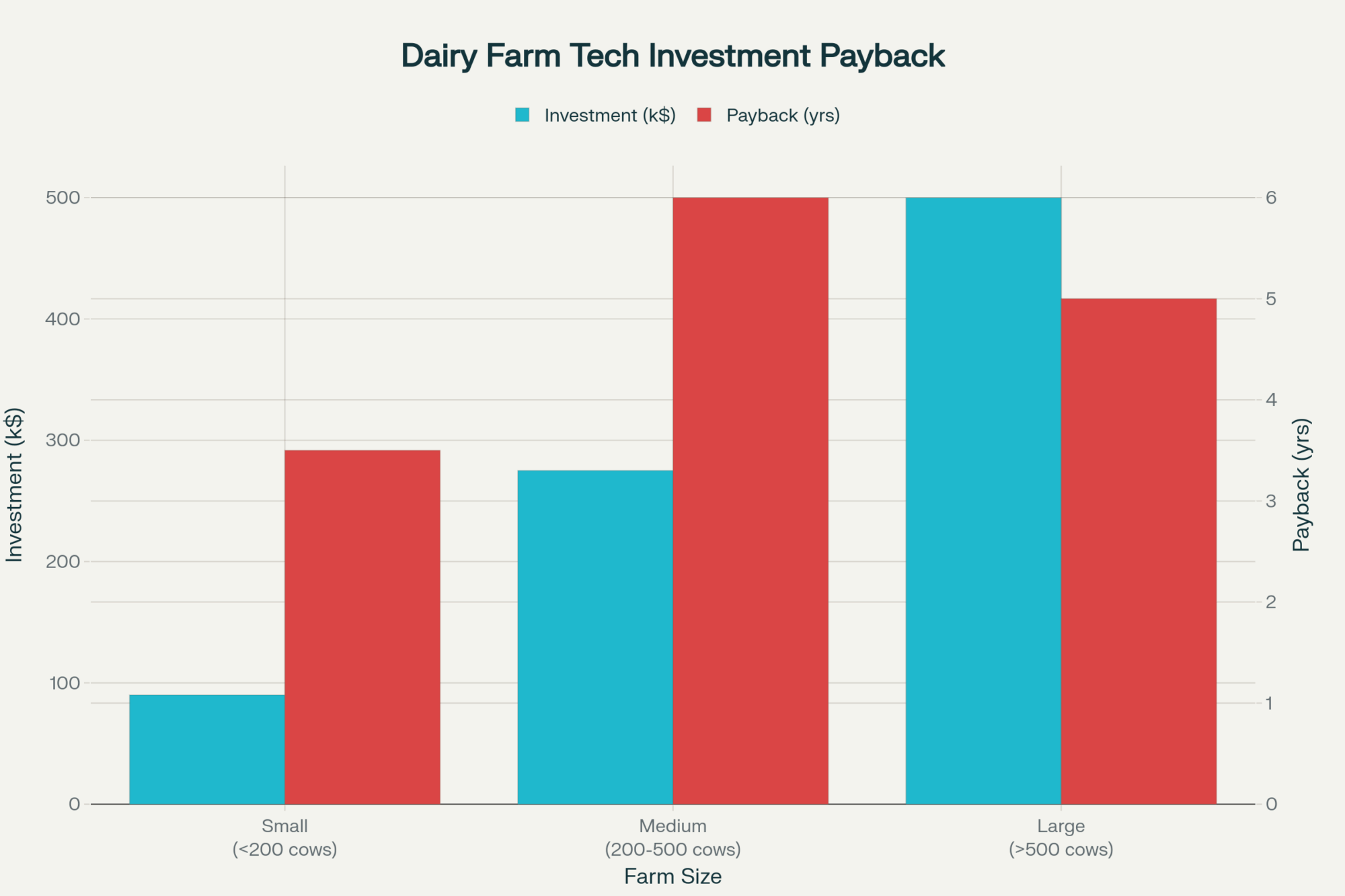
Technology Investment by Farm Size:

  • Under 200 Cows: $60,000-120,000 investments with 3-4 year paybacks. In states like Wisconsin, where corn’s running $4.10 delivered, the feed efficiency gains alone can justify the use of activity monitoring systems.
  • 200-500 Cows: $200,000-350,000 for robotic milking and precision feeding. Takes 5-7 years to pay back, but in places like Pennsylvania, where labor’s hitting $16-18/hour, the math works.
  • 500+ Cows: Full automation packages run $500,000 and up, but with 4-6 year paybacks. Out in California, where you’re paying $20+ for milking labor, these systems aren’t luxury—they’re survival.

This divide? It’s only going to matter more when margins tighten in 2026.

China’s Dairy Puzzle—Still Our Biggest Wild Card

China remains our biggest uncertainty. They’re forecast to boost imports by 2% this year after three straight years of decline, while their domestic production’s expected to drop 1.5-2.6%.

Nate Donnay from StoneX put it perfectly:

“Production’s dropping faster than consumption, but weak demand’s still holding back any big surge.”

Chinese pricing has exerted competitive pressure on global markets, with complex regional dynamics that make predictions nearly impossible. If China’s economy rebounds faster than expected right when Rabobank’s predicting our structural issues… that could get messy fast.

The Great Analyst Split—And Why It Matters to Your Bottom Line

The industry’s basically split into two camps right now. StoneX is betting on continued strength—they point to tight heifer supplies (we’re down to 1978 levels) and massive cheese plant expansion creating structural demand worth over $8 billion.

Rabobank’s more cautious. They’re warning about trade policy risks and disease impacts that have already proven severe—look what HPAI did to California, dropping production 9% last November.

Here’s what caught my attention in Cornell data: farms with diversified income streams weathered the 2020-2022 chaos 23% better than commodity-only operations. That’s not theory—that’s documented survival advantage.

European Carbon Economics—This Is Coming Our Way

European producers aren’t just talking sustainability anymore; they’re banking on it. Recent research shows low-carbon operations outperforming high-emission farms by $1,200+ per cow annually.

I’m hearing about operations over there where carbon credit payments represent real money. Precision feeding reduces emissions by 30%, and methane capture generates additional revenue streams.

California’s LCFS credits are already worth $85-120 per metric ton. Northeast carbon markets are expanding into agriculture. Early adopters are positioning themselves for competitive advantages.

Feed Costs—The Variable That Changes Everything

Don’t underestimate what’s happening with feed prices. Sure, corn futures are around $4.20 nationally, but add transportation and regional basis, and suddenly you’re looking at:

Regional Feed Cost Reality (as of Q3 2025):

  • Iowa: $3.95-4.15 delivered
  • Wisconsin: $4.10-4.25 delivered
  • Pennsylvania: $4.60-4.75 delivered
  • California: $5.10+ delivered

Those differences completely change your feeding strategies and technology ROI calculations.

Investment Timing—This Window Won’t Stay Open

Equipment financing is still reasonable at 6.5-8.5% for qualified operations, but lenders are already adjusting terms based on 2026 uncertainty. Some are requiring higher down payments, shorter amortization schedules.

Your immediate action plan:

  • Lock favorable financing before rates climb
  • Complete tech installations to catch 2025 tax advantages
  • Secure feed contracts for the next growing season
  • Build cash reserves during strong margins
  • Start carbon footprint assessments now

Regional Reality Check—What Works Where

  • Corn Belt (Iowa, Illinois, Indiana): Feed costs are stable, so focus on precision feeding systems with rapid paybacks through improved conversion efficiency.
  • Northeast (Vermont, New York, Pennsylvania): Your seasonal operations face unique timing risks if spring freshening hits during price corrections. Flexibility in milking systems matters.
  • Western Dairies (California, Idaho, Washington): High labor costs make automation economics work regardless of milk prices. Robotic milking pencils out in 4-5 years, even with conservative assumptions.
  • Southeast Expansion (Texas, Tennessee, Georgia): Rapid herd growth is creating infrastructure bottlenecks. Get scalable tech in place before you grow into problems.

What Does This All Means for Your Operation

Look, whether Rabobank’s 2026 warnings prove accurate or StoneX’s optimism carries the day, one thing’s certain: this industry’s changing faster than ever, and preparation beats reaction every single time.

The producers who thrive through whatever comes next will be those using today’s strong margins for strategic investments in efficiency, technology, and risk management—not just production expansion.

Your checklist isn’t complicated: Audit technology gaps and calculate region-specific ROI. Build cash reserves during strong margin periods. Diversify revenue streams beyond commodity milk. Create hedging strategies for key input costs. Start carbon footprint reduction programs before they’re mandatory.

The profits rolling in today are real, but they won’t last forever. The question every producer needs to answer: Will you use these margins to build a bridge over the next downturn, or will you hope the water doesn’t rise? Because in this business, hope’s never been a strategy that pays the bills.

Complete references and supporting documentation are available upon request by contacting the editorial team at editor@thebullvine.com.

Learn More:

  • Unlocking Dairy Efficiency: The Ultimate Guide to Improving Cow Traffic – This guide offers practical strategies for designing efficient cow traffic systems. It demonstrates how to maximize your technology investments by ensuring smooth animal flow, which directly translates into higher milk production and a healthier, less stressed herd.
  • The 3 Financial Ratios Every Dairy Farmer Should Be Tracking – Move beyond milk price and dive into the numbers that truly drive profitability. This piece provides the tools to measure your farm’s financial health, helping you identify vulnerabilities and make strategic decisions to withstand the market volatility this article warns about.
  • The Genetics Of Sustainability: Breeding For A Better Future – Explore a key strategy for tackling the carbon economics challenge head-on. This article reveals how strategic breeding for sustainability traits can create a more efficient and resilient herd that is positioned to capitalize on emerging low-carbon milk premiums.

Join the Revolution!

Join over 30,000 successful dairy professionals who rely on Bullvine Weekly for their competitive edge. Delivered directly to your inbox each week, our exclusive industry insights help you make smarter decisions while saving precious hours every week. Never miss critical updates on milk production trends, breakthrough technologies, and profit-boosting strategies that top producers are already implementing. Subscribe now to transform your dairy operation’s efficiency and profitability—your future success is just one click away.
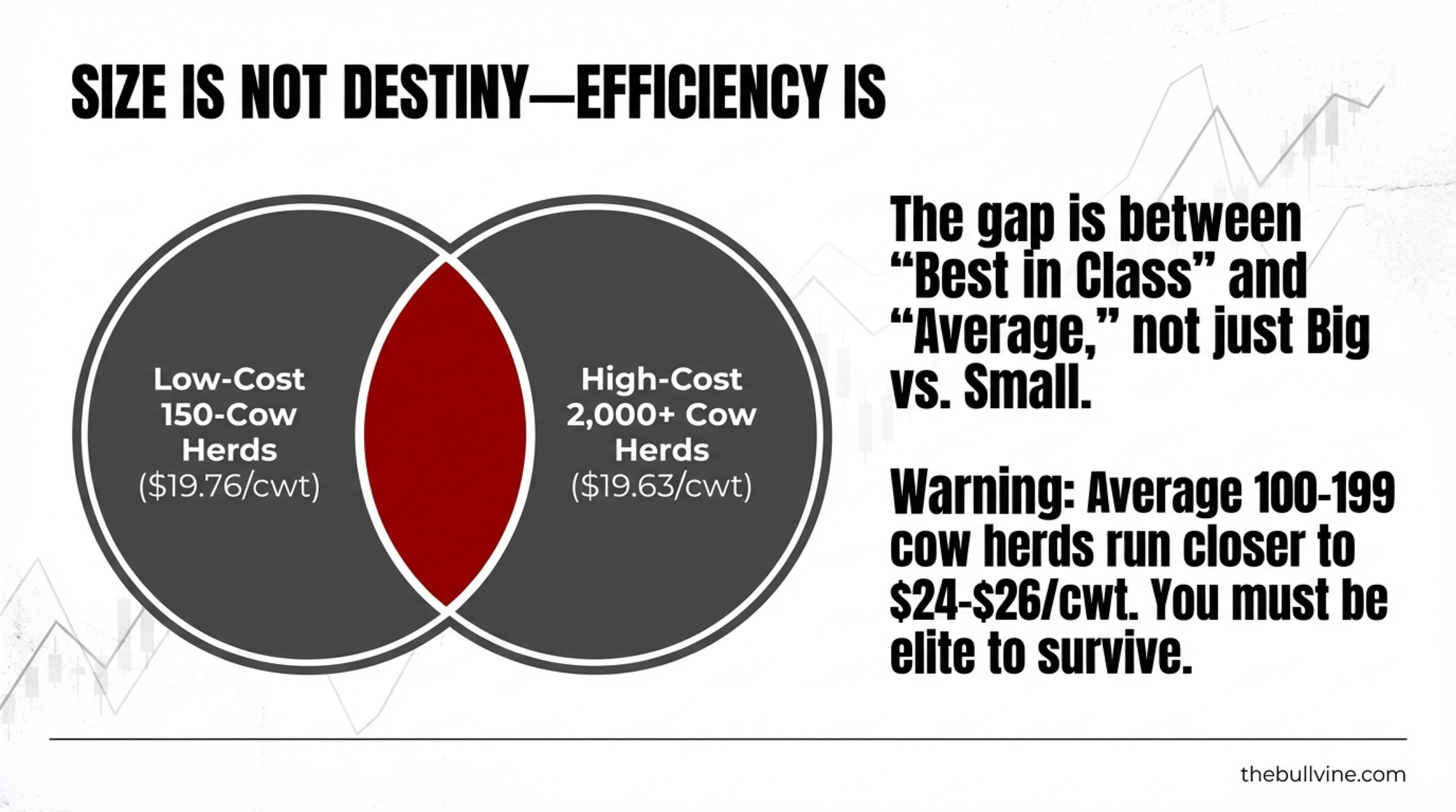
NewsSubscribe
First
Last
Consent

Dairy’s Great Divide: How the Market Split Could Shake Your Milk Check

New Zealand’s crushing it with 8.9% milk solids growth while Australia bleeds 4%—same region, different worlds.

Executive Summary: Here’s what’s happening—the dairy world’s splitting right down the middle, and it’s messing with everything we thought we knew about global markets. New Zealand farms are banking serious cash with an 8.9% milk solids surge and farmgate prices dancing between NZ$7.25-$8.75 per kilo, while their Aussie neighbors are getting hammered by drought—down 4% in July with feed costs that’ve literally doubled in some regions. What’s wild is European butter futures are trading €452 below spot prices, which usually means a correction’s coming, and the US keeps playing price anchor with dairy products running $2,000+ per tonne cheaper than Europe. The bottom line? Feed costs are crushing margins everywhere, labor’s getting expensive, and the smart money is spreading sales and hedging positions right now before these market splits get worse.

Key Takeaways:

  • Lock in your milk solids advantage—New Zealand’s 8.9% jump shows how seasonal tracking can boost cash per liter when you time it right
  • Beat the butter price drop—stagger your fat purchases over 60-90 days since European futures are screaming “correction coming”
  • Survive the feed cost explosion—Australian operators facing doubled hay costs need alternative feed strategies and tighter budgeting now
  • Watch tomorrow’s GDT auction like a hawk—21,145 tonnes of powder hitting the market will tell you where prices are headed
  • Find your niche before the US flood hits—with American exports running $2,000/tonne under Europe, you need value-add products to stay competitive
global dairy markets, milk price forecast, dairy risk management, dairy supply and demand, dairy industry trends

The thing about markets right now—it feels like the dairy world’s split in two. Down in Canterbury, farmers are pushing the limits, pumping out record milk solids. Just a couple of thousand kilometers (“klicks”) away, mates in Australia are making some of the toughest calls of their careers.

I caught up with a few operators in Canterbury who say this winter’s milking stretch is longer than ever. And why not? Fonterra’s latest report shows that milk solids in July jumped 2.2% from the same period last year, and the season-to-date increase is 8.9%. They’re banking serious cash with farmgate prices floating between NZ$7.25 and $8.75, even as feed supplies grow tight.

But hop across the ditch and it’s a different story entirely. Australia’s milk production in July dropped 4%, with Victoria down 5.1%, South Australia experiencing a 9.6% decline, and Tasmania not far behind at 6.1% lower. Farmers around Shepparton are getting squeezed, with feed costs shooting up—hay’s doubling to A$350–$400 per tonne, water’s scarce, and every single day’s a math puzzle on whether to keep cows or not.

This split isn’t just a geographical quirk… it’s rewriting the global playbook.

The Market’s Tale of Two Hemispheres

Last week, the European Energy Exchange saw over 3,000 tonnes of dairy futures change hands, with butter alone accounting for half of that volume, according to EEX trading data. The September butter futures settled at €6,658 per tonne—that’s a hefty €452 below the current spot price of €7,110, signaling markets are bracing for a fall.

For processors, that’s your cue. Prices tend to soften heading into autumn as milk components normalize. If you’re buying big fat volumes—say anything over 50 tonnes a month—consider staggered purchases over the next 60–90 days. Don’t bet on the dip being deeper.

Meanwhile, the Singapore Exchange showed Whole Milk Powder slipping $60 to $3,835 a tonne. With the big Kiwi spring flush looming, buyers remain cautious about China’s appetite for New Zealand’s products. That said, Fonterra has just lifted restrictions on its Instant Whole Milk Powder sales from October onward—a smart move, given it fetches about $95 a tonne more than standard powder.

America Holds the Line

Stateside, it’s full steam ahead. July production climbed 3.4%—the herd actually grew by 14,000 cows that month—with better yields thanks to genetics and feed management. StoneX data points to a 4.7% rise in component-adjusted milk solids.

The knock-on? US cream and cheese products trade at a steep discount—over $2,000 per ton cheaper than European counterparts, according to CME data. That pricing is driving exports and helping prop up US milk prices.

Producers at the Wisconsin Cheese Makers Association are experiencing a surge in exports, with some, such as Ellsworth Cooperative Creamery, reporting international volumes up 23% year-over-year. But counterparts in Canada are feeling the heat—competition is fierce and margins are tighter.

Europe’s Mixed Bag: Regulation, Weather, and Red-Hot Cheese Markets

UK dairy is holding pace—with volumes up 4.4%, butterfat at 4.15%, and protein climbing to 3.36%, per AHDB data.

However, the story is more complex on a continental scale. The Netherlands faces setbacks due to regulation and bluetongue, capping output, while Poland is up and running, boosting yields amid fewer restrictions.

Italy wasn’t spared summer’s wrath. Heat waves reduced production by 10–15%, resulting in approximately 1.8 million litres lost daily, as confirmed by ISTAT data.

Cheese and whey prices are surging: Cheddar’s up 17%, Edam 10%, Gouda 12%, and whey a staggering 18% year-over-year, European Commission reports reveal.

Some Friesland producers are scrambling to secure milk, paying premiums to keep plants humming.

What It Means for Your Milk Check

Butter’s in tight supply, pushing prices up, while protein is squeezed by global supply and discounting. Cheese producers are bidding fiercely to grab milk flows.

Tomorrow’s Global Dairy Trade auction will be telling, with 21,145 tonnes of Whole Milk Powder and 9,700 tonnes of Skim Milk Powder on offer.

Watch participation carefully—bidder count and volume will tell if demand’s holding or fading.

Play It Smart This September

If you’re buying fat, especially over 20 tonnes per month, start hedging now in tranches. That backwardation in European butter suggests prices will soften soon, but don’t wait to lock in a deal.

Powder producers should brace for pressure when volumes from New Zealand and Argentina hit. Focus on higher-margin streams.

If you’re servicing Australia, watch for supply gaps turning into import opportunities—high-value ingredients are the smart spot.

Beyond The Percentages: The Real Cost Behind Production

Victorian producers aren’t just losing volume; they’re getting hit by a surge in input costs, as documented by Dairy Australia:

  • Quality Hay: A$350–$400 per tonne (up from A$180–$200)
  • Water Allocation: Prices are 250% above 2024 levels
  • Grain Supplements: Costs have risen 20–30% across most categories

Meanwhile, Kiwi operators report wage pressures of more than 15% as they stretch labor through extended milking seasons.

Weather’s Still a Wild Card

La Niña may prolong Aussie droughts, while early autumn chills might boost European butterfat and protein.

Stay Sharp, Stay Connected

Markets are messy and fractured. What works for your mate 10 klicks away might not fit your setup.

Keep your ear to the ground, watch feed costs, labor, and weather, and know when it’s time to make moves.

September will be the month to separate the clever from the late movers.

Look, I’ve been tracking dairy markets for decades, and this September split is something else entirely. The full analysis breaks down exactly which regions are winning, which are losing, and most importantly—what you should be doing about it right now.

Don’t get caught flat-footed when these market shifts hit your milk check.

Complete references and supporting documentation are available upon request by contacting the editorial team at editor@thebullvine.com.

Learn More:

Join the Revolution!

Join over 30,000 successful dairy professionals who rely on Bullvine Weekly for their competitive edge. Delivered directly to your inbox each week, our exclusive industry insights help you make smarter decisions while saving precious hours every week. Never miss critical updates on milk production trends, breakthrough technologies, and profit-boosting strategies that top producers are already implementing. Subscribe now to transform your dairy operation’s efficiency and profitability—your future success is just one click away.
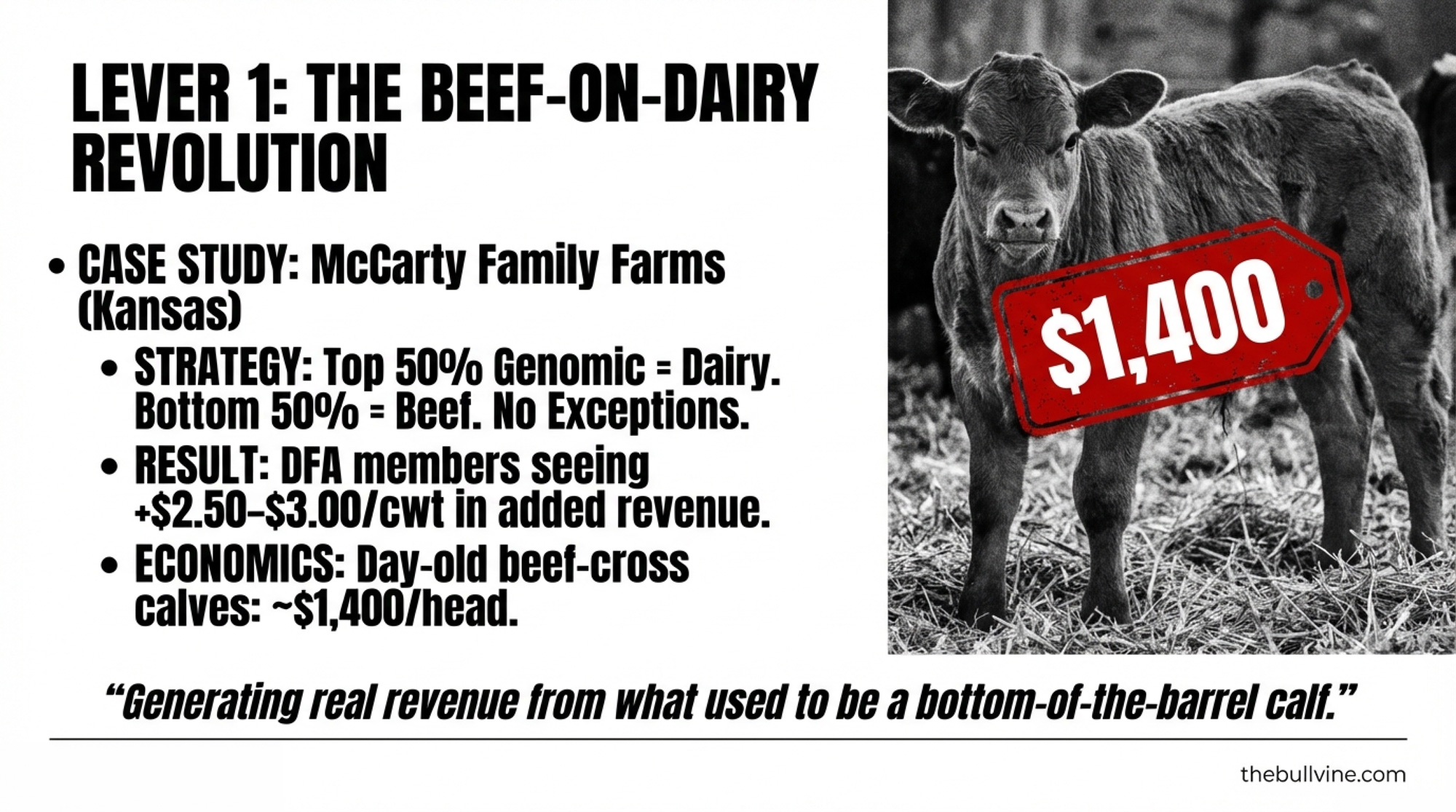
NewsSubscribe
First
Last
Consent

When Milk Checks Shrink, Pay Attention: What’s Coming in September

3.4% milk surge, but your check’s down $1.50. Here’s why.

EXECUTIVE SUMMARY: Listen, here’s what’s really going on with your milk check: July Class III dropped to $17.32/cwt—that’s $1.50 less than June, and butter just took a 13.5¢ dive in one day. Meanwhile, we’re pumping out 3.4% more milk than last year across the top 24 states… so yeah, there’s way more milk chasing fewer buyers. China’s playing a different game now—they’re buying smart, not desperate. Europe’s keeping more product at home because their internal prices are sky-high. What does this mean for you? Simple: how you hedge your bets and protect your feed costs just became make-or-break decisions. Time to get serious about locking in those income-over-feed margins before this gets worse.

KEY TAKEAWAYS

  • Watch those block prices like a hawk — when cheddar drops below $1.80, your protein payouts take a beating. Use this as your trigger for futures positions.
  • Stack your protection tools — combine Dairy Revenue Protection with CME options for 6-12 months out. It’s not optional anymore in this market.
  • The global game changed — U.S. milk up 3.4%, China buying selectively, Europe exporting less. These aren’t temporary blips—adjust accordingly.
  • Tighten up now, not later — every percentage point you gain in feed efficiency matters more when spot markets are sliding. Small improvements = big dollars.
  • Keep your banker happy — Rural Mainstreet Index is falling, covenants are tightening. Solid liquidity keeps you in the game when volatility hits.

That sinking feeling’s back. USDA locked July’s Class III price at $17.32/cwt, down $1.50 from June — a clear sign September checks are heading lower. Add a brutal week of market carnage, capped by a 13.5¢ plunge in butter, and the message for producers is stark: brace yourself.

The numbers that matter (and they’re not pretty)

On August 27, CME spot trading told a tough story: butter dropped to $2.05/lb, down 13.5 cents, and cheddar blocks slid to $1.76, down 5 cents. For farms working cheese-heavy contracts, this math is brutal. Blocks below $1.80 drag protein payouts down, and butter can only mop up so much.

Class III milk prices and spot butter prices from March to August 2025 showing recent downward trends

The supply story that’s keeping me up nights

June milk production from the 24 major dairy states hit 18.5 billion pounds, up 3.4% year-over-year—the biggest jump since 2021. Dairy cow inventories rose by 146,000 head, with much of the growth concentrated in Texas, Idaho, Kansas, and South Dakota, which added 140,000 head combined. That’s a flood of milk chasing thinner buyer demand.

June milk production by major US dairy states for 2024 and 2025 showing 3.4% overall increase

The global mess we can’t ignore

China used to be our safety valve, but the game has changed. Their import appetite hasn’t vanished—in fact, imports were up for five straight months to start 2025. The real story is a structural crisis in domestic production, leading to selective, strategic buying rather than panic purchases. They’re targeting specific needs, which means they’re no longer absorbing global oversupply the way they once did. USDA’s China Dairy Annual tells the story.

Europe isn’t easing the pressure. Although Brussels’ July outlook indicates that milk deliveries are holding steady, soaring internal prices have made European products less competitive on the global stage. However, butter and powder exports are forecasted to decline in 2025, resulting in more products staying close to home rather than easing global market pressure. The Brussels July Outlook has the details.

At the August 6 Global Dairy Trade auction, about 37,000 tons changed hands. Buyers acted with discipline, not panic.

Don’t bet the farm on butter

Industry analysts called the butter market “murky.” And the August 27 drop to $2.05 confirmed their concerns. Cream is abundant, churns are stable, and butter premiums just aren’t enough to prop up payouts when cheddar keeps sliding.

The banker conversation nobody wants

The Rural Mainstreet Index numbers continue to fall, reflecting growing lender caution. Covenants are tightening, and lenders are cutting slack. Hitting a $1.50 monthly drop in Class III milk and a sharp decline in butter rings loud warning bells.

While USDA’s ERS projects 2025 milk prices near $22.00/cwt, that forecast doesn’t reflect today’s mailbox realities.

What the smart money’s doing

The smart operators aren’t just relying on milk prices—they’re locking in income-over-feed margins. They’re layering Dairy Revenue Protection, LGM-Dairy, and CME options strategies to secure coverage for 6 to 12 months out.

One Wisconsin farmer said it best: “Blocks at $1.76 and butter at $2.05 don’t pencil like June. We hedged early and tightened shrink before the checks showed the damage.”

Your move

The best bet? Watch blocks stay above $1.80 and butter steady for several weeks. That’s your early sign that things might shift.

But the longer story is about patience. China’s strategic buying, Europe’s pricing challenges, and the U.S.’s milk surge signal a longer adjustment phase.

Defend your margins, trim waste, and maintain a close liquidity position.

The operations that survive this intact will be well-positioned to capitalize on the upside when things finally turn. The difference between thriving and surviving will be decided by the risk management decisions you make in the next 90 days. Make sure you’re on the right side of that divide.

Bottom line? September’s gonna be rough, but the smart money is already positioning for 2026. Don’t get caught flat-footed.

Time to make some calls and lock in those margins. Your future self will thank you.

Recovery? More likely a 2026 story than a late 2025 one.

Complete references and supporting documentation are available upon request by contacting the editorial team at editor@thebullvine.com.

Learn More:

Join the Revolution!

Join over 30,000 successful dairy professionals who rely on Bullvine Weekly for their competitive edge. Delivered directly to your inbox each week, our exclusive industry insights help you make smarter decisions while saving precious hours every week. Never miss critical updates on milk production trends, breakthrough technologies, and profit-boosting strategies that top producers are already implementing. Subscribe now to transform your dairy operation’s efficiency and profitability—your future success is just one click away.
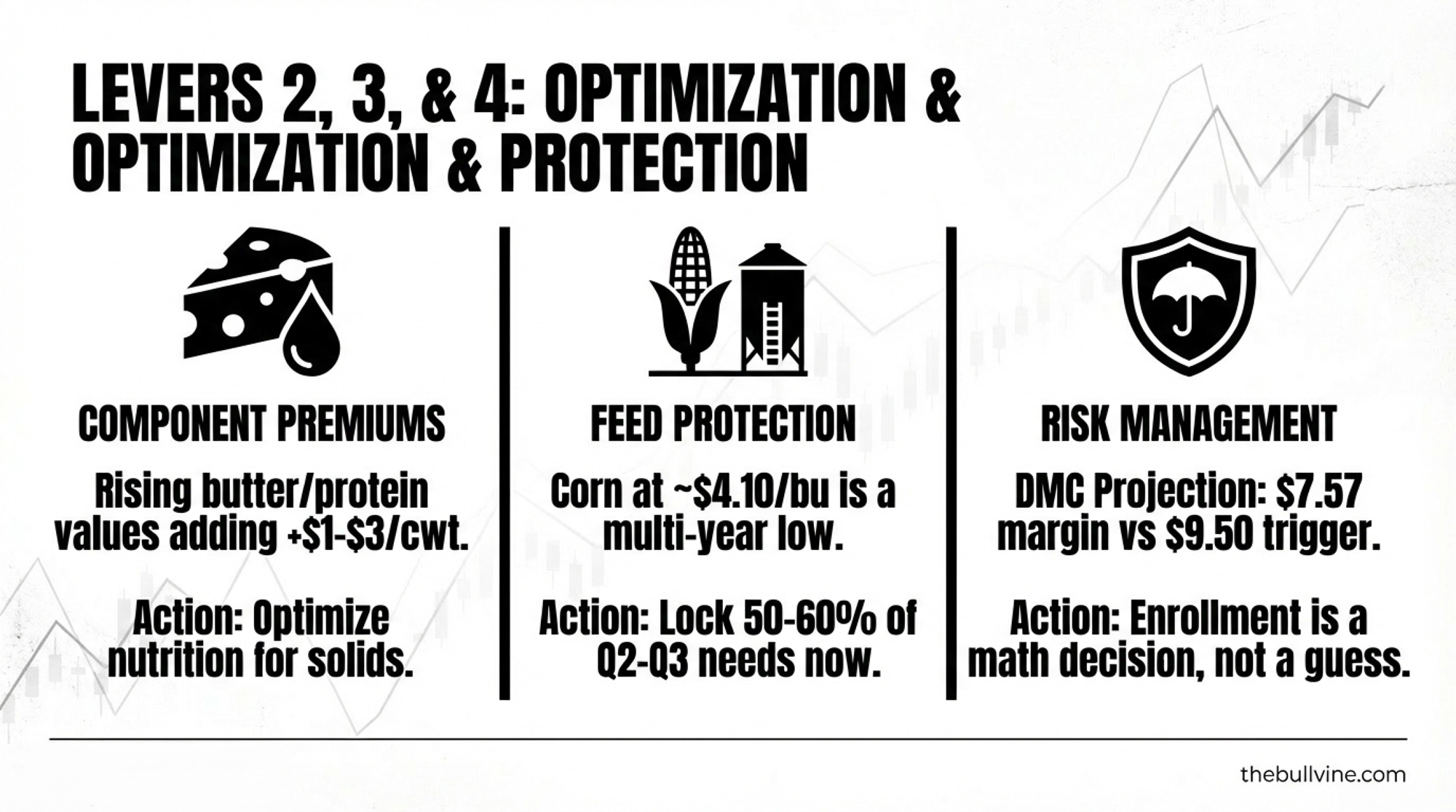
NewsSubscribe
First
Last
Consent

CME DAIRY MARKET REPORT FOR AUGUST 27th, 2025: Butter and Cheese Markets Falter—Margin Pressures Hit September Milk Checks

Butter just dropped 13.5¢, and blocks gave up 5¢—how much will your milk check shrink this fall if this slide keeps rolling? Let’s break it down.

Executive Summary: Butter and cheese prices plunged today, putting direct pressure on September milk checks—expect a drop of $0.25–$0.50/cwt from recent averages. Feed costs are holding steady for now, but tighter income-over-feed margins mean every penny counts when planning rations and herd moves. Global competition’s heating up; EU and New Zealand butter still commands a premium, so U.S. exports face new headwinds in the fall market. The big story isn’t just about total milk—component value is ruling the day, with premiums for protein and fat making up more of the pay. The USDA’s latest data show national milk output rising 3.4% year-over-year, keeping supplies plentiful and processors cautious about premiums. Hedging and contract timing are critical: locking in just 20–30% of Q4 at current Class III levels could add $0.20–$0.30/cwt to cash flow. Bottom line? Get proactive. Review feed rations and check contract opportunities—what you do now could mean a far healthier milk check next month.

Today’s spot markets delivered a tough blow for producers: butter plunged 13.5¢ and blocks fell 5¢, with barrels edging 1.5¢ lower. If component pricing is central to operations, expect next month’s milk check to decrease by roughly $0.25–$0.50/cwt compared to recent weeks. Feed remains manageable for now, but falling milk and strong global competition mean tightening income-over-feed margins for many farms.

Today’s Price Action

ProductPriceToday’s MoveMonth TrendReal Impact on Your Farm
Butter$2.0500-13.50¢-10% w/wClass IV slipping, component pay down
Cheddar Block$1.7600-5.00¢-3.0% w/wClass III weaker, premium pressure
Cheddar Barrel$1.7850-1.50¢-1% w/wLittle support, processors are defensive
NDM Grade A$1.2550+0.25¢FlatHolding export demand, some price support
Dry Whey$0.5500-2.00¢-5% w/wMargins thinner, feed use steady

Market Commentary

What’s Driving Price Moves?
Markets fell under the weight of surplus supply and tepid domestic demand, especially for fat-based products. The increased milk output in July and August nationwide means more product is in the pipeline. With cool weather in the North and steady California output, inventories are well-stocked. Butter’s sharp decline suggests that processors are clearing summer stocks ahead of the fall, and cheese has struggled under sluggish retail and foodservice demand.

Export interest is solid for powders (NDM steady, whey pressured), but the U.S. price advantage is slipping against the EU and New Zealand. Spot Class III/IV will reflect this through softer regional premiums and less upside for milk component pay.

Trading Floor Intelligence & Market Mechanics

  • Bid/Ask Spreads: Butter’s seven bids vs 13 offers—a wide spread suggests bearish sentiment. Blocks traded on thin volume, with buyers still cautious.
  • Trading Volume: Butter had 12 trades (up from weak volumes last week), but most dairy categories saw lighter action, reinforcing the downtrend.
  • Order Book: Block cheese support sits near $1.75/lb; further selling risks breaking that level and sending milk prices lower.
  • Intraday Patterns: Butter saw early selling; cheese was steady until midday, but later offers overwhelmed thin bids, pressuring settlement prices.

Global Market Competitive Landscape

International Production Watch:

  • EU milk output is up, mirroring U.S. trends, and stronger European butter/powder prices keep pressure on U.S. exporters.
  • New Zealand’s output projections remain above last year, with WMP/SMP export prices stabilizing at strong levels.
  • Australia’s supply is flat, but butter trends are up; South America (Argentina, Uruguay) is also growing output, reducing U.S. leverage.

Where We Stand Globally:

  • U.S. prices for cheese and butter are undercut by softer Euro and Kiwi levels, squeezing export margins.
  • Currency: Dollar remains strong, hurting competitiveness.
  • The global market share for U.S. powder/whey is holding steady, but exports of butter and cheese are threatened by aggressive pricing from the EU/NZ pricing.

Feed Costs & Your Bottom Line

  • Wisconsin #2 Yellow Corn: $3.73–$3.77/bu (spot/Dec); California slightly higher at $3.85–$3.95/bu.
  • Soybean meal (Sep): $292.40/ton (steadied this week).
  • Milk-to-feed ratio: Stagnant or shrinking—income over feed cost below historic average for August—watch for breakeven squeezes if milk drops another 20¢/cwt.

Production & Supply Reality Check

  • USDA July milk: Up 3.4% year/year, with 9.49M cows nationally—herd sizes growing, culling rates dropping.
  • Weather: Mild conditions prevail across the Upper Midwest and West, with minimal heat stress. Good forage is available, but drought pockets are affecting hay prices in some areas.
  • Heifer prices are firming but not surging; expansion incentives remain weak.

What’s Really Driving These Prices (The Full Picture)

Domestic Demand:

  • Retail cheese and butter sales are soft; foodservice is slow to rebound post-summer peak.
  • Processor inventories are high for Class IV and Cheddar, limiting upside moves.

Export Markets:

  • Mexico: The U.S. remains competitive, but European products pose a threat, especially in the cheese market.
  • Southeast Asia: Whey and powder hold a share, but face intense competition from the EU and NZ.
  • China: Imports steady, but long-term growth tapering—tariff/renminbi effects limit upside.
  • MENA: Butter opportunities emerging, but trade logistics choppy.

Logistics & Currency:

  • Shipping delays in LA/Long Beach, higher freight costs, and a stronger dollar all dampen the export upside.

Supply Side:

  • Regional milk highs in the Midwest, stable West, steady Southwest. Plant utilization is up, but not at capacity; transport soft spots.

Forward-Looking Analysis with Official Forecasts

USDA Projections

  • Latest USDA: 2025 All-Milk price unchanged at $22.00/cwt; Class III solid but Class IV pressured by butter weakness.
  • Milk production forecast rises; herd expansion maintains strong supply.
  • Export forecasts are positive for cheese/powder, less so for butter.
  • Private models predict more downside risk for butter, moderate stability for cheese, and Class III.

Futures Market Guidance

  • Class III (SEP): $18.20/cwt, trending down from early August highs—hedge pressure intensifying.
  • Class IV (SEP): $17.68/cwt, tightening margins for component herds.
  • Cheese futures (SEP): $1.863/lb; keep a watch for $1.85 support.
  • Hedging advice: Layer contracts, consider 20–30% staged hedges to lock September/October pay prices; keep flexibility for powder strength.

Market Indicators:

  • Commitment of Traders: Managed money trimming long dairy exposure.
  • Options: Volatility bid higher after today’s drop; risk hedges active in Class III/IV.
  • On a regional basis, spot premiums are weak, especially in the West.

Regional Market Spotlight

  • Upper Midwest: Milk volumes cresting, cheese processors limiting premiums; some cooling weather supporting cow comfort.
  • California: Output stable, regional basis weaker for butter—freight rates up, Class IV producers feel margin squeeze.
  • Northeast: Fluid milk sales remain steady; Class I differentials remain little changed.
  • Southwest: Demand is slow, and there are some transportation logjams at the border affecting Mexican exports.

What Farmers Should Do Now

  • Pricing Strategies: Layer hedges for Class III/IV milk through October if feasible. Avoid overcommitting, but look for any signs of a rally around powders.
  • Production Planning: Maintain steady growth by focusing on maximizing component yields, optimizing feed efficiency, and monitoring the local basis for premium opportunities.
  • Cash Flow: Map out milk check impacts—expect $0.25–$0.50/cwt lower pay if prices don’t recover; avoid major capital investments until margins stabilize.

Industry Intelligence

  • Plant activity: Some butter/churn plants are trimming production schedules due to high inventories. Tech trend: More processors exploring whey protein upgrades for export.
  • Regulatory: No major new federal rules this week, but keep an eyes on upcoming trade meetings.
  • Co-op news: Several large co-ops reviewing base price policies for next quarter; expect more volatility in pooling rates.

The Bottom Line

This week marks a significant pivot, with spot butter and cheese off sharply—contrasting with late June/July rallies that lifted margins. Seasonal comparisons to 2024 reveal weaker end-of-summer demand, increased milk in the pipeline, and global competitors nipping at the U.S.’ heels. Today isn’t just market noise—it underscores intensifying challenges for producers heading into fall.

Complete references and supporting documentation are available upon request by contacting the editorial team at editor@thebullvine.com.

Learn More:

  • 5 Risk Management Strategies for Dairy Farmers – This article provides a tactical playbook for implementing the hedging advice in the market report. It details practical strategies for using futures, options, and insurance to protect your operation from the exact price volatility seen in today’s market.
  • The New Dairy Playbook: 5 Trends Redefining Profitability in 2025 – For a strategic view beyond today’s numbers, this piece explores the larger market forces and consumer trends shaping long-term profitability. It reveals how to position your business to thrive amid shifting global dynamics and evolving domestic demand.
  • Robotic Milking Systems: Are They the Answer to the Dairy Labour Shortage? – This piece looks at an innovative solution to improve operational efficiency and cost control. It demonstrates how investing in automation can directly combat rising labor costs and create a more resilient business model, insulating you from market downturns.

Join the Revolution!

Join over 30,000 successful dairy professionals who rely on Bullvine Weekly for their competitive edge. Delivered directly to your inbox each week, our exclusive industry insights help you make smarter decisions while saving precious hours every week. Never miss critical updates on milk production trends, breakthrough technologies, and profit-boosting strategies that top producers are already implementing. Subscribe now to transform your dairy operation’s efficiency and profitability—your future success is just one click away.
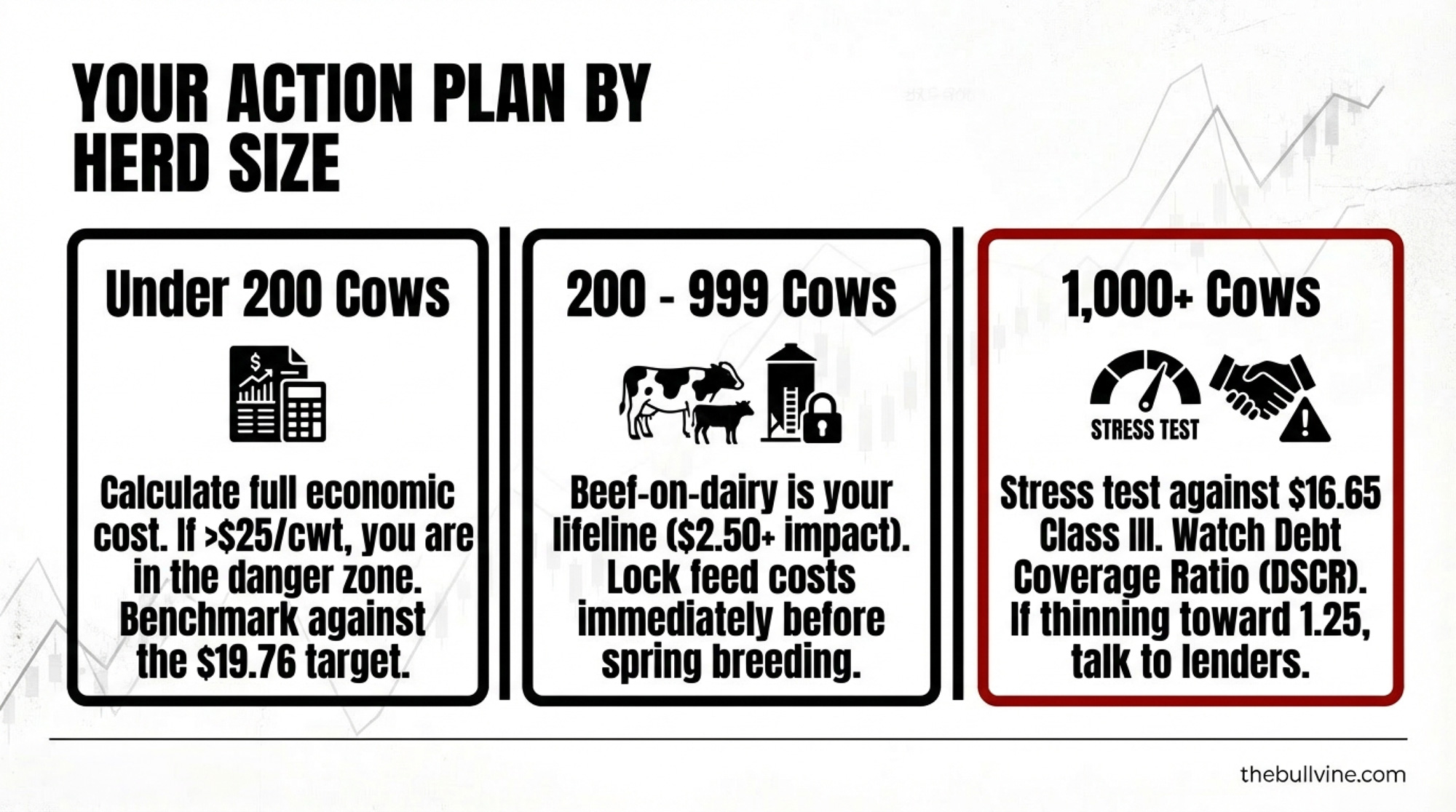
NewsSubscribe
First
Last
Consent

Collision Course: Navigating the 2025 U.S. Dairy and Grain Markets

July milk per-cow jumped to 2,081 lb in the 24 big states—while corn’s pegged at a record 188.8 bpa. Margins? Tight… unless planned.

Executive Summary: Here’s the quick read over coffee. Milk output is running hot—per-cow hit 2,081 lb in July across the 24 major states—while butter’s been slipping on the board even though cold storage isn’t bloated. USDA’s August WASDE prints a record 188.8 bpa corn yield and a 16.7-billion-bu crop, which screams “cheap feed”… if it holds. But field scouts aren’t buying it—Pro Farmer’s final at 182.7 bpa points to disease shaving kernel weight, and that’s exactly the kind of shift that can add 20–40 cents/bu fast on a short-covering pop. Meanwhile, the butter spot around $2.235/lb and a firmer whey tone keep Class III steadier than Class IV—so checks tied to butter/powder feel more pressure. The big move right now isn’t fancy: lock about two‑thirds of feed through early 2026 while the curve is friendly, and set a reasonable floor on milk revenue—then lean into butterfat and protein to keep IOFC intact. Plants coming online in Dodge City and Lubbock will help basis, but not in time to save September spot loads—so plan hedges around the plant’s utilization, not a national average. The bottom line is to get coverage on the books while there’s room, and don’t wait for the market to force the hand.

Key Takeaways

  • Lock feed while it’s offered: with USDA at 188.8 bpa vs. Pro Farmer 182.7, pre‑commit ~66% of Q4’25–H1’26 rations; that cushions a 20–40c/bu corn jump that could hit IOFC $0.20–$0.40/cwt.
  • Use DRP as a true hedge tool: quote it in real time with an agent—the premium and coverage change daily with futures; set a floor that matches the plant’s utilization mix.
  • Aim components for ROI: pushing ~4.2% butterfat and ~3.3–3.4% true protein typically offsets Class IV weakness and stabilizes income-over-feed when whey props Class III.
  • Watch butter vs. stocks: butter around $2.235/lb despite July stocks down ~6% YOY says the market’s pricing future cream; don’t overbuild inventory if processing.
  • Expect basis relief later, not now: Dodge City is online and Lubbock ramps in 2026—help is coming, but September milk still travels; hedge the haul and basis accordingly.
dairy market analysis, feed cost management, income over feed cost, dairy profitability, milk price forecast

The U.S. dairy industry is heading for a collision. That isn’t hyperbole. July data shows milk production is running significantly higher year over year, while feed market risk is anything but settled, setting up a classic margin squeeze if timing goes the wrong way for producers selling milk daily and buying feed in chunks. USDA NASS Milk Production | USDA ERS LDP Outlook

More Than a Milk Price: Why Supply and Basis Are Driving Your Check

What’s striking this summer is a tricky mix for producers planning Q4 coverage and cash flow: stronger per‑cow output in key dairy states combined with unusually wide spreads in feed market signals that amplify basis and logistics risk on the ground. USDA Dairy Market News

ScopePer‑cow (lb)Notes
24 major states (July)2,081+36 lb YoY; higher output corridor
National (July)2,063Lower than 24‑state average

According to the USDA’s July Milk Production report, production per cow in the 24 major states averaged 2,081 pounds, up 36 pounds year over year; the national July average was 2,063 pounds, and that difference matters when estimating loads and component tons per month under tight plant schedules.

The growth corridors across the South‑Central and Plains keep adding milk and steel, but line time and trucking don’t appear out of thin air—when plants prioritize nearby milk, basis penalties can hit loads that have to move farther even if headline prices look fine. USDA Dairy Market News

Butter, Classes, and Why Inventory Isn’t the Whole Story

Butter told the market story in August as spot Grade AA settled around $2.2350 per pound on August 22, looking cheap versus global values but largely discounting what’s coming more than what’s currently in storage. CME butter prices

Cold Storage shows July butter stocks down about 6% year over year—tight enough today—yet prices softened anyway, signaling traders are pricing future cream flows and churn time rather than present availability. USDA Cold Storage – July 2025

This development has a fascinating effect on Class dynamics. When butter and powder soften while whey holds firm, Class III can look relatively better than Class IV. In certain months, this translates into weaker Producer Price Differentials (PPDs) in markets with a butter/powder‑heavy utilization mix. Class spreads and pricing context

Feed Risk: Why the USDA and Field Scouts Disagree on Your Corn Bill

According to the August WASDE, the first survey‑based national corn yield printed a record 188.8 bushels per acre with production at 16.7 billion bushels if realized—an undeniably feed‑friendly deck if it stands. DTN/Progressive Farmer summary

But the view from the field tells a different story: Pro Farmer’s final tour estimate pegs yield at 182.7 and flags widespread late‑season disease pressure across parts of the Belt, which is big enough to tighten carryout and nudge basis and futures higher into winter.

Positioning raises the stakes—CFTC data show managed money carrying sizable net shorts in corn ahead of harvest, the exact fuel that can power a fast short‑covering rally if the crop underperforms.

What to Do Now (Before the Market Makes the Choice for You)

ActionWhat to do nowWhy it pays
Lock feed (~66% Q4–H1’26)Pre‑commit while USDA’s high yield is pricedCushions a 20–40c/bu corn pop; protects IOFC $0.20–$0.40/cwt
Price DRP in real timeQuote with an agent; align to plant utilization mixSets floor against Class IV softness, matches actual pooling
Push components (BF/TP)Aim ~4.2% butterfat; ~3.3–3.4% true proteinLifts pay price when cheese/whey support Class III

Based on market signals and risk calendars, producers should consider these three strategic actions now:

  • Lock In Feed Costs: Pre‑commit to roughly two‑thirds of feed needs for Q4 2025 and early 2026 while the forward curve still reflects the USDA’s high yield scenario, leaving room to average if field‑driven numbers prevail and basis firms. USDA WASDE
  • Evaluate Dairy Revenue Protection (DRP): Work with an agent to price DRP in real time—premiums and terms change daily with futures and endorsements, so it’s a tool to manage actively, not guess at. USDA RMA DRP policy
  • Maximize Component Pay: For component‑based pay, push butterfat toward 4.2% and true protein into the 3.3–3.4% range to lift IOFC even when class prices wobble—especially if feed conversion efficiency holds under current diets. Milk check and pooling dynamics

Capacity and Basis: Help Is on the Way, Just Not for September

Capacity growth is real but won’t solve September’s milk; it matters for anyone with spot loads and a long haul to a dryer or churn while plants juggle maintenance, staffing, and qualifications. USDA ERS LDP Outlook

Hilmar’s new Dodge City facility—an investment north of $600 million—anchors the emerging milk map from western Kansas into the Panhandle and should help rebalance line time and haul distance over the next 12–18 months.

Leprino’s Lubbock facility is staged toward early 2026 for a full ramp, so relief is coming, but not fast enough to erase basis pressure for milk still looking for a closer home this fall and winter.

Global Pull and Why U.S. Butterfat Still Matters

U.S. butterfat remained globally competitive in early 2025, and USDEC highlighted strong mid‑year export momentum that helped keep domestic butter stocks tighter even as milk rose—one reason current weakness is more about forward cream supplies than a freezer problem.

For operators reading the tea leaves, watch the spread between U.S. and EU/NZ butter values alongside Cold Storage—if the U.S. discount narrows as milk stays high, export pull can fade and leave more butterfat at home right into seasonal cream recovery. USDA ERS LDP Outlook

If exports hold, inventories won’t spike quickly; if they wobble, Class IV bears the brunt first, and it shows up in the milk check. Class IV and utilization context

Your Milk Check Explained: How Class Spreads and PPDs Impact Your Bottom Line

When whey resilience props up Class III while butter/powder softness drags Class IV, checks in cheese‑heavy utilization areas can look materially different than those tied more heavily to churns and dryers, and that matters for how DRP or options are layered over already‑contracted milk. Class spreads and pricing context

Weak Class IV tends to pull PPDs lower and reduce the final pay price in orders where Class IV utilization spikes, so re‑read the plant’s pay formula and align hedges with the utilization reality—not a national average that won’t match the load on the truck. Milk check and pooling dynamics

The cheapest penny is the one not lost to a mismatch between pooling math and hedges, especially in a fall when spreads can move faster than loads can be re‑routed. USDA Dairy Market News

Bottom Line: Before the Collision, Not After

If USDA’s big yield verifies, feed stays friendly and margin math gets breathing room, but if Pro Farmer is closer to right and disease pulled kernel weight, the short‑covering bid can meet softening milk and turn the screws on IOFC unless protections are already in place. USDA WASDE | Pro Farmer final

The smartest move is the one made before the market forces your hand—lock in feed and revenue floors while the opportunity exists, don’t wait for the market to dictate terms, and let new capacity in Dodge City and Lubbock ease basis and haul pressure as it ramps over the next few quarters. Hilmar Dodge City | Leprino Lubbock

Complete references and supporting documentation are available upon request by contacting the editorial team at editor@thebullvine.com.

Learn More:

Join the Revolution!

Join over 30,000 successful dairy professionals who rely on Bullvine Weekly for their competitive edge. Delivered directly to your inbox each week, our exclusive industry insights help you make smarter decisions while saving precious hours every week. Never miss critical updates on milk production trends, breakthrough technologies, and profit-boosting strategies that top producers are already implementing. Subscribe now to transform your dairy operation’s efficiency and profitability—your future success is just one click away.
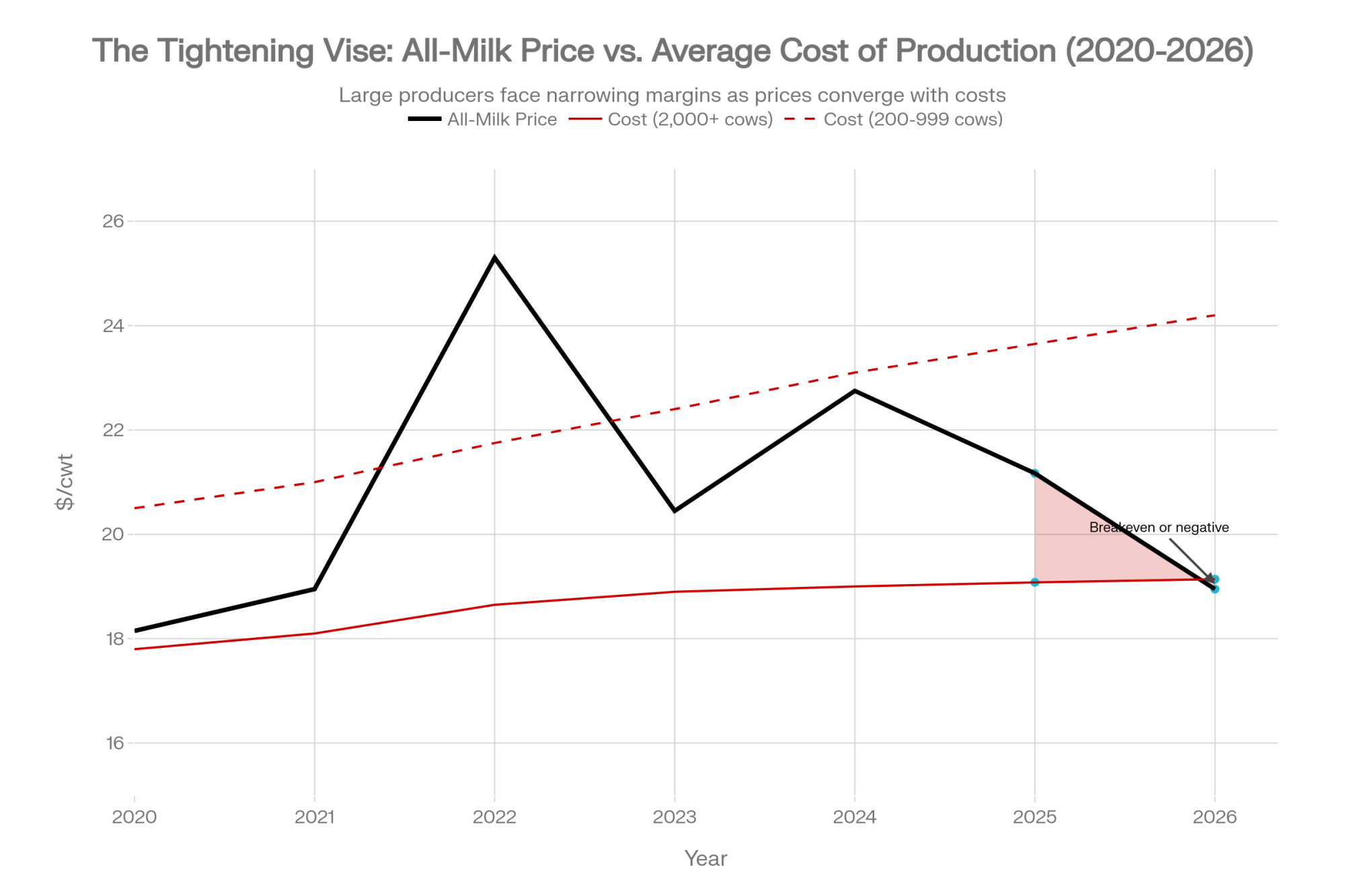
NewsSubscribe
First
Last
Consent

When Global Dairy Markets Start Talking Different Languages

Kansas farms crushing 19% milk growth while butter stocks crash 10M lbs—the component revolution is separating winners from losers

EXECUTIVE SUMMARY: The dairy industry’s obsession with milk volume over components is leaving serious money on the table while smart producers capitalize on the biggest shift in decades. Despite total U.S. milk production climbing just 3.3%, calculated milk solids surged 1.65% through 2025, with butterfat tests hitting 4.36%—nearly 9 basis points above last year. Kansas farmers are absolutely crushing it with 19% growth while butter inventories dropped from 364.6 to 354.4 million pounds in just one month, creating supply tightness that’s driving premiums higher. Meanwhile, genomic testing is delivering $70 additional value per cow annually, and feed efficiency improvements can save $470 per cow per year on well-managed operations. Global trade tensions—especially China’s dairy import challenges and potential Mexico tariffs—are reshuffling traditional export patterns, creating both risks and opportunities for forward-thinking producers. The bottom line? Producers who pivot from volume thinking to component optimization, leverage genomic selection, and implement strategic risk management are positioning themselves to capture the premiums while their competitors chase outdated metrics.

KEY TAKEAWAYS

  • Component Focus Delivers Immediate Returns: Recent data shows butterfat production jumped 5.3% and protein climbed 4.9% year-over-year, with component-rich milk commanding premium pricing in tightening markets—implement targeted nutrition programs focusing on 16:0 fatty acid supplementation and amino acid optimization to boost component tests within 4-6 weeks.
  • Genomic Testing ROI Pays Off Fast: Genomic selection delivers $70 additional value per cow annually compared to traditional breeding methods, with 65-70% breeding value reliability versus just 20-25% from parent averages—test heifer calves early to identify low-genetic-merit animals before investing $1,400-$2,000 in feed costs per head.
  • Feed Efficiency Gains Cut Major Costs: Improvements in herd feed efficiency from 1.55 to 1.75 equate to savings of $470 per cow per year, contributing about $1.2 million to a 2,500-cow dairy’s bottom line—focus on precision nutrition, waste reduction, and intake optimization to achieve 5-15% efficiency gains that directly impact your largest variable cost.
  • Strategic Culling Captures High Beef Values: With cull cow prices at $145+/cwt and beef-on-dairy crossbreds commanding $900 for day-old calves, strategic herd management decisions can generate significant cash flow—evaluate bottom-performing animals using income-over-feed-cost metrics and leverage current high prices for immediate capital injection.
  • Risk Management Is Non-Negotiable: Class III futures pricing milk at $17.21/cwt through Q3 with feed costs rising and trade uncertainties mounting—lock in 60-70% of winter feed needs now at favorable corn ($4.19/bushel) and implement Dairy Revenue Protection coverage to protect against margin compression in volatile markets.

The week ending July 28th delivered some market signals that honestly have me scratching my head – and I think a lot of producers are feeling the same way.

Two Completely Different Stories Playing Out

Here’s what’s got me thinking about where this industry is headed. While European traders seemed to take a collective breather – moving relatively modest volumes across butter and skim milk powder – Asian markets were going absolutely crazy. I mean, when you’re seeing Singapore exchange activity that massive (we’re talking serious tonnage here), something fundamental is shifting.

The price action tells you everything you need to know. European butter futures drifted lower – nothing dramatic, maybe 0.3% or so – while skim milk powder dropped a bit more. But over in Singapore? Traders were bidding up whole milk powder by nearly 2% and butter climbed close to that same level.

That’s not random market noise, folks. That’s Asian demand meeting supply constraints, and it’s a pattern I’m seeing more of when I talk to guys in the export business.

Production Numbers That Make You Think We’re in a New Era

Get ready for this – and I had to double-check these numbers because they seemed almost too good to be true. New Zealand just posted a 14.5% jump in milk collections compared to last June, according to USDA’s latest international production data. After everything they’ve been through – drought, regulations, you name it – Kiwi farmers are back with milk solids production up nearly 18%.

I was talking to a consultant who works down there, and he says the combination of better weather and that opening milk price signal at $10.00 per kgMS has farmers really motivated again. When you’ve got good feed under your feet and prices that work, producers respond quickly.

But here’s the number that really caught my attention: USDA’s monthly milk production report shows U.S. output surged 3.3% year-over-year in June – the biggest annual increase since May 2021. Kansas farmers are absolutely crushing it with 19% growth. South Dakota’s up 11.5%, Idaho’s climbing 9.7%.

When you see numbers like that, you know there’s serious infrastructure investment paying off.

What’s fascinating is how regional this is becoming. I know guys in Colorado who are struggling to find homes for extra milk because there’s no new processing capacity, while Kansas producers are basically printing money with all that new cheese-making ability coming online.

Regional Milk Production Growth Percentages for Selected U.S. States (June 2025 vs June 2024)

The component story might be even more important, though. American dairy farmers aren’t just making more milk – they’re making richer milk. Recent USDA data shows butterfat production jumped 5.3%, protein climbed 4.9%, and nonfat solids rose 3.8%.

Dr. Mike Hutjens at Illinois always said the real money is in components when margins get tight, and boy, is he being proven right.

The Heifer Problem Nobody Wants to Talk About

Here’s something that should keep every dairy producer awake at night – and I’m seeing this pattern everywhere I travel. The latest cattle inventory data suggests U.S. dairy farmers are culling significantly fewer cows than historical averages. We’re looking at the lowest cull rates since 2008, and we all remember how that expansion story ended… not well.

Why? Simple math – there just aren’t enough replacement heifers. USDA’s July 1 inventory shows dairy heifer numbers essentially flat, but that’s only after they made some pretty significant revisions to their 2023 estimates. Translation: we’re running short on the next generation, so farmers are keeping older cows longer.

I was at a producer meeting in Wisconsin last month, and a guy who’s been milking for 30 years said something that stuck with me: “I’ve got cows in fourth lactation that I’d normally ship, but I can’t replace them.” That’s happening everywhere, and it’s not sustainable.

Butter Markets Flash Some Serious Warning Signals

CME spot butter took a beating this week, dropping to around $2.465 per pound– testing two-month lows. But here’s where it gets interesting. USDA’s Cold Storage report showed butter inventories actually dropped to 354 million pounds from May to June, which is faster than the typical seasonal drawdown.

What really caught my eye, though, is what’s happening with exports. Industry sources suggest U.S. butter has been showing improved competitiveness in global markets recently. When you’re among the cheapest butter globally and quality is solid, international buyers notice. A trader I know in California says they’re moving more butter overseas than they have in years.

China’s Whey Situation – and What It Means for Everyone

The trade war casualties keep piling up, and this one hits close to home for a lot of Midwest producers. From what industry observers are seeing, Chinese whey imports took a significant hit in June after those mid-May tariffs kicked in.

CME spot whey powder dropped to around 54¢ per pound, and that’s real money out of producer pockets. A guy I know who’s been in the whey business for 20 years told me, “When your biggest customer goes shopping elsewhere, you feel it immediately.”

That’s exactly what’s happening, and it’s a tough lesson in supply chain diversification that maybe we should have learned earlier.

Futures Markets Price in the New Reality

August Class III milk futures fell 56¢ to $17.21 per cwt** this week. The market’s basically telling us to expect $17 milk through Q3, with maybe a modest recovery to just north of $18 in Q4.

Look, these aren’t disaster prices – especially with corn futures at $4.19 and soybean meal at $281.70 per short ton. But they’re a far cry from where we were earlier this year, and margins are definitely tighter.

Class IV settled around $18.95 for nearby contracts, with the back months in the low $19s. A nutrition consultant I work with says these price levels still work for well-managed operations, but there’s not much room for error.

What Argentina’s Telling Us About Global Dynamics

Here’s something that doesn’t get enough attention – Argentina’s dairy sector showed strong recovery during early 2025, with production up 12.4% in the January-May period according to recent industry reports. After the economic chaos they went through last year, that recovery is pretty remarkable.

What’s particularly noteworthy is how quickly producers there responded to better margins. When milk prices moved up and feed costs stabilized, production followed. It’s a reminder that dairy farmers everywhere react to the same economic signals – they just need them to work in their favor.

Bottom Line: What This Means for Your Operation

Here’s what I’m taking away from all this, and what I think matters most for producers making decisions right now:

The heifer shortage is real and it’s going to bite us. If you’re thinking about expansion, replacement heifer costs are only going higher. The guys who locked in bred heifers six months ago are looking pretty smart right now.

Feed cost advantages won’t last forever. With corn at $4.19 and soy meal under $282, this is the time to lock in Q4 and early 2026 feed needs. Every nutritionist I talk to says the same thing – book 60-70% of your winter needs now.

Regional differences are getting bigger. If you’re in an area with new processing capacity, you’re sitting pretty. If you’re not… well, basis is going to be a problem. Transportation costs are already up 12% year-over-year in some regions.

Risk management isn’t optional anymore. With Class III futures pricing in the $17 range through fall, spending a buck or two per cwt on Dairy Revenue Protection beats taking a $3-4 hit on unprotected milk. Do the math on 75 pounds per cow per day – it adds up fast.

Components are where the money is. Every tenth of a percent improvement in milk fat is worth about 30¢ per cwt when margins are this tight. Nutrition programs that boost butterfat are paying for themselves quickly.

The thing that strikes me most about all this is how quickly the landscape is changing. We’ve got production surging in some regions while others struggle with infrastructure constraints. Trade tensions are reshuffling traditional patterns in real time. And underneath it all, we’re running short on the next generation of milk cows.

The producers who adapt fastest to these new realities – who lock in feed costs, manage risk properly, and focus on components – those are the ones who’ll come out ahead. Because if there’s one thing this industry has taught us over the years, it’s that change is the only constant. And right now, we’re seeing more change than most of us have dealt with in a long time.

Complete references and supporting documentation are available upon request by contacting the editorial team at editor@thebullvine.com.

Learn More:

  • DAIRY PRODUCER’S GUIDE To Getting More From Your Feed – The main report highlights shrinking margins and the value of components. This guide provides practical strategies to maximize feed efficiency, helping you boost butterfat and protein production to immediately improve your milk check.
  • The Ultimate Guide to Dairy Sire Selection – With the heifer shortage becoming a critical issue, this article offers a long-term strategic solution. Learn how to refine your breeding program to create more profitable, resilient, and efficient cows from the ground up.
  • Unlocking Dairy Profits: The Untapped Potential of Automation – The market report notes that new infrastructure is creating regional winners. This piece explores how to leverage automation and technology on your own farm to gain a competitive edge and drive profitability when traditional margins are tight.

Join the Revolution!

Join over 30,000 successful dairy professionals who rely on Bullvine Weekly for their competitive edge. Delivered directly to your inbox each week, our exclusive industry insights help you make smarter decisions while saving precious hours every week. Never miss critical updates on milk production trends, breakthrough technologies, and profit-boosting strategies that top producers are already implementing. Subscribe now to transform your dairy operation’s efficiency and profitability—your future success is just one click away.
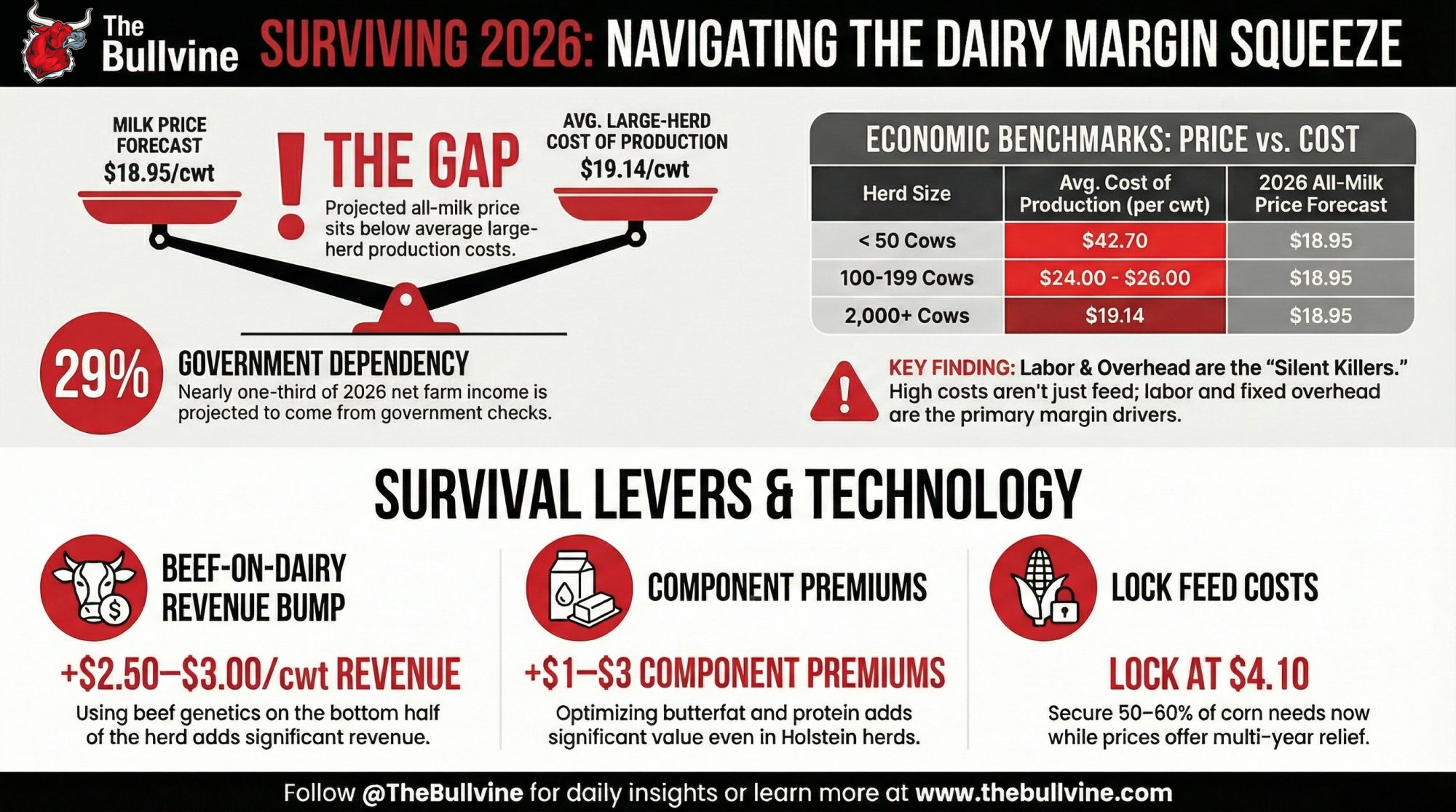
NewsSubscribe
First
Last
Consent

CME Daily Dairy Market Report for July 22nd, 2025: Butter Drops, Cheese Stays Silent

Butter just dropped 2.25¢ but smart farmers locked $1,250/month feed savings. Here’s what most missed about today’s CME action.

EXECUTIVE SUMMARY: Look, I get it – seeing butter tank 2.25¢ in one session makes your stomach drop. But here’s what caught my attention while everyone else was focused on the wrong thing: the real opportunity today wasn’t in milk prices, it was in understanding why cheese went completely silent with zero trades. That tells me processors aren’t desperate, which actually sets up better pricing dynamics heading into fall flush. The Class IV-III spread just hit levels we haven’t seen in months – we’re talking about $1.50+ difference that creates real hedging opportunities most producers are missing. Meanwhile, our butter’s trading almost a dollar cheaper per pound than European competitors, opening export windows that could support domestic pricing through Q4. Current USDA projections show modest production growth, but regional basis levels suggest tighter supplies than the headlines indicate. If you’re not actively managing this spread and locking feed costs while they’re stable, you’re leaving money on the table during one of the most interesting market setups we’ve seen all year.

KEY TAKEAWAYS

  • Lock 60-90 days of feed costs immediately – With corn holding at $4.225/bu and meal stable around $284.90/ton, your milk-to-corn ratio sits above 4.0 (historically profitable). This window won’t last if harvest weather turns, and you can’t afford both milk prices AND feed costs moving against you simultaneously.
  • Capitalize on that $1.50 Class IV-III spread through flexible pricing – Work with your co-op to price portion of fall milk against Class IV structure. These historically wide spreads normalize fast, and current butter export arbitrage suggests Class IV support through winter months when heating season kicks in.
  • Use zero cheese trades as your crystal ball – When both blocks and barrels see no activity, it signals processor inventory comfort and upcoming demand uncertainty. Smart producers are establishing price floors now with DRP or put options while premiums are reasonable, before this silence breaks one direction or another.
  • Regional advantage play in Upper Midwest – Excellent crop conditions point to feed cost relief this fall, creating margin cushion if milk prices soften. Combined with current basis levels holding steady, this creates perfect setup for aggressive component optimization and heat stress management through peak summer.

Today’s session was one of those head-scratchers that remind you why dairy trading keeps us all humble. Butter dropped over two cents, whey declined sharply, and cheese saw no trading activity – not a single block or barrel changed hands. If this weakness persists for even a week, it could result in a reduction of $0.20-$0.30 from your August milk check. The actionable move right now? Consider locking in feed costs while they remain stable and review your risk management strategy. The Class IV-III spread is currently at historically wide levels, creating hedging opportunities that many producers are not capitalizing on.

The What: Today’s Numbers at a Glance

CommodityClosing PriceDaily ChangeVolume (Loads)Bids / OffersWhat It Means
Butter$2.48/lb-$0.022553 / 5Direct pressure on Class IV pricing
Cheese Blocks$1.64/lb(Unch.)01 / 0Market standoff – nobody’s talking
Cheese Barrels$1.66/lb(Unch.)00 / 1Same story as blocks
NDM Grade A$1.30/lb+$0.002513 / 4Only bright spot – export demand holding
Dry Whey$0.55/lb-$0.015012 / 5Your Class III headwind right here

Feed Costs: Corn (Dec) held steady at $4.225/bu, soybean meal (Dec) at $284.90/ton, showing modest stability. Milk-to-corn ratio still comfortable above 4.0 – that’s profitable territory for most operations.

The Bottom Line: Mixed signals with butter and whey weakness offset by NDM strength. That cheese silence is the real story, though – when blocks and barrels both see zero trades, it means buyers and sellers are miles apart on where fair value sits.

The Why: What’s Really Driving These Markets

Domestic Dynamics – The Inside Story

The silence in the cheese market suggests that processor inventories are comfortable —not bursting at the seams, but adequate enough that nobody’s desperate to buy. Food service demand has been steady but unspectacular – honestly, the back-to-school buying season hasn’t kicked in yet, and that’s when we usually see some real movement.

Here’s what struck me about today’s trading floor dynamics. Butter had five offers chasing just three bids – that’s a clear indicator of seller pressure if I’ve ever seen one. Whey showed similar imbalances, with five offers and only two bids. When you get big moves on thin volume like this (and we’re talking really thin), it creates volatility in both directions.

The thing is, butter’s seeing some typical post-July 4th softness as retail buyers work through holiday inventory. Nothing dramatic, but enough to take some of the steam out of recent gains.

Global Competition – Where We Stand

Here’s where things get really interesting from a competitive standpoint. Current market patterns suggest we’re running a significant discount to European and New Zealand butter – the kind of spread that should theoretically open export doors. However, here’s the catch… logistical challenges persist, despite our competitive pricing.

The flip side? Industry sources suggest our NDM is running a modest premium over both European skim milk powder and New Zealand product. Not huge money, but enough to make price-sensitive buyers think twice. Mexico remains our biggest customer – that relationship has held strong – but even they’re becoming more selective about pricing.

What’s particularly noteworthy is how this plays out regionally. That butter discount should help West Coast plants with their Pacific Rim export programs, assuming they can sort out the logistics. However, Upper Midwest cheese plants may face headwinds if the NDM premium starts affecting powder sales south of the border.

Production Reality – Summer Heat Taking Its Toll

Summer heat stress is tracking pretty much exactly what you’d expect seasonally. Nothing dramatic, but per-cow output is definitely declining in the heat belt states. Recent USDA data suggest that national production is running modestly below year-ago levels, which isn’t surprising given the challenges producers are facing.

Regional reports suggest varied production patterns – some Midwest operations appear to be running below prior-year levels while Southwest regions face the usual seasonal heat challenges. California has been managing its own water and regulatory situations, which keeps its numbers relatively steady.

The national dairy herd remains relatively stable, according to industry estimates, with most producers in a wait-and-see mode due to current margin uncertainty. Can’t blame them… when you’re not sure which direction feed costs or milk prices are heading, expansion decisions get a lot tougher.

The What’s Next: Futures Signals and Key Things to Watch

Futures Market Structure – Reading the Tea Leaves

Current August Class III futures are trading in the $17.40-$17.60 range, while Class IV futures hold closer to $19.00. That $1.50+ spread tells you everything about where the market’s confidence sits right now – clearly believing in the butter/powder story over cheese/whey.

Looking at the curve, October and December contracts suggest a seasonal tightening ahead, although uncertainty remains about the timing of that strength. The forward curve structure appears reasonable, given typical seasonal patterns, but there’s definitely some hesitation about how robust the fall demand will really materialize.

Critical Watch Points – What Keeps Me Up at Night

Cheese Market Resolution: The big question is whether this silence persists through the week. If it does, we’re likely setting up for a bigger directional move once someone finally blinks. These standoffs don’t usually last forever.

Butter Support Test: Prices need to hold above $2.40 to maintain confidence. Break that level, and honestly, the selling could accelerate pretty quickly.

Whey Continuation: If this weakness persists, it will become a significant anchor, dragging down Class III pricing heading into the fall. That’s not what producers want to hear right about now.

Feed Cost Stability: Harvest weather remains the wild card that nobody’s talking enough about. Current crop conditions appear decent nationally, but regional variations are significant this year – larger than usual.

Market Sentiment Indicators

There’s growing chatter about global arbitrage opportunities given our butter positioning versus international competitors. Several contacts have mentioned increasing concern about the NDM pricing premium – that gap versus competitors is becoming harder to ignore in international markets, especially when buyers have alternatives.

Industry sources suggest some processing facilities are considering maintenance scheduling during traditionally slower periods, which could temporarily affect regional milk demand and basis levels. Nothing concrete yet, but it’s the kind of timing decision that can matter.

The What to Do: Actionable Strategies for Your Operation

Immediate Actions – This Week

Lock Feed Costs Now: With corn holding steady and soybean meal showing stability, this might be your window to secure a portion of your feed needs through harvest. Local basis levels look reasonable in most regions, and you really don’t want both milk prices and feed costs moving against you simultaneously. Trust me on this one.

Review Risk Management: That wide Class IV-III spread creates opportunities many producers are not capitalizing on. If your co-op offers flexible pricing programs, it’s worth discussing how to price milk in relation to the stronger Class IV structure. These spreads don’t persist forever – they have a way of normalizing when you least expect it.

Near-Term Hedging Considerations

Downside Protection: With fourth-quarter futures still above $18.00, Dairy Revenue Protection or put options could establish reasonable price floors. Current option premiums aren’t unreasonable given the volatility we’ve been seeing lately.

Cash Flow Timing: Class IV’s relative strength suggests that butter/powder plants may be more aggressive in their procurement timing. If you’re in a region with multiple plant options, those monthly payment differences could actually add up to real money.

Operational Focus Areas – What You Can Control

Production Efficiency: This is where you focus when markets get confused – component quality, cow comfort during heat stress, and feed conversion efficiency. Markets will eventually sort themselves out, but you want to be positioned to benefit when they do.

Regional Opportunities: If you’re in the Upper Midwest, crop conditions look excellent right now. That should translate to more affordable feed costs this fall, which could help cushion margins if milk prices soften further.

Risk Scenarios – Thinking Through What-Ifs

Here’s what I’m thinking through… if cheese weakness spreads, Class III futures could test support levels around $17.00. Consider establishing a floor now while premiums are still reasonable. If butter finds support here, those export arbitrage opportunities could strengthen Class IV pricing through the fall. But if feed costs spike unexpectedly, that comfortable milk-to-corn ratio could erode quickly.

Regional Intelligence: What’s Happening Where It Matters

Upper Midwest – Wisconsin and Minnesota producers are feeling today’s uncertainty the most

Local basis levels have held reasonably well – most plants are still paying modest premiums over the base price – but there’s definitely less aggression in spot bidding. Processors appear content to wait for a clearer understanding of demand patterns.

The silver lining? Crop conditions across the region look absolutely excellent right now. Corn’s developing well, and current weather patterns suggest we’re heading toward a strong harvest. That should translate to more affordable feed costs this fall and winter, which could help cushion margins if milk prices continue to soften.

Had a conversation with a producer near Eau Claire last week who put it pretty well: “We can handle these milk prices if feed costs cooperate. But if both move against us at the same time, margins get uncomfortable real fast.”

Southwest – Heat and Feed Cost Pressures

Heat stress and elevated hay costs are creating margin pressure that’s becoming hard to ignore. Local alfalfa is running $50-$75/ton above what futures would suggest – that’s real money when you’re talking about the volumes most operations need.

The drought conditions in some areas aren’t helping matters. Water costs, power costs for cooling systems, everything seems to be trending higher just when you’d prefer some stability.

West Coast – Export Potential vs. Logistics Reality

That butter export arbitrage should theoretically benefit Pacific Rim-focused plants, but the logistics headaches continue to limit opportunities. Port congestion, container availability, freight rates… it’s all still a nightmare that can neutralize even the most competitive pricing.

Still, some plants are finding ways to make it work. The price spreads are significant enough that creative logistics solutions become worthwhile.

The Real Bottom Line

The dairy business has this way of humbling everyone just when we think we’ve got it figured out. Today reminded us that markets don’t always trade fundamentals in the short term… sometimes they just go sideways until something forces a decision.

What’s the key takeaway here? Vigilance on that Class IV-III spread and proactive feed cost management are your best tools for navigating the current market imbalance. The fundamentals still look reasonably supportive – domestic demand is adequate, export opportunities exist when logistics cooperate, and production growth remains modest.

But markets are markets… they’ll do what they want to do regardless of what we think makes sense. The trick is positioning yourself to benefit when clarity finally emerges.

Stay flexible out there. Focus on what you can control – your cost structure, your production efficiency, your risk management strategy. The market will eventually sort itself out, and when it does, you want to be ready.

Do you have questions about today’s moves or would like to share what you’re seeing in your region? The conversation continues in our producer forums. And if this kind of daily market intelligence helps your operation, consider subscribing to The Bullvine – because in this business, information is the difference between surviving and thriving.

Complete references and supporting documentation are available upon request by contacting the editorial team at editor@thebullvine.com.

Learn More:

Join the Revolution!

Join over 30,000 successful dairy professionals who rely on Bullvine Weekly for their competitive edge. Delivered directly to your inbox each week, our exclusive industry insights help you make smarter decisions while saving precious hours every week. Never miss critical updates on milk production trends, breakthrough technologies, and profit-boosting strategies that top producers are already implementing. Subscribe now to transform your dairy operation’s efficiency and profitability—your future success is just one click away.

NewsSubscribe
First
Last
Consent

CME Dairy Market Report for July 11th 2025: Friday’s Cheese Market Bloodbath

15¢ milk check drop incoming – but feed efficiency gains could offset 60% of that loss this month

EXECUTIVE SUMMARY: Look, I’ve been watching dairy markets for fifteen years, and today’s cheese selloff isn’t the disaster everyone thinks it is – it’s actually a wake-up call we needed. Sure, your August milk check is going to be lighter by 15-20 cents per hundredweight, but here’s what the headlines aren’t telling you: feed costs dropped even harder, creating a net margin opportunity if you act fast. With December corn sitting at $4.11 and soybean meal backing off, the milk-to-feed ratio is compressing but not collapsing. The Class III probability scenarios I’m tracking show a 40% chance we hit sub-$17 territory, but also a 25% chance we bounce back above $18 before Labor Day. Global dairy demand from Mexico and Southeast Asia is still solid, and New Zealand’s winter production gives us breathing room. Bottom line? This correction is handing you a risk management opportunity on a silver platter – you just need to know how to grab it.

KEY TAKEAWAYS

  • Lock in feed costs NOW – December corn under $4.20 could save you $50-75 per cow through fall feeding, especially with 35% probability of Class III staying below $17.50. Call your elevator Monday morning and secure 60% of your needs.
  • Hedge 25-30% of August-October milk – Put options on Class III around $17.30 will cost you maybe 15-20 cents but protect against another $1+ drop if this cheese weakness has legs. With bid/ask spreads widening to 3-4 cents, volatility is your friend.
  • Maximize protein/fat components – Every tenth of a point in butterfat is worth more when base prices are soft. Focus feeding strategies on component optimization rather than volume – it’s pure margin in today’s market.
  • Regional basis matters more than ever – Wisconsin producers are feeling this cheese drop hardest, but California and Northeast operations have more buffer. Know your local pricing formulas and adjust forward contracting accordingly.

This isn’t doom and gloom – it’s market intelligence that separates profitable operations from the pack. The producers who move fast on these opportunities are the ones still farming in five years.

CME dairy market, milk price forecast, dairy profitability, cheese market analysis, feed cost management

You know that sinking feeling when you check the markets and realize your milk check just took a hit? Well, buckle up because today’s cheese market action is going to sting. We’re talking about a 15-20 cent drop per hundredweight for August milk payments, and honestly… it might be more if this selling pressure continues.

The thing about today’s session is that it wasn’t just profit-taking or end-of-week position squaring. This felt different. More urgent. Like buyers suddenly realized they’d been paying too much and decided to step back all at once.

Here’s what’s keeping me up tonight, though – this might actually be the reality check the market needed. Stay with me on this.

The Numbers That’ll Hit Your Mailbox

Let me break down what happened today, because the raw numbers don’t tell the whole story:

ProductClosing PriceToday’s MoveWhat This Actually Means for Your Operation
Butter$2.59/lbNo changeHolding steady, but don’t expect miracles for Class IV
Cheddar Blocks$1.66/lb-2.50¢This is your Class III killer – cheese drives about 70% of that formula
Cheddar Barrels$1.675/lb-3.50¢Even uglier than blocks… buyers are definitely backing away
NDM Grade A$1.2675/lb+0.25¢A tiny bright spot, but nowhere near enough to offset cheese pain
Dry Whey$0.5675/lb+0.50¢Bouncing back from Thursday’s lows, but still struggling

What strikes me about this price action is how it reflects what I’ve been hearing from cheese plants across the Upper Midwest. The urgency just isn’t there anymore. Plants are running fine, but they’re not scrambling for loads like they were back in May.

The Trading Floor Reality – And Why This Might Have Legs

Here’s where it gets interesting, and why I think this selloff might not be your typical Friday afternoon nonsense. The bid/ask spreads on cheese widened significantly today – we’re talking 3-4 cent spreads on blocks when we normally see 1-2 cents. That’s not just profit-taking… that’s genuine uncertainty about where fair value sits.

Volume was decent, too. Six trades on blocks, which is above our recent average of 4-5. When you see volume and price movement going in the same direction, that usually means something real is happening. The smart money isn’t just taking profits – they’re repositioning.

Support for blocks looks solid around $1.64-$1.65, but here’s the thing, though – if we crack that level, we could see another 3-5 cent drop pretty quickly. The next meaningful support doesn’t show up until around $1.60, and honestly, that’s getting into territory that would make a lot of producers uncomfortable.

Feed Costs – The Silver Lining Nobody’s Talking About

Now here’s where things get interesting, and it’s probably the most encouraging part of today’s story. While milk prices are getting hammered, feed costs are backing off, too. December corn futures dropped to $4.1150/bu today, and August beans are sitting around $10.16/bu.

The milk-to-feed ratio is compressing a bit – sitting around 4.35 for the milk-to-corn ratio – but it’s not falling off a cliff. What’s fascinating is how this varies by region. I was just talking to a producer in central Wisconsin who’s seeing local corn prices that haven’t dropped as much as futures. But down in Illinois? The basis is much tighter to futures.

For producers who haven’t locked in feed yet, this might be your window. Corn under $4.20 for December delivery… that’s not terrible if you’re planning ahead.

The Probability Game – Let’s Get Real About What’s Coming

Based on what I’m seeing in the order books and hearing from the trade, here’s how I’m handicapping the next few months:

There’s about a 35% chance Class III stays above $17.50 through September. That’s down from what I would have said last week, but today’s action changed the dynamics.

The probability of seeing Class III drop below $17.00? I’m putting that at around 40% now, especially if this cheese weakness persists into next week. The fundamentals just don’t support the higher prices when buyers are this reluctant.

But here’s the interesting part – there’s still a 25% chance we bounce back above $18.00 before Labor Day. Why? Because these selloffs can create their own buying opportunities. If enough processors decide blocks at $1.64 are too cheap to pass up, we could see a quick reversal.

Regional Reality Check – It’s Not Just Wisconsin Anymore

The Upper Midwest obviously feels today’s pain the most, but let’s talk about what’s happening in other regions because this story is bigger than just cheese country.

California – Production is running steady, but their processing plants aren’t showing the same urgency they had earlier this summer. Utilization rates are good but not maxed out. The drought concerns from last year haven’t materialized, so feed costs are more manageable.

Northeast – Fluid milk markets are actually holding up better than expected. Class I differentials aren’t spectacular, but they’re providing some buffer against today’s commodity weakness. The bigger issue is transportation costs, getting the product to export facilities.

Southwest – This is where it gets interesting. Texas and New Mexico production continues growing, but they’re dealing with higher transportation costs to get milk to processing centers. When cheese prices are soft, every penny of logistics cost matters more.

Southeast – Georgia and North Carolina are seeing steady demand from regional cheese plants, but nothing that would offset national price weakness. The heat’s been manageable so far, which is helping maintain production.

What’s Really Driving This Mess – The Fundamental Story

The domestic demand picture is… complicated. Retail cheese sales are steady but not growing much. Food service is recovering, but slowly. The real issue seems to be processing plant inventory management. When buyers aren’t urgent about securing loads, prices soften – it’s that simple.

Export markets are the wild card here. Mexico remains our biggest customer, but they’re price-sensitive. Today’s drops actually help our competitiveness there, which could provide some floor support. Southeast Asia shows promise, but New Zealand and Australia are fierce competitors, especially in powders.

The China situation… look, nobody really knows what’s happening there. Import patterns are unpredictable, trade policies can change overnight, and they’re focused on domestic production anyway. We’re better off concentrating on markets we understand.

Historical Context – Where We’ve Been, Where We’re Going

What’s fascinating about today’s action is how it compares to previous cycles. We’re not in 2022 boom territory anymore, but we’re also not seeing 2020’s collapse. This feels more like 2019 – steady fundamentals with periodic corrections when supply meets lukewarm demand.

Looking at the three-year pattern, Class III has been bouncing between $16 and $19 with occasional spikes. Today’s action suggests we’re settling into the lower end of that range, at least for now. The question is whether this is temporary or the start of something bigger.

Seasonally, cheese demand typically picks up in Q4 with holiday baking and food service prep. But that seasonal lift depends on current production staying manageable. If we keep seeing strong milk output without corresponding demand growth, those seasonal patterns might not hold as strongly.

The Smart Money Moves – What Producers Should Do Right Now

Risk management is everything in this environment. If you’re comfortable with Class III around $17.30, consider hedging 25-30% of your August through October production. The math favors protection over speculation right now.

Immediate actions:

  • Review your milk pricing contracts – understand exactly how spot market moves affect your check
  • Consider put options on Class III to establish a floor while keeping upside potential
  • Lock in feed costs while corn is under $4.20 for December delivery

Medium-term strategy:

  • Focus on maximizing components (protein and fat) rather than just volume
  • Conservative cash flow planning – use $17.00-17.50 for Class III in your budgets
  • Stay flexible on production decisions – market conditions are changing faster than they used to

The Voices From the Trenches

What I’m hearing from around the industry tells a consistent story. Cheese plant managers are less aggressive about securing loads. Traders are watching key technical levels more closely. Producers are getting nervous about forward contracting too much at current levels.

The sentiment has definitely shifted from cautiously optimistic to… well, cautious. Period. Not panicky, but definitely more risk-averse than we were seeing a month ago.

The Bottom Line – Where This Heads Next

Today was a reality check, not a market crash. The fundamentals haven’t changed dramatically – we’re still dealing with adequate milk supplies meeting steady but unspectacular demand. Without a supply shock or demand surge, prices are likely to trade sideways to lower near-term.

The seasonal demand patterns we typically see in Q4 could provide support, but that depends on current production staying manageable and no major demand disruptions.

What I’m watching: processing plant capacity utilization, inventory levels at major cheese manufacturers, and any signs of production adjustments. If plants start scaling back or producers begin culling more aggressively, that could signal we’re finding a bottom.

Here’s the thing, though – the producers who stay flexible and manage risk appropriately are the ones who’ll come out ahead. Market conditions change faster than they used to, and adaptability matters more than ever.

Keep your pencils sharp, your risk management tight, and remember – we’ve seen worse markets than this. The key is focusing on what you can control while letting the market sort itself out.

This analysis reflects market conditions as of July 11th, 2025. Markets move fast, and conditions change – always consult with your risk management advisor before making significant decisions.

Complete references and supporting documentation are available upon request by contacting the editorial team at editor@thebullvine.com.

Learn More:

Join the Revolution!

Join over 30,000 successful dairy professionals who rely on Bullvine Weekly for their competitive edge. Delivered directly to your inbox each week, our exclusive industry insights help you make smarter decisions while saving precious hours every week. Never miss critical updates on milk production trends, breakthrough technologies, and profit-boosting strategies that top producers are already implementing. Subscribe now to transform your dairy operation’s efficiency and profitability—your future success is just one click away.
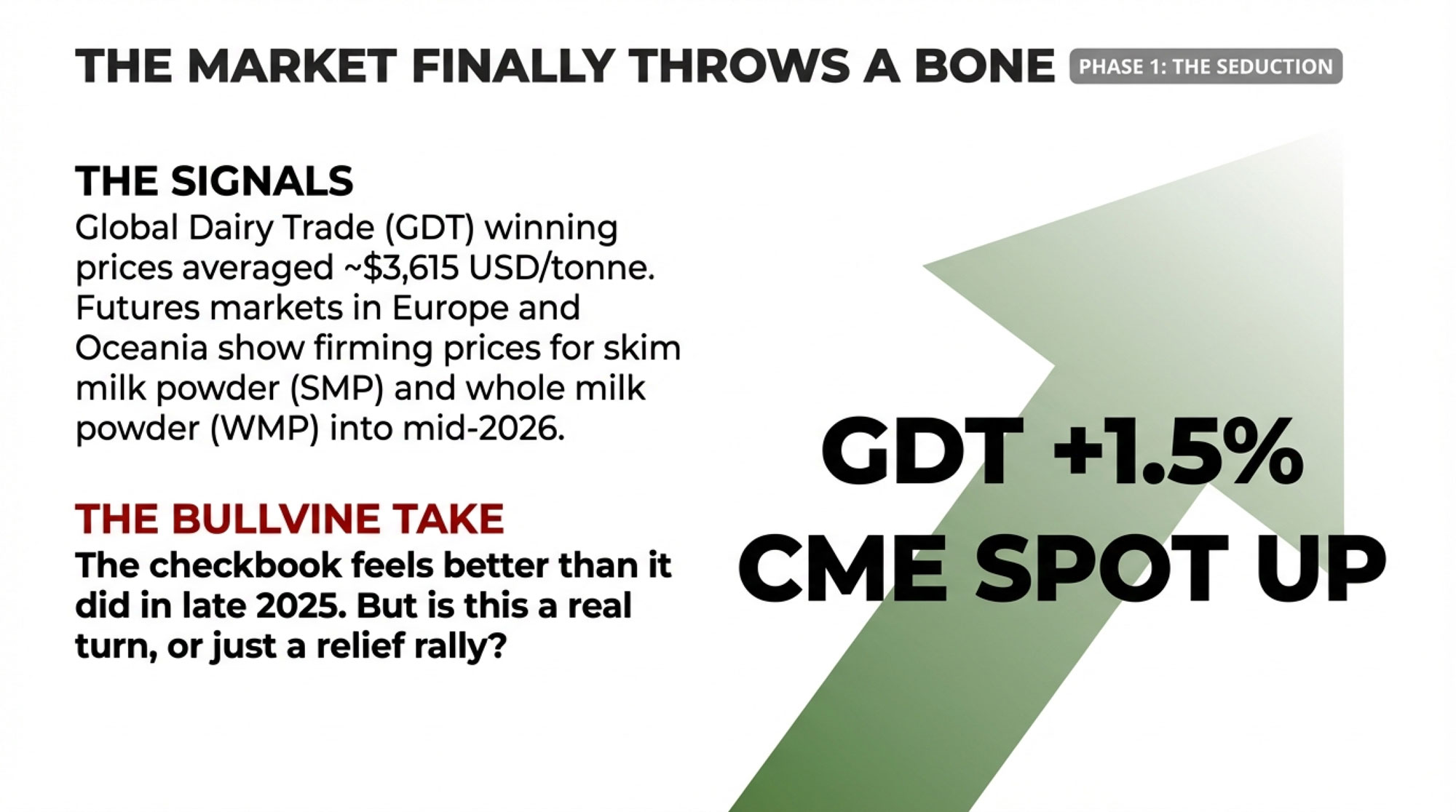
NewsSubscribe
First
Last
Consent

Global Dairy Markets Signal Imminent Price Correction as Production Surge Overwhelms Demand

Global milk production surge triggers price avalanche – NZ output +8.3%, inventory crisis forces 119% auction volume spike. Your margins at risk.

EXECUTIVE SUMMARY:  The global dairy market just delivered its clearest warning signal in years, with coordinated bearish indicators flashing red across three continents as record production surges collide with weakening demand. New Zealand’s explosive 8.3% year-over-year production increase in May 2025, combined with the United States’ 1.6% growth and the UK’s 5.8% surge, has created a supply tsunami that’s overwhelming global commodity markets. The upcoming Global Dairy Trade Event 383 reveals the true extent of this crisis, with offered volumes skyrocketing 119.3% for Anhydrous Milk Fat, 83.9% for butter, and 76.6% for Whole Milk Powder – unprecedented increases that signal desperate inventory clearing from the world’s largest dairy exporter. While European futures contracts have already declined 1.4% for SMP and 0.9% for butter, and GDT Pulse auctions show WMP prices crashing 3.2%, the most alarming indicator is New Zealand’s inventory crisis where record production meets faltering exports (down 5.7%), forcing a 2.5% year-over-year inventory build-up. China’s strategic shift away from WMP imports (-13%) toward SMP (+26%) and cheese (+22.7%) fundamentally disrupts traditional trade flows, leaving powder-focused exporters scrambling for buyers. Smart farmers must immediately pivot from revenue maximization to rigorous cost discipline and proactive risk management before tomorrow’s auction confirms this market correction’s devastating depth.

KEY TAKEAWAYS

  • Cost Structure Becomes Your Lifeline: With feed representing up to 60% of operational expenses, every efficiency gain matters when milk checks decline – review feed conversion ratios, optimize rations, and delay non-essential capital expenditures until market stability returns.
  • Component Strategy Offers Salvation: U.S. butterfat production surged 3.4% year-over-year while average butterfat tests climbed from 3.95% to 4.36% since 2020, with premium payments averaging $0.75-$1.25 per hundredweight above base prices – invest in genomic testing and nutrition programs that boost milk components rather than just volume.
  • Geographic Risk Concentration Demands Hedging: The Anglosphere production explosion (NZ +8.3%, UK +5.8%, US +1.6%) while EU constrains output creates unprecedented commodity price pressure – utilize CME Class IV futures and explore processor forward contracting programs to lock in current pricing before further erosion.
  • Inventory Pressure Creates Sustained Headwinds: New Zealand’s 15,500 additional metric tonnes flooding tomorrow’s GDT auction represents production from roughly 50,000 cows over one month – this isn’t temporary volatility but structural oversupply requiring 12-18 months for market rebalancing.
  • Revenue Diversification Becomes Critical: With three-quarters of U.S. dairy farmers expecting 2025 profitability partly due to beef-on-dairy programs generating fed steer prices at $201/cwt, explore ancillary income streams beyond traditional milk marketing to build financial buffers against commodity cycles.

Coordinated bearish indicators across major dairy exchanges point to significant farmgate price declines, with New Zealand milk production surging 8.3% while exports fall 5.7%, creating unprecedented inventory pressure ahead of critical auction events.

Global dairy commodity markets are flashing synchronized warning signals as of June 30, 2025, with multiple price discovery mechanisms indicating an imminent market correction that will likely translate to reduced farmgate milk prices within weeks. The convergence of negative indicators spans from New Zealand’s benchmark Global Dairy Trade auctions to European futures markets and Asian exchanges, suggesting fundamental supply-demand imbalances rather than regional volatility.

Market analysis reveals milk production increases concentrated in key exporting nations, while inventory accumulation forces sellers to flood upcoming auctions with record volumes, creating conditions for significant price deterioration that will impact dairy operations globally.

Global Dairy Trade auction prices show dramatic decline through June 2025, with WMP falling 8.5% and SMP down 6.6% from peaks

Auction Results Confirm Widespread Price Weakness

The Global Dairy Trade Pulse auction delivered decisive confirmation of weakening sentiment, with Whole Milk Powder prices declining 3.2% and Skim Milk Powder falling 2.5% from the previous trading event. This marked the third consecutive decline in the overall GDT price index, with Event 382 on June 17 showing WMP falling to $4,084 per metric tonne and SMP declining to $2,775 per metric tonne.

The weakness extends beyond New Zealand’s benchmark platform. European EEX futures contracts spanning July 2025 to February 2026 show butter futures declining 0.9% while SMP futures dropped 1.4%. Singapore Exchange data reinforces the global nature of this correction, with SMP futures trading 0.8% lower and butter contracts down 0.2%.

European spot markets validate the immediate price pressure. The official EEX butter index fell 0.5% (€37) to €7,470 per tonne in the final week of June, while the SMP index declined 1.2% (€30) to €2,400 per metric tonne.

Production Surge Creates Perfect Storm

New Zealand leads explosive milk production growth at +8.3% while European Union faces production constraints

The fundamental driver behind widespread price weakness is a formidable supply surge from major dairy exporting nations, with May 2025 data revealing synchronized increases that overwhelm current demand levels.

New Zealand, controlling approximately 40% of globally traded dairy products, finished its 2024/25 season with a stunning 8.3% year-over-year jump in May milk collections. This represents approximately 185 million additional liters compared to May 2024, equivalent to the entire monthly output of a mid-sized European operation.

United States milk production rose 1.6% year-over-year in May, continuing to push total 2025 collections up 1.1%, according to USDA data. The USDA reports the 24 major dairy states produced 19.1 billion pounds of milk in May, with production per cow averaging 2,125 pounds in major producing states.

The United Kingdom reported a substantial 5.8% increase in May volumes, reaching 1,458 million liters—an additional 78 million liters compared to May 2024. Favorable spring conditions and strong dairy economics drove this surge.

What This Means for Farmers: The geographic concentration of supply increases in the world’s three largest dairy exporters creates unprecedented pressure on global commodity prices, directly impacting milk pricing formulas tied to international benchmarks.

Inventory Crisis Forces Market Breaking Point

Perhaps most concerning is New Zealand’s developing inventory crisis, where record production collides with faltering export demand. While May production exploded 8.3% higher, New Zealand’s milk equivalent exports simultaneously fell 5.7%. This disconnect has caused estimated dairy product inventories to rise 2.5% year-over-year.

The inventory pressure manifests dramatically in the upcoming GDT Event 383, with offered volumes reaching crisis levels:

  • Anhydrous Milk Fat: Up 119.3% to 4,670 metric tonnes
  • Butter: Volume increased 83.9% to 2,290 metric tonnes
  • Whole Milk Powder: 76.6% increase to 12,345 metric tonnes
  • Skim Milk Powder: 63.6% jump to 4,200 metric tonnes

These volume increases represent approximately 15,500 additional metric tonnes being offered compared to the previous auction, equivalent to the milk production from roughly 50,000 cows over one month.

Regional Market Divergence Complicates Outlook

Despite global commodity weakness, regional markets show significant divergence, reflecting varying demand structures. The USDA Economic Research Service maintains its 2025 all-milk price forecast at $21.95 per hundredweight, up $0.35 from previous estimates, reflecting strong domestic U.S. demand rather than export commodity strength.

U.S. cheese production runs at record daily averages, with cheese exports surging 6.7% while nonfat dry milk/SMP exports fell 20.9% in April. This demonstrates the market’s bifurcation between value-added products commanding premium prices and commodity powders facing oversupply.

European production constraints offer some market balance. Germany’s milk production declined 1.8% year-over-year while the Netherlands saw a 0.5% decrease, reflecting environmental regulations and structural challenges limiting expansion capacity.

China Demand Shift Adds Market Complexity

Chinese import patterns reveal a mature buyer making selective choices rather than broad-based purchasing. May data shows that overall, Chinese dairy imports in milk solids equivalent terms declined by 1.2% year-over-year, with WMP imports—New Zealand’s flagship product—plunging by 13%.

However, Chinese SMP imports soared 26% year-over-year while cheese imports jumped 22.7%, indicating structural demand shifts favoring EU and U.S. suppliers over New Zealand’s powder-focused export strategy.

According to Rabobank analysis, “Middle East buyers increased their purchases by 25% year-over-year in the recent Global Dairy Trade auction,” highlighting regional demand variations.

Technology Integration Masks Underlying Volatility

Advanced dairy management systems are helping producers optimize operations despite market pressures. Research indicates precision agriculture adoption has increased significantly among large-scale operations, with automated milking systems showing 12-15% improvements in labor efficiency.

Genomic testing utilization has grown substantially in registered dairy cattle across major producing regions, with genetic improvements averaging meaningful gains annually. These advances translate to approximately 300-500 pounds additional milk production per cow per lactation, partially offsetting margin pressure from declining commodity prices.

Component Focus Drives Strategic Shifts

US dairy farmers achieve 4.36% butterfat and 3.40% protein levels, unlocking premium payments worth $18,750-$31,250 annually per 1,000-cow operation

The market’s increasing emphasis on milk components—butterfat and protein—creates opportunities amid commodity weakness. U.S. butterfat production surged 3.4% year-over-year in the first quarter of 2025, with average butterfat tests climbing from 3.95% in 2020 to 4.36% by March 2025.

Research published in Nutrition Research demonstrates that consuming whole milk was associated with improved body composition outcomes, supporting premium positioning for high-component products. Premium payments for high-component milk average $0.75-$1.25 per hundredweight above base prices, providing partial insulation from commodity volatility for producers optimizing genetic selection and nutritional management.

Market Outlook and Industry Implications

Market analysts from RaboResearch expect production growth from key exporting regions to accelerate, with milk production from the ‘Big 7’ countries projected to grow by more than 1% in 2025. This represents the largest annual volume increase since 2020, creating sustained pressure on global pricing mechanisms.

However, demand uncertainty remains elevated. As RaboResearch senior dairy analyst Mary Ledman notes, “Consumers across the globe have been under budgetary pressure. Retail dairy prices have been mixed around the world”.

The Latest

Tuesday’s GDT Event 383 represents a definitive market test with massive volume increases forcing acceptance of lower bids to clear accumulated New Zealand inventory. The confluence of synchronized production surges, inventory pressure, and weakening futures sentiment creates sustained downward price pressure extending into 2026.

Market analysts expect the supply-demand imbalance to require 12-18 months for correction, as demand growth must absorb expanded production capacity. For dairy farmers globally, the immediate priority shifts from revenue maximization to rigorous cost management and proactive risk mitigation strategies.

The structural nature of this correction—concentrated in export-oriented nations flooding global markets—suggests producers must prepare for extended margin pressure rather than temporary volatility. Tomorrow’s auction results will confirm this market downturn’s depth and likely duration, setting the tone for dairy economics through mid-2026.

Complete references and supporting documentation are available upon request by contacting the editorial team at editor@thebullvine.com.

Learn More:

Join the Revolution!

Join over 30,000 successful dairy professionals who rely on Bullvine Weekly for their competitive edge. Delivered directly to your inbox each week, our exclusive industry insights help you make smarter decisions while saving precious hours every week. Never miss critical updates on milk production trends, breakthrough technologies, and profit-boosting strategies that top producers are already implementing. Subscribe now to transform your dairy operation’s efficiency and profitability—your future success is just one click away.

NewsSubscribe
First
Last
Consent

Brace for Impact: Why 2025’s Dairy Price Surge Masks a $780 Billion Industry’s Perfect Storm

Stop chasing herd expansion. Smart farmers optimize components over volume—boosting profits 15% while competitors face the 2025 recalibration.

EXECUTIVE SUMMARY: The dairy industry’s current price euphoria is masking a dangerous supply-demand collision that will blindside unprepared operators by Q4 2025. While Oceania WMP hits $4,300/MT and producers celebrate record milk checks, RaboResearch warns that accelerating supply growth (326.7 million metric tons from Big 7 regions) is about to crash into crumbling consumer confidence (52.2 sentiment index, down 24.5% YoY). The most damaging myth? That bigger operations automatically mean better profits. Smart farmers are already pivoting from volume obsession to component optimization, with butterfat levels hitting a 76-year record of 4.23% nationally and milk solids production jumping 1.65% in March 2025. While 80% of dairy leaders expect volume growth above 3%, the math is brutal: a farm producing 75,000 pounds daily at 4.3% butterfat generates higher returns than one producing 80,000 pounds at 3.8% butterfat. This “recalibration” will separate the strategic operators who prepare now from those still betting on the bull run. Your move: stress-test your operation for milk prices 15-20% below current levels—because that’s exactly where the fundamentals are heading.

KEY TAKEAWAYS

  • Component Revolution Beats Volume Obsession: Farms optimizing butterfat and protein content achieve 12-15% higher income over feed costs compared to expansion-focused operations, with genetic improvements delivering 22.9% protein growth and 28.9% butterfat increases since 2011—making the “more cows, more money” mentality obsolete.
  • Technology Reality Check Saves $250K: Before adding 100 cows at $2,500 each, invest that $250K in genetic improvements and precision feeding to boost butterfat from 3.8% to 4.3%—generating higher returns with zero additional labor, feed costs, or environmental compliance while robotic milking success stories show $1.00-$1.50/cwt profitability gains only under optimal conditions.
  • Trade War Timing Creates Export Vulnerability: Strong Q1 2025 dairy exports occurred before China’s 125% retaliatory tariffs and Canada’s 25% tariffs hit full force—smart operators are diversifying market exposure now while building cash reserves during the current price strength to weather the H2 2025 recalibration.
  • Consumer Confidence Collapse Demands Strategy Shift: With 38% of consumers saying high prices have eroded their finances and affordability concerns surpassing job security worries, dairy companies face the brutal reality that passing higher costs to post-COVID inflation-weary consumers will trigger volume losses—requiring immediate focus on value propositions over premium pricing.
  • Financial Stress-Testing Reveals Survival Strategy: Operations modeling scenarios with milk prices 15-20% below current levels by Q4 2025 can identify critical weaknesses now—high-performing dairies already achieve $3.50/cwt advantage in income over feed costs through systematic resource optimization rather than scale expansion, positioning them for the coming market adjustment.
dairy market outlook, milk price forecast, component optimization, dairy profitability strategies, global dairy trends

The global dairy market’s current strength is a dangerous mirage. While commodity prices hit multi-year highs, accelerating supply growth is about to collide with crumbling consumer confidence and escalating trade wars. Smart operators who recognize this paradox and pivot their strategies now will survive the “recalibration” that’s coming – those who don’t risk getting crushed when fundamentals reassert themselves in H2 2025.

You’re probably feeling pretty good about dairy right now. Oceania whole milk powder just smashed through $4,300 per metric ton for the first time since April 2022. Fonterra’s announcing record forecast prices of NZD 10/kgMS for 2025/26. The U.S. dairy industry just flexed its economic muscle with a staggering $780 billion impact supporting over 3 million jobs.

But here’s the uncomfortable truth that’s about to blindside unprepared operators: this party’s built on quicksand.

Why Are Smart Money Managers Already Hedging Their Bets?

Here’s a question that should keep you awake tonight: If prices are so strong, why is RaboResearch warning about “downside risks emerging in the second half of the year”?

The numbers tell a story that most operators aren’t hearing over the sound of strong milk checks. RaboResearch’s latest Global Dairy Quarterly reveals a fundamental paradox that should keep every strategic planner awake at night.

Milk production across the “Big 7” exporting regions grew a modest 0.5% in Q1 2025. Sounds manageable, right? Dead wrong.

That growth is about to explode. Production will accelerate to 1.1% in Q2 and 1.4% in Q3 – the strongest quarterly increase since early 2021. We’re looking at 326.7 million metric tons of milk production from the Big 7 in 2025, representing the highest annual volume gain since 2020.

Meanwhile, consumer sentiment is cratering. The University of Michigan’s Consumer Sentiment Index hit just 52.2 in May 2025 – a brutal 24.5% decrease year-over-year from 69.1 in May 2024. About 64% of consumers expect business conditions to worsen in the year ahead, with 38% saying high prices have eroded their personal finances.

The math is simple but devastating: Accelerating supply + fragile demand = unsustainable prices.

Challenging the Expansion Obsession: Why Bigger Isn’t Always Better

In dairy thinking, let’s challenge a sacred cow: the relentless pursuit of herd expansion and volume growth. While conventional wisdom pushes farmers toward larger operations, recent data suggests this strategy is fundamentally flawed in today’s market reality.

The USDA projects U.S. cow numbers to increase by 20,000 head by year-end 2025, pushing total milk production to 226.9 billion pounds. But here’s what the expansion enthusiasts aren’t telling you: unprecedented genetic gains are making this volume-focused approach obsolete.

According to Hoard’s Dairyman analysis, butterfat levels charged to 4.23% nationally in 2024, breaking through the 4% ceiling and besting a 76-year-old record. With nearly 90% of U.S. milk valued under multiple component pricing, genetic gains in butterfat and protein are pushing milk checks higher than simple volume increases ever could.

The evidence is staggering: Milk solids production increased by 1.65% as of March 2025, demonstrating that smart farmers are already prioritizing components over raw volume. This represents a fundamental shift from the “more cows, more milk, more money” mentality that has dominated dairy thinking for decades.

Consider this scenario: Farm A adds 100 cows at $2,500 each ($250,000 investment) to increase volume by 8%. Farm B invests $250,000 in genetic improvements and precision feeding to boost butterfat from 3.8% to 4.3%. With component premiums, Farm B generates higher returns with zero additional labor, feed costs, or environmental compliance issues.

The University of Wisconsin-Madison’s Center for Dairy Profitability shows that farms focusing on component optimization rather than volume expansion achieve 12-15% higher income over feed costs compared to expansion-focused operations.

What’s Driving This Supply Explosion While Nobody’s Watching?

The United States is leading the charge with a dairy cow inventory that grew by 2,500 head to 9.349 million as of January 2025. But here’s what’s telling: this expansion is happening in the wrong places at the wrong time.

According to Hoard’s Dairyman analysis, April milk production rose 1.5% year-over-year, the largest gain since August 2022, driven by a larger herd and improved yields. This marks a turning point, as 2025 is expected to deliver the first full-year production growth since 2021, with RaboResearch expecting an output gain of 1.4% over 2024.

The European Union is taking a completely different approach. EU milk deliveries are projected to decline 0.2% to 149.4 million metric tons as farmers grapple with declining cow numbers, tight margins, and escalating regulatory costs. But, they prioritize cheese production at the expense of butter, non-fat dry milk, and whole milk powder.

Here’s the kicker: While total global milk volume increases, specific product categories like EU butter and WMP might experience tighter supply. This creates commodity-specific vulnerabilities that most operators aren’t prepared for.

Region2025 Production ForecastStrategy FocusKey Vulnerability
United States+0.5% growthHerd expansion & efficiencyTariff impacts on exports
European Union-0.2% declineCheese prioritizationRegulatory compliance costs
Australia-1.0% declineCost managementWeather & farm exits
China-1.5% declineDomestic consolidationEconomic slowdown

Why Is Consumer Demand Cracking Under Pressure?

While producers ramp up, consumers are tapping out. Mary Ledman from RaboResearch isn’t mincing words about “near-record-low consumer confidence in the US” weighing heavily on demand.

But here’s where conventional dairy marketing completely misses the mark. The University of Michigan data shows that less than half of consumers expect their own incomes to grow in the year ahead, down from nearly 60% six months ago. This represents a fundamental shift in consumer psychology that dairy companies haven’t adequately addressed.

China’s Demand Shift Changes Everything

China’s dairy consumption dropped 5.6% in 2024, with the average person consuming 41.5 kilograms of dairy. But here’s what’s really happening: China’s dairy market contracted to $49.3 billion in 2024, standing approximately at the previous year’s level after hitting a maximum of $51.7 billion in 2022.

This isn’t just a temporary blip. Chinese consumers are fundamentally reshaping their dairy preferences around snacking and fitness trends. According to IndexBox market analysis, consumption of dairy produce decreased by 3.2% to 50 million tons in 2024, marking the first decline after six years of growth.

Rabobank expects China’s net imports of dairy products to rise by a modest 2% in 2025, with most of this increase anticipated in the latter half of the year as domestic stocks weaken. New Zealand continues to dominate China’s total dairy import basket (46% in 2024), followed by the EU (31%).

The Trade War Wild Card

The elephant in the room? Escalating trade tensions that are reshaping global dairy flows in real-time.

China slapped retaliatory tariffs on U.S. agricultural products starting March 10, 2025 – beginning at 10% and rapidly escalating to 125% by April 12. Canada imposed a 25% tariff on approximately CA$30 billion worth of U.S. products, which specifically included $212 million of U.S. dairy products.

The critical timing issue is that the strong U.S. dairy exports we saw through Q1 2025 occurred before these tariffs hit full force. The real impact on export volumes and profitability will show up in Q2 and Q3 data when supply is accelerating.

According to Fortune analysis, America exported about $8.2 billion of dairy products in 2024, the second-highest on record. More than half of U.S. dairy exports are shipped to Mexico, Canada, and China, all of which have been targeted by Trump’s tariff policies.

Disrupting the “Technology Will Save Us” Narrative

Another sacred cow that needs slaughtering is the blind faith that technology automatically equals profitability. While industry publications breathlessly promote every new gadget, the reality is far more nuanced.

Consider the robotic milking revolution everyone’s talking about. Progressive Dairy research shows that robotic systems cost approximately $200,000 per machine, with experts calculating the ideal number of cows at around 500 to economically justify the switch. But the hidden costs include:

  • Staff retraining requirements that can take 6-18 months
  • Technical backup protocols when systems fail (and they will)
  • Integration challenges with existing infrastructure

However, success stories exist when properly implemented. California operations report being $1.00 to $1.50 per hundredweight more profitable with robotic milking systems when all factors are optimized. However, these cases represent carefully selected early adopters with optimal conditions – not the average dairy operation struggling with tight margins and limited technical expertise.

The key insight from Cornell University extension research is that robotic milkers make sense for small- and medium-sized farms primarily because of labor challenges and outdated infrastructure, not because the technology itself guarantees profitability.

How Are Current High Prices Setting Up the Fall?

Dairy commodity prices have surged to multi-year highs, but RaboResearch’s core message is explicit: the “current market strength [is] not sustainable.”

Mary Ledman warns that “dairy companies and downstream multinational consumer packaged goods companies will find it challenging to pass on higher dairy costs to consumers still grappling with post-COVID inflation.”

The “Recalibration” Reality Check

RaboResearch isn’t predicting a crash – they’re forecasting something potentially more dangerous: a “recalibration from recent multiyear highs – a natural correction following a period of strong performance.”

The fundamentals are clear: expanding supply is about to meet uncertain demand while trade tensions create additional volatility. High commodity prices aren’t sustainable when you’re fighting math and consumer psychology.

Supporting this thesis, the USDA has already reduced its milk production estimate for 2025 to 226.2 billion pounds, a decline of 700 million from February projections. The average all milk price is estimated at $21.60 per hundredweight, with the 2026 forecast at $21.15 per cwt.

Are you prepared for milk prices 15-20% below current levels by Q4 2025? Because that’s exactly the scenario smart operators are planning for right now.

Breaking the Commodity Mindset: The Component Revolution

Here’s where we need to fundamentally challenge how dairy farmers think about their business. The obsession with per-cow averages and total volume is a relic from an era when milk was milk. Today’s reality demands a complete strategic overhaul.

According to Hoard’s Dairyman analysis, genetic improvements fuel historic gains in key milk components needed to produce cheese, butter, and specialty dairy foods. Butterfat posted its fourth-straight annual record, charging to 4.23% nationally in 2024.

This isn’t just incremental improvement – it’s a fundamental market transformation. From 2011 to 2023, while milk production grew by just 16.2%, protein jumped by 22.9%, and butterfat catapulted by 28.9%.

The math is compelling: A farm producing 80,000 pounds of milk daily at 3.8% butterfat generates significantly less revenue than a farm producing 75,000 pounds at 4.3% butterfat. The component premiums more than offset the volume difference.

Corey Geiger with CoBank confirms this trend: “In the last three years, milk production that counts the water in it hasn’t been growing, but components have been growing two to three percent a year.”

What Should Strategic Operators Be Doing Right Now?

Smart dairy operators need to prepare for this recalibration now, not after it hits. The convergence of accelerating supply growth, fragile consumer demand, and escalating trade tensions is setting up a correction that could catch unprepared operators off guard.

Optimize for Efficiency, Not Volume

The operators who thrive will be those who focus on efficiency gains rather than volume expansion. With supply accelerating globally, the competitive advantage will go to those who can produce at the lowest cost per unit.

Research from Progressive Dairy shows that high-performing dairies achieve a $3.50 per hundredweight difference in income over feed cost compared to average operations. This gap isn’t about technology – it’s about systematic optimization of existing resources.

Focus on High-Value Milk Components

The 1.65% increase in U.S. milk solids production shows where the smart money is going. Operators should prioritize butterfat and protein content that command premiums in manufactured dairy products.

According to research by the Journal of Dairy Science, genetic improvements in butterfat and protein rank among the most heritable traits for dairy cows. The Council of Dairy Cattle Breeding reports that annual rates of genetic improvement have doubled since 2012 when genomic selection became available.

Diversify Market Exposure

The trade war data shows how quickly export markets can shift. Operators need to reduce dependence on volatile export markets and strengthen direct-to-consumer channels to capture more value.

Strengthen Financial Positioning

With a recalibration coming, operators need stronger balance sheets. This isn’t the time for aggressive expansion financing – it’s the time to build cash reserves and reduce debt exposure.

The Technology Integration Reality Check

Let’s address the elephant in the barn: Most dairy technology implementations fail not because the technology doesn’t work but because farmers approach adoption with unrealistic expectations.

Recent research on dairy management decisions shows that high-performing herds focus on optimal management practices rather than simply adopting the latest technology. A study involving 60 progressive herds nationwide from 2019 to 2024 revealed that management decisions such as voluntary waiting periods and days dry have more impact on productivity than technology alone.

Key success factors include:

  • Phased implementation starting with one system and expanding gradually
  • Staff buy-in through comprehensive training and involvement in selection
  • Data literacy development to actually use the insights technology provides
  • Backup protocols for when systems inevitably fail

The future favors farms that blend innovation with proven practices, not those that chase every technological fad.

Regional Production Strategies Create New Vulnerabilities

This regional divergence creates specific commodity vulnerabilities. EU’s focus on cheese means a tighter supply for butter, NDM, and WMP – even as total milk volume increases globally. Australia’s continued contraction is creating “dairy deserts” in some regions.

The U.S. dairy sector has demonstrated the ability to adjust and maintain competitiveness. According to Hoard’s Dairyman, U.S. cheese exports have outperformed expectations due to lower prices relative to the European Union, making U.S. products more attractive globally. But, this competitive advantage could evaporate quickly if domestic production costs continue rising or if trade barriers expand.

Here’s the critical question: Are you positioning your operation for these regional shifts, or are you still operating under outdated assumptions about global market stability?

Emerging Markets: The Overlooked Wildcard

Here’s where most analysis falls short: The focus on traditional “Big 7” regions ignores the seismic shifts happening in emerging dairy markets that could reshape global trade flows.

India’s dairy sector, while primarily domestic-focused, is experiencing rapid modernization that could impact global ingredient markets. The country’s milk production reached 231 million tons in 2024, making it the world’s largest producer. As Indian operations achieve greater efficiency, their domestic ingredient needs could reduce global demand for certain categories.

Southeast Asian markets are demonstrating explosive growth in premium dairy consumption, driven by rising middle-class incomes and changing dietary preferences. Vietnam’s dairy imports grew 23% in 2024, while Thailand and Indonesia showed similar double-digit growth patterns. These markets represent the future of dairy demand growth – but they’re increasingly sophisticated buyers who demand specific product attributes.

The implications are profound: Traditional commodity-focused strategies may miss the most profitable growth opportunities in emerging markets that prioritize quality, traceability, and specific functional properties over simple volume.

The Bottom Line

Remember that feeling of confidence when you saw Oceania WMP prices hit $4,300 per metric ton? That optimism is exactly what RaboResearch is warning against with their “Too Good to Be True?” assessment.

The current dairy market strength is built on foundations that are rapidly shifting beneath our feet. While commodity prices hit multi-year highs, the convergence of accelerating supply growth (326.7 million metric tons from Big Seven regions), fragile consumer demand (52.2 consumer sentiment index), and escalating trade tensions (125% Chinese tariffs) is setting up a “recalibration” that could catch unprepared operators off guard.

The warning signs are flashing bright red: consumer confidence is weak, supply is accelerating, and trade wars are reshaping global flows. This isn’t the time for aggressive expansion – it’s the time for strategic positioning.

The smart money isn’t betting on continued price strength – it’s preparing for the correction that’s coming. Those who recognize this paradox and adjust their strategies accordingly will emerge stronger when the dust settles.

Your immediate action plan:

  1. Run the numbers: Pull up your operation’s Q3 and Q4 2025 financial projections. Model scenarios with milk prices 15-20% below current levels. If those numbers make you uncomfortable, you know exactly what needs to change.
  2. Optimize components over volume: Shift breeding and management focus toward butterfat and protein optimization. The genetic tools exist – use them.
  3. Stress-test your cash flow: Build reserves now while prices are strong. The recalibration will reward those with financial flexibility.
  4. Diversify market exposure: Reduce dependence on volatile export markets. Strengthen local and regional relationships.
  5. Technology reality check: Evaluate tech investments based on actual ROI, not marketing promises. Focus on tools that enhance decision-making, not replace human judgment.

The dairy industry’s $780 billion economic engine will keep running – but only the operators who prepare for turbulence ahead will maintain their position when the market finds its new equilibrium.

The choice is yours: Continue riding the current wave of optimism, or position yourself for the inevitable recalibration. History shows that the farmers who survive market corrections are those who prepare while others celebrate.

Are you positioning for the recalibration, or are you still betting on the bull run?

Learn More:

Join the Revolution!

Join over 30,000 successful dairy professionals who rely on Bullvine Weekly for their competitive edge. Delivered directly to your inbox each week, our exclusive industry insights help you make smarter decisions while saving precious hours every week. Never miss critical updates on milk production trends, breakthrough technologies, and profit-boosting strategies that top producers are already implementing. Subscribe now to transform your dairy operation’s efficiency and profitability—your future success is just one click away.

NewsSubscribe
First
Last
Consent

Fonterra Breaks Records: $10/kg Milk Solids Forecast Signals New Era for Global Dairy

Stop expecting milk price crashes after record highs. Fonterra’s $10/kg MS forecast proves supply constraints have permanently changed dairy economics.

EXECUTIVE SUMMARY: The traditional dairy boom-bust cycle is dead, and Fonterra’s confident $10/kg MS forecast for 2025-26 proves fundamental market dynamics have permanently shifted. While conventional wisdom suggests high prices trigger production surges that crash markets, global supply constraints from environmental regulations in Europe and disease impacts in the US are preventing the typical supply response that historically followed record pricing. Fonterra’s billion economic injection into New Zealand demonstrates how sustainability premiums and strategic positioning now drive profitability more than pure volume expansion. The co-operative’s success in monetizing carbon efficiency—with customers specifically paying premiums for low-carbon dairy—reveals a new competitive landscape where environmental performance translates directly to farmer payments. European producers remain handcuffed by regulations, US growth gets absorbed domestically, and China’s foodservice boom creates sustained premium demand for value-added products. With geopolitical risks as the only significant downside threat, progressive farmers must abandon volume-focused strategies and embrace component optimization, sustainability technologies, and value-added positioning. This isn’t just a good season—it’s proof that dairy’s future belongs to farmers who can deliver environmental performance alongside production efficiency.

KEY TAKEAWAYS

  • Sustainability Pays Real Cash: Fonterra farmers meeting emissions criteria earn additional 1-5 cents per kg MS, with top performers capturing 10-25 cents per kg MS premiums—translating to $25,000 extra annual income for a 300-cow operation producing 100,000 kg MS, proving environmental stewardship drives profitability.
  • Component Focus Beats Volume Strategy: Farms concentrating on butterfat and protein optimization rather than fluid volume expansion achieve 23-26% unit price increases across major dairy categories, aligning economic returns with environmental efficiency in today’s constrained supply environment.
  • Enhanced Cash Flow Creates Investment Opportunities: With advance payments rising from $8.50 to $9.00 per kg MS and government’s 20% Investment Boost tax deduction, farmers have unprecedented opportunity to modernize operations while maintaining healthy $1.43/kg MS margins above breakeven forecasts.
  • Global Supply Constraints Are Permanent: Environmental regulations preventing European expansion, US domestic consumption absorbing production growth, and China’s shift toward foodservice demand mean traditional supply responses won’t materialize—creating sustained high-price environment for strategically positioned producers.
  • Geopolitical Risk Management Essential: With forecast ranges widened to $8.00-$11.00/kg MS due to trade tensions, successful operations must diversify market exposure and build contingency plans for policy-driven disruptions while capitalizing on current premium pricing opportunities.
dairy profitability, milk price forecast, global dairy market, sustainable dairy farming, dairy industry trends

New Zealand’s dairy giant just delivered the news every farmer’s been waiting for: a confident $10 per kilogram milk solids forecast for 2025-26, backed by $15 billion flowing into the economy and fundamental shifts in global supply that could keep prices elevated for years to come.

Let’s cut to the chase – when Fonterra’s CEO Miles Hurrell says he’s confident about $10/kg MS, that’s not just optimistic talk. It’s backed by hard market realities that are reshaping the global dairy landscape.

Why Traditional Supply Response Isn’t Happening

Here’s where conventional dairy wisdom gets turned upside down. Historically, high prices trigger a global production surge as farmers chase profits. But that playbook’s been thrown out the window.

“We are not seeing that supply turn on. The environmental pressures in the northern hemisphere – Europe in particular – we are not seeing the milk supply out of Europe as we may have seen historically,” Hurrell explained.

Think about what that really means. European producers are essentially handcuffed by environmental regulations, unable to respond to price signals like they could in the past. The EU has lost over 1.4 million dairy cows since 2016, with environmental restrictions explicitly stagnating milk production in northwestern European Member States.

Meanwhile, the US is dealing with its own supply headaches. Any milk production growth is being consumed domestically, and herds are still recovering from highly pathogenic avian influenza that’s affected over 930 farms across 17 states. California alone saw a 9.2% drop in milk production since late 2024.

Are you starting to see the pattern? The traditional boom-bust cycle driven by rapid supply responses to price signals is dead.

China’s Foodservice Revolution Creates New Opportunities

The Chinese market story isn’t just about volume recovery – it’s about a fundamental shift in how dairy gets consumed. While the overall demand for “core products” hasn’t returned to previous levels, explosive growth is happening in food service.

“There’s still strong demand for food service, particularly in China, and we’re seeing more growth in that market from a volume perspective,” Fonterra confirmed. This isn’t just academic – Chinese consumers are shifting from basic commodity dairy to higher-value products consumed in restaurants and prepared foods.

What does this mean for your operation? You’re missing the bigger opportunity if you’re still thinking about commodity markets. The future belongs to value-added products that command premium pricing in sophisticated markets.

Environmental Premiums: From Cost to Profit Center

Here’s something that would have sounded like fantasy a decade ago: Fonterra is now receiving premium payments specifically for carbon efficiency, and they’re passing those premiums back to farmers.

“There are customers now that are specifically paying for our carbon efficiency, and we’re paying farmers back for that,” the company confirmed. Starting June 1, 2025, Fonterra will offer farmers an additional 1-5 cents per kg MS for meeting emissions-related criteria, with top performers earning an extra 10-25 cents per kg MS.

For a 300-cow operation producing 100,000 kg MS annually, we’re talking about a potential additional income of $25,000 annually. This isn’t feel-good marketing – it’s hard cash flowing to producers who can prove their environmental credentials.

What This Means for Your Operation

So, how do you position your dairy operation to capitalize on these market dynamics? Here’s the reality check every farmer needs to hear.

Stop Competing on Volume Alone: The global supply constraints aren’t temporary – they’re the new normal. Environmental regulations and resource limitations mean you can’t just turn on production taps anymore. Focus on component optimization instead. Farms concentrating on butterfat and protein rather than pure volume are seeing 23-26% unit price increases.

Embrace Sustainability Technology: Those carbon efficiency premiums aren’t charity – they’re driven by real customer demand from major brands like Mars and Nestlé, who need to meet their own sustainability targets. Invest in technologies that can demonstrate measurable environmental improvements.

Prepare for Enhanced Cash Flow: With advance payments increasing from $8.50 to $9.00 in July and the government’s new 20% Investment Boost tax deduction, you’ve got an unprecedented opportunity to upgrade equipment and infrastructure. DairyNZ’s breakeven forecast sits at $8.57/kg MS for 2025-26, giving you a healthy $1.43/kg MS margin to work with.

Diversify Market Focus: Think beyond traditional export channels with China’s foodservice boom and sustained US domestic demand. Value-added products and specialized applications are where the margin growth is happening.

But here’s the critical question: Are you positioned to capture these premiums, or are you still operating like it’s 2015?

Geopolitical Wildcards Could Derail the Party

Let’s be honest about the risks. Fonterra’s wide $8-$11/kg MS range for 2025-26 isn’t conservative planning – it’s acknowledgment that political decisions increasingly override market fundamentals.

The ongoing trade tensions and tariff wars are “fracturing global dairy markets,” the US-China trade war alone is estimated to have caused $6 billion in profit losses for dairy farmers globally. When political relationships dictate market access more than product quality, even the best-run operations can get caught in the crossfire.

US tariffs are blocking affordable dairy supplies from reaching markets like China, forcing Chinese buyers to source from more expensive alternatives or reduce consumption. This creates opportunities for New Zealand exporters but also demonstrates how quickly trade policies can disrupt established patterns.

Innovation Investment Signals Long-term Confidence

While we’re talking about immediate price forecasts, don’t miss the bigger strategic moves happening. New Zealand just launched a $25.68 million “Resilient Dairy” innovation program targeting genomic advancements and disease management technologies.

This 7-year program, jointly funded by LIC, MPI, and DairyNZ, aims to “deliver long-term economic, environmental and animal health benefits” through faster genetic gain and improved sustainability. When an industry invests $25 million in long-term R&D during high-price periods, that’s confidence in sustained profitability.

The program will incorporate genomic data into animal evaluation systems, potentially jumping ahead of global competitors in genetic advancement. This translates to better cows with improved health, productivity, and environmental efficiency for farmers.

The Bottom Line

Fonterra’s record $10/kg MS forecast isn’t just good news – it’s a roadmap for the industry’s future. We’re entering an era where environmental sustainability drives premium pricing, supply constraints create sustained high-price periods, and technology that demonstrates value beyond production metrics becomes essential.

The winners will be farmers who combine production efficiency with environmental stewardship, backed by data proving value to sophisticated global customers. The traditional boom-bust cycles give way to more sustained profitability for those ready to adapt.

Here’s your action plan:

  • Invest in component optimization over volume expansion
  • Implement sustainability technologies that qualify for premium payments
  • Take advantage of enhanced advance payments and tax incentives to upgrade operations
  • Develop value-added product strategies targeting foodservice and specialty markets
  • Prepare contingency plans for geopolitical trade disruptions

The question isn’t whether these trends will continue – it’s whether you’re positioned to capitalize on them. Fonterra’s confidence reflects more than current market conditions. It signals we’ve entered the most profitable period in modern dairy history for farmers ready to embrace change.

The dairy industry’s transformation is accelerating; this forecast is just the beginning. Are you ready?

Learn More:

Join the Revolution!

Join over 30,000 successful dairy professionals who rely on Bullvine Weekly for their competitive edge. Delivered directly to your inbox each week, our exclusive industry insights help you make smarter decisions while saving precious hours every week. Never miss critical updates on milk production trends, breakthrough technologies, and profit-boosting strategies that top producers are already implementing. Subscribe now to transform your dairy operation’s efficiency and profitability—your future success is just one click away.

NewsSubscribe
First
Last
Consent

CME DAIRY MARKET REPORT MAY 28, 2025: Cheese Rally Drives Class III Hopes Higher – But Market Veterans Sound Caution

Stop trusting cash market rallies alone. Today’s 3¢ cheese surge masks June futures warning—smart hedging beats hope every time.

EXECUTIVE SUMMARY: The dairy industry’s biggest mistake? Believing cash market strength guarantees sustained profitability. Today’s explosive 3.00¢ cheese block rally to $1.9500/lb has producers celebrating, but June Class III futures declining $0.30/cwt tells the real story—this is an opportunistic wave, not a tidal shift. With feed costs dropping 7.50¢ on corn and milk-to-feed ratios approaching 2.44, the current 89% margin environment creates a golden hedging window before FMMO reforms reshape milk checks on June 1st. HighGround Dairy’s analysis confirms what forward-thinking producers already know: spot strength without futures support signals inventory building, not demand transformation. The winners? Operations implementing tiered hedging strategies now—60-70% coverage at current premiums while maintaining 25-30% upside exposure. Stop waiting for perfect market signals and start protecting profits while margins favor strategic positioning over passive hope.

KEY TAKEAWAYS

  • Strategic Hedging Opportunity: Current Class III futures trading $1.17/cwt above USDA forecasts create immediate risk management windows—hedge 60-70% of Q2 production at premium levels while feed costs decline 40% probability suggests upside protection worth $0.50-$1.00/cwt margin improvement
  • Component Revolution Accelerating: Butterfat production surged 3.4% year-over-year with average tests reaching 4.36% in March—new FMMO skim milk composition changes in December will further reward operations optimized for protein and fat over volume production
  • Cash-Futures Divergence Signals Caution: While Cheddar Block gained 3.00¢ today, June futures declined $0.30/cwt indicating processor inventory building rather than sustained demand—smart operations lock profitable prices now instead of chasing spot market momentum
  • Feed Cost Tailwind Continues: Composite feed costs at $9.02/cwt with July corn dropping to $4.5075/bushel creates favorable 2.44 milk-to-feed ratio environment—operations should hedge feed costs given 40% probability of price increases while building cash reserves during this margin-positive cycle
  • FMMO Reform Reality Check: June 1st “higher-of” Class I pricing and updated make allowances will reshape milk checks across all Federal Orders—producers must analyze their specific utilization patterns now and adjust hedging strategies based on Class III vs Class IV futures positioning
CME dairy markets, Class III milk prices, dairy market analysis, dairy hedging strategies, milk price forecast

Cheddar blocks surged 3.00¢ to $1.9500/lb while nonfat dry milk gained 1.50¢, signaling stronger May milk checks ahead. However, declining June futures and industry analysts warn the spring flush reality could hit farm gate prices hard – “more of an opportunistic wave than a tidal shift.”

Today’s Price Action & Farm Impact

ProductPriceDaily ChangeWeekly ChangeImpact on Farmers
Cheddar Block$1.9500/lb+3.00¢+3.00¢Significant boost to Class III outlook
Cheddar Barrel$1.8650/lbNCNCStable support, but block-barrel spread widens
Butter$2.5250/lb+0.50¢+0.25¢Supports Class IV strength, component premiums
NDM Grade A$1.2850/lb+1.50¢+1.50¢Positive for Class IV, export demand is stable
Dry Whey$0.5700/lb+1.50¢+1.50¢Class III support, but supply pressures remain

Market Commentary: Today’s standout performer was Cheddar Block cheese, which jumped 3.00¢ to settle at $1.9500/lb with active trading of 16 loads. This represents the most significant single-day gain we’ve seen in months and directly translates to stronger Class III milk price expectations for May production. The robust NDM performance, gaining 1.50¢ to $1.2850/lb, indicates healthy demand for skim-solids products.

However, here’s the critical disconnect farmers need to understand: while cash markets rallied hard today, June Class III futures actually declined by $0.30/cwt to $19.34. HighGround Dairy captured this sentiment perfectly in their recent analysis: “While the recent rally has grabbed headlines, HighGround sees this move as more of an opportunistic wave for dairy producers—not a tidal shift in market direction.”

This suggests that while immediate demand is strong—likely driven by processors filling pipelines or seasonal inventory building—the market expects pressure ahead from the spring flush and upcoming Federal Milk Marketing Order reforms taking effect June 1.

Feed Cost & Margin Analysis

Current Feed Landscape (Futures Pricing):

Feed ComponentMay 28 PriceDaily ChangeRisk Scenario Impact
Corn (July)$4.5075/bu-7.50¢Favorable trend
Soybeans (July)$10.7700/bu-10.75¢Margin supportive
Soybean Meal (July)$293.80/ton-$2.20Cost pressure easing
Estimated Composite Feed$9.02/cwtBelow $9.50 threshold

Milk-to-Feed Ratio: Based on the estimated May All-Milk Price of $22.00/cwt, the current milk-to-feed ratio sits at approximately 2.44. While this is just below the healthy 2.5 threshold, it represents a significant improvement from the 1.73 ratio we saw in January 2024.

Risk Scenario Analysis:

Scenario 1: Feed Cost Spike (40% probability)

  • Corn rises to $5.00+/bushel from the current $4.51 level
  • Estimated impact: -$0.50 to -$1.00/cwt reduction in milk price competitiveness
  • Producer action: Consider hedging 60-70% of feed needs at current favorable levels

Scenario 2: Continued Feed Decline (35% probability)

  • Corn stabilizing below $4.25/bushel
  • Estimated impact: Additional $0.25-$0.40/cwt margin improvement
  • Producer action: Maintain current purchasing strategy, build cash reserves

Market Fundamentals Driving Prices

Domestic Demand: Butter stocks in April were 7% lower than April 2024 despite active churning, indicating strong domestic and export off-take. The food service sector continues recovering, with stakeholders anticipating positive contributions from the upcoming holiday weekend.

Export Markets: January 2025 dairy export values surged 20% year-over-year to a record $714 million, primarily driven by butterfat exports up 41%. However, the Chinese situation remains challenging, with retaliatory tariffs of 84-125%, essentially shutting U.S. suppliers out of a market that accounted for 43% of lactose exports.

Supply Factors: The industry is investing over $8 billion in new processing capacity through 2026, adding roughly 55 million pounds per day of processing capability. These investments, particularly cheese-focused plants, drive demand for component-rich milk and create regional supply-demand imbalances.

Forward-Looking Analysis & Risk Assessment

Futures Reality Check:

  • Class III (June): $19.34/cwt (-$0.30) – Trading $1.17/cwt above USDA’s annual forecast
  • Class IV (June): $18.48/cwt (+$0.24)
  • Cheese (June): $1.9880/lb (-$0.0230)

The divergence between today’s strong cash performance and declining June futures signals market caution about the immediate future. This creates a strategic window for producers to evaluate hedging opportunities.

Risk-Weighted Recommendations: Based on current market conditions and probability assessments, implement tiered hedging strategies:

  • 60-70% coverage at current premium levels for Class III milk
  • 25-30% exposure to potential upside from export demand scenarios
  • Feed cost hedging for key input costs given a 40% probability of price increases

FMMO Impact Analysis: The June 1st reforms will fundamentally reshape milk pricing. Key changes include:

  • Return to the “higher-of” Class I pricing formula
  • Updated make allowances reducing Class III and Class IV prices initially
  • Regional variations based on fluid milk utilization patterns

Regional Market Spotlight: Upper Midwest Under Pressure

Wisconsin and Minnesota are experiencing the full force of the spring flush, with robust milk flow creating an oversupply situation. Spot milk prices trading $4.25/cwt under class indicate processors have ample supply relative to immediate demand.

This regional abundance contrasts sharply with capacity-constrained areas and highlights why some Upper Midwest producers feel pressure despite positive market fundamentals. The situation demonstrates the critical importance of transportation logistics in connecting surplus milk to processing demand.

Industry Intelligence & Market Sentiment

Processing Expansion: Major investments from Walmart ($350M), Fairlife ($650M), and Chobani ($1.2B) are creating new demand centers and competition for milk supplies. These facilities primarily focus on cheese production, reinforcing the component value trend.

Market Participant Insights: Industry analysts note the complexity of current market dynamics. While cash markets show strength, futures caution reflects deeper concerns about seasonal supply patterns and regulatory uncertainties.

Technology Integration: Smart dairy technologies are becoming profitability drivers rather than just efficiency tools, with AI-powered systems delivering measurable ROI within months of implementation.

Actionable Farmer Insights

Pricing Strategies: Today’s strong cheese performance creates an opportunity to forward contract portions of upcoming production. With June futures showing caution and trading at significant premiums to USDA forecasts, locking in profitable prices now provides revenue certainty.

Risk Management: The favorable margin environment makes this an ideal time to build cash reserves and explore risk management tools. Consider implementing the tiered hedging approach:

  • Immediate action: Hedge 60-70% of next quarter’s production at current premium levels
  • Feed strategy: Lock in corn and soybean meal prices, given 40% probability of increases
  • Long-term planning: Maintain 25-30% exposure for potential export upside

Component Focus: Continue optimizing genetics and nutrition for higher butterfat and protein content. The upcoming FMMO changes will further reward component-rich milk, and today’s strong cheese and NDM prices reflect this market preference.

The Bottom Line

Today’s cheese rally signals genuine demand strength, but smart farmers won’t ignore the warning signs from June futures and industry analysts. HighGround Dairy’s assessment that this represents “an opportunistic wave rather than a tidal shift” perfectly captures the need for strategic positioning.

The combination of strong cash markets, declining feed costs, and favorable margins creates opportunities—but the upcoming FMMO reforms and spring flush reality require strategic hedging rather than passive optimism. Current futures trading at premiums to USDA forecasts presents what analysts call a “golden window” for risk management.

Strategic Action Plan:

  1. Hedge 60-70% of upcoming production at current premium levels
  2. Lock in feed costs for 6-month coverage given a 40% spike probability
  3. Build cash reserves during this favorable margin environment
  4. Optimize components for the new FMMO reward structure

Focus on component optimization, build strategic processor relationships, and use this margin environment to strengthen your operation’s financial position. The dairy industry is rewarding forward-thinking producers while leaving volume-focused operations behind.

Ready to optimize your risk management strategy? Contact our market analysts to develop a hedging plan that maximizes profit potential while protecting against downside volatility in this transformed market environment.

Learn More:

Join the Revolution!

Join over 30,000 successful dairy professionals who rely on Bullvine Weekly for their competitive edge. Delivered directly to your inbox each week, our exclusive industry insights help you make smarter decisions while saving precious hours every week. Never miss critical updates on milk production trends, breakthrough technologies, and profit-boosting strategies that top producers are already implementing. Subscribe now to transform your dairy operation’s efficiency and profitability—your future success is just one click away.
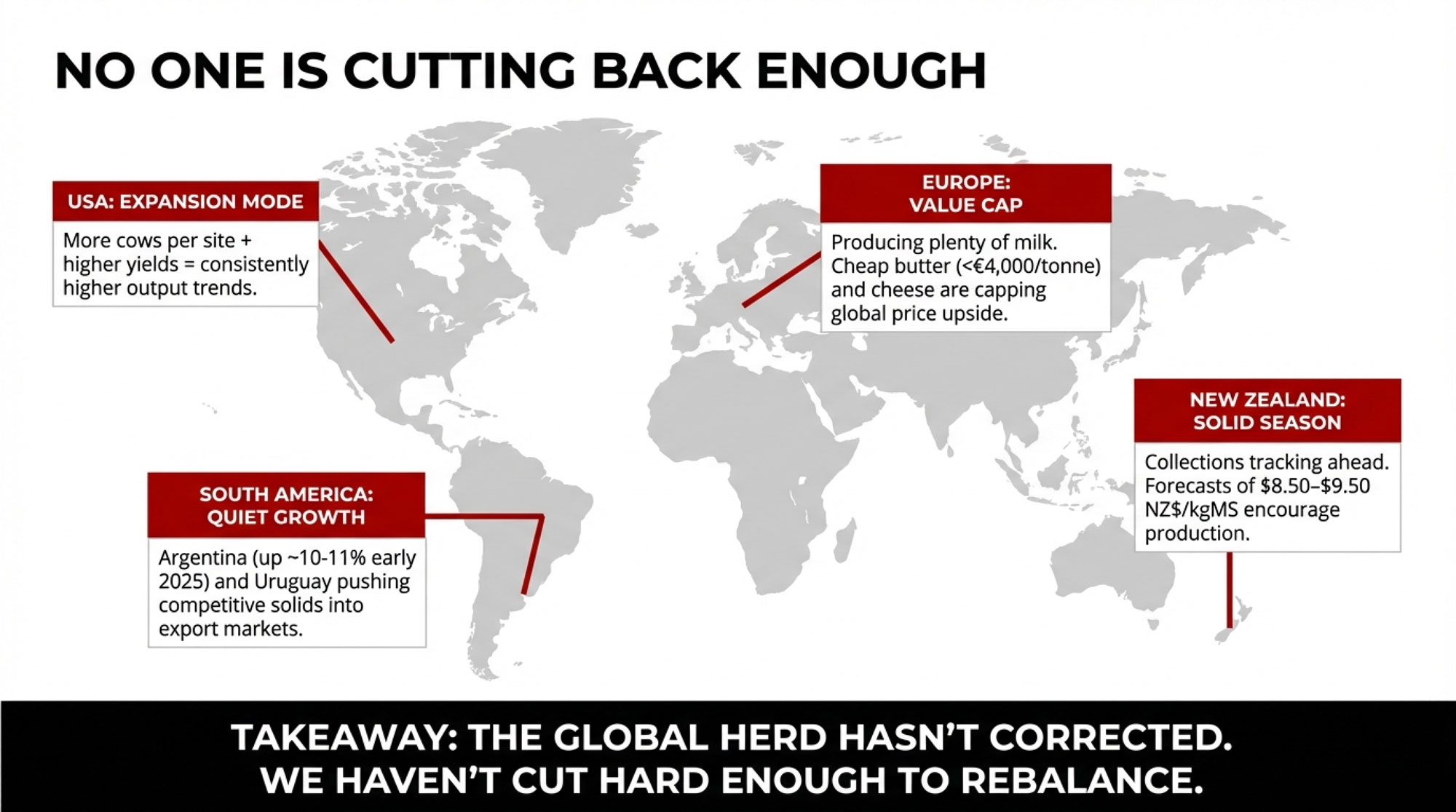
NewsSubscribe
First
Last
Consent

Reversing HPAI’s Grip: Dairy Industry Shows Signs of Production Recovery

After California’s dairy industry battled devastating HPAI outbreaks affecting nearly 70% of the state’s farms, new data shows infection rates declining significantly. The Bullvine examines what the recovery pattern means for your operation and why market impacts defied expectations.
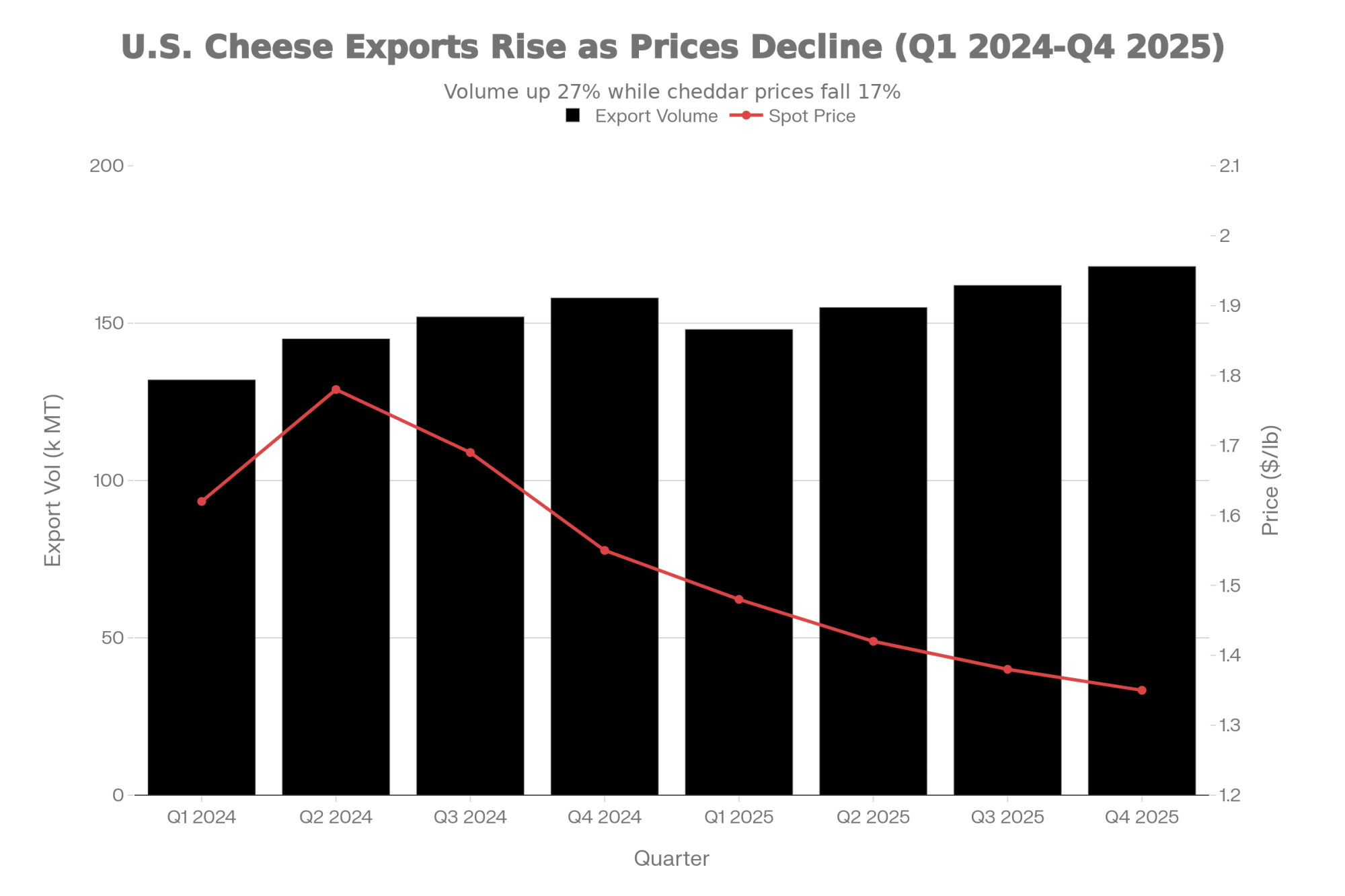
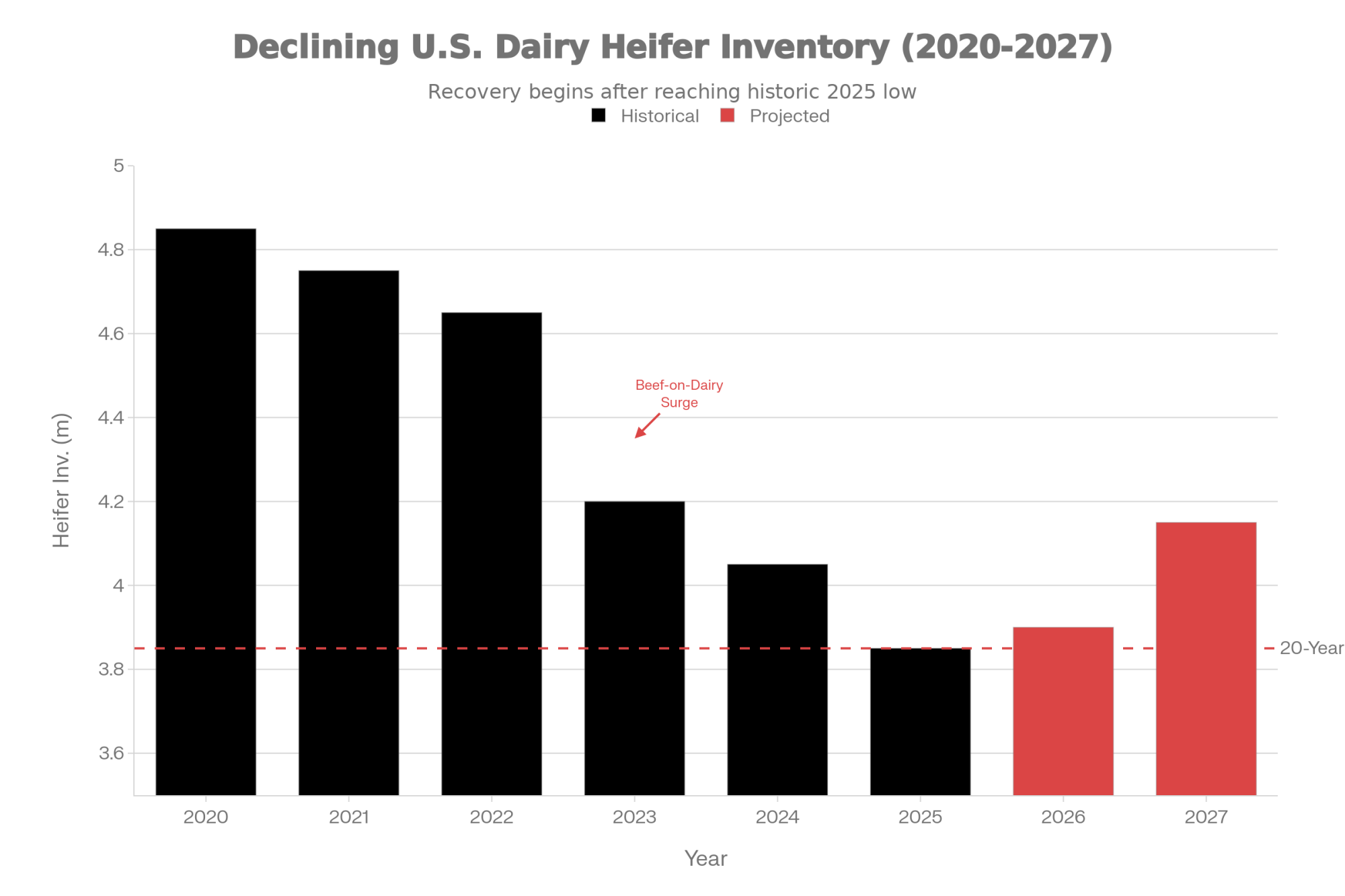
EXECUTIVE SUMMARY:

The dairy industry is turning the corner on HPAI impacts, with infection rates slowing significantly after affecting approximately 650 herds (70% of California’s dairy farms). Historical patterns from Colorado and other states suggest production typically recovers within three months of peak infection, with milk per cow output returning to growth. Despite production challenges that dropped California’s output to a 20-year low and resulted in approximately $400 million in lost revenue, market impacts proved counterintuitive. January 2025 data shows overall U.S. milk production increased slightly (0.1%), with component-adjusted output up 2.2%, despite California’s 5.7% decline. Farmgate milk prices have stabilized at $21.75/cwt while the national dairy herd unexpectedly expanded by 10,000 head, suggesting the industry is entering a recovery phase despite ongoing challenges.

KEY TAKEAWAYS:

  • California’s HPAI outbreak affected nearly 650 herds (70% of the state’s dairy farms) since August 2024
  • November 2024 production fell 9.2% to 2.957 billion pounds, a 20-year low for California
  • Production typically recovers within three months of peak infection, based on Colorado’s experience
  • January 2025 data shows U.S. production up 0.1% overall, with California still down 5.7%
  • Enhanced biosecurity measures, including heat-treating milk for calves, remain essential

The dairy industry is turning the corner on what veterinary experts call the most significant disease challenge in a generation. After HPAI decimated California production, sending November milk flows plummeting by 301 million pounds (-9.2%), we finally see concrete evidence that the viral storm is subsiding. Recent USDA data shows new infection cases dropping dramatically while production metrics gradually improve, offering a lifeline to producers who’ve weathered this unprecedented challenge.

BREAKING DOWN THE RECOVERY NUMBERS

The dramatic decline in new HPAI cases reported in recent months signals a potential turning point in the outbreak. While California initially recorded 105 confirmed cases just two months into its outbreak—with rumors of another 400 suspected cases that could be confirmed—the infection rate has significantly slowed. According to recent figures, approximately 650 herds (nearly 70% of California’s dairies) have been affected by the virus since August 2024.

This pattern mirrors what occurred in Colorado, where 59% of dairy farms were infected over the summer of 2024. The Colorado experience provides valuable insight into the recovery trajectory: milk production per cow was down 2.7% year-over-year in June, improved slightly to a 2.3% decline in July, and showed further improvement to just a 1% reduction in August before returning to growth. This consistent pattern suggests that affected states typically recover production capacity within approximately three months after peak infection rates.

California’s significance to national dairy production cannot be overstated. In 2023, California produced 18.1% of U.S. milk, 17.5% of cheese, 32.2% of butter, and approximately 50% of combined nonfat dry milk (NFDM) and skim milk powder (SMP). When production in California falters, the ripple effects are felt throughout the national supply chain.

Table 1: January 2025 Milk Production Year-Over-Year Changes

RegionProduction Change (%)Notes
United States (Overall)+0.1%Component-adjusted production up 2.2%
California-5.7%Ongoing HPAI impacts
Rest of Country+1.4%Led by Wisconsin and Texas

WHY MILK PRICES DEFIED PRODUCER EXPECTATIONS

One of the most surprising aspects of the HPAI outbreak has been its complex and sometimes counterintuitive impact on dairy markets. Despite widespread expectations that reduced milk output would drive prices higher, the reality proved more nuanced.

Butter prices reached their lowest level since January 2024 during what should have been peak demand season. This unexpected market behavior stemmed from surprisingly strong butter production, which ran ahead of the previous year every month in 2024, with August showing a remarkable 14.5% increase. This production strength suggests processors could adapt quickly, even as farm-level milk production faced challenges.

Cheese markets presented a different puzzle. Despite stocks turning out lower than expected and dropping 6.4% year-over-year in August 2024, cheese prices showed unexpected weakness. Without additional data, analysts have attributed this to potentially softening demand rather than supply constraints.

Nonfat dry milk (NFDM) markets have responded most logically to California’s production challenges. With California producing approximately half of the country’s NFDM and SMP, this product category was most vulnerable to disruption. The CME spot NFDM price has maintained support around $1.35 despite global SMP prices being 5-10 cents cheaper per pound, suggesting the California production situation has supported NFDM values.

Table 2: HPAI Economic Impact in California

MetricValuePeriod
Production Decline-9.2%November 2024 (YoY)
Volume2.957 billion poundsNovember 2024
Revenue Loss~$400 millionFrom outbreak impact
Historical Context20-year lowLast below 3bn pounds in 2004
Affected Herds~650 (70% of state dairies)Since August 2024

REWRITING THE PRODUCTION PLAYBOOK FOR 2025

In its February report, the USDA reduced its 2025 milk production forecast to 226.9 billion pounds, a decrease of 400 million pounds from previous estimates. This adjustment was based on recent Milk Production and Cattle Inventory Reports that revealed a tighter supply of dairy heifers than expected. The World Agricultural Outlook Board indicates mixed price movement across dairy products, with cheese prices increasing slightly ($0.02 per pound) while butter decreased ($0.05 per pound), nonfat dry milk dropped ($0.04 per pound), and dry whey reduced ($0.03 per pound).

The pricing outlook reflects these dynamic market conditions, with farmgate milk prices stabilizing at $21.75 per hundredweight. Some price adjustments can be attributed to changes in the Federal Milk Marketing Order, particularly for class prices, which are calculated differently under the new system.

Table 3: U.S. Dairy Industry Current Indicators (January-February 2025)

IndicatorValueTrend
National Dairy Herd+10,000 headUnexpected expansion
Farmgate Milk Price$21.75/cwtStabilized
Class I Utilization20%Record low amid plant-based competition
Retail Dairy Inflation+7.7%Driven by biosecurity costs & labor shortages
Component-Adjusted Production+2.2%Higher fat and protein yields

TRANSFORMING FARM PROTOCOLS: BIOSECURITY BECOMES NON-NEGOTIABLE

The HPAI experience has fundamentally transformed biosecurity practices across the dairy industry. The Maryland Department of Agriculture’s December guidance offers a template that forward-thinking producers nationwide are adopting. These enhanced measures include restricting access to livestock areas with proper signage and secured gates, implementing rigorous sanitation protocols, and limiting exposure between species.

The management of milk diverted from commercial channels is critical. The FDA strongly recommends that any milk used for feeding calves be heat-treated to kill potential pathogens. Once considered optional in many operations, this practice is increasingly considered an essential standard operating procedure during and after the HPAI outbreak.

The USDA’s comprehensive National Milk Testing Strategy (NMTS) represents another significant shift in industry practice. This structured testing system aims to identify affected states and herds, enhance biosecurity measures, prevent transmission, and protect the dairy workforce from exposure. The program has a five-stage implementation approach, beginning with nationwide testing of milk silos at processing facilities and progressing through increasingly targeted surveillance as infection rates decline.

DEBUNKING MARKET MYTHS: WHY BUTTER PRICES FELL DESPITE PRODUCTION DROPS

Many producers expected the HPAI outbreak to drive milk prices dramatically higher as California’s production declined. However, the reality proved more complex and offers essential lessons in market dynamics.

The butter market performance perfectly illustrates this disconnection between expectations and outcomes. Despite production challenges at the farm level, butter manufacturing ran counter to expectations, with output exceeding previous year levels every month in 2024. August’s remarkable 14.5% year-over-year increase in butter production demonstrates how quickly processing capacity can shift to compensate for regional production disruptions.

This adaptability explains why butter prices hit their lowest level since January during what traditionally would be the tightest market period of the year. The processing sector’s resilience effectively neutralized what could have been significant price inflation, reminding producers that production challenges don’t automatically translate to higher prices in modern dairy markets.

SECURING CONSUMER CONFIDENCE: SAFETY MESSAGING THAT RESONATES

Throughout the HPAI outbreak, federal agencies have consistently emphasized that the commercial milk supply remains safe for consumption. Pasteurization effectively inactivates the virus, and milk from affected animals has been diverted or destroyed to prevent entry into the human food supply.

Following virus detection, the FDA’s December 2024 recall of raw whole milk and cream from a California dairy reinforces the inherent risks of unpasteurized products. While causing no reported illnesses, this incident is a powerful reminder of pasteurization’s critical role in food safety.

Beyond milk, the USDA’s Food Safety and Inspection Service has extensively tested meat products, including ground beef samples from states with confirmed-positive dairy cattle herds. All samples tested adverse using polymerase chain reaction (PCR) methods, confirming that the meat supply remains unaffected by the outbreak.

FORGING AHEAD: LESSONS LEARNED BECOME TOMORROW’S STRENGTHS

The dairy industry’s resilience in managing the HPAI outbreak is remarkable. From processing adaptability to enhanced biosecurity protocols, stakeholders across the supply chain have implemented effective countermeasures against a novel threat.

While the outbreak caused significant disruption, particularly in California, where nearly 70% of the state’s dairy farms were affected, the recovery pattern established in other states suggests that production typically returns to growth within approximately three months of peak infection. This relatively swift recovery timeline offers encouragement for affected producers still working through the challenges.

The USDA’s February forecast adjustment reflects current realities and cautious optimism. Pricing is expected to remain stable despite production adjustments. As the industry continues to implement the comprehensive National Milk Testing Strategy and strengthened biosecurity protocols, dairy producers can approach the remainder of 2025 with greater confidence in their ability to manage disease challenges while maintaining operational continuity.

LEARN MORE:

Join the Revolution!

Bullvine Daily is your essential e-zine for staying ahead in the dairy industry. With over 30,000 subscribers, we bring you the week’s top news, helping you manage tasks efficiently. Stay informed about milk production, tech adoption, and more, so you can concentrate on your dairy operations.

NewsSubscribe
First
Last
Consent

Forecast for Fonterra in FY25 Price of Farmgate Milk Rises, and Earnings Guidance for FY24 Revised

Find out how Fonterra’s milk price hike benefits you. Ready to boost profits this season?

Summary: Fonterra’s recent milk price hike signals a promising season for dairy farmers, increasing to $8.50 per kilogram of fat and protein. This move, driven by a robust dairy market, reflects confidence in continued market growth. The previous season concluded with a steady price of $7.80 per kilogram, and Fonterra’s CEO indicates a likely dividend increase. The final milk price and annual financials will be unveiled in September, with positive outcomes anticipated.

  • Milk price forecast for the 2024/25 season raised to $8.50 per kilogram of fat and protein.
  • Increase driven by strong dairy market and Global Dairy Trade performance.
  • The previous season’s milk price remains at $7.80 per kilogram.
  • CEO Miles Hurrel expects dividends at the upper range of 0.60 to 0.70 per kilogram of fat and protein.
  • Final milk price and annual financial results will be announced in September, with expected positive outcomes.
Fonterra milk price increase, dairy market trend, Global Dairy Trade, milk price forecast, dairy farmers benefits, milk season 2024/25, dairy industry profits, favorable dairy market, dairy farm management, dairy market insights, Fonterra CEO Miles Hurrel, dairy market performance, dairy farm dividend, milk price per kilogram, dairy economic outlook, dairy farming strategies

Fonterra has just boosted its milk price to $8.50 per kilogram of fat and protein for the 2024/25 season, a $0.50 rise driven by a thriving dairy market reflected in the growing Global Dairy Trade index. CEO Miles Hurrel welcomes the excellent result but cautions that the season has just started. Will you take advantage of this fortunate change in the dairy market? Consider your strategy for the season and how to take advantage of the current market circumstances.

You may be asking why the dairy industry is so robust right now. Several reasons contribute to this rise, including global demand and favorable trading circumstances. The Global Dairy Trade Index has risen, and analysts feel the market has not yet peaked.

So, how can you profit from this thriving market? Higher milk prices result in more income for your farm. This might be an excellent opportunity to invest in new equipment, expand operations, or pay off debt. What are your plans for the additional money?

While the prognosis is bright, approach with care. The season has only begun, and market circumstances may change. Monitor market movements and be ready to change your strategy as needed.

To provide some perspective, the predicted price for the 2023/24 season, which concluded in June, was $7.80 per kilogram of fat and protein. According to Fonterra CEO Miles Hurrell, member dairy producers should anticipate a payout of $0.60-$0.70 per kilogram of fat and protein.

CEO Miles Hurrel provided some insight into the anticipated milk price announcement. According to Hurrel, the final milk price for the 2023/24 season will be announced in September, along with the yearly data for fiscal year 2024. He suggested a good result, noting outstanding performance as a critical component.

In conclusion, Fonterra’s milk price increase represents an excellent opportunity for dairy producers. While the market seems bright, being informed and making intelligent judgments are critical. What will you do to profit from this enormous market? The ball is in your court.

Learn more: 

Send this to a friend