



Archive for genetic gain

The Jockey Club Banned It. Dairy Got 248% Better. Is Your Herd Using the Tools?

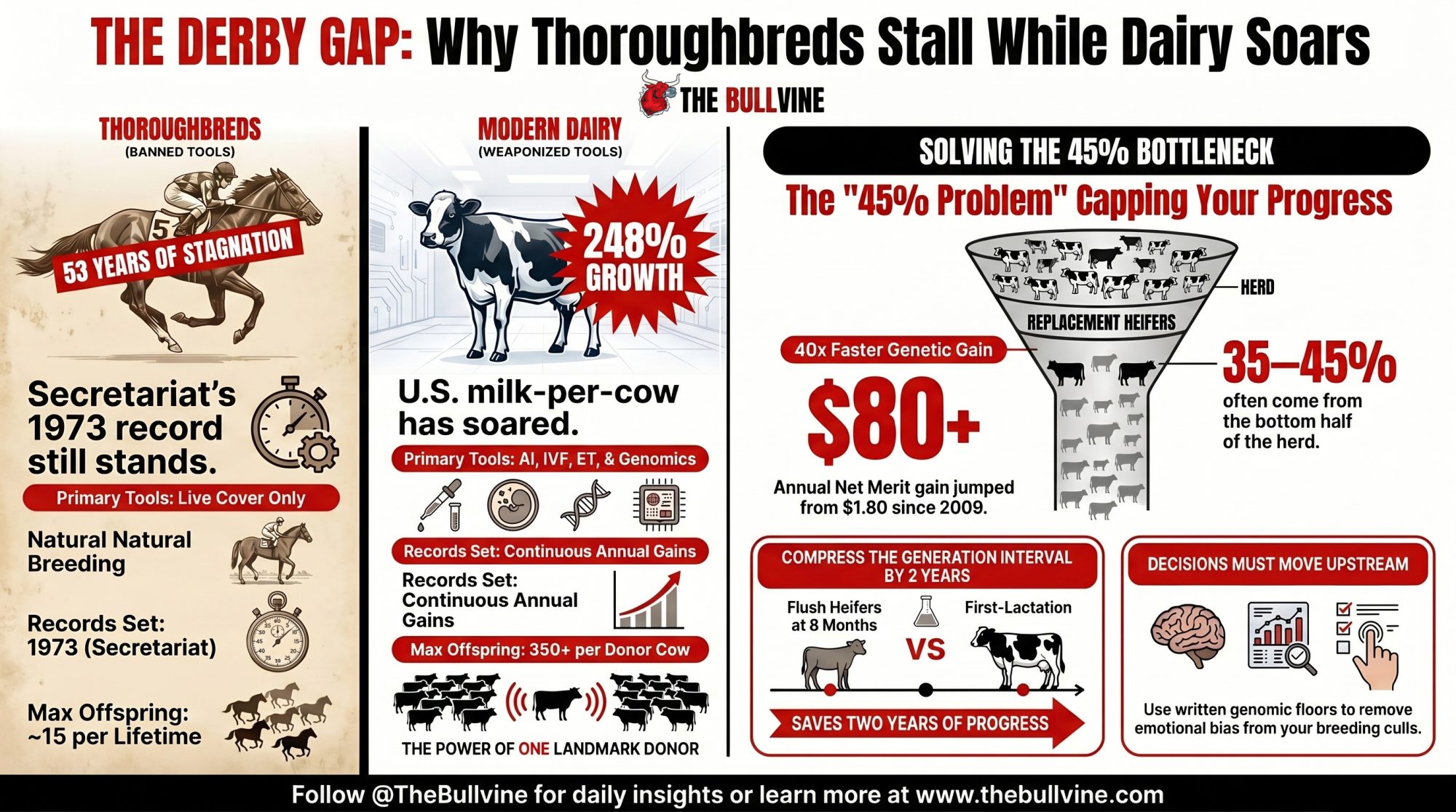
Secretariat’s Derby record is 53 years old. U.S. milk-per-cow is up 248% since he was born. One industry weaponized artificial insemination and genomics. The other banned the tools. Where’s your calf crop in that gap?

Executive Summary: Secretariat’s Kentucky Derby record is 53 years old and U.S. milk-per-cow is up 248% since he was born — not because of biology, but because the Jockey Club still bans AI, IVF, and ET while dairy weaponized all three plus genomic selection since 2009. The annual rate of Holstein genetic gain jumped more than 40-fold inside one decade, from roughly $1.80/year in Net Merit pre-genomics to $79.20–$85.00/year by the CDCB 2016–2020 window. KHW Regiment Apple-Red-ET, bred by Kamps-Hollow Holsteins, now carries more than 350 direct progeny — more than an entire stable of thoroughbred mares will produce across their combined lifetimes. But the uncomfortable number for your operation is this: genetics advisors consistently see 35–45% of replacement heifers in genomic-testing herds coming from the bottom half of the dam distribution, meaning your sire lineup is compounding while your dam decisions sit flat. On a 300-cow Holstein illustration, a 200-point NM$ spread between top and bottom quartiles equals 2.5 years of industry-average progress sitting inside the same barn — and an 8-month OPU flush versus a first-lactation flush compresses or extends 2 years of generation interval per calf. Run the one-hour quartile diagnostic this month before the next proof run: pull your last two calf crops, match each heifer to her dam’s genomic rank at conception, and count the bottom half. If 35% or more of your heifers are coming from there, your decision architecture — not your tool access — is what’s capping your herd’s runway.

Churchill Downs, first turn — a field of three-year-olds under the Twin Spires chasing a record that’s stood since 1973. Same 65 years U.S. milk-per-cow climbed 248%. One industry banned the tools. The other weaponized them.

Somewhere in Louisville this afternoon, a three-year-old thoroughbred worth more than most dairy operations will leave the gate at Churchill Downs and run for roses. Odds are, the winner’s time won’t touch Secretariat’s 1:59.40 from May 1973 — a Derby record that’s now stood for 53 years across an industry awash in discretionary capital.

Meanwhile, the U.S. dairy cow has gotten 248% better at her job in roughly the same window — a gain built on artificial insemination, IVF, embryo transfer, and, since 2009, dairy genomic selection. That gap — flat racing clock, exponential milk curve — is the most useful lens available on Derby Day 2026 for a question most progressive Holstein breeders have never run the diagnostic on:

How much of dairy’s tool advantage is actually reaching your specific herd?

The Scoreboard on Derby Day 2026

Average U.S. milk production per cow climbed from roughly 7,029 pounds in 1960 to 24,117–24,390 pounds by 2023–2025 — the 248% increase that defines modern dairy genetic gain. Annual Net Merit $ gain for U.S. Holsteins went from about $1.80 per year pre-genomics to $79.20–$85.00 by the CDCB 2016–2020 evaluation window. The annual rate of genetic gain increased more than 40-fold inside one decade.
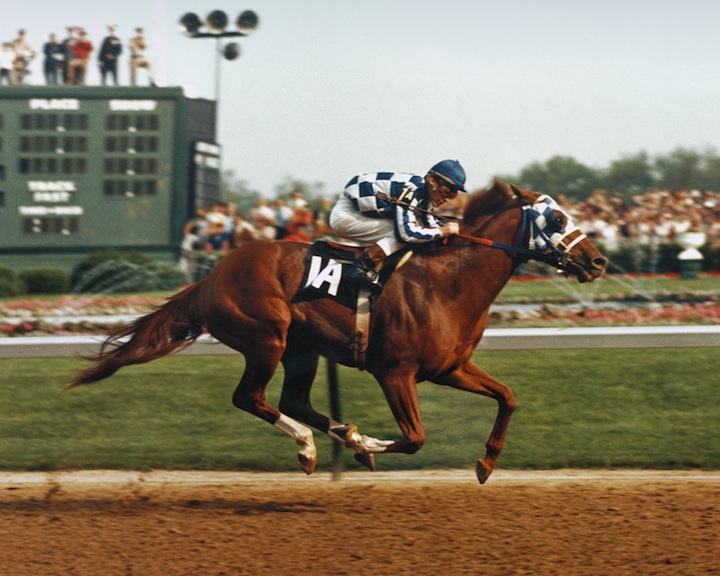
Secretariat, blue-and-white checks, crossing the wire at Churchill Downs in 1:59.40 on May 5, 1973 — the Kentucky Derby record that’s now 53 years old and counting. Same stretch of years U.S. milk-per-cow climbed 248%. The clock hasn’t moved because the rulebook won’t let it.

Now the Derby contrast. Secretariat’s record has held for 53 years — a winning time that has barely moved across a century of racing. Thoroughbred racing commands billions in discretionary capital, elite veterinary care, and the best training money can buy. The clock has barely moved with it.

The reason isn’t biology. It’s the Jockey Club rulebook. Live cover only. No AI. No IVF. No embryo transfer. A thoroughbred mare is biologically capped at roughly 10–15 offspring across her productive lifetime because she can only produce one foal per year.
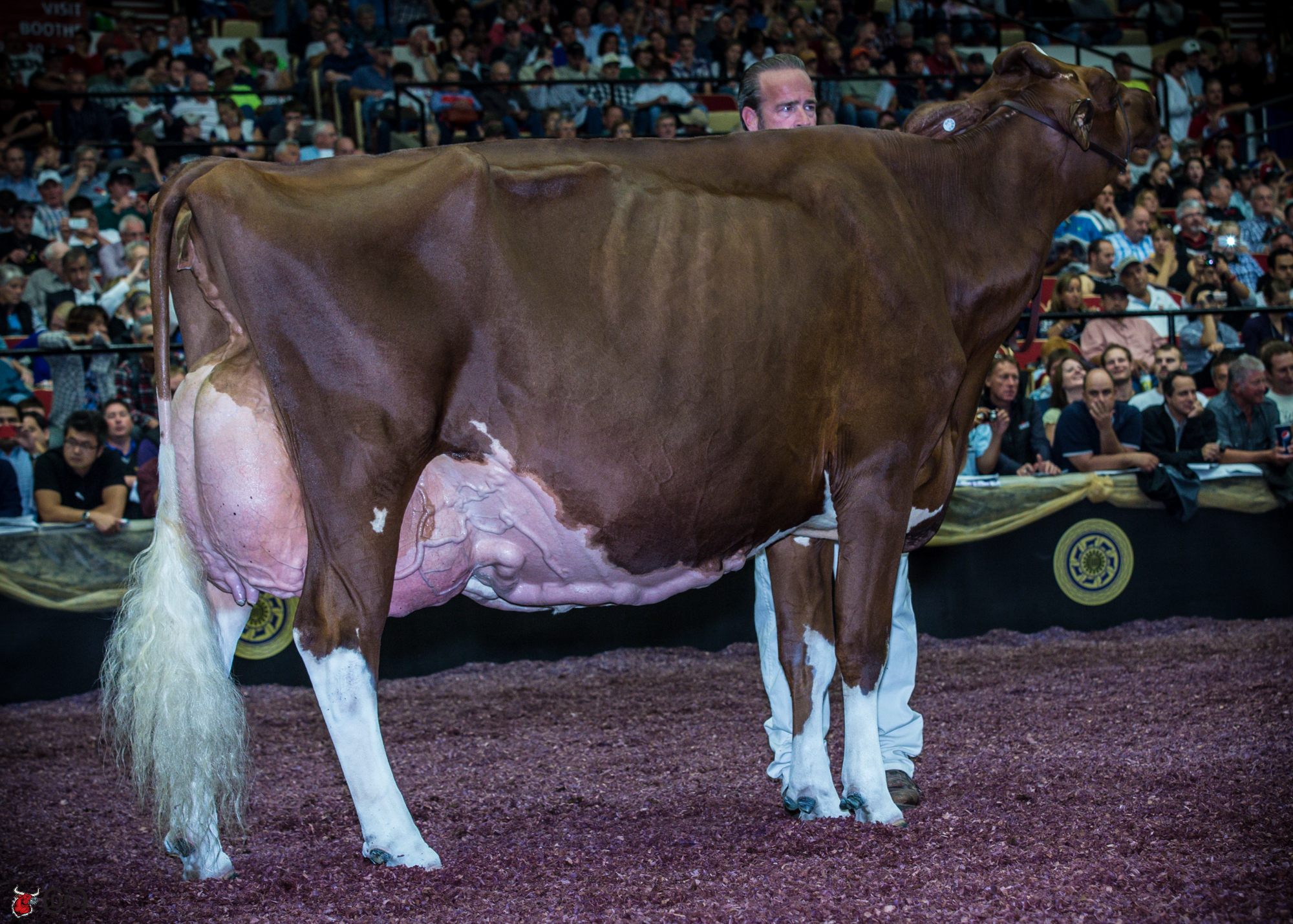
KHW Regiment Apple-Red-ET, posed on the colored shavings at The Royal — bred by Kamps-Hollow Holsteins and credited with 350+ direct progeny and 280+ Excellent-scored daughters and descendants worldwide. A single thoroughbred mare is capped at 10–15 across her whole lifetime. The tools are the difference. Read more

Did You Know? KHW Regiment Apple-Red-ET — bred by Kamps-Hollow Holsteins — is widely recognized as a landmark donor cow of the Holstein breed. Estimates credit her with more than 350 direct progeny and more than 280 Excellent-scored daughters and descendants worldwide, with a single oocyte collection session reportedly yielding 50 viable oocytes. One cow. More registered offspring than an entire stable of thoroughbred mares will produce across their combined lifetimes. 

The Jockey Club’s rules aren’t accidental. They’re designed to protect a specific definition of sporting integrity, and there are thoroughbred people who would rather see Secretariat’s record stand forever than see it beaten by a genetically optimized horse. That’s a legitimate choice. It’s just a choice with a visible genetic cost.

So when the gates open at Churchill Downs this afternoon, you’re watching the cleanest control group in animal agriculture. Same century. Same species of smart, well-capitalized breeders. Tools available on one side, banned on the other. The results are on the clock.

The 45% Problem in Your Barn

The Derby clock raises an uncomfortable question for every progressive Holstein herd:

You have every tool thoroughbreds don’t — so are you actually using them?

Here’s the diagnostic that answers it, and it takes about an hour.

Pull your last two calf crops, match each heifer back to her dam’s genomic ranking at conception, split the herd into quartiles, and count. Among U.S. Holstein operations that have been genomic testing at birth for three-plus years, the number genetics advisors most often describe seeing lands somewhere between 35% and 45%.

That’s the share of your future breeding herd coming from the half of the cows you’d cull first if you were being systematic. It isn’t a knowledge gap. It’s a gap in decision architecture. And it’s the quiet reason herds with the same tools, the same semen access, and the same genomic infrastructure end up with very different rates of genetic gain five years from now.

How Does a Healthy, Productive Cow End Up Dragging Your Genetic Mean Down?

Here’s the composite scenario most genetics advisors describe. She’s milking 85 pounds. She settled on the first service. She’s healthy, she’s cycling, she hasn’t had a vet call in eight months. Every visible signal your eye has been trained to read says keep her. The genomic report, which arrived six months ago and sits in a binder somewhere, says she’s in the bottom quartile.

Those two signals aren’t in conflict biologically. Moderate producers with good health traits exist throughout the genetic distribution. But they feel like a conflict — because one is abstract and the other is standing in front of you eating hay.

So she doesn’t get culled. She gets bred back, probably to a mid-tier sire, because the elite semen is being saved for the top end of the herd. She calves. The calf is a heifer. The heifer enters the breeding pool. Two years later, when you run the diagnostic on your most recent calf crop, that heifer is part of the 45%.

Nobody decided this would happen. The repro program was built to maximize pregnancy rate and minimize days open. It does that well. But it wasn’t built to connect repro priority to genomic rank, so it didn’t. The outcome isn’t a failure of the system — it’s exactly what the system was designed to produce, and the team running it deserves credit for the competence, not blame for the gap.

What Does the Breeder’s Equation Actually Cost When You Don’t Enforce It?

Every textbook on genetic improvement comes back to the breeder’s equation: ΔG = (i × r × σ_g) / L. Selection intensity, accuracy, genetic variation, generation interval. Dairy has optimized every variable at the industry level. AI lets breeders draw from a narrow band of the highest-ranked proven sires worldwide — something that was operationally impossible before frozen semen and international shipping. Genomic testing at birth delivers materially higher reliability on young-animal production indexes than pedigree alone — on the order of 70% versus 20–30%, depending on trait category. Genomic evaluation has compressed generation interval from the traditional 5–7 years under progeny testing to under 2 years.

Every one of those gains was unlocked at the industry level. Whether they’re unlocked inside your fence line depends on decisions made downstream of the data.

Here’s what the math looks like in a real barn. Take a 300-cow Holstein herd. For the sake of illustration — and this is illustrative, not a sourced herd-level distribution — say your top genomic quartile averages $800 NM$ and your bottom quartile averages $600 NM$, a 200-point spread. At the 2016–2020 CDCB annual Net Merit gain rate of roughly .20, that spread translates to about 2.5 years of industry-average genetic progress sitting inside the same barn. Every heifer calf born from the bottom quartile represents roughly 2.5 years of deferred progress compared to a calf born from the top quartile.

The second piece of math most breeders never run: flush an elite heifer at 8 months through OPU, and her daughter is born roughly 17–20 months later, once the embryo has been transferred to a recipient and carried to term. Wait until that same female completes her first lactation before flushing her, and the calf arrives roughly 44 months later. That’s 2 years of generation interval you’re either compressing or extending — and at roughly $79/year in NM$ gain, it’s a measurable number per calf, not a theoretical one.

How the Top Decile Actually Runs the Program

The operations that appear to compound consistently year over year tend to share four structural patterns, according to genetics advisors and herd-level genetic trend data published by CDCB. They don’t solve the 45% problem by working harder. They solve it by moving the genetic decisions upstream — out of the emotionally loaded moment of standing in front of a specific animal, and into a policy or schedule written when the stakes felt abstract.

  • A written genomic floor. A specific NM$ or LPI number — below it, no female is bred to a high-investment sire. The threshold is written down, the exception process requires documentation and a named approver, and the number is reviewed every proof run against the herd’s current distribution.
  • A standing heifer flush schedule. Candidates selected at birth based on genomic testing, OPU appointments booked as part of the herd health calendar at 7–8 months, not case-by-case. The question flips from “should we flush this heifer?” to “is there a reason to take her off the schedule?”
  • Two repro tracks, not one. A conception program for the working herd, optimized for pregnancy rate and days open. A multiplication program for the top tier, optimized for genomic advancement. Top-tier females get scheduled reproductive attention regardless of cycling convenience.
  • Breeding objectives written as decision rules. “We breed for components and fertility” is a preference. “No female below our written NM$ floor is eligible for the breeding herd” is a rule. One requires a decision every time. The other only requires one when you want an exception.

Every one of those moves has the same underlying effect: it changes what has to happen for the default to hold. In most herds, the default requires no decision and aggressive selection requires one. In top-decile herds, the reverse is true.

Options and Trade-Offs for Your Operation

There’s no single path out of the 45% pattern. The right one depends on herd size, cash position, and how much operational change the team can absorb in a single breeding cycle.

  • This month — run the quartile diagnostic. One hour, no commitment. Pull your last two calf crops, match each heifer to her dam’s genomic rank at conception, count the bottom half. The number is the intervention. Works for every herd size. Costs nothing. Backfires only if you look at the result and do nothing with it.
  • Set one genomic threshold for elite sire allocation. Pick your primary index, draw a line, and below it no female gets bred to a high-investment sire. Not a full culling policy yet. One constraint, applied consistently for one breeding cycle. Backfires if the threshold is set so low it doesn’t cut anyone you currently like — in which case it isn’t doing selection work
  • Schedule 8-month heifer OPU as standing protocol. Requires a relationship with an ET technician, recipient inventory or contracted recipients, and a lab that can handle variable volume. Fits operations with the scale and cash to maintain the infrastructure. Backfires when young stock nutrition or body condition isn’t supporting the protocol — fix the management environment first.
  • Separate repro priority from cycling priority. Most operations run one repro program for the whole herd. Top operations run two. Demands more management bandwidth but doesn’t require more labor — it reallocates the labor already there.

The trade-offs are real on all four. Culling productive cows hits next month’s milk cheque. Flushing heifers ties up cash before any daughter has been on the ground. Running two repro programs stretches whoever is managing them. Enforcing a written threshold means sometimes moving a cow you respect. None of that disappears because the math is sound. The math is just clearer than the discomfort.

What This Means for Your Operation

What percentage of your last two heifer calf crops came from the bottom half of your herd genomically?

If you don’t know, that’s the first number to pull this month. It reframes every other genetic decision you’ll make before the next proof run.

  • Is your repro program optimizing for pregnancy rate, or for the genomic rank of the calves it produces? Those are different objectives. When they’re not connected explicitly, the easier one wins every cycle.
  • Where is your genomic floor for the breeding herd, and when did you last enforce it on an animal you respected? A threshold that hasn’t cut anyone uncomfortable isn’t doing selection work.
  • How old is your average dam at first flush? If she’s a cow rather than a heifer, you’ve added years to your effective generation interval on the female side — the side the tools now let you compress.
  • Which cows are you keeping for reasons that have nothing to do with their genetics? Every operation has a few. Naming them explicitly is how you prevent the next generation of comfortable exceptions from quietly forming around the next set of animals.
  • When did you last cull a productive, healthy cow because her genomic rank disqualified her from the breeding pool? If never, your selection intensity on the dam side is near zero regardless of what your sire lineup looks like.
  • Is your breeding objective written as a trait preference list, or as decision rules with specific thresholds and a named person responsible for exceptions? Aspirational standards evaporate under production pressure. Enforceable ones survive because overrides require justification.
Key Takeaways

  • If 35% or more of your replacement heifers are coming from your bottom-half genomic distribution, your sire lineup is doing half the work of the breeder’s equation while your dam decisions are doing none of it. That asymmetry is the single biggest driver of the gap between top-decile and median-herd rates of genetic gain.
  • If your breeding objective lives in your head rather than on paper with specific thresholds, it’s a preference, not a program. Write the floor down. Name the person who can approve an exception. Require documentation when one gets made.
  • If you’ve been genomic testing for three-plus years and your herd’s genomic floor hasn’t risen meaningfully, the tool is doing its job. The decision architecture around it may be the piece still waiting to catch up.
  • If you can flush an elite heifer at 8 months instead of waiting for first lactation, you’re compressing roughly 2 years of generation interval per animal — and at roughly $79/year in NM$ gain, that’s a measurable outcome per calf, not a theoretical one. 
  • If the first cow your new threshold disqualifies is one you respect, the threshold is set at the right level. If it doesn’t cut anyone uncomfortable, the line is in the wrong place.

Watching the Race, Reading Your Barn

When the 2026 Derby field hits the wire at Churchill Downs this evening, most of the barn talk afterward will be about the trip, the track, the trainer, the jockey. Nobody on the broadcast will say the quiet part: the winning time will be what it is today because the Jockey Club decided decades ago which tools their breeders can and can’t use. You have every tool they don’t — AI, IVF, genomic selection at birth, global semen access, compressed generation intervals, and the data infrastructure to act on all of it. The only thing making those tools unavailable inside your fence line is whether you decided how to use them before you walked into the barn this morning.

So here’s the Derby Day question for your operation:

Which one of the four structural moves is the one you’ve been putting off — and what would have to be true in the next proof run for you to stop?

Complete references and supporting documentation are available upon request by contacting the editorial team at editor@thebullvine.com.

Learn More

The Sunday Read Dairy Professionals Don’t Skip.

Every week, thousands of producers, breeders, and industry insiders open Bullvine Weekly for genetics insights, market shifts, and profit strategies they won’t find anywhere else. One email. Five minutes. Smarter decisions all week.

NewsSubscribe
First
Last
Consent

Real Syn Takes Over RZG Genomic Indexes – Sire Proof Central August 2024

dairy farmers, German indexes, Eurogenes, Interbull Genomic ranking, Real Syn, Alaska, Argentum, RZG ranking, Simply Red, Mask Red, Party P, Skill Red, Redwood, DG Maserati, AI-Total, Camden *RC, BTS Avea-Red, Koepon Skyliner Redbull Red, RZE (Type), Feet & Legs, Mammary System, August genetic evaluations, Holstein, Jersey, genetic evaluations, genetic gain, genomics, Holstein Net Merit, Cheese Merit, Total Performance Index, Holstein Association USA

Real Syn, a Rover son, is leading the B&W RZG Interbull Genomic ranking for the third time, with an impressive +166 RZG. Right behind, we have the Arizona brothers—Alaska at +163 RZG and Argentum at +161 RZG. Over in the R&W Interbull Genomic ranking, Simply Red takes the top spot at +159 RZG. He is followed closely by Malaga Red, a Mask Red son, with +158 RZG. Party P, Skill Red, and Redwood are sharing the third spot, all at +157 RZG.

The Role of Genomic Information in Managing Inbreeding and Enhancing Dairy Catte Health and Performance

Discover how genomic inbreeding impacts livestock health and performance. Learn advanced methods to measure homozygosity and manage herds effectively. Curious? Read on.

Have you ever wondered why managing inbreeding is crucial for the health and performance of dairy cattle? The genetic makeup of these animals directly impacts their fitness, well-being, and productivity. Inbreeding, necessary for preserving desirable traits, can also lead to inbreeding depression, negatively affecting these factors. 

Understanding inbreeding is essential for protecting individual animals’ health and ensuring livestock production’s sustainability. High levels of homozygosity, where identical alleles come from both parents, can reveal hidden genetic flaws that otherwise stay unnoticed. 

“Inbreeding is double-edged; while it can amplify valuable traits, it often brings genetic weaknesses into the spotlight.”

Genomic information helps us better estimate and manage inbreeding. Advanced techniques using this data provide more accurate measures than traditional pedigree-based methods. One promising tool is the calculation of runs of homozygosity, offering a clearer picture of genetic makeup. 

This article explores traditional and modern measures of inbreeding, the effects of homozygosity on health and performance, and the latest advancements in genomic tools. By using this knowledge in breeding programs, we can balance genetic progress with sustained heterozygosity, improving the viability of dairy herds.

Pedigree-Based Inbreeding Coefficients: Tracking Lineage and Its Limitations

One traditional measure of inbreeding is using pedigree information to calculate inbreeding coefficients. This involves tracing an animal’s ancestry to find common ancestors and estimating the likelihood of inheriting identical alleles. While this method is popular because historical records are available, it has limitations. 

Firstly, pedigree-based coefficients depend on the accuracy of these records. Any errors or missing data can lead to incorrect estimates. They also assume equal allele transmission probability, ignoring factors like genetic drift and selection pressures. 

Additionally, these coefficients often miss recent inbreeding events, focusing on genetic identity over multiple generations. This can hinder real-time management of inbreeding levels in a herd. 

Another area for improvement is that pedigree-based methods only provide a probabilistic estimate, not a precise measure of actual homozygosity in the genome. This results in less accurate assessments of inbreeding’s effects on health and performance. 

In summary, while traditional pedigree-based inbreeding measures have their uses, they lack the precision needed for effective inbreeding management. This has led to the development of advanced genomic methods for a clearer, more accurate picture of inbreeding levels.

Advancements in Genomic Technologies have Revolutionized the Measurement of Inbreeding. 

Advancements in genomic technologies have revolutionized the measurement of inbreeding. One key innovation is the concept of runs of homozygosity (ROH). These are continuous stretches of identical DNA passed down from both parents, and they can be identified using high-density SNP panels such as the Illumina Infinium BovineHD BeadChip. 

CharacteristicPedigree-Based InbreedingGenomic-Based Inbreeding
Data SourceLineage recordsSNP panels (e.g., Illumina Infinium BovineHD BeadChip)
Measurement UnitInbreeding Coefficient (Fped)Genomic Inbreeding Coefficient (FROH)
AccuracyLess accurate due to reliance on historical recordsMore accurate due to direct assessment of genetic material
ResolutionLow; depends on the completeness and reliability of pedigree informationHigh; identifies specific genomic regions of homozygosity
ApplicabilityUseful for populations with extensive pedigree recordsApplicable regardless of the availability of pedigree information
Usage in ManagementCommon for traditional breeding programsIncreasingly important for modern genomic selection programs

Unlike traditional pedigree-based methods, which can be inaccurate, ROH offers a direct measure of a genome’s homozygosity. This provides a more precise estimate of autozygosity, giving a clearer picture of genetic inbreeding by examining the actual DNA. 

In a study of 68,127 dairy cows, ROH showed predictive solid power for identifying regions with high autozygosity. ROH proved a reliable indicator, as validated by Pearson correlations across SNP datasets. 

Integrating ROH into breeding programs can enhance mate selection and help avoid harmful homozygous regions. This approach maintains genetic diversity while improving livestock health and performance. In short, using ROH significantly advances understanding and managing inbreeding at the genomic level.

Unveiling the Impact of Homozygosity on Livestock Phenotypes: A Key to Health and Performance Management 

TraitCost of Inbreeding (%)
Milk Yield-2.5
Fertility-4.3
Longevity-3.6
Growth Rate-2.8
Health-3.1

Understanding the impact of homozygosity on phenotypes is essential for managing livestock health and performance. Inbreeding increases homozygosity, negatively affecting traits like health, fitness, and production levels

Health issues from inbreeding include more genetic disorders and disease susceptibility. This happens because harmful recessive alleles become more common in homozygous states. In dairy cows, inbreeding raises the frequency of stillbirths and hereditary conditions. 

Inbreeding also impacts the fitness of livestock. You might see declines in fertility, shorter lifespans, and reduced vigor. Studies link higher homozygosity to decreased reproductive success and lower calf survival rates. 

Inbreeding can significantly reduce milk yield, growth rates, and feed efficiency for production levels due to the loss of beneficial heterozygous genotypes. Research shows that as homozygosity increases, milk production often decreases. 

In short, the adverse effects of increased homozygosity due to inbreeding are widespread. They affect critical traits necessary for livestock viability and productivity. Strategically using genomic information can help mitigate these adverse effects and support sustainable breeding practices.

Inbreeding LevelCoefficient RangeImpact on HealthImpact on Performance
Low< 3%Minimal negative effectsOptimal productivity levels
Medium3% – 10%Increased susceptibility to diseasesModerate decline in production traits
High> 10%High risk of genetic disordersSignificant reduction in growth and output

Decoding Detrimental Haplotypes: Safeguarding Livestock Health and Performance 

Identifying detrimental homozygous haplotypes that negatively impact livestock health and performance requires precision. Researchers start by collecting extensive genotypic data from a large sample of animals, like the 68,127 dairy cows in this study, using high-density SNP panels such as the Illumina Infinium BovineHD BeadChip. 

Next, imputation fills in missing genetic data, estimating ungenotyped SNPs to create a comprehensive dataset. For instance, cows genotyped with medium-density SNP panels were imputing a higher density of 84,445 SNPs, which enhanced the accuracy of genomic inbreeding coefficients. 

Scientists then identify runs of homozygosity (ROH), continuous stretches of homozygous genotypes, which suggest common ancestry. Sophisticated algorithms and Pearson correlations validate these ROHs. 

The identified ROH regions are cross-referenced with phenotypic data to spot any detrimental effects linked to specific haplotypes. Calculations of correlations and regression coefficients ensure robust results. 

Researchers can incorporate this knowledge into breeding programs by pinpointing detrimental haplotypes and selectively managing animals to reduce negative impacts on future generations.

Genomic Mate Selection: Precision Breeding for Genetic Health 

Implementing genomic information in mate selection and breeding programs has revolutionized inbreeding management. Traditional methods used pedigree-based inbreeding coefficients, which lacked precision. Now, with genomic data like runs of homozygosity (ROH), breeders make more accurate decisions. 

Genomic mate selection programs estimate genetic potential and inbreeding risks using genomic information. This helps identify optimal mating pairs, balancing genetic gain with diversity, and promoting healthier livestock. For instance, data from 68,127 dairy cows helps predict breeding outcomes more precisely, aiding better decisions. 

Imputation methods further improve data accuracy. Medium-density (MD) SNP panels can be imputed to higher SNP densities, validated with 329 cows, enhancing the accuracy of genomic inbreeding coefficients. This enables better mapping of homozygous regions and detecting detrimental haplotypes, improving breeding outcomes. 

Integrating genomic measures in breeding programs combines pedigree and genomic info, offering a comprehensive tool for better mate selection. Studies using Illumina Infinium BovineHD BeadChip and GeneSeek Genomic Profiler HD-150K show these approaches sustain genetic progress while minimizing inbreeding effects. 

Overall, genomic data in breeding programs shifts livestock management towards sustainability, minimizing inbreeding’s detrimental effects, resulting in healthier herds and better performance.

Precision Breeding: Balancing Genetic Progress and Diversity for a Sustainable Dairy Industry

You can maintain genetic progress while managing homozygosity and keeping heterozygosity at acceptable levels. With advanced genomic tools, breeders can select traits like milk production and disease resistance more accurately. By using genomic inbreeding measures, such as runs of homozygosity, breeding programs can minimize the harmful effects of inbreeding while preserving valuable genetic diversity. 

Genomic mate selection can optimize breeding decisions, balancing genetic merit and health. This precision breeding approach reduces the risk of inbreeding and boosts genetic progress. These advanced methods support the industry’s goals of improving productivity and animal welfare, fostering a sustainable, innovative dairy industry.

Harnessing Genomic Insights for Tailored Breeding Strategies: Maximizing Genetic Gains While Maintaining Diversity

One promising area in genomic inbreeding is achieving significant genetic progress. By integrating precise genomic measures, dairy farmers can enhance traits of interest and manage homozygosity more effectively. This ensures balanced heterozygosity, which is crucial for genetic diversity and herd health. Advanced tools allow for accurate identification of beneficial alleles, enabling selective breeding that boosts productivity while minimizing inbreeding impacts. Leveraging detailed genomic information offers a unique chance to tailor breeding strategies for sustained genetic improvement in dairy populations.

Exploring Future Directions: Enhancing Genomic Inbreeding Management Through Advanced Research 

While progress in managing genomic inbreeding has been substantial, many research areas still need exploring. Improving imputation accuracy and robustness in SNP data, as shown in studies with 329 cows, should be a priority. This could lead to better tools for predicting and managing inbreeding. 

Understanding how different SNP panel densities affect inbreeding estimates is also crucial. Correlation studies between FGRM and FROH with various SNP datasets can inform optimal panel designs. Further research into the effects of ancestral genotyping in different scenarios could provide valuable insights. 

Mapping detrimental homozygosity haplotypes remains critical. Technological advances could help identify these regions more precisely, allowing for targeted breeding strategies to mitigate their negative effects. 

Integrating machine learning and artificial intelligence in genomic prediction models could revolutionize precision breeding. Using large datasets, such as those of 68,127 dairy cows, these technologies can refine inbreeding depression predictions, improving mate selection and herd management. 

Interdisciplinary collaboration among geneticists, breeders, and data scientists is essential. Combining genetic insights with advanced computational methods will lead to new, practical tools for managing genomic inbreeding in livestock.

The Bottom Line

In conclusion, integrating genomic information into livestock breeding programs is essential. Traditional pedigree-based inbreeding coefficients, though important, have their limitations. Genomic technologies, such as runs of homozygosity, offer more accurate insights into autozygosity and its effects on health and performance. These tools allow breeders to manage genetic diversity better, identify harmful haplotypes, and make smarter mating decisions. This approach enhances animal fitness and productivity while supporting the dairy industry’s sustainability. Continued research to improve these genomic methods will lead to more robust and resilient livestock populations.

Key Takeaways:

  • Inbreeding Depreciation: Inbreeding negatively impacts animal fitness, health, and productivity, making it a pressing issue in livestock management.
  • Genomic Inbreeding Measures: Genomic information provides more precise estimates of inbreeding compared to traditional pedigree-based methods.
  • Runs of Homozygosity (ROH): Continuous stretches of homozygous genotypes provide a better estimate of autozygosity and genetic health at the genomic level.
  • Mate Selection Programs: Incorporating genomic information into breeding programs enhances the accuracy of mating decisions, reducing the negative effects of inbreeding.
  • Balancing Genetic Gains and Diversity: Using genomic insights can help maintain high genetic progress while managing homozygosity and sustaining heterozygosity.
  • Future Research Needs: Further research is essential to refine genomic inbreeding management methods and ensure sustainable livestock production.

Summary: Inbreeding is a critical factor in dairy cattle’s health and performance, affecting their fitness, well-being, and productivity. High levels of homozygosity can reveal hidden genetic flaws, affecting individual animals’ health and ensuring livestock production’s sustainability. Advancements in genomic technology have revolutionized inbreeding measurement, offering runs of homozygosity (ROH) as a direct measure of a genome’s homozygosity. Understanding the impact of homozygosity on phenotypes is crucial for managing livestock health and performance. Inbreeding increases homozygosity, negatively affecting traits like health, fitness, and production levels. Incorporating genomic information into breeding programs helps breeders make more accurate decisions, identifying optimal mating pairs, balancing genetic gain with diversity, and promoting healthier livestock. Precision breeding is essential for maintaining genetic progress while managing homozygosity and keeping heterozygosity at acceptable levels. Technological advances could help identify detrimental homozygosity haplotypes more precisely, allowing for targeted breeding strategies to mitigate their negative effects.

How Pedigree Errors Impact Genetic Evaluations and Validation Studies in Cattle Breeding

Explore the impact of pedigree errors on genetic evaluations in cattle breeding. How do these mistakes skew validation studies and influence breeding choices? Learn more here.

In the world of cattle breeding, precision is paramount. Yet, a single misstep in pedigree records can set off a chain reaction of errors. Consider the shock of discovering that a prized lineage is flawed due to a simple record-keeping mistake. This isn’t just a minor blip—it can throw the entire genetic evaluation process into disarray, distorting results and sowing seeds of doubt in breeding programs

Pedigree errors, such as incorrect parentage, can significantly impact breeding. They distort the perceived relatedness of individuals, misguiding selection and reducing efficiency. Accurate pedigree information is essential to: 

  • Ensure the integrity of breeding values
  • Maintain genetic diversity
  • Maximize desirable traits

Reliable pedigree records are the backbone of genetic evaluations, guiding everything from daily management to long-term breeding strategies. With accurate data, the advanced predictions of models like the single-step model retain their power. 

“Pedigree errors are like silent assassins, stealthily undermining the foundation of trust and accuracy in cattle breeding,” a renowned geneticist warned.

This post explores the impact of pedigree errors using accurate Fleckvieh cattle data. We’ll reveal how minor discrepancies can compromise predictions and breeding outcomes by examining various scenarios with erroneous records. Join us in understanding the importance of accurate pedigree information and learning how to protect the genetic legacy of future cattle generations.

Understanding Pedigree Errors in Cattle Breeding

Type of Pedigree ErrorApproximate Error Rate
Incorrect Sire Assignment5% – 20%
Incorrect Dam Assignment1% – 5%
Missing Parent Information10% – 15%
Recording Errors2% – 10%

Pedigrees, the family trees of cattle, play a crucial role in breeding decisions by mapping out lineage and ensuring breeders make informed choices. However, pedigree errors can disrupt these evaluations, leading to inaccurate Estimated Breeding Values (EBV) and misjudging an animal’s genetic potential. 

Studies show that pedigree errors have serious consequences. Before genomic data, these errors caused misguided evaluations. With the integration of genomic information, it’s essential to understand how these inaccuracies affect modern genetic evaluations using the single-step model. 

Research on Fleckvieh cattle, using a dataset of 361,980 pedigrees and 25,950 genotypes, revealed the impact of pedigree errors. Researchers simulated True Breeding Values (TBV) and phenotypes with a heritability of 0.25 to measure the mistakes at 5%, 10%, and 20% levels in conventional and single-step models. 

The results were precise: higher rates of pedigree errors reduced the correlation between TBV and EBV and lowered prediction variability. These errors acted like random exchanges of daughters among bulls, masking actual genetic differences. This effect was more evident in progeny-tested bulls than in young selection candidates. 

In forward prediction scenarios, pedigree errors caused an apparent inflation of early predictions, misleading breeders. This confirms that correcting pedigree errors is essential for reliable genetic evaluations and better breeding decisions. 

Accurate pedigree records are vital; they are the lifeblood of breeders, enabling precise genetic evaluations and promoting genetic progress. With genomic data integrated into assessments, maintaining accurate pedigrees becomes even more critical, marking a new era in precision cattle breeding. Your role in this process is invaluable.

The Role of Pedigrees in Genetic Evaluations

Pedigrees are essential in livestock breeding, serving as the recorded lineage of animals. Accurate pedigrees predict an individual’s genetic potential by tracing inherited traits. However, errors in these pedigrees can lead to significant misinterpretations in genetic evaluations. 

When pedigree errors occur, they disrupt the assumptions about genetic relationships among individuals. This misrepresentation can distort breeding program outcomes, affecting the accuracy of estimated breeding values (EBVs) and genetic gain, especially in genomic evaluations that combine pedigree and molecular data. 

The single-step model, which integrates pedigree and genomic information, aims for more precise genetic predictions. Yet, pedigree errors can still undermine its efficacy. Even a tiny percentage of incorrect records, such as misattributing sires, can skew data and forecasts, as shown in studies on traits like carcass quality. 

Correcting and verifying pedigrees are not just crucial, they are a constant battle in genetic evaluations. Many breeding programs invest in algorithms and DNA testing to correct these errors. Despite these efforts, eliminating pedigree errors remains challenging, requiring constant vigilance and improved data collection methods. Your dedication to this cause is essential. 

The impact of pedigree errors can vary. In progeny-tested animals, reliance on offspring data means errors can significantly reduce genetic prediction variation. This results in progeny appearing more genetically similar, leading to inflated early predictions and potentially overestimating genetic merit. 

Understanding and mitigating the impact of pedigree errors is an ongoing priority in animal breeding. With continued research and improved methodologies, the accuracy of genetic evaluations is expected to be enhanced, supporting future livestock improvement.

Why Accuracy Matters: The Impact of Pedigree Errors

When errors are embedded in pedigrees, the accuracy of estimated breeding values (EBVs) takes a significant hit. These mistakes distort animal genetic relationships, leading breeders astray and ultimately hindering genetic improvement. Our study showed that as pedigree errors increased from 5% to 20%, the correlation between actual breeding values (TBVs) and EBVs dropped markedly. This reduction means predicting an animal’s genetic potential becomes less reliable, complicating efforts to enhance desirable traits. 

These errors also affect validation studies, especially in forward prediction scenarios. We observed a 5-6 percentage points decrease in validation reliabilities with incorrect pedigrees. Errors randomize genetic ties within the herd, particularly when wrong sires are assigned to non-genotyped females. This randomization causes less variation in animals with progeny, inflating early predictions and skewing perceived genetic accuracy. 

The broader impact of these inaccuracies on breeding strategies is profound. Misjudged animals can lead to poor mating decisions, reducing genetic progress over generations. This is especially critical for traits like carcass quality in cattle, where our data showed that EBV accuracy and heritability estimates suffer due to pedigree errors. These findings highlight the need for stringent pedigree validation and the use of genomic data to counteract the adverse effects of erroneous records.

Decoding Pedigree Errors: Causes and Consequences

Pedigree errors can seriously disrupt genetic evaluations. These errors often arise from misidentifications or incomplete records, which are common in large-scale cattle breeding. One frequent issue is sire misidentification, where the recorded sire isn’t the biological father. This can result from human error or accidental mismatching during the breeding process. 

The consequences of such errors are significant, leading to a decline in the accuracy of estimated breeding values (EBV). Distorted pedigree information skews genetic relationships, making animals appear more genetically similar than they are. This perceived homogenization reduces genetic variation, which is essential for accurate selection and breeding decisions. Higher rates of pedigree errors correlate with lower standard deviations in breeding value predictions, indicating a contraction in perceived genetic diversity. 

Progeny-tested bulls are particularly affected compared to young selection candidates. Bulls with progeny show more pronounced decreases in EBV variability due to repeated errors over generations. This false sense of similarity among bulls levels the playing field, erroneously elevating or undervaluing their breeding values. Consequently, pedigree errors deflate the precision of genetic evaluations and disrupt validation processes. 

In forward prediction validation scenarios, early predictions can appear inflated due to artificial genetic uniformity caused by pedigree errors. As animals mature and their progeny are evaluated, the true magnitude of these errors becomes evident. The initial over-inflation of genetic merit misleads breeding success perceptions, disillusions breeders, and complicates breeding strategies. 

Two primary methods introduce pedigree errors: wrong sire information (WSI) and missing parent information (MPI). WSI introduces errors by randomly assigning incorrect sires, while MPI omits parental data. Each method misrepresents familial links, distorting the genetic blueprint and affecting the entire pedigree mapping and evaluation process. 

Pedigree errors pose a multifaceted challenge in cattle breeding, impacting genetic evaluations and breeding progress. Recognizing and mitigating these errors is crucial for maintaining genetic predictions’ integrity and advancing cattle genetics. Advocating for stringent data verification and integrating genomic information to cross-verify pedigrees is essential to ensure accurate and reliable breeding data.

The Domino Effect: How Pedigree Errors Skew Genetic Predictions

Pedigree errors do more than misclassify animals; they ripple through genetic evaluation systems, distorting the entire breeding program. Accurate familial relationships are crucial, especially in single-step models where misassigned pedigrees lead to biased genetic merit estimations. The models need to know which animals share genetic backgrounds to predict breeding values accurately. 

Interestingly, the impact of these errors varies with the animal’s reproductive status. Bulls with many offspring show a steep drop in the correlation between actual breeding values (TBV) and estimated breeding values (EBV) as errors increase. This is because incorrect sire assignments make offspring appear more genetically similar than they are, blurring the distinction between different bulls and misleading breeders. 

Young candidates without progeny are less affected since their evaluations rely more on their genomic data than offspring records. However, they aren’t immune; indirect links to erroneous pedigrees still introduce biases. 

Worryingly, pedigree errors can inflate early predictions in validation studies. When inaccuracies create undue uniformity among progeny-tested bulls, initial predictions for young candidates may seem overly favorable, misleading breeders. Given that forward prediction is vital for breeding strategies, maintaining accuracy in these predictions is critical to long-term success

Therefore, meticulous pedigree recording and validation are crucial. As genetic evaluations increasingly incorporate genomic data, pedigree integrity remains essential for accuracy. Continuous improvement in pedigree accuracy and robust genomic integration will enhance genetic assessment, leading to a more productive and genetically superior livestock population.

Strategies for Minimizing Pedigree Errors

Dealing with pedigree errors demands an intelligent strategy. Here are some essential methods to reduce these errors and improve genetic evaluations: 

  • DNA Testing for Parentage Verification: DNA testing ensures accurate parentage records by verifying true lineage through genetic markers, thus minimizing incorrect identifications.
  • Regular Audits of Pedigree Records: Routine audits help spot and fix discrepancies before they spread through the breeding program, ensuring data consistency and accuracy.
  • Breeder Education on Proper Pedigree Management: Educating breeders on meticulous record-keeping and the impacts of pedigree errors is essential. Training should cover best practices, data management tools, and the effects of mistakes on genetic evaluations.

Importance of Validation Studies in Ensuring Data Accuracy

Validation studies are crucial in ensuring the accuracy of genetic data in livestock breeding. These studies cross-reference pedigrees with genetic markers, making them essential for detecting and correcting errors that could undermine genetic evaluations. 

The role of validation studies extends to identifying anomalies that could distort genetic predictions. Forward prediction validation, for example, shows how pedigree errors can inflate early predictions, emphasizing the need for precise validation. When validation reliabilities decrease due to higher error rates, the integrity of genetic assessments is compromised, leading to poor breeding decisions. 

Collaboration between breed associations and researchers is vital to address these challenges. Breed associations’ extensive records and practical insights, combined with researchers’ technical expertise, can improve data validation methods. This partnership not only corrects existing inaccuracies but also strengthens breeding programs against future errors, ensuring a solid genetic foundation for the livestock industry.

The Bottom Line

In conclusion, pedigree errors can seriously distort genetic evaluations. Mistaken relatedness assumptions reduce the correlation between actual breeding values (TBV) and estimated breeding values (EBV). For progeny-tested bulls, this leads to decreased prediction variation and inflated early predictions, undermining reliability in validation studies. 

Accurate pedigree records are crucial for reliable genetic evaluations in cattle breeding. They empower breeders to make informed selection decisions, which is essential for genetic progress and sustainable breeding goals. 

Call to Action: Breeders should prioritize accurate pedigree records. Implement robust tracking systems and verify pedigree information routinely. This ensures reliable genetic evaluations, enhancing the success and sustainability of cattle breeding programs.

Key Takeaways:

  • Pedigree errors incorrectly assume the genetic relationships between individuals, thus affecting the quality and reliability of genetic evaluation models.
  • The single-step model, which combines pedigree and genomic data, is highly susceptible to even small percentages of incorrect records, leading to skewed data and forecasts.
  • Errors in pedigrees cause a decrease in the correlation between true breeding values (TBVs) and estimated breeding values (EBVs), complicating selection and breeding programs.
  • The impact of these errors is more pronounced in progeny-tested bulls compared to young selection candidates without progeny.
  • Forward prediction validation studies reveal an apparent inflation of early genetic predictions due to decreased variation caused by pedigree errors.
  • Mitigating pedigree errors requires persistent effort, improved data collection methods, and continuous research to enhance genetic evaluation accuracy.

Summary: Pedigree errors, such as incorrect parentage, can significantly affect cattle breeding by distorting the perceived relatedness of individuals, misguiding selection, and reducing efficiency. Accurate pedigree information is crucial for maintaining genetic diversity and maximizing desirable traits. These errors disrupt assumptions about genetic relationships among individuals, distorting breeding program outcomes and affecting the accuracy of estimated breeding values (EBVs) and genetic gain. The single-step model, which integrates pedigree and molecular data, aims for more precise genetic predictions, but even a small percentage of incorrect records can skew data and forecasts. Correcting and verifying pedigrees is a constant battle in genetic evaluations, requiring constant vigilance and improved data collection methods. Understanding and mitigating pedigree errors is an ongoing priority in animal breeding, with continued research and improved methodologies expected to enhance genetic evaluation accuracy and support future livestock improvement.

Send this to a friend