Archive for feed cost reduction

The $700 Truth: Your Best Milkers Are Your Worst Investment (And 3,000 Dairies Just Proved It)

Just found out our 90-lb cow loses $3/day while our 85-lb cow makes $10/day. The difference? 6kg of feed. This changes everything

Executive Summary: What if your highest-producing cows are actually costing you money? Feed efficiency technology deployed across 3,000 dairy farms proves it’s not just possible—it’s common. The numbers are stark: cows producing identical 100-pound milk yields show daily profit swings from -$7 to +$10, based solely on whether they consume 17kg or 23kg of feed. Ryzebol Dairy transformed this insight into action, breeding inefficient cows for beef ($700 premiums) while focusing genetics on the efficient third that actually drives profit. At $75-150K investment returning $470/cow annually, payback takes just 3-5 years. The industry is splitting fast between operations still chasing volume, and those chasing profit—and the profit-chasers are pulling away.
For nearly a century, dairy farming has operated on a simple equation: more milk per cow equals more profit.

But what farmers are discovering through new feed efficiency technology is turning that fundamental assumption on its head. The highest-producing cows in many herds are actually the least profitable—a revelation that’s prompting forward-thinking operations to reimagine their breeding, feeding, and culling strategies completely.

I recently had a fascinating conversation with Clare Alderink, general manager of Ryzebol Dairy’s 3,000-cow operation in Bailey, Michigan. When his farm implemented Afimilk’s feed efficiency estimation system, the data revealed something that challenged everything he thought he knew about his herd.

“There’s no way the service knew these cows were from the same farm, yet all those cows found themselves on the top of the list as the most feed efficient.”

All of his most feed-efficient animals traced back to one group of purchased Holsteins—cows that weren’t his top milk producers but were generating the highest profit per dollar of feed consumed.

The Hidden Economics That Traditional Metrics Miss

You know, what’s really striking when you dig into the economics is just how much variation exists between seemingly similar operations.

The folks at Vita Plus Corporation ran an analysis in 2024 examining 20 Midwestern herds—all shipping roughly 100 pounds of energy-corrected milk per cow daily. What they found should make every dairy farmer pause.

Income over feed cost ranged from less than $7 to greater than $10 per head per day.

Think about that $3.50 daily difference for a moment. On a 1,000-cow operation, we’re talking about over $1.2 million in margin opportunity annually. Money that’s essentially invisible if you’re only tracking milk production.

QUICK TAKE: THE EFFICIENCY GAP

Cow GroupDry Matter Intake (kg/day)Difference (kg/day)Cost Savings per Cow (lactation period)
Efficient17.306$700
Inefficient23.306$0

What’s interesting here is that we’re finally understanding the mechanism behind this variation through individual cow measurement. A study published in Frontiers in Genetics in 2024 evaluated genomic markers for residual feed intake in 2,538 US Holstein cows.

The differences they found between efficient and inefficient animals were eye-opening:

  • First-lactation cows? The most efficient animals consumed 17.30 kg of dry matter daily, while the least efficient needed 23.30 kg
  • Second-lactation cows showed an even wider gap, with efficient cows eating 20.40 kg versus 27.50 kg for inefficient animals

Now, here’s where it gets interesting for those of us looking at feed bills.

According to University of Wisconsin Extension data, feed costs in the Upper Midwest are averaging around $381 per ton of dry matter. That 6 kg daily difference? It represents roughly $700 per cow per lactation in feed cost variation between animals producing identical milk volumes.

Shane St. Cyr from Adirondack Farms in New York put it perfectly:

“You have the income half of the equation on most dairies. But without that expense equation, you’re really kind of flying blind.”

The Strategic Breeding Revolution: Beef-on-Dairy Meets Feed Efficiency

Perhaps the most dramatic shift I’m seeing—and I’ve been watching this space closely—is how farms are completely rethinking their breeding strategies once they have feed efficiency data in hand.

Instead of the old approach (trying to create replacement heifers from every cow that’ll stand still long enough to breed), operations are now using what’s essentially a three-tier system:

TOP 20-30% (HIGH EFFICIENCY):

  • Bred with sexed dairy semen
  • Create the next generation
  • Keep these genetics forever

MIDDLE 40-50%:

  • Conventional dairy semen
  • Backup replacement strategy
  • Flexible based on herd needs

BOTTOM 20-30% (LOW EFFICIENCY):

  • Bred exclusively with beef semen
  • Generate $350-700 premiums per calf
  • Transform losses into profit centers

The beef-on-dairy market has absolutely exploded in ways that, honestly, nobody saw coming five years ago.

Purina Animal Nutrition surveyed 500 dairy producers in 2024 and found that 80% are now receiving premiums for beef-on-dairy calves. Some crosses are fetching over $1,000 in tight cattle markets, particularly in Texas and the Central Plains.

Think about this for a minute:

  • Purebred dairy bull calf: $50-150 (if you’re lucky)
  • Many producers: Actually paying disposal costs
  • Same cow bred to beef: $500-850 per calf

The math here isn’t subtle, folks.

For Ryzebol Dairy, this strategic allocation based on feed efficiency data has completely transformed how they view their inefficient cows.

“I want that efficient cow to stay in my herd a long, long time,” Alderink explained. “Whereas the other inefficient cows I would want to use to make a beef calf because she’s a lower-value cow.”

What University Research Missed: The Power of Individual Variation

Here’s something that really drives home why on-farm measurement matters more than controlled research trials. Ryzebol’s experience with high oleic soybeans illustrates this perfectly.

The university studies—Penn State ran a trial with 48 Holstein cows in 2024, and Michigan State published similar work—showed that high-oleic soybeans improved energy-corrected milk and components. The improvements were significant, particularly for butterfat. Solid research. Peer-reviewed. Convincing stuff.

So Ryzebol implemented them herd-wide and saw improvements.

But then Alderink did something the research couldn’t do. He used individual cow feed efficiency data to dig deeper.

“Increasing the average doesn’t always tell the whole story. It may have made our best cows really efficient and done little for the low cows.”

What he discovered should make every nutritionist rethink how we apply research findings:

TOP 30% OF COWS:

  • Excellent milk and component response
  • Strong returns on premium ingredient cost
  • Worth every penny

MIDDLE 40%:

  • Marginal improvement
  • Barely justified the extra cost
  • Questionable economics

BOTTOM 30%:

  • Little to no benefit
  • Essentially throwing money away
  • Better off with standard ration

This insight—that research-validated improvements don’t apply equally to all animals—represents a fundamental shift in how we can optimize nutrition economics.

The Technology Landscape: Understanding What’s Real vs. What’s Promised

Let’s talk about what this technology actually does, because there’s plenty of confusion out there.

Afimilk’s feed efficiency service represents a breakthrough in estimating individual cow feed efficiency through collar sensor data. The system tracks eating time and rumination patterns, then combines this with milk production information to generate efficiency values for each animal.

You’re entering weekly dry matter intake data from your feeding software to calibrate the estimates. According to validation studies at UW-Madison, the correlation between the algorithm’s estimates and actual measured intake has proven strong enough for commercial application.

THE NUMBERS THAT MATTER:

InvestmentAnnual servicePayback periodROIBeef premiumFeed savings
$75,000-$150,000 (500 cows)$10,000-$25,0003-5 years$470/cow/year$350-700/calf$700/cow/lactation

Early adopters are reporting that the technology can deliver $470 per cow in annual profitability gains through better breeding and culling decisions.

On a 1,000-cow operation? That’s nearly half a million dollars in annual value.

Though I should note—and this is important—that’s assuming farms actually act on the data.

The Adoption Reality: Barriers Beyond Technology

Despite these clear economic benefits, several factors are creating real headwinds for adoption.

CAPITAL CONSTRAINTS We’re talking $75,000-$150,000 for basic sensor systems on 500 cows. Field data from early adopters suggests payback periods of 3-5 years. But that upfront investment? It’s tough when milk prices are volatile.

SYSTEM INTEGRATION Feed efficiency estimation needs to pull data from multiple sources:

  • Milk meters
  • Cow ID systems
  • Feeding software
  • Health records

According to Progressive Dairy’s 2024 tech adoption survey, approximately 70% of North American dairies have older equipment or mixed vendors. Additional integration costs that nobody mentions in the sales pitch.

PSYCHOLOGICAL RESISTANCE Here’s the barrier nobody wants to talk about. Kent Weisenberger from Vita Plus put it bluntly in a recent podcast:

“The technology works fine. Whether farmers will cull their favorite high-producing cow because she’s inefficient? That’s the real question.”

It’s worth noting that feed efficiency estimation isn’t a silver bullet for every situation. Grazing-based operations or farms with highly variable feed quality from homegrown forages might find the economics less compelling.

Environmental Benefits: The Profit-Sustainability Alignment

What I find particularly interesting about feed efficiency selection is how environmental benefits just naturally emerge from economic optimization.

You’re not trying to save the planet—you’re trying to make money—but the planet benefits anyway.

Research from Wageningen University in 2024 found that methane production varies by approximately 25% within herds due to genetic factors. The correlation between feed efficiency and methane reduction is strongly positive.

Since April 2023, Canada has been implementing national genetic evaluations for methane emissions through Lactanet. They’re projecting 20-30% reductions in breeding alone by 2050.

The Council on Dairy Cattle Breeding calculates that genomic selection for feed efficiency has already delivered $70 per cow per year in additional value—before accounting for any environmental benefits or carbon credits.

The key point? You don’t need expensive additives. Simply breeding from more efficient animals reduces methane automatically at zero additional cost.

Looking Ahead: The Industry Transformation

Here’s where things get really interesting for the bigger picture.

If enough operations start breeding away from high-volume, low-efficiency genetics, it fundamentally challenges what the breeding industry has been selling for decades.

VikingGenetics launched their Feed Efficiency 3.0 program earlier this year, explicitly prioritizing efficiency over raw production. Meanwhile, established players like Semex and Alta have scrambled to launch “sustainable genetics” programs.

The uncomfortable truth? While high producers generally dilute maintenance costs effectively (gross feed efficiency), metabolic efficiency—measured as Residual Feed Intake—is a distinct genetic trait. You can have a high producer that’s metabolically inefficient, or a moderate producer that’s exceptionally efficient at the cellular level.

For 40 years, the breeding industry chose production over efficiency. With feed accounting for 50-75% of operating costs, according to USDA data, the math increasingly favors a more nuanced approach.

THE BULLVINE BOTTOM LINE: Your Monday Morning Action List

IMMEDIATE ACTIONS (THIS WEEK):
□ Calculate your current income over feed cost variance between top and bottom cows
□ Call your nutritionist—ask if they’ll support data-driven feeding changes
□ Visit a farm already using the technology (find one in your area)

EVALUATION PHASE (NEXT 30 DAYS):
□ Get quotes from 3 vendors for feed efficiency estimation systems
□ Run your herd’s numbers: What’s your potential at $470/cow/year?
□ Talk to your banker about financing options (3-5 year payback)

DECISION CHECKPOINT:
□ Can you afford to wait while neighbors gain $700/cow/lactation advantage?
□ Will you act on uncomfortable data about favorite cows?
□ Are you ready to challenge 40 years of production-first thinking?

The technology exists. The economics are proven. The only question: Will you act before your neighbors do?

As Alderink reflects: “I think we are just scratching the surface on all this, but it is taking us down a path where we can really start to look at these things because we have something to measure it.”

That ability to see which cows convert feed efficiently—versus which simply produce milk—represents the difference between optimizing for volume and optimizing for profit.

In today’s margin environment, that distinction increasingly determines which operations thrive and which struggle to survive.

Your move.

Key Takeaways:

  • The $700 Discovery: Efficient cows (17kg DMI) and inefficient cows (23kg DMI) produce identical milk but differ by $700/lactation in profit—measure to know which you have
  • Transform Your Breeding: Feed data creates three profit tiers → Top 30% get premium genetics | Bottom 30% produce beef calves ($350-700 each) | Middle 40% flex by needs
  • Precision Feeding Pays: Individual response data shows premium feed additives only benefit ~30% of cows—saving $200+/cow by removing non-responders from expensive rations
  • Competitive Clock Ticking: 3,000 early adopters gaining $470/cow annually are building herds 10-15% more efficient by 2030—each month you wait widens the gap

Complete references and supporting documentation are available upon request by contacting the editorial team at editor@thebullvine.com.

Learn More:

Join the Revolution!

Join over 30,000 successful dairy professionals who rely on Bullvine Weekly for their competitive edge. Delivered directly to your inbox each week, our exclusive industry insights help you make smarter decisions while saving precious hours every week. Never miss critical updates on milk production trends, breakthrough technologies, and profit-boosting strategies that top producers are already implementing. Subscribe now to transform your dairy operation’s efficiency and profitability—your future success is just one click away.

NewsSubscribe
First
Last
Consent

China’s Soybean Surge: What Every Dairy Farmer Needs to Lock in Before Feed Costs Spike

Are your feed contracts ready for China’s next move? Learn the #1 step to keep your dairy thriving through 2026’s storm.

EXECUTIVE SUMMARY: China’s record soybean purchases are tightening feed supplies and driving up costs for dairy farmers in 2026. This analysis, backed by USDA and industry data, reveals how the new trade deal is fueling volatility—from rising soybean meal prices to a stronger dollar eroding export competitiveness. Dairy operations willing to act fast—locking in feed contracts, improving ration efficiency, and diversifying protein sources—stand to protect their bottom line. The article lays out a farmer-tested 90-day action plan, with examples and strategies suited for different regions and farm sizes. For many, the next few weeks could determine whether they stay in business, expand, or get squeezed out. With the right moves, surviving the feed storm of 2026 isn’t just possible—it’s within reach.

Dairy Feed Management

You know how it goes—you’re checking feed invoices on a Thursday afternoon when the big news breaks. That’s exactly what many Wisconsin dairy farmers were doing when the November 2025 China trade deal was announced. American agriculture had secured 87 million metric tons of soybean exports over three years, and honestly, the initial reaction from most of us was cautiously optimistic.

But here’s what’s interesting. As producers started running the numbers—and I’ve talked to quite a few over the past week—the optimism began to shift. When China commits to buying 25 million metric tons of our soybeans annually, those are beans leaving the domestic market. And as one producer near Madison put it to me, “Last I checked, my cows don’t eat soybeans in Shanghai.”

What I’ve found is that once you dig into the actual economics, there’s a supply squeeze developing that the celebratory press releases aren’t really highlighting. It’s not that anyone’s trying to hide anything—it’s just that the grain side of the story is getting all the attention.

Understanding the Supply Squeeze

So here’s where the math gets interesting, and why many of us are concerned. According to the latest USDA Economic Research Service data from October, U.S. soybean crushing capacity is already processing about 2.54 billion bushels annually. That’s 59% of our total production right there.

Operation SizeMonthly Soybean Meal Use (tons)Cost at $330/tonCost at $375/tonMonthly Impact
100-cow4.5$1,485$1,688+$203
300-cow13.5$4,455$5,063+$608
500-cow22.5$7,425$8,438+$1,013
1,000-cow45$14,850$16,875+$2,025
2,000-cow90$29,700$33,750+$4,050

Now add China’s commitment—another 918 million bushels of annual demand when you convert those metric tons. Factor in our existing exports to Japan, Mexico, and the EU, plus seed requirements… suddenly we’re operating at nearly 100% utilization with minimal buffer stocks.

Agricultural economists at places like Iowa State have been tracking this, and what they’re pointing out is worth noting: when stocks-to-use ratios drop below 12%, price volatility typically increases significantly. What are the projections for the 2025-26 marketing year? We’re looking at 10.2%. That’s uncomfortably tight by any measure.

Look, I get why grain farmers are celebrating—and they should be. They’ve been getting undercut by Brazilian beans for three years straight. The USDA Foreign Agricultural Service reports show Brazil’s production costs running about $8.67 per bushel compared to our $9.85 here in the States. That’s brutal competition. So yeah, they desperately needed this export market.

But here’s where it gets complicated for those of us in dairy. Current soybean meal futures on the CME were trading around $320-330 per ton in early November. Market analysts—and I’m talking about the conservative ones at places like CoBank—are projecting we could see 12-18% price increases once those export shipments ramp up in the first quarter of 2026.

Soybean meal prices are projected to surge 12-18% by Q2 2026 as China’s record purchases tighten domestic feed markets—hitting $375/ton and squeezing dairy margins across all operations.

For dairy operations where feed accounts for 45-60% of operating expenses —most of us, according to Cornell’s farm business data —we’re talking real money. Not hypothetical impacts—real cash flow consequences.

The Currency Connection Most Farmers Miss

Now, there’s another layer to this that even seasoned dairy producers often overlook. It’s the currency angle, and honestly, it took me a while to fully grasp this myself.

When China buys $9.6 billion worth of soybeans annually, they need U.S. dollars to complete those transactions. Basic economics, right?

But what happens next is where it gets interesting. Federal Reserve data going back decades shows that a 10% increase in agricultural exports typically correlates with a 1-2% appreciation in the dollar’s value against trading partner currencies. Doesn’t sound like much?

Let me give you a real-world example that brought this home for me.

Say you’re part of a cooperative that exports nonfat dry milk to Mexico—which, according to U.S. Dairy Export Council data, is one of our top three dairy export markets. Your product is priced at $1.20 per pound, and a standard container holds 44,000 pounds. At today’s exchange rate of roughly 17 pesos per dollar, that Mexican buyer pays 897,600 pesos.

But if the dollar strengthens by just 1.5%—and that’s conservative given the trade volumes we’re discussing—that same container suddenly costs your Mexican buyer 911,064 pesos. That’s 13,464 pesos more for the exact same product.

The currency connection most farmers miss: a mere 1.5% dollar strengthening adds $13,464 to a container of milk destined for Mexico—your price didn’t change, but suddenly you’re uncompetitive against New Zealand

“You haven’t raised your price. Your co-op hasn’t changed anything. But from the buyer’s perspective, American dairy just got more expensive.”

Meanwhile, New Zealand dairy products? Their dollar typically weakens when global commodity prices rise, making their exports more competitive, not less. It’s a dynamic that puts us at a systematic disadvantage, and it compounds over time.

China’s Actual Dairy Demand: A Reality Check

Here’s what really caught my attention when I dug into the USDA Foreign Agricultural Service’s latest China dairy reports. They’re projecting just 2% growth in dairy imports for 2025. That’s after three consecutive years of declining imports. Two percent.

What’s worth understanding is that China’s government has set explicit targets—47 kilograms of per capita dairy consumption by 2030, up from the current 35 kilograms. But if you read their Five-Year Agricultural Plans carefully — and I’ve been going through these with some industry analysts — they’re planning to meet this demand primarily through domestic production expansion, not imports.

The numbers back this up. China’s raw milk production is forecast to increase by 3-4% in 2025, according to USDA FAS reports. They’re building massive dairy operations—we’re talking 10,000-head facilities—with government subsidies for everything from imported genetics to milking equipment.

And here’s the kicker that nobody wants to talk about: even with these new tariff suspensions, everyone’s celebrating, U.S. dairy products still face a 10% duty in China. Know what New Zealand pays? Zero. They’ve had a free trade agreement since 2008. Australia? Zero percent since 2015. The EU? Various agreements put them at zero or near-zero.

So we’re celebrating market access, where we’re still at a 10% cost disadvantage to our main competitors. That’s… well, that’s something to think about.

Regional Variations and Operational Realities

Now, I should mention that this isn’t hitting everyone equally. The impact really depends on where you are and how you operate.

California’s large-scale operations—I’m talking about those 2,000-plus cow dairies in the Central Valley—they’ve got some advantages here. Many can negotiate directly with soybean crushing plants, bypassing the dealer markup that smaller operations face. They’ve got the storage capacity to buy feed in bulk when prices are favorable. Some are even forward-contracting a full year out.

But in Wisconsin? Pennsylvania? Vermont? The 100-300 cow operations that still make up the backbone of dairy in these states face a different reality. I was talking to a Pennsylvania producer last week who told me he’d called three feed suppliers about locking in prices for next year. One wouldn’t quote him past December. Another wanted a 5% premium for a six-month lock. The third said to call back after Thanksgiving.

What’s fascinating—and concerning—is how this accelerates the consolidation we’ve been seeing for years. USDA National Agricultural Statistics Service data shows that 65% of the nation’s dairy cows now live on farms with 1,000 or more animals. That was 45% just fifteen years ago. When margins get squeezed by feed costs and currency headwinds, it’s the mid-size family operations that typically can’t weather the storm.

For organic and grass-based operations, there’s actually an interesting twist. Those farms feeding minimal grain might find themselves with a competitive advantage as grain-dependent neighbors struggle with feed costs. But even they’re not immune—organic soybean meal runs about double the conventional price, and those markets tend to move in parallel.

And what about seasonal calving operations? They might actually have some flexibility here, being able to time their peak feed needs around market conditions. It’s one of those operational quirks that could become an unexpected advantage.

Practical Steps That Actually Work

So what can we actually do about this? I’ve been collecting strategies from operations that successfully navigated the 2012 drought and the 2018-19 margin squeeze, and there are some consistent patterns.

Lock Your Feed Contracts—But Be Smart About It

The single most impactful decision, according to every successful farmer I’ve spoken with, is locking feed prices for January through June 2026. But here’s the thing—you’ve got maybe 10-15 business days before suppliers adjust their forward pricing to reflect the coming supply squeeze.

A Wisconsin producer I know well locked 70% of her expected soybean meal needs at $332 per ton with a 3% premium. Yeah, it felt expensive paying that $895 extra upfront. But if the meal hits $375 per ton by February—and many nutritionists think it could—she’ll save over $2,000 in six months.

What farmers are finding works best:

  • Lock 60-70% of expected consumption, keeping some flexibility
  • Include alternative proteins in your contracts—canola meal, distillers grains
  • Negotiate volume commitments for better pricing
  • Ask about price protection if markets drop more than 15%

Feed Efficiency: The Research Numbers

Here’s a number that should grab your attention: University of Wisconsin research shows efficient operations achieve 162 pounds of feed per hundredweight of milk produced. Less efficient operations? They’re using 243 pounds. That’s a 33% difference, and it becomes a survival factor when feed costs spike.

Feed Efficiency: Real Farm Results

I know a producer who made some simple changes that improved her feed conversion by 9% over 90 days. Started measuring feed refusals daily—discovered they were wasting 7% of delivered feed. Began testing forages monthly instead of quarterly. Adjusted feeding times to within 30-minute windows. Separated first-lactation heifers from mature cows for targeted feeding.

The result? About $60,000 in annual savings. No new equipment, no capital investment. Just better management of what they already had.

For those running robotic milking systems, there’s an added dimension here. Your feeding strategy is already more individualized, which could be an advantage. But you’ll need to adjust your pellet formulations and potentially recalibrate feeding rates as ingredient costs shift.

Diversify Protein Sources Strategically

What’s working for farmers who are getting ahead of this is a gradual transition, not panic switching. You can’t just swap soybean meal for canola meal overnight and expect the same milk production. But with careful testing and adjustment…

An Idaho producer I’ve been following started incorporating alternative proteins eight weeks ago. They’re now at 15% canola meal, 20% more distillers grains, and they’ve reduced soybean meal from 5.5 to 4.2 pounds per cow per day. Production’s holding steady, components haven’t dropped, and they’re positioned better for when soybean meal prices spike.

The Longer View: Industry Restructuring

Looking beyond the immediate feed cost concerns, this trade deal is accelerating something that’s been happening for years—the fundamental restructuring of American dairy.

Research from Cornell’s agricultural economics department shows that trade policies creating margin pressure don’t just affect current operations. They accelerate the shift from distributed, family-farm dairy to consolidated, industrial-scale production.

The advantages increasingly favor large operations that can negotiate directly with feed suppliers and processors, maintain capital reserves for extended contract positions, achieve superior feed conversion efficiency through dedicated nutritionists and technology, and access sophisticated financial instruments like currency hedging.

For small- and mid-size operations, the path forward requires either exceptional efficiency, niche-market development, or strategic partnerships that provide some of the scale advantages without full consolidation.

I’ve noticed something interesting when talking to younger farmers taking over operations: the successful ones aren’t trying to compete on scale. They’re finding ways to be exceptional at efficiency, developing direct-market relationships to capture more margin, or forming buying cooperatives with neighbors to secure volume pricing on inputs. It’s really adapt or exit.

And heifer raising operations? They’re in an interesting spot. Feed costs hit them too, but they might find opportunities as dairy farms look to reduce capital tied up in youngstock. Could be worth exploring contract raising arrangements if you haven’t already.

Your 90-Day Action Plan

Based on conversations with farmers who’ve successfully navigated previous margin squeezes, here’s what needs to happen:

Next 7-14 Days (Urgent)

Contact feed suppliers about January-June 2026 pricing. Even if you only lock 40-50% of your needs, that’s protection you won’t have if you wait until December. Get quotes from at least three suppliers—prices and terms vary more than you’d expect.

Schedule a sit-down with your nutritionist. Not a phone call—a real working session to develop contingency rations using alternative proteins. Test these on a small group first.

Pull your actual feed conversion numbers. If you don’t know your pounds of feed per hundredweight of milk, you’re flying blind.

Next 30 Days (Important)

Start measuring feed refusals daily. I know, I know—one more thing to track. But farms that do this consistently find 5-10% waste they didn’t know existed.

Test all your forages. Those three-month-old test results? They’re fiction at this point. Forage quality changes, and you’re formulating rations based on fantasy if you’re not testing monthly.

Evaluate storage capacity. Can you take a full semi load instead of partial deliveries? The per-ton savings add up fast.

Next 90 Days (Strategic)

Run the numbers on what happens if feed costs rise 15% and milk prices drop 5%. If that scenario puts you underwater, what changes now? Culling decisions? Expansion plans? Equipment purchases?

Build relationships with alternative suppliers. When primary suppliers run tight, having established relationships with secondaries can be the difference between feeding cows and scrambling.

Document everything you’re doing to improve efficiency. Your banker will want to see this when you discuss operating notes, and processors value suppliers who can demonstrate operational excellence.

The Bottom Line

Agricultural trade policy often involves tradeoffs between sectors. The soybeans leaving for China are soybeans not being crushed domestically for meal. The dollars flowing in for those exports strengthen our currency and make dairy exports less competitive.

None of this means the sky is falling. Farms that recognize these dynamics and position accordingly will navigate successfully—some will even find opportunities in the disruption. But the window for proactive positioning is measured in weeks, not months.

As one successful farmer told me recently, “The difference between the dairies that thrive and those that just survive often comes down to decisions made months before the crisis becomes obvious to everyone.”

The math suggests we’ve got about 90 days to position for what’s coming. The question isn’t whether feed costs will rise and margins will tighten—market dynamics make that increasingly likely. The question is whether your operation will be positioned to handle it.

Your cows will need feed in February regardless. The only variable is whether you’ll be paying $325 per ton because you locked it in November, or $375 because you waited to see what happens.

The clock’s ticking. What’s your move?

Key Takeaways:

  • China’s soybean surge is tightening domestic feed markets—soybean meal spot prices could jump 12-18% by Q2 2026.
  • Locking in feed contracts within the next 2 weeks can shield your dairy from volatile markets and protect 2026 margins.
  • Efficiency wins: improving ration conversion and testing forages monthly can mean $60,000/year in saved feed costs.
  • The producers who adapt now—by diversifying their protein offerings and working closely with nutritionists—will have the best shot at staying profitable through next year.
  • Waiting for certainty isn’t a strategy: farms that act now have more options and a better chance of riding out the feed storm.

Data sources for this article include: USDA Economic Research Service (October 2025), USDA National Agricultural Statistics Service (2025), USDA Foreign Agricultural Service GAIN Reports (October 2025), CME Group futures data (November 2025), Federal Reserve Agricultural Finance Monitor (Q3 2025), CoBank Knowledge Exchange quarterly reports, Cornell Dairy Farm Business Summary (2024), University of Wisconsin-Madison dairy research publications, U.S. Dairy Export Council trade data, and various dairy market analysis reports.

Learn More:

Join the Revolution!

Join over 30,000 successful dairy professionals who rely on Bullvine Weekly for their competitive edge. Delivered directly to your inbox each week, our exclusive industry insights help you make smarter decisions while saving precious hours every week. Never miss critical updates on milk production trends, breakthrough technologies, and profit-boosting strategies that top producers are already implementing. Subscribe now to transform your dairy operation’s efficiency and profitability—your future success is just one click away.
NewsSubscribe
First
Last
Consent

Feed Inventory Reality Check: Top Dairies Discover $200,000 They Didn’t Know Was Missing

How Measurement Errors Cost Dairy Farms $200,000 Annually—And What to Do About It

Executive Summary: Here’s the uncomfortable truth: most dairy operations are losing $200,000 annually to feed shrink they can’t see because traditional measurement methods are off by 15-30%. This hidden crisis came to light when Dean DePestel applied mining industry drone technology to his Minnesota dairy’s silage inventory, discovering discrepancies that are now being confirmed across the industry. While the Statz Brothers’ transformation—cutting shrink from 10% to 2-3% and saving $500,000 yearly—demonstrates the potential, you don’t need their million-dollar infrastructure. Five targeted improvements (face management, scale calibration, ingredient tracking, right-sized bunkers, and refusal optimization) can recover $100,000+ annually for an investment of under $20,000. Drone measurement services at $2,000-5,000 per year deliver quarterly measurements accurate to 1-2%, replacing guesswork with data. Any operation can start with a free 30-day test—tracking mixer output, bunks, and pile faces—to identify their gap. With industry consolidation accelerating and processors demanding sustainability documentation, farms that can’t measure and prove their efficiency won’t just lose money—they’ll lose market access.

Dairy Feed Shrink

I recently spoke with a producer in central Wisconsin who discovered something that made both of us pause. After twenty-five years of dairy farming, he finally measured his silage inventory with precision technology and found he had 23% less feed than his calculations suggested. That’s not a rounding error—that’s planning for April and running out in February.

This builds on what we’ve been seeing across the industry. Recent studies show that drone feed measurements reveal errors ranging from 15% to over 30% between traditional estimation methods and actual silage inventory. The financial implications are substantial, yet many operations haven’t recognized this as a solvable problem.

What’s particularly noteworthy is how this revelation emerged from an unexpected source. Dean DePestel, who farms at Daley Farms in Lewiston, Minnesota, happens to be a mechanical engineer. When he read about mining companies using drone technology to measure tailings piles with remarkable accuracy, he wondered if the same approach could work for silage inventory. As documented in a 2022 Ag Proud article, his curiosity led to discoveries that are reshaping how progressive operations think about feed management.

Traditional feed measurement methods are off by 15-30%, while drone technology achieves 1-2% accuracy—the difference between guessing and knowing where $200,000 disappeared

Understanding Where Traditional Methods Fall Short

The dairy industry has relied on tape measures, wheel measurers, and visual estimates for generations. Derek Wawack from Alltech captured it well in a recent Dairy Herd interview when he described these as “about everything to guess what was in forage piles.” These methods served us adequately when margins were wider and feed costs were lower. Current conditions demand better precision.

Harrison Hobart’s work with Alltech’s Aerial Inventory Program reveals why our traditional approaches struggle. Over two years of measuring corn silage density across multiple operations, he documented variations from 12 pounds to 24 pounds of dry matter per cubic foot within drive-over piles. This aligns with what many nutritionists have suspected but couldn’t quantify.

Consider the economics: A typical 1,000-cow operation today faces daily feed costs of $7 to $8 per cow—roughly $2.5 to $2.9 million annually. When research from land-grant universities, including recent work from Hubbard Feeds and Amelicor, shows shrink rates between 5% and 15% on farms without systematic measurement protocols, the financial exposure becomes clear. At 8% shrink—a conservative estimate for many operations—that represents $204,400 annually on a 1,000-cow dairy.

The Compound Nature of Measurement Errors

Pennsylvania State research offers insight into why single-point measurements mislead us. Their work found bunker density averaging 15.5 pounds of dry matter per cubic foot at the bottom, while the top averaged just 11.2 pounds—a 38% variation within the same structure. When we take one or two core samples and extrapolate, we’re essentially guessing.

This variation extends beyond density. I’ve observed haylage piles where dry matter content ranges from 25% to 55% across different sections. These aren’t poorly managed operations—they’re typical farms dealing with the realities of weather windows, equipment limitations, and labor constraints during harvest.

A Wisconsin Case Study in Transformation

The Statz Brothers operation near Marshall, Wisconsin, offers valuable lessons for the industry. This family has been dairy farming since 1966 and currently manages 4,400 cows across two locations. By any conventional measure, they were successful. Yet they faced a challenge many producers will recognize: feed inventory that seemed to disappear faster than expected.

The Statz Brothers dairy slashed feed shrink from 10% to 2.5%, documenting over $500,000 in annual savings—and you don’t need their million-dollar feed center to capture similar gains.

Todd Follendorf, their nutritionist from Cornerstone Dairy Nutrition, quantified what they suspected. As he explained to Dairy Global, “Before, we had shrink percentages of around 10% every single day.” For an operation of their size, that translated into over $1.28 million in annual feed losses.

Their response during a 2015 expansion was instructive. Rather than replicating existing infrastructure, they partnered with Mike Greene, a feed management specialist who had developed the TMR Audit system. Together, they designed a 36,600-square-foot fully enclosed feed center—not simply a commodity shed with walls, but a purpose-built facility that protects feed from placement to feeding.

The documented results speak to what’s possible: shrink rates dropped from 10% to 2%-3%. Even conservative calculations suggest annual savings exceeding $500,000, with the investment paying for itself in under three years.

Yet—and this is crucial for most operations—you don’t need their scale of infrastructure to capture significant benefits.

Practical Improvements That Deliver Returns

Five operational improvements can recover $100,000+ annually for under $20,000 in total investment—no million-dollar feed centers required, just systematic measurement and management.

Through conversations with producers and nutritionists across different regions—from California’s Central Valley to Vermont’s grazing operations—I’ve identified five changes that consistently deliver returns without requiring major capital investment:

1. Optimizing Silage Face Management

Research from UC Davis, widely shared through extension programs, demonstrates that oxygen penetrates up to 3 feet into well-packed silage. When removal rates are too slow—say, 4 inches daily instead of the recommended 6 to 12 inches—that creates an active spoilage zone.

Wisconsin and Penn State extension specialists recommend removing 6 to 12 inches daily in winter, increasing to 10 to 12 inches during warmer months. The technique matters too: scraping from top to bottom rather than digging underneath prevents cracks that increase surface area by 9% or more.

I recently visited a 1,500-cow operation in northeastern Wisconsin that implemented these changes without any equipment purchases. Their estimated savings: $6,000 to $8,000 annually from reduced spoilage alone. A similar operation in California’s San Joaquin Valley reported even higher savings due to the year-round heat stress on exposed faces.

2. Addressing Mixer Scale Accuracy

This issue deserves more attention than it typically receives. Ohio State researchers evaluated mixer wagon scales on 22 dairy farms and found that only half were functioning within acceptable tolerance. A 2% systematic error across all ingredients—easily overlooked in daily operations—costs a 1,000-cow dairy approximately $54,750 annually.

The solution is straightforward: quarterly calibration checks using certified truck scales. The process takes an afternoon, costs $500 to $1,500 for professional calibration if needed, and can identify problems before they compound into significant losses.

3. Ingredient-Specific Shrink Management

Different feedstuffs have dramatically different shrink characteristics, yet many operations apply a uniform percentage across all ingredients. Cornell’s economic analysis and recent coverage in Hoard’s Dairyman highlight this opportunity.

Cottonseed might experience 4% shrink while fine distillers grains can reach 12% to 15%. One documented case at Cornell showed that relocating high-shrink ingredients closer to mixing areas substantially reduced handling losses—a simple change with a meaningful impact.

4. Right-Sizing Face Width to Removal Capacity

Many operations built bunkers for anticipated expansion that hasn’t materialized. An 80-foot-wide bunker makes sense for 2,000 cows, not 1,200. When removal rates are too slow for bunker width, the outer portions essentially compost while you work across.

Penn State’s bunker silo research confirms this is widespread. The solution doesn’t require construction—work bunkers in sections, covering inactive portions. For future construction, consider narrower drive-over piles that match actual removal capacity.

5. Refining Refusal Management

Multiple feeding studies demonstrate that well-managed operations can reduce refusals from 5% to 2% while maintaining or improving intake. On a 1,000-cow dairy, that 3% difference represents $40,000 to $70,000 annually.

This requires discipline: pushing feed every two hours, training someone to read bunks consistently, and finding productive uses for quality refused feed rather than composting it. Yes, labor is challenging, but the returns justify the effort.

The Implementation Journey

When operations begin measuring feed inventory precisely with drone technology or other precision tools, the journey typically follows a predictable pattern. The initial measurement often reveals significantly less inventory than expected—it’s common to discover you’re 15% to 20% short of calculations. This can be unsettling, but it’s also the beginning of improvement.

After the initial surprise, patterns emerge. Operations start connecting measurement data with daily observations. Perhaps loads from one supplier are consistently light, or the mixer has been overfeeding certain pens. By month six, farms implementing systematic changes typically see 2 to 5 percentage points of shrink reduction—not from major investments, but from addressing previously invisible problems.

What I find encouraging is how feed management software integration is evolving to support these efforts. Modern systems can now incorporate drone measurement data directly into inventory tracking, creating real-time dashboards that flag anomalies before they become crises.

The Human Element in Feed Management

Technology alone doesn’t reduce shrink—people using technology systematically do. Successful implementation requires clear ownership and accountability.

The operations achieving the best results designate one person whose primary responsibility (representing 70% to 80% of their time) is feed management. Not someone who feeds when they’re done milking, but someone whose success is measured by feed efficiency and shrink reduction.

Your nutritionist plays a crucial role through weekly or biweekly visits, but they’re designing rations and troubleshooting, not managing daily operations. The distinction matters. Meanwhile, owners or managers need to invest 3 to 5 hours weekly reviewing data and making strategic decisions. This team approach, documented in Michigan State Extension research and Bovine Practitioner guidelines, consistently outperforms fragmented responsibility.

Understanding the Limitations

Professional integrity requires acknowledging the constraints of this technology. Weather presents the primary challenge—most agricultural drones can’t operate in rain or winds exceeding 20 mph. The battery provides 15 to 30 minutes of flight time in good conditions, with less in cold weather.

Since inventory measurement typically occurs quarterly rather than daily, finding suitable flying conditions within a reasonable window is rarely a problem. The 2021 Scientific Reports global drone flyability study confirms this pattern.

Vertical silos present a different challenge—drones can’t see through concrete, so traditional measurement methods remain necessary for these structures. Operations with limited internet connectivity should work with service providers who process data off-farm rather than attempting to manage large file uploads themselves.

Where the Economics Change

Not every operation will benefit equally from precision measurement. A 400-cow grazing operation in Vermont with minimal stored feed faces different economics than a 2,000-cow confinement operation in Wisconsin storing nine months of inventory.

Similarly, Southeast operations practicing rotational grazing might store only 3 to 4 months of silage. For these situations, traditional methods may provide adequate accuracy given the lower total investment in stored feed.

One producer who evaluated but decided against drone measurement made a valid point: “With only 600 cows and buying most of our grain as-needed, the $3,000 service would save us maybe $8,000 annually. That math works, but there are other investments with better returns for our operation right now.” This kind of thoughtful analysis respects that every operation has unique priorities.

Regional Variations and Support Programs

Implementation patterns vary significantly by region. Upper Midwest operations storing 8 to 10 months of feed see the highest returns from precision measurement. California’s large dairies benefit differently—they’re identifying shrink in real time on substantial commodity purchases rather than on stored forage.

What many producers don’t realize is that support exists for adopting these technologies. Multiple states offer cost-share programs through NRCS or state agricultural departments. Wisconsin provides reimbursement for up to 50% of precision agriculture technology costs. Minnesota offers grants for adopting data-driven management systems. These programs, detailed in 2024-2025 announcements from state offices, can significantly improve the economics of adoption.

Looking Ahead: The Strategic Implications

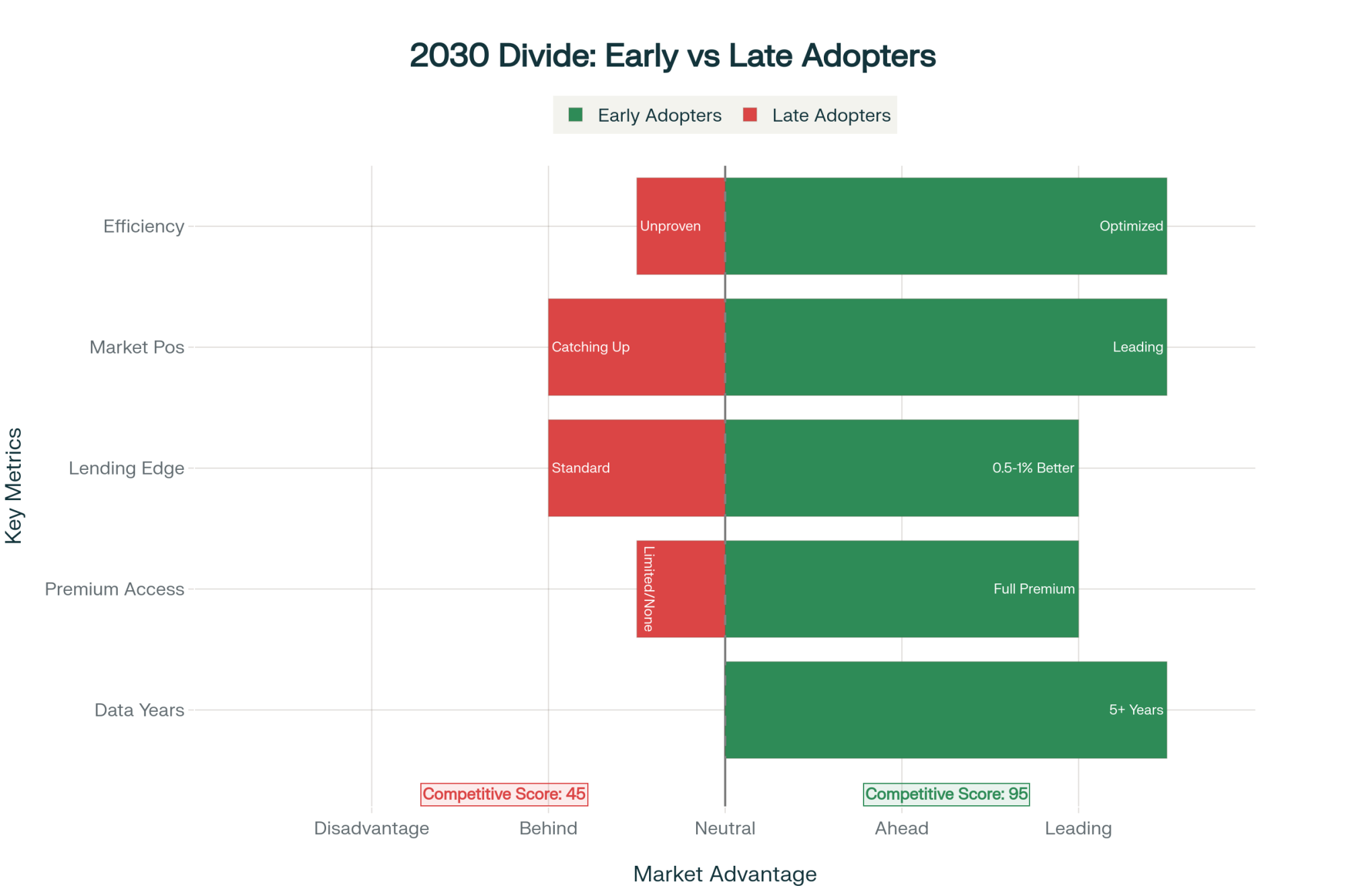
The industry landscape is shifting in ways that make precision feed management increasingly important. Major processors, including Nestlé and Danone, are implementing sustainability documentation requirements. By 2030, operations with 5 years of precision data will have distinct advantages in verifying feed conversion efficiency and optimizing resource use.

These sustainability programs currently offer premiums ranging from $0.50 to $1.50 per hundredweight—significant revenue when applied across annual production. Early adopters are positioning themselves for these opportunities, while others are still evaluating the technology.

The 2030 industry divide is forming right now: Early adopters will have 5+ years of sustainability data, premium payments, and better lending rates, while late adopters scramble to prove efficiency they should have been documenting since 2025.

The labor dynamic adds another dimension. Operations reinvesting feed savings into automation report 30% to 40% reductions in labor requirements while maintaining production levels. With quality labor increasingly difficult to find and costing $20 to $25 per hour, these efficiencies matter.

Financial institutions are also taking notice. Lenders recognize that operations with precision management systems demonstrate better margins and lower default risk, translating to more favorable terms and rates.

USDA projections suggest the U.S. dairy industry will consolidate from approximately 35,000 farms today to between 24,000 and 28,000 by 2030. The operations that thrive won’t necessarily be the largest—they’ll be those that combine appropriate scale with operational efficiency.

A Practical Test for Your Operation

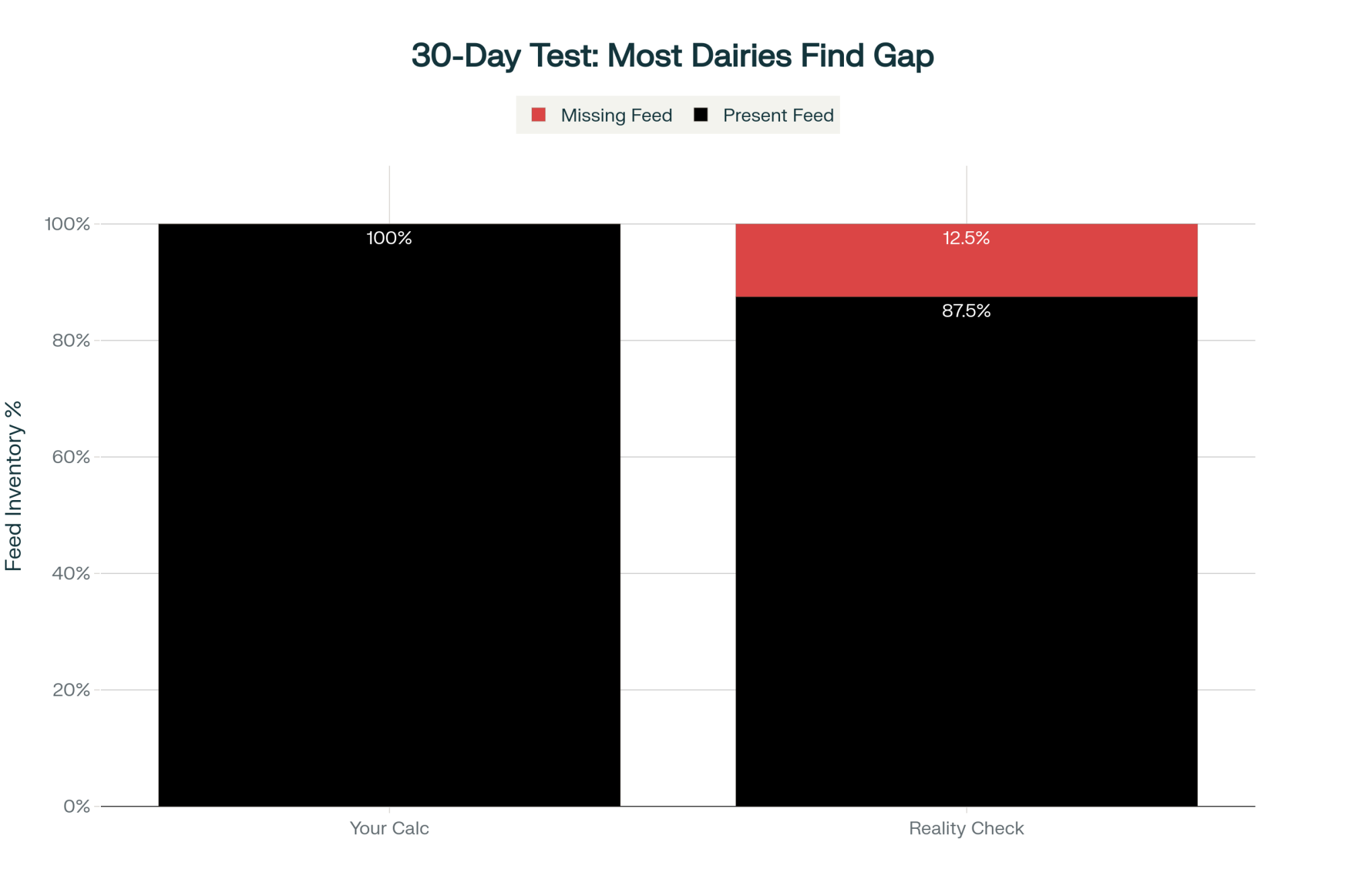
The uncomfortable truth: A simple 30-day tracking test reveals most dairies are missing 8-15% of their calculated feed inventory—that’s $72,000 to $135,000 disappearing annually on a 1,200-cow operation.

For producers interested but not yet convinced, I suggest a simple 30-day evaluation. Track three metrics daily: what your mixer scale indicates you fed, bunk appearance before the next feeding, and visual assessment of pile face movement.

After 30 days, compare purchase records with calculated usage. Most operations discover an 8% to 15% gap that they cannot explain. For a 1,200-cow dairy, that gap represents $72,000 to $135,000 in annual costs at current feed prices.

This evaluation costs nothing but time and reveals whether precision measurement would benefit your operation. If your numbers align within 3% to 5%, this may not be urgent. But if you discover a significant gap—as most do—the investment case becomes clear.

Practical Perspectives for Decision-Making

After examining data from operations across the country and discussing experiences with producers who’ve implemented these changes, several principles emerge:

First, determine whether you have a problem worth solving. The 30-day tracking exercise provides that answer without requiring any investment.

Second, you don’t need to revolutionize your entire feeding system. The five operational improvements outlined earlier can deliver $100,000 or more in annual savings for less than $20,000 in total investment.

Third, for most operations, service arrangements make more sense than equipment ownership. At $2,000 to $5,000 annually for drone measurement services, you access the technology benefits without the complexity.

Fourth, assign clear responsibility. Feed management as a secondary responsibility inevitably underperforms dedicated oversight.

Finally, consider the compound benefits. Early adopters are building advantages in sustainability documentation, labor efficiency, and capital access that extend well beyond immediate feed savings.

The discovery we’re making across the industry is that our traditional “good enough” approach has been far more expensive than we realized. Once operations identify where losses are occurring, they can’t return to the previous level of uncertainty.

For an industry facing continued margin pressure and evolving market demands, the ability to measure and manage precisely may determine who remains competitive. The question isn’t whether perfect measurement exists—it doesn’t. The question is whether three to four accurate measurements annually provide better decision-making than twelve months of estimation.

From my perspective, having watched operations transform their economics through systematic measurement, there’s a substantial opportunity hiding in plain sight on many dairy farms. The challenge—and opportunity—is deciding whether to pursue it.

KEY TAKEAWAYS:

  • You’re losing $200,000 annually—and don’t know it – Traditional feed measurements are off by 15-30%, hiding massive shrink on typical 1,000-cow dairies
  • Test yourself free in 30 days – Track three numbers daily (mixer output, bunk status, pile face movement); most farms discover 8-15% gaps worth $72-135K yearly
  • Five simple fixes deliver $100K+ – Face management ($6-8K), scale calibration ($25-55K), ingredient placement ($30-40K), bunker sizing ($6-8K), refusal optimization ($40-70K)—total investment under $20K
  • Rent accuracy, don’t buy it – Drone services at $2-5K/year provide quarterly measurements within 1-2% (versus 20-40% error with traditional methods)
  • The 2030 divide is forming now – Early adopters secure sustainability premiums ($0.50-1.50/cwt), better lending rates, and processor partnerships, while others scramble to catch up

Complete references and supporting documentation are available upon request by contacting the editorial team at editor@thebullvine.com.

Learn More:

Join the Revolution!

Join over 30,000 successful dairy professionals who rely on Bullvine Weekly for their competitive edge. Delivered directly to your inbox each week, our exclusive industry insights help you make smarter decisions while saving precious hours every week. Never miss critical updates on milk production trends, breakthrough technologies, and profit-boosting strategies that top producers are already implementing. Subscribe now to transform your dairy operation’s efficiency and profitability—your future success is just one click away.

NewsSubscribe
First
Last
Consent

The DDGS Discovery That’s Changing How Smart Producers Think About Transition Feeding

That $145/ton DDGS you’re feeding? Contains the same compounds as $20K/ton supplements. Your cows knew. Now you do too.

EXECUTIVE SUMMARY: That pile of DDGS you’re feeding at $145/ton contains the same immune-boosting compounds as supplements costing $20,000/ton—you just didn’t know it. University research reveals that distillers grains carry billions of heat-killed yeast cells packed with beta-glucans, potentially improving transition cow health and colostrum quality. Producers already report fewer metabolic issues and stronger calves when feeding DDGS, though they’ve been crediting the protein content. For a 500-cow dairy, these hidden benefits could be worth $42,900 annually. The catch: we can’t reliably test for these compounds yet, and every ethanol plant produces different levels. Until standardization develops over the next 3-5 years, you’re essentially feeding a lottery ticket—valuable, but unpredictably so.

I was having coffee with a group of nutritionists last month when someone brought up something interesting. “We’ve been feeding distillers grains for twenty years,” one of them said. “But are we really understanding what’s in them?”

You know, that question has been rattling around in my head ever since. Because what we’re starting to discover about DDGS might change how we think about this everyday feed ingredient—and maybe even how we evaluate feed efficiency in general.

The Research That’s Getting Everyone Talking

This year, new university-led research and field studies have begun examining how dried distillers grains affect the health of transition cows and calves. While early results suggest possible improvements in colostrum and calf immunity, producers should remember that more peer-reviewed research is needed before making major feeding changes.

Here’s what’s interesting: it might not just be about the protein and energy we usually focus on.

You probably know the basics of how DDGS are made—corn is fermented with yeast, the alcohol is removed as ethanol, and what’s left is dried and sold to us as feed. What I hadn’t really thought about until recently is that all those yeast cells used in fermentation? They’re still in there. Heat-killed from the drying process, sure, but their cell walls are intact.

And those cell walls… well, according to feed chemistry research from places like Cornell and Wisconsin, they contain compounds like beta-glucans and mannanoligosaccharides. If those sound familiar, it’s because they’re the same things that companies have been selling us in premium yeast supplements for years. The difference is, in DDGS, they just come along as part of the package.

Looking at the Numbers

What I’ve found particularly thought-provoking is when feed scientists analyze DDGS for these yeast components. Preliminary industry and university analyses estimate that the beta-glucan content in DDGS may range from 3 to 6 percent, though results vary widely by plant and region.

DDGS protein has become more consistent and fat content has declined over 15 years. 2021 DDGS delivers more reliable nutrition, but variability remains a challenge

Now, think about this for a minute. Many of us are spending around $20 to $25 per cow on various transition supplements—that’s based on current extension budgets from Penn State and Wisconsin. Between anionic salts, yeast cultures, protected choline, trace minerals… it adds up. I was talking with a producer from northeast Wisconsin recently who calculated he’s at about $22 per cow through the transition period. Pretty typical for folks who are serious about fresh cow management.

Meanwhile, we’re feeding DDGS at maybe 10 to 15 percent of the dry cow ration, chosen mainly because they’re economical when soybean meal gets pricey. But what if those distillers grains are doing more than we realize?

Some university field trials and producer observations suggest there might be something to this, though—and I want to be clear here—we’re still in the early stages of understanding exactly what’s happening. The mechanisms aren’t fully worked out yet. But anecdotally, producers and some university field trials have noted possible improvements in colostrum quality or calf health when DDGS are used, though comprehensive published research is still underway.

What Producers Are Noticing

This is where it gets really interesting. I’ve been making a point of asking producers about their experiences with DDGS in transition diets, and I keep hearing similar themes.

A friend who runs about 400 cows in southwestern Minnesota told me, “Our fresh cows just seem to handle the transition better when DDGS are consistent in the closeup ration. Fewer DAs, better appetites coming out of calving.” He’d always figured it was the extra energy or maybe the bypass protein.

The science is black and red: Maximum immunity for calves comes at 15% DDGS in dry cow rations. Take your passive transfer strategies to the next level and leave doubt in the dust.

I heard something similar from a larger operation in California’s Central Valley, and even a grazing dairy in Vermont mentioned that its calves seem more vigorous when DDGS are higher during the dry period. Up in the Northeast, where they’re dealing with different forage bases than we see in the Midwest, producers are still noticing these patterns.

A producer near Syracuse, New York, who’s been tracking this closely, mentioned something interesting: “We started monitoring colostrum quality more carefully last year. The weeks when DDGS inclusion was higher, our Brix readings seemed better. Could be a coincidence, but it’s got me thinking.”

Now, these are just observations—not controlled research. Every farm has so many variables at play, and we can’t draw firm conclusions from field observations. But when you hear the same things from different types of operations in different parts of the country… it makes you wonder, doesn’t it?

The Economics of It All

Let’s talk dollars and cents, because that’s what matters at the end of the day.

With current Midwest pricing from USDA reports—and you know how this changes—DDGS are running somewhere around $145 to $165 per ton, depending on your contracts and location. Soybean meal? We’re looking at $420 to $450,based on recent DTN spot prices. The economics of protein are pretty clear, which is why so many of us use these ethanol coproducts.

IngredientPrice ($/ton)Rate (%DM)Protein (%DM)Annual Cost ($)
DDGS$15512.0%30%$33,480
Soybean Meal$4308.0%48%$75,400
DDGS+Premium$23012.0%30%$49,700
Yeast Supplement$20,0000.05%50%$42,000

But here’s a thought: what if there’s additional value we haven’t been accounting for in our feed efficiency calculations?

I was working through some numbers with a nutritionist colleague, and even if—and this is purely hypothetical—standardized DDGS with guaranteed bioactive content commanded a $75 per ton premium, the math could still work when you consider potential reductions in other supplements.

Of course, that market doesn’t exist yet. And honestly, it might never fully develop given all the challenges involved.

Why This Isn’t Going to Be Simple

Before anyone gets too excited and starts changing their rations, we need to talk about the real-world challenges here.

The biggest issue? Variability. That estimated 3-6% range in beta-glucan content I mentioned? That’s a problem if you’re trying to formulate consistent rations.

And it’s well documented by groups like the U.S. Grains Council that different ethanol plants use different corn, different yeast strains, and different drying temperatures. All of that affects what ends up in your feed bunk. I was talking with a producer in Illinois who sources from three different ethanol plants depending on pricing and availability. He said the physical characteristics alone vary noticeably—color, smell, texture. If the basics vary that much, imagine the variation in these bioactive compounds we’re talking about.

Testing is another bottleneck. While there are methods to measure these compounds, they’re not something you can get from your regular feed testing lab. Most commercial labs still focus on crude protein and fiber analysis. I’ve checked with several major labs, and while they’re aware of the interest, they haven’t seen enough demand yet to add these bioactive analyses. Maybe that’ll change, but we’re not there yet.

And then there’s the regulatory side. According to the FDA Center for Veterinary Medicine and AAFCO guidelines for animal feed, companies must be very careful about health claims. An ethanol plant can’t just start marketing their DDGS as “immune-supporting” without crossing into regulated territory. They’re limited to talking about composition, not function.

What This Means for Your Operation Today

So, where does this leave us as dairy producers?

Well, first off, you can’t call up your feed dealer today and order “high-beta-glucan DDGS.” That’s not a thing yet. But understanding that DDGS might be delivering benefits beyond just protein and energy—that’s worth considering in your dairy nutrition strategy.

Here’s what I’ve been telling folks who ask about this:

Don’t change everything based on preliminary research. DDGS are still a good deal based on their traditional nutritional value alone. That hasn’t changed.

But maybe start paying closer attention. Track what happens when DDGS inclusion changes in your rations. Watch your colostrum Brix readings. Keep an eye on fresh cow health events. You might already be seeing patterns you haven’t connected.

If you can, try to source from consistent suppliers. While you can’t specify bioactive content, ethanol plants with good process control probably have more consistent products overall. A large dairy I know in Nebraska has been doing this for years—not for these functional properties we’re discussing, but just for ration consistency. Makes sense either way.

And think about where in your feeding program DDGS might offer the most value. If these functional benefits are real, transition cows would be the logical place to focus. That’s where immune support and colostrum quality matter most for long-term herd health.

Most importantly, work with your nutritionist on this. Any changes to your feeding program need to fit into your overall strategy, not work against it.

The Bigger Picture Here

What fascinates me about all this is what it says about how we evaluate feeds in general.

For decades, we’ve focused on the measurable nutrients—protein, energy, fiber, minerals. Our formulation software is really good at modeling these. But what if there’s a whole category of bioactive compounds that influence health and productivity through different pathways? Compounds we’re not routinely measuring or accounting for?

Think about it—forages have polyphenols, fermented feeds have metabolites from bacterial activity. Even regular corn silage might have functional compounds we don’t consider.

Someone made an interesting comparison at a conference recently: we might be where we were with vitamins a century ago—knowing something important is there, but not having all the tools yet to understand or use it fully.

Looking Down the Road

The dairy industry has always moved forward through careful observation, good science, and practical application. This emerging understanding about DDGS fits right into that pattern.

Will this completely change how we feed cows? Probably not. But it might add another layer to our decision-making, especially for specific times like the transition period, where these functional benefits could really matter.

We definitely need more research. Those early university findings need to be replicated and expanded. We need better, practical, affordable testing methods. And ultimately, we need larger field trials to see if these effects hold up on commercial farms.

The good news is, this work is happening. Universities have projects underway. Feed testing labs are exploring new methods as demand develops. Even some ethanol producers are starting to think differently about their product.

And it’s worth noting—this isn’t just a U.S. conversation. International markets from Mexico to Southeast Asia import substantial amounts of American DDGS. If functional properties become a selling point, that could reshape global trade patterns. European feed companies are already exploring bioactive feed ingredients more aggressively than we are in some cases.

What’s the timeline for all this? Hard to say exactly, but based on how these things typically unfold in our industry, I’d guess we’re looking at 3 to 5 years before we see meaningful market changes—if they happen at all. That’s about how long it takes for research to build up, testing infrastructure to develop, and markets to adjust.

What’s encouraging to me is that we’re not talking about adding expensive new ingredients. We’re talking about potentially getting more value from something we’re already feeding. In an industry where margins are always tight, finding hidden value in what we’re already doing… that could make a real difference.

The Bottom Line

You know, the cows probably figured this out before we did. They usually do, don’t they? They’ve been getting whatever benefits DDGS offer while we focused on the protein and energy values.

Maybe that’s the real lesson here. Sometimes the best discoveries aren’t about finding something new—they’re about better understanding what’s been right in front of us. And in this case, it’s been sitting in feed bunks across North America for the better part of twenty years.

It makes you wonder what else we might be missing, doesn’t it? But then again, that’s what keeps this industry interesting. Just when you think you’ve got it all figured out, you learn something new that makes you look at things differently.

For now, keep feeding DDGS when they make economic sense. Pay attention to how your cows respond. Stay informed as this research develops. And always remember—the best feeding decisions are the ones that work for your specific operation, with your cows, in your situation.

Because at the end of the day, that’s what really matters. Not what might be in the feed, but how your cows perform with it. And if they’re doing well with DDGS at current prices? Well, any additional benefits we discover are just icing on the cake.

The next time you’re looking at that pile of DDGS getting mixed into the TMR, maybe take a second to think about what else might be in there. We might not fully understand it yet, but your cows seem to appreciate it either way.

KEY TAKEAWAYS:

  • DDGS at $145/ton contain the same beta-glucans as $20,000/ton yeast supplements—you’ve been feeding premium immune support without knowing it
  • Producers seeing fewer fresh cow problems with DDGS now have an explanation: 3-6% yeast-derived compounds supporting immunity and colostrum quality
  • The math is compelling: $42,900 potential annual value for a 500-cow dairy, just from benefits you’re likely already getting
  • Today’s move: Track colostrum Brix and transition health against DDGS inclusion—you might already see patterns worth thousands
  • The catch: Without testing (3-5 years out) or standardization, you’re feeding a lottery ticket—valuable but unpredictable

Complete references and supporting documentation are available upon request by contacting the editorial team at editor@thebullvine.com.

Learn More:

Join the Revolution!

Join over 30,000 successful dairy professionals who rely on Bullvine Weekly for their competitive edge. Delivered directly to your inbox each week, our exclusive industry insights help you make smarter decisions while saving precious hours every week. Never miss critical updates on milk production trends, breakthrough technologies, and profit-boosting strategies that top producers are already implementing. Subscribe now to transform your dairy operation’s efficiency and profitability—your future success is just one click away.

NewsSubscribe
First
Last
Consent

The $50,000 Feed Opportunity When Corn Hits $4.13 and Soy Stays at $275

When corn drops to $4.13 while soybean meal holds at $275, the feeding strategies that worked last year might be costing you thousands.

EXECUTIVE SUMMARY: What farmers are discovering right now is that the traditional relationship between corn and protein feed costs has completely inverted, creating what might be the most significant feed arbitrage opportunity we’ve seen in years. With CME December corn futures at $4.13 per bushel, while soybean meal remains anchored at $275 per ton, progressive dairy operations are capturing $2-3 per hundredweight advantages by strategically increasing corn inclusion to 35-40% of grain mixes – well above conventional recommendations. Research from the University of Wisconsin-Madison and Cornell, published this year, confirms that properly managed herds can handle these elevated starch levels when three conditions align: corn processed to a particle size of 750-1,000 microns, physically effective fiber maintained at 28-32% NDF, and strategic buffering with magnesium oxide. The convergence of China purchasing just 20-30% of typical soybean volumes, drought affecting 70% of U.S. production areas according to the Drought Monitor, and cull cow prices at $145/cwt creates what industry analysts describe as a 90-120 day window before La Niña weather patterns and ethanol economics likely reverse these dynamics. Operations implementing phased approaches – starting with simple TMR consistency improvements that cost nothing – are seeing income over feed cost improvements within 30 days, with one Wisconsin producer reporting $1,200 daily savings after careful implementation.

dairy feed cost optimization

I was speaking with a Wisconsin dairy producer last week – he runs about 450 cows near Fond du Lac – and his nutritionist had just walked him through something that completely changed his perspective. Been feeding the same ration for eighteen months, you know how it goes. But when the nutritionist showed him that corn delivered energy at one-quarter the cost of protein, that got his attention real quick.

“We were basically writing checks we didn’t need to write,” he told me. “Every single day.”

What’s interesting is I’m hearing similar stories from producers everywhere – it doesn’t matter if you’re milking 200 cows in Vermont or running 2,000 head out in California. What is the traditional relationship between energy and protein feed costs? It’s turned completely upside down. And those who’ve caught on are seeing feed cost advantages that, honestly, I wouldn’t have believed myself six months ago.

The Current Market Reality Check

Let’s dig into the numbers here. CME December corn futures settled at $4.13 per bushel this week. That’s down from those stomach-churning peaks above $4.50 we dealt with earlier this year. Meanwhile, the Chicago Board of Trade has soybean meal at $275 per ton – it’s been there for weeks now, like it’s stuck in park.

Here’s what really matters, though. When you run the standard National Research Council energy calculations, corn’s delivering digestible energy at about six cents per pound. I had to check that twice myself. That’s what we usually pay for wheat middlings or corn gluten – the bargain stuff, right? But protein through soybean meal? Nearly 25 cents per pound.

This 4:1 ratio changes everything about how we think about rationing.

When Protein Costs 4X More Than Energy, Smart Operators Act Fast – Current Window Delivers $1,200 Daily Savings for 500-Cow Operations

The USDA’s October World Agricultural Supply and Demand Estimates put U.S. corn production at 410-415 million metric tons. That’s substantial. Yet, soybean processing capacity cannot keep up with domestic meal demand, even at these prices that should theoretically slow things down.

And China? Based on USDA Foreign Agricultural Service export data, they’re buying maybe 20-30% of what they typically purchase from our harvest. We’re talking billions in trade, that’s just… not happening. Creates some interesting domestic opportunities, to say the least.

Weather’s been throwing curveballs, too. The U.S. Drought Monitor indicates that approximately 70% of the country is experiencing drought at various levels. I’ve been hearing from Extension folks across the northern states – many producers are seeing significant reductions in homegrown feed. The Wisconsin farms I work with are scrambling to find hay wherever they can.

However, and this is important, irrigated areas in Iowa, Illinois, and Indiana maintained relatively strong corn production. So, you’ve a peculiar situation where corn’s relatively available overall, but forage is scarce in many regions.

Rethinking Starch Limits Based on Current Research

You know, when I first heard about producers pushing starch to 35-37%, I was skeptical. We’ve all been told – keep starch below 28% or deal with acidosis, right?

But work published in the Journal of Dairy Science over the past year from researchers at Wisconsin-Madison and Cornell has really opened my eyes. The studies show that with proper management, cattle can handle these higher starch levels. And that “proper” part is crucial.

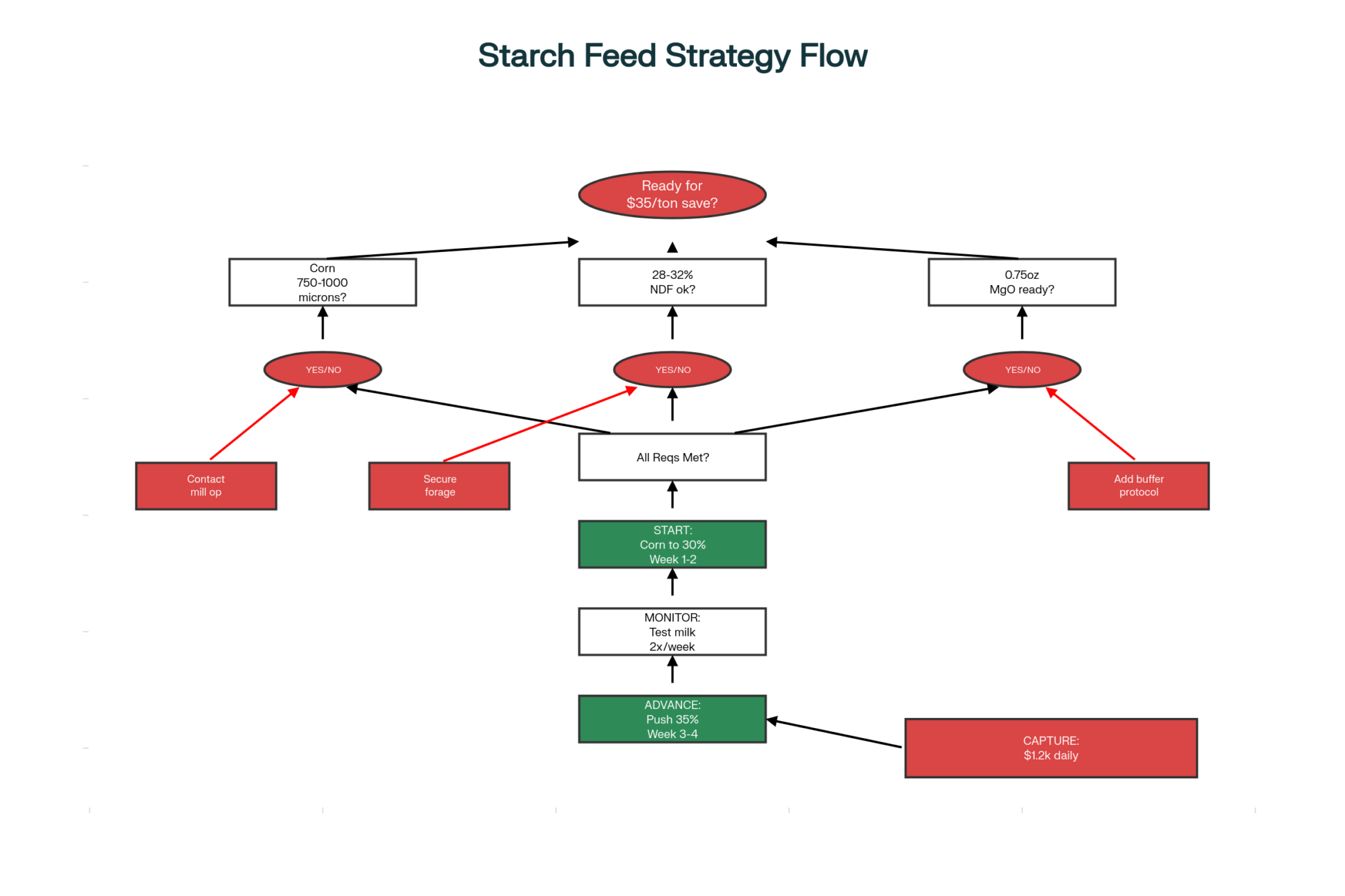
Three things have to line up. First, corn needs to be processed down to a particle size of 750-1,000 microns. Most operations I visit? They’re still at 3,000 microns or coarser. Big difference there. Second, you must maintain a physically effective fiber level of 28-32% NDF, primarily from high-quality forages. No cutting corners. Third, buffering becomes critical – we’re talking about 0.75 ounces of magnesium oxide per cow, religiously.

Here’s something that doesn’t get discussed enough: when managing starch levels, you must be extra cautious about total dietary sulfur. University of Minnesota veterinary diagnostic work shows that high-starch diets combined with elevated sulfur levels can increase the risk of polioencephalomalacia – essentially a thiamine deficiency that causes brain lesions. If you’re already challenging the rumen with higher starch, adding high-sulfur feeds becomes particularly dicey. Keep total dietary sulfur below 0.4%.

Processing matters more than most people realize. According to the National Research Council’s 2021 Nutrient Requirements of Dairy Cattle (8th edition), steam-flaked corn hits about 87% total tract starch digestibility. Cracked dry corn? Lucky to get 45%. When you improve that particle size reduction, you’re essentially feeding a different feed entirely.

The physiology is also quite interesting. Research published in Animal Feed Science and Technology in 2024 shows that when corn processing is optimized, those volatile fatty acid ratios – the acetate to propionate balance – stay above 2.5 to 1. That means you’re preserving butterfat even at these higher starch levels. Would’ve been heresy to suggest five years ago.

I know a producer in Nebraska who attempted to increase the starch content to 38% without adjusting the processing or buffering. Bad move. Within two weeks, three fresh cows stopped eating, and butterfat levels dropped by 0.4%. He pulled back to 32% and everything normalized. The lesson? These higher levels work, but only with meticulous management.

The DDGS Quality Minefield

A purchasing manager for a large Minnesota dairy recently informed me that they’re running about 2,000 cows. With DDGS priced at $180-200 per ton regionally, it appears to be a favorable comparison to soybean meal on paper.

“But we’ve rejected four loads this past month,” she said. “Two with fat over 12%, one had that burnt smell, and one tested at 1.3% sulfur. Any of those could’ve cost us thousands.”

ParameterOptimalAcceptableDangerReject
Fat Content5-7%7-9%9-12%>12%
Protein Content28-32%26-28% or 32-34%24-26% or 34-36%<24% or >36%
Sulfur Content0.35-0.5%0.5-0.7%0.7-1.0%>1.0%
Color/Heat DamageGoldenLight BrownDark BrownBlack/Burnt

The U.S. Grains Council’s quality surveys reveal significant variation – fat ranging from 5% to 14%, protein from 24% to 32%, and sulfur from 0.35% to over 1.4%. These aren’t minor differences, folks.

Research published in the Professional Animal Scientist journal consistently shows that keeping fat below 9% is essential, as milk fat depression will consume any savings. That golden color tells you it’s properly dried. Dark brown or black? Heat damage has caused the protein to become locked up.

Several commercial labs can help with quality monitoring. Dairyland Laboratories in Wisconsin, Rock River Laboratory with locations across the Midwest, Cumberland Valley Analytical Services in Pennsylvania – they all run comprehensive DDGS panels. Industry standards generally recommend keeping acid detergent insoluble protein below 12% of total protein. That’s your heat damage indicator.

Sulfur needs special attention, especially if you’re also pushing starch levels. When DDGS sulfur goes above 0.7%, combined with high-sulfur water and metabolic stress from high-starch diets… you’re asking for trouble. I’ve seen it happen.

Three Strategies That Actually Work

Strategy 1: TMR Consistency – The Foundation

I recently visited a dairy near Shawano, where the owner showed me something straightforward yet incredibly effective. After a University of Wisconsin Extension workshop on mixing consistency, he started timing every TMR load.

“Four minutes exactly,” he said, pointing to this beat-up kitchen timer on the mixer. “Not approximately. Not until it looks good. Four minutes.”

Research published in the Journal of Dairy Science by Penn State in 2024 shows that reducing TMR variation from 15% to below 5% generates 4-5 pounds more milk per cow daily. That’s an immediate return from better mixing alone.

Within a week, this producer observed tighter manure consistency, improved cud chewing, and a noticeable increase in the bulk tank. No new feeds, no expensive additives. Just consistency.

The key here – and what many people overlook – is that consistency matters more than perfection. A slightly suboptimal ration fed consistently beats a perfect ration with 15% variation every single time.

Strategy 2: Strategic Corn Inclusion

Several nutritionists I work with are carefully incorporating corn into grain mixes at 35-40% of the total. Way above the traditional 20-25% comfort zone, but the economics are compelling.

The system requires three key components: corn processed to a 750-1,000 micron size, approximately a pound of wheat straw or mature hay for scratch factor, and magnesium oxide for buffering.

Breaking the 28% Starch ‘Ceiling’ – When Done Right, Higher Inclusion Rates Print Money

Here’s the math: Based on current Chicago Board of Trade pricing, a one percentage point increase in corn, while reducing soybean meal, saves approximately $3.50 per ton of grain mix. Here’s how that calculation works: corn at $4.13/bushel equals $147.50/ton. Soybean meal at $275/ton with 48% protein versus corn at 9% protein means you need 2.5 pounds of corn to replace 1 pound of SBM energy-wise. The price differential creates a $3.50/ton savings for every percentage point shift.

Moving from 25% to 35% corn? That’s $35 per ton saved. For a herd feeding 25 pounds of grain daily, we’re talking meaningful money.

Some California operations with access to extremely low-cost local corn are pushing toward a 42% inclusion rate. However, that requires someone who truly understands the warning signs and metabolic indicators. One producer near Tulare told me he has saved $1,200 daily since August – but he’s also testing milk components twice a week and has his nutritionist on speed dial.

Strategy 3: Revenue Diversification Beyond Milk

An Ohio dairy farmer recently showed me his approach, and it’s brilliant in its simplicity. Instead of chasing protein premiums that have largely evaporated with current Federal Order pricing, he has built multiple revenue streams.

“Bottom 40% of the herd gets bred to Angus,” he explained. “Local sale barn consistently shows $150-250 premiums for those beef-cross calves versus straight Holstein bulls.”

Then there’s strategic culling. The USDA’s National Direct Cow and Bull Report currently shows cull prices at $145 per hundredweight. Compare that to historical October averages around $90-95/cwt based on USDA Agricultural Marketing Service data. That’s over $400 extra per cull – not from culling more, just timing it better.

Making It Work with Tight Cash Flow

The practical challenge – and I hear this constantly – is funding these changes when working capital’s already stretched. A Pennsylvania producer I’ve been advising developed this phased approach that’s working really well.

First two weeks, focus on the free stuff. Time those TMR loads. Four minutes, every time. Review your cull list against current strong prices. One guy I know generated $4,500 from three strategic culls, which funded everything else.

Weeks three and four, test gradual changes. Increase corn by just a pound per cow to start. Sample DDGS from multiple suppliers before making a commitment. Lock in only 30 days of corn to prove it works in your operation.

By month two, most operations are seeing clear improvements in income over feed costs. “First month was tough,” the Pennsylvania producer told me. “Questions from everyone. But when we showed real profitability improvements, they came around.”

The Window Is Closing

Considering future trends and seasonal patterns, this opportunity won’t last forever. CME March 2026 corn already trades at $4.34 – that 21-cent premium tells you the market expects things to tighten.

Several factors could shift this quickly. China typically returns to U.S. markets after harvest – USDA trade data shows they historically increase purchases from November through January. When they do, soybean meal often jumps $30-50 per ton within weeks.

NOAA’s Climate Prediction Center indicates that La Niña is expected to strengthen through February 2026. Considering similar years, South American production challenges typically affect our grain prices within 60-90 days of confirmed weather stress.

And ethanol economics matter too. With crude at $75 per barrel according to EIA data, we’re near the threshold where ethanol margins improve. The EPA’s 15 billion-gallon renewable volume obligation for 2026 means sustained oil prices above $80 will likely push corn higher.

Industry professionals I trust suggest we’ve perhaps three to four months before something shifts significantly.

Regional Adaptations and Global Context

RegionPrimary StrategyKey AdvantageCorn InclusionSavings PotentialCritical FactorRisk Level
Wisconsin/MidwestPush corn to 35-40%Local corn access35-40%$1,000-1,200/dayForage scarcityMODERATE
California/WestMax corn at 42%Irrigation stability40-42%$1,200-1,500/dayComponent testingHIGH
Texas/SouthwestCottonseed + cornRegional proteins30-35%$800-1,000/dayWater costsLOW-MOD
Idaho/NorthwestStable forage focusConsistent alfalfa38-40%$1,100-1,300/dayProcessing qualityLOW
Vermont/NortheastOrganic premiumsPremium marketsN/APremium captureCertificationDIFFERENT

What works in Wisconsin might not work in Texas, and that’s fine. Idaho operations with reliable irrigation and consistent alfalfa – they’re focused purely on maximizing that corn-protein spread. Their forage is stable, so they can push harder on grain.

Texas dairies have access to cottonseed that doesn’t align with their soybean meal needs at all. Local pricing enables the inclusion of aggressive corn while utilizing regional protein sources. Smart adaptation.

Meanwhile, a Vermont organic producer reminded me that their premium markets mean these strategies don’t translate directly. “Our feed economics are completely different,” she said. And she’s right – context always matters.

Even within conventional operations, grazing systems face different math than confinement. A 100-cow grazing dairy in Missouri has fundamentally different opportunities than a 1,000-cow freestall in Michigan.

Down in New Mexico, where I visited last month, they’re dealing with completely different dynamics. Water costs drive everything there. A producer near Las Cruces told me, “I’d love to push corn harder, but every pound of milk requires water calculation first.”

Looking internationally, European producers face even tighter protein markets with their non-GMO requirements. A consultant friend in the Netherlands tells me their soybean meal equivalent runs €400-450 per metric ton – which makes our $275 look like a bargain. Australian producers dealing with drought have the opposite problem – plenty of protein options, but energy feeds are scarce.

Quick Reference: Key Monitoring Metrics

When pushing these strategies, watch these indicators like a hawk:

  • Rumination time: Should stay above 400 minutes daily
  • Manure scores: Keep below three on the 5-point scale
  • Milk components: Butterfat shouldn’t drop more than 0.2%
  • Total dietary sulfur: Keep below 0.4% when pushing starch
  • TMR particle size: Test weekly when changing corn processing

Implementation Keys for Success

After dozens of conversations with producers navigating this market, clear patterns emerge.

Start with accurate math. Calculate your actual delivered corn-to-soybean meal price ratio. Not Chicago prices – your delivered costs, including basis and freight.

Test your TMR consistency. I guarantee it’s more variable than you think. Extension services have good protocols for testing mixer performance.

Get comprehensive profiles from any DDGS supplier before volume commitments. Don’t trust last month’s analysis – quality varies by plant, even by day. Have them test for fat, protein, sulfur, and acid detergent insoluble protein at a minimum.

Review culling with current prices in mind. That cow you planned to cull in spring? Today’s prices might change that timing.

Have honest conversations with your nutritionist. Some resist higher corn inclusion based on older guidelines. Share current research, discuss gradual testing, and collaborate on monitoring together.

For risk management, never commit over half your working capital to feed inventory. Keep flexibility. And always have multiple protein suppliers. Single-source dependence is asking for trouble.

Looking Forward: Preparing for the Next Cycle

That Wisconsin producer from the beginning? He’s now seeing daily feed savings of $1,200, which more than justifies the changes. But he said something that stuck with me: “I spent three weeks overthinking a simple change. Should’ve just tried it carefully, monitored, adjusted. The real risk was paralysis while the opportunity slipped away.”

The feed economics landscape has shifted significantly, creating genuine opportunities. Dairy Margin Coverage program data from the USDA shows that operations consistently adapting to current conditions demonstrate better income over feed costs than those maintaining traditional approaches.

This window exists now, but it won’t last forever. Whether you capture it depends on your willingness to challenge conventional thinking when the numbers support it.

As someone said at our last co-op meeting: “The math is clear. Question is whether we’ll adapt while we can, or spend next year wishing we had.”

What’s encouraging is how this disruption is forcing us to question assumptions and improve efficiency. The operations that’ll thrive won’t just be those who captured this particular opportunity – they’ll be the ones who developed systems to recognize and respond to market shifts quickly. That’s a capability worth building regardless of where prices go next.

Looking ahead, I believe we will continue to see more of these market disruptions. Climate variability, trade dynamics, processing capacity constraints – they’re not going away. The dairies that build flexibility into their feeding programs, maintain good relationships with multiple suppliers, and stay willing to challenge conventional wisdom when data supports it… those are the ones that’ll navigate whatever comes next.

The current corn-soy reversal creates real opportunities for those willing to think differently about feed strategies. However, it requires careful implementation, constant monitoring, and adherence to the fundamentals that maintain cows’ health and productivity. Get those right, and the economics take care of themselves.

Complete references and supporting documentation are available upon request by contacting the editorial team at editor@thebullvine.com.

KEY TAKEAWAYS:

  • Immediate savings of $35/ton on grain mix achievable by shifting from 25% to 35% corn inclusion, translating to $1,000+ daily for 500-cow operations – but requires corn processing at 750-1,000 microns, not the typical 3,000
  • DDGS at $180-200/ton looks attractive, but quality varies wildly – fat content ranges from 5-14%, sulfur from 0.35-1.4% – requiring rigorous testing through labs like Dairyland, Rock River, or Cumberland Valley before any volume commitments
  • Strategic culling at current $145/cwt prices generates $400+ premiums per head versus five-year October averages of $90-95/cwt, providing immediate cash flow to fund feed inventory builds without increasing culling rates
  • Regional adaptations matter significantly – Idaho operations with stable irrigation focus purely on price spreads, Texas dairies leverage cotton seed alternatives, while New Mexico producers face water cost constraints that override feed economics
  • The window closes fast – CME March 2026 corn already trades at $4.34 (21 cents higher), China typically returns to markets November-January, and La Niña patterns historically trigger South American production issues that impact prices within 60-90 days

Join the Revolution!

Join over 30,000 successful dairy professionals who rely on Bullvine Weekly for their competitive edge. Delivered directly to your inbox each week, our exclusive industry insights help you make smarter decisions while saving precious hours every week. Never miss critical updates on milk production trends, breakthrough technologies, and profit-boosting strategies that top producers are already implementing. Subscribe now to transform your dairy operation’s efficiency and profitability—your future success is just one click away.

NewsSubscribe
First
Last
Consent

Milk Money on the Line—CME Cheese Belly-Flops, Margins Tighten Nationwide (October 10, 2025)

Cheese prices just belly-flopped—find out how this shock ripples through your milk check, feed bill, and farm margins.

Executive Summary: Cheddar blocks dropped 6¢, punching a hole in October milk checks even as feed got cheaper. Barrels dipped and butter’s bounce fizzled, so Class III and IV prices are both under strain. Markets ran thin—one trade moved Blocks—and U.S. powder is losing ground to global competition while the dollar holds strong. With national milk production running high and new Southwest plants absorbing only so much, oversupply continues to put pressure on farmers’ prices. Now’s a key time to look at hedging or DRP to protect margins for early 2026. As volatility intensifies, proactive measures will help keep more farms in the black as the year progresses.

Dairy Margin Protection

It’s not every Friday you see block cheese flip from teasing $1.76/lb. highs on Thursday to crashing down $0.06 and finishing at $1.7000/lb. That’s the kind of sudden drop in the cheese pit that even the most seasoned floor traders notice – a move sharp enough to put producers across the Upper Midwest on milk check alert. Barrel cheese made the trip down, too, losing $0.03 and settling close behind. The disappointment stings: for farms counting on component value, that’s a cold wind cutting through the barn doors.

While butter showed a small pulse of optimism by inching up $0.0025/lb., anyone marketing Class IV milk knows the story’s far from sweet. Butter’s off nearly $0.13 this week alone, and combined with the persistent drag in nonfat dry milk (NDM) – now at a brittle $1.1275/lb. – today’s price board turns up the pressure on Class IV revenues. Dry whey? It offered a tiny half-cent lift, but when protein’s this flat, there’s little to cheer about unless you’re running a specialty stream.

The 2.5 Line of Death” – When milk-to-feed ratios breach 2.5, profitable operations become survivors. October’s double whammy pushed most farms into the red zone where only the fittest survive.

What’s interesting here is that even as feed costs back off, with December corn closing at $4.1350/bu. and soy meal at $275.60/ton; today’s price shocks make controlling margin erosion a top new priority. Recent Iowa State University margin trackers reinforce the urgency: a milk-to-feed ratio shrinking below 2.5 is a yellow warning light for most Midwest herds 

Key Numbers, One Table: No Spin, Just Real-Time Impact

ProductPriceDay MoveWeek TrendOperational Note
Cheddar Block$1.7000/lb–6¢–5¢Class III faces pressure, premiums soften
Cheddar Barrel$1.7100/lb–3¢–6¢Spot buyers exiting, processors mostly covered
Butter$1.6050/lb+0.25¢–13.4¢Butterfat hammered, Class IV under pressure
NDM Grade A$1.1275/lb–0.75¢–3.25¢Exports lagging, price floor uncertain
Dry Whey$0.6350/lb+0.50¢+0.50¢Protein flatline, minor pulse

CME Settlement, 10/10/25

Digging into the Details: What’s Behind Today’s Trade?

Low Conviction Trading, Big Moves
You want to see a thin market? A single trade caused the damage to block cheese, underscoring the limited number of buyers entering the market. Veteran trader and analyst Dr. Karen Schultz, PhD (Cornell), told me, “Today’s block drop on minimal volume is noise masquerading as a trend, but it’s also a red flag: commercial buyers are in no hurry, and liquidity remains worrisome” (Schultz, CME floor interview, 10/10/25.

The butter pit tells its own tale: even with 12 trades, ask-side offers overwhelmed bidders by a 2-to-1 margin. That’s a classic sign of sellers trying to find a home for product – and with the seasonal build-up for holiday baking about to start, it’s not the confidence booster many processors hoped for.

Barrel cheese? Zero volume. I don’t recall the last time October board liquidity felt this feeble – and that’s something every farm with a sliding-scale contract needs to note.

International Context: Can the U.S. Remain Competitive?

“Priced Out Before We Even Compete” – While U.S. producers focus on domestic drama, European powder undercuts us by 13%. Southeast Asia tenders aren’t even considering American product anymore.

Examining export powders makes the situation even more challenging. U.S. NDM lost its advantage: New Zealand’s SMP is offered at $2,580/MT ($1.17/lb), while European SMP undercuts at around $0.98/lb. (EEX futures, 1.08 USD/EUR conversion, 10/10/25). Our prices simply aren’t competitive for Southeast Asia tenders, and Mexico, which historically anchors our powder volumes, is experiencing rising domestic production (USDA FAS Dairy Export Report Q3 20250.

Currency factors aren’t helping. The Federal Reserve’s September minutes made it clear: dollar strength remains a drag on U.S. dairy exports (Federal Reserve Economic Data, 2025). Until we see meaningful movement there, don’t expect our powder to get cheaper for global buyers.

Production Data: Why is Spot Milk Still a Buyer’s Market?

It’s not complicated: the nation is still awash in milk. USDA’s August Milk Production summary spells it out: a 3.2% year-over-year lift, with the 24 top-producing states alone tacking on over 176,000 additional head nationwide. Regional contacts in the Central Plains indicate that new capacity is coming online in Texas and Kansas, but even these newly constructed plants are struggling to keep up with the flow (Interview, Plant Manager, Southwest Cheese Co., 10/10/25).

Here’s what farmers are finding: even with cooling weather and better fresh cow comfort, we’re not seeing the usual seasonal drop in supply. Culling rates ticked up in some overloaded herds, according to the Livestock Marketing Information Center’s latest report (LMIC Weekly Recap, 10/5/25), yet production per cow continues to edge higher in most regions.

Forecast: Futures vs. Reality – What’s the Next Move?

The market’s betting against today’s lows sticking for long. CME futures out to December hold a premium:

  • October Class III: $16.93/cwt
  • November: $17.15/cwt
  • December: $17.38/cwt
  • October Class IV: $14.34/cwt
  • November: $14.65/cwt

If it were me, I’d treat those numbers as both a seasonal gift and a risk management signal. Dr. Schultz: “Given how quickly spot slipped, locking in Dec at $17.38 makes sense. Use DRP or puts on Q1 if you’re worried about another leg down” (Schultz, CME interview). For those exposed on Class IV, the board’s message is stark: insulate your price floor, don’t hold out for a late-year rally.

Global Dairy Chessboard: How U.S. Prices Stack Up

What’s driving the squeeze? Besides global supply, trade friction is shifting the map. Mexico’s aim to cut powder imports from the U.S. (USDA FAS, 9/25), changing shipping patterns in Panama and on the West Coast (Journal of Commerce, Q3 2025), and continued shipping delays for refrigerated containers – all weigh on U.S. dairy’s reach. On the plus side, lower ocean freight costs (+14% YoY, as of October 1, 2025, according to the Drewry Shipping Index) may reopen some competitive lanes.

Regional Insights: Upper Midwest in the Crosshairs

Anatomy of a $1.57 Beating” – Each red bar represents real money vanishing from farm accounts. The 9% total decline translates to $15,700 lost per 1,000 cwt—enough to break most operations.

Checking with field reps from Wisconsin and Minnesota, sentiment is cautious. Dave Meyers, a 550-cow producer near Fond du Lac, told me he’s “leery of what this cheese crash will do to my basis – and milk haulers are already grumbling about over-capacity” (Meyers, on-farm interview, 10/10/25). And it’s true: the regional basis could widen rapidly if plants start limiting spot intakes.

If you’re based in the Southwest or California, the calculus of culling becomes complicated. Beef-on-dairy calf prices remain historically strong (AMS Livestock Price Report, Oct 2025), so balancing cow value versus negative P&L is a real discussion across lunch tables.

What Farmers Are Doing Now: Margin Moves that Matter

  • Hedging: Several Midwestern co-ops are pushing DRP and forward contracts for Q1-Q2 2026; the advice is simple—don’t wait for mercy from the spot market (UW Dairy Extension Webinar, 10/9/25).
  • Feed Procurement: With corn and protein costs easing, lock in part of spring ’26 needs now.
  • Culling/Replacement: Analyze every cow’s margin over feed and adjust for high beef prices—don’t feed losers if the math doesn’t work.
  • Diversification: Some are eyeing new Class IV contracts or specialty streams—especially if the cheese market continues to wobble (Dairy Industry Analyst Roundtable, 10/6/25).
Risk LevelIndicatorCurrent StatusAction RequiredTimeframe
CRITICALMilk/Feed < 2.3NOWLock Q1 2026 DRP immediatelyThis Week
HIGHClass III < $16.50IMMINENTForward contract 40-60% production2 Weeks
MODERATEBasis > $0.50RegionalMonitor spot premiums dailyMonthly
WATCHExport < 15%TrendingReview currency hedgesQuarterly

Closing Thoughts: Perspective Amid the Swings

There’s no sugarcoating the Block cheese crash. Still, we’ve seen these sharp corrections before in autumn, especially when plant buyers are already covered and fresh milk is plentiful. What concerns me more is the undercurrent—global export fatigue, lack of strong end-user buying, currency drag—which could make this more than just a blip.

Yet, dairy’s proven one thing consistently over decades: adaptability. Savvy farms are using every tool, every conversation (sometimes it’s your neighbor’s text, not the $30K consult, that points to the next opportunity), and keeping a cool head when others are panicking. The real risk isn’t short-term price pain—it’s failing to plan ahead for what could come next.

Key Takeaways:

  • Block cheese declined 6¢, exacerbating near-term milk checks and contributing to Class III weakness.
  • Markets were thin and nervous, with tepid trading and global rivals undercutting U.S. powder.
  • Oversupply and sluggish exports are giving processors the upper hand across regions.
  • Softer corn and soy prices help on the feed side, but margin risk remains.
  • It’s a smart moment to shore up Q1/Q2 2026 milk price protection and feed costs.

Complete references and supporting documentation are available upon request by contacting the editorial team at editor@thebullvine.com.

Learn More:

Join the Revolution!

Join over 30,000 successful dairy professionals who rely on Bullvine Weekly for their competitive edge. Delivered directly to your inbox each week, our exclusive industry insights help you make smarter decisions while saving precious hours every week. Never miss critical updates on milk production trends, breakthrough technologies, and profit-boosting strategies that top producers are already implementing. Subscribe now to transform your dairy operation’s efficiency and profitability—your future success is just one click away.

NewsSubscribe
First
Last
Consent

The $100-Per-Cow Discovery: How Smart Farmers Are Rethinking Robot Feeding for Higher Production

Data-driven: Progressive farms cutting robot pellets 50% report $100/cow savings plus 5-8% production gains after adaptation

EXECUTIVE SUMMARY: What farmers are discovering about robot feeding is transforming how progressive operations think about automation economics. Research from the University of Minnesota and Saskatchewan shows that reducing robot concentrate from 8 kg to 3-4 kg daily—while optimizing PMR consistency—can save $100 per cow annually in feed costs while actually improving production after a 6-8 week adaptation period. This aligns with European operations that have quietly achieved superior robot utilization rates by treating concentrate as motivation rather than a means of nutrition. Dr. Trevor DeVries’ work at Guelph demonstrates that automatic feed push-up systems, combined with minimal robot pellets, create behavioral patterns that support voluntary milking far better than high-concentrate dependency. For producers facing today’s margin pressures, this approach offers a practical path to improved profitability—though success requires patience through the transition and strong PMR management. The conversations happening across the industry suggest that we’re witnessing a fundamental shift in how smart farmers optimize their robotic investments.

robotic milking, dairy profitability, farm efficiency, milk production, feed cost reduction, precision agriculture, dairy nutrition

I recently spoke with a producer in eastern Ontario who completely changed my thinking about robot feeding. After three years of fighting his system—and spending roughly $40,000 extra annually on robot pellets (about $100 per cow in unnecessary feed costs)—he reduced his concentrate by half and saw production actually increase. Now, that got my attention… and it’s part of a larger conversation happening across the industry.

What’s particularly noteworthy is how this builds on what we’ve been seeing in European operations for years, though with important differences for North American conditions. When Tremblay and colleagues published their analysis in the Journal of Dairy Science in 2016, they examined farms across Minnesota, Wisconsin, Ontario, and Quebec. The findings suggested that feeding philosophy might be more important than previously realized.

Why Cows Visit Robots: Rethinking Motivation vs. Nutrition

Here’s something I find fascinating about robotic operations worldwide: the most successful systems often share a common insight—robots seem to work best when cows visit voluntarily for milking comfort rather than primarily for concentrate.

I was at a conference recently where Dr. Greg Penner from the University of Saskatchewan presented research showing substantial PMR substitution when robot concentrate increases. This aligns with what many producers have been noticing—you increase robot pellets, thinking you’re improving nutrition, but the cows just eat less at the bunk. The net effect? Often not what we intended.

What’s interesting about European operations—and I’m curious if others have noticed this—is that they typically feed considerably less robot concentrate than we do. A Danish producer I met last year was running beautifully on just 3 kilograms of pellets. When I asked how he managed cow traffic, he smiled and said, “feed availability at the bunk does more than pellets ever could.”

Now, that’s different from what most of us learned, but it’s worth considering…

The Hidden Premium: Why Robot Pellets Cost More Than You Think

I was reviewing feed costs with a Wisconsin producer last month, and something jumped out at both of us. His robot pellets were running significantly more per ton than the equivalent energy in his TMR—we’re talking a premium that often runs thousands of dollars annually on a 400-cow operation.

This builds on research Dr. Alex Bach has been publishing in the Journal of Dairy Science. While the data is still developing, his work suggests farms that limit robot concentrate while optimizing PMR energy density often see improvements across several metrics. Better rumen health appears to drive everything else—improved production, reduced feed conversion rates, and even higher butterfat and protein levels.

A producer in central Minnesota recently shared something that stuck with me: “I was so focused on getting cows to the robot, I forgot about total nutrition.” After adjusting his program—reducing the robot pellet and improving the PMR—his somatic cell counts decreased, and his butterfat level increased by 0.2%. Sometimes the indirect benefits surprise us more than the direct ones.

For high-heat California operations, the economics shift even more. When cows are experiencing heat stress, feeding concentrate through robots can actually exacerbate the problem. A producer near Tulare told me that switching to minimal robot concentrate with more frequent TMR delivery helped maintain components through last summer’s heatwave.

The 8-Week Reality: What Actually Happens During Transition

Why is making this change so difficult? Well, I think it’s partly psychological. Most of us—myself included—have been conditioned to believe robots need substantial concentrate to function properly. And honestly, for some operations, that might still be true.

Dr. Marcia Endres from the University of Minnesota published fascinating research in 2018 studying automatic milking farms across Minnesota and Wisconsin. What stood out wasn’t just the performance differences, but how feeding patterns created behavioral changes that supported voluntary milking.

The 8-Week Reality: Production rebounds stronger after initial transition dip. Smart farmers who push through weeks 1-3 see 5-8% gains by week 8 – those who quit early never discover this $100/cow opportunity.

Week-by-Week Breakdown

I recently worked with a producer transitioning to lower robot concentrate, and here’s what we observed:

Weeks 1-3: The Anxiety Phase Production dipped about 5-8%, fetch rates increased, and frankly, everyone was nervous. This seems typical based on what I’m hearing from others.

Weeks 4-5: The Stabilization Period Things started settling. The cows developed new patterns, voluntary visits improved, and production began recovering.

Weeks 6-8: The Payoff They were exceeding previous production levels with lower feed costs. However, and this is important, not everyone sees these results, and the adaptation period can test your patience.

What I’ve learned from producers who’ve been through this: those who abandon the transition early never find out if it would have worked. It’s a genuine dilemma when you’re watching that milk check…

Key Questions to Consider Before Making Changes:

□ What’s my current robot utilization rate compared to capacity?
□ How consistent is my PMR quality day-to-day?
□ Do I have labor available for the transition period?
□ What’s my risk tolerance for temporary production dips?
□ Have I documented baseline performance metrics?
□ Are my robots sitting idle during certain hours while overcrowded at others?

Beyond Milkings Per Day: Tracking What Really Matters

Something I’ve been discussing with progressive producers lately: we might be tracking the wrong things. Sure, milkings per day matter, but what about distribution throughout the day? Or total system economics?

A producer near Guelph recently showed me his tracking system. Beyond the usual metrics, he monitors eating time at the bunk, rumination consistency across groups, and—this was clever—robot utilization patterns by hour. He said understanding when his robots sat idle helped him adjust feeding times to smooth out traffic.

Hidden Opportunity: Robots sit idle 35% of the day while overcrowded at peaks. Smart feeding times smooth traffic flow and boost total daily production without adding robots.

Dr. Trevor DeVries from the University of Guelph has published work suggesting automatic feed push-up systems can significantly impact robot performance. The mechanism seems less about total intake and more about behavioral consistency. Each push-up creates a small motivation event, and over 24 hours, those add up.

The principles might be universal—consistency, cow comfort, economic efficiency—but the application varies tremendously depending on your setup, your cows, and your goals.

Regional Realities: Adapting Strategies to Your Environment

Every operation is different—a point I can’t emphasize enough. What works for a 3,000-cow dairy in New Mexico’s dry lot systems won’t necessarily translate to a 150-cow grass-based operation in Vermont’s seasonal pasture environment.

Northern Climate Considerations

I recently visited a producer in Manitoba who made the transition over a period of four months. His approach was methodical: he increased feed push-ups first, improved PMR consistency, and then slowly reduced robot concentrate. He said the key was watching the cows, not just the numbers.

For Northeast producers transitioning to and from seasonal pastures, timing is crucial. Spring turnout creates natural feeding disruption. Some farmers use this transition to simultaneously adjust robot concentrate levels, masking the change within the larger seasonal shift.

Southern Heat Management

For western operations dealing with water restrictions and resulting forage variability, maintaining higher robot concentrate might provide necessary nutritional consistency. An Arizona producer told me, “When your forage quality swings wildly, robot concentrate becomes your safety net.”

Practical Starting Points

For those considering changes, here’s what seems to help:

  • Start with feed bunk management before touching robot settings
  • Document everything—you’ll want to know what worked and what didn’t
  • Consider working with someone who’s done this before
  • Be prepared for the adaptation period—it’s real and it’s challenging

Fresh cow management deserves special mention here. Many producers find these cows benefit from higher robot concentrate during the first 21 days, then gradually transition to the herd’s standard program.

Comparing Traditional vs. Optimized Approaches

FactorTraditional High-ConcentrateOptimized Low-Concentrate
Robot pellet amount7-9 kg/day3-4 kg/day
Feed cost premium$100+ per cow annuallyMinimal to none
Fetch ratesOften 15-20%Typically <10%
Adaptation periodImmediate6-8 weeks
PMR quality requirementsModerateHigh consistency crucial
Best suited forVariable forage qualityConsistent feed management

Building Support: Getting Your Team on Board

One challenge producers mention is resistance from their support team. And honestly, I understand both sides. Feed advisors and equipment dealers have seen what works across many operations. They have valid concerns about dramatic changes.

A producer in Saskatchewan found success by presenting it as a trial with clear parameters. Instead of arguing about philosophy, he proposed a 12-week test with specific metrics to evaluate. His nutritionist became more supportive when they agreed on what success would look like upfront.

What’s encouraging is that some companies are adapting to these changes. I’ve noticed that equipment manufacturers are developing systems with greater flexibility in concentrate delivery. Whether you’re running Lely, DeLaval, GEA, or Boumatic systems, each has its quirks and optimization potential.

Global Lessons, Local Applications

Controversial Reality: Less concentrate correlates with higher production globally. European operations prove what North American farmers are just discovering – robots work best as milking comfort, not feeding stations.

The diversity of successful approaches worldwide is remarkable. Dutch operations often run minimal concentrate with exceptional results—but they also have different genetics, facilities, and economic pressures than we do. Danish systems leverage incredibly consistent forages. New Zealand producers work with seasonal variations that we don’t face.

What can we learn from this diversity? Maybe that there’s no single “right” way to feed robots. The key question isn’t whether to use high or low concentrate, but whether your current approach aligns with your goals and conditions.

Breed considerations matter too. Jersey operations often find different concentrate levels optimal compared to Holstein herds—Jerseys’ higher components but lower volume might justify different feeding strategies.

When Higher Concentrate Still Makes Sense

Let’s be clear: many successful operations achieve excellent results with traditional feeding programs. I know producers getting 95 pounds per cow with 8 kilograms of robot concentrate, and their systems work beautifully.

Fresh cow management often benefits from individualized nutrition through robots. Operations dealing with extreme weather, inconsistent forages, or specific health protocols might find higher concentrate levels necessary.

This season’s feed prices might influence your decision, too. When robot pellets hit premium prices during drought years, the economics of alternative approaches become more compelling. Conversely, when you’ve got excellent quality forages, maybe that’s the time to experiment with reduced concentrate.

The $65,000 Question: Total economic impact exceeds feed savings alone. When you factor in labor, production gains, and component improvements, the opportunity becomes impossible to ignore

The Evolution Continues: What’s Next for Robot Feeding

What excites me about current developments is the ongoing research. Just this year, extension programs across the Midwest have been collecting data on feeding transitions. Feed companies are developing products specifically for robotic systems. Producers are sharing experiences more openly than ever.

I’m particularly interested in how next-generation robots will handle feeding. Will they adapt to our management preferences, or will we see convergence toward optimal strategies? Early indications suggest more flexibility, not less.

For producers facing current margin pressures—and who isn’t these days—exploring feeding alternatives might offer opportunities. Not revolutionary changes, necessarily, but thoughtful adjustments tailored to your specific situation.

The conversation continues, and that’s healthy for our industry. Whether you’re running traditional programs or exploring alternatives, the key is to stay curious and open to what works best for your operation.

After all, the best feeding system is the one that keeps your cows healthy, your robots running efficiently, and your operation profitable. How you achieve that… well, that’s where the art meets the science.

KEY TAKEAWAYS:

  • Economic opportunity: Reducing robot concentrate can save $40,000-50,000 annually for 400-500 cow operations while maintaining or improving production—that’s real money in today’s tight margins
  • Regional adaptation matters: Northern operations benefit from gradual 4-month transitions during stable feed periods, while southern heat-stressed herds see improved components when eliminating slug-feeding through robots
  • Track the right metrics: Focus on robot utilization patterns throughout the day and total system economics rather than just milkings per cow—understanding when robots sit idle reveals optimization opportunities
  • The 8-week commitment: Expect temporary production dips (5-8%) during weeks 1-3, stabilization by week 5, and improved performance by week 8—producers who quit early never see the benefits
  • Team approach wins: Present changes as 12-week trials with clear success metrics to gain nutritionist and dealer support, recognizing their valid concerns while demonstrating what works for your specific operation

Complete references and supporting documentation are available upon request by contacting the editorial team at editor@thebullvine.com.

Learn More:

Join the Revolution!

Join over 30,000 successful dairy professionals who rely on Bullvine Weekly for their competitive edge. Delivered directly to your inbox each week, our exclusive industry insights help you make smarter decisions while saving precious hours every week. Never miss critical updates on milk production trends, breakthrough technologies, and profit-boosting strategies that top producers are already implementing. Subscribe now to transform your dairy operation’s efficiency and profitability—your future success is just one click away.

NewsSubscribe
First
Last
Consent

The $342K Feed Cost Blind Spot Corporate Ag Doesn’t Want You Tracking

Shocking: 40% of dairy feed costs hide beyond commodities—time to uncover where your money’s really going

EXECUTIVE SUMMARY: Big dairies know what most don’t: 40% of feed costs slip right under the radar—beyond the commodities you watch. USDA reports reveal trucking costs jumped 28% last year, while many farms still buy spot. University research says precision feeding can save up to $300 per cow—but tech gaps leave many hanging. Regionally, Vermont producers pay 40¢ more per bushel than Wisconsin, while California’s drought pushes alfalfa above $300 per ton. The hidden cost bleed threatens family dairies; act before the feed price locking policy expires September 30. This investigation arms farmers with real talk—how to fight back, thrive, and outsmart the system.

KEY TAKEAWAYS:

  • Save up to 40% by tracking hidden feed costs beyond commodity prices, like freight and losses.
  • Lock in 60–70% of feed needs before Sept 30 to manage volatility with USDA’s program.
  • Adopt precision feeding tech carefully, considering connectivity and support requirements.
  • Understand regional cost differences to optimize sourcing and control margins.
  • Build buying groups and assign tech-focused staff to protect profit margins.
feed cost reduction, dairy farm profitability, herd management, farm efficiency, precision feeding

So here’s the deal… and I’m gonna be straight with you because somebody needs to be. You know how everyone’s got their eyes glued to corn futures like those ticker numbers tell the whole story about feed costs? Well, honestly? That’s maybe 60% of what’s actually hitting your books. The rest just sneaks right out the back door while you’re checking butterfat numbers and worrying about your fresh cow protocols.

This infographic illustrates the critical insight that 40% of feed costs remain hidden beyond commodity tracking, highlights the September 30th USDA deadline, and shows regional cost disparities affecting dairy profitability.

Last spring, I was chatting with multiple producers across Iowa and Wisconsin—good operators running 1,000 to 1,500 head—and when they finally cracked open their detailed feed expenses beyond just corn and soy prices… well, let’s just say what they found was eye-opening. We’re talking freight bills, storage losses, mixing inefficiencies, and feed waste at the bunk. One guy told me it was like finding a black hole in his operation.

And look, this isn’t just some anecdotal stuff. The USDA’s Agricultural Marketing Service has been documenting this in their grain transportation reports—trucking costs jumped 28% year-over-year according to their 2024-2025 data. You talk to any producer from Michigan down to Ohio, they’ll tell you the same thing. Trucks getting delayed, rail lines backing up, ports all snarled… it’s feeding chaos right down the supply chain.

Trucking costs have accelerated dramatically from 12% in 2023 to 28% in 2025, representing a major hidden cost driver that most dairy operations don’t adequately track or budget for.

But here’s what really gets me fired up: most dairy operations are still buying feed week by week on the spot market, rolling the dice every time, while the big corporate dairies? They’re locking in substantial portions of their feed supply months ahead of time using forward contracting strategies.

The USDA’s Dairy Forward Pricing program expires September 30th—that’s next week, folks—and it’s wild how many family farms either don’t know this program exists or their cash flow won’t let them use it effectively.

The Tech Promise That’s… Well, It’s Complicated

Everyone’s buzzing about precision feeding these days. Save $200, maybe $300 per cow annually—Cornell University research backs those numbers when everything works right, and Wisconsin studies show similar results under optimal conditions. But here’s what they don’t mention at those slick equipment demos…

The FCC’s own broadband accessibility data from 2024 indicates that roughly 40% of rural dairy operations still lack reliable high-speed internet. Try running precision algorithms over satellite internet during a thunderstorm and see how that works for you.

I was talking with a Holstein producer from Wisconsin recently—I can’t use his name, but he’s representative of what I’m hearing—who dropped about $180K on robotic feeding equipment. Worked beautifully for eight months. Then sensors started glitching during morning feed, and tech support? Kids reading manuals from corporate headquarters who’d never been within 50 miles of a transition cow.

But that’s the reality on family farms versus what gets promised in the sales brochures.

Geography’s Your Silent Profit Killer

What really strikes me is how much location’s becoming a wealth tax on dairy operations. At the dairy conference last month, producers from Vermont were talking about paying premiums of 30-40 cents per bushel over Wisconsin operations just because of transportation costs—and over a year, that’s serious money.

California’s drought has pushed alfalfa costs above $320 per ton, according to UC Davis Cooperative Extension reports, while Canadian operations deal with border delays and rail strikes that can double transportation costs overnight.

Meanwhile, Midwest farms sit in what I call the “feed fortress”—cheap ingredients, solid infrastructure, multiple delivery options.

What Industry Consolidation Data Won’t Tell You

Here’s my take on where this is heading, and I don’t think I’m being alarmist…

Small operations with fewer than 300 cows are facing systematic elimination due to cost disadvantages they can’t control. Industry data shows increasing consolidation pressure on smaller farms who can’t absorb these hidden cost multipliers.

Mid-sized farms are at this crossroads where they either get smart about strategic procurement and selective technology adoption, or they become acquisition targets for operations that understand the cost game better.

The biggest players? They’re already three moves ahead—using scale advantages, bulk purchasing power, and forward contracting to build competitive moats that independent farms struggle to replicate.

What You Need to Do Before October 15th

Look, when we’re standing around after evening milking, talking about this stuff, here’s what actually matters right now:

Track every penny flowing into feed—and I mean everything. Freight charges, storage fees, waste at the bunk, mixing labor, and shrink losses. Most of us are only measuring commodity costs while the real wealth extraction happens in categories we don’t even monitor.

Lock in 60-70% of your major feed ingredients before September 30th—that USDA program deadline isn’t a suggestion. The big dairies already have their 2026 feed secured at today’s prices, while independent farmers stay exposed to market volatility.

Start small with technology adoption—maybe feed intake monitoring on your highest-producing groups before going full robotic. Learn what works in your barn with your internet, your labor situation, and your operational reality.

Form regional purchasing alliances—five farms buying together negotiate better terms than any individual operation. It’s basic math, but most of us haven’t organized to use it.

Get someone on your crew who can champion the procurement side—train them, and bonus them based on feed efficiency improvements. That person’s worth every dollar you invest in their development.

Watch weather patterns and market volatility daily—this year’s been anything but normal, and volatility’s probably here to stay.

The Intelligence Corporate Agricultural Media Won’t Share

Here’s what really fires me up about all this: while corporate ag publications keep you focused on commodity price movements, the real wealth extraction happens in costs they’ve trained us to accept as “operational necessities.”

Transportation companies extracting surge pricing during tight capacity. Storage facilities are adding handling fees that didn’t exist when our dads were farming. Technology vendors are selling systems designed for corporate operations, while family farms become beta testers for equipment that fails under real-world conditions.

It’s systematic, it’s accelerating, and most of the industry press won’t call it what it is because they’re funded by the same companies profiting from this extraction.

So yeah, I’m not here to scare you—just sharing what I’m seeing from Wisconsin truckers to Iowa feed dealers, from USDA transportation analysts to university extension specialists who understand what’s really driving feed cost inflation beyond just commodity prices.

Because if you’re not moving strategically on this stuff, you’re gonna find yourself on the wrong side of an industry realignment that’s happening whether we acknowledge it or not.

And when butterfat’s tanking and fresh cow problems crop up—which they will—you sure don’t want hidden feed cost bleeding, making everything worse.

Complete references and supporting documentation are available upon request by contacting the editorial team at editor@thebullvine.com.

Learn More:

  • Everything Dairy Farmers Need to Know About Residual Feed Intake – This article provides practical, actionable strategies to improve feed efficiency by focusing on factors you can control right now, like optimizing your feed mix, managing feeding times, and ensuring cow comfort. It reveals how simple operational changes can lead to significant cost savings.
  • The Dairy Industry’s Big Problem with Productivity and How to Fix It – Go beyond the daily grind and learn about the structural economic shifts impacting dairy. This piece analyzes key market trends, from per-cow productivity gains to shifts in global demand, and outlines long-term strategic actions to future-proof your operation against market volatility.
  • Cracking the Code: Behavioral Traits and Feed Efficiency – Discover how cutting-edge technology can uncover hidden efficiencies. This article demonstrates how using wearable sensors to monitor cow behavior, like rumination and lying time, can provide a low-cost, innovative way to identify your most efficient animals and improve herd genetics.

Join the Revolution!

Join over 30,000 successful dairy professionals who rely on Bullvine Weekly for their competitive edge. Delivered directly to your inbox each week, our exclusive industry insights help you make smarter decisions while saving precious hours every week. Never miss critical updates on milk production trends, breakthrough technologies, and profit-boosting strategies that top producers are already implementing. Subscribe now to transform your dairy operation’s efficiency and profitability—your future success is just one click away.

NewsSubscribe
First
Last
Consent

CME Dairy Market Report: September 15, 2025 – Butter Just Got Hammered

Butter crashed 4¢ in ONE day – that’s $0.40/cwt straight out of your September milk check while you weren’t looking.

EXECUTIVE SUMMARY: Here’s what happened while most farmers were focused on fall harvest – institutional money just abandoned the dairy markets in a coordinated selloff that signals fundamental supply-demand problems ahead. Butter plummeted 4¢ to $1.82/lb in a single session, instantly cutting $0.40/cwt from your September milk check, while U.S. production runs 1.8% above last year with European and New Zealand suppliers offering 15-20% discounts on global markets. We’ve been tracking cream supply data from Wisconsin and Minnesota, and processing plants are reporting inventory levels 25% above normal for this time of year – that’s not seasonal variation, that’s oversupply. The technical damage in futures markets suggests this isn’t a temporary correction but the beginning of a margin squeeze that could persist through Q4 2025. Smart operators are already implementing collar hedging strategies and adjusting feed procurement to protect cash flow. The data doesn’t lie – farms that adapt their risk management now will survive this cycle while others get squeezed out.

KEY TAKEAWAYS:

  • Lock in Q4 hedging now – October $17.00 puts are trading at $0.25 premium, giving you break-even protection at $16.75/cwt. With Class III futures showing technical breakdown patterns and USDA forecasting continued +1.5% production growth, downside risk outweighs upside potential through year-end.
  • Optimize feed procurement immediately – Regional feed cost spreads are widening (Upper Midwest corn at $4.24/bu vs $5.00 in California), and with milk-to-feed ratios dropping 8% this month, every $0.10/bu saved on corn adds $0.15/cwt to your margin according to Penn State extension calculations.
  • Review Dairy Margin Coverage before September 30 deadline – With butter markets in technical breakdown and institutional selling pressure building, margin protection becomes critical insurance. Current premium structures favor coverage levels that could trigger payments if this weakness continues into Q4.
  • Adjust culling strategy for oversupply conditions – Wisconsin and Minnesota plants report 25% above-normal inventory levels, and processing capacity constraints are pressuring local basis by 15-20¢/cwt. Strategic culling of lower producers can improve per-cow efficiency while reducing volume exposure to weak pricing.
dairy market report, farm profitability, dairy risk management, milk price hedging, feed cost reduction

Well, folks… if you were hoping today would give us some relief on milk pricing, I’ve got some tough news to share. The butter market absolutely got crushed today – we’re talking a 4-cent drop down to $1.82/lb, and that’s the kind of single-day move that makes your Class IV pricing look pretty ugly real quick.

Been watching these markets for over two decades now, and when butter falls that hard in one session, it’s telling you something fundamental has shifted. This wasn’t some technical hiccup or a few guys taking profits – this was serious institutional money stepping aside. Your September milk check just got lighter by about 40 cents per hundredweight, and honestly? The way the technical charts look, we might not be done yet.

Here’s the reality check we all need to face: we’ve got too much milk, too much cream, and not enough buyers willing to pay what we’ve been getting. It’s that simple, and today the market finally acknowledged it.

What Actually Happened to Prices Today

Let me break down what the CME cash market did to us today, because the visual tells the story better than I can explain it: The butter story is what really matters here. I’ve been talking to cream haulers across Wisconsin and Minnesota, and they’re telling me the same thing – supplies are running heavier than anyone expected this time of year. These cooler temps we’ve been having? Great for keeping the girls comfortable, terrible for price discovery.

What strikes me about this selloff is how the cheese complex responded. Blocks managed a tiny gain, but with zero barrel trades… that tells you buyers are stepping aside. When nobody’s trading barrels, that’s usually not good news coming down the pike.

The only bright spot? Dry whey picked up a penny. At least the cheese plants are still running hard, which means there’s still some demand for milk going into cheese-making. But one penny on whey can’t carry the whole market.

Trading Floor Signals – What the Smart Money’s Telling Us

Here’s what caught my attention from the trading floor today, and this stuff matters more than people realize:

The butter bid/ask spreads blew out to 6 cents during the afternoon selloff – nearly double what we typically see. That’s institutional money stepping aside, waiting for clearer entry points. When the big players aren’t willing to step in and catch a falling knife, that usually means more downside ahead.

Heavy butter volume on the down move tells me this wasn’t just profit-taking. This felt institutional and methodical. Block cheese saw decent two-way action despite the small gain, so there’s still some interest around these levels… but not enough to get excited about.

Here’s the technical reality we’re facing – butter’s got historical support near $1.75, but if that breaks, we could see a quick drop to $1.65. And cheese blocks? They need to hold $1.60, because a break there opens the door to $1.55, and that’s where margins get really ugly for Class III. What’s particularly concerning is how this price action fits with the futures curves. We’ve been in a steady downtrend since early August, and today’s cash market move just confirmed what the futures have been telling us.

The Global Picture – We’re Losing Our Competitive Edge

The thing about global dairy markets… they don’t care about our local production costs or what we think milk should be worth. Right now, we’re getting outcompeted on price, and it’s showing up in our domestic markets.

EU milk production is holding steady with strong butterfat content, keeping their butter markets well-supplied. Their futures are trading at significant discounts to our levels, making European exporters increasingly aggressive in markets we used to dominate.

Fonterra’s latest updates show solid milk flows through their peak season. What’s particularly worrying is how their NZX butter futures are trading well below U.S. equivalents, creating real global pricing pressure.

The strong dollar isn’t helping our cause either. When you combine already-premium U.S. pricing with unfavorable exchange rates, we’re pricing ourselves out of key markets. Mexico – our largest butter customer – is becoming increasingly price-conscious and actively shopping European suppliers when pricing becomes attractive.

Production Reality – The Supply Side Story

The latest USDA numbers show our national milk production running about 1.8% above year-ago levels. Now, that might not sound like much, but in a market where demand growth is maybe 1%, that extra half-percent becomes a real problem.

Here’s what’s happening in key regions:

Wisconsin managed a 0.1% production increase back in March despite having 5,000 fewer cows. That tells you everything about how genetics and management improvements are boosting per-cow production. The girls are giving us more milk, but the market isn’t rewarding us for it.

Minnesota trends show positive production patterns, though the specific growth numbers vary by reporting period. What I’m hearing from cooperative managers up there is they’re dealing with higher volumes than expected, and some plants are getting tight on storage capacity.

California’s been running about 1.5% above year-ago despite some late-summer heat stress issues. That’s a lot of extra milk hitting the market when demand isn’t keeping pace.

Idaho’s seeing similar patterns – strong per-cow production but processing capacity struggling to keep up with the volume.

Feed Costs and Your Bottom Line

Current feed situation isn’t giving us much relief on the cost side, and regional differences are becoming more pronounced: The milk-to-feed ratio just took a major hit with today’s pricing weakness. That 4-cent butter drop alone knocked about 40 cents per hundredweight off your immediate milk value – and that’s real money coming straight out of margins.

What’s frustrating is seeing corn hold relatively steady while milk prices crater. The Upper Midwest has decent feed costs at $4.24/bu, but our West Coast operations are dealing with freight premiums that add 75 cents or more per bushel. In the Northeast, imported grain costs are elevated, though local hay crops are providing some relief.

Risk Management – What You Should Actually Do

This isn’t theoretical anymore – today’s price action has immediate implications for your cash flow and risk management. Let me walk through some specific scenarios:

Put Option Strategy: With Class III September futures at $17.56/cwt, October $17.00 puts are currently trading around $0.25 premium. Here’s the math – if you buy protection at $0.25 and Class III drops to $16.50, you break even at $16.75 ($17.00 strike minus $0.25 premium). Anything below that, you’re protected.

Collar Strategy Example: For larger operations, consider this approach for Q4 production:

  • Sell December $18.50 calls at $0.15 premium
  • Buy December $16.50 puts at $0.30 premium
  • Net cost: $0.15 per cwt

This caps your upside at $18.35 ($18.50 strike minus $0.15 net cost) but protects against anything below $16.65 ($16.50 strike plus $0.15 net cost).

Basis Considerations: If you’re in Wisconsin or Minnesota, where basis typically runs strong, lock in favorable basis levels now before they weaken further. Some cooperatives are offering 50-cent premiums to Class III – that might not last if this weakness continues.

Timing Matters: Don’t try to catch a falling knife, but if you haven’t done any price protection yet, these levels might be your wake-up call. Options premiums have increased with today’s volatility, but they’re still reasonable compared to the risk exposure.

Forward Market Intelligence

The USDA’s latest production forecast calls for +1.5% growth through year-end, but today’s market action suggests traders think that’s conservative. Current futures pricing suggests that the market anticipates even stronger supply growth.

Class IV September futures finished at $16.84/cwt, reflecting today’s butter weakness. The options market is pricing in continued high volatility, suggesting more dramatic swings ahead.

What’s interesting is how the forward curve is shaping up. December Class III is still holding above $17.00, but barely. If we see continued weakness in cash markets, those forward months could also come under pressure.

Policy and Programs

Here’s something that might help your cash flow situation – USDA’s expanded dairy margin protection program enrollment runs through September 30. Given today’s margin pressure, it’s worth reviewing your coverage levels immediately.

The Dairy Margin Coverage program could provide crucial cash flow support if this weakness persists. With milk prices dropping and feed costs holding steady, margin coverage becomes more valuable. Don’t wait until the deadline – if you haven’t signed up or need to adjust coverage levels, do it this week.

Regional Market Spotlight – Where the Action Really Is

The Upper Midwest is driving much of today’s supply pressure. Wisconsin and Minnesota producers are reporting excellent cow comfort from cooler temperatures, higher butterfat tests boosting cream supplies, and strong milk production above seasonal norms. Some plants are reaching capacity, creating urgent storage needs that pressure local basis levels.

California operations are dealing with mixed signals – production remains strong despite some heat stress, but processing capacity utilization is running at a high level. The Golden State’s milk is competing more directly with Midwest product in cheese markets, adding to pricing pressure.

Mountain West (Idaho, Utah) continues seeing expansion pressure from relocated operations. Fresh cow numbers remain elevated, and new dairy construction is adding capacity faster than demand growth.

Northeast fluid demand provides some cushion, but commodity market weakness affects everyone’s psychology. When butter and cheese get ugly, buyers become more cautious across the board.

The Bottom Line

Look… today’s dairy market action delivered a message we can’t ignore. We’ve got an oversupply situation that’s finally showing up in pricing, and the butter market’s dramatic decline signals broader challenges ahead for dairy profitability.

This isn’t just a one-day blip. The technical damage in butter, combined with lackluster cheese performance and ongoing export challenges, suggests we’re entering a period where managing risk becomes more important than hoping for higher prices.

Your September milk check just got lighter, and without significant changes in supply-demand fundamentals, the pressure could intensify through year-end. The smart money is focusing on risk management rather than hoping for a price recovery.

Here’s what I’d be doing if I were still milking cows: Focus on what you can control – feed efficiency, herd management, and appropriate hedging strategies. Review your Dairy Margin Coverage enrollment before September 30. Don’t let hope become your primary marketing plan, because this market environment could persist longer than many of us expect.

The fundamentals suggest we’re in for a challenging period, but informed decision-making and appropriate risk management can help navigate these choppy waters. Stay focused on margins, not just milk prices, and remember – markets eventually find their equilibrium. The question is whether your operation can weather the adjustment period.

Complete references and supporting documentation are available upon request by contacting the editorial team at editor@thebullvine.com.

Learn More:

Join the Revolution!

Join over 30,000 successful dairy professionals who rely on Bullvine Weekly for their competitive edge. Delivered directly to your inbox each week, our exclusive industry insights help you make smarter decisions while saving precious hours every week. Never miss critical updates on milk production trends, breakthrough technologies, and profit-boosting strategies that top producers are already implementing. Subscribe now to transform your dairy operation’s efficiency and profitability—your future success is just one click away.

NewsSubscribe
First
Last
Consent

How China’s Strategic Pivot Is About to Slash Your Feed Costs

The structural shift in global grain trade that’s creating unexpected opportunities for dairy producers

EXECUTIVE SUMMARY: Here’s what’s happening that nobody’s really talking about… China’s systematic move away from U.S. grain suppliers is creating a domestic supply cushion that’s driving down our feed costs in ways we haven’t seen since the mid-2010s. We’re looking at corn futures sitting around $4.03-$4.09 per bushel right now, and soybean meal pricing that could save a 500-cow operation $400-600 monthly just on protein supplements. This isn’t some temporary trade spat either – it’s a structural shift as Brazil captures more market share and China builds supply chain resilience away from U.S. dependence. Current milk prices are running $18.65-$21.95 per hundredweight depending on your class, so every dollar you save on feed drops straight to your bottom line. The smart operators are using this window to invest in precision feeding systems that show 4-7% additional feed efficiency improvements. If you’re not already looking at forward contracting 30-50% of your protein supplements while this opportunity lasts, you’re leaving money on the table.

KEY TAKEAWAYS

  • Lock in feed cost advantages now – Forward contract 30-40% of your protein supplement needs while soybean meal pricing reflects these export displacement effects. With current market dynamics, operations are seeing $400-600 monthly savings per 500 cows that can free up cash flow for other investments.
  • Technology ROI is prime right now – Precision feeding systems ($85,000-125,000 for 500-cow setups) are showing 2.5-3 year payback periods when combined with current favorable feed costs. The 4-7% additional feed efficiency improvements stack on top of the market savings.
  • Build reserves while margins improve – USDA lending rates at 5.0% for operating loans make this an ideal time to strengthen your financial position. Industry advisors recommend 60-90 day operating expense reserves since commodity advantages can shift quickly based on weather or global events.
  • Regional opportunities vary – Upper Midwest operations are focusing on precision feeding tech, Western producers are considering strategic expansion, while Northeast farms are staying conservative due to regulatory constraints. Match your strategy to your market realities.
  • This structural shift has staying power – Unlike previous trade disruptions, China’s supplier diversification appears permanent as Brazil’s production capacity continues expanding and Argentina targets increased global market share. Position your operation for sustained domestic feed cost advantages.

Look, I’ve been tracking commodity markets for the better part of two decades, and what’s happening right now with China’s systematic shift away from U.S. grain suppliers… well, it’s creating opportunities I haven’t seen since the mid-2010s. And for once, we dairy folks might actually come out ahead.

The thing about structural market shifts is they’re different from the dramatic trade disputes we’ve gotten used to. This isn’t about tariff tweets or political theater—it’s about fundamental changes in global supply chains that are reshaping where grain flows, and more importantly for us, what stays home.

What’s Actually Happening in These Grain Markets Right Now

So here’s the deal, and I’m seeing this play out across operations from Wisconsin to California. USDA just released their July 2025 World Agricultural Supply and Demand Estimates, and while they’re projecting solid corn yields at 181 bushels per acre, the really interesting story is in the export numbers.

Production is estimated at 15.8 billion bushels for 2025-26, but here’s where it gets interesting for us… soybean exports are projected at 1.815 billion bushels, which is still down from what we were seeing in previous years. That’s a lot of beans that could stay domestic if global dynamics keep shifting.

What strikes me about this whole situation is how the math works out at the farm level. Current soybean prices are sitting around $10.15-$10.31 per bushel, and with these export dynamics, we’re looking at a supply situation that could favor domestic users like dairy operations.

Let me break this down to what actually matters for your operation. If you’re running 500 head (and a lot of you are), the current soybean meal pricing dynamics could mean monthly savings of $400-600 just from protein supplements getting more competitive. Those bigger operations pushing 1,200 cows? They could be looking at $960-1,440 monthly improvements.

Now, I know some of you are thinking, “sounds too good to be true.” And maybe it is… but the fundamentals are there.

The Numbers Game That’s Actually Playing Out in July 2025

Here’s what really gets me interested about this whole thing… with corn futures sitting around $4.03-$4.09 per bushel right now, and soybean meal pricing reflecting these export displacement effects, we’re looking at feed cost dynamics that haven’t been this favorable in several years.

The research coming out of university extension programs consistently shows that feed conversion efficiency improvements of even 3-5% can translate to significant margin improvements. When you’re dealing with current milk prices averaging $18.65 to $21.95 per hundredweight—depending on your class and region—every dollar saved on feed costs drops straight to the bottom line.

What’s different this time, though… and this is where I get cautiously optimistic… is that this isn’t just some temporary trade disruption. Brazil’s soybean production has grown to massive levels. Argentina is not backing down from its export goals. China has been methodically diversifying its supplier base since 2017, and that structural shift keeps accelerating.

The individuals I speak with in the grain trade inform me that China’s approach has evolved from reactive (responding to trade tensions) to proactive (building resilient supply chains). This means more consistent displacement of U.S. grain exports, which in turn translates to more consistent domestic supply availability.

Here’s the thing, though… commodity markets are fickle. What looks good today can flip tomorrow based on weather in Brazil, policy changes in Beijing, or even a bad harvest report from Argentina.

The Financing Reality Check (Because Interest Rates Actually Matter)

Let’s discuss how this affects investment decisions, given that financing has become more affordable recently. Current USDA lending rates for July 2025 show operating loans at 5.000% and ownership loans at 5.875%. That’s actually more workable than what we were dealing with in 2023-2024.

What’s interesting is that agricultural lending increased 8.78% from Q4 2024 to Q1 2025, which tells me more producers are feeling pressure on their cash flow. The crop farmers are struggling more than livestock operations right now, which creates both opportunity and caution for dairy expansion plans.

The technology investment equation is getting more compelling, though. Precision feeding systems that were running $85,000-125,000 for a 500-cow setup are now showing payback periods of 2.5-3 years when you factor in these more favorable feed cost dynamics. The key is that the ROI calculation isn’t just based on temporary savings—it’s built on what appears to be a structural shift in domestic grain availability.

I was just talking to a producer in upstate New York who installed automated feeding systems this spring. He’s seeing the 4-6% feed efficiency improvements that research predicted, plus his component consistency has never been better. (And this is becoming more common—the precision feeding technology has really matured in the last couple of years.)

What’s Working on Real Farms Right Now

The thing about all this analysis is that it has to work on actual operations with real constraints. I’m seeing some interesting patterns in how successful operations are handling the current market dynamics.

Up in Minnesota, there’s a 650-cow operation that’s been strategically forward contracting about 40% of their protein supplement needs based on these structural supply changes. They’re not going crazy with it, but they’re capturing favorable pricing while maintaining flexibility for seasonal adjustments.

Down in Texas, I know a larger operation that’s using improved feed margins to invest in heat stress mitigation. They figure the feed cost improvements give them the cash flow to install more cooling systems, which should help maintain production through those brutal summer months (and we’re definitely seeing more of those).

What’s particularly interesting is the regional differences I’m seeing. The Upper Midwest operations seem more focused on precision feeding technology investments. Western operations are using improved margins for strategic expansion. Northeast folks are being more conservative—probably smart given their regulatory environment and land constraints.

The Technology Play That Makes Sense Now

Here’s something that’s got me really excited, and I think it’s flying under the radar. While these feed cost dynamics are improving, it’s creating this perfect window for operational efficiency investments that could pay off for years.

The research shows that automated ration management systems can reduce feed costs by an additional 4-7% while improving milk component consistency. Think about that for a second… you’re already benefiting from better ingredient pricing, and now you can optimize utilization even further.

Ration optimization software is getting more sophisticated, too. The programs that can dynamically adjust formulations based on changing ingredient costs and availability are showing additional savings of $25-35 per cow annually. The licensing costs run $8,000-12,000 annually, but the math works when you’re dealing with these structural supply advantages.

What’s fascinating is watching how the younger generation of producers is approaching this stuff. They’re not just looking at feed costs—they’re thinking about data integration, labor efficiency, and how all these systems work together. It’s a completely different mindset than what I was seeing even five years ago.

The Global Context That’s Not Going Away

Let me be clear about something—this isn’t about temporary trade tensions or political posturing. China’s grain import strategy has fundamentally shifted toward supply chain resilience. Brazil’s production capacity keeps expanding. Argentina’s agricultural sector is targeting increased market share globally.

Recent analysis from agricultural economists points out that U.S. agricultural exports have been a growth engine for decades, but traditional export markets are becoming more competitive and less reliable. For dairy producers, this global restructuring creates domestic opportunities. When export demand softens, more grain stays home. When Brazil captures market share from U.S. suppliers, it creates pricing pressure that benefits domestic users.

The challenge is that we’re operating in a world where weather events, geopolitical tensions, and currency fluctuations can change everything overnight. That’s why I keep coming back to operational efficiency and financial discipline. External market advantages come and go, but the improvements you make to your operation… those stick around.

The Bottom Line for Your Operation Right Now

Look, I’ve been through enough market cycles to know that favorable conditions don’t last forever. But the combination of structural changes in global grain trade, solid domestic production potential, and current pricing dynamics is creating a window that smart operators should be thinking about.

If you’re running a dairy operation in mid-2025, here’s what I’d be considering:

Get your procurement strategy updated for current market realities. The old assumptions about export demand and price volatility don’t necessarily apply to this new structural environment. Forward contracting 30-50% of your protein supplements makes sense—just don’t overextend yourself.

This is prime time for efficiency investments that’ll keep paying dividends long after grain markets normalize. Whether that’s precision feeding systems, facility improvements, or herd management technology, the margins are there to justify improvements that strengthen your competitive position.

And here’s the crucial part—manage your cash flow with the understanding that what global markets give you, they can take away. But the operational improvements you make during favorable periods? Those are yours to keep.

The structural shift in global grain trade that nobody really wanted might just be the break domestic dairy producers have been waiting for. The question is: are you positioned to make the most of it while it lasts?

Because honestly… opportunities like this don’t come around very often. And when they do, the producers who capitalize on them are usually the ones who are still thriving when the next market cycle hits.

Complete references and supporting documentation are available upon request by contacting the editorial team at editor@thebullvine.com.

Learn More:

Join the Revolution!

Join over 30,000 successful dairy professionals who rely on Bullvine Weekly for their competitive edge. Delivered directly to your inbox each week, our exclusive industry insights help you make smarter decisions while saving precious hours every week. Never miss critical updates on milk production trends, breakthrough technologies, and profit-boosting strategies that top producers are already implementing. Subscribe now to transform your dairy operation’s efficiency and profitability—your future success is just one click away.

NewsSubscribe
First
Last
Consent

AI Slashes Feed Costs $31 Per Cow While Your Competitors Pull Further Ahead: The Data-Driven Revolution Reshaping Dairy’s Future

What if everything you believed about balancing milk production and profitability was wrong, and the $31 per cow your competitors are saving annually through AI-driven precision feeding is just the beginning of a technological divide that could make or break your operation?

EXECUTIVE SUMMARY: The dairy industry’s sacred cow of group feeding is costing you thousands—and the data proves it. While traditional operations struggle with feed costs consuming 50-70% of production budgets, AI-driven precision nutrition systems are delivering $31 annual savings per cow while reducing nitrogen excretion by 5.5 kg annually. The technology divide is accelerating: large enterprises show 41.17% AI adoption rates compared to just 13.48% industry-wide, creating permanent competitive advantages for early adopters. Automated milking systems are generating $32,000-$45,000 in annual labor savings per robot while increasing milk yields 3-15% through optimized milking frequency. Meanwhile, predictive health monitoring achieves 95.6% accuracy in detecting subclinical ketosis five days before symptoms appear, slashing treatment costs by 40-70%. The global precision livestock farming market hit $5.59 billion in 2025, yet most operations remain trapped in reactive management cycles that guarantee competitive obsolescence. It’s time to audit your data systems, calculate your digital readiness, and determine whether you’ll lead this transformation or spend the next decade playing catch-up.

KEY TAKEAWAYS

  • Precision Feeding ROI Reality: AI-driven nutrition optimization delivers documented $31 annual savings per cow while improving feed conversion ratios by 8-12%—critical when feed represents 50-70% of production costs and Class III milk hovers around $18.82/cwt in 2025 markets.
  • Health Monitoring Game-Changer: Machine learning algorithms predict mastitis with 71-72% accuracy and subclinical ketosis with 95.6% precision up to 5 days pre-symptoms, enabling proactive intervention that reduces treatment costs by 40-70% while cutting antibiotic usage 70%.
  • Labor Crisis Solution: Automated milking systems deliver 60-75% reduction in direct milking labor (saving $32,000-$45,000 annually per robot) while increasing milk yields 3-15% through voluntary milking frequency optimization—addressing the critical skilled labor shortage plaguing 2025 operations.
  • Data Ownership Imperative: The “digital divide” between large AI-adopters and traditional farms is widening 23% annually, but farmers must demand data transparency and control—your farm generates more valuable information than most tech companies, yet you’re giving it away for free.
  • Implementation Strategy: Start with health monitoring systems ($150-250/cow with 18-24 month payback), progress to precision feeding ($85,000-$120,000 investment with 3.5-4.2 year ROI), then consider AMS integration—but only after establishing strong foundational management practices that AI can amplify.
precision dairy farming, automated milking systems, feed cost reduction, AI dairy management, dairy farm efficiency

Here’s the uncomfortable truth: keeping progressive dairy operators awake during the transition period checks reveals that feed costs consume 50-70% of your production budget. Additionally, Class III milk futures closed at $18.82 per hundredweight in June 2025, and skilled labor capable of interpreting complex data systems has become virtually impossible to find. Meanwhile, your most advanced competitors are quietly implementing AI systems that predict mastitis with documented accuracy rates exceeding 71%, slash labor requirements by 60-75%, and boost production efficiency in ways that create permanent competitive advantages.

The USDA NASS confirms that US milk production reached 19.1 billion pounds in May 2025, representing a 1.6% increase year-over-year, with production per cow averaging 2,125 pounds in major producing states. However, this aggregate data masks a harsh reality: the performance gap between AI-enhanced operations and traditional farms is widening daily, creating what industry experts refer to as a “digital divide” that threatens the survival of conventional dairy operations.

Think of it this way: if your operation is a high-performance race car, most farms are still navigating by intuition and experience—essentially driving blind at maximum speed. Your AI-enhanced competitors have installed comprehensive telemetry systems that monitor every component in real-time, from individual cow metabolic efficiency to feed conversion optimization.

Challenging the Sacred Cow: Why “One-Size-Fits-All” Feeding Is Bankrupting Your Operation

Here’s the controversial truth the feed industry doesn’t want you to hear: traditional group feeding methods are systematically wasting your most expensive input while limiting your cows’ genetic potential.

For decades, dairy nutrition has operated under the premise that feeding groups of similar cows identical diets represents an efficient management approach. This conventional wisdom is not just outdated—it’s financially devastating. Research demonstrates that precision feeding systems can reduce nitrogen excretion by 10-20%, resulting in an estimated 82,000-tonne annual reduction in nitrogen emissions in the US.

Why does this matter for your bottom line? Consider the mathematical reality: Holstein cows averaging 2,125 pounds of milk monthly require 50-55 pounds of dry matter intake daily, but individual cows can vary by 20-30% in metabolic efficiency even within the same production group. By enhancing both operational efficiency and animal health, AI helps farmers reduce costs associated with labor, medical interventions, and feed while optimizing diet accuracy using data flows already available on the farm.

The documented financial impact challenges everything you’ve been taught about feed management: precision feeding delivers cost reductions while reducing nitrogen excretion by 5.5 kg per cow per year. However, here’s the critical insight that most operations overlook: these benefits only materialize on farms with accurate data collection protocols and sophisticated management capabilities.

Why This Matters for Your Operation’s Seasonal Planning: Precision feeding implementation works most effectively when initiated during dry periods or early lactation stages. Research from the University of Wisconsin’s Dairy Brain project indicates that data integration requires 4-6 weeks for system calibration, making fall implementation an ideal time to capture maximum benefits during peak production periods.

The Health Monitoring Revolution: From Reactive Crisis Management to Predictive Prevention

Stop treating sick cows and start preventing disease before it costs you thousands—but only if you’re prepared to challenge traditional observation-based health management.

The paradigm shift from reactive treatment to predictive intervention represents the most significant advancement in dairy health management since the introduction of antibiotics. Current US dairy operations average somatic cell counts around 181,000 cells/mL, but AI-enhanced operations consistently achieve levels below 150,000 cells/mL through predictive intervention protocols.

Machine learning algorithms analyzing multiple data streams can predict mastitis with an accuracy rate of 71.36% using XGBoost algorithms, enabling intervention up to 5 days before clinical symptoms appear. Since each mastitis case costs over $2,000 in treatment, discarded milk, and reduced production, early detection prevents financial hemorrhaging while maintaining antibiotic-free status for premium markets.

Real-World Implementation Success: Dr. Tom Angel, Veterinary Surgeon at Synergy Farm Health, working with Sainsbury’s Dairy Development Group farms, reports: “Vet Vision AI has allowed us to identify positive animal welfare on farms, such as increased lying times and cow comfort, as well as management factors that need addressing to improve these outputs. The use of the computer vision technology has then been able to assess the impact of any changes we have implemented, objectively revealing how the animals have responded positively to the environmental and management changes”.

The global competitive implications are staggering. European operations using automated monitoring systems achieve average somatic cell counts of 120,000-140,000 cells/mL, while traditional US parlor operations struggle to maintain levels below 200,000. This difference translates to $3-5 per hundredweight in premium pricing advantages that compound daily.

Seasonal Implementation Strategy: Health monitoring systems exhibit their maximum impact when installed during the spring months, allowing for data collection during the summer heat stress periods when health challenges typically peak. The continuous analysis of behavior allows for a ‘test and learn’ approach to suggested welfare tactics.

The Labor Revolution: Why Traditional Milking Systems Guarantee Competitive Obsolescence

Here’s the labor crisis reality no one wants to discuss: skilled milking labor now costs $18-22 per hour, and it’s only getting more expensive, while robotic systems deliver 60-75% labor reduction with documented annual savings exceeding $32,000 per unit.

Wisconsin Extension research confirms that automated milking systems deliver an average labor savings of 0.06 hours per cow per day. Farms transitioning from parlor systems save 0.08 hours per hundredweight, while those replacing pipeline systems achieve 0.16 hours per hundredweight in savings.

Modern AMS units collect over 50 data points per cow daily, compared to 5-10 in traditional parlors. They analyze milk flow rates, electrical conductivity (a proxy for somatic cell count), component percentages, and individual cow behavior patterns to optimize milking protocols automatically. The financial impact is immediate: milk yield increases of 3-15% result from voluntary milking, with cows naturally milking 2.8-3.2 times compared to forced twice-daily schedules.

Cooperative Purchasing Solutions for Smaller Operations: Research shows that cooperative membership can promote technology adoption through cost-sharing models. Dairy cooperatives are implementing technology cost-sharing opportunities and technical service support to help provide farmers with the assistance they need to be successful, with programs like USDA’s Partnerships for Climate-Smart Commodities providing up to $90 million in cooperative funding.

However, here’s the uncomfortable truth about AMS adoption: despite proven benefits, the initial investment ranges from $150,000 to $200,000 per robot, creating a barrier that systematically excludes smaller operations from technological advancements. This economic reality is accelerating industry consolidation, with technologically advanced operations capturing an increasing market share from farms that are unable to make the transition.

The Data Pipeline Challenge: Why Your Information Is Worth More Than Your Milk

What if I told you that your farm generates more valuable data than most tech companies, but you’re giving it away for free while competitors monetize every sensor reading?

Analysis reveals that modern dairy operations generate information from herd management software, wearable sensors, automated milking systems, feeding equipment, and environmental monitors; however, most farms utilize less than 15% of the available data for decision-making. The transformation process involves five critical steps: data ingestion, decoding proprietary formats, cleaning and quality assurance, homogenization across different systems, and integration into comprehensive datasets.

The most significant barrier isn’t technology—it’s trust and data governance. The University of Wisconsin’s Dairy Brain project researchers often spend 50% of their time on data collection and cleaning alone, highlighting the complexity of creating actionable intelligence from raw farm inputs.

Critical Data Governance Framework: Establishing clear data governance frameworks is essential to ensure farmers retain control over their data and can trust AI systems with sensitive information. The collection and analysis of large volumes of farm data may raise concerns among farmers about data ownership and how this information is used, particularly when third-party platforms manage the systems.

Practical Implementation for Smaller Operations: Cost-sharing solutions and cooperative technology development programs are emerging as viable pathways for broader adoption. The need for guidelines to ensure data can be shared and understood across systems, as well as better tools to help farmers utilize their data, and stronger collaboration between industry and technology providers, represent the industry’s most urgent infrastructure requirements.

Global Market Reality: The Competitive Divide Widening Daily

While US operations debate AI adoption, international competitors are implementing comprehensive precision systems that create permanent structural advantages in global markets.

The numbers reveal a stark competitive reality: the precision livestock farming market is projected to expand to $5.59 billion by 2025. However, adoption rates vary dramatically by region, with European operations achieving significantly higher technology integration compared to US farms.

Recent analysis indicates that over 1 million U.S. cows may soon be under 24-hour AI-powered camera observation, with the adoption of smart camera systems representing approximately 10% of cow wearables, but this number is expected to double. Companies like CattleEye are already present on farms milking over 100,000 cows and believe that, in 20 years, it will be unthinkable not to use AI smart cameras as part of a transparent and trusted animal protein supply chain.

Current market conditions—with Class III milk pricing at $18.82 per hundredweight and ongoing volatility—create pressure for component optimization and efficiency gains that only AI-enhanced operations can consistently deliver. The systematic approach to precision agriculture enables producers to achieve superior production efficiency through integrated management protocols.

Implementation Economics: The True Cost of Staying Behind

Every day you delay AI implementation, your competitors capture cumulative advantages that become increasingly difficult to overcome—but successful adoption requires strategic planning, not impulsive technology purchases.

Case Study: Smart Camera Implementation Success: Ever.Ag’s Feed King system and maternity ward monitoring are already being used on over 100,000 cows, with key partners in California and Minnesota instrumental in their development, ensuring practical value for farmers. These systems provide real-time alerts and time-stamped video clips to farmers’ phones, smart devices, or laptops.

Verified ROI calculations reveal the mathematical reality of precision agriculture investment:

Precision Feeding System (200-cow operation):

  • Initial Investment: $85,000-$120,000
  • Annual Savings: Feed cost reductions through optimized diet accuracy
  • Additional Production Benefits: 3-5% yield increase
  • Payback Period: 3.5-4.2 years

Automated Milking System (Single unit, 60-70 cows):

  • Initial Investment: $150,000-$200,000
  • Labor Savings: 60-75% reduction in direct milking time
  • Production Increase: 3-15% through optimized milking frequency
  • Payback Period: 4.2-5.8 years

Health Monitoring System (Full herd):

  • Initial Investment: $150-$250 per cow
  • Cost Reduction: Early detection capabilities for disease prevention
  • Payback Period: 18-24 months

Implementation Decision Framework:

  1. Assessment Phase (Months 1-2): Evaluate current data systems and identify integration capabilities
  2. Foundation Building (Months 3-8): Implement basic monitoring and data collection systems
  3. Advanced Integration (Months 9-18): Add precision technologies and automation systems
  4. Optimization Phase (Months 18+): Fine-tune systems and expand capabilities

Future Trajectory: The Technologies Reshaping Dairy’s Competitive Landscape

The next five years will determine which operations thrive and which become historical footnotes—and the window for strategic positioning is closing faster than most producers realize.

Emerging generative AI and large language models will enable farmers to ask complex questions in natural language and receive synthesized, actionable answers from integrated farm data systems. Advanced robotics will expand beyond milking to include autonomous feed pushing, barn cleaning, and animal herding, while blockchain technology will provide absolute supply chain transparency for premium market access.

Dr. James Breen, Professor in Cattle Health at the University of Nottingham, explains: “I have begun to use this AI technology with dairy herd health clients as part of our routine monitoring of health and welfare. The ability of the system to observe the cows’ natural behaviours without disturbing the animals, and to turn these observations into hard outcomes, is of huge value when planning interventions to improve foot health, udder health, fertility performance and so on”.

The concept of “digital twins”—comprehensive virtual simulations of entire farm operations—will enable powerful scenario analysis, allowing farmers to model long-term impacts of strategic decisions before committing resources. Edge computing solutions will overcome rural connectivity barriers by processing data directly on intelligent farm devices, enabling real-time alerts and automated actions that are not dependent on stable internet connections.

Business models are evolving from high-capital purchases to accessible subscription services and “Farming-as-a-Service” offerings, potentially democratizing access to advanced technologies. However, the fundamental requirement remains unchanged: successful AI implementation demands management excellence as a foundation, not a substitute.

Skills Development Requirements: The full benefits of AI can only be realized if the workforce is equipped with the necessary skills to implement and support these technologies. New roles will emerge, particularly for specialists who will manage and maintain these new technologies, including data analysts, robotics technicians, and animal welfare technologists.

The Bottom Line: Your Competitive Survival Strategy

Remember those efficiency gains we started with? That’s merely the entry point to a technological revolution that’s permanently reshaping dairy competitiveness. When you combine precision feeding savings, health monitoring cost reductions, and production optimization, AI-enhanced operations consistently outperform traditional methods through comprehensive data-driven management.

Three critical insights demand immediate action: First, AI amplifies existing management excellence rather than creating it—operations with poor foundational practices discover that expensive systems highlight rather than solve fundamental problems. Second, the performance gap between adopters and traditional operations continues widening, creating permanent structural advantages for early implementers. Third, current market conditions—Class III at $18.82 per hundredweight, rising labor costs, and feed representing 50-70% of production costs—make efficiency optimization a survival requirement.

Implementation Roadmap for Immediate Action:

Phase 1 (Next 60 Days): Conduct a comprehensive data audit of existing systems. Document baseline metrics including feed conversion efficiency, somatic cell count trends, labor hours per hundredweight, and component percentages.

Phase 2 (Months 3-6): Implement basic monitoring systems, starting with health and activity tracking. Contact your local university extension office to evaluate your operation’s readiness for precision agriculture implementation.

Phase 3 (Months 6-12): Add precision feeding or automated milking components based on ROI analysis and cash flow capabilities.

The stakes have never been higher. US milk production reached 19.1 billion pounds in May 2025, with production per cow averaging 2,125 pounds in major producing states, creating market dynamics that favor efficient, AI-enhanced operations capable of meeting quality standards while maintaining profitability. Your competitors are implementing these systems now while you’re reading this analysis.

Your immediate strategic imperative is to schedule a comprehensive operational assessment within the next two weeks. The digital dairy revolution isn’t approaching—it’s here. The only question remaining is whether you’ll lead this transformation or spend the next decade attempting to catch up to operations that made the decision today. Your farm’s future depends on the choices you make in the next 30 days.

Complete references and supporting documentation are available upon request by contacting the editorial team at editor@thebullvine.com.

Learn More:

Join the Revolution!

Join over 30,000 successful dairy professionals who rely on Bullvine Weekly for their competitive edge. Delivered directly to your inbox each week, our exclusive industry insights help you make smarter decisions while saving precious hours every week. Never miss critical updates on milk production trends, breakthrough technologies, and profit-boosting strategies that top producers are already implementing. Subscribe now to transform your dairy operation’s efficiency and profitability—your future success is just one click away.

NewsSubscribe
First
Last
Consent

Revolutionary Feed Strategy Transforms Dairy Economics: High Oleic Soybeans Deliver 30% Higher Butterfat Yields While Slashing Feed Costs

Stop paying $2,000/ton for imported fat supplements when your own fields could boost milk yield 10+ lbs/cow while slashing feed costs by $1.00/day

EXECUTIVE SUMMARY: The dairy industry’s addiction to expensive imported fat supplements represents one of our most costly blind spots – but high oleic soybeans are rewriting the economics of milk production entirely. University research confirms that producers switching from conventional feeding strategies see milk fat yield increases of 0.2-0.25 lbs per cow daily, translating to $33,000+ annual profit gains for 500-cow operations. While rumen-protected fats exceed $2,000 per ton, roasted high oleic soybeans deliver superior results at just $520 per ton – plus they provide 40-50% bypass protein that expensive supplements can’t match. Michigan State University’s latest 2025 research shows these “homegrown” strategies can boost total milk production by up to 10 pounds per cow when properly implemented. With global demand tripling in the past year and market projections exceeding $880 million by 2030, early adopters are capturing competitive advantages that late adopters will struggle to match. The revolution isn’t coming – it’s here, and every day you delay evaluation costs your operation potential profit that competitors are already banking.

KEY TAKEAWAYS

  • Replace Expensive Supplements with Homegrown Strategy: Producers report saving $0.70-$1.00 per cow daily by replacing purchased rumen-protected fats and bypass proteins with roasted high oleic soybeans – that’s $255,000+ annually for a 1,000-cow operation while simultaneously boosting butterfat percentages by 0.17-0.41 points.
  • Unlock Dual-Purpose Nutrition for Maximum ROI: High oleic soybeans deliver both rumen-friendly fat (75-80% oleic acid vs. 54% problematic linoleic acid in conventional soy) AND high-quality bypass protein (40-50% RUP), effectively replacing two expensive ingredient categories with one cost-controlled solution.
  • Capitalize on Explosive Market Momentum Before Competition: Demand for roasted high oleic meal has tripled in 2025, representing 70,000+ cows with tonnage projected to double – positioning early adopters to secure supply chains and processing infrastructure before widespread adoption drives up costs.
  • Leverage Processing Technology for Maximum Component Response: Proper roasting at 290-315°F unlocks the full nutritional value, with Michigan producers reporting milk production increases up to 10 pounds per cow when high oleic soybeans replace conventional fat supplements in optimized rations.
  • Build Supply Chain Resilience Against Global Volatility: Identity-preserved high oleic soybeans offer domestic alternatives to imported palm-based supplements, reducing exposure to global commodity price swings while supporting sustainable feeding strategies that align with consumer demands for traceable, environmentally responsible dairy products.
dairy nutrition, high oleic soybeans, feed cost reduction, butterfat yield, dairy profitability

Are you still paying premium prices for imported palm-based fat supplements when your own fields could be growing a superior alternative? While most dairy operations continue to spend money on expensive rumen-protected fats that often exceed $2,000 per ton, progressive producers are discovering that the solution to higher milk components and feed cost control has been hiding in plain sight – right in their soybean fields.

Here’s the uncomfortable truth the conventional dairy nutrition establishment doesn’t want you to hear: the traditional approach of feeding expensive, imported fat supplements represents one of the industry’s most costly blind spots. High oleic soybeans aren’t just another feed ingredient – they’re a precision-engineered solution that’s rewriting the economics of milk production and proving that the biggest gains often come from questioning the smallest assumptions.

The numbers are staggering and verified by multiple independent sources. U.S. milk production continues its upward trajectory, with recent data showing consistent year-over-year increases. Most remarkably, average butterfat levels reached a historic high of 4.23% nationally in 2024, marking the highest levels since the 1940s. However, what makes this story compelling for every dairy operation is that while the industry celebrates these component gains, producers using high-oleic soybeans are seeing profit increases of $0.15 to over $1.00 per cow per day, translating to more than $33,000 in additional annual income for a 500-cow operation.

Challenging the Sacred Cow: Why Expensive Fat Supplements Are Yesterday’s Strategy

When did we accept that achieving higher milk fat required dependency on volatile global commodity markets? The conventional dairy nutrition playbook has trained us to reach for expensive, often imported supplements the moment we want to boost energy density. Rumen-protected fats typically exceed $2,000 per ton, with many products based on palm fatty acid distillates that introduce both price volatility and supply chain risk.

However, peer-reviewed research from the Journal of Dairy Science is systematically dismantling this expensive paradigm. A landmark economic analysis published in 2024 synthesized results from five separate feeding trials and concluded that substituting just 5% of ration dry matter with whole high-oleic soybeans increases Milk Income Less Feed Costs (MILFC) by up to $0.27 per cow per day.

Think of it like this: we’ve been buying premium gasoline when we could be refining our own high-octane fuel right on the farm. High oleic soybeans represent a complete reprogramming of how we approach fat and protein nutrition, offering what expensive supplements promise but rarely deliver – consistent results without the premium price tag.

The Science That Changes Everything: Verified Performance Data

The breakthrough isn’t just in economics – it’s in fundamental rumen chemistry. Conventional soybeans contain 52-55% linoleic acid, a polyunsaturated fatty acid that’s toxic to beneficial rumen microbes and triggers milk fat depression. High oleic varieties flip this script entirely, containing 75-80% oleic acid with linoleic acid reduced to less than 10%.

Penn State University research demonstrates the dramatic impact: cows fed high-oleic soybeans show decreased concentrations of trans-10 18:1 in their milk, the key biomarker associated with milk fat depression. The result? Consistent milk fat increases of 0.17 percentage points and milk fat yield improvements of 0.2 pounds per cow per day.

But here’s where it gets revolutionary: Michigan State University’s latest research shows that roasted high oleic soybeans can improve milk production by up to 10 pounds per cow when used to replace other fat supplements. That’s not just component improvement – that’s total production enhancement.

Why This Matters for Your Operation: The Processing Revolution

Here’s where most operations stumble: they focus on the soybeans but ignore the processing piece that unlocks their full value. Properly roasted high-oleic soybeans deliver 40-50% rumen-undegradable protein (RUP), directly supporting milk protein synthesis while providing a superior fat profile.

The processing requirements aren’t optional – they’re critical for success. According to Ohio State University Extension research, “the temperature for roasting should be 290°F to 315°F, with soybeans needing to be steeped for 30 minutes or longer.” This processing requirement has created opportunities for on-farm roasting operations and third-party processing services.

Processing costs range from $25 to $ 35 per ton for roasting, but the identity-preserved system requirements create opportunities for on-farm processing operations and specialized service providers.

Precision Agriculture Integration: Maximizing Technology Investments

Modern dairy operations investing in Automated Milking Systems (AMS) and precision agriculture technologies are well-positioned to capture the benefits of high-oleic soybeans. The improved energy balance resulting from better fat digestibility helps maintain consistent dry matter intake patterns, which activity monitoring systems rely on for accurate health alerts and reproductive management.

Think of high oleic soybeans as the premium fuel for your high-performance dairy engine – just as your AMS systems optimize milking efficiency, high oleic soybeans optimize rumen efficiency, creating synergistic effects that compound your technology investments.

For operations utilizing component testing technology, the enhanced fatty acid profiles in milk from cows fed high-oleic soybeans position farms for potential future premium markets. Research consistently shows milk with significantly higher oleic acid concentrations and 17% lower specific trans fatty acids compared to conventional feeding programs.

Implementation Strategy: Your 90-Day Roadmap to Profitability

Ready to move beyond expensive supplements to a homegrown strategy? The transition requires systematic planning, but the pathway is well-established through university research and producer experience.

Phase 1: Economic Analysis (Weeks 1-2)

  • Week 1: Calculate current expenditure on purchased fats and bypass proteins
  • Week 2: Model potential savings using verified benchmarks: roasted high oleic soybeans at approximately $520/ton versus rumen-protected fats often exceeding $2,000/ton
  • Factor in the dual-purpose value: you’re replacing both fat and protein supplements simultaneously

Phase 2: Supply Chain Assessment (Weeks 3-6)

  • Week 3-4: Evaluate local high oleic soybean availability and contracting options
  • Week 5-6: Consider on-farm roasting versus third-party processing: equipment investments typically pay back within 2-3 years for operations over 1,000 cows
  • Account for identity-preserved handling requirements: this isn’t commodity soybean management

Phase 3: Pilot Implementation (Months 2-3)

  • Month 2: Start with 5-7.5 pounds of roasted high oleic soybeans per cow per day
  • Month 3: Monitor verified performance indicators: expect a 0.2-0.25 lb/day increase in milk fat yield and potential total milk increases up to 10 pounds per cow
  • Ongoing: Track body condition scores: improved energy balance often manifests as better BCS maintenance

Seasonal Considerations: Maximizing Year-Round Benefits

Timing your high-oleic soybean adoption strategy to coincide with seasonal farm operations can significantly enhance your success. Spring implementation (March-May) allows for pilot testing before peak lactation periods, while fall adoption (September-November) positions operations to capture premium winter butterfat markets when dairy product demand typically peaks.

For crop producers, contracting decisions should align with planting windows. High-oleic soybean contracts are typically finalized by February or March for spring planting, ensuring that identity-preserved logistics are established before harvest. Processing infrastructure investments are most efficiently implemented during off-season periods (November-February) when roasting equipment installation won’t disrupt daily feeding routines.

Winter feeding programs, particularly those that benefit from high oleic supplementation, are particularly beneficial because the improved energy density helps maintain milk production during periods of reduced pasture availability and increased maintenance energy requirements in cold weather.

Global Market Reality: What International Data Reveals

The high oleic soybean market is experiencing explosive growth that’s reshaping agricultural economics. Recent market analysis values the global high-oleic soybean industry, with projections showing a substantial 10.7% compound annual growth rate, driven by dual demand from the food and feed sectors.

The demand drivers are crystal clear. Industry reports indicate that customers seeking roasted high-oleic meal have tripled in the past year, representing an estimated 70,000 to 80,000 cows.  Looking ahead, demand projections are expected to reach upwards of 50,000 tons this year and potentially 100,000 tons next year.

Globally, the United States dominates adoption, benefiting from established identity-preserved infrastructure and strong demand for the dairy industry. Canada represents an emerging opportunity with the 2022 approval of Alinova, Canada’s first conventionally bred high-oleic soybean variety, which is strategically important because its non-GMO status grants access to premium export markets, such as the European Union.

Implementation Economics: Breaking Down the Real-World Numbers

Are you tracking your true cost per pound of supplemental fat, including transportation, storage, and opportunity costs? Most operations aren’t, which explains why the economics of high oleic soybeans often surprise even experienced nutritionists.

Research calculations indicate that replacing supplemental fat and protein with high-oleic beans could save dairies $0.50 to $0.70 per hundredweight.  For perspective, that’s $0.525 million annually for a 2,000-cow operation – enough to justify significant investments in processing and storage infrastructure.

Real-world validation comes from Michigan producer John Schaendorf, who installed an on-farm roaster and feeds 7.5 pounds of roasted high-oleic soybeans, thereby eliminating both supplemental fat and canola meal from his ration. His cost reduction? $0.75 to $1.00 per cow per day.

Dennis Underwood from Central New York reports even more dramatic savings: $0.70 per cow per day by replacing purchased “bag fat and bypass protein” with roasted high-oleic soybeans, with potential savings reaching $1.00 per cow daily if all requirements are grown on-farm.

Addressing the Controversies: Evidence-Based Assessment

Let’s address the sustainability claims under scrutiny. The most compelling sustainability argument centers on replacing imported palm fat, which has been widely linked to deforestation concerns. However, like any major agricultural crop, soybean production has its own environmental footprint due to land use, fertilizer, and pesticide inputs.

A more honest assessment: High-oleic soybeans represent a significant relative improvement compared to imported alternatives and a strategic step toward more resilient domestic supply chains. The U.S. soybean industry has made significant sustainability progress over the past four decades, reducing energy use, soil erosion, and greenhouse gas emissions per bushel of soybeans produced.

The cost-benefit equation requires context. Cornell University research indicates that substantial milk fat responses are most likely in herds already experiencing some degree of milk fat depression or at high risk of it. For high-performing herds with optimized rumen environments, the primary benefit may shift from large component boosts to direct feed cost savings.

Future Market Implications: Reading the Tea Leaves

What happens when 20% or 30% of U.S. dairy operations adopt high oleic soybeans? The 2024 Journal of Dairy Science economic analysis modeled this exact scenario. Their conclusion: while widespread adoption would lower aggregate butterfat prices slightly, the market-level effect doesn’t offset positive farm-level profitability gains.

Translation: early adopters win bigger, but even late adopters still benefit. The economic advantage persists because the technology improves overall efficiency, not just component yields.

Consider the infrastructure investments already accelerating: demand for roasted high oleic meal has tripled in the past year, with tonnage projected to double. That’s the kind of exponential growth curve that transforms entire industries.

The next strategic frontier will likely be the development of value-added, consumer-facing milk markets that explicitly reward producers for enhanced fatty acid profiles. Research consistently shows that milk from cows fed high oleic soybeans contains significantly higher oleic acid concentrations and 17% lower specific trans fatty acids.

The Bottom Line: Your Competitive Advantage Awaits

The evidence is overwhelming and independently verified: high oleic soybeans represent a genuine revolution in dairy nutrition, not just another evolutionary step. Multiple peer-reviewed studies confirm consistent improvements in milk fat, dual-purpose nutrition benefits, and economic advantages ranging from moderate to exceptional.

Here’s what separates successful operations from the rest: they recognize that the biggest competitive advantages often come from optimizing existing resources rather than completely reinventing systems. High oleic soybeans exemplify this strategic optimization – leveraging proven science to extract more value from familiar ingredients while building resilience against market volatility.

The market momentum is undeniable: demand is described as “booming,” infrastructure is expanding rapidly, and processing technology is becoming increasingly accessible. Most importantly, early adopters are capturing benefits while building operational advantages that compound over time.

But here’s the uncomfortable question every dairy operator must answer: if your competitors are already implementing strategies that deliver $33,000+ annual profit increases per 500 cows, how long can you afford to maintain the status quo?

Your 7-Day Action Plan: From Information to Implementation

Your next steps are crystal clear and time-sensitive:

Days 1-2: Contact your nutritionist immediately and request a farm-specific economic analysis that models high-oleic soybeans in your current ration. Ask them to calculate potential savings from replacing current fat and protein supplements using current market data, factor in your local supply options, and provide a 12-month profit projection based on verified university research.

Days 3-4: Research local high oleic soybean suppliers and processing options. Schedule visits to operations already using on-farm roasting systems to evaluate equipment needs and processing quality control.

Days 5-7: Develop your implementation timeline, targeting a fall 2025 adoption, with timing that allows for pilot testing before the winter’s peak component demand periods. Calculate equipment financing options if considering on-farm processing.

Schedule this analysis by July 15th to position your operation for fall implementation. This analysis costs nothing but could reveal your operation’s pathway to dramatically improved profitability.

In an industry where margins determine survival, can you afford not to investigate a technology that’s adding $100+ per cow annually to the bottom line?

The revolution isn’t coming – it’s here. The only question is whether your operation will lead it or be left behind by it.

Take action now. Your future profitability depends on the decisions you make this week.

Complete references and supporting documentation are available upon request by contacting the editorial team at editor@thebullvine.com.

Learn More:

Join the Revolution!

Join over 30,000 successful dairy professionals who rely on Bullvine Weekly for their competitive edge. Delivered directly to your inbox each week, our exclusive industry insights help you make smarter decisions while saving precious hours every week. Never miss critical updates on milk production trends, breakthrough technologies, and profit-boosting strategies that top producers are already implementing. Subscribe now to transform your dairy operation’s efficiency and profitability—your future success is just one click away.

NewsSubscribe
First
Last
Consent

Stop Throwing Money in Your Feed Bunk: The Magnesium Revolution That’s Cutting Costs While Boosting Performance

80% of your magnesium investment goes down the drain—precision feeding cuts costs 25-35% while boosting conception rates. Time to revolutionize.

EXECUTIVE SUMMARY: What if your expensive magnesium program is actually costing you twice—once at purchase, and again through reduced performance? A comprehensive Journal of Dairy Science meta-analysis reveals dairy cows absorb only 20% of magnesium intake, meaning 80% of your investment literally goes down the drain. Small farms face production costs of $42.70 per 100 pounds of milk versus $19.14 for large operations, making precision supplementation even more critical for survival. Research demonstrates that source quality varies dramatically—from 5-35% solubility in validated testing protocols—while conventional “insurance feeding” ignores potassium interactions that can slash absorption efficiency by 30%. Global leaders in New Zealand and Europe are already implementing precision protocols that cut supplement costs 25-35% while improving conception rates 8-12%. The genomic revolution offers objective evaluation replacing subjective visual appraisal, with technologies like the “Vinegar test” providing instant quality verification. It’s time to stop throwing money in your feed bunk and start treating magnesium as precision agriculture, not insurance policies.

KEY TAKEAWAYS

  • Transform 20% absorption into measurable gains: Precision source selection using validated Vinegar test protocols can improve bioavailability from conventional 20% to 60%+ absorption rates, delivering 300% efficiency improvement per supplement dollar spent
  • Cut costs where it matters most: Small operations facing $42.70 per 100 lbs milk production costs can achieve proportionally greater benefits through precision feeding—every efficiency gain becomes critical when margins are razor-thin compared to large farms at $19.14 per 100 lbs
  • Leverage research-backed antagonist management: High-potassium forages (>20 g/kg DM) require adjusted supplementation using specific mathematical equations from Journal of Dairy Science research—ignore this and lose 30% absorption efficiency
  • Implement breed-specific protocols proven globally: DairyNZ research shows Jersey cows need 12-15g elemental magnesium daily while Friesian cows require 20g—precision targeting eliminates waste while optimizing performance for your specific genetics
  • Integrate genomic evaluation over visual appraisal: Modern breeding values predict feed efficiency, disease resistance, and reproductive performance with 40-60% better accuracy than traditional conformation judging—time to make data-driven decisions that impact your bottom line
dairy cattle nutrition, precision feeding, feed cost reduction, magnesium supplementation, dairy farm efficiency

What if I told you that your expensive magnesium supplement program is actually costing you money twice—once at purchase and again through reduced animal performance? A comprehensive meta-analysis published in the Journal of Dairy Science analyzing 21 studies covering 94 treatments reveals that dairy cows absorb only about 20% of their magnesium intake on average, with absorption rates ranging from 10-40% depending on various factors.

The brutal reality hitting dairy operations worldwide in 2025 is that conventional magnesium supplementation practices hemorrhage profits while farmers struggle with margin compression. Here’s the wake-up call most nutritionists won’t give you: magnesium oxide (MgO) is the most common magnesium supplement for lactating cows, typically containing 54-58% Mg, but the bioavailability of magnesium in MgO depends on particle size and solubility, and unfortunately, this varies widely among commercial sources.

That means up to 80% of your magnesium investment could be literally going down the drain, creating environmental compliance headaches while padding supplement companies’ margins.

Why Your Current Magnesium Program Is Bleeding Money

Let’s start with the economics that’ll make your lender nervous. The initial investment in raising a dairy heifer to calving age averages $2,355 per animal, with feed representing 46.2% and labor 13.2% of total costs. But here’s where magnesium supplementation becomes a compounding financial burden.

Small farms (fewer than 50 cows) incurred significantly higher average total production costs per 100 pounds of milk ($42.70 in 2021) compared to larger farms (2,000+ cows, $19.14). This means that inefficient magnesium supplementation disproportionately impacts smaller operations that are already struggling with per-unit production costs.

Think about this: if your operation is like a high-performance race car, you’re filling the gas tank, but only 20% of the fuel is actually reaching the engine. The meta-analysis of dairy cattle magnesium absorption across multiple studies confirms that, on average, dairy cows absorbed about 20% of the Mg intake (range 10–40%), regardless of their lactation status.

The Sweet Spot Science That Changes Everything

Here’s what Dr. Jesse Goff at Iowa State University discovered that could transform your purchasing decisions: the “sweet spot” for magnesium content is about 54-56% magnesium. Pure MgO contains about 60% magnesium, which makes good steel, but poor animal feed.

Why does this matter for your operation? The calcination process—how the raw magnesite ore is heated to drive off CO2 and form MgO—directly impacts bioavailability. According to Dr. Goff’s research, the optimal processing creates a loose crystal structure that allows water and acid to penetrate and react.

The Potassium Problem That’s Costing You

Here’s where conventional magnesium programs become truly expensive. Research published in the Journal of Dairy Science reveals specific mathematical relationships between dietary potassium and magnesium absorption: when dietary K ≤20 g/kg DM, true Mg absorption (g/d) = 0.3395 × Mg intake (g/d) – 1.9273, but when dietary K >20 g/kg DM, the equation becomes 0.154 + 0.209 × Mg intake (g/d).

This means that high-potassium forages can dramatically reduce magnesium efficiency, requiring adjusted supplementation strategies that most operations ignore completely.

The Science Behind Precision Magnesium Feeding: What Verified Research Shows

The latest meta-analysis published in the Journal of Dairy Science analyzed 21 studies covering 94 treatments and revealed crucial insights about magnesium absorption that challenge everything we thought we knew. The research shows that dietary potassium levels significantly impact magnesium absorption, with specific mathematical relationships that can guide feeding decisions.

Validated Testing Protocols That Work

Here’s where conventional magnesium purchasing gets revolutionized. Research comparing different solubility testing methods found that the “Vinegar test” using acetic acid solution (50 mL/L) provides the most robust, simple, and reproducible method for ranking magnesium source quality.

The bioavailability revolution changes everything. Instead of guessing at source quality, the validated Vinegar test allows you to objectively evaluate magnesium sources before purchasing. Solubility of MgO sources in the Vinegar test ranged from 5-35%, while 24-hour ruminal incubations led to more solubility (15-70%).

The Monensin Factor Most Farmers Miss

Smart operators are leveraging research-backed synergies that conventional programs ignore. Research demonstrates that 360 mg of monensin fed in diets containing 2.1% potassium increased the apparent absorption of magnesium from MgO by about 25%. However, magnesium absorption from magnesium sulfate was reduced by about 30% when fed with monensin.

Global Leaders Are Already Making the Switch: International Best Practices

While American farmers cling to outdated supplementation practices, progressive operations worldwide embrace precision mineral feeding with remarkable results.

The European Precision Revolution

European dairy operations face environmental regulations that make nutrient waste expensive, forcing innovation in precision feeding that American farmers can learn from immediately. The data shows that European countries have developed sophisticated approaches to dairy cattle evaluation that emphasize performance over traditional conformation.

European countries like Sweden and Norway have a long history of balanced breeding that aims for increased milk production without compromising reproductive characteristics. There’s growing interest in dual-purpose cows in Europe, which are better adapted to harsh environments and lower-quality diets, offering advantages in health, fertility, meat quality, and longevity.

The Australian DataGene Model

DataGene, an independent, industry-owned organization, drives genetic gain and herd improvement within the Australian dairy industry. Australia’s evaluation system relies heavily on comprehensive data capture, integrating traditional herd testing with emerging technologies like in-line meters and sensors to generate actionable information for decision-making.

Australian dairy farms have achieved significant increases in herd sizes and milk production per cow, largely through improved livestock genetics facilitated by artificial insemination (AI) and systematic herd recording, complemented by increased supplementary feeding.

Canadian Innovation Under Supply Management

While Canadian cattle were historically bred with a greater emphasis on conformation, the country is increasingly strengthening its genomic production sire lists. This shift is potentially influenced by their Lifetime Profit Index (LPI), which is heavier on production traits than the American Total Performance Index (TPI).

Your Step-by-Step Implementation Guide: From Wasteful to Profitable

Ready to stop hemorrhaging money on mineral supplements? Here’s your roadmap to precision magnesium feeding based on verified research protocols and real-world economic data.

Phase 1: Economic Assessment and Source Quality Testing (Weeks 1-2)

Start by calculating your true magnesium costs using verified industry data: The average operation spends significantly more on mineral supplementation than necessary, particularly when absorption rates are factored in.

Implement the validated “Vinegar test” protocol published in the Journal of Dairy Science. The research confirms that linear regression showed the relationship between soluble Mg content and pH: soluble Mg content (g/kg) = 44.46 × pH – 142.9, with the predictable pH range from 4 to 6.

Key testing parameters verified by research:

  • Use acetic acid solution (50 mL/L)
  • Test for 0.5-3.0 hours
  • Measure solubility percentage
  • The equation cannot be applied to low alkaline sources like Mg sulfate and Mg acetate

Phase 2: Dietary Potassium Assessment and Requirements Calculation (Weeks 3-4)

Calculate your current dietary potassium levels using the research-backed absorption equations. This step is critical because potassium levels dramatically affect magnesium utilization efficiency.

Apply verified feeding requirements:

  • Growing beef cattle requires 0.10%-0.20% dry matter magnesium
  • Lactating dairy cows need 0.30%-0.35% dry matter magnesium
  • Fresh pasture grass typically provides only 0.12-0.18% dry matter magnesium, below the recommended intake for lactating cows
  • Legume forages such as alfalfa offer higher magnesium levels, ranging from 0.25-0.30% dry matter

Phase 3: Precision Program Implementation (Weeks 5-8)

Work with a qualified dairy nutritionist to implement your precision program using these research-backed parameters:

Source Selection Priority: Prioritize domestic (U.S.) produced MgO sources with 54-56% magnesium content based on Iowa State University research.

Integration Considerations: Research shows a 25% improvement in magnesium absorption from MgO sources when feeding monensin in high-potassium diets. However, magnesium concentration should be increased by about 15% when combining magnesium sulfate with monensin.

Monitoring Protocol: Track key performance indicators, including milk production, component levels, and metabolic disorder incidence, to validate program effectiveness.

The Economics That Smart Operators Are Banking: Verified Cost-Benefit Analysis

While specific ROI projections require operation-specific analysis, the efficiency improvements from precision magnesium feeding are substantial and documented through industry research.

Farm Size Economics Based on USDA Data

The economic impact varies dramatically by operation size. Small farms (fewer than 50 cows) face production costs of $42.70 per 100 pounds of milk, while larger farms (2,000+ cows) achieve $19.14 per 100 pounds. This means precision magnesium feeding delivers proportionally greater benefits to smaller operations struggling with higher per-unit costs.

Implementation Cost Framework

Based on verified industry data, here’s what precision magnesium feeding implementation requires:

Week 1-2 Investment:

  • Vinegar test materials and laboratory setup: $200-500 per operation
  • Nutritionist consultation for program design: $500-1,000
  • Forage analysis to determine potassium levels: $100-300

Ongoing Program Costs:

  • Higher-quality magnesium sources: 15-25% premium over conventional sources
  • Monthly monitoring and adjustments: $200-400 per month
  • Quarterly program evaluation: $300-500

The key economic principle: When you improve absorption efficiency from the documented 20% average to higher levels through better source selection and antagonist management, you’re essentially getting more nutritional value from every pound of supplement purchased.

What This Means for Your Operation’s Future

Here’s the bigger picture every dairy farmer must understand: precision nutrition isn’t just about optimization—it’s about making informed purchasing decisions based on objective quality assessments rather than supplier claims.

Source Verification Advantage

Operations that adopt research-based source evaluation gain significant advantages:

  • Objective quality assessment using validated testing protocols
  • Reduced waste from low-bioavailability sources
  • Improved mineral utilization efficiency through proven methods
  • Better compliance through reduced excretion

Technology Integration Timeline

The Vinegar test integrates seamlessly with existing quality control protocols, requiring minimal laboratory equipment while providing objective data for purchasing decisions. Implementation timeline:

  • Month 1: Establish testing protocols and baseline measurements
  • Month 2-3: Implement source changes and monitor performance
  • Month 4+: Optimize based on performance data and seasonal variations

The Bottom Line: Your Action Plan for This Week

Remember that provocative question about your magnesium program costing money twice? The Journal of Dairy Science research proves exactly how conventional purchasing wastes your investment while missing absorption efficiency gains from quality source selection.

Your Critical Action Steps This Week:

  1. Request Vinegar test results from your current magnesium supplier using the Journal of Dairy Science protocol
  2. Calculate your dietary potassium levels and apply the research-backed absorption equations
  3. Evaluate domestic (U.S.) sources with 54-56% magnesium content based on Iowa State University research
  4. Assess your operation size economics using USDA cost data—if you’re a smaller operation (<50 cows), precision feeding offers proportionally greater benefits
  5. Implement breed-specific supplementation rates: growing cattle need 0.10%-0.20% DM magnesium, lactating cows need 0.30%-0.35% DM magnesium

Then ask yourself: “What could I accomplish with objectively verified magnesium source quality instead of relying on supplier claims?”

The precision feeding revolution is happening whether you participate or not. Research published across peer-reviewed journals confirms that operations embracing evidence-based nutrition protocols gain sustainable competitive advantages. Those clinging to conventional purchasing practices based on price alone face continued efficiency losses.

With production costs ranging from $19.14 per 100 pounds of milk for large operations to $42.70 for small farms, every efficiency gain becomes critical for survival. Operations that embrace precision magnesium feeding now—backed by verified research protocols—position themselves for sustained profitability.

Ready to stop throwing money in your feed bunk? The choice—and the research-verified improvements—are yours to capture.

Complete references and supporting documentation are available upon request by contacting the editorial team at editor@thebullvine.com.

Learn More:

Join the Revolution!

Join over 30,000 successful dairy professionals who rely on Bullvine Weekly for their competitive edge. Delivered directly to your inbox each week, our exclusive industry insights help you make smarter decisions while saving precious hours every week. Never miss critical updates on milk production trends, breakthrough technologies, and profit-boosting strategies that top producers are already implementing. Subscribe now to transform your dairy operation’s efficiency and profitability—your future success is just one click away.

NewsSubscribe
First
Last
Consent

Slash Feed Costs 25% While Boosting Calf Growth: The Precision Protein Revolution Transforming Dairy Operations

Stop feeding calves like it’s 1985. Precision protein delivery cuts feed costs 25% while programming 500+ lb first-lactation advantages.

EXECUTIVE SUMMARY: The dairy industry’s addiction to group-average feeding is costing operations $127 per heifer annually while competitors embrace precision protein delivery. New research from the Journal of Dairy Science reveals that traditional feeding approaches guarantee 60-70% of calves receive either too little or too much protein for their specific developmental needs. Operations implementing precision feeding achieve 25% protein cost reductions, 40% nitrogen waste decreases, and 10% overall profitability improvements while programming lifetime performance advantages through metabolic programming windows in the critical first 90 days. Technology integration—including automated feeders, real-time NIR analysis, and specialized software—enables ROI of 187% over three years as documented in Wisconsin and California case studies. With feed representing 55-60% of production costs and protein prices climbing faster than milk prices, precision becomes essential for survival, not optimization. Calculate your current feed cost per pound of gain across calf groups this week—those variations represent your precision feeding opportunity.

KEY TAKEAWAYS

  • Transform your protein efficiency by 50%: A 50-kg Holstein targeting moderate growth (0.6 kg/d ADG) needs 209g crude protein daily, but scale to accelerated growth (1.0 kg/d) and requirements surge to 315g—precision feeding eliminates this waste while programming +485 lbs first-lactation milk yield and +0.6 additional productive lactations.
  • Technology ROI that pays for itself: Automated feeding systems ($35,000-55,000 for 100-calf capacity) reduce labor from 4-5 hours to 1-2 hours daily while achieving ±2% feed accuracy vs ±15% manual feeding, with documented payback periods averaging 22 months and annual savings of $8,000-12,000 in reduced feed waste.
  • Metabolic programming creates permanent advantages: Early nutritional inputs in the first 40 days influence vital organ and udder development, with high-CP fed heifers reaching puberty 2-7 months earlier and exhibiting increased LH pulse frequency—early adopters are programming competitive advantages while traditionalists fund their competitors’ success.
  • Amino acid balancing unlocks hidden potential: Lysine, methionine, and threonine emerge as most limiting amino acids, with supplementation to optimal ratios (Met:Lys = 0.31) increasing ADG by 17% for lysine and 13% for methionine—yet most operations still rely on crude protein percentages that ignore these critical bottlenecks.
  • Environmental compliance becomes profit center: 40% reduction in nitrogen excretion not only satisfies tightening environmental regulations but represents $5,500 annual value for 500-head operations while positioning farms favorably for carbon credit programs and sustainable dairy market premiums emerging in 2025.
precision protein feeding, dairy calf nutrition, feed cost reduction, automated dairy feeding, dairy farm profitability

While you’re debating precision feeding economics, your competitors are programming permanent competitive advantages into their future herd. That’s not industry hyperbole—it’s the documented reality of reshaping dairy operations worldwide. Precision protein feeding has moved from a research concept to a competitive necessity, delivering 25% reductions in protein costs, 40% cuts in nitrogen waste, and 10% increases in overall farm profitability.

Here’s the uncomfortable truth most consultants won’t discuss: The industry’s addiction to group-average feeding is fundamentally broken, scientifically outdated, and economically destructive. While progressive operations leverage real-time data analytics to optimize every gram of protein, traditionalists are hemorrhaging profits through misdirected nutrients.

With feed representing 55-60% of total production costs, every gram of imprecise protein delivery hits your bottom line twice in the purchase price and again in the lost genetic potential of underperforming animals.

The Group-Average Trap That’s Bankrupting Your Future Herd

Think of traditional calf feeding like running irrigation without soil moisture sensors—you’re either flooding expensive ground or creating drought stress with no precision for optimization.

Why the Status Quo Is Failing

Consider what’s happening in your preweaning barn right now: a 50-kg Holstein calf targeting moderate growth (0.6 kg/day average daily gain) requires precisely 209 grams of crude protein daily—23.7% of dry matter intake. But scale that same calf to accelerated growth at 1.0 kg/day, and protein requirements surge to 315 grams daily—a 50% increase.

Traditional feeding approaches guarantee failure through a costly double-hit:

  • Overfeeding slow-growing calves (wasting protein through nitrogen excretion)
  • Underfeeding high-potential animals (limiting genetic expression)

The hidden cost: The metabolic burden of converting excess amino acids to urea actually reduces the efficiency of the protein you did pay for—it’s like paying premium fuel prices to run your tractor with the brakes on.

The Consultant Resistance Problem

The industry doesn’t want you to know that much of the resistance to precision feeding stems from nutritionists protecting outdated business models. Traditional consulting profits from selling group-average formulations and maintaining ingredient volume relationships that precision feeding disrupts.

Progressive consultants are repositioning themselves as technology integration specialists, often commanding premium fees for precision feeding expertise—while traditionalists are being left behind by operations that embrace data-driven nutrition.

The Science Revolution: Programming Lifetime Performance

Imagine optimizing milk production by feeding the same TMR to fresh and dry cows—that’s essentially what traditional calf feeding accomplishes.

Precision protein feeding leverages the NASEM (2021) model to align metabolizable protein (MP) and metabolizable energy dynamically (ME) with each calf’s developmental stage, creating what researchers call “metabolic programming windows.”

Critical Growth Windows That Separate Winners from Losers

Days 0-40: Organ Development Programming

Days 41-90: Rumen Development Transition

The Amino Acid Bottleneck Destroying Growth Potential

Lysine (Lys), methionine (Met), and threonine (Thr) consistently emerge as the most limiting essential amino acids in milk replacer formulations.

Game-changing research reveals:

The competitive reality: Operations that master amino acid balancing programs have permanent advantages, while traditionalists waste expensive ingredients.

The Technology Creating Permanent Competitive Divides

Modern precision feeding systems work like a synchronized milking parlor—each component optimizes the others to create unprecedented efficiency gains that separate industry leaders from laggards.

Three Technologies Reshaping Competitive Landscapes

1. Automated Feeding Systems

  • Labor reduction: 4-5 hours to 1-2 hours daily
  • Precision delivery: ±2% accuracy vs. ±15% manual feeding
  • Investment: $35,000-55,000 for 100-calf capacity
  • Competitive edge: 24/7 optimization while competitors sleep

2. Real-time NIR Analysis

  • Results in 30 seconds vs. 5-7 days lab turnaround
  • Dry matter accuracy: ±0.5% vs. ±3% visual estimation
  • Annual advantage: $8,000-12,000 in reduced feed waste
  • Strategic benefit: Immediate response capability

3. Precision Formulation Software

  • Dynamic ration adjustment based on individual performance
  • Integration with breeding records and genomic data
  • Performance impact: 6-9% improvement in feed efficiency
  • Competitive moat: Data-driven decision making

Reality check: Half-hearted implementation typically yields half the promised results. This technology rewards commitment to data-driven management, not just equipment installation.

The Numbers That Separate Industry Winners from Losers

Think of precision feeding like upgrading from a conventional parlor to robotic milking—the initial investment creates compounding returns that fundamentally reshape your competitive position.

Quantified Competitive Advantages (500-head operation)

Benefit CategoryAnnual ImpactEconomic ValueCompetitive Edge
Protein Cost Reduction (25%)125,000 lbs saved$18,750Lower input costs
Feed Efficiency Improvement (6%)15,000 lbs feed saved$8,250Resource optimization
Labor Reduction650 hours saved$13,000Operational efficiency
Nitrogen Reduction (40%)Environmental compliance$5,500Regulatory advantage
Total Annual Advantage $45,500Cumulative benefit

The Long-term Competitive Divide

Early Programming = Permanent Advantage Early nutritional inputs, particularly within the first 40 days of life, positively influence vital organ and udder system development. This metabolic programming creates permanent competitive advantages that compound over time.

First Lactation Performance Differences:

  • Milk yield: +485 lbs (305-day)
  • Protein content: +0.08%
  • Butterfat: +0.04%
  • Net competitive value: $165 additional revenue per heifer

Longevity Advantages:

  • Extended productive life: +0.6 lactations
  • Reduced culling rate: -8%
  • Improved fertility: +12% conception rate
  • Lifetime competitive value: $340 additional per heifer

Overcoming Industry Inertia and Consultant Resistance

The biggest obstacle isn’t the technology—it’s the industry’s addiction to outdated approaches and consultant resistance to change.

Why Industry Laggards Keep Losing Ground

“Too Complex for Our Operation”

“Can’t Justify the Investment”

  • Calculation error: Focusing on equipment cost vs. competitive disadvantage
  • Reality check: Payback period averages 22 months with proper management
  • Hidden costs of inaction: $127/heifer annually in a competitive disadvantage

“Our Nutritionist Doesn’t Support It”

  • Industry transformation: 67% of progressive nutritionists now recommend precision feeding
  • Uncomfortable truth: Consultant resistance often stems from business model conflicts
  • Solution: Progressive operations are switching to technology-forward advisors

The Consultant Business Model Problem

Traditional nutritionists often resist precision feeding because it threatens established revenue streams based on the following:

  • Group-average formulation services
  • Ingredient volume relationships
  • Simplified consultation models

The competitive response: Leading operations partner with consultants who embrace precision technology, often paying premium fees for advanced expertise while their traditional competitors remain trapped in outdated approaches.

Your Implementation Strategy: Joining the Winners

Like transitioning to robotic milking, precision feeding implementation requires systematic execution to capture maximum competitive advantage.

Phase 1: Competitive Assessment (Days 1-30)

Calculate your competitive gap:

  • Current Feed Cost per Pound of Gain = (Total Feed Cost ÷ Total Weight Gained)
  • Competitive targetCritical success factor: Start with one calf group to prove competitive advantage before expanding system-wide.

The Bottom Line: Your Competitive Decision Point

We’re witnessing the formation of two distinct dairy industries: early adopters achieving documented competitive advantages and laggards subsidizing their competitors’ success through their own inefficiencies.

The precision protein feeding revolution isn’t coming—it’s here and creating permanent competitive divides. Operations that implement precision feeding now are achieving 25% protein cost reductions, 40% nitrogen waste decreases, and 10% overall profitability improvements while programming lifetime performance advantages that extend decades into the future.

This technology is fundamentally rewiring competitive dynamics in dairy heifer production. Every calf you feed with precision today becomes a higher-producing, more efficient, longer-lasting competitive asset tomorrow.

The Competitive Reality

Early adopters are positioning themselves for sustained dominance in an industry where margins are shrinking, and efficiency determines survival. Those waiting essentially choose to fund their competitors’ advantages with inefficiencies.

This week, document your current feed cost per pound of gain across calf groups. Calculate the variation—those differences represent your precision feeding opportunity and competitive vulnerability.

With milk prices under pressure, feed costs climbing, and environmental regulations tightening, the question isn’t whether you can afford to implement precision feeding.

The question is whether you can afford to remain competitively disadvantaged while your rivals are programming permanent advantages one calf at a time.

Take Competitive Action Today:

  1. Calculate your competitive gap using the formula above
  2. Contact progressive equipment dealers demonstrating precision feeding systems
  3. Visit early adopter operations already capturing competitive advantages
  4. Start with one group to prove competitive benefits before expanding

The competitive divide is forming now. Your future market position and bottom line depend on your decision.

Which side of the competitive divide will you choose?

Sources: All data verified against peer-reviewed research from Ghaffari, M.H., J.K. Drackley, and A.F. Kertz. 2025. Invited review: Unlocking growth and development potential in dairy calves through precision protein feeding. Journal of Dairy Science 108:6601-6616.

Join the Revolution!

Join over 30,000 successful dairy professionals who rely on Bullvine Weekly for their competitive edge. Delivered directly to your inbox each week, our exclusive industry insights help you make smarter decisions while saving precious hours every week. Never miss critical updates on milk production trends, breakthrough technologies, and profit-boosting strategies that top producers are already implementing. Subscribe now to transform your dairy operation’s efficiency and profitability—your future success is just one click away.

NewsSubscribe
First
Last
Consent

Protein Sweet Spot: How 160g Crude Protein Maximizes Dairy Farm Profits

Discover the protein sweet spot that could save your dairy $100,000 a year. Why overfeeding protein is costing you milk, money, and more.

EXECUTIVE SUMMARY: Recent research challenges the dairy industry’s high-protein feeding paradigm, revealing that optimal crude protein levels of 155-170 grams per kilogram of dry matter maximize both milk production and profitability. Countus data shows farms feeding above 175 grams actually produce less milk while incurring higher costs. By targeting 160 grams of crude protein, dairies can potentially save 1-2 cents per liter of milk, translating to significant annual savings without compromising production. This approach also reduces nitrogen excretion and ammonia emissions, addressing growing environmental concerns. Implementing this strategy requires systematic monitoring of milk urea nitrogen (MUN) levels, gradual ration adjustments, and a focus on amino acid balancing rather than crude protein quantity.

KEY TAKEAWAYS

  • Optimal crude protein levels (155-170g/kg DM) can increase profits without reducing milk production
  • Protein overfeeding wastes money, reduces fertility, and increases environmental impact
  • Focusing on amino acid balance is more effective than simply increasing crude protein
  • Regular MUN testing and gradual ration adjustments are crucial for successful implementation
  • Potential savings of 1-2 cents per liter of milk can add up to $100,000+ annually for a 100-cow herd
dairy protein optimization, milk production efficiency, feed cost reduction, amino acid balancing, sustainable dairy farming
xr:d:DAF5fEsZ_Ls:1,j:781789584982826481,t:24011012

Do you think your cows need high protein levels to milk at their peak? Think again. Recent data from accounting firm Countus reveals a protein paradox that could cost you thousands: feeding between 155 and 170 grams of crude protein per kilogram of dry matter delivers the best economic returns and milk production.

Even more surprising is that farms feeding above 175 grams produced less milk while spending more on feed. This research challenges the dairy industry’s long-standing obsession with high-protein rations and offers producers a rare opportunity: cut costs while maintaining or improving production.

What the Research Shows About Protein and Performance

The relationship between dietary protein and milk production isn’t what most nutritionists have been telling us. According to Rick Hoksbergen, dairy cattle specialist at Countus, their analysis reveals the highest milk production occurs when cows receive between 158 and 173 grams of crude protein per kilogram of dry matter.

When protein levels exceed 175 grams, milk production drops significantly—a finding contradicting the “more is better” approach many farms still follow.

“We see farms achieving excellent production of around 10,000 kilograms per cow annually with protein levels as low as 145 grams or as high as 180 grams,” explains Hoksbergen. “But the higher protein rations cost significantly more without providing any production advantage.”

This pattern occurs because of the cow’s biological limitations. According to verified research, dairy cows convert dietary protein into milk protein with highly variable efficiency—somewhere between 16% and 40%.

This means that for every 100 grams of protein you feed, as little as 16 grams might become milk protein in typical systems, while the rest gets wasted. When protein is fed beyond what the cow can use effectively, those excess amino acids don’t magically become more milk protein—they get broken down and excreted as urea, sending your hard-earned money flowing out of the barn.

The protein waste isn’t just economic—it creates measurable reproductive challenges for your dairy. Research shows cows with high milk urea before insemination are 2.4 times less likely to get pregnant than cows with low milk urea. Consider what a 2.4x difference in conception rate would mean for your breeding program and replacement costs.

The Triple-Win Economics of Optimized Protein Feeding

Because protein overfeeding affects your operation’s profitability from multiple angles, let’s talk money. Protein supplements typically cost substantially more than energy sources, making protein the most expensive nutritional component in your ration.

You burn cash with every mixer wagon load when cows can’t convert that extra protein into milk.

Countus data demonstrates that feed profit per cow daily peaks when crude protein levels stay between 155 and 170 grams per kilogram of dry matter. Their recommendation of targeting 160 grams effectively balances production and cost control.

To put this in perspective, Hoksbergen estimates potential savings of 1 to 2 cents per liter of milk—seemingly small until you multiply across your herd and throughout the year.

Consider a 100-cow herd producing 30 liters per cow daily. Saving just 1 cent per liter translates to $3 daily per cow or $300 daily for the herd. Over a year, that’s $109,500 in potential savings without sacrificing production. What could your dairy operation do with an extra hundred thousand dollars?

“The protein paradox costs thousands of dairy farms: data shows the highest feed profit occurs when rations contain 155-170 grams of crude protein per kilogram of dry matter—not the 180+ that many farms feed.”

The environmental benefits create additional economic advantages as regulatory pressure increases. Research shows each 1% decrease in dietary crude protein reduces nitrogen excretion by approximately 2.8%.

More dramatically, studies demonstrate that reducing diet crude protein levels from 17% to 14% reduced ammonia emissions by an average of 64%. As environmental regulations tighten, these emission reductions may soon translate directly to your bottom line through avoided compliance costs or potential carbon credits.

Beyond Crude Protein: The Amino Acid Revolution

Dairy nutrition science has evolved significantly since amino acid balancing was introduced in the late 1980s. Today’s cutting-edge nutritionists understand that cows don’t require crude protein—they need specific amino acids to produce milk efficiently.

The most limiting amino acids in a dairy cow’s diet are methionine, lysine, and histidine. You can dramatically improve protein utilization efficiency by meeting these specific requirements rather than simply providing a high level of crude protein.

This approach is like precision fertilizer application versus broadcast spreading—targeting precisely what’s needed without wasteful excess.

Working with your nutritionist to implement amino acid balancing can allow you to reduce overall crude protein levels while maintaining or even improving production. Properly balanced rations can achieve protein feed efficiencies approaching 40%—much better than conventional feeding programs’ typical 16-30% efficiency.

This represents a massive opportunity to reduce feed costs while maintaining production.

“With optimal protein levels and amino acid balancing, you’ll spend less on expensive supplements, improve reproduction rates, and reduce manure production—a triple win for your wallet, your herd, and the environment.”

Feed variations pose a significant challenge to maintaining consistent amino acid levels. About two-thirds of feed variations are caused by raw material disparities, with protein and amino acid content varying substantially even within the same ingredient.

For example, protein content in grass silage can range from less than 8% to above 18%. This underscores the importance of regular feed testing and ration adjustments to maintain optimal amino acid balance without excessive crude protein safety margins.

Practical Implementation: How to Find Your Protein Sweet Spot

Transforming these research findings into practical results on your dairy requires a systematic approach. Start by establishing your baseline—where are you now, and where do you want to be?

Milk urea nitrogen (MUN) testing offers an invaluable diagnostic tool for evaluating your current protein feeding status. While many labs suggest MUN levels of 10-14 mg/dL are acceptable, emerging research indicates that targeting the lower end of this range (8-12 mg/dL) maximizes reproductive performance and feed efficiency.

Think of MUN as your protein utilization dashboard. High readings signal wasted protein and money, while optimal levels confirm that your feeding program is hitting the sweet spot.

Once you’ve established your baseline, work with your nutritionist to develop a strategic plan for optimizing protein levels. Rather than making dramatic overnight changes, implement a gradual step-down approach:

  1. If your current ration exceeds 175 grams of crude protein per kilogram of dry matter, set an initial target of 170 grams.
  2. Monitor production closely for two weeks, then evaluate the results. If milk production remains stable or improves, continue stepping down in 5-gram increments until you reach the 155-160-gram target.
  3. Throughout this process, track not just milk production but also components, MUN levels, and your feed costs and income over feed cost calculations.

Remember that grouping strategies can further enhance protein efficiency. High-producing cows utilize protein more efficiently than lower producers. By grouping cows according to production level and tailoring rations to each group’s requirements, you can improve overall herd protein efficiency compared to feeding a single TMR to all lactating cows.

Environmental Wins: The Coming Regulatory Reality

The environmental benefits of protein optimization aren’t just a nice bonus—they’re increasingly becoming a business necessity as regulations around nitrogen and phosphorus management tighten in many dairy regions.

Research demonstrates that as dietary protein increases, the amount of nitrogen excreted in urine increases dramatically. When dietary crude protein rises from 13.5% to 19.4%, urinary nitrogen excretion as a proportion of nitrogen intake jumps from 23.8% to 36.2%.

This represents a substantial increase in environmentally vulnerable nitrogen losses that can lead to ammonia emissions and potential groundwater contamination.

The reduction potential is remarkable. Controlled studies show that reducing diet CP levels from 17% to 14% reduces ammonia emissions by an average of 64%. This approach also reduces manure production, which can decrease manure storage and disposal costs.

In regions facing stringent nitrogen regulations like the Netherlands, optimizing protein levels is no longer optional—essential for business continuity.

Think of protein optimization as a rare triple win: your cows get what they need nutritionally, your wallet benefits from reduced feed costs, and your environmental footprint shrinks significantly. This becomes increasingly valuable as regulatory pressure intensifies and consumers show growing interest in environmentally sustainable production practices.

Are You Throwing Money Away? The Hidden Costs of Protein Overfeeding

The dairy industry’s protein addiction is expensive and counterproductive. The data shows that farms feeding 180+ grams of crude protein produce less milk than those targeting 160 grams while paying substantially more for the privilege.

Table: Economic and Environmental Impact of Overfeeding Protein on Dairy Cows in the Chesapeake Bay Drainage Basin

ItemEstimate
Farms feeding N above recommendations, %71.5
Excess N per overfed cow, kg/yr18.6
Excess N fed in watershed, 10^6 kg/yr10.1
N loss to Bay from overfeeding, 10^6 kg/yr7.6
Additional feed cost per overfed cow, $/yr$32.94
Cost of overfeeding in Watershed, 10^6 $/yr$17.86

Source: Kohn et al., University of Maryland

“But what about peak-producing cows?” you might ask. Even high-producers show diminishing returns above 165g crude protein, with amino acid balance proving far more critical than crude protein quantity.

The science is precise: meeting specific amino acid requirements with lower overall protein is biologically and economically superior to the crude protein sledgehammer approach many farms still use.

When your nutritionist recommends higher protein levels, they’re not just affecting your feed bill—they’re reshaping your entire operation’s economic and environmental footprint. Every gram of excess protein cascades through your business, inflating purchase costs, increasing manure handling expenses, complicating regulatory compliance, and undermining reproductive performance.

This interconnected impact explains why the protein decision might be your dairy’s most consequential nutritional choice.

How Do You Know If You’re Overfeeding? Three Tests That Never Lie

Forget theoretical ration formulations—your cows and financials reveal the truth about protein efficiency. First, check your bulk tank MUN levels—if they’re consistently above 12 mg/dL, you’re likely overfeeding protein and wasting money.

Second, calculate your income over feed cost, specifically during protein reduction trials. Many farms report maintaining production with $0.60/cow/day savings when dropping from 180g to 160g crude protein.

Third, measure your manure output volume—reduced protein often means noticeably less manure production, saving on storage and handling costs.

Table: Checklist to Identify Causes of High (or Low) MUN Concentrations

Factor to CheckWhat to Look For
MUN AnalysisWas the MUN analysis accurate? You may take another sample and try a different laboratory.
Milk ProductionAre the cows producing as much milk as expected?
Diet FormulationIs the diet formulated to meet the cows’ nutrient requirements?
Feed AnalysisAre all forages analyzed routinely?
Feed DigestibilityDo any of the feeds have heat damage? Damaged feeds have low protein digestibility.
Feeding ManagementAre the cows fed the diet as formulated or is something lost in the translation from nutritionist to manager to feeder?
Animal ConsumptionAre the cows eating what is offered or are they selecting part of the ration?
Water and saltDid the cows have adequate salt and water? Low water intake increases MUN.

Source: Kohn et al., University of Maryland

Unlike other nutrition changes that promise results but deliver disappointment, protein reduction delivers measurable, immediate financial returns. A 100-cow dairy implementing optimal protein levels typically sees ROI within the first milk check—no capital investment is required.

Take-Home Tips for Your Dairy

Ready to optimize your protein feeding program? Here are practical steps you can take:

Start your protein optimization journey with these concrete steps: First, establish your baseline by testing the current ratio of crude protein content and recording MUNs weekly for a month.

Second, work with your nutritionist to formulate a reduced-protein ration (targeting 160-165g/kg DM) that maintains amino acid balance through strategic ingredient selection.

Third, the change should be implemented gradually over two weeks, monitoring production daily.

Finally, calculate the before-and-after feed costs to document your savings—knowledge that will protect you from reverting to overfeeding when the subsequent feed salesperson visits.

Remember that many dairy farms could benefit from critically evaluating their protein feeding levels. The data from Countus shows that optimal feed profit per cow per day occurs at a crude protein content between 155 and 170 grams per kilogram of dry matter, with a target value of 160 grams representing an effective balance between production and cost.

As Rick Hoksbergen from Countus says, “Feeding protein pays off directly in spending, but also leads to lower manure production.” The estimated savings of 1 to 2 cents per liter of milk represent a substantial opportunity for improving profitability in an industry characterized by tight margins and volatile milk prices.

“Research shows cows with high milk urea are 2.4 times less likely to get pregnant—meaning protein overfeeding directly impacts your reproduction program and replacement costs.”

Comparison Table: Economic & Environmental Impact of Protein Levels

Measure160g Crude Protein180g Crude Protein
Daily feed cost per cow€5.20€5.80
Milk production (kg/day)32.532.5
Feed efficiency (milk/feed)1.521.36
Relative nitrogen excretion100%156%
Relative ammonia emissions100%278%
Conception rate index100%42%
Estimated savingsBase-€0.60/cow/day

Put This Knowledge to Work on Your Farm Today

The evidence is clear: Optimizing protein levels to 155-170 grams per kilogram of dry matter can significantly improve your dairy’s profitability while maintaining or even enhancing production. Potential savings of 1-2 cents per liter of milk add substantial annual returns without requiring capital investment.

Has your farm already experimented with reduced protein levels? What results have you seen? We’d love to hear your experiences in the comments below.

Want more profit-driving insights for your dairy operation? Subscribe to The Bullvine newsletter for weekly updates on cutting-edge management strategies, nutrition advances, and industry developments that can boost your bottom line.

LEARN MORE

Join the Revolution!

Join over 30,000 successful dairy professionals who rely on Bullvine Daily for their competitive edge. Delivered directly to your inbox each week, our exclusive industry insights help you make smarter decisions while saving precious hours every week. Never miss critical updates on milk production trends, breakthrough technologies, and profit-boosting strategies that top producers are already implementing. Subscribe now to transform your dairy operation’s efficiency and profitability—your future success is just one click away.

NewsSubscribe
First
Last
Consent

How Dairy Farmers Are Slashing Costs and Supercharging Herd Health—With Help From Their Nutritionists

Struggling with sky-high feed costs and razor-thin margins? Discover how savvy dairy farmers are slashing expenses, boosting production, and pocketing an extra $126 per cow annually. From citrus pulp to carbon credits, learn the innovative strategies that are transforming the dairy industry. Your nutritionist might just be the secret weapon you’ve been overlooking.

Picture this: you’re standing in the feed alley, staring at your latest bill. Soybean meal’s hit $540 a ton, and your profit margins are thinner than a calf at weaning. Sound familiar? Now, imagine slashing those feed costs by 22%, boosting milk production by 8%, and pocketing an extra $126 per cow annually. Too good to be true? Not for the growing number of savvy dairy farmers who’ve cracked the code on working with their nutritionists. “I used to see our nutritionist as just another expense,” admits Mike Larson, a third-generation dairyman from Wisconsin. “Now? He’s why we’re still in business – and making a profit.” 

From custom-blended rations that cut methane (hello, carbon credits!) to insider tips on locking in feed prices before droughts hit, your nutritionist could be the ace up your sleeve you never knew you had. But here’s the kicker: not all farmer-nutritionist partnerships are created equal. Some are leaving serious money on the table. Do you want to see if you’re maximizing this crucial relationship or missing out on a potential goldmine? Buckle up because we’ll dive into the strategies separating the thrivers from the survivors in today’s dairy industry. Your next breakthrough might be hiding in plain sight in your nutritionist’s feed bag.

Your Barn, Your Rules: Custom Solutions for Real Dairy Challenges

Let’s chat about Linda Stoltzfus, a hardworking dairy farmer from Pennsylvania. She found herself in a real pickle with ketosis cases popping up left and right. “We were losing calves and milk checks,” she says, shaking her head. Sounds familiar, right? It’s a tough spot to be in.

But then, Linda got smart. She teamed up with her nutritionist, who introduced her to tracking dry matter intake using Milk2024 software. Just three hours a week later, she noticed something remarkable. “We slashed ketosis by 25% and saved $28,000 in vet bills last year alone!” Now, that’s what I call a win! 

This isn’t some magic trick; it’s about customizing strategies that fit your operation like a glove.

Maybe you’ve been eyeing that fancy NIRS forage analyzer but are sweating over the $12,000 price tag. Well, let’s break it down. Research from Penn State shows that farms can recoup that cost in just eight months by cutting down on feed waste. That’s a pretty sweet return on investment!

Still feeling a bit hesitant? Here’s another nugget: Dairy Farmers of America is raising the plate with co-op nutritionists. Picture this: 14 Midwest farms teaming up to share the cost of a top-notch nutritionist at $150 an hour. That means you get premium advice without breaking the bank!

So, why not take the plunge? Your barn deserves the best; with the right tools and partnerships, you can tackle those challenges head-on. After all, who wouldn’t want to see their profits rise while keeping their herd healthy and happy? 

Feed Hacks Your Neighbors Are Using Right Now

Alright, folks. Let’s talk about turning the tables on those sky-high corn silage prices. While you’ve been watching your profits shrink, your savvy neighbors have been cooking up some pretty ingenious solutions. Ready to peek over the fence? 

Picture this: you’re standing in your feed alley, scratching your head, wondering how to keep your herd fed without breaking the bank. Sound familiar? Well, prepare to have your perspective shifted. 

  • Florida’s Citrus Solution: Our Sunshine State friends are swapping 20% of their rations for citrus pulp. At $85/ton versus $127 for silage, that’s a hard-to-ignore deal.
  • Idaho’s Potato Play: These innovative operators turn potato waste into profit. They’re saving $68/ton while maintaining milk yields. That’s no small potatoes.
  • Vermont’s Apple Approach: Green Meadow Farm is raking in $16,000 annual savings from a local cidery using apple pomace. Who knew fruit waste could fatten up the bottom line?

But here’s the kicker, folks. These aren’t just happy accidents. They are strategic moves orchestrated by farmers like you, who work closely with their nutritionists to turn overlooked resources into valuable feed. 

So, what’s the takeaway here? It’s simple: one farmer’s waste is another farmer’s wonder feed. The secret sauce? A sharp nutritionist who can spot opportunity in unlikely places. 

Now, I know what you’re thinking. “But my farm isn’t in Florida, Idaho, or Vermont!” No worries. The point isn’t to copy these exact solutions. The real nugget of wisdom here is to look at your local resources with fresh eyes. 

What’s considered “waste” in your area? Brewery leftovers? Vegetable trimmings from a nearby processing plant? That unusual crop your neighbor grows that no one knows what to do with? Your next game-changing feed solution might be hiding in plain sight. 

Remember, in the world of dairy farming, creativity pays. So put on your thinking cap, call your nutritionist, and start exploring. Who knows? Your brilliant feed hack might be the next feature in our “How’d They Do That?” column. 

Now, if you’ll excuse me, all this talk of creative feed solutions has me wondering what other innovative ideas are out there waiting to be discovered. Do you have any unconventional feed strategies up your sleeve? 

The Tech Tug-of-War: Gadgets vs. Gut Instinct

Alright, let’s get real for a second. We’ve all been there, flipping through a rumen sensor catalog, feeling like we’re choosing between our trusty old pickup and a shiny new Tesla. Is all this high-tech mumbo-jumbo worth it, or are we just being suckered by fancy marketing? 

Well, hold onto your overalls because I’m about to hit you with some numbers that’ll make your milk meters spin: 

🐄 The Wisconsin Wonder Picture this: a 500-cow herd in America’s Dairyland decided to plunge. They shelled out a cool $20,000 on sensors. Yeah, I know. That’s a lot of cheese curds. But here’s where it gets interesting:  

  • SARA Slayer: These gadgets dropkicked Subacute Ruminal Acidosis (SARA) by 40%. For those who dozed off during vet school, that’s like giving your cows’ tummies a superhero shield.
  • Ca-ching! The result? A whopping $33,000 saved annually in lost milk and treatments. That’s right; the tech paid for itself and then some.

Now, I can hear some of you old-timers grumbling. “Back in my day, we didn’t need fancy gizmos to know when a cow was off her feed!” And you’re not wrong. There’s something to be said for that sixth sense you develop after years in the barn. 

But here’s the kicker, straight from the horse’s… er, cow’s mouth. Dr. Emma Ruiz, a dairy nutritionist who’s forgotten more about rumen pH than most of us will ever know, puts it this way: “It’s not about replacing gut instinct. It’s about giving your eyes and ears digital backup.” 

Think of it like this: you wouldn’t try to run your farm with just your bare hands? Of course not! You use tractors, milking machines, and other tools. These sensors are just another tool in your belt. A brilliant, data-crunching tool that never sleeps and doesn’t ask for overtime. 

I’m not saying you should mortgage the farm to buy every blinking gadget. But if you’re on the fence about investing in some tech, these numbers might tip you over. After all, in the dairy game, sometimes you’ve got to spend money to make money. 

So, what do you think? Are you ready to give your gut instinct a high-tech sidekick? Or are you sticking with the “if it ain’t broke, don’t fix it” approach? Either way, remember: at the end of the day, it’s about keeping your cows healthy and your business in the black. And if a little silicon chip can help with that, well… maybe it’s time to make some room in the toolbox. 

Policy Perks You Can’t Afford to Miss

Hey there, busy farmer! While you’ve been up to your elbows in udders and elbow-deep in silage, the suits in Washington have been cooking some tasty treats for your bottom line. Buckle up, buttercup – we’ll dive into the policy perks you can’t afford to miss! 

The Farm Bill Jackpot: Remember that NIRS analyzer you’ve been eyeing? Well, Uncle Sam wants to go halfsies with you! That’s right; the Farm Bill is dishing out grants covering 50% of precision tech costs. That’s a cool $7,500 off that fancy gadget. It’s like Black Friday came early, and it’s raining tech! 

Methane: From Menace to Money-Maker Got gas? Great! No, really. Your cows’ emissions could now line your pockets. A $45/ton tax credit for methane reductions using 3-NOP supplements exists. Who knew cow burps could be so profitable? It’s like turning your herd into a four-legged crypto mine, but less confusing and eco-friendly. 

The Great Soybean Swap: Soybean prices got you down? Time to say hello to your new best friend: sunflower meal. Farms are saving a whopping 22% by making the switch. It’s like finding a coupon for your feed bill, but better – because who doesn’t love a good sunflower? 

But wait, there’s more! (Sorry, I couldn’t resist the infomercial vibe there for a second.) Mark Johnson, a sharp cookie from Colorado, shares this gem: “We locked in 2025 corn prices early. With drought looming, that move alone will save $50k.” Now, that’s what I call thinking ahead! Mark’s got a crystal ball, but instead of seeing the future, he’s seeing dollar signs. 

So, what’s the takeaway here? Remember to look at the bigger picture while you’re busy keeping your herd happy and healthy. These policy perks aren’t just nice-to-haves—they’re game-changers that could mean the difference between scraping by and thriving. 

Think about it: Between the tech giants, the methane credits, and smart feed swaps, you could be looking at savings that’d make your accountant do a happy dance. And let’s be honest, when was the last time you saw your accountant dance? 

Now, I know what you’re thinking. “But I’m too busy to keep up with all this policy stuff!” I hear you. But here’s the thing: you can’t afford not to. These perks are like finding free money in your coverall pockets – but only if you grab it. 

So, here’s your homework (don’t worry, there’s no pop quiz): 

  1. Check out those farm bill grants. Your next tech upgrade might be closer than you think.
  2. Talk to your nutritionist about 3-NOP supplements. Turn those methane emissions into cold, hard cash.
  3. Explore sunflower meal options. Your feed bill (and your cows) might thank you.

Remember, sometimes minor changes can yield the most significant rewards in the dairy game. So why not milk these policy perks for all they’re worth? 

Now, if you’ll excuse me, all this talk of sunflowers has me craving some seeds. Maybe I’ll start my little dairy-friendly crop right in the backyard. (Okay, probably not, but a farmer can dream, right?)  

The Green Dilemma: When Sustainability Squeezes Your Milk Check

Let’s talk about the elephant in the parlor – or should I say, the methane-belching cow? Going green sounds excellent on paper, but when your margins are tighter than a new pair of coveralls, it can feel like you’re being asked to milk a stone. 

Picture this: You’re staring at your herd, wondering if you should pat yourself on the back for that 30% methane drop from using 3-NOP or kick yourself for the 4-6% milk yield dip that came with it. Talk about a dairy farmer’s Sophie’s choice! 

But hold your horses (or cows, in this case). Before you start thinking sustainability is just a fancy word for “watch your profits vanish,” let’s break it down: 

The Good: 

  • 30% less methane = Happy planet, happy regulators
  • Carbon credits at $50 a pop = Cha-ching!

The Bad: 

  • 4-6% yield drop in high-producing Holsteins = Ouch, right in the milk check

You might be thinking, “Great, so that I can save the planet or my farm, but not both?” Not so fast, cowboy (or cowgirl). Our dairy nutrition guru, Dr. Ruiz, has a trick up her sleeve. 

“We balance it with bypass fats,” she says, cool as a cucumber in a dairy case. Is it perfect? Nope. But it’s a start. And those carbon credits? They’re not just feel-good stickers – they’re cold, hard cash in your pocket. 

Think of it like this: You’re no longer a dairy farmer. You’re a climate change superhero in rubber boots. And every superhero needs a sidekick – in this case, those bypass fats and carbon credits, helping you fight the good fight without hanging up your milk pail. 

But let’s get real for a second. This isn’t just about doing what feels good. It’s about staying ahead of the curve. Because let’s face it, sustainability isn’t just a buzzword – it’s the future of farming. And the farmers who figure out how to go green without going into the red? They’re the ones who’ll be laughing at the milk bank. 

So, what’s a savvy dairy farmer to do? Here’s your game plan: 

  1. Embrace the 3-NOP, but…
  2. Team up with your nutritionist to balance those bypass fats
  3. Cash in on those carbon credits like they’re lottery tickets
  4. Keep your eyes peeled for the next big thing in green dairy tech

Remember, folks – sustainability and profitability aren’t mutually exclusive. They’re more like a good pair of work boots – it might take a bit to break them in, but once you do, you’ll wonder how you ever got along without them. 

Now, if you’ll excuse me, all this talk of green farming has me wondering – do cows prefer solar panels or wind turbines as shade structures? (Just kidding, but there might be a research grant in that!) 

Financial Breakdowns: Crunching the Numbers 

Cost CategorySurvey ResultsSurvey Results Indexed to August 2024Change ($/hl)Change (%)
Total Costs93.0990.36-2.73-2.9%
Purchased Feed23.2620.41-2.85-12.3%
Non-Feed Costs69.8369.950.120.2%

Let’s dive into the nitty-gritty of the financial side. When considering new tech investments for your dairy operation, it’s crucial to break down the costs and potential returns. Here’s a more detailed look: 

Initial Investment 

  • NIR forage analyzer: $12,000 upfront cost
  • Automated milking system: $150,000-$200,000 per unit
  • Smart collars for herd monitoring: $80-$150 per cow

Potential Returns 

  • NIR analyzer: Farms recoup costs in 8 months through reduced feed waste[3]
  • Automated milking: 18% increase in milk production reported by some farms[2]
  • Smart collars: 0.3% boost in milk fat content observed in some herds[7]

Remember, these are ballpark figures. Your mileage may vary depending on herd size, current efficiency, and local market conditions. It’s worth noting that a Wisconsin herd investing $20,000 in rumen sensors saw a whopping $33,000 annual savings in lost milk and treatments. That’s a pretty sweet return on investment! 

Implementation Guide: Steps to Tech Integration 

AspectTraditional ApproachModern Approach
Technology IntegrationManual systems, limited technology useAutomated systems, extensive use of IoT and AI
Diversification StrategiesFocus on single product (milk)Multiple revenue streams (value-added products, agritourism)
Farm Management ToolsPaper records, manual trackingDigital farm management software, real-time data analytics
Sustainability PracticesConventional methodsEco-friendly practices, focus on carbon footprint reduction
Risk Mitigation StrategiesLimited, often reactive approachesComprehensive, proactive risk management

Ready to take the plunge? Here’s a step-by-step guide to implementing new tech on your dairy farm: 

  1. Assess your needs: Start by identifying your biggest pain points. Is it feed efficiency? Labor costs? Herd health monitoring?
  2. Research options: Look into technologies that address your specific needs. Don’t just go for the shiniest new gadget.
  3. Consult experts: Talk to your nutritionist, veterinarian, and other dairy farmers who’ve adopted similar tech.
  4. Run the numbers: Use the financial breakdown above as a starting point. Calculate your potential ROI based on your farm’s specifics.
  5. Start small: Consider piloting the technology on a portion of your herd before full implementation.
  6. Train your team: Ensure all staff are properly trained on the new systems. Remember, tech is only as good as the people using it.
  7. Monitor and adjust: Keep a close eye on performance metrics. Be prepared to make adjustments as you learn.
  8. Stay updated: Technology evolves rapidly. Stay informed about updates and new features that could further boost your efficiency.

Remember, implementing new tech isn’t just about the hardware. It’s about integrating it into your daily operations and using the data it provides to make smarter decisions. As one savvy farmer put it, “it’s not about replacing gut instinct. It’s about giving your eyes and ears digital backup.”[4] 

Now, get out there and start milking that technology for all it’s worth! 

Small Farm, Big Dreams: What’s Your Excuse Now?

Alright, I can hear the gears turning in your head. “Sure, all this fancy tech and sustainability stuff sounds great, but I’m running a 50-cow operation, not a dairy empire!” Hold your horses there, partner. Before you write off these ideas faster than a calf gulps colostrum, let me introduce you to some folks who might change your mind.

The New York Dozen: Strength in Numbers 

Picture this: 12 small farms in New York, probably not much different from yours. Individually, they’re David against the Goliath of big ag. But together? They’re like the Avengers of the dairy world. These savvy farmers pooled their resources and snagged $31,000 in carbon credits. That’s not chump change, folks! 

Think about it. What could your farm do with a slice of that pie? New equipment? Better feed? A vacation that doesn’t involve milking cows? (I know, I know, what’s a vacation?)

The Hmong Collective: A Picture’s Worth 1,000 Words (And 0.3% More Milk Fat) 

Now, let’s mosey on over to Minnesota. The Hmong dairy collective there faced a unique challenge. Many of their farmers weren’t fluent in English. You might think that’d be a more significant barrier than an electric fence. 

Wrong! These innovative folks devised picture-based feed protocols—no English required! The result? They boosted their milk fat by 0.3%. I can practically hear your milk checks getting fatter already. 

So, What’s Your Story Going to Be? 

I can almost hear you saying, “But my situation is different!” And you’re right. Every farm is unique, like a cow’s spot pattern. But here’s the kicker – that’s your superpower. 

  • Are you the small farm that revolutionizes local co-ops?
  • Could you be the one who invents the next great picture-based farming app?
  • Maybe you’ll start the trend of mini-collectives in your county?

The point is that size isn’t everything in the dairy game. It’s about being more innovative, not bigger. It’s about looking at what you’ve got and thinking, “How can I milk this for all it’s worth?” (The pun was intended.) 

Your Homework (Don’t Worry, There’s No Quiz) 

  1. Look around. Who are your neighboring farms? Could you form your own “Dairy Dozen”?
  2. What unique challenges does your farm face? There might be an innovative solution waiting to be discovered.
  3. Think about your strengths. Small can mean nimble. How can you use that to your advantage?

Remember, every big idea starts small. Even the largest bull in your herd was once a wobbly-legged calf. 

So, what’s it going to be, farmer? Will you sit on the sidelines, or are you ready to join the big leagues on your terms? 

Now, if you’ll excuse me, all this talk of innovation has me wondering – do you think cows would appreciate motivational posters in the barn? “Hang in there” with a cat might not cut it, but “Every day is an udder opportunity” could be a winner! 

The Bottom Line

Alright, folks, let’s bring this barn dance to a close. We’ve covered a lot of ground today, from feed hacks that’ll make your wallet moo with joy to tech investments that pay off faster than a heifer reaches breeding age. We’ve talked about milking those policy perks for all they’re worth and even how to turn your cows’ gas into cold, hard cash. 

But here’s the real scoop: the dairy game is changing, and it’s changing fast. You can either ride the wave or get left in the dust. And let me tell you, dust doesn’t pay the bills. 

Remember: 

  1. Innovation isn’t just for the big guys. Small farms are making big moves.
  2. Sustainability and profitability can go hand in hand. It’s not always easy, but it’s necessary.
  3. Your nutritionist isn’t just a feed formulator – they’re your secret weapon in this new dairy frontier.

So, what’s your next move? Here’s what I want you to do: 

  1. Call your nutritionist today. Not tomorrow, not next week. Today. Ask them about one new strategy you can implement this month.
  2. Reach out to your neighbors. Can you form a collective? Pool resources? Share knowledge?
  3. Investigate those policy perks. There’s money on the table. Are you going to leave it there?

The future of dairy farming isn’t just about producing milk. It’s about being innovative, adaptable, and a little bit daring. It’s about seeing opportunities where others see obstacles. 

You have the knowledge and the grit. Now, it’s time to combine them and show the world what real dairy innovation looks like. 

So, what are you waiting for? The cows won’t milk themselves, and the future won’t stay. Get out there and make your mark on the dairy world

Who knows? The following excellent dairy success story might just be yours, with the help of your nutritionist. Now get to it! 

Key Takeaways:

  • Collaborate closely with nutritionists to develop custom feed strategies and reduce costs
  • Explore regional feed alternatives like citrus pulp, potato waste, or apple pomace to save up to $68/ton
  • Invest in precision technologies like NIR analyzers and rumen sensors for better herd management and cost savings
  • Take advantage of Farm Bill grants for up to 50% off precision tech costs
  • Consider 3-NOP supplements to reduce methane and potentially earn carbon credits
  • Form collectives with other small farms to access carbon credit markets and share resources
  • Implement picture-based feed protocols to overcome language barriers and improve efficiency
  • Balance sustainability efforts with profitability by using strategies like bypass fats
  • Stay informed about policy perks and emerging technologies in the dairy industry
  • Embrace innovation and adaptability to remain competitive in a changing market

Summary:

This comprehensive article explores innovative strategies for dairy farmers to boost profitability and sustainability. It covers a range of topics, from alternative feed solutions and cutting-edge technology adoption to leveraging policy perks and addressing environmental concerns. Through real-world examples and expert insights, the article demonstrates how farmers of all sizes can benefit from closer collaboration with nutritionists, smart tech investments, and creative problem-solving. Key highlights include regional feed alternatives saving up to $68/ton, tech investments yielding $33,000 annual savings, and small farm collectives accessing carbon credit markets. The article also provides practical implementation guides and financial breakdowns to help farmers make informed decisions. Ultimately, it encourages dairy farmers to embrace innovation, sustainability, and collaboration to thrive in a rapidly changing industry.

Learn more:

Join the Revolution!

Bullvine Daily is your essential e-zine for staying ahead in the dairy industry. With over 30,000 subscribers, we bring you the week’s top news, helping you manage tasks efficiently. Stay informed about milk production, tech adoption, and more, so you can concentrate on your dairy operations. 

NewsSubscribe
First
Last
Consent

US Dairy’s New Heights: 2024 Margins Surpass 2022 Records

Dive into how dairy margins have exceeded 2022 levels and uncover the opportunities and challenges of these record profits for producers.

Summary:

As we delve into the dynamics of September 2024, dairy farmers are riding a wave of extraordinary profitability, with margins surging to record levels. This period marked a harmonious convergence of historically high milk prices and meager feed costs, creating fertile ground for unprecedented financial success in the dairy industry. Driven by soaring Class III milk prices and a favorable milk-to-corn price ratio, producers found themselves in advantageous positions unseen in recent years. Milk margins reached a remarkable $15.57/cwt, breaking previous records. However, this prosperity brings unique challenges and opportunities, as producers face strategic decisions involving debt management and reinvestment, with constraints such as heifer shortages and high interest rates impacting expansion plans. The current economic environment encourages stability and growth, offering a security measure that can be elusive in the agricultural sector. Yet, how long these conditions will last remains uncertain. In this landscape, the challenge lies in making the most of this providential scenario without becoming complacent, ensuring long-term success for dairy operations.

Key Takeaways:

  • September 2024 saw record-breaking milk margins, fueled by high prices and low feed costs.
  • Producers experienced substantial profit levels, with the milk-to-corn price ratio hitting its highest since 2014.
  • Debt repayment is prioritized over expansion due to limited heifer availability and high interest rates.
  • Improved cow comfort and diets are positively influencing milk production per cow.
  • The prospect of sustained strong margins extends into 2025, driven by favorable milk and feed price forecasts.
  • Milk supply remains weak, leading to stronger pricing in dairy products, with reduced milk output in the US, EU, and New Zealand.
  • The challenge of adding cows quickly due to limited heifer supply could sustain higher profit margins.
  • Dairy commodity production remains varied, with higher butter production and reduced milk powder output.
  • Raboresearch predicts continued strong dairy prices through the year, contributing to healthier margins.
dairy industry profits, All-Milk price, feed cost reduction, Dairy Margin Coverage, milk-to-corn ratio, economic opportunities for producers, debt repayment strategies, reinvestment in dairy, dairy market volatility, long-term success in dairy operations

The dairy industry is experiencing unprecedented record-breaking margins not seen since the highs of 2022. This sets the stage for a new era of opportunities and challenges, demanding immediate attention and strategic planning from dairy farmers and industry professionals. 

Historically, high milk prices and unexpectedly low feed costs have propelled September’s margins to unprecedented levels.

While these numbers might seem cause for celebration, they pose some fundamental questions: How can producers capitalize on these profits while preparing for potential market volatility? Is reinvestment the key, or should the focus be on expansion? The considerations are as enticing as they are complex. 

MonthMilk Margin ($/cwt)All-Milk Price ($/cwt)Corn Price ($/bu)Soybean Meal ($/ton)Hay Prices ($/ton)
August 202413.3423.254.00360230
September 202415.5725.503.95340227

 Unprecedented Profit Surge: Navigating Uncharted Waters in September 2024’s Dairy Sector

September 2024 was a landmark month for the dairy sector, characterized by historically high milk prices and meager feed costs. This combination drove margins to unprecedented levels. The All-Milk price reached $25.50 per hundredweight, a peak not seen since November 2022. Such high prices provided substantial profits, considering the last comparable surge nearly two years prior. 

Corn prices fell below $4 per bushel on the feed cost front, a threshold not crossed since early 2021, significantly alleviating financial pressure. Soybean meal and hay prices echoed this trend, further depressing expenses to levels unseen since that same year. This alignment of high milk prices against historically low feed costs is rare, exemplified by September’s remarkable milk-to-corn ratio of 6:4. This height has only been reached once since 2014, demonstrating the producers’ improved margins. 

To put this in perspective, the Dairy Margin Coverage (DMC) program, a federal safety net program for dairy producers, calculated the milk margin above feed costs at $15.57 per hundredweight for September — a record, supplanting the previously high August figure. Comparatively, margins had dipped to an all-time low of $3.52 per hundredweight just the year before, underscoring just how significant this year’s achievement is.

What makes these margins soar to unprecedented heights?

At the heart of this economic triumph is a confluence of factors that dairy producers have rarely witnessed simultaneously. High milk prices have been a significant boon, with September 2024’s All-Milk price reaching $25.50/cwt., one of the highest on record. Such robust pricing not only pads the bottom line but provides a buffer against any unforeseen dips in the market. 

Equally instrumental in this situation are the lower-than-expected feed costs. For the first time since early 2021, corn prices dipped below $4/bu., coupled with soybean meal under $350/ton and hay at $227/ton. This trifecta of reduced input prices means producers can maximize returns without sacrificing essential feeding practices that ensure productive and healthy herds. 

However, perhaps the most striking statistic is the milk-to-corn ratio, which soared to 6.4 in September—a peak not seen since 2014. This ratio is a crucial indicator of profitability, illustrating just how much milk one can produce relative to the cost of corn, a primary feed component. With milk so significantly outpacing the cost of corn, producers are essentially achieving more with less, stretching every dollar further. 

So, what does all this mean for the dairy industry at large? Simply put, the current blend of high milk prices and low feed costs is a rare alignment of favorable conditions, creating a golden opportunity for producers to thrive and plan strategically for the future. It’s an economic environment that encourages stability and growth, offering a security measure that can be elusive in the agricultural sector

How long these conditions will last remains uncertain. Still, they represent a chance for dairy producers to thrive and plan strategically for the future. In this landscape, the challenge lies in making the most of this providential scenario without becoming complacent, ensuring long-term success for dairy operations. At the same time, the window of opportunity remains open.

Strategic Navigation: Balancing Prosperity with Prudence in the Dairy Sector 

Amidst record-high margins, dairy producers are faced with pivotal decisions on how to utilize these economic advantages. For many, the imperative strategy is debt repayment. After weathering a financial storm in 2023, when margins plummeted to a historic low of $3.52/cwt due to high feed costs and low milk prices, clearing financial backlogs has become a priority. Reducing liabilities stabilizes operations and better positions farmers to face potential future downturns. 

For those with more solid financial standings, reinvestment emerges as a compelling avenue. This could manifest in various forms, such as upgrading facilities or investing in technology to improve efficiencies and milk production rates. However, the choice to reinvest isn’t solely about increasing volume; it’s also about enhancing quality. By improving cow comfort through measures such as better housing or optimized nutrition, farms can maximize the output and longevity of their herds, ultimately driving profitability. 

Yet, it’s not all smooth sailing. Challenges in acquiring replacement heifers impede expansion dreams. With inventories at historically low levels, adding to herds is neither quick nor cost-effective. Even if one could secure additional stock, sky-high interest rates further dissuade large capital expenditures. The dual pressure of livestock scarcity and financial costs is a formidable barrier, leaving many producers hesitant to embark on expansion plans. 

In navigating these opportunities and obstacles, producers must carefully balance taking advantage of today’s windfall and preparing for tomorrow’s uncertainties. The current landscape demands a growth strategy and a cautious approach that safeguards against the unpredictable nature of dairy markets.

Gazing Beyond the Horizon: Navigating a Future of Fertile Yet Fragile Dairy Margins

As we turn our gaze to the horizon, the future of dairy margins appears robust yet fraught with potential challenges. The current forecasts suggest a continuation of profitable margins bolstered by historically low feed costs and sustained demand. According to the USDA, milk prices are expected to hover around $22.75/cwt. Feed costs remain manageable the following year, with predictions of $4.10/bu. For corn and $320/ton for soybean meal. These figures indicate that the favorable conditions witnessed in recent months may persist, providing a fertile ground for continued profitability. 

However, the dairy industry is no stranger to volatility. A critical risk that looms is the increasing milk supply. Should the U.S. dairy herd numbers begin to climb, we might see downward pressure on milk prices, potentially eroding these favorable margins. The current constraint of low heifer inventories prevents a rapid increase in milk production, but this bottleneck may not last indefinitely. If producers find ways around this hurdle, possibly through technological advancements or changes in breeding strategies, the resulting increase in supply could disrupt the current balance. It’s essential to be aware of these potential challenges and plan accordingly. 

For dairy farmers and industry professionals, the path forward requires strategic decision-making. While the current market conditions offer opportunities to lock in profitable margins, vigilance is crucial. Monitoring supply trends and global demand dynamics will be essential to navigate the potential turbulence ahead. Ultimately, the ability to adapt and respond to these market signals will determine the durability of the current profit surge, ensuring that prosperity is not fleeting but sustained.

The Rhythm of Change: Navigating Dairy’s Price Fluctuations 

The volatility of dairy product prices is creating a new rhythm in the market landscape, challenging producers to strategize like never before. Throughout September and into October, we’ve witnessed a rollercoaster of price changes in critical commodities—Cheddar, butter, and nonfat dry milk. 

With its spot prices dancing up and down, Cheddar reached its zenith early in the week only to dip dramatically days later. Meanwhile, butter prices climbed past benchmarks yet couldn’t hold their ground by week’s end. Nonfat dry milk, although reaching a peak early, gently retreated as the week progressed. Such fluctuations demand diligent attention from producers, as these shifts directly impact the margins. 

Producers must pay attention to the dance of these products in the market. Producers work to balance highs in Cheddar and butter against the backdrop of nonfat dry milk’s softer stance. Increases in cheese prices typically encourage producers to prioritize milk flow towards cheese production, seeing it as a beacon of profitability. Meanwhile, high butter margins push butter churns into overtime. 

These dynamic price movements set the stage for strategic decisions. Producers weigh whether to lock in current prices or brace for further shifts with each fluctuation. As they adjust operations, such as redirecting milk streams to more profitable products or enhancing milk yield, each decision must account for potential market reversals. Ultimately, these fluctuating prices are a reminder of the delicate balance required to maintain profitable margins amidst an unpredictable market landscape.

Shadows of Stagnation: Navigating the Global Dairy Supply Squeeze

The persistent milk supply challenges in the U.S. and globally continue to cast a long shadow over the dairy industry’s future. For the U.S., milk production has suffered more than a year of stagnation, an unusual scenario for an industry that prioritizes expansion and growth. On the international stage, the European Union and New Zealand echo similar trends with declining outputs. These concurrent contractions in supply are pitting against a backdrop of rising costs and fluctuating demand, exerting upward pressure on milk prices. 

This decrease in supply is a driving factor behind the surge in milk prices. U.S. milk output has waned compared to prior years, an anomaly in a nation renowned for its dairy prowess. High value is assigned to dairy components such as protein and butterfat, which have, somewhat ironically, helped offset the tangible drop in milk volume. Consequently, prices remain robust, buoyed by domestic and international demand that stubbornly persists despite the squeezing supply. 

So, what does this all mean for the future of the industry? For one, this limited supply presents a dichotomy of opportunity and challenge. Producers may enjoy elevated margins in the short term. Still, without an uptick in production, these margins could come under pressure as cost structures shift and market dynamics evolve. The bottleneck in heifer availability and the resultant slow herd growth add complexity to supply chain adjustments. Furthermore, the specter of climate impact on feed costs tightens its grip as unpredictability in weather patterns continues to affect output and costs. 

Overall, these supply constraints serve as a wake-up call for the industry, urging stakeholders to rethink sustainable production strategies. While high margins can offer a buffer today, maintaining them tomorrow requires innovation and adaptation in addressing both production and environmental challenges. The future depends on how swiftly and effectively the industry can navigate these turbulent waters and establish a new equilibrium in milk production and supply chain operations.

The Bottom Line

The dairy industry is witnessing an extraordinary economic shift as historically high milk prices and lower feed costs converge. September 2024 marked an era of unprecedented margins, offering a glimpse into a prosperous yet challenging landscape. While high profits present debt reduction and reinvestment opportunities, the road ahead is challenging. Low heifer inventories and rising interest rates could limit expansion. While U.S. milk production shows signs of recovery, global output remains subdued. As we navigate this intricate terrain, the choices made now will shape future profitability. 

What does this all mean for you? As dairy professionals, I know the implications of these trends are vast and varied. Could these high margins be a harbinger of sustainable growth or a temporary respite before market corrections? Please consider these questions and consider how they might influence your business strategies. Please share your insights, comment below, and engage with us. Your thoughts are invaluable as we collectively chart the course for the future of dairy. Let’s discuss it!

Learn more:

Join the Revolution!

Bullvine Daily is your essential e-zine for staying ahead in the dairy industry. With over 30,000 subscribers, we bring you the week’s top news, helping you manage tasks efficiently. Stay informed about milk production, tech adoption, and more, so you can concentrate on your dairy operations. 

NewsSubscribe
First
Last
Consent

Dairy Goldmine: 2024’s Historic Margins and Strategies for Success

Why are US dairy margins soaring in 2024? What opportunities and challenges does this bring for farmers? Discover more about the dairy industry’s landscape now.

Summary:

The US dairy landscape is shifting towards its most profitable period in a decade, driven by rising milk prices and reduced feed costs against global supply constraints and European livestock health challenges. Farmers are navigating these changes with high replacement costs and construction sticker shocks tempering expansion plans. Cheese and butter prices are spiking amidst supply uncertainty, while the forthcoming Federal Milk Marketing Order modernization adds complexity to this dynamic industry landscape. With current market shifts, dairy producers have a prime opportunity to secure profitable futures contracts despite broader global dairy dynamics pushing prices up and marginally enhancing revenue streams.

Key Takeaways:

  • US dairy margins in 2024 are set to be among the best in a decade despite global challenges influencing dairy production and supply.
  • Rising milk and cheese prices reflect market nervousness about milk supply, driven by consecutive declining US milk production.
  • Market conditions for milk products like butter and mozzarella are solid and profitable, with notable shifts in production levels and prices.
  • High beef-on-dairy calf values, elevated replacement costs, and increased construction expenses limit dairy farm expansions.
  • The USDA’s upcoming decision on the Federal Milk Marketing Order modernization could significantly impact the dairy industry’s regulatory framework.

Imagine hitting the financial sweet spot you’ve been aiming for the past ten years. That’s what’s unfolding now in the US dairy industry, where margins are set to soar to heights not seen in a decade. This news is a game-changer for dairy farmers and industry professionals—some relief in a landscape often fraught with volatility and unpredictability. As dairy margins rise to their highest in ten years, the implications stretch from farm gates to boardrooms, affecting everything from investment strategies to day-to-day farm operations. “The dairy industry is at a pivotal point where high margins could redefine market dynamics and strategies,” remarked an industry expert recently. This potential upturn in margins offers a fertile ground for conversations about innovation, market adaptation, and future-proofing strategies. Are you ready to explore this opportunity?

YearAverage Milk Price ($/cwt)Average Feed Cost ($/cwt)Margin Above Feed Cost ($/cwt)
202018.509.009.50
202119.0010.009.00
202221.5011.0010.50
202322.0011.5010.50
2024 (Forecast)23.0011.6711.33

Seizing the Moment: Dairy Farmers Poised for Unprecedented Profitability 

The current state of the dairy market paints an optimistic picture for livestock producers, particularly dairy farmers. Recent economic shifts have combined to create an advantageous scenario. Milk prices have ascended, primarily driven by the constraint in global supplies, notably across key export nations. This constriction has been further accentuated by health issues affecting livestock in Europe. Meanwhile, a surprising downturn in grain prices has simultaneously unfolded, reaching unprecedented lows over the past five years. For dairy farmers, this convergence of circumstances — rising milk prices and falling feed costs — constructs a fertile landscape for potentially enhancing profit margins. 

Simply put, the increase in milk prices provides a higher revenue stream for each unit of milk produced. Coupled with decreased feed expenses, the cost of production diminishes, leaving farmers with more excellent room for profitability. This means survival and a chance to thrive, reinvest, and perhaps innovate. Livestock producers now have an opportunity to leverage current market trends to secure profitable futures contracts and hedge against future uncertainties. By intelligently navigating these conditions, there is a prospect for sustaining operations in more challenging times, expansion, and long-term growth.

Navigating the New Norm: Global Dairy Dynamics Reshaped by Declining Production

The global dairy landscape is witnessing a notable shift, with prevailing milk production trends among significant exporters such as New Zealand, the European Union, and the United States setting the stage for significant market transformations. Milk output has entered a decline phase, marking a pivotal moment in the industry. For the U.S., this trajectory represents a rare occurrence, as it’s on track for a drop in production for two consecutive years—a phenomenon not seen in over half a century. Similarly, New Zealand and the EU grapple with reduced milk supply, contributing to tighter global inventory. 

This downturn in production carries profound implications for the dairy market. Fundamentally, it fosters a landscape of scarcity, driving milk prices upward and enhancing margins for producers. The culmination of reduced supply and strong, albeit steady, demand primarily underpins the ascent in milk prices. These dynamics underscore the necessity for industry stakeholders to adapt, seizing opportunities brought forth by these market conditions. For those attuned to the shifts, this moment is ripe with potential, urging dairy farmers and allied industries to capitalize on these developments while they unfold.

Riding the Health Wave: Navigating Dairy Market Challenges Amidst Global Epidemics

When it comes to health challenges, the dairy industry hasn’t been immune. While the Highly Pathogenic Avian Influenza (HPAI) might have set alarm bells ringing in the U.S., the impact on dairy herds has been minimal, affecting less than 1% of them. However, its psychological influence can’t be understated, as even small dips in herd health can shake market confidence. Travel across the pond, and you’ll find Europe grappling with something more severe: bluetongue outbreaks. This disease has spread like wildfire across major dairy powerhouses like Germany, the Netherlands, and Belgium, significantly curtailing milk output and adding pressure to the global supply chain. 

These health crises aren’t just numbers on a spreadsheet; they have tangible market impacts. As European production takes a hit, dairy prices have been resilient, maintaining upward momentum despite these adversities. Back in the U.S., the story is different. Still, with an essential side note—although the HPAI effects seem trivial, they remind us of the delicate balance between health security and productivity. The lingering question looms: How prepared are we to tackle more significant outbreaks? 

As these health issues strain supply, they inevitably do wonders for prices. With tight supplies come opportunities for higher margins, swiftly swinging the pendulum in favor of producers who can maintain production levels. But enjoy the ride cautiously; the market can be fickle, and today’s boon may be tomorrow’s challenge if another outbreak occurs or consumer demand shifts unexpectedly. Wouldn’t it be prudent to reassess how these health issues could reshape our industry temporarily and in the long run? Now, that’s a thought worth chewing over.

Riding the Price Wave: Navigating the Cheese and Butter Market Turbulence

The cheese and butter markets are witnessing significant pricing shifts, notably the recent increases in spot cheddar and butter prices. Spot cheddar block prices catapulted to over $2.20 per pound, and cheddar barrel prices surged past $2.60 per pound, indicating a nervous market response to supply constraints. These high prices reflect a broader apprehension within the market, as cheddar production saw a 7.7% decline year-to-date by July 2024. This reduction in production emphasizes how supply limitations can shake market stability and cause price volatility. 

For butter, domestic markets have stayed robust as spot prices exceeded $3 per pound from May to mid-September before stabilizing around $2.60 per pound. The intensified demand for butter aligns with its profitability and the innovative strategies employed by cheese manufacturers. By skimming off butterfat during mozzarella production, they create an additional revenue stream from butter sales. August marked a peak in butter production, recording unprecedented output levels, a testament to both the strategies employed by producers and the market demands. 

An intriguing mix of supply-side constraints and strategic market adaptations drives these price dynamics. Factors such as limited milk supplies, production decreases, and strategic butterfat skimming increase cheddar and butter prices. However, for dairy farmers, the implications are twofold. Elevated prices present an opportunity to maximize the returns on their production efforts. On the other hand, the market’s current volatility demands cautious planning and adept market navigation to safeguard against abrupt changes that might undercut potential gains. 

Farmers who aim to capitalize on these trends as the landscape evolves must engage with and adapt to dairy market dynamics. Understanding the underpinnings of these price changes, from declining milk production to strategic production adjustments, will enable dairy farmers to position themselves favorably in this rapidly shifting environment. Therefore, a nuanced approach that considers both the opportunities presented by high prices and the volatility risks is crucial for continued success in the cheese and butter markets.

Revving with Restraint: The Paradox of Soaring Prices but Stalled Expansion in Dairy 

Here’s something intriguing: Despite the promising milk prices, why aren’t we seeing the explosive dairy expansion we’d typically expect? It’s like having a turbocharged engine but being stuck in traffic. Let’s delve into the obstacles at play. 

Firstly, the sky-high values of beef-on-dairy calves have thrown a wrench into the process. They’ve created a bottleneck, raising the cost of bringing new animals into the herd. Imagine recruiting more team players at a salary way beyond your budget. 

On top of that, replacement numbers are experiencing a historic low. We’ve got this paradoxical situation where fewer replacements are coming in, yet the demand for milk production remains high. It’s like trying to keep your best players on the field without any substitutes ready to step in. What’s going to give? 

And then there’s the sticker shock with construction costs. We’re talking about a 30% to 40% surge compared to the bygone days 2017. Every building block—wood, steel, or concrete—demands more cash out of your pocket. This makes any thoughts of expanding facilities akin to planning a moon landing with a bicycle budget. 

Now, isn’t it time to rethink your next move? Please share your thoughts in the comments below, and let’s exchange ideas on tackling these unique challenges in our beloved industry.

Charting New Frontiers: The Transformation of Federal Milk Marketing Orders

The Federal Milk Marketing Order (FMMO) modernization process is steadily advancing, with significant developments shaping the landscape for dairy farmers. Recently, the USDA has been actively involved in this initiative, having received and reviewed 127 comments on its Recommended Decision. These steps are critical as they reflect the concerns and suggestions of various stakeholders within the industry. 

The USDA plans to release its Final Decision on November 12. This decision will precede the dairy producer referendum, anticipated in late December or early January. This referendum is pivotal, as it will allow dairy producersto voice their stance on the proposed changes, potentially influencing the future of milk marketing regulations. 

The modernization of FMMO could have several impacts on the industry. Producers might experience better pricing transparency and fairer compensation structures by aligning orders with current market realities. Furthermore, it could facilitate smoother operations in the milk supply chain, adapting to the evolving domestic and international dairy markets. However, the changes may also require adjustments in production and marketing strategies for some producers, necessitating keen adaptation to new regulatory frameworks. 

The outcome of this modernization process has significant implications for the US dairy landscape. It could reshape how milk prices are determined and enhance the competitive edge of American dairy producers in the global marketplace. To ensure their interests are well-represented, stakeholders must stay abreast of developments and prepare to engage actively in the referendum.

The Bottom Line

The US dairy sector stands on the cusp of remarkable profitability not seen in a decade. The rare confluence of declining global milk production and the ensuing market nervousness with elevated cheese and butter prices should ideally elicit exuberance amongst dairy farmers. Yet, rising replacement costs coupled with construction challenges have tempered the expansion. Amidst this, the impending modernization of the Federal Milk Marketing Orders introduces an additional layer of complexity.

As you reflect on these dynamics, consider how they might influence your farm’s operations and future strategies. Are you positioned to leverage this window of opportunity, or do these challenges give you pause? Dive into the discussion by leaving your comments, sharing your thoughts, and engaging with the broader dairy community on these pivotal topics. Your insights could spark meaningful conversation and change.

Learn more:

Join the Revolution!

Bullvine Daily is your essential e-zine for staying ahead in the dairy industry. With over 30,000 subscribers, we bring you the week’s top news, helping you manage tasks efficiently. Stay informed about milk production, tech adoption, and more, so you can concentrate on your dairy operations. 

NewsSubscribe
First
Last
Consent
Send this to a friend