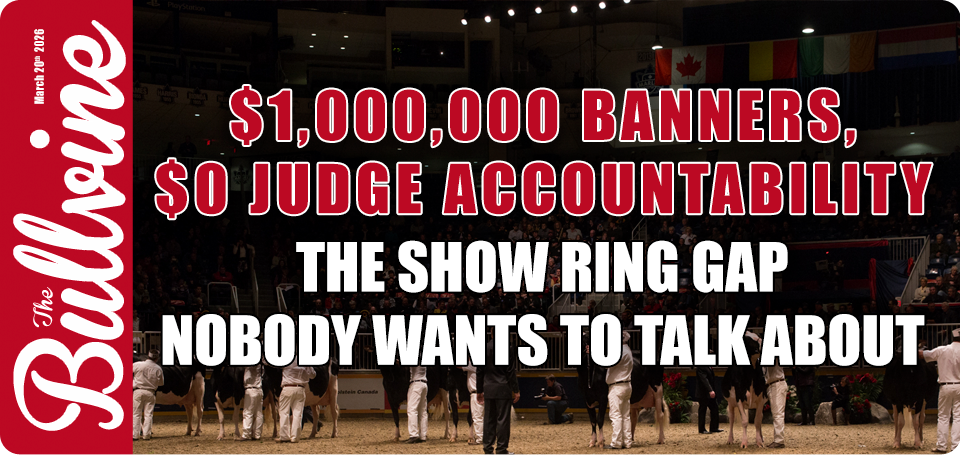





Before you hook up the trailer this show season, ask one question: will this show budget build your herd, or someone else’s brand?
In March 2025, the Purebred Dairy Cattle Association rolled out its toughest show ring ethics overhaul in a decade — new rules on over-bagging and misrepresentation that put exhibitors on notice with real penalties. Four months later, Olortine Avenger Design hammered at $1,000,000 at the International Intrigue Sale at Butlerview Farm in Chebanse, Illinois, proving exactly how much money now rides on a single banner.
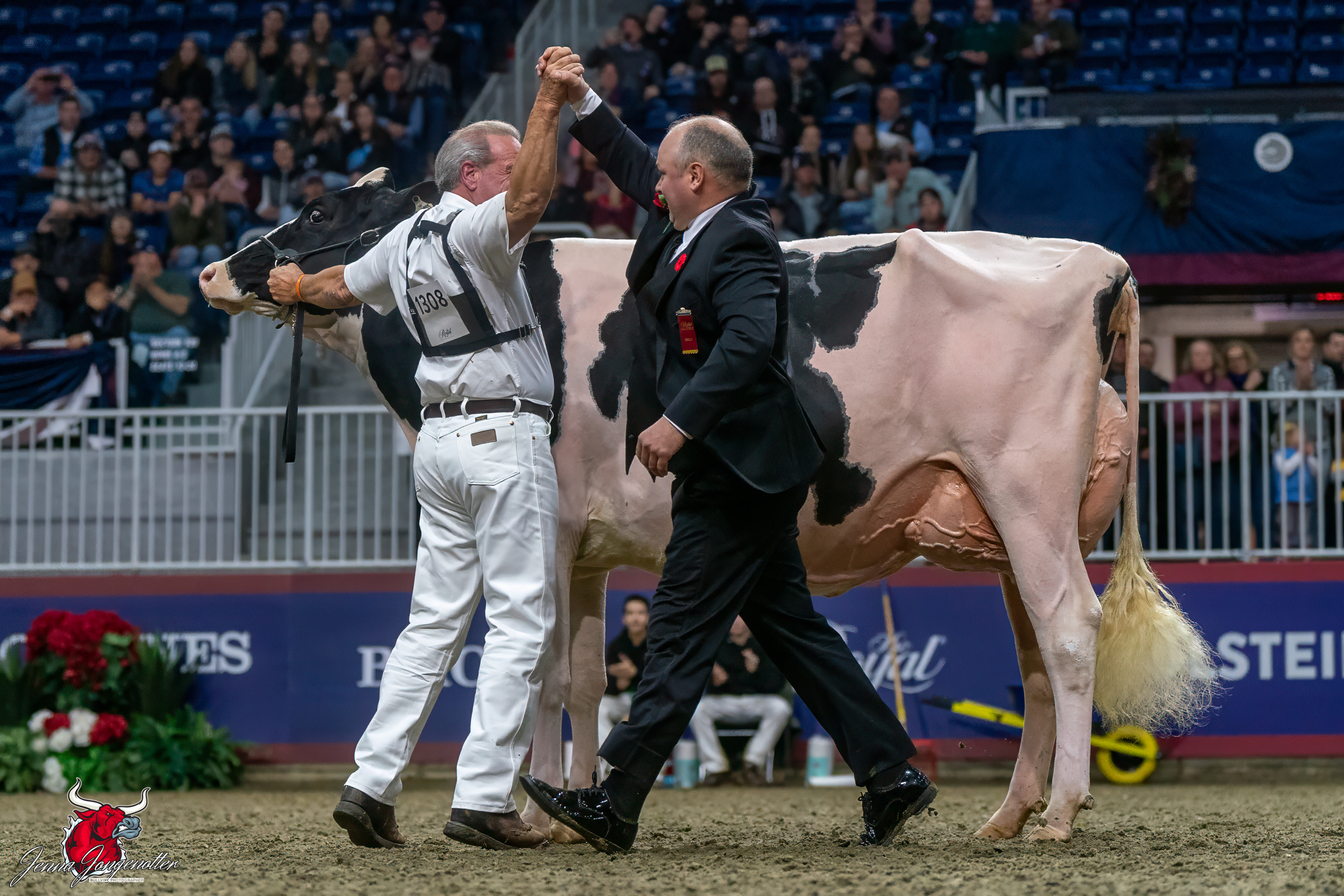
Here’s the disconnect. PDCA tightened the screws on the people holding the halter. But across most of North America, the person in the middle of the ring — the judge — still operates under rules you could fit on a napkin. When a Grand Champion title can realistically swing high six to low seven figures in lifetime genetics revenue, that gap between exhibitor accountability and judge accountability isn’t just an ethics conversation. It’s a financial one.
The Money That Changed Everything
For years, talk about politics in the show ring sounded like barn chatter. Same names. Same judges. Same faces in the backdrop. You shrugged and told your kids it was just part of showing.
The money has changed. The written standards around judging really haven’t kept pace.
To understand the stakes, start with one number: $1,000,000. That’s what GenoSource paid for Avenger Design — the VG-89 (max score) Mystique Avenger daughter who’d already earned Grand Champion at Western Dairy Expo 2025 and a major win at The Royal Winter Fair. She’ll now call Budjon home as a donor for one of the world’s most aggressive genetics programs. By the end of that July sale, 173 live lots had crossed the ring for a total of $4,298,525, averaging $24,846.97 per head.
Design earned her price tag on merit. But her sale is the clearest proof that show ring decisions now carry business consequences that would’ve been unthinkable a generation ago.
A few months before Intrigue, World Dairy Expo’s World Classic Holstein Sale averaged $30,245 across 55 lots, including an IVF session on OCD Sheepster 23614, then the #1 GTPI female in the breed, that brought $205,000 to Oakfield Corners from Semex. That’s one donor, one lot, and it’s a bigger cheque than many parlor upgrades.
On the IVF side, the multiplication keeps stacking. When you’re talking about a donor that can produce dozens of embryos per flush and hundreds over her productive life, every extra notch of perceived “elite” status matters. Put a legitimate banner on a female like that, and every IVF session, embryo package, and daughter that walks through a sale picks up an extra shine.
Oakfield Corners Dairy has seen that effect first-hand. When Oakfield Solomon Footloose went Supreme Champion at World Dairy Expo in 2022 and returned as Grand Champion of the International Holstein Show in 2024, demand for that cow family’s genetics didn’t just rise — it spiked. A banner doesn’t create quality where there isn’t any, but it does drive more eyes, calls, and bids toward the cattle that already have it.
Meanwhile, the rule books have been rewritten — but mostly for the people on the halter, not the person in the middle.
What Changed in the Rulebook — and What Didn’t
The PDCA changes were the first major update in a decade, following a unanimous Board vote in December 2024. They covered the Show Ring Code of Ethics, Showmanship Guidelines, and the Dairy Cow Unified Scorecard,which underpin most North American dairy shows.
The revised Code of Ethics doesn’t dance around specifics. It explicitly calls out over-bagging and misrepresenting an animal’s lactation status as violations — the kind of “finesse” everyone has seen, and too many have ignored. Topline hair allowance moves from 1 inch to 1.5 inches, while the Unified Scorecard now gives fore and rear udder attachment equal 7-point weight in the mammary system section. Showmanship guidelines tighten expectations for how exhibitors lead, set up, and present animals in the ring.
World Dairy Expo followed with its own overhaul. WDE updated its Code of Ethics and Showring Policy for 2025, with changes beginning on page 24 of the Premium Book. Board President Bill Hageman said the revisions emphasize clearer rule definitions, a more efficient violation process, and a more structured approach to assessing responsibilities and penalties.
Expo’s update sits inside a broader framework. Exhibitors must agree to WDE’s Rules, Regulations, Showring Policy, and Code of Ethics as a condition of entry, and violations can lead to forfeiture of premiums, disqualification, and suspension from future shows. At the national level, the IAFE National Code of Show Ring Ethics and language, adopted by events like the Calgary Stampede, calls for violators to be barred from future competition.
For exhibitors, that’s real enforcement power on paper. For judges, there’s still a big hole.
Exhibitors vs. Judges: Who Actually Has Rules?
Right now, exhibitors are under more scrutiny than the person picking your winners. That’s not opinion — that’s how the paperwork reads.
What exhibitors face vs. what judges face
| Area | Exhibitors (PDCA / WDE) | Judges (typical dairy show) |
| Written ethics code | PDCA Show Ring Code of Ethics and WDE Premium Book clearly define violations and penalties. | Many shows have no public judge-specific ethics code; expectations are mostly implied. |
| Named violations | Over-bagging, misrepresenting lactation status, animal abuse and misrepresentation are explicitly covered. | Judge-side violations are rarely listed; there’s no standard cross-show list of misconduct. |
| Investigation process | Ethics committees can investigate complaints, gather evidence, and rule on violations. | Complaints about judges are usually handled informally by committees, if at all. |
| Penalties | Loss of premiums, disqualification of animals/exhibitors, written reprimands, suspension from future shows. | Few shows specify penalties for judge conflicts; future assignments are at committee discretion. |
| Conflict-of-interest standards | Exhibitors must follow prep rules and ownership/registration requirements. | No consistent requirement to disclose semen contracts, consulting work, or co-ownership with exhibitors being judged. |
Bottom line: exhibitors face detailed written rules and penalties; judge standards are often thinner on paper.
World Dairy Expo is the exception, not the rule. Judges at Madison are nominated and voted on by exhibitors, vetted by a Judge Selection Committee, and covered under a published ethics and showring policy. Most county, regional, and even some state-level shows don’t come close to that level of structure. In those rings, judge conflicts sit in a gray zone that everybody knows is there and nobody wants to write down.
How Much Is a Grand Champion Banner Actually Worth?
This is where you stop arguing about “politics” in theory and start looking at numbers you’d actually write on a barn-sheet.
Semen pricing and volume
You can see the spread in any AI catalog. High‑profile, heavily marketed sires coming from show‑ring cow families often run $10–$20 per dose higher than solid commercial sires without that kind of story behind them. Tools like BullVal$ and other semen value calculators show how sensitive a bull’s lifetime value is to small changes in price and unit sales.
Here’s a conservative scenario. Say show-ring exposure on a cow family helps push a related sire from “good bull” to “headline” status and supports an extra $10 per dose on 50,000 additional units over his career. That’s $500,000 in incremental semen revenue tied, at least in part, to one story that started in a show ring.
Embryos and IVF
At the World Classic, that IVF session on OCD Sheepster 23614 brought $205,000 to OCD. Embryos and pregnancies of banner cows and their close relatives routinely sell in the four- and five-figure range, especially when they combine show-ring success and high genomic rankings.
If a Grand Champion cow with a national-level resume sells even a couple of IVF sessions with a $50,000–$100,000premium each over what she’d have brought untitled, and moves 80–120 embryos over a few years at an extra $400–$800 per embryo because of her show record, you’re easily in the $130,000–$300,000 ballpark of extra revenue linked to that banner.
Auction hammer prices
The sale ring is where all of this gets cashed in at once. Avenger Design brought $1,000,000 at Intrigue on a day when the overall average was $24,846.97. That’s not just a premium; it’s a different category. Other banner-backed lots at elite sales regularly sell for well over six figures, even when the sale average is well under that.
Those cows and heifers aren’t just “pretty faces.” They come from deep cow families and strong genomic profiles. Without the banners, though, those same genetics likely don’t touch those numbers. It’s impossible to say exactly how much of each hammer price comes from the show ring versus the pedigree. It’s not a stretch to say the show record adds tens to hundreds of thousands to the value of some of these lots.
What it adds up to
On one page:
- Semen premiums: a realistic scenario of $500,000 extra over a bull’s career.
- IVF and embryo premiums: roughly $130,000–$300,000 in added revenue for a banner cow.
- Sale-ring uplift: $50,000–$250,000+ compared with what a similar non-champion from the same family might bring.
Not every Supreme or Grand Champion reaches those numbers. Some will fall short. A few will blow past them. The point is the order of magnitude. A true national-level banner can realistically move high six to low seven figures in lifetime genetics revenue.
At that scale, a judge’s decision isn’t only about who walks first out of the ring. It’s about who gets to sell that story for the next decade.
What Does This Cost the Families Standing at the Rail?
You rarely see a family storm out of the barn and announce they’re done showing. That’s not how this industry moves.
You do see it quietly. A kid who used to live for show season suddenly has “other priorities.” A breeder who hauled a full string every year decides to stay closer to home. A trailer that used to be parked on the rail at Madison is no longer showing up.
The research backs what you hear in the aisles. A Purdue University livestock ethics study found that youth who completed an ethics curriculum improved their understanding of ethical decisions and consequences in show programs. A separate survey of 4-H and FFA youth and parents in Pennsylvania and West Virginia documented how kids view twenty-three common livestock practices; they could clearly label what’s ethical and what isn’t, and reported seeing unethical behaviour in the barn more often than adults might admit.
On your own balance sheet, the tipping point is simple barn math plus your gut.
If you’re hauling a serious multi-animal string, once you count calves, feed, entries, fuel, hotels, fitting, and a few repairs, you can easily land in the $15,000–$30,000 a year range. Over a five-year junior window, that’s roughly $75,000–$150,000. Stretch into the open divisions over a longer career, and that total can push north of $200,000.
Here’s what that looks like in your notebook:
- Rough annual show-string spend for a serious family: about $20,000.
- Five-year junior window: around $100,000 total.
- Alternative use: that same $100,000 could be a serious chunk of a robot payment, a parlor remodel, stall upgrades, or IVF on your top 1–2% cows.
- Payback: those investments work for every cow, every day — whether your kid wins the class or not.
The moment a family decides the system isn’t as fair as it should be, that $100,000 starts to feel more like tuition in someone else’s marketing program than an investment in their own herd.
If you still believe a particular show gives your cattle a fair shot and helps build your herd’s story, then spending might make sense. The night you decide the balance of fairness isn’t there, those cheques start to feel like donations.
What Would Real Accountability in the Show Ring Look Like?
A fair ring doesn’t mean you agree with every placement. That’s never going to happen. Good judges see cows differently.
A fair ring means judges walk in with clean, declared hands — no undisclosed semen contracts, consulting deals, or co-ownership ties with the cattle they’re about to sort. It means exhibitors know what will get them tossed and have seen rules enforced even when it hurts important names. It means show management can point to a real process for handling complaints, not just “we’ll look into it.”
Other industries already solved this. The American Kennel Club runs formal conflict‑of‑interest rules for judges, enforces look‑back periods of six months to a year for ownership or handling ties with exhibitors, and backs it all with an enforcement ladder that runs from formal observation to lifetime suspension of judging privileges and fines up to $5,000. A dog show. For the full AKC framework and how a dairy version could work for your show committee, watch for our upcoming accountability playbook.
For most dairy shows — especially smaller fairs and regional events — real accountability isn’t complicated on paper:
- A judge conflict-of-interest disclosure form filed before the show, where judges list recent consulting, ownership, and semen/IVF relationships with exhibitors, plus clear recusal rules when conflicts show up.
- An ethics committee with at least one independent voice — someone who isn’t deeply financially tied to the main exhibitors or sponsors, empowered to review both exhibitor and judge issues.
- Basic exhibitor-retention tracking: how many families come once and never return, which juniors stop, which longtime exhibitors quietly scale back.
Major events like World Dairy Expo already have pieces of this in place; the real gap is at the local and regional level, where there often isn’t any written structure at all. None of this guarantees your cow wins. But it does change who takes the hit when someone crosses a line.
Is Your Show Budget Really Paying You Back?
You don’t owe anybody a trailer spot at a ring you don’t trust. But you do owe your farm an honest look at what that show budget has actually done for your herd.
If your annual show spend is creeping into the $15,000–$20,000+ bracket and you can’t point to specific semen orders, embryo deals, or sale-ring interest that came out of those appearances, it’s worth asking a tough question: Is this level of spend building your balance sheet or someone else’s brand?
The barn-sheet test is simple. Take last year’s total show spend — every dollar: fuel, entries, hotels, clipping, calves, truck repairs. Then run one scenario: if you redirected even 25–50% of that into facilities, robotic or monitoring systems, or IVF on your best cows, what does the five-year payback look like? You gain more predictable returns. You give up some backdrop photos and maybe a run at a banner. Only you can decide whether that trade still pencils out.
How Do You Pick a Ring You Can Still Trust?
You can’t fix every show. You can pick where you send your cattle.
Start with what you can see on paper. Shows that post a current Show Ring Code of Ethics, outline how complaints get handled, and explain at least the basics of how judges are selected are already ahead of the pack. World Dairy Expo, for example, posts its ethics policy, requires exhibitors to agree to its Showring Policy and Code of Ethics as a condition of entry, and explains in its materials how judges are nominated and approved. That doesn’t make Madison perfect. It does say they’re willing to be held to something.
Then look at what happens when there’s trouble. When an over-bagged udder or questionable prep job becomes the talk of the aisle, does the committee investigate and respond — or smooth it over? When a judge with a visible financial tie keeps landing the same herd on top, does anyone in a position of authority ask questions, or do they shrug?
You can’t control those meetings. You can decide whether your entries and sponsorship dollars are a vote for that culture.
Options and Trade-Offs for Farmers
You don’t have to torch your show program. But you do need to be straight with yourself about what you’re buying.
1. Keep showing — but only where the rules are real
When it makes sense: You can point to banners that translated into genetics or marketing payback — embryo sales, semen deals, or sale-ring premiums — and your kids are learning real stockmanship, marketing, and life skills. There are rings where you still feel your cattle are judged on merit.
What it requires: Getting pickier. Less “every show we can reach,” more “a few shows with real structure.” Focus on rings that follow PDCA-style ethics codes, show you an enforcement process, and publish their policies.
30-day action: Pick your top one or two target shows for the upcoming season. Call or email and ask for three things: their current Show Ring Code of Ethics, their complaint/enforcement process, and any written judge conflict-of-interest policy. If you can’t get those in writing after asking twice, treat that as a no-confidence signal and consider moving your cattle — and your cheque — somewhere else.
2. Scale back the string and put the saved dollars to work at home
When it makes sense: You like the ring, but the real engine on your farm is milk, components, and genetics — and you know most of your show spend is more passion than profit.
What it requires: Cutting back on the number of shows or animals and deliberately moving a slice of that budget into things that lift the whole herd, not just the ones that clip up well.
90-day action: Add up last year’s show costs: entries, fuel, hotels, fitting, calves, repairs, everything. Take 25–50% of that total and earmark it for one of three buckets: facility upgrades, a robot fund, or IVF on your top 1–2% cows. If a realistic five-year projection says those investments will pay back at 2:1 or better compared with what banners have done for you, you’ve got a clear direction.
3. Use your weight locally to push for judge accountability
When it makes sense: You sit on a committee, sponsor a show, or you’re a breeder whose name carries weight in the barn. People listen when you speak up.
What it requires: Being willing to push for structure in rooms where people are used to doing things by handshake.
365-day action: Pick one reform to champion at the show where you’ve got the most leverage. Three realistic starting points:
- A written judge conflict-of-interest disclosure form filed before the show and kept on record.
- An annual enforcement summary (even anonymized) shared with exhibitors, so they see when rules are actually applied.
- One independent seat on the ethics or show committee for someone without deep financial ties to the main exhibitors or sponsors.
You may not get everything in one year. You’ll quickly find out which shows want real integrity and which want clean-looking rules.
Key Takeaways
- If your annual show spend is pushing past $15,000–$20,000 and you can’t point to specific genetics or marketing payback, treat that as your trigger to run the “2:1 redeployment” test. If facilities or IVF would realistically give you twice the return that banners have, it’s time to rethink how many miles you put on the trailer.
- If you ask a show twice for their ethics code, complaint process, and judge conflict policy and still get vague answers, believe what that silence tells you. That’s your clearest early signal that integrity sits below convenience in their priorities.
- If your juniors come home talking more about who knows who than about clipping, fitting, and cow care, it’s time to reassess what the ring is actually teaching them. At that point, the perception of politics may be shaping your kids more than the cattle are.
- If you sit on a show committee, track who doesn’t come back — not just who wins. Every time a committee chooses not to address a clear ethics concern, you may be losing families who still wanted to believe the ring was fair. The committee that counts both banners and exits is the one that can actually fix the problem.
The Bottom Line
When your kids look back on this stretch of their showing years, how do you want them to remember it — as proof that good cattle and honest work still counted, or as the moment they decided the odds were stacked in favour of someone else’s brand?
You can’t take the money out of the ring. A $1,000,000 cow makes that crystal clear. But you can decide which rings deserve your cattle, your time, and your money — and whether you’re building your own herd’s future or underwriting somebody else’s marketing plan.
If you want the deeper barn-sheet numbers on what a banner is actually worth at different herd sizes and breeding strategies, watch for the upcoming Tier 3 economics breakdown here at The Bullvine — it’ll walk the semen, IVF, and sale-ring math line by line. And if you’re on a show committee and want a concrete accountability checklist you can plug into your Premium Book this year, we’re building that playbook too, with PDCA, WDE, and other models as starting points.
So, here’s the straight-up question: Is the million-dollar banner good for the breed, or just the brand — and are you scaling back your string this year?
Learn More
- Super Bowl LX and the $869-Per-Cow Sire Gap: The Breeding Strategy Your Dairy Can’t Ignore – Delivers a one-page scorecard and a four-slot sire roster you can implement by Monday morning. You’ll gain the exact math to capture an $869-per-cow profit dividend, stripping away the guesswork from your next semen order.
- 9.57 Million Cows, 3.9 Million Replacements: Genetics Built This Dairy Herd Paradox – and 2027 Ends It – Exposes the structural reset hitting the 2027 market and delivers the long-term intelligence needed to position your herd. You’ll gain a strategic advantage by identifying the looming replacement gap before it forces your hand.
- Judge With Confidence: The Ultimate Playbook for Dairy Cattle Judging – Arms you with the ethical framework and evaluation patterns used by elite international officials to maintain ring integrity. You’ll gain the tools to identify—and demand—the transparency and decisiveness that protect your investment’s credibility.
 The Sunday Read Dairy Professionals Don’t Skip.
 The Sunday Read Dairy Professionals Don’t Skip.
Every week, thousands of producers, breeders, and industry insiders open Bullvine Weekly for genetics insights, market shifts, and profit strategies they won’t find anywhere else. One email. Five minutes. Smarter decisions all week.