For twenty years, I’ve covered this industry, writing about milk prices, genetics, and herd management. But this isn’t a story about any of that. This is a story about a young man fighting to walk again, and what happens when an entire industry decides to be family.
The phone call came to Vince Steiner at 3 AM New Zealand time. The kind of call every parent dreads.
Your son’s been in an accident. It’s serious. You need to get here. Now.
Twenty-four hours later, Vince was holding his unconscious son’s hand in a Canadian hospital, not knowing if Quinn would ever walk again. What I witnessed in the days that followed changed how I see this industry—and ourselves—forever.
When Everything Stops
Quinn Steiner was supposed to be celebrating. Twenty years old, working on a grain farm in Saskatchewan, feeling invincible the way young people do. He wasn’t even driving that night—just a passenger with friends, heading home after birthday drinks.
Three rolls later, his world was shattered.
The surgeon’s words still echo: “Two millimeters in any direction would have meant instant death. Another two millimeters the other way? Paralyzed from the waist down.”
Two millimeters. That’s the width of a dairy cow’s whisker. That’s how close we came to losing Quinn Steiner forever.
His C3 vertebra was “smashed,” as his father put it. Emergency spinal fusion surgery. C2-C4 fused together. T1-T6 stabilized. Medical terms that don’t capture the terror of that phone call or the desperation of racing across an ocean, not knowing what you’d find.
The Moment That Broke My Heart
Here’s what moves me most about this story, what I keep coming back to when I close my eyes.
When Vince arrived at that Canadian hospital, Quinn was barely conscious but somehow aware that his father was there. “The first seven hours with him, he held my hand the whole time. Even when he was asleep, he wouldn’t let go,” Vince told me, his voice breaking.
Picture that scene. A young man whose spine had been destroyed, whose future hung by millimeters, holding onto his father like an anchor in a storm. That image—of a father and son connected through the darkest night of their lives—that’s what this story is really about.
Not the medical details or the fundraising. It’s about what happens when everything else falls away and only love remains.
The Response That Changed Everything
I thought I knew how our community responds to tragedy. I was wrong.
Complete strangers in Hudson Bay, Saskatchewan—people who barely knew Quinn—started tracking down his boss, calling his worried mother in New Zealand, organizing support before his family even knew what they needed.
The nurse at Hudson Bay Hospital who cared for Quinn during those first critical hours? She reached out to his mother personally. Not because she had to. Because she wanted to.
Carrfields immediately stepped up, offering to handle the Brookview calf auction for free. Industry professionals from four continents began calling—not because Quinn was famous, but because he represented something precious: a young person choosing to build his future in the dairy industry.
What I witnessed was extraordinary. This wasn’t charity. This was family choosing to be family.
Against All Odds
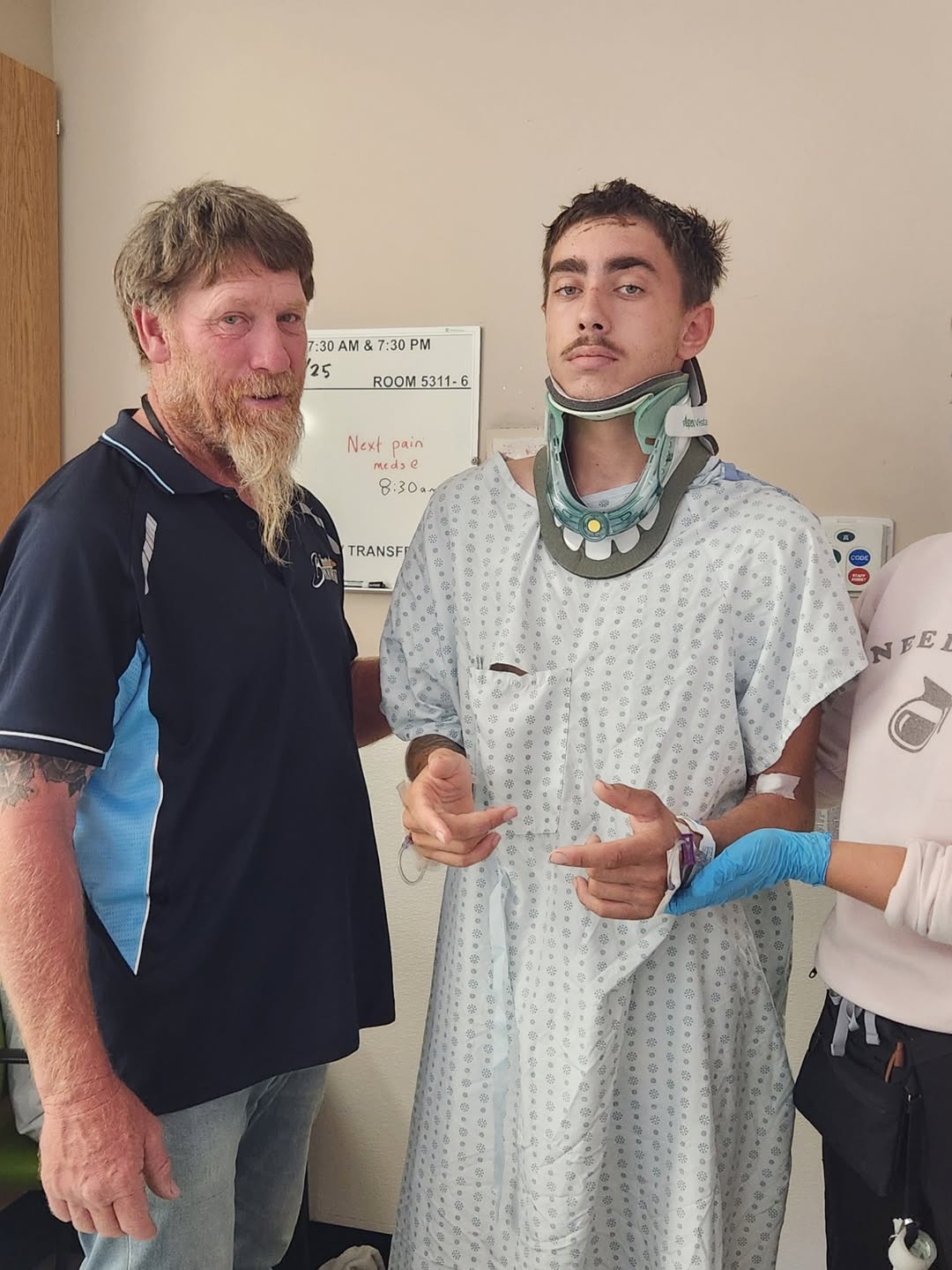
The photo his family shared shows Quinn standing again, wearing a neck brace but with something unbreakable in his eyes. The surgeon’s prognosis suggests he might recover 80% of his neck movement—miraculous considering the alternative was complete immobilization or death.
But recovery timelines are sobering: 6 to 18 months for bone healing, potentially two years for nerve damage to fully resolve. That’s two full seasons, two calving cycles, two years of life on hold.
Quinn isn’t just standing physically. He’s standing as proof that getting back up is possible. Every dairy family facing crisis can look at that photo and remember: survival isn’t just about making it through the worst day. It’s about believing in tomorrow.
Why Brookview Matters
You can’t understand the industry response without knowing what Brookview Genetics represents.
Under Vince’s leadership, they’ve been the most successful exhibitor at 11 of the 12 annual New Zealand Dairy Events. They’ve produced more Excellent-classified Ayrshire cows than any other breeder in New Zealand over the past five years. Their genetics improve herds from New Zealand to Kenya, from the UK to South Africa.
But statistics don’t explain why people from four continents are opening their wallets for Quinn’s recovery.
The real story is decades of Vince Steiner sharing knowledge, sharing genetics, building relationships that span oceans. When your breeding program helps a small family farmer in Kenya or a large-scale operation in the UK, you’re not just running a business—you’re building a legacy of generosity.
Now, when his family needs help, those relationships matter in the most meaningful way possible.
The Money Reality
Let’s be honest about what Quinn’s family faces. No medical insurance. Emergency spinal fusion surgery in Canada. Ongoing rehabilitation costs that will easily exceed $100,000 before Quinn can safely travel home.
That’s potential financial devastation for a farming family. The kind of crisis that destroys futures, not just because of initial costs but because of long-term care requirements.
Here’s how your support translates to real help:
- $50 covers a day of specialized rehabilitation therapy
- $200 pays for weekly recovery accommodation
- $500 helps fund the specialized medical transport Quinn needs to get home safely
Every dollar matters because it’s not just about money—it’s about a young man’s future.
When Crisis Reveals Character
What moves me is watching an industry that argues about everything—breeds, feeding systems, regulations—drop those disagreements instantly when it matters.
We can be territorial, opinionated, sometimes downright stubborn. But when a young person’s future hangs in the balance, none of that matters.
What matters is the stranger in Saskatchewan wanting to help. The auction company is waiving fees. The farmers contributing money they might not have because helping Quinn feels more important than financial caution.
This response revealed something I’ve always suspected but never seen proven so powerfully: beneath all our competition and market pressures, we’re family.
The Lessons Only Crisis Teaches
Every contribution to Quinn’s Givealittle page represents someone making a choice: my family’s security matters, but so does yours. Every share of his story says: this young man’s future is worth my time.
For any farming family reading this who’s facing their own crisis—financial, medical, personal—Quinn’s story offers proof that you’re not alone.
This industry’s greatest strength isn’t our technology or genetics, or marketing systems. It’s our willingness to hold each other up when life goes sideways.
That’s not sentiment. That’s a survival strategy. Because dairy farming is hard enough when everything goes right. When disaster strikes, having people who’ll hold your hand through the darkness isn’t just nice—it’s essential.
The Homecoming We’re Fighting For
I can picture Quinn stepping off that plane in New Zealand, probably still wearing his neck brace, probably tired, but home. His family is waiting. The community rallied around him, celebrating not just his survival but also his return.
That moment will represent more than one young man’s recovery. It will represent the power of human connection in an industry that sometimes forgets its heart.
Behind every herd number and genetic evaluation, there’s a family. Behind every business transaction, some people care about each other beyond profit margins.
How This Story Continues
Quinn’s recovery is far from over. The road ahead includes months of rehabilitation, potential setbacks, and the long process of adapting to life after traumatic injury.
But he won’t walk that road alone.
Every dollar contributed shortens the distance between where he is now and home. Every message reminds his family they’re not forgotten. Every act of solidarity proves that our industry family isn’t just marketing talk—it’s living reality.
The young man holding his father’s hand through seven hours of uncertainty represents all of us holding onto hope when circumstances seem impossible.
And that’s the promise we make to every young person choosing to build their future in this industry: whatever happens, we’ve got your back.
The road ahead is long, but every dollar you contribute shortens the distance between where he is now and home. Donating to the “Get Quinn Home” Givealittle page isn’t just a transaction; it’s an act of solidarity. It’s our way of telling Quinn and the Steiner family: You are not walking this road alone.