Across the Fraser Valley and the I‑29 corridor, disaster relief is quietly deciding who becomes the buyer — and who becomes the bargain — in 2026.
Executive Summary: Three floods on Sumas Prairie turned U&D Meier Dairy into the test case for what happens when you stop betting your future on disaster relief. This article tracks how the Meiers went from 3.5 feet of water and 14 dumped loads in 2021 to just one missed pickup in 2025 by spending on pumps, drainage, and backup power instead of waiting for the next cheque. It explains how the $30.78 billion American Relief Act of 2025 and USDA’s $16.1 billion SDRP, combined with Deryugina and Kirwan’s moral‑hazard research, quietly push farms toward thinner insurance coverage and concentrate “growth capital” in the largest 5–10% of operations. A simple barn‑math run on a 200‑cow herd at 67 lb/day and a $19.55/cwt mailbox price turns a 10% disruption into a real‑dollar hit you can plug your own numbers into. Then it forces the uncomfortable test: if your government‑program income is higher than your net profit, you’re not really profitable — you’re dependent. You get four concrete ways to use relief money — pumps vs props, buffer vs expansion, catastrophe‑only vs operating patch — plus a 30‑day zero‑relief stress test to sit down and run with your lender.
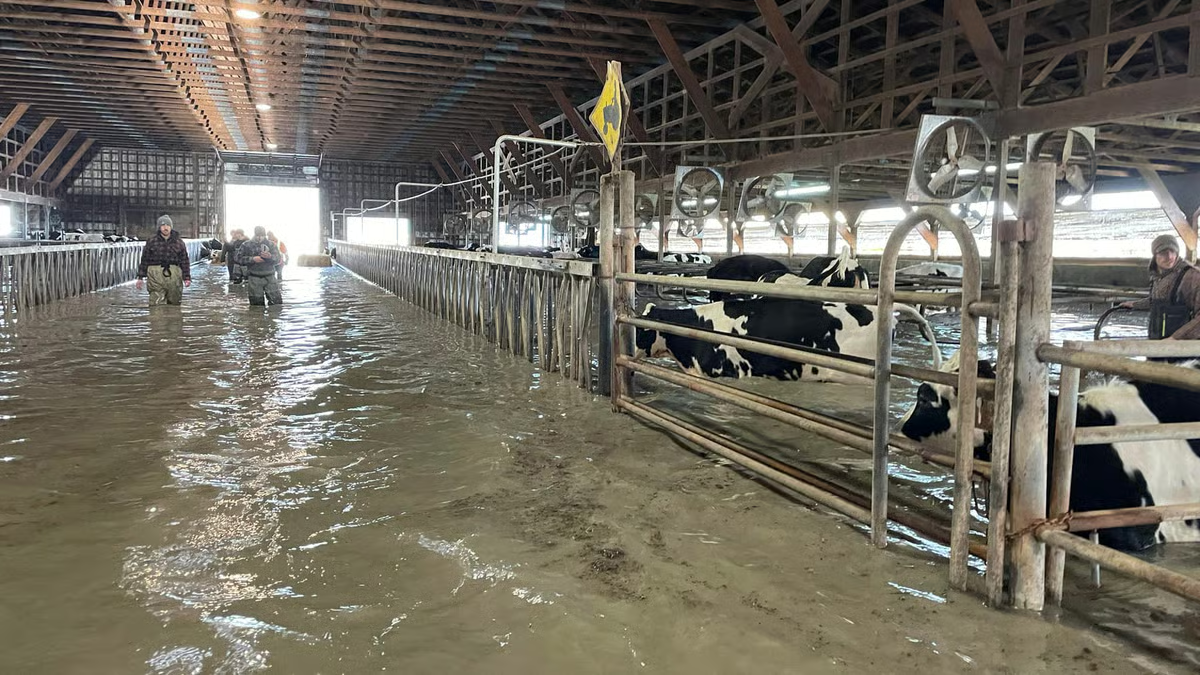
“I’m a 3‑time flood survivor now,” Rudi Meier told Dairy Star in January 2026. “I’ve been through the floods in 1990, 2021, and now this one.”
Rudi milks 200 cows with his brother Karl at U&D Meier Dairy near Abbotsford, B.C. — right on the old Sumas Lake bottom, one of the most flood‑prone stretches of farmland in the Fraser Valley. In November 2021, floodwater overwhelmed the prairie and filled their milking facility with 3.5 feet of water. They missed 14 milk pickups that week. Across the valley, millions of litres of milk never left the farms that produced it, and producers were told to dump loads when tankers and plants were cut off. In the wider region, about 628,000 poultry, 12,000 hogs, and 420 dairy cattledied in the floods, according to B.C.’s agriculture minister Lana Popham on December 1, 2021.
When heavy rain hammered the same valley between December 9 and 12, 2025, the Meiers missed one pickup. Same family. Same bowl of land. Very different outcome.
It wasn’t because Ottawa rolled out a nicer program. “We ran six 2‑inch gas pumps pretty much for a week straight, and we had pumps in the basements of the houses,” Rudi told Dairy Star. “The barnyard was not as flooded… It didn’t get to the milk cows this time.” South of the border, the American Relief Act of 2025 set aside $30.78 billion for U.S. farm support — including $20.78 billion for 2023–2024 natural disaster assistance and $10 billion in direct economic assistance for 2024 commodity producers (Iowa State CALT, July 2025). That kind of money has helped many operations stay current with lenders during bad years. It also quietly reshapes how you, your banker, and your neighbours think about risk, coverage, and how tight you run the business.
Whether you’re milking in the Fraser Valley or the I‑29 corridor, the math is the same: if Uncle Sam or Ottawa is your primary risk manager, you aren’t a business owner. You’re a ward of the state.
What’s Changing in Disaster Relief — and Why It Matters to Your Dairy
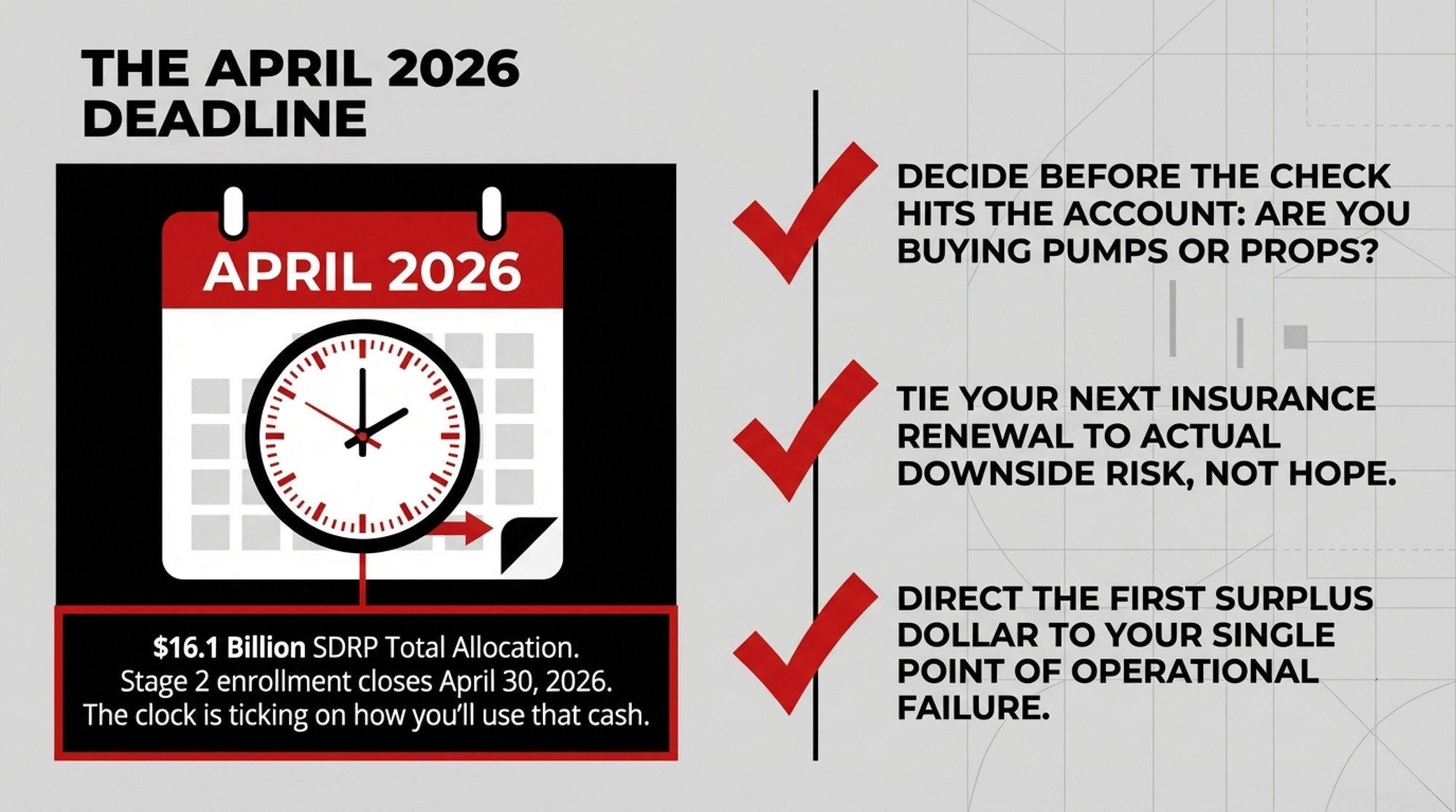
On paper, disaster relief looks straightforward: a bad year hits, Congress writes a cheque, cash fills the gap. Under USDA’s new Supplemental Disaster Relief Program (SDRP), more than $5.75 billion had been disbursed under Stage 1 as of November 30, 2025, out of a total $16.1 billion allocation (USDA FSA; Terrain Ag, Dec. 21, 2025). Stage 2 enrollment opened November 24, 2025, and closes April 30, 2026 (USDA FSA). That money can be the difference between patching a parlour and calling the auctioneer.
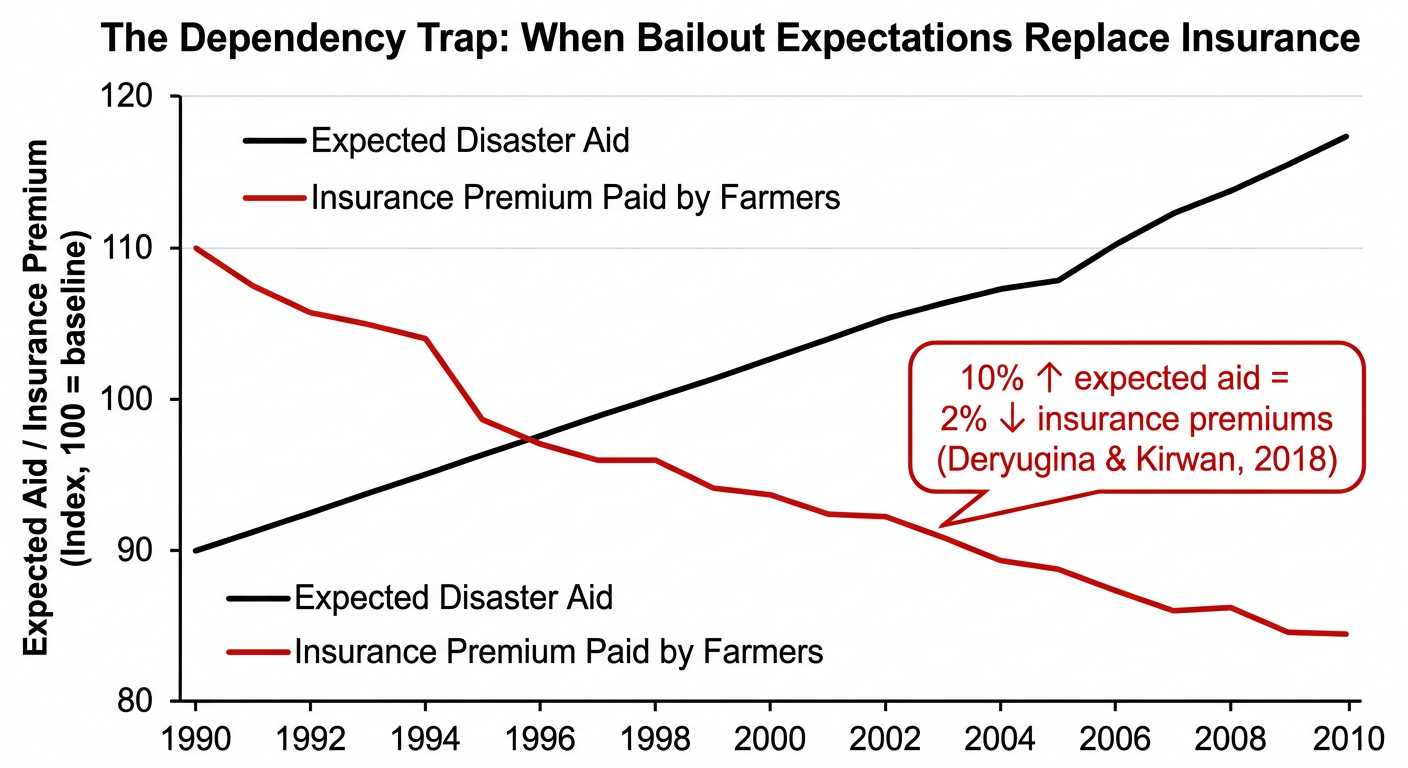
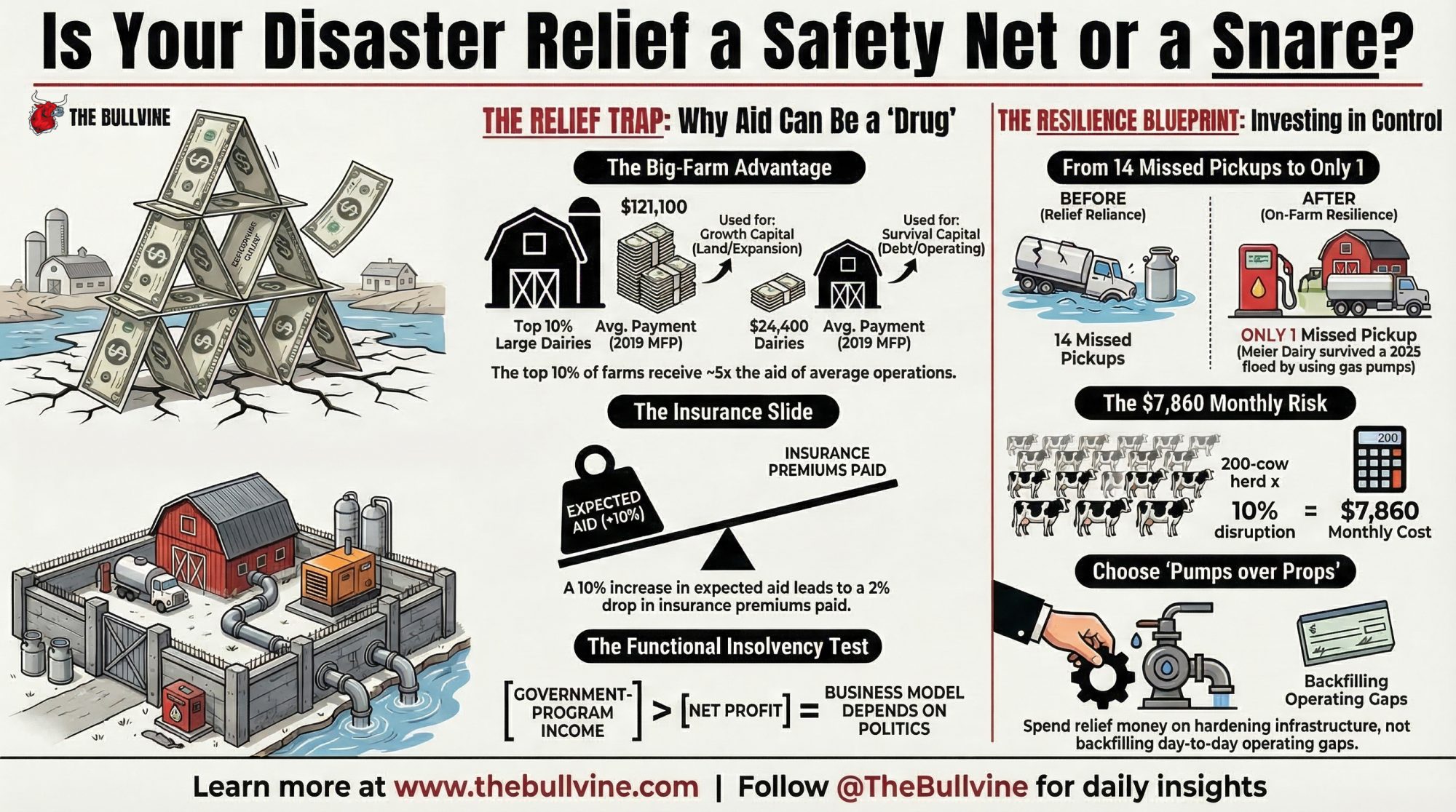
But something else happens underneath the relief. Research by Tatyana Deryugina and Barrett Kirwan, published in Economic Inquiry in 2018 and first released as NBER Working Paper 22845 in 2016, dug into U.S. crop data from 1990 to 2010 — a stretch when Congress provided ad hoc disaster payments every single year. They found that when farmers expect more disaster aid, they pull back on their own protection. A 10% increase in expected disaster payments was associated with about a 2% reduction in insurance premiums farmers actually pay, and farmers shifted toward less generous coverage when they assumed someone would bail them out.
That’s the mechanism nobody wants to name. Relief is a drug that makes you comfortable with being fragile.
Why Your Neighbor Hopes You Take the Check
Policy design doesn’t just change behaviour. It changes who wins.
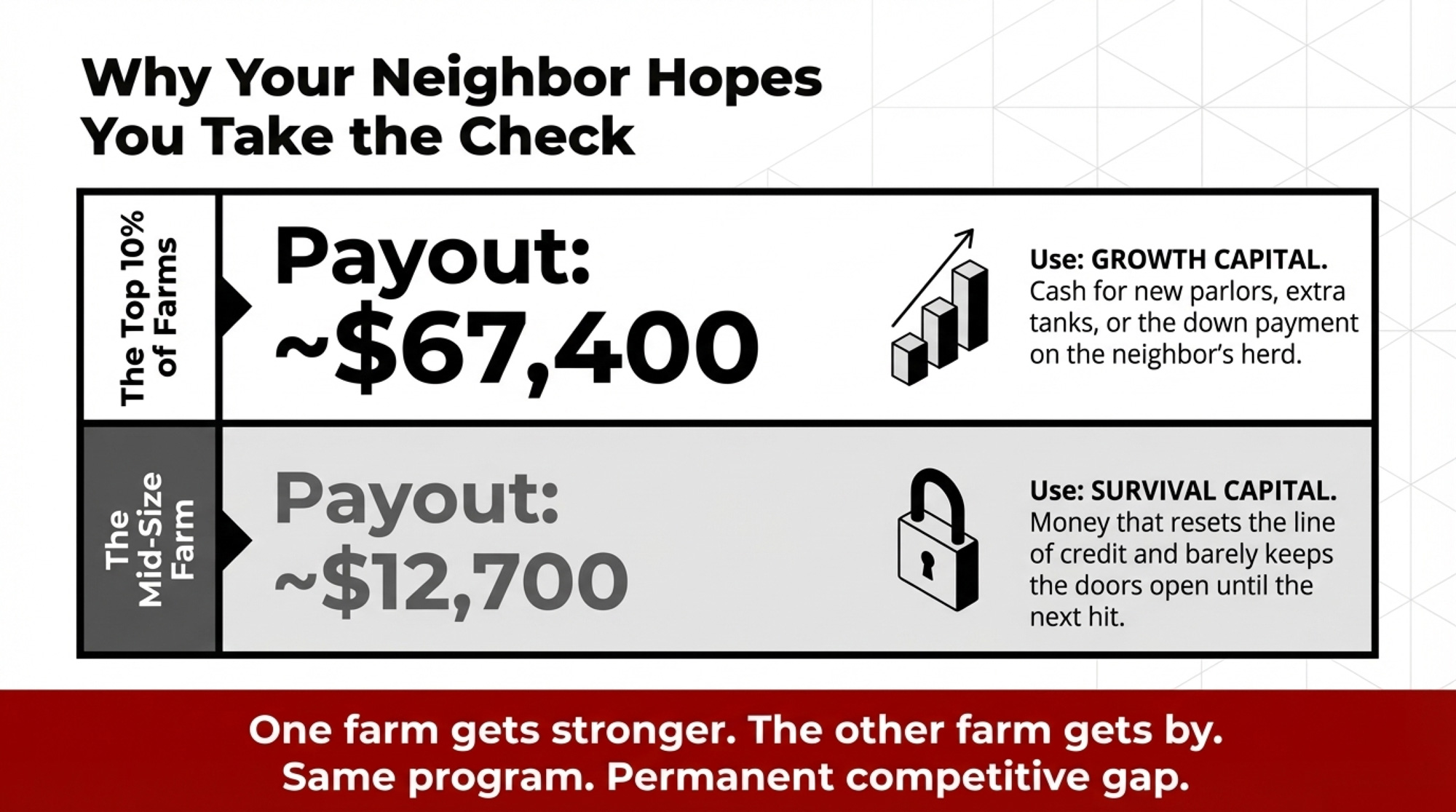
A study by Eric Belasco and Vincent Smith at Montana State University, published in Food Policy in 2021 and widely cited by AEI, examined the 2018 and 2019 Market Facilitation Programs. The largest 5% of farms received 34.3% of total MFP payments in 2018 and 32.1% in 2019. Under the 2018 MFP, the largest 10% of farms received per‑farm payments roughly five times the overall average: about $67,400 vs. $12,700. Under the 2019 MFP, the gap was $121,100 vs. $24,400 (Belasco & Smith, Food Policy, 2021, Tables 2 and 3).
Those programs covered multiple commodities, not just dairy, but the pattern holds: when payouts key off acres or production history, the biggest players get the biggest lifelines.
And here’s where it gets uncomfortable. The big operations don’t use that cheque to patch a fence and limp through another year. They use it as growth capital — cash for new parlours, extra tanks, land purchases, or the down payment on the neighbour’s herd when it comes up for sale. For a mid‑size family dairy with thinner margins, the same program delivers survival capital — money that resets the line of credit and keeps the doors open until the next hit.
One farm gets stronger. The other farm gets by. Same program. Permanent competitive gap.
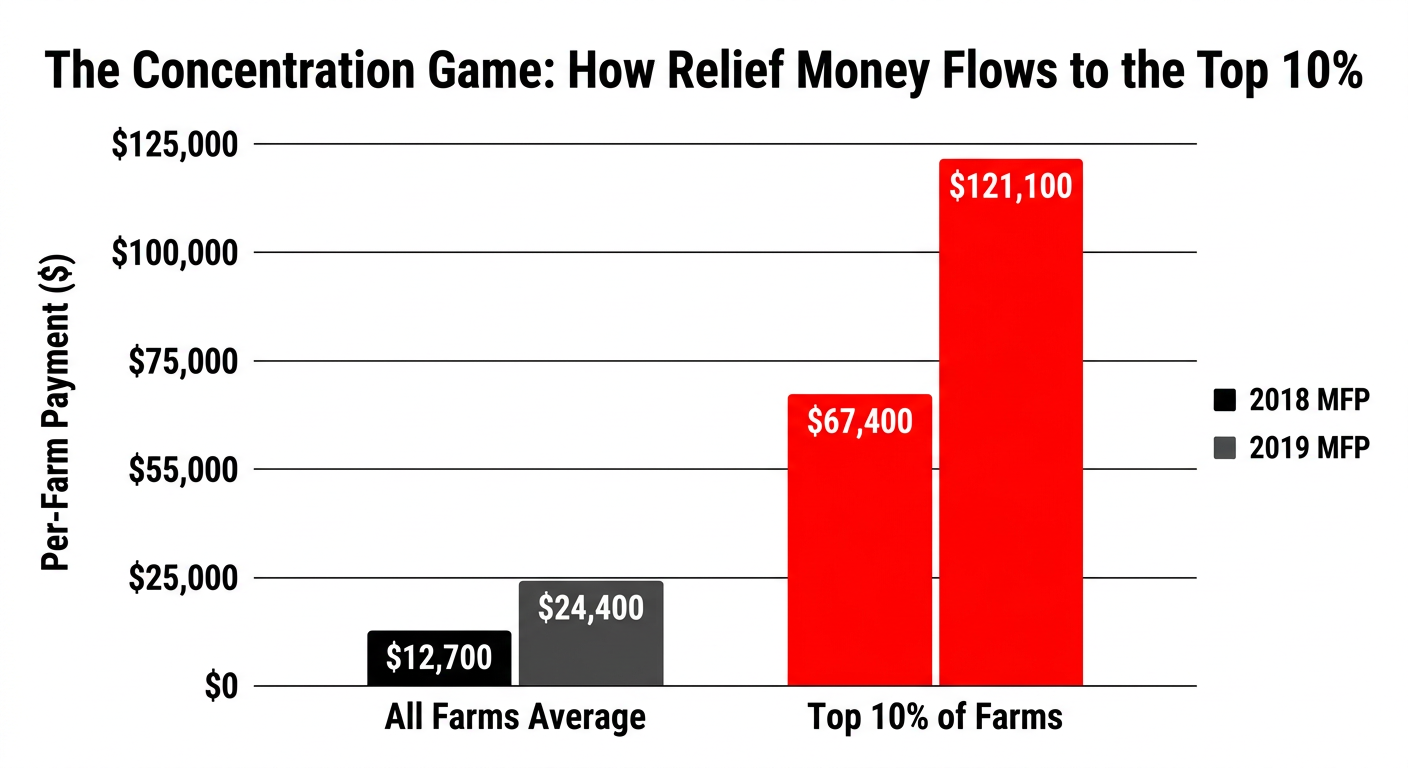
That gap compounds every cycle. After two or three rounds of ad hoc relief, the big operation has used the cushion to add cows, lock in processing contracts, and push down unit costs. The smaller operation has used the same cheques to survive — and is right back where it started, only older and a little more leveraged. When the next disaster comes, the big operation can self‑insure. The smaller one is back at the mailbox, waiting.
Your biggest competitor doesn’t need you to fail. They need you to stay dependent on the same cheques they’re using to grow.
How This Plays Out on Real Farms
You see it most clearly across the desk from the lender.
You sit down to talk about a refinance or adding cows. You know there have been disaster programs in the last five or ten years. Nobody writes “Future Relief” on the cash‑flow plan. But it’s there in the back of everyone’s mind.
So the plan leans a bit on luck. You shave coverage down a notch because the premium stings and “they’ve always stepped in.” You run working capital tighter because last time Congress came through. You push the generator, the pump upgrade, and the yard grading to “after we expand.” On paper, it still works.
That’s the Samaritan’s dilemma on a dairy: the more confident you are that someone else will cover you in a disaster, the less pressure you feel to build your own lifeboat. Deryugina and Kirwan didn’t just see lower premiums — they also found farmers moving into less generous policies and cutting back on inputs, with lower crop‑sale revenue in areas where bailouts were expected. Those choices don’t show up in the milk cheque next week. They shape how fragile you are when the next hit comes.
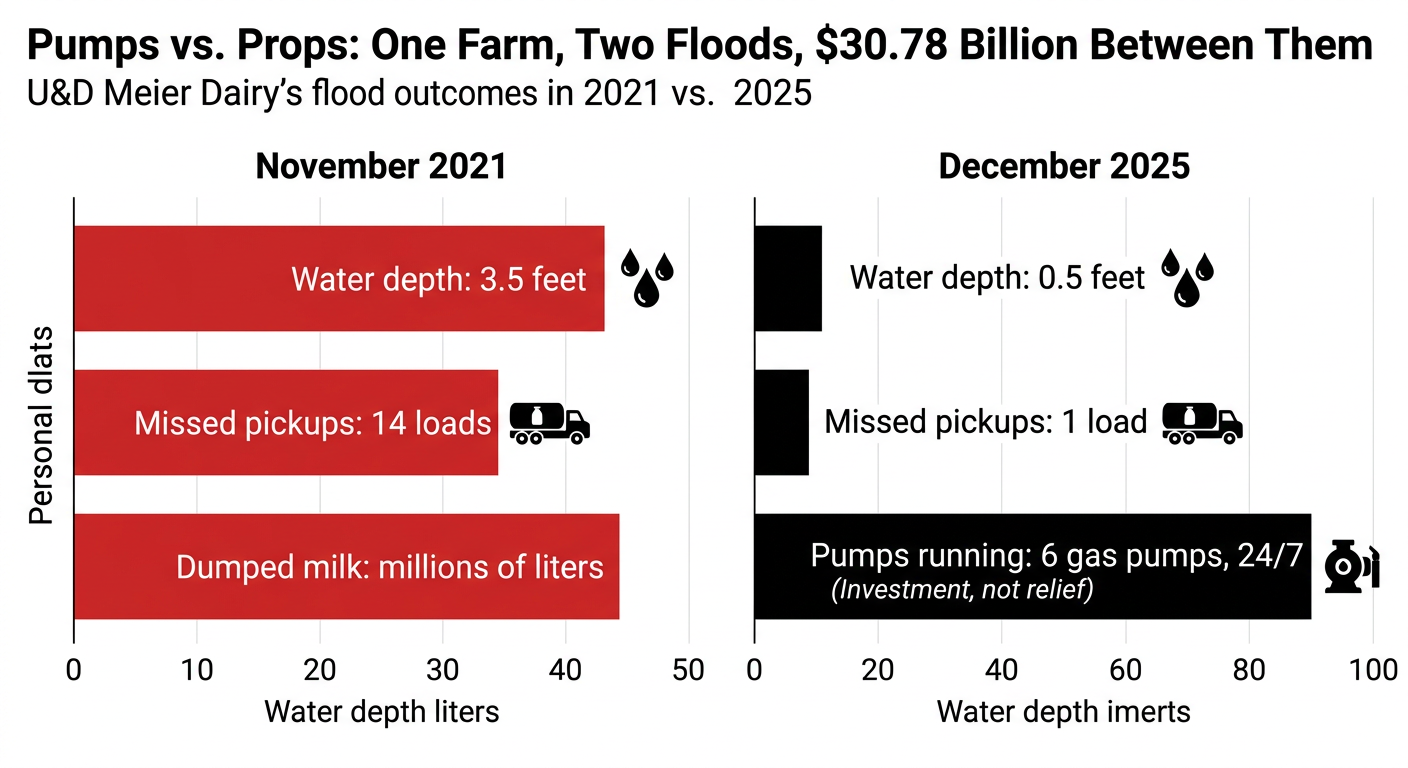
Back on Sumas Prairie, the Meiers didn’t erase flood risk. They accepted that water would come again. Rudi told Dairy Star the difference in 2025 was partly due to direction — the water broke more to the west this time — but also to preparation: running those six gas pumps around the clock and getting submersibles into the basements before the yard filled. “The water in our yard rose 2.5 feet in 20 minutes,” he said. “We were kind of concerned if there was more water coming.”
Up the road at B&L Dairy, Matt Dykshoorn milks 80 cows and faced the same call. In 2021, his cows stood in two feet of water for more than 24 hours. This time, he and his family watched the water levels and decided early whether to stay or go. “Our road is fairly low, so we have to make that decision before the water even gets to us, which is pretty tough,” Matt told Dairy Star. “Once you’ve made the decision, you’re committed.”
They stayed. “Thankfully, it stopped just short,” he said. “The water made it into the dairy barns, the alleys were wet, but the stalls and feed mostly stayed dry.”
Going from 14 missed pickups to one — and from cows standing in two feet of water to dry stalls — isn’t luck. It’s watching closer, moving faster, and spending money on the unsexy stuff between disasters.
The Mechanics Behind the Outcomes
Underneath the stories, a few simple mechanics are doing most of the damage — or the good.
Expectations change behaviour. Deryugina and Kirwan’s work provides a measurable relationship: a 10% increase in expected disaster aid was associated with about a 2% decrease in the insurance premiums farmers paid. More expected aid, less formal coverage. That’s not theory. It’s farmer choices showing up in the data. The study uses 1990–2010 crop numbers, but the pattern still fits what you’re seeing today: Congress keeps writing ad hoc cheques, and business plans quietly adjust around that.
Payment formulas change who plays offense. When programs like MFP and CFAP key off acres or historical production, the largest 5–10% of farms capture an outsized share — and then deploy it as growth capital (Belasco & Smith, Food Policy, 2021). For a mid‑size dairy, the same cheque resets the line of credit. That’s not a gap. That’s a ratchet.
Relief is a drug that makes you comfortable with being fragile. Rudi’s gas pumps didn’t add pounds of fat or protein to the next test. A deeper cash cushion doesn’t feel like “progress” when your neighbour’s new barn is going up. But those are exactly the things that kept U&D Meier Dairy shipping when the Nooksack spiked again last December. Every dollar you spend on resilience is a dollar that never shows up in a press release — and never needs to.
BC Dairy Association chair Casey Pruim put it bluntly after the December 2025 flood: “Nothing’s changed as far as investments in flood mitigation.” The province has committed $76.6 million to upgrade the Barrowtown Pump Station in Abbotsford (BC Government, Feb. 13, 2024) and $3.3 million to the Sumas River Watershed Flood Mitigation Initiative (BC Government, Jan. 27, 2026), as well as other recovery and adaptation funding across the region since 2021. That’s real money. But government infrastructure timelines run in years, and the next atmospheric river doesn’t wait for blueprints.
Rudi himself acknowledged the local response improved — “They have spent four years cleaning the rivers and ditches; they put backup generators on the pump stations” — while noting the federal government is “not supporting British Columbia with enough money.” On‑farm resilience is the only defence you actually control.
How Much Does Planning on Relief Really Cost You?
Let’s put some barn math on this — not scare numbers, just a way to make the research usable.
| Metric | 200-Cow Herd | Your Herd |
|---|---|---|
| Herd Size | 200 cows | ___________ |
| Average Daily Milk/Cow | 67 lb | ___________ |
| Monthly Production | 4,020 cwt | ___________ |
| Mailbox Price (Sept 2025) | $19.55/cwt | ___________ |
| Monthly Gross Revenue | $78,600 | ___________ |
| 10% Disruption Loss | -$7,860 | ___________ |
| 2025 Net Profit | ___________ | ___________ |
| 2025 Government Income | ___________ | ___________ |
| Net Profit > Gov Income? | YES / NO | YES / NO |
Take a 200‑cow herd, the same scale the Meiers run. According to USDA NASS, U.S. cows averaged about 24,390 lb per cow in 2025 — roughly 67 lb/day (USDA NASS, Milk Production report, Feb. 20, 2026). The U.S. average mailbox milk price for September 2025 was $19.55/cwt, down 48¢ from August and $5.23 below a year ago. At that price, a 200‑cow herd at 67 lb/day ships about 4,020 cwt per month and grosses roughly $78,600 in milk revenue.
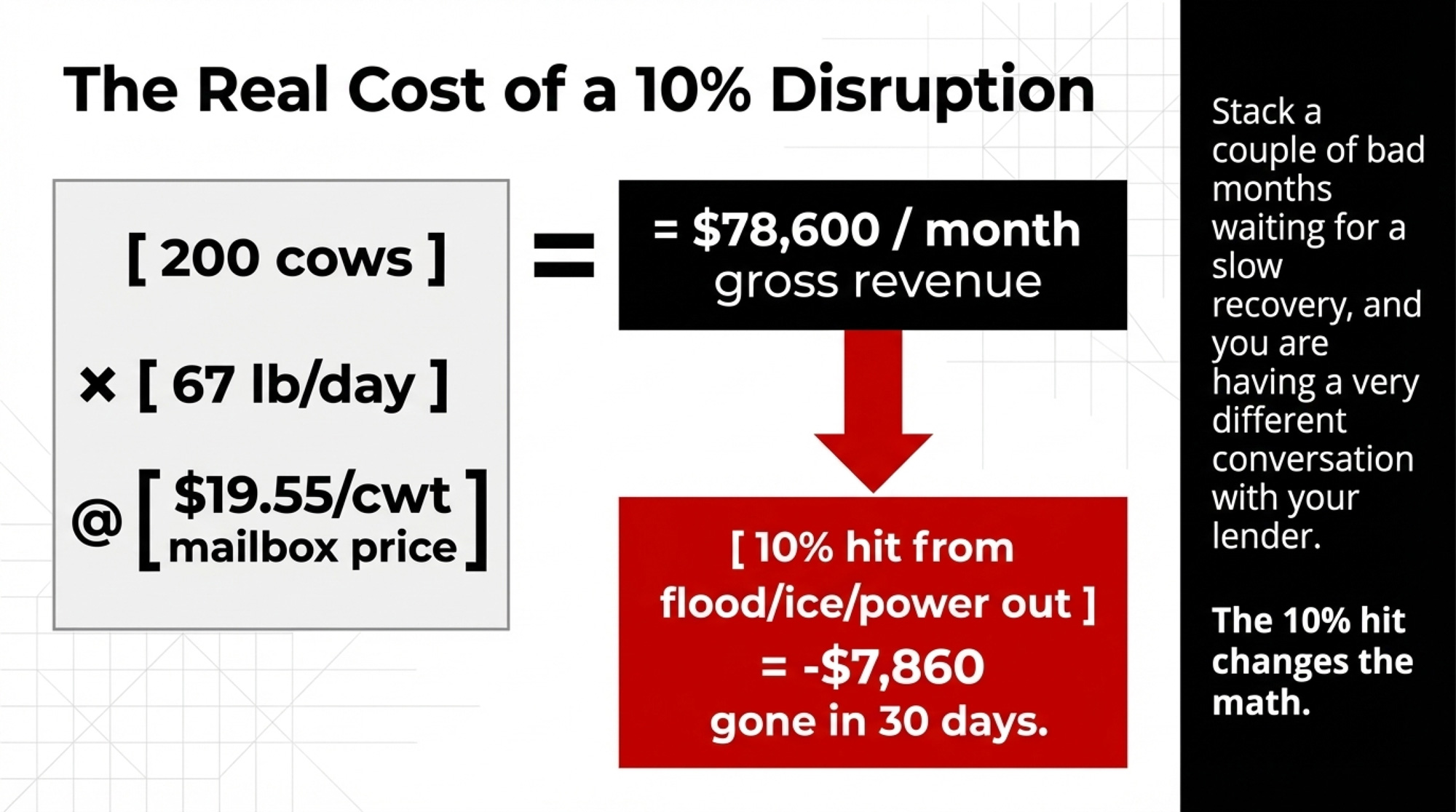
Now suppose a disruption — a flood, an ice storm, a prolonged power outage — takes out 10% of your shipments for a month before you can get everything running again. That’s about $7,860 in gross revenue gone for those 30 days. Not the whole cheque. Not catastrophic by itself. But stack a couple of bad months or a slower recovery, and you’re looking at the kind of hole that changes your next lender conversation. Across Sumas Prairie in 2021, that same principle multiplied across every dairy on the flat as loads were dumped and pickups missed.
If you’re in Canada, swap in your provincial blend price and your actual herd average — the 10% hit works out the same way in your own dollars.
The Stress Test You Should Run This Week
Now pull your 2025 P&L.
Highlight every line item that came from a government program — disaster payments, MFP, CFAP, SDRP, AgriStability, whatever carries a government return address. Add it up.
Now compare that total to your net profit for the year.
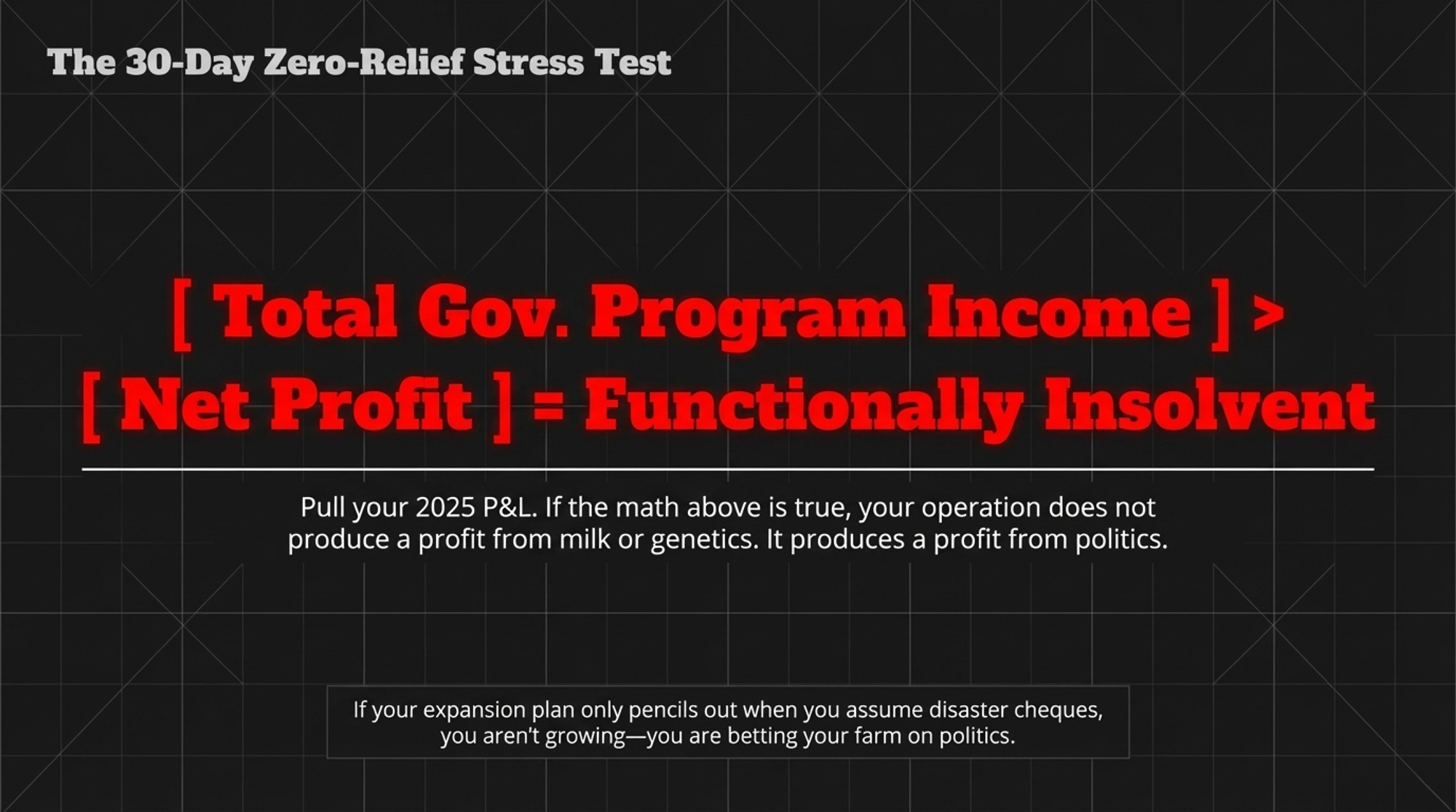
If your government‑program income is larger than your net profit, you are functionally insolvent without subsidies. Not “benefiting from programs.” Not “leveraging a safety net.” Insolvent on a cash‑flow basis. Your operation, as currently structured, does not produce a profit from milk, genetics, or any product you actually sell. It produces a profit from politics.
That doesn’t mean you’re a bad manager. It means your business model has a single point of failure you don’t control — and every year you don’t fix the underlying math, the dependency deepens. The next cycle of ad hoc relief will feel like oxygen. It’s actually the sedative keeping you still while your bigger, better‑capitalized neighbour gets further ahead.
Deryugina and Kirwan’s finding layers right on top: if the expectation of disaster aid nudges your coverage decision by even 2%, that’s a gap between what your insurance would have paid and what you now carry yourself. Not the kind of number that jumps off a spreadsheet. The kind that shows up as a surprise when the claim doesn’t cover what you thought it would.
How Do You Keep Relief Money Out of Your Expansion Math?
This is the economic question that rarely gets said out loud.
Take your latest expansion, refinance, or equipment plan and run it twice:
- Version A: the way you’ve been looking at it.
- Version B: same prices, same yields, same costs — except you assume $0 in ad hoc disaster aid or emergency programs over the life of the plan.
If Version B falls apart — covenants breached, cash flow negative, no room for a bad month — you’ve just proved your growth plan depends on politics and programs you don’t control. That doesn’t mean you abandon the plan. It means you stop pretending relief is “extra” and start treating it as the fragile thing it is.
The framing that lands best isn’t “we’re being cautious.” It’s “who gets to be the buyer next time things go sideways?”
Your neighbour just used their last cheque to add 100 cows. You used yours to harden power, water, drainage, and working capital. You’re not playing the same game. They’re betting the next program lands on time. You’re betting that you’ll still be milking — and still be bankable — when cows, land, or quota quietly go on sale.
What’s the One Weak Link That Would Stop You Milking Tomorrow?
On the management side, there’s a question that cuts through the noise: “What’s the one thing on this farm that, if it failed during a storm, flood, fire, or long power outage, would stop us milking or stop the truck from getting here?”
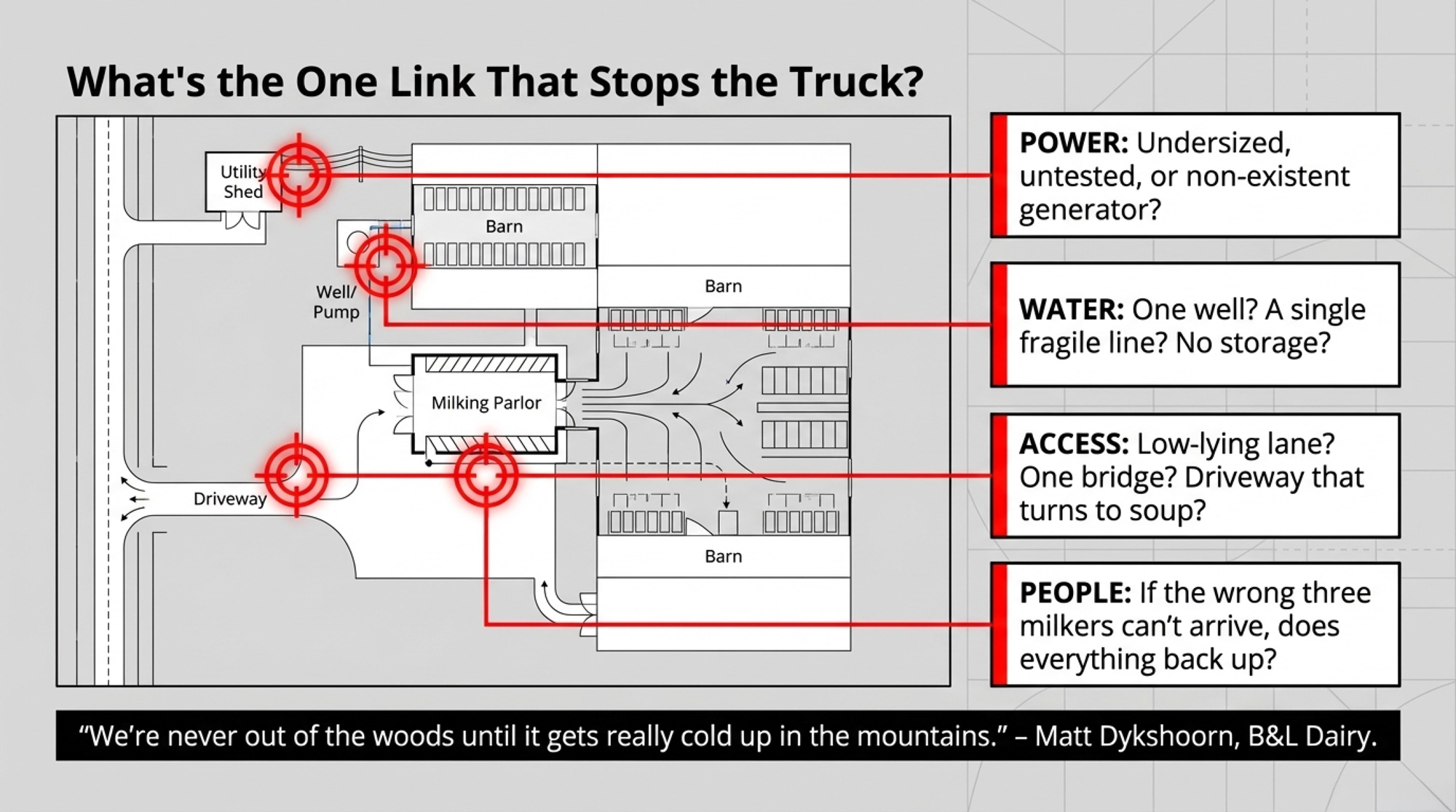
For some herds, it’s power — the generator is undersized, untested, or doesn’t exist. For others, it’s water: one well, one fragile line, no storage. For some, it’s access — one bridge, one low‑lying lane, one driveway that turns to soup. And for more than a few, it’s people: if the wrong three milkers or feeders can’t get to the yard, everything backs up.
Matt Dykshoorn made the point that 2021 caught everyone off guard. “I grew up hearing, ‘We’re never going to see a 1990 flood again,'” he told Dairy Star. “Well, in 2021, the water got three feet higher than in 1990, which just blew everybody’s minds. We underestimated at that point, and we were watching it a lot closer this time.”
That closer watching is the key. Not a silver‑bullet infrastructure project. Not a government program. Just the discipline to identify your weak spots, watch them harder, and act faster than you did last time. Matt summed it up: “That tells us we’re never out of the woods until it gets really cold up in the mountains.”
How many dairies carry some version of a disaster response in people’s heads? Plenty. How many have it written down and actually tested? Almost none.
Options and Trade‑Offs for Farmers
You’ve got a few paths when disaster money is in the air. None is perfect. That’s the point.
Path 1: Use Relief as a Buffer Builder, Not a Growth Down Payment
When it makes sense: When you’re tight on working capital, carrying more debt than you’d like, or there’s one obvious weak link — power, water, drainage, feed storage — that would stop you cold.
What it requires: Discipline and a separate bucket. Park the cheque in a dedicated reserve account or a farm management deposit where it can’t quietly bleed into everyday operating creep.
Risk/limit: The neighbour’s new parlour is visible; your bigger buffer isn’t. You have to be okay with looking slower on the outside to be stronger on the inside.
30‑day action: Sit down with your lender and run the zero‑relief stress test on your current‑year plan. If the numbers only work when you assume programs, pick one reserve or resilience investment and commit to it this quarter.
Bullvine Bottom Line: The farm that looks boring between disasters is the farm that’s still milking after one.
Path 2: Buy Coverage You Won’t Regret
When it makes sense: When you’ve been trimming insurance because the premium hurts and bailouts feel likely. Deryugina and Kirwan’s data says that’s exactly what farmers do when they expect aid.
What it requires: A coverage decision rule that isn’t “what feels right this renewal.” Tie coverage level to your maximum acceptable downside — how much revenue you could lose and still stay inside covenants.
Risk/limit: Premiums cut into cash flow in good years, and you’ll sometimes feel like you “wasted” money when nothing bad happens. That’s the emotional tax for being less dependent on Washington or Ottawa.
Bullvine Bottom Line: Insurance is expensive. But it’s cheaper than losing your equity to a political whim.
Path 3: Build the “Keep Milking” Systems Before You Add Cows
When it makes sense: If a power outage, road washout, or water issue would stop milking, stop pickup, or stop feed access — not just dent margin.
What it requires: Picking one unsexy project and finishing it. A properly sized generator and transfer switch. Fixing the drainage that always floods the lane. Adding a second water source. Rudi’s six gas pumps and basement submersibles kept U&D Meier Dairy shipping milk through the December 2025 flood — a storm that flooded Matt’s alleys just up the road.
Risk/limit: Once you pour the concrete or wire the generator, that capital is tied up. But so is the advantage when the next event hits, and you’re still shipping from the herd.
Bullvine Bottom Line: Rudi Meier went from 14 dumped loads of milk in 2021 to one in 2025. The pumps cost a fraction of what 14 loads down the drain did.
Path 4: Treat Disaster Programs as Catastrophe‑Only Money
When it makes sense: If you’re in a region where truly catastrophic risk — flood, wildfire, disease — is real, and you’re focused on not being wiped out, not just bruised.
What it requires: A hard rule that relief dollars only go to rebuilding and resilience — never to day‑to‑day operating holes or growth that increases your vulnerability. Replacing wrecked equipment. Shoring up lanes and yards. Hardening power and water.
Risk/limit: Tough in the moment to put conditions on “free” money. But this is how you avoid a business model that only works if Congress or Parliament keeps saying yes. SDRP Stage 2 is open until April 30, 2026; the clock is ticking on how you’ll use that cash — for pumps or for props.
Bullvine Bottom Line: Every relief dollar you spend on resilience is one you’ll never need to ask for again. Every one you spend on operating is one you’ll need to replace next cycle.
Key Takeaways
- If your government‑program income exceeds your net profit, you’re not farming — you’re subsidized.Pull the 2025 P&L this week and find out where you actually stand.
- If your expansion only pencils out when you assume disaster cheques, you’re not growing — you’re betting your farm on politics. Run the zero‑relief version before you sign anything.
- If you’ve been trimming insurance because “there will be a program,” tie your next renewal to your maximum acceptable downside, not to hope. The Economic Inquiry evidence says you’re not alone in that drift — and that’s exactly the problem.
- If a power, water, or access failure would stop milking, the next relief cheque or surplus dollar goes to that weak link before it goes to extra cows or equipment. The Meiers went from 14 dumped loads in 2021 to one in 2025 — and Rudi credits the pumps and closer watching of water levels.
- If you receive disaster money this year, decide before it hits the account: pumps or props? How much becomes permanent buffer — reserves, coverage, infrastructure — and how much backfills operating creep until the next cheque.
You don’t control when the next program is written, or how big the cheques are. You do control whether your risk plan still works if the answer next time is smaller, later, or no. Over $10 billion is still available in the USDA’s disaster relief pipeline. With a Stage 2 deadline of April 30, 2026, the clock is ticking — and the decision you make about that money matters more than the money itself. Pumps or props. Growth capital or survival capital. Buyer or bargain.
So before the next disaster season, ask yourself and your partners: if you knew, for sure, that no cheque was coming, what’s the one decision you’d make differently this month — and what would it take to make that move now?
Complete references and supporting documentation are available upon request by contacting the editorial team at editor@thebullvine.com.
Learn More
- The Triple Cushion Trap: Why 2025’s Strong Margins Won’t Save You in 2026 – Gain an immediate survival checklist for the 2026 transition. This piece delivers a hard-hitting audit of contract terms and labor efficiency, arming you with specific management shifts needed to bridge the margin gap before financial cushions deflate.
- The 18-Month Window: Why Your Lender Knows Your Dairy’s in Trouble Before You Do – Reveal the invisible timeline lenders use to grade your operation’s viability. This insight exposes how proactive planning preserves 40% more equity than waiting for a crisis, delivering the strategic advantage of choosing your own exit terms.
- Genetic Revolution: How Record-Breaking Milk Components Are Reshaping Dairy’s Future – Arm yourself with the 2025 genetic reset strategies that prioritize feed efficiency and component value over raw volume. It breaks down how to realign breeding goals to capture the $3.20/lb fat market, delivering a long-term competitive edge.
 The Sunday Read Dairy Professionals Don’t Skip.
 The Sunday Read Dairy Professionals Don’t Skip.
Every week, thousands of producers, breeders, and industry insiders open Bullvine Weekly for genetics insights, market shifts, and profit strategies they won’t find anywhere else. One email. Five minutes. Smarter decisions all week.