RAW FARM has weathered 7 outbreaks and 15 recalls. Could your 400‑cow herd survive even one hit like that?
Executive Summary: RAW FARM, the California raw‑milk giant formerly known as Organic Pastures, has been linked to seven outbreaks and 15 recalls since 2006, including a current E. coli O157:H7 raw cheddar investigation that’s sickened seven people in three states. CDC’s 2025 report on “dairy farm A” — widely identified as RAW FARM — logged 171 Salmonella illnesses and 22 hospitalizations, with 70% of cases in kids, showing how hard raw milk hits families when something goes wrong. On your farm, peeling 10% of a 400‑cow herd into raw or direct sales can look like an extra $580,000–650,000 a year, until you price in a realistic $3 million outbreak hit and see how much of that premium disappears. In our barn‑math Punch Test, that $3 million spread over 10 years adds about $8.33/cwt at 3,000 cwt/month — and a painful $25.00/cwt if you’re only moving 1,000 cwt/month. If your liability policy carries the ISO or AAIS raw‑milk exclusions insurance consultant Casey Roberts has flagged, that punch comes out of your equity, not your insurer’s cheque. Dog Mountain Farm in Washington put $75,000 into a USDA‑certified raw goat dairy and then found its carrier had quietly dropped raw‑milk coverage — a reminder that you can lose the safety net even before you have a claim. This article uses RAW FARM’s history, simple per‑cwt math, and a three‑path playbook to help you decide whether your own raw milk premium is strengthening your balance sheet or just turning into a $3 million gamble.
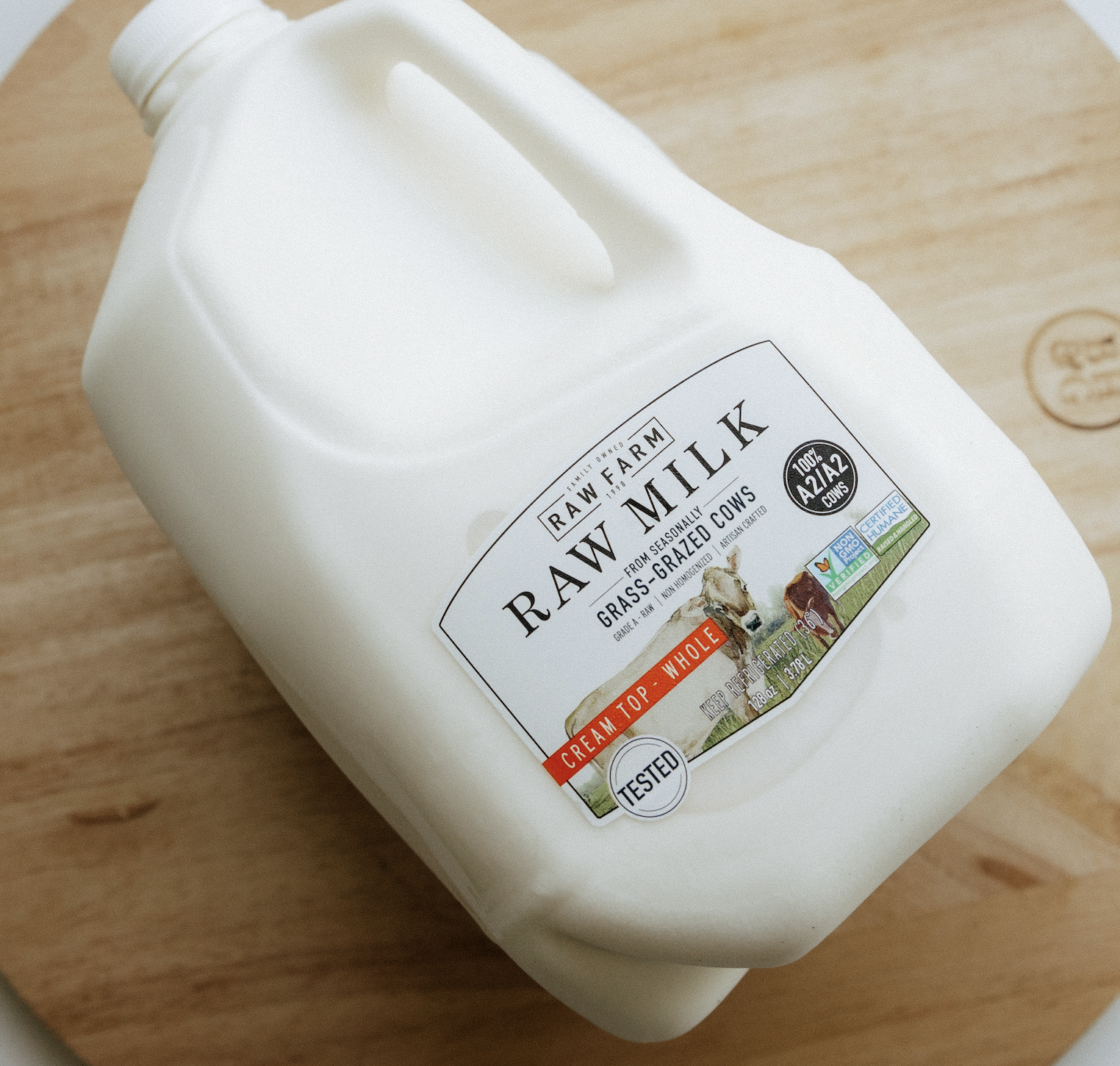
On March 14, the FDA posted the kind of notice that keeps direct‑sales dairies awake: an E. coli O157:H7 outbreak investigation tying illnesses in California, Florida, and Texas to RAW FARM raw cheddar cheese. Seven people confirmed sick across three states, with illnesses dating back to September 1, 2025. Two hospitalized. Four of the seven are children — median age three, youngest just one year old.
The FDA asked RAW FARM to voluntarily pull its raw cheddar from the market. The company refused. RAW FARM President Aaron McAfee told Brownfield Ag News the farm was “not participating in a voluntary recall because they believe the claims are false,” pointing to internal testing at every stage from cow to cheese vat to finished product. Some retailers pulled the cheese anyway — they didn’t wait for RAW FARM to decide.
Whole-genome sequencing confirmed that the E. coli strains from the sick are genetically closely related, suggesting the patients were likely exposed to the same source. If you sell anything direct — raw milk, farmstead cheese, on‑farm yogurt — this isn’t just someone else’s PR crisis. It’s a case study in what the risk curve looks like when a raw‑milk operation scales to about $30 million in annual revenue over two decades.
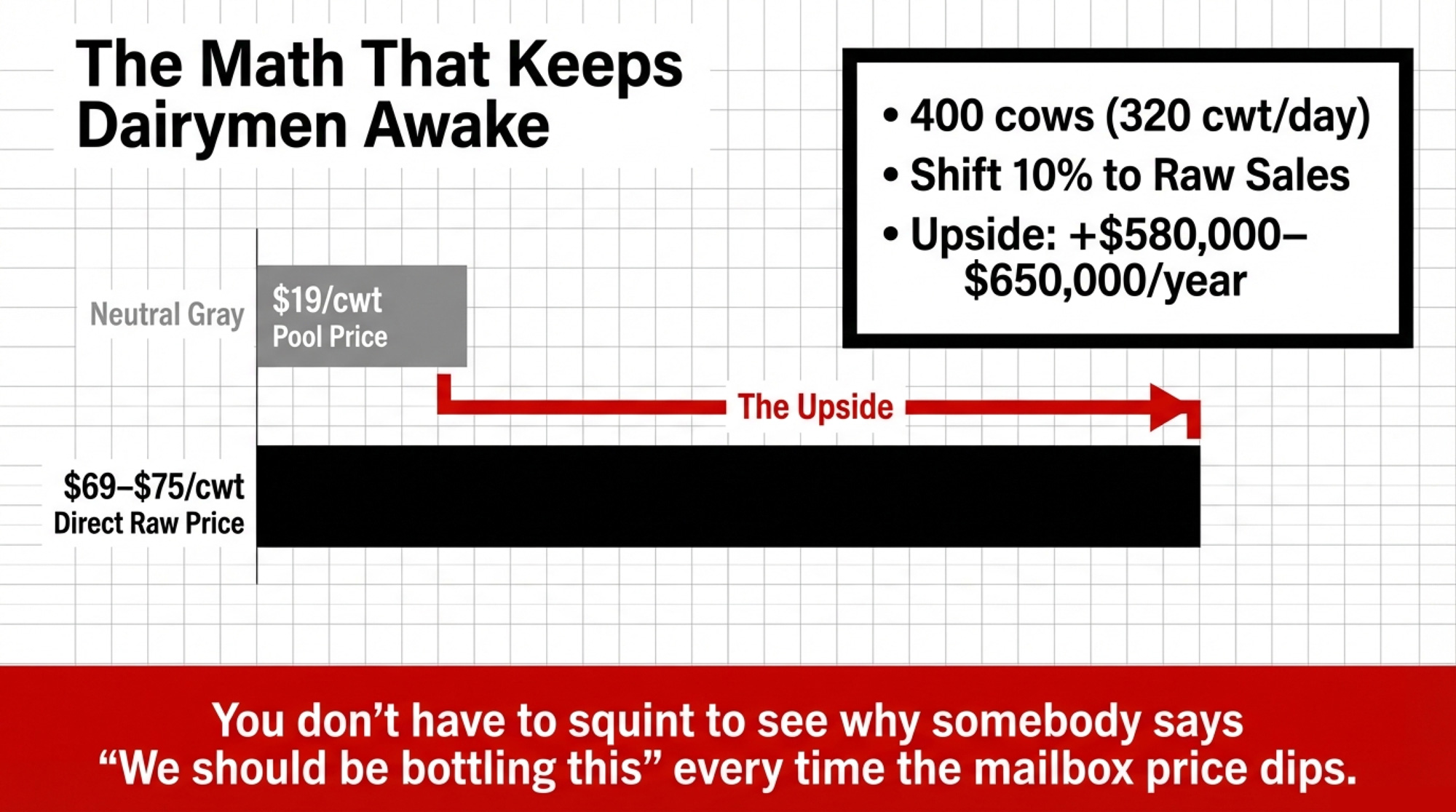
15 Recalls, 7 Outbreaks, and a $30 Million Brand
RAW FARM isn’t a cottage creamery that stumbled into trouble. Under the Organic Pastures name — rebranded to RAW FARM in 2020 after dropping organic certification — the McAfee family built what Forbes in December 2024 called “the country’s biggest producer of raw milk,” with sales exceeding $30 million. Their operation spans about 800 acres near Fresno, California, housing around 1,200 cows according to Mark McAfee’s own account to the New York Times during the current investigation. Before the bird flu quarantine disrupted production, the LA Times reported that 1,800 cows across two farms — Fresno and Hanford — were affected in December 2024.
As of early 2025, KFF Health News reported RAW FARM products available in nearly 2,000 stores, with raw cheddar distributed nationally. Labels emphasize wellness positioning — RAW, A2/A2, TESTED, NON‑GMO, CERTIFIED HUMANE — signaling a premium, health‑conscious brand.
A documented legal and regulatory history
According to federal court records and reporting by Food Safety News and Marler Clark, Organic Pastures pleaded guilty in 2008 to two federal misdemeanor counts of introducing misbranded food into interstate commerce. A federal Permanent Injunction followed in 2010. By July 2023, a U.S. District Court found violations of that injunction, and Mark McAfee accepted a Consent Decree — as reported by Food Safety News in its coverage of United States v. Organic Pastures Dairy Co.
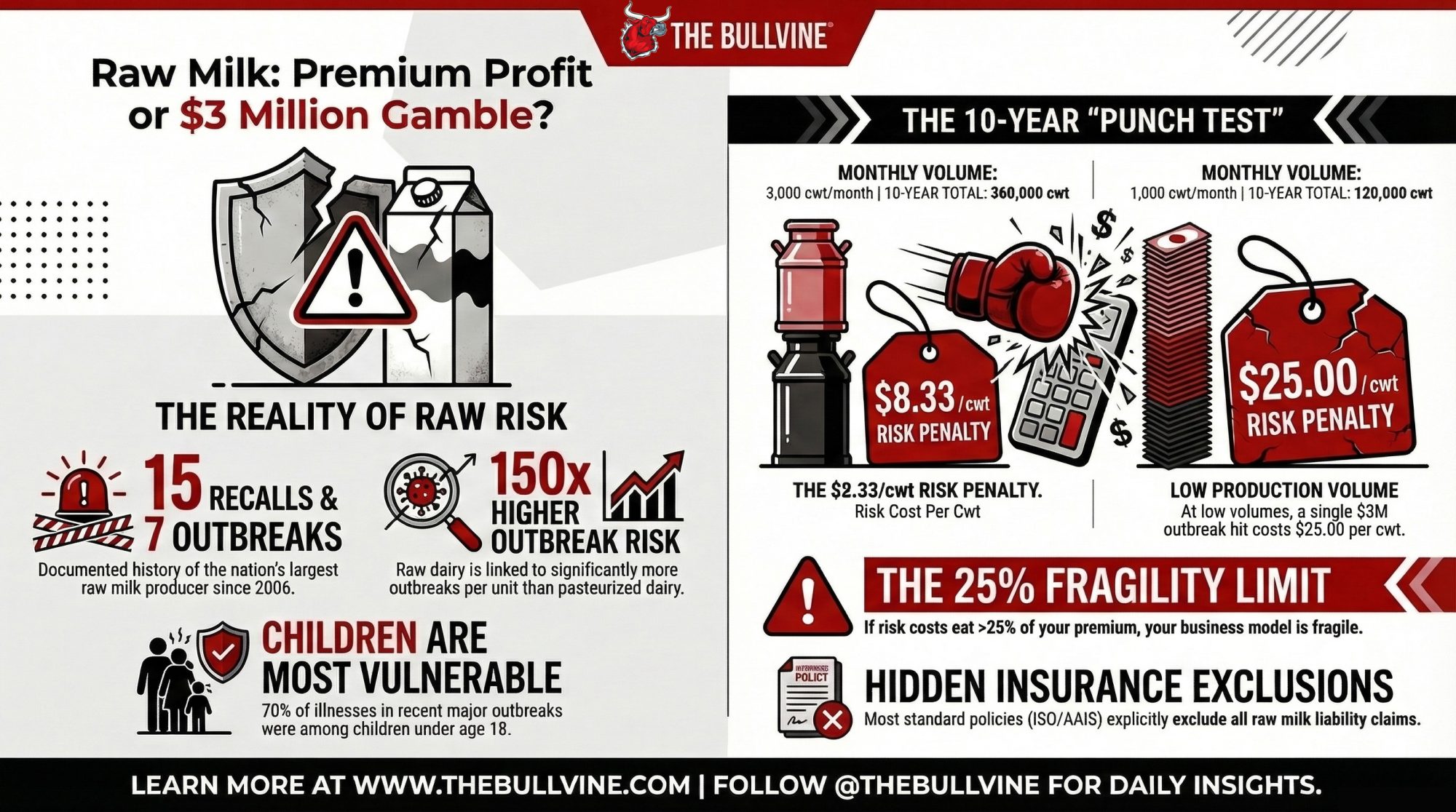
A case history compiled by the plaintiff firm, Pritzker Hageman, citing FDA and state health department records, lists at least 15 recalls and seven outbreaks involving Organic Pastures/RAW FARM products since 2006. Brownfield Ag News has separately reported that the operation has had “more than 10” recalls. RAW FARM has disputed the link between some illnesses and its products but has not publicly challenged those recall counts.
Outbreaks span two decades. A 2006 E. coli outbreak sickened four children ages 7 to 10; all were hospitalized, according to Pritzker Hageman’s case tracking. In 2011, five children ages 1 to 5 fell ill with E. coli — three developed hemolytic uremic syndrome. Campylobacter clusters in 2012 sickened 10 people, six of them kids. A 2016 E. coli outbreak sickened six more children.
The largest documented event
CDC’s MMWR report on the 2023–24 Salmonella outbreak, published in July 2025, anonymized the source as “dairy farm A.” Subsequent reporting by the LA Times, Marler Clark, and Pritzker Hageman has identified “dairy farm A” as RAW FARM. RAW FARM has publicly challenged parts of the FDA and CDC investigations into its products but has not, to date, issued a specific public statement accepting or rejecting that identification.
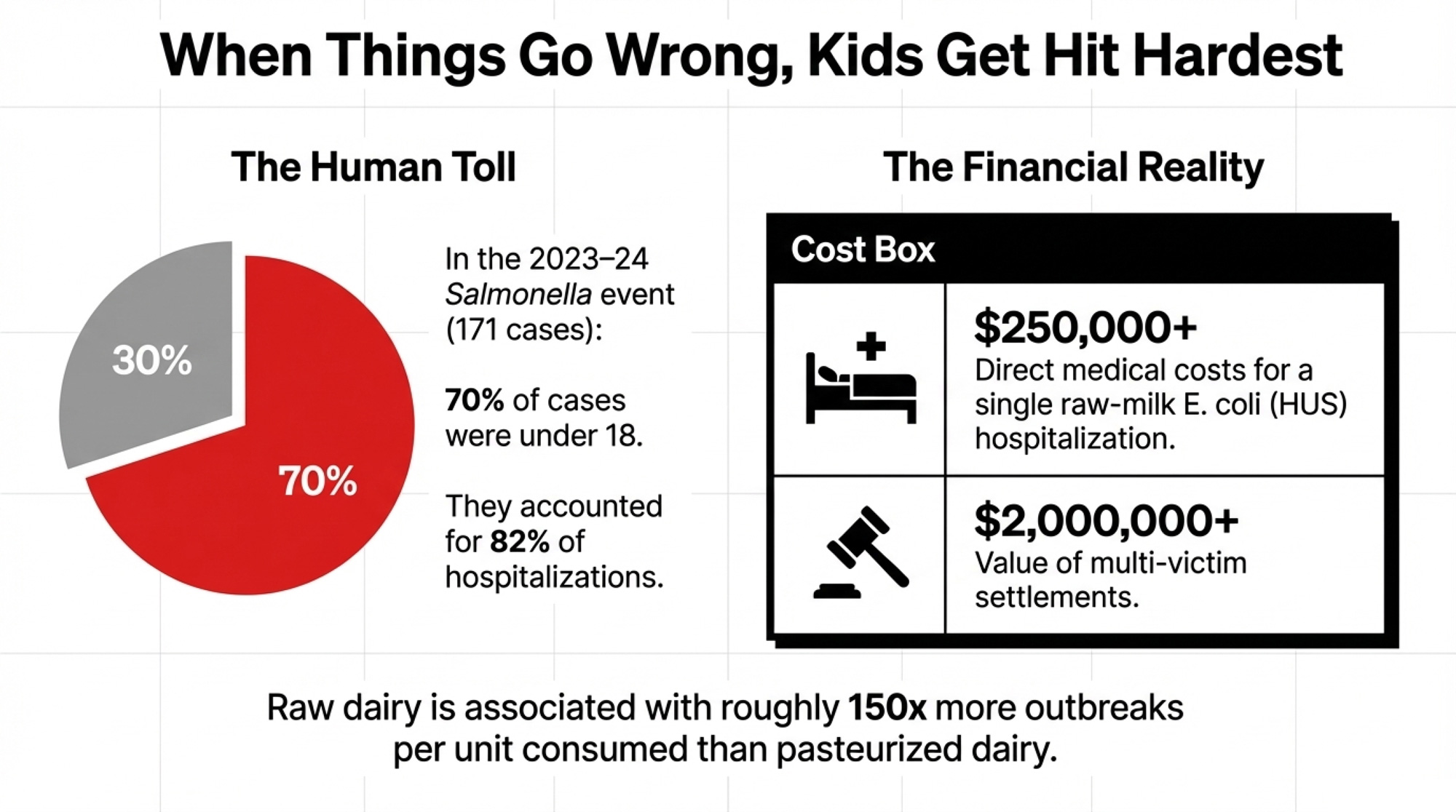
CDC’s MMWR reported 171 outbreak‑associated illnesses across California and four other states, with 22 hospitalizations. Case profile: 70% of all cases and 82% of hospitalizations were among children and adolescents under 18, with a median age of seven. Four product samples tested positive by whole genome sequencing, including raw‑milk cheese aged 60 days, the very aging period FDA allows for interstate raw cheese sales.
A CDC‑linked analysis of U.S. outbreak data from 1993–2006, published in Emerging Infectious Diseases, found that raw dairy was associated with roughly 150 times more outbreaks per unit consumed than pasteurized dairy. Demand keeps climbing —January 2024 media coverage quoted raw‑milk advocates saying demand has “dramatically increased” across the U.S. and Canada.
California already has one of the tighter raw‑milk regulatory frameworks in North America — Grade A inspection, mandatory pathogen testing, and warning labels. Even with that framework and a company of RAW FARM’s size and experience, this outbreak history shows that risk doesn’t disappear.
Does the Raw Milk Premium Really Look Too Good to Walk Past?
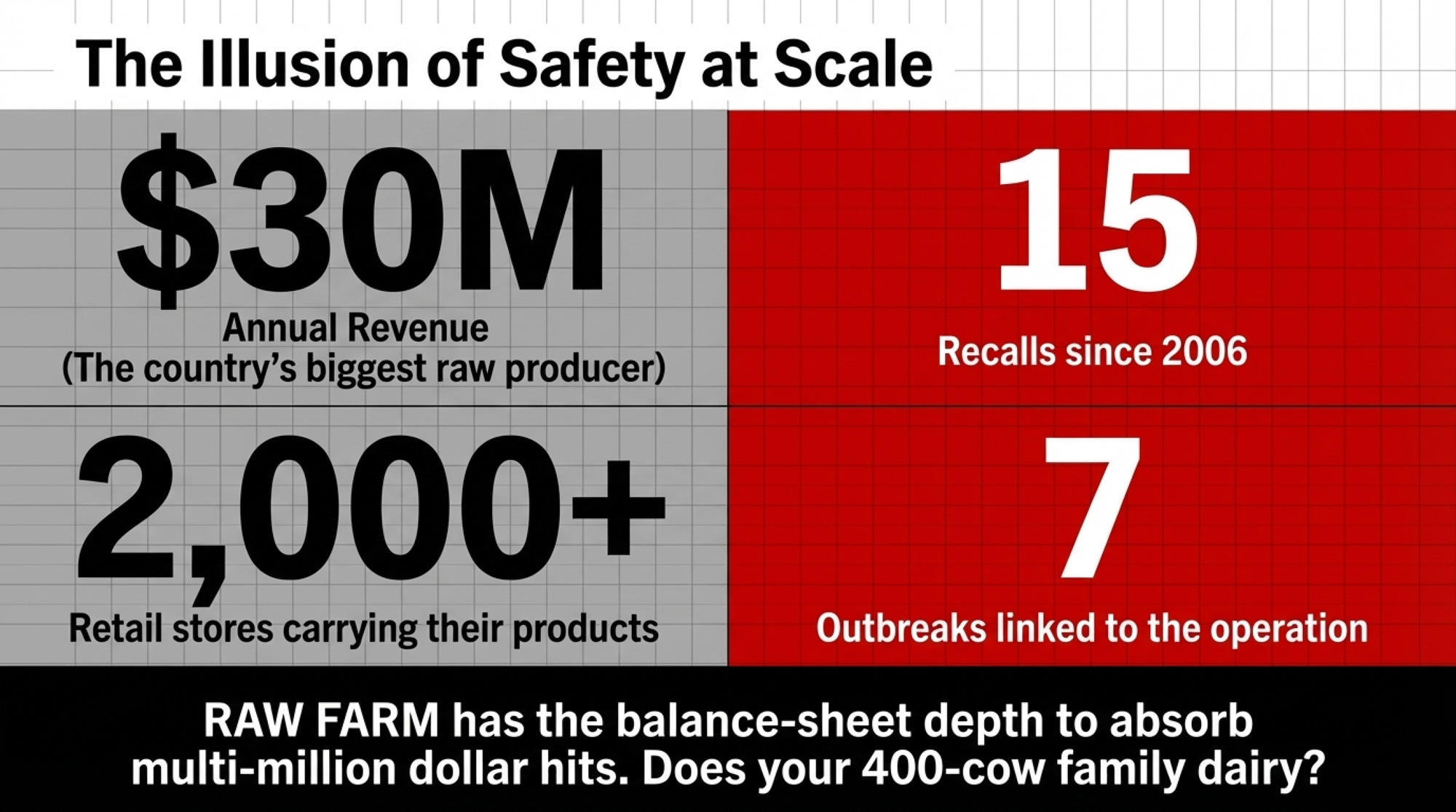
Take a 400‑cow herd averaging 80 lb per cow per day. That’s 32,000 lb — 320 cwt — shipped daily. Peel off 10% into direct‑sales products, and you’re moving about 11,680 cwt a year through your own bottle, vat, or farm store.
Pool that at $19/cwt, and it brings in roughly $221,900. Raw/direct at an illustrative $69–75/cwt — accounting for retailer margins and a mix of fluid and cheese — clears roughly $806,000–876,000 on the same volume. That’s a premium of $580,000–650,000 a year on just a tenth of your milk. You don’t have to squint to see why somebody says “We should be bottling this” every time the mailbox price dips.
Now, lay RAW FARM’s documented history beside those numbers. According to Pritzker Hageman’s tracking, seven outbreaks over twenty years work out to one every 2.9 years. Fifteen recalls are roughly one every 16 months — a frequency that, in our view, raises hard questions about how manageable raw‑milk risk really is at scale, even at a company that outlets like Forbes have described as the country’s biggest raw‑milk producer.
A $30‑million‑revenue operation has fundamentally different financial resilience than a 400‑cow family dairy with $2–3 million in total annual revenue. If an operation at RAW FARM’s scale takes a hit, its balance sheet has a lot more room to absorb it than most family farms ever will. That’s the number most spreadsheets politely ignore.
How Much Risk Per Cwt Are You Actually Carrying?
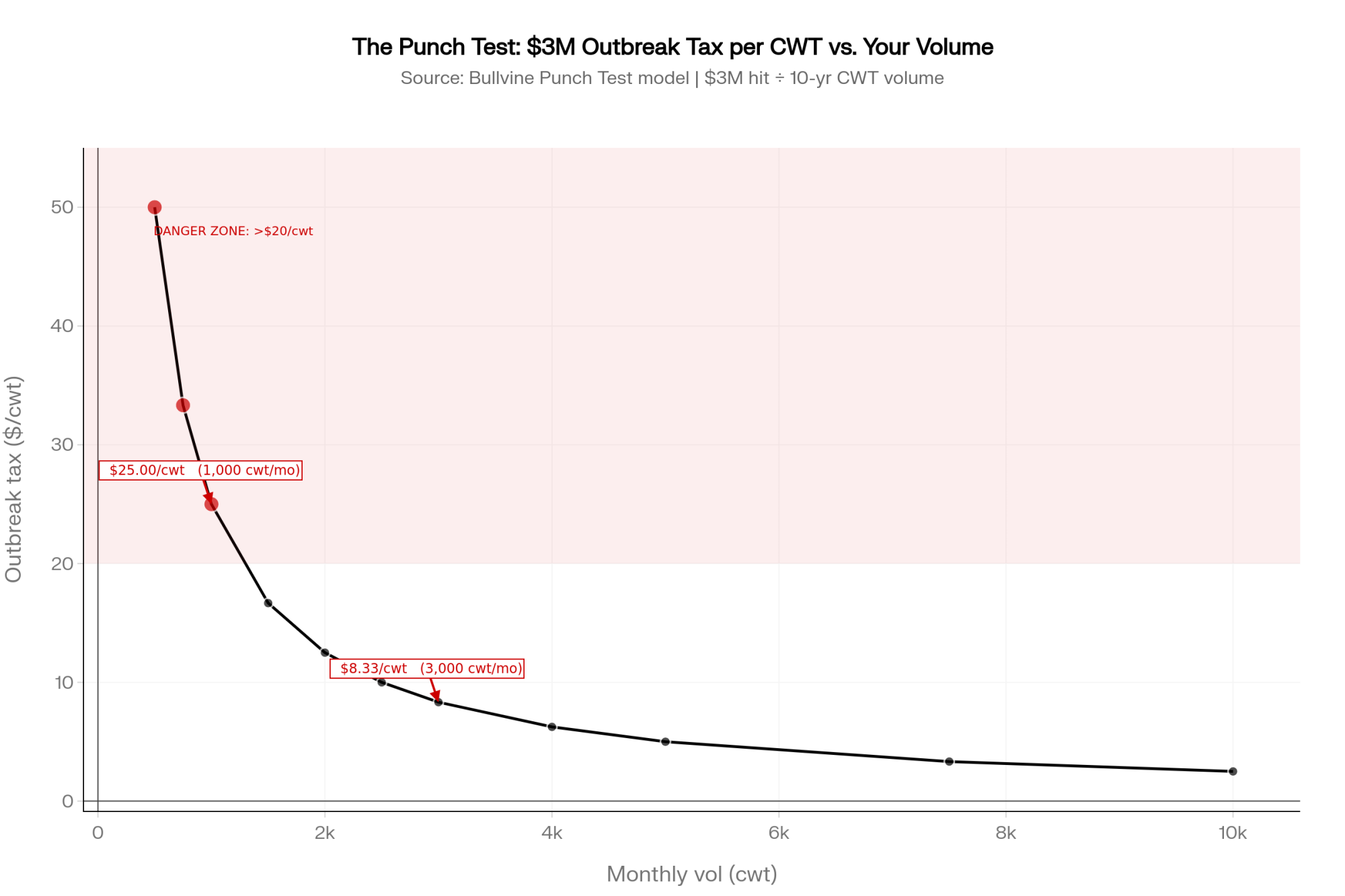
By processing and selling direct, you keep the money the plant would’ve taken — packaging margin, brand premium, part of the retailer spread. But the risk mechanics blend probability and severity in ways that aren’t intuitive.
CDC and peer‑reviewed data show that unpasteurized dairy causes many more outbreaks per unit consumed than pasteurized dairy. Kids get hit hardest — in the 2023–24 Salmonella event linked by multiple outlets to RAW FARM, 70% of the 171 cases were under 18, and 82% of hospitalizations were children and adolescents, per CDC’s MMWR.
| Outbreak Event | Total Ill | % Children / Adolescents | Hospitalizations | % Hosp. Were Kids | Worst Outcome |
|---|---|---|---|---|---|
| 2006 E. coli (Organic Pastures) | 4 | 100% (ages 7–10) | 4 | 100% | All 4 hospitalized |
| 2011 E. coli (Organic Pastures) | 5 | 100% (ages 1–5) | 3 | 100% | 3 developed HUS |
| 2012 Campylobacter | 10 | 60% (6 of 10) | Not reported | — | Cluster across multiple households |
| 2016 E. coli | 6 | 100% (children) | Not fully reported | — | CDPH recall triggered |
| 2023–24 Salmonella (“Dairy Farm A”) | 171 | 70% under 18 | 22 | 82% | Multiple pediatric hospitalizations |
| 2025–26 E. coli O157:H7 (raw cheddar) | 7 (confirmed) | 57% (4 of 7) | 2 | Not specified | Median age 3; youngest age 1 |
Serious cases are expensive. One child’s HUS hospitalization in the 2006 E. coli outbreak associated with Organic Pastures topped $250,000 in direct medical costs alone, according to case records cited by Marler Clark. Pritzker Hageman has described winning over $2 million for a single raw‑milk E. coli client.
Now put that into barn math. Say you’re holding a $50/cwt premium over pool — a farm‑gate around $70 vs a $20 pool cheque. Maybe $3–5/cwt goes to testing, QA, and compliance.
Layer in the outbreak tax. At higher volumes — around 36,000 cwt/year — a $3 million hit spread over ten years adds roughly $8.33/cwt. At 2,500,000 ÷ 360,000, you land closer to $6.94/cwt; shift the assumed hit up to $3 million, and you’re in that $8‑and‑change range. At 12,000 cwt/year, that same $3 million hit works out to $25.00/cwt. Most people never put that number on paper.
Combined, testing overhead and outbreak tax easily eat up roughly $8.50–$ 13/cwt at high volume. At lower volume, it can run $20–30/cwt. If your real premium is closer to $30–35 than $50, you’re in a game where the math only works as long as you never take the punch.
We broke down how processing premiums actually strengthen the balance sheet rather than stretch it in our look at Nebraska’s $186 million gamble.
The Bullvine 10‑Year Punch Test
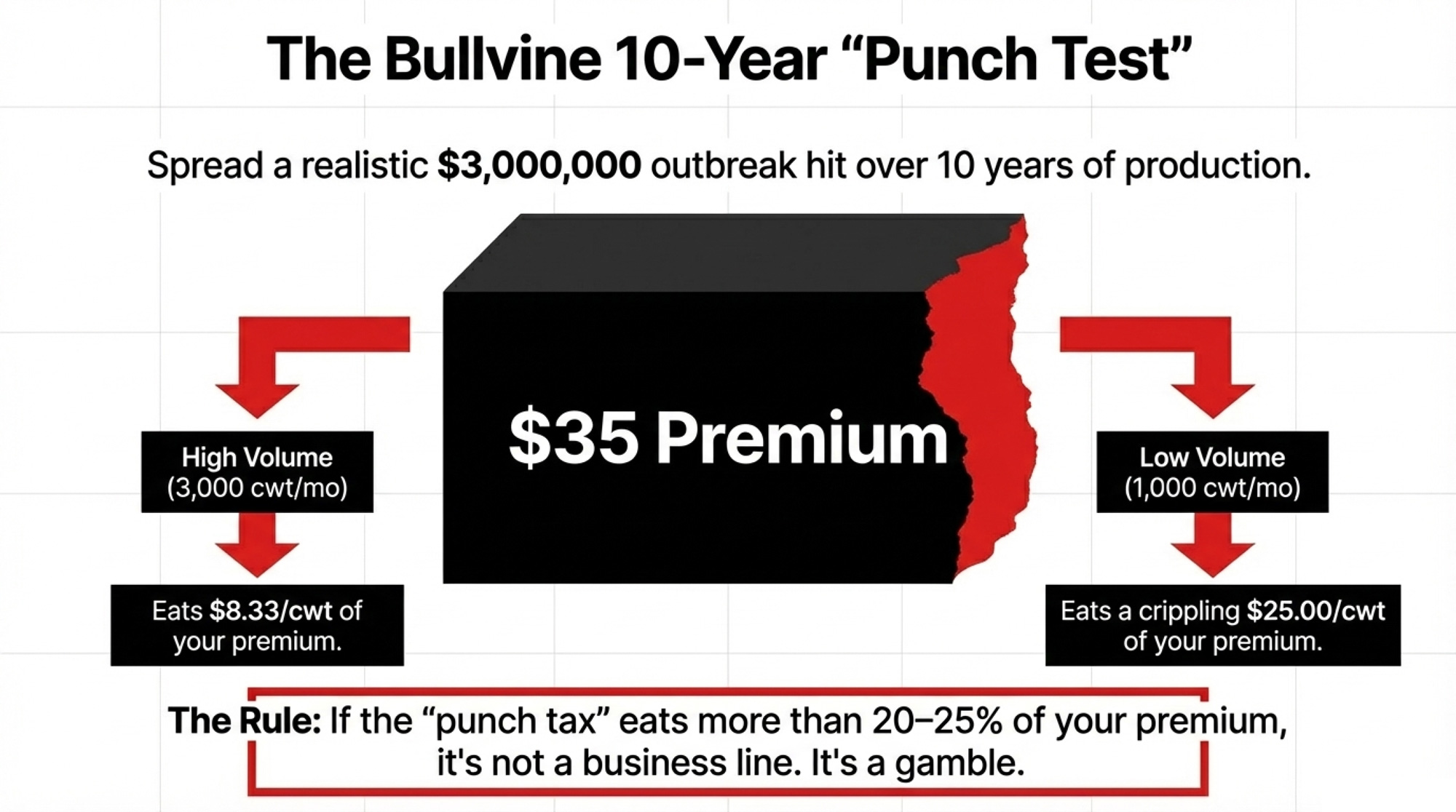
Step 1. Estimate a single realistic outbreak hit: $3 million all‑in (legal fees, settlements, lost business, brand damage). That’s a round but defensible number when you look at HUS hospitalization costs and multi‑victim settlements in raw‑milk cases.
Step 2. Calculate your 10‑year projected raw/direct volume in cwt. Example: 3,000 cwt/month = 360,000 cwt over a decade.
Step 3. Divide: $3,000,000 ÷ 360,000 = $8.33/cwt.
Step 4. Compare that to your premium over pool. If the punch tax eats much more than about 20–25% of your premium, the economics start to look more like a gamble than a farm business. At a $35/cwt premium, $8.33 is just under 24% of your upside spoken for.
Step 5. Run it at your real volume. A smaller line at 1,000 cwt/month: $3,000,000 ÷ 120,000 = $25.00/cwt — more than 70% of a $35 premium. Scale matters. So does honesty.
Swap in your own premium and monthly volume here. Don’t guess — pull last year’s numbers and do the math.
We walked this same expected‑value logic on a Florida raw‑milk lawsuit — worth comparing those numbers to your own.
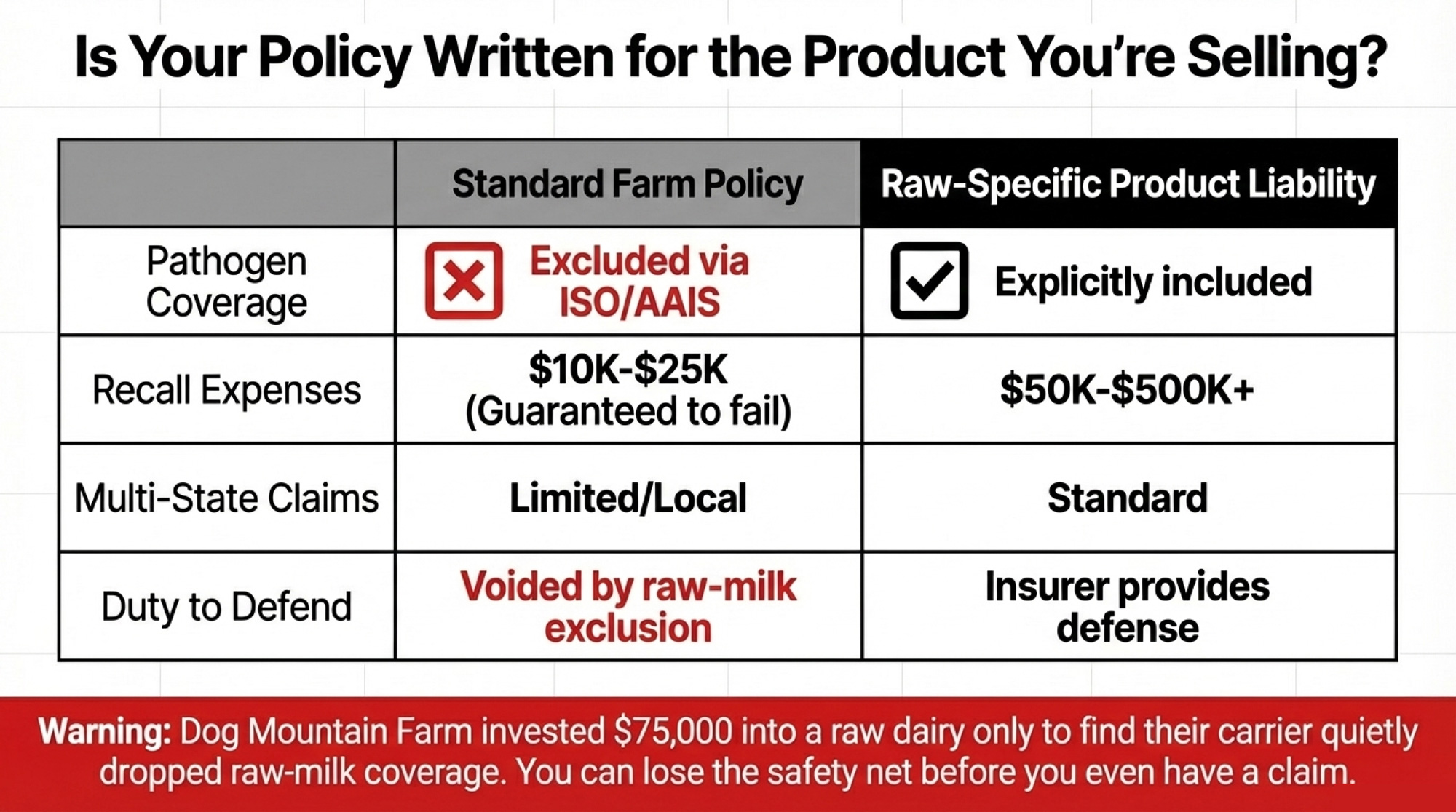
Is Your Policy Written for the Product You’re Actually Selling?
This question decides whether an outbreak is “a terrible year” or “we’re selling the home farm.” And it’s not hypothetical — producers have discovered this the hard way. Dog Mountain Farm near Carnation, Washington, invested $75,000 in a USDA‑certified raw goat milk dairy and then learned their carrier had dropped their raw‑milk coverage, according to Food Safety News. Owner Cindy Krepky was left searching for a replacement policy after her carrier dropped raw‑milk coverage. Denver insurance broker Kendall Turner told the same outlet that it’s “become very difficult for dairy farms to obtain liability coverage for the sale of raw milk” — and that “the insurance company sometimes has more rules than the state.”
Before you scale — before you sell the first gallon — pull your policies and get this answered in writing:
Does our liability and umbrella coverage explicitly include unpasteurized milk and raw‑milk cheeses we sell directly or through retailers, with no special exclusions or lower sub‑limits for foodborne illness?
Both ISO and AAIS publish standard raw‑milk exclusions that insurers bolt onto farm liability policies. Insurance risk consultant Casey Roberts, writing in IRMI in October 2025, reviewed these exclusions and compared them to “a total pollution exclusion” in how completely they shut out raw‑milk claims.
ISO’s farm liability exclusion reads: “This insurance does not apply to… ‘Bodily injury’, ‘property damage’, ‘personal injury’ or ‘advertising injury’ resulting from the production, processing, distribution, bottling, transportation or selling of raw or unpasteurized milk.”
AAIS’s version (GL 4000 01 17) is similarly broad, excluding bodily injury or property damage “arising out of the consumption of” raw milk or raw milk products. One national farm insurer’s proprietary endorsement goes further — excluding “any duty we have to defend ‘suits’” arising from raw milk. They won’t pay, and they won’t show up in court with you.
Roberts described these exclusions as designed to “completely exclude” all raw‑milk liabilities. If your policy has any version of this language, your headline coverage limit doesn’t apply to your raw line.
Standard Farm Policy vs. Raw‑Specific Product Liability
| Feature | Standard Farm Policy | Raw-Specific Product Liability |
|---|---|---|
| Pathogen coverage | ❌ Typically excluded via ISO/AAIS raw-milk endorsement | ✅ Explicitly includes raw & unpasteurized products |
| Raw-milk exclusion language | Applies: “does not apply to…production, processing, distribution…of raw or unpasteurized milk” (ISO) | No exclusion; raw products named and covered |
| Recall expense limit | $10K–$25K per event (BOP/GL standard) | $50K–$500K+ via standalone recall endorsements |
| Multi-state claims | ❌ Limited; written for local operations | ✅ Designed for distribution beyond farm gate |
| Duty to defend | ⚠️ May be voided by raw-milk exclusion endorsement | ✅ Insurer provides legal defence — contractually |
| Annual premium cost indicator | Lower (raw risk not priced in) | Higher — but reflects actual exposure |
| Real-world example | Dog Mountain Farm: $75K invested, coverage dropped silently | Policies explicitly named by product line |
Within the next 30 days, do this: pull every policy and endorsement touching liability and products. Search for “raw,” “unpasteurized,” “high‑risk food,” “foodborne illness,” and “direct‑to‑consumer.” Get a clear, written answer from your agent on what’s covered and what truly raw‑inclusive coverage would cost at your current volume.
If that exercise leaves you queasy, that’s the most useful thing you’ll learn this month.
Our Florida raw‑milk wake‑up call covers the HACCP and testing basics every on‑farm processor needs nailed down.
Options and Trade‑Offs for Farmers
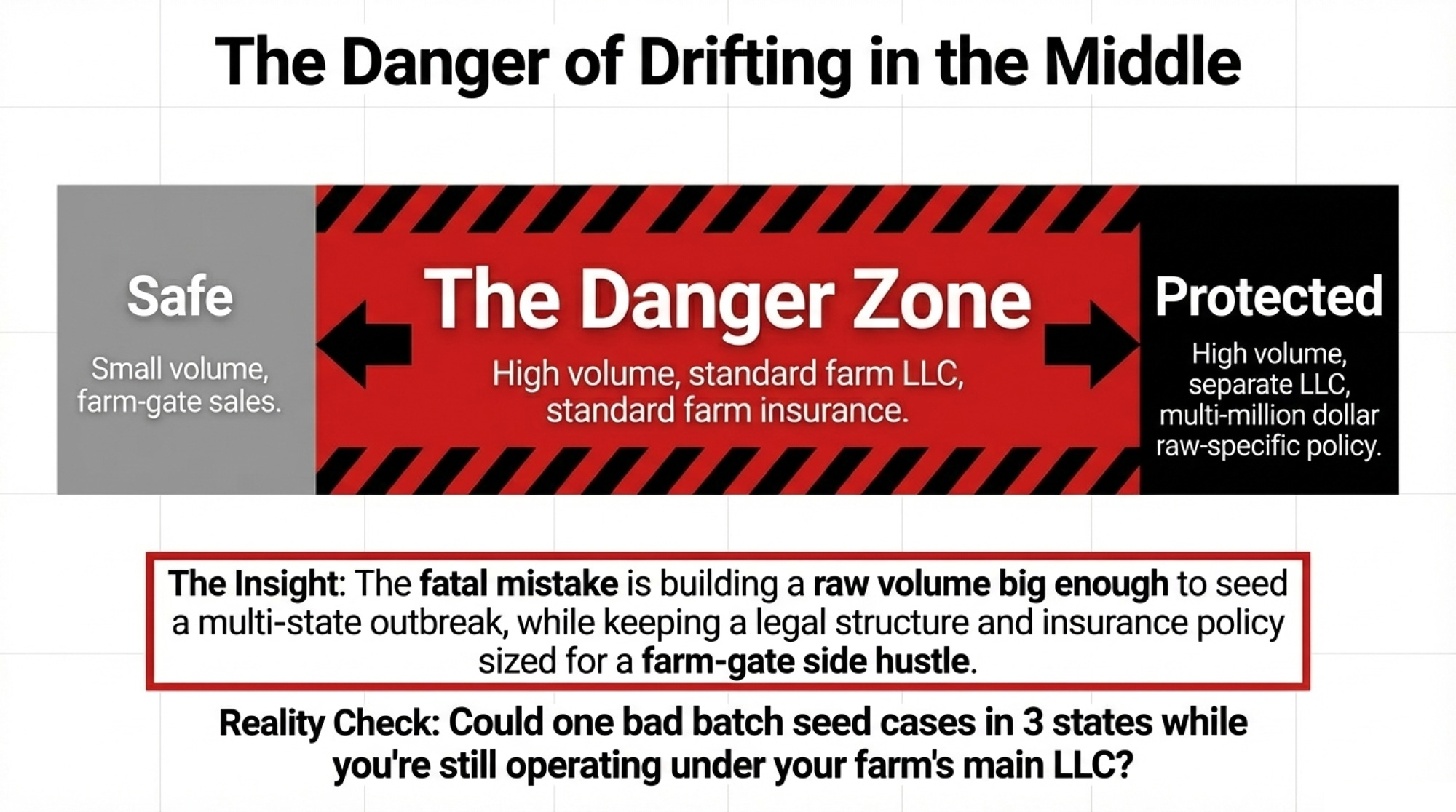
Once you run the Punch Test on your own numbers and stare your coverage in the face, you’re basically picking one of three paths. None is automatically right or wrong. The danger is drifting in the middle — raw volume big enough to seed a multi‑state outbreak, but structure and coverage still sized for a farm‑gate side hustle.
| Dimension | Path A — Capped Local Premium | Path B — True Business Line | Path C — Stay Out / Lower-Risk Value-Add |
|---|---|---|---|
| Monthly volume | Under 500 cwt/mo | 500–10,000+ cwt/mo | Any — raw not the vehicle |
| Annual raw revenue (illustrative) | <$415K | $415K–$8.3M+ | N/A (pasteurized or genetics premium) |
| Punch tax exposure | Low (<$5/cwt at 500 cwt/mo) | $8.33–$25/cwt (volume-dependent) | Zero outbreak tail risk |
| Required liability coverage | Policy explicitly covering raw; local scope | Multi-million, no raw exclusion; recall coverage; multi-state | Standard farm policy adequate |
| Legal entity structure | Farm store side operation acceptable | Separate legal entity essential | N/A |
| Food-safety program required | Basic SOPs + traceability | HACCP, pathogen testing, environmental monitoring | Standard GMP |
| Multi-state outbreak risk | Low if volume capped | High — you ARE a multi-state operator | None |
| Capital at stake | Manageable; core farm protected | Farm + processing assets at risk without structure | Core farm protected |
| Who this fits | Smaller family dairies with strong local retail | Operations targeting $1M+ raw/direct revenue | Farms prioritizing risk-adjusted ROI |
Ask yourself three questions:
- Volume: Is your raw/direct line under 500 cwt/year, between 500–10,000, or above 10,000?
- Coverage: Does your liability policy explicitly name and cover raw/unpasteurized products — yes, no, or “I don’t know”?
- Structure: Is your raw/direct operation in a separate legal entity from your land and cows?
Under 500 / yes / doesn’t matter much at this scale → Path A. Above 500 / yes/yes → Path B. Any other combination — especially “I don’t know” on coverage — means you’re in the gap.
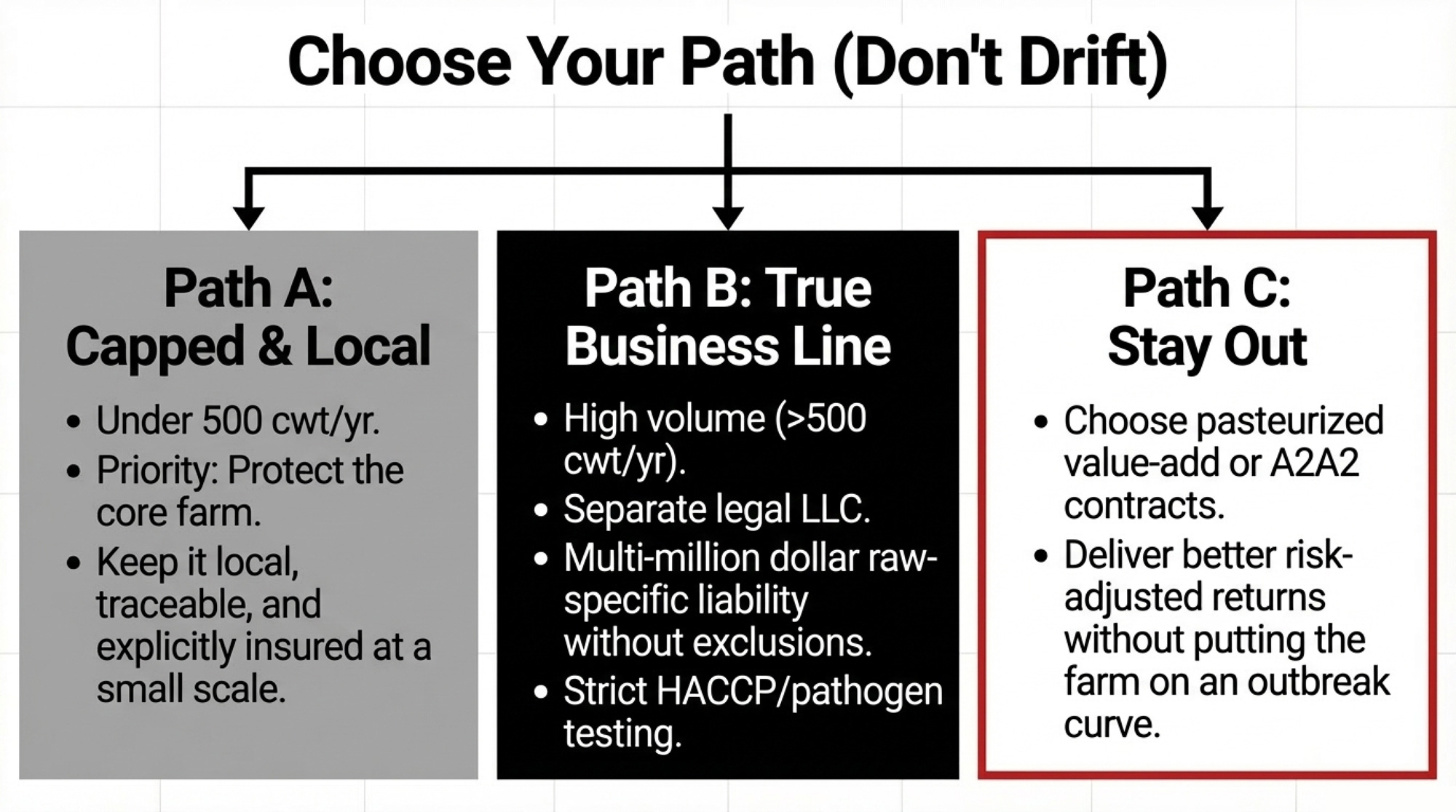
Path A: Keep raw as a capped, local premium outlet
You want better cash flow on a small slice of production. Priority: protecting the core farm. Keep volume below the band where one bad batch seeds cases in multiple states. Sell through channels you can trace and recall fast — your own farm store, subscription boxes, a handful of local shops. Build basic but real testing and SOPs, backed by a policy that explicitly covers raw products at your actual volume.
Within 30 days, confirm in writing that your current policy covers your raw products. Put a one‑page recall plan on paper — who you call, how you trace the product, how you notify customers.
Path B: Build raw/direct as a true business line
You’re aiming for serious volume — thousands of cwt, multiple products, multi‑state retail. That takes entity structure, separating land and cows from processing risk; liability limits in the multi‑million range with no raw-exclusion limits; recall coverage; and a real food‑safety program: HACCP plan, pathogen testing, environmental monitoring, and traceability from cow to consumer. RAW FARM reached about $30 million in revenue, and its outbreak history, as documented by the FDA, CDC, and multiple news outlets, shows that scale alone doesn’t eliminate risk.
You gain margin and brand value. You give up the ability to treat an outbreak as “local noise” — every misstep is now a multi‑state event.
Within 90 days, sit down with a food‑savvy attorney and your lender. Walk them through the Punch Test with your actual numbers. Ask both: “Would you be comfortable if we doubled this line next year?”
Path C: Stay out or choose lower‑risk value‑add
Your risk tolerance or capital doesn’t line up with the downside. Other value‑add playbooks — A2A2 contracts, branded but pasteurized on‑farm processing, genetics‑driven component premiums — might deliver better risk‑adjusted returns without putting your farm on a raw‑milk outbreak curve.
Once a year, if you chose Path A or B, revisit your Punch Test numbers, your policy, and your outbreak plan. If the answers don’t still hold, reclassify yourself honestly. RAW FARM’s documented history shows that the twentieth year can look a lot like the first.
What This Really Means If You’re Already Selling Raw
If your policy has any form of raw‑milk exclusion and you’re selling beyond very small, local volumes, you’re effectively self‑insuring a multi‑million‑dollar risk — whether you’ve priced that into your premium or not. If your raw/direct premium per cwt doesn’t clear your punch‑tax number plus real testing and QA costs, that line isn’t adding resilience to your operation — it’s just moving risk from the co‑op’s balance sheet onto yours.
If your Punch Test shows more than about a quarter of your premium disappearing into outbreak risk and overhead, that’s a yellow light. And if one bad batch at your current volume could seed cases in multiple states while your entity structure and insurance still look like a farm‑store side gig, that’s a hard red light.
Key Takeaways
- If the Punch Test shows more than about 20–25% of your raw/direct premium per cwt going to outbreak risk, the economics say your line is fragile. At 1,000 cwt/month, a single $3M hit works out to $25.00/cwt — over 70% of a $35 premium.
- If your liability policy contains any ISO or AAIS raw‑milk exclusion, your stated coverage limit does not apply to your raw line. Get that confirmed in writing within 30 days. Dog Mountain Farm’s $75,000 investment in raw production became uninsurable overnight — and they only found out after the carrier dropped them.
- If one bad batch at your current volume could seed cases in multiple states, but your structure and coverage are still sized for farm‑gate sales, you’re in the gap. Upgrade the structure and coverage or cap volume.
- If your lender and lawyer both look uncomfortable walking through a large‑scale outbreak scenario with your numbers, believe them. Their discomfort is a better risk signal than your most enthusiastic raw customer’s praise.
The Bottom Line
RAW FARM built a $30‑million brand, ran one of the most tested raw programs in the country, and operated under California’s tighter oversight. Federal and state records, as compiled by CDC, FDA, and Pritzker Hageman’s case tracking, describe multiple outbreaks and recalls involving Organic Pastures/RAW FARM products over two decades, with more than 200 illnesses documented and some children developing hemolytic uremic syndrome. A company of that size has the balance‑sheet depth to absorb far more risk. Your 400‑cow family dairy, with a multi‑generational legacy tied to that land, almost certainly does not.
Run the Punch Test, pull your policies, and have that conversation this month. If the numbers hold up and your structure matches the risk, build it right. When they don’t? That’s valuable information too — and a lot cheaper to learn now than from a state health department.
We’re building the full cost‑per‑cwt model by herd size and product mix in a Tier 3 economics feature, paired with a Tier 2 food‑safety playbook on entity structure, policies, and recall plans. That’s where the deeper spreadsheets and checklists will live.
RAW FARM’s position on the March 2026 outbreak investigation is reflected through public statements by President Aaron McAfee to Brownfield Ag News. The company has publicly challenged aspects of the FDA and CDC investigations. The Bullvine welcomes a response from RAW FARM, which will be appended or linked to this article in full.
Complete references and supporting documentation are available upon request by contacting the editorial team at editor@thebullvine.com.
Learn More
- The $31,200 Raw Milk Trap: How a Florida Outbreak Turned One Farm’s Side Hustle Into a Bet-the-Farm Lawsuit – Reveals the localized financial devastation of a single contamination event, arming you with a cautionary case study that proves why even “small-scale” side hustles require ironclad legal and insurance separation before the first gallon is sold.
- The Triple Cushion Trap: Why 2025’s Strong Margins Won’t Save You in 2026 – Exposes the structural shifts in beef-on-dairy premiums and feed costs that threaten long-term stability, delivering a strategic decision framework to help you reposition equity and diversify revenue before current market cushions inevitably deflate.
- Breaking the Commodity Ceiling: How Delaware’s Raw Milk Rebels Captured 1000% Premium Margins While Big Dairy Watched – Breaks down a revolutionary “compliance-first” model where high-tech testing protocols and H5N1 screening turned regulatory hurdles into a competitive advantage, securing massive direct-to-consumer premiums through radical transparency and verified safety.
 The Sunday Read Dairy Professionals Don’t Skip.
 The Sunday Read Dairy Professionals Don’t Skip.
Every week, thousands of producers, breeders, and industry insiders open Bullvine Weekly for genetics insights, market shifts, and profit strategies they won’t find anywhere else. One email. Five minutes. Smarter decisions all week.