Why are smart producers still expanding herds when Class III futures sit below $17? The genetic revolution changed the economics of everything.
EXECUTIVE SUMMARY: The August 2025 USDA milk report reveals more than record production—it exposes how genetic improvements have fundamentally altered dairy market dynamics in ways most analysts are missing. While we’re celebrating 9.52 million head producing 19.52 billion pounds (up 3.2% year-over-year), the real story lies in component-adjusted growth that could represent manufacturing capacity increases approaching 25% when butterfat and protein improvements are factored in. Recent research from DHIA records shows consistent component improvement patterns across regions, with today’s fresh cows testing butterfat levels that exceed historical peak lactation averages. This genetic revolution creates permanent productivity gains that won’t reverse during market downturns—unlike previous management-based improvements that could be scaled back during tough times. Processing infrastructure built for 3.7% butterfat milk now struggles with today’s richer milk during peak production periods, creating regional bottlenecks that force supply management decisions at higher price points than historical norms. What farmers are finding is that individual expansion decisions that make economic sense collectively create oversupply challenges, while Class III futures trading below $17 through May 2026 suggest markets expect this correction to persist longer than traditional six-to-nine-month cycles. Progressive producers are responding by optimizing efficiency over expansion, building strategic processor relationships, and recognizing that success in this new reality depends on converting genetic abundance into sustainable profitability rather than simply chasing volume.
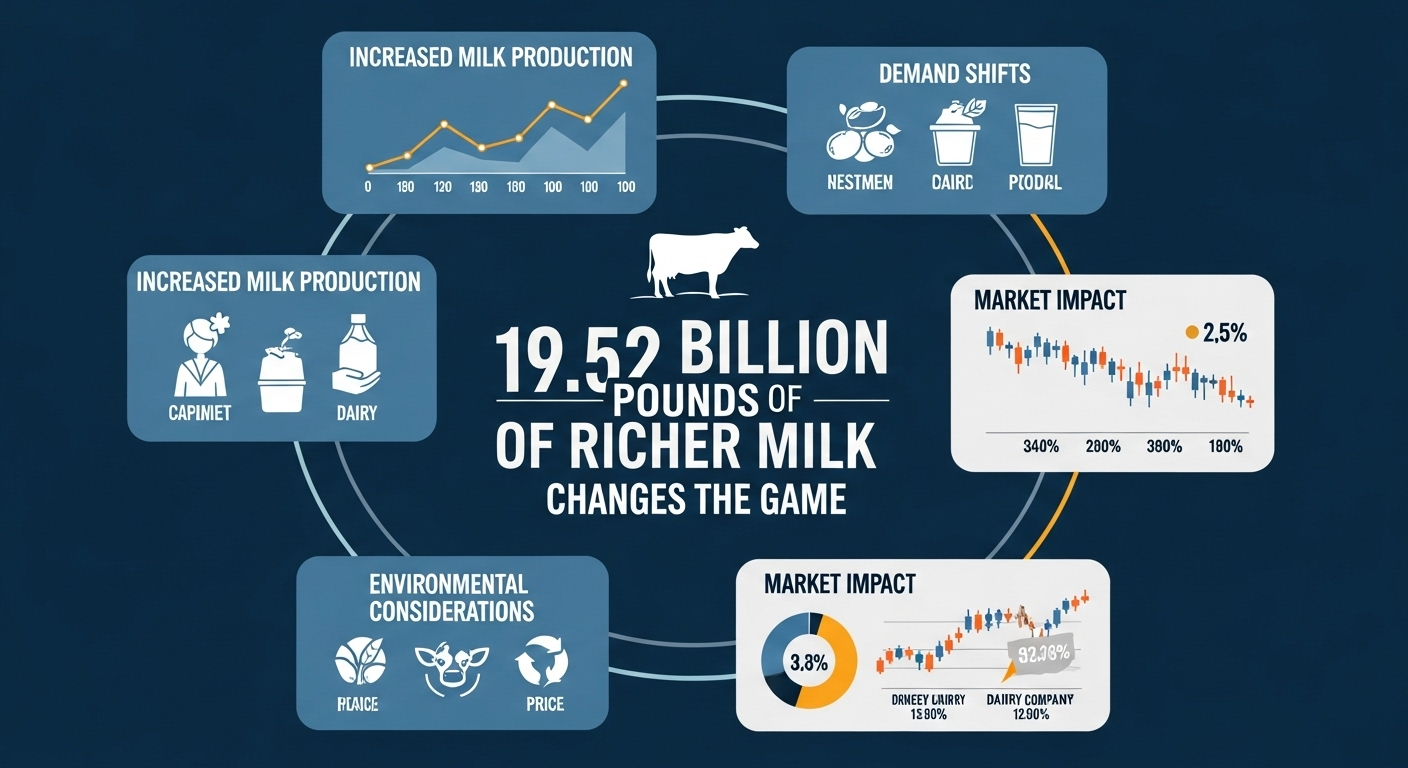
That August USDA milk report has folks talking—some celebrating the production numbers, others wondering what they really mean for our markets. Sure, we hit 9.52 million head in our national dairy herd, the biggest it’s been since 1993, according to the monthly data that came out last week. And those 19.52 billion pounds of milk in August, with that 3.2% bump over last year? Pretty impressive on the surface.
But I’ve been having conversations with producers from different regions recently, and something’s becoming clear… the way genetics have changed what those production numbers actually represent. We’re not just producing more milk anymore—we’re producing fundamentally richer milk. And that’s creating market dynamics that don’t follow the playbook most of us learned twenty years ago.
One producer I spoke with recently—who has been milking up in Wisconsin for thirty-five years—made a point that really stuck with me. “My fresh cows are testing higher on butterfat right out of calving than my best cows used to test at peak lactation back in 2010.” That’s the genetic revolution in action, and it’s happening across the industry whether we’re fully accounting for it or not.
The Component Reality That Changes Everything
When you look beyond just volume and start considering butterfat and protein levels—what some industry analysts are calling component-adjusted growth—that 3.2% increase starts telling a different story. The manufacturing capacity increase could be substantially higher when you account for these component improvements.

Think about this: your average butterfat test has been climbing steadily over the past couple of decades. The DHIA records and breeding association data show consistent improvement patterns, though the exact numbers vary by region and genetic program. That means every 100 pounds of today’s milk carries more actual butter-making and cheese-making potential than the same volume did two decades ago.
Not everyone, however, sees this as concerning. One producer I know down in Texas actually loves these genetic improvements—his cooperative expanded processing capacity specifically to handle higher-component milk, and he’s seeing better margins per cow than ever before.
But here’s what’s particularly noteworthy… the permanent nature of these gains compared to previous productivity improvements. When breeding values for components keep improving—and you can track this through genomic evaluations from the Council on Dairy Cattle Breeding—those gains become part of every heifer entering your herd, regardless of market conditions.
The Infrastructure Bottleneck: Why Your Co-op is Sweating
While we’ve developed essentially unlimited genetic potential for higher components, processing capacity remains fixed. Those aging continuous flow systems weren’t designed for today’s component levels—most were built when 3.7% butterfat was considered excellent production.
During this past spring flush, there were reports from several states of producers having to find alternative outlets because facilities couldn’t handle both the volume and richness of milk they were receiving. According to data from processing industry reports, some regional cooperatives are operating closer to capacity limits than they’ve experienced in decades.
To be fair, not all processors see this as a problem. Some plant managers say the higher components actually make their operations more efficient—more cheese per pound of milk means better margins when demand is strong. But when processors hit their limits during peak production periods, they start offering steep discounts or implementing volume controls that create price volatility.
The Expansion Paradox: Why Farmers Keep Growing Despite the Warnings
Despite these warning signs, many producers are still expanding herds. And when you dig into the individual economics, it often makes sense.
One producer I recently spoke with paid record prices for replacement heifers this year—and we’re seeing some of the highest costs for quality genetics that many of us can remember. But when those heifers are producing milk with substantially higher component levels, the economics can still pencil out.
This creates one of those situations where what makes sense for your operation individually might create challenges for all of us collectively. Modern high-component cows are remarkably efficient at converting feed into valuable solids, which shifts the economic threshold for supply reductions higher… meaning prices might need to fall further and stay lower longer.
What the Markets Already Know
The futures markets are telling an interesting story. Class III contracts through May 2026 are trading below $17, according to Chicago Mercantile Exchange data. The global picture adds complexity too—China’s adjusting dairy imports while the EU has shifting consumption patterns.
That international safety valve we used to rely on isn’t as predictable as it once was, putting more pressure on domestic markets to find balance.
Smart Operators Are Already Pivoting
What I find encouraging is seeing how thoughtful producers are responding to these shifting dynamics:
- Herd optimization over expansion: Evaluating culling decisions based on component efficiency
- Processing partnerships: Securing agreements and component premiums to avoid spot market exposure
- Value-added ventures: Direct-to-consumer operations, on-farm processing, specialized product lines
Regional examples are emerging everywhere:
- Vermont producers are managing fresh cow schedules to avoid peak flush periods when processing gets tight
- California operations are investing in processing partnerships to control milk destination
- Southeast dairies finding success with direct-to-consumer cheese operations
- Georgia producers telling me they’re grateful for the higher components that used just to boost their commodity check
Farm Scale: Who Wins and Who Struggles
Large commercial dairies have scale advantages and financial resources, but could get squeezed if processing constraints force volume limits.
Mid-size family operations face the toughest challenge—lacking both scale advantages and the flexibility to pivot quickly into niche markets.
Smaller dairies may have advantages through their quick pivoting ability and direct marketing relationships, which provide price stability.
The Longer Correction Timeline
Traditional dairy corrections used to run about six to nine months. Several factors suggest this one could stretch longer:
- Record herd sizes
- Genetic productivity gains that won’t reverse
- Shifted global demand patterns
- Processing constraints are forcing supply management at higher price points

What’s interesting about this potential timeline is how processing infrastructure limitations might force supply decisions that wouldn’t normally happen until prices fell much lower.
Your Processor Relationship Just Became Strategic
One thing that’s becoming clearer: your relationship with your processor matters more than it used to. With genetic productivity climbing but plant capacity relatively fixed, these partnerships are becoming competitive advantages beyond just price negotiations.
Early indications suggest seasonal patterns are becoming more pronounced—cooperatives are implementing volume management during spring flush that would’ve been unusual just a few years ago.
Many Midwest producers report that their cooperatives are having different conversations about intake planning than they used to have. It’s not just about having enough trucks anymore—it’s about whether the plants can actually handle the richness of the milk coming in during peak periods.
Market Indicators Worth Watching
Key signals for how this plays out:
- Class III futures staying below $17.50 through early 2026
- Processing capacity announcements (expansions or constraints)
- Component premiums at the farm level during peak production
- Feed price relationships as high-component cows change traditional ratios
What’s developing is that component premiums during peak production periods are becoming a bigger factor. If cooperatives start offering larger premiums for high-butterfat milk during flush seasons, that’s them trying to manage intake through economics rather than outright volume controls.
The New Industry Structure Taking Shape
We’re likely to see a more differentiated industry, where farms with sustainable competitive advantages, based on efficiency, processor relationships, and value-added strategies, emerge stronger.
The genetic revolution delivered tremendous productivity gains, but it also fundamentally changed how markets balance supply and demand. What I’ve noticed is that traditional price signals that used to trigger production adjustments don’t seem to work at the same thresholds anymore.
Your Strategic Playbook for What’s Ahead
For cash flow planning, think in terms of longer cycles. Investment priorities are shifting toward:
- Efficiency improvements that reduce the cost per unit of components
- Better cow comfort to improve butterfat performance
- Precision feeding to optimize protein and fat production
- Facility upgrades that improve labor efficiency per cow
Fresh cow management is getting more attention, too—when every cow’s component production matters more to your bottom line, getting fresh cows off to a strong start becomes critical. That means paying closer attention to dry cow nutrition, calving ease, and those first few weeks post-calving where you’re really setting the stage for the entire lactation.
I’ve been noticing more producers are looking at their feeding programs differently, too. With component production being so critical to margins, ration adjustments that boost butterfat and protein tests—even at slightly higher feed costs—often make more economic sense than volume-focused strategies.
The Bottom Line
The farms positioning themselves for long-term success are embracing efficiency over expansion, building strong processor relationships, and understanding that success will be determined by how well they convert genetic abundance into sustainable profitability.
This isn’t just another commodity cycle—it’s a fundamental shift in how our industry operates. The data from that August USDA report is just the beginning of a conversation about where we’re headed.
What’s encouraging is that producers who are working through these challenges now, building relationships and optimizing efficiency rather than chasing size, are positioning themselves to thrive regardless of how this plays out. The genetic improvements we’ve achieved represent decades of careful breeding decisions paying off.
Now we need to learn how to manage an industry with that kind of abundance in a way that works for everyone involved. It’s an interesting challenge, but one I think we’re up for if we approach it thoughtfully and keep talking to each other about what we’re seeing on our own operations.
KEY TAKEAWAYS:
- Component efficiency optimization can reduce cost per pound of valuable solids by 8-15% through strategic culling of bottom-performing cows and precision feeding programs that boost butterfat and protein tests, even at slightly higher feed costs.
- Processing partnership agreements provide price stability and guaranteed offtake during capacity constraints, with some cooperatives offering higher component premiums during peak production periods to manage intake through economic incentives rather than volume controls.
- Fresh cow management improvements become critical when higher component production directly impacts bottom-line profitability—better transition period nutrition and calving protocols can set the stage for superior lactation performance in today’s genetic environment.
- Extended correction timeline planning requires 18-24 month cash flow models instead of traditional six-to-nine-month assumptions, as genetic productivity gains that won’t reverse mean supply reductions need to be deeper and longer-lasting to achieve market rebalancing.
- Regional processing capacity varies significantly, with some areas investing in infrastructure designed for higher-component milk while others experience bottlenecks—understanding your local processing situation becomes a competitive advantage for strategic planning and marketing decisions.
Complete references and supporting documentation are available upon request by contacting the editorial team at editor@thebullvine.com.
Learn More:
- The New Math of Dairy Genetics: Why This Balanced Breeding Thing is Finally Clicking – This tactical guide reveals how to build a balanced genetic strategy that reduces replacement costs and extends productive lifespan, offering a practical playbook for capitalizing on the genetic revolution.
- August 2025 Proofs: New Kings, Big Swings, and What It Means for Your Herd – A deep dive into the latest genetic evaluations, this article explains how top sires are being selected for economic merit and proven reliability, providing a strategic look at what drives profitable breeding decisions today.
- The Hot Iron’s Last Stand: Why Canada’s #1 Proven Bull Just Changed Everything – Explore a real-world case study of how a homozygous polled bull reached the top of a national index, showcasing how innovation in genetics can deliver significant long-term cost savings by eliminating dehorning.
 Join the Revolution!
 Join the Revolution!
Join over 30,000 successful dairy professionals who rely on Bullvine Weekly for their competitive edge. Delivered directly to your inbox each week, our exclusive industry insights help you make smarter decisions while saving precious hours every week. Never miss critical updates on milk production trends, breakthrough technologies, and profit-boosting strategies that top producers are already implementing. Subscribe now to transform your dairy operation’s efficiency and profitability—your future success is just one click away.