When a Wisconsin dairy finally tested urine pH, their “negative” ration was doing exactly nothing — and the latest research says they’re far from alone.
Executive Summary: One herd in a published six-farm investigation was feeding negative DCAD at −100 to −160 mEq/kg DM and still averaged a urine pH of 7.2 — functionally alkaline — because 15.2 inches of bunk space caused enough sorting to gut the diet entirely. Goff’s 2025 meta-analysis (660 multiparous Holsteins across 9 studies) now provides parity-specific targets: 5.5–6.0 for 2nd–3rd lactation, 6.2–6.8 for 4th-plus cows, where dropping below 5.75 actually harms calcium status. The safety case for full acidification is stronger than the industry’s been acting — Graef’s trial put fully acidified cows at just 3.5 mmol/L urinary ammonium with blood pH steady at 7.39–7.41. SCH runs $125 to $226.46 per affected cow, depending on the model, and at 45–80% multiparous incidence, a 130-multiparous-cow herd faces $6,500 to $11,777 per year in avoidable drag. With the CDC’s 2.3% farmgate increase tightening input scrutiny in 2026, a 50-cent urine strip and 10 close-up cows will tell you whether your DCAD dollars are working in the cow or just living on the ration sheet.
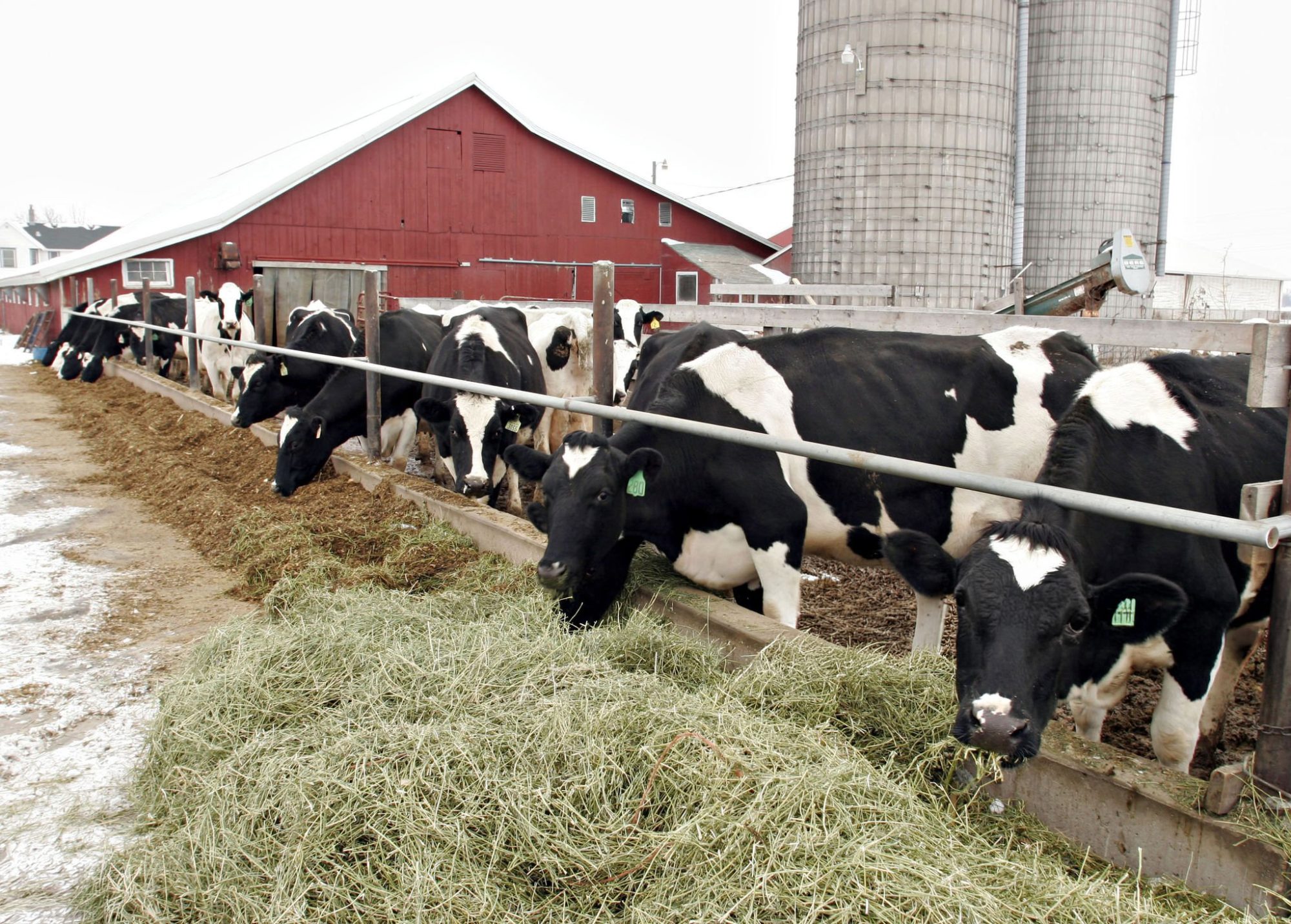
You’re probably paying for a DCAD program you aren’t actually getting. In Wisconsin, the Schaefer family thought their −120 mEq/kg close‑up ration was bulletproof. The “Animate” bill was paid, the spreadsheet looked perfect, and the cows looked fine.
Then they finally dipped a 50‑cent urine strip. The average pH in their close‑up pen was 7.5. Their “negative” DCAD was doing exactly nothing. When they and their nutritionist rebuilt the ration actually to hit a 5.5–6.0 urine pH, their fresh‑cow list quietly shrank — fewer slow starts, fewer mild ketotics, and less time babysitting older cows in the first week fresh.
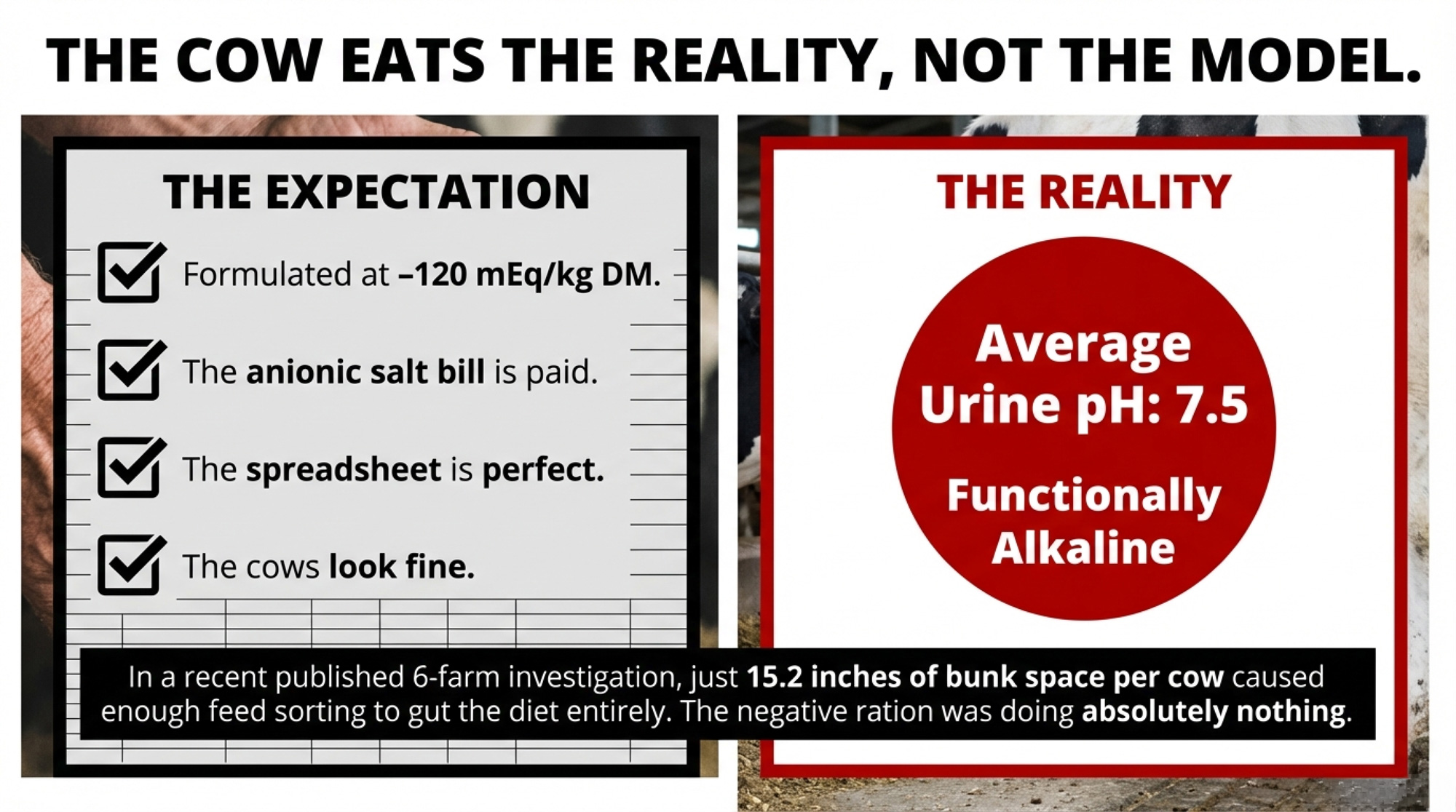
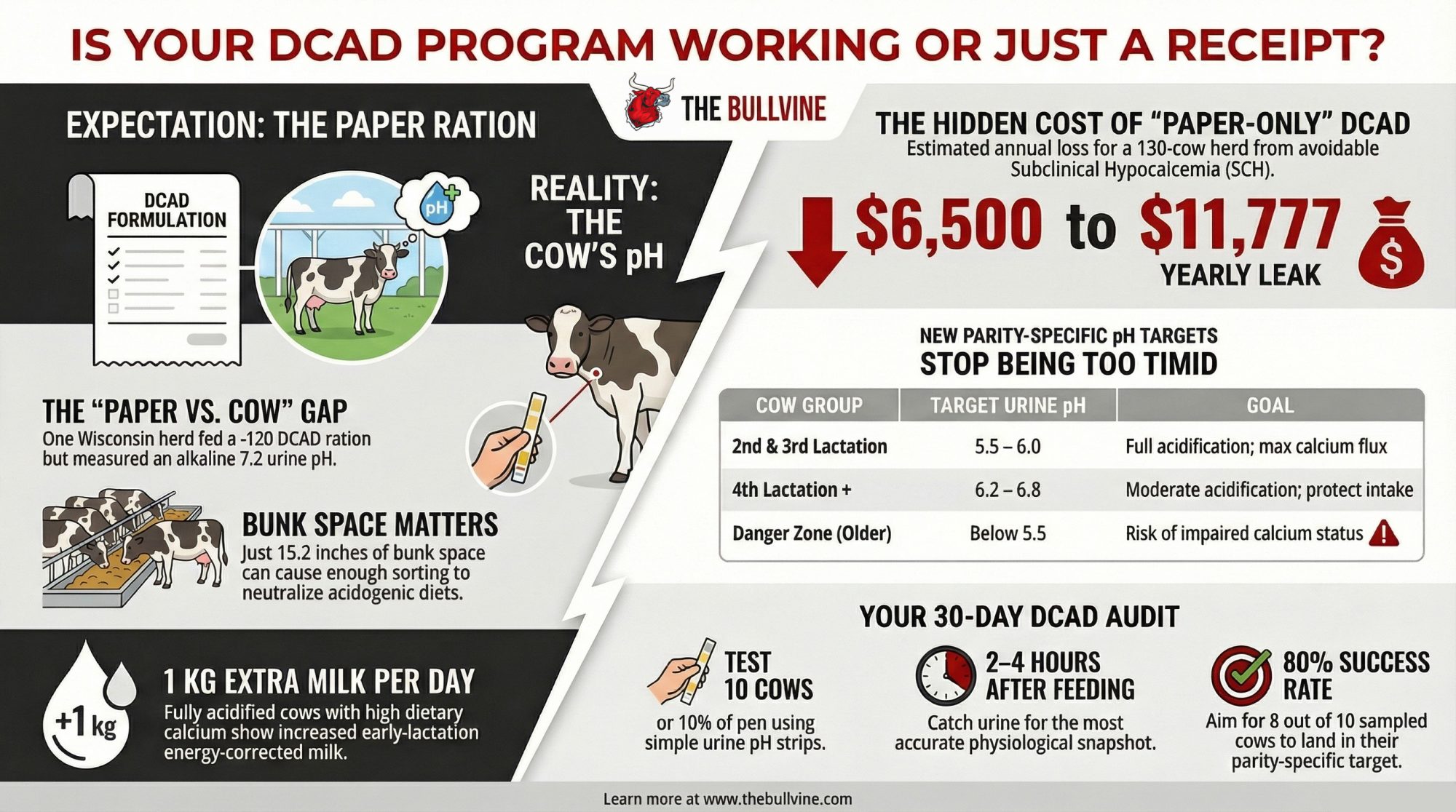
They’re not alone. In a published field investigation across six herds all feeding correctly formulated negative‑DCAD TMRs, one farm averaged a urine pH of 7.2 — not because the ration was wrong on paper, but because 15.2 inches of bunk space per cow caused enough sorting to neutralize the acidogenic diet entirely. The ration analyzed fine. The cows weren’t eating it the way the model assumed.
Here’s the twist the latest research adds: in fully acidified cows, the average urinary ammonium is just 3.5 mmol/L. That low ammonium number shows that low urine pH by itself does not equal acidosis danger. The real warning isn’t “don’t go too low.” It’s “stop being too timid” — because staying alkaline is what keeps subclinical hypocalcemia quietly chewing through your margins. With the CDC’s 2.3% farmgate price increase effective February 2026, pushing input scrutiny higher than ever, you can’t afford to keep writing checks for a program that isn’t actually working in the cow.
Why That 3.5 mmol/L Number Really Matters
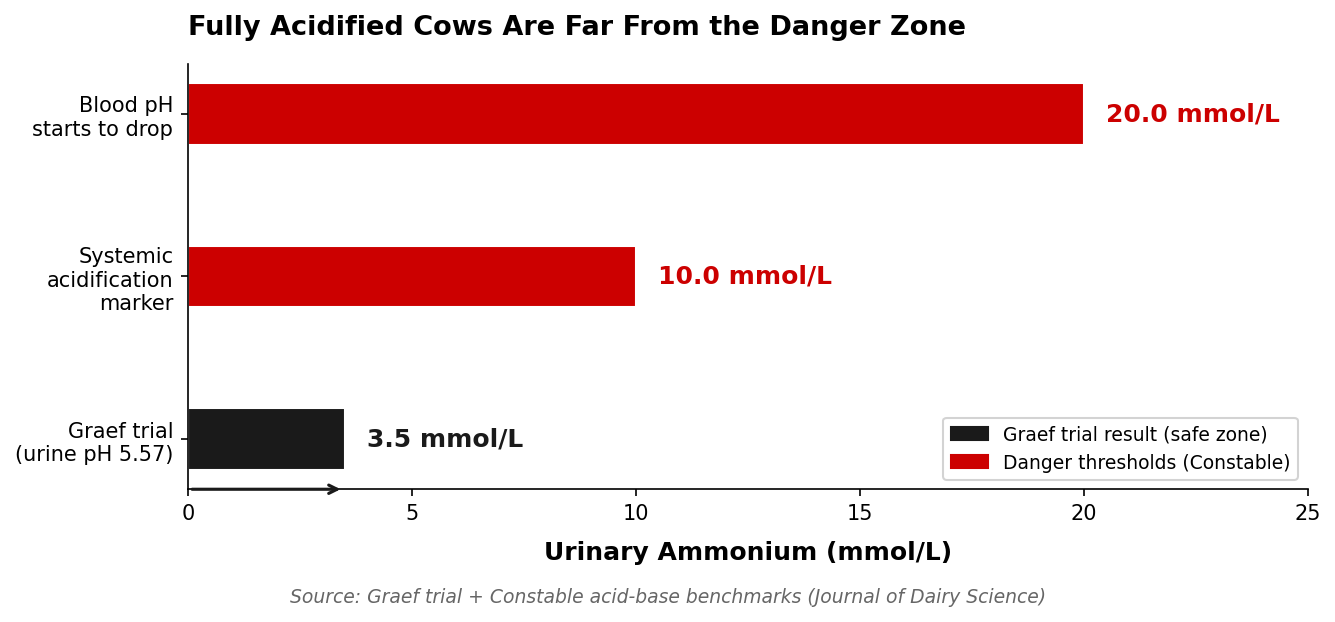
In a recent trial led by Graef, Holsteins on a fully acidogenic pre‑fresh ration landed at a mean urine pH of 5.57 — squarely in the full‑acidification zone. The eye‑opener was their urinary ammonium.
Those cows averaged only 3.5 mmol/L of ammonium, far below the levels associated with systemic over‑acidification. Constable’s work on net acid excretion suggests two guideposts worth knowing:
- At around 10 mmol/L, urinary ammonium is a reliable indicator of systemic acidification.
- Once ammonium climbs above roughly 20 mmol/L, blood pH tends to drop by about 0.02 units — that’s where acid‑base safety becomes a real concern.
In the Graef work, cows never got close to either line at a urine pH most of us would call “aggressive.” Blood pH stayed in the 7.39–7.41 range, and serum bicarbonate sat at or near the lower edge of the typical 22–30 mmol/L window in related negative‑DCAD studies.
When your ration is properly balanced, full acidification (urine pH 5.5–6.0) operates safely within the cow’s compensation system. The danger zone isn’t “anything below 6.5.” It’s keeping cows alkaline because you’re afraid of numbers that the research says are actually safe.
How Low Is Too Low — And For Which Cows?
A 2025 meta‑analysis led by Jim Goff pulled together data from 660 multiparous Holsteins across nine studies to answer the question that really matters in the barn: which pre‑fresh urine pH ranges line up with better blood calcium after calving?
The answer changes with parity:
- For 2nd‑ and 3rd‑lactation cows, the big step is just getting them out of the alkaline zone. Cows with prepartum urine pH below 7.75 had significantly better calcium status than those above that threshold, and driving pH lower within the acidified band didn’t provide much additional benefit.
- For 4th‑lactation and older cows, the sweet spot is narrower. Cows with urine pH between 6.26 and 6.75 had the highest blood calcium nadirs, while cows above 7.25 or below 5.75 showed poorer calcium outcomes.
That moves you from a one‑size‑fits‑all DCAD target to a parity‑specific playbook.
Urine pH Targets by Parity
| Cow Group | Target Urine pH | Blood Calcium Outcome | Key Threshold | Risk if Outside Range |
|---|---|---|---|---|
| 2nd–3rd Lactation | 5.5–6.0 | Best Ca status; strong flux | pH must drop below 7.75 | Staying alkaline (>7.75) impairs Ca |
| 4th Lactation+ | 6.2–6.8 | Peak Ca nadir in this band | Sweet spot is narrower | <5.75 harms Ca status |
| 4th Lactation+ | >7.25 | Poor blood calcium nadir | Same group, high end | Alkaline = no DCAD benefit |
| Any parity — Danger | <5.5 | Ca status trends wrong | Very low DCAD (~−220) | Uncompensated metabolic acidosis |
If you’ve watched a mixed‑parity close‑up pen, you’ve likely seen this play out already. Second‑ and third‑calvers usually cruise on a hot close‑up ration. It’s the 4th‑ and 5th‑lactation cows that look duller, lose more condition, or keep showing up on the fresh‑cow problem list when the diet is pushed as hard as the youngsters’.
What Does “Safe” Full Acidification Actually Look Like?
Pull the DCAD research together, and the safety story is clearer than the coffee‑shop debates.
From recent trials and reviews:
- Fully acidogenic diets drop urine pH into the 5.5–6.0 band, but blood pH hangs around 7.39–7.41, well above the 7.30 “start to worry” threshold for systemic acidosis.
- In a 2022 JDS study, very low DCAD treatments reduced serum bicarbonate by about 8–9%, landing near the lower edge of the 22–30 mmol/L reference range; more moderate negative DCAD diets kept bicarbonate comfortably within normal limits.
- In a Florida trial by Zimpel and colleagues, cows on a strong fully acidogenic program had urine pH around 5.4, but still carried ≈25 mmol/L bicarbonate — squarely normal.
- The real trouble shows up in extremely negative DCAD experiments. A “very low DCAD” diet around −220 mEq/kg DM pushed cows into uncompensated metabolic acidosis with lower blood pH, depressed intakes, and clear metabolic strain. In a separate herd case, dry cows on a diet near −143 mEq/kg DM had urine pH in the 5.2–5.8 range; when the diet was adjusted to about −53 mEq/kg DM, postpartum blood calcium didn’t change — only the acid load and metabolic strain improved.
In practice, negative DCAD diets in roughly the −100 to −150 mEq/kg DM range, paired with adequate fiber and minerals, tend to put cows in a compensated metabolic acidosis zone — enough to prime calcium metabolism without pushing blood pH into dangerous territory.
The real‑world risk for most herds isn’t “too low” DCAD. It’s never getting low enough in the right cows, or pushing the oldest cows too far, because nobody ever checks a strip.
| Biomarker | Normal Reference Range | Graef Trial (Urine pH 5.57) | Systemic Acidosis Threshold | Status |
|---|---|---|---|---|
| Blood pH | 7.35–7.45 | 7.39–7.41 | <7.30 | ✅ Normal |
| Serum bicarbonate (HCO₃) | 22–30 mmol/L | ~22–24 mmol/L (low-normal) | <18 mmol/L | ✅ Within range |
| Urinary ammonium (NH₄) | — | 3.5 mmol/L | >10 mmol/L (systemic marker) | ✅ Far below threshold |
| Urinary ammonium (NH₄) | — | 3.5 mmol/L | >20 mmol/L (blood pH drops) | ✅ Far below threshold |
| Urine pH | — | 5.57 | Not a direct danger indicator | ✅ Target achieved |
How Much Is Subclinical Hypocalcemia Really Costing You?
You see the classic downer cows. The quieter hit comes from subclinical hypocalcemia — cows that stay standing but run with low blood calcium for a day or two after calving.
Reviews and field surveys suggest SCH often hits 25–40% of first‑calvers and 45–80% of multiparous cows in high‑producing herds. That means roughly half or more of your older cows may be affected. Those are the ones that calve “fine,” then quietly drag around mild ketosis, metritis, DAs, and a few extra weeks open.
On the economics side:
- A Progressive Dairy / University of Minnesota model built around a 1,000‑cow herd estimated SCH‑related losses — added disease, culling, and lost milk — at $67,938, or $226.46 per affected cow.
- Prince Agri/Progressive analysis uses a more conservative $125 per SCH case and roughly $300 per milk fever case, while still accounting for both health and production impacts.
- A 2022 study from North‑West Ethiopia estimated SCH losses at 3,026.25 ETB per cow per lactation, which the authors converted to about US$69.6 for their conditions.
Taken together, a realistic SCH cost range is around US$60 to US$ 226 per cow, depending on milk price, herd health, and how broadly you count ripple effects.
Micro barn math: what that looks like on your farm
Come back to a 200‑cow herd like the Schaefers, with 130 multiparous cows. Even if 40% of those multiparous cows are subclinically hypocalcemic — a conservative number given that 45–80% range — that’s 52 SCH cows in a year.
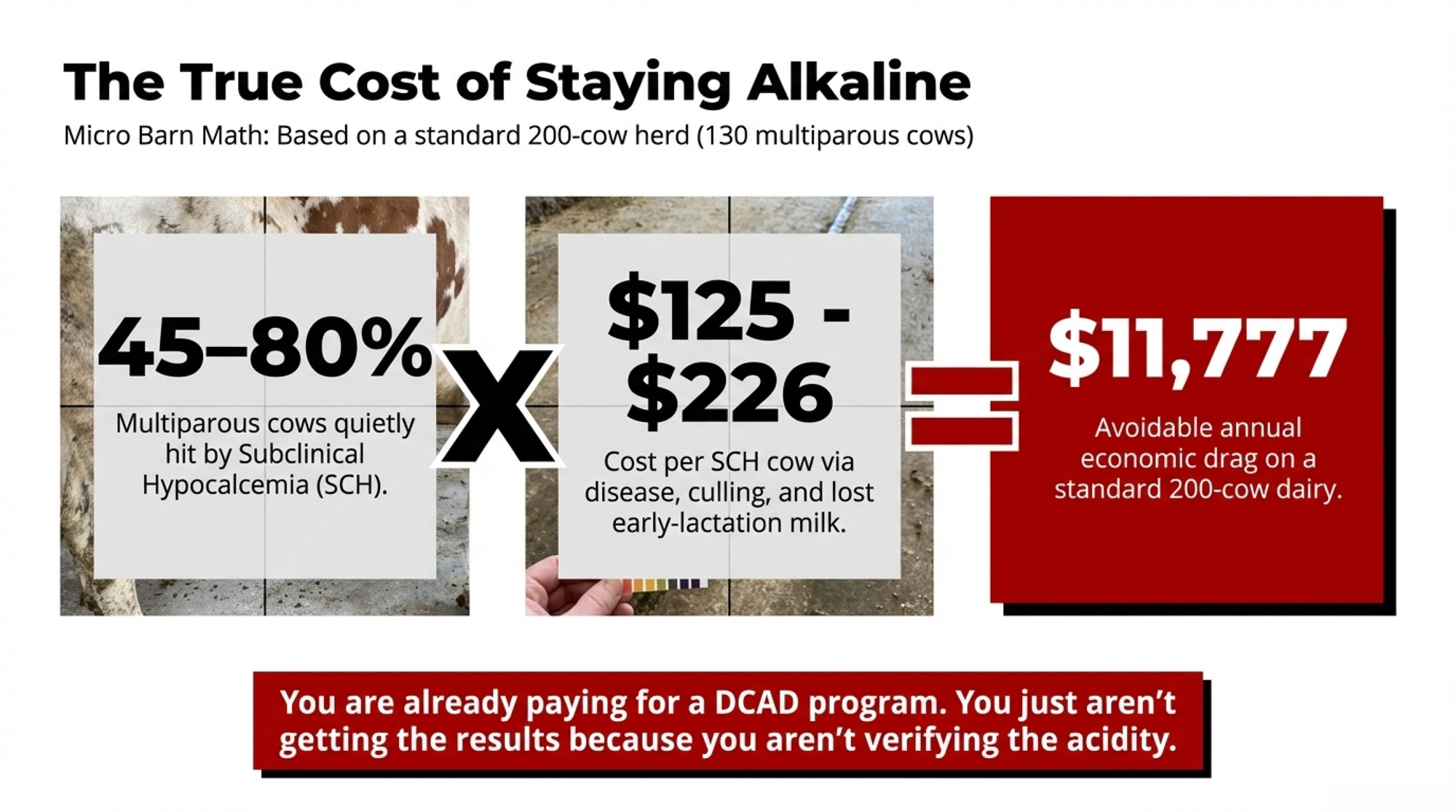
At the $125 per‑case estimate:
- 52 cows × $125 ≈ $6,500 per year in SCH‑linked losses.
At the $226.46 per‑case estimate:
- 52 cows × $226.46 ≈ $11,777 per year.
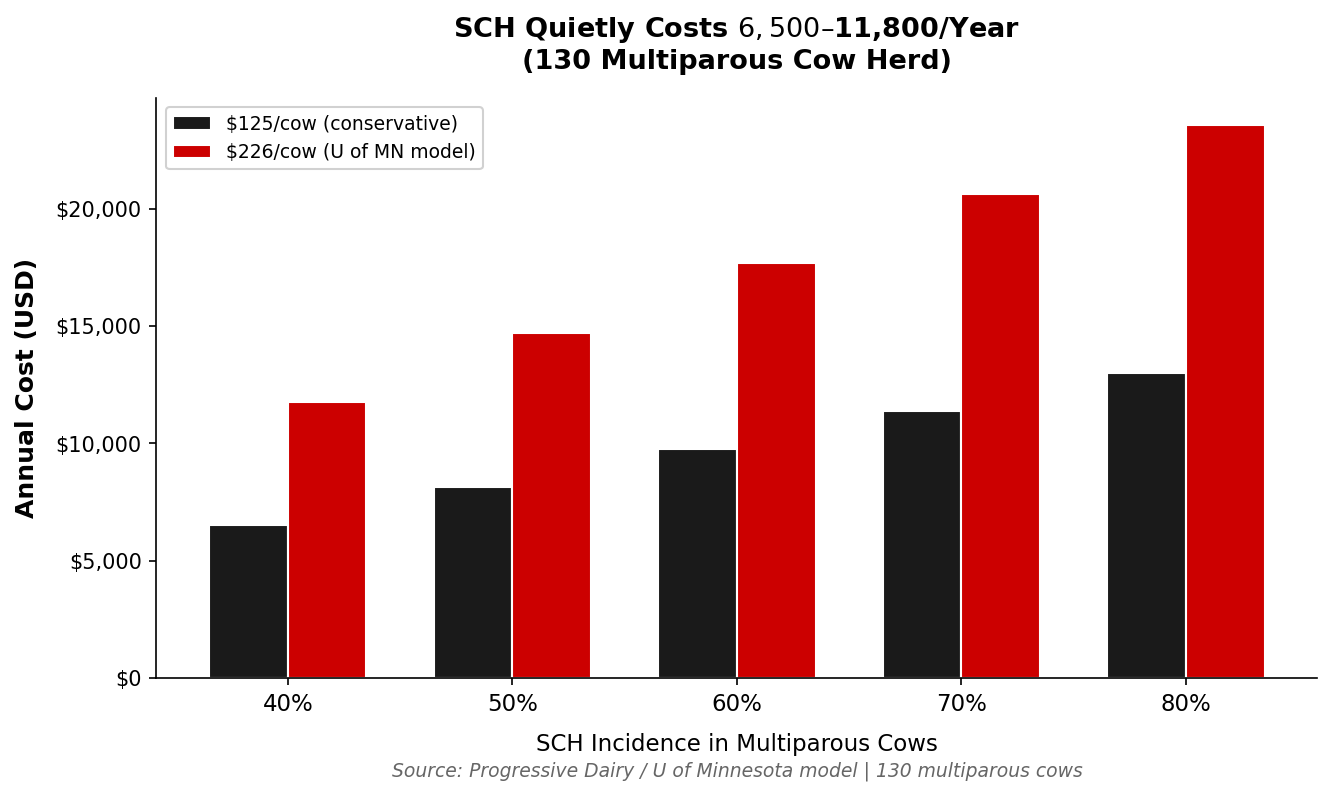
If your “negative DCAD” program isn’t actually lowering that SCH burden — either because it’s not acidifying cows or it’s hammering the wrong cows — you’re spending money on the right idea and the wrong execution.
How Much Milk Are You Leaving on the Table?
The cost of SCH isn’t just in vet work and displaced abomasums. It’s also milk that never hits your bulk tank.
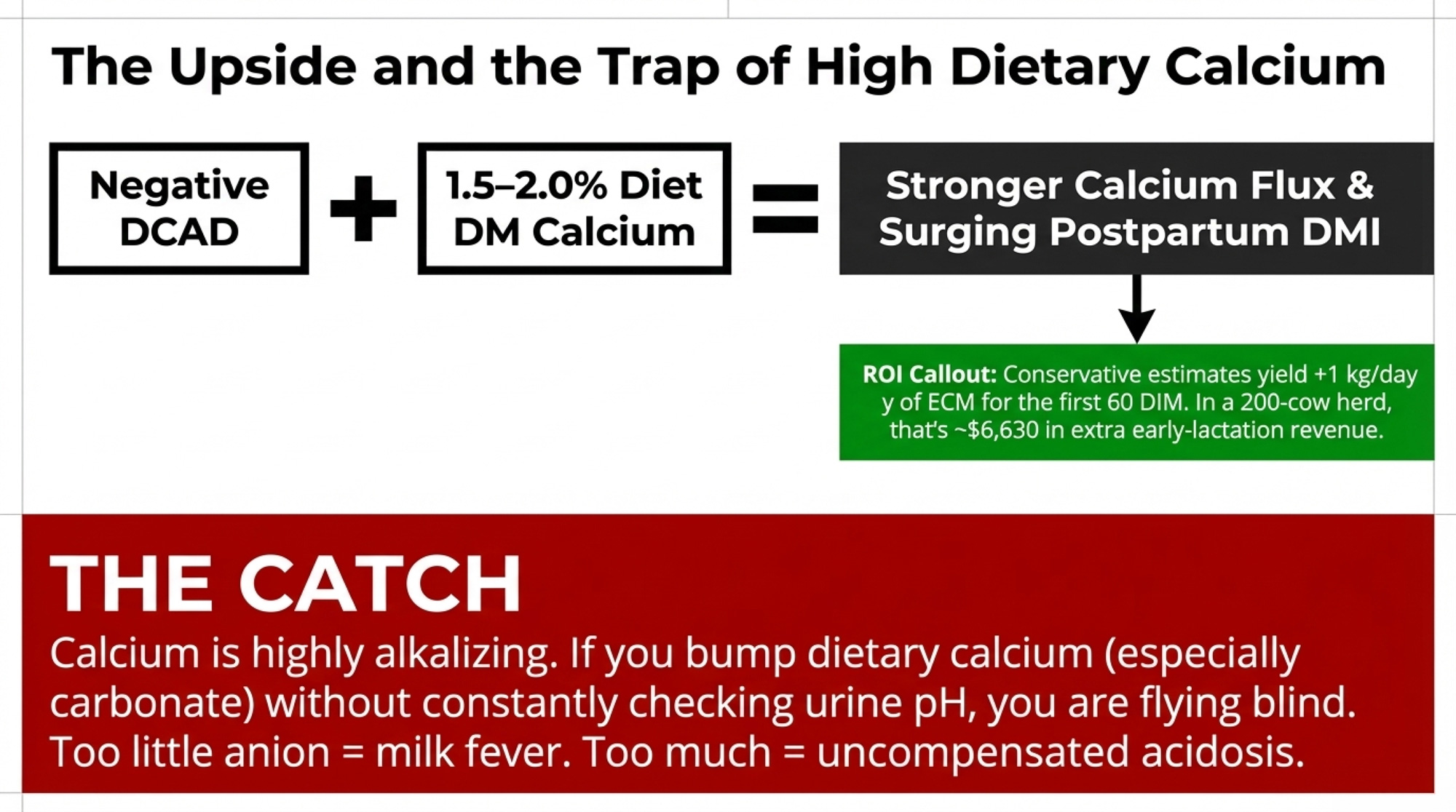
A series of trials looked at fully acidogenic pre‑fresh diets combined with higher dietary calcium — roughly 1.5–2.0% of diet DM — and followed cows through the first two months postpartum. Across those studies:
- Cows on negative DCAD plus higher calcium showed stronger calcium flux around calving, maintained or improved pre‑fresh DMI, and had higher postpartum DMI than cows on low‑calcium acidogenic diets.
- Those same cows produced more energy‑corrected milk (ECM) in early lactation than cows on positive DCAD or low‑calcium fully acidogenic diets.
Keep the barn math conservative. Say that program buys you 1 kg/day of ECM for the first 60 DIM in your multiparous cows. In that 200‑cow herd with 130 multiparous cows, that’s:
- 130 cows × 1 kg/day × 60 days = 7,800 kg of extra ECM.
Use the Ontario blend value of about $0.85/kg — based on DFO’s June 2025 average net of $87.96/hL after deductions — and you get:
- 7,800 kg × $0.85 ≈ $6,630 in extra milk revenue in the first two months of lactation.
(Note: these calculations use $0.85/kg based on Ontario’s June 2025 net blend; adjust to your local mailbox price. With the CDC’s 2.3% farmgate increase effective February 2026, your local number may now be slightly higher.)
Even if the real bump on your place is half that, you’re still talking several thousand dollars a year on top of avoided SCH‑linked disease. But you can’t tap any of that upside if the cows in front of you never actually reach the acidification zone you think you’re feeding for.
Is Your DCAD Program Actually Hitting Its pH Target?
The economic question underneath all of this is simple: Is your DCAD program working in the cows, or just on paper?
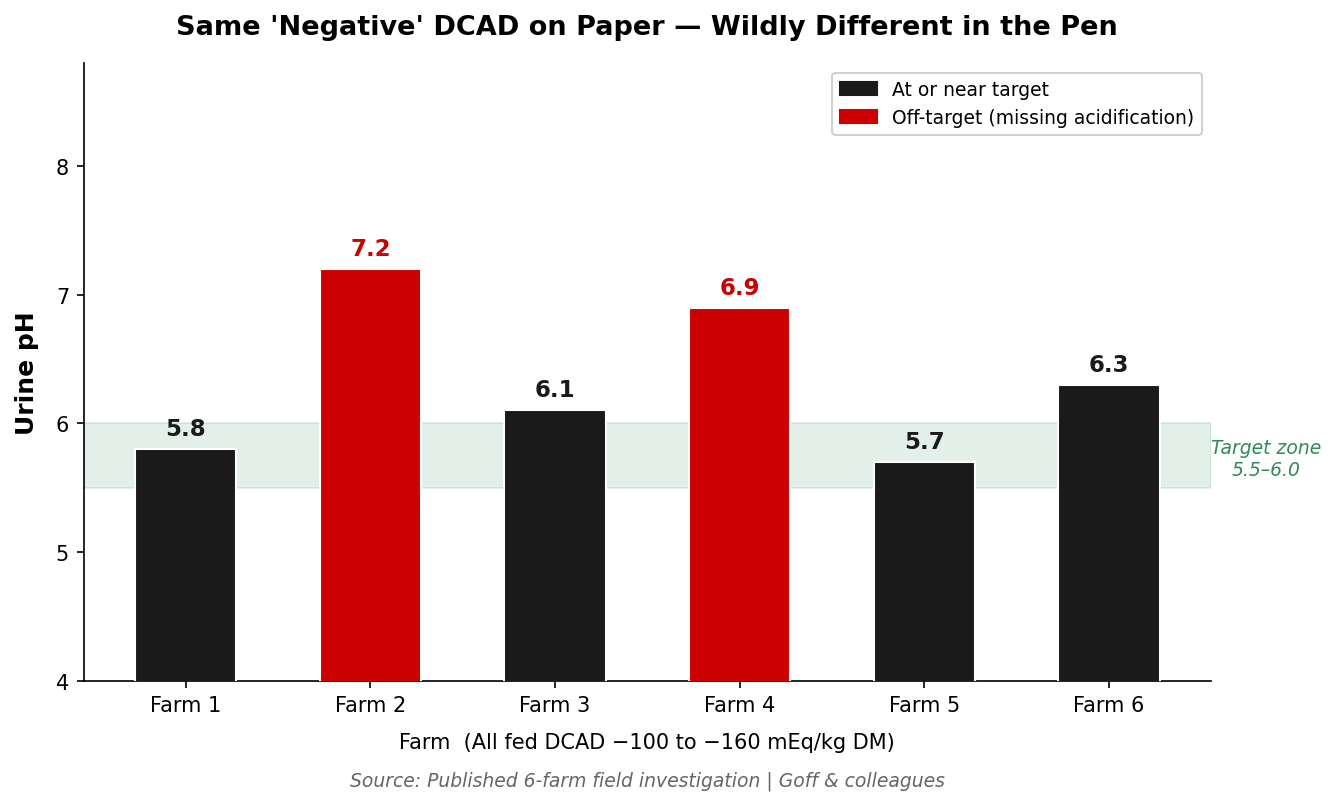
That published field investigation across six herds shows just how common the gap is. All six farms delivered TMRs that analyzed at a DCAD of −100 to −160 mEq/kg DM — right where they should be. All used the same commercial anionic product. But when urine pH was systematically collected from randomly selected multiparous cows over three days, not all farms met the 5.5–6.0 target. Farm 2 averaged 7.2 — functionally alkaline despite a correctly formulated ration. The culprit: 15.2 inches of bunk space per cow, which caused enough sorting and DMI disruption to neutralize the diet. Farm 4 had a similar miss tied to forage particle size and TMR mixing issues.
The lesson: DCAD value is a formulation number. Urine pH is what the cow is actually experiencing.
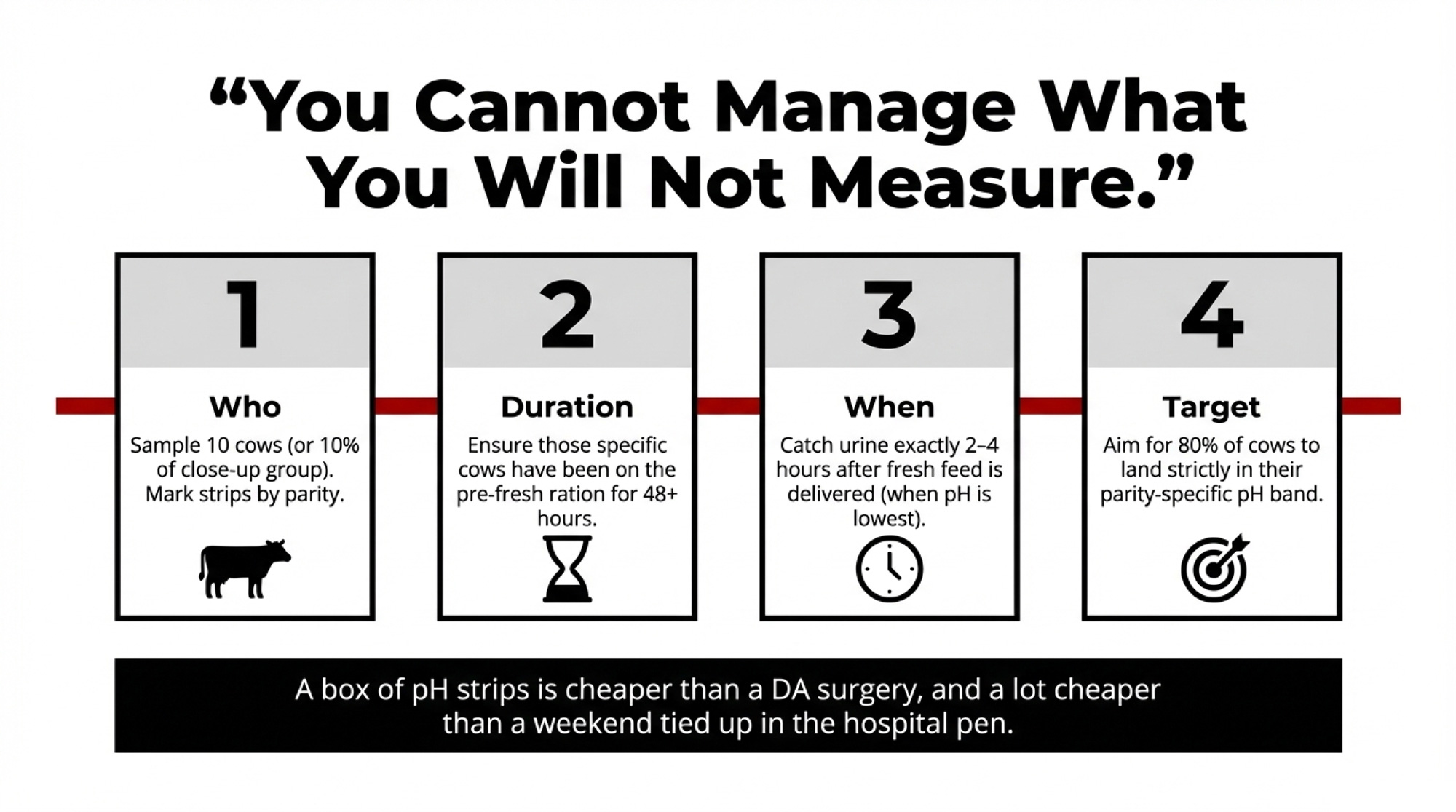
A practical monitoring protocol from Goff and others:
- Sample at least 10 cows, or about 10% of the close‑up group, whichever is bigger.
- Make sure they’ve been on the pre‑fresh ration for at least 48 hours, ideally 3–21 days before calving.
- Catch urine 2–4 hours after cows get access to that ration, when pH is at its lowest and results are tightest.
- Aim for around 80% of sampled cows to land in your target pH band.
Using the parity‑specific data:
- 2nd‑ and 3rd‑lactation cows: target urine pH 5.5–6.0 — full acidification, with safe blood pH and bicarbonate profiles supported by multiple trials.
- 4th‑lactation and older cows: target urine pH around 6.2–6.8, where Goff’s meta‑analysis saw the best calcium outcomes and a clear calcium decline below 5.75.
If your first audit comes back with an average of 7.2 — like Farm 2 in that field study — you don’t have “moderate DCAD.” You have a ration that isn’t acidifying those cows at all.
And if you see a string of older cows under 5.5, especially alongside intake or condition concerns, you’ve probably pushed anions too hard relative to fiber, magnesium, or overall palatability. That’s the edge where the very low DCAD work — down near −220 mEq/kg DM — tipped cows into uncompensated acidosis.
You can’t manage what you won’t measure. But you can buy a box of urine strips for less than a DA surgery — and a lot less than a weekend tied up in the hospital pen.
Are You Feeding Enough Calcium With Your Anions?
Old transition‑cow dogma said “never feed high calcium pre‑fresh.” Newer DCAD and mineral work says that, under a properly negative DCAD, high calcium plus anions is often where the payback is.
Across recent studies:
- Cows on negative DCAD diets with 1.5–2.0% Ca in diet DM had stronger calcium flux, better postpartum DMI, and higher ECM than cows on low‑calcium fully acidogenic diets.
- High‑calcium fully acidogenic diets did a better job of holding DMI than low‑calcium FAS diets, which showed bigger intake dips.
The chemistry catch is that calcium is alkalizing. When you bump dietary calcium — especially as carbonate — you usually have to adjust anion supply to hold the same urine pH. If you crank anions every time you bump Ca, and never check what cows are actually peeing, you’re back to guessing.
Too little anion with high Ca and high‑K forages, and you recreate the old “high‑potassium hay + high‑calcium close‑up” milk fever trap. Too much anion, especially in pens heavy with older cows, and you risk dragging that group below 5.5 pH, where Goff’s meta‑analysis saw calcium status trending the wrong way.
The sweet spot isn’t a single DCAD target on paper. It’s the balance between DCAD, calcium level, and who’s actually standing in your close‑up group.
Options and Trade‑Offs for Farmers
You’ve got four real ways to play this — none of them free, but all of them better than guessing.
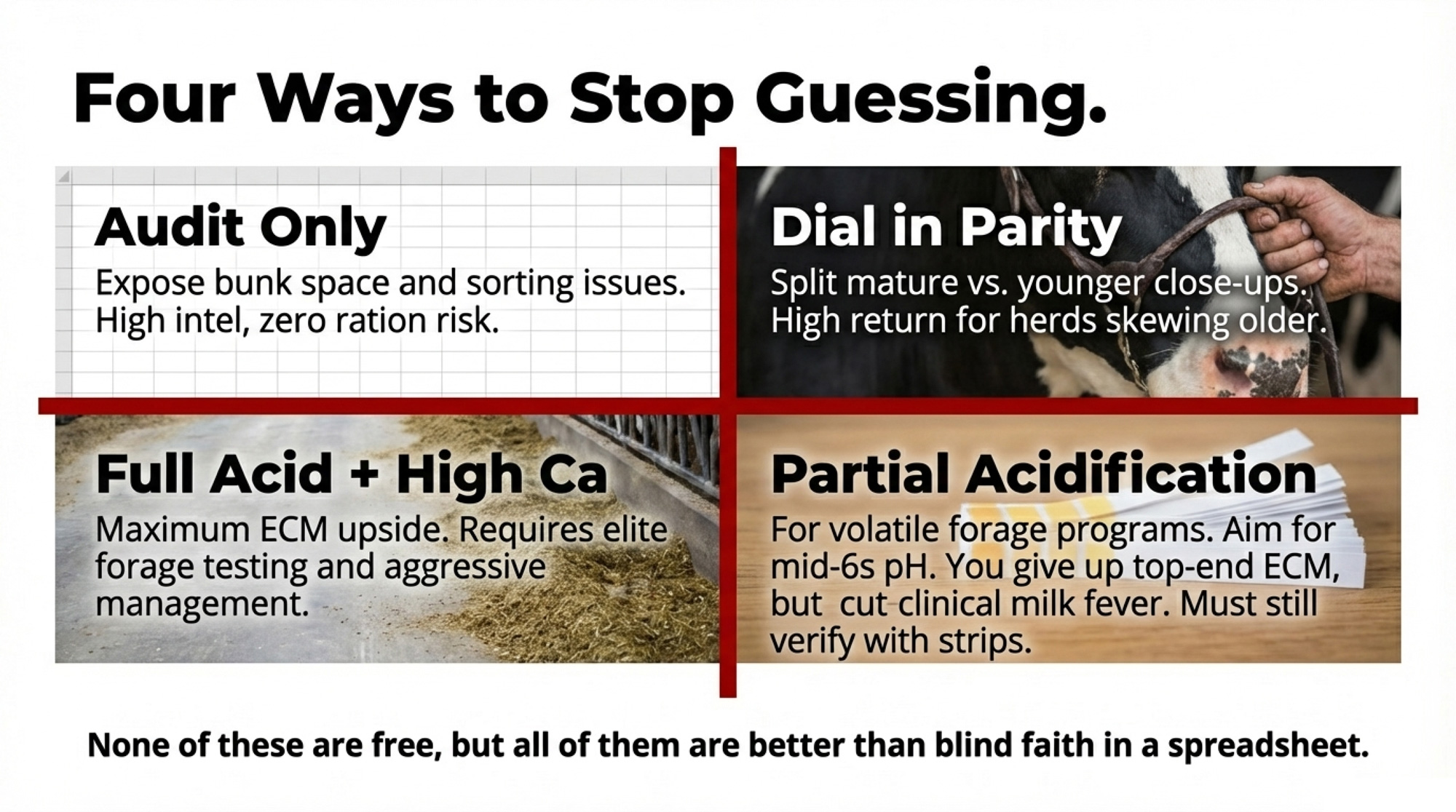
| Strategy | Best Fit For | What You Gain | What You Give Up | Key Risk |
|---|---|---|---|---|
| 30-Day Urine pH Audit | Any herd — starting point | Actual data on whether DCAD is working | 30 min + cost of strips | Finding out your program is doing nothing |
| Parity-Specific Targets | Herds >30% 4th+ lactation cows | Tighter Ca support for oldest cows | Pen complexity, management time | Over-acidifying older cows below pH 5.75 |
| Full Acidification + High Ca | Stable forage, strong advisory team | Maximum ECM gains, lowest SCH | Requires accurate, frequent forage testing | Pushing anions without checking urine pH |
| Partial Acidification (Proven) | Variable forage K, no parity sorting | Lower milk fever risk vs. no DCAD | Won’t capture full SCH/ECM benefit | Cosmetic program at pH 7.8 = money wasted |
1. 30‑Day Action: Audit Your DCAD in the Cows, Not on Paper
This is the low‑risk, high‑information starting point — the same move that exposed the problem in the Schaefer example and that documented field investigation.
- Within 30 days, run a urine pH profile on your close‑up pen: at least 10 cows, or 10% of the group, 2–4 hours after feeding, on the ration for at least 48 hours.
- Mark strips by parity (“P2–3” vs “P4+”) so you can see whether older cows live in a different pH band.
- Sit down with your nutritionist and vet and compare those numbers to your calculated DCAD and your latest forage K analyses.
Patterns you’re likely to find:
- Rations that look fully acidogenic on paper but leave cows at pH 7.0–7.8 because forage potassium came back higher than assumed — or, like Farm 2, because bunk space or mixing issues prevent cows from eating what you think they’re eating.
- Older cows sit at 5.2–5.4, while younger cows hover near 5.8–6.0, and those same older cows are turning up too often on your “problem fresh” list.
This doesn’t fix the ration. It just tells you whether your main problem is being too timid overall, too aggressive with certain cows, or something as simple as bunk management.
2. Dial in Parity‑Specific Targets
If about a third or more of your close‑up pen is 4th lactation or older, Goff’s parity‑specific data says you shouldn’t chase the same pH for them as for your 2nd‑calvers.
In practice, that can look like:
- Grouping by parity when barn design allows: a “mature‑cow close‑up” and a “younger‑cow close‑up.”
- Running a parity‑specific mineral strategy: same base forage, slightly different DCAD and Ca levels by pen.
- Re‑checking urine pH and, if you’re keen, spot blood calcium by group a couple of times a year.
You gain tighter support for the cows most likely to crash. You give up some simplicity and pen flexibility.
3. Strengthen Full Acidification + High Calcium Where It Fits
For herds with stable forage programs and a strong advisory team, leaning into full acidification plus higher calciumcan be a high‑return move.
Best fit when:
- You’re already getting reliable mineral analyses back from your forage lab.
- You’re willing to watch DMI, manure, and fresh‑cow health closely during any ration changes.
- Your vet and nutritionist are aligned on DCAD targets and SCH benchmarks.
It demands:
- Accurate DCAD math using up‑to‑date Na, K, Cl, and S lab numbers.
- Dietary Ca in the 1.5–2.0% DM range.
- Adequate magnesium and effective fiber to keep cows on feed.
Risks:
- Over‑pushing anions to “fix” what’s really a forage‑testing problem, edging toward uncompensated acidosis.
- Raising calcium without enough anion, which blunts the very calcium‑mobilizing system DCAD is designed to prime.
4. Stick With Partial Acidification — But Prove It
Some barns aren’t good candidates for full acidification: volatile forage potassium, no room to sort by parity, and limited labor.
In those systems, aiming for more moderate urine pH — often in the mid‑6s instead of around 8.0 — can still cut clinical milk fever risk compared with no DCAD program at all, even if you never push pH into the 5.5–6.0 band.
The key is honesty:
- You likely won’t get the full SCH and ECM benefits seen in FAS + high‑calcium research.
- You still have to test. A ration “designed” for pH 6.5 that yields pH 7.8 in the pen is cosmetic, not partially acidified.
As ingredient costs keep climbing, cosmetic programs are going to be harder to justify than well‑measured ones.
Key Takeaways
- If you’re not pulling urine pH strips on your close‑up cows at least a few times a year, you don’t have a DCAD program — you have a DCAD expense. Start with a 10‑cow, 2–4‑hour post‑feeding sample and see if your cows are anywhere near your target pH.
- If roughly a third or more of your close‑up group is 4th lactation or older, don’t chase 5.5 pH for everyone. Aim those cows around 6.2–6.8 and reserve the 5.5–6.0 band for 2nd‑ and 3rd‑calvers, where full acidification is both safe and effective.
- If your SCH prevalence in multiparous cows is north of about 30% and you’re already paying for anionic salts, assume a verification gap before you decide “DCAD doesn’t work here.” Use the US$60–$226 per‑case range to ballpark what SCH might be costing you and whether a DCAD tune‑up pencils out.
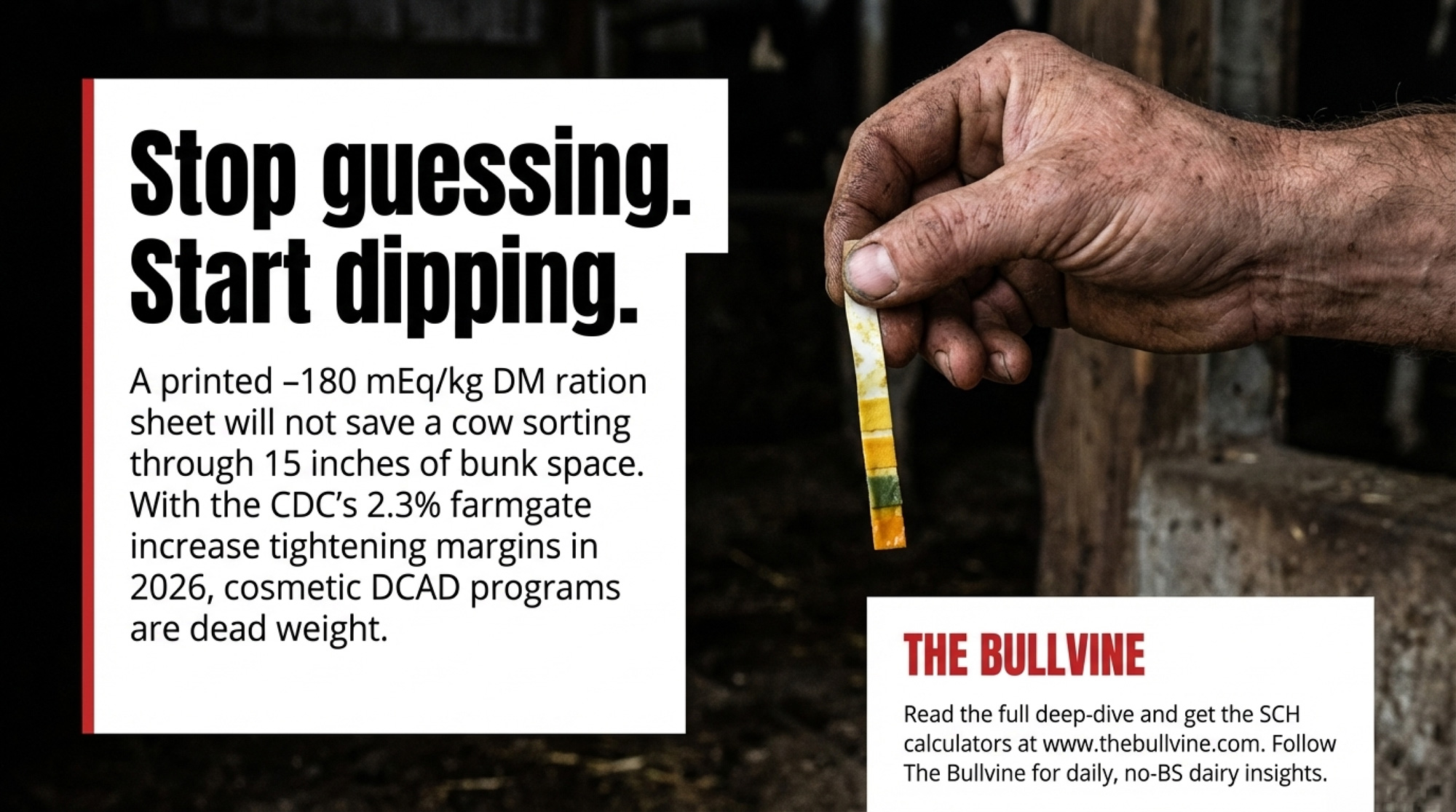
- If your ration DCAD is printed at −180 mEq/kg DM and your older cows are peeing at 5.2, you’ve probably gone past the point of diminishing returns. Back off anions until those cows’ urine pH and calcium status are closer to 6.5, then re‑check urine pH and calcium status instead of assuming “hotter” must be better.
The Bottom Line
You’re already writing checks for anionic salts and pre‑fresh minerals. It’s worth knowing whether those dollars are actually buying fewer SCH cows, more milk, and calmer fresh pens — or just living on a ration sheet. Start with that 30‑day urine pH audit. From there, you’ll know whether your next move should be more anion, more calcium, smarter grouping, or tighter forage testing.
If you want the deeper math — SCH calculators, DCAD formulation walkthroughs, or parity‑specific transition strategies — watch for the follow‑up playbooks and Bullvine Weekly breakdowns. Once you’ve seen your own pH strips, you won’t look at that “−120 mEq/kg” printout the same way again.
Complete references and supporting documentation are available upon request by contacting the editorial team at editor@thebullvine.com.
Learn More
- The $500 Transition Gap: Why Your Neighbor’s Fresh Cows May Outperform Yours by Next Winter – Capture a $500 net benefit per cow by moving beyond the “one-size-fits-all” trap. This field-tested guide breaks down the targeted management habits that separate elite transition pens from the ones just getting by.
- 2026 Dairy Rally Or Dead-Cat Bounce? The Risk and Margin Math Behind Today’s Wall of Milk – Strategically de-risk your 2026 margins with this breakdown of the current “wall of milk.” It exposes the hidden math of the $18.95 forecast, providing the leverage you need to lock in profitable milk.
- How 3D Printed Sensors Detect Subclinical Hypocalcemia in Cows Instantly – Stop the “silent thief” of calcium in its tracks using disruptive 3D-printed sensor technology. This emerging tool delivers a ten-second diagnostic advantage, allowing you to treat individual cows long before the clinical symptoms show.
 The Sunday Read Dairy Professionals Don’t Skip.
 The Sunday Read Dairy Professionals Don’t Skip.
Every week, thousands of producers, breeders, and industry insiders open Bullvine Weekly for genetics insights, market shifts, and profit strategies they won’t find anywhere else. One email. Five minutes. Smarter decisions all week.