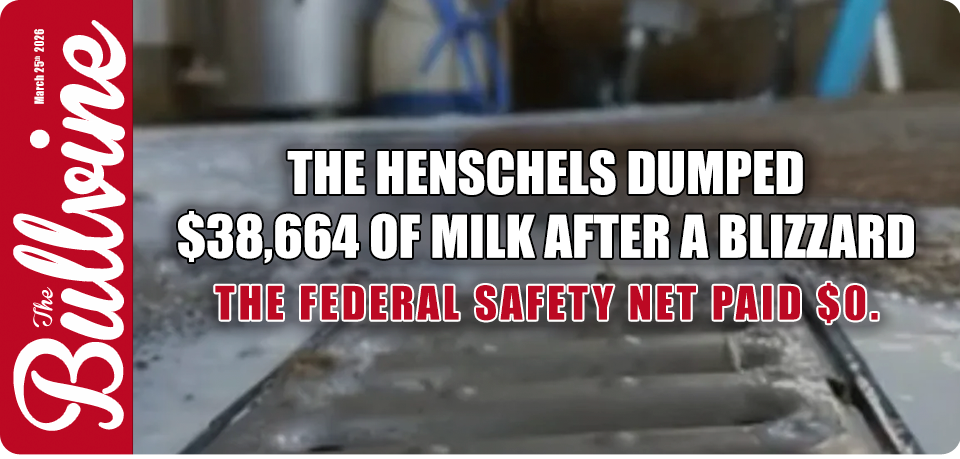





The Henschel family milked through 5‑to‑15‑foot drifts near Manawa — then dumped a full day’s milk because the truck couldn’t come, and no federal program covers the milk you lose.
On the Sunday morning of the March 14–16 blizzard, the Henschel dairy near Manawa, Wisconsin, was buried in snow. Drifts on the lane were higher than the skid steer. The milk truck that usually shows up like clockwork couldn’t reach them. Roads were closed, plows were pulled, and for about 36 hours, they were essentially on their own with cows still milking and a bulk tank running out of room.
Chris Henschel told US Farm Report that they were dealing with “whiteout conditions with snow drifts anywhere from 5 to 15 feet high” around the farm, and that the roads were “impassable for about 36 hours.” Keeping feed in front of cows and milk moving out of the parlor didn’t change one hard fact: the tank only holds so much. In the end, Henschel said they dumped “basically almost a day’s worth of milk because nobody could get to the farm.”
They did the work. They hit every milking. They had no way to ship it. Lay the program rules and the barn math beside that picture, and it’s hard not to see your own risk sitting there too.
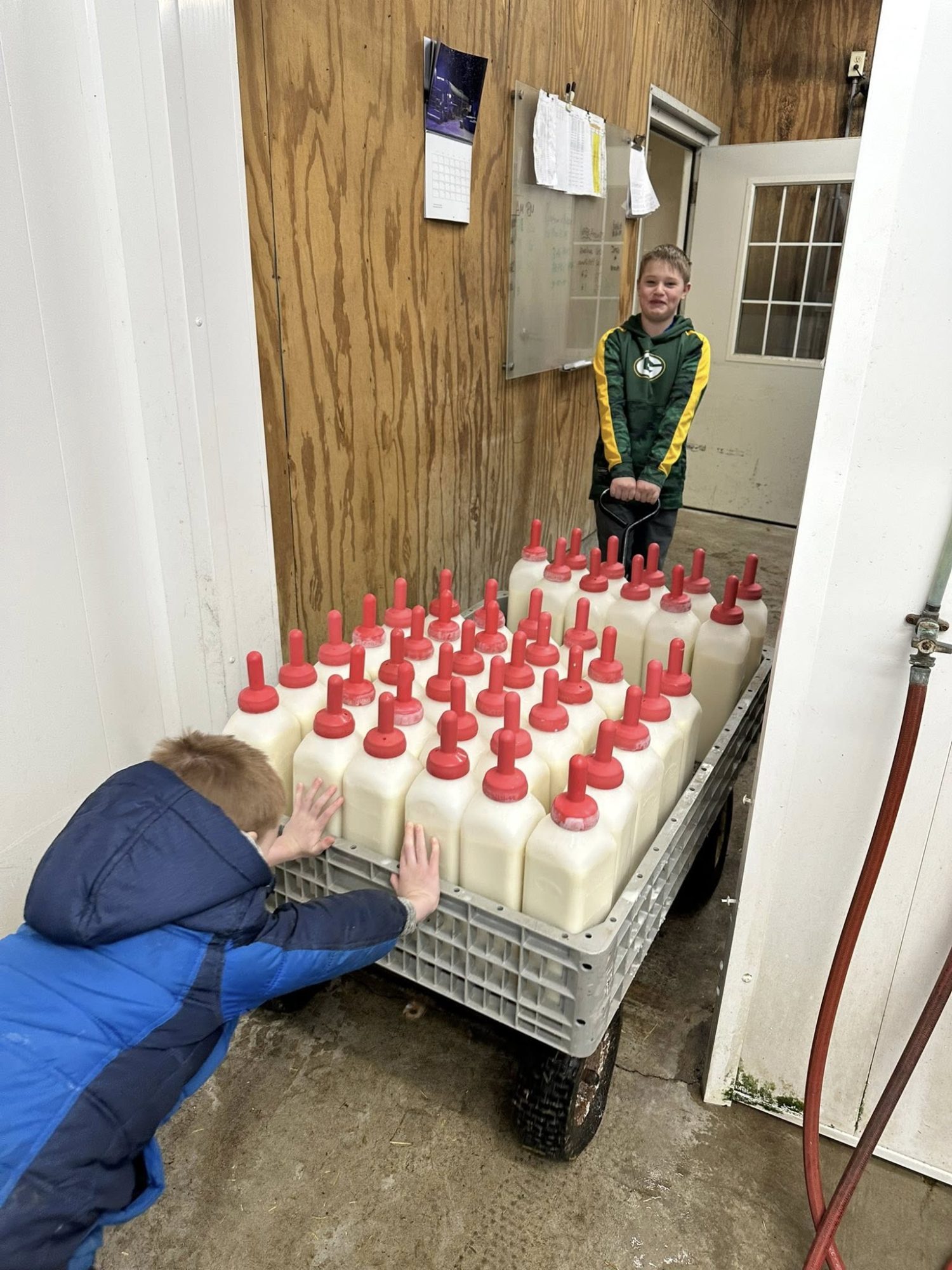
When the crew couldn’t reach the barn and the backup was plowing snow, the backup to the backup crew rolled in — the Henschel boys muscling a cart of milk for calves on that blizzard day.
What the March 14–16 Blizzard Really Did to Dairy Roads
This wasn’t a normal March snow that blows through overnight and melts by the weekend. The National Weather Service called it a “historic, record-setting winter storm” — a potent Colorado low that deepened as it tracked from the central Plains toward Chicago and Lake Huron, pulling Gulf moisture into cold air and hammering the Upper Midwest for more than 48 hours.
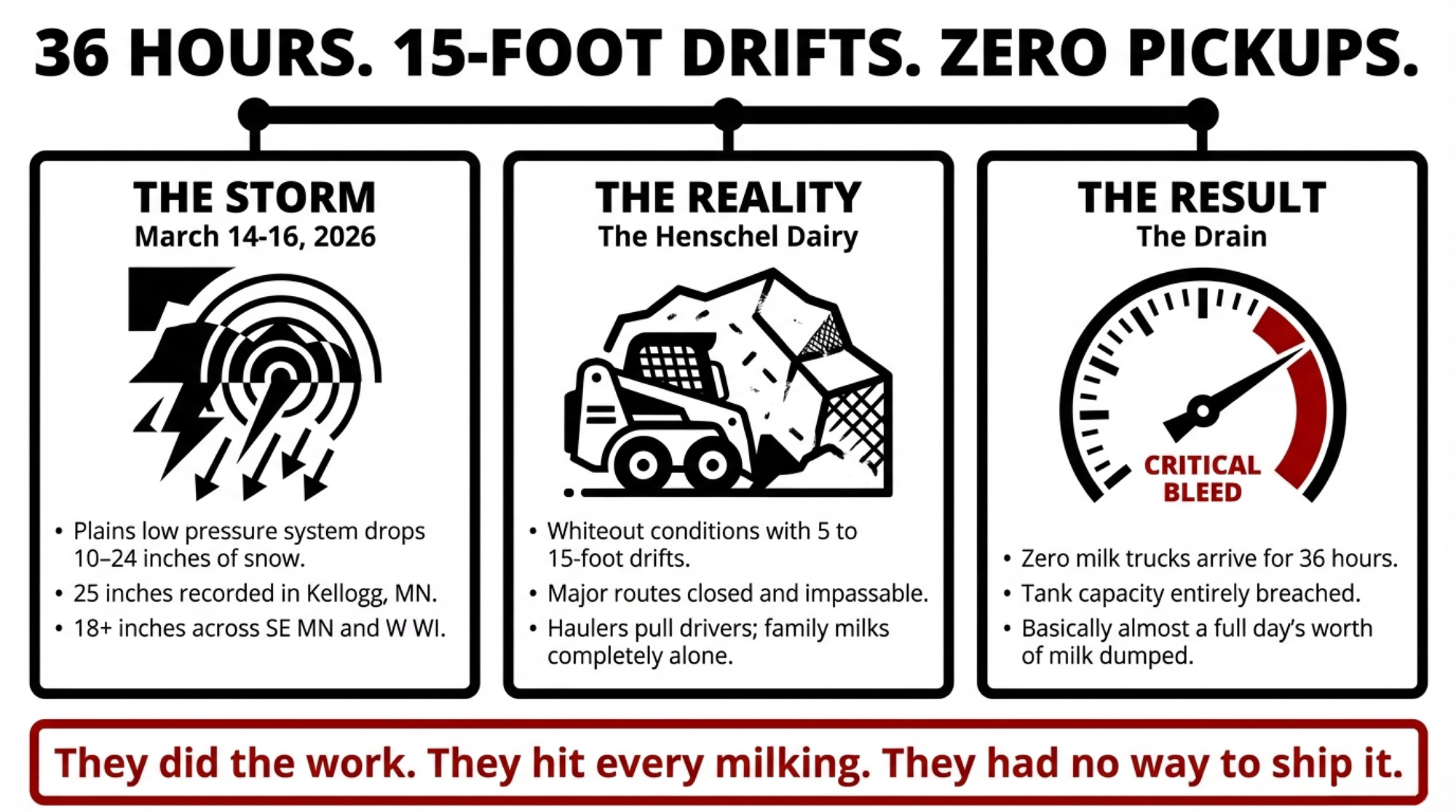
NWS Green Bay reported a widespread 1 to 2 feet across northeast Wisconsin, with localized amounts exceeding 30 inches from Wausau to Marinette and Door County. Green Bay itself recorded 26.6 inches — its second-largest snowstorm on record. Waupaca County, where the Henschel dairy sits near Manawa, saw 25 to 30.5 inches, with nearby Shawano County reporting up to 33 inches. Snowfall rates hit 4 inches per hour at times, with thundersnow and lightning.
To the west, NWS La Crosse confirmed 25 inches at Kellogg, Minnesota, with similar totals across Trempealeau and Clark Counties in Wisconsin — Independence and Strum both hit 25 inches, Granton 25 inches, and Mondovi 26.6 inches. Peak wind gusts reached 59 mph at Green Bay Airport and 60 mph in De Pere, with 40–55 mph gusts common across the region. NWS La Crosse noted reports of 3‑to‑5‑foot drifts were common; NWS Green Bay documented a 10‑foot drift in Ephraim.
The timing was brutal. Storm onset hit Saturday evening, March 14. Peak winds and whiteouts ran late Saturday into Sunday. Interstates 35, 80, and 94 were all closed for a period on Sunday and Sunday night. NWS Twin Cities confirmed that vehicles became stranded on I‑94 between Eau Claire and Osseo during blizzard conditions, and WisDOT posted “No Travel Advised” across the northern half of the state for an extended period. The worst transport window lasted roughly 24–36 hours, during which rural routes were effectively shut down. If your usual truck hits the yard Saturday night or Sunday morning, a 36‑hour shutdown doesn’t just mean “late pickup.” Depending on your tank size and flow, it can mean “no pickup” before you run out of storage.
US Farm Report and Dairy Herd both described the Henschels’ situation as a “rare milk dump” triggered by this storm, noting that towering drifts blocked every path to the farm. On farms across the region, that translated into township and county plows leaving some dairy roads for last, haulers making the call to stay parked rather than risk drivers in whiteouts, and milk plants adjusting schedules or pausing loads until they knew trucks could actually move.
You can’t change the weather. You can be honest about what it costs — and why all the programs that show up after storms like this barely touch the milk itself.
“Milk Can’t Wait”: The Aid That Showed Up — and What It Missed
Within days, USDA’s Farm Service Agency in both Wisconsin and Minnesota was pushing reminders about disaster programs. Sandy Chalmers, FSA State Executive Director in Wisconsin, put it bluntly: “Milk can’t wait. When trucks can’t reach farms or processors on time, producers face costly delays and, in some cases, must dispose of milk that can’t be stored.” She urged producers to report “crop, livestock, and infrastructure-related losses” and to contact their county offices.
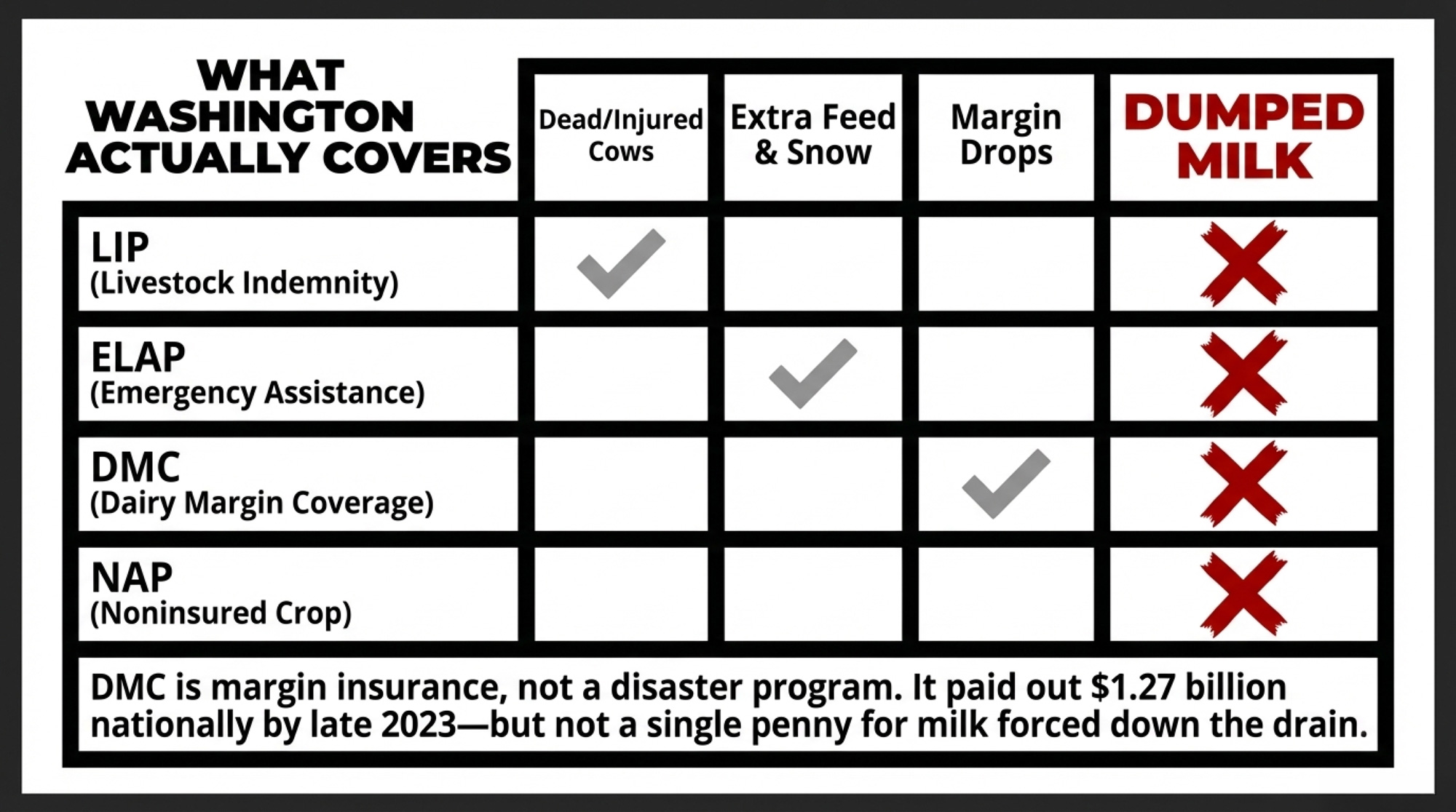
Here’s what was actually on the table for a storm like this:
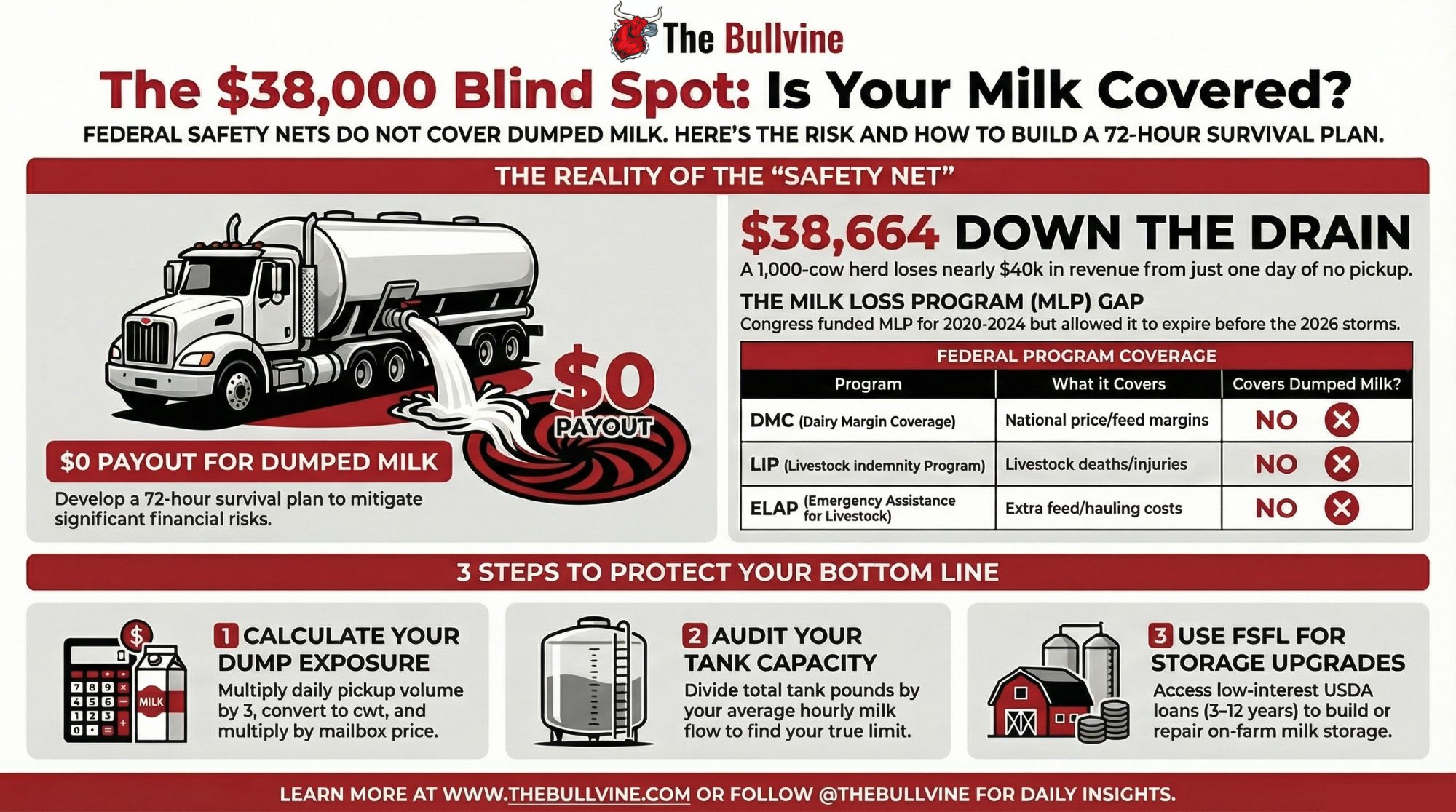
- Livestock Indemnity Program (LIP) — Authorized under the 2014 Farm Bill and administered by FSA, LIP pays 75% of the fair market value for livestock deaths above normal mortality due to eligible adverse weather events like blizzards and extreme cold. It can also cover animals sold at a discount after storm-related injuries. Notice of Loss must be filed within 30 calendar days of when the loss becomes apparent.
- Emergency Assistance for Livestock, Honeybees, and Farm‑raised Fish (ELAP) — Provides emergency relief for above‑normal feed costs, feed and water hauling, and equipment rental for snow removal when adverse weather makes normal operations impossible. ELAP does not cover milk loss directly, though USDA expanded ELAP in July 2024 to cover milk production losses from H5N1‑infected herds — a different mechanism. Notice of Loss: 30 calendar days from when the loss first became apparent.
- Noninsured Crop Disaster Assistance Program (NAP) — Covers non‑insured crops and forage in eligible situations. NAP does not cover milk. A Notice of Loss must be filed within 15 days of the loss becoming apparent — that 15‑day window is shorter than LIP and ELAP, so hay and forage losses from this storm need to be reported fast.
- Farm Storage Facility Loan Program (FSFL) — Provides low‑interest financing on 3–12 year terms to build, repair, or upgrade on‑farm storage facilities. USDA’s eligible commodity list explicitly includes milk, and eligible facility types include bulk tanks, so this can apply directly to expanding your on‑farm milk storage capacity. It doesn’t pay for losses, but it can help you build more buffer for the next storm.
On the margin side, the farm bill politicians in Washington have been celebrating as a “big, beautiful” win for producers, reauthorizing and improving Dairy Margin Coverage (DMC) through 2031. DMC is margin insurance, not a disaster program, but it’s the main federal backstop on dairy revenue. By late 2023, DMC had paid out about $1.27 billion nationally, with Wisconsin topping the list at roughly $272.2 million — around $63,633 per enrolled operation— according to USDA and prior Bullvine analysis.
Bullvine’s DMC work shows margins slipping below $10/cwt by late 2025 and into the mid‑$7s for early 2026, triggering some of the bigger checks in a few years for farms that stayed fully enrolled. Those payouts helped on paper margins. They didn’t do a thing for milk forced down the drain because the road and plant system around you blinked.
On paper, it can look like you’re covered. In the parlor, once you read the fine print, it’s a different story.
Does Any Federal Program Actually Cover Dumped Milk?
Line up USDA’s current tools, and the gap jumps off the page:
| Program | What It Covers | Trigger Mechanism | Covers Dumped Milk? | 2026 Status |
|---|---|---|---|---|
| LIP | Livestock deaths above normal mortality; injured animals sold at discount | Blizzard, extreme cold declared event | NO | Active — NOL by Mar 1, 2027 |
| ELAP | Above-normal feed costs; feed/water hauling; snow removal equipment | Weather event driving extra input costs | NO | Active — NOL by Mar 1, 2027 |
| DMC | National all-milk price minus standardized feed cost (margin) | Monthly margin falls below elected level ($4–$9.50/cwt) | NO | Active — enrolled thru 2031 |
| NAP | Non-insured crops and forage losses | Crop failure / loss event; 15-day NOL requirement | NO | Active — covers crops only |
| FSFL | Low-interest loans for on-farm storage construction/upgrades | N/A — financing, not indemnity | NO | Active — 3–12 yr terms |
| MLP | Milk dumped due to qualifying weather — impassable roads, power outages | YES — BUT 2020–2024 ONLY | EXPIRED — signup closed Jan 23, 2026 |
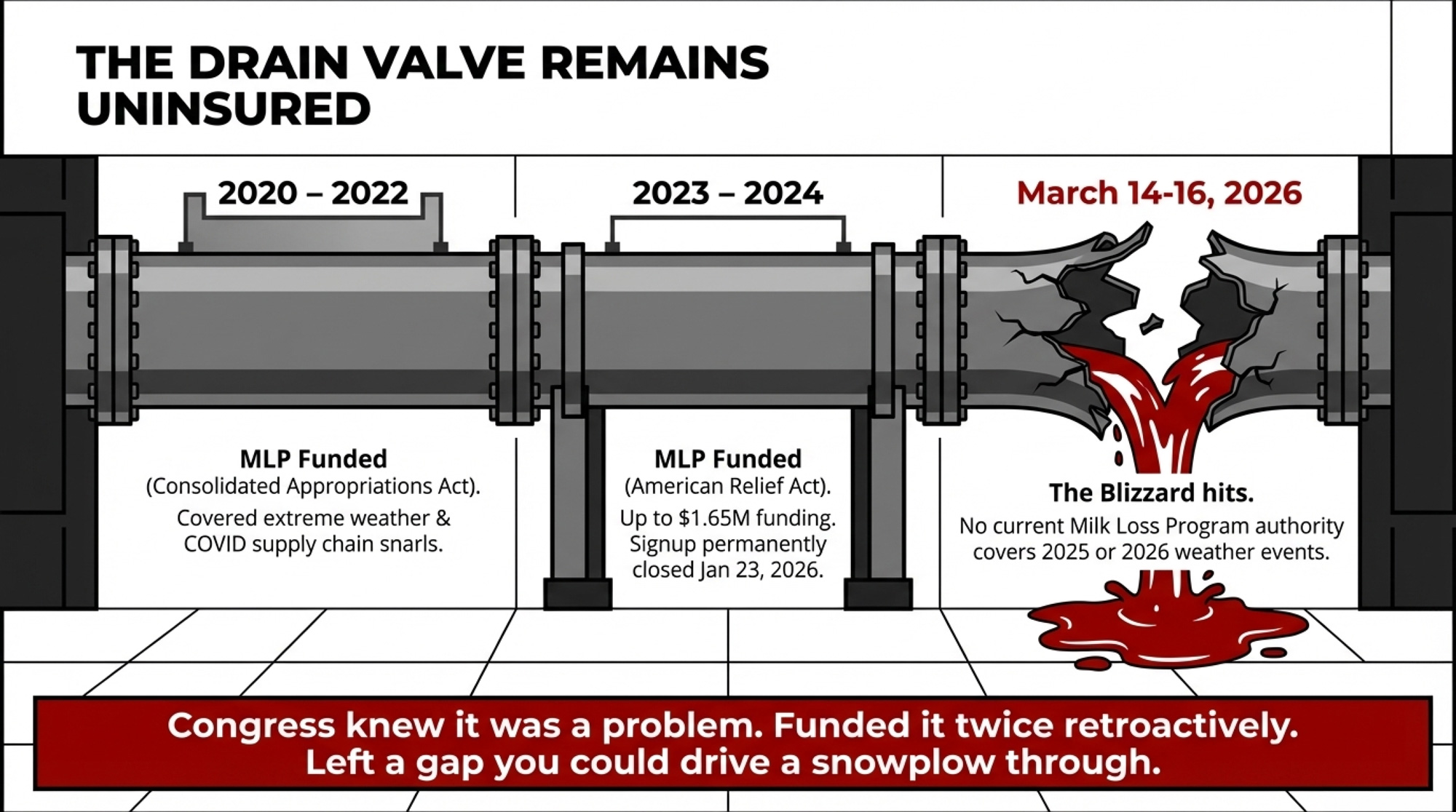
There is one program specifically designed to pay for dumped milk: the Milk Loss Program. Congress has authorized it twice. The first round, under the Consolidated Appropriations Act of 2023, covered eligible losses in 2020, 2021, and 2022 — including extreme weather, supply chain snarls, and COVID‑era processing shutdowns. MLP paid 75% of the milk value for most producers and 90% for underserved producers, including beginning, limited‑resource, and veteran farmers.
The second round, authorized under the American Relief Act of 2025 as part of USDA’s Supplemental Disaster Relief Program, extended MLP to cover qualifying weather events in 2023 and 2024. That signup window opened in late November 2025 and closed in late January 2026 — less than two months before the Henschels’ blizzard.
The March 14–16, 2026, blizzard lands outside both windows. No current MLP authority covers losses for 2025 or 2026. Congress knew about the problem, funded it retroactively twice, and still hasn’t built a permanent program.
So when the Henschels opened that valve, here’s what the safety net really did:
- Any calves or cows lost to storm stress or injuries? LIP might cover 75% of their value — but you need to file a Notice of Loss within 30 days, which for this storm means roughly by mid‑April 2026. The application for payment deadline extends to approximately March 1, 2027.
- Extra feed, fuel, and snow removal to dig out? ELAP might help — same 30‑day Notice of Loss requirement, with an application deadline of approximately January 30, 2027. fsa. usda
- Margins squeezed this winter? DMC sends a check if the national margin falls far enough below your coverage level.
- The actual milk they dumped — roughly a full day’s output — sat entirely outside federal coverage in 2026.
That’s not a clerical error. That’s how the net has been structured so far.
How Much Does 72 Hours Without a Milk Truck Actually Cost Your Operation?
Now put some numbers to what a storm like this means in dollars.
March 2026 Class III futures were trading around $16.11/cwt on the CME. Take a realistic daily production number: 80 pounds of saleable milk per cow per day — 0.8 cwt per cow. Daily revenue per cow at that price: 0.8 cwt × $16.11 = $12.89 per cow per day.
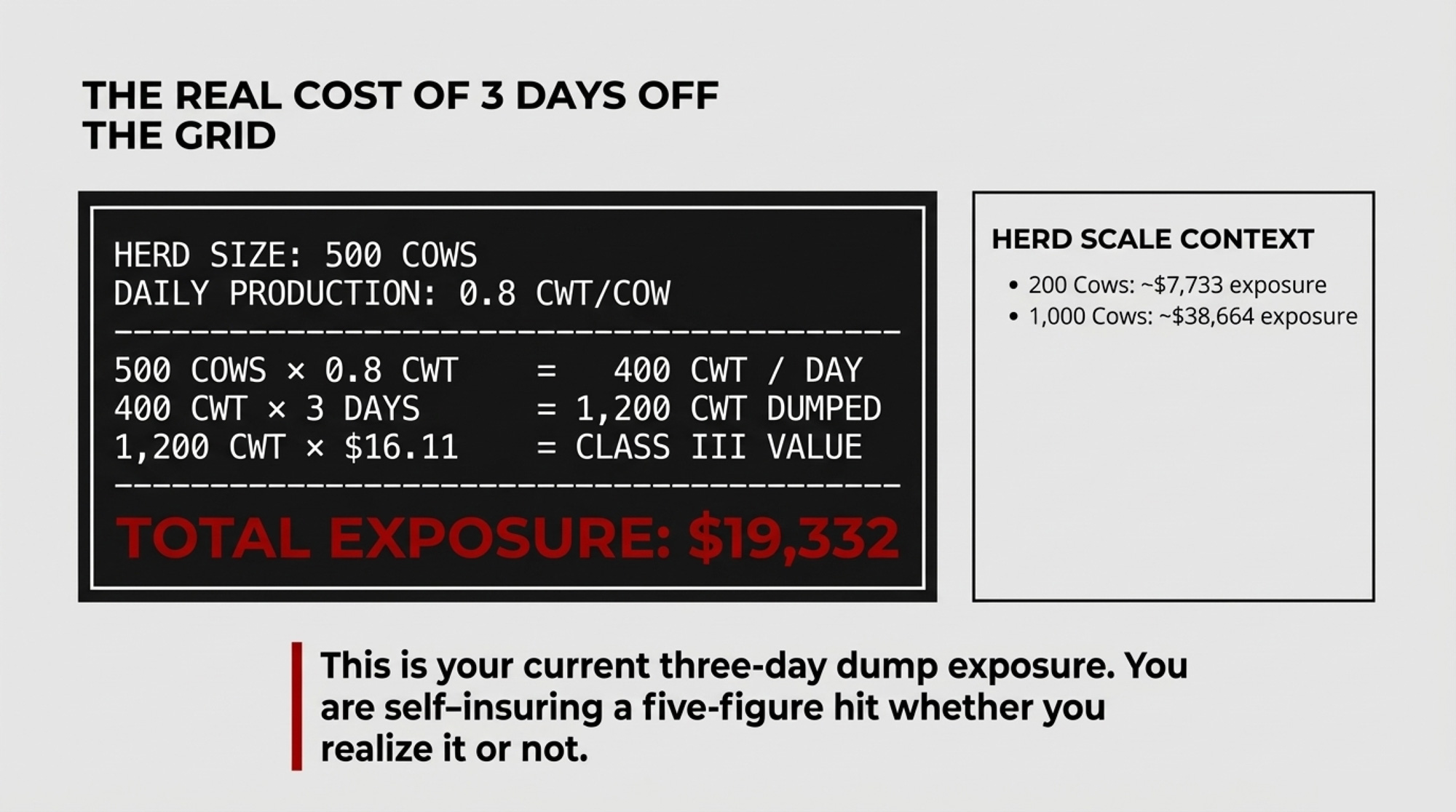
Scale that across a herd and across three days of no pickup:
- 200 cows: 48,000 lb = 480 cwt. At $16.11 ≈ $7,733 down the drain.
- 500 cows: 120,000 lb = 1,200 cwt. At $16.11 ≈ $19,332.
- 1,000 cows: 240,000 lb = 2,400 cwt. At $16.11 ≈ $38,664.
For the Henschels, coverage described them dumping “basically almost a day’s worth of milk” when roads kept trucks out. If you assume a mid‑size herd shipping around 32,000 lb per day — 320 cwt — one dumped day at $16.11/cwt is about $5,155. That’s explicitly example math, not their disclosed volume, but it’s the right scale for a lot of upper‑Midwest family dairies.
| Herd Size | Avg Daily Pickup (lbs) | 3-Day Pickup (cwt) | At $14.59/cwt (Jan 2026 low) | At $16.11/cwt (March futures) | At $18.00/cwt (strong market) |
|---|---|---|---|---|---|
| 200 cows | 16,000 | 480 | $7,003 | $7,733 | $8,640 |
| 500 cows | 40,000 | 1,200 | $17,508 | $19,332 | $21,600 |
| 1,000 cows | 80,000 | 2,400 | $35,016 | $38,664 | $43,200 |
| 2,500 cows | 200,000 | 6,000 | $87,540 | $96,660 | $108,000 |
| 5,000 cows | 400,000 | 12,000 | $175,080 | $193,320 | $216,000 |
Here’s the quick version for your own barn:
- Grab your last hauler or co‑op statement and find your average daily pickup volume in pounds.
- Multiply that number by 3.
- Divide by 100 to turn pounds into cwt.
- Multiply by today’s Class III or your mailbox price.
That final number is your current three‑day “dump exposure.” Whether you’ve thought about it or not, you’re self‑insuring it.
Does Your Disaster Plan Survive Three Days Without a Pickup?
Most of us say we have a “plan” for storms. What we really have are habits and luck:
- The township usually plows us early.
- The hauler always finds a way.
- The generator has “never let us down.”
Henschel dairy had habits, too. Then they watched the system around them break — drifts higher than the skid steer, I‑94 closed, WisDOT posting “No Travel Advised” across the northern half of the state.
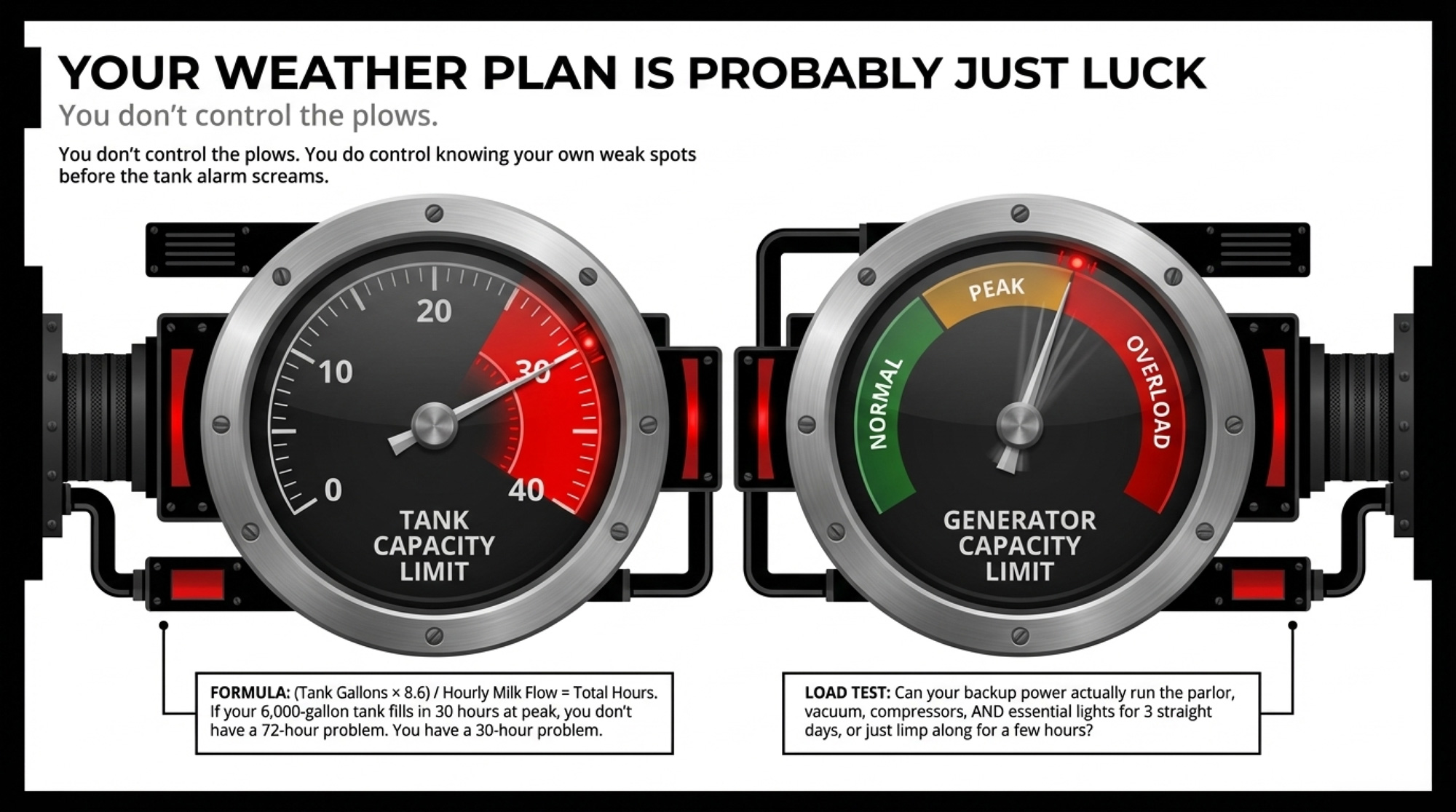
If you want an honest 72‑hour plan, start by knowing your own limits:
- How many hours to a full tank? Take your tank size in gallons. Multiply by 8.6 (the weight of a gallon of milk in pounds). Divide by your average hourly milk flow. If your 6,000‑gallon tank fills in 30 hours at peak, you don’t have a 72‑hour problem — you’ve got a 30‑hour one.
- What backup storage do you really have? A clean nurse tank you actually trust? Access to a neighbour’s bulk tank under a mutual‑aid agreement? A rented tanker or portable tank you could bring in ahead of a forecast blizzard? USDA’s FSFL program will finance bulk milk storage tanks at low interest rates, so if you’ve been thinking about adding capacity, the loan structure already exists.
- What are your hauler’s hard limits? Do they have written rules for when they pull trucks? Will they combine routes, run nights, or send smaller trucks? Who actually decides when routes are suspended, and how do they let you know?
Power and access matter too. If a storm like this takes down the grid, can your generator actually run the parlor, vacuum, compressors, and essential lights for three days, or just enough to limp along for a few hours? If you don’t know the answer, that’s worth a conversation with your electrician before fall.
You don’t control the plows or the wind. You do control whether you know your own numbers and weak spots before the next tank alarm reminds you how tight your margin for error really is.
Options and Trade‑Offs for Farmers
| Option | Upfront Cost / Effort | Ongoing Cost | Time to Implement | Covers Which Risk? | Key Limitation |
|---|---|---|---|---|---|
| Add on-farm storage (extra tank, nurse tanker) | High — stainless steel, plumbing, wiring; FSFL loans available at low interest | Low — maintenance & cleaning | 6–18 months | Buys 12–24 hrs extra buffer | Hauler still won’t come in whiteout; storage has limits |
| Tighten hauler/processor agreement | Low — phone calls, written plan | None | 30 days | Reduces likelihood of no-show | Can’t override DOT road closures; hauler serves many farms |
| Neighbor/mutual-aid milk pact | Low — a conversation now, co-op paperwork | None | 30–60 days | Routes milk to farm with access/storage | Co-op food-safety rules; requires pre-approval before crisis |
| Push for permanent MLP | Political capital + time | None | 1–3 years (Congress) | Creates federal backstop on dumped milk | Program has expired twice; 2026 dumps currently uninsured |
You’ve basically got four paths when you think about the “truck can’t come” problem. None are perfect. Each has trade‑offs.
1. Build more on‑farm or shared storage
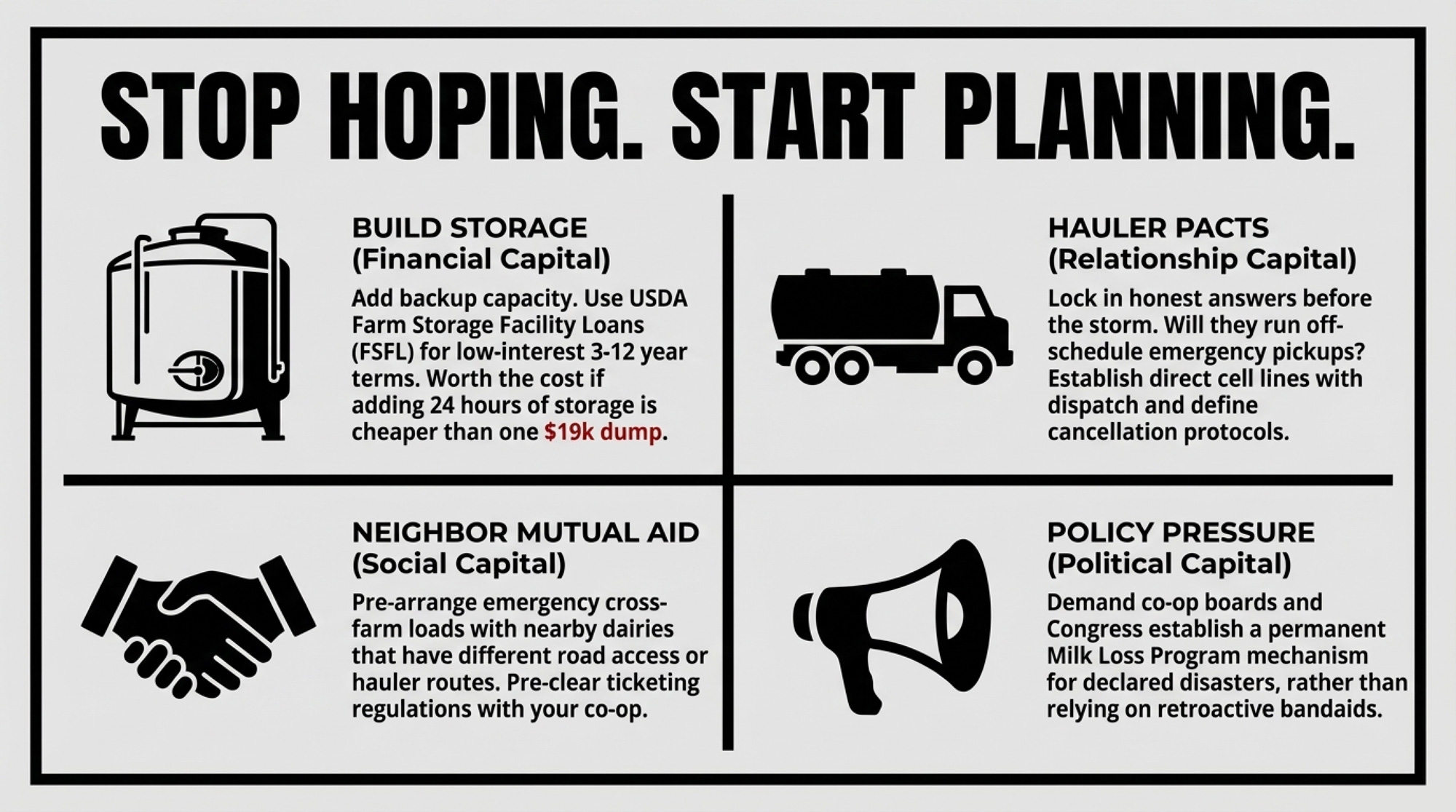
When it makes sense: you’re milking enough cows that even one dumped day is a five‑figure event, you have physical space, and your lender understands risk management. A 500‑cow herd with 80 lb/cow/day has about $19,332 at risk in a three‑day storm at $16.11/cwt.
What it requires: capital for a larger bulk tank, a second tank, or a nurse tanker. USDA’s Farm Storage Facility Loan Program offers low‑interest financing on 3–12 year terms, and its eligible commodity list specifically includes milk, with bulk tanks listed as eligible facility types.
Risks and limits: you tie up cash in stainless that mostly sits there until the rare bad week. If your hauler and processor can’t or won’t add emergency routes, you may still end up dumping.
2. Tighten hauler and processor agreements
When it makes sense: you’ve got relationship leverage as a long‑term patron with solid quality.
What it requires: honest conversations before the next storm. During this event, WisDOT posted “No Travel Advised” across the entire northern half of Wisconsin – at that point, nobody was running. But for storms short of that, some co‑ops and haulers have emergency pickup or route‑consolidation protocols. If yours doesn’t, that conversation is worth having now.
Your 30‑day move: write a one‑page “storm plan” with hauler and processor contacts, who calls first, and what you’ve agreed to. Tape a copy on the bulk tank, one in the office, and one at home.
3. Build neighbour and community mutual‑aid pacts
When it makes sense: you’ve got another dairy or two within a few miles, and at least one has different exposure — better road, more storage, different hauler.
What it requires: sitting down now and asking, “If your truck can reach you but not us, could you take one load?” Then work with your co‑op on how that milk is ticketed and paid. Some processors are open to cross‑farm loads if quality can be tracked; others need approvals in place.
We’ve seen this kind of neighbour network in real crises. When Ohio dairyman Reed Hostetler died in a manure pit accident, neighbours stepped in to run chores, haul feed, and keep the dairy going. That same instinct — organized ahead of time — can keep a blizzard from turning into a five‑figure milk loss.
4. Push for policy change
What it requires: calling your members of Congress and being specific: “Congress funded the Milk Loss Program twice — first for 2020–2022 under the Consolidated Appropriations Act of 2023, then for 2023–2024 under the American Relief Act of 2025. Why does the program keep expiring?”
You can also press your co‑op or processor board. During the 2020 milk‑dump crisis, USDA relief dollars flowed through co‑ops to help cover losses. Ask your buyer, bluntly: “If we’re forced to dump because the road or plant is shut, do you share any of that hit, or are we on our own?”
Bullvine Perspective: The Bill That Brags About DMC and Leaves the Drain Uninsured
The latest farm bill made a big deal out of reauthorizing DMC through 2031 and tweaking margins and coverage levels. They lined up for photo‑ops, telling dairy producers they’d “protected family farms.”
Look at the blizzard math again:
- You do the work.
- You feed and milk through 5‑ to 15‑foot drifts.
- The truck can’t get to you.
- You open the valve and dump thousands to tens of thousands of dollars of milk.
DMC pays based on a national margin. It doesn’t care whether your milk is left in a tanker or runs across the floor. LIP and ELAP pay for dead cows, extra feed, and some snow removal. The only program USDA has built to pay for dumped milk — the Milk Loss Program — has been funded twice, retroactively, for events in 2020–2024, and the last signup closed in late January 2026. Less than seven weeks before the Henschels’ tank overflowed.
Congress knew this was a problem. They funded it. Twice. And still left a gap you could drive a snowplow through.
What This Means for Your Operation
- If you had any livestock deaths, discounted livestock sales, or major feed disruptions in this storm, your Notice of Loss deadline is roughly 30 days from the event — mid‑April 2026 for March 14–16 losses. Don’t wait. File with your county FSA office now. The application‑for‑payment deadline extends to early 2027, but the Notice of Loss window is the one that catches people off guard.
- If your three‑day milk exposure number makes you flinch when you multiply daily pickup × 3 × current Class III, then it’s not a freak event — it’s a business risk you’re actively self‑insuring, and it belongs in the same conversation as debt service and feed contracts.
- If you can’t afford more storage, your 30‑day move is to get your paperwork and people in order:document any milk dumps even if they’re not covered yet (you’ll want that record if Congress funds MLP retroactively again), and write down a simple storm plan with hauler and neighbour contacts where everyone can find it.
- If you’ve been treating DMC as disaster coverage, remind yourself it’s margin insurance, not milk‑dump insurance. Congress has funded the Milk Loss Program twice for past events and let it expire both times. If you want dumping covered going forward, someone from your area is going to have to say that out loud — using real numbers from storms like this one.
The Bottom Line
Sandy Chalmers was right: milk can’t wait. The Henschels kept cows milking and fed through 5‑ to 15‑foot drifts, and the federal system around them offered help with feed costs and animal losses — but not with the milk they had to dump.
So here’s your kitchen‑table homework: grab your last hauler statement. Multiply your average daily pickup by three days and by today’s price. Are you actually comfortable self‑insuring that number the next time your road disappears under three feet of snow?
If you want the deeper math on how DMC, processor contracts, and USDA dairy disaster assistance actually fit together — and what happens when it’s not the weather but a plant shutdown that stops the truck — keep an eye out for the next “When the Truck Can’t Come” instalments. We’ll be looking at what the AMPI Paynesville strike and shutdown just taught us about stranded milk, and at whether the $17,500 DMC gamble was really the right bet for a storm year like this.
And one more question to chew on while you’re staring at that bulk tank: Do you know where your co‑op actually stands on renewing a permanent Milk Loss Program — and whether they’re truly pushing for it, or just offering sympathy when you’re the one opening the drain valve?
Complete references and supporting documentation are available upon request by contacting the editorial team at editor@thebullvine.com.
Learn More
- $1,000 in Diesel or $10,000 Down the Drain: The Storm Math Every Dairy Needs Before the Next Big Blow – This breakdown delivers the exact generator math and documentation habits you need to turn a disaster into a recoverable claim. It arms you with a high-ROI survival checklist that stops the $10,000 “no-power” bleed before it starts.
- DMC: The Six-Year Lock-In Gamble or a Big Beautiful Safety Net? – This strategic analysis exposes the hidden costs of the 2026-2031 lock-in, revealing how the “One Big Beautiful Bill Act” actually impacts your long-term liquidity. It provides the high-stakes perspective you need to position your operation against five years of margin volatility.
- Your Top Heifers All Trace to Three Cow Families. That’s a $93,300-A-Year Trap. – This guide reveals how over-concentrating maternal lines creates a massive capital drain through inbreeding-driven frailty. It delivers a new genetic filter for your genomic sorting, reclaiming diversity and protecting your herd’s physical resilience against the next regional crisis.
 The Sunday Read Dairy Professionals Don’t Skip.
 The Sunday Read Dairy Professionals Don’t Skip.
Every week, thousands of producers, breeders, and industry insiders open Bullvine Weekly for genetics insights, market shifts, and profit strategies they won’t find anywhere else. One email. Five minutes. Smarter decisions all week.