Red × Red should equal Red. But half your calves came out black. The COPA gene is the override switch you didn’t know existed.
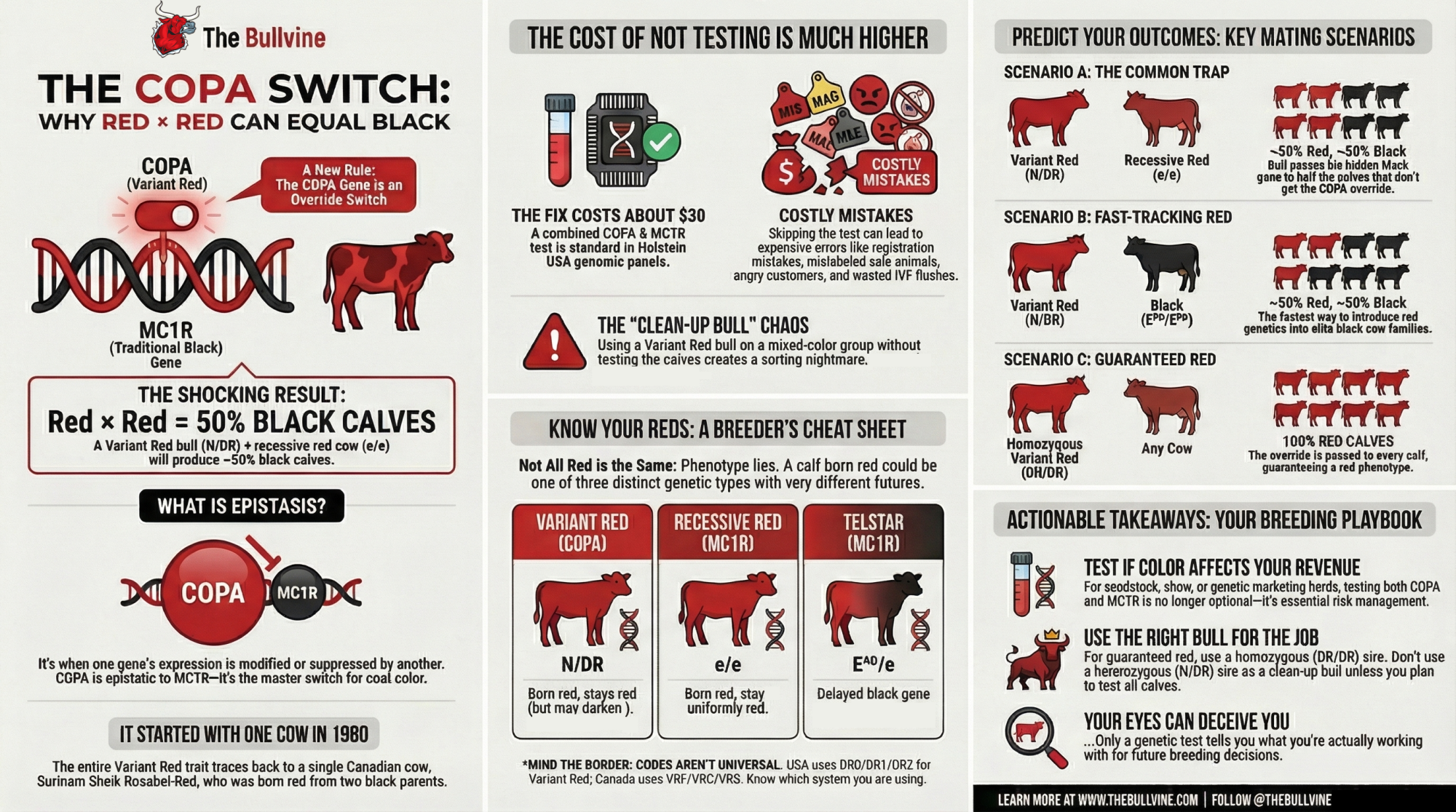
For decades, Holstein breeders operated on a simple truth: Black dominates Red. It was a comfortable, binary rule—and one that served us well for generations. But here’s the thing: it was incomplete as well.
The emergence of Variant Red (COPA) hasn’t just added a new color pattern to our toolbox; it’s also changed the way we think about color. It’s exposed a blind spot in how we think about genetic pathways. And if you’re making mating decisions without accounting for this “override” switch, you’re working with incomplete information. That costs money.
The Mechanic: Two Systems, One Outcome

You probably already know the old model. The MC1R gene—what geneticists call the Extension locus—controls coat color through a clear dominance hierarchy: E^D (dominant black) > E^BR (Telstar) > E^+ (wild-type) > e (recessive red). Two copies of e gives you a red calf. Simple enough.
Then in 2015, researcher Ben Dorshorst and an international team published findings in PLOS ONE that changed everything. They identified a second switch: a mutation in the COPA gene that produces what we now call Variant Red. The critical discovery? COPA overrides MC1R entirely. An animal can be genetically programmed to be black at MC1R, but if it carries the COPA variant, it still expresses red. A decade of breeding experience and subsequent genetic research has validated this finding—the mechanism holds up.
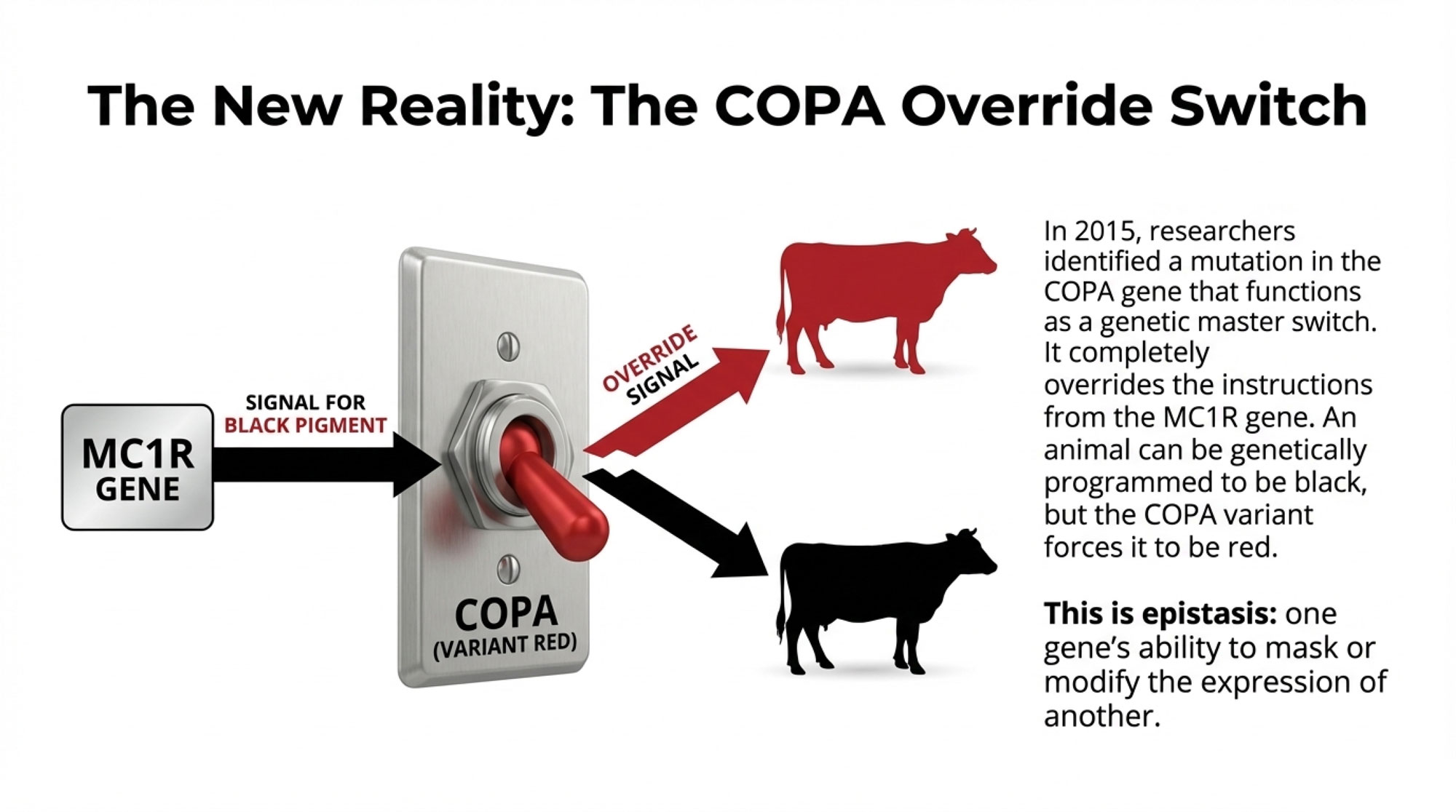
This is epistasis in action—one genetic pathway superseding another. Practically, it means that phenotype alone tells you nothing about what’s actually happening under the hood.
The good news? We now have reliable tests for both systems. UC Davis Veterinary Genetics Laboratory offers both COPA and MC1R panels, and Holstein Association USA includes both in their standard genomic testing. Once you know both pieces, you can actually plan your color outcomes instead of guessing.

The Cheat Sheet: Mating Outcomes at a Glance
Let me walk you through the scenarios breeders ask about most. This is the section you’ll probably want to bookmark.

Scenario A: Variant Red Sire (N/DR) × Black Dam (E^D/E^D)
- Outcome: ~50% Red / ~50% Black
- What’s happening: Red calves inherit the dominant DR allele, which overrides their black MC1R genetics. Black calves inherit the N allele and express normally.
Scenario B: Variant Red Sire (N/DR) × Recessive Red Dam (e/e)
- Outcome: ~50% Red / ~50% Black (if sire carries E^D at MC1R)
- What’s happening: This scenario assumes your Variant Red bull is carrying the Dominant Black gene (E^D) “underneath” his red coat—which many do, since the COPA mutation originated in black Holsteins. Red calves inherit DR (Variant Red) and express red regardless of MC1R. But calves inheriting N from the sire are now N/N at the COPA locus (no override present). If they also inherit E^D from the sire and e from the dam, they genotype as E^D/e at MC1R—which results in a black phenotype. Important note: If your Variant Red bull happens to be e/e (recessive red) at MC1R, he won’t throw black calves even when passing N—but this is less common.
Scenario C: Homozygous Variant Red Sire (DR/DR) × Any Dam
- Outcome: 100% Red
- What’s happening: Every calf inherits at least one DR allele. The override is guaranteed. This is your cleanest path to predictable red outcomes.
Scenario D: Telstar (E^BR) Animals
- Outcome: Born red, turn black within 2-6 months
- What’s happening: Completely different mechanism—MC1R timing, not COPA override. Don’t confuse these in your records.
The Trap: When Red × Red = Black
This scenario deserves special attention because it’s the one that burns breeders most often.
You have a nice Variant Red bull (N/DR). You breed him to your recessive red cows (e/e). You’re expecting all-red calves—makes sense, right? Red bull, red cow, red calves.
Except that about half those calves come out black. What gives?
Here’s what’s happening genetically: Your N/DR bull passes either N or DR to each calf (50/50 chance). The calves that get DR are red—the override kicks in, and they express Variant Red. But the calves that get N are now N/N at the COPA locus (no override present), assuming your dam is N/N like most Holsteins. If those calves also inherit E^D from the sire and e from the dam, they genotype as E^D/e at MC1R—and since Dominant Black is dominant over recessive red, you get a black calf.
The key detail here: this trap only springs if your Variant Red bull carries E^D at MC1R. Many do—the COPA mutation originated in black Holstein lines, so most Variant Red animals are “hiding” black genetics underneath that red coat. But if your bull happens to be e/e at MC1R (homozygous recessive red), he can’t pass E^D, and you won’t see black calves even when he passes the N allele.
This is exactly why UC Davis VGL’s documentation is explicit: phenotype cannot distinguish between color mechanisms. You need to test both COPA and MC1R to know what you’re actually working with.
Select Sires addresses this directly in their bull catalogs. Their DR1 code indicates heterozygous Variant Red status, and their technical materials—using LUCKY SEVEN-RED as an example—walk through exactly these scenarios. That’s the kind of transparency the whole industry should be moving toward.
The Money: Testing Costs vs. Breeding Errors

Let’s talk economics, because this is where the rubber meets the road.
Testing costs are pretty reasonable. UC Davis VGL lists coat color testing at $30 for the first test and $10 for each additional test on the same animal (pricing as of October 2023—worth verifying current rates at vgl.ucdavis.edu/pricing/cattle before you budget).
The cost of NOT testing? That’s where it gets expensive.
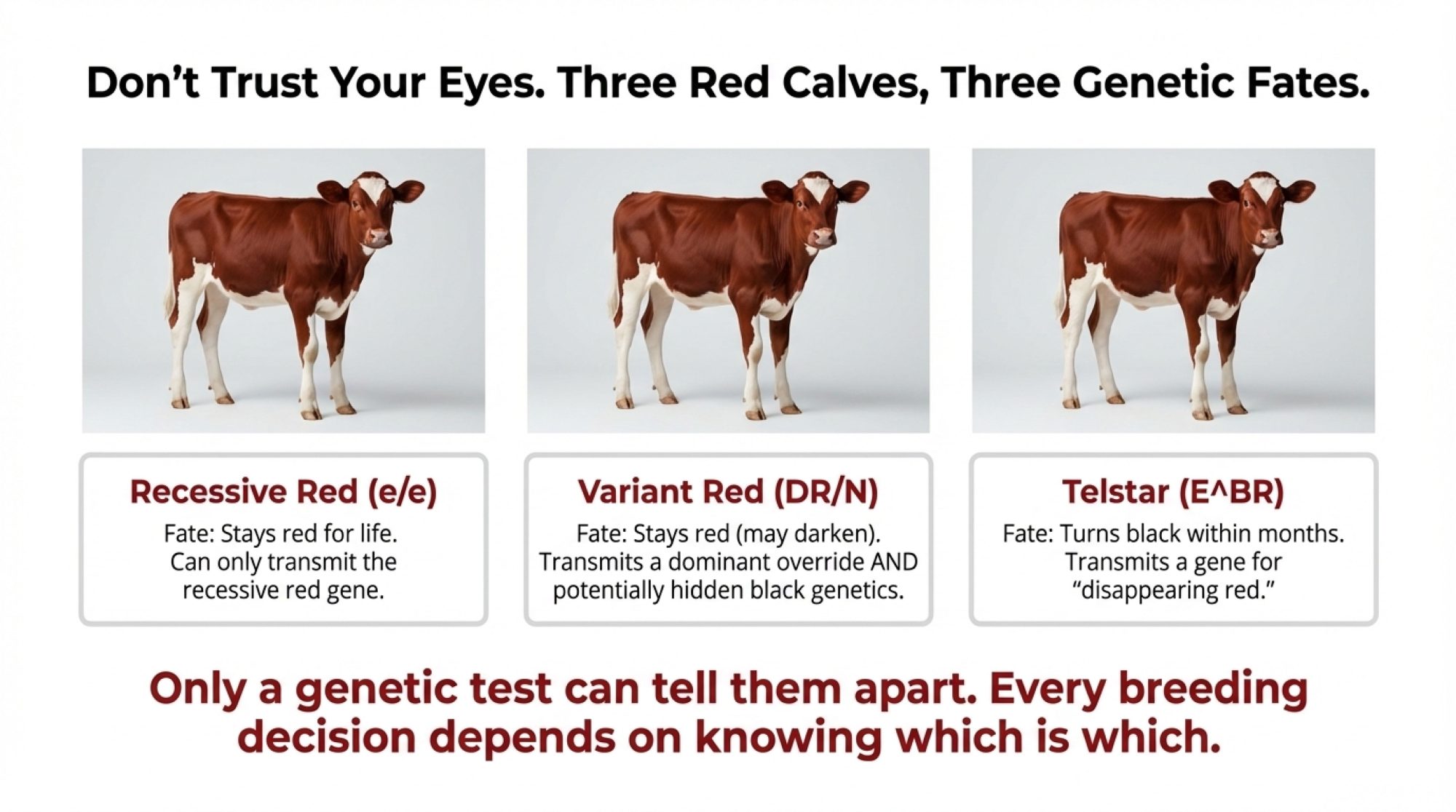
The Telstar Trap: You sell a red heifer as breeding stock. Buyer’s excited, pays a premium for red genetics. Six months later, she’s turned black. Now you’ve got an angry customer and reputation damage that’s hard to quantify but very real.
The Registration Error: You register a Variant Red calf as recessive red because it looks the same as a red calf at birth. Now every mating decision based on that animal’s record is built on false assumptions. Future buyers make breeding plans expecting recessive red transmission—and get results that don’t make sense. These errors compound across generations.
The Donor Disaster: You flush a valuable cow expecting specific color outcomes based on her phenotype. Wrong assumptions about her COPA/MC1R status mean the resulting embryos don’t deliver what you promised buyers. Cost: the flush investment, recipient management, and potentially refunds or re-dos.
The Clean-Up Bull Chaos: You turn a Variant Red bull out with a mixed color group during summer breeding. Come calving season, you can’t tell by looking which calves are carrying what. Now you need to genomically test the whole crop to sort replacements from sale animals—that’s $30-40 per head across your calf crop.
A $30 test looks pretty reasonable compared to any of those scenarios.

Where the Industry Is Heading
Here’s my read on where this is going: mandatory COPA/MC1R testing at registration isn’t a question of “if” for the elite tier—it’s a question of “when.” The economics and technology make it inevitable.
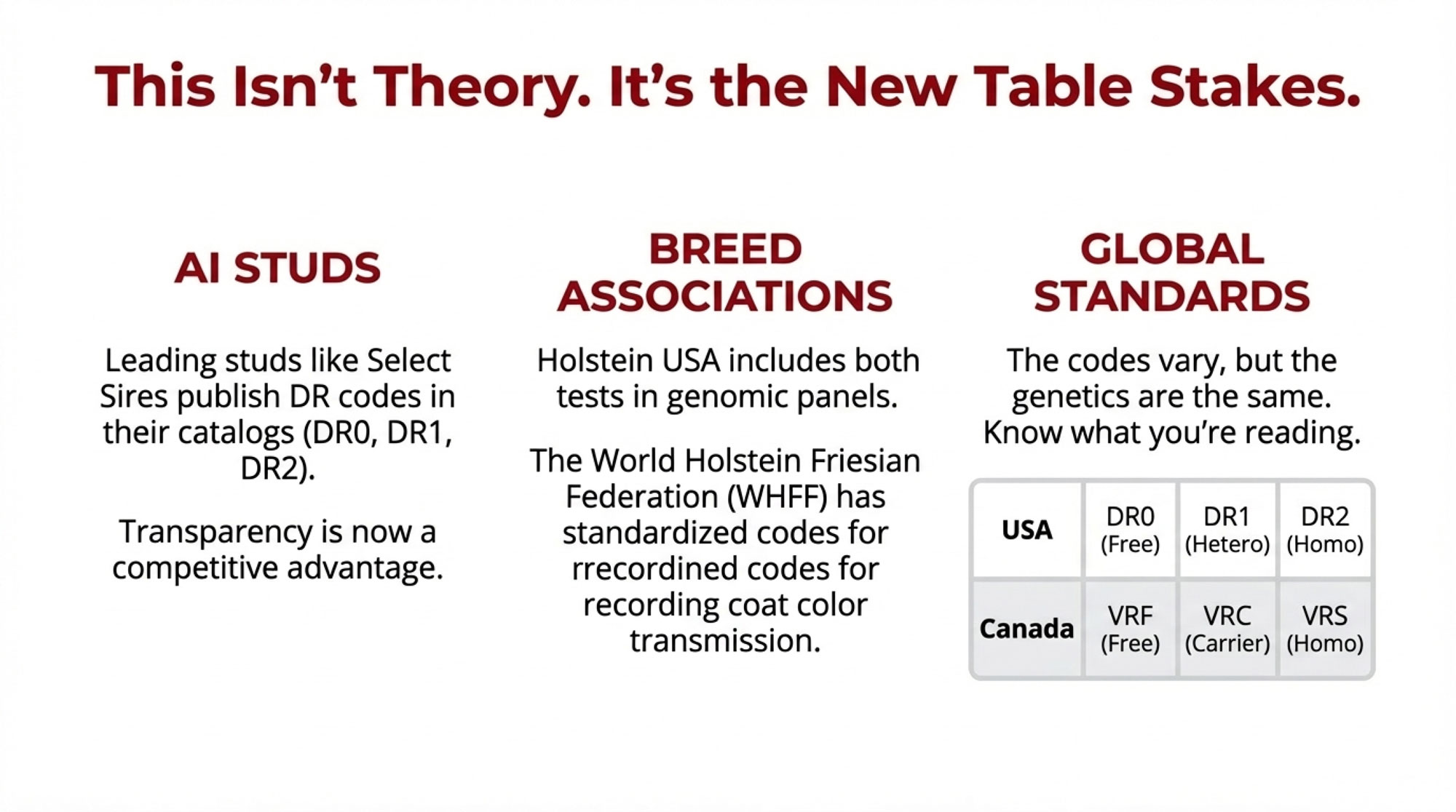
The AI studs are already there. Select Sires publishes DR codes in their catalogs and provides detailed mating guidance. Other major organizations are following suit with color genetics in their genomic offerings. The competitive pressure is real—if one stud provides complete color transparency and another doesn’t, breeders making premium decisions will choose clarity every time.
A note on codes: If you’re working across borders, be aware that the US and Canada use different labeling systems. In the US, Holstein Association USA and CDCB use DR0 (tested free), DR1 (heterozygous carrier), and DR2(homozygous Dominant Red). Holstein Canada uses VRF (free of Variant Red), VRC (carrier of Variant Red), and VRS (homozygous Variant Red). Same genetics, different shorthand—just make sure you’re reading the codes correctly for whichever system you’re working in.
The breed associations have built the infrastructure. WHFF registration guidelines already require member organizations to record coat color transmission and carrier status using standardized codes. Holstein Canada’s genetic trait coding system is in place. Holstein USA includes both recessive red and Dominant Red in their genomic panels. The recording framework exists—it’s just not universally enforced yet.
The holdouts make sense. For a 500-cow commercial dairy, shipping bull calves at a week old and selecting replacements purely on production and health? Color genetics are irrelevant. That’s a perfectly rational business decision, and mandatory testing across all registrations would be unnecessary friction for these operations.
But for seedstock operations, show herds, and anyone marketing genetics where color affects value? Testing both COPA and MC1R isn’t optional anymore. It’s table stakes.
The Verdict: Manage the Complexity You Create
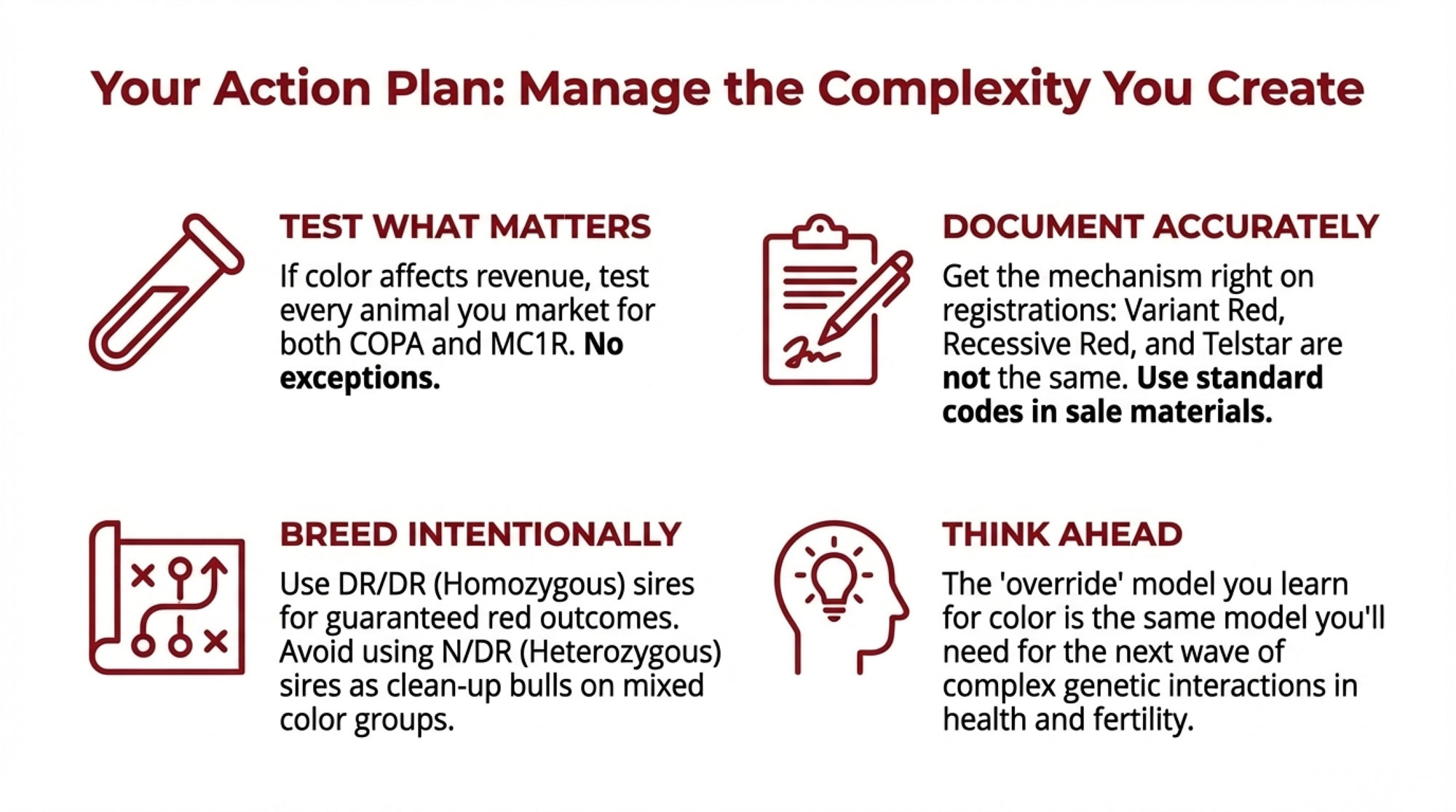
So where does this leave you? Here’s my thinking:
If color affects your revenue, test every animal you plan to market as breeding stock. Document the COPA and MC1R status in your sale materials. Use breed-standard codes so the information travels cleanly when animals change hands.
If you’re breeding for red: Understand that N/DR sires will throw ~50% black calves even on red cows—provided the sire carries E^D at MC1R. If you need guaranteed red outcomes, use DR/DR sires. Plan accordingly.
If you’re managing clean-up bulls: Don’t use Variant Red bulls on mixed-color groups unless you’re prepared to test the resulting calves. The sorting headache isn’t worth it.
If you’re registering animals: Get the mechanism right. Variant Red, recessive red, and Telstar are three different things with different inheritance patterns. Mislabeling creates downstream problems for everyone.
If you think phenotype tells you enough: It doesn’t. A red calf at birth could be Variant Red (stays red, might darken slightly), recessive red (stays red), or Telstar (turns black in months). Only testing tells you which—and that distinction matters for every breeding decision that follows.
“Understand the genetics, test what matters for your operation, communicate clearly with buyers, and manage the complexity you’re creating.”
The COPA discovery didn’t complicate Holstein color genetics—it revealed the complexity that had always been there. We just couldn’t see it before. The breeders who adapt their programs to account for genetic networks, not just single-gene thinking, are the ones who’ll avoid expensive surprises.
And honestly, color is just the beginning. The same epistatic interactions—one pathway overriding another—show up in fertility, health, and efficiency traits. The mental model you build managing Variant Red is the same model you’ll need for the next layer of genetic complexity headed for your breeding program.
Test what matters. Document what you find. Plan accordingly. That approach will serve you well regardless of what genetic curveball comes next.
Key Takeaways
- COPA is the override switch. An animal can carry black genetics at MC1R but still express red if COPA is present—traditional color rules don’t apply.
- Red × Red can equal Black. Variant Red bulls throw ~50% black calves on red cows if they carry hidden black genetics underneath their red coat.
- A $30 test prevents expensive mistakes. UC Davis VGL tests both COPA and MC1R; Holstein USA includes both in standard genomic panels.
- Codes vary by country. The US uses DR0/DR1/DR2; Canada uses VRF/VRC/VRS. Same genetics, different shorthand—read them correctly.
- Skip the test, accept the gamble. Registration errors, mislabeled sale animals, and buyer disputes cost far more than $30.
Executive Summary:
Red bull × red cow should equal red calf—except when it doesn’t. The COPA gene, discovered in 2015, acts as a genetic ‘override switch’ that supersedes traditional color inheritance. A Variant Red bull can throw 50% black calves even on red cows if he carries hidden black genetics underneath his red coat. That surprise leads to angry buyers, botched registrations, and breeding decisions built on wrong assumptions. The fix is simple: test both COPA and MC1R status. It runs about $30 through UC Davis VGL and comes standard with Holstein USA genomic panels. For seedstock operations and anyone marketing genetics where color affects value, skipping this test is a gamble you don’t need to take.
Complete references and supporting documentation are available upon request by contacting the editorial team at editor@thebullvine.com.
Learn More:
- The Holstein Genetics War: What Every Producer Needs to Know About the Battle for Our Breed’s Future – Quantifies the $400 lifetime value of comprehensive genomic testing and provides actionable protocols for managing inbreeding risks while maximizing beef-on-dairy revenue.
- Your Genetics Rep Has Bad News – But Won’t Tell You Until January – Reveals critical shifts in the global genetics supply chain and prepares producers for looming price increases in sexed semen and elite genetic lines.
- Genetic Revolution: How Record-Breaking Milk Components Are Reshaping Dairy’s Future – Analyzes the 2025 genetic index reset and demonstrates how to pivot breeding programs toward the high-value butterfat and feed efficiency traits that now drive milk check profitability.
 Join the Revolution!
 Join the Revolution!
Join over 30,000 successful dairy professionals who rely on Bullvine Weekly for their competitive edge. Delivered directly to your inbox each week, our exclusive industry insights help you make smarter decisions while saving precious hours every week. Never miss critical updates on milk production trends, breakthrough technologies, and profit-boosting strategies that top producers are already implementing. Subscribe now to transform your dairy operation’s efficiency and profitability—your future success is just one click away.