




We tracked 401 genomic Holstein bulls from April 2020 to their December 2025 daughter-proven proofs. Most never showed up. The ones that did reshuffled everything.
In April 2020, a lot of breeders logged into that proof run feeling like it was draft day. Lists of sky-high GTPI young bulls, reps pushing “can’t-miss” sires, and mating programs swinging hard toward genomics overnight. Five years later, the December 2025 CDCB/HAUSA proofs told a very different story in the U.S. Holstein system: 59% of those “elite” genomic Holstein bulls never made it to a daughter-proven proof at all, while a small group of outliers like Genosource CAPTAIN didn’t just hold — they gained hundreds of TPI points.
This is the reality check on that April 2020 class: who vanished, who climbed, what changed under the hood of TPI, and what it should do to the way you build your sire stack going into 2026.
How We Tracked the 2020 Class
Before we get into winners and wrecks, here’s where these numbers come from.
The Bullvine pulled an “elite” group of 401 genomic Holstein bulls from the April 2020 U.S. CDCB/HAUSA evaluations, based on their GTPI at that time. We then followed those same bulls forward to their December 2025 U.S. proofs, recording who made it to a daughter-proven evaluation, how their TPI changed, and which AI stud carried their semen.
Every cohort-level average and stud-level number you’ll see here describes this 401-bull slice over that five-year window. It’s not claiming to represent every bull each stud owns.
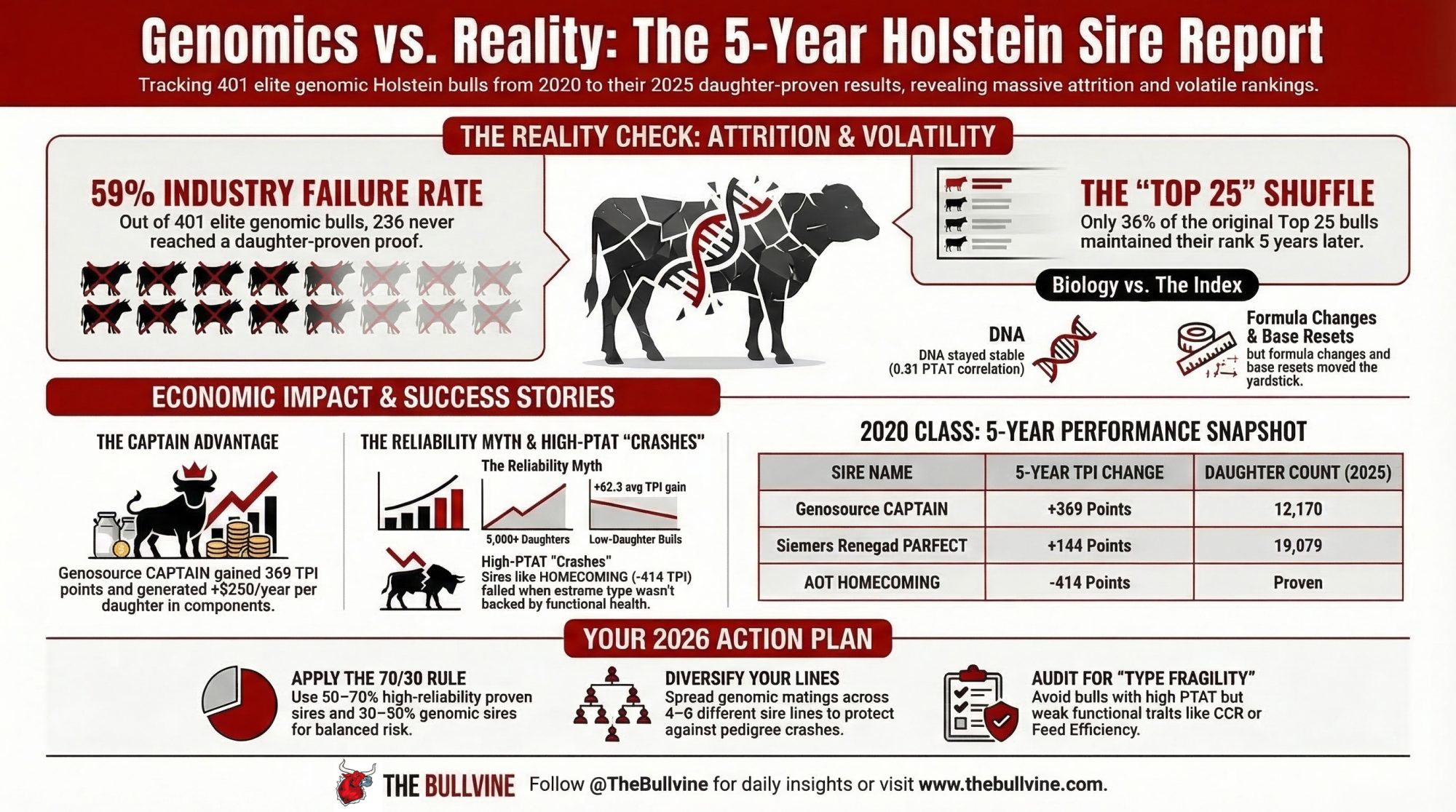
401 Genomic Bulls. 236 Never Showed Up.
In April 2020, the Holstein genomic pipeline looked unstoppable. The top of the GTPI list was stacked with young sires promising big jumps in milk, components, and type.
| Metric | Count | % of Total |
| Total April 2020 Elite Bulls | 401 | 100% |
| Bulls with December 2025 Daughter Proof | 165 | 41% |
| Bulls That Never Proved | 236 | 59% |
By December 2025, only 165 of those bulls — 41% — had an official daughter-proven proof in the U.S. system. The other 236 bulls — 59% — never showed up with a CDCB/HAUSA daughter proof at all. No proof. No official daughters in the data.
Some of that attrition was straight biology. Many of those bulls came out of aggressive IVF programs and shortened generation intervals — great for genetic gain, not always great for semen production, health, or simply living long enough to matter. The rest was institutional: as soon as higher-index sons and half-brothers hit the lists, studs quietly retired a lot of 2020 calves before their first daughters ever calved.
If you bred heavily to April 2020 genomics, a big slice of the “genetic potential” you were sold never even got the chance to prove itself in your bulk tank — or anyone else’s.
How Accurate Were the April 2020 Rankings?
The 59% failure rate isn’t the whole story. Among the bulls that did survive to a December 2025 proof, the ranking shuffle was just as important.
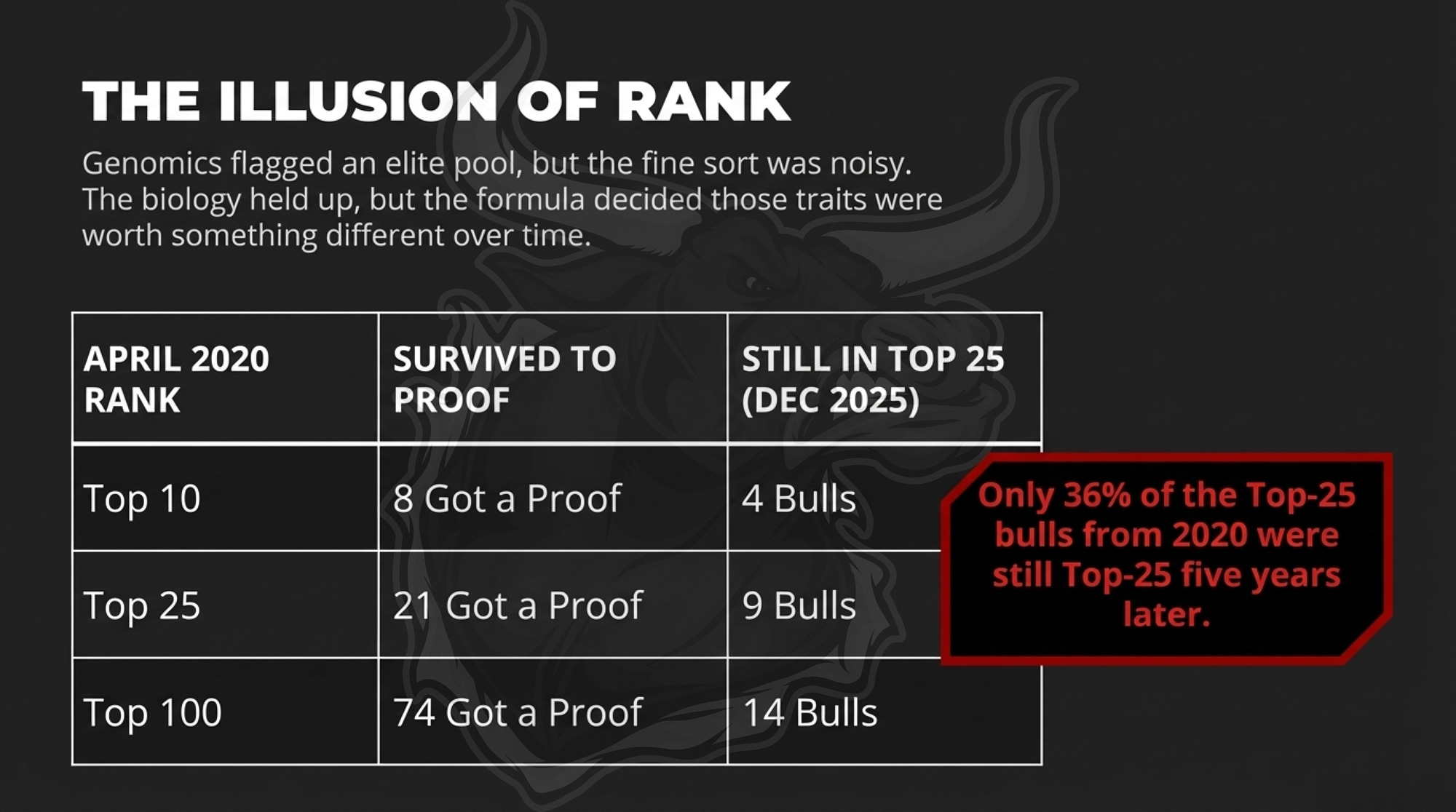
- Of the Top-10 genomic bulls in April 2020, 8 eventually got a proof, but only 4 were still in the proven Top-25 by December 2025.
- Of the Top-25 genomic bulls, 21 got a proof; just 9 held a Top-25 spot.
- Of the Top-100 genomic bulls, 74 got a proof; only 14 were still Top-25.
That means only 36% of the Top-25 bulls from April 2020 were still Top-25 five years later. Genomics clearly did a solid job flagging an “elite” pool. The fine sort between #1 and #25 turned out to be noisy once real daughters, base changes, and formula rewrites landed.
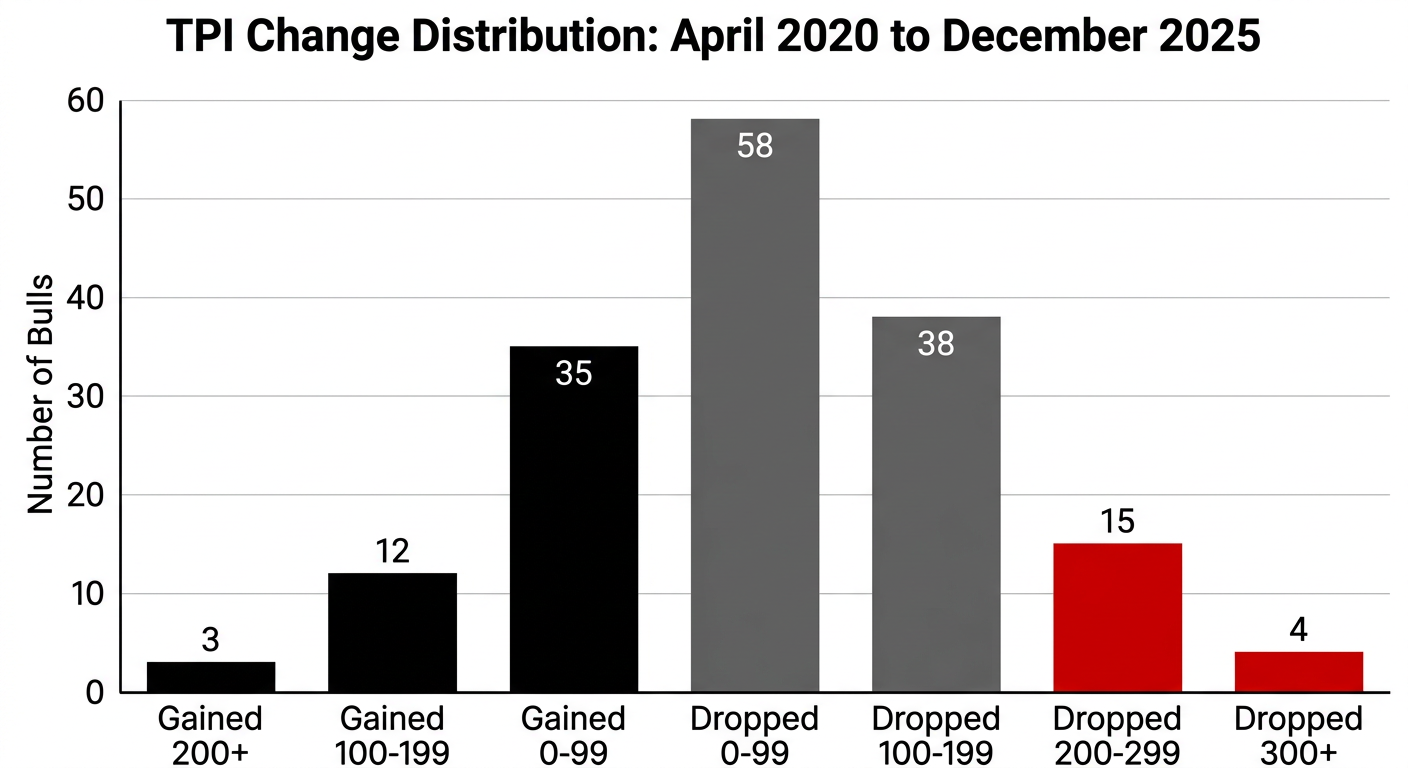
Underneath that index whiplash, the biology held up better than the rankings suggest. Correlations between 2020 genomic predictions and 2025 proven proofs stayed strong for core biological traits: 0.814 for PTAT, 0.762 for fat yield, 0.709 for protein yield.
Genomics did a pretty good job on pounds of fat and protein and general type. The volatility came from what the formula decided those traits were worth over time — not from the underlying DNA suddenly changing its mind.
Why Your Bull’s TPI Dropped Even if His Genetics Didn’t
You can’t stack a 2020 GTPI beside a 2025 proven TPI and read it straight. The ground moved under every bull in three big ways.
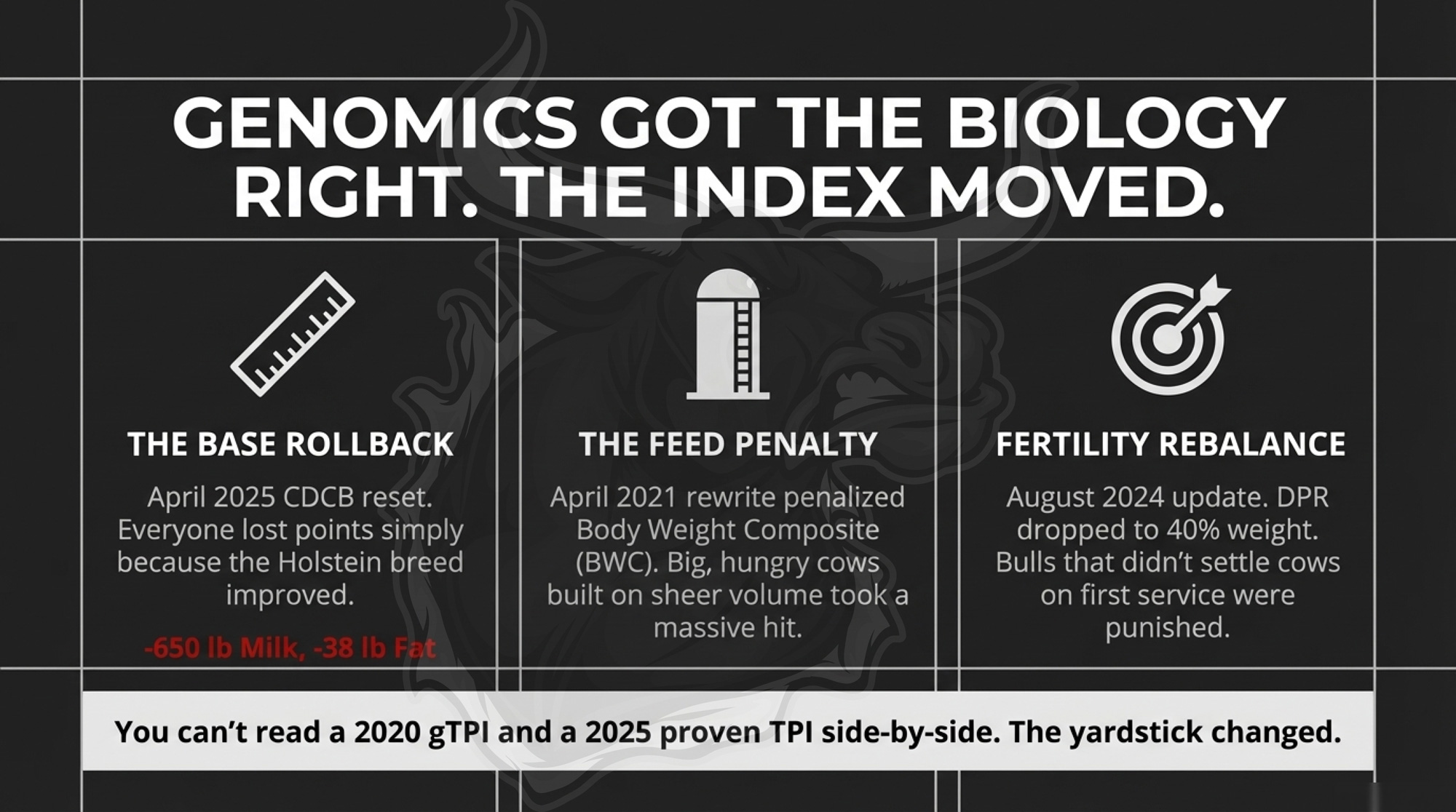
The 2025 Base Change: The Big Rollback
In April 2025, CDCB reset the Holstein genetic base from cows born in 2015 to cows born in 2020. The breed made serious progress in that window, so every bull’s PTA got pulled back:
- Milk: −650 lb
- Fat: −38 lb
- Protein: −26 lb
- Productive Life: −2.31 months
- Somatic Cell Score: +0.10
For bulls in this 401-bull cohort that made it to December 2025, the average TPI drop was about 42.5 points, just from living through that base reset and the other formula changes. Expected Future Inbreeding (EFI) climbed from 7.5% to 9.4%, which added extra pressure on certain pedigrees.
So if you saw a favorite bull lose a chunk of TPI over those five years, part of that was simply the yardstick moving.
Feed Efficiency and Feed Saved: Penalties for Big, Hungry Cows
In April 2021, Holstein Association USA rewrote the TPI formula to pull Feed Saved into the mix. The revised feed efficiency term leaned hard into solids and efficiency, not just raw volume:
FE$=(-0.0025×PTA Milk)+(1.86×PTA Fat)+(1.75×PTA Protein)+(0.13×Feed Saved)
Bulls that made big, heavy daughters with high body weight composite (BWC) — and big maintenance bills — started paying a TPI penalty, even if their milk PTAs looked flashy. That was bad news for “bigger is better” pedigrees whose value had been built on sheer volume. And very good news for moderate-framed cows that quietly pounded out components without eating the farm out of house and home.
DPR Couldn’t Carry the Fertility Load Alone Anymore
By August 2024, the Fertility Index was also rebalanced. DPR had been 70% of that index. After the change, DPR and Cow Conception Rate (CCR) each carried 40%, with Heifer Conception Rate (HCR) and Early First Calving (EFC) at 10% each.
Any 2020 bull whose genomic TPI leaned heavily on extreme DPR, but didn’t have the CCR to back it up, took a hit. The new math rewarded bulls that actually got cows bred on first service, not just bulls whose daughters came back into heat quickly after a miss.
Put those three shifts together, and you get the pattern: genomics did a decent job on biology; the index moved underneath them.
CAPTAIN: +369 Points, 12,000 Daughters, 99% Reliability
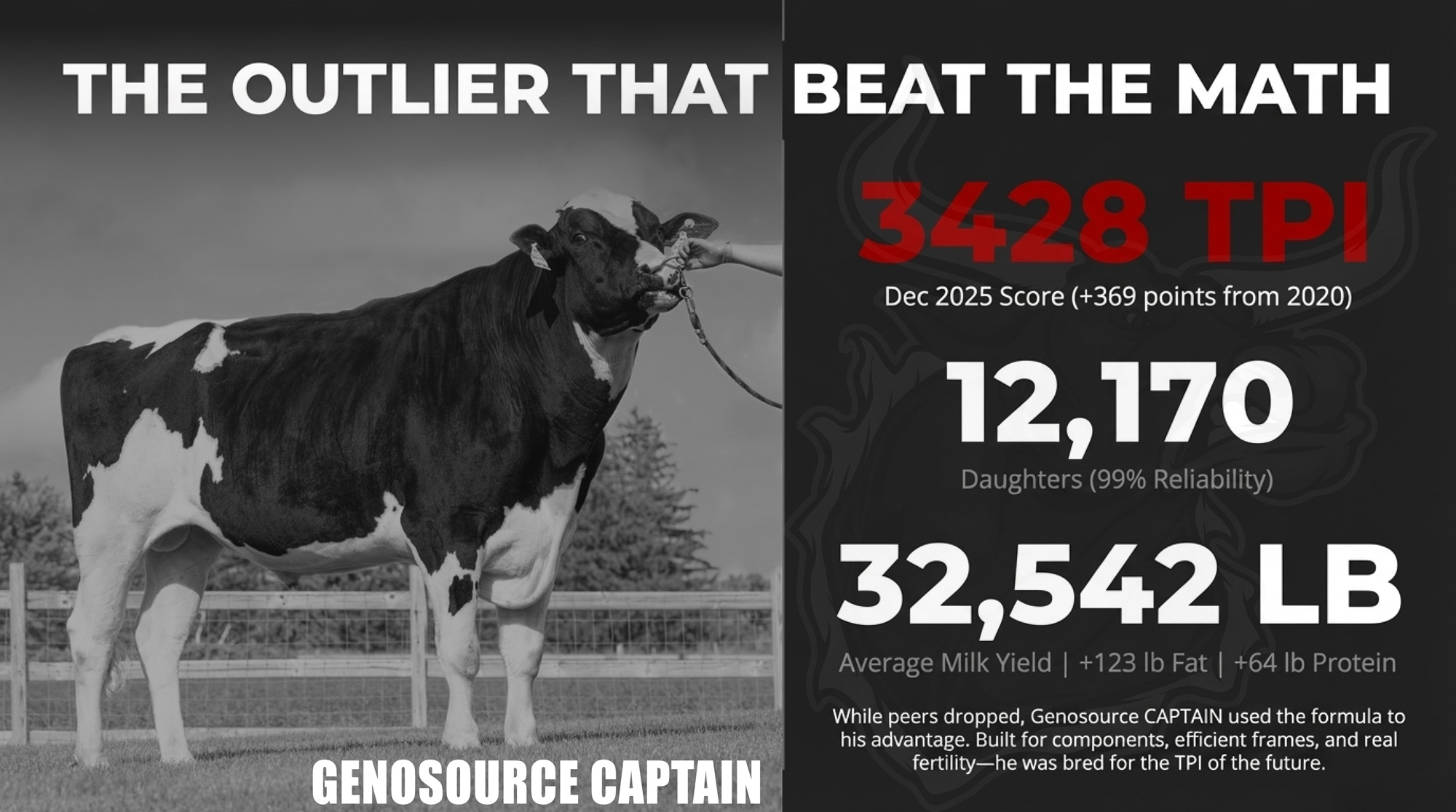
One sire didn’t just ride out those hits. He used them.
Born on New Year’s Day 2019 in Iowa, the Charl × Sabre calf spent his first six months at Farnear Holsteins. “With his very promising gTPI, everyone doted on him,” recalled Tom Simon from Farnear. Genosource’s Tim Rauen had flagged Captain early, calling him “a long-term deal” during a conversation in Madison in October 2019 — months before the bull would debut at 3059 GTPI in April 2020.
Most of his peers dropped from their genomic starting point once the base changed and the formula shifted. Captain went the other way.
By December 2025, Captain was sitting at 3428 TPI, a gain of 369 points from his 2020 genomic estimate. His proof at that time pulled from over 12,000 daughters in nearly 800 herds under U.S. CDCB/HAUSA evaluations. His daughters averaged 32,542 lb milk with +123 lb fat and +64 lb protein, and his milk reliability sat at 99%.
That’s not an opinion. That’s a bull whose daughters out-delivered the genomic math while the formula got tougher. “He is without a doubt, the best bull that the breed has ever seen,” STgenetics CEO Juan Moreno has stated publicly — and in this case, the proof file backs up the claim.
Captain’s profile — heavy on components, efficient frames, and enough fertility to hold value under the 2024 FI rewrite — was effectively built for the TPI of the future, not the one we were using in 2020. He’s not faultless. Rauen himself has noted Captain needs to be “protected for somatic cell” and watched on overall conformation, strength, foot angle, and teat length. But the production engine underneath is something the breed hasn’t seen before at this reliability level.
Read more: CAPTAIN: The Bull That Rewrote the Rules for Modern Breeding and From Pasture to Powerhouse: The GenoSource Story.
Barn Math: Captain vs. Homecoming in Your Milk Cheque
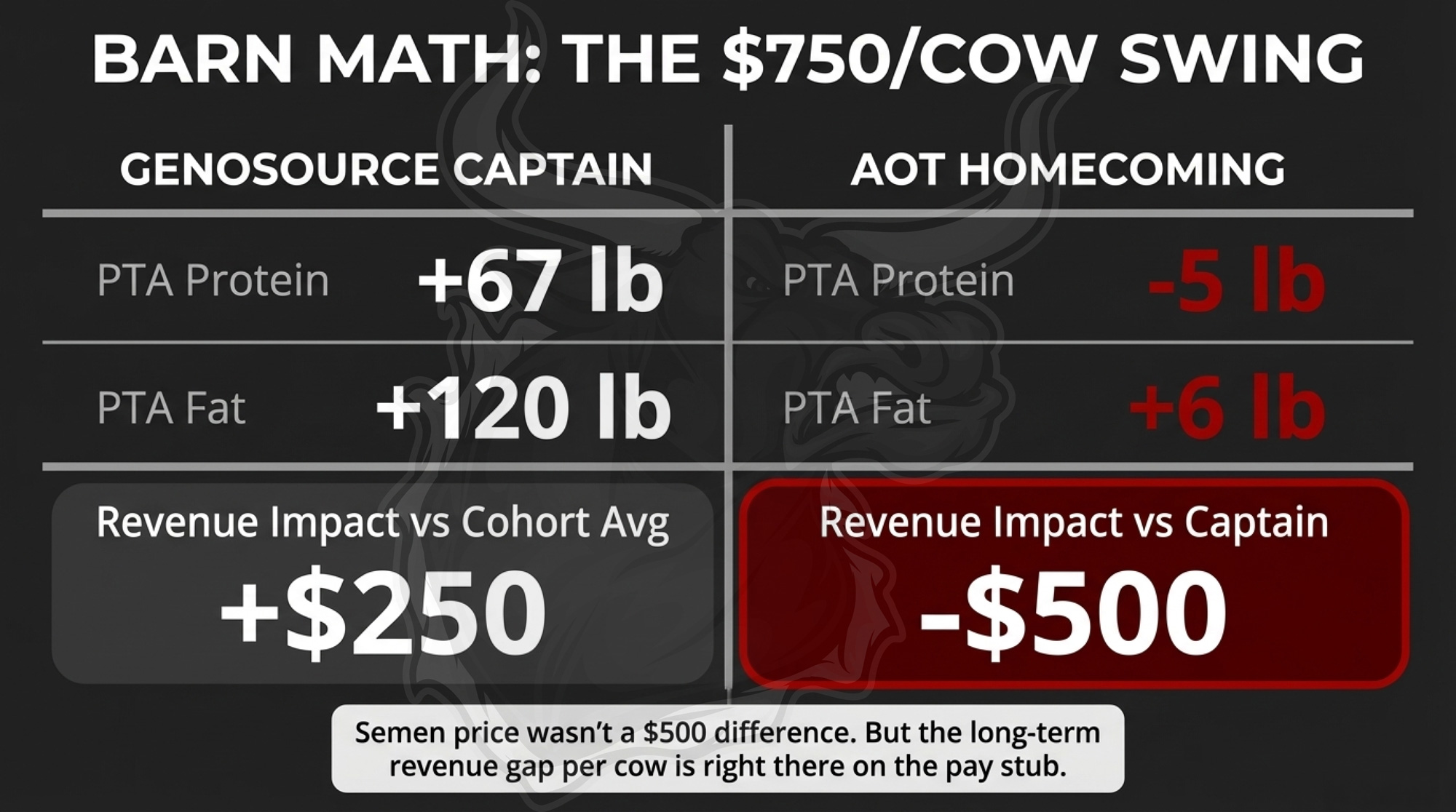
“Captain over-performed” sounds nice. Let’s put a dollar figure on it.
On the December 2025 U.S. proof run, Captain’s PTA stands at +67 lb protein and +120 lb fat per lactation. The average bull in this April 2020 proven cohort sits at +29 lb protein and +64.9 lb fat. That gives Captain an edge of roughly:
- +38 lb protein
- +55.1 lb fat
per daughter per lactation versus the class average.
Using January 2025 U.S. FMMO Class III component prices — $2.33/lb protein and $2.95/lb butterfat (per USDA/AMS) — that component gap works out to roughly $250 per cow per year in extra component revenue compared with the average bull in this group.
Put that in your own barn. If Captain sires half the replacements in a 300-cow herd, once those daughters are in full production, you’re looking at around $37,500 more in component revenue per year than if you’d used the cohort average instead. On a 1,000-cow operation, that gap jumps to roughly $125,000 per year. That’s not a rounding error — for a lot of upper Midwest freestall herds, it’s the difference between making the principal payment comfortably and sweating every month.
Now flip it with AOT HOMECOMING. His proven PTAs landed at −5 lb protein and +6 lb fat. Versus Captain, that’s about:
- 72 lb less protein
- 114 lb less fat
per daughter per lactation. At the same component prices, that’s in the ballpark of $500 less per cow per year in component revenue for a Homecoming daughter than for a Captain daughter.
| Bull | Protein PTA (lb) | Fat PTA (lb) | Component Revenue/Cow/Year (USD) |
| CAPTAIN | +67 | +120 | ~$510 |
| Cohort Average | +29 | +64.9 | ~$260 |
| HOMECOMING | -5 | +6 | ~$0 |
| Captain vs. Homecoming Gap | +72 lb | +114 lb | ~$500 |
Both bulls were available to you in essentially the same era. The semen price gap wasn’t $500 a straw. But the long-term revenue gap per cow per year is right there on the pay stub. Run the same math with your own component prices and herd size — the method is the same even if your numbers differ.
The Siemers Renegad Parfect Surprise
If Captain is the headline, Siemers Renegad Parfect is the bull a lot of people skimmed past in 2020 — and shouldn’t have.
In April 2020, Parfect sat at #150 on the genomic TPI list with 2980 gTPI. Solid, but a long way from the Top-10. By December 2025, he had 19,079 daughters in 2,627 herds — the highest daughter count of any bull in this 401-bull dataset — and his TPI climbed to 3124, a gain of 144 points. He’s also the only bull in the 165-head proven group whose PTAT went up: from +1.80 genomic to +1.88 proven.
A Renegade × Delta-Lambda × Denver from the Siemers Lmda Paris family, Parfect has sold approximately 450,000 units of semen worldwide with 24% sexed and 35% sold outside the U.S., and he remains an allocated bull because demand keeps outrunning production, according to Select Sires. Paris herself was a Global Cow winner with GMD and DOM designations and more than 20 sons to AI — and there are already 76 bulls released from Parfect dams.
At Trent-Way Holsteins in Wisconsin, Trent Hendrickson calls Parfect a “generational talent” for their black and whites, describing daughters that are well-balanced, with positive milk, strong components, and consistent udders and rumps.
None of that makes Parfect bulletproof — it just shows that in this cohort, he’s one of the rare bulls whose proof climbed with massive daughter numbers behind him. When 19,000+ daughters tell the same story, you’re past the “small sample” excuse and into something real.
When the “Can’t-Miss” Genomic Bulls Missed Hard
On the other side of the ledger sit the crashes.
| Bull | April 2020 gTPI | Dec 2025 TPI | Change | Daughters | Sire Stack |
|---|---|---|---|---|---|
| CAPTAIN | 3059 | 3428 | +369 | 12,170 | Charl x Sabre x Ahead |
| ENVY | 3038 | 3231 | +193 | 1,168 | Entity x Achiever x Bayonet |
| PARFECT | 2980 | 3124 | +144 | 19,079 | Renegade x Delta-Lambda x Denver |
| HOLDON | 2980 | 3091 | +111 | 2,937 | Charl x Draco x Numero Uno |
| DUFFY | 3025 | 3152 | +127 | 1,979 | Acura x Rio x Modesty |
The bulls that fell more than 300 TPI points between April 2020 genomics and December 2025 proofs share a familiar pattern:
- HOMECOMING (Spartacus × Delta × Day): −414 TPI points, with PTAT dropping 0.87 points.
- SUPERCHARGE (Legacy × Rubicon × Morgan): −396 TPI points, including a 2.32-point collapse in PTAT (from +1.18 to −1.14).
- TYCOON: −352 TPI points, mainly from yield under-performance.
- SHINE: −327 TPI points, driven by fertility and health erosion.
In the worst of these crashes, the structure is the same: over-predicted type stacked on weak or shallow functional traits. Sire lines heavy on Legacy and Heroic on the top side, with Delta on the maternal side, were over-represented.
Supercharge is the clearest example. His genomic PTAT was built on a stack of fashionable type sires and early pedigree data. Once his daughters hit real commercial parlors, the structure didn’t hold up — and the index followed.
For breeders who leaned hard into those pedigrees, the disappointment wasn’t a chart. It was cows that didn’t do the job they were supposed to do.
Does More Semen in More Herds Really Make Proofs Worse?
You’ve heard it at the coffee shop: “Once a bull goes everywhere, his proof will just get worse.” This class gives you a cleaner answer.
Group the 165 proven bulls by how many daughters they had in December 2025, and the pattern is pretty clear:
| Proven daughters | Bulls | Avg TPI change | % that gained TPI |
| Under 500 | 52 | −81.8 | 28.8% |
| 500–1,000 | 29 | −65.5 | 24.1% |
| 1,000–2,000 | 27 | −23.4 | 33.3% |
| 2,000–5,000 | 42 | −27.9 | 40.5% |
| 5,000+ | 15 | +62.3 | 66.7% |
Bulls with 5,000+ daughters actually gained TPI on average, and two-thirds of them went up, not down. Bulls with fewer than 500 daughters lost an average of almost 82 points, with fewer than a third improving.
A few big-use sires from this group:
- Siemers Renegad Parfect: 19,079 daughters, +144 TPI.
- Larcrest Captivating: 14,777 daughters, −122 TPI.
- Mr. Farnear Helix Twitch: 12,480 daughters, −246 TPI.
- Sandy-Valley R Conway: 12,411 daughters, +22 TPI.
- Genosource Captain: 12,170 daughters, +369 TPI.
Once you’re past around 5,000 daughters in a few hundred herds, what you see is basically what you get — good or bad.
For your own herd, this dataset says one thing: treat daughter and herd counts as filters, not afterthoughts. A bull with 300 daughters in 20 herds is still on trial. A bull with 2,000 or 5,000 daughters spread over hundreds of herds is telling you who he really is.
Which Studs Got It Right — and Which Got Burned?
This five-year window didn’t just sort bulls. It showed which AI programs were actually breeding for the new economics and which ones were still built around the old index.
All stud-level averages and retention rates here come from The Bullvine’s analysis of that 401-bull April 2020 cohort through the December 2025 U.S. proofs — not every bull each stud owns.
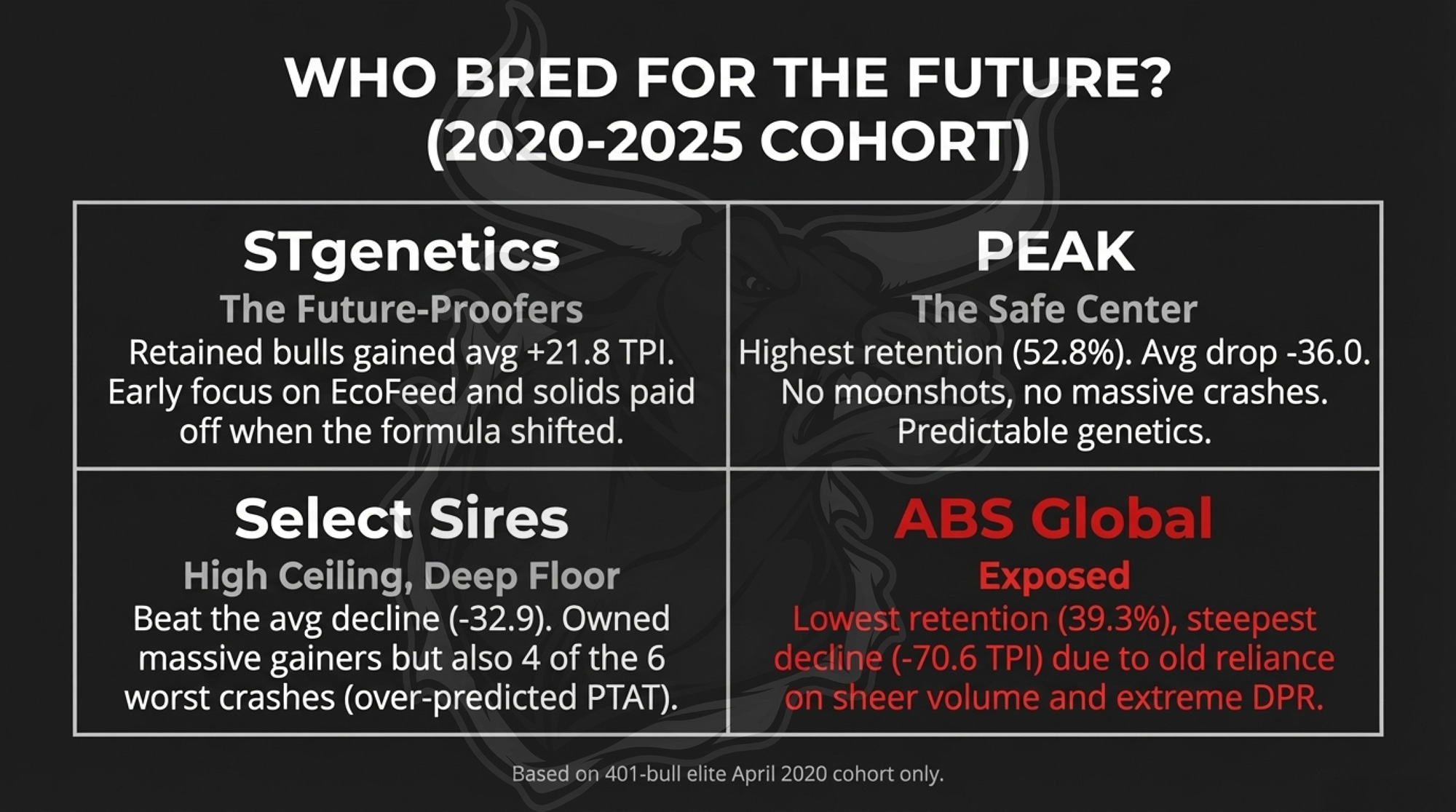
| AI Stud | Bulls in April 2020 Elite Group | Bulls with Dec 2025 Proof | Retention Rate (%) | Avg TPI Change (Retained Bulls) |
| STgenetics | 36 | 14 | 38.9% | +21.8 |
| PEAK | 36 | 19 | 52.8% | -36.0 |
| Select Sires | 106 | 43 | 40.6% | -32.9 |
| ABS Global | 196 | 77 | 39.3% | -70.6 |
| Cohort Average | 401 | 165 | 41.2% | -42.5 |
STgenetics: Building for the Index of the Future
In this look-back, STgenetics came out on top.
They were the only major stud whose retained bulls gained TPI points on average, at about +21.8 TPI per bull across the group. That lift was anchored by Captain and his clone brothers Jack and John, but it went deeper — bulls like HOLDON (+111) and JARVIS (+76) also posted gains.
That pattern lines up with ST’s long-running focus on Chromosomal Mating and their EcoFeed program — both targeting feed conversion and solids years before those traits were fully rewarded in the TPI formula. For a commercial herd, that meant ST-sired daughters were better positioned than most when the formula turned on big, hungry cows and rewarded efficient ones.
For more on the four foundation sires shaping almost every Holstein pedigree you touch today, see our deep dive.
Select Sires: High Ceiling, Deep Floor
Select Sires landed in the middle of the pack, but with a wide spread.
They retained 43 bulls (40.6%), a better survival rate than the group as a whole, and those bulls dropped an average of −32.9 TPI points, beating the overall cohort decline. They also owned 16 bulls that gained points, including PAYLOAD, CRUSHER, and GAMEDAY.
But Select also held four of the six worst crashes in this analysis, including HOMECOMING and SUPERCHARGE. If you spread your matings across their lineup, you probably did fine. If you concentrated on a couple of high-PTAT pedigrees that later deflated, December 2025 may have been a painful read.
PEAK: The Safe Center
PEAK showed up as the most stable of the majors.
They had the highest retention rate, successfully proving 19 of 36 bulls (52.8%), and their retained bulls dropped an average of −36.0 TPI points. No moonshot 300-point gainers. No catastrophic 300-point crashes.
PEAK’s strategy leaned into balanced, predictable genetics that mostly held their rank even as the base and formula moved. Sires like ZILLION and ALTAZAZZLE became quiet anchors in that approach. If your breeding philosophy values predictability over fireworks, this is the sort of stud profile that lets you sleep at night.
ABS Global: Exposed to the Old Index
In this particular 2020 look-back, ABS Global had the roughest ride.
They started with the most bulls on the 2020 elite list, but recorded the lowest retention rate — 39.3% (77 bulls) — and their retained bulls dropped an average of −70.6 TPI points, the steepest decline among the major studs in this dataset.
Many of their high-profile young sires at that time were built on extreme DPR and high-milk, larger-framed daughters. Once feed efficiency and CCR were given more weight in TPI, those profiles were more exposed than some competitors’ lineups. There were bright spots — bulls like ENVY (+193) — but the volume of Heroic and Prince sons that fell off pulled their stud average down.
ABS has been adjusting. They introduced 36 new Holstein graduates following later sire summaries, a sign they’re working to realign with updated TPI standards and market demands.
Genomics Got the Biology Right. The Index Is What Moved.
The biggest takeaway from this April 2020 class is simple: don’t confuse index volatility with genomic failure.
- The average retained bull dropped 42.5 TPI points over five years, driven largely by base changes and formula shifts, not by failed biology.
- The correlations between 2020 genomic predictions and 2025 proofs stayed strong for core traits: PTAT around 0.81, fat around 0.76, protein around 0.71.
The core question for your breeding program isn’t “Does genomics work?” It’s “Am I breeding for the index and milk cheque of the next five years — or the one that just got retired?”
For more on how the genomic model reshaped what “elite” even means, read our primer on genomic selection’s real track record.
What This Means for Your Operation
You don’t control base changes or formula tweaks. You do control how much risk you take, which studs you trust, and how you weight solids, fertility, and efficiency when you pick bulls.
- Audit your reliability stack within 30 days. Print your current sire list and match it against the December 2025 U.S. CDCB/HAUSA proofs. Any bull under 70% reliability on TPI? Treat him as a genomic young sire in practice, even if he technically has some daughters. Any bull above 90% reliability with daughters across multiple herds is your stability layer — the Captain/Gameday-type bulls that absorb shocks when formulas move. Any sire list where three young bulls cover more than half your matings should be a red flag, given the 59% attrition this class showed.
- Balance proven vs. genomic on purpose, not by accident. For a commercial Holstein herd, a pragmatic split looks like 50–70% of matings on a small group of high-reliability proven sires whose daughters do exactly what the current TPI and milk cheque care about — solids, fertility, efficiency — and 30–50% of matings on genomic sires spread across at least 4–6 different lines.
- Run a type-fragility check before you chase the next PTAT rocket. The bulls that crashed hardest here — Homecoming, Supercharge, Shine — weren’t derailed by milk. They were derailed by over-predicted type and weak functional traits, especially once base and formula changes hit. Before you lean into the next big PTAT bull, look at his sire and MGS proof history and his health/fertility stack. If the pedigree is all type and no ballast, keep that semen for donors and show projects — not across the whole freestall herd.
- Respect daughter and herd counts as filters, not fine print. A bull with 300 daughters in 20 herds is still on trial. A bull with thousands of daughters in hundreds of herds is telling you who he really is, for better or worse. Make that filter part of your mating program, not a footnote you glance at after you’ve picked the bull.
- Align with solids and efficiency economics. U.S. component pricing and export data are pointing the same direction: fat and protein drive the cheque, and global demand is solids-hungry. Pick sires that put more fat and protein in the tank at realistic feed costs — the new FE$ and Net Merit formulas are already paying those cows differently. For the economics that now reward solids and efficiency over sheer volume, see our analysis of the $1.6B dairy shift.
Key Takeaways
- If you build your sire list only from the very top of a genomic ranking, you’re accepting that roughly 6 out of 10 “elite” bulls may never even see a daughter-proven proof; to manage that risk, blend proven stability with genomic upside.
- If you see a bull drop 100–150 TPI points between 2020 and 2025, don’t panic; check how much of that is base change and formula moves versus real trait erosion before you write him off.
- If a high-PTAT young sire’s pedigree leans hard on Legacy/Heroic/Delta lines and doesn’t bring matching health and fertility, treat him as a specialist tool for donors and show cows — not as a herd-wide solution.
- If you’re choosing between two bulls available at the same time, and one puts an extra 90–100 lb of combined fat and protein into each daughter’s tank at current component prices, assume that’s worth several hundred dollars per cow per year and make your semen budget reflect it.
The Bottom Line
Genomics is still the sharpest tool in the shed. But if you love speed and are willing to absorb some crashes, you’ll keep leaning into young sires. If you’d rather sleep at night, let bulls like Captain and Parfect carry most of the weight while genomics scouts the next generation. The difference between a well-diversified strategy and a concentrated one is the difference between Captain and Supercharge.
Pull up your semen invoices from 2020–2021 and your December 2025 proof file. How many of those bulls are still earning their keep under today’s rules — and how many were gone before their daughters hit a parlor?
Complete references and supporting documentation are available upon request by contacting the editorial team at editor@thebullvine.com.
Learn More
- 3 Temptations Taking Down Dairy Farms in 2026- and the 40-Day Discipline That Saves Them – Gain a bulletproof operational shield using a concrete 40-day audit protocol. This field-tested framework exposes the three hidden financial traps currently sinking dairies and arms you with the exact ratios needed to safeguard your spring margins.
- 2025 Dairy Year in Review: Ten Forces That Redefined Who’s Positioned to Thrive Through 2028 – Secure your operation’s survival through 2028 by mastering the ten structural shifts redefining dairy profitability. This strategic breakdown reveals how to bypass the critical heifer shortage and positions your herd to out-compete the upcoming supply expansion.
- The Next Frontier: What’s Really Coming for Dairy Cattle Breeding (2025-2030) – Harness the disruptor’s edge with a roadmap to 2030’s most aggressive genetic breakthroughs. From methane indexes to rumen microbiome PTAs, this guide delivers the early-adoption strategies that slash feed costs and unlock massive environmental premiums.
 The Sunday Read Dairy Professionals Don’t Skip.
 The Sunday Read Dairy Professionals Don’t Skip.
Every week, thousands of producers, breeders, and industry insiders open Bullvine Weekly for genetics insights, market shifts, and profit strategies they won’t find anywhere else. One email. Five minutes. Smarter decisions all week.