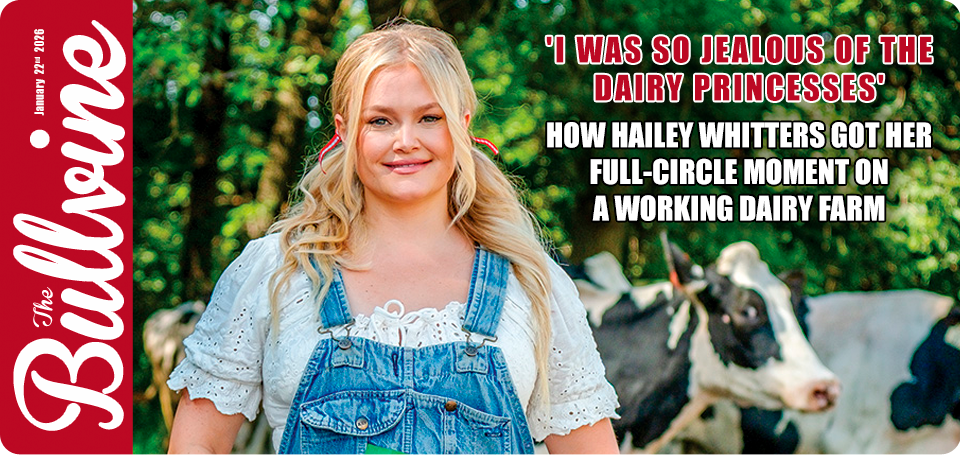





‘I was so jealous of the dairy princesses. That wasn’t in the cards for me.’ Twenty years later, she’s standing in a working parlor—cameras rolling, cows listening.
Growing up, Hailey had her eye on the crown—or at least the butter sculpture that came with it. “The princesses told me you had to be a dairy princess to get your own bust, and I was so jealous,” she admits. But because her dad farmed corn and soybeans rather than cows, she didn’t quite meet the credentials. “We’ve never done anything with cows, which is a requirement to be a dairy princess,” she laughs, “so that wasn’t in the cards for me.”
Twenty years later, she got her dairy moment anyway.
It was fall 2025, and there on my screen was this self-described “corn kid” from Iowa stepping out of a pickup onto a Land O’Lakes member-owned dairy farm in Minnesota. The Bovine Serenade campaign footage showed what looked like any working dairy: a parlor that’s seen some years, cows walking through their routine, real people doing real chores.
No polished set. No barn where no cow has ever actually lived. Just a farm that could’ve been down the road from a lot of us.
Hailey looked around that working dairy like she recognized it. Like she’d grown up near places just like it.
Because she had.
What struck me most wasn’t the music or the marketing. It was seeing a farm that looked like ours treated as a place worth putting on a national stage. And knowing that the artist standing in that barn came from the same kind of roads and communities where a lot of us learned to work, to show up, and to keep going.
Raising a Cornfield Kid
Before any cameras, there was a baby blue trailer in a cornfield.
Hailey’s parents brought her home from the hospital to a single-wide baby blue trailer parked in the middle of an Iowa cornfield near the little town of Shueyville, tucked between Cedar Rapids and Iowa City. “They brought me home from the hospital to a single wide baby blue trailer in the middle of a cornfield,” she told Countrytown in 2025.
Her dad worked nights at the corn plant—ADM, doing the shifts nobody else wanted. “He was always doing the stuff nobody wanted to do, you know, working night shifts and long shifts,” she’s said. Her mom raised the kids and stretched every dollar.
Hailey laughs about it now. “We didn’t have a pot to piss in,” she’s told interviewers. But she always follows that up with how hard her parents worked to put food on the table and build something better.
Around them were aunts and grandparents whose livelihoods were tied to the land:
- Her Aunt Cindy had a small place with pigs, chickens, turkeys, and sometimes ducks
- Her grandpa ran a sod farm where “all the boys were always working in the field with grandpa, growing grass,” as she described it on the Like a Farmer podcast
- Her dad farmed crops on top of his plant job
That mix of family farms and shift work at the plant—that’s the backbone of the work ethic she still leans on.
If you’ve ever watched a county dairy princess wave from a parade float or hand out ribbons at a 4-H show, you know that role carries real weight in rural communities. For a corn kid looking in from the outside, that world looked pretty appealing.
She’s talked about the cornfield behind her parents’ house as the spot she’d go to sit and think, especially after she started spending more time away. If you’ve ever slipped out behind the freestall at dusk or walked a headland just to clear your head after a rough day, you know exactly what she means. Those quiet corners are where you sort out more than just the chores.
If you’ve grown up in dairy country, you know the rest of the backdrop: school buses rattling down gravel roads in the dark, Friday nights in small-town gyms, church basements full of hot dishes and coffee, county fairs where somebody from your road is always clipping a heifer or leading a 4-H calf into the ring.
You can hear all of that in Hailey’s music—cornfields, plant shifts, small-town families who’ve been on the same ground for a long time. It sounds like it could belong to families a lot of us already know.
The Choice Every Farm Kid Knows
The text from the neighbour comes before sunrise when the pipeline freezes. The decision to leave the farm takes a lot longer.
When Hailey was about fifteen, she and her mom made their first trip to Nashville. “I’d never been to any city before, not even Chicago, three hours east of where I grew up,” she told Lonesome Highway. Suddenly they were walking down streets where live music poured out of almost every doorway, tip jars sat on tiny stages, and songwriters were pouring their hearts out to rooms that were mostly bar stools.
Back in Iowa, her classmates were doing what a lot of rural kids do:
- Learning to read cloud lines and radar apps
- Heading to 4-H meetings and FFA chapter nights
- Leaning toward herd health, agronomy, nursing, welding, or teaching
- Loving show cattle but not sure what that meant long-term
Standing on that Nashville sidewalk, halfway between the gravel roads she knew and a city that felt like another planet, something shifted. When she went back home, she sat down at the same kind of kitchen table where seed guides, milk cheques, vet bills, and school papers pile up, and told her parents she wanted to move to Nashville after high school.
You know that moment. Pride, because raising a kid brave enough to chase something that hard means you’ve done a lot right. Fear, because you’re not sure what it means for the farm, for your own future, for the cows you’ve been building a herd around. And that knot in your stomach quietly asking, “If they go… what happens here?”
Hailey’s been honest about her parents being “very blue-collar”—her dad now owns an excavation business and still farms, her mom runs a trucking company. They were excited for her, but not entirely convinced that “move to Nashville and become a country singer” was a realistic plan. It sounds a lot like the conversations you hear in farm kitchens when a kid talks about vet school, moving across the country for an apprenticeship, or taking a job that has nothing to do with agriculture.
Her parents did what a lot of farm parents do when a storm they can’t control rolls in. They let her go—because they’d raised her to follow through.
So at seventeen, she packed her things and headed to Nashville. The cornfields stayed. The neighbours still waved. Church folks still asked her parents how “Nashville” was going.
In dairy communities all over—whether you’re milking in Ontario, Wisconsin, Iowa, or Friesland—you see the same thing: the community doesn’t stop caring just because a kid’s postal code changes.
When Nashville Said “Not Yet”
Nashville has a reputation as a “ten-year town.” Give it a decade, people say, and you’ll know if it’s going to work out. Hailey’s joked that her song “Ten Year Town” came from being twelve years into that supposed ten-year timeline, and that extra couple of years weren’t pretty.
During that long stretch, she worked whatever jobs would keep her afloat while still leaving space for co-writes and gigs—nannying, front-desk work, late shifts. She put out music independently when nobody in the industry was paying much attention. She watched other artists get record deals, tour slots, and radio spins while her own phone stayed quiet.
There were plenty of stretches where the math didn’t make much sense. Money went out and didn’t always come back in. “I had been so bitter and so frustrated and just tired with the music business,” she told The Boot in 2020. There wasn’t any guarantee that the time, money, and heart she’d poured into Nashville would ever return.
If you’ve carried a dairy through enough rough years—the kind where transition problems pile up, components slip, interest chews into every cheque, and the bank starts asking harder questions—you know that feeling. You’re doing everything you know how to do, and it still feels like you’re stuck.
What kept her going wasn’t some shiny motivational slogan. It was the same mindset she’d watched in that little Iowa community: her dad rolling out for night shifts at the plant and then working crops, her mom keeping kids and bills sorted on not much, neighbours who just kept going whether anyone saw them or not.
Honestly, that’s not far from how most barns survive bad years. No big hero moment. Just the next milking. The next fresh cow check. The next calf. The next payment.
The Night the Road Filled with Headlights
Nobody expects to look out and see the whole road lined with tractors and pickups. But if you talk to enough farmers, it doesn’t take long before you hear about the night when, for somebody, it did.
Sometimes it’s a barn fire and people arrive from three townships—skid steers, stock trailers, and half-tons parked wherever they can fit. Sometimes it’s a sudden illness or accident and one partner ends up in the hospital while the other is staring down fresh cow lists, milking shifts, school pickups, and feed deliveries that aren’t going to wait.
In the rural world that shaped Hailey, and in a lot of ours, support often comes as a string of small rescues more than one big dramatic moment.
- Grandparents stepping in so parents can haul one more load or catch two hours of sleep
- Neighbours pulling in with a tank spreader when they hear your pit is one heavy rain away from trouble
- Church folks quietly leaving groceries or a gas card on a step, then driving away before anyone can say thank you
- The vet who leans on the tailgate and asks how you’re doing after a brutal calving run
- The 4-H leader who walks into the show ring beside a nervous kid and stays until their knees stop shaking
When it matters most, the community shows up in farm T-shirts and chore boots, not capes.
That same thing is what lets kids leave, too. You don’t head off to Nashville, college, an apprenticeship, or a job on another continent unless you have some sense that the community you’re leaving will still have your family’s back.
As doors slowly opened for Hailey—more co-writes, better slots, albums like The Dream and Raised, and eventually Corn Queen—that hometown web didn’t disappear. Local bars would put the TV on if they thought she might be featured. Old classmates would send photos of her on a screen back to her parents’ phones.
For a lot of people back home, the moment that changed how they saw their neighbours wasn’t just seeing her on TV. It was realizing how many folks were watching with them, cheering from the same gym bleachers and church pews where they’d always been.
The Bovine Serenade: When Real Barns Became the Stage
By the time Corn Queen rolled around, Hailey wasn’t trying to sand the country out of her story. She was doubling down on it.
“Fans started calling me the ‘Corn Queen’ because I’m from Iowa,” she explained to Big Loud Records. “At first, it seemed kind of silly, but the more I thought about it, the more I loved the duality of it. Corn is this simple, humble crop, and ‘queen’ implies royalty passed down through blood.”
The album is packed with Midwest-rooted tracks that’ll land with anyone who grew up around here. “High on the Hog” opens the record with a twangy origin story about paying dues and keeping your head up. “Casseroles” is a wrenching account of living through grief after “the casseroles stop comin'”—and if you’ve ever been to a church basement potluck after a funeral or a 4-H awards banquet, that title alone will hit you somewhere deep. “Wagon” rounds out the collection of songs that feel like they could’ve been written about families down the road from any of us. (Corn Queen is available on all major streaming platforms.)
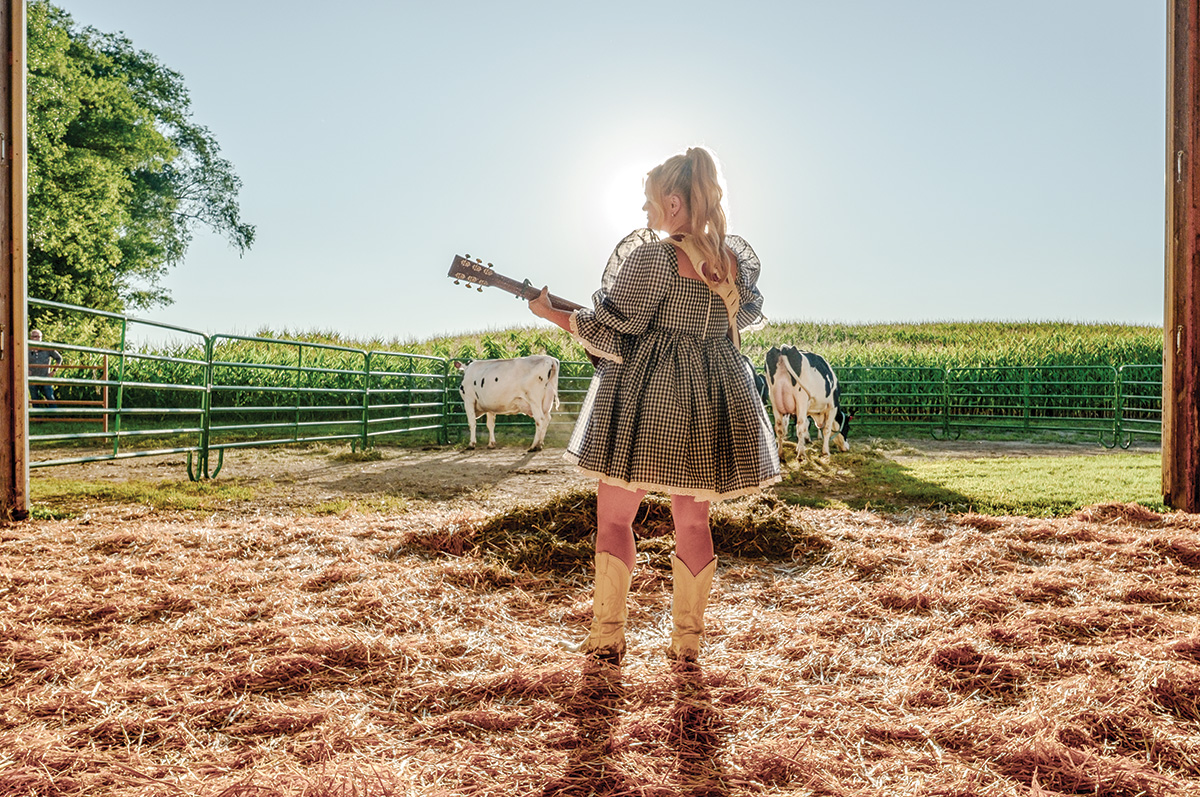
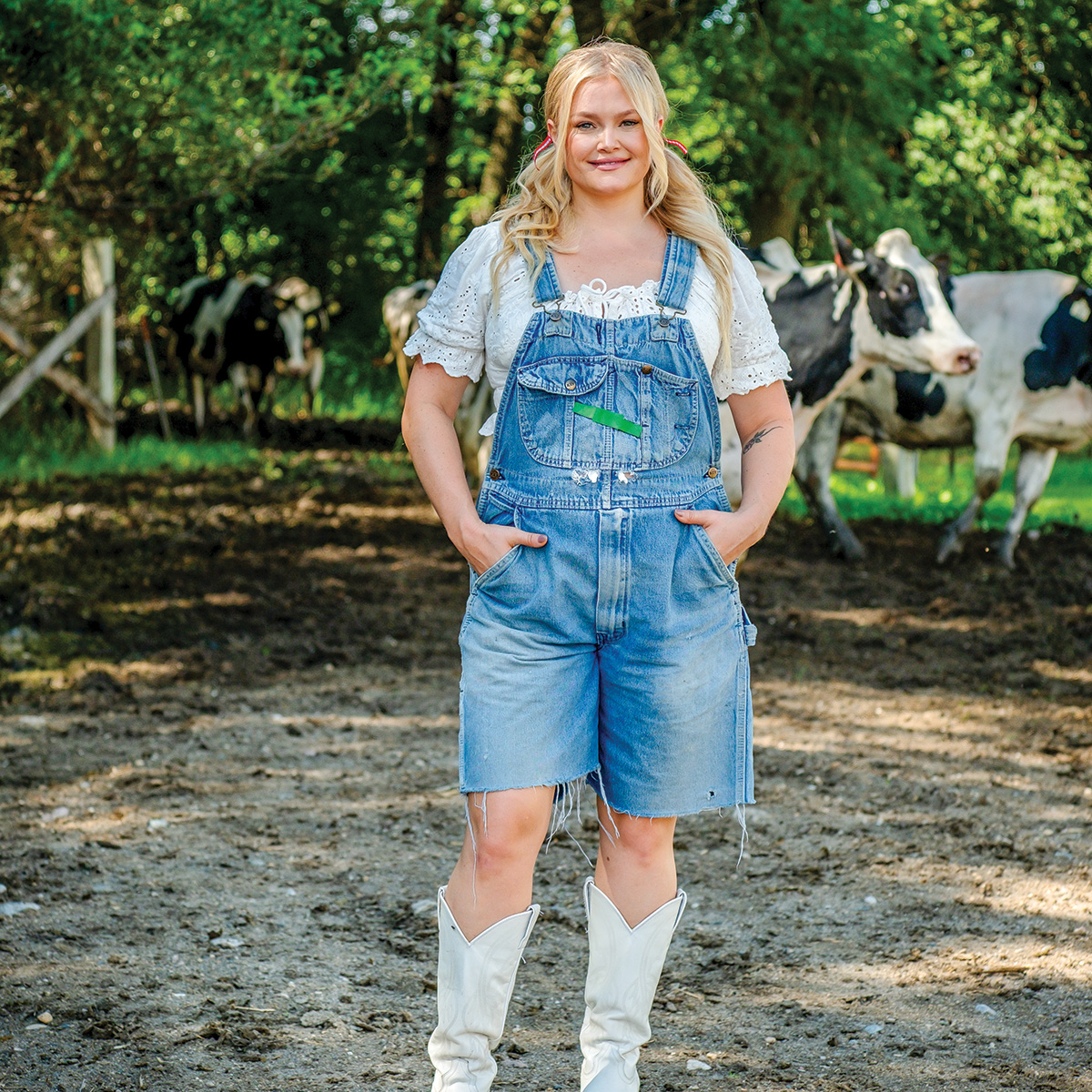
In fall 2025, she partnered with Land O’Lakes for the Bovine Serenade campaign, visiting a member-owned dairy farm in Minnesota to capture everyday dairy life as it actually is: mud, stainless steel, worn parlor floors, big fans humming, kids trying to act natural around a camera.
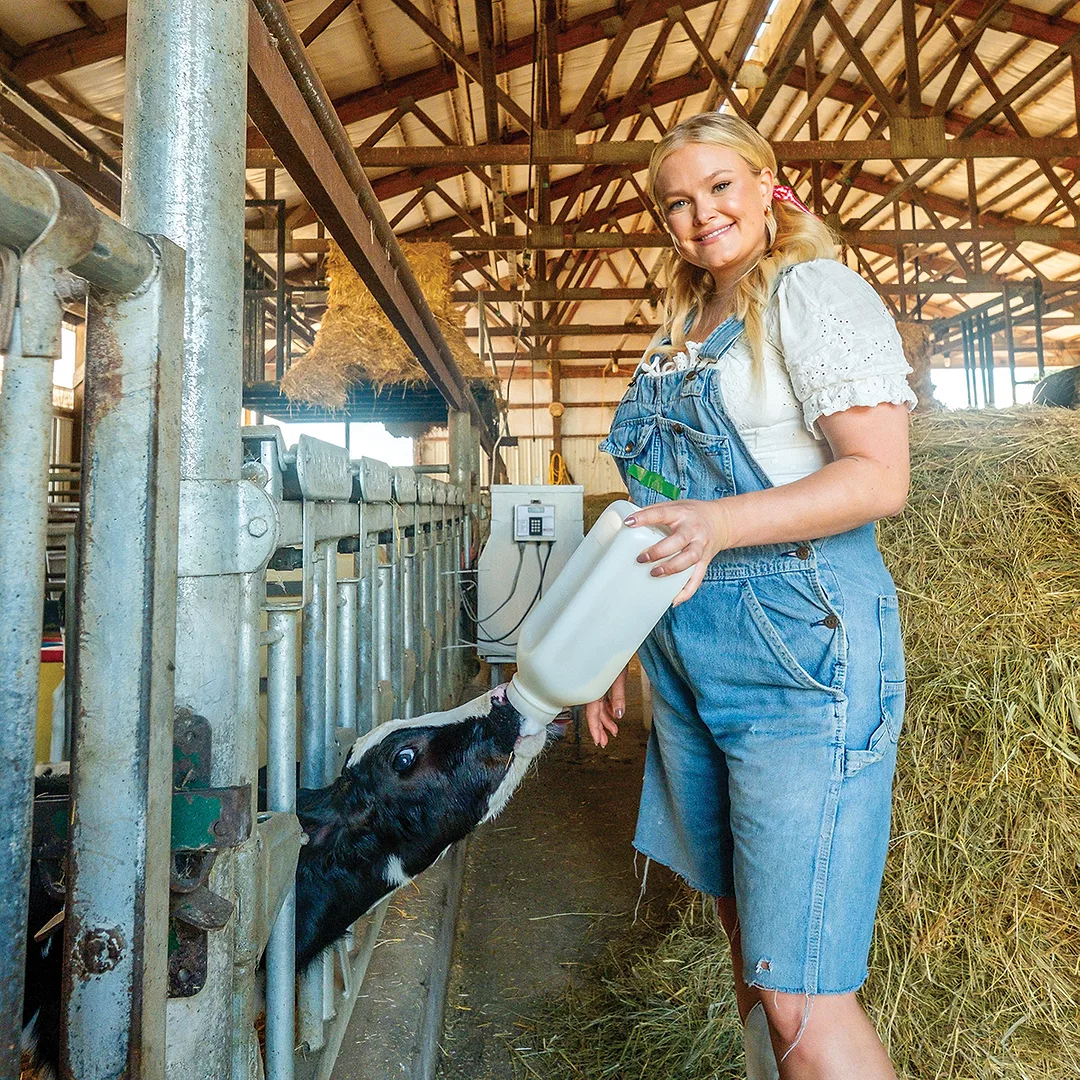
In the campaign footage, you can see her genuinely light up around the animals. “Oh here’s the babies… Hi! Look at you with your cute little pink nose,” she says in one clip, crouching down to greet young calves. Anyone who’s spent time in a calf barn knows that reaction doesn’t need staging.
For that corn kid who was once jealous of the dairy princesses with their busts at the county fair, standing in a working parlor and having it broadcast to the world looks a lot like a full-circle moment. Maybe not the crown she couldn’t earn as a kid—but something close.
According to Ads of the World, Land O’Lakes partnered with Hailey specifically for “her genuine farm roots, appreciation for farmers and farm life, and shared values of hard work, ownership, and cooperation.”
For producers watching those clips, this isn’t “some singer in a barn.” It’s someone who grew up on the same kinds of roads and in the same kinds of communities, standing in a parlor that looks like theirs, treating it like the main stage instead of a prop.
The Song About Losing the Farm
If you’re going to tell the truth about rural life, you can’t just sing about tailgates and sunsets.
“Middle of America,” which Hailey recorded with American Aquarium, is one of those songs that makes a lot of rural listeners go quiet. She’s talked about how it came from driving through western Iowa and seeing signs that read “Stop the Airport. Save the Farms,” then realizing for the first time what eminent domain really meant for the families behind those signs.
“I remember driving through western Iowa—it was the first time I kind of learned about eminent domain,” she told Wide Open Country. “Seeing all these signs saying, ‘Stop the Airport, Save the Farms,’ and I was like, ‘What are they talking about?’ That was the first time I realized the government can take farms to build an airport. That kind of blew my mind a little bit.”
Those conversations aren’t limited to Iowa. In Ohio, the Farm Bureau has made eminent domain reform one of its top policy priorities, pushing back against what they see as overreach that threatens family farms across the state. Whether it’s airports, pipelines, highways, or industrial development, the pressure on agricultural land is a live issue in dairy regions all over the country.
A lot of dairy producers don’t need a song to tell them that story. They’ve lived their own versions: fighting a pipeline route, watching development creep up to their hedgerows, seeing highways and subdivisions change the view out the kitchen window, or just watching neighbours disperse because the math stopped working and the next generation’s life was heading somewhere else.
What the song does is say it out loud in a space where our kind of stress usually gets turned into clichés. There’s no easy resolution in the lyrics. No promise that every farm will be saved. But there is a line in the sand that says, “This is happening to real families, in real towns, in the middle of America.”
Sometimes that’s what art can do for us—give us language for something we’ve been watching for a long time.
When the Kids Don’t Come Back
Standing in the milk house late at night, when it’s just the fans, a couple of cows shifting in the sand, and the glow of the bulk tank readout, it’s pretty common now to wonder who’ll be standing there in ten or twenty years.
In a lot of dairy regions—whether we’re talking Wisconsin freestalls, Ontario tie-stalls, Dutch robot barns, or Iowa parlors—only a fraction of family dairies stay in the same hands across three or four generations. Some herds transition beautifully. Some land in the hands of cousins or neighbours. Some quietly disappear.
You hear these stories in co-op boardrooms, at Holstein club meetings, behind the side curtains at junior shows, and around the coffee pot at extension events like Iowa State’s Dairy Directions series. The official agenda might be transition cow health or beef-on-dairy economics. The hallway talk is often about kids, succession, and whether the farm can—or should—stretch one more generation.
Hailey’s story doesn’t provide a simple answer for who should stay and who should go. What it does is widen our idea of what “carrying on the farm story” looks like when kids don’t take over the parlor.
In her case, it looks like carrying the voices, images, and values of rural communities into rooms most of us will never see: writing rooms, studios, bigger stages, and co-op campaigns. It looks like insisting that those stories stay grounded in gravel roads, cornfields, and barns instead of being smoothed into something generic.
That doesn’t make it hurt any less when a freestall empties out or a tie-stall is unlatched for the last time. But it does remind us that sometimes the legacy walks out the lane and keeps talking somewhere else.
What They’re Paying Forward Now
Here’s where it loops back to barns like yours and mine.
As more farmer-rooted stories have surfaced in dairy promotion—campaigns like Wisconsin’s “Born to Dairy” effort—you started to hear those pieces pop up in places far from ad agencies. In ag classrooms. At 4-H meetings. In church youth groups. In co-op annual meeting slide decks.
In some FFA classrooms and 4-H barns, teachers and leaders are using those videos and songs as conversation starters. “If we made a video about farms around here, whose places would you show? What would you want people to understand about calving, transition pens, or what happens in the parlor at 4 a.m.?”
Missouri’s 4-H dairy cow camps have become a model for that kind of hands-on youth connection. In 2025 the state hosted its largest camp ever—seventy kids spending days in real barns, washing, feeding, working with animals, and hearing directly from dairy families. Organizers emphasized that the goal goes beyond teaching skills—it’s about showing young people that dairy families are real, approachable, and worth knowing.
One evening in the barn can shape how a kid sees farmers for years to come.
Three Ways to Strengthen Your Community This Year
So what does all of this mean when you go back to your own barn?
Most of us aren’t looking for a fairy tale. We’re looking for anything that makes us feel a bit less alone and gives us a few ideas that might actually fit into a world of 4 a.m. alarms, fresh cow checks, and numbers that don’t always add up.
One youth night. Pick one evening—FFA, 4-H, Junior Holstein—that works around your milking schedule. Let kids see chores, ask questions, and warm up in the shop afterward. Team up with a neighbour if the workload feels like too much for one farm.
One neighbour check-in. When you notice someone’s lights on too late, too many nights in a row, stop by or send a text. “Saw your lights—everything okay?” is enough.
One honest conversation. Invite your vet, banker, or extension rep to sit down with a few neighbours and talk about stress, succession, and the next ten years. Not a lecture—a conversation where everybody gets to speak.
None of that will change the mailbox price next month. But it keeps people connected enough that when the bottom drops out—or when something unexpectedly good happens—you’ve got someone to call who understands the stakes.
And when the weight feels like too much for one kitchen table, it’s more than okay to reach further—to your doctor, to a counsellor who understands agriculture, to a peer group that gets what dairy life is like. Organizations like the Do More Agriculture Foundation or Farm Aid’s farmer hotline (1-800-FARM-AID) exist for exactly these moments.
What This Means for Our Barns, Our Roads, Our People
Maybe your farm will never see a film crew in the yard. Maybe nobody from your concession road will ever stand on a big award-show stage singing about cornfields and co-ops.
Honestly, that’s alright.
What sticks with a lot of people is this: when someone who grew up in a baby blue trailer in a cornfield can stand in front of the world and sing about the pressure on rural families—and people outside agriculture actually stop and listen—it says something about the strength of the places we come from.
Every dairy community has people like that simmering under the surface.
- A kid scribbling lines about feeding calves in a January wind on the back of a feed sheet
- A young herdswoman who can put a nervous visitor at ease in two sentences in the parlor
- A retired breeder who can tell you a cow family story three generations deep without looking anything up
- A vet who can tell, just from how you answer “How’s it going?” by the bulk tank, that it’s time to ask again
So the real question isn’t, “Will we produce the next Corn Queen?”
The real question is, “Will we notice the gifts sitting around our own kitchen tables and barn aisles—and make a little room for them—rather than letting them get buried under one more load of chores?”
When you think back over the hardest seasons, the ones you weren’t sure you’d get through, there’s usually more to the story than genetics and feed efficiency. It’s the neighbour who pulled in when your lights were still on long after they should’ve been. It’s the employee who stayed that extra hour when you were at the end of your rope. It’s the youth leader who kept a kid showing just long enough for them to feel like they belonged. It’s the community that quietly shifted from “down the road” to “like family” when your back was against the wall.
We can leave home. But if we keep calling, visiting, and telling each other the truth, home doesn’t have to leave us.
Because at the end of the day, what’s kept most of us going hasn’t just been the cows.
It’s been the people around them.
And around us.
If this story reminded you of your own community—your own “headlights in the lane” moment—share it. Not just this article. Your story. That’s how these things spread.
KEY TAKEAWAYS
- The crown she couldn’t have: Hailey Whitters grew up jealous of dairy princesses, but her family farmed corn. Twenty years later, she’s serenading cows in a Land O’Lakes parlor—full circle.
- Twelve years of rejection, then Corn Queen: Nashville said “not yet” the same way bad components and tight margins say it to your five-year plan. She kept showing up. Sound familiar?
- This isn’t celebrity fluff: Succession. Kids who leave. Mental health. The question of who’ll be standing in your milk house in twenty years. Her story mirrors what a lot of us live.
- Three small moves for your community this year: One youth night on your farm. One check-in when a neighbor’s lights are on too late. One honest conversation about stress and the next decade.
- Letting them leave is how they stay: The community that supports a kid chasing something far from the barn is the same one that keeps them calling home—and telling your story to the world.
EXECUTIVE SUMMARY:
Hailey Whitters grew up jealous of the dairy princesses—but her family farmed corn in Iowa, so that crown was never in the cards. She came home from the hospital to a baby blue trailer in a cornfield, watched her dad work night shifts at the plant, and learned what it means to keep showing up when nobody’s watching. Twelve years of Nashville rejection later, she broke through with Corn Queen, an album that sounds like it was written about families down the road from any of us. When Land O’Lakes brought her to a member-owned dairy farm for their Bovine Serenade campaign last fall, she crouched down to greet the calves like she’d done it her whole life—because in a way, she had. Her story hits close to home for dairy communities wrestling with succession, kids who leave, and the question of what legacy really means when the next generation takes a different path. If you’ve ever stood in the milk house late at night wondering who’ll be there in twenty years, this one’s for you—and it comes with three small ways to strengthen your own community this year.
Complete references and supporting documentation are available upon request by contacting the editorial team at editor@thebullvine.com.
Continue the Story
- The Woman Who Milks Other People’s Dreams: Michele Schroeder’s Unexpected Path from Historic Dairy Legacy to Relief Milking Pioneer – Michele walks a similar path of resilience in Minnesota. After her barn went quiet, she found a way to carry her legacy forward through relief milking, proving our dairy stories don’t end just because the cows leave the lane.
- Why 83% of Dairy Farms Will Disappear: How to Beat the Succession Odds Before It’s Too Late – This piece explores the industry forces and human dynamics that shaped the world Hailey’s classmates navigated. It deepens the understanding of why these kitchen-table conversations about leaving or staying are the most critical ones we’ll ever have.
- From 4-H Project to 20 All-Americans: The 28-Year-Old Proving Your Succession Plan Is Already Dead – For those asking “what happens next?”, this look at a young breeder continues the story of rural grit. It shows the next generation wrestling with legacy and proving that the farm story lives on through those who choose to stay.
 Join the Revolution!
 Join the Revolution!
Join over 30,000 successful dairy professionals who rely on Bullvine Weekly for their competitive edge. Delivered directly to your inbox each week, our exclusive industry insights help you make smarter decisions while saving precious hours every week. Never miss critical updates on milk production trends, breakthrough technologies, and profit-boosting strategies that top producers are already implementing. Subscribe now to transform your dairy operation’s efficiency and profitability—your future success is just one click away.