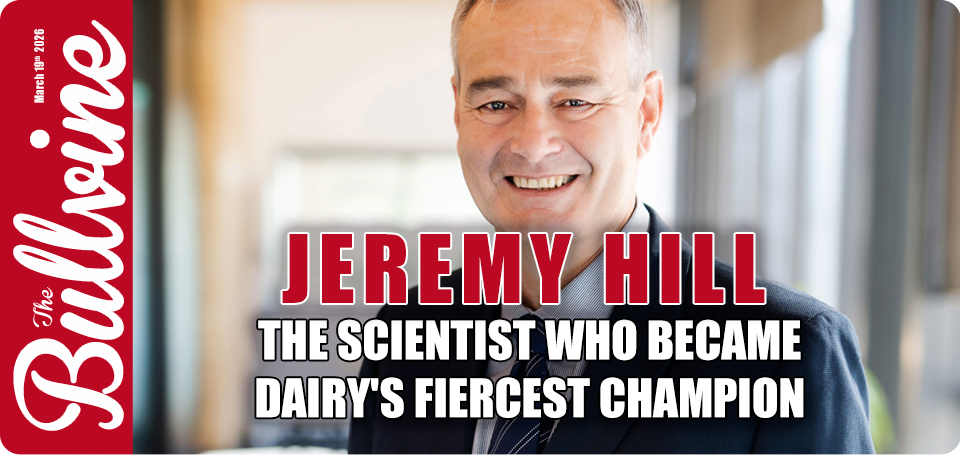





The plant-protein lobby pushed for a rule change that would’ve cut billions from milk payments worldwide. Jeremy Hill stopped it. Most producers have never heard his name.
For decades, the global protein scorecard was rigged — capping dairy’s score at the same level as soy and pea. One New Zealand scientist spent 15 years fixing it, and the data now proves what your bulk tank already knew. Here’s why Dr. Jeremy Hill’s work is behind the component premiums hitting your milk check right now — and why those premiums aren’t going anywhere.
Here’s something that should bother every dairy producer reading this.
For years — decades, really — the standard system for measuring protein quality capped every score at 1.0. Didn’t matter how good your protein actually was. Dairy casein, which is genuinely one of the most complete, most digestible protein sources on the planet, got the exact same grade as soy protein isolate. Same number. Same ranking. Like judging a VG-89 fourth-lactation cow on the same scorecard as a crossbred heifer and telling the market they’re identical.
Nobody questioned it. For years, the industry just… accepted this.
The man who finally said that’s not good enough — who spent 15 years championing the development of the scientific frameworks that rewrote protein quality standards and also define how protein content in your milk is measured — never actually planned on working in dairy. He was supposed to go back to medical research. He was studying liver enzymes, for crying out loud.
His name is Jeremy Hill. And what he built is now the science behind the component premiums on your milk check — and the single most powerful piece of evidence the dairy sector has ever had against plant-based alternatives.
Every producer shipping milk today should know this story.
The Guy Who Turned Right Instead of Left
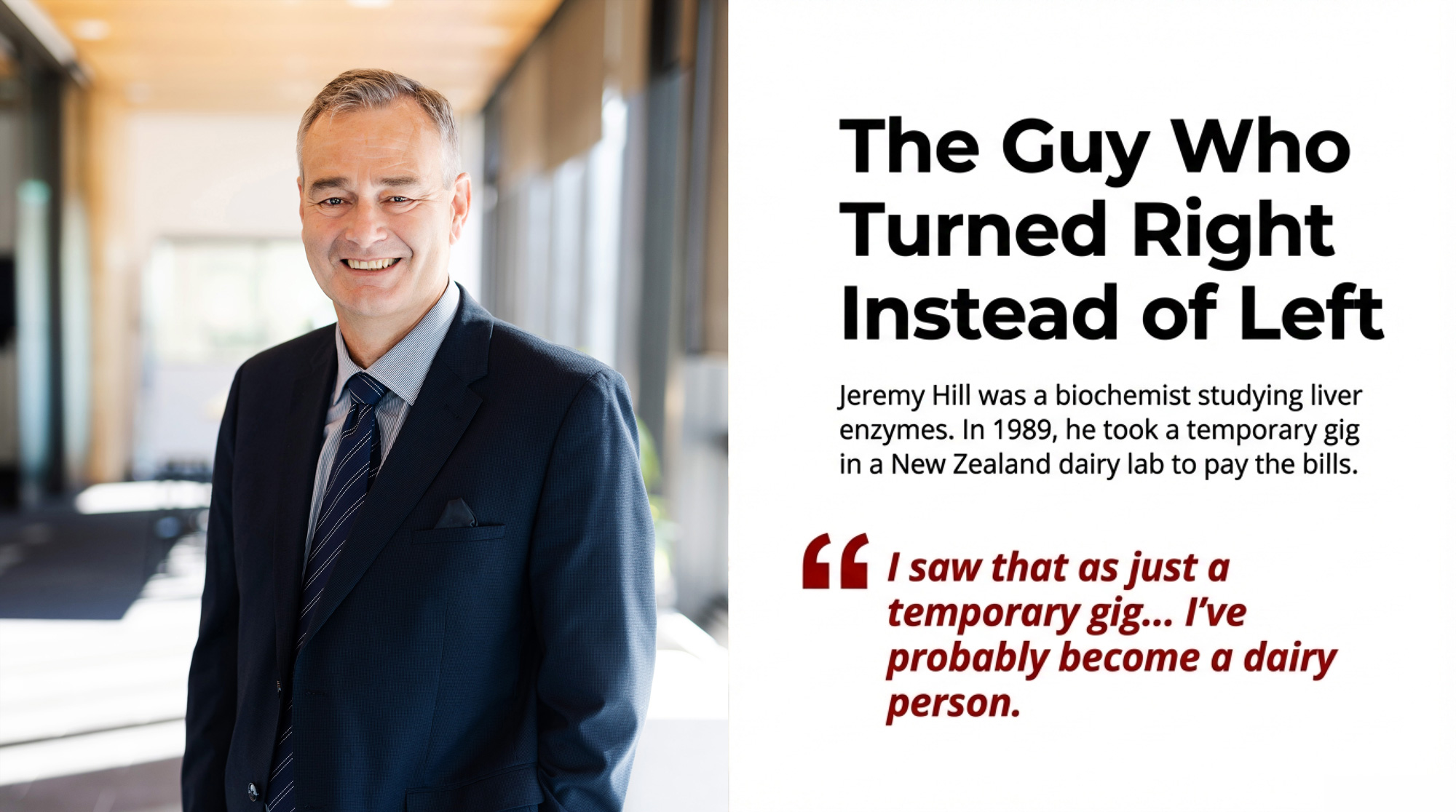
There’s a road in Palmerston North, New Zealand — flat, windswept, surrounded by the kind of relentless green pasture that feeds both cows and the scientists who study them — that splits in two directions. Left takes you to Massey University. Postdocs, academic grants, the quiet hum of biochemistry labs. Right takes you into what became the Fonterra Research and Development Center — the scientific engine behind the world’s largest dairy exporter.
Sometime in the late 1980s, a young British biochemist named Jeremy Hill stood at that fork. PhD in medical research. Specialty in liver enzymes. The plan was always medical research.
But here’s how dairy gets its hooks in you.
Hill had done an undergraduate project years earlier — modifying yeast to produce cocoa butter-like fats using whey as a feedstock. “Stone age techniques compared to today,” he says now with a laugh. But that project was essentially precision fermentation before the venture capitalists gave it a fancy name. When his PhD wrapped up, his department head offered a postdoc based on that earlier dairy work. Hill took it — not because he saw a future in dairy, but because he needed a paycheck between medical gigs.
“To be quite frank,” Hill tells me, “I saw that as just a temporary gig before I would move back into medical research.”
That temporary gig deposited him in New Zealand. His wife picked up a teaching job. They liked the lifestyle. Hill started crossing the road to Fonterra’s facility — their gear was better than Massey’s, and the coffee was decent — got to know the protein chemistry team, and one day the department head said, “Hey, we’ve got a scientist role. Interested?”
You’d think a guy studying liver enzymes would have nothing to say about your milk check. Stick with me.
That was 1989. He’s still there. Talking to Hill via video from the Palmerston North campus — you can practically hear the New Zealand rain against the windows — you’d never guess this was supposed to be temporary. Thirty-five years, 100-plus patents, a Queen’s Birthday Honour, and the distinction of being the only New Zealander ever to lead the International Dairy Federation later, Jeremy Hill has, as he puts it, “probably become a dairy person.”
Yeah. Probably.
The Protein Scorecard Nobody Questioned — Until He Did
Alright, here’s where this gets directly relevant to anyone watching their component numbers.
For decades, the global standard for measuring protein quality has been PDCAAS — Protein Digestibility-Corrected Amino Acid Score. Sounds rigorous, right? Here’s the problem: PDCAAS had an artificial ceiling. It capped at 1.0. So dairy protein — which is demonstrably, measurably superior in essential amino acid profile and digestibility — scored the exact same as several plant proteins that weren’t remotely in the same league.
The industry had been playing on a rigged scoreboard. But nobody in industry or regulatory bodies was pushing for change.
Hill pushed. And then he spent 15-20 years championing the development of a replacement.
It wasn’t easy. And it wasn’t cheap. The thing that gets me about this story is how long it took the broader industry to get behind the investment. Hill championed this through a partnership with the Riddet Institute at Massey University, drove it into a public-private partnership with the New Zealand government, and then sponsored it into the Global Dairy Platform to globalize it. Every step required convincing people that spending money on long-term nutrition science — with returns 10 or 15 years out — was worth it. There were skeptics. There were always skeptics. Processors who didn’t want to fund research with a decade-long horizon. Co-ops that figured the old system was “good enough.”
“For it to be credible,” Hill explains, “it can’t just be about how it works with milk. You have to do it across different sources of food. You have to move from animal models into confirming that it works from a human nutrition perspective. That takes a lot of time. It’s also expensive.”
The result was DIAAS — the Digestible Indispensable Amino Acid Score. It removed the cap. It measured individual amino acids rather than total protein. And critically, it assessed digestibility at the ileal level — meaning it tracked how much of each essential amino acid your body could actually absorb and use, not just how much appeared on a nutrition label.
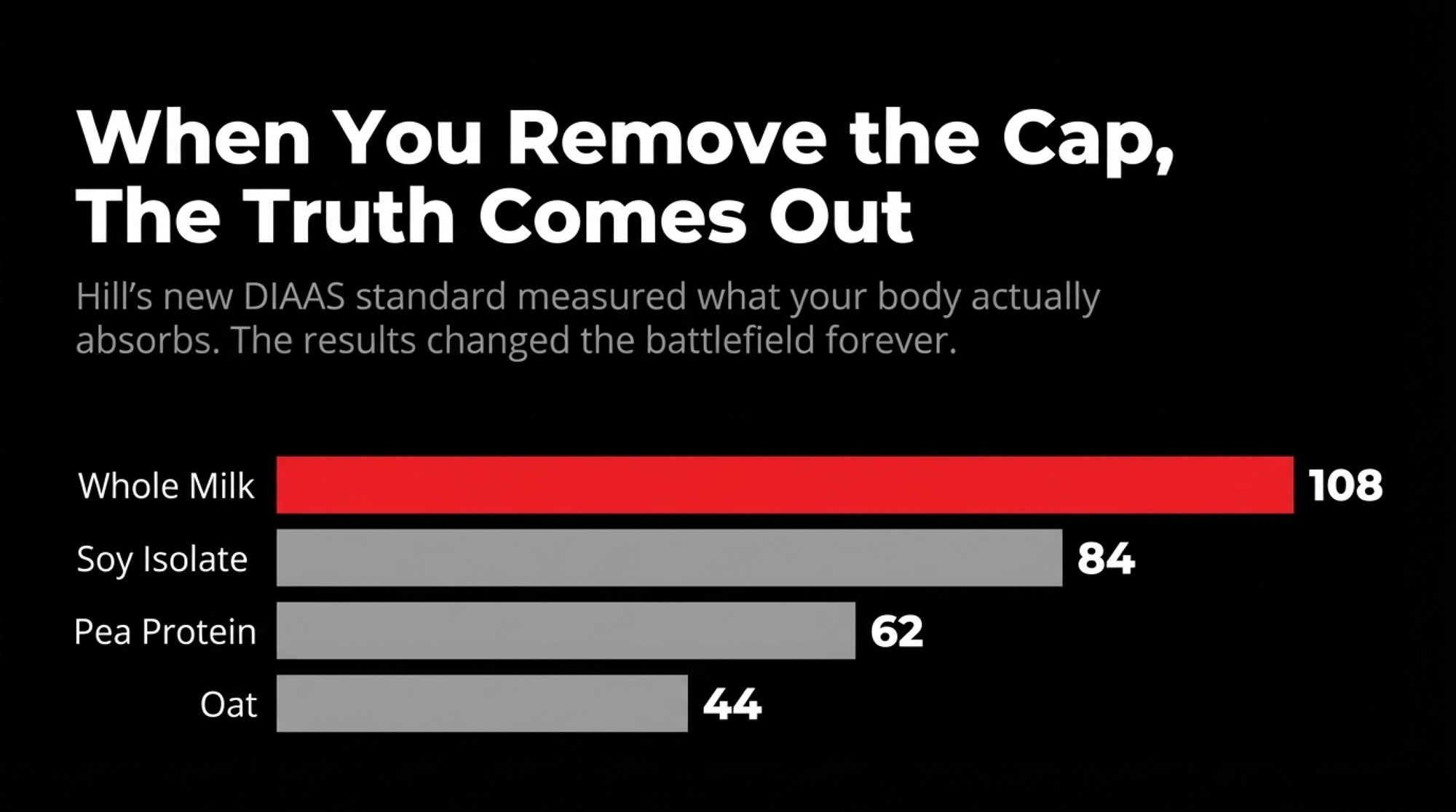
I don’t normally get worked up about nutrition tables. This one’s different. Here’s what the scoreboard looks like when the system isn’t rigged — all values on the same scale, FAO 2011 reference pattern (ages 0.5–3 years), from peer-reviewed research published in the British Journal of Nutrition (Mathai et al., 2017) and Nutrients (Hertzler et al., 2020):
| Protein Source | DIAAS (%) | FAO Quality Classification |
| Whey protein isolate | 109 | Excellent |
| Whole milk | 108 | Excellent |
| Whey protein concentrate | 107 | Excellent |
| Milk protein concentrate | 101 | Excellent |
| Skimmed milk powder | 92 | Good |
| Soy protein isolate | 84 | Good |
| Soy flour | 79 | Good |
| Pea protein concentrate | 62 | No quality claim |
| Wheat | 45 | No quality claim |
| Oat | 44 | No quality claim |
Look at that spread. Whey protein isolate — 109. Pea protein concentrate — 62. Oat protein — 44. Under the old PDCAAS system, soy scored a perfect 1.0, right alongside milk. Under DIAAS, the truth comes out: soy isolate scores 84, which is “good” but not “excellent.” Pea can’t even make a quality claim.
Some people have credited DIAAS as the greatest tool the dairy industry has ever possessed against plant-based competitors. Hill’s been told he “didn’t win the nutrition war — he changed the battlefield.”
And here’s the part that should make every producer angry: if the broader dairy sector had funded this work faster — if the industry had gotten behind nutrition science with the same urgency it brings to trade negotiations or quota disputes — this tool could have been ready years earlier. Instead, it arrived just in time for the plant-based wave because one scientist and a handful of collaborators had the stubbornness to keep pushing while everyone else figured the old system was fine.
The Protein Quantity Fight You’ve Never Heard About
So that was the protein quality side of Hill’s work. But here’s the thing — there’s a second front in this battle that hits your milk check even more directly, and most producers have never heard a word about it.
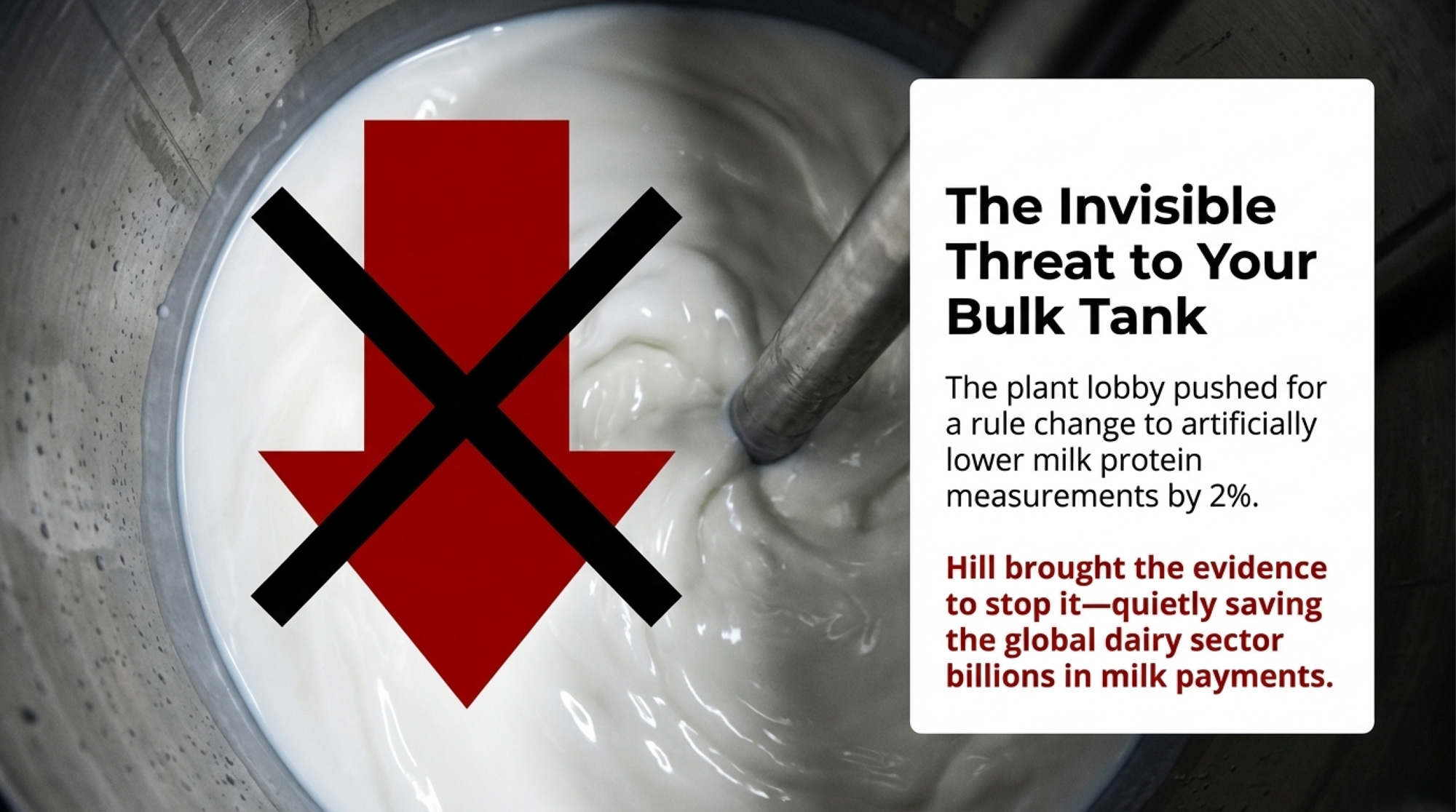
Standard-setting agencies have been under constant pressure from the vegetable and plant protein industry to change how protein quantity is measured. The push has been for a “convenient” one-size-fits-all method that would see a 2% downward change to how milk protein content is determined — and up to a 10% upward change in how some plant protein content is determined.
Think about what that means for your payment. A 2% downward shift in how your milk protein is measured, applied across the entire global dairy sector, would wipe billions off milk payments. Billions. Not hypothetically — that was the trajectory if the plant protein lobby had gotten its way.
They didn’t. By bringing the best available evidence to bear, undertaking and publishing new research, the dairy sector under Hill’s leadership has been able to prevent that unjustified change.
So when we talk about Hill’s legacy, it’s not just that he proved dairy protein is better than the alternatives. He also fought to make sure the way your protein is counted wasn’t quietly rigged against you. Quality and quantity. Both battles. Both won — for now. And most of the industry doesn’t even know it happened.
Why This Protein Science Is Hitting Your Milk Check Right Now
The thing is, Hill’s protein quality work didn’t land in a vacuum. It landed right in the middle of the biggest protein demand surge the food industry has ever seen.
The numbers coming out of early 2026 are staggering. CoBank’s January report shows 70% of American consumers now actively seek more protein in their diets — up from 59% in 2022. Ready-to-drink dairy protein shake sales have climbed 71% in four years, from $4.7 billion to $8.1 billion. Cottage cheese — which, let’s be honest, was a punchline five years ago — posted over 51% year-on-year growth in some markets, with demand so intense producers couldn’t keep up. TikTok, of all things, drove cottage cheese into a supply shortage in 2025.
IDFA called 2025 “one of American dairy’s strongest years,” with consumption growth led by value-added products such as milk, yogurt, cottage cheese, and butter.
And right here at home? Farm Credit Canada’s 2026 outlook flagged that Ontario is now staring down a protein deficit— demand for high-protein dairy products grew so significantly through 2025 that production couldn’t keep pace. Agropur just reported improved profitability in fiscal 2025, driven by the strength of its enriched dairy products.
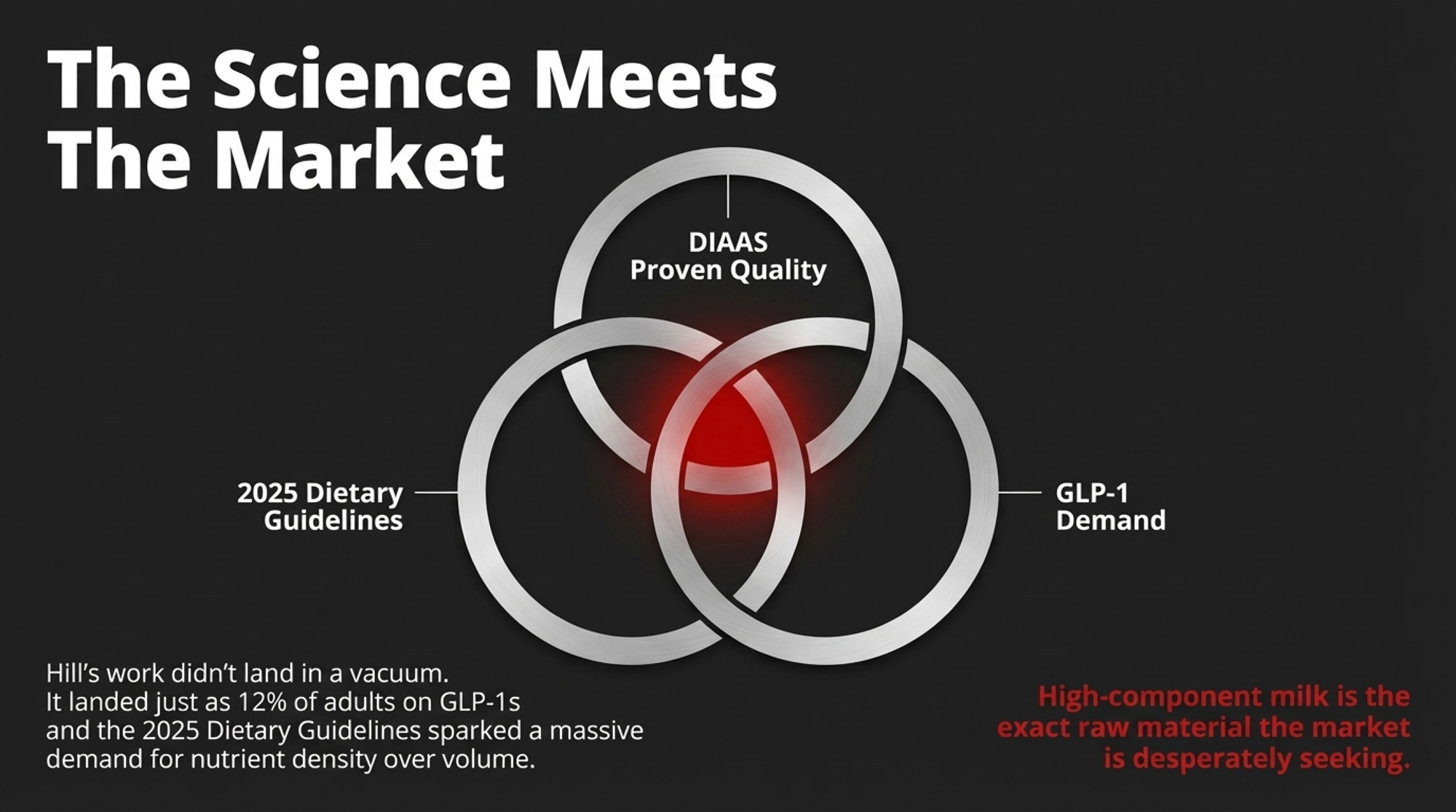
Then there’s what dropped on January 7, when the USDA and HHS released the new 2025–2030 Dietary Guidelines for Americans. The recommended daily protein intake for adults jumped from 0.8 g/kg body weight to 1.2–1.6 g/kg — a 50–100% increase in what the U.S. government says you should be eating. The guidelines also specifically call for three daily servings of full-fat dairy with no added sugars. For dairy processors and the producers supplying them, that’s a massive tailwind.
And the GLP-1 effect. If you haven’t been tracking this, you should be — as we reported in our GLP-1 deep dive last year. Twelve percent of U.S. adults are now on appetite-suppressing drugs like Ozempic, with cheaper pill versions hitting the market this year that could push adoption significantly higher. If that sounds like bad news for food demand, it’s not. Research shows that GLP-1 users increased their spending on yogurt, protein bars, and other nutrient-dense foods. When you eat less overall, nutrient density matters more. You can’t afford empty calories when your appetite is chemically suppressed. You need the most nutritional bang per bite.
If that feels like the goalposts moving again just when you figured out the last shift… you’re right. But this time, the movement favors exactly what you’re already producing.
Hill saw this coming. “If we’re going to eat less, then nutrient density and richness and quality of diets becomes really important,” he says. “I think there is a right for dairy in that space, and a big one.”
60 Million Years of R&D — and the Cow Still Wins
Hill’s perspective on why dairy protein is so extraordinary gets at something deeper than amino acid tables. And this is where his medical research background — that left turn he almost took — actually pays off.
“Sixty million years of evolution has evolved this food to be the sole source of nutrition when we’re at our most vulnerable from a developmental perspective — body, mind, and everything,” he says, and Hill leans into this point like a man who’s made this argument in government offices and boardrooms for a decade. “So it shouldn’t be surprising that it’s full of these great nutrients and bioactivities.”
Think about that. Milk didn’t come out of a laboratory or a venture capital pitch meeting. It was refined over geological time by the most ruthless quality-control system in existence: survival. If milk failed to deliver complete nutrition to the most vulnerable members of a mammalian species, that species went extinct. Full stop. Every load you ship is the product of 60 million years of evolutionary R&D.
Dairy is the number one source of at least half a dozen essential nutrients in the human diet. In modeling work Hill’s been involved in — covering dozens of nutrients — dairy ranks in the top five sources for 20 to 30 of them. It contains bioactive compounds, such as lactoferrin, with antiviral, antibacterial, and immune-stimulatory properties.
And here’s the line that deserves to be painted on the wall of every dairy boardroom and co-op office on the continent:
“It’s naive to look at nutrition with just the protein paradigm,” Hill argues. “The value of dairy is the great protein and what comes with it.”
Protein plus calcium plus B vitamins plus zinc plus iodine plus phosphorus plus a constellation of bioactives working in concert. That’s not a commodity. That’s a nutritional ecosystem.
As Hill dryly observes, dairy was produced as food. Meat, by contrast, “is actually produced as a muscle and only becomes food when it doesn’t move fast enough.”
He gets a laugh with that one. But the distinction matters—and it brings us to the question of precision fermentation.
A Bullvine Reality Check on Precision Fermentation
Hill was literally doing precision fermentation before it had a name — his undergraduate yeast project in the UK was the same concept. His assessment after decades on both sides? “I do not believe, and I haven’t seen the evidence, that this technology will disrupt the dairy industry. Even though we’re heavily involved in it. We see it playing a nice complementary role.”
His reasoning is compelling: the mammary epithelial cells in a cow’s udder produce their own weight in protein every single day, while simultaneously generating fats, sugars, minerals, bioactives — the whole nutritional ecosystem — in a self-sustaining biological system powered largely by grass and sunlight. Replicating that in a bioreactor remains, frankly, a fantasy at commercial scale.
And the market data backs him up — at least partially. The plant-based alternatives that were supposed to revolutionize the food system have been on shelves for 10, 15, or even 20 years. They’ve found a niche and plateaued.
But here’s the Bullvine’s editorial note on this: We’re less sanguine than Hill on the precision fermentation timeline. Our own reporting suggests that commodity dairy faces real disruption risk over the next decade, particularly for ingredient-grade proteins, where PF firms are approaching cost parity. Hill’s argument that the cow remains the most efficient protein ecosystem on earth? That’s hard to argue with. But if you’re a commodity producer shipping bulk powder to a co-op with no value-added strategy, the PF threat warrants more caution than “complementary” suggests. Keep your eyes open.
The Methane Vaccine: Dairy’s Environmental Game-Changer
Let’s talk about the methane in the rumen.
Hill has publicly called a methane vaccine a potential game-changer for our industry. Not as wishful thinking — as a strategic assessment rooted in one word: ubiquity.
Most other methane-reduction tools are context-specific. Feed additives like 3-NOP work great in a TMR system — precise dosing, consistent delivery, specialized supply chains. Perfectly viable for a 2,000-cow operation in Wisconsin or a 500-cow barn in Oxford County. Completely impractical for a smallholder milking three cows outside Rajasthan.
A vaccine? Administer it once or twice a year. Works across dairy, beef, and sheep. Works in pasture systems, confinement operations, and the approximately one billion livelihoods that depend on dairy globally — a figure from the 2016 FAO Dairy Declaration of Rotterdam, which Hill himself co-signed with the United Nations.
Imagine walking into a policy meeting where the first question isn’t about your carbon footprint. When environmental regulators come knocking — and they will — that declaration is the reason dairy has scientific standing in the room.
The science is moving fast. ArkeaBio — backed by over $33 million in total funding and now running second-generation formulations with Texas A&M — has confirmed that its vaccine successfully reduces methane by targeting methanogen microbes in the rumen. Full field trials are targeted for 2026–2027. New Zealand’s AgriZeroNZ has committed $73.4 million across its emissions portfolio as of December 2025, with the methane vaccine as a centerpiece. And India’s National Dairy Development Board is sponsoring parallel development — because this is a global race.
“Probably not the only tool,” Hill says carefully. “We may need a number of tools to stack them, and of course, in concert with practice improvements.”
But his larger point — and this is where producers need to lean in — is that the environmental conversation can’t be separated from the nutritional one. If dairy provides irreplaceable nutrition to billions of people, then the imperative isn’t to eliminate dairy production. It’s to make it cleaner. And the data on that front is better than most people realize.
The 72% Surge You’re Not Hearing About
Here’s a number that should reshape how you think about your herd’s future.
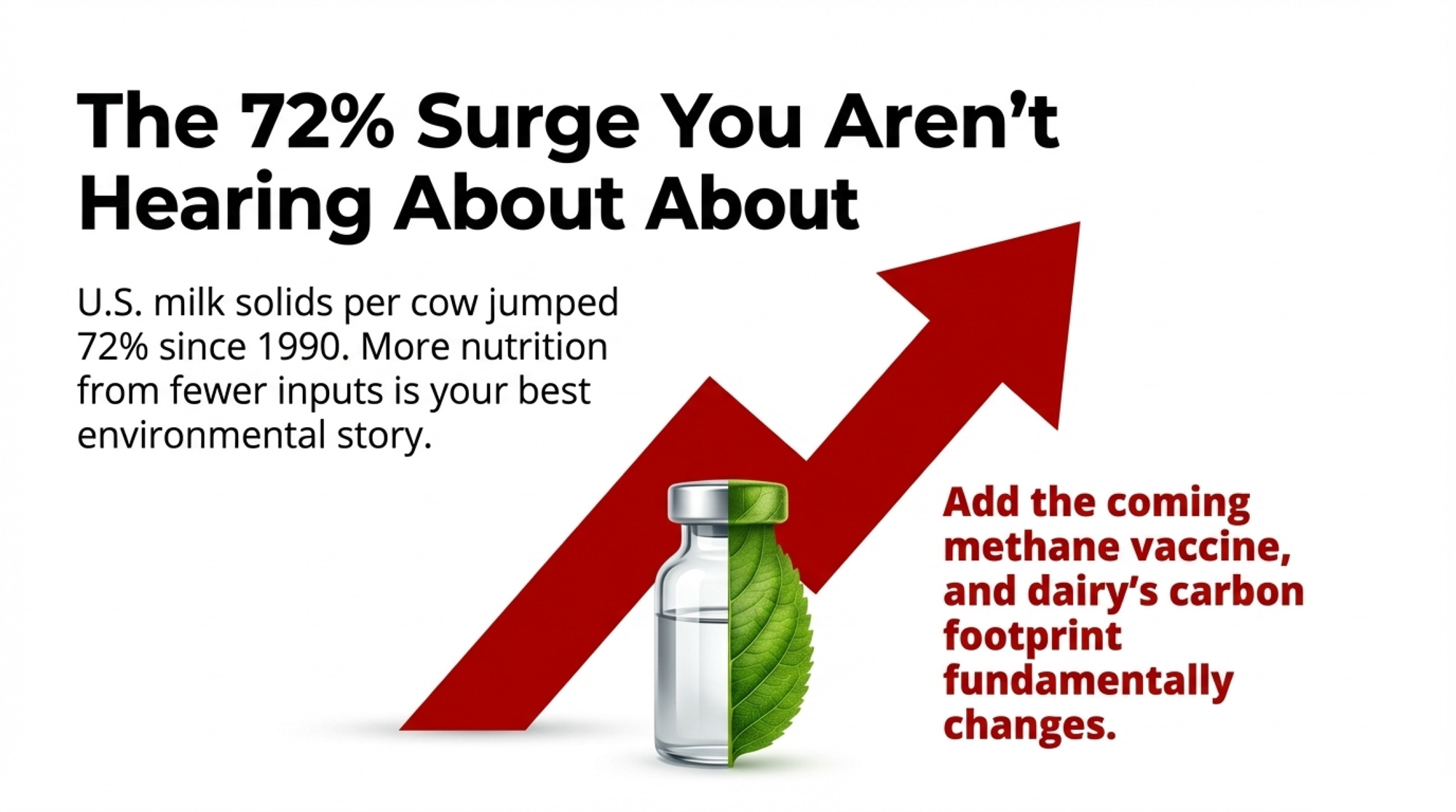
72% — the increase in U.S. milk solids per cow between 1990 and 2020 (USDA/NASS). New Zealand achieved gains above 60% over the same period. That’s your best productivity AND sustainability argument in a single number.
In a single generation, the North American dairy cow became nearly three-quarters more productive on a components basis. Not through some radical disruption. Through the compounding, relentless application of better genetics, better nutrition, better management — the blocking and tackling of good dairy science applied consistently over decades.
“A good way of looking forward at what might happen from a productivity point of view is to look back 30 years,” Hill says.
And here’s the correlation that doesn’t get nearly enough attention: a high-component cow is also a high-efficiency cow from a methane-per-unit-of-production standpoint. The goals sync up. Every 1% increase in components per cow is effectively a 1% decrease in methane per unit of nutrition produced. Producing more nutritionally dense milk from fewer inputs isn’t just good economics — it’s your best sustainability story right now.
This is hitting the payment system hard. Canada’s component pricing — where protein commands $9.70/kg in Class 3(d) — is already incentivizing exactly the kind of production Hill’s research validates. Hill acknowledges New Zealand is ahead on this: “I think you guys are a little ahead of us there… but that is where the biggest change is coming.” The U.S. is catching up.
So here’s the uncomfortable question the dairy industry needs to ask itself: if we’ve known about the component value story for this long, why did it take this long for payment systems to reflect it? And how much milk check money did producers leave on the table in the meantime?
As we wrote in our piece on unlocking dairy farming’s full potential, the industry has a habit of moving slowly on the things that matter most.
What This Means for Your Operation
So what do you do with all of this? Here’s how Hill’s global insights translate to decisions at your farm gate — and honestly, some of this is stuff the industry should have been shouting from the rooftops years ago.
Stop measuring the wrong thing. If you’re still evaluating your herd on litres of fluid milk rather than kilos of components, you’re farming in 2005. With Canadian protein premiums at $9.70/kg and U.S. processors scrambling for high-protein ingredients, the cows in your herd that test high on protein and fat are your most valuable assets — period. If your breeding decisions aren’t prioritizing component yield in 2026, you’re not leaving money on the table. You’re writing your own exit notice.
Understand the GLP-1 demand shift. This isn’t a fad. Twelve percent of U.S. adults are already on these drugs, with cheaper pill versions launching this year. Users eat less but spend more on protein-dense dairy. The market is shifting from volume to value — and your high-component milk is the raw material processors need to meet it.
Play offense on sustainability, not defense. Hill’s central argument is that dairy’s nutritional irreplaceability is the basis for the sustainability argument. A methane vaccine could be commercially available within five years. In the meantime, your productivity gains are already your best environmental story. Document them. Talk about them.
Know the protein quality numbers. DIAAS is increasingly referenced in dietary guidelines and trade policy — and now the 2025–2030 U.S. Dietary Guidelines are explicitly calling for higher protein intake and three daily servings of full-fat dairy. When someone at the dinner table or in a policy meeting says oat milk is “just as good,” the peer-reviewed data says otherwise. Whole milk DIAAS: 108. Oat: 44. That’s not a competitive gap. That’s a canyon. Know these numbers. Make your MP, your congressman, your county councillor see them.
Don’t ignore precision fermentation. We covered our concerns above—if you skimmed that section, go back and read it. The short version: Hill’s optimistic, we’re more cautious, and either way, the best defense is moving up the value chain.
The Legacy That Actually Matters
Ask Jeremy Hill about his proudest achievement, and he doesn’t mention the DIAAS standard, the Rotterdam Declaration, his cheese technology patents, or even the Queen’s Birthday Honour. He talks about people.
“The real legacy is the impact that you’ve had on the people and perhaps the way they’re thinking in the future,” he says.
Then he tells you a story about his son. As a teenager, the kid was an elite swimmer — setting New Zealand records, stacking national titles. One day, he looked at his dad and said: “Dad, all the sports people are forgotten. But those scientists that have something named after them — they’re remembered.”
Hill still marvels at it. That son went on to earn dual degrees in biotechnology and chemical engineering. Hill jokes that he’ll leave it to the next generation to establish “a unit called a Hill”—and if it exists, it should measure “the level of perspiration associated with innovating.”
It’s a funny line. But underneath it is a truth every dairy producer understands instinctively: the things worth building take decades, not quarters. The DIAAS standard took 15 years. The Rotterdam Declaration required a career’s worth of credibility. The methane vaccine has been in development for over a decade. None of it was fast. All of it mattered.
Hill finishes his book Legendairy with a line that should be painted on the wall of every dairy boardroom, every farm office, every ag policy department on the continent:
“If dairy was invented today by some agritech startup, it would be seen as the greatest blockbuster in the history of food.”
We live in an era that worships disruption and pours billions into lab-grown alternatives to foods that already exist. And the most nutritionally dense, most versatile, most evolutionarily perfected food source on earth — supporting a billion livelihoods, anchoring the world’s most valuable agricultural sector, now riding the biggest protein demand wave in history — is sitting right there. In your parlor. In your bulk tank. On pastures from the Waikato to Wisconsin to Woodstock, Ontario.
The industry doesn’t need to invent its blockbuster. It needs to stop being so damn quiet about the one it already has.
Sometimes the right move isn’t the new move. Sometimes it’s just turning right instead of left—and spending 35 years making sure the world can’t look away.
Is the dairy industry doing enough to tell its own protein quality story? Or are we still letting oat milk and pea protein control the narrative with inferior science? We want to hear from producers on the ground—drop your take in the comments.

KEY TAKEAWAYS
- For decades, the global protein scorecard hid how far ahead milk really is — DIAAS puts whole milk at 108 vs oat at 44 and pea at 62.
- Jeremy Hill spent 15+ years driving DIAAS and fighting plant protein lobby moves to change how milk protein is measured, protecting billions in potential milk payments.
- Higher protein targets in the 2025–2030 Dietary Guidelines, 70% of consumers chasing more protein, and 12% of adults on GLP-1 drugs all point the same direction: high-component dairy is in demand.
- A 72% jump in milk solids per cow since 1990, plus a methane vaccine on the horizon, gives dairy a powerful sustainability story when you talk emissions per kilo of nutrition, not per cow.
- The producers best positioned for the next decade will breed and feed for components, get their milk into value-added protein products, and know the DIAAS numbers when they’re up against plant-based and precision-fermentation claims.
Dr. Jeremy Hill has spent 35+ years at Fonterra turning dairy science into dairy ammunition — from protein quality and quantity standards that rewrote global nutrition policy to cheese technology patents that transformed how the QSR industry sources its products. He’s the only New Zealander to serve as IDF President (2012–2016), an adjunct professor at Massey University’s Riddet Institute, a Member of the New Zealand Order of Merit, and author ofLegendairy. His work shapes how the entire sector talks about protein, sustainability, and the future of food.
Continue the Story
- Frank Mitloehner: Clearing the Air on Cattle and Climate – He wrestled with the same vital question: how do we defend an industry being buried by bad data? This profile follows another scientist who stepped out of the lab to become a fierce, data-driven champion for producers worldwide.
- GLP-1 Weight Loss Drugs Reshape Dairy Demand: The $35,000 Question No Dairy Farmer Can Afford to Ignore – To truly understand the world Hill predicted, you must look at how modern medicine is forcing a pivot toward nutrient density. This piece explores the economic forces reshaping demand and why “good enough” protein no longer cuts it.
- Precision Fermentation: The $100 Billion Threat to the Dairy Industry? – Carrying forward the debate on Hill’s “evolutionary R&D,” this deep dive examines the next chapter of the Cow vs. Lab battle. It’s essential reading for every producer wondering if the bioreactor will ever truly outrun the rumen.
 The Sunday Read Dairy Professionals Don’t Skip.
 The Sunday Read Dairy Professionals Don’t Skip.
Every week, thousands of producers, breeders, and industry insiders open Bullvine Weekly for genetics insights, market shifts, and profit strategies they won’t find anywhere else. One email. Five minutes. Smarter decisions all week.