




Archive for Class IV milk

Powder Just Outpriced Cheddar: The $15,000/Month Gap Reshaping Your 2026 Milk Check

NDM’s best week since 2007 exposed a Class III/IV spread that’s costing cheese-pool herds $10,000–$15,000/month. Four moves before spring flush.

Executive Summary: If you’re shipping to a cheese-dominant handler, the Class III/IV spread is costing your operation $10,000 to $15,000 a month on 500 cows. NDM surged 18¢ this week to $1.64/lb — its strongest weekly gain since May 2007 — while Cheddar settled at $1.4725 and Class IV futures pushed into the high $18s versus Class III in the low $17s. The structural driver: U.S. powder output in 2025 fell to its weakest level since 2013 while over $11 billion in new processing capacity flowed to cheese and whey, not dryers. That imbalance has staying power. DMC enrollment closes in 52 days, and four moves — DRP restructuring, DMC stacking, component optimization worth $1.00–$1.50/cwt, and a hard look at your handler alignment — can narrow this gap before spring flush closes the window.
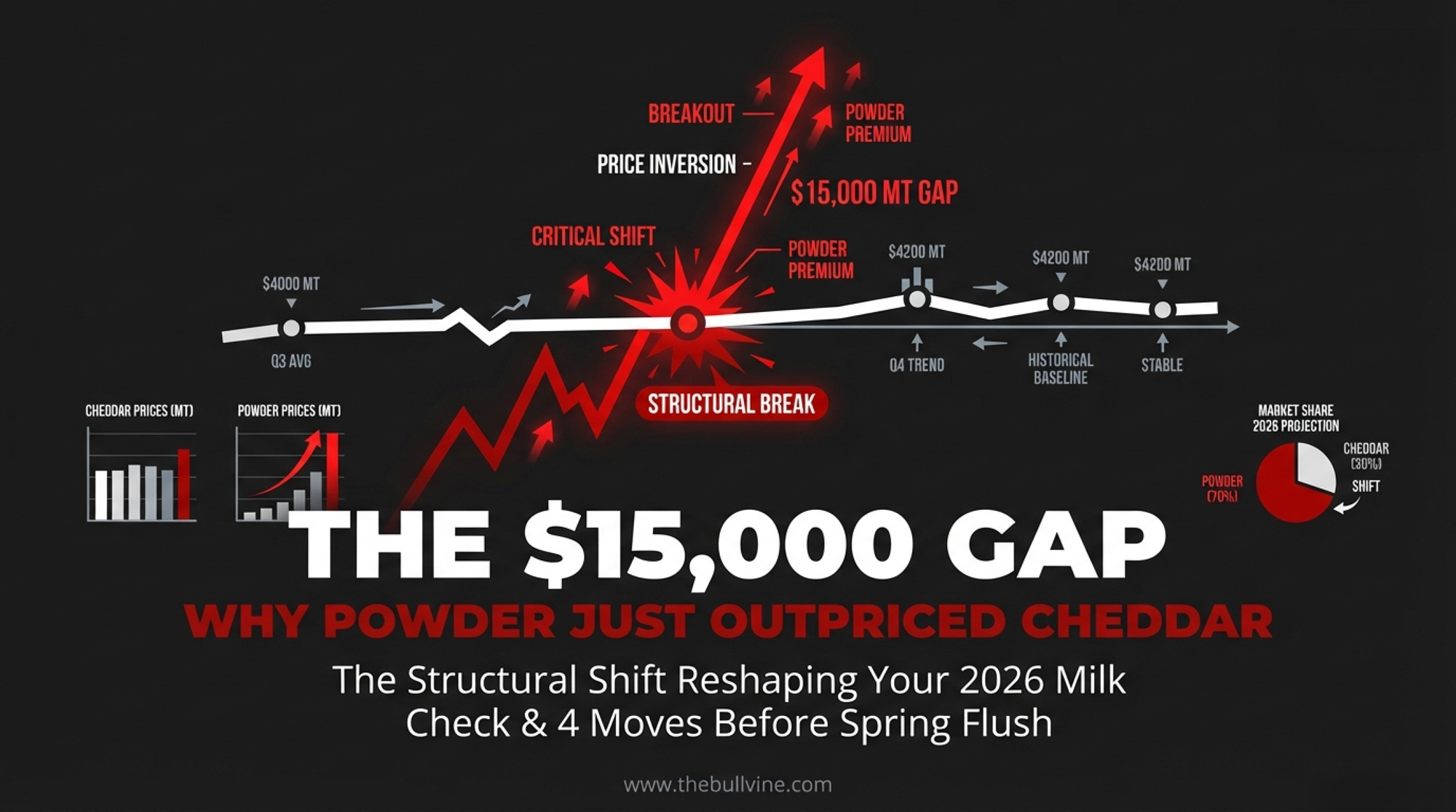
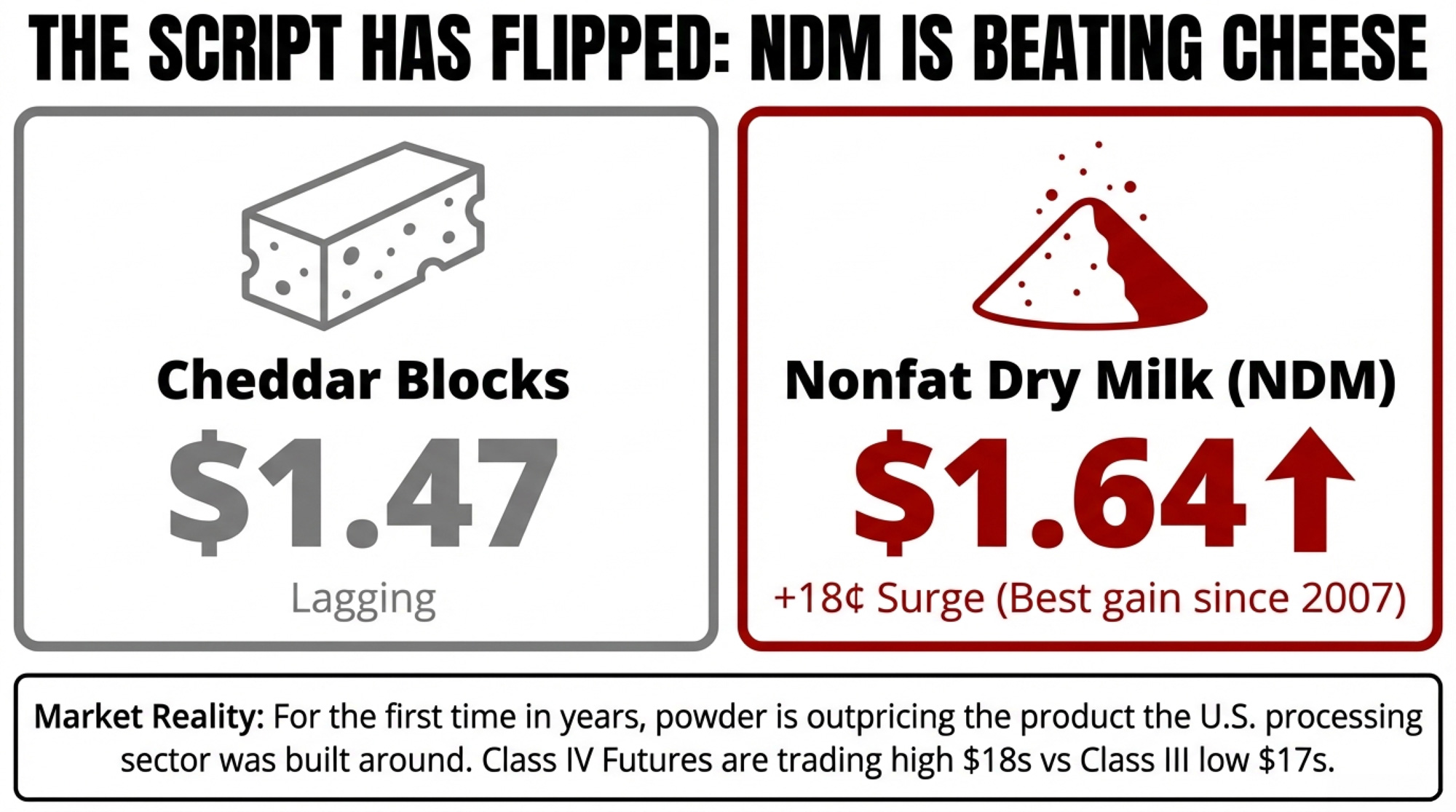
Nonfat dry milk surged 18¢ in a single week to settle at $1.64/lb on Friday, February 6, 2026 — the highest CME spot price since August 2022 and the strongest weekly gain since May 2007, per Jacoby & Associates. That puts powder a full 16.75¢ above Cheddar blocks and within pennies of butter. For the first time in years, milk powder is outpricing the product that the entire U.S. processing sector was built around. 
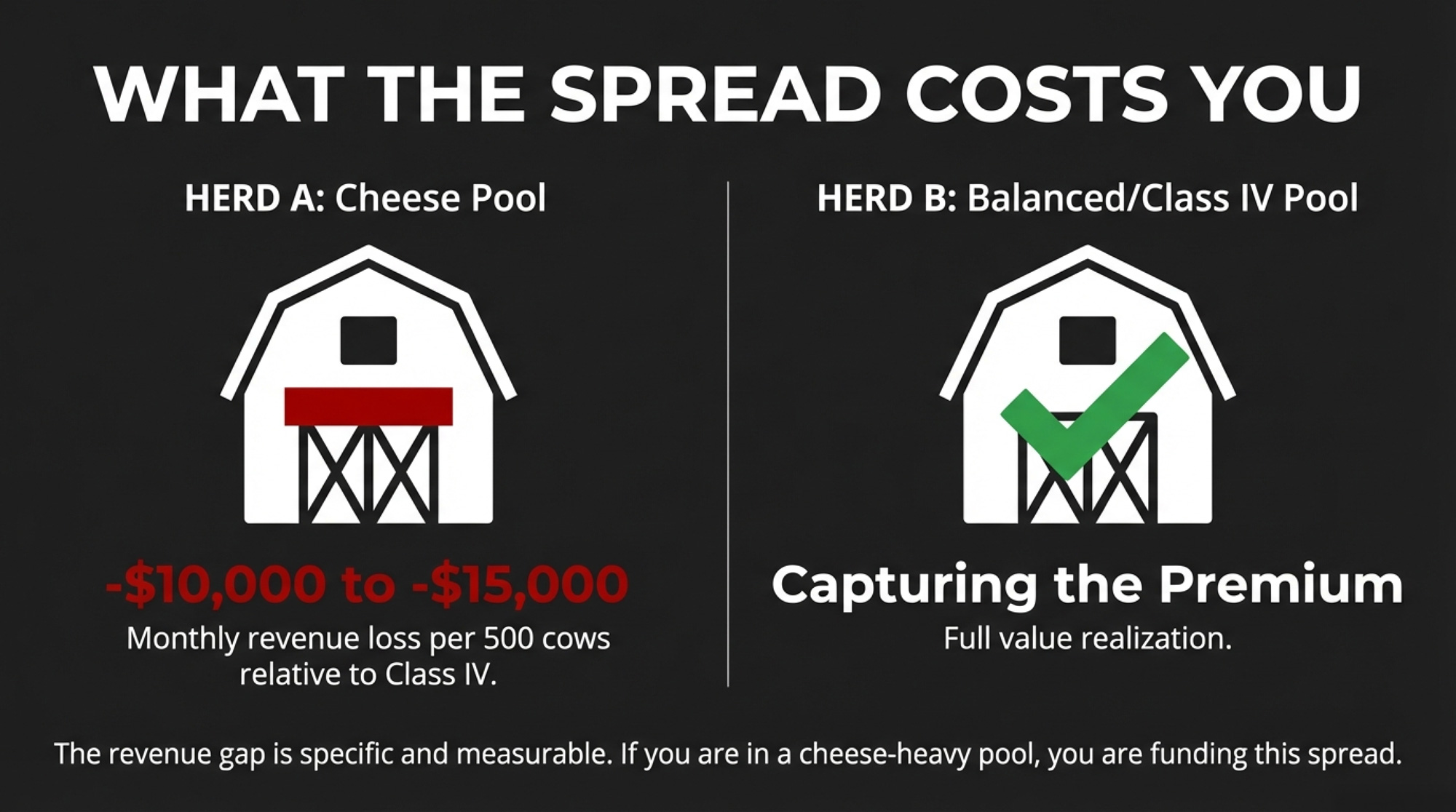
For producers shipping to cheese-dominant handlers — where Class III drives the blend — the revenue gap is specific and measurable. The Bullvine’s October 2025 analysis of two identical 500-cow herds — same genetics, same production, same components, different pool structures — found a monthly revenue disparity of $10,000 to $15,000, with the cheese-heavy operation on the losing end. DMC enrollment closes March 31. Spring flush is six to eight weeks out. The decisions you make about DRP coverage, component targets, and handler alignment in the next 90 days determine which side of that gap you land on. 

MonthClass III Pool (Black Line)Class IV Pool (Red Line)Gap
Sep 2025$310,000$315,000$5,000
Oct 2025$305,000$314,000$9,000
Nov 2025$302,000$314,500$12,500
Dec 2025$298,000$313,000$15,000
Jan 2026$295,000$310,000$15,000
Feb 2026$292,000$307,000$15,000

What $1.64 NDM and $1.47 Cheddar Look Like on Your Check

The week’s CME scoreboard tells a lopsided story. NDM at $1.64/lb. Cheddar blocks up 11¢ to $1.4725/lb on 51 loads — one of the busiest trading weeks in recent memory. Butter jumping 13¢ to $1.71/lb, with dozens of unfilled bids still on the board at Friday’s close. By Friday, MAR26 Class IV was trading in the high $18s to near $20/cwt — well above Class III in the low-to-mid $17s. That spread hits your check directly if you’re in a cheese-heavy pool. 
ProductFeb 6, 2026 CloseWeekly ChangeYOY ChangeTrading Volume (loads)
Nonfat Dry Milk$1.64/lb+18.0¢+42.6%38
Cheddar Blocks$1.4725/lb+11.0¢+8.4%51
Butter$1.71/lb+13.0¢+15.5%42
Class IV Futures (MAR26)~$19.00/cwt+$1.50/cwt+12.2%
Class III Futures (MAR26)~$17.25/cwt+$0.50/cwt+4.1%

Behind those numbers sits twelve months of compounding imbalance. USDA’s Dairy Products report, released February 5, confirmed that combined U.S. NDM and skim milk powder output in December totaled just 170.3 million pounds — down 6.2% year-over-year. Full-year 2025 powder production: 2.143 billion pounds. The weakest annual total since 2013. 

Cheese, meanwhile, has never been higher. December output hit 1.279 billion pounds, up 6.7% year-over-year, with Cheddar surging 9%. Milk production grew 4.6% in December across the 24 major states. More milk than ever is flowing through the system. It’s going into cheese vats, not dryers. 

Where Did All the Dryers Go?

Powder got scarce because the industry was built for cheese, not because the world suddenly needed more milk powder.

IDFA reported in October 2025 that U.S. dairy processors have committed over $11 billion in new and expanded processing capacity across more than 50 projects in 19 states between 2025 and early 2028 — overwhelmingly targeting cheese and whey protein, not drying. IDFA CEO Michael Dykes framed it as a response to “unprecedented demand for American-made dairy products, especially cheese and whey protein”. That investment wave is a supply-side explanation for the powder squeeze—and it suggests the scarcity has staying power. 

Inside the Plant Where Cheese Barely Breaks Even

Ken Heiman lives this math daily. The CEO and co-owner of Nasonville Dairy in Marshfield, Wisconsin — a certified Master Cheesemaker who got his license at 16 — processes 1.8 million pounds of milk daily from roughly 190 Wisconsin farm families, turning out more than 150,000 pounds of cheese every day. By his own account, the operation “just breaks even” on most of the cheese. What keeps Nasonville profitable is whey protein. “We ought to be thanking people who are buying whey protein at Aldi’s,” Heiman told the New York Times last July. “It definitely enhances the bottom line.” 
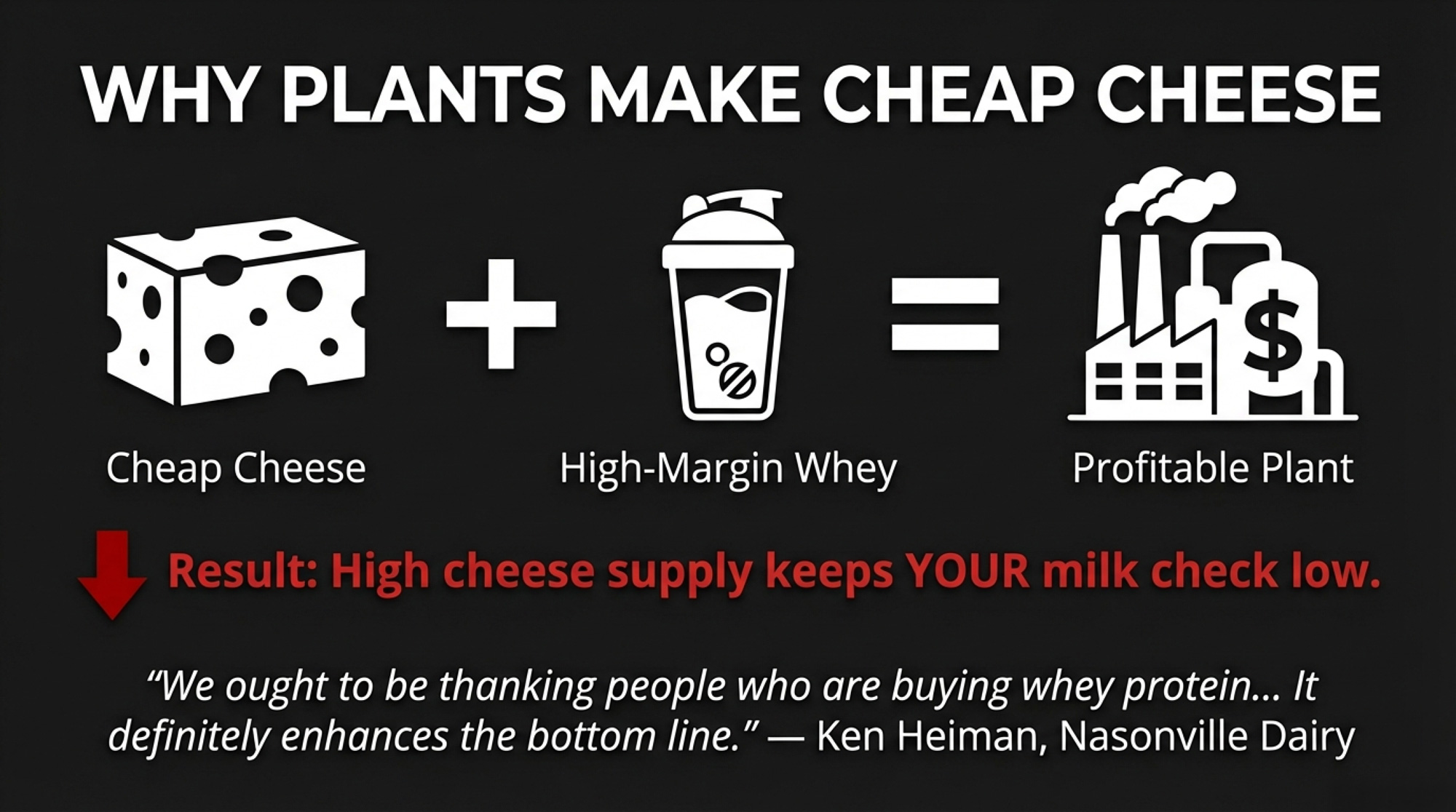
That’s not an outlier — it’s the new economics of processing. December USDA data shows whey protein isolate production at 20.6 million pounds, up 11.7% year-over-year, while lower-protein WPC (25–49.9%) fell 12.8%. Plants keep making cheese — even at thin margins — because the whey stream subsidizes the operation. More cheese keeps Class III supply elevated, which holds down the blend price for every farm shipping to a cheese-dominant handler. Phil Plourd at Ever.Ag framed it bluntly: “It is a street fight, in terms of figuring out ways to stay relevant, to get more productive, to stay ahead of the curve, to manage risk better.” 

What the FMMO Reforms Actually Did to Your Check

Kevin Krentz knows the cost of pool imbalances firsthand. The Wisconsin Farm Bureau President — who milks about 600 cows with his wife, Holly, near Berlin, in Waushara County — testified before USDA in August 2023 that negative PPDs reached $9/cwt, costing his operation nearly $200,000. Those losses accumulated during a PPD crisis that began when the “average-of” Class I mover took effect in May 2019 and persisted through at least 2023. 

The June 2025 FMMO reforms addressed that specific formula — reverting to the “higher-of” Class I mover, with all 11 federal orders voting to accept it. But the reforms also raised make allowances by 5¢ to 7¢ per pound across all four pricing products. In three months, that wiped $337 million from pool values nationally, per AFBF economist Danny Munch, with the Upper Midwest absorbing $64 million of the hit. Class prices dropped 85 to 93 cents per hundredweight, even with make allowances alone. 

UW–Madison extension specialist Leonard Polzin noted that make allowances are “embedded in the federal pricing formulas rather than itemized”—they don’t show up as a line on your check like a hauling charge. Roughly 90% of the component-priced milk check sits on butterfat and protein, per CoBank analyst Corey Geiger. With the spread running this wide, that concentration means your check swings harder on butterfat and protein than on volume — and the structural dynamics driving today’s Class III/IV divergence share some of the same characteristics as the crisis Krentz lived through. 

Component Premiums — Run Your Own Numbers

The gap between high-component and volume-focused herds is calculable from the USDA’s monthly announcements. In January 2026, FMMO component prices were $1.4595/lb for butterfat and $2.1768/lb for protein. The Bullvine’s June and July 2025 market reports estimated that each 0.1% increase in butterfat translates to roughly $0.15–$0.35/cwt in additional revenue, depending on the month. For a farm testing 4.3% fat and 3.3% protein versus one at 3.8% and 3.0%, that cumulative advantage runs $1.00–$1.50/cwt

On a 1,000-cow herd averaging 75 pounds per day, even the low end means roughly $22,000 per month. The high end: $34,000 — over $400,000 annually. This lever works regardless of your pool or handler — as long as component premiums hold. And that’s not guaranteed. Protected fat supplements run $0.35 to $0.55 per cow per day in the Upper Midwest. Genetic gains through sire selection take 6–24 months to show up in the tank. Ask your nutritionist for the breakeven component test level at current premiums.

Component TestButterfat (%)Protein (%)Monthly Revenue Advantage (1,000 cows)Annual Revenue Advantage
Low Components3.6%2.9%
Average Components3.8%3.0%+$8,000+$96,000
Mid-High Components4.1%3.2%+$18,000+$216,000
High Components4.3%3.3%+$28,000+$336,000

Four Moves Before Spring Flush — and What Each Costs

  • Restructure DRP to match actual pool exposure. If your co-op runs 60% cheese and 40% butter/powder but your DRP is weighted 80% Class III, you’re insuring a milk check that doesn’t exist. High-component herds generally benefit from the Component Pricing option; average-component herds from Class Pricing with accurate III/IV weighting. RMA premium subsidies range from 44% at 95% coverage to 55% at 70%. Compeer Financial’s 2020–2023 analysis found average DRP premiums of $0.31/cwt; HighGround Dairy’s five-year review showed an average net benefit of $0.23/cwt. Get a current quote — premiums fluctuate with volatility. The trade-off:premiums are sunk cost if the spread narrows. That premium stacks against a monthly gap exposure of $10,000–$15,000 on 500 cows. 
  • Stack DMC before March 31. Tier 1 now covers up to 6 million pounds — up from 5 million — giving medium-sized operations an extra million pounds of coverage. You must establish a new production history based on your highest marketings from 2021, 2022, or 2023. For operations with a longer risk horizon, DMC offers a six-year lock-in (2026–2031) with a 25% premium discount — but you give up annual flexibility, and if milk prices surge above $24/cwt, you’re locked into coverage you don’t need. With MAR26 soybean meal at $303.60/ton and corn at $4.30/bu, the feed-cost squeeze is real. DMC covers cost; DRP covers revenue. 
  • Audit your milk check. AFBF economist Danny Munch, at ADC’s Dairy Hot Topics session during World Dairy Expo last October, urged farmers to share milk check stubs with ADC, their state Farm Bureau, or their market administrator. Munch found instances — particularly in Wisconsin — where independent handlers weren’t following existing disclosure requirements. Look for months where your PPD went sharply negative while Class IV traded at a premium. Cost: one uncomfortable phone call. Potential payback: significant. 
  • Explore handler options in competitive milk sheds. In parts of Wisconsin, Idaho, and the Upper Midwest, producers with high-component milk may have leverage to find handlers whose plant mix better captures Class IV value. The trade-off is real: equity stakes in your current co-op, hauling logistics, and relationship costs. But when pool assignment can swing $10,000–$15,000 monthly on 500 cows, the conversation may be worth having.
Coverage ScenarioQuarterly DRP Premium ($/cwt)Monthly Premium Cost (9,000 cwt/month)Monthly Uninsured Pool Gap Exposure
Low Coverage (70%)~$0.05/cwt~$450$10,000–$15,000
Mid Coverage (85%)~$0.20/cwt~$1,800$10,000–$15,000
High Coverage (95%)~$0.40/cwt~$3,600$10,000–$15,000

Running the Numbers: DRP Coverage (500-cow herd, ~9,000 cwt/month)

 Low EstimateHigh Estimate
Quarterly DRP premium (per cwt)~5¢~40¢
Monthly premium cost~$450~$3,600
Monthly Class III/IV pool gap exposure~$10,000~$15,000
Net monthly uninsured risk~$9,550~$11,400

Compeer Financial 2020–2023 avg: $0.31/cwt. HighGround Dairy five-year avg net benefit: $0.23/cwt. RMA subsidies: 44% (95% coverage) to 55% (70% coverage). Gap: Bullvine analysis, Oct 2025. Get a current quote for your operation.

Four Signals That Separate Noise from Structure

  • Q1 2026 powder production (USDA reports, March and April). If NDM/SMP output remains negative year-over-year despite record milk production, drying capacity is confirmed to be insufficient— not just seasonally tight. Monthly sales below 180 million pounds would be historically abnormal. Above 195 million pounds would suggest the system is self-correcting. This is the single most important data point for validating or killing the thesis.
  • Monthly cheese exports to Mexico (USDEC data, ~6-week lag). Mexico accounted for 38% of all U.S. cheese exports through November 2024 — 392 million pounds — per Hoard’s Dairyman, with full-year 2024 volumes reaching 424 million pounds. If monthly volumes drop below 30,000 metric tons for two consecutive months, alternative markets can’t absorb the displacement. 
  • Class III/IV spread duration. A two-month spread is noise. One that persists through six months signals a structural change that even processing allocations will eventually follow. Last July, The Bullvine reported the Class IV premium hit $1.71/cwt over Class III. If the gap holds above $1.00/cwt through June 2026, that would mark the longest sustained Class IV premium driven by powder scarcity in modern FMMO history. 
  • Cheese inventories. USDA’s December 31, 2025, Cold Storage report showed 1.35 billion pounds of natural cheese in warehouses, up 1% year-over-year. Two consecutive months above 1.40 billion pounds would signal the export safety valve is failing — and that cheese is backing up faster than the market can clear it. 

Your Next Moves

Start with three questions: What’s your handler’s cheese-to-powder plant utilization split? What’s your current DRP Class III/IV weighting? What’s your rolling 12-month average butterfat test? If you don’t know all three, that’s your first move.

  • If your DRP is weighted more than 60% Class III but your handler runs significant butter or powder volume, you’re likely insuring the wrong revenue stream. Pull your current parameters this week.
  • DMC enrollment closes on March 31 — 52 days from now. Tier 1 covers 6 million pounds for 2026. Six-year lock-in (2026–2031) saves 25% on premiums but sacrifices annual flexibility. With soybean meal above $303/ton, this is the cheapest margin backstop available. 
  • If your herd averages below 4.0% butterfat and 3.1% protein, you’re leaving an estimated $1.00+/cwt on the table relative to component-optimized herds in the same pool. 
  • If your PPD went negative in any month since October 2025, ask your co-op directly whether Class IV milk was depooled. Danny Munch at AFBF has flagged handlers — particularly in Wisconsin — not following existing disclosure rules. 
  • Run your cash flow at Class III, averaging $16.50/cwt for the next 18 months with current feed costs. If that doesn’t work on your spreadsheet, waiting costs more than acting.
  • Counter-signal: If Q1 NDM/SMP production rebounds above 195 million pounds monthly, the scarcity thesis weakens. The March Dairy Products report is the first real test.

Key Takeaways

  • The Gap: Today’s NDM–Cheddar spread is already costing a 500-cow cheese-pool herd $10,000–$15,000/month compared with the same cows in a more Class IV-exposed pool.
  • Why It Lasts: 2025 powder output fell to its weakest level since 2013 while more than $11 billion in new capacity went to cheese and whey, not dryers — a setup that keeps Class IV firm and cheese-led pools behind.
  • Your Biggest Lever: At current component prices, moving from “average” to high components is worth roughly $1.00–$1.50/cwt — about $22,000–$34,000/month on 1,000 cows — but only if your DRP mix and handler capture that value.
  • The 52-Day Deadline: DMC enrollment closes in 52 days, giving you one tight window to line up DMC coverage, DRP weighting, and component targets with the actual market you’re in before spring flush hits.
  • The Cost of Waiting: Rolling into spring with a cheese-heavy pool, a Class III-heavy DRP, and “good enough” components is a bet that the Class IV premium disappears before your cash does.

Complete references and supporting documentation are available upon request by contacting the editorial team at editor@thebullvine.com.

Learn More

Join the Revolution!

Join over 30,000 successful dairy professionals who rely on Bullvine Weekly for their competitive edge. Delivered directly to your inbox each week, our exclusive industry insights help you make smarter decisions while saving precious hours every week. Never miss critical updates on milk production trends, breakthrough technologies, and profit-boosting strategies that top producers are already implementing. Subscribe now to transform your dairy operation’s efficiency and profitability—your future success is just one click away.

NewsSubscribe
First
Last
Consent

Dairy Farmer Alert: Maximize Profits with Sky-High Milk Revenues Despite Supply Constraints

Hot weather, avian flu, and heifer shortages are pushing milk prices higher. Are you prepared to handle market shifts and boost your farm’s profits?

Summary: This detailed analysis explores the multifaceted challenges currently facing the dairy industry, primarily focusing on how weather conditions, diseases, and heifer shortages impact milk supplies and market prices. Despite high milk revenues and cheap feed, supply constraints drive prices. Cheese markets struggle to maintain high prices while demand for whey products soars. The article also examines how cooler weather might temporarily boost milk production, the impact of China’s increased dairy self-sufficiency on global milk powder markets, and recent downturns in cattle and feed markets. The USDA announced record-breaking milk prices in July, with Class III milk at $19.79 per cwt and Class IV milk at $21.31. However, the dairy industry faces challenges due to hot weather, avian influenza, and heifer shortages. High temperatures stress dairy cows, leading to lower milk output. Avian influenza and heifer shortages further strain the industry, causing significant regional price volatility.

  • Record-breaking milk prices in July: Class III at $19.79 per cwt, Class IV at $21.31.
  • High milk revenues and cheap feed juxtaposed with tight milk supplies.
  • Significant regional price volatility due to weather conditions, avian influenza, and heifer shortages.
  • Cheese markets struggle to sustain high prices, but whey product demand is soaring.
  • Cooler weather is expected to boost milk production temporarily.
  • China’s increased dairy self-sufficiency is impacting global milk powder markets.
  • Recent declines in cattle and feed markets pose mixed outcomes for dairy producers.

The current status of the dairy business paints a complicated and intriguing picture for industry experts and newbies. Milk revenues are skyrocketing thanks to a powerful combination of low feed prices, seasonal weather patterns, and various external factors that have significantly tightened milk supplies. This detailed essay provides in-depth insights into these market dynamics, including current trends and future predictions, to assist you in navigating the complex world of dairy farming. Cheap feed rates, increased demand from processors and bottlers, and worldwide market effects, such as China’s changing dairy import patterns, will all be investigated to give meaningful insights for your dairy farming company.

MonthClass III Milk Price ($ per cwt)Class IV Milk Price ($ per cwt)
May 202419.8721.08
June 202419.7921.02
July 202419.7921.31

USDA Announces Record-Breaking Milk Prices Amid Market Volatility

The USDA recently announced that the July Class III milk price will be $19.79 per cwt. Despite a tiny decrease of 8̼ from May, this number represents a significant rise of $6.02 compared to July 2023. The Class IV milk price increased to $21.31, up 23 percent from June and $3.05 more than July 2023. This considerable price increase reflects current market circumstances and potential future trends.

The futures market reinforces this optimistic forecast. Class IV futures have remained constant, with all contracts for 2024 priced at $21 or higher. Although there has been some recent volatility in Class III futures, with significant contracts such as September briefly hitting life-of-contract highs before falling somewhat, the overall trend remains strong. Contracts closed around 20% lower than the previous Friday, with September seeing a steeper loss of 98%. Despite this variation, the future of Class III milk pricing seems promising, with predictions for August through November quickly reaching the $20 barrier.

Surviving the Milk Crisis: How Weather, Disease, and Heifer Shortages Are Squeezing Your Business

Hot weather, avian influenza, and a scarcity of heifers all conspire to reduce milk supply. The high temperatures greatly stress dairy cows, resulting in lower milk output. Concurrently, avian influenza outbreaks have impacted the poultry sector, further burdening the cattle business and agricultural operations. Furthermore, a lack of heifers has curtailed the replacement rate of dairy cows, aggravating the drop in milk yield.

USDA’s Dairy Market News emphasized the ongoing supply restrictions in its weekly milk and dairy product market assessment. The agency said that milk production continues to seasonally lower, impacting the supply of fluid milk, butter, cheese, nonfat dry milk (NDM), dry whole milk, casein, dry buttermilk, and lactose. The major exception was whey protein concentrates (WPCs), where producers focused on WPC-80 and whey protein isolates. The industry faces substantial challenges sustaining enough milk supply, presumably keeping market conditions tight in the following months.

Cooler Weather Forecast Expected to Boost Milk Production While Structural Issues Persist

The milder weather forecast for later this year is expected to boost milk production, offering a glimmer of hope amidst persistent supply limitations. Lower temperatures have traditionally helped to maintain cow comfort and milk output, which merchants and processors throughout the nation are eagerly anticipating. However, it’s important to note that milk supply is projected to remain somewhat tight despite the approaching seasonal rise due to persistent structural difficulties in the sector.

Milk prices have varied significantly among regions, with the central area seeing the most volatility. This week, spot milk in this region traded from stable to $2 above Class III, the most significant premium since early August 2014. This premium reflects regional variations in supply and demand dynamics, with spot milk prices above the historical average in 48 of the previous 52 weeks. These geographical disparities highlight the dairy market’s complexity since localized events may considerably influence pricing and supply chain architecture.

Why Soaring Dairy Prices Might Backfire on Your Farm This Season

However, tighter supply may only drive up costs to a certain point. Excessively high prices necessarily reduce demand, restricting the market. Consumers, who are already stressed by regular price rises in restaurants and supermarkets, are vulnerable to more increases. As prices rise, consumers’ buying power declines, making it less likely that they will continue to pay more for dairy goods.

The recent significant drop in Wall Street has also influenced market sentiment. Investors ‘ fears about demand have grown against the background of massive financial losses. This genuine market concern reflects consumers’ rising reluctance to bear more extraordinary expenses in uncertain economic circumstances. The dairy business struggles to balance demand with increasing costs, exacerbated by such sentiments.

Cheddar Struggles While Whey Soars: A Dairy Diaries Update

MonthCheddar Price ($/lb)Whey Price ($/lb)Non-Fat Dry Milk Price ($/lb)
May 2024$1.95$0.60$1.22
June 2024$1.90$0.61$1.24
July 2024$1.85$0.615$1.24

Spot Cheddar barrels had a brief victory in May and June, hitting the $2 mark, only to fail soon after that. This week’s volatility continued as they flirted above $2 before sliding to $1.93 per pound, indicating a 4˼ loss from last Friday. Cheddar cubes fell 8% at $1.85.

The whole dairy product industry had a distinct trend. CME spot whey prices reached their highest level since April 2022, completing the week at 61.5˼, a substantial 4.5ɼ rise. This rise may be linked to solid demand for Whey Protein Concentrates (WPCs) and Whey Protein Isolates (WPIs), exacerbated by maintenance downtimes at important whey production plants, further constraining supply.

Nonfat Dry Milk (NDM) rose 0.75 percent to $1.24, tying its highest price since February 2023. However, this market, too, has issues. Rapid expansion in Chinese milk production has decreased dependence on imported milk powder, with Rabobank reporting that China currently satisfies 85% of its dairy demand locally, up from 70% four years ago. This trend gradually reduces the global milk powder supply, resulting in further price hikes.

Butter prices have remained robust. After a slight loss, they recovered 1.5˼ to close at $3.105. Despite increasing output and more significant stock levels than the previous two years, customer worries over the forthcoming autumn baking season have maintained demand strong.

Despite the challenges, the dairy market demonstrates resilience. It reflects a combination of increasing pricing and supply restrictions caused by seasonal demand swings and global production dynamics. This complex ecosystem needs regular monitoring, but the market’s ability to adapt to changes should reassure dairy farmers about the industry’s resilience and potential for profitability.

Chinese Self-Sufficiency in Dairy Disrupts Global Milk Powder Markets

YearChina’s Dairy Self-Sufficiency (%)Milk Powder Imports (MT)
201970%800,000
202075%750,000
202180%700,000
202282%650,000
202385%600,000

Understanding the global market dynamics is crucial in navigating the dairy business. As global milk powder supplies continue to deplete, resulting in an incremental increase in market pricing, it’s important to note that one essential aspect driving this trend is China’s tremendous expansion in milk output. Rabobank notes that China currently satisfies 85% of its dairy demand, up from 70% only four years ago. This shift towards domestic self-sufficiency has replaced significant milk powder imports, significantly impacting global supply dynamics.

As milk powder supplies continue to dwindle, the market remains volatile. Prices will likely rise if demand increases, reflecting the fundamental economic laws of supply and demand. According to Rabobank’s estimates, any revival in demand might drive prices higher, putting more pressure on global dairy markets. Dairy farmers and exporters must know these worldwide trends to successfully manage and prevent future market instability.

Shifting Feed and Cattle Markets: A Mixed Bag for Dairy Producers

MonthCorn Price (per bushel)Soybean Price (per bushel)Soybean Meal Price (per ton)
May 2024$4.15$10.45$330
June 2024$4.10$10.35$328
July 2024$4.03$10.29$325

Dairy farmers should be relieved and cautious as feed markets continue to decline. December corn prices fell below the psychologically critical $4 threshold for the first time in recent years, finishing at $4.0375 per bushel, down 6% for the week. This drop is linked to ideal growth circumstances, which include a healthy balance of sunlight and rain in prominent growing areas. In November, soybeans declined almost 20% to $10.29, but December soybean meal remained stable at $325 per ton.

Dairy farmers face a more complicated picture in the cattle market. While milk revenue over feed margins remain strong, aided by significant beef checks, recent cattle price trends are reason for worry. A big selloff on Wall Street has raised concerns about demand, compounded by persistent reports about the possible shutdown of a cow slaughterhouse in Nebraska. Such a shutdown would lower demand for fed cattle, moving negotiating leverage away from cattle feeders who want higher prices and toward cattle packers who wish to cut animal expenses.

Despite enjoying large margins for many years, cattle packers have lately begun losing money. This turnaround has dramatically dropped cattle prices this week, raising questions about the sustainability of present levels. Cattle values look to be headed for a downturn. While this drop in cattle prices may marginally reduce the value of dairy calves and cull cows, they’re still around record highs.

Mastering the Dairy Market: Proven Strategies for Weathering Price Volatility and Ensuring Farm Stability

Given the volatile nature of today’s dairy markets, sound risk management is critical. Futures contracts provide financial security by locking in prices for future milk sales. Furthermore, insurance such as the USDA’s Dairy Revenue Protection (DRP) and Livestock Gross Margin for Dairy (LGM-Dairy) protect against revenue losses and feed expense threats. Diversification is essential; expanding into other agricultural products or integrating on-farm processing may provide new income streams, such as specialty cheese manufacturing or farm-based retail. Farmers may use futures contracts, insurance, and diversification to secure income and establish long-term resilience.

The Bottom Line

As we negotiate the complexity of the dairy market, it is critical to recognize that present circumstances, typified by restricted supply and high prices, result from several converging events, including harsh weather, avian influenza, and heifer shortages. These problems have substantially impacted milk pricing, creating both possibilities and hazards for dairy producers. While some relief is expected from seasonal increases in milk production as more unusual weather arrives, the mismatch between expanding dairy processing capacity and milk production, combined with global shifts such as China’s increasing self-sufficiency, suggests that milk supplies will remain tight. Dairy producers must remain knowledgeable and adaptable, monitor feed and cattle markets, grasp structural supply challenges, and react to changing circumstances to maintain profitability. The capacity to negotiate this complex terrain will determine dairy farmers’ success; be watchful, keep educated, and accept change front.

Learn more: 

Will the Surge in Milk Prices Last? Analyzing Trends and Future Outlook

Will the surge in milk prices last? Discover the trends and future outlook for milk, cheese, and butter prices, and what it means for your grocery budget.

The early-year increase in milk prices has pleasantly surprised dairy producers in changing agricultural markets, characterized by shifting consumer preferences and fluctuating grain prices. While Class IV milk reached $21.08, a level not seen since mid-2022, June’s Class III milk price was notably $19.87, the most since December 2022. The economic situation of dairy farmers depends on this increase, which also influences the whole agricultural industry. With May’s revenue above feed price rising to $10.52, the greatest since November 2022, dairy producers have optimism given changing grain prices.

Record Highs in Class III and IV Milk Prices Signal Potential Market Stability

MonthClass III Milk Price ($)Class IV Milk Price ($)
January 202318.2719.60
February 202318.8820.22
March 202319.1720.75
April 202319.4421.05
May 202319.7521.08
June 202319.8721.08

The recent record highs in Class III and IV milk prices, the highest since December 2022, signal a potential market stability. With Class III milk reaching $19.87 and Class IV prices hitting $21.08, this increase could provide a stable market environment that would benefit both customers and operators, instilling a sense of reassurance in the industry.

Optimizing Feed Costs: A Path to Enhanced Dairy Farm Profitability

MonthFeed Cost ($/ton)
January290
February285
March275
April270
May268
June265

The recent increases in revenue above feed cost have substantially benefited dairy producers. Driven by dropping grain prices, the May number of $10.52 is the highest since November 2022. Grain prices fall; lowering feed costs increases dairy farmers’ profit margins. Should present grain market patterns continue, dairy producers might lock in low feed costs, thus providing financial stability for the following year. Using forward contracts or other financial instruments to hedge against growing feed costs can guarantee ongoing profitability. Although the future is bright, awareness is required as grain market volatility might rapidly alter the scene and call for swift decisions. The conditions provide a great chance to maximize feed costs and increase revenue above feed prices, enabling a steady and prosperous future in the dairy sector.

The Evolution of Cheese Production: American vs. Italian Varieties 

MonthAmerican Cheese Production (Million lbs)Italian Cheese Production (Million lbs)
January475.2487.1
February450.6472.8
March460.5485.9
April470.3490.7
May488.2505.0
June473.0498.3

The mechanics of American cheese manufacturing have shown interesting patterns deserving of conversation. Since the beginning of the year, output has been steadily declining; May 2023 shows a 5.7% drop over the year before. This tendency is shocking when compared to consistent milk output statistics. Production methods and market tastes most certainly have the answer. Particularly Italian-type cheeses, there is a clear shift towards other cheese types. Italian cheese output is much greater than it has been in 2023 and exceeds past year averages. Changing consumer preferences, such as preferring mozzarella and parmesan over conventional American cheese, caused this change.

Essential elements include worldwide gastronomic trends and well-liked meals such as pasta and pizza with Italian cheese. Driven by a passion for culinary variety and premium, handcrafted goods, consumer behavior demonstrates a rising predisposition for varied and gourmet cheese selections. Responding to worldwide demand trends, the sector is realigning its manufacturing strategy to take advantage of higher-margin items.

Therefore, the whole cheese production spectrum is vital even if American cheese stocks are still below the previous year’s. This implies that American cheese production is declining, led by Italian-type cheese’s appeal and significant outputs, but the sector is rebounding. The industry creates paths for possible market stability and profitability as it adjusts to these changing consumer patterns.

Analyzing American Cheese Inventory: What Lower Levels Mean for Future Pricing

MonthAmerican Cheese Inventory (Million Pounds)Year-Over-Year Change (%)
January700-3%
February710-2%
March720-1%
April715-4%
May700-5%

American cheese inventory has always been below last year, which should help to explain why prices should rise given demand growth. The fluctuations in overall cheese output—some months larger and others lower—have kept stockpiles close. Still, demand for American cheese has not skyrocketed; careful consumption has kept prices erratic instead of steadily increasing.

Should demand follow last year’s trends, limited supply may cause prices to rise. Cheese consumers’ careful approach shows a wait-and-see attitude toward changing output. Record-high cheese exports in March, April, and May positively signal worldwide solid demand, supporting the market even with higher pricing points.

American cheese prices can get under increasing pressure if strong export demand meets or surpasses local consumption. Stable or declining feed prices increase the likelihood of this, enhancing dairy companies’ general profitability. Thus, cheese inventory and demand dynamics provide a complex projection with possible price rises depending on the stability of the local and foreign markets.

Robust Cheese Exports: Navigating Record Highs and Future Uncertainties 

Month2022 Cheese Exports (million pounds)2023 Cheese Exports (million pounds)Percentage Change
January75.581.2+7.5%
February68.172.4+6.3%
March73.078.5+7.5%
April74.280.1+7.9%
May76.482.3+7.7%

With record highs in March, April, and May, the latest patterns in cheese exports show a strong market presence. This expansion indicates a robust global demand even if cheese prices increase. Higher costs usually discourage foreign consumers, but the consistency in export numbers indicates a strong worldwide taste for U.S. cheese. This helps the dairy sector maintain a competitive advantage in changing pricing.

Still, the viability of this tendency is being determined. Should prices keep rising, specific foreign markets could change their buying policies, reducing demand. A wide variety of cheese products appealing to different tastes might balance this risk and guarantee ongoing demand.

Strong cheese exports support the worldwide posture of the U.S. dairy sector and help to steady home milk prices. Strong cheese and butter exports should provide dairy producers a solid basis as worldwide butter demand increases, enabling them to negotiate price constraints and market expectations boldly.

Although cheese exports are moving in an encouraging direction now, stakeholders must be alert. Maintaining development depends on examining price changes and reactions in foreign markets. Balancing high local pricing with worldwide solid demand will rely primarily on creative ideas in strategic market participation and product offers.

Global Butter Demand: Navigating the Surge and Potential Market Ripples 

YearDomestic Demand (Million Pounds)International Demand (Million Pounds)Total Demand (Million Pounds)
20201,4801,2952,775
20211,5251,3202,845
20221,5451,3502,895
20231,5701,3752,945

A promising increase in international butter demand suggests a possible influence on butter prices in the following months. Driven by better economic times and a rising consumer taste for dairy products, recent statistics show a consistent comeback in world butter exports. Rising worldwide demand will cause butter prices to be under increasing pressure. Strong export demand historically matches rising local pricing, which helps manufacturers. Should export growth continue, this tendency is likely to endure.

Nevertheless, supply chain interruptions, geopolitical concerns, and changing feed prices might influence market circumstances. Low-cost manufacturers from developing nations also bring challenges of price competition. Driven by strong worldwide demand, the butter industry seems ready for expansion, yet players must constantly observe changing dynamics.

Strategic Outlook: Navigating the Future of Milk Prices Amid Market Dynamics and Economic Factors

Milk prices’ path will rely on several significant variables that combine market dynamics with general economic circumstances. While sustained high prices provide hope, they also present possibilities and problems for buyers and producers.

High prices allow producers to increase profitability through capitalization. Locking in favorable feed prices might lead to significant cost savings, considering the present grain price pressure. Diverse manufacturing of highly sought-after cheeses, including Italian-type cheeses, could improve income sources, fostering a sense of optimism in the industry.

Risks, however, include changes in foreign demand and erratic market circumstances. Higher costs discourage worldwide consumers, affecting local pricing and exports. Furthermore, changes in consumer tastes toward plant-based dairy substitutes might slow down conventional dairy industry expansion. To stay competitive, the sector has to be creative.

Buyers must guarantee consistent supply chains in retail and food service despite changing customer patterns and costs. Higher prices need flexible pricing policies and intelligent buying. Matching goods with customer tastes for sustainability, and better choices might provide a business advantage.

Although milk prices’ future is bright and unknown, stakeholders may utilize strategic foresight and flexibility to seize possibilities and reduce risk. Tracking consumer behavior and market trends can help buyers and producers flourish in a changing dairy environment.

The Bottom Line

The present success in Class III and IV milk pricing shows a solid but delicate balance for dairy farmers as we negotiate the subtleties of the dairy market. Recent highs encourage a look at lifespan and environmental impact. Changing cheese production patterns, grain price swings, and better revenue over feed ratios highlight a dynamic market. The drop in American cheese output against the increase in Italian cheese reveals a complicated customer choice and market adaption story. Strong cheese export performance reveals the sector’s worldwide resiliency even against growing prices. This should inspire cautious optimism by implying better circumstances ahead and continuous foreign demand. Still, volatility is natural, especially given the changing global butter demand and possible export rebounding. Shielding against downturns mostly depends on careful planning and hedging of expenses. In the end, even if the increase in milk prices provides relief and a promising future, monitoring and market and consumer trend adaptability are crucial. Maintaining momentum and guaranteeing long-term viability will depend on pushing sustainability and openness.

Key Takeaways:

  • Higher Milk Prices: Both Class III and Class IV milk prices reached their highest levels since December 2022, signaling potential market stability.
  • Enhanced Income Over Feed: The income over feed price has been improving, with lower grain prices potentially boosting dairy farm profitability in the near term.
  • Shift in Cheese Production: A noticeable trend towards Italian-type cheese production, despite a decline in American cheese output, could reshape market dynamics.
  • Consistent Cheese Inventory: Lower American cheese inventory levels, paired with steady demand, may lead to higher prices if consumption rises.
  • Strong Export Markets: Record-high cheese exports in recent months indicate robust international demand, which could sustain higher prices moving forward.
  • Global Butter Demand: Improving international butter demand suggests potential price increases if export strength continues throughout the year.

Summary:

The dairy industry has experienced a significant increase in milk prices, signaling potential market stability. Class IV milk reached $21.08, the highest level since mid-2022, and June’s Class III milk price was $19.87, the most since December 2022. This has impacted the economic situation of dairy farmers and the agricultural industry. May’s revenue above feed price rose to $10.52, giving dairy producers optimism due to changing grain prices. Record highs in Class III and IV milk prices provide a stable market environment that benefits both customers and operators. Lowering feed costs can increase dairy farmers’ profit margins, and if present grain market patterns continue, producers might lock in low feed costs, providing financial stability for the following year. Using forward contracts or other financial instruments to hedge against growing feed costs can guarantee ongoing profitability. The evolution of cheese production, particularly American vs. Italian varieties, has shown interesting patterns, with strong export demand meeting or surpassing local consumption, enhancing dairy companies’ profitability. Global butter demand is expected to influence butter prices in the coming months, driven by better economic times and rising consumer tastes for dairy products.

Learn more:

Send this to a friend