Archive for beef on dairy

Matching the Feed to the Calf: Birth to 120 Days – Practical Science for Dairy-Beef Calves

Consistency isn’t a suggestion—it’s biology. Same time, same temp, same quality = 2.6 lb ADG and $100+ more per calf.

Good calf growth starts with steady habits—consistent feeding, clean water, and careful observation. From birth through 120 days, the calf’s diet and environment change rapidly, and how those changes are managed determines strength, health, and efficiency later on. Success comes from small, repeated actions done right every day.

Philosophy in Practice

Calves grow on consistency. Steady feeding times, clean water, dry air, and no sudden ration changes are the foundation of every good calf program.

Consistency Drives Growth

  • Feed at the same times every day
  • Keep milk solids and milk temperature consistent
  • Replace the starter daily so it smells clean and fresh
  • Make ration changes gradually over 4–7 days

Quick Start Essentials: 

□ Buy Brix refractometer ($30) 
□ Buy digital thermometer ($12) 
□ Set feeding times and stick to them 
□ Test first colostrum batch today 
□ Check milk temperature at next feeding

Birth to Day 3 — Immunity and Metabolic Activation

A newborn calf is born without immune protection in its bloodstream. All early protection comes from colostrum, which provides antibodies (IgG) and energy for warmth and early growth. If the calf doesn’t receive enough high-quality colostrum quickly, long-term health and gain are compromised.

What must happen in the first 24 hours:

  • Feed at least 4 quarts of clean, high-quality colostrum (Brix 24 or higher) within 2 hours of birth or 8.5%-10% of body weight
  • Provide another 2 quarts in the next 8–12 hours
  • Aim for 200+ grams of IgG total. A quick check is a Brix reading of 24% or higher
  • Dip the navel and provide deep, dry bedding
  • Offer warm water between liquid feedings
  • Keep calf temperature above 100°F

Research confirms that colostrum quality varies significantly between cows, with IgG concentrations ranging from less than 50 g/L to over 150 g/L. Using a Brix refractometer to test colostrum is now standard practice; readings of 22% or higher indicate good quality, and readings below 18% suggest the colostrum should not be used as the first meal. The 2024 National Animal Health Monitoring System (NAHMS) dairy study found that 29% of colostrum samples tested below minimum quality thresholds, while producers estimated only 8% was of poor quality.

Why Water Matters

  • Water and milk are not the same in the calf’s gut
  • Free-choice water helps rumen microbes begin developing early
  • No water equals weak fermentation, which equals slow rumen growth
  • Dump, clean, and refill water buckets daily

Water consumption is critical even in the first days of life. Unlike milk, which bypasses the rumen through the esophageal groove, drinking water enters the rumen directly and supports bacterial establishment and fermentation.

Days 3–21 — Rumen Initiation and Microbial Establishment

By day 3, the rumen is waking up. A good calf starter stimulates chewing and microbial activity. When microbes ferment starch, they produce volatile fatty acids (VFAs), especially butyrate, which signals the rumen lining to grow papillae—the structures that absorb energy later in life.

Feeding goals for this stage:

  • Feed milk replacer (20–24% CP, 20–22% fat) twice daily at consistent solids and temperature
  • Introduce textured starter by day 5 and keep it fresh
  • Starter formulation: 20–23% CP, 3–5% fat, 6–8% fiber
  • Provide clean, room-temperature water at all times
  • Maintain dry bedding and good airflow

Research demonstrates that VFA production, particularly butyrate and propionate, drives papillae development in young calves. Calves fed corn-based starters show improved rumen development compared to those fed barley or oats, with corn providing superior energy density and fermentability. Dr. Jud Heinrichs from Penn State, who’s been studying calf nutrition for 4 decades, emphasizes that these early days set the stage for lifelong digestive capacity.

Temperature consistency matters more than most realize. Research from Virginia Tech shows that milk temperature variations from 88 to 122°F within a single facility cause 40-65% more nutritional scours and 0.25-0.33 pounds of slower daily growth.

Temperature Consistency Drives Lifetime Value: Temperature swings from 88-122°F reduce ADG by 27% and cost $100+ per calf

Days 21–49 — Transition, Frame Growth, and Stable Fermentation

By week 3, calves transition from monogastric to ruminant digestion. Microbes multiply rapidly, and fermentation patterns shift toward propionate and butyrate production. These VFAs fuel lean growth and the development of rumen papillae.

Targets for this stage:

  • Starter intake: 1.5–3.0 lbs/day by week 6
  • Starter formulation: 18–23% CP, 3–5% fat, 6–8% fiber
  • Maintain uniform texture to prevent sorting
  • Watch manure consistency for early feedback on rumen health

Studies show that calves consuming adequate starter during this period develop larger, more functional rumens with greater papillae surface area. The relationship between starter intake and rumen pH becomes more pronounced as calves increase dry feed consumption, though young calves appear more tolerant of lower pH than adult cattle.
Sponsored Post

Days 49–70 — The Weaning Window

Wean by intake, not age. Calves are ready for weaning when they consistently eat 3 lb of starter per day for three consecutive days and drink water freely. A premature milk pull can cause growth slumps that can take weeks to recover from.

Best practices for weaning:

  • Taper milk gradually over 5–7 days
  • Keep the same starter ration during taper and for 10–14 days after full wean
  • Ensure dry housing, strong airflow, and adequate bunk space
  • Calves should be at least 8 weeks old before weaning is completed

Research consistently shows that weaning based on starter intake (minimum 3 lbs for three consecutive days) rather than age alone reduces stress and maintains growth momentum. Dr. Emily Miller-Cushon at Florida found that calves weaned before adequate intake show 180-280% increases in muscle breakdown markers, literally catabolizing their own tissue to survive the energy deficit.

Days 70–120 — Early Grower Phase for Dairy-Beef Calves

Three Biological Windows Programming Lifetime Value: Each missed critical period creates permanent deficits that cascade through production

Once fully weaned, calves function as true ruminants. The goal now is frame and muscle growth without digestive upset. A balanced grower with moderate starch, digestible fiber, and proper minerals supports this phase.

Key management points:

  • Target ADG of 2.4–2.6 lbs/day
  • Maintain 12–15% NDF from digestible fiber
  • Keep feed fresh and bunks clean
  • Manage heat with shade and airflow

Research on dairy-beef crossbred calves shows they can achieve exceptional growth rates when appropriately managed, with some studies reporting ADG exceeding 5.5 lbs/day on high-energy diets post-weaning. The optimal NDF level for starter diets appears to be in the range of 12-20%, with higher levels (above 27%) potentially reducing intake and growth.

This period is critical for marbling development. Research from South Dakota State shows that marbling adipocytes—the cells that determine quality grade—primarily form between days 70 and 120. Miss this window with inadequate nutrition, and those cells simply don’t form, costing 16.2 percentage points in Choice grading at harvest.

Common Mistakes and How to Avoid Them

  • Weaning by age instead of intake
  • Changing feed and pulling milk in the same week
  • Letting water get dirty—calves notice first
  • Feeding dusty or inconsistent starter
  • Overcrowding pens and limiting bunk space

Feeding Benchmarks by Stage

StageMilk Replacer (lb./day) 13.5% SolidsCalf Starter (lb/day)Water (qt/day)Target ADG (lb/day)
Birth–3 days1.12 – 1.682–40.8–1.0
3–21 days1.68 (6 quarts)0.25–1.04–61.2–1.6
21–49 days1.68 (6 quarts)1.5–3.06–81.6–2.0
49–70 days (wean)5.0–6.08–102.0–2.4
70–120 days6.0–8.0 (grower)8–122.4–2.6

Use these benchmarks as general guides. If calves fall below expectations, check water, environment, and feed freshness before adjusting the ration.

Nutritional Specifications by Stage

StageCP (%)Fat (%)NDF (%)Notes
Birth–3 daysColostrum quality (Brix ≥24%), warmth, hydration
3–21 days20–2318–20<5Starter + water drive rumen start-up
21–49 days18–203–56–8Uniform texture; watch manure form
49–70 days16–183–48–10Wean by intake; avoid new feeds during taper
70–120 days15–173–412–15Manage heat, bunk space, and cleanliness

The Economic Impact

Morbidity Collapse: Precision Feeding Reduces Pre-weaning Disease by 60%

While high milk replacer programs promise rapid early gains, the economics tell a different story. Operations using this starter-focused, consistency-based approach typically see:

  • 22% to 9% reduction in pre-weaning morbidity
  • 26 kg heavier weaning weights
  • 20 percentage point improvement in Choice grading
  • $100+ per calf additional value at harvest

The investment? A $30 Brix refractometer for colostrum testing, a $12 thermometer for milk temperature, and attention to daily details. These simple tools prevent the cascading failures that cost producers thousands in lost performance.


Economic Cascade: How Precision Practices Build $100+ Value Per Calf

Regional Considerations

Northeast operations dealing with harsh winters need insulated transport containers and pre-warmed feeding equipment when temperatures drop below zero.

Southwest producers face the opposite challenge—preventing milk from overheating when ambient temperatures exceed 100°F. Cooling systems and shaded feeding areas become essential.

Southeast operations must manage humidity’s impact on both heat stress and feed stability, requiring more frequent starter replacement and enhanced ventilation.

Putting It All Together

Healthy calves grow on predictability. If intakes or gains stall, start by checking basics: water, air, bedding, and space. When these fundamentals are right, calves stay on feed, develop strong rumens, and finish efficiently later in life.

The transition from colostrum-dependent newborn to functional ruminant represents one of the most critical developmental periods in a calf’s life. Research consistently demonstrates that calves receiving optimal early nutrition—including timely, high-quality colostrum, gradual increases in starter intake, and consistent access to clean water—show improved first-lactation milk production, reduced morbidity, and enhanced lifetime productivity.

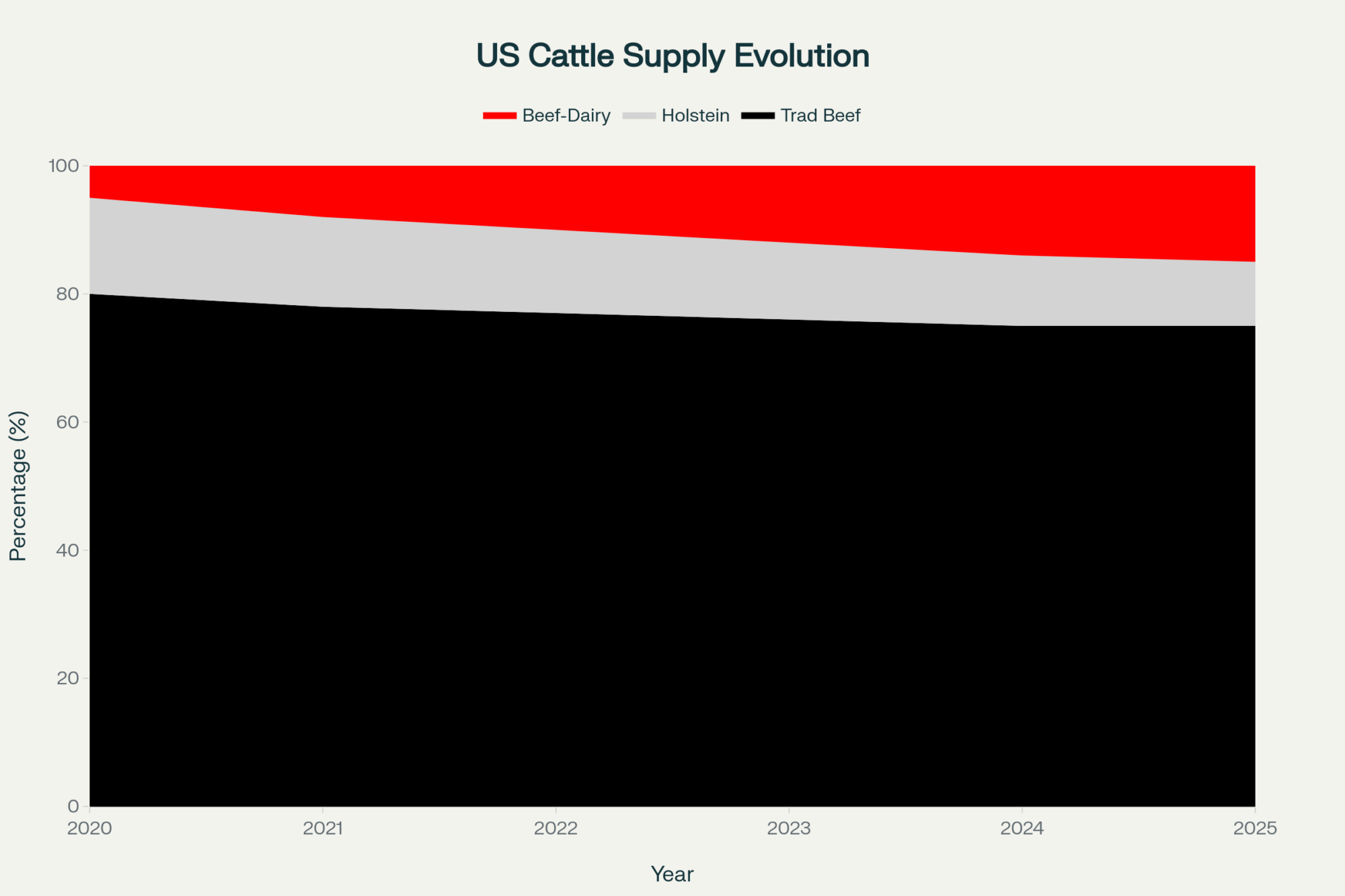
For dairy-beef crossbred calves specifically, proper early management becomes even more critical as these animals represent an increasingly important segment of beef production. USDA data shows the dairy-beef sector expanded approximately 23% from 2021 to 2024. When managed with attention to the physiological transitions outlined here, dairy-beef calves can achieve growth rates and feed efficiencies that rival or exceed those of traditional beef calves while producing high-quality carcasses.

The key is consistency—the same times, same temperatures, same quality, every single day. Biology operates on its own schedule. Our job is to support that schedule with predictable, quality nutrition and management. Miss these critical windows in the first 120 days, and no feeding program can fully recover what’s been lost.

KEY TAKEAWAYS: 

  • Consistency Drives Everything: Feed same time, same temp (102-105°F), same quality daily—variation of just 14°F causes 60% more scours and 0.3 lb/day slower growth
  • Three Windows Program Forever: Immunity (0-3 days), rumen development (3-21 days), marbling formation (70-120 days)—miss any window and lose 16% Choice grade permanently
  • Water From Day 3 Changes the Game: Clean, fresh water drives rumen microbes; no water = weak fermentation = compromised lifetime efficiency
  • Wean by Intake, Not Calendar: 3 lbs starter/day for three consecutive days signals readiness—force it at 8 weeks and watch calves cannibalize their own muscle
  • $42 Tools Prevent $100 Losses: Brix refractometer ($30) catches bad colostrum that looks good; thermometer ($12) prevents temperature swings killing performance

EXECUTIVE SUMMARY: The first 120 days determine everything—calves grow on consistency, not complexity —and missing critical windows creates permanent deficits that no feeding program can fix. From birth through weaning, success requires unwavering precision: colostrum within 2 hours (Brix ≥24%), milk at 102-105°F (not the 88-122°F range common on farms), clean water from day 3, and weaning based on intake (3 lbs/day), not calendar. Three biological windows program lifetime performance: immunity (days 0-3), rumen development (days 3-21), and marbling formation (days 70-120)—miss any one and lose 16% Choice grade, 500 kg lifetime milk equivalent, or worse. This guide provides exact feeding benchmarks and nutritional specifications for each stage, showing how to achieve 2.4-2.6 lb daily gains while reducing morbidity by 60%. The tools are simple ($30 refractometer, $12 thermometer), the schedule is specific, and the payoff is clear: $100+ more per calf through better health, heavier weights, and superior carcass quality.

Complete references and supporting documentation are available upon request by contacting the editorial team at editor@thebullvine.com.

Learn More:

Join the Revolution!

Join over 30,000 successful dairy professionals who rely on Bullvine Weekly for their competitive edge. Delivered directly to your inbox each week, our exclusive industry insights help you make smarter decisions while saving precious hours every week. Never miss critical updates on milk production trends, breakthrough technologies, and profit-boosting strategies that top producers are already implementing. Subscribe now to transform your dairy operation’s efficiency and profitability—your future success is just one click away.
NewsSubscribe
First
Last
Consent

Why Dairy Markets Can’t Self-Correct Anymore: The Hidden Forces Reshaping the Dairy Industry’s Future

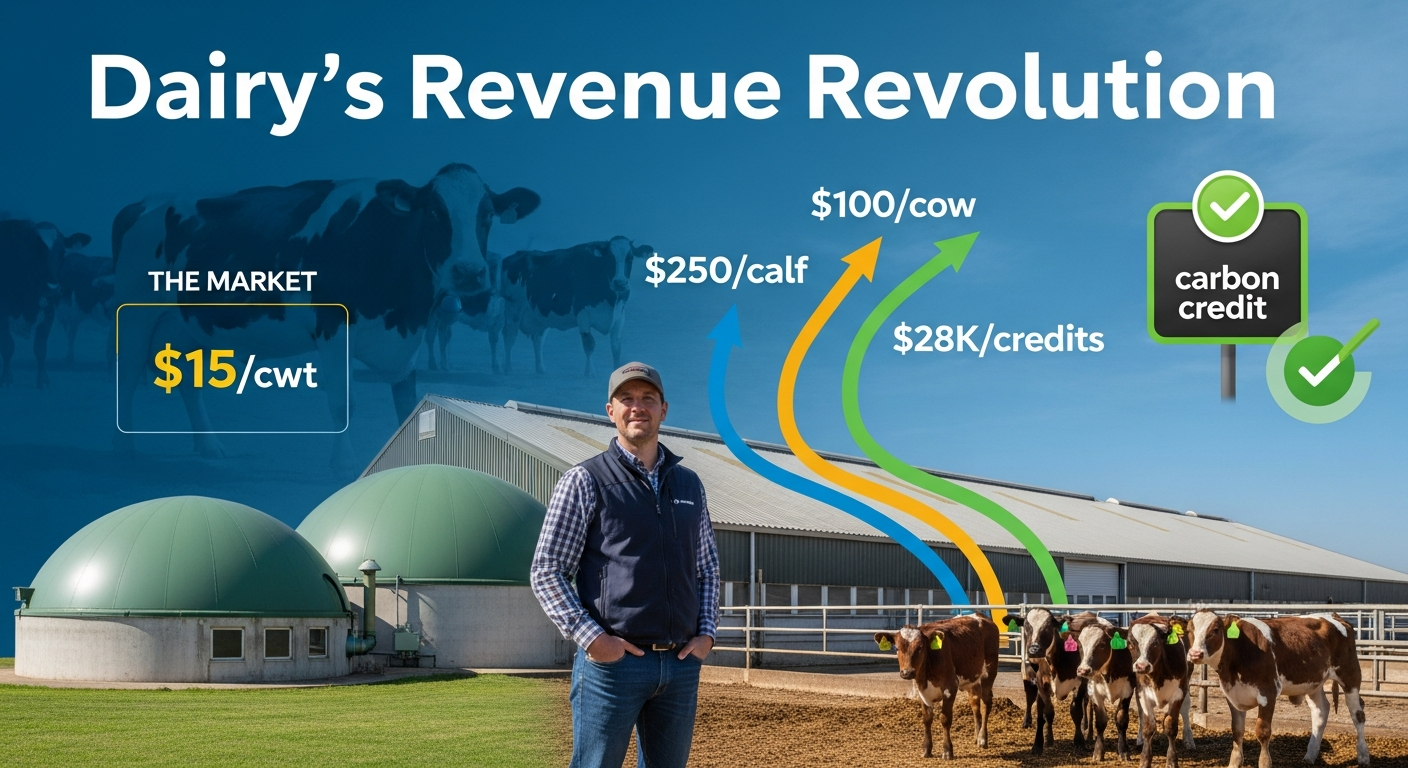
Digesters: $100/cow. Beef crosses: $250/calf. Carbon credits: $28K. When milk becomes your SMALLEST revenue, you survive.

EXECUTIVE SUMMARY: Traditional dairy economics no longer exist—milk production rises 7.5% while prices crash 29% because half of the global supply doesn’t need milk profits anymore. Six structural forces —from European cooperatives locked into accepting all production to U.S. farms earning $100/cow from digesters —have permanently broken market self-correction mechanisms. This isn’t temporary: 40-50% of U.S. milk now comes from multi-revenue operations that profit even at $12/cwt, while conventional farms need $17/cwt to survive. The 2026-2027 shakeout will consolidate 25-40% of production into mega-dairies as thousands of single-revenue farms exit. But you can act now: implementing beef-on-dairy generates $15,000-20,000 annually with one phone call to your breeding tech—no loans, no construction. The divide is clear: farms with multiple revenue streams will thrive at prices that bankrupt traditional operations. Your survival depends on recognizing this transformation isn’t cyclical—it’s permanent.

Farm Revenue Diversification

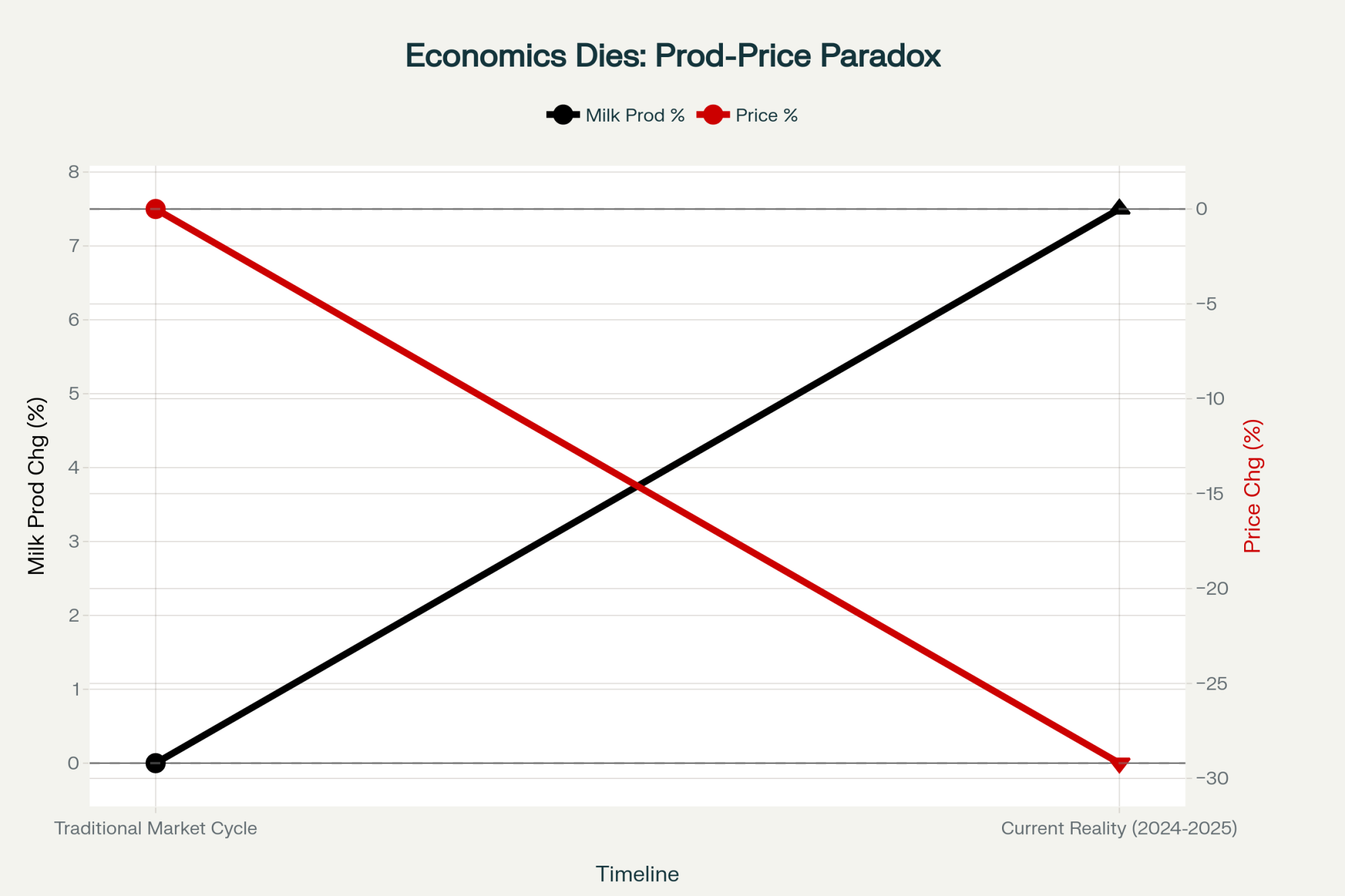
I recently reviewed the UK’s latest production figures from AHDB Dairy, and something remarkable stood out. Milk output increased 7.5% while butter prices declined 29.2% year-over-year. This pattern extends across Europe—Poland’s growing 5.7%, Italy expanding 3%. Meanwhile, European Commission data shows cheese prices down 33-37% across varieties.

What’s particularly noteworthy is how this contradicts everything we thought we knew about market dynamics. When prices fall by a third, producers should reduce output. Basic economics, right? Yet that’s not happening, and understanding these dynamics becomes essential for navigating what lies ahead.

My analysis of Global Dairy Trade auctions, European Energy Exchange futures, and USDA production reports reveals something striking: approximately half of the global milk supply now operates under economic principles different from those we traditionally understood. This shift affects every segment of our industry, from family farms to mega-dairies, from local cooperatives to multinational processors.

Milk production surges 7.5% while butter prices plummet 29.2% year-over-year—a violation of basic supply-demand principles proving half the global supply no longer responds to price signals

Six Structural Forces Reshaping Market Dynamics

Through extensive analysis of production patterns and discussions with industry professionals across multiple regions, I’ve identified six key factors preventing traditional market corrections. As many of us have observed, these aren’t temporary disruptions—they’re permanent structural changes.

1. Cooperative Frameworks and Supply Obligations

European cooperatives manage approximately 60% of the continent’s milk, according to data from the European Dairy Association. What’s interesting here is how these systems operate under unique structural constraints that essentially lock in production.

Within these frameworks, members maintain contractual obligations to deliver their full production, while cooperatives must accept all member milk regardless of market conditions. Think about operations like Dairygold in Ireland—when most members have committed their supply through formal agreements, the cooperative can’t refuse deliveries even when tanks are full and prices are in the basement.

This represents a significant structural difference from the flexibility many North American producers experience. I’ve noticed that producers in Wisconsin or California often don’t fully appreciate how these European constraints ripple through global markets.

2. Infrastructure Investment and Economic Lock-In

Modern dairy facilities require substantial capital that creates what I call “economic handcuffs.” Current robotic milking systems range from $150,000 to $250,000 per unit, according to Lely and DeLaval specifications. The University of Wisconsin Extension‘s latest facilities guide indicates modern freestall barns require $2,000-3,500 per cow space.

Do the math on a 200-cow operation—you’re looking at $2-3 million in specialized assets. And here’s what keeps me up at night: agricultural equipment values have declined significantly, with virtually no secondary market for used robotic milkers.

Cornell’s agricultural economics research demonstrates what we’re seeing firsthand—operations continue production as long as variable costs are covered, even when they’re bleeding red ink on total costs. It’s rational for the individual farm, but it perpetuates the oversupply problem.

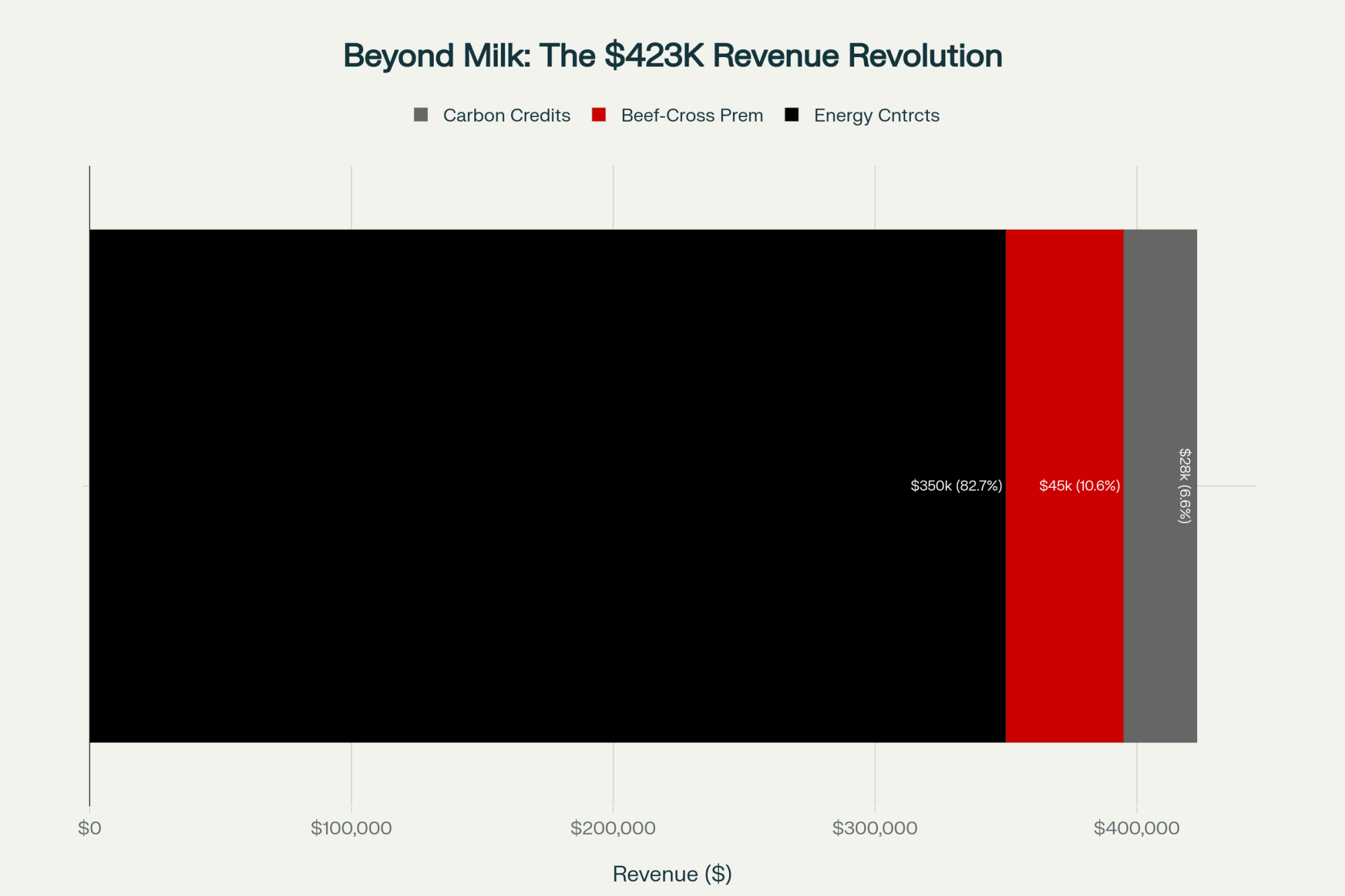
A 3,500-cow California operation generates $423,000 annually from non-milk revenue—with energy contracts dominating at $350K, fundamentally changing farm economics and making them profitable even when milk prices crash

3. Agricultural Support Programs and Income Stability

The European Union’s Common Agricultural Policy represents a €291.1 billion commitment from 2021-2027. What farmers are finding is that these payments, primarily based on land area rather than production, create income stability that’s independent of milk prices.

Research from Wageningen University indicates CAP payments constitute 30-40% of net farm income for many European operations. I’ve spoken with numerous Irish producers whose single farm payments—typically €15,000-20,000 annually—provide the cushion that keeps them milking when prices tank.

While these programs successfully maintain rural communities (and that’s important), they also reduce the supply response we traditionally expected during downturns.

4. Energy Production and Alternative Revenue Streams

This development changes everything about dairy economics. EPA’s AgSTAR program data shows methane digesters generate $80-100 per cow annually through renewable natural gas contracts. California Air Resources Board reports indicate some operations earn $2-3 per hundredweight from energy alone.

A senior consultant recently told me, “We’re approaching a point where milk becomes the co-product of energy production.” That might sound extreme, but look at the numbers…

California operations with 10-15 year renewable natural gas contracts can’t reduce cow numbers without breaching agreements worth millions. With over 200 digester projects operational or under construction, according to the California Department of Food and Agriculture, this fundamentally alters production incentives.

5. Environmental Compliance and Capital Lock-In

Environmental regulations create an interesting paradox. I recently spoke with a Vermont producer who invested approximately $275,000 in manure separation and phosphorus recovery to meet Required Agricultural Practices regulations.

“When you’ve invested that much in compliance infrastructure,” he explained, “continuing at marginal returns often makes more sense than exiting and losing everything.”

This becomes especially complex for operations with succession plans. Kids wanting to farm face tough choices between continuing marginally profitable operations or walking away from family legacies.

6. Beef-on-Dairy Programs: Accessible Revenue Diversification

Here’s a revenue stream that deserves particular attention because it’s accessible to everyoneUSDA Agricultural Marketing Service data from October shows beef-cross dairy calves commanding $200-300 premiums over Holstein bulls. Regional auctions report Angus-Holstein crosses averaging $450-500 while Holstein bulls struggle to hit $200.

Industry breeding data suggests 30-40% of U.S. operations now use beef semen for 20-50% of breedings, up from under 10% five years ago. A 100-cow dairy breeding 30 animals to beef genetics at a $250 premium generates $7,500additional revenue—roughly 50¢ per hundredweight across total production.

Penn State’s dairy genetics team has documented how these programs provide crucial diversification for operations of all sizes, making it a key survival strategy in the current market environment.

Six permanent structural forces have destroyed traditional dairy market corrections—from European cooperative obligations to U.S. energy contracts—resulting in 40-50% of global milk supply operating independent of price signals, ending boom-bust cycles forever

Understanding Multi-Revenue Economics

The transformation from single to multiple revenue streams represents a paradigm shift in how we think about dairy profitability.

I recently analyzed a 3,500-cow California operation that illustrates this perfectly. Their annual alternative revenue includes:

  • Energy contracts: $350,000
  • Beef-cross premiums: $45,000
  • Carbon credits: $28,000

That’s over $400,000 in non-milk revenue, roughly $3 per hundredweight. Their effective break-even after all revenue streams? About $11.50/cwt. Meanwhile, University of California Cooperative Extension data shows conventional neighbors need $16-18/cwt just to cover costs.

Multi-revenue dairy operations maintain profitability at $11.50/cwt while conventional farms require $16-18/cwt—a $4.50+ gap that’s forcing the largest industry consolidation in decades

With November’s CME Class IV at $13.90, multi-revenue operations maintain positive margins while single-revenue neighbors hemorrhage cash daily.

Scale of the Transformation

EPA’s AgSTAR database documents over 270 digesting operations covering approximately 10% of the national herd. The California Energy Commission reports $522 million in private investment in digester projects.

When we combine operations with digesters, beef programs, carbon credits, and solar leases, approximately 40-50% of U.S. milk production now comes from farms with significant non-milk revenue. Traditional supply response? It’s essentially dead.

Processor Adaptation Strategies

Processors aren’t sitting idle—they’re repositioning aggressively. The whey market tells the story.

The Whey Market Divergence

While CME Class IV futures languish at $13.90-14.00/cwt through March 2026, dry whey hit nine-month highs at 71¢/pound—16¢ above the March-September average according to USDA Dairy Market News.

Why this divergence? Three factors stand out:

First, clinical guidelines for GLP-1 medications like Ozempic recommend 1.2-1.5 grams of protein per kilogram body weight to preserve muscle during weight loss. Whey’s amino acid profile makes it ideal.

Second, the sports nutrition market will reach $27.6 billion by 2030, up from $15.6 billion in 2022, with whey representing 70% of protein supplement sales.

Third, technology breakthroughs—companies like Milk Specialties Global have developed clear, fruit-flavored protein beverages that expand beyond traditional shake consumers.

Strategic Processing Investments

The International Dairy Foods Association reports over $11 billion in new processing capacity through 2027. Valley Queen Cheese Factory’s South Dakota expansion illustrates the strategy—management emphasizes whey and lactose demand drives growth planning, not cheese.

These processors recognize that a predictable milk supply from multi-revenue farms justifies substantial investments in protein concentration. Cheese enables whey capture—the latter increasingly drives decisions.

Global Price Transmission Mechanisms

Recent GDT auctions showed whole milk powder down 0.5%, European powder fell 2% per CLAL monitoring, and U.S. nonfat dry milk hit 13-month lows at $1.1325 CME spot. Three different structures, identical direction.

How Arbitrage Enforces Price Discipline

Import buyers consistently report shifting purchases immediately when New Zealand, German, or Wisconsin prices show 5% differentials. The Global Dairy Trade platform, with hundreds of bidders trading 10 million metric tonsannually, creates transparent global price discovery.

Structural Supply Rigidity Everywhere

All major exporters demonstrate inflexibility:

  • Fonterra must accept all shareholder milk (82% of New Zealand production)
  • European cooperatives, plus CAP support, maintain production regardless of price
  • U.S. operations with digester/beef revenue lock in production for years

When China’s imports grow just 6% versus the historical 15-20% (USDA Foreign Agricultural Service), no region possesses quick adjustment mechanisms.

Anticipated Market Evolution: 2026-2027

Based on financial indicators, here’s what I expect:

Q4 2025 – Q1 2026: Credit Market Adjustment

Financial institutions report rising delinquencies. Some require quarterly rather than annual production reports. American Farm Bureau data shows Chapter 12 bankruptcies increased 55% in 2024—that trend continues.

Q2-Q3 2026: Initial Consolidation

Credit-constrained operations begin exiting, but milk production doesn’t disappear—it consolidates. I’m seeing California Central Valley operations with 5,000+ cows buying neighboring 500-cow dairies as satellites.

Q4 2026 – Q2 2027: Structural Realignment

Analysis suggests Class IV stabilizes around $15.00/cwt—sufficient for multi-revenue operations but challenging for conventional single-revenue farms.

The dairy industry faces unprecedented consolidation: multi-revenue mega-dairies will more than double their market share to 32.5%, while conventional small farms shrink from 40% to 28% and the price-responsive segment collapses from 85% to under 45%—ending traditional supply-demand cycles

By mid-2027:

  • Multi-revenue mega-dairies: 25-40% of supply (up from 15%)
  • Conventional small farms: 26-30% (down from 40%)
  • Price-responsive segment: Under 45% (down from 85%)

This represents permanent transformation, not cyclical adjustment.

Southeast Asian Trade: Realistic Assessment

October’s agreements with Malaysia, Cambodia, Thailand, and Vietnam generated optimism. Let’s examine the actual impact.

USDA data shows current exports to these nations total $335 million—just 4% of our $8.2 billion total. Mexico alone buys $2.47 billion.

Even assuming aggressive growth, additional exports might reach $150-200 million by 2027—roughly 750 million pounds milk equivalent. But U.S. production ranges from 6.8 to 9.1 billion pounds annually. Southeast Asia absorbs 8-11% of growth—helpful but not transformative.

These agreements benefit operations with scale, integrated processing, and West Coast proximity—not the Wisconsin 300-cow farm facing bankruptcy.

Strategic Guidance by Operation Type

Small-to-Medium Conventional (100-500 cows)

Post-crisis prices around $14.85/cwt for Class IV are likely to fall below your break-even. University of Minnesota’s FINBIN shows operations this size need $15.50-17.50/cwt.

Immediate action: Implement beef-on-dairy tomorrow. Breeding 30-40% to beef generates $150-250/calf premium. For 200 cows, that’s $15,000-20,000 annually. Call your breeding tech today.

Exit strategies: Chapter 12 provisions offer tax advantages when properly structured. Timing matters as provisions may change.

Expansion: Only viable with 40%+ equity. Reaching 1,500+ cows requires $3-5 million in capital.


Metric
Holstein Bull CalfBeef-Cross CalfPremium/Advantage
Market Value$150-200$450-500$250-300
Current AdoptionN/A30-40% of farmsGrowing rapidly
Breeding %100% dairy20-50% beefStrategic flexibility
Capital Required$0$0Zero investment
Annual Revenue (100 cows, 30% beef)N/A$7,500-9,000Immediate impact
Per Cwt BenefitN/A+$0.50/cwtPure profit add-on

Large Conventional (500-1,500 cows)

You’ll survive but face persistent margin pressure. Push beef-on-dairy toward 40-50% if heifer inventory allows. Lock processor relationships now. Watch for acquisition opportunities.

Near gas pipelines? Seriously evaluate digesters—the economics are compelling, especially with access to infrastructure.

Integrated and Mega-Dairy Operations

The next 24 months present strategic opportunities: favorable asset acquisitions, long-term processor contracts, and continued revenue diversification. Don’t overestimate Southeast Asian volumes—focus on operational efficiency and strategic positioning.

The Bottom Line

What we’re witnessing represents market evolution driven by technology and policy, not temporary failure. The emerging industry will be more concentrated, less price-responsive, and fundamentally different.

Traditional boom-bust cycles are giving way to persistent equilibrium at lower prices, with alternative revenue determining competitive advantage. I know this challenges everything many of us learned. The farm I grew up on wouldn’t survive today’s reality.

But early recognition creates options. Waiting for “normal” to return? That normal no longer exists.

Operations understanding these structural changes will define the next era. Those managing based solely on milk prices risk missing critical competitive factors.

Your strategic window remains open, but it won’t remain open indefinitely. Whether implementing beef-on-dairy, evaluating energy opportunities, or planning transitions, purposeful action becomes essential.

In this evolving dairy economy, standing still means falling behind. The fundamentals have shifted, and our strategies must evolve accordingly. While challenging, this transition creates opportunities for those prepared to adapt.

Together, we’ll navigate this transformation. But success requires understanding the forces at work and a willingness to embrace new models. The path forward demands both realism about challenges and optimism about opportunitiesfor those ready to evolve.

KEY TAKEAWAYS: 

  • Critical Market Intelligence Traditional dairy economics is dead: Half of global milk supply doesn’t need milk profits—digesters generate $100/cow, beef-on-dairy adds $250/calf, making $12/cwt profitable while you need $17/cwt
  • Immediate opportunity: Implement beef-on-dairy tomorrow for $15,000-20,000 annual revenue with zero capital investment—just one call to your breeding tech
  • Six permanent forces guarantee oversupply: European cooperatives must accept all milk, U.S. farms locked into 10-15 year energy contracts, and CAP subsidies cushion losses
  • 2026-2027 consolidation inevitable: 25-40% of milk production shifting to multi-revenue mega-dairies as thousands of conventional farms exit at $15/cwt prices
  • Your choice is binary: Develop multiple revenue streams now or exit within 24 months—waiting for market recovery means waiting for something that won’t happen

Complete references and supporting documentation are available upon request by contacting the editorial team at editor@thebullvine.com.

Learn More:

Join the Revolution!

Join over 30,000 successful dairy professionals who rely on Bullvine Weekly for their competitive edge. Delivered directly to your inbox each week, our exclusive industry insights help you make smarter decisions while saving precious hours every week. Never miss critical updates on milk production trends, breakthrough technologies, and profit-boosting strategies that top producers are already implementing. Subscribe now to transform your dairy operation’s efficiency and profitability—your future success is just one click away.
NewsSubscribe
First
Last
Consent

Your $1,200 Beef Calves Are Worth Protecting – And Now You Actually Can

Beef crosses went from $50 to $1,200 in three years. Smart producers aren’t asking ‘how long will this last?’—they’re asking ‘how do I protect it?’ July’s changes made it possible.

Executive Summary: Beef income exploded from 5% to 25% of dairy revenue in just three years—that’s $650,000+ annually for a typical 500-cow operation—yet most producers are protecting their milk while leaving their beef income completely exposed. History shows cattle markets crash hard every 5-8 years, with potential losses exceeding $200,000 that can force operations to delay expansion or exit entirely. The breakthrough came July 2025 when USDA finally fixed LRP insurance for dairy, valuing beef-cross calves at their real $1,200-1,370 price instead of the insulting $275 coverage that made insurance worthless. After 35-55% government subsidies, comprehensive protection costs just $6,200 annually—about what you spend on two months of mineral supplement. October’s 11.5% price drop in 12 days isn’t normal market movement; it’s volatility returning, and smart producers are locking in protection now while it’s still affordable. Whether you choose insurance, contracts, or another approach, this guide provides the practical roadmap to protect the beef income that’s become essential to your operation’s future.”

If you’ve been to any dairy meetings lately—whether it’s in Wisconsin or Pennsylvania—you know the conversation has shifted. Sure, we’re still talking about milk prices and feed costs, because those never go away. But here’s what’s interesting: everywhere I go, the main topic is beef-on-dairy calves trading at $1,200 a head. And more importantly, everyone’s wondering how long this can last.

What I’ve found is we’re living through one of the most significant transformations in modern dairy. In just three years, beef income has gone from being this minor thing—you know, maybe 5-10% of revenue when we were lucky to get fifty bucks for a Holstein bull calf—to representing 20-25% of total farm income for operations that have really embraced beef-on-dairy breeding. University of Wisconsin Extension has been tracking this, and their analysis aligns with what USDA market reports show.

“We went from dreading bull calves to actually planning our cash flow around them. It’s a complete mental shift.”
— Wisconsin dairy producer

Here’s something worth thinking about: A typical 500-cow dairy that’s generating, say, $3 million in milk sales can now add $750,000 or more from beef-on-dairy calves and cull cows. That’s not pocket change—that’s genuine business diversification. Yet many of us are still approaching this revenue stream the way we always have, which might not be enough given these new market dynamics.

What’s encouraging is that, starting July 1, 2025, the USDA restructured its Livestock Risk Protection program to better align with what we actually need. You can find all the details in their Product Management Bulletin PM-25-028 if you want to dig into the specifics. But I’ll be honest—these aren’t simple programs. There’s definitely a learning curve.

The Beef-Cross Revolution: From $50 to $1,200 in Three Years – This isn’t gradual growth, it’s a complete transformation of dairy economics. Andrew says this chart should be on every dairy farm’s office wall as a reminder that diversification isn’t optional anymore

How We Got Here (And Why It Matters)

We’re Back to 1951—And That’s Not Good News for the Long Term – The cattle inventory crisis explains everything: why your calves are suddenly worth $1,200, and why that won’t last forever.

You probably know this already, but the way several trends came together created today’s opportunity. And understanding this helps explain both the upside and the risks.

The cattle inventory situation is pretty remarkable when you look at the numbers. USDA’s January 2024 Cattle Inventory Report shows we’re at 87.2 million total cattle—that’s the lowest since 1951. Can you believe that? The 2023 calf crop was just 33.6 million head, the smallest since 1948. We’re talking about five straight years of herd reduction, driven by drought out west, input costs that made everyone’s eyes water, and interest rates that made it nearly impossible for cow-calf folks to rebuild.

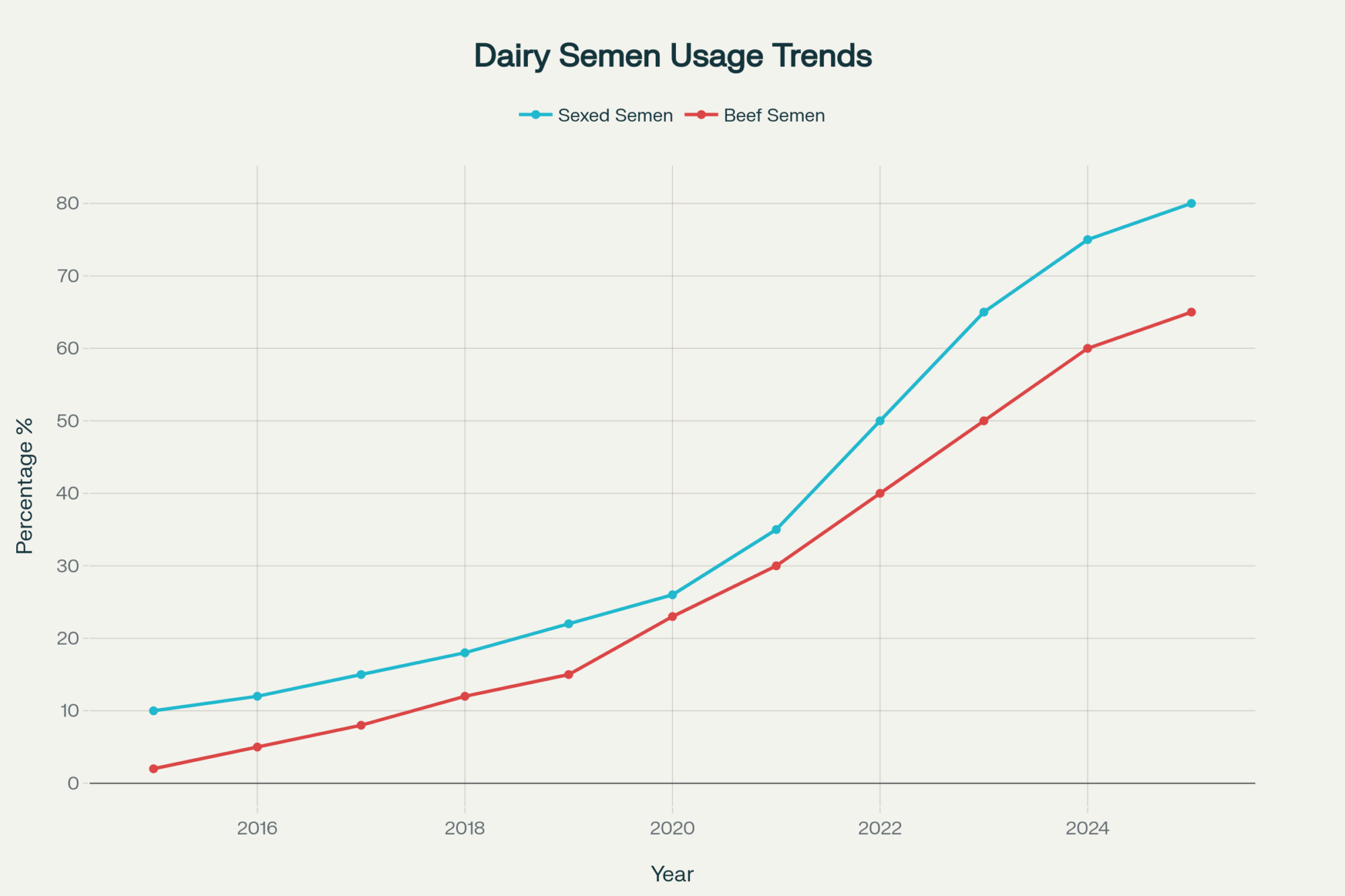
Meanwhile—and this is fascinating—sexed semen technology finally started delivering on its promises. The National Association of Animal Breeders reports that modern sexed semen hits 90-95% accuracy with conception rates that are actually competitive with conventional semen now. By 2024, sexed semen made up 61% of all dairy semen used in U.S. herds. That’s incredible growth from basically nothing a decade ago.

A New Revenue Reality

Where Dairy Income Comes from Now

  • Milk Sales: 75-80%
  • Beef-Cross Calves: 15-18%
  • Cull Cows: 5-7%

This technology shift changed everything. Now we can breed our best 35-40% of cows for replacements and put the rest to beef. As one Wisconsin producer put it to me recently, “We went from dreading bull calves to actually planning our cash flow around them. It’s a complete mental shift.”

And the economics… well, they became impossible to ignore. Holstein bulls that used to bring $50-150 are now competing with beef-on-dairy crosses pulling $1,000-1,450 per head—that’s what Superior Livestock Auction data from Pennsylvania and Wisconsin markets shows. Do the math on a 500-cow operation breeding 65% to beef, and you’re looking at roughly $250,000 in additional calf revenue. That’s like producing an extra million pounds of milk at current Class III prices.

What These New Tools Actually Do for Us

Before July 2025, if you wanted to protect beef income through insurance, you were basically out of luck. The products available were designed for beef feedlots, not dairy farms selling day-old calves and cull cows.

Finally, Real Coverage for Cull Cows

Here’s what still gets me about the old system—dairy cull cows had zero LRP coverage options. None. Think about that… An operation culling 175 cows annually at current values—we’re talking $350,000 or more—had no insurance protection available whatsoever.

“For that typical 175-cow culling program, that’s serious money at risk.”

CME market data and USDA Agricultural Marketing Service reports show cull cow prices can swing wildly—from $165/cwt down to $100/cwt when things get rough. For that typical 175-cow culling program, that’s serious money at risk.

The new “Fed Cattle – Cull Cows” category in the 2026 LRP Insurance Standards Handbook finally addresses this. What I really appreciate is how practical it is—13-week protection periods that match how we actually market cull cows, with pricing based on real cull cow values instead of fed cattle prices that never made sense for us. And with USDA Risk Management Agency subsidies of 35-55%, the actual cost comes down to about $14-21 per head. That’s manageable.

Beef-Cross Calves: Protection That Actually Works

The old “Unborn Calves, Predominantly Dairy” coverage was… well, let’s just say it didn’t work. It valued protection at about 110% of the CME Feeder Cattle Index according to the old actuarial documents. So when your beef-cross calves are selling for $1,000-1,400 but the insurance values them at $275, what’s the point?

The Value Gap: Old vs. New LRP

The $925 Gap That Could’ve Bankrupted You – Old livestock insurance was a joke, covering barely 23% of what your calves were worth.

What Your Calves Are Actually Worth vs. What Insurance Covered

  • Actual Market Value: $1,000-1,400
  • Old LRP Coverage: $275
  • New LRP Coverage: $1,200-1,370

Agricultural economists at Kansas State and other universities have documented this disconnect—we were basically insuring 25-30% of actual value. One economist described it as insuring only your truck’s tires, rather than the whole vehicle. Pretty accurate, if you ask me.

The new “Feeder Cattle – Unborn Calves” category uses dynamic Price Adjustment Factors published monthly by RMA, which actually reflect reality. The latest RMA pricing shows expected values ranging from $1,200 to $1,370 per head, depending on when you’re marketing. You can get coverage for 70-100% of those values, though there’s one catch—calves have to be sold within 14 days of birth. But that’s how most of us market them anyway, so it works.

Regional Differences Matter More Than You’d Think

What’s happening in Texas is quite different from what we’re seeing here in the Upper Midwest or Northeast. Those big Texas operations—you know, the 2,000+ cow places—they shifted to beef-on-dairy really wholly and fast. They had the scale to work directly with feedlots and set up sophisticated breeding programs.

Meanwhile, in Wisconsin and Minnesota, where most of us run 400-800 cows, it’s been more gradual. University Extension folks across the Midwest have noticed that producers here need time to build buyer relationships and understand how our local prices relate to the broader market. We couldn’t just ship direct to feedlots like the big Southwest dairies—we had to build those connections first.

Pennsylvania’s interesting, too. Penn State Extension research shows that their veal markets and proximity to Eastern feedlots yield nice premiums—$931-1,075 per head, compared to $690-945 in Wisconsin. Those regional differences really change the economics of insurance.

What’s interesting here is how Europe and Australia handle this differently. They rely more on cooperative structures and supply management—less individual insurance, more collective bargaining power. There’s something to learn from both approaches, though our system offers more flexibility if you’re willing to navigate the complexity.

Let’s Talk Real Numbers

So what does protection actually cost for a typical 500-cow dairy? Using October 2025 market data:

Your current annual beef income looks like this: Based on Wisconsin auction reports, 249 beef-cross calves at $1,239 each brings in $308,000. Add 175 cull cows at $140/cwt for 1,400-pound cows (that’s USDA-AMS data), and you’re looking at another $343,000. Total beef revenue exceeds $651,000 annually.

But if markets crash like they have before: CattleFax documented the 2015 correction at 31% within 12 months. Apply that today—calves drop to $800 (you lose $109,000) and cull cows fall to $100/cwt (another $98,000 gone). That’s over $207,000 at risk.

Here’s what protection costs after subsidies: Calf coverage at 90% runs about $2,540 annually. Cull cow coverage at 90% is around $3,675. So your total annual premium is $6,215—basically 1% of your beef income protecting against 30-40% potential losses.

Insurance folks who’ve been doing this for years will tell you—and history backs this up—major corrections happen every 5-8 years. When they do, operations with coverage get indemnity checks while their neighbors… well, they’re scrambling. It’s worth noting that crop insurance adoption took decades to reach current levels—we’re seeing similar patterns with livestock protection now.

From 5% to 22.5% in Three Years—This Is Why It’s Called a Revolution – Traditional dairy producers thought of beef income as “beer money.” Today it’s paying for new equipment, covering debt, and funding expansion.

Why Aren’t More Folks Using These Tools?

Despite the math being pretty compelling, adoption’s still low. Research from our land-grant universities points to several reasons, and they’re all legitimate concerns.

The knowledge gap is real. Most of us spent decades learning milk markets—we know Class III like the back of our hand. But cattle pricing, CME futures, basis risk? That’s all new territory. Extension programs are trying to help, but it takes time.

Then there’s what I call the trusted advisor disconnect. Your vet, your nutritionist—research shows these are the people we actually listen to and trust. But they don’t typically know insurance. Meanwhile, many crop insurance agents who handle Dairy Revenue Protection (DRP) aren’t licensed for livestock products. So there’s this gap right when we need guidance most.

And let’s be honest—we’re all stretched thin. When you’re dealing with labor shortages, equipment that needs fixing, keeping milk quality where it needs to be… adding “figure out complex insurance” to the list feels overwhelming. Especially during transition periods when fresh cow management takes all your attention. I’ve noticed that operations with dedicated financial managers adopt these tools faster—but not everyone has that luxury.

Different Approaches Can Work Too

Now, it’s important to acknowledge that insurance isn’t the only way to manage this risk. Some operations have found other approaches that work well for them.

I was talking with an Oregon producer recently who’s got direct contracts with a regional grass-fed program. “They take all our beef crosses at a guaranteed premium over market,” he explained. “For us, that predictability is worth more than insurance. We know what we’re getting, and we don’t worry about whether our local prices match up with CME indices.”

That’s a valid approach. If you’ve got solid contracts, strong financials, or other marketing arrangements that work, LRP might not be essential for you. Look at Canada—their producers rely more on supply management and cooperatives than individual insurance, and they manage okay.

Building Your Protection Strategy

What successful producers have figured out—especially those who made it through 2020’s market chaos—is that protection works best when you layer different tools.

Start with Dairy Margin Coverage (DMC) as your foundation. FSA data shows Tier 1 coverage at $9.50 margin protection costs just $75 annually for the first 5 million pounds. Over the program’s history, it’s paid out an average of $1.17/cwt. You can’t beat that value.

If you’re producing over 5 million pounds, seriously consider Dairy Revenue Protection (DRP) at 95% coverage. Yes, it runs $48,000-80,000 annually for a 500-cow operation, but government subsidies cover 44% of that. It protects both your price and production risks on milk.

Then add the new LRP tools:

  • Beef-cross calves: Get 90-95% coverage, purchased 13-43 weeks before they’re born
  • Cull cows: 13-week coverage that matches your culling schedule
  • Combined cost: roughly $6,000-8,000 annually for solid beef income protection

All told, you’re investing about 3-5% of gross revenue to protect against 30-50% potential losses in a downturn. This development suggests we’re entering a period where comprehensive risk management is becoming standard practice, not optional.

Quick Cost Breakdown by Herd Size

Herd SizeAnnual Beef Income*LRP Premium CostWhat You’re Protecting
200 cows$260,000$2,500$78,000
500 cows$651,000$6,200$195,000
1,000 cows$1,302,000$12,400$390,000
*At current market conditions   

Learning from Early Adopters

A Pennsylvania producer who started coverage in August 2025 shared something interesting with me. When October’s volatility hit—USDA reports show prices dropped 11.5% in just 12 days—he had protection at $1,130 per calf.

“My neighbors were calling emergency meetings with their bankers,” he said. “We had coverage. Sure, we didn’t get peak prices, but we weren’t losing money either. The key was starting with some coverage and learning as we went, instead of waiting for perfect timing.”

That pragmatic approach really resonates—get something in place, learn the system, then optimize. Looking at this trend, it’s clear that producers who build risk management expertise now will have significant advantages going forward.

Common Pitfalls to Watch For

Based on what agents and producers who’ve been through this tell me, here are the main things to avoid:

Waiting for the “right time” is the biggest mistake. Markets turn faster than you’d think. Once volatility shows up, premiums often double.

Don’t under-insure just to save on premiums. Saving $2,000 doesn’t help much if you’re still exposed to $100,000 in losses. Remember, these are tax-deductible business expenses—factor that into your calculations.

Read the details carefully. That 14-day marketing window for calves? Miss it, and your coverage doesn’t apply. Keep good records of birthdates and sale dates.

And find an agent who actually knows dairy livestock insurance, not someone who mainly works with beef operations. There’s a difference.

Why Timing Matters So Much

History gives us some important lessons here. CattleFax documented the 2015 crash—fed cattle went from $175/cwt to $120/cwt in less than a year. They called it the fastest decline ever recorded. Then in 2020, when COVID hit, feeder cattle lost $33/cwt in just 13 weeks.

And right now? We’ve already seen beef-on-dairy calf prices drop 11.5% in 12 days this October. That’s not normal market movement—that’s volatility coming back.

Dr. Derrell Peel at Oklahoma State has studied cattle cycles for thirty years. His research consistently shows that if you wait until you “see trouble coming” to buy insurance, it’s already too late—premiums have doubled and coverage floors are below current prices.

What’s Coming Down the Road

Several things suggest this opportunity window might not stay open as long as we’d like.

Beef herd rebuilding is starting. State inventory data shows expansion happening across Montana, the Dakotas, and Texas. As beef cattle supplies get back to normal over the next 3-5 years, our premium prices for dairy-beef crosses will probably come down. These $1,000+ calves might be temporary.

Those generous subsidies aren’t guaranteed forever, either. Congressional Budget Office analysis shows the current 35-55% premium subsidies came from COVID-era funding. With the farm bill already delayed two years and budget pressures building, who knows what future support will look like. Some states are developing their own supplemental programs, but nothing’s certain.

And here’s something interesting: if you follow genetics, the market’s starting to differentiate. ABS Global and Select Sires report that feedlots increasingly want verified genetics with carcass data. Generic crosses might fall back to $600-800 while premium verified genetics hold their value. What farmers are finding is that investing in documented genetics now positions them for when the market gets more selective.

Options for Smaller Operations

Not every 200-cow operation can spend time figuring out complex insurance programs, and that’s perfectly understandable. What’s encouraging is seeing cooperatives step up.

Vermont and Maine producers are working through their co-ops to access group risk management. Agri-Mark’s running a pilot where their risk management team handles LRP enrollment for members, spreading the expertise cost across farms. You lose some individual optimization, but it’s better than no protection at all.

Looking at this trend, smaller operations might actually have an advantage—they can leverage collective expertise without bearing the full burden themselves.

Your Next Steps: A Timeline That Works

If you’re ready to explore this, here’s a practical approach:

First week: Call your current insurance agent plus 2-3 livestock specialists. Ask specifically about dairy LRP experience, especially with the new beef-cross and cull cow options. The RMA Agent Locator helps find qualified folks in your area.

Second week: Pull together your data—breeding records, calving schedules, and when you typically cull. Figure out your actual beef income exposure. Your Extension agent can help—they’ve got spreadsheets ready to go.

Third week: Review proposals and compare options. Here’s something important—talk to your lender about this. Many banks offer better terms or even help with premium financing when you’ve got good risk management in place. As one banker told me, “We’d rather finance insurance premiums than deal with bankruptcies.”

Fourth week: Get initial coverage going for your next calving group and upcoming culls. Set up quarterly check-ins because this isn’t “set and forget”—markets change, your operation evolves, coverage should adapt.

The Bottom Line

This transformation in dairy beef income creates both huge opportunities and real risks that need managing. The USDA’s new LRP tools offer meaningful protection, but only if we understand them and act before volatility makes coverage too expensive.

We’re witnessing a fundamental shift from single-product dairy operations to diversified businesses. Those who recognize this and adapt will be the ones expanding in 2028. Those who don’t… well, they’ll have some tough conversations ahead.

The tools are there. Government subsidies cover 35-55% of premium costs. The math works. But tools only help if you use them.

With beef income at historic highs but already showing volatility, the window for affordable protection is open but narrowing. Every producer I know who’s been through previous crashes says the same thing: “I wish I’d bought insurance when times were good and premiums were cheap.”

That time is right now. Make the calls. Run your numbers. Get protected. Whether you choose insurance, contracts, or another approach, make sure you’ve got a plan that fits your operation.

“Hoping for the best isn’t risk management—it’s gambling with your family’s future.”

For more information on LRP enrollment, contact a licensed livestock insurance agent or visit rma.usda.gov for resources and agent locator tools. Your state Extension service offers educational programs on risk management strategies specifically for dairy operations.

Key Takeaways:

  • You’re protecting your milk but gambling with your beef—that 25% of revenue ($650K+ annually) needs coverage just as much as your milk income does
  • July 2025 changed everything: USDA finally valued dairy beef calves at their real $1,200-1,370 price for insurance, not the useless $275 that made coverage pointless
  • Simple math, huge impact: Invest $6,200 annually (after 35-55% subsidies) to protect $651,000 in beef income—that’s using 1% to protect against 30-40% crashes
  • The window is closing fast: October’s 11.5% price drop in 12 days proves volatility is returning, and waiting means doubled premiums or no coverage at all
  • You have options: Whether through insurance, direct contracts, or cooperative programs, successful operations are implementing beef income protection now—our 4-week guide shows you exactly how

Complete references and supporting documentation are available upon request by contacting the editorial team at editor@thebullvine.com.

Learn More:

Join the Revolution!

Join over 30,000 successful dairy professionals who rely on Bullvine Weekly for their competitive edge. Delivered directly to your inbox each week, our exclusive industry insights help you make smarter decisions while saving precious hours every week. Never miss critical updates on milk production trends, breakthrough technologies, and profit-boosting strategies that top producers are already implementing. Subscribe now to transform your dairy operation’s efficiency and profitability—your future success is just one click away.

NewsSubscribe
First
Last
Consent

The 800,000-Heifer Shortage Reshaping Dairy: Why Some Farms Will Thrive While Others Exit

Week-old beef calf: $1,400. Replacement heifer: $4,000. Still breeding beef? You’re not crazy—you’re doing the math.

EXECUTIVE SUMMARY: What started as desperate survival in 2018 has become an irreversible trap: beef-cross revenue now provides 16% of dairy farm income, forcing farmers to keep breeding beef at $1,400 per calf even as replacement heifers hit $4,000. This has driven U.S. heifer inventory to 3.9 million—the lowest since 1978—with 800,000 fewer coming before any recovery in 2027. Simultaneously, processors who invested $11 billion expecting 2-3% growth face just 0.4% milk expansion, guaranteeing plant closures and $3-5/cwt regional price swings. The industry is restructuring into three distinct survivors: fortress farms with over 1,500 cows capturing component premiums, strategic operations with 200-500 cows in profitable niches (organic/A2A2/grass-fed), and those exiting now at peak cattle prices. Wisconsin’s 10,000-heifer gain versus Texas’s 10,000-head loss proves that processor relationships and location now matter more than size. Behind the numbers, 2,400-3,700 dairy families face elimination—transforming not just an industry but entire rural communities.

Dairy Heifer Shortage

You know something’s off when you’re seeing beef-cross calves bringing $1,000 to $1,400 at a week old while replacement heifers are hitting $4,000 at auction. It doesn’t make sense at first—but then you dig into what’s actually happening out there, and suddenly it all clicks.

We’re not looking at just another market swing here. What we’re seeing is the collision of desperate decisions farmers made back in 2018 and 2019 with billions in processing investments that assumed a completely different future. And if you’re wondering why your neighbor’s still breeding 40% of the herd to beef despite those heifer prices…well, let me walk you through what I’ve been hearing from producers across the country.

The 800,000 Heifer Crisis Timeline – From 4.8 million in 2018 to 3.4 million projected by 2027, this isn’t a market cycle—it’s industry transformation

Note: Throughout this article, some producers and industry professionals spoke on condition of anonymity to discuss sensitive business details. All financial figures and operational data have been verified against industry benchmarks.

The Numbers Paint a Picture Nobody’s Prepared For

So, CoBank released its latest dairy heifer inventory analysis in August, and the numbers are… honestly, they’re worse than most people realize. According to the USDA’s National Agricultural Statistics Service January 2025 cattle report, the national number of replacement heifers stands at 3.914 million. That’s the lowest since 1978—back when the average herd was what, 30-something cows?

But here’s the kicker that really got my attention: only about 2.5 million of those heifers are expected to actually calve into milking herds this year, based on CoBank’s projections. That’s tracking to be the lowest since the USDA started keeping those specific records in 2001. The ratio’s collapsed, too—USDA’s July calculations show we’re down to 27 heifers per 100 cows. Ten years ago? That was 31 per 100.

And it gets rougher. CoBank’s projects indicate that we’ll lose another 357,490 heifers in 2025, followed by an additional 438,844 in 2026. They’re saying maybe we’ll get back 285,387 or so in 2027, but…that’s still a massive hole. Add it up and we’re talking about 800,000 fewer replacements before any real recovery kicks in.

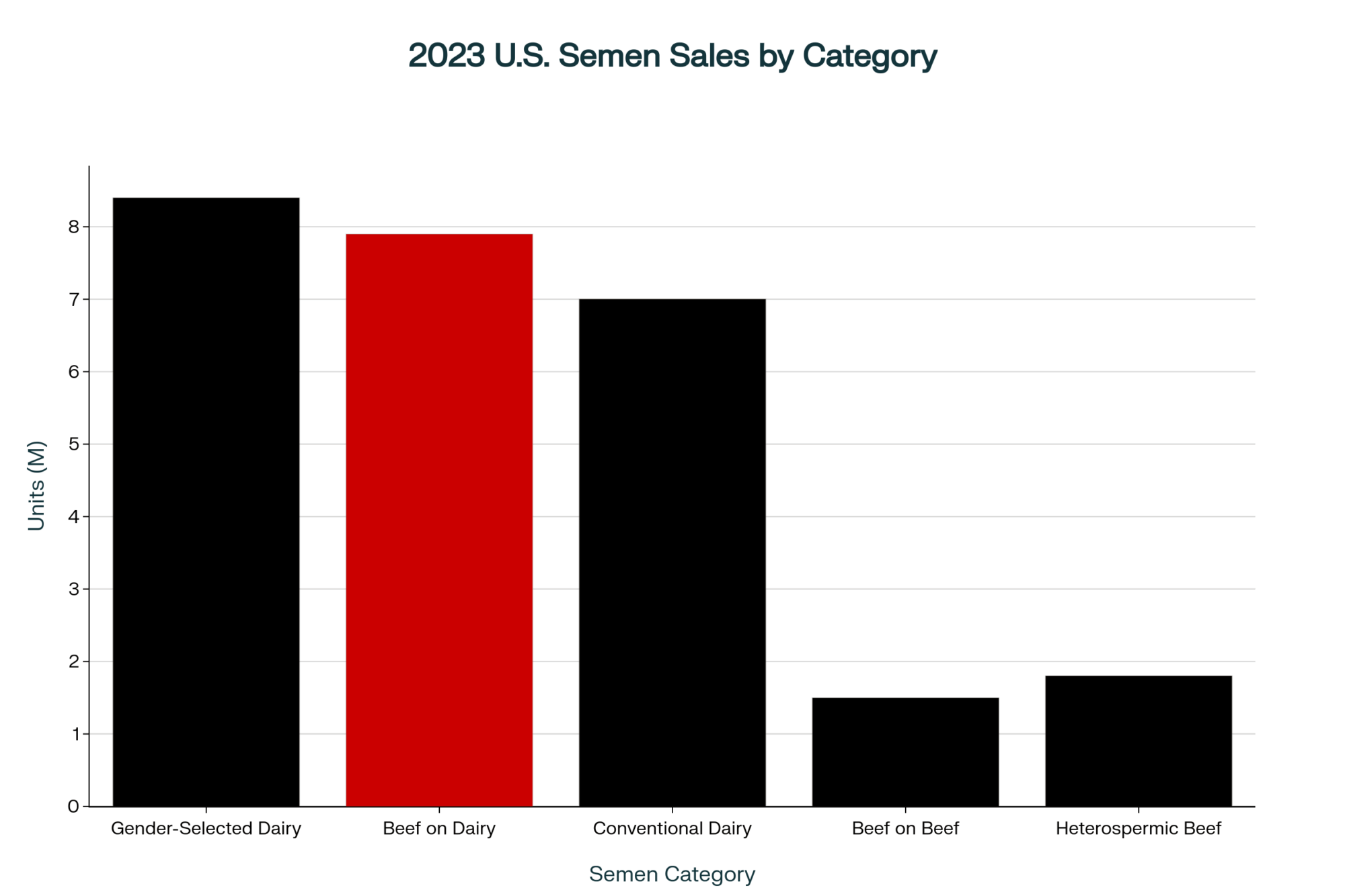
The 216% Explosion That Changed Everything – Beef semen sales to dairy farms surged from 2.5M to 7.9M units, creating the heifer shortage crisis

How Seven Years of Survival Mode Created Today’s Crisis

You can trace this whole thing back to that brutal stretch from 2015 through 2021. Class III milk prices averaged below $18 per hundredweight for most of those years—not continuously, but often enough to cause significant harm. University of Illinois dairy economist John Newton documented this period in his 2018 farmdocdaily analysis, calling it an extended period of sustained losses that fundamentally changed the industry.

By April 2019, according to the USDA’s Agricultural Marketing Service reports, replacement heifers that cost $ 2,000 or more to raise were only bringing $1,140 at market. Think about that for a second. You’re losing $860 to $1,360 on every single replacement you raise.

Then the technology all came together at once. Sexed semen finally worked reliably—industry data from Select Sires and other major AI companies shows you can get 90% female calves with 85-95% of conventional conception rates. Genomic testing through companies like Zoetis and Neogen dropped to about $40 per animal. And beef prices? Through the roof. Suddenly, those Holstein bull calves that might bring $200 on a good day were being replaced with Angus crosses worth anywhere from $600 to over $1,400, depending on genetics and your local market.

I mean, what would you have done?

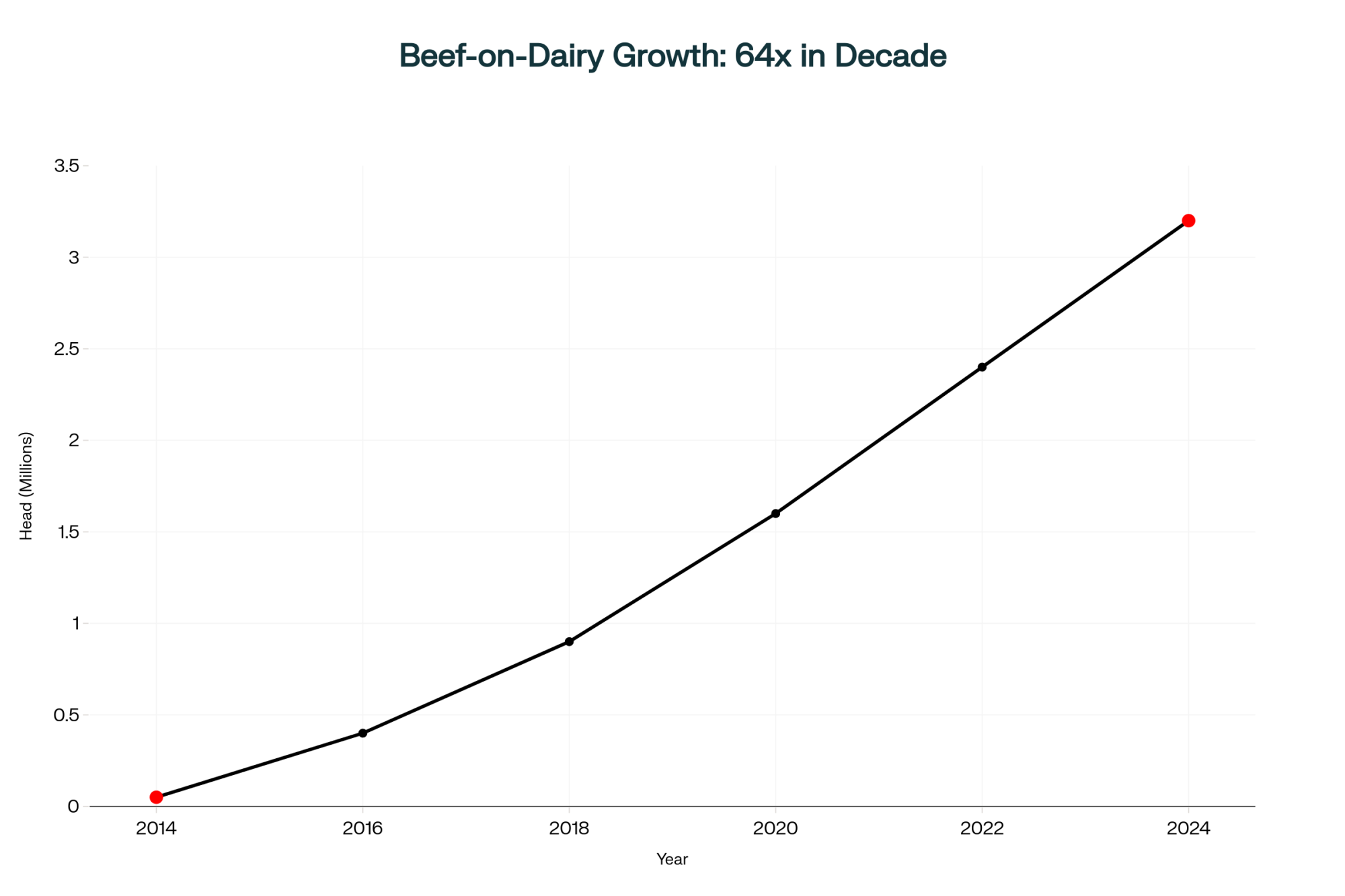
The National Association of Animal Breeders has been tracking this transformation in their annual Semen Sales Reports. Beef semen sales to dairy farms went from about 2.54 million doses in 2017 to over 7.2 million by 2020. That’s nearly triple in three years. Their March 2025 industry update shows we’re now sitting at about 7.9 million units, and it’s just…stuck there. Meanwhile, conventional dairy semen sales have crashed almost 46.5% since 2020.

Why $4,000 Heifers Still Can’t Fix the Problem

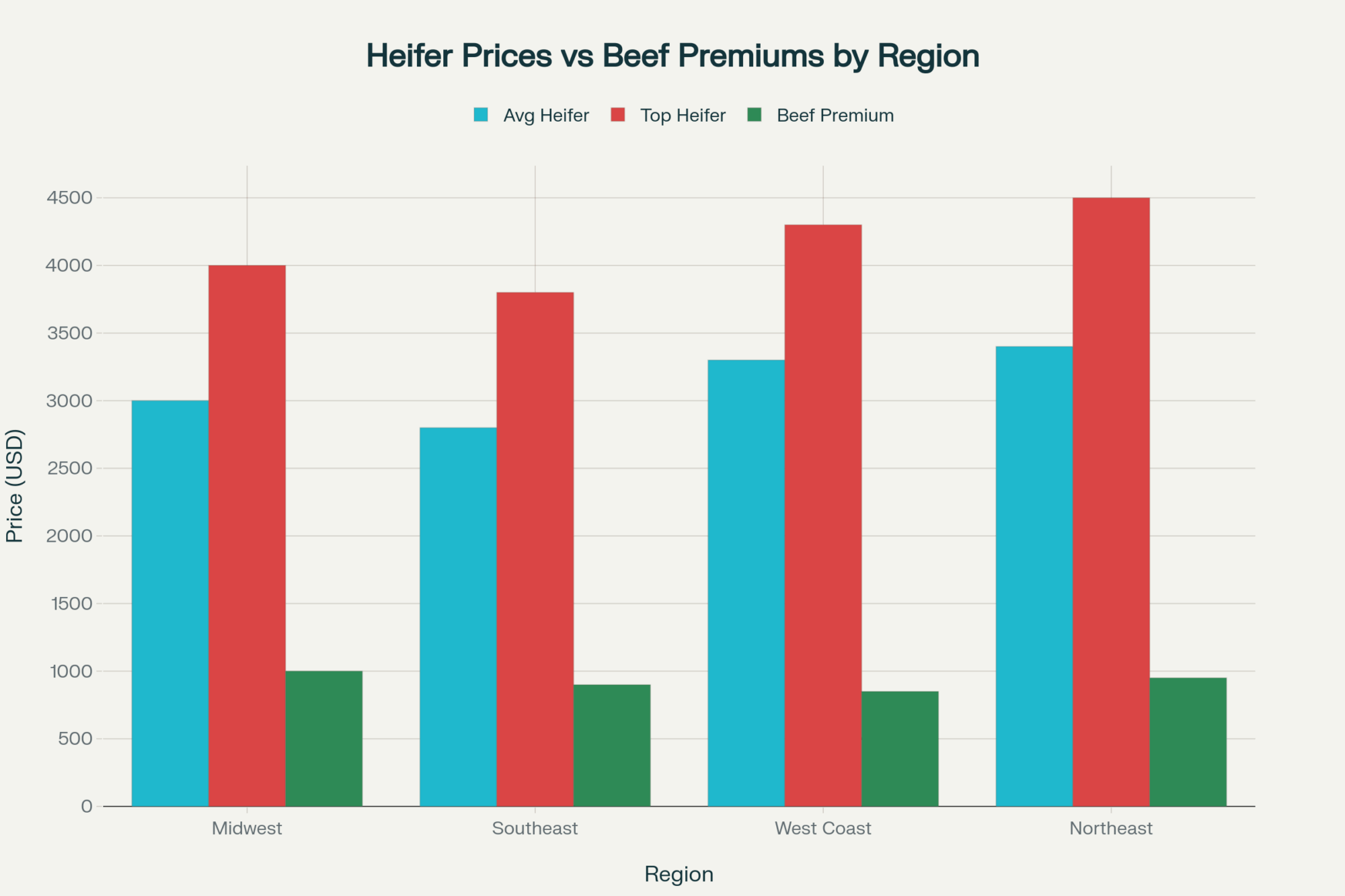
Examining what doesn’t add up for many people: according to the USDA’s October 2025 Agricultural Prices report, heifers are currently worth a significant amount of money. Wisconsin’s averaging close to $2,860. Vermont’s around $2,930. Premium animals in California and Minnesota are fetching over $4,000, according to recent livestock auction reports. So why isn’t everyone breeding dairy again?

What I’m hearing from nutritionists working with Wisconsin herds is pretty consistent. Consider a typical 500-cow operation that breeds 40% of its cows for beef. They’re bringing in maybe $200,000 a year just from those beef calves. Add in cull cows at current prices, and you’re looking at $350,000 in cattle revenue.

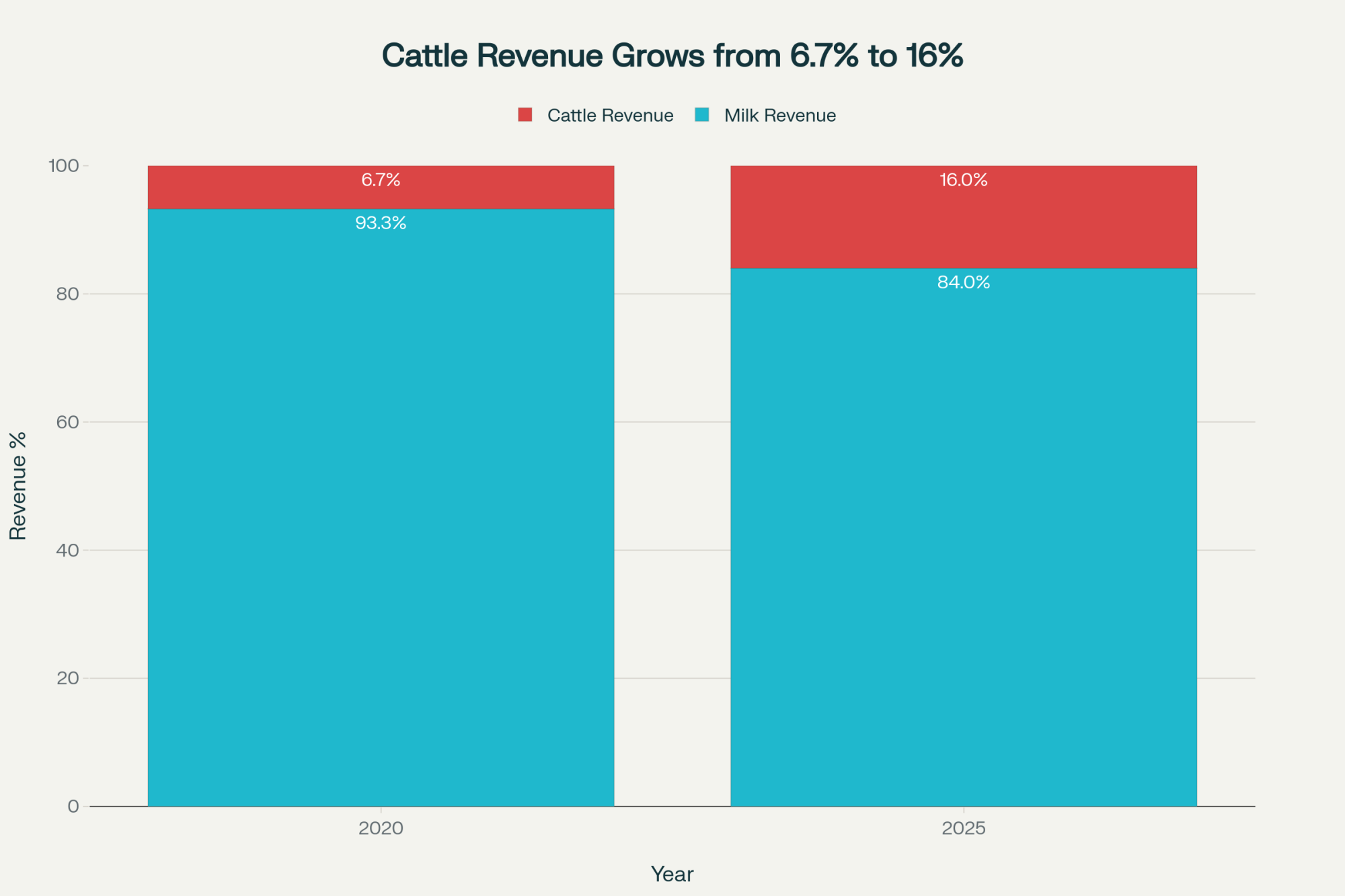
The Revenue Revolution – Cattle sales jumped from 6.7% to 16% of dairy income – this structural shift is permanent and changes everything

According to USDA Economic Research Service data, that’s approximately 16% of total farm income for many operations now. Back in 2020? Cattle sales were maybe 6.7% of dairy farm revenue.

As one nutritionist put it to me, “It’s not just extra money anymore. It’s structural. These guys can’t just flip a switch and go back. Walking away from that revenue would mean completely restructuring the operation.”

From Crisis to Gold Rush – Heifer prices crashed to $1,140 in 2019, now average $2,860 with premiums hitting $4,000

The Processing Overcapacity Challenge Coming in 2027

And here’s where it gets really messy. According to the International Dairy Foods Association’s industry investment tracking, the processing sector has invested more than $10 billion in new facilities over the past three years—some estimates put the total closer to $11 billion. New York’s Department of Agriculture reports that the state alone has $3 billion in processing investments that require an additional 10 to 12 million pounds of milk per day.

These plants were all designed assuming we would continue to grow milk production at a rate of 2-3% annually, as we have for decades, based on USDA historical data from 1995 to 2020. Instead? USDA’s October 2025 World Agricultural Supply and Demand Estimates project just 0.4% growth next year. That’s not a typo—zero point four percent.

Mike North from Ever.Ag’s Risk Management division put it bluntly at the September 2025 Milk Business Conference: “We don’t have enough cows to fill all these plants.” He thinks we’ll see inefficient plants close, and others running way under capacity. That’s billions in stranded investment.

What’s worth noting here is that we’re already seeing some policy discussions emerging. The National Milk Producers Federation has formed working groups to study the situation, though no concrete proposals have emerged. Meanwhile, some state agriculture departments are exploring incentive programs for heifer retention, but the scale of these initiatives remains small compared to the challenge.

Three Different Worlds Emerging

What’s really interesting—and I’ve been watching this develop over the past year or so—is how the industry’s basically splitting into three completely different business models.

The Big Operations (Your “Fortress Farms”)

These 1,500 to 5,000-cow dairies have basically built moats around their businesses. They’re conducting genomic testing on every single heifer through programs like Zoetis’ CLARIFIDE Plus, utilizing AI-powered systems like DairyComp for informed decision-making. According to the Penn State Extension’s 2025 component premium tracking, they’re achieving component premiums that add $1.50 to $2.50 per hundredweight.

Large Midwest operations I’ve talked with are reporting revenue per cow that’s approaching $6,000 to $7,000—numbers that would’ve been fantasy five years ago. They’re generating base milk revenue in the millions, plus substantial component premiums, and nearly a million dollars from beef calves in some cases.

What’s interesting here is something I noticed visiting a couple of these operations recently: they’re not just bigger—they’re fundamentally different businesses. One manager showed me their real-time component monitoring system. “We know within 0.1% what our butterfat’s gonna test every single day,” he said. “That consistency is worth an extra $750,000 a year to us.”

It’s worth noting that these operations are also exploring emerging technologies. Embryo transfer programs, automated calf feeding systems, precision nutrition through AI…they’re positioning themselves for whatever comes next. Some are even experimenting with automated milking systems that can handle 500-plus cows, completely changing labor dynamics.

The Strategic Middle

This is where it gets interesting for those with 200-500 cows. According to the USDA’s organic dairy market reporting, they’re finding ways to make it work through specific niches. Organic products typically sell for $7-12 more than conventional ones. University of Wisconsin extension studies on pasture-based dairy show grazing systems are cutting costs by 30-50%. Some are going direct-to-consumer and getting $4 more per gallon.

I visited an organic operation in Vermont last month, which had transitioned to organic in 2022, with 280 cows. The producer told me she’s actually more profitable now than when she had 350 conventional. The premium’s real—she’s averaging about $9.50 over conventional—and her vet bills dropped 40%.

Out in California, there’s a different approach. One Jersey producer with about 450 cows is locked into a specialized cheese contract. Between base and components, he’s getting close to $24.50 when commodity milk’s at $21. On 10 million pounds, that $3.50 spread is…well, you can do the math.

Down in Georgia—and this is something you don’t hear much about—a 300-cow operation switched to A2A2 milk production exclusively. They’re selling direct to Atlanta-area health food stores at premium prices. “It’s niche as hell,” the owner admits, “but it works for us.”

The Ones Choosing to Exit

Then there are the operations using these high cattle prices as their exit opportunity. After a decade of barely hanging on, they’re done—and honestly, who can blame them?

I caught up with a couple who recently sold their 185-cow place in Wisconsin. After accounting for debt service, living expenses, and reinvestment, they were netting maybe $18,000 a year for 70-hour weeks. Now they’ve got a solar lease on the land, bringing in $52,000 with zero labor. Can’t really argue with that decision.

 Industry Darwinism – Only 20% of small farms will survive the heifer shortage, while 95% of large operations thrive – consolidation is accelerating

Global Perspective: How Other Countries Face Similar Dynamics

What’s fascinating is seeing how this isn’t just a U.S. problem. The European Union’s dealing with their own version of this crisis, though for different reasons. Environmental regulations and nitrogen limits are forcing Dutch and German producers to reduce herd sizes, just as their processing sector has expanded to meet export market demands. According to European Dairy Association reports, EU milk production is expected to decline 1.5% annually through 2027.

New Zealand’s taking a different approach. Fonterra’s latest annual report shows they’re actually encouraging farmers to reduce production intensity and focus on value-added products. Their winter milk premiums now exceed NZ$11 per kilogram milk solids—that’s roughly equivalent to a $7/cwt premium in U.S. terms—specifically to maintain year-round supply for their specialty ingredient plants.

Brazil and India, meanwhile, are ramping up production. Brazil’s domestic consumption is growing at a rate of 3% annually, and the country is investing heavily in genetics and infrastructure. India’s cooperative model—completely different from ours—is actually expanding smallholder participation. It’s a reminder that there’s more than one way to structure a dairy industry.

What’s interesting is watching how other countries handled similar situations. Dairy Australia’s market analysis shows that in 2023, when their production hit 30-year lows, processors like Goulburn Valley Creamery started paying AUS$9.70 per kilogram milk solids—equivalent to about $28 per hundredweight U.S.—just to keep smaller farms from shutting down. We’re starting to see hints of that in the Upper Midwest—smaller co-ops offering bonuses that weren’t on the table two years ago.

Why Some Regions Are Winning While Others Lose

The shortage’s not hitting everywhere the same. USDA’s January 2025 cattle report shows Wisconsin actually added 10,000 replacement heifers last year. Meanwhile, Kansas dropped 35,000, Idaho lost 30,000, and Texas shed 10,000.

Why the difference? Extension specialists at UW-Madison point to several factors. It’s partly infrastructure, partly processor relationships, but mostly it’s about positioning. Wisconsin cheese plants require consistent, high-quality milk, and they’re willing to pay for it. They’re offering retention bonuses, multi-year contracts—things that make raising heifers actually pencil out.

Down in Texas, it’s brutal. One producer recently told me that he paid $4,200 per head for bred heifers from Wisconsin, plus an additional $380 each for trucking. “It hurt,” he said, “but dropping our ship volume would’ve cost us our quality premiums. That’s $140,000 gone.”

Out in the Mountain West states—Colorado, Wyoming, parts of Montana—they’re dealing with different challenges. Water rights, urban expansion, and feed costs… it’s pushing many smaller operations out. One Colorado producer told me, “Between Denver sprawl and water restrictions, we’re done in five years regardless of heifer prices.”

The “Obvious” Solution That’s Actually a Trap

You’d think with heifers at $4,000, somebody would be raising extras to cash in. Spend $2,400 raising them, pocket $1,600 profit. Simple, right?

Not really. The heifer management experts at UW-Madison have thoroughly reviewed this. First problem: mortality. The USDA’s 2022 Dairy Cattle Management Practices study shows you lose about 21% of heifers from birth to freshening when you factor in all causes of mortality and culling. So that $2,400 cost becomes over $3,000 per surviving heifer.

Then add labor—extension economists calculate $400-600 per head through freshening. Feed costs can fluctuate by $400 based solely on corn prices—we’ve seen a variation of $2.80 per bushel over the past 18 months. And you’re making a 24-month bet with no way to hedge the price risk.

As one extension specialist explained, “The only people successfully raising heifers for sale have paid-off facilities, family labor, and grow their own feed. That’s not a business model most can replicate.”

Industry Response: Fragmented Approaches to a Systemic Challenge

You’d think there’d be some coordinated response, but…not really. The National Milk Producers Federation has been discussing the situation, but they’re mostly focused on data collection and suggesting best practices. No real market intervention, though they are exploring potential policy recommendations for the next Farm Bill discussions.

Some cooperatives are exploring different approaches to help members finance replacement raising, though the details vary significantly by region. But as one board member mentioned in a recent meeting, the scale of what’s needed versus what’s being offered is pretty mismatched. We need hundreds of thousands, not tens of thousands, of additional heifers.

What’s encouraging is seeing some innovation at the regional level. A group of farms in Minnesota formed what they’re calling a “heifer pool”—basically sharing genetics and breeding decisions to optimize replacement production across multiple operations. It’s early days, but the concept’s interesting.

Meanwhile, some states are getting creative. Pennsylvania’s Department of Agriculture is piloting a heifer retention incentive program, offering $200 per head for farms that increase replacement numbers. It’s small—only $2 million allocated—but it’s something.

2027: The Year Everything Changes

Based on everything I’m hearing from processors, economists, and producers—plus what we’re seeing in reports from CoBank and Rabobank’s latest dairy quarterly analysis—here’s what’s probably coming:

Milk prices will diverge significantly regionally—possibly $3-5 per hundredweight between shortage and surplus areas. I’m already seeing it start. Some cooperatives in Texas are offering $2.40 location premiums for new farms near their plants.

Industry analysts suggest that processing plants will operate at 72-76% capacity, rather than the 85-90% required for profitability. Smaller regional processors will either close or get bought for significantly less than their construction cost. As one former cheese plant executive explained to me, “The consolidation is coming, it just hasn’t started yet.”

Heifer prices are likely to peak around $4,200-$4,800 in early 2027, based on historical price patterns from similar periods of shortage. They will then moderate back to $3,800-$ 4,200 as more sexed semen is used and the supply improves slightly.

According to NAAB’s projections, beef-on-dairy sales are expected to decline slightly—possibly to 6.5-7 million unitsfrom the current 7.9 million—but they are unlikely to return to pre-2020 levels. As one large-herd manager put it, “Once you’ve built those calf buyer relationships and you’re getting $1,000 to $1,400 per head, you don’t just walk away.”

The Human Cost We’re Not Calculating

What gets lost in all these numbers is what this means for actual people. Back in 2018, Agri-Mark started including suicide prevention hotline numbers with milk checks after losing three members to suicide, as documented in their member communications. The CDC’s 2020 Morbidity and Mortality Weekly Report shows farmers have the highest occupational suicide rate in America—43.7 per 100,000 workers, over 3 times the general population.

When 10-15% of dairy operations close over the next decade—that’s 2,400 to 3,700 families based on current USDA numbers—we’re not just losing businesses. These are communities that have been built around dairy farming for generations.

Researchers studying farmer mental health, such as those at the University of Illinois’ Agricultural Safety and Health Program, have found that after a decade of financial stress, decision-making processes undergo fundamental changes. As one researcher explained, “These aren’t people making strategic business decisions anymore. They’re making survival decisions from a place of chronic stress.”

I see it visiting farms. The producer who won’t look you in the eye when money comes up. The couple who stopped talking about succession because their kids made it clear they’re not coming back. The neighbor who sold out and now won’t answer calls because the shame’s too heavy.

That’s the real cost we’re not calculating.

Your Survival Playbook for the Next 18 Months

Look, every operation’s different, but here’s what seems to make sense based on what I’m seeing:

If You’re Under 200 Cows

Be honest about whether this still works for you. I know that’s hard, but extension economists have shown pretty clearly that the economics are brutal at this scale unless you’ve got a real niche.

If you’re staying, pick your lane now. Organic certification takes three years, but it adds significant premiums, according to USDA data. Grass-fed certification is faster. Direct sales need the right location. However, you have to pick one and commit to it completely. Half-measures don’t work anymore.

Consider teaming up with neighbors. I’m seeing more informal cooperatives forming—sharing equipment, coordinating breeding, even pooling milk for better bargaining power. It’s worth exploring.

If You’re 200-500 Cows

This is your moment to choose. The middle ground’s gone.

Invest smart. Extension research indicates that testing the top 30% of animals genomically costs approximately $3,000-$ 4,000 per year, but can significantly advance your genetics. Activity monitors from companies like SCR by Allflex run $150-200 per cow, but their field data shows conception rate improvements of 8-12%.

Build relationships with your processor now. The farms that’ll get premiums when things get crazy in 2027 are the ones building trust today. Consistent quality, reliable volume, good communication—that’s what processors are looking for.

And keep beef breeding at a maximum of 35-40%. Yeah, those $1,000-plus checks are nice, but you need flexibility when markets shift.

If You’re Over 500 Cows

Focus on component consistency. Penn State’s data show that farms with less than 2% daily variation are earning significant premiums—$375,000 to $750,000 annually on 50 million pounds of product.

Test everything genomically. University research consistently shows that herds testing all their females make genetic progress over twice as fast. At $40 per test, it pays for itself quickly through increased production efficiency.

Be ready to expand strategically when neighbors exit. But like one Idaho dairyman told me, “Don’t expand just because you can. Expand because it makes your operation better.”

What This All Really Means

We’re sitting at 3.914 million heifers—the lowest since 1978, according to the USDA—with 800,000 fewer expected to arrive before anything improves, based on CoBank’s modeling. We’re not going back to the dairy industry we knew.

What started as desperate survival with beef-on-dairy has triggered a complete restructuring. When cattle revenue reaches 16% of farm income, according to USDA ERS data, and large operations capture premiums that smaller farms cannot match, when $10 billion in processing investment faces milk shortages nobody predicted—this is creative destruction happening in real-time.

What’s emerging isn’t necessarily better or worse; What’s emerging isn’t necessarily better or worse. It’s fundamentally different.. The broad middle that defined dairy for generations is disappearing, replaced by high-tech large operations and strategic niche players.

The decisions you make in the next 18-24 months about breeding, technology, and positioning will determine not just profitability but survival. There’s opportunity in this chaos, but only if you recognize the game has completely changed.

The heifer shortage isn’t the crisis. It’s the catalyst exposing a transformation that was always coming. The question now is whether you’re positioned for what’s next or still trying to preserve what was.

KEY TAKEAWAYS: 

  • The Numbers: 3.9 million heifers (lowest since 1978) with 800,000 fewer coming by 2027—yet farmers won’t stop breeding beef because it’s now 16% of revenue vs 6.7% in 2020
  • The Collision: $11 billion in new processing capacity built for 2-3% growth will get 0.4%—expect plant closures and $3-5/cwt regional price swings by 2027
  • Your 18-Month Strategy: Scale to 1,500+ cows for premiums | Find your niche at 200-500 (organic/A2A2/grass-fed) | Exit under 200 while cattle prices are high

Complete references and supporting documentation are available upon request by contacting the editorial team at editor@thebullvine.com.

Learn More:

Join the Revolution!

Join over 30,000 successful dairy professionals who rely on Bullvine Weekly for their competitive edge. Delivered directly to your inbox each week, our exclusive industry insights help you make smarter decisions while saving precious hours every week. Never miss critical updates on milk production trends, breakthrough technologies, and profit-boosting strategies that top producers are already implementing. Subscribe now to transform your dairy operation’s efficiency and profitability—your future success is just one click away.
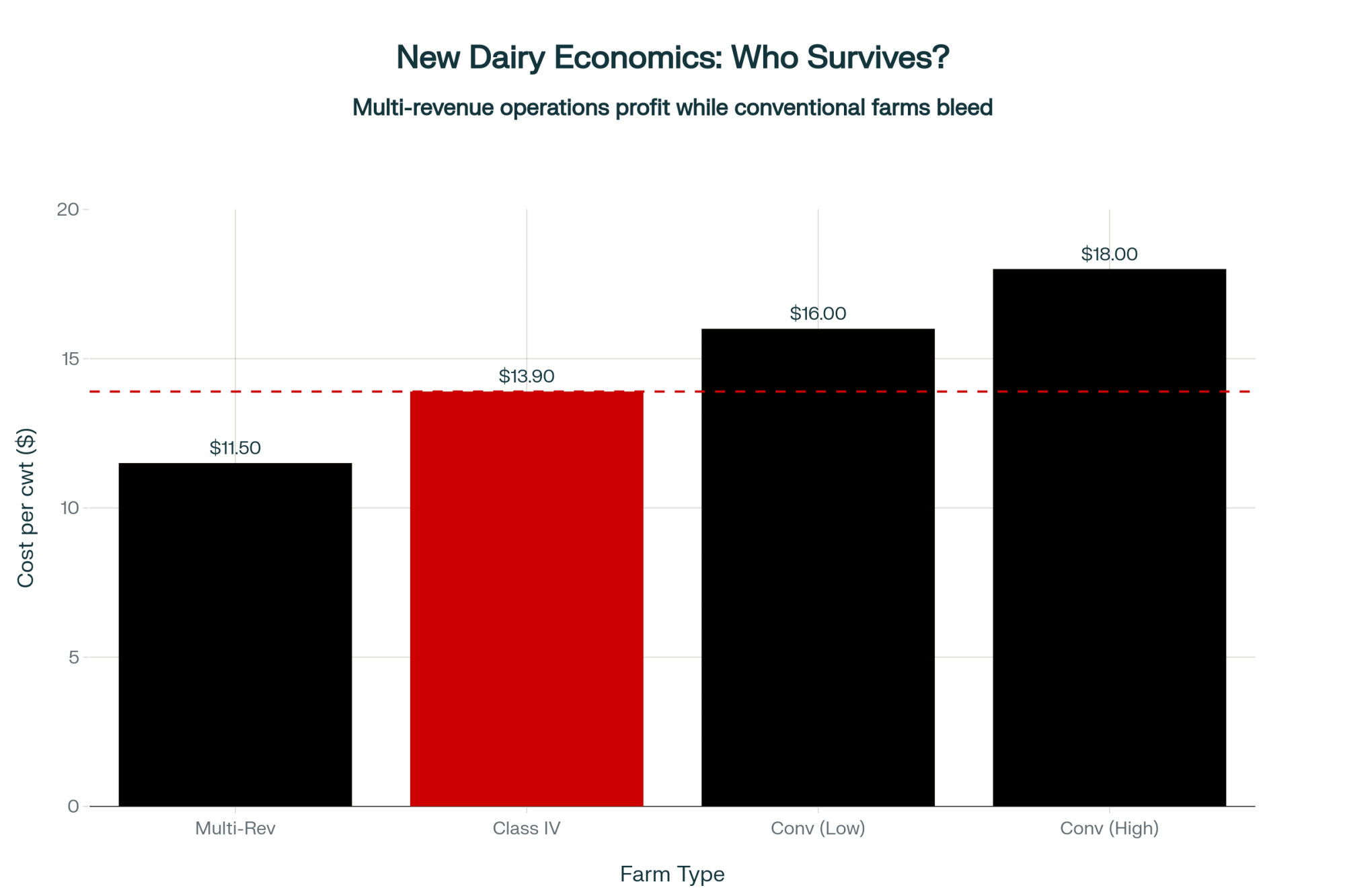
NewsSubscribe
First
Last
Consent

Building a Beef-on-Dairy System: Capturing $360,000 in Annual Farm Profit

What farmers are discovering: beef-on-dairy breeding jumped from 50K to 3.2M head, boosting calf revenue from 2% to nearly 6% of total farm income

EXECUTIVE SUMMARY: What farmers are discovering is that beef-on-dairy breeding has surged from around 50,000 head in 2014 to over 3.2 million in 2024, driving calf revenue from 2% to nearly 6% of total farm income (NAAB 2024; UW Center 2025). Recent research shows that targeting sires in the top 15% for calving ease and top 20% for marbling can yield $100–$200 more per calf, translating to over $360,000 additional annual profit on a 1,500-cow dairy (Penn State 2024; K-State Extension 2025). This development suggests that building a systematic beef-on-dairy program—complete with rigorous colostrum Brix monitoring and detailed health protocols—will remain profitable even if calf prices normalize to $700 by 2028 (USDA WASDE 2025). Across regions from Pennsylvania to California, securing direct feedlot relationships can command $1,200–$1,250 per calf versus $950 at auction, enhancing cash flow and fresh cow management (UW-Madison 2025). While market cycles will fluctuate, adopting documented genetics evaluation and buyer partnerships today positions farms to thrive through changing conditions. Here’s what this means for your operation: build sustainable systems now to secure lasting profitability.

Beef on Dairy

I recently spoke with a producer outside Dodge City whose operation tells a remarkable story about what’s happening in our industry. Nearly half his total farm revenue—not a supplement to milk income, but half—now comes from selling beef-cross calves. Three years ago, those same bull calves brought maybe $250 on a good day.

The National Association of Animal Breeders documented this transformation in their spring report, showing beef-on-dairy breeding has grown from roughly 50,000 head in 2014 to over 3.2 million today. For those making breeding decisions this week for next spring’s calf crop, understanding what’s really driving this shift has become essential.

The beef-on-dairy revolution in numbers: from backyard experiment to mainstream strategy, jumping from 50,000 head to 3.2 million in just ten years—transforming dairy calf economics forever.

What’s particularly noteworthy is what I’ve observed visiting operations from Pennsylvania to Wisconsin recently. The most successful producers aren’t simply riding today’s high prices. They’re building systems that remain profitable even when—but it’ll be when—beef calf values return to more historical levels.

Understanding the Supply Dynamics

Looking at this trend, the numbers tell a big part of the story. USDA’s July cattle inventory report revealed the U.S. beef cow herd at about 28.7 million head—the lowest level since 1961. That’s a generational shift.

Drought from 2020 through last year devastated many cow-calf operations in Texas, Oklahoma, and Kansas. When pastures dried up and feed costs skyrocketed, producers had to liquidate. Now we have about 3.7 million replacement heifers according to the USDA’s latest count, down 3% from two years earlier.

Even with perfect weather tomorrow (which Western Kansas certainly isn’t seeing yet), the biological realities remain unchanged. A heifer bred today won’t calve for nine months, and that calf requires another 18–20 months to hit market weight. That points toward beef supply normalization not before late 2027 or early 2028.

Here’s what’s fascinating: dairy farms have stepped in to fill that gap. NAAB’s data from March shows dairy operations now purchase 84% of all beef semen sold domestically—five times more than traditional beef ranchers. That reversal of historical patterns underscores a major shift.

Fed cattle prices hovering around $214 per hundredweight on the CME are historic. USDA’s World Agricultural Supply and Demand Estimates project we could see $249 next year, with most analysts keeping prices elevated through 2027.

The Genetics Investment That Pays Dividends

What farmers are finding is that sire selection matters more than ever. Many assume that any Angus bull improves on Holstein genetics for beef production. While technically true, practically, that oversimplification can cost hundreds per head.

Penn State’s breed comparison published in the Journal of Animal Science this year shows Angus crosses finish in about 121 days with gains of over 4 pounds daily. Strong. But Limousin crosses require 152 days with gains just over 3 pounds daily—that extra month of feeding means additional costs and lower feedlot bids.

The genetics reality check: Angus and Simmental finish in 121-122 days with 4+ pound daily gains, while Limousin drags an extra month costing you feed and opportunity. Not all beef semen delivers equal value.

What caught my attention was Simmental: 122-day finish with nearly 4 pounds daily gain, matching Angus performance. Yet many operations haven’t considered this breed simply because Angus has become the default choice.

Michigan State’s Translational Animal Science research shows beef-dairy crosses finish roughly 21 days faster than straight Holsteins, with 20% larger ribeyes and superior yield grades. But—and this is crucial—those gains only materialize with the right genetics.

Wisconsin Extension notes Limousin pregnancies typically last 285–287 days compared to Holstein’s 279 days. Those extra days in the close-up pen, eating expensive pre-fresh rations but not producing milk, can cost $40–$50 per cow. Across 400 breedings, that adds up fast.

Superior Livestock’s auction summaries, compiled by Kansas State Extension this August, indicate the premium for superior genetics versus average bulls at $100–$200 per calf. On 100 calves, saving $6 on semen while losing $100 at sale just doesn’t pencil out.

Regional Market Dynamics and Opportunities

Farmers are also finding huge regional price gaps. New Holland’s Monday sale in Pennsylvania, according to their October reports, sees 75-pound beef-cross calves bringing $1,400–$1,725 per hundredweight. That same calf at Equity Livestock in Stratford, Wisconsin, brings $900–$1,200.

Why the difference? Pennsylvania sits at the heart of America’s veal industry. USDA data shows about 133,000 formula-fed calves processed annually in that region, with Lancaster County a major hub and generations of family-run operations creating steady demand.

Penn State Extension specialists explain that New Holland’s market structure—sales on Monday, Thursday, and Wednesday—creates exceptional liquidity. When veal buyers and feedlot buyers compete, prices naturally rise.

What’s encouraging for producers outside Pennsylvania is the chance to capture similar value through direct feedlot relationships. The University of Wisconsin’s Center for Dairy Profitability reports Wisconsin dairies shipping calves to Kansas earn $1,200–$1,250 when local auctions pay $950.

Location determines your check: Pennsylvania’s veal market competition drives calves to $1,562 while generic auctions settle at $950. Smart producers are building direct feedlot relationships to capture that $250-$600 premium.

I recently visited a Wisconsin operation near River Falls that ships about 200 calves annually to a Kansas feedlot. The producer told me, “They pay us a premium because we provide documented genetics, health records, and consistent quality. It’s well worth the extra coordination.”

California dairies facing water and regulatory challenges, and Texas operations dealing with heat stress in transition periods, are also finding beef-dairy diversification boosts cash flow when milk prices are tight.

Financial Realities: A 1,500-Cow Example

Beef calf prices will normalize as supply rebuilds. Operations built on $1,300 calves will struggle when—not if—markets hit $700. The winners are designing systems today that profit at both extremes

Let’s break down what this means for a 1,500-cow dairy breeding 40% to beef:

2022 Baseline (All Dairy Breeding)

  • Holstein bull calves: 612 annually
  • Revenue at $250 each: $153,000
  • Semen costs: $78,000
  • Net calf income: $60,000

2025 With 40% Beef Breeding

  • Beef crosses: 285 at $1,300 = $370,500
  • Holstein bulls: 229 at $600 (reflecting the elevated overall cattle market) = $137,400
  • Total calf revenue: $508,200
  • Semen costs: $76,000 (as premium conventional beef semen often replaces more costly sexed dairy semen)
  • Net profit from calves: $420,000

That’s an improvement of $360,000 annually—profit, not revenue.

The University of Wisconsin’s dairy profitability reports show calf sales jump from 2% to nearly 6% of total revenue. Producers breeding 50–60% to beef are seeing calves represent 8–12% of revenue. That diversification is a welcome buffer when milk prices drop.

The diversification story nobody saw coming: calves jumped from throwaway income at 2% to a legitimate revenue pillar at 6-10% of total farm earnings. That’s a business model transformation, not a price spike.

Planning for Market Normalization

Nobody expects these prices to last forever. CoBank’s dairy quarterly outlook suggests gradual moderation as supply recovers, though timing remains uncertain.

Economists modeling historical patterns and current fundamentals anticipate:

  • 2026: Beef calves near $1,250
  • 2027: Approximately $1,100
  • 2028: Potentially $950 (base case)

The bear-case scenario—if Mexican imports resume in force, beef herds rebuild quickly, and dairy-beef calves flood the market—could see $700 calves by 2028.

Even at $700, beef-dairy remains more profitable than Holstein bulls alone. The break-even point where beef-dairy loses its edge sits around $145 per calf. Historical prices have never approached that level, even during the 2008–2009 economic downturn.

Cornell’s dairy management specialists caution against expansion decisions based on peak prices. Farms that factored $1,300 calf revenue into projections risk financial stress if markets normalize rapidly.

Implementation Strategies That Work

From visiting dozens of operations, I’ve noticed successful programs share certain practices:

Genetics Evaluation: Review breeding records and consult breed association EPD databases. Bulls outside the top 15% for calving ease and the top 20% for marbling need revaluation.

Feedlot Partnerships: Build relationships with three feedlots within shipping distance. Phone calls often create stronger commitments than emails. Buyers prioritize documented genetics and health records.

Documentation Systems: Recording data at birth takes minutes:

  • Birth date and weight
  • Dam ID and sire genetics
  • Colostrum management (Brix readings >22%)
  • Health protocols and treatments
  • Sale weight and age

Premium Genetics Investment: Spending $18–$25 on beef semen instead of $10–$12 often earns $100–$200 per calf premium at auction or on contract.

Trial Shipments: Start with batches of 10–20 documented calves. Feedlots track health, average daily gain, and feed conversion, then share that data so dairies can refine protocols.

Documented standard operating procedures—breeding protocols, calf care standards, health programs—ensure consistency. Regular check-ins with buyers build relationships that drive premiums. As Dairy Herd Management noted this September, “Producers earning top prices aren’t just selling cattle—they’re selling confidence through consistent quality.”

The 2030 Outlook

By 2030, analysts expect two distinct tiers in the beef-dairy market:

  • Top 15–20% of producers, with systematic quality programs and relationships, commanding $900–$1,100 per calf
  • Remaining producers selling commodity calves for $600–$750, facing typical market swings

University of Illinois consultants predict the quality premium will widen from $300–$400 today to $500–$700. Quality will move from an important differentiator to the primary driver of value.

Technology adoption—genomic testing to allocate dairy vs. beef breeding—continues accelerating. While sophisticated, these data-driven approaches deliver tangible returns.

The quality-commodity divide is about to explode. Today’s $350 premium grows to $500-$700 by 2030 as buyers demand documented genetics and health protocols. Commodity producers will be fighting for scraps while quality systems command sustainable premiums.

Quick Implementation Reference

Key Genetic Thresholds:

  • Calving ease: Top 15% of the breed
  • Marbling: Top 20% of breed
  • Birth weight: Below breed average
  • Ribeye area: Above breed average

Financial Break-Even Points:

  • Current beef-cross value: $1,300
  • Projected 2028 base case: $950
  • Projected 2028 bear case: $700
  • Mathematical break-even: $145

Documentation Essentials:

  • Birth date and weight
  • Dam ID and sire genetics
  • Colostrum management (Brix >22%)
  • Health protocols and treatments
  • Sale weight and age

Timeline Considerations:

  • Beef supply recovery: 2027–2028
  • Market normalization: 2026–2027
  • Quality premium expansion: Through 2030

The Bottom Line

As you consider breeding strategies, ask yourself:

  • Does your program remain viable at $700 calves? If not, you’re speculating, not building a system.
  • Are you building documented quality systems or chasing today’s highs? Systems endure cycles.
  • Does beef-dairy complement your dairy operation or add complexity? UW-Madison specialists emphasize that it should boost butterfat performance and fresh cow management, not distract from core milk production.

What we’re witnessing transcends temporary price spikes. The dairy industry is discovering systematic value creation from calves that once had minimal worth. But long-term success rewards disciplined, sustainable approaches over opportunistic plays.

For operations willing to invest in quality genetics, develop robust documentation, and cultivate real buyer partnerships, beef-dairy can generate $200,000 to $400,000 in additional annual profit. That’s transformational for most dairies.

Those simply riding current market waves without building sustainable systems may find 2027 to 2028 challenging.

The opportunity is genuine. The transformation is occurring now. How each operation responds will determine its role in this evolving market dynamic.

KEY TAKEAWAYS

  • Beef-on-dairy breeding lifted calf revenue from 2% to nearly 6% of total farm income, adding $360,000 net annually for a 1,500-cow herd (NAAB 2024; UW Center 2025).
  • Use top 15% calving-ease and top 20% marbling sires to capture $100–$200 premium per calf, offsetting extended dry-period costs (Penn State 2024; K-State Extension 2025).
  • Establish direct feedlot contracts to earn $1,200–$1,250 per calf vs. $950 at auction, smoothing cash flow and supporting butterfat performance in 2025 markets (UW-Madison 2025).
  • Implement calf documentation—colostrum Brix >22%, health and treatment records—to boost buyer confidence, improve fresh cow management, and command relationship premiums.
  • Monitor USDA heifer inventory and fed cattle futures to adjust breeding rates strategically, ensuring profitability even if calf prices fall to $700 by 2028.

Complete references and supporting documentation are available upon request by contacting the editorial team at editor@thebullvine.com.

Learn More:

Join the Revolution!

Join over 30,000 successful dairy professionals who rely on Bullvine Weekly for their competitive edge. Delivered directly to your inbox each week, our exclusive industry insights help you make smarter decisions while saving precious hours every week. Never miss critical updates on milk production trends, breakthrough technologies, and profit-boosting strategies that top producers are already implementing. Subscribe now to transform your dairy operation’s efficiency and profitability—your future success is just one click away.
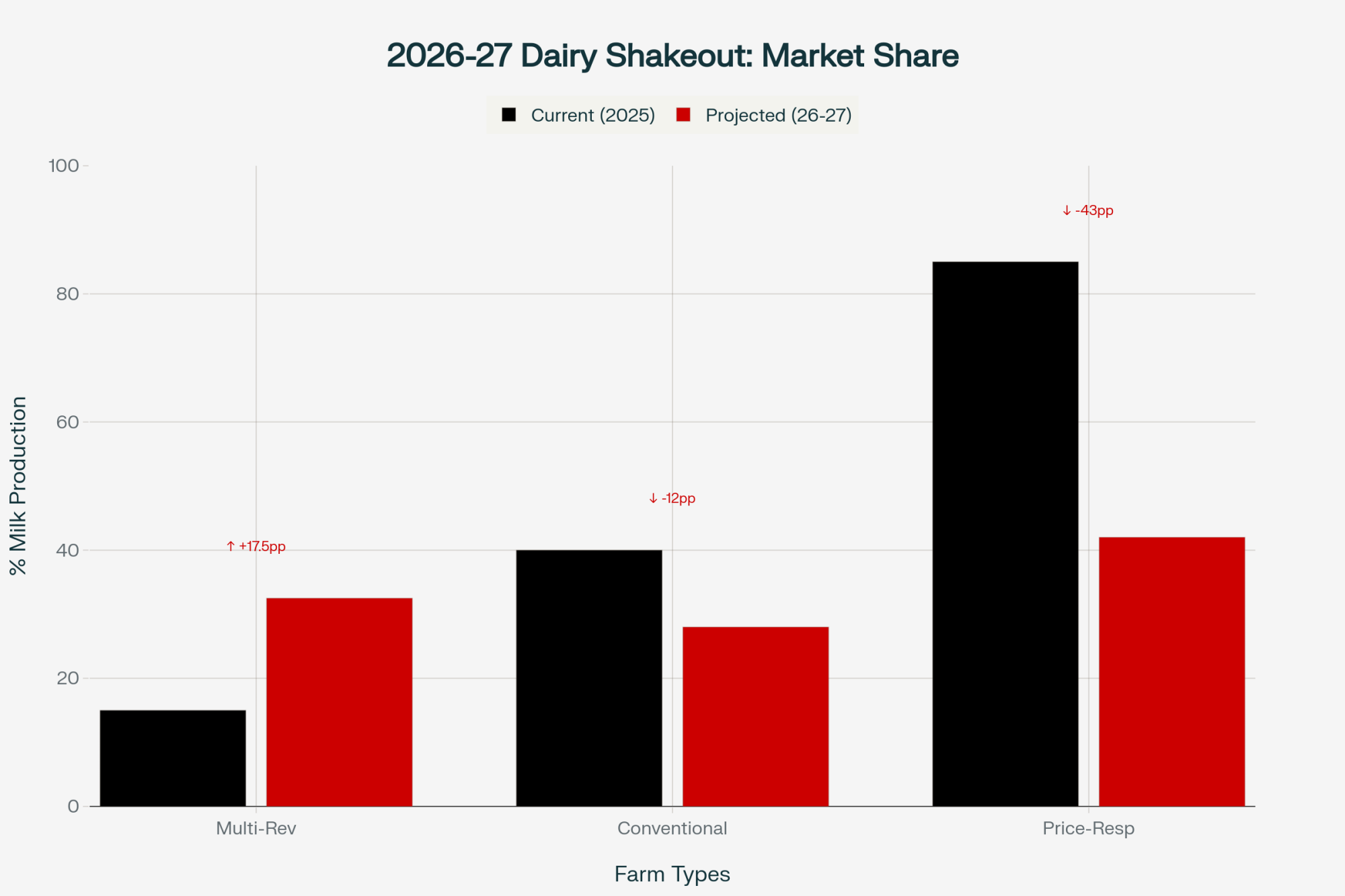
NewsSubscribe
First
Last
Consent

$200 Holstein Bulls to $1,400 Beef Crosses: The $150 Fix Your $7,000 Consultant Won’t Tell You

84% of beef semen goes to dairy farms now. However, the extension agent requires still requires 6 months of planning first. Wonder why?

Look, I don’t know about you, but I’m tired of watching this happen…

Was at the sale barn last week, and I’m watching these beef-dairy crosses roll through.

Fourteen hundred. Thirteen fifty.

Hell, saw one nice Angus-cross heifer calf bring fifteen seventy-five.

Meanwhile, straight Holstein bulls? One ninety. Two ten if the buyers are feeling generous.

So here’s what’s eating at me…

USDA’s market reports from October 15th—they put these out every Tuesday from their Agricultural Marketing Service—are showing this same pattern across every Midwest auction. Beef crosses pulling twelve to fourteen hundred. Holstein bulls are barely breaking two hundred.

Seven times the money. Same barn. Same buyers. Different semen.

And the crazy part?

The difference between farmers banking fourteen hundred and farmers stuck at two hundred isn’t what you’d think. It’s not education or fancy genetics or herd size. Hell, it’s not even having a computer.

It’s whether they actually started or whether they’re still planning to start.

The Thing Extension Won’t Say Out Loud

You know what kills me about these beef-on-dairy workshops?

Every. Single. One. Same script.

Genomic testing first. Build your breeding hierarchy. Optimize your genetic selection matrix. Plan, plan, plan.

But here’s what the research actually shows—and I’m talking about real peer-reviewed stuff in the Agricultural Systems journal from March 2024, not marketing fluff—farmers who just jump in, who start immediately with their obvious cull cows? They’ve got way better sustained adoption rates than the ones sitting through six months of planning meetings.

I mean… think about it.

Guy I know near Fond du Lac—runs about 280 head, old tie-stall barn, been struggling with these milk prices—started breeding his worst cows to beef eighteen months ago—no genomic testing. No consultant. Just picked the obvious culls and started.

Banked an extra $68,000 last year.

Meanwhile, his neighbor’s still “developing a comprehensive strategy” with some consultant from Madison.

The behavioral economics research on this stuff is fascinating. They call it “implementation intention gap.” Basically, the longer you wait between deciding to do something and actually doing it, the less likely you are to ever do it.

And what’s extension pushing? Six months of planning before you breed your first cow.

Meanwhile—get this—NAAB’s 2024 annual report shows beef semen sales to dairy operations hit 7.9 million units. That’s eighty-four percent of all beef semen going to dairy farms.

Beef-on-dairy doses now rival gender-selected dairy semen—proof the industry has already moved while consultants keep preaching patience.

Most of those operations? They didn’t have comprehensive plans. They just… started.

What Nobody Talks About at The Co-op Meeting

Alright, so consultants.

I’ve been asking around about what these beef-on-dairy implementation consultants are actually charging. And… Jesus.

Industry pricing runs anywhere from five hundred to eight hundred just for the initial farm visit. Then they want genomic testing on everything—that’s forty bucks a cow plus coordination fees. Then monthly check-ins, implementation support, all that jazz.

Consultant consultants: $7K before a single calf. Beef semen: $150 today. Which pays the bills this month?

For a hundred-cow operation? You’re easily looking at six, seven thousand dollars.

Before you’ve bred a single cow.

Seven grand!

And for what? The actual difference—I mean the actual, physical difference—is using twenty-five-dollar beef semen instead of dairy semen. That’s it. That’s the whole “technology” we’re talking about here.

You know what else seven grand buys?

  • About 600 round bales at current prices
  • Winter feed for forty cows
  • A decent used TMR mixer
  • Half a year’s worth of sawdust bedding

But somehow, we’ve built this whole consulting industrial complex around what amounts to ordering different straws from your Select Sires guy.

Who’s Actually at The Sale Barn These Days

Here’s something I’ve been noticing…

And this is especially bad now with corn harvest wrapping up and guys trying to get winter rye in before it freezes…

Have you ever really look around at who’s still showing up to the weekly auctions? I mean, really look?

It’s maybe thirty, forty percent of the dairy farms that used to come. Maybe.

The rest? They’re not there. And it’s not because they don’t care about calf prices.

They can’t get away from the farm. Simple as that.

The research on farmer stress—there’s good stuff from those 2023 Canadian parliamentary hearings on farmer mental health—basically confirms what we all know but don’t talk about. When farms get in real trouble, farmers withdraw. Stop going to auctions. Stop attending meetings.

They’re home, trying to keep the wheels from falling off.

And where’s extension holding their beef-on-dairy workshops?

The Holiday Inn conference room. Tuesday at ten. Right during morning milking.

I actually saw some research in the Journal of Extension from their April 2024 issue about how extension professionals get evaluated. You know what matters for their performance reviews?

Workshop attendance. Satisfaction scores from participants.

Not whether anyone actually implements anything. Not whether farmers make money.

Just… did people show up and were they happy.

What Your Banker Sees That Your Extension Agent Doesn’t

This is where it gets interesting…

Agricultural lenders—and I’m talking about the ones who actually work with dairy, not the kid fresh out of college who thinks TMR is a texting abbreviation—they see this completely different.

When you’re sitting across from your banker trying to restructure debt, drowning basically, they’re looking at cash flow.

And the math is simple. Brutally simple.

Fifty Holstein bull calves at two hundred bucks? That’s ten thousand dollars.

Those same fifty calves as beef crosses—based on current USDA pricing—that’s sixty, seventy thousand.

Fifty to sixty thousand in additional revenue. No capital investment. No new facilities. No extra labor.

Just different breeding decisions.

Had an ag lender tell me—off the record—”We see higher beef-on-dairy implementation rates when farmers are desperate than when they’re comfortable. Crisis clarifies priorities.”

And here’s what’s wild…

Behavioral economics research published in Agricultural Systems shows that these crisis-moment interventions? Where are you’re desperate and need something that works right now? Way higher implementation rates than educational workshops when times are good.

Because when you’re drowning, you grab the life preserver. You don’t sign up for swimming lessons.

Red Flags Your Consultant’s Full of Crap

After watching this industry for twenty-something years, here’s what I’ve learned to watch for:

They want comprehensive testing before anything

Genomic testing is cool. Science-y. Makes you feel sophisticated.

But research on how farmers actually make decisions—they call it “satisficing strategies”—shows we identify our cull cows pretty damn accurately just by looking at them.

That three-teater in pen four? The one that’s been open since last Christmas? The chronic mastitis case that’s cost you two grand in treatment this year?

You really need a DNA test to know she should get bred to beef?

Equipment before you have calves

Had a guy tell me last week his consultant wanted him to install twelve thousand dollars in calf monitoring sensors.

Before his first beef calf was even born. Twelve grand!

Meanwhile, university research from Wisconsin, Minnesota, and Cornell shows that proper colostrum management—four quarts in two hours—and actually checking your calves twice a day prevents most mortality.

That’s a thirty-dollar Brix refractometer and paying attention. Not twelve thousand in sensors.

National averages instead of neighbor results

“The industry average ROI is four hundred percent!”

Great. But what about Tom down the road with the same size herd as me? What about operations in my milk shed, dealing with Lake Michigan effect snow, and my feed costs?

Some massive operation in Texas getting four hundred percent ROI doesn’t help me make decisions for my tie-stall barn in Wisconsin when it’s twenty below, the waterers are frozen, and I’m feeding $280 hay because drought killed our second cutting.

The Planning Trap Nobody Calculates

So here’s the thing about all this planning…

Research on implementation—behavioral economists love studying this stuff—shows that in agriculture, the gap between deciding to do something and actually doing it is enormous.

And every week you delay? The probability of ever starting drops.

Think about the math here.

Every month you’re sitting in planning meetings, reviewing genomic reports, optimizing breeding strategies… that’s a month you’re not generating that extra twelve hundred per calf.

Ten calves a month? That’s twelve thousand in lost opportunity.

But we don’t calculate opportunity cost. We’re too busy calculating theoretical genetic improvement metrics that don’t mean much when you’re getting two hundred for bull calves and your milk check barely covers feed costs.

Why Time’s Running Out on This

And this is what really gets me…

The big ag finance outfits—Rabobank’s Q3 2024 report just came out on October 10th, CoBank released theirs on October 8th—they’re all documenting the same trend.

Processor consolidation in the beef-dairy supply chain is accelerating. Fast.

The major packers—Tyson, JBS, Cargill—want predictable supply from operations they can depend on. Which means what?

Exclusive contracts with big operations. Multi-year deals. Guaranteed premiums for guaranteed volume.

Meanwhile, small and mid-size farms are still “developing comprehensive implementation strategies.”

Industry source at one of the big three packers told me last month: “By the end of 2026, we expect seventy percent of beef-dairy supply under contract. The spot market will be whatever’s left.”

Another processor—different company, same message—said they’re already turning away small suppliers. “We need consistent weekly volume. Can’t build a supply chain on guys bringing five calves one week, none the next.”

By the time you’re ready with your perfect genomic plan? The contracts are gone.

You’ll be selling at auction—taking whatever you can get—while the five-thousand-cow dairy down the highway has a three-year exclusive at fourteen fifty a head.

What Actually Works (And It’s Stupidly Simple)

Look, here’s what I’m seeing actually work. And I mean actually work, not theoretically work.

Producers just… start. Small. Messy. But immediately.

They pick their obvious culls—we all have them—and breed them to beef. No genomic testing. No consultant. Just twenty-five-dollar straws of Angus or SimAngus or whatever your AI guy has in the tank.

Three weeks later at preg check?

If things are settling normally—and beef semen settles the same as dairy—they breed a few more. Then a few more. Scale based on what’s actually happening, not what some spreadsheet says should happen.

Universities Want Millions While the Answer Costs Twenty-Five Bucks

You know what really burns me?

Every land-grant university in the Midwest is after state funding for new facilities. Millions of dollars.

Wisconsin wants new research barns—sixteen million in their latest budget request. Michigan’s building some temple to dairy science. Minnesota’s got plans for… I don’t even know what.

Meanwhile, beef-on-dairy implementation is literally just using different semen. Twenty-five, thirty bucks a straw.

The money they’re asking for? Could buy enough beef semen to convert every Holstein bull calf in their state for the next decade. Every. Single. One.

But that doesn’t generate research grants. Doesn’t justify graduate programs. Doesn’t get anyone tenure.

So instead, we get million-dollar facilities to study something that basically amounts to ordering different semen.

Here’s Your Bottom Line

Look, I’ve watched enough “revolutions” in this industry to know most are garbage.

Remember when everybody was gonna get rich on organic? Or when robots were gonna solve all our labor problems?

But this beef-on-dairy thing? The math actually works.

USDA market reports prove it every week. Seven times the revenue for the same calf. Same feed. Same labor. Same facilities.

Just different genetics.

The problem isn’t the concept. It’s the planning-consulting-optimization industrial complex we’ve built around something that should be dead simple.

THE STUPIDLY SIMPLE ACTION PLAN

From phone call to $1,400 calf in seven boxes—no genomic PhD required.

TODAY (Right Now):

→ Call your AI tech
Tell them to bring beef semen on their next visit

TOMORROW (Next AI Visit):

→ Pick your six worst cows

  • That chronic mastitis case
  • The one that’s been open 200+ days
  • The three-teater
  • You know which ones

→ Breed them to beef
Cost: $150 in semen (that’s it)

THREE WEEKS LATER (Preg Check):

→ If 4-5 settled, breed 15 more
Cost: Another $450

SIX WEEKS OUT:

→ Scale to 30-40 head if working
Still no genomic testing needed

SEVEN MONTHS:

→ First calves born
NOW you can think about optimization—but you’re already banking $1,400 instead of $200

No consultants. No genomic testing. No seven-thousand-dollar planning process.

Just different semen in the same cows you’re breeding anyway.

Because while you’re sitting through another workshop on genomic optimization matrices, your neighbor’s already twelve months into this. Banking fourteen hundred per calf. Every month.

And that neighbor?

They don’t have genomic testing. Don’t have a consultant. Don’t have a comprehensive plan.

They just have fourteen-hundred-dollar calf checks instead of two-hundred-dollar ones.

Seven times the money. Same cow. Different semen.

Tell me again why this needs to be complicated?

Key Takeaways:

  • You’re Losing $1,200 Per Calf Right Now. Holstein bulls bring $200. Beef crosses bring $1,400. Same cow, different semen. That’s $60,000 extra on 50 calves—with zero capital investment.
  • The $7,000 Planning Scam vs. The $150 Solution Consultants want genomic testing and six months of meetings. Meanwhile, your neighbor just ordered $150 in beef semen and banked $68,000 extra last year.
  • Extension’s Evaluation Scandal: They get rewarded for workshop attendance, NOT your profitability. While you’re in meetings, processors are locking exclusive contracts with mega-dairies.
  • The 2026 Deadline Nobody’s Discussing. Major packers will control 70% of the beef-dairy supply through exclusive contracts by the end of 2026. After that? You’re fighting for scraps at auction.
  • Tomorrow’s Action (Not Next Month’s Plan) Call your AI tech TODAY. Breed your six worst cows. $150 investment. No genomics. No consultant. First $1,400 check in 7 months.

Executive Summary:

Your Holstein bulls are worth $200. Beef crosses bring $1,400. It’s the same cow, same feed, same labor—just different semen that costs $25 more per straw. This seven-fold price difference should be every dairy’s easiest decision, yet the extension-consultant complex has weaponized it into a $7,000 “comprehensive planning process” that behavioral economics research proves actually prevents farmers from starting. While consultants push genomic testing and extension runs workshops (they’re evaluated on attendance, not whether you make money), major processors are quietly locking up 70% of beef-dairy supply through exclusive contracts with mega-dairies—by 2026, you’ll be fighting for auction scraps. The farmers making money didn’t plan; they just started breeding their worst cows to beef and figured it out as they went—one neighbor banked $68,000 extra last year with zero genomics, zero consultants, just $150 in different semen. Every month you spend planning instead of breeding costs you $12,000 in lost revenue, and the contract window is slamming shut.

Complete references and supporting documentation are available upon request by contacting the editorial team at editor@thebullvine.com.

Learn More:

  • Download “The Ultimate Dairy Breeders Guide to Beef on Dairy Integration” Now! – This guide provides actionable steps and best practices for implementing a beef-on-dairy program, covering everything from sire selection to calf management and marketing strategies. It gives you a tactical roadmap to maximize your profits beyond the initial breeding decision.
  • Beef-on-Dairy: Real Talk on Turning Calves into Serious Profit – This article expands on the market dynamics driving the trend, revealing how beef crosses fundamentally change your farm’s profitability. It provides data on feed savings and market size to help you understand the strategic value of diversifying your income beyond milk prices.
  • The Beef-on-Dairy Wake-Up Call: What Some Farms Are Still Missing – This piece offers a different perspective on the role of technology, explaining how genomic selection can be a powerful tool for strategically identifying which cows to breed to beef. It provides data-backed insights on how to optimize your herd and maximize genetic progress.

Join the Revolution!

Join over 30,000 successful dairy professionals who rely on Bullvine Weekly for their competitive edge. Delivered directly to your inbox each week, our exclusive industry insights help you make smarter decisions while saving precious hours every week. Never miss critical updates on milk production trends, breakthrough technologies, and profit-boosting strategies that top producers are already implementing. Subscribe now to transform your dairy operation’s efficiency and profitability—your future success is just one click away.

NewsSubscribe
First
Last
Consent

From $200 Holstein Bulls to $1,400 Beef Crosses: Your 3-Week Implementation Guide

Why do some dairies bank $100K+ from beef crosses while neighbors get $200 for Holstein bulls?

EXECUTIVE SUMMARY: What farmers are discovering through real-world experience is remarkable—beef-cross calves now bring around $1,370 at Pennsylvania auctions while Holstein bulls fetch maybe $200, according to recent USDA market reports. This seven-fold premium stems from three converging factors: beef cow inventory hitting its lowest point since 1961 (27.9 million head per USDA’s January report), sexed semen technology achieving 70-80% of conventional conception rates, and research from the Journal of Animal Science confirming crossbreds demonstrate superior feed conversion and carcass quality versus straight dairy steers. Nearly three-quarters of dairy operations now engage in some beef-on-dairy breeding, with leading farms, such as McCarty Family Dairy in Kansas, reporting that cattle sales represent roughly half of their monthly revenue during strong markets. Economic modeling from UW-Madison indicates profitability holds as long as crossbreds maintain at least double the value of Holstein bulls—suggesting a practical floor around $450-500 even after inevitable market corrections. Here’s what this means for your operation: implementing a conservative approach with just 15% of your herd could generate $25,000-40,000 in additional annual revenue without betting the farm. The opportunity remains open for producers willing to act with measured optimism and proper risk awareness.

beef on dairy

I recently spoke with a producer from Pennsylvania who mentioned something that stopped me in my tracks. His beef-cross calves just brought around $1,370 at the New Holland auction, according to recent USDA market reports from September. Meanwhile, his neighbor, located in the same region and operating similarly, continues to receive roughly $200 for straight Holstein bulls on a good day.

What’s interesting here is that this isn’t just a Pennsylvania story. I’m hearing similar accounts from Wisconsin to California, Texas to Vermont, and it raises questions worth exploring. Some operations are capturing an additional $100,000 or more annually through strategic breeding decisions, while others continue with traditional approaches. The difference isn’t simply about access to information—it’s about recognizing and acting on converging opportunities.

Ken McCarty from McCarty Family Dairy in Kansas offered a particularly compelling perspective at the recent World Dairy Expo. You know what stuck with me? He recalled attempting to sell Holstein bull calves years ago, describing them as “two for $5,” with no takers. Today, as he explained to the audience, cattle sales have transformed from a budget afterthought to representing approximately half of monthly revenue during strong markets. That’s more than incremental improvement. It’s a fundamental business transformation.

I’ve noticed similar stories emerging from diverse operations lately. An Ohio producer described an identical trajectory last month—from essentially giving away bull calves to generating significant revenue through beef crosses. Then there’s this Wisconsin dairyman who runs 300 cows and became one of his region’s early adopters. Down in Georgia, a 600-cow operation told me they’re now banking an extra $120,000 annually. These aren’t isolated success stories; they represent something broader worth understanding.

When Three Industry Trends Converged

From Afterthought to Game-Changer: How 7.9 Million Units of Beef Semen Rewrote Dairy Economics

Looking at this trend, what’s particularly noteworthy is how this opportunity emerged from the convergence of three independent developments. Understanding each component helps explain why some producers captured value while others missed the signals.

The current situation of the beef industry provides essential context. USDA’s January 2025 cattle report documented approximately 27.9 million beef cows nationally—the lowest level recorded since the early 1960s. Total cattle inventory decreased to 86.7 million head, reflecting sustained pressure on beef production capacity. Three consecutive years of drought across the Great Plains forced substantial herd liquidations.

Driving through Nebraska last summer, I observed pastures that typically support cow-calf operations standing empty—a clear reminder of supply constraints affecting the entire beef complex. A rancher near North Platte told me he’d sold his entire herd rather than buy $300 hay. Can’t blame him.

Simultaneously—and this is where it gets interesting—sexed semen technology reached practical viability. By the mid-2010s, conception rates improved substantially. Under good management protocols, sexed semen often achieves 70-80% of conventional rates, according to various university studies and extension reports. While this advancement didn’t make headlines, it fundamentally altered replacement strategies. What farmers are finding is they can now generate adequate replacements from their top-performing animals—perhaps 30% of the herd—while directing remaining breedings toward terminal crosses.

The third development surprised even experienced cattle feeders. Research from the Journal of Animal Science and multiple land-grant universities documented that beef-dairy crossbreds weren’t merely “improved Holstein steers.” They demonstrated measurably superior performance—better growth rates, improved feed conversion, enhanced carcass quality. Major processors report acceptance rates for these crosses now exceed 95%, with many achieving Choice grade or better. The kind of performance that makes feeding operations genuinely interested, if you know what I mean.

FactorCurrent StatusHistorical ContextImpact
Beef Cattle Inv27.9m headLowest ’61Supply shortage
Sexed Semen Tech70-80% conceptPrev impactEfficient strat
Crossbred PerfSuperior convBetter Holstein95% acceptance

Early Adopters: Different Thinking, Strategic Implementation

I’ve been thinking about what separated these pioneers who began beef-on-dairy breeding around 2015-2016 from their peers. It wasn’t necessarily farm size or capital resources. They approached risk and opportunity differently, somehow.

Their typical strategy involved measured experimentation rather than wholesale conversion. They’d identify maybe 50 to 75 lower-performing animals—you know, third-lactation cows with conception challenges, candidates for culling regardless. The economics were straightforward enough: with Holstein bulls bringing $50 and beef crosses potentially fetching $250 or more, even modest success rates justified the marginally higher semen costs.

What I find particularly clever about their approach was the trial design. They selected proven, easy-calving Angus genetics rather than exotic breeds. Maintained existing AI service providers. And—this is crucial—they secured buyer commitments before initiating breeding programs. Having confirmed market access before breeding decisions proved pivotal to consistent returns.

A producer in Idaho shared his early experience: “We started with 60 cows in 2016. Nothing fancy. Just wanted to see if this beef-cross thing was real. That first group of calves generated an additional $18,000. Not huge money, but enough to know we were onto something.”

Now, not every operation found immediate success. A producer in New Mexico attempted the same approach but initially struggled with buyer acceptance. “Our local market wasn’t ready for crossbreds yet,” he explained. “Took us a year to find the right buyers who understood what we were producing.” That’s an important reminder—market development varies by region. Even within Arizona, producers in Phoenix-area markets report premiums 15-20% higher than those near Tucson, reflecting different buyer bases.

Evolution from Experiment to Core Strategy

The adoption pattern followed remarkably consistent phases across different regions and operation sizes, which I find fascinating.

During the initial phase—let’s say 2015 through 2017—farms allocated 10-15% of breedings to beef bulls, typically focusing on problem breeders. Revenue impact remained modest, perhaps 2-3% of total farm income. But the learning value? That proved substantial. Which sires performed best? What specifications did buyers prefer? How should calf management protocols adapt?

The scaling phase (2018-2020) saw operations expand to 25-35% beef breeding as data accumulated and buyer relationships developed. This is when sexed semen integration became crucial. Top-tier genetics received sexed dairy semen for replacement purposes, while lower-performing animals were bred for beef production. Revenue contribution increased to 5-8% of farm income—becoming materially significant.

Current adoption reflects industry-wide recognition. Recent industry reporting indicates that a large majority—nearly three-quarters—of dairy operations now use some beef semen, according to the latest data from Farm Journal. For operations like McCarty’s, cattle sales can represent substantial monthly revenue during favorable market conditions. We’re talking about a complete business model evolution from a decade ago.

Labor Challenges: The Under-Discussed Constraint

Here’s something that concerns me, and I think we should discuss it more openly. Premium calf values come with management requirements that deserve careful consideration.

Crossbred calves require different protocols than traditional dairy calves, particularly during the critical first 30 days when respiratory challenges are more common. Achieving the growth rates buyers expect demands precise feeding management. And unlike Holstein bulls, which are typically marketed through single channels, beef crosses require evaluation and sorting for multiple programs.

This intensified management intersects with broader labor challenges we’re all aware of. A Texas A&M AgriLife analysis estimated that about half of the U.S. dairy workforce are immigrants, producing close to four-fifths of the nation’s milk. Current immigration uncertainties create operational risks that many producers are experiencing firsthand.

I’m hearing similar concerns from producers across multiple states. Wisconsin operations describe workers hesitant to report following nearby enforcement actions. Arizona and Idaho dairies face challenges in retaining experienced calf managers. Vermont producers express similar concerns. Even down in Florida, where you might not expect it, labor availability is constraining expansion plans. The H-2A program, while valuable for seasonal agriculture, doesn’t address year-round dairy labor needs—as we all know too well.

What worries me is that the skills required for premium calf production—health assessment, nutritional management, market timing—require experience that takes years to develop. A calf buyer recently explained that management quality can create $200-300 per head value differences. That margin? That’s the entire profit opportunity for many operations.

Understanding Market Premiums: The Hide Color Reality

Let’s address something that generates understandable frustration among producers—the $100-200 premium for black-hided calves. I know, it seems arbitrary. But the economics reflect market realities worth examining.

Analysis from organizations, including the American Angus Association, indicates black cattle demonstrate statistical advantages in marbling consistency and feed efficiency. More significantly—and this is key—black hides provide access to branded beef programs, such as Certified Angus Beef, that command harvest premiums. Although not every qualifying animal naturally achieves program standards. Recent processor data shows these programs can add substantial value at harvest.

Markets frequently pay several dollars per hundredweight more for black-hided groups, which can translate to roughly $100-200 per head on typical feeder weights. Feedlot managers consistently acknowledge this price impact.

Is this pricing structure optimal? Well… maybe not from a pure performance perspective. A Nebraska feedlot manager recently offered practical insight: “I understand a red Angus cross might perform equally well, but when I’m evaluating 300 head in 10 minutes, I rely on proven indicators.” Hard to argue with that logic. Until individual genetic data become standard for every calf, visual characteristics will continue to influence rapid market decisions.

A producer in South Dakota put it bluntly: “I don’t like that my red-hided calves bring less money. But I can complain about it, or I can breed black bulls and bank the difference. Guess which one pays better?”

Industry Disruption in Real Time: How Dairy Operations Became America’s Fastest-Growing Beef Producers

Anticipating Market Evolution

Looking ahead—and I’ve been through enough cycles to know this—current premium levels will moderate. The question isn’t whether adjustment occurs, but rather its timing and magnitude.

Early indicators already emerge. Industry reports suggest that beef-on-dairy breeding decreased slightly in 2024 as operations addressed concerns about heifer inventory. Improved pasture conditions across traditional beef regions may enable herd rebuilding, though this process typically requires multiple years. We’ve seen this before.

This development suggests something important, though. Economic modeling from UW-Madison indicates profitability generally holds when beef-on-dairy calves bring at least twice the value of straight Holstein bull calves, given common assumptions. That’s the key threshold right there.

Consider potential scenarios here. If beef prices decline to $700—that’s down from current highs—while Holstein bulls remain at $250, that still represents nearly three times the value. Well above that 2x profitability threshold. Using this guideline and common Holstein bull values of around $200, viability tends to weaken if beef cross-calf values fall below the mid-$400s. That’s probably your practical floor.

Practical Implementation for October 2025

For operations currently receiving $200 for Holstein bulls, here’s what I’d suggest as a measured approach to capturing available premiums.

This week: Contact three calf buyers—your current purchaser plus two specializing in beef crosses. Start with your local livestock auction markets, which often maintain buyer lists for specialty calves. Your county extension office can provide contacts for regional beef-cross buyers. Most AI companies now maintain buyer networks specifically for their beef-on-dairy customers, and the National Association of Animal Breeders offers a directory of approved calf buyers by region. Obtain specific pricing for the October delivery of 80-100 pound black crossbred calves. Understand health protocols, volume preferences, and payment terms. Many Holstein buyers don’t purchase beef-on-dairy calves, so confirming markets in advance prevents misalignment.

Next week: Identify 50-75 lower-tier breeding candidates. You know the ones—older animals that require multiple services, typically those in the bottom quartile of producers. Source proven, easy-calving Angus genetics with birth weight EPDs around -2.0 or better. Extension sources consistently recommend choosing these mainstream genetics over exotic alternatives for better market acceptance.

Week three: Calculate replacement needs precisely. A 500-cow operation typically requires 100-110 annual replacements, with some variation. Implement sexed dairy semen on superior genetics to ensure adequate replacements while allocating remaining breedings to beef. This balance is critical for long-term sustainability. And don’t forget to factor in your typical cull rates and any expansion plans you may have. Also worth considering is that many operations now insure higher-value calves for the first 30-60 days, typically costing $15-25 per head but protecting an investment of $ 1,000 or more.

This conservative approach—involving just 15% of your herd—could generate approximately $25,000 to $ 40,000 in additional annual revenue at current premium levels. That’s meaningful income without excessive risk concentration.

Strategic Lessons for Long-Term Success

What I think distinguishes operations that will thrive versus those facing challenges involves how they treat beef-cross revenue.

Successful producers I know use these premiums strategically—paying down debt, building reserves, addressing deferred maintenance while maintaining focus on sustainable milk production. They treat beef-cross income as a bonus, not a baseline. The operations at risk are restructuring entire business models around current calf values, taking on debt, and expanding facilities based on peak pricing.

Agricultural lenders commonly caution against structuring long-term debt service around peak calf prices. A banker friend in Minnesota captured this perfectly: “The dairy operations that worry me aren’t the ones doing beef-on-dairy. It’s the ones borrowing against $1,400 calves like that’s permanent. When markets moderate—and they always do—those fixed costs won’t adjust with them.”

This pattern echoes previous agricultural cycles, doesn’t it? The ethanol-driven corn boom rewarded producers who banked profits while challenging those who built operations around $7 corn. The organic milk premium cycle followed similar dynamics. A producer in Vermont who lived through the organic boom told me, “Same story, different product. The ones who survive are the ones who remember it’s a cycle.”

The Sustainable Future of Beef-on-Dairy

Despite inevitable market adjustments, several structural changes appear permanent. The efficiency of producing replacements from elite genetics, while maximizing terminal cross value, will not reverse simply because prices moderate. Established infrastructure—buyer networks, marketing channels, quality programs—will persist even as margins compress. And those documented performance advantages of crossbred cattle in feeding operations remain regardless of price levels.

For producers evaluating current opportunities, perspective matters. The exceptional margins of recent years won’t persist indefinitely—we all know that. However, even at more sustainable levels—perhaps $600-$ 800 per head—beef-on-dairy offers meaningful revenue diversification for operations prepared to manage the added complexity.

The opportunity window remains open, but it continues to narrow. Producers acting now with appropriate risk awareness can still capture value. Those awaiting perfect conditions will likely miss participation entirely.

A Nebraska dairyman recently offered a valuable perspective that resonates with me: “We accepted for 20 years that bull calves had negligible value. The only worthless element was that assumption itself.”

Sometimes significant opportunities exist in plain sight, waiting for the convergence of technology, market conditions, and strategic thinking to reveal their value. For dairy producers willing to thoughtfully evaluate and act on current conditions, beef-on-dairy represents exactly such an opportunity—one where understanding both potential and limitations determines success.

What farmers are finding is that this isn’t just about catching a market trend; it’s about cultivating a lasting relationship. It’s about fundamentally rethinking what each pregnancy on your farm represents. Whether you’re in Pennsylvania, Wisconsin, or anywhere in between, the beef-on-dairy opportunity is real. But it requires clear eyes about both the potential and the pitfalls. Those who approach it with measured optimism and conservative implementation will likely find success. That shift in thinking might be the most valuable change of all.

KEY TAKEAWAYS

  • Start conservatively with 15% of your herd (50-75 lower-performing cows) to capture $25,000-$ 40,000 in additional annual revenue while maintaining operational flexibility. This approach minimizes risk and proves the concept works for your specific situation.
  • Secure buyers before breeding decisions by contacting local auction markets for specialty calf lists, your county extension office for regional beef-cross buyers, and AI company networks—many Holstein buyers don’t purchase crossbreds, so market confirmation prevents costly misalignment.
  • Target proven, easy-calving Angus genetics with birth weight EPDs around -2.0 or better, as extension sources consistently show mainstream black-hided genetics bring $100-200 premiums per head due to branded beef program access and feedlot preferences.
  • Calculate replacement needs precisely before expanding—a 500-cow operation typically requires 100-110 annual replacements, so implement sexed dairy semen on your top 30% while allocating bottom-tier cows to beef to maintain herd sustainability.
  • Treat beef-cross income as windfall profit, not baseline revenue—agricultural lenders caution that operations borrowing against $1,400 calf values face serious risk when markets moderate to the sustainable $600-800 range that economic models predict.

Complete references and supporting documentation are available upon request by contacting the editorial team at editor@thebullvine.com.

Learn More:

Join the Revolution!

Join over 30,000 successful dairy professionals who rely on Bullvine Weekly for their competitive edge. Delivered directly to your inbox each week, our exclusive industry insights help you make smarter decisions while saving precious hours every week. Never miss critical updates on milk production trends, breakthrough technologies, and profit-boosting strategies that top producers are already implementing. Subscribe now to transform your dairy operation’s efficiency and profitability—your future success is just one click away.

NewsSubscribe
First
Last
Consent

The October 31st Dairy Disaster Your Co-op Won’t Discuss: How Argentina’s Export Tax Scam Just Handed Mexico Your Milk Check

40% of U.S. cheese exports face an immediate threat as Argentina drops 9% dairy tax—while your industry leaders stay silent

EXECUTIVE SUMMARY: Here’s what we discovered: Argentina suspended all agricultural export taxes on September 22nd—a move that instantly makes their dairy products $200-300 per metric ton cheaper than ours in global markets. With Mexico accounting for 40% of U.S. cheese exports (approximately $2-3 billion annually), this “temporary” policy, in effect through October 31st, threatens to crater milk prices by 20% or more. The silence from National Milk, IDFA, and major co-ops isn’t a coincidence—many of these same companies operate profitable facilities in Argentina and Brazil. Historical patterns show that Argentina’s “temporary” measures have a nasty habit of becoming permanent (remember Macri’s 2015 tax elimination, which was reversed in 2018?). The domino effect could be catastrophic: Turkey’s 60% inflation and Brazil’s 20% currency slide make them prime candidates to copy Argentina’s playbook. Suppose you’re shipping to processors with significant exposure to Mexico. In that case, you have exactly 36 days to lock in price protection before this market manipulation, disguised as policy reform, decimates your milk check.

dairy market manipulation

So I’m sitting here at 5 AM—couldn’t sleep, actually—scrolling through the news, and there it is. Argentina suspended their agricultural export taxes. September 22nd. Just… gone. And nobody’s talking about it.

Look, maybe I’m overreacting. My wife says I do that. But I’ve been covering dairy for twenty-something years, and this feels… different. Really different.

You know how sometimes you get that feeling in your gut? Like when you see a fresh cow not eating and you just know something’s off? That’s what this feels like.

The Thing Nobody at Your Co-op Meeting Will Tell You

Alright, so here’s what I’ve been able to piece together…

Argentina’s been taxing agricultural exports for years, right? Different products, different rates. The reports coming out say they were hitting soybeans pretty hard—maybe around 30 percent—and dairy products were also being taxed. I’ve seen numbers anywhere from 8 to 10 percent on dairy, depending on who you ask.

Now they’re saying it’s temporary. Through October 31st, supposedly. Or until they hit some big export revenue target—I’ve heard $7 billion thrown around, but honestly, who knows if that’s accurate.

Temporary. Right.

You know what else was supposed to be temporary? Remember when Macri took over down there… what, 2015? Eliminated export taxes completely. Said it was the new way forward. Permanent change. All that.

Three years later? Boom. “Emergency measures.” Taxes are back.

I’ve been watching this long enough to know—Argentina’s “temporary” has a funny way of becoming permanent. And their “permanent”? That disappears faster than free donuts at a co-op meeting.

Mexico’s Buying HOW Much of Our Cheese?

Mexico’s strategic importance to the U.S. dairy industry is undeniable. The chart shows U.S. cheese exports to Mexico have grown steadily, with a 40% market share. This explosive growth is now directly threatened by Argentina’s sudden export tax elimination.

So I’m at the feed store last week—you know, the one by the old John Deere place in Dodge County—and this trucker’s there. Does the Mexico run for one of the big outfits.

He goes, “You know how much cheese is going south?”

And yeah, I knew it was a lot, but when you actually look at the numbers… Jesus. According to recent trade reports, approximately 40% of all U.S. cheese exports are destined for Mexico. That’s… what, $2-3 billion worth? Wisconsin alone is shipping tens of millions. California? Even more. Texas? Don’t even get me started—those processors down there are basically running on Mexico business.

Mexico’s 40% share of U.S. dairy exports represents $2.3 billion in annual trade now under direct threat from Argentina’s export tax elimination. When your biggest customer has cheaper alternatives, your milk check follows the market down.

But here’s the kicker—and this is what nobody’s talking about—Argentina already ships a ton of dairy to Brazil. They’ve got the infrastructure. The relationships. Brazilian companies have been dealing with Mexican importers for decades.

All Argentina needed was a price advantage.

Putting All Your Eggs in One Basket: How Mexico Became American Dairy’s Single Point of Failure. When 37% of Your Cheese Sales Depend on One Country, You’re Not Diversified—You’re Hostage.

And dropping export taxes? Well… do the math. If they were taxing dairy at 9% and that’s now gone, their products just became that much cheaper overnight. We’re talking maybe $200-300 per metric ton advantage. Maybe more.

You can’t compete with that. Nobody can.

Actually, I was just talking to this producer near Fond du Lac last week—milks about 800 head and has been in the business for forty years—and he says his processor already warned him that Mexico contracts might be “under review” come November. Under review. You know what that means.

Your Co-op Board’s Interesting Side Investments

Now… I’m going to be cautious here due to legal considerations, but…

Have you ever looked at who owns what in the South American dairy industry? I mean, really look?

Some of the same companies buying your milk here have operations down there. Big operations. I’m talking major ownership stakes in Argentine processors, Brazilian plants, the whole nine yards.

I’m not saying it’s a conspiracy. But when something this big happens and National Milk doesn’t say a word? IDFA’s silent? Your co-op board’s acting like nothing’s happening?

Makes you wonder, doesn’t it?

Actually, I ran into… well, let’s just say a former industry bigwig at a conference last week. The guy who used to be pretty high up. Even he looked worried. And this guy’s seen everything.

He says, “this is different. This isn’t market volatility. This is market manipulation.”

It Gets Worse (Because Of Course It Does)

So I’m talking to this analyst—a smart guy who covers global markets—and he starts laying out what happens next.

Turkey’s watching Argentina. Their currency’s trash, inflation’s through the roof—I’ve heard anywhere from 40 to 60 percent, depending on who’s counting. They export billions in ag products to Europe. If Argentina gets away with this, Turkey will likely follow suit, and the same could happen in Brazil. Their currency’s been sliding all year. Down maybe 20% against the dollar. And Brazil controls… what, a fifth of global soybean exports? Something like that. Huge chunk, anyway.

Once they see Argentina getting away with it…

It’s like dominoes. Remember back in ’09 when one bank started dumping assets and suddenly everybody had to? Same thing, but with countries using agriculture to prop up their currencies.

From $17.50 to $10.00: The Currency War Price Collapse That Could Cost You 43% of Your Milk Revenue. Every Day You Wait, Your Window to Protect Yourself Gets Smaller

Actually, wait. This is even scarier than I thought. Because once this starts, how do you stop it? Every country with a weak currency and agricultural exports is gonna look at this playbook and think, “Why not us?”

I was at a meeting in Madison last month—Wisconsin Dairy Business Association thing—and this economist from UW was saying something that stuck with me. She said, “The next trade war won’t be about tariffs. It’ll be about currency manipulation through agricultural policy.”

Guess she was right.

The Cavalry Ain’t Coming

Called the USDA yesterday. You know what they said? “We’re monitoring the situation.”

Monitoring.

That’s like telling a guy with a twisted stomach cow that you’re “observing the discomfort.” Great. Super helpful.

Look, theoretically, somebody should file a trade complaint. WTO, USMCA, whatever. But come on. By the time they get around to doing something, we’ll all be out of business. Or dead.

The market will sort this out long before Washington does. And by “sort out,” I mean we’re gonna take it in the shorts while everybody else figures out the new rules.

What You Can Actually Do (Besides Panic)

Alright, practical stuff. Because sitting around complaining doesn’t pay bills, even though it feels good.

That Dairy Revenue Protection everybody’s always talking about? Figure it out. Now. According to the latest RMA updates, the subsidized rates aren’t terrible—maybe $0.25 per hundredweight for decent coverage. That’s cheap insurance if this thing goes sideways.

Class III futures are still holding above $17.50, as of my last check yesterday. Won’t stay there long if this Argentina thing spreads. Lock something in.

Feed? Corn’s under $4.00 a bushel. Soybean meal’s… what, $280-290 a ton? Not great, not terrible. If you secure a six-month commitment, it.

Oh, and here’s something—you breeding any beef crosses? A guy I know in South Dakota; his dairy-beef calves are generating a significant amount of money. $800-1,000 each. With beef prices where they are… I mean, the math works.

Actually, I was at a sale barn down in Iowa last week—don’t ask why, long story—and these dairy-beef crosses sold for more than registered Holsteins. I’ve never seen that before.

The Part That Really Pisses Me Off

We did everything right, you know?

Got more efficient. Improved genetics. Built these massive freestalls. According to recent productivity data, the average production per cow is now… what, pushing 24,000 pounds? My grandfather would’ve called bullshit on that number.

Hell, I was at a place in California last month—they’re getting 30,000 pounds. Per cow! That’s not farming, that’s… I don’t even know what that is.

And for what? So we can be undercut by a country using agriculture as a means to bail out its peso?

This isn’t a competition. It’s desperation. And we’re the ones who’re gonna pay for it.

October 31st (Yeah, Right)

Argentina says this is temporary. Until October 31st.

And I’m gonna be the next American Idol.

Look at their track record. Every “temporary” measure from the last twenty years? Still there in some form. Or it lasted way longer than promised. Or they brought it back under a different name.

Argentina’s history proves ‘temporary’ policies are anything but. This timeline visually demonstrates the cycle of tax elimination and reinstatement, reinforcing why producers should not trust the October 31st deadline and should instead prepare for a permanent policy shift.

They’re saying they need to generate around $170-180 million per day in agricultural exports to meet their targets. Per day! That’s… come on. That’s fantasy numbers.

I’ll bet you my best heifer they extend this “temporary” measure. Probably call it something else. “Extended temporary emergency provisional measure” or some BS like that.

Maybe I’m wrong. God knows I’ve been wrong before. Remember when I said nobody would pay six figures for a cow? Yeah, that aged well…

But this feels different. The silence from our industry groups. The positioning of the big processors. Nobody wants to talk about it.

That tells you everything, doesn’t it?

The Bottom Line Nobody Wants to Hear

Had drinks with this banker last night—finances a bunch of operations around here. He asks me, “How bad is this, really?”

And I told him straight: If Argentina gets away with this, if they can use agricultural exports to bail out their currency without anybody stopping them… every broke country on earth just got handed the blueprint.

And guess who pays for it?

Not the politicians. Not the multinational processors with operations everywhere. Not the futures traders who’ll make money either way.

Us. The actual farmers.

Look, more details will come out over the next week or two. But don’t wait for some official report to tell you what to do. By then, it’s too late.

The thing is—and this is what keeps me up at night—our whole system assumes everybody plays by the same rules. You compete on quality, efficiency, and genetics. Not on whose government is most desperate for dollars.

But if that’s changing…

Christ. I need more coffee. Or maybe something stronger. It’s 5 AM somewhere, right?

Anyway, pay attention to this Argentina thing. Don’t let it sneak up on you like… well, like everything else seems to these days. October 31st is coming fast. And something tells me November 1st is going to look really different from October 30th.

Actually, hang on—before I forget. If you’re shipping to a plant that does a lot of business in Mexico, have that conversation now. Today. Not next week. Ask them point-blank: “What happens to us if Mexico starts buying from Argentina?”

They know the answer. They just don’t want to tell you.

You know what really strikes me about all this? We spent the last decade getting told to “think globally.” Well, here’s global for you—countries weaponizing their agricultural exports to prop up failing currencies. What did they mean by ‘global markets’?

Trust me on that one.

KEY TAKEAWAYS

  • Lock in Q4 pricing NOW: Class III futures still holding above $17.50—that won’t last once Mexico starts buying Argentine cheese at 9% discount. DRP coverage at $0.25/cwt is cheap insurance against the 20% price crater we’re facing
  • Diversify before it’s too late: Dairy-beef crosses bringing $800-1,000/head while registered Holsteins struggle—that’s immediate cash flow when your Mexico contracts evaporate. Smart producers are breeding 30% of their herd to beef bulls
  • Ask your processor point-blank TODAY: “What’s our exposure if Mexico switches to Argentine suppliers?” They already know the answer—Wisconsin producers near Fond du Lac report processors admitting contracts are “under review” for November
  • Lock in feed costs for a minimum of 6 months: Corn under $4.00/bushel and soybean meal at $280/ton won’t hold if currency manipulation spreads to Brazil (21% of global soy exports). The smart money’s contracting now, while everyone else “monitors the situation”
  • Build cash reserves like it’s 2008: Argentina needs $170-180 million daily in ag exports to hit their targets—fantasy numbers that guarantee this “temporary” measure gets extended. Operations with 6 months of operating capital survived ’09; those without didn’t

Complete references and supporting documentation are available upon request by contacting the editorial team at editor@thebullvine.com.

Learn More:

Join the Revolution!

Join over 30,000 successful dairy professionals who rely on Bullvine Weekly for their competitive edge. Delivered directly to your inbox each week, our exclusive industry insights help you make smarter decisions while saving precious hours every week. Never miss critical updates on milk production trends, breakthrough technologies, and profit-boosting strategies that top producers are already implementing. Subscribe now to transform your dairy operation’s efficiency and profitability—your future success is just one click away.

NewsSubscribe
First
Last
Consent

The $1,600 Calf That’s Breaking Every Market Rule: Why This Dairy Crash Won’t Self-Correct

Dairy prices crash, but farmers aren’t culling—what’s keeping supply inflated?

EXECUTIVE SUMMARY: Here’s what we discovered: butter prices plunged 40% to $1.86 per pound, and milk futures hit historic lows, but dairy farmers are sticking with their herds. The culprit? Beef-on-dairy calf prices are hitting $1,600 in auctions, cushioning losses and disrupting traditional supply pressures. U.S. milk production surged 3.5% through July, mirrored by growth in the EU and New Zealand, creating a global surplus that dwarfs export gains. Scientific data and USDA reports reveal this simultaneous production boom is unprecedented in recent history, baffling markets and dragging down prices. This broken feedback loop means prices may remain depressed for longer, forcing farmers to reassess their risk and herd management strategies. Independent producers need to understand these dynamics now to adapt and survive—waiting for a market correction could mean bleeding margins for months.

KEY TAKEAWAYS:

  • Farmers can buffer revenue losses with beef-on-dairy calves selling between $900-$1,600, easing pressure from falling milk prices.
  • Lock in futures contracts near $17-$17.50 for risk protection amid volatile price trends.
  • Focus on maximizing butterfat and protein components as premium payments shift away from volume in 2025.
  • Recognize that global simultaneous milk supply growth from the U.S., EU, and New Zealand is unprecedented and pressuring prices lower.
  • Monitor beef market shifts closely, as calf price drops will trigger the necessary herd contraction for market balance.
beef on dairy, dairy economics, farm profitability, dairy markets, milk futures

Look, I’ve been tracking dairy fundamentals long enough to recognize when something’s fundamentally shifted. September 15 brought us CME butter at $1.86 per pound—lowest since October 2021—yet half the producers I’m talking to aren’t in crisis mode. Here’s the uncomfortable truth nobody’s discussing: this market’s traditional feedback mechanisms are completely broken.

When the Numbers Tell a Different Story

U.S. butter spot prices and Class III milk futures from June-September 2025 showing the dramatic market collapse that defines this dairy crisis.

The headline numbers are brutal, no question. CME spot butter crashed to $1.86 per pound on September 15, down more than 40% from mid-summer highs and hitting levels we haven’t seen in nearly four years. Class III futures dropped to life-of-contract lows at $16.31 per hundredweight, with Class IV even uglier at $15.90.

But here’s what’s got me scratching my head… walking through farm offices across Pennsylvania and upstate New York last week, the conversations weren’t what you’d expect. Sure, everyone’s feeling the milk price pain, but there’s this underlying confidence that wasn’t there in previous downturns.

The reason? Beef-on-dairy has become a game-changer nobody fully anticipated.

The Calf Market That’s Rewriting Farm Economics

At recent Premier and Empire auctions across Pennsylvania and New York, beef-on-dairy crossbred calves are routinely commanding $900 to $1,600 per head. That’s not hyperbole—Empire Livestock’s September reports show “Beef Type Calves” trading between $8.00-$17.50 per pound, which translates to these per-head values for 100-120 pound calves.

One producer near Lancaster told me his September calf sales covered three months of feed bills. When your day-old crossbred is worth more than most people’s monthly mortgage payment, it changes how you think about culling decisions entirely.

This isn’t just Northeast pricing either. Similar premiums are showing up across the Midwest wherever beef-on-dairy genetics are being marketed through organized sales.

Global Supply Dynamics: Everyone’s Producing More

Global milk production changes by major dairy regions in July 2025, illustrating the simultaneous supply growth driving market oversupply

What makes this situation particularly concerning is the production data coming out of all major dairy regions. U.S. milk production surged 3.5% in July compared to the same month last year, building on the 3.4% increase we saw in June. USDA raised their 2025 production forecast to 228.3 billion pounds, citing increased cow inventories and higher milk per cow yields.

The growth isn’t evenly distributed, though—it’s concentrated in regions like Kansas, Texas, and South Dakota where new processing capacity has come online. Industry reports suggest this additional processing infrastructure may be encouraging regional herd expansion, though formal analysis of this relationship is still pending.

New Zealand posted similarly strong numbers, with milk solids climbing 2.2% in July. Fonterra’s reporting record production for the third consecutive month, driven by favorable weather conditions and strategic supplemental feeding programs, including increased palm kernel imports.

The European situation is more complex. While some regions show growth, overall EU production for January-July 2025 was actually down 0.3% compared to 2024, with significant regional variation due to disease outbreaks in France and weather impacts across different member states. The UK bucked this trend with a stronger performance, but the continental picture remains mixed.

According to USDA data, this represents significant simultaneous growth across major dairy regions—a pattern that’s putting unprecedented pressure on global absorption capacity.

Export Numbers Hide the Real Problem

The export headlines sound encouraging at first glance. U.S. dairy exports jumped 7.1% in July, with butter exports soaring 206% year-over-year. USDEC confirms cheese reached 52,105 MT, up 29% and setting new monthly records driven by demand from Central America, the Caribbean, South Korea, and Japan.

But here’s the thing that’s got me concerned… much of this “growth” is being bought with margin destruction. We’re offering aggressive discounts to move oversupplied product faster than domestic markets can absorb it. Meanwhile, nonfat dry milk and skim powder exports collapsed 16% as we’re getting priced out by European and New Zealand competitors.

At the Global Dairy Trade auctions, European supplier Arla was moving SMP at prices equivalent to $2,575, down 4.8% from previous sessions and undercutting U.S. offerings significantly.

The Feed Cost Buffer

USDA’s September crop report projects 16.8 billion bushels of corn production for 2025—one of the largest harvests on record. This abundance is keeping feed costs historically low, providing producers with a critical buffer that’s preventing the usual financial pressure that forces herd reductions.

What’s interesting is how this interacts with the beef-on-dairy phenomenon. Cheap feed means lower breakeven costs, while premium calf values provide additional revenue streams. Together, they’re eliminating the economic incentives that typically force supply contraction during price downturns.

Why Traditional Market Cycles Are Broken

The broken dairy market feedback loop: How high calf prices and cheap feed prevent traditional supply corrections, perpetuating oversupply.

Here’s where it gets really concerning from a market structure perspective… The traditional dairy cycle relied on economic pressure forcing tough culling decisions when milk prices dropped. But when beef-on-dairy calves are worth $1,200-$1,600 per head, producers can actually profit from keeping cows that aren’t covering their milk production costs.

This creates a perverse incentive structure where low milk prices don’t trigger the supply response the market needs. Instead of reducing cow numbers, producers are maintaining or even expanding herds because the beef side of the equation is so profitable.

It’s a fundamental break from historical market dynamics, and honestly… I’m not sure how long it can persist without causing more serious structural problems.

Regional Variations and Seasonal Impacts

The impact isn’t uniform across all production regions. Midwest operations with strong relationships to beef buyers are weathering this much better than single-buyer situations in more isolated areas. Fresh cow markets in Pennsylvania and New York are showing more resilience than I’d expected, partly due to the proximity to premium auction facilities.

Seasonal factors are also playing a role. The September-October calving peak means higher volumes of crossbred calves hitting premium markets just as beef prices remain elevated. This timing is providing crucial cash flow support during what would normally be a financially stressful period for many operations.

What Smart Operators Are Doing Now

The producers who are positioning themselves best in this environment aren’t waiting for “normal” markets to return. December Class III futures near $17.00-$17.50 might be your last reasonable hedge opportunity before this situation potentially gets worse.

Component focus has become absolutely critical. Milk buyers are increasingly paying for butterfat and protein content rather than volume, and the producers who’ve optimized their component production are seeing significantly better returns than those still focused on total pounds.

Whey protein concentrate demand remains strong despite the broader commodity weakness, which suggests there are still opportunities in value-added products for operations positioned to capture them.

The Uncomfortable Truth About Market Timing

Look, what we’re seeing here—this combination of crashing milk prices alongside sustained farm profitability—isn’t a temporary market quirk. It’s a structural shift that could persist for months or even years until external factors finally force the supply contraction this market desperately needs.

The moment beef-on-dairy calf prices start sliding back toward historical norms, that’s when you’ll see the real market correction begin. But until then? We’re in uncharted territory where traditional market analysis doesn’t provide the usual roadmap.

The operations that thrive through this period will be the ones that adapt their business models now, rather than waiting for markets to return to patterns that may not exist anymore.

Complete references and supporting documentation are available upon request by contacting the editorial team at editor@thebullvine.com.

Learn More:

Join the Revolution!

Join over 30,000 successful dairy professionals who rely on Bullvine Weekly for their competitive edge. Delivered directly to your inbox each week, our exclusive industry insights help you make smarter decisions while saving precious hours every week. Never miss critical updates on milk production trends, breakthrough technologies, and profit-boosting strategies that top producers are already implementing. Subscribe now to transform your dairy operation’s efficiency and profitability—your future success is just one click away.

NewsSubscribe
First
Last
Consent

$4,200 Heifers and the Dairy Revolution No One Saw Coming

Do you think sticking to old breeding strategies will suffice in 2025? Think again.

You know when you’re casually chatting over coffee, and a fellow producer drops that a heifer just fetched $4,200? You choke on your sip, right? That’s how much the dairy breeding scene has flipped today.

The old rules — raise your replacements carefully, cull and churn, milk it out — well, those days are evolving fast.

Here’s the thing.

Across the U.S., replacement dairy inventories are at one of the lowest points seen in decades. We’re talking under 4 million head nationwide, a level not seen since the late 1970s. Prices? Replacement heifers are averaging north of $3,000—with the cream of the crop commanding $4,000 and more at major auctions.

Beef-on-dairy calves aren’t just side hustles anymore—they’re big money.

Premium values for those calves can top $1,000 per head in some regions.

This all stems from a clever yet complex shift: farmers are using sexed semen more than ever to target female replacements among their elite cows, while sending the rest down the profitable beef path.

Sexed semen? It has come a long way, delivering conception rates that reach 80-90% of conventional fertility — typically landing around 45-50% in field conditions. Modern products are achieving gender accuracy rates of 90-97%, significantly higher than the previous standard of 85-90%.

Add in accessible genomic testing that identifies your best cows before breeding, and suddenly you’re precision-targeting your replacement queue while cashing in on beef demand.

But here’s the catch: It’s a balancing act. The more you push into beef, the fewer replacements you create. And when scarcity hits, prices climb.

So, where are folks heading with their breeding strategies?

Plan A: The Rotational Rhythm

Some operators are blocking out breeding cycles — a few months all dairy, then a stint all beef.

University of Wisconsin Extension trials documented impressive wins in calf health with this approach—’all-in, all-out’ nursery management slashed respiratory disease cases by 35%.

But it’s a rollercoaster on cash flow — you get big spikes and dry spells.

It’s tailor-made for places like Wisconsin and Minnesota, where seasonal labor patterns and feed costs make it a viable option. Down south? Trickier. University of Georgia research indicates that dairy cows face heat stress indexes exceeding 72 for extended summer periods, prompting operators to shift breeding windows to cooler months and invest heavily in cooling systems.

Plan B: Go Big with the Heifers

These operators put all their eggs in the surplus replacement basket. It’s potentially lucrative — think serious revenue streams — but the ride’s bumpy.

Industry observers report mixed results: profits soared during the hot streak, but operators felt the pinch when prices cooled off.

CoBank analysts warn this boom could bust—replacement inventories may bounce back by 2027 as more producers adjust breeding strategies.

The challenge? You’re betting big on market timing, and the University of Missouri Extension estimates that raising costs will be $2,640 per heifer from birth to freshening.

Plan C: The Genetic Leapfrog

Some farms are hitting pause on raising their own replacements, flooding calf sales with beef calves, all to buy in elite genetics.

It’s high-stakes — skipping years of gradual genetic gain in one purchase.

The risks? Disease introduction (the highest-risk activity for transmission) and today’s sky-high prices for elite animals often exceed the combined savings from beef calf sales and avoided raising costs.

The Quiet Game-Changer: Male-Sorted Semen

Here’s something most producers aren’t considering yet: male-sorted semen for precision market targeting.

University of Idaho research found all-steer loads earned $5,180-6,746 more per truckload than mixed-sex groups—serious money if you’ve got the right marketing channels.

The Map Matters

Success depends heavily on location:

Upper Midwest: Feed costs run 8-12% below the national average, and seasonal labor patterns fit rotational breeding naturally. Perfect territory for batch approaches.

Southeast: Heat stress management becomes critical. Operations are installing high-volume fans, adding shade structures, and shifting feed timing to cooler hours.

West Coast: California wages average $20.48/hour, compared to $19.11 nationally. High labor costs push toward automation, but proximity to premium markets creates opportunities.

Northeast: Smaller herds require flexibility, but proximity to high-value markets is beneficial. High-quality animals fetch $ 4,500 or more at regional sales.

Counting the Real Costs

Let’s talk dollars, because that’s where strategy meets reality.                                                                            

Most operators know growing an animal from calf to first-calf heifer soaks up around $2,500—and that’s with tight management on feed, housing, and health.

Your financial picture for a 100-cow operation looks roughly like this:

  • A rotational approach requires approximately $ 100,000 or more upfront to grow heifer batches while pursuing beef payouts.
  • A surplus heifer strategy involves investing substantial capital in raising additional animals, relying on market timing to maximize returns.
  • Genetic leapfrog concentrates cash on buying elite quality but risks price volatility.

One market swing and your calculations change completely.

Note: These figures represent direct costs related to calf and replacement management—separate from milk revenue and other farm expenses.

What This Really Means

Look, it’s no longer simple.

The smart operator balances short-term cash from beef, long-term genetic progress, and risk tolerance — then adjusts based on what actually works in their situation.

Because the days of just milking cows and raising calves are long gone.

The producers who master this complexity? They’re positioning for years of competitive advantage.

We’re witnessing a fundamental shift from commodity milk production to strategic genetic and market portfolio management.

So what’s your play? Testing rotational breeding? Banking on the heifer market? Or planning a genetic upgrade?

Drop your thoughts below — let’s turn coffee-shop talk into real-world strategies.

KEY TAKEAWAYS

  • Leverage sexed semen with nearly 90% reliability to craft premium heifers and capitalize on beef-on-dairy premiums up to $1,000 per calf – start genomic testing your herd this month to identify breeding targets.
  • Adopt rotational breeding for disease control, reducing respiratory illnesses by 35% while managing cash flow fluctuations. Perfect for Midwest operations with seasonal labor patterns.
  • Explore the strategic purchase of elite heifers with an eye on the 2025 market’s high prices and risks – it’s a significant upfront cost, but can potentially leapfrog genetics by 5-10 years in one purchase.
  • Don’t underestimate genomic testing – knowing your cows’ genetics sharpens breeding decisions and improves herd profitability. With replacement costs exceeding $ 2,500 per heifer, precision pays.
  • Tailor your strategy by region: Northern states are well-suited for batch breeding approaches, while southern dairies require heat mitigation and adapted scheduling to avoid summer calving disasters.

EXECUTIVE SUMMARY

This isn’t your grandpa’s dairy breeding anymore. Dairy replacement inventory in the U.S. hit a 40-year low, and with fewer heifer calves born, prices soared past $3,000 – topping $4,000 in hotspots. Meanwhile, beef-on-dairy calves pull premiums up to $1,000 each, turning genetics and breeding choices into your new profit center. Tech like sexed semen now reliably produces female replacements, while beef semen turns the rest into gold. And with genomic testing, you can zero in on your best cows. This trend shakes up your bottom line and offers clever producers a new road to boost profitability – now’s the time to explore and adapt.

Complete references and supporting documentation are available upon request by contacting the editorial team at editor@thebullvine.com.

Learn More:

Join the Revolution!

Join over 30,000 successful dairy professionals who rely on Bullvine Weekly for their competitive edge. Delivered directly to your inbox each week, our exclusive industry insights help you make smarter decisions while saving precious hours every week. Never miss critical updates on milk production trends, breakthrough technologies, and profit-boosting strategies that top producers are already implementing. Subscribe now to transform your dairy operation’s efficiency and profitability—your future success is just one click away.

NewsSubscribe
First
Last
Consent

US Dairy Herd Expansion Defies Historic Shortage – What’s Really Happening

US dairy herds are growing at the fastest rate since 2008, with the worst heifer shortage in 50 years. How’s that even possible?

EXECUTIVE SUMMARY: Here’s what’s blowing my mind right now. We’re expanding dairy herds faster than we have since 2008, even though replacement heifers have just reached their lowest level since 1978 — a mere 3.9 million head available nationwide.The math shouldn’t work, but it does because farmers are keeping cows longer instead of culling them. Why? Because buying replacements now costs nearly $3,000 per head, with some California operations paying over $3,800 for bred heifers.Meanwhile, Texas is crushing it with 50,000 new cows and 10%+ increases in per-cow production. And get this — 72% of farms are now using beef-on-dairy genetics to squeeze more value from their bottom-tier animals. The butterfat numbers are actually improving, despite the age of the herds, jumping from 4.17% to 4.24%.This isn’t just an American thing — it’s part of a global shift in how we think about dairy economics and herd management. You need to start adjusting your strategy now, as the old rules no longer apply.

KEY TAKEAWAYS

  • Replacement economics are brutal — at $ 2,870 per head or more, extending lactations becomes profitable, even with increased health costs. Start tracking which cows justify the extra investment in monitoring tech.
  • Beef-on-dairy isn’t optional anymore — 4 million crossbred calves in 2024 heading to 6 million by 2026. Evaluate your bottom 30% for strategic beef crosses and check local auction prices for crossbred premiums.
  • Data-driven culling is the new normal — successful farms run monthly profit analyses on every cow over 36 months. Invest in rumination monitors and activity trackers if you’re serious about extended lactations.
  • Texas demonstrates what’s possible — their 10.6% production increase per cow, while adding 50,000 head, proves that scale and efficiency can work together. Study their management systems for ideas that fit your operation.
  • Cash flow modeling is critical — with interest rates climbing and feed costs volatile, you can no longer afford to wing it. Model extended lactation costs versus replacement purchases using your actual numbers, not industry averages.
replacement heifer prices, beef on dairy, dairy herd management, dairy farm profitability, dairy culling strategy

The thing about dairy expansion in 2025 is it’s downright wild. Here we are, with American dairy farmers growing their herds at the fastest pace since 2008 — even though replacement heifer numbers have dropped to the lowest level in nearly 50 years.

If you’re scratching your head, wondering how that happens, trust me, you’re not alone. This paradox isn’t just a curiosity—it’s rewriting the playbook on herd growth.

The Numbers That Don’t Add Up

Take the numbers: According to a recent analysis from Dairy Management Inc. (DMI) and USDA’s January 2025 Cattle Inventory report, the national dairy herd is climbing — but replacement heifers have plummeted to around 3.9 million, the smallest count since 1978.

Here’s the kicker — from September 2023 through March 2025, farmers slaughtered nearly 500,000 fewer cows than expected, per recent data. That “hold onto older cows” strategy has basically propped up the national herd in ways none of us predicted.

But is it sustainable? Just holding cows longer comes with significant risks and costs, and many farmers are feeling the pinch.

When Replacement Economics Get Crazy

Pricing plays a significant part in this story. USDA data show that replacement heifer prices increased to an average of $2,870 in April 2025. Sure, that’s jaw-dropping — but anecdotal reports and auction results from several regions show even crazier bids. For example, some heifers are reportedly fetching over $3,800 a head at auction.

That kind of premium is forcing producers to rethink their culling practices — keeping cows they might have culled before, simply because replacing them is no longer financially feasible.

What’s interesting is that milk quality hasn’t taken a hit. According to a detailed Bullvine study, butterfat percentages have actually risen from 4.17% to 4.24% year-over-year, and component-adjusted milk production has increased by 3%. It appears that years of genetic investment are finally paying off.

The Beef-on-Dairy Revolution

Now, one of the game changers? Beef-on-dairy breeding. Data from Farm Bureau indicates 72% of dairy farms are now using beef genetics to boost the value of calves from lower-performing cows.

This trend gained momentum in 2024, with nearly 4 million crossbred calves born nationally, a figure forecasted to reach 6 million by 2026. And nowhere is this more obvious than Texas, where herd counts ballooned by 50,000 cows, complemented by a production spike of over 10% per cow.

Of course, such growth raises questions about sustainability. Water scarcity, especially concerning the Ogallala Aquifer, looms large. But that’s a story for another day.

Feed Economics and Longevity

This strategy also hinges on feed economics and longevity. Nutrition experts point out that cows in their third or fourth lactations tend to convert feed more efficiently than first-lactation heifers, but this isn’t a simple fix.

Managing longer lactations demands precision — automated rumination monitors and activity trackers are proving essential. Field reports from progressive operations, including one in Wisconsin, demonstrate that extending average lactations from 2.8 to 3.2 over just a few years yields significant benefits.

However, don’t fool yourself — this increased longevity comes with risks. Fertility dips, udder health challenges, and mobility issues. Without top-tier herd health protocols and facilities, these can quickly erode profits.

Add financial headwinds — with current interest rates higher than many have seen — and the risk scale tips even further.

What Smart Producers Are Doing

Smart farms are responding with surgical decisions — beef genetics on the lower tier, heavy genomic investments on the best cows.

Some are running monthly profitability analyses on individual cows over three years old, matching management micro-decisions with broader goals. Are you tracking your cows at that level? Because that’s where the industry’s heading.

The successful operations I’m seeing aren’t just extending lactations randomly — they’re being strategic about which animals receive the extended treatment and which ones are bred for beef.

Bottom Line: Your Monday Morning Action Plan

If you’re not already reviewing your herd and strategy with this data-driven lens, now’s the time.

  • Start by evaluating which cows are prime candidates for beef breeding. Track your local auction results for beef-cross calves to understand which sire genetics are bringing the highest premiums.
  • Invest in health monitoring tech ASAP. Without good data on rumination, activity, and health indicators, you’re flying blind on extended lactation decisions.
  • Tighten your genetics spend. When replacements cost nearly three grand, every breeding decision matters more than ever.
  • Reinforce herd health programs focused on fertility, mastitis prevention, and mobility. These become critical when you’re counting on cows for additional lactations.
  • And don’t forget cash flow — crunch those numbers and run scenarios comparing extended lactation costs versus replacement purchases. Factor in your specific feed costs, facilities, and management capabilities.

This is a moment of big change — a rewriting of the rules that have governed dairy expansion for decades.

Those who grasp these evolving dynamics first will set the pace and shape the future. The question isn’t whether this trend will continue… it’s whether you’ll be leading it or following it.

So, what’s your move?

Complete references and supporting documentation are available upon request by contacting the editorial team at editor@thebullvine.com.

Learn More

  • Why Reduced Culling is Inflating Heifer Prices – Go deeper into the market forces driving record-high replacement costs. This strategic analysis breaks down the long-term economic implications of reduced culling, helping you make smarter financial decisions about when to buy, sell, or raise your own heifers.
  • Beef on Dairy: Are You Maximizing Your Opportunities? – This article provides a tactical guide for optimizing your beef-on-dairy program. It reveals practical strategies for sire selection and terminal cross-breeding to maximize the marketability and value of every crossbred calf, turning a good idea into a significant profit center.
  • The Data Doesn’t Lie: How Herd Monitoring Is Revolutionizing Dairy Management – Explore the technology that makes extended lactations profitable and sustainable. This piece demonstrates the clear ROI of modern herd monitoring systems, revealing how data on health and rumination can directly reduce culling, improve longevity, and secure your herd’s future.

Join the Revolution!

Join over 30,000 successful dairy professionals who rely on Bullvine Weekly for their competitive edge. Delivered directly to your inbox each week, our exclusive industry insights help you make smarter decisions while saving precious hours every week. Never miss critical updates on milk production trends, breakthrough technologies, and profit-boosting strategies that top producers are already implementing. Subscribe now to transform your dairy operation’s efficiency and profitability—your future success is just one click away.

NewsSubscribe
First
Last
Consent

Beef-on-Dairy: Real Talk on Turning Calves into Serious Profit

Did you know? Dairy herds now supply nearly 20% of the US beef market — that’s a game changer for your farm’s bottom line.

EXECUTIVE SUMMARY: Beef-on-dairy programs have completely transformed dairy profitability. This isn’t just about selling expensive calves — it’s about fundamentally changing how we think about revenue streams. Dairy herds now contribute around 20% of the US beef supply, and producers are banking an extra $90,000 to $100,000 annually on 1,000-cow operations by breeding smart. Research shows that these beef crosses grow 15-20% faster and save nearly a month on feed, which translates to real money when corn’s priced at $3.88 a bushel and milk futures keep fluctuating. This trend is going global too — from European markets to Canadian operations, everyone’s figuring out that diversified income beats putting all your eggs in the milk price basket. If you’re serious about staying profitable while others struggle with volatile markets, this strategy deserves a hard look.

KEY TAKEAWAYS

  • Beef crosses deliver serious feed savings — up to 20% faster growth and 26 fewer days on feed means roughly $90 saved per calf. Start genomic testing your herd today to identify which cows should get beef semen.
  • Smart breeding means smart money — Use sexed semen on your top 30-40% genetic merit cows for replacements, then breed the rest to beef bulls. With 2025’s tight cattle supplies, those crossbreds are gold.
  • Phase it right to manage cash flow — Begin with just 10-15% of your breeding decisions going to beef. The 18-24 month lag between breeding and premium checks won’t hurt as much if you scale gradually.
  • Direct marketing beats auctions every time — Build relationships with local feedlots now while everyone else is still figuring this out. Pennsylvania producers are seeing premiums of $ 200 or more per hundredweight over Holsteins.
  • Feed those crosses right and watch them grow — Bump up protein and energy in your starter feeds by $15-25 per calf. With current feed prices, that small investment typically boosts weaning weights 8-12%.
beef on dairy, dairy profitability, herd management, genomic testing, farm efficiency

Beef-on-dairy programs are completely reshaping how producers think about calf income. Once, Holstein bull calves sold for roughly $150 to $250, depending on market conditions. Today, these beef crosses command a significant premium, potentially adding over $100,000 in annual revenue for a 1,000-cow operation with a dialed-in breeding program.

Here’s what’s really driving this shift in our industry. The US cattle herd reached its smallest size since 1951, creating significant demand for high-quality beef genetics (USDA, 2024). To illustrate, the National Association of Animal Breeders (NAAB) reports beef semen sales to dairies have absolutely exploded—going from 2.5 million units in 2017 to nearly 8 million in 2024. That’s not just a trend; that’s a fundamental change in how we manage our herds.

A 2025 analysis from CoBank projects that dairy-origin cattle will account for nearly 20% of the total US beef supply. When you’re supplying one-fifth of the nation’s beef from dairy herds, that’s not going away anytime soon.

Beyond Calf Prices: Where the Real Money Lives

Research out of Texas Tech shows these crosses grow 15-20% faster and spend up to a month less on feed—that adds up to roughly $3.50 saved every single day (Texas Tech, 2023). Conversations with producers reveal a critical insight:

For example, one operator from central Pennsylvania noted in Progressive Dairyman that genomic testing was a game-changer for him. “We’re maintaining our genetic progress on milk while adding this whole new income stream from beef calves,” he said. Smart approach.

However, as Wisconsin dairy consultant Sarah Mitchell cautions, “Too many producers think this is a quick flip. It’s not.” You’re looking at 18-24 months from insemination to premium calf checks, plus genomic testing, which costs $ 10,000-$ 15,000 annually for mid-sized herds (Penn State, 2024).

With corn sitting around $3.88 a bushel and milk futures bouncing between $17-19 per hundredweight, that beef income becomes a real lifeline when milk checks get ugly.

The Strategy That Actually Works

A University of Wisconsin analysis identified the financial sweet spot: using sexed semen on your top 30-40% genetically merit cows to maintain replacements, then breeding the rest to beef bulls (UW, 2024). Their “Income from Calves Over Semen Costs” calculation demonstrates profitability when crossbred calves sell for at least double what dairy calves do.

The challenge, however, is that an estimated 30% of programs fail to hit their financial projections. Why? It usually comes down to three things: sloppy genetic evaluation, inconsistent breeding protocols, or underestimating the working capital required upfront.

“I see operations crash and burn because they didn’t track their genetics properly or they tried to cheap out on genomic testing,” says Tom Anderson, an extension specialist in Wisconsin who’s worked with dozens of these programs. “When you fail, you’re stuck with sunk costs for semen, testing, and specialized feed—but no premium calves to show for it.”

Breed selection has also become quite targeted. Angus bulls for marbling, Limousin and Charolais for feed efficiency and growth. Furthermore, the use of heterospermic semen (packing multiple sires into one dose) has more than doubled, as it is shown to boost conception rates, according to the NAAB.

The Nutrition Reality Check

These crossbred calves need different starter protocols—higher protein, energy-dense feeds that add $15-25 per head but improve weaning weights by 8-12%. It’s not rocket science, but it’s money you need to budget for.

The good news? Penn State’s massive study on nearly 40,000 cows shows that beef crossbreeding does not increase dystocia rates or harm subsequent milk production, although some producers experience temporary dips in breeding efficiency during the program rollout (Penn State, 2024).

Making the Market Work for You

Auction barns have their place, but direct relationships with feedlots and packers who understand genetics pay better. Pennsylvania auctions are seeing beef-on-dairy crosses sell for $197-220 per hundredweight, significantly above Holstein prices (Farm Progress, 2024).

Market dynamics also vary significantly by region. One Minnesota producer reports their local buyers are paying $180-200, while California operations with established feedlot contracts are seeing $220-250. Location matters, and so do your relationships.

Financial analysts suggest a herd needs to produce 180-200 crossbred calves annually to break even on investment and operational costs. Below that threshold, the economics get shaky fast.

Common Mistakes (And How to Avoid Them)

Cornell Extension recommends starting slowly—perhaps initially allocating 10-15% of your breeding decisions to beef bulls. Get your systems right, build those market relationships, then scale based on actual results, not projections.

The pitfalls I see most often include rushing implementation without securing buyer contracts first, skipping rigorous genetic evaluation (genomic testing isn’t optional), underestimating working capital requirements, not tracking conception rates closely enough, and assuming all beef breeds will work the same in your management system.

“Start small, measure everything, and be patient,” advises Dr. Jennifer Walsh from Cornell. “The producers making real money didn’t get there overnight.”

Looking Ahead

CoBank projects continued growth through at least 2028 as cattle supplies stay tight (CoBank, 2025). This creates an opportunity for producers who can execute with discipline, but it’s not a guarantee of success.

Ultimately, this strategy provides a valuable hedge against milk price volatility while improving overall herd efficiency. But success demands careful planning, sound genetics, and the patience to let programs mature properly.

For those ready to invest in the systems and discipline required, beef-on-dairy represents one of the most compelling profit opportunities in today’s dairy industry. Just don’t expect it to be simple—the best opportunities rarely are.

Your First Steps: Start by genomically testing your herd to identify breeding candidates, connect with local feedlots to understand their genetic and weight preferences, and develop a comprehensive budget to manage the 18-24 month cash flow gap. Small steps, but they’ll set you up for success when you’re ready to scale.


Download “The Ultimate Dairy Breeders Guide to Beef on Dairy Integration” Now!

Are you eager to discover the benefits of integrating beef genetics into your dairy herd? “The Ultimate Dairy Breeders Guide to Beef on Dairy Integration” is your key to enhancing productivity and profitability.  This guide is explicitly designed for progressive dairy breeders, from choosing the best beef breeds for dairy integration to advanced genetic selection tips. Get practical management practices to elevate your breeding program.  Understand the use of proven beef sires, from selection to offspring performance. Gain actionable insights through expert advice and real-world case studies. Learn about marketing, financial planning, and market assessment to maximize profitability.  Dive into the world of beef-on-dairy integration. Leverage the latest genetic tools and technologies to enhance your livestock quality. By the end of this guide, you’ll make informed decisions, boost farm efficiency, and effectively diversify your business.  Embark on this journey with us and unlock the full potential of your dairy herd with beef-on-dairy integration. Get Started!

Learn More:

Join the Revolution!

Join over 30,000 successful dairy professionals who rely on Bullvine Weekly for their competitive edge. Delivered directly to your inbox each week, our exclusive industry insights help you make smarter decisions while saving precious hours every week. Never miss critical updates on milk production trends, breakthrough technologies, and profit-boosting strategies that top producers are already implementing. Subscribe now to transform your dairy operation’s efficiency and profitability—your future success is just one click away.

NewsSubscribe
First
Last
Consent

Beef-on-Dairy in 2025: Turning Calf Premiums into Real Profit (Without Blowing Up Your Herd)

Last year, beef-on-dairy cross calves brought in over $370 more than straight Holsteins. That changes the math on every breeding plan.

EXECUTIVE SUMMARY: You want real numbers? Here’s the headline: switching just 35% of your herd to beef semen can net you $480 a head on cross calves—that’s nearly $370 more than your Holsteins. Talk about feed efficiency—these calves are finishing 10–15% faster, burning less corn and stacking up profits where milk prices aren’t. Genomic testing used to sound fancy, but now it’s about $40 a head and the only way I’m picking which cows to cross. UW Extension spells it out: the old “breed every cow to Holstein” play is costing you real dollars. Markets are tight, premiums are up, and buyers want paperwork and health records they can trust. Bottom line? Take a look at your last calf check—if you’re not seeing numbers like that, maybe it’s time to shake up the system. There’s never been a better year to try it.

KEY TAKEAWAYS

  • $350–$500 premium: Switching your bottom 35% to beef semen has brought Midwest herds $370 more per head on cross calves this spring—sort your DHI reports right now and flag candidates for next cycle.
  • 10–15% feed boost: Crossbred beef-dairy calves are finishing quicker and saving starter, especially with corn above 5 bucks—review Penn State Extension’s latest on real-world feed gains before you re-order feeds.
  • $40 genomic investment pays off: Cheap DNA tests mean you can target beef breedings on your true low producers—ask your co-op rep about on-farm genomics kits before next breeding window.
  • Buyer contracts need discipline: Packers and buyers want traceable genetics and clear paperwork—check their premium spec sheets and start logging calving and health info with your phone (not just on paper).
  • Don’t short your replacements: UW Extension’s 25–30% rule is gospel—before loading more beef straws, double-check your replacement pipeline or risk a wallet-busting spring heifer buy.
beef on dairy, dairy profitability, replacement heifer strategy, genomic testing, dairy herd management

The thing about beef-on-dairy this year? It’s not just buzz at trade shows or a milk-hauler rumor. You walk into any barn office out here in the upper Midwest, and somebody’s already pulling up their phone to show you the latest Angus cross price at the sale barn. Back in January, a chart from Drovers was already screaming about the tightest U.S. cattle herd in over 70 years. Real producers are cashing real checks, and the difference shows up plain as day in their records.

But for every producer bragging about a $400 or $500 beef cross calf, there’s another looking over his shoulder at next year’s replacement pen and breaking into a sweat. Ask around: some guys have learned the hard way—go too heavy on beef and you might get blindsided by a spring heifer shortage.

What Auctions Are Paying Now

Want a hard number? At Place Dairy, a freestall outfit in Jefferson County running 550 cows, breeding the bottom 35% with Angus semen meant this spring’s bull calves averaged $480—nearly $370 more than Holsteins in the same barn, month for month (Wisconsin DATCP, April–June 2025 market report). It wasn’t magic. It was sticking to their sorting plan—top 30% kept for replacements, bottom 10% to high-gen sires. Anyone reading auction sheets from Wisconsin, western New York, or Iowa lately sees similar beef-on-dairy premiums… when the paperwork and protocols show up right.

What’s interesting is buyers in some pockets—like out in the Finger Lakes—will even pay a little extra for documented Simmental or Limousin contracts, especially if a packer’s on board. But for many herds, Angus remains the “easy button”—offering a reliable combination of high premiums, proven calving ease, and a deep, liquid market.

Protocols That Stand Up

Here’s what strikes me, and it’s a trend you can spot in both big parlor herds and fifty-stall tie-barns: discipline is the great divider. According to recent work from The Bullvine, beef cross strategies that work are the ones with protocols written down and followed every week—no winging it after holidays or when the A.I. rep reschedules. Many operations are using a “60-30-10 plan”, as covered in Bullvine’s practical beef-on-dairy management features: 60% bred to beef, 30% to sexed dairy, remaining 10% to bulls with top genomic numbers. For us—the plan’s as important as the product.

Costs? Genomic tests run $40–$50, sometimes less on a subscription or as co-op add-ons, which nips excuses in the bud (see your co-op or vendor sheet). Real farms these days are sorting DHI results every month and making beef decisions off those, not gut feel.

Replacement Gaps and How to Dodge Them

Here’s the part the hype-mongers leave out—replacements. In Clark County, I talked to a family running a tie-stall who was doing everything by the book: switched to beef on bottom 40%, kept replacements at 20%, figured buying open heifers from the neighbor would fill the gap. Then March hit, prices spiked, and they shelled out $8,000 more than expected on springers just to keep up.

“Burned my profit, lesson learned.”

That quote stuck with me.

That’s why The Bullvine and every regional consultant pushes the 25-30% rule: keep at least a quarter of breedings for homegrown heifers, unless you like handing your beef premiums right back at the next replacement sale.

Keeping Buyers Happy

What’s particularly noteworthy as this “beef-on-dairy” tide keeps rising? Buyers are tightening specs. This spring, several Midwest sales consultants were already hammering requirements like traceable genetics, health records, and even third-party breed certifications for top contracts. Herds that update buyers weekly with weights, paperwork, and shots don’t just bank premiums—they get called first when orders come up. I’ve noticed more producers texting sale details or health updates; it’s becoming as natural as milking time.

Practical Actions Before Next Month’s Breeding

Here’s my real-world checklist—straight from the barn office, not a Zoom slide deck.

  • Review Your Calf Sales: Pull average prices for beef crosses vs. Holstein for the last 12 months. If it’s not at least $350/head difference, flag the weak link—price, paperwork, or pen health. Do this before Friday.
  • Fix Your Replacement Pipeline: Run last month’s breeding records by hand or computer. Are at least 25% still marked for replacements? Plan to adjust before you open the next tank of beef semen.
  • Track Buyer Demand: Call, text, or email your main calf buyer or sale barn for updated premium specs. Do this by midweek.
  • Use Your Test Results: Flag your next breed cycle—for 600-cow herds, that means sorting 240 for beef based on DHI, not “feeling lucky.”
  • Audit Your Calf Barn: Walk the pens and check feeder/health logs. Book your service or cleaning before next week’s cold snap.

Lessons from the Barn

To wrap up: beef-on-dairy this year isn’t about finding a golden ticket—it’s about consistency, real price records, and planning ahead. The “winners” are the herds that stick to their sort plans, check every record, and stay in front of buyer requirements year-round, not just when beef prices are hot. The best tip I got this year? Forecast your calf crop and premium for the next 12 months—and remember, that’s next year’s profit or next year’s headache, depending on who’s paying attention.

Markets turn, margins tighten, and neighbor talk never stops—but your numbers don’t lie. Put your plan on paper, double-check your replacement slots, and stay in the buyer’s good graces. You’ll miss a calf or two now and then—just don’t miss the lesson.

That’s what’s working this year. What’s your next move?

Complete references and supporting documentation are available upon request by contacting the editorial team at editor@thebullvine.com.

Learn More

  • Genomic Testing: A Practical Guide for Commercial Herds – This article provides a step-by-step framework for implementing genomic testing in your commercial herd. It reveals practical methods for sorting cows effectively, helping you maximize the profitability of your beef-on-dairy strategy and improve long-term genetic gain.
  • Navigating the Tides: A Strategic Look at the 2025 Dairy Market – Go beyond calf premiums with this market analysis. This piece breaks down the key economic forces shaping dairy profitability in 2025, allowing you to develop a resilient long-term strategy and better anticipate shifts in feed and replacement costs.
  • Beyond the Straw: How Precision Breeding Technology is Reshaping Dairy Herds – Explore the next frontier of genetic improvement. This article demonstrates how emerging precision breeding technologies and data analytics are creating new opportunities for herd optimization, giving you a competitive edge and preparing your operation for the future of dairy.

Join the Revolution!

Join over 30,000 successful dairy professionals who rely on Bullvine Weekly for their competitive edge. Delivered directly to your inbox each week, our exclusive industry insights help you make smarter decisions while saving precious hours every week. Never miss critical updates on milk production trends, breakthrough technologies, and profit-boosting strategies that top producers are already implementing. Subscribe now to transform your dairy operation’s efficiency and profitability—your future success is just one click away.
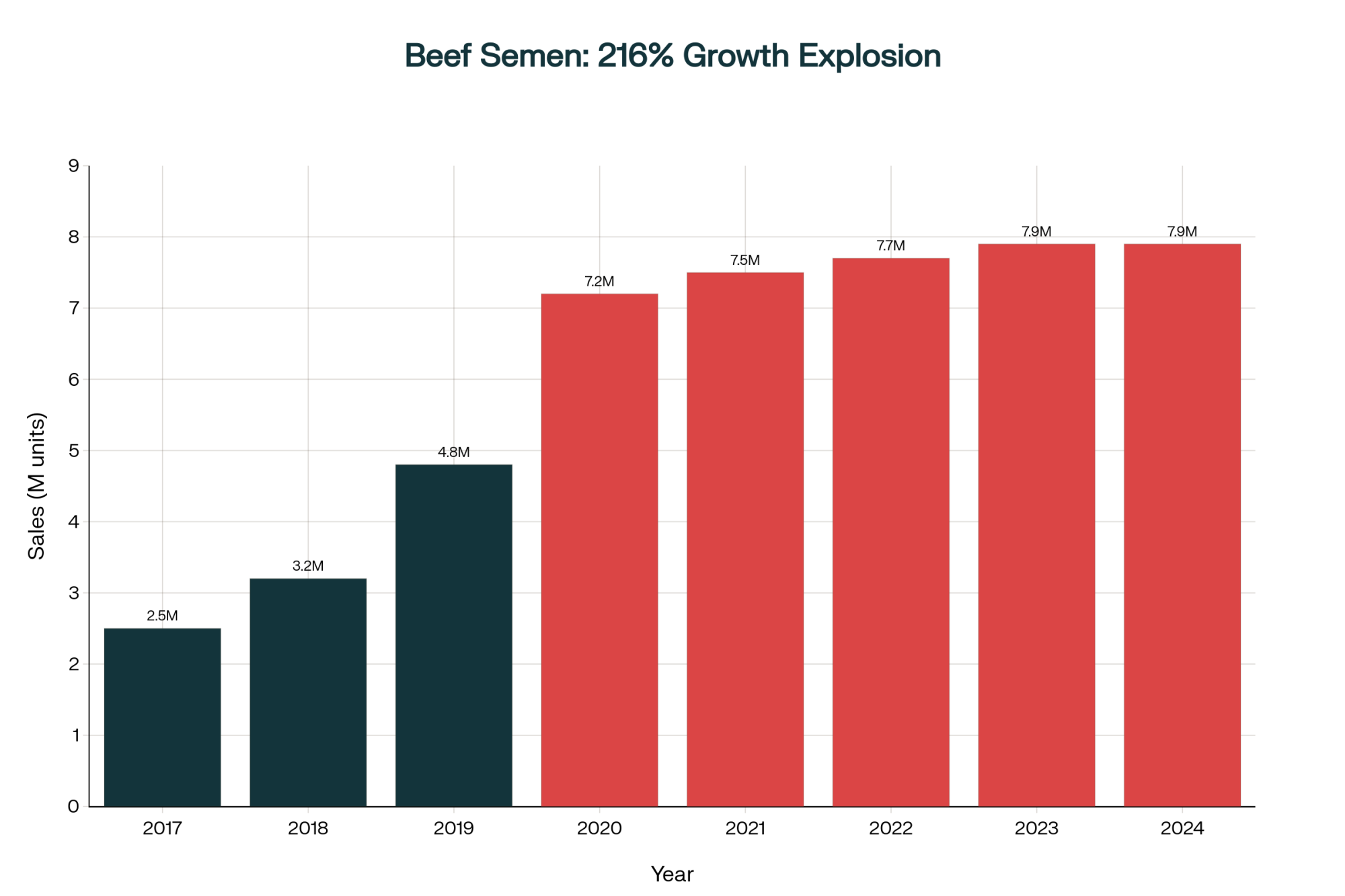
NewsSubscribe
First
Last
Consent
Send this to a friend