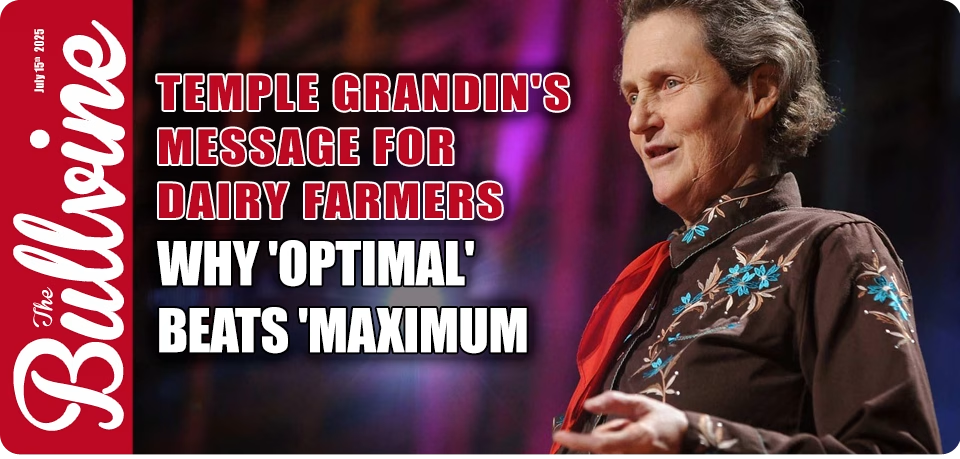





Her latest warnings on genetics and handling reveal the costly blind spots on modern dairies—and how to fix them.
A cow hesitates at the parlor entrance, her eyes locked on a shadow cast by a gate. An impatient worker slaps her flank, and in that instant, the morning’s profits begin to evaporate. Her heart rate spikes, adrenaline floods her system, and the flow of oxytocin, the hormone essential for milk let-down, is compromised. For the next 20 minutes, she won’t milk out completely, which will reduce her yield and increase her risk of mastitis.
To many, it’s a routine frustration. But to Dr. Temple Grandin, it’s a costly failure to see the world through the animal’s eyes. This failure, she argues, is the single most overlooked drain on dairy profitability today.
Today, at 78, Dr. Grandin stands as one of the most influential figures in animal welfare. This July, she will receive the 2025 AVMA Humane Award, a recognition that validates her urgent message about the future of livestock genetics and welfare. What others dismiss as stubbornness, Grandin recognizes as profound communication from an animal living in a sensory-based world, a world she, with her autistic mind that “thinks in photorealistic pictures,” understands intuitively. Her life’s work offers a revolutionary truth for dairy producers: understanding what your cows see is the first step to unlocking their full potential.
From Silence to Seeing: The Making of a Revolutionary Mind
The irony of Temple Grandin’s story is that the woman who would become the voice for the voiceless animals began her own life in silence. She didn’t speak until age four, a child written off by many as having limited potential. “I was the kind of kid that, you know, was thought could just go nowhere, not good at math,” she reflects.
However, what appeared to be a limitation was actually a liberation from the constraints of conventional thinking. While her peers learned to navigate the world through words and abstract concepts, Grandin’s mind developed along different pathways —visual, concrete, and startlingly perceptive to details that others missed entirely.
“I didn’t know that most other people think a lot more verbally,” she explains. “It wasn’t until my late 30s that I had any inkling that other people were much more verbal in their thinking”. This realization came as a shock to someone who had assumed everyone saw the world through the same lens of vivid, three-dimensional imagery that filled her mind.
It was this visual thinking that would prove to be her greatest asset when she entered the cattle industry in the early 1970s. While others approached animal behavior through human assumptions and verbal reasoning, Grandin instinctively understood that “animals live in a sensory-based world, not a word-based world”. She could see what the cattle saw, feel what they felt, and most importantly, design solutions that worked with their natural behaviors rather than against them.
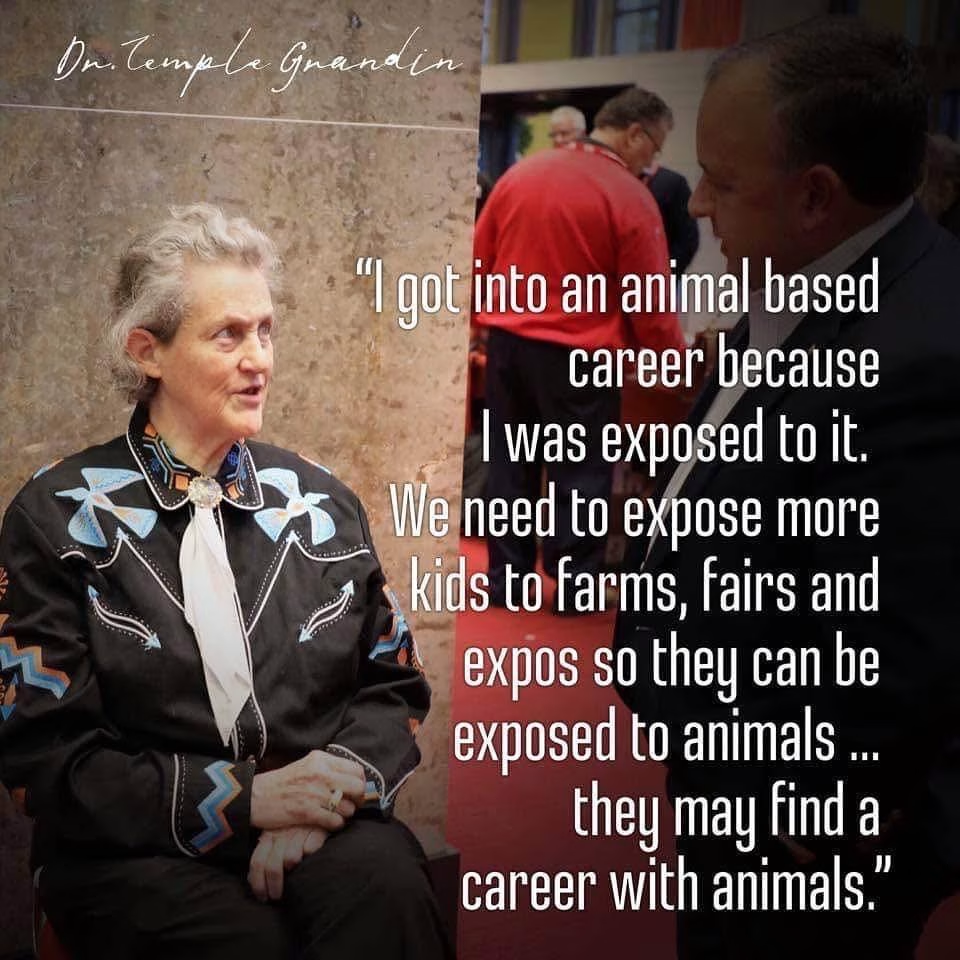
The Birth of a Movement: When Welfare Meets Economics
The transformation of American cattle handling didn’t happen overnight. It began with Grandin’s patient observation and meticulous documentation of what stressed cattle and what calmed them. Her early work in the 1990s, including groundbreaking research by her graduate student on cattle temperament, established a simple but revolutionary hypothesis: cattle that got upset in squeeze chutes would have lower weight gains.
In the research pens, Grandin observed agitated cattle, with eyes wide and bodies tense from restraint, their breathing rapid and shallow, consistently showing reduced performance compared to their calm counterparts. The data confirmed the hypothesis, laying the groundwork for a fundamental shift in how the industry approached animal handling.
“People back then denied animals’ emotions,” Grandin recalls. “I was not allowed to use the word ‘fear’ in my papers. I had to take that out”. The academic establishment’s resistance to acknowledging animal emotions seems almost quaint now, but it reflects the uphill battle Grandin faced in convincing an industry that welfare and profitability were not competing interests, but complementary ones.
The breakthrough came in 1999 when McDonald’s hired Grandin to develop an animal welfare auditing program for its suppliers. The initiative created a powerful economic incentive for change; failure to pass the audit meant being removed from the approved supplier list of one of the world’s largest beef buyers. The results were swift and dramatic. Within a year, stunning efficacy rose significantly, and handling practices improved across the board.
Crucially, this transformation required minimal capital investment; most facilities made simple, economical improvements, such as better equipment maintenance, non-slip flooring that provided cattle with confident footing, and improved lighting that eliminated the sharp shadows that had long terrified animals.
The Dairy Connection: Lessons That Transform Every Milking
While Grandin’s reputation was built primarily in the beef industry, her principles have found eager adoption among dairy farmers who recognize a fundamental truth: stressed cows are unproductive cows. The science connecting stress to production in dairy cattle is unequivocal and immediate.
“There’s a bunch of research on a lot of different kinds of animals that show that, on both old studies and new studies, if you yell at dairy cattle and slap them and hit them, they’re going to give less milk,” Grandin explains. “That gentle handling is important”.

Research demonstrates that this gentle handling can increase milk production by 3.5% to 13% compared to rough treatment. But the economic implications extend far beyond a single milking. Chronic stress compromises immune function, leading to higher rates of mastitis and elevated somatic cell counts, which directly impact milk quality premiums and can result in thousands of dollars in lost revenue for dairy operations.
| Stressor at milking | Biological effect | Immediate loss |
| Shouting, slapping, tail-twisting | Adrenaline surge blocks oxytocin | 3.5 – 13% less milk per cow per milking |
| Slippery floors & dark shadows | Hesitation, elevated heart rate | Slower parlor flow, higher mastitis risk |
| Over-crowded holding pens | Heat & social stress | ↑ Somatic cells, ↓ yield |
| Rehandling frightened heifers <20 min | Heart rate still elevated | Poor let-down; equipment “over-milks” |
Perhaps most significantly for dairy operations, Grandin has documented how lameness alone costs producers approximately 800 pounds of milk per lactation. Yet studies consistently show that dairy farmers underestimate lameness in their herds by more than 50%. “They get so used to seeing the mildly lame cows, they don’t see them,” Grandin observes. “But you actually measure them with one of the lameness scoring cards… This is what I call ‘bad becoming normal'”.
The Dangerous Drift: When “Bad Becomes Normal”
The phrase “bad becoming normal” is a warning bell for an insidious process where gradual deterioration goes unnoticed. To understand the real-world cost, consider a farmer—let’s call him Mike—for whom the concept became devastatingly real.
Picture Mike’s 340-cow operation, a source of pride for twenty-three years. Walking through his barn on a typical morning, he noticed his usual routine, checking feed bunks, observing the cows, and mentally noting their condition. Everything seemed normal. The same cows he’d seen yesterday, the same familiar sight of a few animals shifting weight from foot to foot, the same handful with slightly shortened strides.
Then his veterinarian arrived for a routine herd health visit, clipboard in hand, armed with a lameness scoring card that Grandin had helped develop. For the next hour, Mike watched in growing dismay as his vet methodically scored each cow’s locomotion, marking down numbers that painted a picture Mike had somehow missed entirely.
“Thirty-eight percent,” the vet announced, looking up from his calculations. “You’ve got thirty-eight percent of your milking herd showing some degree of lameness.”
Mike felt his stomach drop. He had estimated maybe 12%, perhaps 15% on a bad day. The numbers didn’t lie; he had become so accustomed to seeing mildly lame cows that he had stopped seeing them as a problem requiring urgent attention. Each month, the baseline had shifted imperceptibly. A cow favoring her left rear foot became just “Cow 247.” A heifer with a shortened stride became part of the landscape.

The economic reality hit him like cold water. At 800 pounds of lost milk per lactation for each lame cow, Mike was looking at catastrophic losses that had crept up so slowly he had absorbed them as simply “the cost of doing business.” The sight of cows in pain had become white noise in his daily routine, a dangerous blind spot that was quietly devastating both animal welfare and farm profitability.
“This is what I call ‘bad becoming normal,'” Mike’s vet explained, echoing Grandin’s warning. “They get so used to seeing the mildly lame cows, they don’t see them”.
Meanwhile, the hidden costs accumulate: reduced milk yield from affected cows, increased veterinary bills, higher culling rates, and compromised reproductive performance. What started as a minor welfare issue becomes a major economic drain, but because the change occurred gradually, it’s absorbed as simply “the cost of doing business.”
“You can also get problems with handling, where, okay, you take your employees out and do a big workshop on low-stress handling,” Grandin explains. “And then if you don’t measure your handling, yelling and screaming and hitting and tail twisting can come back slowly, and the handling can deteriorate slowly, and people don’t realize it”.
The solution, Grandin insists, lies in objective measurement. “You manage what you measure,” she says, advocating for simple, visual scoring systems that can be accessed on a smartphone. “Get the body condition score chart on your phone. And as you walk down through the cows, you can tick off the skinny ones, the non-compliant ones… if you put the scorecard away, then your eye drifts”.
The Genetic Crossroads: When Maximum Becomes the Enemy of Optimal
At 78, Grandin’s passion burns brightest when discussing what she sees as the industry’s most pressing challenge: the dangerous pursuit of maximum production. This reality of “biological system overload” crystallizes for many producers during the breeding season. Take the example of a farmer we’ll call Sarah.
Standing in her maternity barn at dawn, you can picture her watching as her best-producing cow, a towering Holstein that had peaked at 95 pounds of milk per day, failed once again to settle after her seventh artificial insemination attempt. The cow’s massive frame, bred for maximum production, seemed to work against every natural process beyond milk synthesis.
Sarah ran her hand along the cow’s protruding hip bones, feeling the sharp angles of an animal pushed to its biological limits. At $3,800 invested in raising this replacement from birth to first calving, watching her struggle with conception felt like watching money evaporate with each passing heat cycle. The cow’s udder swayed heavily beneath her, an impressive feat of genetic engineering that came at the cost of reproductive efficiency.
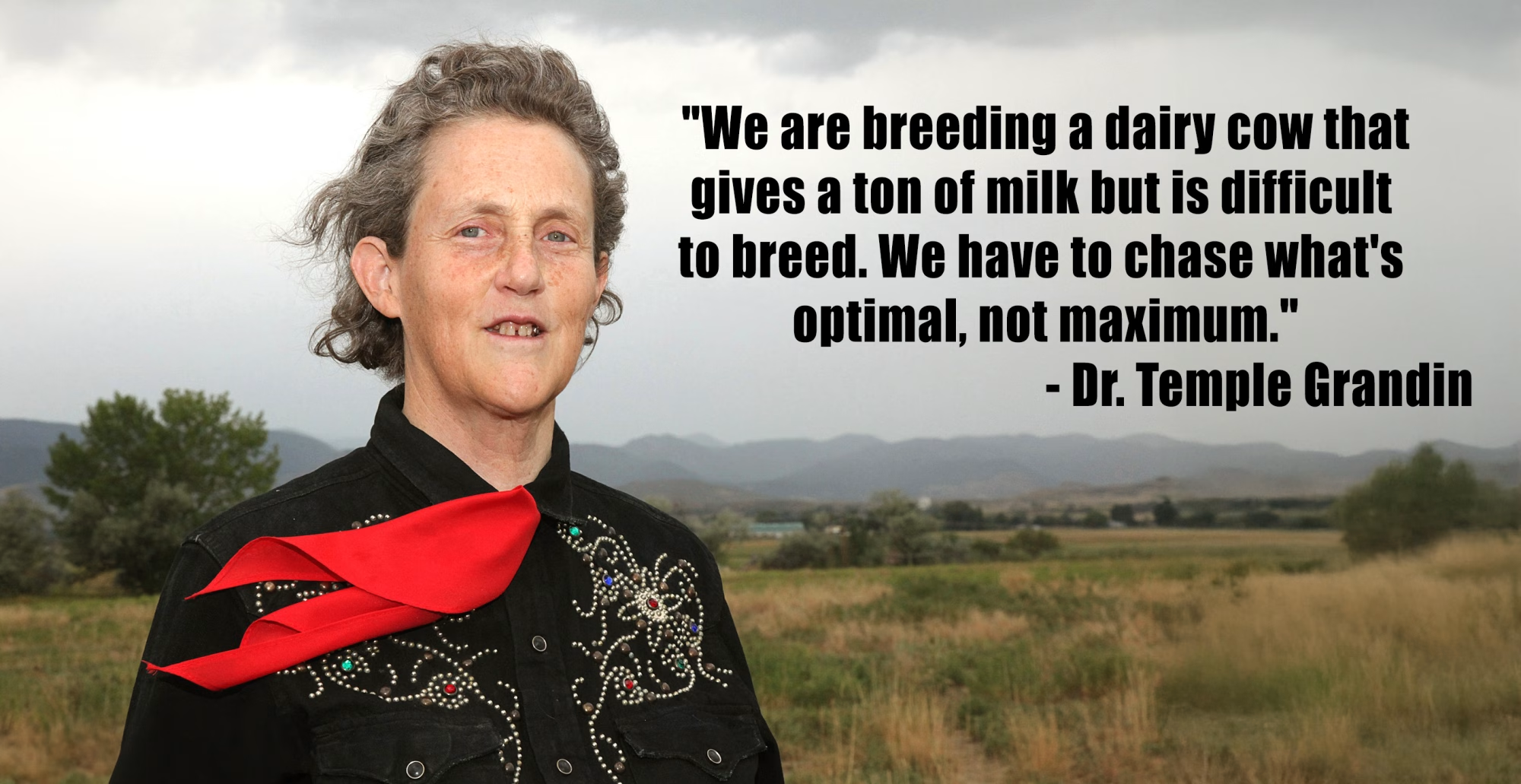
“We have a dairy cow now that’s giving a ton of milk, but she’s difficult to breed,” Grandin explains. “There are always tradeoffs. We have to start looking at what’s optimal, not maximum”. Sarah had learned this lesson the hard way, watching as her most genetically “superior” animals became reproductive disasters, requiring hormone treatments, multiple breeding attempts, and increasingly expensive veterinary interventions.
In her breeding records that morning, Sarah could trace the problem: cow after cow with impressive production figures but conception rates that would have horrified her grandfather. These animals, bred relentlessly for a single trait, had become biological contradictions, productive yet unsustainable, impressive yet fragile.
The Evidence from Modern Dairy Herds
In modern dairy barns across America, the evidence is increasingly visible. Cows tower so tall that they barely fit through standard doorways designed for smaller animals. Their massive frames strain aging facilities, forcing producers to choose between expensive renovations and continued use of inadequate housing. Some operations now use cows for only two years of lactation, despite the fact that “it takes you two years to turn a calf into a cow”.
The math doesn’t add up, a massive investment in raising a replacement that’s discarded just as she reaches peak productivity. At current replacement costs exceeding $3,000 per heifer, this shortened productive life represents a catastrophic loss of return on investment.
The parallel to crop production is striking: “The biggest, tallest corn is not necessarily the best because you have to put too many inputs into it”. The same genetic pressure that has created challenges in the dairy industry also drives the problems now emerging in beef cattle, where Grandin’s latest research has documented alarming increases in congestive heart failure and hoof abnormalities.
“The congestive heart failure used to be confined to very high altitudes… Where I’m at right now, we’re at 5,000 feet. Now it’s showing up in places that are at 2,000 feet”. These warnings from the beef sector serve as a canary in the coal mine for dairy genetics.
The Infrastructure Crisis
This genetic myopia has created new challenges for the industry. Cattle have grown so large that they no longer fit in existing barns and transportation systems. “Some of these very tall animals, whether they’re dairy cows or beef cattle, is when they come out of the bottom compartment of these trucks, they’re bashing their backs on the upper back as they unload, bruised all over their backs”.
The solution, Grandin argues, requires a fundamental shift in breeding philosophy. “We need to start looking at optimal milk production balanced against things like fertility and mastitis and other important things,” she says. “We tend to get into single-trait selection, blindly following the numbers, while we’re breeding a four-month-old heifer that’s got crossed toenails. And that’s a genetic defect”.
“It’s easier to breed a smaller cow that fits in the trailer, in the truck, too”, Grandin notes, pointing to the practical realities that genetic selection has ignored in favor of production metrics that may ultimately prove unsustainable.
The concept of “biological system overload” that Grandin has identified represents a critical inflection point for the dairy industry, a moment when the pursuit of maximum production threatens to undermine the very foundation of sustainable dairy farming.
The Missing Data Dilemma: What We Don’t Measure, We Can’t Improve
While the industry has become sophisticated at tracking milk yield and components, Dr. Grandin points to a critical blind spot: the traits that matter most for long-term sustainability often lack reliable data collection systems. “Breeding schemes for long-term animal, farm, and industry viability have components for which data is not yet captured, analyzed, and genetically evaluated,” she explains.
This data gap creates a dangerous disconnect between what farmers know matters and what genetic indexes actually measure. Three critical areas exemplify this challenge:
Reproductive Resilience Beyond Conception Rates: Current genetic evaluations capture whether a cow conceives, but overlook the nuanced factors that affect her long-term reproductive health, heat detection accuracy, embryonic survival, and the subtle hormonal imbalances that lead to “repeat breeders.” These factors, while obvious to experienced dairy farmers, remain largely invisible to genetic selection programs.
True Mobility and Structural Soundness: While the industry measures basic locomotion scores, it lacks comprehensive data on the factors that prevent lameness before it occurs. “We need better data on mobility without the expense of hoof trimming,” Grandin notes. The current system essentially waits for problems to manifest rather than selecting for the structural integrity and hoof quality that prevent issues entirely.
Feed Conversion Efficiency at the Individual Level: Perhaps most frustratingly for producers, feed represents 50-60% of production costs, yet accurate individual feed conversion data remains elusive in most commercial operations. Farmers instinctively know which cows are “easy keepers” versus those that require excessive inputs, but this knowledge rarely translates into genetic improvement programs.
“These are all disciplines farmers know are important, but are hard to get accurate data on,” Grandin observes. This creates a fundamental tension: the traits most critical for economic sustainability, reproductive longevity, structural soundness, and feed efficiency, receive less genetic emphasis than easily measured production traits.
The Beef-on-Dairy Revolution: When Success Creates New Challenges
One of the most significant developments in Grandin’s recent observations is the explosive growth of the beef-on-dairy trend, which has fundamentally altered the economics of dairy farming. “Over the last four or five years, beef on dairy has become very, very popular in the U.S., very popular, and they make really nice steers”.
The transformation has been remarkable. In dairy barns across America, farmers now carefully plan breeding strategies, using sexed semen to produce replacement heifers while dedicating the majority of their matings to beef sires. The economic impact has been substantial, turning previously worthless male calves into significant revenue streams that can add thousands of dollars to a dairy’s annual income.
But success has bred its own problems, illustrating once again the industry’s tendency toward extremes. We now have a shortage of fresh dairy cows because everyone has bred so many to beef that we don’t have enough replacement dairy cows. “They’ve gone overboard on the beef. It’s like a lot of things. You know, people go overboard”, Grandin explains.
The trend illustrates a recurring theme in Grandin’s work: the industry’s tendency to lurch from one extreme to another rather than finding sustainable balance. “People have a tendency to go too far on something. Then the pendulum swings back, but sometimes the ‘too far’ gets kind of bad before they realize the pendulum needs to swing back”.
The Technology Paradox: When Innovation Meets Animal Instinct
As the dairy industry adopts precision agriculture and robotic systems, Grandin provides crucial insights into the role of technology in modern farming. Rather than opposing innovation, she advocates for designs that work with, rather than against, natural animal behavior.
Consider the modern robotic milking system, a marvel of engineering that promises 24/7 operation and reduced labor costs. But as Grandin points out, the robot’s success depends entirely on whether cows willingly approach it. Suppose the pathway includes the same visual distractions that have stressed cattle for millennia, such as shadows dancing across the floor, reflections from puddles, or sudden movements in their peripheral vision. In that case, even the most sophisticated robot will fail to reach its full potential.
“Again, it’s not automatic management,” she emphasizes, referring to robotic milking systems. “It doesn’t solve the problem because it’ll tell you whether a cow is in heat or whether she’s sick. You’ve got to bring the cattle in, temp them, and check them for mastitis. You still have to bring them in”.
The key to successful technology implementation lies in the same principles that govern traditional handling. Cows must be trained to use robotic systems through positive reinforcement, what Grandin calls “cow candy.” “You don’t have to feed them very much. Just a few… you could feed them a coffee cup of feed and get them in the parlor”.
Her experience with artificial intelligence in slaughterhouse monitoring offers similar insights. While AI can accurately identify obvious problems, such as the use of electric prods or animals falling, it struggles with more subtle assessments that require human judgment. “But on the other hand, I don’t think you should totally just use the AI program. You’ve always got to go back and calibrate it with some real people”.
The Human Element: Preserving Different Minds in a Digital Age
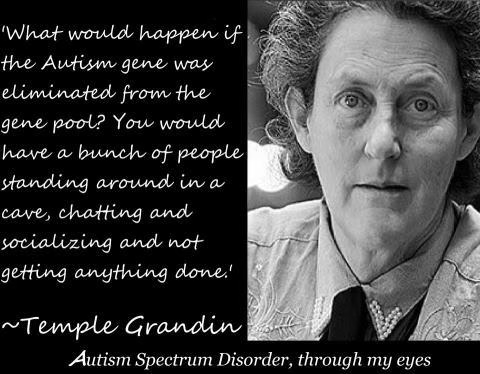
Perhaps no aspect of Grandin’s work is more personal or more urgent than her advocacy for neurodiversity in the agricultural sector. Having struggled with autism in an era when such differences were often seen as limitations, she’s deeply concerned about the industry’s loss of visual thinkers, the practical, hands-on minds that have historically driven innovation in farming.
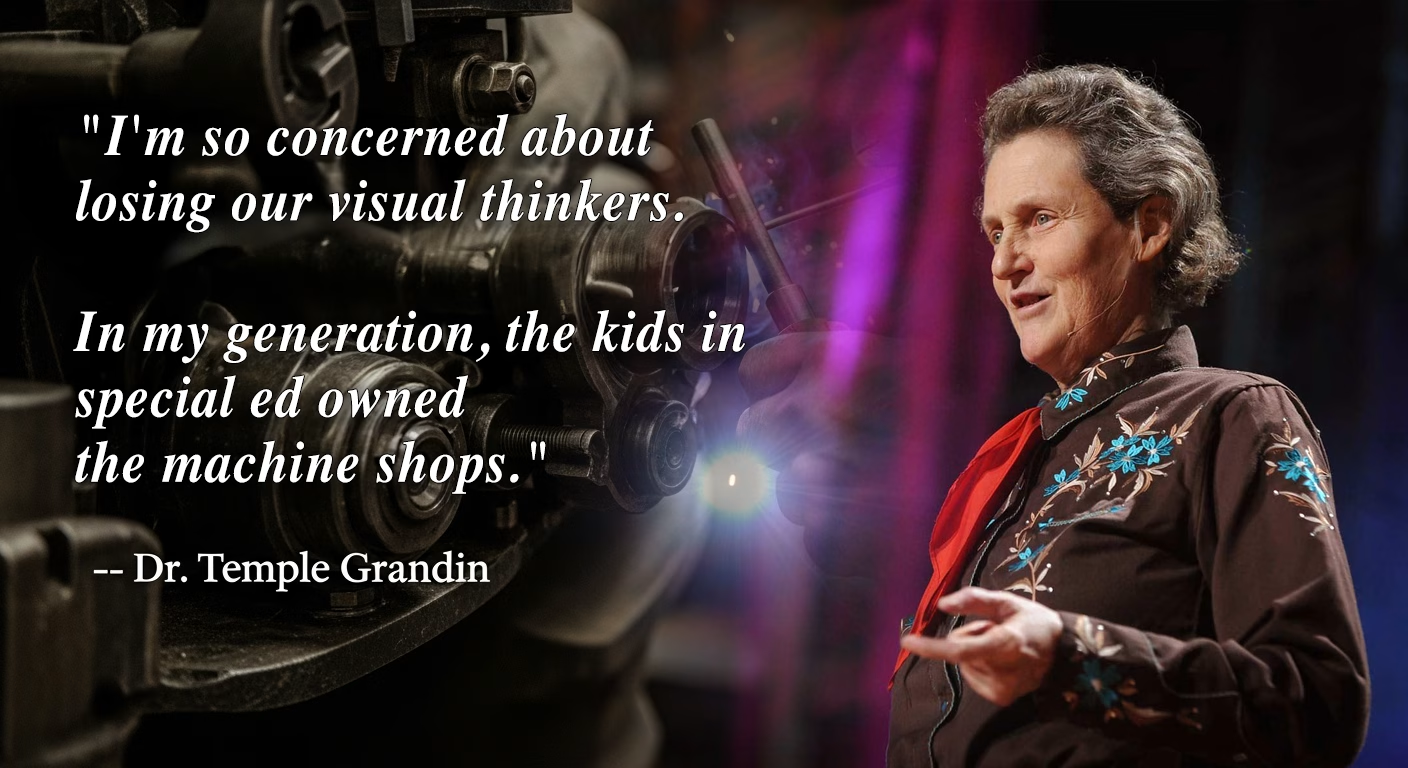
“I’m so concerned about losing some of our visual thinkers,” she says. “They’d be some of your best people working with the dairy cows”. These individuals, often dismissed by traditional education systems, possess an intuitive understanding of mechanical systems and animal behavior that can’t be taught from textbooks.
The crisis is real and immediate. Many of the skilled tradespeople who built the infrastructure of modern agriculture are retiring, and their knowledge is retiring with them. “The people I’ve worked with are all 50, 60, 70… I’ll be 78 this summer”. Meanwhile, educational systems increasingly push all students toward college tracks, often eliminating the shop classes where visual thinkers once found their calling.
“In my generation, special ed kids owned the machine shops,” Grandin says, not as a joke but as a statement of fact. These individuals, whom she met on large construction projects with companies like Cargill, were often autistic or dyslexic but excelled in practical fields where their different ways of thinking became assets rather than liabilities.
The Management Imperative: Leadership as the Foundation of Change
Throughout her decades of consulting and training, Grandin has observed that the most successful welfare improvements share one critical element: unwavering commitment from management. This leadership extends beyond policy statements to daily practices and long-term strategic decisions.
“Top management has to decide they’re going to stop it,” she says about addressing animal welfare problems. “If top management doesn’t get totally behind it, it doesn’t happen”.
This principle was dramatically illustrated at a recent consultation with a beef operation, where Grandin identified simple, low-cost improvements that could transform animal handling. The facility had solid steel infrastructure, which was not her preferred design, but it was functional. The changes she recommended required minimal investment: installing solid sides with plywood in two strategic locations to prevent cattle from seeing the squeeze chute operator, repositioning three pickup trucks parked directly in front of the facility, and most importantly, eliminating the yelling and screaming that had become normalized.
“The first thing we’ve got to do is to stop yelling and screaming at them,” she explains. “The research is clear that yelling and screaming really stresses cattle out”. Once cattle become fearful, “it takes 20 minutes for cattle to calm down if you get them all scared”.
For dairy operations, this leadership is evident in decisions regarding facilities, genetics, and daily handling practices. “Some producers have a really good reaction and they’ve backed off on some of the single-trait breeding,” Grandin notes. “Some people are realizing that that’s kind of folly, and they probably want to get four years out of her before you get rid of her”.
The Award and the Future: A Platform for Urgent Messages
The 2025 AVMA Humane Award represents more than recognition for past achievements; it provides Dr. Temple Grandin with a crucial platform to deliver her most urgent message about the future of livestock genetics and welfare. The award ceremony, scheduled for July 18-22 in Washington, D.C., will give her access to veterinarians and industry leaders who shape dairy practices across North America.
Her acceptance speech will likely focus on the concept she calls “biological system overload”, the idea that single-minded pursuit of production traits has pushed livestock to a physiological precipice. The evidence from beef cattle, where congestive heart failure and hoof abnormalities are increasing, serves as a warning to the dairy industry about the long-term consequences of genetic extremism.
“We have to start looking at optimal milk production balanced against things like fertility and mastitis and other important things,” Grandin argues. “We tend to get into single-trait selection, blindly following the numbers, while we’re breeding a four-month-old heifer that’s got crossed toenails. And that’s a genetic defect”.
The Continuing Mission: A Legacy Still Being Written
As our interview on July 4th, 2025, draws to a close, it’s clear that Dr. Temple Grandin’s work is far from finished. At 78, she continues to review scientific papers, train auditors, and advocate for the visual thinkers who built the infrastructure of modern agriculture. Her latest book, “Visual Thinking: The Hidden Gifts of People Who Think in Pictures, Patterns, and Abstractions,” represents her effort to preserve and celebrate the cognitive diversity that has driven innovation throughout human history.
The book, written in collaboration with Betsy, who “smoothed out” Grandin’s disorganized, rough drafts, exemplifies her philosophy: “different minds working together, cooperating together, and taking advantage of the different kinds of thinking.” It’s a lesson that extends far beyond individual collaboration to encompass the entire agricultural industry.
“We need the different kinds of thinkers in just building something like a milk processing plant,” Grandin explains. “You have the visual thinkers who do all the mechanical equipment, but you’ve got to have mathematics for refrigeration”. The future of agriculture depends not on choosing between different types of intelligence, but on integrating them.
Her message to the dairy industry is both simple and profound: success comes not from pushing animals or people to their absolute limits, but from finding the optimal balance that allows both to thrive. “We need to start looking at what’s optimal, not maximum,” she says. It’s a philosophy born from a lifetime of seeing the world through different eyes, eyes that have revolutionized how we understand and care for the animals that sustain us.
When asked what still drives her after more than five decades in the industry, Grandin’s response reveals the passion that has fueled her remarkable journey: “The handling has gotten 1,000% better, dairy cattle and beef cattle both. Handling has really gotten better”. However, challenges remain, and her work continues because new problems threaten the progress she has helped achieve.
The woman who began her career unable to speak until age four has become one of the most influential voices in modern agriculture. Her legacy lies not just in the facilities she has designed or the standards she has established, but in the fundamental shift in thinking she has inspired, a recognition that seeing the world through different eyes, whether human or animal, is not a limitation but a gift that can transform entire industries.
As Dr. Temple Grandin prepares to accept the 2025 AVMA Humane Award, her message to the dairy industry is clear: the future belongs to those who can see what others miss, measure what others ignore, and find the optimal balance that has always eluded those who chase maximum at any cost. In a world increasingly dominated by artificial intelligence and automation, she reminds us that the most valuable intelligence is often the most overlooked, the visual, practical, intuitive understanding that has always been the foundation of good farming.
The coat on the fence post still casts its shadow, but now, thanks to Dr. Temple Grandin’s pioneering work, we know why it matters, and more importantly, we know what to do about it.
KEY TAKEAWAYS
- Stop the profit bleed from “invisible” lameness – Producers underestimate herd lameness by 50%+, but each lame cow costs 800 lbs of milk per lactation. Start weekly scoring with smartphone apps instead of monthly visual checks to catch issues before they destroy your milk income.
- Beef-on-dairy goldmine has a dark side – While crossbred calves are worth serious money in 2025 markets, farms are creating replacement shortages by going overboard. Calculate your actual replacement needs before breeding another cow to Angus, or you’ll be buying $3,800 heifers instead of raising your own.
- Gentle handling = instant ROI boost – Research shows calm cows produce 3.5-13% more milk than stressed animals. Train staff to eliminate yelling/hitting, fix shadows in parlor approaches, and watch your tank readings climb without spending a dime on new equipment.
- “Optimal beats maximum” in 2025 economics – Those 95-pound-per-day cows that fail to breed after seven services? They’re poster children for genetic extremism. Focus on breeding for 4+ lactation longevity instead of peak yield, because replacement costs are eroding margins faster than production records can save them.
- Measure or lose money – Grandin’s “bad becoming normal” concept explains why problems creep up unnoticed. Use objective scoring tools for lameness, body condition, and handling stress on a weekly basis – if you can’t measure it, you can’t manage it, and you’re likely losing money on it.
Quick-Reference Checklist
| Discipline | Monthly goal | Metric |
|---|---|---|
| Handling calmness | ≤5% cows vocalize in parlor | Video audit |
| Lameness prevalence | <10% scores ≥ 2 | Locomotion app |
| Replacement sufficiency | 115% of 24-mo needs on farm | Heifer inventory |
| Cow longevity | ≥4.0 avg lactations | DC305 or DairyComp |
EXECUTIVE SUMMARY
Look, I’ve been covering dairy for years, but Temple Grandin’s story still gives me chills. Here’s a woman who couldn’t speak until the age of four, and now she’s designed over half of the cattle facilities in America… that’s the kind of turnaround that makes you believe anything’s possible. Her biggest message to dairy farmers right now? We’re chasing “maximum” production when we should be shooting for “optimal” – and it’s quietly bankrupting operations across the country. The numbers don’t lie: gentle handling alone bumps milk production 3.5-13%, while every lame cow costs you 800 pounds per lactation. She’s watching the beef industry crash into “biological system overload” with heart failure and hoof problems, and she’s warning us we’re headed down the same path. When someone who’s spent 50+ years reading cattle behavior tells you to pump the brakes on single-trait selection, you listen. Trust me, after reading her latest insights on the direction of dairy genetics, you’ll want to take a hard look at your breeding decisions.
Learn More:
- Lameness In Dairy Cattle: Early Detection Is The Key To Prevention – This piece provides tactical, on-farm methods for early lameness detection. It demonstrates how to spot subtle signs before they become costly problems, directly addressing Dr. Grandin’s warning about ‘bad becoming normal’ and protecting your milk check.
- Beef on Dairy: A Trend That Is Here To Stay – Go beyond the operational ‘how’ and understand the strategic ‘why’ of the beef-on-dairy trend. This article analyzes the market forces and economic models driving the movement, helping you optimize your long-term breeding and replacement strategy.
- Precision Dairy Technologies: The Future of Herd Health Management – Dr. Grandin highlights the ‘missing data dilemma,’ and this article reveals the solution. It explores emerging precision technologies that provide the objective data needed for superior health and fertility management, turning measurement into profit.
 The Sunday Read Dairy Professionals Don’t Skip.
 The Sunday Read Dairy Professionals Don’t Skip.
Every week, thousands of producers, breeders, and industry insiders open Bullvine Weekly for genetics insights, market shifts, and profit strategies they won’t find anywhere else. One email. Five minutes. Smarter decisions all week.