Archive for Dairy Markets – Page 35

Global dairy market outlook 2021

As we approach the peak production period in the northern hemisphere, it’s worth taking stock of dairy market developments in the key supply and demand regions. Looking at the milk production and product stock situation, in combination with demand expectations, can provide an early view on likely pricing developments through the year.

Milk production

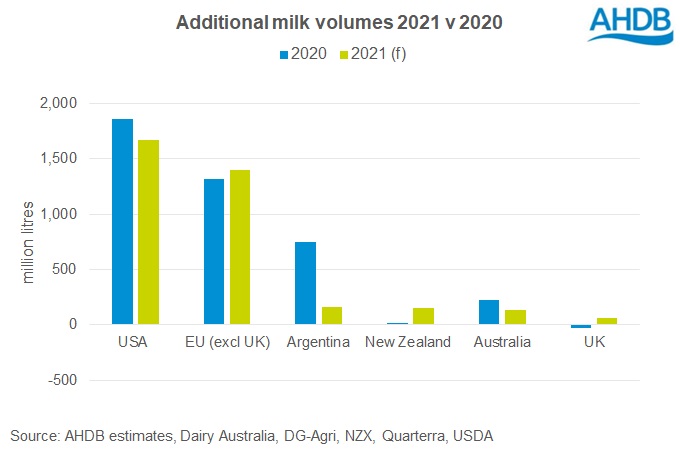
At a global level, forecasts suggest limited growth in milk production across the key surplus regions. In total, supplies are expected to increase by just over 1% in 2021, compared to the 1.4% growth recorded in 2020[1]. The lion’s share of this extra milk is expected to come from the US and the EU[2]. However, rising feed costs in both of these regions could put farmer margins under pressure and restrict supply growth in the second half of the year.

New Zealand (NZ) dairy farmers are reported to be in a good position going into the new season, with a profitable price forecast and strong demand for their product leading to good supply growth. Beyond any adverse weather events, the largest risk to this will be a slowdown in Chinese import demand.

Demand

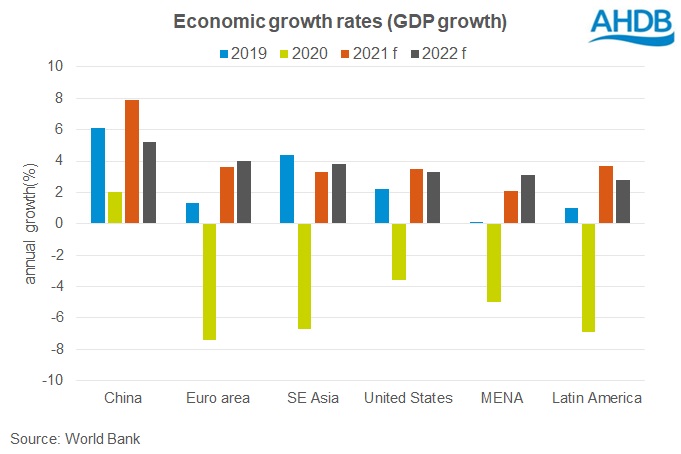
Demand for dairy has remained strong through 2020 and will continue to be the key driver in dairy markets through 2021. Economic growth around the world is improving, and foodservice demand returning.

Recent projections from the World Bank suggests global growth of 4% in 2021, following a contraction of 4.3% in 2020.

Economic recovery will vary by country, although forecasted income growth looks set to remain strong in China, maintaining robust import demand. In addition, rising foodservice sales, high domestic milk prices and government messaging around the health benefits of milk are expected to keep China’s import demand strong through 2021.  There is some risk that import demand could weaken in the latter part of the year, particularly if prices continue to increase or stocks build too high.

In both US and EU markets, the return of domestic foodservice demand will be important in maintaining profitable price levels. In these markets, the expectation is that sales will begin to recover through 2021 as vaccination programmes roll out. However, sales are not expected to reach pre-Covid levels by the end of the year. Industry estimates[3] suggest that sales will still be 22% and 27% lower than 2019 levels by Q4 2021 in the US and EU respectively.

Product availability

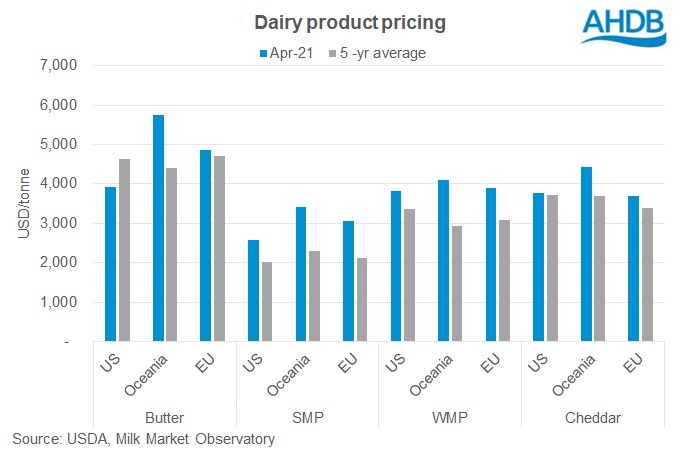
Recent price trends on global markets are positive across all dairy products. In most cases, current pricing is at or above the 5-year average, with the exception of butter in the US.  This is a positive in terms of supporting farmgate pricing, although the level of support will be subject to how product availability develops relative to demand.

The US has relatively high stocks for both butter and cheese, while SMP stocks are only slightly higher year on year. However, this is not expected to put undue pressure on global pricing while shipping costs remain high, and availability of containers is limited.  Strong domestic demand for butter and cheese, resulting from government buying and restocking in the foodservice sector, is helping to keep US prices from falling.

Meanwhile, EU stocks are reported to be well balanced for cheese and butter, but low for SMP. A year of strong exports and lower product production has kept stocks from building up. Higher domestic demand, and limited milk supply growth, is expected to constrain the EU’s exportable supplies in 2021, which should support prices on global markets.

Although there is no data on stocks for NZ, strong exports to China in recent months suggest tight supplies. With limited growth in milk supplies expected in the 2021/22 season, the risk of excessive stock build up is low.

Farmgate prices

Overall, indications are positive for market returns in the short term, which should support farmgate prices. There are some risks to markets later in the year which could put some downward pressure on prices. Lower Chinese import demand, increased availability of US products on global markets, or a delay in the return of foodservice demand, could all limit further positive price movements.

The question that remains is whether farmgate prices can achieve sufficient increases to compensate for rising operating costs.

Source: ahdb.org.uk

Milk Futures Continue Higher Tuesday in Chicago

On the Chicago Mercantile Exchange milk futures continued higher Tuesday supported by somewhat stronger cheese trade ahead of USDA’s supply and demand report Wednesday.Class III Milk saw May gain 3 cents to 18.89, June jumped 18 to 19.00 even, and July gained 19 cents to 19.39/cwt. The second half of 2021 was unchanged to 19 higher and is averaging at 19.18/cwt. Class IV was unchanged in May at 16.07, June gained 9 cents to 16.84. and July was unchanged at 17.13/cwt. The second half of 2021 was unchanged.

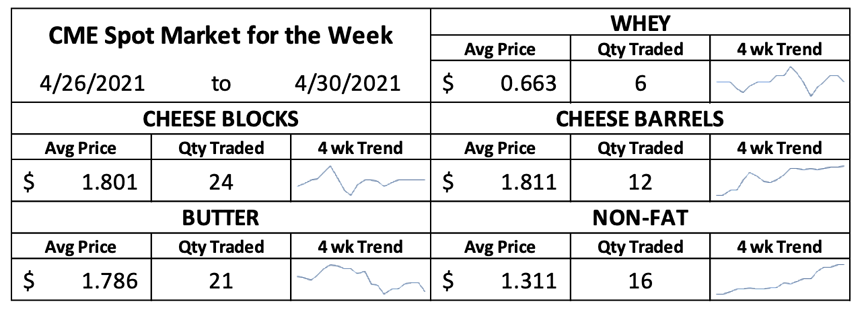
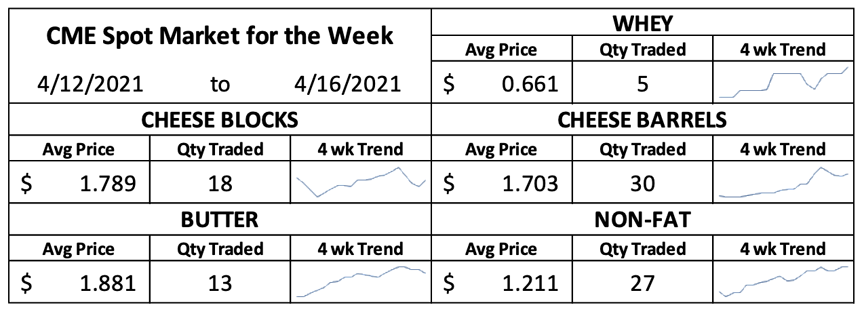
Butter woke up and drove the spot dairy trade on Tuesday. Butter up $0.03 at $1.8125. Three trades were made at $1.80 to $1.8125. Blocks up $0.0025 at $1.77. Five trades were made from $1.75 to $1.7750. Dry whey unchanged at $0.6275. One sale was made at that price. Nonfat dry milk unchanged at $1.3225. Barrels down $0.0050 at $1.69. Five trades were made from $1.6750 to $1.70.

Grain markets moved higher ahead of Wednesday’s World Supply and Demand report from the USDA. July corn gained 10 ½ cents to 7.22 ¼, July Soybeans gained 27 ¼ to $16.14 ¾ with Soybean meal gaining $4.70 to $447/ton.

Fonterra releases milk price for 2021-22 and spruiks new pricing structure

Fonterra Australia has come out of the gates with a $6.55/kg MS price for the upcoming season.

The diary giant announced its weighted average farmgate milk price on Monday and estimated a closing price range of $6.55 to $6.95/kg MS for the 2021-22 season.

The strong price and early announcement is down to good market conditions and strong business performance, according to managing director Rene Dedoncker.

“Some of our domestic and export contracts are due to be settled later this month, so we will review this price when these are finalised and to ensure we remain competitive, as we will, in line with market and business performance throughout the season,” he said.

Mr Dedoncker said Fonterra was also working with farmer representative body the Fonterra Australia Suppliers’ Council on a new pricing structure for the upcoming season.

“Our new pricing allows farmers to farm the way that suits their needs with a choice of base rates to suit their milk curve, and also gets cash on farm as early as possible with changes to our incentive structure,” he said.

Bulla Dairy is the only other processor to announce its 2021-22 price so far, with a $6.40/kg MS to $6.90/kg MS opening range.

Source: dairynewsaustralia.com.au

Quiet markets to start the week in Chicago

On the Chicago Mercantile Exchange milk futures started the week mostly higher correcting some oversold positions follow last week’s slide.  Class III ranged on the close between 7 cents lower to 11 cents higher out through June of 2022.  Class IV prices were unchanged across the board.  Low volumes were again seen in the market. 

On spot trade , dry whey unchanged at $0.6275.    Blocks up $0.02 at $1.7675.  Three trades were made from $1.75 to $1.7675.   Barrels down $0.0375 at $1.6950.  Six trades were made from $1.6850 to $1.71.  Butter up $0.0125 at $1.7825.  One trade was made at $1.7725.  Nonfat dry milk unchanged at $1.3225.  Two trades were made at that price. 

Milk Futures Fall as Grain Prices Set Contract Highs in Chicago Thursday

On the Chicago Mercantile Exchange milk futures traded lower as a run up in grain markets continues to pressure prices.  Class III milk futures crashed after the move lower in spot cheese.  May milk lost 28 cents to $18.87/cwt.  June milk finished limit down to $19.01/cwt.  July milk dropped 61 cents to $19.25/cwt.  Class IV milk settled lower on the day as well.

Cheese prices sliced back through its most recent gains in the CME Cash Dairy Product Trade.  Blocks down $0.0425 at $1.76.  Three trades were made from $1.76 to $1.7975.    Barrels down $0.07 at $1.7750.  One trade was made at $1.8225.  Butter up $0.0125 at $1.7475.  Four trades were made from $1.7350 to $1.75.  Nonfat dry milk down $0.0125 at $1.3450.  Five sales were made from $1.3450 to $1.35.  Dry whey unchanged at $0.6475.   

Grains exploded higher and set new contract highs once again.  December corn rocketed 20.75 cents higher to $6.2550/bushel.  November soybeans surged $14.09/bushel.  May soybean meal was up $3.40 to $427.70/ton.  May Chicago Wheat gained 8.50 cents to $7.6425/bushel.

Changes to milk pricing for producers, not consumers

The Nebraska State Dairy Association is the voice of Nebraska Dairy Farmers. The NSDA is working to promote growth, success and sustainability for the dairy industry in Nebraska.

“Farmers only have limited options to sell their milk in Nebraska. The demand for fluid milk processing or raw milk processing has never been higher than it is today,” said Kris Bousquet Executive Director of Nebraska State Dairy Association.

Dairy farmer groups are proposing Class III Plus for better milk pricing plans. Compared to other dairy industries, dairy farmers are not compensated equally.

“If this proposal is adopted, it will affect the entire country. The entire United States will follow this Class III Plus pricing structure. It would provide stability for not just Nebraska farmers but farmers all across the United States,” said Bousquet.

Class III Plus aims to build on the current pricing system. Recent proposals by dairy cooperatives and dairy farmer petitions are calling for a better Class I pricing system. The Class III Plus proposal would connect the Class I (fluid) skim milk price to the Class III (cheese) milk price plus an adjuster and do away with advanced pricing.

“The problem really kind of aspirated some issues where our farmers weren’t able to utilize some of the federal programs,” said Bousquet.

Last year, advanced pricing caused a negative producer price differential (PPD). This new proposal is more equitable among farmers, processors and customers. Class III Plus also creates stability for farmers, including protection from PPD and better risk management ability.

“You can either go out there and get revenue back for farmers that lost money, or you can make the changes for the industry and balance everything so everyone benefits in the future,” said Bousquet.

Class III Plus does not increase prices to the customers. In stores, milk pricing is decided by the margins of processors. Proposal changes are not increasing the price of production but balancing things out.

Source: knopnews2.com

Cheese Trade Drives Milk Markets Higher In Chicago Wednesday

On the Chicago Mercantile Exchange milk futures traded mixed to mostly higher at midweek with positive moves seen in cash cheese trade. Class III Milk had May up 8 cents to 19.15, June fell 2 to 19.76 and July gained 2 cents to 19.86/cwt. Class IV milk was quiet nearby, but 2022 jumped higher. May slid 1 cent to 16.20, June and July were unchanged at 16.99, and 17.31. January of 2022 gained 20 cents to 17.75 and Feb and March also moved to 17.75/cwt.

Dairy markets were stable as the CME spot trade saw Dry whey up $0.0025 at $0.6475.  Two sales were made at $0.6450 and $0.6475.  Blocks up $0.0025 at $1.8025.  Five trades were made at $1.80 and $1.8025.  Barrels up $0.0250 at $1.8450.  Seven sales were made from $1.8250 to $1.8450. Butter down $0.01 at $1.7350.  Nine trades were made from $1.7350 to $1.7425. Nonfat dry milk up $0.0175 at $1.3575.  Ten sales were made at $1.3575 and $1.36.

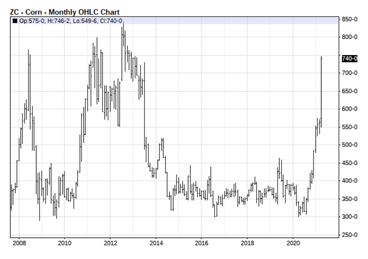
Feed costs will continue to pressure dairy Margins. Wednesday had December corn break through $6 for new crop and July pushed through $7.  Corn finished the day with July up 11 ¾ cents to $7.08 ½. December corn at 6.04 3/4 /bu. These values have not been seen since September of 2013. Soybean meal gained 2.90 to $424.40/ton as Soybeans gained 4 cents in July to 15.42 ¼, and November gained 19 ½ cents to 13.82 ¾ /bu.

Flush is in Full Swing and Milk is Plentiful

The T.C. Jacoby Weekly Market Report Week Ending April 30, 2021

The bulls continued their leisurely stroll through the dairy pits this week and the milk markets moved higher.

The bulls continued their leisurely stroll through the dairy pits this week and the milk markets moved higher. Class III futures posted sizeable gains. Summer contracts added a half-dollar or more, which lifted them well above $19 per cwt. June through October Class IV contracts added 30ȼ to 40ȼ. May Class IV settled at $16.21, and the other contracts all topped $17, a welcome sight for dairy producers who don’t get the full benefit of the sky-high Class III market.

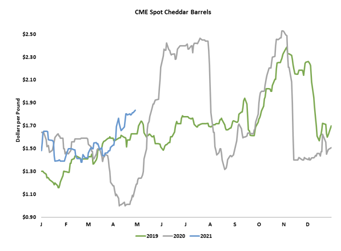
It’s been a big month for barrels. They closed today at $1.835 per pound, up 3ȼ since last Friday and up an impressive 35.25ȼ since the end of March. CME spot Cheddar blocks added a more modest 0.75ȼ this week and were up 6.25ȼ for the month. Cheesemakers tell USDA’s Dairy Market News that sales have plateaued, as restaurants have largely restocked.

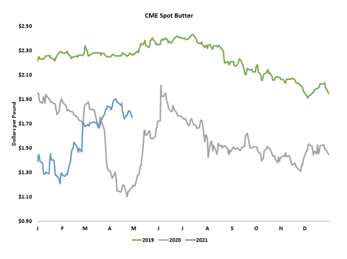
Butter sales are starting to slip. Dairy Market News notes that foodservice orders have ebbed and retail requests are “lackluster.” Uninspiring demand dragged prices lower. CME spot butter fell 1.75ȼ this week to $1.7525. Butter closed out the month 6.5ȼ lower than where it began.

Cream is plentiful in the West, and churns there are running hard, as befits the season. Supplies are tighter in the Midwest and the Northeast, and the shortage of trucks and drivers has exacerbated the regional imbalance. Logistical headaches are rippling through the dairy supply chain, preventing milk and cream from flowing smoothly to its most profitable outlet.

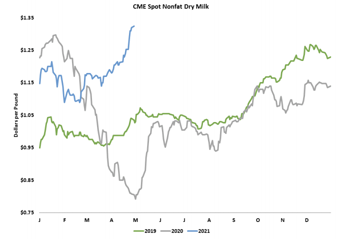
The powders remain strong. CME spot dry whey finished the month right where it started, at 66ȼ per pound. That was up 4ȼ from last Friday. Spot nonfat dry milk (NDM) jumped 7.25ȼ to $1.325, the highest spot value since October 2014. Thanks to strong foreign demand, spot NDM rallied 14ȼ this month, a 12% increase. U.S. milk powder is priced to move, and Mexico is finally stepping up purchases. Europe has very little SMP available for sale, and most milk powder in Australia and New Zealand is already committed to buyers in Southeast Asia. That leaves the United States and South America to capture new orders.

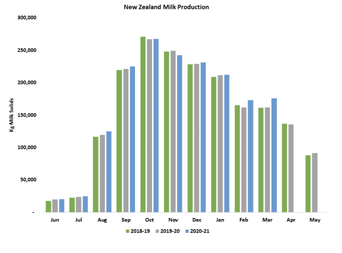
Milk output was very strong in New Zealand in March. Collections jumped 9.8% from the prior year, bringing season-to-date collections to the highest June to March tally on record, up 2.1% from last year. Timely rains in February and early March promoted grass growth and lifted milk output last month. But the rains have slowed, which could make for slower growth in the final two months of the 2020- 21 season.

In Australia, milk output improved in February but faltered in March. For the season to date, Aussie milk collections are 1% greater than the very low volumes of last year. After several years of drought, Australian dairy producers are grateful for much greener pastures. But they face new hurdles. The island has been extremely isolated. That’s kept the pandemic largely at bay, but it’s also reduced the labor pool, and many producers can’t find enough help. Now that Australia and New Zealand have agreed to merge their travel bubbles, Australia is seeking farmworkers in New Zealand, promising airfare and good wages. In response, kiwi producers are stepping up efforts to retain experienced farmhands.

In the United States, the flush is in full swing and milk is plentiful. The weak dollar and tight global inventories for milk powder are helping to lift Class IV values despite domestic abundance and all the headaches of global trade.

The corn market just keeps climbing. May corn futures jumped 38ȼ today as traders who were caught short rushed to buy back their positions before they were obligated to deliver corn to Chicago. May corn settled at a sevenyear high of $7.40 per bushel, up more than $1.75 this month. July corn closed at $6.7325, up 41ȼ this week. The U.S. has

exported huge volumes of corn and there is no sign of a slowdown. Brazil’s corn crop is withering and there is little rain in the forecast. In the Corn Belt, planters are rolling. Farmers and feed-buyers are hoping for big yields, but there is a lot of weather between now and harvest.
Soybeans followed corn higher. July soybeans closed at $15.3425, up 18.25ȼ from last Friday. July soybean meal closed at $426.10 per ton, up 30ȼ. Feed costs are rising quickly.

Source: Jacoby

Global Dairy Commodity Update May 2021

The explosion in the global COVID caseload as some governments continue to favour “economy over care” shows there is yet a long and complex road out of the pandemic, despite the rapid progress on inoculations in some rich developed countries.

While control of infections in some major countries is in sight, a lengthy timeline before life as we knew it is realistic, while the effects of the complex macro-impacts caused by massive stimulus will have lasting effects. Meanwhile there will be a slow return to pre-COVID economic conditions for developing Africa, South Asia and Latin America.

Global trade improved from the dip in February 2021 compared with the same month in 2020. As usual, some large distortions continue to affect the numbers, the most significant being the aftereffects of Brexit.

Fundamentals of dairy markets have improved with the further slowing of global milk output, as the EU takes longer to crawl out of winter, tightening SMP and butterfat availability. Feed challenges will affect milk growth into H2-2021 and could be far worse if there’s a hot summer.

While US milk collections remain strong and stocks heavy, the glut of milk will gradually shrink as producers respond to poor margins, while improving demand for cheese and butterfat will come as foodservice outlets re-open. Dry conditions in several other regions – Brazil, Mexico and lately the UK – will also help slow milk output.

The Chinese demand has heavily influenced price discovery to lift milk powders and butterfat prices. The recent prices have and will continue to meet buyer resistance and weaken fundamentals. Butterfat trade was significantly weaker with COVID’s impact on food service demand, but the recent spike in prices will test affordability as activity recovers. WMP demand outside China has also been significantly weaker at prices much lower than current values.

Source Maxum Foods

GDT index drops slightly in latest event

The Global Dairy Trade (GDT) index has recorded a slight drop to mark back-to-back decreases for the first time this year in its latest auction.

The most recent tender – event 283 – concluded today (Tuesday, May 4) with the GDT Price Index down 0.7%.

Lasting two hours and seven minutes, today’s event saw 148 participating bidders take part across 17 bidding rounds, with 108 winning bidders emerging.

A total of 22,020MT of product was sold on the day.

Key Results:

AMF index down 4.2%, average price US$5,730/MT;
Butter index down 12.1%, average price US$5,035/MT;
BMP index up 14.4%, average price US$4,222/MT;
Ched index down 4.5%, average price US$4,274/MT;
LAC index down 2.0%, average price US$1,236/MT;
SMP index up 2.0%, average price US$3,433/MT;
SWP not offered;
WMP index up 0.7%, average price US$4,115/MT.

The most dramatic move on the day was an increase – butter milk powder (BMP) elevated by 14.4% in index. There were index rises too for skim milk powder (SMP) and whole milk powder (WMP), with increases of 2% and 0.7% respectively.

On the flip side, butter took a heavy tumble in index, down 12.1%, while there were also drops for cheddar, anhydrous milk fat AMF) and lactose – 4.5%, 4.2% and 2% respectively.

Once again, sweet whey powder (SWP) was not offered at today’s event.

Image source: Global Dairy Trade

Today’s auction is the first time in a number of months – stretching back into 2020 – since there have been (albeit small) back-to-back decreases in index, following a strong showing from the overall index over the last six months.

The latest index figure of 1,290 is back by eight points on the last outing of 1,298.

Image source: Global Dairy Trade

Milk Markets Seesaw Tuesday in Chicago

On the Chicago Mercantile Exchange milk futures continued to seesaw Tuesday with little direction from global markets or cash trade. Class III milk prices ranged anywhere from even to 10 cents higher at the close following lower trade all day.  Class IV values traded anywhere from 5 cents lower to 5 cents higher. 

The CME spot product market traded in a mixed tone on Tuesday.  Dry whey down $0.0150 at $0.6450.  Blocks unchanged at $1.80.  Two trades were made at that price.  Barrels up $0.0075 at $1.82.  One sale was made at $1.8125. Butter down $0.0075 at $1.7450.  Nonfat dry milk up $0.02 at $1.34.  Six sales were made at $1.34 and $1.3350.

New Zealand dairy prices look steady

The Government has allowed for a two-year phase-out period for live cattle exports by sea to allow people time to adjust.

The Government’s ban of live animal exports by sea will mean a significant farm system change for those farmers supplying stock to export.

It will be an adjustment for those who relied on the practice for a significant portion of their income, as well as those who used it to sell any surplus heifers that were export quality, Federated Farmers animal welfare spokesperson Wayne Langford says.

He says the dollar value of these animals being exported was significantly higher than what they are worth if sold on the domestic market.

“Now they will have to adjust their systems with what they were doing,” Langford says.

The stock that was bound for export could now be sold at the sale yards and Langford says it would affect that market.

“I can’t see how this is not going to flood the market, and I would expect a downturn in dairy heifer prices,” he says.

“I’m yet to hear how this can be avoided and it will be interesting to see how farmers change their systems and how many animals are raised over the next few years.”

It was not just the farmers growing the cattle that would have to adjust. There was a wider support industry, including farmers who ran quarantine facilities for the cattle prior to shipment, stock agents and veterinarians.

“There’s everything that goes along with this process. It’s a $250 million business. We shouldn’t downplay how much that is.”

Langford says the announcement surprised him. 

Agriculture Minister Damien O’Connor says the decision would protect New Zealand’s reputation as the most ethical producer of food in the world.

“Those farmers who support livestock exports would point out our trade in this sector operates to some of the highest animal welfare standards anywhere – standards that were further bolstered after last year’s Heron Report,” Langford says.

“Our farmers care deeply about animal welfare. The government has seen fit to bring in this ban, but Federated Farmers has no information about any breaches of the high standards relating to livestock exports.”

So far, about 110,000 animals have been exported this year and he estimated around 500-1000 farmers will be impacted.

He says the two-year phase-out period was important and should allow for farmers to make the necessary adjustments.

“That’s definitely a positive that it’s not a ban overnight, as that would be even harder to take,” he says.

Once the ban was in place, he believed farmers could choose to grow more dairy-beef cattle and could either sell the animals as calves or cull them as bobbies.

“It could be a bit of everything, but you’ll see farmers making more choices around their beef sires.”

Langford says his phone had “been ringing off the hook” over the 24 hours since the announcement.

He says the calls had been an even mix of farmers supporting the move and those who are against it.

“There’s been a real mix of views. It’s a bit like the vegemite-marmite debate,” he says.

One of those views came from dairy farmer Matt Pepper, who emailed O’Connor expressing his disappointment at the decision.

“I have just sold export heifers for $1900 each at only nine months old. I have been to China and have seen where these animals go, which is to modern, well-run farms that are far better than many I have seen in Europe,” Pepper says.

“Now I will have to go back to culling them as a bobby at four days old for $30 – where is the logic?”

On the flipside, it has been welcomed by animal welfare groups such as SAFE and the SPCA.

The latter’s chief executive Andrea Midgen says media coverage of numerous disasters in which exported animals have suffered or been killed, resulted in overwhelming public support for the ban of live exports.

“We know that New Zealanders are appalled by live exports and we are thrilled the Government has listened to the experts, scientific evidence and the general public. It’s a historic moment for animal welfare in NZ,” Midgen said.

“Enough is enough, and we are relieved that those elected to represent us have done the right thing. Common sense has prevailed.”

Source: farmersweekly.co.nz

Class III Milk Starts Week Lower in Chicago

On the Chicago Mercantile Exchange milk futures started the week lower pressured somewhat by lower, albeit quiet, cash trade. April Class III milk unchanged at $17.64.  May down 14 cents at $19.04.  June down seven cents at $19.79.  July down eight cents at $19.77.  August through October contracts three to four cents lower.

On the CME Cash Dairy Product Trade Dry whey unchanged at $0.66.  Blocks unchanged at $1.80.  Two trades were made at that price.  Barrels down $0.0225 at $1.8125.  One sale was made at that price. Butter unchanged at $1.7525.  Nonfat dry milk down $0.0050 at $1.32.  One sale was made at that price.

Weekly dairy digest: In-depth analysis of US and Spanish dairy sector

US dairy market at a glance

Cheese highlights

Cheese availability has varied by region and within regions, but barrel producers have begun reporting strength in demand, as well as a limit regarding supply. The CME markets exhibited some of the strength in barrel markets this week, as barrel prices overtook block prices on 27 April after a $.06+ bounce. Market tones, in general, are a little shaky as some questions go unanswered regarding the effect of the different direction the government is taking in regards to the food box programs.

Milk remains generally available, although there were some overages reported this week from Midwestern cheese producers. The reported spot milk price range was $5 under Class to $.50 over Class. With the available milk supplies, cheese production is active, although plant managers report some upcoming seasonal maintenance over the course of the next few weeks.

Butter highlights

Cream supplies vary regionally. Butter makers are generally receiving adequate volumes of cream to support seasonal production levels. Inventories remain stable. Retail demand varies but is trending steady to lower. Nationally, food service orders have markedly improved since the ides of March.

Midwestern food service butter demand now seems to be reaching a plateau, but Western and Eastern demand continues to climb. Early in the week, market tones wavered. Bulk prices range from 1.0 to 8.0 cents above the market across the country this week.

Fluid milk

While milk production is nearing, at, or just past peak levels in the southern parts of the country, milk output is said to be steady to lower across much of the northern parts of the country. That said, some upper Midwestern farmer contacts suggest peak flush levels may still be a few weeks away. Regardless, manufacturers contend there is plentiful milk available for processing. Industry contacts report Class I demand is steady to lower, apart from healthy demand in Florida, Arizona and the Pacific Northwest. Condensed skim markets are mostly steady, but tanker availability is a challenge to moving loads.

Cream supplies remain adequate for most processing needs. Midwest contacts report cream supplies loosened up compared to previous weeks. Multiples for cream in all Classes are: 1.26-1.37 in the East, 1.24-1.30 in the Midwest, and 1.05-1.28 in the West.

Dry products

Low/medium heat non-fat dry milk prices continued to move higher this week. Even with ample milk supplies and active production, domestic and export customers are actively seeking out loads. High heat prices are steady to higher. Manufacturers are focusing on the production of low/medium heat NDM in order to keep up with the abundance of milk. Buttermilk powder prices are steady to higher. Discounted loads of dry buttermilk resulting from shipping delays were not reported this week. Dry whole milk powder prices moved slightly higher at the bottom of the range.

Prices for dry whey are mostly higher and supplies remain tight. Animal feed whey prices are steady to higher, on light trading. While the bottom of the whey protein concentrate 34% price range moved a tick lower, the overall market tone for WPC 34% is steady. Strong prices for the higher whey protein concentrations are keeping whey solids moving toward those markets, instead of toward dry whey or WPC 34% production. Lactose prices are steady to lower. A few higher priced sales cleared the market, but the market tone is stable. Rennet and acid casein prices are firming, with supplies mostly committed until Q3.

Organic dairy market news

Federal Milk Market Order 1, in New England, reports utilization of types of organic milk by pool plants. During March 2021, organic whole milk utilization totaled 14.8 million pounds, up from 14.2 million pounds the previous year. The utilization of organic reduced fat milk in March this year, 17.1 million pounds, increased from 13.7 million pounds a year earlier. The price spread between weighted average advertised prices for organic half gallon milk, $3.92, compared to $1.59 for conventional half gallons, led to an organic premium of $2.33. The organic premium increased $0.78 from the previous reporting period.

The Agricultural Marketing Service (AMS) reports estimated US sales of total organic milk products for February 2021 were 227 million pounds, up 6.8% from February 2020, and up 7.5% year-to-date. Organic whole milk sales for February 2021, 98 million pounds, were up 4.1% compared to a year earlier and up 5.1% compared with year-to-date 2020. Reduced fat milk (2%) sales were 78 million pounds, up 9.8% from the previous year and up 13.5% year-to-date.

National retail report

Throughout the retail reports in the month of April, the most advertised conventional dairy item has been ice cream in 48 – 64-ounce containers. This trend continued this week, being featured in 14% more ads than last week.

Conventional cheese ads fell by 10% this week. The weighted average advertised price of conventional 8-ounce shred cheese dropped to $2.38, a decrease of $0.11 from the previous week. Total ads for conventional yogurt increased this week by 3%.

Total organic yogurt ads fell slightly, by 5%, in this week’s survey. Ads for both conventional and organic milk decreased this week. Conventional milk ads fell by 39%, while organic ads saw a 4% drop. The weighted average advertised price for half gallon conventional milk dropped by $1.00 to $1.59.

What’s happening in Spain’s dairy industry?

USDA has reported Spanish domestic cow milk production rose 2.7% to 7.4 million tonnes in 2020 compared to 2019, due to increased efficiency in cow milk production and a wet spring during 2020. Conversely, in 2020, the Spanish dairy cow herd declined 4% to 810,000 animals. The number of dairy farmers continued its downward trend, lowering 5% to 12,479 dairy farmers compared to 2019. Improvements in agronomical factors such as animal genetics, nutrition, installations, animal health, and animal welfare significantly enhanced efficiency and the production of cow milk. This efficiency growth also continued to boost Spanish imports of US bovine genetics valued at $4.5 million in 2020, increasing 36% over the last five years.

In addition, Spain is one of the EU leading producer of sheep and goat milk, mainly destined to produce high-valued cheeses. However, in 2020, due to the COVID-19 pandemic, the Spanish dairy sector faced disruptions marketing gourmet cheeses like sheep, goat, and mixed cheeses given the temporary closure of the hotels, restaurants, events, celebrations, and tourism. For this reason, in 2020, Spanish production of sheep and goat milk declined slightly. However, due to the strong demand for Spanish sheep and goat milk domestically and in external markets, including China, sheep and goat milk prices are trending upwards. Spanish industry sources remark that in 2020, during the COVID-19 pandemic, household consumption of fluid milk, yogurt, butter for homemade bakery, milk cream, and low-cost cheese grew strongly.

According to the Spanish dairy industry, domestic dairy consumption may continue to rise in the coming years. However, this increase in household consumption did not offset the loss of the hospitality and tourism sectors marketing high-valued cheeses and other dairy products. Spain effectively reoriented its dairy export destinations to non-EU markets.

In 2020, Spain sent 65% of its total dairy exports to other EU markets, mainly to Portugal, France, and Italy. Major non-EU markets of Spanish dairy exports are the UK, Saudi Arabia, the United States, and China. In 2020, despite the COVID-19 crisis and related global measures, total Spanish dairy exports -including milk- increased 0.4% and valued at $1.8 billion. Higher export volumes of milk and cream, yogurt and fermented milk, infant formula, and whey offset lower export volumes of Spanish cheese.

Spanish dairy exports to the United States are mainly high-valued cheese as this market is Spain’s major export destination for cheese outside the EU. In 2020, Spain´s cheese exports to the U.S. decreased 17 percent in volume, and 2.5 percent in value to $94 million due to the COVID-19 crisis and additional U.S.  tariffs in response to the WTO case against EU aircraft subsidies. Spanish dairy sources report that Spanish and US traders absorbed the cost of the additional tariffs. Thus, they welcome the announcement in March 2021 suspending these additional tariffs for four months and expect a rebound of Spanish cheese exports in 2021. According to Spanish sources, in 2021, expecting the global recovery of the hospitality sector, Spanish dairy exports may continue trending upward.

Source: thedairysite.com

Milk Futures Continue Slow Climb Higher in Chicago Thursday

On the Chicago Mercantile Exchange milk futures continued higher Thursday while cash trade was mostly stagnant.  Class III was quiet nearby. April fell a penny to $17.63, and May was unchanged at $19.22/cwt, but June gained 11 cents to $19.75, and July – December were 5-13 cents higher. Averaging at $19.31/cwt. Class IV milk was relatively unchanged. April held at $15.52, May fell 3 to $16.21, and June fell 4 to $17.02.

The CME sport trade was similarly quiet.  Dry whey unchanged at $0.6750.  One sale was made at that price.  Blocks unchanged at $1.8025.  Barrels up $0.0025 at $1.8150.  One sale was made at $1.81. Butter unchanged at $1.8050.  Nonfat dry milk up $0.01 at $1.32.  Three trades were made from $1.31 to $1.32. 


Milk Markets Move Up Mid Week in Chicago

On the Chicago Mercantile Exchange milk futures traded higher Wednesday, gaining support as grains moved lower and cash markets were higher. April Class III milk unchanged at $17.64.  May up two cents at $19.22.  June up 12 cents at $19.64.  July up 22 cents at $19.80.  August through October contracts seven to 16 cents higher.

On the product market, dry whey up $0.0150 at $0.6750.  One sale was made at $0.66. Blocks up $0.0025 at $1.8025.  One sale was made at that price. Barrels up $0.0150 at $1.8125.  Three sales were made at $1.80 to $1.81. Butter up $0.0075 at $1.8050.  One sale was made at that price. Nonfat dry milk unchanged at $1.31. 

Mixed Markets Tuesday in Chicago

On the Chicago Mercantile Exchange near-term milk futures showed slight pressure Tuesday while longer-term contracts traded higher along with most cash markets.  Class III had April down 2 cents to $17.64/cwt, May fell 8 to $19.20, but July forward saw green with a gain of 10 cents in June to $19.52 and the second half of 2021 averaging at $19.15/cwt. Class IV saw big moves higher. April held unchanged at $15.52, May up 4 to $16.15, but June gained 22 cents to $17.09/cwt.

The CME spot trade had dry whey up $0.0150 at $0.66.  Blocks unchanged at $1.80.  Eight sales were made from $1.7825 to $1.80. Barrels up $0.0025 at $1.7975.  Four sales were made at $1.7859 and $1.80. Butter up $0.0275 at $1.7975.  Eleven trades were made from $1.7975 to $1.83.  Nonfat dry milk up $0.02 at $1.31.  Two sales were made at $1.31 and $1.32. 

CWT Assists with 6.3 Million Pounds of Dairy Product Export Sales

Cooperatives Working Together (CWT) member cooperatives accepted 17 offers of export assistance from CWT that helped them capture sales contracts for 1.321 million pounds (599 metric tons) of Cheddar and Gouda cheese, 272,822 pounds (124 metric tons) of butter, 2.205 million pounds (1000 metric tons) of whole milk powder, 2.205 million pounds (1000 metric tons) of anhydrous milkfat, and 304,238 pounds (138 metric tons) of cream cheese. The product is going to customers in Asia, Central and South America, North Africa, and Oceania. It will be delivered during the period from April through August 2021.

CWT-assisted member cooperative year-to-date export sales total 13.6 million pounds of American-type cheeses, 9.1 million pounds of butter (82% milkfat), 5.8 million pounds of Anhydrous Milk Fat, 15.8 million pounds of whole milk powder, and 4.7 million pounds of cream cheese. The products are going to 26 countries in six regions. These sales are the equivalent of 642.1 million pounds of milk on a milkfat basis.

Assisting CWT members through the Export Assistance program positively affects all U.S. dairy farmers and dairy cooperatives by strengthening and maintaining the value of dairy products that directly impact their milk price. It does this by helping member cooperatives gain and maintain world market share for U.S dairy products. As a result, the program has significantly expanded the total demand for U.S. dairy products and the demand for U.S. farm milk that produces those products.

The amounts of dairy products and related milk volumes reflect current contracts for delivery, not completed export volumes. CWT pays export assistance to the bidders only when export and delivery of the product is verified by required documentation.

All dairy farmers and dairy cooperatives should invest in CWT. Membership information is available on the CWT website.

Milk Futures Start the Week Strong in Chicago

On the Chicago Mercantile Exchange milk futures started the week strong supported by positive cash trade. Class III milk futures exploded higher today to start the week.  April milk was up 2 to $17.66/cwt.  May milk surged 36 cents to $19.36/cwt.  June milk launched a 46 cent gain to $19.50/cwt.  July gained 50 to $19.55/cwt.  Class IV futures saw higher settlements as well.

Grade A Nonfat Milk was the biggest winner in the CME Cash Dairy Product Trade.  Nonfat dry milk up $0.0375 at $1.29.  Two sales were made at $1.28 and $1.29.  Dry whey up $0.0250 at $0.6450.  Three sales were made from $0.61 to $0.64.  Blocks up $0.0075 at $1.80.  Eight sales were made from $1.7775 to $1.80. Barrels down $0.01 at $1.7950.  Two sales were made at $1.79 and $1.7950. Butter unchanged at $1.77. 

The grain market once again set new contract highs.  May and July corn finished limit up while December 21 corn gained 17.50 cents to $5.6825/bushel.  May soybeans jumped 29.25 cents to $15.69/bushel.  May soybean meal climbed $6.40 to $428.80/ton.  May Chicago Wheat increased 29.25 cents to $7.3950/bushe


Milk Futures Continue Lower in Chicago Thursday

On the Chicago Mercantile Exchange milk futures continued lower Thursday pressured by declining cash trade. April Class III milk down five cents at $17.65.  May down 48 cents at $19.68.  June down 37 cents at $18.82.  July down 40 cents at $18.89.  August through October contracts 16 to 27 cents lower.

On spot trade dry whey down $0.0225 at $0.66.  One sale was made at that price.  Blocks down $0.02 at $1.7750.  Five sales were made at that price. Barrels down $0.01 at $1.7950.  Ten sales were made from $1.7775 to $1.7950. Butter down $0.0525 at $1.74.  Eight sales were made from $1.73 to $1.7450. Nonfat dry milk up $0.0125 at $1.2525.  Two sale was made at $1.25 and $1.2525. 

UK dairy exports to EU remain low

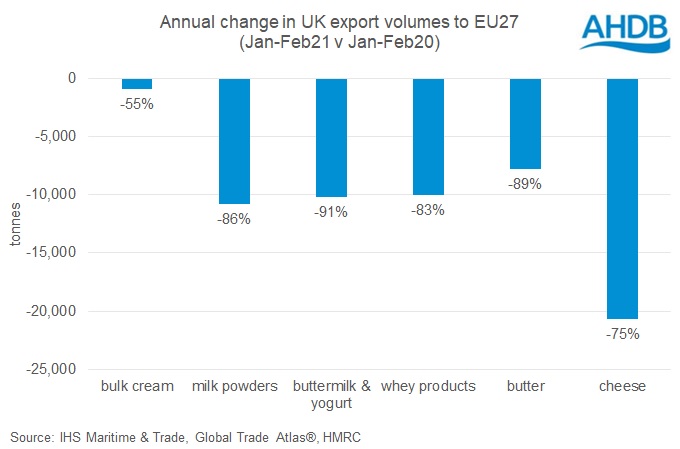
As shown in the latest UK agri-food trade data, trade with the EU is well below normal levels across all sectors and dairy is no exception. Volumes of UK dairy exports to the EU during February were marginally higher across most products than in January. Despite this small month-on-month increase, they remain notably lower than volumes exported this time last year.


Both milk and bulk cream[1] shipments to the EU are well behind typical levels. In February 2020, just under 76,5600 tonnes of milk and 901 tonnes of bulk cream were exported to Europe. This compares to just 131 and 436 tonnes of milk and cream respectively sent in February 2021. 

Exports of other key products also remained low in February compared to year earlier levels. Milk powders, whey products and cheese saw much improved exports volumes in February, with butter exports seeing a more limited month on month increase.

Buttermilk & yogurt was the only dairy category to see exports decline further in volume on the previous month. This puts exports of these products in February at just 7% of year earlier levels.

[1] Milk includes trade codes 0401.10 and 0401.20 (milk of a fat content <6%) and Cream included trade code 0401.5039 (milk and cream of a fat content >21 & <45%, in containers >2L)

Source: ahdb.org.uk

Dairy Markets Turn Lower in Chicago Thursday

On the Chicago Mercantile Exchange milk futures turned lower Wednesday pressured by declining cash cheese trade.  Class III milk was mixed at the close. April gained 2 to 17.70, May fell 16 to 19.16, and June fell 11 cents to 19.19/cwt. The balance of the year was unchanged to 16 lower. Averaging at 18.86/cwt. Class IV milk had April and May unchanged at 15.52 and 16.09/cwt and June jumped 7 cents higher to 16.53/cwt.

CME Spot trade saw dry whey down $0.02 at $0.6825.  One sale was made at that price.  Blocks down $0.0050 at $1.7950.  Four sales were made at $1.78 to $1.7950. Barrels unchanged at $1.8050.  Butter down $0.0050 at $1.7925.  Two sales were made at $1.7750 and $1.80. Nonfat dry milk up $0.01 at $1.24.  One sale was made at that price. 

Grain markets continued to rocket higher. Corn up 19 to 6.25 1/2, Soybeans up 25 ¼ to 1497 ¼, with Soybean meal only gaining $1.90 to 412.30/ton.

Government Lets Air Out of the Milk Markets This Week

The T.C. Jacoby Weekly Market Report Week Ending April 16, 2021

USDA ends the Farmers to Families Food Box program after May, squelching hope surrounding the kind of government spending that propelled the cheese and Class III markets to unsustainable heights in 2020.

The government let a little air out of the milk markets this week. Most Class III and Class IV futures contracts lost between 10 and 30ȼ. For the past six weeks, cheese prices have climbed ever higher thanks to accelerating demand from restaurants and speculation that USDA would continue to buy and donate dairy at a heady clip. But on Tuesday USDA announced that it would end the Farmers to Families Food Box program after May, squelching hopes – and fears – surrounding the kind of government spending that propelled the cheese and Class III markets to unsustainable heights in 2020. Although the cheese markets staged a comeback today, they finished lower than where they began the week. CME spot Cheddar blocks dropped a nickel to $1.78 per pound. Barrels ultimately fell just a quarter-cent and closed at $1.69. Butter also weakened. Spot butter slipped 3ȼ to $1.85.

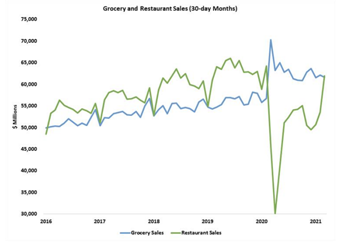
Demand for both cheese and butter remains strong, as restaurants restock and retailers have yet to pull back. Americans spent $127.7 billion at restaurants and grocery stores in March, the highest total on record. Grocers continue to ring up stellar sales, and spending at restaurants is almost back to pre-pandemic levels. At some point, consumers will pare back on grocery purchases as restaurant visits become more routine and their pantry shelves grow heavy. But for now, both food sectors are pushing product at a good clip.

The protein powders continued to climb. CME spot nonfat dry milk (NDM) added a penny and reached a fresh 14-month high at $1.215. Spot whey jumped 4.5ȼ to 67.5ȼ, its highest price on record. Although the spring flush is in full swing, driers are running below capacity in the Great Lakes states as the new cheese plant laps up a greater share of the regional milk supply. Both domestic and export demand are strong, but logistics issues have slowed some sales. The container shortage and port backlogs add to the cost of freight and delay deliveries. Although U.S. milk powder is priced to move, the freight issues are likely trimming sales – and prices – at the margin. But tightening milk powder stocks in Oceania and low output in Europe suggest the U.S. will continue to fare well in foreign markets.

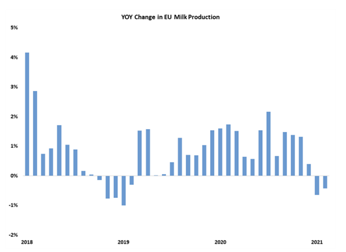
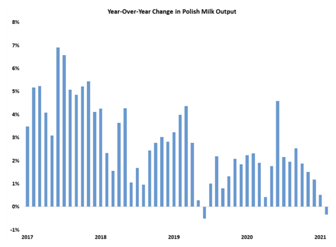
European milk collections were just shy of 27 billion pounds in February, assuming steady milk production trends in Sweden. Adjusted for leap day, that is 0.4% lower than in February 2020, following a 0.7% shortfall in January. Output fell below year ago levels in all the major dairy nations except the United Kingdom, Italy, and Ireland. Polish milk collections were 0.3% lower than in February 2020, a rare decline for one of Europe’s most consistent sources of growth. Lower European milk output helped to offset about 40% of the growth in U.S. milk production in the first two months of the year.

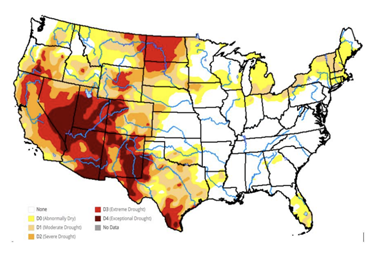
U.S. milk output remains strong, but expenses are on the rise. Feed costs are starting to bite, especially in the West, where dairy producers must pay unusually steep freight rates on top of already high grain and protein prices. Regional drought and scarce inventories compound the Western feed shortage and raise the cost of milk production noticeably. Pricey inputs will weigh on milk output eventually. However, given the massive milk-cow herd and relatively low slaughter rates, milk production is likely to remain formidable in the near term. Fortunately for dairy producers, strong demand has supported dairy product values.

May corn futures topped $6 per bushel this week for the first time since 2013, when the industry struggled to rebuild inventories after the devastating 2012 drought. Aside from concerns that it’s a bit too dry in Brazil, there are no serious crop issues to fuel this year’s rally. But demand is formidable. Livestock numbers are up, and drought in the West will push cattle out of grasslands and into feedlots. Exports are booming. May corn settled at $5.855, up another 8.25ȼ from last week. December corn finished at $5.1225, 14ȼ higher than last Friday. May soybeans jumped more than 30ȼ to $14.3325. May soybean meal finished a dollar higher, at $402.20 per ton.

Original Report at: https://www.jacoby.com/market-report/government-lets-air-out-of-the-milk-markets-this-week/

Demand for whole milk powder ‘strong’ at overnight auction, analyst says

Demand for whole milk powder remained strong at the global dairy trade auction overnight, boding well for dairy farmers and prompting analysts to upgrade their forecasts for next season.

The global dairy trade price index slipped 0.1 per cent from the previous auction a fortnight ago. Prices for whole milk powder, which has the most impact on what farmers are paid, gained 0.4 per cent to an average US$4097 (NZ$5713) a tonne.

Whole milk powder prices are 51 per cent higher than at the same time last year, largely driven by China where a wealthier population and an increased focus on health and wellbeing after the Covid-19 pandemic is stoking demand for better nutrition.

“Whole milk powder demand remains strong, with this auction seeing North Asian buyers back in force, taking back their usual positions as the major buyer,” said NZX analyst Stu Davison.

”After the last auction, where we saw other regions take more than usual, it’s obvious that the demand is still there globally.”

At the latest auction, 99 per cent of the whole milk powder on offer was sold, he said.

Prices for skim milk powder were unchanged, while cheddar gained. Prices for butter, anhydrous milkfat and lactose fell.

Davison said he wasn’t surprised that both of the cream group products fell, given the extra volume of butter on offer and the price gains seen for both fats over the last six months.

Fonterra Cooperative Group has indicated it is producing more butter to benefit from improved returns relative to other products.

Dairy products are the country’s largest commodity export and Fonterra estimated milk payments to its 10,000 farmer suppliers for this season would contribute about $11.5 billion to the economy.

“Overall, the prices achieved at last night’s event still bode extremely well for export returns and farmgate returns,” said ANZ agriculture economist Susan Kilsby.

Last month, Fonterra raised its forecast milk price for this season to between $7.30 and $7.90 per kilogram of milk solids, with a mid-point of $7.60 per kgMS. That’s up from $7.14 per kgMS last season.

For this season, ASB is forecasting $7.60 per kgMS, ANZ $7.70 per kgMS, BNZ $7.70 per kgMS, and Westpac $7.90 per kgMS. The futures market closing price on Tuesday was $7.64 per kgMS.

Following the latest auction, ASB raised its milk payment forecast for next season to $7.50 per kgMS from $7.30 per kgMS, noting prices for shipments later in the year were trading at a premium.

“The shape of the contract curve suggests prices maintain momentum heading into next season,” said ASB economist Nat Keall. “An uncertain outlook for Northern Hemisphere production and rising global consumption should keep prices supported over the medium term.”

Westpac also upgraded its forecast for next season to $8 per kgMS, from $7.25 kgMS.

“We expect robust demand to continue,” said Westpac senior agri economist Nathan Penny. “Strong Chinese and South-East Asian demand is underpinning the price strength and we expect this to be ongoing through 2021.

“We now expect global dairy prices to remain stronger for longer,” Penny said.

For next season, BNZ is forecasting a milk price of $7 per kgMS, and ANZ $7.30 per kgMS. The futures market closed on Tuesday at $7.50 per kgMS.

From the big moments in the boardroom to the little questions on your credit card, the Stuff business team keeps you across what’s happening in our economy and how it affects you. We help small businesses prosper, we analyse the stock market, we challenge experts on the housing crisis, and we explain finances for everyday Kiwis.

Source: Stuff

Milk Futures Push Higher in Chicago Tuesday

On the Chicago Mercantile Exchange milk futures continued higher Tuesday while global trade provided little direction. Class III milk futures surged higher on the heels of barrel cheese.  April milk gained 1 penny to $17.68/cwt.  May milk was up 13 cents to $19.29/cwt.  June milk added 22 cents to $19.32/cwt.  Class IV milk settled lower with the move lower in butter and nonfat.

Moving along to the CME Cash Dairy Trade,  Barrels up $0.0625 at $1.8050.  Eight trades were made at $1.75 to $1.8050. Butter down $0.0725 at $1.7975.  Twenty-one sales were made from $1.79 to $1.8225. Nonfat dry milk down $0.0050 at $1.23.  Four trades were made at $1.2275 to $1.2350. Dry whey up $0.0275 at $0.7025.  Blocks unchanged at $1.80.  Two sales were made at $1.79 and $1.80.

Green was screen across the board in the grain market.  May corn settled 14.50 cents higher to $6.0650/bushel.  May soybeans exploded 22.25 cents to $14.72/bushel.  May soybean meal was up $2.90 to $410.40/ton.  May Chicago Wheat added 7.50 cents to $6.5975/bushel.

Dairy Markets Stagnant to Start the Week in Chicago

On the Chicago Mercantile Exchange milk futures started the week with light, positive trade along with cash markets. Class III milk price movement was essentially a nonevent on Monday.  April added 3 cents while May was up 12 and June 4 cents.  Beyond June, prices in the 2nd half ranged from 5 lower to 2 cents higher.  2022 prices added a couple of cents.  Class IV milk strung together a solid performance once again as prices jumped 13 to 25 cents/cwt between May and September. 

CME spot dairy auction results were even to higher on good volumes on Monday.  Blocks up $0.02 at $1.80.  Seven sales were made from $1.7925 to $1.80. Barrels up $0.0525 at $1.7425.  Five trades were made at $1.69 and $1.7350. Butter up $0.02 at $1.87.  Eight sales were made from $1.8450 to $1.87. Nonfat dry milk up $0.02 at $1.2350.  One trade was made at that price. Dry whey unchanged at $0.6750. 


CWT Assists with Over a Half Million Pounds of Dairy Product Export Sales

Cooperatives Working Together (CWT) member cooperatives accepted nine offers of export assistance from CWT that helped them capture sales contracts for 304,238 pounds (138 metric tons) of Cheddar cheese, 56,116 pounds (25 metric tons) of butter, and 191,802 pounds (87 metric tons) of cream cheese. The product is going to customers in Asia and will be delivered during the period from April through July 2021.

CWT-assisted member cooperative year-to-date export sales total 11.865 million pounds of American-type cheeses, 8.8 million pounds of butter (82% milkfat), 3.6 million pounds of AMF, 13.5 million pounds of whole milk powder, and 4.4 million pounds of cream cheese. The products are going to 26 countries in six regions. These sales are the equivalent of 540.5 million pounds of milk on a milkfat basis.

Assisting CWT members through the Export Assistance program positively affects all U.S. dairy farmers and dairy cooperatives by strengthening and maintaining the value of dairy products that directly impact their milk price. It does this by helping member cooperatives gain and maintain world market share for U.S dairy products. As a result, the program has significantly expanded the total demand for U.S. dairy products and the demand for U.S. farm milk that produces those products.

The amounts of dairy products and related milk volumes reflect current contracts for delivery, not completed export volumes. CWT pays export assistance to the bidders only when export and delivery of the product is verified by required documentation.

All dairy farmers and dairy cooperatives should invest in CWT. Membership information is available on the CWT website.

Asia and Middle East Drive World Dairy Market Growth in 2020

Highlights

  • The Dairy Price Index in 2020 averaged slightly lower than in 2019
  • World milk output continued to rise in 2020, with Asia registering the highest volume increase from 2019
  • World trade in milk products rose in 2020, driven by a few Asian and Middle Eastern countries.
  • International trade in whole milk powder, whey and cheese rose, while that in skim milk powder and butter fell

Global dairy prices

International dairy prices registered a slight decline in 2020 

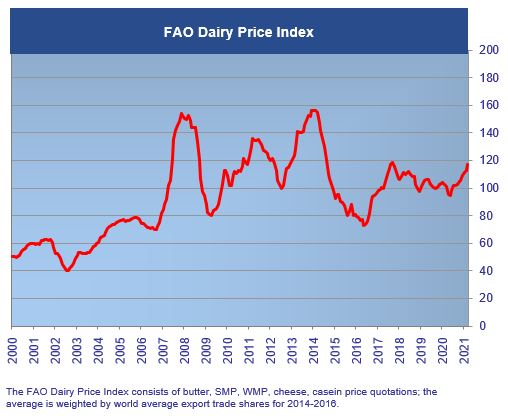
International dairy prices, measured by the Food and Agriculture Organization of the United Nations (FAO) Dairy Price Index, averaged 101.8 points in 2020, down 1.0 points (1.0 percent) from 2019, primarily reflecting reduced import demand due to widespread economic downturns in many dairy importing countries. High export availabilities in exporting countries, caused by reduced internal sales, coupled with increased processing of less labour-intensive milk products, especially milk powders, to overcome labour shortages, also weighed on global milk prices.

Among the milk products represented in the index, butter prices fell the most (-13.5 percent). FAO butter price index was already trending downward since reaching its peak in 2017. COVID-19-related import curtailments and reduced internal sales accelerated the decline, depressing prices by 16 percent (from USD 4 043 to USD 3 403 per tonne) between January and May, but prices began recovering since June in response to solid import demand and internal consumption stability. The annual average whole milk powder (WMP) prices declined by 4.5 percent in 2020 due to lower purchases by Asia, especially China, Bangladesh, Malaysia and Singapore. Reflecting the economic crisis and falling petroleum price, WMP imports by the Middle East and North Africa (MENA) region also registered a noticeable dip, negatively impacting international WMP quotations. Like the other milk product prices, skim milk powder (SMP) prices also fell during the first several months of 2020, as many large milk powder importing countries lowered imports in line with economic downturns and lower demand from industrial food processors and food services sectors.  However, prices trended upward from May, lifting the annual 2020 average value by 6.8 percent, mainly due to limited supplies in Europe and increased import demand from Middle Eastern and Asian countries. International cheese prices also increased by 2.1 percent in 2020, underpinned by solid import demand and sustained internal consumption in leading producing regions, mainly Europe and North America, with increased retail sales offsetting declines in food services sales.

Global milk production

World milk output rose in 2020

Global milk production reached nearly 906 million tonnes in 2020, up 2.0 percent from 2019, driven by output increases in all geographical regions, except in Africa, where production remained stable. Milk volume increases were highest in Asia, followed by Europe, the Americas, Oceania and Central America and the Caribbean.

In Asia, milk output rose to 379 million tonnes1 in 2020, up 2.6 percent year-on-year, principally driven by increases mainly in India, China, Pakistan and Turkey. Kazakhstan, Uzbekistan and Japan too registered moderate production expansions.

In India, milk output reached 195 million tonnes in 2020, up 2.0 percent from 2019, underpinned by the continued rise in dairy cattle numbers and improved feed and fodder availability on favourable monsoon rains (June to September). The fast mobilisation of the village cooperatives’ network at the early phase of the pandemic and channelling milk into drying plants further facilitated milk output growth. In China, the increased output of large-scale dairy farms and their operational and production efficiency improvements underpinned the over 7 percent milk output growth. In Pakistan, milk output increased by 3.2 percent, mainly due to a rise in cattle numbers, partially offset by poor milk collections during the pandemic’s early phase. Besides herd numbers, farm efficiency improvements and solid import demand helped Turkey to sustain milk production growth. In Kazakhstan and Uzbekistan, two of the largest milk producers in Central Asia, the output increase reflected modernising farms with rising dairy cattle, although smallholders remain the dominant force. In Japan, price support to farmers under government COVID-19 assistance, combined with the lowering of tariff-rate quotas (TRQs) for butter and SMP, ensured milk market stability and production growth.

In Europe, milk output rose to 236 million tonnes, up 1.6 percent from 2019, mainly due to production increases in the European Union, the Russian Federation and Belarus. In the European Union, yield improvements, a slight increase in dairy cattle numbers and robust internal and foreign demand were behind the production expansion. The European Union COVID-19 livestock assistance programme also helped to stabilise farm-gate prices, encouraging high milk deliveries. In the Russian Federation, milk production rose, buoyed by yield improvements in large-scale dairy farms.

The Russian government initiative to trace and remove products that flout regulatory requirements from the market and introduce the obligatory electronic certification “Mercury” system2 re-established consumer confidence, lifting internal demand. In Belarus, farm management improvements, quality feed use and the continued solid purchases by the neighbouring countries, mainly the Russian Federation, were crucial in production expansion. By contrast, Ukraine’s output declined due to multiple factors, including fast declining cattle herd, increased feed costs, falling farm profitability and weak import demand.

In North America, milk output reached nearly 111 million tonnes in 2020, up 2.1 percent from 2019. In the United States of America, milk output rose by 2.2 percent to 101 million tonnes, driven by increased dairy herd numbers and milk yields. COVID-19 livestock sector assistance helped sustain internal demand and production, despite pandemicrelated adverse impacts, especially labour shortages and transport hurdles. Buoyant import demand from Asia was also a factor that helped milk production expansion. In Canada, milk output increased slightly, despite a slowdown in milk deliveries due to labour constraints and plummeted milk sales in early 2020.

In Central America and the Caribbean, milk production expanded by 1.6 percent to 18 million tonnes, driven by increased production in the region’s largest milk producer, Mexico. Following nearly a decade-old growth pattern,

Mexico’s 2020 production expanded by 2.2 percent from 2019, as improvements to farming technology and genetics continued. Animal feed production too increased, boosting output.

In South America, milk production expanded by 2.0 percent to nearly 82 million3 in 2020, driven by higher outputs in Argentina, Brazil, Chile and Uruguay, partially offset by a decline in Venezuela. In Argentina, milk production expanded faster than anticipated earlier due to improved pastures and internal and foreign demand. Freezing retail milk prices helped sustain demand, which, incidentally, lowered dairy farm profits. However, the subsequent decision to allow a 2 percent increase in retail milk prices stabilised farm profit margins, helping production. Brazil’s milk output rose, helped by milk production recovery in the last quarter, following one of the country’s most prolonged droughts between May and October 2020. High milk outputs of large-scale dairy farms that rely on animal feed use also supported sustaining an output expansion. In Chile, milk production rose, mainly due to significantly increased milk prices compared to the previous year. Uruguay too benefitted from favourable weather, including good rainfall.

In Oceania, following a 2.5 percent contraction in 2019, milk output expanded by 1.1 percent to 31 million tonnes in 2020. After four years of declines, milk production in Australia rebounded by over 9 million tonnes, underpinned by good rains, improved pastures and increased fodder and feed availability. Government assistance to drought-affected 2 The “Mercury” is the national electronic veterinary certification system in the Russian Federation, which tracks animal product movements and is part of the Federal State Information System (FGIS). Mercury system requires all stakeholders in the dairy value chain from farms to processing plants to register dairy product movements, while the National Track and Trace Digital System (Chestny ZNAK) registeres movements from processing plants to the customer. The government began implementing the system by launching a pilot on on 15 July 2019. farming households and the extension of farm household allowances also contributed to production expansion.

In New Zealand, following a marginal (0.7 percent) contraction in 2019, milk output rose slightly (+0.4 percent), reaching 22 million tonnes. Favourable weather and robust import demand from China and countries in the MENA region were behind the production growth. Despite COVID-19 market disruptions, profit margins remained attractive on account of high farm-gate prices offered by the leading milk cooperative and government financial support to cover increased freight costs.

In Africa, milk production remained stable, at 49 million tonnes. Algeria registered a significant output increase, whereas Kenya, Ethiopia and South Africa, among others, registered declines. Algeria’s output increased by 3.8 percent to 3.3 million tonnes, helped by the farm modernisation programme granted land for dairy production, pasture development and opportunities for importing genetic materials. Algeria’s prohibition of subsidised milk powder for manufacturing pasteurised milk, milk products or derivatives also boosted output. In Kenya, following three years of expansions, milk production fell marginally, owing to drier and warmer weather in 2020’s last quarter, which constrained animal feed availability. Ethiopia also faced dry weather conditions, especially in the Southern parts of the country, constraining production. South Africa’s production declined slightly due to dry weather conditions and feed price increases that lowered farm profits. Elsewhere in Africa, adverse market conditions were prevalent, stemming from economic downturns, conflicts and displacements, droughts, and floods in some regions, limiting milk production.

Read more

Sell Off in Chicago Pushes Milk Futures Lower Thursday

On the Chicago Mercantile Exchange milk futures continued to sell off Thursday along with cash prices. April Class III milk up seven cents at $17.56.  May down 33 cents at $18.50.  June down 37 cents at $18.58.  July 17 cents lower at $18.65.  August through October contracts three to five cents lower.

On spot trade, blocks down $0.02 at $1.74.  Barrels down $0.0225 at $1.6575.  Two trades were made at $1.6475 and $1.6575. Butter unchanged at $1.8775.  Two sales were made at that price. Nonfat dry milk up $0.0075 at $1.2125.  Eight trades were made from $1.21 to $1.2150.  Dry whey unchanged at $0.66.  Two sales were made at $0.66 and $0.6625.


Cancellation of Food Box Program Pushes Dairy Markets Lower in Chicago Wednesday

On the Chicago Mercantile Exchange milk futures continued to slide a midweek as cash trade tumbled lower and the USDA announced plans to discontinue the food box program.  Class III milk fell 11 cents in April to 17.49, May fell 63 cents to 18.83, and June fell 64 to 18.95/cwt. The balance of 2021 was 18-55 cents lower and is averaging 18.44/cwt. Class IV was unchanged in April at 15.43, May fell 8 to 16.00, and June fell 14 cents to 16.38/cwt.

The CME spot trade had blocks down $0.0450 at $1.76.  Barrels down $0.04 at $1.68.  Two trades were made at $1.6775 and $1.68. Butter down $0.0175 at $1.8775.  Six sales were made at $1.8775. Nonfat dry milk unchanged at $1.2050.  Dry whey unchanged at $0.66. 


Milk Futures Lose Previous Gains as Markets Retreat Significantly in Chicago Tuesday

On the Chicago Mercantile Exchange milk futures turned around Tuesday taking back earlier week gains as the cash market took a dive lower. After posting the highest spot class III prices yesterday in 5 months, class III prices retreated significantly with sell side pressure showing up in spot cheese.  April milk settled 26 cents lower to $17.60/cwt.  May drifted 47 cents lower to $19.49/cwt.  52 cents evaporated off of the June contract to $19.50/cwt. 

On the CME Cash Dairy Product Trade dry whey up $0.01 $0.66.  One sale was made at that price.  Blocks down $0.0550 at $1.8050.  Barrels down $0.0450 at $1.72.  Nine trades were made at $1.7175 and $1.72. Butter down $0.01 at $1.8950.  Three sales were made from $1.89 to $1.9050.  Nonfat dry milk down $0.01 at $1.2050.  Three trades were made at $1.20 and $1.2050. 

Soybean meal was the lone feed input to retreat lower.  May soybean meal sank $6.90 to $395/ton.  May soybeans gained 7.50 cents to $13.8950/bushel.  May corn jumped 11 cents to $5.80/bushel.  May Chicago Wheat was up 1.75 cents to $6.2975/bushel.

Milk Futures Start Week Higher in Chicago

On the Chicago Mercantile Exchange milk futures starting the week out with strong moves following positive cash trade. Class III and IV values tagged along and raced higher along with product.  Class III jumped 40-60 cents/cwt in May/June, 20-25 cents higher in July/August, and 8-14 stronger from September to December.  The second half of 2021 is offering Class III dairies an average of $18.88/cwt.  Early 2022 added a little value as well.  Class IV values increased 20-34 cents/cwt from May to December 2021.  The second half of 2021 is now offering Class IV dairymen an average of $17.43/cwt.

On the spot market, Blocks up $0.03 at $1.86.  Eight trades were made ranging from $1.85 to $1.8675.  Barrels up $0.0725 at $1.7650.  Ten trades were made from $1.7350 to $1.7750.    Butter up $0.0250 at $1.9050.  Nonfat dry milk up $0.01 at $1.2150.  Eleven trades were made from $1.21 to $1.22.  Dry whey up $0.02 $0.65.  One sale was made at that price. 

Grain commodities took the opposite route as milk to kick off the week.  Corn lost 6-8 cents in the old crop while December settled unchanged at $4.965/bu.  Soybeans softened across the board falling 21 cents on the front end and 13 cents in the new crop price.  The wheat complex ranged from 7.5 to 11 cents lower as well.

The FAO Dairy Price Index – March 2021

The FAO Dairy Price Index averaged 117.4 points in March, up 4.4 points (3.9 percent) from February, rising for the tenth consecutive month and lifting the index to nearly 16 percent above its value in the corresponding month last year. In March, international butter prices rose, mainly underpinned by somewhat tight supplies in Europe due to a slow start to its milk production season and increased internal demand in anticipation of a foodservice sector recovery. Milk powder prices also rose, supported by a surge in imports in Asia, especially China, due to concerns over possible short-term sourcing challenges amidst seasonally declining milk production in Oceania and scarce shipping container availability in Europe and North America. By contrast, cheese prices fell slightly for a third consecutive month due to limited demand for spot supplies.

Source: fao.org

Milk Markets Maintain Strength in Chicago Thursday

On the Chicago Mercantile Exchange milk futures maintained midweek strength Thursday with cash trade mostly supportive. Class III futures trended higher once again.  April gained 7 cents to $17.62/cwt.  May milk surged 24 cents to $19.42/cwt.  June exploded 34 cents higher to $19.61/cwt.  July jumped 22 cents to $19.42/cwt.  Class IV futures settled 10-25 cents higher in second half 2021, ranging from $16.70-$17.25/cwt. 

Butter regained yesterday’s losses and more in the CME Cash Dairy Product Trade,up $0.03 at $1.8425.  Eight trades were made ranging from $1.8250 to $1.8475.  Blocks up $0.0075 at $1.8075.  Barrels up $0.0050 at $1.5850.    Nonfat dry milk up $0.0125 at $1.2050.  Three trades were made at $1.2050 and $1.2075. Dry whey down $0.02 $0.64.  One sale was made at that price. 

Corn led the pace higher in the grain markets ahead of tomorrow’s WASDE report.  May corn launched a gain of 19.25 cents to $5.7975/bushel.  May soybeans moved 6.50 cents higher to $14.1525/bushel.  May soybean meal receded $2.30 to $406.80/ton.  May Chicago Wheat finished 12.50 cents higher to $6.2875/bushel.

New Zealand commodity prices hit record high, driven by surge in global dairy exports

The country’s major commodity export earners have hit a record high.

ANZ's monthly commodity price index for March 2021.

ANZ’s monthly commodity price index for March 2021. Photo: Screenshot / ANZ

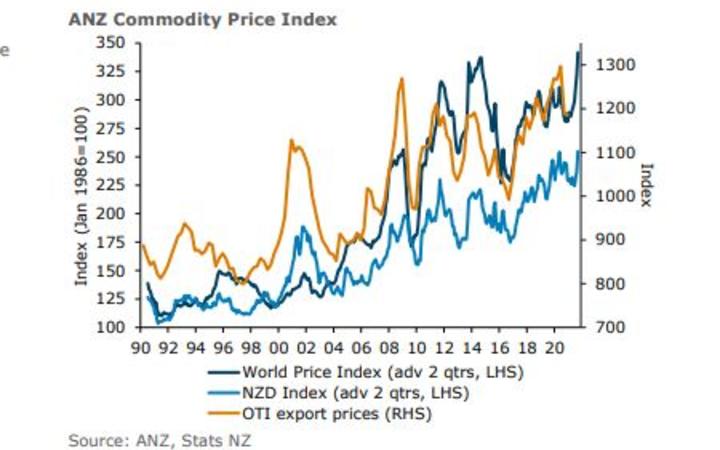
ANZ’s monthly commodity price index rose 6 percent in March on February, and was 20 percent higher than a year ago, to reach its highest level since it was started in 1986.

The main driver was the strength of global dairy prices, which gained 12.7 percent in March, the highest in seven years, with whole milk powder, a key driver of farmer returns, 43 percent higher than last year.

ANZ’s agricultural economist Susan Kilsby said: “Dairy prices are currently being supported by strong global demand, combined with a steady milk supply in the main dairy-exporting nations”.

Meat was close to a one-year high, while logs and aluminium were sitting near two-year highs.

The common feature of the strong prices and demand was China, which was growing more strongly than most economies after the pandemic, Kilsby said.

“It was already a major buyer of our commodities before Covid hit and it’s going to continue to be for the foreseeable future.”

The seafood and horticulture sectors remained under pressure, with the former not be able to sell to normal high end food outlets overseas, and the latter was struggling to harvest crops.

Shipping costs remained a high cost and the shortage of containers was more pronounced with exporters finding it harder to get containers and then space on ships, Kilsby said.

The Baltic Dry shipping index – a lead indicator of economic activity – rose 25 percent in March.

“Global shipping costs continue to trend higher, meaning a smaller portion of the overseas returns is making it back to our local producers,” she said.

New Zealand dollar returns for producers rose 7.4 percent for the month, reflecting a fall in the value of the dollar.

Source: rnz.co.nz

Milk Futures Blast Past $19 in Chicago Wednesday

On the Chicago Mercantile Exchange milk futures crossed $19 Wednesday as global support carried into futures and cash markets saw strong positive trade. Class III milk saw May-July blast through $19.00/cwt.  April jumped a nickel to $17.50/cwt, being mostly priced already.  August through December ranges from $18.00 to $18.91/cwt.  Class IV saw modest gains. 

Butter was the lone product to move lower in the CME Cash Dairy Product Trade,  Butter down $0.0175 at $1.8325.  Nine trades were made ranging from $1.6075 to $1.82.  Blocks up $0.0150 at $1.80.  Three sales were made ranging from $1.79 to $1.80.    Barrels up $0.05 at $1.58.   Four sales were made ranging from $1.5650 to $1.58. Nonfat dry milk up $0.01 at $1.1925.  Two trades were made at that price. Dry whey unchanged $0.66. 

Soybeans lost momentum off of the overnight session with May settling 10 cents lower to $14.0875/bushel.  May corn increased 6.25 cents to $5.6050/bushel.  May soybean meal settled $2.70 higher to $409.10/ton.  May Chicago Wheat finished just ¾ of a penny higher to $6.1625/bushel.

Abundant Raw Milk Translates Into Record Setting Dairy Product Production

The T.C. Jacoby Weekly Market Report Week Ending April 2, 2021

With milk production expected to stay strong, dairy product production will continue to be robust. This aggressive production threatens to overhang the market unless demand can demonstrate a meaningful and sustained expansion.
Spring has sprung across the United States. As the days lengthen and the temperatures rise, milk production is also growing seasonally. In the Western region of the country, market participants indicate that peak production levels are on the horizon, perhaps just weeks away. Meanwhile, in the Upper Midwest, while seasonally high volumes are a bit further off, market participants continue to report very strong figures relative to prior year. Bottling demand has perked up as students return from spring break, but milk remains readily available for manufacturing needs.

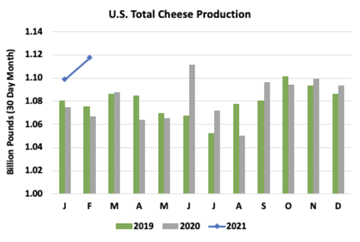
Abundant raw milk has translated into record setting production of dairy products. In USDA’s Dairy Products report released on Thursday, production of butter, cheese, and nonfat dry milk in February was the highest ever seen for that month, at least on an average daily basis. With milk production expected to stay strong, dairy product production will continue to be robust. This aggressive production threatens to overhang the market unless demand can demonstrate a meaningful and sustained expansion.

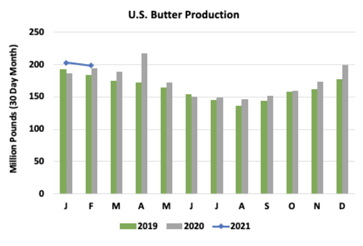
Yet despite supply concerns, the CME spot dairy markets all saw gains over the course of the week. Butter had the biggest weekly rise, adding 7¢ during the short week with 19 loads trading hands. After closing Thursday’s spot session at $1.845/lb., spot butter prices are now the highest they have been since June of last year. Butter demand has improved as spring holiday baking has supported retail purchases while the reopening of restaurants increased the pull from foodservice. New crop butter rules are also likely helping to support some of the spot price increase, since there is no denying that product is readily available. February butter production set a new record for the month. At 185.6 million pounds, butter production was up 2.2% year over year, after accounting for the leap day.

Cheese markets also got a boost this week. Market participants indicate that food service demand for cheese has improved markedly, which is helping to keep some tension in the market. Nevertheless, cheesemakers have been busy, manufacturing a total of 1.043 billion pounds of cheese in February. Representing an increase of 4.7% versus February 2020, cheese production set a record for the month. Production data shows that manufacturers favored the production of American style cheeses during February, though Cheddar output in particular has slipped compared to earlier months. Meanwhile, the production of Italian style cheeses also increased versus prior year, albeit by a slower margin than American style cheeses. Improving restaurant activity should disproportionately benefit Italian cheese demand in the coming months.
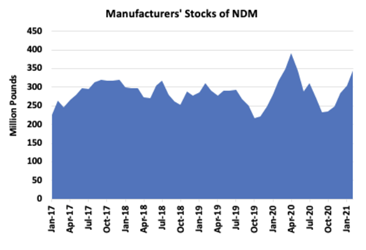
Cheddar blocks were able to capitalize on the increase in demand, though the spot market was fickle. Price increases on Monday and Thursday counteracted a penny drop on Wednesday, ultimately pushing the spot price up by 5.5¢ to $1.775/lb. Barrels were more consistent, with prices marching upward in three out of the four daily spot sessions, finishing the week at $1.5125/lb., up a nickel from last week.

February production data illustrates that during the month dryers held a strong bias for producing nonfat dry milk (NDM) for use in the domestic market or to be shipped to nearby Mexico, versus skim milk powder which would likely be send farther afield. Totaling 186.3 million pounds for the month, NDM production was up by 13.0% year over year. Meanwhile, SMP production slipped by 20.3% to 29.6 million pounds. This preference is likely a reflection of the nagging logistical issues that are preventing U.S. produced SMP from being easily exported. Strong NDM production also translated to a buildup in stocks as manufacturers’ stocks of NDM grew to 345.6 million pounds at the end of February, the highest amount ever recorded at the end of that month. In the spot NDM market, the price rose by a half cent in each of the four trading days of the week, bringing the price on Thursday to $1.19, up two cents from last Friday’s close.
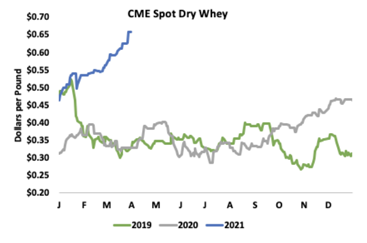
The whey markets continue to move upward, with the spot dry whey price boasting a new record this week. After opening the week unchanged and adding just a quarter cent on Tuesday, the price moved up by 3¢ on Wednesday as three loads traded hands. The market remained unchanged at 66¢/lb. on Thursday. Dry whey production rose by 4.3% year over year in February, as strong cheese production threw off a plentiful whey stream. Yet, dry whey production paled in comparison to the manufacture of higher protein products. Production of whey protein concentrates and whey protein isolates rose by 8.8% and 28.3%, respectively. This preference for higher protein products continues to keep tension on the dry whey market, contributing to the spot price increase.
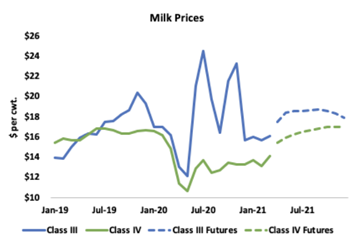
Activity in the spot dairy sessions combined with noise in the grain markets had a significant influence on milk futures over the course of the week. After posting some mixed performance on Monday and Tuesday, Wednesday’s Prospective Plantings report suggesting impending feed price increases contributed to significant gains in the Class III futures market. Several nearby contracts traded as high as limit up before settling off these highs. Some further gains during Thursday’s session pushed prices higher still. The MAY21 Class III contract settled on Thursday a full 95¢ higher than on Monday. Most nearby Class IV milk futures contracts also saw gains over the course of the week, bolstered by increases in the spot butter market.

A surprising Prospective Plantings report released on Wednesday sent corn and soybean prices skyward. Despite already high prices which were expected to inspire additional plantings, the initial survey data included in the report underwhelmed. Corn plantings for the upcoming market year are estimated at 91.1 million acres. Though up from last year, this figure is a couple million acres shy of most trade estimates. Soybean planting expectations also underwhelmed at 87.6 million acres. The lower-than-expected planted acreage combined with meager carryover stocks sent grain futures limit up on Wednesday and are expected to result in higher feed costs for dairy producers.

Source: Jacoby

CME Markets Moves Higher on Global Market Reports Tuesday in Chicago

On the Chicago Mercantile Exchange milk futures continued mostly higher Tuesday seeing some support from global markets.  Class III Milk continued a creep higher. April fell 15 to 17.45, May however gained 6 to 18.63, and June gained 14 cents to 18.84. The second half of 2021 has an average of 18.57/cwt. Class IV milk was quieter with April fall 2 to 15.33, May unchanged at 15.77, June unchanged at 16.10/cwt. The second half of 2021 has class IV averaging at 16.91/cwt.

The CME spot trade was another low volume trade.  Blocks up $0.01 at $1.7850.  Two sales were made at $1.78 and $1.7850.  Barrels unchanged at $1.53.   Two sales were made at $1.53 and $1.5325. Butter down $0.0050 at $1.8325.  One trade was made at that price. Nonfat dry milk up $0.0025 at $1.1825.  Two trades were made at $1.1825 and $1.1850.  Dry whey unchanged $0.66. 

The Global Dairy Trade Event 281 started our day with a slight move higher, up 0.3 percent, Tuesday.  Butter milk powder had a significant surge in demand, up 17.6 percent, followed by cheddar and butter.  Lactose had the only decline, down 6.5 percent.

Milk Futures Start Week Higher After Easter Weekend

On the Chicago Mercantile Exchange milk futures came back renewed from the Easter holiday trading higher while cash markets were subtly mixed. April Class III milk up a dime at $17.60.  May up 12 cents at $18.57.  June up nine cents at $18.70.  July eight cents higher at $18.72.  August through October contracts one to 10 cents higher.

On the spot trade Barrels up $0.0175 at $1.53.   One sale was made at that price. Butter down $0.0075 at $1.8325.  Two trades were made at $1.8050 and $1.8375. Nonfat dry milk down $0.01 at $1.18.  Dry whey unchanged $0.66.  Blocks unchanged at $1.7750.   


How the Pricing of Nonfat Dry Milk has Changed

Nonfat Dry Milk (NDM) prices are determined by a weekly survey conducted by the Agricultural Marketing Service (AMS).  In turn, the price of Class IV skim milk, Class II skim milk, and half of the pricing of Class I skim milk are determined from the price of NDM.  Putting all that together, nearly 50 percent of producer milk is priced at least partially on the price of NDM.  NDM prices have been below historical levels for the last six years, causing lower producer milk prices.  This post will review the evolution of NDM production, use, and pricing.

The difference between NDM and Skimmed Milk Powder (SMP) is important.  In some statistics, the two are combined which can make analysis difficult.  See this prior post for a review of NDM vs. SMP.

Chart I below shows what has happened to NDM prices.  During the years 2005 to 2014 NDM prices averaged $1.32 per pound. From 2015 to the most recent date, the price has averaged $.92 per pound, 30 percent lower.

Chart I – NDM Prices from 2005 to 2021

From 2005 to the present, the usage of NDM/SMP has changed drastically.  In 2005, only 30 percent of NDM/SMP was exported. In 2020, 72 percent was exported (Chart II).  U.S. prices for NDM/SMP are now dependent on international prices.  Chart II shows a 16-year trend with a steady growth in exports.  For the last seven years there has also been a decrease in the domestic use of NDM as other casein protein sources have become available for cheese production.  The trend of increased exports and decreased domestic use appears to be a continuing long-term trend.  

The largest U.S, dairy export product measured in tons is NDM.  It is not driven by global demand, but by domestic supply.

Chart II – Exports vs. Domestic Use of NDM

From 2005 to 2021, the U.S. production of NDM and SMP has grown by 4.5 percent annually (Chart III).  This is more than twice the growth rate of cheese production.   What has caused the increase in production?  One of the main elements is the growth of butter consumption, which has left an increasing amount of Class IV skim milk available.  Also, the decrease in no fat and one percent fat drinking milk have left less available butterfat (See the February 11, 2021 post to this blog)..

Chart III – Production of NDM/SMP

Domestic Inventories of NDM/SMP have also increased (Chart IV).  From 2005 to 2021, inventories of NDM/SMP have increased by 12 percent annually. The increase is well above the increase in production which was 4.5 percent annually.  A shown in Chart V, inventories as a percent of production have doubled between 2005 and 2021.   With rising inventories available, prices will be lower. 

Chart IV – Inventories of NDM/SMP
Chart V – NDM Inventory as Percent of Production

There are essentially no imports of NDM/SMP.  The challenge is to export what is excess in the U.S.

The international market for NDM and SMP is strongly skewed to SMP.  The standards for SMP are set by the WTO.  The U.S. is producing increased volumes of SMP (Chart VI), but it is still much smaller than production of NDM.  The U.S. does not participate in the largest powdered milk market, Whole Milk Powder. 

Chart VI – U.S. Production of NDM and SMP

 WHAT DOES ALL THIS MEAN?

NDM prices are low, and the data above indicate that this will not be changing.  The new formula for pricing Class I milk is now out-of-date.  The $.74 adjustment in the new formula is out-of-date considering the continued lower prices of NDM.  The lower Class I price resulting from the new formula is lowering the “uniform” price and contributing to low and negative Producer Price Differentials.

Without major changes in U.S export markets, expect continued low NDM prices. To be more competitive in international markets, a new approach would have to be developed.  It is unlikely that this will happen.

Source: milkprice.blogspot.com

Send this to a friend