The role of emerging technological trends that can help dairy farmers better manage their operations and improve animal health, longevity and nutrition was a focus of a panel discussion that also looked at impacts and lessons from the pandemic.
Three dairy experts shared their views during a webinar at the World Ag Expo, which went virtual this month due to COVID-19.
With the pandemic increasing market volatility, Fernanda Ferreira, a specialist in herd health and management at the University of California, Davis, said she thinks dairy farmers have learned they need to be prepared for so-called “black swan” events. Even though overall U.S. dairy consumption has reached its highest level, she said, dairy farmers need to determine how to manage supply and operate in volatile markets. For California, which exports 18% to 20% of its milk production, it remains unclear how these relationships will affect markets in 2021, she added.
One takeaway from the pandemic has been the use of risk-management tools, said Michael Hutjens, professor of animal science at the University of Illinois, noting that dairy farmers have been locking in milk and feed prices, especially with the recent rise in feed costs.
The pandemic has also increased focus on ways to lower production cost and boost efficiency. One way to do that is to improve feed intake, which helps milk production, said Tom Oelberg, a ruminant specialist for Diamond V, an animal nutrition company based in Iowa. He stressed the importance of maintaining consistent feeding times, including when feed is dropped off and pushed up, so cows can have continuous access to feed. Having employees available to do this at all hours can be a challenge, he acknowledged. Some larger dairies use robots, he said, but they’re “not quite as effective.”
Robots can reduce the need for labor, but Ferreira said that may not be the main reason producers adopt the technology—at least according to those she’s asked. She said she was surprised to hear that some of them are choosing robotics to improve cow welfare and to keep their children on the farm.
“I think it’s a trend,” Ferreira said. “I don’t know how fast that’s going to happen, but it’s happening.”
Hutjens encouraged the use of rumen modeling to help optimize diets, fine-tune rations and improve precision feeding.
“It’s just amazing what this technology does for metabolizable protein, bioavailability of micronutrients, dry matter adjustments,” he said.
Another technology being used is cameras in barns to monitor feed intake and cow behavior, which Oelberg said will help dairy farmers better evaluate and design facilities to maximize cow comfort.
Cameras are also being used for body condition scoring, lameness scoring and to monitor weight changes, Hutjens said. Rather than “standing in the barn for hours and hours” trying to collect this data, he said this information can be captured and summarized via cameras.
Hutjens made the point that cows are still individual animals, but “how do you get your arms around 3,000 cows unless you have some type of assistance? And, of course, that’s where the technology and the cameras are going to come into play,” he said.
Managing all this data will be key, Oelberg said, as it will help producers make quicker decisions about their dairies. Heat mapping and cow comfort index, for example, can tell producers which pens are having an issue, what day of the month and in which barns.
“Within a few seconds, the dairyman can take a look at this picture and decide what’s going on and take appropriate action,” he said.
Ferreira said technology can also help producers be more precise about the medications they give their animals. One area she said she’s working on is predicting which cows need antibiotics, noting that with some illnesses, cattle can self-cure.
“So how can we go from dealing with a big population (of dairy cows) … and go into these specifics? I think technology is great for that,” she said.
Because dairy cows produce more milk after the first lactation, Oelberg said producers are looking at ways to extend the productive life of cows, noting that the most profitable animals are those in their second, third and fourth lactations. Hutjens pointed out that a more-mature cow can produce 20 pounds more milk per day than a first-lactation cow.
“It takes the first lactation for the heifer to recover her replacement costs,” Oelberg said. “I think people are going to start looking at those older animals as our real moneymakers.”
There’s promising research being done in California on feed additives that can reduce methane emissions in dairy cows, Ferreira said.
Because of the additional cost of feed additives, Oelberg said research will be key to help dairy farmers understand what those additives do and what will be their return on investment.
Hutjens said farmers are also looking to different feed crops that will reduce their water use, noting the renewed interest in sorghum as an alternative to corn, because its uses about a third less water.
Source: agalert.com











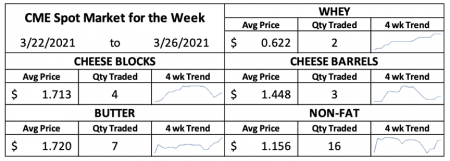
 Spot cheese market observers are recovering from whiplash this week after watching the price dip then rally. Cheddar blocks lost 3¢ on Monday, 4.5¢ on Tuesday, and another 4.5¢ on Wednesday, before the winds changed course. Gains of 3¢ and 2¢ on Thursday and Friday helped to erase some of the loss, but at $1.72/lb. spot Cheddar blocks still finished the week 7¢ lower than last Friday. In the case of barrels, despite giving up 1.5¢ on Monday, modest gains on Tuesday, Thursday, and Friday pushed the price up to $1.4625/lb., a penny higher than last week. As a result, the block barrel spread narrowed to 25.75¢ on Friday.
 Cheese manufacturers report that demand has improved from both domestic and international sources. As Covid-19 dining restrictions are rolled back unevenly across the country, foodservice demand is firming, a trend that is likely to be particularly supportive for Italian style cheeses. Even with improved demand, however, supply remains more than ample, and inventories are growing. Total cheese stocks at the end of February reached 1.436 billion pounds, an increase of 27.8 million pounds compared to January. Though this increase exceeds the five-year average over the same period, it remains lower than the gains seen in 2017 and 2018. Other cheese stocks built somewhat faster than American cheese stocks, indicating that manufacturers have had more luck moving Cheddar and other American style cheeses into the market, likely through retail channels.
 On the other side of the Class III complex, whey prices showed no relenting this week, continuing their upward charge to hit yet a new record. Spot whey added 1.5¢ on Wednesday as two loads traded to move up to 62.75¢/lb., a new record for the three year old market. Demand is robust from both domestic and global users, even as logistical complications persist. Insatiable demand from China continues to underpin the global whey market. Chinese imports of whey hit a record high 277.1 million pounds during January and February, a 52.7% increase versus the same period last year after accounting for the leap day. Hefty Chinese dairy imports in January and February set records across many categories including milk powders and fluid milk.
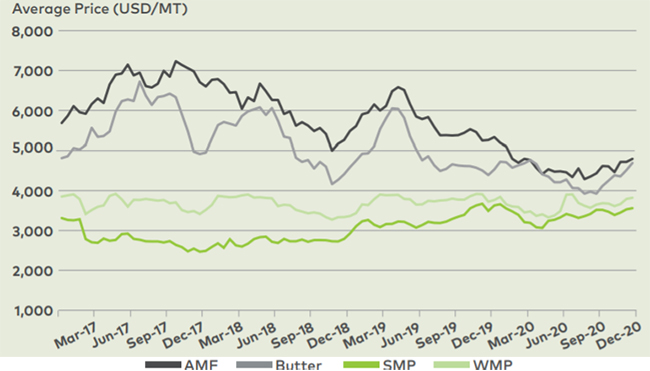
 Moving over to Class IV products, the butter market was able to make up some ground this week. After seeing increases Tuesday through Friday, the spot butter price ended the week a full 11¢ higher than last Friday at $1.775/lb. Even as cream remains plentiful, foodservice activity has picked up and retail demand is robust as Easter and other spring holidays approach. Butter inventories totaled 352.7 million pounds at the end of February, an increase of 6.3% or 20.8 million pounds compared to January. This increase is less than half of the five-year average build of 43.5 million pounds between these two months, indicating that product is indeed moving into commercial channels. Nevertheless, butter stocks remain historically heavy, and the market will have to work through these inventories before returning to balance.
 After dropping 1.25¢ on Monday, the spot nonfat dry milk (NDM) market was also able to do an about-face. Moving upward on Tuesday and especially Thursday, when 12 loads traded hands, the market ended the week at $1.17/lb., up 1.75¢ compared to prior week. Plentiful condensed skim continues to stifle more dramatic price increases but demand has at least remained sufficient to keep some tension in the market. International demand from both Mexico and overseas markets has remained substantial though manufacturers report that higher prices are causing some global buyers to balk. At 192.6 million pounds Chinese imports of skim milk powder during January and February set a new record, though the vast majority of this product was supplied by New Zealand.
 The United States dairy herd continues to expand, driving milk production upward. According to USDA’s Milk Production report, released Thursday, producers added another 3,000 head of cattle between January and February, pushing the national herd up to 9.458 million cows, the largest herd size in decades. The growing herd drove a 2% increase in milk production in February, after accounting for the leap day. Totaling 17.63 billion pounds, February milk production was the strongest ever recorded for that month after considering leap days. USDA also revised January milk production growth up to 2.4% from the 1.6% published in last month’s report. Milk production has been growing for nine consecutive months, following the sudden decline that occurred at the beginning of the pandemic.
 Milk production was particularly pronounced in the upper Midwest where relatively mild temperatures during most of the month helped to accelerate gains in milk yields. California milk production also grew by 2.1% during the month and USDA revised the state’s surprising January loss of 0.7% printed in last month’s report to a gain of 2%. Perhaps most shocking, however, was that despite the devastation brought about by winter storm Uri, Texas and New Mexico still managed to post year over year production increases of 5.3% and 1%, respectively, in February. It is likely that that the full effects of the storm will show up in future reports as culling in those geographies increased and dumped milk, while captured in the milk production figures, never made its way into finished products.
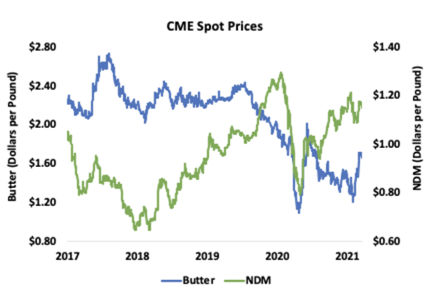 Even after rising by quarter cent on Monday, the nonfat dry milk (NDM) spot market also ceded some ground over the course of the week, giving up a total of 1.75¢ versus last Friday to end the week at $1.1525/lb. Despite the losses seen in Chicago, market participants surveyed by Dairy Market News report that the market feels poised to move higher. Export demand, particularly from Mexico has purportedly improved dramatically and parts of the country are reporting that spot loads of condensed skim are less available. Class IV milk futures were generally quiet though they gave up some ground later in the week as the spot butter and NDM markets saw prices retreat.
 In many parts of the country, improved foodservice activity has translated to increased demand for cheese. While most manufacturers report that activity remains understated relative to pre pandemic levels, demand has markedly improved compared to several weeks ago. The CME block market rose by a penny on Monday and fell by a penny on Friday, ending the week unchanged from last Friday at $1.79/lb. Barrels, however, gave up a dime over the course of the week, falling to $1.4525/lb. on Friday with a total of 13 loads trading hands. The block-barrel spread has now grown to 33.75¢, the largest gap since last November.
 Meanwhile the spot whey market continued to reach new heights, setting another record this week and gaining ground every day but Friday when it remained unchanged. Closing Friday’s trading session at 61.25¢/lb. dry whey prices were up 2¢ compared to last Friday and have once again hit levels not seen since the market was created in 2018. Strong demand from both domestic and international sources for a variety of products across the whey complex continues to drive the prices higher. Despite they whey market’s sustained rally, weakness in the cheese market weighed on the Class III milk futures markets during most of the week. Nearby contracts gave up value on nearly every day, with APR21, MAY21, and JUN21 each falling by at least 30¢ over the course of the week.
 Robust cheese production has persisted into recent weeks as manufacturers continue to report busy production schedules. Spot milk remains readily available, and manufacturers can pick up these loads at comparable discounts to those seen in recent weeks. Nevertheless, some cues may be emerging that the market is firming. Domestic demand appears to be improving as Covid-19 restrictions are rolled back and vaccination campaigns progress. This cautious optimism likely helped to support gains at the CME this week as spot Cheddar blocks saw prices move steadily upward over the course of the week. By Friday spot Cheddar blocks reached $1.7325/lb. an increase of 11.5¢ versus last week. Barrels began the week unchanged before finding some traction on Thursday and Friday, adding 8.75¢ over the week to close Friday’s session at $1.5075/lb.
 If cheese vats were busy in January, the butter churns were even more so. Butter production for the month increased by 7.0% year-over-year to 206.9 million pounds – record production for the month of January. Butter exports were also strong during the month, rising by 81.9% year-over-year to 6.2 million pounds. In the first week of trading for new crop butter, and emboldened by the aggressive GDT result, spot butter prices bounded upward early in the week, adding 24.5¢ between Monday and Tuesday to reach $1.715/lb. on Tuesday, the highest price since July. The price was coaxed down on Wednesday and Thursday before rebounding on Friday, ultimately ending the week at $1.69/lb. Even as the spot butter price ended this week 22¢ higher than prior week, it nevertheless maintains a significant discount to global competitors.
 Ample butter production resulted in lots of condensed skim for dryers in January as production of nonfat dry milk (NDM) also set a January record of 196.9 million pounds, an increase of 11.7% compared to the same month prior year. Despite sustained international interest, skim milk powder production declined 8.0% year-over-year to 36.9 million pounds during the month. Demand has been active from both domestic and international sources which has helped to put modest upward pressure on prices. Despite a dip during Wednesday’s trade, spot NDM prices moved up 1716 Hidden Creek Court P 314.821.4456 E info@jacoby.com Suite 200, St. Louis MO 63131 over most of the week, finishing Friday’s session at $1.1775/lb., an increase of 4.5¢ versus last week with 33 loads trading hands.
 Continuing the trend seen over the last few weeks, whey markets once again belonged to the bulls as spot prices moved up to 58¢/lb. on Thursday, the highest price ever since the spot market began trading in 2018. Even though cheese production is active, a preference for the production of whey permeate, whey protein concentrates (WPC), and whey protein isolates has limited the availability of dry whey. USDA’s Dairy Products report showed that in January while dry whey production for both human and animal use slipped by 0.4% year-over-year, output of WPC and WPI increased by 6.6% and 11.8%, respectively. Export demand also continues to surge with January whey exports rising 34.4% year-over-year to 40.3 million pounds, anchored by strong demand from Southeast Asia.
 Milk futures rode the spot market gains, moving upwards during the week. Class III milk futures found the most traction on Tuesday and Wednesday before most nearby contracts retreated slightly on Thursday and Friday. Nevertheless, the MAY21 through NOV21 Class III contracts settled on Friday above $18/cwt. Nearby Class IV contracts also moved upward, buoyed by the spot butter and GDT rally early in the week.

 Of course, winter weather complications didn’t end at the farmgate. Several processing facilities in the area were forced to shut down as energy supplies were diverted toward heating residences and essential services. Of those that were still operational, many were forced to work with reduced staffing as employees were unable to get to work. While plants outside the affected areas have attempted to absorb the milk that would have been typically processed by these plants, it is likely that a significant amount of milk had to be dumped over the course of the week.
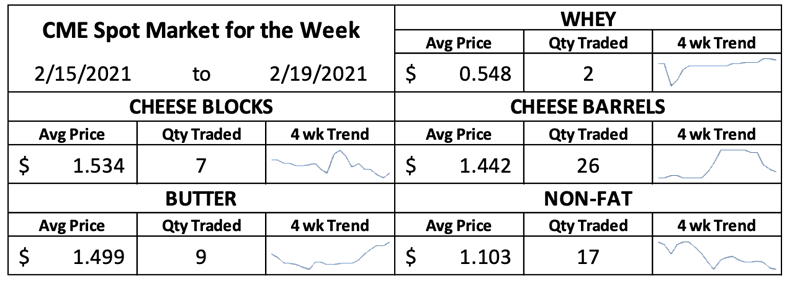
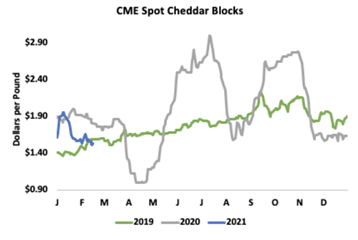 A short week didn’t translate to a shortage of action in the spot Cheddar markets. After a lethargic start, with blocks and barrels unchanged on Tuesday, both products began to slide. Blocks gave up 2.75¢ on Wednesday, followed by another 2¢ to hit a weekly low of $1.51/lb. on Thursday. Friday breathed a bit of life into blocks, pushing them up 2.75¢ to close the week at $1.5375/lb., 2¢ lower than last week. In an active week during which 26 loads traded hands, barrels moved continuously lower after Tuesday, ultimately ending the week at $1.4125/lb., 7.75¢ lower than last Friday.
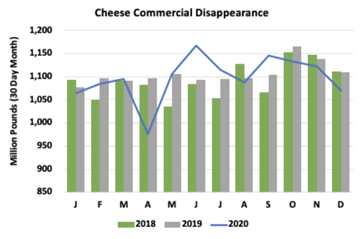
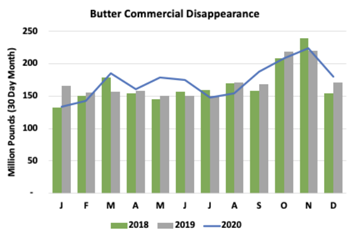 As the March 1 deadline for selling old crop butter rapidly approaches, the butter market seems to have found some traction. Foodservice demand is still depressed, according to market participants, but retail sales remain robust. Commercial disappearance of butter was up a surprising 5.2% year over year in December. Meanwhile, a USDA Section 32 solicitation for purchases of about 15 million pounds of butter between April and June also likely bolstered market sentiment, even as the announcement was aligned with expectations.
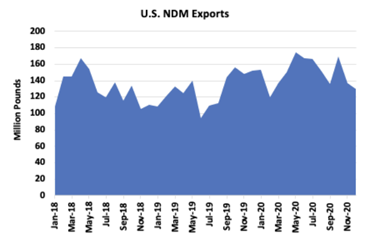 After opening Tuesday’s spot session with a .25¢ gain, nonfat dry milk prices slid over the balance of the week, ultimately closing Friday’s trade at $1.0925/lb. 17 loads traded hands during the week. Even though some powder manufacturers have been affected by the inclement weather, production has remained robust. A shortage of containers continues to garner headlines and is interrupting the ability of exporters to move product abroad, even where interest from global buyers exists.
 Class III milk futures were able to make some gains on Tuesday, even as the spot cheddar markets were quiet on the day. However, these gains were largely erased over the remainder of the week with most nearby contracts giving up ground as spot cheese prices slid. Class IV milk futures performed similarly with Tuesday’s gains subsequently canceled out by losses later in the week. Despite spot butter’s strength, most nearby Class IV contract settled on Friday within a few cents of prior week levels.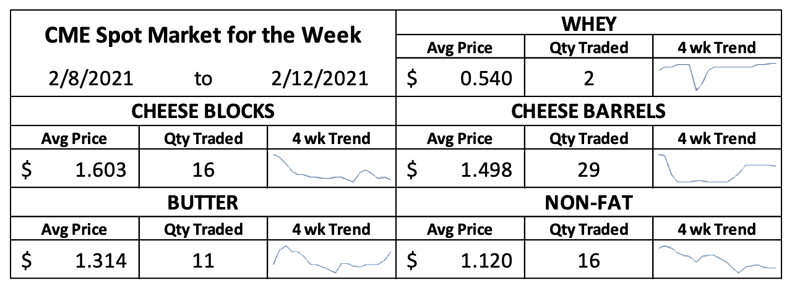
 Overall, the spot Cheddar markets had a relatively subdued week, as the reality of ample supply and lackluster restaurant demand continues to weigh on prices. Cheese manufacturers across the country emphasize the availability of spot milk and are running had to absorb as much of it as possible. Following last Friday’s rally, CME spot Cheddar blocks opened the week with a modest gain on Monday. The market then lost steam for the remainder of the week, and despite a bounce on Thursday, Cheddar blocks ultimately finished the week at $1.5575/lb., down 8.25¢ from last Friday. Barrels remained unchanged at $1.50/lb. for most of the week before giving up a penny on Friday to close at $1.49/lb. Barrel trade was active with 29 loads changing hands, while 16 loads of blocks moved.
 Spot butter prices managed to find some traction this week. With the exception of a dip on Wednesday, CME spot butter prices moved up all week, closing Friday’s trade at $1.395/lb., up 12.75¢ from last week. Market participants indicate that lower prices have helped to generate additional demand, particularly from retailers. As U.S. prices continue to hold a significant discount to global competitors, interest from international buyers is growing, and where possible, manufacturers are adjusting to produce butter that meets international standards. Even with the uptick in demand, cream supplies remain available and with churns running hard, butter inventories are still heavy. Most participants expect the butter market to bounce after March 1, when the shift from old crop to new crop butter occurs.
 Nonfat dry milk (NDM) markets were unsettled this week. Inventories are heavy but demand has remained robust from both domestic and international sources, thus helping to keep some tension in the market. Condensed skim for dryers can still easily be obtained but NDM manufacturers indicate that prices have increased modestly. Spot NDM prices lost .75¢ over the course of the week at the CME, ultimately closing at $1.1125/lb. with 16 loads trading hands.
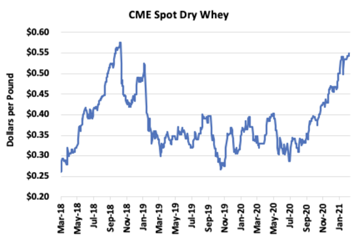
 The dry whey market continues to demonstrate resilience with prices moving upward on strong exports and a production preference for higher protein products like whey protein concentrates and whey protein isolates. U.S. whey exports hit a record high in 2020, up 23.4% year over year after considering the leap day, and with 38.9% of these exports destined for China. Exporters have reported that Asian demand for U.S. whey has slowed in recent weeks as the Chinese New Year approached, but demand is expected to rebound after the holiday. CME spot dry whey was able to add .75¢ during the week to close Friday’s session at 54.25¢/lb.
 Class III milk futures were under pressure for most of the week as they embodied the weakness of the spot Cheddar block market. Thursday’s House Agriculture Committee announcement imbued the market with a bit of strength and pushed several nearby contracts limit up. However, the rally was short-lived, and by Friday’s settlements nearly all 2021 contracts corrected downward once again. Class IV milk futures remained quiet for most of the week.



