Archive for Dairy Markets – Page 37

Dairy Markets Start Shortened Week Higher in Chicago Tuesday

On the Chicago Mercantile Exchange milk futures started the holiday-shortened week to the higher side Tuesday supported by improving global trade, while most cash markets came to a standstill. February Class III milk a penny higher at $15.64.  March up 14 cents at $16.70.  April up 12 cents at $17.26.  May a dime higher at $17.50.  June through August contracts four to nine cents higher.

On spot trade, butter up $0.06 at $1.4550.  Two trades were made at that price. Nonfat dry milk up $0.0025 at $1.1150.  Four trades were made ranging from $1.11 to $1.1175.  Dry whey unchanged at $0.5425.  Blocks unchanged at $1.5575.  Barrels unchanged at $1.49.  

Dairy Markets Show Strength on the CME in Chicago Thursday

On the Chicago Mercantile Exchange milk futures closed higher Thursday as some newfound strength in cash markets carried into futures. February Class III milk 17 cents higher at $15.66.  March up 75 cents at $17.03.  April up 75 cents at $17.54.  May up 61 cents at $17.71.  June through August contracts 32 to 57 cents higher.

On spot trade dry whey up $0.0025 at $0.5425.  Blocks up $0.0225 at $1.5925.  Five sales were made ranging from $1.5825 to $1.5925. Barrels unchanged at $1.50.  Eight sales were made at $1.49 and $1.50. Butter up $0.0450 at $1.3250.  One trade was made at $1.2975.  Nonfat dry milk down $0.0075 at $1.1125.  Four trades were made ranging from $1.11 to $1.1225. 

Mixed Markets Mid Week in Chicago

On the Chicago Mercantile Exchange milk futures closed mixed Wednesday, range-bound with limited cash direction. February Class III milk a penny higher at $15.49.  March down three cents at $16.28.  April up three cents at $16.79.  May down five cents at $17.10.  June through August contracts eight cents lower to a penny higher.

On spot trade blocks down $0.0575 at $1.57.  Four sales were made ranging from $1.57 to $1.6025. Barrels unchanged at $1.50.  Six sales were made at that price. Butter down $0.0075 at $1.28.  One trade was made at that price.  Nonfat dry milk down $0.01 at $1.12.  Six trades were made at $1.12 and $1.1225.  Dry whey unchanged at $0.54. 


Bearish Supply and Demand Report Drives Futures Down in Chicago Tuesday

On the Chicago Mercantile Exchange milk futures closed lower Tuesday following a bearish supply and demand report. February Class III milk down 13 cents $15.48.  March down 23 cents at $16.31.  April down 36 cents at $16.76.  May down eight cents at $17.15.  June through August contracts five to seven cents lower.

In spot trade, dry whey up $0.0050 at $0.54.  Two sales were made at that price.  Blocks down $0.0375 at $1.6275.  Four sales were made ranging from $1.6225 to $1.6275. Barrels unchanged at $1.50.  Nine sales were made at that price. Butter up $0.0075 at $1.2875.  Nonfat dry milk up $0.0050 at $1.13.  Four trades were made at that price at $1.1275 and $1.13. 

Traders Correct Overbought Positions to Start the Week Lower in Chicago

On the Chicago Mercantile Exchange milk futures started Monday mostly lower as traders corrected overbought positions and squared their stance ahead of Tuesday’s supply and demand report. February Class III milk up down three cents $15.61.  March down 15 cents at $16.54.  April unchanged at $17.12.  May down 25 cents at $17.23.  June through August contracts ten to 17 cents lower.

In product trade, blocks up $0.0250 at $1.6650.  Three sales were made ranging from $1.66 to $1.6650. Barrels unchanged at $1.50.  One sale was made at that price. Butter up $0.0125 at $1.28.  Seven trades were made ranging from $1.2525 to $1.28.  Nonfat dry milk up $0.0050 at $1.1250.  Dry whey unchanged at $0.5350. 


New Zealand‘s milk powder exported to China will achieve zero tariffs within three years

On January 26, 2021, on behalf of China, the Chinese Minister of Commerce, Mr. Wang Wentao, signed a protocol with Damien O’Connor, Minister for Trade and Export Growth of New Zealand, on upgrading their Free Trade Agreement (FTA). This has been the first update since the FTA was signed twelve years ago.

Minister of Trade and Export Growth of New Zealand, Damien O’Connor, indicated that with the economic confusion caused by the COVID-19 situation, the FTA upgrade is part of New Zealand’s trade recovery strategy to answer the economic impact caused by the coronavirus. He also emphasized that the relationship with China is always one of the most important diplomatic relationships of New Zealand. The FTA upgrade is expected to bring more benefits to the businesses and people of China and New Zealand.

In the amendment to the FTA are new stipulations regarding online and offline competition, as well as environmental standards. Furthermore, the revised FTA will include new rules for customs protocol and the sourcing of product materials.

Chinese duties on New Zealand dairy products to be eliminated within three years

The FTA upgrade will retain the current stipulations for dairy products. While the safeguard duty of most of the products will be canceled within one year, the safeguard duty of milk powder will be canceled within three years, which means that all dairy products imported to China from New Zealand will be exempt from customs duties from January 1, 2024. This will bring large benefits to dairy enterprises in New Zealand.

Official data from New Zealand shows that China invested a total of 340 million US dollars in New Zealand in 2019, and China was considered to be the second largest source of foreign capital. It is believed that the FTA upgrade will attract more Chinese investment to New Zealand after taking effect.

According to some public records, New Zealand is the largest dairy product exporting country in the world. The total dairy export volume of New Zealand accounts for 1/3 of the global dairy trade. Data from Chinese customs shows that from January to November, 2020, China imported 306,700 tons of baby formula milk powder from other countries, with 63,800 tons of milk powder from New Zealand, which accounts for 20.8% of the total dairy import volume in China, becoming China’s second biggest customer after Europe. Dairy products from New Zealand also rank first in the imported dairy market in China.

China’s new partnership with New Zealand puts pressure on Australia

A dairy analyst in China pointed out that the FTA upgrade makes it convenient for China to import dairy products from New Zealand, brings more benefits to the customers, and also helps develop Chinese dairy enterprises in New Zealand. In addition, China and New Zealand’s signing of the Regional Comprehensive Economic Partnership (RCEP) will improve the relationship between China and Australia.

Since 2020, Australia has prevented the export of agricultural products such as lobsters, wine, wood, and beef to China. Nowadays, the FTA upgrade brings more advantages to New Zealand, which will give a hard blow to Australia’s agricultural and dairy market. According to a news report from Australia Broadcasting Corporation, on January 24, Minister for Trade, Dan Tehan, said that he has sent positive news to China in the hope that he could break the ice on trades between China and Australia and create more opportunities for trade.

For more information, please check our resources on Dairy Products China.

Limited Trade Sees Mixed Results in Chicago Thursday

On the Chicago Mercantile Exchange milk futures traded mixed in a narrow range Thursday ahead of the monthly dairy product report. February Class III milk down four cents at $15.54.  March down two cents at $16.01.  April three cents higher at $16.37.  May up four cents at $16.73.  June through August contracts a penny lower to five cents higher.

In product trade, dry whey unchanged at $0.5350.  Blocks down $0.0225 at $1.5575.  Five sales were made ranging from $1.5350 to $1.5550. Barrels up $0.0325 at $1.4450.  One trade was made at that price. Butter down $0.0150 at $1.2775.  Thirteen sales were made ranging from $1.2750 to $1.30.  Nonfat dry milk down $0.02 at $1.09.  Six sales were made ranging from $1.09 to $1.0975.

Mixed Markets Mid Week at CME

On the Chicago Mercantile Exchange milk futures closed mixed Wednesday with front-month contracts to the lower side and more optimism in the second half of the year. February Class III milk down 14 cents at $15.58.  March down 22 cents at $16.03.  April 16 cents lower at $16.34.  May six cents lower at $16.69.  June through August contracts two to five cents higher.

In product trade, dry whey unchanged at $0.5350.  One sale was made at that price. Blocks down $0.0325 at $1.5575.  Four sales were made ranging from $1.5575 to $1.59. Barrels up $0.0225 at $1.4125.  Three trades were made at $1.41 and $1.4125.   Butter unchanged at $1.2925.  Nonfat dry milk down $0.0275 at $1.11.  Thirty-three sales were made ranging from $1.1050 to $1.1275.

Global Dairy Trade Index up 1.8%

The Global Dairy Trade index in New Zealand increased 1.8 percent Tuesday, the sixth event to post positive moves.  Gains were seen in almost all categories with butter milk powder, up 10.7 percent, butter, up 6.2 percent, and lactose, up 3.8 percent, posting the largest increases.  Skim milk powder had the only decline, down 1.5 percent.

 
New Zealand Global Dairy Trade Price Index
  Actual Previous Highest Lowest Dates Unit Frequency  
  1.80 4.80 22.60 -14.00 2009 – 2021 percent Weekly
NSA


AMF index up 1.3%, average price US$5,463/MT

Butter index up 6.2%, average price US$5,028/MT

BMP index up 10.7%, average price US$3,180/MT

Ched index up 2.3%, average price US$4,178/MT

LAC index up 3.8%, average price US$1,217/MT

SMP index down 1.5%, average price US$3,198/MT

SWP index not available, average price not available

WMP index up 2.3%, average price US$3,458/MT

Fonterra raises its forecast milk price payout

Fonterra has raised it forecast farmgate milk price for the current dairy season off the back of strong demand from China and South East Asia.

Fonterra milk truck

Fonterra expects to pay farmers between $6.90 – $7.50 per kilogram of milk solids. Photo: RNZ / Rebekah Parsons-King

The dairy giant now expects to pay farmers between $6.90 – $7.50 per kilogram of milk solids. That is up 20 cents a kilo from its previous forecast range of $6.70 – $7.30.

Fonterra chief executive Miles Hurrell said the lift in the 2020/21 forecast farmgate milk price range was a result of strong demand for dairy, which is demonstrated by the continued increase in Global Dairy Trade (GDT) prices since the Co-op last revised its milk price at the beginning of December.

“In particular, we’ve seen strong demand from China and South East Asia for whole milk powder (WMP) and skim milk powder (SMP), which are key drivers of the milk price.

Hurrell said with New Zealand farmers now through the peak of the 2021 milking season, the impact of any changes in global market dynamics was reducing and its view of the season is firming up.

“However, we are continuing to keep a close eye on a number of factors. These include New Zealand weather conditions, expected challenges from further waves of Covid-19 and increasing milk production in the Northern Hemisphere.”

At the GDT auction overnight dairy prices hit their highest level in nearly seven years. The average price at the fortnightly auction rose 1.8 percent to $US3614 a tonne. This followed a 4.8 percent rise at the last auction two weeks ago.

Fonterra will provide more detail on its overall performance and full year earnings guidance when it announces its 2021 half year results on Wednesday, 17 March.

More in the back pocket

Federated Farmers Dairy Chair Wayne Langford said the lift in payout and the GDT would have a trickle down effect into other sectors.

Farmers would have extra money in the back pocket to spend on capital items they were previously holding off on, he said.

“It is really important that people in those jobs, understand that for the average dairy farmer this slight increase is an extra $20,000 or $30,000 and potentially farmers will be looking at spending that,” Langford said.

“Whether that is a new shed or tractor or just some tidy up jobs around the farm, that is where others in the community can get amongst it.”

Source: rnz.co.nz

Markets Turn Higher Tuesday in Chicago

On the Chicago Mercantile Exchange milk futures were mostly higher Tuesday with positive global markets providing some strength. January Class III milk unchanged cents at $16.12.  February up 22 cents at $15.72.  March eight cents higher at $16.25.  April three cents higher at $16.50.  May through July contracts one to five cents lower.

On spot trade, Dry whey unchanged at $0.5350.  Blocks up $0.0075 at $1.59.  Two sales were made at that price. Barrels unchanged at $1.39.   Butter up $0.0825 at $1.2925.  Nine trades were made ranging from $1.22 to $1.2925.  Nonfat dry milk down $0.0150 at $1.1375.  Eight sales were made ranging from $1.13 to $1.1450.

Wisconsin December All Milk Price Fell to $18.20 Cwt.

The Wisconsin all milk price for December was $18.10 per hundredweight, according to the latest USDA Agricultural Prices report. That was $4.60 lower than last month’s price and $3.30 lower than last December’s price.

The U.S. all milk price was $18.50 per cwt, 40 cents higher than Wisconsin’s price, but $2.80 lower than a month earlier. Nineteen of the 24 major milk producing states had a lower price when compared with November.

Meanwhile, the Chicago Mercantile Exchange 40-pound block cheese price closed at $1.57 per pound on January 29, while barrels were $1.39 per pound. The CME butter price was $1.24 per pound.

For the week ending January 23, the Agricultural Marketing Service U.S. weekly 40-pound block cheese price averaged $1.78 per pound, and 500 pound barrels adjusted to 38 percent moisture averaged $1.62 per pound. The U.S. butter price was $1.41 per pound.

Source: Wisconsin Ag Connection

Dairy Markets Start Week Lower in Chicago

On the Chicago Mercantile Exchange  milk futures closed mostly lower to start the week Monday as did cash markets. January Class III milk unchanged cents at $16.12.  February up 14 cents at $15.50.  March 47 cents lower at $16.17.  April down 29 cents at $16.47.  May through July contracts 10 to 29 cents lower.

In spot trade, Dry whey unchanged at $0.5350.  Blocks up $0.0075 at $1.5825.  Four sales were made ranging from $1.57.50 to $1.5825.  Barrels unchanged at $1.39.  One trade was made at $1.3875. Butter down $0.0350 at $1.21.  One trade was made at $1.2250.  Nonfat dry milk down $0.02 at $1.1525.  Three sales were made ranging from $1.1525 to $1.1625.

Commodity Inventories Determine Prices. Where do Commodity Inventories Stand?

Producer milk prices are determined by formula from the prices of four dairy commodities: cheese, butter, Nonfat Dry Milk (NDM), and dry whey.  The prior two posts (January 10 & December 20) covered where these commodity prices were in 2020 and where the futures prices of these commodities are going.  The four commodity prices are largely determined by available inventories.  When there is a lot available, prices will be lower than when commodities are scarce.  

This post will examine the inventory levels and prices of cheese and butter over the last three years and where they currently stand.  Because NDM and dry whey prices are determined by global inventories they will not be covered in this post.  Cheese and butter prices are the main determinants of butterfat, milk protein, and Class III milk prices.  NDM which is not covered in this post has a strong influence on the Producer Price Differential.  Dry whey prices are used to set the price of Other Solids in milk and has a small influence on producer milk prices.

Monthly changes can be very volatile and therefore can be misleading and difficult to follow.  The data in this post is based exclusively on twelve-month moving averages.  Twelve-month averages decrease the volatility of seasonal and monthly swings and allow better visibility of where the market is and where it may be going. 

In some of the charts below, there are “blips” in around March and April 2020.  That is when the impact of COVID and the drastic shifts in consumer demand started.  The changes were drastic, and it took a while for the production and supply chains to manage the changes.  That time has passed, and those changes should be considered as a one-time event that has passed.

Data for 2020 is available through November 2020.

BUTTER

The price of butter determines the price that all Federal Milk Marketing Order producers get for butterfat.  Therefore, the price of butter is very important.  There is a inverse correlation between butter inventories and butter prices.  In the last few years butter prices increased to record levels as inventories were tight.  During 2020 the inventories levels increased, and butter prices dropped to more typical levels.

Chart I below provides a very clear view of the correlation between butter inventories and butter prices.  During 2018 and 2019, inventories were very low and prices were high.  In 2020, the inventories increased, and prices tumbled.  The inverse relationship here is very clear.

Chart I – Butter Inventories and Prices

In turn, this begs the question as to why the inventories were low and what changed to increase the wholesale availability of butter.  The answer to this is somewhat complex with multiple variables contributing to these inventory swings.

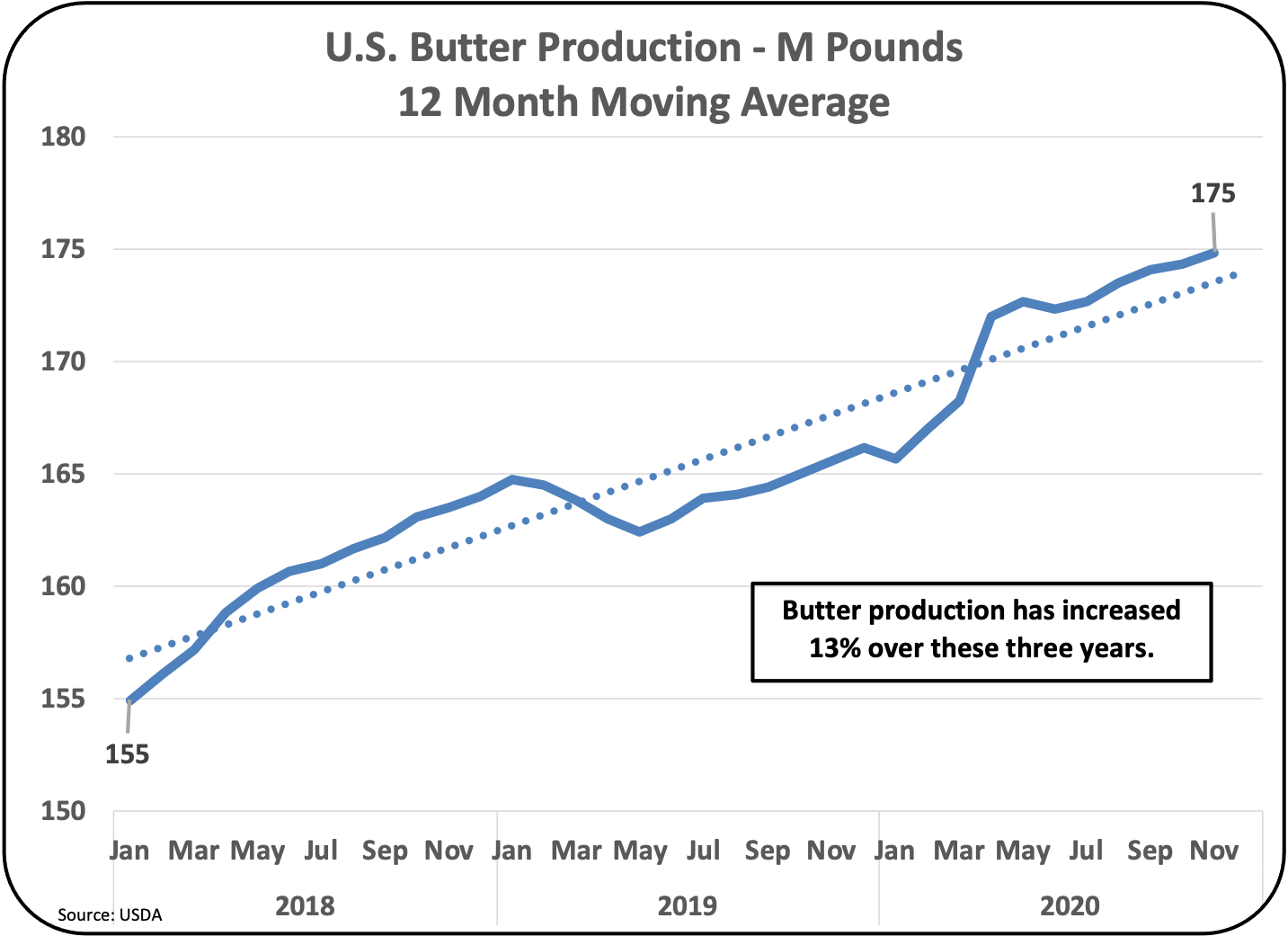
The first thing to be covered will be butter production (churning).  Chart II illustrates the increase in butter production.  Since the start of 2018 to the end of 2020, U.S. butter production has increased by 13 percent.  This is well above the increases in domestic demand.  Therefore, it resulted in an increase in inventories.  Milk production of butterfat has continued to reach new record highs and new capacity for churning has also contributed to the increase in butter production.

Chart II – Butter Production

Chart III below repeats the above chart with domestic production of butter and adds a comparison to butter domestic disappearance from cold storage.  Toward the end of 2020, the area in the circle on Chart III, shows the increasing spread of higher domestic production and a static level of domestic disappearance.  Obviously, this will contribute to larger inventories.  But this chart also shows that in 2018, production was well above disappearance.  During that time, butter prices were still high, and inventories were low (Chart I).  The answer to that is exports and imports that will be covered next.

Chart III – Butter Production and Butter Disappearance

Butter exports and imports have made some significant changes in 2018 through 2020.  Butter exports (Chart IV) were high in 2018 and early 2019.  This contributed to the low butter inventories and high prices in 2018 and early 2019.

Chart IV – Butter Exports


Butter imports in Chart V are the exact opposite of the export chart above.  Imports were low in 2018 also contributing to the low butter inventory levels.  In 2019 significantly more butter was imported to meet demand.  Additionally, imports of Irish butter branded as “Kerrygold” continued to grow significantly.  In 2020 as U.S. butter inventories grew, less butter was imported.  Also noteworthy in Chart V is the March “blip” in imports.  This can be attributed to the drastic changes in dining caused by COVID and can be considered as a one-time event.

Chart V – Butter Imports


Taken together the exports minus imports are shown in Chart VI as “Net Exports.”  Note that the “Net Exports” are all negative numbers, meaning that the U.S. is consistently importing more butter than the U.S. is exporting.  Chart IV on exports had a swing of two million pounds with reduced exports.  Chart V on imports had a swing of three million pounds with increasing exports.  Together, this results in the chart below on “Net Export” which has a four-million-pound reduced swing.  

Chart VI – Butter Net Exports


With “Net Exports” negative, the inventory of butter has remained low through the late 2019.  As butter production started increasing in 2020 butter inventories grew to a higher-level reducing butter prices. The futures market as covered in the prior post showed an increase in butter prices in 2021.  However, based on the current inventory levels and the current trends, there is little reason to expect higher butter prices.

CHEESE

Cheese inventory levels are always more difficult to analyze as the basis for the Agricultural Marketing Service (AMS) survey of cheese prices is based strictly on “young” cheddar cheese and the inventory of “young” cheddar cheese is not public.  The data below is based on the inventories of American cheese which is composed of around 70 percent cheddar and the remainder is a mix of other cheeses.

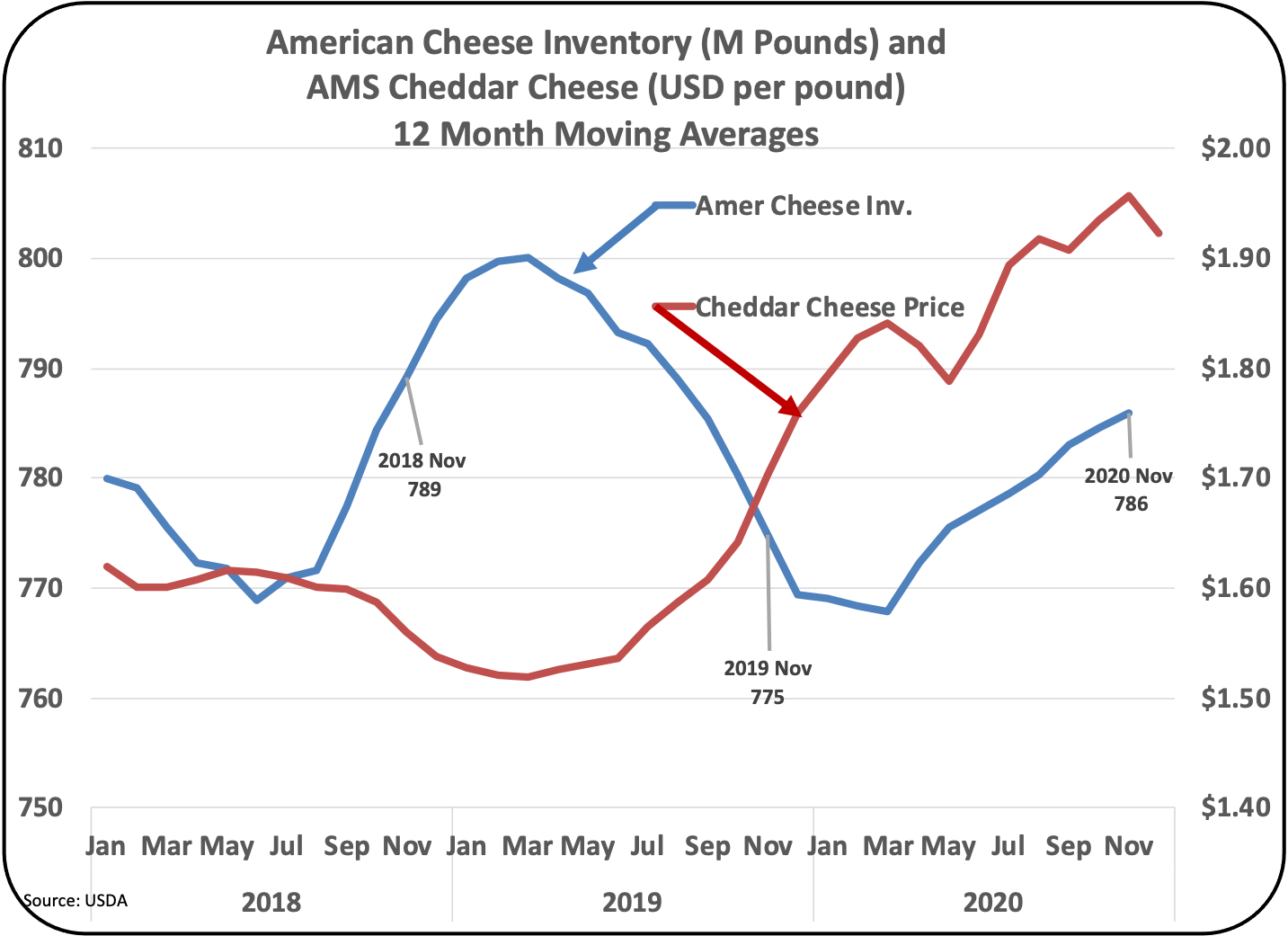
Chart VII below shows the relationship between American Cheese inventories and the AMS price of cheese.  While the inverse relationship is similar to the one for butter (Chart I), in 2020, the relationship does not consistently show the inverse relationship.  The rapidly changing cheese prices in March 2020 set off a rollercoaster of cheese pricing.  It appears that the relationship is only beginning to normalize currently.  As will be shown below, the cheese production and inventory levels do not support the 2020 pricing, because confusion and early buy-ins upset the normal pricing process. 

Chart VII – American Cheese Inventory and Pricing


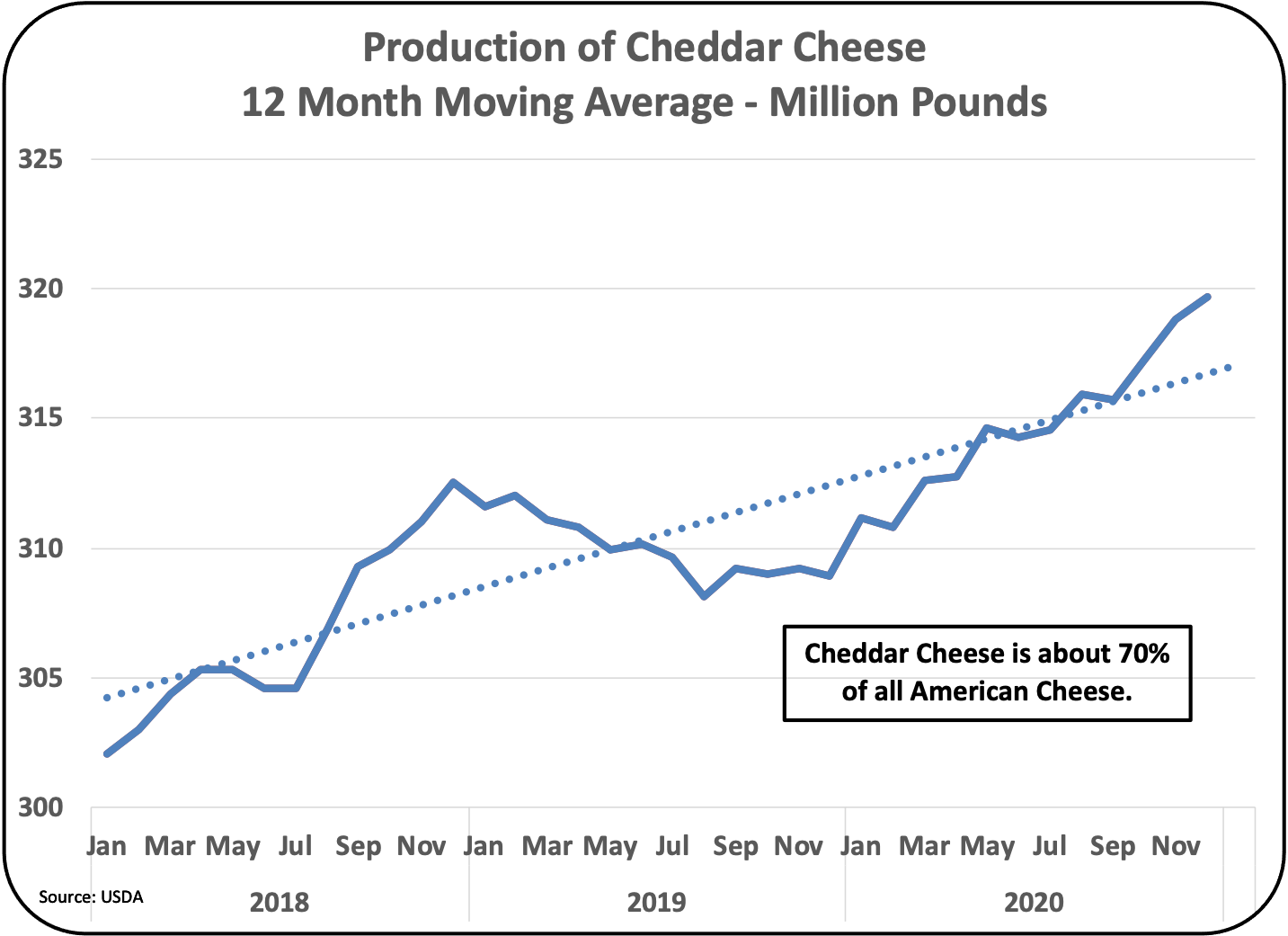
Production of Cheddar cheese was pretty normal in 2020.  From the beginning of 2018 to the end of 2020, production of Cheddar cheese grew by six percent.  Variances from the trend line never exceeded 2 percent.  Currently production is above the trend line.  

Chart VIII – Production of Cheddar Cheese


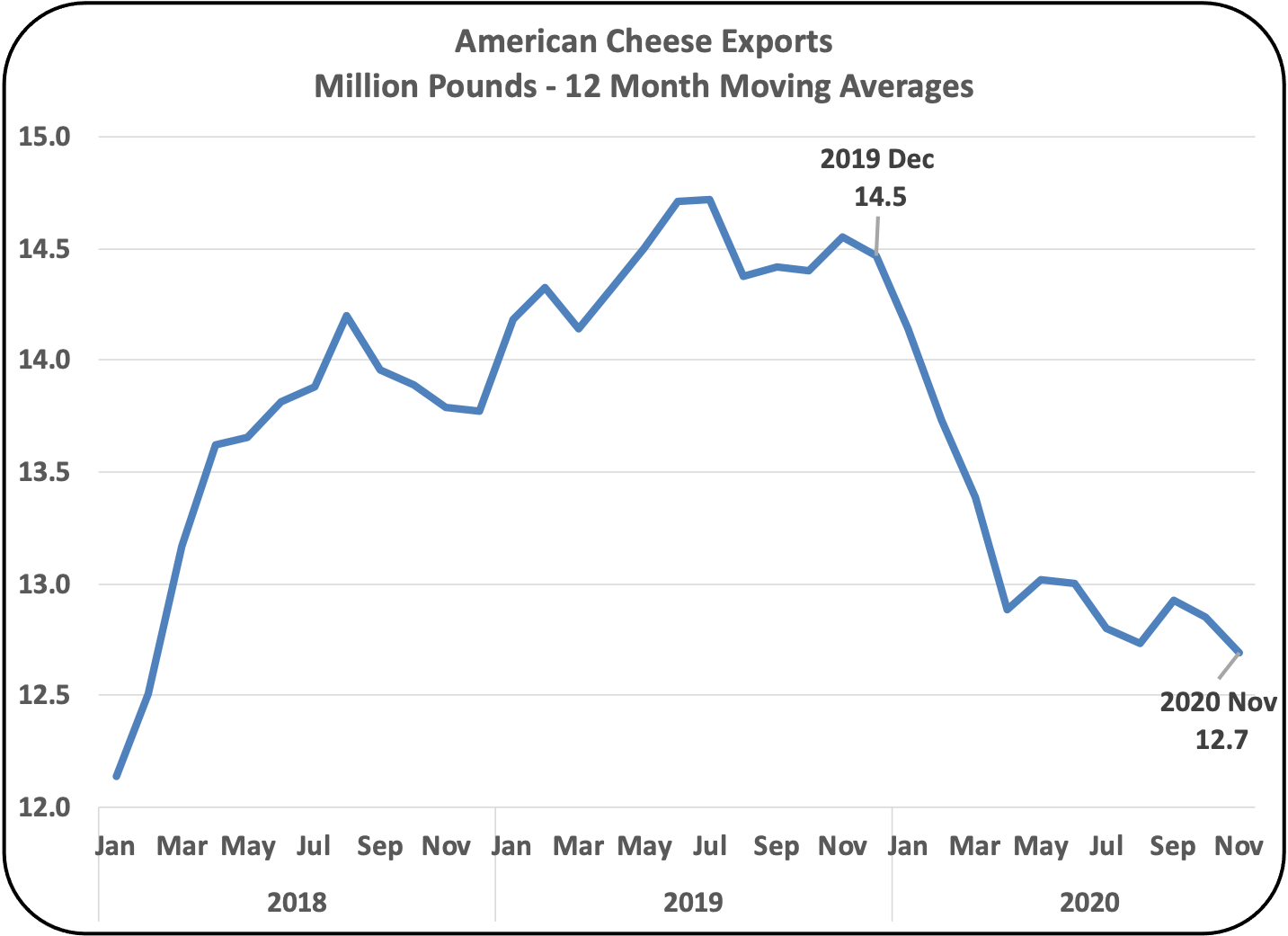
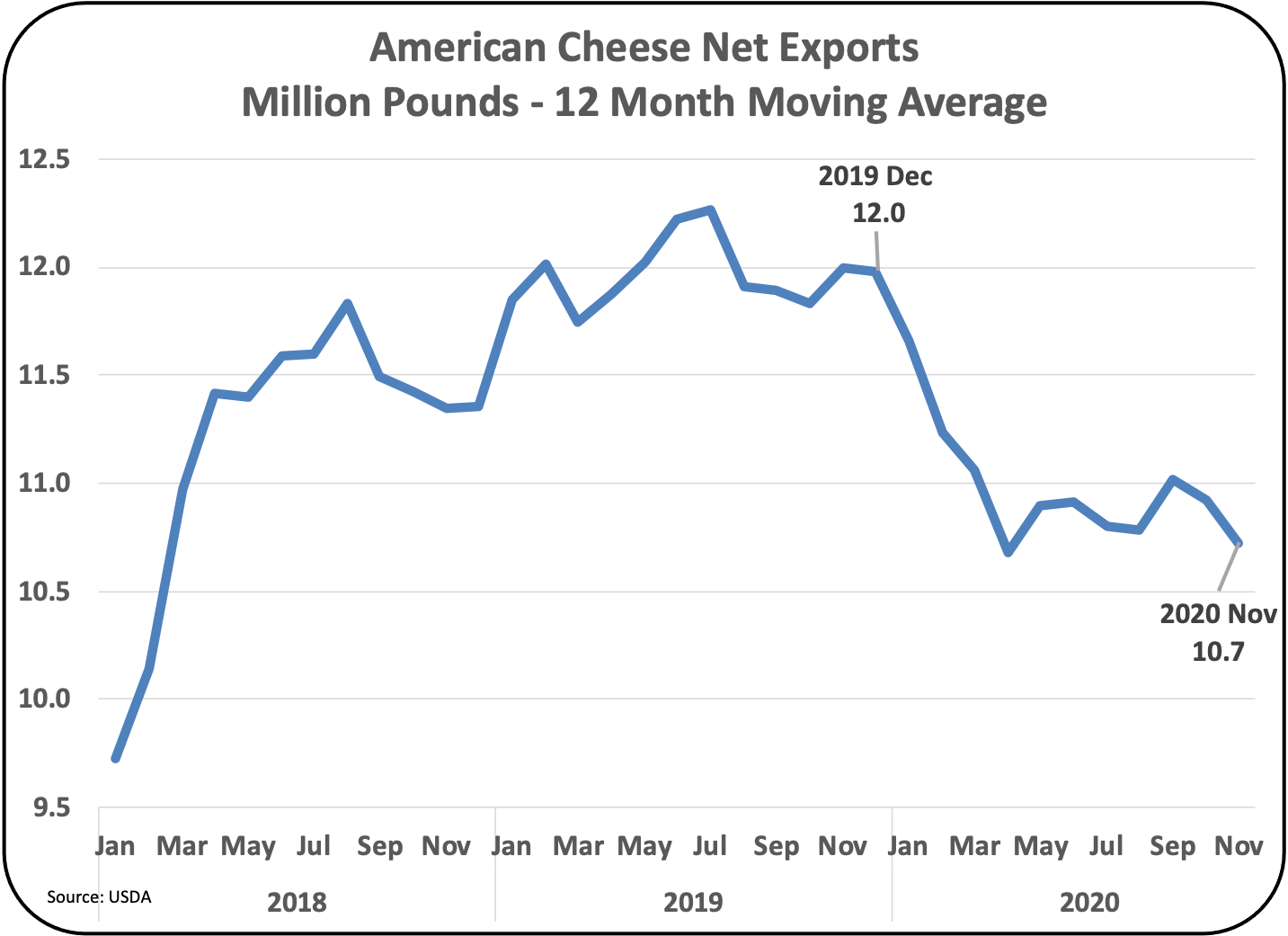
Imports of American cheese do not vary much and amount to only about one-half of a percent of production, so they have very little impact on inventories.  American Cheese “Exports” and “Net Exports” are shown in Charts IX and X. They are down in 2020.  COVID has reduced travel to Mexico and upset the Mexican economy.  Mexico is the largest importer of U.S. cheese. 

Chart IX – Exports of American Cheese
Chart X – Net Exports of American Cheese

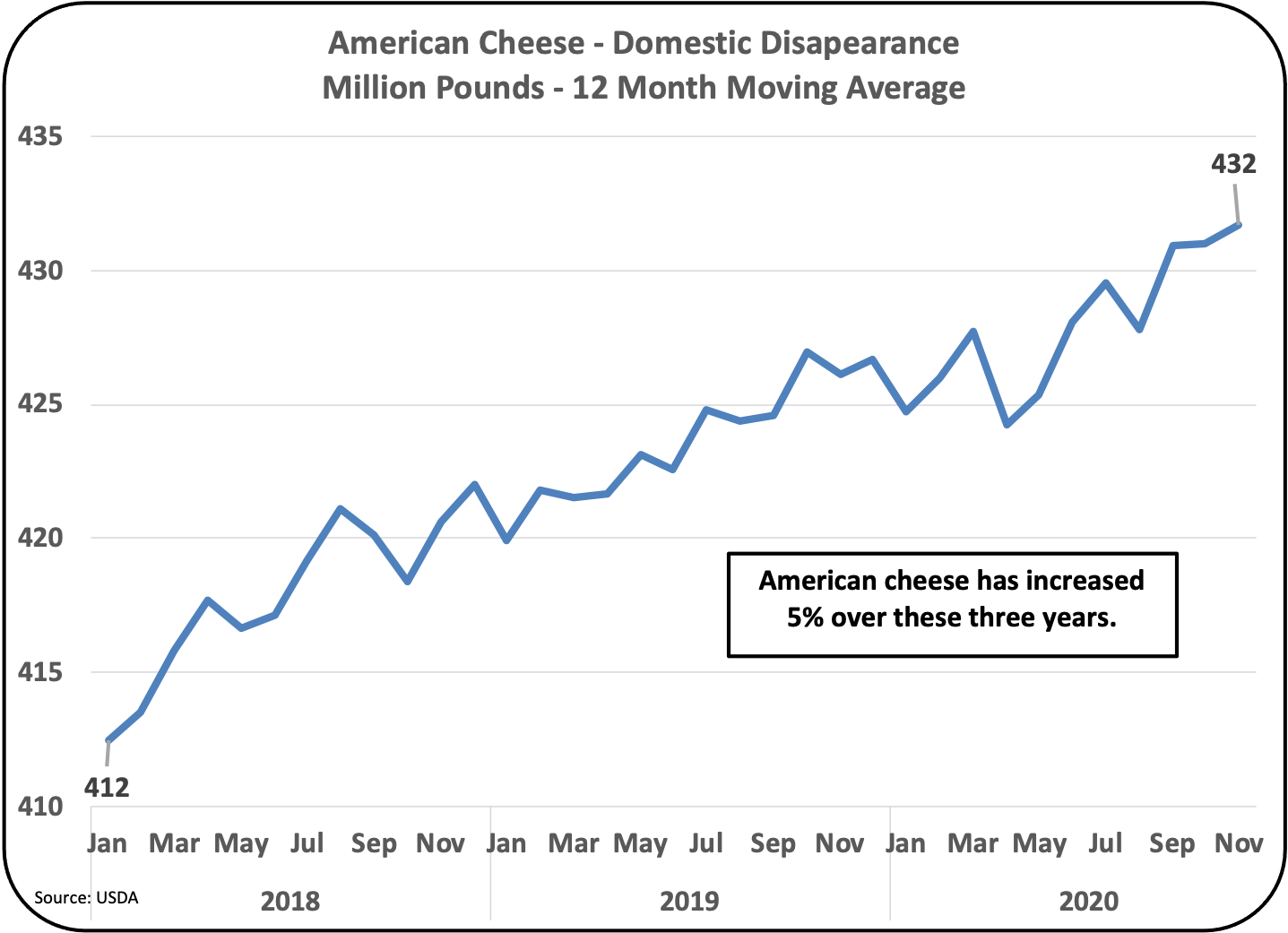
Domestic disappearance is shown in Chart XI.  While domestic disappearance did have a blip in the month of April 2020, it has recovered and appears normal.

Chart XI – American Cheese Domestic Disappearance


Overall cheese inventories seem to be in line with strong production and normal disappearance levels.  The price of cheese as determined by AMS seems to be high (Chart VII) and the cheese futures for 2021 covered in the prior post are expected to drop a little in 2021. This seems reasonable.  The big factors influencing cheese inventories is higher production and reduced exports. 

SUMMARY

The summation of the above is pretty clear.  Butter inventories will not shrink in 2021 and therefore prices of butter will remain at normal long-term levels.

Cheese inventories are reasonable.  Production of Cheddar is reaching record highs.  The increases in production outweigh the disappearance.   Exports to Mexico, the U.S. largest customer will probably remain depressed in 2021.  This could lead to some slippage in price.  That is the same forecast as in the prior post where futures prices were reviewed.

 
Source: Milk Price

Milk Markets Mixed in Chicago Thursday

On the Chicago Mercantile Exchange milk futures were mixed in a narrow range Thursday following the direction of the cash market. January Class III milk up down two cents at $16.12.  February unchanged at $15.52.  March seven cents higher at $16.72.  April up four cents at $16.80.  May through July contracts four to 14 cents higher.

On spot trade, dry whey up $0.02 at $0.53.  One sale was made at that price.  Blocks down $0.0175 at $1.5750.  Barrels down $0.01 at $1.39.  Fifteen sales were made ranging from $1.39 to $1.40.  Butter down $0.0125 at $1.2675.  Twelve sales were made ranging from $1.2750 to $1.2850. Nonfat dry milk up $0.0075 at $1.1725.  One different sale was made at that price.

Milk Markets Shift Higher in Chicago Wednesday

On the Chicago Mercantile Exchange milk futures turned higher Wednesday as traders corrected oversold positions. January Class III milk up a penny at $16.14.  February up 15 cents at $15.52.  March nine cents higher at $16.65.  April down five cents at $16.76.  May through July contracts six to 10 cents higher.

In spot trade, dry whey up $0.0125 at $0.51.  Two sales were made at $0.50 and $0.51.  Blocks unchanged at $1.5925.  Barrels unchanged at $1.40.  Butter unchanged at $1.28.  One sale was made at that price. Nonfat dry milk up $0.0275 at $1.1650.  fifteen sales were made ranging from $1.1475 to $1.1650. 

Dairy Market Report January 2021

2021 has opened with a mix of bullish and bearish market indicators, as the dairy industry moves through another major surge of the coronavirus pandemic and the federal policy outlook is uncertain with a new administration and Congress in Washington.

The U.S. average all-milk price reached its peak for the 2020 calendar year in November and isn’t expected to reach similar levels until the second half of the year, at the earliest. Meanwhile, milk production continues to rise: compared with a year earlier, November U.S. milk production was 3.0 percent higher, total milk solids production was 3.3 percent higher, and total U.S. dairy cows were up by 62,000. All three were the highest rates of increase in several years. Growth in total domestic commercial use of milk in all dairy products ticked up during September–November. Still, a temporary lull in government purchases of dairy products at the end of 2020 was accompanied by a drop in the monthly survey cheese price of more than eighty cents a pound from November to December. This took the Class III price down by $7.62 /cwt from the previous month. That development in turn reestablished a relatively normal relationship between December federal order class prices, generating mostly positive producer price differentials in the seven component pricing orders for the first time since last May. Shipments overseas continued to be a bright spot in the dairy economy. Although slipping some in November from prior monthly pandemic levels, exports for all of 2020 remain on track to hit a record level of milk solids exported during a calendar year.

Commercial Use of Dairy Products Domestic commercial use of milk in all dairy products showed stronger growth during the September–November, period than during many earlier rolling three-month periods, in terms of both milkfat and skim solids usage. Significant increases in American-type cheese and butter, bolstered by government purchases, helped drive this increase.

Read more: NMPF

Milk Futures Continue Lower After Bearish USDA Reports

On the Chicago Mercantile Exchange milk futures are still reeling from USDA’s bearish reports while cash markets were mixed Monday. January Class III milk down three cents at $16.13.  February down 59 cents at $15.37.  March 48 cents lower at $16.56.  April down 50 cents at $16.81.  May through July contracts 40 to 50 cents lower.

On the product markets, dry whey down $0.0425 at $0.4975.  Three sales were made ranging from $0.4975 to $0.51.  Blocks down $0.0175 at $1.5925.  Barrels up $0.0075 at $1.40.  Four sales were made ranging from $1.40 to $1.43. Butter down $0.08 at $1.28.  One sale was made at that price. Nonfat dry milk down $0.0250 at $1.1375.  Thirteen sales were made ranging from $1.1325 to $1.1375. 

Mailbox Milk Prices Expected to Normalize in 2021

The pandemic in 2020 caused unprecedented market volatility in dairy prices, leading to lower milk checks for dairy producers and breaking the relationship between monthly mailbox milk prices and Class III milk prices.

However, the price spread is expected to realign in the first half of 2021, bringing normalcy to producer price differentials (PPDs) and mailbox milk prices, according to a new report from CoBank’s Knowledge Exchange division.

Extreme volatility in cheese and milk prices resulted from supply chain disruptions, government purchasing, and changes in consumption habits during the COVID-19 pandemic. Record-high cheese prices lifted Class III milk prices disproportionately higher than Class IV milk prices, which were held in check by low butter and milk powder prices.

Because of higher Class III milk prices, cheese manufacturers were incentivized to depool milk from Federal Milk Marketing Order (FMMO) marketing regions. The loss of higher-priced Class III milk from the pool resulted in negative PPDs for dairy farmers and lower mailbox milk prices.

“The coronavirus pandemic broke the relationship between monthly mailbox milk prices and monthly Class III milk prices,” said Tanner Ehmke, manager of CoBank’s Knowledge Exchange. “But the spread between Class III and IV milk prices is expected to realign in the first half of 2021, bringing normalcy back to PPDs and mailbox milk prices.”

Pooling and De-Pooling
While most Class I processors are legally obligated to pool milk in an order, handlers of other classes of milk have the option to participate based on certain order performance requirements and the financial incentive.

Between June and November 2020, cheese processors mostly found themselves in a disincentivized position. The cost of milk would be higher if processors had pooled milk in the order. As a result, cheese manufacturers have in many cases chosen to “de-pool” milk.

The effect of de-pooling has been most dramatic in California, where the FMMO pool consisted of an average of just 0.8% Class III milk between June and October 2020. This followed an average of 29% of the order in the same period in 2019.

De-pooling is incentivized when the blend or uniform price in an order pool falls below either Class III or Class IV prices. Historically, de-pooling also tends to coincide with a negative producer price differential.

Future of PPDs
Negative PPDs occur when milk in a federal milk pool is less than the Class III price. This tends to happen when the Class III price is at a significant premium to Class IV milk prices.

New cheese manufacturing plants coming online and expanding in Iowa, Michigan, Minnesota, South Dakota, and Wisconsin will increase annual production of American-type cheese by an estimated 8% by June 2021. When at capacity, the addition in manufacturing will utilize approximately 4.6 billion lbs. of milk annually—roughly equivalent to 1.5 years of increases in annual U.S. milk production.

The increase in plant capacity, combined with the slowing of government programs like the Food Box Program, should contribute to Class III and Class IV milk prices returning to more historical price spreads in the second quarter of 2020, resulting in positive PPDs.

Source: The Cattle Site

Global food prices continue rising in October

Global food prices continued rising for the fifth consecutive month in October, led by cereals, sugar, dairy and vegetable oils, according to a new report from the Food and Agriculture Organization of the United Nations.

The FAO Food Price Index, which tracks international prices of the most traded food commodities, averaged 100.9 points in October 2020, up 3.1 percent from September and 6.0 percent above its value in October 2019.

The FAO Cereal Price Index climbed 7.2 percent from the previous month and 16.5 percent above its value in October 2019. The surge was mainly driven by wheat prices amid shrinking export availabilities, poor growing conditions in Argentina and continued dry weather affecting winter wheat sowings in Europe, North America and the Black Sea region. Maize, feed barley and sorghum prices also remained under upward pressure in October, while those of rice subsided.

The FAO Vegetable Oil Price Index gained 1.8 percent during the month, posting a nine-month high, led by firmer palm and soy oil prices. By contrast, rapeseed oil prices declined moderately amid increased uncertainty regarding demand in the European Union (EU) following the recent deterioration of the COVID-19 situation across the region.

The FAO Dairy Price Index rose 2.2 percent from September, with cheese rising the most, followed by skim milk powder, whole milk powder and butter. Price increases in October reflected market tightening for near-term deliveries, underpinned by robust import demand from Asian and Middle Eastern markets.

The FAO Sugar Price Index increased 7.6 percent from September ­- a move largely influenced by the prospects of a lower sugar output in both Brazil and India – the two largest sugar producing countries in the world.

The FAO Meat Price Index, by contrast, declined 0.5 percent from September, marking the ninth monthly decline since January, driven by drop in pig meat prices reflecting in part continued influence of the import restrictions imposed by China on Germany. Bovine and poultry meat prices also fell, while prices of ovine meat rose on steady internal demand and low export supplies.

Despite downward revisions, cereal output still expected to reach an all-time high

In its latest Cereal Supply and Demand Brief, also published today, FAO reduced the world’s 2020 cereal production for a second consecutive month, by nearly 13 million tonnes, largely on expectations of diminished world coarse grains production. However, global cereal output is still forecast at a record 2 750 million tonnes, surpassing the 2019 output by 1.6 percent.

The reduction in the world coarse grains production forecast reflects lower expectations for the maize output in the EU and Ukraine, where continued adverse weather has further reduced yield prospects.

The global wheat production forecast for 2020 is also trimmed slightly this month, on lower output expectations in Ukraine and Argentina due to the impact of dry weather.

Prospects for the 2021 winter wheat crop, which is already being sown in the northern hemisphere, are generally strong, reflecting the expectations of increased plantings in response to higher prices in several main producing countries, notably in the EU.

FAO slightly raised its estimate of world total cereal utilization in 2020/21 to 2 745 million tonnes, which would represent a 1.9 percent increase from the 2019/20 level, mostly driven by upward revisions for wheat consumption in the EU.

Cuts in world production forecasts this month for maize, wheat and rice, amidst a faster pace in exports in response to strong global import demand, are seen to result in lower inventories, especially among the major exporters. FAO has lowered its forecast for world cereal inventories by the end of seasons in 2021 by 13.6 million tonnes since October to 876 million tonnes, now falling below the 2017/18 record. The resulting global cereal stock-to-use ratio in 2020/21 stands at 31.1 percent, still highlighting relatively comfortable global supply prospects in the new season.

FAO expects world cereal trade in 2020/21 to increase by 3.0 percent from the 2019/20 level to 451 million tonnes, with expansions predicted for all major cereals, led by a 4.7 percent anticipated increase in global trade in coarse grains.

Source: reliefweb.int

Anticipation of Bullish USDA Report Milk Futures Start Week Lower

On the Chicago Mercantile Exchange milk futures started the week lower anticipating bearish USDA reports and seeing little cash activity Monday. January Class III milk unchanged at $16.16.  February down 50 cents at $15.96.  March 50 cents lower at $17.04.  April down 23 cents at $17.31.  May through July contracts seven to 15 cents lower.

On product trade, dry whey unchanged at $0.54.  Blocks unchanged at $1.61.  Barrels unchanged at $1.3925.  Two sales were made at $1.39 and $1.3925. Butter down $0.0425 at $1.36.  Four sales were made ranging from $1.36 to $1.4075.  Nonfat dry milk down $0.01 at $1.1625. 

Global dairy prices start year with a bang

Global dairy prices have started the year with a bang with strong results at the first two Global Dairy Trade auctions.

The GDT index lifted 4.8 per cent to $US3593 a tonne on Tuesday night, backing up a rise of 3.9pc on January 6.

The increase was led by a 17.2pc surge in the anhydrous milk fat, while skim milk powder was up 7.0pc, butter 4.6pc and whole milk powder 2.2pc.

The price is the highest since May 2018.

“It was another rip-snorter of a dairy auction overnight, as prices advanced yet again,” New Zealand bank ASB economist Nat Keall said.

“All the indicators continue to suggest demand for dairy products is likely to hold up well, through to the end of the season.”

Westpac NZ senior agri economist Nathan Penny said the dairy market was starting 2021 with a hiss and a roar.

The bank has lifted its forecast NZ 2020/21 farmgate milk price by NZ50 cents a kilogram of milk solids to $NZ7.50.

It has also lifted its forecast NZ 2021/22 farmgate milk price by NZ25c to $NZ7.25.

“The forecast lifts are on the back of surging global dairy prices, particularly at the start of this year,” Mr Penny said.

“Since early November, overall dairy prices have jumped 17.2pc, with over half of the lift occurring since the start of the year.”

Both analysts pointed to Chinese economic recovery as the key to the market revival.

“Solid purchases from China have anchored price gains at recent auctions, and with the latest Chinese GDP (gross domestic product) figures showing a decent lift in GDP, there is little reason to think that story will change,” Mr Keall said.

Mr Penny said China largely had COVID-19 under control and its economy had rebounded strongly.

“In fact, the Chinese economy actually grew over 2020, the only major economy to do so,” he said.

Mr Penny is upbeat about the market’s prospects for the rest of this season.

“The global dairy price lift is mirroring a broader lift in other commodity prices,” he said.

Oil price were trading essentially back at their pre-COVID levels.

“On that measure too dairy markets have put COVID well and truly in the rear-view mirror,” he said.

“Whole milk powder (WMP) prices are now at their highest level since December 2016.

“From here, we expect the price momentum has further to run.

“Global dairy supply takes time respond to price lifts.

“Ultimately though, when supply does respond, we expect prices to moderate.

“But that is a story largely for next season.”

Both analysts dismissed the impact on the strengthening NZ dollar on this season’s prices.

“Given Fonterra’s hedging policies and the timeframes involved, the flight of the kiwi will have little influence on the final farmgate price for this season,” Mr Keall said.

“The NZD’s recent strength is likely to be more of an influence on next season’s milk price, so farmers should prepare to take a bit more of a hit from the NZD strength in the 21/22 season.”

Source: farmonline.com.au

Markets Continue Downward in Chicago Thursday

On the Chicago Mercantile Exchange milk futures and cash dairy markets were down again Thursday, January 21st. January Class III milk was down $.03 at $16.15.  February was down $.67 closing at $16.46.  March was down $.45 at $17.33.  April was down $.19 at $17.41.  May through December contracts ranged from five cents lower to five cents higher.

On the spot markets dry whey was up $.0050 at $.54. One sale was made at that price. Blocks were down $.0775 closing at $1.6525.  One sale was made at that price. Barrels went down  $.0500 to $1.39.  Eighteen sales were made ranging from $1.38 to $1.39. Butter closed down $.0525 at $1.4025.  Three trades were made from $1.4025 to $1.46.  Nonfat dry milk was down $.0175 at $1.1825.  Six sales were recorded from $1.18 to $1.1825.

Markets Continue Slide Wednesday in Chicago

On the Chicago Mercantile Exchange milk futures continued to slide Wednesday with a major sell off for February contracts pressured somewhat by negative cash cheese trade. January Class III milk down four cents at $16.18.  February down $1.35 at $17.13.  March 83 cents lower at $17.78.  April down 62 cents at $17.60.  May through July contracts 12 to 29 cents lower.

On the spot market dry whey unchanged at $0.5350.  Blocks down $0.07 at $1.73.  Barrels down $0.12 at $1.44.  One sale was made at that price. Butter up $0.05 at $1.4550.  Four trades were made ranging from $1.42 to $1.4550.  Nonfat dry milk down $0.0150 at $1.20.  One sale was made at that price.

Global Dairy Trade Index Rises for 5th Conescutive Time

The Global Dairy Trade index jumped up 4.8% in Tuesday’s trading, marking the fifth straight increase in the price index.

The most recent tender – event 276 – concluded today (Tuesday, January 19) with the GDT Price Index up 4.8%.

Lasting two hours and 47 minutes, today’s event saw 181 participating bidders battle it out across 21 rounds with 93 winning bidders emerging.

A total of 29,606MT of product was sold on the day.

Key results:

  • AMF index up 17.2%, average price US$5,398/MT;
  • Butter index up 4.6%, average price US$4,735/MT;
  • BMP not offered;
  • Ched index down 0.3%, average price US$4,082/T;
  • LAC index up 6.6%, average price US$1,173/MT;
  • SMP index up 7.0%, average price US$3,243/MT;
  • SWP not offered;
  • WMP index up 2.2%, average price US$3,380/MT.

The big winner on the day was the anhydrous milk fat (AMF) index, which soared by 17.2%. Skim milk powder (SMP) and lactose (LAC) recorded increases also, of 7% and 6.6% respectively.

Meanwhile, butter and whole milk powder (WMP) recorded more moderate gains of 4.6$ and 2.2% respectively to index.

The only reduction on the day was recorded by cheddar which fell marginally by 0.3%.

Butter milk powder (BMP) was not offered at today’s event, while sweet whey powder was once again also unavailable.

Today’s overall index increase is the largest gain recorded in recent months and continues the strong start to 2021.

After the enthusiasm last week most commodities struggled to keep the momentum going

The T.C. Jacoby Weekly Market Report Week Ending January 15, 2021

After the enthusiasm ignited by last week’s USDA announcement, most commodities struggled to keep the momentum going. Weighed down by plentiful supply, the butter and cheese markets both finished the week on a softer note while dry products, and especially whey, fared somewhat better. Reports from most milksheds indicate that milk production is more than sufficient to meet needs, motivating manufacturers, and especially balancers, to run hard to absorb excess volumes. Spot milk is ample, and market participants comment that discounts are required to move loads.

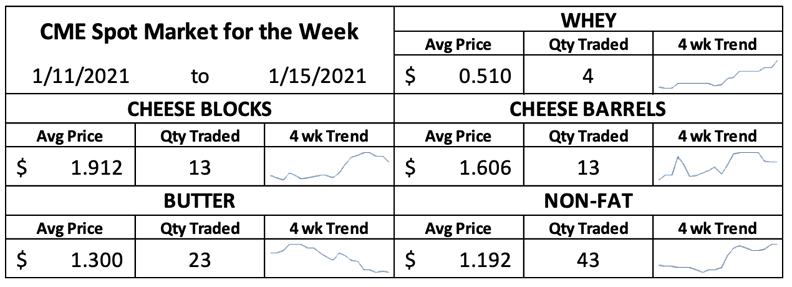
Cream is readily available across the country and churns are active. But with foodservice demand still lethargic, much of this butter is being routed to storage and exacerbating concerns about an inventory hangover. Butter stocks are seasonally higher than they have been in decades and have likely had a hand in driving the CME spot butter price lower this week. After dropping 7¢ during Monday’s session the spot butter price continued to slide until hitting $1.2875/lb. on Wednesday, the lowest price since May. Even after a modest rebound on Thursday, another decline on Friday left the spot price at $1.29/lb., 9¢ lower than last week.

Even though condensed skim is also abundant, and dryers have been going full tilt, the nonfat dry milk (NDM) market has been able to stand its ground. Despite giving up 5¢ on Monday, gradual gains during the balance of the week propelled the CME spot NDM price to $1.20/lb., up a penny from the prior Friday. The trade was active, with 43 loads cumulatively changing hands over the course of the week. While domestic demand for NDM has been mixed, robust draw from the export market has kept product moving and inventories in check. According to traders, the booking of export sales through the first quarter has been active. This includes shipments to Mexico, which has demonstrated only tepid demand in recent months.

Spot cheese markets also finished the week decisively lower. Though Cheddar blocks made an effort to continue last week’s upward trajectory by adding a nickel during Monday’s spot session, the effort was short-lived. By Tuesday, block prices began to slide, capping off the week with a 7¢ drop to end Friday’s session at $1.83/lb. Barrels mounted a less dramatic campaign, finishing the week down by 8¢. Manufacturers report that while cheese production has picked up since the holidays, renewed concerns about demand in both the foodservice and retail channels is likely to continue weighing on prices.

If the bulls were taking respite any corner of the dairy complex, however, it would be with whey. Whey prices continue to rise, spurred on by healthy demand from both domestic and international buyers. After stair stepping up over the course of the week, spot whey prices closed Friday’s session at 53¢/lb., up 3¢ versus last week and the highest price seen since October 2018. Price increases among higher protein whey products is increasingly coaxing the whey stream toward these uses, which is also helping to keep dry whey stocks in check.

Milk futures markets posted mixed performance as weaker cheese and butter prices collided with stronger NDM and whey values. Spot cheese declines weighed heavily on nearby Class III futures contracts early in the week and even some recovery on Thursday and Friday could not erase these losses. Ultimately, the JAN through MAR Class III futures contracts gave up ground over the course of the week. Class IV futures were similarly turbulent with early week losses counteracted by gains on Thursday, ushered in by the pop in spot butter prices. However, while the JAN Class IV contract still gave up 7¢ between Monday and Friday, all the remaining 2021 contracts were able to end in positive territory.
Released by USDA on Tuesday, a surprising World Agricultural Supply and Demand Estimates report led to some dramatic increases in the grain markets. Most notably, USDA made a harsh downward revision to the expectation for the corn yields during the 2020/2021 marketing year. Combined with reduced acreage, this reduced total estimated supply by 400 million bushels. Though adjustments were also made on the demand side, including lower ethanol use and lighter exports, ending stocks have been reduced significantly. These changes pushed MAR through JUL corn futures above $5/bu.
Soybeans also saw total supply revised downward at the hand of lower yields, albeit by a more modest 14 million bushels. Concerns persist about the availability of soybeans in the Southern Hemisphere, with USDA reducing Argentina’s expected soybean production for the year by 4.0%. The news pushed nearby soybean futures north of $14/bu. These increases are likely to contribute to even higher feed costs for dairy producers that have already seen margins squeezed by rising operating costs in recent months.
Original Report at: https://www.jacoby.com/market-report/most-commodities-struggle-to-keep-the-momentum-going/

Milk Futures Sharply Lower in Chicago Tuesday

On the Chicago Mercantile Exchange Tuesday milk futures were sharply lower and cash dairy markets were mixed. January Class III milk was down $.01 at $16.22.  February was down $.75 closing at $18.48.  March was down $.43 at $18.61.  April was down $.33 at $18.22.  May through December contracts ranged from three to twenty-nine cents lower.

On the spot markets dry whey was up $.0050 at $.5350. No sales were recorded Tuesday. Blocks were down $.03 closing at $1.80.  Four sales were recorded at that price. Barrels went down  $.0125 to $1.56. One sale was made at that price. Butter closed up $.1150 at $1.4050.  One trade was made at that price..  Nonfat dry milk was up $.0150 at $1.2150.  Fifteen sales were recorded from $1.2075 to $1.2150.

2021 Dairy Markets Begin on a Volatile Note

Monday’s announcement that the USDA is extending its Farmers to Families Food Box Program spurred dairy commodity prices upward, with all products seeing gains during Tuesday’s spot session.

Milk & Dairy Markets

Seemingly unwilling to leave 2020’s habits in the past, the dairy markets began 2021 on a volatile note. Monday’s announcement that the USDA is extending its Farmers to Families Food Box Program spurred dairy commodity prices upward, with all products seeing gains during Tuesday’s spot session. The International Dairy Foods Association estimates that this installment of the program will designate $300 million for dairy purchases, spread across fluid milk, cheese, butter, and soft products. Once contracts are awarded at the end of this month, deliveries should commence and continue through April.

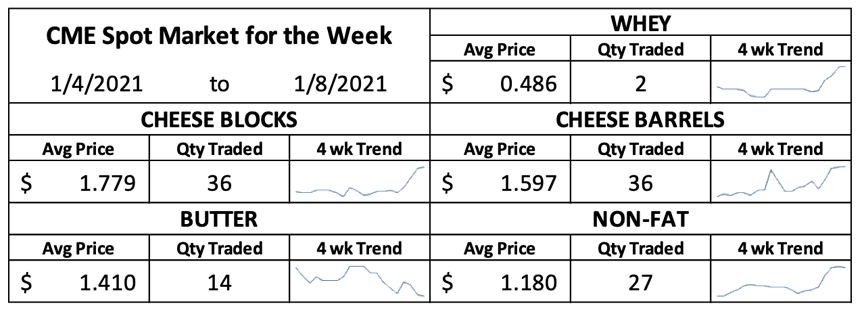
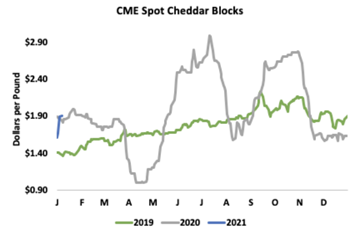
CME spot Cheddar blocks received perhaps the greatest boost from the news. Blocks added 26.75¢ over the course of the week, closing Friday’s session at $1.9175/lb. Cheddar barrels also gained some ground, with prices rising by a more modest 11¢ since last Friday to finish the week at $1.6525/lb. Not only were prices on the move, but volumes were also active with 36 loads of each barrels and blocks trading hands over the course of the week. Spot market strength inspired gains in the futures market where JAN through APR Class III contracts saw increases every day of the week, except Monday.
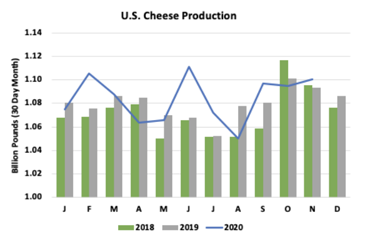
The USDA Dairy Products report released on Wednesday showed that Cheddar production was strong in November, due in part to new manufacturing capacity coming online in the Upper Midwest. Cheddar output was up by 3.7% year over year, totaling 320.7 million pounds for the month. Even though only cheese between 4 and 30 days old may be sold at the CME, this week’s spot price gains are even more impressive against the backdrop of abundant production. Plentiful American cheese production compensated for weak mozzarella output, which was down by 3.3% versus November 2019. At 1.1 billion pounds, total cheese production for the month was up 0.6% year over year.
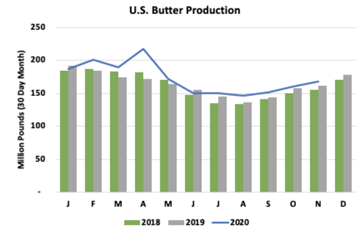
The Dairy Products report also pointed to robust butter production, continuing the trend seen in recent months. Plentiful cream supplies were routed into churns and resulted in the manufacture of 168.3 million pounds of butter in November, an increase of 4.0% compared to the same month last year. Even as demand for dairy fats remains remarkably steady at both the foodservice and retail level, much of this butter is finding its way into storage. Heavy inventories are weighing on prices. While spot butter got a bump from the USDA announcement on Tuesday, this gain was erased by the end of the week. CME spot butter finished the week at $1.38/lb., down 4¢ since last week.
Aggressive butter manufacturing has also resulted in plentiful skim availability for dryers. However, despite copioussupply, demand from both international and domestic sources has been sufficient to push prices modestly higher. During November, production of nonfat dry milk and skim milk powder rose by 8.9% year over year to 206 million pounds. For most of the year, sustained export demand, especially from Asia, has prevented inventories from building to worrisome levels. U.S. NDM exports were slightly softer in November, falling by 7.8% year over year, due principally to reduced shipment to destinations such as the Philippines and Vietnam. However, market participants indicate that renewed export interest has once again quelled concerns and was a contributing factor to the increase in spot NDM prices seen at the CME this week. Spot NDM rose by 4.75¢ to finish the week at $1.19/lb.
Weakness in the butter market collided with strength in the nonfat dry milk market to leave Class IV futures markets largely stable over the course of the week. Most nearby contracts gained a little bit of ground in the wake of the USDA announcement, but the gains were modest.

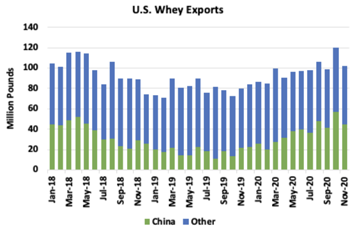
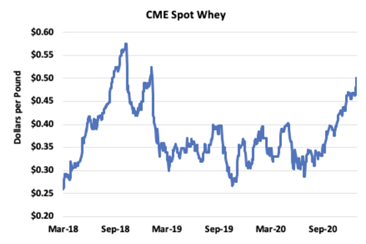
Whey markets continue their impressive rally, with the spot whey price rising to $0.50/lb. on Thursday and holding steady on Friday. Whey prices have not breached 50¢ since early 2019. Export demand has played a key role in keeping tension on these markets. November U.S. whey exports rose by 27.9% year over year, mostly due to China’s persistent appetite for U.S. product. Traders indicate that inventories are light and market fundamentals are aligning to keep upward price pressure on the whey market in the coming weeks.

Grain Markets

Rising grain prices are continuing to stress producer economics with feed prices hitting levels not seen in several years. Persistent concerns about grain availability in South America, exacerbated by Argentina’s decision to suspend corn exports until March, has only intensified these worries. After rising convincingly during the first half of the week, nearly all 2021 soybean and corn futures contracts took a brief respite on Thursday before continuing their upward campaign on Friday. The market anxiously awaits USDA’s World Agricultural Supply and Demand Estimates report which will be released next Tuesday and should provide additional information on the state of global grain supply and demand.

Original Report At: https://www.jacoby.com/market-report/2021-dairy-markets-begin-on-a-volatile-note/

Mixed Markets Thursday on CME

On the Chicago Mercantile Exchange milk futures continued trading mixed in a narrow range Thursday as did cash markets. January Class III milk down nine cents at $16.22.  February up a penny at $18.91.  March 15 cents higher at $18.63.  April up 13 cents at $18.26.  May through July contracts two cents lower to eight cents higher.

On spot trade, dry whey unchanged at $0.51.  Blocks down $0.01 at $1.90.  Barrels down $0.0050 at $1.5750. Butter up $0.0125 at $1.30.  Two trades were made at $1.2850 and $1.30.  Nonfat dry milk up $0.0125 at $1.20.  Fourteen sales were made ranging from $1.1850 to $1.20.

Dream start for dairy prices

Last week’s GDT recorded solid gains for Whole Milk Powder (WMP).

Dairy farmers can expect a lift in the forecast milk payout if dairy prices continue to climb.

Last week’s Global Dairy Trade (GDT) auction, the first for 2021, recorded solid gains in whole milk powder (WMP) and fat product prices, building on gains in the two December auctions.

WMP prices, used by Fonterra to set its payout, sit at a 12-month high of US$3306/metric tonne.

Last month, Fonterra narrowed its forecast payout range to $6.70-$7.30/kgMS. ASB lifted its forecast to $7/kgMS. ASB senior economist Chris Tennent-Brown notes that last week’s GDT price rise built on gains of December that led to the bank lifting its forecast price.

He says WMP prices have now edged comfortably ahead of where they were a year ago.

“The contract curve remains flat and stable, so price gains aren’t being driven by short-term supply fears,” he told Rural News.

“The latest GDT result provides a buffer to our $7 forecast, and more of the same over the coming events could well see Fonterra narrow its forecast range.”

Gains on GDT auctions over the past two months are being mostly attributed to strong demand from China.

While most countries are still dealing with waves of Covid-19, China’s economy is bouncing back after weathering the Covid storm.

Fonterra said last month that China was continuing to recover well from Covid-19 and this was reflected in recent GDT auctions.

The co-op noted a strong demand from Chinese buyers for WMP.

“The impact of Covid-19 continues to play out globally, and we continue to have a watchful eye on the increasing Northern Hemisphere milk production and New Zealand dollar,” said Fonterra chief executive Miles Hurrell.

“However, we have contracted a good proportion of our sales book for this time of the season, which has given us the confidence to narrow and lift the bottom end of the forecast farmgate milk price range.”

New Zealand milk production also impacts GDT prices; a drop in production can spark supply fears.

Data released in late December by the Dairy Companies Association of New Zealand (DCANZ) showed NZ November milk production was down 2.5% on a tonnage basis and down 2.7% on milksolids basis on November 2019.

Source: ruralnewsgroup.co.nz

Oversold Corrections Drives Milk Futures Higher in Chicago Wednesday

On the Chicago Mercantile Exchange milk futures twisted higher Wednesday correcting oversold positions while cash traded on both sides of the aisle. January Class III milk down eight cents at $16.31.  February up 22 cents at $18.90.  March 16 cents higher at $18.48.  April up 20 cents at $18.13.  May through July contracts seven to 13 cents higher.

On the spot trade dry whey up $0.01 at $0.51.  Two sales were made at $0.5050 and $0.51.  Blocks down $0.0475 at $1.91.  Barrels down $0.07 at $1.58. Butter down $0.0225 at $1.2875.  Three trades were made ranging from $1.2850 to $1.29.  Nonfat dry milk up $0.0025 at $1.1875.  Two sales were made at $1.1850 and $1.1875.

Sells Offs Drive Milk Futures Down in Chicago Tuesday

On the Chicago Mercantile Exchange milk futures saw some major sell-offs Tuesday as traders corrected oversold positions and reacted to the run-up in grains following the monthly supply and demand report. January Class III milk down 16 cents at $16.39.  February down 75 cents at $18.68.  March 73 cents lower at $18.32.  April down 52 cents at $17.93.  May through July contracts seven to 38 cents lower.

On spot trade dry whey unchanged at $0.50.  One sale was made at that price.  Blocks down $0.0050 at $1.9575.  Barrels down $0.0025 at $1.65. Butter unchanged at $1.31.  Nonfat dry milk unchanged at $1.1850.  Two sales were made at $1.18 and $1.1850.

Mixed Milk Markets Monday at the CME

At the Chicago Mercantile Exchange Monday milk futures and cash dairy markets were mixed. January Class III milk was down $.15 at $16.55.  February was down $.27 closing at $19.43.  March was down $.02 at $19.05.  April was up $.11 at $18.45.  May through December contracts ranged from four cents lower in July to four cents higher in May. 

In spot trade dry whey was unchanged at $.50. No sales were recorded.  Blocks were up $.0450 closing at $1.9625.  Eight sales were recorded from $1.94 to $1.9625.  Barrels were unchanged at $1.6525. Four sales were made at that price.  Butter closed down $.07 at $1.31.  Five sales were made from $1.3050 to $1.35.   Nonfat dry milk was down $.0050 at $1.1850.  Six sales were recorded at that price. 

Milk Futures Continue Gains in Chicago Thursday

On the Chicago Mercantile Exchange milk futures continued to see gains Thursday after another day of strong cash trade. January Class III milk up 19 cents at $16.85.  February up 42 cents at $19.46.  March 21 cents higher at $19.13.  April up 15 cents at $18.41.  May through July contracts 10 cents lower to 10 cents higher.

On spot trade dry whey up $0.0150 at $0.50.  Blocks up $0.1125 at $1.8975.  Barrels up $0.0125 at $1.6525.  Thirteen trades were made ranging from $1.64 to $1.6550.  Butter down $0.0450 at $1.39.  Four sales were made ranging from $1.39 to $1.42. Nonfat dry milk up $0.0050 at $1.1950.  Five sales were made ranging from $1.19 to $1.1950.

The FAO Dairy Price Index


The FAO Dairy Price Index averaged 108.8 points in December, up 3.4 points (3.2 percent) from November and representing the seventh continuous monthly rise. International prices of all milk products that constitute the index increased in December, underpinned by strong global import demand, mostly induced by concerns over the adverse impacts of drier and warmer weather conditions on Oceania’s milk production. High internal demand and lagging production of some milk products in Western Europe also provided support. However, for 2020 as a whole, the FAO Dairy Price Index averaged 101.8 points, down 1.0 point (1.0 percent) from 2019. Among the different milk products, butter prices registered the sharpest fall, followed by whole milk powder, while prices of skim milk powder and cheese increased.

Source: The FAO Dairy Price Index – December 2020

Strong Run on Milk Markets in Chicago Wednesday

On the Chicago Mercantile Exchange Milk futures saw a big run-up Wednesday following USDA’s fifth round of food box purchases announcement this week and strong cash sales. January Class III milk up 49 cents at $16.66.  February up $1.17 at $19.04.  March 89 cents higher at $18.92.  April up 28 cents at $18.26.  May through July contracts nine to 13 cents lower.

On the spot market dry whey up $0.0050 at $0.4850.  Blocks up $0.1075 at $1.7850.  Sixteen trades were made ranging from $1.6850 to $1.7850. Barrels up $0.0850 at $1.65.  Six trades were made ranging from $1.60 to $1.65.  Butter down $0.0125 at $1.4350.  One sale was made at $1.45. Nonfat dry milk up $0.0150 at $1.19.  Thirteen sales were made ranging from $1.1750 to $1.19.

Milk Prices Surge After USDA Food-Box Aid Program Extended

The latest extension of a U.S. food aid program is lifting dairy prices and raising prospects of a boost in milk production in the coming months.

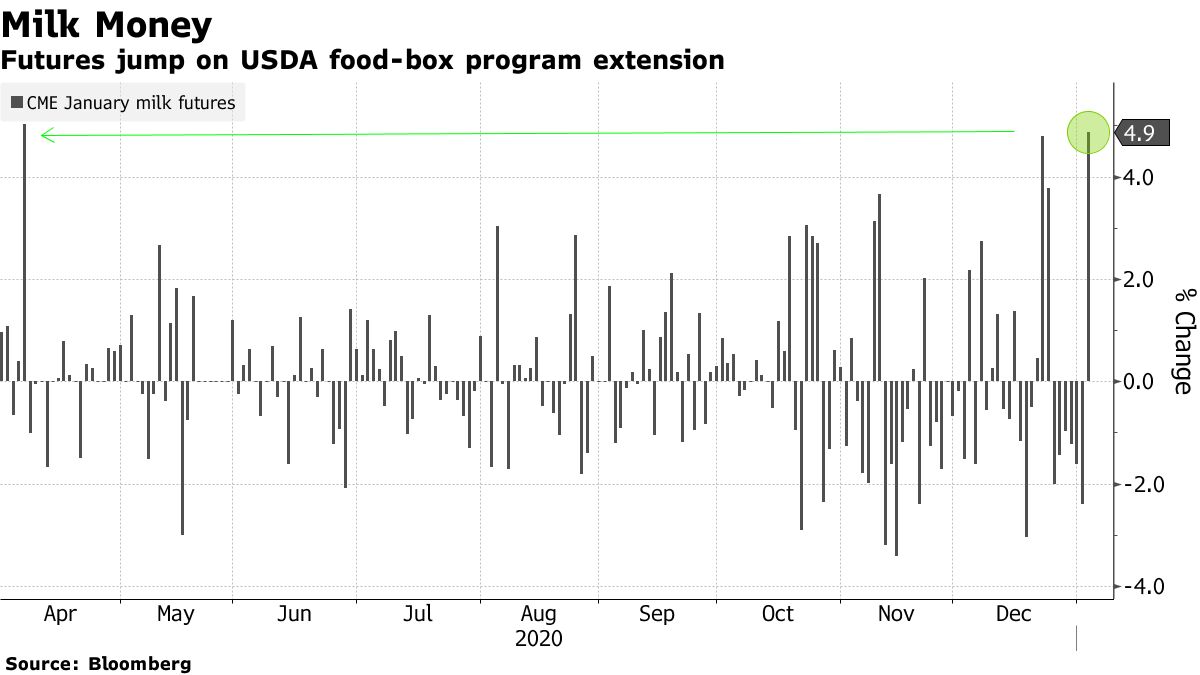
Benchmark Class III futures for milk used to make cheese jumped 4.9% on Tuesday in Chicago in their biggest gain since April after the U.S. Department of Agriculture expanded its Farmers to Families Food Box Program. The USDA will buy $1.5 billion worth of food including produce, beef, pork, seafood, milk and cheese to distribute across the country, U.S. Secretary of Agriculture Sonny Perdue said Monday in a statement.

The funding for a fifth round of purchases was included in the Covid-19 aid package passed in December and comes after USDA distributed more than 132 million boxes of food.

Futures jump on USDA food-box program extension

The program extension is the latest news to jolt the U.S. dairy market, which has been volatile throughout the pandemic. The closures of schools, offices and restaurants initially curbed demand for milk and cheese, prompting farmers to dump supplies before food-box buying sent dairy prices surging.

As many as 40 million food boxes could be bought with the latest funding, with as much as $500 million spent to procure dairy products, according to Lucas Fuess, director of dairy market intelligence at HighGround Dairy in Chicago. That could translate to milk-production growth of 3% in the first part of this year, Fuess said in a report.

“Milk needed to fulfill demand stemming from food-box purchases will exceed anticipated year-over-year production gains” in the first quarter, he said.

Source: bloomberg.com

Stimulus Package Invigorates Dairy Markets During Holiday Trading Weeks

The T.C. Jacoby Weekly Market Report Week Ending January 1, 2021

There is no word yet on when USDA will begin spending its allocations, which makes it difficult to assess the repercussions for the dairy markets. The dairy funding could make a big splash if it is spent in a short time, or slowly ripple through the markets if spent steadily throughout the next year.

Uncle Sam donned a Santa cap this year, and promised gifts for all. News that Congress passed a $900 billion stimulus package invigorated the dairy markets during the two holiday-shortened trading weeks. Congress allocated more money for the Supplemental Nutrition Assistance Program (SNAP) and other food aid programs, which will presumably allow those who are struggling financially to put a bit more dairy in their grocery carts. The bill provided $400 million for The Emergency Food Assistance Program (TEFAP), a small, unspecified portion of which USDA will spend procuring American-style cheeses and low-fat ultra-high temperature milk. USDA also received $400 million for the Dairy Donation Program to reimburse dairy processors for donations to food banks and $1.5 billion to buy commodities – including seafood, fresh produce, dairy, and meat products – and donate them to food banks. The total for dairy is likely to be noticeably less than the massive government expenditures this year, but it is still significant.
There is no word yet on when USDA will begin to spend this money, which makes it difficult to assess the repercussions for the dairy markets. The dairy funding could make a big splash if it is spent in a short time, or slowly ripple through the markets if the agency spends in a steady stream throughout the next year.

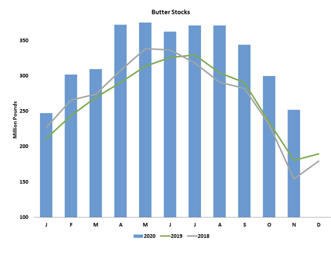
Aside from the TEFAP, the legislation does not specify which dairy products USDA should buy. Based on its experiences in 2020, the dairy trade seems to assume that government purchases will have the greatest impact in the cheese markets. However, the text of the bill suggests USDA may focus its spending power elsewhere. The legislation directs the Secretary of Agriculture to facilitate orderly milk marketing, reduce “volatility relating to significant market disruptions,” and maintain “traditional price relationships between classes of milk.” The bill also directs the Secretary to buy “surplus eligible dairy products,” which surely argues for more butter donations. Last week’s Cold Storage report showed November 30 butter stocks at nearly 252 million pounds, the highest November inventory since 1993. Butter stocks were 39.4% greater than they were a year ago.
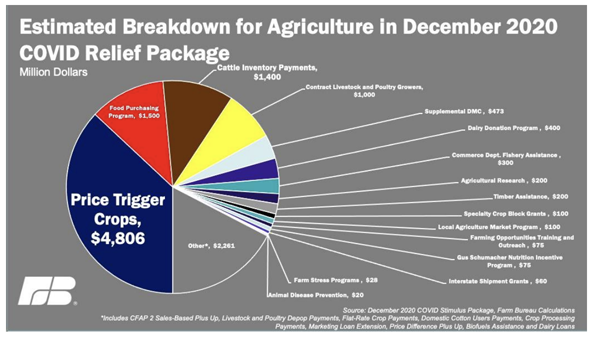
Current USDA Secretary Sonny Perdue and former Secretary Tom Vilsack, who will take Perdue’s place at the helm pending Senate approval, are both well aware of the impact that government interference had on the cheese markets. After several years leading the U.S. Dairy Export Council, Vilsack has expressed concerns about government purchases lifting U.S. dairy product prices too high to compete internationally, which is a major problem for an industry that is growing much more quickly than domestic demand. If USDA spends more on butter and fluid milk and less on cheese than it did this year, its well-intentioned aid could be spread more equitably among dairy producers, some of whom cashed very small milk checks this year even in months with sky-high cheese prices.

The coronavirus aid bill also includes direct payments for dairy producers. Congress set aside $473 million to help small dairy producers – those who sell less than 5 million pounds of milk annually – top up their Dairy Margin Coverage to reflect recent growth in milk output.

The bill also directs the Secretary to make additional payments to medium and large dairy producers whose losses were far larger than the $250,000 payment caps under the Coronavirus Food Assistance Program (CFAP). CFAP was meant to compensate dairy producers for 80% of their pandemic-related losses, and USDA estimated potential payments of $5.39 billion. However, due primarily to the caps, the agency has distributed less than $3 billion so far. Along with some money left in last year’s budget, the new funding will likely allow USDA to send medium and large producers sizeable checks. However, it’s possible the agency will still lack the funding to put these producers on equal footing with their peers whose calculated losses fell below the payment caps. Farm Bureau estimates the agency will have $2.26 billion in discretionary funds to spread among several agricultural assistance programs this year, including these supplemental CFAP payments for dairy producers
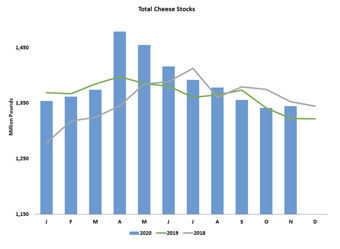
The dairy aid will be especially helpful for producers who suffered from low Class IV values, a punitive producer price differential, or supply management restrictions this year. Hopefully, it can be structured in a way that does not muddle market signals. The industry is awash in milk and demand is fitful at best. Millions of Americans are out of work and struggling to make ends meet. Vaccinations are underway, but it will be several months before consumer habits and foodservice traffic return to their pre-pandemic norms.

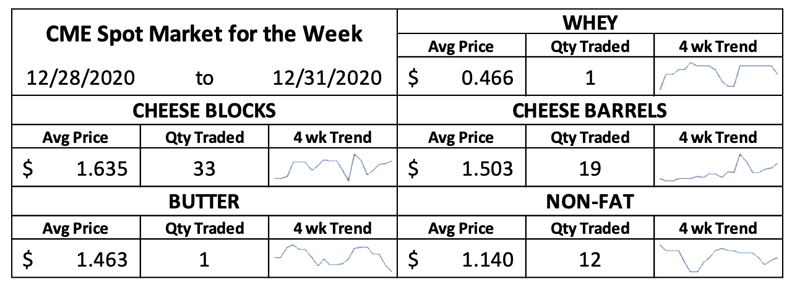
Cheese demand continues to fall short of last year during a crucial season for sales. Cheese stocks climbed marginally from October to November, a time when they typically decline. At 1.34 billion pounds, stocks are now 1.7% greater than they were a year ago. Nonetheless, spot Cheddar and Class III values bounced back from recent lows, likely fueled by hopes that government spending would offer a boost. CME spot Cheddar blocks reached $1.64 per pound today, up 2.25ȼ since the Friday before Christmas. Over the same period, barrels rallied 3.25ȼ to $1.5075. Spot whey powder also added 1.25ȼ and climbed to 46.75ȼ, just shy of the recent high. Those gains helped lift nearby Class III values. The January contract added 50ȼ over the holidays, and February jumped $1.47 to $17.91 per cwt.
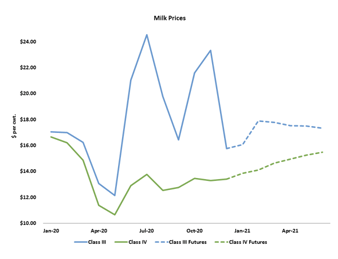
The Class IV products slipped. CME spot butter dropped 0.75ȼ to $1.4475. Spot milk powder settled a penny lower than where it stood the week before Christmas, at $1.14. Class IV futures finished modestly in the red at prices that are well below the cost of milk production.



The feed markets are poised to ring in the new year at new highs. Booming exports and concerns about South American weather continue to lift crop values. The weak dollar and tight stocks around the world suggest exports will stay strong, further tightening U.S. inventories. Argentina highlighted just how scarce South American feedstuffs have become today when it announced a ban on corn exports until at least March. That gave the bulls another burst of momentum. March corn settled today at $4.745 per bushel, up nearly 40ȼ in the past two weeks. March soybean meal jumped $22.50 to $427.80 per ton. March soybeans climbed 76.5ȼ to $13.005, and cries of “beans in the teens” rang out on LaSalle Street.

Original Report located at: https://www.jacoby.com/market-report/stimulus-package-invigorates-dairy-markets-during-holiday-trading-weeks

Dairy Markets Climb Higher Tuesday in Chicago

On the Chicago Mercantile Exchange milk futures and cash dairy markets were all higher Tuesday. January Class III milk was up $.75 at $16.17.  February was up $.75 closing at $17.87.  March was up $.75 at $18.03.  April was up $.75 at $17.98.  May through December contracts ranged from twenty to seventy-five cents  higher.

On the spot market, Dry whey was up $.0150 at $.48. One sale was recorded at $.4750. Blocks were up $.06 settling at $1.6775.  Six sales were recorded from $1.65 to $1.6775. Barrels went up  $.0725 to $1.5550. Eleven sales were made from $1.50 to $1.5550. Butter closed up $.0525 at $1.4475.  Six trades were made ranging from $1.44 to $1.46.  Nonfat dry milk was up $.0275 at $1.1750.  Five sales were recorded at that price.

Milk Futures Lower in Chicago to Start the Week.

On the Chicago Mercantile Exchange milk futures started the new year continuing a lower trend as a rally in grains added pressure to the market, cash prices were mixed. January Class III milk down 38 cents at $15.42.  February 37 cents lower at $17.12.  March 23 cents lower at $17.28.  April down 14 cents at $17.23.  May through July contracts one to 15 cents lower.

On the spot market Dry whey up $0.0025 at $0.4650.  One sale was made at that price. Blocks down $0.0325 at $1.6175.  Eleven trades were made ranging from $1.6175 to $1.6325. Barrels down $0.06 at $1.4825.  Butter down $0.0250 at $1.3950.  Two sales were made at $1.3950 and $1.3975.  Nonfat dry milk up $0.0050 at $1.1475.  Two sales were made at $1.1450 and $1.1475.

Send this to a friend