










The T.C. Jacoby Weekly Market Report Week Ending June 18, 2021
After a few hot weeks, stress is starting to sap milk yields. Nevertheless, there is more milk than manufacturers can accommodate in the Southwest and mountain states despite supply management programs.
The dairy markets were awash in red ink this week. June Class III milk gained a little ground, but all other Class III and Class IV contracts finished sharply lower. July Class III lost 81ȼ and closed at $16.72 per cwt. The August contract plummeted $1.18. Most Class IV contracts lost between 25 and 45ȼ.
For months, high feed costs have propped up second-half futures, based on the theory that poor margins would reduce milk output eventually. Now, the trade seems to be questioning that theory – and with good reason, given the size of the dairy herd – and concentrating on more immediate supply issues. There is milk in abundance, and it’s weighing on dairy product prices.
After a few hot weeks, stress is starting to sap milk yields. Nevertheless, there is more milk than manufacturers can accommodate in the Southwest and mountain states despite supply management programs. In the Upper Midwest, dairy producers have added cows sufficient to fill up new cheese processing capacity and then some. Excess milk is selling in the region for $4 to $6 under class. In the rest of the nation, there is still no shortage, and cooler weather is on the way nearly everywhere except California.
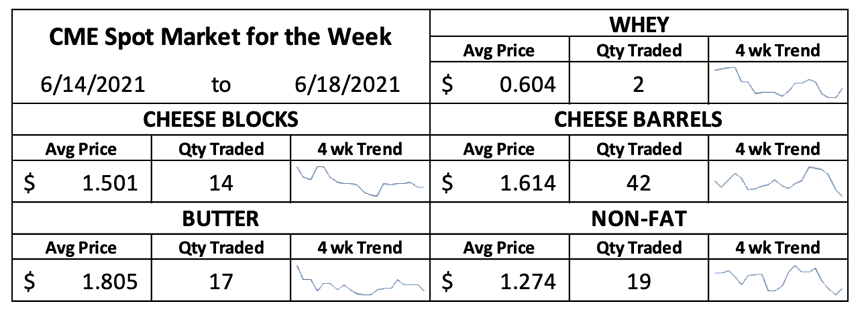
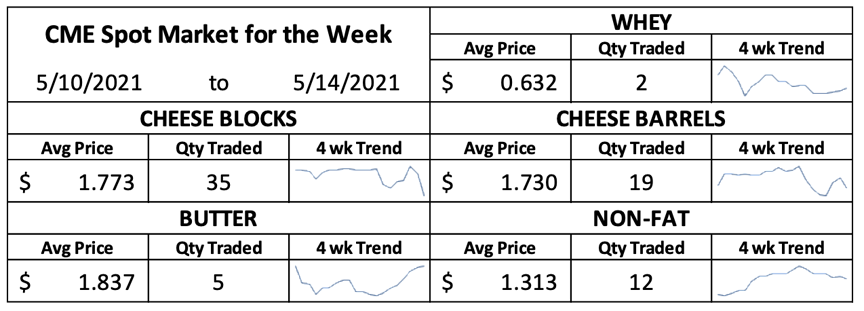
The cheese markets are looking especially weighed down by overproduction. Traders exchanged 56 loads of fresh Cheddar in Chicago this week, pushing a lot of product through the market of last resort. CME spot Cheddar blocks slipped 0.75ȼ to $1.4925 per pound. Barrels fell 13ȼ to $1.5425. Cheap milk is pushing some Midwest cheese plants to run at “max capacity,” according to USDA’s Dairy Market News. Meanwhile, “demand is mixed.”
Under pressure from abroad, CME spot nonfat dry milk (NDM) fell 3.5ȼ this week to $1.265. Powder values faded at the Global Dairy Trade auction, where skim milk powder (SMP) dropped 1.7% to the equivalent of (NDM) at $1.62 per pound. Big moves in the currency markets also weighed on the most export-dependent of the U.S. dairy commodities. On Wednesday, Federal Reserve officials offered a more optimistic economic outlook and hinted at the possibility of a slightly tougher stance on inflation. That prompted a dramatic turnaround in the dollar, which had been languishing at multi-year lows. Over the past three trading sessions, the U.S. dollar index rallied 1.9% against a basket of foreign currencies, a massive move in the generally stolid forex market. The stronger dollar makes U.S. NDM more expensive when priced in weaker foreign currencies. The snarled supply chain is not helping
matters. The container shortage and port backlogs continue to slow exports, while a lack of truck drivers has delayed domestic shipments.
Ever the contrarian, the whey market softened early in the week but made a strong showing on Friday. Still, CME spot whey finished 1.75ȼ lower than it was last Friday at 61ȼ. Buyers continue to balk when prices top 60ȼ, but stocks are tight, and sellers feel no pressure to lower their sights. High-protein whey products continue to sell at a good clip, mostly to foreign buyers. Although the strong dollar may trim whey exports at the margins, it is less of an issue for whey than for many other products, because China’s yuan is strengthening even more quickly than the greenback.
Butter started strong but faded throughout the week. It closed today at $1.785, down 0.75ȼ. Cream is plentiful and churns are running. Retail orders are starting to fade, but foodservice demand remains strong. European butter prices also softened, especially when adjusting for the currency effect. While benchmark German butter prices fell 1.7% in euro terms this week, they fell 3.7% when converted to dollars.
This week on LaSalle Street was one for the record books. Dragged down by soybean oil, the soy complex spent Monday through Thursday deep underwater. On Thursday, July soybeans capped off a seven-session losing streak by plummeting $1.1875 per bushel, the largest singlesession setback ever. The strong dollar and a Chinese crackdown on inflation weighed on commodities in general. The weather forecast – which promises some relief after a hot, dry stretch – pummeled the already weakened crop markets.
But the majority of the growing season still lies ahead, and there are some real trouble spots. As of last Sunday evening, USDA rated 68% of the corn crop in good or excellent condition, down four points from the previous week. In South Dakota, just 45% of the crop was in good or excellent condition, and ratings are sure to drop again next week after scant rains in the Northern Plains.
Today’s weather maps promised a bit less rain for the Corn Belt than previous iterations, and the crop markets came roaring back. But crop values are still much lower than they were last week after several days of red ink. July corn closed at $6.5525, down 29.25ȼ. New crop December corn was off 43.5ȼ at $5.6625. July soybeans dropped $1.125 to $13.96. July soybean meal fell almost $10 to $373.40 per ton.
Demand for feed remains strong, and the world is hoping for a big crop. It’s going to be a long, volatile summer in the grain pits.
Source: Jacoby


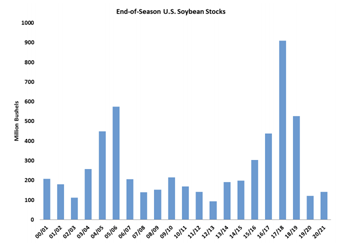 Soybeans made their debut at the Chicago Board of Trade in 1936. In the past 85 years, they have traded above $16 per bushel in just 61 daily trading sessions, including four times this week. Record-breaking exports have reduced U.S. soybean supplies to impossibly low levels. USDA projects that when the season ends on August 31, there will be just 120 million bushels of soybeans left over, an all-time low. With stocks dwindling, July soybean futures briefly touched $16.675 per bushel on Wednesday, the highest price since 2012, when crops withered in a crippling drought.
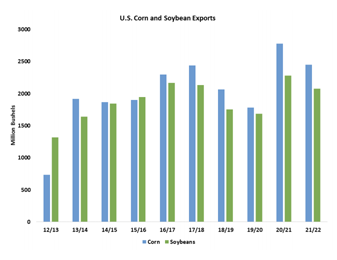 USDA expects big exports in the 2021-22 crop year as well, although the volumes will likely fall short of the staggering totals sent abroad in the current season. In its first detailed look at the next crop year, the agency called for bigger soy acreage and higher yields than last harvest. Even so, next year’s ending stocks will be historically low at 140 million bushels. There is no room for error in the soybean balance sheet and prices will likely remain high. Although soybean and soybean meal futures took a big step back on Thursday, they started to climb once again today. July soybeans closed at $15.84 per bushel, down 5.75ȼ this week.
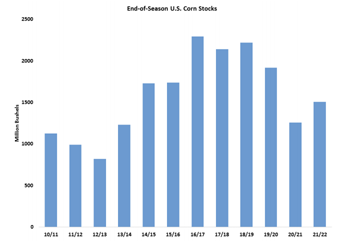 Record-breaking exports are tightening corn supplies too, although not to the extremes seen in the soybean market. USDA expects that when the season ends in a few months, corn stocks will fall below 1.26 billion bushels, the smallest ending inventories since 2013-14. USDA stuck with the 91.1 million acres of corn it called for in the Prospective Plantings report, but corn prices have done nothing but climb since the agency surveyed farmers in March. Farmers have likely increased their ambitions for corn acreage since then. The agency calls for a trend-line yield of 179.5 bushels per acre. If the weather cooperates, this record-setting yield would help U.S. corn inventories back over 1.5 billion bushels by the end of next season. The prospect of a huge corn crop weighed heavily on the futures market. July corn settled at $6.7475, down 57.5ȼ from last Friday.
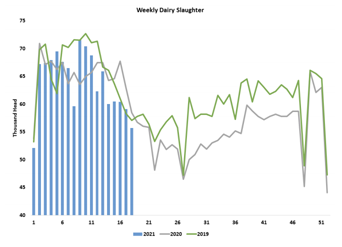 Although crop valuesfell back this week, they are still historically high. Dairy producers are paying more to feed their cows than they have in years, and they likely won’t see much relief until a bumper crop is assured. Even then, soybean meal is likely to remain pricey. Expensive feed and staggering construction costs are likely suppressing dairy producers’ appetite to build new facilities, but there is no evidence that they are crimping production just yet. Dairy producers were still adding cows at a rapid clip earlier this spring. In March, the milkcow herd reached a 25-year high. Slaughter volumes remain well behind the pace set in 2019 and 2020, when the herd was notably smaller than it is today.
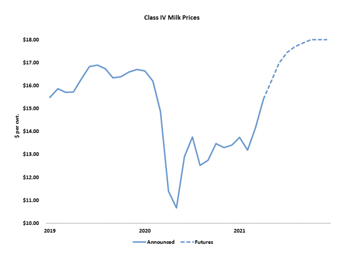 Fortunately, Class IV values are on the rise. Most contracts added between 25 and 45ȼ this week. Second-half futures scored life of contract highs and are now projected to average $17.84 per cwt., sharply higher than in the last six months of 2020, when Class IV contracts averaged a pitiful $13.21. Class III futures moved higher early in the week and then fell back. But they still gained ground. Most Class III futures contracts settled 15ȼ to 45ȼ higher than last Friday. The June through November contracts sit north above $19.




