On the Chicago Mercantile Exchange class III milk futures exploded higher for the first time in a while with August up just 10 cents being 85% priced. September rallied 71 cents to $17.29 per cwt. Class IV saw November milk gaining 13 cents.
Blocks and barrels once again saw upward moves after last week’s stagnant trade in the block cheese market. Blocks up $0.0775 at $1.7375. Barrels up $0.0675 at $1.4275. Five trades were made, ranging from $1.42 to $1.43. Butter down $0.01 at $1.67. Two trades made, ranging $1.66 to $1.67. Nonfat dry milk down $0.0025 at $1.2550. Dry whey unchanged at $0.54.
The grain markets were mixed as the relatively quiet trade continues ahead of the August WASDE report at 11 a.m. on Thursday. December corn settled just 1/2 of a penny lower, seemingly unwilling to break out in either direction until the USDA releases their yield numbers on Thursday. November soybeans added 7 cents to $13.3675 per bu. August soybean meal finished 70 cents higher to $360.30 per ton. Chicago wheat jumped 15.75 cents to $7.27 per bu.
On the Chicago Mercantile Exchange, Class III futures settled in the green with limited gains in August with being about 70% priced. August milk gained 8 cents to $16.11/cwt. September through December finished 25-34 cents higher with 2022 up 10-19 cents. Class IV futures saw gains today as well.
On the CME Cash Dairy Product Trade, dry whey up $0.0675 at $0.5375. Two trades were made, ranging $0.53 to $0.5375. Blocks unchanged at $1.6350. Barrels down $0.0075 at $1.3075. Butter $0.05 higher at $1.6550. Nonfat dry milk up $0.0025 at $1.2550. Six trades made, ranging from $1.2525 to $1.26.
The grain complex finished mostly in the green today. December corn gained 6.25 cents to $5.53/bushel. November soybeans was up just 2.75 cents to $13.33/bushel. August soybean meal jumped $3.80 to $356.90/ton. September Chicago Wheat fell 4.50 cents to $7.1275/bushel.
On the Chicago Mercantile Exchange milk futures were mostly up in the near term and cash dairy markets were mostly down Wednesday, August 4th. Class III milk price settlements didn’t show much excitement during Wednesday’s trading session as many printed limited gains. August added 7 cents, September 11, and October 6 cents/cwt stronger while November was unchanged, and December fell a penny. 2022 prices were virtually unchanged. A late push higher in prices had August through November 2021 trading 18-51 cents in the green. Thursday’s session will give the market a clearer look if there’s any substance behind it, profit taking, or a head fake. Class IV markets failed to trade with many months closing the session unchanged or lower by a couple cents.
CME spot dairy auction results saw dry whey was down $.0050 at $.4750. There were three trades from $.4725 to $.4750. Blocks were unchanged for a third straight day at $1.6350, and like Monday and Tuesday, no sales were recorded. Barrels went up $.0075 to $1.3150. There were four sales from $1.3075 to $1.3150. Butter closed down $.0150 at $1.6050. Two sales were made at $1.6050 and $1.62. Nonfat dry milk was down $.0150 to $1.2525. Two sales were made at $1.2525 and $1.27.
Grain markets turned in a mixed bag of results Wednesday. Soybeans traded 6 cents higher while meal was up $4/ton. Corn declined 5 cents to $5.4675/bu and the wheat complex dropped 7-16 cents.
The T.C. Jacoby Weekly Market Report Week Ending July 30, 2021
Although this year’s losses have none of last year’s frenzy, the ink is just as red. But it may be a while before lower prices translate to less milk.
Like a balloon with a pinhole, the dairy markets are slowly deflating. The summer setback lacks the drama of July 2020, when – flush with government largesse – the cheese market balloon grew and grew and grew until it burst spectacularly. Although this year’s losses have none of last year’s frenzy, the ink is just as red. Both Class III and Class IV futures posted double-digit declines once again this week. September and October Class III settled below $17 per cwt., at their lowest values so far in 2021. In Class IV, the September through November contracts plumbed life-of-contract lows in the $15s. Given historically high costs for feed, fuel, freight, and labor, these values are extremely disappointing for dairy producers.
But it may be a while before lower prices translate to less milk. Dairy slaughter has accelerated relative to the 2020 pace. But, as is always the case during the summer, the numbers aren’t all that high. Although slaughter volumes have eclipsed the prior year for the past six weeks, year-to-date slaughter is still 0.2% behind the 2020 pace, and the dairy herd is 1.6% larger than it was a year ago. Dairy producers are clearly not culling cows at the pace required to significantly shrink the herd. And, given how many cows we are milking, it will take significant slaughter to bring production back down to a level that necessitates higher prices. Low prices are the best cure for low prices, but the healing process is often painful and achingly slow.
USDA’s Dairy Market News reports, “Milk volumes are plentiful enough for strong cheese production schedules.” But packaging issues continue to shift some milk out of blocks and into barrels. The proof is in the prices. Cheddar blocks closed today at $1.635 per pound, up a nickel this week and 8.25ȼ higher than where they began the month. In contrast, barrels fell 1.25ȼ this week to $1.39. They are down 11.25ȼ for the month and not far from the calendar-year lows. Demand is good, but output is strong.
Heavy production continues to weigh on the whey market as well. CME spot whey powder fell 3.5ȼ this week to 50.25ȼ. Spot dry whey finished July 5.75ȼ lower than where it began, trimming roughly 35ȼ from implied Class III values in the process. Demand for highprotein whey products remains impressive, but whey powder is piling up nonetheless.
Plentiful cream and well-stocked warehouses are dragging on butter values. This week CME spot butter probed five-month lows. It closed today at $1.6425, down 5.25ȼ from last Friday and nearly a dime lower than where it began the month.
Despite the summer heat, there is more than enough milk to keep driers busy. Demand is steady, but shipping issues are slowing the flow of product from manufacturers to end users at home and abroad. While foreign milk powder values took another step back this week, CME spot nonfat dry milk (NDM) rallied. It closed today at $1.2675, up 1.5ȼ this week and up just 0.75ȼ for the month. Milk powder values could come under further pressure in the months to come if global demand falters. Dairy Market News notes that some Southeast Asian countries likely ordered extra skim milk powder (SMP) in the first half of the year, hoping to avoid shortages caused by shipping delays. But now, “inventories may be building to the point where buyers are willing to wait before making more purchases.” If that’s the case, a slowdown in demand could collide with growing supplies. Global milk output is high and rising. In May, milk production among the four largest
dairy exporters other than the United States outpaced the prior year by 2.5%. Throw the U.S. in the mix, and output among the big five was 3.1% greater than in May 2020. That’s the largest year-over-year increase since late 2017, which does not bode well for prices in the coming year.
Back and forth and back and forth. The grain and oilseed markets traversed the same ground several times this week and ended up not far from where they started. September corn closed today at $5.47 per bushel, down a quarter-cent from last Friday. December corn futures, the benchmark for new-crop corn, rallied 2.25ȼ to $5.4525. Soybean and soybean meal contracts were similarly steady. November soybeans closed at $13.4925 per bushel, while September soybean meal finished at $351.30 per ton.
The corn crop has made it through the critical pollination phase in fine shape overall. USDA assessed 64% of the crop in good or excellent condition, although ratings lag considerably in Minnesota (38%), South Dakota (30%), and North Dakota (21%), where rain has been scarce. Much of the Northern Plains enjoyed a good soak today, but the Corn Belt forecast looks relatively dry for the next week. The market is marking time until fall, when it can be assured of a good crop. In the meantime, feed expenses remain relatively lofty.
On the Chicago Mercantile Exchange milk futures and cash dairy markets were mostly down Tuesday, August 3rd. Class III Milk fell 15 in August to 15.96, September down 22 to 15.93, and October fell 19 to 16.48/cwt. Class IV milk also followed butter lower. August held unchanged at 15.55, but September fell 21 to 15.63, and October fell 18 to 15.78/cwt.
On spot trade dry whey was down $.0225 at $.48. There were two trades at that price. Blocks were unchanged for a second straight day at $1.6350, and like Monday, no sales were recorded. Barrels went down $.0025 to $1.3075. There was one sale at that price. Butter closed down $.08 at $1.62 losing Monday’s five-cent gain. There were two sales at $1.62 and $1.6250. Nonfat dry milk was down $.0075 to $1.2675. One sale was made at $1.27.
Feed markets also saw red as the USDA crop progress report Monday showed small improvements. December corn fell 7 ½ cents to 5.51 ¾, November soybeans fell 33 ¾ cents to 13.19 3/4, with soybean meal falling $8.90 to 347.50/ton
On the Chicago Mercantile Exchange Monday milk futures and most cash dairy markets were down. Class III milk prices weakened along with product markets. August declined 13 cents while September through December fell 15-21 cents/cwt. 2022 months ranged from 9 cents lower to 6 cents higher. The first half 2022 average stands at $17.27/cwt. Class IV turned in a solid session as prices rose 5 to 26 cents in 2021 and most first half 2022 months.
Barrels met stiff selling pressure to kick off our week on Monday. Barrels went down $.08 to $1.31. There were nine sales from $1.31 to $1.3625. Butter closed up $.0575 at $1.70. There were fourteen sales ranging from $1.6625 to $1.70. Nonfat dry milk was up $.0075 to $1.2750. One sale was made at the price. Dry whey was unchanged at $.5025. There were no trades recorded. Blocks were unchanged at $1.6350. No sales were recorded.
The grain complex printed green across the board. Corn jumped 14 cents in new crop to a price of $5.5925/bu. Wheat led the charge as Kansas City traded 30 cents stronger, Chicago pushed 25 cents higher, and Minneapolis was up 21. Soybeans settled higher in sympathy with the other grains gaining 4 cents while meal prices added $5/ton.
Milk production expanded 2.9% in June according to the USDA. That followed 4.7% YOY growth in May. The milking herd finally declined, by just 1,000 head compared to the prior month to 9,508m. While down on the multi-decade high reached in May this was still 153,000 head higher YOY. The YOY growth in average yield per cow for June was 1.3%, a 3-month low. June was the thirteenth consecutive month of expansion in US milk output.
Wisconsin, California and Texas jointly accounted for 48% of the national YOY milk growth in June (down from 51% in May), increasing by 2.8%, 3.1% and 7% respectively. There were also strong YOY gains in Idaho (+3.6%), New York (+3.1%) and Michigan (+4%).
May 2021 dairy exports were still down year-on-year, trade figures show
UK exports of dairy products remained mixed in May, with butter and whey down on April, according to the latest analysis by the AHDB.
UK dairy exports had a mixed month-on-month performance in May, with butter down 14 percent and whey down 9 percent.
But the cheese, powdered and condensed milk and yogurt categories all up, by 13%, 34% and 26% respectively, said Katherine Jack, AHDB Dairy analyst.
However, May 2021 exports were still down on their 2020 counterpart for all categories except milk and cream, she noted.
May imports were similarly still down year-on-year, but with a mixed month-on-month performance.
“The categories down compared with April were milk and cream (-3%), powdered/condensed milk (-4%) and yogurt & fermented dairy (-7%),” Ms Jack said.
“The categories up on the month were whey products (+14%), butter products (+38%), and cheese and curd (+17%).
“As a final note, last month we identified that the UK had achieved a small trade surplus with the EU for Cheddar, for the first time. This surplus has been maintained into May.”
At the Chicago Mercantile Exchange Class III milk futures were lower. July fell 4 cents to 16.48, Aug fell 13 to 16.22, and September fell 24 to 16.26/cwt. The balance of 2022 was down 5-17 cents. Class IV bounced back. July gained 3 to 15.99, August up 9 to 15.44 and September gained 2 cents to 15.45/cwt. December was our biggest mover gaining 14 cents to 16.04/cwt.
The CME spot trade was mixed. Butter held unchanged at $1.62 ¼. Cheddar Blocks also held unchanged at $1.63 1/2/lb with Barrels sliding ¾ of a cent to $1.39 ¼ but moved 9 loads.
Cooperatives Working Together (CWT) member cooperatives accepted 12 offers of export assistance from CWT that helped them capture sales contracts for 1.8 million pounds (802 MT) of American-type cheese, 524,700 pounds (238 MT) of butter and 74,957 pounds (34 MT) of cream cheese. The product is going to customers in the Middle East, Asia, South America, and Oceania, and will be delivered during the period from July through December 2021.
CWT-assisted member cooperative year-to-date export sales total 29.4 million pounds of American-type cheeses, 11.7 million pounds of butter (82% milkfat), 7.3 million pounds of anhydrous milkfat, 17.2 million pounds of whole milk powder, and eight million pounds of cream cheese. The products are going to 26 countries in six regions. These sales are the equivalent of 920.9 million pounds of milk on a milkfat basis.
Assisting CWT members through the Export Assistance program positively affects all U.S. dairy farmers and dairy cooperatives by strengthening and maintaining the value of dairy products that directly impact their milk price. It does this by helping member cooperatives gain and maintain world market share for U.S dairy products. As a result, the program has significantly expanded the total demand for U.S. dairy products and the demand for U.S. farm milk that produces those products.
The amounts of dairy products and related milk volumes reflect current contracts for delivery, not completed export volumes. CWT pays export assistance to the bidders only when export and delivery of the product is verified by required documentation.
All dairy farmers and dairy cooperatives should invest in CWT. Membership information is available on the CWT website.
On the Chicago Mercantile Exchange milk futures closed lower Wednesday. Class III milk futures followed barrels lower as the futures premium continues to come off out of the market. The market moved 6-22 cents throughout the end of 2021. Class IV futures also fell anywhere from a penny to 18 lower.
Butter continues its trend lower in the CME Spot Dairy Auction, down 1 ¾ cents at $1.62 and 3/4. Dry whey is up 1/4 cent, at $53.25 Blocks unchanged at $1.63 and a half Barrels down 1 1/2 cents at $1.40 Nonfat dry milk unchanged at $1.25
The T.C. Jacoby Weekly Market Report Week Ending July 23, 2021
While US milk output is down from the peak volumes reported in April and May, it is still historically strong. USDA’s Dairy Market News cites strong demand for cheese across the nation but butter and powder orders begin to soften. Weather and Washington way heavy on demand of corn and soybean crops.
Milk abounds. U.S. milk output reached 18.955 billion pounds in June. While that is down from the peak volumes reported in April and May, it is still historically strong, up 2.9% from June 2020. The heat wave sapped production in the Pacific Northwest last month, and the region has suffered even higher temperatures and greater stress in July. Industry consolidation has reduced output in some Eastern states, as cows move to states with better margins. But in the rest of the nation, milk output grew noticeably. California made a strong showing, with output up 3.1% from a year ago. The increase was driven entirely by higher milk yields. Second-ranked Wisconsin was not far behind, posting a 2.8% gain. In Texas and Idaho, production climbed 7% and 3.6%, respectively. It’s hard to imagine how much milk would be pouring through these states in the absence of onerous supply management programs. In the Northern Plains and Midwest, dairy producers are quickly adding cows and milk to fill up new cheese capacity.
For the first time in a year, dairy producers scaled back the dairy herd in June. But the decline was modest, at just 1,000 head. The herd is still massive. Dairy producers collectively milked 9.508 million cows last month. That’s up 153,000 from last year and – excluding May 2021 – it’s the largest dairy herd since 1993. Slaughter volumes in recent weeks have been a bit higher than normal for mid-summer, but nowhere close to a liquidation pace. It’s going to be hard to slow milk output significantly with this kind of cow power. Meanwhile, fluid milk sales are in the summer doldrums. That’s left plenty for manufacturers, who are topping up vats and running churns. Despite the heat, there are long lines at the drier.
USDA’s Dairy Market News cites strong demand for cheese across the nation. The Cold Storage report confirmed this, showing a 23-miillion-pound decline in cheese stocks from May to June. Still, at 1.435 billion pounds, June 30 cheese inventories were up 1.3% from a year ago, marking the highest mid-year cheese stockpile on record. Heavy inventories and strong output continued to weigh on pricing this week. On Wednesday, CME spot Cheddar barrels fell to an 11-month low at $1.3725 per pound. After a partial comeback, barrels finished at $1.4025, down 3.75ȼ from last Friday. Blocks dropped 3ȼ this week to $1.585. Prices have fallen low enough to attract the notice of importers, particularly from Asia. Despite all the headaches of international shipping in a world bogged down by shortages, exports remain a bright spot and a vital outlet for an industry flush with excess.
Butter inventories typically decline from May to June, but this year they grew, which suggests that output is outpacing demand. At 414.5 million pounds, butter inventories are larger than they’ve been in any month since 1993, and they topped those of June 2020 by more than 14%. Buttermakers tell USDA’s Dairy Market News that sales are starting to soften. Nonetheless, the spot market rallied. CME spot butter finished at $1.695, up 1.75ȼ from last Friday.
Spot milk powder held steady this week at $1.2525 per pound. But manufacturers report sales at lower values, and international orders are beginning to slow. At the Global Dairy Trade auction on Tuesday, both whole milk powder (WMP) and skim milk powder (SMP) prices dropped for the fourth consecutive event, and the losses were significant. Compared to the previous auction, WMP pricesfell 3.8%, while SMP values plummeted 5.2%. The selloff suggests that international demand for milk powder has waned. But the data show that China, the world’s largest buyer, remained hungry for product through June. Last month China purchased far more SMP and more WMP than during any other June on record. For the year to date, Chinese SMP imports are up 47% from last year and up 29% from the record set in 2019. China’s WMP imports inched just ahead of the record pace set in 2014 and are 30.3% greater than the first half of 2020. Has China overstocked, or is their appetite truly insatiable? The answer will have a huge impact on the nonfat dry milk and Class IV markets.
Class IV futures shook off the relatively positive moves in the spot market. They finished mostly lower than last week, with third quarter contracts holding just south of $16.00 per cwt. Despite a late-week rally, Class III futures also settled in the red. The August contract fell 32ȼ to $16.47. These values are certainly uninspiring for dairy producers, but they’re likely not low enough to foster a major shift from expansion to contraction. We’ve got a lot of cows that will give a lot of milk for the rest of the year.
The corn market leapt to a three-week high on Wednesday, but then faded. September corn closed today at $5.4725 per bushel, almost a dime lower than last Friday. August soybean meal finished at $353.60, down nearly $10 per ton.
After several weeks of good rains, the corn crop in the central and eastern Corn Belt is pollinating under excellent conditions. To the west, soil moisture is less ideal, and much of Minnesota and the Dakotas are downright parched. But, by and large, the market expects a lot of corn come harvest. Meanwhile, there are indications that demand might not be as massive as once thought. Weekly corn and soybean export sales have slowed of late. And legislators are discussing modifications to the Renewable Fuels Standard. Some hope to end the ethanol blending mandate altogether now that greener alternatives are viable. If enacted, this change would surely reduce corn for ethanol demand. But bureaucracy moves slowly, and headlines are not policy. Supplies are still tight, and the weather matters more than Washington at the moment.
Original Report at: https://www.jacoby.com/market-report/milk-abounds/
At the Chicago Mercantile Exchange milk futures were mixed. Class III Milk was mixed with July up a penny to 16.54, Aug up 4 to 16.61 but September fell 12 to 16.66/cwt. The balance of the year was 3 higher to 17 cents lower. Class IV milk followed the weakness in butter. July was unchanged at 15.96, August fell 15 cents to 15.53, and September fell 10 cents to 15.45/cwt.
The CME spot trade had xash cheese barrels were up $.015 at $1.4175 and 40-pound blocks were $.0425 higher at $1.6275. Double A butter was $.04 lower at $1.655. Grade A nonfat dry milk was up $.0025 at $1.255. Extra grade dry whey was down $.0075 at $.53.
On the Chicago Mercantile Exchange milk futures were mixed. Class III milk results watched August trade 10 cents in the green while September fell 13, October 25, November 16, and December and beyond off single digits. Class IV markets were beat up on Monday following the butter markets falloff. 2021 months lost 14 cents in August, 27 cents in September, 29 cents in October, 29 in November, and 25 cents in December. Early 2022 Class IV prices declined 14-24 cents.
On the spot market, block cheese rose 4.25 cents to a value of $1.6275/lb with 1 load trading hands and two uncovered bids. Barrels traded 5 loads and 1.5 cents stronger to a value of $1.4175/lb. Butter lost 4 cents with the settlement coming in at $1.655/lb. Grade A nonfat dry milk added a quarter cent to $1.255/lb while dry whey lost ¾ of a cent to $0.53/lb.
On the Chicago Mercantile Exchange milk futures were lowered Tuesday following negative global markets and cash trade. Class III milk futures moved lower with barrel cheese down 6.50 cents to $1.38/lb. July milk lost 3 to $16.66/cwt. The rest of the year saw larger decreases, dropping 18-42 cents. Class IV milk futures also bled 3-25 cents lower on the heels of Nonfat Milk moving lower.
On spot markets dry whey unchanged at $0.5375. Blocks down $0.03 at $1.5850. Barrels down $0.0650 at $1.3850. Seven sales were made from $1.3850 to $1.4050. Butter unchanged at $1.7125. Nonfat dry milk down $0.03 at $1.23. Three sales were made at that price.
On the Chicago Mercantile Exchange milk futures were mostly lower, with cash dairy steady to higher Monday. Class III Milk had July up 1 cent to 16.69, August slid 12 to $16.67, with September down 5 to $17.26/cwt. The balance of months traded 1-16 cents lower. Class IV milk was mixed with July up 3 cents to 15.96, Aug down 1 to 15.88, and Sept unchanged at $16 even. The balance of the year was unchanged to 7 higher.
On the spot market dry whey unchanged at $0.5375. Blocks steady at $1.6150. Barrels up $0.01 at $1.45. Butter up $0.0350 at $1.7125. Two trades were made, ranging $1.7075 to $1.7125. Nonfat dry milk up $0.0075 at $1.26. Two trades made, with a range of $1.2575 to $1.26.
Rural Bank is forecasting 4-5 per cent higher farmgate milk prices and increased dairy exports in the second half of 2021.
The bank released its Australian Agriculture Mid-year outlook 2021 report on Tuesday, analysing the performance of six industries – cattle, cropping, dairy, horticulture, sheep, and wool, and the broader economy.
Dairy – along with lamb and mutton, horticulture and wool – is expected to strengthen in the second half of 2021, while cattle and cropping prices are anticipated to remain steady.
The bank is forecasting the mid-point farmgate milk price to be 4-5pc higher than in 2020/21.
“Australian milk processors have reacted to a buoyant global dairy market and highly competitive domestic milk pool by raising opening milk prices,” the report said.
“Closing price estimates and revisions to opening prices suggest there may be multiple step ups during the season.”
It is also tipping higher-than-average international prices into the spring.
“This is driven by demand from Asia, particularly for milk powder,” the report said.
“The desire to hold a slightly higher level of inventory due to the threat of further COVID-19 disruptions could hold prices in the middle of the forecast range for the remainder of 2021.”
The bank’s Tasmania regional manager agribusiness Dean Lalor said milk supply growth would be led by Tasmania and Victoria.
“Supply growth will be assisted by strong milk prices, favourable levels of feed and cheaper input costs for water and grain,” he said.
“However, early winter rainfall in parts of Victoria which caused flooding will present ongoing challenges for some farmers.
“In global markets, strengthening demand for finished dairy products, particularly from Asia, is expected to underpin historically high prices.”
The report said increasing milk supply in Australia would provide a higher exportable surplus, which was likely to lead to growth in export value of 5-8pc for 2021/22.
Demand for milk powder is expected to remain above year-on-year levels for July to December.
However, the bulk of China’s purchasing in 2020 occurred between January and May, suggesting there is a low likelihood of exceeding the monthly highs set earlier this year as supply of finished product traditionally dips over winter.
Milk supply is anticipated to increase by 1-2pc in New Zealand and the US driven by favourable seasonal conditions and expanding herds.
In contrast, parts of Europe are likely to record a decline in milk production due to drier than usual conditions.
Agriculture thriving
The report said Australian agriculture had thrived under much calmer conditions in the first half of 2021 compared to the unexpected disruptions that characterised 2020.
Favourable seasonal conditions continued into the first half of 2021 in most regions and are forecast to continue in the coming months.
Signs of recovery from the impacts of COVID-19 in Australia and key export markets would help strengthen demand for commodities such as wool, dairy, red meat and horticulture.
The bank’s chief operating officer Will Rayner said even when taking these factors into account, there was cause for optimism on the outlook for Australian commodities.
“Although South Australia and western Victoria experienced a dry start to 2021, the probability of a wet winter is looking positive for the production of most commodities and will assist continuing efforts to rebuild livestock numbers,” he said.
“Market sentiment has improved on early signs of recovery from the impacts of COVID-19 as outbreaks in key export markets slowly come under control and vaccine distribution rolls out.
“Economies globally will continue to emerge from lockdowns of varying degrees and consumer confidence should rebound, strengthening demand for wool and dairy – commodities that experienced a decline in 2020.
“Demand is also strengthening for the horticulture and red meat sectors and we are anticipating Australia will produce a winter crop 13 per cent above average, with generally optimistic forecasts for rainfall.”
On the Chicago Mercantile Exchange milk futures were limit down Thursday as negative cash markets overhung the market. July Class III milk down four cents at $16.75. August down 75 cents at $19.98. September 75 cents lower at $17.31. October down 46 cents at $18.04. November through January contracts 20 to 42 cents lower.
On the spot trade, dry whey up $0.0150 at $0.5350. Blocks down $0.0925 at $1.6450. Barrels down $0.0950 at $1.50. One sale was made at that price. Butter down $0.0250 at $1.6850. One sale was made at that price. Nonfat dry milk down $0.0050 at $1.2350. Two sales were made at $1.2350 and $1.2375.
On the Chicago Mercantile Exchange milk futures were pressed at midweek by falling cash trade and strength in grain markets. Class III dairy prices lost early gains as cheese found a couple sellers. August through October declined 29-35 cents/cwt while November and December were down 19 and 10 cents, respectively. 2022 prices were unchanged except for February adding 5 cents and August falling 4 cents. Class IV milk prices saw gains of 2-17 cents over the August through December 2021 months while 2022 was unchanged.
CME spot product markets had dry whey down $0.0175 at $0.52. Two sales were made at $0.52 and $0.53. Blocks down $0.0150 at $1.7375. Two sales were made at $1.7350 and $1.76. Barrels down $0.0525 and $1.5950. Two sales were made at $1.5950 and $1.6150. Butter unchanged at $1.71. Eleven sales were made from $1.71 to $1.7450. Nonfat dry milk down $0.0275 at $1.24. Three sales were made from $1.2425 to $1.25.
Corn prices rose 16-18 cents/bu from Sept 2021 to July 2022. Soybean meal added $9.5-$12/ton out through 2023 markets. Soybeans traded 31.5 cents/bu higher in the new crop November price with the settlement posted at $13.8325/bu. Wheat markets followed suit jumping 13-20 cents/bu across the three complexes.
USDA’s Dairy Market News reports that domestic cheese demand is “healthy”. Exporters are busy moving product they contracted to sell last month when prices were lower, which tightens the supply of fresh cheese available for sale in Chicago.
The cheese markets came roaring back. CME spot Cheddar blocks jumped 17ȼ this week to $1.725 per pound, a nearly two-month high. Barrels climbed 8ȼ to $1.58. The rebound propelled Class III values higher. The July contract inched up 6ȼ to $16.85 per cwt., while August vaulted 83ȼ to $17.54. Gains down the board were modest, but fourth-quarter contracts held above $18.
USDA’s Dairy Market News reports that domestic cheese demand is “healthy”. Although inquiries from foreign buyers have likely slowed at these prices, exporters are busy moving product they contracted to sell last month, when prices were lower. That’s helping to tighten the supply of fresh cheese available for sale in Chicago.
There is more than enough milk to go around, particularly in the Midwest, where excess loads of spot milk are moving at $4 to $6 under class. Cheesemakers are going hard, but shortages are causing headaches. Some processors have had trouble finding enough help to keep their plants running at optimal volumes. Meanwhile, the boxes that hold 640-lb. blocks have gotten scarce, and plants that can’t switch to other sizes or varieties have been forced to trim output. After numerous expansions, overall U.S. cheese processing capacity is still much larger than it was a year ago. But these issues have trimmed potential production at the margins.
The other dairy markets dropped. CME spot whey fell another 4.25ȼ this week to 50.75ȼ, its lowest value since January. That’s still historically high, but it’s down noticeably from late April, when spot whey briefly traded above 70ȼ. For every penny the whey market declines, the Class III market gives up roughly 6ȼ, so this setback has been costly. Still, dairy producers are much better off with the current whey price than they were a year ago, when whey languished below 30ȼ. According to the Daily Dairy Report, the impact of the whey price on other milk solids values added about $1 per cwt. to Class III milk prices in 2019 and 2020. But so far this year, other solids have contributed far more, with the additional revenue ranging from $1.53 in January to $2.64 in May.
Seventy-cent whey was clearly unsustainable. After prices climbed, domestic whey consumption dropped to just 23 million pounds in May, the lowest monthly disappearance since 2014. But prices now stand at more palatable levels, and the fundamentals are sound. Exports remain strong, stocks are not burdensome, and demand for high protein products is directing most of the whey stream away from the drier.
The milk powder market took another step back. CME spot nonfat dry milk (NDM) slipped 0.75ȼ to $1.25. The cheese processing issues likely spilled over into the Class IV space, as every load of milk that was turned away from the cheese vat likely found its way to a drier. Overseas milk powder markets retreated as well. At the Global Dairy Trade (GDT) auction, skim milk powder (SMP) fell 7%, to the equivalent of NDM at $1.59 per pound after adjusting for protein. GDT whole milk powder prices dropped 3%.
CME spot butter closed at $1.675, down 6.5ȼ to its lowest price since March. Domestic demand is stable. The big-time butter buyers are mostly on the sidelines. They had plenty of opportunity to stock up in January and February, when butter was historically cheap, and they are less inclined to buy today.
With both butter and powder in the red, Class IV futures settled lower across the board. Losses ranged from 20 to 40ȼ. The futures promise scant returns on this year’s Class IV milk, with August at $15.86 and December peaking at $16.51.
The heat has abated in much of the Midwest, and milk output remains high. But in the rest of the country, summer is in full swing. Humidity has dampened milk yields in the South and East. Record-smashing heat sapped milk production in the Pacific Northwest and in Idaho. In central California, the cows weathered their first bout of summer weather relatively well, but there are more triple digit temperatures in the forecast, and the stress is starting to show. Dairy producers are putting less milk in the bulk tank than they did last month. But, given the size of the dairy herd, we won’t be short of milk anytime soon.
The feed markets continue to move violently back and forth as the trade struggles to assess the size of this year’s crops. Last week, amid anxiety about drought and acreage, the bulls ruled LaSalle Street. But this week widespread rains swept through the Corn Belt, and the bulls fled to escape the downpour. In the parched Dakotas and parts of Minnesota, the rains came too late to help corn meet its historic potential, but they certainly helped to stave off disaster. In the rest of the Corn Belt, the crop is looking lush as it heads into the make-or-break pollination stage.
There are still plenty of reasons for concern. Stocks are tight, and some of Brazil’s second corn crop suffered from frost damage, which will push more importers to the U.S. The feed markets will remain volatile until the crop is safely in the bin.
September corn settled today at $5.295 per bushel, down more than 60ȼ since last Friday. August soybeans fell more than 50ȼ to $13.7925. At $354.10 per ton, August soybean meal lost a hefty $27.40 during the holiday-shortened trading week.
On the Chicago Mercantile Exchange milk futures and cash dairy markets were all up Tuesday, July 13th. July Class III milk was down $.03 at $16.86. August was up $.23 closing at $18.08. September was up $.32 at $18.35. October was up $.26 at $18.85. November through June contracts ranged from two cents lower to twenty-six cents higher.
On the spot markets, dry whey was up $.0175 to $.5375. There were three trades from $.53 and $.5350. Blocks were up $.0175 closing at $1.7525. There were three sales from $1.7450 to $1.75.
On the Chicago Mercantile Exchange milk futures and cash dairy markets were all up Monday, July 12th. July Class III milk was up $.04 at $16.89. August was up $.31 closing at $17.85. September was up $.32 at $18.03. October was up $.25 at $18.59. November through June contracts ranged from zero to fifteen cents higher.
On spot trade, dry whey was up $.0125 at $.52. There were no trades registered. Blocks were up $.01 closing at $1.7350. There was one sale at that price. Barrels went up $.06 to $1.64. Ten sales were made ranging from $1.59 to $1.64. Butter closed up $.0225 at $1.6975. Two sales were at $1.6975 and $1.70. Nonfat dry milk was up $.01 to $1.26. Four sales were recorded from $1.2550 to $1.26.
On the Chicago Mercantile Exchange milk futures were continued higher Thursday as traders pick back up steam from the holiday-shortened week. July Class III milk up 14 cents at $17.09. August up 67 cents at $17.59. September 62 cents higher at $17.78. October up 41 cents at $18.44. November through January contracts 12 to 33 cents higher.
On spot trade, dry whey down $0.01 at $0.4875. One sale was made at $0.4850. Blocks unchanged at $1.71. One sale was made at that price. Barrels up $0.03 at $1.58. One sale was made at $1.57. Butter down $0.650 at $1.6750. Thirteen trades were made from $1.6725 to $1.7075. Nonfat dry milk down $0.0025 at $1.2250.
On the Chicago Mercantile Exchange milk futures were mostly higher Wednesday picking up oversold positions and some optimism in cash cheese trade. Class III milk tried to follow cheese, but whey held it back. July finished up 21 cents to 16.95/lb, Aug gained 33 to 16.92 and Sept gained 4 cents to 17.16/cwt. The balance of the year struggled and saw mostly lower moves into 2022. Class IV milk slid lower, July down 1 to 16.12, Aug fell 14 to 15.70 and Sept down 1 to 15.84/cwt.
The CME spot trade saw blocks jump $0.0875 at $1.71. Two sales were made at $1.64 and $1.71. Barrels up $0.04 at $1.55. Eleven trades were made from $1.51 to $1.56. Butter unchanged at $1.74. Nonfat dry milk down $0.0175 at $1.2275. Dry whey down $0.0325 at $0.4975. One sale was made at $0.50.
The T.C. Jacoby Weekly Market Report Week ending July 2, 2021
Class III and settled today not far from where they finished last Friday.Those prices are generally disappointing for dairy producers, but they are not low enough to significantly slow milk output. The dairy herd is massive, and it’s likely to stay that way for a while.
The dairy trade checked out early and the markets coasted into the long holiday weekend. Class III and Class IV futures settled today not far from where they finished last Friday. Class III futures range from $16.71 to $18.24 per cwt. in 2021. Class IV contracts sit comfortably above $16. Those prices are generally disappointing for dairy producers, particularly as feed costs and other on-farm expenses rise. But they are not low enough to significantly slow milk output. The dairy herd is massive, and it’s likely to stay that way for a while.
Formidable milk production added up to a mountain of dairy products in May. Year over-year comparisons are skewed by all the dumped milk and processing headaches the industry suffered a year ago. But the broader trends are clear. New cheese processing capacity has boosted Cheddar output, which tops that of the first five months of 2020 by 5.6%. Total cheese production bested May 2020 by 5%. Although butter output fell short of the unusually high volumes of the prior year in March and April, it remains historically high and exceeded May 2020 production by 7.6%. Driers ran hard in May, and combined production of nonfat dry milk (NDM) and skim milk powder reached 241 million pounds, the highest May total on record and 12.7% more than the prior year. Dry whey production remains in the doldrums.
Thankfully, exports have provided an outlet. Despite port backlogs, a container shortage, and a lack of truckers, dairy exports soared in May. The weak dollar and competitive pricing helped to keep product moving. U.S. NDM exports accelerated to an all-time high of 196 million pounds thanks to big shipments south of the border and to Southeast Asia. An uptick in milk powder exports to Algeria, where Europe typically dominates, suggests that European stocks are scant and the U.S. may continue to gain global marketshare. Dry whey exports were strong too, up an impressive 30% from May 2020. For the year to date, whey exports are running at their best pace since 2014. Cheese exports faltered, but butter sales climbed. So far this year the U.S. has sent slightly more butter abroad than it has taken in, marking its first major stretch as a net butter exporter since 2014.
Strong exports buoyed the powder markets all spring, but values retreated this week. Domestic buyers are quick to back off as asking prices climb, driving the market downward despite reliable demand. It’s hard to argue for higher prices with so much milk to go around. CME spot NDM slipped 0.75ȼ this week to $1.2575 per pound. Spot whey powder fell 2.75ȼ to 55ȼ. That’s a significant decline in a market that has helped to prop up Class III values for months. Despite modest dry whey production and booming exports for whey powder and NDM, stocks of both products grew in May.
Cheese and butter bounced back this week. CME spot butter rallied 2.25ȼ to $1.74. Barrels added a penny and reached $1.50. Blocks staged a more impressive comeback, rising 6.5ȼ to $1.555. Still, cheese is inexpensive, reflecting onerous output.
USDA shocked the feed markets on Wednesday with its annual assessment of the acreage mix. Amid unusually high corn prices this spring, the grain trade expected that farmers had stepped up corn seedings to nearly 94 million acres. But, according to USDA, farmers planted 92.7 million acres of corn this spring. That is 1.6 million acres more than they intended to plant in the March Prospective Plantings report and the highest corn acreage since the 2016-17 crop year. But it was significantly lower than the trade had penciled in to its balance sheets, and the location of the new acres will not help matters. Farmers shifted 100,000 acres away from corn and into soybeans in Iowa, the nation’s most productive corn state. Nebraska ranks second in average corn yield; plantings dropped by 200,000 in the Cornhusker State. Farmers in the drought-stricken Dakotas and Minnesota added a combined 1 million corn acres, but the harvest is likely to disappoint. Demand remains daunting, and the new acreage figures leave little room for error on crop yields. Meanwhile, frost damage in southern Brazil and Paraguay shrunk the exportable crop in South America. As we head into the critical pollination season, the grain markets are primed to react violently to the tiniest shifts in the forecast.
USDA trimmed 40,000 acres from soybean area, relative to March intentions. The trade had expected a modest uptick. Projected soybean stocks were historically tight even before this adjustment. Much depends on the size of this crop.
The grain and oilseed markets soared on Wednesday but faded today. September corn settled today at $5.92 per bushel, up more than 60ȼ since last Friday. August soybeans added an astounding $1.305 and closed at $14.3325. After a big setback last week, August soybean meal regained all that it lost and then some. It closed today at $381.50 per ton, up $32.60.
Overall U.S. dairy-product demand appears to be headed back to pre-pandemic levels, and U.S. dairy exports have achieved near-record highs as a percent of U.S. milk solids so far. Meanwhile, wholesale prices for butter, nonfat dry milk and dry whey in May were all higher than before the pandemic began, but cheese prices continue to struggle. Capturing the state of dairy through data is difficult at the moment due to the pandemic.
On the Chicago Mercantile Exchange milk futures closed lower Tuesday following the freefall in grain markets. Dairy prices felt weakness all day Tuesday which began with the Global Dairy Trade index falling 3.6%. Class III milk futures were down across the board with settlements posted ranging from 5-16 cents lower in 2021 and even to 5 cents lower in first half 2022. Class IV took it on the chin harder falling as much as 46 cents in September 2021.
In the CME spot dairy session, dry whey down $0.02 at $0.53. One sale was made at $0.5375. Blocks up $0.0675 at $1.6225. On sale was made at that price. Barrels up $0.01 at $1.51. Eighteen trades were made from $1.49 to $1.5175. Butter unchanged at $1.74. Nonfat dry milk down $0.0125 at $1.2450.
On the grains, wetter seven day forecasts had corn down the limit of 40 cents with new crop settling at $5.3975/bu. Wednesday will have the expanded limits of corn applicable to it. Soybeans traded 80-90 cents lower while meal was also off $20-$25/ton. The wheat complex followed suit and ended 24-55 cents/bu lower across all three complexes.
Fonterra says sustained increases in global dairy prices are behind the higher cost of cheese.
A 1kg block of Tasty cheese is now selling for between $16 and $18 at the main supermarket chains.
Fonterra said since the pandemic, there had been a significant increase in demand for cheese in New Zealand and globally.
It said global cheese prices have jumped 15 percent over the last year.
In New Zealand, the company said it held retail cheese prices, for brands like Mainland, for most of the last year.
But in May, it increased the average price per block by about 50 cents.
The rising price of dairy products on supermarket shelves has meant some foodbanks are no longer receiving regular donations of milk and cheese to give to those most in need.
Māngere Budgeting Services chief executive Darryl Evans said it has been months since its foodbank parcels included staple dairy products.
«We’ve had no milk to give, no cheese, those items are either selling in the supermarkets or maybe going to some foodbanks but certainly our foodbank hasn’t seen any of those items since the beginning of this year,» he said.
ANZ rural economist Susan Kilsby said the price of cheese at local retailers was affected by global demand which had been high, resulting in prices rising.
«People are looking to consume more dairy products for health reasons. The underlying market is really strong for all dairy products and that’s what we’re starting to see flow through here to our supermarket prices in New Zealand.»
She said the wholesale price of cheese was not yet at record levels.
Overview Overall U.S. dairy-product demand appears headed back to pre-pandemic levels, and U.S. dairy exports have achieved near-record highs as…
Overview
Overall U.S. dairy-product demand appears headed back to pre-pandemic levels, and U.S. dairy exports have achieved near-record highs as a percent of U.S. milk solids production during 2021 so far. Meanwhile, wholesale prices for butter, nonfat dry milk and dry whey in May were all higher than before the pandemic began, but cheese prices continue to struggle. However, capturing the state of dairy through data is unusually difficult at this moment, and will be for several months, as the industry is entering a series of months during which year-over-year comparisons are affected by the COVID-19 pandemic’s disruptions to dairy markets one year ago at this time. For example, U.S. milk production has been increasing, pressuring milk prices since early May, but year-over-year growth comparisons are somewhat misleading due to last year’s atypical seasonal production patterns. Similarly, year-over-year domestic fluid milk sales were down sharply this March and April, while commercial cheese use was up sharply in April.
Commercial Use of Dairy Products
Larger than usual measured drops in domestic fluid milk sales during March and April brought year-over-year fluid sales down by almost 4 percent during February through April. The comparison, however, was against higher than usual fluid sales during the first months of the pandemic in March and April 2020, despite supply chain disruptions during those months. By contrast, domestic commercial use of both American-type and other cheese was considerably higher during February through April than during the same months in 2020, due in large part to year-over-year increases of more than 20 percent for both types of cheese in April. This was due, in turn, largely to a base effect, since domestic use of all cheese was significantly depressed in April 2020 as the pandemic registered its first full month of demand destruction in food service, and supply chains had not yet had time to redirect enough cheese to retail outlets. Allowing for this, the large April numbers for cheese indicate a recovery to close to normal consumption this year.
As a broader indicator of this recovery, commercial use of milk in all products, both domestic and total, was generally higher during 2021 than during comparable periods two years earlier, prior to the pandemic. Domestic use of dry skim dairy ingredients, including the whey complex, was largely down during the pandemic months, as strong export demand competed aggressively with domestic users for
the available supply.
U.S. Dairy Trade
U.S. dairy exports surged during the first third of 2021, in spite of continued shipping difficulties. Exports of all major product categories during February through April were up over a year earlier by mostly double-digit percentages. Even more significantly, as a percentage of U.S. milk solids, April
exports were 18.7 percent, the second highest for any month, while March exports were 18.4 percent, the third highest.
January and February exports also reached high points for their particular months.
Dairy imports into the United States were higher during February through April than a year earlier for many of the major imported product category, although total imports as a percent of domestic milk solids production was down slightly during the period.
Milk Production
April milk production was 3.3 percent higher than it was during April 2020. This followed a string on months during which year-over-year production had been declining, from 3.5 percent in November 2020 to 1.9 percent in March. However, while milk production has indeed been increasing somewhat more rapidly than total consumption, comparisons to a year ago have become misleading because production during April though December 2020 was skewed by the pandemic. April and May production a year ago was sharply lower than usual, as cooperatives established base-excess plans in response to the sharp disruptions that supply chains experienced at the beginning of the pandemic. Production from July through December did not drop off as rapidly as had been typical going into the summer and fall. Had April 2020 production followed typical seasonal patterns production during April 2021 would have been up by about 2.2 percent year-over-year. Should 2021 production follow typical seasonal patterns, May production could show an increase above 5 percent over actual May 2020. Production will not likely fall below 1 percent over a year earlier until the last few months of the year.
Although also affected by the same base effect comparison, U.S. milk solids production growth over a year earlier exceeded growth of liquid milk production during February through April by almost a full percentage point, according to data from USDA’s Economic Research Service.
Dairy Products
Cheddar cheese production growth dropped off sharply in April, but Mozzarella and overall Italian cheese production growth jumped that month, presumably reflecting increased use in of food service. The net result is that total cheese production was up over a year earlier by almost 6 percent
during February through April. Butter production was down by over 7 percent during the period after being flat during the first quarter, while total production of dry skim milk and dry whey products was higher.
Dairy Product Inventories
Month-ending inventories did not increase from March to April for American-type cheese and dropped for other cheese. This was somewhat surprising given the strong production growth of American-type cheese in recent months and the weakness of cheddar cheese prices. Butter stocks have returned to the general levels of the first several months following the onset of the pandemic a year ago, while stocks
of dry skim milk and whey products were lower, reflecting strong export demand.
Dairy Product and Federal Order Class Prices
Monthly federal order prices for butter, nonfat dry milk, dry whey and Class IV milk reached their highest levels in May since before the pandemic began to affect the dairy industry in March 2020. By contrast, May federal order prices for cheese and Class I and Class III milk were significantly lower than at various times during the pandemic months. Retail prices for the major dairy products in May were all
down from various points during the pandemic, although retail prices for fluid milk have been rising during the past two months after dipping temporarily.
Milk and Feed Prices
The U.S. average all-milk price increased by a full dollar per hundredweight from a month earlier to $18.40/cwt in April. This had been anticipated by the strong increases in April Class III and Class IV prices announced several weeks earlier, together with smaller increases in April Class I and Class II
prices. The Dairy Margin Coverage feed cost calculation increased by $0.52/cwt, mostly from a higher corn price, producing a monthy net increase of $0.48/cwt in the April DMC margin, and an April payment of $2.56/cwt for coverage at $9.50/cwt. USDA estimated that 2021 DMC payments for disbursment reached $446 million as of June 7. Half of these estimated payments were to enrolled
producers in the four states of Wisconsin, California, New York and Minnesota.
Looking Ahead
USDA’s monthly World Agricultural Supply and Demand Estimates (WASDE) forecast released in early June projects annual U.S. milk production will expand by 2.7 percent year-over-year in 2021 and by a further 1.1 percent in 2022. The Department forecasts the all-milk price to average $18.85/cwt in calendar year 2021 and $18.75/cwt in 2022. At the same time, the dairy futures were indicating the
2021 and 2022 all-milk prices would average $19.20/cwt and $20.50/cwt, respectively. The dairy and grain futures continued to indicate that the DMC margins would remain below $9.50/cwt for the second and third quarters of 2021 but might rise modestly above this level during the fourth quarter.
On the Chicago Mercantile Exchange milk futures closed lower Thursday as concerns over increasing feed costs linger. Class III milk was equally ho hum. July fell 14 to 16.77, Aug down 29 to 16.84, and September fell 6 cents to 17.28. Class IV milk was unchanged in July at 16.13, August fell 8 cents to 16.09, and September held unchanged at 16.33/cwt.
Thursday saw the CME spot trade lack volume. Dry whey down $0.01 at $0.55. One sale was made at $0.57. Blocks unchanged at $1.5525. Barrels down $0.0175 at $1.4850. Two trades were made at $1.4850 and $1.49. Butter unchanged at $1.74. Nonfat dry milk down $0.0150 at $1.2450. One trade was made at that price.
Economically and culturally diverse population requires a broad mix of dairy products and ingredients
U.S. milk production continues to increase faster than domestic demand, raising the need for export market growth. And Southeast Asia, with an expanding population and rising middle class, remains the biggest growth opportunity for U.S. dairy exporters. However, matching ample U.S. milk supplies with increasing demand in Southeast Asia will require U.S. processors to invest in manufacturing technology to meet the product needs of an ethnically and economically diverse consumer base.
According to a new report from CoBank’s Knowledge Exchange, rapid urbanization across Southeast Asia has raised per capita incomes and will lead to increased protein consumption as consumers seek healthier foods and beverages, including an array of dairy products and ingredients.
“The cultural and economic diversity throughout Southeast Asia means U.S. processors must offer a diverse product mix to compete,” said Tanner Ehmke, lead dairy economist with CoBank. “In the skim milk powder (SMP) market that accounts for the bulk of dairy imports into Southeast Asia, processors need to offer low-heat SMP at a lower price point for the millions of lower income consumers. At the same time, processors need to offer medium- and high-heat SMP for higher income consumers who want products with greater digestibility and solubility.”
Whey products exported to the region also need to meet diverse consumer needs with varying price points. Whey permeate powder is mostly used as a feed additive to fortify pig rations, with demand building as the region’s hog herd recovers from African Swine Fever. But as wealthier consumers increasingly desire protein sports drinks and products for babies and toddlers, demand for whey protein concentrate will continue to rise.
With much of Southeast Asia lacking a refrigerated supply chain and consumable products frequently sold via outdoor vending machines, products containing dairy must be heat stable. Powdered ingredients must also be completely soluble so solids don’t settle in the container over time. U.S. processors will need to ensure they are versatile enough to meet these needs to fully capitalize on opportunities in the Southeast Asia market.
While Southeast Asia promises greater export opportunities in the future, the U.S. dairy sector needs trade liberalization in order to take full advantage of the growth. U.S. dairy prices are frequently lower than other exporters into Southeast Asia, partially to overcome tariff barriers with some countries. Other major dairy exporters like Oceania and Europe, though, face production headwinds, potentially enabling the U.S. to capture market share.
CoBank is a $160 billion cooperative bank serving vital industries across rural America. The bank provides loans, leases, export financing and other financial services to agribusinesses and rural power, water and communications providers in all 50 states. The bank also provides wholesale loans and other financial services to affiliated Farm Credit associations serving more than 75,000 farmers, ranchers and other rural borrowers in 23 states around the country.
CoBank is a member of the Farm Credit System, a nationwide network of banks and retail lending associations chartered to support the borrowing needs of U.S. agriculture, rural infrastructure and rural communities. Headquartered outside Denver, Colorado, CoBank serves customers from regional banking centers across the U.S. and maintains an international representative office in Singapore.
The T.C. Jacoby Weekly Market Report Week Ending June 25, 2021
The mercury is climbing on the West Coast and heat stress is dragging down milk yields. In the Northeast temperatures are expected to average above normal, gradually bringing an end to the spring flush. But in the Midwest and Southern Plains it’s unusually cool. Milk yields have slipped from the peak, but the mild weather is prolonging the flush, no matter what the calendar says.
Summer officially arrived this week. Right on cue, the mercury is climbing on the West Coast. Temperatures will top triple digitsfrom Washington to California, shattering records in the Pacific Northwest. In California’s Central Valley, home to the nation’s greatest concentration of dairy cows, the forecast calls for highs in the 100s for the foreseeable future. Heat stress is sure to drag down milk yields there. In the Northeast, the heat is not nearly so extreme, but temperatures are expected to average above normal, gradually bringing an end to the spring flush. But in the Midwest and Southern Plains, it’s unusually cool and expected to remain so. Milk yields have slipped from the peak, but the mild weather is prolonging the flush, no matter what the calendar says.
Cows abound. On Monday, USDA offered its latest look at monthly milk production. The agency revised upward its estimate of the April dairy herd by 10,000 head. According to USDA’s new figures, dairy producers added 13,000 milk cows in February, 14,000 in March, 26,000 in April, and another 5,000 in May. There were more than 9.5 million milk cows in May, the highest total since 1994 and 145,000 more than there were in May 2020. That’s the largest year-over-year expansion in the dairy herd since 2008, a surplus which led to an immensely painful 2009.
All those cows made for a profusion of milk. Output reached 19.85 billion pounds last month, an all-time high. Production was up 4.6% from May 2020, when pandemic lockdowns prompted a steep selloff in the dairy markets, and numerous supply chain issues – caused by a scared workforce, storage shortage, and tumbling demand from foodservice – reduced processing capacity. Amid onerous but necessary supply management programs, producers were forced to dump countless loads of milk last spring. As the Daily Dairy Report notes, “Against that backdrop, it’s not surprising to see such a staggering year-over-year increase.”
A two-year comparison gives a clearer portrayal, without allowing the pandemic to cloud the picture. Since October, U.S. milk output has been roughly 4% greater than it was two years prior, the most formidable increase since 2015. In the Midwest processors continue to snap up loads of excess milk at steep discounts even after significant expansions. Dairy Market News reports that cheesemakers are running at “max capacity.”
Thankfully, demand is also strong. Both cheese and butter inventories grew in May, but the increases were smaller than those of a typical year, and they came on the heels of lowerthan-average growth in butter stocks since February. Cheese stocks climbed modestly after a highly unusual setback in April. Still, there is plenty of product. Cheese inventories reached 1.465 billion pounds, up 0.7% from a year ago. At 401.8 million pounds, butter stocks are 6.9% greater than they were a year ago. There hasn’t been this much butter in cold storage since 1993, at the height of the low-fat craze.
Heavy stockpiles continue to weigh on pricing. At the spot market this week, butter fell 6.75ȼ to a three-month low of $1.7175 per pound. Blocks slipped 0.25ȼ to $1.49. Barrels plunged 5.25ȼ and also closed at $1.49. Milk fell too. Nearby Class III futures finished a little lower than last Friday, while August through December contracts settled 40ȼ to 65ȼ in the red. Most Class IV contracts were 30ȼ to 50ȼ lower and September Class IV fell 72ȼ.
For weeks, whey buyers have pushed back as prices topped 60ȼ. Their pluck has paid off. CME spot whey fell 3.25ȼ this week to 57.75ȼ. Inventories are far from burdensome, but they are starting to grow thanks to formidable cheese output. Demand for high-protein whey products remains strong, and exports are moving at a good clip. China brought in 161.8 million pounds of foreign whey in May, just shy of the all-time high set in March. So far this year, Chinese dry whey imports are record large and up 56.4% from 2020. The United States has accounted for 37% of the total, down from 55% in 2017, before the trade war opened the door for our competitors.
CME spot nonfat dry milk values held steady at $1.265. Amid heavy milk output, driers are running hard. Processors find it difficult to keep product moving on time due to a shortage of truck drivers and continued backlogs at the ports. The slowdown is forcing manufacturers to stash milk powder in warehouses as distant buyers wait on delivery. Warehouse space is tightening, and some Western driers have been forced to sell more spot loads of powder to preserve storage space for their export commitments.
Chinese milk powder imports continue to impress. The world’s largest dairy importer brought in 164 million pounds of whole milk powder (WMP) last month, the highest May total on record and 72% more than in May 2020. For January through May, China’s WMP and SMP imports were 25% and 47% greater than the first five months of 2020, respectively.
China’s imports of other dairy products are all off to a record-smashing start. For the year to date, China has imported 16% more butter, 57% more ultra-high temperature fresh milk, and 69% more cheese than in 2020. The United States is largely excluded from these markets due to retaliatory tariffs, but big Chinese purchases from our competitors free up space for the U.S. dairy industry to sell product elsewhere. Still, the industry is surely missing out on export opportunities due to our lack of free trade agreements in the Asia-Pacific. Given all the milk we’re making, that’s a costly disadvantage.
The bears continued to bellow in the grain pits. Heavy rains watered crops in much of the Corn Belt, putting to rest fears of a widespread drought. But it’s still painfully dry in the Dakotas, Minnesota, and northern Iowa. There are plenty of rains in the forecast for the next two weeks, but the pattern remains the same, with only light, scattered showers in the driest areas. Many parched fields could miss the moisture altogether.
The crop markets were already on the run when the Supreme Court ruled that the EPA could grant small refiners an exemption from their Renewable Fuel Standards obligations to blend ethanol and biodiesel into the fuel supply. Although the ruling was relatively narrow, it gave fresh life to speculation that the Biden administration would grant waivers to refiners who have fallen short of their commitments to blend biodiesel. Those waivers could significantly reduce demand for soybean oil. Lower soybean oil prices would weigh on soy crushing margins and perhaps slow the crush enough to tighten soybean meal supplies. With that, corn and soybean values plummeted further, while soybean meal bounced back. Despite the Friday rebound, August soybean meal dropped nearly $25 per ton this week to $348.90. September
Source: Jacoby
On the Chicago Mercantile Exchange milk futures closed lower Wednesday following USDA’s crop estimate reports which suggest increasing feed costs ahead. July Class III milk down six cents at $16.91. August down nine cents at $17.13. September down 16 cents at $17.34. October down 16 cents at $18.11. November through January contracts 16 cents lower to unchanged.
On spot markets, dry whey down $0.0050 at $0.56. One sale was made at $0.57. Blocks up $0.01 at $1.5525. Barrels down $0.0025 at $1.5025. One trade was made at that price. Butter down $0.0250 at $1.74. Six trades were made from $1.74 to $1.7650. Nonfat dry milk down $0.01 at $1.26. One trade was made at that price.
On the Chicago Mercantile Exchange milk futures closed Tuesday mostly higher as optimism carries through midweek. June Class III milk down a penny at $17.19. July up 19 cents at $16.97. August up 40 cents at $17.22. September up 20 cents at $17.50. October through December contracts 10 to 17 cents higher.
On the spot market dry whey down $0.0150 at $0.5650. Blocks up $0.0275 at $1.5425. Barrels up $0.02 at $1.5050. Butter down $0.0025 at $1.7650. Fifteen trades were made from $1.76 to $1.7975. Nonfat dry milk down $0.01 at $1.27. Three trades were made at $1.2675 to $1.2725.
On the Chicago Mercantile Exchange milk futures closed Monday mostly higher as rain brought more optimism to feed cost concerns and cash trade was mostly higher. June Class III milk up two cents at $17.20. July up 13 cents at $16.78. August up 19 cents at $16.82. September unchanged at $17.30. October through December contracts two to five cents lower.
On the spot market, blocks up $0.0250 at $1.5150. One sale was made at that price. Barrels down $0.0050 at $1.4850. Thirteen trades were made ranging from $1.4850 to $1.5050. Butter up $0.05 at $1.7675. Four trades were made from $1.7550 to $1.7675. Nonfat dry milk up $0.0150 at $1.28. Five trades were made at $1.28 and $1.2825. Dry whey up $0.0025 at $0.58. One sale was made at that price.
Cooperatives Working Together (CWT) member cooperatives accepted 21 offers of export assistance from CWT that helped them capture sales contracts for 2.6 million pounds (1,189 metric tons) of Cheddar, Gouda, and Monterey Jack cheese, 299,829 pounds (136 MT) of cream cheese and 535,723 pounds (243 metric tons) of butter. The product is going to customers in the Middle East, Asia, and Oceania, and will be delivered during the period from June through November 2021.
CWT-assisted member cooperative year-to-date export sales total 21.9 million pounds of American-type cheeses, 11.1 million pounds of butter (82% milkfat), 7.1 million pounds of anhydrous milkfat, 16.7 million pounds of whole milk powder, and 7.2 million pounds of cream cheese. The products are going to 32 countries in six regions. These sales are the equivalent of 822.7 million pounds of milk on a milkfat basis.
Assisting CWT members through the Export Assistance program positively affects all U.S. dairy farmers and dairy cooperatives by strengthening and maintaining the value of dairy products that directly impact their milk price. It does this by helping member cooperatives gain and maintain world market share for U.S dairy products. As a result, the program has significantly expanded the total demand for U.S. dairy products and the demand for U.S. farm milk that produces those products.
The amounts of dairy products and related milk volumes reflect current contracts for delivery, not completed export volumes. CWT pays export assistance to the bidders only when export and delivery of the product is verified by required documentation.
All dairy farmers and dairy cooperatives should invest in CWT. Membership information is available on the CWT website.
Fonterra raised its opening price by 10 cents as Australian processors counted down a few days before the 2021-22 season.
Auckland-based processors have identified an average weighted price of $ 6.95 / kg of milk solids from the $ 6.55 / kg milk solids initially offered last month.
The $ 6.55 / kg figure was confirmed by the mandatory Code of Conduct deadline of June 1, and was raised to $ 6.85 / kg a few days later.
René Dedoncker, Managing Director of Fonterra Australia, showed an increase in the average price of farmgate milk, which consists of 8 c / kg of milk fat and 11 c / kg of protein.
“The price has risen to $ 6.95 / kg of milk solids, reaching the upper limit of the forecast range we provided when we opened on May 10. This supports farmers and is competitive milk. It reflects our commitment to paying the price, “he said.
The announcement by Fonterra will be made just days after Sapt raises its opening price to an average of $ 6.95 / kg milk solids.
Earlier this week, Saputo’s Director of Supplier Relations, Anthony Cook, said:
Last week, Bra confirmed a third pre-season step up to the lowest price.
Colac-based processors have increased their starting price range from $ 6.85 / kg to $ 7.35 / kg milk solids, up 15 c / kg across all four supplier price categories.
Rabobank has joined the group of milk processors and banks forecasting a milk price of $8-plus for the new season.
Last month, Fonterra announced its opening 2021-22 milk price forecast of $7.25 to $8.75/kgMS with a midpoint of $8/kgMS, a record opening forecast.
Synlait has come out with an $8 opening milk price. Westpac is also backing an $8 milk price while ASB is predicting $8.20/kgMS.
RaboResearch senior analyst Emma Higgins says Chinese dairy import demand remains strong and global dairy supply growth is stuck in neutral.
“China continues to drive global trade, and its healthy appetite for dairy imports over recent months has acted as the primary pillar of price support in the year to date.
“Import demand in China has been boosted by the ongoing recovery of its food service and retail channels – with demand in these channels now nearly back to pre-pandemic levels – and this thirst for dairy imports has helped keep farmgate milk prices on a higher trajectory journey for many farmers around the world.”
Rabbank’s Dairy Quarterly report says dairy prices have been further assisted by modest supply growth across the major export regions during the first half of the year.
“The recent European spring flush has largely been lackluster, and while milk flows in New Zealand, the US and South America have been more positive, the recent spke in some feed prices is a further factor which has constrained global milk production growth,” Higgins said.
She expects to see feed prices remain firm well into 2021.
As a result, milk supply growth for the ‘Big 7’ dairy exporters (the US, the EU, New Zealand, Australia, Uruguay, Brazil and Argentina) will expand by just 1.3% in the second half of 2021.
Despite the upward revision in its New Zealand milk milk price forecast, Higgins said the bank was still expecting to see lower Chinese import demand in the second half of the year.
“China’s milk production growth continues to push ahead and there is now an increasing risk that this growth will outpace consumption growth, adding further pressure on inventory levels. This, in turn, could change China’s buying pattern and have negative implications for dairy commodity prices,” she says.
“We do anticipate weaker demand from China will have an impact on commodity prices over the course of the season, however, we expect the timing of the softer demand will be past New Zealand’s production and sales peak.”
There are other issues on the horizon including shipping woes caused by Covid-19.
The report says ongoing global shipping issues and further waves of new Covid-19 variants have the potential to disrupt global dairy markets and shape as additional watch factors in the second half of 2021. The report says the new season kicked off on June 1 amongst generally positive settings for farmers.
On the Chicago Mercantile Exchange milk futures dropped Thursday as the selloff in most ag commodities continues, cash markets were mixed. June Class III milk down 13 cents at $17.21. July down three cents at $16.57. August down 19 cents at $16.60. September 32 cents lower at $17.28. October through December contracts 14 to 22 cents lower.
On the spot market dry whey down $0.0175 at $0.5775. Blocks unchanged at $1.49. Barrels up $0.01 at $1.50. Butter down $0.0125 at $1.7175. Nonfat dry milk unchanged at $1.2575. Two trades were made at that price.
On the Chicago Mercantile Exchange milk futures continued to trade in mixed territory as cash markets began to move more positive. Class III milk futures have continued their freefall lower, with June dropping 12 cents to $17.21/cwt. July milk added 1 nickel to $16.53/cwt. August fell 16 cents to $16.67/cwt. Both red and green were seen in class IV milk with most of the weakness seen in the fourth quarter.
Blocks and barrels turned around slightly in the CME Cash Dairy Product Trade. Blocks up $0.0150 at $1.49. Two sales were made at that price. Barrels up $0.02 at $1.49. One trade was made at that price. Dry whey up $0.0050 at $0.5950. Butter down $0.0175 at $1.73. Six sales were made from $1.72 to $1.7350. Nonfat dry milk unchanged at $1.2575. One trade was made at that price.
To provide the best experiences, we use technologies like cookies to store and/or access device information. Consenting to these technologies will allow us to process data such as browsing behavior or unique IDs on this site. Not consenting or withdrawing consent, may adversely affect certain features and functions.
Functional
Always active
The technical storage or access is strictly necessary for the legitimate purpose of enabling the use of a specific service explicitly requested by the subscriber or user, or for the sole purpose of carrying out the transmission of a communication over an electronic communications network.
Preferences
The technical storage or access is necessary for the legitimate purpose of storing preferences that are not requested by the subscriber or user.
Statistics
The technical storage or access that is used exclusively for statistical purposes.The technical storage or access that is used exclusively for anonymous statistical purposes. Without a subpoena, voluntary compliance on the part of your Internet Service Provider, or additional records from a third party, information stored or retrieved for this purpose alone cannot usually be used to identify you.
Marketing
The technical storage or access is required to create user profiles to send advertising, or to track the user on a website or across several websites for similar marketing purposes.
To provide the best experiences, we and our partners use technologies like cookies to store and/or access device information. Consenting to these technologies will allow us and our partners to process personal data such as browsing behavior or unique IDs on this site and show (non-) personalized ads. Not consenting or withdrawing consent, may adversely affect certain features and functions.
Click below to consent to the above or make granular choices. Your choices will be applied to this site only. You can change your settings at any time, including withdrawing your consent, by using the toggles on the Cookie Policy, or by clicking on the manage consent button at the bottom of the screen.
Functional
Always active
The technical storage or access is strictly necessary for the legitimate purpose of enabling the use of a specific service explicitly requested by the subscriber or user, or for the sole purpose of carrying out the transmission of a communication over an electronic communications network.
Preferences
The technical storage or access is necessary for the legitimate purpose of storing preferences that are not requested by the subscriber or user.
Statistics
The technical storage or access that is used exclusively for statistical purposes.The technical storage or access that is used exclusively for anonymous statistical purposes. Without a subpoena, voluntary compliance on the part of your Internet Service Provider, or additional records from a third party, information stored or retrieved for this purpose alone cannot usually be used to identify you.
Marketing
The technical storage or access is required to create user profiles to send advertising, or to track the user on a website or across several websites for similar marketing purposes.











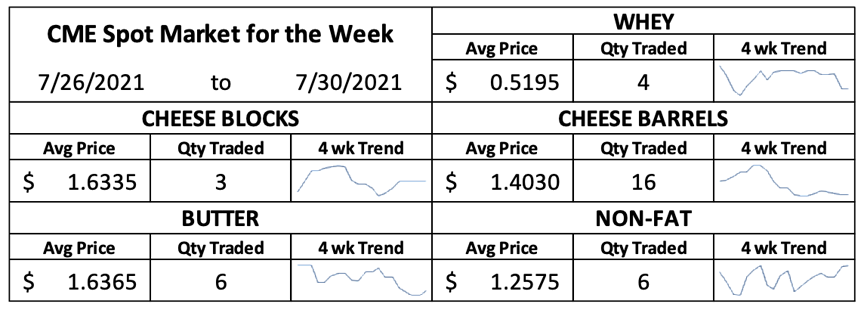
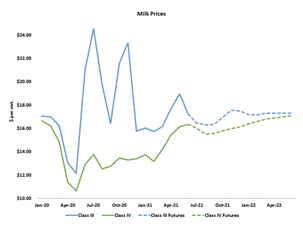 Like a balloon with a pinhole, the dairy markets are slowly deflating. The summer setback lacks the drama of July 2020, when – flush with government largesse – the cheese market balloon grew and grew and grew until it burst spectacularly. Although this year’s losses have none of last year’s frenzy, the ink is just as red. Both Class III and Class IV futures posted double-digit declines once again this week. September and October Class III settled below $17 per cwt., at their lowest values so far in 2021. In Class IV, the September through November contracts plumbed life-of-contract lows in the $15s. Given historically high costs for feed, fuel, freight, and labor, these values are extremely disappointing for dairy producers.
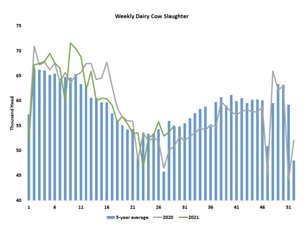 But it may be a while before lower prices translate to less milk. Dairy slaughter has accelerated relative to the 2020 pace. But, as is always the case during the summer, the numbers aren’t all that high. Although slaughter volumes have eclipsed the prior year for the past six weeks, year-to-date slaughter is still 0.2% behind the 2020 pace, and the dairy herd is 1.6% larger than it was a year ago. Dairy producers are clearly not culling cows at the pace required to significantly shrink the herd. And, given how many cows we are milking, it will take significant slaughter to bring production back down to a level that necessitates higher prices. Low prices are the best cure for low prices, but the healing process is often painful and achingly slow.
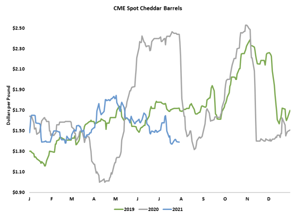 Heavy production continues to weigh on the whey market as well. CME spot whey powder fell 3.5ȼ this week to 50.25ȼ. Spot dry whey finished July 5.75ȼ lower than where it began, trimming roughly 35ȼ from implied Class III values in the process. Demand for highprotein whey products remains impressive, but whey powder is piling up nonetheless.
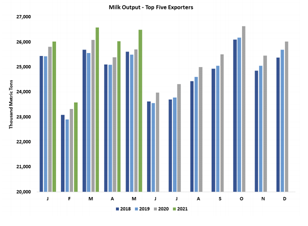 Despite the summer heat, there is more than enough milk to keep driers busy. Demand is steady, but shipping issues are slowing the flow of product from manufacturers to end users at home and abroad. While foreign milk powder values took another step back this week, CME spot nonfat dry milk (NDM) rallied. It closed today at $1.2675, up 1.5ȼ this week and up just 0.75ȼ for the month. Milk powder values could come under further pressure in the months to come if global demand falters. Dairy Market News notes that some Southeast Asian countries likely ordered extra skim milk powder (SMP) in the first half of the year, hoping to avoid shortages caused by shipping delays. But now, “inventories may be building to the point where buyers are willing to wait before making more purchases.” If that’s the case, a slowdown in demand could collide with growing supplies. Global milk output is high and rising. In May, milk production among the four largest

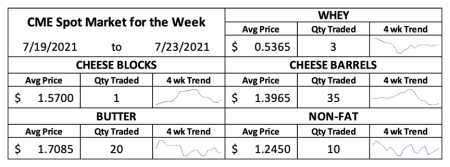
 Milk abounds. U.S. milk output reached 18.955 billion pounds in June. While that is down from the peak volumes reported in April and May, it is still historically strong, up 2.9% from June 2020. The heat wave sapped production in the Pacific Northwest last month, and the region has suffered even higher temperatures and greater stress in July. Industry consolidation has reduced output in some Eastern states, as cows move to states with better margins. But in the rest of the nation, milk output grew noticeably. California made a strong showing, with output up 3.1% from a year ago. The increase was driven entirely by higher milk yields. Second-ranked Wisconsin was not far behind, posting a 2.8% gain. In Texas and Idaho, production climbed 7% and 3.6%, respectively. It’s hard to imagine how much milk would be pouring through these states in the absence of onerous supply management programs. In the Northern Plains and Midwest, dairy producers are quickly adding cows and milk to fill up new cheese capacity.
 For the first time in a year, dairy producers scaled back the dairy herd in June. But the decline was modest, at just 1,000 head. The herd is still massive. Dairy producers collectively milked 9.508 million cows last month. That’s up 153,000 from last year and – excluding May 2021 – it’s the largest dairy herd since 1993. Slaughter volumes in recent weeks have been a bit higher than normal for mid-summer, but nowhere close to a liquidation pace. It’s going to be hard to slow milk output significantly with this kind of cow power. Meanwhile, fluid milk sales are in the summer doldrums. That’s left plenty for manufacturers, who are topping up vats and running churns. Despite the heat, there are long lines at the drier.
 USDA’s Dairy Market News cites strong demand for cheese across the nation. The Cold Storage report confirmed this, showing a 23-miillion-pound decline in cheese stocks from May to June. Still, at 1.435 billion pounds, June 30 cheese inventories were up 1.3% from a year ago, marking the highest mid-year cheese stockpile on record. Heavy inventories and strong output continued to weigh on pricing this week. On Wednesday, CME spot Cheddar barrels fell to an 11-month low at $1.3725 per pound. After a partial comeback, barrels finished at $1.4025, down 3.75ȼ from last Friday. Blocks dropped 3ȼ this week to $1.585. Prices have fallen low enough to attract the notice of importers, particularly from Asia. Despite all the headaches of international shipping in a world bogged down by shortages, exports remain a bright spot and a vital outlet for an industry flush with excess.
 Butter inventories typically decline from May to June, but this year they grew, which suggests that output is outpacing demand. At 414.5 million pounds, butter inventories are larger than they’ve been in any month since 1993, and they topped those of June 2020 by more than 14%. Buttermakers tell USDA’s Dairy Market News that sales are starting to soften. Nonetheless, the spot market rallied. CME spot butter finished at $1.695, up 1.75ȼ from last Friday.
 that international demand for milk powder has waned. But the data show that China, the world’s largest buyer, remained hungry for product through June. Last month China purchased far more SMP and more WMP than during any other June on record. For the year to date, Chinese SMP imports are up 47% from last year and up 29% from the record set in 2019. China’s WMP imports inched just ahead of the record pace set in 2014 and are 30.3% greater than the first half of 2020. Has China overstocked, or is their appetite truly insatiable? The answer will have a huge impact on the nonfat dry milk and Class IV markets.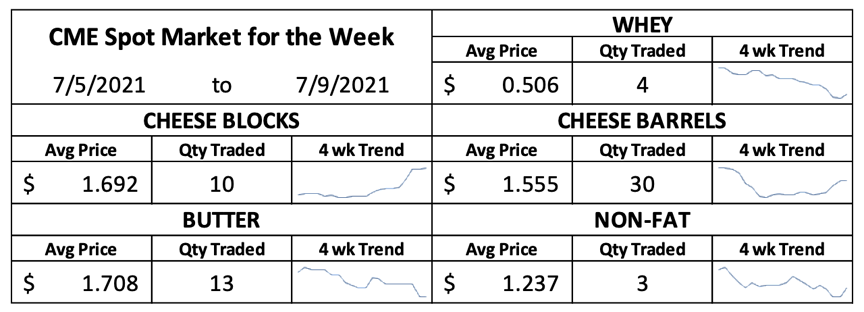
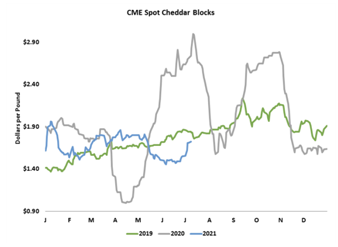 The cheese markets came roaring back. CME spot Cheddar blocks jumped 17ȼ this week to $1.725 per pound, a nearly two-month high. Barrels climbed 8ȼ to $1.58. The rebound propelled Class III values higher. The July contract inched up 6ȼ to $16.85 per cwt., while August vaulted 83ȼ to $17.54. Gains down the board were modest, but fourth-quarter contracts held above $18.
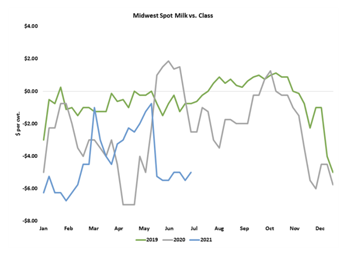 The other dairy markets dropped. CME spot whey fell another 4.25ȼ this week to 50.75ȼ, its lowest value since January. That’s still historically high, but it’s down noticeably from late April, when spot whey briefly traded above 70ȼ. For every penny the whey market declines, the Class III market gives up roughly 6ȼ, so this setback has been costly. Still, dairy producers are much better off with the current whey price than they were a year ago, when whey languished below 30ȼ. According to the Daily Dairy Report, the impact of the whey price on other milk solids values added about $1 per cwt. to Class III milk prices in 2019 and 2020. But so far this year, other solids have contributed far more, with the additional revenue ranging from $1.53 in January to $2.64 in May.
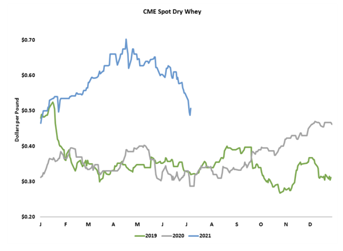 Seventy-cent whey was clearly unsustainable. After prices climbed, domestic whey consumption dropped to just 23 million pounds in May, the lowest monthly disappearance since 2014. But prices now stand at more palatable levels, and the fundamentals are sound. Exports remain strong, stocks are not burdensome, and demand for high protein products is directing most of the whey stream away from the drier.
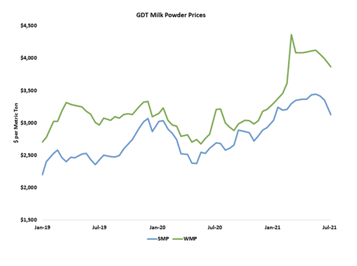 The milk powder market took another step back. CME spot nonfat dry milk (NDM) slipped 0.75ȼ to $1.25. The cheese processing issues likely spilled over into the Class IV space, as every load of milk that was turned away from the cheese vat likely found its way to a drier. Overseas milk powder markets retreated as well. At the Global Dairy Trade (GDT) auction, skim milk powder (SMP) fell 7%, to the equivalent of NDM at $1.59 per pound after adjusting for protein. GDT whole milk powder prices dropped 3%.
 Formidable milk production added up to a mountain of dairy products in May. Year over-year comparisons are skewed by all the dumped milk and processing headaches the industry suffered a year ago. But the broader trends are clear. New cheese processing capacity has boosted Cheddar output, which tops that of the first five months of 2020 by 5.6%. Total cheese production bested May 2020 by 5%. Although butter output fell short of the unusually high volumes of the prior year in March and April, it remains historically high and exceeded May 2020 production by 7.6%. Driers ran hard in May, and combined production of nonfat dry milk (NDM) and skim milk powder reached 241 million pounds, the highest May total on record and 12.7% more than the prior year. Dry whey production remains in the doldrums.
 Thankfully, exports have provided an outlet. Despite port backlogs, a container shortage, and a lack of truckers, dairy exports soared in May. The weak dollar and competitive pricing helped to keep product moving. U.S. NDM exports accelerated to an all-time high of 196 million pounds thanks to big shipments south of the border and to Southeast Asia. An uptick in milk powder exports to Algeria, where Europe typically dominates, suggests that European stocks are scant and the U.S. may continue to gain global marketshare. Dry whey exports were strong too, up an impressive 30% from May 2020. For the year to date, whey exports are running at their best pace since 2014. Cheese exports faltered, but butter sales climbed. So far this year the U.S. has sent slightly more butter abroad than it has taken in, marking its first major stretch as a net butter exporter since 2014.
 Strong exports buoyed the powder markets all spring, but values retreated this week. Domestic buyers are quick to back off as asking prices climb, driving the market downward despite reliable demand. It’s hard to argue for higher prices with so much milk to go around. CME spot NDM slipped 0.75ȼ this week to $1.2575 per pound. Spot whey powder fell 2.75ȼ to 55ȼ. That’s a significant decline in a market that has helped to prop up Class III values for months. Despite modest dry whey production and booming exports for whey powder and NDM, stocks of both products grew in May.
 Cheese and butter bounced back this week. CME spot butter rallied 2.25ȼ to $1.74. Barrels added a penny and reached $1.50. Blocks staged a more impressive comeback, rising 6.5ȼ to $1.555. Still, cheese is inexpensive, reflecting onerous output.
 USDA shocked the feed markets on Wednesday with its annual assessment of the acreage mix. Amid unusually high corn prices this spring, the grain trade expected that farmers had stepped up corn seedings to nearly 94 million acres. But, according to USDA, farmers planted 92.7 million acres of corn this spring. That is 1.6 million acres more than they intended to plant in the March Prospective Plantings report and the highest corn acreage since the 2016-17 crop year. But it was significantly lower than the trade had penciled in to its balance sheets, and the location of the new acres will not help matters. Farmers shifted 100,000 acres away from corn and into soybeans in Iowa, the nation’s most productive corn state. Nebraska ranks second in average corn yield; plantings dropped by 200,000 in the Cornhusker State. Farmers in the drought-stricken Dakotas and Minnesota added a combined 1 million corn acres, but the harvest is likely to disappoint. Demand remains daunting, and the new acreage figures leave little room for error on crop yields. Meanwhile, frost damage in southern Brazil and Paraguay shrunk the exportable crop in South America. As we head into the critical pollination season, the grain markets are primed to react violently to the tiniest shifts in the forecast.


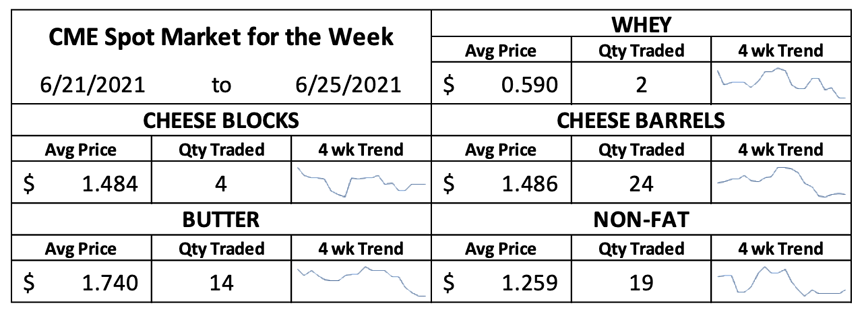
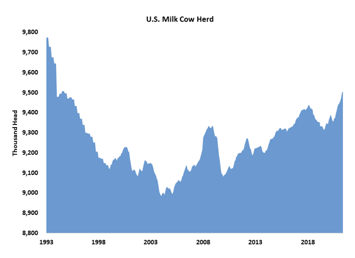 Cows abound. On Monday, USDA offered its latest look at monthly milk production. The agency revised upward its estimate of the April dairy herd by 10,000 head. According to USDA’s new figures, dairy producers added 13,000 milk cows in February, 14,000 in March, 26,000 in April, and another 5,000 in May. There were more than 9.5 million milk cows in May, the highest total since 1994 and 145,000 more than there were in May 2020. That’s the largest year-over-year expansion in the dairy herd since 2008, a surplus which led to an immensely painful 2009.
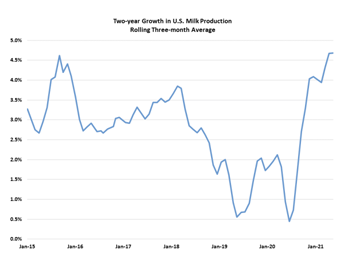 All those cows made for a profusion of milk. Output reached 19.85 billion pounds last month, an all-time high. Production was up 4.6% from May 2020, when pandemic lockdowns prompted a steep selloff in the dairy markets, and numerous supply chain issues – caused by a scared workforce, storage shortage, and tumbling demand from foodservice – reduced processing capacity. Amid onerous but necessary supply management programs, producers were forced to dump countless loads of milk last spring. As the Daily Dairy Report notes, “Against that backdrop, it’s not surprising to see such a staggering year-over-year increase.”
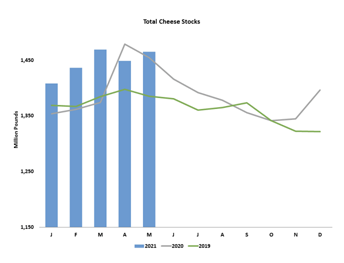 A two-year comparison gives a clearer portrayal, without allowing the pandemic to cloud the picture. Since October, U.S. milk output has been roughly 4% greater than it was two years prior, the most formidable increase since 2015. In the Midwest processors continue to snap up loads of excess milk at steep discounts even after significant expansions. Dairy Market News reports that cheesemakers are running at “max capacity.”
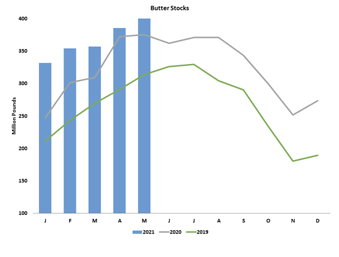 Thankfully, demand is also strong. Both cheese and butter inventories grew in May, but the increases were smaller than those of a typical year, and they came on the heels of lowerthan-average growth in butter stocks since February. Cheese stocks climbed modestly after a highly unusual setback in April. Still, there is plenty of product. Cheese inventories reached 1.465 billion pounds, up 0.7% from a year ago. At 401.8 million pounds, butter stocks are 6.9% greater than they were a year ago. There hasn’t been this much butter in cold storage since 1993, at the height of the low-fat craze.
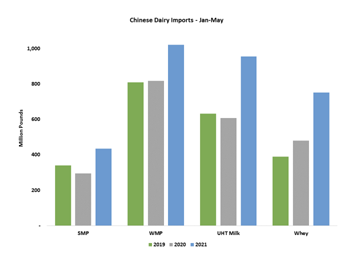 Chinese milk powder imports continue to impress. The world’s largest dairy importer brought in 164 million pounds of whole milk powder (WMP) last month, the highest May total on record and 72% more than in May 2020. For January through May, China’s WMP and SMP imports were 25% and 47% greater than the first five months of 2020, respectively.
 Fonterra raised its opening price by 10 cents as Australian processors counted down a few days before the 2021-22 season.




