










The T.C. Jacoby Weekly Market Report Week Ending June 25, 2021
The mercury is climbing on the West Coast and heat stress is dragging down milk yields. In the Northeast temperatures are expected to average above normal, gradually bringing an end to the spring flush. But in the Midwest and Southern Plains it’s unusually cool. Milk yields have slipped from the peak, but the mild weather is prolonging the flush, no matter what the calendar says.
Summer officially arrived this week. Right on cue, the mercury is climbing on the West Coast. Temperatures will top triple digitsfrom Washington to California, shattering records in the Pacific Northwest. In California’s Central Valley, home to the nation’s greatest concentration of dairy cows, the forecast calls for highs in the 100s for the foreseeable future. Heat stress is sure to drag down milk yields there. In the Northeast, the heat is not nearly so extreme, but temperatures are expected to average above normal, gradually bringing an end to the spring flush. But in the Midwest and Southern Plains, it’s unusually cool and expected to remain so. Milk yields have slipped from the peak, but the mild weather is prolonging the flush, no matter what the calendar says.
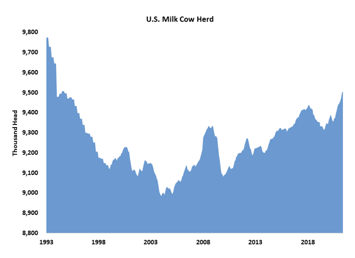 Cows abound. On Monday, USDA offered its latest look at monthly milk production. The agency revised upward its estimate of the April dairy herd by 10,000 head. According to USDA’s new figures, dairy producers added 13,000 milk cows in February, 14,000 in March, 26,000 in April, and another 5,000 in May. There were more than 9.5 million milk cows in May, the highest total since 1994 and 145,000 more than there were in May 2020. That’s the largest year-over-year expansion in the dairy herd since 2008, a surplus which led to an immensely painful 2009.
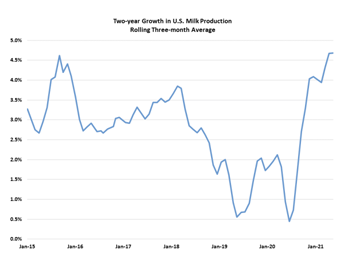 All those cows made for a profusion of milk. Output reached 19.85 billion pounds last month, an all-time high. Production was up 4.6% from May 2020, when pandemic lockdowns prompted a steep selloff in the dairy markets, and numerous supply chain issues – caused by a scared workforce, storage shortage, and tumbling demand from foodservice – reduced processing capacity. Amid onerous but necessary supply management programs, producers were forced to dump countless loads of milk last spring. As the Daily Dairy Report notes, “Against that backdrop, it’s not surprising to see such a staggering year-over-year increase.”
 A two-year comparison gives a clearer portrayal, without allowing the pandemic to cloud the picture. Since October, U.S. milk output has been roughly 4% greater than it was two years prior, the most formidable increase since 2015. In the Midwest processors continue to snap up loads of excess milk at steep discounts even after significant expansions. Dairy Market News reports that cheesemakers are running at “max capacity.”
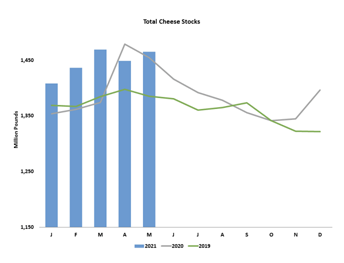
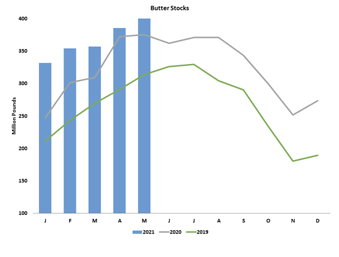 Thankfully, demand is also strong. Both cheese and butter inventories grew in May, but the increases were smaller than those of a typical year, and they came on the heels of lowerthan-average growth in butter stocks since February. Cheese stocks climbed modestly after a highly unusual setback in April. Still, there is plenty of product. Cheese inventories reached 1.465 billion pounds, up 0.7% from a year ago. At 401.8 million pounds, butter stocks are 6.9% greater than they were a year ago. There hasn’t been this much butter in cold storage since 1993, at the height of the low-fat craze.
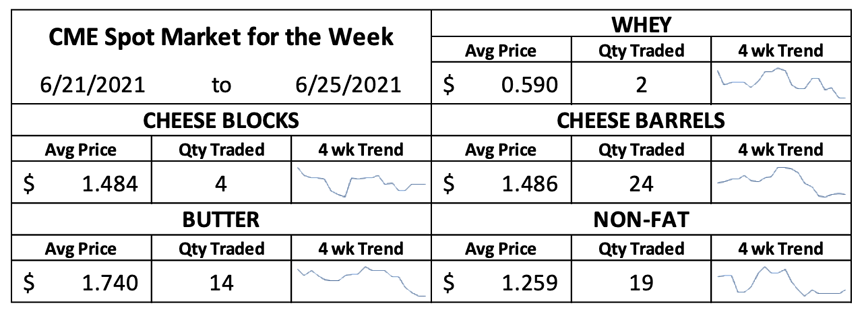
Heavy stockpiles continue to weigh on pricing. At the spot market this week, butter fell 6.75ȼ to a three-month low of $1.7175 per pound. Blocks slipped 0.25ȼ to $1.49. Barrels plunged 5.25ȼ and also closed at $1.49. Milk fell too. Nearby Class III futures finished a little lower than last Friday, while August through December contracts settled 40ȼ to 65ȼ in the red. Most Class IV contracts were 30ȼ to 50ȼ lower and September Class IV fell 72ȼ.
For weeks, whey buyers have pushed back as prices topped 60ȼ. Their pluck has paid off. CME spot whey fell 3.25ȼ this week to 57.75ȼ. Inventories are far from burdensome, but they are starting to grow thanks to formidable cheese output. Demand for high-protein whey products remains strong, and exports are moving at a good clip. China brought in 161.8 million pounds of foreign whey in May, just shy of the all-time high set in March. So far this year, Chinese dry whey imports are record large and up 56.4% from 2020. The United States has accounted for 37% of the total, down from 55% in 2017, before the trade war opened the door for our competitors.
CME spot nonfat dry milk values held steady at $1.265. Amid heavy milk output, driers are running hard. Processors find it difficult to keep product moving on time due to a shortage of truck drivers and continued backlogs at the ports. The slowdown is forcing manufacturers to stash milk powder in warehouses as distant buyers wait on delivery. Warehouse space is tightening, and some Western driers have been forced to sell more spot loads of powder to preserve storage space for their export commitments.
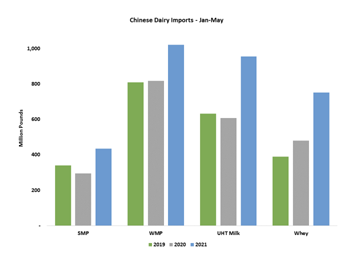 Chinese milk powder imports continue to impress. The world’s largest dairy importer brought in 164 million pounds of whole milk powder (WMP) last month, the highest May total on record and 72% more than in May 2020. For January through May, China’s WMP and SMP imports were 25% and 47% greater than the first five months of 2020, respectively.
China’s imports of other dairy products are all off to a record-smashing start. For the year to date, China has imported 16% more butter, 57% more ultra-high temperature fresh milk, and 69% more cheese than in 2020. The United States is largely excluded from these markets due to retaliatory tariffs, but big Chinese purchases from our competitors free up space for the U.S. dairy industry to sell product elsewhere. Still, the industry is surely missing out on export opportunities due to our lack of free trade agreements in the Asia-Pacific. Given all the milk we’re making, that’s a costly disadvantage.
The bears continued to bellow in the grain pits. Heavy rains watered crops in much of the Corn Belt, putting to rest fears of a widespread drought. But it’s still painfully dry in the Dakotas, Minnesota, and northern Iowa. There are plenty of rains in the forecast for the next two weeks, but the pattern remains the same, with only light, scattered showers in the driest areas. Many parched fields could miss the moisture altogether.
The crop markets were already on the run when the Supreme Court ruled that the EPA could grant small refiners an exemption from their Renewable Fuel Standards obligations to blend ethanol and biodiesel into the fuel supply. Although the ruling was relatively narrow, it gave fresh life to speculation that the Biden administration would grant waivers to refiners who have fallen short of their commitments to blend biodiesel. Those waivers could significantly reduce demand for soybean oil. Lower soybean oil prices would weigh on soy crushing margins and perhaps slow the crush enough to tighten soybean meal supplies. With that, corn and soybean values plummeted further, while soybean meal bounced back. Despite the Friday rebound, August soybean meal dropped nearly $25 per ton this week to $348.90. September
Source: Jacoby




