










USDA’s Dairy Market News reports that domestic cheese demand is “healthy”. Exporters are busy moving product they contracted to sell last month when prices were lower, which tightens the supply of fresh cheese available for sale in Chicago.
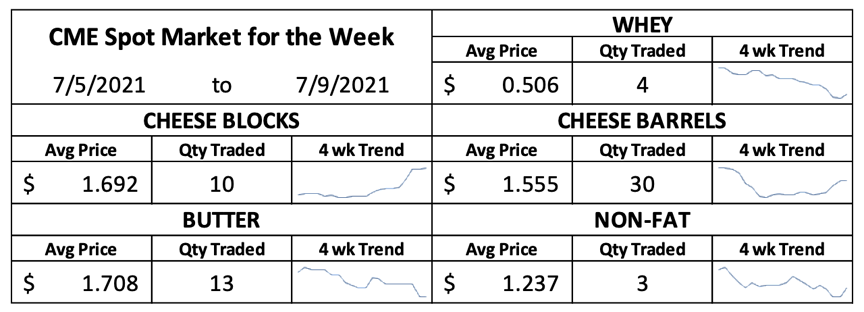
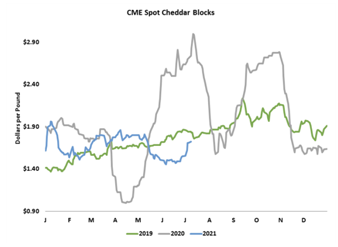 The cheese markets came roaring back. CME spot Cheddar blocks jumped 17ȼ this week to $1.725 per pound, a nearly two-month high. Barrels climbed 8ȼ to $1.58. The rebound propelled Class III values higher. The July contract inched up 6ȼ to $16.85 per cwt., while August vaulted 83ȼ to $17.54. Gains down the board were modest, but fourth-quarter contracts held above $18.
USDA’s Dairy Market News reports that domestic cheese demand is “healthy”. Although inquiries from foreign buyers have likely slowed at these prices, exporters are busy moving product they contracted to sell last month, when prices were lower. That’s helping to tighten the supply of fresh cheese available for sale in Chicago.
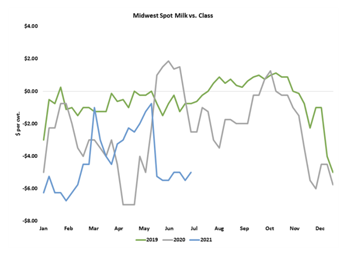
There is more than enough milk to go around, particularly in the Midwest, where excess loads of spot milk are moving at $4 to $6 under class. Cheesemakers are going hard, but shortages are causing headaches. Some processors have had trouble finding enough help to keep their plants running at optimal volumes. Meanwhile, the boxes that hold 640-lb. blocks have gotten scarce, and plants that can’t switch to other sizes or varieties have been forced to trim output. After numerous expansions, overall U.S. cheese processing capacity is still much larger than it was a year ago. But these issues have trimmed potential production at the margins.
 The other dairy markets dropped. CME spot whey fell another 4.25ȼ this week to 50.75ȼ, its lowest value since January. That’s still historically high, but it’s down noticeably from late April, when spot whey briefly traded above 70ȼ. For every penny the whey market declines, the Class III market gives up roughly 6ȼ, so this setback has been costly. Still, dairy producers are much better off with the current whey price than they were a year ago, when whey languished below 30ȼ. According to the Daily Dairy Report, the impact of the whey price on other milk solids values added about $1 per cwt. to Class III milk prices in 2019 and 2020. But so far this year, other solids have contributed far more, with the additional revenue ranging from $1.53 in January to $2.64 in May.
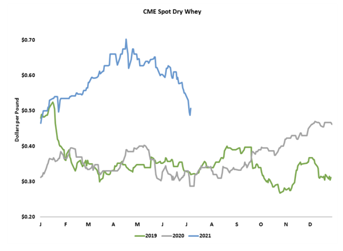 Seventy-cent whey was clearly unsustainable. After prices climbed, domestic whey consumption dropped to just 23 million pounds in May, the lowest monthly disappearance since 2014. But prices now stand at more palatable levels, and the fundamentals are sound. Exports remain strong, stocks are not burdensome, and demand for high protein products is directing most of the whey stream away from the drier.
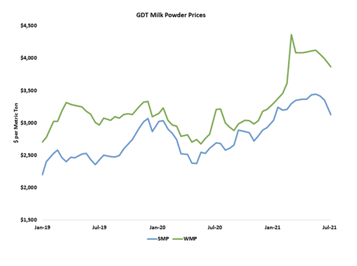 The milk powder market took another step back. CME spot nonfat dry milk (NDM) slipped 0.75ȼ to $1.25. The cheese processing issues likely spilled over into the Class IV space, as every load of milk that was turned away from the cheese vat likely found its way to a drier. Overseas milk powder markets retreated as well. At the Global Dairy Trade (GDT) auction, skim milk powder (SMP) fell 7%, to the equivalent of NDM at $1.59 per pound after adjusting for protein. GDT whole milk powder prices dropped 3%.
CME spot butter closed at $1.675, down 6.5ȼ to its lowest price since March. Domestic demand is stable. The big-time butter buyers are mostly on the sidelines. They had plenty of opportunity to stock up in January and February, when butter was historically cheap, and they are less inclined to buy today.
With both butter and powder in the red, Class IV futures settled lower across the board. Losses ranged from 20 to 40ȼ. The futures promise scant returns on this year’s Class IV milk, with August at $15.86 and December peaking at $16.51.
The heat has abated in much of the Midwest, and milk output remains high. But in the rest of the country, summer is in full swing. Humidity has dampened milk yields in the South and East. Record-smashing heat sapped milk production in the Pacific Northwest and in Idaho. In central California, the cows weathered their first bout of summer weather relatively well, but there are more triple digit temperatures in the forecast, and the stress is starting to show. Dairy producers are putting less milk in the bulk tank than they did last month. But, given the size of the dairy herd, we won’t be short of milk anytime soon.
The feed markets continue to move violently back and forth as the trade struggles to assess the size of this year’s crops. Last week, amid anxiety about drought and acreage, the bulls ruled LaSalle Street. But this week widespread rains swept through the Corn Belt, and the bulls fled to escape the downpour. In the parched Dakotas and parts of Minnesota, the rains came too late to help corn meet its historic potential, but they certainly helped to stave off disaster. In the rest of the Corn Belt, the crop is looking lush as it heads into the make-or-break pollination stage.
There are still plenty of reasons for concern. Stocks are tight, and some of Brazil’s second corn crop suffered from frost damage, which will push more importers to the U.S. The feed markets will remain volatile until the crop is safely in the bin.
September corn settled today at $5.295 per bushel, down more than 60ȼ since last Friday. August soybeans fell more than 50ȼ to $13.7925. At $354.10 per ton, August soybean meal lost a hefty $27.40 during the holiday-shortened trading week.
Source: Jacoby




