Archive for Dairy Markets – Page 32

Class III Milk Tumbles Tuesday in Chicago

On the Chicago Mercantile Exchange ,ilk futures continued to slide and cash dairy prices were mixed Tuesday.  Class III prices tumbled lower especially in November and December.  November decreased 59 cents to $18.78/cwt.  December milk lost 57 cents to $18.57.  2022 milk futures finished 14 cents lower to slightly positive.  Class IV prices were mixed despite spot nonfat milk and butter prices moving higher. 

In the spot dairy product trade dry whey was down $.0050 at $0.62.  No sales were recorded.  Blocks were down $.0475 at $1.7725.  There were three offers and no sales. Barrels went down $.03 to $1.83.   There were two offers, but only one trade at $1.84. Butter closed up $.0650 at $1.93.   There were eight butter sales ranging from $1.9050 to $1.93. Nonfat dry milk was up $.0075 to $1.5450.  Six trades were made ranging from $1.5350 to $1.5450.

Grain prices were mixed on the day.  December corn added 5.50 cents to $5.4350/bushel. November soybeans inched up ¾ of a penny to $12.38.  December soybean meal declined 30 cents to $326.90/ton.  December Minneapolis Wheat set a new contract high at $10.47/bushel before settling back at $10.2150.  Oats traded over $7.00/bushel for the first time ever.

Class III starts the week flat after last weeks gains

Despite a mainly higher CME spot dairy auction, Class III prices faltered and took back some of last week’s gains.  November was down $.24 at $19.37 and December was $.29 lower at $19.14, while January lost $.17 to $18.60 and February was down $.13 at $18.35. Class IV months were mainly 6 cents lower to 6 higher.

Spot dairy auction saw cash cheese mixed, with barrels down $.0025 at $1.86 and blocks up a penny at $1.82. Double A butter was $.03 higher at $1.865, grade A nonfat dry milk held at $1.5375, and extra grade dry weight was $.0075 higher at $.625.

Class III Jump Higher in Chicago Thursday

On the Chicago Mercantile Exchange milk futures closed higher Thursday as declines in grains and gains in cash prices buoyed markets.  Class III milk prices exploded higher with multiple contract highs set.  November milk surged 57 cents to $19.89/cwt.  December milk was up 47 cents to $19.52/cwt.  2022 milk futures increased 13-49 cents.  Class IV prices also saw similar price action, gaining around 20 cents in both November and December to $18.25 and $18.48/cwt. 

Spot dairy prices shot higher today following yesterday’s friendly September Milk Production Report.  Dry whey up $0.01 at $0.61. One sale was made at $0.6050. Blocks up $0.01 at $1.76. Barrels up $0.05 at $1.86. Five trades were made from $1.82 to $1.86. Butter up $0.0450 at $1.8450. One trade was made at that price. Nonfat dry milk up $0.0075 at $1.5275. Four trades were made at $1.5275 and $1.53.

Dairy’s 2020 gains steady in a year that was anything but

We’ll spare you the long story of how 2020 was difficult for everyone – assuming you aren’t a time-traveler or a visitor from outer space, you already know it. And if you follow this column, you’ll know that consumers turned to dairy in difficult times, from baking at home to stocking up on fluid milk in the COVID-19 pandemic’s earliest days.

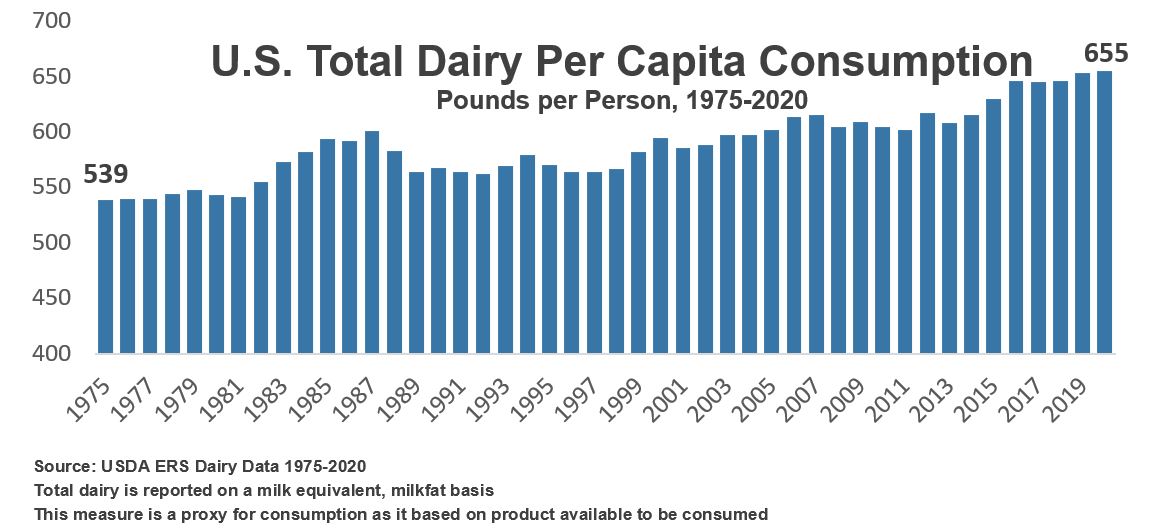
But the final consumption data for 2020 is now in, and the spreadsheet confirms what we already knew in our hearts: For the third consecutive year, U.S. per-capita dairy consumption increased, to 655 pounds per person from 653 pounds in 2019, showing a resilience in dairy that reflects that of those who relied on it.

No eye-poppers in this year’s report. A small uptick in yogurt, a gain in butter as it marches back to 1960’s-level consumption, increased buying of both full-fat and lower-fat ice cream – because what’s a ­­­lockdown without ice cream? And fluid milk consumption held steady, belying the haters who always use receding prominence  as fake evidence of the “death of dairy” even as gains among other dairy products more than outpace any fluid losses.

In the end, “steady” is ­­­what dairy’s been all about. At a time when everything from public health to supply chains have been in upheaval, consumers can count on dairy – for quality, for nutrition, for affordability, and for care in its creation.

2020 is over, and 2021 hasn’t been a picnic either. But we do know – and the data does show – what consumers have counted on throughout. Dairy farmers are proud to provide products that keep the country nourished. They will continue to meet that steadily growing need until current challenges have passed – and far, far beyond.

Source: NMPF

Class IV Products Garner Much Attention in Chicago This Week

The T.C. Jacoby Weekly Market Report Week Ending October 15, 2021

Despite some moderation during Friday’s spot session, gains earlier in the week left prices higher than last Friday for both butter and nonfat dry milk (NDM), pushing Class IV milk values upward.

Class IV products continued to garner much attention in Chicago this week. Despite some moderation during Friday’s spot session, gains earlier in the week left prices higher than last Friday for both butter and nonfat dry milk (NDM), pushing Class IV milk values upward.

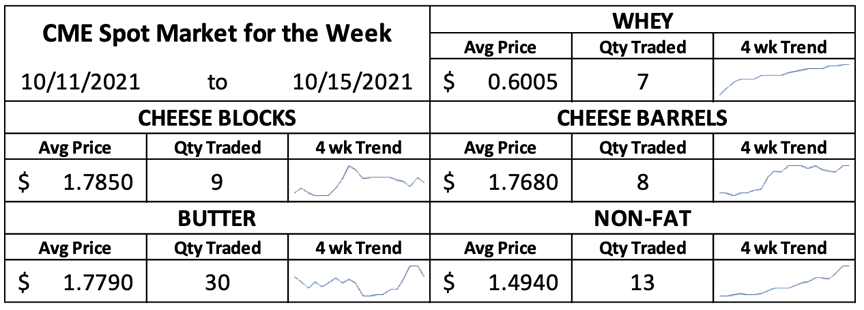
NDM saw the biggest gains during the spot trade this week. A .5¢ decline on Friday did little to counteract the substantive jumps seen on Tuesday and Wednesday. As a result, NDM finished the week at $1.5325 per pound, an increase of 7.25¢ versus last Friday. This represents the first time since 2014 that NDM prices have exceeded $1.50 per pound. 13 loads of product traded hands over the course of the week. Participants describe the NDM market as tight, even though loads of condensed skim are still available. USDA’s Dairy Market News reports that there is more product available in the West, but logistical challenges are preventing buyers from easily moving product from one region to another.

Butter markets also contributing to the Class IV gains. Demand for butter has been robust as the holiday season approaches and buyers, concerned about being caught short due to labor and logistical issues, seem to have front loaded orders. The outlook for butter demand over the rest of the holiday season is mixed but for the moment, product continues to move at a rapid clip. Strong butter demand pushed the CME up to $1.82 per pound on Wednesday, before giving up 4.5¢ during Friday’s trade. Ultimately, the CME spot butter price ended the week at $1.775 per pound, an increase of 5.5¢ compared to last Friday

With the strength imbued by NDM and butter, Class IV futures markets appreciated over the week, with particularly strong gains on Wednesday and Thursday. Futures markets for Class III and Class IV milk are showing remarkable parity through much of 2022. In fact, as of Friday’s settlement, JAN22 through MAY22 Class IV contracts are higher than those of Class III.

The spot cheese markets slid lower during the first half of the week before finding traction and bouncing pack on Thursday. During Friday’s trade, barrels held steady at $1.79 per pound while blocks again lost ground, falling to $1.78 per pound and inverting the block-barrel spread for the first time since June. Blocks finished the week 3¢ lower than last Friday while barrels were unchanged. Holiday demand has also perked up for cheese and processors indicate that given the availability of affordable spot milk, they would happily increase production if they thought they could reliably find enough labor to do so.

Whey markets continued to strengthen this week, adding value to Class III prices. Spot dry whey rose as high 60.5¢ per pound on Thursday before giving up a quarter cent to close the week at 60.25¢ per pound, up .75¢ from last Friday. Whey prices have not exceeded 60¢ per pound since June, when they were on the descent from their record setting rally. Somewhat lighter cheese production has reduced the available whey stream while demand remains robust from both domestic and international sources.

Milk production is beginning to tick upward in most areas of the country with milk availability generally described as good. Class I demand has subsided from a few weeks ago, when the start of school bumped up demand from bottlers, but remains significantly elevated relative to prior year. Labor shortages are pervasive, and a lack of plant operators and truck drivers are creating challenges up and down the supply chain. At the ports, well documented congestion is interrupting dairy exports and causing a buildup of inventories. Yet even as challenges abound, demand for U.S. dairy products remains robust from both international and domestic buyers.

USDA’s World Agriculture Supply and Demand Estimates report, released on Tuesday, held some surprises for the trade. USDA rebuffed analysts’ expectations, increasing production estimates for both corn and soybeans on the back of higher yields. The forecast for corn production during the 2021/22 marketing year was raised by 0.2% to 15.019 billion bushels. Larger production,

an increase in beginning stocks, and a decrease in total use forecasts allowed USDA to increase its corn ending stocks estimate by 92 million bushes. On the soybean balance sheet, a 1.6% increase in soybean production also trickled down to a 135-million-bushel, or 75%, increase in ending stocks. This dramatic change pulled the average farm price down to $12.35 per bushel for the 2021/22 crop year, 55¢ lower than last month’s estimate.

The increase in US corn and soybean production fed into expectations for larger global output, even as other key exporters of both crops saw their corn production expectations cut. The surprising WASDE report sent the futures markets for corn and soybeans tumbling on Tuesday, though they recovered later in the week. Heftier grain supplies should lead to lower grain prices and reduce pressure on dairy producer economics.

Original Report At: https://www.jacoby.com/market-report/class-iv-products-garner-much-attention-in-chicago-this-week/

Trader Optimism Lifts Markets in Chicago Wednesday

On the Chicago Mercantile Exchange milk futures closed higher at midweek as trader optimism lifted markets. October Class III milk up a nickel at $17.96. November a dime higher at $19.32. December up nine cents at $19.05. January up eight cents at $18.33. February through April contracts seven to nine cents higher.

In spot trade,  butter was up $0.0275 at $1.80. Five trades were made from $1.80 to $1.81. Nonfat dry milk was down $0.01 at $1.52. Two trades were made at $1.51 to $1.52. Dry whey was unchanged at $0.60. Blocks unchanged at $1.75. Barrels unchanged at $1.81.


Dairy prices rise at auction, supporting farmgate milk prices to farmers

Dairy prices rose at the global auction overnight, boding well for farmgate milk price payments to farmers this season.

The global dairy trade price index increased 2.2 per cent at the fortnightly auction. The average price for whole milk powder, which has the most impact on what farmers are paid, lifted 1.5 per cent to an average US$3803 (NZ$5305) a tonne, which is 25 per cent higher than at the same time last year.

Fonterra has been reducing the amount of whole milk powder it offers on the auction platform, saying it has strong contract demand and expectations for flat milk supply this season will limit its ability to increase production.

“With strong price gains across each contract period of each commodity, there is now little doubt that buyers are aware of how tight supply is expected to be, and are willing to pay the premium to secure volumes,” said NZX dairy analyst Stuart Davison. “The market doesn’t expect prices to ease from these price points in a hurry.”

Davison said the auction result will be positively received by farmers, as it supports the farmgate milk price.

“The confidence this result has provided will be appreciated, as farmers continue to deal with ongoing challenges on farm, such as labour shortages, cold and wet weather, along with supply chain issues affecting their businesses,” he said.

“However, I still don’t expect a higher farmgate milk price to entice excess milk production, as margins and on farm capabilities remain tight.”

Fonterra expects to pay farmers

Analysts have noted New Zealand has started this season on the back foot as wet and cold weather dents milk production.

Milk production was also soft elsewhere, with weather impacting European production and Chinese and United States production constrained by high feed costs and limited feed availability.

Davison noted that North Asian buyers returned to their dominant position as the top purchasers at the latest auction.

 between $7.25 per kilogram of milk solids to $8.75 per kgMS this season. That’s ahead of its $7.54 per kgMS payment last season.

The mid-point of the forecast would see Fonterra contributing more than $12 billion to the economy.

The co-operative expects global demand for dairy to increase by about 2 per cent per annum out to 2030 and says it may divert some product away from the auction platform in the future, as it focuses on higher value products.

Source: 

UK milk price increase needed to counter input costs

Local dairy farmers need a reflective and meaningful milk price to counter mounting financial pressure due to rapidly rising input prices and labour shortages, says the Ulster Farmers’ Union (UFU).

“Input prices have been rising all year and this was shown in recent analysis by local dairy consultants,” said Mervyn Gordon, dairy chairman, UFU. “They reported that the break-even milk price has increased 3.5ppl in the last 15 months and the biggest worry is that it’s not going to stop there.

“We’re going to have to factor in the impact of pending energy price and the predicted domino-effect that will come about with feed, fertiliser and fuel costs increasing. It’s going to be nearly impossible to keep up with rising input costs with the current base milk prices.

“To aggravate the situation further, the UFU are now receiving reports of labour shortages on local dairy farms. The appeal of more sociable working hours and a pay increase as much as £5/hour is enough to draw workers away from our sector.

“This then puts pressure on our dairy farms, not just the inflationary pressures on increasing wage demands, but also the lack of support to help run our farms.”

“With dairy commodities prices getting significantly stronger in recent weeks, this supports the call for a higher local base milk price.”

Source: belfasttelegraph.co.uk

Global Strength Battles Lower Cash Trade to Produce Mixed Markets in Chicago Tuesday

On the Chicago Mercantile Exchange milk futures were mixed Tuesday as global strength was offset by lower cash trade. October Class III milk down a penny at $17.91. November six cents higher at $19.22. December up 16 cents at $18.96. January a dime higher at $18.25. February through April contracts unchanged to four cents lower.

On spot trade dry whey was down $0.0025 at $0.60. One trade was made at $0.5925. Blocks were unchanged at $1.75. Barrels were down $0.0125 at $1.7775. Two trades were made at $1.75 and $1.7650. Butter was down $0.0275 at $1.7725. Thirteen trades were made from $1.7725 to $1.8025. Nonfat dry milk was down $0.01 at $1.53. Five trades were made from $1.5225 to $1.53. 


Class IV moves higher in Chicago to Start the Week

On the Chicago Mercantile Exchange milk futures started the week mostly lower as cash markets were mixed. Class IV milk kept inching higher. Though October was unchanged at 17.05, November gained 3 at 18.10 and Dec was unchanged at 18.54, 2022 gained 1-15 cents and the first half averages at $18.27/cwt. Class III milk was mixed. Nearby saw some lower moves. Oct down 2 to 17.92, November fell 12 to 19.16, and December gained 4 to 18.80/cwt. 2022 was mixed with Ja – June averaging at $18.11/cwt.

On spot trade dry whey unchanged at $0.6025. Blocks down $0.03 at $1.75. Barrels down $0.0125 at $1.7775. Two trades were made at $1.75 and $1.7650. Butter up $0.0250 at $1.7750. Eight trades were made from $1.79 to $1.8175. Nonfat dry milk up $0.0075 at $1.54. Three trades were made from $1.53 to $1.54.

Milk Futures Trend Higher in Chicago Thursday

On the Chicago Mercantile Exchange milk futures continued their trend higher Thursday as cash markets found strength. Class III and IV prices popped higher on Thursday.  November Class III added 51 cents/cwt and ended at $19.27 while December traded 47 stronger to a $18.85/cwt settlement.  January pushed 21 cents higher to $18.14/cwt while February and March were up 7 and 9 cents, respectively.  Beyond Q1 2022, most Class III months were flat.  Class IV was also in on the action as November traded 17 higher to $18.07 while December was up 25 cents/cwt.  First half 2022 ranged from 11 to 28 cents stronger.

Spot product saw dry whey up $0.0050 at $0.6050. One sale was made at that price. Blocks up $0.0475 at $1.8075. Three trades were made from $1.7575 to $1.8075. Barrels up $0.0450 at $1.79. Four trades were made from $1.76 to $1.79. Butter unchanged at $1.82. Nonfat dry milk up $0.0525 at $1.5275. Three trades were made from $1.50 and $1.5375.

Milk Futures Close Higher in Chicago Midweek

On the Chicago Mercantile Exchange milk futures closed higher Wednesday with traders optimistic from supply and demand expectations while cash trade was mixed. Class IV milk was our big mover – following butter higher. October gained 8 cents to 16.95, November added a massive 38 cents to $17.90, and gained 36 in December to $18.29.  First half of 2022 gained 20-34 cents and sits at a 18.04/cwt.  Pushing it higher than Class III in 2022. Class III milk was steady. October fell 1 cent to 17.88, November gained 4 to 18.85, and December gained 2 cents to 18.38/cwt. First half of 2022 gained 1-8 cents and is averaging at $18.00/cwt even.

On spot trade, butter traded 5 loads and jumping 6 cents higher to $1.82/lb . Cheddar Blocks and Barrels slid a bit, Blocks down 2 ¼ cents to $1.76/lb and Barrels down ½ cent to $1.74 ½. The block/barrel spread holding at 1 ½ cents with a $1.75 average price for Cheese.

Mixed Markets Continue in Chicago Tuesday

On the Chicago Mercantile Exchange milk futures closed mixed in a narrow range Tuesday following the supply and demand report and mixed cash trade. October Class III milk down four cents at $17.89. November a penny lower at $18.81. December up three cents at $18.36. January a penny higher at $17.91. February through April contracts four cents lower to seven higher.

On-the-spot markets dry whey up $0.0050 at $0.60. Four sales were made at $0.5975 and $0.60. Blocks down $0.0125 at $1.7825. Barrels down $0.0150 at $1.75. Butter up $0.04 at $1.76. One trade was made at that price. Nonfat dry milk down $0.0050 at $1.4550. Three trades were made at that price.

Milk Markets Start Week Lower in Chicago

On the Chicago Mercantile Exchange milk futures started the week mixed pressured somewhat by negative cash trade. Class III milk futures were lower across the board minus November.  October gave up a dime to $17.93/cwt.  November rose 7 cents to $18.84/cwt.  December milk fell 1 penny to $18.30/cwt.  First half 2022 lost 1 to 11 cents. 

Blocks and barrels finished lower to start the week in the CME Cash Dairy Product Trade. Blocks down $0.0150 at $1.81. Three sales were made from $1.79 to $1.7950. Barrels down $0.0250 at $1.7650. Dry whey unchanged at $0.5950. Butter unchanged at $1.72. Fifteen trades were made from $1.72 to $1.75. Nonfat dry milk unchanged at $1.46. Three trades were made at that price.

Milk Futures Continue to Climb Higher in Chicago Thursday

On the Chicago Mercantile Exchange milk futures were again mostly higher Thursday as was cash trade with continued export market support. October declined 10 cents to $18.05/cwt while November added 14 cents and December was up 12.  2022 months ranged from 2 to 7 cents higher.  The 2022 average last traded Thursday at $18.07/cwt.  Class IV experienced a similar move as November gained 10 cents and December was up 8.  2022 ended 2-11 cents in the green as well.

CME spot markets resulted in dry whey up $0.0025 at $0.5950. One sale was made at that price. Blocks up $0.0025 at $1.81. One sale was made at that price. Barrels down $0.02 at $1.7675. Butter unchanged at $1.6975. Nonfat dry milk up $0.0125 at $1.4425. Three trades were made at $1.44 and $1.4425.

Milk Futures Continue to Climb Higher

On the Chicago Mercantile Exchange milk futures continued higher Wednesday supported by strong exports and mostly higher cash trade. October Class III milk down six cents at $18.15. November three cents higher at $18.59. December up eight cents at $18.19. January four cents higher at $17.86. February through April contracts 10 to 19 cents higher.

On spot trade, dry whey up $0.0025 at $0.5925. Blocks unchanged at $1.8075. One sale was made at that price. Barrels down $0.0050 at $1.7875. Three trades were made at that price. Butter up $0.0075 at $1.6975. Eleven sales were made from $1.6975 to $1.7250. Nonfat dry milk up $0.0125 at $1.43. Eleven trades were made from $1.42 to $1.43.

Milk Futures Push Higher in Chicago Tuesday

Milk futures on the Chicago Mercantile Exchange continued higher Tuesday following strength in cash markets.  Class III milk continued a slow grind higher. October up 1 at $18.21, November up 14 cents at $18.56, and November up 10 cents at $18.11/cwt. 2022 was 5-19 cents higher and first half is averaging at 17.87/cwt. Class IV milk was quieter with 2021 months holding unchanged. October at 16.86, November at 17.29, and December at 17.41.

The CME spot trade took this information and was up slightly across the board. Dry whey up $0.0050 at $0.59. Blocks up $0.01 at $1.8075. Two sales were made at $1.8075 to $1.8075. Barrels up $0.0025 at $1.7925. One trade was made at that price. Butter unchanged at $1.69. Nonfat dry milk up $0.0175 at $1.4175. Five trades were made from $1.41 to $1.42.

Global Dairy Trade Event 293 was even to two weeks prior. Almost every product traded withing 1 % of last trade. Butter milk powder saw the largest gain up nearly 10 percent. Fractional gains and losses were reported for most other categories.

Mixed Markets Return in Chicago Wednesday

On the Chicago Mercantile Exchange milk futures closed mixed Wednesday following the direction of the cash market. September Class III milk down three cents at $16.70. October up 15 cents at $17.60. November 14 cents higher at $17.61. December up seven cents at $17.70. January through March contracts unchanged to a nickel lower.

The CME spot product trade was mostly higher. Dry whey up $0.0125 at $0.5175. Two sales were made at $0.51 and $0.5125. Blocks up $0.0175 at $1.7525. Barrels up $0.04 at $1.47. Two trades were made at $1.46 and $1.47. Butter down $0.0025 at $1.7850. Six trades were made from $1.7725 to $1.7925. Nonfat dry milk down $0.0025 at $1.3575. Three trades were made at that price.

The Class IV Market is Heating Up

The T.C. Jacoby Weekly Market Report Week Ending September 3, 2021

CME spot butter jumped 9ȼ this week. July butter production fell 0.8% short of the frantic pace of July 2020, but was still historically high. There is plenty of butter socked away to last through the fall and holiday baking season.

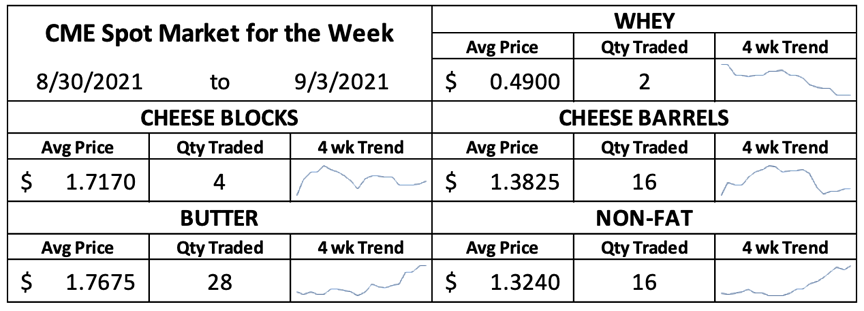
The Class IV market is heating up. CME spot butter jumped 9ȼ this week to $1.7975 per pound. July butter production fell 0.8% short of the frantic pace of July 2020, but was still historically high. There is plenty of butter socked away to last through the fall and holiday baking season.

U.S. milk powder output dropped noticeably in July, and has slowed further in the past five weeks. Combined production of nonfat dry milk (NDM) and skim milk powder (SMP) totaled 208.4 million pounds in July, down 8.4% year over year. On a daily average basis, driers ran 12.5% lighter in July than in June.

Demand for milk powder is running hot. U.S. exports of NDM/SMP in July reached 161 million pounds. That’s a little behind the breakneck pace of last year but still a solid total, especially in the face of all the issues getting milk powder from the warehouse over the border or out to sea. Through July, U.S. NDM/SMP exports are higher than any other year and up 12.4% compared to the first seven months of 2020. More recently, the heat wave and back-to-school rush have completely absorbed the U.S. milk surplus, pushing cheesemakers to use more NDM to fortify their vats. Manufacturers’ stocks of NDM shrunk more than 27 million pounds from June to July, the largest July drawdown since 2009.

Strong demand and falling stocks propelled CME spot NDM up 4.75ȼ this week to $1.34. Aside from two days in early May, that’s the highest spot value since 2014. With both butter and milk powder on the rise, Class IV futures climbed once again. Most contracts added between 20 and 45ȼ. From December onward, Class IV is projected to bring at least $17 per cwt. If they can finish there, dairy producers will reap a better reward for their Class IV milk than they have in any month in the past seven years.

The Class III market was extremely quiet, just marking time ahead of the long weekend. Most contracts regained a little of the ground they lost last week. However, the September contract slipped 12ȼ, eroding some of the premium it held over the spot market. Most Class III contracts are trading north of $17 and not far from their Class IV counterparts. Just two weeks ago, fourth-quarter Class III futures stood $1.15 higher, on average, than Class IV contracts, threatening another few months of depooling and negative producer price

differentials for many struggling dairy producers. But today, the spread has plunged to a healthy 31ȼ, and the menace of depooling has evaporated.

Cheese output was extremely strong in July, but surprisingly, Cheddar production fell a little short of the prior year. Manufacturers focused on other American and Italian cheese varieties. Compared to July 2020, USDA reported a 3.5% increase in total cheese production, driven by a 6.5% increase in output of Italian-style cheeses. Exporters helped to keep product moving. They sent over 81 million pounds of cheese abroad in July, nearly 26% more than in July 2020. CME spot Cheddar blocks slipped 1.5ȼ this week to $1.735. Barrels finished a penny lower at $1.3925.

Spot whey powder also lost 1.5ȼ and closed at 48.5ȼ, a one-month low. Despite formidable cheese output, production of dry whey for human consumption lagged the prior year for the fifth straight month in July. Higher-protein concentrates and whey protein isolates lapped up more of the whey stream than they did last year. Nonetheless, stocks climbed, prompting the recent selloff in the spot market.

USDA announced the August Class III milk price at $15.95 per cwt., down 54ȼ from July and $3.82 lower than August 2020. At $15.92, the August Class IV price was within a hairsbreadth of Class III and just 8ȼ lower than July Class IV. It was also $3.39 better than that of August 2020, when Class IV milk brought just $12.53. Today’s prices are inadequate for many dairy producers, especially in a world where everything costs more than it used to. But after a stormy 18 months, dairy producers whose revenue depends on Class I or Class IV milk can look forward to sunnier skies ahead.
Hurricane Ida slammed into Louisiana on Sunday, damaging export terminals at ports along the Gulf, which account for about 60% of U.S. corn and soybean shipments. More than a million Louisianans are without power, and the major grain facilities remain in the dark. Even after the lights come back on, it will take time to repair the damage and get back to normal operations.

Ida’s winds caused a powerful storm surge which pushed brackish water up the Mississippi River, temporarily reversing the flow of the Big Muddy. Many barges were sunk or grounded. With containers and truck drivers already scarce, the hit to the nation’s barge capacity will severely reduce the flow of grain and oilseeds from the Corn Belt and Delta to the Gulf. In short, it’s a mess.
Meanwhile, combines are getting ready to roll in the southern states. Crops that would normally move quickly from the field to the port will pile up farther inland. Although merchants will shift much of this grain abroad eventually, they’ll likely lose some business to South America. Because the early harvest is staying closer to home, the market will likely transition swiftly from extremely tight old crop supplies to more abundant new crop corn. The storm hammered corn futures this week, and it’s likely to weigh on the basis soon. December corn settled today at $5.24 per bushel, down nearly 30ȼ from last Friday. November soybeans dropped 31.25ȼ to $12.92. December soybean meal slipped another $9.40 per ton to $341.

Source: Jacoby

Dairy prices jump 4% at auction, the biggest gain in six months

Dairy prices jumped 4 per cent at the global auction overnight, the biggest increase in six months, with gains across all products.

The global dairy trade price index posted its biggest increase since early March, when it jumped 15 per cent. The index had fallen 13 per cent since then, before the latest bounce.

The average price for whole milk powder, which has the most impact on what farmers are paid, increased 3.3 per cent to an average US$3691 (NZ$5200) a tonne, with gains across all contract periods. The average price is sitting 24 per cent higher than at the same time last year.

Fonterra has been reducing the amount of whole milk powder it offers on the auction platform, saying it has “extremely strong” contract demand and expectations for flat milk supply this season will limit its ability to increase production.

“Constant messages from New Zealand processors of tighter supply may have been heeded, along with tighter supply out of the European Union coming onto the radar of buyers also,” said NZX dairy analyst Stuart Davison. “GDT offer volumes are much lower than this time last year.

Fonterra factors in fat and protein levels in milk when buying it off farmers.

“This auction will no doubt light a fire in the global dairy industry,” he said. “Buyers that missed out at this auction will be scrambling to secure prices and product.”

BNZ noted that against buoyant demand, supply is on the tight side with about 25,000 MT of product sold at the auction, down 37 per cent on the same event a year ago.

North Asian buyers purchased less whole milk powder than normal, although remained the largest buying group. They were closely followed by buyers from South East Asia. Buyers from the Middle East, Africa and the European Union all bought massive volumes of whole milk powder compared to their usual purchase volumes, Davison said.

Skim milk powder increased 7.3 per cent to an average US$3274/t, with lifts across all contract periods.

Butter prices rose 3.7 per cent, cheddar gained 3.6 per cent, anhydrous milk fat increased 3.1 per cent, lactose advanced 6.4 per cent, and buttermilk powder was up 3 per cent.

New Zealand is heading into its peak milk production period from next month.

Fonterra has forecast a record opening milk price for farmers this season, underpinned by an improving global economy, and strong demand for dairy relative to supply.

The co-operative has announced an opening forecast for the 2021/22 season of between $7.25 per kilogram of milk solids to $8.75 per kgMS, with a mid-point of $8 per kgMS. Its previous highest ever opening price was $7 per kgMS.

Following the latest auction, BNZ lifted its milk price forecast to $8.30 per kgMS from $7.80 per kgMS.

“We do not anticipate much growth, if any, in New Zealand milk production for the season overall given strong output last season and a recent trend of fewer cow numbers,” said BNZ senior economist Doug Steel.

“The dynamics and balance of risks appear to be changing with robust demand bumping up against subdued supply.”

Still, Steel noted there are still plenty of risks that have the potential to throw milk prices around with a long way to go until the season ends next May.

Rather than a precise estimate of Fonterra’s milk price, Steel said his forecast should be read as the balance of risk moving to a payout above $8 per kgMS rather than below it.

Whatever the final price, it is likely to be significantly above the five-year average of around $6 per kgMS, he said.

“For farmers, this is good news and strongly supports profitability,” he said, although he noted costs were also rising.

Fonterra has yet to finalise its final milk price for the 2020/21 season, although it has indicated a range of $7.45 per kgMS to $7.65 per kgMS. It paid $7.14 per kgMS for the 2019/20 season.

Source: stuff.co.nz

Dairy Market Report – August 2021

Low milk prices and high feed costs – a.k.a. depressed margins – are slowly bringing U.S. milk production back in line with demand. Daily average production was down almost 2 percent from the spring flush high in April, a larger-than-usual drop. Futures markets have taken notice, ending the long slide in their collective estimate of calendar year 2021 average milk prices beginning in mid-May.

To view the report, click here.

Markets Move Higher Tuesday in Chicago Boosted by Global Markets

On the Chicago Mercantile Exchange milk futures closed higher Tuesday supported by declining grain prices and strong global markets. Class III markets reacted favorably as October traded 60 cents stronger to $17.44/cwt, November was up 37 cents, and December tacked 21 cents on.  First half 2022 ranged from 2 cents to 22 higher.  Class IV markets continue to rally with many months 10-25 cents in the green out through October 2022.

The CME spot product markets followed up with a mainly stronger session itself.   Dry whey up $0.02 at $0.5050. One sale was made at $0.50. Blocks unchanged at $1.7350. Barrels up $0.0375 at $1.43. One trade was made at $1.4150. Butter down $0.01 at $1.7875. Fifteen trades were made from $1.7850 to $1.7975. Nonfat dry milk up $0.02 at $1.36. Three trades were made at that price.

Global Dairy Trade Event 291 took place Tuesday morning with the overall complex adding 4%. Skim milk powder led the categories higher, up 7.3 percent, followed by lactose, up 6.4 percent.

Global Dairy Commodity Update August 2021

Graph Reference: Fresh Agenda

Market fundamentals through the coming quarters are expected to remain mostly supportive of prices.

Despite the profound challenges posed by the tangle of ground and sea logistics affecting most major supply chains, it is difficult to see any major disruption in the supply & demand landscape that could upset these settings through the remainder of 2021 and into Q1-2022.

Northern hemisphere milk production will grow at a slower pace while much focus in the short-term will be on the NZ season. Despite the ongoing race to vaccinate populations, the worst affected food market channels will continue to gradually recover as new rules for living with COVID become accepted, while the damage to incomes will affect affordability.

Demand for dairy commodities remains steady as a gradual shift towards eating-out continues, although the challenges of managing the Delta variant of COVID (and others that will emerge) in unvaccinated populations will mean continued restrictions impact foodservice channels – whether imposed or through self-imposed avoidance.

China’s expanding demand remains absolutely critical to the global market balance. Despite an apparent build in powder inventories, major shifts in internal milk use remain supportive of ingredient imports.

There are already tight SMP supplies in EU and NZ, and next the US will tighten. The fundamentals are good for SMP with Chinese and SE Asian demand although landed costs (with hiked freight charges) are in new territory.

US milk is quickly tightening. Cheese and butterfat balance sheets should improve with stronger food service patronage, as the US herd contracts a little and challenging feed costs and quality hamper yields.

NZ milk supply remains a lottery – strong farmgate prices will drive as much milk as possible but there is a watchout with a shift to a drier seasonal outlook which could crimp peak milk and early shoulder-season output.

By Edwin Lloyd, General Manager Commercial, Maxum Foods

Source: Maxum Foods

Mixed Markets with Small Volumes in Chicago Thursday

On the Chicago Mercantile Exchange milk futures were mixed Thursday which cash markets were mostly higher. Small volume trade was present in both Class III and IV markets on Thursday.  2021 Class III months ranged in daily change of 11 cents lower to a penny higher.  2022 months fell single digits as well.  First half 2022 closed at $17.36/cwt.  Class IV months ended even to a couple cents in the green.  Class IV first half 2022 settled out at $17.10/cwt. 

CME spot product markets were mainly stronger on Thursday.   Blocks up $0.01 at $1.72. Barrels up $0.0150 at $1.3950. Three trades were made at $1.3950 and $1.4025. Butter up $0.03 at $1.7950. One trade was made at that price. Nonfat dry milk down $0.0075 at $1.3250. Seven trades were made at $1.3225 and $1.3250. Dry whey unchanged at $0.4850.

The grain complex found a bit of support as corn traded 2.75 cents higher, soybeans added 5.5 cents, and the wheat complex ranged from 2 cents lower to 6 cents in the green.  The soybean meal contracts faltered $1-$5/ton.

Ida Contributes to Mixed Markets in Chicago Wednesday

On the Chicago Mercantile Exchange milk futures were in a narrowly mixed range Wednesday as cash trade provided little direction and grain markets took a dive from Hurricane Ida concerns. Class III milk futures were mixed.  September milk dropped 4 cents to $16.71/cwt.  October was up just 1 to $16.91/cwt.  Class III 2022 milk saw some mild downward movement.  Class IV milk saw up front months lower while further out months finished in the green. 

On CME Cash Dairy Product Trade dry whey down $0.0125 at $0.4850. Two sales were made at that price. Blocks unchanged at $1.71. Barrels unchanged at $1.38. Butter unchanged at $1.7650. Nonfat dry milk up $0.0125 at $1.3325. Three trades were made from $1.3275 to $1.3325.

Grains were lower across the board once again.  December corn declined 11.50 cents to $5.2275/bushel.  November soybeans eased 14.75 cents to $12.7775/bushel.  September soybean meal fell $2.70 to $343.70/ton.  September Chicago Wheat settled 5.75 cents lower to $7.01/bushel. 

Declining Grain Prices Help Drive Milk Futures Higher in Chicago Tuesday

On the Chicago Mercantile Exchange milk futures found strength Tuesday from improving cash trade and declining grain prices.  Class IV say most of 2022 react kindly to the strength in butter. August held unchanged at 15.94 and Sept gained 3 to 16.20, but October – July of 2022 had double digit gains of 12-27 cents higher. Class IV milk is quickly catching up to Class III, but Class III also showed strength on Tuesday. August up 1 cent to 15.98, September up 9 to 16.75, and October jumped 24 cents to $16.90/cwt. 2022 gained 15-20 cents

The CME spot trade however, saw everything hold unchanged or move higher. Dry whey unchanged at $0.4975. Blocks unchanged at $1.71. Barrels up $0.0150 at $1.38. Butter up $0.05 at $1.7650. Fourteen trades were made from $1.73 to $1.7650. Nonfat dry milk up $0.0175 at $1.32. Two trades were made at that price.

Feed prices continued the slow grind lower. Corn fell 8 ½ cents in December to 5.34 ¼,  Soybeans fell 10 ¾ cents to 12.92 ½ with soybean meal softening $1.90 to $343.10/ton.

Mixed Monday on the Markets in Chicago

On the Chicago Mercantile Exchange milk futures closed Monday mixed as did cash trade. August Class III milk down a penny at $15.97. September down 10 cents at $16.66. October 12 cents higher at $16.66. November up two cents at $17.06. December through February contracts two cents lower to a penny higher.

On the spot market dry whey down $0.0025 at $0.4975. Blocks down $0.04 at $1.71. Three trades have been made from $1.71 to $1.74. Barrels down $0.0375 at $1.3650. Six trades were made from $1.3650 to $1.3975. Butter up $0.0075 at $1.7150. Nine trades were made from $1.6975 to $1.7150. Nonfat dry milk up $0.01 at $1.3025.

Mixed Markets Midweek in Chicago

On the Chicago Mercantile Exchange milk futures dipped at midweek as grain markets found strength and cash trade was mixed. Class III Milk fell 1 cent in Aug to 16.03, September fell 2 to 17.36 and October fell 9 cents to 17.20/cwt. The balance of months into 2022 were unchanged to 8 cents lower. Class IV slid higher. August gained 3 cents to 15.78, September gained 4 to 15.95, and October gained 7 cents to 16.07/cwt.

The summer slump continued on a slow news day and a quiet day in the CME products trade.  Dry whey down $0.0050 at $0.5150. Blocks up $0.0050 at $1.76. One sale was made at that price. Barrels up $0.0025 at $1.4875. One sale was made at that price. Butter down $0.0125 at $1.7025. Five trades were made from $1.6975 to $1.71. Nonfat dry milk unchanged at $1.27.

There Is an Abundance of Milk, but Momentum Is Slowing.

The T.C. Jacoby Weekly Market Report Week Ending August 20, 2021

There is an abundance of milk in both the United States and Europe, but momentum is slowing. The combination of summer temperatures and back-to-school demand has tightened milk supplies noticeably.

There is an abundance of milk in both the United States and Europe, but momentum is slowing. In Europe and the United Kingdom, June milk collections totaled roughly 30.7 billion pounds, up just 0.7% year over year. Low-quality forage and poor on-farm economics have slowed growth in milk output. USDA’s Dairy Market News reports that milk prices “have not kept up with higher feed costs.” Some farmers are leaving the industry and the milk-cow herd is in decline in Europe’s traditional dairy regions. Flooding in Western Europe further dampened milk collections in July, but in Eastern Europe output remains strong.

U.S. milk output reached 19.1 billion pounds last month. As expected, year-overyear growth waned from an average of 3.7% in the second quarter to a still-healthy 2% in July. Heat, humidity, and smoke clearly took a toll on milk yields in the Pacific Northwest, California, and the Southwest. Milk output continues to accelerate in the Midwest, but August temperatures have finally started to cut into milk yields in the heartland.

The U.S. milk-cow herd remains massive, at 9.5 million head, up 128,000 from July 2020. But contraction is underway, particularly in areas with big dairies – whose government payments fell well short of pandemic-era losses – and high Class I or Class IV utilization. After peaking in May, the U.S. milk cow herd declined by 6,000 head in June and another 3,000 head last month. Weekly slaughter volumes suggest the dairy herd will continue to shrink at the margins.

The combination of summer temperatures and back-to-school demand has tightened milk supplies noticeably. School milk orders could be especially strong this year. Just like the 2020- 21 school year, USDA will offer free lunches with milk to all students this year. Unlike last year, most students will learn in person this year, which will presumably enhance demand for school milk cartons. Additionally, the Biden administration announced a permanent 27% increase in food stamp benefits, which is sure to boost dairy purchases at the margins. In fiscal 2019, dairy accounted for 13.5% of all purchases made through the Supplemental Nutrition Assistance Program.

Already, cheesemakers note stiff competition from Class I bottlers and say there is no spot milk to be had. In late July, cheesemakers in the Upper Midwest could buy excess loads of milk at as much as $6 per cwt. below Class III. Today, spot milk is trading at Class III to a dollar over. Tighter milk supplies are a double boon for milk powder. Balancing plants are running light, and, in the absence of discounted milk, cheesemakers are fortifying their vats with nonfat dry milk (NDM). Across the pond, European milk continues to flow into cheese vats, leaving driers with very little. European skim milk powder (SMP) exports are light, and inventories are lean. Meanwhile, global demand for milk powder remains strong. SMP values rallied 1.1% at the Global Dairy Trade auction on Tuesday. Nonetheless, CME spot NDM slipped 2ȼ this week to $1.25 per pound.

CME spot Cheddar converged this week. Cheddar blocks tumbled 12ȼ to $1.6925. Barrels climbed 2.75ȼ to $1.4775. Cheese demand is reportedly steady at restaurants and at retail. Export orders have been creeping higher, but the strong dollar is not likely to help U.S. export prospects going forward.

CME spot whey powder gained 1.25ȼ this week and closed at 53ȼ. Overall demand for whey is steady. Domestic orders are climbing, and interest in high-protein whey products is particularly strong. But exports are weakening.

CME spot butter fell 0.75ȼ this week to $1.6625. Churning is starting to slow in the Midwest as cream supplies tighten. Demand is holding, but sentiment has soured. Butter makers are clearly concerned about the impact that higher Covid counts could have on foodservice.

Class III futures took a big step back this week, as they erased some of the premium they held over the spot market. An overall selloff in equities and commodities and the stronger dollar likely also weighed. September through December Class III futures lost between 55

and 75ȼ. They are holding at $17 or better. Class IV futures were steady to a little higher, but they are still trading roughly a dollar below Class III.
The grain and oilseed markets took a big step back this week. Export sales, ethanol production, and the soybean crush have all slowed of late, leading to slightly lower demand projections. Heavy rains are expected in the Northern Plains and Western Corn Belt, which will surely help the region’s parched soybeans. It’s too late in the season for the rains to have a huge impact on corn yields, but they surely won’t hurt. Funds hold an unusually large corn position as we head into harvest, which could add to typical seasonal selling pressure. December corn settled today at $5.37 per bushel, down 36ȼ from last Friday. November soybeans fell more than 80ȼ to $12.9075. Soybean meal dropped $5.50 per ton to $354.90.

Original Report at: https://www.jacoby.com/market-report/there-is-an-abundance-of-milk-but-momentum-is-slowing/

Mixed reports stalls markets in Chicago Tuesday

On the Chicago Mercantile Exchange milk futures traded in a narrow range, Tuesday stuck between a bearish cold storage report and improving cash markets. August Class III milk up a penny at $16.04. September down seven cents at $17.38. October a penny lower at $17.29. November also down a penny at $17.48. December through February contracts unchanged to a nickel higher.

On the spot markets dry whey unchanged at $0.52. Blocks up $0.01 at $1.7550. One sale was made at that price. Barrels unchanged at $1.4850. Butter up $0.0350 at $1.7150. Ten trades were made from $1.70 to $1.72. Nonfat dry milk up $0.01 at $1.27. One sale was made at that price.

Double Digits Rally for Class III Milk in Chicago to Start the Week

On the Chicago Mercantile Exchange, milk futures were supported by strong cash trade Monday. Class III milk futures rallied double digits in the September through November months.  September paced the efforts gaining 40 cents/cwt while October added 25 cents and November traded 12 cents higher.  2022 months were single digits in the green as well.  The Class IV market ranged anywhere from unchanged to 9 cents softer in 2021 and 2022. 

On the spot trade dry whey down $0.01 at $0.52. Blocks up $0.0525 at $1.7450. Three trades were made from $1.7350 to $1.7450. Barrels up $0.0075 at $1.4850. One sale was made at that price. Butter up $0.0175 at $1.68. Three trades were made from $1.67 to $1.6850. Nonfat dry milk up $0.01 at $1.26. One sale was made at that price.

Bearish Milk Production Drives Markets Lower in Chicago Thursday

On the Chicago Mercantile Exchange milk futures along with cash trade closed lower Thursday ahead of a bearish milk production report. Class III  milk fell 16 in August to 16.03, Sept down 2 to 17.11, and October down 4 to 17.08. Class IV was unchanged across the board. Aug at 15.75, Sept at 15.91, and October at 16.01/cwt.

The CME spot trade continues to be relatively quiet but failed to see any products move higher. Dry whey unchanged at $0.5275. Blocks down $0.03 at $1.73. Barrels down $0.0075 at $1.5050. Five trades were made at $1.5050 and $1.5150. Butter down $0.0025 at $1.6825. Three trades were made from $1.6825 to $1.69. Nonfat dry milk down $0.0025 at $1.25. One trade was made at that price.

Milk Futures Continue to Slide in Chicago Wednesday

On the Chicago Mercantile Exchange milk futures continued to slide and cash dairy was mixed Wednesday.  Class III futures were weaker on the day.  August to December was down 3-19 cents with 2022 milk down roughly the same amount.  August class III milk is printing $16.06/cwt.  Class IV saw 0 trades take place.  

It was a mixed day in the CME Cash Dairy Product Trade. Dry whey was up $.0075 at $0.5275.  No sales were recorded.  Blocks fell $0.02 to $1.76.   Barrels went up $.0225 to $1.5125.   Two trades were made at that price. Butter closed down $.0050 at $1.6850.   There were 11 trades ranging from $1.6650 to $1.6850. Nonfat dry milk was down $.0075 at $1.2525.  Two sales were recorded at $1.2550.

Another mild day in the grain market with neither the bulls nor bears taking control.  December corn was up 1.50 cents to $5.65/bushel.  November soybeans decreased 8.25 cents to $13.5325/bushel.  September soybean meal fell $2.50 to $357.60/ton.  September Chicago Wheat gained 2.75 cents to $7.3725/bushel. 

The Spot Cheddar Block Market Found The Gas Pedal This Week

Sarina Sharp, Market Analyst for the Daily Dairy Report

The spot Cheddar block market found the gas pedal this week, moving convincingly upward. Spot block prices closed higher than the previous session on four out of the week’s five trading days. Yet, as cheese prices moved up at the CME this week, dry whey prices moved down.

After remaining unchanged at $1.635/lb. for nine consecutive sessions, the spot Cheddar block market found the gas pedal this week, moving convincingly upward. Spot block prices closed higher than the previous session on four out of the week’s five trading days, ultimately settling on Friday at $1.8125/lb. This represents the highest price since mid-May and is a full 17.75¢ above last Friday’s price. After no product moved last week, nine loads traded hands this week. Not to be left behind, Cheddar barrels

also moved upward, ending Friday’s trade at $1.45/lb., 14¢ higher than last week. The block-barrel spread yawned to as wide as 37¢, the largest gap since last November.
According to market participants, cheese demand has remained robust from both domestic and international sources. Even as the Delta variant threatens to bring about new restrictions, consumers have continued to visit foodservice outlets while the return of summer fairs and festivals has also boosted demand. At the same time, a seasonal decline in milk production combined with increased demand from bottlers has left less milk available for cheese manufacturers. Dairy Market News cites that barrels are relatively more available than blocks, contributing to the widening spread.

Yet, as cheese prices moved up at the CME this week, dry whey prices moved down. Though nowhere near as dramatic as the precipitous drop seen last week, the spot market gave up 2¢ on Wednesday and another quarter cent on Friday to end the week at 51.75¢/lb., a decline of 2.25¢ compared to last Friday. Spot loads of dry whey are purportedly available for purchase and raw whey is still accessible, but dryers are noticing a decline in supplies as milk production contracts seasonally. Furthermore, robust demand from abroad and a continued pull of the whey stream toward higher value products could reduce the availability of dry whey, keeping upward price pressure on the market in the coming weeks.

Movements among the Class IV products were more subdued. Cream availability has waned, but as ice cream production has also declined, butter churns are still able to get their hands on necessary cream supplies, albeit at higher multiples. Foodservice demand for butter has remained steady in spite of building concern around the Delta variant. Retail sales have also remained reasonable for the time of year and are expected to increase in the coming weeks as home bakers turn their ovens back on for the autumn season. During Monday’s spot session, butter rose by 3.25¢ as 11 loads traded hands. The spot price bobbled between $1.67/lb. and $1.68/lb. over the rest of the week, finally closing Friday’s trade at $1.67/lb., up 2.25¢ from last Friday.

Nonfat dry milk (NDM) markets also found a nugget of strength over the course of the week, adding a penny and a half to end the week at $1.27/lb. with 11 loads moving. Domestic demand for NDM has improved, particularly from cheesemakers who are fortifying as milk supplies drop. International interest has been mixed as logistics issues continue to hound exporters of NDM and other dairy ingredients.

The tranquility of the butter and NDM markets translated into a relatively quiet week for Class IV futures. By the end of the week, most nearby contracts had shifted just a few cents with SEP21 seeing the largest gain, an increase of 24¢ on Friday versus Monday’s

settlement. The Class III markets were full of action, however, as dramatic movements in the spot Cheddar price played out in the milk futures market. Remaining 2021 contracts moved decisively upward on Monday and Tuesday with SEP21 rising by the 70¢ limit on Tuesday. Wednesday and Thursday brought price moderation but another upward leap on Friday led nearby contracts to settle substantively higher on Friday. For example, the SEP21 contract added $1.04 over the week to settle on Friday at $17.62/cwt.

Across the country milk volumes are declining seasonally. At the same time, students are returning to school, increasing demand from Class I, especially in the Southeast. Taken together, this has meant less spot milk available for manufacturing needs. Although cheese manufacturers and balancing plants are no longer running such full schedules, market participants comment that the break has taken some pressure off operators who have been coping with labor shortages, logistical challenges, and other Covid related issues for months now.

On Thursday the USDA released its World Agricultural Supply and Demand Estimates report infusing some excitement into the grain markets. On the corn balance sheet, USDA reduced the expectation for U.S. corn yields by 2.7% versus last month’s estimate to 174.6 bushels per acre. The decrease was greater than what most analysts had expected and led to a 415-million-bushel decline in U.S. corn production. Even as some use categories were also decreased the balance pushed ending stocks down by 190 million bushels and caused futures prices to rally.

The estimates released for soybeans were significantly more measured. Yield expectations were also lowered, but by just 1.6% to 50 bushels per acre. The resulting 66 million bushel drop in production was partially offset by a larger carryover increase in beginning stocks. A lower crush estimate and slower exports reduced estimated use, ultimately leaving ending stocks unchanged at 155 million bushels. The soybean futures markets failed to get too excited over the report with only minimal changes in the nearby contracts.

Original report at: https://www.jacoby.com/market-report/the-spot-cheddar-block-market-found-the-gas-pedal-this-week/

Down Markets in Chicago Mid-Week

On the Chicago Mercantile Exchange milk futures were sharply down and cash dairy was mostly flat . Despite a supportive GDT and relatively unchanged product auction, Class III futures struggled.  September milk declined 29 cents to $17.31/cwt while October was off 37 cents at $17.20.  November and December were also down 23 and 24 cents/cwt, respectively.  2022 months lost a little value also Tuesday, but mainly single digits.  Class IV markets were virtually unchanged with just October in 2021 trading and down 7 cents.  2022 months saw double digit volumes except for January.

Very little change took effect in Tuesday’s CME spot dairy auction.  Blocks up $0.01 at $1.78.  Two trades were made at $1.77 and $1.78.  Two trades were made at $1.77 and $1.78. Barrels went up $.01 to $1.49.   Six trades were made from $1.4850 to $1.50. Butter was unchanged at $1.69.   No sales were recorded. Nonfat dry milk was unchanged at $1.26.  No sales were recorded. Dry whey was unchanged at $0.52.  No sales were recorded. 


Milk Futures Start the Week Lower in Chicago

On the Chicago Mercantile Exchange milk futures opened the week lower as cash markets trade on both sides of the coin. Class III Milk showed some weakness nearby, but 2022 gained. Aug fell 4 cents to 16.15, September fell 2 to 17.60 and October fell 17 cents to 17.57/cwt.  Jan – July were unchanged to 7 higher. Class IV milk however showed some strength. August was unchanged at 15.75, and September gained 11 to 15.98 with October gained 12 to 16.13/cwt.

The CME spot trade saw dry whey up $0.0025 at $0.52. One sale was made at that price. Blocks down $0.0225 at $1.79. Three trades were made at $1.78 and $1.79. Barrels up $0.03 at $1.48. Four trades were made at $1.408 and $1.49. Butter up $0.02 at $1.69. Two trades were made at $1.69 and $1.6975. Nonfat dry milk down $0.01 at $1.26. Two sales were made at $1.26 and $1.2650.

Grain and feed markets continue to hold their own and keep margins tight. Corn fell 4 ¼ cents to 5.68 ¾,  Soybeans gained 3 ¼ cents to 13.68 ¼, with soybean meal gained $2 to $358.70/ton.

Dairy Markets Experience Flips, Climbs and Dives

The T.C. Jacoby Weekly Market Report Week Ending August 6, 2021

Even as cheese production has slowed, balancing operations continue to press forward at a steady clip.

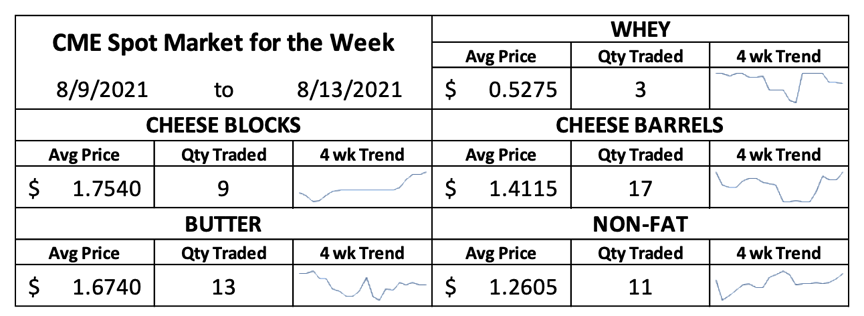
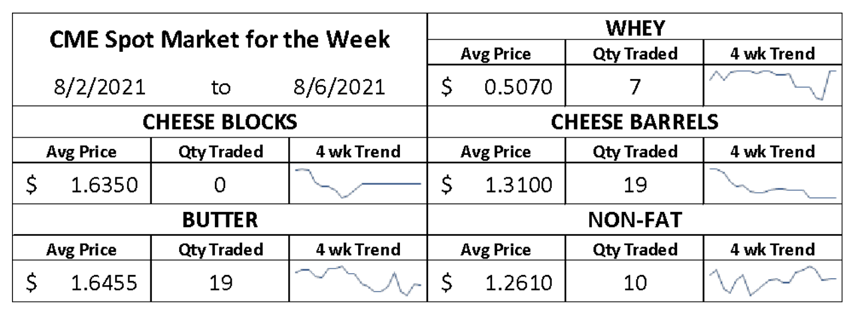
While the world’s best athletes showcase their athletic prowess in the final days of the Tokyo Olympics, the dairy markets are also experiencing their share of flips, climbs, and dives. In the cheese markets, barrels made the biggest headlines this week with the CME spot prices taking a tumble on Monday. Barrels finished the week at $1.31 per pound, down

8¢ compared to last Friday. Meanwhile, the block market was quiet, holding unchanged at $1.635 per pound with no loads trading hands over the course of the week. The block-barrel spread gaped as wide as 32.75¢ this week, the largest difference since mid-March.

Cheese production grew year over year for the eighth consecutive month in June, according to USDA’s Dairy Products report, released earlier this week. However, with total cheese output totaling 1.124 billion pounds, the increase was a mere 0.2% compared to June 2020. Augmented cheese production was driven by growth in American styles, and especially Cheddar production which was up 8.2% year over year and likely reflected the expansion of processing capacity which has occurred over the past year. Production of Italian varieties fell by 2.6% against the same month last year.

Anecdotal reports indicate that cheese demand remains steady from both domestic and international sources. An announcement of Section 32 cheese purchases on Thursday breathed some air the market but stakeholders don’t expect the amounts to be substantive.

The whey markets have softened considerably over the last week. At the CME, the spot market slipped, testing depths as low as 47.5¢ per pound on Wednesday, the lowest price since the early January. However, this figure was quickly rejected with the market rebounding and ultimately closing Friday’s session at 54¢ per pound, an increase of 3.75¢ compared to last week. Nevertheless, comments in USDA’s Dairy Market News suggests that market tones have shifted with buyers now boasting more negotiating power and demanding lower prices from suppliers

Whey production has eased with most whey products seeing lower figures in June. Dry whey production for human consumption slipped by 0.9% year over year while output of whey protein isolates also fell by 7.0% versus June 2020. Only whey protein concentrates were able to eke out an increase, rising by 0.2% to 40.3 million pounds for the month.

Whey exports stayed strong through June, with insatiable demand from China driving year over year growth of 11.7% for the month. In recent weeks, however, market participants comment that international interest has been more mixed with the commodity hit particularly hard by ongoing logistical constraints.

Even as cheese production has slowed, balancing operations continue to press forward at a steady clip. Cream supplies are plentiful and butter churns are working through available supplies. Butter production surged upward by 7.8% year over year in June, posting the largest volume for the month in decades. Plentiful butter supplies have weighed on prices. Spot prices slipped as low as $1.605 per pound on Wednesday before bouncing back. Today’s spot session closed at $1.6475 per pound with 19 loads changing hands over the course of the week. Butter prices perked up at this week’s Global Dairy Trade (GDT) auction, one positive note as the auction’s index lost ground for the eighth consecutive session. At current prices, GDT butter holds a 38¢ per pound premium to U.S. spot prices after adjusting for fat content, potentially creating some additional opportunity for butter exports.

Dryers have also continued to run solidly, absorbing available condensed skim. As a result, supplies of nonfat dry milk (NDM) are plentiful but demand from both domestic and international sources has kept tension in the market. NDM spot prices have been unsettled, starting the week by rising to $1.275 per pound before giving up two pennies and closing Friday’s trade at $1.255, down 1.25¢ from last week. Dryers have shown a strong preference toward producing milk powder for use domestically and for certain Mexican buyers. While NDM production rose by 19.8% year over year in June, skim milk powder production, typically destined for customers further afield, tumbled by 46.1%. NDM exports posted another strong month in June, setting a record for the month with 179.5 million pounds moving offshore. Sustained demand from Mexico has kept U.S. NDM moving, even as interest from some Asian buyers has waned in recent weeks. After SMP appreciated modestly at this week’s Global Dairy Trade auction, U.S. powder holds a discount of about 21¢ per pound after standardizing for protein content.


Milk production continues to dissipate seasonally but volumes remain plentiful overall. As schools prepare to open in the coming weeks demand from bottlers has ticked upward. Higher Class I demand and lower overall milk supplies has reduced the availability of milk for manufacturers and slashed discounts on spot milk loads. Milk futures staged mixed performance over the week with most nearby Class III contracts losing value early in the

week before finding some strength on Thursday and Friday. Most of the 2021 contracts ended this week slightly higher than last week. Action in the Class IV market was even more subdued. Gains on Monday were canceled out by losses on Tuesday before most contracts remained unchanged for the balance of the week.
Oscillations in the grain markets persisted this week. Corn futures appreciated across the board on Monday before slipping on Tuesday and Wednesday. Nevertheless, they found traction on Thursday and Friday. DEC21 corn futures settled on Friday just 2.75¢ per bushel lower than on Monday. Meanwhile, soybean and soybean meal futures bottomed out on Tuesday before recouping some value later in the week. Volatility in the grain markets and elevated feed costs continue to cause anxiety for producers, with little indication that prices are poised to relax coming weeks.

Original Report at: Jacoby

Bearish Supply and Demand Report Pushes Markets Lower in Chicago Thursday

On the Chicago Mercantile Exchange, milk futures dropped Thursday following the bearish monthly supply and demand report and limited cash trade. August Class III milk down two cents at $16.12. September down 32 cents at $16.92. October 24 cents lower at $17.26. November down 21 cents at $17.77. December through February contracts three to 11 cents lower.

On the spot market dry whey is unchanged at $0.52. One sale was made at that price. Blocks unchanged at $1.78. Barrels unchanged at $1.41. Butter down $0.01 at $1.67. Nonfat dry milk up to $0.0050 at $1.2650. Five sales were made from $1.26 to $1.2650.

Dairy Markets Rally Slows Down in Chicago Wednesday

On the Chicago Mercantile Exchange a mixed day in the dairy markets slowed down the class III rally, but Class IV perked up.  Class IV milk held unchanged in Aug at 15.55, but September jumped 29 to 15.92 and October up 13 to 16.01/cwt. Class III milk slid 3 cents in Aug to 16.14, September down 4 to 17.24, and October slid 11 cents to 17.50/cwt.

Wednesday saw a more mixed trade on the CME spot trade.  Dry whey down $0.02 at $0.52.  One sale was made at that price.  Blocks up $0.0425 at $1.78.  Four trades were made from $1.7550 to $1.78.  Barrels down $0.0175 at $1.41.    Butter up $0.01 at $1.68.    Nonfat dry milk up $0.0025 at $1.2575.  Two sales were made at that price. 

The Feed and Grain markets continue to stagnate ahead of Thursday’s USDA Supply and Demand report. Corn gained 6 cents to 5.59 ¼, November Soybeans gained 3 ¼ to 13.40 even, and soybean meal fell $3.60 to $353.90/ton

Global Dairy Trade Index Falls in Tuesday’s Trade

The Global Dairy Trade index has fallen for the eighth consecutive auction.  Tuesday’s trading event index fell 1% to an average price of $3,784 a metric ton.

Prices for anhydrous milk fat, butter, cheddar cheese, and skim milk powder rose while buttermilk powder, sweet whey powder, lactose, and whole milk powder prices fell.

Anhydrous milkfat was up 1.3% to $5,668 a metric ton, or $2.62 per pound.

Butter closed up 3.8% at $4,589 a ton, or $2.89 per pound.

Buttermilk powder was down 8% selling for $3,246 a ton, or $1.52 per pound.

Cheddar cheese was up 0.7% closing at $4,065 a ton, or $1.93 per pound.

Lactose was down 3.1% to $1,094 a ton, or $.49 per pound.

Skim milk powder gained 1.5% to $3,020 a ton, or $1.36 per pound.

Whole milk powder prices dropped 3.8% to $3,598 a ton, or $1.69 per pound.

Sweet whey powder was not offered during this GDT trading event.


Send this to a friend