On the Chicago Mercantile Exchange ilk futures were higher Monday as supply and demand numbers and lower grain markets brought support to prices. January and February each closed north of $20/cwt with March not far off either. All months in 2022 now sit north of $19/cwt for Class III. Class IV didn’t perform as well with prices off 7-15 cents/cwt.
On spot markets blocks up $0.0450 at $1.91. Two sales were made at $1.8850 and $1.91. Barrels down $0.02 at $1.66. Two trades were made at $1.66 and $1.6775. Butter down $0.0625 at $2.06. Nine trades were made from $2.06 to $2.10. Nonfat dry milk up $0.0050 at $1.63. Two sales were made from $1.6175 and $1.63. Dry whey unchanged at $0.7125.
U.S. dairy exports to China were up 32% during the first half of this year on a milk equivalent basis, which is one reason total U.S. dairy exports are on pace for another record year.
Speaking last week to dairy farmers at the MILK Business Conference in Las Vegas, William Loux, the U.S. Dairy Export Council’s Director of Global Trade, offered his analysis of what’s driving dairy demand in China during the pandemic.
“A lot of that has to do with the Chinese government telling consumers, ‘Hey, dairy is really nutritious, it’s a great thing for your immunity, go out buy dairy products,’” said Loux. “And so frankly, Chinese consumers did that, and as a result, we’ve seen a huge spike in imports of everything from milk powders to cheese.”
Loux said the real challenge going forward will be to ensure that the U.S. wins its fair share in that growing market.
On the Chicago Mercantile Exchange milk futures were mixed Thursday despite a positive supply and demand report. Class III milk futures retreated after initial strength once again. December dropped 18 cents to $18.58/cwt. January lost 1 to $19.77/cwt. February fell 8 cents to $19.76/cwt. Class IV 2022 milk futures were mixed.
In the CME spot dairy trade, dry whey up $0.0150 at $0.7125. Blocks up $0.0075 at $1.85. Barrels down $0.01 at $2.0475. Four trades were made at $2.0450 and $2.0475. Butter up $0.02 at $2.0025. Ten trades were made from $1.9850 to $2.0125. Nonfat dry milk up $0.0250 at $1.5950. Nine sales were made from $1.5675 to $1.5950.
Milk prices jumped this month and Joe Fasula, co-owner of Gerrity’s Supermarkets, was surprised the price hike wasn’t steeper.
The price for a gallon of whole milk increased 11 cents to $4.15 from November to December and is up 17 cents, or 4.3%, over last December.
“It really should have gone up more because there’s no way they’re covering the increased costs these farmers are incurring, but it’s controlled by the Pennsylvania Milk Marketing Board,” Fasula said. “The cost of everything else is going up so significantly, I’m very surprised they haven’t passed along more cost increases. I’m happy for the consumers, but not for the farmers.”
Fasula added he was told by Valley Farms Dairy in Williamsport, the supplier for Gerrity’s grocery stores, that they don’t anticipate any immediate additional price increases.
Arden Tewksbury, manager of Meshoppen-based Progressive Agriculture Organization, feels the increase to $4.15 will benefit some farmers but won’t be enough to compensate for all their production costs.
“It’s going to help the dairy farmers in Pennsylvania who ship their milk to a Pennsylvania handler, but it’s still not going to put them up to a price that they really need,” he said.
Annette Kuzma, co-owner of Milky-Ray Dairy Farm in Vernon, Wyoming County, has been scrambling to keep up with rising costs.
“I pay the bills and they’re not getting paid because the price of milk is so terrible,” she said. “The price of feed is up and the price of milk has been at a standstill or below for years. It’s really frustrating.”
The pricing formula that determines how much farmers are compensated for the milk is set by the U.S. Department of Agriculture, not the state, and Tewksbury said it doesn’t consider the farmer’s production costs.
Tewksbury has proposed the Federal Milk Marketing Improvement Act which would amend the Agricultural Adjustment Act to require the secretary of agriculture to determine the price of all milk used for manufacturing purposes by using the national average cost of production.
Carol Hardbarger, secretary of the Pennsylvania Milk Marketing Board, noted the state differs from the rest of the country with its pricing procedures.
“Pennsylvania is really the only state that regulates prices at all three levels — producer, wholesale and retail,” she said. “A large portion of Pennsylvania counties are not included in a federal milk marketing area, so the state decided to create Pennsylvania milk marketing areas and that would allow minimum prices for producers to be established throughout the state.”
Hardbarger said the minimum wholesale prices are determined by considering the minimum producer price, and the costs of procurement, production and transportation. The minimum retail price factors in the minimum wholesale price along with the cost of storage and checkout process at the stores.
“The increased cost of transportation is partly responsible for the increase to $4.15 a gallon,” Hardbarger said. “We evaluate the average diesel fuel prices on a monthly basis.”
She added the state’s milk marketing board is taking a further look at it’s procedures given a shift in where the milk is going.
“We’re reviewing a lot of the older milk marketing regulations in Pennsylvania because they were either amended, reinforced or developed in some way when 60% to 70% of our fluid milk was staying in the state,” Hardbarger said. “Now, we have an almost reverse situation in which 60% to 70% of our milk is going out of state. We definitely produce more than we consume.”
On the Chicago Mercantile Exchange Class III milk futures were higher ahead of Thursday’s USDA supply and demand report. December was up $.05 at $18.76 and January gained $.24 to $19.78, while February was $.13 higher at $19.84 and March was up $.09 at $19.62.
qIn spot trade Cash cheese barrels were up $.0125 at $1.6925 and blocks were steady at $1.8425. AA butter was $.0025 lower at $2.0575, Grade A nonfat dry milk was $.0025 higher at $1.57, and Extra Grade dry whey held at $.6975.
The December 7th trading session marked the eighth straight session the index went up or held steady. There were 167 bidders buying 104 total purchases totaling more than 31 thousand metric tons of dairy products Tuesday. The index rose 1.4% in Tuesday trading. The average price was $4,290 per ton or $1.94 per pound.
AMF index up 3.0%, average price US$6,668/MT
Butter index up 4.6%, average price US$5,791/MT
BMP index up 2.9%, average price US$3,620/MT
Ched index up 1.0%, average price US$5,220/MT
LAC index up 3.5%, average price US$1,339/MT
SMP index up 1.3%, average price US$3,721/MT
SWP index not available, average price not available
The T.C. Jacoby Weekly Market Report Week Ending December 3, 2021
Churns made just 159.4 million pounds of butter in October, down 1.6% from a year ago. Stiff competition for cream and supply chain tangles likely kept a lid on output in November as well.
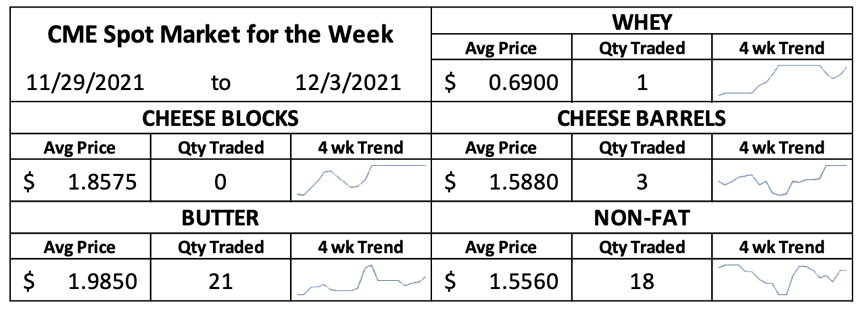
Less milk means less butter. Churns made just 159.4 million pounds of butter in October, down 1.6% from a year ago. Stiff competition for cream and supply chain tangles likely kept a lid on output in November as well. USDA’s Dairy Market News notes that in the East, “widespread logistical issues, including driver shortages and delivery delays, pose a greater hindrance to cream-based operations than tighter cream availability does.” Butter stocks are falling seasonally, and prices are on the rise. CME spot butter climbed back over the $2 mark today and closed at $2.0025 per pound, up 1.25ȼ for the week.
Driers also ran lighter in October. Combined production of nonfat dry milk (NDM) and skim milk powder (SMP) totaled 183 million pounds, down 10.5% from October 2020. Despite all the headaches required to get goods from here to there, manufacturers kept product moving. Stocks waned for the fourth consecutive month, dropping to 221.7 million pounds on October 31, down 5.9% from last year. This summer, manufacturers’ stocks of NDM bordered on burdensome. Now, they stand at two-year lows.
Some processors are concerned that high prices will deter milk powder buyers, but those who need the product don’t have many other places to turn. October milk collections were down 2.1% year over year in Australia and down 3.1% in New Zealand. European milk output fell 0.6% from yearago volumes in September and was flat in the third quarter. Just like their peers in the United States, European manufacturers are keeping cheese vats full, while churns and driers do without. Compared to the first nine months of last year, European cheese production is up 2.3%, while SMP output is down 3.6% and butter lags last year by 1.3%.
Meanwhile, global demand for milk powder remains firm. Dairy Market News reports that North African buyers are trying to nail down 2022 contracts with European processors, but merchants in Europe are holding back, uncertain that they’ll have enough milk to meet big commitments. SMP supplies are also “tighter than desired” in Oceania as China just keeps buying. China imported another 72 million pounds of SMP in October, bringing year-to-date imports to a record smashing total, up 34% from a year ago.
Global SMP prices are high and holding. In Chicago, CME spot NDM held steady this week at $1.5625. The futures rallied. With both butter and milk powder futures on the rise, most Class IV contracts for 2022 climbed by double digits. The futures project that Class IV milk will average $19.50 per cwt. next year.
CME spot Cheddar blocks didn’t move at all this week. They sat at $1.8575. Meanwhile, barrels leapt 7.75ȼ to $1.6025. Cheese production remains heavy, but Cheddar output slipped 1.4% from the very high volumes of a year ago. U.S. cheese production reached 1.15 billion pounds in October, up 0.9% from last year. Italian-style cheese output jumped 3.5% year over year.
Whey product output surged in October. Output of whey protein concentrates (WPCs) was 13.8% greater than a year ago, and production of whey protein isolates (WPIs) grew 5.3%. Over the past six months, high WPC and WPI output has kept commodity whey production in check. But dry whey output was also strong in October, up 3.9% from last year. Nonetheless, whey stocks fell from already low levels. Spot whey slipped a fraction of a cent this week to 69.75ȼ. This year, high whey prices have added more than $1.30 per cwt. to the Class III price, compared to 2020 whey values. Class III futures rebounded this week, with most contracts gaining roughly 20ȼ. The December contract stands at $18.60, and the futures call for Class III to average $18.99 in 2022.
The grain markets plummeted early in the week but came roaring back. March corn futures settled at $5.84 per bushel, down 7.75ȼ from the extremely high close last Friday. January beans closed today at $12.6725, up 14.5ȼ. January soybean meal finished at $358.60 per ton, up $9.20.
Crops in central Brazil continue to thrive, thanks to regular rains. But southern Brazil and Argentina are trending dry, which is causing concerns about crop conditions there. Some of the crop isn’t even in the ground yet, so it’s a bit early to declare disaster. Indeed, Argentina’s statistics agency reports that just 31% of corn acreage is planted so far, and it describes excellent conditions for the corn already in the ground. But it’s a La Niña year, and the market seems inclined to price in a lot of weather risk until it is proven wrong.
The weather is also wreaking havoc in the soybean meal market. Flooding in Canada tangled up the already strained rail system, slowing canola deliveries. Feed buyers in the West and in Canada who typically depend on canola are looking for substitutes, which has lifted demand for soybean meal. Between the basis, freight markups, and irregular deliveries, the futures vastly understate the true increase in the cost to keep the cows fed.
On the Chicago Mercantile Exchange milk futures rose Tuesday and cash dairy prices were steady to higher. December Class III milk was up a nickel at $18.71. January closed up $.36 at $19.54. February closed up $.43 at $19.71. March was up $.14 at $19.53. April through November contracts ranged from five to twenty-five cents higher.
In spot trade Cheese Barrels went up $.04 closing at $1.68. No sales were recorded. The butter market was active, closing up $.0475 at $2.06. There were nine sales ranging from $2.0375 to $2.0675. Nonfat dry milk went up half a cent to close at $1.5675. There were five sales ranging from $1.5650 to $1.5725. Dry whey was unchanged at $0.6975. No sales were recorded. Cheese Blocks were unchanged at $1.8425. No sales were recorded.
Dairy farmers who endured paper-thin margins in recent years have reason for optimism in the year ahead.
USDA’s current price projections for 2022 surpass the $20-mark (at $20.25 per hundredweight) for all milk, with Class IV and Class III average price estimates close behind at $18.70 and $17.75, respectively.
If realized, the price increases for the three milk classifications would range between 80 cents and $2.70 per hundredweight above USDA’s November 2021 estimates.
“There’s reasons to finally be upbeat in dairy,” Dan Basse, president of AgResource Company in Chicago, said recently at the annual Agricultural Bankers Conference. “It’s taken us eight years to get back to where we were in 2014 (if milk prices surpass $20).”
Basse estimates Class III and IV milk prices could reach as high as $21 to $23 next year, driven by surging demand, a possible smaller supply and inflationary pressure.
Longer-term, a proposed shift in ag policy in the European Union could shift the EU market from a net exporter to net importer of dairy.
“World demand for dairy products remains strong,” Basse said. “I believe exports are the bullish driver of the future.”
The U.S. exported an all-time high of 16% of milk solids produced nationwide in 2020. And, exports so far this year, from January through September, bubbled a whopping 14% above last year’s record pace.
“As we head into 2022, we’ll have another record year for dairy exports,” Basse said. “One of the bigger buyers is China. They use a lot of whey as a milk replacer for piglets.”
U.S. dairy cow numbers increased 2% from 2020 to July 2021 to 9.5 million head. But, Basse believes the yearly total could decline due in part to strength in the beef market, with slaughter up 14%.
“U.S. dairy cow slaughter has been elevated. Cull prices have been strong,” Basse said. “That’s a big margin enhancer for dairies.”
But what effect will price inflation have on demand for dairy products and beef?
“Inflation is not going to be leaving us any time soon. I think it will be around at least the next 12-18 months,” the analyst said. “There’s no indication of protein switching. World demand for dairy products remains strong.”
That includes surging demand for cheese and butter, with global butter demand growing at a 7% clip.
“U.S. butter supplies are ample. It’s an export opportunity now,” Basse said. “World butter prices have been rising.”
Price inflation also represents one of the biggest risks for the dairy industry heading into 2022, as well, with feed costs near historic highs.
“We’re bullish for the milk market. But, my biggest concern is the price of feed. It could be the Achilles heel of the dairy industry,” Basse said. “It’s how you manage risk. Lock up profitable margins.”
Potential growth in the dairy industry also could be squeezed by processing bottlenecks.
“We’re almost at maximum (milk processing) capacity,” Basse said. “We need more capital and investment.”
Overall, Basse believes farmers are in the midst of a commodity supercycle that could last 2-3 years.
This story was distributed through a cooperative project between Illinois Farm Bureau and the Illinois Press Association. For more food and farming news, visit FarmWeekNow.com.
Cepea surveys show that the price for the milk produced in October and paid to farmers in November dropped by 6.2%, to BRL 2.1857/liter on the net “Brazil average” – compared to that in Nov/20, the average last month is 2.5% lower, in real terms (data were deflated by the IPCA from Oct/21). This is the second consecutive monthly decrease in the price paid to farmers. In this scenario, in 2021 (January to November), prices have faded by 5%, in real terms.
Cepea surveys also show that, from September to October, the Cepea Index for Milk Production (ICAP-L) decreased by 0.87% on the “Brazil average”. This result highlights that, despite the return of rains – which favor pastures – milk production has been constrained by higher production costs and the consequent lower investments in the activity this year.
The decrease in the price paid to dairy farmers also reflects the lower purchase power of consumers, which has been limiting sales of dairy products in Brazil since August. With weak demand and pressure from distributors, inventories increased, leading agents from dairy plants to reduce dairy prices in October.
Between September and October, Cepea surveys show decreases of 6.8%, 4.9% and 2% in the average prices for UHT milk, mozzarella cheese and powdered milk sold by dairy plants to wholesalers in São Paulo State.
On the Chicago Mercantile Exchange December Class III milk futures up 6 cents at $18.66. January 41 higher at $19.18. February up 33 at $19.28. March through May contracts 14 to 29 cents higher.
On spot trade Dry whey was steady at $0.6975. Blocks down $0.0150 at $1.8425. Three trades were made, ranging from $1.8175 to $1.8425. Barrels up $0.0375 at $1.64. Four trades made with a range of $1.64 to $1.6450. Butter up $0.01 at $2.0125. four trades ranging from $2.0125 to $2.03. Nonfat dry milk unchanged at $0.6975.
According to AHDB market analyst Peggy Clayton, market prices for dairy in the UK have surged in recent months. The rising prices, she said, are due to tight supplies and rising demand.
Butter and skim milk powder (SMP) prices 33% and 44% (respectively) higher than they were last year this time. Mild cheddar cheese has seen an annual increase of 18%.
Dairy products reached a 5-year high in November.
Typically, higher returns to processors would lead to rising milk prices for those on market-related contracts, following a short lag to allow for price changes to flow through the supply chain. However, in the current climate of rapid cost inflation, this may not be the case.
Each processors’ product mix, exposure to recent input cost hikes and success in renegotiating selling prices with their customers will affect how much of the increased market value they are able to realise, said Clayton. This will subsequently affect how they adjust the prices they pay for milk as well as the timing of any changes.
The New Zealand-based dairy company cited strong demand, constrained global supply
Fonterra Co-operative Group lifted its forecast range of the price it pays farmers for milk for the second time in the 2021/22 season. The price was lifted due to strong demand amid constrained supply.
The New Zealand dairy company raised its farmgate milk price range to NZD $8.40-$9.00 per kgMS, up from NZD $7.90 – $8.90 per kgMS. This increases the midpoint of the range, which farmers are paid off, to NZD $8.70 per kgMS. The higher milk price has seen the Co-op revise its earnings guidance to 25-35 cents per share from 25-40 cents per share.
“While we’ve seen demand soften slightly in China, global demand remains strong and we think that will remain the case for the short to medium term,” said Fonterra Chief Executive Miles Hurrell.
“A higher forecast Farmgate Milk Price at this level can put pressure on our margins and therefore our earnings, which is why we’ve reduced the top end of our earnings guidance,” he added.
Fonterra’s New Zealand milk supply is down around 3% on this time last season. Hurrell said he expects that milk supply will be less than last season’s 1,539 million kgMS.
“The improving weather conditions and forecast milk collections for the balance of this season that are generally on par with last season support our current season forecast of 1,525 million kgMS,” he said.
On the Chicago Mercantile Exchange milk futures closed higher Thursday with cash markets providing support. December Class III milk up 29 cents at $18.33. January 19 cents higher at $18.29. February up eight cents at $18.62. March a penny higher at $18.77. April through June unchanged to eight cents higher.
In spot trade dry whey up $0.0050 at $0.6850. One sale was made at that price. Blocks unchanged at $1.8575. Barrels up $0.0025 at $1.6025. Butter up $0.0025 at $1.9825. Seven trades were made from $1.96 to $1.9925. Nonfat dry milk up $0.0150 at $1.5625.
The USDA has adjusted November Class and Component prices higher. The Class II milk price was set at $18.40 per hundredweight, up $1.32 from October, the Class III price was $18.03, $0.20 higher, and Class IV was $18.79, up $1.75.
The outlook for market fundamentals has further tightened on the supply side in the past month with peak production in NZ remaining weaker than expected and continued downward pressure on EU milk production.
The rapid slowing in US herd numbers eased a little in latest data for October while cash margins will improve slightly which may stabilize output.
Total global milk output is expected to stay in decline for at least the first quarter of 2022.
The outlook for milk collections won’t get better unless excellent pasture conditions develop in the European spring, while US milk will likely remain slightly below the prior year. In the meantime, farm input cost pressures will remain intense through winter and likely have a further impact on the spring flush in Europe, as farmers protect cashflows by limiting expensive fertilizer applications. High beef prices meanwhile will still be tempting for quick cash relief.
Weather will also play an important part in NZ possibly lifting pasture growth with warmer summer weather. A near-NZ$9/kg milk price is now widely expected which will ensure a strong focus on per-cow yields using bought in feed.
On the demand side, there has been some weakening in EU fat prices post-festival buying but domestic demand is good. Uncertainty for the food service market lingers in some regions but retail has been more than supportive.
China’s demand through the peak shipping period into Q1-2022 remains critical but indicators from that market do not suggest a rapid weakening. Higher dairy commodity prices may increase the caution in some markets, especially with a higher US$. Buying in some regions is close to trend but hand-to-mouth behavior will continue with ongoing mobility and macro uncertainty – not made any better by the discovery of the omicron variant.
The outlook sees a slowing in trade but that won’t alter the tension in ingredients markets given the limits on supply.
By Edwin Lloyd, General Manager Commercial, Maxum Foods – Your partner in dairy
On the Chicago Mercantile Exchange December Class III milk settled 3 cents higher at $18.04. January down 11 at $18.10. February 31 cents lower at $18.54. March through May contracts 4 higher to 9 lower.
In spot trade dry whey down $0.0075 at $0.68. Blocks unchanged at $1.8575. Barrels steady at $1.60. Butter up $0.01 at $1.98. Nonfat dry milk down $0.0075 at $1.5475.
On the Chicago Mercantile Exchange Class III milk futures were mixed. December milk lost 11 cents to $18.05/cwt. January milk decreased 19 cents to $18.19/cwt. March to December milk was up 3-22 cents. November and December 2022 were the two lone months to trade for class milk.
Spot barrels up $0.0650 at $1.60. Two trades made at $1.60 and $1.6025. Butter down $0.02 at $1.97. One trade at that price. Nonfat dry milk up $0.0025 at $1.5550. Nine trades were made, ranging from $1.5475 to $1.56. Dry whey down $0.0125 at $0.6875. Blocks unchanged at $1.8575.
On the Chicago Mercantile Exchange Milk futures began the week lower with limited direction from cash markets and following the overall tone of the grain and livestock complex. Class III milk futures began Monday deep in the red following Friday’s broad based commodity move lower and was never able to recover fully. January led months lower as its price fell 26 cents. February through December 2022 ranged from 11-19 lower. Similar results over in Class IV milk with months that traded down 1 to 20 cents cents/cwt.
The CME dairy spot auction saw little excitement. Dry whey unchanged at $0.70. Blocks unchanged at $1.8575. Barrels up $0.01 at $1.5350. One trade was made at that price. Butter unchanged at $1.99. Two trades were made at $1.9925. Nonfat dry milk down $0.01 at $1.5525. One trade was made at that price.
The T.C. Jacoby Weekly Market Report Week Ending November 19, 2021
According to USDA’s Milk Production report, U.S. milk production dropped to 18.5 billion pounds in October, down 0.5% from October 2020. That’s the steepest year-over-year decline in milk output since March 2019.
Milk output is down and prices are up. According to USDA’s Milk Production report, U.S. milk production dropped to 18.5 billion pounds in October, down 0.5% from October 2020. That’s the steepest year-over-year decline in milk output since March 2019. The agency also reported that September milk collections were steady with last year. The new estimate is 0.2% lower than USDA’s initial take.
At long last, U.S. dairy producers are milking fewer cows than they were a year ago. USDA dropped its estimate of the September milk-cow herd by 8,000 head from last month’s report, which already showed a sizeable decline. And producers trimmed the herd by another 14,000 head in October, according to USDA’s preliminary estimates. The US. dairy herd now stands at 9.4 million head, down 14,000 from October 2020 and down 107,000 from the peak in May.
Sky-high Class III prices in part of 2019 and most of 2020 fueled expansion in the cheese states. Combined milk production in Iowa, Minnesota, South Dakota, and Wisconsin topped 4.3 billion pounds last month, up 145 million pounds from October 2020, an increase of 3.5%. Over the past year, dairy producers in these four states have added 57,000 cows, while the dairy herd in the other 46 states has shrunk by 71,000 head. Growth in the cheese states finally seems to be petering out. Dairy producers there added just 1,000 head in September and did not expand in October.
Outside the Upper Midwest, both milk production and cow numbers are in decline. Texas, Georgia, New York, and Idaho did make more milk last month than they did in October 2020, but that is growth of a different sort, as cows have simply moved across state lines, with little impact on regional production.
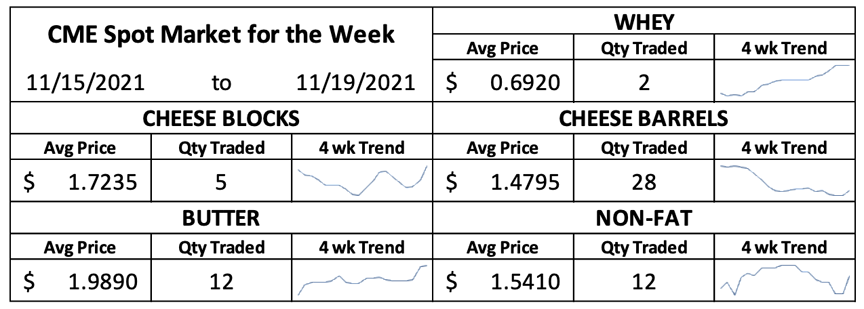
The market clearly assumes that less milk will mean less dairy products of all varieties. Prices jumped across the board in Chicago. CME spot butter leapt 9.75ȼ this week to a two-year high of $2.0475 per pound. Spot nonfat dry milk (NDM) rebounded to $1.555, up a half-cent. Spot dry whey rallied even before the bullish Milk Production report. It reached 70ȼ on Wednesday and held there. That’s up 3ȼ on the week and within a whisker of the highest price in whey’s nearly four years on the spot market. Spot Cheddar blocks climbed 10.75ȼ to $1.8575. Barrels advanced 2.25ȼ to $1.52.
The bulls are also bellowing in foreign markets too. Prices were higher for all categories once again at the Global Dairy Trade (GDT) auction. Cheddar rose 2.2% to its highest price since it debuted at the auction in 2011. Skim milk powder (SMP) rallied 1.4% to a fresh seven-year high. Benchmark dairy product indices in Europe were steady to higher. However, when converted from euros to dollars, European dairy prices actually moved lower this week, as the strong U.S. dollar made foreign products more competitive.
In both Europe and the United States, milk output is slowing, but cheese output is not. U.S. milk production grew just 0.8% from a year ago in the third quarter, while cheese production jumped 3.8%. Cheese plants are pulling milk away from Class IV manufacturers. In the third quarter, butter output fell 2.8% year over year, and combined production of NDM and SMP plummeted 11.3%. In the
Mideast, milk powder output has reportedly slowed further in October and November. Lower output and robust global demand have helped to lift the milk powder market for months, and prices are likely to stay firm. The fundamentals for butter are similar. Slow production and strong domestic orders have enlivened this once sluggish market.
The improved outlook has lifted Class IV futures above their Class III counterparts for every contract on the board. But this week, Class III gained more ground. December Class III settled at $18.57 per cwt., up 95ȼ from last Friday. January Class III rallied 81ȼ to $18.98, and most other 2022 contracts climbed above $19. Most Class IV contracts gained about 40ȼ and hover around $19.50.
The corn market tested new highs but failed to hold there. December corn settled today at a still-
lofty $5.7075 per bushel, down 6.5ȼ for the week. Soybean meal values pushed sharply higher once again. The January contract closed at $364.60, up $7.80 from last Friday.
Both corn and soybean meal prices are likely to stay high unless demand slows, and that will depend on exports. Closer to home, ethanol makers are using all the corn they can, thanks to lucrative margins. Hog growers are upping the share of soybean meal in the ration, because imports of feed additives like lysine have slowed. Forage is scarce and pricey, especially in the West. Dairy producers are spending more every day to keep their cows fed.
On the Chicago Mercantile Exchange milk futures fell again Tuesday and cash dairy prices were mixed. November Class III milk was down $.01 at $17.94. December closed down $.09 at $18.33. January closed down $.24 at $18.75. February was down $.17 at $18.94. March through October contracts ranged from twelve cents lower to one cent higher.
On spot trade cheese Barrels went up $.0150 closing at $1.5250. There was one sale at $1.5225 and one offer at $1.55. Dry whey was unchanged at $0.70. One sale was recorded at that price and there were two offers at $.73 and $.74. Cheese Blocks were unchanged at $1.8575. No sales were recorded. Butter closed unchanged at $1.99. There were no sales or offers Tuesday. Nonfat dry milk was unchanged at $1.5675. There were two sales at $1.5675 and $1.57 and two offers at $1.5750 and $1.58.
On the Chicago Mercantile Exchange milk futures fell except for January and February and cash dairy prices were mostly down Monday. CME Class III futures settled mainly lower. December fell 15 cents to $18.42/cwt. 2022 months ranged anywhere from a penny higher in January and February to 18 cents softer. Most months remain in the higher $18s-$19/cwt. Class IV was unchanged.
On spot trade dry whey was unchanged at $0.70. No trades were recorded, but there were two offers at $.73. Cheese Blocks were unchanged at $1.8575. No sales were recorded. Cheese Barrels went down $.01 closing at $1.51. No sales were recorded, but one offer at $1.51. Butter closed down $.0575 at $1.99. There was one sale at that price. Nonfat dry milk went up $.0125 to $1.5675. There was one trade at $1.56 and a couple of offers at $1.57 and $1.5750.
UK dairy trade[1] continues to be down on the year overall, with quarter 3 (July-September) exports 10% lower year on year, while imports were down 7%. Subsequently, overall year to date figures remain down on 2020.
Trade in most of the key product categories was down on the year for Q3, with the exception of powders and butter. This was largely helped by both products seeing a drop in exports in Q3 2020, making the comparison more favourable. Still, with positive growth hard to come by this year, these small wins are worth noting.
Butter[2] exports totalled 15.3k tonnes in Q3 2021, up 34% on Q3 2020. The vast majority of this growth came from exports to the EU, which were up 42% yoy to 13.0k tonnes. In Q3 2020, the EU’s demand for imported dairy fell as a result of the pandemic, with particularly reduced demand from the food service sector. In 2021, this demand has been returning, and low growth in EU milk supplies will have increased import demand.
Exports in the milk powders and concentrates category[3] totalled 34.1k tonnes in Q3 2021, up 16% on Q3 2020. SMP exports were up 13% at 19.1k tonnes, and WMP exports up 17% at 9.2k tonnes. Powder exports can be highly variable, as key importers often purchase via tender or shop around for the best prices. For example, the UK exported 2.9k tonnes of SMP to Algeria in Q3 2021, compared to only 0.1k tonnes in Q3 2020 – which is a fairly common fluctuation for Algeria. Additionally, the UK exported 3.4k tonnes of WMP to China in Q3, more than we shipped to them in the whole of 2020. There has also been an increase in exports of concentrated milk and cream this year.
[1] Trade codes 0401-0406 inclusive. Includes raw milk crossing the Irish border for processing.
[2] Trade code 0405, “Butter And Other Fats And Oils Derived From Milk”
[3] Trade code 0402, “Milk And Cream, Concentrated Or Containing Added Sweetening”
US dairy prices have risen by double-digit percentages this year, adding to an overall increase in food inflationary pressures. But in the case of dairy, heightened demand comes at a time when milk supply growth has slowed sharply and is expected to continue to decelerate for the rest of the year.
Higher dairy prices impact a variety of companies at multiple points in the food supply chain. Grocers could see higher selling prices for a key driver of foot traffic. Food manufacturers of products from confectionery to yogurt may be forced to raise prices, and even restaurants with large coffee offerings may need to do likewise.
Futures contracts for class III milk, which is used for making most types of cheese, have rallied nearly 10% so far this year. Class IV milk, used for butter and nonfat dry milk (NFDM), is up 14%. Milk is priced according to its end use, with products grouped into four classes.
Gro’s US Food Price Index, which reflects prices on a basket of consumer food items, is up nearly 20% year over year, signaling strong inflationary pressure on basic food necessities. And the US government reported last week that the Consumer Price Index rose by 6.2% in October from a year earlier, the fastest gain in more than 30 years.
The easing of pandemic-related food service restrictions has fed US domestic demand for dairy products such as cheese and butter. Exports have also risen. Nonfat dry milk exports so far this year are up 12% from a year earlier, with gains mainly to Mexico and Southeast Asia. And cheese exports are 9% higher.
On the supply side, an increase in US milk production that started over a year ago has slowed. Milk production in September totaled 18.1 billion pounds, up just 0.2% from a year earlier, the slowest growth pace since mid-2019. The USDA has forecast a continuing slide in milk production growth through the end of 2021.
The US dairy herd also has shrunk, with milk cow numbers in September of 9.4 million, down 85,000 from an all-time peak in May. The drought that has plagued the western US has taken cows away from pasture and driven up feed costs, mainly for corn and hay. That has cut into returns for dairy producers, who have thinned herds, and prompted changes in the mix of feed rations, resulting in lower milk production because of reduced nutrition levels.
Milk is produced in all 50 US states, with the highest producing states in western and northern areas of the country. California, the biggest producer with over 41 billion pounds of milk production per year, has suffered some of the country’s worst effects from this year’s drought.
On the Chicago Mercantile Exchange milk futures continued their negative tone at midweek while cash markets were mixed. Nearby class III futures pushed lower. November milk lost 9 cents to $17.88/cwt. December, which is in its third day of 5 weeks of pricing, fell a nickel to $17.16. January gave up the most, dropping 26 cents to $17.72/cwt. February to June remained unchanged to 11 cents lower with the second half of 2022 moving higher. Class IV milk futures moved lower on the day.
Spot dry whey up $0.0150 at $0.70. Blocks up $0.01 at $1.67. Two sales were made at $1.6550 and $1.67. Barrels down $0.0150 at $1.4450. Eight trades were made from $1.4450 to $1.46. Butter up $0.01 at $1.96. Six trades were made from $1.9350 to $1.96. Nonfat dry milk down $0.0150 at $1.53. Two trades were made at $1.53 and $1.5325.
On the Chicago Mercantile Exchange milk futures closed mostly lower Tuesday pressured by lower cheese markets. November Class III milk three cents lower at $17.97. December down 28 cents at $17.21. January down 14 cents at $17.98. February a dime lower at $18.46. March through May contracts one to seven cents higher.
On spot trade dry whey up $0.01 at $0.6850. One trade was made at that price. Blocks down $0.04 at $1.66. Barrels down $0.0575 at $1.46. Butter unchanged at $1.95. Nonfat dry milk unchanged at $1.5450.
On the Chicago Mercantile Exchange milk futures closed mostly lower Monday pressured by cash markets. Class III milk futures saw very little trade outside of the December 2021 contract. December lost 13 cents/cwt with a settlement price of $17.49/cwt. 2022 months ranged anywhere from 5 cents lower to 10 cents higher. January 2022 led the months in volume with just 56 contracts trading. Class IV was virtually unchanged across its curve Monday.
The CME spot dairy auction ended Monday with block cheese turning in the largest move. Blocks down $0.05 at $1.70. Barrels down $0.02 at $1.5175. Two trades were made at $1.5150 and $1.5175. Dry whey down $0.0050 at $0.6750. One trade was made at that price. Butter unchanged at $1.95. Nonfat dry milk down $0.0050 at $1.5450.
On the Chicago Mercantile Exchange, milk futures were all up and cash dairy prices were mixed with little sales activity Thursday. November Class III milk was up $.09 at $18.19. December closed up $.05 at $18.08. January closed up $.13 at $18.48. February was up $.13 at $18.66. March through October contracts ranged from zero to five cents higher.
On spot trade blocks were up $.01 at $1.81. No sales were recorded. Barrels went up $.0050 to $1.55. No sales were recorded. Butter closed down $.0175 at $1.9575. There were nine trades ranging from $1.96 to $1.9775. Nonfat dry milk was unchanged at $1.56. No sales were recorded. Dry whey remains unchanged at $0.66. No sales were recorded.
On the Chicago Mercantile Exchange milk futures closed lower Wednesday coming off of earlier week gains while grains rallied. Class III milk struggled to follow cheese. November fell 2 cents to 18.10, December fell 8 cents to 18.03, and January fell 10 to 18.35. The balance of 2022 was unchanged to 11 cents lower. Class IV milk was mixed. November gained 3 cents to 18.68, December was unchanged at 18.20, and January fell 7 cents to 19.06/cwt.
On spot trade, dry whey was unchanged at $0.66. Blocks up $0.0850 at $1.80. Barrels up $0.0050 at $1.5450. Three trades were made from $1.5450 to $1.5525. Butter up $0.01 at $1.9750. Two trades were made at $1.97 and $1.9750. Nonfat dry milk down $0.01 at $1.56.
The T.C. Jacoby Weekly Market Report Week Ending November 5, 2021
U.S. cheese production topped 1.14 billion pounds in September, scoring an all-time high in daily average output. There is clearly plenty of fresh Cheddar available, and cheesemakers are unloading some at the market of last resort in Chicago.
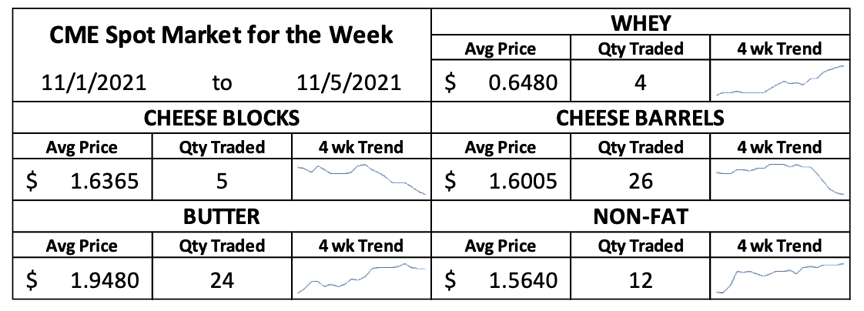
Record-shattering cheese output dragged the Class III market downward. U.S. cheese production topped 1.14 billion pounds in September, scoring an all-time high in daily average output. Production was up 3.3% from the already lofty volumes of September 2020. Compared to last year, U.S. processors stepped up Cheddar production by 3.2%. There is clearly plenty of fresh Cheddar available, and cheesemakers are unloading some at the market of last resort in Chicago. This week CME spot Cheddar blocks slipped 9ȼ to $1.585 per pound. Barrels plummeted a stomach-churning 31.75ȼ to $1.5025.
As more tankers traversed from the farm to cheese plants and bottlers, there was less milk available for Class IV manufacturers. Butter output fell 4.9% year over year to just 143.4 million pounds. By all accounts, cheese makers, milk bottlers, and Class II manufacturers continue to lap up milk and cream, leaving less for churns and driers. Grocers expect Americans to go big this holiday season, to make up for last year’s Scrooge-like celebrations. And retailers anticipate shipping delays and supply chain snarls, so they will likely order whips and dips and other cream-laden foods as early as possible. Cream multiples are on the rise, making churning less attractive. In the West, multiples stand at six-year highs. This week spot butter lost a half-cent and closed at $1.935, near the 17-month high.
The powders continued to climb. CME spot whey jumped 3ȼ to 66ȼ, just a few cents from the all-time high. In the face of heavy cheese production, strong demand for high protein whey products is helping to keep whey powder stocks in check.
Nonfat dry milk (NDM) prices got a boost from overseas markets, strong exports, and slower output. Skim milk powder (SMP) values leapt 6.6% at Tuesday’s Global Dairy Trade (GDT) auction, a seven-year high. It was a strong showing across the board at the GDT. Cheddar jumped 14.1% its highest price since January 2014.
Closer to home, CME spot NDM gained another 1.25ȼ this week and rallied to $1.57, yet another seven-year high. U.S. manufacturers dried 185 million pounds of NDM and SMP in September, 10.7% less than the prior year. U.S. NDM/SMP exports held firm, logging the strongest September total on record, up 14% year over year. Inventories waned.
Despite the lack of trucks, containers, and port infrastructure to keep product moving at an ideal pace, U.S. dairy exports continue to impress. As the Daily Dairy Report notes, the fact that exports have continued to ship at such a clip “is a testament to the competitiveness of U.S. products abroad.” So far this year, NDM exports are 12.8% higher than the record-breaking volumes of 2020. Cheese exports logged a new high for the month of September and were 20% greater than the previous record set last year. U.S. milkfat exports grew more than threefold.
After the recent run-up in Class IV values, U.S. dairy products have lost some of their competitive edge, but they are still less pricey than product from Europe or Oceania. However, if Chinese milk powder imports slow suddenly, U.S. trade volumes may suffer. The US Dairy Export Council notes that over the past 12 months, global dairy exports to China grew 29%, while exports to the rest of the world fell 3%. China has clearly crowded out other buyers, but the economics of the pandemic have likely also played a role. Will other buyers step in if China pulls back?
The dairy product mix has set the tone for the milk markets. Cheese production is heavy, and so are Class III values. The November contract dropped 69ȼ to $17.81 per cwt. December Class III fell 87ȼ to $17.59. Most 2022 contracts gained a few cents and are hovering near $18.50. The Class IV market has the wind at its back. All contracts scored life-of-contract highs again this week. Most advanced roughly 30ȼ from Friday to Friday, which is great news for dairy producers who suffered huge losses over the past 18 months as Class IV prices languished and Class III manufacturers pulled milk out of regional pools.
The sun is shining, combines are rolling, and the grain markets have pulled back from the highs. With lofty prices in Chicago and a weak real, Brazilian corn and beans are attracting foreign buyers. That’s unusual at this time of year, when South American stocks are minimal and the U.S. is flush with freshly harvested crops. A slowdown in U.S. exports at harvest is likely to result in lower sales overall; it will be harder to catch up once South America’s new crops hit the market in a few months.
The rainy season is in full force in northern Brazil and, despite the La Niña, rain is falling in southern Brazil and Argentina too. The season got off to a dry start, but the recent showers and the wet forecast are at least partially alleviating fears that the La Niña will wither South America’s row crops.
December corn settled today at $5.53 per bushel, down 15.25ȼ from last Friday. January beans lost 44ȼ and closed at $12.055. December soybean meal inched a dime lower, finishing at $332.70 per ton.
On the Chicago Mercantile Exchange milk futures closed higher Tuesday supported by a positive supply and demand report. November Class III milk seven cents higher at $18.12. December up 43 cents at $18.11. January up 38 cents at $18.45. February 18 cents higher at $18.55. March through May contracts 17 to 22 cents higher.
On spot trade blocks up $0.0625 at $1.7150. Two trades were made at $1.6575 and $1.7150. Barrels up $0.0175 at $1.54. Eight trades were made from $1.5125 to $1.5150. Butter unchanged at $1.9650. Nonfat dry milk unchanged at $1.57. Nine trades were made from $1.5650 to $1.57. Dry whey unchanged at $0.66.
Scott Simon talks with Dairy Radio Now’s Lee Mielke about the rising price of milk in the markets.
SCOTT SIMON, HOST:
Milk prices are up. The average price for a gallon of milk is around 3.59. With all the problems with supply lines and rising car and home prices, it’s the costs of basics like milk that can hit the hardest. That’s why we called up Lee Mielke. That’s M-I-E-L-K-E. He is the host of “Mielke Monday” on Dairy Radio Now, and he joins us from Lynden, Wash. Mr. Mielke, thanks so much for being with us.
LEE MIELKE: You bet, Scott.
SIMON: Why are milk prices up?
MIELKE: Well, they’re on their way up, but they’ve been down for some time. And this industry is one that rises and falls regularly. Dairy farmers have a tough row to hoe sometimes. And while the benchmark Class III milk price did go up a $1.30 this week to 17.83 per hundredweight, that’s still well below what most farms see as a break-even price of around 18.50 per hundredweight.
SIMON: Well, what makes the prices, I guess I should say, of milk change?
MIELKE: Well, it goes back to the law of supply and demand, of course. But we’ve got a different situation with the COVID of last year. We saw a real ruckus take place as demand was all over the board. And we saw restaurants closing. Prices plummeted. The government kicked in its food box program, which was one of several programs, and that benefited the dairy industry significantly. And so while the benchmark price up $1.30 is good from September, it’s almost $4 below what it was a year ago.
You have to consider, also, that farmers have seen their costs skyrocket as well, particularly feed, plus energy – which is gas and electricity, propane – and labor costs. Dairy farmers have to hire labor, and we all know what the labor market is looking like right now. It’s hard to get help.
SIMON: Yeah.
MIELKE: And you have to increase your pay scale in order to attract good help.
SIMON: Are problems in the supply chain affecting either the price…
MIELKE: Yes.
SIMON: …Or availability of milk?
MIELKE: Yes, there is port congestion that is going on. The biggest exporter of dairy products is New Zealand and the European Union. The U.S. is not always real competitive with them, but we are right now. And the problem has come in getting exports to countries that need it. And so there is a certain amount of turning away from the U.S. as not being a reliable supplier because of the congestion that’s going on at ports.
SIMON: Mr. Mielke, I am told that you have been covering the dairy industry since the 1980s. What do you think? Is milk a reliable way to gauge inflation?
MIELKE: Oh, I don’t know that you would use milk as a way to gauge inflation. No, I am – I wouldn’t think that to be the case. The retail price of milk often does not correlate with the farm wholesale prices either because retailers often use milk as a loss leader. And so you do not necessarily see a lot of fluctuation in the price per gallon of milk. You will see that more in cheese and in butter and ice cream, perhaps, but not so much in fluid milk.
I can remember years and years ago when we were having issues with dairy farmers remaining profitable and dairy farms going out of business and an interview with people saying, well, are you not concerned about the number of dairy farmers going out of business? And the one response that was most amazing to me was, well, not really, because I get all my milk at Safeway.
SIMON: Oh, my word. Yeah. Mr. Mielke, forgive me, is there any joke about your name that actually makes you laugh?
MIELKE: I do. And for years when I was on – I had my own radio program, syndicated radio program. I often said, I’m the Mielke, and my listeners are the Mielkers (ph).
SIMON: Oh (laughter). Lee Mielke is the host of “Mielke Monday” on Dairy Radio Now. Thank you so much for being with us.
On the Chicago Mercantile Exchange milk futures were all up and cash dairy prices were steady to higher Monday. November Class III milk was up $.24 at $18.05. December closed up $.09 at $17.68. January closed up $.11 at $18.07. February was up $.14 at $18.37. March through October contracts ranged from three cents higher in October to fourteen cents higher in April.
On spot trade, dry whey was unchanged at $0.66. No sales were recorded. Blocks were up $.0675 at $1.6525. There was one sale at $1.6525. Barrels went up $.02 to $1.5225. There were ten sales ranging from $1.50 to $1.5275 Butter closed up $.03 at $1.9650. There was one sale at that price. Nonfat dry milk was unchanged at $1.57. Seven trades were made ranging from $1.55 to $1.5675.
The UK dairy industry has faced rapid change through 2021 as it adjusts to a new trade relationship with the EU and the impacts of the pandemic on consumption patterns, writes Patty Clayton with AHDB.
Rising costs have also been a key feature of the year, with higher feed costs impacting on milk production and more recent spikes in energy costs influencing the whole supply chain.
The question remains on how farmgate milk prices will develop given the pressures on margins through the supply chain.
Milk production
Minimal growth in domestic milk supplies is expected for the remainder of 2021. Based on the latest forecast, total deliveries in the UK for 2021 are expected to reach just over 15bn litres, only 80m litres more than deliveries in 2020.
To date (Jan-Sep), UK farmers have delivered 11.4bn litres of this, meaning we would expect around 3.6bn litres to be delivered in the final 3 months of the year, marginally less than deliveries in the final quarter in 2020.
Weighing on production levels in the UK, are rising costs of the ‘big three’ – feed, fertiliser and fuel – and the impact of this on margins. While milk prices have been generally rising through the past 12 months to average between 28-30ppl, they are increasingly being eroded by input cost inflation.
Product availability
The relatively limited growth in milk deliveries, combined with the gradual return of out-of-home demand, has meant product availability for most products on the UK market has tightened.
This, along with concerns of winter production and the potential for some manufacturers to hold some stocks due to issues with transport, has seen dairy product prices remain firm in recent months.
While imports can help alleviate some of the pressure of tight domestic availability, this is unlikely to offer much relief. EU product pricing is currently at a premium to domestic markets for most products[1] as milk deliveries are not sufficient to improve low stock levels. Adding high transport costs into the mix further limits the ability of imports to take the pressure off rising prices.
Farmgate prices
Taken as a whole, the rising market returns would normally point towards increases in market-related farmgate milk prices. However, the trend in rising input costs is impacting the whole supply chain and could limit the benefit of rising wholesale prices on processor margins.
We would normally expect farmgate milk prices to move in line with market returns[2] after a period of time to allow for negotiating prices within contracts. However, processors are also facing rising costs across a range of inputs. The spiralling energy costs will be particularly challenging for some companies depending on their product mix and exposure to recent price hikes, as highlighted in the recent report from Kite Consulting. This will have an impact on the net value they will be able to recover from the market, and could limit their ability to increase milk prices if they can’t increase selling prices to their customers.
AHDB last reviewed the cost figures used in our market indicators (AMPE/MCVE) in July 2021, using the latest cost data from Office for National Statistics (ONS), covering quarter 1 2021. At that time, it was found the net impact of rising costs was minimal, reducing the indicators by 0.3ppl. Since then, energy prices have seen more significant increases, which will be reflected in the cost indexes from quarter three.
AHDB will next be reviewing the cost elements of the indicators upon publication of the ONS data for quarter three of this year in December, and will carry out quarterly reviews while input costs continue to move quickly.
On the Chicago Mercantile Exchange milk futures continued lower at midweek as did most cash markets. Class III milk fell 23 cents to $18.08 in November, December fell 28 to 17.97 and January fell 31 cents to 18.09/cwt. 2022 has the first half down 4-31 cents with the average still at 18.31/cwt. Class IV milk was mixed with November holding unchanged at 18.60, December up 8 cents to 19.13, and January down 5 cents to 19.00 even. 2022 markets were 6 lower to 3 cents higher and are holding a first half average at 18.88/cwt.
The CME spot trade saw dry whey up $0.0050 at $0.65. One trade was made at that price. Blocks down $0.0325 at $1.6725. Barrels down $0.09 at $1.57. Five trades were made from $1.57 to $1.64. Butter down $0.04 at $1.94. Six trades were made at $1.94 to $1.9925. Nonfat dry milk unchanged at $1.5650. Three trades were made from $1.5550 to $1.5650.
The T.C. Jacoby Weekly Market Report Week Ending October 29, 2021
The U.S. dairy herd is much smaller than once thought, and milk production barely grew at all in September. Early indications suggest milk output is once again below year-ago levels in Europe.
Global milk supplies are tightening. The U.S. dairy herd is much smaller than once thought, and milk production barely grew at all in September. Early indications suggest milk output is once again below year-ago levels in Europe. Most of the continent has yet to report for September, but Dutch milk collections dropped 4.1% year over year, the steepest Dutch decline since January 2019. USDA’s Dairy Market News reports that milk output in Western Europe is “at or below last year’s levels,” and “milk supplies are tight.”
In Oceania, collections are underwater. Australian milk output in September dropped 2.9% below year-ago levels, to the lowest September volume in decades. In the first month of the season that matters, New Zealand milk solids collections dropped 4% below year-ago volumes. Wet weather has dampened milk output in both Australia and New Zealand, but volumes are expected to pick up later this year as the sun breaks through the clouds.
Argentina is the only major dairy exporter to report significant growth in milk output last month. Argentine milk collections topped the prior year by 4.6% in September. Latin American dairy analyst Monica Ganley notes that rising milk prices have kept pace with escalating feed costs, which has helped to preserve on-farm margins. Argentine milk output is likely to remain strong.
Global milk production has clearly shifted into a lower gear. Growth among the top-five dairy exporters was minimal in July and August. Assuming European milk output was steady with yearago levels in September, top-five milk collections flipped into reverse last month. If so, that would be the first aggregate deficit since June 2019. High feed costs will likely deter a quick rebound in milk output. Meanwhile, demand is running nearly full throttle.
So far this year, China has imported record-shattering volumes of dairy products. Milk powder has piled up in China, raising concerns that imports will come to an abrupt halt. And Chinese dairy product imports did slow in September, at least relative to the staggering levels of the rest of 2021. But for most categories, Chinese imports were still noticeably higher than September 2020, and all other Septembers for that matter. China has imported so much milk powder this year that they’ve nearly depleted Oceania’s inventories. Last month, New Zealand and Australia accounted for just 20% of China’s skim milk powder (SMP) imports, their second-lowest monthly share in the last two decades. That made room for the United States to become China’s top SMP supplier for the first time in eight years.
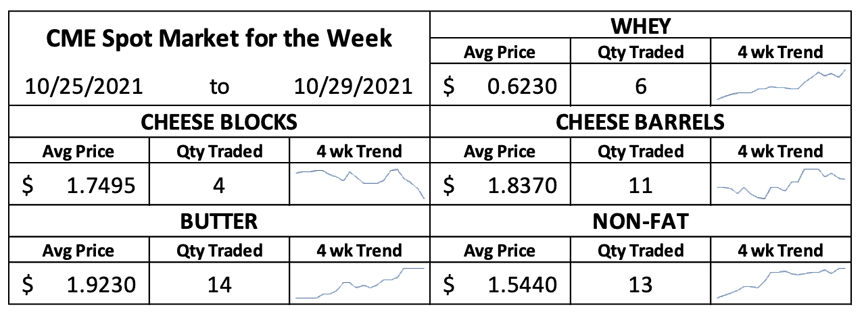
Slow milk production and rising prices in Oceania and Europe have created big opportunities for U.S. and Latin American milk powder exports. Favorable trade winds lifted milk powder prices in Chicago once again this week. CME spot nonfat dry milk climbed 2ȼ to $1.5575 per pound, a fresh sevenyear high.
Spot butter leapt 10.5ȼ this week to $1.94, its highest price since June 2020. Butter production has slowed due to fierce competition for cream.
Cheesemakers are using far more milk and cream than they did in years past, and Class II manufacturers are ramping up production of whips and dips for the holidays. As milk continues to flow toward Class II and III and away from Class IV, butter and NDM prices are likely to remain strong.
Weighed down by heavy supplies, cheese prices dropped. CME spot Cheddar blocks plummeted 13.5ȼ this week to $1.675. Barrels fell 4.25ȼ to $1.82.
CME spot whey added another 2ȼ this week and reached $1.5575. Demand for high-protein whey productsremains formidable, keeping whey powder production in check despite onerous cheese output.
The setback in spot cheese dragged down nearby Class III futures. The November contract plunged $1.11 this week and closed at $18.50 per cwt. December futures lost nearly a dollar. But from February onward, Class III futures settled at life-of-contract highs. The trade clearly believes that U.S. cow numbers will continue to drop, exports will remain strong, and prices will hold above $18.
Aside from the expiring October contract, every Class IV future on the board also logged life-of-contract highs this week. The spread between Class III and IV is extremely narrow, which suggests milk will remain in the pool and Class I revenues will climb. These high prices are welcome news for dairy producers. As feed costs soar, they will need every penny.
Heavy rains brought the harvest to a halt this week, and seasonal sellers stepped away from the crop markets. Corn prices inched upward Monday and Tuesday and then jumped Wednesday after the Energy Information Administration reported a steep increase in ethanol output. Ethanol prices are climbing along with the energy markets, and, flush with new-crop corn, ethanol makers rose to the challenge. Last week U.S. ethanol production reached its second-highest volume on record, and output is likely to remain high. It’s unusual to see demand for corn rise in the face of sharply higher prices, but $80 oil makes ethanol processors almost numb to corn costs.
Sensing an opportunity to capitalize on commodity market inflation, investment funds bought a lot of corn this week. The December contract settled today at $5.6825 per bushel, up more than 30ȼ from last Friday. The soy complex followed corn higher. January soybeans rallied 18.75ȼ to $12.495. December soybean meal added more than $5 and reached $332.60 per ton.
On the Chicago Mercantile Exchange milk futures turned around in a typical Tuesday fashion despite global market strength, cash trade was mixed. November Class III milk 37 cents lower at $18.31. December down 37 cents at $18.25. January down 16 cents at $18.40. February 11 cents lower at $18.46. March through May contracts two to eight cents lower.
In spot trade dry whey up $0.0150 at $0.6450. One trade was made at that price. Blocks unchanged at $1.6750. Barrels down $0.0925 at $1.66. One trade was made at that price. Butter up $0.03 at $1.98. Four trades were made at $1.98 and $1.9850. Nonfat dry milk up $0.01 at $1.5650
On the Chicago Mercantile Exchange milk futures started a fresh month with positive trade Monday while cash markets were mostly quiet. Class III saaw November closed 18 cents stronger at $18.68/cwt while December ended at $18.62/cwt, up 16 cents/cwt. 2022 markets ranged anywhere from 2-9 cents higher and individual months are anywhere from $18.18/cwt in December to a high of $18.57 in February. Class IV put together another solid day of gains as December 2021 and January 2022 both touched $19.00/cwt which is the first time in seven years that we’ve seen Class IV trade with a $19 handle in front of it. Most months in 2022 made double digit higher settlements.
The strength in Class III milk on Monday was stunted by the barrel cheese trade during the CME spot dairy auction. Barrels lost 6.75 cents/lb on offers and zero trades. Blocks moved one load and ended unchanged at $1.675/lb. Butter climbed a penny to $1.95/lb with 6 loads exchanging hands. Non-fat dry milk was a quarter cent lower to $1.555/lb, 4 trades took place. Whey was unchanged at $0.63/lb.
On the Chicago Mercantile Exchange milk futures were turned back lower Thursday as cash trade brought a negative tone to the market. October Class III milk down two cents at $17.85. November 29 cents lower at $18.55. December down 20 cents at $18.51. January down four cents at $18.46. February through April contracts four cents lower to unchanged.
In spot trade dry whey down $0.0050 at $0.6175. One trade was made at that price. Blocks down $0.0350 at $1.7225. One trade was made at that price. Barrels down $0.02 at $1.8275. Two trades were made at $1.83. Butter unchanged at $1.94. Three trades were made at $1.94 and $1.9450. Nonfat dry milk up $0.0250 at $1.5525. Three trades were made from $1.53 to $1.5525.
On the Chicago Mercantile Exchange milk futures were higher Wednesday as traders took back oversold positions and cash trade was mixed. Class III milk mostly traded higher. October up a penny to $17.87, November up 10 cents to $18.84, and December gained 11 to $18.71/cwt. 2022 was a penny lower to 9 cents higher. Class IV milk was mostly unchanged. October at 17.05, November at 18.29, and December gained 9 cents to 18.70/cwt. 2022 markets were 7 cents lower to 10 cents higher in a mixed move.
The CME spot trade saw dry whey up $0.0025 at $0.6225. One trade was made at that price. Blocks down $0.0150 at $1.7575. Barrels up $0.0175 at $1.8475. Three trades were made at $1.94 and $1.9425. Butter up $0.01 at $1.94. Three trades were made at that price. Nonfat dry milk down $0.0175 at $1.5275. Three trades were made from $1.5275 to $1.5375.
The T.C. Jacoby Weekly Market Report Week Ending October 22, 2021
USDA’s Milk Production report, released Wednesday, suggested that national milk supplies are growing at a slower rate than many analysts previously believed. Lighter milk supplies have likely helped to keep upward pressure on the markets this week.
USDA’s Milk Production report, released Wednesday, suggested that national milk supplies are growing at a slower rate than many analysts previously believed. According to the report, milk production grew by just 0.2% year over year in September, rising to 18.075 billion pounds. This represents the slowest growth since May of last year when the pandemic was sending shockwaves through the industry, and producers were directed to drastically cut production. Previous month estimates were decreased as well. August milk production, which was originally estimated as up 1.1% year over year, was reduced to a 0.6% increase in the September report.
Most of the slowdown was due to a decline in the national milking herd. Cow numbers dropped by 25,000 head between August and September, marking the fourth consecutive month of contracting cow numbers. Revisions played a key role in cow numbers as well. USDA revised downward the August herd size estimate by 33,000 head. Despite the consecutive declines, at 9.422 million head in September, the national dairy herd remains 27,000 cows larger than at the same time last year. Yields remained virtually unchanged in September compared to prior year.
Lighter milk supplies have likely helped to keep upward pressure on the markets this week as all spot products finished the week higher than last Friday. In the Cheddar markets, despite giving up 3¢ during Monday’s spot trade, blocks added a penny on Thursday and a nickel on Friday to end the week at $1.81 per pound, up 3¢ from last week, though only one load moved. Barrels demonstrated a bit more action, ending Friday’s session at $1.8625 per pound, up 7.25¢ from last week with 19 loads changing hands. The block-barrel spread stretched as wide as 10¢ on Thursday before narrowing to 5.25¢ on Friday. Cheesemakers are running busy schedules but continue to be plagued by labor and logistical challenges. Despite the headwinds, cheese inventories built significantly during September, rising to 1.46 billion pounds by the end of the month and setting a new monthly record.
Whey markets have become increasingly enticing and USDA’s Dairy Market News suggests that some cheesemakers are producing generic, non-specification cheeses to get access to the whey stream, particularly for use in higher protein products. Market stakeholders describe robust interest from both domestic and international buyers, though sustained port congestion is preventing whey from moving offshore as quickly as exporters would like. In Chicago, the spot market took a small dip on Tuesday before moving convincingly upward on Thursday and Friday to end the week at 61.75¢ per pound, up 1.5¢ from last Friday. Though prices still have far to go to break the 70¢ barrier and set a new record, market tones are firm.
The fat market was a bit less settled this week as butter prices jostled to and fro. Demand for butter is purportedly strong with most churns anticipating a strong holiday season. However, most market participants also describe inventories as sufficient to meet buyers’ needs. Butter stocks declined seasonally during September, falling by 9% versus August to 330.1 million pounds. At the CME, spot butter prices moved up on Monday before shrinking on Tuesday in an active trading day where 13 loads moved. Prices found traction on Wednesday and Thursday but ended the week by giving up a penny on Friday. After the dust settled the spot butter price finished Friday’s session at $1.835 per pound, up 6¢ from last week with a total of 30 loads trading hands.
After headlining the dairy markets recently, movements in the nonfat dry milk (NDM) market were more subdued this week. Nevertheless, the market retained a strong tone, setting a new seven year high on Monday at $1.54 per pound, before retreating modestly in the middle of the week. Gains on Thursday and Friday delivered a final price of $1.5375 per pound for the week, a half cent higher than last Friday’s close. Though some customers are balking at the higher prices, demand remains robust, especially from international sources. Dairy Market News reports that exports to Mexico are moving at a steady clip. While procuring drivers can be a challenge, moving product south of the border at least allows exporters to avoid the pileup at the ports.
The action in the spot markets later in the week worked to push the futures markets for milk upwards. Activity in the Class III market was mixed early in the week, but convincing gains on Thursday left most contracts higher than last Friday’s settlement and above their Class IV counterparts. Class IV futures perked up on Monday but found resistance on Tuesday and Wednesday. Recovery on Thursday and Friday delivered modest gains across the board compared to last Friday’s settlements.
Corn futures were seemingly on a seesaw this week with alternating sessions of increases and declines. Gains on Monday, Wednesday, and Friday were counteracted by drops on Tuesday and Thursday. The soybean markets were more consistent with gains during the first half of the week only somewhat undermined by losses on Thursday and Friday. Feed costs remain elevated for dairy producers and are likely one of the key factors that is putting pressure on milk production.
To provide the best experiences, we use technologies like cookies to store and/or access device information. Consenting to these technologies will allow us to process data such as browsing behavior or unique IDs on this site. Not consenting or withdrawing consent, may adversely affect certain features and functions.
Functional
Always active
The technical storage or access is strictly necessary for the legitimate purpose of enabling the use of a specific service explicitly requested by the subscriber or user, or for the sole purpose of carrying out the transmission of a communication over an electronic communications network.
Preferences
The technical storage or access is necessary for the legitimate purpose of storing preferences that are not requested by the subscriber or user.
Statistics
The technical storage or access that is used exclusively for statistical purposes.The technical storage or access that is used exclusively for anonymous statistical purposes. Without a subpoena, voluntary compliance on the part of your Internet Service Provider, or additional records from a third party, information stored or retrieved for this purpose alone cannot usually be used to identify you.
Marketing
The technical storage or access is required to create user profiles to send advertising, or to track the user on a website or across several websites for similar marketing purposes.
To provide the best experiences, we and our partners use technologies like cookies to store and/or access device information. Consenting to these technologies will allow us and our partners to process personal data such as browsing behavior or unique IDs on this site and show (non-) personalized ads. Not consenting or withdrawing consent, may adversely affect certain features and functions.
Click below to consent to the above or make granular choices. Your choices will be applied to this site only. You can change your settings at any time, including withdrawing your consent, by using the toggles on the Cookie Policy, or by clicking on the manage consent button at the bottom of the screen.
Functional
Always active
The technical storage or access is strictly necessary for the legitimate purpose of enabling the use of a specific service explicitly requested by the subscriber or user, or for the sole purpose of carrying out the transmission of a communication over an electronic communications network.
Preferences
The technical storage or access is necessary for the legitimate purpose of storing preferences that are not requested by the subscriber or user.
Statistics
The technical storage or access that is used exclusively for statistical purposes.The technical storage or access that is used exclusively for anonymous statistical purposes. Without a subpoena, voluntary compliance on the part of your Internet Service Provider, or additional records from a third party, information stored or retrieved for this purpose alone cannot usually be used to identify you.
Marketing
The technical storage or access is required to create user profiles to send advertising, or to track the user on a website or across several websites for similar marketing purposes.