





Archive for Dairy Markets – Page 30

CoBank predicts dairy margins will improve in 2022

CoBank is predicting that milk supplies in the U.S. and around the world will tighten in 2022 as dairy farmers reduce herd sizes in response to declining margins.

According to Tanner Ehmke, lead industry analyst at CoBank, European and New Zealand milk production, in particular, will continue to face headwinds, with stricter environmental regulations discouraging any growth in cow numbers.

“With the global economy widely expected to continue its recovery from COVID-19 and global consumers adding more protein to their diets, demand for dairy products around the world will continue to grow, particularly in high-growth regions like Southeast Asia,” Ehmke says. “However, the U.S. Phase 1 trade deal with China is set to expire at year-end, and China could steer its purchases toward our main export competitors — New Zealand and the European Union.”

Rising labor costs

Ehmke says high costs for labor, construction and freight will limit upside margin potential and dampen milk production growth. Faced with tightness in farm labor, U.S. dairy producers increasingly will be evaluating robotics and automation on the farm.

“The potential for continuing drought in the Western U.S., made more likely by the current La Niña conditions, will tighten feed availability for producers in the West — an additional incentive for dairies in the region to relocate further inland, specifically to the Midwest and Plains states,” he notes.

For dairy processors, increasing milk costs, inflation driving up operating costs and reduced labor availability will mean some processors get squeezed, particularly those manufacturing commodity dairy products. According to Ehmke, the significant expansion of capacity in cheese production in the past year — with more capacity coming on line in 2022 — will reduce milk supplies available for other categories, particularly for Class II (ice cream and yogurt) and Class IV (butter and powder) users.

“Port congestion and a shortage of available outbound containers will remain as headwinds for U.S. dairy exporters for much of 2022,” he says. “Ongoing logistical snarls, resulting in higher detention and demurrage costs and declining market share in Asian markets, will pressure U.S. dairy companies. International customers are already switching dairy purchases to Europe and New Zealand origin — a trend that is likely to accelerate in 2022.”

A continuation of the strengthening dollar could also hinder U.S. dairy exports in 2022. However, domestic consumption of dairy products will be more resilient as consumer demand increases both at and away from home, Ehmke says.

“Consumers armed with ample savings accounts and improved job prospects from a growing U.S. economy will drive further increases in dairy consumption in 2022,” he explains. “The cross-current of resilient domestic and global demand for dairy products with the slowing growth in milk supplies should give additional upward lift to milk prices in 2022. Combined with softer feed costs following big corn and soybean harvests, producer margins will finally improve.”

The economy is predicted to continue to grow in 2022. But inflation is driving up gasoline prices, home heating fuel prices, and the cost of food and other consumer goods, and will reduce consumer spending power. Barring any setback to restaurants, in-person learning in schools and colleges, and attendance at public events, increased cheese sales should boost overall milk sales.

Labor shortages are prevalent, Ehmke says, and a lack of truck drivers and milk plant operators is creating challenges across the supply chain. “At the ports, congestion is interrupting dairy exports and causing a buildup of inventories,” he adds.

Even as challenges abound, according to USDA, demand for U.S. dairy products for both domestic as well as international buyers remains robust. Class I demand has subsided from last fall when schools opened, boosting the need for fluid milk; however, demand for fluid milk remains significantly elevated above 2020. The growth in milk production for 2022, according to USDA, may be just 1.2% over 2021.

Source: farmprogress.com

India’s farm exports expected to touch record $50 billion

In FY21, India had exported farm products worth $41.25 billion, up 17% from $35.16 billion in 2019-20.

Export of rice is likely to touch $9.5 billion in value terms, accounting for about half of the global rice export market, the officials said, adding that non-Basmati rice shipments are likely to clock $5.8 billion.

“We expect farm exports to reach the highest and record $50 billion this year,” said one of the officials.

In the April to November 2021 period, export of agricultural products, including marine and plantation, amounted to $31.05 billion, up from $25.2 billion in the year-ago period.

Export of marine products is likely to touch a record $8 billion, while that of coffee could grow 45% and cereals 66%. Overseas shipment of meat, dairy and poultry products could rise 10% this fiscal, the official said.

“In spite of the disruptions caused by Covid-19, agriculture exports did well in 2020-21. The upward trend has continued during the current year,” the official said.

In the first eight months of the fiscal, India’s wheat exports rose by about 421%, sugar exports grew by 62% and that of other cereals increased by 79%.

Roller Coaster Day in Chicago at the CME

It was another roller-coaster day on the milk futures on the Chicago Mercantile Exchange. January Class III milk was two cents higher at $20.25. February 45 cents lower at $20.86. March down 63 cents at $21.69. April down 47 cents at $21.47. May through July 30 to 44 cents lower.

Mixed results on the spot market. Dry whey up $0.02 at $0.80. One sale was made at that price. Blocks unchanged at $1.8450  Barrels down $0.0875 at $1.8175. Butter up $0.0175 at $2.90. Two trades were made at $2.8975. Nonfat dry milk down $0.04 at $1.81. One trade was made at $1.8150. The USDA says December’s dairy cow slaughter was 267,800 head, 22,500 more than in November, but 5,700 less than December 2020. The preliminary total for the 2021 dairy cow slaughter was 3.106 million head, 429,000 above the 2020 total.

Milk Markets Lower in Chicago Wednesday

On the Chicago Mercantile Exchange milk futures ended lower Wednesday pressured by mostly lower cash markets while butter saw large gains. January Class III milk was unchanged at $20.23. February 31 cents lower at $21.31. March down 16 cents at $22.32. April down 23 cents at $21.94. May through July 16 to 26 cents lower.

In spot trade blocks down $0.0350 at $1.8450. Barrels down $0.05 at $1.9050. Butter up $0.1025 at $2.8825. Eight trades were made from $2.8675 to $2.90. Nonfat dry milk unchanged at $1.85. Dry whey unchanged at $0.78.


Global dairy prices hit 8-year high as supply tightens; milk payments to farmers tipped to increase

Dairy prices jumped 4.6 per cent at the global auction overnight to hit an eight-year-high, as tight milk supply stokes demand for New Zealand’s biggest export commodity.

The Global Dairy Trade price index rose to 1397, its highest level since March 2014.

The average price for whole milk powder, which has the most impact on what farmers are paid, posted the biggest gain, up 5.6 per cent to US$4082 (NZ$6041) a tonne, and is sitting 21 per cent higher than at the same time last year.

Global dairy prices have been supported this season by weaker milk production in New Zealand and overseas, hindered by poor weather and higher feed costs. Last week, Fonterra lowered its forecast for the amount of milk it expects to collect this season by 1.6 per cent to 1.5 billion kilograms of milk solids due to challenging pasture growing conditions.

Buyers have “taken full stock of the tightness of milk supply globally and are now increasingly willing to pay the price to secure product,” said NZX dairy insights manager Stuart Davison.

He noted demand was global, with buyers from all regions participating in the auction. North Asian buyers secured well over half of the total volume sold.

Fonterra factors in fat and protein levels in milk when buying it off farmers.

The jump in auction prices overnight has prompted some economists to lift their forecast for farmgate milk payments to farmers for this season, which runs to the end of May.

Fonterra’s latest forecast is for a farmgate milk price of between $8.40 and $9 per kilogram of milk solids. The $8.70 per kgMS midpoint, which farmers are paid off, would be the highest level since Fonterra was formed in 2001 and is expected to contribute more than $13.2 billion to the economy. As the biggest processor, its payment sets the benchmark for competitors.

ASB economist Nat Keall lifted his forecast above Fonterra’s range, to $9.10 per kgMS, from $8.75 per kgMS, noting the “impressive gains” in dairy prices in the latest auction.

“Tight global supply is driving prices higher,” Keall said in a note. “Domestic conditions over the summer have been poor, with hot and dry weather the order of the day in much of the country. With a softer production outlook also evident in Europe and North America, it’s a potent combination for dairy prices – there’s a willingness on the part of buyers to pay big premiums to secure supply.”

Keall said the underlying global dairy demand and supply balance should keep prices supported over the remainder of the season and given that longer-dated contracts were trading at a premium, prices should keep up the momentum over the near term.

“At this stage in the game, a record high milk price for the current season is a practical certainty,” he said.

Still, prices are likely to soften next season and Keall said he will be firming up his forecast over coming weeks.

Meanwhile, Westpac senior agri economist Nathan Penny said the strong auction result cemented his forecast for this season of $9 per kgMS.

“In the short term, the risks to our forecast are mostly on the upside,” Penny said. “Ongoing dry weather could put additional dents in New Zealand production and push prices higher again. Meanwhile, Omicron-related supply chain issues could also lead prices higher.”

Also at the auction, the average skim milk powder price jumped 5 per cent to US$3963/t, butter rose 5 per cent to an average US$6158/t, cheddar gained 1.1 per cent to hit a record US$5546/t, while anhydrous milkfat advanced 0.6 per cent to US$6720/t.

Whether you’re investing, hiring, expanding, buying, financing, starting-up or diversifying, our business reporting helps you make smart, informed decisions.

At heart, we’re a big bunch of nerds. It’s fun for us to analyse the markets, delve into data and check the trends for you.

Source: stuff.co.nz

Dairy Markets Are on a Roller Coaster Ride

The T.C. Jacoby Weekly Market Report Week Ending January 14, 2022

Markets are swinging wildly from heart-stopping highs to stomach-churning lows and back again. But unlike thrill rides, the dairy markets are breaking new ground.

Buckle up and keep your hands inside the tram. The dairy markets are on a roller coaster ride, swinging wildly from heart-stopping highs to stomach-churning lows and back again. But, unlike thrill rides, which end up back where they began, the dairy markets are breaking new ground. Class III and Class IV milk futures forged new life-of-contract highs across the board this week. February Class III advanced 65ȼ and closed at $22.08 per cwt. March was even stronger, up $1.19 to $22.43. Further down the board, most contracts gained around 80ȼ. Class III futures stand at $21 or higher through September. The Class IV markets were stronger yet. The February contract leapt $1.36 to an astounding $23.49, and Class IV milk is $22 or better through August, with September at $21.99.

Slower global milk production and firm demand have invigorated the bulls. Compared to the prior year, November milk output was down 0.4% in the United States, 1.5% in New Zealand, and 0.8% in Australia. Many European nations have not yet reported November data, but production remains depressed in Europe’s largest dairy nations. Output fell 2.9% short of last year in Germany and was down 2.6% in France, 2% in the United Kingdom, and 4% in the Netherlands. Argentina is the only major dairy exporter where milk output has risen. Argentine milk collections grew 4.5% in November compared to a year ago. However, the Daily Dairy Report warns, “South America’s record of bucking the global trend of shrinking production may be under threat,” due to rising costs and adverse weather in Argentina and Uruguay. Aggregate milk collections among the world’s five

largest dairy exporters has been negative since September, an extremely rare global deficit.
Sharply higher prices will surely result in a rebound in milk production as dairy producers around the world respond to higher prices. But the market doesn’t anticipate a flood of milk anytime soon. USDA’s Dairy Market News reports that in Western Europe, “2022 milk production is expected to continue to be lower than desired,” which is likely to keep butter and milk powder output in check. Dairy producers in Europe’s traditional milk sheds are aging out of the business, and, with the government sending clear signals that it is willing to strangle commerce to meet its green commitments, there are fewer young farmers to replace them. European cow numbers are in decline. Meanwhile, a shortage of labor, pricey inputs, and wet weather have dragged on milk yields in Australia and New Zealand, and it will be several months before the new calving season arrives and producers can add to their herds to take advantage of record-high pay prices. Even then, tightening environmental restrictions may limit growth in New Zealand.

In the United States, $22 milk will surely coax dairy producers to slow cull rates, buy heifers, and keep their barns full. Springer prices are on the rise, a signal that dairy producers are trying to add milk. But in many regions, processors and co-ops will cap this growth through supply management programs. And after two rough years outside the cheese states, those dairy producers who can find a buyer for new milk still have a lot of financial healing to do before they can invest in new facilities. The slow permitting process, tight labor market, high construction costs, and supply chain backlogs will ensure that when these dairy producers are ready to build new barns, it will take a very long time to go from ambition to accomplishment.

Of greater concern, then, is that high prices will remedy themselves by killing demand. The trade will likely falter at the first indication that buyers are backing off due to high prices. There are signs that whole milk powder prices in New Zealand have climbed enough to deter buyers, but, with that exception, global consumers remain hungry for dairy. Many end users stayed on the sidelines in 2021, hoping for a break to buy that never came. Now they are playing catch up, and prices are rising accordingly. The gap between U.S. and global dairy product prices has narrowed, but even at today’s values, U.S. dairy is competitively priced, and exports are booming. Domestic demand remains strong. Nonetheless, dairy prices remain vulnerable to a setback simply because they are already so elevated.

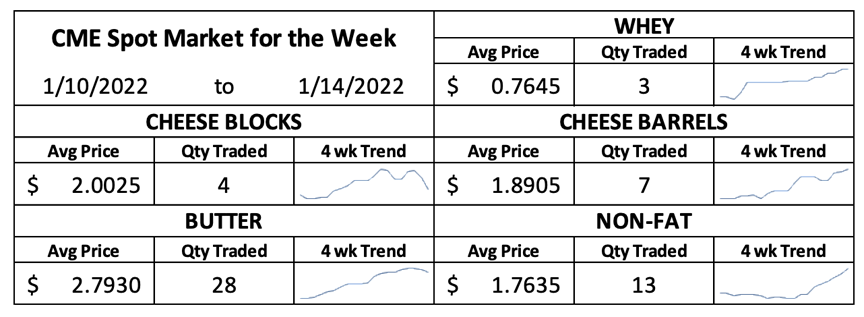
At the CME spot market this week, butter reached a fresh six-year high on Wednesday but then retreated. It closed at $2.725 per pound, down 1.75ȼ for the week. The Cheddar markets diverged. After topping $2 for two days, blocks fell back to $1.92, down 7.5ȼ for the week. Barrels jumped 9.5ȼ and closed at a 14-month high of $1.96. The football playoffs, otherwise known as nacho season, have helped barrels trade higher than blocks for the first time since early November. The powders just keep climbing. Dry whey rallied another 1.25ȼ to 77ȼ, the highest spot value in its nearly four years at the CME. Spot nonfat dry milk jumped 10.5ȼ to $1.815, a price not seen in Chicago since June 2014.

It was a scorching week in Argentina and southern Brazil, but relief is on the way, with lower temperatures and big rains expected next week. Those rains will surely cause crops to perk up, but some damage has been done. USDA acknowledged as much in its monthly update to global crop balance sheets. The agency cut its estimates of soybean production in Argentina, Brazil, and Paraguay by 6.1%, 3.5%, and 15% respectively. USDA slightly trimmed its estimates of South American corn production, but, after surveying farmers, USDA raised its estimate of U.S. corn production. A modest increase in last year’s harvest and some tweaks to demand resulted in larger ending stocks than USDA’s previous forecast, and corn prices dropped. March corn settled today at $5.9625 per bushel, down 12.5ȼ this week. March soybeans closed at $13.6975, down 40.5ȼ. March soybean meal finished at $405.60 per ton, down $19.40.

Original Report

Milk Markets Push Higher Tuesday in Chicago

On the Chicago Mercantile Exchange  milk futures were mixed Tuesday as nearby markets took on a negative tone and further out 2022 contracts show optimism. Class III milk saw February get hit with a 46-cent daily loss while all others closed in the green.  Milk futures between February and October all begin with a $21 or higher price at Tuesday’s close.  Class IV markets had another solid day of trade adding 10-35 cents/cwt in the February through July 2022 time period.

The CME Spot Dairy Auction followed this morning’s Global Dairy Trade (GDT) Event.   Dry whey up $0.01 at $0.78. One sale was made at that price. Blocks down $0.04 at $1.88. Four sales were made from $1.8750 to $1.91. Butter up $0.0550 at $2.78. Four trades were made from $2.7250 to $2.7725. Nonfat dry milk up $0.0350 at $1.85. Three sales were made at that price. Barrels down $0.0050 at $1.96.

Big cheese: Milk production slows causing dairy prices to rise in 2022

The continuing downward spiral of how much milk America’s dairy cows are producing is pushing up the price of common goods like cheese, butter and cream. Thanks to lower dairy production and ongoing inflation, putting creamer in your coffee and butter on your toast is going to cost you more cheddar.

In east and central regions of the United States, the cream needed to make butter is more limited. The U.S. Department of Agriculture said the big driver of those new limits was increased domestic demand and access being slowed by a combination of inclement weather and limited drivers to transport the goods cross country.

Compared to last year, USDA reported the average price for a gallon of milk in December was $5.99, while it was $3.50 in 2020 in the Southeast region, including Florida. While prices for milk went up, supplies of cream to make delectable treats shrank. Even ice cream supplies were down by 1.7% compared to 2020. As of November, USDA reports the production of nonfat dry milk for human foods was down 15% in 2021, though it had risen compared to the month before.

Overall, the retail and food service demand for domestic butter supply is “steady to stronger” and export demand is healthy. Global supplies are tighter, according to the USDA, making bulk butter prices rise $0.07 to $0.18 above market prices.

The base price for a pound of butter in the U.S. is currently listed at $2.04 per pound, as of Jan. 3. Pricing is measured on a two-week average. In December 2021, pricing had ended at $1.91, according to USDA reports. A year ago, in January 2021, the price for a pound of butter was $1.46.

USDA reports part of the issue for butter production is the reopening of schools. “With the re-openings of schools and processing plants returning to production, butter operations holding sufficient in-house cream are running hard to replenish shrunken freezer inventory,” USDA said. “Butter plants with supplies not as available, limited churning is the rule, as those butter facilities prioritize in-house cream for contracted customers’ needs.”

Production facilities are reducing how much butter they’re making as domestic demand for butter increases in retail, food service and wholesale markets. Still, bulk butter stocks remain tight, particularly in the East, according to USDA.

The U.S. Midwest is seeing supplies of cream tighten, and the shortage of cream is hitting the supply of schmear for bagels and cheesecake, putting them on the hunt for ingredients to make their spread. “Cream cheese manufacturers are active in seeking cream,” USDA reported.

As a refresh on dairy pricing, cwt is how many dollars per hundredweight of milk. Milk is measured in how much 100 pounds of milk costs in dollars, which is what makes up a hundredweight. USDA is predicting the cost of Class III milk, used for making cream cheese and spreadable cheese futures to go up to $21.67 per cwt in February. Previously, USDA forecasted cwt to rise to $20.75 in January.

For coffee lovers who don’t love it enough to drink their coffee black, the milk used for making coffee creamer, Class I, will be up $0.54 per cwt, or a 2.45% increase from December. Class IV milk, used for making butter and condensed milk products, as well as dry milk, are expected to go up to $22.14 per cwt.

As far as high priority dairy products, USDA said cheese “continues to be high” on the list. The price for a 40-pound block of cheese, was up by $0.07 per pound, making it roughly $79.80 per block. Barrels of cheese, weighted at 500 pounds, also got more expensive, now priced $0.14 per pound higher for a total of $912.25 on average. Barrels and 40-pound blocks are the two standard supply sizes used by USDA.

Increased “logistical costs,” particularly feed for dairy cows, is reportedly impacting the production of milk on farms. Labor shortages are also reportedly contributing to dairy production and prices.

“Looking ahead, 2022 milk production is expected to continue to be lower than desired. Decisions will have to be made regarding allocating available milk among dairy products,” USDA reported. According to their report, “production and transportation challenges resulting from labor shortages; uncertainty related to COVID factors; and cost pressures” continue to make prices for common dairy products rise.

Source: edairynews.com

Irish dairy exports perform well in 2021

Exports exceeded €5 million for third consecutive year

According to a report by Bord Bia, Ireland’s state agency that promotes sales of Irish food, Irish dairy exports performed well in 2021. The value of exports exceeding €5 billion for the third successive year.

Strong market returns were seen in all categories, including butter, cheese and powders. Strong demand in North America and Africa countered the dampening effect of softer demand for specialised infant nutrition products in Asia, said the report.

Diversification, said the state agency, continued to pay dividends last year. Ireland exported dairy products to 147 markets during 2021 and for the first time, trade to countries other than the EU and the UK accounted for more than 50% of total exports.

Worth more than €1 billion per annum, cheese exports increased by 15%. According to Bord Bia, customers in the UK and the EU, as well as in Africa, are willing to pay higher prices for Irish cheese.

Irish butter exports also increased in 2021, climbing 3% over last year and reaching €997 million. Exports to the UK declined, however, but EU demand was good. Exports to the US continue to grow.

Finally, Bord Bia’s report highlighted reduced demand for imported finished and base powders to Asia for the specialised infant nutrition sector. The state agency did say that this decline was offset by strong performance in ingredients for manufacturing to Asia, particularly China, as well as increased exports of traditional dairy products.

Source: thedairysite.com

Milk Markets Turn in Chicago Thursday

On the Chicago Mercantile Exchange milk futures took back earlier week gains Thursday as block cheese and cash butter closed lower. January Class III milk down six cents at $20.32. February 43 cents lower at $22.20. March a nickel lower at $22.33. April down 11 cents at $21.87. May through July nine cents lower to a penny higher.

In spot trade dry whey up $0.0075 at $0.77. Two sales were made at $0.7650 and $0.77. Blocks down $0.0550 at $1.9975. Barrels up $0.0225 at $1.9275. One trade was made at $1.93. Butter down $0.0425 at $2.7875. Seven trades were made at $2.7875 and $2.80. Nonfat dry milk up $0.02 at $1.78. One sale was made at that price.

Milk Markets Slightly Higher in Chicago Wednesday

On the Chicago Mercantile Exchange January Class III milk futures a penny higher at $20.38.  February up 43 at $22.63.  March 29 higher at $22.38.  April through June contracts 20 to 38 cents higher. Class IV milk continues to drive higher though January and was unchanged at $22.80. February gained 35 cents to $23.25 and March was up 15 to 23.10/cwt. Class IV 2022 average is $22.29/cwt.

The CME spot trade saw Dry whey steady at $0.7625. Blocks up $0.0050 at $2.0525. Barrels up $0.0750 at $1.9050. Butter down $0.0125 at $2.83. Nonfat dry milk up $0.02 at $1.76.  Two trades at $1.75 and $1.76.

Butter – What is Happening to Supply and Prices?

This post will cover the recent surge in the price of butter.  Butter prices as determined by the Agricultural Marketing Service (AMS) are used to price producer butterfat.  Recently, butter production has dropped, wholesale disappearance and exports have increased, inventories have tightened, and prices have increased.  

When butter prices increase, butterfat prices increase, milk protein prices decrease, and the Class III price is only slightly impacted as covered in this recent post.

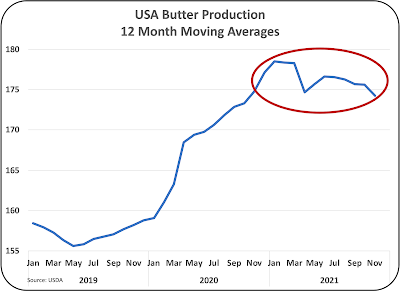
USA production of butter was variable in 2020 with the massive changes in eating habits caused by COVID mandates.  However, butter production grew nicely overall in 2020 as shown in Chart I. At the start of 2021, monthly butter production peaked.  By November of 2021, monthly production was down 26 percent from the start of 2021.

Chart I – Butter Production 12 Month Moving Averages

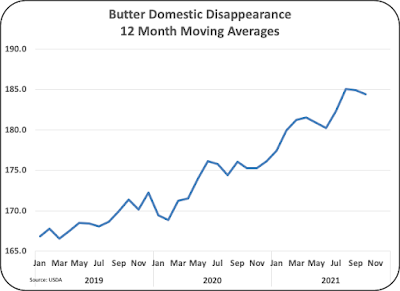
Domestic disappearance from wholesale inventories has grown throughout the span of this analysis and  this growth has accelerated in 2021.

Chart II – Domestic Disappearance 12 Month Moving Averages

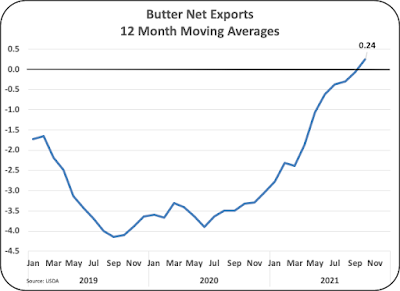
Net exports have remained minimal but are currently positive with an increase in butter exports.  The current 12-month average is the first positive 12-month average for net exports since 2015.

Chart III – Net Exports 12 Month Moving Averages

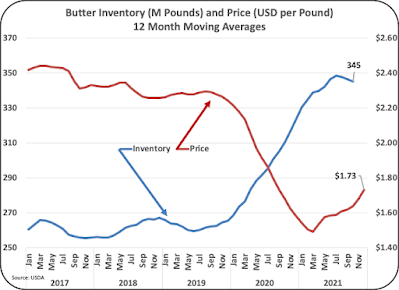
With the combination of lower production, strong domestic disappearance, and positive net exports, inventories have decreased, and prices have increased.  Chart IV shows the relationship based on 12-month averages.  When wholesale supplies decrease, wholesale prices increase.  The most recent monthly price of butter is $2.06 per pound.

Chart IV – Inventories and Prices of Butter

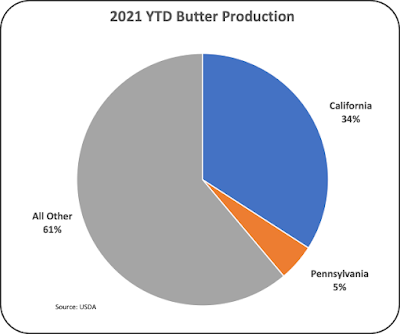
What is causing this?  The explanation will start with where butter is produced.  Chart V is a pie chart that shows production by the two biggest butter producing states.  California and Pennsylvania butter production are reported over the span of this analysis and all other state butter production is considered too small to report.  California produces more than one third of the total U.S. butter, and that butter is shipped throughout the U.S.  The percent of the USA butter produced in California has increased from 30 percent at the end of 2018 to 34 percent near the end of 2021.

Chart V – Butter Production by Location

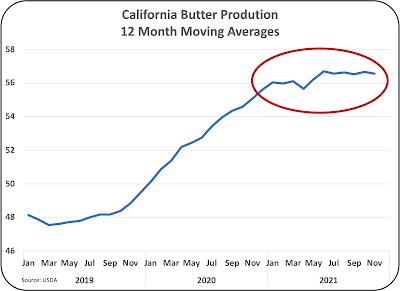
Production of butter in California is shown below in Chart VI.  There was significant growth in California butter production through 2020, but in 2021, butter production leveled off with almost no growth.  This chart is very similar to the Chart I which shows butter production for the U.S.  The one big difference is that butter production in California “leveled off” while the USA butter production decreased.  Annual butter production in California has grown by 17 percent between 2018 and 2021.  By comparison, the annual U.S. butter production has grown by just 10 percent during this same time span.  

With Class I milk for drinking and Class III milk for cheese declining in California, the increase in butter churning is offsetting the declines and providing a home for California milk production.

Chart VI – California Butter Production 12 Month Moving Averages

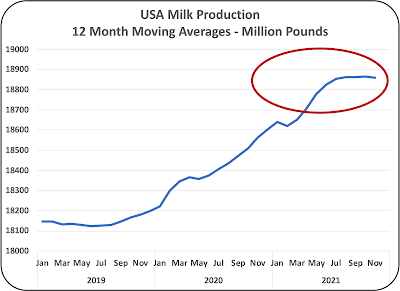
Recent press releases have blamed the decreasing butter inventories on logistics and a lack of milk production. The impact of logistics is difficult to analyze, but certainly butter is moved long distances and there is a shortage of drivers for moving products across the USA. Data for milk production is readily available.  As shown below, the USA milk production has shown a recent slowdown in growth (Chart VII). 

Chart VII – USA Milk Production 12 Month Moving Averages

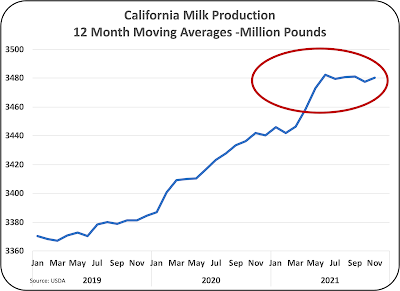
California milk production has followed the USA chart above, except that California milk production grew faster in early 2021 and then abruptly “leveled off.”

Chart VIII – California Milk Production 12 Mont Moving Averages

From this data, it looks like milk production has certainly reduced availability for churning.  Until there is a change in milk production, butter production and inventories will likely keep butter prices high.  

Cheese has not been impacted as severely by the milk shortage, as the milk production in Wisconsin, Texas and Minnesota has continued to grow.  For a review of the major cheese producing states, see this post.

Source: milkprice.blogspot.com

Dairy Markets Are Off to an Exciting Start in 2022

Prices are high and extremely volatile as the trade assesses how long global milk output will remain depressed and whether demand will hold firm despite the rising cost of dairy.

The dairy markets are off to an exciting start in 2022. Class III futures rocketed to life-ofcontract highs Wednesday and then plumbed their lower daily trading limits Thursday. February Class III peaked at $22.45 per cwt., and closed today at a still lofty $21.43. Prices are high and extremely volatile as the trade tries to assess how long global milk output will remain depressed and whether demand will hold firm despite the rising cost of dairy.

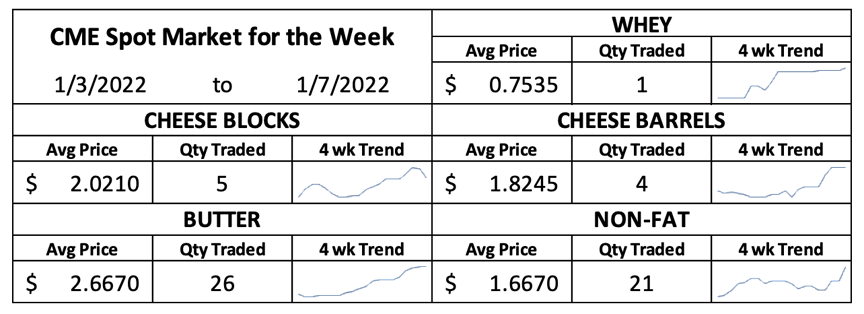
Uncertainty reigns in the cheese markets. Fresh cheese is tight enough to propel spot Cheddar to its highest price since late 2020. CME spot Cheddar blocks pushed well above the $2 mark this week but settled at $1.995 per pound, up 1.5ȼ for the week and up 12.25ȼ since Christmas. Barrels leapt 15.5ȼ over the past five trading sessions and closed today at $1.865. But cheese stocks are heavy and the vats are full. The latest Dairy Products report showed November cheese output at 1.12 billion pounds, up 1.6% from a year ago. However, Cheddar output fell 4.4% short of the very high volumes made in

November 2020, when the government’s food box program boosted demand. This time around, cheesemakers focused on specialty and Italian-style cheeses, which suggests they were making cheese to meet orders rather than to push milk through their plants. Demand is reportedly strong as grocers restock after the holidays. And, despite all the headaches required to move cheese from the warehouses to the ports, U.S. exports are better than ever. We sent 73.9 million pounds of cheese abroad in November, up 39.9% from the prior year. With one month of data yet to be counted, U.S. cheese exports have already set a full-year record.

CME spot whey climbed to a fresh high in its nearly four-year tenure at the spot market. At 75.75ȼ, it is 0.75ȼ higher than it was a week ago. Dry whey production is well above the very low levels of November 2020 but not heavy by historic standards. Processors continue to direct much of the whey stream into concentrates, leaving less to drag down the commodity markets. Dry whey stocks moved higher from October to November but are still somewhat tight, as befits a market at multi-year highs.

With both cheese and whey markets moving higher – albeit erratically – Class III futures gained a lot of ground over the past two weeks. 2022 contracts are up 70ȼ, on average, since the last trading session before Christmas, and the February through April contracts added well over a dollar. The futures promise $20 milk from now until November.

The Class IV markets are even stronger, with an average 2022 price of $21.67 and an average two-week gain of 92ȼ. Both butter and milk powder are in relatively short supply as milk moves to cheese vats and cream is processed into whips and dips. Butter output slumped to 156 million pounds in November, down 9.6% year over year. The spot butter market took off on December 20, and it has been sprinting uphill ever since. It closed today at $2.7425, up 29ȼ this week and up nearly 50ȼ since Christmas. Spot butter hasn’t been this pricey since 2015.

Manufacturers made just 181 million pounds of nonfat dry milk (NDM) and skim milk powder (SMP) in November, 17.8% less than the year before. Exports boomed and stocks waned. The U.S. sent a record-breaking 168.5 million pounds of NDM abroad in November, up 25% from a year ago. Manufacturers’ stocks of NDM have moved from burdensome to scant in just five months. Inventories stood at 196.5 million pounds at the end of November, the lowest November total since 2013 and 21% lower than the prior year.

U.S. exports are likely to remain strong, because foreign milk powder prices just keep climbing. At the Global Dairy Trade auction on Tuesday, SMP advanced another 1% to the equivalent of NDM at $1.83 per pound, after adjusting for protein. In Chicago this week, CME spot NDM climbed 5.5ȼ to $1.71, the highest price – by far – since 2014.

USDA announced the December Class III price at $18.36 per cwt., up 33ȼ from November and up $2.60 from December 2020. At $19.88, December Class IV milk was $1.09 higher than the preceding month and up an astounding $6.46 year over year. It’s been a long time coming, but dairy producers outside the cheese states can expect their best milk check in years, and the futures promise much bigger revenue in the months to come. But costs are high too.

The corn market vacillated but finished close to where it began, at $6.0675 per bushel. Soybeans, on the other hand, moved sharply higher. The March contract closed at $14.1025, up nearly 80ȼ in two weeks. March soybean meal vaulted to $425 per ton, up nearly $19. It’s been hot and dry in southern Brazil and Argentina, and the forecast calls for scorching temperatures for at least another week. After that, rains are expected to bring relief. But until then, the soybean market will be on edge.

Original Report Jacoby

US dairy exports near 1.5 billion pounds in 2021

Products went to the Caribbean, Asia, Middle East-North Africa and South America

Despite not taking bids for two weeks during December breaks, Cooperatives Working Together (CWT) member cooperatives secured 41 contracts in December. The additional contracts added 3.5 million pounds of American-type cheeses, 105,000 pounds of butter, 44,000 pounds of whole milk powder, 767,000 pounds of cream cheese and 300,000 pounds of anhydrous milkfat to CWT-assisted sales in 2021.

The products will go customers in the Caribbean, Asia, Middle East-North Africa and South America, and will be shipped from December 2021 through June 2022, National Milk Producers Federation said in a press release.

CWT-assisted dairy product sales contracts for 2021 total 53.1 million pounds of American-type cheese, 16 million pounds of butter, 6.4 million pounds of anhydrous milkfat, 12.2 million pounds of cream cheese and 45.1 million pounds of whole milk powder. This brings the total milk equivalent for the year to 1.447 billion pounds on a milkfat basis.

Source: thedairysite.com

Milk markets take rollercoaster ride in Chicago Tuesday

On the Chicago Mercantile Exchange, Class III milk futures were limit up at one point today but fell drastically over time. January milk jumped 11 cents to $20.38/cwt. February milk surged 39 cents to $21.94/cwt. March milk gained 27 cents to $21.80/cwt. Class IV 2022 milk futures settled 7-44 cents higher. 

Dairy products continued higher in the CME Cash Dairy Product Auction.  Dry whey up $0.0050 at $0.7625. Blocks up $0.0525 at $2.0475.  Three trades were made, ranging $2.03 to $2.0475. Butter up $0.0625 at $2.8425.  Eight trades, with a range of $2.7925 to $2.8525. Nonfat dry milk up $0.0175 at $1.74.  Six trades made, ranging from $1.7325 to $1.74. Barrels unchanged at $1.83.

Milk Futures Up While Spot Trade Mixed in Chicago Monday

On the Chicago Mercantile Exchange Monday most milk futures were up and cash dairy prices were mixed.   Class III milk was down 2 cents in January to $20.27, February gained 12 to $21.65, with March up 29 to $21.53/cwt. The balance of 2022 was up 5-33 cents. Class IV Milk  continued to march higher. January up 5 to $22.40, February up 33 cents to $22.46, and March up 21 to $22.43. First half of 2022 averages at $22.27/cwt.

The spot dairy trade helped support milk. Butter was up $.0375 at $2.78.  No sales were recorded. Dry whey was unchanged at $0.7525.  No sales were recorded. Cheese Blocks were unchanged at $1.9950.  No sales were recorded. Cheese Barrels were $.0350 lower, closing at $1.83.  Two sales were recorded at $1.83 and $1.8475.    Nonfat dry milk was up $.0125 at $1.7225.  No sales were recorded.

Markets Pullback in Chicago Thursday

On the Chicago Mercantile Exchange, milk futures pulled back from earlier week gains Thursday ahead of the USDA’s dairy product report. January Class III milk down a quarter at $20.41. February 68 cents lower at $21.67. March 70 cents lower at $21.05. April down 60 cents at $20.74. May through July 32 to 58 cents lower.

In spot trade, blocks down $0.0150 at $2.05. Barrels unchanged at $1.8725. Butter up $0.0325 at $2.7425. Ten trades were made at $2.74 and $2.7425. Nonfat dry milk is unchanged at $1.6675. Dry whey unchanged at $0.7525.


Dairy Market Report: December 2021

The rapid evaporation of growth in dairy cows, milk and milk solids production dropped all three into negative territory during October. These supply-side effects have dominated the dairy situation recently and will continue to do so well into the coming year.

Domestic consumption growth of all milk and dairy products has been somewhat sluggish in recent months, but U.S. dairy exports during the first ten months of 2021 have set a new volume record of 17.6 percent of U.S. milk solids production, well above this measure’s second-highest year, 2020 at 16.3 percent.

The drop in production is being felt most in dry skim milk products, and to a lesser extent in butter and dry whey production. Cheese production remains the preferred channel for available milk. Product stocks are being drawn down and prices rising, as production trends change.

To view the report, click here.

Milk price has still not reached peak level

Milk prices will continue to harden through the first quarter of 2022, as the recent buoyancy in dairy markets is translated back into higher farmgate returns.

And while inflation and slower Chinese buying is expected to affect demand for dairy commodities during the second half of the year, milk prices are likely to hold at elevated levels.

“There has been a lot of dairy market movement, but the recent strengthening has not been fully translated into higher milk prices yet,” explained Rabobank food and agriculture analyst Richard Scheper.

“If we look forward towards Q1, we expect commodity prices to remain at a high level, with strong milk prices for the first three months [of 2022],” he added.

Peak milk price

Scheper predicted that peak milk price will be in Q1 of 2022 or slightly later.

He said “a market correction” is likely later next year, but the Rabobank analyst maintained that “elevated milk pries” are likely through the first half of 2022.

Rabobank’s 2021 Q4 Global Dairy Quarterly report noted that dairy production had fallen to a level not seen since 2014.

A combination of low global milk supply growth in the main export regions and strong import demand from China during 2021 have set the stage for the current price levels. Most other market fundamentals are also supporting high prices in Europe at the moment.

Peak milk production in New Zealand and Australia has been affected by poor weather, while high feed costs in Europe and the US has restricted farmers’ margins and output growth.

Slight production fall

Milk production in the seven leading dairy exporting regions – EU, US, Australia, New Zealand, Brazil, Uruguay and Argentina – is forecast to fall by 0.3% during Q4 compared with last year, according to Rabobank.

Although Scheper maintained that milk supplies will recover through Q1 of 2022, he said output growth during the first three months of the year will be “modest”.

“We do not expect to see really strong growth in milk supplies in the first six months of 2022. Markets will not be oversupplied,” he said.

This analysis tallies with the views of Irish dairy-sector officials.

“Prices will come back; they always come back. But I can’t see any change for the spring at least. The milk doesn’t appear to be there globally and commodity prices, although strong, have not reached stupid levels,” one dairy source told the Irish Farmers Journal.

Butter prices on the Dutch spot market have hit €5,500/t, up from €4,400/t in October. Meanwhile, skim milk powder has topped €3,250/t, with whole milk powder making over €4,000/t.

Farmgate milk prices are generally at 37c to 38c/l excluding VAT for November supplies or 39c to 40c/l including VAT.

Source: farmersjournal.ie

Spot Trade Pushes Markets Higher in Chicago Wednesday

On the Chicago Mercantile Exchange, most milk futures and cash dairy prices continued to rise Wednesday.  Class III milk had January sliding 9 cents to $20.66, February finished the day 56 cents higher to $22.35/cwt and March up 31 to 21.75.  The balance of 2022 was up 6-24 cents with only December lagging below $20. Class IV milk extended their gains as well. January up 41 cents to $22.25, February up 89 cents to $22.40 with March up 81 cents to $22.36/cwt. The balance of the year seeing double-digit gains except for Dec.

How high can the spot trade go? After we saw limit moves Tuesday, the follow-through bullish tone returned on Wednesday.  Cheese Blocks closed up $.0500 at $2.0650.  Three sales were recorded from $2.0475 to $2.06. Cheese Barrels were $.0725 higher, closing at $1.8725.  Three sales were recorded from $1.8550 to $1.8725.    Butter was up $.0600 at $2.71.  There were three sales ranging from $2.7075 to $2.7125. Nonfat dry milk was up $.0225 at $1.6675.  Eight sales were recorded from $1.6525 to $1.6675. Dry whey was unchanged at $0.7525.  No sales were recorded.


Dairy prices have risen slightly, at the first Global Dairy Trade auction of 2022

Explanatory Notes

All information published on this page may be reproduced provided the user acknowledges Global Dairy Trade as the source.

Quantity sold is the total quantity sold in a Trading Event across all products, contract periods and sellers. The quantity sold may be less than the minimum supply if the quantity bid on a product in the first bidding round was less than the minimum supply

Minimum supply and maximum supply are the lower and upper bounds on the quantities the sellers wish to sell in the Trading Event. The maximum supply is also sometimes referred to as the sellers’ offer quantity.

Number of participating bidders is the number of bidders who entered a bid in the first round of the Trading Event.

Average winning price is the quantity-weighted average of winning prices at the Trading Event.  “n.a.” for the winning price means that no prices were available for that contract period and therefore no average price was applicable.

“n.a.” for the percentage change in GDT Price Index means that no product was offered or sold, or no price was published for the last event, or on both of the two previous events.  I.e. a change in GDT Price Index is only shown if there is a price available for the last event AND for at least one of the two previous events.

NZ: New Zealand, AU: Australia, US: United States, IN: India, EU: Europe, DE: Germany, PL: Poland, SE: Sweden, UK: United Kingdom, DK: Denmark

Source: GDT

Dairy Markets Spike Higher in Chicago Tuesday

On the Chicago Mercantile Exchange  most milk futures and cash dairy prices spiked higher Tuesday.  Class III milk futures saw a limit move of 75 cents higher starting in February out through April.  Prices range from $21.10-$21.79/cwt.  January milk advanced 67 cents to $20.70/cwt.  Class IV prices climbed anywhere from 1-55 cents higher in 2022.

In spot trade butter launched an explosive 16 cent gain, settling at $2.65/lb in the CME Spot Dairy Auction today.  Barrel cheese surged 8.75 cents higher to $1.80/lb.  Block cheese crossed the $2.00 threshold, finishing at $2.0150/lb.  Whey was unchanged at $0.7525/lb.  NFDM settled in place at $1.6450/lb. 

Milk Markets Start New Year Higher in Chicago

On the Chicago Mercantile Exchange most milk futures and cash dairy prices were higher Monday to start the new year.  January Class III milk was down $.01 at $20.03.  February closed up $.32 at $21.04.  March closed up $.20 at $20.69.  April was up $.13 at $20.35.  May through December contracts ranged from a penny lower to twenty cents higher.

On spot trade dry whey was up $.0025 at $0.7525.  One sale was recorded at that price. Cheese Blocks were unchanged at $1.98.  No sales were recorded. Cheese Barrels were up $.0025 closing at $1.7125 with one sale at that price.    Butter was up $.0375 at $2.49.  There were no sales. Nonfat dry milk went down $.01 closing at $1.6450.  No sales were recorded.

Dairy Markets Continue to Heat Up in Chicago as 2021 Winds Down

On the Chicago Mercantile Exchange milk future again closed higher Thursday as cash markets and price optimism for 2022 continues. Class III milk saw January gain 17 cents to $20.18, February gained 38 to 20.83 and March jumped 34 cents to $20.79/cwt. The first half of 2022 sits at $20.43/cwt. Class IV milk continues to be the leader. January gained 20 to $21.50, February was up 6 cents to 21.41, and March up 4 to 21.41/cwt. The first half of 2021 has a class IV average of $21.30/cwt.

The CME spot dairy product trade saw great volume all week. On Thursday blocks up $0.03 at $1.98. Two sales were made at $1.9725 and $1.98. Barrels up $0.02 at $1.71. Eleven trades were made from $1.70 to $1.7150. Butter up $0.0150 at $2.4475. Four trades were made from $2.4350 to $2.45. Nonfat dry milk up $0.0075 at $1.6550. Three trades were made from $1.65 to $1.6550. Dry whey unchanged at $0.75.

The Price Index for November, at 103.5, is up 5.6 percent from the previous month but down 1.4 percent from November a year ago. The November all milk price of $20.80 per cwt is $1.10 higher than October but 30 cents lower than November 2020.

US dairy exports set to record stellar year

Skimmed milk powder shipments reached 689,000 tons through October

Despite the logistical challenges posed by the COVID-19 pandemic, US dairy exports are set to record a stellar year, led by shipments of skimmed milk powder (SMP), cheese, and butter. SMP shipments through October have already reached 689,000 tons. According to the US Department of Agriculture (USDA) World Markets and Trade report, shipments accounted for nearly one third of the $6.4 billion of dairy exports.

For the year, SMP exports are forecast to reach a record 887,000 tons – up almost 10% – over 2020. For 2022, growth is anticipated to moderate with exports set to grow by 3% to reach 917,000 tons.

Global prices of SMP have been rebounding recently as a result of lackluster milk production in Oceania and the EU. SMP prices in these regions are currently hovering around $1.60-$1.65 per pound. While US prices remain competitive, import demand is expected to be tempered as food processors seek more cost-effective substitutes, said the report.

One notable trend is that US global market share of SMP among major exporters has been steadily climbing from around 30% in 2015 and is forecast to reach 41% in 2022. Since 2014, the EU has been the dominant supplier; however, this year US exports of SMP are expected to surpass EU shipments. This trend is likely to persist into next year as US milk production is expected to continue to grow.

Exports of other dairy products such as cheese and butter have also posted strong gains this year. In the case of cheese, shipments this year are expected to grow by 16% to reach a record 412,000 tons.

US butter has also been highly sought after as it is highly competitive in a tight global market. Recent Oceania prices have been around $2.65 per pound while EU prices have been higher. Exports of US butter this year are expected to more than double from last year to reach 60,000 tons, said the report.

Source: thedairysite.com

Milk Futures Push Higher in Chicago Wednesday

On the Chicago Mercantile Exchange milk futures continue higher at midweek supported by strong cash trade. December Class III milk up a penny at $18.42. January six cents higher at $20.01. February 15 cents higher at $20.45. March up 14 cents at $20.45. April through June a penny lower to 17 cents higher.

In spot trade blocks up $0.02 at $1.95. One sale was made at $1.95. Barrels up $0.0575 at $1.69. Five trades were made from $1.66 to $1.69. Butter up $0.0325 at $2.4325. Nonfat dry milk down $0.0150 at $1.6475. Five trades were made from $1.6425 to $1. 6475. Dry whey unchanged at $0.75.

Milk Markets push higher in Chicago Tuesday

On the Chicago Mercantile Exchange milk futures continue higher with strong butter prices supportive to markets. Class III milk futures were mixed.  January milk fell 4 cents to $19.85/cwt.  February milk soared 20 cents to $20.40/cwt.  March milk was up 8 cents to $20.27/cwt. Class IV milk rallied 8-25 cents higher with the nice move higher in butter today. 

In spot trade butter surged 9.50 cents higher to $2.40/lb in the CME Spot Dairy Auction.  This marks the highest price since July of 2019.  Block cheese climbed 2 cents to $1.93/lb.  Barrel cheese 4.50 cents to $1.6325/lb.  Whey held steady at $.75/lb.  NFDM slipped half a penny to $1.6625/lb. 

Dairy markets teetering, Rabobank

Dairy markets are teetering at levels not seen since 2014

Weather-related issues decimated Oceania’s peak production, and margin erosion in the US and Europe stymied growth, resulting in a year-on-year deficit that was too deep for favourable milk production gains in South America to offset, reported Mary Ledman, Global Sector Strategist in Rabobank’s most recent Global Dairy Quarterly. As a result, Q4 2021 milk production in the Big-7 exporting regions is expected to decline by 0.3% vs. last year’s high comparable. This is the first quarterly year-on-year decrease since 2019.

According to the summary report, farmgate milk prices have followed commodity prices higher worldwide, with more potential upside in some regions. Still, rising costs of inputs, lack of labor, unfavourable weather, and questionable feed quality will limit the production response by producers.

Dairy exports slowed in response to logistic disruptions, rising transportation costs, and elevated commodity prices. Global dairy exports based on product volume ran 6% ahead of the prior year during 1H 2021, but slowed to 2% in Q3.

A slowdown in import demand from China is expected and is needed to cool prices in the face of limited supply-side increases. Chinese buyers are torn between the bullish sentiment outside China and the current weak fundamentals within China to decide whether, when, and at what price levels they should return to the market.

Despite rising inflationary pressures, consumers have yet to face sticker shock for dairy products in most countries, supporting demand. That will not be the case in 2022, as higher commodity prices from 2H 2021 are passed through to consumers.

New variants of Covid-19, inflation, labor and logistic challenges, along with others weigh on the global economic recovery, with the potential for global dairy markets to teeter or totter, reported Rabobank.

Source: thedairysite.com

Ontario dairy prices set to rise in 2022

Rising prices on provincial dairy farms means the price of raw milk will be rising in 2022. Producers hope event though prices rise, dairy will remain a big part of the grocery list.

Dairy farmers in Ontario say all operational prices on the farm from feed, fuel and even cleaning supplies have been going up over the last two years. (Spencer Van Dyk/CBC)

Like everything else at the grocery store, the cost of milk, cheese, yogurt and butter is going to be more expensive in 2022.

That’s because one of the largest hikes in the price of raw milk takes effect at the beginning of February. 

The Canadian Dairy Commission recommended a raw milk price hike of 8.4 per cent. The increase, which works out to about six cents more per litre, takes effect in February. 

And by the time the packaged and prepared items reach the grocery store, the cost will rise even more.

The commission says the higher price processors will pay, will help offset increased production costs for farmers due to the COVID-19 pandemic.

‘You can’t produce milk and lose money’

In Ontario there are 3,500 dairy farms — all family run, and 75 processing plants that pasteurize and package milk,  butter, yogurt and cheese that is sold at retail stores.

Bonnie Den Haan and her family operate Haanview Farm and Sheldon Creek Dairy in Simcoe County. 

She also represents the Dairy Farmers of Ontario in Wellington, Dufferin, Peel and her home base in Simcoe.

Den Haan says it’s costing more to run their operation.

“You can’t produce milk and lose money … or you’ll lose your farms. As input prices go up, we have to pay more,” said Den Haan. 

“I saw the other day that if you contract to build a new house, you have to pay the [increased] charge or you walk away.”

Murray Sherk is the Chair of the Board for the Dairy Farmers of Ontario. And he is also a dairy farmer at Pinehill Dairy,  which is between New Dundee and Plattsville.

He says dairy producers have seen the cost to operate their farms rising over the last two years.

“We’ve seen fuel prices rise significantly in the past year and we also know that, with the pandemic, there’s been a lot of supply chain issues and sourcing,” said Sherk.

“Feed, particularly corn and soybean, would be one of the main components. And those have increased significantly, 20 to 25 percent.”

The grocery store increase

The price increase is based on a study of over 200 farms across Canada. One aspect of the price increase looks at the annual cost of production on each farm.

Sylvain Charlebois, director of the Agri-Food Analytics Lab at Dalhousie University in Halifax says the cost increase of  raw milk definitely will boost the retail price of finished products. 

He says the retail price of milk in grocery stores could increase as much as 10 per cent while prices for dairy products  such as butter, cheese and yogurt could soar as much as 15 per cent.

“If you’re having dinner and dairy products are involved, somehow this year is ‘your year’, because next year it’s likely be way more expensive,” said Charlebois.

“We are expecting cheese, yogurt, fluid, milk, anything dairy to be much more expensive next year compared to this year.”

Source: cbc.ca

New York milk production flat but prices rise

Milk production in New York during November was steady, but the price received by farmers took a big jump.

According to the latest figures provided by the U.S. Department of Agriculture, production in November totaled 1.24 billion pounds, down 0.2 percent from November 2020.

The average milk price received by New York farmers in October 2021, at $19.90 per hundredweight, is up $1.00 from September 2021 and up $1.10 from October a year ago.

The number of milking cows in the state increased from 626,000 in November 2020 to 628,000 in November 2021.

Source: Aubrun pub


Milk Markets Push Higher in Chicago Monday

On the Chicago Mercantile Exchange milk futures started the week higher as strong butter and cheese trade continues to carry markets. December Class III milk unchanged at $18.43. January 40 cents higher at $19.89. February 25 cents higher at $20.20. March up 24 cents at $20.06. April through June 11 to 23 cents higher.

In spot trade blocks up $0.0375 at $1.91. Two sales were made at $1.91 and $1.91. Barrels up $0.0250 at $1.6750. Four trades were made from $1.6875 to $1.6750. Butter up $0.0550 at $2.3050. Ten trades were made from $2.28 to $2.3050. Nonfat dry milk down $0.0025 at $1.6675. One trade was made at that price. Dry whey unchanged at $0.75.


Markets Move Higher in Chicago Wednesday

On the Chicago Mercantile Exchange January Class III milk futures up 35 cents closing at $19.54.  February 42 higher at $20.15.  March up 36 cents at $20.04.  April through June contracts 8 to 23 cents higher.

In spot trade, dry whey up $0.01 at $0.7350.  Blocks up $0.0125 at $1.8725.  Two trades at $1.85 and $1.8725. Barrels up $0.0250 at $1.65.  Seven trades were made, ranging from $1.6375 to $1.65. Butter up $0.0475 at $2.19.  Three trades, with a range of $2.1850 to $2.19. Nonfat dry milk up $0.0075 at $1.67.  Ten trades, ranging $1.6625 to $1.67.

Global Milk Output is Slowing

The T.C. Jacoby Weekly Market Report Week Ending December 17, 2021

Lower milk production abroad will make more room for U.S. dairy product exports, even if the global appetite for dairy products fades modestly.

Global milk output is slowing, supporting dairy product values all around the world. Foreign prices for butter, milk powder, cheese, and whey have been climbing for months, and they continue to rise. In recent weeks, gains have accelerated, as milk production shortfalls move to the fore.

In Australia and New Zealand, the peak of the season has passed and milk output continues to disappoint. Through October, Aussie milk production is down 2.9% for the season to date. In New Zealand, June through October milk collections lag last year by 3.4%. Australian milk output is expected to improve. In New Zealand, November milk output also likely fell short of last year, and it will be difficult to make up for lower peak-season milk output as production gradually fades in the coming months.

In Europe, a few countries have yet to publish milk output data for October, but the year-overyear deficit is widening in the nations that have reported. October collections in Europe’s seven largest dairy countries fell 1.1% below year-ago volumes, the steepest decline since January 2017, when some governments paid producers to restrict output.

Lower milk production abroad will make more room for U.S. dairy product exports, even if the global appetite for dairy products fades modestly. The market is primarily concerned that China has overstocked its larder, and that it will need less foreign dairy in the year to come. USDA’s analyst in Beijing believes that China will indeed import 6% less whole milk powder (WMP) in 2022 than it did this year, due to higher domestic production and ample stocks. But the USDA attaché expects Chinese skim milk powder (SMP) imports to keep climbing into 2022, and she calls for China’s overall dairy imports to rise again next year, after reaching all-time highs in 2021. If Chinese SMP imports do fade, demand from other markets is likely to remain firm, as some buyers were pushed to the sidelines by China’s aggressive purchases this year or simply went hand-to-mouth in hopes of lower prices that never came. They have given up waiting and are buying now. USDA’s Dairy Market News reports that demand from Mexico is particularly strong.

Waning global output and hearty demand lifted powder prices once again this week. CME spot nonfat dry milk (NDM) jumped 5.25ȼ to $1.6775 per pound, a fresh seven year high. Dairy Market News describes the NDM market as “resolutely bullish.” Spot whey powder added another 1.75ȼ and reached 73ȼ, its highest price in a relatively short run at the CME. Manufacturers continue to focus on high-protein whey products, leaving less for commodity whey. Exports remain strong despite headaches at the ports. Every penny increase in the whey market adds 6ȼ to Class III values.

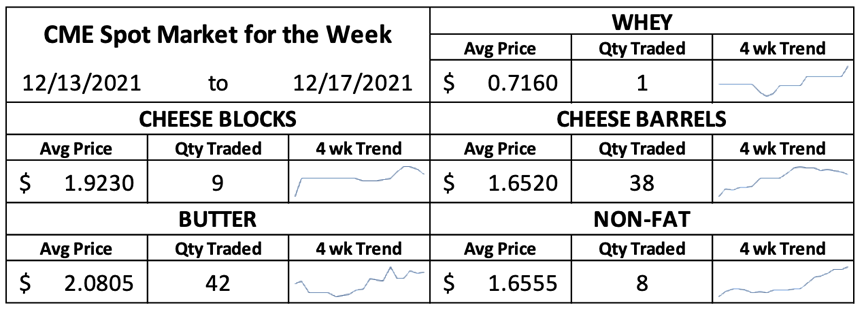
Bring on the egg nog and pour one out for all the appetizers and desserts that will go unassembled and unbaked this Christmas due to the much-publicized cream cheese shortage. Bakers honed their skills in 2020 and they’re putting them to good use this year as families and friends gather for the holidays. Demand for cream in all forms is frenzied and multiples are well above average. Churns are last in line for cream and butter output is running light. That is likely to keep butter values firm, although they lost a little ground this week compared to last Friday’s frothy levels. CME spot butter slipped 3ȼ to a still-high $2.0925.

Cheese prices were mixed. CME spot Cheddar blocks advanced 2.25ȼ to $1.8875. Barrels lost a nickel and closed at $1.63. Although milk supplies are tighter, cheese production remains active, as Class IV manufacturers do without. Demand is healthy, but supplies are plentiful.

After a brief foray over the $20 mark, nearby Class III futures retreated to safer climes. January Class III settled today at $19.25 per cwt., down 57ȼ from last Friday. February dropped 26ȼ to $19.70. Down the board, Class III futures continued to rise. The March through December contracts added another 24ȼ this week, on average. Since Thanksgiving, 2022 Class III contracts have rallied an average of 89ȼ.

Class IV futures just keep rising. This week the gains ranged from 10ȼ in January to 50ȼ in July and August.

Every Class IV contract on the board scored fresh life-of contracts. Next year’s futures promise an average of $20.58 for Class IV.
The grain markets are stubbornly high. March corn added another 3.25ȼ this week and closed at $5.9325 per bushel. January beans rallied 11ȼ to $12.8525. Soybean meal gained nearly $13 and finished at $379.50 per ton.

The feed markets have already priced in a hefty weather risk premium, but the relatively dry forecast for southern Brazil and Argentina raised alarms – and prices – nonetheless. Crops are thriving in central Brazil, where the weather has been much wetter. It’s too soon to panic with most of the growing season still ahead, but the markets are primed to rally at the first sign of trouble.

Original Report At: https://www.jacoby.com/market-report/global-milk-output-is-slowing/

Dairy prices fall, volumes drop at Global Dairy Trade Auction

International milk prices fell while volumes dropped in this month’s second Global Dairy Trade auction held by GDT Events.

The GDT Price Index dipped 1.5 percent, with an average selling price of $4,236 per tonne, in the auction held on Tuesday.

The index rose 1.4 pct at the previous sale, according to GDT Events.

A total of 30,375 tonnes was sold at the latest auction, falling 2.3 percent from the previous one, the auction platform said on its website (Link).

The auctions are held twice a month, with the next one scheduled for Jan. 4.

The auction results can affect the New Zealand dollar NZD= as the dairy sector generates more than 7 percent of the nation’s gross domestic product.

The New Zealand milk co-operative, which is owned by about 10,500 farmers, controls nearly a third of the world dairy trade.

GDT Events is owned by New Zealand’s Fonterra Co-operative Group Ltd FCG.NZ , but operates independently from the dairy giant.

U.S.-listed CRA International Inc CRAI.O is the trading manager for the twice-monthly Global Dairy Trade auction. (Bangalore Commodities desk)

Source: xm.com

Milk Futures Turn Higher in Chicago Tuesday

On the Chicago Mercantile Exchange January Class III milk futures closed nine cents higher at $19.19.  February up 29 at $19.73.  March futures 12 higher at $19.68.  April through June contracts 8 to 15 cents higher.

Tuesday’s CME spot dairy trade had both blocks and barrels unchanged at $1.86 and $1.6250/lb.  Butter advanced a nickel to $2.1425/lb.  Nonfat Milk fell 1.50 cents to $1.6625/lb.  Whey was down half a penny to $.7250/lb. 

Milk markets start holiday week lower in Chicago

On the Chicago Mercantile Exchange January Class III milk futures closed 15 lower at $19.10.  February down 26 at $19.44.  March down 20 at $19.56.  April through June contracts 2 to 10 cents lower.

In spot trade, Blocks down $0.0275 at $1.86.  Three trades were made, ranging from $1.8350 to $1.8875. Barrels down $0.0050 at $1.6250.  Five trades made with a range of $1.6175 to $1.63. Butter steady at $2.0925.  Nonfat dry milk unchanged at $1.6775. Dry whey unchanged at $0.73. 


Markets Post Lower in Chicago Thursday

On the Chicago Mercantile Exchange milk futures posted lower Thursday as did most cash markets. Class III milk futures were mixed. January milk declined 21 cents to $19.59/cwt. February added 1 penny to $19.95/cwt. Q4 2022 milk futures saw the biggest positive change, gaining 6-18 cents/cwt.  Class IV was lower in the near term and saw mixed results further out across the curve. 

In the Spot Dairy Trade, blocks down $0.0225 at $1.9250. One sale was made at that price. Barrels down $0.01 at $1.6450. Nine trades were made from $1.6375 to $1.6625. Butter down $0.01 at $2.09. Six trades were made from $2.07 to $2.10. Nonfat dry milk up $0.0025 at $1.6650. One sale was made at that price. Dry whey unchanged at $0.7125.


Record New Zealand milk price is holding

Last week’s rise in global dairy prices has further boosted the chance of a record-breaking $9 milk price for the season.

Whole milk powder prices – the benchmark for Fonterra’s milk price – to its farmer suppliers – broke the US$4,000/metric tonne barrier for the first time in six months.

Westpac has lifted its 2021-22 farmgate milk price by 10c to $9/kgMS, at the top of Fonterra’s updated forecast range of $8.40 to $9.00/kgMS.

Senior agri economist Nathan Penny believes the lower NZ dollar is likely to prove a windfall gain for farmers.

“The key catalyst for the forecast revisions is our lower forecast track for NZD/USD,” says Penny. “We now expect NZD/USD to fall to US$0.66 by mid-2022.i

“That’s a whopping 8 cents lower than our previous expectation of it rising to US$0.74 at the same stage. “Expectations of an earlier increase in interest rates in the US have put the US dollar on the front food, and we expect that it will make further gains against currencies like the NZD over the next six months.”

ASB economist Nat Keall says the bank is retaining its forecast milk price of $8.75/kgMS.

He adds that at this point in the season, a record-high farmgate price is practically guaranteed and every auction where WMP prices simply hold onto the gains they’ve already made supports that prospect.

“On that front, there is little to suggest that prices will be correcting in the near future.

“Most obviously, the WMP contract slope continues to point to prices maintaining momentum from here.”

Keall admits that ASB is “a little bit more cautious” than the bullish futures market, which sees WMP prices lifting and remaining north of US$4,000/MT over much of the rest of the season. But WMP prices have had a tendency to overcorrect to swings in demand and supply, he says.

“Still, there is room for a little upside in our lofty forecast.”

Source: ruralnewsgroup.co.nz

Milk Futures Press Higher in Chicago Wednesday

On the Chicago Mercantile Exchange, milk futures in nearby months remain on a downward trend while spring contracts continue to post higher. Class IV milk had December finish at 19.78/cwt, January gained 30 to 20.55, and February jumped 22 cents to 20.67/cwt.  Class III milk saw nearby getting some selling pressure, but the bulk of 2022 gained. December fell 4 cents to 18.57, January fell 18 to 19.80, and February gained 1 cent to 19.94/cwt.

The CME spot trade on Wednesday saw blocks up $0.0025 at $1.9425. Three sales were made at $1.9475. Barrels down $0.0150 at $1.6550. Eleven trades were made at $1.65 to $1.67. Butter up $0.04 at $2.10. Nineteen trades were made from $2.7 to $2.1050. Nonfat dry milk up $0.02 at $1.6625. One sale was made at that price. Dry whey unchanged at $0.7125.


Milk futures end lower in Chicago Tuesday

On the Chicago Mercantile Exchange milk futures ended lower in a typical turnaround Tuesday fashion while cash markets were mixed. December Class III milk down a penny at $18.61. January eight cents lower at $19.98. February down nine cents at $19.93. March 12 cents lower at $19.77. April through June unchanged to eight cents lower.

In spot trade blocks up $0.0350 at $1.9450. Two sales were made at $1.93 and $1.9450. Barrels down $0.01 at $1.67. Ten trades were made at $1.67 and $1.6850. Butter unchanged at $2.06. Nonfat dry milk up $0.0125 at $1.6425. One sale was made at $1.64. Dry whey unchanged at $0.7125.


Send this to a friend