





Archive for Dairy Markets – Page 29

Russia Attacks Ukraine – Feed and Energy Prices Soar!

The T.C. Jacoby Weekly Market Report Week Ending March 4, 2022
High feed costs and pricey energy will quickly add up on the farm. Feed and energy costs are even higher in Europe, which will further deter growth on the continent.

Russia intensified its brutal attacks in Ukraine, and feed and energy prices soared. Crude oil closed today at $115.68 per barrel, its highest price since 2008. In just the past week, U.S. crude oil prices leapt 26%. Wheat prices climbed even faster. May winter wheat futures settled today at $12.09 per bushel, up 41% from last Friday.

Both Russia and Ukraine are major wheat exporters, and Ukraine is a critical corn exporter as well. Today, farmers in the United States are getting ready for spring planting, assessing their seed and fertilizer stores, and checking their equipment. Ukrainian farmers would like to be making the same preparations, but they face immense hurdles. Even in areas untouched by violence, farmers will likely struggle to access inputs. Ukraine relies on the ports in the war-torn south for many supplies, and much of the nation’s fertilizer comes from Russia. Every day that the war drags on increases the likelihood that Ukraine’s corn, wheat, and sunflower crops will fall well short of potential this year, and the world needs every bushel. Concerns about export disruptions and the potential for a much smaller Ukrainian harvest this fall pushed May corn futures to $7.5425 per bushel, up nearly a dollar from last Friday, a 15% increase. Nearby soybean and soybean meal futures rallied 4% this week. May soybean meal closed at $460.40 per ton.

High feed costs and pricey energy will quickly add up on the farm. In the past, dairy producers would have filled their barns to capacity to make more $22 or $23 milk. But they will probably think twice before adding a cow that will eat $7.50 corn. Feed and energy costs are even higher in Europe, which will further deter growth on the continent.

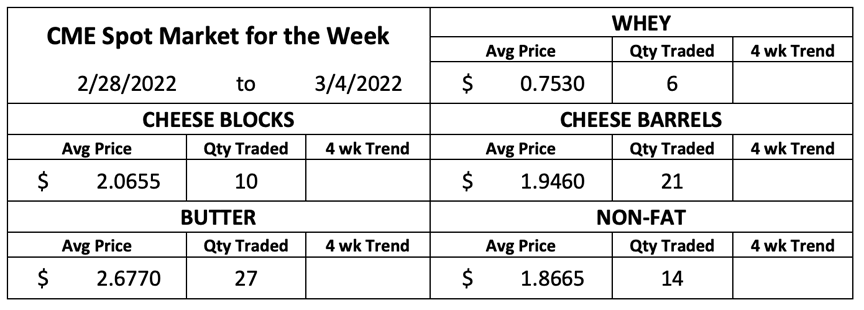
With the exception of whey, the dairy markets moved sharply higher this week, led by a 20.5ȼ jump in CME spot Cheddar blocks. At $2.15 per pound, blocks stand at their highest price since November 2020, when the government was buying huge volumes of cheese for the food box program. Barrels rallied 7ȼ this week to $1.97, also the highest price since 2020. Even at these values, U.S. cheese looks like a bargain compared to foreign product. At the Global Dairy Trade (GDT) auction on Tuesday, Cheddar scored a new all-time high at the equivalent of $2.90 per pound. Exports of relatively affordable U.S. cheese are booming. But output is robust as well. U.S. cheese production reached 1.17 billion pounds in January, up

2.8% from a year ago. Cheddar production fell 2.7% year over year but remained historically large.
In recent weeks, the weather has improved but milk remains a little tighter than expected, so there is not a lot of cheap milk sloshing around, which would ordinarily motivate cheesemakers to run hard as the flush builds. Processors tell USDA’s Dairy Market News that labor issues are not quite as bad as they were in January, but they are still restricting output at the margins.

Manufacturers continued to direct more of the whey stream to high-protein concentrates and isolates in January. Output of commodity whey powder fell 6.2% from last year. Dry whey stocks slipped to 55.5 million pounds, down 16.8% from a year ago and the lowest January stocks figure since 2012. Tight stocks propelled they whey market higher in February, but buyers lost their enthusiasm once prices topped 80ȼ. CME spot whey closed today at 75.75ȼ per pound, down 2.25ȼ from last Friday.

Milk powder prices moved sharply higher at the GDT and in Chicago. GDT skim milk powder (SMP) rallied 4.7% to a fresh seven year high. SMP at the GDT is roughly equivalent to nonfat dry milk (NDM) at $2.17 per pound, making U.S. NDM look eminently affordable. CME spot NDM gained 1.25ȼ this week to $1.8725.

Manufacturers dried 214 million pounds of NDM/SMP in January, 8.5% less than a year ago. Stocks climbed seasonally. But, at 261.3 million pounds, they were 14.3% lower than in January 2021 and noticeably light for this time of year.

Butter bounced back this week, climbing 9.75ȼ to $2.685. Butter churns made 195.2 million pounds of product in January, down 6.9% from a year ago and the lowest January volume since 2018. Manufacturers of cottage cheese, cream cheese, and sour cream bid up the cream price in January, which caused churns to run slower. U.S. butter output has fallen short of year-ago levels for eight straight months.

Dairy producers in Class IV milk sheds finally cashed a big milk check last month, and their next check will be even better. USDA announced the February Class III price at $20.91 per cwt., up 53ȼ from January and $5.16 more than February 2021. At $24, the February Class IV price is 91ȼ higher than January and an astounding $10.81 higher than February 2021.

Although milk values are lofty, feed and energy costs are high enough to deter growth in milk production and they may be contributing to further declines. With that in mind, the milk markets moved sharply higher this week. 2022 Class III contracts added 99ȼ, on average, and the April through August contracts now stand well north of $23 per cwt. Class IV futures gained an average of 71ȼ this week. April, May, and June Class IV milk topped $25.

Source: Jacoby
Dairy Markets on the Rise in Chicago Tuesday

On the Chicago Mercantile Exchange Milk futures and everything but powder closed higher Tuesday.  March Class III milk was up $.08 at $22.69.  April closed up $.58 at $24.55.  May closed up $.55 at $24.65.  June was up $.52 at $24.43.  July through February contracts ranged from twenty-three to forty-six cents higher with the biggest gains between July and September.

In spot trade,  Cheese Blocks were up $.06 closing at $2.2225.  No sales were recorded. Cheese Barrels were $.0425 higher, closing at $2.07. Six sales were recorded ranging from $2.05 to $2.07.    Butter was up $.0425 to $2.7650.  Four sales were made ranging from $2.7650 to $2.7675. Nonfat dry milk was down $.0075 closing at $1.8550.  Six sales were recorded from $1.8550 to $1.86. Dry whey was unchanged at $0.7575.  Two sales were registered at $.74 and $.7425.


Markets Start Week Higher in Chicago

On the Chicago Mercantile Exchange milk futures and cash dairy prices were all up Monday.  Class III milk prices were up double digits throughout 2022 futures.  2nd quarter prices broke through and traded $24/cwt multiple times on Monday.  Second half months rallied 14-33 cents with a current average nearing $22.75/cwt.  First half 2023 added 11-26 cents and pushed above $20/cwt.  Class IV months were a mixed bag but only the nearby months saw activity. 

Dairy product markets kicked off Monday in a positive manner.  Cheese Blocks were up $.0125 closing at $2.16.  Three sales were recorded between $2.1550 and $2.1625. Cheese Barrels were $.0575 higher, closing at $2.0275. Seven sales were recorded ranging from $2.00 to $2.0275.    Butter was up $.0375 to $2.7225.  Six sales were made ranging from $2.6875 to $2.7250. Dry whey was unchanged at $0.7575.  No sales were recorded. Nonfat dry milk was down $.01 closing at $1.8625.  Two sales were recorded at $1.86 and $1.8625.

Class III Futures Spike Higher in Chicago Thursday

On the Chicago Mercantile Exchange milk futures on the marched higher Thursday as positive global trade and strong cash markets support prices. Class III milk futures surged after the higher spot cheese trade today. April milk jumped 39 cents to $23.39/cwt. May milk finished 43 cents higher to $23.50/cwt. June advanced 26 cents to $23.17/cwt. Class IV milk futures also saw upside. April milk tacked on 2 cents to $25.20/cwt. May milk accelerated 25 cents to $25.25/cwt.

Dairy products were steady to higher in the CME spot dairy auction. Dry whey up $0.0150 at $0.7550. Blocks up $0.0475 at $2.1025. Two sales were made at $2.10 and $2.1025. Barrels up $0.05 at $1.97. Five trades were made from $1.94 to $1.97. Butter up $0.0225 at $2.70. Ten sales were made from $2.70 to $2.7175. Nonfat dry milk unchanged at $1.8750. One trade was made at that price.

Oversold positions cause mixed results in Chicago Wednesday

On the Chicago Mercantile Exchange, milk futures were mixed at midweek as traders took back some oversold positions and cash markets were mixed. March Class III milk was down two cents at $22.24. April 12 cents lower at $23.05. May unchanged at $23.07. June unchanged at $22.91. July through September eight to 22 cents higher.

In spot trade,  Blocks up $0.0250 at $2.0550. One sale was made at that price. Barrels down $0.0150 at $1.92. Five trades were made from $1.91 to $1.9275. Butter down $0.0150 at $2.6775. One sale was made at that price. Nonfat dry milk up $0.0150 at $1.8750. Seven trades were made from $1.87 to $1.88. Dry whey down $0.0125 at $0.74. Two sales were made at $0.74 and $0.7450.


CWT Assists with 3.9 Million Pounds of Dairy Product Export Sales

Cooperatives Working Together (CWT) member cooperatives accepted 14 offers of export assistance from CWT that helped them capture sales contracts for 3.2 million pounds (1,466 MT) of American-type cheese and 697,000 pounds (316 MT) of cream cheese. The product is going to customers in Asia and Oceania and will be delivered from March through August 2022.

CWT-assisted member cooperative year-to-date export sales total 29.9 million pounds of American-type cheeses, 14.1 million pounds of whole milk powder, and 3.1 million pounds of cream cheese. The products are going to 16 countries in five regions. These sales are the equivalent of 403 million pounds of milk on a milkfat basis. Over the last 12 months, CWT-assisted sales are the equivalent of 1.482 billion pounds of milk on a milkfat basis.

Assisting CWT members through the Export Assistance program positively affects all U.S. dairy farmers and dairy cooperatives by strengthening and maintaining the value of dairy products that directly impact their milk price. It does this by helping member cooperatives gain and maintain world market share for U.S dairy products. As a result, the program has significantly expanded the total demand for U.S. dairy products and the demand for U.S. farm milk that produces those products.

The amounts of dairy products and related milk volumes reflect current contracts for delivery, not completed export volumes. CWT pays export assistance to the bidders only when the export and delivery of the product is verified by required documentation.

Global Milk Output Shrinks and Deficits Get Bigger

The T.C. Jacoby Weekly Market Report Week Ending February 25, 2022

In December, milk production among the world’s five largest dairy exporters fell 1.3% below December 2020, the steepest decline in five years. At 19 billion pounds, U.S. milk production was 1.6% lower than in January 2021, the steepest decline since March 2004.

Global milk output is shrinking, and the deficits are getting bigger. In December, milk production among the world’s five largest dairy exporters fell 1.3% below December 2020. That’s the steepest decline in five years, dating back to 2016 when European governments paid dairy producers to pare back production. The deficit likely got even bigger in January. Australia and Europe have yet to report January milk output, but losses accelerated elsewhere.

Argentine milk collections fell 0.9% in January. That’s Argentina’s first decline in two-and-a-half years. In New Zealand, hopes that milk production would recover as the weather improved were dashed once again in January. Kiwi milk collections fell an astounding 6.1% below year-ago levels, the worst deficit since April 2019. New Zealand milk output is down 3.8% for the season to date, and it will be difficult for dairy producers to make up for these losses as the milking year winds down.

At 19 billion pounds, U.S. milk production was 1.6% lower than in January 2021. That’s the steepest decline since March 2004. Together, the U.S., New Zealand, and Argentina made roughly 664 million pounds less milk last month than they did a year ago, greater than January output in New Mexico, the ninth-largest dairy state.

Milk output declined in all regions of the country, aside from a modest gain in the Midwest. USDA estimates the dairy herd at 9.368 million cows, down 5,000 head from December and 82,000 fewer than in January 2021. High milk prices and low cull rates suggest that dairy producers will soon begin to add cows, but they did not do so last month. High feed costs are clearly a deterrent. With cattle values on the rise, several dairy producers in the West will take the opportunity to sell out over the next couple months.

Lower milk output translated to slower growth in dairy product inventories. On January 31, there were 1.45 billion pounds of cheese in cold storage, just 3.9 million pounds more than at the end of the year. Inventories of American-style cheeses, including Cheddar, actually dropped from month-to-month, lending credence to anecdotal reports that a flurry of export orders pushed manufacturers away from commodity cheese production. Slow growth in cheese stocks during the traditional building season is the first step on a long path to less burdensome cheese inventories. But there is clearly no shortage. Cheese inventories were still up 2.6% from a year ago, at all-time highs for January.

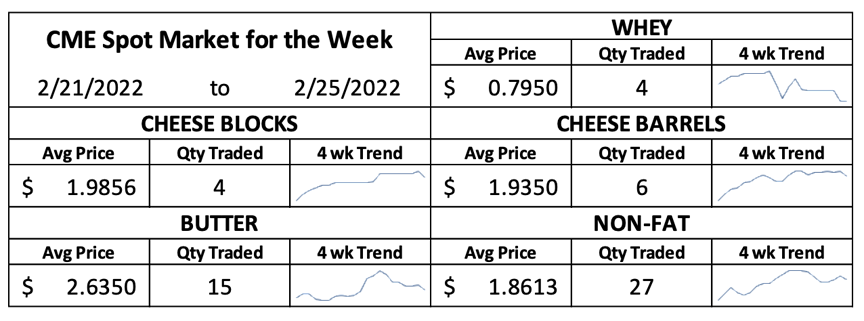
There is plenty of cheese, but the supply of Cheddar fresh enough to sell in Chicago is tight, which has helped to support the spot markets. Cheddar blocks traded above $2 per pound yesterday, but they fell back today to $1.945, down 4.25ȼ this week. Barrels slipped 3.5ȼ to $1.90.
There were 221.3 million pounds of butter in refrigerated warehouses at the end of January, onethird less than the unusually high volumes in storage a year ago, when foodservice sales struggled and butter piled up. Butter stocks grew just 3 million pounds from December to January, the smallest January increase since 1998. The combination of pricey cream, expensive freight, and staffing issues weighed heavily on churn rates last month, and it shows. But buyers are fatigued with sky-high prices, and they took a step back this week. CME spot butter fell 10.25ȼ to $2.5875.

CME spot whey slipped 3ȼ this week 78ȼ. Staffing issues are disrupting production, but inventories are starting to grow, as exports fall back in the face of high prices. Domestic buyers also seem a little more hesitant to purchase whey above 80ȼ. After a five-month march straight uphill, the whey market seems to have found the peak.

News of slower milk output spurred the milk powder markets upward once again. Spot nonfat dry milk (NDM) closed today at $1.86, a penny higher than last Friday. Labor issues are limiting dryer capacity at the margins. U.S. NDM is a bargain compared to European or Oceanian skim milk powder, and exports remain strong.

The milk markets moved sharply higher on the heels of the bullish Milk Production report. April and May Class III and May Class IV futures settled 75ȼ in the green on Thursday, at their daily trading limits. But today the screen was red. Upon further reflection, dairy traders decided that most of this news was already factored into the lofty dairy markets, and a broad selloff in commodities didn’t help matters. Bulls must be fed daily, and when milk is already well north of $20 per cwt., they require a feast before they are ready to push prices higher still. With heavy losses on the front of the board today, March through May Class III futures lost ground this week. But deferred Class III futures and most Class IV contracts added another 30 to 50ȼ. Class III is hovering in the $21 to $22.50 range. Nearby Class IV contracts traded north of $24 and briefly touched the $25 mark.

Russia attacked Ukraine, and their barbarism rocked the grain markets. Last year, Russia and Ukraine together accounted for 29% of global wheat exports. Russia doesn’t export much corn, but Ukraine has made huge strides in corn production over the past decade, and it contributed 17% of world corn exports last year. Ukraine still holds a lot of the corn it harvested in the fall. Exporters have already moved most of last season’s wheat offshore, but global wheat stocks are extremely low, and the world needs every bushel. Fears that war in Ukraine would disrupt exports, destroy crops, prevent the winter wheat harvest, or hamper spring sowings sent the grain markets soaring. Wheat went limit-up yesterday, climbing 50ȼ to $9.3475 per bushel, the highest price since 2008. But both wheat and corn fell quickly from the highs today. Under expanded trading limits, May wheat dropped 75ȼ to $8.5975. May corn closed today at $6.5575, well off the intra-week highs but up 3ȼ from last Friday.

The oilseed markets had a wild week as well. May soybeans closed today at $15.845, down more than 10% from the high set just yesterday. For the week, beans lost nearly 20ȼ. May soybean meal finished at $442.70 per ton, down $3 from last Friday.

Original Report Located At: https://www.jacoby.com/market-report/global-milk-output-shrinks-and-deficits-get-bigger/

Less milk, Ukraine conflict driving dairy prices up

Global dairy prices continue to break records.

The overnight Global Dairy Trade (GDT) auction saw another solid rise in prices across all products offered on the platform.

RaboResearch senior agricultural analyst Emma Higgins says lower milk production and fall-out from the Ukraine conflict are pushing prices further up.

Whole milk powder prices jumped 5.7% to US$4757/MT; skim milk powder prices rose 4.7% to US$4481/MT.

Butter, cheese and anhydrous milk fat (AMF) also recorded price rises; cheddar prices rose a whopping 10.9%.

Butter, AMF and Cheese prices have pushed higher into unchartered territory.

“This morning’s GDT auction saw soaring prices for dairy commodities, propelled by dwindling milk supplies, market uncertainty around the fall-out from the Ukraine crisis and ultimately what the combination will mean for global dairy trade,” says Higgins.

She notes that the milk supply situation in several key export regions continues to deteriorate. New Zealand milk production was down 6.1% year-on-year (YOY) in January 2022, while US milk flows took a hit of 1.6% YOY in the same period too.

The Ukraine conflict is also making markets nervous.

Higgins says although the physical fighting in Ukraine is localised, the effects of war will be far reaching and have a ripple effect on global communities and economies.

“Clearly it will be the Ukrainian and Russian people who will pay the most – be it physically, psychologically or economically. Still, we must consider the flow-on implications for global markets, and potential reverberations for our food producers.”

Russia and Ukraine are significant players in global trade of major commodities: grains, energy and metals. Combined, both countries are major exporters of grain (24% of global wheat, barley, corn), oil (5% of crude oil), natural gas (35% market share in Europe) and raw materials for fertiliser manufacturing (23% of world ammonia; 17% of potash; 14% of urea; & 10% of phosphates). 

“These commodities are being swept up in the fighting – either physically or via the results of crippling sanctions on Russia.

“Rabobank anticipates more upside to come for global prices of grain, oil, natural gas and fertiliser over time. The flipside is that we also expect the same for food prices and inflation.”

Source: ruralnewsgroup.co.nz

Butter sets new records as milk futures pass $23 mark at the CME

On the Chicago Mercantile Exchange milk futures pushed past the $23 mark as improving prices globally and gains in butter continue to carry markets. Class III milk prices increased across the board. March milk tacked on 21 cents to $22.26/cwt. April milk surged 36 cents to $23.11/cwt. May settled 57 cents higher to $23.01/cwt. Class IV also was higher. April milk added 30 cents to $25.10/cwt. May rallied 43 cents to $24.95/cwt.

In the CME Spot Dairy Auction, Blocks up $0.04 at $2.03. One sale was made at that price. Barrels unchanged at $1.9350. Seven trades were made from $1.9350 to $1.9450. Butter up $0.0625 at $2.6925. Seven trades were made from $2.6925 to $2.70. Nonfat dry milk up $0.01 at $1.86. Two trades were made at $1.8575 and $1.86. Dry whey down $0.0075 at $0.7525. Two sales were made at $0.7525 and $0.7575.


Milk Futures Bullish Outlook Over $22

On the Chicago Mercantile Exchange milk futures started the week higher Monday following positive cash trade and USDA’s bullish outlook for 2022. Class III milk closed with a strong session as futures months were up 5 to 27 cents.  All months between March and September ended with a $22 handle in front of it.  Class IV was also in the green adding 10-30 cents.

In spot trade dry whey down $0.02 at $0.76. One sale was made at that price. Blocks up $0.0450 at $1.99. Two sales were made at $1.9650 and $1.99. Barrels up $0.0350 at $1.9350. Two trades were made at $1.9425 and $1.95. Butter up $0.0425 at $2.63. One trade was made at $2.5850. Nonfat dry milk down $0.01 at $1.85.

Fonterra opens up GDT to key investors

Fonterra is opening up ownership of its successful global dairy auction platform to two strategic partners.

The New Zealand’s Exchange (NZX) and the European Energy Exchange (EEX) are set to take an equal one-third ownership of Global Dairy Trade (GDT), launched by the co-op in 2008 and which has to date traded dairy products worth over US$30 billion.

The deal is subject to the approval of boards, clearance from European or any other relevant competition law authorities, and finalisation of transaction documentation. It is expected to be completed mid-2022.

Fonterra chief executive Miles Hurrell says the move to a broader ownership structure marks the next step in the evolution of GDT.

It further enhances the standing of GDT as an independent, neutral and transparent price discovery platform, giving it a presence in prominent internatinal dairy producing regions, and creating future growth opportunities, says Hurrell.i

“This is good news for our farmer owners, unit holders, and all dairy industry participants and is expected to lead to greater volumes being traded on GDT.

“It will bring more participants and transactions, stimulating further growth of risk management contracts available on financial trading platforms.

“We all know that dairy is one of the most volatile traded commodities,” he says.

“This partnership is another step in helping to manage this risk for everyone – from the farmer through to the customer at the end of the supply chain.

“A more liquid dairy-trading environment allows for the growth of financial tools which can be used by all participants to better manage price volatility.”

Hurrell says Fonterra’s focus has been about securing the best partners and that NZX and EEX share the co-op’s vision for a stronger, more liquid auction platform that benefits all involved.

Source: ruralnewsgroup.co.nz

Milk Futures Turn Higher on Volatile Reaction to Russia’s attack on Ukraine

On the Chicago Mercantile Exchange milk futures saw strong support Thursday supported by cash trade and volatile market activity following Russia’s attack on Ukraine. February Class III milk was up six cents at $20.95. March 49 cents higher at $22.51. April up 75 cents at $23.23. May 75 cents higher at $22.91. June through August 50 to 63 cents higher.

In spot trade dry whey down $0.03 at $0.78. Four sales were made from $0.78 to $1.7975. Blocks up $0.0275 at $2.0175. Barrels up $0.0150 at $1.95. Three trades were made at $1.9475 and $1.95. Butter up $0.0225 at $2.6625. Two trades were made at $2.6625 and $2.68. Nonfat dry milk up $0.0150 at $1.8750. Ten trades were made from $1.86 to $1.8750.

Milk Markets Turn Downward in Chicago Wednesday

On the Chicago Mercantile Exchange February Class III milk futures steady at $20.89.  March down 44 cents at $22.02.  April 38 lower at $22.48.  May through July contracts 3 higher to 18 lower.

In spot trade barrels down $0.02 at $1.9350. Butter down $0.01 at $2.64.  Five trades, ranging from $2.64 to $2.6475. Nonfat dry milk up $0.01 at $1.86.  Twelve trades with a range of $1.85 to $1.8650. Dry whey unchanged at $0.81.  Blocks steady at $1.99.


Class III Milk Traders Higher to Start Holiday Shortened Week

On the Chicago Mercantile Exchange  milk futures started the holiday-shortened week in mixed trade Tuesday ahead of a mixed cold storage report. Class III milk prices were mainly higher throughout 2022.  July and August 2022 led market strength adding 13 cents/cwt each.  Class IV ended mostly even to 30-40 stronger in Q4 2022. 

 The CME spot dairy auction trade saw dry whey unchanged at $0.81. Blocks up $0.0025 at $1.99. Three sales were made at that price. Barrels up $0.02 at $1.9550. One trade was made at that price. Butter down $0.04 at $2.65. Six trades were made from $2.6325 to $2.65. Nonfat dry milk unchanged at $1.85.

USDA released their monthly Cold Storage report on Tuesday and total natural cheese again set new monthly records while butter stocks dropped by a third. Cheese stocks during January were up slightly on the month and three percent on the year at more than 1.4 billion pounds. Butter inventories were up 11 percent from the previous month but down 33 percent from last year at 221 million pounds.

Dairy Defined: Inflation is Hot. Dairy Stays Cooler.

It will come as no surprise to anyone reading this that inflation’s eating away at pocketbooks. The most recent Consumer Price Index is reporting the fastest retail price increases in costs in 40 years, with a hot economy and tight supply chains pushing up everything from cars to coffee.

And when consumers (and media outlets) focus their frustration, it tends to be on the prices that are most widely noticed. Gasoline’s the best example – what other product routinely posts its price on big signs next to highways? A gallon of milk is another one – when you’re in 94 percent of households, you can safely assume that a big part of the consuming public knows exactly what milk costs – and notices when it rises.

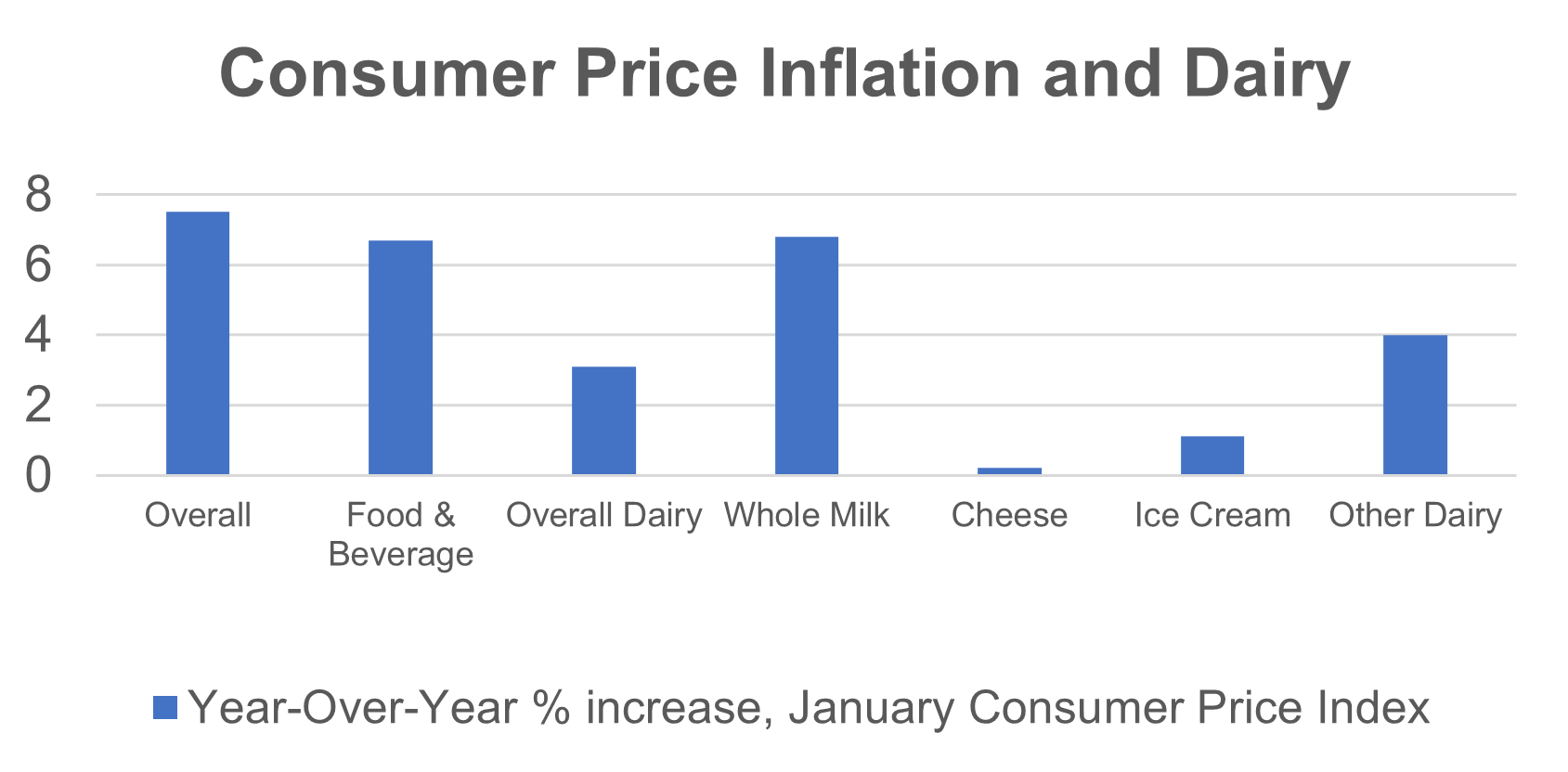
But before you pass unfair judgment on a jug of liquid goodness, a chart:

This is the most recent year-over-year Consumer Price Index covering overall inflation, food and beverage inflation, and dairy categories. A gallon of whole milk (the most popular variety in a jug) is going up, but it’s in line with other foods and beverages and lower than overall inflation. Subcategories fare even better. Cheese costs to consumers have barely budged. Ice cream remains an affordable (and relative to other categories, becoming even more so) treat. And yogurt, butter, et. al remain a compelling choice of affordable, high-quality nutrition for households.

So what’s going on with the inflation gap? A few things. Dairy supply chains tend to be more local and predominantly domestic, meaning some factors driving price gains in imported goods don’t apply. Dairy farmers have also done a great job of keeping markets adequately supplied, even in a year of record dairy export sales.

But whatever the reasons — if you’re frustrated with your grocery bill, dairy’s a place to find value. Dairy farmers are doing their part in keeping food prices under control. So much so, in fact, it might be worth slowing down a little bit the next time you’re pushing your cart past the dairy case. You might just want to take advantage of the opportunity dairy provides to nourish your family, without emptying your wallet. That’s not to be taken for granted these days.

Source: NMPF

NZ’s a2 Milk profit halves on China slowdown

The company expects sales to pick up in the second half of the year

New Zealand’s a2 Milk said on Monday its first-half profit halved as sales of its infant milk formula product continued to fall in China, but forecast second-half revenue to be significantly higher than a year ago, reported Reuters.

The firm reported first-half net profit after tax of NZ$56.1 million ($37.54 million), down from NZ$120 million a year ago.

The hit to its Chinese market stems from coronavirus-induced supply disruptions to its “daigou” channel, a reseller network where people outside China buy a2’s products and ship them to Chinese consumers informally.

That, along with contracting market share in China owing to declining birth rates, has caused a2 Milk shares to plunge more than 60% from pre-COVID-19 levels, reportedly making it a target for Canadian dairy firm Saputo Inc.

A2 said it expects sales of its Chinese label and English label infant milk formula products to pick up in the second half of the year, with inventory levels expected to improve, driving revenue growth.

However, it said it does not expect this sales growth to translate into higher profit, as it plans to spend more on its expansion strategy and it is also battling rising costs.

Source: Reuters

Milk Futures Correct Course and Close Higher in Chicago Thursday

On the Chicago Mercantile Exchange Milk futures turned course Thursday back higher supported by continued strength in cash markets. Class III milk futures were higher on the day. March milk settled 4 cents higher to $22.35/cwt. April milk progressed 16 cents to $22.79/cwt. Class IV milk futures saw weakness in the near term with butter and NFDM trading lower.

On the CME spot dairy trade blocks up $0.0050 at $1.9875. Barrels up $0.0150 at $1.9350. Seven trades were made from $1.9175 to $1.9350. Butter down $0.011 at $2.69. Six trades were made from $2.69 to $2.73. Nonfat dry milk down $0.02. at $1.87. Dry whey unchanged at $0.81. Three sales were made from $0.81 to $0.8175.


Milk Markets Give Back Early Gains in Chicago Wednesday

On the Chicago Mercantile Exchange Milk futures fell off their positive streak Wednesday while cash markets also closed lower.  Class III struggled to fight a spot market all in red. February down 5 cents to $20.75, March down 66 cents to $22.31 and April down 50 cents to $22.71. The balance of 2022 down 10-58 cents. Class IV also gave back some gains. February was unchanged at $23.90, but March fell 23 to $24.75, and April fell 28 to $24.77.

CME spot trade has been on a yo-yo this week with previous gains giving back Wednesday. Dry whey down $0.0025 at $0.81. One sale was made at that price. Blocks down $0.0075 at $1.9825. Three trades were made from $1.9650 to $1.9925. Barrels down $0.03 at $1.92. Three trades were made at $1.92 and $1.9225. Butter down $0.06 at $2.80. Seven trades were made from $2.80 to $2.8625. Nonfat dry milk down $0.01 at $1.89. One sale was made at that price.

Dairy Markets Remain in Flux

The T.C. Jacoby Weekly Market Report Week Ending February 11, 2022

Buyers and sellers jockeyed to exert their influence on the trade. The action in the cheese markets was relatively subdued, however important movements in the nonfat dry milk, whey, and especially butter markets, kept observers on their toes.

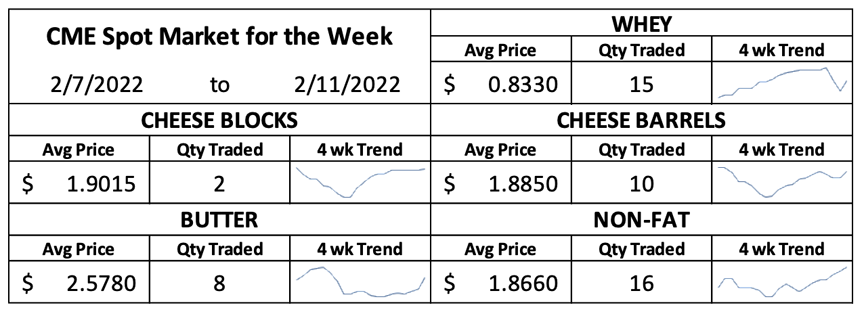
The dairy markets remained in flux this week as buyers and sellers jockeyed to exert their influence on the trade. Following a few weeks of big swings, the action in the cheese markets was relatively subdued. However, important movements in the nonfat dry milk, whey, and especially butter markets, kept observers on their toes.

Against a backdrop of struggling global milk production, sustained interest from international buyers is one of the key factors that worked to keep markets tight in recent months. U.S. exporters rose to the challenge of meeting global demand in 2021, setting records in the process. Last year, U.S. exporters shipped 5.936 billion pounds of dairy products valued at $7.7 billion abroad. This represented a record in both volume and value terms, and bested prior year levels by 10.4% and 19.1%, respectively. Exports to China totaled 966.7 million pounds during the year, an increase of 28.6% versus 2020. At 1.286 billion pounds, shipments to Mexico, the largest trading partner of the U.S., were up 16% versus prior year but failed to beat the record 1.349 billion pounds set in 2018.

Despite the annual performance, however, December’s exports were lighter than prior year, suggesting that port congestion and supply chain complications limited exporters’ ability to move product during the month. At 416.3 million pounds, December dairy exports were down 2.6% versus December 2020, representing the first year over year decline since January.
Seemingly tuckered out by swings in prior weeks, the CME Cheddar block market remained unchanged between Monday and Thursday before adding a modest .75¢ during Friday’s trade to end the week at $1.9075 per pound. Barrels demonstrated a bit more zest, losing just over a nickel during the first half of the week before bouncing back. Friday’s trade closed at $1.91 per pound, up 1.5¢ compared to last Friday and inverting the block barrel spread. Demand is reportedly chipper, particularly from retail channels as consumers gear up for this weekend’s Superbowl. In addition, the pull from international customers remains robust. Cheese exports were formidable in December, due to particularly strong demand from Mexico. At 68.4 million pounds, total cheese exports were up 20.1% year over year, and lifted cheese exports for the year to 892.1 million pounds, over 80 million pounds more than the prior record set in 2014.

There was more excitement on the other side of the Class III complex. Following weeks of unfettered upward movements, the CME dry whey price notched a new high of 86.75¢ per pound on Tuesday before dropping 4¢ on Wednesday and another 3.75¢ on Thursday. Following these declines, the first seen this year, the whey price was down to 79¢ per pound. Tempted by the lower prices, buyers moved back into the market on Friday, pushing the price up 3.25¢ as 6 loads traded hands. Ultimately dry whey ended the week at 82.25¢ per pound, down 3.5¢ compared to last Friday with 15 loads trading hands. Higher prices are reportedly eating away at international demand. December’s exports of all whey products were down 22.8%, due to waning appetite from China. Exports of whey protein concentrates (WPC) dropped considerably during the month. At 18.2 million pounds, WPC exports were the weakest they have been in any month since January 2019.

Yet the movement in dry whey was no match for the action in the butter markets. Following the sharp descent seen in late January, the CME spot butter price had seemed to find balance, trading within a 12.5¢ range between January 26 until Thursday. However, butter buyers found their way to LaSalle today, pushing the butter price up by 17.75¢ in a single session with 3 loads trading hands and 10 bids remaining on the board when the session closed. When the dust settled, the butter price closed the week at $2.755 per pound, up 25.5¢ versus a week ago. The spot result is somewhat surprising considering that cream is ever more available while demand is mixed. Churns however, continue to cite labor and logistical challenges that are constraining production.

Similar complications are plaguing dryers. In particular, a scarcity of truckers is preventing the smooth movement of condensed skim from one region to another. International demand persists but little progress has been made resolving port congestion that is slowing exports. December exports of nonfat dry milk (NDM) totaled 127 million pounds, down 3.9% year over year and the lowest monthly result since February 2020. Despite December weakness however, U.S exporters shipped 1.968 million pounds of NDM during 2021, an increase of 10.4% over last year’s record volume. Strength persisted in the spot market as well with the price moving upward in four of the week’s trading days. Spot NDM finished the week at $1.8975 per pound, up 6.5¢ with 16 loads trading hands.

While winter weather persists across the country, conditions have generally been milder over the past week with snow and ice no longer causing major disruptions. Reports on milk availability have been mixed but continue to be clouded by a lack of truckers and hauling capacity that is preventing loads from being easily moved across the system. Bottling demand has been robust as schools are back in session which has tightened up milk supplies for manufacturing uses. Class III milk futures markets generally moved upward over the course of the week and by Friday the MAR22 contract through the JLY22 contract all settled above $22 per cwt. Class IV futures also saw green over most of the week and especially on Friday, emboldened by

butter’s big move. MAR22 through MAY22 Class IV contracts settled on Friday above $24.50 per cwt.
USDA’s World Agricultural Supply and Demand Estimates report, released Wednesday, left the U.S. corn balance sheet unchanged while only increasing the crushing forecast slightly on the soybean balance sheet. However, USDA did cut its expectations for South American production to reflect the impact of dry weather. USDA reduced its soybean production estimate for Argentina from 46.5 million metric tons (MMT) to 45 MMT. Meanwhile it slashed its expectation for Brazilian soybean production by 3.6% from 139 MMT to 134 MMT. While significant, these cuts were less than what was expected by the trade. Nevertheless, futures prices continued to move upward.

Original Post 

Mixed Markets Tuesday in Chicago

On the Chicago Mercantile Exchange milk futures ended the day mixed with mostly higher cash markets and strong global trade. February Class III milk was down two cents at $20.80. March 16 cents higher at $22.97. April down four cents at $23.21. May 14 cents higher at $22.64. June through August one to 15 cents lower.

In spot trade dry whey was down $0.03 at $0.8125. Blocks up $0.0750 at $1.99. Three trades were made from $1.94 to $1.99. Barrels unchanged at $1.95. Butter up $0.0750 at $2.86. Ten trades were made from $2.82 to $2.86. Nonfat dry milk unchanged at $1.90. Two sales were made at that price.

Today’s Global Dairy Trade event 302 concluded with the GDT Price Index 4.2% higher. Butter was 5.1% higher to $2.96/lb (US equivalent adjusted to 80% fat). Cheddar Cheese jumped 3.5% to $2.67/lb on aggregate. Whole Milk Powder was up 4.1% to $2.04/lb. Skim Milk Powder surged 6.0% to $1.95/lb.

Milk Markets Kick Off Week Higher in Chicago

On the Chicago Mercantile Exchange milk futures kicked off the week mostly higher crossing into $23 territory as cash markets remain positive. February Class III milk was up two cents at $20.82. March 13 cents higher at $22.81. April up 31 cents at $23.25. May four cents lower at $22.50. June through August two to seven cents lower.

In spot trade, dry whey up $0.02 at $0.8425. Five sales were made from $0.8050 to $0.8225. Blocks up $0.0075 at $1.9150. One trade was made at $1.91. Barrels up $0.03 at $1.95. Four trades were made from $1.92 to $1.95. Butter up $0.03 at $2.7850. Four trades were made from $2.7725 to $2.7825. Nonfat dry milk up $0.0025 at $1.90. Three sales were made at that price.

U.S. dairy exports set multiple records in 2021

But three big headwinds for 2022 warrant caution in expecting another year of double-digit growth.

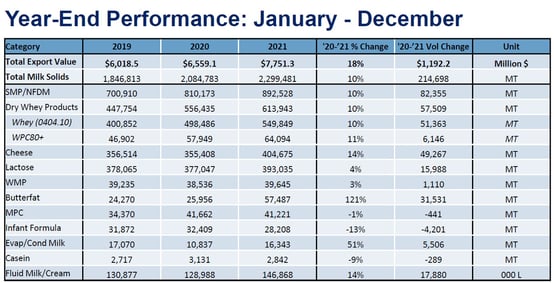
In December, U.S. dairy export value rose 17% even as year-over-year volume fell 4% for the month. Cheese exports, particularly to Mexico (+17%, +1,239 MT), starred during the month, posting a healthy gain of 20% (+5,204 MT). But flat milk powder volume and a significant decline in whey shipments in December provided a low-key finish to what turned out to be the best year ever for U.S. dairy exports.

An overall rebound in exports to Mexico and a sharp increase in whey and milk powder to China led widespread gains across products and geographies in 2021. With the December numbers now published, we see that U.S. dairy exports secured record highs in many key metrics and in the largest export categories:

  • Total U.S. dairy export VOLUME grew by 10% (+214,698 MT MSE) over 2020 to reach 2.3 million metric tons of milk solids (MSE) shipped to overseas customers;
  • Total U.S. dairy export VALUE surpassed the highs of 2014 to reach $7.75 billion in 2021, an 18% increase year over year;
  • Cheese volumes also beat the 2014 record with a final total of 404,675 MT (+14%, +49,267 MT);
  • NFDM/SMP built upon a successful 2020 (the previous record) and grew an additional 10% (+82,355 MT) to set a new record; and
  • Whey exports – in both high- and low-protein varieties – reached new levels with 613,943 MT of whey products exported in 2021, also a gain of 10% (+57,509 MT).

Chart5-1

More data and graphs from the latest trade data report can be found here. 

There were multiple other records and success stories in the full-year data – whether broken down by market or product – that you can read more about in our press release. 

Indeed, by all metrics, 2021 was a tremendous success for U.S. dairy exports.

What then does 2022 hold? Is a third year in a row of double-digit growth possible? To this analyst’s eyes – yes, it’s possible, but it certainly won’t be easy.

First, in 2021, U.S. dairy exporters managed to find success despite substantial headwinds from logistics. Lack of trucking availability, shortages of equipment and containers, carrier companies ignoring export orders for blank loads and, most recently, declining productivity at ports, have all taken their toll on U.S. exports – even though U.S. exports have clearly been positive.

Slower delivery times, higher shipping costs, unexpected fees and reputational damage all hurt U.S. exporters in key markets overseas and continue to limit the ability of U.S. dairy exports to reach their full potential due to lost sales, weaker returns, higher expenses, or all the above.

As we look to 2022, we expect many of these headwinds to remain – even as USDEC staff and policymakers look to find ways of easing the burden.

Fundamentally, labor issues at ports and lack of trucks to move product off crowded docks has limited the throughput of container vessels even as plenty of ships wait to be unloaded. Additionally, carrier companies continue to eschew containers filled with U.S. dairy products for empty ones. Given that the sharp price differential of Asia-to-U.S. freight rates compared to U.S.-to-Asia is expected to continue (driven by U.S. goods consumption), the practice of favoring empties will likely persist absent regulatory or legislative steps to tackle it head-on.

Chart1 (2)-Feb-08-2022-10-06-21-72-PM


Second, slower-than-average U.S. milk production could limit product availability for export in the short term – even if overseas demand for U.S. dairy is plentiful.

In both 2020 and 2021, U.S. dairy exports grew by twice as much as domestic sales. However, it is worth noting, the supply environment was substantially different with milk production growing by 1.9% in 2020 and 1.7% in 2021.

For 2022, slower growth in milk production (and thus dairy product production) combined with the usual expansion of domestic consumption, as well as port congestion adding costs to exporting, will likely mean fierce competition to secure product. Certainly, exports will be a key component of that demand picture regardless of the short-term supply forecast, but more U.S. demand to satiate makes double-digit export growth challenging (but again, not impossible).

Chart2 (2)-Feb-08-2022-10-07-13-08-PM


I do want to point out that we remain incredibly bullish about the U.S. having a clear opportunity to be the growing dairy supplier to the world. U.S. milk production growth should return to above 1% by the second half of 2022. And in the longer term, underlying supply-demand fundamentals, a supportive investment and policy environment and U.S. dairy’s commitment to international customers all signal long-term export growth potential. But short-term tightness in the market is likely to create headwinds to substantial growth in the near term.

Finally, on the data side of things, year-over-year comparisons to 2021 data will be strong across most major markets and products.

Perhaps the data-geekiest point, U.S. exports will be trying to match a record year with no laggards by market or product that would suggest low-hanging opportunities for booming volumes. Trade to all our major markets except New Zealand grew year-over-year, and all of the United States’ primary export products (along with most of the secondary ones) grew by double digits in 2021.

This final point is in sharp contrast to the comparisons used in 2020 and even 2021 as there were substantial opportunities in several markets. In 2020, U.S. exports to Southeast Asia had significant untapped potential after European intervention SMP flooded into the market at below-market prices the year prior. Additionally, the U.S.-China Phase I Agreement re-opened the door for U.S. dairy exports into the country in January 2020. By 2021, there was still plenty of opportunity to recapture market share in a booming Chinese market, particularly post-African Swine Fever, and Mexico’s import demand was sharply recovering after suffering from the worst of the COVID-19 pandemic in 2020.

To be 100% clear, there remain plenty of opportunities for growth in U.S. dairy exports. Demand is expanding around the world and competitors are struggling to keep up. But unlike the past two years where volumes were boosted by recovery in several key markets, 2022 growth will need to be built exclusively by new business.

Ultimately, even as export growth faces challenges in the short-term keeping up this record-setting pace, we believe U.S. dairy is still set up for long-term, sustainable success in growing export volume and value.

(For more information on our expectations of 2022, check out Part I and Part II of our recent “signpost” article, breaking down the key factors to influence global dairy consumption and trade in the year ahead.)

Source: USDEC

Milk Markets Mostly Higher in Chicago Thursday

On the Chicago Mercantile Exchange milk futures were modestly higher Thursday as a supportive supply and demand report kept trader optimism throughout the day. February Class III milk was up eight cents at $20.74. March seven cents higher at $22.11. April up four cents at $22.55. May a penny lower at $22.19. June through August three to eight cents higher.

In spot trade, dry whey down $0.0375 at $0.79. Three sales were made from $0.79 to $0.81. Blocks unchanged at $1.90. Barrels unchanged at $1.8575.  Butter up $0.0450 at $2.5775. Nonfat dry milk up $0.0125 at $1.88. Two sales were made at $1.8725 and $1.88.

Milk Futures Mostly Higher in Chicago Wednesday

On the Chicago Mercantile Exchange milk futures were mostly higher Wednesday while cash trade was mixed following a supportive supply and demand report.  Class III milk had February fall 3 cents to $20.66, but March jumped 36 cents high to $22.04, April followed, gaining 62 cents to $22.51 and May was up 50 cents to $22.20/cwt. Class IV milk was unchanged in February and March, but April climbed 49 cents to $24.25 and May up 10 cents to $23.64/cwt.

The CME spot trade was mixed with  Dry whey down $0.04 at $0.8275. Four sales were made from $0.8275 to $0.8575. Blocks unchanged at $1.90. Barrels down $0.0325 at $1.8575. One sale was made at that price. Butter up $0.0250 at $2.5325. Nonfat dry milk up $0.0225 at $1.8650. One sale was made at that price.

Mixed Markets Mark the Day Monday at the CME

On the Chicago Mercantile Exchange milk futures ended mixed Tuesday with turnaround trade and mixed cash markets. Class III milk futures were lower on the day. February decreased 11 cents to $20.69/cwt. March milk slide 26 cents to $21.67. 2022 class IV milk futures were higher on the day. March did not trade on the day. April traded just 9 times to $23.76/cwt. June and July traded around 50 times each.

In the CME spot dairy auction, dry whey up $0.01 at $0.8675. Two sales were made at $0.8650 and $0.8675. Blocks unchanged at $1.90. Barrels down $0.02 at $1.89. Two trades were made at $1.89 and $1.9125. Butter down $0.01 at $2.5075. Five trades were made from $2.49 to $2.2575. Nonfat dry milk down $0.0025 at $1.8425. Three trades were made at $1.8425 and $1.8450.

Milk Futures Push Higher to Start the Week in Chicago

On the Chicago Mercantile Exchange  the return of the butter market helped push milk futures higher. Class III closed with March milk up 27 cents to a value of $21.88/cwt.  April also jumped 30 cents and crossed the $22 handle while May rallied 42 cents, and June was 30 higher.  The second half of 2022 traded 8-31 cents stronger.  The Q2 2022 period is offering $21.96/cwt whereas the 2nd half is at $21.10/cwt.  Class IV markets ranged anywhere from even to 30 cents stronger in 2022. 

Product prices were firmer on Monday as well.  Barrels up $0.0150 at $1.91. Butter up $0.0175 at $2.5175. Nonfat dry milk up $0.0125 at $1.8450. Six trades were made from $1.84 to $1.8450. Dry whey unchanged at $0.8575. Blocks unchanged at $1.90.


Dairy Market Report January 2022

Dairy markets are in a very different situation than almost any experienced since 2014.

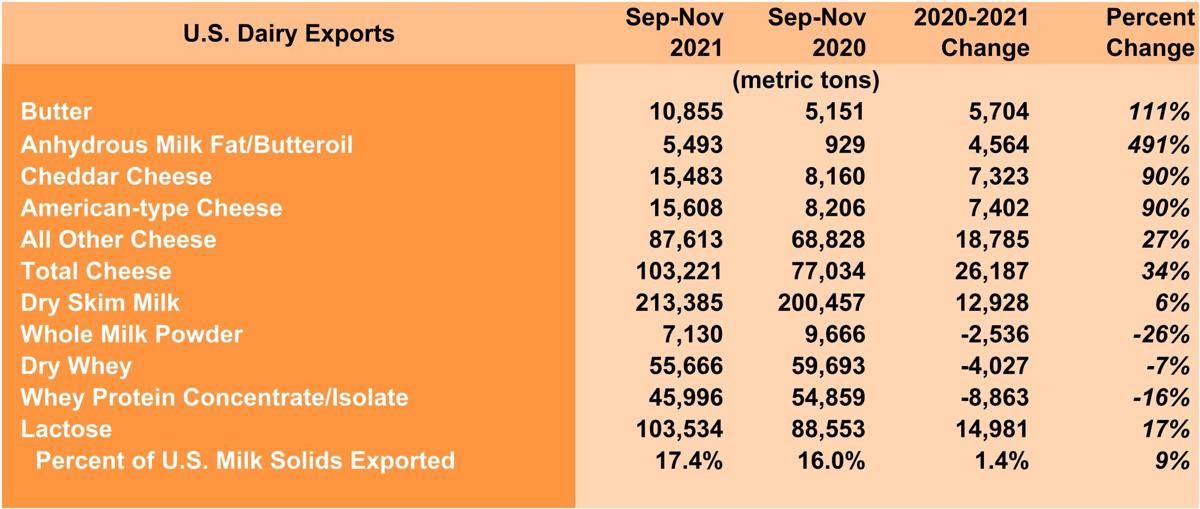
The dominant features of the basic U.S. dairy situation continue to be tighter milk production, record export volumes, increased prices, sluggish domestic consumption and decreasing inventories. Total dairy cows and total milk production in the United States were both less than a year earlier during the September-November rolling quarter. December prices for nonfat dry milk and dry whey were the biggest monthly prices since 2014. They, as well as December butter and cheese prices, were among the most observed during all months since the beginning of the year 2000. The long period of difficult market conditions – from 2014 until recently – constitutes a major reason for the production contraction that’s driving the current situation.

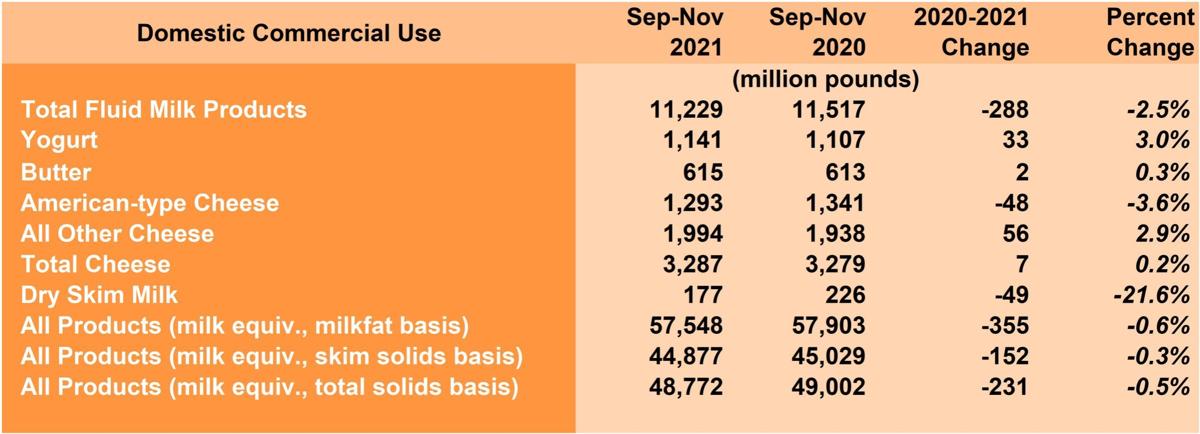
Commercial Use of Dairy Products

Growth in total commercial use of milk in all dairy products in all markets, domestic and export, was positive for both milkfat and skim solids; it averaged about 1 percent during September-November. But that growth was due entirely to exports; domestic commercial use during that period decreased by about .5 percent from a year earlier. Fluid milk and American-type cheese were two key categories that showed reduced consumption in the United States.


U.S. Dairy Trade

The United States exported the equivalent of 17.6 percent of domestic milk-solids production during calendar year 2021 to date through November – a record by that measure for the first 11 months of any calendar year, the next most being 16.2 percent in 2020. Strong growth in exports of fats and cheese coupled with generally reduced exports of dried milk and whey products during September-November raises the question of how much those changes indicate a rebalancing of the preponderance of skim-milk products in the typical U.S. dairy-export mix. The answer is noticeably but minor.

During first-half 2021 exports of mostly skim-ingredient products, defined as those consisting of 70 percent or more skim-milk solids, accounted for an average of 85 percent of total milk solids exported. During July through November, that percentage decreased to 83 percent. The corresponding percentages of greater-fat products, defined as those with fat content of 20 percent or more, were 14 percent and 16 percent.

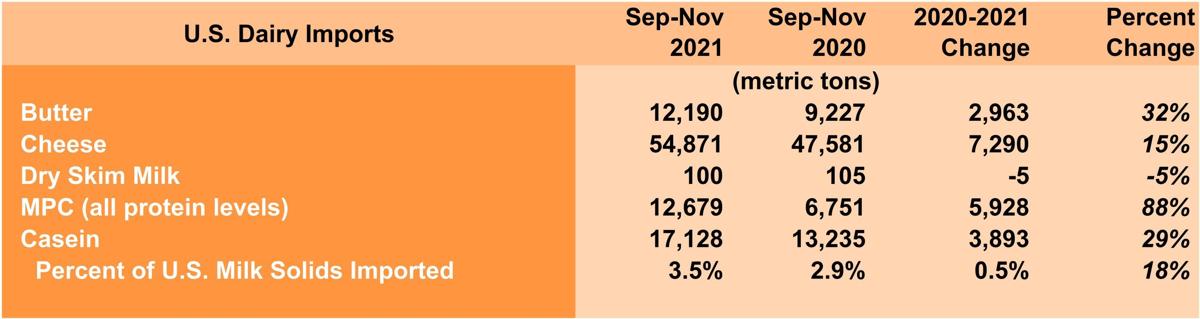
Exportable supplies of dairy products are becoming tighter among the world’s major export suppliers in Europe and Oceania, and world prices are increasing in response. But U.S. imports of the traditional key product categories of cheese and concentrated-protein products have increased significantly as U.S. domestic supplies tighten, prices increase and importers prioritize supplying the coveted U.S. market.


Milk Production

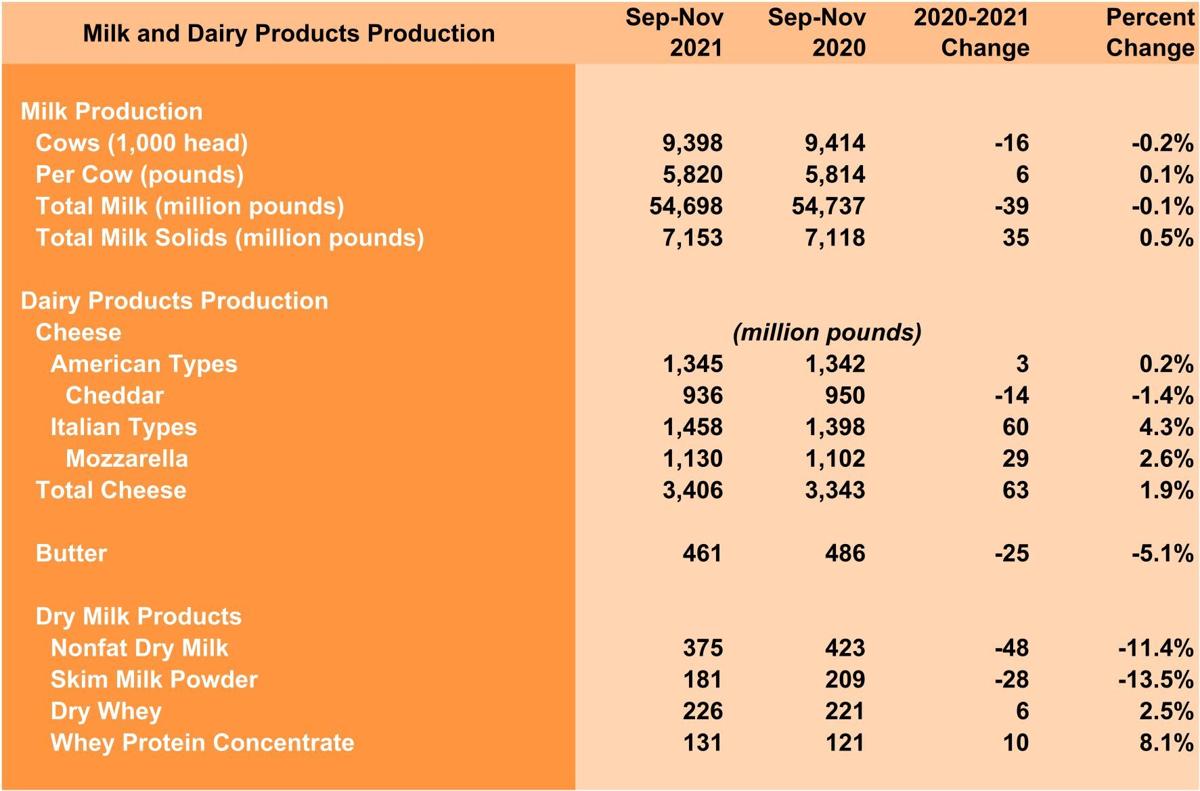
Milk production was marginally less, by .07 percent, from a year earlier, during the three-month period September through November. U.S. milk production has been steadily growing for decades. But production growth has actually been negative, on average, during one out of every six rolling three-month periods during the past two and a half decades. Reduced cow numbers were the driver for the latest decline; average cow productivity still showed a small increase. Milk-solids-production growth was unchanged from a month earlier in November, as reported by the U.S. Department of Agriculture’s Economic Research Service. The USDA’s National Agricultural Statistics Services reported year-over-year milk-production growth decreased well into negative territory that month.

Dairy Products

Although Cheddar-cheese production was less than a year earlier during September through November, growth during the period for most cheese and whey products contrasted sharply with marked declines in butter and dry-skim-milk products. Despite recent significant price increases for butter and skim-milk products, compared with more-modestly increased prices for cheese, available milk is still being preferentially routed to cheese and whey production.

Dairy-Product Inventories

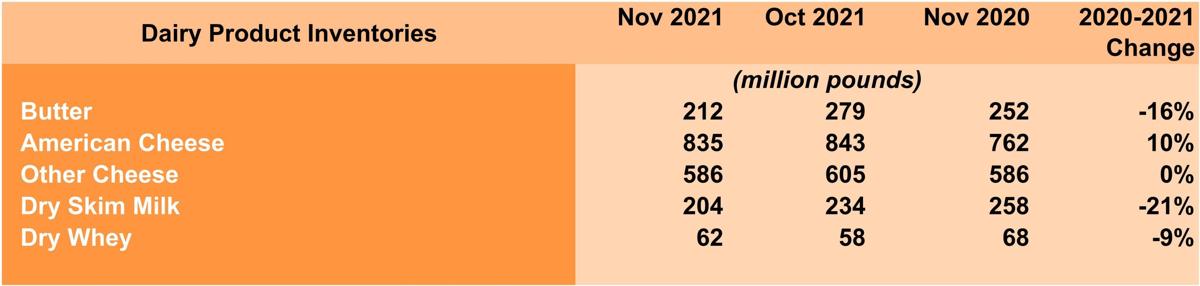
American-type cheese is the only major dairy-product category to show larger stocks than a year ago in November. Butter, dry skim milk and dry whey stocks were all less that month than a year earlier by mostly double-digit percentages, while stocks of other than American-type cheese were unchanged for the year. Compared to their year-over-year changes, November stocks were less by even larger percentages for almost all product categories when compared with their respective maximum levels during the intervening 12 months.

Dairy Product, Federal Order Class Prices

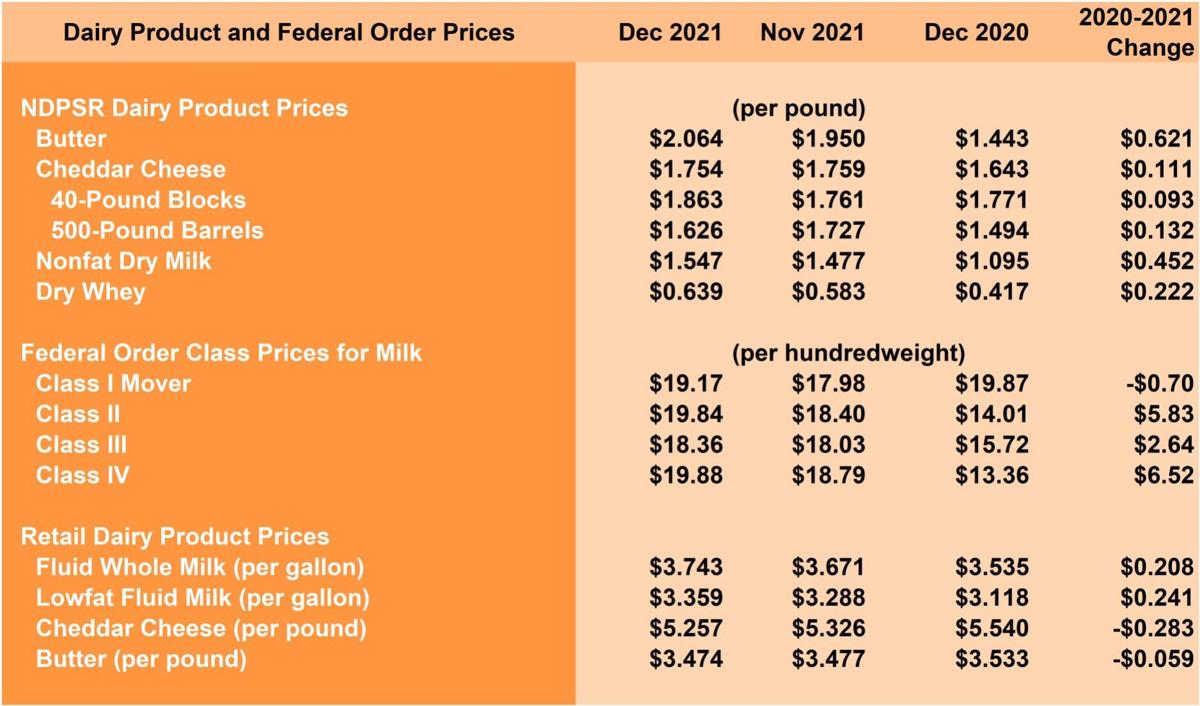
The monthly average National Dairy Products Sales Report survey price for block cheese increased by about a dime a pound from November to December, while the barrel-cheese price decreased by about the same amount. That left the overall cheese price essentially unchanged for the month. By contrast butter, nonfat-dry-milk and dry-whey prices increased significantly in December. Federal-order-class prices increased accordingly, with Class III increasing by only 33 cents per hundredweight; others increased by more than $1.

Milk, Feed Prices

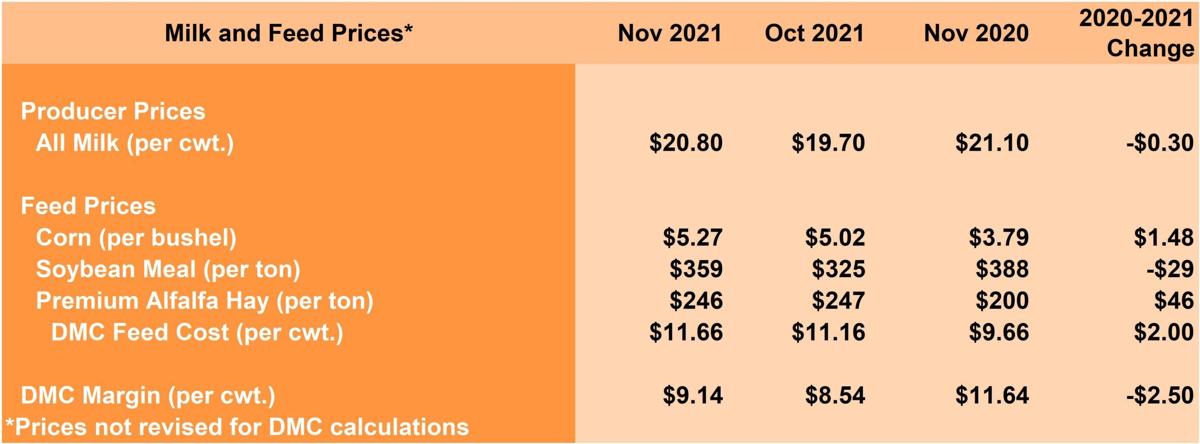
The November margin under the Dairy Margin Coverage program was $9.14 per hundredweight, an increase of $0.60 per hundredweight. from October. The all-milk price component of the November margin was $20.80 per hundredweight, $1.10 per hundredweight more than a month earlier. The November Dairy Margin Coverage feed cost was also more for the month, by $0.50 per hundredweight, almost equally from increased corn and soybean-meal prices. But prior to the November increase, feed costs had been generally decreasing since spring 2021. The November premium-alfalfa-hay price decreased slightly from a month earlier after increasing steadily almost every month since September 2020. Monthly corn prices had also increased steadily since September 2020 but decreased this past year during the harvest months of September and October before increasing again in November. Monthly soybean-meal prices have increased and decreased in 2021 but have remained well less than their level during the first quarter of the year since then. The USDA reported that, as of Jan. 18, a total of almost $1.2 billion was expected to be paid to 18,823 operations enrolled in the 2021 Dairy Margin Coverage program, for an average of more than $63,000 per enrolled operation.

Looking Ahead

The effects of the current rather-dramatic pullback in cow numbers and production on dairy-product production, stocks and prices has been marked. To no surprise, it’s causing much speculation about how long it will last. Dairy-futures markets signal the trend will last well into 2022. Futures as of mid-January indicated that the 2022-calendar-year average U.S. all-milk price would be about the same as the record $24 per hundredweight average that the price attained during the 2014 calendar year. USDA’s mid-January monthly forecast update predicts U.S. milk production will increase by just 0.7 percent this year from 2021’s estimated total of 226.2 billion pounds. At the same time, USDA increased its forecast for the 2022 U.S. average all-milk price by $1.85 per hundredweight from just a month earlier – to $22.60 per hundredweight – which is still about $1.50 per hundredweight less than the futures were indicating at that time.

Another record that will almost assuredly be set soon is the percentage of U.S. milk solids exported during an entire calendar year. With data for just the final month of December to be reported, U.S. exports this past year are on track to reach 17.4 percent of solids production, 1.4 percentage points more than the previous record by that measure the year before.

Source: 


Global Dairy Commodity Update February 2022

The EU’s contribution to any milk growt is under a cloud with high input costs and limited fertilizer supplies.

Commodity prices pushed higher in January-2022 as a weaker outlook for milk supplies in coming months due to the lack of NZ rainfall.

Fast-rising milk prices may restore margins for some producers, but cost pressures won’t ease quickly. Cow numbers in the US won’t steady and start to rise again until the 2nd half of the year, but herd reductions in the EU will likely persist in all cases other than Ireland.

Demand of dairy products has been supported by resilient domestic retail markets, while export activity, although disrupted due to logistical issues, has been close to pre-COVID levels.

Demand will be rationed at these high prices. Short-term trends may weaken with a likely pushback against strong prices where buyers have some coverage, but this is offset by a tightening supply base. China’s demand through the peak shipping period through Q1-2022 remains a critical feature of the outlook.

The spread of COVID infections remains a major challenge for the entire supply chain – reducing farm labour access, disruptions to factory operations and supply chains and limiting the ability to keep food service venues staffed. Consumers will continue to shun dining out in many regions, prolonging the uncertainty for the food service trade.

Weather will continue to play an important role as La Nina slowly recedes but leaving lingering dry conditions in NZ and South America.


Maxum Foods

Maxum Foods is one of Australia and New Zealand’s principal suppliers of dairy ingredients to the Human Health and Nutrition, as well as the Animal Nutrition industries. Maxum Foods specialises in supplying medium to large-scale food manufacturers with high-quality dairy ingredients such as milk powders, cheese and butter. Backed by top-level technical support and a huge dairy ingredient range, Maxum Foods have open global supply channels to source exactly what our customers need.

Milk Markets Turn Lower Chicago Thursday

On the Chicago Mercantile Exchange milk futures turned mostly lower Thursday as the back and forth of the week continues and cash markets had limited trade. February Class III milk was up 14 cents at $20.45. March 20 cents lower at $21.31. April down 21 cents at $21.39. May 19 cents lower at $21.30. June through August one to 17 cents lower.

In spot trade,  Barrels up $0.0125 at $1.8525. One trade was made at that price. Butter unchanged at $2.4525. Nonfat dry milk up $0.0125 at $1.81. Seven trades were made from $1.7950 to $1.81. Dry whey unchanged at $0.8575. Blocks unchanged at $1.88.


Dairy prices hit 8-year high at auction; milk payments to farmers could lift

Global prices for dairy products hit an eight-year high at auction, and futures market pricing suggests they could go higher yet. Dairy prices jumped at the global auction overnight to touch a fresh eight-year high, prompting speculation that forecast milk payments to farmers could hit new records.

The Global Dairy Trade price index rose 4.1 per cent to 1455, its highest level since February 2014. That followed a 4.6 per cent gain at the previous fortnightly auction.

The average price for whole milk powder, which has the most impact on what farmers are paid, gained 5.8 per cent to US$4324 (NZ$6394) a tonne, and is sitting 25 per cent higher than at the same time last year. Whole milk powder gained 5.6 per cent at the previous auction.

Fonterra, the world’s largest dairy exporter, last month lifted its forecast milk payment to farmers for this season to a record level as tight milk supply in New Zealand and overseas underpins demand. The latest strong auction result has prompted economists to speculate that milk payments could move higher still.

NZX dairy insights manager Stuart Davison said it was another “incredible” auction result, with prices lifting for all commodities on offer.

“Buyers recognise that global milk supply will continue to be constrained in the short term, while consumers continue to demand dairy.

“There is little doubt that a second 4 per cent plus auction result will push New Zealand farmgate milk price forecasts higher” and help buoy expectations for next season’s forecasts, he said.

“When looking at the futures forward curves of each dairy commodity, it would seem there are another few auctions of price gains yet to come, with some lofty expectations from the market yet,” he said.

STUFF

Fonterra factors in fat and protein levels in milk when buying it off farmers.

Fonterra last week lifted its forecast milk payment to farmers for this season to a record level of between $8.90 and $9.50 per kilogram of milk solids, which it expects will contribute $13.8 billion to the economy.

The midpoint of the range, which farmers are paid off, increased to $9.20 per kgMS, which would be the highest level since Fonterra was formed in 2001. The co-operative paid farmers $7.54 per kgMS last season, and its previous record was $8.40 per kgMS in the 2013/14 season.

Westpac senior agri economist Nathan Penny on Wednesday raised his forecast by 50 cents to $9.50 per kgMS, which is at the top of Fonterra’s range.

Penny lowered his forecast for New Zealand milk production as farmers have been hit by bad weather and surging costs. He now expects milk production to fall 3 per cent for the season, a bigger decline than his earlier prediction of a 1.5 per cent fall.

“This season, the weather has conspired to slam the brakes on New Zealand production,” Penny said. “First, winter and spring were either wet or cold or both in many parts of the country. Now, a dry summer, particularly in the Waikato, has added to the production woes.

“Moreover, with costs sky-high (including for feed) farmers don’t have the incentive to increase production that one might normally expect given the record-high milk price,” he said.

Penny expects Fonterra to pay $7.50 per kgMS next season.

suppliedWestpac senior agri economist Nathan Penny lifted his forecast for milk payments to farmers this season to the top of Fonterra’s range.

ASB economist Nat Keall lifted his forecast for this season by 15c to $9.25 per kgMS.

“Given the weak New Zealand growing conditions and the failure of overseas producers to offset softer local production, we concur with the market view that the supply outlook is likely to remain tight beyond the end of the season,” Keall said.

He expects farmers could be paid $8.80 per kgMS next season, lagging behind the futures market expectation of $9.38 per kgMS.

ANZ’s agricultural economist Susan Kilsby on Tuesday raised her forecast for this season by 50 cents to $9.30 per kgMS, and for next season by 40 cents to $8.40 per kgMS.

However economists have warned that farmers are also facing higher costs, which is taking some shine off the forecast for a record payment.

As the country’s biggest processor, Fonterra’s payment sets the benchmark for its competitors. But higher milk prices can also squeeze profit margins for processors unless they can sell their products at higher prices as well.

Economists have noted that when dairy prices reach such high levels, they become unaffordable for some consumers.

NZX’s Davison said buyers from North Asia bought the vast majority of whole milk powder at the latest auction, and South East Asian buyers increased their share, however African and Middle Eastern buyers were far less active.

“Buyers from regions outside of Asia were not as active as in the last handful of auctions, potentially being outbid by aggressive Asian buyers in a tight market,” he said.

“North Asian buyers dominating GDT auctions again is a great sign, highlighting that there is no sign of their demand easing in the short term,” he said. “North Asian buyers are more than willing to chase prices higher, to secure the product they need.

“The Asian market as a whole, both South East Asia and North Asia, remains the dairy market power house currently, and this auction confirms that both regions have demands that still need filling, even at current prices.”

However Davison said he is concerned to see low volumes purchased from Africa, which could show the market has hit a point of price sensitivity for the region, and other regions could also start to feel a similar pinch.

“African buyers are most likely unwilling to compete as prices rip higher,” he said.

Source: stuff.co.nz

FAO Dairy Price Index

The FAO Dairy Price Index averaged 132.1 points in January, up 3.1 points (2.4 percent) from December 2021, marking the fifth consecutive monthly increase, and placing the index 20.8 points (18.7 percent) above its value in the corresponding month last year. In January, price quotations for dairy products rose, with the steepest increases in skim milk powder and butter. The January increase was underpinned by a tightening in global markets, reflecting a reduction in export availabilities, especially from Western Europe, where a reported reduction in milk deliveries in some large milk-producing countries and lower stock levels supported prices. Expectations for milk production in Oceania to remain below its average levels in the months ahead added to the tightening in global dairy markets. In addition, milk processing and transportation delays due to COVID-19-related labour shortages further contributed to higher dairy prices.
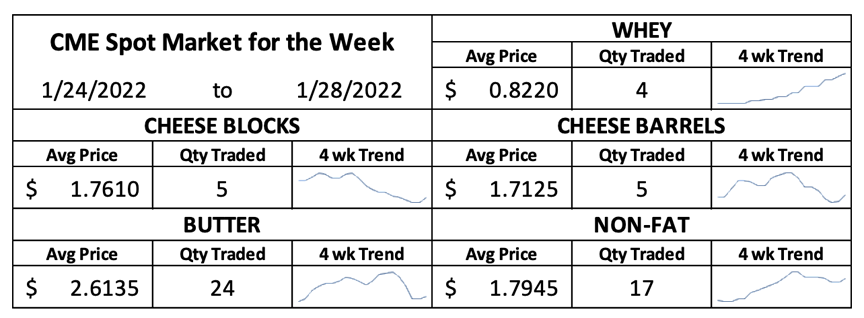


 

Class III Milks Shows Gains Across the Board in Chicago Wednesday

On the Chicago Mercantile Exchange milk futures did a reversal Wednesday to the higher side as position squaring and strong cheese markets continue.  Class III milk saw small gains across the board. February up 18 to $20.31, March up 16 to $21.51, and April up 11 to $21.60/cwt. The balance of the year unchanged to 16 cents higher. Class IV milk struggled with both butter and non fat slipping lower. February fell 15 to $23.45, with March down 39 to $23.74 and April off 34 to $23.15/cwt. The balance of the year was unchanged to 14 cents lower.

The CME spot trade saw dry whey up $0.0050 at $0.8575. One trade was made at that price. Blocks up $0.0225 at $1.88. Barrels up $0.0450 at $1.84. One trade was made at that price. Butter down $0.03 at $2.4525. Three sales were made from $2.4525 to $2.4675. Nonfat dry milk down $0.0125 at $1.7975. Nine trades were made from $1.7925 and $1.82. 

Volatility Reigns in the Dairy Markets

The T.C. Jacoby Weekly Market Report Week Ending January 28, 2022

Nearly every product lost ground at the CME as market participants challenged the high product prices seen in recent weeks. However, the butter markets really stole the show.

Milk production continues to trail prior year levels according to USDA’s Milk Production report, released on Monday. December output totaled 18.825 billion pounds, a decrease of 0.1% compared to the same month last year. A declining national herd continues to drive the contraction in milk supplies with cow numbers falling by 7,000 head between November and December. U.S. cow numbers have been shrinking since May. Totaling 9.375 million head for the month, December marked the smallest herd since August 2020. The evolution in milk supplies has been uneven across the country with major dairy states such as California, Wisconsin, Idaho, and Texas seeing volumes grow year over year in December, while supply restrictions in other states, such as New Mexico, have stymied output.

The decline in U.S. milk production mirrors the contraction seen in other global dairy supply regions. European production is trailing prior year levels with some of the greatest losses seen in major dairy nations like Germany and France. In the Southern Hemisphere, the New Zealand milk production season continues to disappoint with December output down 5% compared to prior year. Argentina is still posting strong production figures, but the volumes are modest and logistical challenges are preventing the resulting dairy products from making a dent in global demand. As such, global milk supplies are lacking and are generally expected to support prices at higher than historical levels over the coming months.

Back at home, despite lagging supply, volatility has reigned in the dairy markets. Nearly every product lost ground at the CME as market participants challenged the high product prices seen in recent weeks. However, the butter markets really stole the show. After hitting a multi-year high last Friday, butter more than erased last week’s gains by plummeting 44.5¢ between Monday and Wednesday. A modest recovery on Friday brought the price up to $2.54/lb., still 39.5¢ lower than last week’s price. 24 loads of b utter moved over the course of the week.

Butter demand has been robust from domestic and international sources though the recent price rally likely caused some buyers to step out of the market as they waited for prices to retreat. Butter is being pulled out of storage at a rapid clip to meet demand. USDA’s Cold Storage report, released on Monday, disclosed butter stocks of 199.1 million pounds at the end of December, down 11.4 million pounds versus November and reversing the typical seasonal trend. This is the first time in two years that butter stocks have dipped below 200 million pounds. While cream availability has eased somewhat, shortages of plant operators and truck drivers are preventing churns from running as hard as they might like.

On the other side of the Class IV complex, nonfat dry milk (NDM) markets also lost some ground over the week, though the dips were modest next to those of the butter market. Echoing the concerns of butter manufacturers, dryers report that condensed skim loads can be

found, but transporting them remains a challenge. The CME price for NDM retreated between Monday and Thursday before perking up on Friday. NDM prices finished the week at $1.8050/lb. a decrease of a penny versus prior week. The deterioration of the spot values for butter and NDM weighed on Class IV futures prices. Nevertheless, they remain strong by historical standard with JAN22 through MAY22 contracts settling on Friday at a minimum of $23/cwt., more than $1.50 above their Class III counterparts.

The cheese markets continued their slide this week though the degree of movement was less dramatic than last week. Cheddar blocks lost ground early on before moving up by 6¢ during Friday’s trade. Blocks closed the week at $1.79/lb., a 1.75¢ loss compared to last Friday. Barrels saw more pressure, giving up 7¢ over the course of the week to close today’s trade at $1.7425/lb. Volumes were modest with five loads each of blocks and barrels changing hands.

Cheese demand has softened somewhat, particularly from the foodservice channel. This has led cheese inventories to accumulate. At the end of December, total cheese stocks reached 1.445 billion pounds, an increase of 1.6%, or 22.8 million pounds, compared to a month earlier. The inventory build was particularly pronounced for American varieties, which saw stocks increase by 11.5 million pounds between November and December. Exporters report that international demand has remained healthy and should play a role in clearing volumes.

Dry whey was the exception this week, with prices continuing to rise seemingly unabated. Dry whey prices set another record on Friday at 84¢/lb. after adding 4¢ over the course of the week. The whey price rally has now bested the prior record set in April 2021 by 13.75¢. USDA’s Dairy Market News reports that the dry whey markets have ‘bullish undertones’ as demand continues to outpace supplies. Even once reticent buyers have stepped in to purchase product at prevailing price levels. Other whey products, such as whey protein concentrates, are

also seeing tight markets and higher prices.
The grain markets appreciated this week as geopolitical conflicts, monetary policy, and persistent concerns over South American weather drove price volatility. Despite a dip on Thursday, the MAR22, MAY22, and JUL22 corn contracts all settled on Friday above $6.25/bu. with the March contract reaching $6.36, nearly 20¢ higher than last week. Futures prices for soybeans also rose with the nearby contracts settling in excess of $14.40/bu. High feed prices are poised to continue challenging producer margins during the coming year.

Source: Jacoby

It was Turnaround Tuesday at the CME

On the Chicago Mercantile Exchange, milk futures closed in a turnaround Tuesday fashion despite higher cash cheese prices and strong global markets. February Class III milk was down 22 cents at $20.13. March 46 cents lower at $21.35. April down 36 cents at $21.49. May 21 cents lower at $21.40. June through August 10 to 21 cents lower.

In spot trade dry whey up $0.0025 at $0.8525. Blocks up $0.0275 at $1.8575. Barrels up $0.0150 at $1.7950. One trade was made at that price. Butter down $0.0575 at $2.4825. Two sales were made at $2.4825 and $2.5025. Nonfat dry milk down $0.02 at $1.81. Three trades were made at $1.81 and $1.82. The Global Dairy Trade index in New Zealand on Tuesday posted strong gains again, up 4.1 percent. Butter milk powder led the way, up 9.7 percent, followed by whole milk powder, up 5.8 percent.

Optimism to Start the Week at the CME

On the Chicago Mercantile Exchange optimism continues for milk futures which began the week higher as did cash trade. February Class III milk was up 16 cents at $20.35. March 43 cents higher at $21.81. April up 35 cents at $21.85. May 16 cents higher at $21.61. June through August eight to 22 cents higher.

In spot trade dry whey up $0.01 at $0.85. One sale was made at that price. Blocks up $0.04 at $1.83. Barrels up $0.0375 at $1.78 Butter unchanged at $2.54. One sale was made at that price. Nonfat dry milk up $0.0250 at $1.83. Two trades were made at $1.8150 and $1.83.

Fonterra lifts NZ price forecast to record levels

Fonterra has lifted its forecast New Zealand farmgate milk price range to record levels on the back of strengthening global prices.

But there are yet no indications that major Australian processors will follow suit.

Burra is the only Australian processor to have announced a step up this year.

Fonterra lifted its NZ forecast to a midpoint $NZ9.20 a kilogram milk solids – with a range of $NZ8.90-$NZ9.50/kg MS.

The increase followed a strong result on the Global Dairy Trade auction last week, where prices jumped 4.6 per cent.

It also follows a 1.6pc NZ production downgrade from Fonterra earlier this month.

Australian market analyst Freshagenda is reporting record Australian dairy commodity spot prices.

Its spot commodity milk value and dairy export index increased this week, as the result of stronger dairy commodity prices following the GDT auction and a weaker Australian dollar.

In spot quotes from Australasian exporters, butter rose $US320/tonne from last week to $US6160/t.

Skim milk powder was also stronger, up $US200/t to $US3970/t, while whole milk powder was up $US100/t to $US4100/t and cheddar was up $US50/t to $US5350/t.

Constrained global milk supply

Fonterra chief executive officer Miles Hurrell said the forecast increase for NZ farmers was the result of consistent dairy demand at a time of constrained global milk supply.

But Mr Hurrell warned the co-op was keeping a close eye on a number of factors.

These included growing inflationary pressures impacting on operational costs and the increased potential for volatility, as a result of high dairy prices and economic disruptions from COVID-19, particularly as governments responded to the rapid spread of the Omicron variant.

NZ bank ASB economist Nat Keall said last week’s GDT result meant an NZ record high milk price for the current season was a practical certainty.

All commodities rose at the auction, led by the key whole milk powder index, which rose 5.6pc to $US4082/tonne.

“The key question will be how long it takes before prices start to move down,” he said.

Westpac senior agri economist Nathan Penny said the hot start to the year for the GDT reflected recent dry weather that had further crimped already sluggish dairy production.

“From here, we expect that weakness in New Zealand dairy production will further underpin global dairy prices at least in the short term,” he said.

Source: farmweekly.com.au

Milks Market See Positive Gains in Chicago Thursday

On the Chicago Mercantile Exchange milk futures and most cash dairy prices were up Thursday.  January Class III milk was up $.08 at $20.36.  February closed up $.33 at $19.84.  March closed up $.52 at $20.69.  April was up $.46 at $21.03.  May through November contracts ranged from five to forty-six cents higher with the biggest gains in the spring and early summer months..

In spot trade, dry whey closed a penny higher at $0.83.  One sale was recorded at that price. Cheese Blocks were unchanged at $1.73.  No sales were recorded. Cheese Barrels were $.0150 higher, closing at $1.6775. One sale was recorded at that price.  Butter was unchanged at $2.49.  No sales were recorded. Nonfat dry milk was down $.0025 closing at $1.7750.  Three sales were recorded at that price.

Sell Off Continues in Chicago Wednesday

On the Chicago Mercantile Exchange Class III milk futures continued downward pressure as the sell off continued. February was down $.40 at $19.51 and March was $.64 lower at $20.17, while April was down $.41 at $20.57 and May was $.28 lower at $20.62.

In spot trade, cash dairy markets were mostly lower, continuing that recent trend. Barrels were down $.0425 at $1.6625 and blocks were $.03 lower at $1.73. Grade A nonfat dry milk lost $.025 to $1.7775 and double A butter continued its slide, dropping $.21 to $2.49, while extra grade whey held at $.82.

Sell-Offs Continue Tuesday in Chicago

On the Chicago Mercantile Exchange, milk futures continued a major sell-off Tuesday following USDA reports and mostly negative cash markets. January Class III milk was down two cents at $20.28. February 54 cents lower at $19.91. March down 75 cents at $20.81. April 45 cents lower at $20.98. May through July five to 20 cents lower.

In spot trade Blocks down $0.0350 at $1.76. Two sales were made at $1.76 and $1.7675. Barrels down $0.07 at $1.7050. One trade was made at that price. Butter down $0.1475 at $2.70. Two sales were made at $2.70 and $2.7275. Nonfat dry milk down $0.01 at $1.825. Two trades were made at $1.8025 and $1.8050. Dry whey up $0.02 at $0.82. Two sales were made at $0.8150 and $0.82.


Milk Markets Lower in Chicago to Start the Week

On the Chicago Mercantile Exchange milk futures started the week mostly lower ahead of USDA’s monthly reports and as cash markets trended lower. January Class III milk was a penny higher at $20.30. February nine cents lower at $20.45. March down 20 cents at $21.55. April a dime lower at $21.43. May through July one to 14 cents lower.

In spot trade Blocks down $0.0125 at $1.7950. One sale was made at $1.8250. Barrels down $0.0375 at $1.7750. Three trades were made from $1.7750 to $1.8175. Butter down $0.0875 at $2.8475. Nonfat dry milk down $0.0025 at $1.8125. Two trades were made at $1.8125 and $1.8150. Dry whey unchanged at $0.80.


Send this to a friend