




Archive for Dairy Markets – Page 28

Cheese Goes Up and Up and Up Again

The T.C. Jacoby Weekly Market Report Week Ending April 15, 2022
Cheese output continues to outpace every other year on record, but, due to persistent supply chain issues, it is lower than it could be. For months, cheese makers and other dairy processors have struggled to find the materials, truck drivers, and staff they need to run at capacity, and there is no relief in sight.

Up and up and up again. CME spot Cheddar barrels gained another 7.25ȼ this week and reached $2.44 per pound. That’s the highest price since November 2020, when the government was spending billions to push cheese to consumers through the food box program. In the past 80 days, the barrel market has jumped 47%, and blocks have added 37%. Cheddar blocks closed yesterday at $2.3725, up 5.25ȼ in the holiday-shortened week.

Cheese output continues to outpace every other year on record, but, due to persistent supply chain issues, it is lower than it could be. For months, cheese makers and other dairy processors have struggled to find the materials, truck drivers, and staff they need to run at capacity, and there is no relief in sight. In the

Midwest, where milk is tight, plant issues are pushing some milk away from cheese plants to driers, and spot milk is selling at a modest discount. In the Southwest, where the flush is in full swing, unanticipated downtime is straining regional capacity, and some dairy producers have been forced to dump milk.
In this environment, cheese output is healthy but not formidable. Meanwhile, demand is robust. USDA’s Dairy Market News characterizes domestic cheese demand as “strong” for both retail and food service. Exports are booming, as U.S. cheese is more widely available at better prices than the other dairy hubs can offer. Manufacturers in Europe and Oceania face all the same staffing and trucking headaches that plague the U.S. dairy industry, and they are short of milk besides. That’s making more room for U.S. dairy exports despite port backlogs and a very strong dollar.

Exports are helping to tighten butter supplies as well. But, in the lull between Easter and ice cream season, cream is getting a little cheaper, which may spur slightly higher churn rates. CME spot butter took a small step back this week, falling 2.75ȼ to $2.755.

The powders finished right where they started. CME spot nonfat dry milk (NDM) inched up and then back down to close unchanged at $1.8225. Spot whey went nowhere at all, holding at 63.5ȼ for the sixth consecutive session. Although U.S. NDM is cheaper than foreign skim milk powder, exports have slowed. Buyers in Mexico are hoping for a setback before they step back into the market.

The high cheese price propelled Class III futures to new closing highs. The May and June contracts climbed more than 60ȼ and settled well north of $25 per cwt. If they close here, they will exceed their Class IV counterparts for the first time since October. Down the board, Class IV contracts are still higher. However, the gap narrowed, as Class IV put in a mixed performance this week. With Class III and IV running neck and neck, there is little risk of depooling or big surprises from producer price differentials. And dairy producers who sell Class I milk will enjoy the highest possible price, the average of two buoyant milk classes and a 74ȼ bonus.

Prices are likely to remain high as long as global milk output is in decline. USDA’s Dairy Market News described the situation in Europe, offering a summary that will surely feel familiar to American dairy producers. “Farmers would like to take advantage of strong milk and dairy prices, but the increased costs of feed, labor, replacement heifers, and other farm inputs make expansion difficult.”

The corn market has set one milestone after another. This week, every corn contract on the board established new life-of-contract highs. The most-actively traded July contract reached $7.86 per bushel, its highest price since September 2012. It settled at $7.8375, up 23ȼ for the week. December corn futures, which will determine the price of fall silage, climbed nearly 20ȼ to $7.3525. Although the market has climbed higher than this in the heat of the summer, corn prices have never run this hot in the spring. The soy complex cooled off a bit this week. July soybeans fell 2.75ȼ to $16.6525. Soybean meal lost $6.90 and closed at a still-pricey $455.70 per ton.

With low global wheat stocks, the war in Ukraine, and record-high fertilizer prices, there is good reason for crop values to stay high. But as corn approaches $8, the bears might rouse themselves from a long hibernation. They will point to a significant increase in Indian wheat exports and plentiful rice, which will help to feed a hungry world. Additionally, Brazil’s second corn crop is off to a good start, and U.S. farmers will surely do all they can to grow a bumper harvest this year, despite the high cost of inputs. The market is already lamenting the slow start to corn planting this spring, but there is a lot of time to go. The forecast calls for above-normal precipitation in the last week of April. The bulls will complain about another slowdown in sowing, but the bears will rightly celebrate a bout of rain where it is sorely needed. Spring is finally here, and the weather will determine the direction of the crop markets from now until harvest.

Original Report At: https://www.jacoby.com/market-report/cheese-goes-up-and-up-and-up-again/
Dairy Markets Starts Week Lower in Chicago

On the Chicago Mercantile Exchange milk futures started the week lower pressured by a surge in grain prices while cash trade was mixed. May Class III milk suffered a 33 cent loss and ended at $25.13/cwt.  June declined 6 cents while the third quarter ranged from 13-18 lower.  Most Class IV months ended the day unchanged.

The CME spot dairy auction saw Dry whey up $0.0050 at $0.64. One sale was made at that price. Blocks up $0.0250 at $2.3975. Five sales were made from $2.3725 to $2.40. Barrels down $0.0250 at $2.4150. Five trades were made at $2.4125 and $2.4150. Butter down $0.0150 at $2.74. Three trades were made at $2.7325 and $2.74. Nonfat dry milk unchanged at $1.8225.

Milk Markets Mostly Higher in Chicago Wednesday

On the Chicago Mercantile Exchange milk futures and cash dairy prices were mostly higher Wednesday.  Class III Milk saw a nice jump higher with April up 12 cents to $24.22, May pushed past $25 to gain 36 cents and finishing the day at $25.17/cwt with June jumped 27 cents to $25.10. The second half of 2022 is averaging at $24.10/cwt. Class IV milk was more mixed with April unchanged at $25.25, May down 20 cents to $25.00 and June down 14 cents to $25.02/cwt. The balance of the year was down 15 to 10 higher.

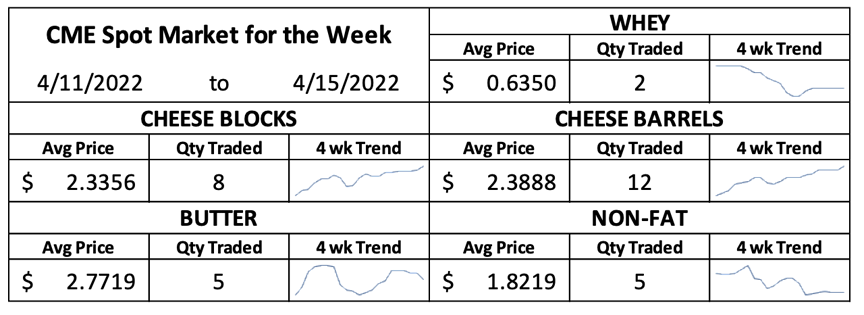
The CME spot trade had gains in cheese.  Cheese Blocks were up $.01 closing at $2.33.  Three sales were made from $2.31 to $2.33. Cheese Barrels were up $.0125, closing at $2.38.  Two trades were made at $2.3750 and $2.38. Butter was unchanged at $2.7750.  Two sales were recorded at $2.7650 and $2.7675. Nonfat dry milk was unchanged at $1.82.  No sales were recorded. Dry whey was unchanged at $0.6350.  Two sales were recorded at that price.

Spring Has Sprung and Milk Production Increases

The T.C. Jacoby Weekly Market Report Week Ending April 8, 2022

Even as milk production expands seasonally, volumes are tending to run at or below prior year levels. This supports the notion that even though milk prices remain historically strong, the increased pressure caused by rising operating costs gives producers continued margin concerns.

With the Easter holiday around the corner and students enjoying vacations, spring appears to have sprung. Milk production is increasing seasonally as the days lengthen and temperatures warm. In Southern regions of the country market participants report that volumes are nearing seasonal peak levels. However, in the Midwest and Northeast, the peak is likely a few weeks out, as pockets of inclement weather, including isolated snowstorms are extending winter’s grasp.

Even as milk production expands seasonally, volumes are tending to run at or below prior year levels. This supports the notion that even though milk prices remain historically strong, the increased pressure caused by rising operating costs has been sufficient that producers continue to have margin concerns. Milk futures prices remain elevated with Friday’s settlements showing Class III contracts through OCT22 at or above $24/cwt while Class IV contracts for the nearby six months all settled above $25/cwt.

Slower milk production in the United States is compounding global milk supply concerns. Volumes

are slipping in Europe and Oceania and while South America has so far been able to maintain output growth, increased margin pressure there is also likely to weigh on milk production in the coming months.
In January, milk production among the world’s top five dairy exporters – the United States, the European Union, New Zealand, Australia, and Argentina – was down 1.8% compared to the same month last year.

Despite shrinking global milk supplies, the Global Dairy Trade index fell by 1% on Tuesday, pulled down by price declines for anhydrous milkfat and whole milk powder. This represented the second consecutive auction that the index had declined. While the slowdown suggests that global demand may be starting to show some resistance against higher prices, anecdotal evidence indicates that global demand remains healthy.

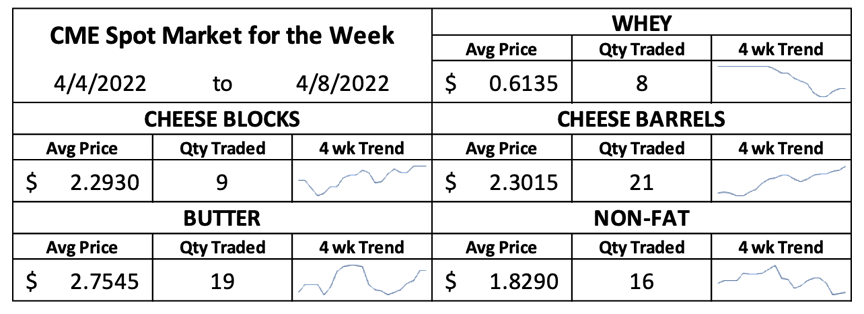
Closer to home, the CME spot market had mixed performance over the course of the week. Cheddar blocks gave up 3.25¢ on Monday before finding some upward momentum on Wednesday and Friday, ultimately finishing the week at $2.32/lb., an increase of 2.5¢ compared to last Friday’s close. Meanwhile, with the exception of a .75¢ decline on Tuesday, Cheddar barrels bounded upward over the week, adding 11.5¢ to bring the price to $2.3675/lb. and inverting the block-barrel spread by the largest amount since midJanuary.

Demand for cheese has been strong from both domestic and international sources, which is working to keep pressure on prices. Cheese exports remain robust with the 72.6 million pounds of cheese exported in February setting a record for the month. With expanding milk supplies, spot milk loads are readily available but cheesemakers report that persistent staffing issues are preventing them from processing as much milk as they would like.

On the other side of the Class III complex, the spot dry whey market continued to slide on Monday, falling to 59¢/lb., the first time since October 2021 that the price has slipped below 60¢. The dip was short-lived, however. By Wednesday and Thursday, the market was moving back up, ultimately ending the week at

63.5¢/lb., an increase of 2.5¢ compared to last Friday with 8 loads changing hands over the course of the week.
Lighter international interest has taken some of the pressure off dry whey markets. At 102.4 million pounds, February’s whey exports were down 4.2% year over year, due especially to lighter demand from China. Meanwhile, robust cheese production has resulted in a plentiful raw whey stream available for processing. Higher protein products continue to experience strong demand and have demonstrated resilience, even at elevated price levels.

Nonfat dry milk (NDM) also saw exports falter compared to prior year. U.S. exporters shipped 139.7 million pounds of NDM in February, a decline of 11.5% compared to last year’s February record. While demand from China remained strong, lower demand from other key destinations such as Mexico, Indonesia, and Vietnam pulled the figure downward. Logistical and staffing issues are weighing on NDM production even as milk volumes rise seasonally.

Activity at the CME was mixed for NDM over the week with losses early in the week only partially compensated by gains later on. After starting the week unchanged on Monday, the spot NDM market gave up 3.5¢ on Tuesday and Wednesday, falling as low as $1.815 at the end of Wednesday’s session. Modest gains on Thursday and Friday were unable to overcome the loss and the market closed Friday’s session at $1.8225/lb., down 2.75¢ compared to last Friday.

The spring holiday season has ushered in strong demand for butter from both retail and foodservice channels. Furthermore, with summer in their sights, ice cream makers have also started to step up their cream demands. As a result of stronger demand, cream availability has tightened but market participants report that spot loads are still available for those who want them. The strong demand helped to put upward pressure on the spot butter price at the CME this week which added 7.25¢ over the week to end Friday’s session at $2.7825/lb.

The ongoing conflict between Russia and Ukraine continues to wreak havoc on grain markets. In today’s World Agricultural Supply and Demand Estimates report, the USDA further reduced expectations for Ukrainian grain exports, spurring crop futures prices upward. At the conclusion of Friday’s trade, every corn contract until JUL23 settled above $7 per bushel. For soybeans, the MAY22, JLY22, and AUG22 each finished above $16 per bushel.

At home USDA left the U.S. corn and soybean balance sheets mostly unchanged but the swirling uncertainty led the agency to lift its average farm corn price by 15c to $5.80 per bushel.

Source: Jacoby

Dairy Revenue Protection – April 2022

Dairy Revenue Protection (DRP) is an insurance program for U.S. dairy producers who are looking to manage financial risk and minimize the impact of unanticipated declines in milk prices. Locking in a milk price for a future quarter can be a useful risk management strategy, establishing baseline revenue without losing potential on the upside.

Government-subsidized DRP policies can be set up through private agents, much like crop insurance. It is recommended to work with an agent who is knowledgeable on the topic and accommodating with the services they provide. The initial process to set up a policy is free and typically quite simple. Specific endorsements can be purchased as frequently or infrequently as desired. Premiums do not become due until the month following the end of the quarter.

The chart below shows historical price guarantees with the maximum 95% coverage along with associated net premiums (after subsidy) specific to Pennsylvania for the fourth quarter of this year. The upward movement on prices softened a little bit in March, but guaranteed prices are still several dollars above historical class price averages. Sales for 4Q2022 coverage opened in July of 2021 and will remain open until the middle of September.

There are five key decisions that need to be made when purchasing a DRP endorsement with the maximum 95% coverage, which is 44% subsidized:

  1. Quarter – Endorsements are only available for entire quarters of the calendar year (e.g. January through March as Quarter 1). At any one time, sales are open for as many as five future quarters. Sales close 15 days before the beginning of the quarter. Distant quarters don’t open for sale until there is adequate market activity.
  2. Price category – The choices are Class III milk, Class IV milk, or a selected butterfat and protein combination. The only obligation is that 85% of the covered milk volume or 90% of the components be delivered in order to receive full payments.
  3. Quantity – Any volume can be selected for an endorsement, with no limit to the number of endorsements within a particular quarter.
  4. Protection factor – This is a factor built into the program for the purpose of increasing coverage on a specific volume of milk up to 1.5 times the covered volume. A higher protection factor level will increase coverage (and the premium) at the same milk volume.
  5. Date – The market changes daily. Endorsements must be purchased between the market closing and the next opening, meaning the time window on the East Coast is typically between 4 p.m. and 10 a.m. the following morning.

Below are the highest quarterly Class III and Class IV prices to date. The prices and associated premiums change almost every weekday, so this just captures the high points to demonstrate the recent potential for DRP coverage. Notice that DRP indemnity payments would not have been possible for Class III milk in some quarters (e.g., 1Q2022) because of the high ending prices, whereas the payment potential was high in other quarters (e.g., 3Q2021). Indemnity payments are determined by calculating the difference between expected revenue and actual revenue according to market prices, adjusted on a state or regional basis to account for differences between expected and actual milk production. If the DRP guaranteed price captured with an endorsement is below the final announced milk price, a payment can be expected.

Class III

Highest DRP Prices (as of March 31, 2022) Date Occurred Expected Market Price (on that date) DRP Price Guarantee (95% of Expected Market Price) PA Premium ($/cwt) Actual Market Price (at completion of quarter)
3Q2020 6/9/20 $18.34 $17.42 $0.2788 $20.25
4Q2020 1/24/20 $17.96 $17.06 $0.1646 $20.22
1Q2021 11/10/20 $17.46 $16.59 $0.3692 $15.98
2Q2021 3/11/21 $18.29 $17.38 $0.2008 $17.95
3Q2021 5/12/21 $20.03 $19.03 $0.3119 $16.32
4Q2021 5/12/21 $19.30 $18.34 $0.4285 $18.07
1Q2022 12/13/21 $19.99 $18.99 $0.2052 $21.25
2Q2022 3/8/22 $24.54 $23.31 $0.2997 TBD
3Q2022 3/22/22 $24.52 $23.29 $0.5608 TBD
4Q2022 3/22/22 $23.41 $22.24 $0.6460 TBD
1Q2023 3/24/22 $21.73 $20.64 $0.6347 TBD
2Q2023 3/29/22 $20.75 $19.71 $0.6451 TBD
3Q2023 3/31/22 $19.98 $18.98 $0.7080 TBD

Class IV

Highest DRP Prices (as of March 31, 2022) Date Occurred Expected Market Price (on that date) DRP Price Guarantee (95% of Expected Market Price) PA Premium ($/cwt) Actual Market Price (at completion of quarter)
3Q2020 1/21/20 $18.40 $17.48 $0.1317 $13.01
4Q2020 1/24/20 $18.38 $17.46 $0.1727 $13.38
1Q2021 1/24/20 $17.83 $16.94 $0.1802 $13.71
2Q2021 1/17/20 $17.95 $17.05 $0.1906 $15.98
3Q2021 5/18/21 $17.74 $16.85 $0.2309 $16.09
4Q2021 5/19/21 $18.06 $17.16 $0.4226 $18.57
1Q2022 12/15/21 $20.63 $19.60 $0.1462 $23.97
2Q2022 3/14/22 $25.20 $23.94 $0.2342 TBD
3Q2022 3/24/22 $25.40 $24.13 $0.6190 TBD
4Q2022 3/24/22 $24.52 $23.29 $0.7795 TBD
1Q2023 3/28/22 $22.67 $21.54 $0.8003 TBD
2Q2023 3/28/22 $21.35 $20.28 $0.5818 TBD
3Q2023 3/28/22 $19.65 $18.67 $0.6138 TBD

Consider how the DRP program might fit into the risk management portfolio for a dairy operation. It provides a different type of coverage than other programs (e.g. Dairy Margin Coverage). There are agents, educators, dairy producers, and others who are familiar with the program and can help with the initial learning curve. After getting started, it is just a matter of setting a strategy to capture the right opportunities.

Source: Penn State Extension

Milk Markets Turn Lower in Chicago Tuesday

On the Chicago Mercantile Exchange milk futures turned around Tuesday as traders worry over the impact of expanding E-15 on feed costs and cash markets seem to have started their holiday weekend. Class III milk futures were mostly lower on the day. May milk fell 8 cents to $24.85/cwt. June milk gained 3 cents to $24.85/cwt. July milk dropped 4 cents to $24.65/cwt. Class IV volume was light with one contract trading in April and one in September.

Dairy Products were unchanged to lower in the CME spot dairy auction Tuesday. Dry whey unchanged at $0.6350. Blocks unchanged at $2.32. Barrels unchanged at $2.3675. Butter down $0.0075 at $2.7750. Nonfat dry milk down $0.0050 at $1.82. Two sales were made at $1.81.

Milk Futures Start Week Higher, Product Trade Stagnant in Chicago Monday

On the Chicago Mercantile Exchange milk futures carried over last week’s optimism while cash trade was stagnant. Class III milk prices were in the green to kick off the week on Monday.  April added 3 cents while May was up 8 cents and June through August rallied 16-19 cents/cwt.  Beyond that the Class III market was relatively unchanged.  Class IV dipped 25 cents in July 2022 and all other months closed unchanged. 

The CME spot product markets saw Nonfat dry milk up $0.0025 at $1.8250. One sale was made at that price. Dry whey unchanged at $0.6350. Blocks unchanged at $2.32. Barrels unchanged at $2.3675. Butter unchanged at $2.7825.


Weaker Chinese demand weighs on dairy auction amid Covid-19 disruption

Demand weakened from China at the latest auction as the country puts major cities into lockdown to try and contain an outbreak of Covid-19, causing disruption to supply chains and prompting local dairy processors to increase production of milk powder, denting demand for imported product.

Dairy prices slipped for a second consecutive global auction, following weaker demand from China due to disruptions and lockdowns as the country battles an outbreak of Covid-19.

The Global Dairy Trade price index dropped 1 per cent to 1564 at the overnight auction. That follows a 0.9 per cent decline at the previous bimonthly auction.

Dairy prices have risen steeply at auction this year, pushing the index to record levels, as tight supply underpins demand.

However at the latest auction, demand weakened from China, the world’s largest dairy market, as the country puts major cities into lockdown to try and contain an outbreak of Covid-19, causing disruption to supply chains and prompting local dairy processors to increase production of milk powder, denting demand for imported product.

“Internal logistics are heavily interrupted within China, meaning more raw milk is needed to be diverted into dry powders away from liquid milk products, meaning that the local supply of milk powders is now slightly distorted from what was previously expected,” said NZX dairy insights manager Stuart Davison.

North Asian buyers almost halved their whole milk powder purchases compared with the previous auction, while South East Asian/Oceania and African bidders bought more, he said.

“Overall, the same market fundamentals remain in place, global demand is strong, and supply continues to struggle,” Davison said.

Fonterra factors in fat and protein levels in milk when buying it off farmers.

The average price for whole milk powder, which has the most impact on what farmers are paid, fell 1.5 per cent to US$4532 (NZ$6529) a tonne.

Davison said prices weakened as there was an oversupply of regular whole milk powder.

Skim milk powder, also a key driver of the milk price paid to farmers, rose 1 per cent to US$4599/t.

Davison said demand remained strong for skim milk powder, with buyers seeking 3.5 times more product than was on offer at the auction.

The latest auction comes as Northern Hemisphere milk production nears its peak. Still, milk supply in Europe is expected to remain under pressure as the war in Ukraine disrupts fertiliser and grain markets.

Butter slipped 0.6 per cent to US$6,891/t, cheddar rose 2.7 per cent to a record US$6,472/t, anhydrous milkfat fell 2.5 per cent to US$6,908/t, lactose fell 0.6 per cent to US$1,598/t and buttermilk powder rose 6.3 per cent to US4,461/t.

Davison said the latest auction result may put some pressure on forecasts for milk prices for farmers for this season and next season.

In February, Fonterra raised its forecast milk payment to farmers for this season for a fourth time to between $9.30 and $9.90 per kilogram of milk solids. The $9.60 per kgMS midpoint, which farmers are paid off, is the highest since Fonterra was formed in 2001.

Last month, Fonterra chief executive Miles Hurrell said the country’s largest milk processor was “very comfortable at this point in time” with its milk price forecast for this season.

“We see no change to that at this stage in the season,” Hurrell said when announcing the co-operative’s first-half profit. “In the medium term, we expect the supply and demand outlook to go some way towards underpinning a strong milk price next season.”

New Zealand milk production generally peaks around November and the season runs until the end of May.

As the country’s largest dairy company, Fonterra’s milk payment sets the benchmark for its competitors.

Source: stuff.co.nz

Australian Milk Price Initiative a win-win for dairy

Australian dairy farmers have reason to celebrate.

The future of milk trading is looking brighter.

Recently, a key first step has been taken that delivers monthly milk price transparency and competition, as the Australian Milk Price Initiative (AMPI) ran its first regional milk spot markets.

Trading was done on the Mercari platform, owned and operated by the Financial and Energy Exchange.

These regional spot markets deliver the monthly price transparency necessary to enable a forward financial hedging market like those seen in New Zealand, the US and Europe.

Such financial markets already enable dairy farmers and processors to lock in prices up to three years forward for some of their milk.

As the national representative body for dairy farmers, Australian Dairy Farmers (ADF) has advocated for and sponsored the AMPI and encourages dairy farmers to take advantage of the trading platform.

Not only will the AMPI empower dairy farmers when they sell milk, it will also increase transparency and build trust.

As said at the launch, “there is no more transparent price signal than an open market price!”.

The benefits to the dairy industry do not end there.

The Australian Milk Price Initiative (AMPI) aims to deliver increased transparency in the milk market.

The AMPI will improve risk management across the supply chain with back-to-back pricing from customer to processor to farmer, providing the ability to lock in margins across the chain.

Better margin and risk management enables better planning, which, in turn, drives investment and growth across the supply chain.

More investment means a strong dairy industry.

Among the concerns to emerge from industry consultations during the development of the Australian Dairy Plan was a call for ‘New measures to increase transparency and help manage market risk, including the establishment of a functioning milk price market and new risk measures backed by government legislation’.

This is something the ADF has been helping to achieve.

At the ADF we have been working closely with government and industry to develop the AMPI.

Similar trading platforms are already operating for other agricultural sectors, including wool and grains.

Through consultation with industry bodies and the dairy community, and with a grant from the federal government, the new trading platform will allow Australian dairy farmers to leverage their competitive advantage.

In 2019, a pledge of $560,000 towards the development of a milk trading platform was one of the most significant election promises the dairy industry received from the Morrison Government.

While the launch of the AMPI is an important step in the right direction, the work is not over yet.

Seed funding is required for the AMPI’s governance and operating model, as well as education for participants.

It is our view that these funds can come from the Improving Market Transparency in Perishable Agricultural Goods Industries Grant Program.

This program will run over three years from 2022-23 to 2024-25.

A total of $5 million of grant funding is available.

Ongoing investment and innovation are key to the future of the dairy industry.

With an open market where farmers can choose who they sell their milk to, at what cost, and on what terms the future is looking brighter.

Source: farmonline.com.au

FAO Dairy Price Index

The upward trend of dairy product prices persisted, mainly supported by the tightening of global markets due to inadequate milk output in Western Europe and Oceania to meet global demand. Quotations for butter and milk powders rose steeply, underpinned by a surge in import demand for near- and long-term deliveries, especially from Asian markets, and solid internal demand in Western Europe. Meanwhile, cheese markets were also facing a tight supply situation due to strong internal demand in Western Europe, but the index value eased marginally, reflecting the impacts of currency movements.

https://www.fao.org/fileadmin/user_upload/est_new2020/xlsFileToUpload/Indices/FAO_Dairy_Price_Indices.xlsx

Source: FOA

March dairy market review

Milk production

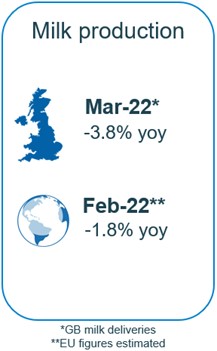
GB milk deliveries are estimated to be down 3.8% in March compared to year earlier levels, however the seasonal growth is in line with last year as we enter the spring flush. Yields have been down year-on-year since November as a result of poor silage quality, reduced milking frequency due to labour shortages and rising input costs.

At the same time, global milk deliveries are also down year on year. February deliveries are estimated to be 1.8% lower than last year, with the EU-27 and New Zealand showing the largest declines. There is no indication of things improving anytime soon, despite entering the flush in the northern hemisphere. Bad weather continues to affect production and feed quality in Oceania and high input costs are suppressing production growth in the EU-27, UK and US.

March milk production infographic

Wholesale markets

Prices for all key dairy products have been increasing steadily so far this year, both on domestic and global markets. and it is expected this will continue until at least late spring/early summer as supplies remain tight.

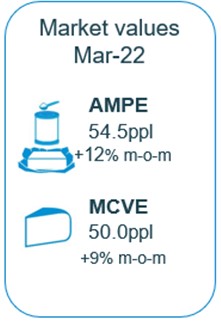
UK wholesale prices have continued to reach 5-year highs, bringing both AMPE and MCVE to, or above, the 50ppl mark. Our Milk Market Value (MMV) indicator has also reached 50ppl in March, up 4.4ppl up on the month. With the release of updated manufacturing costs for Q4 2021, the cost elements of these indicators have now been adjusted. Higher energy costs have impacted on net returns, particularly on the cost of drying milk powders.

March market values infographic

Farmgate prices and input costs

Market-related farmgate prices in GB continue to move up in response to the higher market returns, with processors announcing more increases for April and May. Retailer-aligned contracts are now responding to the on-farm cost pressures, announcing significant increases for April. These should bring the retailer aligned contract prices more in line with market-based prices.

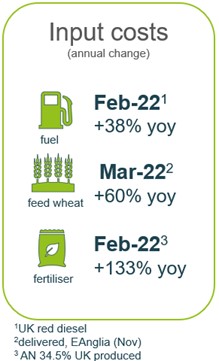
It remains to be seen if the higher milk prices will prompt higher milk production or whether the cost increases will continue to make this unprofitable. While milk prices are helping to offset rising input costs, we expect the 2021/22 season to end 1.6% below that of 2020/21. Our milk production forecast for the 2022/23 season is for a further drop of 0.8%, although with such volatility in markets, we will revisit these forecasts through the year as events unfold.

Uncertainly of the impact of the war in Ukraine on access to fertiliser and feed ingredients, combined with changes to agricultural policy and labour shortages are expected to make farmers cautious in their decision making as the year progresses.

March input costs infographic

 
Source: ahdb.org.uk

Milk Futures Turn Lower in Chicago Thursday

On the Chicago Mercantile Exchange milk futures turned lower Thursday with position squaring and limited cash movement. Class III milk futures were mostly lower across the curve. May milk dropped 21 cents to $24.64/cwt. June milk fell 23 cents to $24.59/cwt. July milk crashed 32 cents to $24.41/cwt. Class IV milk futures traded 5-22 cents higher on the day.

Dairy products were steady to higher Tuesday in the CME spot dairy auction.  Dry whey up $0.0175 at $0.6350. One sale was made at that price. Blocks unchanged at $2.31. Barrels up $0.0125 at $2.3125. Butter up $0.0350 at $2.7825. Seven trades were made from $2.7475 to $2.7825. Nonfat dry milk down $0.0025 at $1.8175. Three sales were made from $1.8175 to $1.8225.

Milk Markets Continue to Push Higher in Chicago Wednesday

On the Chicago Mercantile Exchange milk futures continued higher supported by cash trade, improving exports, and pressure throughout the grain complex. April Class III milk was up 22 cents at $23.94. May 45 cents higher at $24.85. June up 42 cents at $24.82. July 40 cents higher at $24.73. August through to October 16 to 41 cents higher.

In spot trade, dry whey up $0.0275 at $0.6175. Blocks up $0.0475 at $2.31. One sale was made at $2.2650. Barrels up $0.04 at $2.30. Eight trades were made from $2.2675 to $2.30. Butter up $0.0075 at $2.7475. Nonfat dry milk down $0.0250 at $1.8750.

Dairy Markets Get Used to the Altitude

The T.C. Jacoby Weekly Market Report Week Ending April 1, 2022

Last week, Q2 Class III contracts summited briefly, but the air was too thin and they quickly pulled back from the highs. Class III futures tumbled early in the week, but on Wednesday they found their footing and began to plod upward once again.

The dairy markets are getting accustomed to the altitude. Last week, Q2 Class III contracts summited briefly above $25/cwt., while Q3 topped $24.50 and Q4 approached $24. But the air was too thin, and they quickly pulled back from the highs. Class III futures spent the first couple days of this week tumbling, but on Wednesday they found their footing and began to plod upward once again. Both Class III and Class IV contracts finished the week below last Friday’s impressive closes, but they looked lively rather than exhausted as they headed into the weekend. Most Class III contracts lost between 15 and 40ȼ, but April finished 62ȼ lower at $23.68. Most Class IV contracts gave up about 20ȼ. April

through August Class IV futures held their ground above $25.
USDA announced the March Class III price at $22.45, up $1.54 from February and $6.30 higher than March 2021. At $24.82, Class IV futures set an all-time high, up 82ȼ from February and an astounding $10.64 above March 2021. Dairy producers can anticipate some very big milk checks in a few weeks.

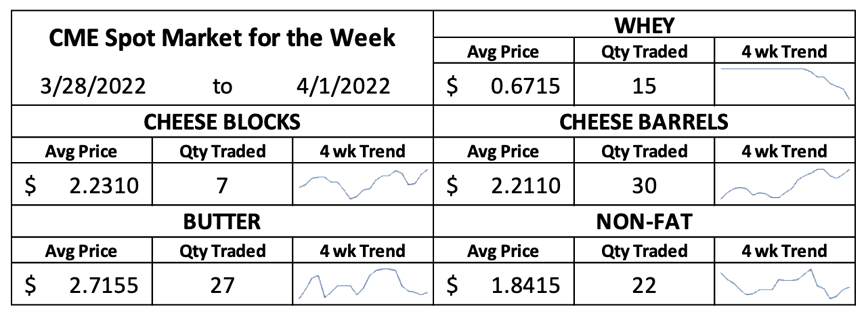
At the spot market, Cheddar blocks climbed 2ȼ to $2.295 per pound. Barrels added 0.25ȼ and reached $2.2525. But butter and the powders fell. CME spot butter slumped 8.5ȼ to $2.71. Spot nonfat dry milk fell 0.25ȼ to $1.85. Whey plummeted 11ȼ to 61ȼ, a 15% decline in just five trading sessions.

Processors tell USDA’s Dairy Market News that there is more whey on offer, and buyers have turned coy. Last week, China reported disappointingly low whey import volumes in January and February. Today, USDA reported that commodity whey production was just 0.7% lower than the prior year in February, and whey stocks began to climb after five months in decline. Whey buyers clearly expect that, with stocks on the rise and China backing off, they can bide their time and hope to purchase whey at a bargain. This could have a big impact on milk revenues. Every penny decline in the whey price takes 6ȼ off Class III milk.

U.S. cheese production topped 1.1 billion pounds in February, up 6.3% from a year ago. For months, issues in staffing and logistics have prevented cheese makers and other dairy processors from running optimally. Nonetheless, daily average cheese production in February reached an all-time high. Production was strong across the board, with Cheddar output up 3.9% from a year ago, and Mozzarella production up 4.4%. Recently, growth in cheese inventories has slowed and prices have climbed, so today’s big cheese production figures imply that the world is hungry for U.S. cheese.

Strong cheese production left less milk for Class IV manufacturers. U.S. butter production totaled 183.6 million pounds in February, down 1.4% from a year ago. Combined production of NDM and skim milk powder (SMP) fell 6.8% year over year to 200.6 million pounds. Manufacturers’ stocks of NDM climbed from January to February, but, at 288.8 million pounds they are 16% smaller than they were a year ago and represent the smallest U.S. stockpile for this time of year since 2017. Given lower milk output in Europe and Oceania, it should not be difficult to keep U.S. milk powder moving abroad, which will continue to support Class IV milk values.

American farmers love to plant corn, but record-shattering fertilizer costs have strained the relationship. Yesterday USDA published its annual Prospective Plantings report, reflecting farmers’ intended crop mix in early March. The survey showed that farmers planned to plant fewer than 89.5 million acres of corn, the lowest total since 2018 and a 4.1% drop from last season. In the Corn Belt, farmers intend to switch to soybeans. USDA reported soybean planting intentions at just shy of 91 million acres, up 4.3% from last season. If farmers follow through, this will mark only the third time ever that soybeans take the acreage crown from King Corn. In the South, farmers say they will move away from corn and sorghum acres and into cotton. In the far Northern Plains, farmers plan to plant fewer row crops altogether and switch to more wheat, small grains, and sunflowers.

There is still time for farmers to change their minds, and the new crop futures markets are doing all they can to push them back to corn. December corn futures settled today at $6.905 per bushel, an all-time high for the benchmark new crop contract ahead of spring planting. December corn futures have climbed 52ȼ since USDA took its survey in early March. Over the same period,

November soybean futures have fallen more than 60ȼ. It’s likely farmers will shift some fields back from soybeans into corn, but rising fertilizer costs remain a deterrent, and spring weather will also play a big role in the final acreage mix.
The price that dairy producers will pay for feed today took a small step back this week. The strong dollar and falling energy costs weighed on commodity markets of all types. USDA also reported quarterly grain and soy stocks yesterday, and, as expected, both corn and soybean stocks are higher than they were a year ago. It seems that nearby corn and soybean prices are more than expensive enough to deter new export sales, so the futures retreated. May corn closed today at $7.35 per bushel, down nearly 20ȼ from last Friday. May soybeans settled at $15.8275, down $1.275. May soybean meal plummeted $37.90 this week to $450 per ton.

Source: Jacoby

Tuesday Sees Turnaround at the CME

On the Chicago Mercantile Exchange milk futures saw a typical turnaround Tuesday trading higher while cash markets were mixed, and global trade news was slightly bearish. Class III milk futures rallied 20-50 cents. May milk climbed 43 cents to $24.42/cwt. June surged 52 cents to $24.35/lb. Class IV milk experienced near-term weakness. 

In the CME spot dairy auction, dry whey unchanged at $0.59. Five trades were made from $0.59 to $0.5975. Blocks unchanged at $2.2625. Barrels down $0.0075 at $2.26. Butter up $0.02 at $2.74. Nonfat dry milk down $0.01 at $1.84.

Mixed Reports at the CME in Chicago Thursday

On the Chicago Mercantile Exchange milk futures were mixed Thursday as cash trade and grains were mixed following the prospective plantings report. April Class III milk was up 22 cents at $23.68. May 57 cents higher at $24.47. June up 54 cents at $24.27. July 31 cents higher at $23.95. August up 27 cents at $23.84. September through to November 11 to 15 cents higher.

In spot trade,  Dry whey down $0.0150 at $0.6625. One trade was made at that price. Blocks up $0.07 at $2.25. Two trades were made at $2.21 and $2.25. Barrels up $0.0425 at $2.2025. Twelve trades were made from $2.1575 to $2.2025. Butter down $0.0125 at $2.70. Nine trades were made from $2.69 to $2.71. Nonfat dry milk up $0.01 at $1.8450. One trade was made at that price.

Dairy Markets in Chicago Turn Higher as Traders Buy Back Over-Sold Positions

On the Chicago Mercantile Exchange milk futures turned higher at midweek as traders bought back over-sold positions.  Class III milk had April up 17 cents to $23.46, May up 40 to $23.90, and June up 21 cents to $23.73/cwt. The balance of 2022 was mixed from 5 lower to 24 higher. Class IV milk was unchanged nearby with Apri at $25.12, May at $24.94, and June at $25.11. The balance of the year was mixed being 19 lower to 25 cents higher.

The CME spot dairy product trade was mixed.  Dry whey down $0.0125 at $0.6775. Four sales were made at $0.6775 and $0.68. Blocks up $0.01 at $2.18. Two trades were made at $2.15 and $2.18. Barrels down $0.03 at $2.16. Three trades were made at $2.15 and $2.16. Butter down $0.0050 at $2.7125. Four trades were made from $2.6975 to $2.7125. Nonfat dry milk up $0.0050 at $1.8350. five trades were made from $1.8275 to $1.84.

Milk Markets Continue to Fall Lower in Chicago Tuesday

On the Chicago Mercantile Exchange, milk futures continued their trend lower Tuesday, pressured by cash trade. Class III Milk followed for a second day lower. March gained a penny to $24.42, April fell 24 cents to $23.29, with May slipping 66 cents to $23.50/cwt. The balance of 2022 was unchanged to 54 cents lower. Class IV milk also struggled. March unchanged at 24.85, April down 18 to $25.12, and May down 25 cents to $24.94/cwt.

Dairy markets struggled as all 5 products moved lower in the CME spot trade. Dry whey down $0.0275 at $0.69. Four sales were made at $0.69 and $0.6950. Blocks down $0.09 at $2.17. One trade was made at that price. Barrels down $0.06 at $2.19. Four trades were made at $2.19 and $2.1925. Butter down $0.02 at $2.7175. Four trades were made from $2.7075 to $2.7275.

Nonfat dry milk down $0.0175 at $1.83. Two trades were made at that price.

Dairy Markets Start Week Sharply Lower in Chicago

On the Chicago Mercantile Exchange milk futures started the week sharply lower as did most grain and livestock markets. April suffered a 77 cent break while May lost 85 cents and June faltered 73.  The second half of the year ranged from 16-49 lower.  Class IV closed in the red as well with losses ranging from a penny lower in November to 37 softer in July.

The spot market was lower with Dry whey down $0.0025 at $0.7175. Blocks down $0.0150 at $2.26. One trade was made at that price. Barrels unchanged at $2.25. Four trades were made at $2.2475 and $2.25. Butter down $0.0575 at $2.7350. Eight trades were made from $1.7325 to $2.7450. Nonfat dry milk down $0.0050 at $1.8475. Six trades were made from $1.84 to $1.8475.

Milk prices soaring around the globe

Canada is far from alone with a milk price increase of more than eight per cent on Feb. 1.

The entire world is facing disruptions, cost increases, faltering production, and soaring milk prices.

Bad weather in New Zealand, the United States and Australia had already combined with rocketing gas prices and pandemic-related supply chain disruptions to put pressure on milk producers in the five biggest exporters before the war.

Combined milk production in New Zealand, which accounts for 35 per cent of global exports, the European Union, Australia, the U.S. and Argentina fell 1.7 per cent in January compared with the previous year, down according to commodity broker StoneX.

New Zealand and Australia posting declines of more than 6 per cent.

After the start of the war on February 24, prices of crucial products have risen further.

Anhydrous milk fat, a core dairy product, hit a record $7,111 a tonne on March 15, according to Global Dairy Trade index, which monitors New Zealand dairy prices.

Whole milk powder, the most actively traded product, hit an eight-year high this month.

New Zealand company Fonterra, the world’s biggest dairy exporter, said last week it was paying farmers 30 per cent more for milk than it did a year ago and predicted the price would rise further.

It cited rising costs for fertilizer and feed and disruptions in supply chains related to ongoing labour shortages because of the COVID-19 pandemic and Russia’s invasion of the Ukraine.

Source: woodstocksentinelreview.com

Milk prices soar due to Russia-Ukraine war while EU officials warn of ‘global food crisis’

Woolworths Group Ltd. branded milk bottles displayed for sale inside a company’s grocery store in Melbourne, Australia, on Monday, 21 February (Photo: Carla Gottgens/Bloomberg via Getty)

The price of milk has been soaring as the war in Ukraine threatens the supply of fertilisers and cow feed, of which Russia and Ukraine are leading exports.

As Russia and Ukraine account for more than a quarter of world wheat exports, while also being leading exporters of fertilisers, the war in Ukraine has seen the global price of food and energy shoot up in the past month.

The crisis in Ukraine has put further pressure on supply chains that had already been disrupted by Covid-19, rising gas prices and bad weather.

New Zealand, which controls 35 per cent of dairy exports, saw its milk output fall year on year by more than six percent, according to the Financial Times. Quoting figures from the Global Dairy Trade index, the FT reported the cost of anhydrous milk fat, a core dairy product, hit a record $7,111 per tonne on 15 March, while the price of whole milk powder hit an eight-year high.

“The conflict in Ukraine has added to an already complex Covid-19 operating environment, impacting global supply chains, the oil price, and global supply of grains,” Miles Hurrell, chief executive of New Zealand’s Fonterra, the world’s largest exporter of milk, said as the company reported interim results on Thursday.

Michael Oakes, Dairy Board chairman for the National Farmers’ Union, told Sky News the cost of fertilisers and animal feed, which comes from wheat, has almost doubled since the war began.

He said it forced him to take the difficult decision of slaughtering some of his dairy herd in order to cover the rising costs, which had already gone up due to Brexit and Covid-19.

“In January 2021 we were paying just under £300 for a tonne of fertiliser,” he said. “Before the war that had risen to £600.”

“Now it’s £1,000. And we’ve got a 60% increase in feed costs.”

It comes as the French farming minister Julien Denormandie said in Brussels on Monday ahead of a EU agriculture meeting the war between Russian and Ukraine could lead to a food crisis “on the global scale”. The World Food Programme (WFP), meanwhile, said on Friday the supply chains in Ukraine were collapsing, with key infrastructure such as bridges and trains destroyed by bombs and many grocery stores and warehouses empty.

The situation has sparked warnings of at least 40 million millions being plunged into poverty as prices have soared more than in 2007, when 155 million people were pushed into extreme poverty, the Center for Global Development (CGDEV) said on Friday.

The researchers said the most immediate concern was for direct wheat customers of Ukraine and Russia. These include countries like Lebanon, where 80 per cent of the wheat imported in 2020 came from Ukraine, as well as Libya, which relies on Ukraine for over 40 per cent of its wheat imports. Egypt is also heavily reliant on Russia and Ukraine for wheat with an estimated 80 per cent of imports coming from the two warring countries in 2021. Yemen, which remains the world’s worst humanitarian crisis, imports 27 per cent of its wheat from Ukraine and 8 per cent from Russia. Food prices, however, will rise worldwide as importers compete for alternative supplies, CGDEV researchers said.

Households in low-income countries allocate nearly half of their budgets to food, and higher prices will force “hard choices between food and other necessities”, they added.

Human Rights Watch (HRW) released a report on Monday calling for governments to ensure the conflict in Ukraine does not worsen the food crisis in Middle East and Africa as it said disruptions related to the war are already deepening poverty.

“Global food chains demand global solidarity in times of crisis,” said Lama Fakih, executive Middle East and North Africa director at HRW said. “Without concerted action to address the supply and affordability of food, the conflict in Ukraine risks deepening the world’s food crisis, particularly in the Middle East and North Africa.”

Source: inews.co.uk

Milk Markets Push Higher Thursday in Chicago

On the Chicago Mercantile Exchange milk futures pushed higher Thursday, carried mostly by nonfat dry milk activity. Class III milk futures varied on the day. April milk gained 11 cents to $24.32/cwt. May remained at $25.09/cwt. June lost 6 cents to $24.91/cwt. Class IV 2022 milk futures were relatively unchanged with some significant price action in 2023 taking place on just 1 trade.

In the CME spot dairy auction, barrels up $0.02 at $2.21. Butter unchanged at $2.8025.vNonfat dry milk up $0.01 at $1.88. Eleven trades were made from $1.8750 to $1.8825. Dry whey down $0.01 at $0.7450. One sale was made at that price. Blocks unchanged at $2.24.


Mixed Market Mark Mid Week in Chicago

On the Chicago Mercantile Exchange, milk futures were mixed Wednesday as traders work within a new trading range. March Class III milk was down three cents at $22.39. April 10 cents lower at $24.21. May up six cents at $25.09. June three cents lower at $24.97. July through September five to 25 cents higher.

In spot trade blocks up $0.03 at $2.24. One sale was made at that price. Barrels up $0.0350 at $2.19. Five trades were made at $2.1675 and $2.19. Butter up $0.0050 at $2.5025. One sale was made at that price. Nonfat dry milk up $0.0075 at $1.87. Dry whey unchanged at $0.7550.


GDT dip ‘nothing to worry about’

A surprise dip in global dairy prices last week won’t affect a record milk price locked in for this season, says ASB economist Nat Keall.

Keall says the 2.1% drop in whole milk powder prices in the latest Global Dairy Trade (GDT) auction should not be of concern.

He points out that WMP prices have soared 23% this year alone and are up more than 50% on historical averages.

Therefore a wee dip is all “a bit much of a muchness” – particularly given the 1.6% lift in skim milk powder prices.

Keall says SMP prices, which have underperformed WMP, show demand for powders is still strong.i

“The same is true of butter prices, which had been on a massive bull run over the past dozen auctions,” he says.

“And, of course, it’s a mistake to get too hung up the auction-to-auction swings – pay attention to the broader fundamentals.

“On that note, market fundamentals still support prices holding their ground or advancing further in the near term. There still isn’t much sign that tight global supply conditions will ease with any alacrity.”

Stretched capacity and rising costs pressures remain constraints on output globally, while in much of the southern hemisphere, milk producton is down thanks to unfavourable weather conditions.

Keall notes that in some parts of the Waikato dairy heartland, output is still running about 12% behind year-ago levels.

“The good news for farmers is that a record milk price is already locked-in for the current season, and we’ve got a good starting point in the offing for 2022/23.”

Westpac senior agri economist Nathan Penny says the latest GDT result partially reduces the upside risks to its farmgate milk price forecasts.

But Westpac is sticking to forecasts of $9.50/kgMS for this season and $8.50 for the next season.

Penny says the latest GDT results showed that “something does go the other way”.

He believes a softening of demand in China is responsible for the price dip.

“An Omicron outbreak and surging Covid case numbers in China has introduced uncertainty around global dairy demand in the world’s larfest dairy market.

“Indeed, the fact that WMP and butter posted the largest price falls points to conditions in China as being the key development for dairy markets.

“Recall that New Zealand is the largest exporter of WMP and butter to China, so any factors affecting demand there will soon be reflected in these prices on the auction platform.”

In contrast, SMP and cheddar prices continued to rise.

Penny says NZ is a smaller exporter of these products, with the EU the dominant exporter.

“As a result, the price rises for these products suggests that the Ukraine-Russia conflict and its impact on grain feed prices is continuing to put the squeeze on EU dairy production.”

Source: 

A surprise dip in global dairy prices last week won’t affect a record milk price locked in for this season, says ASB economist Nat Keall.

Keall says the 2.1% drop in whole milk powder prices in the latest Global Dairy Trade (GDT) auction should not be of concern.

He points out that WMP prices have soared 23% this year alone and are up more than 50% on historical averages.

Therefore a wee dip is all “a bit much of a muchness” – particularly given the 1.6% lift in skim milk powder prices.

Keall says SMP prices, which have underperformed WMP, show demand for powders is still strong.i

“The same is true of butter prices, which had been on a massive bull run over the past dozen auctions,” he says.

“And, of course, it’s a mistake to get too hung up the auction-to-auction swings – pay attention to the broader fundamentals.

“On that note, market fundamentals still support prices holding their ground or advancing further in the near term. There still isn’t much sign that tight global supply conditions will ease with any alacrity.”

Stretched capacity and rising costs pressures remain constraints on output globally, while in much of the southern hemisphere, milk producton is down thanks to unfavourable weather conditions.

Keall notes that in some parts of the Waikato dairy heartland, output is still running about 12% behind year-ago levels.

“The good news for farmers is that a record milk price is already locked-in for the current season, and we’ve got a good starting point in the offing for 2022/23.”

Westpac senior agri economist Nathan Penny says the latest GDT result partially reduces the upside risks to its farmgate milk price forecasts.

But Westpac is sticking to forecasts of $9.50/kgMS for this season and $8.50 for the next season.

Penny says the latest GDT results showed that “something does go the other way”.

He believes a softening of demand in China is responsible for the price dip.

“An Omicron outbreak and surging Covid case numbers in China has introduced uncertainty around global dairy demand in the world’s larfest dairy market.

“Indeed, the fact that WMP and butter posted the largest price falls points to conditions in China as being the key development for dairy markets.

“Recall that New Zealand is the largest exporter of WMP and butter to China, so any factors affecting demand there will soon be reflected in these prices on the auction platform.”

In contrast, SMP and cheddar prices continued to rise.

Penny says NZ is a smaller exporter of these products, with the EU the dominant exporter.

“As a result, the price rises for these products suggests that the Ukraine-Russia conflict and its impact on grain feed prices is continuing to put the squeeze on EU dairy production.”

Source: ruralnewsgroup.co.nz

Milk futures cross $25 in Chicago Tuesday

On the Chicago Mercantile Exchange milk futures crossed into $25 territory Tuesday supported by a tight milk production report and increased cash trade. March Class III milk was up two cents at $22.42. April 57 cents higher at $24.31. May up 49 cents at $25.03. June 38 cents higher at $25.00. July through September five to 25 cents higher.

In spot trade, blocks up $0.0725 at $2.21. Five sales were made from $2.15 to $2.20. Barrels up $0.0850 at $2.1550. Eight trades were made from $2.08 to $2.1550. Butter up $0.02 at $2.7975. Two trades were made at $2.7975 and $2.80. Nonfat dry milk up $0.0025 at $1.8625. Three trades were made from $1.86 to $1.87. Dry whey unchanged at $0.7550.


Milk prices rise as Ukraine war threatens cow feed and fertiliser supplies

Milk prices are soaring on the expectation that a tight market will be hit by further disruption to fertiliser and feed supplies and inflationary pressures following Russia’s invasion of Ukraine.

Bad weather in New Zealand, the US and Australia had already combined with rocketing gas prices and pandemic-related supply chain disruptions to put pressure on milk producers in the five biggest exporters before the war.

Combined milk production in New Zealand — known as the “Saudi Arabia of milk” because it controls 35 per cent of global exports — the EU, Australia, the US and Argentina fell 1.7 per cent in January compared with the previous year, down according to commodity broker StoneX.

Milk output for the five producers fell year on year, with New Zealand and Australia posting declines of more than 6 per cent.

After the start of the war on February 24, prices of crucial products have risen further. Anhydrous milk fat, a core dairy product, hit a record $7,111 a tonne on March 15, according to Global Dairy Trade index, which monitors New Zealand dairy prices. Whole milk powder, the most actively traded product, hit an eight-year high this month.

New Zealand company Fonterra, the world’s biggest dairy exporter, said last week it was paying farmers 30 per cent more for milk than it did a year ago and predicted the price would rise further.

“The conflict in Ukraine has added to an already complex Covid-19 operating environment, impacting global supply chains, the oil price and global supply of grains,” Fonterra chief executive Miles Hurrell said as the company reported interim results on Thursday.

Michael Harvey, an analyst at Rabobank, said that although dairy processors and food companies were bearing the brunt of costs, consumers were likely to face price increases.

He added that Russia’s invasion of Ukraine would add to milk production costs, as both countries were leading exporters of nitrogen-based fertilisers and wheat, an important feed for cattle along with corn and soy.

New Zealand and the EU account for about 70 per cent of milk exports, followed by the US, Australia, Brazil and Argentina.

Craig Hough, director of policy and strategy at Australian Dairy Farmers, a trade body, said the rising cost of feed was a “big problem” for dairy farmers because it accounted for 70-80 per cent of costs.

Hough added that Australian dairy farmers imported most of their fertiliser from China. But the gas supply crunch following the Ukraine war and pandemic restrictions in China as the country faces a growing Covid outbreak, meant it was “hard to get fertiliser, and it’s bloody expensive”.

In the ‘good ole days,’ farmers could often be found chatting with each other at the local breakfast joint in town, solving the world’s problems one cup of coffee at a time. Today, farmers are lucky if they’re able to even finish their cup of coffee while it’s still hot.

Source: 

Milk Markets Start the Week Higher in Chicago

On the Chicago Mercantile Exchange milk futures and cash dairy prices were mostly higher Monday. Class III settled with many months 12-47 cents/cwt higher.  The second quarter closed at an average of $24.30, Q3 ended at $24.38/cwt, and quarter four rose to $23.12/cwt.  2022 months saw some tremendous value added as well jumping 15-30 cents/cwt.  Class IV markets were in the green a bit as well.  Q2 2022 months all traded $25.12/cwt and 20 cents stronger.  Deferred months jumped as well. 

CME product markets saw Dry whey was down $.0050 at $0.7550.  One sale was recorded at that price. Cheese Blocks were up $.0075 closing at $2.1375.  No sales were recorded. Cheese Barrels were $.04 higher, closing at $2.07.  One sale was made at that price. Butter was up $.0525 to $2.7775.  Four sales were recorded ranging from $2.77 to $2.7775. Nonfat dry milk was unchanged at $1.86.  Two sales were recorded at  $1.8550 and $1.86.

Global dairy prices to remain elevated whilst global production declines

Global milk production is expected to continue to decline in the first half of 2022 despite higher farmgate milk prices. In the latest Rabobank quarterly report, production is forecast to decline by 0.7% year-on-year for the first half of 2022 following a worse than anticipated end to 2021. The main drivers are rising cost of inputs, lack of labour, unfavourable weather, and variable feed quality. It goes without saying that that the current geopolitical environment has escalated already high costs as Russia and Ukraine are key players in both the energy and the cereals markets.

Exports are also expected to slow in 2022 as tight supplies reduce availability, while high prices may reduce appetite from importers. Lower demand from China is expected as their domestic production continues to grow, and stocks increase.

In the short term, dairy commodity prices should remain elevated as a result of inflationary pressures and tight supplies. The longer-term view is difficult to predict due to uncertainties around consumer behaviour given higher prices, and market conditions in light of the impact of the conflict in Ukraine. Despite this, there is little expectation that inflationary pressures with ease, or milk production grow, until later in 2022.

Source: ahdb.org.uk

Milk Markets Turn Higher in Chicago Tuesday

On the Chicago Mercantile Exchange milk futures flipped higher Thursday as traders took back oversold positions and cash markets were mostly positive. March Class III milk was up a penny at $22.39. April 35 cents higher at $23.23. May up 42 cents at $23.75. June 25 cents higher at $23.95. July through September 24 to 31 cents higher.

In spot trade,  Blocks up $0.0275 at $2.0775. Six sales were made from $2.0350 to $2.0775. Barrels up $0.0050 at $2.9850. Nine trades were made at $1.96 and $1.9850. Butter down $0.0350 at $2.70. Nine trades were made from $2.70 to $2.7375. Nonfat dry milk up $0.0175 at $1.8625. Dry whey unchanged at $0.76.


The Commodity Boom Thunders Through Feed and Dairy Markets

Dairy producers cannot afford to pay this much for feed unless milk prices remain high. The market is well aware that global dairy stocks are relatively low, and that output is shrinking. So, for now, milk prices are climbing nearly step for step with the feed market to deter further declines in milk production.
The commodity boom continues to thunder through the feed and dairy markets. Once again, the storm roared loudest in the wheat pits. On Tuesday, the most actively traded May winter wheat contract climbed to an all-time high at $13.635 per bushel and then plunged as low as $11.64. The trading range was a fraction of a cent away from $2, wider than the annual trading ranges from 2015 through 2020. Despite ongoing concerns about Black Sea production and exports, May wheat finished far from the highs, at $11.07 per bushel, down $1.02 from last Friday.

Corn futures swung wildly back and forth but ultimately finished higher. May corn settled today at $7.625, up 8.25ȼ for the week. New crop corn futures climbed as well. The December contract closed at $6.5525, up 25.75ȼ over the past five sessions. Lower grain output in Ukraine will necessitate a massive U.S. corn crop in order to feed a hungry world. On Wednesday, USDA raised its estimate of U.S. corn exports by 75 million bushels but also noted that this represents “an initial assessment of the short-term impacts” of the war in Ukraine. Further increases in U.S. exports – and even lower end-of-season corn supplies – are likely. This year’s corn seed and the extremely pricey inputs needed to grow a big crop are still lying dormant in shops and barns and tanks all across the nation. There is a lot of weather and uncertainty to price in between now and harvest.

USDA slashed its estimate of soybean production in Brazil, Argentina, and Paraguay by a combined 9.5 million metric tons, a 5% decline from last month’s assessment. Together, South America’s three largest producers are expected to grow 10% fewer soybeans than last year. Meanwhile, soybean meal prices and crushing margins in China are sky-high, so importers are looking abroad. U.S. soybean exports are big and getting bigger by the day. May soybean meal futures closed today at $477.10 per ton, up $16.70 from last Friday.

Dairy producers cannot afford to pay this much for feed unless milk prices remain high. The market is well aware that global dairy stocks are relatively low, and that output is shrinking. So, for now, milk prices are climbing nearly step for step with the feed market to deter further declines in milk production. From April onward, Class III contracts scored life-of-contract highs this week. Most contracts finished 50ȼ to 60ȼ higher than last Friday with the largest gains weighted to the back of the board. May and June futures topped $24 per cwt.

April and May Class IV finished slightly lower than last Friday, but the other contracts continued to rise. April through June futures held above $25, and most other Class IV contracts traded well north of $24.

The cheese markets were particularly strong this week. Both blocks and barrels forged new 2022 highs and added 4ȼ from Friday to Friday. Blocks closed at $2.19, while barrels finished at $2.01. USDA’s Dairy Market News captures the market’s confusion around potential demand at these high prices. Some cheesemakers believe that buyers will eventually balk at the cost, “while others say buyers are actively trying to stay ahead of further price increases.” Meanwhile, U.S. cheese is priced to move abroad. U.S. cheese exports topped 65 million pounds in January, up 16.5% from a year ago thanks to strong sales to Mexico.

Exports make up a relatively small piece of the butter equation. Nonetheless, strong sales in January made the U.S. a net butterfat exporter and contributed to concerns that low supplies in January will translate to a shortage later this year. CME spot butter rallied 2.5ȼ to $2.71. The futures swung wildly but ultimately closed higher than last Friday.

The powders were the laggards this week. CME spot dry whey held steady at 75.75ȼ. Domestic buyers who backed away when whey topped 80ȼ may have to step back in soon to replenish supplies. But competition for whey is notably less fierce than it was much of last year thanks to a slowdown in exports. The United States sent 26.7 million pounds of dry whey abroad in January, the lowest monthly volume since October 2019 and 34% less than in January 2021. Whey exports were already soft in December. The back-to-back disappointment suggests that Chinese buyers have become more sensitive to price as pork profit margins erode.

CME spot nonfat dry milk (NDM) fell 3.25ȼ this week to $1.84. High freight costs and port backlogs are making it more expensive to move milk powder from the warehouse to consumers in other countries, and that is starting to weigh on export demand. The United States exported just shy of 131 million pounds of NDM in January, down 6% year over year. U.S. milk powder is among the least-expensive in the world, and slower milk output in other nations is likely to result in milk powder production

deficits. So export volumes are likely to be healthy in the coming months, and U.S. NDM prices are not likely to fall much further.
Australian milk collections plummeted to 714 million liters in January, down 6.3% from the prior year. Dairy Australia blamed the smaller dairy herd and hot, humid weather for the shortfall. Combined milk production among the world’s major exporters has fallen short of year-ago levels since September, and there is no sign that that will change anytime soon. Until it does, dairy product prices are likely to be lofty.

Source: Jacoby

Global dairy prices fall for first time this year

Global dairy prices have fallen for the first time this year but remain near record levels.

Brighter Future - Dairy. Dairy farming family the Mathieson's, Ewen, Dianne and Melissa talk about the boom and bust of their industry since 2008 and how they got through some of the tougher times.

The price of wholemilk powder, which strongly influences the payouts for local farmers, was down 2.1 percent in the latest global auction. Photo: RNZ / Rebekah Parsons-King

The average price at the fortnightly global dairy auction fell 0.9 percent to US$5,039 a tonne, after rising 5.1 percent in the previous auction.

It was the first decline in prices since late December, and followed a series of auctions which averaged 4.5 percent gains.

NZX dairy analysts said the dip was not unexpected.

“A correction has always been a good possibility considering how quickly we have marched up to current prices, and this minor price correction could be seen as a good thing; it could have been much harsher.”

The price of wholemilk powder, which strongly influences the payouts for local farmers, was down 2.1 percent to US$4,569 a tonne, as buying demand from the Middle East and Africa eased from recent highs.

Prices for other products sold were mixed, with a fall in butter but a rise for skim milk powder and cheese.

The amount sold was down 7.4 percent on the previous auction.

In the past month dairy companies have raised their forecast payout to farmers for the current season to record highs around $9.50 a kilo of milk solids.

Source: rnz.co.nz

Milk Markets Push Lower in Chicago Midweek

On the Chicago Mercantile Exchange milk futures continued lower at midweek picking up the overall negative tone of grain markets. March Class III milk was up a penny at $22.38. April 53 cents lower at $22.88. May down 54 cents at $23.33. June 39 cents lower at $23.70. July through September 23 to 31 cents lower.

In spot trade dry whey up $0.0025 at $0.76. One sale was made at that price. Blocks down $0.07 at $2.05. One sale was made at that price. Barrels down $0.04 at $2.98. Butter unchanged at $2.7350. Nonfat dry milk unchanged at $1.8450. One sale was made at that price.

International milk prices, volumes fall

The GDT Price Index fell 0.9%

International milk prices and volumes fell in this month’s second Global Dairy Trade auction held by GDT Events, reported Reuters.

The GDT Price Index fell 0.9%, with an average selling price of $5,039 per tonne, in the auction held on Tuesday.

The index rose 5.1% at the previous sale, according to GDT Events.

A total of 23,348 tonnes was sold at the latest auction, falling about 7.4% from the previous one, the auction platform said on its website.

The auctions are held twice a month, with the next one scheduled for 5 April.

The auction results can affect the New Zealand dollar NZD= as the dairy sector generates more than 7% of the nation’s gross domestic product. The New Zealand milk co-operative, which is owned by about 10,500 farmers, controls nearly a third of the world dairy trade.

GDT Events is owned by New Zealand’s Fonterra Co-operative Group Ltd, but operates independently from the dairy giant. US-listed CRA International Inc is the trading manager for the twice-monthly Global Dairy Trade auction.

Source: Reuters

Why are global dairy prices so high? Here’s what you need to know

Recently, global dairy prices hit a record high.

Last week the average price at the fortnightly global dairy auction rose 5.1 percent to $US5065 ($NZ7370) a tonne, after rising 4.2 percent in the previous auction.

The Global Dairy Trade price index hit 1593, breaking the previous record of 1573 set in April 2013.

Prices for other products were up too – wholemilk powder, butter, skim milk powder, and cheddar cheese.

In late February, Fonterra lifted its forecast farmgate milk price for the current season to a record midpoint of $9.60 a kilogram of milk solids.

Back in January, Synlait Milk was forecasting a record payout to its suppliers – and expected prices to stay high for some time.

So why are prices so high and what does it mean for our farmers? RNZ is here to clear it up.

Why are prices so high?

In February, Fonterra chief executive Miles Hurrell said there were good levels of demand for dairy, while global milk supply growth continued to track below average.

Milk production in the EU and US continued to be impacted by the high cost of feed and that was not expected to change in the coming months, Hurrell said.

And in New Zealand, ongoing challenging weather conditions have continued to impact grass growing conditions.

Fonterra chief financial officer Mark Rivers told the Rural Roundup podcast the easiest way to think of it was that “demand has been pretty steady, so it’s not so much a demand-driven story … it’s really a supply-driven event”.

“Here in New Zealand it’s been fairly dry and collections [of milk solids] are looking to be, you know, a fair bit off compared to last season, so that’s one factor.

“The other, is globally we’ve seen supply being pretty limited in Europe for example, we’ve not seen a supply response up. We’ve not seen a massive supply response in North America either.

“It’s probably driven in part by grain prices being so high and that being a factor and then of course on top of all of this is the context of global pandemic, supply chain disruptions, customers really worried about being able to get a hold of what looks like limited supply.

“You’ve got the environmental pressures that are of course there that are limiting the ability to increase production, not only in New Zealand, but in places like Europe as well.”

The interesting bit will be seeing how much the issue will be limited to the near future before resolving itself, Rivers told Rural Roundup.

Fonterra says the reduction in supply reinforces its focus on ensuring its milk goes into the highest-value products.

How does the pricing work – what do farmers get back?

Fonterra collects about 80 percent of Aotearoa’s milk production.

Because of that, there’s no market price for milk that is independent of the price paid by Fonterra, it says.

“As a result, since its formation in 2001, Fonterra has calculated a farmgate milk price that enables total returns to be allocated between payments for milk and returns on the capital invested by Fonterra farmer shareholders and by unit holders in the Fonterra Shareholders’ Fund,” Rivers said.

The Fonterra Board sets the total amount to be paid by Fonterra for all milk supplied to it in New Zealand in each season.

“Global dairy prices are a strong factor in determining: (a) Farmgate milk price – which is the amount farmers receive for their milk; and (b) the wholesale price of milk – which is the price dairy companies in New Zealand, including Fonterra Brands New Zealand (FBNZ), pay for the milk they make into consumer products such as fresh milk, cheese and yoghurt.”

You can find out more about how that works and is regulated here.

How long will this last?

Rabobank puts it pretty simply in a statement titled “Dairy prices expected to remain elevated in the near term, but longer-term outlook less certain”.

Rabobank senior agricultural analyst Emma Higgins says looking towards the 2022/23 season, pricing is much less certain.

It hinges upon consumer behaviour and normalised market conditions – both of which are very unpredictable within a setting of the escalating Russia-Ukraine conflict, she says.

However, that invasion has played a part in lifting dairy prices as global food security concerns increase. They’re expected to stick around in coming months.

“We expect global dairy commodities to stay elevated through to the middle of the year amid the constrained global supply. But with inflationary pressure running rampant around the world, and expectations for global economic growth beginning to slow, this begs the question ‘how high will dairy prices go and for how long will they stay there?’.

“High-priced dairy commodities could take a bite out of some importers’ appetites, but on the flip side, we have seen rising oil prices support Whole Milk Powder (WMP) prices in the past.”

However, the situation is evolving rapidly, Higgins says.

If, for example, China supported Russia and exposed itself to sanctions, they could be applied to 25 percent of global dairy products, she says.

“Should this eventuate, it would create a dire situation for China and its trading partners, with New Zealand hardest hit given it would need to find alternative markets for nearly 40 percent of its dairy exports.”

What does this mean for farmers, New Zealanders – and the economy?

Fonterra says its current forecast farmgate milk price midpoint of $NZ9.60 per kgMS represents a cash injection of over $14 billion into New Zealand’s economy through milk price payments alone.

It’s also good news for farmers facing rising on-farm costs, including from inflation and rising interest rates, Fonterra says.

“The higher forecast farmgate milk price puts pressure on the co-op’s margins in consumer and food service, but prices in our ingredients business remain favourable for milk price and earnings at this stage.

“Global dairy prices can be volatile, that is why we always take a longer-term view when determining our prices. However, when there’s a sustained increase in global dairy prices we can reasonably expect that these will flow through to consumer prices eventually.”

Dairy NZ chief executive Tim Mackle says while increased milk prices are positive, farmers are also dealing with a number of higher costs.

“The increased expenses are due to debt costs from forecast increases in interest rates and fertiliser, which has been affected by rising shipping costs and geopolitical changes.

“Labour is also a significant cost – the record-low unemployment rate and border closure means farmers and their families are carrying a heavy workload, despite increasing pay in order to attract staff.

“With the government introducing significant regulatory changes, farmers are already facing higher costs and need to budget for ongoing regulatory costs.

“Positively, regional communities and New Zealand as a whole will benefit from the forecast lift in milk prices. Dairy will contribute an estimated $49b to New Zealand in 2021/22 (this includes direct and flow-on income to the economy). This is up from around $37b in 2020/21.”

Source: rnz.co.nz

Dairy prices tipped to stay high in near term

Dairy prices are expected to remain elevated in the near term but the longer-term outlook is less certain as the Russia-Ukraine conflict creates uncertainty in markets, Rabobank’s latest dairy report says.

Weather-related issues, high or rising production costs and lingering disruptions from Covid-19 resulted in milk production growth faring worse than previously expected in the final quarter of last year.

Those challenges had affected dairy farmers from all the key production regions and among the top seven dairy exporters — New Zealand, Australia, the EU, the US, Uruguay, Brazil and Argentina — production was now expected to fall 0.7% year on year in the first half of 2022, Rabobank senior agricultural analyst Emma Higgins said.

That had further increased the global milk supply deficit and led to soaring dairy commodity prices and significantly higher farm-gate milk prices across the major export regions. Potential further upside in milk price remained, the recent strength in global commodity prices yet to affect farm-gate milk prices in some regions, Ms Higgins said.

The report said rising milk prices were failing to induce greater production and the supply deficit was unlikely to go away in the near term.

Rabobank has increased its forecast New Zealand farm-gate milk price for the 2021-22 dairy season to $9.70 a kg of milk solids.

The lower-than-expected milk production both within New Zealand and globally supported a milk price forecast around the midpoint of Fonterra’s current range of $9.30/kgMS-$9.90/kgMS, Ms Higgins said.

Looking towards the 2022-23 season, the pricing outlook was much less certain, and hinged on consumer behaviour and normalised market conditions, both of which were very unpredictable within a setting of the escalating Russia-Ukraine conflict, she said.

“We expect global dairy commodities to stay elevated through to the middle of the year amid the constrained global supply. But with inflationary pressure running rampant around the world, and expectations for global economic growth beginning to slow, this begs the question: how high will dairy prices go and for how long will they stay there?”

One of the key initial impacts of Russia’s invasion of Ukraine was increased global food security concerns, Ms Higgins said.

“These concerns have played a role in lifting dairy prices higher. And we do see these concerns remaining to the fore with buyers over coming months, adding upside weight to dairy commodity prices for the new season.

“However, the situation is evolving rapidly and we also need to consider the possibility that China could support Russia and expose itself to sanctions, which in turn could be applied to 25% of global dairy product. Should this eventuate, it would create a dire situation for China and its trading partners, with New Zealand hardest hit given it would need to find alternative markets for nearly 40% of its dairy exports.

“The Russia-Ukraine conflict also escalates an already high-cost situation. Russia and Ukraine are major players in global trade of grains, energy and metals and we anticipate more upside to come for farm inputs like grain, oil, natural gas and fertiliser over time,” Ms Higgins said.

Earlier this week, ANZ revised its farm-gate milk price forecast for the 2021-22 season up another 40c to $9.70/kgMS and upped its 2022-23 season forecast from $8.40/kgMS to $9.30/kgMS.

The bank said the risk of a sharp downwards correction in dairy commodity prices in the near term was very low as much of this season’s product had already been sold.

Dairy products were now becoming extremely expensive for consumers, particularly those in developing nations, who spent a large portion of their income on food.

“Eventually, this will impact demand, but for now we are still seeing solid demand for dairy commodities despite the excessively high prices,” it said.

For next season, it expected dairy commodity prices to remain at high levels at the beginning of the season but believed it was unlikely prices would stay at such lofty levels as the season wore on.

Source: odt.co.nz

Week Starts Positive at CME in Chicago

On the Chicago Mercantile Exchange milk futures started Monday on the positive side as traders bought back oversold positions and cash markets were higher. Class III values added 8 to 20 cents/cwt in Q2 2022 while Q3 added 30 cents and Q4 2022 jumped 30-52 cents/cwt.  First half 2023 ranged from 6-27 stronger in the months that traded.  Class IV markets had more limited trade and gains adding 9-24 cents in the May through December 2022 contracts.

In spot trade, Barrels up $0.02 at $2.03. Two sales were made at that price. Butter up $0.0250 at $2.7350. Eight trades were made from $2.7025 to $2.7425. Nonfat dry milk up $0.0050 at $1.8450. Two sales were made at $1.84 to $1.8450. Dry whey unchanged at $0.7575. Blocks unchanged at $2.19.


Dairy prices hit record on tight supply, Ukraine jitters

The higher prices were propelled by dwindling milk supplies, market uncertainty around the fall-out from the Ukraine crisis and ultimately what the combination will mean for global dairy trade, RaboResearch senior agricultural analyst Emma Higgins said.

Global dairy prices hit their highest level ever on tight supply and fall-out from the Ukraine crisis. 

“This train isn’t slowing down,” NZX dairy insights manager Stuart Davison said.

The GDT index lifted 5.1% to an average price of US$5065 (NZ$7509). Whole milk powder rose 5.7% to US$4757 while cheddar rose 10.9% to $6394.

The GDT price index eclipsed both events in April 2013, the previous two largest GDT price index results.

The higher prices were “propelled by dwindling milk supplies, market uncertainty around the fall-out from the Ukraine crisis and ultimately what the combination will mean for global dairy trade,” RaboResearch senior agricultural analyst Emma Higgins said.

According to Higgins, China scooped up the majority of whole and skim milk powder, anhydrous milk fat and butter. The Middle East procured the bulk of the butter.

On the supply side, NZ milk production fell 6.1% year-on-year in January and in the US, milk flows also took a hit, she said. 

The worsening supply is driven by crispy weather for the first month of 2022 here locally in NZ, while feed cost pressure impacting on margins in the US has hampered milk flows over there, she said.

Also, while “the physical fighting in Ukraine is localised, the effects of war will be far-reaching and have a ripple effect on global communities and economies,” Higgins said.

Russia and Ukraine are significant players in the global trade of major commodities: grains, energy and metals.

“These commodities are being swept up in the fighting – either physically or via the results of crippling sanctions on Russia,” she said.

Combined, they export 24% of global wheat, barley and corn, Higgins said.

In the short term, however, she expects further upside to come for dairy commodity prices. Food security concerns for some buyers will be high.

The still-rising dairy prices will put further pressure on Fonterra to keep lifting its payout forecast for its farmers.

Last week, strong global milk prices led Fonterra to lift its forecast farmgate milk price to a fresh record, while still maintaining its earnings guidance range.  

The co-operative now expects to pay farmers $9.30-$9.90 per kilogram of milk solids in the current season, up from a prior forecast of $8.90-$9.50/kg MS. 

The midpoint is a cash injection of $14 billion for NZ’s rural economy, Fonterra said.

Source: farmersweekly.co.nz

Markets Continue Lower in Chicago Thursday

On the Chicago Mercantile Exchange milk futures continued lower Thursday as markets dropped back into the $23 range with cash trade under pressure. March Class III milk was down 12 cents at $22.42. April 37 cents lower at $23.89. May down 37 cents at $23.88. June 37 cents lower at $23.83. July through September five to 35 cents lower.

In spot trade, barrels down $0.0150 at $2.07. Butter down $0.0850 at $2.6925. Eleven sales were made from $2.6925 to $2.71. Nonfat dry milk down $0.0075 at $1.8375. Two sales were made at $1.8375 and $1.84. Dry whey unchanged at $0.7575. Blocks unchanged at $2.2325.


Dairy export value keeps climbing in January even as supply constrains volume

Higher prices and increased cheese exports drove export value by 16% in the first month of the year.

While January’s total export value grew 16% from a year ago (+$80.6 million to $586 million), the volume of dairy solids (MSE) declined by 3% (-4,438 MT MSE).

There were two key reasons for the divergence between volume and value. 1) A tighter global market raised unit values across the dairy complex. For example, the average price of nonfat dry milk/skim milk powder (NFDM/SMP) exports increased by $739 per metric ton (MT) from the previous January. Dry whey rose by $458/MT, and cheese increased by $68/MT. 2) The United States’ export portfolio increased in higher-per-unit-value products like cheese (volume up 17% year-over-year, +4,202 MT) and butterfat (+53%, +1,707 MT).

However, U.S. exports in its two biggest categories, NFDM/SMP and whey, lagged prior year volumes.

NFDM/SMP fell 6% (-3,462 MT) year-over-year caused by a 15% decline to Mexico (-3,587 MT), a 47% decline to South America (-2,544 MT) and a 41% fall to the Middle East/North Africa (-1,246 MT). Still, there were some bright spots for NFDM/SMP, with Southeast Asia up 9% (+2,117 MT) and exports to China doubling (+98%, +1,672 MT) despite logistics constraints shipping to East Asia.

But the major volume decline came from whey, which fell 16% (-6,742 MT) and which we’ll explore more in-depth in the section below.

U.S. dairy exports (month of January, data in metric tons)Chart1-1


We do want to reiterate before going into our major takeaways that it is important not to overstate one month of data. Overall, as we mentioned in our final report of 2021, we anticipate that export volume will likely be choppy in the first half of 2022 given supply chain difficulties, slower supply growth and tough year-over-year comparisons. And that is exactly what we saw in January.

With that in mind, here are our key takeaways from January’s data:

China’s Whey Demand for Feed Use Falling – William Loux

As mentioned above, the major driver behind the decline in dairy export volume is the decline in whey demand, particularly from China. In January, U.S. whey exports to China under HS Code 0404.10, which includes predominantly sweet whey and permeate, dropped by 41% (-9,163 MT). If that sounds familiar, it’s because December’s whey exports to China fell by 52% (-13,034 MT) and November’s fell by 21% (-4,093 MT). So, this decline is more than a one-month blip.

As for the reasons for the decline, we can point to two main factors: China’s falling demand and tight sweet whey supplies.

On the first point, most U.S. low-protein whey products shipped to China end up in the animal feed sector, since the market for whey permeates for food use—a key success in the U.S.-China Phase I agreement—remains a relatively new, albeit growing, market.

Chart2 (2)-Mar-08-2022-09-26-29-45-PM


In that feed sector, the finances for China’s pig farmers have struggled of late. Pork prices have fallen precipitously from their African Swine Fever (ASF) highs as pork supply rebounded and anecdotes suggest that China’s consumers have switched to other animal proteins, namely chicken. Those lower prices have been compounded by elevated feed costs. The combination of lower prices and higher costs have eaten into China’s pork industry’s margins and thus dampened the incentives to expand production (and thus whey usage).

Beyond a rebalancing market in China, supply of sweet whey—which accounted for the majority of the decline in January—has been limited and expensive. Dry whey prices are at record highs, and U.S. dry whey production fell by 12% in the second half of 2021, caused by milk production slowing and demand for protein in the health and wellness sector pushing more whey towards WPC80 and WPI.

Looking ahead, both factors (China and supply) are likely to act as a persistent headwind to U.S. dairy export volume through the first quarter even as value is likely to stay strong.

Cheese Continues Growth Streak – Paul Rogers

U.S. cheese exports rose for the seventh consecutive month in January, increasing 17% year-over-year (+4,202 MT). Growth was more concentrated than it had been for the previous six months. A 74% jump in sales to Mexico (+3,223 MT) drove the gain, but Australia (+81%, +1,131 MT), the Caribbean (+27%, +369 MT) and Southeast Asia (+30%, +364 MT) also contributed.

On the positive side, it was the seventh straight month of year-over-year gains to Mexico and the 11th straight month to the Caribbean.

Other major U.S. cheese markets from 2021 took a breather in January. Year-over-year sales to the Middle East/North Africa fell 1% in January (after rising 39% in calendar-year 2021); exports to Central America fell 2% (after a 53% increase in 2021); and shipments to Japan fell 1% (after a 13% gain last year).

Those slowdowns might stem in part from foodservice uncertainty related to the omicron wave of the pandemic that began hitting importing nations in late November and is still making its way around the world.

In addition, the U.S. increase to Mexico should be looked at in context. The comparable volume the previous year was quite low. The United States shipped only 4,358 MT of cheese to Mexico in January 2021—the lowest volume of any month since November 2011. On the other hand, the 7,581 MT exported to Mexico in January 2021 marks the third-largest January volume ever.

More clarity on 2022 cheese demand should come in the months ahead, but the U.S. remains well-positioned from a production standpoint and in a favorable price position to meet overseas needs, with a geographic advantage to serve growing Latin American markets. Overall, sharply growing cheese exports should provide a major boost to U.S. export value.

Source: USDEC

Milk Futures Turn Lower in Chicago Wednesday

On the Chicago Mercantile Exchange milk futures closed lower at midweek despite USDA calling for increased milk prices in its latest supply and demand report, cash markets were mixed. March Class III milk was down 15 cents at $22.54. April 29 cents lower at $24.26. May down 40 cents at $24.25. June 23 cents lower at $24.20. July through September 30 to 42 cents lower.

In spot trade blocks up $0.01 at $2.2325. Barrels up $0.0150 at $2.0850. Six trades were made at $2.0825 and $2.0850. Butter up $0.0125 at $2.7775. Three sales were made from $2.7775 to $2.80. Dry whey unchanged at $0.7575. One sale was made at that price. Nonfat dry milk down $0.01 at $1.8450.

Send this to a friend