Archive for Dairy Markets – Page 27

GB milk production passes spring peak

According to the latest data, the highest daily figure was 37.00m litres on 6 May, while the 7-day rolling average peaked on 8 May at 36.81m litres.

graph of GB daily milk deliveries

The spring flush has so far run behind last season, following the trend seen since the latter half of 2021. This year’s peak is 2.5% lower than the highest individual day in 2021, and the lowest ‘peak day’ since 2016. The peak is also 0.4% lower than our March forecast.

While the height of the peak is one factor, how sustained it is also affects availability of milk. In 2021 we saw a rapid fall from the peak which reduced summer volumes. Meanwhile in 2020 we had a lower but more drawn out peak influenced by the reaction to coronavirus lockdowns. With low milk production a particular concern this season, this will be an area to watch over the coming months.

Mixed Markets Thursday at CME in Chicago

On the Chicago Mercantile Exchange milk futures and cash dairy prices were mixed Thursday. May Class III milk was up $0.08 at $25.19.  June closed up $0.05 at $24.25.  July closed down $0.08 at $24.45.  August was down $0.02 at $24.18.  September through March contracts ranged from zero to thirteen cents higher.

In spot trade,  Dry whey was up $0.01 at $0.51.  One sale was recorded at that price. Cheese Blocks closed down $0.02. at $2.28.  Two sales were recorded at $2.28 and $2.2850. Cheese Barrels were down $0.0150, closing at $2.2850.  Six sales were made from $2.2750 to $2.2850. Butter was down $0.0050 at $2.89.  Eight sales were made from $2.85 to $2.89. Nonfat dry milk was up $.0125 to $1.8550.  Four sales were recorded from $1.84 to $1.8550.

Milk Futures Bounce Back While Cash Dairy Struggles in Chicago Wednesday

On the Chicago Mercantile Exchange milk futures were up and cash dairy prices were mixed Wednesday.  Class III milk had May 3 cents higher to $25.11, June up 5 to $24.20 and June jumped 12 cents to $24.45. 3rd Quarter 2022 has moved back to a $24.20 average. Class IV milk continues to follow a strong butter market higher. May was unchanged at 25.02, but June gained 11 cents to $25.47 and July up 26 cents to $25.75/cwt.

In spot trade, Dry whey was up $.0050 at $0.50.  Three sales were recorded at that price. Cheese Blocks closed down at $0.04. at $2.30.  One sale was recorded at that price. Cheese Barrels were down $.03, closing at $2.30.  One sale was made at that price. Butter was up $.01 at $2.8950.  Ten sales were made from $2.8850 to $2.90. Nonfat dry milk was up $.0225 to $1.8425.  Eight sales were recorded from $1.82 to $1.8425.

Fonterra may announce record opening milk price for next season

Fonterra is set to pay its farmers a record price for their milk this season, which ends this month, and attention is now turning to the payout for next season, with prices expected to remain high.

The country’s largest dairy company has raised its forecast payment to farmers four times this season as tight milk supply underpinned demand for New Zealand’s biggest export commodity. But it lowered its forecast earlier this month after prices for whole milk powder, a key driver of the milk price, fell as Covid-19 lockdowns in China, an economic crisis in Sri Lanka and the Russia-Ukraine conflict dented short-term demand.

Fonterra expects to pay farmers between $9.10 and $9.50 per kilogram of milk solids this season. The $9.30 per kgMS midpoint, which farmers are paid off, would be the highest milk payment since Fonterra was formed in 2001 and would inject almost $14 billion into New Zealand’s economy.

Analysts are now turning their attention to next season, with prices forecast to remain elevated. Fonterra is expected to announce its opening milk price for next season when reporting its third-quarter results on Thursday.

Westpac senior agri economist Nathan Penny expects next season’s milk price to remain high at $9.25 per kgMS as demand improves and supply remains tight.

“We still expect this dip in Chinese demand will prove temporary as Covid restrictions will eventually ease,” he said in a note last week following the latest global dairy trade auction.


China’s Covid-19 restrictions were starting to wind back and daily case numbers were falling, he said.

“Fundamentally, global supply remains tight and we expect this tightness to support prices over the second half of calendar 2022 and into 2023,” Penny said. “Global grain feed prices remain very high and continue to put the squeeze on farmer margins in the US, Europe and Australia.”

The dip in the New Zealand dollar was putting the milk price on the front foot for the new season, he said, noting the currency had traded recently at US62c, a marked drop from around US68c just a month ago.

ASB economist Nat Keall said he remained upbeat about the outlook for dairy prices, with a $9.20 per kgMS forecast for next season.

“We’re still bullish on the price outlook – global supply remains very tight and demand is fairly robust,” Keall said in a note following the latest auction. “Recent economic data out of China have been soft and global growth forecasts have been revised down, but both China and the global economy more broadly are still in expansionary territory, and global dairy demand is still set to rise.

“Global dairy supply is still very, very tight, with no obvious signs of meeting that demand,” he said. “Our base case is still that prices will recover some ground over the NZ winter.”

Keall said the decline in the Kiwi dollar was also giving a big lift to his forecast, and had largely offset the fall in prices over the past couple of months, given Fonterra was probably about midway through its currency hedging for the next season.

Rabobank senior agricultural analyst Emma Higgins is due to publish her latest dairy seasonal outlook report this week, which will include a $9 per kgMS forecast for next season.

ANZ agriculture economist Susan Kilsby lowered her forecast for next season earlier this month by 80c to $8.50 per kgMS, saying commodity prices were anticipated to keep falling in coming months.

“Global dairy markets have been impacted by the economic consequences of the Shanghai lockdowns, which is being felt throughout Asia,” Kilsby said in a note.

“The near-term economic outlook in China generally is looking more clouded as global demand for manufactured goods starts to wane.The high prices buyers have been required to pay to secure dairy products in recent months have also had some impact on demand, particularly from poorer countries.”

Still, relatively low global milk supplies were expected to put a floor under prices later in the year, she said.

“We have seen some increases in global milk supplies in response to the high prices, but these are expected to be modest throughout the rest of 2022 as high input costs take the shine off strong milk prices,” she said.

“In the current environment where demand is weakening, any increase in output can put downward pressure on prices. For now, we remain relatively confident the supply response will not be excessive, but it is much harder to forecast demand.”

Kilsby expects dairy commodity prices will continue to fall for the next three to six months before stabilising.

“There is considerable uncertainty about how supply constraints and waning demand will balance out in terms of price movements,” she said.

“Global risks to demand are now outweighing relatively subdued global milk supplies. On balance, we anticipate further downwards pressure on commodity prices and farmgate prices. However, the overall tight supplies in the global food production system, along with muted incentives to increase milk production, mean prices are not expected to slide too far.

“This will help keep farmgate prices above their long-run average next season.”

While the New Zealand dollar had weakened in response to other central banks hiking interest rates, ANZ expects the Kiwi dollar to strengthen again to reach US69c at the end of this year.

BNZ senior economist Doug Steel said the current market strength and outlook suggests a record opening price forecast for the new season “maybe with a $9 handle”.

Fonterra’s opening price for the current season was a record breaker. This time last year, the co-operative announced an opening forecast for the current season of between $7.25 and $8.75 per kgMS, with a mid-point of $8 per kgMS. Its previous highest ever opening price was $7 per kgMS.

Still, Steel said there was uncertainty around global supply and demand that seemed assured to alter any initial forecast through the season and he expected Fonterra to outline a relatively wide forecast range.

“Whatever the forecast, local farmers will be weighing it up against rapidly rising costs,” he said.

Source: stuff.co.nz

Summer Milk Prices Fall in Chicago Tuesday

On the Chicago Mercantile Exchange, milk futures were lower Tuesday while cash trade provided little market direction.  Class III milk futures were lower on the day. June milk fell 31 cents to $24.16/cwt. July milk dropped 34 cents to $24.34/cwt. Class IV milk prices were green on the day, ranging 21-38 cents higher.

Tuesday’s spot dairy product trade was mixed.  Dry whey up $0.01 at $0.4850.    Blocks down $0.04 at $2.34.    Barrels down $0.0175 at $2.33. Four sales were made from $2.33 to $2.3475.      Butter up $0.02 at $2.8850.  Eight sales were made from $2.8550 to $2.8675.    Nonfat dry milk up $0.0150 at $1.82.  Two trades were made at $1.8150 and $1.82. 

Dairy Markets Search for Equilibrium

The T.C. Jacoby Weekly Market Report Week Ending May 13, 2022

The dairy markets are still concerned about demand. Global milk output is growing slowly and dairy product inventories are not burdensome. But tight supplies are not enough to lift the market when prices are already quite lofty. Consumption must be healthy too.

The dairy markets are still concerned about demand. Global milk output is growing slowly, if at all, and dairy product inventories are not burdensome. But tight supplies are not enough to lift the market when prices are already quite lofty. Consumption must be healthy too. As uncertainties grow, the dairy markets are moving back and forth, searching for the price that puts supply and demand in equilibrium. Class IV futures were mixed, although most contracts leaned higher. May Class IV climbed 32ȼ to reach $24.87 per cwt., and the June contract rallied 15ȼ to $24. Class III futures lost ground across the board. The June contract was weakest. It fell 71ȼ to $23.83.

Cheesemakers continue to struggle with staffing issues, and U.S. cheese processing capacity

suffered another blow this week. Storms slammed into the Northern Plains with high winds and heavy rain. Three cheese plants in South Dakota and Iowa are dark today. Together, these plants can process more than 12 million pounds of milk per day. Some producers are dumping milk and the plants will have to discard the cheese they were in the process of making before the weather forced them to shut down. There may be a little less cheese for sale in Chicago over the next 30 days, which could briefly lift the spot Cheddar market.
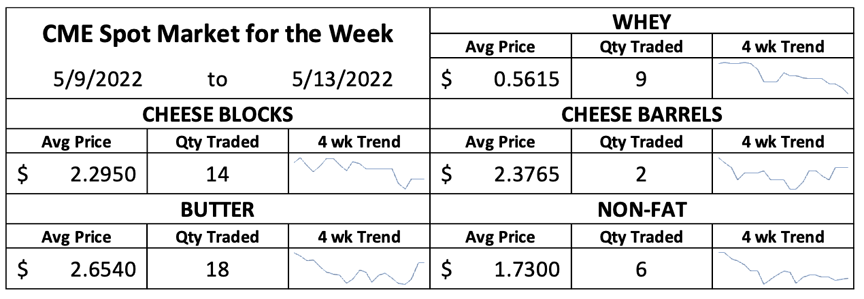
Most cheesemakers tell USDA’s Dairy Market News that demand remains strong. U.S. cheese is a bargain compared to foreign product, and exports are as vigorous as the supply chain will allow. Orders from foodservice and retail are generally stable. However, in the Northeast, processors mentioned “pockets of slightly softer demand.” That is enough to raise doubts about the price, slower output notwithstanding. The cheese markets were mixed this week, highlighting the market’s unease. CME spot Cheddar blocks fell 4.25ȼ to $2.3075 per pound. Barrels climbed 1.5ȼ to $2.395.

CME spot nonfat dry milk (NDM) slipped a penny this week to $1.73. Like cheese, U.S. milk powder is priced to move abroad. However, on the heels of the big GDT selloff last week, some buyers are hoping for a further setback before they step in to buy. Mexican milk powder importers are biding their time, and U.S. exports have likely slowed. The market is also casting a worried eye toward China. With several major cities in lockdown, Chinese economic growth is in peril and consumer spending is in a slump. Starbucks reported a 23% decline in same-store sales in China in the first quarter. Clearly lattes are a luxury that locked-down consumers cannot venture out to buy. Hopefully, China’s appetite for more shelf-stable dairy-laden products will fare much better.

Anxiety about China is top of mind in the whey market. China’s hog industry is awash in red ink, and they are purchasing considerably less whey for feed than they did last year. Closer to home, whey for feed demand is expected to climb, given the lack of affordable substitutes. Amid slower exports and seasonal growth in the whey stream, inventories are growing and prices continue to sink. CME spot whey fell another 5.25ȼ this week and dropped to an eight month low at 53.25ȼ.

After a few weeks in the doldrums, spot butter came roaring back this week. It jumped 6.5ȼ to $2.705. High prices have weighed on demand at retail, but foodservice orders are steady. Cream prices are climbing seasonally as ice cream makers ramp up production, and churn rates are falling accordingly. With the rest of the dairy complex under a bit of pressure, the rally in the butter market is a timely reminder that, while high prices can deter demand, there are good reasons that prices have climbed so high in the first place.

Setting aside the storm-ravaged Northern Plains, the spring flush has not overwhelmed processing capacity, despite all the labor and logistics issues that have reduced throughput. Indeed, although most spot milk is moving at a discount, some cheesemakers in the Upper Midwest paid a small premium for spot milk in each of the past two weeks. Dairy Market News reports, “If cheese production were at full clip… milk would be atypically tight during the flush.” The smaller dairy herd, high feed costs, and rising temperatures are stunting growth in milk production. There may be room for further declines in dairy product prices, but the pace of milk output suggests that prices aren’t likely to plummet.

Heavy rains in the Northern Plains kept planters out of the fields yet again this week, and the market is concerned that farmers will abandon some would-be corn acres in the Dakotas and Minnesota. But the sun shone in the rest of the farm belt, and planters were rolling. All eyes will be on the Crop Progress report Monday afternoon to see just how much ground farmers were able to cover.

Typically, USDA assumes a trendline corn yield in the May update to the World Agricultural Supply and Demand Estimates report, because it’s simply too early to say much about crop yields when much of the seed is not yet in the ground. But on Thursday the agency took the unusual step of lowering its projected corn yield from the trendline of 181 bushels per acre down to 177. That would match last year’s record-high corn yield, but it represents a significant step down from maximum potential, and the world needs those bushels. New crop corn prices soared on Thursday, and then retreated today as the market reflected on the mostly sunny forecast and all the unknowns that could benefit or harm the crop between now and harvest. December corn futures closed today at $7.4875 per bushel, still up 28ȼ from last Friday. Nearby July corn futures moved back and forth and finished close to where they began the week at $7.8125.

The soy complex was mixed this week. July soybean futures rallied 24.5ȼ to $16.465, driven by a rebound in soybean oil prices. Soybean meal took another step back. The July contract closed at $409.30 per ton, down $4.30 since last Friday.

Source: Jacoby

Mixed Markets to Start the Week in Chicago

On the Chicago Mercantile Exchange milk futures started the week in mixed territory.   Class III Milk had May unchanged at $25.09, June down a penny to $24.47, and July 3 cents higher to $24.68/cwt. The balance of the year was mixed between 4 cents lower and 14 cents higher. Class IV milk was unchanged in May and June at $25.04 and $25.05/cwt with July up 5 cents at $25.25/cwt.

The CME spot trade was quiet as well.  Dry whey down $0.0225 at $0.4850.  Five sales were made from $0.4850 to $0.4975.    Blocks unchanged at $2.38.    Barrels unchanged at $2.3475.      Butter up $0.0150 at $2.8650.  Three sales were made from $2.8625 to $2.8675.    Nonfat dry milk up $0.0050 at $1.8050.  Five trades were made from $1.79 to $1.8050.   

Milk Futures Fly Higher in Chicago Thursday

On the Chicago Mercantile Exchange milk futures found strength Thursday following a bullish milk production report and positive cash trade.   Class III milk futures soared on the day. June gained 22 cents to $24.79/cwt. July milk launched a 42-cent gain to $24.82/cwt. 2023 milk futures also saw nice increases. Class IV milk futures climbed higher. June exploded for a 68-cent gain. July added 58 cents to $25.05/cwt.

In the CME spot dairy product auction, Dry whey down $0.0025 at $0.50.  Six sales were made from $0.49 to $0.5025.    Blocks up $0.0050 at $2.38.  One trade was made at that price.  Barrels down $0.05 at $2.40.  Two trades were made at $2.40 to $2.42.    Butter up $0.0350 at $2.8275.  Nine sales were made from $2.80 to $2.8325.    Nonfat dry milk up $0.0450 at $1.79. Two trades were made at $1.79 and $1.7925.   

Dairy prices slip for a fifth global auction as Chinese demand weakens

Dairy prices fell for a fifth consecutive global auction, as Covid-19 lockdowns in China dent demand.

The Global Dairy Trade price index dropped 2.9% to 1340 at the bimonthly auction overnight. That follows an 8.5% fall at the previous auction.

The decline comes after steep rises in dairy prices this year pushed the index to record levels, as tight supply underpins demand. However recent auctions have been impacted by supply chain disruptions in China.

“North Asian demand is not as hot as normal,” said NZX dairy insights manager Stuart Davison. Still, demand from the rest of the world “is still hot”, he said.

Davison said he remained optimistic on the outlook for dairy prices.

“Following the previous event’s dramatic crash, this event has been the sort of settling that is usually expected after that scale of movement; prices are just finding their feet, albeit drifting slightly lower,” he said.

“Demand is still relatively steady, as prices are finding a new floor price that buyers are willing to participate with.”

STUFF

Fonterra factors in fat and protein levels in milk when buying it off farmers.

Whole milk powder, which has the most impact on what farmers are paid, recorded the biggest drop, with the average price down 4.9% to US$3934 (NZ$6063) a tonne, after a larger offer volume of instant whole milk powder.

Butter fell 1% to US$5750/t, skim milk powder slipped 0.6% to US$4116/t, and cheddar slid 0.1% US$5635/t. Anhydrous milkfat advanced 0.6% to US$6043/t.

Last week, Fonterra lowered its forecast milk payment to farmers for this season to between $9.10 and $9.50 per kilogram of milk solids. That reduced the midpoint of the range, which farmers are paid off, to $9.30 per kgMS from $9.60 per kgMS.

Fonterra chief executive Miles Hurrell cited Covid-19 lockdowns in China, an economic crisis in Sri Lanka and the Russia-Ukraine conflict among recent events which had resulted in short-term impacts on global demand for dairy products.

The $9.30 per kgMS midpoint for this season, which finishes at the end of this month, would still be the highest milk payment since Fonterra was formed in 2001.

As the country’s biggest processor, Fonterra’s milk payment sets the benchmark for its competitors.

Source: stuff.co.nz

Milk futures turn south in Chicago

On the Chicago Mercantile Exchange milk futures declined at midweek following the general trend in commodities, cash trade was mixed.  May Class III milk was down four cents at $24.98.  June two cents lower at $24.57.  July down four cents at $24.40.  August five cents lower at $24.04.  September through November unchanged to a dime lower. 

In spot trade, dry whey up $0.0050 at $0.5025.  Four sales were made at $0.5025 to $0.51.    Blocks up $0.0050 at $2.3750. Three trades were made at that time.    Barrels unchanged at $2.45.  Three trades were made from $2.4450 to $2.4550.    Butter up $0.0225 at $2.7925.  Seven sales were made from $2.7850 to $2.79.    Nonfat dry milk unchanged at $1.7450.

CME Markets Move Higher Despite Negative GDT

On the Chicago Mercantile Exchange milk futures continued its trend higher along with cash markets despite negative global trade.  Class III milk futures were higher on the day. June moved 18 cents higher to $24.59/cwt. July settled 19 cents higher to $24.44/cwt. Class IV milk futures were approximately 15-40 cents higher. The USDA will release the April Milk Production Report Wednesday afternoon at 2 pm central time.

In the CME spot dairy auction, Dry whey up $0.0125 at $0.4975.  Two sales were made at $0.4925 and $0.4950.    Blocks up $0.0050 at $2.37.    Barrels up $0.0325 at $2.45.  Four trades were made from $2.42 to $2.45.    Butter up $0.03 at $2.77.  Six sales were made from $2.7375 to $2.77.    Nonfat dry milk up $0.01 at $1.7450. Three trades were made at $1.7450 and $1.7475.   

Milk Futures Take Postive Tone in Chicago to Start the Week

On the Chicago Mercantile Exchange milk futures took on a positive tone Monday that moved through commodities as did cash trade.  Class III milk markets jumped 50+ cents/cwt in the June through September 2022 markets on Monday.  Q4 2022 was also up 17-35 cents while first half 2023 ranged from even to 19 cents stronger.  Class IV saw some strength as well, gaining around 20 cents from June through August 2022.  Beyond August, results were a bit more sporadic as months ended even to 28 higher.  

With the exception of whey on the CME spot dairy auction, dairy markets had a strong start to this week.   Dry whey down $0.0475 at $0.4850.  Seven sales were made from $0.4850 to $0.5150.    Blocks up $0.0575 at $2.3650. Two trades were made at $2.3075 and $2.3650.    Barrels up $0.0225 at $2.4175. Seven trades were made from $2.20 to $2.42.    Butter up $0.0350 at $2.74. Seven sales were made from $2.7250 to $2.74.    Milk Nonfat dry milk up $0.0050 at $1.7350.

Tight global dairy production should keep prices high over next year

Stagnant global dairy production should keep prices high for New Zealand farmers over the next 12 months, Westpac senior agri economist Nathan Penny says.

A softening of demand for dairy in China because of the Omicron outbreak is likely to be temporary, he told farmers at a field day at Owl Farm in Cambridge.

That softening is being blamed for dairy prices tumbling at the latest GDT auction and subsequent 30 cent revision in Fonterra’s forecast for this season.

Omicron waves usually pass and Penny said he was confident demand will return to that market once the wave was finished.

At the same time, supply will stay tight around the world and this will help underpin prices.

“Come spring, we think underlined prices will rebound as China comes out of its Omicron wave and the key thing around production tightness globally will reinsert itself as the dominant force for prices.”

Interest rates were also rising for the first time in a long time.

While this will impact global growth, it was not as important influence as supply.

“There isn’t a big supply response coming this year like there was back in 2015. This is going to be a longer cycle and we expect consecutive high milk prices.”

Nathan Penny
Westpac

Dairy is a staple rather than a luxury product so even when incomes became tighter because of the effect of interest rates, they will still consume it. 

“Yes, it matters, but not nearly as much as the supply crunch. That’s the key driver over the next 12-18 months,” he said.

On the downside, inflation and cost increases will continue to impact the farming sector – much more so than the rest of the economy. 

This is not a challenge that is going away any time soon, he said.

Dairy incomes are very strong and farmers still had buying power that other parts of the economy did not have.

“I expect the pressure on costs for farmers to be really rough over the next season at least.”

Six months earlier, all of the indicators pointed to a fall in global dairy production and a lift in commodity prices. 

There was a drought in the United States, the Ukraine-Russia conflict, high fertiliser, fuel and supplementary feed prices and supply chain issues.

At the same time in China and South East Asia, demand for dairy was taking off and prices followed suit, with record prices for several categories.

That never lasts and over the past few months, a few of those indicators were starting to go the other way, Penny said.

Right now the commodity price cycle is different to the one that occurred in 2014. 

It is longer and prices are going to stay higher for longer.

“We’re thinking another $9/kg MS milk price for next year.

“It’s going to be quite different this time round and the key reason for that isn’t any milk around to fill the gap that we have seen during covid.”

Like New Zealand, European dairy producers had their own production issues and their margins are no where near they should be for them to crank up production.

“There isn’t a big supply response coming this year like there was back in 2015. This is going to be a longer cycle and we expect consecutive high milk prices.

“Where is the new normal? The new normal is now $8. There’s still quite a wide range around that, but $8 is the new $6.”

The pandemic accelerated that shift upwards, which was already slowly occurring and now New Zealand was at a new long running milk price.

That acceleration has put the industry in a better position pre- covid.

“We have got a margin to work with but our offshore competitors, for the moment at least, don’t have that luxury.”

Source: farmersweekly.co.nz

Milk Markets Mostly Lower to Start the Week at the CME

On the Chicago Mercantile Exchange milk futures ended the week mostly lower with little direction from cash trade.  May Class III milk was up two cents at $24.97.  June 27 cents lower at $23.83.  July down 27 cents at $23.83.  August 29 cents lower at $23.74.  September through November 17 to 29 cents lower. 

In spot trade,  Dry whey down $0.0225 at $0.5325.  Four sales were made from $0.5325 to $0.5450.   Blocks unchanged at $2.3075.    Barrels unchanged at $2.3950.     Butter unchanged at $2.7050.   Nonfat dry milk up $0.0025 at $1.73.

Markets Continue to Move Higher in Chicago Thursday

On the Chicago Mercantile Exchange milk futures continued higher Thursday supported by a strong supply and demand report and cash trade.  May Class III milk was up six cents at $24.95.  June 29 cents higher at $24.10.  July up 25 cents at $24.03.  August 32 cents higher at $23.57.  September through November four cents lower to 25 cents higher. 

In spot trade,  Dry whey down $0.0125 at $0.5550. Five sales were made from $0.5550 to $0.5675.    Blocks unchanged at $2.3075.   Barrels unchanged at $2.3950.    Butter up $0.07 at $2.7050.  Six trades were made from $2.6950 to $2.7050.  Nonfat dry milk up $0.0050 at $1.7275.  Three trades were made from $1.7275 to $1.7425.

Fonterra opens season at $8.25/kg MS

Fonterra Australia has announced a step-up of 10¢/kg of milk solids, taking its 2021-22 average price to $7.40/kg MS, and an opening weighted average farm gate milk price of $8.25/kg MS for the 2022-23 season.

Fonterra Australia managing director René Dedoncker said this latest price increase demonstrated another year of consistent performance for Fonterra’s business.

“It gives us good momentum as we head into the new season, where we’re opening at an average farm gate milk price of $8.25/kg MS,” he said.

“Like last year, we’ve come out early with an opening price in May to help farmers plan for the year ahead and budget in the face of rising costs, and we will review our price in June once key contracts, including cheese exports, are finalised.”

Mr Dedoncker said while Fonterra’s business was well-placed to continue to deliver good returns, recent falls in commodity prices and currency volatility had been factored in when setting next season’s price.

“China’s COVID-19 lockdown, the Russia-Ukraine conflict and continued global supply chain disruption combined with inflation have had short-term impacts on dairy demand,” he said.

“This has flowed through to commodities on Global Dairy Trade with prices down 13.4 per cent over the last four auctions.

“The Australian dollar has buffered this drop in commodity prices, falling to 69 US cents, but has traded as high as 76 cents in April.

“While the outlook for dairy remains positive and we expect global demand to recover next season as these short-term impacts are resolved, inflationary pressures, rising interest rates, increased volatility, and COVID-19 and geopolitical disruptions will continue to be watch-outs.”

Source: dairynewsaustralia.com.au

Milk futures turn higher in Chicago Wednesday

On the Chicago Mercantile Exchange milk futures moved higher Wednesday with pre-report positioning ahead of tomorrow’s supply and demand report and some cash trade support.  May Class III milk was up 23 cents at $24.89.  June 30 cents higher at $23.81.  July up 41 cents at $23.78.  August 24 cents higher at $23.25.  September through November two to 20 cents higher. 

In spot trade,  Blocks up $0.0450 at $2.3075.  One trade was made at that price.  Barrels up $0.0550 at $2.3950. Two trades were made at $2.3424 and $2.3950.    Butter up $0.0250 at $2.6350.  Eight trades were made from $2.6250 to $2.6350.  Nonfat dry milk down $0.0125 at $1.7225.  One trade was made at that price.  Dry whey unchanged at $0.5675.   


Milk Prices Slump in Chicago Tuesday

On the Chicago Mercantile Exchange milk futures continued their sell-off Tuesday with limited market news and lower cash trade.  Class III milk futures saw weakness across the board. June milk finished 34 cents lower to $23.44/cwt. July milk was down 20 cents to $23.21/cwt. Class IV milk futures were negative as well.

Dairy products were lower in the CME spot dairy auction on Tuesday.  Dry whey down $0.0175 at $0.5675.    Blocks down $0.0275 at $2.2675.  Nine sales were made from $2.2550 to $2.2625.    Barrels down $0.0175 at $2.34.    Butter down $0.0050 at $2.61.  Three trades were made from $2.5750 to $2.62.  Nonfat dry milk unchanged at $1.7350.  One trade was made at that price. 

Poor Start to Week at the CME in Chicago

On the Chicago Mercantile Exchange milk futures started Monday lower as did cash markets.   Class III Milk had May down 24 cents to $24.77, June down 68 to $23.78, and July down 59 to $23.51/cwt. Class IV milk was also softer. May and June unchanged at $24.55 and $23.85. July fell 6 cents to $23.83/cwt.

Milk followed a lackluster CME spot trade.  Blocks down $0.06 at $2.29. Four sales were made at $2.29 and $2.30.    Barrels down $0.0225 at $2.3575.    Butter down $0.0250 at $2.6150.  One trade was made at that price.  Nonfat dry milk down $0.0050 at $1.7350.  One trade was made at that price.  Dry whey unchanged at $0.5850.   


U.S. dairy exports finished Q1 strong, as value soared and volume nearly matched 2021 record

Cheese and butter led the way in March, alongside improvements in whey.

Source: uab bank

U.S. dairy exports in March nearly matched the record high of 2021, as total exports on a milk solids equivalent (MSE) basis decreased by less than 1%, a drop of only 2,005 metric tons (MT) MSE.

The strong performance of cheese (+13%, +4,773 MT), particularly cheddar (+86%, +3,596 MT), is a positive signal to the market, highlighting global consumers’ growing consumption of U.S.-made cheese.

Arguably, a recovery in low-protein whey exports (+1%, +320 MT) after three straight underwhelming months is the most bullish March indicator for future performance. But given the importance of China to the whey market, the country’s recent lockdowns and corresponding fallout regarding supply chains are likely to cause whey exports to fluctuate significantly in the short term.

More broadly, several short-term factors – constrained milk supplies, strong domestic demand early in the year limiting export availability, logistics frustration, and high prices slowing some global demand growth among lower-income consumers – have and continue to act as short-term headwinds to U.S. dairy export volume meeting or exceeding 2021 records.

Export value, on the other hand, continued to soar in March and looks poised to build off the success of 2021 as a result of the tight global market and increased U.S. shipments of higher-value products like cheese, butter and protein concentrates. Export value in March jumped 25% (+$172 million) to $860 million, the highest month on record by a considerable margin.

Chart25

Below is how U.S. dairy exports fared to the major markets and our key takeaways.

MEXICO

Chart2 (2)-May-04-2022-08-04-15-26-PM

  • Key trend: High input costs are reportedly slowing Mexico’s domestic milk production growth, necessitating imports to meet domestic demand.
  • Moving forward: Given the tight milk supplies within Mexico, the fact that NFDM volumes still trail pre-pandemic levels on an annualized basis, and logistics headaches are expected to continue, we anticipate greater nonfat volumes moving south of the border this year. Provided the economy holds and inflation is kept to a reasonable level, cheese exports to the country should continue to perform well.

SOUTHEAST ASIA

Chart3-4

  • Key trend: U.S. exports of high protein whey to the region have slowed down sharply, likely a result of limited availability and high prices burning off some demand. Long-term growth is still very positive, particularly with more supply capacity expected in 2023 and beyond.
  • Moving forward: With Southeast Asian markets opening up after two years of relatively tight COVID restrictions, buyers are expected to become increasingly active in anticipation of demand growth. With the  recent troubles in China, the U.S. should expect increased competition from New Zealand, as product previously earmarked for China is re-routed to SEA.

CHINA+HK

Chart4-1

  • Key trend: Government lockdowns continue to snarl global supply chains and limit imports into a market we believed was already well-stocked on ingredients coming into the new year.
  • Moving forward: In the short term, we anticipate China’s COVID lockdown measures will challenge exports across the dairy complex. Crucially, if Chinese consumers under quarantine are not consuming fresh milk, not only will that lessen the need for imports, it will also likely result in additional domestic milk production being dried into whole milk powder, further exacerbating the import demand slowdown. The length and severity of the lockdown measures will remain the primary inflection points as to whether this is a short-term blip or will create ripple effects in global dairy markets through the end of the year.

JAPAN

Chart5-May-04-2022-08-11-46-09-PM

  • Key trend(s): After a slow year in 2021, U.S. cheese exports to Japan got off to an incredibly strong start as buyers looked to the U.S. for supply security and, at times, favorable prices.
  • Moving forward: We expect U.S. cheese exports to remain favorable given the lack of supply out of Europe and New Zealand through the first half. Much of the abnormally strong import demand growth appears to be restocking rather than a surge in new demand. Exports of high value proteins, on the other hand, are growing at an exponential rate as consumers move strongly towards health and wellness – a trend we anticipate will persist in the long-run (even if export growth moderates later in the year).

KOREA

Chart6-1

  • Key trend: Some of the world’s tighter COVID measures—including restrictions on operating hours for restaurants and bars that started in early January—limited economic growth as well as cheese consumption in South Korea in the first quarter. However those measures did little to dampen demand for products utilizing milk and whey proteins.
  • Moving forward: South Korea dropped most of its COVID restrictions in mid-to-late April, and signs of reinvigorated consumption are already beginning to show. U.S. suppliers went through a four-month period (May-August 2021) where their main dairy product export to the country—cheese—fell by 30% (a decline of nearly 10,000 MT). Fewer COVID restrictions and favorable cheese comparisons bode well for U.S. prospects this summer.

MIDDLE EAST-NORTH AFRICA (MENA)

Chart7-3

  • Key trend: High commodity prices are restraining dairy import demand in the price-sensitive MENA region. U.S. shortfalls are magnified by Egypt and Algeria’s spike in buying U.S. milk powder in the first quarter of 2021, as well as some increased availability of SMP for export out of smaller suppliers, including Turkey and India.
  • Moving forward: A prolonged period of elevated oil prices—which it certainly appears will be the case—could help soften the blow of historically high dairy commodity prices for some of the more oil-dependent countries in the region. In addition, milk powder, butterfat and cheese prices have come off recent peaks and—should they continue to moderate—could also help stir demand. MENA inventories are likely in need of a burst of buying activity.

Source: USDEC

Dairy Market Review

Highlights
• Tight global supplies and sustained import demand underpin rising global dairy prices
• Global milk production is rising, with significant expansions expected in Asia and North America
• World dairy trade in 2021 is likely to reach a new high amid a sharp increase in imports by China

See the latest issue |

Global Dairy Commodity Update May 2022

Supply-side constraints remain a feature in the outlook, as the effects of war on feed markets will mean extended periods of high input costs (corn, grain and fertilizer) and weak margins for milk producers. Higher milk prices may alleviate some of the pressure, but most milk producers typically recoil from high costs by reducing inputs rather than looking longer term at their expected business cashflows.

Weather is also not being supportive, as Europe is forecast to have (another) hotter than usual summer, and other regions face a weaker La Nina, while a worsening US drought threatens water supplies.

The effect of the fragile global feed situation will run into next year with the ongoing damage to Ukraine’s food production and sanctions on Russia and its allies. The escalating tensions between Russia, EU and the US have unpredictable consequences.

Uncertainty about EU milk output hangs over protein and fat values keeping wholesale prices firm, but buyers have retreated from strong prices in some developing regions. The higher food (and dairy) prices have not reached many developed world consumers yet – the downward pressure on demand for cheese and butterfat may not significantly affect pricing given the supply constraints in the region.

The fundamentals suggest a tighter US dairy market, subject to the risks for cheese demand as households learn to cope with inflation. While milk production looks to be stabilizing, growth is occurring in limited regions and may soon stall. The US drought is worsening.

China’s zero-COVID restrictions will weaken short-term demand for ingredient imports while domestic whole milk powder output is increasing in the short term. The whip-effect of a stimulated recovery could bring a revival later in the year to recover some lost ground.

By Edwin Lloyd, Executive General Manager – Foods
Ph: +61 7 3246 7810
edwin@maxumfoods.com

Graph Reference: Fresh Agenda
-Ends –

For more information or interviews contact: Edwin Lloyd | Executive General Manager – Foods
Ph: +61 7 3246 7810
edwin@maxumfoods.com

Milk Prices Push Higher in Chicago Thursday

On the Chicago Mercantile Exchange milk futures closed higher Thursday as traders corrected oversold positions and cash markets were mostly higher.  Class III milk futures traded higher but came off its highs as the day progressed. May milk gained 22 cents to $24.94/cwt. June milk settled at $24.32/cwt. July milk advanced 12 cents to $24.24/cwt. Class IV milk futures were slightly higher.

Dairy products settled mostly higher in the CME dairy product trade.  Blocks up $0.0025 at $2.35.  Two trades were made at $2.35 and $2.3525.    Barrels up $0.03 at $2.33.  One sale was made at that price.  Butter up $0.01 at $2.66.  Three trades were made at $2.66 and $2.67.  Nonfat dry milk up $0.0050 at $1.74.  One trade was made at that price.  Dry whey down $0.0025 at $0.5850.   


Milk Markets Bounce Back in Chicago Wednesday

On the Chicago Mercantile Exchange May Class III milk futures up 51 cents at $24.72.  June gained 37 to $24.30 and  July gained 39 to $24.12/cwt. Class IV milk was unchanged in May to $24.45, June gained 10 to $23.70, and July gained 17 to $23.92/cwt.

The CME spot trade was littered with green.  Barrels up $0.03 at $2.33.  One sale was made at that price.  Butter up $0.03 at $2.65.  Two trades were made at that price.  Nonfat dry milk up $0.0250 at $1.7350.  Four trades were made at $1.72 to $1.7350.  Dry whey down $0.0075 at $0.5875.  Five sales were made from $0.5875 to $0.6025.    Blocks unchanged at $2.3475.  Three trades were made from $2.3450 to $2.35.   


Global dairy auction plummets 8.5% as buyers baulk at high prices

The Global Dairy Trade price index dropped 8.5%, its biggest fall since 2015.

Dairy prices plummeted at the fastest rate in seven years at the latest global auction, as buyers appear to have baulked at record high prices.

The Global Dairy Trade price index dropped 8.5% to 1379 at the bimonthly auction overnight. That’s the biggest fall since August 4, 2015, when the index shed 9.3%.

The drop comes after steep rises in dairy prices this year, pushing the index to record levels, as tight supply underpins demand. Recent auctions have been impacted by supply chain disruptions due to Covid-19 lockdowns in China, but analysts say the latest result suggests buyers may be baulking at high prices.

“The result will be a bit of a shock to many – while a further fall was expected, the magnitude wasn’t,” said NZX senior analyst Amy Castleton. “It seems buyers have finally had enough of paying high dairy commodity prices.” 

The average price for whole milk powder, which accounted for more than half the auction volume, fell 6.5% to a four-month low of US$3916 (NZ$5967) a tonne, the biggest drop since March last year.


Castleton said the decline was largely driven by regions outside of North Asia “who seem to have decided they didn’t want to pay the high prices any longer”.

Skim milk powder fell 6.5% to US$4130/t, anhydrous milkfat slumped 12.1% to US$6008/t, butter dropped 12.5% per cent to US$5807/t, cheddar slid 8.6% US$5652/t and buttermilk powder dropped for the first time since November, down 6.1% to US$4203/t.

Global dairy prices are important for determining the milk price companies pay farmers. The dairy season runs until the end of May, with production generally peaking around November.

The country’s largest dairy company, Fonterra, sets the benchmark for milk prices and Fonterra chief executive Miles Hurrell said in March that the company was “very comfortable at this point in time” with its milk price forecast for this season.

In February, Fonterra raised its forecast milk payment to farmers for this season for a fourth time to between $9.30 and $9.90 per kilogram of milk solids. The $9.60 per kgMS midpoint, which farmers are paid off, is the highest since Fonterra was formed in 2001.

Source: stuff.co.nz

GDT Drags CME Markets Down in Chicago Tuesday

On the Chicago Mercantile Exchange Tuesday  global dairy markets dragged down milk futures along with a quiet but lower cash trade.  Third quarter Class III futures stumbled to $23.37 per hundredweight, down 34 cents. GDT WMP prices dropped 6.9% to $3,916 per metric ton, or $1.78 per pound. SMP prices fell 6.3% to $4,130 per metric ton, or $1.87 per pound. Spot NDM slid to $1.7100 per pound, giving up four cents, with two loads trading. Spot dry whey paused at $0.5950 per pound, with zero lots changing hands.

In spot trade  Butter down $0.0475 at $2.62.  Three trades were made from $2.60 to $2.62. Three trades were made from $2.60 to @.62.  Nonfat dry milk down $0.04 at $1.71.  Two trades were made at that price.  Dry whey unchanged at $0.5950.    Blocks unchanged at $2.3475.    Barrels unchanged at $2.30.   


Retail Milk Prices are Way Up. What is that Doing to Sales?

Retail milk prices are reaching record levels.  Conventional milk is selling for over four dollars per gallon.  Organic milk is selling for nearly nine dollars per gallon.  Because of the price point, organic milk is typically sold in half gallon containers.  Between the start of 2021 and April 2022, conventional retail milk prices have increased by 18 percent and organic retail milk prices have increased by nine percent.  Beverage milk has been characterized as a necessity which is not subject to price elasticity of demand (if it costs more, people will buy less).  In the coming months, we’ll see if this is true. 

Federal order pricing and retail milk prices in this blog are current through April 2022.  Data on milk sales is available through February 2022.   Flavored milk is included in the charts for whole and two percent milk.  Buttermilk is a very small category and is not included in this data.

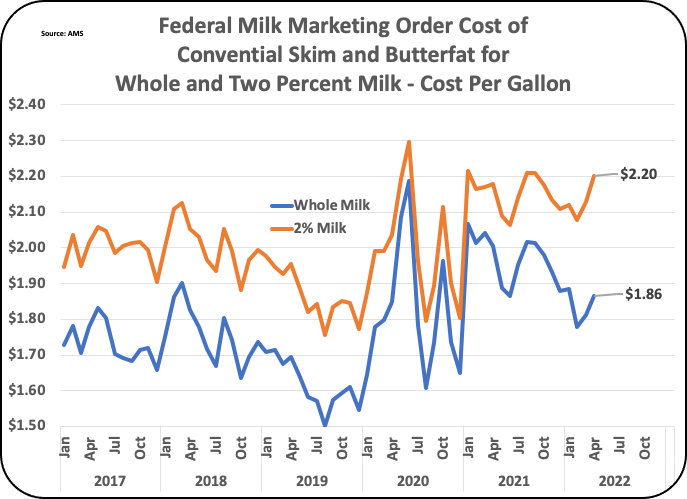
Whole and two percent milk are retail priced identically (Chart I) despite the difference in cost with a different amount of butterfat (Chart II).  With butterfat at high prices, whole milk is more expensive to produce than two percent milk.  Organic milk makes up only six percent of total beverage milk.

Chart I – Retail Prices of milk
 
Chart II – Federal Milk Order prices for Whole and two Percent Milk
 
Total beverage milk sales continue to decline linearly (Chart IV).  That means that the percentage decline is accelerating.  In 2018, total milk sales declined by two percent from the previous year.  In 2021, total milk sales declined by four percent from the previous year.   In 2020, there was a “bubble” caused by the COVID “Stay at Home” policies.  It looks like the annual decline of around 80 million pounds per year is returning.


Chart IV – Total Milk Sales Volume

Whole milk had a major increase in 2020 as “Stay at Home” policies were implemented (Chart V).  Some of this was caused by hoarding as retail milk was in short supply in March 2020 and this influenced the twelve-month averages in Chart V.  However, by the start of 2022 whole milk sales have declined to 2019 levels.

Chart V – Whole Milk Sales Volume
 
Two percent fat milk sales (Chart VI) follow a linear declining pattern with a small surge at the beginning of COVID policies.  It is now back to a linear decline.  Two percent milk has declined by 13 percent over the course of Chart VI.
Chart VI – Sales of Two Percent Fat Milk
 
Sales of one percent milk and fat free milk are declining quickly.  In February 2018, they made up 23 percent of total milk sales.  By February 2022, they made up only 18 percent of total milk.
 
Chart VII – Comparison of 2018 and 2022
 
Charts VIII and IX show the decline in one percent milk and fat free milk.  One percent milk has declined by 20 percent over the course of Chart VIII and fat free milk has declined by 40 percent over the course of Chart IX.
Chart VIII – Sales of One Percent Fat Milk
 
Chart IX – Sales of fat Free Milk
Organic milk saw tremendous growth in 2020, perhaps influenced by the COVID policies of “Stay at Home.”  However, that surge is fading as shown in Chart X.  Organic milk sales grew by 14 percent in 2020 but in 2021 and 2022 YTD, sales have slide by five percent.
Chart X – Sales of Organic Milk
 

SUMMARY AND CONCLUSIONS

 
Prices for milk are up, significantly up.  Sales of milk are down, and the worst may be yet to come as March and April data becomes available.
 
Two percent, one percent, and fat free milk are all in a linear decline, meaning that the decrease is becoming a larger percent.
 
Fat free milk is falling very fast.  Less retail shelf space will be used for fat free milk and some private label brands may eliminate fat free milk further escalating the decline in sales.  As an ingredient, nonfat dry milk is always an alternative.
 
Organic milk has started to decrease after a long term of static to increasing volumes.
 
With these declines, less butterfat will be available for butter churning.  See the January 2022 post to this blog for details.
 

Milk Markets Start Lackluster Week at the CME

On the Chicago Mercantile Exchange milk futures started the week lackluster with cash markets weighing on prices. Class III milk markets settled 40-50 cents lower although certain months were trading down near a limit of 75 cents near the close.  May and June are nearing $24.00/cwt while the second half average is now offering $23.20/cwt.  2023 Class III was also down around 20 cents/cwt.  Class IV weakened 20 cents/cwt as well.

Dairy markets were beat up on Monday as cheese was sold off.   Blocks down $0.0225 at $2.3475.  Two sales were made at that price.    Barrels down $0.04 at $2.30.  Ten trades were made from $2.30 to $2.34.  Butter down $0.0075 at $2.6675.  Five trades were made from $2.6550 to $2.6675.  Nonfat dry milk down $0.0050 at $1.75.  One trade was made at that price.  Dry whey down $0.01 at $0.5950.  Two sales were made at $0.5950 and $0.60.   


Wisconsin All Milk Price Hits Near Record $25.30

The Wisconsin all milk price for March was $25.30 per hundredweight, according to the latest USDA Agricultural Prices report. That was $1.30 above last month’s price and $7.60 more than the previous March. It was also the highest all milk price since September 2014 when it reached an all-time record of $26.60.

The U.S. all milk price for March was $25.90 per cwt., 60-cents higher than Wisconsin’s price and $1.20 more than last month’s U.S. price. All the 24 major milk producing states had a higher price when compared with February.

Meanwhile, the Chicago Mercantile Exchange 40-pound block cheese price closed at $2.37 per pound on April 29, while barrels were $2.34 per pound. The CME butter price was $2.67 per pound.

For the week ending April 23, the Agricultural Marketing Service U.S. weekly 40-pound block cheese price averaged $2.32 per pound, and 500-pound barrels adjusted to 38 percent moisture averaged $2.36 per pound. The U.S. butter price was $2.77 per pound.

Source: Wisconsin Ag Connection

Record prices, ideal weather set to buoy Aussie dairy sector

Record minimum milk price offers are already being made to Australian dairy farmers according to Rabobank research – but there’s a catch.

Although global market fundamentals remain strong, dairy farmers’ margins are under pressure due to rising input costs according to the bank.

In its Australian Dairy 2022/23 Seasonal Outlook, Rabobank has forecasted an indicative milk price of $8.40/kgMS for southern Australia.

And despite Australia’s national dairy cow herd falling for the fifth consecutive year, Rabobank predicts a 0.9 per cent increase in milk volume, returning production to 8.64 billion litres in 2022/23.

On a global scale, the big seven dairy exporters (the EU, US, New Zealand, Australia, Brazil, Argentina and Uruguay) have recorded lower milk production this year due to supply chain disruptions and weather-related impacts.

Rabobank senior dairy analyst Michael Harvey said the global dairy commodity market is doing the ‘heavy lifting’ in propelling milk prices to record levels.

“Commodity prices for Oceania-origin butter and cheese are trading at record levels and the milk powder complex is nearing record highs,” Harvey said.

The report has suggested that dairy farm businesses can expect local guaranteed milk pricing despite a complicated operating environment.

“There are record minimum milk price offers already in the market across southern Australia,” Harvey said. “This will provide a strong cashflow position for farm businesses and, given the level of price security, could provide a good risk management platform for inputs to ensure an adequate locked-in margin.”

Source:  Inside FMCG

Exceptional milk prices in Ireland may be sufficient to maintain dairy profit margins

With Irish farmgate milk prices now among the highest in the EU, dairy farmers here have benefited from weekly EU wholesale prices continuing to rise through March and the first half of April. It comes despite prices on the New Zealand-based GDT trading platform easing slightly since March 1.

Irish milk prices in 2022 could be 20% to 30% higher than in 2021, on average, says Teagasc. However, some farmers have significant shares of their output in fixed milk prices contracts, well below the prevailing spot milk prices, and they will be hit by falling income. 

The war in Ukraine has led to a further dramatic increase in energy prices, and fertiliser and feed availability for 2022 have become uncertain. Irish milk production costs could jump 30% from the 2021 level, but Teagasc goes on to predict that in spite of the dramatic increase in input costs, the very high milk prices may be sufficient to maintain dairy profit margins and incomes on most farms this year.

Intensive users of purchased inputs, and farmers dependent on hired labour, will likely see the greatest impact on the cost of production, according to the recently updated Teagasc Situation and Outlook for Irish Agriculture report. But it was noted that the average net margin per hectare and income levels in 2022 should be broadly in line with the 2021 figures.

Glanbia milk payments

In response to the extreme and unprecedented inflation in farm inputs, the Board of Glanbia Co-op has announced a six-month pilot change in the timing of milk payments, which includes a new early milk payment each month, commencing with the June milk payment in July, when about 50% of the price due to milk suppliers will be paid early (on June 9 rather than June 18).

Then, when the milk price for the month is set, the remaining balance due will be paid by June 25. Any deductions due on milk accounts will be split evenly between the two payment dates.

Glanbia Co-op Chairman John Murphy said: “In this period of extreme input cost inflation, the Co-op Board believes that an early milk payment each month will assist our farmers by providing a more regular cash inflow approximately every fortnight. 

“The board has agreed to implement this payment structure on a pilot basis for the second half of 2022.” 

Glanbia Co-op has also decided this month to start creating a stability fund “to protect both suppliers and our farmer-owned business”.

Chairman John Murphy said: “We are in unchartered territory as rising costs and tight supplies of key farm inputs such as feed and fertilizer contribute to the current strength in dairy prices on global markets.”

“While tight global milk supplies and the need to cover rising costs have supported prices in recent months, there will inevitably come a time when high prices cause a reduction in demand and a subsequent price correction,” said dairy markets analyst Katherine Jack of the UK’s Agriculture and Horticulture Development Board, commenting after the GDT global trading platform index fell 1% on both March 15 and April 5, and by 3.6% on April 19. 

Milk prices

The price declined for all products traded at the latest event. The GDT primarily facilitates trades from New Zealand and Australia to Asia, so Asian demand has a stronger influence on GDT prices.

The AHDB analyst said it may not be the case that prices in other regions will follow the GDT trend. Covid-19 lockdowns in China and the resulting logistics chaos were partly blamed for the latest GDT price fall.

The most recent EU Commission milk price report for member states (February) had higher milk prices than Ireland only in Malta and Cyprus (respectively €61.90 and €58.40 per 100kg compared to €47.50 in Ireland). 

The price also exceeded €45 in Denmark, Lithuania, Greece, Belgium, and the Netherlands. Only in Romania, Slovakia, Bulgaria, Hungary, Slovenia, Spain, Croatia, and Portugal was the estimated February milk price under €40.

Dairy markets are likely to stay strong because unfavourable weather in New Zealand and South America points to lower global milk production growth in 2022, and the war in Ukraine has created further new uncertainties putting a brake on global milk production growth.

Meanwhile, international dairy product demand remained solid, in spite of higher prices. China remains an important source of demand, along with oil-exporting countries benefiting from high oil prices.

With price levels also high for some vegetable oils used as dairy alternatives, increased dairy commodity prices may have only a limited impact on dairy demand.

Source: irishexaminer.com

Dairy giant Müller to increase milk price for farmers in June

Dairy giant Müller has confirmed that it will increase the milk price it offers to farmers from June.

Müller's plant in Market Drayton
Müller’s plant in Market Drayton

Farmers who meet the conditions for the Müller Advantage programme will receive a milk price of 41.5p per litre from June 1 – a 1.5p increase.

Müller has operations in Shropshire at Market Drayton, Minsterley and Telford.

Rob Hutchison, joint chief executive officer at Müller Milk & Ingredients, said: “With unprecedented increases in input costs and challenges facing all parts of the supply chain from farm to shelf, we are committed to ensuring security of supply for the millions of consumers who enjoy the dairy products we make, every day.

“As ever, we will closely monitor all of the factors which influence farm gate milk price in the coming months.”

Müller Advantage aims to improve supply chain collaboration, herd health and reductions in environmental impact and 99.5 per cent of eligible supplying dairy farmers have opted to commit to the programme.

Source: shropshirestar.com

Mixed Day Tuesday at the CME in Chicago

On the Chicago Mercantile Exchange Milk futures continued to be mixed Tuesday as did cash trade. April Class III milk was down a penny at $24.31. May two cents higher at $24.70. June down 18 cents at $24.64. July a penny higher at $24.46. August through to October three to 20 cents lower.

In spot trade dry whey down $0.04 at $0.5750. Five sales were made from $0.5750 to $0.5950. Blocks down $0.0275 at $2.3650. Two trades were made at $2.3650 and $2.3850. Barrels up $0.01 at $2.38. Seven trades were made from $2.38 to $2.39 Butter down $0.0075 at $2.65. Nonfat dry milk down $0.0475 at $1.7075.

Spring Has Arrived and the Dairy Markets Swoon

The T.C. Jacoby Weekly Market Report Week Ending April 22, 2022


Milk powder was especially weak and whole milk powder (WMP) prices fell 4.4%, logging their third straight decline. Skim milk powder (SMP) suffered its first setback at the GDT since July. U.S. milk output has fallen short of the prior year for six of the past seven months, its longest such streak since 2009.

Spring has arrived, and the dairy markets swooned accordingly. Milk powder was especially weak. At Tuesday’s Global Dairy Trade (GDT) auction, whole milk powder (WMP) prices fell 4.4%, logging their third straight decline. Skim milk powder (SMP) suffered its first setback at the GDT since July. It fell 4.2% to an average of $4,408 per metric ton, roughly equivalent to nonfat dry milk (NDM) at $2.13 per pound. In comparison, U.S. NDM looks like a bargain. CME spot NDM followed GDT SMP lower this week, dropping 6.75ȼ to $1.755, a three-month low.

Powders are under pressure amid concerns that lockdowns in major Chinese cities and backups at Chinese ports will stymie demand. March trade data neither fed nor assuaged those fears. Chinese milk powder imports were still healthy in comparison to most years, but they fell well short of the record-shattering volumes of 2021. China imported 128.1 million pounds of WMP last month, 30% less than the prior year. Still, thanks to an extremely strong showing in January, China’s first-quarter WMP imports are up 11% from a year ago, logging the highest volume of any three-month period on record. Chinese SMP imports fell 27% year over year in March, dragging first-quarter imports down 16% from last year’s record-setting pace.

Chinese whey imports once again fell well short of the prior year. January through March whey imports plummeted 47% from the first three months of 2021. Chinese hog growers have been losing money for months, and they are unwilling to spend on whey for their rations.

Although the market will remain on edge about China’s appetite for milk powder, supplies are likely to remain tight as long as global milk output is in the doldrums. The European Commission reported a surprising 0.3% year-over-year increase in European milk collections in February, the first sign of growth in Europe in six months. However, commentary from the Commission and USDA’s Dairy Market News suggests that milk output fell short once again in March and April. In New Zealand, milk solids collections slipped 1.5% from a year ago in March, bringing season-to-date output down 3.8%.

Closer to home, U.S. milk output totaled 19.69 billion pounds in March, down 0.5% from last year. U.S. milk output has fallen short of the prior year for six of the past seven months, its longest such streak since 2009.

Less milk – and ongoing issues at processing plants – may have resulted in lower cheese output in March. Either that, or demand was exceptionally strong. We’ll know which cause to celebrate when USDA publishes the Dairy Products report in a couple weeks. Whatever the reason, the monthly Cold Storage report showed that cheese stocks declined 8.9 million pounds from February to March, the first decline in cheese inventories at this time of year since 2011. The U.S. cheese stockpile was still hefty, at 1.46 billion pounds, but it was 0.7% smaller than in March 2021.

Conversely, butter stocks climbed rapidly in both February and March. At the end of last month there were 283 million pounds of butter in cold storage. That is still considerably below year-ago stock levels, but the deficit has shrunk from 34% in January to 26% in February to 20% in March. Unexpectedly high

stocks may explain why butter prices have fallen in April. This week, CME spot butter dropped another 8.75ȼ to $2.6675 per pound. Cheese prices were mixed. Spot Cheddar blocks rallied 2ȼ to $2.3925, just shy of the 2022 high. Barrels dropped 7ȼ to $2.37. Whey held steady at 63.5ȼ
According to USDA’s latest estimates, sky-high milk prices enticed dairy producers to add 13,000 cows in February and 15,000 in March, bringing the milk-cow herd up to 9.395 million head. That’s still down 87,000 head from March 2021.

Dairy producers may add fewer cows in the months to come. Painfully high feed costs are deterring growth, even in the face of massive milk checks and lofty futures prices. There are a few new or newly expanded dairies that will continue to fill their barns in the months to come, but once those expansions are complete, there are not many new dairies on the drawing board. Meanwhile, auction houses around the nation advertise a steady stream of sellouts. Despite these regular sales, heifers are scarce and pricey. At this week’s sale in Pipestone, Minnesota, the average price for the top 25 springers exceeded $2,000 for the first time since 2016. High feed costs and high heifer prices will make dairy producers think twice – or thrice – before they crowd their barns to take advantage of $24 to $25 milk.

The corn market forged new multi-year highs once again this week and, once again, settled well below the mid-week peak. July corn closed today at $7.89 per bushel, up 5.25ȼ since last Thursday. December corn futures briefly traded above $7.50, but they closed at $7.245, down more than a dime for the week. July soybeans fell hard today, but their close at $16.88 was up 22.75ȼ from last week. July soybean meal futures slipped $3.60 to $452.10 per ton. Hay prices are climbing at an alarming rate. According to The Hoyt Report, dairy producers in central California paid between $405 and $420 per ton for premium quality alfalfa last week.

Planters are just starting to roll in the Corn Belt and the Plains. Cold temperatures and a relatively wet outlook are raising concerns that farmers will not be able to get in their fields as soon as they would like. If the weather hinders fieldwork for long enough, it could push even more acreage away from corn and into soybeans. That would be a real shame. The world is short of grain, and it needs every bushel.
Source: Jacoby

Milk shortages push opening Australian prices to record levels

Despite Bega Cheese announcing a record milk solids per kilogram for its opening average milk price, Australian Dairyfarmers’ president Rick Gladigau says it is not enough.

Yesterday Bega Cheese sent letters to suppliers including its offering of $8.40 a kilogram for the next 2022-23 financial year for all its Victorian, South East South Australian and Riverina suppliers.

However, the company will need to supply Bega on an exclusive basis for the coming financial year.

Bega Cheese also announced a 10 cents milk solids step-up and price increase for the 2021-22 financial year.

The step-up and price increase will apply for the July 2021 to June 2022 period.

Bega executive chair Barry Irvin said the step-up and milk price increase reflected strong global dairy commodity markets.

“Bega Cheese’s endeavour to ensure we are delivering a competitive milk price to our suppliers,” he said.

“Depending on supplier size and supply profile, most of our suppliers will receive an opening milk price in the range of $8.20/kgMS to $8.60/kgMS for our Vic, South East SA and Riverina exclusive suppliers.”

“As is always the case when setting milk price, it was important that we considered the returns in both the Australian and international markets, the milk requirements for our significantly expanded portfolio of products and the competitive circumstances in each of our regions.”

Bega beverage operations executive general manager Mark McDonald said the 2022-23 opening milk prices reflected the strength of Bega’s broader and diversified branded domestic and international dairy business.

“Bega is supporting its exclusive suppliers with record average prices and incentives for productivity, quality, new milk and growth and encourages growth from our current suppliers and also welcomes new suppliers to the Bega family,” he said.

But Mr Gladigau said the $8.40/kg for milk solids would not be enough.

“I think that given the rising costs, for a lot of people that won’t be enough,” he said.

“There’s certainly people talking we should be in the $9 mark, as they’re talking $9 now in NSW.

“If they’re paying $9 for domestic milk in NSW then why can’t we get $9 for domestic milk across the board.

“It’s all used for the same product and really, part of it will also come back to that we need an increase across the whole supply chain.

“Whether retailers will have to stamp the price up to consumers, but it has to be passed back along the whole chain that everybody else is getting a piece of that as well.”

Also read:South Coast dairies face battles in rain recovery

Mr Gladigau said the price announced was certainly reflecting their concerns about continuing milk supply to keep product on the shelf.

“Talking to the people in NSW with flooding, there certainly would be some issues over how much milk is going to be available given what those farmers are dealing with from the flooding and animal health issues now,” he said.

“I think there’ll be a decrease of supply in NSW, which they would then pull it out of say northern Vic was their fill in but even now there is not the volume in northern Vic.

“There’d be certainly be some processors which are a little bit concerned about where the milk will be coming from and it’s much easier to keep the farmers you have than try and get farmers to come across (to dairy farming) so that also reflects in the prices.

“If they pay a good price, we will keep the farmers if it’s not going to be good enough they’ll have to do step ups to (keep supply).”

Dairy Australia industry insights and analysis manager John Droppert said they were seeing very stagnant milk supply globally.

“There’s confidence that there isn’t going to be huge amount of supply on the market to disrupt the current prices that we’re seeing in terms of commodities,” he said.

“Contributing to a smaller milk pool is shortages of labour, even predating COVID, competition for land – especially in southwest Vic and southern Vic in general – we’ve seen the beef industry, horticulture,” he said.

“Horticulture is big because of the competition for land and groundwater.

“We’ve seen a lot of exits out of the industry, especially with asset values being very high.”

He said due to an inflationary cycle across the world, shelf prices were expected to do their own thing.

“And that’s expected across the whole supply chain,” he said.

“The shelf price is only up about 2 per cent, compared to last year on the last data we’ve got.

“I think you’re going to see a lot more inflation on the supermarket shelf, which will be partly driven by farmgate price and commodity prices and it’s going to be partly driven by the logistics of getting products on the shelf as well.”

Earlier this month Bulla Dairy Foods revealed its 2022-23 opening milk price in the range from $7.40-$8/kgMS.

But the question remains of how it will compare with other processors that are still yet to make their announcements.

La Casa Del Formaggio managing director Claude Cicchiello said they were in discussions with their existing milk supply partners.

“(They are) actively seeking additional milk from new suppliers, as demand for fresh cheese products continues to accelerate,” he said.

The company is expected to announce its opening price in the next four weeks while Beston’s Global Food Company general manager Hamish Browning said they would announce their opening milk price soon.

Source: theland.com.au

Markets Start the Week on Lighter Trade in Chicago

On the Chicago Mercantile Exchange milk futures started the week mixed with limited cash movement. Class III milk moved 13 cents stronger in the May contract while June added 4.  The second half of 2022 ranged anywhere from even to 18 cents softer.  First quarter 2023 declined 5 cents in January but added 6 and 10 cents in February and March, respectively.  Class IV milk futures contracts declined around 20 cents in most months in 2022.  

CME spot dairy product markets were quiet to start the week.   Dry down $0.02 at $0.6150. Four sales were made from $0.6250 to $0.63. Blocks unchanged at $2.3925. Barrels unchanged at $2.37. Butter down $0.01 at $2.6575. Nonfat dry milk unchanged at $1.7550. One trade was made at that price.

Dairy price records tumble

Dairy commodity prices are traversing the high section of the commodity cycle, with record prices being broken across the complex. New Zealand cheddar prices have never been higher, and butter continues to be in hot demand, hitting prices not seen before.

Milk powders are moving in the right direction, with skim milk powder prices streaking higher over the first three months of 2022. Whole milk powder prices have surged, with a few bumps in the road, but in very favorable territory. From dairy commodity prices we know that the farm gate milk price for the 2021-22 season is relatively baked in, which means the risk has shifted strongly into the coming season. So, what are the chances commodity prices can remain high for another season, and deliver another high farm gate milk price in NZ?

As I’m sure you’re aware, while we deal with winter in NZ, Northern Hemisphere farmers are delivering peak milk flows. The level of milk flows across United States and European farms has a serious impact on global dairy prices, which we as Kiwi farmers are directly exposed to. So, for insight into what the coming season’s milk price is likely to be, it’s important to get a good handle on what milk flows are likely to be, so let’s take stock of how Northern Hemisphere milk flows are likely to track this year.

Basically, is the current imbalance of supply and demand going to persist throughout the coming season?

The easiest place to explain this is with the European Union, where uncertainty in all markets is still rife, and milk flows tracking below last season’s figures, which were below the season before.

What’s driving these low milk flows? Onfarm costs are pushing higher than milk prices, with the things impacting in NZ hitting the Europeans in the same way. Fuel costs are proportionally a larger part of a European farmer’s operating costs, due to the way they farm; tractors and machinery are used far more for their milk production than in our pasture-based systems.

Fuel costs have streaked higher over the first three months of 2022 and look unlikely to settle in the near term. Feed costs have tracked the same path, shifting sharply higher, with constrained feed supplies likely to persist.

But you’ve read this sort of discussion about six times over the last three months, and you’re asking “surely if supply and demand is out of kilter as much as you’re saying, why would EU farmers not just ramp up milk supply as dairy commodity prices drag farm gate milk prices higher and then make the most of high prices?”

Well, something that can’t be measured on a commodities market, or via crude oil prices, is the impact of changing environmental regulations on European farmers. The EU has for many years been very vocal about the changes required, especially by European dairy production.

Over the last two years, herd sizes in the Netherlands alone have been dramatically reduced to be able to comply with these environmental regulations. Simply put, if you have fewer cows, there’s an upper limit of how much production can be extracted from each cow and thus each farm.

The Dutch are world renowned for being sharp dairy operators, so being restricted on cow numbers has directly restricted their potential milk flows; Dutch cows were already producing at high levels prior to the restrictions, with little potential for more capacity to be extracted in a short time frame. The Dutch, with their vulnerable soils, some recovered only over the last century, are at the pinnacle of environmental restrictions, but similar limitations have been placed across all other EU dairy farmers. What this means to world dairy supply, is that the environmental regulation enforced has created a ceiling on cow numbers, which has directly impacted EU dairy farmers’ ability to ramp up milk production quickly, even if they wanted to chase prices.

So, EU farmers have regulations stopping them from chasing milk production at any cost. Yes there is an associated economic impact to the EU from these restrictions, but the EU population pays for this via subsidies. The upside is that Kiwi farmers are likely to see the dairy market remain supported in the short term.

Meanwhile in the US, a massive force in the world of dairy, environmental regulations are not as restrictive just yet, but they will undoubtedly be in the pipeline. Their milk flows are being driven by restrictively high and very variable onfarm feed, fuel and fertiliser costs, with milk prices not keeping up with these rapid market changes.

So, the same question needs to be posed, will US dairy farmers respond to high global prices? Not in the short term. Do they have the capacity to ramp up production? Yes. Why are these two factors not aligning? US processors are struggling with factors greater than milk prices or commodity prices. Logistics and packaging in the US are having massive issues in the processing side of the equation – if processors can’t get product into a bottle or on a ship, it becomes very hard to keep pushing prices higher when you can’t sell the product. So, the US market is restricted by factors off farm. This adds to onfarm issues, creating real downward pressure on milk flows out of the US.

Altogether, it seems very unlikely global milk flows will be able to respond in the short term, leading to an expectation that dairy commodity prices will remain supported. The supply demand imbalance is unlikely to be resolved in the short term, at least from the supply side of the equation. The risk of demand falling is always real, but it would seem the biggest factor to impact demand right now is further geopolitical tensions.

Source: nzfarmlife.co.nz

Global milk supplies forecast to remain flat

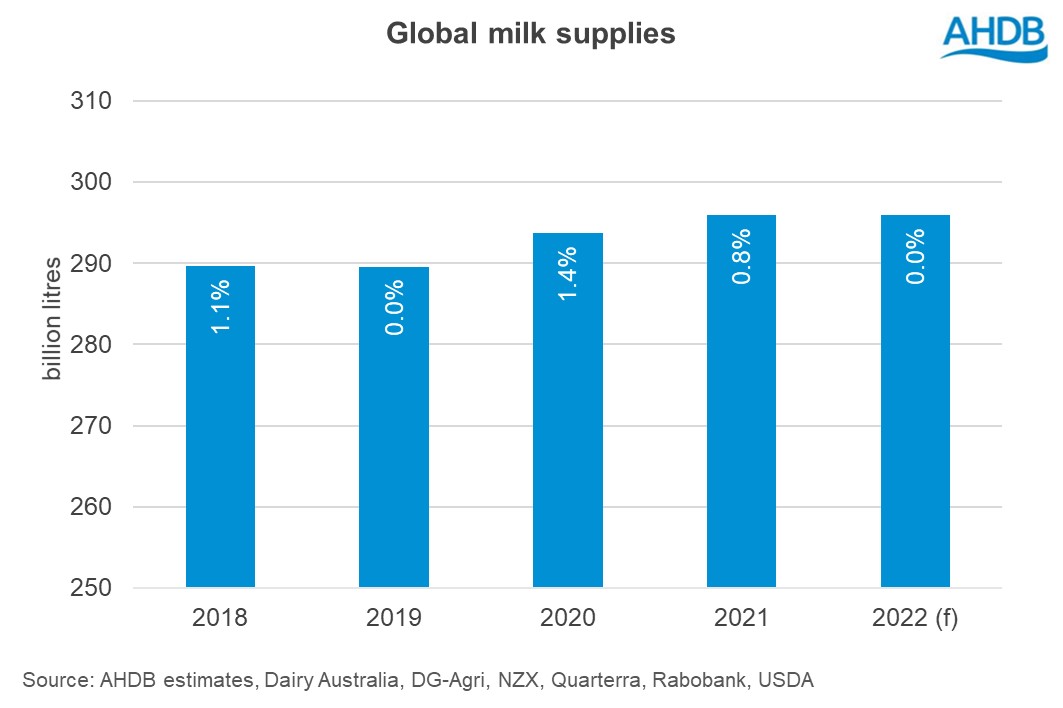
Following a low growth year in 2021, where global milk production[1] was up only 0.8%, 2022 is not looking to fare any better. Updated forecasts for the coming year now see global milk production remaining flat on the year. This is down from the 0.6% annual growth which was forecasted in January.

The latest data from each of the key exporting regions paints a less positive picture than in January. This is most notable in the UK where production is expected to decline by at least 0.9% on the year.  EU milk production is set to remain in line with 2021, as are New Zealand and the US. Click here to view the latest global milk deliveries.

Already high input costs, now escalated by the current conflict in Ukraine, are offsetting strong milk prices and with no sign of relief in inflationary pressures, farmers do not feel encouraged to improve yields. The challenges of labour shortages, transport delays, increased greening requirements and unfavourable weather also need to be taken into consideration when looking at the feasability of increasing production.

With little growth in global milk supplies, prices will remain supported  and have the potential to increase further if demand rises. However, there is some uncertainty around this, as when the large price jumps eventually flow through to consumers this is likely to dampen demand. We may also see reduced purchasing as buyers use up some of the security stocks held in response to delivery delays. These factors could slow down further increases in price.

[1] From the key dairy exporting regions – US, EU-27, UK, New Zealand, Australia, and Argentina

bar chart showing changes in annual global milk production

Sign up for regular updates

You can subscribe to receive Dairy market news straight to your inbox. Simply fill in your contact details on our online form and select the information you wish to receive.

Visit the Keep in touch page

While AHDB seeks to ensure that the information contained on this webpage is accurate at the time of publication, no warranty is given in respect of the information and data provided. You are responsible for how you use the information. To the maximum extent permitted by law, AHDB accepts no liability for loss, damage or injury howsoever caused or suffered (including that caused by negligence) directly or indirectly in relation to the information or data provided in this publication.

All intellectual property rights in the information and data on this webpage belong to or are licensed by AHDB. You are authorised to use such information for your internal business purposes only and you must not provide this information to any other third parties, including further publication of the information, or for commercial gain in any way whatsoever without the prior written permission of AHDB for each third party disclosure, publication or commercial arrangement. For more information, please see our Terms of Use and Privacy Notice or contact the Director of Corporate Affairs at info@ahdb.org.uk  © Agriculture and Horticulture Development Board. All rights reserved. 

Source: AHDB

Milk Prices Rebound in Chicago Thursday

On the Chicago Mercantile Exchange milk futures turned higher Thursday as traders bought back oversold positions and cash trade was mostly positive. Class III milk futures were higher across the board. May milk climbed 41 cents to $24.58/cwt. June milk was 38 cents higher to $24.82/cwt. July milk finished 44 cents higher to $24.61/cwt. Class IV milk futures were lower on the day with both butter and NFDM moving lower.

In spot trade dry up $0.0050 at $0.64. Two sales were made at that price at $0.6375 and $0.64. Blocks up $0.0275 at $2.3625. Three sales were made from $2.3350 to $2.3625. Barrels up $0.0275 at $2.37. Nine trades were made from $2.34 to $2.37. Butter down $0.03 at $2.69. Three trades were made from $2.68 to $2.69. Nonfat dry milk down $0.0150 at $1.7725. One trade was made at that price.

Big Drops in Dairy Markets at CME Wednesday

On the Chicago Mercantile Exchange milk futures continued to fall lower Wednesday while grain markets continued to hold strength. Class III milk prices closed double digits lower in all months between May 2022 and September 2023 on Monday.  The 2022 months still range from $22.84 to $24.44/cwt while 2023 has just one month north of $22.  Most Class IV months were off double digits as well. 

In spot trade Dry whey unchanged at $0.6350. Blocks down $0.0250 at $2.3350. One sale was made at that price. Barrels down $0.0525 at $2.3425. Butter up $0.0025 at $2.72. Four trades were made from $2.6875 to $2.7150. Nonfat dry milk down $0.0050 at $1.7925. Six trades were made from $1.79 to $1.8050.

Send this to a friend