Archive for Dairy Markets – Page 26

Milk Futures Drop Below $20 in Chicago Thursday

On the Chicago Mercantile Exchange milk futures continued to fall and cash dairy prices were all steady to lower Thursday. Class III milk’s trend lower continued Thursday. August fell 27 cents to $19.88/cwt. September milk crashed 48 cents to $19.42/cwt. Class IV milk futures settled lower too.

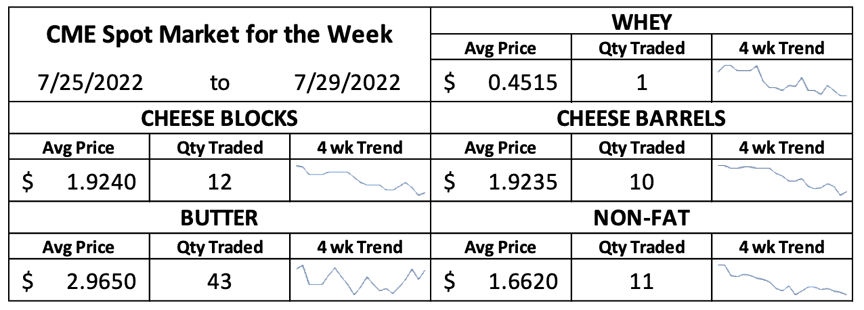
Thursday’s CME spot dairy product auction was steady to lower on the day.  Dry whey was unchanged at $0.42.  No sales were recorded. Cheese blocks were down $0.0850 closing at $1.7650.  No sales were recorded. Cheese Barrels were down $0.0425 at $1.7475.  Five sales were recorded from $1.7475 to $1.76. Butter went down $0.01 closing at $3.05.  Four sales were made from $3.04 to $3.0725. Nonfat dry milk was down $0.02 at $1.5775. One sale was recorded at that price.

Milk Markets Take Beating in Chicago While Butter Shines Through

On the Chicago Mercantile Exchange milk futures and cash dairy prices were mostly lower Wednesday, with butter being the exception.  Class III prices saw August falter 34 cents and September 50 cents, respectively.  Q4 2022 ranged from 35-39 cents lower.  Outside of January losing 21 cents of value, most 2023 months were slightly lower to 40 cents higher.  Class IV was off around 15-20 cents in 2022.  

In spot trade dry whey was down $0.02 at $0.42.  One sale was made at $0.4250. Cheese blocks were down $0.0375 closing at $1.85.  No sales were recorded. Cheese Barrels were down $0.0950 at $1.79.  Three sales were recorded from $1.79 to $1.80. Butter went up $0.0275 closing at $3.06.  Six sales were made from $3.0525 to $3.06. Nonfat dry milk was down $0.0225 at $1.5925. One sale was recorded at that price.

Global Dairy Trade auction drops 5% again

Milk powder prices fell at the Global Dairy Trade (GDT) auction by more than expected on stronger supplies. Tuesday’s weighted average did a repeat of the last event, dropping 5.0%, the fourth decline in a row.

The whole milk powder index fell 6.1pc and the skim milk powder index was down 5.3pc. Anhydrous milk fat prices were down by 1.4pc, but butter prices were down by 6.1pc at this auction.

Prices have now declined significantly since the peak back in the March/April period, with whole milk powder (WMP) prices down over 20pc in US Dollar terms.

StoneX Dairy Group says the GDT 80% butterfat butter price equates to $2.2987 per pound U.S., down 14.8 cents from the last event, and compares to CME butter, which closed Tuesday at a pricy $3.0325.

In a note on the auction, New Zealand bank ASB said the GDT WMP price has fallen from a peak of $4,757 to $3,544 in the latest event – a 22pc decline.

“In earlier reports we have emphasised that we are in the middle of (southern hemisphere) winter and have not panicked about the recent run of soft prices.

“Prices eased over winter last season as well and then moved higher given the extremely tight global milk supply. And we continue to think global dairy demand is likely to remain relatively inelastic, and keep prices well supported,” it said.

ASB also highlighted that it believes global dairy supply will remain ‘extremely’ constrained.

Nonetheless, it said there were no signs of supply concern at the latest auction and in the longer dated contract prices for powders – prices were down for all contract periods for both whole and skim milk powders.

“We continue to see future supply and demand dynamics supporting higher dairy prices, but clearly buyers were not willing to pay up to secure product over the key months of the NZ season at this latest auction,” it said.

Bulls and Bears Square Off and Fight for Control

The T.C. Jacoby Weekly Market Report Week Ending July 29, 2022

The bulls and bears squared off in Chicago this week, and the dairy markets lurched this way and that as the two sides fought for control.

The bulls and bears squared off in Chicago this week, and the dairy markets lurched this way and that as the two sides fought for control. Class III futures moved higher on Monday and Tuesday, helped by last Friday’s Cold Storage report, which reassured the trade that cheese demand remained healthy through mid-year. But on Wednesday and Thursday, the bears won the upper hand, fueled by news that the U.S. economy contracted in the first half of the year, and that the Federal Reserve hoped to tamp down inflation by raising interest rates yet again. That stoked fears about consumers’ propensity to spend on dairy products going forward. The trade is likely to remain anxious about demand until the economy is on surer footing. But it seems that prices have fallen back far enough for now. When the closing bell rang, the bulls came out on top, and Class III markets bounced back today. August Class III climbed 18ȼ to $20.41 per cwt. and the September contract jumped back over the $20 mark. It closed today at $20.31, up 42ȼ from last Friday. Deferred contracts also finished higher. Fourth-quarter contracts added 30ȼ, on average, and Q1 2023 futures leapt 37ȼ. Nearby Class IV futures posted similar gains, while deferred futures made a smaller advance. August Class IV closed at $24.81.

There is still plenty of fresh product to be had, and the spot markets took another step back. CME spot Cheddar blocks slipped 3ȼ to $1.88 per pound, and barrels fell 3.25ȼ to $1.8875. Those mark the lowest spot cheese values since early February. Spot nonfat dry milk (NDM) scored a new low for the year at $1.64, down 4.5ȼ since last Friday. Whey powder dropped a penny to 44.5ȼ, its lowest value since late 2020, when many Americans were at home making sourdough in their sweatpants, rather than pumping iron and pounding protein shakes at the gym. In contrast to its feeble peers, spot butter looked strong. It jumped 8.25ȼ to $2.99, toward the high end of its well-defined trading range.

All year, pricey cream and a lack of carry in butter futures has discouraged processors from churning butter and storing it for use later in the year. Now that fall baking season looms large, butter buyers are scrambling for product. And processors aren’t likely to step up churn rates anytime soon. It’s hot, which means that ice cream makers are running hard, and cows are struggling to make as much milk – let alone cream – as they did in the spring. Cream multiples in the Midwest soared to the highest levels since the weeks leading up to Christmas.

It’s hot in Europe too, which is surely weighing on milk yields. Milk collections in the EU-27 and the United Kingdom dropped 1.6% below year-ago levels in May, tied with April for the worst European deficit since 2016, when the government paid producers to pull back. Anecdotal reports suggest that output was not down quite so hard in June, but the July heat wave pushed production southward once again. Aside from a brief respite in February, European milk output has been negative since September. Given ever tighter environmental regulations, it’s likely to stay in the red for a while.

Throughout 2021 and into this year, European dairy processors prioritized cheese production, allowing them to grow cheese output even as milk production faltered. But EU cheese output fell below year-ago levels in March, and it has remained in the doldrums. Europe is now making less of every category of dairy product, leading to a smaller exportable surplus. If global dairy demand stumbles, a decline in European dairy exports could soften the blow.

The recent selloff in U.S. dairy markets and the setbacks in Europe mean the U.S. is well positioned to keep sending healthy volumes abroad. Meanwhile, there is no sign that U.S. milk or dairy product supplies are likely to become burdensome. Scorching temperatures are keeping output in check in the short term. In the long run, high feed costs, low heifer supplies, processing capacity limitations, and supply management programs will likely cap growth in U.S. milk production. Dairy cow slaughter volumes have been running light since April, but they perked up recently, a hint that producers may be less willing to keep their barns crowded for $20 milk than they were for $24. Milk and dairy product prices likely overreached this summer, but they seem to have found an equilibrium at values that acknowledge tighter global supplies without throttling demand.

Feed futures whipsawed back and forth this week as they assessed the impact of the weather. For corn, it’s a bit of a mixed bag. July rains really helped the crop in the Eastern Corn Belt, but in the South and the Plains, it’s painfully dry. In most areas, the crop will have enough moisture to get through what remains of the crucial pollination season, but yields are likely to average a little below normal. For beans, August weather determines crop yields, and the forecast is hot and dry. That propelled November bean futures up to $14.685 per bushel, up $1.5275 this week. Soybean meal was even stronger. The September contract jumped $11 to $442.40 per ton. December corn futures rallied all the way to $6.365 per bushel today, but when news broke that the Russians and Ukrainians have reached a deal to export grain through the Black Sea, they retreated. They settled at $6.20, still up 56ȼ from last Friday.
Source: Jacoby

Butter Passes $3 in Chicago Monday

On the Chicago Mercantile Exchange milk futures fell and cash dairy prices were mixed Tuesday. July Class III milk was unchanged at $22.53.  August closed down $0.03 at $20.43.  September closed down $0.10 at $20.40.  October was down $0.14 to $20.78.  November through June contracts ranged from unchanged in March, April, May, and June to seventeen cents lower in December. 

In spot trade, dry whey was down $0.0050 at $0.44.  No sales were recorded. Cheese blocks were up $0.04 closing at $1.8875. Two sales were recorded at $1.8850 and $1.8875. Cheese Barrels were up $0.0050 at $1.8850.  No sales were recorded. Butter went up $0.0450 closing at $3.0325.  One sale was made at $3.0275. Nonfat dry milk was down $0.0250 at $1.6150. One sale was recorded at that price.

GDT to run single product auctions from next month

Global Dairy Trade (GDT) is to rollout a pilot project from next month involving smaller single product auctions in a bid to increase price discovery.

GDT currently hosts trading events for dairy commodities, including butter, skim milk powder (SMP) and cheddar, twice per month.

The company is owned and managed as a strategic partnership between the European Energy Exchange (EEX), FonterraCooperative Group, and New Zealand’s Exchange (NZX), with equal one-third shareholdings.

The new ‘GDT Pulse’ events aims to enhance liquidity in GDT by providing price discovery on a more frequent basis. The first auction is scheduled to take place on August 9.

“GDT events will continue to be the large volume, high liquidity events”, the company said. The next large trading eventis due to be held on August 2.

Fonterra

Initially, GDT Pulse will offer auctions on alternate weeks between the larger trading events for a period of 6-12 months.

The auctions will offer one product specification to bid on: Fonterra Whole Milk Powder (WMP) Regular, Contract Period 2.

GDT explained that this will ensure a short total duration of 15–30 minutes, providing convenience for bidders.

The pilot scheme will allow the company to assess whether there is a credible level of participation, if credible prices are published and if trade in the dairy futures market increased.

“Prices discovered through the GDT Pulse auctions will be complementary to the price discovery provided by GDT events,” it said.

After the pilot period, the company will assess the merit of smaller auctions and the future potential for more frequent price discovery.

If the pilot is deemed successful, it is envisaged that GDT will invest in platform upgrades to enable scalability of the service offering and the potential for daily auctions.

Source: agriland.ie

Futures Rise as Spot Trade Weakens to Start the Week in Chicago

On the Chicago Mercantile Exchange milk futures rose and cash dairy prices were steady to lower Monday. August 2022 milk added 5 cents to a settlement value of $20.46/cwt while September gained 19 cents to $20.50/cwt, respectively.  Q4 2022 and Q1 2023 performed the best as prices ranged in Q4 from 32 to 36 stronger while Q1 was up 16 – 37 higher.

CME spot dairy market saw dry whey was unchanged at $0.4450.  No sales were recorded. Cheese blocks were down $0.0325 closing at $1.8475. Two sales were recorded at $1.8275 and $1.83. Cheese Barrels were down $0.0075 at $1.88.  Five sales were recorded ranging from $1.8675 to $1.8825. Butter went down $0.0025 closing at $2.9875.  There were no sales recorded. Nonfat dry milk was unchanged at $1.64. No sales were recorded.

Dairy Markets Take Nose Dive in Chicago Thursday

On the Chicago Mercantile Exchange Class III milk futures continued their trend lower. August milk tumbled 48 cents to $20.19/cwt. September milk took a nosedive of 51 cents to $19.81/cwt. Class IV milk futures settled 5-34 cents lower.

Dairy products were lower Thursday in the CME spot dairy auction.  Dry whey down $0.01 at $0.4450.  Blocks down $0.0875 at $1.85.  Two trades at $1.85 and $1.87. Barrels are down $0.1125 at $1.8450.  Four trades were made, ranging from $1.8450 to $1.87. Butter down $0.0375 at $2.9550.  Three trades, ranging $2.9450 to $2.9550. Nonfat dry milk is down $0.01 at $1.6550. 

Markets are a Mixed Bag in Chicago Wednesday

On the Chicago Mercantile Exchange milk futures and cash dairy prices were mostly down Wednesday. Class III milk futures tumbled lower on the day. August milk slid 50 cents to $20.67/cwt. September milk lost 42 cents to $20.32/cwt. Class IV milk futures increased in both 2022 and 2023.

It was a mixed bag in the CME dairy product trade.  Dry whey closed down $0.01 at $0.4550.  No sales were recorded. Cheese blocks were down $0.06 closing at $1.9375. Two sales were made at that price. Cheese Barrels were down $0.0325 at $1.9575.  Two sales were made with prices at $1.95 and $1.9575. Butter went up $0.0350 closing at $2.9925.  There were twenty sales ranging from $2.97 to $2.9925. Nonfat dry milk was down $0.0150 at $1.6650. Two sales were made at that price.

Dairy Market Report: Input costs keep tight lid on milk production growth

Both dairy supply and demand are being driven by unusual factors in mid-2022, with little immediate respite in sight. Severe cost inflation and limited availability are affecting virtually all inputs necessary to produce milk, keeping a tight lid on milk production growth and thereby generating record-high milk prices. Sustained tight production is spreading high milk and dairy product prices to retailers.

Click for Report

Jacoby Weekly Dairy Report: The Streak is Over

The T.C. Jacoby Weekly Market Report Week Ending July 22, 2022

After seven months in the red, U.S. milk production exceeded year-ago volumes in June, topping June 2021 by 0.2%.

The streak is over. After seven months in the red, U.S. milk production exceeded year-ago volumes in June, topping June 2021 by 0.2%. In Thursday’s Milk Production report, USDA also revised its estimates of January through May milk output, lifting the early months slightly and raising its May estimate enough to trim the year-over-year deficit from an initial assessment of -0.7% to a revised – 0.5%. The agency also made modest revisions to its appraisal of the dairy herd in March and April and boosted its May headcount substantially, showing much faster growth than previously thought. According to the latest figures, dairy producers have added 56,000 cows since January, including 14,000 in May and 4,000 in June. At 9.423 million head, the dairy herd is still 78,000 head smaller than it was a year ago, but the gap is closing quickly.

It’s safe to assume that there was plenty of milk for formidable cheese and whey output last month. Nonetheless, cheese stocks declined 6.8 million pounds from May to June, implying that demand remained healthy. Still, there were just over 1.5 billion pounds of cheese in cold storage on June 30, 4.9% more than the prior year and only a little less than the all-time high set in May.

Heavy inventories and concerns about demand have dragged down cheese prices over the past two months. This week, CME spot Cheddar barrels plummeted 15ȼ to a five-month low at $1.92 per pound. Blocks fell 8.5ȼ to $1.91. Those figures align with sour sentiment about demand, but the Cold Storage figures suggest that the market may have gotten a little too pessimistic about cheese consumption.

CME spot whey held steady this week at 45.5ȼ. That is tied with last Friday for the lowest spot whey value since 2020. Chinese whey imports fell short of year-ago volumes for the ninth straight month in June. However, in an otherwise gloomy trade update, there are some silver linings for U.S. whey exporters. While Chinese whey imports were 7% smaller than in June 2021, they did improve to a nine-month high. Red ink on Chinese hog farms has weighed on whey demand all year, but Reuters reports that the average Chinese hog grower was back in the black last month, which could bode well for demand going forward. And the U.S. is grabbing a big share of China’s still hefty business. American whey accounted for more than half of Chinese whey imports throughout the second quarter, the U.S.’s highest market share since the U.S.-China trade war began in 2018. Still, European whey prices have fallen precipitously in the past few weeks, so the competition for exports may heat up.

Amid Covid lockdowns and economic disruptions, Chinese milk powder imports were better than feared in June. But they were still sharply lower than the record-setting volumes of last year. China imported 52.9 million pounds of skim milk powder (SMP) and 78.2 million pounds of whole milk powder (WMP) last month, down 30% and 48%, respectively, from the prior year. For the first half of the year, Chinese SMP imports are down 25% from 2021, while WMP imports are 5.5% lower.

Anxiety about global demand pushed prices downward at the Global Dairy Trade (GDT) auction on Tuesday. WMP values fell 5.1% from the previous auction and SMP dropped 8.6% to the rough equivalent of nonfat dry milk (NDM) at $1.80 per pound. CME spot NDM faltered after the GDT, but it bounced right back. It closed today at $1.685, up 2.5ȼ since last Friday.

The butter market slipped once again this week. It fell 2.25ȼ to $2.9075. Despite the setback, butter remains in its comfort zone. Throughout June and July, it has traded in a narrow range between $2.90 and $3.01. There are concerns about demand, of course, but butter buyers are also anxious to make sure they have enough stocks on hand to get through the holiday baking season. Butter stocks grew at the typical rate in June and reached nearly 332 million pounds. That is 20% lower than last year and 8.5% below June 2020.

After a steep selloff last week, Class IV futures regained a little ground. The August contract climbed 18ȼ to $24.47 per cwt. Surprisingly, nearby Class III futures also finished slightly higher than last Friday, but deferred contracts continued to drop. September Class III fell 30ȼ to $19.89, marking the only close below $20 for any Class III contract since the very first days of the year. For many dairy producers, especially those in the West, that’s not going to be enough to pay their sky-high feed bills.

Thankfully, the grain markets took another step back. September corn closed at $5.6425 per bushel, down 40ȼ from last Friday to the lowest price since January. Crops have struggled this week amid hot, dry conditions, particularly in the Plains. But next week looks cooler and wetter, which will help prevent further damage. Corn prices came under additional pressure from the wheat market. Wheat futures dropped hard on news that Ukraine and Russia had come to terms on a plan to export Ukrainian grains out of Black Sea ports. If Russia keeps its promises not to attack the port, and if Ukrainian ships are able to safely navigate the underwater mines near the port, Ukraine hopes that grain exports can return to pre-war volumes. Those are big ifs, but grain traders – and hungry people around the world – are relieved to see signs of progress.

Soybean futures bounced back from last week’s selloff. The September contract jumped 75ȼ to $14.345. Soybean meal futures barely moved once again. They closed at $431.50 per ton, up 50ȼ from last week.

Lower grain prices will offer some relief on feed costs, but rations remain exceptionally expensive. And, amid drought in the West, forage costs continue to climb. According to the Hoyt Report, premium quality alfalfa delivered to dairies in California’s Central Valley commanded an all-time high of $455 per ton last week, up from $282.50 a year ago.

Source: Jacoby

Milk Markets Continue to Push Higher in Chicago Tuesday

On the Chicago Mercantile Exchange milk futures and cash dairy prices were up except for July milk Tuesday. Class III milk futures surged on the day. August milk launched a 50-cent gain, settling at $21.20/cwt. September milk moved 23 cents higher to $20.78/cwt. Class IV milk futures were also higher on the day.

Tuesday’s spot dairy product session was higher.  Dry whey was up $0.0175 at $0.4650.  One sale was made at that price. Cheese blocks were up $0.0425 closing at $1.9975. Five sales were made with prices from $1.9550 to $1.9975. Cheese Barrels were up $0.0525 at $1.99.  Three sales were made with prices from $1.9550 to $1.99. Butter went up $0.0275 closing at $2.9575.  There were twelve sales ranging from $2.9450 to $2.96. Nonfat dry milk was up $0.01 at $1.68. Three sales were made with prices from $1.67 to $1.68.

Markets Start the Week Strong in Chicago

On the Chicago Mercantile Exchange milk futures and cash dairy prices were up except for whey and powder Monday. Class III and IV milk markets began the week on the right foot as prices ended in the green.  August through December 2022 Class III values jumped 33 to 66 cents/cwt. while Q1 2023 added 23-25 cents. Class IV prices followed along with futures up 13-30 cents. First half 2023 closed up to 10 cents stronger.

In spot trade dry whey was down $0.0075 at $0.4475.  No sales were recorded. Cheese blocks were up $0.0450 at $1.9550. Three sales were made from $1.91 to $1.9575. Cheese Barrels were up $0.0175 at $1.9375.  One sale was made at that price. Butter went up $0.0225 closing at $2.93.  There were wo sales at $2.9175 and $2.93. Nonfat dry milk was down $0.0150 at $1.67. No sales were recorded.

Milk Markets Slip in Chicago Thursday

On the Chicago Mercantile Exchange milk futures and cash dairy prices were mostly down Thursday. Class III milk futures were lower on the day. August milk slipped 50 cents to $20.19/cwt. September also fell 50 cents to $20.01/cwt. Class IV futures were mixed. August tumble 22 cents to $24.34/cwt. September increased 14 cents to $23.40/cwt.

In the spot dairy product trade,  dry whey was down $0.0225 at $0.4550.  Six sales were recorded between $0.4550 and $0.4775. After three days without movement, cheese blocks fell $0.0650 to $1.91. There were three sales recorded between $1.91 and $1.97. Cheese Barrels were down $0.09 at $1.96.  Two sales were recorded at $1.96 and $2.0550. Butter went up $0.01 closing at $2.9250.  There were four sales ranging from  $2.92 to $2.9250. Nonfat dry milk was up $0.0275 at $1.6875. Seven sales were recorded from $1.6825 to $16875.

Dairy prices drop on weak demand

Weak demand outweighed tight supplies

Global dairy prices are now trading at 10-month lows, as once resilient demand has fallen off, particularly from China where widespread COVID-19 lockdowns are taking a toll on the economy, reported Reuters.

The downward move comes even as milk supplies remain tight worldwide due to dry weather in New Zealand, and as rains in Australia and the war in Ukraine pushed up feed costs for dairy farmers, particularly in Europe and the United States.

The Global Dairy Trade price index fell 5% overnight, adding to a drop of 4.1% in the prior auction in early July. The index is now at its lowest level since the 7 September 2021 auction.

Data from the recent auction showed that North Asian buyers, who tend to be largely from China, were buying, but in smaller quantities than normal.

“The recent weakness in the Chinese economy is a likely catalyst for weaker global dairy demand,” Westpac Senior Agri Economist Nathan Penny said in a note.

China’s economic growth slowed sharply in the second quarter, highlighting the colossal toll on activity from widespread COVID lockdowns and pointing to persistent pressure over coming months from a darkening global outlook. 

Penny said Westpac expects China’s economy to rebound over the remainder of the year, which should lead to a recovery in consumer spending and thus dairy demand.

Analysts say tight supply fundamentals keep a floor under the prices.

Production in Europe remains exceedingly weak impacted by the energy crisis, drought, rising input costs and other unfavourable on-farm economic headwinds, ASB Bank economist Nat Keall said in a note.

He said while New Zealand production might be better than last year, it was unlikely to offset European weakness.

“Suffice to say, we find it hard to see global dairy prices losing too much ground in this sort of environment,” he said.

Source: Reuters

Milk Futures Rebound in Chicago Wednesday

On the Chicago Mercantile Exchange milk futures were up in the near term and cash dairy prices were mostly up except for butter Wednesday. Class III milk had July up 1 cent to $22.55, but August gained back 23 cents to $24.56 and September gained 7 to $20.51/lb. Class IV milk was quieter. July and August unchanged at $25.86 and $24.56/cwt. September fell 2 cents at $23.26/cwt.

The CME spot trade had Dry whey was down $0.0025 at $0.4625.  No sales were recorded. Cheese Blocks remain unchanged at $1.9750 with no sales activity.  Cheese Barrels were up $0.04 at $2.05.  One sale was recorded at that price. Butter went down $0.0250 closing at $2.9150.  There were 10 sales ranging from  $2.9050 to $2.9150. Nonfat dry milk was up $0.0150 at $1.66. One sale was recorded at that price.

5% drop in all dairy prices – Global Dairy Trade

The Global Dairy Trade index fell for a third straight session, falling 5% in Tuesday’s trade.

The powder market took the biggest fall in value, as skim milk powder fell 8.6% to $3,709 per metric ton or $1.68 per pound.  Whole milk powder fell 5.1% to $3,757 a metric ton, or $1.70 per pound. 

The butter market price fell 2.1% to $5,530 a ton or $2.50 per pound.

Anhydrous milk fat was down 2.1% to $5,580 per ton or $2.53 per pound.

Cheddar cheese prices fell 2% to $4,825 per ton or $2.18 per pound.

There were no offers to sell butter milk powder, sweet whey powder, or lactose in Tuesday’s sale.

Overall, 149 bidders purchased 23,219 metric tons of dairy products in the Tuesday GDT session.

Source: Global Dary Trade

Anxiety Grows Over Global Economy

The T.C. Jacoby Weekly Market Report Week Ending July 15, 2022

U.S. inflation accelerated to 9.1% last month, reducing Americans’ purchasing power at the fastest rate since 1981. The dairy markets suffered too.

The commodity markets reeled this week, battered by growing anxiety about the global economy. The headlines packed one punch after another. U.S. inflation accelerated to 9.1% last month, reducing Americans’ purchasing power at the fastest rate since 1981. China’s economy grew just 0.4% in the second quarter, its slowest expansion in more than two years. More recently, rising Covid counts prompted China to reinstate some of the lockdown measures that led to such poor performance last quarter, spooking the markets. The European economy is in even worse shape as the war in Ukraine, the energy crisis, and ever stricter regulations hamstring industry on the continent. With Europe’s economy on the ropes, the euro dropped near parity with the U.S. dollar, at a 20-year low. Crude oil futures fell $7 per barrel this week as investors retreated to their corners.

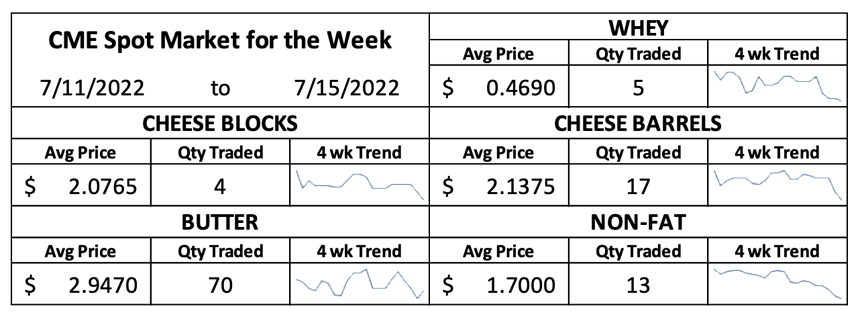
The dairy markets suffered too. CME spot dry whey fell 3.5ȼ to 45.5ȼ per pound, its lowest price since 2020. For nearly two years, strong demand for high protein whey products and robust exports to China have kept whey stocks in check. But the trade is concerned that the latter is in jeopardy. Chinese whey imports have slowed noticeably, but U.S. whey is competitively priced. U.S. exporters are likely to capture a larger piece of a shrinking pie.

There is still plenty of milk in the cheese states, and production continues apace. With plentiful supply and concerns about demand, CME spot Cheddar barrels plummeted 11.25ȼ this week to $2.07. Blocks fared even worse, falling 11.5ȼ to $1.995, their lowest price since February.

CME spot nonfat dry milk (NDM) fell 8.75ȼ this week to $1.66, the lowest price in more than six months. Summer temperatures have slowed the flow of milk to driers, and supplies are not burdensome. However, buyers are bearish, and they are waiting for better values before they bid in significant volumes. USDA’s Dairy Market News describes demand as “lackluster.”

CME spot butter jumped back to $3.00 on Monday but then spent much of the week on its back foot, falling to $2.90 on Thursday. Butter battled back and closed today at $2.93, down just 4ȼ since last Friday. Butter inventories are tight, but demand is a bit soft.

Milk futures finished deep in the red. July Class III fell 27ȼ to $22.52 per cwt. Most deferred futures fell roughly $1.50, and the September contract lost $2.10. Class III milk is trading just north of $20, a far cry from the $25 the futures briefly promised earlier this summer. July Class IV climbed 23ȼ to $25.86, but the other contracts lost ground. September through December futures closed $1.21 to $1.55 lower than last Friday. Fortunately, feed costs have fallen too.

The grain markets covered a lot of ground this week. September corn ascended to a peak of $6.67 per bushel on Monday, but on Tuesday it ran straight downhill. Corn spent the rest of the week on the valley floor. The September contract closed today at $6.0425, down 29ȼ this week. December corn finished at $6.0375, nearly 20ȼ lower than last Friday. Soybean futures plummeted, dragged down by the oil market and slow export sales, which fueled apprehensions about demand. September soybeans closed at $13.595, down more than $1.50 in just five trading sessions. Nonetheless, August soybean meal held at $431 per ton, down just 30ȼ from last week.

If the outside markets held less sway, and the feed markets were solely focused on the weather, prices likely would have climbed. Crops are starting to wither in the high-production counties of northwest Iowa and in nearby South Dakota and Minnesota. It’s also disappointingly dry in much of Indiana. Conditions are better in most of the central and eastern Corn Belt thanks to heavy rains last week. The forecast calls for more of the same, with rains expected over the weekend in the eastern Corn Belt. The West will remain dry.

USDA updated its crop balance sheets Tuesday, but made no changes to yield estimates. After adjusting planted area to reflect the June 30 Acreage report, the agency showed tighter soybean supplies and more corn than in last month’s report.

Russia, Ukraine, Turkey, and the United Nations say they will sign an agreement next week to allow Ukrainian grain to flow through Black Sea ports once again. That’s a win for diplomacy, but the execution isstill fraught with danger and likely to be slow at best. In order to get grain moving, officials will have to de-mine the deep water routes and exporters will have to struggle with damaged infrastructure at the besieged ports of Mykolaiv and Odessa. Even as the Russians negotiated the terms of the export pact, they launched missiles at those same ports earlier this week.
Meanwhile farming – and everyday life – remains extremely difficult throughout Ukraine. USDA once again trimmed its estimate of Ukrainian wheat production. It’s hard to project wartime crop output, let alone exports, with any precision, but USDA’s best guess puts Ukrainian corn and wheat production down 30.6 million metric tons from last year, a decline of 41%. We’re counting on a big U.S. crop to help make up for the loss, so the grain markets will remain extremely sensitive to the whims of the weather until harvest arrives.

Original Report At Jacoby

Milk Futures Start the Week Higher in Chicago

On the Chicago Mercantile Exchange Milk futures were mostly up and cash dairy prices were mixed Monday. Commodities across the board found support to kick off the week on Monday.  Dairy prices were no different.  Class III milk settled 13-38 cents stronger in the 2022 market and 21-27 higher in the Q1 2023 time period.  Class IV prices were also in the green led by September closing 57 cents higher.  Months beyond September rose around 20-30 cents/cwt.

The CME spot dairy index saw Dry whey was up  $0.01 at $0.4650.  One sale was recorded at that price. Cheese Blocks were down $0.02 at $1.9750. One sale was recorded at that price. Cheese Barrels were down $0.06 at $2.01.  Two sales were recorded at $2.0075 and $2.01.  utter went up $0.0350 closing at $2.9650.  There were 16 sales ranging from  $2.96 to $2.97. Nonfat dry milk was up $0.03 at $1.69. Five sales were recorded from $1.6850 to $1.69.

Strong Dairy Prices Overshadowed by Farm Operating Expenses

By prices alone, the past year or so has gone well for dairy producers. In March, USDA reported the highest-ever average all-milk price at $25.90 per hundredweight, 20 cents ahead the previous record set in September 2014. The all-milk price represents the gross price farmers receive, sold at an average fat test, before deductions for items such as hauling, advertising, stop charges, promotional costs and cooperative membership dues. Between May 2021 and May 2022, the base Class I (fluid milk) price increased by $8.35 (49%), the Class II (soft products like ice cream and yogurt) price increased by $9.65 (59%), Class III (hard cheeses and whey) prices increased by $6.25 (33%), and Class IV (butter and powders) prices increased by $8.83 (55%) per hundredweight. These prices, as displayed in Figure 1, have been on a seemingly unstoppable climb until the last two price reports, which indicated stable prices or marginal drops. The frequent and volatile price spreads between classes that defined the onset of COVID-19 in the marketplace appear to have receded. The four class prices, for now, are moving in a more clustered and correlated manner.

Expand Image

These high prices are a result of factors on both the supply and the demand fronts. Declines in the national herd, or total inventory of milking cows, and an accompanying decline in milk production defined much of 2021. Since the beginning of 2022, however, the dairy herd has marginally recovered, moving from 9.37 million head in January to 9.405 in the latest report for May; this is in line with the previous five-year average for May of 9.39 million head. Quarterly national milk production between quarter one of 2021 and quarter one of 2022 dropped 0.86% or 489 million pounds, with quarterly milk production per cow down 3 pounds per cow, or 0.05%, during the same timeframe. Dairy cow slaughter in early June (Figure 2) was 6% lower than the prior five-year average but 3% higher than last month. The slight recovery in the milk herd and comparative decline in slaughter suggests production may slightly increase as we deepen into the flush months – though not proportionally to the magnitude of high prices.

Expand Image

On the demand side, prices originally lifted as various facets of the economy such as restaurants, schools and leisure travel rushed back, bringing demand for large quantities of dairy products with it. May butter stocks in cold storage in 2020 were 17% above, and in 2021 were 28% above, the 2015-2020 average, when drops in food service orders led to increases in stored product. The May 2022 Cold Storage Report shows butter stores have dropped back to the 2015-2020 average exactly at 322 million pounds with markets foreign and domestic quickly consuming the cumulated excess. Natural cheese cold stocks, which initially experienced a strong decline as consumers looked for cheeses via retail outlets in 2020, have since recovered on the backs of increased processing capacity. May cold stores of natural cheese were 15%, or 196 million pounds, higher than the 2015-2020 average and 4%, or 54 million pounds, higher than last May. Domestic consumption of cheese has continued to increase with 123 million additional pounds consumed between January 2022 and April 2022 over the same period last year, a 5% jump. Time will tell if the range of new cheese processing plants will outpace demand and hamper Class III prices.

Expand Image

Exports remain relatively strong across the board for U.S. dairy products. In the first five months of the year (January-May), the U.S. sent $3.860 billion worth of dairy products across borders, a 25%, or $761 million, increase from last year. This translated to 1.162 million metric tons of dairy product exported from U.S. borders, about 15,000 metric tons more than last year, which is only a 1% increase in volume. The discrepancy between value increase and volume increase reveals the magnitude of price increases year-over-year. Mexico continues to lead as our top export customer, purchasing $915 million worth of dairy products in the first five months, including $485 million in non-fat dry whey (+37% YOY) and $233 million in cheese and curds (+36% YOY). Canada retained its second-place spot in terms of value with $424 million in purchases including $52 million in butter and milkfat (+25% YOY). China claims the third-place spot in value with $298 million worth of dairy products, including $99 million in whey (-16% YOY), but outpaced Canada in volume by 81,000 metric tons. Given that high prices explain the majority of increases in dairy products export value so far, any future increase in domestic production could risk those increases unless volume demand picks up internationally – which appears unlikely as a potential recession looms.

Expand Image

The record prices at the mailbox have largely been dwarfed by increases in production costs. Feed costs, even with some recent declines, remain well above average. Uncertainty surrounding crop supply expectations globally continue to apply upward pricing pressure. As of May 2022, the average corn feed costs used to calculate the Farm Service Agency’s Dairy Margin Coverage Program margin was 22% higher than last year ($5.91/bu to $7.26/bu), the average soybean meal cost was 5% higher ($421/ton to 441/ton) and the average blended alfalfa price was 5% more ($210/ton to $274/ton). Severe Western drought continues to stress hay production with little sign of relief. Notably, the average DMC margin (above feed cost margin) between the program’s launch in January 2019 and December 2020 was 52% of the all-milk price. Since December 2020 the DMC margin has come in at 40% of the all-milk price. Dairy farmers are keeping proportionally less of their milk check under these periods of high milk prices, revealing the impacts of inflationary price pressures on the value of revenue. Though the number on the check is higher, its value and buying power in the broader market has weakened

Expand Image

Analyzing production and operating costs on the dairy farm more deeply further highlights this margin problem. USDA’s Economic Research Service runs biannual milk cost of production estimates nationally and for about 20 states. Though numbers for 2022 will not be available for some time, 2021 can serve as a proxy for describing the extent to which operating costs have largely outpaced market values of dairy production under more recent market conditions. Figure 6 displays common dairy farm expenses between 2016 and 2021 in dollars per hundredweight of milk produced. Feed, including purchased feed, homegrown feed and grazed feed has taken up the largest portion of expenses, ranging from $9.28/cwt in 2017 to $14.04/cwt in 2021- a shift from 45% of total expenses to 52%. By state, West Coast dairies experienced the largest increase in feed costs, with Oregon feed costs up 46% ($5.43/cwt), California feed costs up 45% ($4.28/cwt) and Washington feed costs up 26% ($4.75/cwt) year-over-year. Exceptional drought in these states throughout much of last year was a likely culprit. The second-highest category is capital recovery of machinery and equipment, which includes investments in housing, manure handling, feed storage structures and the breeding herd. Capital recovery refers to the earning back of initial funds put into an investment, which will be considered negative until that investment is recouped. In 2021 capital recovery cost dairy farmers an average of $4.62/cwt or 17% of all expenses. Hired labor, another costly piece of the equation, has increased by 12% since 2016 ($1.83/cwt to $2.31/cwt) and is highest in Oregon, Maine and Vermont, states with comparatively stringent farm labor regulations.

Figure 6 also displays the average gross market value of production in green to represent the market value of goods produced and sold by dairy farms. This includes income from milk sales, cattle sold, leasing stock, renting space to other operations, cooperative patronage dividends and the fertilizer value of manure. In red is the difference between the total average production expenses and average gross market value of production i.e., the loss per hundredweight dairy farmers, on average, have had to absorb each year to remain in business. In 2021, for each $27.02/cwt spent, dairy farmers received only $21.33/cwt, a loss of $5.69/cwt. This is the largest loss within the timeframe analyzed. Between 2020 and 2021 the loss increased by 233%, going from -$1.60/cwt to -$5.69. These estimates can also be broken down by farm size and, for 2021, yielded a negative margin across all size categories ranging from fewer than 50 cows to over 2,000 cows. For farms with fewer than 50 cows the magnitude of loss was far greater at -$19.90/cwt vs -$3.18/cwt for farms with over 2,000 cows. A comprehensive breakdown of dairy farm production cost estimations by farm size can be accessed here.

Expand Image

Conclusion

A quick glance at the dairy market’s high prices and decent demand signals might suggest dairy farmers are in good shape. Unfortunately, analyzing milk prices only by comparing their face value over time is futile to understanding the breadth of challenges facing dairy farmers across the country. Persistent high costs across the expense spectrum continue to challenge dairy farm solvency; these costs are further exacerbated by inflationary pressures that have lowered the real value of a higher milk check. The impending recession could spell trouble on the demand front if consumers begin to spend less and go out less, actions that would be compounded by increases in milk production. For now, production appears to have mellowed with high production expenses and pending government regulations across global economies continuing to discourage future milk expansion.

Source: fb.org

Milk Production Dips Slightly in May

Nationally, 18.8 billion pounds of milk was produced in the 24 major dairy states for the month of May. That was down 0.6 percent from 2021, but higher than the previous month’s production of 18.3 billion pounds.

California continues to have the highest total production with about 3.65 billion pounds. South Dakota had the greatest percent-increase in output as that state produced 348 million pounds of milk–about 15.2 percent more from the same period last year. Only six of the top 24 states had higher year-to-year production last month.

Meanwhile, the number of milk cows on farms in the 24 major states was 8.91 million head, 84,000 head less than May 2021, but 2,000 head more than April 2022. The average number of milk cows on Wisconsin farms for the month was 1.27 million head–unchanged from last month, but 1,000 less than last year. Monthly production per cow averaged 2,165 pounds, which up 20 pounds from last year’s figures.

Dairy Market Report June 2022

Dairy farmers and the entire industry continue to deal with a high-price, high cost environment unlike any seen for at least a decade, and in many ways, not in the past four decades. March and April set consecutive all-time highs for the monthly average all-milk price in the U.S., while the four federal order class prices set a collective record in May. Monthly retail prices of whole and lowfat milk, butter, ice cream and yogurt also reached all-time highs. Meanwhile, monthly U.S. dairy exports posted a strong recovery in April from a recent low in January, amounting to 18.7 percent of U.S. milk solids production, the third highest ever for a single month by this measure. The combination of continued lower U.S. cow numbers, milk production and record-high milk and retail dairy prices is beginning to show signs of impacting domestic dairy product consumption at retail and also food service. However, since retail price inflation is occurring for all food and beverages, and throughout the entire economy, it is unclear how or whether this will play out differently than if higher dairy product prices were an exception in an overall non-inflationary economy.

Read more

Markets Push Futures Lower in Chicago

On the Chicago Mercantile Exchange, milk futures were down and cash dairy prices were mostly lower Thursday. Class III milk futures were taken lower after the bearish Cold Storage Report. July milk lost 60 cents to $22.95/cwt. August milk declined 48 cents to $23.64/cwt. Class IV prices were mixed.

In the CME spot dairy auction, Dry whey was down $0.0275 at $0.47.  Six sales were recorded from $0.47 to $0.4975. Cheese Blocks were unchanged for the third day at $2.10. No sales were made. Cheese Barrels were also unchanged for the third day at $2.17.  No sales were made. Butter was down $0.01 to $2.95.50.  Six trades were recorded from $2.92 to $2.9550. Nonfat dry milk was down $0.0150 at $1.7950. Three sales were recorded from $1.7925 to $1.80.

Dairy prices, volumes fall at auction -GDT Events

International milk prices and volumes fell in this month’s second Global Dairy Trade auction held by GDT Events, reported Reuters.

The GDT Price Index fell 1.3%, with an average selling price of $4,600 per tonne, in the auction held on Tuesday.

The index rose 1.5% at the previous sale, according to GDT Events.

A total of 20,760 tonnes was sold at the latest auction, falling about 3.1% from the previous one, the auction platform said on its website.

The auctions are held twice a month, with the next one scheduled for 5 July.

The auction results can affect the New Zealand dollar NZD= as the dairy sector generates more than 7% of the nation’s gross domestic product. The New Zealand milk co-operative, which is owned by about 10,500 farmers, controls nearly a third of the world dairy trade.

GDT Events is owned by New Zealand’s Fonterra Co-operative Group Ltd, but operates independently from the dairy giant. US-listed CRA International Inc is the trading manager for the twice-monthly Global Dairy Trade auction.

Source: Reuters

Steady Markets in Chicago Wednesday

On the Chicago Mercantile Exchange milk futures were up and cash dairy prices were steady to up Wednesday. June Class III milk was unchanged at $24.31.  July closed up $0.28 at $23.55.  August closed up $0.26 at $24.12.  September was up $0.38 at $24.11.  October through May contracts ranged from five cents higher in February to thirty-two cents higher in November.

In spot trade, Dry whey was down $0.01 at $0.4975.  Four sales were recorded from $0.4975 to $0.51. Cheese Blocks were unchanged at $2.10. No sales were made. Cheese Barrels were unchanged at $2.17.  No sales were made. Butter ended its downhill slide going up $0.0350 to $2.96.50.  Nine trades were recorded from $2.9150 to $2.9650. Nonfat dry milk was unchanged at $1.81. No sales were recorded.

CME starts the week lower

On the Chicago Mercantile Exchange milk futures were mostly down and cash dairy prices were mixed Tuesday. Class III milk futures rebounded over course of the trading day on Tuesday. July milk dropped 20 cents to $23.36/cwt. August Milk fell 11 cents to $24.02/cwt. September milk inched 3 cents higher to $23.95/cwt. Class IV milk futures were higher on the day.

It was a mixed bag in the CME Dairy Product Auction on Tuesday.  Cheese Blocks were down $0.0450 at $2.10. One sale was made at $2.11. Cheese Barrels were up $0.0125 to $2.17.  No trades were recorded. Butter was down $0.01 to $2.93.  No trades were recorded. Nonfat dry milk was up $0.01 to $1.81. Two sales were recorded at that price. Dry whey was unchanged at $0.5075.  No sales were recorded.


UK retailers announce milk price top-ups for July

Tesco and Sainsbury’s have both announced they are revising their July milk prices to bring them more in line with the rest of the market.

The two retailers had found themselves in a position where their previously announced July milk prices were significantly adrift of the prices being announced by other buyers.

As a result, suppliers in Tesco’s Sustainable Dairy Group (TSDG) through Muller will now be paid 46p/litre from 1 July for a standard liquid litre of 4% butterfat and 3.3% protein.

This is 3.65p/litre higher than the previously announced July price of 42.35p/litre.

The price for Arla Direct TDSG suppliers will be 45.75p/litre.

A statement from Tesco said the revised TDSG milk price followed continued volatility in the sector.

“It is hoped the rise will help to address the current unprecedented levels of on-farm inflation.”

Sainsbury’s

Meanwhile, Sainbury’s has announced a 4.3p/litre temporary booster payment for farmers in the Sainsbury’s Dairy Development Group.

Those on Muller contracts will receive 46p/litre, rather than the 41.7p/litre announced previously, for a standard litre of 4% butterfat and 3.3% protein.

Farmers with Arla contracts will be paid 45.88p/litre, which takes into account the company’s 0.12p/litre haulage charge.

Source: fwi.co.uk

Dairy Markets Sharply Down Thursday in Chicago

On the Chicago Mercantile Exchange milk futures and cash dairy prices were all down Thursday. Class III milk futures saw weakness across the board. June fell 1 nickel to $24.29/cwt. July milk suffered a 52-cent loss to $23.74/cwt. Class IV milk futures also were down on the day.

Dairy products tumbled lower in the CME Spot Dairy Auction on Thursday. Dry whey was down $0.0175 at $0.4925.  Four sales were recorded from $0.4925 to $0.51. Cheese Blocks were down sharply $0.1450 at $2.08. Five sales were recorded from $2.08 to $2.10. Cheese Barrels were down $0.0750 to $2.1350.  Six trades were made at that price. Butter was down $0.01 to $2.96.  Five trades were made from $2.93 to $2.96. Nonfat dry milk was down $.0275 to $1.79. One sale was made at $1.80.

Dairy Markets Show Strength in Chicago Wednesday

On the Chicago Mercantile Exchange milk futures were mostly up and cash dairy prices were mixed Wednesday. Class III milk was up 3 in June to $24.34, July up 1 to $24.25 and August up 1 to $24.40/cwt. The balance of the year was weaker unchanged to 27 lower.  Class IV milk was unchanged nearby. June at $25.79, July at $25.80 and August up 11 cents to $25.28/cwt. The balance of 2022 was unchanged to 18 cents higher.

Dairy markets were also fairly quiet.  Cheese Blocks were up $0.04 at $2.2250.  No sales were recorded. Cheese Barrels were up $0.0350 to $2.21.  Two trades were made at that price. Butter was down $0.01 to $2.97.  Six trades were made from $2.95 to $2.9725. Nonfat dry milk was down $.0025 to $1.8175.  No sales were recorded. Dry whey was down $0.0050 at $0.51.  Four sales were recorded from $0.51 to $0.5175.


Milk markets down in Chicago Tueasday

On the Chicago Mercantile Exchange milk futures and cash dairy prices were mostly down Tuesday. Class III milk futures were lower on the day. July milk fell 18 cents to $24.25/cwt. August milk gave up 12 cents to $24.39/cwt. September milk decreased 8 cents to $24.32/cwt. Class IV milk futures were lower across the curve.

The CME spot dairy product auction was a mixed bag Tuesday.  Cheese Blocks were down $0.0325 at $2.1850.  Three sales were recorded at $2.1825 and $2.1850. Cheese Barrels dropped $0.0450 to $2.1750.  Ten trades were made from $2.1750 to $2.1850. Butter was up $0.05 to $2.98.  Fifteen trades were made from $2.9375 to $2.98. Nonfat dry milk was down $.0350 to $1.82.  Three sales were made from $1.81 to $1.8250. Dry whey was unchanged at $0.5150.  There were no sales recorded.


Markets Start Week Lower in Chicago

)n the Chicago Mercantile Exchange July Class III milk futures down 19 cents at $24.43.  August 14 lower at $24.51.  September down 18 at $24.40.  October through December futures unchanged to 23 cents lower. The Class //IV market was 30-50 cents lower on Monday.  Barrels were down 2.25 cents/lb, blocks lost 3.75 cents, butter declined 4.5 cents, and whey fell 2.75 cents.

Dry whey down $0.0275 at $0.5150. Blocks down $0.0375 at $2.2175.  Two trades were made at $2.2175 and $2.23. Barrels down $0.0225 at $2.22.  Three trades were made, ranging from $2.21 to $2.22. Butter down $0.0450 at $2.93.  Two trades at $2.9225 and $2.93. Nonfat dry milk unchanged at $1.8550.

Milk Markets Mostly Rise in Chicago Thursday

On the Chicago Mercantile Exchange milk futures were mostly up and cash dairy prices were mixed Thursday. June Class III milk was up $0.12 at $24.42.  July closed down $0.06 at $24.95.  August closed up $0.07 at $24.97.  September was up $0.13 at $24.84.  October through May contracts ranged from six cents lower in May to twenty cents higher in November.

In spot trade, Dry whey was up $0.0175 at $.5425.  Three sales were recorded from $0.5325 to $0.5425. Cheese Blocks were unchanged at $2.2750.  Two sales were recorded at $2.2875 and $2.2925. Cheese Barrels were up $0.05 at $2.3050.  Ten trades were made from $2.2525 to $2.3050. After breaking the three-dollar barrier Wednesday, Butter was unchanged holding at $3.00. Unlike Wednesday where 19 sales were made, there were no butter trades Thursday. Nonfat dry milk was down $.0150 to $1.87.  Four sales were made from $1.87 to $1.8725.

Global dairy prices rise, volumes fall

The GDT Price Index rose 1.5%

International milk prices rose while volumes fell in this month’s first Global Dairy Trade auction held by GDT Events, reported Reuters. 

The GDT Price Index rose 1.5%, with an average selling price of $4,656 per tonne, in the auction held on Tuesday.

The index fell 2.9% at the previous sale, according to GDT Events.

A total of 21,435 tonnes was sold at the latest auction, falling about 11.7% from the previous one, the auction platform said on its website.

The auctions are held twice a month, with the next one scheduled for 21 June.

The auction results can affect the New Zealand dollar NZD= as the dairy sector generates more than 7% of the nation’s gross domestic product. The New Zealand milk co-operative, which is owned by about 10,500 farmers, controls nearly a third of the world dairy trade.

GDT Events is owned by New Zealand’s Fonterra Co-operative Group Ltd, but operates independently from the dairy giant. US-listed CRA International Inc is the trading manager for the twice-monthly Global Dairy Trade auction.

Source: Reuters

Butter Breaks $3 Barrier in Chicago Wednesday

On the Chicago Mercantile Exchange milk futures were down in the near term and cash dairy prices were mostly up Wednesday. Butter moves into territory we have not seen since September 2015. $3 butter in the CME cash market sets new highs since 2015. Cheese was quieter with barrels a penny higher to $20.25 ½ and blocks fell half a cent to $2.27 ½.

June Class III milk was down $0.13 at $24.30.  July closed down $0.15 at $25.01.  August closed down $0.11 at $24.90.  September was down $0.04 at $24.71.  October through May contracts ranged from fifteen cents lower in November to twenty cents higher in May.


Global Dairy Commodity Update June 2022

Supply-side constraints will remain a fixture in the outlook for at least the next half year as the effects of the Ukraine war will continue to drive high input costs (corn, grain and fertilizer). Milk prices continue to rise in Europe which will alleviate some of the pressure. Energy prices have receded in several regions as countries comply with Russia’s requirements to improve supplies but remain at extremes in others.

The weather outlook is not offering many prospects to improve milk supply, as Europe (already basking in a record hot spring) is forecast to have another warmer, drier summer, while the damage to pastures due to the poor finish to the NZ season may weaken the start of season in some key regions.

The constraints on EU milk output will keep protein and fat fundamentals firm, while the risk of weaker demand as buyers recoil from high prices is not expected to materially weaken commodity balance sheets. Higher food (and dairy) prices are reaching consumers but the potential damage to demand for dairy will be greater in butterfat rather than cheese.

The fundamentals also suggest a tighter US dairy market; milk output is constrained by weaker margins, sluggish recovery in the dairy herd and processor supply management, but there are mounting fears of softer cheese demand as households adjust to rising inflation. Lower milk availability for class IV uses in some regions will maintain protein and fat prices.

China’s zero-COVID restrictions will ease in coming weeks but a gradual return to normal mobility will take months. Damage to consumer spending (and confidence) and loaded supply chains will weaken short-term demand for imports.

With reduced exportable product, demand will inevitably be rationed in price-sensitive markets as consumers face rising food inflation.


By Edwin Lloyd, Executive General Manager – Foods

Ph: +61 7 3246 7810

edwin@maxumfoods.com

Graph Reference: Fresh Agenda

For more information or interviews contact: Edwin Lloyd | Executive General Manager – Foods

Maxum Foods

Maxum Foods is one of Australia and New Zealand’s principal suppliers of dairy ingredients to the Human Health and Nutrition, as well as the Animal Nutrition industries. Maxum Foods specialises in supplying medium to large-scale food manufacturers with high-quality dairy ingredients such as milk powders, cheese and butter. Backed by top-level technical support and a huge dairy ingredient range, Maxum Foods have open global supply channels to source exactly what our customers need.

Milk Futures Up Sharply in Chicago to Start the Week

On the Chicago Mercantile Exchange, milk futures were up sharply and cash dairy prices were mostly up Monday. June Class III milk was up $0.13 at $24.46.  July closed up $0.47 at $25.07.  August closed up $0.56 at $24.98.  September was up $0.36 at $24.74.  October through May contracts ranged from eight cents higher in April to thirty-five cents higher in October and November.

In spot trade dry whey was unchanged at $.5575.  No sales were recorded. Cheese Blocks were up $0.01 at $2.28.  Two sales were recorded at that price. Cheese Barrels were unchanged at $2.2450.  Two sales were recorded at that price. Butter rebounded with a $0.0425 gain to $2.9575.  Four sales were made from $2.9175 to $2.9575. Nonfat dry milk was up $.0075 to $1.87.  Three sales were recorded from $1.87 to $1.8725.

Miked Markets Wednesday in Chicago

On the Chicago Mercantile Exchange milk futures and cash dairy prices were mixed Wednesday.   Class III milk was 12 cents lower in light trading for June at $24.45, July gained a penny at $24.70 and August gained 2 to $24.43. The excitement was in 2023 with most months trading 10-32 cents higher. Class IV milk also showed small gains. June up 3 to $25.58, July up 8 at $25.91 amd August up 3 to $25.85/cwt. 2023 Class IV also jumped 10-45 cents higher.

The CME spot trade was fairly stable.  Dry whey was up $.0275 at $.55.  No sales were recorded. Cheese Blocks closed Wednesday’s trade unchanged at $2.2475.  No sales were recorded. Cheese Barrels were up $.0075 at $2.3025.  No sales were recorded. Butter was up $0.01 at $2.89.  Five sales were made from $2.8575 to $2.89. Nonfat dry milk was up $.0025 to $1.8675.  Six sales were recorded from $1.8675 to $1.8750

Milk Futures Higher Post Memorial Day in Chicago

On the Chicago Mercantile Exchange, milk futures were up and cash dairy prices were mixed Tuesday. Dairy markets began the post-Memorial Day trade with modest gains in Class III and IV milk.  2022 ranged in higher settlements from 4-19 cents/cwt for both classes of milk.  Greater results were realized in 2023, especially Q1, where 17-31 cents was tacked on to the Class III average.  The quarterly average settled out at $21.64/cwt, the high established for the quarter is $22.25/cwt.   

In spot trade dry whey was unchanged at $0.5225.  No sales were recorded. Cheese Blocks closed down $0.0325. at $2.2475.  Four sales were recorded from $2.2475 to $2.28. Cheese Barrels were unchanged at $2.2950.  Nine sales were made from $2.2950 to $2.2975. Butter was up $0.0025 at $2.88.  Nine sales were made from $2.8525 to $2.88. Nonfat dry milk was up $.0050 to $1.8650.  One sale was recorded at that price.

Milk futures Higher in Chicago to Start the Week

On the Chicago Mercantile Exchange, June Class III Milk futures closed 26 cents higher at $24.51.  July up 23 at $24.60.  August futures up 18 at $24.36.  September through November contracts 23 to 27 cents higher.

In spot trade, Dry whey up $0.0125 at $0.5225. Blocks steady at $2.28. Barrels up $0.01 at $2.2950. Butter down $0.0125 at $2.8775.  Four trades were made ranging from $2.87 to $2.89. Nonfat dry milk up $0.0050 at $1.86.

Fonterra to lower farmer milk prices next year

New Zealand’s dairy firm Fonterra Co-Operative Group said on Thursday it expects to pay a lower price for milk to its farmers next year, as a volatile global environment poses risks to its business, reported Reuters. 

Fonterra expects to pay between NZ$8.25 and NZ$9.75 ($5.34 – $6.31) per kilogram of milk solids (kgMS) in the coming financial year 2022-23, the mid point of which is 3.2% lower than this year’s forecast.

The firm will be impacted by further challenges from market and currency volatility, global inflation and a tightening labour market, in addition to a potential hit to demand from higher dairy prices, said Chief Executive Officer Miles Hurrell.

“This is why our 2022/23 forecast range is so wide at this point in the season,” Hurrel added.

The dairy firm, however, maintained its forecast for the price it pays farmers for milk in the 2021-22 season at NZ$9.10 to NZ$9.50 per kgMS.

Fonterra said sales volumes and profit dropped over the last nine months hit by lower demand due to the recent COVID-19 lockdowns as well as the impact from Sri Lanka’s economic crisis and the Ukraine war.

The company said normalised profit after tax fell 19.6% to NZ$472 million for the nine months ending 30 April.

Source: Reuters

Send this to a friend