A dairy economist says he is watching how a big rise in retail dairy prices affects what people buy.
The National Milk Producers Federation is where Peter Vitaliano works.
“Dairy product consumption isn’t too affected by price changes,” he says, “but the retail price inflation we’re seeing now will test that.”
He tells Brownfield that inflation in the retail dairy market has been slower than in the rest of the economy, only going up by about 3% in January compared to 2021.
“But it’s gone up quickly, and in August it was 16.2%,” he says. “That’s a big deal, because the growth from one year to the next shows double-digit inflation.”
Vitaliano says that the price of milk has always gone up more slowly than the price of food and drinks as a whole. More work with cheese. This year, a change in retail prices was also caused by a rise in export demand and a shortage of milk.
“Most of the available milk has been used to make cheese. As a result, both the wholesale and retail prices of cheese haven’t gone up as much, while butter production has been kind of shorted,” he says.
In August, prices of food and drinks went up by almost 11%.
U.S. milk output grew decisively last month in comparison to the very low production reported in August 2021. It’s likely that today’s milk-cow herd is already slightly larger than it was in September 2021. Milk production climbed in every region of the country except the Great Lakes states.
U.S. milk output grew decisively last month, at least in comparison to the very low production reported in August 2021. Output jumped 1.6% year-over-year in August, to 19.02 billion pounds. USDA also revised upward its estimates of July milk production and the milk-cow herd, signaling a bit stronger growth than previously reported. According to USDA’s latest assessment, dairy producers added 4,000 cows in July and another 6,000 in August, which seems like a pretty big lift given relatively tight heifer supplies. There were 9.427 million milk cows in August, 11,000 fewer than the year before. It’s likely that today’s milk-cow herd is already slightly larger than it was in September 2021. Milk production climbed in every region of the country except the Great Lakes states.
There is an abundance of cheese but a shortage of fresh Cheddar barrels. In Chicago, CME spot Cheddar barrels jumped another 9.5ȼ this week and reached $2.185 per pound, their highest value since early July. USDA’s Dairy Market News reports that buyers anticipate strong holiday demand for barrels, and they are rushing to stock up. Pizza makers continue to buy lots of mozzarella, and exports remain strong. That helped to keep cheese inventories in check in August. At the end of last month there were 1.48 billion pounds of cheese in cold storage warehouses, notably less than at the end of July, but still 3.6% more than the prior year. More recently, U.S. consumers have begun to balk at high prices, and retail sales have started to slip. Concerns about the economy and its impact on demand weighed heavily on spot Cheddar blocks this week. They dropped a dime to $1.96.
The butter market was uncharacteristically stable. CME spot butter finished right where it started, at $3.1325. USDA’s Cold Storage report confirmed that butter supplies remained tight in August, but that did not come as a surprise to a market that recently scored all-time highs. There were 282.6 million pounds of butter in refrigerated warehouses at the end of August, 22.1% less than the year before. That’s the lowest August tally since 2017, and butter demand has grown considerably in the five years since.
Spot whey slipped a penny to 45ȼ per pound. Dairy Market News reports that domestic buyers are well aware that strong cheese production points to plentiful whey, and they are getting picky about the price. But exports remain strong. China brought in 138.5 million pounds of whey in August, its highest import volume ever for the month. The United States continues to gain marketshare. U.S. dry whey exports to China have topped prior year volumes for five straight months.
Chinese skim milk powder (SMP) imports improved to a seven-month high in August. Still, they were 2.4% lower than in August 2021. And whole milk powder (WMP) imports dropped hard. China imported just 66 million pounds of WMP in August, the lowest monthly volume in nearly two years and 59.5% less than in August 2021. China spent 18 months storing away WMP for food reserves, and it looks like their pantries are full.
WMP prices jumped once again at the Global Dairy Trade (GDT) auction. They were up 3.7% from the early-September GDT auction and up 2.9% from the comparable contract at the GDT Pulse last week. However, GDT SMP prices slipped 0.7% to the equivalent of nonfat dry milk (NDM) at $1.72 per pound. Closer to home, CME spot NDM added a penny this week and reached $1.58. American milk powder remains a bargain, and exports are starting to accelerate.
Although there was some sunshine in the spot markets, the futures were gloomy. Sharply higher interest rates and economic anxiety cast dark clouds over Wall Street and LaSalle Street. Class III futures lost between 40ȼ and $1.07 this week. October Class III settled today at $20.90 per cwt. Class IV futures fared a little better, with losses ranging from 25ȼ to 63ȼ compared to last Friday. October Class IV was $24.30, but deferred contracts slipped below $22.
Fearless Ukrainian troops have regained a lot of ground in the past few weeks, and Russian President Vladimir Putin is desperate to save face. In an angry speech this week, the invader vowed that Russia would use any means necessary to protect its “territorial integrity.” The world fears that an embarrassed Putin will resort to nuclear weapons rather than admit defeat. The threat of nuclear war in Europe’s bread basket lifted the wheat market to three-month highs, and corn followed. December corn futures neared $7 per bushel on Wednesday. But after the panic subsided, wheat prices fell back and corn did too.
Meanwhile, the U.S. dollar index climbed to a 20-year high. The strong dollar raises the price of U.S. corn and soybeans relative to crops from other nations, making South American supplies more attractive to foreign buyers. That could trim U.S. exports at the margins, especially if South America produces a strong harvest. Farmers in Brazil are heading into spring with adequate soil moisture, but in Argentina, back-to-back La Niñas have created the worst spring drought in three decades.
December corn futures settled today at $6.7675 per bushel, down a half-cent from last Friday. November beans closed at $14.2575, down 22.75ȼ. December soybean meal closed at $423.30 per ton, up $1.60 for the week.
Milk futures on the Chicago Mercantile Exchange turned around on Tuesday as traders bought back oversold positions. Cash trade, on the other hand, was mostly down, even though there was a lot of movement in butter.
Class III milk in October went up 47 cents to $21.29. November went up by 20 cents, making it $20.50. December is now $20.29, up 12 cents. January, it went up 15 cents to $20.23. From February to April, contracts go down by one to ten cents.
Dry whey is now worth $0.4450, down $0.0075.
At $2.0075, blocks are down $0.0025.
At $2.17, barrels are down $0.0050.
Butter up $0.0225 at $3.1550. From $3.1350 to $3.1550, there were 23 trades.
At $1.5625, nonfat dry milk has gone down $0.0175.
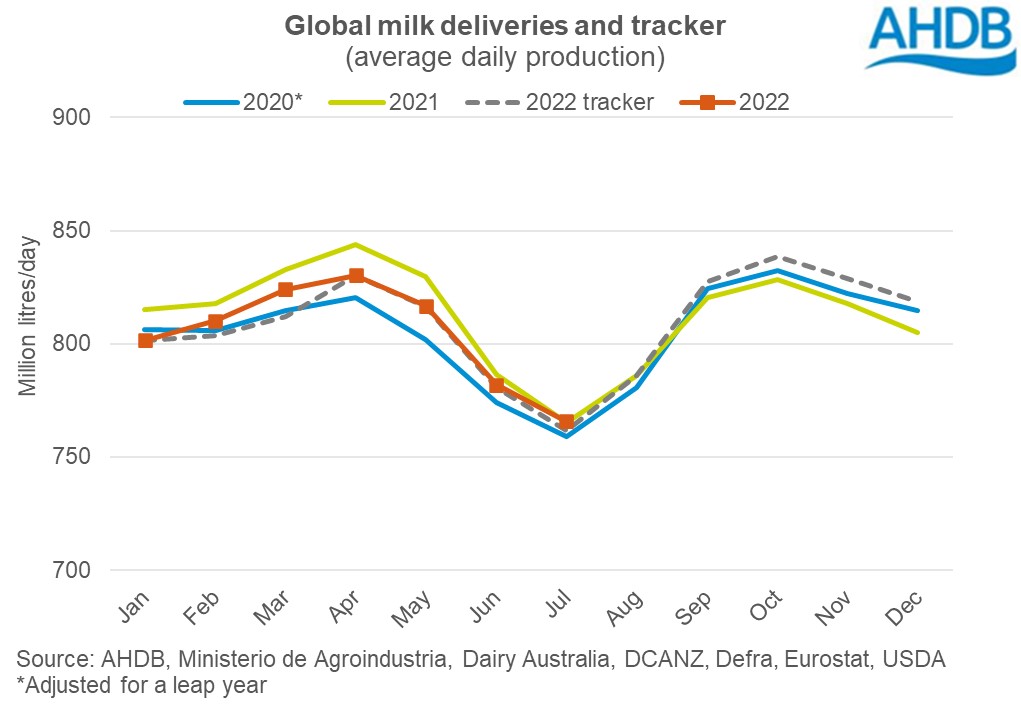
Trends in global milk supplies impact on prices. Deliveries in the six key exporting regions are tracked to provide an overview of current production levels and trends in global milk supplies.
The milk production regions included are the EU-27, UK, Argentina, Australia, New Zealand and the United States. Combined, they account for more than 65% of global cow’s milk production and around 80% of global exports of dairy products.
Overview
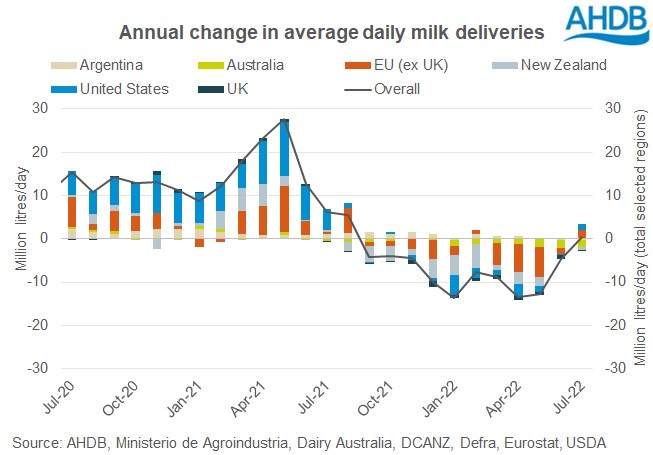
Average daily global milk production for key producing countries in July totalled 765.7 million litres per day in July, an increase of 0.5million litres on last year. This is the first increase seen since August 2021, but due to the downturn in production last year.
The EU-27 saw an overall increase of 0.5% on last year, although about half of the constituent countries reported year-on-year increases.
Within the EU-27, production in the key regions of Germany, France, and Spain was down compared with July 2021. However, deliveries in Poland, the Netherlands and Ireland all grew between 1%-6%, helping to offset these losses. Denmark held steady on production achieved last year.
Inn the United States, average daily deliveries were estimated to be 272.7million litres in July, an annual increase of 1.4million litres per day. This is the first increase it has seen in 9 months.
The UK saw a decrease of 1% in daily deliveries to 39.9 million litres per day, 0.4million litres down on July 2021. Extreme temperatures in July may have contributed to this, with reduced grass growth and daily milk deliveries coinciding with the rises in temperature.
Australia, Argentina, and New Zealand all recoreded lower deliveries in July, most notably with Australia back 8.3% on the year, equivalent to 1.7million litres per day. New Zealand decreased by 5.7%, and Argentina by 1%. The large drop in New Zealand is down to record production last year. For Australia, the drop continues its declining trend, with deliveries now running below prior year for 14 months.
Additional information
The tracker is a baseline for comparing against actual production, not a forecast of milk production.
The baseline is calculated using historic month-on-month movements in milk production, providing information on a typical milk year in each of the key regions.
Milk futures on the Chicago Mercantile Exchange started the week lower as commodity prices continued to go down while cash markets were all over the place. Class III and IV futures also got caught up in that weaker trade, which was a shame. Class III lost 8 cents in October 2022, 40 cents in November, and 26 cents/cwt in December. 2023 months out to August were also between 19 and 33 cents lower. From December 2022 to May 2023, Class IV fell 16–25 cents.
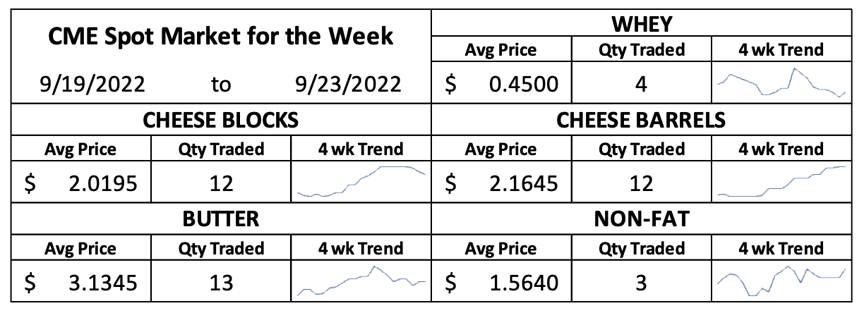
Dry whey ended the day on the CME spot markets up $0.0025 at $0.4525. At $0.46, one sale was made. Blocks are now $2.01, up $0.05. At that price, one sale was made. At $2.1750, barrels are down $0.01. At $3.1325, butter hasn’t changed. The price of nonfat dry milk is still $1.58.
Milk futures on the Chicago Mercantile Exchange finished down Wednesday, following the trend of commodities, while cash markets were mainly lower as well.
Class III milk for October is down 24 cents to $21.70. The November contract is down 36 cents to $21.43. The December contract is down 36 cents to $21.40. The January contract is down 24 cents to $20.97. Contracts are six to 19 cents lower from February to April.
Dry whey is $0.0050 lower at $0.45. At that price, one sale was made.
Blocks are $0.02 lower at $2.0325. At that price, one sale was made.
Barrels are trading at $2.1750, up $0.0050. At that price, one sale was made.
In this month’s second Global Dairy Trade auction, hosted on Tuesday by GDT Events, international milk prices increased although quantities decreased, according to Reuters.
With an average selling price of $4,072 per tonne, the GDT Price Index rose 2%. At the prior auction, the index increased 4.9%, according to GDT Events.
According to the auction platform’s website, 26,106 tonnes in total were sold at the most recent auction, a decrease of around 3.8% from the one before.
The New Zealand currency may be impacted by the auction outcomes since the dairy industry contributes more than 7% of the country’s GDP.
Nearly one-third of the global dairy trade is under the authority of the 10,500 or so farmers that make up the New Zealand milk cooperative.
Despite being owned by Fonterra Co-operative Group Ltd. of New Zealand, GDT Events is run separately from the world’s largest dairy company. The trade manager for the Global Dairy Trade auction, which takes place twice a month, is US-listed CRA International Inc. The next auction is set for October 4.
Milk futures on the Chicago Mercantile Exchange rose with global markets on Tuesday, but cash activity was mixed.
October Class III milk is up 40 cents to $21.94. November is up 36 cents to $21.79. December is up 30 cents to $21.76. January is up nine cents to $21.21. Contracts for February to April are steady to two cents higher.
Dry whey is constant at $0.4550.
Blocks are constant at $2.0525. At that price, there were two sales.
Barrels are down $0.0675 at $2.17. Three deals were made ranging from $2.01175 to $2.17.
Butter is down $0.0025 at $3.15. At that price, one sale occurred.
Prior to a mostly neutral report on milk output, milk futures on the Chicago Mercantile Exchange ended Monday with a mixed performance. Class III milk for October is now $21.54, up nine cents. November came in at $21.43, up a cent. December is at $21.46, down four cents. At $21.12, January was up three cents. Contracts for February through April are up a cent in value.
Dry whey is now $0.4550, down $0.0050. At that price, one deal was completed. $0.0075 less each block at $2.0525. At $2.0625, one sale was completed. At $2.1025, barrels are up $0.0125. At that price, one deal was completed. Butter is now $3.1525, up $0.02. There were nine transactions between $3.16 and $3.1675. Nonfat dried milk is now $1.56, down $0.01.
On August 16, prices at the dairy auction decreased overall by 2.9%, while important whole milk powder prices fell by 3.5%. Out of the previous 11 auctions, it was the 10th time that the total price fell. Penny notes that “prices have really been down since March.” In fact, although total costs are down 29%, the cost of whole milk powder has decreased by around a third.
Prices were astronomically high in March. The total price drop is 3.5% in yearly terms, whereas the price decline for whole milk powder is 9.8%. When taking a longer view, the current prices for whole milk powder and the whole market are 3.4% and 2.7% higher than the 5-year average, respectively.
Dairy auction price increases actually outpaced price decreases by product (3 to 2). Prices of cheddar in particular defied the trend and increased by 4.2%. In the meanwhile, the costs of butter and skim milk powder hardly increased (up 0.2% and 0.1%, respectively). The cost of anhydrous milk fat, however, fell 9.8%.
According to Penny, this outcome was a little weaker than anticipated. “Before the auction, the futures market indicated that whole milk powder prices would decline by around 2%, when we had anticipated a 1% decline. The extra decline could have been caused by this week’s deterioration in market mood after the publication of disappointing Chinese activity figures for July.
Additionally, the Chinese yuan declined, increasing the price of dairy products for Chinese consumers that were priced in USD. Westpac’s prediction for 2022–2023 milk prices of NZ$9.25 per kg (US$5.68) remains vulnerable to negative risks.
poor global dairy supply
However, Penny notes that the global dairy supply is still extremely low, and that we continue to anticipate a recovery in Chinese demand over the coming months as Covid-19 limitations are further relaxed and policy stimuli take effect. On the basis of that and the NZD/continued USD’s support, we continue to anticipate a strong milk price this season.
GLOBAL DAIRY MARKET PRICE OVERVIEW
According to Rabobank, the auction results provide more evidence in favour of the company’s Q2 worldwide estimate that the peak in milk powder pricing would occur in the first half of 2022. Prices will be lower during the second half of this year and into 2023, according to Rabobank.
According to Rabobank’s Commodity Markets Research Monthly, the negative movement brings the index back to its March 2021 levels. According to Rabobank, “Demand-side uncertainties continue, largely as a result of China’s rigorous lockout rules and plentiful supplies.”
As the herd is still 67,000 head below last year’s level, the US produced 19.14 billion pounds (8.68 billion kg) more milk in July, an increase of 0.2%, driven by a 0.9% increase in milk per cow. The dairy herd reached a high of 9.501 million heads in June 2021 before progressively declining through January 2022. Since then, there have been 49,000 more cows introduced to the herd.
manufacture of milk
In its WASDE report for August, the US Department of Agriculture increased US milk output. Production forecasts for 2022 were raised from 226 billion pounds (102.5 billion kg) to 226.8 billion pounds (103 billion kg), and for 2023, from 228.3 billion pounds (103.55 billion kg) to 229.2 billion pounds (103 billion kg) (103.96 billion kg).
Expect milk to increase in value.
The greatest exporter of cheese in the world, the European Union, is having issues with dairy producers due to the very dry weather. Farmers in Spain and France who raise animals for the production of dairy have seen their herds’ grazing pastures drying up, which has hampered the production of milk, butter, and cream. Due to record inflation and the effects of Russia’s conflict in Ukraine on the supply chain, dairy producers in the EU already have difficulty affording feed.
In addition to increased food and energy prices, labour shortages, and disease outbreaks, farmers must contend with these issues. The European Dairy Association’s secretary-general, Alexander Anton, told Bloomberg that while “we have been in this situation previously in prior dry years,” the situation currently is “absolutely amazing.” Expect milk to increase in value.
Following the decrease in all commodities, milk futures on the Chicago Mercantile Exchange finished lower on Thursday.
Class III milk fell 23 cents to $21.38 in October, 34 cents to $21.39 in November, and 24 cents to $21.46 in December. $21.10 in January, down 22 cents. Contracts for the months of February through April are reduced by 20 cents.
Dry whey is now $0.4775, down $0.01.
Blocks remain the same at $2.06.
steady at $2.06 per barrel.
At $3.1725, butter is down $0.0350. At that price, one deal was completed.
Nonfat dry milk is now $1.58, up $0.03. There were fifteen transactions from $1.55 to $1.58.
On Wednesday, the Chicago Mercantile Exchange saw a decline in the price of milk futures and cash dairy products. Class III milk for October remained at $21.61. November ended with a $0.04 decline to $21.73. At $21.70, December was down $0.06. To $21.32, January saw a $0.08 decrease. Contracts for February through August ranged from constant in May to 25 cents lower in July.
In spot trade dry whey was now $0.4875, down $0.01. Sales were not tallied. Cheese blocks up $0.06 to end the day at $2.06. Sales were not tallied. Cheese Barrels continued to cost $2.06. There were two transactions between $2.06 and $2.08. At $3.2075, butter was down $0.0325. The prices of two transactions were $3.20 and $3.2075. To $1.55, nonfat dry milk decreased by $0.0250. There were four transactions between $1.55 and $1.5525.
Due to lower cow inventories, USDA has reduced its predictions for milk output in 2022 and 2023. The agency predicts a slight improvement in yield per cow in the latter half of this year, but not enough to make up for a reduced herd.
The USDA increased the prices of butter and nonfat dry milk in its September supply and demand report due to marginally better pricing, while leaving the prices of cheese and whey unchanged. The agency anticipates a rise in butter and nonfat dry milk costs the next year due to limited supply. For 2023, cheese prices were reduced but whey prices remained constant.
Due to improved component values, the USDA predicts that Class III and Class IV prices will rise this year. While the Class IV price increased due to rising butter costs, the Class III price in 2023 remained the same.
The forecasted price for all milk in 2022 was increased by 25 cents to $25.45 per hundredweight, while the price in 2023 was raised by 20 cents to $22.70.
On the Chicago Mercantile Exchange, milk futures were generally down in the short term, but Tuesday’s exception saw a little increase in cash dairy prices. Despite spot prices being higher, selling pressure on Class III prices persisted throughout the day. For a long time, future prices have been higher than spot prices. The discrepancy was lessened by today’s price movement. $21.52/cwt for October milk saw a 15-cent decrease. Milk for November dropped by 27 cents to $21.78/cwt. Class IV milk futures for Q4 gained 17 cents on average throughout the day.
In the CME spot dairy product auction on Tuesday, the majority of dairy goods increased. Block cheese was priced at $2.00/lb plus 4.75 cents. To $2.06/lb, barrel cheese increased by 7.50 cents. Whey increased $0.4975/lb by 4 cents. Butter increased 7 cents to a record high of $3.24 per lb. Nonfat milk’s price fell 1.25 cents to $1.5750 per pound.
The ongoing strong demand for dairy, compounded by New Zealand’s shrinking milk pool, has prompted Fonterra Co-operative Group Limited to lift its forecast earnings guidance range to 45-60 cents per share, up from a previous estimate of 30-45 cents per share. The co-op has also revised its forecast milk collections for the current season to 1,495m kgMS, down from 1,510m kgMS.
The improved earnings guidance is mainly down to ‘favorable pricing relativities’ between Fonterra’s protein and cheese portfolios as well as whole milk powder, the co-op’s chief executive Miles Hurrell explained. “The demand signals we saw at the end of FY22 have continued driving improved prices and higher margins across our portfolio of non-reference products, particularly in cheese and our protein products such as casein,” he said.
Domestically, demand has continued to outstrip supply, with milk production in New Zealand down 6% in July and further impacted by weather conditions. This could see Fonterra’s Farmgate Milk Price range, which was revised down by 25 cents per kgMS in August, climb back up as the year progresses.
“We see strong underlying demand and the latest lift in whole milk powder prices on GDT is also a positive signal reversing the recent easing in the prices that drive our Farmgate Milk Price,” confirmed Hurrell. “Strong offshore prices for protein, as reflected in the recent increase in EU and US milk prices, mean our protein portfolio has been performing very well.”
The co-op’s chief sees further forecast revisions on the horizon if this perfect storm of low supply and strong demand at home and abroad continues. “Our strategy is based on growing demand, constrained supply and shifting our farmers’ milk into higher value products, all of which are currently being realized,” he said.
“If these unprecedented conditions were to continue for a further extended period, this could have an additional positive impact on forecast earnings.”
Fonterra is expected to announce its financial results for the year ending July 31, 2022 on September 22, 2022.
“We are committed to our 2030 targets and expect variable market conditions as we work towards them,” concluded Hurrell. “The benefit of being part of the co-op is having a diversified organization with an extensive portfolio of products which allow us to capture value in a broad range of market conditions, benefiting both farmer owners and unit holders.”
On the Chicago Mercantile Exchange milk futures were up and cash dairy prices were mostly higher Monday. Class III milk markets watched October jump $0.74/cwt to $21.68. Both November and December were up around $0.50/cwt. Calendar year 2023 ranged from $0.12-$0.34/cwt stronger. Class IV also produced gains with months in 2022 up around $0.40/cwt. January – July 2023 months also finished in the green today.
Spot trade turned in a strong performance on Monday. Cheese blocks were up $0.0350 closing at $1.9525. Two sales were recorded at $1.9450 and $1.95. Cheese Barrels were up $$0.0525 at $1.9850. Three sales were recorded from $1.9525 to $1.9850. Dry whey was unchanged at $0.4575. One sale was recorded at that price.
New Zealand dairy co-op Fonterra has lowered its 2022/23 farmgate milk price forecast as inflation hits consumer behaviour, softening global demand.
The cut in the forecast, announced at the end of last month, takes the price range down from NZ$8.75-$10.25 per kgMS to $8.50-$10. This reduces the midpoint of the range from $9.50 to $9.25 per kgMS. According to the co-op, the current advance payment rate of $5.70 per kgMS is unchanged.
This is a reversal on an announcement in June, when the co-op expected to pay a higher price to farmers for milk supply next year following an increase in dairy demand and a strong US dollar.
CEO Miles Hurrell said: “The change in the 2022/23 forecast Farmgate Milk Price will be disappointing for our farmers but it reflects a number of factors, including the recent downward trend in global dairy prices driven by some short-term softening in global demand, and the general impact of inflation on purchasing behaviour.
“However, we believe the longer-term outlook for dairy remains positive.”
Meanwhile, the co-op continues to seek new market opportunities, with a new business-to-business brand, Nutiani, launched to tap into the medical and everyday wellbeing nutrition markets – which are worth billions of dollars and are still growing.
Chief innovation and brand officer Komal Mistry-Mehta says the brand will help its business customers tailor their products to changing consumer needs.
“Our health and wellbeing customers are facing growing pressure to accelerate their innovation pipeline to respond to these dynamic consumer demands,” she added, “yet they face common challenges during new product development and are looking for partners to fill their capability gaps.
“Nutiani answers this need by providing a suite of solutions which help customers tackle the pain points associated with each step of the innovation journey – from identifying the opportunity to validating the final product.
“We see a clear opportunity to win in critical segments of the global wellbeing nutrition space. Fonterra’s deep expertise in nutrition science gives us an incredible advantage here.
“We will use Fonterra’s existing expertise in nutrition science to develop targeted solutions, while opening up opportunities for strategic partnerships to deliver access to new markets and consumers.”
Fonterra, which is due to publish its results for the year to 31 July on 22 September, is New Zealand’s biggest milk processor and the world’s biggest dairy exporter.
On the Chicago Mercantile Exchange milk futures were higher Thursday as lower corn markets provided some feed cost relief. Class III milk futures were mostly higher on the day. Q4 milk futures settled at $20.98/cwt. First half 2023 milk futures ended the day at $20.82/cwt. Class IV milk futures were 12-35 cents higher.
Dairy products were mixed in the CME spot dairy product auction on Thursday. Dry whey up $0.0050 at $0.45. Three sales were made at that price. Blocks unchanged at $1.85. Barrels down $0.0025 at $1.9325. Butter unchanged at $3.1475. Nonfat dry milk up $0.0350 at $1.5650. Ten sales were made from $1.5425 to $1.5650.
On the Chicago Mercantile Exchange milk futures and cash dairy prices were mostly higher Wednesday. Class IV milk finished up it’s strong move Tuesday with small moves nearby and big gains in 2023. September held unchanged at $24.12, October gained 4 cents to $24.14 and November was 8 higher at $23.45. Jan – March 2023 gained 16-46 cents to average at $22 even. Class III milk saw nice gains with September up 17 to $19.84, October jumping 25 to $20.34, and November up 15 to $20.85/cwt.
Cheese finally found a bid and took off in the CME spot trade. Cheese blocks were up $0.09 closing at $1.85. No sales were recorded. Cheese Barrels were up $0.06 at $1.9350. One sale was recorded at $1.90. Butter was up $0.0275 closing at $3.1475. Nine sales were recorded from $3.1050 to $3.1475. Nonfat dry milk was down $0.0075 at $1.53. Four sales were recorded from $1.5250 to $1.53. Dry whey was unchanged at $0.4450. No sales were recorded.
Tuesday morning’s GDT auction concluded with the price index up 4.9%. This was slightly beneath what futures expectations were showing coming into today. Skim Milk Powder gained 1.4% to $1.62/lb. Whole Milk Powder added 5.6% to $1.64/lb. Cheddar Cheese was up 0.8% to $2.29/lb. Butter tacked on 3.2% to $2.44/lb.
Grocers are anxious about stocking their shelves with enough product to last through the holiday baking season, and USDA’s recent reports have not calmed their fears.
The bulls remain in charge in the butter pit. CME spot butter added another 1.75ȼ this week and reached $3.10 per pound, tied for the second-highest trade ever. Grocers are anxious about stocking their shelves with enough product to last through the holiday baking season, and USDA’s recent reports have not calmed their fears. Last week’s Cold Storage report showed July 31 butter stocks at the lowest volume for the month since 2017, when demand was much smaller. Today, USDA’s Cold Storage report showed July butter output at 151.7 million pounds, up 3.1% from July 2021. The unexpected year-over-year increase implies strong demand, making it clear that production did not keep up with consumption this summer.
The churns surely didn’t run any harder in August, when cream multiples in the Midwest soared to unprecedented heights. Butter supplies are likely to remain tight, and the market is on edge. But these high prices are already doing their job. U.S. butter imports are on the rise and sticker shock will likely slow sales. The futures project that butter will drop from north of $3 in September to around $2.56 by January.
The cheese markets were mixed. CME spot Cheddar blocks climbed 2.5ȼ to $1.765. Barrels fell by the same amount and closed today at $1.8575. Both blocks and barrels are hovering a little above the 2022 lows, weighed down by heavy inventories and formidable production. USDA reported July cheese production at 1.157 billion pounds, up 1.1% from July 2021. Milk is plentiful in the cheese states and production is likely to remain strong. Thankfully, robust exports are preventing cheese stocks from becoming even more burdensome.
With cheese vats full, whey output is going strong. USDA reported July whey powder production at 82.1 million pounds, up 7.4% from a year ago to an 18- month high. Formidable output helps to explain the swift selloff in the whey market earlier this summer. CME spot dry whey slipped a half-cent this week to 46.5ȼ.
Milk powder prices also lost a little ground this week. CME spot nonfat dry milk (NDM) fell 4ȼ to $1.52. Combined production of NDM and skim milk powder totaled 216.5 million pounds in July. That is pretty typical for mid-summer drying, but it was 7.1% greater than July 2021, and stocks climbed. Lower prices are starting to attract some interest from Mexican milk powder buyers, but USDA describes the milk powder market overall as “quiet.”
The milk markets sprinted higher into the holiday weekend and logged substantial gains today. But it was not enough to undo significant losses from early in the week. Class III futures settled 30ȼ to 90ȼ lower than last Friday, and the September and October contracts slumped below the $20 mark. Class IV futures are still sitting comfortably in the low- to mid-$20s, but they also lost considerably ground this week.
USDA announced the August Class III price at $20.10 per cwt., down $2.42 from July but still up $4.15 from last year. At $24.81, August Class IV milk was 98ȼ lower than July. August Class IV was an astounding $8.89 higher than Class IV milk in August 2021.
After much back and forth, the corn markets finished the week not far from where they
began it. December corn settled at $6.6575 per bushel, up a penny and a half. The trade has come to a consensus that the national average corn yield is somewhere in the low 170s. Corn prices will have to remain high enough to deter new export sales and keep sufficient corn at home to last until next year’s harvest.
The bean markets took a big step back. Thanks to timely rains, the crop is looking great. November soybeans settled at $14.205, down more than 40ȼ for the week. October soybean meal dropped more than $10 to a still pricey $424 per ton.
While tight milk and commodity availability in the EU will remain a strong influence, weaker demand in the US will keep cheese and protein prices under pressure. Significantly weaker demand from China and parts of Asia continue to weaken Oceania milk powder prices.
The slow recovery in Chinese import demand due to COVID restrictions remains a major influence over SMP and WMP prices. Indicators from the Chinese market do not yet provide support for a meaningful reversal of this situation, despite powder prices moving into a more attractive zone. Upcoming GDT events will provide critical signals.
The demand-side outlook is also more challenging with food inflation continuing to rise in most developing regions, pushed by the flow-on effects of elevated grain and energy prices.
The EU outlook remains the most uncertain. Milk collections have been resilient, aided by strong milk prices that will persist for the remainder of the year. Poor soil moisture remains a huge risk for crops and pasture fodder in some regions, while the uncertainty of the impact of EU-agreed gas rationing on powder drying will further threaten SMP and butter output.
US market fundamentals remain weaker with the demand for cheese slowing. While milk supplies are expected to grow in the coming months, that is against a sharp reduction in cow numbers in Q3-2021. Weaker milk prices and elevated input prices are expected to keep producer margins under greater pressure through H2-2022.
Wet weather is slowing the start of the NZ 2022-23 production season. The expected record milk prices won’t drive stronger milk output as higher input costs and labour shortages constrain production. Weaker demand from China and Sri Lanka leaves a large gap in WMP requirements and may provide some pressure to alter product mix in favour of SMP/butterfat – to what extent remains uncertain and may yet be swayed by short-term developments.
Graph Reference: Fresh Agenda
About Maxum Foods: Maxum Foods is one of Australia and New Zealand’s principal suppliers of dairy ingredients to the Human Health and Nutrition, as well as the Animal Nutrition industries. Maxum Foods specialises in supplying medium to large-scale food manufacturers with high-quality dairy ingredients such as milk powders, cheese and butter. Backed by top-level technical support and a huge dairy ingredient range, Maxum Foods have open global supply channels to source exactly what our customers need.
On the Chicago Mercantile Exchange milk futures were down and cash dairy prices were mixed Thursday. Class III milk futures were lower out of the gate today and never recovered. October milk slipped 41 cents to $19.48/cwt. November milk fell 43 cents to $20.28/cwt. Class IV milk futures trended lower as well.
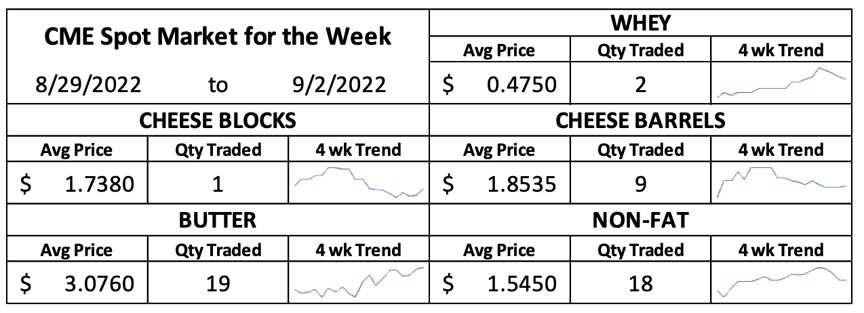
Spot butter gained 3.75 cents to $3.0925/lb, the third highest level ever. Six sales were recorded from $3.09 to $3.0925. Cheese blocks were up $0.01 closing at $1.7350. No sales were recorded. Cheese Barrels were unchanged at $1.85. No sales were recorded. Dry whey was down $0.0050 to $0.47. No sales were recorded. Nonfat dry milk closed down $0.03 at $1.52. Two sales were recorded at that price.
On the Chicago Mercantile Exchange milk futures stayed lowered Wednesday while cash markets took mixed directions. Class III Milk had September down 16 cents to $19.63, October slid 21 to $19.89, and November fell 29 cents to $20.71/cwt. 2023 was unchanged to 20 cents lower with Jan – March averaging at $20.55/cwt. Class IV milk also slid lower nearby. September fell 13 cents to $24.02, October fell 35 to $23.25, and November fell 46 cents to $22.78. First quarter 2023 Class IV is averaging at $21.56/cwt.
The CME spot trade again had Barrels unchanged at $1.85. Butter up $0.0050 at $3.0550. Eight trades were made from $3.0275 to $3.0550. Nonfat dry milk down $0.0150 at $1.55. Dry whey down $0.0050 at $0.4750. Blocks down $0.0250 at $1.7250.
Butter production is always scant in the summer, but it was especially so this year. There were just 314.4 million pounds of butter in cold storage at the end of July, 5.4% less than a year ago and the lowest mid-summer total since 2017.
Butter buyers are anxious. There were just 314.4 million pounds of butter in cold storage at the end of July, 5.4% less than a year ago and the lowest mid-summer total since 2017. Butter production is always scant in the summer, but it was especially so this year. Cream multiples are sky-high, pushing butterfat to other users. And the fall baking season looms large. CME spot butter leapt 14.25ȼ this week to $3.0825 per pound, the loftiest price since 2015 and within a few cents of the all-time highs.
In contrast, the cheese market is weighed down with oversupply. There were 1.52 billion pounds of cheese in refrigerated warehouses on July 31, the largest stockpile ever. Cheese inventories were 5.1% greater than the already ample volumes of a year ago. Meanwhile, cheese output remains strong as high freight keeps milk close to home. USDA’s Dairy Market News
characterizes domestic demand as “steady to lower.” Thankfully, U.S. cheese is a bargain to foreign buyers, and exports are helping to keep product from piling up even further. CME spot Cheddar barrels slipped 1.25ȼ this week to $1.8825. Blocks dropped 8ȼ to $1.74, just a penny above the 2022 low.
The powders moved higher. Whole milk powder (WMP) prices inched upward at the new Global Dairy Trade (GDT) Pulse auction on Tuesday, bouncing back from a poor showing at last week’s traditional GDT auction. The GDT will still feature the full array of dairy products twice per month, while the Pulse auction will offer a look at a single delivery period for Fonterra WMP in the off weeks. At the CME spot market, nonfat dry milk rallied 4ȼ to $1.56.
The market remains concerned that large stockpiles and economic malaise will weigh on Chinese dairy demand. China’s July import data was not strong enough to silence the bears, but it was a little better than feared. Across all categories, China imported far less than the record-shattering volumes of last year. Chinese milk powder imports were especially soft. Compared to the prior July, China imported 50% less WMP and 41% less skim milk powder (SMP). However, if last year’s unsustainably high imports are pushed to the side, China’s milk powder imports look far less disappointing. For the year to date, China’s WMP and SMP imports are the third-highest ever.
China imported 119.5 million pounds of whey products in July, 17% less than the year before. Still, this is the highest monthly total since September. For most of this year, Chinese hog growers operated in the red, and they cut back on expensive feeds including whey for piglets. But now they’re back in the black and including more whey in the ration. U.S. whey is priced to move and gaining marketshare. The United States accounted for 59.3% of Chinese whey product imports in July, its highest share since the U.S.-China trade war heated up in 2018.
Better exports, a recovery in U.S. infant formula production, and rising NDM prices have helped to spur a rebound in U.S. whey prices. CME spot dry whey climbed 2ȼ this week to 47ȼ per pound, a one-month high. But whey prices are down nearly 40ȼ from the February peak, a slump that has sapped more than $2 per cwt. from the Class III milk price.
USDA fine-tuned its June milk production estimates and reported that, in contrast to its initial assessment, milk production did not top year-ago levels in June, and dairy producers didn’t add cows. June milk output fell 0.1% from the prior year, and the dairy herd shrunk 4,000 head from May to June. For July, USDA’s Milk Production report showed national milk output at 19.14 billion pounds, up just 0.2% from the prior year. The dairy herd grew a modest 1,000 head from June to July and is still 67,000 head smaller than it was a year ago. Both milk production and cow numbers were on the low end of expectations and they prompted much higher prices in Chicago.
Despite the selloff in the spot cheese market, September Class III futures jumped 51ȼ this week to $20.24 per cwt. The October contract added 76ȼ, and deferred contracts added at least a dollar. Class IV futures were even stronger. October Class IV jumped $1.72 to $24.20.
Dairy producers will need milk prices to stay high to keep up with rising feed costs. The trade has grown increasingly concerned about global grain supplies amid worsening drought in Europe and in China’s rice belt. Closer to home, ProFarmer crop scouts pegged the national average corn yield at 168.1 bushels per acre, well below USDA’s latest estimate of 175.4. ProFarmer often posts a lower yield than USDA’s September assessment, so the market shouldn’t count on the agency whacking seven bushels off in its next Crop Production report. However, the tour made it clear that the crop in the Eastern Corn Belt is good but not record large, and it’s not big enough to make up for variable yields in Iowa and a truly terrible crop in the Plains.
The bean crop is in better shape, thanks to August rains that fell during the peak of soy pollination. ProFarmer put the soybean yield at 51.7 bushels per acre, just a little shy of USDA’s August guess at 51.9. Nonetheless, the soy complex followed the grains higher this week. November soybeans closed today at $14.6125 per bushel, up 57.25ȼ from last Friday. October soybean meal jumped more than $26 per ton to $434.10. December corn futures rallied 41ȼ to $6.6425.
On the Chicago Mercantile Exchange, the negative price trend continued Tuesday for milk futures and cash trade. Class III milk futures were negative on Tuesday. September milk gave up 10 cents to $19.79/cwt. October milk tumbled 39 cents to $20.02/cwt. Q4 2022 milk futures were 40-55 cents lower.
It was a mixed bag in the CME spot dairy product auction. Dry whey down $0.0050 at $0.48. One trade was made at that price. Blocks up $0.0350 at $1.75. One trade was made at that price. Barrels down $0.01 at $1.85. Eight trades were made from $1.8475 to $1.87. Butter down $0.0325 at $3.05. Nonfat dry milk down $0.0050 at $1.5650. Two sales were made at that price.
On the Chicago Mercantile Exchange milk futures were down and cash dairy prices were mixed with little sale activity Monday. Class III markets declined 32-45 cents/cwt September through December 2022. 2023 markets were virtually flat to slightly lower in the first half of 2023. Class IV turned in a mixed bag of results as September 2022 gained 15 cents, October lost 20, and Nov/Dec were unchanged. 2023 was also all over the place amongst monthly settlements.
Cheese markets struggled on Monday as Cheese blocks were down $0.0250 closing at $1.7150. No sales were recorded. Cheese Barrels were down $0.0225 closing at $1.86. No sales were recorded. Butter was unchanged at $3.0825. No sales were recorded. Nonfat dry milk rose $0.01 closing at $1.57. Five sales were recorded from $1.56 to $1.57. Dry whey was up $0.0150 to $0.4850. No sales were recorded.
The T.C. Jacoby Weekly Market Report Week Ending August 12, 2022
Economic anxiety is still threatening consumer purchasing power and though a robust international appetite has kept product moving offshore, the balance between supply and demand feels precarious.
On the heels of persistent declines, most products at the CME managed to stop the slide this week. While some modest increases suggest that the tone may be shifting, the markets continue to feel unsettled as they digest various fundamentals. Economic anxiety is still threatening consumer purchasing power and though a robust international appetite has kept product moving offshore, the balance between supply and demand feels precarious.
Boiling temperatures and stifling humidity are pushing back on milk production in many areas of the country. With school openings around the corner, bottlers are increasing their raw milk demand. In most areas supplies have been sufficient to meet Class I demand without depriving manufacturers of too much volume. However, if weather conditions continue to beat back output this may not be the case for long.
Milk futures bounced around over the course of the week but both Class III and Class IV saw contracts through the balance of the year settle higher on Friday than on Monday. Class IV prices continue to hold a premium to Class III, due to strength in the fat markets, which the futures markets anticipate will persist over the majority of next year.
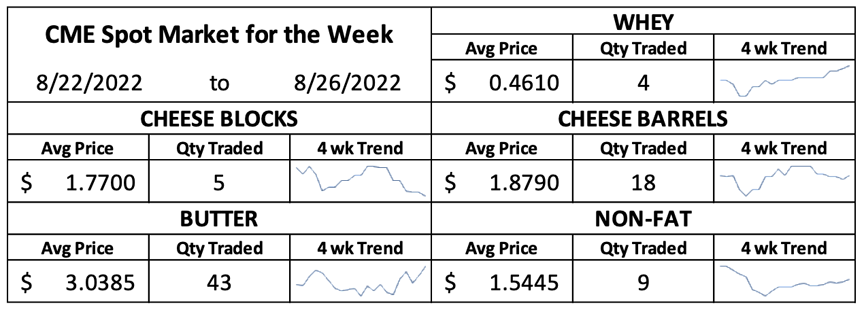
After weeks of pushing upward, butter prices moved down this week. In particular, a 4¢ loss during today’s trade ushered the spot price down to $2.935/lb., a decrease of 7.5¢ compared to last Friday. The trade continues to be active with 34 loads of butter trading hands over the course of the week. Despite the decline, however, butter markets remain elevated relative to historical averages and continue to demonstrate surprising resilience.
Cream availability is tight as seasonal, hot weather is reducing both milk availability and component levels. In
addition, cream demand from cream cheese manufacturers is strong and believed to be depriving churns of spot cream loads. With the fall baking season looming, butter manufacturers are optimistic that retail demand will improve. For the moment, however, most butter buyers seem to have their needs covered. Tepid demand and sufficient, if not overwhelming, inventories, are lending some doubt about how much longer butter may be able to persist at prevailing price levels.
On the other side of the Class IV complex, manufacturers of nonfat dry milk (NDM) indicate that stocks are plentiful. Export demand for NDM and skim milk powder has slowed, especially from Mexico. However, according to Dairy Market News, “some are hopeful that the recent decline in prices will entice purchasers.” At the CME, spot prices slid as low as $1.46/lb. on Tuesday before gaining some ground later in the week. Ultimately, the market closed at $1.5175/lb. on Friday, an increase of 1.5¢ compared to last week, with 25 loads moving.
The Cheddar markets also managed to make some gains during the week. In the block market, after beginning the week unchanged on Monday, gains on Tuesday, Thursday, and Friday lifted the price to $1.845/lb., 6¢ higher than last Friday. Barrels saw important gains on Tuesday and Thursday before giving up some ground during today’s trade. At the end of today’s session, barrels were at $1.8875/lb., up 9.5¢ versus last week. Barrels held as much as an 8.75¢ premium to blocks this week though the advantage was whittled down to 4¢ today.
According to market participants, cheese inventories are readily available. Production continues at a steady clip though competition for milk with other users threatens to reduce the quantity of milk headed to cheese vats. In addition, ongoing labor issues are preventing manufacturers from being as productive as they might like. The high prices seen in recent weeks have taken a bite out of cheese demand in both retail and foodservice channels, though lower prices could help to restore some of that interest.
Whey markets moved in a narrow band this week, ultimately gaining a penny compared to last Friday’s close. The spot dry whey price ended the week at 44.5¢/lb. with just two loads trading during the week. Demand has purportedly slowed from both domestic and international sources and inventories are accumulating as a result. Higher protein products continue to offer more attractive margins for manufacturers.
USDA released its World Agricultural Supply and Demand Estimates report this afternoon, making some modest edits to both the corn and soybean balance sheets. In the case of corn, USDA trimmed its yield expectations for the 2022/23 corn crop to 175.4 bushels per acre, ultimately reducing their forecast for corn production by 1% to 14.539 billion bushels. Reduced production flowed through to lower exports along with lower feed and residual use. In the global balance sheet, lower exports from the U.S. were more than compensated by larger exports from Ukraine and Russia, as corn begins to move out of ports there.
Despite reducing the forecast for area harvested by 300,000 acres, a 0.8% increase in the yield projection lifted the soybean production forecast to 4.531 billion bushels. This represents an increase of 0.6%, or 26 million bushels compared to last month’s estimate. Exports were raised by 20 million bushels. Even so, USDA’s updated balance sheet suggests there should be marginally more soybeans available for domestic use.
Both corn and soybean futures markets found the report as sufficient motivation to move upward, though gains were more dramatic in the corn market. Every corn contract through JLY23 settled at least a dime higher today.
On the Chicago Mercantile Exchange milk futures and cash dairy prices gained back some of last week’s losses Monday. September Class III milk was up $0.23 at $19.96. October closed up $0.09 at $20.09. November was up $0.20 at $20.81. December was up $0.13 to $20.73. January through July contracts ranged from fourteen cents lower in May to seventeen cents higher in March.
In spot trade for a fourth straight session, dry whey remains unchanged at $0.45 with no sales activity. Cheese blocks were unchanged at $1.82. No sales were recorded. Cheese Barrels were unchanged at $1.8950. No sales were recorded. Butter went up $0.0800 closing at $3.02. Two sales were recorded at $3.00 and $3.02. Nonfat dry milk closed up $0.0125 at $1.5325. Three sales were recorded from $1.53 to $1.5350.
Australia’s dairy exports took a fall in June after the increase in exports recorded in May. Total dairy export volumes out of Australia decreased 4% in June year-on-year, while year-to-date total dairy export volumes are still down 3%. From a value perspective and for the first time since February, total dairy export values declined, down 1% YoY in June; however, they are still up 6% YTD.
Milk powder exports had a mixed result with whole milk powder (WMP) exports declining YoY, while skim milk powder (SMP) exports increased YoY for June. WMP exports declined 44% YoY in June, with exports to Asia and China down 48% and 63% respectively, the largest reason for this overall decline. WMP exports to the Middle East attempted to offset this, with an increase of 840mt of WMP exported to the region. In fact, the Middle East followed this trend through both milk powders, with a massive 427% YoY increase in SMP volumes sent to the Middle East. There was also an increase of 54% into China. Overall, SMP exports increased 19% out of Australia in June.
Australian milk fat exports took a hit with anhydrous milkfat (AMF) and butter both experiencing declines. AMF exports out of Aussie in June declined a massive 46% YoY however, the YTD figure still sits up 6%. Again, a lack of Asian purchases drove this decline, with a drop of 49%. However this region still accounts for 93% of Australia’s June AMF export volumes. Butter exports followed suit, down 37% YoY and 30% YTD. Asia and China drove this decline, down 64% and 15%; however, China took nearly double the volume of butter in June that the rest of Asia did.
Continuing the trend of recent months – likely a result of favourable pricing – cheese and whey both increased export volumes out of Australia. Unlike milk powders and fats, Asia continues to purchase significant amounts of cheese and whey, not just from Australia, with exports out of the US also suggesting big volumes headed for Japan and Indonesia. Cheese exports increased 3% YoY, while whey exports increased a phenomenal 78% YoY. The story of the day, however, is the huge value increase of whey, with total export values up a massive 195% in June YoY.
Infant formula also continues to follow the trend occurring over recent months, with both Danone and Bubs AU winning contracts to the US for infant formula exports in the wake of the nation’s shortage. Infant formula exports increased another 16% YoY in June.
It is no surprise that exports have had declining month. Global constraints to shipping and production inputs have made farming and processing more difficult. Alongside this, farm sales and declining herd sizes in Australia have seen milk production become more expensive, resulting in increases likely to be relatively unattainable. Dairy production in Australia has fallen every month in the 21/22 season with a YTD variance of -3.5%. As a result, it is no surprise that dairy exports have fallen in June, and are unlikely to grow looking ahead.
GDT first Pulse results
The first of the trial Global Dairy Trade (GDT) Pulse events has resulted in a decline in the price of whole milk powder (WMP), with the only contract period sold, C2, declining 2.7% from the C2 price achieved at the previous GDT auction. The WMP price was US$3425/t.
This event saw 15 winning bidders from 33 participating bidders. The auction lasted two rounds and 938t was sold.
US dairy exports report record June
US dairy exports had a record month in June with total dairy export volumes up a massive 14% on 247,207mt while YTD figures increased 5%. All core commodities, with the exception of skim milk powder (SMP) increased, with Mexican purchases of dairy commodities driving the increases. Mexico’s imports of US dairy echo total US results, with increases of every commodity with exception to SMP.
Whole milk powder (WMP) exports into Mexico continue to increase, with a jump of 61% in June YoY while YTD figures are up a huge 38%.
While milk production in Mexico has been forecast to be stagnant according to reports out of the USDA earlier this year, increased demand from tourism and hospitality continues to drive demand out of Mexico, particularly for premium products such as imported dairy.
As that demand for premium products continues to increase, all other commodities saw big increases in June. AMF increased a colossal 946%, and while that is against no imports of US AMF in June 2021, the YTD figure is up a whopping 1179% with Mexico importing solid volumes of US AMF in 2022. Butter exports increased another 34% despite the global shortage, and YTD US butter exports into Mexico have risen 82%.
Cheese and whey exports out of the US have had a colossal year, and while Southeast Asia has taken large chunks of each commodity, June 2022 saw a record month for both commodities into Mexico with increases of 12% and 15% respectively.
On the Chicago Mercantile Exchange milk futures were higher and cash dairy prices were mixed Tuesday. September Class III milk was up $0.52 at $20.87. October closed up $0.19 at $20.98. November was up $0.36 at $21.64. December was up $0.18 to $21.28. January through July contracts ranged from seven cents higher in January to twenty-three cents higher in April and May.
In spot trade dry whey went up $0.0050 to $0.45. Two sales were recorded at that price. Cheese blocks were unchanged at $1.89. No sales were recorded. Cheese Barrels were unchanged at $1.9475. No sales were recorded. Butter went down $0.0225 closing at $2.9625. Twenty-one sales were recorded from $2.95 to $3.0025. Nonfat dry milk closed up $0.0100 at $1.5275. Two sales were recorded at $1.5250 and $1.5275.
Cheese, whey drove U.S. dairy exports to finish the first half positive in both volume and value.
U.S. dairy exports jumped sharply in June (+9% by volume on a milk solids equivalent basis) despite growing uncertainty in the macroeconomic environment. The rapid expansion of cheese exports, particularly cheddar, remains a consistent storyline for U.S. dairy in 2022. U.S. cheese exports grew by 31% (+10,349 metric tons, or MT) year-over-year in June.
While cheese exports were the stars of the show, they were by no means alone. Exports of U.S. whey products increased by 23% (+10,531 MT), as Southeast Asian buyers secured supplies and volumes held steady to China – the largest single whey importer in the world by a wide margin. Lactose exports saw similar levels of growth (+22%, 7,426 MT).
NFDM/SMP was the only major product to see an export decline in June (-14%, -11,288 MT). But as we discussed in last month’s write-up, the primary obstacle to growing NFDM/SMP exports remains a lack of supply, as U.S. milk powder production trailed prior year levels by 8% (-224,868 MT) over the past 12 months.
Beyond the major categories, the U.S. expanded its portfolio to include gains in milkfat-heavy products. Butter jumped 63% (+2,272 MT), AMF more than tripled (+225%, +1,695 MT), WMP climbed significantly (+83%, +1,695 MT), and even evaporated/condensed milk saw substantial growth (+77%, +883 MT).
Overall, June’s data confirms that even if domestic consumption slows with economic turbulence, the U.S. dairy industry is growing its presence in the international market.
Let’s dive a bit more into why U.S. exports performed so well, particularly in cheese and whey.
Through the first half of 2022, U.S. cheese exports grew by 17% (+33,556 MT), easily on pace to smash the previous annual record. This rapid expansion comes after three-and-a-half years of relatively little growth. From January 2018 through June 2021, U.S. cheese exports only saw a single month where annualized exports fell outside the relatively narrow band of 340,000-365,000 MT. June’s trade figures show U.S. cheese exports grew to an annualized volume of over 436,000 MT.
So, what’s driving this rapid success in cheese exports?
First, the U.S. has supplies available to export, unlike many of its competitors. Despite limited milk production growth in the U.S., cheese production has managed to expand. Through May, U.S. cheese production is up 2.5%, while domestic consumption is up only 1.7%. Indeed, domestic consumption of American-type cheeses is actually down 1.5%, creating an opportunity for the near doubling of cheddar exports (+96%, +22,006 MT).
Second, U.S. cheese has been relatively affordable on the global market, both on a spot basis and in futures markets for the majority of the first half of the year. This gap between U.S. cheddar prices on the CME and New Zealand prices on the GDT (coming off the lowest milk production season in four years) supported gains in U.S. market share in Japan and Korea, two of the most highly contested cheese markets.
Pricing factors have also favored U.S. suppliers in key buying regions like Mexico and Central America, where U.S. exports grew by 15,848 MT combined in the first half of 2022. Today, U.S. natural cheese is virtually equal in price to cheese analogues, a traditionally much cheaper alternative that uses palm oil instead of dairy fats. With soaring palm oil prices (see chart below), the incentive for end-users to trade down to analogues has weakened significantly.
Finally, the competitiveness of U.S. natural cheese compared to analogues is boosting demand in Latin America at a time when a strengthening peso is raising purchasing power for imports and local milk production remains weak. All of it is contributing to rising demand in the region.
Fundamentally, the U.S. having supplies available for export combined with advantageous prices and growing import demand equals an export boom in cheese, despite the many headwinds of shipping, economic uncertainty, and still historically high prices.
Looking ahead, U.S. cheese exports are well placed to continue growing in the near term. The peso is holding steady and even while palm oil prices and competitor prices have come down in recent weeks, exports should keep expanding through the second half of the year since these changes will take time to work through the system.
The major wildcard is Europe. EU27+UK milk production continues to lag, but with concerns over natural gas shortages come winter, the cheese vat is likely to look much more appealing for local processors than a gas-intensive dryer, potentially increasing competition in cheese later in the year.
Whey and Lactose: Improved Shipping and Growth to SEA and China
U.S. whey shipments posted their best month of the year in June, with year-over-year volume up 20% (+10,182 MT) to 62,321 MT. Lactose volume rose 22% (+7,426 MT) to 41,642 MT.
June saw strong gains in whey shipments across geographies, including Southeast Asia (+3,628 MT), Canada (+2,668 MT), South America (+1,938 MT) and Japan (+1,688 MT). That stellar performance lifted year-to-date U.S. whey exports into the black, with total U.S. shipments up 1% in the first half, compared to the first six months of 2021.
The rebound in Chinese pig prices that began in mid-April and peaked in July likely also supported June whey export volume. U.S. whey exports to China (excluding WPC80+) grew 6.5% (+1,618 MT) with gains in sweet whey and permeate. At 26,638 MT, it was the most whey (excluding WPC80+) the U.S. ever shipped to China in a single month—even during the months of herd rebuilding from African Swine Fever.
But more broadly, the recovery in U.S. shipping is what helped lift overall U.S. whey and lactose volumes in June. The many mitigation measures taken by players throughout the U.S. supply chain—including the pop-up container facilities, threats to implement dwell time fees to ocean carriers, and the implications of the Ocean Shipping Reform Act—are beginning to make a difference as delayed product secures passage aboard ocean vessels.
After declining for most of the final three-quarters of 2021, the number of loaded outbound TEUs leaving major California ports has been slowly ticking upward this year. In May, loaded outbound TEUs matched the previous year for the first time in nearly a year.
While the West Coast dockworkers contract remains a big shipping unknown, the improvement in container flow bodes well for U.S. dairy export efforts heading into the back half of 2022—particularly as more attention is paid to correcting additional supply chain choke points. Economic growth and inflation (from dairy input costs to retail prices) will continue to create export headwinds, but the supply chain arguably is looking up for the first time since before the pandemic.
Australians are being warned of another price hike, with the cost of milk set to go up.
The CEO of Bega has urged consumers to stick with the branded dairy products over private label products to help the dairy industry.
Sunshine Coast dairy farmer Matt Trace, is also the President of eastAUSmilk, an advocacy lobbying group that represents dairy farmers in QLD and NSW.
He says there’s a “good reason” for the price hike.
“People mightn’t want to hear it, but there’s been a lot of on farm inflation as well with the conflict going on overseas in the Ukraine, and it’s increased grain prices and fertiliser prices and these increases at the retail level are really just passing that on so that farmers can keep their heads above water.”
On the Chicago Mercantile Exchange milk futures and most cash dairy prices were higher to start the week. August Class III milk was up $0.01 at $20.16. September closed up $0.55 at $20.35. October was up $0.43 at $20.79. November was up $0.41 to $21.28. December through July contracts ranged from twelve cents higher in April to fifty-one cents higher in January.
In spot trade dry whey remains unchanged since Thursday at $0.4450. No sales were recorded. Cheese blocks were up $0.0450 at $1.89. Three sales were recorded from $1.8625 to $1.89. Cheese Barrels were up $0.06 at $1.9475. Five sales were recorded from $1.9125 to $1.9475. Butter went up $0.05 closing at $2.9850. Three sales were recorded from $2.98 to $2.9850. Nonfat dry milk was unchanged at $1.5175. One sale was recorded at that price.
On the Chicago Mercantile Exchange Class III futures were mixed on Thursday. August milk gained a nickel to $20.13/cwt. September milk lost 11 cents to $20.10/cwt. Class IV milk futures settled lower on the day.
In spot trade dry whey up $0.0050 at $0.4450. Blocks up $0.02 at $1.84. Barrels up $0.0475 at $1.9275. Four trades were made, ranging from $1.90 to $1.9275. Butter up $0.0075 at $2.9450. Nonfat dry milk up $0.0225 at $1.5175. Four trades at $1.5175.
On the Chicago Mercantile Exchange September Class III milk futures closed 34 cents higher at $20.21. October up 42 at $20.84. November milk 50 higher at $21.23. December through February contracts 24 to 58 cents higher.
In spot trade, dry whey down $0.0050 at $0.44. Blocks unchanged at $1.82. Barrels steady at $1.88. Butter up $0.0075 at $2.9675. Twelve trades were made, ranging from $2.96 to $2.9850. Nonfat dry milk up $0.0350 at $1.4950.
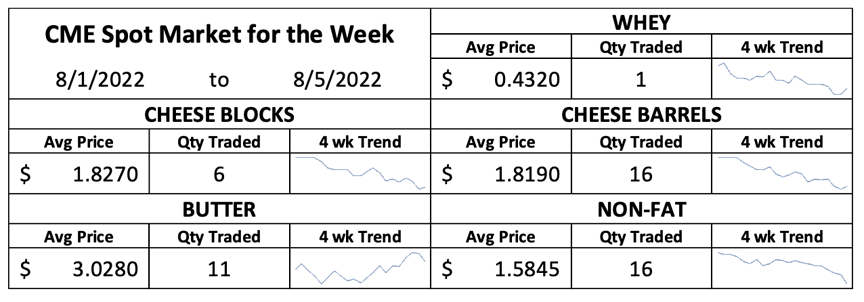
The T.C. Jacoby Weekly Market Report Week Ending August 5, 2022
The United States sent a record-setting volume of dairy products abroad in May. Then, after adjusting for a shorter month, it bested that record in June.
Slowing global milk output is making room for American dairy. The United States sent a record setting volume of dairy products abroad in May. Then, after adjusting for a shorter month, it bested that record in June. Thanks to lofty dairy product prices, those exports brought home $886.2 million in June, also an all-time high.
Cheese was a significant driver of the strong export performance, with both volume and prices reaching higher than ever before. Exporters shipped 96.8 million pounds of cheese outside our borders in June. In the first half of the year, net exports lapped up more than 4% of U.S. cheese production. U.S. butter and milkfat exports also impressed in June, and dry whey exports climbed back over year-ago levels. Shipments of whey protein concentrates were up 48% from June 2021, marking the highest June volume ever and the third-highest total for any month. However, nonfat dry milk (NDM) exports lagged. They fell 15% from last year’s extremely high mark.
Lively trade is keeping U.S. dairy product inventories in check for now, but the forward-looking futures markets reflect anxiety that U.S. dairy output will overwhelm demand. Amid slowing orders from bottlers and rising components, even modest growth in U.S. milk output can keep processors busy. With just 0.3% more milk in June than the year before, manufacturers made 2.3% more butter, 2.7% more cheese, and 5.6% more whey powder than in June 2021. Combined production of NDM and skim milk powder (SMP) fell 10.4% from the hefty volume dried in June 2021, but it was still the second highest June milk powder output in U.S. history.
Dairy product inventories are not burdensome, at least not yet. But U.S. milk production is not expected to drop back below year-ago levels, and dairy product output is likely to remain high. Meanwhile, uncertainty about the economy and trade continues to simmer in the background. The U.S. dairy industry needs demand to hold firm, or products will start to pile up.
With that in mind, milk and most dairy product prices took a big step back. CME spot Cheddar blocks and barrels both dropped 9.5ȼ this week to their lowest prices since January. That put blocks at $1.785 per pound and barrels at $1.9725. CME spot dry whey slipped another penny to 43.5ȼ, a fresh 20-month low. Class III futures suffered double-digit losses, led by a $1.01 (triple digit) shellacking for the September contract. August, September, and October Class III all spent some time south of $20, but only the September contract finished there, at $19.30 per cwt.
A poor showing at the Global Dairy Trade (GDT) auction and concerns about Chinese demand weighed heavily on milk powder prices. GDT SMP plummeted 5.3% to the rough equivalent of NDM at $1.71. Whole milk powder prices fell 6.1%. In Chicago, CME spot NDM plunged 13.75ȼ to a 10-month low at $1.5025.
But butter held firm. Lower butter output early in the year and resilient demand has pushed retailers to scramble for product ahead of the fall baking season. Butter production is typically low during the summer, and sky-high cream prices have made it clear that this year will be no exception. USDA’s Dairy Market News sums up the issues neatly: “Cream supplies are tight, multiples have risen, and some manufacturers are still trying to find the workers needed to fill up their production schedules.” Those who need butter for later this year are paying up to make sure they have it. On Wednesday, CME spot butter traded at $3.06 per pound, its highest price in nearly seven years. It closed today at $3.01, up 2ȼ from last Friday. But the futures market showed some doubts that prices have staying power. Despite the gains in the spot market, September through November butter futures finished the week lower than where they began.
Spot butter helped to lessen losses in August Class IV futures, but the other contracts moved decisively downward. September Class IV dropped 33ȼ to $23.37 and the October contract fell 95ȼ to $21.60.
On Monday, the bulk carrier Razoni left Odesa, Ukraine, laden with 26,000 metric tons of corn. A tugboat led the Razoni through the heavily-mined waters of the Black Sea. The ship then sailed through the Bosporus Strait, passed inspections from Turkish, Russian, and United Nations officials in Istanbul, traversed the Dardanelles, and is now crossing the Aegean Sea on its way to Tripoli, Lebanon. Since the Razoni’s safe passage through the dangerous Black Sea corridor, two more ships have
departed with some of the 20 million metric tons (~800 million bushels) of grain previously stuck at Ukraine’s ports. More will follow. The resumption of Ukraine’s seaborne exports will provide grain to a hungry world and empty silos needed to store recently harvested wheat and fast-maturing corn and barley crops.
With Ukraine back in the game, U.S. grain prices slipped. December corn closed today at $6.10 per bushel, down a dime from last Friday. Beans fell too, despite pockets of hot, dry weather this month, the most crucial time for soybean development. November soybeans dropped nearly 60ȼ to $14.0875. Soybean meal prices swung violently back and forth but closed a little lower. September soybean meal settled at $437.50, down $2.90 for the week.
On the Chicago Mercantile Exchange milk futures and most cash dairy prices were higher Tuesday. Class III milk futures climbed higher on the day. August milk gained 14 cents to $20.09/cwt. September milk surged 54 cents to $19.94/cwt. October milk increased 37 cents to $20.42/cwt. Class IV milk futures were varied.
Tuesday’s CME spot dairy product auction was a mixed bag. Dry whey was up $0.01 at $0.4450. One sale was recorded at that price. Cheese blocks were up $0.0350 at $1.82. One sale was recorded at that price. Cheese Barrels were up $0.0850 at $1.88. Five sales were recorded from $1.8350 to $1.88. Butter went down $0.0150 closing at $2.96. Nine sales were recorded from $2.95 to $2.96. Nonfat dry milk was down $0.0225 at $1.46. Nine sales were recorded from $1.46 to $1.4725.
Prices for dairy products have slid at the last four global dairy auctions.
GDT price index fell 5%
Whole milk powder index slid 6.1%
Fonterra may pull back milk price forecast
Dairy prices fell for a fourth consecutive global auction, which may prompt Fonterra to pull back its milk price forecast for farmers.
The Global Dairy Trade price index fell 5% to 1163, the lowest level since February 2021. It follows a 5% decline at the previous fortnightly auction.
Dairy prices have slid from record levels in March this year, as disruption from Covid-19 lockdowns in China, an economic crisis in Sri Lanka and the Russia-Ukraine conflict weigh on demand and buyers baulk at higher prices in an environment of high inflation and constrained consumer spending.
“Bidders weren’t willing to chase prices higher,” said NZX dairy insights manager Stuart Davison. “This result could see Fonterra updating their milk price forecast for the current season, considering the scale of the price slide over the last two auctions.”
Still, Davison said the auction drew good participation from all regions, and described demand as “limp” rather than “completely dead”.
“This trend is likely a result of the current outlook of the wider economy for some buyers, with uncertainty of the future still front and centre for most, creating an unwillingness to be burdened with heavier than required pipelines of product at this point in time,” he said.
Fonterra factors in fat and protein levels in milk when buying it off farmers.
The whole milk powder price index fell 6.1%, with the average price dropping to US$3544 (NZ$5661) a tonne. Whole milk powder has the most impact on what farmers are paid.
Among the other price indices, skim milk powder dropped 5.3%, butter slid 6.1%, buttermilk powder fell 9.2%, anhydrous milk fat shed 1.4% and cheddar slipped 0.7%.
Global dairy prices set the price Fonterra and other processors pay farmers for their milk.
In June, the co-operative lifted its forecast farmgate milk price for the current season to between $8.75 and $10.25 per kilogram of milk solids. The $9.50 per kgMS mid-point, which farmers are paid off, would set a new record.
To provide the best experiences, we use technologies like cookies to store and/or access device information. Consenting to these technologies will allow us to process data such as browsing behavior or unique IDs on this site. Not consenting or withdrawing consent, may adversely affect certain features and functions.
Functional
Always active
The technical storage or access is strictly necessary for the legitimate purpose of enabling the use of a specific service explicitly requested by the subscriber or user, or for the sole purpose of carrying out the transmission of a communication over an electronic communications network.
Preferences
The technical storage or access is necessary for the legitimate purpose of storing preferences that are not requested by the subscriber or user.
Statistics
The technical storage or access that is used exclusively for statistical purposes.The technical storage or access that is used exclusively for anonymous statistical purposes. Without a subpoena, voluntary compliance on the part of your Internet Service Provider, or additional records from a third party, information stored or retrieved for this purpose alone cannot usually be used to identify you.
Marketing
The technical storage or access is required to create user profiles to send advertising, or to track the user on a website or across several websites for similar marketing purposes.
To provide the best experiences, we and our partners use technologies like cookies to store and/or access device information. Consenting to these technologies will allow us and our partners to process personal data such as browsing behavior or unique IDs on this site and show (non-) personalized ads. Not consenting or withdrawing consent, may adversely affect certain features and functions.
Click below to consent to the above or make granular choices. Your choices will be applied to this site only. You can change your settings at any time, including withdrawing your consent, by using the toggles on the Cookie Policy, or by clicking on the manage consent button at the bottom of the screen.
Functional
Always active
The technical storage or access is strictly necessary for the legitimate purpose of enabling the use of a specific service explicitly requested by the subscriber or user, or for the sole purpose of carrying out the transmission of a communication over an electronic communications network.
Preferences
The technical storage or access is necessary for the legitimate purpose of storing preferences that are not requested by the subscriber or user.
Statistics
The technical storage or access that is used exclusively for statistical purposes.The technical storage or access that is used exclusively for anonymous statistical purposes. Without a subpoena, voluntary compliance on the part of your Internet Service Provider, or additional records from a third party, information stored or retrieved for this purpose alone cannot usually be used to identify you.
Marketing
The technical storage or access is required to create user profiles to send advertising, or to track the user on a website or across several websites for similar marketing purposes.












 Butter production is always scant in the summer, but it was especially so this year. There were just 314.4 million pounds of butter in cold storage at the end of July, 5.4% less than a year ago and the lowest mid-summer total since 2017.
-Aug-04-2022-07-29-12-58-PM.png?width=554&name=Chart1%20(2)-Aug-04-2022-07-29-12-58-PM.png)
-Aug-04-2022-07-30-08-81-PM.jpg?width=554&name=Chart2%20(2)-Aug-04-2022-07-30-08-81-PM.jpg)
-Aug-04-2022-07-30-50-54-PM.jpg?width=554&name=Chart3%20(2)-Aug-04-2022-07-30-50-54-PM.jpg)
-3.jpg?width=554&name=Chart4%20(3)-3.jpg)