Archive for Dairy Markets – Page 24

Milk Markets Show Slight Increases Thursday

On Thursday, Chicago Mercantile Exchange milk futures and most cash dairy prices increased somewhat.

Price of Class III milk in January rose by $0.26 to $19.11. Price for February rose by $0.15 to $18.31. Prices increased in March by $0.09 to $18.31. The price of an April contract has increased by $0.01 to $18.51. Contracts from May through December fluctuated by as much as eight cents from September and October to November, from a low of one cent lower.

The price of dry whey remained steady at $0.4150. Unfortunately, there were no reported sales.

Prices for blocks of cheese increased by 0.0075 per cent, to $1.98. There were two transactions, at $1.9650 and $1.97.

Barrel prices of cheese increased by $0.0050, to $1.72. There were four purchases made at the $1.71 and $1.72 prices.

When we checked the price of butter, it was $2.38, which remained unaffected. There were no reported sales.

The price of nonfat dry milk decreased by $0.0125, to $1.2975, on Friday. There were three purchases made between $1.2950 and $1.2975.

Worldwide, dairy commodity prices continue to fall.

The Global Dairy Trade index in New Zealand started the year lower, down 2.8 percent. All categories posted lower trade with butter milk powder (-12.9 percent), anhydrous milk fat (-5.1 percent), and skim milk powder (-4.3 percent) seeing the largest losses.

AMF Down 5.1%, average price US$5,395/MT

Mantequílla Down 2.8%, average price US$4,479/MT

BMP Down 12.9%, average price US$2,556/MT

Chedar Low n 2.7%, average price US$4,690/MT

Lactose Down 3.6%, average price US$1,178/MT

Skim Powdered Milk Low 4.3%, average price US$2,838/MT

Whole Milk Powder Down 1.4%, average price US$3,208/MT

Milk Prices Continue to Drop in Chicago

On Tuesday, the Chicago Mercantile Exchange saw milk futures go down and cash dairy prices stay the same or go down.

January Class III milk was $0.47 less, coming in at $19.07. At $18.24, February was down $0.35. At $18.32, March was down $0.07. At $18.50, April was down $0.12. From May to November, contracts were lower by anywhere from 2 cents in September to 9 cents in May, June, and July.

At $0.4150, dry whey stayed the same. There were no sales.

Tuesday, cheese prices went down a lot. At $1.9975, blocks were down $0.1375. At that price, one sale was made.

Cheese barrels were down $0.1125 at $1.7450. At $1.7375 and $1.7450, two sales were made.

The price of butter stayed at $2.38. There were no sales.

The price of dry nonfat milk went down $0.0125 to $1.3225. At that price, one sale was made.

Milk Markets Give Back Gaines From Start of the Week

Milk futures on the Chicago Mercantile Exchange lost some of the gains they had made earlier in the week, and cash markets were all over the place.

January Class III milk prices went down 19 cents to $19.54. February’s price is 13 cents less at $18.59. March fell six cents to $18.39. April is down 20 cents to $18.62. The contracts for May through July are 14 to 19 cents lower.

Dry whey is now $0.4150, up $0.01.

Blocks fell $0.0250 and are now worth $2.1350. From $2.1250 to $2.1350, three trades were made.

At $1.8575, barrels are down $0.01. At $1.86, one sale was made.

Butter unchanged $2.38.

At $1.3350, nonfat dry milk has gone down $0.0025. At that price, one sale was made.

The USDA’s dairy index for November was down 1.2% from October but up 24% from November 2021. The all-milk price was $25.60 per hundredweight, which was $.30 less than the previous month but $4.90 more than last year.

There has been a sharp increase in the price of milk in Australia.

Based on data from the national Consumer Price Index (CPI), RABOBANK says in a new report that prices for dairy products are going up a lot, with milk prices going up at the fastest rate since records began.

In its Global Dairy Quarterly Q4 2022 – Walking the Tightrope into 2023, Rabobank says that while the Australian consumer has been strong in the face of rising costs of living, signs of weakening dairy demand are showing up as people’s willingness and ability to spend on non-essentials weakens.

“Households are switching to private label products, and volume declines are more noticeable in grocery and foodservice channels,” said Michael Harvey, senior analyst for Dairy and Consumer Foods at Rabobank and co-author of the report. “It looks like it will be a tough year for Australian consumers.”

“Australia’s dairy farmers are still making money, and the record milk prices are helping them,” Mr. Harvey said.

“Dairy farmers have had to pay more for fertiliser, fuel, and feed, but the high milk prices have mostly made up for that. While the lack of workers is still a big problem for dairy farming businesses.”

As the season winds down, Mr. Harvey said that Rabobank doesn’t expect milk prices to go up much more.

Dairy Market Report: Rising Domestic Use Supports Prices

During the period of August to October, the domestic commercial use of milk in all products continued to grow. This helped keep prices up, even though production was also going up. From July to October, U.S. milk production has gone up compared to the same time last year, but at a slower rate each month. On the other hand, the number of dairy cows in the U.S. has gone up steadily compared to a year ago, which suggests that milk production could go up even more in the coming months.

Since February of this year, total U.S. dairy exports have been more than the equivalent of 18 percent of U.S. milk solids every month, putting the industry on track to beat last year’s record of 17.3 percent. Milk prices are expected to be at least $25.50 per cwt this year, which is much higher than the previous record of $24.00 per cwt set in 2014. The Dairy Margin Coverage programme margin could drop below $9.50 per cwt again in December, and it’s likely to stay below that level until at least 2023.

VIEW FULL REPORT

The outlook for the global dairy market in 2023 is unclear.

After a year of record or near-record farmgate prices, the weakening of dairy markets around the world will still be a big problem.

But the most recent dairy report from Rabobank shows that there are clear differences between regions and dairy products. It says that the large cheese and butter markets in the EU and US that are supported by their own countries stayed high, but not as high as they were earlier this year.

On the other end of the scale, milk and powder markets around the world have been affected by a 9% drop in Oceania GDT index prices over the last three months.
Less expensive milk from farms

The report says that milk prices at the farm gate are now following the trends of the global commodity market and will go down in 2023. At the same time, high input costs are still a clear headwind everywhere, and when combined with lower milk prices, this will put pressure on farm margins. But the recent growth in the milk supply will keep going through the first half of next year.

It also shows how buyers can get into a quieter market, especially since the Chinese market will keep eating up the stocks that have built up over the last year. Second- and third-tier buyers have joined the market in the fourth quarter, and they will have to make up the difference in the first few months of 2023.

China’s dairy imports are likely to be lower in the first quarter of 2023 than they were in the same quarter of 2022. However, buying interest is likely to pick up in the second quarter.

Prices for dairy products have gone up in stores and restaurants around the world. Even though dairy demand is complicated, the resilience that has been shown so far will be put to the test even more by a drop in confidence as people’s disposable incomes fall.

Most at risk are emerging markets, such as buyers in tiers 2 and 3, because inflation is expected to hurt their budgets in the first half of 2023.

When looking further into the future, Rabobank analysts say that the fundamentals of the global market are still skewed down. Much depends on how China runs its own government and how strong the dairy market is as a whole. Weaker growth in supply has kept dairy commodity prices relatively high, but there are signs of weak growth on the horizon, though it will depend on China reopening in a meaningful way in the post-Covid world.

In the short term, dairy demand is likely to go down before it goes up again, because food prices are going up across the board in many economies.

Rabobank milk price outlook holds firm

Rabobank’s move came after Fonterra lowered its midpoint forecast for the 2022-23 season from $8.50 a kg to $10 a kg to $8.50 a kg to $9.50 a kg.

In its most recent Global Dairy Quarterly report, Rabobank said that dairy farmers would have to walk a tightrope next year.

After this year’s record farm-gate prices in many exporting regions, the milk supply seems to be finally growing.

But as demand drops, the bank thinks that farm-gate milk prices will follow the trends of the global commodity market and go down next year.

“Dairy commodity prices are still pretty high because supply growth has been slow,” said Emma Higgins, a senior agriculture analyst at Rabobank.

She said that short-term dairy demand was likely to go down because food prices were going up everywhere in many economies.

Still, the bank wasn’t giving in to the urge to lower its own $9 a kg milk price forecast.

“Our forecast is the same as it was last quarter, but it’s important to note that the risks to this forecast are heavily skewed to the downside. Any possible rally to the upside would depend on a supply shock in the northern hemisphere or a meaningful reopening of China in the new post-Covid world,” she said.

Westpac thinks the price will be $8.75 per kg, BNZ thinks it will be $8.90 per kg, and ANZ thinks it will be $8.75 per kg. Earlier this month, ASB kept its prediction of $9.40 per kg.

After five straight quarters, the global milk supply seems to be coming out of a slump. This is due to higher production in Europe and the United States.

Most places should see a small increase in milk supply next year, except for Australia, where milk flows were again hurt by bad weather in the fourth quarter of this year.

The milk flows from the Big Seven export regions of New Zealand, Australia, the EU, the US, Uruguay, Brazil, and Argentina are expected to grow by 1% next year.

Ms. Higgins said that was enough to make up for the 0.8% drop this year.

She said that prices went down in different places and for different things in the fourth quarter.

The large cheese and butter markets in the EU and the US are still high, but they are not as high as they were earlier this year. Over the past three months, prices on the Oceania GDT index have gone down by 9%, which has spread to the global milk powder markets.

Over the next year, the high costs of farming and the drop in buyers’ disposable income are likely to cause more problems. Inflation rates that were expected to happen were most likely to hurt emerging markets.

In spite of rising costs of living, dairy demand in the US has stayed strong, but European consumers are now feeling the pinch.

There were still questions about what would happen to China in the future with Covid-19 policies and as the country worked through its local stocks and imported stock.

Domestically, New Zealand’s milk production has been affected for the second year in a row by the changeable spring weather.

“This is a clear trend for this season,” Ms. Higgins said. “From now until October 2022, milk supply is 3.6% less than it was last year.” “Only Otago-Southland is showing signs of being able to produce milk again. Feed is plentiful in the south because it is warmer there.”

She said that could cause the milk production for the whole season to drop by up to 2%.

She said that rising interest rates, fuel prices, and feed prices were the main causes of inflation on farms.

Fonterra also increased its earnings forecast from 40c to 60c per share to 50c to 70c per share earlier this month after reporting a good start to the 2022-23 season.

CEO Miles Hurrell said that the company is off to a good start even though geopolitical and macroeconomic events have caused higher costs at every step of its supply chain.

He said that the situation was the same behind the farm gate, where farmer shareholders had to deal with much higher costs of inputs.

He said that New Zealand’s milk production was 2.9% less than it was at the same point last season.

Fonterra has seen a drop in demand for whole milk powder, especially in Greater China, where more milk is coming from other suppliers.

After taxes, the co-profit op’s went up 84% to $214 million.

Several things drive dairy markets around the world into the new year.

AgResource Co.’s chief grains and dairy analyst, Ben Buckner, thinks that the global dairy market has reached its peak. They are less than they were a year ago. Buckner spoke on December 8 during a Dairy Signal webinar put on by the Professional Dairy Producers.

“At the last global dairy auction, all dairy products were sold for an average of $1.64 per pound,” he said. “A year ago, it cost $1.95 per pound. A year ago, we were getting ready to start an extremely bullish pattern. The future of dairy around the world is very neutral right now.”

He pointed out that the world’s dairy continues to find a balance, even if it’s slow.

“There haven’t really been any problems with dairy demand so far,” Buckner said. “But we’re responding by making more milk in the U.S., parts of South America, and even Europe.” There are still problems with milk production in New Zealand, but the total amount of milk exported around the world is close to what it was a year ago because of more dairy exports from the U.S., he said.

“This long period of high prices seems to be affecting the cheddar market in particular, and we saw record-high production in the U.S. for the month of October,” said Buckner.

Buckner said that he has seen a small amount of demand destruction for butter. Since the middle of summer, butter stocks have stopped falling so quickly.

“High prices seem to be encouraging milk production in the U.S. and Europe, as well as cheese production in the U.S.,” he said. “We’re looking for the next thing that will push markets up, but we can’t figure it out yet. I think it’s up to Mother Nature to make sure there are enough raw materials over time.”

He also said that he is worried about the way dairy prices drop every year after the New Year.

“The U.S. and the rest of the world ate less dairy in the first three months of the year,” Buckner said. “In 2023, all markets are likely to stay volatile,”

Buckner said that overall, U.S. agricultural exports are going down. “Since the summer, there are fewer of them,” he said. “The dairy industry is doing pretty well, but the total amount of agricultural exports is 5% lower than it was a year ago.”

Exports of soybeans in particular have gone down. The same is true for wheat and corn.

Buckner said, “We are worried about the demand for U.S. corn, soybeans, wheat, and possibly dairy in the second half of 2023.” He said that he was worried about emerging markets.

“For the first time in a long time, the U.S. economy is still growing while the Chinese economy is not,” he said. “China has had a hard time keeping growth rates between 5% and 10% per year. The rate of inflation in China is negative, and the rate of inflation in the U.S. is, of course, very high.

Buckner said that the drought in Argentina is also a worry for him.

“For the third year in a row, Argentina’s growing season starts with the soil having lost a lot of water,” he said. Argentina is by far the world’s biggest exporter of soybean oil and meal, and it also sends out a lot of corn.

“If Mother Nature cooperates in the Northern Hemisphere in 2023, we might be able to solve all of our grain problems in one year,” he said.

In 2023, farmers in the U.S. will also have to worry about interest rates going up. Buckner said that the interest rates on U.S. farm operating loans are 6.52% and that the interest rates on real estate loans are 6.13%. These are the highest interest rates in 15 years.

Milk Markets Down Wednesday

All dairy prices except cheese went down on the Chicago Mercantile Exchange on Wednesday.

The price of January Class III milk stayed the same, at $18.73. At $18.23, February was down $0.29. At $18.53, March was down $0.21. At $18.96, April was down $0.24. From May to November, contracts were either the same or went down by as much as 24 cents in May.

Dry whey fell by $0.0075 and now costs $0.3650. There were four sales between $0.3650 and $0.3675.

Blocks of cheese went up by $0.0275 to $2.0275. $2.02 was the price of one sale.

Cheese barrels were up $0.0450 at $1.70. At that price, there were two sales.

Butter’s price went down a lot for the third day in a row, dropping $0.1250 to $2.4750. $2.4750 was the price of one sale.

At $1.3350, the price of nonfat dry milk went down $0.0250. At $1.3350 and $1.34, two sales were made.

Class III Price Increases

On Tuesday, both milk futures and cash dairy prices were up on the Chicago Mercantile Exchange. Class III milk futures for 2023 were only a little bit higher. The January milk price went up by 31 cents to $19.35. February milk rose 9 cents to $19.21. The price of milk in March went up 8 cents to $19.45. Class IV futures were unchanged to up, but not many contracts were traded.

Most dairy products were more expensive. Tuesday, the CME held an auction for spot dairy products. Dry whey rose by $0.01 to $0.4550 per pound. At that price, there was one sale. Blocks of cheese went up $0.0125 to $2.0725. At that price, there was one sale. Cheese barrels were down $0.01 at $1.86. There were no sales made. At $2.77, butter went up $0.07. Four sales were recorded between $2.7075 and $2.7750. Nonfat dry milk stayed the same, at $1.3575. No sales were reported.

Declining Milk Prices Show No Sign of Stopping

On Monday, most cash dairy prices and milk futures prices went down on the Chicago Mercantile Exchange. From January to September 2023, the price of Class III milk went down by 13 to 26 cents. Monday was the worst day for the third quarter, and the average price is still above $20/cwt. First half of 2023 can’t say that because January and February are dangerously close to printing a $18 handle in front of it. In the first half of 2023, Class IV markets were calm, but in Q3 2023, prices fell by 14–23 cents/cwt.

Monday, dairy markets went down because product markets were going down. At $0.4450, dry whey went up $0.01. At that price, one sale was made. Blocks of cheese fell $0.0350 to $2.06. At that price, one sale was made. Cheese barrels were down $0.08 at $1.87. At that price, one sale was made. The price of butter seems to be going up and down again. This time, it went down by $0.1125 and ended at $2.70. There were four sales between $2.70 and $2.81. At $1.3575, the price of nonfat dry milk went down $0.0075. There were four sales between $1.3525 and $1.3575.

CME Milk Futures and Cash Dairy Hit a Slick Spot

On Wednesday, the Chicago Mercantile Exchange saw a general downward trend in the pricing of milk futures and cash dairy products.

The price of Class III milk in December fell by $0.08 to $20.39. At $19.62, January’s total was a decrease of $0.42. At $19.51, February’s total was $0.23 less than January’s. At $19.73, March’s total was a decrease of $0.18. Contracts for April through October varied from sixteen cents lower in May to fifteen cents higher in October, with a median value of sixteen cents lower.

The price of dry whey decreased by $0.0150, reaching $0.4425. There was not even one sale on the books.

The price of cheese blocks decreased by $0.0025, reaching $2.1075. There was not even one sale on the books.

Cheese barrels were flat at $1.92. There was not even one sale on the books.

The price of butter decreased by $0.0125, reaching $2.8875. There was not even one sale on the books.

The price of nonfat dry milk increased by $0.01, reaching $1.3825. There was not even one sale on the books.

Milk Futures Slow to Start the Week in Chicago

On the Chicago Mercantile Exchange, January Class III milk futures were priced at $19.99, down one penny from the previous settlement. The price dropped to $19.72 on February 17. March finished at $19.84, down 14 points. Contracts for April through June ranged from a loss of 12 cents to no change.

The price of dry whey remained the same at $0.45.

Blocks were $0.02 down, trading at $2.08.

Barrels up $0.05 at $1.9475. There were a total of five trades conducted, with prices ranging from $1.9475 to $1.95.

The price of butter has remained unchanged at $2.90.

The price of nonfat dry milk remained the same at $1.36.

CME: blended milk and cash dairy prices fell on Monday.

On Monday, the Chicago Mercantile Exchange saw a decline in cash dairy prices and a decline in milk futures for the near future.

Class III milk for December cost $20.17, down $0.14. At $20.02, January saw a $0.04 decrease. At $19.76, February saw a $0.03 decrease. March’s price was $20.01, up $0.21. Contracts for April through October varied from five cents less in July to three cents more in May.

Dry whey’s price remains $0.44. Sales were not tallied.

At $2.1250, cheese blocks were down $0.250. The prices of two sales were $2.1150 and $2.1250.

At $1.8175, Cheese Barrels remained constant. Sales were not tallied.

Butter decreased $0.0175 to $2.93 at the close. There was only one transaction at that cost.

At $1.39, nonfat dried milk was down $0.0075. Sales were not tallied.

Milk prices on the CME Futures Exchange drop sharply before Thanksgiving.

As the Thanksgiving holiday rolled around, the dairy market continued its downward spiral. Class III milk experienced substantial losses as the short trading week around the holidays closed. Class III milk prices in November increased by a penny to $21.04 but dropped by 69 cents in December to $20.31/cwt. The following month was January when prices dropped by 38 cents to $20.06. The remaining months in 2023 had decreases of 5-18 cents. Similarly, the production of Class IV milk faced difficulties. During the month of November, prices stayed stable at $23.35, while in December they dropped to $21.32 and during the month of January they dropped by 12 cents, to $20.78.

There was a lack of consistency in spot trade on the CME. Dry whey pricing has been stable at $0.44 for almost a week now. Unfortunately, there were no reported sales. At $2.15, cheese blocks were $0.05 cheaper than they had been. No transactions were recorded.  Barrels of cheese increased by $0.0125, to $1.8175. There were no reported sales. After an additional $0.0175 gain, the price of butter settled at $2.9475. There were six transactions ranging from $2.92 to $2.9575. At $1.3975, the nonfat dry milk price was down $0.02. A total of four transactions were registered between $1.39 and $1.40.

Milk Markets Mostly Lower in Chicago Tuesday

On the Chicago Mercantile Exchange on Tuesday, cash dairy prices went down except for butter, where they went up. On Tuesday, futures for Class III milk went down. December milk prices went down 24 cents to $21.01/cwt. January lost 23 cents and now costs $20.30/cwt. Even though spot butter went up, Class IV milk futures were slightly down.

The price of dry whey stays at $0.44. At that price, there were two sales. Cheese blocks were still $2.20 each. There were no sales. Cheese Barrels were down $0.0375 at $1.8050. At that price, one sale was made. At $2.93, butter went up by $0.03. There were five sales between $2.93 and $2.9450. At $1.4175, nonfat dry milk was down $0.01. There were no sales.

CME milk & dairy down again excluding Monday butter

With the exception of butter, milk futures and cash dairy prices were all down again on the Chicago Mercantile Exchange on Monday.

The price of barrel cheese at the CME spot dairy auction fell by 8.5 cents/lb to $1.8425. Block cheese fell 3.25 cents to $2.20 per pound. With a settlement price of $2.90/lb, butter had an impressive 8-cent gain. At the end of the day, the price of whey was $0.44/lb and the price of nonfat dry milk was $1.4275/lb.

Milk futures on the CME Class III market were under pressure all day. At $21.25/cwt, December ended 22 cents lower. The average price for the first half of 2023, from January to June, was $20.06/cwt. Between 8 and 20 cents less for the second half of the year. On Monday, the price of Class IV stayed the same or went down a little bit.

Monday saw the release of the USDA’s Milk Production Report for October 2022. The U.S. milking herd was estimated at 9.418 million heads, an increase of 1,000 from the previous month. The September data was amended 6,000 head higher to reflect a 7,000 cow increase month-over-month. Compared to the previous year, the 2022 herd has grown by 31,000 animals. Milk Production as a whole was 18,850 billion pounds, an increase of 1.2% over the previous year, which was somewhat behind the previous couple of months but in line with forecasts. Southwest (+3.2%) led regional comparisons year-over-year, followed by Midwest (+2.2%), Pacific Northwest (+1.7%), Northeast (+1.3%), and Middle East (+0.2%). California lagged behind at -0.5%.

Milk Price Declines

On Thursday, most cash dairy prices and milk futures prices went down on the Chicago Mercantile Exchange. The price of block cheese stayed at $2.235/lb. Barrel cheese went down 5.25 cents to $1.98 per pound. Dry Whey stayed at $0.44 per pound. Butter dropped 1.25 cents to $2.94 per pound. Nonfat milk settled at $1.44/lb.

Milk futures for Class III were a little bit lower for the day. December Class III milk dropped $0.20 to $21.72 per gallon. At $20.76, January was down $0.10. At $20.35, February was down $0.10. At $20.39, March was down $0.02. From April to October, contracts were anywhere between 8 cents lower in April and 3 cents higher in May.

Cash dairy prices & milk futures prices were all over the place in Chicago Wednesday

On Wednesday, cash dairy prices and milk futures prices were all over the place on the Chicago Mercantile Exchange. Class IV milk was mostly unchanged farther out, but November gained 9 cents to $23.35/cwt. December jumped 20 cents to $22.30 and Jan – April were unchanged Jan at $21.40, feb at $21.05/cwt.

The CME spot trade was mixed.  At $0.44, dry whey hasn’t changed. There were no sales. At $2.2325, cheese blocks went up by $0.0075. There were no sales. Cheese Barrels were down $0.02 at $2.0325. There were no sales. At $2.9525, butter went up by $0.0125. There were no sales. The price of dry nonfat milk went down $0.0250 to $1.44. At $1.4375 and $1.44, two sales were made.

2.4% increase in all dairy prices

This week marked the first time since the end of September that the New Zealand Global Dairy Trade index showed growth, increasing by 2.4%. 3.1 percent increases were found for both skim and whole milk powder, while 2.7 percent increases were noted for anhydrous milk fat. Topping the list of declining items by 4.6 percentage points was lactose, while cheddar fell by only 1.3 percent.

AMF index up 2.7%, average price US$5,711/MT
 
Butter index down 0.8%, average price US$4,829/MT
 
BMP not offered
 
Ched index down 1.3%, average price US$4,746/MT
 
LAC index down 4.6%, average price US$1,236/MT
 
SMP index up 3.1%, average price US$3,057/MT
 
SWP not offered
 
WMP index up 3.1%, average price US$3,397/MT

Milk Markets Push Higher on Back of World Markets and Cash Trade

Milk futures on the Chicago Mercantile Exchange ended Tuesday higher, thanks to good cash trade and better markets around the world.

December Class III milk prices went up by 5 cents to $21.83. January is up nine cents to $20.81. February is now $20.49, down three cents. March, it went up by a dime to $20.50. From April to June, contracts go down by four cents to go up by two cents.

At $0.44, dry whey hasn’t changed. At that price, one sale was made.

Blocks are now $2.2250, up $0.0175.

Barrels stayed the same at $2.0525. From $2.05 to $2.0550, three trades were made.

Butter up $0.01 at $2.94.

At $1.4650, nonfat dry milk went up $0.0350. From $1.4375 to $1.4675, nine trades were made.

US Dairy Export Growth Continues

According to the United States Dairy Export Council, September saw record-breaking levels of dairy exports.

Annual export values are up 25% from 2021, while export volumes are up 4%.

September saw record highs in the export of whey (+18%), cheese (+5%), and lactose (+32%). Canada and Mexico both increased imports to fill output gaps, leading to an almost 50 percent increase in butter shipments.

The council reports that exports of nonfat dry milk, skim milk powder, have fallen for the tenth consecutive month, down seven percent. This decline is likely due to limited product availability and lack of demand from China.

Monday’s cash dairy and CME milk futures were a mixed bag.

On Monday, the Chicago Mercantile Exchange had a mix of prices for milk futures and cash dairy products.

Class III milk in December went up $0.20 to $21.78. January’s price fell $0.07 to $20.72. February’s price fell by $0.03 to $20.52. March’s price rose by $0.03 to $20.40. From April through October, contracts ranged from eight cents lower in May to nine cents higher in April.

The price of dry whey stays the same, at $0.44. There were no sales made.

At $2.2075 per block, cheese blocks went up by $0.0075. There were no sales made.

Cheese Barrels were down $0.01 at $2.0525. At that price, there was one sale.

At $2.93, butter was up $0.0250. There were no sales made.

The price of dry nonfat milk stayed at $1.43. There were no sales made.

Global dairy market and production outlook

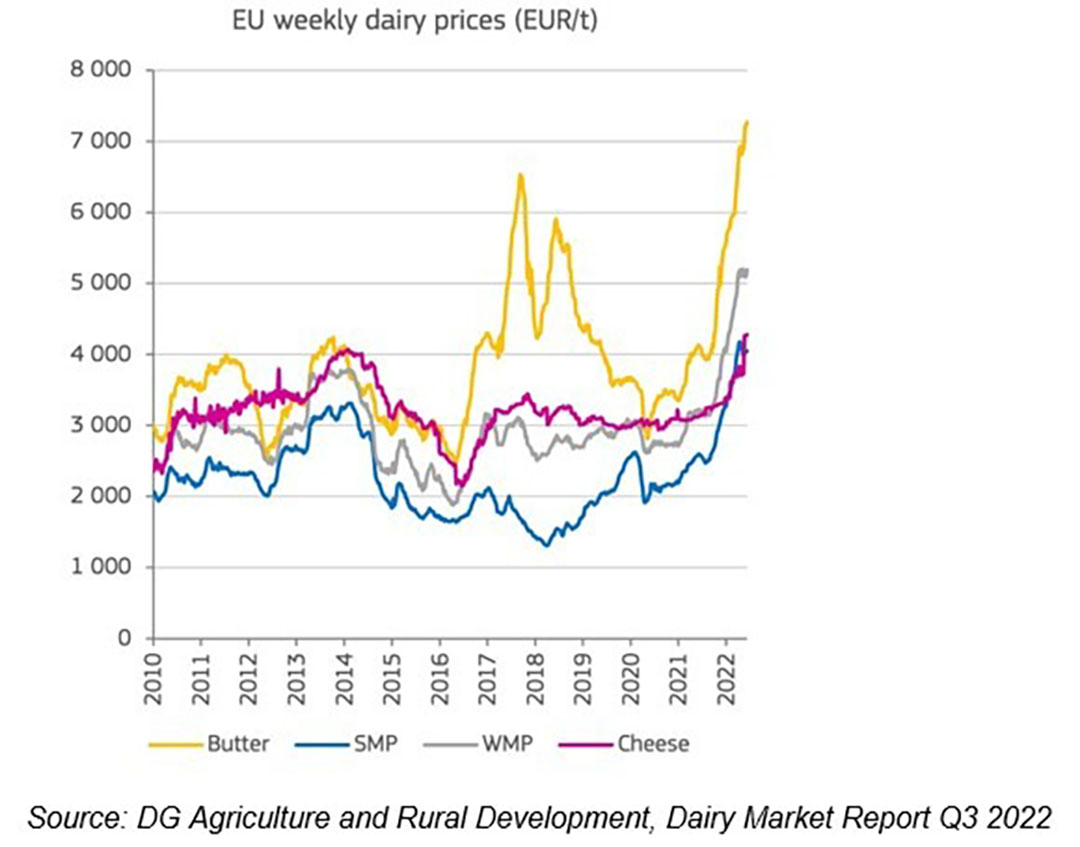
The milk supply is still very unstable all over the world, and there are many reasons for this. Since the beginning of the year, prices have only gone up.

Europe and UK

In the economy after Covid, inflation was already very high, and the war in Ukraine has made the pressures on farmers all over Europe even worse. France, Germany, Benelux, and southern Europe, which are some of the biggest producing areas in the EU, were hit the hardest, while Poland, Ireland, and Denmark were mostly unaffected.
In the UK, the price of fertiliser has gone up from £315 per tonne to £930 per tonne (€366 per tonne to €1,081 per tonne). Paul Tompkins, vice chair of the National Union of Farmers dairy board in the UK, says that diesel prices have doubled, from £0.63 per litre to £1.29 (€0.73 to €1.50), which has made fertiliser more expensive.

The European Milk Board says that in Portugal, the price of diesel has gone up by 62%, the price of maize has gone up by 77%, and the price of nitrogen fertilisers has gone up by 140%. In France, the cost of energy has gone up by 30% and the cost of fertiliser has gone up by more than 80% in the last year.

The US

An interesting side effect of what’s going on in Europe is that big European dairy traders from places like the Netherlands are looking to the US to import cheese because it’s cheaper there.

Seasonally, milk production is going up in the Midwest of the US, which some cheesemakers say will make more cheese available in the coming weeks. Cheesemakers say that retail cheddar and Italian-style cheese are in high demand, and that Asian buyers are buying a lot of it to ship in the second quarter of 2023.

Latin America

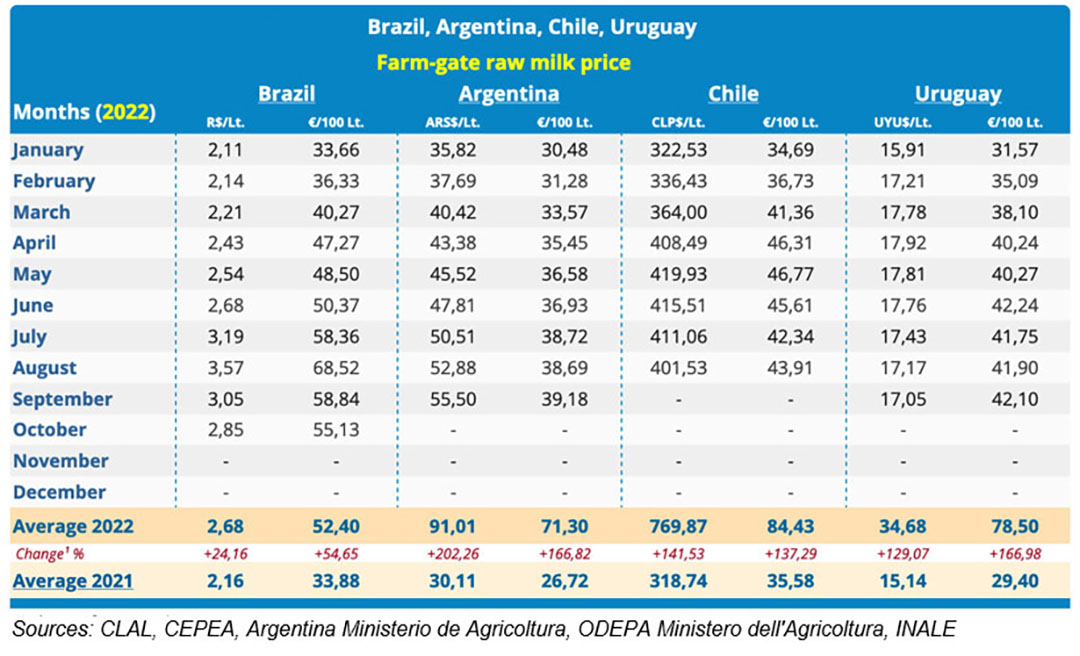
After prices hit all-time highs in August, they went down in September. But demand is getting stronger, which will probably stop prices from going down even more. In recent months, producers have been able to handle increases in operating costs thanks to higher prices.

In the first half of 2022, the amount of milk made in Latin America went up by 3.3% compared to the same time last year. This increase is partly due to the fact that the weather has been good, which has helped countries that were affected by drought to get back into growth. Milk prices have also gone up, which has helped this increase in volume.

Since Brazil is making more on its own, there is a lot less demand for imports. This has made it easier to send goods to places like Algeria and China in the past few months.

Foto: 2

Milk Futures Show Slight Uptick

On Monday, milk futures and cash dairy prices fluctuated on the Chicago Mercantile Exchange. Class III milk futures markets concluded with December up twelve cents at $20.47/cwt, Q1 2023 down ten to a penny higher, and Q2 2023 down ten to six weaker. The second half of 2023 will perform between even and seventeen cents better. In January and February, Class IV markets gained 12 and 13 cents, respectively. Other months remained unchanged.

Monday’s spot dairy auction on the CME was a mixed bag. Dry whey decreased $0.0225 to reach $0.4450. There were two transactions totalling $0.4475 and $0.4550. Cheese blocks increased $0.02 to reach $2.03. Two sales totalling $2.02 and $2.03 were recorded. Cheese Barrels were up $0.01 at $1.9850. Seven transactions were recorded between $1.98 and $1.99. The price of butter increased significantly for the second consecutive session, rising $0.0975 to $2.87. Four transactions ranged from $2.84 to $2.87. The price of nonfat dry milk fell $0.0150 to $1.3850. There were three sales at that price.

Holiday Dairy Prices Predicted To Remain High

When compared to August of last year, the price of butter went up 24.6%, while the cost of groceries as a whole went up 13.5%.

Cheese, milk, and other dairy prices are also likely to stay high because supplies are tight and demand is high.

The USDA recently estimated that the average price of butter will be $2.88 per pound, up from $1.73 last year. The average price of cheese will be $2.10, up from $1.67 last year, and the price of all milk will be $25.60 per hundredweight in October, compared to $18.53 in 2021.

Peter Vitaliano, vice president of economic policy and market research for the National Milk Producers Federation, said that the whole situation with dairy prices began the summer before.

“Milk production went up by 5% year over year for a while, but then it started going down and went negative,” he said. “When combined with a rise in demand, it drove up the prices of key dairy products, but it took until this year for that to show up in stores.”

Through the week ending September 10, the average price of a pound of butter was $3.08. This was because less milk was being produced, so less of it was being used to make butter and other dairy products.

In August, there were 22% less butter stores (282 million pounds) than at the same time last year. Vitaliano doesn’t think there will be a “butter shortage” this baking season, even though supplies are much tighter.

Vitaliano said, “When you say there’s a butter shortage, I think that means that somewhere in the country, you won’t be able to buy it at the store.” “No, that’s not true. Butter is available. The price has just gone up.”

As milk prices went up, so did the price of most dairy products. In October, the USDA said that the average price of Class III milk was $21.90 per hundredweight, which was $4.82 more than last year, and that the average price of Class IV milk was $24.60, which was $16.09 less than last year.

Record feed prices, problems caused by ongoing drought in many parts of the country, the high cost of replacement cows, and trouble finding farm workers all led to a smaller number of dairy cows and higher prices.

“There are a lot of things that make it hard to increase milk production. We went through a year when farmers didn’t grow,” said Vitaliano. “The price of making milk is as high as it has ever been.”

Recent signs were better, though, as milk production went up 1.6% in August. The average number of milk cows on farms was 9.416 million in July, which was 1,000 more than the month before but 67,000 less than July 2021.

Prices are also going up because dairy products are still in high demand.

“Higher prices have had a small effect on consumption, but dairy is usually not affected by changes in price,” Vitaliano said. “People still buy it when the price goes up.”

The price of a 40-pound block of Cheddar cheese has recently gone down by 12 cents on average.

“For the last few months, the U.S. has been the largest exporting country with the cheapest cheese,” Vitaliano said. “This has led to a big rise in exports.” “I want exports to make up a bigger and bigger part of the total market, which is already getting close to 20% of total (dairy) production.”

Canada will boost milk price at the farm gate by 2.2% in 2023

The Canadian Dairy Commission (CDC) did its annual review of farm gate milk prices in October 2022. The CDC plans to make the following change on February 1, 2023, based on the review and discussions with stakeholders.

The price of milk at the farm gate will go up by 2.2%, which is equal to $0.0174 (less than 2 cents per litre). The National Pricing Formula, a way to set prices that was decided by the industry, is to blame for this increase. It looks at both the costs of making milk for dairy farmers and the consumer price index. As was said in June, the 1 September 2022 increase in the price of milk at the farm level was taken out of the result of the pricing formula.

In the past year, the cost of feed, fertiliser, fuel, and interest rates all went up for producers. Input costs are still going up because of problems in supply chains. But some of these increases were cancelled out by investments and productivity gains on the farm.

Milk, which is used to make dairy products like milk, cream, yoghurt, cheese, and butter, will cost an average of 2.2% more in stores and restaurants. The net effect on consumers will also be affected by things like how much it costs to ship, distribute, and package goods at each step of the supply chain. Only a part of the price paid by consumers goes to farmers.

In the past year, the average annual increase in the consumer price index for dairy products was 6.0%, which was about the same as the increase for all food items, which was 6.3%. Over the past five years, the average annual increase in the consumer price index for dairy was 12%. Compared to this, meat has 21%, eggs have 27%, and fish has 15%.

As of the end of 2022, the new farm milk prices will be official once they have been approved by provincial authorities.

Prices for Milk and Butter Go Back Up

Prices for both futures and cash milk on the Chicago Mercantile Exchange went up on Thursday. Class III milk futures went up by a lot. Class III milk for December went up 84 cents to $19.90/cwt. January milk prices went up 65 cents, reaching $19.55/cwt. Class IV milk futures also got a boost when the price of milk in December went up 53 cents to $20.90/cwt.

Dairy products were the same or went up. In the CME spot dairy product auction on Thursday. At $0.4525, dry whey stayed the same. There were no sales. Blocks of cheese went up by $0.0325 to $2.01. There were no sales. Cheese Barrels were up $0.0050 at $1.9750. There were three sales between $1.9550 and $1.9750. Butter stopped falling for three days, going up $0.0575 to close at $2.6675. There were three sales that were all between $2.66 and $2.67. Dry nonfat milk went up by $0.01 to $1.38. At that price, there were two sales.

The Future of Milk Prices

From 2023 to 2027, the average price of 100 kg of milk will be between €45 and €50. Countries that export a lot of dairy are at the top of the range.

During the DSM global ruminant days in Rome, this was said by Christophe Lafougere, the CEO of the strategic consulting and market research firm Gira.

Lafougere said that in the last three years, the dairy market has changed a lot. Costs are going through the roof because concentrations and energy prices are going up. Together, they account for 30% of the total cost. “This means that it’s still expensive to make milk,” says Lafougere.

The EU and New Zealand are making less because the number of farmers and cows is going down quickly. “Not because they want to make more money, but because they want to live a normal life like everyone else,” Lafougere said, citing recent research. “And then, especially the most popular businesses stop running. In France, these people are business owners who are 45 years old or younger and have 1 million kg of milk. Large companies in northern Germany are switching to making bioenergy. And once they are stopped, they don’t start up again.”

Read also: 5 key ways to improve the use of labour on dairy farms
Farm labour is one of the biggest costs in the dairy production system, and it is becoming a bigger and bigger problem for milk producers. Read on…
This decrease in production will continue over the next few years because of environmental rules, such as New Zealand’s recent tax on methane emissions.

More milk is made in the United States.

Because margins are getting better, the US will produce more by design. But the total increase in production is not enough to meet the growing demand for butter and powder around the world. “For the first time, big customers like Ferrero say they expect problems with their sourcing,” Gira’s CEO said.

Farmers change who they sell to.

Lafougere said that this is shown in the prices of goods. Even though there are less imports from China, prices are already well above what they have been in the past.

This makes a big difference in milk prices between countries like Italy and France and countries like the Netherlands, Ireland, and Denmark, which export a lot of milk. This year, the price of milk has gone up by more than 60% in the first country and 23% in France. This also causes big changes in how supplies move. Farmers change who they sell to.

Lafougere said, “A-ware bought a lot of milk from suppliers in Milcobel. Then, to keep the new mozzarella factory running, they bought cheaper milk in France.”

U.S. Milk Output in the Black but What About Demand

The T.C. Jacoby Weekly Market Report Week Ending October 28, 2022

U.S. milk output is now growing at a historically normal rate, but there are many barriers to more rapid expansion, including onerous feed costs and self-imposed supply management restrictions.

Global milk output has been in decline for a full year, muffling anxieties about the impact of skyhigh dairy prices and a strong dollar. But now, with U.S. milk output back in the black and signs of recovery in Europe, the summers’ whispered query has grown into a shout. “What about demand?”

USDA’s Dairy Market News summed up the shift in sentiment in Europe. “The market talk is switching from whether there will be enough dairy products available to fill customer needs to whether demand will be present to take up the available dairy products.” The summer heat has faded and milk output is finally on the mend in Germany and France, leaving more milk for driers. But European milk powder is too pricey to attract foreign buyers. “Without the added orders to take up the SMP, production is outpacing demand, and inventories are growing,” according to Dairy Market News. If stocks keep piling up, European manufacturers will likely drop the price to clear product overseas, adding further pressure to the global milk powder market.

Through August, European SMP output fell 2.1% short of 2021, and it lagged 2020 and 2019 by even wider margins. Inventories are not likely to become burdensome anytime soon. But the combination of rising European stocks and lower Asian demand looms large over the market.

In September, China imported 16.2% less whole milk powder (WMP) and 17.8% less SMP than it did in September 2021. China’s year-to-date SMP and WMP imports are both down nearly 17% from the record-breaking volumes of 2021. But last year’s unsustainably aggressive pace skews the comparison. Excluding 2021, China imported more WMP last month than any September on record. For the year to date, China’s WMP imports were the second highest ever, behind only 2021, and its SMP imports were the third largest, behind 2021 and 2019.
China’s milk powder imports are relatively healthy, but its economy is not. Rolling Covid-19 lockdowns and an ailing real estate sector are weighing on consumer spending, prompting concerns about dairy demand. Earlier this week, China’s yuan dropped to its lowest level against the dollar in nearly 15 years, reducing China’s

purchasing power for U.S. goods. So far this year, the dollar has gained 14% against the yuan, 20% vs. the South Korean won, and 28% vs. the Japanese yen. That suggests that Asian dairy imports could fall back in the months to come, making a return to record-high dairy product prices less likely. But there are some reasons for optimism. Chinese imports of U.S. whey powders and permeates reached an all-time high last month, and Chinese imports of butter and cheese topped year-ago volumes.
There is also little reason to expect a flood of milk and dairy products. U.S. milk output is now growing at a historically normal rate, but there are many barriers to more rapid expansion, including onerous feed costs and self-imposed supply management restrictions. It’s possible that European milk output will top year-ago volumes in October, but not by a wide margin.

In New Zealand, dairy producers continue to struggle with cold, wet weather. September milk solids collections fell 3.8% from September 2021, and Dairy Market News described October conditions as “unfavorable.” Soggy pastures are not making enough grass, and supplemental feed supplies are “nearly exhausted.” However, the forecast calls for more sunshine and better grass growth in November.

With concerns about demand top of mind, global milk powder prices took another step back this week. But in Chicago, CME spot nonfat dry milk (NDM) regained a penny and reached $1.43 per pound. U.S. milk powder is still the cheapest in the world, so when buyers return, the U.S. will likely win some business. CME spot dry whey gave back 1ȼ this week and slipped to 43ȼ.

There were just 267 million pounds of butter in cold storage warehouses on September 30, 17.6% less than the year before. That was the lowest September stockpile since 2017, when U.S. butter consumption per capita was 14% smaller than it is today. It’s easy to see why spot butter values jumped to all-time highs this month. But now grocers have bought all they need to get through the holidays, and the price is fading. CME spot butter fell 6ȼ this week to $3.14. The futures foretell steeper declines ahead.

Cheese inventories declined from August to September, implying hearty demand. Stocks totaled nearly 1.47 billion pounds, up a mere 0.8% from a year ago, but still the highest September tally on record. Commensurate with large stocks and formidable production, spot Cheddar took a sizeable step back this week. Blocks fell 9.75ȼ to $1.96. Barrels plummeted 16.5ȼ to $1.925. That was enough to drive December and January Class III futures below $19 per cwt. for the first time in nine months. These prices simply don’t pencil on most farms today. November Class III settled at $20.21, down 93ȼ from last Friday. Class IV futures lost ground as well. The November contract slipped just 2ȼ to $23.65, but deferred contracts dropped about 25ȼ apiece.

The feed markets didn’t move much. Supplies are tight, and there are reasons to fear that grain shipments from Ukraine will slow. Brazil’s crops are off to a great start, but Argentina remains painfully dry. However, the strong dollar and logistics headaches are making it difficult for the United States to capitalize on the opportunity and export grains and oilseeds at the typical harvest pace. The Mississippi River is unusually low, and barge traffic is restricted. That’s slowing the flow of corn and beans to the Gulf. Weekly corn export sales dropped to their lowest tally for this time of year since 2012.

December corn futures closed today at $6.8075 per bushel, down 3.5ȼ from last Friday. November beans finished at $13.8775, down 7.75ȼ. December soybean meal jumped $7.50 to $425.40 per ton.

Original Report

Wednesday, prices for CME butter fell for the third day in a row, while other prices mixed.

On the Chicago Mercantile Exchange on Wednesday, milk futures were mixed and cash dairy prices went up, except for butter.

At $20.68 for November, Class III milk was up $0.09. At $19.06, December was down $0.04. At $18.90, January was up $0.08. At $19.27, February was up $0.07. Contracts from March to October were anywhere from five cents lower in May to seven cents higher in March.

At $0.4525, dry whey went up $0.0125. The price of one sale was $0.45.

Blocks of cheese went up by $0.0175 to $1.9775. There was one sale for $1.98.

Cheese Barrels were up $0.01 at $1.97. There were no sales.

For the third day in a row, butter fell sharply, this time by $0.09 to $2.61. On Tuesday, there were a lot of offers, but no sales. On Wednesday, there were fifteen sales, and the prices ranged from $2.61 to $2.7050.

The price of dry nonfat milk went down $0.0250 to $1.37. There were no sales.

Prices and amounts of milk sold at auction go down – GDT events

Reuters said that at the first Global Dairy Trade auction of the month, held by GDT Events on Tuesday, both the prices and amounts of international milk went down.

The GDT Price Index went down by 3.9%, and the average price to sell a tonne was $3,537. GDT Events says that the index lost 4.6% at the last sale.

At the most recent auction, a total of 28,867 tonnes of dairy products were sold, which is about 1.8% less than at the last one, the auction platform said on its website.

The auction results could have an effect on the New Zealand dollar because the dairy industry makes up more than 7% of the country’s GDP.

The New Zealand milk co-op is owned by about 10,500 farmers, and it controls almost a third of the dairy trade in the whole world.

Fonterra Co-operative Group Ltd of New Zealand owns GDT Events, but it works independently from the dairy giant. The Global Dairy Trade auction is run by CRA International Inc., which is based in the US. The auction happens twice a month, and the next one is set for November 15.

AMF index down 1.7%, average price US$5,562/MT
 
Butter index up 0.2%, average price US$4,868/MT
 
BMP index down 11.4%, average price US$2,973/MT
 
Ched index up 0.9%, average price US$4,802/MT
 
LAC index down 1.0%, average price US$1,300/MT
 
SMP index down 8.5%, average price US$2,972/MT
 
WMP index down 3.4%, average price US$3,279/MT


Monday, cash dairy prices and CME milk futures prices were mixed.

On Monday, the Chicago Mercantile Exchange had a mix of prices for milk futures and cash dairy. Futures for November added 26 cents to a settlement of $20.47/cwt. Futures for December rose 19 cents to $19.00. Prices for milk in the first half of 2023 ranged from 9 cents less to 4 cents more. On average, they cost $19.43. Class IV 2022 markets struggled as November prices went down by 35 cents and December prices went down by 7 cents/cwt. From 5 to 23 cents less in the first half of 2023 for Class IV months.

Cheese Barrels went up $0.0175 to $1.9425 at the CME spot dairy auction. There were three sales between $1.9250 and $1.9425. At $2.9450, butter had dropped sharply by $0.1950. There were four sales between $2.9450 and $3.10. The price of dry nonfat milk went down $0.0050 to $1.4250. There were no sales. At $0.44, dry whey went up $0.01. There were no sales. Cheese blocks stayed the same price of $1.96. At that price, there were two sales.

The December Milk Price Futures Market Falls

On Thursday, most futures prices for milk and cash prices for dairy continued to fall on the Chicago Mercantile Exchange. After the spot cheese trade, most Class III milk futures went down. $20.50/cwt went up by 3 cents in November. December milk prices went down by 32 cents, to $18.78/cwt. Milk futures for 2023 were flat to down for the day. Today, there was only mild selling pressure on Class IV prices, with January dropping 38 cents the most.

Spot trade Cheese blocks went down $0.0375 to $1.96. At that price, one sale was made. Cheese Barrels were down $0.0550 at $1.9250. There were no sales. At $3.1450, butter was down $0.0050. At that price, one sale was made. The price of nonfat dry milk is still $1.42. There were no sales. At $0.43, dry whey stayed the same. There were no sales.

Milk Prices Stall Mid Week in Chicago

On Wednesday, both futures and cash prices for milk and other dairy products went down on the Chicago Mercantile Exchange. Cheese came after Class III milk. October’s price stayed the same at $21.78, November’s price went down 38% to $20.47, and December’s price went down 25% to $19.10/cwt. Class IV milk was all over the place: October 2 was higher at $24.91, November dropped 11 to $23.67, and December dropped 27 to $21.25/cwt.

Milk is still having trouble getting going higher. At $0.43, dry whey was down $0.01. At that price, one sale was made. Blocks of cheese went down $0.0425 to $1.9975. At that price, one sale was made. Cheese Barrels were down $0.0250 at $1.98. There were two sales, for $1.98 and $2.0075. At $3.15, butter was down $0.0025. At that price, one sale was made. The price of nonfat dry milk has stayed the same at $1.42, but there were three sales at that price.

Milk Futures Continue to Fall

Short-term milk futures and cash dairy prices were mostly down on the Chicago Mercantile Exchange on Tuesday. In the first half of 2023, prices for Class III were lower. November prices dropped 36 cents to $20.81/cwt in the second week of pricing. December milk prices dropped by 21 cents, to $19.31/cwt. Prices for Class IV milk were all over the place but mostly stayed the same.

At the CME spot dairy product auction on Tuesday, prices stayed about the same or went down. Blocks of cheese dropped $0.02 to $2.04. There were no sales.
Cheese Barrels were down $0.0550 at $2.0050. At that price, one sale was made. At $3.1525, butter was down $0.0375. At that price, one sale was made. Dry whey stayed the same price of $0.44. Even though there were three bids, no sales were made. The price of nonfat dry milk stayed at $1.42. Even though there were three bids, no sales were made.

Despite Recent Attempts at Support, Milk Prices Remain Weak.

On Monday, milk futures on the Chicago Mercantile Exchange were mostly the same or slightly up, while cash dairy prices were mostly down. The end of the Class III and Class IV milk futures markets showed a range of results. Class III went up 3 cents/cwt in November 2022, and it went up 1 cent/cwt in December. Milk futures for 2023 were anywhere from even to 10 cents down. From November 2022 to June 2023, markets in Class IV closed 3 to 21 cents in the green.

This week, the CME spot dairy auction started on a slightly weaker note. Blocks of cheese went up by $0.0025 to $2.06. At that price, one sale was made. Cheese Barrels were down $0.03 at $2.06. There were no sales. At $3.19, butter was down $0.01. There were no sales. The price of nonfat dry milk stayed at $1.42. There were no sales. Dry whey stayed the same price of $0.44. There were no sales.

Milk Prices Continue to Rise at the CME

On Monday, the Chicago Mercantile Exchange saw milk futures go up and cash dairy prices stay the same or go down, except for cheese. Futures markets for Class III milk only got back a small amount of what they lost on Friday. The markets for November and December both went up by 15 cents, ending at $20.56 and $19.85/cwt, respectively. Between 6 and 17 cents stronger from January to April 2023. The markets in Class IV were a mix. Futures for 2022 and 2023 ended up 14 cents higher in November 2022 and 18 cents lower in September 2023.

CME spot dairy auction prices began this week in a mixed fashion.  Cheese Barrels were up $0.0550 at $2.18. There were four sales between $2.15 and $2.18. At $3.1675, butter was down $0.0075. There were no sales. At $1.4875, nonfat dry milk was down $0.0025. There were four sales between $1.4850 and $1.4875. At $0.4425, dry whey stayed the same. There were no sales. The price of a cheese block stayed at $2.05. There were no sales.


Record U.S. milk prices

Prices for milk in the U.S. are on track to break records this year.

In an interview with Brownfield, Peter Vitaliano, the chief economist for the National Milk Producers Federation, tells Brownfield that this year’s milk prices are likely to be nearly two dollars higher than those in 2014.

“We’re looking at $25.70 as the likely average that will come in, which is a lot more,” he says.

Vitaliano says that prices went up so much in March, April, and May that three records were set and broken in a row.

“It’s gone down a little, but so far the monthly prices are still around or above $26 per hundredweight,” he says.

He says that the high prices in the past would have caused farms to grow quickly, but that isn’t happening now because prices are so low.

Vitaliano says that because of this, cheese prices are 13 percent higher than they were last year, and butter prices are up 25 percent.

Send this to a friend