




Archive for Dairy Markets – Page 23

What’s next for rising U.S. dairy exports?

The consensus at USDEC’s Spring Board of Directors meeting was that U.S. dairy exports would continue to grow in 2023 but may not match last year’s lofty 5% increase. 
USDEC President and CEO says exports poised for continued growth

After three straight years of breaking records, what’s next for U.S. dairy exports? 

That was the overarching question at the U.S. Dairy Export Council’s Spring Board of Directors Meeting held March 27-29 in Washington, D.C. 

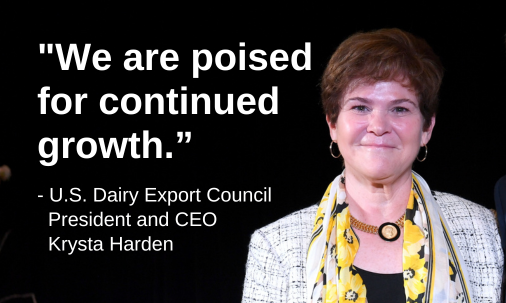
USDEC President and CEO Krysta Harden captured the guarded optimism of the three-day meeting when she told attendees, “The long-term outlook for U.S. dairy exports is extremely bright. We are poised for continued growth.”

Looking ahead to the global dairy market, past performance does not guarantee future results.

U.S. supplier consistency a key to success

A growing reputation for reliability and an ample supply provided by U.S. farmers and dairy processors has helped get more milk and dairy products shipped across U.S. borders than ever before. That fact delivers hope because exports help everyone in the U.S. dairy industry and the local economies where they live.

USDEC member companies have demonstrated that exports are an integral part of their businesses, not an afterthought, overcoming COVID, a supply-chain crisis, a tilted trade policy playing field and other challenges.

“The message to our dairy customers around the world is that we will consistently meet their needs now and as their demand grows in the future,” said Harden in her address.

The long and steady growth of U.S. dairy exports

The trend toward more reliability and consistency is part of a long and steady international expansion of U.S. dairy, facilitated by USDEC, which was founded in 1985 by Dairy Management Inc. with dairy checkoff program funding. DMI remains USDEC’s parent organization, getting most of its budget through the dairy checkoff. 
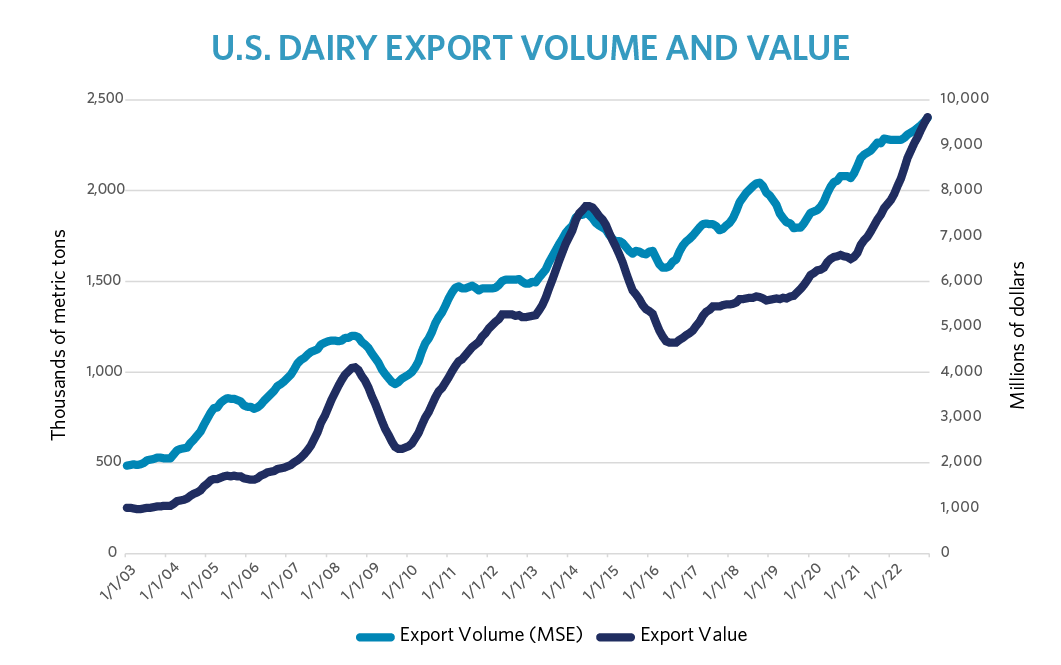
In 2022, the United States set new records for dairy export volume (2.4 million metric tons, milk solids equivalent), value ($9.6 billion) and percentage of U.S. milk production exported (18%)

In 2022, the United States set new records for dairy export volume (2.4 million metric tons, milk solids equivalent), value ($9.6 billion) and percentage of U.S. milk production exported (18%)

In a Q&A session with USDEC members, Harden was asked if 2023 would yield another record for the percentage of U.S. milk production exported. Citing headwinds, including the “wild card” of China, Harden remained cautiously upbeat, saying, “We might not grow as much as we have been growing, but we’re hoping for a little bit more.”

Economists at the meeting (read below) expressed a similar outlook that growth will continue but slower. 

Where would U.S. dairy be without exports?

What is clear, said Harden, is that the U.S. dairy industry needs exports and sees it as an engine for growth. “Where would we be without that 18% going to exports,” Harden asked rhetorically. “That would be a pretty big drain.”

The United States’ growth as a committed, consistent global dairy supplier delivering a portfolio of products suiting the needs of overseas buyers has driven U.S. dairy exports for decades, with USDEC there every step of the way.

In 2022 alone, USDEC staff traveled a combined 2.6 million air miles—the equivalent of five round-trip visits to the moon—for a broad array of activities aimed at building demand for U.S. exports and facilitating trade flows.

A high-level lineup of speakers delivers insights

While Harden’s remarks set the tone for the meeting, USDEC secured a list of high-level government officials and business executives to offer their expert opinions on dairy trade challenges and opportunities, from prospects for free trade agreements to geographic indications to dairy alternatives.

USDEC President and CEO Krysta Harden poses with Rep. Dusty Johnson (R-SD) after a session addressing Congress’ outlook on agricultural issues.

USDEC President and CEO Krysta Harden, left, with Rep. Dusty Johnson (R-SD) after a session addressing Congress’ outlook on agricultural issues.

The lineup included:

  • U.S. Representative Dusty Johnson’s assessment of the political landscape for agricultural issues and the need for improved market access for exports.
  • Scott Gottlieb, former Food and Drug Administration commissioner, on the FDA’s role in facilitating agricultural trade and his experiences leading the agency.
  • Ambassador Doug McKalip, chief agricultural negotiator at the Office of the United States Trade Representative (USTR), and Alexis Taylor, undersecretary for trade and foreign agricultural affairs at USDA, about the 2023 agricultural trade landscape.
  • A discussion about strengthening global connections with Michelangelo Margherita, head of trade section of the European Commission; Lloyd Day, deputy director general of the Inter-American Institute for Cooperation on Agriculture, and Ambassador Esteban Moctezuma, Ambassador Extraordinary and Plenipotentiary of Mexico to the United States of America.
  • Tom Halverson, CEO of CoBank, providing a primer on globalization and deglobalization and ag’s role in feeding the world.
  • James Caffyn, partner, Lever VC, on the evolution of plant-based and fermentation-derived dairy alternatives and how they relate to dairy.

Challenges: Uncertain China demand, improved EU dairy supply

One session featured USDEC’s Economics team expressing differing opinions on their expectations for U.S. dairy export performance in 2023. One area that generated consensus was that U.S. dairy export volume growth in 2023 is unlikely to match 2022’s lofty 5% increase (milk solids equivalent or MSE).

U.S. dairy exporters face a series of challenges in 2023, including a weaker price environment, improved dairy supply out of the EU, uncertain Chinese demand and major questions about the global economy. That being said, William Loux, USDEC director, Economic Research and Analysis, expects solid demand for U.S. dairy ingredients in key growth markets, like nonfat dry milk/skim milk powder in Mexico and high-value whey in Japan, will still fuel a gain of more than 1.5% MSE.

In real-time audience polling, 58% of attendees sided with Loux, expecting U.S. MSE export growth to top 1.5% in 2023.

That’s the short term. Looking years into the future, the market dynamics that have helped carry U.S. dairy exports to this point remain favorable. A rising global population, growing middle class and the need for sustainable, affordable nutrition are expected to drive world dairy consumption, benefitting U.S. exports.

Fly-in conveys dairy priorities to Washington policymakers

Nine members of the USDEC Operating Committee conducted a Capitol Hill “fly-in” following the membership meeting for a day-and-a-half of meetings with congressional representatives and administration officials.

Participants included USDEC Chairman Larry Hancock; Vice Chair Alex Peterson; Pennsylvania dairy farmer Marilyn Hershey; Patti Smith, DairyAmerica; Jing Hagert, Milk Specialties Global; Greg Rodriguez, MCT Dairies; Sheryl Meshke, AMPI, Jeff Schwager, Sartori; and Alison Rosenblum, Tillamook County Creamery Association.

Dairy fly-in 1

USDEC staff and members of USDEC’s Operating Committee met with Rep. Michelle Fischbach (center) during their visit to Capitol Hill to talk about dairy trade priorities.

fly-in 2

Fly-in participants with FAS and AMS staff, including FAS Administrator Daniel Whitley (center front, left of Krysta Harden).

Accompanied by Harden, COO Martha Scott Poindexter and the USDEC Trade Policy team (Jaime Castaneda, Shawna Morris and Tony Rice), the group emphasized the need for increased funding for key FAS market development programs like the Market Access Program and for a larger U.S. government role in protecting common food names.

The group also touched on the significant role exports play in the health of the entire U.S. dairy supply chain, the U.S. economy and jobs. 

Source: USDEC
Ink Runs Red on Lasalle Street

Milk futures on the CME are up, but cash dairy is down on Thursday.

On the Chicago Mercantile Exchange, milk futures were mostly higher, while the cash dairy market was stable to lower.

April Class III milk was down $0.04 to $19.46. May was up $0.11 to $18.61. June was up $0.13 to $18.60. July was up $0.08 to $19.01. Contracts for August through February ranged from unchanged in January and February to eleven cents higher in November.

Dry whey was down $0.0025 to $0.44. There were no recorded sales.

Cheese blocks were down $0.01 to $1.9250. At that price, only one sale was recorded.

Cheese barrels were down $0.03 to $1.8750. There were no recorded sales.

Butter remained unchanged at $2.3975 per pound. Five sales were recorded ranging from $2.3975 to $2.4150.

Nonfat dry milk remained unchanged at $1.1475. There were no recorded sales.

The Spring Flush Rolls In

The official start of spring is right around the corner and milk volumes are responding accordingly. Output is steady to higher in most parts of the country as the spring flush rolls in. 

The official start of spring is right around the corner and milk volumes are responding accordingly. Output is steady to higher in most parts of the country as the spring flush rolls in. Bouts of extreme weather have popped up across the nation and are challenging the production and transportation of milk. Producers in parts of the northeast are digging themselves out from under several feet of snow while those in California slog through seemingly unending rain. Flooding is causing cow comfort and animal health concerns and, in the most severe cases, is forcing producers to evacuate their herds to higher ground. With more rain expected to fall, fears are mounting that critical infrastructure such as levees will fail, further exacerbating the situation. While increased precipitation has helped to refill reservoirs and could provide some relief to California’s water crisis, for the moment attention is focused on dealing with the immediate impacts of the flooding.

As students excitedly look forward to their spring breaks, demand from bottlers has softened. This has freed up even more milk for manufacturing uses, which was already oversubscribed. Balancing operations are stepping up milk intake where possible, but they remain constrained by a variety of factors including labor complications. As a result, spot milk can be obtained at extreme discounts. Dairy Market News once again reported that in the Central region, spot milk can be picked up for as little as $12 under Class III pricing. Meanwhile, milk futures followed the commodity markets upward this week. On Friday, every 2023 Class III contract except MAR23 and MAY23 settled above $19/cwt. Nearby Class IV contracts fell slightly over the course of the week.

The spot market found surprising traction this week as every commodity ended Friday’s trade at a higher price than at the end of Monday’s session. The Cheddar markets, in particular, vaulted higher. Except for a .75¢ decline on Thursday, Cheddar blocks saw the price move upward each day, including a 11.5¢ leap on Tuesday. Ultimately, blocks ended the week at $1.9975/lb., an increase of 21.75¢ compared to last Friday’s close. Not to be left behind, barrels staged their own comeback this week, including a 7.25¢ jump on Friday as 16 loads traded hangs. Barrels ended the week at $1.96/lb., an increase of 19¢ compared to last week and bringing the block-barrel spread to 3.75¢.


With cheap milk readily available, cheese vats have been full across the country. Market participants indicate that inventories have been steady. Even so, demand appears to be strong enough to at least provide some lift to Cheddar prices, as witnessed in the market this week. Demand from both retail and foodservice channels has been perky with demand for barrels especially pronounced. The pull from the export market has been mixed as some traders report keen interest from global buyers while others emphasize that U.S. product has lost competitiveness compared to other international sources.

The spot dry whey market gave up a quarter of a cent on each Monday and Tuesday before more than compensating with a 1.25¢ and 1¢ gain on Wednesday and Thursday, respectively. After remaining unchanged on Friday the market closed out the week at 46¢ per pound, an increase of 1.75¢ compared to last Friday. Heavy cheese production has kept a steady whey stream available for processors. Price signals are pulling the whey stream toward the production of dry whey at the expense of higher protein products. Even so, demand is reportedly mixed. While interest has improved from some international buyers, product from alternative supply regions, especially Europe, is very competitively priced.


Cream availability varies across the country. In the Western states cream supplies remain long while Dairy Market News reports that the market is significantly tighter in the Eastern states. Despite the regional differences, the overarching message is that churns continue to run busy schedules. Butter inventories are healthy and some of the butter being produced today is being immediately frozen for later use. With the spring holidays rapidly approaching, demand for butter and other Class II products has increased considerably which should keep tension in the markets in the coming weeks.

The spot butter market rose in fits and starts this week. After kicking off the week with a 4.75¢ increase on Monday, the spot price remained unchanged on Tuesday and Wednesday. Another two penny increase on Thursday lifted the price to $2.40/lb. where it remained during Friday’s session. A total of six loads of butter traded hands during the week.

On the other side of the Class IV complex, market movements were more mixed. The spot nonfat dry milk (NDM) price kicked off the week with a half penny loss on Monday, followed by another dip on Wednesday. These declines were countered by a 1.5¢ gain on Tuesday and another .75¢ increase on Friday. When the dust settled, the NDM market ended the week at $1.1875/lb., up 1.25¢ compared to last Friday. Ample milk supplies are keeping dryers working hard and supplies are reported to be readily available. Meanwhile, demand is mixed on both the international and domestic fronts. Mexican buyers appear intermittently while some domestic buyers are swapping NDM out for WPC34 as prices in that market fall.

Elevated feed prices seem poised to continue negatively impacting producer profitability. The corn markets rose this week with the MAY23 contract settling on Friday at $6.3450/bu. Concerns about global supplies persist, especially given intensifying heat and drought in Argentina. Meanwhile soybean meal prices slipped with the MAY23 contract settling on Friday at $466/ton. In USDA’s North American Grain and Oilseed Crushing Summary published on Monday, the agency estimated that U.S. soybean crushing was up 2.6% in 2022 to 65.856 million tons.

Original Report At: https://www.jacoby.com/market-report/the-spring-flush-rolls-in/

Milk Futures on the Rise in Chicago

The Chicago Mercantile Exchange’s milk futures rose Thursday ahead of the cold storage report, while cash markets were mixed.

Class III milk for March is up six cents to $18.10. April is up 40 cents to $19.76. May rose 28 cents to $18.95. The June contract is six cents higher at $18.66. Contracts for July through September are unchanged at 18 cents lower.

Dry whey is now $0.4375, down $0.01.

Blocks are trading at $2.0550, up $0.04. Three trades were completed ranging from $2.03 to $2.0550.

Barrels are up $0.02 to $1.96 per barrel. Seven trades were made between $1.9250 and $1.96.

At $2.3475, butter is down $0.0350. At $2.35, one sale was made.

The price of nonfat dry milk remains unchanged at $1.15.

Fonterra: Latest GDT Quote Shows 2.6% Drop in Price Index

Global Dairy Trade: Sharing a New Dairy Price Quote from Fonterra:

AMF index down 3.8%, average price US$5,150/MT
Butter index down 3.0%, average price US$4,748/MT
Ched index down 10.2%, average price US$4,052/MT
SMP index down 3.5%, average price US$2,648/MT
WMP index down 1.5%, average price US$3,228/MT

Milk Markets Lower in Chicago

With no trading activity on the Chicago Mercantile Exchange on Tuesday, milk futures and cash dairy prices were lower.

April Class III milk was $18.99, a $0.03 decrease. May was $0.07 lower at $18.44. June was $18.50, a $0.14 decrease. July was $0.08 lower at $18.95. Contracts from August to February ranged from unchanged in December and January to sixteen cents lower in October.

The price of dry whey remained unchanged at $0.4475. There were no sales recorded.

At $1.9850, cheese blocks were down $0.0050. There were no sales recorded.

The price of cheese barrels remained unchanged at $1.9525. There were no sales recorded.

Butter was trading at $2.4050, down $0.0050. There were no sales recorded.

Nonfat dry milk fell $0.0125 to $1.1550. There were no sales recorded.

Class III milk up in Chicago Tuesday

On the Chicago Mercantile Exchange, milk futures were higher, while cash dairy prices were mixed. Today, the Class III Dairy Complex exploded, with March Class III milk up $0.17 to $17.95. April was $0.75 higher at $18.53. May was $0.66 higher at $18.60. June was $0.54 higher at $18.87. Contracts from July to January ranged from unchanged in December to forty cents higher in July.

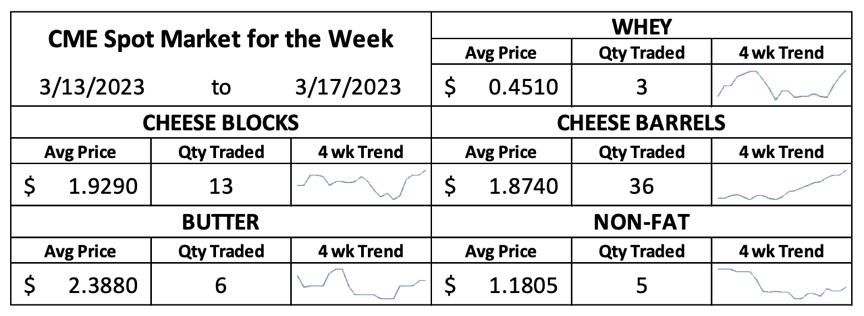
Dry whey was down $0.0025 on the spot market, trading at $0.4375. At that price, one sale was recorded. Cheese blocks increased $0.1150 to $1.9250. Two sales were made for $1.85 and $1.90. Cheese barrels increased $0.0450 to $1.84. Seven sales ranged from $1.7950 to $1.84. The price of butter remained unchanged at $2.38. There were no sales recorded. The price of nonfat dry milk remained unchanged at $1.1750. Five sales ranged from $1.1750 to $1.1825.

Growth in core products led to double-digit gains in January.

U.S. dairy’s positive momentum in the international market continued in 2023 as exports got off to a strong start in January. U.S. shipments climbed 16% year-over-year in volume on a milk solids equivalent (MSE) basis (+25,026 MT MSE) and 21% in value (+$121.4 million) for the month.

The core U.S. product categories – cheese, nonfat dry milk/skim milk powder (NFDM/SMP) and whey – all grew by double digits even as sales of milkfat-heavy products, namely butter, anhydrous milkfat and whole milk powder, struggled.

NFDM/SMP volumes continued to bounce back after being the only major product category to contract in 2022. In January, shipments increased by 15% (+8,805 MT) year-over-year thanks to robust demand from Mexico.

Whey – in all its forms, from permeate and sweet whey to WPC80 and WPI – continued to perform well (+12%, +4,351 MT for low-protein varieties and +14%, +569 MT for WPC80+). U.S. whey success varied by geography: China bought more low-protein varieties, while high-protein varieties found eager buyers in a host of different markets.

Despite rising competition in the cheese space, U.S. exports held strong, increasing 16% (+4,582 MT) thanks to solid growth across the world but particularly in Latin America, Middle East/North Africa and Japan.

Looking ahead, challenges remain with low-priced European cheese on the market, uncertainty from China and economic headwinds. Nonetheless, U.S. dairy exports are off to a running start in 2023.

Chart4 (3)-2

Visit USDEC’s Data Hub for more detailed information


Mexican demand surges in January

After establishing a new volume record in Mexico in 2022, U.S. dairy suppliers picked up where they left off in January 2023. Year-over-year U.S. dairy export volume to Mexico rose for the fifth straight month, led by NFDM/SMP and cheese.

U.S. NFDM/SMP exports to Mexico soared 75% (+15,625 MT) to 36,520 MT in January. U.S. cheese shipments jumped 21% (+1,578 MT) to 9,159 MT, buoyed by demand for U.S. gouda. Both the NFDM/SMP and cheese totals were easily January records (in fact, before this year, the U.S. never shipped more than 29,000 MT of NFDM/SMP to Mexico in January).

Many other U.S. dairy export categories (while smaller in volume) fared similarly well: Year-over-year U.S. lactose shipments to Mexico rose 52% (+922 MT), milk protein concentrate increased 54% (+524 MT), whey grew 18% (+451 MT), and butter gained 40% (+48 MT).

The source of the gains can be traced to solid Mexican economic growth, a tight domestic milk supply and favorable U.S. milk powder and cheese prices.

On the economic front, the Mexican economy grew for five straight quarters through the end of 2022, lifting consumer demand. In addition, the peso gained value against the U.S. dollar throughout the year (it reached a nearly six-year high this week), helping to make imports more affordable. And a boom in post-COVID tourism in Mexico helped drive cheese consumption.

It’s a positive start to the year for U.S. exports to Mexico, but some factors bear watching in the months ahead. Tailwinds from Mexico’s post-COVID economic reopening are weakening. Mexican growth slowed in the fourth quarter of 2022, and analysts forecast economic expansion this year will come in under 1% (compared to 3.7% in 2022).

WPC80+ exports start off strong

U.S. exports of high-protein whey products excelled in January, continuing to rebound after stagnating for much of 2022. Year-over-year January shipments increased 14% (+569 MT), marking the fourth straight month of growth.

Despite the Q4 surge, U.S. exports of WPC80+ in 2022 were essentially flat (+0.3%, +222 MT), largely attributed to weaker global demand caused in part by higher prices. Global WPC80+ trade contracted by 9% last year. Prices for high-protein whey in early 2022 were more than double those in early 2021, and they stayed elevated through the first three quarters of the year. It wasn’t until Q4 of 2022 that we started to see some meaningful price declines. That prolonged high-price environment burned off demand globally, but the U.S. was able to weather that pullback better than the EU and New Zealand, which saw declines of 17% (-8,268 MT) and 16% (-4,289 MT), respectively, in 2022.

With easing prices and readily available supplies, global demand has started to pick up with the U.S. capitalizing on the opportunity. U.S. exports to China (-39%, -256 MT) continued to lag in January, but growth to Japan (+27%, +218 MT) and a surprisingly robust trade to Canada (+33%, +182 MT), Europe (+90%, +365 MT) and South America (+100%, +390 MT) was more than enough to offset Chinese declines.

As we move further into 2023, global economic pressures are a key variable pushing back on growth in global demand, but as prices normalize, higher use of WPC80+ will be incentivized, especially as global economic pressure eases as we move through the back half of the year.

Souce: U.S. Export Dairy Council’s website 

Milk markets on the Rise in Chicago Thursday

On the Chicago Mercantile Exchange, milk futures and cash dairy prices were higher on Thursday.

March Class III milk was $0.08 higher at $17.76. April was $0.24 higher at $17.75. May was $0.24 higher at $17.99. June was $0.17 higher at $18.40. Contracts from July to January ranged from one cent lower in January to seventeen cents higher in July.

The price of dry whey remained unchanged at $0.44. There were no sales recorded.

Cheese blocks increased $0.0275 to $1.8250. There were no sales recorded.

Cheese barrels increased $0.0375 to $1.7350. Eleven sales from $1.6950 to $1.7350 were recorded.

Butter was trading at $2.3325, up $0.0025. There were no sales recorded.

Nonfat dry milk was $0.01 higher at $1.1750. There were four sales ranging from $1.1750 to $1.18.

Milk Futures Keep Falling

Dairy products are continuing to fall from their all-time high prices set last year. On the Chicago Mercantile Exchange, milk futures were mostly lower, while cash dairy prices were mixed. Class III milk fell $0.08 to $17.70 in March. The month of April was down $0.01 to $17.61. May was $0.06 lower at $17.84. June was $0.01 higher at $18.32. Contracts from July to January remained unchanged, with the exception of August, which fell $0.04 to $19.31.

Block Cheese fell 7 cents on the CME Spot Trade, finishing at $1.8450. Barrel Cheese increased by 3 cents to $1.6675. Dry whey dropped 34 cents to $0.4375. Class III milk futures averaged $17.93 in the second quarter, down 8 cents. In Class IV markets, butter remained stable at $2.3450, while NFDM fell to $1.1650, losing 1.25 cents along the way.

CME Milk Futures on the Rise

On the Chicago Mercantile Exchange, milk futures were mostly higher, while cash dairy prices were mixed.

March Class III milk was $0.03 higher at $17.78. April was $0.09 higher at $17.62. May was $0.07 higher at $17.90. June’s price was down $0.02 to $18.31. Contracts from July to January ranged from two cents lower in September to three cents higher in July, with many months recording no price change.

The price of dry whey remained unchanged at $0.4450. There were no sales recorded.

Cheese blocks fell $0.0350 to $1.9150. There were two sales at $1.8850 and $1.9150.

Cheese barrels increased $0.0625 to $1.6375. There were eight sales ranging from $1.5950 to $1.6375.

Butter remained unchanged at $2.3450, and no sales were reported, as on Friday.

The price of nonfat dry milk remained unchanged at $1.1775. There were no sales recorded.

Milk Futures Drop Thursday in Chicago

On the Chicago Mercantile Exchange, milk futures were lower and cash dairy prices were mixed Thursday.

Class III milk was down $0.04 to $17.71 in March. At $17.45, April was down $0.14. May was trading at $17.80, down $0.10. June’s price was down $0.13 to $18.32. Contracts from July to January ranged from unchanged in October to ten cents lower in August.

Dry whey fell $0.0125 to $0.4350. At that price, one sale was recorded.

Cheese blocks increased by $0.01 to $1.91. Four sales ranged from $1.89 to $1.91.

Cheese barrels fell $0.0225 to $1.53. Three sales were recorded, with prices ranging from $1.5250 to $1.53.

Butter was trading at $2.3450, down $0.0350. Two sales of $2.3450 and $2.35 were recorded.

Nonfat dry milk fell $0.0025 to $1.18. Three sales were recorded, with prices ranging from $1.1750 to $1.18.

Milk Markets Fall Lower Wednesday

On the Chicago Mercantile Exchange, milk futures and cash dairy prices all closed lower on Wednesday.

Class III milk fell $0.28 to $17.75 in March. April’s price was $17.59, a $0.08 decrease. May was $0.14 lower at $17.90. June’s price was down $0.13 to $18.45. Contracts from July to January ranged from unchanged in January to sixteen cents lower in July.

Dry whey fell $0.01 to $0.4475. One transaction was recorded at $0.45.

Cheese blocks were $0.01 lower at $1.90. At that price, one sale was recorded.

Cheese barrels fell $0.0375 to $1.5525. There were two sales at $1.5525 and $1.59.

Butter was down $0.07 to $2.38 per pound. Two sales were made for $2.38 and $2.39.

Nonfat dry milk fell $0.0025 to $1.1775. At that price, one sale was recorded.

Milk prices will be much lower in 2022

During January and February, cheese prices fluctuated, but the overall trend is downward. In January, a pound of barrel cheddar cheese cost $1,6803 and is now $1.60. In January, forty-pound cheddar blocks cost $2.0024 per pound and are now $1.96. Dry whey, which was in the $0.30s per pound in January, has dropped to $0.415 to $0.46 per pound in February.

As a result, Class III dropped from $20.50 in December to $19.43 in January. The February Class III will be even cheaper, hovering around $17.90. The Class III price has dropped dramatically since reaching a high of $25.21 in May.

Butter prices fell slightly in January before recovering slightly in February. Butter cost $2.3553 per pound on average in January and is now $2.38. Nonfat dry milk cost $1.2279 per pound in January and is now $1.215 per pound. The December Class IV was $22.12, but lower butter and nonfat dry milk prices in December and January pushed the January Class IV down to $20.01. The February Class IV could fall even further, to around $18.90.
What factors are influencing milk prices?

Milk prices will be determined in the coming months by the level of milk production, domestic sales, and dairy exports. As of now, these factors indicate that milk prices will be much lower in 2022.

In 2023, milk production is expected to rise by less than 1%. The USDA predicts a 0.8% increase, marking the second consecutive year of less than a 1% increase. In 2022, milk production increased by only 0.1%.

Fewer dairy replacements, higher herd culling, relatively high feed prices, and lower milk prices may reduce the average number of cows in 2023. The USDA predicts that the average number of cows will be down 24,000 from 2022, a 0.3% decrease. This is the second consecutive decrease in cow numbers, with a 0.5% or 44,000 decrease in 2022.

High feed prices have hampered the increase in milk per cow. In 2022, milk per cow increased by only 0.6%. The USDA predicts a 1.0% increase in 2023.

Milk production is currently higher than it was a year ago. January milk production was 1.3% higher than the previous year. Since last August, milk production has increased by at least 1%. Milk cows increased by 0.4%, and milk per cow increased by 0.9%.

Milk cow numbers fell by 9,000 in November and December but increased by 16,000 in January. Texas had a 24,000 increase in milk cow numbers, South Dakota had a 17,000 increase, Iowa had a 16,000 increase, and New York had a 10,000 increase.

When compared to a year ago, January milk production in the five leading dairy states was unchanged in California, 1.6% higher in Wisconsin, 2.6% higher in Idaho, 5.2% higher in Texas, and 3.5% higher in New York. South Dakota had a 9.1% increase, Iowa had a 7.4% increase, and Georgia had a 6.3% increase. Florida experienced a 11.4% decrease, while New Mexico experienced a 4.1% decrease.

Domestic dairy product consumption in 2022 was slightly lower than in 2021. While cheese sales nearly equaled those of 2021 butter, nonfat dry milk, dry whey, whey protein concentrate, and lactose decreased. Domestic consumption is expected to rise by about 1% in 2023.

Dairy exports were a major contributor to higher milk prices in 2022. The total number of exports in 2022 was a record. Exports increased by 5% in total volume, 9% for whey products, 12.5% for cheese, a record, and 41.5% for butterfat, but 5.5% lower for nonfat dry milk/skim milk powder.

The USDA predicts that exports will be lower in 2023 than in 2022. As Europe’s milk production increases, the United States will face more competition for exports. Depending on the weather, New Zealand may see increased milk production. Furthermore, there is softness in international demand, which may limit exports. Much is dependent on China. In 2022, exports to China were lower.

Dairy product production has increased over the previous year. Butter production was 3.9% higher in December of last year, and total cheese production was 2.2% higher. From November 30th to December 31st, butter and cheese stocks increased. Butter stocks were 9% higher on December 31st than a year ago, while total cheese stocks remained unchanged. There are more than enough stocks to meet current demand.
Milk prices are expected to rise in the second half of 2023.

Opinions on the level of 2023 milk prices vary greatly, but all predict significantly lower milk prices than in 2022. The USDA has reduced their price forecast. Class III averaged $21.94 in 2022, a $4.86 increase over 2021. The forecast for 2023 is $17.90, which is $4.04 less than the forecast for 2022. Class IV averaged $24.47 in 2022, a $8.38 increase over 2021. The forecast for 2023 is $18.25, which is $6.22 less than the forecast for 2022.

As the year progresses and monthly increases in milk production slow as expected, milk production reaches its normal low this summer, demand strengthens as schools reopen late summer, and butter and cheese sales reach their normal seasonal peak during the holidays, milk prices are likely to improve in the second half of the year compared to the first.

Current futures reflect this, with Class III in the $17-$18 range in the first half of the year and in the $19-$20 range in the second half. Futures prices are higher than the USDA’s forecast. Some forecasters believe the Class III could fall as low as $16 during the first half of the year. The level of milk prices in 2023 is extremely uncertain.

Fonterra lowers milk prices after demand drops.

Fonterra has reduced its milk prices as demand has decreased.

Fonterra has reduced its milk prices due to a drop in demand.

The farmer-owned cooperative reduced and narrowed its forecast Farmgate Milk Price range for the 2022/23 season from $8.50 to $9.50 per kilogramme of milk solids (kgMS), with a midpoint of $9, to $8.20 to $8.80, with a midpoint of $8.50.

At the same time, it revised its forecast milk collections for the 2022/23 season to 1465 million kgMS, down from 1480 million kgMS previously.

According to Fonterra CEO Miles Hurrell, the revised forecast Farmgate Milk Price range reflects softened demand at a time of balanced supply.

“Demand for whole milk powder has been soft, particularly from Greater China, with prices down around 5% since the beginning of December.”

While Fonterra was encouraged by recent increased Chinese purchasing behaviour, he said it was too early to tell how this would affect the rest of the season.

It also maintained its cautious stance in light of the global economic growth outlook.

When purchasing milk from farmers, Fonterra considers the fat and protein levels.

“In terms of milk production, while Fonterra’s season collections are up from this time last year, cyclone Gabrielle and dry conditions in the South Island have impacted the co-full op’s season expectations.”

Milk supply from key exporting regions was balanced globally.

Europe and America produced more than last year, but this was partially offset by lower collections in New Zealand, Australia, and Latin America.

“The medium to long-term outlook for dairy, in particular New Zealand dairy, looks positive. “We are evaluating our position for next season and will provide an opening forecast in May,” Hurrell explained.

GDT Price Index dropped 1.5% after Global Dairy Trade Event 326.

After a 3.2% gain earlier this month, the Global Dairy Index fell 1.5% in Tuesday’s trade.

Butter and Cheddar cheese prices were up, but powder and anhydrous milk fat prices fell.

Butter was up 3.8% to $4,922 a metric ton or $2.23 per pound.

Cheddar cheese prices were up 1.5% to $5,086 a ton or $2.30 per pound.

Whole milk powder fell 2% to $3,264 a ton or $1.48 per pound.

Skim milk powder was down 2.4% to $2,769 a ton or $1.25 per pound.

Anhydrous milk fat prices fell 2.6% to $5,447 a ton or $2.47 per pound.

Buttermilk powder, lactose, and sweet whey powder were not traded at Tuesday’s event.

Overall, 158 bidders participated Tuesday and 30,693 metric tons of dairy products were sold.

Global Dairy Trade

Dairy farmer who featured on Clarkson's Farm is overwhelmed by the crowdfund set up for her

Spring milk prices are rising

The CME dairy complex began the week higher after a Global Dairy Trade (GDT) that was mixed but overall lower in Event 326. March Class III milk was $0.19 higher at $17.84. April was $0.24 higher at $18.07. May was $0.17 higher at $18.45. June was $0.11 higher at $18.89. Contracts from July to January ranged from eight cents lower in January to twelve cents higher in November.

On Monday, the CME spot market was closely watched. The price of dry whey remained unchanged at $0.45. There were no sales recorded. Cheese blocks increased $0.08 to $1.96. Four sales ranged from $1.90 to $1.96. Cheese barrels increased $0.0350 to $1.5825. There were nine sales ranging from $1.5525 to $1.5825. Butter was trading at $2.38, up $0.0050. At #2.36, one sale was recorded. The price of nonfat dry milk remained unchanged at $1.22. One transaction was recorded at $1.2225.

Challenges persist for Texas’ dairy farmers despite high milk prices.

Despite favourable milk prices over the last year, Texas dairy farmers continue to confront problems, according to a Texas A&M AgriLife Extension Service specialist.

According to Jennifer Spencer, Ph.D., AgriLife Extension dairy expert in Stephenville, milk prices remain historically favourable for farmers, and demand for milk and milk products ranging from cheese to ice cream is robust. Nonetheless, she claims that increased input costs are reducing profitability.

Spencer said that Texas is still doing well and adding dairy capacity and cows. Texas surpassed Idaho to take third place in milk output during the first six months of 2022. Nevertheless, the summer heat limited output, and Texas finished fourth for the year.

Texas dairies produced 15.1 billion pounds of milk as of December 1, a 6% increase over the same period previous year. According to the US Department of Agriculture, Spencer estimated the 2022 total to be approaching 16 billion pounds by the end of the year, up from 15.6 billion pounds in 2021.

Prices stayed over $23 per hundredweight in 2022, after oscillating between $23 and $25 per hundredweight. The price per hundredweight averaged $23.67.

But, dairy farmers faced additional hurdles this year as increasing expenses reduced prospective revenues, according to Spencer.

Feed costs account for almost 60% of dairy farmers’ expenditures on average, she claims. Drought and high fertiliser costs hampered forage supplies this year, and prices for cereals and supplementary feed like cotton seed rose considerably.

Fuel prices and labour shortages also hampered dairy operations more than in a usual year, according to Spencer.

“Dairy farmers had greater possibility to be successful in 2021 because they didn’t have to battle to keep up with growing feed and other expenditures,” she added. “Despite the favourable pricing, it was a difficult year.”

Texas dairies are continuing to follow industry trends in which dairy size and total output are increasing but the number of operations is decreasing.
Texas dairy output is expected to grow.

Texas’ dairy output might increase significantly in the coming years as processing infrastructure improves to handle milk. Several soft cheese production facilities, such as cottage cheese, cream cheese, and other spreadable cheeses, are set to expand or launch in the next two years to fulfil rising demand.

The cheese industry was the primary destination for the 226 billion pounds of milk produced in the United States in 2021. 1 pound of cheese requires 10 pounds of milk.

Amarillo’s facility will open later this autumn, and Stephenville’s facilities will likely grow. Another plant in Lubbock is set to open in 2024, while a new facility in western Kansas will receive milk from the Texas Panhandle.

Dairies in the Texas Plains generate around 80% of Texas milk.

“Texas dairies increased their output capacity by around 25,000 cows this year, and the processing expansion will enable farmers contribute to that growth,” she said. “One of the limiting elements impeding manufacturing is processing capacity.”

Liquid milk consumption is down, while dairy products for lactose intolerant customers are increasing, according to Spencer. Summer ice cream demand often leads in seasonally increased milk costs.

Whey, which is used in goods such as muscle recovery powders and infant formula, is an increasing part of dairy demand, according to Spencer. It is a byproduct of cheese manufacturing that was deemed trash until a purpose for its 99% amino acid protein was discovered.

Spencer said that continually growing dairy alternatives for customers is driving total production growth in the United States.

“Texas producers are highly progressive, so they are responding to the problems in order to preserve output and profitability,” she added. “The demand is there, and I believe there is room for Texas dairy production to go further.”

The following summaries were produced by AgriLife Extension district reporters:

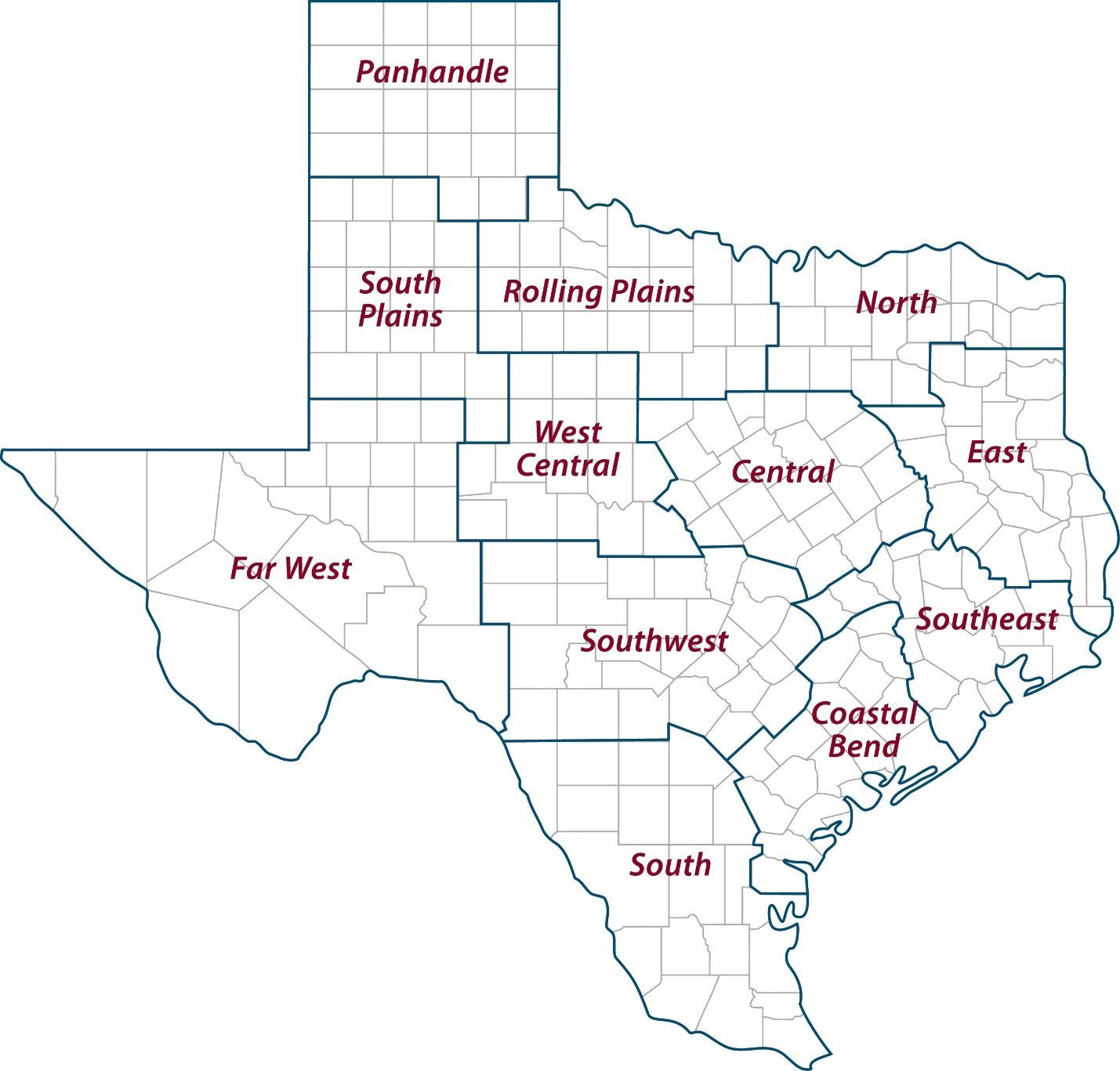
A map of the 12 Texas A&M AgriLife Extension districts.

CENTRAL

The majority of the district got 0.5 to 1.5 inches of rain. While recent rains restored soil moisture, pastures remained in poor condition owing to the harsh frost and drought. Higher temperatures are expected to boost pasture conditions. Cattle were being fed a lot of extra food. Hay supplies were critically low. Conditions for wheat and oats were improving. The future corn plants could benefit from the precipitation.

THE ROLLING PLAINS

More rain fell in several regions, with some counties reporting up to 1.5 inches. Wheat has continued to improve as a result of the recent rain, but more precipitation is required to maintain the gains. Rangeland and pasture conditions were improving, and warmer weather was expected. Wheat conditions improved considerably in several regions, particularly in fields that had been treated before to the rains. Winter supplemental feeding for livestock continued, but some producers grazed wheat. Pasture grasses were also greening up as a result of the increased rain. There was a scarcity of hay. Cattle physical conditions were good, but large feed rations were required to keep them in good shape. Cows nursing calves were losing physical condition.

COASTAL TURN

The majority of the district experienced rain, ranging from drizzle to heavy showers. The weather remained mild. Soils remained wet due to enough subsoil moisture. Grain growers readied planting equipment, while others completed fertiliser. Several fields were flooded, so farmers delayed planting maize until they dried out. Winter pastures were thriving. Several oat fields were almost ready for grazing. Pastures remained essentially dormant, and livestock farmers supplemented their feed with hay and protein. While hay was still in scarce supply, further supplementary feeding was still required. Cattle were in excellent condition, and prices were consistent.

EAST

Soggy conditions prevailed in the fields and pastures. Numerous counties reported that pastures and fields were too flooded to operate on, and equipment became stuck. The subsoil and topsoil conditions were satisfactory. Stock ponds and streams were overflowing. The pasture and rangeland conditions were satisfactory. Supplementation was being administered to the livestock, which were in fair to excellent condition. Because of low hay supplies, several farmers began to give more cubes. Flooded bottoms have driven wild pigs into more visible areas, increasing their activities.

THE SOUTH PLAINS

Cotton totals were quite low by the end. High winter moisture was observed, including snow, sleet, and rain. While livestock were in fair health, the weather was hampering wheat output.

PANHANDLE

Snow flakes fell across the Panhandle, but no significant accumulation was observed. The area remained very dry. Soil moisture levels were extremely low to very low. Winter wheat was suffering from a lack of moisture. Pasture and rangeland conditions ranged from bad to extremely poor. Livestock supplementation was maintained.

NORTH

Soil moisture levels were insufficient. Although most locations were dry, growers in other areas were coping with exceptionally wet circumstances. A brief halt happened. Other regions were still trying to recover from the deep cold that occurred earlier this winter. Rainfall flooded the majority of the ponds. Conditions for wheat and oats were improving. In certain locations, hay was still scarce. The pollen count of cedar trees was high. The livestock situation was favourable. There were no reports of insect or disease outbreaks.

FAR OUT WEST

The days were chilly and damp at first, then warm and dry. Temperatures throughout the day varied from the mid-50s to the lower 60s, with lows in the mid-20s. Growers started discing or tossing up beds in preparation for corn or cotton planting, which increased fieldwork across the area. Orchard floor cleaning and trimming for pecan activities proceeded. Other farmers were targeting orchards and residual alfalfa fields where irrigation from the water district was still accessible. In the next weeks, irrigation was projected to increase. The pastures were still barren, with just a few weeds sprouting. The livestock were in poor to good condition and were given extra hay and feed.

CENTRAL WEST

After rain showers and an ice storm, topsoil moisture was enough. Prior to the most recent rains, some field cultivation took place. Several small grain fields were top-dressed with fertiliser prior to the rain and should fare well. Warmer, brighter days were predicted. Pastures were still lacking in grazing, so farmers were providing hay and vitamins to animals.

SOUTHEAST

The weather was nicer. The soil moisture levels were sufficient to excess. After heavy rains, water was still standing in several areas. The ground was muddy. Warmer weather and better pastures resulted in a higher calf market. Wheat sowing was delayed due to rain and muddy areas. The grades for rangeland and pasture ranged from extremely low to outstanding. Planting conditions for wheat, ryegrass, and other forages were excellent. Greening of pastures, including broadleaf weeds, was observed. Corn planting should begin shortly, although damp fields may cause a delay. Rains filled stock ponds.

SOUTHWEST

Moisture levels rose, however other places remained dry. Ice damaged trees, and orchard managers pruned trees and removed debris. Corn planting was set to start shortly. Wheat and oats seemed to be doing well under irrigation, with very few winter weeds appearing. Additional feeding for cattle was maintained but reduced.

SOUTH

Most regions had extremely short to short soil moisture levels, with some southern areas reporting acceptable soil moisture. Temperatures were colder, with windy winds and sporadic rain recorded. The daytime high temperature hovered around 80 degrees. Farmers were getting ready to sow and checking soil moisture levels. Corn planting should begin when the soil moisture is sufficient for germination. Corn, sunflowers, and sorghum were sown in the district’s southern sections with appropriate moisture, although a rain would benefit those crops. Irrigation was used on certain planted areas. Cool-season crops were harvested by vegetable farmers. Onion yields seemed to be satisfactory. Citrus and sugarcane were also in season. Pasture and rangeland conditions were poor, and grazing was restricted in most locations, however some good grazing was noted in the district’s south. Hay and feed costs continued to rise as farmers supplemented animal meals. Producers were culling bulls and cows, and market prices remained strong to stable. The livestock were in good condition. Mesquite trees were leafing out, and black brush was flowering. Wheat and oat fields were in fair shape, while other areas were experiencing dry conditions and frigid temperatures.

Butter prices are falling

Midweek trade in milk futures on the Chicago Mercantile Exchange was lower, owing in part to reduced and inactive cash trade. The price of February Class III milk remains unchanged at $17.93. March is down eight cents to $17.66. April is down 9 cents to $17.85. May is a penny lower at $18.35. Contracts are five to eleven cents lower from June to August. As Butter fell lower on Wednesday, Class IV milk suffered. Class IV milk came after butter but remained unchanged nearby. February was $18.97, March was $18.93, but April was 26 cents lower at $18.92, and May was 29 cents lower at $19.30/cwt.

After a few quiet days on the CME, butter fell 34 cents to $2.42/lb, reversing the slow gains it had been making. The price of nonfat dry milk remained unchanged at $1.22 3/4/lb. Cheese fell a penny in blocks to $1.88, and barrels fell a quarter cent to $1.53./4. Dry Whey remained stable at $0.43 1/2/lb.

Milk markets dormant Thursday

Thursday’s markets were dormant, with little action in feed and milk. Class III milk was uneven, with February falling a penny to $17.92, March falling two cents to $17.64, and April rising four cents to $17.89/cwt. The balance of 2023 remained basically identical, although 8 cents lower. Class IV milk fell 2 cents to $18.95 in February, 6 cents to $18.87 in March, and 12 cents to $18.80 in April.

The CME spot market had Dry whey gains $0.0050 to $0.44. Blocks are stable at $1.88. Barrels are up $0.01 to $1.5475 per barrel. The price of butter remains steady at $2.42. At $1.22, nonfat dried milk is down $0.0075.

Milk futures are largely up, but cash dairy is divided.

The Chicago Mercantile Exchange’s milk futures concluded the week mainly higher, with mixed cash activity.

February Class III milk is $17.94, down two cents. The March contract is 13 cents higher at $18.06. April is up a penny to $18.39. May is up a cent to $18.77. Contracts are six to ten cents higher from June to August.

Dry whey is constant at $0.4250.

Blocks are $0.01 lower at $1.8625. At that price, one deal was completed.

Barrels are trading at $1.5750, up $0.0050. There were four transactions ranging from $1.5750 to $1.5775.

Butter up for $0.0050 $2.4725.

Nonfat dried milk increased $0.0225 to $1.2650. There were two deals at $1.25 and $1.2650.

Futures prices for Class III milk are skyrocketing.

On Thursday, milk futures went up for the second day in a row, but cash dairy prices were all over the place.

Class III milk in February went up by $0.15 to $17.96. At $17.93, March was up $0.31. At $18.29, April was up $0.28. May was up $0.31 at $18.76. From June to December, contracts went up anywhere from 5 cents in November to 25 cents in July.

At $0.4250, dry whey was down $0.0050. At that price, one sale was made.

Cheese blocks were still $1.8725 each. There were no sales.

Cheese barrels stayed the same price of $1.57. There were no sales.

At $2.4075, butter went up by $0.0125. At that price, one sale was made.

At $1.2425, nonfat dry milk went up $0.0075. There were no sales.

US dairy exports in 2022 surpass prior highs.

According to new estimates issued by the US Department of Agriculture on Feb. 7, US dairy exports will hit $9.5 billion in 2022, substantially surpassing the industry’s previous high of $7.6 billion established in 2021. It was the third year in a row that US dairy exports reached new highs.

In addition, US dairy exports set a new volume record in 2022, totalling 2.82 million metric tonnes.

According to the International Dairy Foods Association (IDFA), US dairy exports have climbed by 85% in the last decade, while volume has increased by 52%.

“Today’s export results reflect the rate at which the US dairy sector is innovating and capitalising on possibilities to market US-made dairy products worldwide,” said Michael Dykes, president and CEO of IDFA. “Consumers in the United States and throughout the globe continue to want more US dairy because we offer an array of tasty, healthy, economical and sustainable dairy products. From high-value whey to award-winning cheeses, milk powders used to manufacture life-saving products for children and adults to safe and nutritious, shelf-stable milk, US dairy is renowned across the globe for its quality and dependability. We are on track to become the world’s largest provider of dairy products, owing to the tenacity and ingenuity of American dairy exporters and dairy food firms.”

Dykes said that 30 years ago, the market for US dairy products was “virtually completely domestic,” but today the US dairy sector exports around 18% of its milk products.

Mexico, Canada, China, and the Philippines are the top four international markets for US dairy. According to the US Dairy Export Council, Mexico has become the first $2 billion US dairy export market, with sales increasing by 37% to $2.5 billion in 2022.

“As US milk production continues to rise over the next decade while other dairy-producing rivals’ output falls,” Dykes added. “IDFA encourages the Biden Administration and Congress to explore additional free trade agreements in developing areas for US dairy and to continue to hold trading partners with whom we have agreements to their promises.”

According to the USDEC, cheese exports in 2022 will increase by 18% in Mexico, 41% in the Middle East and North Africa, 17% in Japan, 17% in Central America, 25% in the Caribbean, 9% in South Korea, 14% in Australia, and 28% in Colombia.

“We’ve experienced three straight years of record US dairy exports despite battling some of the toughest dairy export headwinds we’ve ever seen,” said Krysta Harden, president and CEO of the USDEC. “Last year, we experienced unprecedented global inflation, slowing economic growth, lasting supply chain issues and drastically curtailed Chinese demand. US dairy export success under such circumstances demonstrates US suppliers’ commitment to global markets as well as the value consumers in those nations have grown to put on US dairy goods.”

Milk Prices Catch Fire, Milk futures higher, cash dairy steady Wednesday

Except for blocks on the Chicago Mercantile Exchange, milk futures were higher and cash dairy prices were stable to down. Class III milk went up $0.04 to $17.81 in February. March was $0.21 higher at $17.62. April was $0.18 higher at $18.01. May was $0.16 higher at $18.45. Contracts from June to December varied from six cents higher in September to eighteen cents higher in June. Class IV milk remained fairly steady in February, at $18.76/cwt, in March, at 18.66, and in April, at $18.83/cwt.

A mixed spot transaction in milk markets provides a spark on Wednesday. CME spot trading saw cheese blended with Cheddar Blocks rise 3 34/lb to $1.87 14, while barrels slipped 12 cents to $1.57/lb. The current spot average price is $1.72/lb. Butter and powders remained unaltered. Butter costs $2.39 12, Grade A Nonfat Dry Milk costs $1.23 12, and dry whey costs $0.43 per pound.

For the first time in a few weeks, international dairy trade is on the rise.

The Global Dairy Trade index jumped 3.2% in Tuesday’s trade with solid price gains for five products.

Global Dairy Trade: Sharing a New Dairy Price Quote from Fonterra:

  • AMF index up 4.8%, average price US$5,586/MT
  • Butter index up 6.6%, average price US$4,745/MT
  • BMP index up 2.0%, average price US$2,633/MT
  • Ched index up 2.3%, average price US$4,980/MT
  • SMP index unchanged, average price US$2,829/MT
  • WMP index up 3.8%, average price US$3,329/MT

The price of Class III Milk Futures has stabilised at $18.

Today’s dairy products were mixed. Block Cheese dropped $0.0150 to $1.8350. With 5 lots traded, barrel cheese decreased by the same amount to $1.5850. Dry whey, on the other hand, rose 1.5 cents to 43 cents even. Quarter 2 Class III Milk Futures were essentially flat, losing two cents to $18.30. Nonfat dry milk fell short of expectations in this morning’s Global Dairy Trade. As a result, it dipped 1.5 cents to $1.2350, while butter rose 1.5 cents to $2.3950. Q2 Class IV Milk Futures down 16 cents to $19.07.

Milk futures on the CME and cash dairy prices are largely down to start the week.

On the Chicago Mercantile Exchange, milk futures and cash dairy prices were mainly down on Monday.

February Class III milk was $17.84, a $0.08 decrease. The month of March was down $0.27 to $17.46. The month of April was down $0.14 to $17.90. May’s price went down $0.13 to $18.28. Contracts from June to December vary from constant in December to thirteen cents lower in July.

The price of dry whey remained steady at $0.4150. There were no sales registered.

Cheese blocks fell $0.0150 to $1.85. Three sales ranged from $1.8125 to $1.85.

Cheese barrels fell $0.03 to $1.60. Seven sales ranged from $1.59 to $1.60.

Butter was trading at $2.38, up $0.0050. Seven sales ranged from $2.38 to $2.4075.

At $1.25, nonfat dry milk was up $0.0050. There were four transactions ranging from $1.2475 to $1.25.

Six indicators of U.S. dairy export performance in 2023

USDEC looks at the principal market factors influencing dairy import demand and trade in the year ahead.

Every year, the U.S. Dairy Export Council summarizes the key “signposts” that our analysts will be watching in the year ahead that will determine the direction of U.S. dairy exports and global markets. This year, we’ll focus on the major structural factors that will come into play in 2023.

Here are our six signposts to watch:

Economic headwinds: Inflation and consumer purchasing power

If one word could summarize the global economy in 2022, it’s “inflation.” Driven by supply shortages, Russia’s invasion of Ukraine and strong demand, high inflation rates challenged consumer incomes, reducing purchasing power and forcing consumers to make tough decisions on how to spend their limited currency.

Positively, U.S. inflation is expected to ease in 2023 with a forecast of 2.9%—down sharply from the 2022 average of roughly 8%. Global inflation is also anticipated to improve in 2023—down from the 2022 average of 7.4% to 4.8%.

Purchasing power in both the U.S. and the rest of the world will improve as inflation pressure eases, but that pressure will be felt differently depending on the region and country. Additionally, while the forecast 2023 levels show a decrease, these numbers are still well above pre-pandemic levels.

Compared to the pre-pandemic, five-year average inflation rate (2015-2019), the 2023 inflation forecast for the U.S. is still 83% higher. Similarly, for the world, the 2023 forecast inflation rate is still 54% higher than pre-pandemic levels. So, while the projected easing is positive, consumers worldwide will still be battling elevated prices in 2023.

In terms of U.S. dairy exports, global recovery is important, but U.S. exporters should care most about the recovery in a few key regions. Roughly 75% of U.S. dairy exports are destined for Southeast Asia (SEA), Mexico, China, Japan and Korea. Positively, for the majority of these countries, inflation is forecast to decline faster in 2023 than the world average. In the case of Mexico and China, both countries are anticipated to have inflation rates in 2023 below the five-year pre-pandemic average—all of which is positive for U.S. exports in the year ahead.

Unfortunately, the sharp rise in interest rates (which is the primary instrument used to control inflation) slowed global economic growth. So while inflation is getting under control, the economic outlook is by no means rosy. Thus, our analysts will be watching economies, currencies and inflation rates especially closely in 2023 for signals on dairy demand.

China’s import demand: When will it bounce back?

China will be a critical signpost for the year ahead after dominating global market discussions in 2021 and 2022. Global dairy trade fell 4% (in milk solids equivalent, or MSE) through the first 10 months of 2022, largely because of the precipitous drop-off in Chinese purchasing. Through the first 11 months of 2022, Chinese dairy import volume plummeted 17% or by more than 400,000 MT MSE.

A year full of COVID-related lockdowns, travel restrictions and anemic economic growth (by Chinese standards), combined with strong domestic milk production and heavy inventories, severely undercut import demand. Certainly, some of the magnitude of the decline stemmed from the sky-high spike in Chinese imports in 2021, as China shattered all import records that year. However, the more data we analyze, the more we believe the 2021 rise was due in large part to China building heavy inventories in a manner similar to the 2013/14 whole milk powder (WMP) buying bubble as opposed to a sustainable increase.

Chart1 (2)-Jan-18-2023-06-41-00-6958-PM


So what can we expect in 2023?

Unfortunately, the answer is probably closer to 2022 import volumes than the record 2021.

On the plus side, the country famously did a complete 180 on its zero-tolerance COVID policy over the past two months. Additionally, China’s central bank promised to increase targeted stimulus measures for key areas and industries damaged by the pandemic, in part to support domestic demand growth.

While economists and investors—not to mention the Chinese population—cheered the changes, a significant dairy demand boost may have to wait until China exits its current COVID wave. By China’s own admission, the wave infected hundreds of millions since the beginning of December 2022.

Just as important, domestic WMP and skim milk powder (SMP) inventories have declined substantially in recent months. Industry estimates peg WMP stocks at their lowest level in a year and SMP inventories at the lowest since December 2020, though reliable data remains difficult to pin down.

Overall, growth from China, if it returns, is likely to be closer to the long-term trend than the increasingly anomalous 2021 boom. Moderate growth should support dairy prices and global demand though plenty of uncertainty remains for the country, making Chinese purchasing behavior a critical signpost for 2023.

Dairy alternatives: Palm oil and plant-based imitators

With China’s demand appearing measured if not spectacular, global demand dynamics are likely to be driven by the other major importing markets, including SEA, the Middle East-North Africa (MENA) and Latin America (and Japan and Korea for cheese and whey proteins).

In these markets, especially those where economic conditions are challenged, we expect consumers to be looking for cost-saving measures, potentially trading down from higher-value products to more affordable options. This dynamic will likely impact demand for dairy alternatives, both in the low-cost space and the premium segments.

Starting in the commodity space, the most important signpost will be palm oil prices. Palm oil is used as a cheaper alternative to dairy fat in some applications, the most notable being fat-filled milk powder (FFMP) and analogue cheese. Recently, palm oil prices have fallen dramatically after spending most of 2022 at historically elevated levels.

Chart2 (2)-Jan-18-2023-06-42-06-9022-PM


With the sharp fall in palm oil, the comparative cost of FFMP versus whole milk powder and analogue cheese versus natural cheese is likely to widen in favor of alternatives. This in turn is likely to push price-sensitive consumers to the cheaper alternatives that contain less dairy.

U.S. non-fat dry milk/skim milk powder (NFDM/SMP) demand should fare well as U.S. NFDM/SMP is a critical input to FFMP production, particularly in SEA and MENA, even if WMP demand suffers. However, U.S. cheese exports will likely be negatively impacted, especially to Latin America and MENA, where analogue cheeses are prominent. The high palm prices seen in 2022 meant there was very little reason for importers to purchase analogue, boosting U.S. cheese exports, but now this dynamic has shifted due to the significant price difference.

On the flip side (alternatively, if you will…), plant-based imitators are likely to be challenged as many are priced substantially higher than dairy staples. According to IRI, alternative beverages held a 66% premium over cow’s milk on a gallon equivalent basis in 2022. While the plant-based segment, especially on a global basis, remains very small compared to cow’s milk, flexitarian consumers gravitating to traditional dairy would help support domestic consumption in both the U.S. and Europe, boosting demand and prices but potentially limiting exportable supplies.

EU27+UK milk production: Will the rebound last?

Switching from demand to supply, one of the factors that supported U.S. dairy exports in 2022 was limited production growth in Europe. From September 2021 through August 2022, EU27+UK milk production fell by 0.6% or more than 2 billion lbs. compared to the same period the previous year.

With less milk, EU dairy production declined for all major export products, undercutting supply and laying the groundwork for a less aggressive U.S. export competitor. In the last 12 months, the EU market share of global dairy trade fell by 2%, with the U.S. taking advantage and rising by an equal amount.

The question is can we expect a similar performance from the EU27+UK in 2023?

The answer is almost certainly no – at least in the first half. Despite running below year-ago levels for most of 2022, EU27+UK milk production began picking up in the final third of 2022 after dramatically higher farmer payouts finally incentivized increased output.

Chart3 (2)-Jan-18-2023-06-42-58-7437-PM


Year-over-year September-October milk deliveries increased 1.3%, and initial indications suggest gains continuing through December. Low comparable volumes in 2021 have contributed to the increases but they are not wholly responsible. October’s deliveries, for example, topped October 2020 as well as year-ago levels. When November and December numbers are reported, the EU27+UK might even erase the slow start and finish the year nearly flat. The rebound should continue into the start of 2023 too.

Added to that, sluggish European economic growth (and potential recession on the horizon) will create domestic consumption headwinds. Weak demand coupled with improved milk deliveries is resulting in increased exportable volumes (albeit modest) and heightened competition with U.S. suppliers that we didn’t see for much of 2022. The rapid fall in European spot prices, particularly in cheese, adds further evidence of plentiful supply and weak demand in the European Union to start the year.

While the short-term outlook appears supportive of growth (at least until lower product prices are passed onto European farmers), the 1,500-lb. Holstein in the room is the EU’s increasingly prescriptive Common Agricultural Policy (CAP) that discourages dairy investment and expansion. Jan. 1, 2023, marked the implementation of the bloc’s new CAP, which includes strategic plans submitted by each member state to align with climate and environmental goals laid out in the EU’s “Farm to Fork Strategy.”

For some key dairy producers like the Netherlands and Ireland the means to reach those goals is fewer cows and farms. Those strategic plans come on top of an EU dairy herd that was already shrinking. EU27+UK cow numbers peaked in 2015 and have been declining ever since—a drop of about 1.5 million head over seven years. The EU itself expects its dairy herd size will decline a further 10% (more than 2 million head) over the next decade, with milk production falling about 0.2% annually.

Immediate EU27+UK milk production is looking up for now with the U.S. facing stiffer competition overseas, particularly in cheese. However, the structural limitations on European farmers suggest their surprisingly strong milk production growth will likely be ephemeral beyond the first half of 2023.

Farm inputs: Cost and availability

For farmers across the world, input costs have been top-of-mind over the last two years as balance sheets were squeezed. Feed and labor costs have been especially high, and, while we’re likely to see some slight easing on the feed cost side, it may not feel like much relief.

USDA is forecasting 2023 corn production will see a boost over the previous season—up from 13.895 billion bushels to 15.265 billion bushels (+10%). Similarly with soybean meal, USDA is forecasting production will rise from 52.6 million tons to 54.1 million tons (+3%). As a result, both corn and soybean meal futures are trending lower throughout the year. While that easing is positive, prices are still high and anticipated to remain well above pre-pandemic levels for the foreseeable future. Plus, given the prevalence of risk management programs, even if feed costs do fall, those farmers purchasing most of their feed, especially out West, are unlikely to see much relief in their expenses for many months after prices ease.

Additionally, farm labor will continue to be a challenge in terms of both maintaining needed personnel and paying the rising cost of that labor. The continued tight labor market suggests these challenges will persist in 2023. Job openings far outpace the available workforce with nearly twice as many vacancies as there are individuals seeking employment. That imbalance has increased labor competition and led to increased wages. We anticipate job openings to continue easing into 2023, but expect the labor market to remain tight with elevated wage rates during the year.

Why does this matter for dairy exports? Overall, with a challenging demand environment and rising milk production in the U.S. and Europe, dairy product prices are likely to ease in the near term. If input costs remain high, farmer margins are likely to be squeezed. As we saw in 2021 and 2022, reduced farmer margins will limit production growth, which in turn can limit exportable supply.

Inventories: Was “just-in-case” just a fad?

Finally, for 2021 and much of 2022, with so many challenges around supply availability and shipping, companies, including in the dairy sector, were focused on supply security and proved willing to pay higher prices for that security. A principal strategy in achieving supply security was carrying heavier inventories and switching from a “just-in-time” inventory model to “just-in-case.” As touched on earlier, China in 2021 was the perfect example of this phenomenon.

But today, with shipping issues having eased substantially from last year, supply more readily available and the need to reduce costs being critical in a challenging economic environment, data and market intelligence show companies are eschewing “just-in-case” inventory management just two short years after its inception.

While dairy-specific data on inventory strategy is limited, we can make some general points by looking at the broader economy. First, data from the Logistics Managers’ Index show U.S. warehouse utilization and prices have reached the lowest point in the past two years after peaking in late 2021 and early 2022. Similarly, Census Bureau statistics detail how inventory-to-sales ratios held by manufacturers, retailers and wholesalers have plateaued or declined in late Q3-Q4 compared to earlier in the year. Similarly, imported containers at the major West Coast ports have also decreased dramatically, even falling below pre-pandemic levels! All this data highlights that inventories are being drawn down, at least in the United States, and given the general fall in shipping costs globally, this dynamic is occurring in many importing markets as well.

Chart4 (2)-Jan-18-2023-06-44-41-5776-PM


What does this mean for dairy exports?

Positively, with less focus in the U.S. by retailers and consumer goods companies scrambling to secure inventory, this should place less pressure on U.S. ports, improving export reliability and shipping costs. However, with dairy prices still elevated compared to historic norms and end-users focused on minimizing costs, dairy importers’ willingness to build security stocks (like we saw in China in 2021 or MENA in 2020) will likely be limited too. Thus, we should expect hand-to-mouth buying to be common, likely making markets and import demand more volatile in the year ahead.

Source: USDEC

Rising US cheese and dairy production, falling prices

Rabobank predicts that dairy prices will continue to go down in Q1 2023 because Chinese demand for imports will be low because they plan to destock their own stores. But Rabobank predicts that Chinese buyers will become more interested in buying again starting in the second quarter of 2023. This should lead to a rise in Chinese imports compared to the same time last year and help dairy markets around the world.

Rabobank’s analysts say that the Global Dairy Trade (GDT) auction on January 17 was a pretty quiet event, with the average price going down by 0.1% to US$3,393 per mt. Only 4 of the 11 GDT auctions since the beginning of August have ended with a higher price than the last one.
The US makes more cheese.

In its November report on dairy products, the US Department of Agriculture (USDA) said that the country was making more cheese. Adjusted for 30 days in a month, production went up 1.7% from one month to the next. “However, production was down 10% from the year before as a result of a weak export market. “Because Non-Fat Dry Milk production went up from one month to the next, stocks went up by 3.4% from one month to the next,” says Rabobank.

Rabobank says that the January World Agricultural Supply and Demand Estimates (WASDE) report from the USDA was disappointing for US farmers. The 2023 price projections for all products and milk classes were cut because of weak domestic demand and price pressure from other countries. Rabobank thinks that these cuts will hurt farmers’ profits, which will likely slow the growth of the US in 2023.

In a lot of places, the US Consumer Price Index for dairy and related products is still high. “Based on data from December, it was 15.3% higher than the same time last year. Australia’s Q4 2022 data showed that the prices of dairy and related products went up by 4.2% from one quarter to the next,” says Rabobank.

“As a result, we’re seeing more signs that the demand for dairy is weakening, as more people buy private label products. As inflationary pressures continue, there is growing worry that falling consumer confidence will make people spend less, especially in developing countries, says Rabobank.
The US dairy industry is growing.

During a market outlook session at the Dairy Forum of the International Dairy Foods Association, Mary Ledman of Rabobank said that she thinks the US dairy industry will grow in the long run. She brought up the investments that are being made right now in the American dairy processing sector, both at home and abroad.

Ledman thinks that there isn’t enough trust right now to increase milk production in Europe. “It’s because of political talk. Remember, no laws have been passed yet, but the talk is shaking the confidence of dairy producers.”

A recent report from UBS in Australia showed that dairy prices are still the main cause of inflation there. In the year leading up to December, prices for dairy products went up by 14%. The price of cheese went up by 24%, and the price of butter went up by 18%.

Analysts at UBS are getting more and more worried about how little milk Australia is making. FreshAgenda, an industry group, recently said that they expect a 6-7% drop in the financial year 2023 and another 3-4% drop in the financial year 2024, which would bring the total to 7.7 billion litres.

Coles, a big supermarket chain, was the last company to raise the prices of its own brand dairy products. Coles says it has to raise the price of its milk because packaging and shipping costs have gone up. Leah Weckert, the chief commercial officer at Coles, said that these price hikes were needed because of higher costs in the supply chain, such as higher payments to dairy farmers and processors.

In other market news, Fonterra and Nestlé have agreed to sell their joint venture Dairy Partners Americas (DPA) Brasil for NZD $210 million (US$136 million) to the French dairy company Lactalis. The deal should be done by the middle of 2023, if regulatory authorities give their approval. Miles Hurrell, the CEO of Fonterra, says that the sale of DPA Brazil is in line with the co-plan op’s to put New Zealand milk pool first.

Class III prices are on the rise.

On the Chicago Mercantile Exchange, Class III Milk futures for February ended the day 3 cents higher at $17.93. March went up 15 points to $17.79. March Class IV was happy to see that the spot trade brought in 39 cents on the day, bringing the total to $18.75. April’s Class III was 19 more expensive, at $18.12. Prices for May through July contracts went up by 5 to 8 cents.

It was a good day for milk and cheese. The Spot Trade was all green, except for Block Cheese, which fell to $1.8750, down $0.0200. Barrel Cheese went up by $0.0175 to $1.6000, and 9 lots were traded. Whey went up by 4.5 cents, or 40 cents per pound. The price of butter went up 3 cents to $2.36, and the price of nonfat dry milk went up 1 cent to $1.21.

U.S. Milk Output Not Strong but More Than Enough Milk Available

U.S. milk output was not as strong as anticipated in December. Perhaps more importantly, the dairy herd is smaller than previously thought, and it’s getting smaller by the month. And yet, there is more than enough milk.

U.S. milk output was not as strong as anticipated in December. Clocking in at 18.9 billion pounds, it was just 0.8% higher than December 2021. USDA also trimmed its estimate of November milk output. The agency now shows November milk production was 1% higher than the prior year, down from the 1.3% increase reported a month ago. Topping year-ago levels is a low bar to clear, as U.S. milk output was already in deficit in the final months of 2021. And yet, the industry didn’t surpass those volumes by a very wide margin.

Perhaps more importantly, the dairy herd is smaller than previously thought, and it’s getting smaller by the month. USDA’s latest estimate put the December milk-cow herd at 9.4 million head, down 8,000 head from November and down 20,000 head from USDA’s initial assessment of the November herd. There are 27,000 more cows in U.S. milk parlors than there were at the end of 2021, but the trend is downward. The new numbers make clear that, despite sky-high milk prices, some dairy producers began scaling back in the final months of last year. Now that milk prices are much lower, punitively pricey feed is likely to prompt further consolidation.

And yet, there is more than enough milk. Output in California is variable as cows slog through the mud. But milk is plentiful in the mountain states and the Pacific Northwest. The Midwest is drowning in milk. Excess loads are trading at discounts commensurate with holiday hangovers or the worst of the spring flush. For the sixth week in a row, Midwest cheesemakers purchased at least some milk at $10 below Class III. Labor issues have prevented some cheesemakers from running as hard as they’d like, but with this much milk sloshing around in the cheese states, product must be piling up.

Barrels are especially abundant. Burdensome supplies pushed CME spot Cheddar barrels to a fresh 14-month low on Wednesday. Until this week, buyers had been confident that prices could get even cheaper, and they were content to wait. But on the heels of the bullish Milk Production report, some clearly began to worry that the cheese markets may be close to bottoming out. Wednesday’s Cold Storage report offered a little support as well, showing modest seasonal growth in cheese inventories and a slow build in American cheese stocks in December. With that in mind, traders snapped up 22 loads of barrels Thursday and another seven cars today. Still, prices slipped 2.75ȼ this week to $1.5525 per pound. Blocks fared much better. They jumped 12.5ȼ this week to $1.96.

The fundamentals of the butter market look nothing like they did in most of 2022. Cream is inexpensive and churns are humming along. Butter stocks grew at a pretty good clip in December, and year-end inventories were 8.7% larger than they were on December 31, 2021, marking the first year-over-year increase in 17 months. Meanwhile, last year’s high prices continue to weigh on demand. USDA’s Dairy Market News reports that retail demand is steady, but orders from foodservice are “notably subdued.” Spot butter prices slipped a nickel this week to $2.2725.

The dairy trade remains anxious about China’s appetite for imported dairy this year. But the latest numbers likely prompted a cautious sigh of relief. China imported notably more milk powder, whey, and butter in December 2022 than they did the year before. For the year, Chinese dairy product imports fell well short of the record-shattering volumes of 2021, but they were healthy compared to all other annual tallies. One month of decent data won’t be enough to assuage the trade’s concerns. China’s economy is not firing on all cylinders, and Chinese milk production is formidable. USDA estimates that Chinese milk output grew 6.4% in 2022 and it is projected to grow another 4.3% this year, which will crowd out some demand for imported dairy in 2023.

Any support that the Chinese trade data might have offered to U.S. milk and whey powder prices was undermined by other news from abroad. European and British milk output grew 2.1% in November, and New Zealand milk solids collections improved unexpectedly, up 0.6% year-over-year in December. Dairy product prices are in decline in both Europe and Oceania, adding pressure to already feeble U.S. markets. CME spot nonfat dry milk (NDM) slipped 2.25ȼ this week to $1.1525, the lowest price in nearly two years. Spot whey powder logged a fresh multi-year low, but it bounced back today to 32.75ȼ up 0.25ȼ from last Friday.

After much back and forth, the milk markets finished pretty close to where they started. Most Class III futures contracts settled a little lower than last Friday, but the March contract managed to add 2ȼ. February through June futures range from $18.01 to $18.87 per cwt., while secondhalf contracts are better than $19. January Class IV jumped 35ȼ this week to $20.16, and other nearby contracts gained a little ground. Most milk futures are holding a little above $18. That’s not enough to stave off red ink.
It’s raining in Argentina and there are more showers in the near-term forecast. But the market was already counting on these rains, and the deferred forecast is a little drier. The rains helped to stave off disastrous crop yields, but some damage is already done, and Argentina will need a lot more rain to break the drought. Sub-par yields are assured. To the north, conditions remain excellent in most of Brazil, and farmers will harvest record-breaking volumes of corn and soybeans. But the world is short of grain and oilseeds, so the market will continue to move with the whims of the weather in Argentina. This week, that meant higher prices. An uptick in U.S. soybean exports also leant support. March soybeans settled at $15.095 per bushel, up 3ȼ this week. Soybean meal was notably stronger, up nearly $10 to $473.50 per ton. March corn closed at $6.83 per bushel, up 6.75ȼ.

Original Report At: https://www.jacoby.com/market-report/u-s-milk-output-not-strong-but-more-than-enough-milk-available/

Cash dairy and milk futures are mostly down.

Both cash trade and milk futures on the Chicago Mercantile Exchange were mostly down at the start of the week. On the cash market, more barrel cheese and butter were bought and sold.

February Class III milk went down 12 cents to $17.94. March is down 20 cents to $17.81. April fell 16 cents to $18.02. May is down six cents to $18.49. From June to August, contracts range from a penny less to seven cents more.

Dry whey is now $0.32, down $0.0075. From $0.3175 to $0.3325, five trades were made.

At $1.88, Blocks are down $0.08. At $1.87, a trade was made.

Barrels up $0.0275 at $1.58. There were six sales between $1.56 and $1.58.

Butter up $0.08 $2.3525. At $2.35 and $2.3525, two sales were made.

The price of nonfat dry milk is still $1.1525. At $1.15 and $1.1525, two deals were made.

Significant Changes in Class III Pricing

On Monday at the Chicago Mercantile Exchange, milk futures went up and cash dairy prices were mixed. When the price of cheese went up, Class III milk futures did well. In February, 43 cents/cwt were added to $18.67. March went up 29 cents to $18.28/cwt. Prices for the second quarter went up by 16–26 cents, while prices for the second half went down by 1–7 cents. Except for December 2023, most of the Class IV markets were up.

As two loads of blocks moved from seller to buyer, the price per pound went up by 15.5 cents. Blocks settled at $1.99/lb. The price of barrel cheese went up 9 cents/lb to $1.67, and two loads were moved. Butter dropped 4 cents to $2.2825 per pound. Dry whey went up by a quarter cent, but Grade A nonfat dry milk went down by the same amount to $1.1725/lb.

One of the profitability indicators for dairy farmers improved somewhat.

The December class III price is the highest since 2007. The 2022 average is $21.96, up from $17.08 in 2021 and $18.16 in 2020, a penny less than the USDA’s most recent forecast.

The government anticipates a 2023 average of $19.80. Late Friday morning, class III futures predicted a January price of $19.28, a February price of $18.40, and a March price of $18.34, with an October top of $19.90. The class IV price is $22.12, $1.18 lower than in November, $2.24 higher than a year ago, and the lowest since December 2021. Its average price in 2022 is $24.47, up from $16.09 in 2021 and $13.49 in 2020. The USDA predicts $20.10 in 2023.

The weighted average for the first Global Dairy Trade event of 2023 fell 2.8%, following a 3.8% decline on December 20 and a 0.6% rise on December 6. Traders brought in 73.8 million pounds of goods, up from 63.4 million pounds on December 20 and the largest since November 3, 2020. The average metric tonne price dropped to $3,365.00 US, down from $3,493.00 the previous time.

After not trading on December 20, buttermilk powder was the greatest draw on the average, falling 12.9%. Anhydrous milkfat was down 5.1% after dropping 2.2% the previous time, while butter was down 2.8% after falling 2.6% the previous time. Skim milk powder was down 4.3% after falling 4.8%, while whole milk powder was down 1.4% after falling 4.0%. GDT cheddar was down 2.7% after down 0.7% the previous time.

According to StoneX Dairy Group, the GDT 80% butterfat butter price is $1.9822 per pound US, down 5.5 cents from the previous week’s loss of 5.4 cents, and compared to CME butter, which ended Friday at $2.3825. GDT cheddar, at $2.1274, was down 5 cents from Friday’s CME block cheddar, which was $2.0550. GDT skim milk powder averaged $1.2874 per pound, down from $1.3447 (5.7 cents) and $1.4552 per pound, both down from $1.4723. (1.7 cents).

CME level Nonfat dried milk closed at $1.2975 a pound on Friday. “Total supply on sale climbed 4,000 metric tonnes at this event, and with a comparable rise in purchasing amount of over 5,000 MT, it is difficult to conclude that demand is down,” says Dustin Winston of StoneX.

More likely, market purchasers are hesitant to pay extra for volume since they are not in such desperate need of stuff. “Every area except Southeast Asia has a high purchase volume,” Winston adds.

According to Ron O’Brien of Nui Markets, global markets will enter 2023 “on the defensive.” O’Brien stated in the January 9 Dairy Radio Now programme that purchasers have the power, mostly owing to pressure from the Southern Hemisphere’s flush inventory that is still available. He expects “lacklustre demand out of Asia and growing supply in Oceania to continue to pull CME spot and front month futures down.

Where the rear months are greater than the front months, spot demand must continue over, particularly for butter and nonfat dry milk,” O’Brian stated.

“Inflation worries and supply chain nightmares are starting to fade,” he added, “but it’s a double-edged sword for dairies since end users are now interested in less safety stock and are re-evaluating future budgets owing to demand destruction.”

“Basis risk continues to afflict margins on all sides of the market,” says O’Brien. “Output prices based on CME spot markets continue to deviate from input prices based on federal order milk markets. There are significant differences between CME futures market settlements and real milk inspections. Variations in the block-barrel spread across time.

Worse, corn-based price variations of up to $3 when prices are already near $7,” he added.

Valley Milk in Turlock, California, has joined Hilmar and Milk Specialties Global on Nui’s platform, along with Seattle-based Darigold, to “provide further value to the marketplace by bringing buyers and sellers together, further boosting transparency for all that are engaged,” he concluded.

Meanwhile, dairy exports from the United States were high in November. According to the most recent USDA data, cheese exports totalled 82.7 million pounds, up 12.9% over the previous year.

According to HighGround Dairy, butter sales increased 160% to 18.6 million pounds, with exports to Canada reaching an all-time high, despite unit value being extremely low, “suggesting some form of blended fat, alternate item, or mislabeled product.” Bahrain’s demand for butter has also remained robust. Exports of nonfat/skim milk powder totalled 155.2 million pounds, a 3% decrease. Dry whey increased 17.4% to 43.8 million pounds.

According to HighGround Dairy, November volume was the biggest on record, with the largest gains to Mexico, especially on nonfat dry milk, and subsequently China.

According to the latest Margin Watch (MW) from Chicago-based Commodity and Ingredient Hedging LLC, dairy margins fell considerably in the second half of December as milk prices continued to fall while expected feed costs rose.

“Milk prices were impacted by a boost in milk output throughout November, as well as cold storage statistics from the USDA,” according to the MW.

The MW highlighted highlights from the milk production and cold storage reports, which I previously reported on, attributing the rise in milk output to a mix of greater efficiency from a bigger milking herd and increased milk output.

“The cold storage data revealed a seasonal reduction in dairy product stockpiles during the month,” the MW found.

Cheese prices on the CME fell in the shorter first week of 2023. The cheddar blocks dropped 13.75 cents on the first day of trade, then dropped to $1.9725 per pound on Wednesday, the lowest since November 1, 2022, then recovered, rising 7.5 cents Friday to end at $2.0550, down eight cents for the week but six cents higher than a year earlier.

The barrels plummeted to $1.7150 on Wednesday, the lowest since December 21, 2022, but finished Friday at $1.725, 13.25 cents down on the week, 14 cents lower than a year ago when they rose 15.50 cents, and 33 cents lower than the blocks. On the week, sales totalled five block cars and eleven barrel cars.

According to Dairy Market News, Midwest cheesemakers are keeping busy as spot milk prices remain as low as they were during the holiday periods. Cheese demand varies, with some cheesemakers reporting a slowdown in recent weeks and others reporting consistent week-to-week demand. The availability of cheese has increased. Contacts indicated that surplus cheese was generally spoken for late in the year, but supplies are currently expanding in certain situations, according to Dairy Market News. According to StoneX, the best reductions on spot milk loads were roughly $10 under class, “but it is doubtful that offers will remain that low.”

Western cheese demand is stable to slightly lower in food service and retail, while foreign demand is mixed. Lower pricing from worldwide suppliers are leading to lower demand, however some companies claim good sales to Asian markets. Milk is still accessible for cheesemakers, and some are getting it at a discount. According to Dairy Market News, schedules remain busy, but certain factories continue to report supply delays and staffing difficulties.

Spot butter rose a quarter penny Friday to settle at $2.3825, 36 cents lower than a year ago, after remaining at $2.38 a pound for the entire Christmas and New Year’s week. This week there were no sales. Cream is said to be commonly available both inside and outside of the Midwest.

Multiples are somewhat higher in some circumstances, but still lower as compared to non-holiday seasons. When personnel and haulage cooperate, butter output with the widely available cream is busy, and machines are functioning at capacity. According to Dairy Market News, butter demand has eased somewhat late in the year and in the first week of 2023, and “market mood has obviously cooled down after the fall’s bullish spell.

According to contacts, the market timbre is now ambiguous.

There are other factors at play, but strong production increases and sufficient cream supply are unlikely to support market tones, since demand has slowed in recent weeks.”

To begin the year, demand for cream in the West is being exceeded by plentiful cream supply.

Some butter producers utilise cream internally rather than selling it at the beginning of the year. Cream deliveries are delayed owing to transportation challenges, while butter production is high and exceeds demand. “With near-term demand for physical butter and nonfat dry milk being generally satisfied, we continue to expect that demand for fat will remain robust in January,” StoneX writes.

The issue is retail demand, since costs for a pound of butter can range from $6 to $7 to $8 or more, depending on the shop and brand. Anecdotal talks indicate that current demand for NFDM is somewhat modest, but the likelihood of buy side interest down the line appears to be improving.”

The week’s GDT did not assist Grade A nonfat dry milk, which finished Friday at $1.2975 per pound, down 3.75 cents, the lowest since August 27, 2021, and 37 cents lower than a year ago. This week, four sales were recorded.

With two sales recorded, dry whey maintained stable for three sessions but concluded the week at 39 cents per pound, down 2.5 cents and 36.75 cents from a year ago.

Dairy producers noticed a small improvement in one of the profitability indicators. For the third month in a row, the November milk feed price ratio increased. According to the most recent agricultural pricing data, the November ratio is 1.93, up from 1.92 in October and compared to 1.92 in November 2021.

The entire millk price average fell to $25.6 per hundredweight, a 30 cent decrease from October, but was $4.90 more than November 2021.

California’s pricing per hundredweight was $26.40, down 20 cents from October but $6 more than a year earlier. Wisconsin’s was $23.60, down 80 cents from October but $3 more than a year earlier.

The November national corn price averaged $6.49 per bushel, down a penny from October and 59 cents from the previous month, but still $1.23 per bushel higher than November 2021.

Soybeans rose $14 per bushel, up 50 cents from October after falling 60 cents the previous month, and were $1.90 per bushel higher in November 2021.

Alfalfa hay has decreased $14 per tonne since October, after rising $4 in the previous month to a new high. The November average dipped to $267 per tonne, still $54 per tonne higher than the previous year.

The November cull price for beef and dairy combined averaged $78.40 per hundredweight, down $5.70 from October and $7.10 from the previous month, but $9.20 more than November 2021 and $6.80 higher than the 2011 base average.

“Income above feed expenses in November were over the $8 per hundredweight threshold needed for stable to growing milk production for the 14th month in a row,” says Bill Brooks of Stoneheart Consulting in Dearborn, Missouri.

“Alfalfa hay prices hit a new all-time high price in November, and all three commodities were in the top two for November all-time high prices. Feed prices were the highest in November history, and the seventh highest all time. According to Brooks, the total milk price remained in the top 10, with the eighth highest recorded.

“For 2022, milk income above feed costs (using December 30 CME settlement futures prices for class III milk, maize and soybeans plus the Stoneheart projection for alfalfa hay) are predicted to be $12.17 per hundredweight, a rise of 48 cents per hundredweight against the previous month’s estimate. “By 2022, revenue over feed would be beyond the amount required to maintain or increase milk production, and $4.38 per hundredweight higher than in 2021,” adds Brooks.

“Looking to 2023, milk income above feed expenses (using December 30 CME settlement futures prices for class III milk, maize and soybeans plus the Stoneheart projection for alfalfa hay) are predicted to be $8.18 per hundredweight, a loss of 59 cents per hundredweight over last month’s estimate. “Income over feed in 2023 would be above the amount required to sustain or increase milk production,” Brooks said, “but down $3.99 per hundredweight from the forecast in 2022.”

According to National Milk Producers Federation President and CEO Jim Mulhern, the Environmental Protection Agency will betray dairy producers in politics. “NMPF is sad that dairy farmers, who try every day to be environmental leaders, may have to live under a WOTUS regulation that is burdensome, ambiguous, and unduly complex,” Mulhern stated.

“Because the EPA’s most recent iteration fails to resolve what has now been a 50-year struggle to define what constitutes a water body subject to federal regulation under the Clean Water Act, our members will face continued uncertainty as they attempt to understand and comply with ambiguous regulations.”

“NMPF was delighted with the Navigable Waters Protection Rule (NWPR), but upset when it was repealed. NMPF is particularly upset that the EPA did not listen to several farm stakeholders who urged the agency to postpone regulation on a new WOTUS rule until the Supreme Court issued its decision in the Sackett case, which is due this spring.”

“EPA’s current iteration is not a total return to the unworkable regulation established in 2015,” the NMPF said. The EPA’s specified exemptions at least attempt to address some of agriculture’s worries about ambiguity. Even yet, the EPA is reintroducing significant uncertainty in this version of the rule as it seeks to identify what is a ‘Water of the United States,’ as shown in the handling of ditches, ephemeral streams, and groundwater, all of which were largely excluded under the NWPR. The NMPF fully expects further lawsuits as a result of this rule.”

Dairy prices in Canada will climb again in February.

In a statement, the Commission blamed inflation. “Producers are facing hikes in feed, fertiliser, gasoline, and borrowing rates,” it stated. In February, the wholesale price of milk and butter paid to dairy quota holders would jump 2.2%.

According to Statistics Canada, total year over year food inflation has averaged 11% every month since August of last year. Last year, check-out costs for dairy items increased by 6% to an average of $6.61 per 500 grammes for block cheese, 11% to an average of $2.81 per litre for milk, 11% to $4.20 per litre for cream, and 22% to $5.50 per 454 grammes for butter.

MPs have stated that the retail price of milk is a source of difficulty for young families. “There are actually parents out there washing down milk,” Conservative MP Philip Lawrence (Northumberland-Peterborough South, ON) said on October 27 in the House of Commons.

Dairy farmers speaking before the Commons budget committee denied profiteering. “Three of the primary production inputs – feed, fertiliser, and gasoline – suffered price rises of 100%, 60%, and 50%, respectively, which is substantially greater than the Consumer Price Index,” Martin Caron, president of Québec’s Union des Producteurs Agricoles, said during a hearing on September 28.

“Keep in mind that the price of agricultural products is only a fraction of the price of food on grocery store shelves,” said Caron, a dairy farmer from Louiseville, Quebec. “For example, in Quebec, less than 38 cents of every dollar spent on beef gets back to the producer. Only 13 cents of every dollar spent on yoghurt is returned to dairy producers.”

Grocery stores have likewise denied profiting. “Many people feel merchants are benefitting from inflation on purpose,” Pierre St-Laurent, CEO of Empire Company Ltd., which controls the Sobeys chain, told the House of Commons agricultural committee on December 5. “I can’t answer for the other stores, but I can promise you that in the case of Empire, this is entirely wrong.”

According to St-Laurent, federally controlled milk price rises are appropriate. “It appears that the Canadian Dairy Commission has been exposed to all the justifications required for a price rise,” he added. “Three successive hikes have been permitted for reasons that I believe are appropriate.”

Milk Futures Down in Chicago Tuesday

On the Chicago Mercantile Exchange on Tuesday, prices for milk futures and cash dairy products were mixed for the next few months. January Class III milk was $19.53, down $0.17 from December. February was $0.05 less, coming in at $19.10. At $18.67, March was down $0.04. At $18.85, April was up $0.02. From May to December, contracts were either the same or went up by 15 cents in October.

At $0.3525, dry whey was down $0.0375. There were eight sales between $0.3525 and $0.3750. The cheese market lost some of the gains it made on Monday, with blocks dropping $0.0150 to $2.1825. There were four sales between $2.15 and $2.1825. Cheese barrels were down $0.0250 at $1.80. There were 11 sales between $1.80 and $1.8275. At $2.43, butter went up by $0.01. $2.44 was the price of one sale. At $1.2775, the price of nonfat dry milk didn’t change. There were no sales.

Milk prices go up a lot.

On Monday, most dairy futures and cash prices went up on the Chicago Mercantile Exchange. In January, the price of Class III milk on the market went up 39 cents to $19.70/cwt. February prices went up 56 cents to $19.15/cwt, and March prices went up 27 cents to $18.71/cwt. April through August of 2023 also went up by more than 10%. On Monday, all Class IV markets went down until 2023.

Most CME spot product markets were up to start the week. At $0.39, dry whey stayed the same. There were no sales. The cheese market did well, with blocks going up by $0.1425 to $2.1975. At $2.18 and $2.1975, two sales were made. Cheese barrels were up $0.10 at $1.8250. There were seven sales between $1.80 and $1.8275. At $2.42, butter went up by $0.0375. At that price, one sale was made. At $1.2775, nonfat dry milk was down $0.02. At that price, one sale was made.

Record Milk Prices Expected in 2022

According to forecasts made last month by Dairy Management Inc. and the National Milk Producers Federation, the final price of milk will be at least $25.50 per cwt. The previous high was $24.00 per cwt, set in 2014, so this is a significant increase.

They say that from August to October, commercial usage of milk and other dairy products in the United States continued to rise, allowing prices to strengthen despite an increase in output.

Since February of last year, monthly total U.S. dairy exports have topped the equivalent of 18% of U.S. milk solids. It is also noted that the $9.50/cwt threshold at which Dairy Margin Coverage (DMC) payments are triggered might fall again and might not recover until well beyond 2023.

For improved dairy policy, the American Farm Bureau Federation has proposed a number of changes. A Farm Bureau dairy working committee was formed to devise a strategy. Farmers from all four Farm Bureau areas are represented here.

The purpose of this study is to investigate potential ways in which the Farm Bill may be used to fortify the dairy industry this year and to update the Federal Milk Market Order, which has not been revised since 2000. It is imperative to increase Class I differentials and bring back the Class I Mover to a Higher-of formula as part of any order reform. The organisation also wants to streamline the milk testing process. They also want a modification in the dietary rules to allow whole milk and full fat dairy products, and they want to see a rise in catastrophic margin levels within DMC.

Wisconsin’s milk costs are well above the national average but higher than 21.

The Wisconsin all milk price for November 2022 was $23.60 per hundredweight (cwt) according to the latest USDA National Agricultural Statistics Service “Agricultural Prices” report. This was 80 cents below last month’s price but $3.00 above last November’s price. The U.S. all-milk price for November was $25.60 per cwt, $2.00 higher than Wisconsin’s price but 30 cents lower than last month’s U.S. price.

Send this to a friend