


Archive for Dairy Markets – Page 22

Dairy producers in Cork lose over €500 million as milk prices collapse.

Milk price decreases have cost Irish dairy producers over 38% of their earnings in the last year.

Surprising new numbers have shown the magnitude of the financial crisis confronting dairy farmers throughout Cork as a result of continued milk price decreases, with over half a billion Euro wiped off their profits this year.

The data produced by the Irish Creamery Milk Suppliers organization (ICMSA) so sobering that organization president Pat McCormack calls them a “disaster for the rural economy.”

Dairygold was the latest processor to cut its July quoted milk price by 2 cents per pound to 36 cents per pound, with a spokeswoman claiming that “global milk markets continue to weaken due to pressure on demand in key markets, with no sign of near-term correction.”

To put the magnitude of recent milk price cuts into perspective, Dairygold paid its milk suppliers 55.5c/pl in June of last year.

This reflects a year-on-year decrease of little more than 35%.

According to the ICMSA, the persistent drop in milk prices has cost dairy farmers throughout the nation €2 billion in earnings, with Cork suffering the brunt of this.

According to their projections, milk income in Cork will equal €1,269,394.000 in 2022. According to the ICMSA, the income number for 2023 is now €777,865,000, a €491,529,000 or 38.7% decrease.

The ICMSA conducted a comprehensive examination of each of the 26 counties to determine the decrease in dairy farmer income over the previous two years.

The results reveal that milk values have dropped dramatically, with about €2 billion less estimated to be paid to dairy producers in 2023 compared to 2022.

ICMSA president Pat McCormack described this as “an astounding amount to lose” and predicted that it would have a “very serious impact” not only on dairy farmers but also on the wider rural economy this year and in 2024 as farmers tightened their purse strings and made drastic cuts to their spending.

“We all know that farmers spend in their communities, and many local services and businesses rely on them.” It is unsurprising to see dairy farmers’ spending power diminish considerably, as observed by companies in rural towns that offer products and services to dairy farmers and the larger dairy sector,” Mr McCormack said.

“From concrete to shed suppliers, to milking equipment to farm machinery, reports are coming back that dairy farmers have stopped buying and investing, and only the very basics are being purchased, and this is going to have a dramatic impact on the local economy,” he continued.

According to Mr. McCormack, with a dairy outlet multiplier of two, the overall loss to the Irish rural economy in 2023 may be as high as €4 billion.

“At the county level, we see Cork losing nearly half a billion in direct revenues, while Tipperary will lose nearly a quarter of a billion in direct revenues.” “With so many indirect jobs reliant on the dairy sector, the multiplier effect can bite even harder in these counties,” Mr McCormack said.

Given the current weather and pricing circumstances, the ICMSA research utilized an average total milk price of 59cpl for 2033 and a projected average price of 37cpl for 2023, with output predicted to reduce by 2% year on year.

“This means that nearly 38% of dairy revenues have been wiped away in the last year, and this analysis does not include the very severe cost elements facing dairy farmers, implying that dairy farm incomes will be severely impacted in 2023,” Mr McCormack added.

“While fertiliser prices have fallen slightly, most fertiliser was purchased at inflated prices earlier in the year or last year, and unfortunately, electricity and feed remain stubbornly high,” he said.

Mr McCormack urged Agriculture, Food and Marine Minister Charlie McConalogue to organize a meeting of the Dairy Forum so that a “clear strategy” could be put in place to kick-start an urgent recovery in milk prices.

“This is required not only by the farmers who produce the milk on a daily basis, but also by the larger rural businesses that rely on it for revenue,” Mr McCormack added.
On Thursday, both milk futures on the CME and cash dairy prices climbed.

On the Chicago Mercantile Exchange, milk futures and cash dairy markets were up on Thursday, with the exception of cheese and nonfat dry milk.

September Class III milk was $0.02 higher at $18.89 a gallon. October saw a $0.15 increase to $19.10. November was $0.24 higher at $18.78. December was $0.13 higher at $18.65. Contracts from January to July were six cents higher in February and thirteen cents higher in July.

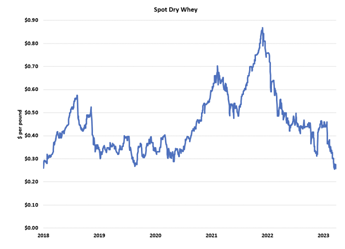
Dry whey was $0.02 higher at $0.3050. One transaction was recorded at $0.30.

The price of forty-pound cheese bricks remained constant at $1.9925. There were no sales registered.

The price of cheese barrels stayed steady at $1.86. There were no sales registered.

Butter was trading at $2.6450, up $0.0250. Fourteen transactions were made, with prices ranging from $2.6450 to $2.67.

Nonfat dried milk fell $0.02 to $1.0725. There were four transactions, with prices ranging from $1.07 to $1.0850.

Dairy trade index has fallen for 7 months in a row.

The Global Dairy Index fell 7.4% on Tuesday, its sixth consecutive trading day.

The Cheddar cheese market recovered, while all other items lost value.

The price of cheddar cheese increased 5.8% to $4,127 per metric ton, or $1.87 per pound.

Prices for whole milk powder declined 10.9% to $2,548 per metric ton, or $1.15 per pound.

Skim milk powder fell 5.2% to $2.333 per metric ton, or $1.05 per pound.

The price of anhydrous milk fat fell 5.3% to $4,452 per metric ton, or $2.01 per pound.

Butter prices dropped 3% to $4,539 per pound, or $2.05 per pound.

125 successful bidders purchased 33,580 metric tons of dairy goods in 20 bidding rounds during Tuesday’s trade session.

Since May 16th, the Global Trading Index has declined in all seven trading sessions.

An Overview of Milk Price Increases in Europe

A comprehensive examination of European inflation and its effects on dairy goods such as milk, cheese, and butter. In addition, the Idele conference in Paris last June examined record food inflation, consumption, and dairy commerce.

Christine Goscianski of the Idele economics service reminded the audience in her presentation that 2022 saw unprecedented food inflation. Food consumption prices in the EU-27 increased by over 12% in 2022 compared to 2021. This rise was smaller in some countries, such as Ireland (+6.9%) and France (+7%), while it was larger in others (+12.6% in Germany, +13% in Portugal, and +14.5% in Poland). This rise in food costs was matched by an increase in distributor brand market share (+2.3% in Spain, +1.4% in Germany, and +0.5% in France).

“The beginning of 2023 was marked by a sharp acceleration in the rise of food prices in Europe, with an increase in sales of consumer products at discount (+1 point between January 2022 and January 2023),” Goscianski said, adding that consumption of dairy products held up rather well in the EU-27 in 2022, but should fall in 2023 as a result of high food inflation.

Germany has seen unprecedented food inflation.

In 2022, the price of dairy goods in Germany increased by 20-40% compared to 2021: +21% for Emmental and UHT milk, +22% for Gouda, and +41% for butter. This resulted in a decrease in dairy product purchases, which was most noticeable in liquid milk (-6% over the past 12 months, -9% in March 2023) and fresh cheeses (-7% over the last 12 months, -9% in March 2023).

Organic milk is losing market share to vegetable juices and pasture milk as costs climb sharply, affecting the organic sector. Finally, rising food prices in Germany increased trade in dairy goods, impacting both exports and imports.
France: Trade balance decline

In France, there are four factors to consider when it comes to inflation:

a +7.9% increase in dairy product prices in 2022 in stores, with the highest increase for dairy fat (+11.7%) and even higher in-store prices in early 2023; a -2.5% decrease in dairy product sales in 2022 in stores, with the largest drop being for butter (-6.8% over 12 months); consumer arbitrage: buy less and downscale (increasing use of private label ranges, fewer organic products purchased, success of discounters);

Italy has one of the lowest rates of inflation.

Despite having one of the lowest rates of food inflation in Europe, Italy had a 10-20% increase in food costs in 2022, depending on the product: +9.8% for UHT milk, +20.8% for butter.

“However, the beginning of 2023 is marked by a slowing in this rise in food prices, particularly those of dairy products,” said the speaker, who noted that the discount market share has increased from 17.5% of sales in value in 2019 to 20.6% in 2022, despite a very high rise in prices in this channel.

Organic purchases in Italian households declined from 3.9% in 2021 to 3.6% in 2022. In 2022, trade in value increased with inflation (both for imports and exports), but the balance contracted.

Strong inflation in the United Kingdom

Food costs increased by 16.9% in 2022 and then skyrocketed in early 2023 (+33% for milk and 39% for cheddar cheese in April 2023). While dairy product sales are down, cheese sales are holding up better.

“We also see a decrease in the range of dairy product consumption, and branded milk volumes are declining faster than private-label products,” Goscianski added.

Organic milk volume sales are falling considerably (-13.5% in 2022/2021 against -5.6% for non-organic milk). Organic dairy products accounted for 2.9% of total dairy retail volume in 2022. Finally, like with the other European nations, volume exports are increasing, but the value balance is worsening.

Conclusion

Inflation currently affects food goods more than other things:

In the EU-27, consumer prices increased by 9.1%.
Food costs increased by 18.2% in the EU-27.

Eurostat data: January-April 2023/January-April 2022

Inflation has a particularly large influence for dairy goods.
Consumer inflation arbitrage: less amounts bought, more private label, less organic, discount success. Store sales of dairy goods seem to be improving.

In-store purchases in France in 2022 (in volume):

Beef: -6.4% Eggs: -1.6% Dairy products: -6.4% -2.5% Fruits and vegetables: -5% Fish: -12%

For a few weeks, general inflation has been lower, with food inflation falling marginally in May.

The USDA predicts a drop in dairy output and an increase in dairy prices.

In Friday’s supply and demand report, the USDA reduced its milk output predictions. The USDA anticipated 2023 milk production at 228.4 billion pounds in July, but their August update reduces that estimate to 227.9 billion pounds.

The predicted cow inventory is lower for this year and 2024, while the expected production per cow is lower for 2023 but unchanged for 2024.

Because of recent price increases, the study upped the predicted 2023 butter and cheese prices. Whey pricing expectations for this year have been reduced. Nonfat dry milk (NDM), Class III, and Class IV have a better prediction. In 2023, the all-milk price will rise to $19.95 per cwt.

Butter and cheese costs are expected to rise in 2024, while whey prices are expected to fall. Nonfat dry milk prices are expected to remain stable. Class III and IV pricing are higher due to increased product costs. The predicted all-milk price in 2024 has been increased to $19.35 per hundredweight.

The USDA anticipates reduced dairy imports and exports in the United States. Imports of fat and skim-solids have been reduced from previous month due to lower-than-expected imports of cheese and butter. The prediction for fat basis exports in 2023 has been reduced owing to decreased exports of cheese, butter and butterfat products, and whole milk powder. The projection for skim-solids exports is lower, owing mostly to reduced whey product sales.

Analysis on the future of dairy prices by Rabobank

Following Fonterra’s modification of the farmgate milk price prediction earlier today, RaboResearch Senior Agricultural Analyst Emma Higgins provides analysis below.

The farmgate milk price forecast has been drastically revised. Fonterra has reduced its prior midpoint of $8.00/kgMS by $1.00/kgMS, with a new midpoint of $7.00/kgMS for the current 2023/24 milk production season. The new milk price estimate range is $6.25/kgMS to $7.75/kgMS.

Before dawn, it is always the darkest.

Dairy commodity prices are currently lower than 5-year norms after this week’s GDT auction. This is a big movement in dairy commodity price, which has been occurring since the second quarter of last year. It will be difficult for individuals who are going through this moment of transition.

Costs have risen 13% year on year. The agricultural price expenditure index for Q1 2023 reveals that total input prices increased 13% year on year (Q1 23 vs. Q1 22). Interest rates are the greatest movers (+50% year on year), followed by fertilizer (+11% year on year), dairy shed expenditures (+11%) year on year, and insurance premiums (+9% year on year). At the same time, Fonterra’s farmgate projection mid-point fell 11% year on year.

Fonterra’s newest farmgate predicted mid-point (August 2023) is 24% lower than the same time in 2022.

The drop is primarily due to decreasing import demand from China, which is now experiencing a milk boom that has been building for many years. Production growth is moderating, which is what markets want for rebalancing, but the pace of increase in the first half of 2023 has surpassed our expectations. Milk supply increased 7.5% year on year in the first half of 2023, with a slowing in Q2 compared to Q1.

The dairy commodities markets are going through another cycle.

The markets are now sluggish and tough. However, we do not believe that this is a super-cycle slump.

For comparison, during the dairy slump (seasons 2014/15 – 2015/16), the milk price fell from $8.40/kgMS (2013/14) to $4.40/kgMS (2014/15). When adjusted for inflation, it equates to the milk price in today’s terms falling from over $10.60/kgMS to $5.50/kgMS.
There are some signs of hope for pricing out there.

The triggers for a rebalancing inside China are in action, as indicated in our recent Agri Monthly report (attached). Milk prices are falling, cost pressures are increasing, and farm growth is stalling. China is reopening, but demand settings remain weak and unpredictable.

RaboResearch argues that inventory levels in dairy markets are low outside of China. This is a significant departure from the Dairy Downturn era, when certain dairy commodity prices, notably SMP, were under pressure for a prolonged length of time because to EU intervention inventories. Another significant distinction between the Dairy Downturn and this time is that the supply picture is considerably more modest. Whether it’s pricing pressure in the US, weather concerns in parts of the EU, or even El Nino dangers in the future, the challenge for milk supply growth from key exporting nations is evident.

In the future, New Zealand milk production will need consistent weather. Budgets will not appreciate spring storms or anything going wrong in the closing months of winter.

Rabobank is presently working on its third quarter dairy quarterly report, which will contain an updated milk price estimate. This is scheduled to be published in early September.

Dairy Markets Still Feeling the Summer Sizzle

The T.C. Jacoby Weekly Market Report Week Ending July 28, 2023

Cheese and butter prices both jumped once again this week. The sudden strength in the cheese market reflects a shortage of Cheddar that is fresh enough to trade at the spot market in Chicago, a phenomenon that can lead to dramatic but often short-lived spikes in the sultry summer months.

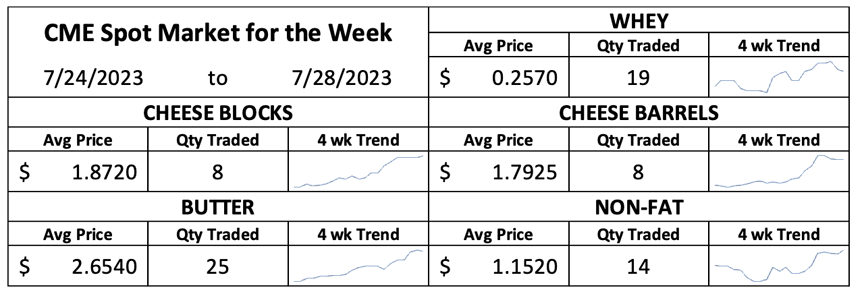
The dairy markets are still feeling that summer sizzle. Cheese and butter prices both jumped once again this week. CME spot Cheddar blocks leapt 12.5ȼ to $1.9075 per pound. That put them higher than year-ago prices for the first time since early February. Barrels rallied 10.75ȼ to $1.7625. The sudden strength in the cheese market reflects a shortage of Cheddar that is fresh enough to trade at the spot market in Chicago, a phenomenon that can lead to dramatic but often short-lived spikes in the sultry summer months.

Fresh Cheddar may be scarce, but there is plenty of cheese. On Tuesday, USDA reported 1.51 billion pounds of cheese in cold storage warehouses on June 30, the highest mid-year inventory on record. Stocks were 0.3% greater than in June 2022 and they grew 12.6 million pounds from May to June, a month in which cheese stocks often shrink. Inventories of American-style cheeses did decline modestly last month, but, at 853.3 million pounds, they were still up 0.8% from a year ago and notched the highest June stocks figure on record.

CME spot butter hiked to a new peak this week, touching a fresh 2023 high Thursday at $2.6925. It finished at $2.68, up 9.75ȼ since last Friday. Tuesday’s Cold Storage report helped to explain butter’s impressive summer climb. Butter stocks dropped unexpectedly in June, falling 20.4 million pounds last month to 347.5 million pounds. Stocks are 5% greater than the uncomfortably tight levels from this time last year, but they’re quite a bit lighter than butter buyers would like to see ahead of the fall baking season. Meanwhile, cream multiples are ramping up as scorching temperatures take a toll on milk production and components.

CME spot nonfat dry milk also logged impressive gains. It climbed 4ȼ to a six-week high at $1.16. Lower milk production is reducing the lineup of trucks at driers, and production is falling accordingly. Meanwhile, export demand remains strong thanks to robust orders from Mexico.

Spot whey powder slipped 0.25ȼ to 25ȼ per pound. USDA’s Dairy Market News describes demand for whey as “lackluster.” Cheese vats are full and whey production continues apace, leading to some concerns about storage space for dry whey and other dry products. It’s going to be hard to lift whey prices significantly when the trade is worried about having enough places to stash it.

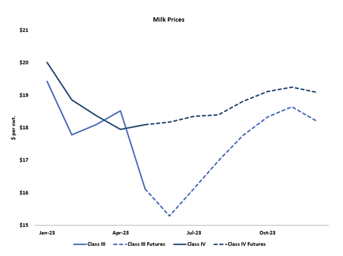
Strong spot cheese prices propelled August Class up 55ȼ this week to $17.26 per cwt. Other Class III contracts finished a few higher, and fourth-quarter futures averaged $18.43. Class IV futures logged strong gains. The August contract advanced 52ȼ to $19.05. Fourth quarter futures rallied about 70ȼ to an average of $19.33.

Today’s futures prices are considerably better than those that determined the June milk checks or those on which July milk revenue will be based. But they’re still not enough to pay the bills on many farms, especially for producers who will continue to suffer discounts on their already-low Class III revenue. Dairy producers are leaving the industry in growing numbers, and dairy slaughter volumes remain high. The milk-cow herd continues to shrink, setting the stage for higher prices in the year to come.

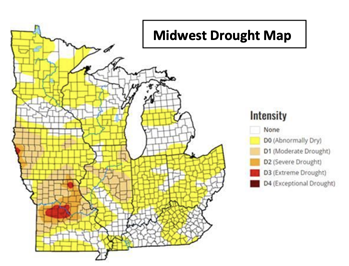
It’s certainly hot, but the weather was not as dry as feared. Scattered showers moved across the Corn Belt and they’re expected to do so again next week. But moderate drought persists in most of the Farm Belt, and crop yields likely continue to slip. December corn futures fell 6ȼ this week to $5.3025 per bushel. November soybeans closed at $13.825, down 19.5ȼ. September soybean meal closed at $433.60 per ton, up another $7.30.

Source;  https://www.jacoby.com/market-report/dairy-markets-still-feeling-the-summer-sizzle/

Fonterra updates farm gate milk price projection

Fonterra has indicated that it would lower its expected Farmgate Milk Price range for the 2023/24 season.

According to the cooperative, the range will be reduced from $7.25 to $8.75/kgMS to $6.25 to $7.75/kgMS, with the midpoint dropping from $8.00 to $7.00/kgMS.

The news comes after the price of whole milk powder (WMP) fell 7.29% earlier this week on the Global Dairy Trade (GDT) auction platform, bringing WMP prices to their lowest level since early 2019.

According to Fonterra CEO Miles Hurrell, the updated pricing range reflects continuous lower import demand for whole milk powder from Greater China.

“When we announced our opening 2023/24 season forecast Farmgate Milk Price in May, we noted that it reflected our expectation that China’s import demand for whole milk powder would increase in the medium term,” Hurrell explains.

He claims that total GDT whole milk powder WMP prices have dropped 12% since then, with China’s portion of WMP volumes on GDT events following below-average levels.

“This reflects China’s current surplus of fresh milk, resulting in increased levels of local production of whole milk powder and a reduction in near-term whole milk powder import requirements.”

“The medium to long term outlook for dairy, particularly New Zealand dairy, looks positive, with milk production from key exporting regions flat compared to last year,” Hurrell adds.

Bearish trend continues in Chicago Thursday

Milk futures on the Chicago Mercantile Exchange fell Thursday, extending the week’s gloomy trend, while cash markets were mainly down. Class III milk for August is down 40 cents to $17.09. September is down 34 cents to $17.19. The October contract is down 30 cents to $17.67. November is 22 cents cheaper at $18.00. Contracts from December to February are five to fifteen cents lower. At $0.2650, dry whey is up $0.0025. Two transactions were made at prices ranging from $0.2625 to $0.2650. Blocks are constant at $1.96. Barrels have fallen $0.0450 to $1.8250. At $2.6150, butter is down $0.0150. At $1.12, nonfat dried milk is down $0.0025. At $1.12, two deals were completed.

Milk dumping likely to stop as dairy prices rise

Wisconsin dairy farmers benefited from a rapidly expanding export market, particularly to Asian countries, in recent years. But when those same markets pulled back on their orders, farmers had more milk than they knew what to do with.

The U.S. exported over 16 million fewer pounds of cheese in May 2023 compared to the same period a year earlier, according to the U.S. Dairy Export Council.

Selling on a global scale also involves global competition. Wisconsin cows now sell alongside those from Europe and else where. More competition drives down prices.

Staffing challenges continue to plague many industries as baby boomers retire in droves and younger generations are simply too small to fill the holes. This is also true for the creamery industry, where a lack of adequate staffing means that operations cannot process as much milk as they once did.

Combine all of these forces together with naturally higher milk production from cows in the spring months, and the market is flooded.

Milk’s short shelf life means that producers cannot store excess product and wait for prices to recover. All the extra gets dumped.

Phil Plourd, president of Ever Ag Insights, the market analysis arm of an agricultural logistics company, acknowledges that milk dumping hurts the dairy industry’s brand image.

“It’s not a good look, right? And it seems wasteful, and it’s like ‘Oh, this is good milk, what the heck are we doing?,’” he said.

Despite these factors all pressing down on the price of milk, Plourd believes that prices will likely rebound in the near future and bring an end to the majority of milk dumping for the year.

Hotter weather in July and August reduces milk production in cows.

Farmers will also likely respond by reducing their herds, Plourd said. High prices for beef will offer some additional encouragement.

Prices have already moved in a promising direction for farmers in the past week. The cost of butter and a block of cheddar rose two and ten percent respectively.

“We usually find our way out of it before too long,” Plourd said. “And it can be a painful process, but the people in the industry are generally resilient.”

Source:

July Class III milk prices could plummet to $13.80/cwt, nearly $12 lower than July 2022

After record high milk prices in 2022, milk prices continue to fall reaching prices not seen since 2020 and 2021. Class III prices for July could dip to $13.800/cwt, $5.63 below January and a whopping $11.99 below a healthy $25.79 just a year ago.

Prices dipped into the $13 rante from October of 2020 to February of 2021. Milk prices are now well below profitable levels for dairy producers.

What’s to blame?

Much lower cheese and dry whey prices have contributed to lowering the Class III price. The price of 40-pound cheddar cheese was in the $1.30’s to $1.40’s per pound in June with some improvement in July to the high $1.40’s.  A year ago in July, 40-pound blocks were ranging from $1.94 to $2.11 per pound. In June, Cheddar barrel cheese reached as high as the mid $1.50’s per pound but declined to as low as $1.34 in June. In July barrels were in the low $1.40’s per pound. A year ago, in July barrels ranged from $1.55 to $1.83 per pound.

However, both blocks and barrels may be starting to trend higher. Today on the CME, 40-pound blocks increased $0.135 per pound to $1.72 and barrels increased $0.12 per pound to $1.58. Dry whey started the year at $0.415 per pound, got as high as $0.4675 per pound in March but has been as low as $0.225 to as high as $0.2775 per pound in June and July and is now $0.25. A year ago, in July dry whey ranged from $0.445 to $0.50 per pound.

What about the milk supply?

These prices show that milk prices are subject to rather small changes in milk supply, milk demand or a combination of changes in supply and demand. Last year milk production was just 0.1% higher than the year before. This year milk production from January to June has been 0.7% higher than a year ago but the increase is slowing. June milk production was unchanged from a year earlier.

Increased domestic demand and/or dairy exports are required to take up this increased production to prevent falling milk prices. Record high milk prices last year resulted in higher retail prices of dairy products which may have dampened domestic demand some. With lower milk prices, retail dairy product prices are starting to decline some but not nearly to the extent of lower milk prices.

Dairy exports enjoyed healthy sales last year with record cheese exports. But on a volume milk solids equivalent basis, May exports were 13% lower than a year ago with cheese exports down 18% lower and dry whey product exports down 29%. May was the third consecutive month dairy exports were lower than the previous year.

Weaker demand from key export markets such as China and increased competition from New Zealand have dampened exports. Lower dairy exports mean more milk is needed to clear the domestic market without lowering milk prices.

Have we hit bottom?

The July Class III price should be the bottom for the year with the price trending upward for the remainder of 2023. Milk cow numbers fell by 16,000 from May to June. June cow numbers decreased by 5,000 animals from this time last year were finally below a year ago, down 5,000. There was no increase in milk per cow. As a result, June milk production was unchanged from a year ago.

June milk production compared to a year earlier for the five leading dairy states and their cow numbers were: California -1.2%, 4,000 fewer cows; Wisconsin +1.0%, 2,000 fewer cows; Idaho +1.9%, 14,000 more cows; Texas -5.0%; 13,000 fewer cows; and New York +3.4%, 7,000 more cows. All of last year Texas was just behind South Dakota with the highest increase in milk production. But the loss of 8,000 cows from an explosion and fire along with hot weather have reduced milk production.

Other states having relatively strong increase in June milk production over a year ago were: SD +6.9%, Ohio +3.3%, Mich. + 3.2%, GA +3.0%, Ind. +2.7%, Iowa +2.5% and Minn. +1.6%. June milk production was below a year ago by 7.1% in New Mexico, 3.1% in Oregon and 1.2% in Florida.

Milk production likely to stay down

Milk production is likely to run below year ago levels for the remainder of the year. With the existing widespread drought this year’s final crop production is uncertain. The drought has already reduced alfalfa hay production. Feed prices will remain at relatively levels. Higher feed prices and lower milk prices will make margins tight for dairy producers. Dairy producers are likely to reduce cow numbers in response.

Domestic demand may improve as retail prices soften some. Dairy exports could improve some by the third quarter of the year. Except for butter the price of cheese, dry why and nonfat dry milk/skim milk power are very competitive on the world market. Some export markets may take advantage of these lower prices and start to increase purchases.

Milk prices to trend upward

Milk prices will trend higher for the remainder of the year. Milk production will be in its seasonal low August through September. Schools will begin to open at the end of August and early September which will help beverage milk sales. By October butter and cheese stocks will start to build to meet the higher season sales of cheese and butter Thanksgiving through Christmas.

Class III futures show a continued improvement in the Class III price with it rising into the $15/cwt range by August, the $16’s by September and the $17’s for the remainder of the year. However, the latest USDA forecast is not as optimistic. USDA has Class III averaging just $14.30 for the third quarter and $15.05 for the fourth quarter with the average for the year $16.05 compared to $21.96 last year.

With the sensitivity to small changes in milk supply and/or demand I think the probability is high for third quarter and fourth quarter prices to be higher than USDA’s forecast. But time will tell.

Cropp is Professor Emeritus at the University of Wisconsin Cooperative Extension, University of Wisconsin-Madison


Milk price swings drain dairy margins

The rapid decline of milk prices in recent months has drained returns on dairy farms and created quite a challenge for farmers.

Dan Ziller, a dairy farmer from Huntley and president of the McHenry County Farm Bureau, said negative margins have impacted plans to build a new facility on his family farm.

“We (he and his wife, Carol) have kids working to take over the farm,” Ziller told FarmWeek. “They still want to continue with it, but to see a swing like this makes it very hard to plan.”

USDA reduced its price estimates this month to $16.05 per hundredweight for Class III milk and $18.20 for Class IV, down $5.91 and $6.27, respectively, from last year. Ziller reported his local milk price is closer to $14 for July, which puts the operation in the red.

USDA attributed the drop in Class III milk prices to weaker cheese and whey prices while the decline of Class IV prices reflects lower nonfat dry milk prices.

“What a difference a year makes,” Ziller said. “Our operation is labor intensive, so we’re way below our cost of production with where prices are now. We need prices near $19 to $20.”

The Zillers are enrolled in USDA’s Dairy Margin Protection Program through the Farm Service Agency (FSA). But it hasn’t entirely stopped the recent financial bleeding.

“We are fortunately in the FSA dairy program,” Ziller said. “It helps, but it’s not enough to make up the difference.”

The Zillers’ daughter, Meredith, plans to take over management of the dairy herd while their son, David, looks to take over crop and feed production on the farm.

“We’re trying to build a new facility,” Ziller noted. “It remains in the planning process. We’re adjusting to figure out where we can cut costs.”

Retired dairy farmer Tom Doolittle of Antioch, president of the Lake County Farm Bureau, said he exited the business years ago when his equipment and facilities became outdated.

He’s concerned for current dairy farmers as recent margins are unsustainable.

“When I came back to farm full time with my father in 1969, there were quite a few dairies,” Doolittle said. “But, here in Lake County, urbanization continues. We have one dairy left in the county.”

Lake County had about 125,000 acres in production ag when Doolittle first started farming. Now, there’s about 25,000 farm acres left in the county as most was swallowed up by urban sprawl, he noted.

Current milk prices are “terrible for this day and age,” Doolittle said. “And, with feed prices so high, it just kills the income for a small dairy farm.”

Timing of the recent milk price decline also adds insult to injury as rising temperatures in the summer typically fuel a rally with higher demand and reduced production.

David Anderson, Texas A&M AgriLife Extension economist, said the lack of a summer price bump could be attributed to a few factors. U.S. dairy production is up, but overall demand is struggling, which created a glut of milk in some areas.

“The milk market is complex, so that makes it interesting,” Anderson said. “There is a seasonality to the supply side and the demand side that keeps the market constantly moving.”

The next usual boosts in dairy demand are coming up in August, when school returns to session and drives built-in demand for carton milk, followed by the holidays when consumers typically increase their use of cheese, milk and other dairy products for baking.

“Milk and feed futures suggest producer profitability should improve considerably by October when Class III milk prices are anticipated to increase by about $3 (per hundredweight),” CoBank’s Knowledge Exchange noted in a recent report.

But for the time being, there doesn’t appear to be much relief in sight for dairy farmers.

“U.S. milk producers continue to struggle in the current price environment,” according to the CoBank report. “While several factors are to blame for this year’s milk price decline, the sharp drop in American/cheddar-style cheese prices (which declined by a third) is the most significant.”

Source: farmweeknow.com

Dairy Markets Start the Week Higher in Chicago

On the Chicago Mercantile Exchange milk futures and cash dairy prices were higher again Monday. August Class III milk was up $0.75 at $17.46.  September was up $0.75 at $18.42. October was up $0.75 at $18.97.  November was up $0.75 at $19.22.  December through June contracts ranged from thirty-eight cents higher in May to sixty-seven cents higher in December.

In spot trade dry whey was up $0.0075 at $0.26.  Two sales were recorded at $0.2575 and $0.26. Cheese blocks were up $0.08 at $1. 8625.  Five sales were recorded, ranging from $1.80 to $1.85. Cheese barrels were up $0.0175 at $1.83.  No sales were recorded. Butter was up $0.03 at $2.6125.  Eleven sales were recorded, ranging from $2.60 to $2.6125. Nonfat dry milk was up $0.03 at $1.15.  Five sales were recorded, ranging from $1.13 to $1.15.

Milk Futures Continue Higher in Chicago Tuesday

Milk futures on the Chicago Mercantile Exchange closed higher Tuesday following strong cheese demand while cash markets were mixed.

July Class III milk up three cents at $13.86. August 49 cents higher at $15.80. September up 39 cents at $16.50. October 29 cents higher at $17.30. November through January contracts 10 to 28 higher.

Dry whey down $0.01 at $0.24. Fourteen sales were made from $0.24 to $0.2475.

Blocks up $0.09 at $1.5850. Four trades were made at $1.5050 and $1.5850.

Barrels up $0.05 at $1.4575. Four sales were made from $1.42 to $1.4575.

Butter unchanged at $2.56.

Nonfat dry milk down $0.0150 at $1.10.

Low milk prices hurting dairy farmers despite summer demand

Summertime usually means big business for dairy farmers across the country, but this year has brought sour results as milk prices remain at low levels.

According to the U.S. Department of Agriculture, the price per hundredweight of milk is currently around $17, down almost $8 from the peak of last summer.

“We’re producing more milk than we did last year, and normally when supplies go up, prices go down, and so prices to farmers are down dramatically from where they were last year,” said David Anderson, professor and extension economist at the Texas A&M AgriLife Extension service. “We set some record high prices on milk prices to farmers. We’re down 25% from that level a year ago.”

Increased production is largely to blame according to Anderson. Year-to-year production increases are typical, but industry advances in addition to changing demand and uses for dairy products make an already complicated market tougher.

“Consumer demand is changing. We drink less fluid milk, but we eat more cheese, and that leads to this kind of dynamic, ‘If I got a hundred pounds of milk, what am I gonna make out of it?’” said Anderson.

Increased feed prices in addition to general production costs are also hurting farmers. Anderson said that when feed prices are high, farmers will sometimes cut production, which in the long run can help prices return to normal levels.

“It’s not a perfect correlation in terms of timing. Dairy farmers lose money because costs go up or milk prices have come down,” said Anderson. “They lose money; they start producing less, and that drives the price back up, so we are in this real price-and-income squeeze on dairy farmers right now.”

Source: kltv.com

Positive trends for UK dairy farms despite extreme volatility, report says

There have been positive trends for dairy farmers despite the sector facing unprecedented volatility, a new report by dairy specialist Kingshay says.

Dairy producers across the country faced volatility in 2022-23 with record high prices across the board, from inputs to milk markets.

However, they secured record margins over purchased feed – although the gap between the top and bottom performers widened further, showing the importance of attention to detail.

According to the annual Kingshay Dairy Costings Focus Report, milk prices have increased by 61% over the past 10 years, reaching an average of 50.98p/litre in December 2022.

However, there was a sharp drop in the first half of 2023, with prices losing more than they gained in the second half of 2022.

Kathryn Rowland, senior farm services manager at Kingshay, said: “The gap between the top and bottom 10% of prices reached a peak differential of 16.2p/litre in February, with producers in Scotland suffering the worst prices on a regional basis,” says

The hot, dry summer of 2022 caused milk from forage to drop slightly, with many producers turning to feed winter forage stocks.

The bottom 25% of producers used almost a tonne (917kg) more concentrate per cow than their higher performing counterparts, at 3,197kg fed over the 12 months.

Not only did the summer impact yields, but fertility too. Ms Rowland said: “Cows didn’t display such obvious oestrus cycles due to the hot weather.”

She added: “As a result, days to first service increased from 69 to 75, and given the high milk price, the cost of each day of extended calving interval increased to £5.89/day per cow.

When comparing production systems, year-round housed cows produced the greatest margin per cow, with low to moderate yielding organic herds leading on a per-litre basis.

However, the gap between the top and bottom quartile of those within the same systems widened again, showing the potential to improve performance within an existing system rather than switching to an alternative.

New to Kingshay’s report this year is heifer trends, which found 62% of herds were not hitting the age at first calving target of between 23 and 25 months.

Also, 50.2% of cows leaving the herd are in their first three lactations, before they have fully paid for the cost to rear them and this can have a big impact on carbon footprints.

Herd size has grown by 23% over the past 10 years, although there was a dip in 2019 to 2021 when flying herds were not restocking due to high heifer prices.

“Since 2021, herd size has recovered its long-term trend, rising from an average of 201 cows to 217,” explained Ms Rowland.

Yields have also grown by 10% over the past decade, but over a shorter period have stagnated, remaining around 8,400 to 8,450 litres per cow since 2020.

“This could be due to a reduced focus on production alone, with a shift towards efficiencies and margins,” she added.

Milk from forage and grazing has also remained static since 2020, but over 10 years has grown by 31% and 9%, respectively.

At the same time, concentrate use per cow has grown by 12%, with prices up by 46% to a record high of £357/t (rolling 12 month average).

As a result, total purchased feed costs have jumped by 58% per cow and 44% per litre of milk produced.

Ms Rowland said: “Thankfully, the milk price has increased by 61% over the same period – also to a record high – meaning the milk price to feed price ratio has widened by 10%, to 1.33.

“The larger the ratio, the better it is for farmers – and last year was the highest it had been since 2018.”

The 10-year trend looks positive when it comes to the bottom line. “The average margin over purchased feed improved by 86% on a per cow basis, and 69% on a per litre basis, to £2,865 and 33.87p/litre, respectively – their highest levels since Kingshay first started the costings service back in 1998.

“A much needed additional margin to cover increases in all the non-purchased feed input costs,” explained Ms Rowland.

Close attention should be paid to cost of production for the next 12 months, to assess the impact of high input costs, with accurate budgets essential for planning cash flow.

“Margins over purchased feed continues to be a key way to easily monitor production, feed efficiency and feed costs, along with milk quality and price each month, with comparisons to similar herds.”

Source: farminguk.com

Milk Markets Start the Week Higher in Chicago

Milk futures were higher in the near term and cash dairy prices were higher Monday on the Chicago Mercantile Exchange.

July Class III milk July was up a penny at 13.83. August Class III milk had most of the trading volume and was up $0.22 at $15.31.  September was up $0.19 at $16.11.  October was down $0.01 at $17.01.  November was unchanged at $17.58.  December through June contracts ranged from unchanged from December through May to eleven cents higher in June.

Dry whey was up $0.0025 at $0.25.  No sales were recorded.

Cheese blocks were up $0.0150 at $1. 4950.  Three sales were recorded from $1.48 and $1.49.

Cheese barrels were up $0.0150 at $1.4075.  No sales were recorded.

Butter was up $0.01 at $2.56.  Twenty sales were recorded, ranging from $2.5525 to $2.5675.

Nonfat dry milk was up $0.01 at $1.1150.  No sales were recorded.

Record Low Milk Prices During Rough Summer for Dairy Farmers

High milk creation, lukewarm homegrown interest, floundering send out deals, and a sketchy weather conditions market for feed wares all are powering anxious vulnerability for U.S. dairy makers.

The principal half of Summer 2023 in dairy markets will be noted for breaking records, and not positively. As per dairy item dealers T.C. Jacoby, the USDA declared in late June the pay over feed cost determined in May as a component of the Dairy Edge Inclusion (DMC) program tumbled to $4.83/cwt., the most minimal figure seen starting from the formation of that program. Furthermore, on July 7, dry whey cratered at 22.75₵/lb., the most minimal cost at any point found in that market.

On the June 28 episode of the “Parlor to Plate” web recording from Ever.Ag, the subject for exploring the months ahead was discipline and persistence. Examiner Jim Spainhour said the U.S. corn and soybean crops keep on wavering on the meteorologist’s every word, and makers should be extremely key to control feed costs in what will stay an exceptionally unstable product market until the end of the mid year.

“Safeguard your potential gain and give yourself a roof as far as how high your protein and grain uses may be,” he encouraged. “Use a few procedures on the Trade, while leaving a portion of that disadvantage adaptability would it be a good idea for us we see a break.”

Dairy market examiner Kathleen Wolfley encouraged a comparative procedure to safeguard makers from low milk costs utilizing the Dairy Income Security (DRP) Protection program. “Lay in certain floors, play some safeguard, and basically shield yourself from even lower costs,” she proposed. “Discipline and tolerance pay off.”

Wolfley said around 25% of the U.S. milk supply was safeguarded by DRP protection in the primary quarter of 2023, with around 20% covered for Q2 and Q3.

Greg Steele, Senior Dairy Loaning Expert for Companion Monetary, said 2023 is turning out to be an extraordinary illustration of the worth of makers taking the long view with risk the executives. “The people who have risk the executives devices set up are partaking in a superior edge at the present time, in light of choices they made 6-9 months prior whenever the market potential open doors were a lot more grounded than they are today,” he expressed.

Steele proceeded to say that the U.S. dairy industry is entering another time in which processors presently have base projects set up, like a standard framework. In view of their creation history, dairies have limits on the allocation of milk they can sell the processor, with sharp punishments assuming they surpass those edges.

Another unsettling advancement: processors lessening their number of supporters. Because of oversupply combined with work issues, handling limit is pushed to the limit in certain pieces of the country. That has prompted instances of unloading milk, and a few makers getting sees that they have 30, 60, or 90 days to track down another processor.

“By the details of the agreements they have, processors are giving supporters notice that they never again need to take their milk,” shared Steele. “We urge makers to comprehend the relationship they have with their processor, take generally excellent consideration of it, take a gander at the legally binding arrangements they have set up, and investigate an Arrangement B of elective choices in the occasion their processor cuts off their friendship.”

Wolfley likewise underscored it’s a crucial time for makers to remain proactively participated in their promoting choices. “Trust isn’t a gamble the board technique,” she exhorted.

Fonterra 2022/23 output lifted marginally

According to Fonterra’s latest Global Dairy Update, May collections across New Zealand rose 9.7% YOY to 76.2mkg of milksolids, taking 2022/23 seasonal output to 1,481mkg milksolids, 0.2% ahead of the season prior. Fonterra said favourable weather conditions supported strong milk supply at the end of the season. Despite seasonal supply edging up for 2022/23, Fonterra’s output remains below previous seasons.

May intake in the North Island rose 12.7% YOY, with seasonal output ending 0.4% behind the prior season. Soil moisture across the North Island remains in surplus with warmer weather improving pasture cover in preparation for calving in July. Milk collections across the South Island rose 7% YOY in May, with seasonal intake ending 1.1% ahead of the previous season as warmer temperatures and intermittent rain supporting grass growth. 

Milk prices have continued to tumble to levels not expected earlier this year.

Milk prices continue to fall and to levels not anticipated earlier in the year. Class III was $18.52 in April, and fell to $16.11 in May and could be below $16.00 in June ‒ that’s $8.33/cwt. less than June 2022 prices. The last time we saw Class III this low was in 2018 and 2020. In 2018 Class III was in the $13’s for two months and the $14’s for six months. In 2020 Class III was $13.07 for one month and $12.14 for one month.

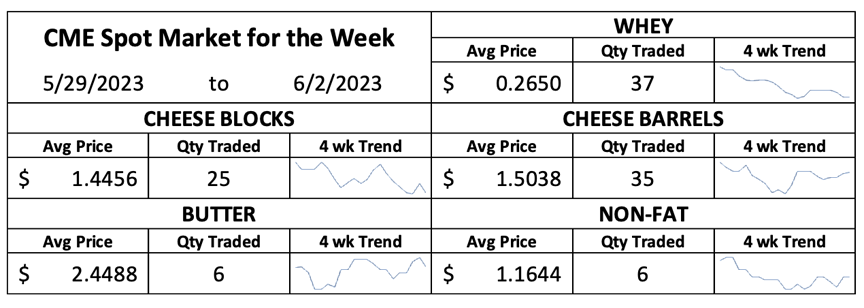
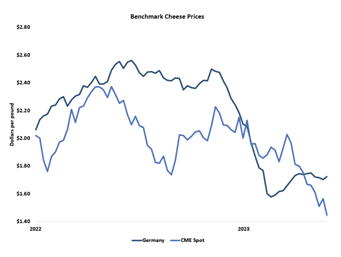
Declining cheese and dry whey prices have driven Class III down. Early January 40-pound cheddar blocks were $2.1975 per pound and cheddar barrels $1.8250 per pound. In early May, 40-pound blocks fell to $1.6825 per pound, and then down to $1.47 mid-May. While prices recovered to $1.6525, they quickly fell and are now $1.40. Cheddar barrels have held better falling to $1.4475 per pound in mid-May, recovering to $1.6525 in early June and are now $1.510. Dry whey was $0.415 per pound in early January and has declined to $0.2675.

Plenty of milk, not as much demand

These lower prices are driven by both the level of milk production and demand. There is plenty of milk. May milk production in the U.S. is estimated to be 0.8% higher than a year ago. Milk cow numbers were unchanged from April but were still 20,000 higher than a year ago or 0.3% higher. Milk per cow continues to be suppressed being just 0.5% higher. This level of milk production has stretched milk plant capacity in the Midwest as some plants lack employees to operate at full capacity. Some producers in Minnesota and Wisconsin as a result have been asked to dump milk.

Milk cow numbers and milk per cow in the five top dairy states are as follows: California 3,000 fewer cows and milk down 0.7%; Wisconsin 4,000 fewer cows and milk up 1.3%; Idaho 15,000 more cows and milk up 3.1%; Texas 1,000 more cows and 0.8% more milk and New York 7,000 more cows and milk up 2.1%. Michigan had 8,000 more cows and 2.1% more milk while Iowa added 5000 more cows and 2.6% more milk. Both Minnesota added more cows and more milk. South Dakota continues to lead in milk production being up 6.2% with 12,000 more cows. Florida had the biggest decline in milk production down 6.7% with 7,000 fewer cows. Milk production was down 3.8% in New Mexico with 10,000 fewer cows.

There is plenty of cheese to fulfill demand. Production of American cheese in April was 2.3% higher than a year ago with cheddar production 5.8% higher. However, total production of all cheese types was down slightly, 0.2%. While April 30 stocks of American cheese was unchanged from a year ago, year ago stocks were at a high level.

Inflation, economic slowdown dampen consumer demand

Fluid (beverage) milk continues to run below year ago levels and will drop lower during the summer when schools are out. Butter and cheese sales have been somewhat higher than a year ago, but cheese sales are not at a level to hold up prices. Dairy exports set a record in 2023 with strong cheese exports. But according to the US Dairy Export Council, global dairy demand has weakened at the same time competition has increased from Europe and New Zealand. Inflation and the economic slowdown have dampened consumer demand.

The volume of dairy exports on a milk solids equivalent basis in April was 13% below a year ago resulting in year-to-date exports down 0.3% from a year ago. Compared to April, year ago nonfat dry milk/skim milk powder exports were down 9%, dry whey products exports down 13%, cheese exports down 12% and butterfat exports down 65%.

Milk prices will recover, but just how much?

Milk prices will recover but how much is uncertain. Milk production will be held in check with low milk prices and still rather high feed prices resulting in unfavorable operating margins. Dairy producers who are enrolled in the Margin Protection Program, the Revenue Protection Program or had earlier protected Class III prices with Class III futures will get some relief from low milk prices.

Slaughter cow prices are favorable so culling of dairy cows is likely to increase. Year-to-date dairy cow slaughter was 4.9% higher than a year ago. Drought is a concern in a large part of the country which could affect the supply of forages, grain and soybeans which would keep feed prices relatively high this fall and winter.

Lower milk prices should give some relief to retail dairy product prices but probably not to the extent of low milk prices. Schools will start to open late summer increasing fluid milk sales. Sales of butter and cheese may show modest growth. Milk production will decline seasonally from June through September. Later this fall buyers of butter and cheese will start to build inventories for the strong sales period of Thanksgiving through Christmas. All of this will push milk prices higher.

Dairy products, exports could finish year on down side

Dairy exports will end the year lower than a year ago. US dairy prices of cheese, nonfat dry milk and dry whey are competitive on the world market, which are positive for exports and could improve exports later this year.

Current dairy futures show a slow recovery in Class III prices with August reaching $16, $17 for September, and October $18 to December. USDA forecast is less optimistic with Class III averaging just $15.50 July to September, $16.30 October to December and averaging $16.70 for the year compared to 21.96 in 2022. Based on the level of expected milk production, dairy product sales and dairy exports USDA’s forecast could well be on the low side.

The tumbles continue mid week in Chicago

On the Chicago Mercantile Exchange, milk futures prices fell further Wednesday, while cash dairy prices remained mixed.

The price of July Class III milk remained constant at $14.35. August’s price went down $0.13 to $15.04. September was $0.19 lower at $16.19. October’s price went down $0.17 to $17.14. Contracts from November to May varied from constant in March and May to fifteen cents lower in November.

Dry whey fell $0.0125 to $0.2425. Ten sales ranged from $0.2425 to $0.25.

Cheese chunks increased by $0.02 to $1.33. There were eight transactions ranging from $1.3225 to $1.33.

Cheese barrels fell $0.0075 to $1.3825. Twelve sales ranged from $1.38 to $1.3875.

Butter went up $0.04 to $2.44 a pound. At that price, three sales were recorded.

Nonfat dry milk was unchanged at $1.1175.  No sales were recorded.

Markets Turn Lower In Chicago to Start the Week

On the Chicago Mercantile Exchange, milk futures and cash dairy prices were all down on Monday.

Class III milk went down $0.49 to $14.86 in July. August’s price went down $0.44 to $15.68. September was $0.50 lower at $16.77. October was $0.30 lower at $17.70. Contracts for November through May ranged from unchanged in April to 25 cents lower in November.

Dry whey fell $0.0025 to $0.2625. Thirteen transactions were made between $0.2625 and $0.2650.

Cheese blocks fell $0.0425 to $1.3625. There were nine transactions ranging from $1.3625 to $1.4050.

Cheese barrels fell $0.05 to $1.45. There were nine transactions ranging from $1.45 to $1.4575.

Butter went down $0.06 to $2.36 a pound. At that price, one sale was recorded.

Nonfat dried milk fell $0.0075 to $1.1250. four transactions

Milk Futures Turn Positive, cash markets mixed.

The Chicago Mercantile Exchange’s milk futures were up Wednesday ahead of a somewhat positive milk production report, but cash markets were divided.

At $14.95, June Class III milks a cent. July is up 41 cents to $15.78. August gained 34 cents to $16.63. September was 25 cents higher, closing at $17.65. Contracts are six to fifteen percent higher from October to December.

Dry whey gains $0.0025 to $0.2275. Nine transactions were made between $0.2675 and $0.2750.

At $1.40, blocks are up $0.0225. Four deals were executed ranging from $1.3750 to $1.3925.

Barrels are constant at $1.51. At that price, one sale was made.

At $2.3475, butter is down $0.0025. At that price, one sale was made.

At $1.15, nonfat dried milk is down $0.0050. At that price, one sale was made.

Global Dairy Trade dairy prices fall at the last auction

Whole milk powder prices are projected to tumble overnight on the Global Dairy Trade auction.

The futures market expects the main whole milk powder price to decline at Tuesday’s Global Dairy Trade auction.

The average price for whole milk powder, which has the largest influence on farmer pay, declined 3% at the previous auction a fortnight ago, and the SGX-NZX Dairy Derivatives market was forecasting another 3% reduction at the auction overnight this week.

According to Stuart Davison, global dairy consultant at HighGround Dairy, the market was anticipating another drop in whole milk powder on the GDT after Fonterra changed their offer quantities.

Fonterra has limited the quantity offered at this auction due to “tight seasonal inventory positions.” However, it also moved up the volume for the July and August auctions, claiming that the adjustment will better link GDT offer volumes with milk supply and collection patterns throughout the year.

Davison believes that the lesser volume at the forthcoming auction will not boost pricing.

“Buyers are well aware that there will be greater volumes on offer in less than two months on the GDT platform,” he added.

He predicted that the additional volume would have a negative impact on demand.

Fonterra cut the quantity of whole milk powder offered at auction by 8.4% overnight, to 10,870 metric tonnes. It boosted the quantities of the two July auctions by 4.2% to 12,510 MT each, and the August 1 sale by 24.4% to 17,830 MT, matching the amount offered in the August 15 auction.

STUFF

When purchasing milk from farmers, Fonterra considers the fat and protein levels.

Davison predicted that the entire GDT index would decrease overnight at the auction as prices for other important items remained constant or dropped.

Over the last year, the GDT index has fallen by 25%, while the average price of whole milk powder has fallen by 23%.

Demand for dairy products has slowed as China’s economy has not recovered as quickly as predicted after its exit from tight zero-Covid shutdown regulations.

According to Fonterra CEO Miles Hurrell, he expects Chinese demand to recover to normal by the end of this calendar year.

Hurrell said that Fonterra is “very positive” about the Chinese market in the medium to long term due to favourable demographics, a growing middle class, and higher dairy product consumption.

Davison said buyers were cautious, and demand from China remained “bearish” despite a rise in domestic milk output.

Summer heat waves in China may enhance demand for liquid milk and ice cream in the immediate term, while reduced interest rates and other government stimulus measures may boost consumption over the next six months, he added.

Nonetheless, he stated that this may not result in increased GDT pricing.

“There’s so much milk in China that they have no reason to come to GDT for anything other than necessities,” he remarked.

On Tuesday, China’s central bank slashed interest rates in an effort to help the country’s economy after its exit from tight zero-Covid lockdown policies.

According to Reuters, the one-year loan prime rate was reduced by 10 basis points to 3.55%, while the five-year rate was reduced by the same amount to 4.20%. The decision follows the central bank’s reduction of short- and medium-term interest rates last week.

There is also speculation that the Chinese government may present a stimulus plan, including assistance for the suffering real estate industry and incentives for people to spend.

China is New Zealand’s biggest primary industry export market, accounting for around one-third of total primary industry export value in the year to the end of March.

Weaker commodity prices aren’t helping the currency, with Kiwibank forecasting a drop from US62 cents to US55 cents by the end of the year.

Kiwibank attributed the drop to lower commodity prices, interest rate differentials, and poor economic indicators.

While the Reserve Bank of New Zealand has finished raising interest rates, the Federal Reserve had further rises planned, according to Kiwibank.

Nonetheless, Kiwibank warned that the currency’s drop would be “a bumpy ride lower” and that it might be “a bumpy ride lower.”

Kiwibank advised importers to keep a look out for any upward movements, especially any short-term transactions up towards the US63c level.

On Tuesday, the benchmark S&P/NZX 50 Index rose 0.3%, or 38.625 points, to 11,789.37. With $130 million shares traded, 68 stocks climbed and 52 sank on the wider market.

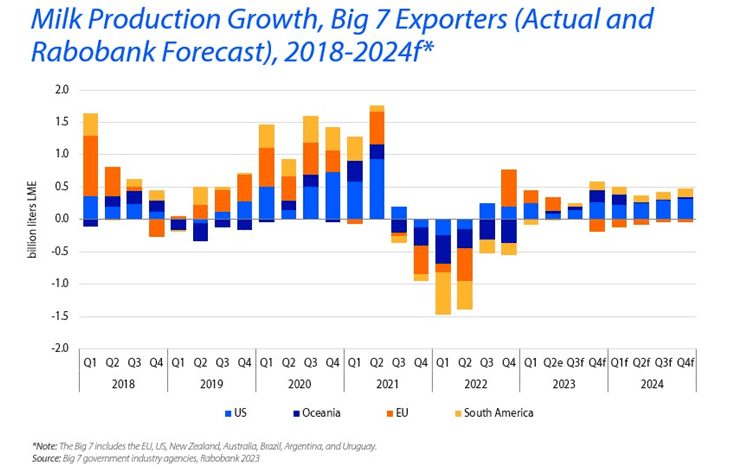
Global milk production still ‘growing’ – Rabobank

There is likely to be lower milk production in the EU and the US during 2023 which could “stabilise” global market prices, according to a new report from Rabobank.

There is likely to be lower milk production in the EU and the US during 2023 which could “stabilise” global market prices, according to a new report from Rabobank.

Overall global milk production is still rising but, according to the bank, it is “losing momentum”.

In its latest Global Dairy Quarterly report, Rabobank also warned that there are signs of weakening dairy demand in some markets.

“The cumulative effects of high food-price inflation over the past 24 months, in most cases significantly higher than salary growth, along with slowing economic activity in 2023 have translated into lower dairy demand in developed and emerging markets,” it stated.

As a result it has lowered its 2023 milk production forecast from last quarter’s forecast of 0.7% to 0.5%.

In the report, the bank detailed that slower growth is attributed to “stagnant output in the EU”.

It expects that in quarter three, EU milk production will be flat year-on-year and noted that while some farmers had managed to “sustain production growth” – despite lower farmgate prices – weather volatility in some regions could “slow deliveries further”.

Global milk production still ‘growing’ – Rabobank1
Source: Rabobank

Rabobank also outlined that a contracting dairy herd and lower yields are likely to slow milk production in the US while in New Zealand and Australia the “dairy pool is stabilising”.

“While profitability remains challenging for New Zealand farmers, current estimates suggest that output could be higher next season.

“Meanwhile, Australia’s milk pool is showing signs of stablisation after a nearly 5% year-on-year decline in the 2022/23 season.

“Water and feed availability should support production growth next season,” the report highlighted.

South American milk production also remains under pressure and according to Rabobank Argentina, is likely to “experience a significant contraction” in milk production because of low forage after a very dry summer.

The bank also expects to see milk production in China while imports decline.

“Chinese dairy imports (liquid milk equivalent excluding whey) declined by 36% year-on-year in quarter one 2023, adding pressure to already weaker global prices in the short term,” the report outlined.

According to Andres Padilla, senior analyst dairy at Rabobank, some price deflation in dairy could help “sustain” demand levels in key markets during the second half of 2023.

The U.S. dairy industry grew significantly over the past two years, adding nearly 60,000 new jobs, increasing average wages by 11%, and increasing its total impact on the U.S. economy by $41 billion, according to the latest economic impact report from the International Dairy Foods Association (IDFA).

WA dairy producers milk farmgate prices as nationwide prices decline 6–9%.

Dairy processors in Australia have revealed farmgate milk prices that are 6-9% lower than the current season’s anticipated pricing, however WA dairy farmers are not suffering the consequences like their colleagues in the Eastern States.

In reality, the national trend may not be mirrored in the local market, as Cowaramup dairy farmer Bob Biddulph said the 4 per litre hike from Brownes Dairy was “welcome” after WA prices had already been “historically high.”

“We’re not complaining,” Mr Biddulph said.

“While there has been no cost relief with fertiliser and feed, milk prices have been at an all-time high for quite some time.”

Mr Biddulph said that he hoped to average 65/L throughout the course of the year, but that it varied according on the season, particularly during the winter when the price was lowest but production was greatest.

“The price varies according to the time of year — highest in summer, lowest in winter/spring, and with shoulder periods on either side of summer,” he said.

“It will also vary according to individual farmer’s butterfat and protein percentages, as well as milk quality.”

He described the previous two years as “buoyant,” particularly with meat prices high, albeit they had “come back a bit” lately.
Bob Biddulph, a dairy farmer from Cowaramup. Image: Cally Dupe

According to Brownes Dairy chief operations officer Marc Anderson, it was almost difficult to determine how WA farmgate prices compared to those paid in the eastern states since, although announced on June 1, they were “already changing upwards due to the severe competition for milk.”

“I believe WA milk prices are at the lower end of the range when compared to Victorian milk prices, but who knows where that will be this week!” Anderson said.

He said that any farmers who are presently on multi-year contracts or who sign new contracts with Brownes Dairy would get a 4 per litre boost.

WAFarmers Dairy Section president Ian Noakes said that although processors were required to declare their planned pricing on June 1 each year, it was a convoluted affair that was not always simple for farmers to figure out.

While he was still trying to get his mind around the latest farmgate pricing being offered by different corporations, he hadn’t gotten any calls from WA growers who were worried about them.

According to the Australian Dairy Products Federation, farmgate milk prices for 2023/24 are mainly lower than anticipated pricing for the current season, “with adjustments to initial offers still being made.”

Dairy processors in the eastern states were charged between $8.65kgMS and $12.22kgMS, depending on the contract, quality, and production location.

The business said in the inaugural edition of the Elders Dairy Market Update that opening milk prices for 2023/24 “may not be the outcome producers were looking for.”

According to the research, firms were providing opening prices that were 6-9% cheaper than the current season’s pricing.

“Because of supply reductions, competition for milk supply remains very high in Australia, implying that farm gate milk prices are somewhat disconnected from the global market,” Elders stated.

“Despite the drop in 2023/24 opening prices, farm gate milk prices remain above long-term averages.”

“However, producers have faced rising input costs and limited labour availability, which has squeezed profit margins.”

“These factors, combined with rapidly rising land prices, have led to the expectation that milk supply will fall again in 2023/24, further increasing competition for milk supply.”

According to the latest Economic Impact Report from the International Dairy Foods Association (IDFA), the US dairy industry has grown significantly over the last two years, adding nearly 60,000 new jobs, increasing average wages by 11%, and increasing its total impact on the US economy by $41 billion.

Milk Markets Marked Lower in Chicago Tuesday

On the Chicago Mercantile Exchange, milk futures were down, while cash dairy prices were stable to lower.

June Class III milk was $0.02 lower at $15.09. July’s price went down $0.13 to $15.80. August’s price went down $0.21 to $16.59. September was $0.08 lower at $17.57. Contracts for October through April varied from thirteen cents lower in January to two cents higher in March.

The price of dry whey remained steady at $0.28. Six purchases were reported between $0.28 and $0.29.

Cheese blocks fell $0.0175 to $1.4050. There were sixteen transactions ranging from $1.4050 to $1.4125.

Cheese barrels fell $0.02 to $1.55. There were two transactions at $1.5475 and $1.55.

Butter was trading at $2.3525, down $0.01. At that price, three sales were recorded.

The price of nonfat dry milk remained steady at $1.16. There were no sales registered.

Too Much Cheese

There is simply too much cheese. USDA’s Dairy Market News reports that cheese production schedules are “steady to stronger” and, for some cheesemakers, “limited warehouse space is becoming a concern.” Meanwhile, there is plenty of milk, especially now that bottlers are slowing down intakes for summer break. 

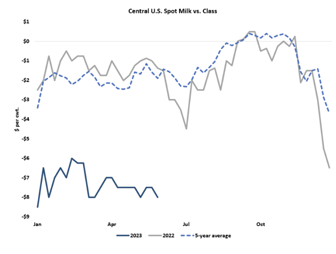
There is simply too much cheese. USDA’s Dairy Market News reports that cheese production schedules are “steady to stronger” and, for some cheesemakers, “limited warehouse space is becoming a concern.” Meanwhile, there is plenty of milk, especially now that bottlers are slowing down intakes for summer break. Spot milk prices in the Upper Midwest ticked back down this week, with some sales as low as $12 under Class III. A few cheesemakers offered their workforce a long weekend, but others worked straight through the Memorial Day holiday. And, unlike earlier in the year, there are very few plants taking downtime for maintenance, so today’s steep discounts reflect a milk surplus that cannot be blamed on underutilized production capacity. By all accounts, the vats are full. USDA reports that some cheesemakers are turning away spot milk because they simply can’t hold anymore.

The excess weighed heavily on the cheese markets. CME spot Cheddar blocks plummeted to $1.42 per pound on Wednesday, their lowest value since May 2020, at the height of the pandemic panic. Blocks made a partial recovery and closed today at $1.43, still down 4.75ȼ for the week. Barrels fared a little better. They closed today at $1.5125, up 2.25ȼ since last Friday. Those prices are probably low enough to attract a bit more export business, but demand is clearly not keeping pace with production.

More cheese means more whey, and most of it is being dried. Demand for higher protein whey concentrates is finally starting to perk up, which could shift more of the whey stream into concentrates down the road. But for now, dry whey output is heavy and so are stocks. CME spot whey prices slipped further this week, closing at 25.75ȼ, just a fraction of a cent above last week’s all-time low and down 1.75ȼ from last Friday.

Once again, the Class IV products held within their well-established trading ranges. CME spot nonfat dry milk (NDM) finished right where it started at $1.17. Spot butter regained half of the ground it lost last week, climbing 1.5ȼ to $2.445.

Dairy Market News describes the NDM market as “balanced,” thanks to decent demand from Mexico. Still, driers are running hard to balance milk supplies in the back half of the spring flush. High temperatures have taken a toll on components, but nights are cool and milk yields are still only a little below the recent peak.

Churns are running, but butter output is expected to slow soon as the heat saps cream production and boosts ice cream sales. For now, though, butter production is going strong and manufacturers are putting away product for later this year.

USDA announced the May milk price at a paltry $16.11 per cwt., down $2.41 from April and $9.10 lower than May 2022. At $18.10, May Class IV milk was 15ȼ higher than April but $6.89 lower than the astoundingly high price set last year. The futures promise steady or better prices ahead for Class IV. Unfortunately, Class III milk is projected to be even cheaper in the near term. Most Class III contracts lost about 50ȼ this week, and June Class III slumped to an untenable $15.29. July is a little better at $16.14, but that is still well below the cost of milk production. Deferred prices look a bit better, in the $17s and $18s, but that is still not enough to pay the bills on most operations. Class IV prices were characteristically stable this week, with modest gains in June and July and slight losses down the board. The futures project prices in the low $18s nearby, climbing above $19 in the fourth quarter.

At these values, dairy producers are suffering painful financial losses, and the number of sellouts is on the rise. However, dairy slaughter volumes are not all that high, which suggests that, for now, most cattle are simply moving to a new home. With lofty beef prices and low milk prices, that’s likely to change very soon. But until it does, the dairy markets will remain under pressure.

Heavy rains are helping to relieve the multi-year drought in the Southern Plains, but it’s hot and dry in the Corn Belt and the forecast calls for more of the same, with the hope of showers more than a week away. The U.S. Drought Monitor rates two-thirds of the Corn Belt as abnormally dry or worse, with 15% officially in drought. Young crops are starting to show signs of stress. Prolonged dryness will chip away at yield potential, although the impact is much less severe today than it would be in mid-summer when the crop pollinates. On the other hand, exports remain tepid. The opposing fundamentals pushed prices back and forth, but ultimately, concerns about the weather won out, and a strong Friday rally signaled that the bulls had the upper hand heading into the weekend. July corn closed at $6.09, up a nickel for the week. December corn climbed 6.75ȼ to $5.4125. July soybeans climbed another 15.25ȼ to $13.525. However, soybean meal prices dropped again. The July contract lost $5.40 and settled at $397.80 per ton.

Original Report At: https://www.jacoby.com/market-report/too-much-cheese/

Milk Markets Mostly Higher in Chicago Tuesday

The Chicago Mercantile Exchange’s milk futures rose on Tuesday, boosted by robust cash markets.


At $15.24, June Class III milks a cent. The July contract is 32 cents higher at $16.29. August gained 30 cents to $17.17. September was 13 cents higher, closing at $17.87. Contracts from October to December are five to thirteen cents higher.


Dry whey gains $0.01 to $0.2750.


Blocks are up $0.03 to $1.46. At that price, one sale was made.


Barrels are up $0.0175 to $1.5675 per barrel. Three deals were executed between $1.5650 and $1.5675.


At $2.3775, butter is down $0.0250. Five deals were placed between $2.3775 and $2.40.


Nonfat dried milk is now $1.1650, up $0.0025. Six transactions were completed at $1.1625 and $1.1650.


The Global Dairy Trade index in New Zealand fell 0.9 percent on Tuesday, continuing its downward trend. Whole milk powder fell 3 percent, followed by butter milk powder, which fell 2.4 percent. Cheddar sales increased 7.4%.


Low Milk Prices: Another DMC Payment to Help

The continued milk price rollercoaster, which seems to be heading lower, has required a Dairy Margin Coverage (DMC) payment to be given in 2023. According to the USDA’s Agricultural Prices report, which was issued late Wednesday afternoon, the April Dairy Margin Coverage revenue over feed costs was $5.84/cwt. Producers having coverage at $9.50/cwt will get $2,735.38 in indemnity payments for each million pounds enrolled.

In comparison to March, the all-milk price decreased $0.40/cwt. to $20.70, maize increased $0.03/bu. to $6.70, premium alfalfa hay climbed $1.00/ton to $315, and soybean meal decreased $27.15/ton to $457.25.

To far, the $9.50 coverage has paid $8,926.53 for each million pounds in exchange for a $1,500 premium. Payments for the highest level of coverage are expected to continue until October, according to the Farm Service Agency.

The DMC programme was established by the 2018 farm bill to provide farmers with protection when the gap between the all-milk price and the average feed price falls below the producer-selected margin trigger.

According to Jim Mulhern, CEO of NMPF, DMC’s catastrophic coverage level is at the top of his team’s farm bill wish list.

“The basic DMC’s catastrophic coverage level includes up to 5 million pounds of annual protection, which is equivalent to a 200 to 220 cow herd.” “We’re looking at DMC’s tier 2—anything above basic—adjustments because the collapse of those markets would be more akin to a truly ‘catastrophic’ event,” Mulhern explains.

According to Phil Plourd, president of Ever.ag Insights, periods like these make farmers appreciate programmes like DMC as well as coverage options like Dairy Revenue Protection (DRP).

“These are also times when we are reminded that risk management necessitates vigilance and diligence.” I doubt many people expected margins to be this low in 2023. “However, here we are,” he adds. “Producers who take a disciplined approach to market monitoring and action may not come out on top in this environment, but they are almost certainly doing better.” When will it be over? Prices are clearly low enough to inhibit production, which we anticipate in the coming months. However, there are several shifting variables in the market equation, both domestically and abroad.”

Milk Prices Continue Their Downward Slide

On the Chicago Mercantile Exchange, milk futures were down while cash dairy prices were neutral.

June Class III milk was $0.10 lower at $15.19. July’s price went down $0.17 to $15.97. August’s price went down $0.12 to $16.87. September’s price went down $0.02 to $17.74. Contracts from October to April varied from thirteen cents lower in October to ten cents higher in March.

Dry whey was trading at $0.2650, up $0.0075. There were no sales registered.

The price of cheese blocks remained steady at $1.43. Six sales ranged from $1.43 to $1.4450.

Cheese barrels increased $0.0375 to $1.55. Five sales ranged from $1.53 to $1.55.

At $2.4025, butter was down $0.0425. Five transactions were registered, with prices ranging from $2.4025 to $2.44.

Nonfat dried milk fell $0.0075 to $1.1625. Seven transactions were registered, ranging from $1.1625 to $1.1650.

Milk Futures Lower While Cash Dairy Mixed in Chicago Wednesday

On the Chicago Mercantile Exchange, milk futures were down while cash dairy prices were mixed Wednesday.

June Class III milk was $0.15 lower at $15.41. July’s price went down $0.17 to $16.15. August was $0.19 lower at $17.00. September was $0.18 lower at $17.95. Contracts from October to April were four cents lower in November and fifteen cents lower in April.

Dry whey fell $0.0050 to $0.27. Eleven sales ranged from $0.27 to $0.28.

Cheese blocks were $0.01 lower at $1.42. Fourteen transactions were registered, with prices ranging from $1.4150 to $1.43.

Cheese barrels gained $0.0025 to $1.4975. Eleven transactions from $1.4950 to $1.4975 were reported.

Butter was trading at $2.4550, up $0.0250. At that price, one sale was recorded.

Nonfat dried milk fell $0.0075 to $1.1550. At that price, one sale was recorded.

Dairy Prices Mixed as Future Push Lower in Chicago Mid Week

On the Chicago Mercantile Exchange, milk futures were down, while cash dairy prices were mixed.

June Class III milk was $0.18 lower at $16.37. July’s price went down $0.12 to $16.82. August’s price went down $0.09 to $17.63. September was $0.05 lower at $18.48. Contracts from October to April varied from one cent lower in November to six cents higher in December.

Dry whey was $0.0175 higher at $0.26. There were nine transactions between $0.2725 and $0.2875.

Cheese blocks fell $0.0750 to $1.5775. There were two sales at $1.5775 and $1.63.

The price of cheese barrels stayed steady at $1.5150. At that price, one sale was recorded.

The price of butter remained steady at $2.4375. There were no sales registered.

Nonfat dried milk increased $0.0050 to $1.1575. From $1.15 to $1.1575, four transactions were registered.

0.9% drop in the Global Dairy Trade

Global Dairy Trade: Sharing a New Dairy Price Quote from Fonterra:

AMF index down 4.5%, average price US$4,600/MT
Butter index up 2.2%, average price US$5,068/MT
Ched index down 3.4%, average price US$4,407/MT
SMP index down 1.6%, average price US$2,766/MT
WMP index up 0.3%, average price US$3,244/MT

USDA forecasts milk price decreases until 2024.

The USDA predicts lower milk output this year and increased production in 2024. The organisation predicts that cow stocks will be higher this year, with slower milk per cow growth, than dairy cows will enjoy output increase and an extra milking day in 2024.

Because of robust demand, the USDA upped its projection for 2023 butter and nonfat dry milk prices in its May supply and demand report, while lowering its forecast for cheese and whey prices. The USDA predicts a decrease in Class III prices and a rise in Class IV prices.

The agency forecasts Class III prices to fall due to lower whey costs next year, and Class IV prices to fall due to reduced butter and nonfat dry milk prices.

The prediction for total milk prices in 2023 has dropped 15 cents to $20.50 per hundredweight. The USDA projection for next year is $19.90.

Markets Down in Chicago with the Exception of Butter

On the Chicago Mercantile Exchange, milk futures and cash dairy prices were down on Thursday, with the exception of butter.

May Class III milk was $0.06 lower at $16.46. June’s price went down $0.28 to $16.91. July’s price went down $0.24 to $17.63. August was $0.13 lower at $18.41. Contracts from September to April varied from constant in April to seven cents lower in October.

Dry whey fell $0.0025 to $0.30. Two sales of $0.30 and $0.3025 were reported.

Cheese bricks down $0.0525 to $1.6175. Six sales ranged from $1.61 to $1.63.

Cheese barrels fell $0.0325 to $1.5050. Five sales ranged from $1.50 to $1.5050.

Butter was trading at $2.4075, up $0.0125. Although there were two bids, no sales were reported.

Nonfat dried milk fell $0.01 to $1.17. There were two sales at $1.17 and $1.1750.

Chicago Milk Prices Mostly Lower to Start the Week

Milk futures on the Chicago Mercantile Exchange began the week mainly down, weighed down by a higher dollar and little cash action. Class III milk for May is down 11 cents to $16.46. The June contract was five cents higher at $17.04. July dropped six cents to $17.70. August fell two cents to $18.50. September through November futures are down seven cents to be steady.

To begin the week, the CME spot dairy auction was quite calm.  Dry whey is constant at $0.3275. The price of blocks remains steady at $1.6125. Barrels are down $0.0150 to $1.5150 per barrel. At $2.43, butter is down $0.0150. At that price, one sale was made. Nonfat dry milk unchanged at $1.1975.

Feed Markets Tumble

The T.C. Jacoby Weekly Market Report Week Ending April 28, 2023

The feed markets tumbled once again this week and dairy producers can thank Brazilian farmers for the setback. Brazil lacks the infrastructure to hold this year’s bin-busting production. Brazilian soybeans outprice U.S. soy by such a wide margin, two ships with Brazilian soybeans will hit the U.S. Southeast coast this week.

The feed markets tumbled once again this week. July corn futures notched their lowest price in nearly a year and closed today at $5.85 per bushel, down 30ȼ from last Friday. July soybeans lost just as much ground and settled at $14.1925. July soybean meal lost another $11 and finished at $432.40 per ton.

Dairy producers can thank Brazilian farmers for the setback. The market is growing increasingly confident that Brazil will harvest a massive second – or safrinha – corn crop. Brazil typically sends nearly all safrinha corn for export, but this year’s safrinha harvest comes hot on the heels of a large first corn crop and a record-breaking soybean crop to boot. Brazil lacks the infrastructure to hold this year’s bin-busting production, so farmers and commercial elevators are rushing to get crops out the door. Brazilian soybeans outprice U.S. soy by such a wide margin, two ships with Brazilian soybeans will hit the U.S. Southeast coast this week.

U.S. corn and soy exports were already moving at a languid pace, but now they are practically going backward. China cancelled two orders for U.S. corn this week, and China will presumably switch even more of its business to South America. U.S. corn export commitments to foreign markets other than China stand at their second-lowest level in two decades, behind the 2012-13 crop year. As the Daily Dairy Report notes, “Slow U.S. grain exports could help speed the transition from today’s scarcity to anticipated abundance this fall.” Farmers are expected to plant more corn this year, and stocks are likely to climb. Optimism about this year’s crop prospects weighed heavily on summer and fall corn futures this week.

Dairy producers will surely welcome the big selloff in feed prices. But the transition from lower futures to cheaper rations could be painfully slow as producers work their way through onfarm inventories and contracted feed priced at much higher values. According to the Dairy Margin Coverage program’s formula, feed expenses used up $14.65/cwt. of milk revenue on the typical U.S. dairy operation in March, leaving just $6.45 to cover all other expenses. In Texas, the formula calculates feed costs equal to $16.60/cwt. last month, which is obviously unendurable. Pain on the farm is going to get worse before it gets better, as the recent decline in feed prices has been more than offset by dramatic drops in milk values.

This week, May through August Class III futures scored fresh life-of-contract lows. The May contract is truly in the doldrums. It closed today at a punishingly low $16.81 per cwt., down 51ȼ from last Friday. The June contract dropped 79ȼ this week to $17.22. Deferred contracts also posted double-digit losses. Class IV contracts fared much better, with slight gains nearby and modest losses down the board.

Class III values got no help from the whey market this week. CME spot whey powder slipped a penny to 35.25ȼ. Meanwhile, cheese prices diverged. CME spot Cheddar barrels finally sunk low enough to deter would-be sellers, while buyers continued to snap up cheese in Chicago. After spending two days below $1.50, barrels bounced back to $1.59 per pound, up 3.75ȼ for the week. But blocks fell another 6.25ȼ to $1.6875, a 17-month low.

Despite the abundance of milk in the cheese states, cheese stocks grew at the typical seasonal rate in March. They reached 1.46 billion pounds on March 31, 0.4% below prior-year levels. However, inventories of American-style cheeses grew at a heady pace last month. They stood at 832 million pounds, topping year-ago volumes for the first time since August. Heavy American cheese stocks and the spring flush will likely continue to weigh on Cheddar values in the near term.

Curiously, butter stocks did not grow at all last month. In fact, they fell 2.3 million pounds to 606 million pounds. March 31 stocks were still 3.5% greater than the unusually tight supplies of early 2022, but they were notably smaller than end-of-March inventories in 2020 or 2021. The shrinking stockpile helps to explain why butter prices have remained resilient, but the industry will have to wait for the Dairy Products report and the latest trade data to determine why butter inventories were so modest last month. The spot market hinted that supplies may be growing now. CME spot butter fell 4.75ȼ this week to $2.2325.

Milk powder prices managed to added another half-cent. CME spot nonfat dry milk (NDM) closed at $1.17 per pound. Whole milk powder (WMP) prices also inched upward at Tuesday’s GDT Pulse auction. However, the market remains anxious about Chinese demand. Chinese WMP imports disappointed once again in March, a clear sign that China has enough WMP on hand, and it is not yet hungry for imported product. China is buying WMP at its slowest average rate since 2018. On the other hand, China bought skim milk powder and whey at a gallop and it purchased cheese at a trot.

If China – or any other foreign buyers – step up dairy product purchases to take advantage of today’s lower prices, dairy product supplies could tighten up in a hurry. But for now, there is plenty of milk, cheese, butter, and milk powder to go around, and prices remain low.

Original Report At: https://www.jacoby.com/market-report/feed-markets-tumble/

Dairy Markets Turn Green in Chicago Wednesday

Green has returned to the dairy markets, with Class IV leading the way upward for the second day in a row. May Class III milk was $0.11 higher at $16.76. June was $0.11 higher at $17.08. July was $0.10 higher at $17.84. August was $0.09 higher at $18.57. Contracts from September through March varied from unchanged in January, February, and March to a fifteen cent increase in November, which concluded at $19.40.

The CME spot trade for all of our items was green. Dry whey was $0.0125 higher at $0.3375. There were eighteen sales ranging from $0.33 to $0.3375. Cheese blocks were $0.0275 higher at $1.69. Three transactions were made ranging from $1.6650 to $1.6825. Cheese barrels increased $0.0275 to $1.5850. There were nine transactions ranging from $1.5675 to $1.5825. Butter was trading at $2.4425, up $0.02. At that price, one sale was recorded. Nonfat dried milk increased $0.0050 to $1.1925. Six sales ranged from $1.19 to $1.1950.

Slashed and bruised milk prices in Chicago

On the Chicago Mercantile Exchange, milk futures were down while cash dairy prices were stable to lower Tuesday.

May Class III milk was $0.29 lower at $16.50. June’s price went down $0.34 to $17.25. July was $0.20 lower at $18.02. August was $0.15 lower at $18.72. Contracts from September through March varied from constant in January and February to seventeen cents lower in September.

The price of dry whey remained steady at $0.3325. There were no sales registered.

Cheese blocks down $0.0175 to $1.6625. At that price, one sale was recorded.

Cheese barrels fell $0.0550 to $1.4750. There were fifteen transactions, with prices ranging from $1.4750 to $1.5175.

The price of butter stayed steady at $2.40. There were no sales registered.

The price of nonfat dry milk remained steady at $1.1650. There were no sales registered.

Send this to a friend