




Archive for sexed dairy semen

The $585‑Per‑Service Beef‑on‑Dairy Trap: What a 500‑Cow Herd Reveals About Your Replacement Pipeline

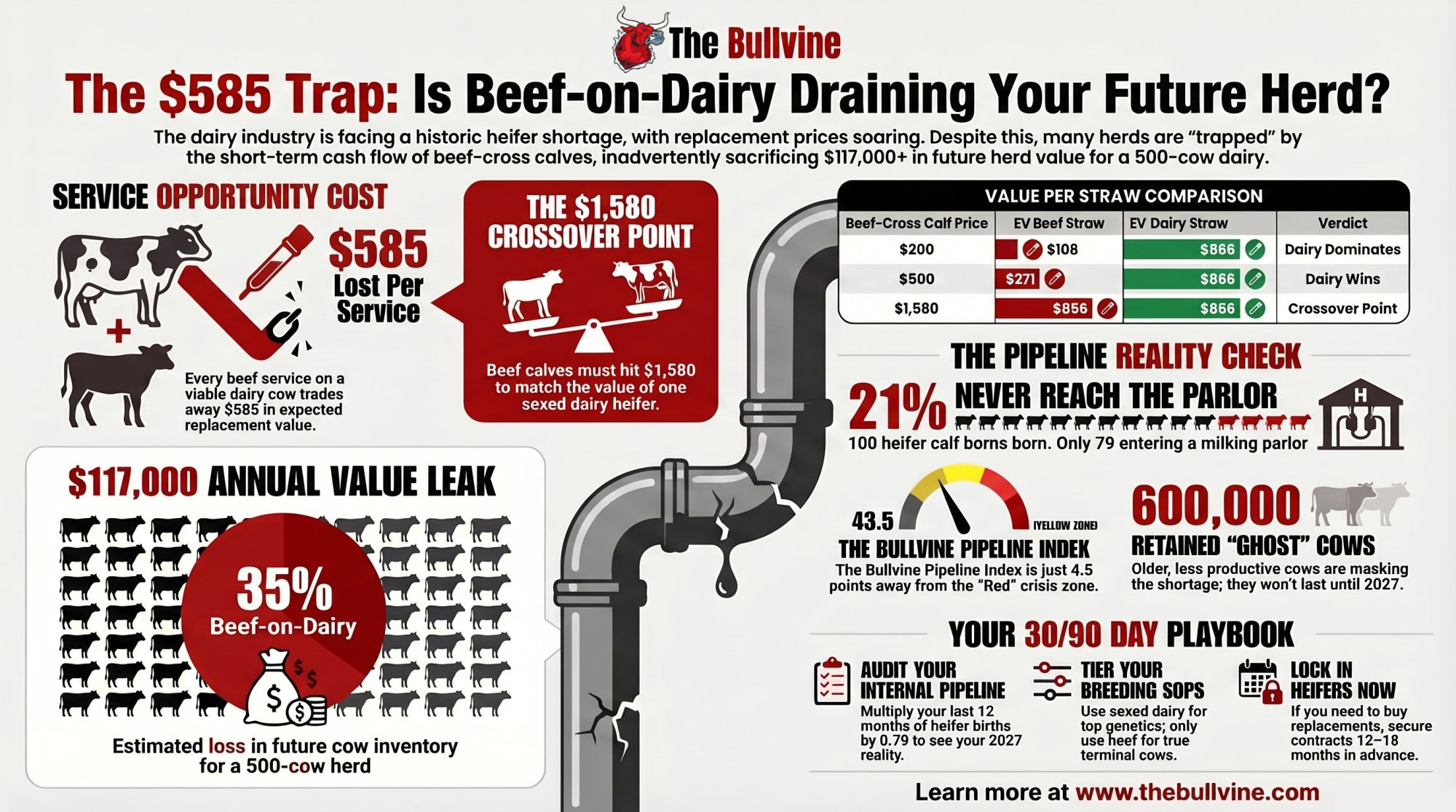
200 beef services on a 500‑cow herd work out to $117,000 in lost replacement value. The calves look good today. The pipeline doesn’t in 2027.

A 500‑cow Panhandle dairy shipping to one of the new plants outside Amarillo needs 135 replacement heifers a year at a 27 percent turnover rate. At the current national average of $3,010 per head (USDA Agricultural Prices, July 2025), that’s a $406,350 annual replacement line — closer to $500,000 in the premium bands Texas and California producers are actually paying. And the Bullvine Replacement Pipeline Tracker shows only 4.29 million heifers entering the national milking herd in 2027 from 2025 breedings, against a herd of 9.35–9.57 million cows and billion in new processing steel that needs milk.
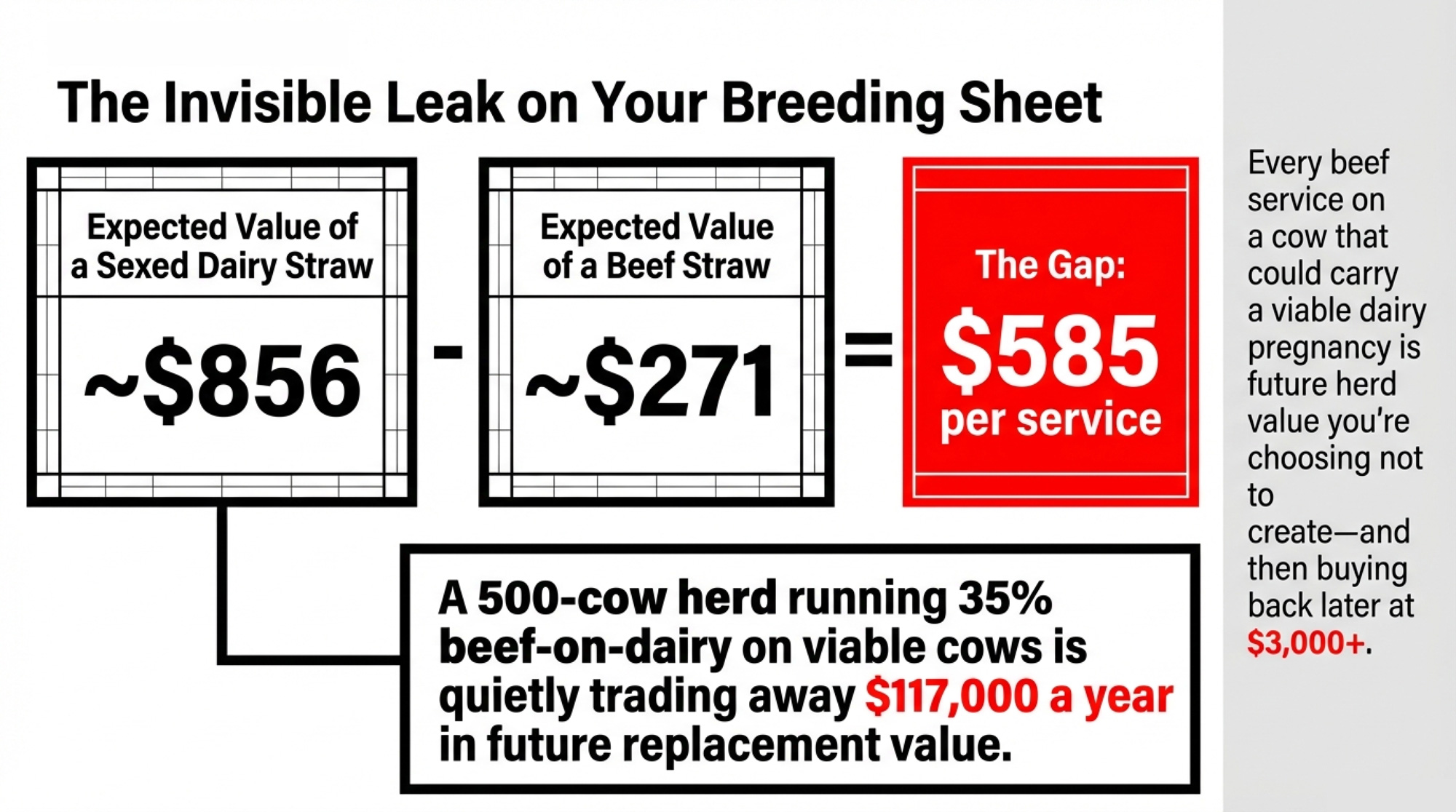
Meanwhile, that same herd’s breeding sheet is probably still heavy on beef‑on‑dairy. Two years ago, beef‑cross calves brought $900–$1,400 in the right programs. Today, a sexed dairy straw generates an expected value of roughly $856while a beef straw sits near $271 at a $500 calf price. Every beef service on a cow that could carry a viable dairy pregnancy is a $585 gap in expected replacement value. How many of those services can your 2027 herd absorb before you’re buying someone else’s genetics at $3,500+?

The Pipeline Math: From Semen Straw to Milking Cow

The Bullvine Replacement Pipeline Tracker takes NAAB’s domestic semen sales and applies biological conversion rates. Not vibes. Multiplication.

From the NAAB 2025 Year‑End Report (released March 2026), domestic units only:

  • 10.6 million units of sexed dairy semen (+644,000, up 6 percent vs. 2024).
  • 6.0 million units of conventional dairy (down about 280,000).
  • 8.1 million units of beef‑on‑dairy (flat).

NAAB members exported 63 percent of the dairy semen they produced in 2025. Those export doses never enter U.S. cows. Only the domestic units drive your pipeline.

Sexed semen now represents 64 percent of domestic dairy units, up from roughly 58 percent a year earlier. That shift matters enormously in the pipeline math because of what happens at each biological step.

The conversion rates — documented by Dr. Michael Overton of Zoetis from field data across 85 commercial Holstein herds:

ParameterSexedConventional
Conception rate42 percent (range 40–45)57 percent (range 55–60)
Pregnancy survival95 percent95 percent
Sex ratio (heifer)90 percent50 percent
Completion rate (calf to milking cow)79 percent79 percent

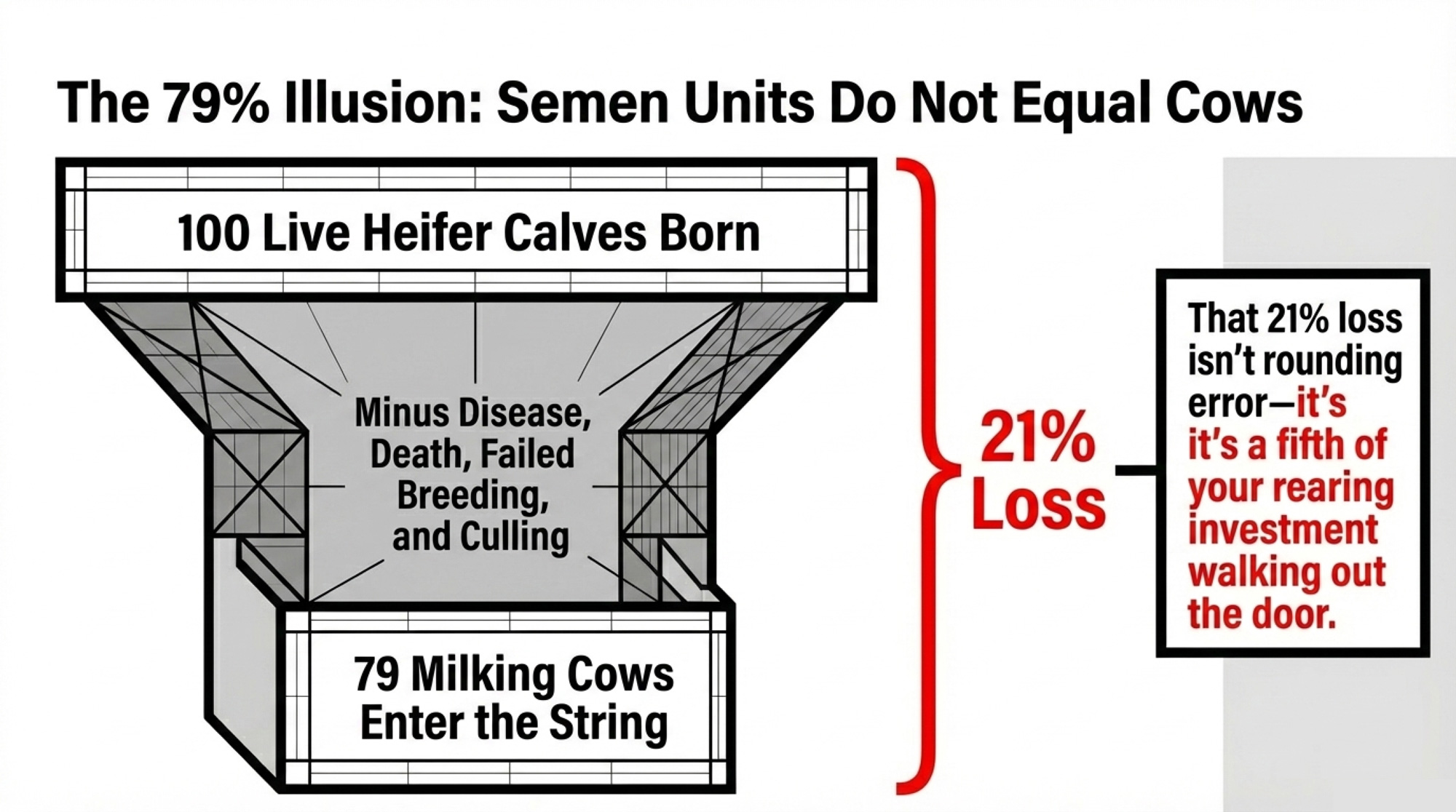
That 79 percent completion rate is the one most producers underestimate. Twenty‑one out of every 100 heifer calves born alive never make it to the milking string. Disease. Death. Failed breeding. Culled before first calving. That’s not rounding error — it’s a fifth of your rearing investment walking out the door.

Run the national numbers:

StageSexed DairyConventionalTotal
Domestic Semen Units10.60M6.00M16.60M
Pregnancies4.45M3.42M7.87M
Live Calves4.23M3.25M7.48M
Heifer Calves3.81M1.62M5.43M
Milking Herd Entries3.01M1.28M4.29M

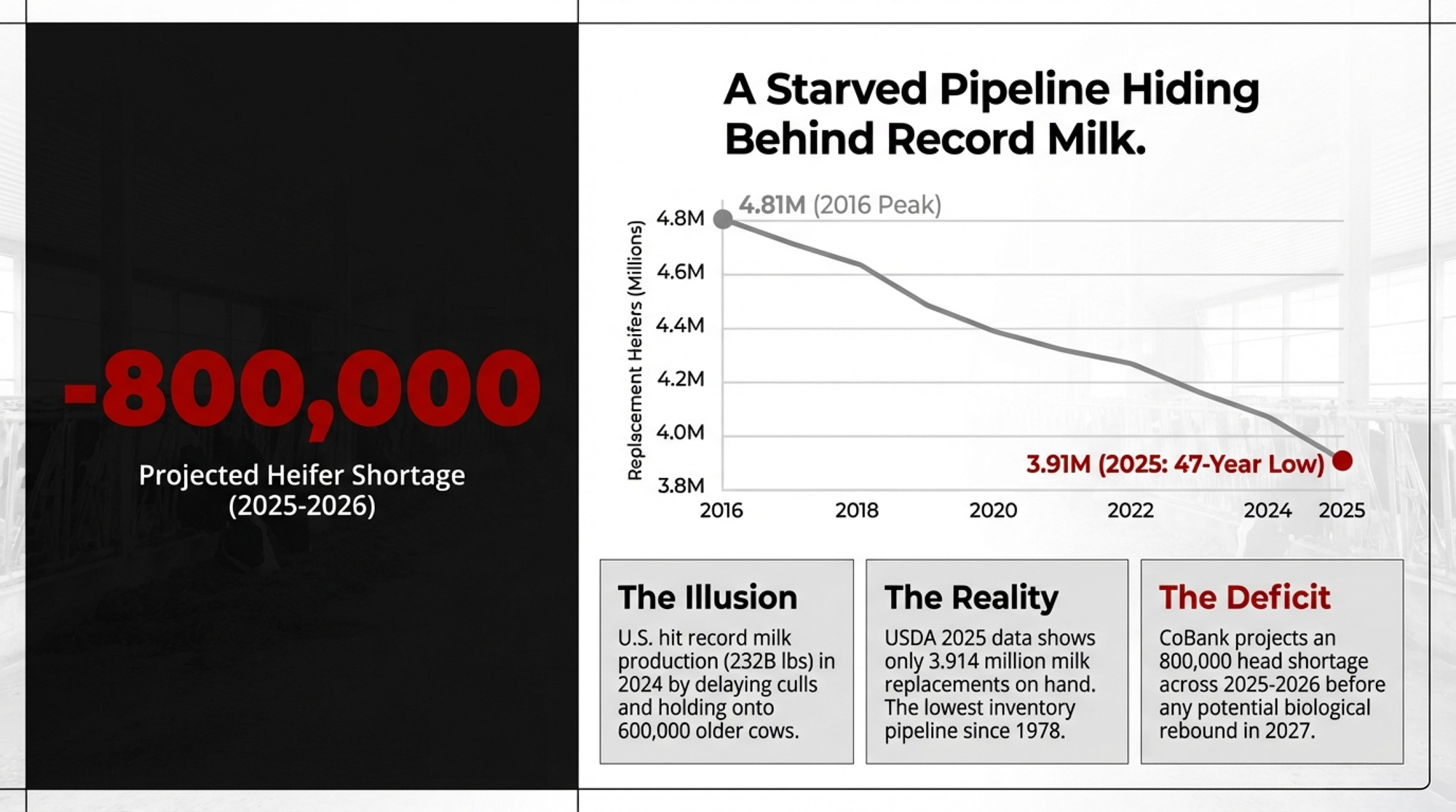
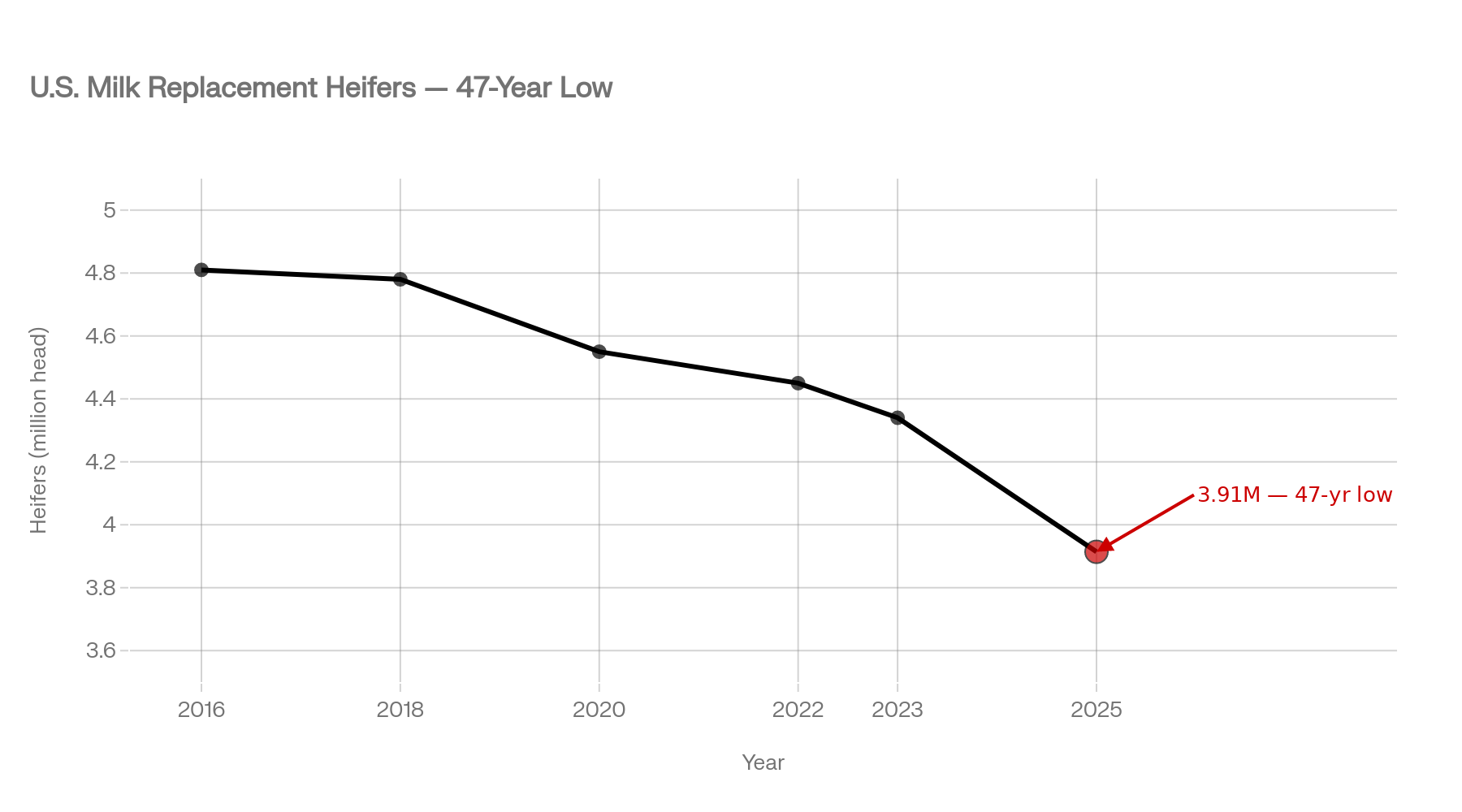
That’s your 4.29 million heifers for 2027. The USDA Cattle Inventory (January 2025) counted just 3.91 millionreplacement heifers on U.S. farms — the lowest in nearly five decades and 18 percent below the 2018 peak. Corey Geiger and the CoBank team (CoBank Knowledge Exchange, August 2025) project the heifer trough extending through 2026 — roughly 438,844 fewer heifers vs. 2025 — before a partial rebound of about 285,387 more in 2027. Geiger’s CoBank model works at the national level with annual NAAB data, which is a huge step forward, and the Bullvine version builds on it in three ways. First, we overlay weekly USDA dairy cow slaughter data so that the projections adjust as culling behavior shifts, rather than waiting for the next annual semen report. Second, we break the projections down by state, because a heifer surplus in Idaho doesn’t help a short herd in New York once you factor in freight, biosecurity, and breed mix. Third, we bolt on a beef‑on‑dairy tipping‑point calculator that turns semen mix trends into an expected‑value crossover number — like the ,580 beef‑calf price where beef finally matches sexed dairy — so breeding decisions can move now, not a year from now.
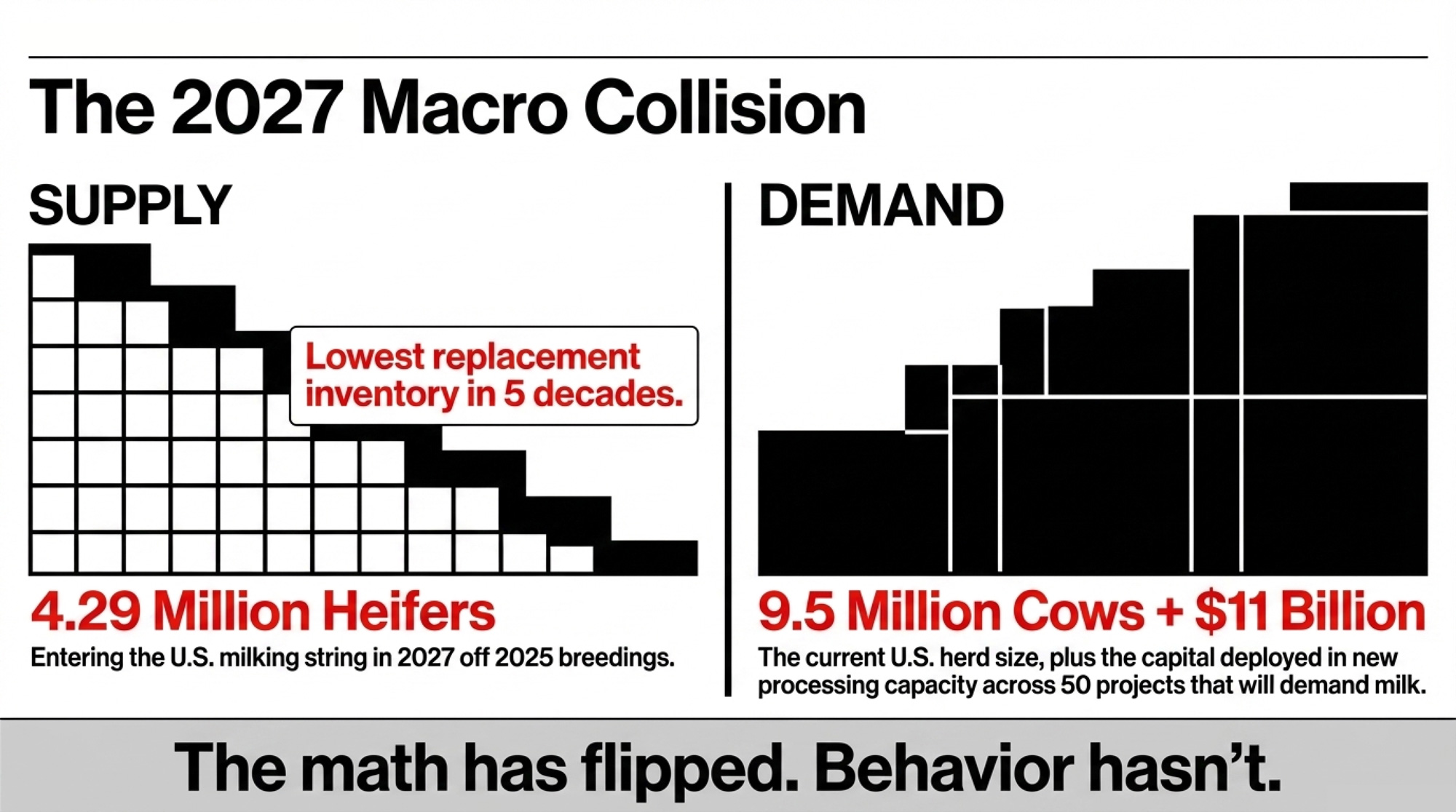
That 2027 rebound is real. But it’s a rebound from a historic low, into a herd that’s expected to fill $11 billion in new processing capacity across more than 50 projects in 19 states.

That conversion pipeline — semen to pregnancy to live calf to heifer to milking cow, with losses at every step — is the spine of the Bullvine Replacement Pipeline Tracker and the reason it can tell you today what your 2027 cow supply will look like.

How Many Replacement Heifers Do 2025 Breedings Actually Produce?

Here’s where that national number lands on your farm. If you’re running 500 cows with a 27 percent replacement rate, you need 135 heifers a year. To produce 135 heifers internally, you need your sexed dairy services generating enough heifer calves — multiplied by 0.79 — to cover that number.

A herd using 50 percent beef‑on‑dairy on the bottom tier produces almost exactly the number of heifers it needs to hold size after applying Overton’s 79 percent completion rate. Zero margin for error. One bad calfhood disease event, one stretch of below‑average conception rates, and you’re short. That’s not a plan — that’s a coin flip with $406,350consequences.

Quick check: your last 12 months of heifer‑calf births × 0.79 vs. herd size × your replacement rate — that spread is your 2027–2028 problem. If you land at 110 or 115 instead of 135, your future herd is already under‑built. No market rally generates animals that aren’t in your pipeline.

When Does Beef‑on‑Dairy Actually Stop Paying?

At what beef‑cross calf price does beef semen become a better economic play than sexed dairy on the same cow?

Sexed dairy expected value per straw: $3,010 × 0.42 × 0.95 × 0.90 × 0.79 ≈ $856.

Beef expected value per straw (at a $500 pre‑weaned calf): $500 × 0.57 × 0.95 ≈ $271.

More than three times the expected value for dairy. But the scenario table tells the full story:

Beef Calf PriceBeef EV/StrawSexed Dairy EVDairy AdvantageVerdict
$200$108$856$748Dairy dominates
$500$271$856$585Dairy wins
$1,000$542$856$314Dairy still ahead
$1,500$812$856$44Near breakeven
$1,580$856$856$0Crossover
$2,000$1,083$856–$227Beef wins

Beef calves have to clear $1,580 per newborn/pre‑weaned calf to match sexed dairy’s expected value at a $3,010heifer. Current beef‑cross calf prices from dairy herds range from $200 to $500+, depending on genetics and region. Some high‑end weaned feeders at 500–700 pounds push higher in program and video sales, but at the breeding‑decision level — the straw going in the gun — the math isn’t close.

Three behavioral reasons explain why producers haven’t caught up. Cash flow timing: a beef calf brings a check in weeks; a heifer generates milk in about 24 months. Strategy inertia: programs built when calves pulled $900–$1,400haven’t been rewritten. The lag itself: any heifer you aim to calve in 2028 has to be conceived now, and that feels like forever when feed bills hit monthly.

None of that makes the choice crazy in the moment. It just explains why behavior hasn’t caught up to the math — and why the pipeline keeps bleeding.

The Turn: $117,000 on One Panhandle Breeding Sheet

Here’s where this gets personal for that 500‑cow Panhandle herd.

Say the operation’s been running 35 percent beef‑on‑dairy on cows classified as bottom‑third — roughly 200 beef services a year on animals that could carry a dairy pregnancy. At a $585 per‑service expected‑value gap:

200 beef services × $585 ≈ $117,000 in expected replacement value traded away per year.

Cost DriverAnnual $ ExposureCategory
Base Replacement Budget (27% rate × $3,010/head)$406,350Base Budget
TX/CA Premium Band Uplift$93,650Direct Cost Premium
Lost EV: 200 Beef Services × $585$117,000Hidden Risk (Red)
Potential 2027 Bid Premium ($3,500+ vs. $3,010)$295,000Future Risk (Red)

That’s not a clean line item on the P&L. It’s future cow inventory value you’re choosing not to create — and then buying back at $3,010+ when the auction ring gets to it. The number shifts with your calf price and your local heifer cost, but the direction doesn’t. At current market levels, that Panhandle herd’s breeding sheet is quietly writing checks that the pipeline can’t cash in 2027.

This is where the conversation should change. Not “heifers are tight” — which is weather talk — but “how much expected value am I giving up per service, and can my pipeline absorb it?”
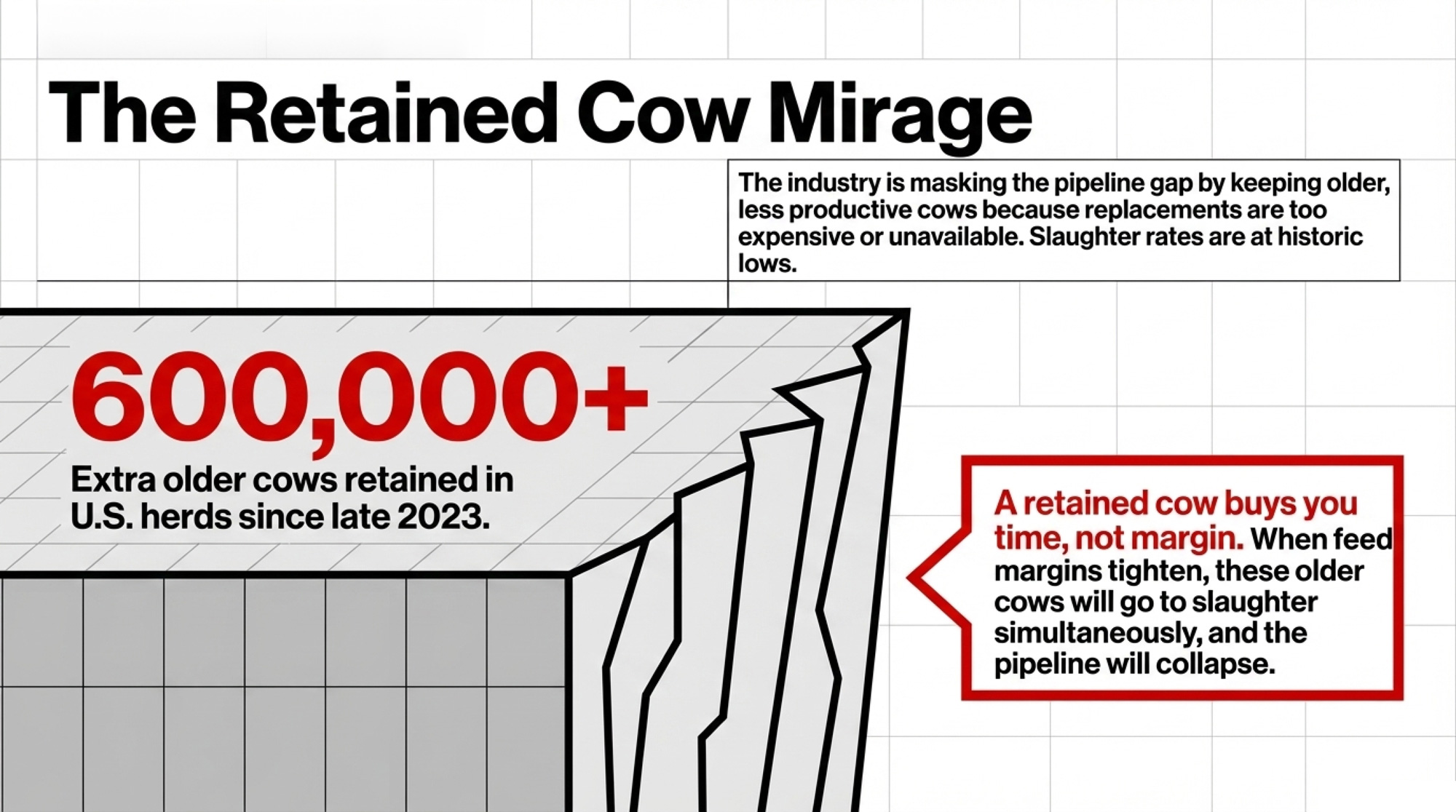
600,000 Retained Cows and the Cliff Underneath

The industry’s been masking the pipeline gap with cow retention. Iowa State Extension’s NW Iowa Dairy Outlook has tracked it since late 2023: from September 2023 through mid‑May 2025, weekly dairy cow slaughter ran behind year‑earlier levels in 86 of 88 weeks. January–April 2025 slaughter came in at roughly 889,900 head — the lowest start to a year since 2008. By the second half of 2025, culling ticked up 2.7 percent as the herd reached 9.57 million head — its largest since the early 1990s — but levels remain historically low.

Bullvine’s modeling extends that documented deficit through late 2025 and estimates the cumulative “extra cows kept” at roughly 600,000–611,600 head vs. the normal culling pace. These aren’t USDA’s numbers — they’re our extrapolation from ISU’s documented weekly deficit. But the direction is consistent: producers kept cows they would normally have shipped because replacements were either too expensive or literally unavailable.

Those retained cows carry the milk volume today. When margins compress further — Class III was $14.59/cwt in January 2026, $14.94 in February, and $16.16 in March (USDA Class and Component Prices). — producers start culling harder. If a meaningful share exit simultaneously, the void can’t be filled by a pipeline set two years earlier. And the cows being retained to supply the $11 billion in new processing capacity are, by definition, the least productive animals in the herd.

MonthClass III Price
January 2026$14.59/cwt
February 2026$14.94/cwt
March 2026$16.16/cwt

The Bullvine Pipeline Index: 43.5 and 4.5 Points from Red
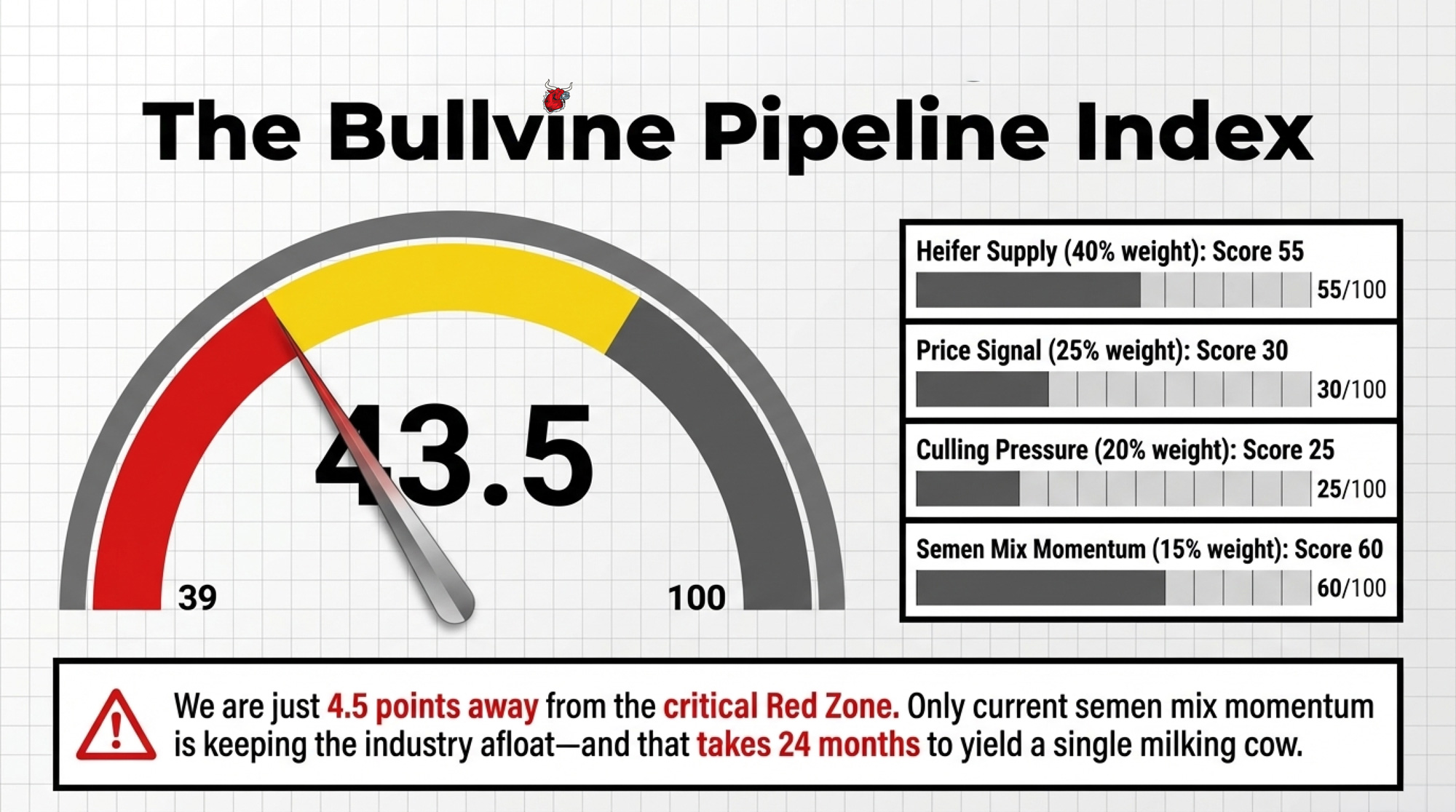
We built a single composite score to track the pipeline’s health. It runs 0 (crisis) to 100 (abundant), weighted across four components:

Component (weight)What it measuresCurrent scoreWeightCurrent Status
Heifer Supply (40 percent)Replacement ratio — currently ~27 per 100 cows5540%Marginal
Price Signal (25 percent)Inverse of heifer price — $3,010/head3025%Red Zone Range
Culling Pressure (20 percent)Deviation from normal culling pace2520%Red Zone Range
Semen Mix Momentum (15 percent)Sexed dairy share — 64 percent and rising6015%Adequate
Composite43.5100%Yellow Zone

Index = (55 × 0.40) + (30 × 0.25) + (25 × 0.20) + (60 × 0.15) = 43.5.

Yellow Zone (40–69). Barely. The Red threshold is 39.

This Index is sensitive to culling. If slaughter normalizes and the Culling Pressure Score drops from 25 to 15, the Index slides to 41.5. If sexed semen adoption stalls at the same time — possible if cash‑strapped herds revert to cheaper conventional — you’re at 38. Red Zone. No catastrophe needed. Just normal economics catching up.

For that Panhandle herd, the Index confirms what the breeding sheet already showed: the semen mix momentum is the only indicator keeping the pipeline above the critical threshold. And that momentum takes roughly 24 months to yield a single milking cow. The race is whether retained cows hold long enough for the 2025 breeding surge to reach the milking string in 2027.

How Did We Get to 43.5? The Two‑Year Trend Nobody Tracked

A single Index reading is a snapshot. The trajectory tells you whether you’re healing or bleeding. We back‑calculated the Pipeline Index at five points from mid‑2024 through early 2026, using the same four‑component framework and the best available USDA, NAAB, and ISU Extension data at each snapshot.
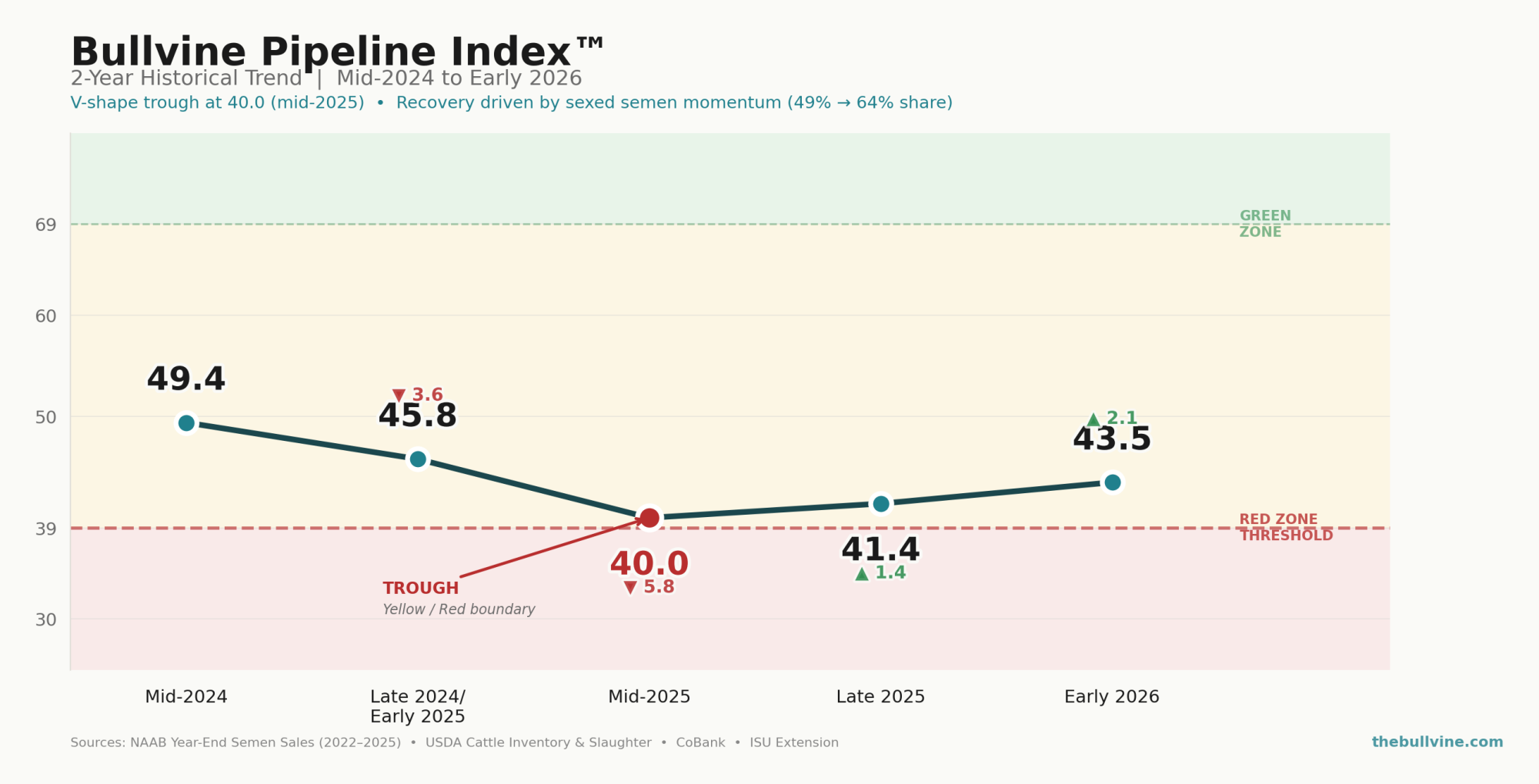
PeriodApprox. DatePipeline IndexZoneChange
1Mid‑202449.4Yellow
2Late 2024 / Early 202545.8Yellow▼ 3.6
3Mid‑202540.0Yellow (boundary)▼ 5.8
4Late 202541.4Yellow▲ 1.4
5Early 2026 (current)43.5Yellow▲ 2.1

Sources: NAAB Year‑End Semen Sales (2022–2025), USDA Cattle Inventory & Slaughter, CoBank Knowledge Exchange, ISU Extension NW Iowa Dairy Outlook.

The Index hit its trough in mid‑2025 at 40.0 — sitting exactly on the Yellow/Red boundary. It’s recovered 3.5 points since, but remains 5.9 points below where it stood just 18 months earlier. That’s not a rebound. That’s a bounce off the floor.

What Drove the Decline

Three components deteriorated simultaneously between mid‑2024 and mid‑2025:

  • Heifer Supply fell from 63 to 48 as the replacement ratio dropped from roughly 31 heifers per 100 cows (the 2016 peak) through 27 per 100 (January 2025 USDA inventory), and USDA’s July 2025 mid‑year report showed milk replacement heifers at just 3.50 million against a herd that was still growing.
  • Price Signal fell from 42 to 30 as national average heifer prices climbed from roughly $2,660 (mid‑2024) to $3,010–$3,110 (mid‑to‑late 2025), with premium markets in California and Minnesota already clearing $4,000+.
  • Culling Pressure fell from 42 to 25 as the industry moved from early retention (fall 2023) to 86 of 88 weeks of below‑year‑earlier slaughter by May 2025. January–April 2025 dairy cow slaughter — roughly 889,900 head — marked the lowest four‑month start to a year since 2008.

Each of those moves alone would’ve been a yellow flag. All three at once is why the Index nearly hit Red without ever making a headline.

What’s Driving the Recovery — and Why It’s Fragile

The partial bounce from 40.0 to 43.5 is driven almost entirely by one component: Semen Mix Momentum climbed from 35 to 60 as sexed dairy’s domestic share rose from 49 percent (2022 NAAB) to 64 percent (2025 NAAB). That’s the pipeline’s one genuine tailwind — producers shifted breeding behavior, and it showed up in the semen tank before it’ll show up in the milking string.

The other three components? Flat to worse.

  • Heifer Supply recovered modestly (48 → 55) because the 4.29 million pipeline projection from 2025 breedings suggests future improvement — but the current on‑farm inventory remains at a multi‑decade low.
  • Price Signal is stuck at 30. Heifers haven’t gotten cheaper.
  • Culling Pressure is stuck at 25. The retention overhang of 600,000+ cows hasn’t broken, and the herd is now 9.57 million — its largest since the early 1990s.

That means the entire recovery is riding on a single behavioral shift (sexed semen adoption) that won’t produce a milking cow for 24 months. If that growth stalls — possible if cash‑strapped herds in a $14–$16 Class III environment revert to cheaper conventional or beef — the Index reverses course with no backstop.

The V‑Shape and Your Breeding Barn

Here’s the practical read. In mid‑2024, you had a buffer. The Index at 49.4 meant the pipeline was tight but functional — you could run a moderately heavy beef‑on‑dairy program and still source replacements without panic pricing. By mid‑2025 at 40.0, that buffer was gone. Any herd that didn’t adjust breeding protocols during that 18‑month slide locked in a thinner pipeline for 2027–2028.

The recovery to 43.5 buys time. It doesn’t buy safety. The structural vulnerabilities — expensive heifers, a massive retention overhang, and $11 billion in new processing demand — haven’t improved. They’ve been offset by breeding behavior that won’t yield results for two more years.

If you adjusted your beef‑on‑dairy split in 2025, your pipeline will reflect that in 2027. If you didn’t, the trend chart above shows exactly how thin your margin is — and the Index is still closer to Red than it is to the Green Zone.

Where the Shortage Bites First
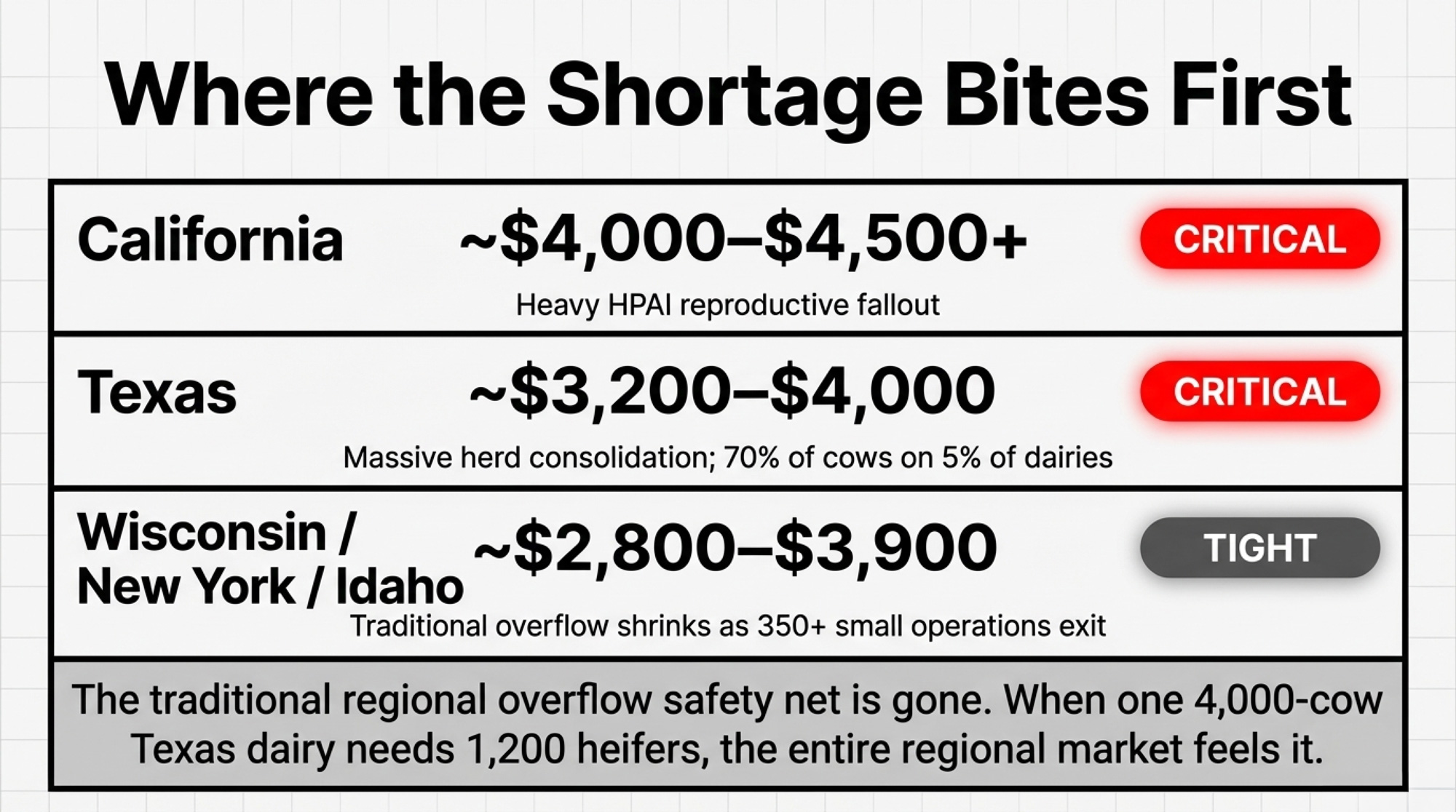
StateShare of herdEst. 2027 pipelineReplacement ratioHeifer price rangeStatus
California~18 percent~772,000~25 per 100$4,000–$4,500+Critical
Wisconsin~14 percent~600,000~28 per 100$2,800–$3,750Tight
Texas~7.5 percent~322,000~24 per 100$3,200–$4,000Critical
Idaho~7.5 percent~322,000~26 per 100$3,100–$3,900Tight
New York~6.5 percent~279,000~28 per 100$3,000–$3,600Tight
Minnesota~4.7 percent~202,000~27 per 100$2,800–$3,850Tight

Bullvine Pipeline Tracker estimates based on USDA cow inventory, NAAB data, and regional replacement ratios.

California has a 25‑per‑100‑cow replacement ratio, heavy HPAI reproductive fallout (750‑plus dairies affected from August 2024–March 2025, with some reporting a 7 percent drop in conception rate), and premium Central Valley springers routinely selling for over $4,500. Texas added 39,000 cows in 2025 — 70 percent of the state’s cows sit on just 5 percent of its dairies in the Panhandle. When one 4,000‑cow dairy needs 1,200 heifers, the regional market feels it. The traditional overflow from Wisconsin and Minnesota shrinks as small operations exit — 230 farms lost in Wisconsin and 120 in New York in 2025 alone.

What This Means for Your Operation
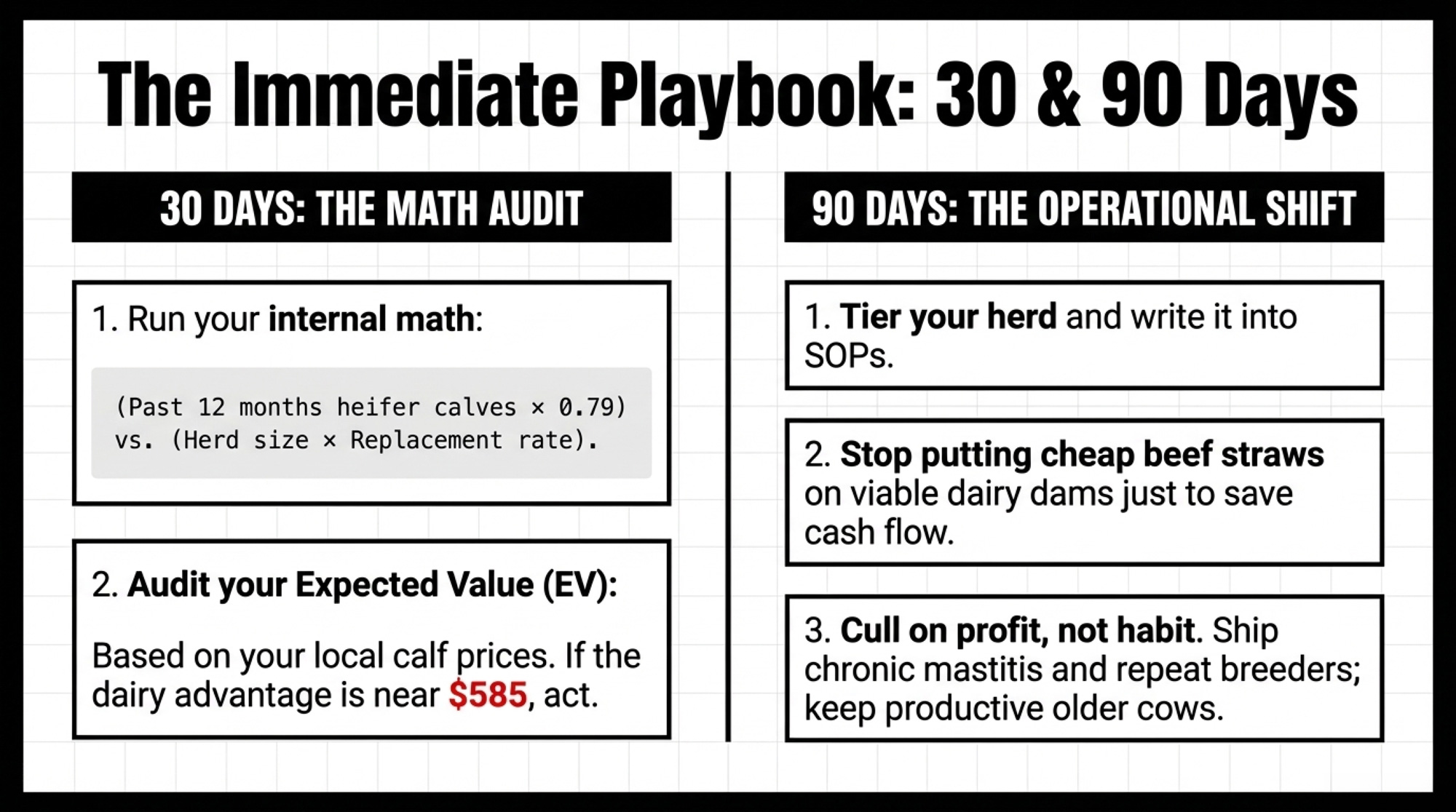
In the next 30 days:

  • Run your pipeline math. Pull 12 months of heifer‑calf births. Multiply by 0.79. Compare to herd size × replacement rate. If you’re short, that gap is baked into 2027–2028 regardless of what happens to prices.
  • Audit beef‑on‑dairy with your own prices.
    EV_beef = your calf price × 0.57 × 0.95.
    EV_dairy = your local heifer cost × 0.42 × 0.95 × 0.90 × 0.79.
    If the dairy advantage looks anything like $585, decide how many beef services you keep on viable dairy dams. You gain near‑term cash. You give up future replacement inventory at today’s expected‑value spread.
  • Call your heifer suppliers this week. Ask how far they’re booked and whether they’ll lock in numbers 12–18 months out. If “I’ll just buy later” is your plan, find out whether the supply actually supports that.

In the next 90 days:

  • Tier your herd and write it into SOPs. Top genetics go to sexed dairy. The middle tier is a mix. True terminal cows only get beef. Don’t let beef creep back onto viable dams just because the straw is cheaper that day.
  • Cull on profit, not habit. Keep productive older cows if SCC and repro allow. Ship chronic mastitis, repeat breeders, and low‑index animals. A retained cow buys you time. She doesn’t buy you margin.
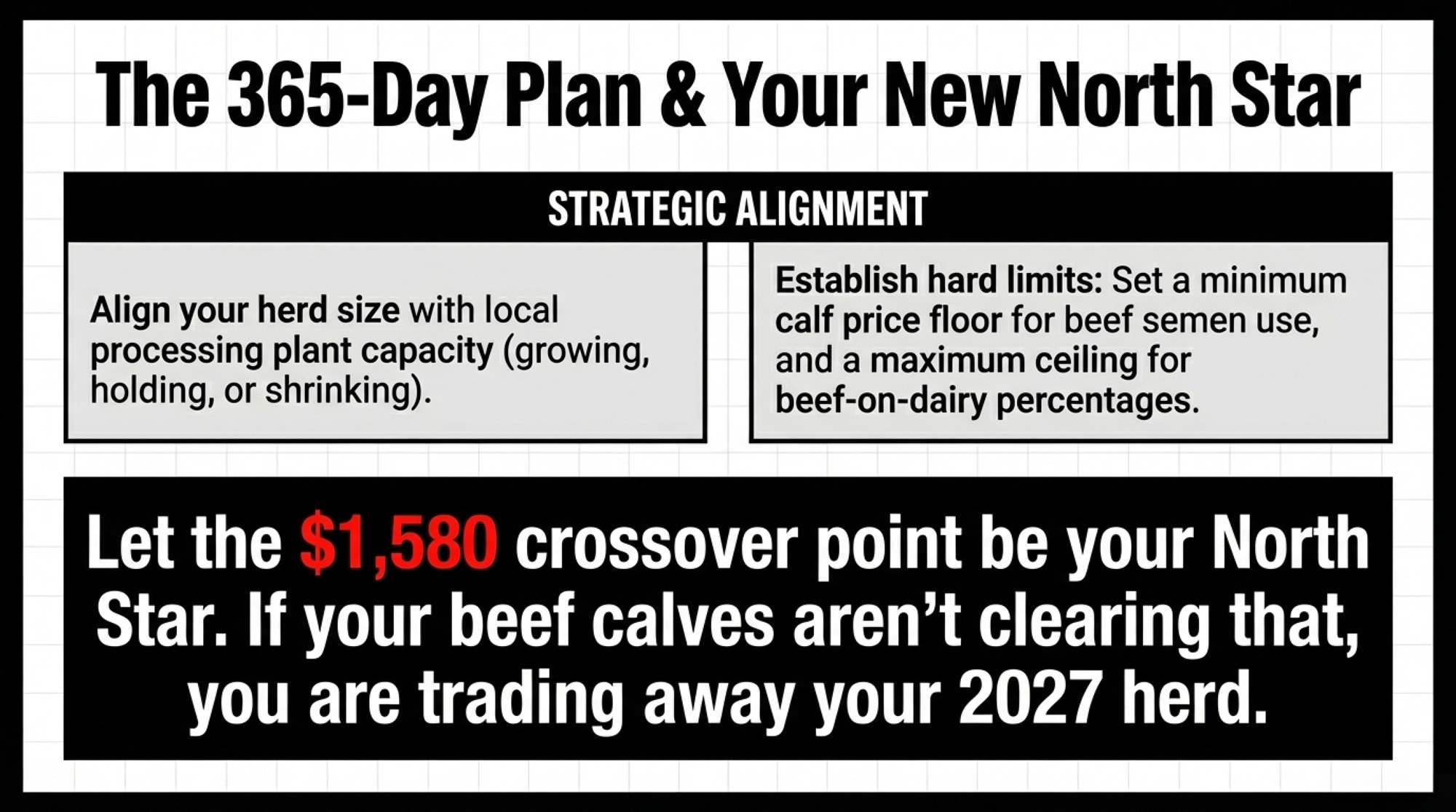
Over the next 365 days:

  • Align your herd plan to your plant. If you’re near new processing steel, decide whether you’re growing, holding, or shrinking. Your pipeline, beef percentage, and culling strategy need to match that call.
  • Set hard floors and ceilings. Floor: the minimum beef‑calf price where beef services still make cash‑flow sense. Ceiling: the maximum percentage of breedings you’ll put to beef on viable dairy dams. The $1,580crossover is your north star.
Key Takeaways

  • If your 12‑month heifer‑calf count × 0.79 doesn’t cover herd size × replacement rate, you’re already short on future cows. That shortage is baked into 2027–2028 and can only be solved with purchased heifers, breeding changes, or culling adjustments starting now.
  • Every beef service on a viable dairy dam trades away roughly $585 in expected replacement value at current prices. The crossover requires beef calves at $1,580 per head. Most markets aren’t in the same zip code. Run the expected‑value calculation with your own calf receipts before your next breeding round.
  • The Pipeline Index sits at 43.5 — Yellow Zone, 4.5 points from Red. Semen mix momentum is the only component holding the score up, and it takes about 24 months to turn semen into a milking cow. One bad culling quarter pushes the national pipeline into critical territory.

Before your next lender review or processor supply meeting, print the EV table and your pipeline math side by side. Ask yourself one question: does your current breeding program produce the cows your operation will need in 2028, or are you planning to compete for someone else’s heifers at $3,500+? The breeding decisions locking in that answer are being made right now. Biology won’t wait for the market to make them comfortable.

We’ll update the Bullvine Replacement Pipeline Tracker and Pipeline Index quarterly as NAAB and USDA data refresh, with the next full reading publishing after the Q3 2026 NAAB report and fall culling data are in.

Methodology Note: Pipeline and economic data in this article comes from the NAAB 2025 Year‑End Report (March 2026), USDA Cattle Inventory (January 2025), USDA Agricultural Prices (July 2025), USDA Class and Component Prices (January–March 2026), CoBank Knowledge Exchange (August 2025), and ISU Extension NW Iowa Dairy Outlook (May and December 2025). Biological conversion rates reference Dr. Michael Overton/Zoetis field data from 85 commercial Holstein herds. The 600,000–611,600 retained‑cow estimate is Bullvine’s extrapolation from ISU’s documented weekly deficit data, not a USDA statistic. National averages may not reflect your specific region, herd size, or management system. All dollar figures are USD. We welcome producer feedback and corrections at editor@thebullvine.com

Learn More

The Sunday Read Dairy Professionals Don’t Skip.
Every week, thousands of producers, breeders, and industry insiders open Bullvine Weekly for genetics insights, market shifts, and profit strategies they won’t find anywhere else. One email. Five minutes. Smarter decisions all week.
NewsSubscribe
First
Last
Consent

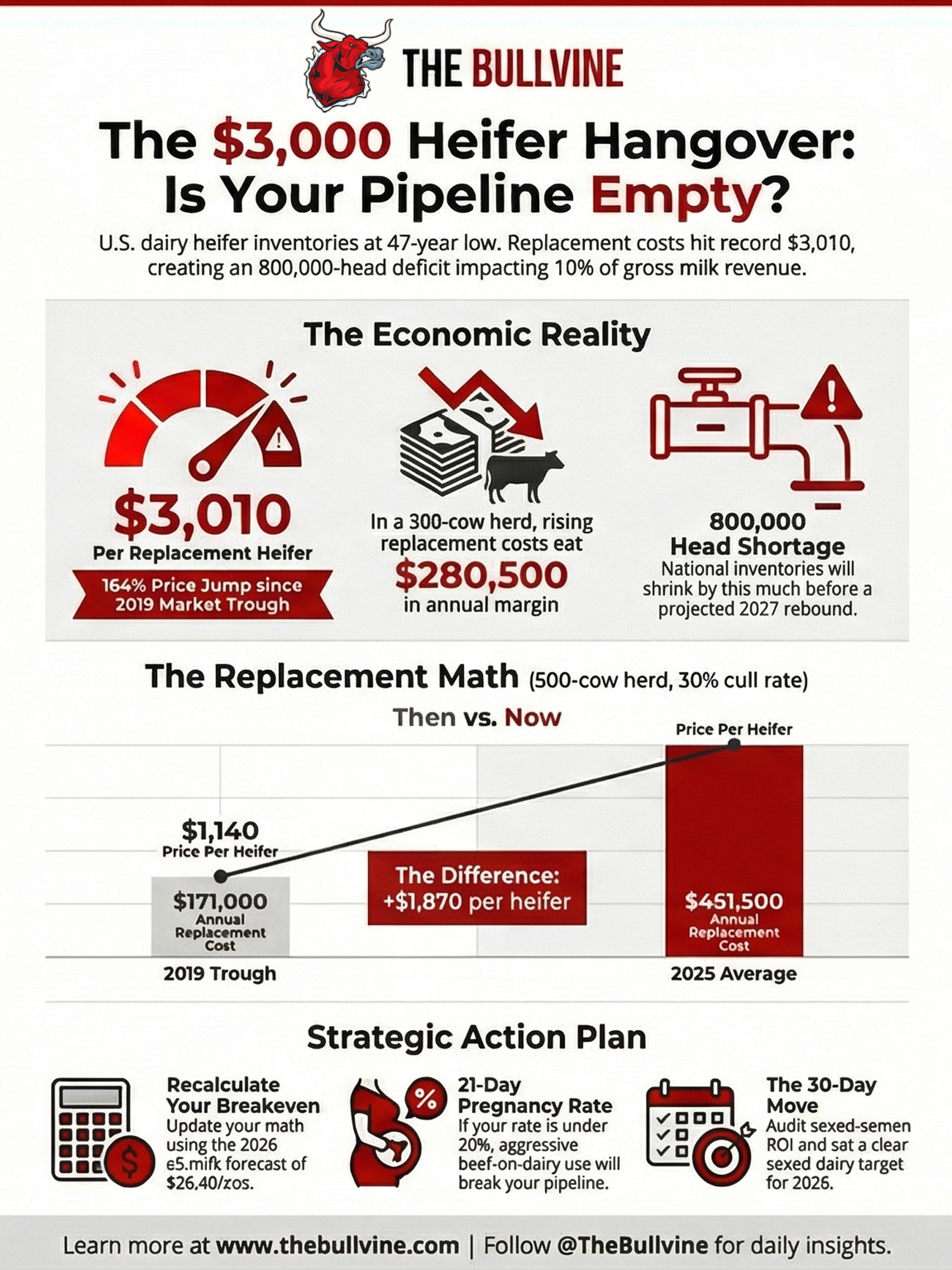
The $3,000 Heifer Hangover: How Beef‑on‑Dairy Emptied Your Pipeline and Left the U.S. 800,000 Head Short

On a 500‑cow herd, the jump from $1,140 to $3,010 per replacement eats $280,500 a year — roughly 10% of your gross. Have you recalculated your breakeven yet?

Executive Summary: Average U.S. replacement heifers just hit about $3,010 per head, and CoBank says the national pipeline will shrink by roughly 800,000 heifers before any rebound in 2027. USDA’s 2025 data shows 3.914 million milk replacements on hand — the lowest since 1978 — even as total milk climbed to 232 billion pounds on 9.50 million cows averaging 24,390 pounds each. For a 500‑cow herd replacing 30% annually, the jump from $1,140 to $3,010 per heifer adds about $280,500 a year in replacement cost, which is close to 10% of gross milk revenue at $20.40/cwt. Beef‑on‑dairy and heavy use of beef semen (7.9 million units on dairy in 2024) filled calf pens but quietly drained the heifer pipeline, especially in fast‑growing states like Kansas, South Dakota, Idaho, and Texas. The article walks through JDS modelling, NAAB semen data, and real farm examples to show when beef‑on‑dairy works, when it backfires, and how your 21‑day preg rate and semen mix determine whether you’ll have enough 2028 replacements. You’ll see three clear paths — lock the pipeline, choose margin over size, or push expansion — each with a 30‑day move you can take now so $3,000 heifers don’t quietly eat what’s left of your margin.

Dairy heifer shortage

Record 2025 milk production was built on one of the thinnest heifer pipelines in decades — and over the next 12–18 months, herds from Kansas to the Upper Midwest will find out if their replacement math holds or breaks.

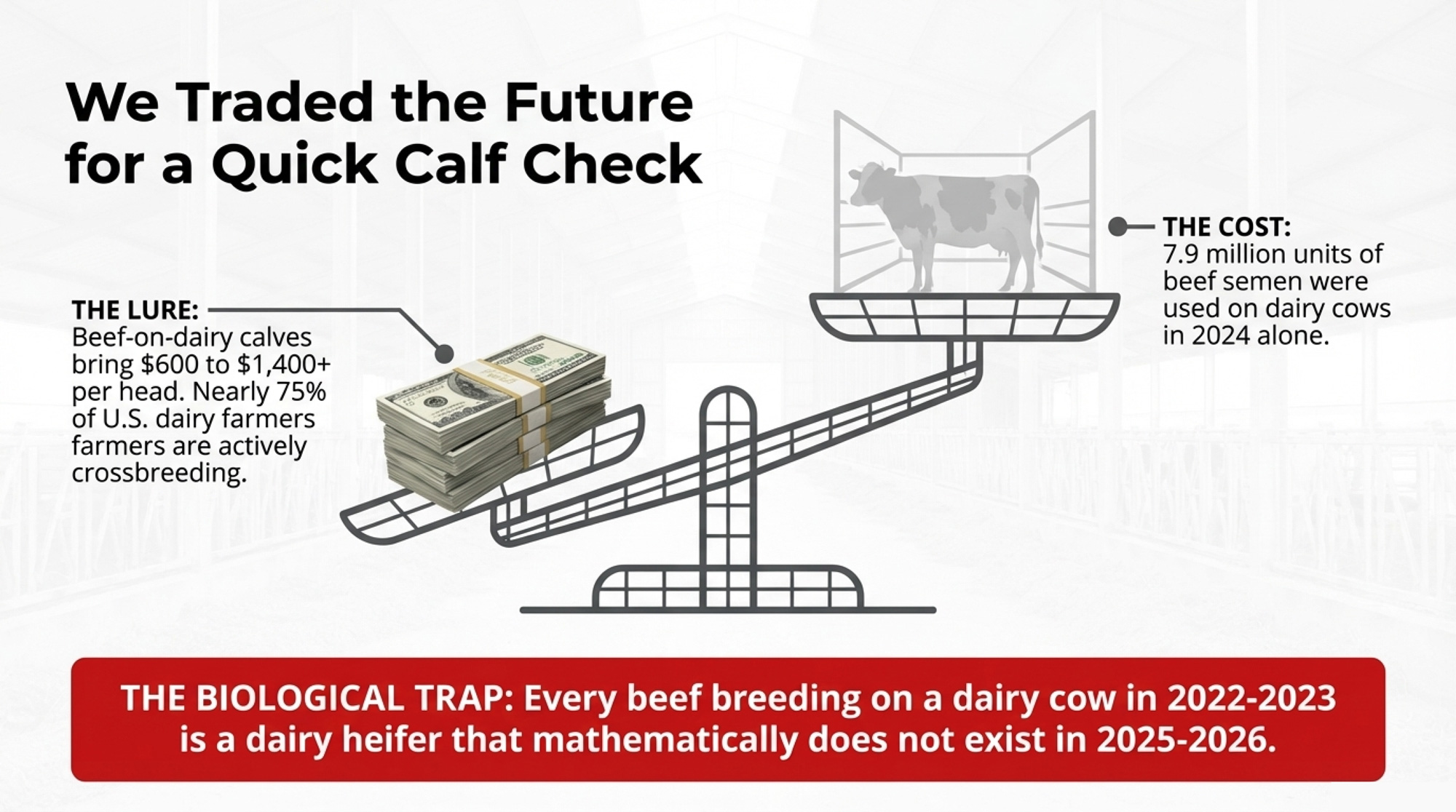
Ken McCarty of McCarty Family Farms still remembers trying to sell Holstein bull calves: “Two for $5” — with no takers. That kind of market teaches you not to count on calf checks to save the milk check. Fast‑forward to 2024–25, and beef‑on‑dairy calves are bringing $600, $1,000, even $1,400 a head in some barns. It feels like someone finally turned on a faucet that’d been stuck dry for years. (Read more: The McCarty Magic: How a Family Farm Became the Dairy Industry’s Brightest Star) But there’s a bill attached, and it’s landing in the form of four‑figure replacement heifers and a national heifer pipeline CoBank says will be roughly 800,000 head short of where it needs to be before a hoped‑for rebound in 2027. 

If you milk cows in the U.S. right now — 150 stalls in Wisconsin, 1,500 in western Kansas, anything in between — your future herd is being shaped by the replacement math you run (or don’t run) in the next 90 days.

We traded our future for a quick calf check. Now the bill is coming due in empty stalls. That’s what the $3,000 hangover feels like when your heifer string is thin, and the sale barn is picked over.

Record Milk on a Starved Heifer Pipeline

USDA’s January 2025 Cattle report shows where the real squeeze is. On Jan. 1, 2025, there were 3.914 million milk replacement heifers, down from 4.34 million just two years earlier and roughly 4.78 million in 2018, and well below the 2016 peak of 4.81 million. Farm Progress put it plainly: dairy replacement heifers have tumbled to a 47‑year low.

CoBank’s August 2025 heifer report, built on those USDA inventories, projects the gap at 357,490 fewer dairy heifers in 2025 and another 438,844 fewer in 2026 — roughly 800,000 missing replacements across a two‑year window — before inventories begin to rebound sometime in 2027. As CoBank economist Corey Geiger put it: “We don’t see a rebound until 2027, and that will be up 285 thousand, but you’ve got to remember, that’s going to be after 800 thousand fewer heifers.”

Meanwhile, the top‑line production numbers look deceptively strong. USDA’s annual Milk Production summary, released February 20, 2026, puts 2025 U.S. milk production at 232.0 billion pounds, up 2.6% from 226.1 billion in 2024. The national milking herd averaged 9.50 million head for the year — up 153,000 from 2024. Milk per cow hit 24,390 pounds, up 218 pounds from 2024’s 24,172. Since 2016, total milk has climbed about 9%, while per‑cow output has risen roughly 7%.

Those extra pounds didn’t come from a lush crop of young cows behind the string. They came from hanging onto cows that, in any other cycle, would’ve been on a truck. CoBank’s analysis and slaughter data note dairy producers sent over 600,000 fewer cows to slaughter from late 2023 through 2024 as they tried to cover plant needs without the replacements to support normal culling. You bought time with older cows because the young stock to replace them either wasn’t there or wouldn’t pencil at current prices.

The industry celebrated record milk. It should’ve been counting heifers.

How Beef‑on‑Dairy Helped Create an 800,000‑Head Hole

The flip side of McCarty’s “two for five” story is the beef‑on‑dairy boom that followed. When Holstein bull calves couldn’t draw a bid, it made perfect sense to chase a calf check that finally moved the needle. By 2024–25, sale reports around the country had beef‑on‑dairy calves bringing $800, $1,100, even $1,400 — with some two‑ and three‑day‑old calves fetching about $1,000 in the Northwest, as Ever.Ag’s Mike North told Brownfield. That kind of money is hard to say no to when milk margins are thin.

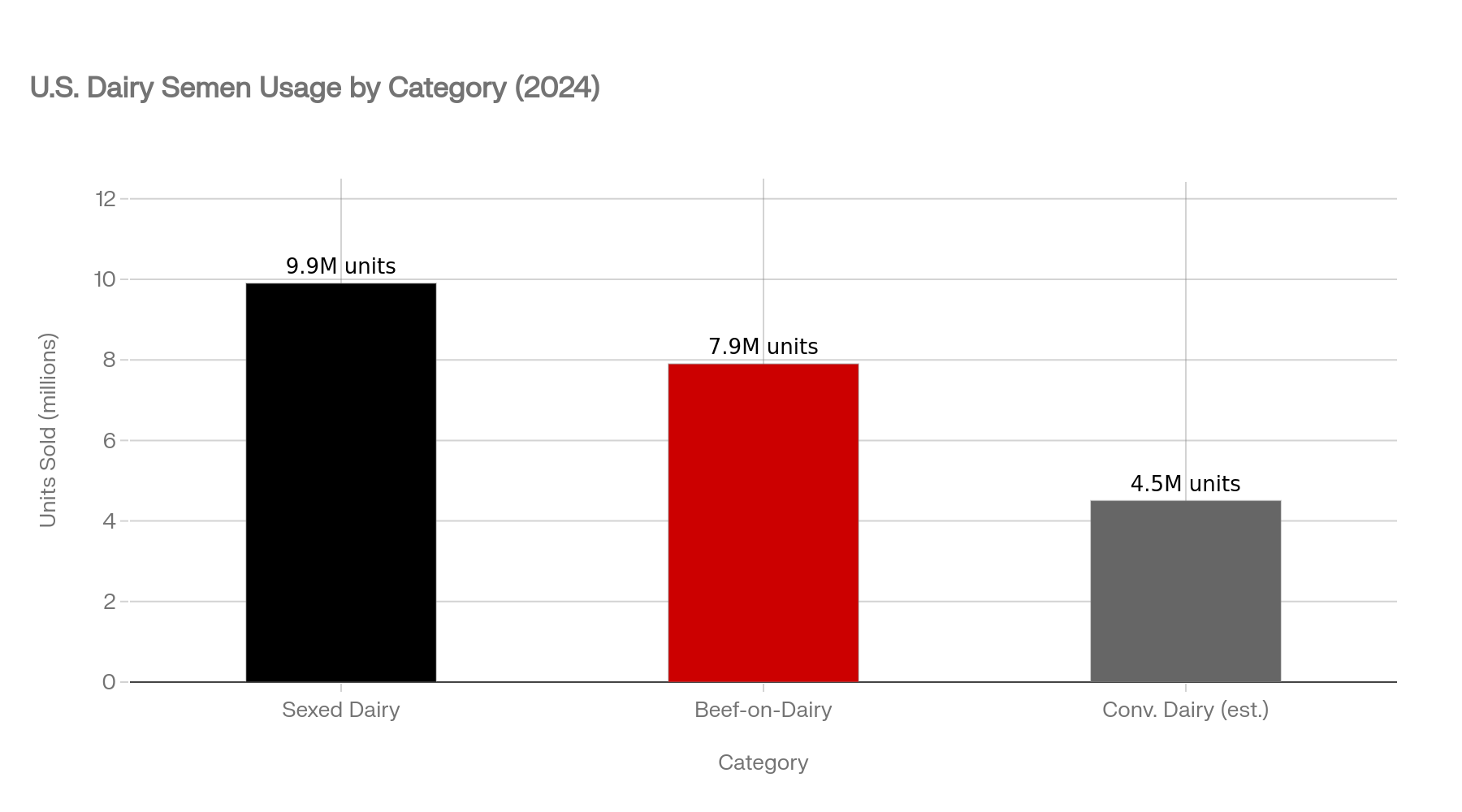
A 2024 Purina survey found that almost three‑fourths of U.S. dairy farmers now actively crossbreed dairy cows or heifers with beef cattle, with another 16% considering it. NAAB’s 2024 year‑end semen report shows just how far the shift has gone: gender‑selected dairy semen hit about 9.9 million units, up roughly 1.5 million from the year before, while beef semen sales reached 9.7 million units, with 7.9 million of those used on dairy cows and heifers. Sexed dairy is now the largest semen category — and beef‑on‑dairy is firmly entrenched alongside it.

On paper, the strategy looks balanced: more sexed dairy on your best females, beef on the bottom end. On the national ledger, it didn’t balance out. CoBank’s “Dairy Heifer Inventories to Shrink Further Before Rebounding in 2027” lays it out: even with more sexed dairy semen in the mix, three straight years of aggressive beef‑on‑dairy use shrank the replacement pipeline heading into 2026.

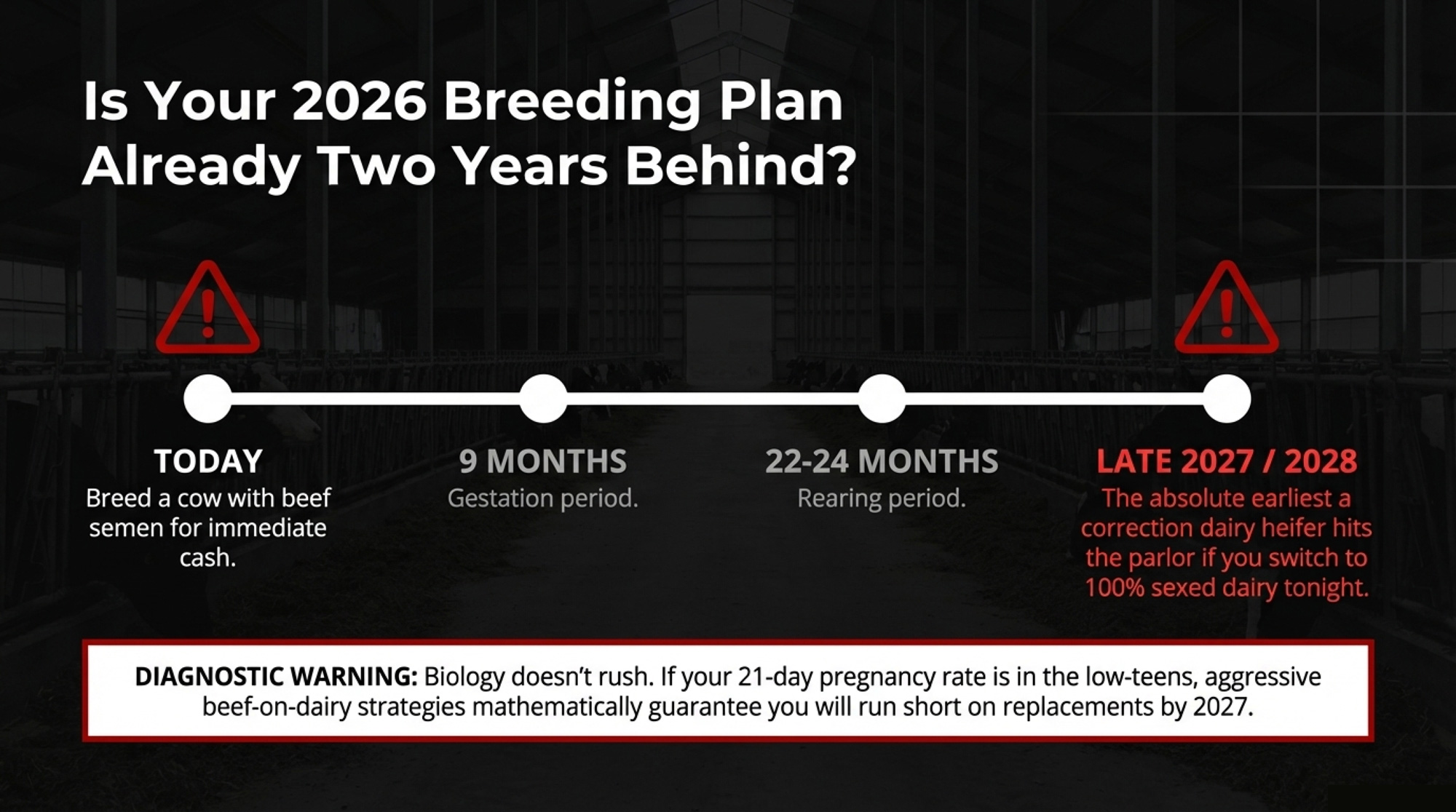
And biology doesn’t rush. You’ve got conception, nine months of gestation, then roughly 22–24 months of rearingbefore a heifer freshens. Even if every dairy flipped to all‑dairy semen tonight, the first real wave of “correction” heifers wouldn’t be hitting parlors in bulk until late 2027 and into 2028 — right around the time CoBank expects inventories to begin rebounding.

Every beef breeding on a dairy cow in 2022–23 was a dairy heifer that doesn’t exist in 2025–26. You can’t dodge that math now.

What Does a $3,000 Heifer Actually Do to Your Check?

Here’s where the hangover shows up in plain numbers.

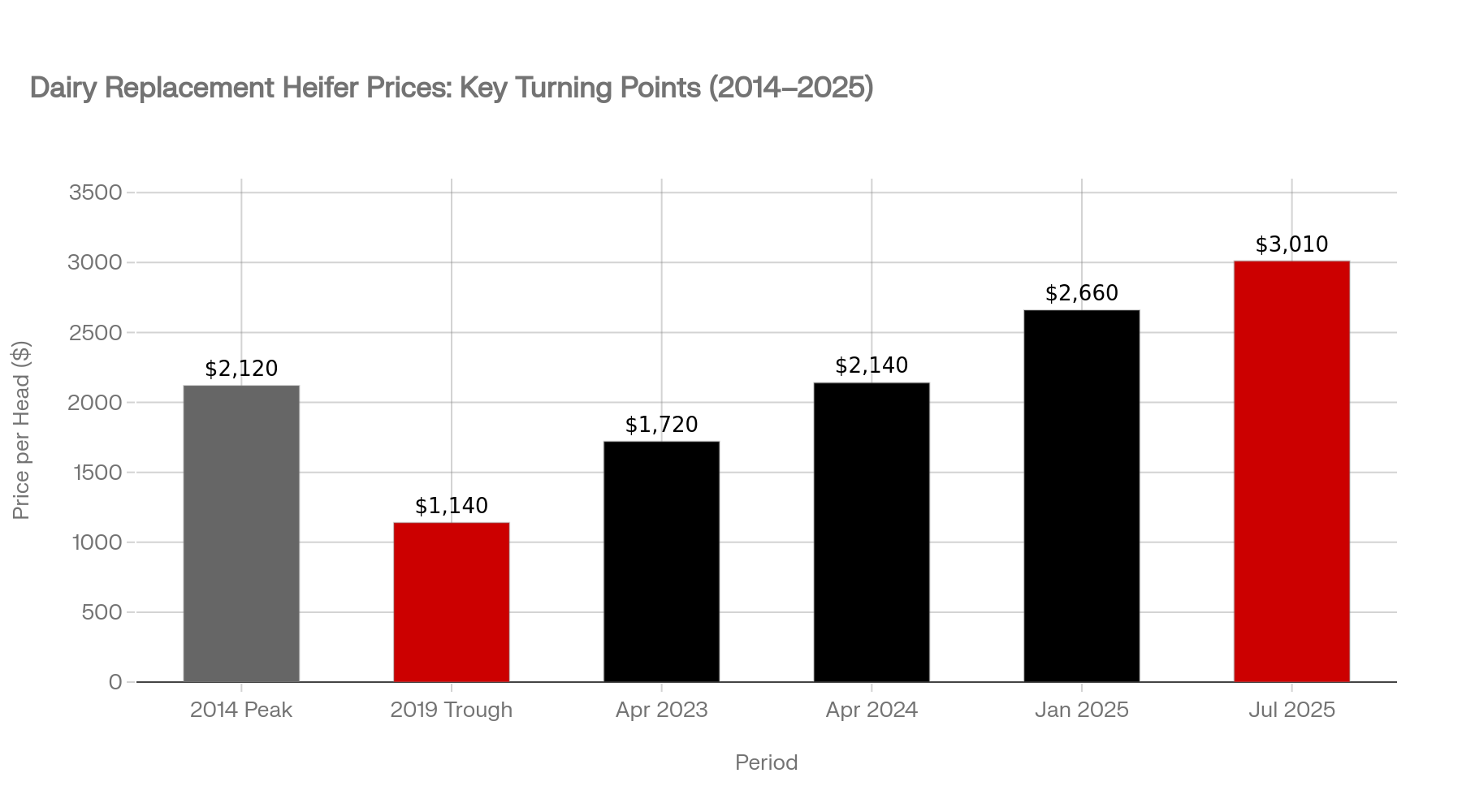
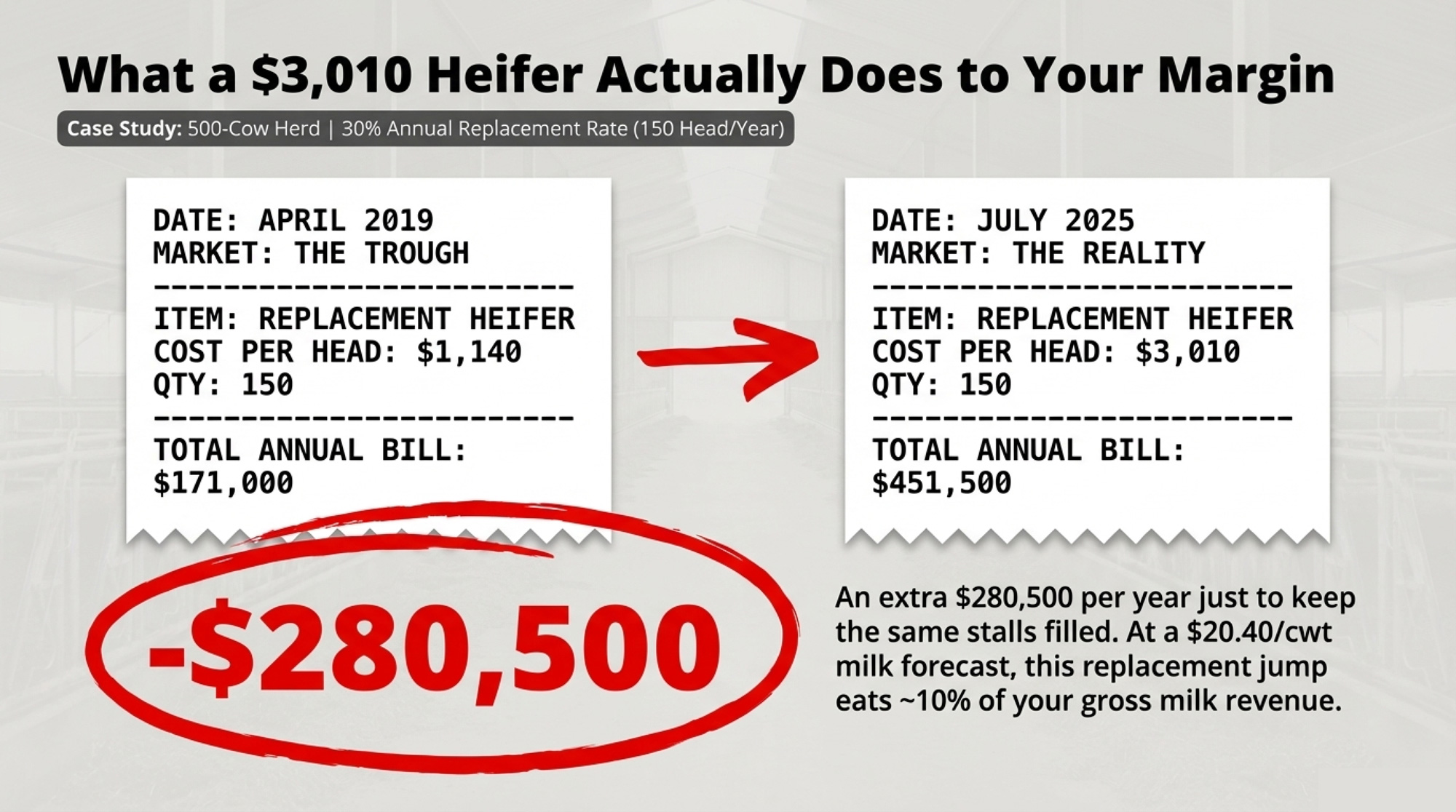
CoBank’s Geiger, using USDA Agricultural Prices data, traced the replacement arc across a decade. Dairy replacement values peaked at ,120 per head in October 2014, then fell nearly ,000 over five years to settle at ,140 by April 2019 — a price so low that those heifers were arguably worth more as beef than as future milk cows. It took almost a decade for prices to claw back. By April 2024, values had climbed to $2,140 — the same level as the 2014 peak — then pushed higher to $2,660 by January 2025 as tight inventories, not windfall milk margins, drove the move. By July 2025, Geiger says values hit an “unforeseen threshold” of $3,010 per head — a 164% jump from the 2019 trough and about 75% higher than the $1,720 reading in April 2023.

Those USDA averages still lag what some barns are seeing. Geiger notes “high‑quality Holstein replacement heifers have routinely fetched over $3,000 per head, with some premium heifers receiving over $4,000 per head in California and Minnesota auctions.” North told Brownfield that “some animals moving in the northwest last week were north of $4,000 an animal.” That’s not theory. That’s the check producers are writing today.

Now drop that onto a herd you can actually picture. Take a 500‑cow operation replacing 30% of its string annually — that’s 150 head a year. At the 2019 trough of $1,140 per head, your replacement bill sat around $171,000. At $3,010, it jumps to $451,500. That’s an extra $280,500 per year to keep the same number of stalls filled.

If you’re shipping about 75 pounds per cow per day, that 500‑cow herd moves roughly 13.7 million pounds of milk a year — about 136,900 cwt. At USDA’s 2026 all‑milk forecast of $20.40/cwt, gross milk revenue lands around $2.8 million. That replacement‑cost jump alone chews up roughly 10% of your gross.

USDA‑ERS cost‑of‑production benchmarks Bullvine has highlighted put full‑cost numbers for efficient large herds near $19.14/cwt. Against a $20.40 forecast, that’s about $1.26/cwt of breathing room — before replacements even enter the picture. You don’t have to be a spreadsheet person to see how fast $3,000 heifers chew through that.

Here’s the simple check you can run with your own numbers:

Replacement cost per cwt = (annual replacements × price per head) ÷ total cwt shipped.

If that number has more than doubled since 2019 and you haven’t updated your breakeven, your cash‑flow story and your actual economics are already out of sync.

Why Are Heifers So Scarce in the Growth States?

The heifer crunch isn’t spread evenly across the map. It’s piled up hardest in the same places that pushed U.S. milk to new highs.

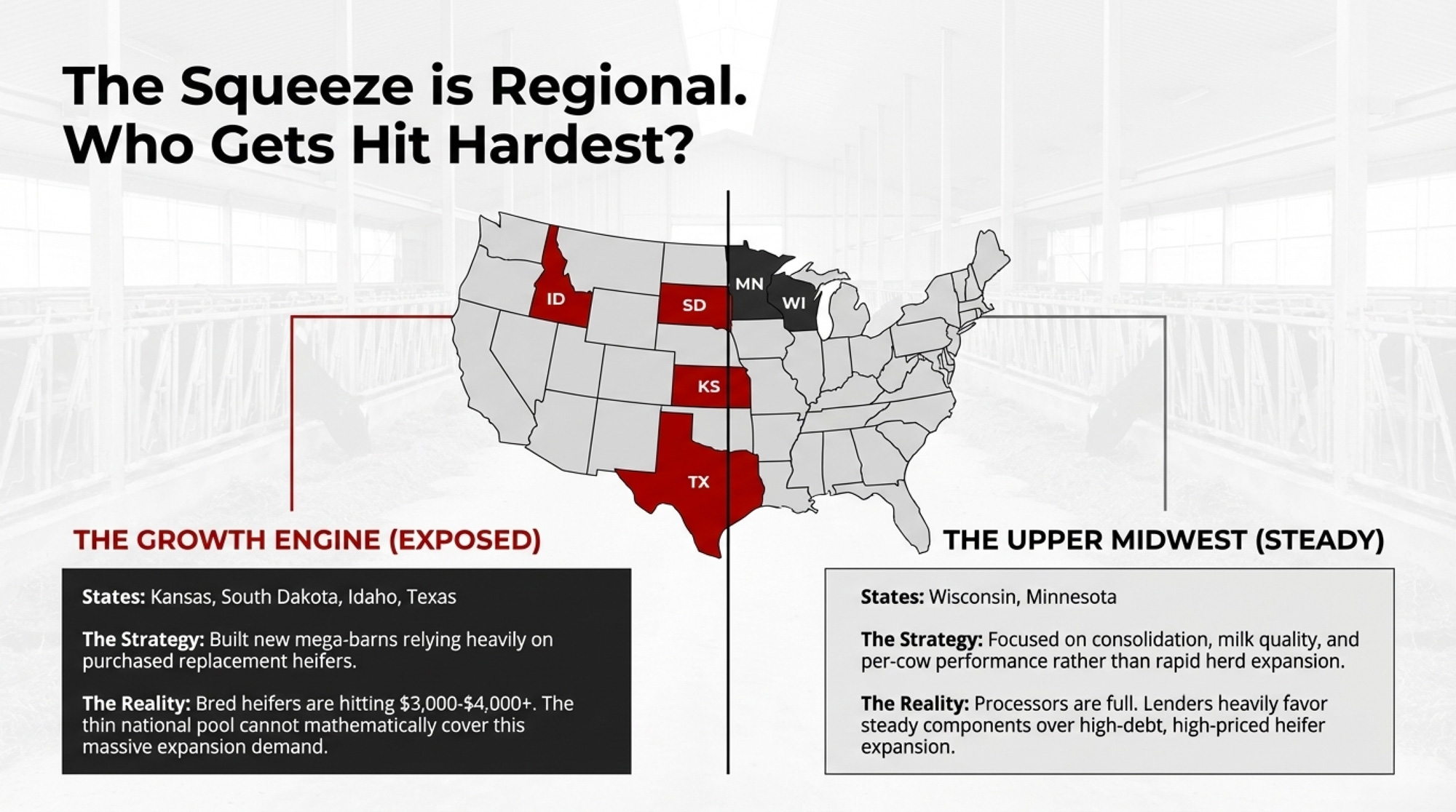
State/RegionCow Count TrendHeifer Inventory DirectionReplacement StrategyRisk Level
KansasStrong multi-yr growthShrinking — drawing from national poolPrimarily purchased heifers🔴 High
South Dakota+117% over 10 yrs (~215K head by 2025)Under pressure from rapid expansionMixed raised/purchased🔴 High
IdahoLarge gains — now #3 milk stateTight; competes with Western demandPrimarily purchased🔴 High
TexasRapid growth then coolingLost 10K heifers YoY (USDA data)Purchased-heavy, margin-squeezed🟠 Elevated
WisconsinConsolidation-led, steady outputGained 10K heifers YoYRaised, disciplined culling🟢 Lower
MinnesotaEfficiency-led, steadyStable — processor relationships strongRaised, component-focused🟢 Lower

Kansas has been one of the big growth engines. CoBank and regional coverage point to strong multi‑year expansion in Kansas milk output, driven by new barns and new processing plants in the southwest part of the state. Those cows have to come from somewhere, and more of them are being purchased rather than raised.

South Dakota is the poster child. Over the past decade, its dairy cow population has increased by about 117%, reaching roughly 215,000 head by 2025, fueled by expansions at processors like Valley Queen Cheese and Agropur and a concerted state‑level push to become a dairy corridor. Idaho added tens of thousands of cows and overtook Texas to become the No. 3 milk state, while Texas itself surged before weather and margin pressure cooled its growth.

Geiger warns that this draws on a thin heifer pool and, combined with roughly $10 billion in new U.S. dairy processing investments expected to come online through 2027, creates a looming pinch point for both farms and plants. Regions like Kansas, Texas, Idaho, and the I‑29 corridor are leaning hardest on a national heifer pool that’s at one of its lowest levels in nearly five decades. In some of those markets, bred heifers are bringing $3,000–$4,000 and still not covering all the demand.

The Upper Midwest has quietly taken a different path. USDA state numbers show Wisconsin and Minnesota together contributing a major share of national milk output, with growth coming mostly through consolidation and better performance per cow, not a rash of brand‑new mega‑barns. Wisconsin’s heifer inventory actually gained 10,000 headyear‑over‑year, while Texas lost 10,000, according to USDA data cited in Bullvine’s $3,010 analysis. That divergence comes down to processor relationships and infrastructure, not just breeding decisions.

In that Upper Midwest milkshed, processors and lenders talk constantly about quality and consistency. Compeer Financial’s Curtis Gerrits told Brownfield that Upper Midwest processors “are at a point where their farmers are doing such a great job and getting great high‑quality milk and a good amount of milk out of those animals that our processors are relatively full.” In a tight replacement market, those steady herds — strong components, disciplined culling, controlled expansion — often look better to lenders and plants than operations that depend heavily on debt‑financed growth and high‑priced purchased heifers.

Growth states chased cow numbers just as the replacement pipeline was thinning. Steady regions tightened up and let efficiency do more of the work.

What Does a $3,000 Heifer Do to Your 2028 Herd?

This is where your breeding sheet and the calendar slam into each other.

Every service you write this spring won’t show up in the parlor until late 2028 at the earliest. The heifers that will freshen in 2027 were mostly conceived in 2024–25, when beef‑on‑dairy was hottest and sexed semen use was still catching up. If your 2026–27 heifer crop already looks thin, you’re staring at decisions you made a couple of breeding seasons ago.

Economic modelling in the Journal of Dairy Science backs up what a lot of you can feel without a calculator. In one simulation of a 1,000‑cow Holstein herd, beef semen made the most economic sense when two things were true: beef‑cross calves were worth significantly more than dairy bull calves, and the herd’s reproductive performance stayed strong with targeted use of sexed dairy semen — 21‑day pregnancy rates in the 20–30% range, not in the low‑teens. When repro performance sagged, or sexed semen wasn’t used strategically, the more aggressive beef programs ran short on replacements, even though the calf income looked good on paper.

In Bullvine’s earlier coverage, one Minnesota producer’s allocation illustrated the hedging strategy many herds have adopted: 10% of cows bred to sexed Holstein and 90% to beef; for heifers, a 50/50 split between sexed dairy and beef. On the page, that sounds like a reasonable hedge — some calf revenue, some replacements. In the barn, that kind of allocation can leave one 300‑cow group with extra heifers and another group 20–30 heifers short. At $3,000 per head, that’s a $60,000–$90,000 swing in purchased replacements just from how you’re lining up semen today.

So the question isn’t “Is beef‑on‑dairy good or bad?” It’s “Does your current repro reality and semen strategy actually deliver the heifers you’ll need in 2028 — or are you penciling in daughters that don’t exist?”

Is Your 2026 Breeding Plan Already Two Years Behind?

If you spread your 2026 breeding sheet on the kitchen table tonight, would it set you up with more replacement options in 2028 — or fewer?

If your 21‑day pregnancy rate lives in the high‑teens or lower, that JDS modelling suggests you need to be very cautious about how much beef semen you’re putting on cows — especially if you’re not aggressive with sexed dairy on the right animals. You gain margin from beef‑cross calves today, but you give up flexibility down the road, particularly if you’re in a growth region where every neighbor is trying to buy heifers from the same thin pool.

The herds that will still have room to maneuver in 2028 are making deliberate choices right now:

  • Sexed dairy semen on the best animals — cows and heifers — where you actually want daughters.
  • Beef is reserved for the bottom end, or strictly for animals you’ve already decided won’t contribute replacements.
  • A hard count of how many home‑raised heifers that strategy should deliver each year — and how that compares to your real replacement needs over the next three years.

North told Brownfield he’s already seeing the inflection: “Some animals moving in the northwest last week were north of $4,000 an animal. That’s a pretty tall price, and so now, guess what? We’re seeing people starting to switch some of their breeding back to that replacement animal.” McCarty’s whiteboard this spring looks different from it did when his calves were going two‑for‑five. His family lived the downside of relying on calf checks to backstop the milk check — and at $3,000‑plus per replacement, the stakes on getting that breeding plan wrong have never been higher.

Three Paths — and the 30‑Day Move for Each

Let’s be blunt. You’re probably living one of these strategies already.

StrategyBest For…Key RiskThe “Must‑Do” Now
Path 1: Lock the PipelineHerds that want steady or modest growth and are willing to carry more youngstockHigh heifer‑rearing cost and capital tied up in replacements if prices coolAudit your sexed‑semen and heifer‑raising ROI at today’s $3,000‑plus values and set a clear sexed‑dairy target for 2026.
Path 2: Margin over SizeStable or mid‑size herds in mature markets with solid processorsMissing upside if milk and premiums improve and plants chase volumePush components and quality hard enough to be at the top of your plant’s sheet, and put a real ceiling on herd size in your plan.
Path 3: Push ExpansionNew or expanding facilities tied to fresh processing capacityOver‑leveraging debt into a market with $3,000–$4,000 heifers and export riskStress‑test your 3‑year plan at $19–$19.50 milk, $3,000 heifers, and tighter premiums before you pour more concrete.

Each column is a gut check. Where you land in that table matters more than what you tell your banker.

For Path 1, you’re choosing control over your replacement pipeline. That means more sexed dairy on your best females, a tighter culling list, and either an in‑house heifer program or a long‑term grower relationship that pencils at current feed and interest levels. The 30‑day move here is simple: sit down with your repro team and lender and decide how many sexed‑dairy pregnancies you actually need in the next 12 months to cover your 2028 replacement needs — then lock in how you’ll raise or contract those heifers at something close to today’s true cost.

For Path 2, you’re accepting a ceiling on cow numbers and choosing to compete on margin. That’s the path many Upper Midwest herds are already on — Compeer’s Gerrits described processors in that region as “relatively full” with high‑quality milk from their existing base. The key risks are missing upside if milk or premiums jump and plants start rewarding volume again, or getting sidelined if processors concentrate on a smaller number of mega‑suppliers. Your 30‑day move: update your breakeven and cash‑flow projections with current replacement and interest numbers — not 2022 figures — and sit down with your processor and lender to explain that holding or slowly shrinking cow numbers is a conscious survival strategy built around components and reliability.

For Path 3, you’re betting that your cost structure, processor relationship, and export demand can carry you through the heifer squeeze. Geiger points to roughly $10 billion in new U.S. dairy processing investments expected through 2027. U.S. dairy exports hit about $8.2 billion in 2024, one of the strongest years on record. That combination only works if export buyers keep writing checks, and your plant still needs every pound you can ship. Your 30‑day move is to run an honest stress test with your lender: what happens to your principal and interest coverage if all‑milk settles closer to $19–$19.50/cwt, replacement prices hold near $3,000 per head, and your base or premiums tighten by 10–15%? If those numbers don’t work on paper, they won’t work in the barn. In a $3,000+ market, remember: nobody sells their best two-year-olds. You are paying premium prices for the bottom half of someone else’s genetic progress.

Key Takeaways

  • If your replacement cost per cwt has more than doubled since 2019, recalculate your breakeven using today’s heifer values and the 2026 all‑milk forecast of $20.40/cwt — then take that updated math to your lender before the next renewal meeting. 
  • If your 21‑day pregnancy rate is stuck in the high‑teens or lower, be cautious about how much beef semen you’re putting on cows; JDS modelling makes it clear that with weaker repro, aggressive beef strategies run short on replacements even when calf prices are strong. 
  • If you’re buying replacements at $3,000‑plus and your total replacement cost per cwt is drifting toward $4.00 or more, you can’t stay on autopilot. Pick a path — pipeline, margin, or deliberate expansion — in the next 30 days instead of letting replacements “just happen.”
  • If you’ve already decided to hold herd size steady or shrink slightly, call your processor and lender within 90 days to explain that this is a strategy built around margin and reliability, not a slow slide — it changes how they look at your risk. 
  • If your 2026 breeding sheet still looks like 2023, sit down this month and pencil out how many heifers it actually delivers by 2028. If the number comes up short of what you’ll need, adjust your sexed‑dairy vs beef allocation before this spring’s breeding season is in full swing. 

The Bottom Line

The question worth putting on the whiteboard in your office this week isn’t “How much milk did we ship last year?” It’s “Where are our 2028 replacements coming from — and what happens to our cash flow if each one costs $3,000 or more?”

For some herds — especially the Upper Midwest operations that quietly tightened up while their neighbors chased growth — the answer is already baked in. For others in Kansas, South Dakota, Idaho, or Texas who built new capacity on the back of beef‑on‑dairy, the hardest conversations with bankers and processors may be right around the corner.

Which side of that line do you want to be on when CoBank’s projected 2027 rebound finally shows up — and how many stalls will you have to fill before it gets here?

If you want the deeper math — by herd size, region, and debt profile — Bullvine Weekly and an upcoming Tier 3 economics feature will break down the full herd‑flow replacement model. That’s where you’ll see per‑cwt cost curves and export‑shock scenarios. But the fork in the road starts here, with the numbers on your own whiteboard.

Complete references and supporting documentation are available upon request by contacting the editorial team at editor@thebullvine.com.

Learn More

The Sunday Read Dairy Professionals Don’t Skip.

Every week, thousands of producers, breeders, and industry insiders open Bullvine Weekly for genetics insights, market shifts, and profit strategies they won’t find anywhere else. One email. Five minutes. Smarter decisions all week.
NewsSubscribe
First
Last
Consent

Boost Your Dairy Profits: Proven Breeding Strategies Every Farmer Must Know

Boost your dairy farm’s profits. Learn how using beef and sexed dairy semen can increase income and keep a steady flow of replacements.

Summary: The dairy farming industry innovates to boost profitability by using beef semen for high-value calves while ensuring enough dairy replacements through strategic breeding. Minimizing involuntary culling and improving genetic resilience are crucial for herd longevity and health. Using sexed dairy semen enhances heifer production internally, which is essential amid a 20-year low in heifer availability. A balanced approach to breeding, reproductive efficiency, and internal herd expansion is vital for sustainable and profitable dairy operations. This method offers financial benefits and challenges but requires sustaining large herds of dairy replacements. Strategic breeding plans using sexed dairy semen for high-potential heifers and beef semen for lower-value animals can achieve this balance. Farmers must continuously monitor and adjust these techniques to maximize benefits and efficiency.

  • Using beef semen on dairy cows can boost farm profitability through high-value dairy-beef calves.
  • Maintaining a steady supply of dairy replacements is crucial amidst a 20-year low in heifer availability.
  • Minimizing involuntary culling enhances herd longevity and reduces costs associated with maintaining herd size.
  • Strategic breeding programs should include sexed dairy semen for high-potential heifers and beef semen for lower-value animals.
  • Improving genetic resilience through selective breeding can reduce disease incidence and increase cow longevity.
  • Effective reproductive management includes enhancing pregnancy and conception rates through various strategies.
  • Internal herd expansion is critical to sustaining and growing herds as external replacement heifer sources become scarce.
  • Continual oversight and adjustment of breeding programs are essential to maximize benefits and overall efficiency.

The dairy farming sector is now at a crossroads, with unique problems and exceptional prospects. Beneath the conventional pastoral images of cows grazing, a disruptive trend is developing that can revolutionize dairy producers’ income streams: using beef semen to generate high-value beef-on-dairy calves. Although promising more revenue, this novel method requires a careful balance between sustaining large herds of dairy alternatives. Integrating cattle semen into dairy herds can significantly increase farm profitability. Still, it requires deliberate breeding programs and strict monitoring. These are critical to ensuring long-term dairy replacements and reaping the potential benefits for farmers willing to take this dual strategy. However, success is not assured and requires careful preparation and execution.

Why Dairy Farmers Are Turning to Beef Semen

This significant change in the dairy farming industry, the purposeful incorporation of beef semen into dairy herds, brings a promising potential for increased profitability. By utilizing beef genetics, especially for dairy animals with lower milk production genetic merit, farmers can generate high-value beef-on-dairy calves. These calves, benefiting from solid beef genetics, have continuously commanded premium prices in the marketplace, demonstrating the economic viability of this method.

Using cattle semen provides a double benefit. First, it gives more cash by producing high-quality beef calves. Twomey et al. (2020) found that beef-on-dairy calves often had better carcass features, such as increased softness and marbling, making them appealing to beef processors and customers. Consequently, dairy producers may target a more profitable portion of the animal market.

However, the effectiveness of this technique is dependent on a careful balance. While the financial advantages of raising beef calves are clear, producers must recognize the potential challenges. These include maintaining enough dairy replacements for their herds, the complexity of strategic breeding plans, and the careful preparation required. A steady supply of heifer replacements is critical for preserving milk output and herd expansion. Strategic breeding plans that include sexed dairy semen for high-potential dairy heifers and beef semen for lower-value animals may assist in achieving this balance, emphasizing the strategy’s complexity and careful preparation.

Achieving the Perfect Balance: The Importance of Strategic Breeding Programs 

Strategic breeding plans are important; they are essential for creating a balanced and productive dairy farm. By using sexed dairy semen to ensure the birth of more female calves, farmers can control their herd’s genetic composition and potential production. This selective technique allows producers to concentrate on producing high-quality heifers, which improves the herd’s overall genetic composition and potential production.

On the other hand, utilizing cattle semen is a practical way to maximize the genetic potential of excess or low-genetic-merit animals. By marrying these animals with beef sires, producers may create beef-on-dairy calves with more excellent market value, diversifying revenue streams and making the most of their livestock resources.

However, these breeding techniques are more complex answers. Continuous monitoring and modification is critical to their performance. Regular evaluations of breeding results, genetic advancement, and herd health are essential to continuously meet objectives, such as maintaining herd size, improving milk output, and increasing calf value. Failure to address this oversight could result in herd composition imbalances, leading to expensive blunders and decreased production. This continual effort to monitor and adjust demonstrates your devotion to your farm’s success.

Strategic breeding initiatives need a flexible and adaptable strategy. By continually reviewing and adapting their approaches, dairy producers may effectively address obstacles and capitalize on the possibilities presented by modern breeding procedures. Effective strategic breeding programs can increase total herd production by 15-20%.

Strategies to Minimize Involuntary Culling 

The herd is the heartbeat of every dairy enterprise, and forced culling may devastate numbers and production. High culling rates may upset the delicate balance required for a profitable and efficient dairy operation. To guarantee the long-term viability of your herd, you must prioritize decreasing involuntary culling.

Comprehensive herd health and sophisticated management approaches are the primary defenses against the expensive problem of needless culling. By employing proactive health monitoring, you may address possible issues before they become major health concerns. Effective preventative care measures, such as vaccines, parasite control, and a good diet, are crucial in reducing health risks. An efficient health management plan may reduce involuntary culling rates by up to 20 percent.

Dairy farmers can build a more robust herd by stressing genotypes that improve disease resistance and cow lifespan. Selecting sires with known health and wellness features increases the possibility of future replacements demonstrating long-term performance and durability. Regularly assessing and fine-tuning breeding strategies to target these features may result in substantial, long-term gains in herd health. Fouz et al. (2013) found that selecting sires based on detailed assessments is essential in increasing genetic resistance to prevalent illnesses. Genetic improvements may increase the productive lives of cows by 2-3 years, providing a reassuring outlook for the future.

Beyond genetics, effective management techniques are critical. Proper living conditions, including appropriate space, ventilation, and clean bedding, help minimize the spread of infections and accidents. Technology such as automated health monitoring systems may provide real-time information and quick actions, lowering the likelihood of complications leading to culling.

Ultimately, a well-rounded strategy incorporating health, genetics, and management approaches will reduce involuntary culling while keeping the herd productive and profitable. This attentive, diversified technique is the foundation of long-term success in dairy production.

Genetic Strategies for Healthier and Longer-Lived Herds

Strategic breeding for enhanced genetics provides dairy producers a feasible solution for increasing disease resistance and overall cow lifespan. Farmers may minimize disease incidence and boost herd productivity by promoting health and wellness. Enhanced genetic features for disease resistance reduce cows’ susceptibility to common diseases, lowering the need for medical treatments and related expenditures.

However, it’s important to note that focusing on health and well-being factors in genetic selection also comes with potential risks. For example, cows with robust immune systems and good health are less likely to be culled for disease or poor performance. This implies fewer resources are required for treatment, allowing more to be devoted to improving production and milk quality [Fouz et al., 2013]. However, other areas may have trade-offs, such as milk production or other desirable traits. Farmers must carefully consider these trade-offs when making breeding decisions.

Mastering Reproductive Efficiency

Maintaining and increasing pregnancy and conception rates is critical for dairy herd reproductive efficiency. Focusing on these areas can make a significant difference: 

  • Heat Detection and Synchronization: Accurate detection of heat episodes in cows is critical. Tools such as activity monitors, tail chalk, and specialist software may considerably improve accuracy. Furthermore, synchronization procedures may help simplify breeding schedules, resulting in optimum insemination. Effective heat detection and synchronization may boost pregnancy rates by 10–15 percent.
  • Nutrition and Body Condition: An adequate diet is essential for reproductive health. Cows must be in excellent physical condition to conceive and sustain pregnancy. Nutritional strategies should emphasize well-balanced meals rich in calories, protein, and minerals.
  • Sire Selection: Selecting good sires may improve conception rates. Assess sires for reproductive qualities and dependability. Selecting sires with a track record of high conception rates may boost total herd fertility.
  • Health Management: Routine health exams and vaccines are essential to comprehensive health management procedures. Preventive care lowers the risk of illnesses that might impair fertility. Quickly treatment of any health concerns ensures that cows stay productive and capable of conception.

By combining these measures, dairy producers may significantly improve their herds’ reproductive performance, assuring a consistent and predictable supply of replacement heifers. Adequate heat detection and synchronization may increase pregnancy rates by 10-15%.

How Sexed Semen is Revolutionizing Dairy Herd Management 

Expanding the use of dairy semen, especially sexed semen, is critical for guaranteeing a steady supply of replacement heifers while improving the herd’s genetic quality. Sexed semen ensures herd stability by generating a more significant percentage of female calves. Given the 20-year low in available dairy heifers, this essential strategy highlights the need for internal herd expansion for many dairy producers. Using sexed semen may result in around 90% of female calves, making it a significant change in breeding efforts.

Farmers may improve their herd’s genetic quality by choosing sires based on extensive examinations. Genetic improvement focuses on productivity, disease resistance, and longevity, increasing the health and performance of individual animals while increasing the herd’s overall efficiency and profitability. Studies [de Haas et al., 2015] show that focused genetic selection may have considerable long-term advantages, such as lower culling rates and better reproductive success.

Furthermore, using sexed semen coincides with long-term production objectives by constantly producing an adequate number of heifer replacements internally. This decreases dependence on external purchases and the risks of changing market circumstances. Expanding sexed dairy semen offers a long-term strategy for herd management, ensuring that dairy enterprises stay strong and financially viable in an increasingly competitive market.

Internal Herd Expansion: Your Best Strategy Amidst Heifer Scarcity 

Internal herd growth has never been more critical as the lack of dairy alternatives worsens. Dependence on external purchases is becoming more risky in today’s turbulent economy. As a result, farms must develop and execute breeding methods that prioritize the internal development of many heifer replacements. This technique ensures a steady supply of productive cows while promoting genetic continuity throughout the herd, resulting in long-term stability. Internal herd growth may minimize dependency on external heifer acquisitions by up to 30 percent.

Strategic breeding plans must target the development of replacement heifers. This includes using technologies like sexed semen, which may produce more female calves and effectively ensure the herd’s future. Farmers that combine this with complete reproductive management measures may considerably reduce the effect of low heifer supply while still supporting internal herd development.

Furthermore, these programs should not be static; they must be continuously monitored and fine-tuned to correspond with the farm’s production objectives. This proactive strategy is critical to maintaining a regular supply of high-quality replacements, which ensures the operation’s long-term viability and profitability. 

The Bottom Line

Integrating beef semen into dairy breeding programs is both challenging and an opportunity for dairy producers. Farmers may increase income sources while maintaining sustainable dairy replacement production by implementing strategic breeding programs, using sexed semen, and focusing on avoiding forced culling. Improving reproductive efficiency and concentrating on genetics for health and longevity are essential to this equilibrium. As the industry’s available dairy heifers reach a 20-year low, internal herd growth becomes more than a plan; it is a need. Properly managing these varied methods is critical to ensuring long-term success and sustainability. It’s a challenging but gratifying activity that needs attention, forethought, and adaptation, demonstrating that a well-balanced breeding plan is the cornerstone of a thriving dairy enterprise.


Download “The Ultimate Dairy Breeders Guide to Beef on Dairy Integration” Now!

Are you eager to discover the benefits of integrating beef genetics into your dairy herd? “The Ultimate Dairy Breeders Guide to Beef on Dairy Integration” is your key to enhancing productivity and profitability.  This guide is explicitly designed for progressive dairy breeders, from choosing the best beef breeds for dairy integration to advanced genetic selection tips. Get practical management practices to elevate your breeding program.  Understand the use of proven beef sires, from selection to offspring performance. Gain actionable insights through expert advice and real-world case studies. Learn about marketing, financial planning, and market assessment to maximize profitability.  Dive into the world of beef-on-dairy integration. Leverage the latest genetic tools and technologies to enhance your livestock quality. By the end of this guide, you’ll make informed decisions, boost farm efficiency, and effectively diversify your business.  Embark on this journey with us and unlock the full potential of your dairy herd with beef-on-dairy integration. Get Started!

Learn more: 

Great Britain World Leaders in Adoption of Sexed Dairy Semen

Explore the transformative impact of sexed semen on Great Britain’s dairy industry, driving remarkable genetic advancements and enhancing beef output. Learn how this strategic shift is revolutionizing farming practices and benefitting dairy farmers.

Great Britain is setting the standard in dairy production by employing sexed dairy semen and thereby creating new international guidelines. Not just a trend, but also a major development with significant consequences for the industry. Farmers may now selectively breed their best females with modern breeding methods, quickening genetic development.

“UK dairy farmers should be congratulated on their progressive attitude to adopting modern technologies to improve their herd efficiencies; they are leading the world in accepting sexed semen.” Head of Animal Genetics, AHDB Marco Winters

Discover how this innovative strategy is reshaping the dairy and beef supply chains, thereby fostering a brighter future for both consumers and farmers.

Transformative Breeding: The Rise of Sexed Dairy Semen and Its Impact on the Dairy Sector

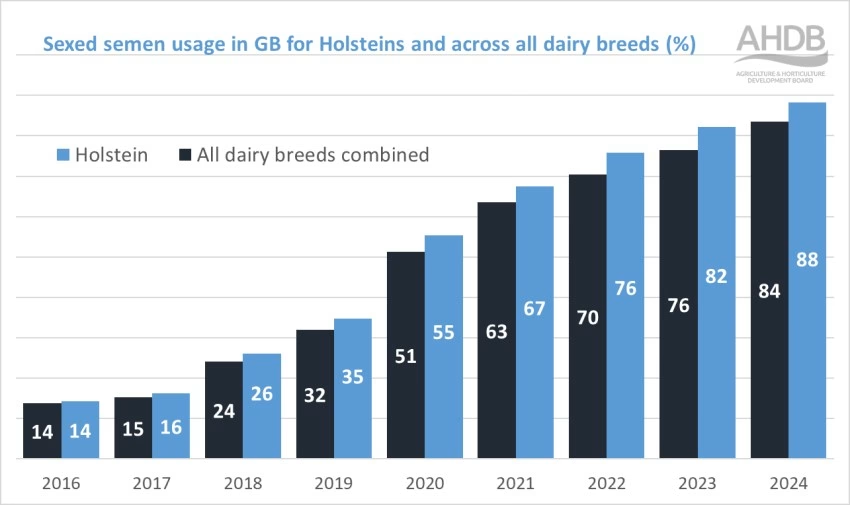
AHDB, a key player in the industry, has been instrumental in promoting the acceptability of sexed dairy semen. Their most recent survey indicates a notable increase in its usage, underlining the dairy sector’s progressive attitude to reproductive technologies. Sales of sexed semen rose from 76% in 2023 to 84% in 2024. This trend reveals the sector’s ambition to increase herd efficiency and hasten genetic progress. The increased use of sexed semen is changing breeding strategies by selecting top females and modifying the genetic geography of British dairy farms.

The Unrivaled Reign of Holsteins: Leading the Charge in Genetic Advancement

Leading the dairy industry with 88% of all Holstein semen sold today sexed, the breed is ahead of the average of 84%. This highlights its main contribution to advancing efficient and genetically altered farming techniques.

Driving Forces Behind the Surge in Beef Semen Sales 

Increasing beef semen sales result from many significant developments altering the dairy industry. Farmers have been able to focus their breeding on outstanding females for dairy replacements using sexed dairy semen. This exact husbandry produces a surplus of genetic potential in the rest of the herd, enabling further use of beef semen.

Now, considering 52% of all semen sent to dairy farms, sales of beef semen surpass those of dairy goods for the first time. This shift alludes to a trend wherein dairy farmers generate highly sought-after beef crosses, increasing the economic value of non-replacement animals. This economic advantage, coupled with the genetic benefits, makes the use of sexed semen a compelling choice for dairy farmers.

Technologies like SexedULTRA4M accelerate these advances by consistently producing female dairy calves and steering other breeding projects toward beef crosses. This approach enhances dairy herd genetics and significantly boosts the beef supply chain, stressing the innovative synergy between dairy and beef production. This forward-looking breeding method increases profitability and output for farmers across the agricultural land.

The Strategic Application of Selective Breeding Through Sexed Semen Technology

Dairy farmers stand to gain significantly from the strategic use of sexed semen technology. By enabling the deliberate selection of superior females for reproduction, farmers can ensure that only the best genetic traits are passed on to future dairy replacements. This focused breeding accelerates genetic development, bolstering milk supply, lifetime, and overall herd health. 

Moreover, sexed semen significantly increases the likelihood of female calves, which are naturally more lucrative for dairy companies. Farmers may focus their efforts on raising females predisposed to superior performance requirements through this optimization. This approach not only guarantees long-term sustainability and profitability but also genetic development through a more efficient and productive herd with every generation. The use of sexed semen is not just a short-term solution but a strategic investment in the future of the dairy industry.

The proper use of sexed semen in breeding efforts allows dairy farmers to promptly and effectively maximize genetic advantages. This forward-looking attitude highlights how dedicated the dairy industry is to using innovative technologies for exceptional herd performance and creative expression.

The Bottom Line

Great Britain’s strength in agricultural innovation is shown in its use of sexed dairy semen. Especially among Holsteins, a jump to 84% in sexed semen usage reveals a deliberate focus on genetic quality. More beef crosses enhance dairy genetics and the beef market, ensuring farmers remain competitive and efficient.

Dairy producers should use genomic studies and the Herd Genetic Report published by the AHDB to maximize breeding initiatives. The adoption of these cutting-edge technologies will constantly propel genetic development, increase herd efficiency, and maintain the dairy industry’s worldwide leadership.

Key Takeaways:

  • Sales of sexed dairy semen reached 84% of all dairy semen sold over the 12 months leading up to April 2024, up from 76% in 2023.
  • The Holstein breed stands out, with sexed semen accounting for 88% of all their semen sales.
  • The use of sexed dairy semen has facilitated an increase in the adoption of beef semen, which now constitutes 52% of all semen sold to dairy farms.
  • This trend empowers dairy farmers to selectively breed their elite females for dairy replacements, enhancing genetic progress within the herd.
  • Dairy farmers are encouraged to leverage genomic evaluations and the AHDB’s Herd Genetic Report to identify top females for breeding decisions.
  • The growing production of beef crosses in the dairy sector has positive implications for the beef supply chain and the overall efficiency of dairy herd genetics.

Summary: Great Britain is utilizing sexed dairy semen to boost dairy production, resulting in a significant increase in sales from 76% in 2023 to 84% in 2024. This innovative approach allows farmers to selectively breed their best females, accelerating genetic development. The Holstein breed is leading the charge in genetic advancement, with 88% of all Holstein semen sold sexed. This shift in the dairy industry also leads to a rise in beef semen sales, as farmers can focus on outstanding females for dairy replacements using sexed dairy semen, resulting in a surplus of genetic potential in the rest of the herd.

Send this to a friend