






The remand turned on a missing verification mechanism, not bad geology — and the sixteen-month clock is the part your lender should read.
Executive Summary: On August 24, a Wisconsin administrative law judge sent Ridge Breeze Dairy’s expansion permit back to the DNR — not because the groundwater science was wrong, but because the permit commanded compliance without building in any way to check it. DNR’s own hydrogeologist mapped 279 land-application fields, and the judge upheld that work; the permit still failed on a missing verification mechanism, and it took sixteen months from hearing grant to ruling. Run that delay against your own expansion: 1,000 incremental cows shipping 75 lbs a day is 273,750 cwt a year, and at January’s national DMC margin of $7.81/cwt, twelve months of empty barn leaves $2.14 million on the table against roughly $96,000 in legal fees. Forgone margin, not the lawyer, is what breaks the covenant math — and that ratio holds across every margin USDA published this year, from $7.81 to $11.10/cwt. If you’ve got a permit or nutrient management plan sitting in a DNR inbox, the check is an hour of your time: does the file contain monitoring wells, a testing protocol, or a reporting schedule, or does it only state obligations? Wisconsin has roughly 370 active or pending CAFO permits, and nobody has publicly examined how many share the same gap. The trigger to watch isn’t the eventual ruling — it’s the day DNR grants a contested-case hearing, which in this case showed up sixteen months before anyone knew the outcome.
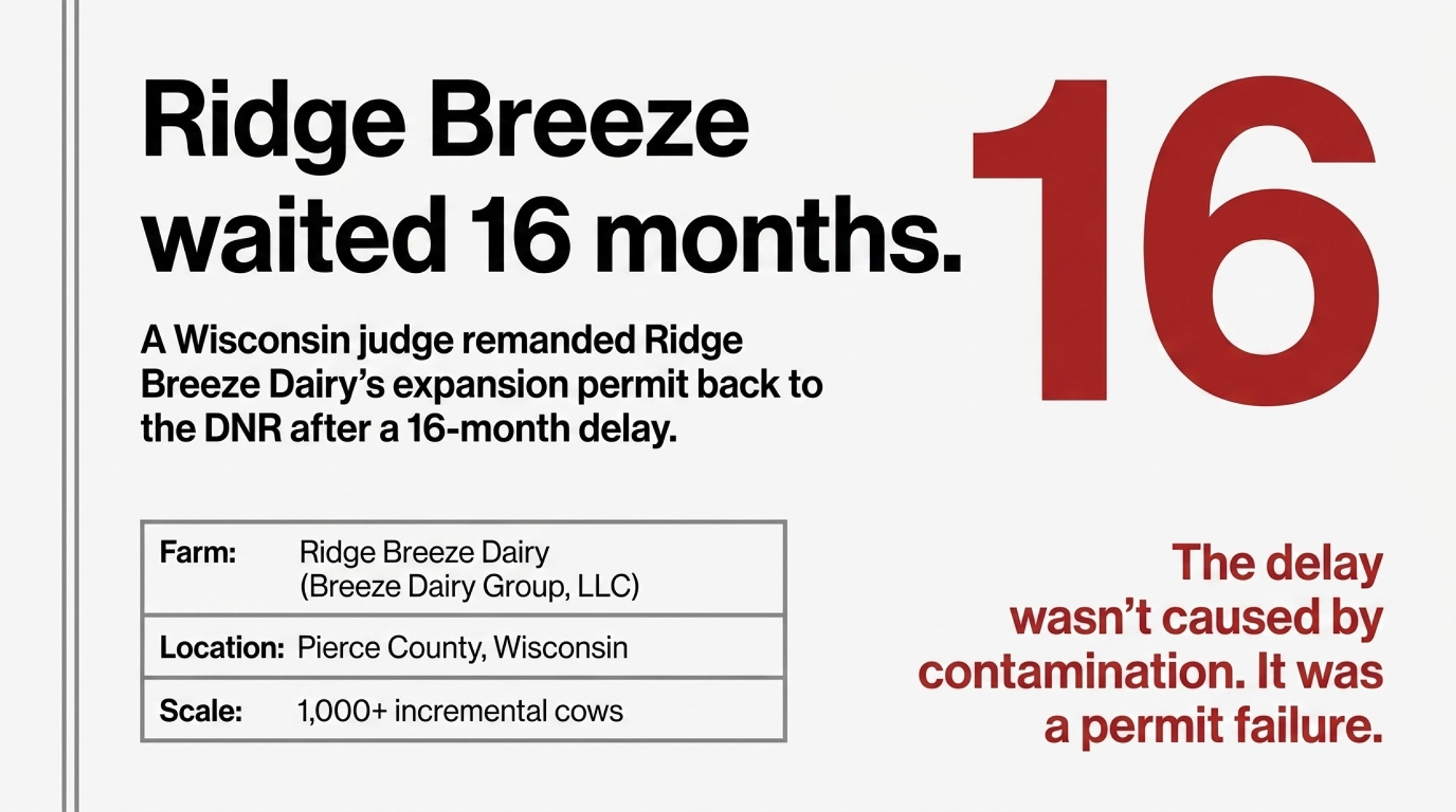
Ridge Breeze Dairy waited sixteen months — from the day Wisconsin’s DNR granted its neighbors a contested-case hearing to the day an administrative law judge sent the expansion permit back.
Here’s what should stop you if you’ve got a CAFO permit or nutrient management plan sitting in a DNR inbox: the judge didn’t say Ridge Breeze’s groundwater science was wrong. She said the opposite. DNR’s own hydrogeologist, Ian Anderson, mapped overburden depth, bedrock depth, and conduits across 279 individual application fields — and the judge upheld that work. The permit failed on something a lot less interesting than geology. Nothing in it verified whether the rules it imposed were actually being followed.
The challenge came from five Pierce County neighbors — Ty Fisher, Larry Brenner, Kay Kashian, Dick Dart, and Gerald Steien — working through GrassRoots Organizing Western Wisconsin. “This victory started when a handful of neighbors sat down together in a garage down the road from Ridge Breeze,” Fisher, a Pierce County farmer, said in a statement released through the group. They filed April 21, 2025. The decision landed August 24, 2026, in Case No. DNR-25-0004.
The Gap Wasn’t in the Science
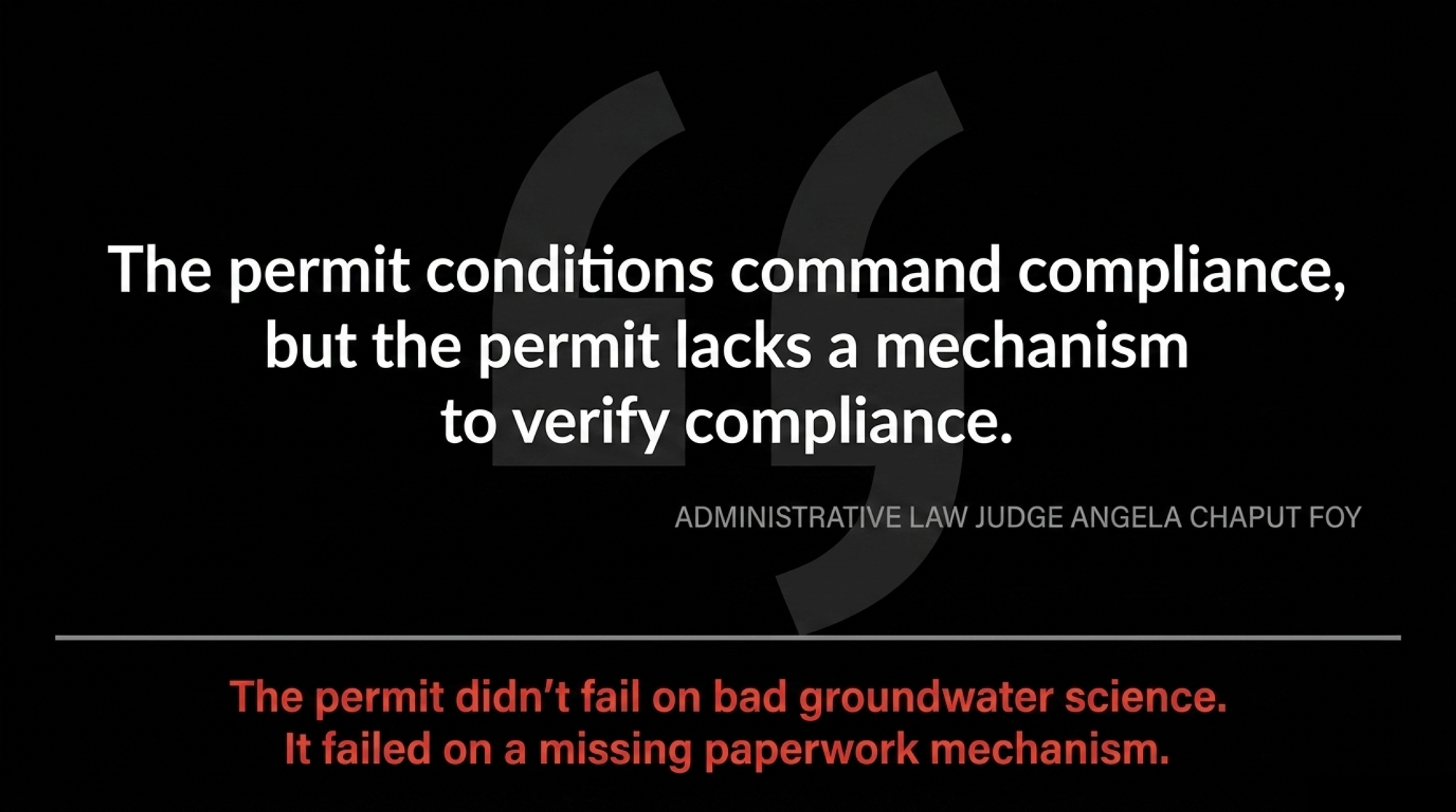
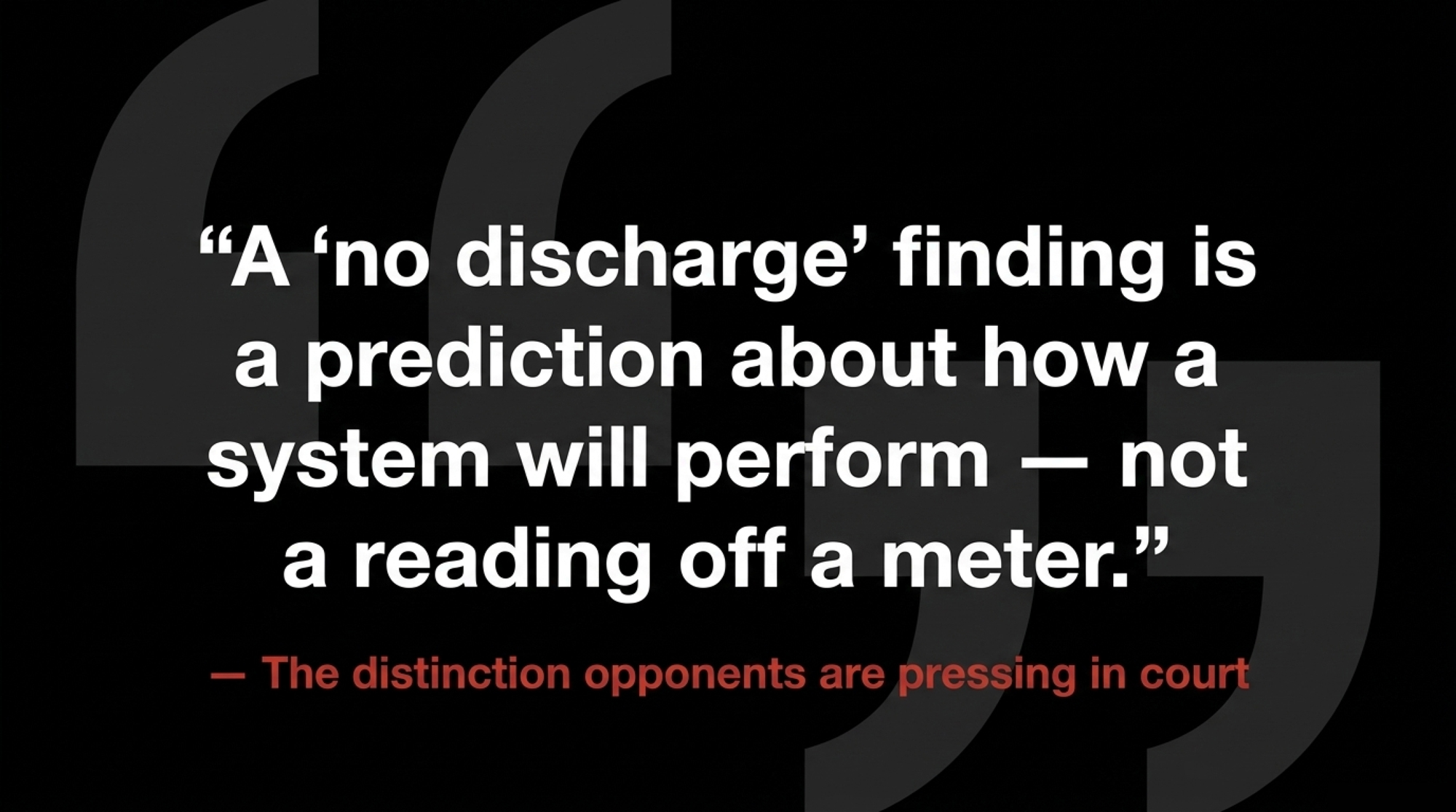
Administrative Law Judge Angela Chaput Foy, of the Wisconsin Division of Hearings and Appeals, put it in one sentence: “The permit conditions set Ridge Breeze up for anticipated compliance, they also command compliance, but the permit lacks a mechanism to verify compliance.”
Read that twice if you’re mid-application. The permit told the dairy to meet groundwater standards. It just never built in a way to check.
The order itself is narrow, and the narrowness matters. It remands the permit “to incorporate additional conditions or requirements, which may include monitoring, capable of detecting whether the groundwater protection standards of Wis. Admin. Code Chapter NR 140 are being violated.” Chaput Foy didn’t mandate monitoring wells — DNR decides what the mechanism looks like. But the principle underneath travels further than one farm in Pierce County. Obligations and verification aren’t the same thing, and a permit can carry the first without the second.
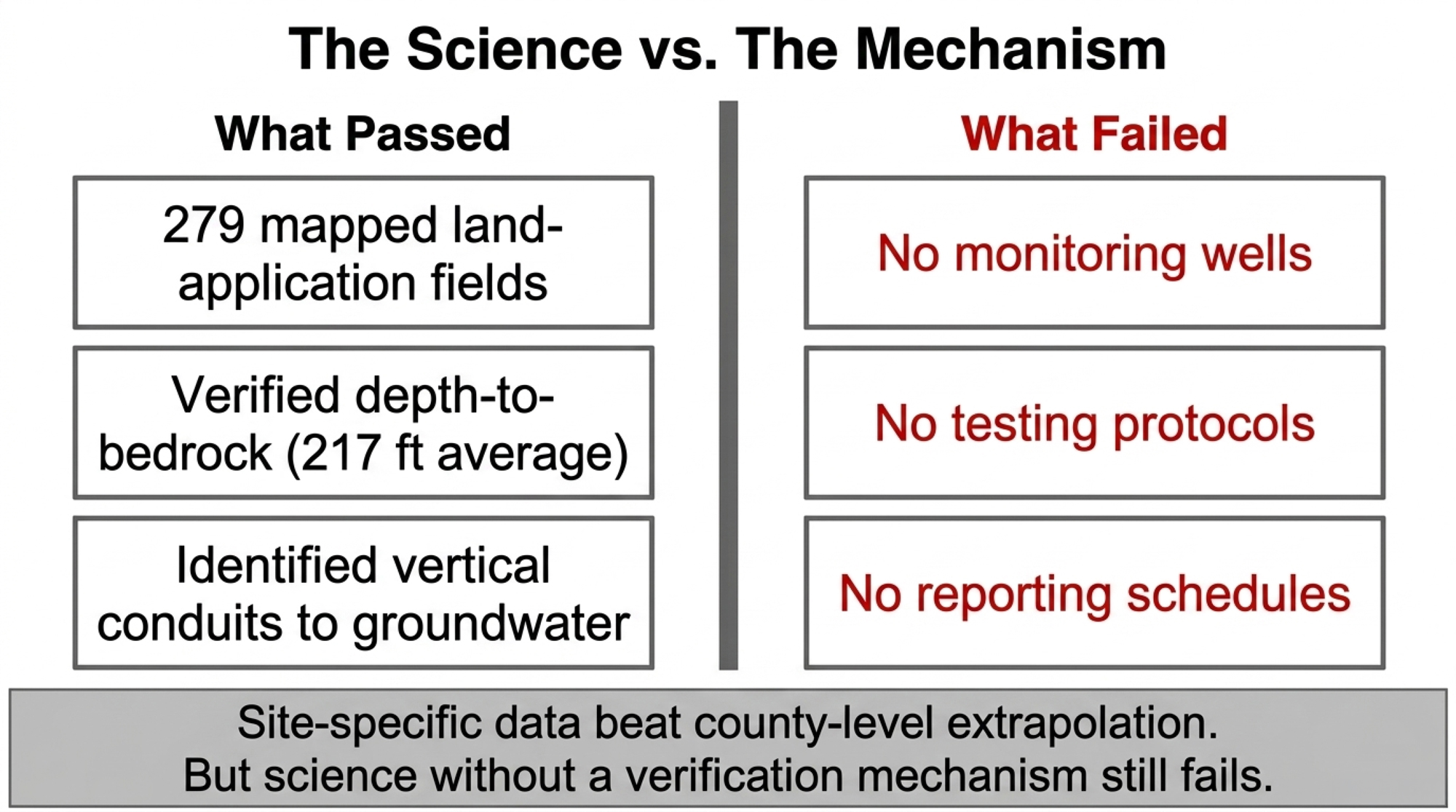
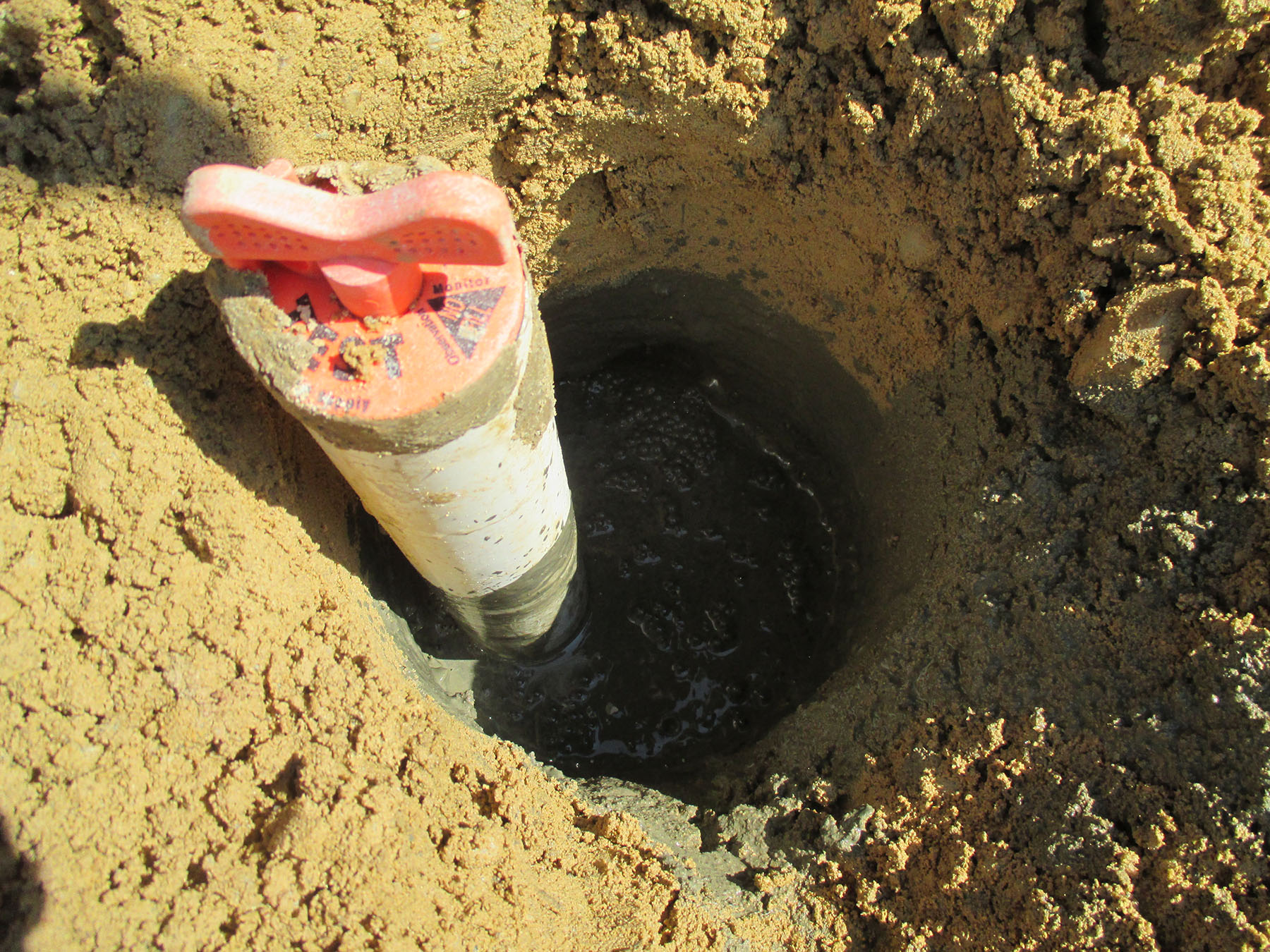
The geology at Maiden Rock is the kind that makes hydrogeologists slow down. Ridge Breeze sits on Prairie du Chien dolomite — solid rock, but heavily fractured, forming karst. Sinkholes. Conduits that move water fast and unfiltered. Glacial overburden above that bedrock runs 8 to 106 feet thick, averaging 34.7 feet. Depth to bedrock at production-area wells averaged 217 feet, ranging from 23 to 364 feet. Of the 279 land-application fields, DNR’s restriction mapping flagged 4 with direct vertical conduits to groundwater.
Who’s on Each Side
Ridge Breeze operates under Breeze Dairy Group, LLC, an Appleton company formed in 2002 by five Wisconsin dairy families. Gregg Wolf is CEO, and he’s been talking about this expansion publicly for two years. Wisconsin Public Radio reported in March 2026 that Wolf said the project would create 20 jobs and contribute more than $25 million a year to the local economy.
Scale figures vary by source, and the difference is worth knowing. The DNR decision and most coverage describe the expansion as roughly 1,700 to 6,500 cows and heifers. GROWW’s own release puts it at “up to 9,000,” which tracks the animal-unit figure from the April 2025 petition rather than head count. Both are defensible — they’re measuring different things.
Midwest Environmental Advocates represented the neighbors. Senior staff attorney Adam Voskuil told WPR in March 2026: “The DNR assumed groundwater underlying the farm and surrounding fields would be protected from surface contamination and issued the permit without requiring groundwater monitoring.” That’s petitioners’ counsel describing the agency’s approach — he’s not a neutral party. The judge’s ruling turned on a related point: the permit contained no way to verify compliance. If you followed the North Dakota water-permit fight that turned on standing rather than science, this is the same lane from a different angle — there the challenge died on who had the right to bring it; here it succeeded on what the permit left out.
One thing the judge went out of her way to say. She found no evidence linking Ridge Breeze’s permitted activities to existing well contamination, and noted that septic systems and general agriculture are both implicated in Pierce County’s groundwater picture. The county’s 2024 sampling found roughly 14% of tested wells above the 10 mg/L nitrate enforcement standard, scattered county-wide rather than clustered near any one operation. This is a permit case. Not a contamination case.
How Much Does a Permit Delay Actually Cost You?
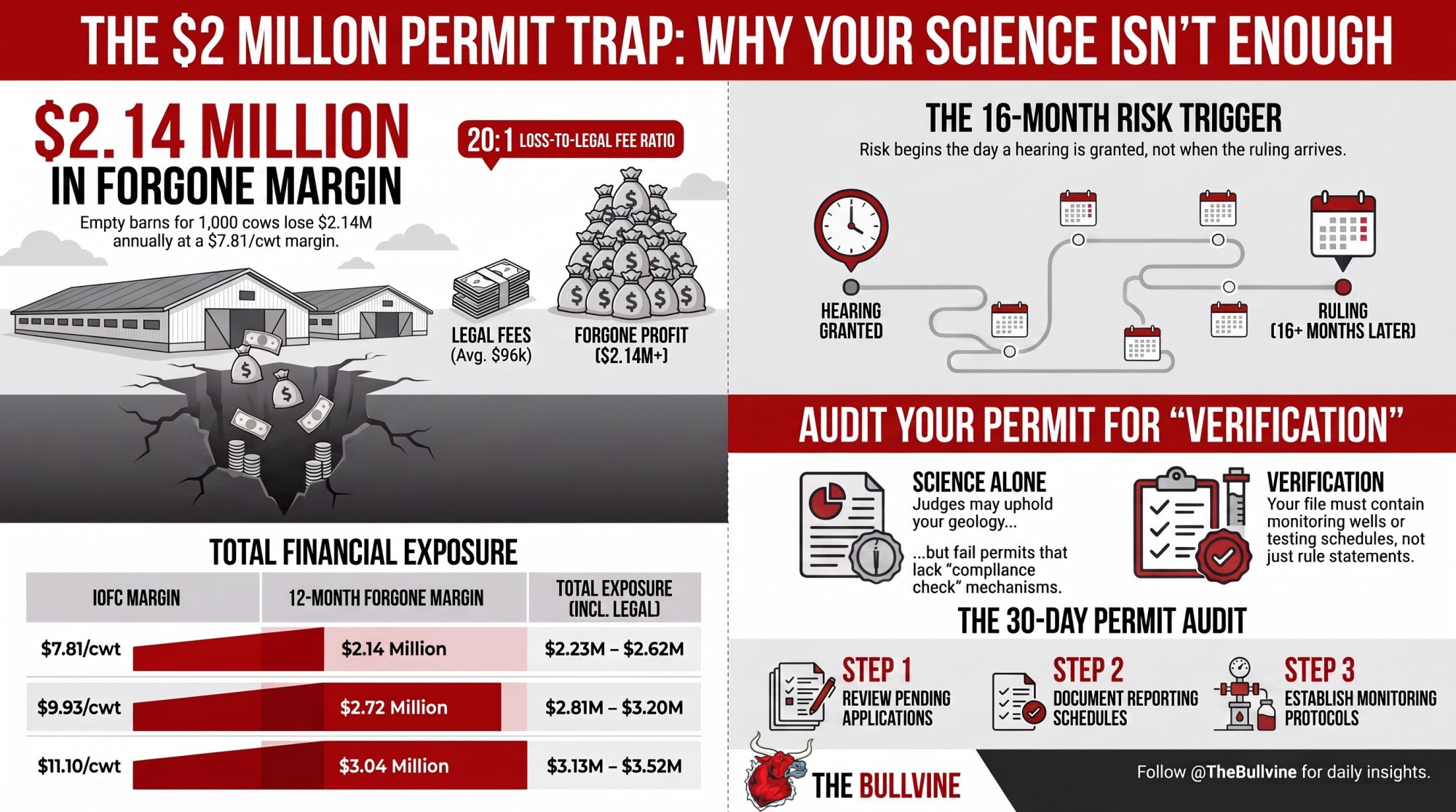
Run it on a napkin. Take 1,000 incremental cows shipping 75 lbs a day — that’s 273,750 cwt a year. At January 2026’s national Dairy Margin Coverage income-over-feed-cost margin of $7.81/cwt, a barn sitting empty for twelve months leaves roughly $2.14 million in margin on the table.
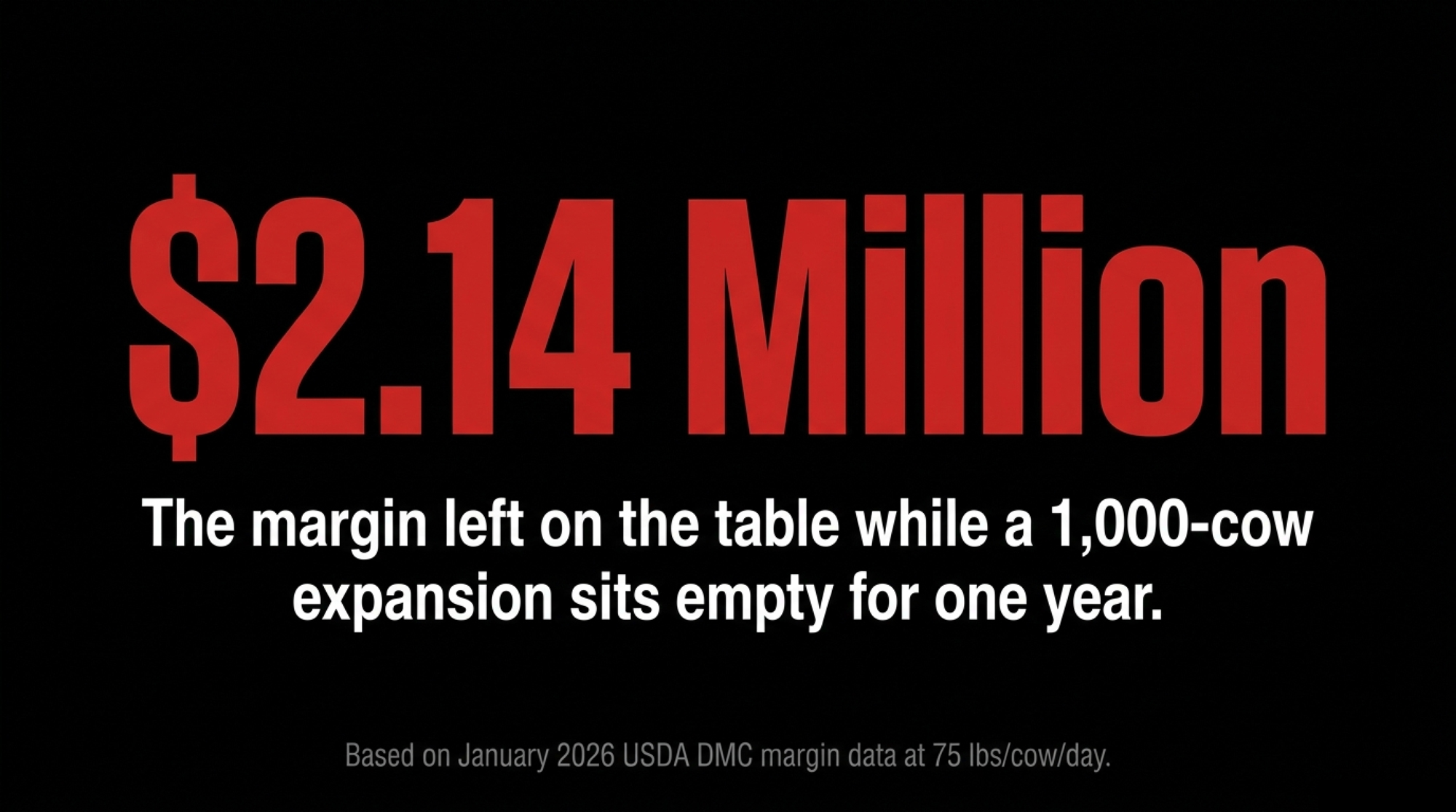
Now put that beside the legal bill. At $8,000 a month — the low end of the $300 to $500 per hour range Dairy Herd Management documented for environmental counsel in 2022 — twelve months of litigation runs about $96,000. That’s better than twenty-to-one against the lawyer, and it’s the low-fee case. Push counsel costs to $40,000 a month, and the ratio narrows to roughly four-to-one. Forgone margin still wins.
Here’s the full range USDA published this year:
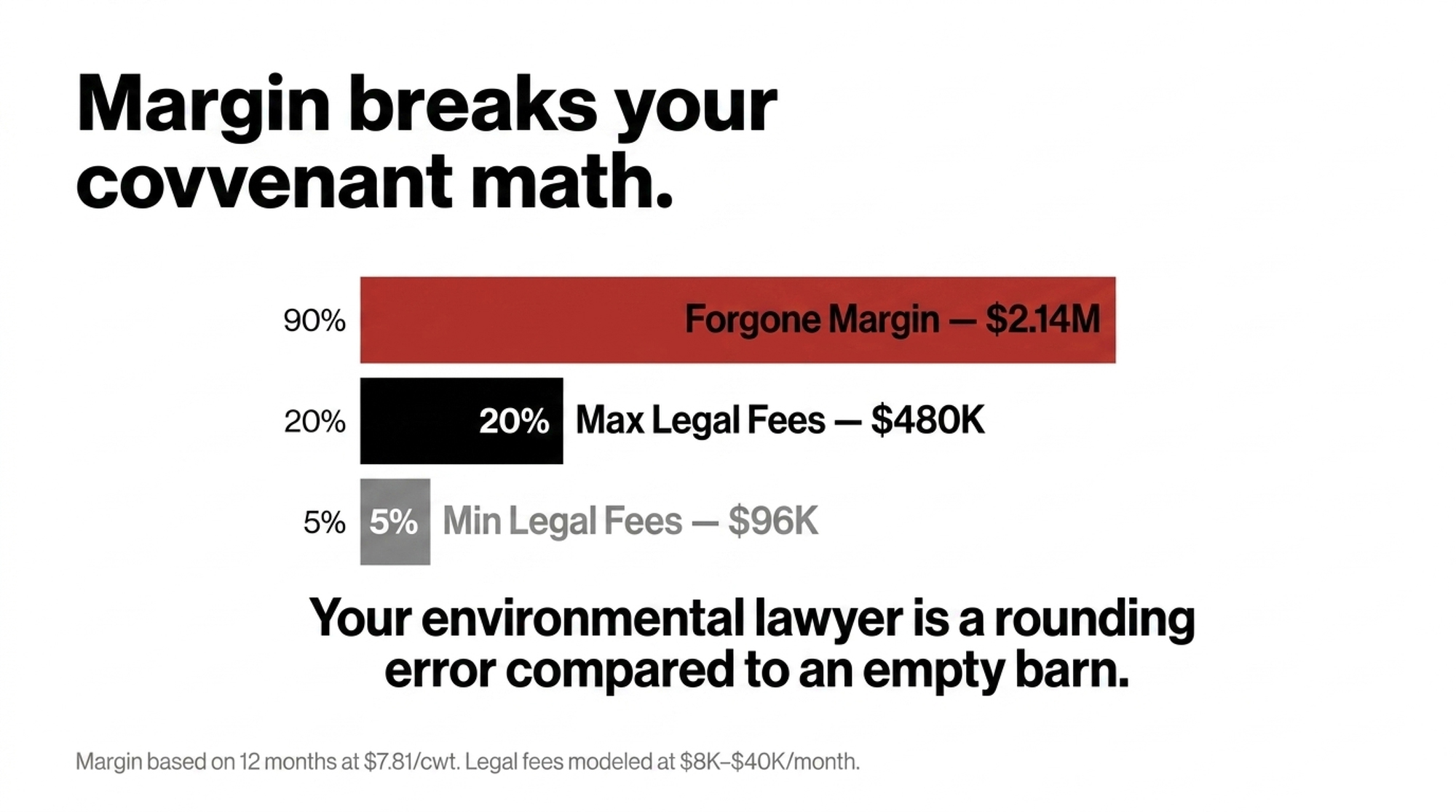
| IOFC margin | Source month | 12-month forgone margin | Legal fees ($8K–$40K/mo) | Total exposure |
| $7.81/cwt | January 2026 | $2.14M | $96K – $480K | $2.23M – $2.62M |
| $9.93/cwt | Jan–Jun average | $2.72M | $96K – $480K | $2.81M – $3.20M |
| $11.10/cwt | June 2026 | $3.04M | $96K – $480K | $3.13M – $3.52M |
Margins come from USDA’s published 2026 DMC series — $7.81/cwt in January, $9.57 in March, $10.54 in April, $10.62 in May, $11.10 in June. That’s a national formula built on standardized corn, soybean meal, and alfalfa prices, so treat it as a benchmark and substitute your own number. Production at 75 lbs/cow/day is a planning assumption, not a survey figure.
Stretch any row to sixteen months — the actual Ridge Breeze wait — and the mid-margin case clears $3.6 million in forgone margin alone.
What the table leaves out matters too. It excludes interest carry on drawn construction debt and construction cost escalation, both real and both potentially large, because the available per-head construction benchmarks come from Canadian survey data that doesn’t transfer cleanly to a U.S. build. Read these totals as a floor. For what a delay does to your cost per hundredweight rather than your total exposure, the $1.56/cwt permit trap runs that math on a 600-stall expansion.
Is Your Permit File Actually Audit-Ready?
Pull your application this week and ask whoever handles your groundwater work one question: does this file contain a documented verification mechanism — monitoring wells, a testing protocol, a reporting schedule — or does it only state compliance obligations?
The Ridge Breeze record shows what holds up under cross-examination. Site-specific data beat county-level extrapolation, consistently. Ian Anderson, DNR’s hydrogeologist program coordinator, relied on well construction reports specific to the production area and field-by-field restriction mapping, grounded in Wisconsin Geological and Natural History Survey data. Petitioners’ expert, Dr. John Jansen — a registered professional geologist with roughly four decades in groundwater investigation — argued from broader county geology. On the geology itself, the site-specific work won.
| Element | Status in Ridge Breeze Permit | Outcome |
|---|---|---|
| Site-specific well data (279 fields mapped) | Present, upheld by judge | Survived challenge |
| Overburden/bedrock depth mapping | Present (8–106 ft; 217 ft avg) | Survived challenge |
| Conduit/karst flagging (4 of 279 fields) | Present | Survived challenge |
| Verification mechanism (monitoring, testing, reporting) | Missing | Permit remanded |
One more thing a knowledgeable reader will look for. A second issue was originally noticed for hearing: whether Section 1.6 of the modified permit and the nutrient management plan were unreasonable if the NMP failed to comply with Wis. Admin. Code § NR 243.14. Petitioners withdrew it by letter on February 24, 2026, and the matter proceeded solely on the groundwater question. Don’t read this ruling as a clean bill of health on the NMP. Read it as a ruling on one specific gap.
The Legal Machinery, in Brief
Three provisions did the work here, and you can hold them in your head:
- Wis. Stat. § 283.31(4) — DNR must prescribe permit conditions necessary to assure compliance with groundwater protection standards.
- Wis. Admin. Code § NR 243.13 — those conditions must actually achieve compliance with groundwater quality standards.
- Wis. Admin. Code § NR 243.15(7) — but whether to require monitoring specifically is DNR’s discretionary call.
That third one is where the case lived. Anderson’s testimony and Jansen’s cross-examination collided over it at the March 3–4 hearing in Eau Claire. Chaput Foy wasn’t writing new law — she found DNR exercised its discretion in a way that left a hole, and petitioners carried their burden of proving that unreasonable by a preponderance of the evidence. Preponderance is a lower bar than “beyond a reasonable doubt,” which is worth knowing before you assume a challenge to your permit is a long shot.
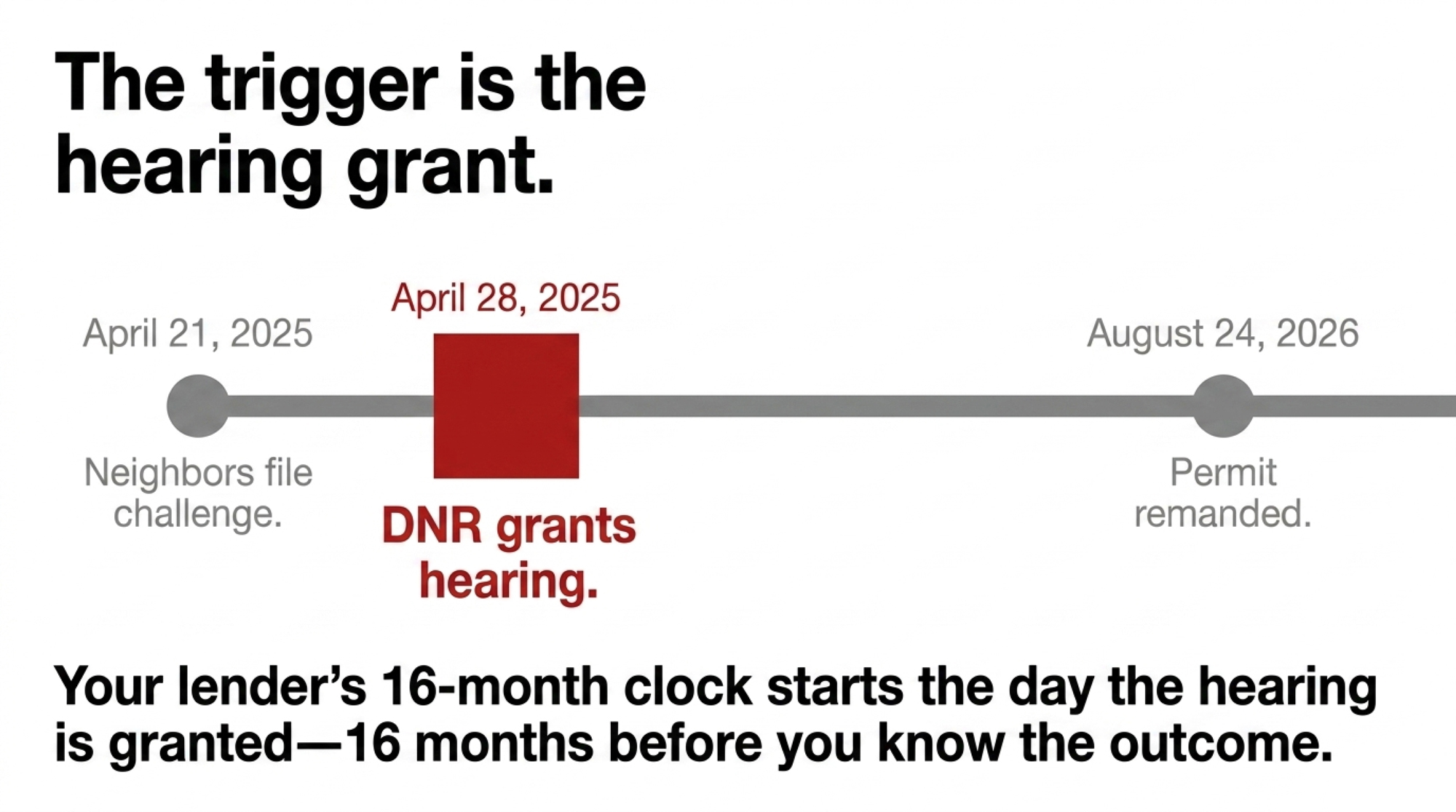
The timing detail lenders should note: DNR granted the contested-case hearing petition on April 28, 2025 — one week after filing — and referred the matter to the Division two days later. That grant date is public, documented, and it showed up roughly sixteen months before anyone knew the outcome.
Options and Trade-Offs for Farmers
Audit your permit file for a verification mechanism — within 30 days. Works for anyone with a pending or recently approved application. It costs you a conversation with your consultant and an hour of your own paperwork. Where it falls short: this is Wisconsin law. If you’re in Iowa, Michigan, or the Dakotas, ask your counsel which statute in your state does the job § 283.31(4) does here, because the holding doesn’t travel automatically.
Commission site-specific hydrogeology during the application phase, not after a challenge. Makes sense if you’re on karst, fractured bedrock, shallow depth-to-bedrock, or sand. Requires real money up front — well construction reports and field-by-field conduit mapping aren’t cheap, and you’re spending it before anyone has objected to anything. But thorough geology alone didn’t save this permit. You need the science and the mechanism, and buying only the first one is how Ridge Breeze ended up here.
Move your financing trigger from permit approval to hearing-grant date. Aimed at lenders, consultants, and anyone phasing construction draws. Requires watching DNR’s contested-case docket, which is public and free. The honest limit: this is The Bullvine’s analysis, not established underwriting practice — we haven’t found a lender willing to say on the record that they price risk this way today.
Defer major steel and equipment orders once a hearing petition is granted. The arithmetic is simple. If twelve months of forgone margin alone runs $2.14 million on a thousand-cow expansion, holding a purchase order 60 to 90 days while the record closes barely registers. The trade-off is real — deferring can cost you a price lock or a contractor slot, and in a tight market that slot may not come back. Comparable fights elsewhere suggest patience is the safer bet: a challenge to the Herberg Dairy permit in North Dakota has been awaiting a ruling since July, and Michigan’s statewide CAFO permit litigation ran more than six years before producing enforcement clarity.
Key Takeaways
- If your application states compliance obligations but contains no monitoring, testing, or reporting mechanism, that’s the exact gap that got this permit remanded. Check it this month.
- If you’re siting on karst or fractured bedrock, commission well construction reports and field-by-field conduit mapping before DNR’s final determination — not after somebody files against you.
- If a contested-case petition against your permit gets granted, treat that as your risk trigger. Not the eventual ruling. The gap between the two ran sixteen months here.
- Before your next construction draw, run the napkin version: incremental cows × your production × your actual income-over-feed-cost. USDA’s 2026 DMC margins ranged from $7.81 to $11.10/cwt nationally, and your number won’t match either end.
- If your expansion depends on a permit still inside the contested-case window, price a twelve-month delay into your covenant math now, while you can still negotiate it. Not at renewal, when you can’t.
- If you’re outside Wisconsin, don’t assume this holding applies. Ask which statute in your state performs the same function before you change anything.
What Would Your File Look Like Under Oath?
No appeal or rehearing petition had been filed as of Monday, August 31. DNR said only that it’s reviewing the decision. Rehearing under Wis. Stat. § 227.49 runs 20 days from August 24; judicial review under § 227.53 runs 30 days. So this can still move. GROWW members were scheduled to gather outside the DNR Service Center in Eau Claire on Monday evening to mark the decision and press for stronger statewide groundwater protections. Nobody has publicly examined whether the same verification gap sits inside other Wisconsin CAFO permits — and with roughly 370 active or pending permits statewide, that’s a question somebody should be asking.
So here’s yours. If a neighbor filed against your permit next Tuesday, would your file stand on its own documentation? Or would you be assembling groundwater evidence after the petition, the way this one went? We’re building the full delay-cost model by herd size — construction carry included once we’ve got defensible U.S. inputs — plus a state-by-state comparison of CAFO permit challenges and how long each took, as a follow-up piece. That’s the one to forward to your lender.
Learn More
- The $1.56/cwt Permit Trap Hiding in Your Next Dairy Expansion: Riverview’s 18,855-Cow Minnesota Challenge Exposes the Real Math — Arms you with the cash-flow defense needed when multi-year environmental reviews stall construction draws, calculating the brutal per-hundredweight cost penalties that threaten lender covenants during contested expansion timelines.
- 500,000 Gallons a Day: A Ceiling to the City, a Floor to Its Challengers — Exposes how anti-expansion groups weaponize municipal water appropriation caps and administrative standing rules to block large herds, delivering strategic blueprints to secure high-volume utility agreements before breaking ground.
- The High-Stakes Red River Water War: Herberg Dairy’s 3,800-Cow Permit Faces a 3-Judge Test on Grand Forks’ Aquifer — Dismantles the legal fiction that state hydrogeology approvals grant total immunity, detailing how multi-jurisdiction aquifer disputes create sudden litigation exposure across county lines regardless of individual farm containment design.
The Sunday Read Dairy Professionals Don’t Skip.

Every week, thousands of producers, breeders, and industry insiders open Bullvine Weekly for genetics insights, market shifts, and profit strategies they won’t find anywhere else. One email. Five minutes. Smarter decisions all week.