







The first U.S. New World screwworm case turned up in a 3-week-old calf in Zavala County. For dairies near the border, the real problem isn’t the parasite — it’s the 18-month gap before the eradication engine is even built.
Executive Summary: New World screwworm just turned up in a 3-week-old calf near La Pryor, Texas — — and a 20-km quarantine zone now locks down every warm-blooded animal in Zavala County until it’s inspected. For dairies, this lands harder than for cow-calf operations: you can hold beef cattle on pasture and wait out a quarantine, but the parlor runs twice a day and you can’t hold back milk. The cash-flow hit comes from the withdrawal clock, and the paperwork doesn’t agree — 19.5 days in some conditional-approval documents, “not established” on Zoetis’ EUA fact sheet for milking cows — so pin the number down with your vet before you treat. Run it yourself: one 200-cow pen shipping 75 lbs/day, held off the tank 19.5 days, dumps roughly 293,000 lbs of milk before you’ve paid a vet bill. Here’s the part that should worry you most — the $750M sterile-fly production plant at Moore Air Base in Edinburg won’t make a single fly until late 2027, so for about 18 months you’re on containment, not eradication. The work that protects your herd is yours: daily checks on navels, fresh-cow perineums, and any dehorning or surgical site, plus a same-day report to your state vet (NWS is reportable within 24 hours). Read the full piece if you want the milk-dump math by herd size and a straight read on whether the federal response is built for 2026.
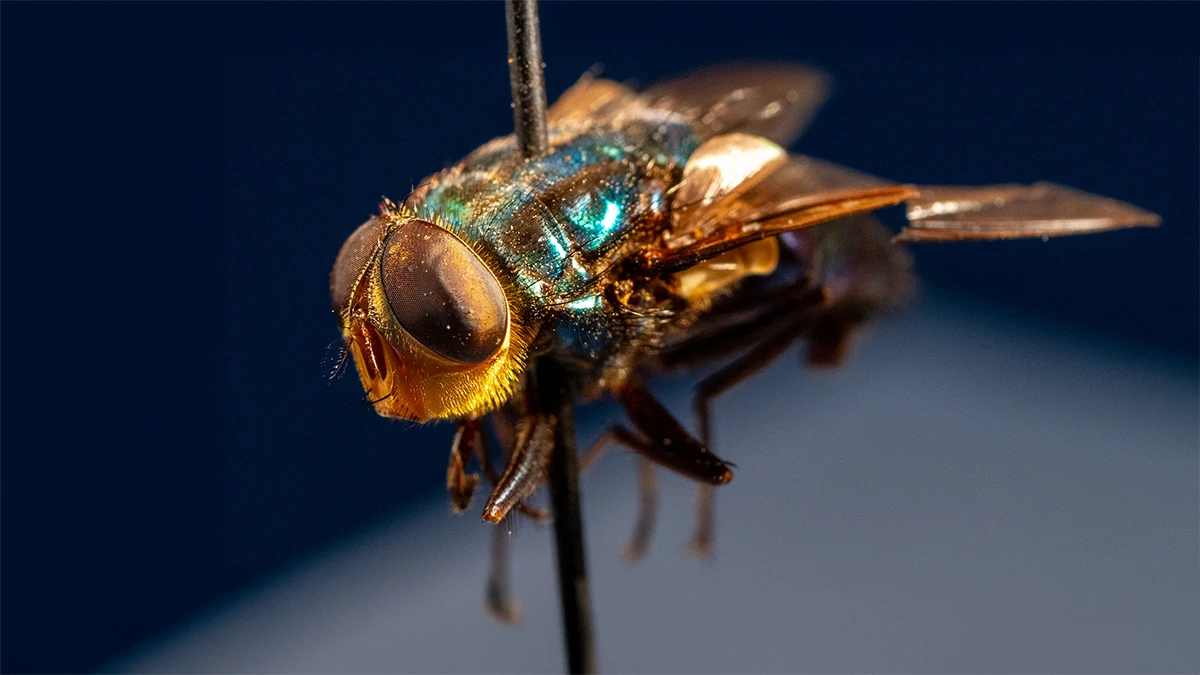
It started with a navel. A three-week-old calf on a ranch near La Pryor, Texas, had larvae burrowing into its umbilical area — the kind of wound that, on any dairy, can read at first like a stubborn infection. On June 3, 2026, USDA Secretary Brooke Rollins confirmed what the National Veterinary Services Laboratories in Ames, Iowa had found: New World screwworm. A 20-kilometer quarantine zone went up around Zavala County, and every warm-blooded animal inside it — cattle, horses, even the family dog — now needs an inspection before it can move.
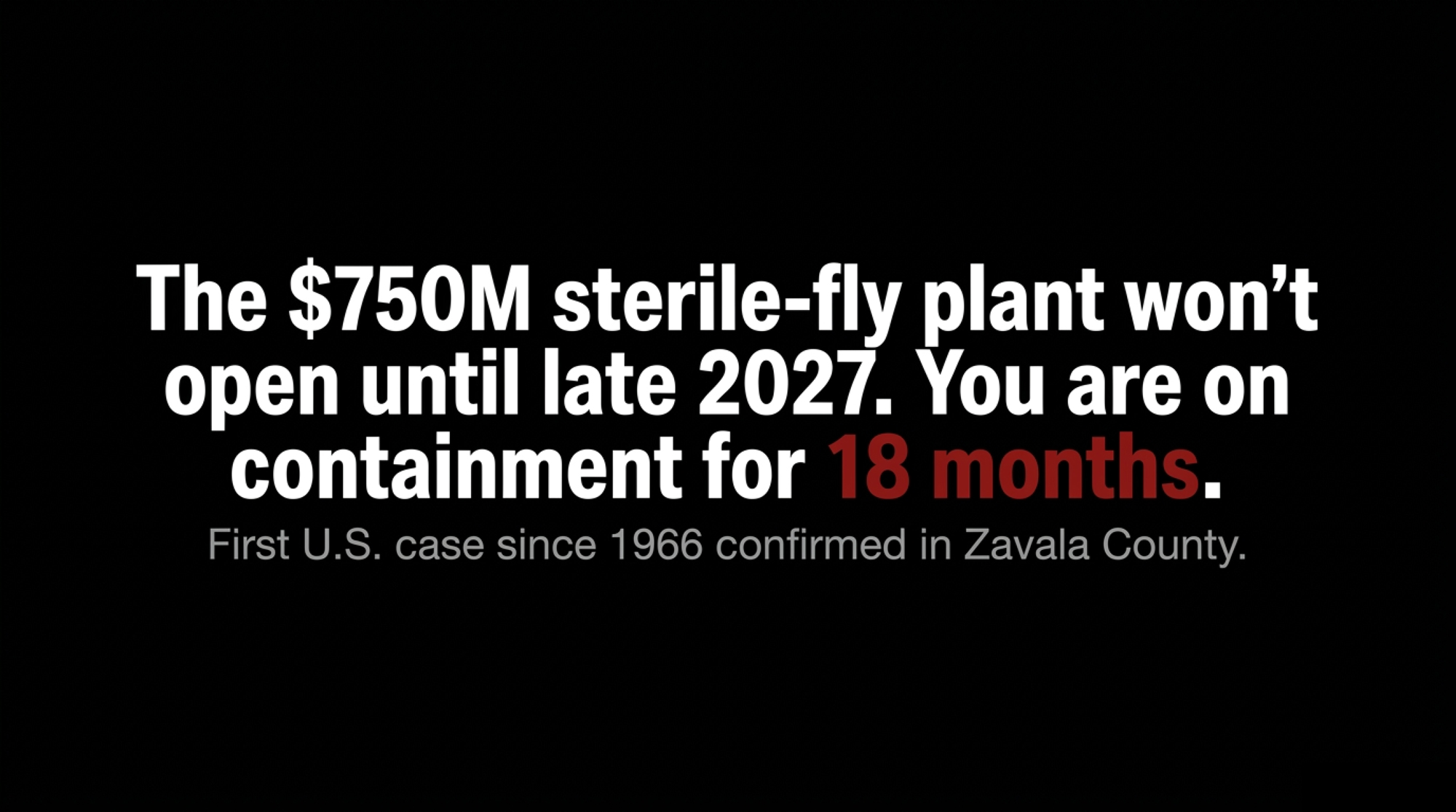
That’s the official posture, and the Texas Animal Health Commission has been clear about it: all warm-blooded animals in the zone face movement restrictions, and NWS must be reported within 24 hours of suspicion. Dr. Lewis “Bud” Dinges — the state veterinarian and TAHC’s executive director — has led the state’s response since the threat was still south of the river. Here’s the part that should keep a South Texas dairy operator up at night. The plant built to actually beat this thing back isn’t finished. USDA’s sterile-fly production facility at Moore Air Base in Edinburg — backed by roughly $750 million in federal funding — won’t produce its first flies until late 2027. So for roughly 18 months, dairies near the border are working with a containment system — not an eradication one. And they’re carrying the risk in between.
What Changed, and Why It Landed on a Tuesday
USDA slammed the border shut to live Mexican cattle in May 2025. That one move disrupted roughly $119 million in annual trade and about 1.25 million head, according to USDA figures. Governor Greg Abbott issued a statewide disaster declaration and Texas stood up its NWS response. The detections kept marching north — then, as Rollins recounted, a goat turned up in Coahuila about 25 miles south of the border on June 2, the closest case yet. A day later, it was in a Texas calf.
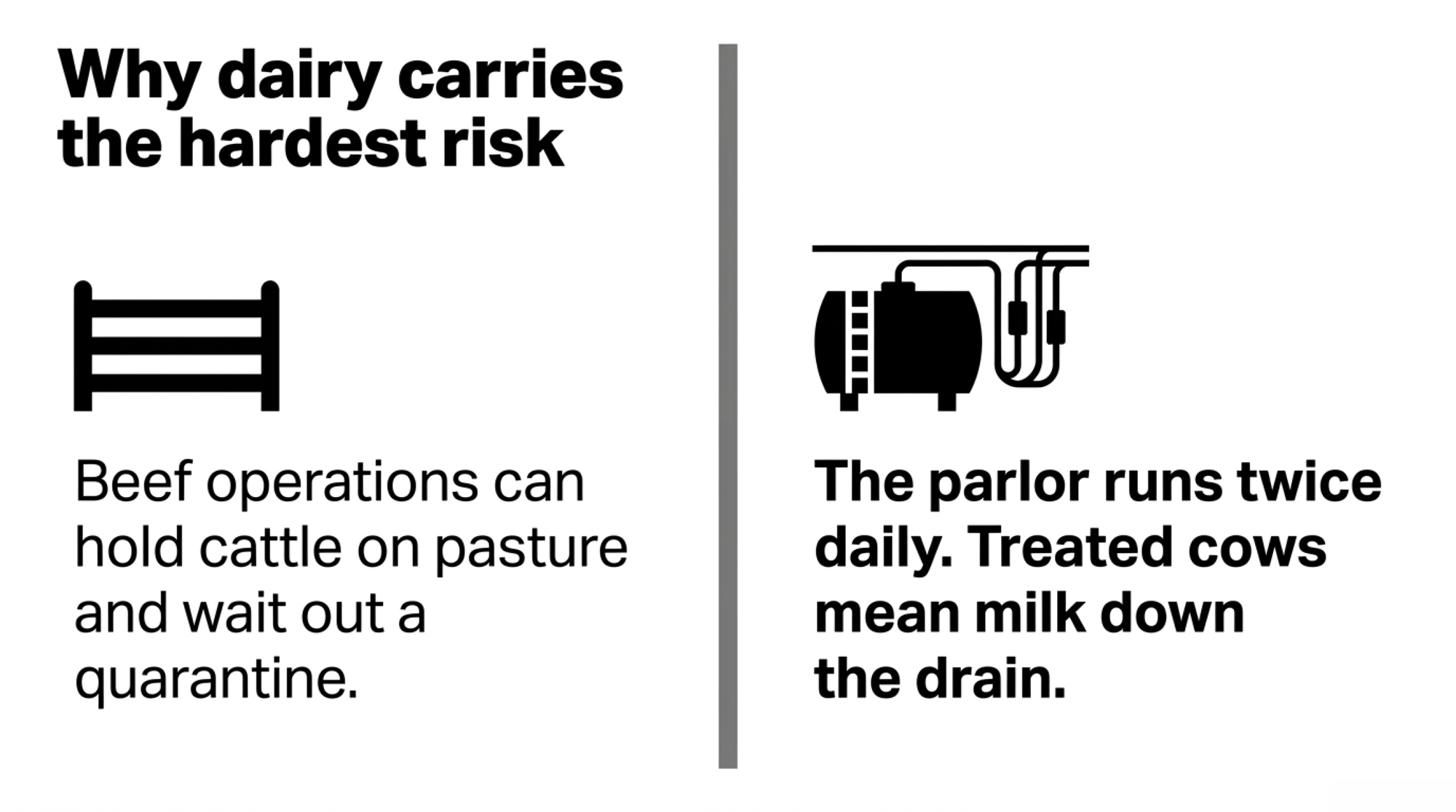
Here’s why this hits a dairy differently than a cow-calf outfit. You can hold beef cattle back on pasture during a quarantine and wait it out. You can’t hold back milk. The parlor runs twice a day, quarantine or not — so the financial pressure point for dairy isn’t dead animals so much as milk you can’t ship. And Texas is the nation’s third-largest milk state, which means a South Texas problem doesn’t stay in South Texas.
How Screwworm Actually Gets Into Your Herd
Screwworm doesn’t behave like the horn flies and stable flies you fight all summer. The female lays her eggs at the edge of a wound, and when they hatch, the larvae burrow into living tissue — feeding and tearing as they go, not just cleaning up dead flesh like a common blowfly. One untreated wound can host hundreds of larvae and turn septic fast.
On a dairy, the open doors are everywhere. Fresh navels on newborn calves. The vulva and perineum on a fresh cow, raw 24 to 72 hours after calving. Teat injuries, mastitis lesions, dehorning sites, tag holes. The La Pryor calf was infested through its navel — the most common entry point in young calves, and exactly the spot a dairy crew handles by the dozen during a busy calving stretch.
There’s a tell that separates this from ordinary fly strike. Veterinary diagnosticians describe a “chain of abscesses” — clusters of lesions, often anywhere from blueberry- to golf-ball-sized, rather than one clean wound. TAHC tells producers to watch body openings — nose, ears, umbilicus, genitalia — for drainage or enlargement, and to report suspect cases even when they’re not sure. Add a foul, rotting smell and an animal that’s isolating or off feed, and you’re likely looking at something a herdsman can’t afford to shrug off.
How This Plays Out on Real Farms — in Milk, Not Theory
The damage that hurts most isn’t the vet bill. It’s the milk you have to dump. Once you’re treating, that milk goes down the drain, not into the tank — and the withdrawal clock decides how long.
The Texas Association of Dairymen has called the spread a serious threat to both livestock health and dairy farmer livelihood, and built out a resource hub aimed at safeguarding herds, the milk supply, and the long-term sustainability of the state’s dairy industry. Producers across the state are landing on the same answer: get ahead of it now. As Texas stocker Wayne Cockrell put it back in February, ramping up animal-health practices is the crucial piece of the fight — “you’ve got to put” the work in on management before the parasite arrives, not after. That logic hits a dairy harder than a stocker operation, because a dairy’s wounds come on a calendar.
| Scenario | Withdrawal (days) | Milk lost (lb) | Milk revenue lost ($) |
|---|---|---|---|
| Single pen, short course | 10 | 150,000 | 33,000 |
| Single pen, conditional 19.5‑day window | 19.5 | 292,500 | 64,350 |
| Single pen, 35‑day withdrawal assumption | 35 | 525,000 | 115,500 |
| Single pen, 60‑day worst‑case parasiticide | 60 | 900,000 | 198,000 |
This is where you need to read the label carefully, because the numbers don’t all agree. Zoetis’ Dectomax-CA1 (doramectin) earned conditional approval for the prevention and treatment of NWS in cattle, including newborn calves and certain classes of dairy cattle. On May 19, 2026, FDA issued a separate Emergency Use Authorization extending its use to the milking string — we broke down the May 19 EUA math here, and it’s worth your time before you reach for the bottle. And the withdrawal figures don’t line up neatly across the paperwork: industry briefings cite a 468-hour (19.5-day) milk-withdrawal window in some conditional-approval documentation, an FDA FOI document assigns a 35-day withdrawal for certain labeled uses of doramectin in deer, and Zoetis’ EUA fact sheet for milking cows states a milk withdrawal period “has not been established”. The point isn’t the spread itself — it’s that you cannot eyeball this. Confirm the exact withdrawal with your veterinarian for your specific use before you treat a single cow. Older or extra-label parasiticides can stretch withdrawal as far as 60 days, per NMPF guidance.
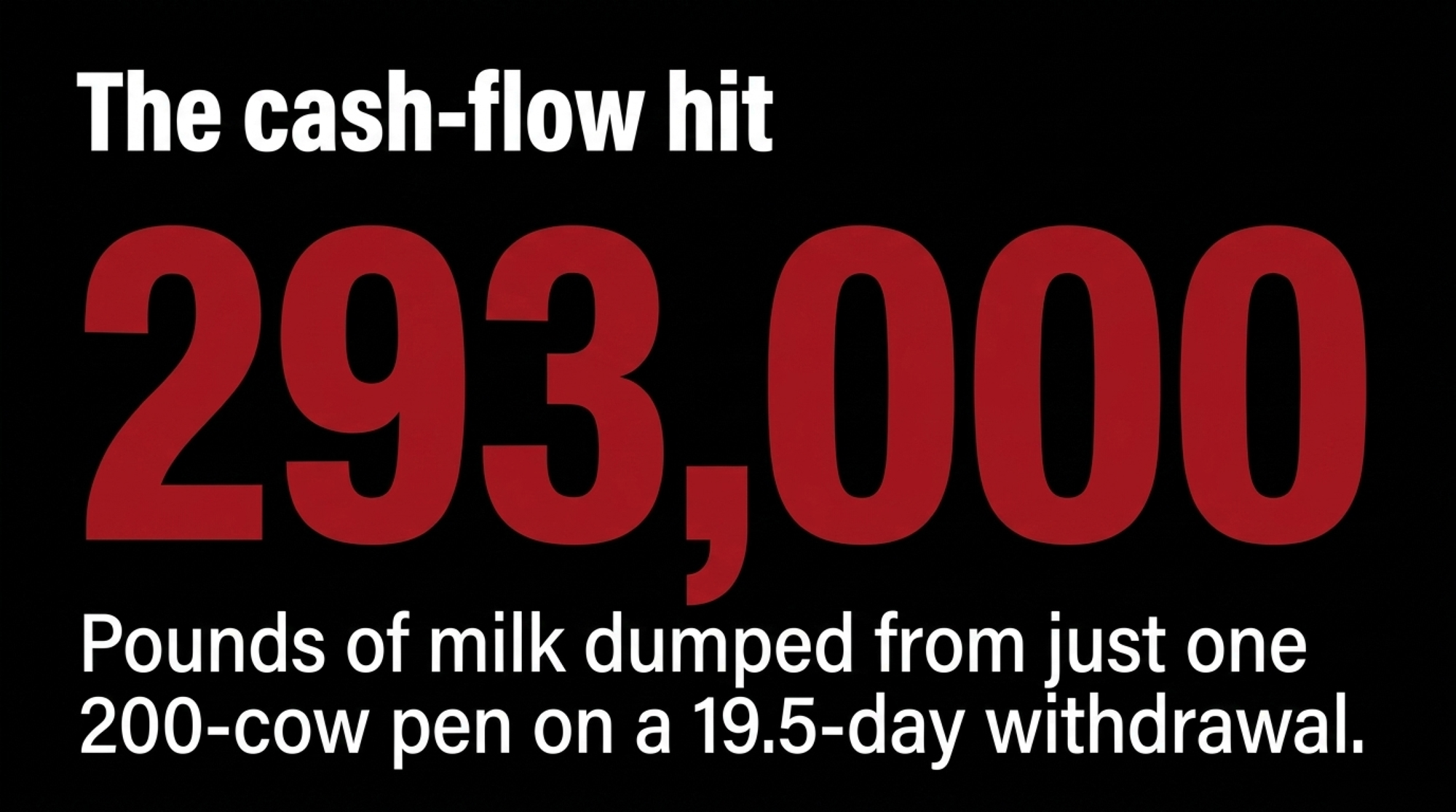
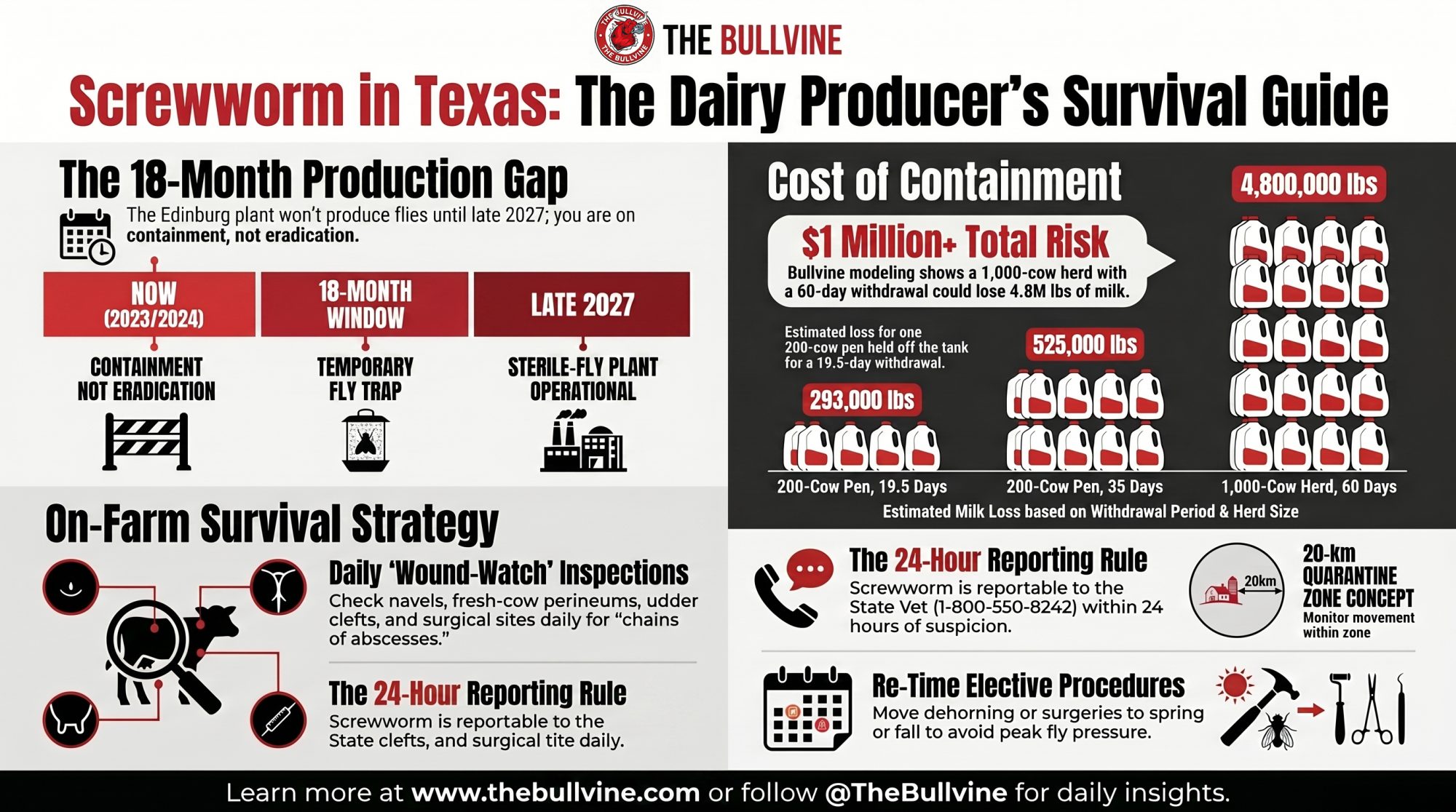
Run the math on a single pen and it gets real. Take a 200-cow group shipping 75 pounds a day. Hold that group off the tank for a 19.5-day withdrawal and that’s roughly 293,000 pounds of milk gone — just one pen, before vet costs or retreats. Push the window to 35 days and you’re past 525,000 pounds. The withdrawal number you land on isn’t a footnote. It’s the whole ballgame.
Scale it up and you hit the number that makes people quiet. In a worst case — a full 1,000-cow herd treated and held off the tank for 60 days at roughly 80 pounds a cow — Bullvine modeling puts the loss near 4.8 million pounds of milk, over $1 million down the drain at recent pricing. That’s a ceiling, not an expectation; real outbreak responses are usually targeted, not whole-herd. But even a treated fraction of your cows, times a withdrawal measured in weeks, turns “a pest we’re watching” into a cash-flow event you have to fund.
The Mechanics Behind the 18-Month Gap
The entire eradication strategy rests on one number: how many sterile flies you can put in the air. Release enough sterilized males and wild females mate but produce nothing. The wild population collapses. It’s proven science — it’s how the U.S. won in 1966 — but only at saturation scale.
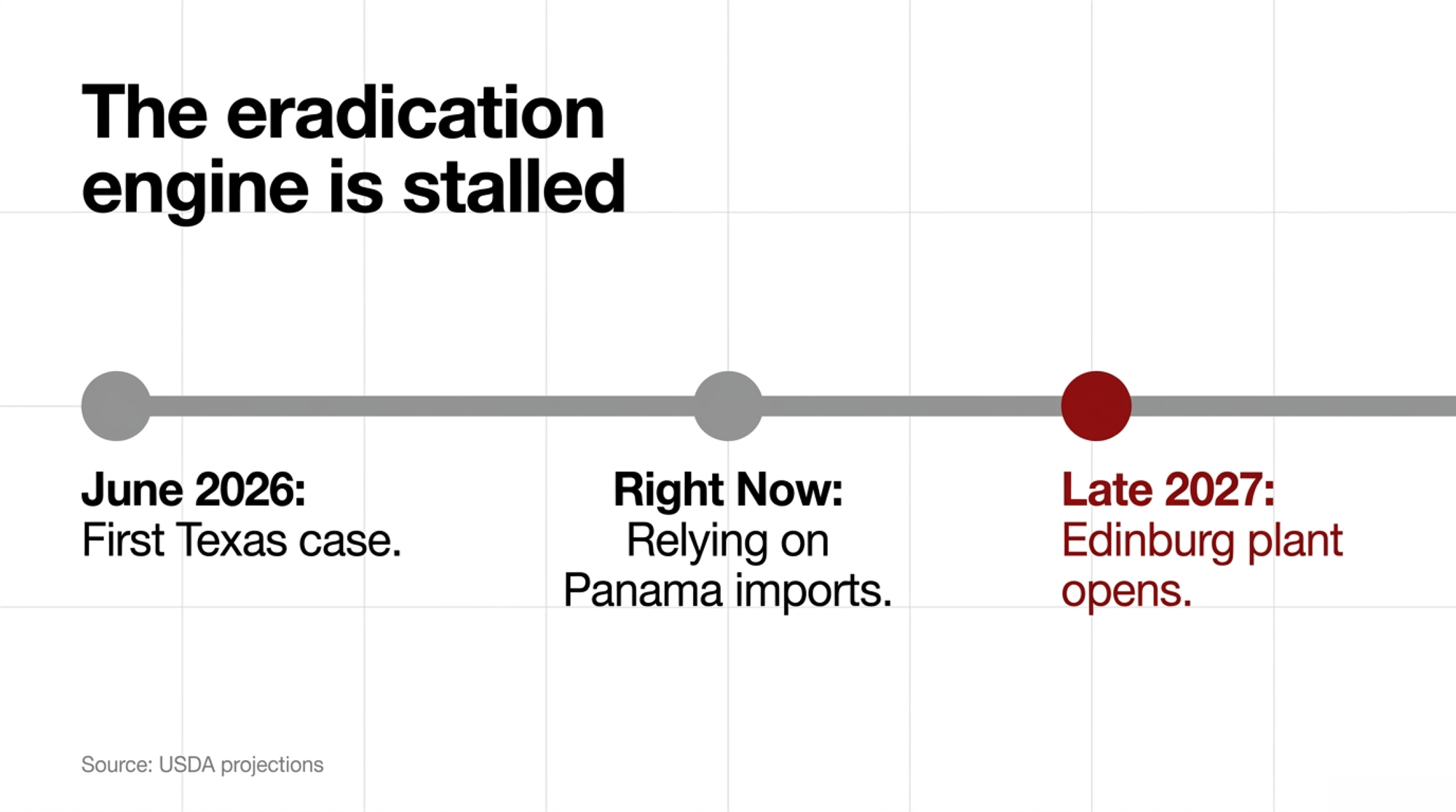
Right now, the COPEG plant in Panama is the only sterile-fly production facility operating in the region, turning out about 100 million sterile flies a week as it works to hold the line in Mexico. A sterile-fly dispersal facility at Moore Air Base is already up and running and can release up to 100 million flies a week — but it relies entirely on sterile pupae shipped in from COPEG and other sites. It doesn’t make its own flies. The big domestic production plant in Edinburg — the one that takes the U.S. from borrowing flies to making its own — is still under construction, with first output of about 100 million flies a week targeted for late 2027 and a phased build to 300 million a week by 2028.
So the system can ring-fence a known detection and flood one corridor. What it can’t do yet is blanket a wide region the moment a case pops in a new county. There’s promising work on a “male-only” fly strain that would roughly double usable output without new buildings, but it’s pending EPA review, not in the field. Until capacity catches up, more of the load falls on the part you control — your daily inspections and your willingness to report. Your calf barn is part of the eradication machinery now, whether anyone told you so.
How Much Screwworm Risk Can Your Cash Flow Actually Handle?
Most operators haven’t run this number, and it’s the one that should drive every other call. That 293,000-pound figure on a single 200-cow pen isn’t an abstraction once a confirmed case forces your hand. It’s the difference between a manageable vet event and an awkward phone call with your lender. We ran a version of this against a typical milking schedule last September and landed near an $800K liability — and that was before the parasite crossed the river.
| Herd size (milking cows) | 60‑day milk lost (lb) | Milk revenue lost ($) | Risk signal |
|---|---|---|---|
| 200 | 960,000 | 211,200 | Manageable but painful |
| 500 | 2,400,000 | 528,000 | Lender conversation zone |
| 1,000 | 4,800,000 | 1,056,000 | Red‑line for many operators |
| 4,000 | 19,200,000 | 4,224,000 | System‑level stress test |
So the most useful step here isn’t on any government poster. It’s a three-way conversation — you, your veterinarian, and your lender, in the same room. Decide on paper, before the parasite shows up, how much milk you can afford notto ship and still service your debt. Set that ceiling and everything downstream gets clearer: which animals you’d treat, when you’d pull a pen, whether you delay a dehorning round. Where does your milk-dump ceiling actually sit right now? If you can’t answer it in dollars, that’s the gap to close this week.
Is Your Calving Routine Built for This?
The operational reality is simpler and harder than the economics. Screwworm finds wounds, and a dairy manufactures wounds on a schedule — calving, dehorning, tagging, the odd surgery. The fix isn’t exotic. It’s tightening what you already do.
Walk your calving and fresh-cow pens daily with screwworm in mind: navels on the newborns, the perineum on fresh cows, udder cleft, any recent surgical site. Texas A&M AgriLife is telling producers to get elective wounding done early in spring or late in fall — outside peak fly pressure — and to watch animals after any procedure until they’re fully healed. None of that needs new equipment. It needs a trained set of eyes that knows a chain of abscesses from an ordinary scrape — and the discipline to look every day, not just when something already seems off. The emergency-fund and inspection playbook we ran in August lays out exactly how to build that routine without burning out your crew.
Options and Trade-Offs for Farmers
Here’s where the rubber meets the road: every response is a trade between labor, cash, and risk. Lay it out that way and the choices get clearer.
| Option | When it makes sense | What it demands most | Biggest risk or limit |
| Tighten daily inspection of high-risk sites — start this within 30 days | Any herd within a few counties of a detection, and really any Southern dairy this summer | Labor: trained people walking calves and fresh cows every day, checking navels, perineum, udder cleft, surgical sites | You pay in hours. A half-trained program that still misses cases is worse than honest vigilance. |
| Re-time elective wound procedures | High-risk regions during warm months, when fly pressure peaks | Planning: breaking your usual calendar on dehorning, castration, some surgeries | You can’t postpone everything; some procedures are time-sensitive for calf welfare. |
| Pre-plan treatment and withdrawal economics with your vet | Any dairy that could face a case — so, all of them | Cash-flow clarity: agreeing on which product, on which animals, with which milk-withdrawal assumption | Approvals and emergency-use rules are still shifting; this plan needs revisiting every few weeks. |
| Map your quarantine-zone status and movement options | Anyone shipping heifers, calves, or culls out of South Texas. | Logistics: live contacts with your state vet and APHIS, inspection booked before you book the truck | Zone lines move with each new case; this isn’t set-and-forget. |
You don’t have to do all of this at once. But you can’t afford to do none of it and hope that polygon never lands on your milk shed.
Key Takeaways
- If you’re within a few counties of the Zavala detection, confirm your exact position relative to the 20-km zone this week — and don’t move a single animal without knowing the inspection rule first.
- If your calving program runs without a daily wound-inspection routine, treat that as a training or hiring decision to make now, not after a confirmed case forces it.
- If you haven’t pinned down the exact milk withdrawal for the product and animal class you’d use, do that before you treat — the figures vary widely across the paperwork, and your vet has to make the call for your situation.
- If you’ve never put a dollar figure on milk-dump tolerance, run the math on one pen at both a short and a multi-week withdrawal window. If that number threatens your debt service, start the financing conversation.
- If your dehorning or surgery round is scheduled for peak fly season, ask your vet whether it can shift.
- Program the TAHC veterinarian-on-call line, 1-800-550-8242, your APHIS contact, and screwworm.gov into your phone today. NWS is reportable within 24 hours of suspicion — there’s no wait-and-see.
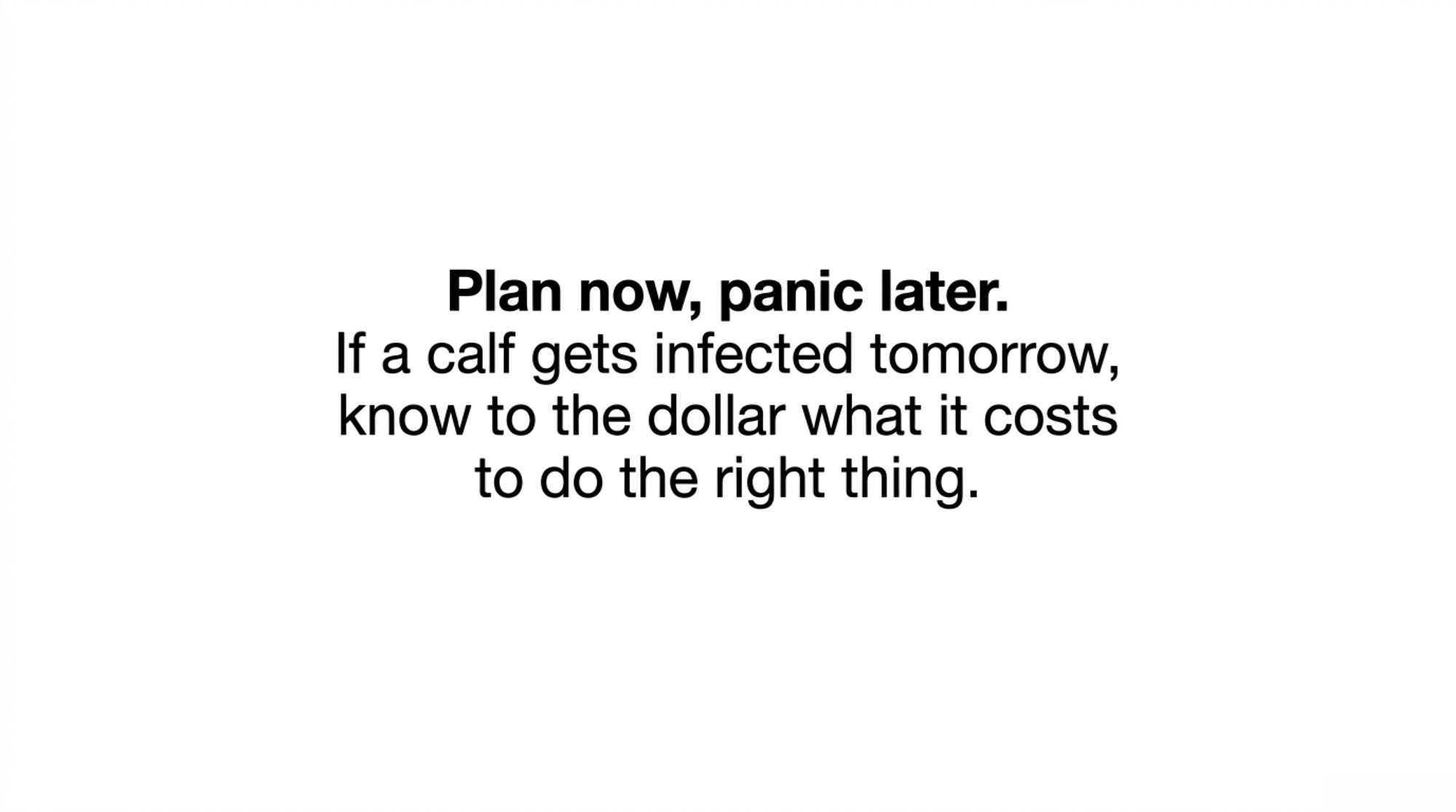
So here’s the question to carry into your next vet visit: if a calf in your barn turned up like that La Pryor calf did, do you know — to the dollar and to the day — what it would cost you to do the right thing? Most operators can’t answer that yet. The ones who work it out before the polygon drifts their way are the ones who’ll make decisions from a plan instead of from panic.
We’re building out the full milk-withdrawal cost model by herd size — across short and multi-week withdrawal windows — plus a zone-by-zone movement playbook in an upcoming Bullvine Weekly. That’s where the real numbers live, and where a 200-cow dairy and a 4,000-cow dairy will find very different answers.
Run Your Numbers
Health ROI Calculator — Before a screwworm case forces your hand, run the Health ROI Calculator to put a real-dollar figure on milk withdrawal, culling, and treatment losses for your herd size and milk price. Its “Cost of Inaction” view turns “a pest we’re watching” into the number you take to your vet and lender.
Complete references and supporting documentation are available upon request by contacting the editorial team at editor@thebullvine.com.
Learn More
- Screwworm treatment dairy cattle: the May 19 EUA math — Arms you with a metric-driven wound scoring framework to distinguish standard infections from screwworm infestations, preventing costly buyer biosecurity discounts on your calf loadouts.
- Beef-on-Dairy at 45%? A Screwworm 200 Miles South Just Rewrote Your Calf Math — Exposes the hidden financial vulnerabilities of high-leverage beef-on-dairy breeding strategies, delivering a complete stress-test playbook to buffer your contract revenue against regional movement restrictions.
- US-Mexico Border Shutdown: Flesh-Eating Parasite Threat Halts $119 Million Cattle Trade — Breaks down the geopolitical supply chain shockwaves triggered by failing international sterile fly containment protocols, tracking how the initial border closure directly squeezed the domestic feeder cattle market.
 The Sunday Read Dairy Professionals Don’t Skip.
 The Sunday Read Dairy Professionals Don’t Skip.
Every week, thousands of producers, breeders, and industry insiders open Bullvine Weekly for genetics insights, market shifts, and profit strategies they won’t find anywhere else. One email. Five minutes. Smarter decisions all week.





