


Archive for Milk recording

Lactanet Gave Murray Hunt Its Distinction Award. He Gave the Room a 3,500-Herd Problem

In 1970, Canada had 90,000 dairy herds. By August 2025, there were 9,048. By 2035, there may be just 3,500. Upon receiving Lactanet’s Distinction Award, Murray Hunt challenged the industry: the milk tank can’t pay for the structure we have now.

Murray Hunt thanked Neil Petreny and Paul Larmer for helping him up to the podium. “Age is catching up,” he said, “but I still love the industry.” Then the 81-year-old spent the rest of his time at the podium proving it, first by thanking the people who built his career and then by telling the people who run Canada’s dairy cattle improvement organizations that the structure he spent that career building has outgrown the milk cheque.
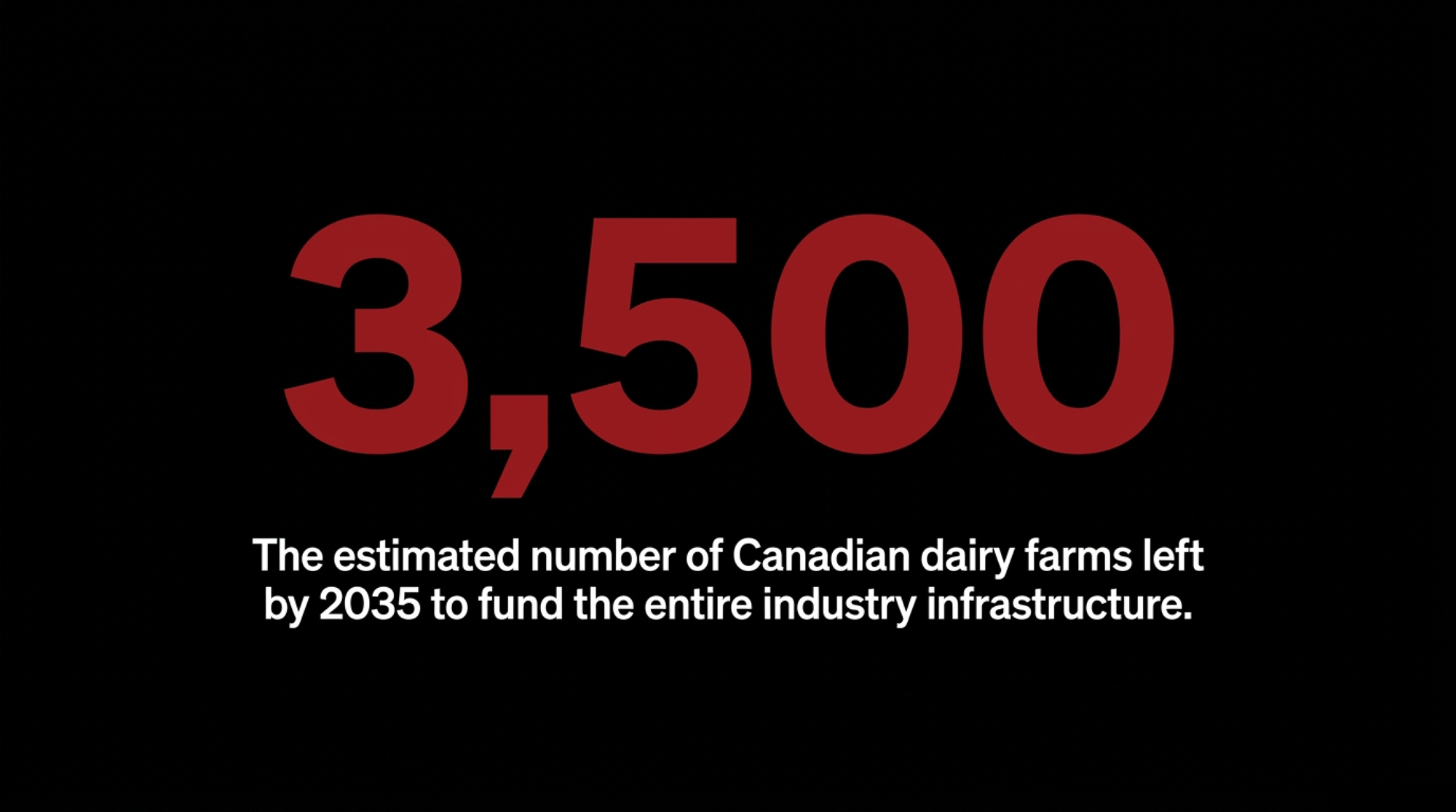
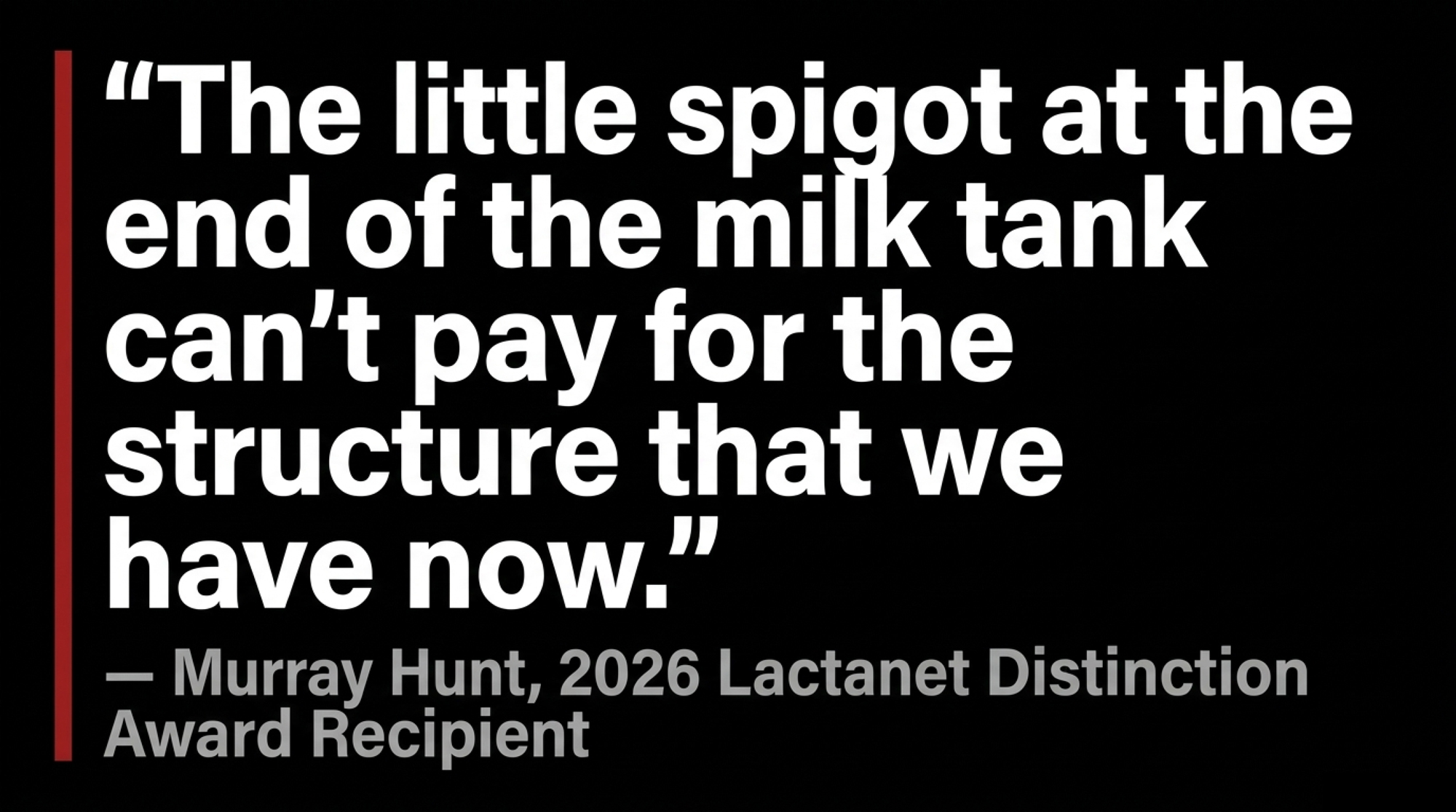
“In 1970 we had 90,000 herds in Canada, 25 cows each, and every farmer organization had its own silo, its own goals, its own area, and you didn’t dare get outside them,” he told the Dairy Cattle Industry Forum at the Sheraton Gateway Hotel in Toronto on September 22, minutes after Lactanet presented him with its 2026 Dairy Cattle Improvement Industry Distinction Award. Canada had 9,048 farms shipping milk on August 1, 2025, according to the latest available Canadian Dairy Information Centre data. The estimate Hunt had read for 2035 is 3,500. “The milk tank, that little spigot at the end of the milk tank, can’t pay for the structure that we have now,” he said.
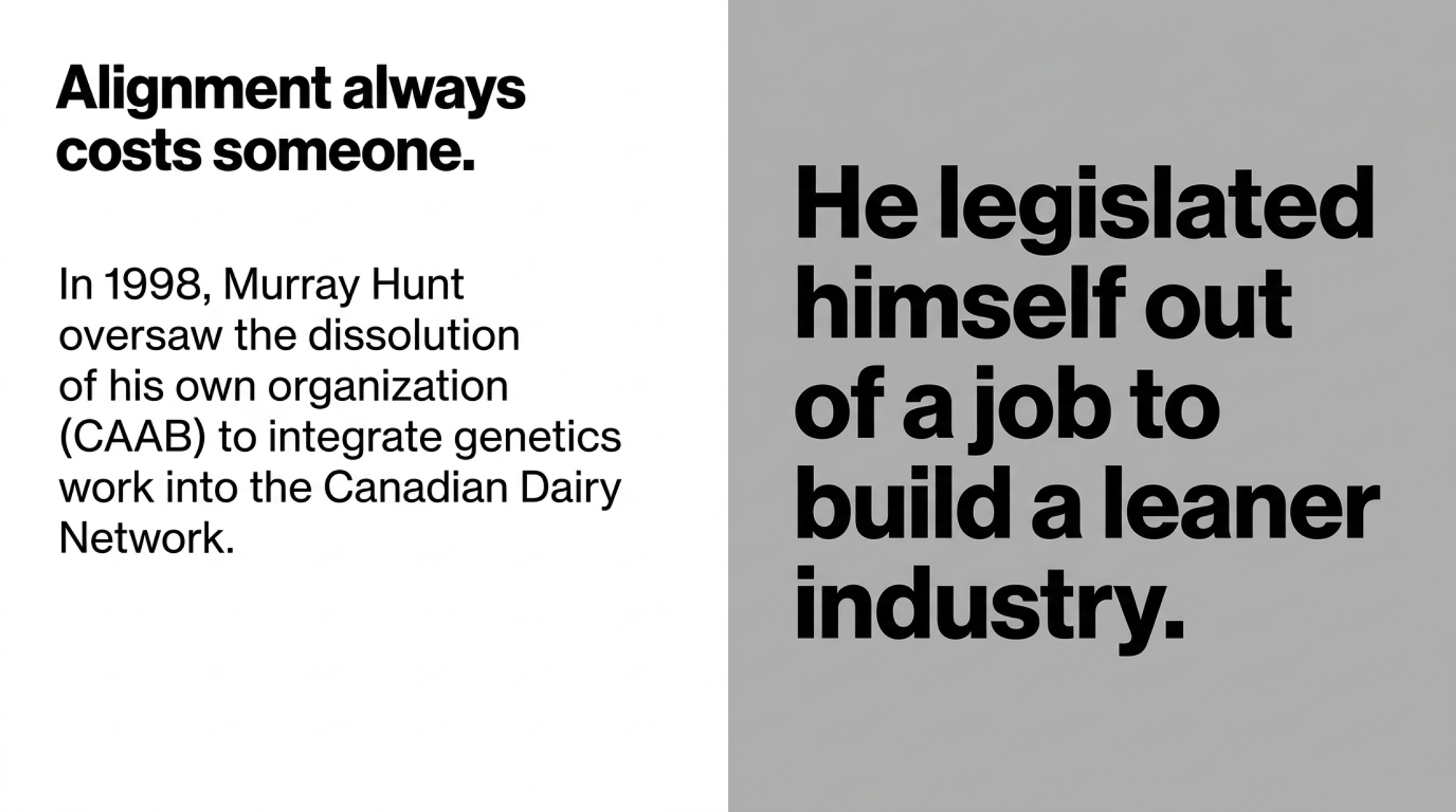
Few people in that room had more standing to say it. In 1998, as executive director of the Canadian Association of Animal Breeders, he saw CAAB dissolved once its genetics work had moved to the new Canadian Dairy Network. Four years earlier, Larmer’s citation noted, he “navigated a successful streamlining and integration of research dollars, people resources, and effort” across industry organizations to create the Cattle Breeding Research Council. On Tuesday, he asked the room to do it again. “Alignment for me and Karen personally was that we were out of a job,” he said.
His 2035 number sounds extreme until you look at who actually buys dairy improvement services. Herds enrolled in milk recording fell 17.3% in five years, against 10.4% for all farms. Hold that pace, and Lactanet records roughly 3,650 herds in 2035, within 150 of Hunt’s figure. That’s a Bullvine calculation, and the math is below.

The Names Read Before His

Larmer read the roll of previous recipients before he read the résumé. Doug Blair and Robert Chicoine shared the first award in 2008. Bonnie Cooper became the first woman honoured in 2019. The 2023 forum made up for three pandemic years with Pierre Laliberté, Dr. David Kelton and a special award to Brian Van Doormaal, according to Lactanet. Gary Bowers followed in 2024, and the late Dr. Gerrit Kistemaker was honoured posthumously in 2025. 

Lactanet’s announcement calls Hunt the sixteenth recipient since the award’s creation in 2008. Semex announced Chicoine’s death on September 15, so the name that opened the list was read a week later. 

Jack Britt had come up from the United States for the evening. The North Carolina State dean emeritus co-wrote the 2018 Journal of Dairy Science review imagining dairy farms in 2067, a fitting guest for a speech about 2035. Hunt also thanked Van Doormaal for starting the forum at CDN and Lactanet for carrying it on.

Larmer called it “a lengthy résumé, but one of contribution, foundation building, and success that has touched on almost every aspect of our dairy improvement industry.” We covered it in full when Lactanet announced the award in August. The short version: a 1970 University of Guelph master’s thesis under Dr. Ted Burnside arguing for the maximum number of young sires in structured sampling, which at its peak meant more than 500 young bulls sampled in Canada a year. The Production Dollar Difference, Canada’s first sire ranking index built on profit and a forerunner of the Pro$ index that arrived in 2015. Eighteen years at Holstein Canada. Inaugural chair of the Genetic Evaluation Board. A seat in the Futures Group that led to Canadian Dairy Network on May 29, 1995. 

→ The full career story: 500 Young Bulls a Year: The 1970 Thesis Behind Murray Hunt’s Lactanet Distinction Award

A Farm Accident, a Centennial Dance and the Hardest Lesson

He was 15 when his parents, Sterling and Irene Hunt, bought Huntsdale Farm: 22 cows and a 25-acre market garden. The herd went on Record of Performance, started using AI in 1962, and was type classified in 1963. Huntsdale earned Holstein Canada’s Master Breeder shield in 1984.

University wasn’t the plan. “I had a farm accident, and she said, ‘You may not be able to farm,'” he said of his mother. “I wanted to farm. As always, mothers are right.”

He called August 5, 1967 “my greatest blessing.” It was a community centennial dance. “I’m not a very good dancer, mostly a wallflower. She did let me drive her home. We went out on a date the next day, and the rest is history.” Karen was entering her first year at McMaster; he was partway through Guelph. They married two years later. “If I have any communication skills, I learned from Karen. She’s my rock, my support, my everything.”

His first job, running Ontario’s Dairy Herd Improvement Program for the provincial agriculture ministry at 25, taught him business and human resources the hard way. “Firing people. That was the toughest thing I ever had to learn,” he said. “I had to learn to part with people in a good way.”

Larmer’s citation filled in the life around the work: more than 15 years as a 4-H leader coaching teams at what’s now the TD Canadian 4-H Dairy Classic, two decades producing the six-night Rockton Dinner Theatre with Karen to raise money for the Rockton Fair, and service as an elder at West Flamborough Presbyterian and Troy United churches. They have three children and eight grandchildren. None of the grandchildren is in dairy. He listed their careers with obvious pride, from data systems to medicine, in the same speech where he cited a 3,500-herd estimate.

How Did Milk Recording Go From 10% of Cows to 58%?

When Hunt joined Holstein Canada in 1973, he said, 10% of Canada’s dairy cows were milk recorded and 6% were type classified. “We’ve heard here today that we don’t need every animal recorded, but at one time we thought we did, so we pushed hard.”

Pushing meant travelling the country to combine the federal ROP program with the provincial DHI programs. It meant writing the first constitution of the Ontario Dairy Herd Improvement Corporation with a lawyer the Ontario Milk Marketing Board paid for. And it meant spending three hours one day explaining to Lorne Hurd, the board’s general manager, why DHI needed a checkoff. “Now whether it’s being well used or not,” he said, “Neil Petreny will have to explain that.”

It worked. In 2025, 563,492 cows in 5,333 herds were on milk recording, according to Lactanet data published by the Canadian Dairy Information Centre. That’s 58% of Canada’s 971,600 dairy cows. 

Classification was the harder fix. “The type classification program may not now be meeting everyone’s needs,” he conceded, but in 1973, 47% of first-lactation cows were classified Good Plus, and there were more Goods than Good Pluses. The scores weren’t separating cows, and the recording needed to be standardized.

The answer turned up at a grounded Ottawa airport. It was February, about minus 20, and planes weren’t leaving because Ottawa didn’t have de-icing yet. Hunt got talking to a man in snow boots working on a portable device. He measured trees for a living, he said. He could only work outside for an hour and a half at a time, then went back inside and worked the data. Hunt wondered whether classifiers could use the same thing.

Dalton Hodgins, the Shawville classifier who later led Holstein Canada’s classification staff, according to Holstein Québec, took the project on with him. He’d drive out from his Brantford hotel to the Hunt home at night, where a young Andrew Hunt would pepper him with questions and then start punching keys. Hodgins would warn the boy, “Oh, don’t do that. You might break it,” Murray told the room. “Andrew’s never been afraid of computers.” Larmer’s citation credits that work as the first handheld device used to standardize classifiers’ records, and the Canadian system was adopted by multiple countries. Hunt trained classifiers in Australia, Japan, Brazil, France, Italy, Cuba, Germany and Spain. 

He didn’t oversell the result. “I’m not sure we were successful in getting the right feet and legs on the cow,” he said, “but nevertheless, it was a lot of change.”

The Silo Speech

Hunt said he’d cleared it with the organizers first. “I could throw out a little bit of my bias here.” Then he told a room full of cattle people that he wasn’t there to talk about cows. “I want to challenge you on the infrastructure.”

In the 1970s, he said, Canada sampled 500 young bulls a year, and some herds generated 30% of their revenue from breeding sales. The organizations serving them stayed in their own lanes. Some of those walls have come down since. “In my opinion,” he said, “not enough.”
 1970 (Hunt)2025 (official)2035 (estimate Hunt cited)
Herds90,0009,0483,500
Cows per herd25107225–240
Dairy cows~2.25 million (implied)971,600787,500–840,000 (implied)
Fat and protein per cow per day—baseline20%+ higher

Sources: 2025 farms and cows, Canadian Dairy Information Centre; 2025 herd average, Dairy Farmers of Canada. The 1970 and 2035 figures are Hunt’s, from the podium. Implied cow counts are Bullvine calculations.

“It’s going to be a business model on every farm,” he said of 2035, and the milk recording service will have to become a business-model service too. “Are you prepared to take down all the silos and get together for the benefit of the dairy farmers?”

He gave three asks.

  • Alignment. “Yes, I said alignment, not cooperation, not collaboration, not amalgamation. Alignment.” He held up Lactanet itself, which brought CanWest DHI, Valacta and CDN together in 2019, as the model and said it needs to go further. Then he looked right at the president of Holstein Canada. “It’s going to be a challenge for you, because I think there’s roles for breeds and there’s roles for others.” 
  • Rationalization. Each organization carries its own HR department and its own computer systems. “We need to destroy more silos.”
  • Innovation. “The dairy industry is bigger than Canada, and we need to be finding partners around the world to work on research and development.” Then came an admission from the man who helped shape the type program. “We used to think we had the Canadian kind. It was unique. We’re not any more unique than anything else. We’re finding out now she was too tall in front, and that chest width didn’t mean anything about how much feed she could take in.”

He also asked for modelling. The Futures Group of 1994 led to CDN the following spring. “It sounds kind of stupid now to say 1994. We were looking to the future.” His master’s was a computer model. Now he wants a new model for 2035, 41 years on.

Can 3,500 Herds Pay for Today’s Structure?

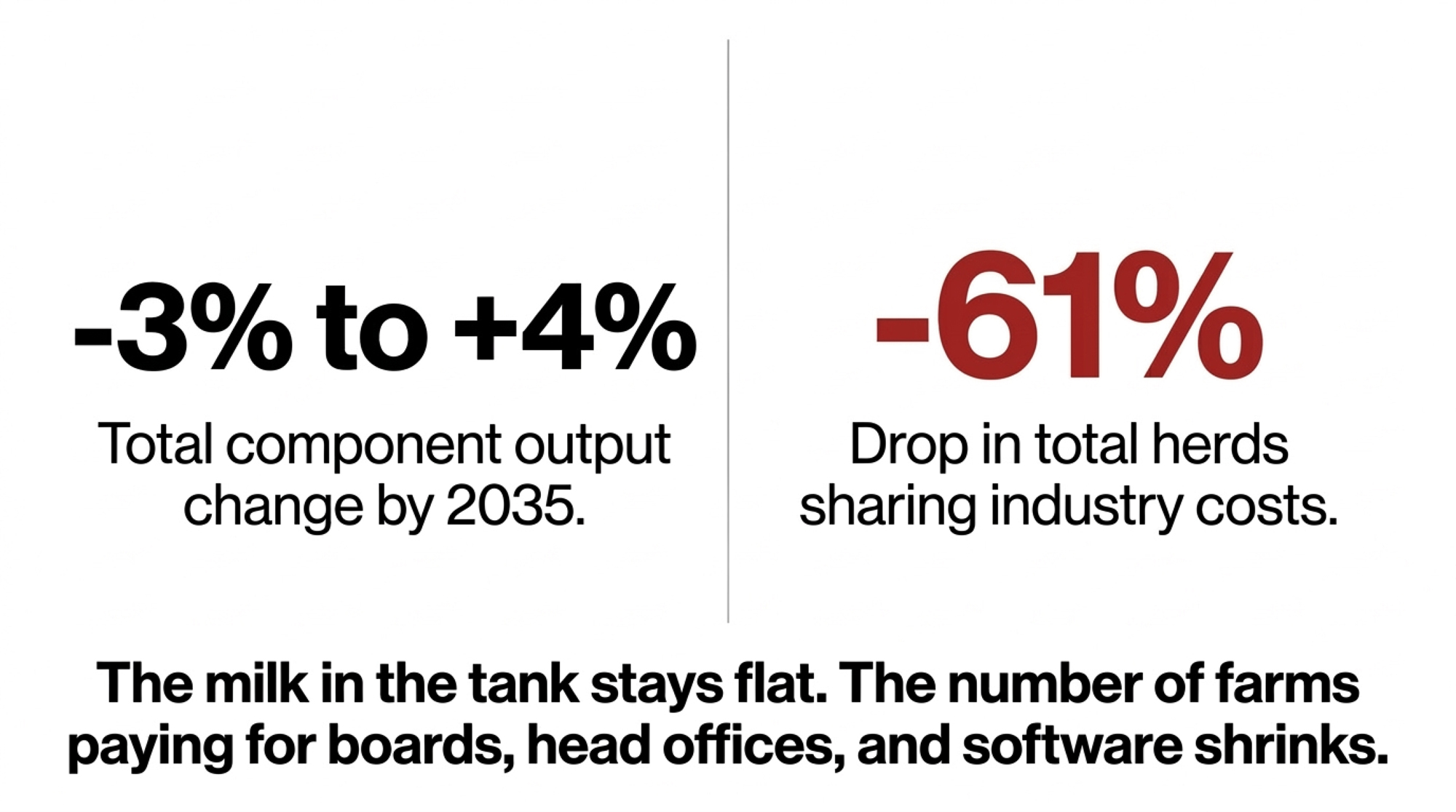
Here’s the surprise in his numbers. The milk in the tank barely moves. At 225 to 240 cows a herd, 3,500 herds is 787,500 to 840,000 cows. Add his 20% more fat and protein per cow, and total component output lands between 3% below and 4% above today’s.

So the spigot pays about what it pays now. What changes is how many farms are left to carry the costs that don’t shrink when a herd sells out: boards, head offices, evaluation runs, software, HR.

“We need to destroy more silos.”

— Murray Hunt, Dairy Cattle Industry Forum, September 22, 2026

Bullvine calculation: how fast does the fixed-cost share per herd rise?
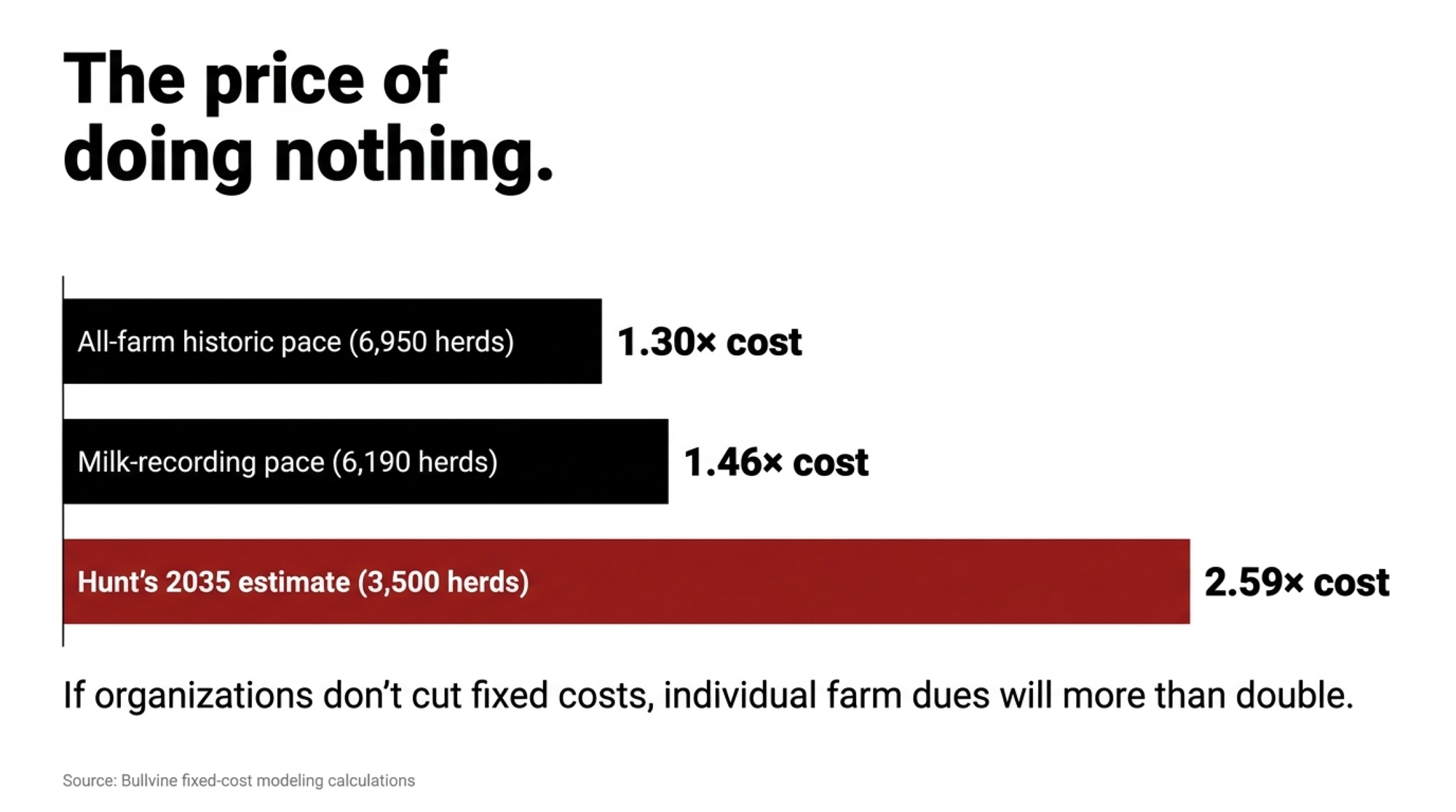
Path to 2035Annual decline in herdsHerds in 2035Fixed cost per herd vs. 2025
All-farm pace (2014–2024)2.6%~6,9501.30×
Milk-recording pace (2020–2025)*3.7%~6,1901.46×
Hunt’s 2035 estimate9.1% (implied)3,5002.59×

All-farm pace from the AAFC Dairy Sector Profile. *Milk-recording enrolment pace, applied to all farms.

For all farms, 3,500 is aggressive. It needs herds to disappear three and a half times faster than they did over the last decade. For the herds that buy milk recording, it’s close to the current trend line.

Milk recording20202025Change
Herds enrolled6,4465,333−17.3%
All dairy farms10,0959,048−10.4%
Share of farms enrolled63.9%58.9%−5.0 points

Enrolled herds fell 3.7% a year from 2020 to 2025. Hold that pace for a decade, and the recorded-herd base is about 3,650 in 2035. Part of that is deliberate. The forum heard the same day that not every animal needs recording anymore, and genomics has made that true for some decisions. But a deliberate exit still leaves fewer herds carrying the same systems.

Put a dollar on it. Say an organization carries $1 million a year in costs that don’t fall when herds leave. Across 9,048 farms, that’s about $111 a herd. At 6,950 farms, it’s $144. At 3,500, it’s $286. Spread only across milk-recording herds, it goes from $188 today to $274 at 3,650. That’s an illustrative model, not any organization’s budget.

What Should Board Members Ask Before 2035?

Hunt aimed the challenge at the directors and delegates in the room, and he’d been on the staff side of that table. “Elected farmer representatives are a great resource,” he said. “Being young and brash, you think you don’t need to be told, but I did.” Here’s what his three asks look like as board work.

  • Ask for the fixed-cost split this AGM season. Ask every organization you fund what share of its budget doesn’t fall when herd numbers do, and what that line costs per herd at 6,950 and at 3,500 farms. It’s a 30-day question. A total with no split isn’t an answer.
  • Price shared services before governance. Shared HR, IT and field systems attack duplicated costs without anyone surrendering a board, which is the distinction Hunt drew between alignment and amalgamation. The trade-off is control, since breed-specific rules have to survive the sharing.
  • Fund research with partners beyond Canada. Bigger research pools spread cost across more cows. The risk is losing Canadian pricing in the selection goal, the same logic that made PDD and Pro$ Canadian tools in the first place.

Hunt closed with John F. Kennedy, from Frankfurt in June 1963: “Change is the law of life. And those who look only to the past or present are certain to miss the future.”

He’d lived that line once already, in 1998, when the job he’d built was the one that went.

The room gave him a standing ovation. Karen was part of it, as she’s been through every chapter of this story: his biggest supporter and his biggest fan.

If the organization you pay dues to had to run on 6,950 herds tomorrow, what would it cut first, and has anyone on your board asked yet?

We’ll put that question to the organizations Hunt challenged and report their answers in The Bullvine Weekly.

Key Takeaways

  • Hunt’s 3,500-herd estimate for 2035 is aggressive for all farms, but milk recording is already on that track: enrolled herds fell 17.3% from 2020 to 2025, which projects to about 3,650.
  • On Hunt’s own 2035 figures, the tank ships about the same fat and protein, between 3% less and 4% more. What shrinks is the number of herds splitting the fixed costs.
  • Alignment always costs someone. In 1998 it cost Hunt his own job when CAAB dissolved, so any board asking for it should be ready to say who gives up what.
  • Hunt’s test for any partnership or shared-service plan: “In the end, the group that need to be profitable are the dairy farms, viable and sustainable.”

The Sunday Read Dairy Professionals Don’t Skip.

Every week, thousands of producers, breeders, and industry insiders open Bullvine Weekly for genetics insights, market shifts, and profit strategies they won’t find anywhere else. One email. Five minutes. Smarter decisions all week.

NewsSubscribe
First
Last
Consent

Learn More

  • Are You Breeding for the Future or the Past? — Align your genetic strategy directly with tomorrow’s milk cheque. Breaks down the hidden costs of outdated selection traits, arming you with the metrics needed to shift your sire criteria toward strict profit margins over show-ring appeal.
  • What Will the Dairy Industry Look Like in 2030? — Prepare your balance sheet for the consolidation wave Murray Hunt predicts. Maps upcoming bottlenecks in processing capacity against consumer demand, delivering concrete herd-size thresholds your operation must clear to survive the next decade.
  • Is Crossbreeding the Answer to Dairy’s Problems? — Challenge the purebred status quo with hybrid vigor economics. Follows the money on crossbred herds to reveal exactly how improved conception rates and reduced cull costs offset potential yield drops, fundamentally redefining baseline profitability.

Crampy Dairy Cows – An Lactanet Project Update

Find out how Canadian dairy farmers can lower Crampy in cows. Get the latest data, genetic insights, and future strategies to boost herd health.

Summary: Crampy, also known as Bovine Spastic Syndrome, increasingly concerns Canadian dairy farmers due to its progressive neuromuscular symptoms. Lactanet’s data collection initiative aimed to provide a clearer picture of its prevalence and explore genomic evaluations for mitigation. Their analysis, involving 2,807 Crampy cases from 801 herds, revealed that genetic selection could significantly reduce its occurrence. With the heritability of Crampy estimated at 6.8%, prioritizing top-rated sires can lower the risk. Gabriella Condello’s M.Sc. thesis highlighted that Crampy primarily affects cattle between two and seven years old, with a higher incidence in younger age groups. The study emphasizes the need for ongoing data collection to refine genetic evaluations and develop effective control strategies.

  • Crampy affects Canadian dairy cows as a neuromuscular disorder, primarily in the hind limbs.
  • Lactanet’s data collection received 2,807 Crampy cases from 801 herds, aiding research.
  • Genomic evaluations suggest genetic selection can reduce Crampy prevalence.
  • Heritability of Crampy is estimated at 6.8%, indicating a genetic component.
  • Crampy affects cows mainly between two and seven years of age, with severe cases often seen in younger cattle.
  • Ongoing data collection and genotyping are crucial to improving genetic evaluations and mitigation strategies.
Canadian dairy producers, Crampy, degenerative neuromuscular illness, cattle, two to seven years old, difficult to diagnose, underlying cause, Paresis, younger animals, one hindlimb, individualized treatment options, Lactanet's data-collecting initiative, genetic screening methods, data matching, genetic research, Crampy control, Gabriella Condello's M.Sc. thesis, estimating occurrence of cramps, investigating genetics, varied ages, lower age groups, two to seven, genetic selection, combating Crampy, extensive data analysis, genetic component, minimize occurrence, nationwide genetic assessment system, data collecting, nationwide plan, monitor Crampy symptoms, nursing cows, genotyping, accuracy, future genomic assessment systems, nationwide data-gathering approach, lactating cows, milk recording, precision, genetic selection

Canadian dairy producers are growing concerned about crampy cows, often known as Bovine Spastic Syndrome. Imagine spending years nurturing a healthy herd only to have your cows suffer devastating neuromuscular disorders out of the blue. Wouldn’t it be frustrating to watch your carefully controlled herd’s health deteriorating? You’re not alone in feeling this way. Crampy doesn’t just afflict cows. It affects milk production, raises veterinary expenses, and may result in significant losses. Are you willing to let these obstacles eat your profitability and peace of mind? Let’s examine why this problem is growing more widespread and what you can do about it. The answers may surprise you and, more importantly, provide a path ahead.

Unpacking Crampy: What Dairy Farmers Need to Know 

So, what precisely is Crampy/Bovine Spastic Syndrome? It is a degenerative neuromuscular illness that mainly affects cattle between two and seven years old. The signs are pretty obvious: spastic spasms in the muscles of one or both hindlimbs, which spread to the back and finally the whole body. You may see your cattle shivering, straining against the neck rail as they rise, or exhibiting indications of lameness even though they can still walk with total weight.

Is it now being diagnosed as Crampy? This is when things become challenging. The course of symptoms might vary greatly, making it difficult to determine the underlying reason. This cannot be diagnosed quickly or early, complicating management and therapy options.

To complicate matters further, there’s Paresis, a similar disorder to Crampy. However, Paresis usually appears in younger animals and affects just one hindlimb. You’ll notice a “pegged leg” look rather than the trembling associated with Crampy.

Understanding these distinctions allows us to understand the broad picture when both illnesses impact herds with overlapping age groups. Crampy often affects older cattle, while Paresis affects younger ones. Both illnesses provide diagnostic hurdles and need individualized treatment options.

Lactanet’s Blitz: Farmers Rally to Combat Crampy with Data 

Lactanet’s data-collecting blitz was critical in combating Crampy. This program aimed to collect thorough information on the occurrence of Crampy and Paresis in Canadian dairy herds. The blitz ran from September 2021 to April 2022, providing a limited window for gathering critical information.

During this time, dairy producers nationwide reacted enthusiastically, reporting data on 2,807 Crampy instances and 219 Paresis cases from 801 dairy herds. This excellent engagement demonstrated the dairy community’s dedication to tackling this neuromuscular condition.

The efforts of dairy producers were significant. Their willingness to offer thorough information aided the first estimate of Crampy’s prevalence and paved the way for future genetic screening methods. These activities are critical in furthering our knowledge of Crampy and finding measures to limit its effect, eventually benefiting the health and production of dairy herds throughout the country.

Digging Deep: How Detailed Data Matching and Genetic Research Could Be the Game-Changer for Crampy Control

To determine the true incidence of Crampy in the Canadian dairy sector, Lactanet methodically linked acquired data from dairy herds to herdbook-registered herd mates. This means they checked each affected cow’s information against the official records of their farm colleagues. This was critical for accurately presenting the herd’s overall health state and ensuring that the study was valid.

This extensive data was then given to the University of Guelph for further analysis. Gabriella Condello’s M.Sc. thesis focused on estimating the occurrence of cramps on Canadian dairy farms and investigating their genetics.

First, the researchers reviewed the cases to see how common Crampy was across different herds. With this baseline established, the next step was to investigate the genetic data. The idea was to see whether specific genes rendered cows more prone to Crampy. The thesis attempted to examine the possibility of gene selection as a feasible strategy for reducing Crampy’s occurrence in herds.

Age Matters: Unveiling the Alarming Spike in Severe Crampy Cases Among Younger Cattle

According to current data collecting, Crampy affects cattle of varied ages, with a maximum age of 12 years. However, most instances occur in the lower age groups, particularly between the ages of two and seven. Many cases have been detected among these cattle, with younger animals showing a specific surge in severity. Specifically, 566 severe Crampy instances were observed at younger ages, emphasizing the need for early detection and management techniques in afflicted herds.

Genetic Selection: Your Key to Combating Crampy in Dairy Herds

Extensive data analysis revealed that Crampy’s genetic component has the potential to minimize its occurrence. We reduced the overlap between Crampy and Paresis instances by concentrating on cows aged three or older with neuromuscular disease indications. This filtering yielded 1,952 Holstein cows, giving a solid dataset for further analysis.

Crampy’s average within-herd prevalence rate was determined to be 4.7%. This value changes amongst herds, indicating the role of genetics and environmental influences. Crampy has a heritability of 6.8%, highlighting the role of genetic selection in alleviating the ailment.

An essential part of this research was determining the association between sire estimated breeding values (EBVs) and the occurrence of Crampy in their daughters. Daughters of low-rated sires were shown to be 3.2 times more likely to acquire Crampy than sons of high-rated fathers. This association indicates that choosing against sires with greater Crampy frequencies may dramatically lower its prevalence, demonstrating the importance of genetic assessment and selection in long-term genetic improvement.

Why Prioritizing Genetics Could Be Your Best Move Against Crampy 

The research presents numerous essential insights for the dairy business. First, Crampy’s average within-herd incidence rate is estimated at 4.7%, implying genetic and environmental factors. Crampy’s heritability was determined to be 6.8%, showing a high potential for genetic selection. Furthermore, daughters of low-rated sires are 3.2 times more likely to develop Crampy, emphasizing the need to focus on top-ranked sires to minimize prevalence rates.

These data indicate that targeting low-rated sires might benefit genetic improvement. Furthermore, the research discovered large genomic areas related to Crampy, demonstrating that numerous genes regulate it. This opens the path for genetic selection as a powerful tool to combat Crampy.

However, more data collecting is required before a nationwide genetic assessment system can be created. Implement a nationwide plan to monitor Crampy symptoms in nursing cows throughout time. Both afflicted and unaffected cows should be genotyped to improve the accuracy of future genomic assessment systems. To fully utilize the promise of genetic and genomic technologies in the fight against Crampy, the dairy sector must engage in a cost-effective, ongoing data-gathering effort.

The Bottom Line

As the dairy sector deals with Crampy, a planned, continuing nationwide data-gathering approach centered on lactating cows during milk recording is critical. Genotyping afflicted and unaffected cows will improve genomic assessments and the precision of genetic selection. The Canadian dairy sector must develop a cost-effective method for identifying Crampy cows over time, assuring sustainability and efficacy, resulting in healthier herds and more resilient dairy operations.

Learn more: 

Do dairy breeders need to classify, milk record and register their dairy cattle?

It has been six years since genomic, genetic evaluations were introduced in North America.  Since that time, every part of the dairy improvement industry has changed. The business of artificial insemination has changed from selling predominantly proven sires and having to reward breeders for using young sires to young sire semen which now costs more than proven sire semen and accounts for more than half the semen sales.  On the one hand, there’s a growing misconception that genomics will replace traditional data recording systems, such as those offered by DHI and breed associations.  However, the reality is that, with genomics, accurate and complete performance data is required, in order to maintain the accuracy of genetic evaluations and allow a wider list of traits to be evaluated.

The question becomes where will that genetic information come from, if everyone stops classifying, registering and milk recording?

Accuracy comes from validating data with proven sires

Current genomic evaluations are more accurate than previous traditional evaluations primarily as a result of the large reference population of genotyped progeny proven sires. Without such a significant reference population, genomic evaluations would only offer small gains in accuracy compared to the significant move from 33% to 66% accuracy that a 50K genomic tested young sire currently receives.

The collection of performance data leads to a steady supply of new progeny proven bulls. Without these bulls continually expanding  the reference population, young bulls selected for A.I. would get further away  (and therefore less genetically related) from the proven sires in the reference population. Over time, this would negatively affect the accuracy of genomic evaluations, and we would actually start to see reliability figures decline.

Genomics have allowed us to make even faster genetic progress, however we still need field data for production, health, and conformation, in order to keep and even increase the reliability of the current genetic evaluation system.

Without genomics, test day records or a classification, a cow would maintain her Parent Average (PA) for all production and type traits for her entire life. She would thereby miss out on the opportunity to further enhance the accuracy of her genetic evaluations. Milk recording and classification data are added to the cow’s contribution from PA to produce an Estimated Breeding Value (EBV) that is more accurate than without it. For example, consider a first lactation cow that was genotyped as a heifer. Upon classification, the reliability of this animal’s Conformation index will increase from 68% to 75%. Once a lactation is completed, the reliability of her production index will increase from 73% to 78%. Despite the jump in reliability achieved by genotyping, the incorporation of performance data boosts the reliability, making the cow’s evaluation indexes even more accurate by approximately 10%. (Read more: Three Reasons Why Performance Data Will Always Be Important for Genetic Improvement)

Where does that data come from?

One of the more pertinent questions I hear being asked more frequently is, do we need to use official milk recording and type classification systems in order to validate this data?

With the introduction of on-farm computer systems, many breeders are not finding it necessary to use official DHIA milk recording systems.  That means instead of doing bi-weekly or monthly or sporadic tests for production, components and Somatic Cell Score, breeders who use Robots, for example, get this information with every milking.  This is a far more accurate way to measure production values. Instead of using algorithms to merely predict the in-between production data, these systems are working with the actual numbers.  In fact, these systems are such a complete herd management tool, `that they have metrics and information on many areas the current systems cannot even begin to predict. (Read more: The Future of Dairy Cattle Breeding Is in the Data, and Forget Genomics– Epigenomonics & Nutrigenomics are the future)

In speaking with many of the principal suppliers  in the robotic milking marketplace, they  often comment on that  the dairy breeding industry not only could have more accurate information, but  could also add indexes for more directly applicable evaluations such as feed efficiency.  While many organizations are trying to present algorithms to predict this measure, we could actually have performance data, which would significantly accelerate the accuracy and the rate of genetic gain in this core profitability area.

I have often heard the opposing argument from supporters of the current system. They cite that, since these numbers are not validated or conducted by a non-biased third party, how accurate can they be?  I find this argument doesn’t have any weight at all.   I have seen many hot house herds which have been able to “skew” the current numbers when they needed to. The argument that a third party verifies things means nothing.   With the fact that most new systems are computer based, there is actually the potential to implement a much more secure system for data integrity than the current process allows.  So really, the case for mandatory use of DHIA records is actually allowing far greater inaccuracy of the system, than if we accepted more modern computerized methods.

What about type classification?

The argument for the need for type classification is slightly different.  Since there is no computerized system to score a cow or to measure a cow’s conformation, there is no second data set that could be used instead of classification. Or is there?

Type classification was created in order to predict a cow’s longevity.  Isn’t that exactly what herd life and productive life measure?  Moreover, instead of being based on a prediction, they are  rooted in 100% accurate longevity data.  (Read more: Is Type Classification Still Important?,  She Ain’t Pretty – She Just Milks That Way! and Does Classifying Excellent Mean Profitable? Now? In The Future?)

Hence, the argument for the need to validate conformation data through classification is missing the boat.  Instead of trying to hold on to a system rooted in the past, we should embrace the more relevant data and information available. We should change the systems to evaluate genetic progress and merit based on actual information and should not continue to rely on a subjective system which tries to make predictions. The actual information is available.

What About Registration?

On-farm systems are such an accurate and efficient way to record breeding, calving and parenting information that the arm’s length breed association registration is duplication. Genomic testing provides 100% verification of parentage. (Read more: What is the Role of a Dairy Cattle Breed Association?)

The Bullvine Bottom Line

And so we see that the arguments supporting the need to continue type classification, milk recording and registry are becoming redundant.  Instead of trying to keep a system that validates old school genetic evaluation systems that are based on trying to use algorithms to predict genetic merit, we should be embracing the wealth of new and more accurate information that is available. We should be creating a new system that is based on measurable profitability and herd improvement statistics. The only reason that is left for keeping these three expensive programs is because we feel a need to validate an old animal model.  Instead, we should be creating a new animal model. One that accurately reflects the way modern dairy farmers operate.


The Dairy Breeders No BS Guide to Genomics


Not sure what all this hype about genomics is all about?

Want to learn what it is and what it means to your breeding program?

Download this free guide.


[related-posts-thumbnails]

Data Systems in the Future – Are We Ready?

Three times in the past two weeks serious dedicated dairy cattle breeders have asked the Bullvine questions that we too have been wondering about.

QUESTION 1: Why do we accept breeders collecting DNA samples but not owner recorded milk weights?

QUESTION 2: Why can’t milk weights from robotic systems be considered for publication purposes?

QUESTION 3: Why don’t milk recording programs take all relevant details about a cow when the milk yield data is captured?

We decided to turn those queries into a think piece so that even more breeder input can be brought into the discussion.

The Reality Is

The current data included in national data bases is based on what was the norm a couple of decades back. As well it is based on the previously accepted fact that only human eyes could determine if a recording was accurate or unbiased.

Times have changed. Today robots milk cows without human oversight. Technology is coming out every year on ways to capture more details that can help in breeding, feeding and managing dairy animals.

It is true that individual owners own their animal’s data. They paid for its capture, but only through having all the data for dairy cows in one or inter-linked data systems will breeders be able to advance their animals as quickly as possible.  No one breeder is an island onto themselves so the approach must be to use and make available all the animal data.

The reality is that it is time to put energy and resources into addressing the needs and possibilities when it comes to the data captured, stored and reported.

Capturing Cow Data

In both robotic and large herds owners do not milk the cows. The computers or cow milkers have no bias towards any one cow. Also systems are being used in some tie stall barns where the RFID tag identifies the cow and the system electronically captures the yield. In these systems the data is captured for each and every milking.

QUESTION 4: Why is that data not available for others to see?

QUESTION 5: What can be more accurate than recording every milking?

Surely we are not prepared to argue that eight to ten single milking observations in a lactation by a third party person is more accurate than every milking captured by the milking system.

Canada found twenty years ago that owner recorded milk weights and collected milk samples were accurate enough for sire proving purposes. Data that is 95% accurate is much superior to no data at all.

In the foreseeable future there will be parlour systems that can instantaneously provide readings for butterfat %, protein %, SCS, milk temperature and hormone levels and we expect in time readings for fat composition, protein composition and a host of other readings. Wow won’t that be useful information to use to breed, feed and manage?

Question 6: Will this further information be moved off the farm into the national data system?

Just last week it was reported at the Progressive Dairy Operators Conference that RFID ear tags may have use for measuring temperature and ear movement to monitor heats in tie stall barns. That is interesting.

Data Starts Early

Calves are to be identified at birth with RFID tags.

Question 7: Why is it not possible to use technology that now exists to collect a piece of the ear tissue for DNA analysis?

That way every animal would have a DNA profile at birth. With the very interesting things we are learning on DNA profiles and heifer management, we have just scratched the surface of this crystal ball.

Calves are now being fed by computers from day three or four of age. There will potentially be a very useful data set there that can be of great benefit when determining genetic merit, feeding programs and management practices.

Let’s Dream the Possible Dream

But it does not end there! Many other details and data sets exist that are not part of the national data base but that can be useful for animal traceability, food safety (mastitis and other drug treatment), foot care, reproduction, production limiting diseases (i.e. Johnes), pedometers, rumen boluses (i.e. temperature),… and the list goes on.

Question 8: Are plans being made to link all dairy cattle data bases?

But Is It Official?

In the past, if a piece of information could not be authenticated then it could not be published.  In the future, every farm using genetics to advance their animals will, out of necessity, need to capture and use more data than they have ever had to in the past. Official and unofficial applied when breeders were or were not prepared to trust the method of data capture.

In today’s world there are many systems of marketing and commerce that are monitored as necessary but without a third party observing every event. Breeders are routinely putting on Facebook events about their cows, including their milk yields, an animal’s profit per day, flushing history and ability to come into heat when milking 120 pounds per day. The world of dairy cow information is changing and changing quickly.

QUESTION 9:  What does the current “official” actually mean in the bigger future scheme of things?

The Bullvine Bottom Line

THE ALMOST FINAL ANSWER: Future data standards will need to address that more information will be needed and that data must be universally available. Breeder input is needed now to guide the development of future standards for data captured, stored and reported.


Get original “Bullvine” content sent straight to your email inbox for free.


[related-posts-thumbnails]

Send this to a friend