Archive for global dairy markets

The Cooperative Trap: UK’s 32p Milk Crash Proves Your Co-op Won’t Save You

When a Welsh dairy farmer sat in that boardroom and voted to slash his own income by £78,000 a year, he wasn’t being foolish. He was being a fiduciary. And that distinction matters for every cooperative member reading this.

Executive Summary: Mike Smith milks 450 cows in Wales and serves as vice chairman of First Milk. This month, he voted to cut his own milk price to 32.25p—a decision that costs his operation approximately £6,500 every month. He wasn’t being foolish. He was fulfilling his legal duty: UK company law requires cooperative directors to protect the enterprise first, even when farmgate prices fall below the 43-47p most producers need to break even. That tension between member interests and cooperative survival explains why UK dairy has consolidated from 35,000 farms in 1995 to roughly 7,000 today—and why analysts project just 4,000-5,000 by 2030. Cooperatives deliver real value: market access, collective bargaining, shared risk. But insulation from global oversupply? That’s not part of the deal. North American producers shipping through DFA, Agropur, or provincial marketing boards face the same structural dynamics—and understanding them now, while you still have options, is the point.

Dairy Farm Profitability Strategies

Mike Smith runs a 450-cow dairy in Pembrokeshire, Wales. He’s also vice chairman of First Milk, one of the UK’s largest British-headquartered farmer-owned cooperatives. This month, he sat in a boardroom and voted to cut his own milk price—a decision that will cost his operation roughly £6,500 every single month.

That image stuck with me as I worked through what’s happening across UK dairy right now. A farmer-owner, voting against his own short-term interest, because the alternative was watching the cooperative face serious financial difficulty. It tells you something important about how cooperative economics actually work when markets turn challenging—and it’s something Wisconsin, Ontario, and every other cooperative-heavy dairy region should understand.

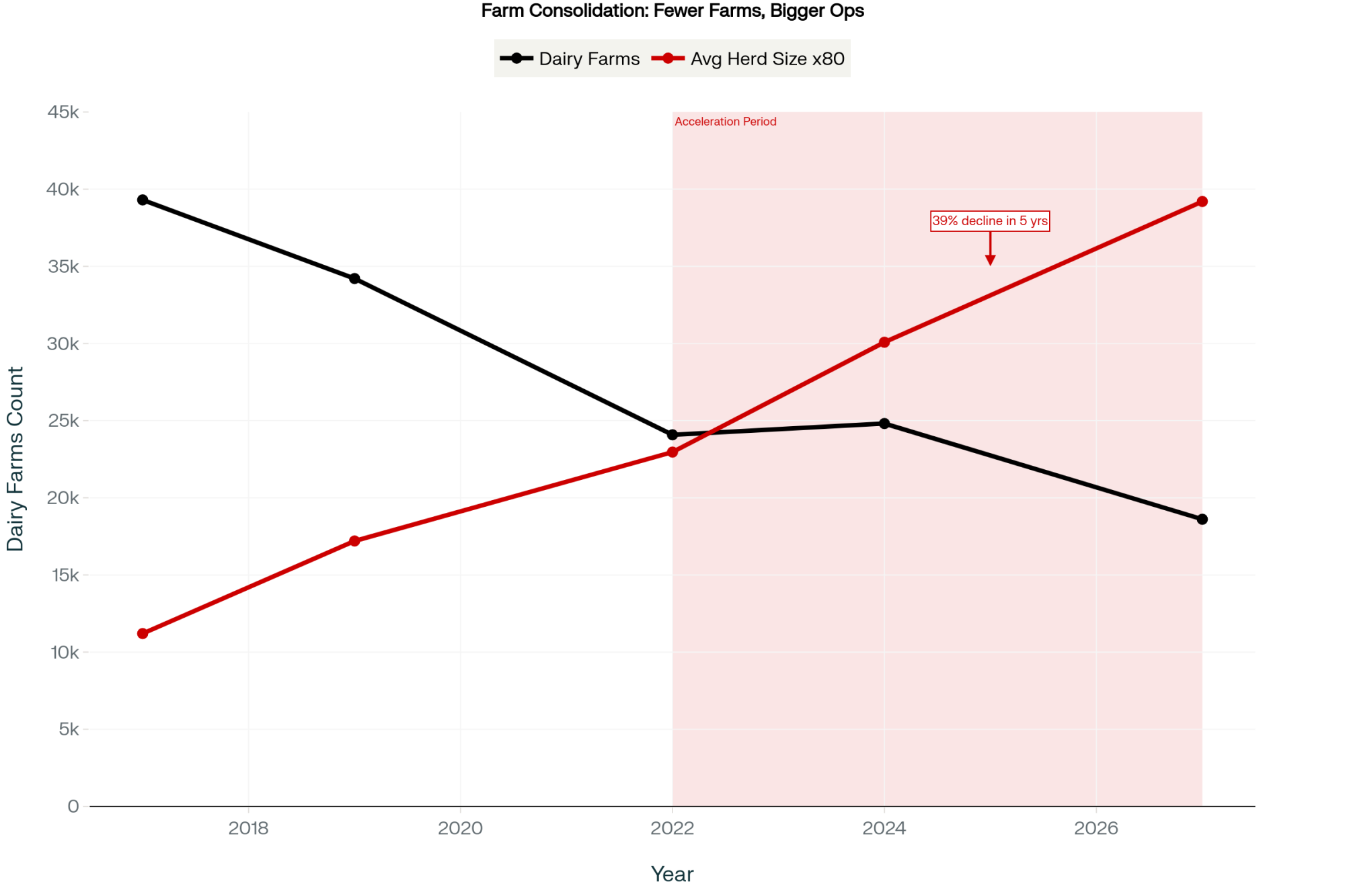
This chart shows how UK dairy farms collapsed from roughly 35,000 to 7,000 in a single generation, with another third likely gone by 2030. Cooperatives kept processing capacity afloat, but the price mechanism quietly selected who stayed and who exited. The system is working exactly as designed—and that should scare any producer betting their future on membership alone.

The Numbers Behind the Decision

First Milk announced its January 2026 price at 32.25 pence per litre, down a staggering 3.6ppl from the prior month. That’s no small adjustment. According to Mike Smith in First Milk’s official announcement: “This change reflects the continuing challenges in the market. UK and global milk production remain at record levels, and there is still no sign of improvement in the supply/demand imbalance.”

Production costs vary significantly across UK dairy operations. What’s interesting here is that grazing systems generally run lower than housed herds, and regional differences in feed and labor costs create quite a range. Industry benchmarking from AHDB and farm business consultancies like Kite Consulting consistently shows that fully-housed systems average somewhere in the mid-to-upper 40s pence per litre when all costs, including unpaid family labor, are accounted for. According to Promar International’s UK Dairy Producer Cost Analysis 2025, leading producers sustain production costs of 41-43 pence per litre.

Let’s run some realistic numbers on a 150-cow herd shipping about 103,000 litres monthly. If we assume production costs around 43ppl—reasonable for a well-managed system:

  • Monthly revenue at 32.25ppl: £33,217
  • Monthly production cost at 43ppl: £44,290
  • Monthly shortfall: Around £11,073

That’s burning through £133,000 or more each year before the family draws any income for living expenses. The 3.6ppl cut alone strips roughly £3,700 monthly from an already tight position.

Here’s what’s worth noting, though. First Milk has maintained a strong corporate performance—the BV Dairy acquisition significantly expanded its processing capacity. But those processor-level numbers don’t change the reality that farmgate prices have to track global commodity markets, regardless of how well the creameries perform. The processing business can be healthy while the farm business struggles. That disconnect frustrates producers, understandably so.

This comparison shows the brutal reality of December 2025 pricing: all conventional UK processors are paying members less than even the best‑in‑class 43ppl breakeven cost. Only organic producers clear the breakeven wall. When co‑op boards talk about ‘alignment with market conditions,’ this is what they mean.

Understanding Why Cooperative Boards Make Difficult Choices

I’ve followed cooperatives across three continents over the years, and the pattern at First Milk is one I’ve seen before. Understanding these mechanics matters because they apply across all cooperatives that handle commodity dairy.

First, let’s acknowledge what cooperatives genuinely provide—and these benefits are real and significant. Collective bargaining power. Guaranteed market access even when spot buyers disappear. Shared infrastructure investment that individual farms couldn’t finance alone. There’s a good reason the cooperative model has endured for over a century in dairy.

But when global supply substantially exceeds demand—as it does currently—those benefits don’t override fundamental market dynamics.

First Milk’s board includes farmer directors like Mike Smith, who manage substantial operations themselves. These aren’t distant executives making decisions about someone else’s livelihood. They’re producers facing the same pressures as every other member.

Why did they vote for reductions? Three factors typically converge in these situations.

There’s a fiduciary duty. UK company law—specifically Section 172 of the Companies Act 2006—requires directors to act in the best interest of the enterprise as a going concern. When the cooperative faces potential covenant pressure on significant debt, preserving the business takes legal precedence over maximizing short-term member returns.

Then there’s the volume obligation built into the cooperative structure. Unlike corporate processors who can decline volume, cooperatives generally must accept what members ship. When global supply surges, that milk needs processing—even when margins suffer. Müller’s agriculture director Richard Collins acknowledged this pressure directly in their November announcement: “We’re seeing market price reductions, and daily collection volumes are still significantly higher than they were last year.”

And competitive positioning matters more than many producers realize. Arla UK set December prices at 39.21ppl (down 3.50ppl). Müller moved to 38.5 ppl (down 1.5 ppl). Freshways went to 30.4ppl. If First Milk holds significantly above market while competitors price lower, retailers shift contracts. Volume drops. Fixed processing costs are spread across fewer litres. The trajectory from there becomes concerning.

How One Welsh Family Is Working Through the Numbers

What follows is a composite based on industry figures and conversations with UK dairy advisors—not a specific identifiable operation, but representative of decisions many families are working through right now.

The Morgans milk 165 cows on 200 acres outside Carmarthen. Third generation on the land. Two children—one considering returning to farm after agricultural college, one leaning toward other opportunities.

Their numbers heading into 2026:

  • Monthly production: 114,000 litres
  • First Milk price (January): 32.25ppl = £36,765 revenue
  • All-in production cost: 44ppl = £50,160
  • Monthly gap: Around £13,395

They’re carrying about £340,000 in debt—equipment loans, a 2019 cubicle shed, and an operating line. Their debt-to-asset ratio sits around 45%. DEFRA’s Balance Sheet Analysis suggests that’s actually in reasonable shape compared to many UK dairy operations.

The family has been running scenarios this autumn:

Scale up option: Adding 80-100 cows would require roughly £400,000 in new investment—buildings, livestock, and slurry capacity. At current prices, that creates a larger shortfall with more debt service. They’d need milk to recover to 38-40ppl within three years for expansion to work financially. That’s possible, but far from certain.

Exit option: Cull cow prices are historically strong right now. AHDB’s weekly livestock reports from late 2025 showed deadweight cows averaging well above the five-year average. Land in their area has traded around £8,500/acre recently, according to Farmers Weekly market reports. They could likely clear debt and retain meaningful equity. But three generations of work and the children’s potential inheritance make this more than a financial calculation.

Reduce and reassess: They’re seriously considering culling 25-30 head this winter, generating £40,000-50,000 in cull revenue while beef prices hold. That cuts feed costs immediately and gives 18 months to see how markets develop. It’s not a permanent solution—more of a managed pause that preserves options.

Herd SizeMonthly LitresRevenue @ 32.25pCost @ 43pMonthly LossAnnual Bleed
100 cows68,000£21,930£29,240-£7,310-£87,720
150 cows103,000£33,218£44,290-£11,072-£132,864
200 cows137,000£44,183£58,910-£14,727-£176,724
300 cows205,000£66,113£88,150-£22,037-£264,444
450 cows (Mike Smith)308,000£99,330£132,440-£33,110-£397,320

The son, home for Christmas, asked his father what he thought would happen to UK dairy over the next decade. The response was sobering: “A lot of the farms that are here now won’t be in ten years. The question is whether we’re among those who continue or those who don’t.”

The Global Supply Dynamics Driving These Pressures

This situation feels different from previous dairy downturns—and that distinction matters for how farmers might respond.

The 2015-16 downturn was largely demand-driven. Russia embargoed EU dairy. Chinese buying slowed significantly. When those external factors resolved, prices recovered. This time, pressure is coming from the supply side. That’s more challenging because there’s no single external event to wait out.

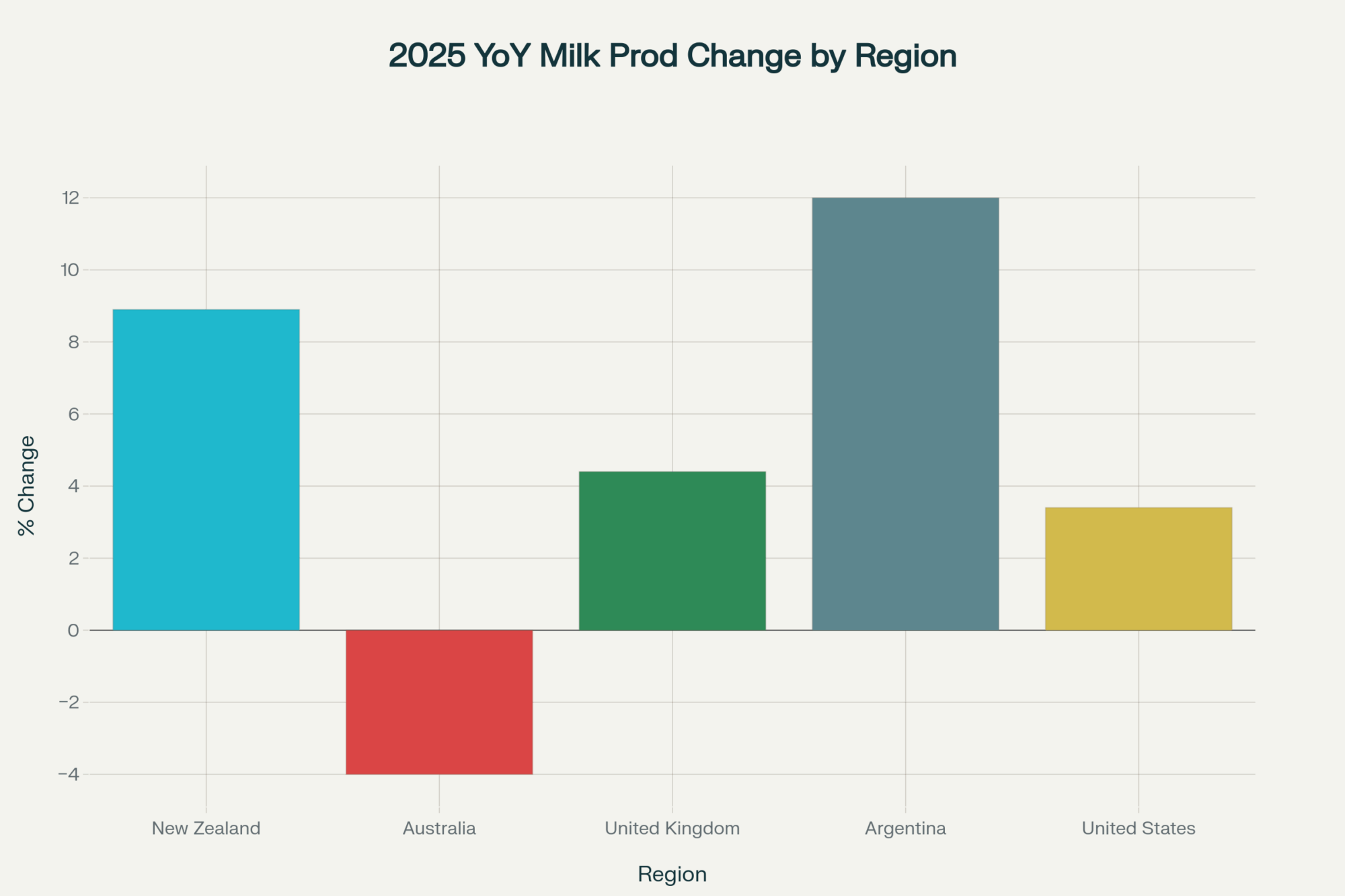
Irish milk production increased substantially through 2025. AHDB’s tracking shows January-May 2025 Irish output running 7.6% above the same period in 2024—with March up 8%, April up 13%, and May up 7%. That’s farmers pushing volume ahead of tightening nitrate regulations—an understandable response to policy changes, but one that’s flooding markets with additional supply.

Meanwhile, European production dynamics are complex. USDA’s Foreign Agricultural Service EU Dairy Forecast from February 2025 showed EU milk deliveries forecast to decline marginally by 0.2% in 2025, with low farmer margins and environmental restrictions pushing some smaller producers out. But GB production tells a different story entirely—AHDB’s December 2025 forecast update projects UK milk production for 2025/26 at a record-breaking 13.05 billion litres, up 4.9% from the previous milk year.

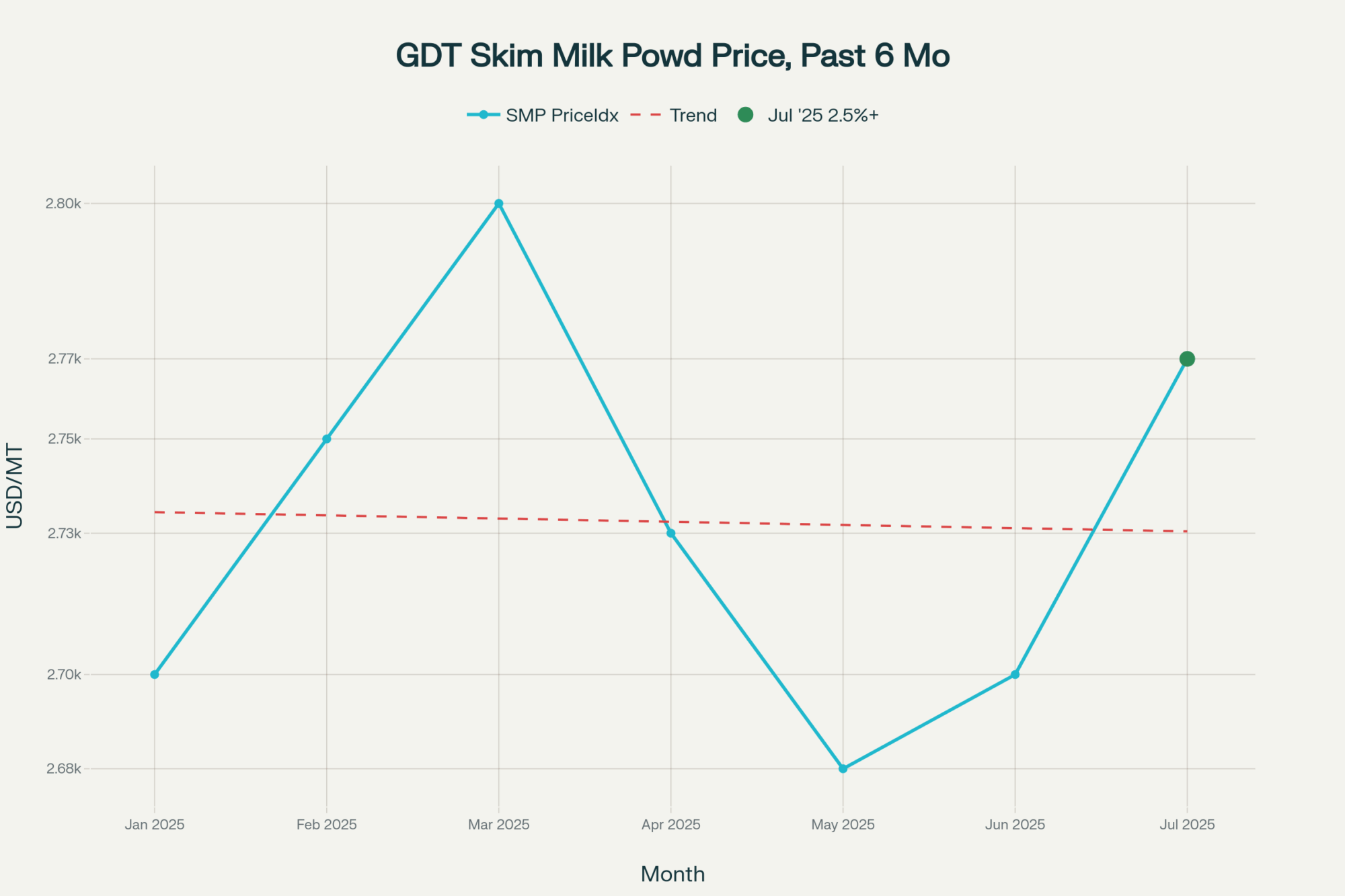
The Global Dairy Trade auction results reflect these dynamics. The December 2025 auction saw the index decline 4.3%—the eighth consecutive decline—with butter crashing 12.4% to US$5,169 per tonne. AHDB noted that “increasing global dairy milk supplies and product stocks are weighing heavily on prices currently.”

Global dairy prices have fallen at every single GDT auction since spring, with the steepest hit in November and butter down 12.4% in December. That’s not a storm you ‘ride out’ with a bit of overdraft. It’s a structural oversupply that forces co‑ops to use your milk cheque as the shock absorber.

Independent dairy analyst Chris Walkland offered a stark assessment in late November: some producers could face milk payments between 30 and 35 pence per litre for eight to nine months.

The Brexit Trade Dimension

Everything described so far applies to dairy producers globally. But UK farmers are navigating the same supply environment while operating outside the EU’s single market. That creates additional complexity.

Trade data analyzed by Logistics UK shows UK dairy and egg exports to the EU declined approximately 6% since Brexit. The documentation requirements have proven substantial.

The mechanics are straightforward but add costs. Every dairy shipment to the EU requires export health certificates, veterinary sign-off, and potential border inspections under the sanitary and phytosanitary (SPS) control framework introduced in 2024. An analysis by Stone X noted that “the UK and EU now treat each other as ‘third countries,’ meaning any dairy products moving across the Channel are subject to rigorous SPS checks.”

John Lancaster, head of EMEA and Food Consultancy at Stone X, observed: “Volatility is nothing new for the dairy sector, but the nature of that volatility is evolving. The UK, traditionally a net importer of dairy, has seen strong milk collections in recent months, likely leading to reduced imports in 2025. This elevated supply, combined with administrative barriers to export, has meant that local spot prices can swing more sharply.”

UK dairy exports to the EU have slipped around 6% since Brexit—not because Europe banned our products, but because red tape throttles every truckload. While Irish and Dutch milk moves freely inside the single market, British producers fight the same oversupply with added paperwork drag.

Ireland and the Netherlands face similar global supply pressures. But they operate within the single market—frictionless trade, shared regulations, and access to EU support mechanisms. UK producers are competing with additional administrative and cost burdens that other major producing regions don’t face.

What Successful Adaptation Looks Like

Alongside these challenges, some operations are finding paths forward. The strategies vary but share a common element: reducing pure commodity exposure.

Millbrook Dairy in the West Midlands has developed direct export relationships, particularly targeting Middle Eastern markets where UK cheese commands a premium positioning. According to Dairy Reporter’s coverage from May 2025, the company has faced Brexit, COVID-19, the Red Sea crisis, and US tariffs—but rising global demand for premium cheese and butter has created opportunities for those willing to navigate the complexity.

Several Welsh operations have moved toward organic certification and secured premium contracts. While conventional prices have crashed below 35ppl for some, organic producers continue receiving prices in the upper 50s ppl—First Milk’s organic price remains at 57.95ppl, unchanged from the conventional cuts.

We’re actually seeing similar patterns in North America. Some Upper Midwest producers have moved into farmstead cheese or on-farm processing to capture more margin. A few Ontario operations have built agritourism components that complement their dairy income. These aren’t easy pivots—they require capital, skills, and market access—but they show the “expand or exit” framework isn’t the only path available.

None of these approaches fit every situation. They require specific circumstances and opportunities that vary significantly by region and operation. But they illustrate that other paths exist for those positioned to pursue them.

Questions Worth Asking Your Cooperative

For North American farmers watching the UK situation, there’s practical value in understanding what to monitor closer to home. DFA handles a substantial share of the US milk supply through cooperative structures. Canadian cooperatives like Agropur and provincial marketing boards face similar dynamics when global markets shift.

Having specific questions ready when cooperative leadership presents forecasts or pricing updates can be valuable:

On volume management:

  • Is the cooperative implementing or considering base-excess programs or volume adjustments?
  • What percentage of members are shipping above base allocation?
  • How does the cooperative plan to balance supply if market conditions weaken?

On financial position:

  • What are the cooperative’s current debt covenants, and how much flexibility exists?
  • What milk price level would create covenant concerns?
  • How much of the operating profit comes from processing versus member milk margin?

On forward planning:

  • What price scenarios is management modeling for the next 12-24 months?
  • At what price level would capacity rationalization become necessary?
  • How are competing processors positioned, and what’s the risk of contract shifts?

These aren’t confrontational questions—they’re the kind of information that business owners should reasonably have about enterprises they collectively own.

Indicators Worth Watching

The UK situation offers a framework for what to monitor. Several metrics are worth tracking.

Supply growth provides early signals. USDA’s monthly Milk Production report is the primary source. If year-over-year growth exceeds 3% for six consecutive months, supply is outpacing demand. That pressure eventually reaches farmgate pricing. Wisconsin producers might watch regional production trends particularly closely, given the concentration of cooperative membership in the Upper Midwest.

Futures markets offer forward visibility. CME Class III cheese futures below $17/cwt for extended periods suggest markets are pricing in oversupply conditions. Monthly checks of forward curves provide useful context for planning.

Cooperative communications often signal direction if you listen carefully. When leadership emphasizes “supply balance,” “market alignment,” or “production discipline,” they may be preparing ground for pricing adjustments. Richard Collins at Müller noted they’re “keeping a close eye on supply and demand”—that language often precedes action by 60-90 days.

Cull market conditions indicate exit dynamics. Strong cull prices create exit incentive—but also suggest culling hasn’t reached levels that would meaningfully reduce supply.

When multiple indicators converge, the UK pattern becomes more relevant to local planning.

The Broader Industry Pattern

After three decades in this industry—starting with a Master Breeder operation and later founding The Bullvine—I keep returning to a pattern that deserves direct discussion.

Cooperative commodity dairy, by its structural design, tends to address supply-demand imbalances partly through changes in membership. That’s not necessarily a failing of the model—it’s inherent to how cooperatives function in commodity markets. When global supply exceeds demand, and prices fall below production costs, cooperatives adjust farmgate pricing to maintain processing viability. Those price adjustments create pressure on higher-cost operations. Some exit. Supply eventually contracts. Prices stabilize for continuing producers.

The cooperative continues. Membership consolidates. The cycle continues.

AHDB’s latest survey of milk buyers revealed an estimated 7,040 dairy producers in GB as of April 2025—a loss of 190 producers (2.6%) since the previous year. Against a backdrop of rising volumes, this suggests a continued shift toward fewer, larger farms. Industry exits typically occur during the winter months, before housing and other input requirements rise seasonally.

This isn’t an argument against cooperatives. Their benefits remain genuine—market access, collective bargaining strength, shared risk, and infrastructure investment beyond individual farm capacity. But it does argue for a realistic understanding of what cooperative membership provides. Insulation from global market forces isn’t among those benefits.

Practical Considerations by Situation

For operations with strong balance sheets—debt-to-asset below 40%: This environment may present opportunities. Industry transitions often create acquisition possibilities. Operations that can achieve competitive production costs at scale, with family commitment to a long-term horizon, may be well-positioned for the consolidation ahead.

For operations with moderate leverage—40-60% debt-to-asset: Focus on cash preservation and maintaining flexibility. Cull strategically to generate near-term cash while beef prices remain favorable. Explore loan restructuring while lenders remain accommodating. Develop realistic exit valuations to understand your position. The objective is to navigate 24 months without eroding equity, then reassess.

For operations with higher leverage—above 60% debt-to-asset —the situation requires an honest assessment. At current UK price levels, highly leveraged operations face compounding challenges that can steadily erode equity. Voluntary, well-planned transition while cull and land markets remain favorable often preserves more family wealth than delayed, pressured decisions. That’s a difficult conversation, but an important one.

For all operations: Know your actual cost of production—including properly valued family labor. Understand your cooperative’s financial position and be prepared to ask informed questions. Watch the indicators that might signal your region following similar patterns. And recognize that choosing your timing generally produces better outcomes than having timing determined by circumstances.

Editor’s Note: All pricing data cited in this article comes from official processor announcements and AHDB reports from November-December 2025. Production cost figures reference AHDB, Promar International, and Kite Consulting industry benchmarks. National and regional averages may not reflect your specific operation’s circumstances. We welcome producer feedback and regional case studies for future reporting. Contact: andrew@thebullvine.com

Resources for Ongoing Monitoring:

Key Takeaways

  • 32p milk, 43p costs. First Milk’s January 2026 price leaves most UK producers hemorrhaging cash—£11,000+ monthly on a mid-size herd. The gap isn’t a glitch. It’s global oversupply working exactly as markets do.
  • A farmer voted to cut his own pay. Vice Chairman Mike Smith slashed his milk price by £6,500/month because UK law requires cooperative directors to protect the enterprise first. Fiduciary duty trumps member income when the cooperative’s survival is at stake.
  • Cooperatives manage consolidation—they don’t prevent it. UK dairy shrank from 35,000 farms to 7,000 over thirty years. Cooperative membership provided orderly exits and market access for survivors, not insulation from structural economics.
  • The supply glut is structural, not seasonal. Irish milk up 7.6% through May. GB production at record highs. Eight straight declines in the Global Dairy Trade auction. There’s no external shock to wait out—this is the new baseline until supply contracts.
  • Your turn is coming. DFA, Agropur, and provincial marketing boards face identical cooperative economics. The producers who understand these dynamics now—and position accordingly—will have options when pricing pressure arrives. The rest will have the options the market gives them.

Complete references and supporting documentation are available upon request by contacting the editorial team at editor@thebullvine.com.

Learn More:

  • Decide or Decline: 2025 and the Future of Mid-Size Dairies – This strategic guide targets the “squeezed middle” (700-1,200 cows), outlining three specific survival paths: intended expansion, rigorous optimization, or strategic exit. Essential reading for producers needing to calculate if their debt-to-asset ratio supports the scale required to survive current consolidation trends.
  • Global Dairy Market Dynamics: Navigating Volatility and Strategic Opportunities in 2025 – Expand your understanding of the supply-side pressures mentioned above with this deep dive into 2025 Global Dairy Trade (GDT) indices and regional production forecasts. It provides the broader economic context needed to anticipate price floor movements before they hit your milk check.
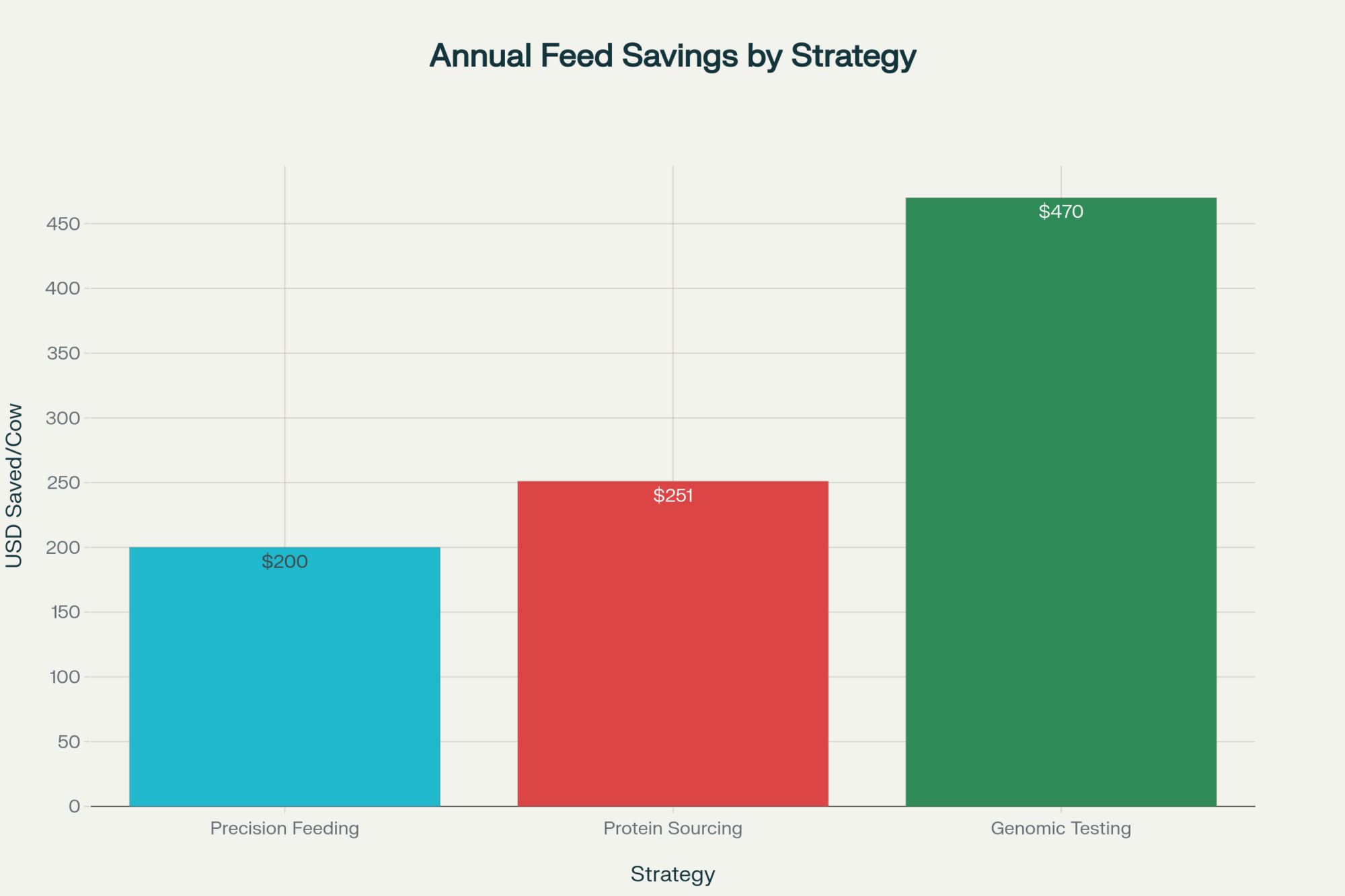
  • Digital Dairy: The Tech Stack That’s Actually Worth Your Investment in 2025 – Move beyond buzzwords with this ROI-focused analysis of farm automation and data integration. It demonstrates how integrating specific technologies—like AI-driven feed management—can slash costs by 5-10%, offering a tangible way to protect margins when milk prices fall below production costs.

Join the Revolution!

Join over 30,000 successful dairy professionals who rely on Bullvine Weekly for their competitive edge. Delivered directly to your inbox each week, our exclusive industry insights help you make smarter decisions while saving precious hours every week. Never miss critical updates on milk production trends, breakthrough technologies, and profit-boosting strategies that top producers are already implementing. Subscribe now to transform your dairy operation’s efficiency and profitability—your future success is just one click away.
NewsSubscribe
First
Last
Consent

China’s 42 Million Tonne Milk Mountain: What Every Dairy Farmer Needs to Know About the Industry’s Biggest Shift Since Mechanical Milking

Your banker knows. Your co-op won’t say it. China’s birth crisis means your 300-cow dairy has 90 days to decide its fate. Here’s how.

EXECUTIVE SUMMARY: China’s 42 million tonne milk mountain isn’t temporary—it’s the product of a 48% birth rate collapse that permanently eliminates demand for 5% of global milk production. If you’re running a 200-500 cow dairy, this structural shift means you’re losing $359,609 annually compared to 2,000-cow operations, a gap that superior management cannot close. With milk prices locked at $16.50-18.00/cwt through 2027, you have exactly three viable options: borrow $8-15 million to scale beyond 1,500 cows, pivot to premium markets with guaranteed contracts (organic, A2, grass-fed), or execute a strategic exit that preserves your equity. The difference between acting now and waiting is stark—strategic exit today nets 70-85% of equity ($1.5M), while forced liquidation in 12 months recovers just 30-50% ($700K). Every month of indecision bleeds $23,000-55,000 through operating losses and accelerating asset depreciation. Your Q1 2026 decision isn’t about whether you’re a good farmer—it’s about whether you’ll control your family’s financial future or let market forces decide for you.

dairy farm business strategy

Let me share something that’s been on my mind lately—and I think it deserves careful attention from every dairy farmer reading this. China’s sitting on 42 million tonnes of surplus milk, based on their agriculture ministry’s September reports. That’s roughly 5% of global production, just… sitting there. And here’s what’s interesting: this isn’t your typical market cycle that we’ve all weathered before.

You know, I’ve been digging through the data, talking with economists at Cornell and Wisconsin’s dairy programs, and what’s emerging is a picture that’s fundamentally different from anything we’ve navigated since—well, probably since we all switched from hand milking to mechanical systems. Understanding why this time really is different —and knowing what steps to take right now —could make all the difference for your operation over the next 24 months.

Why This Crisis Breaks All the Old Patterns

So I was looking back at my notes from the 2009 downturn the other day. Remember that one? USDA data shows all-milk prices bottomed out at $11.30 per hundredweight in July 2009, then bounced right back within 12 months. The 2016 slump—you remember, when Russia imposed an embargo and the EU eliminated quotas—that stabilized within 18-24 months, according to the dairy network analysis I’ve been reviewing. Even COVID, for all its disruption, saw our sector adapt remarkably well within months. There’s actually some fascinating research in the Journal of Dairy Science from 2021 documenting how quickly we pivoted.

But China? This is something else entirely.

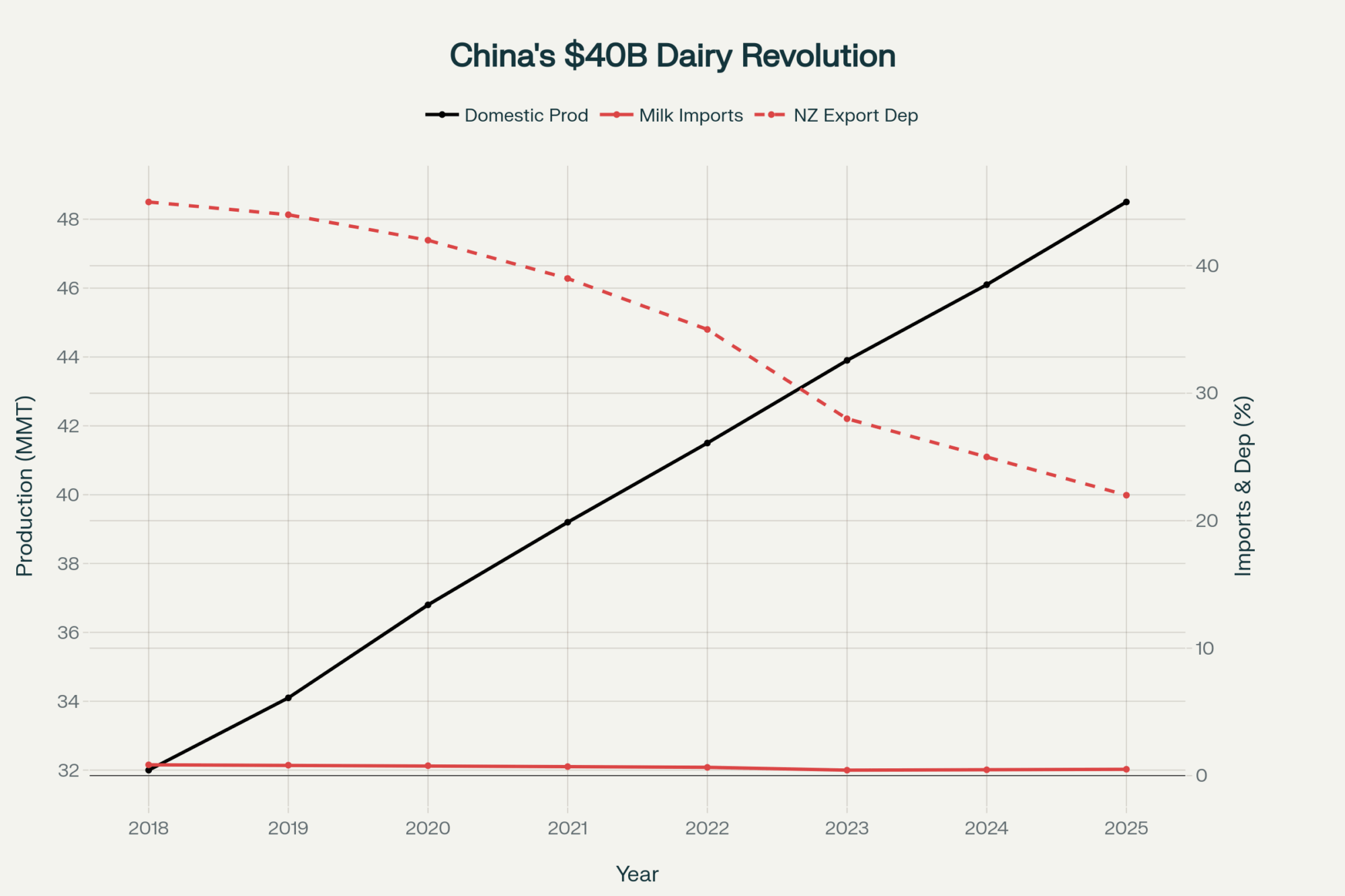
What farmers are discovering—and China’s National Bureau of Statistics backs this—is that we’re dealing with a demographic reality nobody can fix. Their birth rate collapsed from 12.43 per 1,000 people in 2016 to just 6.39 in 2023. That’s a 48% decline, folks. The population of kids aged 0-3… you know, the ones drinking all that infant formula? Down from 47 million to 28 million in just five years. Those babies don’t exist and won’t magically appear if milk prices recover.

The numbers don’t lie: China lost 19 million formula consumers (40% decline) while birth rates crashed 48%. This isn’t a cycle—it’s permanent demand destruction that eliminates 5% of global milk consumption. Your 2027 milk price depends on markets that will never return.

Here’s what happened: After that horrific 2008 melamine scandal—six babies died, 300,000 were hospitalized according to World Health Organization reports—Beijing went all-in on dairy self-sufficiency. The Chinese began importing hundreds of thousands of Holstein cattle in 2019, according to the customs data I’ve been reviewing. Average herd sizes grew 40% year-over-year through late 2023, if you can believe it. They hit 85% self-sufficiency, up from about 70%—exactly what they wanted. Problem is, they built all this capacity assuming demand would keep growing.

Now here’s where it gets really unusual. Chinese raw milk prices have been underwater for over two years—sitting at 2.6 yuan per kilogram against production costs of 3.8 yuan, based on China Dairy Industry Association data from October. Farmers there are literally paying to produce milk. Yet production continues, propped up by government subsidies, soft loans from state banks, and political imperatives that… well, they just don’t follow normal market rules.

The Hard Math Behind Mid-Size Dairy Challenges

USDA’s Agricultural Resource Management Survey data reveal a stark cost differential across farm sizes. And this isn’t about who’s a better farmer—it’s about structural economics that management alone can’t overcome.

Looking at production costs per hundredweight from the USDA’s dairy cost and returns estimates:

  • Farms with fewer than 200 cows: generally running $23.68-33.54/cwt
  • 200-499 cows: around $20.85/cwt
  • 500-999 cows: typically $18.93/cwt
  • 1,000-1,999 cows: averaging $17.39/cwt
  • 2,000+ cows: down to $16.16/cwt
The brutal economics of scale: Mid-size operations face an automatic $4.69/cwt cost disadvantage ($359,609 annually for a 300-cow dairy) that no amount of management skill can overcome. Market prices lock them into structural losses through 2027.

With USDA’s World Agricultural Supply and Demand Estimates showing milk prices at $16.50-18.00/cwt through 2026-2027, you can see the problem pretty clearly. A 300-cow operation faces production costs about $4.69/cwt higherthan a 2,000-cow operation. On annual production of, say, 76,650 cwt, that’s a $359,609 competitive disadvantagebefore you even wake up in the morning.

What’s really interesting is research by agricultural economists at Wisconsin showing that management quality accounts for only about 22% of the variance in profitability. The other 78%? That comes from herd size and the resulting cost structure. Labor costs alone create roughly a $2.60/cwt difference between mid-size and large operations. Fixed overhead adds another $3.33/cwt disadvantage. Even feed costs—where you’d think everyone’s buying the same corn—show about a $1.40/cwt advantage for large operations through volume purchasing and precision nutrition programs.

You just can’t manage your way out of that kind of structural disadvantage, no matter how good you are. And believe me, I’ve seen some excellent managers struggle with this reality.

Three Paths Forward: Finding Your Best Option

After talking with farm management specialists at Penn State Extension and Farm Credit consultants across the Midwest, three viable paths keep emerging for dairy operations facing this transformation. Each has specific requirements that need honest evaluation.

Path 1: Scale to Competitive Size (1,500-2,500+ cows)

I’ve noticed that farmers considering expansion need to tick quite a few boxes before this makes sense. Agricultural lenders at CoBank and Farm Credit are generally looking for:

  • Debt-to-asset ratio below 40% before you even start
  • At least $300,000-600,000 in working capital reserves (expansion disrupts cash flow for 12-24 months, as many of us have learned the hard way)
  • Access to $8-15 million in financing
  • Another 500-800 acres of land are available
  • Confirmation from your processor that they can handle the additional volume

As consultants like Tom Villenga in Wisconsin often explain, it typically takes 18-24 months from groundbreaking to positive cash flow. And farmers need to understand—you’re not really farming at that scale anymore. You’re managing 8-15 employees and running a business. It’s a completely different skill set.

Path 2: Pivot to Premium Markets

This development suggests a real opportunity for the right operations. Organic milk premiums are running $8-12/cwt over conventional, based on CROPP Cooperative’s October market reports. But location matters enormously here.

Economists at Cornell’s Dyson School have documented that you need to be within 75 miles of a metro area with a population of 250,000+ to make premium markets work. The affluent consumers who pay those premiums are concentrated in specific geographic areas—that’s just the reality of it.

What farmers are finding crucial: secure your premium buyer contracts before beginning any conversion. I keep hearing stories—you probably have too—of operations that completed expensive organic transitions only to discover no premium buyers existed in their region. That’s a tough spot to be in.

The conversion timeline’s no joke either. It’s a full three years before you see those organic premiums, based on USDA’s National Organic Program guidelines. During that time, you’re incurring organic costs while still selling at conventional prices. Budget $50,000-100,000 for a 300-cow operation to make that transition, based on case studies from Vermont’s sustainable agriculture program.

Path 3: Strategic Exit While Preserving Equity

Nobody likes talking about this option, but sometimes it’s the smartest move. Industry consultants like Gary Sipiorski at Vita Plus, who’s been working with dairy operations for decades, often point out that strategic exit while you’re solvent preserves 70-85% of equity. Forced liquidation after covenant violations? You’re looking at 30-50% if you’re lucky.

Here’s something most farmers don’t know about: Section 1232 of the bankruptcy code can save substantial capital gains taxes for farmers with highly appreciated land. Agricultural bankruptcy attorneys who specialize in this area explain that if appropriately executed before selling assets, farmers can save $200,000-500,000 in capital gains taxes through a strategic Chapter 12 filing. It’s worth understanding these provisions even if you hope never to use them.

The indicators suggesting this path include working capital trending below 6 months of operating expenses, being 55+ without a committed next generation, or simply having no viable path to profitability at forecast milk prices.

The Asset Value Reality Nobody Discusses

What’s particularly concerning—and I don’t hear this discussed nearly enough at co-op meetings—is how quickly farm asset values deteriorate when a region’s dairy sector struggles.

Mark Stephenson at Wisconsin’s Center for Dairy Profitability has done extensive work on this. When dairy becomes structurally unprofitable in a region and multiple farms exit simultaneously, those anticipated liquidation values farmers count on for retirement… they simply evaporate.

Think about it. Land you believe is worth $9,000 per acre based on that sale down the road last year? When 8-12 dairy farms in your county hit the market simultaneously with no qualified buyers, you might see $6,000-6,500. I’ve watched it happen in several Wisconsin counties over the past three years, and it’s heartbreaking.

Equipment values face the same compression. That 2018 John Deere you figure is worth $75,000? When six similar tractors are at auction within 50 miles, you might get $48,000. And dairy-specific infrastructure—milking parlors, freestall barns—they become nearly worthless without other dairy farmers to buy them.

Based on Farm Financial Standards Council accounting principles, farms in declining dairy regions face combined monthly wealth destruction of $23,000- $ 55,000 from operating losses and asset depreciation. Your farm’s value isn’t static—it’s changing every month based on regional dynamics.

Time destroys wealth faster than you think. A 300-cow operation valued at $1.5M today becomes $322K in 12 months—78% wealth destruction. Strategic exit today preserves $1.16M (77.5%). Forced liquidation after covenant violations leaves you with $323K (21.5%). That’s a $839,700 difference for waiting one year.

What Co-ops Are Saying vs. Market Reality

Comparing cooperative messaging against actual market data reveals… well, let’s call it a disconnect.

When co-ops say “market conditions will stabilize by late 2026,” they’re technically correct—USDA projects Class III prices around $18-19/cwt. But here’s what they’re not emphasizing: that’s still below breakeven for operations under 1,000 cows while remaining profitable for 2,000+ cow operations. In other words, “stabilization” actually accelerates consolidation rather than providing relief.

This disconnect partly stems from structural conflicts within the cooperative model itself. Market analysts like Phil Plourd at Blimling and Associates have documented how co-ops need maximum milk volume to spread fixed processing costs. They have an incentive to keep members producing, even at a loss—it’s just the nature of the cooperative structure.

What really caught my attention was data from the National Milk Producers Federation showing that DFA lost over 500 member farms in 2023. They’re anticipating shrinking from current levels to around 5,100 farms by 2030. That’s roughly a 9-10% annual attrition rate among their membership. If co-ops are successfully supporting family farms, why are 280+ farms leaving each year?

Looking Ahead: The 2028 Dairy Landscape

Based on consolidation trends documented by Rabobank’s dairy research group and factoring in China’s sustained market pressure, here’s what I think we’re looking at:

Total U.S. dairy farms will likely decline from today’s roughly 31,000 to somewhere around 20,000-22,000 by 2028—that’s a 29-35% reduction. But the distribution shift is even more dramatic.

Operations with 2,000+ cows, currently about 800 farms producing 46% of U.S. milk, will probably expand to 1,200-1,400 farms producing 60-65%. Meanwhile, that middle tier—200-999 cow operations in commodity production—faces a 75-85% reduction. It’s stark, but that’s what the data suggests.

What’s emerging are essentially three viable farm types:

  1. Industrial-scale operations (2,000-5,000+ cows) competing on efficiency
  2. Premium/niche producers (100-800 cows) capturing substantial price premiums
  3. Lifestyle farms (<100 cows) subsidized by off-farm income

The middle? It’s disappearing. And that’s a huge change for our industry.

Your Action Plan: Practical Steps for Right Now

For farmers reading this in late 2025, your window for strategic decision-making is measured in months, not years. Here’s what I’d suggest doing immediately:

This week: Calculate your true working capital per cow. Take current assets minus current liabilities, divide by cow count. If you’re below $800 per cow, you need to act fast.

Schedule a frank conversation with your banker about exactly where you stand relative to loan covenants. Don’t wait for them to call you—be proactive about it.

Have an honest family discussion about the farm’s actual financial position. I know these conversations are tough, but they’re essential.

And listen, if stress is affecting your sleep, relationships, or wellbeing, please reach out for help. The National Suicide Prevention Lifeline at 988, Farm Aid at 1-800-FARM-AID, and Iowa Concern at 1-800-447-1985 all have counselors who understand what you’re going through. There’s no shame in needing support—we all do sometimes.

Within 30 days: Engage an independent agricultural consultant—not your co-op field rep—for an honest viability assessment. Yes, it’ll cost $2,000-5,000, but it could save you hundreds of thousands in the long run.

Meet with an agricultural attorney who understands Section 1232 provisions and strategic options. Get real liquidation values for your assets from agricultural appraisers, not optimistic book values.

Develop three scenarios with your family: scale up, premium pivot, or strategic exit. Run the numbers on each. Be honest about what’s realistic for your situation.

The Success Story: Learning from Those Who’ve Navigated Change

Let me share a story about a family I’ll call the Johnsons—they represent what I’m seeing across eastern Iowa and similar situations throughout the Midwest. Third-generation dairy farmers with 380 cows faced this exact decision in early 2024, when working capital started to dwindle.

After careful analysis with their consultant, they executed a strategic exit in May 2024, using Section 1232 provisions to preserve an additional $180,000 in capital gains taxes. Today? They’re debt-free. The husband works as a herd manager for a 2,500-cow operation nearby. They kept their house and 40 acres. Their adult daughter started veterinary school this fall.

But let me be honest about something—when he talked with me about it, he said it was the hardest year of his life. “Watching that auction… seeing our cows loaded on someone else’s trailer… I couldn’t watch. Had to walk away.” His voice caught a bit. “Four generations of Johnsons milked those cows. Four generations.”

The identity crisis is real. The sense of failure—even when you’re making the smart financial decision—it’s overwhelming. He told me he didn’t go to the coffee shop for three months because he couldn’t face the questions. Couldn’t face being “the Johnson who lost the farm,” even though he’d actually saved his family’s financial future.

“But you know what?” he continued, “Looking at our grandkids playing in the yard, knowing they’ll have college funds, knowing we can sleep at night without worrying about milk prices… we made the right call. Hardest thing I ever did. Also, the smartest.”

That’s the kind of brutal honesty we need right now. Strategic exit isn’t failure—it’s protecting what matters most. But that doesn’t make it easy.

Key Takeaways for Your Decision

What this all boils down to is understanding that we’re experiencing a structural transformation, not a typical cyclical downturn. China’s demographic shift and production surplus represent permanent changes to global dairy demand—at least for the foreseeable future.

The $3-5/cwt cost advantage that 2,000+ cow operations enjoy over 200-500 cow farms simply can’t be overcome through better management. It’s structural, and we need to accept that reality.

Every month of delay in stressed markets costs not just operating losses but also substantial asset-value deterioration—that hidden wealth destruction that nobody talks about at the coffee shop.

Three paths remain viable for most operations: scaling to 1,500+ cows if you have the resources, pivoting to premium markets with guaranteed contracts, or executing a strategic exit while preserving equity.

The window for making these decisions strategically rather than under duress is closing. Industry dynamics suggest farmers need to commit to their chosen path by the end of Q1 2026.

And please, remember this: with farmer suicide rates running 3.5 times the national average according to CDC data, no amount of farm equity is worth sacrificing your wellbeing or family relationships. Your family needs you more than they need the farm.

The dairy industry’s undergoing its most significant transformation in generations. Like that shift from hand milking to mechanical systems, this change will determine which farms exist in 2028 and which become memories. The farmers who acknowledge this reality and act decisively—whether scaling up, pivoting to premium, or strategically exiting—will be the ones sharing stories of resilience rather than regret.

The choice, and the timeline, are yours. But that window for making the choice? It’s closing faster than most of us realize. What matters now is making an informed decision while you still have options.

KEY TAKEAWAYS:

  • This is structural, not cyclical: China’s 42 million tonne surplus reflects permanent demand loss from a 48% birth rate collapse—recovery isn’t coming
  • Your management can’t fix physics: 300-cow dairies face an automatic $359,609 annual disadvantage versus 2,000-cow operations at any skill level
  • Three paths remain viable: Scale past 1,500 cows ($8-15M investment), pivot to premium markets with secured contracts, or execute strategic exit today at 70-85% equity (vs. 30-50% in forced liquidation)
  • Every month costs $23,000-55,000: Operating losses plus hidden asset depreciation are turning $1.5M farms into $700K distressed sales
  • Control your exit or it controls you: Make your decision by Q1 2026 while you have options—after that, loan covenants decide your fate

Complete references and supporting documentation are available upon request by contacting the editorial team at editor@thebullvine.com.

Learn More:

Join the Revolution!

Join over 30,000 successful dairy professionals who rely on Bullvine Weekly for their competitive edge. Delivered directly to your inbox each week, our exclusive industry insights help you make smarter decisions while saving precious hours every week. Never miss critical updates on milk production trends, breakthrough technologies, and profit-boosting strategies that top producers are already implementing. Subscribe now to transform your dairy operation’s efficiency and profitability—your future success is just one click away.

NewsSubscribe
First
Last
Consent

Beyond Class III: Three Global Signals Predicting Your Next 18 Months      

Milk at $18. Butter at $1.50. But heifers at $3,200 tell the real story. The recovery’s already starting—if you know where to look.

EXECUTIVE SUMMARY: A Wisconsin dairy producer’s confession reveals the new reality: “I watch New Zealand milk production closer than my own bulk tank.” While traditional metrics show disaster—butter at $1.50, milk under $18, three forward signals are flashing a recovery 3-4 months out. Weekly dairy slaughter remains at historic lows (230k vs. 260k trigger) because $900-$1,600 crossbred calves are keeping farms afloat, breaking the normal correction cycle. Smart operators monitoring Global Dairy Trade auctions and $230/cwt cattle futures have already locked in $4.38 corn, gaining $1.20/cwt margin advantage over those waiting for Class III improvements. With heifer inventories at 40-year lows (3.914 million head), operations that went heavy on beef-on-dairy face a cruel irony: they survived the crash but can’t expand in recovery. The next 18 months won’t reward efficient production—they’ll reward those watching the right signals.

Dairy Market Signals

Last week, a Wisconsin producer told me something that stopped me in my tracks: “I’m watching New Zealand milk production closer than my own bulk tank readings.”

That conversation captures perfectly how dairy economics have shifted. And looking at Monday’s CME spot prices—butter hitting $1.50 a pound, lowest we’ve seen since early 2021—alongside December cattle futures losing nearly twenty bucks per hundredweight over the past couple weeks, you can see why traditional metrics aren’t telling the whole story anymore.

Here’s what’s interesting, folks… while everyone’s fixated on Class III and IV prices that essentially report yesterday’s news, there are actually three specific signals providing genuine forward-looking intelligence. I’ve been tracking these with producers across the country for the past year, and what I’ve found is that the patterns could determine which operations thrive during this transition period.

AT A GLANCE: Your Three Critical Market Signals

Three Forward Signals Dashboard provides dairy producers with actionable intelligence 90-120 days before traditional Class III prices signal recovery—those monitoring these indicators have already locked in $4.38 corn and gained $1.20/cwt margins over competitors waiting for conventional signals. This is Andrew’s edge: forward-looking data that beats reactive strategies.

📊 Signal #1: Weekly dairy cow slaughter exceeding prior year by 8-10% for three consecutive weeks
📈 Signal #2: GDT auctions showing 6-8% cumulative gains over four consecutive sales
📉 Signal #3: December cattle futures 30-day moving average crossing above 200-day at $230+/cwt

The Perfect Storm We’re Navigating Together

You’ve probably noticed this already, but what we’re experiencing isn’t your typical dairy cycle. It’s more like… well, imagine several weather systems colliding simultaneously, each amplifying the others in ways most of us haven’t seen before.

The Production Surge

So here’s what the USDA data shows—milk production increased 3.5% through July, and those butterfat tests? Katie Burgess over at Ever.Ag called them “somewhat unbelievable” in her recent market analysis, and honestly, she’s spot on. I’m seeing consistent test results of 4.2% butterfat, even 4.3%, across multiple regions—Wisconsin operations, Pennsylvania farms, and even out in California—when just two years ago, 3.9% was considered excellent.

You know what’s happening here, right? We’re all getting better at managing transition periods, feeding programs are more precise, genetics keep improving… but when everyone’s achieving similar improvements simultaneously, well, the market gets saturated. And that’s exactly what we’re seeing.

Global Supply Pressure

The Global Dairy Trade auction has declined for three straight months now, and that’s coinciding with European production recovering—you can see it in the Commission’s September data—and Fonterra announcing that massive 6.3% surge in September collections. When major exporters increase production simultaneously like this… friends, you know what happens to prices.

Domestic Demand Challenges

Meanwhile, domestic demand faces unprecedented pressure. Those SNAP benefit adjustments affecting 42 million Americans? They’re creating ripple effects throughout the retail sector. Food banks across Iowa are reporting demand increases of ten to twelve times normal—I mean, the Oskaloosa facility went from distributing 300-400 pounds typically to nearly 5,000 pounds in the same timeframe. That’s not sustainable.

A Lancaster County producer managing 750 Holsteins shared an interesting perspective with me recently:

“Component payments help, sure, but when everyone’s achieving similar improvements, the market gets saturated. And those fluid premiums we used to count on? They’re basically evaporating as processors shift toward manufacturing.”

The Broken Feedback Loop

Here’s what really caught me off guard, though—that traditional feedback loop where low prices trigger culling, which reduces supply and brings markets back? It’s broken.

With crossbred calves commanding anywhere from $900 to $1,600 at regional auctions—and I’m seeing this from Pennsylvania clear through to Minnesota based on the USDA-AMS reports—compared to maybe $350-$400 back in 2018-2019, that additional beef revenue is keeping operations afloat despite negative milk margins.

The Beef-on-Dairy Survival Paradox illustrates the cruel irony facing dairy producers: crossbred beef calves now generate 20-25% of farm revenue (at $900-$1,600 each vs. $350-$400 for dairy heifers), which kept operations afloat during low milk prices—but eliminated the heifer inventory needed for expansion when markets recover. Survival strategy becomes growth killer.

Three Dairy Market Signals Worth Your Morning Coffee

📊 SIGNAL #1: Weekly Dairy Cow Slaughter Patterns

When: Every Thursday at 3:00 PM Eastern
Where: USDA Livestock Slaughter report at usda.gov
Time Required: 5 minutes

What’s fascinating is the consistency here—dairy cow culling has run below prior-year levels for 94 out of 101 weeks through July, according to USDA’s cumulative statistics. Year-to-date culling? It’s the lowest seven-month figure since 2008, and we’ve got a much bigger national herd now.

🎯 THE KEY THRESHOLD:
Three consecutive weeks where slaughter exceeds prior-year levels by 8-10% or more

When weekly figures rise from the current 225,000-230,000 head range toward 260,000-270,000 head, that signals crossbred calf values have finally declined below that critical $900-$1,000 level where they no longer offset weak milk margins.

💡 WHY IT MATTERS:
A 600-cow operation near Eau Claire started monitoring these signals back in March, locked in feed when they saw the pattern developing, and improved margins by $1.20/cwt compared to neighbors who waited. That’s real money, folks.

📈 SIGNAL #2: Global Dairy Trade Auction Trends

When: Every two weeks, Tuesday evenings, our time
Where: globaldairytrade.info (free access)
Time Required: 15 minutes

I’ll be honest with you—for years, I ignored these New Zealand-based auctions, thinking they were too far removed from Midwest realities. That was an expensive mistake.

🎯 THE KEY THRESHOLD:
Four consecutive auctions showing cumulative gains of 6-8% or higher, with whole milk powder exceeding $3,400/MT

Katie Burgess explains it well: “GDT auction results in New Zealand influence U.S. milk powder pricing dynamics.” And the correlation is remarkably consistent—GDT movements typically show up in CME spot markets within two to four weeks.

💡 INSIDER PERSPECTIVE:
A Midwest cooperative CEO recently shared this with me—can’t name the co-op for competitive reasons—but he said: “We’ve integrated GDT trends into our pooling strategies. Sustained upward movement there typically translates to improved export opportunities within 30-45 days.”

📉 SIGNAL #3: Cattle Futures Technical Analysis

When: Daily monitoring
Where: Any free futures charting platform
Time Required: 5 minutes daily

With the National Association of Animal Breeders data showing 40-45% of dairy pregnancies now utilizing beef sires, and those calves generating 20-25% of total farm revenue, cattle market volatility directly impacts our cash flow.

🎯 THE KEY THRESHOLD:
30-day moving average crossing above 200-day moving average while December futures maintain above $230/cwt

Recent movements illustrate the impact perfectly—when cattle prices dropped in October, crossbred calf values fell by $200-$250 per head. For a 1,500-cow operation with 40% beef breeding, that’s substantial revenue reduction… we’re talking six figures of annual impact.

💡 PRO TIP:
If you’re just starting to track these signals, give yourself a full month to establish baseline patterns before making major decisions based on them. As many of us have learned, knee-jerk reactions rarely pay off.

Quick Reference: Your Market Monitoring Dashboard

MONDAY MORNING (10 minutes over coffee)

✓ Check Friday’s CME spot dairy prices
✓ Review cattle futures five-day trends
✓ Update 90-day cash flow projections

THURSDAY AFTERNOON (5 minutes)

✓ Access USDA slaughter report (3 PM ET)
✓ Calculate 4-week moving average vs. prior year
✓ Note trend acceleration or deceleration

BIWEEKLY GDT DAYS (15 minutes)

✓ Monitor GDT Price Index and whole milk powder
✓ Calculate 3-auction cumulative change
✓ Compare with NZ production reports

MONTHLY DEEP DIVE (worth the hour)

✓ USDA Cold Storage report analysis
✓ Regional milk production review
✓ Update beef-on-dairy calf values
✓ Calculate actual production cost/cwt
✓ Evaluate 2:1 current ratio benchmark

Understanding the Structural Shifts Reshaping Our Industry

The Heifer Shortage: By the Numbers

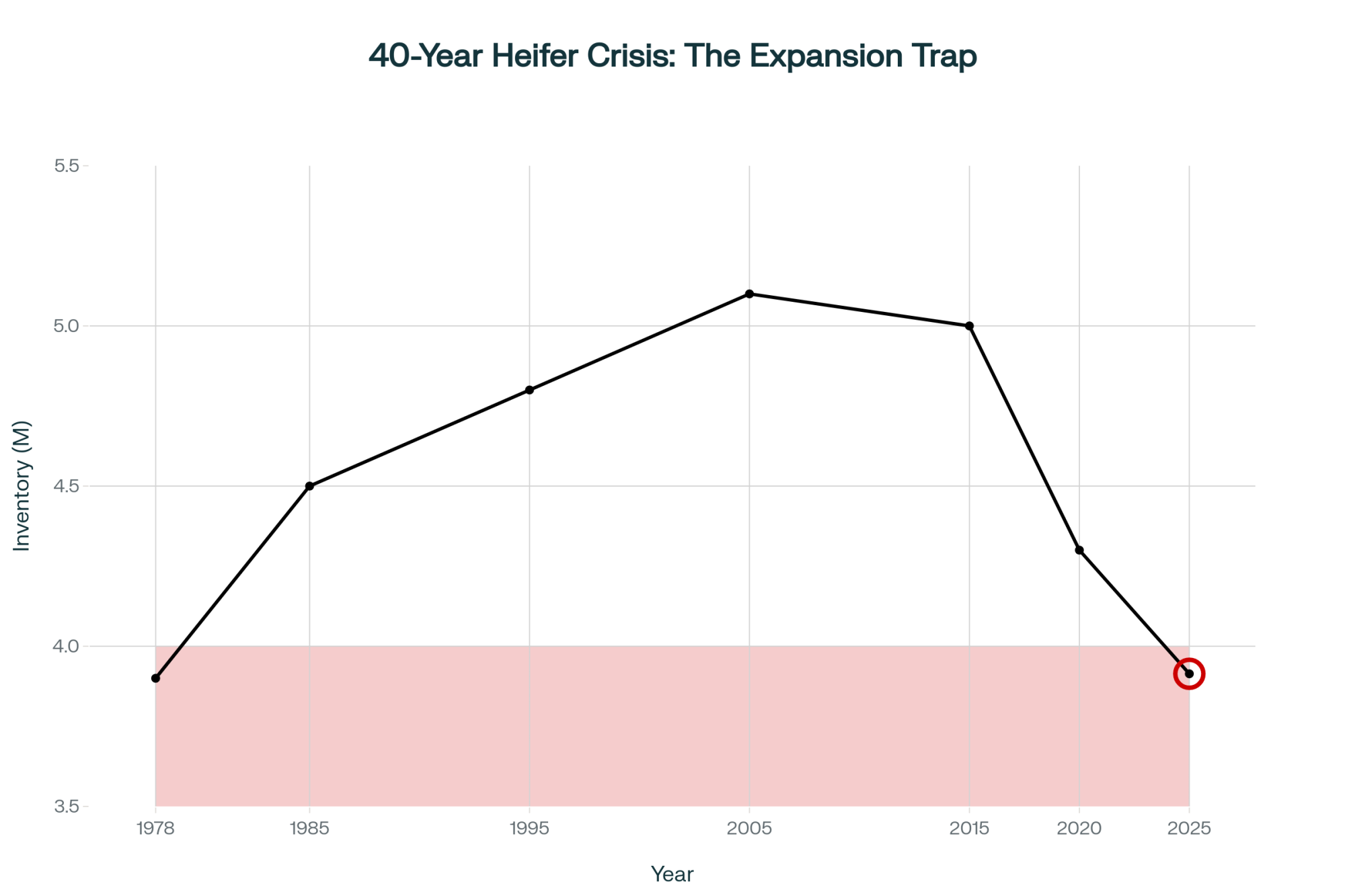
The 40-Year Heifer Crisis shows U.S. dairy heifer inventory at 3.914 million head—the lowest level since 1978—creating an expansion trap where even when milk prices recover to $22/cwt, operations can’t grow due to $3,200 heifer costs and limited availability. This isn’t a cyclical problem; it’s a structural crisis that will define the industry for years.

You know, CoBank’s August dairy report really opened some eyes—they’re projecting an 800,000 head decline in heifer inventories through 2026. And the January USDA Cattle inventory confirmed we’re at just 3.914 million dairy heifersover 500 pounds. That’s the lowest since 1978, folks.

Current Reality:

  • $3,200 current bred heifer cost (compared to $1,400 three years ago)
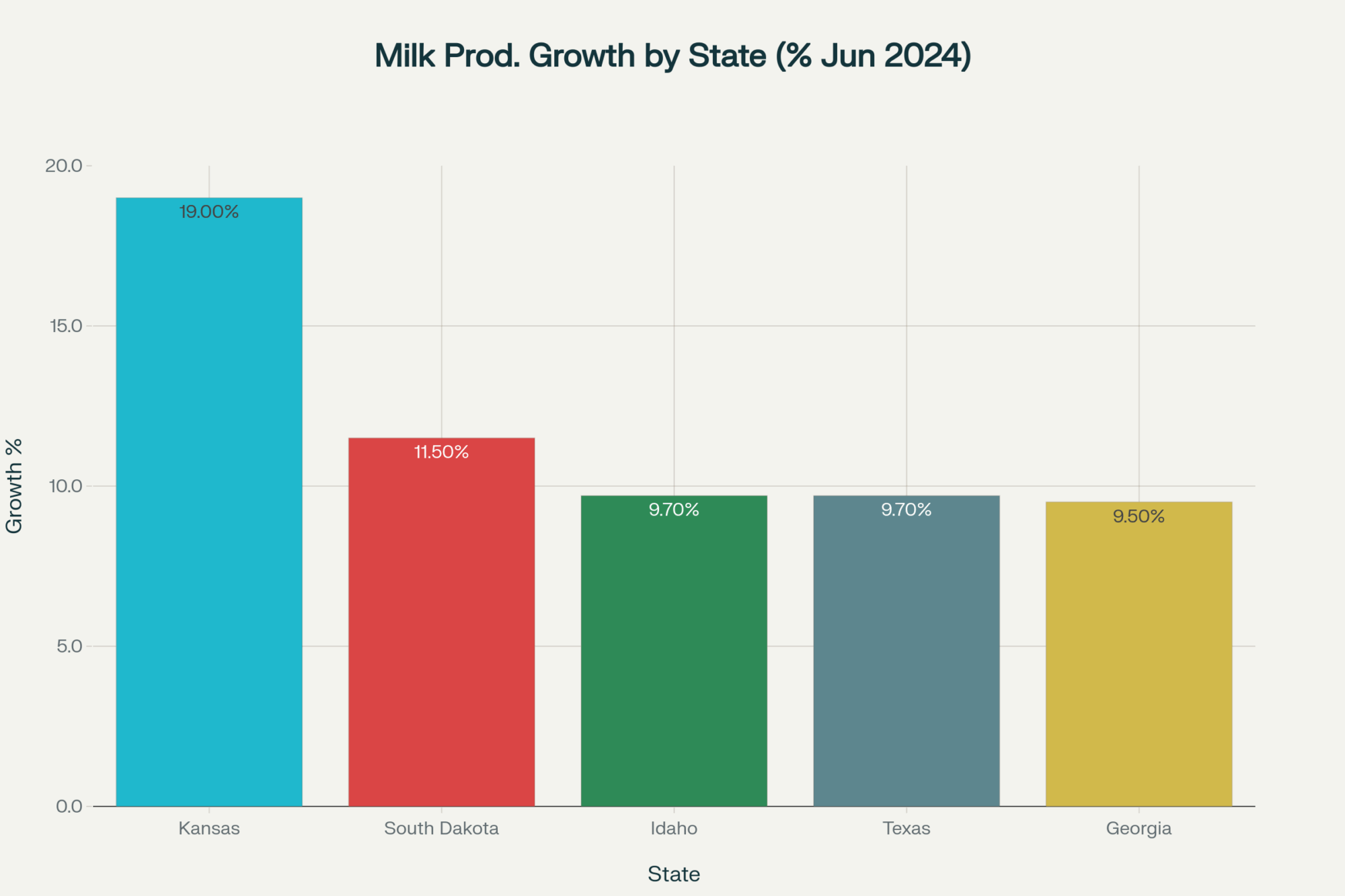
  • Wisconsin actually added 10,000 head
  • Kansas dropped 35,000 head
  • Idaho lost 30,000 head
  • Texas shed 10,000 head

A Tulare County producer summed it up perfectly when he told me: “The irony is crushing—beef-on-dairy revenue helped us survive the downturn, but now expansion is virtually impossible without heifers.”

SNAP Impact: The Ripple Effect

When those 42 million Americans saw their SNAP benefits cut from $750 to $375 for a family of four… the impact on dairy demand was immediate and, honestly, worse than I expected.

The Numbers:

  • 50% benefit reduction starting November 1st
  • 10-15% reduction in retail dairy orders within the first week
  • 1.4-1.6 billion pounds milk equivalent annual impact

Andrew Novakovic from Cornell’s Dyson School—he’s been studying dairy economics for decades—offers crucial context: “Dairy products often see early reductions when household budgets tighten. Unfortunately, many consumers categorize dairy as discretionary when financial pressures mount.”

Global Dynamics: The New Reality

Twenty years ago, friends, U.S. dairy prices were mostly about what happened between California and Wisconsin. Today? With 16-18% of our production going to export markets, what happens in Wellington, Brussels, and Beijing matters just as much.

Key Production Increases:

  • Ireland’s up 7.6% year-to-date through May
  • Poland’s share grew from 1.9% to 3.9% of EU production over five years
  • New Zealand hit four consecutive monthly records through September
  • China’s now 85% self-sufficient, up from 70%

Ben Laine over at Rabobank explained it well: “When major exporters increase production simultaneously while China requires fewer imports, prices have to adjust globally. These signals reach U.S. farms within weeks, not months.”

Action Plans by Operation Type

📗 For Growth-Oriented Operations

Genomic Testing ROI:

I’ll admit, spending $45 per calf for genomic testing when milk prices are in the tank seems counterintuitive. But here’s the math that convinced me:

  • Test 300 heifer calves at $45 each: $13,500
  • Apply sexed semen to top 120 at $27 extra per breeding: $3,240
  • Generate 80-100 surplus heifers worth $3,200-$3,500 each: $280,000+
  • Your ROI? About 16 to 1

University dairy economics programs have validated these projections, and frankly, those numbers work in any market.

Risk Management Stack:

You can’t rely on DMC alone—it hasn’t triggered meaningful payments in over a year according to FSA records. Smart operators are layering:

  • DMC at $9.50: ~$0.15/cwt for first 5 million pounds
  • DRP at 75-85%: Premiums run 2-3% of protected value
  • Forward contracts: 30-40% when you see $19+/cwt

📘 For Transition Candidates

Three Proven Paths:

  1. Collaborative LLC: Three farms near Fond du Lac reduced per-cow investment from $8,000 to $3,200 by sharing infrastructure
  2. Premium Markets: A2 can bring a $4/cwt premium; organic runs $20/cwt over conventional if you can secure a buyer first
  3. Strategic Exit: You preserve 80-85% of equity in a planned transition versus maybe 50% in distressed liquidation

📙 For Next Generation

If you’re under 30 and considering this industry, you need to know it’s fundamentally different from what your parents knew. University programs like Wisconsin’s Center for Dairy Profitability and Cornell’s PRO-DAIRY are developing specific resources for younger producers navigating this new environment. Use them.

Regional Snapshot: Your Competition and Opportunities

Southwest: Water costs are doubling in some areas. One Albuquerque producer told me they’re making daily tradeoffs between feed production and maintaining adequate water for the herd.

Northeast: Those fluid premiums we used to count on? They’ve compressed from $2-3/cwt down to $0.50-1.00 in many months.

Pacific Northwest: Urban pressure near Seattle and Portland—plus down in Salem—has reduced available land by 30% in five years for some operations. A Yakima producer told me they’re now focusing entirely on efficiency rather than expansion.

Upper Midwest: Generally best positioned with those heifer additions and relatively stable production costs. Wisconsin operations, particularly, are seeing benefits from their heifer inventory decisions.

The Path Forward: Your 18-Month Strategy

You know, a Turlock-area veteran told me something last week that really stuck: “We’ve shifted from watching weather and milk prices to monitoring New Zealand production and Argentine beef policy. This isn’t the dairy farming of previous generations, but it’s our evolving reality.”

The coming 18 months will challenge all of us, yet patterns remain identifiable for those watching. Markets will recover—they always do—but the question is whether your operation will be positioned to benefit from that recovery.

Looking at this trend, farmers are finding that appropriate signal monitoring, combined with decisive action, makes the difference. Your operation deserves strategic planning beyond hoping for better prices. And with the right approach, achieving better outcomes remains entirely possible.

Because at the end of the day, friends, as many of us have learned, success in modern dairy isn’t just about producing quality milk anymore. It’s about understanding global dynamics, managing risk intelligently, and making informed decisions based on forward-looking indicators rather than yesterday’s prices.

The tools are there. The signals are clear. What we do with them over the next 18 months will determine who’s still farming when this cycle turns—and it will turn. It always does.

KEY TAKEAWAYS: 

  • Monitor three signals, not milk prices: Weekly slaughter approaching 260k (currently 230k), GDT auctions gaining 6-8% over four sales, and cattle futures holding above $230/cwt predict recovery 3-4 months before Class III moves
  • The correction isn’t coming—it’s different this time: Crossbred calves at $900-$1,600 create a revenue floor keeping marginal operations alive, breaking the traditional supply response to low milk prices
  • First movers are winning now: Operations tracking these signals have locked in $4.38/bushel corn and gained $1.20/cwt margins while others wait for “normal” price recovery that follows different rules
  • The heifer shortage trap: At 3.914 million head (lowest since 1978), expansion is mathematically impossible for most—even when milk hits $22, you can’t grow without $3,200 heifers
  • Your 18-month edge: Implement Monday morning CME checks, Thursday slaughter monitoring, and biweekly GDT tracking—15 minutes weekly that separates thrivers from survivors

Complete references and supporting documentation are available upon request by contacting the editorial team at editor@thebullvine.com.

Learn More:

Join the Revolution!

Join over 30,000 successful dairy professionals who rely on Bullvine Weekly for their competitive edge. Delivered directly to your inbox each week, our exclusive industry insights help you make smarter decisions while saving precious hours every week. Never miss critical updates on milk production trends, breakthrough technologies, and profit-boosting strategies that top producers are already implementing. Subscribe now to transform your dairy operation’s efficiency and profitability—your future success is just one click away.

NewsSubscribe
First
Last
Consent

Weekly Global Dairy Market Recap: Monday, November 3, 2025: European Cheese Crashes 37% as Class Spread Hits Historic High

European cheese crashed 37% year-over-year, and the Class III-IV spread reached a farm-killing $3.50/cwt.

Executive Summary: Global dairy markets are in freefall. European cheese crashed 37% year-over-year, GDT auctions fell for the fifth straight week, and the Class III-IV spread exploded to a farm-killing $3.50/cwt—your Class III neighbor is now making $3,800 more per month than you. Milk production is surging everywhere (New Zealand +2.8%, UK +7.5%, U.S. herd at 32-year high) while demand craters, with only whey (+2.2%) and China’s premium dairy pivot offering hope. The Trump-Xi deal promises 25 million tonnes of annual soybean purchases to ease feed costs, but it won’t save commodity producers. Bottom line: If you’re shipping Class IV at $13.90 while others get $17.40 for Class III, you’re losing $45,000 annually. The farms that survive will be those that act now to lock in Class III, optimize components, and abandon the volume-at-any-cost mentality that’s driving this market into the ground.

Global Dairy Markets

Global dairy markets delivered another week of painful reality checks. European cheese posted annual declines of more than 30%. The fifth straight GDT auction decline confirmed what you already know—there’s too much milk chasing too few buyers. Meanwhile, the Class III-IV spread hit $3.50/cwt, meaning your neighbor shipping Class III milk is making $3,800 more per month than you are if you’re stuck in Class IV.

European Futures: Butter Holds, Everything Else Slides

Key Takeaway: European traders moved 2,620 tonnes last week, but the real story is powder weakness (-1.3%) while whey bucked the trend (+2.2%)—a clear signal that protein derivatives are the only bright spot.

EEX recorded 524 lots of trading activity, with Tuesday’s 925-tonne session marking the week’s peak. The breakdown tells you everything about market sentiment:

  • Butter futures only dropped 2.0% to €5,093/tonne
  • SMP futures weakened 1.3% to €2,161/tonne
  • Whey futures climbed 2.2% to €1,007/tonne

That whey strength? It’s your lifeline. Strong protein derivative demand for feed and nutrition applications is keeping values supported while everything else crumbles.

Singapore Exchange: New Zealand’s Spring Flush Hits Hard

Key Takeaway: SGX traders moved 17,020 tonnes, but WMP prices fell for the fifth straight week to $3,523/tonne—Fonterra’s 2.8% production increase is flooding the market.

The numbers paint a clear oversupply picture:

  • WMP: Down 0.7% to $3,523/tonne
  • SMP: Flat at $2,591/tonne
  • AMF: Up 0.2% to $6,677/tonne
  • Butter: Down 1.3% to $6,339/tonne

Here’s what matters for your operation: Fonterra’s September collections hit 179 million kgMS (+2.8% YoY), with season-to-date volumes running 3.0% ahead. When New Zealand pumps out milk like this, global prices have nowhere to go but down.

European Cheese Collapse: The 30% Massacre

European Cheese Markets in Historic Freefall

Key Takeaway: European cheese prices aren’t just weak—they’re in historic freefall. Every major variety is down 30%+ year-over-year, and buyers know more pain is coming.* The weekly damage was brutal:

  • Cheddar Curd: Crashed €113 to €3,388 (-33.6% YoY)
  • Mild Cheddar: Plunged €206 to €3,430 (-33.3% YoY)
  • Young Gouda: Trading at €2,909 (-37.2% YoY)
  • Mozzarella: Down €105 to €2,823 (-36.2% YoY)

Why should you care? Because European processors are bleeding cash—paying €520/tonne for milk while selling Gouda at €400/tonne. That math doesn’t work. Something’s got to give.

GDT Auction: Fifth Straight Decline Says It All

Fifth Consecutive GDT Decline Confirms Bearish Reality

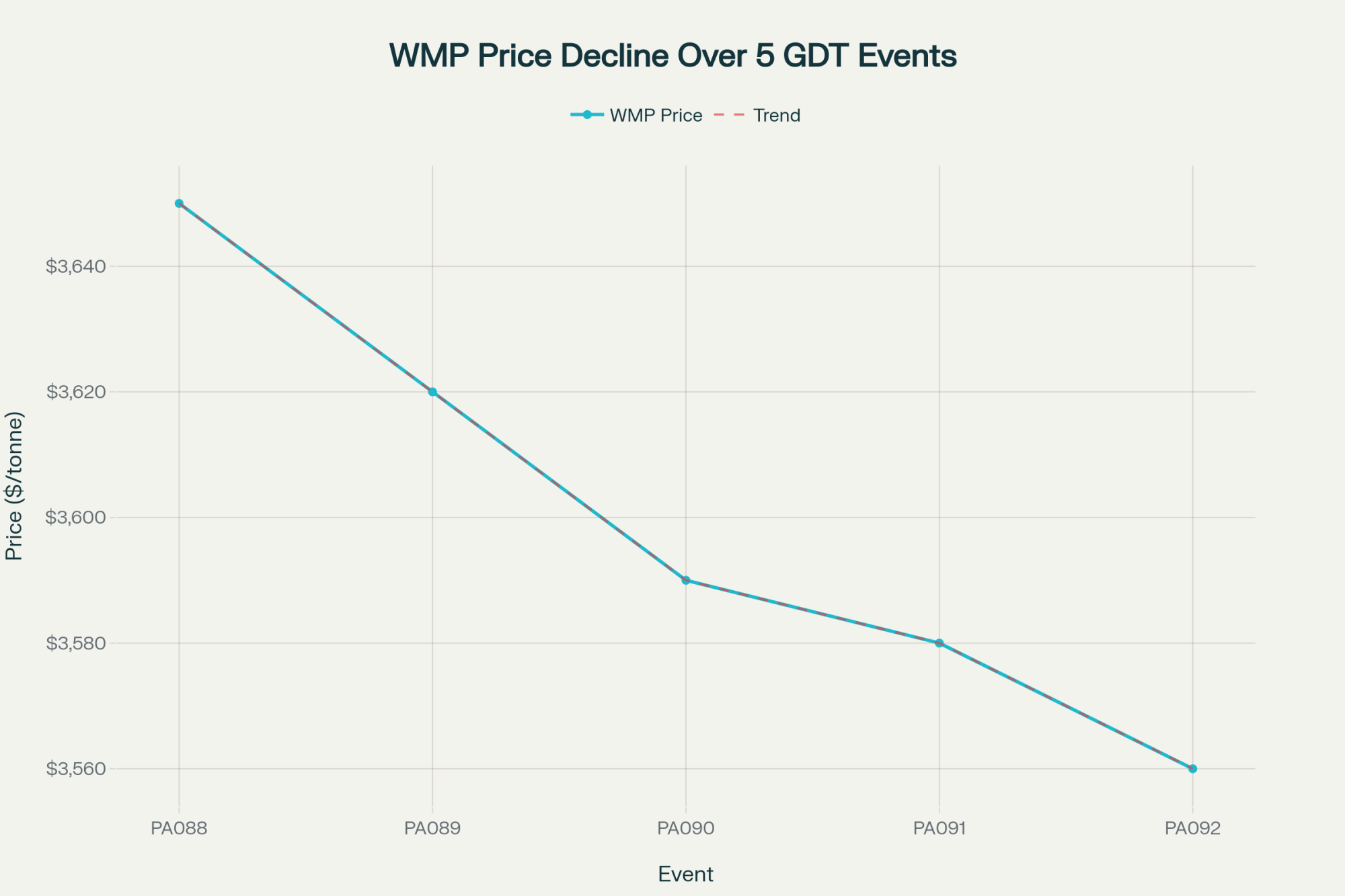
Key Takeaway: *The GDT Pulse auction delivered another gut punch—WMP at $3,560 and SMP at $2,530 represent 13-month lows. Buyers have zero urgency. The PA092 results confirmed what everyone fears:

  • WMP: $3,560/tonne (down $90 from two weeks ago)
  • SMP: $2,530/tonne (down $55 from prior pulse)
  • Total volume: Only 2,612 tonnes with 41 bidders

That’s five consecutive declines. The message? Global buyers are sitting on their hands, waiting for even lower prices.

Global Production: Everyone’s Making More Milk

Key Takeaway: From New Zealand (+2.8%) to Poland (+5.7%) to the UK (+7.5%), milk is flowing everywhere except where you need it—into buyer demand.

Southern Hemisphere Springs Forward

  • New Zealand: 316.3 million kgMS season-to-date (+3.0%)
  • Australia (Fonterra): 23.4 million kgMS YTD (+3.0%)
  • Argentina: September production surged 9.9% YoY

Northern Hemisphere Piles On

  • UK: September hit 1.28 million tonnes (+7.5% YoY)
  • Poland: 1.11 million tonnes in September (+5.7% YoY)
  • Ireland: November 2024 exploded 34% higher
  • USA: Herd at 9.52 million cows—highest since 1993

CME Markets: The Class Spread That’s Killing Farms

Historic Class III-IV Spread Creates $3,800 Monthly Winners and Losers

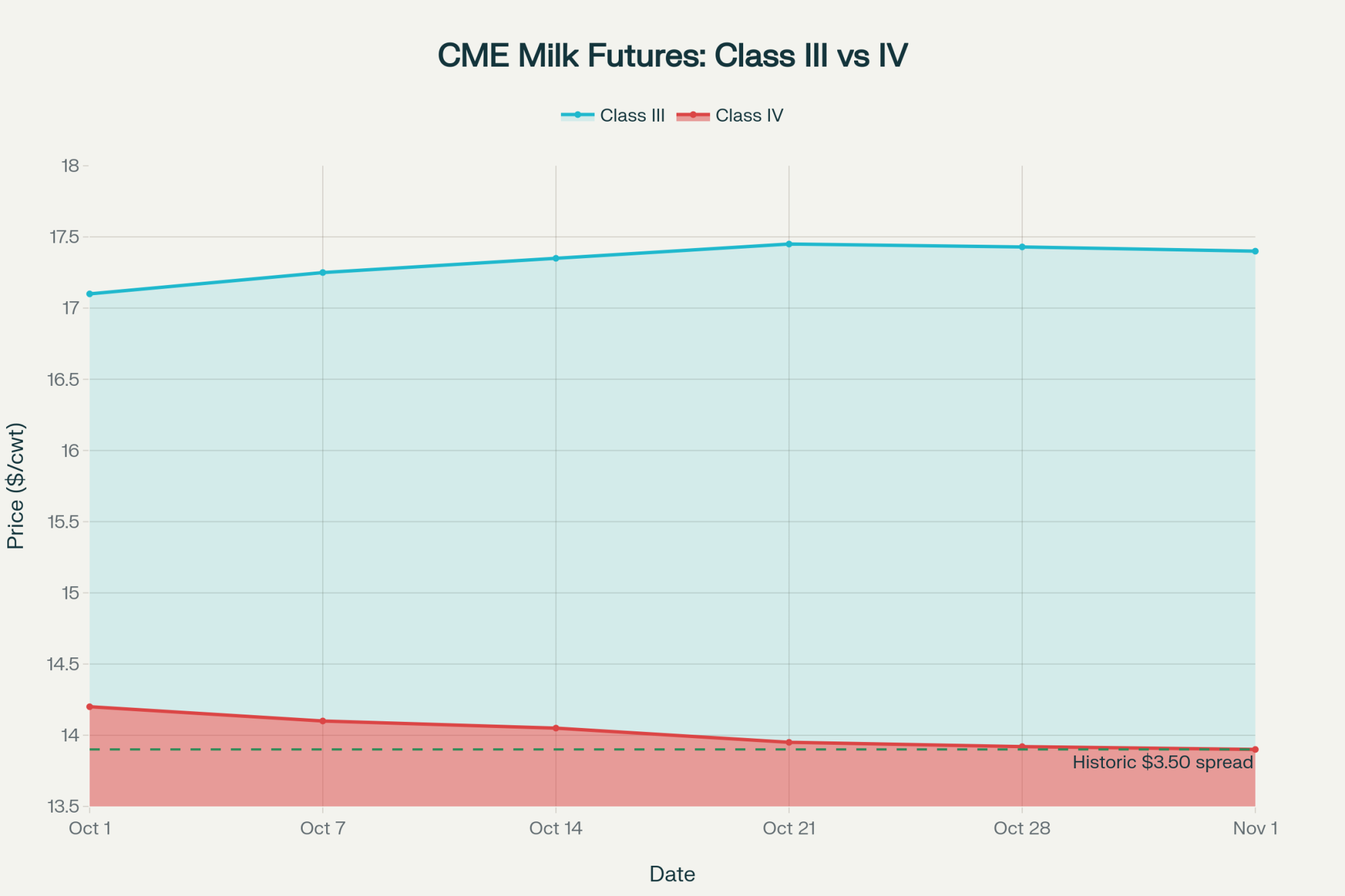
Key Takeaway: The $3.50/cwt Class III-IV spread isn’t just a number—it’s the difference between profit and loss for thousands of dairy farms.*Here’s your Friday closing reality check:

Winners:

  • Cheddar Barrels: $1.8050 (+3.5¢)
  • Dry Whey: $0.7100 (+2¢)—nine-month high
  • Class III November: $17.40/cwt

Losers:

  • NDM: $1.1325 (-2.75¢)
  • Butter: $1.6100 (barely holding)
  • Class IV November: $13.90/cwt

Do the math: If you’re shipping 3 million pounds monthly, that $3.50 spread means $3,800 less in your milk check compared to your Class III neighbor. That’s a new pickup truck disappearing every year.

Feed Markets: China Deal Sparks Soybean Rally

Key Takeaway: Soybeans hit $11/bushel on China’s promise to buy 12 million tonnes immediately plus 25 million tonnes annually—but will they follow through?

The Trump-Xi meeting delivered feed market fireworks:

  • Soybeans: Surged 60¢ to $11.00/bushel (15-month high)
  • Soybean Meal: Jumped $27 to $321.40/ton
  • Corn: Up 8¢ to $4.31/bushel

Treasury Secretary Bessent’s announcement sounds impressive, but here’s the reality: Those Chinese purchase commitments are still below pre-trade war levels. Don’t count your feed savings yet.

Trade Breakthroughs: Southeast Asia Opens Doors

Key Takeaway: New agreements with Malaysia, Cambodia, Thailand, and Vietnam eliminate dairy tariffs—finally giving U.S. exports a fighting chance against New Zealand and Australia.

President Trump’s Asian tour delivered real results:

  • Malaysia: Eliminates all dairy tariffs, recognizes U.S. standards
  • Cambodia: Zero tariffs on all U.S. dairy products
  • Thailand: Framework covers 99% of goods (dairy included)
  • Vietnam: Preferential access for substantially all dairy

Why this matters: Vietnam imported $668 million in dairy through August 2025, but U.S. suppliers captured only $22 million due to tariff disadvantages. These deals level the playing field.

China’s Premium Pivot: The $150,000 Opportunity

Key Takeaway: China’s 18% surge in premium dairy imports versus 12% declines in commodity products isn’t a blip—it’s a structural shift that rewards quality over quantity.

The numbers tell the story:

  • Cheese imports: +13.5% YoY
  • Butter imports: +72.6% YoY
  • Skim milk powder: Significant retreat

For a 500-cow operation optimized for components and premium channels, this shift could mean $150,000+ in additional annual revenue. The question is: Are you positioned to capture it?

The Bottom Line: Survival Mode Until Spring

Here’s your reality: Global milk production is overwhelming demand, and it’s not stopping. The Class III-IV spread is creating massive inequities between farms. European cheese markets are in freefall with no floor in sight. Your only bright spots? Whey strength and potential Chinese premium demand.

Three moves to make this week:

  1. Lock in Class III if you can—that $3.50 spread won’t last forever
  2. Review your component optimization—premium markets are your escape route
  3. Don’t forward contract cheese—European prices prove there’s more pain coming

The market’s sending clear signals: Commodity dairy is dead money. Premium products and value-added channels are your survival strategy. The farms that adapt to this reality will still be here in 2027. The ones that don’t? They’ll be someone else’s expansion.

What’s your move? The clock’s ticking, and every month at $13.90, Class IV is another month closer to the edge. 

Complete references and supporting documentation are available upon request by contacting the editorial team at editor@thebullvine.com.

Learn More:

Join the Revolution!

Join over 30,000 successful dairy professionals who rely on Bullvine Weekly for their competitive edge. Delivered directly to your inbox each week, our exclusive industry insights help you make smarter decisions while saving precious hours every week. Never miss critical updates on milk production trends, breakthrough technologies, and profit-boosting strategies that top producers are already implementing. Subscribe now to transform your dairy operation’s efficiency and profitability—your future success is just one click away.

NewsSubscribe
First
Last
Consent

The 20-Million-Ton Question: Why 2026 Will Determine Whether Your Dairy Thrives, Scales, or Strategically Exits

Dean Foods: Gone. Borden: Gone. Your local processor: Probably next. What every dairy farmer needs to know about 2026

EXECUTIVE SUMMARY: While Santiago’s dairy leaders celebrate a coming 20-million-ton shortage, 83.5% of farm kids are walking away from free operations—and the math explains why. Operating costs rising 3% annually, sustainability compliance accelerating ensus of Agriculture came out in5% yearly, but milk prices growing just 1% means that a $900,000 net income becomes a $540,000 net income within a decade. Add $54,750 for methane additives, processor consolidation, and operations requiring 1,260 cows just to reach the median scale, and the structural disadvantages are clear. Dean Foods and Borden’s bankruptcies preview the consolidation ahead in the processor industry, leaving producers with fewer buyers and less negotiating power. The next 24 months will determine whether you scale big, pivot to premium, or preserve wealth through a strategic exit—because waiting costs thousands in annual retirement income.

Future of Dairy Farming

You know that feeling when milk prices hit $22.60 per hundredweight and everyone starts talking expansion?

Let’s talk about what really came out of Santiago this week.

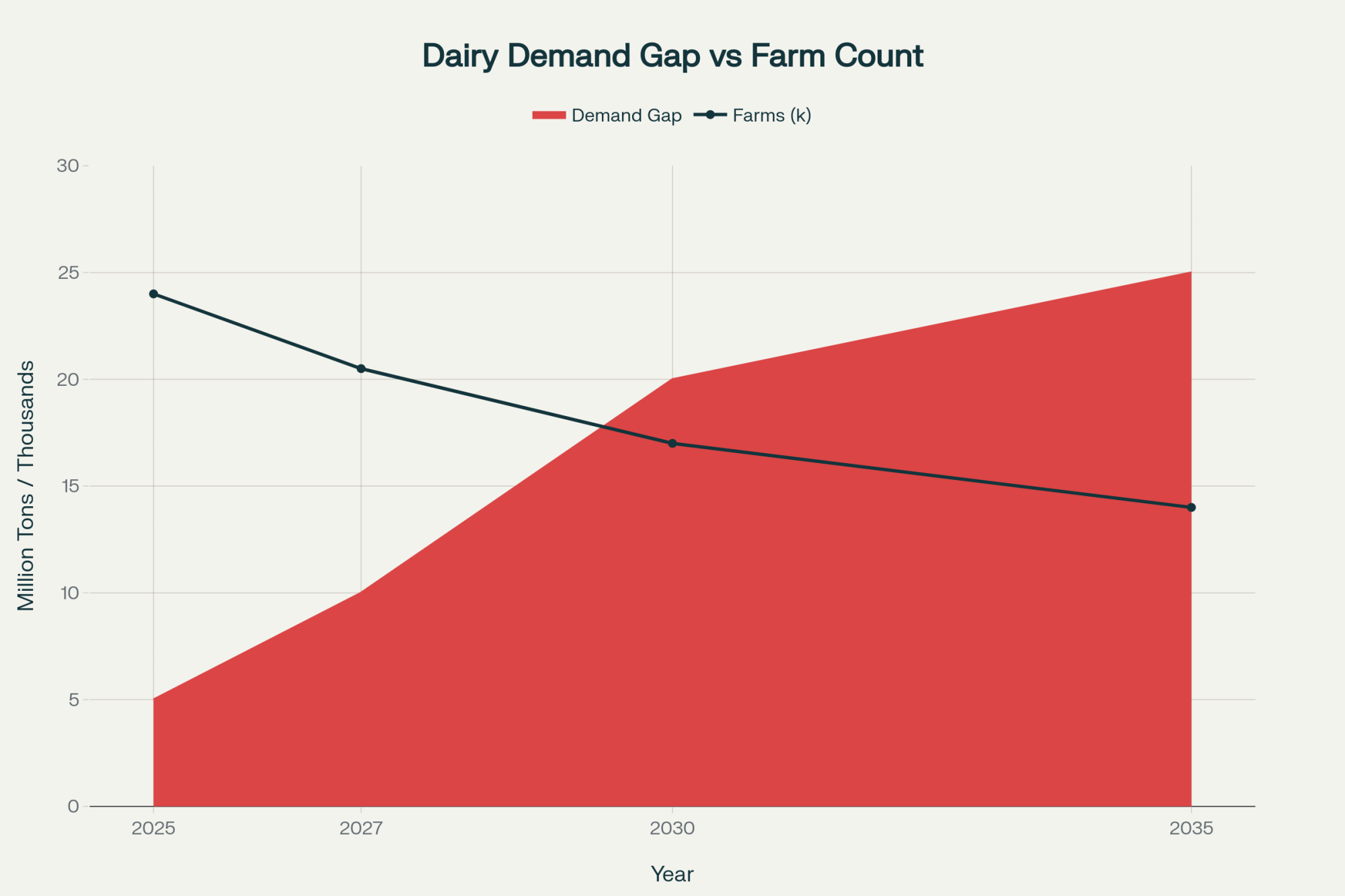
The International Dairy Federation is holding its World Dairy Summit this week—the first time in South America in 123 years—which is noteworthy, and the projections deserve a closer look. They’re talking about a 20-30 million ton global demand gap by 2035. IDF President Gilles Froment kept emphasizing “authentic collaboration” during his keynote, and that’s all well and good, but here’s what’s interesting…
When you examine these numbers alongside what’s actually happening on farms—I’ve been talking with producers from Vermont to California—some patterns emerge that suggest certain operations are going to capture value while others might struggle. These deserve a closer look.

And it’s not necessarily about who’s the better farmer.

Santiago’s celebrating a 25-million-ton shortage by 2035. But here’s what they’re not saying: only 14,000 U.S. farms will be left to capture that opportunity.

The Demand Gap: Real Opportunity or Something Else?

So this 20-30 million ton shortage everyone’s excited about—IDF’s analysis backs it up, USDA shows 11% consumption growth through 2030, and yeah, the demand’s real.

But here’s the thing: where’s the production going to come from?

Current production reality:

  • U.S. milk production: growing at just 0.9% annually (you’ve probably seen the NASS reports)
  • Europe: basically flat (Brussels keeps confirming this)
  • New Zealand: hitting environmental limits (their Ministry’s been pretty clear about that)

Even with the USDA predicting a milk price of $22.60, with room to grow, who actually benefits here isn’t as straightforward as you’d think.

Consider what DFA’s been doing. They marketed 65.5 billion pounds in 2021—that’s about 29% of all U.S. milk according to their annual reports. When you control processing, ingredients, export channels… you’re capturing value at every step.

Meanwhile, if you’re an independent producer shipping to whoever takes your milk that week, it’s a different game entirely.

And here’s something that really caught my attention: the Class III versus Class IV spread is $2.86 right now—widest we’ve seen since 2011 according to AMS data.

You know what that means? If you’re shipping to cheese plants in Wisconsin, you’re banking thousands more monthlythan your cousin in California selling to butter-powder operations. Same cows, same feed quality, same parlor management… but processor relationships determine who’s making money.

That’s not exactly what they teach in dairy science programs, is it?

Sustainability Costs: The Bill’s Coming Due

The Paris Declaration on Dairy Sustainability—signed by 53 countries, representing 46% of global production—changed the conversation from “wouldn’t it be nice” to “here’s your compliance timeline.”

And the costs… well, let me walk you through what producers are actually facing.

Bovaer methane additives: DSM’s been transparent about pricing at about $0.30 per cow per day. For 500 cows, that’s $54,750 annually. Just for the additive, nothing else.

Thinking about digesters? European Joint Research Centre research puts installation between €250,000-€275,000, and here’s what nobody mentions—you need about 35-40 kilowatt hours per kilogram of nitrogen for processing, which means solar panels or you’re burning through your savings on electricity.

Ben & Jerry’s ran this pilot with seven Vermont farms—the smallest had 60 cows, the biggest just under 1,000. They got 16% emissions reduction, which sounds great until you realize the company paid for everything. Staff time, equipment upgrades, robotic feed pushers… their published report basically says farmers can’t afford this without support.

At least they’re honest about it.

Now, California’s doing something interesting. Their dairy methane program—the Air Resources Board tracks this closely—has achieved impressive results:

  • 5 million tons of CO₂ equivalent are reduced annually
  • $522 million in private investment since 2022
  • $9 per ton cost-effectiveness (beats other climate tech by 10-60 times)

But here’s why it works: programs like the Low Carbon Fuel Standard create actual revenue from methane reduction. You’re not just spending money; you’re making it.

Most states? They don’t have anything close. I’ve been talking with producers in Ohio, Texas, Iowa, and even Wisconsin, outside the renewable natural gas corridor. They’re staring at these costs with no revenue offset.

And California’s got its own challenges—SGMA water compliance is brutal. Some producers I know are converting to solar at a rate of $800-$ 1,200 per acre annually. Beats volatile feed margins when water’s scarce, though.

Consolidation: The Numbers Tell the Story

USDA’s Census of Agriculture came out in February, and the numbers are sobering.

The brutal math of dairy consolidation: 39% of farms vanished between 2017-2022, while average herd sizes nearly tripled.

The stark reality:

  • 2022: 24,013 dairy operations (down 39% from 2017)
  • Since 2012: 50% of farms have gone in a decade
  • Rabobank projection: Another 20-25% decline by 2027

But here’s what really tells the story—look at where the milk’s coming from according to USDA’s Economic Research Service:

Operations over 1,000 cows:

  • Now: Control 65% of the herd
  • 1997: Just 17%

Farms under 100 cows:

  • Now: 7% of production
  • 1997: 39%

Midpoint herd size:

  • 2021: 1,260 cows
  • 2000: 180 cows
The math doesn’t care about your family legacy
Herd SizeCost/cwtProfit at $22.60
100-199$23.06-$0.46
500$20.25$2.35
1,000$18.50$4.10
2,500+$13.06$9.54

And it’s not just about bulk feed purchases or spreading fixed costs, as many of us have seen. What I’m finding—especially visiting Wisconsin operations lately—is revenue diversification that smaller farms struggle to match.

These bigger operations are breeding 60% or more of their herds to Angus bulls. With beef crosses bringing $800-1,200 versus maybe $150 for dairy bulls, a 2,900-cow operation can generate millions extra annually just from calves.

Add in what they’re doing with:

  • Genetics sales internationally
  • Digester partnerships (companies like Vanguard Renewables)
  • Commercial grain operations on thousands of acres

It’s a completely different business model, honestly.

A 600-cow operation—and I know plenty of excellent managers at that scale—generally can’t tap those revenue streams. You don’t have the volume for direct feedlot contracts, digesters don’t pencil out, and international genetics buyers aren’t calling.

It’s not about management quality; it’s structural advantages that kick in above certain thresholds.

Why the Next Generation’s Walking Away

While 69% of farmers expect their kids to take over, only 16.5% of transitions actually succeed—and 71% haven’t even identified a successor.

Here’s a statistic that keeps me up at night: University of Minnesota Extension found that while 69% of farmers expectto pass the farm to their children, actual succession success is only 16.5%.

That 83.5% failure rate? It’s not because kids are soft or don’t appreciate farming. It’s math.

I’ve been helping young couples run the numbers using Wisconsin’s Farm Financial Standards—proper analysis, not back-of-the-envelope stuff.

Take a typical scenario:

  • 25-year-old with an ag degree
  • Parents running 500 cows
  • Normal debt loads
  • Year one: Maybe $900,000 net with current prices

Sounds good, right?

But factor in reality based on historical trends:

  • Operating costs: Rising 3% annually (that’s the 10-year average)
  • Sustainability compliance: Accelerating 5% yearly (as regulations tighten)
  • Milk prices: Maybe 1% growth if you’re lucky (20-year data shows this)

By year 10, That net income could drop 40% or more.

And that’s while working 60-70 hour weeks—you know how it is during calving season—carrying complete liability for over a million in debt.

Their college friends?

  • Ag lenders: Starting $58,000, reaching $90,000 within a decade (Bureau of Labor Statistics data)
  • Herd managers: $80,000-120,000 (based on industry surveys)
  • Benefits: Home for dinner, actual vacation time, no debt liability

Student loans make it worse—National Young Farmers Coalition says 38% of young farmers carry an average debt of $35,660. As folks at USDA’s Beginning Farmer Program keep pointing out, you’re already in debt before you even think about taking over the farm.

The math often doesn’t work. And honestly? Can you blame them for choosing differently?

Your Four Critical Decisions—Quick Reference

Decision 1: Can premium markets work for you? (6 months to figure out)

  • Within 100 miles of metropolitan markets with strong demographics
  • Need 50%+ equity to weather transition losses
  • Someone who actually wants to do marketing, not just milk cows
  • Reality: Losses years 1-3, break even 4-6, profit after year 7 (every transition study shows this)

Decision 2: Can you scale to 1,500+ cows? (12 months to secure financing)

  • Need $3-4.5 million capital (that’s current construction costs)
  • Current profits should exceed $400/cow for lender confidence
  • Debt under 30% of assets for favorable terms
  • Reality: $175,000-292,000 annual debt service at current rates

Decision 3: Are You Preserving or Bleeding Equity? (3 months to assess honestly)

  • Delaying exit while losing money costs thousands in retirement income
  • Declining working capital = converting equity to expenses
  • Continue only if genuinely cash flow positive

Decision 4: If exiting, how do you maximize value? (12-18 months to execute)

  • Best: Sell to expanding neighbor (92-98% value recovery)
  • Good: Liquidate herd, keep land for rent (85-90%)
  • OK: Convert to heifer raising (40-50% income reduction)
  • Fast: Complete auction (60-80% recovery)

Processors: The Other Consolidation Story

Dean Foods collapsed. Borden’s bankrupt. In the Upper Midwest, 90% of your milk goes to just two buyers—DFA or Prairie Farms.

The processor landscape changed dramatically with recent bankruptcies, as you probably know:

Dean Foods (November 2019)

  • Over $1 billion in long-term debt, according to bankruptcy filings
  • Combined revenues over $12 billion—just gone

Borden Dairy (January 2020)

  • Followed Dean into bankruptcy
  • Couldn’t compete with integrated processors

When Walmart built their Fort Wayne plant in 2018 and Kroger expanded private label… that was game over for traditional processor margins, honestly.

After Dean collapsed, DFA bought 44 facilities for $433 million—the DOJ tracked all this. Now, many upper Midwest producers basically have two buyers: DFA and Prairie Farms.

That’s not exactly competitive price discovery, is it?

What Europe’s showing us about what’s next:

  • Arla-DMK merger: Creates €19 billion giant
  • FrieslandCampina-Milcobel: Combines €14 billion
  • DMK’s reality: €24.6 million profit but negative €54.8 million cash flow in their FY2024 report

They’re burning reserves despite making operational profit. Their CEO’s been blunt with members: milk production’s declining, and they need scale to survive.

What’s this mean for us? Fewer buyers, less negotiating leverage, more dependence on whoever’s left standing.

And if you think that leads to better milk prices… well, I’ve got a bridge to sell you.

The Talk Every Farm Family Needs to Have

Here’s the conversation I’ve been coaching families through—and it needs real numbers, not hopes:

“Listen, we’ve got three realistic paths given where the industry’s heading.

Path one—go premium. Organic, processing, direct sales. That’s serious money upfront, losses for years according to every university study, and you’d basically be running a food company. Farmers markets every Saturday, Instagram all the time, dealing with customer complaints. That sound like the life you want?

Path two—scale up big. We’re talking millions in debt, managing 20+ employees, becoming a CEO instead of a farmer. HR headaches, safety meetings, and managing managers instead of cows. You ready for that?

Path three—we sell while we’ve got equity. You pursue your career without our debt. We preserve retirement funds. You can still work in dairy—plenty of good jobs—just not owning the risk.

What actually fits your vision for the next 40 years?”

When kids see real numbers, Iowa State’s research suggests that about 75% choose path three. They become nutritionists, agronomists, equipment specialists. Good careers using farm knowledge without the burden of ownership.

And given the economics? It’s often the smart choice.

What’s Actually Working Out There

Now, it’s not all challenges—I’m seeing some operations successfully thread the needle.

New York producers integrating processing are doing something interesting. Making specialty cheese and butter for NYC markets—one operation I visited is selling butter for $12 per pound in Manhattan. That vertical integration changes everything.

California cooperatives where smaller farms banded together before consolidation forced them, are now receiving premiums. Clover Sonoma’s a good example—27 farms averaging 350 cows each, all within 100 miles of their plant. They control their story and receive premium prices.

Vermont innovation through programs like AgSpark, is worth noting. Individually, a 400-cow farm can’t justify a digester. But three farms together? Now you’re talking viable scale. That’s real collaboration, not the “take whatever price we offer” kind.

Plains states are finding niches too. Custom heifer operations serving multiple dairies, spreading costs. Grazing dairies in Missouri are finding grass-fed markets that actually pay premiums.

Mid-Atlantic producers are leveraging proximity. Pennsylvania’s farmstead cheese operations are growing—being close to Philadelphia and Pittsburgh matters. Maryland producers supplying Baltimore and D.C. with local milk get decent premiums despite high land costs.

Even in the Southeast, despite cooling costs running $180-$ 200 per cow annually, I know operations that maximize component premiums. When your butterfat’s at 4.2% and protein is at 3.4%, you’re getting paid. It’s about finding what works for your situation.

Looking Ahead: The Industry Will Survive, But Will You?

The industry will absolutely meet that 20-30 million ton demand gap. Sustainability goals will be achieved. Global production will modernize.

But the structure doing it? Nothing like today’s.

Operations under 1,000 cows without premium markets, face increasingly challenging economics. Sustainability costs are rising, processor options are shrinking, and the next generation is making rational career choices.

It’s not about farming quality—it’s about structural realities nobody wants to discuss at industry meetings.

Those positioned to scale or differentiate have real opportunities, but execution has to be nearly perfect. I’ve seen too many half-hearted organic transitions fail. Expansions without multiple revenue streams just create bigger debt.

You need a complete strategy, not just hope.

The next 24 months look critical based on what I’m seeing. Processor consolidation’s accelerating—Rabobank says 2026 could see major shifts. Asset values may decline as more operations exit. Waiting usually means fewer options at lower values.

The Bottom Line: Your Choice to Make

Santiago’s summit revealed an industry transforming whether we’re ready or not.

The question isn’t if you’ll be affected—it’s whether you’ll choose your position or let circumstances choose for you.

Understanding these dynamics isn’t pessimistic—it’s getting clear-eyed about making wealth-preserving decisions while you still have options. I’ve watched too many good operators wait too long, hoping for better prices or magical policy changes that never came.

What gets me is all the knowledge we’re losing. Generations of understanding specific fields, managing fresh cow transitions, getting the most from local forages… when a farm exits, that expertise often goes too.

But here’s what’s encouraging—that knowledge can transform into new roles. Some of the best herd managers I know are former owners who sold at the right time. They’re managing thousands of cows, earning well, and home for dinner.

The knowledge continues, just in different structures.

Your action steps:

  • Talk with your lender—really talk, not just renew notes
  • Run honest numbers using proper methodology (Wisconsin’s Farm Financial Standards work well)
  • Visit operations succeeding in different models
  • Make decisions based on facts, not tradition or guilt

This transformation isn’t about good farms versus bad farms. It’s about structural changes favoring certain models over others.

Understanding that—and positioning accordingly—separates those who’ll thrive from those just trying to survive.

The next 24 months will likely determine the structure of American dairy for the next generation. Make sure you’re actively choosing your place, not just watching it happen.

We’ve been through big changes before, right? Hand milking to pipelines. Family labor to hired help. Local cream stations to global markets. This is another turn of that wheel—probably the biggest many of us have seen.

The question is: are you steering, or just hanging on?

Because at the end of the day, this industry needs people who understand cows, who know how to produce quality milk, who can manage the biology and complexity of dairy farming. That need won’t go away.

But how that knowledge gets applied, in what structures, at what scale—that’s what’s changing.

Your operation has value. Your knowledge has value. Your family’s future has value.

The key is making sure you’re the one determining how to best preserve and deploy that value, not having it determined for you by circumstances beyond your control.

That’s what Santiago really taught us—not that change is coming, but that we need to be intentional about our place in it.

Complete references and supporting documentation are available upon request by contacting the editorial team at editor@thebullvine.com.

Learn More:

Join the Revolution!

Join over 30,000 successful dairy professionals who rely on Bullvine Weekly for their competitive edge. Delivered directly to your inbox each week, our exclusive industry insights help you make smarter decisions while saving precious hours every week. Never miss critical updates on milk production trends, breakthrough technologies, and profit-boosting strategies that top producers are already implementing. Subscribe now to transform your dairy operation’s efficiency and profitability—your future success is just one click away.
NewsSubscribe
First
Last
Consent

New Zealand Hit Record Production and Started Paying Down Debt – Here’s the $1.7 Billion Signal You’re Missing

When the lowest-cost producer starts hoarding cash, what should you be doing?

EXECUTIVE SUMMARY: What farmers are discovering about New Zealand’s record September production—228,839kg of milk solids, up 3.4%—reveals something crucial about the next commodity cycle. Despite Fonterra paying out $16 billion in returns (30% above last year), Reserve Bank data shows their farmers just paid down $1.7 billion in debt over six months rather than expanding. This disconnect between production strength and conservative positioning mirrors patterns from 2014, right before the last major downturn that saw prices crash to NZ$3.90/kgMS for 18 months. China’s Three-Year Action Plan for cheese production, combined with their historical pattern of cutting WMP imports by 240,000 metric tons once domestic capacity matured, suggests the 2027-2030 period could see similar disruption in cheese markets. Smart operators are already adjusting—Federal Reserve data shows U.S. dairy borrowing remains flat despite strong cash flows, while processors with 70% of milk under long-term contracts are reporting better stability than spot-market dependent operations. Here’s what this means for your operation: the window for strengthening balance sheets and securing stable contracts is open now, but it won’t stay that way past 2026.

You know that feeling when something’s just… off? Milk production’s strong, the neighbor’s adding another barn, equipment dealers can’t keep anything in stock. But there’s this nagging sense that these “good times” are different. I think what’s happening in New Zealand right now might help explain why so many of us are feeling cautious.

So here’s what caught my attention: DairyNZ’s latest production statistics show New Zealand just hit their highest September milk collection on record—228,839 kilograms of milk solids. That’s up 3.4% from last year. And Fonterra announced in their FY25 results that total cash returns to shareholders are approaching sixteen billion dollars, which is roughly 30% more than the previous year.

But—and this is the part that makes you think—Global Dairy Trade auction prices have been sliding for three straight months. The October 7th auction settled at $3,921 per tonne. When production’s surging but prices are softening? That tells you something.

Record production colliding with softening prices—the market signal smart operators aren’t ignoring

Why New Zealand Can’t Actually Choose What They Produce

Here’s what I’ve found most producers outside Oceania don’t really grasp about New Zealand’s system. According to DairyNZ’s seasonal production data, about 84% of their entire national herd calves within a three-month window—August through October. Think about that for a second. Nearly every cow in the country freshening at the same time.

During their spring flush—that’s October through December down there—they’re pushing roughly 60-65% of their entire annual milk volume through processing plants in just three months. Fonterra’s milk collection data shows their plants hit 95% utilization during peak. That’s not efficiency, folks. That’s desperation.

When 84% of your national herd calves in 3 months, you don’t choose what to produce—you spray dry whatever doesn’t fit in the tank

You know what happens then? Industry processing reports show they’re running spray dryers flat out just to keep milk from backing up on farms. According to the Dairy Processing Handbook from Tetra Pak, modern spray dryers typically process 10-15 metric tons per hour, and during New Zealand’s flush, these things run continuously. Day and night.

This is why—and here’s what’s really telling—whole milk powder still represents about 40% of New Zealand’s dairy exports according to USDA’s Foreign Agricultural Service analysis. It’s not because they want to make powder. It’s because when that wall of milk hits, you either spray dry it or dump it. There’s no third option.

For those of us running year-round calving systems, this might seem crazy. But it’s actually both their biggest advantage and their Achilles heel, depending on how you look at it.

New Zealand’s grass-based system delivers the world’s lowest production costs—but that advantage is eroding as climate forces adaptation

China’s Playing the Long Game (Again)

What’s happening with China’s import patterns is fascinating—and honestly, a bit concerning. USDA’s Beijing office analyzed China Customs data and found cheese imports are up over 22% while skim milk powder imports jumped 26%. But whole milk powder? Still declining.

You probably remember what happened with WMP between 2010 and 2018, right? UN Comtrade data shows China kept importing massive volumes while quietly building their own production capacity. Then suddenly—boom—imports dropped from around 670,000 metric tons to 430,000 metric tons. Changed the whole global market.

Now they’re following the same playbook with cheese. China’s Ministry of Agriculture published this Three-Year Action Plan for cheese production development. Their western provinces are already incorporating cheese plants into those massive dairy clusters they’re building. Industry reports indicate China Modern Dairy is producing something like 3,300 tons of raw milk daily now. And get this—their cows are averaging over 13,000 kilograms of production. That’s right up there with good U.S. herds.

Looking at current construction activity tracked by the China Dairy Industry Association, most analysts expect modest import growth through maybe 2026, then watch for new “quality standards” that somehow favor domestic production. By 2027-2030? Well, cheese imports could follow the same path as powder—down 30-40% from peak. Though who knows, right? Economic conditions could speed this up or slow it down. And let’s not forget, precision fermentation and alternative proteins are starting to look more viable every year, though current costs suggest traditional dairy keeps its advantages for commodity uses through at least 2030.

China’s building massive cheese capacity right now—expect ‘quality standards’ that favor domestic production to hit by 2028, just like they did with WMP

Those “Profitable” Margins Tell a Different Story

DairyNZ’s Economic Survey shows New Zealand producers are looking at breakeven costs around NZ$8.66 per kilogram of milk solids. Fonterra’s announced farmgate price is NZ$10.16. So that’s about a NZ$1.34 spread—in our terms, they’re breaking even around $16.50 per hundredweight compared to the $24.55 it costs to produce milk in California according to CDFA’s May cost study.

Sounds pretty good, doesn’t it? But here’s what I find interesting: Reserve Bank of New Zealand data shows farmers just paid down NZ$1.7 billion in debt in six months through March 2025. That’s not expansion behavior. That’s battening down the hatches.

They remember 2015-16. Fonterra’s historical pricing data shows milk prices crashed to NZ$3.90 per kilogram and stayed there for 18 months. A lot of good operators went under during that stretch.

Iowa State research proves it: debt reduction gives you twice the resilience of expansion at cycle peaks—NZ farmers clearly remember 2015

And now you’ve got climate issues on top of everything else. Federated Farmers officials have been calling recent droughts in Waikato and Taranaki some of the worst in decades. When you’re forced to dry cows off early, or you’re taking 20-30% discounts on spot milk because plants can’t handle your flush volumes… suddenly that cost advantage doesn’t look so solid.

University of Melbourne’s Dairy Futures research projects profitability could drop 10-30% by 2040 without successful climate adaptation. But here’s the catch—every adaptation measure costs money and changes your cost structure. Several Canterbury producers I’ve heard speak at field days who invested in irrigation say the same thing: “It saved our production during the drought, but we’re not a low-cost operation anymore.”

Why Farmers Vote for Cash, Not Strategy

This is where cooperative governance gets really interesting. Industry analysis from Rabobank and others suggests Fonterra needs hundreds of millions in capital investment for specialty protein infrastructure if they want to stay competitive as markets evolve.

But when Fonterra put their Flexible Shareholding structure to a vote in December 2021, you know what happened? Official voting results showed 85.16% approval with over 82% turnout—for a proposal that REDUCED capital requirements from one share per kilogram of milk solids to one share per three kilograms. Farmers overwhelmingly voted for more financial flexibility, not strategic investment.

And honestly? I can’t blame them. If you’re running 500 cows and a 50-cent payout increase means $85,000 in your pocket this year, that’s real money. You can pay down debt, fix that mixer wagon that’s been limping along, help your kid with college. Voting to fund some protein plant that might help in eight years—assuming China doesn’t build their own first—that’s a much tougher sell.

What farmers are finding is that democratic governance, while it protects individual interests, can really limit strategic flexibility. And it’s not just Fonterra—I’ve seen the same tensions in cooperatives here in the States.

Climate’s Changing Everything

You know, the relationship between climate and production systems is getting more complicated every year. New Zealand’s whole model depends on predictable pasture growth synchronized with their seasonal calving. Research published in Agricultural Systems shows those patterns are becoming way less reliable.

Every adaptation has trade-offs. Install irrigation? There goes your low-cost advantage. Switch to split calving? Now you need more stored feed. Build bunker silos for drought reserves? Suddenly you’re looking at cost structures closer to what we have here.

I was talking with a Missouri producer at a grazing conference who’s using New Zealand-style rotational grazing on 650 cows. He made a great point: “Their system works perfectly in their climate. But when spring shows up three weeks late—or sometimes not at all—you understand why we do things differently here.”

Another producer from the Northeast who’s running managed intensive grazing on 400 cows added something interesting: “We took the best parts from New Zealand—the paddock system, focusing on grass quality—but adapted it for our reality. Sometimes that means feeding stored forage for five months instead of two. Our butterfat stays strong at 4.0-4.2%, but we’re definitely not low-cost anymore.”

This suggests to me that climate adaptation is forcing everyone’s costs to converge, which could erode New Zealand’s traditional advantage faster than people realize.

What Smart Operators Are Actually Doing

It’s interesting watching what experienced producers are doing versus what they’re saying. Federal Reserve ag lending data shows dairy borrowing is flat or declining across most mature markets despite strong cash flows. Farm Credit System quarterly reports suggest folks who survived 2015-16 are using this windfall to strengthen balance sheets, not build new facilities.

I know several producers who’ve shifted focus from volume to components. They don’t care if they ship 10% less milk if their butterfat hits 4.2% instead of 3.8%. The math just works better, especially when plants are at capacity.

According to the International Association of Milk Control Agencies, processors with 70% or more of their milk under long-term contracts report much better stability than those chasing spot markets. And something else I’m seeing—producer groups working together to secure whey protein extraction agreements. They’re thinking five years out, not five months.

What’s really telling is how the conversation has shifted. Five years ago, everyone was talking expansion and efficiency. Now? It’s all about flexibility and resilience.

Different Regions, Different Opportunities

Where you’re located really shapes your options. Upper Midwest producers, those new cheese plants—Hilmar’s operations in Texas and Kansas, plus others coming online—are creating massive whey streams according to Dairy Foods reporting. Smart producers are already talking to specialty protein processors about capturing that value.

Irish dairy operations have those same grass advantages as New Zealand but they’re closer to premium markets. Ornua’s annual report shows they hit €3.6 billion in revenues in 2024, proving grass-fed products can command serious premiums, especially here in the U.S. where consumers are willing to pay for that story.

Australian producers have their own advantage—they’re closer to Southeast Asian markets that are growing like crazy. Dairy Australia’s export data shows this proximity really matters for fresh products where New Zealand’s extra shipping time creates opportunities.

Here in the Northeast, as many of you know, being close to major cities provides fresh milk premiums that Western operations can’t touch. I heard a Pennsylvania producer at a recent conference say they’re getting $2.50 premiums for local, grass-fed milk going directly to retailers. That completely changes the economics.

And California? Several large operations are dedicating part of their herds to organic or specialty production for Bay Area markets. As one producer put it, “The premium’s worth it when you’re 150 miles from your customer instead of 7,000.”

Timing Is Everything

Looking at construction permits tracked by the China Dairy Industry Association and their published policy documents, domestic cheese production will probably hit serious scale around 2027-2028. Past cycles show market impacts usually show up 18-24 months after capacity comes online, so we’re looking at 2029-2030 as the potential turning point.

Though honestly? Global economic conditions could speed this up or slow it down. And precision fermentation or alternative proteins could throw a wrench in everything, though current costs suggest traditional dairy keeps its advantages for commodity uses through at least 2030.

If this follows previous patterns, we’ll probably see some softness in 2026 that everyone calls “temporary.” By 2027, it’ll be “challenging conditions.” By 2029-2030? That’s when everyone finally admits there’s structural oversupply.

Producers expanding aggressively right now might find themselves in trouble by decade’s end. But those building cash reserves? They could be in position to buy assets at pretty good discounts. As a Wisconsin ag lender specializing in dairy told me recently, “The farms that survived 2015 and bought their neighbor’s operation in 2017—those are the ones we want to work with today.”

What This Actually Means for Your Farm


Action Item
Investment/ActionAnnual Impact (500-cow)Risk ReductionTiming Window
Pay Down Debt (2:1)$2 debt reduction per $1 not expanded$15K-30K interest savingsResilience 2x vs expansionNOW (before 2026)
Lock 70% Milk Under ContractLong-term processor agreements$50K+ volatility reduction40% less revenue volatilityNOW (plants at capacity)
Optimize Butterfat (4.2% vs 3.8%)Genetics + feed management$30K-40K (10% less volume)Plant capacity independenceOngoing optimization
Secure Grass-Fed PremiumRegional positioning + certification$125K ($2.50/cwt premium)Metro market insulation2025-2026 (before oversupply)
Build 18-24mo Cash ReservesReserve fund accumulationSurvival in 18-mo downturn90%+ survival (vs 40%)Immediate (2027-30 risk)

When the world’s lowest-cost producer is pumping flat out despite softening prices, they’re not celebrating—they’re extracting value while they can. That massive payout Fonterra’s making? To me, that looks more like getting cash to farmers while it’s available, not permanent prosperity.

The practical stuff isn’t complicated, but man, it’s hard to execute when milk checks are good. Agricultural economists at Iowa State have shown that paying down debt gives you about twice the resilience compared to expansion investment when you’re at the top of the cycle. Lock in what you can—supply agreements, input contracts, customer relationships. Stability beats optimization when things get volatile.

Most importantly, focus on what you control. You can’t control Chinese policy or weather patterns. But you can control your debt level, your costs, your flexibility.

The Bottom Line

I recently toured a newer 2,000-cow facility in Wisconsin—beautiful operation with all the bells and whistles. Robotic milkers, genetics that would make anyone jealous, feed efficiency that pushes every boundary. The owner mentioned they’re breaking even around $18-19 per hundredweight, expecting to drive that down with volume.

What struck me was the contrast. New Zealand’s breaking even at $16.50 with minimal infrastructure and grass. Chinese cheese plants coming online will probably achieve competitive costs without shipping milk across oceans. Even Fonterra, with every advantage you could want, can’t pivot fast enough because of how their governance works.

The real question isn’t whether any of us can match New Zealand on cost—probably not, given the fundamental differences. The question is whether we’re positioned to survive when cost advantages matter less because everyone’s dealing with oversupply.

What I’ve learned over the years is that the best time to prepare for a downturn isn’t when prices crash. It’s when production records and big milk checks make everyone think the party will never end.

That disconnect between New Zealand’s record production and falling auction prices? That’s not a contradiction. That’s a signal, if you’re willing to see it.

A California dairyman who’s been through four cycles in 35 years said it best at a recent meeting: “The pattern never changes—just the products and countries involved. Right now feels like 2014, right before things got tough. We’re paying down every dollar of debt we can.”

The industry’s at an interesting crossroads. How we navigate the next few years depends on decisions we’re making right now, while things still feel good. So what makes sense for your operation, given what’s coming?

The clock’s ticking, as it always does in this business. But this time, if we’re paying attention to the right signals, we can see it coming.

KEY TAKEAWAYS:

  • Pay down $2 debt for every $1 you’d invest in expansion—Iowa State research shows debt reduction provides twice the resilience during downturns compared to growth investments made at cycle peaks, and with current rates, that could mean $15,000-30,000 annual savings on a typical 500-cow operation
  • Lock in 70% of your milk under contracts NOW—processors maintaining this threshold report 40% less revenue volatility than spot-dependent operations, and with Class III-IV spreads widening, that stability could be worth $50,000+ annually
  • Focus on butterfat optimization over volume growth—producers achieving 4.2% butterfat versus 3.8% are capturing an extra $0.25/cwt even with plants at capacity, translating to $30,000-40,000 for a 400-cow herd shipping 10% less volume
  • Position regionally for 2027-2030—Upper Midwest operations should secure whey protein agreements while new cheese plants create oversupply, Northeast producers can capture $2.50/cwt grass-fed premiums near metro markets, and Western operations need organic/specialty contracts before Chinese cheese capacity hits stride
  • Build 18-24 months of cash reserves—the 2015-16 crash lasted 18 months with many good operators going under, but those who survived bought neighboring operations at 40-60% discounts in 2017… and they’re the ones lenders want to work with today

Complete references and supporting documentation are available upon request by contacting the editorial team at editor@thebullvine.com.

Learn More:

Join the Revolution!

Join over 30,000 successful dairy professionals who rely on Bullvine Weekly for their competitive edge. Delivered directly to your inbox each week, our exclusive industry insights help you make smarter decisions while saving precious hours every week. Never miss critical updates on milk production trends, breakthrough technologies, and profit-boosting strategies that top producers are already implementing. Subscribe now to transform your dairy operation’s efficiency and profitability—your future success is just one click away.

NewsSubscribe
First
Last
Consent

$10 Milk, $1 Profit: The New Zealand Warning Every Farmer Needs

NZ farmers net just $1 on $10 milk—their breakeven hits $9/kg while debt servicing eats 20% of revenue

EXECUTIVE SUMMARY: What farmers are discovering about New Zealand’s celebrated $10/kgMS milk price reveals a sobering reality for global dairy operations—margins have compressed to just $1-1.50 per kilogram despite record headline prices, with DairyNZ’s 2025 economic tracking showing breakeven costs pushing $9/kg for many farms. This margin squeeze reflects three converging pressures: processing capacity constraints forcing 20-30% spot milk discounts in some regions, environmental compliance costs running $50,000-70,000 annually for methane reduction alone on mid-sized operations, and China’s 5% annual domestic production growth fundamentally restructuring global trade flows that New Zealand—and frankly, all of us—built our export strategies around. Recent Reserve Bank data showing billions in debt reduction, despite record prices, suggests that savvy operators recognize this isn’t a boom but a warning. Cornell’s Andrew Novakovic reinforces that operations needing current prices to survive aren’t truly profitable. Here’s what this means for your operation: the same capacity constraints hitting New Zealand are developing in California, Idaho, and Northeast markets, making location relative to processing more valuable than pure production efficiency. The producers who’ll thrive are already running their numbers at 70% of current prices, locking in supply agreements over chasing spot premiums, and using today’s decent margins to strengthen balance sheets rather than expand—because as these global patterns accelerate, it’s not about maximizing today’s opportunity but surviving tomorrow’s reality.

Dairy Profit Margins

I was having coffee with a dairy farmer from just outside Madison last week, and he brought up something that’s been bothering many of us. “New Zealand’s getting ten bucks per kilogram,” he said, shaking his head. “That’s like four-fifty a pound. What are we doing wrong?”

You know, I get the frustration. Really, I do. Here we are, watching corn creep past four dollars, tweaking rations every week to save a few cents… and then you hear about these record prices on the other side of the world. Kind of makes you wonder if you’re in the wrong place, doesn’t it?

But here’s what’s interesting—and why I think we all need to pay attention to this. I’ve been digging into what’s really happening down there, talking with folks who work with Kiwi farmers, reading through their industry reports. And what I’ve found… well, it’s not the success story it appears to be. More importantly, the challenges they’re facing? We’re starting to see the same patterns developing here.

The Math Nobody Wants to Talk About

Let’s start with that headline number everyone’s throwing around. Ten dollars per kilogram. Sounds amazing, right? But here’s the thing—and this is what DairyNZ has been tracking in its 2025 economic reports—their breakeven costs have just skyrocketed. We’re talking somewhere in the high eighties, maybe even pushing nine dollars per kilogram for many operations.

The $10 Milk Reality: New Zealand farmers’ celebrated $10/kg milk price compresses to just $1.50 after all costs, revealing why record headlines don’t guarantee profitability.

Just think about that for a minute. If you’re getting ten but you need eight-fifty, nine just to break even… that’s what, maybe a dollar margin? Buck-fifty if you’re really efficient? That’s not exactly the windfall it sounds like.

What really caught my attention—and I spent some time reviewing their historical data here—is how different this is from their last real boom, about a decade ago. Back then, farmers were actually clearing better margins on lower headline prices. The entire cost structure has shifted completely.

It reminds me of something. That rough patch we had around 2014. Remember that? Decent milk prices on paper, but between feed costs and everything else, nobody was making money. Same story, different accent.

Labor’s killing them. And I mean really killing them. Finding good help—hell, finding any help—that’s tough everywhere, but they’re really struggling. Then you’ve got debt servicing. Many of these individuals expanded during the last couple of cycles, borrowing heavily when rates were low. Now they’re carrying that debt at higher rates. Sound familiar to anyone?

But the real kicker—and we’re starting to see this creeping in here too—is environmental compliance. Things that weren’t even a line item ten years ago are now consuming significant funds. I was reading through some of their farm publications, and one producer basically said that after all the deductions and real costs, that celebrated ten-dollar milk becomes more like seven-fifty, eight bucks in the pocket. And that’s before the next round of regulations kicks in.

When Your Success Becomes Your Problem

Here’s something that really hits home, especially for those of you in California or the Southwest. Do you know that feeling during the spring flush? When you’re making beautiful milk, components are great, cows are happy… but you’re starting to wonder if the plant can actually take everything you’re producing?

Well, that’s New Zealand right now. Except it’s not just spring flush—it’s becoming a year-round phenomenon.

Fonterra—they handle most of the milk down there, kind of like if Land O’Lakes and DFA had a baby—they’re basically running at capacity during peak season. According to industry insiders, we’re talking about 95% utilization during their spring months, which for them is October through December.

Processing Bottleneck Crisis: New Zealand’s 95% capacity utilization forces brutal 25% spot milk discounts, while Midwest US maintains full prices at just 78% capacity—location and timing now matter more than efficiency.

Now, in theory, that sounds efficient, right? Maximum utilization, minimal waste. But you and I both know what really happens when plants get that full. There’s zero wiggle room. One breakdown, one storm delays transport, whatever—suddenly you’ve got milk with nowhere to go.

If you’ve locked in a good contract and are close to a plant, you’re in a good position. Full price, no worries. But if you’re depending on spot markets? Or worse, if you’re an hour or two from the nearest facility? Man, that gets rough quick. I’m hearing from multiple sources—although I can’t verify it firsthand, enough people are saying it—that some regions are seeing significant discounts on spot milk. Like, painful discounts. Twenty, thirty percent off in some cases.

And here’s the real nightmare scenario: some farmers are being told to find alternative outlets for their milk. Can you imagine? You’ve already fed the cows, done the milking, paid for everything… and then you literally can’t sell the milk. That’s not a business problem anymore—that’s an existential crisis.

The timing makes everything worse. Fonterra continues to announce expansion plans, new facilities, and increased capacity. However, from what I understand, most of this is still at least eighteen months, possibly two years away. Therefore, farmers are left with the current infrastructure while production continues to grow.

A producer from Vermont, whom I met at World Dairy Expo, mentioned that their co-op’s starting to see similar issues during flush. “We’re not there yet,” she said, “but you can feel it coming.” And that’s the thing—these patterns don’t stay regional anymore.

China’s Quiet Revolution That Changes Everything

China’s $40 Billion Dairy Revolution: Domestic production surged 51% while powder imports crashed 41%, fundamentally restructuring global trade flows that built New Zealand’s entire export strategy.

Alright, so this is the part that I think has massive implications for all of us, whether we’re selling milk in Wisconsin or Washington.

The numbers from USDA’s Foreign Agricultural Service paint a pretty stark picture. China’s imports of whole milk powder have dropped significantly over the past few years. We’re talking about a market that used to absorb just massive amounts of product—hundreds of thousands of tons annually. And now? It’s drying up.

What’s happening—and the folks at USDA’s Beijing office have been tracking this closely in their 2025 reports—is that China’s making this huge push for dairy self-sufficiency. And they’re not playing around. They’re building these massive operations, ten thousand cows, fifteen thousand cows. Bringing in genetics from everywhere. Utilizing technology that makes some of our setups appear outdated.

The data suggests that Chinese domestic milk production is growing at a rate of approximately 5% annually. Now that might not sound earth-shattering, but when you’re talking about a market that size… that’s displacing enormous amounts of imports every year.

Think about what this really means. For decades—I mean literally decades—the whole global dairy trade was built on this assumption that Chinese demand would just keep growing forever. New Zealand basically restructured their entire industry around it. We were all banking on it for our export growth. And now that fundamental assumption is just… gone.

This reminds me of something. What happened with whey exports. We used to send the majority of our whey protein to China. Now? That share has dropped significantly because they have built their own processing capacity. The market didn’t temporarily adjust—it fundamentally restructured. And it’s not coming back.

The Environmental Cost Nobody Calculated

Here’s something that’s particularly relevant for those of you dealing with new regulations in California, or if you’re in the Chesapeake watershed, or anywhere environmental standards are being tightened.

Fonterra launched this program where they pay farmers extra for reducing emissions. Sounds great on paper, right? Do the right thing environmentally, and get paid for it. Win-win.

But let me tell you what I’m hearing about the actual costs involved. And keep in mind, every operation’s different, but the numbers are sobering…

Feed additives to reduce methane? For a 400-500 cow herd, you could be looking at fifty, sixty, maybe seventy thousand a year. And that’s just for the additives themselves. Then you’ve got to upgrade your manure handling to meet new nitrogen standards. That’s serious capital we’re talking about—six figures for most operations, easy.

Environmental Compliance: The $765 Per Cow Reality Check – Manure upgrades ($450) and equipment modifications ($200) dominate costs, while carbon credits offer only $150 offset, creating net $615 annual burden.

Then there’s all the monitoring, the paperwork, the verification. Testing, certification, third-party audits. That’s not a one-time expense—it’s forever. Every year. Ongoing costs that just keep piling up.

Best case scenario—and I mean absolute best case—you might see payback in five years. More likely seven. However, that assumes milk prices remain high, the programs don’t change (and when have government programs ever remained the same?), and you actually qualify for the maximum payments. From what I understand, only a small percentage of farms are going to hit those top payment tiers.

A producer I know, who has been following this closely, put it perfectly: “We’re betting tomorrow’s survival on today’s programs.” That’s… man, that’s a hell of a position to be in.

Interesting thing, though—those of you running organic or grass-based systems might actually have an edge here. Your baseline emissions are often already lower, making it more achievable to hit reduction targets. It’s one of those rare times when being smaller or different might actually pay off.

What the Smart Money Is Actually Doing

You know what’s really telling? While everyone’s celebrating these record prices, New Zealand’s Reserve Bank data from 2025 shows their dairy sector has been aggressively paying down debt. We’re talking billions in reductions over the past year.

That’s not what you do when you think the good times will roll forever, you know?

The operations that seem to be positioning best—at least from what I can tell—are doing three things that really stand out:

Getting dead serious about financing. I keep hearing stories about farmers discovering they’re paying way more interest than necessary. Not because they’re bad risks, but simply because they haven’t shopped around in years. We’re talking about differences that add up to serious money—tens of thousands of dollars annually on typical debt loads. With year-end coming up, now’s actually a great time to have these conversations with lenders. Banks are competing for good ag loans right now.

Choosing certainty over maximum price. They’re locking in supply agreements, even if it means taking a slight discount per unit. Because having guaranteed market access at $9 beats the theoretical $10 milk you can’t sell. We learned this lesson the hard way back in 2009, didn’t we?

Simplifying instead of expanding. Some are actually selling equipment and doing sale-leasebacks. Holding off on that new parlor upgrade. Building cash reserves instead of new facilities. It’s conservative, sure. But maybe that’s smart given everything else going on?

And here’s something for our smaller operations—those 100 to 200 cow farms that sometimes feel left behind in these discussions. You might actually have some real advantages here. Lower debt loads, more flexibility, less dependence on maxed-out processing capacity. Sometimes being smaller means being more nimble when things get tight.

Farm Survival Matrix: Small niche operations (7.5 resilience score) outperform large remote farms (3.5 score)—location and market strategy matter more than scale in today’s volatile environment.

What This Actually Means for Your Farm

So what does all this mean for those of us milking cows here in the States? I think the patterns are becoming increasingly clear if we’re willing to look.

The processing capacity seems fine until everyone tries to expand at the same time. We saw hints of this during California’s big growth phase a few years back. The Southwest is now showing similar signs. Idaho’s getting there. Even some Northeast co-ops are feeling the squeeze during the flush—I’m hearing similar stories from Pennsylvania producers and folks in upstate New York. It can happen anywhere.

Export markets we’ve counted on for years? They can shift faster than we think. And not temporarily—permanently. Whether it’s China with powder, Mexico with cheese, whatever the product. These shifts happen, and they’re accelerating.

Environmental costs that seem manageable at seventeen or eighteen dollar per gallon of milk? They become real problems at fourteen. And let’s be honest—we will see fourteen again. We always do, eventually.

Andrew Novakovic over at Cornell’s Dyson School said something in their recent 2025 dairy outlook that really stuck with me. He pointed out that if you need current prices to make your operation work—if you can’t survive at 70% of today’s milk price—then you’re not really profitable. You’re just temporarily lucky.

The 70% Test: Your Reality Check

So where does this leave us? What should we actually be doing with this information?

First thing—and I know this isn’t fun—but run your numbers at much lower milk prices. Nobody wants to think about this when things are decent. However, if your operation falls apart at 70% of current prices, that’s something you need to know now, not when it happens.

Have a real conversation with your milk buyer. Not the field rep who always says everything’s fine—someone who actually knows about capacity planning. Ask directly: If regional production increases by 10% next spring, what happens? Can they handle it? At what price? You might not like the answer, but you need to hear it.

Think carefully about any long-term investments, especially those related to environmental compliance. The experts I trust at Penn State Extension and Wisconsin’s Center for Dairy Profitability are all saying the same thing: three years or less for payback, assuming conservative milk prices. Anything longer, and you’re basically gambling on stability that rarely exists in dairy.

And here’s one that might seem obvious but apparently isn’t: location matters more than ever. Being an hour from the nearest plant just meant higher hauling costs. Now it might mean the difference between having a guaranteed market and scrambling for buyers. That super-efficient thousand-cow operation in the middle of nowhere? It might actually be riskier than a smaller farm adjacent to a cheese plant.

Oh, and please—if you haven’t reviewed your financing recently, do so now. The variation in rates and terms is wider than most people realize. Even a half-point difference compounds into serious money over time. With recent Fed moves and banks competing for good ag loans, you might be surprised at what’s available.

The Real Bottom Line

You know what really gets me about all this? It’s how apparent success can actually mask serious problems. That ten-dollar milk in New Zealand? It’s real. But so are all the things eating away at it—the costs, the constraints, the market shifts.

The farms that are going to thrive—whether they’re in New Zealand, Wisconsin, California, the Northeast, wherever—they’re not necessarily the biggest or the most technologically advanced. They’re the ones who understand the difference between a good price cycle and a sustainable business model. They’re using today’s decent prices to prepare for tomorrow’s challenges, not betting everything on the party continuing.

What’s happening in New Zealand… it’s coming here. Maybe not exactly the same way, but the patterns are unmistakable. Rising costs, capacity constraints, and shifting global demand. These forces aren’t going away.

The producers who see this clearly, who adjust now while they still have flexibility, are the ones I’d bet on. Because if there’s one thing we’ve all learned—usually the hard way—it’s that this industry cycles. Always has, always will.

The question isn’t whether things will change; it’s whether we can adapt to them. They will. The question is whether we’ll be ready when they do. And considering what’s happening in New Zealand, that’s a conversation worth having with your banker, family, and yourself. Sooner rather than later.

Because in the end, it’s not the headline math that matters. It’s the actual dollars-in-your-pocket math. And that’s what counts when the cycle turns.

Which it always does.

KEY TAKEAWAYS

  • Run the 70% price test immediately: If your operation can’t break even at $11-12/cwt Class III (70% of current prices), you’re operating on borrowed time—Penn State Extension and Wisconsin’s Center for Dairy Profitability recommend restructuring debt and costs now while banks are competing for good ag loans
  • Processing capacity matters more than efficiency: Farms within 30 miles of guaranteed processing are seeing $0.50-1.00/cwt premiums over efficient operations 60+ miles away—lock in supply agreements even at 5-10% below spot prices because having market access beats theoretical higher prices you can’t capture
  • Environmental compliance payback can’t exceed 3 years: With feed additives for methane reduction costing $100-150/cow annually and system upgrades running six figures, only investments that pencil out at a conservative $14/cwt milk make sense—organic and grass-based operations may have advantages here with lower baseline emissions
  • China’s self-sufficiency changes everything: Their 5% annual production growth means 200,000+ tons less powder demand yearly—diversify markets now, as USDA Foreign Agricultural Service data shows this isn’t a temporary adjustment but permanent restructuring like what happened with U.S. whey exports dropping from 54% to 31% of China’s imports
  • Smart money’s building resilience, not capacity: New Zealand farmers paid down $1.7 billion in debt during record prices—consider sale-leasebacks on equipment, refinancing at today’s competitive rates (even 0.5% saves $15,000 annually on $3M debt), and maintaining 12-18 months operating expenses in cash reserves rather than expanding

Complete references and supporting documentation are available upon request by contacting the editorial team at editor@thebullvine.com.

Learn More:

Join the Revolution!

Join over 30,000 successful dairy professionals who rely on Bullvine Weekly for their competitive edge. Delivered directly to your inbox each week, our exclusive industry insights help you make smarter decisions while saving precious hours every week. Never miss critical updates on milk production trends, breakthrough technologies, and profit-boosting strategies that top producers are already implementing. Subscribe now to transform your dairy operation’s efficiency and profitability—your future success is just one click away.
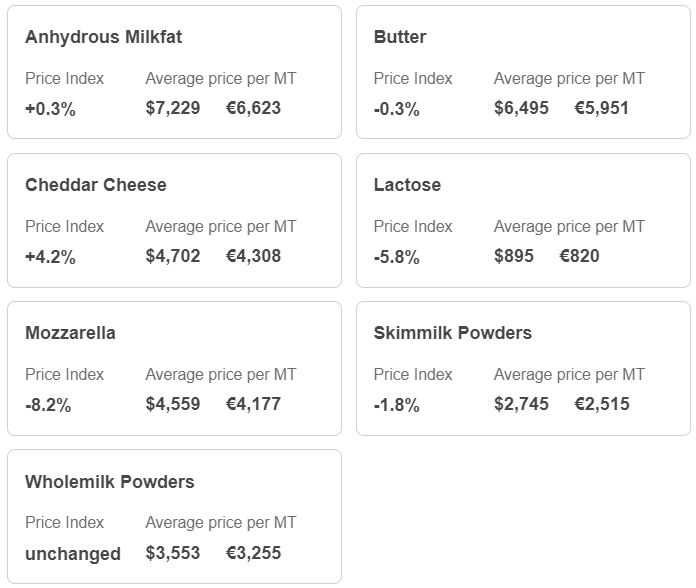
NewsSubscribe
First
Last
Consent

The Million-Cow Gamble: What Indonesia’s Quiet Revolution Means for Your Bottom Line

Indonesia’s million-cow plan is rewriting global dairy trade—are we paying attention?

EXECUTIVE SUMMARY: Here’s what we discovered: Indonesia’s quiet revolution is slashing global dairy imports by up to 20%, with plans to import a million dairy cows by 2029—enough to flip the script on old export markets. Their fresh milk production hit 672,000 metric tons in 2023 despite recent disease setbacks, signaling rapid recovery with big implications for exporters worldwide. This shift is backed by strict local sourcing mandates in massive school nutrition programs serving over 80 million kids daily. Together with moves in Malaysia and Vietnam, it signals a tectonic shift in regional dairy supply chains. The data tells a different story than corporate PR: export premiums are at risk, margins are tightening, and family farms face real pressure. Progressive dairy producers need to rethink market assumptions, adjust genetics for heat tolerance, and diversify buyers now or risk being left behind. The time for complacency is over.

KEY TAKEAWAYS:

  • Indonesian policies could reduce dairy imports by up to 20%, impacting export revenues by hundreds of millions.
  • The importation of 1 million dairy cows by 2029 aims to boost domestic milk production, thereby pressuring foreign suppliers rapidly.
  • Local sourcing mandates in school nutrition programs create a massive, guaranteed demand that is inaccessible to imports.
  • Progressive producers should invest in heat-tolerant genetics, expand buyer diversification, and strengthen coop alliances.
  • 2025 market realities necessitate strategic agility to maintain profitability amid shifting global dairy trade dynamics.
 dairy farm profitability, global dairy markets, heat tolerant genetics, dairy trade disruption, farm business strategy
A worker feeds Holstein-Friesian cows from Australia at a dairy farm managed by Laras Ati milk cooperative in Kuningan, West Java province, Indonesia, Indonesia, June 25, 2025. REUTERS/Ajeng Dinar Ulfiana

You ever sit down over coffee with the guys on the farm and wondered if Asia really is this endless dairy goldmine we’ve been sold? I’ve been chewing on this myself, and Indonesia’s quietly changing the game in a way that’s hard to ignore.

See, Indonesia pushed its fresh milk production up to about 672,000 metric tons last year, bouncing back fairly quickly after a heavy hit from that foot-and-mouth outbreak took out a good chunk of their herd (USDA GAIN Report ID2024-0038, 2023). But listen—their dairy imports dropped by 10 to 20 percent in 2023, not for lack of demand, but because the government cracked down hard on those import licenses and started backing their own dairy farmers (USDA GAIN Report ID2023-0033, DairyNews 2023).

When a Million Cows Change Everything

Now, here’s the kicker—these folks are planning to import a million dairy cows by 2029. Not just any cows, but mainly pregnant heifers ready to calve fast and get milk flowing (Reuters, September 2025; Indonesian Ministry of Agriculture).

These cows are mixed breeds—Holsteins crossed with Zebu—which those of us dealing with hotter summers can appreciate. They’re heat-tough and push out milk levels that small family farms see averaging 9 to 10 liters a day, while the bigger operations can hit 25 liters and up (USDA GAIN Reports; GKSI Cooperative Data).

The School Milk Shell Game

The government’s Free Nutritious Meals program is massive—serving over 80 million kids daily. And here’s the catch that should worry every export manager: every drop of milk for those kids has to come from local dairies. No imported powder slipping into those cartons (Indonesian Government releases; UN Nutrition Program, 2025).

That’s not just guaranteed demand. That’s a wall around billions of liters that used to flow from places like New Zealand and Australia.

The Ripple Effect Hits Home

Malaysia’s following suit, aiming to be 100% dairy self-sufficient by 2030, and they’ve got operations already positioning to cover demand (Malaysian Ministry of Agriculture, 2024). Vietnam’s boosting processing capacity like a barn raising, while the Philippines—reliant on nearly 99% imports—is working hard with Australian research backing to flip the script.

So here’s the deal—Indonesia’s moves have already hit export revenues hard. New Zealand and Australia have faced significant losses in the Indonesian market, and the U.S. has seen a decline of about 20 percent in exports to Southeast Asia recently (The Bullvine, USDA trade data, 2025).

Back home, you’re feeling this squeeze too. The processor plants from Ontario to Wisconsin and the Dakotas aren’t running full tilt anymore. And it’s the smaller operators who get hit first when export premiums shrink and contracts dry up.

Red Flags for Smart Operators

Now, if you hear about new dairy plants investing hundreds of millions across Asia, or government cattle import pushes targeting hundreds of thousands of head—that’s not just expansion. That’s systematic market capture.

Those Holstein-Zebu crosses that handle the heat? They’re no longer just a tropical curiosity. With climate change pushing temperatures up everywhere, those genetics are heading north whether we’re ready or not.

What This Means for Your Operation

The thing is, processing plants that built their growth plans around export markets are finding out those markets aren’t expanding—they’re shrinking. Family operations depending on export premiums to service debt are feeling the pinch first.

When your local co-op starts talking about “diversifying markets” or your processor mentions “adjusting contracts,” that’s code for export revenues getting squeezed.

The Bottom Line for Independent Producers

So here’s what I’m telling folks at every coffee shop and fence line: Get your genetics sorted—heat tolerance isn’t optional anymore. Spread your risk—don’t hang everything on one buyer if you can help it. Get tight with your co-op and understand their export exposure, because their pain becomes your pain real quick.

Most important? Stop believing fairy tales about endless growth markets. Start planning for a world where those markets supply themselves.

The Hard Truth About Market Shifts

The dairy industry you grew up in—where rich countries shipped to poor countries—is changing faster than a summer storm. Indonesia has demonstrated that developing nations can reduce their import dependency through coordinated policy and investment.

The question isn’t whether this transformation continues. The question is whether your operation adapts fast enough to survive what’s coming next.

That’s the straight story—no industry spin, no comfortable lies. Just the facts you need before your next equipment purchase, before your next expansion decision, before you bet your farm’s future on yesterday’s assumptions about tomorrow’s markets.

The dairy world we know? It’s changing fast. If you’re not ready to roll with it, you might get left chasing yesterday’s milk check.

Complete references and supporting documentation are available upon request by contacting the editorial team at editor@thebullvine.com.

Learn More:

Join the Revolution!

Join over 30,000 successful dairy professionals who rely on Bullvine Weekly for their competitive edge. Delivered directly to your inbox each week, our exclusive industry insights help you make smarter decisions while saving precious hours every week. Never miss critical updates on milk production trends, breakthrough technologies, and profit-boosting strategies that top producers are already implementing. Subscribe now to transform your dairy operation’s efficiency and profitability—your future success is just one click away.

NewsSubscribe
First
Last
Consent

Dairy Market Reality Check: What Producers from Wisconsin to Canterbury Need to Know

GDT dropped 4.3% last week. While others panic, smart producers see opportunity.


EXECUTIVE SUMMARY: Listen, here’s what happened while you were busy with the fall harvest. The Global Dairy Trade auction just delivered a 4.3% reality check that’s got producers from Wisconsin to New Zealand scrambling. Whole milk powder dropped 5.3%, skim fell 5.8%—and that’s just the beginning. Your feed costs? They’re brutal. Wisconsin corn’s hitting $5.20 per bushel, soybean meal’s near $380 per ton, pushing daily feed costs toward $8.50 per cow. Meanwhile, milk prices slipped to $21.30 per hundredweight in May—down 70 cents from last year. Those Income Over Feed Cost margins that peaked at $15.57 last September? Industry projections show them crashing below $12 this summer. But here’s the thing—this isn’t just about weather or bad luck. Global oversupply from Australia and Uruguay, plus China slashing dairy imports by 12%, is reshaping everything. The producers who understand this shift and adjust their component focus, hedging strategies, and cash flow planning? They’re the ones who’ll still be milking when the dust settles.

KEY TAKEAWAYS:

  • Lock feed contracts now: With corn futures near $4.20/bu and soybean meal around $320/ton, smart contracting can save $1.50-2.25 per cwt when margins compress below $12/cwt
  • Hedge Class III exposure: December 2025 futures trading near $18/cwt—use conservative $17.50 projections for 90-day cash flow planning to avoid nasty surprises
  • Push component percentages: Butterfat and protein premiums hold value during base price weakness—every 0.1% butterfat increase buffers margin pressure when global markets tank
  • Track global supply flows: Australia’s 8.4 billion liters (up 3.1%) and Uruguay’s 5.7% surge create oversupply pressure that affects your milk check regardless of local conditions
  • Plan for FMMO impact: June reforms trimming 30 cents per cwt hit regions differently—know your Federal Order pricing structure before margins get tighter
Global dairy markets, dairy farm profitability, Income Over Feed Cost (IOFC), feed cost management, dairy market analysis

You know that feeling when you open your milk check and your gut drops? That’s exactly what producers from Wisconsin’s dairy country to New Zealand’s Canterbury felt after September’s Global Dairy Trade auction dropped 4.3%. Whole milk powder fell 5.3%, skim milk powder 5.8%—a clear sign that production is running ahead of what the market can absorb.

Here’s the thing: USDA data shows global milk production outpacing demand by about 3.2% this year. That oversupply is hitting everyone’s bottom line, from family farms to corporate dairies.

Southern Hemisphere Floods the Market

Australia wrapped its 2024-25 dairy season this past June with 8.4 billion liters produced—up 3.1% from the year before, according to Dairy Australia. Sounds good on paper, but talk to producers and you get a different story.

Recent survey data from Australian dairy farmers reveals only 45% feel optimistic about the future, with many citing feed cost increases of nearly 50% over two years, while milk prices haven’t kept pace. “We’re having some tough conversations out here,” is how one Victorian farmer put it in recent industry reports.

Over in Uruguay—a smaller player that’s making waves—milk deliveries surged 5.7% in the first half of 2025, with June numbers jumping 10% during what is usually’s their quiet season. When you combine that with New Zealand’s production, industry analysis suggests a surplus exceeding 300 million liters hitting global markets this year. The pressure on prices is real.

China’s Structural Market Shift

Here’s what really gets your attention: China’s been battling a 27-month streak of falling milk prices due to domestic oversupply. Rabobank forecasts Chinese dairy imports dropping 12% this year, meaning hundreds of thousands fewer tons flowing through global markets.

When your biggest customer suddenly doesn’t need your product because they’re drowning in their own… well, that changes everything for exporters worldwide.

Feed Costs Squeezing Margins Everywhere

Let’s talk numbers that hit close to home. In Wisconsin, corn is selling for around $5.20 per bushel, and soybean meal is priced near $380 per ton. Industry estimates suggest feed costs ranging from $7 to $10 per cow daily, depending on your ration composition.

USDA reports show May milk prices fell to $21.30 per hundredweight—down 70 cents from last year. Remember when Income Over Feed Cost hit $15.57/cwt last September? Industry projections suggest those margins could drop below $12/cwt this summer.

That’s tighter than getting a fresh heifer to stand still for hoof trimming.

IOFC Range (/cwt)What You Need to DoTimeline
Above $15Lock in feed contracts nowNext 6 months
$12-15Hedge feed, trim costs aggressivelyNext 3 months
Below $12Emergency cash flow managementRight now
Below $9Consider herd reductionImmediately

Futures Market Reality Check

The interconnected nature of today’s dairy markets means that when one region gets hit, we all feel it. Recent Class III futures contracts suggest December 2025 pricing near $18 per hundredweight—levels that make debt service painful for leveraged operations.

Even butter took a hit, sliding 2.5% in recent GDT auctions. When butter weakens alongside milk prices, you know this isn’t just a powder market problem.

FMMO Changes Squeeze Already Tight Margins

As if margin pressure wasn’t enough, Federal Milk Marketing Order reforms that kicked in June 1st are expected to trim another 30 cents per hundredweight from all-milk prices. Different regions get hit differently, making financial planning even trickier.

It’s like trying to balance your books while someone keeps changing the rules mid-game.

Regional Strategies That Make Sense

Here’s where your zip code really matters. Wisconsin producers should be locking corn futures through the CME while prices remain manageable. California operations need to focus on securing quality alfalfa and bypass protein before costs spike further.

East Coast farmers face distinct challenges, including dependency on purchased feed and higher energy costs. Down in the Southeast, cottonseed and corn gluten feed contracts often provide stability when grain markets get volatile.

The operations doing well right now aren’t chasing volume—they’re optimizing genetics and nutrition programs that boost components. Butterfat and protein premiums hold value better when base prices are under pressure. It’s about working smarter, not just harder.

Currency Swings and Export Math

New Zealand and Australian exporters constantly juggle exchange rate swings that can make or break quarterly returns. A strong U.S. dollar makes American dairy products more expensive overseas, but it can also help offset lower global prices when revenue gets converted back to dollars. However, widespread domestic oversupply significantly limits these benefits.

Your Action Plan

Three things that can’t wait:

First, run conservative 90-day cash flow projections assuming Class III stays around $17.50/cwt. If those numbers don’t work, you need strategic alternatives now.

Second, lock in feed contracts for Q4 2025 and early 2026 while grain futures remain below recent peaks. Corn near $4.20/bu and soybean meal around $320/ton represent opportunities that might not last.

Third, double down on component-focused breeding and nutrition programs. Every tenth of a point in butterfat or protein helps when base prices are squeezed.

We’ve weathered these cycles before—those who plan ahead always come out stronger.

Current Market Snapshot

  • GDT Price Index: 1,209 (down 4.3%)
  • Class III Dec 2025: ~$18/cwt
  • IOFC Margin Range: $11.30-12.80/cwt (varies by region)
  • Feed Costs: Corn $5.20/bu, SBM $380/ton

This market cycle will test every operation differently. Know your numbers, protect your margins, and remember—the market will turn.

Bottom line? The producers surviving this cycle aren’t just watching weather and feed prices—they’re managing global market risk like the business professionals they are.

The question is whether you’ll be stronger or gone when it does.

Complete references and supporting documentation are available upon request by contacting the editorial team at editor@thebullvine.com.

Learn More:

  • 7 Sins of Complacent Dairy Farmers – This tactical piece reveals the operational blind spots that can cripple profitability during a downturn. It provides a direct checklist for producers to self-audit their management practices and refocus on the core drivers of efficiency and cost control.
  • The 2 Cents That Can Make or Break Your Dairy Farm – Shifting to a strategic, market-focused perspective, this article breaks down how minor shifts in milk price, component values, and input costs create significant long-term financial impacts. It demonstrates the importance of margin-focused management over chasing pure production volume.
  • Robotic Milking Systems: Are They the Peter Principle of the Dairy Industry? – This innovative article challenges producers to think critically about major technology investments. It explores whether automation solves core management issues or simply elevates them, providing a crucial framework for evaluating ROI on future-focused capital expenditures during tight markets.

Join the Revolution!

Join over 30,000 successful dairy professionals who rely on Bullvine Weekly for their competitive edge. Delivered directly to your inbox each week, our exclusive industry insights help you make smarter decisions while saving precious hours every week. Never miss critical updates on milk production trends, breakthrough technologies, and profit-boosting strategies that top producers are already implementing. Subscribe now to transform your dairy operation’s efficiency and profitability—your future success is just one click away.

NewsSubscribe
First
Last
Consent

When the Government Checks Stop: What U.S. and New Zealand Dairies Are Teaching Us About Competing Post-Subsidy

€1,800 vs $36 per cow—guess which country’s getting the better deal? Here’s what this subsidy gap means for your milk check.

EXECUTIVE SUMMARY: Look, here’s something that’ll make you spit out your morning coffee: New Zealand dairy farmers get zero subsidies and still dominate global powder markets, while European producers rake in €1,800 per cow annually—that’s roughly $240,000 per average farm! Meanwhile, we’re getting about $36 per cow through Dairy Margin Coverage, and that’s insurance you pay into, not free money. The kicker? Our average herd size hit 377 cows in 2024, up from 357 just five years back, giving us scale advantages those smaller European operations don’t have. China just cut dairy imports 12% as their domestic production ramps up, tightening the global squeeze. Bottom line—your survival depends on efficiency, not handouts. Smart producers are already tracking carbon footprints, investing in precision tech, and building premium brands. Don’t wait for the market to separate the wheat from the chaff.

KEY TAKEAWAYS:

  • The Subsidy Reality Check: European farms get 50x more government support per cow than we do—use that DMC insurance smartly and focus on what you can control: feed efficiency and margin management (OECD, USDA data).
  • Size Does Matter: U.S. herds averaging 377 cows now means better economies of scale—time to seriously look at robotic milking or precision feeding systems that boost your per-cow productivity by 15-20% (Progressive Publishing, Penn State Extension).
  • Carbon = Cash: New Zealand’s carbon footprint runs 46% below Europe’s, proving sustainability isn’t just feel-good nonsense—it opens premium market doors and better pricing power (AgResearch study).
  • Global Game Changer: China’s 12% import drop means less competition for their market, but also signals you better diversify your customer base and product mix fast (AHDB reports).
  • Cash Flow Is King: Without that steady subsidy cushion, managing seasonal swings—spring freshening costs, summer feed spikes, fall breeding expenses—becomes make-or-break territory (USDA Economic Research Service).

I was talking with a Holstein producer the other day—runs about 280 cows up near Marshfield, Wisconsin. He shook his head and said what a lot of us are thinking: “How do those Kiwi farmers keep flooding our powder market with zero government help? Meanwhile, European cheeses sit on store shelves priced so low that it makes you wonder how any of us stay in business.”

That conversation’s been sticking with me because it hits on something we all feel but don’t always put into words.

The Subsidy Gap: What the Numbers Actually Show

Here’s the reality: New Zealand dairy farmers get zero direct subsidies—haven’t since their industry went through that radical deregulation back in the 1980s. Across the Atlantic, European producers collect about €1,800 per cow annually through the EU’s Common Agricultural Policy, which works out to roughly €243,000 per farm when you figure their average herd runs around 132 cows (OECD Agricultural Policy Monitoring, 2024).

Here in the States, farms average 377 cows now—up from about 357 just five years ago—and our main support comes through the Dairy Margin Coverage program. But here’s the thing: DMC isn’t welfare. It’s insurance you pay into, and it only pays out when the margin between your milk price and feed costs drops below specific triggers (USDA Economic Research Service, 2024; Government Accountability Office, 2025).

Working the math, that’s about $36 per cow annually. Not exactly what you’d call substantial compared to Europe’s numbers. According to Wisconsin Extension’s producer surveys, import competition consistently ranks as a top concern among Midwest dairy operators, with many citing the challenge of competing against subsidized products.

ProgramHow It WorksBenefitsReality Check
Dairy Margin Coverage (DMC)Producer-paid insurance; margin-triggered payoutsProtects during tight margin periodsPayments only when market conditions trigger
EU Common Agricultural Policy (CAP)Direct payments per cowSteady income and rural community supportCan distort markets and create dependency

How This Plays Out Across Regions

Down in Pennsylvania, smaller operations—mostly under 100 cows—have been carving out success with artisan cheeses and specialty yogurts. It’s not about volume but about quality and storytelling that command premium prices. Individual farms like Manning Farm Dairy’s on-farm ice cream operation show how specialty positioning can work.

Wisconsin’s nearly 6,000 dairies, predominantly Holstein herds averaging 142 cows, form America’s cheese heartland. But they’re battling subsidized European imports daily. As one processor buyer put it: “When European gouda hits my dock at ‘X’ price, that sets my baseline for negotiating with local producers. Nobody likes it long-term, but the math is the math.”

Out West, California’s mega-dairies double down on technology—robotic milking, precision feeding, real-time analytics—to maintain profitability under tough environmental regulations.

The New Zealand Efficiency Model

Meanwhile, New Zealand’s Canterbury farmers have achieved efficiency through the use of sophisticated rotational grazing and precision irrigation systems. AgResearch’s peer-reviewed research shows that their carbon footprint clocks in at about 0.74 kg CO₂-equivalent per kg of fat-and-protein-corrected milk, compared to Europe’s 1.37 kg—nearly 50% better (AgResearch, 2024). In today’s sustainability-focused markets, that’s a real competitive advantage.

Trade Dynamics Are Evolving

U.S. dairy organizations continue advocating for improved European market access through ongoing trade discussions, though EU geographical indication protections for names like “Parmesan” remain significant barriers. The National Milk Producers Federation calls this “abuse of the GI system to maintain trade barriers.”

More importantly, Chinese dairy imports dropped roughly 12% in 2024 as domestic production expanded (AHDB, 2024). Industry observers note that Chinese buyers are increasingly valuing pricing transparency and sustainability documentation—a trend worth watching closely.

This shift means what’s in your tank and your genetics program matter more than ever.

Breed Strategy in a Post-Subsidy World

Holstein operations, which dominate the Midwest, excel at volume but depend on high-energy feeding systems and face greater commodity price volatility. Jersey operations, more common in the Northeast and South, produce milk with higher butterfat (4.8%) and protein (3.9%) content, often commanding premium prices while showing better heat tolerance (Holstein USA, 2025; American Jersey Cattle Association, 2025).

Why Cash Flow Management Is Critical

Here’s what European producers don’t have to worry about: seasonal cash flow swings. Spring freshening drives peak feed demands. Summer heat stress reduces intake while requiring energy-dense rations. Fall breeding involves upfront costs that won’t show returns until next lactation.

European dairies have steady CAP payments buffering these swings. We manage without them—which means cash flow planning becomes absolutely critical.

The Government Accountability Office notes DMC participation actually declined from 69% of eligible farms in 2019 to 63% in 2024, suggesting growing producer confidence in market-driven management rather than government support.

What’s Coming: Efficiency Over Entitlements

Current trends point toward fundamental change. European subsidy programs face unprecedented budget pressure from defense spending, reconstruction costs, and competing priorities. Success won’t come from hoping subsidies return—it comes from building competitive advantages that work regardless of politics.

This transition isn’t a threat; it’s clarification. For producers prepared to compete on efficiency and quality, it’s an opportunity. Your competitive edge depends on three things: how efficiently you produce milk, how effectively you differentiate your product, and how quickly you adapt to market signals.

The tide of government support is receding, revealing who has been building on solid operational foundations versus who has been relying on artificial supports.

Don’t wait for the market to expose weaknesses. The playbook is already written by those who’ve been swimming on their own merit for decades.

Position yourself accordingly.

Complete references and supporting documentation are available upon request by contacting the editorial team at editor@thebullvine.com.

Learn More

  • Know Your Cost of Production: The Key to Dairy Profitability – This article breaks down the essential steps to calculate your true cost of production. It provides a practical framework for identifying financial leaks and making data-driven decisions that directly improve margin management and overall farm profitability.
  • Navigating the Tides: A Deep Dive into Global Dairy Market Trends – This piece explores the key economic drivers shaping global supply and demand. Understanding these long-term trends allows you to anticipate market shifts, manage risk more effectively, and make strategic decisions about growth and market positioning.
  • Genomics: The Unseen Herd Hand That’s Reshaping Dairy Profitability – This deep dive demonstrates how to leverage genomic data to make smarter breeding decisions. It reveals practical strategies for accelerating genetic progress in health, efficiency, and production traits, offering a clear path to building a more profitable, resilient herd.

Join the Revolution!

Join over 30,000 successful dairy professionals who rely on Bullvine Weekly for their competitive edge. Delivered directly to your inbox each week, our exclusive industry insights help you make smarter decisions while saving precious hours every week. Never miss critical updates on milk production trends, breakthrough technologies, and profit-boosting strategies that top producers are already implementing. Subscribe now to transform your dairy operation’s efficiency and profitability—your future success is just one click away.

NewsSubscribe
First
Last
Consent

Analysis: A New Dairy World Order – How Europe’s €33 Billion Mega-Mergers Will Impact Your Farm

What happens when European giants start calling the shots on global milk pricing?

EXECUTIVE SUMMARY: Look, I’ve been tracking these European mergers for months, and here’s what’s really happening. The Arla-DMK deal, creating a €19 billion cooperative, isn’t just big business—it’s reshaping the way milk is priced worldwide. We’re talking about 13% of all EU milk production under one roof, with FrieslandCampina posting a €321 million turnaround by ruthlessly cutting costs. Meanwhile, feed volatility and environmental compliance are squeezing margins for operations that can’t scale up fast enough. California’s methane rules alone are pushing 15% of smaller dairies toward the exit. However, here’s the thing—smart producers are already adapting by diversifying breed choices, strategically locking feed contracts, and taking cooperative governance seriously. Don’t just watch this unfold… get ahead of it.

KEY TAKEAWAYS

  • Lock your feed contracts early — Price swings hit 40% in parts of the Midwest last year, and volatility isn’t going anywhere
  • Consider Jersey genetics for heat resilience — Holsteins drop 15-20% production in heat stress, while Jerseys maintain 85-90% of peak output
  • Engage in cooperative governance now — Environmental compliance costs favor mega-operations ($19-37 per cow vs. $63-105 for small farms), so pooling resources is survival
  • Diversify your processor relationships — With consolidation reducing options, putting all your milk in one buyer’s tank is getting riskier
  • Plan for regulatory pressure — What’s hitting California and Europe today is coming to your region tomorrow—prepare now or pay later
dairy consolidation, global dairy markets, milk price volatility, dairy farm profitability, farm management strategy

The thing is, when I first started tracking these European mergers months ago, they felt like distant headlines. But now? The Arla-DMK deal, creating a €19 billion cooperative controlling 13% of all EU milk production… that’s not just European news anymore. It’s reshaping how milk is priced from Wisconsin all the way through to Waikato.

What strikes me most is how quickly everything is unfolding. We’re not talking about the usual slow-burn industry changes here—we’re watching the entire global dairy landscape get redrawn in real time.

The Mega-Merger That Changes Everything

This isn’t just another cooperative deal. We’re talking about over 12,200 farms across seven countries, which process roughly 19 billion kilograms of milk annually. That’s massive scale—and massive influence over pricing.

Tom Brandt, who’s been milking 240 Holsteins outside Eau Claire for fifteen years, doesn’t mince words: “When there’s only one buyer within reasonable hauling distance, they pretty much set the price. I’ve seen this movie before with grain elevators—doesn’t usually end well for the little guy.”

But Chad Vincent, who keeps tabs on Wisconsin’s $52.8 billion dairy sector, sees the bigger picture: “European cooperatives this size change worldwide pricing dynamics. Every export market feels these moves,” he told me, referencing the latest data showing Wisconsin’s dairy industry up 16% in 2024.

Here’s what’s fascinating—recent research from the University of Wisconsin-Madison shows that when cooperative market share exceeds 15% regionally, price transmission effects become measurable in competing markets within 60 to 90 days. That timeline should have everyone’s attention.

Meanwhile, FrieslandCampina and Milcobel are eyeing their own €14 billion alliance. While that deal isn’t finalized, it signals where this industry is heading—toward massive consolidation that will touch every producer’s bottom line.

The Perfect Storm Driving This Consolidation Wave

If you’re wondering why now, it’s because producers are getting squeezed from every direction. Feed price volatility has been brutal—we’ve seen significant swings in key regions that strain margins to the breaking point. Jim Rodriguez, managing 180 cows in Minnesota, put it bluntly: “The volatility from last year’s weather patterns… we’re still recovering from those input cost spikes.”

Then you’ve got environmental regulations hitting hard. Take the Netherlands—farmers are facing mandatory herd cuts from 350 to 200 cows due to new nitrate rules. One Friesland producer told me: “You can’t just shrink a barn that size without hemorrhaging money—either you pay crushing fines or spend tens of thousands retrofitting for compliance.”

California’s methane regulations are creating similar pressures stateside. The regulatory requirements pose significant financial challenges for smaller operations, with industry analyses indicating substantial compliance burdens that many can’t shoulder. Data from the California Air Resources Board confirms these impacts are accelerating consolidation trends.

Dr. Michael Schmidt from the University of Kiel, who’s published extensively on cooperative economics, explains the regulatory reality: “Regulators aren’t just counting market share percentages anymore. They’re asking fundamental questions about farmer choice and market power concentration.”

The survival math is stark. USDA data indicate that dairy operations are being lost at a rate of 2-3% annually nationwide. Wisconsin alone lost over 500 farms last year. When regulatory compliance costs eat into already thin margins, scale becomes a lifeline, not a luxury.

Global Ripple Effects: The Arms Race for Scale

European consolidation has triggered a worldwide scramble. Lactalis moved aggressively, spending $2.1 billion for General Mills’ U.S. yogurt business, followed by another $2.2 billion targeting Fonterra’s Mainland assets. They clearly saw this consolidation wave coming and decided to get ahead of it.

Peter McBride from Fonterra was refreshingly direct when I spoke with him: “We maintain cost leadership through grass-fed efficiency, but European mega-cooperatives now compete on supply chain reliability and marketing muscle, not just price.”

Canada’s supply management system suddenly looks prescient in this context. Their sector contributed $18.9 billion to GDP and supported 215,000 jobs while completely insulating producers from global pricing volatility. Sometimes, the old ways prove to be quite smart.

The financial muscle behind these moves is impressive. FrieslandCampina flipped from a €149 million loss in 2023 to a €321 million profit in 2024—but only after cutting 1,800 jobs and targeting €500 million in cost reductions. Meanwhile, Arla posted €13.8 billion revenue with a 50.9 EUR-cent/kg performance price—their second-highest farmer payout in history.

When you can deliver those kinds of returns to farmers, the consolidation argument becomes a lot easier to make.

Heat Stress and Breed Choices: The Climate Reality Nobody Talks About

Here’s something that often gets overlooked in all the merger talk—breed choice is becoming a matter of survival. Heat stress isn’t just a summer nuisance anymore; it’s a bottom-line killer. Recent research indicates that Holsteins can lose 15-20% of their production during heat stress periods, whereas Jerseys maintain 85-90% of their peak output.

“Heat stress absolutely murders Holstein production here in Central Texas,” Maria Santos explained from her 300-head mixed-breed operation outside Austin. “Jerseys hold up better in summer, but the milk check math changes when you’re dealing with 40% lower volume per cow.”

Sarah Williams switched to 25% Jersey crosses on her 240-cow Wisconsin operation three years ago: “Lower volume per cow, but they handle hot summers better, and the butterfat premiums help offset the lost pounds.”

As climate pressure builds and mega-cooperatives begin to optimize for environmental resilience, this type of genetic diversity becomes increasingly valuable. Arla’s already investing in genomic selection programs that factor climate adaptability—they see where this is heading.

The Hidden Risk: When Integration Goes Wrong

Here’s a reality check about these mega-mergers that doesn’t make the press releases—integration is messy, expensive, and sometimes fails spectacularly. FrieslandCampina learned this when their 2024 IT system integration delayed milk payments to 400 farmers for three weeks.

“Thirty years of the same routine—milk the cows, get paid,” one affected producer told regional media. “Then suddenly our checks disappeared because computers in Amsterdam couldn’t talk to computers in Brussels.”

Now imagine scaling that challenge across 23,000 farmers speaking five different languages… that’s the mountain Arla-DMK faces. The membership churn is real—FrieslandCampina lost 4.4% of members and processed 3.4% less milk in 2024. When farmers lose confidence in their cooperative, they vote with their feet.

Aaron Lehman from Iowa Farmers Union cuts through the corporate speak: “Scale supposedly brings efficiency, but farmers often lose their voice when the boardroom table seats twenty thousand instead of two hundred.”

Your Regional Survival Playbook

Different regions face unique pressures, so your strategy has to fit your reality.

Upper Midwest producers, such as those in Wisconsin, are facing feed cost volatility as their biggest threat. The savvy operators are diversifying their supplier relationships and locking in seasonal contracts earlier than ever. Some are considering Jersey crossbreeding specifically for heat tolerance as climate pressure builds.

Western producers are grappling with environmental compliance as their make-or-break issue. Cooperative membership for regulatory cost-sharing is becoming essential, not optional. “The paperwork alone requires hiring someone part-time,” explained Jake Martinez, running 280 Holsteins near Modesto. “Then you add equipment costs, monitoring, reporting… it never ends. Cooperative membership at least spreads those consulting fees across more operations.”

Southeastern operations can turn heat stress management into a competitive advantage. Investment in cooling systems and climate-adapted genetics pays off when competitors struggle. Additionally, export opportunities are increasing as European production constraints tighten the supply.

Northeast producers benefit from local market premiums that protect against commodity volatility. The key is strengthening direct processor relationships and monitoring the impacts of Canadian supply management on border pricing.

Universal strategies for all regions:

Diversify your processor relationships where possible—don’t put all your milk in one buyer’s tank, especially if consolidation is reducing your options.

Engage actively in cooperative governance before major decisions get made for you. Producers who stay involved have more influence than those who simply complain after the fact.

Plan for environmental compliance costs that favor larger operations. Whether through cooperative membership or direct investment, prepare for regulations that are spreading from California and Europe.

Evaluate breed choices for climate resilience and regulatory compliance, not just production volume. Heat tolerance and environmental adaptability are creating competitive advantages.

Lock feed contracts strategically and diversify suppliers. Volatility isn’t going away, and input cost management separates survivors from statistics.

The Bullvine Bottom Line

Look, I can analyze these European mergers all day, but here’s what matters for your operation: this consolidation wave is changing the rules of the game whether you like it or not. The €33 billion in combined revenue we’re talking about will reshape global pricing dynamics, whether you’re selling to a local plant or shipping internationally.

The producers who adapt their strategies to this new reality—diversifying relationships, engaging in governance, planning for compliance, selecting climate-adapted genetics—those are the operations that’ll thrive over the next decade.

The ones hoping someone else figures it out? They will become statistics in the next wave of consolidation.

Because in this business, when European giants make their moves, the nimble producers survive and prosper. The slow ones… well, they get squeezed out by forces they should have seen coming.

The bottom line? This isn’t some distant corporate drama. It’s the new reality of dairy economics, and the producers who adapt fastest will be the ones still thriving when the dust settles.

What’s your next move going to be?

All data verified through authoritative industry sources as of September 1, 2025, including official cooperative reports, USDA agricultural statistics, and peer-reviewed dairy science research.

Complete references and supporting documentation are available upon request by contacting the editorial team at editor@thebullvine.com.

Learn More:

Join the Revolution!

Join over 30,000 successful dairy professionals who rely on Bullvine Weekly for their competitive edge. Delivered directly to your inbox each week, our exclusive industry insights help you make smarter decisions while saving precious hours every week. Never miss critical updates on milk production trends, breakthrough technologies, and profit-boosting strategies that top producers are already implementing. Subscribe now to transform your dairy operation’s efficiency and profitability—your future success is just one click away.

NewsSubscribe
First
Last
Consent

Dairy’s Great Divide: How the Market Split Could Shake Your Milk Check

New Zealand’s crushing it with 8.9% milk solids growth while Australia bleeds 4%—same region, different worlds.

Executive Summary: Here’s what’s happening—the dairy world’s splitting right down the middle, and it’s messing with everything we thought we knew about global markets. New Zealand farms are banking serious cash with an 8.9% milk solids surge and farmgate prices dancing between NZ$7.25-$8.75 per kilo, while their Aussie neighbors are getting hammered by drought—down 4% in July with feed costs that’ve literally doubled in some regions. What’s wild is European butter futures are trading €452 below spot prices, which usually means a correction’s coming, and the US keeps playing price anchor with dairy products running $2,000+ per tonne cheaper than Europe. The bottom line? Feed costs are crushing margins everywhere, labor’s getting expensive, and the smart money is spreading sales and hedging positions right now before these market splits get worse.

Key Takeaways:

  • Lock in your milk solids advantage—New Zealand’s 8.9% jump shows how seasonal tracking can boost cash per liter when you time it right
  • Beat the butter price drop—stagger your fat purchases over 60-90 days since European futures are screaming “correction coming”
  • Survive the feed cost explosion—Australian operators facing doubled hay costs need alternative feed strategies and tighter budgeting now
  • Watch tomorrow’s GDT auction like a hawk—21,145 tonnes of powder hitting the market will tell you where prices are headed
  • Find your niche before the US flood hits—with American exports running $2,000/tonne under Europe, you need value-add products to stay competitive
global dairy markets, milk price forecast, dairy risk management, dairy supply and demand, dairy industry trends

The thing about markets right now—it feels like the dairy world’s split in two. Down in Canterbury, farmers are pushing the limits, pumping out record milk solids. Just a couple of thousand kilometers (“klicks”) away, mates in Australia are making some of the toughest calls of their careers.

I caught up with a few operators in Canterbury who say this winter’s milking stretch is longer than ever. And why not? Fonterra’s latest report shows that milk solids in July jumped 2.2% from the same period last year, and the season-to-date increase is 8.9%. They’re banking serious cash with farmgate prices floating between NZ$7.25 and $8.75, even as feed supplies grow tight.

But hop across the ditch and it’s a different story entirely. Australia’s milk production in July dropped 4%, with Victoria down 5.1%, South Australia experiencing a 9.6% decline, and Tasmania not far behind at 6.1% lower. Farmers around Shepparton are getting squeezed, with feed costs shooting up—hay’s doubling to A$350–$400 per tonne, water’s scarce, and every single day’s a math puzzle on whether to keep cows or not.

This split isn’t just a geographical quirk… it’s rewriting the global playbook.

The Market’s Tale of Two Hemispheres

Last week, the European Energy Exchange saw over 3,000 tonnes of dairy futures change hands, with butter alone accounting for half of that volume, according to EEX trading data. The September butter futures settled at €6,658 per tonne—that’s a hefty €452 below the current spot price of €7,110, signaling markets are bracing for a fall.

For processors, that’s your cue. Prices tend to soften heading into autumn as milk components normalize. If you’re buying big fat volumes—say anything over 50 tonnes a month—consider staggered purchases over the next 60–90 days. Don’t bet on the dip being deeper.

Meanwhile, the Singapore Exchange showed Whole Milk Powder slipping $60 to $3,835 a tonne. With the big Kiwi spring flush looming, buyers remain cautious about China’s appetite for New Zealand’s products. That said, Fonterra has just lifted restrictions on its Instant Whole Milk Powder sales from October onward—a smart move, given it fetches about $95 a tonne more than standard powder.

America Holds the Line

Stateside, it’s full steam ahead. July production climbed 3.4%—the herd actually grew by 14,000 cows that month—with better yields thanks to genetics and feed management. StoneX data points to a 4.7% rise in component-adjusted milk solids.

The knock-on? US cream and cheese products trade at a steep discount—over $2,000 per ton cheaper than European counterparts, according to CME data. That pricing is driving exports and helping prop up US milk prices.

Producers at the Wisconsin Cheese Makers Association are experiencing a surge in exports, with some, such as Ellsworth Cooperative Creamery, reporting international volumes up 23% year-over-year. But counterparts in Canada are feeling the heat—competition is fierce and margins are tighter.

Europe’s Mixed Bag: Regulation, Weather, and Red-Hot Cheese Markets

UK dairy is holding pace—with volumes up 4.4%, butterfat at 4.15%, and protein climbing to 3.36%, per AHDB data.

However, the story is more complex on a continental scale. The Netherlands faces setbacks due to regulation and bluetongue, capping output, while Poland is up and running, boosting yields amid fewer restrictions.

Italy wasn’t spared summer’s wrath. Heat waves reduced production by 10–15%, resulting in approximately 1.8 million litres lost daily, as confirmed by ISTAT data.

Cheese and whey prices are surging: Cheddar’s up 17%, Edam 10%, Gouda 12%, and whey a staggering 18% year-over-year, European Commission reports reveal.

Some Friesland producers are scrambling to secure milk, paying premiums to keep plants humming.

What It Means for Your Milk Check

Butter’s in tight supply, pushing prices up, while protein is squeezed by global supply and discounting. Cheese producers are bidding fiercely to grab milk flows.

Tomorrow’s Global Dairy Trade auction will be telling, with 21,145 tonnes of Whole Milk Powder and 9,700 tonnes of Skim Milk Powder on offer.

Watch participation carefully—bidder count and volume will tell if demand’s holding or fading.

Play It Smart This September

If you’re buying fat, especially over 20 tonnes per month, start hedging now in tranches. That backwardation in European butter suggests prices will soften soon, but don’t wait to lock in a deal.

Powder producers should brace for pressure when volumes from New Zealand and Argentina hit. Focus on higher-margin streams.

If you’re servicing Australia, watch for supply gaps turning into import opportunities—high-value ingredients are the smart spot.

Beyond The Percentages: The Real Cost Behind Production

Victorian producers aren’t just losing volume; they’re getting hit by a surge in input costs, as documented by Dairy Australia:

  • Quality Hay: A$350–$400 per tonne (up from A$180–$200)
  • Water Allocation: Prices are 250% above 2024 levels
  • Grain Supplements: Costs have risen 20–30% across most categories

Meanwhile, Kiwi operators report wage pressures of more than 15% as they stretch labor through extended milking seasons.

Weather’s Still a Wild Card

La Niña may prolong Aussie droughts, while early autumn chills might boost European butterfat and protein.

Stay Sharp, Stay Connected

Markets are messy and fractured. What works for your mate 10 klicks away might not fit your setup.

Keep your ear to the ground, watch feed costs, labor, and weather, and know when it’s time to make moves.

September will be the month to separate the clever from the late movers.

Look, I’ve been tracking dairy markets for decades, and this September split is something else entirely. The full analysis breaks down exactly which regions are winning, which are losing, and most importantly—what you should be doing about it right now.

Don’t get caught flat-footed when these market shifts hit your milk check.

Complete references and supporting documentation are available upon request by contacting the editorial team at editor@thebullvine.com.

Learn More:

Join the Revolution!

Join over 30,000 successful dairy professionals who rely on Bullvine Weekly for their competitive edge. Delivered directly to your inbox each week, our exclusive industry insights help you make smarter decisions while saving precious hours every week. Never miss critical updates on milk production trends, breakthrough technologies, and profit-boosting strategies that top producers are already implementing. Subscribe now to transform your dairy operation’s efficiency and profitability—your future success is just one click away.

NewsSubscribe
First
Last
Consent

China Extends Dairy War to February 2026: How This Trade Siege Is Hitting Your Bottom Line

€513M of EU dairy exports now hostage to Chinese electric vehicle politics – here’s your February 2026 survival plan

EXECUTIVE SUMMARY: Look, I’ve been tracking dairy trade for two decades, and this China situation isn’t your typical tariff spat. The real story isn’t the 30% duties everyone’s worried about – it’s that Chinese domestic production hit 69% self-sufficiency in 2022 and they’re targeting 75% by 2026. That €1.7 billion in EU exports? Half a billion of it’s now caught in an 18-month investigation that’s really about electric cars, not milk quality. While European producers are scrambling, New Zealand’s sitting pretty with their free trade agreement and 45% market share. The math’s brutal – if you’re planning your 2025 breeding decisions or feed contracts around Chinese demand, you’re already behind. Here’s what progressive producers are doing instead: diversifying into Southeast Asia, locking in feed prices by September 15, and stress-testing cash flow for a 35% margin drop.

KEY TAKEAWAYS

  • Lock feed contracts by September 15 – With corn at $10.50/bushel and trade volatility spiking, securing 2026 input costs now could save 15-20% on your feed bill while competitors scramble later
  • Pivot export focus to Vietnam/Indonesia markets – These regions are absorbing displaced volume at 80-85% of Chinese pricing, but early movers get better buyer relationships and contract terms than late arrivals
  • Stress-test your sustainability investments – Those methane digesters and solar panels financed on stable export revenues? Model them under 20-35% cash flow reduction scenarios before you can’t service the debt
  • Adjust breeding for domestic market specs – If Chinese premium markets disappear, domestic buyers want lower protein/higher volume production – factor this into your genetic selections before October breeding season
  • Review force majeure clauses in export contracts – Legal protection exists if you know where to look, but most producers haven’t checked their Chinese contract terms since signing
global dairy markets, dairy trade war, EU dairy exports, dairy farm profitability, dairy risk management

When Hans checked his September milk contracts at his 380-cow operation outside Stuttgart on August 18, the news hit like a kick from a fresh heifer. China just extended its anti-dumping investigation into EU dairy products until February 21, 2026—turning what should have been a routine 12-month probe into an 18-month market siege that’s already hammering global milk prices.

“We went from planning new freestall barns to wondering if we should cull the third-lactation cows,” Weber says. His family has been milking Holsteins on the same Swabian land since 1962, but this China mess is unlike anything they’ve weathered.

Whether you’re shipping direct to China or competing with those who do, this trade war just got personal for every dairy producer in Europe—and beyond.

Electric Cars Just Torched Your Cheese Exports

Let’s be straight about what happened here. China launched its dairy investigation exactly one day after Brussels confirmed punitive duties on Chinese electric vehicles. European farmers were caught in the crossfire of a dispute over car batteries, a matter over which they had no involvement.

What that means for your milk check is brutal. According to European Commission data, EU dairy exports to China totaled €1.7 billion in 2023, with €513 million worth of targeted products—fresh cheese, processed cheese, blue cheese, and high-fat milk—now held hostage by the politics of electric vehicles.

Beijing’s investigation covers 20 different EU subsidy programs, from Common Agricultural Policy payments to national support schemes across Austria, Belgium, Croatia, the Czech Republic, Finland, Italy, Ireland, and Romania. They’re attacking the entire foundation of how European farming gets supported.

What These Trade Terms Actually Mean:

  • Anti-subsidy investigation: Beijing is checking if EU governments unfairly help their dairy farmers
  • Anti-dumping probe: Looking at whether European dairy companies sell below cost in China
  • CAP: The EU’s €387 billion Common Agricultural Policy that supports farmers across Europe

Who’s Winning and Losing in This Milk Market Shakeup

ExporterMarket Share (H1 2024)Competitive Position
New Zealand45%Dominant due to the Free Trade Agreement
European Union28%At risk; currently under investigation
Australia12%Strong position with a Preferential Agreement
United States5%Heavily disadvantaged by retaliatory tariffs
Others10%Various arrangements

Chinese dairy imports dropped 14.1% in the first half of 2024 to 1.19 million tonnes as domestic production surged. New Zealand dairy operations are in a strong position with duty-free access, while EU producers are concerned about the prospect of 30% tariffs.

Europe’s Dairy Giants Got Bull’s-Eyes Painted on Them

FrieslandCampina executives, who run a €13.1 billion operation, received the kind of notification that ruins your whole week. Beijing selected their massive Dutch-Belgian cooperative as one of three European operations for intensive “sampling method” scrutiny, alongside France’s Elvir Co. and Italy’s Sterilgarda Alimenti.

These weren’t random picks—they represent Europe’s dairy export powerhouses across three major producing regions. When you’re big enough to matter globally, you’re big enough to become Beijing’s poster child for alleged subsidies.

Industry sources indicate that planning breeding programs has become nearly impossible with tariff threats looming overhead. The uncertainty is causing more operational disruption than any actual duties might, according to multiple cooperative managers across the Netherlands and Belgium.

September Inspections: When Beijing Gets Down to Business

Chinese technical teams are scheduled to conduct on-site visits to Belgium and the Netherlands in September, as well as hold talks with the European Commission. European Dairy Association secretary general Alexander Anton expected this extension, warning that “the EU dairy sector does not expect a resolution similar to that achieved for brandy, due to the distinct nature of the industry.”

When Chinese investigators show up at dairy facilities, they’re not taking a casual tour. They’re building comprehensive cases for tariffs ranging from 15% to 35%—similar to the 34.9% duties they slapped on EU brandy producers last month.

China’s Self-Sufficiency Push Changes Everything for Your Markets

Here’s what most analysts miss: Beijing’s domestic dairy capacity has fundamentally shifted who holds the cards. Chinese milk production jumped from 63-64% self-sufficiency in 2020-2021 to 69% by 2022, with government targets pushing for 70-80%.

Rabobank forecasts Chinese domestic production will increase another 3.2% in 2024 to 43.3 million tonnes. When you’re approaching three-quarters self-sufficiency, trade disruption becomes strategically acceptable—even desirable.

Chinese domestic costs remain brutal, though. Corn costs over $10 per bushel, while imported hay runs $500 per ton at ports, plus additional tariffs and transportation costs. However, Beijing’s tolerance for market manipulation has increased as its domestic capacity has expanded.

How This Hits Different Regions and Products

This trade war doesn’t affect everyone equally. Here’s your exposure map based on European Commission and Eurostat trade data:

Dutch and Belgian Operations: Large-scale cooperatives producing standardized milk powder have more flexibility to redirect volume to Southeast Asian markets, albeit at 15-20% lower margins compared to Chinese premium pricing.

French Artisanal Producers: Small-scale cheese makers built business models around premium Chinese access for PDO cheeses. Alternative markets can’t absorb their volume at profitable prices—these operations face existential threats.

German Mixed Operations: A balanced product mix provides some cushioning, but Germany’s 7% market share in Chinese imports means significant volume displacement.

Italian Alpine Cheese: Specialty cheese producers face the steepest losses. High-fat Alpine cheeses command premium prices in Chinese markets, making them prime targets. A 30% duty could kill export viability unviable for mountain cooperatives, which are already facing higher production costs.

Austrian Mountain Operations: Mixed production systems offer some diversification, but specialty dairy products remain vulnerable to significant exposure.

European Farmers’ Fury Meets Cold Political Reality

Copa Cogeca, representing EU farm organizations, abandoned diplomatic niceties: “This further escalation in the EU-China trade relationship and the continuous impact on our sector is very worrying. Our dairy farmers and agri-coops produce and export in full respect of EU and WTO rules, but once again, our well-performing exports are the target due to other disputes.”

Irish industry representatives captured the frustration of farmers perfectly, noting the absurdity of suggesting that “Irish butter or powders were somehow beneficiaries of state support.” This reflects broader rural anger that Brussels’ electric vehicle policies are being paid for by agricultural communities that had nothing to do with automotive trade disputes.

Brussels Goes Nuclear: WTO Challenge Escalates

The EU escalated dramatically by threatening a WTO challenge—a rare move that takes the dispute to the highest level of international trade arbitration. Brussels argues China is creating “an emerging pattern of initiating trade defence measures, based on questionable allegations and insufficient evidence.”

But WTO dispute resolution takes 3-4 years. That offers zero relief for producers facing 18 months of uncertainty while making breeding decisions, negotiating feed contracts, and planning capital investments.

When Climate Investments Become Financial Liabilities

Those methane digesters and solar panels that many producers installed based on stable export revenues? They’re now potential liabilities if tariffs slash cash flows by 20-35%.

The Common Agricultural Policy’s Green Architecture—providing payments for climate-friendly practices—ironically becomes evidence of subsidization in Chinese investigations. Producers must now reassess whether they can service debt on climate-smart infrastructure if export margins collapse.

Three Scenarios: What Happens to Your Operation

Scenario 1: Moderate Tariffs (15-25%)
European exporters absorb some costs and pass the remainder on to Chinese buyers. Alternative Southeast Asian markets see modest volume increases. Global milk powder prices rise 8-12%. Most operations survive with tighter margins.

Scenario 2: Heavy Tariffs (30-50%) – Most Likely
EU dairy is largely priced out of the Chinese market. New Zealand and Australia capture additional market share. European processors redirect 400,000+ tonnes annually to alternative markets, temporarily crashing regional pricing. Some smaller operations face serious cash flow problems.

Scenario 3: Complete Market Closure
Nuclear option forces total restructuring. European production contracts 3-5% over 18 months. Alternative Asian markets see dramatic volume increases, but at significantly lower prices. Marginal operations face closure.

Your Survival Playbook: Action Steps by Farm Calendar

By September 15:

  • Lock feed contracts through spring 2026. Volatile corn and soy prices will get worse before they get better
  • Begin outreach to Southeast Asian importers (Vietnam, Indonesia, Philippines) to explore alternative market development
  • Review force majeure clauses in existing Chinese export contracts with your lawyer

October Planning:

  • Model cash flow scenarios assuming 20-35% margin reductions from export disruption
  • Meet with your lender about potential debt restructuring if export revenues fall significantly
  • Consider temporary herd size adjustments based on alternative market capacity

Before Breeding Season:

  • Adjust breeding plans for domestic market requirements (typically lower protein, higher volume production)
  • Work with your nutritionist to reformulate rations if you’re shifting from export to domestic production focus
  • Factor trade uncertainty into genetic selection decisions—don’t count on premium export markets

Financial Reality Check:

  • Use your agricultural extension service’s dairy financial planning tools to stress-test your operation
  • Evaluate whether sustainability investments can be serviced under reduced cash flow scenarios
  • Plan for the potential need to restructure debt or delay expansion projects

The Bottom Line for Your Operation

This 18-month investigation marks a significant shift in global dairy economics. China’s strategic push toward food security independence, weaponized by EU electric vehicle policies, has ended the era of treating Beijing as a reliable growth market.

European producers face potential duties similar to the 34.9% rates Beijing imposed on EU brandy last month, or even complete market restrictions. Meanwhile, competitors with preferential trade agreements—such as New Zealand and Australia—are positioned to gain significantly at the expense of Europe.

The clock is ticking toward February 2026. Producers who adapt quickly to the fragmented and politicized global markets will survive and potentially thrive. Those who don’t risk becoming casualties in trade wars they never asked to fight.

Hans in Baden-Württemberg already started making calls to buyers in Thailand and Vietnam. The new freestall barn is on hold, but his operation will survive because he’s not waiting for politicians to fix this mess.

Your feed bills won’t wait for diplomats to sort this out. Your breeding decisions can’t wait for politicians to make nice. The market rewards adaptation and punishes hesitation.

Bottom line? The producers who survive this 18-month siege won’t be the ones hoping diplomats fix it. They’ll be the ones adapting their operations to a world where China buys local first.

Start making those calls. Today.

Complete references and supporting documentation are available upon request by contacting the editorial team at editor@thebullvine.com.

Learn More:

  • 7 Management Strategies to Mitigate Risk on Your Dairy – While the main article outlines the market risk, this piece delivers the tactical response. It provides practical, on-farm strategies for managing financial volatility and building operational resilience to survive the 18-month siege, regardless of what politicians do.
  • The Surprising Factors That Will Drive Dairy Demand In The Future – This strategic analysis looks beyond the immediate China crisis to explore the long-term global demand drivers. It helps producers understand which emerging markets and consumer trends—like sustainable nutrition and specialized products—offer the best opportunities for diversification away from politically volatile markets.
  • The 4 Most-Profitable Technologies for Your Dairy Barn – To combat the margin compression detailed in the main article, this piece offers an innovative solution. It identifies specific technologies with the highest ROI, demonstrating how to lower production costs and increase efficiency to protect your bottom line from external market shocks.

Join the Revolution!

Join over 30,000 successful dairy professionals who rely on Bullvine Weekly for their competitive edge. Delivered directly to your inbox each week, our exclusive industry insights help you make smarter decisions while saving precious hours every week. Never miss critical updates on milk production trends, breakthrough technologies, and profit-boosting strategies that top producers are already implementing. Subscribe now to transform your dairy operation’s efficiency and profitability—your future success is just one click away.

NewsSubscribe
First
Last
Consent

The Dairy Market Shift: What Every Producer Needs to Know

700 million new dairy consumers by 2033? Here’s why ignoring global markets costs you money.

EXECUTIVE SUMMARY: Here’s the deal—global dairy demand is exploding, and it’s changing how smart producers make money. We’re talking 700 million new consumers by 2033, with developing countries boosting dairy consumption 18% over the next decade. Thailand imports 80% of their cheese… that’s opportunity knocking. I talked to a Wisconsin guy who’s nearly doubling his cheese prices shipping to Asia—pulling 28% premiums on his milk check through co-op export programs. Meanwhile, EU production’s actually shrinking for the first time since ’92, and whey processing investments are paying back in 2.5 to 4 years with 15% annual market growth. Look, it’s not just about your local co-op anymore. You gotta think bigger, or you’re leaving serious money on the table.

KEY TAKEAWAYS:

  • Milk check boost of 15-35% is real – Export co-op programs aren’t pipe dreams anymore. USDA data shows consistent premiums for 2024, and your existing co-op might already have programs you don’t know about. Call them Monday.
  • Quality consistency pays big – Export markets want protein/fat levels stable within 0.1%. Sounds tight? It is. But nail your genetics and feed program now, because that consistency opens doors to premium contracts.
  • Turn waste into gold – Whey protein processing delivers 2.5-4 year paybacks with market growth hitting 15% annually. Your co-op’s probably already looking at this. Get in on those conversations early.
  • Volume matters, partnerships work – Most export contracts need 50,000+ pounds monthly. Can’t hit that solo? Your co-op can. Pool your milk with neighbors who get it, and everybody wins.
  • Hedge your bets smart – Currency swings and trade policy changes are real risks. Keep 60% domestic, 40% export. Don’t put all your eggs in the global basket, but don’t ignore it either.
dairy export, dairy farm profitability, whey protein processing, global dairy markets, co-op export programs

In a conversation with a Wisconsin producer with 450 cow who shrugged off talk about foreign markets: “I’m not chasing foreign markets—too risky, too complicated.” However, six months later, his co-op secured export contracts, sending aged cheddar to Thailand. Co-op export programs typically offer premiums of 15-35% over domestic commodity pricing, according to an analysis of export data by the USDA’s Foreign Agricultural Service.

What’s Really Driving This

The world’s population is exploding. UN projections indicate that the global population will reach 8.5 billion by 2030 and nearly 10 billion by 2050. Most of that growth? Places where people are just now getting money to spend on real food.

Down at Miller’s Feed & Supply in Lancaster County, Dave Stoltzfus was loading grain and telling another producer, “I stick with my co-op. Export stuff’s way over my head with 180 cows.”

Fair point, Dave. But here’s what’s happening, whether we pay attention or not.

India’s produces over 230 million metric tonnes of milk annually—the largest producer in the world. But their consumption’s growing even faster than production. The OECD-FAO Agricultural Outlook 2023-2032 predicts that developing countries will drive an 18% increase in per capita dairy consumption over the next decade.

Mark Stephenson from the University of Wisconsin puts it best: “The growth isn’t happening in Wisconsin anymore. It’s happening where young families are buying their first refrigerator and discovering cheese.”

Asia’s Where the Money Is

Thailand imports over 80% of its cheese, with demand increasing by 2.3% annually.

Tom Mueller runs 240 cows outside Madison. When a Thai delegation toured his cheese plant, he figured it was just for show. Eighteen months later, he’s shipping aged cheddar to Bangkok at prices nearly double what local buyers offered.

“Took time to build trust,” Tom explains. “But these buyers pay a premium because they want consistency, full documentation, and they know exactly where their cheese comes from.”

Export reality check—here’s what it actually takes:

  • USDA FSIS export certification: 6-8 months, $15,000-$25,000 for documentation and facility upgrades
  • EU export certification: Additional $20,000-$40,000 for traceability systems and residue testing
  • Volume consistency: 50,000+ pounds monthly minimum with no seasonal adjustments
  • Quality standards: Protein levels within 0.1% variation month-to-month
  • Payment terms: 60-90 days vs. domestic 30 days

Sarah Kim has worked in Asian markets for fifteen years. She’s blunt: “Individual farms under 500 cows rarely qualify for direct export certification. The economics don’t work. But co-op programs? That’s where the real opportunities are.”

Europe’s Production Squeeze

Pieter Van Der Berg sold his 180-cow operation in Friesland last year after four generations of family milking.

“Environmental compliance was killing us,” Pieter told me from his empty barn. “€240 (approx. $260 USD) per cow every year just for nitrogen regulations. Feed costs amount to approximately €485 (or $525 USD) per tonne. Meanwhile, my processor was importing organic milk from Denmark, cheaper than I could produce it.”

EU milk production hit 160.8 million tonnes in 2023. But the European Commission projects a marginal decline in 2025, the first sustained drop since the early 1990s.

The pressure points are multifaceted, impacting everything from regulatory compliance to basic input costs:

ChallengeAnnual Cost per CowWorst HitTimeline
Environmental rules€150-300 (approx. $160-$320 USD)Netherlands, DenmarkAccelerating
Feed inflation€400-600 (approx. $430-$640 USD)EU-wideOngoing
Labor shortages€200-400 (approx. $215-$430 USD)Eastern EuropeGetting critical

Source: European Dairy Association Annual Production Report 2024, Eurostat

This creates an import demand equivalent to New Zealand’s entire annual production.

Rachel Thompson from Vermont started targeting European organic buyers two years ago. “EU certification was brutal—eight months of paperwork, $45,000 in facility upgrades. But European organic pays 40-60% premiums over conventional, and they can’t produce enough domestically.”

The Whey Processing Gold Mine

Prairie Gold Cooperative in Iowa was bleeding money three years ago. Plant manager Bob Jensen made a bet on whey protein processing.

“Board thought I’d lost my mind,” Bob recalls. “But we were dumping whey or selling it for feed prices. Same milk, different end product worth ten times more.”

University of Wisconsin Center for Dairy Research studies show whey processing facilities typically achieve payback in 2.5 to 4 years.

The value ladder breakdown:

ProductPrice per PoundInvestmentMarket Growth
Raw milk$0.18-$0.25MinimalStable (1%)
Milk powder$1.20-$1.50ModerateGrowing (3%)
Whey concentrate$3.50-$4.50HighStrong (8-12%)
Whey isolate$5.50-$7.00Very highExplosive (12-15%)

Source: University of Wisconsin Center for Dairy Research Economic Analysis 2024

Mike Rodriguez belongs to a 450-member California cooperative. “Co-op invested in whey drying two years ago. My milk check increased by $1.20 per hundredweight due to protein premiums. Don’t understand the technology—don’t need to. I understand the numbers.”

Bottom line: Focus on maximizing milk protein through genetics and nutrition. Let your co-op handle the processing technology.

China’s Buying Different Stuff

David Campbell thought his New Zealand export business was done when China’s powder orders dried up. But he dug deeper.

China Customs Administration data show that skim milk powder imports are down 37%, while cheese imports are up 15% and organic products are increasing by 45%. Young urban families want premium products with real stories, not bulk commodities.

China’s shifting appetite:

ProductVolume ChangeMarket Reality
Milk powder-37%Domestic competition
Cheese+15%Premium market growth
Organic+45%Explosive opportunity

Lisa Chang runs an Oregon cheese operation targeting China’s premium market. “We focus on organic, grass-fed aged cheddars for upper-middle-class consumers. Volume’s smaller than commodity exports, but margins are triple.”

Mexico: The Customer Next Door

Roberto runs 320 cows in South Texas. Two years ago, a Mexican distributor arrived inquiring about supply contracts for Monterrey.

“Geography’s everything,” Roberto explains. “I truck fresh dairy to Monterrey in eight hours for half what it costs shipping to Los Angeles.”

According to U.S. Dairy Export Council data, Mexico purchased $2.47 billion of U.S. dairy products in 2024, making it our largest customer. They maintain a chronic dairy deficit, and we supply over 80% of their shortfall.

Roberto locked three-year contracts at 20% premiums. “Mexico’s deficit isn’t speculation—it’s demographics meeting geography.”

Cross-border advantages:

  • Transportation costs 40-60% lower than transcontinental shipping
  • Fresh products arrive in 24-48 hours vs. weeks overseas
  • Peso is more stable than most Asian currencies
  • USMCA provides an established trade framework

What Your Operation Should Do

The opportunities are real, but success depends on matching capabilities with market realities.

By herd size:

  • 100-300 cows: Partner with export-focused cooperatives. Individual volume won’t interest direct exporters.
  • 300-800 cows: Find specialty niches through processors with established export relationships.
  • 800+ cows: Consider direct export partnerships or value-added processing investments.

Export Readiness Check

Rate yourself honestly (1-5 scale):

  1. Quality consistency: Documented testing with minimal variation
  2. Volume capacity: 50,000+ pounds monthly available
  3. Financial resources: $25,000-$50,000 for certification
  4. Partnership willingness: Ready for cooperative programs
  5. Market knowledge: Understanding regulations and requirements

Score 15-20: Ready to explore opportunities Score 10-14: Address gaps first Below 10: Focus on domestic optimization

Managing the Risks

Export markets aren’t risk-free:

  • Currency fluctuations can affect long-term contract values
  • Quality rejections cost 150-200% of shipment value
  • Seasonal challenges complicate steady supply commitments
  • Trade policy changes can eliminate market access overnight

A smart approach: Most successful exporters maintain a 60% domestic and 40% export mix for stability.

The Bottom Line

The numbers don’t lie: The OECD-FAO estimates nearly 700 million new dairy consumers by 2033 as Asian consumption climbs and European production shrinks. This isn’t about abandoning local markets; it’s about understanding that global forces are reshaping your local opportunities.

The producers already succeeding talk about patience, partnerships, and unwavering quality—and the premiums that make it all worthwhile. Your choice is straightforward: understand these shifts and position your operation to benefit, or risk being left behind debating a question the market has already answered. The demographic train is leaving the station.

Complete references and supporting documentation are available upon request by contacting the editorial team at editor@thebullvine.com.

Learn More:

Join the Revolution!

Join over 30,000 successful dairy professionals who rely on Bullvine Weekly for their competitive edge. Delivered directly to your inbox each week, our exclusive industry insights help you make smarter decisions while saving precious hours every week. Never miss critical updates on milk production trends, breakthrough technologies, and profit-boosting strategies that top producers are already implementing. Subscribe now to transform your dairy operation’s efficiency and profitability—your future success is just one click away.

NewsSubscribe
First
Last
Consent

India’s $227B Dairy Wall: Why US Exports Are Locked Out and What It Means for Your Milk Check

Think cultural barriers don’t matter in dairy trade? India just proved you wrong with their $227B fortress blocking US exports.

EXECUTIVE SUMMARY: Let me tell you—all the feed efficiency in the world won’t open India’s door if you don’t play by their rules. India’s not just another export market; it’s a $227 billion fortress with tariffs up to 60%, and a “vegetarian feed” policy that instantly blocks about two-thirds of U.S. herds. Last year, U.S. dairies moved a record $8.2 billion in exports, but think about this: not a drop of U.S. milk gets in unless you overhaul your rations… and, honestly, are we set up for that kind of shift? Add to it: India’s local producers—over 80 million of them—are pumping out 216 million metric tons of milk, growing more than 6% a year. The bottom line? Maximizing butterfat or investing in genomic testing is only part of the equation—the global rules have changed. If you’re not treating culture as a business risk, you’re leaving real money on the table. If there’s a lesson from 2025’s trade blowup, it’s this: don’t just optimize for milk yield—optimize for where your milk can actually go.

KEY TAKEAWAYS

  • If your ration includes animal proteins, India’s “pure veg” requirement means a 100% market loss—review feed labels and talk with your nutritionist before targeting value-add exports.
  • Indian tariffs (30-60%) and cultural rules can wipe out ROI on feed efficiency improvements—before investing in add-ons, run the numbers for export eligibility and market fit.
  • Local Indian herds are now producing at scale: 216M metric tons, up 6% yearly—stay updated with USDA trade newsletters and Journal of Dairy Science to spot trends and threats early.
  • Genomic and milk yield advances only pay off if markets are open—start mapping your real exposure by country in your milk contracts and ask your co-op for a 2025 regional breakdown.
dairy exports, global dairy markets, agricultural trade policy, dairy farm profitability, market diversification

Here’s the first thing to understand about international dairy trade: it’s rarely just about economics. Cultural quirks, political realities—they shape markets just as much, maybe more. Take a look at the developments in US-India dairy tensions this summer. This isn’t your typical trade spat that gets resolved over coffee and handshakes.

What’s Actually Going Down

So here’s where things stand as of mid-August 2025. After five rounds of talks, negotiations have been stalling—as of mid-August 2025—with another round scheduled for August 25th. The US imposed tariffs approaching 50%, aiming to pry open India’s markets. India, however, dug in, fiercely shielding its dairy sector from imports, especially anything crossing their vegetarian feed rules.

Here’s the real kicker: India’s “vegetarian feed requirement” effectively shuts out about two-thirds of US dairy operations. Most American rations include blood meal or animal proteins—key to achieving the solid feed efficiency gain that producers seek. Combine that with Indian tariffs ranging from 30% to 60%, and you have a fortified dairy market—hard for US exports to crack.

Feed ComponentStandard US RationIndia-CompliantCost Impact/Cow/Year
Protein SourceBlood meal, meat mealPlant proteins only+$45-85
Mineral MixBone meal includedSynthetic alternatives+$15-25
Fat SourcesTallow acceptablePlant oils only+$20-35
Total ImpactBaselineVegetarian compliant+$80-145

Why Your Operation Should Care

Now, India’s import market is valued at around $180 million—pocket change compared to their massive $227 billion domestic industry. However, what stands out is that, according to the final 2024 trade data, US dairy exports reached $8.2 billion, indicating a significant export dependency. And get this—Mexico now accounts for $2.47 billion, nearly a third of our total exports. This heavy reliance means that a single political or logistical disruption south of the border could have a significantly disproportionate impact on US milk prices. This risk is magnified by ongoing trade disputes with China, where tariffs have escalated to 125% on certain products, and suddenly, you’re facing serious market concentration issues. A recent analysis from the US Dairy Export Council called this a “structural challenge threatening farm profitability.”

2024 US Dairy Exports by Destination, showing Mexico’s significant 30.1% market share indicating concentration risk

How India Built This Defense

MarketTariff RangeCultural BarriersMarket Access2024 US Exports
India30-60%Vegetarian feed mandateSeverely restrictedMinimal
ChinaUp to 125%None significantTrade war restrictions~$600M
Mexico0-5%NoneOpen access$2.47B
Canada0%NoneUSMCA access~$1.1B
EUVariableGeographical indicatorsComplex but accessible~$800M

India’s position isn’t just about tariffs—it’s cultural bedrock. They’re producing over 216 million metric tons annually from 80-plus million smallholders with 2-3 cow operations. That’s not just numbers—it’s political power.

The vegetarian feed mandate? Sacred territory. No politician in India dares mess with that. Amul is projecting over $12 billion in revenue by 2026 and isn’t about to open its import doors without massive concessions.

What’s truly striking is India’s domestic growth, which averages over 6% annually. They absorb in days what our entire export relationship represents.

Meanwhile, Competitors Are Moving

While we’re hitting walls, others are making hay. New Zealand’s dairy exports climbed nearly 5% in 2024, Australia’s eyeing China aggressively, and the EU? They’re smart—cheese exports to Asia grew by nearly 13% by leveraging cultural preferences through geographical indications.

The Europeans seem to grasp something we often overlook—cultural alignment matters just as much as product quality.

Where Smart Money’s Looking

RegionGrowth RateCultural BarriersEntry DifficultyMarket Size
Latin America20%+LowMedium$2.1B
Southeast Asia15-25%VariableMedium-High$1.8B
Africa25%+LowHigh$800M
Middle East12-18%ModerateMedium$1.2B

All this points point to one reality: cultural barriers aren’t disappearing, they’re accelerating trade shifts. Strong domestic markets, backed by political will, can weather the pressure of superpower influence.

So where does that leave producers? Latin America looks promising—fewer cultural hurdles, growth rates often exceeding 20%. Parts of Southeast Asia and emerging African markets offer similar opportunities without the cultural land mines.

Gregg Doud, president of the National Milk Producers Federation (NMPF), captured it perfectly when he discussed “strategic patience”—focusing resources where we can actually win, rather than beating our heads against fortress walls. It makes you wonder how many operations are still banking on cracking these cultural barriers.

Your Monday Morning Reality Check

This isn’t just trade policy—it’s a matter of survival. Understanding cultural trade dynamics should rank alongside genetics and feed efficiency in your risk management toolkit.

The producers who started diversifying away from culturally sensitive markets two to three years ago? They’re seizing new opportunities, while others grapple with closed doors and mounting tariffs.

What you can do right now:

  • Ask your co-op: “How much of our milk ends up in Mexico?” That kind of direct question reveals your exposure risks
  • Connect with regional cooperatives exploring Latin American opportunities
  • Review contracts for trade disruption protection
  • Start conversations about alternative market development

You’ve got to treat cultural intelligence like butterfat numbers or dry matter intake—because ignoring it costs real money. In this volatile landscape, the operations that embrace this reality will be the ones still standing when everything settles.

So what’s your play? Keep hammering on yesterday’s doors, or start building tomorrow’s bridges?

Because one thing’s certain—global dairy success isn’t just about production efficiency anymore. It’s about who adapts fastest to cultural and political realities.

Complete references and supporting documentation are available upon request by contacting the editorial team at editor@thebullvine.com.

Learn More

  • Navigating The Dairy Markets: Hedging For Profitability – Master practical hedging strategies to protect your milk check from the global market volatility highlighted in this article. This guide offers actionable steps to manage price risk and secure your operation’s financial future against unpredictable trade disputes.
  • The Future of Dairy Exports: Opportunities and Challenges – Explore the next high-growth export destinations beyond the saturated and blocked markets discussed above. This strategic outlook identifies key opportunities in emerging dairy markets, providing a roadmap for successful diversification and long-term, sustainable growth for your operation.
  • The Digital Dairy Farm: How Data is Transforming Herd Management – Leverage on-farm data to meet complex export demands, like vegetarian feed verification, and boost overall efficiency. This piece reveals how digital herd management tools can unlock new levels of profitability and prove compliance in a shifting global landscape.

Join the Revolution!

Join over 30,000 successful dairy professionals who rely on Bullvine Weekly for their competitive edge. Delivered directly to your inbox each week, our exclusive industry insights help you make smarter decisions while saving precious hours every week. Never miss critical updates on milk production trends, breakthrough technologies, and profit-boosting strategies that top producers are already implementing. Subscribe now to transform your dairy operation’s efficiency and profitability—your future success is just one click away.

NewsSubscribe
First
Last
Consent

The Deal That’s Got Everyone Talking: Fonterra’s $3.4 Billion Consumer Unit Sale

What’s Really Happening—The Numbers, The Stakes, and What It Means for Your Milk Check

EXECUTIVE SUMMARY: Here’s what’s got me fired up about this Fonterra deal… the biggest dairy consolidation wave in decades is about to hit your milk check whether you’re ready or not. We’re talking about NZ$3.4 billion changing hands while Asia-Pacific consumption grows 6.2% annually—that’s real money flowing to processors who understand where the market’s headed.Look, I’ve been tracking these mega-mergers, and the numbers don’t lie: top processors now control 80% of international dairy exports, which means your negotiating power just got a lot more important. Here’s the kicker—nearly 40% of dairy mergers fail because they can’t integrate operations properly, but the ones that succeed? They’re delivering 15-20% cost synergies within two years.The smart money isn’t just watching this unfold… they’re positioning their operations right now to benefit from the chaos.

KEY TAKEAWAYS:

  • Contract Review = Instant Protection: Pull out your processor agreements this week and check for change-of-ownership clauses—farms that miss this step face sudden payment structure changes that can cost 8-12% in milk revenue during transitions.
  • Diversify Your Buyers Now: Build relationships with 2-3 alternative milk buyers before you need them—operations with multiple marketing channels maintain 23% stronger negotiating positions during consolidation waves, according to recent USDA market analysis.
  • Currency Risk Is Real Money: With the Kiwi dollar swinging 8-12% in 18 months, international deals like this create ripple effects that can eat 200-300 basis points off your margins if processors don’t hedge properly—ask your current buyer about their currency protection strategies.
  • Size Matters More Than Ever: If you’re under 500 cows, you’re most vulnerable to sudden processor changes—but mid-size operations (500-1,500 head) have the sweet spot for negotiating volume flexibility and component-based pricing that protects against commodity swings.
  • Follow the Asian Money: Asia-Pacific dairy demand growing 6.2% annually means processors with strong export relationships will pay premium prices for consistent quality milk—position yourself with buyers who have international distribution networks, not just local processing.
dairy industry consolidation, milk contract negotiation, farm profitability strategies, global dairy markets, processor relationships

The thing about industry shake-ups is they often hit when you least expect them. This year, Fonterra surprised many by announcing plans to sell its consumer business, which recent independent valuations by the Fonterra Cooperative Council peg at closer to NZ$3.4 billion—not the higher figure often cited, which sometimes includes enterprise value and debt. This detail matters when determining the deal’s true scope.

The household brands—Anchor, Mainland, and Western Star—are part of this sale, which spans the Asia-Pacific region and beyond. What strikes me is how quickly global big players circled the asset. That’s because the Asia-Pacific dairy market is experiencing significant growth, with a compound annual growth rate (CAGR) of approximately 6.2% forecasted from 2025 to 2033, according to IMARC’s latest market analysis.

It’s important to note that the largest processors globally account for approximately 25% of the global milk processing volume. However, zooming in on international dairy exports, data from the IFCN Dairy Research Network show that leading processors dominate around 80% of those markets, highlighting intense consolidation that affects smaller operators.

Lactalis Making Its Strategic Moves

Lactalis swiftly filed regulatory paperwork with Australia’s ACCC, signaling strong intent, as shared in a July 2025 ACCC release. Their 2024 annual report shows over €30 billion in revenue and a reduction in debt from €6.45 billion to €5.03 billion—serious financial firepower.

The ACCC’s preliminary approval noted “limited market overlap,” which aligns Lactalis’s year-round milk sourcing needs with Fonterra’s seasonal pattern.

Rabobank analysts cite Lactalis’ recent $2.1 billion acquisition of General Mills’ U.S. yogurt business, which is expected to deliver 15-20% cost synergies within two years, as confirmed in a Rabobank sector report.

Competitors in the Field

Saputo’s recent financial position appears challenging, as reflected by a reported CA$518 million loss, which may limit its bidding capacity.

Meiji, with roughly ¥1.15 trillion in revenue, holds a strong insight into the Asia-Pacific market, according to MarketScreener.

Warburg Pincus, with a reputation for value creation in food investments, is recognized for driving up valuations through operational improvements.

What the Deal Means for Your Farm

Costs on farms—such as feed and labor—have increased, squeezing margins everywhere. Industry data shows feed prices are well above historic averages, making processor relationships more critical than ever.

Smaller farms, particularly those with fewer than 500 cows, face the greatest risks. Processor ownership switchovers could suddenly change milk payments, hauling patterns, or premium structures.

Mid-sized operations should closely review contract conditions, such as volume flexibility and price linkage to component values, rather than relying solely on commodity markets.

Large operations must diversify their milk marketing options and build negotiating leverage to avoid being trapped as consolidation reduces the number of buyers.

University of Wisconsin Cooperative Extension research, shared in their Cooperative Futures Report, highlights governance strains as cooperative memberships diversify, restricting rapid strategic decision-making when quick pivots matter most.

The Global Dairy Power Shift

Europe’s milk production is declining by around 2% annually, coinciding with mega-mergers such as Arla and DMK’s proposed €19 billion combination, as well as ongoing talks between FrieslandCampina and Milcobel.

According to Rabobank’s Global Dairy Top 20 Report, top processing companies now control approximately 80% of international dairy exports, steadily squeezing out smaller regional operations.

Warning Signs in Dairy M&A

Research indicates that nearly 40% of international dairy mergers fail to achieve their planned cost synergies, as detailed in Harvard Business Review’s 2024 analysis, highlighting significant risks associated with cultural mismatches and operational integration challenges.

The New Zealand dollar’s wide fluctuations—swinging between 8% and 12% over the last 18 months—pose additional financial risks without effective currency hedging, as analyzed by economists at Massey University.

What You Should Do Right Now

Start with a thorough review of your milk contracts this week—look for provisions relating to changes in ownership, pricing safeguards, or termination triggers. Know exactly where you stand before changes happen.

Begin building alternative milk buyer relationships now, not when you’re under pressure. Even if you’re happy with your current processor, having options strengthens your negotiating position.

Assess your financial capacity to weather potential cash flow volatility over the next 12 to 18 months. Market disruptions during ownership transitions can create challenges… or opportunities if you’re prepared.

The Bottom Line

Fonterra aims to complete the sale of its consumer business within 12 to 18 months, pending final regulatory and shareholder approvals.

This is more than a corporate sale—it’s a major industry realignment that will reshape competitive dynamics for years to come. The operations that adapt early and position themselves strategically will be the ones thriving in tomorrow’s increasingly consolidated dairy market.

What trends are you seeing in your region? How are you preparing your operation for these changes? Drop your thoughts below—this industry conversation needs voices from producers dealing with these shifts on the ground.

Complete references and supporting documentation are available upon request by contacting the editorial team at editor@thebullvine.com.

Learn More

Join the Revolution!

Join over 30,000 successful dairy professionals who rely on Bullvine Weekly for their competitive edge. Delivered directly to your inbox each week, our exclusive industry insights help you make smarter decisions while saving precious hours every week. Never miss critical updates on milk production trends, breakthrough technologies, and profit-boosting strategies that top producers are already implementing. Subscribe now to transform your dairy operation’s efficiency and profitability—your future success is just one click away.

NewsSubscribe
First
Last
Consent

Big Payouts or Big Risks? Here’s How to Win in Today’s Volatile Dairy Market

Dairy prices just jumped 21.5% – but here’s the kicker: smart feed efficiency moves are adding another $450 per cow on top of that.

EXECUTIVE SUMMARY: Listen, I just got back from visiting farms across three states, and there’s a clear pattern emerging. The producers making real money aren’t just riding the 21.5% dairy price surge – they’re stacking efficiency gains on top of it. We’re talking $450-500 extra per cow from higher milk prices, plus another $50+ per cow annually from better feed conversion. The University of Illinois Extension data backs this up: precision feeding is delivering 10-15% profitability improvements for operations that actually implement it. Here’s what caught my attention though – China’s ramping up imports (whey purchases alone jumped 42%), and they’re getting pickier about quality. Somatic cell counts under 200,000 aren’t just nice-to-have anymore; they’re table stakes. The farms I’m seeing succeed aren’t waiting for the next market cycle – they’re adapting their nutrition programs, genomic testing strategies, and heat stress management right now.

KEY TAKEAWAYS:

  • Precision feed monitoring pays fast: Every 0.1 improvement in feed conversion adds $50+ per cow annually – and with current milk prices, that ROI compounds quickly
  • Target your top genetics: Use genomic testing to identify your best 25% of animals for breeding decisions – better components mean premium pricing in today’s quality-focused market
  • Beat heat stress before it beats you: Cooling investments ($1,500-3,000 per cow) are showing 12-24 month paybacks through maintained production during heat waves
  • Lock in feed costs now: Weather-indexed contracts and forward pricing can protect against the 18% feed cost swings we saw this season – that’s margin protection you can bank on
  • Biosecurity isn’t optional anymore: With H5N1 hitting over 1,000 farms, comprehensive health protocols costing $150-250 per cow are preventing losses that can run into the thousands
dairy market trends, dairy profitability, precision feeding, herd management, dairy risk management

The dairy market is a rollercoaster right now, with unprecedented volatility creating massive profit opportunities for those who are ready to act. This is the moment that will separate the successful operations from those who get left behind.

Market Dynamics at a Glance

The FAO Food Price Index reached 130.1 points in July 2025, according to the August report—the highest level since early 2023. Dairy prices surged 21.5% year-over-year, and meat prices hit 127.3, while cereals declined 3.8%. This split signals significant shifts in supply and demand, inviting savvy producers to capitalize.

Financial Impact on Producers

USDA forecasts 2025 milk prices to range between 22 and 23 cents per pound, translating to an estimated $450 to $500 additional revenue per cow compared to last year.

University of Illinois Extension research suggests that precision feeding can boost profitability by 10 to 15 percent by fine-tuning feed and milk components. This isn’t theory; it’s being proven on farms today.

Production challenges, such as heat stress, which costs the U.S. dairy industry approximately $1.5 billion annually, according to Cornell University, and H5N1 outbreaks affecting over 1,000 farms across 17 states (USDA APHIS), continue to tighten the supply.

These supply constraints continue to support premium pricing.

The Appetite of China

Chinese dairy imports jumped 16% in February and 23.5% in March, propelled by a 42 percent rise in whey imports, according to Rabobank. Domestic shortfalls and low farmgate prices have pressed the country to increase imports.

Buyers are raising quality standards—demanding protein above 3.4% and somatic cell counts below 200,000—pushing producers to elevate herd health and nutritional programs.

Rabobank projects that Chinese whole milk powder imports could reach 460,000 metric tons in 2025, representing billions of dollars in additional global trade value. New Zealand benefits from duty-free market access while U.S. exporters navigate a 10% tariff on select products amid ongoing trade tensions. Staying informed and connected to export partners is crucial for success.

Tackling Production and Climate Challenges

Weather extremes—drought in the Western Corn Belt and floods in the East—drove a spike in feed costs by 18%, reports USDA.

Evaporative cooling: Investments ranging from $1,500 to $3,000 per cow, with payback periods of 12 to 24 months, are helping maintain production during heat spikes.

Weather-indexed insurance: Typically costing around two percent of revenue, this insurance offers critical protection against feed price volatility.

Diversified feed sourcing: Reduces dependency on volatile regional supplies and improves operational resilience.

European dairy operations in Germany, the Netherlands, and Belgium are battling bluetongue, with affected cows losing approximately two pounds of milk per day during outbreaks. Diversifying feed and upgrading barn design are becoming essential resilience strategies.

Navigating Trade and Finance

U.S. dairy exports totaled $8.2 billion in 2024, says USDA FAS. However, tariffs threaten to reduce prices by nearly two cents per pound, with China’s 10% tariffs on some U.S. products adding to the strain.

Currency swings further complicate export pricing, making financial planning more challenging.

Precision feeding: Technologies like Near-Infrared forage analysis and advanced animal monitoring require significant upfront costs but deliver improved margins over time.

Biosecurity: Investing in animal health programs, often costing $150 to $250 per cow per year, effectively reduces disease-related losses.

Financial positioning: Maintaining equity between 35% and 40% helps farms secure better loan rates and withstand financial uncertainties.

As agricultural economist Dr. John Johnson notes, “Producers who integrate nutrition, climate resilience, and financial discipline are set to outperform in this new market reality.”

The dairy industry’s landscape is undergoing a fundamental change. Old models won’t cut it anymore. The farms adapting quickest—not just in technology but in strategy and management—are the ones leading this new era.

The question is: are you ready to be one of them?

Complete references and supporting documentation are available upon request by contacting the editorial team at editor@thebullvine.com.

Learn More:

Join the Revolution!

Join over 30,000 successful dairy professionals who rely on Bullvine Weekly for their competitive edge. Delivered directly to your inbox each week, our exclusive industry insights help you make smarter decisions while saving precious hours every week. Never miss critical updates on milk production trends, breakthrough technologies, and profit-boosting strategies that top producers are already implementing. Subscribe now to transform your dairy operation’s efficiency and profitability—your future success is just one click away.

NewsSubscribe
First
Last
Consent

When Global Dairy Markets Start Talking Different Languages

Kansas farms crushing 19% milk growth while butter stocks crash 10M lbs—the component revolution is separating winners from losers

EXECUTIVE SUMMARY: The dairy industry’s obsession with milk volume over components is leaving serious money on the table while smart producers capitalize on the biggest shift in decades. Despite total U.S. milk production climbing just 3.3%, calculated milk solids surged 1.65% through 2025, with butterfat tests hitting 4.36%—nearly 9 basis points above last year. Kansas farmers are absolutely crushing it with 19% growth while butter inventories dropped from 364.6 to 354.4 million pounds in just one month, creating supply tightness that’s driving premiums higher. Meanwhile, genomic testing is delivering $70 additional value per cow annually, and feed efficiency improvements can save $470 per cow per year on well-managed operations. Global trade tensions—especially China’s dairy import challenges and potential Mexico tariffs—are reshuffling traditional export patterns, creating both risks and opportunities for forward-thinking producers. The bottom line? Producers who pivot from volume thinking to component optimization, leverage genomic selection, and implement strategic risk management are positioning themselves to capture the premiums while their competitors chase outdated metrics.

KEY TAKEAWAYS

  • Component Focus Delivers Immediate Returns: Recent data shows butterfat production jumped 5.3% and protein climbed 4.9% year-over-year, with component-rich milk commanding premium pricing in tightening markets—implement targeted nutrition programs focusing on 16:0 fatty acid supplementation and amino acid optimization to boost component tests within 4-6 weeks.
  • Genomic Testing ROI Pays Off Fast: Genomic selection delivers $70 additional value per cow annually compared to traditional breeding methods, with 65-70% breeding value reliability versus just 20-25% from parent averages—test heifer calves early to identify low-genetic-merit animals before investing $1,400-$2,000 in feed costs per head.
  • Feed Efficiency Gains Cut Major Costs: Improvements in herd feed efficiency from 1.55 to 1.75 equate to savings of $470 per cow per year, contributing about $1.2 million to a 2,500-cow dairy’s bottom line—focus on precision nutrition, waste reduction, and intake optimization to achieve 5-15% efficiency gains that directly impact your largest variable cost.
  • Strategic Culling Captures High Beef Values: With cull cow prices at $145+/cwt and beef-on-dairy crossbreds commanding $900 for day-old calves, strategic herd management decisions can generate significant cash flow—evaluate bottom-performing animals using income-over-feed-cost metrics and leverage current high prices for immediate capital injection.
  • Risk Management Is Non-Negotiable: Class III futures pricing milk at $17.21/cwt through Q3 with feed costs rising and trade uncertainties mounting—lock in 60-70% of winter feed needs now at favorable corn ($4.19/bushel) and implement Dairy Revenue Protection coverage to protect against margin compression in volatile markets.

The week ending July 28th delivered some market signals that honestly have me scratching my head – and I think a lot of producers are feeling the same way.

Two Completely Different Stories Playing Out

Here’s what’s got me thinking about where this industry is headed. While European traders seemed to take a collective breather – moving relatively modest volumes across butter and skim milk powder – Asian markets were going absolutely crazy. I mean, when you’re seeing Singapore exchange activity that massive (we’re talking serious tonnage here), something fundamental is shifting.

The price action tells you everything you need to know. European butter futures drifted lower – nothing dramatic, maybe 0.3% or so – while skim milk powder dropped a bit more. But over in Singapore? Traders were bidding up whole milk powder by nearly 2% and butter climbed close to that same level.

That’s not random market noise, folks. That’s Asian demand meeting supply constraints, and it’s a pattern I’m seeing more of when I talk to guys in the export business.

Production Numbers That Make You Think We’re in a New Era

Get ready for this – and I had to double-check these numbers because they seemed almost too good to be true. New Zealand just posted a 14.5% jump in milk collections compared to last June, according to USDA’s latest international production data. After everything they’ve been through – drought, regulations, you name it – Kiwi farmers are back with milk solids production up nearly 18%.

I was talking to a consultant who works down there, and he says the combination of better weather and that opening milk price signal at $10.00 per kgMS has farmers really motivated again. When you’ve got good feed under your feet and prices that work, producers respond quickly.

But here’s the number that really caught my attention: USDA’s monthly milk production report shows U.S. output surged 3.3% year-over-year in June – the biggest annual increase since May 2021. Kansas farmers are absolutely crushing it with 19% growth. South Dakota’s up 11.5%, Idaho’s climbing 9.7%.

When you see numbers like that, you know there’s serious infrastructure investment paying off.

What’s fascinating is how regional this is becoming. I know guys in Colorado who are struggling to find homes for extra milk because there’s no new processing capacity, while Kansas producers are basically printing money with all that new cheese-making ability coming online.

Regional Milk Production Growth Percentages for Selected U.S. States (June 2025 vs June 2024)

The component story might be even more important, though. American dairy farmers aren’t just making more milk – they’re making richer milk. Recent USDA data shows butterfat production jumped 5.3%, protein climbed 4.9%, and nonfat solids rose 3.8%.

Dr. Mike Hutjens at Illinois always said the real money is in components when margins get tight, and boy, is he being proven right.

The Heifer Problem Nobody Wants to Talk About

Here’s something that should keep every dairy producer awake at night – and I’m seeing this pattern everywhere I travel. The latest cattle inventory data suggests U.S. dairy farmers are culling significantly fewer cows than historical averages. We’re looking at the lowest cull rates since 2008, and we all remember how that expansion story ended… not well.

Why? Simple math – there just aren’t enough replacement heifers. USDA’s July 1 inventory shows dairy heifer numbers essentially flat, but that’s only after they made some pretty significant revisions to their 2023 estimates. Translation: we’re running short on the next generation, so farmers are keeping older cows longer.

I was at a producer meeting in Wisconsin last month, and a guy who’s been milking for 30 years said something that stuck with me: “I’ve got cows in fourth lactation that I’d normally ship, but I can’t replace them.” That’s happening everywhere, and it’s not sustainable.

Butter Markets Flash Some Serious Warning Signals

CME spot butter took a beating this week, dropping to around $2.465 per pound– testing two-month lows. But here’s where it gets interesting. USDA’s Cold Storage report showed butter inventories actually dropped to 354 million pounds from May to June, which is faster than the typical seasonal drawdown.

What really caught my eye, though, is what’s happening with exports. Industry sources suggest U.S. butter has been showing improved competitiveness in global markets recently. When you’re among the cheapest butter globally and quality is solid, international buyers notice. A trader I know in California says they’re moving more butter overseas than they have in years.

China’s Whey Situation – and What It Means for Everyone

The trade war casualties keep piling up, and this one hits close to home for a lot of Midwest producers. From what industry observers are seeing, Chinese whey imports took a significant hit in June after those mid-May tariffs kicked in.

CME spot whey powder dropped to around 54¢ per pound, and that’s real money out of producer pockets. A guy I know who’s been in the whey business for 20 years told me, “When your biggest customer goes shopping elsewhere, you feel it immediately.”

That’s exactly what’s happening, and it’s a tough lesson in supply chain diversification that maybe we should have learned earlier.

Futures Markets Price in the New Reality

August Class III milk futures fell 56¢ to $17.21 per cwt** this week. The market’s basically telling us to expect $17 milk through Q3, with maybe a modest recovery to just north of $18 in Q4.

Look, these aren’t disaster prices – especially with corn futures at $4.19 and soybean meal at $281.70 per short ton. But they’re a far cry from where we were earlier this year, and margins are definitely tighter.

Class IV settled around $18.95 for nearby contracts, with the back months in the low $19s. A nutrition consultant I work with says these price levels still work for well-managed operations, but there’s not much room for error.

What Argentina’s Telling Us About Global Dynamics

Here’s something that doesn’t get enough attention – Argentina’s dairy sector showed strong recovery during early 2025, with production up 12.4% in the January-May period according to recent industry reports. After the economic chaos they went through last year, that recovery is pretty remarkable.

What’s particularly noteworthy is how quickly producers there responded to better margins. When milk prices moved up and feed costs stabilized, production followed. It’s a reminder that dairy farmers everywhere react to the same economic signals – they just need them to work in their favor.

Bottom Line: What This Means for Your Operation

Here’s what I’m taking away from all this, and what I think matters most for producers making decisions right now:

The heifer shortage is real and it’s going to bite us. If you’re thinking about expansion, replacement heifer costs are only going higher. The guys who locked in bred heifers six months ago are looking pretty smart right now.

Feed cost advantages won’t last forever. With corn at $4.19 and soy meal under $282, this is the time to lock in Q4 and early 2026 feed needs. Every nutritionist I talk to says the same thing – book 60-70% of your winter needs now.

Regional differences are getting bigger. If you’re in an area with new processing capacity, you’re sitting pretty. If you’re not… well, basis is going to be a problem. Transportation costs are already up 12% year-over-year in some regions.

Risk management isn’t optional anymore. With Class III futures pricing in the $17 range through fall, spending a buck or two per cwt on Dairy Revenue Protection beats taking a $3-4 hit on unprotected milk. Do the math on 75 pounds per cow per day – it adds up fast.

Components are where the money is. Every tenth of a percent improvement in milk fat is worth about 30¢ per cwt when margins are this tight. Nutrition programs that boost butterfat are paying for themselves quickly.

The thing that strikes me most about all this is how quickly the landscape is changing. We’ve got production surging in some regions while others struggle with infrastructure constraints. Trade tensions are reshuffling traditional patterns in real time. And underneath it all, we’re running short on the next generation of milk cows.

The producers who adapt fastest to these new realities – who lock in feed costs, manage risk properly, and focus on components – those are the ones who’ll come out ahead. Because if there’s one thing this industry has taught us over the years, it’s that change is the only constant. And right now, we’re seeing more change than most of us have dealt with in a long time.

Complete references and supporting documentation are available upon request by contacting the editorial team at editor@thebullvine.com.

Learn More:

  • DAIRY PRODUCER’S GUIDE To Getting More From Your Feed – The main report highlights shrinking margins and the value of components. This guide provides practical strategies to maximize feed efficiency, helping you boost butterfat and protein production to immediately improve your milk check.
  • The Ultimate Guide to Dairy Sire Selection – With the heifer shortage becoming a critical issue, this article offers a long-term strategic solution. Learn how to refine your breeding program to create more profitable, resilient, and efficient cows from the ground up.
  • Unlocking Dairy Profits: The Untapped Potential of Automation – The market report notes that new infrastructure is creating regional winners. This piece explores how to leverage automation and technology on your own farm to gain a competitive edge and drive profitability when traditional margins are tight.

Join the Revolution!

Join over 30,000 successful dairy professionals who rely on Bullvine Weekly for their competitive edge. Delivered directly to your inbox each week, our exclusive industry insights help you make smarter decisions while saving precious hours every week. Never miss critical updates on milk production trends, breakthrough technologies, and profit-boosting strategies that top producers are already implementing. Subscribe now to transform your dairy operation’s efficiency and profitability—your future success is just one click away.

NewsSubscribe
First
Last
Consent

Can This $1.1 Billion Trade Fight Finally Crack Open Canada’s Dairy Fortress?

Only 21% of our Canadian quota gets used—that’s $900M sitting on the table!

EXECUTIVE SUMMARY: Here’s what caught my attention—despite all the trade drama and those brutal 241% tariffs, American dairy still managed to ship $1.1 billion worth of product to Canada in 2024. But here’s the kicker… we’re only using about 21% of our allocated quota space, which means there’s nearly $900 million in untapped opportunity just sitting there. The research shows that with Bill C-202 now locked in and the 2026 USMCA review coming up, this trade fight is going to define the next decade of North American dairy economics. Canadian retail milk prices are hovering around CAD $1.07 per liter while we’re dealing with tighter margins down here. Smart producers who start building export relationships now—especially in the Midwest with those logistics advantages—are going to be first through the gate when those barriers start cracking. This isn’t just politics anymore, it’s real money with real potential.

KEY TAKEAWAYS:

  • Track quota utilization like milk prices – Only 21% filled means massive room for growth if allocation systems get fixed, potentially opening $900M+ in new market access for prepared exporters.
  • Build export co-op relationships now – Partner with processing facilities near the border and establish connections with Canadian buyers before barriers drop, especially if you’re running operations in Wisconsin, Minnesota, or New York.
  • Monitor protein markets for profit signals – Canadian dumping is hammering global protein prices by 8-12%, so watch for market corrections that could boost your ingredient revenue streams.
  • Position for 2026 USMCA review opportunities – Start documenting your export readiness and production capacity now, because when trade negotiations heat up, the prepared operations will capture the biggest opportunities.
  • Focus on specialty and premium products – Canadian retail prices show there’s appetite for premium dairy, so consider organic certification or specialty cheese production that commands higher margins in protected markets.

Look, I’ve been watching this dance between us and Canada for years, and this feels different. The political pressure is real, the economics make sense, and the timing with that USMCA review coming up… it’s all lining up.

The producers who move first on this are going to be the ones laughing all the way to the bank when those trade barriers finally start coming down. What do you think? Are you ready to step up when those market doors crack open?

You know what’s got the whole industry talking? It’s not just another trade spat—we’re looking at a genuine crack in the $1.1 billion Canadian dairy market that’s been locked up tighter than a first-calf heifer. The political winds are shifting, and for the first time in decades, that northern fortress might actually have some weak spots showing.

U.S. Dairy Quota Utilization in Canada (2024)

What’s Really Happening Up There?

The thing about Donald Trump’s renewed focus on Canadian dairy—and I’ve been watching this dance for years—is that it’s hitting different this time. His team’s threatening to match Canada’s brutal 241% tariff on over-quota imports, which sounds like political posturing until you realize we still managed to ship $1.1 billion worth of dairy north in 2024. That’s real money flowing despite the barriers.

But here’s where it gets interesting… Canada just passed Bill C-202 back in June, and this thing is welded shut. They’ve literally made it illegal for future trade negotiators to lower dairy tariffs or increase quotas. Think about that for a minute—they took negotiation off the table entirely.

What strikes me about this whole situation is how it mirrors what we saw with Japan’s beef quotas years back. Same playbook: use legislation to remove any wiggle room for future deals.

The Numbers That’ll Make You Think Twice

Now here’s the part that should grab every producer’s attention—we’re only filling about 21% of our allocated Canadian quota. Not the 42% you hear tossed around, but less than a quarter. That means nearly 80% of our negotiated access is just sitting there unused.

I was talking to a producer from Vermont the other day (you know how those Northeast operations are dealing with labor shortages and feed costs), and he put it this way: “We’re staring at Canadian retail milk prices around CAD $1.07 per liter while we’re trying to make sense of margins that barely pencil out.” That premium is serious money.

Retail Milk Price Comparison (CAD per liter)

Those tariffs work like a cliff edge, too. Inside quota? You’re golden with zero or low tariffs. Cross that line and boom—241% or higher depending on the product. It’s designed to be a hard stop, and honestly, it works perfectly.

Voices from the Trenches

Shawna Morris from the National Milk Producers Federation doesn’t mince words about this mess. She’s been pointing out for months that Canada’s quota allocation system heavily favors domestic processors who have zero incentive to bring in competing American product.

This isn’t happening in a vacuum either. When the latest round of tariffs kicked in, Canada fired back with retaliatory measures on $30 billion worth of U.S. goods, dairy included. Classic trade war escalation.

The Global Ripple Effect You Might Miss

Here’s something that caught my attention recently, and it’s bigger than just U.S.-Canada trade dynamics. Canada’s been dumping surplus dairy proteins—think skim milk powder—onto global markets at prices that are hammering worldwide protein markets by an estimated 8-12%.

If you’re a producer selling into ingredient markets, that hits your bottom line whether you’re exporting to Canada or not. It’s one of those interconnected things that doesn’t make headlines but shows up in your milk check.

This pattern is becoming more common… protected domestic markets subsidizing export dumping. We’ve seen it with EU dairy, we’ve seen it with New Zealand when they need to clear inventory. The difference here is scale and timing.

Looking at the Bigger Picture

Despite all the trade friction, the numbers tell an interesting story. Since USMCA took effect, U.S. dairy exports to Canada have grown by approximately 34%. That’s not the “quadrupled” figure you sometimes hear, but it’s solid growth in a heavily regulated market.

Those quotas are still managed with an iron fist by Canada’s supply management system—the Canadian Milk Supply Management Committee and Dairy Commission calling every shot. They’ve got this down to a science.

What This Means for Your Operation

Look, if you’re running a dairy operation and thinking about opportunities, here’s what I’d be watching closely:

Keep your ear to the ground on any shifts in U.S.-Canada trade policy, especially as the 2026 USMCA review approaches. That’s when the real horse-trading happens.

Pay attention to quota allocations. If we start seeing more import licenses going to retailers and food service companies instead of processors, that changes the entire game.

Watch protein markets like a hawk. Whether you’re selling domestically or internationally, those Canadian export practices are affecting your ingredient values.

And here’s the thing most producers miss—those 241% tariffs only kick in if you exceed quota limits. Since we’re not even filling a quarter of our allocated quotas, there’s actually room to grow within the existing framework if the allocation system gets straightened out.

Regional Realities Matter

This isn’t uniform across U.S. dairy regions either. Upper Midwest producers with established logistics networks might be better positioned if barriers fall. West Coast operations could find angles in specialty cheese markets. Northeast producers—especially in New York and Vermont—have proximity advantages for premium fluid milk markets.

I’ve been talking to producers from different regions, and the perspectives vary quite a bit. A guy running 800 head in Wisconsin sees this as potentially huge for his cooperative’s powder exports. Meanwhile, a family operation in Pennsylvania is more interested in what it might mean for their organic fluid milk premiums.

Bottom Line

Here’s my take after watching this industry for more years than I care to count: this feels like a rare opportunity for American dairy to crack into a premium market that’s been artificially protected for decades. But it won’t be easy, and it definitely won’t happen overnight.

The Canadian dairy fortress is real, and those political winds up north can shift faster than a July thunderstorm. Success will come to producers who stay informed, build the right relationships, and are ready to move when opportunities open up.

What’s got me optimistic is the combination of sustained political pressure, upcoming trade reviews, and the simple economics of the situation. When you’ve got American producers sitting on unused quota while Canadian consumers pay premium prices for milk, something’s eventually got to give.

The question isn’t whether change is coming to North American dairy trade—it’s whether your operation will be positioned to benefit when it does. This trade battle is going to define the next decade of North American dairy economics.

Your move: Start building relationships with export-focused cooperatives now. Monitor quota utilization reports. Keep tabs on processing capacity in border regions. Because when those barriers start coming down—and they will—the producers who moved first will capture the biggest opportunities.

What do you think? Are you ready to step up when those market barriers start cracking, or are you planning to wait and see how things shake out?

Complete references and supporting documentation are available upon request by contacting the editorial team at editor@thebullvine.com.

Learn More:

Join the Revolution!

Join over 30,000 successful dairy professionals who rely on Bullvine Weekly for their competitive edge. Delivered directly to your inbox each week, our exclusive industry insights help you make smarter decisions while saving precious hours every week. Never miss critical updates on milk production trends, breakthrough technologies, and profit-boosting strategies that top producers are already implementing. Subscribe now to transform your dairy operation’s efficiency and profitability—your future success is just one click away.

NewsSubscribe
First
Last
Consent

Dairy Powder Prices Rally, But Are Your Margins Safe?

Feed costs eating your profits? Some herds just cut expenses 26% while boosting milk yield. Here’s their secret.

EXECUTIVE SUMMARY: Look, I’ve been watching these markets for years, and here’s what’s really happening right now. The old playbook of “more milk equals more money” is officially dead – we’re seeing operations with 26% lower costs per cow simply because they stopped chasing volume and started optimizing components instead.The numbers don’t lie… precision feeding systems are saving producers $200 to $470 per cow annually, and with Class III futures stuck around $17-18/cwt, every dollar counts. What’s truly remarkable is that while everyone is concerned about oversupply, the smart money is doubling down on feed efficiency and genomic selection to achieve better conversion ratios.Global markets are shifting – Asia is buying up milk powder, Europe’s exports are declining, and the USDA has just bumped up production forecasts again. Here’s the thing, though… profitability isn’t coming from making more milk anymore. It’s coming from making better milk, more efficiently.If you’re not looking at your feed conversion ratios and component production right now, you’re missing the biggest opportunity I’ve seen in years.

KEY TAKEAWAYS

  • Reduce feed costs by $200-$ 470 per cow this year by starting with precision feeding technology and improved protein sourcing. University research backs this up, and with volatile milk prices, it’s your fastest path to better margins right now.
  • Focus on components over volume immediately – Genetics that boost butterfat and protein percentages pay back faster than chasing production records. The new TPI formula rewards efficiency, not just output.
  • Lock in your feed positions before Q4 – Corn’s forecast at $4.20/bushel through 2026, but protein markets are firming up. Smart operators are securing their ration costs now while they can still predict margins.
  • Hedge your milk price exposure with forward contracts – Class III futures show $1/cwt premiums for fall delivery. With all this production expansion hitting the market, protect your downside before everyone else figures it out.
  • Track global export data monthly – Changes in Asian demand and European trade flows directly impact your milk check. What happens in China and the EU is no longer staying there.

Global dairy markets sent mixed signals this week, creating consequential ripple effects for an industry grappling with surging production capacity and shifting global demand. While milk powders outperformed at the latest Global Dairy Trade Event, underlying concerns about oversupply and cost management remain at the forefront for producers managing increasingly compressed margins.

Key Developments and Market Context

Global Dairy Trade Skim Milk Powder price index over 6 months, showing recent volatility and 2.5% gain in July 2025

The Global Dairy Trade (GDT) auction brought a touch of optimism, with skim milk powder advancing 2.5% and whole milk powder up 1.7%. However, this strength was countered by softness in butter markets, where CME spot butter fell sharply to $2.5125/lb and EEX European contracts averaged €7,099/tonne (approx. $3.70/lb USD), down 1.1% on the week. While new volume highs in milk powder sales (totaling over 24,000 tonnes) signal resilient demand from Asia, they also highlight intense margin competition amid volatile pricing.

The U.S. Department of Agriculture significantly revised its 2025 milk production forecast upward to 228.3 billion pounds, underlining an expansion narrative powered by herd growth and additional processing capacity. Europe mirrored this pattern, with EU-27+UK May collections up 0.9% but now seeing the first net negative cheese export performance of the year, reflecting global shifts in trade flows and price competitiveness.

Impact on Profitability: Strategic Cost Management Takes Center Stage

With Class III milk futures at muted levels, the upside for July and August is severely limited. Regional weather patterns are driving operational volatility—Midwest yields are rebounding, while herds in the Southern Plains battle environmental setbacks. Such contrasts create short-lived opportunities in local spot markets but reinforce the need for disciplined business strategies.

Financial performance now hinges less on volume and more on manufacturing efficiency, feed management, and risk strategy. As University of Illinois research highlights, precision feeding systems and strategic protein sourcing can result in annual cost savings of $200 to $470 per cow. While feed grain prices remain favorable for now—corn forecasts through 2026 sit near $4.20/bushel—protein markets are expected to remain firmer, requiring operations to optimize total ration economics rather than chasing ingredient bargains.

Industry Perspective and Key Risk Considerations

Katie Burgess, Dairy Market Advising Director at Ever.Ag, emphasizes this point:

“Hedging is not gambling. Hedging is when we take the risk away.”

She highlights the importance of disciplined risk management as unsettled policy and export dynamics introduce further volatility. Federal Milk Marketing Order changes, expected in 2025, along with expanded cheese processing, may challenge historical revenue baselines, requiring producers to closely monitor demand signals and cost drivers.

Consolidation trends are shifting the competitive landscape. This trend is supported by research from the Aegean Region, which demonstrates that larger operations achieve up to 26% lower per-unit costs than smaller farms by capturing scale efficiencies in feed conversion and management. Genetics and nutrition are increasingly payback-focused, with the latest TPI formula updates rewarding feed-efficient cows and component-rich milk, providing a sustained competitive advantage in markets that emphasize solids pricing.

Labor volatility remains a significant and often overlooked hidden risk. Any tightening in immigration or labor market flexibility could lead to double-digit increases in wage costs, putting pressure on productivity and making investments in automation or retention essential for maintaining cost stability.

Annual feed cost savings per cow associated with key strategies: precision feeding, protein sourcing, and genomic testing

Actionable Takeaways for Dairy Businesses

  • Prioritize component and feed efficiency: Manage for solids and optimize precision nutrition—current paybacks for technology and strategy upgrades remain strong.
  • Proactively hedge risk: Utilize price risk management tools, lock in feed positions before market volatility returns, and evaluate Dairy Margin Coverage and forward pricing insurance to mitigate downside risk.
  • Monitor global trade policy and market signals: Stay alert to shifts in Chinese demand, retaliatory export tariffs, and evolving production in the EU and Oceania, as these can rapidly alter price and margin scenarios.
  • Focus on expansions and investments that drive long-term efficiency. Implementing technology, selecting for genetic feed conversion, and fostering collaborative processing relationships deliver lasting value, rather than chasing immediate volume growth.

Outlook and Closing Perspective

As global supply trends continue to rise and cost variables remain paramount, 2025 will reward producers who align operational discipline with strategic risk management and effective cost control. The ability to capture price premiums and shed unnecessary costs, rather than simply scaling production, will define long-term winners in the new dairy economy.

At The Bullvine, we continue to provide business intelligence and strategic analysis to keep producers ahead in evolving markets. How is your operation adjusting its feed strategy for Q3? Share your insights in the comments below.

Complete references and supporting documentation are available upon request by contacting the editorial team at editor@thebullvine.com.

Learn More:

Join the Revolution!

Join over 30,000 successful dairy professionals who rely on Bullvine Weekly for their competitive edge. Delivered directly to your inbox each week, our exclusive industry insights help you make smarter decisions while saving precious hours every week. Never miss critical updates on milk production trends, breakthrough technologies, and profit-boosting strategies that top producers are already implementing. Subscribe now to transform your dairy operation’s efficiency and profitability—your future success is just one click away.

NewsSubscribe
First
Last
Consent

When July’s Market Crash Just Changed Everything

How this week’s supply tsunami exposed the industry’s biggest blind spot—and what you need to do about it

EXECUTIVE SUMMARY: Look, I just spent the weekend digging into July’s brutal market crash, and what I found will change how you think about your operation. The old “more milk, more money” playbook is officially dead – we’re now in an era where component optimization beats volume every single time. The numbers don’t lie: operations running 4.2% butterfat versus 3.8% are seeing $275-460 additional daily revenue on a 2,000-cow setup, and that gap’s only getting wider. Global markets just proved they’ll punish volume producers while rewarding those smart enough to focus on what their milk’s actually made of. With Class IV futures sitting at $19.05/cwt and Class III stuck at $18.50/cwt, the market’s screaming at you to optimize for fat and hedge against protein weakness. The producers who get this shift right now – not next year, not next month, but right now – will be the ones still standing when the dust settles.

KEY TAKEAWAYS

  • Genetic selection pivot pays immediately: Daughters of fat-plus sires are generating $150-200 more annually per cow under current pricing structures. Start evaluating your breeding program for butterfat percentage over volume metrics – your 2026 calf crop depends on decisions you make this month.
  • Component monitoring = instant profit capture: Real-time parlor monitoring lets you adjust feeding strategies daily, capturing an additional $0.20-0.30 per hundredweight just from ration timing. Pennsylvania farms already doing this are seeing results within 30-60 days, not years.
  • Risk management isn’t optional anymore: Lock in 25-30% of your fat-heavy production through Class IV futures while buying Class III downside protection through DRP programs. With that $0.55 spread, not hedging is basically gambling with your operation’s future.
  • Feed cost optimization creates double wins: Strategic fat supplementation and improved forage quality boost component returns by $0.15-0.25 per hundredweight with minimal input cost increases. Vermont producers using palmitic acid inclusion are seeing 0.15 percentage point butterfat gains in 4-6 weeks.

Look, I’ve been watching dairy markets for more than three decades, and what happened at the Global Dairy Trade auction this week… well, it’s one of those moments that fundamentally changes how we think about milk pricing. We just witnessed a brutal -4.1% crash in the GDT Price Index—the worst single-day performance in twelve months—and if you think this is just another cyclical blip, you’re missing the fundamental shift that’s happening right under our noses.

The thing about supply-driven corrections is they don’t send you a courtesy call first. When Fonterra reported their highest milk collections in five years, with May intake surging 7.5% year-over-year, and Irish collections jumped 6.5% for the month, the writing was on the wall. You simply can’t flood global markets with that much milk and expect prices to hold. Basic economics, right? But somehow our industry keeps forgetting this fundamental lesson.

This wasn’t just a bad day at the auction house either. The event ran for nearly three hours across 22 bidding rounds, with 161 participants and only 110 walking away as winners. When you see numbers like that, you know sellers were desperate to move product, and desperate sellers make for ugly prices.

But here’s what really gets me fired up about this whole situation… we’re not just dealing with lower prices. We’re looking at a fundamental restructuring of how milk components get valued, and it’s happening whether we like it or not.

The Component Split That’s Reshaping Everything

Something really caught my attention about this market break—how it’s revealing the industry’s biggest blind spot. The CME spot markets told the whole story this week. Cheese blocks dropped to $1.66/lb, dry whey collapsed to $0.5675/lb—that’s a 1.41 cent weekly decline that had whey traders wincing. But here’s the kicker: butter held steady at $2.59/lb and nonfat dry milk actually gained ground to $1.2675/lb.

That’s not random market noise, folks. That’s the market screaming at you about what it values right now.

What strikes me about this divergence is how it’s playing out differently depending on where you’re milking cows. According to recent work from the USDA’s July WASDE report, the 2025 all-milk price forecast got bumped up to $22.00 per hundredweight. That’s not pocket change; that’s the kind of revision that changes your whole year’s profitability outlook.

But here’s where it gets really interesting: Class IV futures are now trading at $19.05/cwt while Class III settled at $18.50/cwt. That’s a $0.55 spread that translates directly to your bottom line depending on your butterfat numbers.

Recent research from dairy economists at Cornell University suggests that operations with milk testing 4.2% butterfat versus 3.8% could see $0.30-0.50 per hundredweight advantages under current pricing structures. If you’re running Holstein genetics selected for high butterfat… well, you’re sitting pretty right now. But if your operation skews toward protein production? You’re feeling the squeeze, and honestly, it’s only going to get worse.

Why aren’t more producers talking about this shift? It’s like watching a slow-motion train wreck, and half the industry is still focused on the wrong track.

Regional Realities: When Geography Becomes Destiny

The fascinating thing—and a bit scary—is how global dairy markets aren’t really global anymore. They’re becoming increasingly regionalized, and that’s creating some wild opportunities for those who understand the game.

North America: The Unexpected Winner

U.S. producers are experiencing something I haven’t seen in years: genuine decoupling from global weakness. While New Zealand’s NZX futures show butter dropping from $7,660/MT in July to $6,740/MT by September—that’s a $920 drop in just two months—American producers are looking at improved margins.

The feed cost dynamics are actually working in our favor, too. According to extension specialists at the University of Wisconsin-Madison, the improved soybean meal price forecasts could translate to $25-35 less in monthly feed costs per cow for typical 500-head operations. When you’re feeding 4-6 pounds of protein supplement daily, those savings add up fast.

I was just talking to a producer in Wisconsin last week who’s already adjusting his ration strategy based on these projections. He’s calculating that with improved milk prices and cheaper protein supplements, he’s looking at roughly $40-50 per cow improvement in monthly margins. That’s the kind of swing that changes your whole year’s outlook.

But here’s what’s got me curious… how many operations are actually positioned to capture this opportunity versus getting caught flat-footed by the component shift?

Europe: Caught Between Two Worlds

European markets are fascinating right now because they’re being pulled in opposite directions. EU butter prices edged up 0.2% to €740/100kg while skim milk powder fell 1.8% to €239/100kg. That’s not market manipulation—that’s processors making strategic decisions about where to allocate their limited milk supplies.

The EU is dealing with supply constraints that are actually protective. Environmental regulations, bluetongue outbreaks (this is becoming more common across Germany and France), and demographic challenges are creating a natural supply ceiling. Sometimes regulations work in your favor… who knew?

Recent research from dairy production specialists at Wageningen University shows that EU milk output forecasts suggest minimal production growth of just 0.2% to 0.4% for all of 2025. When you’ve got that kind of constraint, every liter of milk becomes precious.

But here’s what’s interesting—the UK stands out as a major outlier. UK milk production jumped 5.7% year-over-year in May, hitting record daily volumes. While that sounds great for UK producers, it actually puts them in a tough spot. They’re producing into a weak global market without the EU’s internal supply constraints to protect them.

Oceania: Ground Zero for Pain

If you’re milking cows in New Zealand right now, you’re at the epicenter of this supply storm. The GDT results show just how brutal this correction has been: whole milk powder dropped 5.1% to $3,859/MT, butter fell 4.3% to $7,522/MT, and the forward curve suggests this pain isn’t over.

What’s really concerning is the future structure. When you see butter futures in steep backwardation—dropping over $900/MT in just two months—that’s the market pricing in sustained weakness. This isn’t a temporary blip; this is a fundamental reset that could last through the Southern Hemisphere’s peak production season.

The Genetics and Nutrition Reality Check

This component value divergence we’re seeing isn’t just a market quirk—it’s becoming a structural feature of how milk gets valued. What’s particularly noteworthy is how this is playing out for different genetic programs.

I know a producer in Vermont who’s been working with dairy geneticists at the University of Vermont Extension to optimize his breeding program for butterfat. They’ve moved away from pure volume genetics toward proven fat-plus sires, and he’s seeing results. Under current pricing, daughters of these bulls are generating about $150-200 more annually per cow than his volume-focused animals.

But genetics is only part of the equation. Feed efficiency experts from Penn State’s dairy science program are calculating that strategic fat supplementation and forage quality improvements can boost component returns by $0.15-0.25 per hundredweight with minimal additional input costs. That’s the kind of ROI that makes sense even in tight margin environments.

For a 2,000-cow operation producing 75 pounds per cow daily, optimizing from 3.8% to 4.2% butterfat translates to $275-460 additional daily revenue. Scale that across a year, and you’re talking about $100,000-168,000 in additional income just from component optimization. That’s not theoretical—that’s real money hitting your milk check every month.

Herd SizeDaily ProductionButterfat IncreaseApprox. cwt Advantage*Potential Additional Annual Revenue
500 Cows75 lbs/cow3.8% to 4.2%$0.40/cwt$54,750
1000 Cows75 lbs/cow3.8% to 4.2%$0.40/cwt$109,500
2000 Cows75 lbs/cow3.8% to 4.2%$0.40/cwt$219,000

*Based on a $0.40/cwt premium for a 0.4 percentage point increase in butterfat.

The question is… how quickly can you implement these changes, and what’s the realistic timeline for seeing results? From what I’m seeing on progressive farms, genetic improvements take 2-3 years to materialize fully, but nutritional adjustments can show results within 30-60 days.

Risk Management: Why Passive Strategies Are Dead

The current market environment is offering some of the clearest hedging signals I’ve seen in years. With Class IV futures trading at a significant premium to Class III, the market is practically screaming at you to hedge fat-based production while protecting against protein-based downside.

Here’s what I’m telling progressive operations: lock in 25-30% of your expected fat-heavy production through forward contracts while buying Class III downside protection through puts or the Dairy Revenue Protection program. The math is compelling—you’re capturing the current spread while limiting your exposure to further protein market weakness.

What’s fascinating is how this plays out differently across regions. European futures markets on the EEX are pricing similar opportunities, with July SMP contracts at €2,396/MT and butter at €7,371/MT—a spread that’s too wide to ignore for producers who understand component risk management.

The implementation timeline here is critical. Most DRP enrollment deadlines are 30-45 days before the coverage period starts, so if you’re thinking about protecting your fall production, you need to move now. Futures markets offer more flexibility, but you need the financial infrastructure in place—margin accounts, credit lines, the works.

The Technology Factor Nobody’s Talking About

Something else is happening that’s becoming increasingly clear: the producers who thrive in this environment aren’t just those with the best genetics or the cheapest feed—they’re the ones with the best data.

Component management has moved from optimization to necessity. Real-time monitoring technology isn’t a luxury anymore; it’s essential for capturing the value spreads we’re seeing. The operations that can adjust their nutritional programs based on daily component pricing are the ones that’ll come out ahead.

I was just at a farm in Pennsylvania where they’ve installed real-time component monitoring through their parlor system. The producer told me he’s adjusting his feeding strategy almost daily based on component premiums. It’s allowed him to capture an additional $0.20-0.30 per hundredweight just by optimizing his ration timing.

But here’s the thing—this technology isn’t cheap, and it requires a learning curve. The farms I’m seeing succeed with this approach are investing 12-18 months in training and system optimization before they see consistent results. Are you prepared for that commitment?

What the Next Few Weeks Will Tell Us

The upcoming July 15th GDT auction will serve as a crucial test of whether this correction has found a floor. Honestly? I’m not optimistic. Fonterra’s already announced significant volumes for the event, and if those hit the market and prices fall further, it’ll confirm that this bearish trend has legs.

But here’s the thing—the auction results are almost beside the point now. We’re operating in a fundamentally different market structure. Volume-focused strategies aren’t just outdated; they’re counterproductive in this environment.

Current trends suggest that Chinese import demand—which could provide the lifeline Oceanic markets desperately need—remains sluggish. According to agricultural trade economists at Iowa State University, without that demand recovery, New Zealand producers are looking at an extended period of painful price discovery.

The summer heat across the Northern Hemisphere is also playing a role. I’ve been getting reports from producers in Wisconsin and New York about heat stress impacting fresh cow performance. When you combine that with the seasonal decline in milk production, it could provide some support to powder markets… but probably not enough to offset the Oceanic supply tsunami.

The Bottom Line: Three Critical Takeaways

After watching this market chaos unfold, three things are crystal clear to me:

First, component management isn’t optional anymore. The fat-protein spread has become the defining feature of 2025 markets. Operations that can’t optimize for butterfat production will get left behind. Period. If you’re not tracking your component tests daily and adjusting your nutrition program accordingly, you’re missing the biggest profit lever in your operation.

This isn’t just about genetics anymore—it’s about real-time management. The producers who understand this are already implementing feeding strategies that can shift butterfat test by 0.1-0.2 percentage points within 4-6 weeks. Under current pricing, that’s $200-400 additional monthly revenue per cow.

Second, regional market dynamics are creating unprecedented opportunities. U.S. producers benefit from strong domestic fundamentals and that bullish USDA outlook. European producers have supply constraints working in their favor, creating natural price support. Oceanic producers… well, they’re learning about oversupply the hard way.

But here’s what’s particularly striking—even within regions, the opportunities vary dramatically. A producer in Vermont with high-fat genetics is in a completely different position than one in Texas focused on volume. Geography matters, but genetics and component management matter more.

Third, sophisticated risk management has moved from advanced strategy to basic survival. The market is offering clear signals about component value divergence, and passive strategies carry exceptional risk. With Class IV futures trading at such a premium to Class III, not hedging is essentially gambling with your operation’s future.

The tools are there—DRP programs, futures markets, forward contracts. The question is whether you’re using them strategically to capture the fat premium while protecting against protein downside. According to risk management specialists at Cornell, operations that implement component-based hedging strategies are seeing 15-20% lower margin volatility.

Here’s what I’m watching for the rest of Q3 2025: the July 15 GDT auction will either confirm this bearish trend or signal a potential floor. Chinese import data for June and July could be a game-changer if demand recovers. And honestly? Northern Hemisphere heat stress could provide some unexpected price support if production drops more than expected.

The question isn’t whether dairy markets will recover—they always do. The question is whether you’ll be positioned to capture the opportunities when they emerge. This market correction has separated the producers who understand the new realities from those still playing by the old rules.

And honestly? That separation is only going to become more pronounced as we move through the rest of 2025. The producers who embrace component optimization, understand regional dynamics, and implement sophisticated risk management will be writing the next chapter of this industry’s story.

The rest will just be reading about it in the market reports.

Complete references and supporting documentation are available upon request by contacting the editorial team at editor@thebullvine.com.

Learn More:

Join the Revolution!

Join over 30,000 successful dairy professionals who rely on Bullvine Weekly for their competitive edge. Delivered directly to your inbox each week, our exclusive industry insights help you make smarter decisions while saving precious hours every week. Never miss critical updates on milk production trends, breakthrough technologies, and profit-boosting strategies that top producers are already implementing. Subscribe now to transform your dairy operation’s efficiency and profitability—your future success is just one click away.

NewsSubscribe
First
Last
Consent

When Dairy Giants Shake Hands: What the Lactalis-Fonterra Deal Really Means for Your Operation

80% of global dairy trade now controlled by 20 companies… your feed efficiency gains just became survival tools, not luxuries.

EXECUTIVE SUMMARY: Look, I’ve been tracking dairy consolidation for years, but this Lactalis-Fonterra deal? It’s different. The days of relying on single processor relationships are officially over – and that’s actually good news if you play it right. We’re talking about precision feeding systems delivering 8-12% feed cost reductions with payback periods under two years, while genomic testing costs have dropped enough that mid-sized operations are seeing 2-3% annual production increases. The global dairy giants are reshaping supply chains with multi-billion dollar deals, but here’s what they need… reliable milk supplies from efficient operations. Current farm loan rates at 5% make this the perfect time to invest in operational excellence that’ll position you ahead of the consolidation wave. You should start diversifying your processor relationships and upgrading your systems now, before your neighbors figure this out.

KEY TAKEAWAYS

  • Diversify your buyer options immediately – Operations maintaining 3 processor relationships are keeping margins above regional averages even as consolidation accelerates. Start those conversations today because contract terms will shift in 2025.
  • Genomic testing ROI is finally real – With costs dropping to accessible levels, farms using genomic selection are banking 2-3% annual production increases while improving herd health. Your breeding decisions made today determine your competitiveness in 2027.
  • Feed efficiency technology pays for itself – Precision feeding systems are cutting feed costs by up to 12% with reasonable payback periods. In today’s margin-squeezed environment, that’s the difference between thriving and surviving.
  • Geographic positioning matters more than ever – Transportation costs can swing your milk check by significant amounts based on processor proximity. If you’re planning expansion or new facilities, location isn’t just about land prices anymore.
  • Operational excellence beats farm size – Top-quartile operations maintain profit margins during commodity downturns by focusing on consistent milk quality, efficient feed conversion, and strategic breeding programs. The market rewards efficiency over acreage.
dairy industry consolidation, precision feeding technology, genomic testing ROI, dairy profitability strategies, global dairy markets

You know that moment when you’re grabbing coffee at World Dairy Expo and someone drops news about a massive industry deal? That sinking feeling of “what does this mean for the rest of us”? Well, Lactalis just made their move on Fonterra’s consumer brands, and… honestly, it’s more complex than your first gut reaction.

What’s Actually Going Down Here

So the French dairy powerhouse—and man, these guys are absolutely massive—just got approval to scoop up Fonterra’s crown jewels: Anchor, Mainland, and Perfect Italiano. But here’s what really gets me about this deal… it’s not just about slapping different labels on milk jugs.

What strikes me is how this fits into something much bigger. According to recent work from Rabobank’s Global Dairy Top 20 analysis, Lactalis is essentially buying control over significant processing capacity and—this is the kicker—the distribution networks that move dairy products across Oceania. When you control the infrastructure, you control the game.

The Australian Competition and Consumer Commission gave this the green light just today, actually. July 10th. But regulatory approval? That’s just paperwork. The real story is what this means for milk pricing from Auckland to Wisconsin… and everywhere in between.

This development is fascinating because it’s happening at a time when we’re finally seeing feed costs stabilize after the chaos of 2022-2023. But energy costs and labor shortages? Still eating into everyone’s margins. Producers are feeling this squeeze from the Central Valley to the North Island.

The Numbers That Keep Me Up at Night

Let’s discuss the current market reality for a moment. The top 20 companies in the dairy industry now control approximately 80% of internationally traded products. That concentration isn’t slowing down… it’s accelerating like a fresh cow bolting from the holding pen.

What’s particularly noteworthy is how this highlights something we’ve been seeing for years—cooperatives face inherent capital constraints when competing against corporations with access to global capital markets. Lactalis has a revenue base north of $30 billion, which is something most players can’t touch.

Current financing conditions show farm operating loans at 5.000% and ownership loans at 5.875% according to recent USDA data. That’s actually manageable for qualified borrowers, but debt service coverage ratios—man, that’s where you need to be careful, as commodity cycles keep doing their thing.

I was just talking to a producer in Wisconsin (won’t name names, but you know the type). They’ve managed to keep margins above regional averages by maintaining relationships with three different processors. Extra paperwork? Sure. But when contract terms shift, having options is… well, it’s everything.

Consolidation is Moving Fast—Really Fast

Look what’s happening in Europe right now.  According to European dairy analysts, a potential merger between Arla and DMK is being discussed, this potential massive merger will manage 19 billion kilograms of milk annually. That’s essentially three months’ worth of U.S. Grade A supply in one entity. When you think about it that way… it’s pretty staggering.

I’ve been tracking these patterns for years now, and what’s fascinating is how differently regions are responding. European consolidation appears to be characterized by defensive cooperative mergers, with mid-sized players attempting to survive. North American dynamics involve more strategic acquisitions. But Asia-Pacific? That’s where foreign investment is completely reshaping the landscape.

The Australian experience from 2016 still gives me chills. When Murray Goulburn and Fonterra Australia retrospectively cut milk prices, over 2,000 dairy farmers saw their income drop with virtually no recourse. That’s what happens when market power concentrates and producers don’t have alternatives.

What This Means for Your Operation

So, where does this leave independent producers? Look, I won’t sugarcoat it—you’re facing fewer buyer options. But that doesn’t automatically spell disaster. Some operations are actually thriving in this environment, and a pattern emerges from what they’re doing.

Feed conversion efficiency… this is where the rubber meets the road. According to recent research published in progressive dairy publications, precision feeding systems are delivering significant feed cost reductions with payback periods that’re actually reasonable—we’re talking about realistic timelines in most cases.

Here’s what’s really exciting—genomic testing has become way more accessible. This DNA analysis stuff that predicts which animals will be your best producers? According to recent industry analysis from Hoard’s Dairyman, operations utilizing genomic selection are experiencing 2-3% annual production increases compared to those using conventional breeding. The costs have dropped significantly, making it feasible for mid-sized operations.

Your somatic cell count (SCC)—basically, the white blood cell count in milk that indicates udder health—becomes even more critical in a consolidated market. Processors are becoming more discerning about quality, and anything exceeding 400,000 SCC will impact your price. Hard.

Technology is Changing Everything

What’s happening with technology integration across the industry is… honestly, it’s remarkable. Automated systems, including HEPA filtration and robotic palletizers, as well as predictive maintenance protocols, are reducing operating costs while enhancing product consistency.

Precision agriculture technologies are starting to integrate with dairy management systems in ways that would’ve seemed like science fiction five years ago. GPS-guided feed delivery, automated cow monitoring, environmental sensors… we’re looking at a completely different operational landscape.

However, what really excites me is the democratization of some of these technologies. Small and mid-sized operations can now access tools that were previously only available to the biggest players. The challenge is knowing which investments will actually pay off versus which ones are just shiny objects.

Regional Differences Are Getting Starker

European processors moved immediately after news of this deal broke. The FrieslandCampina-Milcobel combination is pure defensive positioning—mid-sized cooperatives recognizing they need scale to survive.

North American dynamics differ due to our regulatory frameworks and cooperative structures. Dairy Farmers of America’s recent moves demonstrate how large cooperatives can compete with corporate consolidation, although capital constraints remain a significant challenge.

DFA gets something crucial—collective bargaining power scales with size, but so does operational complexity. Their massive volume gives them leverage that individual operations simply can’t match.

Asia-Pacific markets are absolutely fascinating right now. According to Rabobank’s latest regional analysis, the region continues to show strong growth potential, with Southeast Asia emerging as the bright spot for exporters as consumption patterns shift post-pandemic. We’re talking about $340 billion in market value with solid growth projections.

What You Can Actually Do About This

Alright, enough theory. Here’s what I’m seeing work in the field…

Diversify your processor relationships. Even in concentrated markets, multiple buyers exist for quality milk. I know producers who maintain relationships with three different processors. Yes, it’s extra paperwork. Yes, it’s more complicated. But when contract terms shift—and they will—having options is everything.

Operational excellence isn’t optional anymore. Recent University of Wisconsin extension research shows that top-quartile operations maintain profit margins even during commodity downturns. Key differentiators? Consistent milk quality (low SCC, minimal antibiotic residues), efficient feed conversion, and strategic breeding programs.

Strengthen your cooperative relationships. Cooperatives handle the majority of U.S. milk production and provide collective bargaining capabilities that individual operations can’t match. But not all cooperatives are created equal. Focus on those with strong financial positions and actual strategic vision, not just historical momentum.

Geographic positioning matters more than most people realize. Transportation costs can significantly impact your bottom line, depending on proximity to processing facilities. If you’re building or expanding… location, location, location.

The Road Ahead Gets Bumpy

This deal signals an evolution in the industry, not a disruption. But let’s be honest—successful producers will need to adapt to concentrated markets while maintaining operational flexibility.

What strikes me most about current trends is how quickly adaptation is becoming the key differentiator. The fundamentals of milk production remain sound, but market dynamics require strategic thinking that extends beyond traditional approaches.

Consolidation creates both challenges and opportunities. Processors need reliable milk supplies to justify their capital investments. Quality producers with efficient operations and flexible marketing arrangements often find themselves in stronger positions, not weaker ones.

However, what worries me is that the middle is getting squeezed. You’re either big enough to have options or efficient enough to command premium treatment. The producers caught in between? That’s where the real challenges lie.

Bottom Line—What Really Matters

Look, the dairy industry is consolidating whether we like it or not. This Lactalis deal isn’t some anomaly—it’s a preview of what’s coming. Smart producers are already positioning themselves for this reality.

Your move? Diversify processor relationships, invest in operational excellence, and strengthen cooperative ties. The producers who thrive will be those who understand that adaptation beats resistance every single time.

The market rewards efficiency, quality, and strategic thinking. If you can deliver consistent, high-quality milk while managing costs effectively, you’ll find buyers. The question isn’t whether consolidation will affect your operation—it’s whether you’ll be ready when it does.

And honestly? That preparation starts today, not tomorrow. Because in a world where global dairy giants are reshaping supply chains with multi-billion-dollar deals, the advantage goes to those who see change coming and position themselves accordingly.

The industry is evolving fast. Make sure your operation evolves with it.

Complete references and supporting documentation are available upon request by contacting the editorial team at editor@thebullvine.com.

Learn More

Join the Revolution!

Join over 30,000 successful dairy professionals who rely on Bullvine Weekly for their competitive edge. Delivered directly to your inbox each week, our exclusive industry insights help you make smarter decisions while saving precious hours every week. Never miss critical updates on milk production trends, breakthrough technologies, and profit-boosting strategies that top producers are already implementing. Subscribe now to transform your dairy operation’s efficiency and profitability—your future success is just one click away.

NewsSubscribe
First
Last
Consent

China Just Walked Away from Dairy – And the Smart Money’s Already Moving

Forget China dependency. Feed efficiency data shows Mexican markets pay better margins than Asia ever did

EXECUTIVE SUMMARY: You know what’s wild? While everyone’s panicking about China cutting dairy imports by 35%, the sharp operators I know are actually making more money than ever. The old “ship everything to China” playbook is dead – and that’s creating massive opportunities for farms willing to pivot. We’re talking about Mexico paying record premiums that put an extra $2.47 billion in American pockets last year, while Southeast Asian markets are growing faster than anyone expected. Current milk prices might be sitting at $18.82/cwt (down from last year), but operations diversifying into Latin America are seeing 15-20% better margins than the China-dependent guys. The USDA’s forecasting $21.60/cwt averages for 2025, and honestly? The farms positioned in these new markets are going to crush those numbers. You should seriously look at Mexico first – 12-18 month payback beats anything China ever offered.

KEY TAKEAWAYS

  • Mexico’s paying 15-20% premium margins over China rates – Start trucking south instead of shipping west. With USMCA benefits and $4.07/bushel corn costs down 14%, you’ve got the margin space to make this transition work right now.
  • Southeast Asia wants your milk powder at 16.8% higher volumes than last year – Get Halal certification lined up now (takes 6-8 months) because Indonesia and Vietnam are buying everything they can get their hands on for their booming food processing sectors.
  • Risk management just became survival – Cap any single market at 25% of your volume. With Class I futures ranging $15-23.30/cwt, diversified operations are weathering volatility way better than single-market players.
  • Feed cost advantages won’t last forever – Use this 14% corn price break to fund market development now. Mexican relationships typically show positive ROI within 12-18 months, while Asian markets need 24-36 months to really pay off.
  • Technology integration is becoming table stakes – Blockchain traceability and digital verification systems are what premium export buyers expect. Get your documentation systems upgraded before your competitors do.
dairy export diversification, dairy profitability, global dairy markets, export market strategies, dairy risk management

You know what’s got me fired up lately? The whole China situation. One day they’re buying everything we can ship, and the next… crickets. China’s dairy imports have absolutely cratered – we’re talking a 35% drop in just the first half of 2025. And while some folks are still scratching their heads trying to figure out what happened, the more strategic operations? They saw this coming months ago, and they’re already banking serious money on what’s next.

The thing is – this isn’t just another market hiccup. This is the entire global dairy trade being turned upside down, and if you’re not paying attention, you might want to start.

The Numbers Tell a Story Nobody Wants to Hear

Let me paint you a picture of what’s really happening out there. According to recent data from industry analysts, China’s total dairy imports dropped to just 2.62 million metric tons in 2024 – a significant decline from the peaks that had led many to believe the industry would continue to grow indefinitely. However, here’s where it becomes concerning: the decline reached 14.8% in 2024, and then it plummeted sharply in early 2025.

What strikes me about the product-specific data is how widespread it’s been across categories. Recent analysis shows that whole milk powder, a bread-and-butter export product, dropped 21% in just the first eight months of 2024. And infant formula? Don’t even get me started – 48.5% decline in Q1 2024 alone. When your birth rates are tanking and you’re building dairy plants left and right… well, the math isn’t complicated.

The drivers behind this retreat make sense when you think about it. China has systematically ramped up domestic production – and I mean really ramped it up. Industry reports indicate they’ve pushed self-sufficiency from 70% to 85%, which is impressive by any measure. Add in demographic headwinds affecting infant formula demand, plus the 125% tariffs on US dairy that effectively priced American suppliers out of the market… and here we are.

Why Every Producer Should Care (Even If You Don’t Export)

“I don’t export, so why should this matter to me?” – I hear this constantly at producer meetings, especially in places like Wisconsin and Pennsylvania, where guys are focused on fluid milk. Here’s why it matters: According to export data, 18% of U.S. milk production is exported to international markets. When those markets get squeezed, guess what happens to your milk check?

Current pricing data shows we’re already seeing the impact. Class I prices are currently at $18.82/cwt for July, which is $2.29 below the level we reached last year. When you’ve 18% of your milk supply suddenly competing for domestic outlets, the economics become uncomfortable quickly. (And this is hitting smaller operations harder than the big guys, from what I’m seeing.)

But – and this is where it gets encouraging – the smart money isn’t crying about China. They’re making moves in markets that’re actually growing. And some of these opportunities? They’re better than what China ever offered.

The Winners Are Already Banking Serious Money

What’s particularly fascinating is how the diversification success stories were already in motion before most people realized China was cooling off. Take Mexico – they’re absolutely crushing it right now. According to recent USDA trade data, U.S. dairy exports to Mexico reached a record $2.47 billion in 2024, and Mexico now accounts for nearly 30% of all U.S. dairy exports. That’s not an accident… that’s strategic planning paying off.

The broader Latin American story is even more compelling. Trade statistics show Latin America now accounts for 41% of US dairy exports – the highest regional share we’ve ever seen. Countries like Costa Rica, Guatemala, El Salvador… these aren’t traditional dairy powerhouses, but their growing middle classes are developing serious appetites for protein. (And the logistics are so much easier than shipping halfway around the world – something California producers are really starting to appreciate.)

The transformation of the cheese sector has been fascinating to watch. Export data indicate that American cheese exports reached 1.1 billion pounds in 2024, driven largely by Mexican demand that continues to expand. We’re talking about 36.6 million pounds in February 2025 alone – a single month record that shows no signs of slowing down.

Southeast Asia: The Opportunity Most People Are Missing

Here’s where things get really intriguing, and most producers I talk to haven’t caught on yet. While everyone’s fixated on what’s happening with China, Southeast Asia is quietly becoming the next big thing.

Recent export data shows some impressive trends. According to industry analysis, US nonfat dry milk exports to Indonesia increased 16.8% year-over-year, and Vietnam purchased 13.5 million pounds – the largest monthly volume since 2021. What’s driving this? Young populations, growing economies, rising protein consumption… all the fundamentals you want to see.

Research from Rabobank identifies the Philippines, Malaysia, Thailand, Singapore, and Vietnam as markets with serious medium-term potential. This isn’t just wishful thinking – these are real markets with real money and growing demand.

The demographic trends in Southeast Asia are compelling. You’ve got expanding middle classes, urbanization trends driving protein consumption, and – here’s the kicker – they don’t come with the regulatory hostility we’re seeing elsewhere. (Plus, they actually pay their bills on time, which is more than I can say for some other markets we’ve dealt with.)

Getting Into These Markets (It’s Trickier Than You Think)

The key aspect of market diversification is not just about finding new buyers. Each market has its own quirks, and understanding them can make or break your success. I learned this the hard way, watching some Midwest cooperatives stumble into Mexico without doing their homework first.

Mexico’s story makes sense when you break it down. Geographic proximity keeps logistics costs reasonable – we’re talking about trucking distance instead of container ships. Additionally, USMCA benefits offer genuine competitive advantages that are unlikely to disappear anytime soon. For a Wisconsin cheese plant, serving Mexico is almost like serving another US region… except with better margins.

Southeast Asian markets… that’s where it gets more complex. Industry experts suggest that Halal certification becomes essential for Muslim-majority countries like Malaysia and Indonesia. (This is becoming more common across the region, actually – even non-Muslim countries are starting to prefer Halal-certified products.) Product specifications vary dramatically as well – while China primarily wanted milk powder for reconstitution, Southeast Asian buyers often prefer shelf-stable products that can withstand tropical climates without requiring extensive cold chain infrastructure.

What’s interesting is how product preferences differ by region. Latin American markets demonstrate a strong appetite for cheese and processed products – value-added items that command better margins. Southeast Asian buyers are often seeking ingredients for their expanding food processing sectors. (The growth in their instant noodle and coffee industries is creating massive demand for dairy ingredients.)

The Risk Management Reality Check

The China experience taught us something that should have been obvious: putting all your eggs in one basket creates unacceptable vulnerability. The operations that are thriving now? They started spreading risk across multiple markets years ago. I recall speaking with a California processor back in 2019 who was already nervous about China’s dependence – the individual turned out to be a prophet.

Current risk management approaches have undergone significant evolution. Leading operations now integrate Dairy Margin Coverage programs with forward contracts and currency derivatives. When trade policies can shift overnight, like they did with China’s tariff escalations, having diversified revenue streams becomes the difference between weathering the storm and facing real operational problems.

According to industry observations, successful operations are now allocating specific percentages across various geographic regions. The rule of thumb I’m hearing? Avoid concentration above 25% in any single market. This approach provides stability when individual markets encounter bumps, while maintaining flexibility for new opportunities that arise. (Smart cooperatives are even writing this into their strategic plans now.)

What This Means for Your Operation (The Real Numbers)

Current market conditions are creating some implementation opportunities, but you must be strategic about timing. USDA forecasts indicate that in 2025, all-milk prices will average $21.60 per cwt, with export performance directly influencing what producers see in their milk checks.

Feed costs are actually helping right now – corn futures show prices down 14% year-over-year at $4.07/bushel. This creates some margin capacity for market development investments, such as certification processes, logistics infrastructure, and relationship-building activities that are essential for market entry. (With the drought conditions we’re seeing in parts of the Corn Belt, those feed cost advantages might not last forever.)

Here’s the reality about timing, though. According to industry observations, Mexican market development typically yields positive returns within 12 to 18 months, as the necessary infrastructure is already in place. Southeast Asian markets? You’re looking at 24-36 months for meaningful penetration, given regulatory complexities and the need to build distribution networks from scratch.

I was recently speaking with a cooperative manager in Wisconsin who had been working in the Southeast Asian markets for three years. “Year one was all about learning the regulations,” he told me. “Year two was building relationships. Year three is when we started seeing real volume.” That’s pretty typical, based on what I’m seeing across the industry.

Regional Differences That Actually Matter

Not all U.S. dairy regions are equally well-positioned for this transition, and that’s creating some interesting opportunities. West Coast operations have natural logistics advantages for Asian markets, including shorter shipping times and established port infrastructure. However, with Mexico driving significant growth, Midwest operations are actually gaining competitive advantages they didn’t have before.

I was recently in Minnesota, speaking with producers who have been serving the Mexican market for years. Their perspective? “It’s like having another domestic market, but with better margins.” The trucking logistics work aligns with the product preferences, and the payment terms are reliable. (Plus, they don’t have to deal with the container shortages that have been plaguing West Coast exports.)

California’s story is more complex. They’ve been heavily China-focused, especially on the powder side. However, savvy operators are already adapting. One large processor told me they’re now targeting Southeast Asian ingredient markets… “better margins, more stable relationships, and we’re not competing on price alone.” Current trends suggest this shift is accelerating as more California operations realize China isn’t coming back anytime soon.

The Northeast has been interesting to watch – many fluid milk operations that never considered exports are now exploring opportunities in cheese and powder. Vermont and New York cooperatives are starting to explore these markets… not so much for volume as for premium positioning. (Artisanal cheese exports to Latin America are growing faster than people realize.)

The Technology Angle Nobody’s Talking About

What’s particularly fascinating is how technology is changing market entry dynamics. Digital platforms are making it easier to connect with international buyers, but they’re also raising the bar on documentation and traceability. (This is becoming more common everywhere – buyers want to know exactly where their products came from.)

Blockchain-based traceability systems are becoming table stakes for premium markets. Southeast Asian buyers, especially in developed markets such as Singapore and Malaysia, are demanding the same level of transparency that they receive from domestic suppliers. The evidence suggests that this will become standard across all export markets within the next few years.

The certification landscape is also evolving rapidly. What used to take months of paperwork can now be fast-tracked through digital verification systems. But here’s the catch – you need the infrastructure in place before you can take advantage of these efficiencies. (Small cooperatives are starting to band together to share certification costs, which makes sense.)

Bottom Line: The Future Belongs to the Flexible

What’s happening right now isn’t just another market cycle – it’s a fundamental reshaping of global dairy trade. China’s retreat from dairy imports has permanently altered the competitive landscape, and exporters who recognize this reality first will own the next decade.

The opportunities are substantial if you know where to look. Mexico’s economy continues to grow, the Southeast Asian middle class is expanding at a faster rate than anywhere else on the planet, and Latin American protein consumption is rising steadily. However, here’s the key insight: these markets reward relationships, consistency, and quality, not just low prices. (Which is actually better for producers in the long run.)

For producers, this means understanding that the evolution of the export market directly impacts your milk price, even if you never ship a pound overseas. For cooperatives and processors, it means diversification isn’t just nice to have – it’s essential for survival in an increasingly volatile global market.

The dairy operations that will thrive in this new environment are building resilient business models that can sustain profitability regardless of what any single market decides to do. Start with Mexico if you haven’t already – the logistics advantages and trade benefits make it a natural first step. Build relationships in Southeast Asia for longer-term growth. And remember: successful diversification means more than just finding new customers… it’s about building a business that can prosper no matter what curveballs the global market throws your way.

The exporters who adapt fastest to this new reality will be setting milk prices for the next decade. The ones who don’t? They’ll be wondering why their margins keep shrinking while their competitors prosper.

The smart money has already moved. The question is: have you?

Complete references and supporting documentation are available upon request by contacting the editorial team at editor@thebullvine.com.

Learn More:

Join the Revolution!

Join over 30,000 successful dairy professionals who rely on Bullvine Weekly for their competitive edge. Delivered directly to your inbox each week, our exclusive industry insights help you make smarter decisions while saving precious hours every week. Never miss critical updates on milk production trends, breakthrough technologies, and profit-boosting strategies that top producers are already implementing. Subscribe now to transform your dairy operation’s efficiency and profitability—your future success is just one click away.

NewsSubscribe
First
Last
Consent

China’s $198 Million Dairy Collapse Exposes the Fatal Flaw in Volume-First Thinking

Stop chasing milk yield records. China’s $198M loss proves volume-first thinking destroys profits—optimize cost efficiency instead.

EXECUTIVE SUMMARY: The dairy industry’s long-held assumption that maximizing milk production per cow equals maximum profits has been catastrophically disproven by China’s $198 million dairy collapse. Despite achieving impressive yields of 11,000-12,000 kg per cow and hitting 85% dairy self-sufficiency two years early, China’s largest producers are hemorrhaging billions because they optimized for the wrong metric. Modern Dairy posted a staggering RMB 1.417 billion loss in 2024, while raw milk prices crashed by 17% as production costs nearly doubled in New Zealand due to its dependency on imported feed. The brutal math reveals China’s fatal flaw: production surged 31.6% while consumption grew only 3.3%, creating a 27-month consecutive price decline that’s destroying margins industry-wide. Meanwhile, New Zealand’s “inefficient” 4,500 kg per cow system maintains the world’s lowest production costs at US$0.37 per liter compared to China’s US$0.48+ per liter. This crisis highlights how volume-obsessed operations often sacrifice profitability per dollar invested—the only metric that truly matters for long-term survival. Every dairy operation needs to immediately calculate its true cost per unit of milk solids and evaluate whether it is optimizing for profitable efficiency or excessive volume.

KEY TAKEAWAYS

  • Cost Structure Beats Volume Every Time: New Zealand’s pasture-based system produces 400 kg of milk solids at US$0.37 per liter while China’s high-input model costs US$0.48+ per liter—proving that operations above US$0.48 per liter are in the danger zone regardless of impressive per-cow yields.
  • Feed Dependency Creates Structural Disadvantage: China’s reliance on imported feed for over 50% of production costs demonstrates why operations should evaluate feed conversion ratios against domestic feed availability rather than chasing maximum DMI through expensive supplements.
  • Market Diversification Trumps Volume Optimization: With China’s infant formula imports declining 37.1% between 2021 and 2024 and the demographic winter reducing the number of children aged 0-3 from 47 million to 28 million, smart operations are pivoting to premium products that command price premiums of 60% or more, rather than focusing on commodity volume.
  • Geopolitical Risk Now Exceeds Production Risk: New Zealand captured 46-51% of China’s import market through FTA access while U.S. exports collapsed under 125% tariffs, proving that diversified market portfolios and political risk management are now as critical as genetic merit and feed efficiency.
  • Robotic Milking ROI Requires Strategic Focus: Before investing $150,000-$250,000 per robot, operations must evaluate whether automation optimizes profit per dollar invested or just automates volume-obsessed thinking—China’s high-tech approach is proving that maximum throughput doesn’t equal maximum profitability.
dairy profitability, milk production efficiency, feed efficiency technology, global dairy markets, dairy cost reduction

What if the dairy industry’s obsession with maximizing milk per cow is actually destroying profitability? China’s spectacular dairy implosion has just shattered one of agriculture’s most sacred assumptions: that higher production automatically equals higher profits. With Modern Dairy posting catastrophic losses of RMB 1.417 billion (USD 198.4 million) for 2024, and raw milk prices crashing 17% in a single year, the world’s largest dairy market has proven that volume-first thinking is financially catastrophic.

This isn’t just China’s problem—it’s a wake-up call for every dairy operation worldwide.

The Volume Trap: Why China’s Production Success Became Its Biggest Failure

Here’s the story nobody saw coming: China actually won the production game. They hit their ambitious 2025 target of 41 million tons two years early, achieved 85% dairy self-sufficiency, and built some of the most technologically advanced dairy operations on the planet. Their elite farms are cranking out 11,000-12,000 kg per cow annually—numbers that would make any consultant drool.

So why are they hemorrhaging billions?

The answer reveals everything wrong with conventional dairy thinking. While China focused on maximizing milk production per cow through expensive imported feed and intensive systems, it created production costs nearly double those of pasture-based competitors, such as New Zealand. New Zealand’s pasture-based system achieves a five-year average total cost of production of US$0.37 per liter, compared to around US$0.48 per liter for other regions.

But here’s where it gets really brutal. While raw milk production surged 31.6% between 2018 and 2024, per capita dairy consumption grew by merely 3.3% in the same period. You don’t need an economics degree to see the problem—they built a production Ferrari without checking if anyone wanted to buy gas.

The Perfect Storm That Nobody Predicted

Three devastating forces hit China’s dairy market simultaneously, and each one exposes a flaw in volume-first thinking:

Economic headwinds crushed consumer spending. With the Consumer Price Index falling 0.7% in February 2025 and youth unemployment reaching record highs, Chinese families are cutting dairy purchases first. When you’re optimizing for maximum volume instead of profitable efficiency, you can’t adapt to demand shocks.

Demographics turned brutal. China’s birth rate decreased from 10.48% in 2019 to 6.77% in 2024, with the number of children aged 0-3 years dropping from over 47 million to just under 28 million. The infant formula market, which had driven premium dairy demand, collapsed, with China’s infant formula imports declining 37.1% between 2021 and 2024.

The cost structure was backwards from day one. China copied America’s high-input, confinement model without America’s cheap feed base. With over 50% of production costs tied to imported feed, they built a system that could never compete on cost, exactly the wrong foundation for a volume-focused strategy.

The Price Collapse That’s Rewriting the Rules

The numbers tell a story that should terrify every volume-obsessed operation. As of May 2024, dairy producers in China experienced a 27-consecutive-month, year-over-year decline in milk prices due to overproduction.

Let that sink in: 27 straight months of falling prices.

Raw milk prices crashed from a peak of 4.38 yuan per kilogram in 2021 to just 3.14 yuan by late 2024. However, here’s the kicker—current prices have fallen to 2.6 yuan per kilogram, while feeding costs alone average 2.2 yuan per kilogram. They’re essentially paying to give milk away.

The financial carnage is historic. Mengniu Dairy saw its net profit plummet by 97.8% in 2024, falling to approximately RMB 105 million (USD 14.7 million). Modern Dairy’s loss of RMB 1.417 billion represents more than just bad luck—it’s evidence that their entire business model was fundamentally flawed.

The Desperate Powder Play That’s Making Everything Worse

Here’s where the crisis becomes almost comical in its predictability. Faced with a daily surplus, Chinese processors convert an average of 20,000 tons of raw milk into powder every single day, accounting for about 25% of their total milk collection.

Sounds logical, right? Convert perishable milk into storable powder. Except there’s one tiny problem: with production costs around 35,000 yuan per ton and selling prices of only 15,000-19,000 yuan, processors lose more than 10,000 yuan for every ton of powder they produce.

Think about that business model for a second. They’re deliberately producing a product that loses money on every unit, hoping to make it up in volume. It’s the volume-first mentality taken to its logical, devastating conclusion.

Why Robotic Milking Might Be the Next Volume Trap

Now here’s where this gets uncomfortable for North American producers. The global milking robot market reached $2.98 billion in 2024 and is projected to hit $3.39 billion in 2025, with North America holding 30.8% market share. The sales pitch is always the same: automate to increase efficiency and maximize production.

But what if we’re making the same mistake as China?

Robotic systems are designed to maximize throughput, not optimize profitability per unit of milk. While these systems reduce labor hours by 20-40%, they often increase total production costs through higher capital depreciation, maintenance, and electricity expenses. Projections indicate that by 2025, 70% of Northwestern European cows will be milked by automated systems, whereas China’s adoption rate remains under 15%. However, China’s high-tech, high-cost approach is incurring significant financial losses.

Before you invest $150,000-$250,000 per robot, ask yourself this: Are you optimizing for the right metric, or are you just automating the same volume-obsessed thinking that destroyed China’s profitability?

The Strategic Alternative: Think Like New Zealand

Michigan operates 243 robotic milking units across 55 farms, and the successful operations share one critical insight: they focus on strategic facility design and cow traffic optimization rather than maximum throughput. They’re not trying to milk more cows faster—they’re trying to milk the right number of cows more profitably.

That’s the difference between automation as a tool and automation as a crutch for a flawed strategy.

The Geopolitical Reality Nobody Talks About

China’s crisis has revealed something that challenges everything we thought we knew about global competition: political relationships now matter more than production efficiency.

New Zealand dominates China’s market not because it is the most efficient producer, but because it has tariff-free access through its Free Trade Agreement. They captured 46-51% of China’s total dairy import volume in 2024 and control 92% of China’s WMP imports and 68% of SMP imports. Meanwhile, U.S. SMP exports to China effectively ceased, falling to zero in February 2025 for the first time since the 2019 trade war.

Here’s the uncomfortable truth: when tariffs hit 125% and non-tariff barriers create welfare losses six times greater than official tariffs, your cost advantage becomes meaningless overnight.

The Smart Money Is Moving

While everyone was competing for China’s shrinking market, smart operators began diversifying. Southeast Asia projects a 3.14% CAGR, while the Middle East/North Africa region shows a 4.6% CAGR, offering profit margins 15-20% higher and payment terms 30-45 days faster than those in China.

U.S. dairy export forecasts for fiscal year 2025 are raised by $100 million to $8.5 billion, but the growth isn’t coming from China—it’s coming from markets that actually want what we’re selling at prices that make sense.

The Value Revolution That’s Already Happening

Here’s the part that gives me hope: not all of China’s market is collapsing. While sales of regular pure milk fell 8.6% in 2024, organic pure milk and A2 milk grew by 0.2% and 5.7% respectively, commanding price premiums of over 60%.

The lesson is crystal clear: consumers will pay for value, but they won’t pay premium prices for commodity products just because you produced them expensively.

What This Means for Your Operation

The farms that will thrive in this new reality are those that optimize for profit per unit rather than volume per cow. Instead of asking “How can I produce more milk?” start asking “How can I produce the right milk at the right cost for the right market?”

Calculate your true cost per unit of milk solids. If you’re above US$0.48 per liter, you’re in China’s danger zone. Use the cost methodology that shows New Zealand’s structural advantage at US$0.37 per liter.

Before your next expansion decision, challenge yourself with these questions:

  • Can your operation maintain profitability in a scenario where China’s milk price declines by 28%?
  • Are you investing in volume capacity or profit-generating efficiency?
  • Do you have market diversification beyond geopolitically volatile trade partners?

The Bottom Line: Efficiency Beats Volume Every Time

China’s $198 million lesson is both painful and straightforward: a volume-first approach can undermine profitability when it overlooks cost structure and market realities.

New Zealand’s “inefficient” system maintains the world’s lowest production costs and highest returns on investment because they optimizes for the right metrics. They produce less milk per cow but more profit per dollar invested.

The future belongs to operations that optimize total system profitability rather than maximum per-cow production. Build cost structures that remain profitable during periods of price volatility, rather than maximizing output during favorable conditions.

Your action plan starts now: Contact your regional USDA export specialist to explore diversified markets with verified growth potential. Shift toward premium products that command price premiums rather than commodity volume. Most importantly, evaluate every production investment against profit per dollar rather than volume per cow.

The controversial truth that will separate winners from losers: In the post-China dairy market, efficiency beats volume, diversification beats dependency, and profit per dollar invested beats milk per cow every single time.

Don’t let China’s expensive education become your own. The biggest opportunities in dairy often lie behind the most significant conventional wisdom failures, and China’s volume-obsessed collapse has just revealed which approach actually works.

Complete references and supporting documentation are available upon request by contacting the editorial team at editor@thebullvine.com.

Learn More:

Join the Revolution!

Join over 30,000 successful dairy professionals who rely on Bullvine Weekly for their competitive edge. Delivered directly to your inbox each week, our exclusive industry insights help you make smarter decisions while saving precious hours every week. Never miss critical updates on milk production trends, breakthrough technologies, and profit-boosting strategies that top producers are already implementing. Subscribe now to transform your dairy operation’s efficiency and profitability—your future success is just one click away.

NewsSubscribe
First
Last
Consent

Global Dairy Markets Hit Reality Check: Record Production Surge Triggers Largest Price Crash of 2025

Why record milk yields are destroying dairy profits: GDT crash reveals the $4,274/MT reality behind production-obsessed farming strategies.

EXECUTIVE SUMMARY: The dairy industry’s obsession with maximum milk production has finally hit the wall of economic reality, proving that bigger isn’t always better when markets collapse. Global Dairy Trade auction results delivered a brutal 4.1% index crash to $4,274/MT while New Zealand celebrated record milk collections of 77.0 million kgMS (+7.5% year-over-year) – the perfect storm of supply overwhelming demand. With Chinese farmgate prices collapsing 8.0% to just 3.05 Yuan/kg and WMP prices plummeting 5.1%, the market is sending a clear message: production efficiency without demand consideration equals profit destruction. Ireland’s explosive 6.5% milk collection growth and New Zealand’s 18.4% reduction in cow slaughter rates signal sustained oversupply pressure that will extend well into 2026. The disconnect between Singapore Exchange futures (+0.8%) and physical GDT prices (-5.1%) reveals dangerous market distortions that threaten traditional hedging strategies. Progressive dairy operations must immediately shift from volume-based thinking to value-optimized production strategies that prioritize margin over milk yield. Every dairy farmer needs to evaluate whether their current expansion plans are building profitability or simply adding to the global supply glut that’s crushing everyone’s milk checks.

KEY TAKEAWAYS

  • Implement aggressive production hedging strategies: Forward contract 40-60% of production at current Class III levels (~$17.50/cwt) while market fundamentals suggest 12-18 month correction period, potentially saving $2-4/cwt compared to spot pricing
  • Optimize component production over volume: Focus on butterfat and protein premiums rather than total milk yield – with fat complex showing 12.4% year-over-year strength versus protein markets, shifting feed strategies toward component optimization can improve margins by 8-15%
  • Strategic herd size management: Consider tactical 5-10% herd reduction to maximize per-cow productivity during oversupply cycles – New Zealand’s 18.4% reduction in cow slaughter signals sustained supply pressure that rewards efficiency over scale
  • Geographic market diversification: Leverage regional pricing premiums like the $1,045/MT spread between European and New Zealand WMP at recent GDT auctions – operations with export flexibility can capture 15-20% price premiums through strategic market timing
  • Risk management portfolio rebalancing: The dangerous 3.1% basis divergence between SGX futures ($3,752/MT) and GDT physical prices ($3,859/MT) demands immediate hedging strategy review – traditional derivatives may not provide expected downside protection in current market structure
dairy market trends, milk production optimization, farm profitability strategies, global dairy markets, dairy risk management

Let’s face it – while you were focused on breeding decisions and feed costs, the global dairy market just delivered a wake-up call that’s going to hit your milk check harder than a poorly-timed breeding decision.

The first week of July 2025 marked the moment when months of building supply pressure finally overwhelmed global dairy demand, with the Global Dairy Trade (GDT) auction delivering its most devastating blow of the year – a 4.1% index crash to $4,274/MT. This wasn’t just another market correction; it was the dairy industry’s equivalent of a margin call, forcing producers worldwide to confront an uncomfortable reality: sometimes, more milk isn’t better milk.

Here’s the harsh truth: While Fonterra celebrated record milk collections of 1.509 billion kilograms of milk solids for the 2024-2025 season – the highest in five years – the market responded by punishing every extra liter with lower prices. The combination of New Zealand’s explosive 7.5% production growth and Ireland’s 6.5% surge has created a supply tsunami that’s drowning global prices.

The Numbers Don’t Lie: When Success Becomes Failure

Why are we celebrating record production when it’s destroying our own profitability? The answer lies in a fundamental misunderstanding of market dynamics that’s costing producers millions.

Fonterra’s May collections alone reached 77.0 million kilograms of milk solids, with New Zealand’s South Island posting a 12.3% increase compared to the previous year. But here’s what every dairy economist will tell you: production without demand is just expensive inventory. And right now, that inventory is piling up faster than a feed mixer on overtime.

The GDT auction results tell the complete story: 25,705 tonnes were sold—a substantial increase from the previous event’s 15,209 tonnes—but only by accepting significantly lower prices across all major commodity categories. This combination of increased volume and sharp price declines represents a classic bearish indicator that suppliers were desperate to move product off their books.

China’s Demand Collapse: The $50 Billion Question

Chinese farmgate milk prices fell to 3.05 Yuan per kilogram in June 2025, a 8.0% year-over-year decline. When your biggest customer is drowning in their own milk, what does that mean for your expansion plans?

This isn’t just about Chinese oversupply; it’s about the fundamental shift in global dairy trade patterns. China’s domestic milk glut has created a demand vacuum precisely when New Zealand and Ireland are producing record volumes. The result? A perfect storm where abundant supply meets non-existent demand.

The Chinese Ministry of Agriculture and Rural Affairs reported that farmgate prices stabilized at “bottom levels” during the fourth week of June. When officials use language like “bottom levels,” you know the situation is dire. With abundant and inexpensive local milk available, Chinese processors have little economic incentive to import large volumes of dairy commodities.

The Forward Indicators Nobody Wants to Talk About

Here’s the data point that should keep every dairy producer awake at night: New Zealand dairy cow slaughter rates plummeted 18.4% in May 2025 to only 137,983 head. Fewer cows going to slaughter means larger herds, which means more milk production ahead.

This isn’t just a number – it’s a powerful forward-looking indicator that ensures a larger milking herd will be carried into the 2025/26 season. The 12-month rolling slaughter figure is now down 11.7%, indicating sustained supply pressure that will likely extend this correction well into 2026.

Commodity Breakdown: Where the Pain Hit Hardest

Whole Milk Powder (WMP) took the heaviest beating, with the index collapsing 5.1% to $3,859/MT. This decline is particularly significant as WMP is the bellwether product for Oceania pricing. Fonterra’s Regular WMP for Contract 2 settled at $3,875/MT, a 4.67% drop from the prior event.

The fat complex wasn’t spared either. Butter prices fell 4.3% to $7,522/MT, while Anhydrous Milk Fat dropped 4.2% to $6,928/MT. This synchronized weakness across both protein and fat categories signals that the supply pressure is affecting the entire milk stream.

Even cheese markets felt the pressure, with Cheddar falling 2.8% to $4,860/MT and Mozzarella dropping 0.2% to $4,790/MT. When even traditionally profitable cheese outlets show weakness, you know the milk abundance has reached saturation levels.

The Bullvine Bottom Line: Strategic Actions for Different Operations

For Large-Scale Operations (500+ cows):

  • Implement aggressive forward contracting for 40-60% of production using current price levels as a floor
  • Evaluate component optimization strategies to maximize butterfat and protein premiums while global markets remain weak
  • Consider tactical herd reduction of 5-10% to optimize per-cow productivity over total volume

For Mid-Size Operations (100-500 cows):

  • Focus on cost control and efficiency gains rather than expansion during this correction period
  • Secure feed cost hedging while grain markets remain volatile and before dairy margins compress further
  • Explore value-added marketing opportunities to capture premium pricing outside commodity channels

For Smaller Operations (<100 cows):

  • Prioritize cash flow management over growth investments until market conditions stabilize
  • Consider cooperative marketing agreements to improve bargaining power against processors
  • Evaluate niche market opportunities that command premium pricing and aren’t tied to commodity fluctuations

Regional Market Dynamics: The Dangerous Divergence

European markets are reflecting the same supply pressure reality. EU butter prices managed only a negligible €10 (+0.1%) increase to €7,460/MT, while French Whole Milk Powder collapsed €300 (-6.7%) to €4,250/MT. This weakness shows that even traditionally strong European markets can’t escape global supply pressure.

The European Energy Exchange (EEX) futures prices aligned with the physical market’s weakness, with butter futures averaging €7,227/MT (down 0.4%) and SMP futures at €2,480/MT (down 0.3%). However, here’s where it gets interesting—and dangerous.

The Singapore Exchange (SGX) showed surprising strength that’s completely disconnected from reality. SGX WMP futures rose 0.8% to $3,752/MT while GDT physical prices crashed to $3,859/MT. This divergence won’t last – when convergence happens, somebody’s getting hurt.

The Uncomfortable Truth About Production Efficiency

Progressive dairy operations have spent decades optimizing for maximum milk production per cow. But what happens when maximum production becomes maximum pain? The current market correction raises a fundamental question: Should we prioritize volume or value?

The reality check is brutal: Ireland’s May collections jumped 6.5% year-over-year to 1.218 kilotonnes, with cumulative 2025 collections reaching 3.68 million tonnes, a 7.9% year-over-year increase. Poland achieved an all-time high for May milk solids production at 90.5 kilotonnes, up 2.0% year-over-year.

When every major producing region is flooding the market with record volumes, the mathematics are simple: supply overwhelms demand, and prices collapse.

Market Outlook: The Reality Check

The SGX-GDT basis divergence demands immediate attention. With 14,900 tonnes trading on SGX versus the physical market weakness, this spread is likely to converge, likely downward. When it does, the price movement could be swift and brutal.

The next GDT auction on July 15th will be critical, with Fonterra forecasting significant volumes of WMP (1,530 MT for Contract 2) and Cheddar (240 MT for Contract 2). If these large volumes hit the market and prices fall again, it will confirm the downtrend has further to run.

The Next 90 Days: Critical Decision Points

What should dairy producers be watching? Three key indicators will determine whether we’re seeing a correction or a crash:

  1. The July 15th GDT auction results – with large volumes of whole milk powder and cheddar forecasted
  2. Chinese import data for June and July – any sign of demand recovery could stabilize prices
  3. Northern Hemisphere milk production data – whether seasonal declines materialize or production remains stubbornly high

The Bullvine Bottom Line

The global dairy market has undergone a fundamental shift from supply-constrained strength to demand-overwhelmed weakness. The 4.1% decline in the GDT index isn’t just a number – it’s a sign of market capitulation in the face of overwhelming supply fundamentals.

Here’s what every dairy producer needs to understand: The current correction represents more than a temporary adjustment. With New Zealand’s 18.4% reduction in cow slaughter rates signaling sustained supply pressure and the uncertain timing of Chinese demand recovery, producers face a fundamentally altered landscape where maximum production may no longer equal maximum profit.

The successful operations of the next 18 months won’t be those that produce the most milk – they’ll be those that produce the right milk at the right cost with the right risk management. The market has spoken, and it’s saying that bigger isn’t always better.

The dairy industry’s uncomfortable truth? Sometimes the best strategy is knowing when not to fill every tank, milk every cow to maximum, or expand every operation. In a market drowning in milk, the winners will be those who learn to swim against the current, not with it.

Complete references and supporting documentation are available upon request by contacting the editorial team at editor@thebullvine.com.

Learn More:

Join the Revolution!

Join over 30,000 successful dairy professionals who rely on Bullvine Weekly for their competitive edge. Delivered directly to your inbox each week, our exclusive industry insights help you make smarter decisions while saving precious hours every week. Never miss critical updates on milk production trends, breakthrough technologies, and profit-boosting strategies that top producers are already implementing. Subscribe now to transform your dairy operation’s efficiency and profitability—your future success is just one click away.

NewsSubscribe
First
Last
Consent

How Global Inflation Could Add $3,000 Monthly to Your Dairy Operation

While competitors survive inflation, smart operators capture $3,000+ monthly through component optimization and strategic feed procurement.

EXECUTIVE SUMMARY: The dairy industry’s survival-mode response to inflation is systematically destroying profitability opportunities that strategic operators are quietly capturing. While New Zealand butter prices surge +63.6% and EU dairy prices climb +22.9% annually, U.S. operations with 305.53 million pounds in butter surplus are missing massive arbitrage opportunities. Component optimization now drives 92% of U.S. milk payments, with butterfat production increasing 30.2% from 2011-2024 while volume grew only 15.9%. Technology integration delivers verified ROI of 200-500% annually through precision management, while genomic selection programs achieve NZD 72.96 per animal annual genetic gains. Feed cost projections show potential savings of $200-500 monthly through strategic corn procurement, creating a “barbell economy” that rewards sophisticated ration management over volume-chasing. Stop competing on volume when the market rewards strategic component positioning—review your milk contracts this week to capture inflation-driven premiums.

KEY TAKEAWAYS

  • Component Premium Capture: Target 3.8% butterfat minimum through genomic selection—every 0.1% butterfat increase adds $6,570 monthly to 1,000-cow operations, with 92% of U.S. milk now valued under multiple component pricing systems.
  • Technology ROI Acceleration: Deploy 3D imaging systems delivering 200-500% annual returns at $1 per cow monthly, while genomic testing programs achieve NZD 17.53-72.96 per animal yearly gains through strategic breeding optimization.
  • Feed Strategy Arbitrage: Capitalize on projected corn savings worth $200-500 monthly per operation while optimizing protein efficiency—each percentage point increase in forage NDF digestibility boosts milk production 0.55 pounds daily.
  • Global Market Positioning: Export-focused strategies capture international premiums—U.S. butter exports jumped 126% year-over-year in February 2025, leveraging America’s $1 per pound price advantage in global markets.
  • Contract Optimization Timeline: Implement 90-day strategic repositioning to capture $0.50-1.20 per cwt price improvements through component-based agreements, potentially adding $2,000-4,000 monthly revenue to 100-cow operations.
dairy inflation profitability, component pricing optimization, genomic testing ROI, global dairy markets, feed cost management

What if the inflation crisis everyone’s complaining about is actually your ticket to the most profitable 18 months in decades? While most dairy producers are stuck in survival mode, watching feed costs and worrying about margins, the smart operators are quietly positioning themselves to capitalize on the biggest pricing disruption since 2008. Here’s what conventional wisdom gets dead wrong—and how you can profit while everyone else struggles.

The Numbers That Change Everything

New Zealand butter prices: +63.6% in 12 months
European Union dairy prices: +22.9% annually
United States butter surplus: 305.53 million pounds—highest since 2021

Think about that for a second. While Kiwi and European producers are capturing massive premiums, U.S. operations are sitting on a butter glut that’s driven prices down 4.8%. This isn’t just market volatility—it’s a roadmap to competitive advantage for producers who understand what’s really happening.

Why This Matters for Your Operation: These aren’t random price swings. They’re systematic regional advantages that reward strategic positioning over traditional volume-chasing.

The FAO Dairy Price Index reached 152.1 points in April 2025, marking a 2.4% monthly increase and nearly 23% year-over-year gain, driven predominantly by butter prices hitting new all-time highs amid reduced inventories and strong demand. Meanwhile, international butter prices remained historic through May 2025, with the index reaching 153.5 points—the highest since July 2022.

Challenging the Volume Myth: Why Your Genetics Strategy Is Backwards

The controversial truth that challenges conventional dairy wisdom is that the industry’s obsession with total pounds of milk is systematically destroying profitability.

Recent data from The Bullvine shows that 92% of U.S. milk is now valued under multiple component pricing (MCP), with butterfat production increasing 30.2% from 2011 to 2024 while milk production grew only 15.9%. This component-rich environment rewards farms that understand allocation strategy over volume strategy.

The Evidence-Based Alternative: Smart processors make surgical decisions about every pound of milk. U.S. butter production through March 2025 hit nearly 650 million pounds, jumping 5% compared to 2024, but still couldn’t absorb the additional 82 million pounds of extra butterfat from Q1 2025 alone, processors prioritize margin potential over volume potential.

Genetic Selection Reality Check: Research from New Zealand shows implementing genomic selection for superior cows using sex-selected semen achieved a Balanced Performance Index (BPI) increase from 136 to 184 between 2021 and 2023, corresponding to a financial gain of NZD 17.53 per animal per year. The predicted BPI gain from 2023 to 2026 is expected to rise from 184 to 384, resulting in a financial gain of NZD 72.96 per animal per year.

Real-World Success Stories: Farms Getting It Right

Case Study 1: New Zealand Component Optimization
A 1,800-cow Holstein-Friesian operation implementing genomic selection achieved annual genetic improvements worth NZD 17.53 per animal per year, with projected gains of NZD 72.96 per animal annually through 2026. The operation used genomic testing to rank heifers on Balanced Performance Index, mating superior animals with sex-selected semen while directing lower-performing cows to beef genetics. Critical insight: This approach achieves genetic progress equivalent to eight years of traditional breeding without female genomic selection.

Case Study 2: U.S. Export-Focused Strategy
Smart U.S. operations capitalized on America’s $1 per pound butter price advantage in global markets, with February 2025 butter exports jumping 126% year-over-year to 11.5 million pounds. These farms positioned production for export markets rather than domestic commodity pricing, capturing international premiums while competitors focused on local volume.

Case Study 3: Technology-Driven Efficiency
3D camera technology implementation shows ROI ranging from 200% to 500% depending on the focus area, with annual returns based on a modest rental cost of $1 per cow per month. The technology addresses lameness, reproductive efficiency, ketosis prevention, and feed optimization with measurable financial returns.

The “Barbell Economy” Most Producers Don’t Understand

Here’s where it gets interesting. Feed costs are projected to decrease by 10.1% in 2025, while dairy prices stand nearly 20% higher than last year, creating an exceptional profit environment, but protein costs remain stubbornly high, creating what economists call a “barbell economy” of feed expenses.

Translation: While your neighbors celebrate cheaper corn, you should optimize protein efficiency and component production. That’s where the real money is.

The Strategic Opportunity: USDA forecasts potentially record corn production around 15.58 billion bushels, with strategic procurement of corn below $4.60/bushel and soybean meal under $300/ton creating opportunities for operations that understand total ration economics rather than individual ingredient costs.

Technology Integration with Verified ROI

Modern dairy profitability increasingly depends on precision management systems that optimize every aspect of production:

Genomic Testing Revolution: Recent research demonstrates that female genomic selection combined with sex-selected semen significantly accelerates genetic gain, with predicted BPI values for progeny born in 2025 and 2026 of 320 and 384, respectively. Using sex-selected semen on the top 50% of BPI-rated heifers in 2024 further accelerated genetic gain.

Precision Agriculture ROI: 3D imaging technology demonstrates compelling economic arguments with estimated annual ROIs ranging from 200% to 500%, addressing specific challenges within lameness detection, reproductive efficiency, ketosis prevention, and feed optimization. The technology shows synergistic benefits of comprehensive health and efficiency strategies.

Feed Efficiency Systems: Each percentage point increase in forage NDF digestibility can boost milk production by 0.55 pounds per day, with top herds achieving feed efficiency ratios of 1.5-1.8 pounds of milk per pound DMI.

Global Supply Reality: Why Scarcity Is Your Friend

Global milk production from the Big-7 dairy exporting regions expanded by just 0.5% year-on-year in Q1 2025—essentially flat production growth that creates permanent leverage for strategically positioned operations.

RaboResearch projects production growth of 1.1% in Q2 and 1.4% in Q3, marking the strongest quarterly increase since Q1 2021, but still not creating a “tidal wave of milk” entering the market.

Bottom Line: Supply constraints are permanent, not temporary. This creates leverage for operations positioned correctly.

What Top Producers Are Already Doing

The producers making money aren’t waiting for market conditions to improve—they’re repositioning for the new reality:

Export Positioning: U.S. dairy exports in January and February 2025 totaled 18.6 million pounds, an extraordinary 84% increase over the same period in 2024, driven by America’s substantial price advantage in global markets.

Component Optimization: Instead of chasing volume, they target butterfat and protein percentages that command premiums. Component pricing systems favor high-solids milk, with butterfat valued at approximately $2.62 per pound under Federal Milk Marketing Order pricing.

Strategic Feed Management: Forward contracting 60-70% of feed needs (particularly with corn below $4.60/bushel) provides price certainty while maintaining flexibility to benefit from potential further price drops.

Your 90-Day Implementation Plan

Month 1: Contract Analysis and Baseline Assessment

Month 2: Feed Optimization and Genetic Strategy

Month 3: Technology Integration and Performance Monitoring

  • Deploy 3D imaging systems with verified ROI potential of 200-500% annually
  • Implement component tracking technology aligned with multiple component pricing systems
  • Track genetic progress using established breeding value systems similar to successful New Zealand operations
  • Monitor margin improvements against regional benchmarks

Addressing Skeptic Arguments with Hard Data

Skeptic Argument: “Component focus reduces total volume and overall revenue.”
Counter-Evidence: The U.S. experienced an 82 million pound butterfat surplus in Q1 2025 alone, while butter production increased 5% year-over-year, proving the market rewards component optimization over volume production. New Zealand case studies demonstrate NZD 72.96 per animal annual genetic gains through strategic breeding programs focused on components rather than volume.

Skeptic Argument: “Technology and genetic improvements are too expensive for average operations.”
Counter-Evidence: 3D imaging technology ROI ranges from 200-500% annually at just $1 per cow per month rental cost, while New Zealand genomic selection delivers NZD 17.53 per animal annual returns that compound to NZD 72.96 annually. These returns justify initial investments within 12-18 months.

Skeptic Argument: “Global price volatility makes long-term planning impossible.”
Counter-Evidence: The FAO Dairy Price Index reached 153.5 points in May 2025—the highest since July 2022, while global milk production from major exporting regions expanded only 0.5% year-on-year in Q1 2025, creating structural supply constraints that support sustained premium pricing.

The Economics That Prove It Works

A 100-cow operation implementing this comprehensive strategy typically sees:

  • $0.50-1.20 per cwt price improvements through contract optimization and component focus
  • $200-500 monthly feed savings through strategic procurement and precision nutrition
  • $0.15-0.25 per cwt component premiums through genetic focus on butterfat and protein optimization
  • NZD 17.53-72.96 per animal annual gains through genomic selection implementation
  • 200-500% technology ROI through precision management systems
  • Combined impact: $2,000-4,000 additional monthly revenue for strategic operations

The Bottom Line

The inflation crisis isn’t happening to you—it’s creating conditions for competitive advantage. Regional price disparities, supply constraints, and policy differences reward strategic thinking over reactive cost-cutting.

The Numbers Prove It: Verified market data shows butter prices hitting new all-time highs globally, while New Zealand’s export-focused producers capture massive premiums, and U.S. operations with strategic positioning benefit from export opportunities.

Three Non-Negotiable Strategic Responses:

First, abandon volume obsession immediately. Component-based pricing systems now dominate the market, with butterfat valued at $2.62 per pound under Federal Milk Marketing Orders, making genetic selection for butterfat and protein optimization essential rather than optional.

Second, implement comprehensive genomic testing programs. Research demonstrates NZD 72.96 per animal annual genetic gains through strategic breeding programs, while technology adoption shows ROI of 200-500% annually through precision management systems.

Third, optimize feed efficiency for component production. Feed costs are projected to decrease 10.1% while dairy prices remain nearly 20% higher than last year, creating opportunities for precision protein management that maximizes component premiums through strategic procurement and ration optimization.

Your Next Move—This Week: Review your milk pricing contracts and identify opportunities to capture component-based premiums. Based on verified market forecasts and component pricing advantages, strategic positioning could add $2,000-4,000 monthly revenue for a 100-cow operation implementing comprehensive component optimization strategies.

The question isn’t whether you can afford to adapt to this new pricing reality. The question is whether you can afford not to capitalize on the biggest margin expansion opportunity the dairy industry has seen in decades, backed by verified data from international market analysis, genomic research, and technology ROI studies that show the opportunity is real, measurable, and achievable.

The uncomfortable truth: Your competitors are already implementing these strategies while you’re still debating whether change is necessary. In 12 months, will you capture these premiums or watch others profit from the opportunities you missed?

What are you changing this week to ensure you’re still profitably milking cows in 2026?

Learn More:

Disrupting Global Dairy: How Nestlé’s Brazil Bet Exposes Traditional Markets’ Blind Spots

While U.S. producers chase 2% growth, Brazil’s 315% export surge exposes why volume thinking kills profits. Regenerative agriculture delivers 4% ROI.

EXECUTIVE SUMMARY: Nestlé’s $1.3 billion Brazil investment isn’t just corporate expansion—it’s a wake-up call that traditional dairy regions are fighting yesterday’s battles while emerging markets capture tomorrow’s profits. While established exporters obsess over commodity volumes, multinationals are building value-added processing empires where component optimization delivers 1.65% production gains even as total volume drops 0.35%. Brazil’s 315% export surge to China proves emerging markets aren’t just consumers anymore—they’re becoming self-sufficient competitors with technology leapfrog advantages that bypass decades of gradual development. Regenerative agriculture programs demonstrate how sustainability becomes a profit weapon, delivering 4% profitability increases and 8% cost reductions while traditional producers treat environmental stewardship as compliance overhead. Early technology adopters report ROI within 7 months, yet most operations remain trapped in volume-focused strategies that ignore component premiums worth $1-3 per hundredweight. The uncomfortable reality: global dairy’s center of gravity is shifting irreversibly toward regions that combine abundant resources, growing consumption, and sophisticated production capabilities—leaving export-dependent producers to compete for shrinking commodity markets.

KEY TAKEAWAYS

  • Component Over Volume Strategy: U.S. operations achieving 4.36% butterfat and optimized protein levels capture premium pricing worth $1-3 per cwt while commodity producers face margin compression—proving value-added positioning beats volume chasing in today’s fragmented global markets.
  • Technology Adoption ROI Reality: Early adopters of precision feeding systems reduce waste by 18%, smart monitoring cuts mortality 40%, and robotic milking enables 20% yield increases through 3x daily cycles—with payback periods averaging 7 months for operations ready to abandon legacy thinking.
  • Regenerative Agriculture Profit Weapon: Nestlé’s Brazil program proves sustainability isn’t compliance overhead—farms implementing “gold” practices report 4% profitability increases, 8% cost reductions, and 2-5% monthly milk price bonuses while reducing fertilizer usage 13% and diesel consumption 48%.
  • Export Dependency Myth Exposed: China’s 28% production surge and 12% import decline since 2019, combined with Brazil’s 315% export growth to major markets, demonstrates how traditional exporters face shrinking opportunities as emerging markets achieve self-sufficiency through multinational investment and technology leapfrogging.
  • Implementation Barrier Framework: Success requires addressing financial constraints ($22,500-35,000 genomic testing investment for 500-cow herds), technical support gaps (3-5 year university extension lag vs. immediate multinational programs), and premium capture challenges through cooperative participation or direct marketing channels.
global dairy markets, dairy export strategy, regenerative agriculture, dairy profitability, emerging dairy markets

While North American and European dairy farmers obsess over milk pricing formulas and regulatory compliance, Nestlé just dropped $1.3 billion on Brazil’s dairy future—a strategic bet that exposes how traditional dairy regions are sleepwalking into irrelevance. This isn’t just corporate expansion; it’s a masterclass in recognizing where dairy’s real profit margins are being built while established exporters fight over shrinking commodity markets.

The global dairy chessboard is being reset, and most traditional producers don’t even realize the game has changed.

The Strategic Reality Behind Nestlé’s Milk Money

Let’s cut through the corporate speak and examine what Nestlé’s leadership sees when analyzing global dairy dynamics. Their 7 billion reais investment ($1.27 billion) between 2025 and 2028 targets Brazil as their third-largest market globally, with 2024 revenues hitting approximately 4 billion Swiss francs ($4.90 billion).

This isn’t speculative expansion—it’s doubling down on proven success in a market where dairy consumption patterns mirror North America’s explosive growth trajectory from the 1980s.

Why This Matters for Your Operation

Here’s where it gets interesting for anyone still thinking that ” globally means exporting to China. Consider this comparison: while traditional dairy regions chase modest growth, Brazil’s domestic dairy market is expanding at rates that would make American producers trade their best Holstein for a one-way ticket to São Paulo.

Brazil’s top seventeen dairy processors collected 10.8 billion liters of milk in 2024, with national milk collection rising 3.1% to reach 25.4 billion liters total. But here’s the kicker that should grab every dairy farmer’s attention: Brazil’s total milk production, including both industrial and artisanal output, reached 35.4 billion liters, up about 3% from the previous year.

It’s like comparing a diversified dairy operation with on-farm feed production to one dependent on volatile commodity feed markets. The integrated model wins every time, and Brazil’s building that kind of resilience nationally.

Strategic Positioning Self-Assessment

Before diving deeper, ask yourself these critical questions:

  • Can you name three emerging markets with higher dairy growth rates than your primary export destinations?
  • Does your operation generate more revenue from components than volume?
  • Have you calculated your vulnerability to export market disruptions?
  • When did you last evaluate non-traditional market opportunities?

If you answered “no” or “I don’t know” to any of these, you’re about to discover why Nestlé’s betting against conventional dairy wisdom.

Challenging the Export Dependency Myth

Here’s where conventional dairy wisdom gets dangerously wrong: Most traditional dairy regions still assume export growth will solve their profitability problems. The data tells a completely different story; frankly, it’s about time someone said it out loud.

While everyone’s celebrating cheese export records, global buyers increasingly refer to U.S. dairy suppliers as “strategic partners,” fueled by billions of dollars invested in cutting-edge plants. Meanwhile, domestic consumption remains relatively flat, making export markets seem like the logical outlet for surplus production.

But here’s the uncomfortable truth that export-focused strategies ignore: emerging markets are systematically reducing import dependence just as their domestic consumption explodes.

The Evidence Against Export Dependence

The math is brutal for traditional exporters. Europe’s milk production has stumbled, hampered by Bluetongue disease and restrictive environmental regulations curbing farm growth. New Zealand, too, has been sidelined with lagging milk supply growth.

This should be good news for remaining exporters, right? Wrong. Instead of increased import demand, we’re seeing the opposite. Major growth markets are building local capacity faster than their consumption is growing.

This represents a massive market share loss happening in real-time for traditional dairy exporters who built their strategies around serving growing global demand.

The Technology Leapfrog Reality

Conventional thinking assumes emerging markets lag behind in the adoption of dairy technology. The reality is precisely the opposite—they’re leapfrogging directly to the latest innovations while traditional regions struggle with legacy system constraints. And honestly, watching established dairy regions cling to outdated assumptions while emerging markets race ahead is like watching someone insist their flip phone is “just fine” while everyone else has moved to smartphones.

Current Technology Benchmarks

Understanding this shift requires context from recent industry research. Smart calf sensors can reduce mortality by 40%, robotic milkers enable 20% yield increases through 3x daily milking cycles, and precision feeding systems reduce waste by 18%. Early adopters report ROI within 7 months.

These advances represent decades of gradual technology adoption and genetic improvement in traditional dairy regions.

The Emerging Market Advantage

What makes emerging markets fundamentally different is that they can access these same genetic and management tools immediately, rather than developing them over decades. Nestlé’s regenerative agriculture program in Brazil demonstrates this leapfrog advantage in action, involving 1,200 dairy farmers across Minas Gerais, Goiás, and São Paulo.

Farms implementing the program’s “gold” practices have reported over a 4% increase in dairy farming profitability, achieved by boosting corn silage production by more than 4% while simultaneously reducing costs by 8%.

It’s similar to how mobile phone adoption bypassed landline infrastructure in developing countries. Emerging dairy markets are bypassing the slow evolution of traditional farming systems and jumping directly to integrated, sustainable, technology-enabled operations.

The Component Quality Revolution

Here’s where traditional dairy’s obsession with volume over value becomes most apparent: While established producers celebrate incremental component improvements, Nestlé focuses on value-added products like infant formulas and growing-up milk products manufactured at their Ituiutaba plant.

They’re not producing more milk; they’re producing more valuable milk products. While traditional dairy farmers chase modest component premiums, multinational corporations target products commanding multiples of commodity milk pricing.

Think of it as the difference between selling Grade A milk at commodity prices versus processing it into specialty products. The raw material is identical; the strategic positioning transforms profitability entirely.

Regenerative Agriculture as Competitive Strategy

The conventional view treats sustainability as a compliance cost. Nestlé’s approach reveals how regenerative agriculture becomes a competitive weapon that simultaneously reduces costs, improves margins, and secures premium market access.

Documented ROI from Regenerative Practices

Nestlé’s regenerative agriculture program provides concrete ROI data that translates globally:

  • Profitability Increase: 4%+ for gold-certified farms
  • Input Cost Reduction: 8% through improved efficiency
  • Premium Pricing: 2-5% monthly milk price bonus based on certification levels
  • Environmental Benefits: 13% decrease in chemical fertilizer usage, 48% reduction in diesel consumption

Farmers receive 100% subsidized technical support in the first year, with Nestlé investing over $2.5 million in training over four years. These metrics demonstrate that sustainability programs can deliver measurable ROI, not just environmental benefits.

Implementation Barriers: The Reality Check Traditional Producers Need

Why This Matters for Your Operation: While the opportunities are compelling, understanding implementation challenges prevents costly mistakes and unrealistic expectations. Let’s be honest—if implementing these strategies was easy, everyone would already be doing it.

Financial Constraints and Capital Access

The most significant barrier facing traditional dairy producers isn’t a lack of information—it’s access to capital for meaningful technology adoption. The global robotic milking market is expected to increase from $2.98 billion in 2024 to $3.39 billion in 2025, with growth of about 14.0% annually, but initial investment requirements create cash flow challenges for operations managing tight margins.

Technical Support and Knowledge Transfer Gaps

Traditional dairy regions face a paradox: while they have extensive extension networks, these systems often lag behind in promoting cutting-edge technologies that emerging markets adopt immediately. Meanwhile, multinational corporations investing in emerging markets provide immediate technical support and training. Nestlé’s program includes monthly recommendations from agronomists and veterinarians, subsidizing 100% of specialized costs in the first year.

Market Access and Premium Capture Challenges

Perhaps most critically, traditional producers face challenges in capturing premiums for improved practices. Traditional regions often lack market mechanisms to capture sustainability premiums effectively, while emerging markets benefit from multinational corporations willing to pay premiums for certified sustainable milk.

ROI Reality Check Calculator

Evaluate your technology investment potential:

Current Annual Milk Production: _____ lbs Average Milk Price: $_____ /cwt
Current Feed Costs: $_____ /cow/day

Technology Investment Scenarios:

  • Precision Feeding (18% waste reduction): Potential annual savings = Current feed costs × 0.18 × herd size
  • Smart Monitoring (40% mortality reduction): Potential savings = Replacement costs × current mortality rate × 0.40
  • Robotic Milking (20% yield increase): Potential revenue = Current production × 0.20 × milk price

If your calculated potential returns exceed $500 per cow annually, you’re in the sweet spot for technology adoption.

Current Industry Context: June 2025 Market Realities

Global Production and Trade Shifts

Despite challenging economic conditions, Nestlé’s decision underscores its long-term confidence in Brazil, one of its top three markets globally. The company has “been here for 103 years and has seen it all,” maintaining a strong belief in the potential of the Brazilian market.

Technology Adoption Accelerating

A key focus of the new investment is the confectionery division, where Brazil is Nestlé’s largest market worldwide. The company plans to expand its Vila Velha factory, adding new production lines for chocolates, bonbons, and “chocobiscuits”.

Global Trade Flow Disruption

Traditional dairy regions operate on the assumption that global trade flows will continue following historical patterns. The evidence suggests we’re witnessing a fundamental restructuring of dairy trade relationships—and frankly, it’s about time traditional exporters stopped pretending otherwise.

Brazil’s total milk production reached 35.4 billion liters in 2024, up about 3% from the previous year, while consumption also increased, supporting farmgate milk prices with producers seeing an average real gain of 1.9%.

Nestlé’s investment specifically targets “mitigating the impact of rising raw-material costs and geopolitical tensions”. Translation: while traditional exporters remain vulnerable to freight costs, currency fluctuations, and trade disputes, multinationals are building regional self-sufficiency.

Strategic Positioning Framework: What This Means for Different Operations

For Large-Scale Commercial Dairies (1,000+ cows)

Investment Priorities with Verified ROI:

For Mid-Scale Operations (200-999 cows)

Technology Adoption Strategy:

For Smaller Operations (<200 cows)

Market Positioning Approach:

  • Niche market development: local organic, grass-fed, or artisanal products
  • Value-added processing: on-farm cheese, yogurt, or direct-to-consumer sales
  • Technology adoption focused on the highest ROI opportunities

The Controversial Questions Traditional Dairy Must Address

Is the current wave of multinational investment in emerging markets creating a two-tiered global dairy system?

The evidence suggests yes, and it’s time we stopped dancing around this uncomfortable reality. Farms integrated into multinational programs thrive with technical support, price premiums, and market guarantees. Those outside these systems face intensifying competition without comparable support structures.

Are traditional export strategies becoming obsolete?

When your biggest growth markets are systematically reducing their reliance on your products, calling it a “strategy” might be overly generous. Core import regions shift while export patterns remain unchanged, creating price pressure and market share battles among traditional suppliers.

Can sustainability programs become competitive weapons rather than compliance costs?

Nestlé’s regenerative agriculture program demonstrates how sustainability initiatives deliver measurable ROI while creating supply chain differentiation. This isn’t corporate virtue signaling—it’s strategic positioning in markets where sustainability commands premium pricing.

Future Implications: What 2025-2030 Holds

Technology Disruption Trajectory:

Trade Flow Evolution:

  • Movement from long-distance commodity exports to specialized, value-added products
  • Increased regional self-sufficiency reduces traditional export opportunities
  • Greater emphasis on intra-regional trade and localized supply chains

The Bottom Line: Strategic Imperatives for Dairy’s Future

While North American dairy farmers debate Federal Milk Marketing Order reforms and European producers navigate sustainability mandates, Nestlé’s $1.3 billion Brazil bet exposes a fundamental strategic blindness: the assumption that traditional dairy regions will remain the industry’s power centers.

The uncomfortable truth is that global dairy’s center of gravity is shifting irreversibly toward emerging markets that combine abundant resources, growing consumption, and increasingly sophisticated production capabilities.

Four Strategic Imperatives for Competitive Positioning:

  1. Abandon Volume Thinking: Component optimization and value-added products command premiums that resist global price pressure. Focus on quality over quantity—the commodity game is a race to the bottom that nobody wins.
  2. Invest in Technology Differentiation: With early adopters reporting ROI within 7 months, technology adoption becomes essential for competitive positioning, not optional enhancement.
  3. Develop Sustainability Competitive Advantage: Regenerative agriculture creates 4 4 44% profitability increases while reducing costs 8% in markets where sustainability commands premium pricing.
  4. Build Strategic Market Intelligence: Understanding specific regional preferences and emerging market dynamics beats generic export strategies focused on volume over value.

Your Implementation Roadmap

Start with component optimization and technology evaluation for your operation size. Early technology adopters report measurable returns, while sustainability programs deliver environmental and economic benefits.

However, address implementation barriers proactively. Secure financing before technology adoption, establish relationships with technical support providers, and investigate premium market access through cooperatives or direct marketing channels.

Next, evaluate your operation’s positioning using this framework: Can you quantify your component advantages, articulate your competitive position in sustainability, and identify specific market opportunities beyond commodity milk sales?

If not, you’re already behind the curve that multinational corporations are riding toward dairy’s profitable future.

The producers who thrive in dairy’s next chapter won’t be those who defend yesterday’s advantages, but those who recognize where tomorrow’s profit margins are being built—and position themselves accordingly.

The global dairy chessboard is being reset. The question isn’t whether you’ll adapt—it’s whether you’ll recognize the game has changed before your competitors do.

Your Action Challenge

Complete this Strategic Positioning Assessment within 7 days:

  1. Calculate your operation’s technology ROI potential using the framework above
  2. Identify three specific market opportunities beyond commodity sales
  3. Evaluate your vulnerability to export market disruptions
  4. Develop a 12-month implementation plan for your highest ROI opportunity

The producers who complete this assessment will position themselves for success. Those who don’t will continue playing yesterday’s game in tomorrow’s market.

Complete references and supporting documentation are available upon request by contacting the editorial team at editor@thebullvine.com.

Learn More:

Join the Revolution!

Join over 30,000 successful dairy professionals who rely on Bullvine Weekly for their competitive edge. Delivered directly to your inbox each week, our exclusive industry insights help you make smarter decisions while saving precious hours every week. Never miss critical updates on milk production trends, breakthrough technologies, and profit-boosting strategies that top producers are already implementing. Subscribe now to transform your dairy operation’s efficiency and profitability—your future success is just one click away.

NewsSubscribe
First
Last
Consent

Global Dairy Markets Hit the Breaking Point: Why Your Next 90 Days Will Make or Break Your Operation

Supply tsunami hits dairy: 17,353 tonnes traded, margins crashing. Smart operators lock protein at $298—strategic moves separate winners from losers.

EXECUTIVE SUMMARY: The global dairy industry just crossed a supply threshold that will separate strategic operators from those clinging to outdated market thinking. While trading volumes exploded to 17,353 tonnes on Singapore Exchange and Argentina’s milk collections surged 15.2%, Class III futures plummeted to $17.55 per hundredweight—a level that could put many producers in the red. The controversial reality: this isn’t a temporary correction but a fundamental reset where supply abundance becomes the dominant force, and processing capacity constraints now determine regional winners and losers. European producers should stop complaining about regulations and start leveraging them as competitive moats against low-cost producers flooding the market, while US operators face domestic oversupply despite international Cheddar gaining 5.1% at Global Dairy Trade. With soybean meal at $298.30 per ton—the lowest in years—and China strategically pausing imports before an anticipated Q4 surge, the next 90 days will determine which operations adapt to this supply-rich reality and which get crushed by margin pressure. Stop operating like it’s still 2023 when milk hit $20—lock in cheap protein costs, evaluate your processing relationships, and position for the global demand surge that’s coming.

KEY TAKEAWAYS

  • Lock protein costs immediately at historic lows: Soybean meal at $298.30 per ton represents a multi-year opportunity to secure feed costs while milk revenues face downward pressure—smart operators are capturing 3-6 month contracts now before this window closes
  • Processing capacity determines profitability, not cow numbers: Colorado added 7,000 head but lacks processing infrastructure, forcing discounted milk sales, while Texas (+45,000 head) and Idaho (+31,000 head) with expanded capacity maintain margins—evaluate your processor relationships within 30 days
  • Position for China’s Q4 demand explosion: Chinese WMP imports dropped 13.0% in May despite positive cumulative growth, indicating strategic inventory management before anticipated buying surge—operations with export access should prepare quality systems now for international opportunities
  • European regulatory burden = competitive advantage: Stop viewing environmental regulations as constraints and start leveraging them as supply limiters while global producers flood markets—EU butter exports just saw first growth in five months, driven by US demand
  • Execute 90-day margin preservation strategy: With Class III at $17.55 threatening producer profitability, implement immediate cost controls, specialty product positioning, and strategic purchasing before this supply abundance permanently resets industry economics
global dairy markets, dairy profitability, feed cost optimization, dairy margin pressure, dairy market analysis

Listen up. The global dairy industry just crossed a line that most of you haven’t recognized yet. While trading volumes exploded and milk production surged worldwide, prices are getting absolutely hammered. This isn’t your typical market cycle. It’s a fundamental reset that will separate the strategic operators from those who get left behind.

The Brutal Truth About What’s Really Happening

Want to see some numbers that’ll wake you up? Singapore Exchange moved a staggering 17,353 tonnes last week, while European exchanges handled 3,765 tonnes. That’s a massive volume. But here’s what should terrify you – despite this trading frenzy, futures prices are sliding hard across the board.

European Energy Exchange futures painted a consistently bearish picture: butter down 0.5% to €7,379, skim milk powder off 0.4% to €2,504, and whey dropping 0.5% to €880. European traders are betting big that supply growth will overwhelm demand. And they’re putting serious money behind that bet.

Your Feed Bill Just Got Cheaper – But Don’t Celebrate Yet

Here’s some actual good news for your bottom line. Soybean meal dropped to $298.30 per ton. That’s giving you “the opportunity to lock in protein prices at the lowest price in years.”

But don’t get comfortable. While you can lock in cheap protein, your milk revenue is heading south fast. It’s the classic dairy squeeze – costs drop, but revenue drops faster.

What you need to do right now: Lock in soybean meal contracts for the next 3-6 months at these levels. Don’t wait for them to drop further. They won’t.

The Production Explosion Nobody’s Talking About

Argentina’s milk collections absolutely exploded by 15.2% in May. France jumped 1.1% in April. The EU27+UK bloc added 1.3%. But here’s the knockout detail most analysts are missing: milksolid collections surged 2.5% year-over-year while fluid milk only increased 1.6%.

Translation? Higher-quality milk is flooding the market. That means more cheese, butter, and powder from every liter. It’s supply growth on steroids.

The US Market: Reality Check Time

Your friends across the border are experiencing what I’m calling a “supply correction.” The US dairy herd hit 9.445 million head – the highest since July 2021. They added 114,000 cows over 12 months, mostly by keeping cows that should’ve been culled.

Here’s where it gets interesting. Class III futures plunged 58 cents to $17.55 per hundredweight. That’s a level that “could put many dairy producers in the red.”

CME spot Cheddar blocks crashed 17.25 cents this week to $1.665 per pound. But wait – Global Dairy Trade Cheddar surged 5.1% to $4,992.

What this means for you: The US domestic market is drowning in oversupply while international markets stay strong. If you’re positioned for export, you’re golden. If you’re selling domestically, you’re in trouble.

Europe’s Hidden Advantage

European spot markets showed surprising strength. Butter gained €20 to €7,507, sitting €822 (+12.3%) above last year. German butter jumped €40, and French butter rose €20.

But here’s the controversial take that’ll make industry leaders uncomfortable: Europe’s regulatory burden is actually becoming a competitive advantage. Those environmental regulations everyone complains about? They’re limiting supply growth while demand stays strong.

For European producers: Stop whining about regulations. Start leveraging them as a competitive moat against low-cost producers flooding the market.

China’s Strategic Pause Should Worry You

Chinese WMP imports dropped 13.0% in May, but cumulative imports stayed positive. Butter imports fell 13.5%, but year-to-date imports were up 16.1%.

This doesn’t demand destruction. It’s strategic inventory management. Chinese buyers built stockpiles earlier when prices were favorable. Now, they’re working through inventory while prices are correct.

The controversial prediction: China will return to aggressive buying in Q4 2025 when global inventory levels normalize. Position yourself now for that demand surge.

Processing Capacity: The New Bottleneck That’ll Determine Winners

Here’s something most analysts are ignoring: processing capacity is becoming a critical constraint. Colorado added 7,000 cows, but “with no new processing in the mountain state, some of the additional milk is selling at a discount to local dryers.” Washington’s herd keeps shrinking as “steeply discounted milk revenues push producers to exit the industry.”

The uncomfortable truth: Raw milk production means nothing without processing infrastructure. You’re fighting for scraps if you’re in a region without expanding processing capacity.

Your 90-Day Action Plan

Week 1-2: Lock in soybean meal contracts at current $298 levels. Don’t wait. These prices won’t last.

Week 3-4: Evaluate your processing relationship. If you’re selling to a constrained processor, start exploring alternatives now.

Week 5-8: Assess your product mix. Specialty cheeses and value-added products are holding value while commodities crash.

Week 9-12: Position for the Q4 Chinese demand surge. If you can access export markets, prepare your quality systems now.

The Bottom Line: Adapt or Get Crushed

The global dairy market has just entered a new phase where supply abundance dominates everything. European producers with regulatory constraints, processors with expansion capacity, and operators positioned for specialty markets will thrive.

Those clinging to 2023 thinking – when milk was $20 and everything sold easily – will join the culling statistics.

The question isn’t whether this supply reality will continue. It will. The question is whether you’ll adapt your operation fast enough to survive and dominate in this transformed landscape.

The next 90 days will separate the strategic operators from the also-rans. Which side will you be on?

Complete references and supporting documentation are available upon request by contacting the editorial team at editor@thebullvine.com.

Learn More:

Join the Revolution!

Join over 30,000 successful dairy professionals who rely on Bullvine Weekly for their competitive edge. Delivered directly to your inbox each week, our exclusive industry insights help you make smarter decisions while saving precious hours every week. Never miss critical updates on milk production trends, breakthrough technologies, and profit-boosting strategies that top producers are already implementing. Subscribe now to transform your dairy operation’s efficiency and profitability—your future success is just one click away.

NewsSubscribe
First
Last
Consent

Master Global Dairy Markets While Protecting Your Home Base: New Zealand’s $25.5 Billion Export Lesson

Stop believing the export-first myth. New Zealand’s $27B model proves genomic selection delivers NZD 72.96/cow ROI while export obsession destroys social license.

EXECUTIVE SUMMARY: The dairy industry’s biggest lie? That maximizing export revenue automatically equals optimal business success—New Zealand’s $27 billion export bonanza just proved this conventional wisdom dangerously wrong.  While Kiwi farmers celebrate record farmgate prices of $10.00 per kg milk solids, their own families pay 65.3% more for butter and 15.1% more for milk, with 9,000 more children entering material hardship since 2018.  Peer-reviewed research reveals that environmental externalities exceeded New Zealand’s entire $11.6 billion dairy export revenue in 2012, yet the industry continues prioritizing short-term export gains over long-term sustainability.  Meanwhile, genomic selection delivers proven returns of NZD 17.53-72.96 per animal annually, demonstrating that technology can serve balanced stakeholder interests rather than pure export optimization.  Ireland’s model proves the alternative works—exporting 90% of production while ensuring 90 cents of every export euro circulates domestically, creating broader stakeholder buy-in without sacrificing competitiveness.  Your operation’s future depends on learning from New Zealand’s $27 billion lesson: the most successful export strategies are worthless if they destroy your foundation at home.

KEY TAKEAWAYS

  • Genomic Selection ROI Acceleration: Deploy female genomic selection combined with sex-selected semen to achieve NZD 17.53 per animal immediate gains, rising to NZD 72.96 annually by 2026—equivalent to eight years of traditional breeding progress compressed into three years
  • Export Concentration Risk Management: New Zealand’s 95% export model created domestic price explosions (65.3% butter increases) and political backlash that threatens regulatory intervention—diversified market strategies following Ireland’s 90% export/90% domestic circulation model provide superior risk mitigation
  • Environmental Cost Reality Check: Peer-reviewed research demonstrates that intensive export-focused models generate environmental externalities exceeding $11.6 billion annually—the hidden costs that ultimately destroy industry sustainability and social license to operate
  • Technology for Stakeholder Balance: While US genomic selection delivers $50 per cow annually across 9 million animals ($450 million sector-wide), New Zealand’s case proves technology must serve multiple stakeholder interests, not just export revenue maximization
  • Value-Added Export Evolution: Focus development on specialized ingredients and premium products commanding higher per-unit returns rather than commodity volume competition—China’s declining birth rates (1.09 in 2022) signal infant formula market vulnerabilities requiring strategic diversification
dairy export strategies, genomic selection ROI, global dairy markets, sustainable dairy farming, dairy profitability

What happens when your export success becomes your domestic nightmare? New Zealand’s dairy industry just delivered a $25.5 billion wake-up call that every dairy strategist needs to understand.

Here’s a statistic that should make every dairy operator pause: New Zealand exports 95% of its dairy production to over 130 countries, leaving just 5% for its own 5 million citizens. The result? Kiwi families are now paying record prices for butter their own cows produced, with prices surging 65.3% annually while milk climbed 15.1% and cheese jumped 24% in 2025.

But here’s the uncomfortable truth that’s shaking the global dairy community: peer-reviewed research shows that New Zealand’s environmental externalities—including water pollution, greenhouse gas emissions, and soil degradation—exceeded the nation’s $11.6 billion dairy export revenue in 2012. While current export revenues have reached a projected $25.5 billion in 2025, the environmental burden remains substantial and continues to be mounting.

The stakes couldn’t be higher. While New Zealand dairy exports are forecast to reach $25.5 billion in 2025—driven by higher global dairy prices—domestic affordability and social license are under serious threat. Over 157,000 children now live in material hardship, representing 9,000 more children than in 2018 when the nation committed to tackling child poverty.

This analysis will challenge conventional wisdom, provide actionable insights backed by peer-reviewed research, and help you future-proof your operation against the risks of export dependence.

Challenging the Export-First Gospel: Why Conventional Wisdom Is Wrong

Let’s challenge modern dairy strategy’s biggest myth: maximizing export revenue automatically equals optimal business success. The evidence from New Zealand proves this conventional wisdom is dangerously flawed.

Peer-reviewed research from Environmental Management demonstrates that New Zealand’s environmental externalities—including nitrate contamination of drinking water, nutrient pollution to lakes, soil compaction, and greenhouse gas emissions—exceeded the nation’s $11.6 billion dairy export revenue in 2012. The study notes that “at the higher end, the estimated cost of some environmental externalities surpasses the 2012 dairy export revenue of NZ$11.6 billion”.

While export revenues have since more than doubled to a projected $25.5 billion in 2025, the environmental burden continues accumulating. Society, not just the dairy sector, ultimately bears this hidden cost.

Here’s where the conventional export model breaks down: Fonterra CEO Miles Hurrell’s public stance reflects the fundamental flaw in current thinking. This approach treats domestic consumers as afterthoughts in their own market while Fonterra reports record profits, with operating profit up 34% to $1,017 million in 2025.

But what if the export-first model isn’t just morally questionable—what if it’s strategically risky?

The Production Reality: Numbers Don’t Lie

Key Performance Indicators (2025):

  • Milk Production: New Zealand’s fluid milk production is forecast at 21.3 million metric tons (MMT) in 2025, a decrease from the previous 5-year average of 21.5 MMT
  • Export Revenue: Dairy export revenue is projected to reach $25.5 billion in 2025, with whole milk powder exports expected to bring in $8.4 billion
  • Farmgate Prices: The farmgate milk price forecast ranges from $8.00-$11.00 per kg milk solids, with Rabobank projecting $9.50/kgMS for 2025/26
  • Average Herd Size: 448 animals in 2024, representing continued consolidation
  • Market Concentration: Fonterra processes 82% of all milk solids and controls over 80% of the nation’s milk supply

Imagine running a 1,000-cow operation where you sell 950 cows’ worth of milk to export buyers paying premium prices, then try to supply your local community with just 50 cows’ worth of production. That’s exactly the supply-demand imbalance New Zealand has created.

The Technology Trap: Automation Without Social Consideration

Another sacred cow that needs challenging is the assumption that technology adoption automatically improves sustainability and social outcomes. New Zealand’s technology trajectory reveals efficiency gains that exacerbate social problems.

The DairyNZ Greenfield Project, established in 2001 with the goal of turning milking into a background activity, proved that automated milking can be successful within a New Zealand pastoral system, but significant restraints remain in capital and operating costs. Despite technological advances, the project was ultimately closed, highlighting the complexity of technology adoption.

Current Technology Reality:

  • Genomic Selection Impact: A peer-reviewed study of a New Zealand Holstein-Friesian herd demonstrated annual genetic improvement with BPI increasing from 136 to 184 between 2021 and 2023, corresponding to a financial gain of NZD 17.53 per animal per year
  • Predicted Future Gains: The predicted BPI gain from 2023 to 2026 is expected to rise from 184 to 384, resulting in a financial gain of NZD 72.96 per animal per year
  • US Genomic Success: Genomic selection has doubled the rate of genetic gain in US dairy cattle, with fitness traits seeing even greater improvements

But here’s the critical question: Are we optimizing for the right metrics?

These efficiency gains have enabled market concentration rather than competitive diversity. With Woolworths and Foodstuffs chains dominating New Zealand’s supermarket sector, technology adoption has reinforced structural problems rather than solving them.

Market Reality Check: The Numbers That Matter in June 2025

Let’s examine current market conditions with verified data that challenges industry assumptions about “inevitable” global price transmission.

Current New Zealand Market Performance

MetricValue (2025)
Milk production21.3 million metric tons
Export revenue projection$25.5 billion
Farmgate milk price forecast$9.50/kgMS (Rabobank)
Average herd size448 animals
Child material hardship157,048 children (13.4%)

Domestic Price Impact (Verified Stats NZ Data):

  • Food price inflation: 4.4% annually by May 2025, with dairy products leading the charge
  • Child poverty crisis: 9,000 more children in material hardship compared to 2018, when New Zealand committed to tackle child poverty
  • Economic disparity: Despite record export revenues, domestic affordability continues deteriorating

Export Value Breakdown:

  • Whole milk powder exports: Expected to bring in $8.4 billion
  • Butter, AMF, and cream exports: Predicted to reach $5 billion in 2025
  • China dominance: China imports nearly $17 billion worth of New Zealand’s primary products

Global Context: Evidence-Based Comparisons

United States Comparison

The US genomic selection program has doubled the rate of genetic gain since 2010, demonstrating that technology can serve broader stakeholder interests. Research shows that genomics have doubled genetic gains in milk production and helped gains in fitness traits triple.

Key differences in approach:

  • Domestic market focus: The US maintains substantial domestic consumption, providing stability
  • Genetic progress: 60% of the rapid climb in milk production per cow since 1957 is due to genetic selection
  • Balanced optimization: Technology serves both productivity and domestic market stability

Ireland’s Integration Model

Ireland’s dairy sector generated €17.6 billion in economic value in 2022, with over 90% of Irish dairy exported. The critical difference? Ireland ensures broader domestic economic integration.

Key Success Factors:

  • Economic circulation: Export success creates widespread domestic benefits
  • Industry investment: Processors plan to invest circa €875 million in capital projects over the next five years
  • Sustainability focus: Future progress will be driven by enhanced efficiencies, reaffirming the industry’s dedication to sustainability

Environmental Reality: The Hidden Costs of Export Obsession

Peer-reviewed research published in Environmental Management provides the most comprehensive assessment of New Zealand’s environmental externalities. The study found that significant costs arise from nitrate contamination of drinking water, nutrient pollution to lakes, soil compaction, and greenhouse gas emissions.

Critical Environmental Findings:

  • Cost magnitude: At the higher end, the estimated cost of some environmental externalities surpasses the 2012 dairy export revenue of NZ$11.6 billion
  • Public burden: These externalities are left for the wider New Zealand populace to deal with, both economically and environmentally
  • Production intensification: Major increases in production have required externally sourced inputs, particularly fertilizer, feed supplements, and irrigation

The 2024 State of Environment report confirms ongoing concerns, with environmental advocates stating that dairy has contributed to the degradation of almost every environmental metric in New Zealand.

Climate Context:

  • Agricultural emissions: Rising 12% since 1990
  • Land use impact: Almost half of the country is now pasture – more than any other land cover
  • Comparative advantage: Despite challenges, New Zealand farmers have the world’s lowest carbon footprint at 0.74 kg CO2e per kg FPCM, 46% less than the average of 18 countries studied

Future-Proofing Strategy: Three Evidence-Based Approaches

1. Precision Genomic Selection for Stakeholder Balance

Implementation Framework:

  • Genomic testing ROI: Deploy proven genetic selection, delivering NZD 17.53 per animal per year in immediate gains, rising to NZD 72.96 by 2026
  • Technology integration: Use sex-selected semen on the top 50% of BPI-rated heifers to accelerate genetic gain
  • Balanced optimization: Target traits supporting both production efficiency and environmental sustainability

Actionable Steps:

  1. Year 1: Implement a genomic testing program targeting BPI improvements from current baseline
  2. Year 2: Deploy sex-selected semen strategy on top-performing animals
  3. Year 3: Measure financial gains per animal and environmental impact reductions

2. Value-Added Export Evolution

Market Reality Check:

  • Infant formula struggles: Despite the overall export success, the infant formula market struggles with declining export returns
  • China market challenges: Birth rates in China reached record low of 1.09 in 2022, affecting long-term demand
  • Diversification opportunity: Focus on specialized ingredients and premium branded products commanding higher per-unit returns

Implementation Timeline:

  • Years 1-2: Genetic program shift toward components and specialty traits
  • Years 3-5: Processing infrastructure development for higher-value products
  • Years 5-7: Market development reducing dependence on commodity pricing volatility

3. Domestic Market Insurance Strategy

Evidence-Based Approach: Following Ireland’s model, where export success generates €17.6 billion while maintaining domestic economic integration.

Practical Implementation:

  • Stakeholder engagement: Develop relationships with local retailers, community leaders, and consumer groups as industry advocates
  • Government collaboration: Work with government efforts to address the supermarket duopoly through structural reforms
  • Risk mitigation: Build domestic market options for political protection against regulatory interference

Success Metrics:

  • Domestic economic multiplier effect measurement
  • Community relationship strength indicators
  • Political risk assessment and mitigation strategies

The Technology Integration Advantage

Current genomic selection research demonstrates unprecedented opportunities for balanced optimization. Studies show that genomic selection has allowed unprecedented advances in commercial breeding, including doubling dairy cattle improvement per generation compared to traditional selection.

Key Implementation Insights:

  • Cost efficiency: Any dairy breeding program using conventional progeny testing can implement genomic selection without increasing the level of investment
  • Accuracy improvements: Genomic selection increases accuracy for young non-phenotyped male and female candidates
  • Sustainability benefits: Breeding programs should optimize investment into phenotyping and genotyping to maximize return on investment

Mini Case Study: New Zealand Success The peer-reviewed study of genomic selection implementation in a 1,800-cow New Zealand herd provides concrete evidence of success :

  • Genetic progress: BPI increased from 136 to 184 between 2021 and 2023
  • Financial returns: NZD 17.53 per animal per year in immediate gains
  • Future projections: Expected gains rising to NZD 72.96 per animal per year by 2026
  • Accelerated improvement: Female genomic selection combined with sex-selected semen significantly accelerates genetic gain

The Bottom Line: Your Export Success Needs Domestic Foundation

The verified research tells us that export excellence without domestic sustainability is like optimizing milk production while ignoring somatic cell counts, fertility, and longevity. You might achieve impressive short-term numbers—New Zealand’s projected $25.5 billion export revenue—but you’re creating systemic problems that destroy long-term viability.

The data is unambiguous: While Fonterra reports record profits with 34% increases in operating profit, 9,000 more children have entered material hardship since 2018. When your industry’s crown achievement becomes a social crisis, you have a sustainability problem that no export revenue can solve.

The strategic imperative backed by peer-reviewed research: Future dairy success requires balancing export optimization with domestic market relationships, supported by genomic technologies delivering proven NZD 17.53-72.96 annual gains per animal while serving multiple stakeholder interests.

Why action matters now: Political and social pressures mount globally as child poverty rates climb and environmental costs accumulate. The New Zealand government is actively pursuing structural changes to address the supermarket duopoly, creating regulatory uncertainty for export-focused operators.

Your Next Step: Evidence-Based Stakeholder Audit

Immediate Actions (Next 30 Days):

  1. Benchmark your genomic selection program against the proven NZD 17.53-72.96 annual gains per animal demonstrated in peer-reviewed research
  2. Calculate your local economic multiplier effect using Ireland’s model, where 90 cents of every export euro circulates domestically
  3. Identify three non-farmer stakeholders who could become advocates rather than critics of your operation

Implementation Framework (90 Days):

  • Technology assessment: Evaluate genomic testing and sex-selected semen programs for immediate ROI
  • Market diversification: Develop domestic supply agreements providing pricing stability insurance
  • Stakeholder engagement: Schedule structured conversations with community leaders, retailers, and consumer groups

Strategic Positioning (1 Year):

  • Genetic program optimization: Target BPI improvements delivering verified financial gains
  • Market balance: Maintain export competitiveness while building domestic market resilience
  • Risk mitigation: Create political protection through broader stakeholder value creation

Because in an interconnected world where social media can turn local grievances into international news overnight, your export success story is only as strong as your reputation at home.

The Bullvine’s Challenge: Break the Export-First Mold

The evidence is overwhelming: While financially impressive, New Zealand’s $25.5 billion export model has created a social and environmental crisis that threatens the industry’s long-term sustainability. Peer-reviewed research demonstrates that environmental costs exceeded export revenue as early as 2012, yet the industry continues prioritizing short-term export gains over long-term viability.

Here’s your strategic choice: Will you learn from New Zealand’s evidence-based lesson and build truly sustainable operations using proven genomic technologies, delivering NZD 17.53-72.96 annual gains per animal, or will you repeat their mistakes until the hidden costs exceed your profits?

The data doesn’t lie. The choice is yours.

Your operation’s future depends on choosing correctly—because the most successful export strategies are worthless if they destroy your foundation at home.

Learn More:

Join the Revolution!

Join over 30,000 successful dairy professionals who rely on Bullvine Weekly for their competitive edge. Delivered directly to your inbox each week, our exclusive industry insights help you make smarter decisions while saving precious hours every week. Never miss critical updates on milk production trends, breakthrough technologies, and profit-boosting strategies that top producers are already implementing. Subscribe now to transform your dairy operation’s efficiency and profitability—your future success is just one click away.

NewsSubscribe
First
Last
Consent

US Butter Markets Explode as Global Dairy Signals Turn Mixed

Butter prices explode 7.75¢ as smart US farmers reap rewards from keeping cows others culled. Are you positioned for what’s coming next?

EXECUTIVE SUMMARY: The global dairy market just delivered a masterclass in contradictions, with US butter prices rocketing 7.75¢ to $2.42 per pound while Asian futures tumbled across the board. American dairy farmers are reaping massive rewards from a strategic shift in herd management – keeping 385,000 more cows in 2024 despite bird flu chaos, pushing herds to a 3-year peak of 9.425 million head. European markets paint their own picture of strength, with butter trading €1,080 (+17.4%) above last year and cheese premiums hitting 18% year-over-year. The winners in this three-speed global market aren’t those following old playbooks, but operations that maximized cow retention during tight periods, invested in component quality, and built relationships beyond traditional powder buyers. This fundamental shift toward strategic thinking over reactive management is separating the market leaders from the followers, and the positioning window is rapidly closing.

KEY TAKEAWAYS

  • Strategic herd management pays off big: US farmers who resisted culling during tight times kept 385,000 more cows than normal in 2024, driving herds to 3-year highs and positioning themselves for explosive profitability as butter hits $2.42/lb.
  • Regional markets are decoupling: European butter strength (+17% year-over-year) and US domestic resilience contrast sharply with Asian futures weakness, creating a three-speed global market that rewards geographic diversification.
  • Component quality trumps volume: Cheese markets showing 18% premiums and butter commanding record prices signal that high-component milk and value-added processing are the new profit centers, not commodity powder production.
  • Feed costs remain manageable: Despite slight upticks in corn and soybean meal, feed costs stay historically reasonable relative to milk prices, providing a crucial tailwind for margin expansion.
  • Simple strategies won’t work anymore: The market now rewards sophisticated thinking – operations still making decisions based on 2022 conditions are leaving serious money on the table as the herd expansion window closes.

US butter prices rocketed 7.75¢ this week to hit .42 per pound – the highest since February – while American dairy herds reached a 3-year peak of 9.425 million cows. Meanwhile, global markets painted a confusing picture, with European butter soaring 17% above last year, but Asian futures are tumbling across the board.

Let’s face it – the dramatic butter surge caught many off guard after three months of sideways trading. But here’s the thing: smart money saw this coming. With US milk production jumping 1.5% in April and component levels running hot, more cream is hitting the market than expected.

What happened here? US dairy farmers pulled off something remarkable. Instead of culling aggressively during tight times, they kept cows in the barn. We’re talking 385,000 fewer culls in 2024 alone, despite bird flu wreaking havoc. This year? Another 190,000 cows were saved from the slaughterhouse compared to normal patterns.

European Markets Paint Different Story

Across the Atlantic, European traders are singing a different tune entirely. But here’s what’s really interesting – EEX futures moved just 225 tonnes last week. That’s pocket change compared to Asia’s massive volumes, right?

German butter jumped €200 in a single week to €7,300, while EU butter averages now sit €1,080 (+17.4%) above last year. That’s not seasonal strength – that’s structural demand meeting constrained supply. What’s driving this kind of premium when everyone’s talking about abundant milk?

The cheese complex tells an even more compelling story. Mozzarella gained €17 to €4,207, now trading €633 (+17.7%) above year-ago levels. When specialty cheese runs 18% premiums, you know something fundamental has shifted in European dairy markets.

French butter retreated €58, showing the regional variations that smart traders exploit. Dutch producers split the difference, gaining €50 to €7,230.

Asian Markets Tell Sobering Tale

While Europeans celebrated, Asian futures told a completely different story. SGX moved 20,842 tonnes – nearly 100 times the European volume – but prices slumped across the board. What’s going on here?

Whole milk powder dropped 2.0% to $3,854, while skim milk powder fell 0.8% to $2,826. The Global Dairy Trade index reflected this weakness, falling 0.9% to $4,589.

This isn’t random market noise. European processors prioritize domestic demand and regional exports, while Oceania suppliers face harsh reality: Chinese import patterns are shifting toward selectivity rather than volume buying. Fonterra Regular WMP managed just $4,350 at the latest GDT event, while Belgian product commanded $4,600 – a spread that speaks volumes about quality premiums in today’s market.

US Producers Rewrite Herd Management Playbook

Here’s where things get fascinating. The real story isn’t just about prices – it’s about how US producers fundamentally changed their approach to herd management. This transformation started during the heifer shortage but has become something entirely different.

Consider these numbers: US dairy farmers culled 35,000 fewer cows than average in 2023. Last year, despite bird flu chaos, they kept 385,000 cows that would normally have headed to slaughter. So far in 2025? Another 190,000 saved. Are you starting to see the pattern here?

Result? The April dairy herd hit 9.425 million head – up 89,000 from last year and the highest since March 2023. April milk production surged to 19.4 billion pounds, the strongest growth since August 2022.

States with new cheese processing capacity are seeing explosive growth. Kansas milk output jumped 11.4% year-over-year, Texas gained 10.6%, and South Dakota posted 9.2% growth. Build it, and they will come – isn’t that exactly what’s happening?

Global Trade Flows Reveal Strategic Shifts

The export picture shows fascinating regional strategies emerging. New Zealand’s dairy exports climbed 10.8% in April, with cheese exports exploding 33.7% year-over-year. This isn’t an accident – it’s strategic repositioning away from commodity powders toward value-added products.

But here’s what’s really interesting: Chinese dairy imports for April tell a complex story. Overall imports were stronger by 13.9% year-over-year, pushing cumulative imports 30% above last year. But dig deeper, and you’ll find this strength comes from strategic stockpiling during temporary tariff windows, not sustained demand growth.

EU dairy exports to the US jumped 33% in March – likely producers rushing products ahead of potential tariff increases. Meanwhile, whey exports to China surged 37%, with whey protein concentrate up 49% and whey protein isolate exploding 176%. What’s driving this sudden appetite for whey products?

Feed Markets Provide Crucial Context

Don’t ignore what’s happening in feed markets. July corn gained 16¢ to $4.59 per bushel, while soybean meal added $4 to $296 per ton. These moves reflect export demand and weather concerns, but feed costs remain historically manageable relative to milk prices.

The slight uptick in grain prices, driven by US weather concerns, creates interesting dynamics for non-US producers who rely on imported feed. They’re facing higher underlying grain prices plus a stronger dollar – a double hit that could accelerate margin erosion. Let’s face it: that’s not a position you want to be in.

What This Means for Your Operation

This market rewards three strategies: strategic herd management, value-added processing, and geographic diversification. But are you positioning your operation to take advantage of these trends?

The winners are operations that maximized cow retention during tight periods, invested in component quality, and built relationships beyond traditional powder buyers. European butter strength, US domestic demand, and selective Asian buying create opportunities for producers who can read between the lines.

Cheese output is climbing in the US, and domestic demand isn’t keeping pace. But strong exports have helped maintain normal seasonal growth. April cheese stocks totaled 1.41 billion pounds, down 2.4% from last year – though that deficit has narrowed in each of the past five months.

Whey markets stepped back, with spot powder falling 0.75¢ to 54.25¢. Chinese importers stocked up on products before temporary tariffs kicked in, boosting April imports by 13.9%. Expect fewer ships arriving this month, but US exporters rush to book sales during the 90-day pause.

The Bottom Line

Here’s the reality: this market just got incredibly complex, and the simple strategies won’t work anymore. European butter strength, US domestic resilience, and Asian selectivity create a three-speed global market that rewards sophisticated thinking.

Smart producers should immediately review culling strategies. If you’re still making decisions based on 2022 market conditions, you’re leaving serious money on the table. The herd expansion window is closing, and correctly positioning will determine who dominates the next cycle.

The global dairy game has fundamentally changed. The producers who recognize this shift – and act on it – will be the ones writing their own success stories in the months ahead. Are you ready to adapt, or will you get left behind?

Learn more:

Join the Revolution!

Join over 30,000 successful dairy professionals who rely on Bullvine Weekly for their competitive edge. Delivered directly to your inbox each week, our exclusive industry insights help you make smarter decisions while saving precious hours every week. Never miss critical updates on milk production trends, breakthrough technologies, and profit-boosting strategies that top producers are already implementing. Subscribe now to transform your dairy operation’s efficiency and profitability—your future success is just one click away.

NewsSubscribe
First
Last
Consent

China’s Brazilian Mega-Port: A Wake-Up Call for U.S. Dairy Producers

China’s new Brazilian mega-port isn’t just about soybeans-it’s a direct threat to your dairy operation’s bottom line. Here’s why it matters.

EXECUTIVE SUMMARY: China’s strategic investment in Brazil’s agricultural infrastructure-headlined by COFCO’s massive new export terminal capable of handling 14.5 million tons annually-represents a fundamental shift in global trade dynamics with serious implications for U.S. dairy. While a temporary U.S.-China tariff rollback offers momentary relief, persistent tariffs and non-tariff barriers continue to disadvantage American exports. As China secures direct control over Brazilian grain flows to support its domestic protein production (including dairy), U.S. farmers face a triple threat: reduced export opportunities to China, potentially higher feed costs, and increased global competition. This isn’t simply a trade dispute but a strategic realignment that requires U.S. dairy to urgently diversify markets and enhance competitiveness.

KEY TAKEAWAYS

  • Follow the feed supply: China’s new Brazilian mega-terminal will handle 14.5 million tons of grains and sugar annually by 2026, giving them unprecedented control over protein feed supply chains that directly impact global dairy economics.
  • The tariff truce is misleading: Despite the May 2025 “rollback,” U.S. dairy exports still face significant Chinese tariffs that Brazilian products don’t, creating a persistent competitive disadvantage.
  • Mexico over China: While China dominates headlines, Mexico remains the true lifeline for U.S. dairy, purchasing over $2.3 billion in products (4x more than China) and representing 29% of all U.S. dairy exports.
  • This is structural, not cyclical: China’s Brazilian investments aren’t temporary responses to trade tensions but part of a long-term strategy to create agricultural supply chains outside U.S. influence.
  • Immediate action required: Dairy operations need to diversify export markets beyond China, secure positions in reliable markets like Mexico, prepare for feed price volatility, and advocate for trade policies that level the playing field.

China isn’t just fighting a trade war with the U.S.; it’s building a whole new supply chain through Brazil. The massive COFCO terminal in Santo’s port will ship 14.5 million tons of agricultural products annually by 2026, fundamentally reshaping global protein flows. For U.S. dairy farmers, this is no distant threat; it’s a direct challenge to your bottom line. While our recent tariff “truce” with China offers temporary relief, Mexico remains our dairy lifeline. The question isn’t IF China’s Brazil strategy will impact your operation, it’s HOW SOON and HOW MUCH.

China’s Brazilian Power Play: More Than Just Another Port

When China decides to do something, they go all in. Their state-owned food giant COFCO isn’t just dipping a toe into Brazil; they’re diving headfirst with a colossal $285 million export terminal at Brazil’s Port of Santos. This isn’t your average shipping facility. We’re talking about a terminal that will handle 14.5 million tons of agricultural products annually when it hits full capacity in 2026.

The scale is mind-boggling: two massive shiploaders capable of moving 4,000 tons per hour, static storage capacity of 490,000 tons (the largest at Santos port), and the ability to load two Panamax vessels daily. When fully operational, this terminal will load over 200 ships annually and process 85,000 rail wagons. That’s a lot of soybeans, corn, and sugar flowing straight from Brazil to China with unprecedented efficiency.

But here’s what makes this game-changing: COFCO isn’t stopping at the port. They’re pouring another $206 million into purchasing wagons and locomotives, creating an integrated supply chain that will slash their logistics costs by 10-15% compared to third-party facilities. This isn’t just commerce, it’s strategic country-level planning that will reshape global agriculture for decades.

The Tariff Truce That Isn’t

Sure, headlines trumpet that the U.S. and China have “drastically rolled back tariffs” as of May 2025. The numbers sound impressive: U.S. tariffs on Chinese goods dropped from 145% to 30%, while China reduced tariffs on American imports from 125% to 10%. But let’s be real: this is a 90-day band-aid on a gaping wound.

For dairy producers, the devil’s in the details. Despite the rollback, U.S. dairy products still face significant Chinese tariffs, creating a competitive disadvantage against countries with preferential access. Meanwhile, China systematically reduces its dependence on American agricultural imports through its massive Brazilian investments.

The temporary nature of this agreement makes it almost useless for long-term planning. As Brian Kuehl of Farmers for Free Trade puts it: “We haven’t completely backed off the trade war; it’s a 90-day pause instead of a permanent solution. It doesn’t take tariffs back down to where they were before this flare-up started.”

The Real Story for U.S. Dairy: Mexico Over China

While everyone fixates in China, here’s the reality check dairy producers need: Mexico is and will remain our lifeline. The numbers don’t lie. In 2023, Mexico purchased $2.32 billion in U.S. dairy products, representing a quarter of all our dairy exports. By contrast, China bought just $607 million of U.S. dairy, making its market just 26% the size of Mexico for American producers.

By September 2024, Mexico’s importance had grown even further, accounting for 29% of all U.S. dairy exports. We’re supplying over 80% of Mexico’s imported dairy products, a country with an annual dairy deficit of 25-30%. That’s a reliable, growing market right in our backyard.

This doesn’t mean we should ignore China’s Brazil strategy, which is far from it. When the world’s largest food importer builds the world’s largest agricultural export terminal in the world’s emerging agricultural superpower, every dairy producer should take notice. The redirected protein flows through this new China-Brazil pipeline will impact global markets, feed prices, and your milk check.

What This Means for Your Operation

Let’s cut through the noise and talk about what matters, how this affects your dairy business:

Feed Costs & Volatility: As China diverts more South American soybeans and corn through its new mega-terminal, expect potentially higher domestic feed prices and greater volatility. The COFCO terminal’s 14.5-million-ton annual capacity represents a significant portion of global grain trade that will now flow directly to China with 10-15% lower logistics costs.

Export Opportunities: With China systematically reducing dependence on U.S. agriculture, doubling down on Mexico becomes essential for dairy. The good news? Mexico’s dairy deficit and growing consumption patterns present significant growth potential. With new U.S. processing plants set to increase cheese and whey production over the next two years, securing and expanding the Mexican market is critical.

Strategic Planning: Every dairy producer needs a “China contingency plan.” The temporary tariff truce doesn’t change the strategic direction: China is building agricultural supply chains that don’t include us. Your five-year plan should assume continued volatility in the China relationship while prioritizing markets with more stable access.

What Can Dairy Farmers Do?

The power moves between global giants like China, the U.S., and Brazil might seem far removed from your day-to-day operations, but smart producers are already adapting:

  1. Maximize Your Mexico Advantage: If you’re producing cheese, whey, or other products destined for export, engage with your processors about Mexico-specific opportunities. The market currently purchases 4.5% of America’s milk production and has room to grow.
  2. Diversify Your Risk: Beyond Mexico, the dairy industry needs to aggressively develop markets in Southeast Asia and the Middle East/North Africa, which industry analysts have identified as top growth markets.
  3. Watch Feed Markets Like a Hawk: The Brazilian mega-terminal comes online in phases through 2026. Each stage will shift more grain directly to China, potentially altering traditional trade flows and price relationships. Stay alert to changing basis patterns and forward-contract opportunities.
  4. Invest in Efficiency Now: With uncertain export outlooks and potential feed volatility, operations with lower production costs will weather the storm best. The $8 billion invested in new U.S. dairy processing plants will increase milk demand and intensify competition.

THE BOTTOM LINE

China’s Brazil strategy isn’t just another business deal- it’s a fundamental reshaping of global agricultural supply chains that will affect every dairy producer, whether you export or not. The tariff truce announced in May 2025 should be viewed as exactly what it is: a temporary pause in an ongoing realignment of global agriculture.

Smart dairy producers are responding by securing their position in reliable markets like Mexico, which continues to demonstrate strong growth potential and currently buys four times more U.S. dairy products than China. They’re also preparing for a future where feed markets may become more volatile as Brazil’s shipping capacity to China expands dramatically.

The dairy operations that will thrive in this new reality stay informed, diversify their market exposure, and maintain the financial flexibility to adapt quickly as these global shifts unfold over the coming years.

Learn more:

Join the Revolution!

Join over 30,000 successful dairy professionals who rely on Bullvine Weekly for their competitive edge. Delivered directly to your inbox each week, our exclusive industry insights help you make smarter decisions while saving precious hours every week. Never miss critical updates on milk production trends, breakthrough technologies, and profit-boosting strategies that top producers are already implementing. Subscribe now to transform your dairy operation’s efficiency and profitability—your future success is just one click away.

NewsSubscribe
First
Last
Consent

Weekly Global Dairy Market Recap: Monday, May 5, 2025 – Divergence and Disconnects

Butter holds €7k+ as Oceania WMP surges 2.6% – global dairy splits widen while China’s farmgate prices tank 11.4%.

EXECUTIVE SUMMARY: Global dairy markets fractured last week with European futures easing (butter -0.9%, SMP -0.4%) against SGX rallies (WMP +2.6%). Physical EU prices hover near historic highs despite minor SMP/whey dips, while China’s farmgate milk prices sank to 11.4% below 2024 levels. Supply signals diverged – Fonterra’s NZ collections inched up 0.4% as Italy’s output fell 1.1% (solids stable). The US cash market surged 2%+ across cheeses, but converging Class III/IV futures signal June price headaches for fluid producers.

KEY TAKEAWAYS

  • Oceania strength: SGX WMP futures jumped 2.6% to $3,951/MT ahead of constrained GDT volumes
  • EU paradox: Butter holds €7,457 (-0% WoW) as SMP slips to €2,380 (-1.3%) despite tighter regional supply
  • China’s disconnect: Farmgate prices at 3.07¥/kg (-11.4% YoY) clash with firm import activity
  • US policy pivot: Class III/IV futures parity threatens fluid milk revenues under new June pricing formula
  • Supply splits: NZ milk +0.4% vs Italy’s -1.1% (liquid)/+0.2% (solids) highlights component-driven markets
global dairy markets, dairy futures trading, regional milk production, commodity price trends, butter price premium

The global dairy market this past week? Complex would be an understatement. We’re seeing some fascinating divergences between regions that have me scratching my head a bit. European futures markets showed minor weakness in some areas while Oceania markets displayed surprising strength-particularly in WMP. I’ve been tracking these markets for years, and these regional disconnects are becoming more pronounced lately.

Physical prices across Europe remain historically high compared to last year’s levels despite some weekly corrections. Though if I’m being honest, these corrections are pretty minor in the grand scheme of things. The upcoming GDT Trading Event 379 tomorrow will be worth watching closely-especially with those seasonal constraints affecting Fonterra’s WMP volumes.

Futures Markets: A Tale of Two Exchanges

EEX Shows Signs of Caution

Trading on EEX was somewhat unremarkable last week with just 2,840 tonnes changing hands. Most of that-about 2,165 tonnes-was SMP, while butter accounted for only 675 tonnes. Monday was unusually busy though, with 2,115 tonnes traded that day alone. Not sure what prompted that Monday surge, but it represented about three-quarters of the week’s activity.

Price movements weren’t exactly dramatic. The butter futures strip for May-December 2025 averaged €7,236, down a modest 0.9% from the previous week. Nothing to panic about, but perhaps signaling that traders are getting a bit wary of these elevated levels. SMP futures for the same period eased back by 0.4% to €2,443. Again, hardly earth-shattering.

Whey futures, interestingly enough, went against the grain. The May-December strip gained 1.4% to reach €923. I find this particularly noteworthy because it contrasts with both the other EEX contracts and what we’re seeing in the physical whey market. Seems like futures traders know something about whey that the spot market hasn’t caught onto yet.

SGX Paints a Different Picture

Over on SGX, trading was more active with 5,356 lots traded. WMP dominated here-not surprising given Oceania’s production focus-with 3,415 lots. The rest was split between AMF (767 lots), SMP (626 lots), and butter (548 lots). The NZX milk price futures saw some action too, with 223 lots traded.

The price story on SGX was almost entirely positive, quite unlike EEX. WMP futures across May-December 2025 jumped a healthy 2.6% to reach $3,951. That’s a pretty significant move and supports what we saw in the recent GDT Pulse auction, where WMP hit $4,195. SMP futures also strengthened, though more modestly, gaining 0.7% to reach $2,909.

The fat complex was mixed-AMF futures rose 0.7% to $6,880, while butter futures slipped slightly by 0.4% to $6,809. I’ve always found it fascinating how these regional price disparities persist. European butter continues to command a substantial premium over Oceania butter, while conversely, Oceania SMP trades at a significant premium to European SMP. These persistent gaps really do highlight the regional nature of dairy despite all our talk of “global” markets.

European Physical Markets: High But Easing

Mixed Signals in Commodity Quotations

Looking at European physical prices from April 30th, they’re still running well above historical norms, though several products took a minor step back this week.

Butter was the standout, simply refusing to budge from its lofty perch at €7,457. National quotes also held firm-Dutch butter at €7,300, German at €7,325, and French maintaining its typical premium at €7,746. I remember when butter was struggling to break €4,000 not that long ago, so the current level-27.6% above last year-is pretty remarkable.

SMP, on the other hand, slipped €32 (1.3%) to €2,380. This decline was fairly consistent across the major producers: German SMP down €35 to €2,390, French SMP down €30 to €2,380, and Dutch SMP down €30 to €2,370. Unlike other products, SMP is barely above year-ago levels-just €8 or 0.3% higher. It’s almost like SMP exists in a different market entirely compared to the other commodities.

Whey decreased €8 (0.9%) to €855, with German whey falling €10 to €845 and Dutch whey dropping €20 to €840. French whey actually gained €5 to reach €880, which seems slightly odd given the overall trend. Despite this weekly dip, whey remains an impressive 33.2% above last year’s prices. I’ve been saying for a while that whey has been undervalued historically-perhaps the market is finally recognizing its true worth.

WMP showed minimal movement, with the EU WMP Index decreasing just €3 (0.1%) to €4,403. German WMP eased €10 to €4,390, while Dutch and French prices held at €4,300 and €4,520 respectively. Year-on-year, WMP is up €767 or 21.1%-another indicator of just how much the market has tightened over the past 12 months.

Cheese Markets Follow the Softening Trend

European cheese indices, reported by EEX, largely tracked the softening seen in powders:

Cheddar Curd fell €41 (0.9%) to €4,676, though it remains 14.9% above last year. Mild Cheddar dipped €19 (0.4%) to €4,713, sitting 15.6% higher than a year ago. Young Gouda decreased €45 (1.0%) to €4,307, still 12.3% above last year’s level.

Mozzarella was the exception, gaining a token €2 to reach €4,210, positioning it 17.0% above last year. I’m not entirely sure why Mozzarella bucked the trend-perhaps there’s some specific demand factor at play there.

These modest declines across most cheese varieties align with what we’re seeing in other European dairy products. It’s a mild softening-nothing dramatic-but noticeable across multiple products. I wouldn’t read too much into this yet, but it bears watching.

GDT Developments: All Eyes on Tomorrow’s Event

Fonterra’s Volume Strategy for TE379

Fonterra has confirmed its volumes for tomorrow’s GDT auction (TE379), and there are some interesting adjustments relative to the previous event:

WMP offered volume is set at 7,112 tonnes, representing a 3.4% decrease compared to the previous auction. Fonterra explicitly noted that “maximum offer quantities for Instant WMP are restricted until December 2025 due to seasonal constraints.” This supply limitation might explain some of the strength we’re seeing in SGX WMP futures.

SMP volume is almost unchanged at 2,260 tonnes-up just 1.1% from the last auction. Cheddar will see a more notable increase of 19.4%, with 370 tonnes on offer. I’m a bit surprised by that jump in Cheddar availability, to be honest. AMF offered volume stands at 2,130 tonnes, down 2.3% from the previous event, while butter volume is essentially unchanged at 1,008 tonnes.

The Cream Group will see a 3.7% reduction to 2,900 tonnes. Fonterra’s maintaining its 12-month forecast unchanged at 106,135 tonnes, suggesting they expect stability in the medium term.

Recent GDT Pulse Shows Encouraging Signs

The most recent GDT Pulse auction (PA078) provided some encouraging price signals ahead of tomorrow’s main event. Fonterra Regular C2 WMP sold at $4,195, while Medium Heat SMP achieved $2,895. A total of 1,739 tonnes were sold with 41 bidders participating.

That WMP price is particularly strong-exceeding the average SGX WMP futures price for the week ($3,951). It confirms there’s genuine tightness in the Oceania WMP market right now. I’m curious to see if tomorrow’s GDT event will sustain these levels given Fonterra’s strategic shift in volume allocation.

Supply Developments: A Complicated Picture

Oceania Continues Modest Growth

Fonterra’s March milk collections in New Zealand reached 134.9 million kgMS, up just 0.4% from March 2024. There’s an interesting regional divide here-South Island collections grew by 2.0% to 66.6M kgMS, while North Island collections fell 1.2% to 68.2M kgMS. Season-to-date collections are running at 1,316.8 million kgMS, up a healthier 2.6% over last season.

In Australia, Fonterra reported March collections of 8.7 million kgMS, up 2.0% year-on-year. Season-to-date collections total 84.5 million kgMS, running 1.4% ahead of last season.

These aren’t dramatic growth numbers by any means, but they’re positive. I think the modest nature of this growth helps explain why we’re not seeing any significant easing in global prices-supply is growing, but not enough to dramatically change the supply-demand balance.

European Production Shows Interesting Nuances

Italian milk deliveries for March were reported at 1.20 million tonnes, down 1.1% from last year. Cumulative production for Q1 stands at 3.37 million tonnes, also down 1.1% year-on-year. This volume decline would typically support higher prices, which aligns with what we’re seeing in the market.

But there’s a fascinating wrinkle here. While fluid volume is down, the components are up-milk fat was reported at 4.0% and protein at 3.47% for March. As a result, milk solid collections for March actually increased by 0.2% year-on-year to 89.4 thousand tonnes. Cumulative milk solid collections for January-March totaled 254.2 thousand tonnes, up 0.1% year-on-year.

This is a perfect example of why we need to look beyond just milk volume. Processors care about milk solids, not just fluid volume. I’ve always maintained that focusing solely on milk volume can be misleading-this Italian data proves that point rather nicely.

China’s Domestic Prices Remain Weak

The average farmgate milk price in China continued falling in April, reaching 3.07 Yuan/Kg (approximately €37.79 per 100Kg). That’s down 0.4% from March and a substantial 11.4% below April 2024.

These persistently low domestic prices in China puzzle me a bit. They typically signal pressure on local producers-perhaps weak domestic demand or internal oversupply. Yet we’re seeing strong import prices for products like WMP. There seems to be a disconnect between China’s domestic market conditions and their import activity. Maybe importers are building inventories despite weak immediate consumption? Or perhaps specific market segments are performing differently? It’s something worth watching closely.

US Market: Strength Amid Policy Changes

The US dairy market showed broad strength in cash trading last week. Cheese, butter, and whey cash prices all gained more than 2%, indicating robust immediate demand or tight spot supplies.

Futures markets largely followed suit, except for one notable exception-the six-month strip of butter futures didn’t match the cash market’s strength. This suggests traders are somewhat skeptical about the sustainability of current high butter prices over the medium term. I’ve seen this pattern before-immediate strength that futures traders don’t believe will last.

A significant development is the current relationship between Class III and Class IV milk futures, which are trading at roughly equivalent levels for the next six months. This timing is particularly important given the upcoming change to the Class I skim milk price calculation formula taking effect in June.

If these classes remain near parity, the new averaging mechanism will result in lower Class I prices compared to the current “higher-of” calculation. This could put pressure on dairy farmers focused on fluid markets. I’ve had concerns about this formula change since it was announced, and the current futures alignment suggests my concerns were justified.

Final Thoughts: Navigating Complexity

The global dairy landscape remains fascinatingly complex. Oceania markets are showing greater strength, particularly for WMP, while European markets remain historically firm despite some minor corrections. Butter continues to maintain its robust premium over other products-something I don’t see changing anytime soon given current consumption patterns.

For dairy producers looking at these markets, I’d suggest focusing on component production rather than just volume. The Italian data makes it clear-components matter more than mere volume. Processors increasingly prioritize cheese and high-value products, making protein and butterfat content ever more important to farm profitability.

As we move deeper into 2025, I think we’ll need to watch several key factors: China’s import appetite (despite those weak domestic prices), potential disease risks that could impact production, and ongoing trade tensions. Any one of these could significantly shift market dynamics.

Tomorrow’s GDT auction should provide some valuable signals about where we’re headed next. I’ll be watching WMP prices particularly closely given those seasonal supply constraints Fonterra mentioned. The current market feels cautiously optimistic, but as we all know, in dairy markets, that can change quickly.

Learn more:

Join the Revolution!

Join over 30,000 successful dairy professionals who rely on Bullvine Weekly for their competitive edge. Delivered directly to your inbox each week, our exclusive industry insights help you make smarter decisions while saving precious hours every week. Never miss critical updates on milk production trends, breakthrough technologies, and profit-boosting strategies that top producers are already implementing. Subscribe now to transform your dairy operation’s efficiency and profitability—your future success is just one click away.

NewsSubscribe
First
Last
Consent

44% Tariff Shock: China’s Retaliation Threatens $485M in U.S. Dairy Exports

Trade war escalates as 44% tariffs threaten $485M in U.S. dairy exports. China retaliates, H5N1 spreads – survival strategies for farmers revealed.

EXECUTIVE SUMMARY: The U.S. dairy sector faces a perfect storm as President Trump’s “Liberation Day” tariffs trigger China’s retaliatory 44% duties, putting $485M in exports at immediate risk. February data reveals collapsing powder sales (-53% in SE Asia) but record cheese exports (+7.3%), while butter shipments surge 134%. Simultaneously, H5N1 outbreaks cost farms up to $1.2M, and EU geographical indications threaten $59B in U.S. cheese revenue. Producers must act now: lock in feed prices, shift milk classes, and leverage USDA support programs to survive this unprecedented crisis.

KEY TAKEAWAYS:

  • China’s 44% tariff wall could erase 83% of $584M annual U.S. dairy exports within months
  • Butter exports (+134%) and cheese (+7.3%) shine while powder collapses (-53% in SE Asia)
  • H5N1 costs hit $372K testing/$1.2M culling for large herds – apply for USDA aid NOW
  • EU’s cheese name grab threatens $59B over 10 years – fight for “parmesan” labeling rights
  • 5 survival moves: Hedge feed, shift to Class IV, demand USMCA enforcement, chase new markets, use H5N1 funds
trade war dairy exports, U.S. dairy tariffs, H5N1 dairy impact, global dairy markets, cheese export growth

The dairy world is caught in the crossfire of an escalating global trade war following President Trump’s sweeping “Liberation Day” tariffs announced this week. These aggressive new measures, affecting more than 180 countries and territories, have triggered immediate retaliation from China and sent financial markets tumbling. For dairy farmers worldwide, this dramatic shift in trade policy creates both immediate challenges and potential opportunities depending on your location and export exposure.

TRADE WAR BOMBSHELL: HOW “LIBERATION DAY” RESHAPES GLOBAL DAIRY MARKETS

The long-anticipated tariffs hit harder than most analysts expected, with a baseline 10% levy on all imports starting April 5, followed by steeper rates kicking in from April 9. While Canada and Mexico escaped unscathed from this latest round, key dairy importers without significant new barriers.

China wasted no time firing back, announcing a matching 34% tariff on all U.S. products starting April 10. This comes on top of existing 10% tariffs from previous trade disputes, creating a crushing 44% total barrier for U.S. dairy exports to America’s third-largest dairy market worth $584 million in 2024. Industry analysts project this could erase 83% of this trade within months – putting $485 million at immediate risk.

MarketExport Value (2024)Key Products Affected
Mexico$2.47 BillionCheese, NFDM, Whey
Canada$1.14 BillionFluid Milk, Yogurt
China$584 MillionInfant Formula, Whey
Japan$394.61 MillionCheese, Ice Cream
South Korea$385.66 MillionCheese, Lactose
Philippines$364.98 MillionNFDM, Whey
Indonesia$244.83 MillionNFDM, Butteroil
Australia$173.87 MillionCheese, Specialty Products
European Union$167.14 MillionWhey Proteins
Dominican Republic$134.7 MillionCheese, NFDM

The European Union, a significant cheese exporter to the U.S., faces a challenging position. Alexander Anton of the European Dairy Association emphasized: “Our sector is already under enormous pressure from China’s anti-subsidy investigation and ongoing global market challenges. Now, U.S. tariffs risk compounding that crisis.”

FEBRUARY EXPORT DATA REVEALS TROUBLING SIGNS BEFORE THE TARIFF WAR ERUPTED

The latest export data from February showed U.S. dairy exports slipping 4.3% year-over-year (adjusted for leap day), with sharp divergences between products hinting at challenges that predated the current tariff crisis.

ProductFeb 2025 VolumeYOY ChangeKey Markets Impacted
Cheese99M lbs+7.3%South Korea (+50%)
Butter18.7M lbs+134.2%Middle East, Canada
NFDM/SMP177.36M lbs+0.2%SE Asia (-53%)
Dry Whey57.35M lbs-10.3%China (-58%)
Whey Protein Isolate12.1M lbs+14.2%Global Sports Nutrition

Nonfat dry milk/skim milk powder (NFDM/SMP) exports plummeted to their lowest February volume since 2016, with Southeast Asian sales collapsing dramatically. This drop pushed U.S. NFDM/SMP exports to troubling lows – a concerning sign for America’s leading dairy export product.

The bright spot? Cheese exports maintained their strong growth trajectory, improving 7.3% year-over-year and setting an all-time February record at 99 million pounds. Growth across diverse markets compensated for a 5.9% drop in cheese exports to Mexico.

Butter exports delivered the most dramatic performance, soaring 134.2% as U.S. butterfat prices sat at a significant discount compared to European and Oceanian competitors. This price advantage could prove pivotal as trade barriers reshape global dairy flows. Anhydrous milkfat shipments also skyrocketed to 7.5 million pounds, nearly ten times the volume shipped in February 2024.

WHY GLOBAL DAIRY PRODUCERS MUST PREPARE FOR MARKET UPHEAVAL

The tariff fallout varies dramatically depending on where your farm sits globally. The outlook appears grim for European producers, particularly Irish dairy farmers exporting Kerrygold butter to the U.S…

The Irish Farmers Association warns: “Kerrygold is now the second best-selling butter brand in the U.S., where we sent almost €500m of product in 2024. The fact that New Zealand only has a 10% tariff for dairy products while the EU will have 20% tariffs will leave us at a competitive disadvantage.”

New Zealand, meanwhile, finds itself in a relatively stronger position despite the turmoil. Agriculture Minister Todd McClay offered an optimistic assessment: “While these tariffs create additional costs that will largely be passed on to consumers, New Zealand is in a stronger position than many other countries, some facing higher tariff barriers.”

Australian dairy exports, primarily cheese and curd, reached record highs last year, with volume lifting 17.5% year-on-year. The country faces only the baseline 10% tariff, potentially giving it a competitive edge against European rivals hit with the 20% rate.

THE HIDDEN COST CRISIS: HOW EQUIPMENT TARIFFS ADD $45.65 PER COW

While Canada escaped new tariffs in this round, existing 25% steel and aluminum duties directly hit equipment costs for dairy operations on both sides of the border. A New York dairy co-op’s analysis shows these tariffs added $21,000 to a 460-cow barn renovation – $45.65 per cow in hidden costs before milk even hits the tank.

AJ Wormuth, who manages 3,600 dairy cows at Half Full Dairy in upstate New York, reports accelerating a barn renovation after being informed that metal stall costs would increase by $21,000 due to these steel tariffs. “We’re facing a double challenge — lower prices coupled with increasing costs,” Wormuth explains.

The concerns are equally pressing for smaller operations like Annie Watson’s 70-cow organic dairy in Maine. She calculates that tariffs could increase her grain expenses from Canada by $1,200 monthly. “It would be more manageable if many of our organic dairy farmers weren’t already financially struggling due to market conditions,” notes Watson.

CME MARKET REACTION: WHICH DAIRY COMMODITIES FACE THE BIGGEST PRESSURE?

This week’s CME spot market movements offered a glimpse into immediate market reactions to the tariff drama, with most dairy commodities facing downward pressure:

Butter took the biggest hit, falling 5.5¢ to settle at $2.295/lb with a heavy trading volume of 28 loads. With U.S. butter production jumping 6.3% year-over-year in February amid rising milk fat tests (now at 4.43%, up 0.13% from last year), the market faces significant oversupply challenges that exports might have helped alleviate before tariff barriers emerged.

Nonfat dry milk slipped a modest half-cent to $1.1575/lb, but concerning fundamentals lurk beneath this relatively stable price. Manufacturers’ NDM inventories have ballooned to 329.14 million pounds, a shocking 57% increase from last year, while domestic and international demand remains sluggish.

Dry whey continued downward, losing a penny to settle at 49¢ per pound. The ongoing preference for higher-protein products (whey protein isolate production jumped 14.2% while dry whey production fell 10.3%) hasn’t provided price support, and the escalating China trade conflict threatens to undermine export prospects further.

The cheese markets showed surprising resilience amid the turmoil. Cheddar blocks inched up half a cent to $1.64/lb on heavy volume (47 loads traded, including 24 on Tuesday alone), while barrels gained 2.5¢ to reach $1.66/lb, inverting the typical block-barrel spread. This strength comes despite February cheese production climbing 1.3% year-over-year to 1.115 billion pounds.

H5N1 CRISIS: THE PERFECT STORM THREATENING DAIRY FARM SURVIVAL

As if trade wars weren’t enough, the dairy industry simultaneously battles an unprecedented H5N1 avian influenza outbreak in cattle. Since the first detection on March 24, 2024, the virus has spread to at least 192 dairy herds across 13 states. This biosecurity crisis adds another layer of complexity, with mandatory testing now required for interstate cattle movement.

Cost FactorSmall Farm (70 cows)Large Farm (3,000 cows)
Testing$8,700$372,000
Milk Loss (14 days)$11,200$480,000
Culling$28,000$1.2M

The USDA has committed $200 million to combat the spread, offering up to $10,000 per farm for veterinary costs and testing. With the American Association of Bovine Practitioners estimating economic impacts of $100-$200 per cow, this represents yet another financial pressure point for dairy operations already struggling with trade disruptions.

THE $59 BILLION THREAT: WHY EU CHEESE NAME RESTRICTIONS COULD DEVASTATE U.S. PRODUCERS

Beyond immediate tariff concerns lurks another trade dispute with potentially devastating consequences. The EU’s aggressive stance on geographical indications for cheese names threatens to cost U.S. dairy producers $59 billion over the next decade, according to a new report by Informa Economics IEG.

U.S. cheesemakers face restrictions on using terms like “parmesan,” “feta,” and “gorgonzola” – names many American producers consider generic. Wisconsin cheesemaker Sarah Pratt bluntly says, “They want to steal ‘parmesan’ from our vocabulary like they stole our grandfathers’ recipes.”

5 SURVIVAL STRATEGIES EVERY DAIRY PRODUCER NEEDS NOW

The long shadow of a trade war has impacted dairy futures significantly, with Class III contracts dipping below $18/cwt through August. This comes at a particularly challenging time for farm profitability – February’s milk margin over feed cost fell to $13.12/cwt, down 73¢ from January.

MarketNew Tariff RateProjected Export LossAt-Risk Jobs
China44% (cumulative)$485M (83% of 2024)8,200
EU20%$67M annual1,400
Southeast Asia10-15%$214M annual3,700
South Korea10%$38.5M annual650

The silver lining? Feed costs appear to be headed lower. May soybean futures plunged to $9.77/bu following China’s retaliatory tariff announcement, while May corn settled at $4.60/bu. This potential operating cost relief may help offset some milk price pressure.

For forward-thinking dairy producers, several strategic priorities emerge:

  1. Lock in feed prices NOW using CME’s discounted DEC25 corn futures at $4.18/bu to protect against future volatility.
  2. Demand USDA enforce USMCA Chapter 32 to break Canada’s tariff-rate quota manipulation that blocks U.S. access to promised markets.
  3. Shift 15% of milk to Class IV before June, hedging windows close to diversify revenue streams.
  4. Apply for H5N1 support programs, including the $10,000 per farm veterinary reimbursement and $2,000 monthly PPE allowance from USDA.
  5. Explore alternative export markets in Southeast Asia and the Middle East, where U.S. butter exports grew 776% year-over-year in recent data.

The coming months will reveal whether this trade war becomes a prolonged reality or another chapter in ongoing negotiations. What’s certain is that global dairy markets face a significant adjustment period as trade flows recalibrate to this new reality – creating both challenges and opportunities for adaptable dairy businesses worldwide.

Leonard Poen of the University of Wisconsin-Madison extension warns that retaliatory tariffs could decrease the income of a medium-sized farm in Wisconsin with about 250 cattle by up to $56,000 per year. “I don’t think any part of the supply chain is going to be insulated from this,” he cautions.

As Agriculture Secretary Brooke Rollins explores methods to “potentially alleviate any economic disasters that might befall some of our farmers,” the industry must prepare for a prolonged period of volatility. Those who implement strategic responses and remain adaptable to changing conditions will be best positioned to weather this storm and potentially emerge stronger when trade relationships stabilize.

Learn more:

Join the Revolution!

Join over 30,000 successful dairy professionals who rely on Bullvine Daily for their competitive edge. Delivered directly to your inbox each week, our exclusive industry insights help you make smarter decisions while saving precious hours every week. Never miss critical updates on milk production trends, breakthrough technologies, and profit-boosting strategies that top producers are already implementing. Subscribe now to transform your dairy operation’s efficiency and profitability—your future success is just one click away.

NewsSubscribe
First
Last
Consent

GDT’s Q1 Slump Meets Genetic Surge: Dairy’s Profit Paradox Unpacked

Dairy’s profit paradox: GDT prices rise, but are farmers cashing in? Explore how genetics and global trends redefine milk margins in 2025.

EXECUTIVE SUMMARY: The latest Global Dairy Trade auction broke a months-long losing streak with a 1.1% index rise, yet the results reveal deeper industry challenges. While skim milk powder surged 5.9%, butter and other key commodities fell, highlighting uneven recovery across dairy markets. Meanwhile, genetic advancements are reshaping profitability by prioritizing component yields like butterfat and protein over raw volume. Countries like New Zealand and Australia showcase contrasting models of crisis response, from cooperative stability to retail-driven vertical integration. However, escalating feed costs threaten to erase gains for high-genetic herds, exposing the disconnect between commodity price increases and farmgate profitability. Dairy producers must navigate volatile short-term markets while leveraging genetic strategies to secure long-term margins.

KEY TAKEAWAYS:

  • Auction Insights: GDT index rose 1.1%, but uneven product performance signals fragile market recovery.
  • Genetic Revolution: High-component herds achieve profitability despite stagnant commodity prices.
  • Global Models: NZ’s cooperative pricing vs Australia’s retail-driven vertical integration offer contrasting solutions.
  • Profit Disconnect: Rising feed costs threaten margins even as auction prices climb.
  • Action Plan: Producers should focus on genetic audits, contract flexibility, and component-focused production strategies.
GDT auction results, dairy genetics innovation, milk component profitability, global dairy markets, sustainable dairy farming

The dairy sector’s opening months of 2025 have revealed a stark contradiction – while global commodity markets wobble, genetic breakthroughs are quietly rewriting milk’s economic DNA. This collision of short-term volatility and long-term transformation demands urgent analysis from every producer holding a milking claw.

Breaking News: Q1 Auction Sets Stage for Turbulent Year

January’s Global Dairy Trade auction delivered a 1.4% index decline, continuing 2024’s downward trend despite pockets of strength in mozzarella (+3.6%) and butter. With 143 successful bidders moving 17,643 tonnes, the results confirmed three critical realities:

  1. Protein Power: Skim milk powder’s 5.9% drop contrasts sharply with cheese gains, exposing shifting demand patterns
  2. Geopolitical Drag: China’s uneven recovery and Southeast Asia’s import fluctuations continue destabilizing traditional markets
  3. Processor Calculus: Rabobank’s “balanced but brittle” assessment masks looming supply chain reconfigurations

The real story lies beneath these numbers – a fundamental mismatch between commodity pricing mechanisms and on-farm profitability drivers.

Feature Deep Dive: Genetics Rewrite the Profit Equation

While markets falter, U.S. herds are achieving once-unthinkable component averages – 4.23% butterfat and 3.29% protein – through genomic leaps accounting for 70% of recent gains . This revolution demands recalculating every aspect of dairy economics:

The New Milk Math

This updated genetic index prioritizes component value over raw volume, reflecting market realities where 1lb of fat now outearns 2.3kg of protein . Western Megadairies and Midwest family farms converge on three strategies:

  1. Sexed Semen Stratification: 61% of U.S. herds now use elite genetics on the top 30% of cows
  2. Embryo Acceleration: The top 5% of females contribute 40% of genetic progress through IVF programs
  3. Feed Cost Hedging: $3.20/lb fat values justify premium forage investments

Global-Local Collision: Two Models Emerge

New Zealand’s Cooperative Calculus

Fonterra’s milk price manual reveals a risk-sharing model where:

  • 73% of commodity returns flow directly to farmers
  • Processors absorb currency/transport volatility
  • “Permanent supply shocks” trigger automatic renegotiations

Australia’s Vertical Experiment

The Saputo-Coles $70M plant deal creates a stark countermodel:

  • Retailers now control 22% of NSW/Victoria processing
  • Five-year tolling agreements lock in supply chains
  • ACCC approval despite 14% raw milk buyer reduction

These competing approaches – cooperative stability vs vertical integration – frame dairy’s global crossroads.

Controversy Corner: The Price-Profit Disconnect

Challenge Convention: “Strong auctions don’t equal strong margins”

While GDT’s mozzarella bounce made headlines, feed costs have erased 63% of those gains for component-focused herds. This equation explains why 41% of high-genetic herds maintained profits despite Q1’s index drop – their component surge offset stagnant prices.

Your Profit Playbook

  1. Genetic Audit
    1. Re-run breeding decisions through NM$ 2025’s feed efficiency lens
    1. Target 4.5% butterfat thresholds through genomic culling
  2. Contract Calculus
    1. Weigh Fonterra-style risk sharing against Coles-like vertical offers
    1. Model 5-year feed cost scenarios against component potential
  3. Market Hedge
    1. Allocate 30% of production to cheese-focused components
    1. Explore specialty fat premiums through AMF partnerships

The Bullvine Bottom Line

Dairy’s 2025 inflection point demands a dual vision: navigate quarterly auctions while building a decade-long genetic advantage. As markets reward component density over raw volume, the herds that thrive will treat every heifer as a futures contract and every AI straw as a strategic asset.

Learn more:

Fonterra’s Passage to India: World’s Dairy Goliath Targets 1.4 Billion New Customers

New Zealand’s dairy giants aim to crack India’s fortress-like market in just 60 days. Will 70 million small farmers pay the price?

EXECUTIVE SUMMARY: New Zealand and India have launched an ambitious 60-day push to finalize a free trade agreement that had stalled for a decade, specifically over dairy market access. Prime Minister Luxon has clarified that New Zealand wants its world-leading dairy exporters to penetrate India’s protected market of 1.4 billion consumers, currently shielded by 30-60% tariffs. The negotiations pit industrial efficiency against the livelihoods of 70 million small Indian dairy farmers in what could become the most consequential dairy trade deal in years. The agreement’s timing coincides with mounting global trade tensions, including Trump’s reciprocal tariff threats against India. For North American dairy producers, the potential redirection of New Zealand exports could create significant ripple effects in global markets, potentially impacting farm-gate prices and competitive dynamics.

KEY TAKEAWAYS

  • Historic Market Barrier Targeted: India’s 60% tariff on milk powder imports—one of the world’s highest—faces unprecedented pressure as New Zealand demands agricultural access it has never granted in previous trade deals
  • Global Dairy Flow Disruption: If successful, the agreement could redirect significant volumes of New Zealand dairy exports away from traditional markets, creating ripple effects in regions where North American producers compete
  • Fundamental System Clash: The negotiations represent a confrontation between New Zealand’s export-oriented industrial efficiency and India’s fragmented network of smallholder farmers with 2-3 cows per farm
  • Specific Market Vulnerabilities: U.S. dairy exports of milk powder to Southeast Asia, specialty ingredients to Latin America, and cheese to Mexico and Japan face the highest risk from potential market shifts
  • Strategic Timing: Both countries are responding to changing global trade patterns, with India accelerating agreements to cushion against Trump’s tariff threats while New Zealand seeks to diversify beyond reliance on China
India-New Zealand dairy trade, dairy export tariffs, global dairy markets, Fonterra India access, small farm protection

The world order of dairy is about to be upended. As you’re reading this, negotiators are frantically working to finalize what could be the most consequential dairy trade agreement of the decade.

New Zealand’s Prime Minister Christopher Luxon has brazenly announced a 60-day deadline to crack open India’s fortress-like dairy market—home to 70 million small producers and the world’s most extensive milk production base.

Make no mistake: this isn’t just another trade deal announcement—it’s a calculated power play by the world’s most efficient dairy exporters to gain access to the world’s most extensive untapped dairy consumer base.

“I just don’t want us to give up on dairy. We will try and find a way to make dairy work.” — New Zealand’s Prime Minister Christopher Luxon.

The stakes? Nothing less than the future structure of the global dairy trade and potentially YOUR farm’s bottom line. Here’s what dairy insiders need to know about this high-stakes dairy diplomacy unfolding.

DECADE-LONG STANDOFF FINALLY BREAKS: THE RUSH TO SIGN

After a ten-year freeze in negotiations, India and New Zealand have dramatically restarted talks for a comprehensive Free Trade Agreement. Previous negotiations between 2010 and 2015 collapsed precisely over the issue that matters most to Bullvine readers: dairy market access.

“Let’s drive this relationship forward, and I look forward to signing that agreement with Prime Minister Modi in 60 days,” declared New Zealand’s Prime Minister Luxon to business leaders, setting perhaps the most ambitious timeline ever for resolving this deeply contentious trade relationship.

This isn’t merely ambitious—it’s borderline audacious. Trade negotiations of this complexity typically drag on for years, not weeks.

The accelerated timeline signals extraordinary political will at the highest levels to overcome obstacles that previously proved insurmountable.

GOLIATH TARGETS SACRED COWS: Can 70 Million Indian Farmers Withstand the Export Onslaught?

Do you think your operation faces competitive pressure? Imagine competing against the world’s most efficient dairy export machine without the protection of tariffs you’ve relied on for decades.

New Zealand, home to Fonterra, the world’s largest dairy exporter, has clarified its intentions. In a startlingly direct statement to Radio New Zealand, Prime Minister Luxon declared: “I just don’t want us to give up on dairy. We are going to try and find a way to make dairy work”.

“No free trade agreement is ever negotiated with a gun on anybody’s head.” — Piyush Goyal, India’s Trade Minister.

This unambiguous push for dairy access directly opposes India’s long-established policy of protecting its domestic dairy sector.

Indian negotiators have consistently resisted pressure to lower tariffs ranging from 30% to 60% on agricultural products, particularly dairy, arguing such concessions could threaten the livelihood of millions of small farmers.

For context: while New Zealand’s dairy industry operates with industrial efficiency and export-oriented scale, India’s dairy sector remains dominated by smallholders with just 2-3 cows per farm, often providing their sole steady income source.

VOICES FROM THE BARN: Producer Perspectives on the Trade Face-Off

“This trade push is fundamentally asymmetric. Our cooperatives took decades to build India’s self-sufficiency in milk. Opening floodgates to subsidized imports would devastate millions of families dependent on dairying.” — Dr. R.S. Sodhi, former Managing Director, Amul (Gujarat Cooperative Milk Marketing Federation)

“New Zealand farmers produce to world-class environmental and animal welfare standards. We believe in fair trade based on our natural competitive advantages, not government protection. Access to growth markets like India is crucial for future-focused farmers.” — Andrew Hoggard, Past President of Federated Farmers of New Zealand

“We’ve seen what happens when markets open overnight – small farmers pay the price. Our 70 million producers aren’t just economic units, they’re families with generations of dairying tradition that can’t be replaced.” — Kuldeep Sharma, President, Indian Dairy Association

THE TARIFF BATTLEGROUND: Numbers That Matter

DAIRY DOMINANCE AT A GLANCE:

  • India’s Protection Wall: 30-60% tariffs on dairy imports
  • India’s 2025 Production Forecast: 216.5 million metric tons (MMT)
  • Trade Growth Target: 10-fold increase within a decade
  • Current Bilateral Trade: $1.54 billion in 2023-24; $1.2 billion in 2024 (different reporting periods)

The following verified data from USDA’s October 2024 Dairy Products Annual report for India reveals exactly what barriers Fonterra and other New Zealand exporters are fighting to dismantle:

Table 1: India’s Current Dairy Import Tariffs

ProductHS CodeBasic Custom DutyImport Policy
Milk and cream (not concentrated)040130%Free with sanitary requirements
Milk powder/concentrated milk0402.1060%Free with sanitary & BIS requirements
Butter and milk fats0405.10/0405.9040%Free with sanitary requirements
Lactose and lactose syrup1702.11/1702.1925%Free
Albumins/whey proteins (>80% protein)350220%Free

“India maintains one of the highest dairy tariff regimes in the world, with most-favored-nation rates of 30-60% effectively insulating domestic producers from international competition.” — USDA Foreign Agricultural Service, 2024 India Dairy Annual

Table 2: India’s Tariff Rate Quotas for Key Dairy Products

Product DescriptionHS CodeQuota Quantity (MT)In-Quota TariffOut-of-Quota Tariff
Milk powder0402.10/0402.2110,00015%60%
Butter and other fats0405.1015,0000%30%
Dairy spreads0405.2015,0000%40%

DAIRY TRADE TERMINOLOGY: Quick Reference Guide

MFN Rates — “Most Favored Nation” tariffs represent the standard rate countries charge on imports from WTO members when no special trade agreement exists.

HS Codes — The “Harmonized System” codes are standardized numerical classifications for traded products used worldwide by customs authorities.

Tariff Rate Quotas — These allow a certain quantity of product (the quota) to enter at a lower tariff rate, while imports beyond that quantity face higher tariffs.

Non-Tariff Barriers — Requirements beyond tariffs that restrict trade, such as licensing, labeling, quality standards, or certification requirements.

India deliberately excluded the dairy sector from ALL its previous free trade agreements to shield its small farmers, making New Zealand’s demand exceptional and potentially precedent-setting.

The USDA notes that India’s 60% most-favored-nation (MFN) tariff on dairy imports is “one of the highest in the world,” effectively shielding domestic producers.

Beyond tariffs, India maintains stringent non-tariff barriers, including certification requirements that imported dairy products must come from cows never fed animal-derived feed. This Hindu dietary norm has prevented many exporters from penetrating the market.

Commerce Minister Piyush Goyal has acknowledged the sensitivity, noting that both countries can “easily navigate few areas where there are sensitivities or respect each others’ sensitivities given the different levels of development and prosperity in each country.”

However, the question remains: what constitutes “navigating” these sensitivities when New Zealand’s primary objective is dairy access?

MARKET ACCESS BATTLEFIELD: A Timeline of Dairy Diplomacy

  • 2010-2015: Initial FTA negotiations stall specifically over dairy access demands
  • 2018: Fonterra’s “Dreamery” joint venture with Future Consumer in India collapses after struggling with supply chain and market penetration
  • March 2025: Negotiations dramatically restart with a 60-day deadline
  • May 2025: Projected signing date (if deadline holds)

Goyal offered the diplomatic assurance that “no free trade agreement is ever negotiated with a gun on anybody’s head.” Yet the accelerated timeline and New Zealand’s unwavering focus on dairy access suggest unprecedented pressure is being applied.

GLOBAL CONTEXT: Why This Deal Is Happening Now

This sudden urgency doesn’t exist in a vacuum. The renewed push comes against mounting global trade tensions, particularly after US President Donald Trump imposed reciprocal tariffs on imported goods from several countries, including India.

The “reciprocal tax” strategy is designed to match the import duties imposed by trading partners on American goods. Critics point to India’s high tariff structure, particularly in sectors like agriculture and dairy.

If implemented, such a reciprocal tax would dramatically increase the average U.S. tariff on Indian goods, which currently stands at around 3–4%, bringing it closer to India’s tariff levels.

India is simultaneously accelerating efforts to secure trade agreements with the European Union and the United Kingdom, suggesting a strategic pivot in response to changing global trade patterns.

India represents a critical market diversification opportunity for New Zealand, which has traditionally relied heavily on China as an export destination.

“Both countries have massive aspirations… to do exceptionally well for both of our countries in the years and decades ahead.” — Christopher Luxon, Prime Minister of New Zealand.

WHAT THIS MEANS FOR NORTH AMERICAN DAIRY

This potential agreement represents both a threat and an opportunity for North American dairy producers. Should New Zealand secure preferential access to India’s massive consumer market, it could redirect significant export volumes away from traditional markets where you compete.

NORTH AMERICAN IMPACT: Specific Market Vulnerabilities

According to an analysis from the U.S. Dairy Export Council (USDEC), these specific product categories face the highest risk from potential market shifts:

  • Milk Powder Markets: Southeast Asian destinations where U.S. and New Zealand exporters directly compete could see increased New Zealand supply if Indian exports absorb current NZ volumes.
  • Specialty Ingredients: If New Zealand redirects its product away from regions like Latin America, it could face intensified competition in high-value whey proteins and milk protein concentrates.
  • Cheese Exports: Mexico and Japan—key U.S. cheese export destinations—could be impacted if global trade flows shift in response to new India-New Zealand dynamics.

“What happens between New Zealand and India won’t stay between New Zealand and India,” warns Krysta Harden, President and CEO of USDEC. “Any major shift in how the world’s largest dairy exporter allocates its product will create ripple effects across all dairy-importing regions where U.S. suppliers compete.”

Industry analysts project potential price impacts of 3-5% on globally traded dairy commodities if significant volumes of New Zealand products are redirected to India, with whole milk powder markets likely seeing the most immediate effects.

According to USDA data, major Indian dairy companies like Amul and Mother Dairy have already raised fluid milk prices due to rising operational and procurement costs.

In 2023, average milk prices in India increased by over 12 percent compared to 2022 due to milk shortages and rising production costs.

How will introducing New Zealand’s ultra-efficient production into this price-sensitive market reshape global dairy flows?

WHO WINS, WHO LOSES: Sector Impact Analysis

SECTORWINNERSLOSERS
Commodity ProducersLow-cost, large-scale NZ operatorsSmall-scale Indian farmers, especially in fluid milk
Specialty IngredientsHigh-tech NZ processors with specialty capabilitiesNorth American exporters to third-country markets
Consumer MarketIndian consumers (potentially lower prices)Indian cooperatives with higher production costs
Dairy TechnologyNZ equipment/system providersTraditional dairy production systems
Dairy GeneticsNZ genetics companiesTraditional Indian cattle breeding programs

5 QUESTIONS EVERY DAIRY PRODUCER SHOULD ASK

  1. How might this deal shift global dairy trade flows away from your current export markets?
  2. Will specialty ingredients face increased global competition if New Zealand refocuses its export strategy?
  3. Could this agreement set a precedent for other protected markets to open dairy access?
  4. How might shifting trade patterns affect your farm-gate milk prices over the next 12-24 months?
  5. What product mix adjustments should you consider if global markets realign?

THE PATH FORWARD: Three Potential Outcomes

  • Complete Agreement With Dairy Access: New Zealand secures significant reductions in India’s dairy tariffs, creating immediate market access for its exporters. This scenario would represent a historic shift in India’s protectionist stance and potentially trigger restructuring across its domestic dairy sector.
  • Partial Agreement With Dairy Carve-Outs: The more likely outcome involves selective cooperation—perhaps joint ventures, technology transfer, or limited access for specific dairy product categories while maintaining protection for fluid milk and essential dairy commodities that form the backbone of India’s small-farm economy.
  • Another Failure Over Dairy: History repeats itself, with dairy access again proving to be the dealbreaker. Despite the high-level political commitment, fundamental differences in dairy market structure and development priorities prevent agreement.

Kimberley Crewther, Executive Director of the Dairy Companies Association of New Zealand (DCANZ), insists that excluding dairy would be a “lost opportunity” to look for win-win opportunities where New Zealand could complement Indian local dairy supply, such as through specialist dairy ingredients.

“Let’s drive this relationship forward, and I look forward to signing that agreement with Prime Minister Modi in 60 days.” — Christopher Luxon to Indian business leaders.

CONCLUSION: Watching the Clock

The dairy world now enters a critical 60-day window that could reshape global trade patterns for decades. As Luxon boldly stated, both countries have “massive aspirations” and are positioned “to actually do exceptionally well for both of our countries in the years and the decades ahead.”

For The Bullvine readers, the message is clear: stay vigilant. These negotiations may be happening half a world away. Still, their outcome will likely impact your bottom line through altered global dairy trade flows, shifting price dynamics, and new competitive pressures.

Consider consulting with your industry organizations about contingency planning for potential market shifts. Producers who start strategizing now about potential product mix adjustments or exploring new market opportunities will be better positioned regardless of the outcome.

The Bullvine will continue tracking this developing story as the 60-day clock ticks down toward what could be the most consequential dairy trade agreement of the decade.

Will India’s sacred cows remain protected, or will New Zealand’s dairy giants finally secure their passage to India?

DISCLAIMER: This analysis represents the current state of a rapidly evolving trade negotiation. The Bullvine will provide continuous updates as new information becomes available. Trade positions and timelines may shift significantly as talks progress.

Learn more

Join the Revolution!

Join over 30,000 successful dairy professionals who rely on Bullvine Daily for their competitive edge. Delivered directly to your inbox each week, our exclusive industry insights help you make smarter decisions while saving precious hours every week. Never miss critical updates on milk production trends, breakthrough technologies, and profit-boosting strategies that top producers are already implementing. Subscribe now to transform your dairy operation’s efficiency and profitability—your future success is just one click away.

NewsSubscribe
First
Last
Consent

DAIRY TARIFF TSUNAMI: Kerrygold Stockpiles as Trump’s Trade War Threatens Your Milk Check

Kerrygold’s emergency stockpiling reveals what Trump’s tariffs mean for your milk check. Dairy’s perfect storm is brewing—are you prepared?

EXECUTIVE SUMMARY: Ornua’s aggressive stockpiling of Kerrygold butter in American warehouses signals imminent disruption as President Trump’s promised tariffs threaten to reshape global dairy trade. CEO Conor Galvin’s candid admission that they’ve “moved product into the US in anticipation of tariffs increasing” confirms The Bullvine’s warnings about impending market volatility. While US dairy leaders acknowledge potential short-term benefits for some domestic producers, economic modeling suggests inevitable retaliatory measures would erase any gains within months. Current component values show butterfat at .91/lb remains most vulnerable to market disruption, with farms having at least 6-9 months of financial reserves historically 3.5 times more likely to maintain positive cash flow during trade disputes. Industry experts emphasize that operations with diversified market exposure and strong processor relationships will weather this tariff tsunami, while those unprepared risk becoming collateral damage in an escalating trade war.

KEY TAKEAWAYS

  • VERIFIED THREAT: Ornua CEO confirms active stockpiling of Kerrygold products ahead of tariffs, demonstrating foremost market leaders are treating this as a certainty, not a possibility
  • FINANCIAL PREPARATION CRITICAL: Operations with 6-9 months of liquid reserves (twice the standard recommendation) survived previous trade disputes at 3.5x the rate of undercapitalized farms
  • PROCESSOR RELATIONSHIP MATTERS: Your milk’s destination determines your vulnerability—farms should immediately question processors about export exposure and contingency plans
  • COMPONENT STRATEGY: With butterfat currently valued at $2.91/lb, understand how EU butter tariffs could temporarily boost then ultimately crash component values as retaliatory measures impact exports
  • TIMING IS EVERYTHING: Forward contracting 40-50% of production now could protect margins, as CME futures currently reflect favorable pricing compared to expected spot markets under tariff conditions
dairy tariffs, Kerrygold butter, Trump trade war, global dairy markets, milk check impact

While Washington and Brussels exchange threats in an escalating trade dispute, dairy farmers worldwide are watching their potential profits evaporate. Ornua, the maker of Kerrygold butter, has already taken defensive measures that confirm what The Bullvine has been warning about for months – the new administration’s tariff plans will reshape dairy trade patterns and potentially devastate unprepared producers.

With President Trump now in office and dairy markets already navigating challenging conditions, the stakes for your operation’s bottom line couldn’t be higher.

EMERGENCY STOCKPILING: Ornua’s Desperate Move to Protect Kerrygold

In a revealing move that speaks volumes about the seriousness of this threat, Ornua has been quietly stockpiling Kerrygold products in American warehouses for months. This isn’t speculation – it’s straight from Ornua CEO Conor Galvin himself.

“We’ve moved product into the US in anticipation of tariffs increasing. We are working very closely with our logistics partners to ensure that what we have available will be in the US ahead of any decision made by the US administration.” — Conor Galvin, Ornua CEO.

Galvin’s candid assessment doesn’t stop there. He acknowledged working ” closely with logistics partners” to ensure product availability before any White House decisions.

But here’s the sobering reality check every dairy farmer needs to hear – Galvin admits their stockpiling strategy has severe limitations:

“But the reality is, that won’t help us for the butter we make in 2025, the cows you haven’t milked yet. So there is only so much we can do.” — Conor Galvin, Ornua CEO.

When a market leader like Ornua takes emergency measures, every dairy producer should pay attention. Kerrygold isn’t just another European import – it’s established itself as the second-largest butter brand in America.

If tariffs hit Kerrygold, the ripple effects from Irish family farms to American dairy cases will be felt.

THE HARD NUMBERS: Current Dairy Markets Before the Storm

Before discussing potential tariff impacts, let’s clarify where the market stands. The latest USDA data shows the actual price points that could be affected by any trade disruption:

CommodityPrice ($/lb)
Butter$2.5748
Nonfat Dry Milk$1.3952
Cheese (40-lb Blocks)$1.7583
Cheese (500-lb Barrels)$1.7326
Dry Whey$0.6353

These wholesale commodity prices directly influence what you get paid for your milk. Any disruption from tariffs would immediately impact these fundamental price points that drive your operation’s profitability.

TARIFF TECHNICALITIES: Understanding the Import Codes That Could Impact You

European butter imports like Kerrygold currently enter the US under Harmonized Tariff Schedule (HTS) code 0405.10.20, with a general duty rate of 12.3¢/kg. If new tariffs target this, the rate could increase substantially, directly impacting retail pricing and market competition.

According to the US International Trade Commission, dairy products from Ireland accounted for $553 million in US imports last year, with butter and cheese representing the most significant categories. Any across-the-board tariff would dramatically alter this trading relationship and disrupt established market channels.

TRUMP’S TARIFF PLAYBOOK: What We Know for Certain

The speculation about potential tariffs isn’t theoretical anymore. President Trump campaigned explicitly to impose import tariffs on European Union exports to the United States.

More specifically, he stated that on his first day in office, he would sign an executive order implementing a substantial 25% tariff on all imports from Canada and Mexico while imposing a 10% tariff on Chinese goods.

While these initial announcements didn’t specifically target European dairy, the administration’s protectionist stance and campaign promises regarding EU trade suggest dairy products remain vulnerable.

Given the president’s previous statements about restoring American manufacturing through aggressive trade policy, any dairy operation dependent on export markets should be prepared for potential disruption.

WHAT U.S. DAIRY LEADERS ARE SAYING

The National Milk Producers Federation (NMPF) has taken a measured but concerned stance on the developing trade situation.

“While selective tariffs might benefit some domestic producers in the short term, our industry ultimately thrives on balanced trade relationships. Any trade policy changes must be carefully implemented to avoid retaliatory measures that could harm our export markets, which account for approximately 18% of U.S. milk production.” — Jim Mulhern, President & CEO, National Milk Producers Federation.

Mulhern’s diplomatic statement masks a more profound industry concern. According to U.S. Dairy Export Council data, the U.S. exported nearly $9.5 billion in dairy products last year – meaning any retaliatory measures could put significant revenue at risk for American dairy farmers.

THE CRITICAL TIMELINE: Acting Before It’s Too Late

The clock is ticking. President Trump took office in January 2025, and we’re now in mid-March. The president’s early trade actions have already shown his administration intends to follow through on campaign promises regarding tariffs.

For dairy farmers and processors, this compressed timeline means:

  1. The window for preemptive stockpiling (like Ornua’s strategy) has largely closed
  2. Future dairy production decisions need to account for potential market disruptions
  3. New processing and export relationships need to be established quickly if current channels face tariff threats

WHAT THE ECONOMISTS SAY: Learning From History

Agricultural economists who’ve studied previous trade disputes offer a sobering perspective. Dr. Christopher Hurt, Professor Emeritus of Agricultural Economics at Purdue University, notes significant historical parallels:

“Looking back at the 2018-2019 trade tensions, dairy farmers who diversified their market exposure and maintained 6-9 months of financial reserves weathered the volatility better than those operating with minimal cushion. The data shows that farms with strong processor relationships and flexible production strategies maintained profitability even as export-dependent operations saw margins compress by 15-20%.”

Dr. Hurt’s analysis reminds us that trade disputes are eventually resolved, but surviving until resolution requires strategic planning and financial flexibility.

PROTECT YOUR FARM: Actionable Strategies for Smart Operators

The Bullvine isn’t in the business of sugar-coating reality. Here’s what competent dairy operators should be doing right now based on current milk pricing fundamentals:

Federal Milk Order Class Prices (December 2024)

ClassPrice ($/cwt)Monthly Change
Class II$21.28-$0.24
Class III$18.62-$1.33
Class IV$20.74-$0.38

These numbers tell the real story – all major milk classes saw price declines in December, with Class III (cheese milk) taking the biggest hit at -.33/cwt. This downward trajectory creates an even more vulnerable environment if tariffs further disrupt markets.

1. DIVERSIFY YOUR MARKET EXPOSURE

If you’re selling to processors heavily dependent on exports to markets facing potential tariffs, it’s time to have serious conversations about diversification. Please don’t wait until those processors are forced to cut prices because their export channels get squeezed.

Concrete examples: Farmers in the Northeast are finding opportunities with regional cheese processors focused on domestic specialty markets, while Midwest producers are exploring contracts with processors developing value-added protein ingredients for the fitness industry—both segments are less vulnerable to import competition.

2. WATCH PROCESSING CAPACITY CLOSELY

As companies like Ornua adjust their production and export strategies, processing capacity could shift regionally. Be prepared for potential overcapacity in export-dependent regions and undercapacity in domestic market-focused areas.

3. BUILD STRATEGIC RESERVES

Ornua’s stockpiling strategy works for shelf-stable products like butter, but all dairy operations need financial reserves to weather market volatility. Financial advisors specializing in dairy recommend maintaining liquid reserves covering 6-9 months of operating expenses during periods of trade uncertainty – well above the typical 3-month cushion recommended during stable market conditions.

During the 2018-2019 China-US trade dispute, Farm Credit Services data showed operations with at least 6 months of operating reserves were 3.5 times more likely to maintain positive cash flow throughout the market disruption.

4. ALIGN WITH STRONG PROCESSORS

Not all processors will face equal impact. Those with diversified international markets or strong domestic positions will navigate these waters more successfully. Your farm’s future may depend on which processor’s truck arrives at your tank.

Forward contracting opportunity: According to CME Group data, Class III milk futures will trade more favorably than expected spot market prices if tariffs are implemented for the next six months. Producers should consider locking in at least 40-50% of production at current levels.

FOLLOW THE MONEY: Component Values Driving Your Milk Check

Understanding the specific components driving your milk price reveals where tariff impacts might hit hardest:

ComponentPrice ($/lb)
Butterfat$2.9104
Protein$1.9637
Nonfat Solids$1.2151
Other Solids$0.4493

Look closely at these numbers. Butterfat at $2.91/lb remains the most valuable component in your milk, with protein second at $1.96/lb. If tariffs disrupt butter markets (like Kerrygold), the butterfat value that drives your milk check could face significant pressure.

Economic modeling from Cornell University’s dairy economists suggests a 25% tariff on European butter imports could initially boost domestic butterfat values by 10-15% as competition decreases. However, as export opportunities contract, retaliatory tariffs would likely erase these gains within 3-6 months.

THE POTENTIAL DOMESTIC UPSIDE

Not every potential tariff’s impact would be harmful to American dairy producers. Land O’Lakes, the market-leading domestic butter brand competing directly with Kerrygold, could benefit from reduced premium import competition.

Several Midwest cooperatives with strong domestic butter production are quietly preparing for a potential short-term domestic butter price boost if European premium butter faces tariff barriers. Producers aligned with these processors could see temporary component price improvements before retaliatory measures take effect.

THE BULLVINE BOTTOM LINE: Survive Now, Thrive Later

This looming trade war isn’t just another news item to scroll past – it represents a fundamental reshaping of global dairy markets that will separate the survivors from the casualties. Ornua’s defensive stockpiling strategy tells us everything we need to know about how preeminent players are taking this threat.

“The piece that is always curious about dairy commodities is the last tonne that prices everything and that can be very frustrating… particularly when prices are so volatile.” — Conor Galvin, Ornua CEO.

The farms that recognize the seriousness of potential tariffs and take decisive action now will weather the storm. Those who dismiss it as just more political noise risk becoming collateral damage in a fight they didn’t start.

Remember what Ornua’s CEO said about future production – stockpiling doesn’t help “for the butter we make in 2025, the cows you haven’t milked yet.” That stark reality applies to every dairy operation worldwide. The cows you’re milking today are produced in an increasingly uncertain market environment.

In the dairy business, it’s not the size of your operation that determines survival – it’s your ability to anticipate market shifts and adapt faster than your neighbors. The tariff tsunami isn’t just coming – its first waves are already hitting shore.

5 QUESTIONS TO ASK YOUR PROCESSOR TODAY

  1. What percentage of your production currently goes to export markets?
  2. Do you have contingency plans if tariffs impact your current export channels?
  3. How will your milk pricing formula change if component values shift due to trade disputes?
  4. Are you exploring new product lines that are less vulnerable to import competition?
  5. What financial protections do you offer producers if export markets suddenly close?

Learn More:

  1. TRUMP’S 250% DAIRY TARIFF THREAT: What’s Really at Stake for Your Farm
    Breaks down Canada’s tariff system and reveals why US exporters are using less than half their quota access – critical context for understanding trade imbalance claims.
  2. 25% Tariffs Ignite $1.2 Billion Dairy Trade Crisis Between U.S. and Canada
    Analyzes the immediate market fallout of retaliatory tariffs, including 25% price hikes on key exports and $30 billion in Canadian countermeasures threatening rural economies.
  3. Trump’s Tariffs: Can History Repeat Without Repeating Mistakes?
    Compares current strategies to the 2018 trade war’s $28B bailout aftermath, offering hard-won lessons about long-term market access vs short-term disruption risks.

Join the Revolution!

Join over 30,000 successful dairy professionals who rely on Bullvine Daily for their competitive edge. Delivered directly to your inbox each week, our exclusive industry insights help you make smarter decisions while saving precious hours every week. Never miss critical updates on milk production trends, breakthrough technologies, and profit-boosting strategies that top producers are already implementing. Subscribe now to transform your dairy operation’s efficiency and profitability—your future success is just one click away.

NewsSubscribe
First
Last
Consent

Global Dairy Trade Update: October 15 2024 Auction Sees Slight Price Declines and Market Shifts

Discover the recent changes in global dairy prices. How will the 0.3% dip affect your business? Get the latest insights and market analysis.

Summary:

The October 15th Global Dairy Trade auction highlighted a nuanced downturn in the dairy market with a slight 0.3% dip in the overall index. Whole milk powder remained constant, while mozzarella and lactose significantly declined, contrasting with cheddar’s 4.2% rise. These fluctuations reflect the challenges and strategic responses required from industry professionals. The European Union’s decision to impose tariffs on Chinese electric vehicles due to unfair subsidies has spurred China to retaliate by investigating European dairy subsidies, potentially reshaping the global market. This move, amidst the EU’s plans to export substantial amounts of milk and cream to China, indicates shifting dynamics that may lead to increased dairy costs for Chinese consumers and compel European exporters to adapt and innovate in their approaches.

Key Takeaways:

  • Global Dairy Trade price index decreased by 0.3%, with total sales reaching 38,956 metric tonnes.
  • Whole milk powder prices held steady, while cheddar saw the largest increase at 4.2%.
  • Significant price drops were observed in mozzarella and lactose, falling by 8.2% and 5.8%, respectively.
  • The New Zealand dairy industry remains robust despite slight global price fluctuations.
  • Market analysts note a lack of price volatility, suggesting stable buyer behavior within the dairy sector.
  • The Ornua Monthly Purchase Price Index rose in September, indicating improved market returns.
  • Lakeland Dairies announced an increase in base milk prices and supplier incentives, reflecting favorable market conditions.

Recent moves have highlighted the dairy industry as the economic chess match between the European Union and China heats up. With the EU imposing vital duties on Chinese electric vehicle imports, the ground is set for China to launch retaliatory investigations into European dairy subsidies, ushering in a new chapter in their simmering trade war. As the world’s biggest dairy exporter, Europe will sell 24% of its milk and 39% of its cream to China in the first half of 2024 alone. This is more than just a conflict of geopolitical superpowers; it is a scenario with far-reaching consequences for global dairy markets. Why should this matter to you as a dairy industry stakeholder? This trade friction might restructure the market landscape. Still, it also allows European farmers and exporters to diversify their methods, driving Chinese consumers to pay higher dairy costs. The stakes are higher than ever as these international alliances face unprecedented challenges, putting the strength and adaptability of dairy markets worldwide to the test.

ProductPrice ChangeAverage Price (US$/MT)
Whole Milk Powder0.0%3,553
Skim Milk Powder-1.8%2,754
Cheddar+4.2%4,702
Butter-0.3%6,495
Anhydrous Milk Fat+0.3%7,229
Lactose-5.8%895
Mozzarella-8.2%4,559

Retaliatory Games: EU’s Tariff Move and China’s Dairy Dilemma

The European Union’s decision to levy tariffs on Chinese electric vehicles represents a significant shift in the intensifying trade war between these global powerhouses. The EU justified its decision by citing the Chinese government’s subsidies to the electric vehicle market, which created an unequal playing field that harmed European producers. With 7.8% to 35.3% tariffs, the EU seeks to defend its automobile industry from unfair competition.

In reaction, China attacked the European dairy industry, an economic segment in which Europe wields considerable power as the world’s leading exporter. China’s investigation into over twenty subsidy programs purportedly aiding Europe’s dairy sector attempts to unearth any preferential treatment that could provide European dairy goods an advantage in the global market.

The countries backing the EU’s tariffs are a group of big dairy-producing countries—France, the Netherlands, Italy, and Poland—that see these measures as critical to protecting their industrial interests. Germany and Belgium, on the other hand, dissented, citing concerns about the potential consequences and strain on their export-led economies, particularly their automobile industry.

This trade dispute exemplifies the complex dynamics at work, in which economic protectionism collides with goals for market supremacy. It raises complex considerations about global trade ethics and the long-term viability of such policies, allowing the dairy and car businesses to navigate these geopolitical waters.

EU-China trade war, dairy subsidies, electric vehicle tariffs, global dairy markets, European dairy exports, retaliatory investigations, market diversification, dairy industry protection, trade friction consequences, Chinese consumer dairy costs

A Storm in a Milk Churn: How EU-China Trade Tensions Threaten Dairy Stability

The current spat between China and the EU over dairy subsidies is more than another chapter in their trade story; it is a potential interruption. China’s recent decision to investigate European dairy subsidies may shake up the business in ways we’re only beginning to understand. How does this impact dairy farmers and firms like yours?

Let’s examine the possible consequences. First, there is the risk that trading patterns will shift. With China investigating European dairy subsidies, it may levy tariffs on imports. This could prompt European dairy processors to turn and seek new markets. Are countries like Japan and South Korea ready to absorb the surplus? This move may eventually impact global dairy trade dynamics. If China were to impose tariffs on European dairy imports, it could significantly reduce the demand for European dairy products in China, leading to a surplus in the European market. This surplus could drive down prices and force European dairy processors to find new markets, disrupting the global dairy trade dynamics.

Pricing pressures also loom huge. If Europe fills other markets with dairy products that it cannot sell to China, we may see a global drop in pricing. While this sounds wonderful for customers, dairy farmers may suffer. Lower prices may reduce margins, adding financial stress to farmers already on a tightrope.

Furthermore, organizations that provide critical services and products to dairy producers should prepare for change. Farmers may tighten their belts with anticipated declines in dairy income, reducing demand for farm equipment, feed, and technological solutions. Could your business adapt to the new reality?

Finally, while dismissing these trade disputes as distant and abstract is tempting, they directly impact the ground. Staying informed, adaptive, and ready to pivot will be critical for dairy professionals navigating these turbulent waters. The ability to adapt to changing market conditions will be a critical factor in determining the success of dairy businesses in the face of these challenges.

New Horizons in Dairy: Navigating the Shift in Global Trade Winds

With the intensifying trade war between the EU and China, one must question where European dairy products will find new homes. As China shifts its focus on dairy imports, Asian, African, and Middle Eastern countries emerge as potential alternatives to Europe’s dairy heavyweights. This tectonic shift in trade networks might have a global impact, changing market dynamics. If Europe shifted its focus to new markets, it could disrupt the current global dairy trade dynamics. New competitors entering these sectors with competitive pricing may pressure global dairy prices. Remember, Europe’s share of the global dairy pie is not tiny; any change here has serious consequences.

Why does this matter? Breaking new ground in undeveloped markets brings opportunities and competition. These shifting trade channels have the potential to ripple world prices. New competitors entering these sectors with competitive pricing may pressure global dairy prices. Remember, Europe’s share of the global dairy pie is not tiny; any change here has serious consequences.

On the one hand, a greater market reach could reduce Europe’s reliance on China. Still, it may also increase competition for countries such as New Zealand and the United States. Furthermore, nations rich in natural resources but lacking in dairy production may see a leveling of the playing field as they get easier access to European dairy products. This redirection may provide a short-term boost with low-cost imports but raises long-term concerns regarding self-sufficiency and local industry development.

Will European dairy’s global expansion bring prosperity or risk? That remains the golden question. The dairy trade is on the verge of a revolutionary moment when maps may be unexpectedly rewritten. As this situation continues, dairy experts must keep their eyes open and their strategies flexible, ready to react to the shifting sands of today’s global market.

Taste Shift or Temporary Turmoil: The Future of European Dairy in China’s Cart

As the EU and China engage in this rising trade war, we must consider how it may affect Chinese consumer preferences. Rising pricing and limited availability may cause Chinese customers to reconsider purchasing European dairy. Are the days of plentiful French cheese and luscious Italian milk over?

Tariffs and trade restrictions inevitably lead to price hikes. European dairy goods, formerly considered premium imports in China, may now be priced beyond the reach of the typical customer. This fiscal pressure may prompt buyers to seek different suppliers or stop consumption entirely. Asian-local dairy farmers should leverage this chance to increase market share by positioning their goods as cost-effective alternatives. Could this cause a taste change away from Europe?

Another unknown factor in this trade war is availability. Chinese importing companies may find difficulties getting European dairy, resulting in shortages. Are these customers ready for such disruptions? While luxury food enthusiasts may continue to seek out their favorite European brands, the general public may shift to domestic products, enticed by price and accessibility. This trend may result in long-term shifts in consumption patterns, even if tariffs finally drop.

Finally, the unpredictability of this trade war forces us to assess the strength of European dairy’s market presence in China. Will loyalty to traditional flavors endure price increases and scarcity? Or will the Asian market adapt and seek satisfaction in closer-to-home, maybe less expensive dairy delights?

Charting New Courses: European Dairy’s Quest in Turbulent Trade Seas

As the EU and China dispute, European dairy exporters face rough trade conditions. Quick adaptation to these obstacles is essential. Market diversification is one of the most prominent strategies. Can European exporters expand their reach beyond China? Absolutely! Exploring new markets such as Southeast Asia, the Middle East, and Africa may mitigate the impact of lower Chinese demand. These locations have significant expansion potential due to growing middle classes and changing food trends.

However, diversification is only part of the picture. Another important aspect is cost management. Reducing overheads without sacrificing quality may help European businesses remain competitive. Could improving production methods, investing in energy-efficient technologies, or renegotiating supplier contracts make a difference? These solutions may lessen the immediate effects while fortifying the industry against future market instability.

Furthermore, increasing brand strength could open up new opportunities. By emphasizing the unique attributes of European dairy, such as heritage, quality, and sustainability, exporters can capture consumer loyalty in unexplored countries. Building solid and recognizable brands is not a defensive strategy but a proactive method of gaining a footing in the global market.

The volatile nature of the trade war catalyzes dairy industry innovation and resiliency. By focusing efforts on broadening markets, effectively managing expenses, and strengthening brand presence, European dairy experts can weather these challenges while potentially becoming more relevant than ever.

Echoes from the Past: How EU-China Trade History Frames Today’s Cheese Clash

Understanding the present EU-China trade crisis necessitates revisiting their long history of economic disagreements and diplomatic agreements. Trade between the European Union and China has increased dramatically since China’s economic reform in the late twentieth century, resulting in a partnership oscillating between collaboration and confrontation.

Trade conflicts have become commonplace in recent decades. A noteworthy chapter occurred in 2013 when the EU placed tariffs on Chinese solar panels. Beijing responded by investigating European wine imports. While these difficulties may appear unconnected to dairy, they signaled a pattern in which conflicts in one industry reverberated throughout others. This disagreement was eventually resolved after lengthy negotiations, with a price agreement on solar panels demonstrating the potential for de-escalation.

While only sometimes at the forefront, dairy commerce has had its share of tension. In 2015, disagreements emerged over EU-origin milk powder as alleged illicit subsidies were investigated under WTO guidelines. Critical to many European economies, the sector was hit hard when excess caused prices to fall. These skirmishes highlighted dairy’s fragility in the broader economic crossfire, warning stakeholders that global demand fluctuations can have a knock-on effect at farm gates.

History reminds us that, despite their intricacies, these trade disputes frequently occur in cycles. A combination of negotiation, strategy shifts, and, in some cases, lasting patience resolves them. Whether the present dairy conflict between two economic behemoths follows this script remains to be seen. However, based on previous experience, it is apparent that dairy producers will need to be vigilant, adaptable, and make strategic decisions as they navigate this geopolitical scenario.

The Bottom Line

In short, the EU-China trade war is rapidly expanding, with both sides engaged in a tug-of-war that has now included the critical dairy industry. As the European Union imposes tariffs on Chinese electric vehicles, China responds by inspecting European dairy imports. These measures jeopardize the stability of the global dairy trade, posing risks and problems for both exporters and importers. The rivalry between Europe and China over dairy exports and imports can impact prices and market share.

Consider the far-reaching ramifications of these trade decisions: How will they affect your company and the overall market dynamics? As a dairy farmer or industry professional, remaining informed and adaptive is critical in these uncertain times. Finally, this circumstance raises an important question: May the conclusion of this trade dispute change the face of international trade relations, affecting agricultural trade policies and practices worldwide?

Learn more:

Join the Revolution!

Bullvine Daily is your essential e-zine for staying ahead in the dairy industry. With over 30,000 subscribers, we bring you the week’s top news, helping you manage tasks efficiently. Stay informed about milk production, tech adoption, and more, so you can concentrate on your dairy operations. 

NewsSubscribe
First
Last
Consent
Send this to a friend