Archive for feed cost management

CME Dairy Market Report October 30, 2025: Today’s Historic Class Price Gap Is Creating $3,800 Monthly Winners and Losers

Two identical farms. One gets $17.81/cwt today. The other? $13.75. The ONLY difference: where their milk truck goes.

Executive Summary: Today’s dairy market delivered a brutal verdict: if your milk goes to cheese, you’re winning at $17.81/cwt – but if it’s heading to powder, you’re bleeding money at $13.75. This historic $4 gap means identical farms are now separated by $3,800 per 100 cows per month, and NDM’s collapse today (seven sellers, zero buyers) signals it’s getting worse. While cheese held firm above $1.82, powder crashed by 2.25 cents amid intensifying European competition and weakening global demand. Feed costs keep climbing – corn hit $4.35/bu, soybean meal $308/ton – squeezing everyone’s margins, but only cheese producers have the pricing power to survive. The industry’s geographic revolution accelerates as Texas adds 50,000 cows and builds massive new plants while California and Wisconsin struggle with regulations and aging infrastructure. Smart operators are locking in Q1 2026 Class III near $18 and making hard decisions about their future – because in this market, standing still means falling behind.

Dairy Class Price Gap

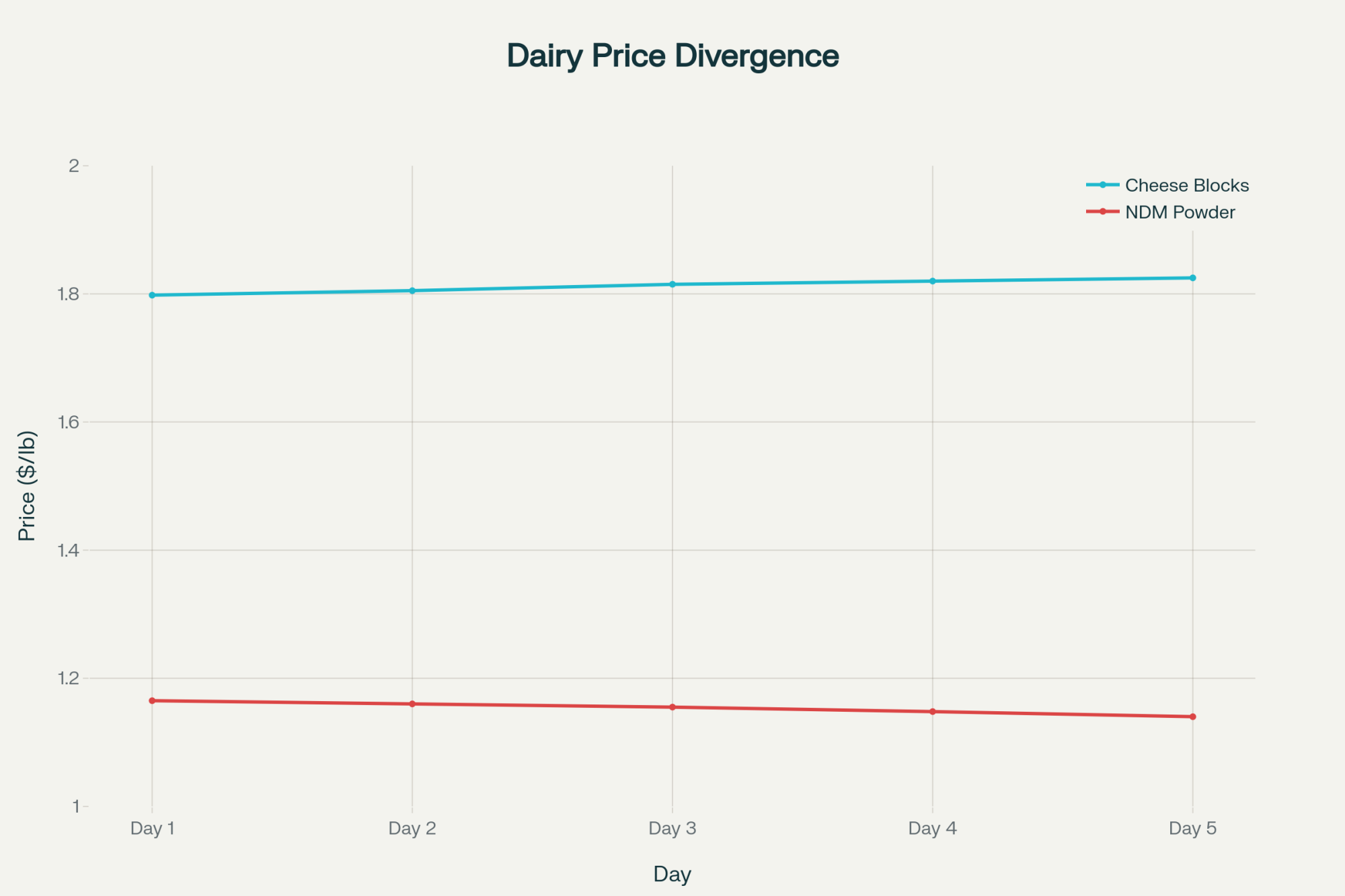
Let me tell you what’s happening in the dairy markets today —and, more importantly, what it means for your next milk check. We saw cheese prices hold steady above $1.82, which is good news if you’re shipping to a cheese plant. But if your milk’s going into powder? That 2.25-cent drop in NDM to $1.14 is going to sting. This growing divergence between Class III and Class IV prices — now nearly $4 per hundredweight — is creating clear winners and losers depending on where your tanker is unloaded.

Looking at today’s trading, what’s interesting here is the complete absence of action in cheese despite decent bid support. No trades in blocks or barrels isn’t unusual after a week-long rally, but the seven offers stacked up against zero bids in NDM? That tells you everything about where sentiment is heading for powder markets.

Two Identical Farms, One Brutal Verdict: The $3,800 monthly gap reveals how processor relationships now matter more than production efficiency—cheese-bound operations at $17.81/cwt are winning while powder-plant farmers bleed at $13.75/cwt.

Today’s Price Action — What These Numbers Mean for Your Farm

ProductPriceToday’s MoveWeekly TrendReal Impact on Your Farm
Cheese Blocks$1.8250/lbUnchangedUp 1.4%Holding firm above $1.82 keeps Class III near $17.80
Cheese Barrels$1.8200/lbUnchangedUp 1.4%Steady demand supporting the cheese complex strength
Butter$1.5725/lb+1.75¢Down 0.1%Small bounce won’t offset NDM weakness for Class IV
NDM Grade A$1.1400/lb-2.25¢Up 3.4%Sharp drop pulls November Class IV below $14
Dry Whey$0.7000/lbUnchangedUp 3.2%Steady support for Class III other solids value
Market Sentiment Splits Violently: Cheese’s steady climb to $1.83 contrasts with NDM’s freefall to $1.14—today’s seven sellers against zero buyers signals powder markets haven’t found bottom yet, widening the Class III/IV chasm to historic levels.

The cheese market’s taking a breather after climbing steadily all week. With blocks and barrels both parked above $1.82, processors seem content with their inventory levels heading into the November holiday demand. That’s actually constructive for maintaining these price levels.

But here’s where it gets concerning — NDM dropping 2.25 cents on heavy offers and absolutely no buying interest. When you see seven sellers trying to unload product with no takers, that’s a market looking for a floor. This weakness directly hits anyone shipping to butter-powder plants, pulling that November Class IV price down toward $14 or potentially lower.

From the Trading Floor — Reading Between the Lines

Bid/Ask Dynamics Tell the Story

The order book today painted two very different pictures. Cheese showed balance with just two bids and two offers on blocks, nothing on barrels — that’s a market comfortable with current levels. But NDM? Zero bids against seven offers is about as bearish as it gets. As one Chicago floor trader told me this morning, “Nobody wants to catch a falling knife in powder right now.”

Trading volumes stayed extremely light — only two loads of butter actually changed hands. The lack of cheese trades doesn’t worry me; it’s normal consolidation. But NDM’s inability to attract even a single bid at progressively lower prices? That suggests we haven’t found the bottom yet.

Volume Patterns and Market Mechanics

What caught my attention was the timing of those NDM offers. They started appearing early and kept building throughout the session, with sellers growing increasingly anxious as the day wore on. The price had to drop 2.25 cents just to clear the board, and even then, no actual trades occurred — just a lower posted price trying to entice buyers who weren’t there.

Where We Stand Globally — And Why It Matters

You want to know why NDM’s struggling? Look at global prices. U.S. NDM at $1.14 per pound is now squeezed between New Zealand at roughly $1.15 and Europe, sitting around $1.00 (based on current exchange rates). That 14-cent premium over European powder is killing our competitiveness in key export markets like Mexico and Southeast Asia.

The real opportunity — and I’ve been saying this for weeks — is in butter. At $1.5725, we’re trading at a massive discount: 89 cents below Europe and $1.40 below New Zealand. Yet nobody’s stepping up to arbitrage this gap. Either U.S. butter is about to rally hard, or global prices are set for a major correction. Something’s got to give.

Market Inefficiency or Warning Signal? The $1.40 butter discount to New Zealand defies arbitrage logic—either U.S. prices are set to rally hard, or global markets face a major correction. Smart money is watching this gap obsessively.

According to Rick Naerebout, CEO of the Idaho Dairymen’s Association, “We’re seeing strong interest from international buyers for U.S. butter at these levels, but the logistics of securing a consistent supply through Q1 2026 is holding back larger commitments.”

Feed Costs Keep Creeping Higher

Your feed bills aren’t doing you any favors right now. December corn futures closed at $4.3450 per bushel, up 6.5 cents this week. December soybean meal hit $308.70 per ton, gaining $11.

For a typical Upper Midwest dairy running a standard TMR, you’re looking at an extra $0.15-0.25 per cow per day in feed costs from this week’s rally alone. With the milk-to-feed ratio barely treading water, these incremental cost increases are directly eating into your already thin margins.

Dr. Bill Weiss from Ohio State’s dairy nutrition program notes, “The projected feed cost index for 2025 sits at 92, suggesting an 8% decrease from 2024 levels, but current futures pricing indicates that relief may not materialize until late Q1 2026.”

Production Reality Check — Where the Milk’s Coming From

USDA’s latest projections have milk production at 230.0 billion pounds in 2025 and 231.3 billion pounds in 2026 — both revised upward from previous estimates. But here’s what matters: where that milk’s being produced and who’s got the processing capacity to handle it.

The geographic shift is striking. Texas posted a jaw-dropping 10.6% surge in April 2025, hitting 1.511 billion pounds. Idaho’s up 4.2% at 1.471 billion pounds. Meanwhile, California’s still recovering from H5N1 impacts, down 1.4%, and Wisconsin — the traditional dairy heartland — barely grew at 0.1%.

This isn’t just statistics; it’s a fundamental realignment of the U.S. dairy industry. Texas added 50,000 cows in the past year. Idaho gained 28,000. Kansas jumped 16,000. These states are building new processing capacity to match — Leprino’s massive cheese plant in Lubbock will process a million pounds daily when it opens in 2025.

The Geographic Revolution Is Here: Texas’s 50,000-cow expansion and Idaho’s 28,000 additions expose the brutal reality—dairy’s future belongs to states with water rights, minimal regulations, and new $11B processing infrastructure, not nostalgic traditions.

What’s Really Driving These Markets

Domestic Demand Dynamics

Holiday cheese demand is providing the floor under current prices. Retailers are actively building inventory for Thanksgiving promotions, keeping both block and barrel prices well-supported above $1.82. Food service demand remains steady, according to several major processors I spoke with this week.

But butter’s a different story. Inventories appear more than adequate for holiday baking needs. As one major retailer’s dairy buyer put it, “We’re covered through New Year’s at current consumption rates. No need to chase prices higher.”

Export Markets — The Pressure Points

U.S. Dairy Export Council data shows we’re in a knife fight with the EU for market share in Mexico. Today’s NDM price drop was necessary to stay competitive. But the bigger story is Southeast Asia, where demand continues to grow at 4-6% annually, according to recent USDEC reports.

The massive butter discount to global prices should be creating export opportunities, but logistics remain challenging. “We need consistent supply commitments through Q2 2026 to make these international contracts work,” notes a major exporter who requested anonymity.

Forward Markets and What They’re Telling Us

November Class III futures settled at $17.81 yesterday — today’s stable cheese market keeps that outlook intact. November Class IV at $14.02 faces more downward pressure after today’s NDM drop, potentially testing below $14.

Looking ahead, markets are pricing Class III around $17.30 for Q4 2025 and $16.85 for the first half of 2026. Class IV projections sit at $16.00 for Q4 and $15.75 for H1 2026. This persistent $1.50+ spread between Class III and Class IV isn’t going away anytime soon.

USDA’s all-milk price forecast for 2025 sits at $21.35 per hundredweight, with 2026 projected at $20.40 — both recently revised downward due to growing milk supplies and moderate demand growth.

From the Farm — Producer Perspectives

“We’re holding our own with these cheese prices, but barely,” says Jim Henderson, who milks 450 cows near New Glarus, Wisconsin. “Feed costs keep nibbling away at margins. If Class III drops below $17.50, we’ll have to make some hard decisions about culling.”

Down in Texas, the mood’s different. “We’re expanding,” states Maria Rodriguez, managing a 2,500-cow operation outside Dalhart. “With Leprino coming online next year, we need the milk ready. These prices work for us with our cost structure.”

In Pennsylvania, third-generation dairyman Tom Mitchell is more cautious: “I’m locking in 30% of my Q1 2026 milk at $18.85 Class III. After what we went through in 2023, I’m not taking chances. Better to know your margin than hope for higher prices.”

Regional Spotlight: The Changing Landscape

Wisconsin and Minnesota — The traditional dairy heartland is holding steady but not growing. Corn harvest is complete with good yields, helping stabilize the local feed basis. Cheese plants are operating at capacity due to holiday orders. Spot milk premiums remain steady, reflecting balanced supply-demand dynamics. The real concern? Younger producers are questioning long-term viability with these margins.

Texas and the Southwest — This is where the action is. With Cacique’s Amarillo facility now operational and Leprino’s Lubbock plant set to come online in 2025, processing capacity is finally catching up with production growth. Land values of $6,000-$8,000 per acre remain reasonable compared to traditional dairy regions. Water availability varies by location, but it hasn’t yet constrained growth.

California — Still recovering from H5N1 impacts and facing ongoing water challenges. The proposed Dairy Order requiring nitrogen discharge limits of 10 milligrams per liter will add costs. As dairy farmer John Silva near Tulare explains, “Between water regulations, air quality rules, and labor laws, it’s getting harder to compete. Some neighbors are selling to almond growers.”

Idaho — Continuing its steady expansion, with milk production up 4.2% year-over-year. The state now ranks fourth nationally, accounting for 7.5% of total U.S. production. Processing capacity remains the constraint, but several expansion projects are in the planning stages.

Three Market Scenarios for Next Week

Bull Case (25% probability): Cheese breaks above $1.85 on strong holiday orders, pulling Class III toward $18.50. Export buyers finally move on discounted butter, sparking a rally above $1.65. This scenario requires an unexpected surge in demand or a production disruption.

Base Case (60% probability): Cheese consolidates between $1.80 and $1.85. NDM continues sliding toward $1.10. Butter stays range-bound $1.55-1.60. Class III pays $17.50-18.00, while Class IV pays $13.75. Feed costs remain elevated.

Bear Case (15% probability): Cheese breaks below $1.80 on profit-taking. NDM accelerates decline toward $1.05. Growing milk supplies overwhelm demand. Class III drops toward $17, Class IV toward $13.50. This requires significant demand destruction or a major production surge.

What Farmers Should Do Now

Price Risk Management Lock in 25-30% of Q1 2026 milk production through Class III futures near $18. Use Dairy Revenue Protection for catastrophic coverage below $16. Consider collar strategies to maintain upside while protecting downside — buying $17 puts while selling $19 calls, for instance.

Feed Strategy Book 40-50% of Q1 2026 corn needs at current levels. Soybean meal showing concerning strength — if you lack coverage through winter, act before it breaks $320/ton. Watch South American weather closely; any production issues there will drive prices higher.

Operational Decisions With the massive Class III/IV spread, every percentage point of protein and fat matters. Work with your nutritionist to fine-tune rations. Consider genomic testing to identify your highest component producers. Cull decisions should factor in not just production but component quality.

Cash Flow Planning. That gap between Class III and Class IV means uneven milk checks depending on your plant’s utilization. Budget conservatively. Build working capital while cheese prices hold. Consider equipment purchases now rather than waiting for potentially tighter margins in 2026.

Industry Intelligence — What’s Coming Down the Pike

Federal Order Reform Impact The comment period for FMMO reform closes soon. Key proposals include updating milk component values, revising Class I pricing, and adjusting make allowances. “These changes could shift milk values by $1-2 per hundredweight once implemented,” notes Dr. Marin Bozic, dairy economist at the University of Minnesota.

Processing Capacity Expansion Beyond Leprino: In Texas, significant capacity is coming online. Chobani’s $500 million Idaho expansion, Select Milk’s powder facility upgrades, and multiple smaller cheese plants across the Midwest. The industry’s investing over $11 billion in new capacity through 2026, according to the International Dairy Foods Association.

Technology Adoption: Robotic milking systems are no longer just for small farms. Several 1,000+ cow operations are installing robots, citing labor savings and improved cow health. “The payback’s under five years at current milk prices,” reports one Wisconsin producer who installed 24 robots last year.

The Brutal Mathematics of Plant Relationships: That ‘small’ $3,800 monthly difference compounds into $45,600 annually—enough to fund expansion, hire workers, or justify switching processors. This chart is why powder-plant farmers are calling cheese plants this week.

The Bottom Line — Context for Today’s Market

Today was a pause day after cheese’s weeklong rally. That’s normal, healthy even. The stability above $1.82 suggests these levels are sustainable through holiday demand.

But NDM’s accelerating weakness is concerning. This isn’t just market noise — it reflects fundamental oversupply in global powder markets and weak demand from key importers. When you can’t find a single bid at progressively lower prices, more downside usually follows.

The growing spread between Class III and Class IV — now approaching $4 per hundredweight — creates distinct winners and losers. If you’re shipping to a cheese plant, you’re in decent shape. Butter-powder plants? That’s a different story entirely.

Compared to last October, we’re in a better position on cheese but significantly worse on powder and butter. This divergence isn’t resolving anytime soon. Success in this environment requires active management — of price risk, feed costs, and operational efficiency. The days of riding market waves without a strategy are over.

What’s clear is that the U.S. dairy industry is undergoing fundamental restructuring. Production is shifting to states with fewer regulatory constraints and newer infrastructure. Traditional dairy regions face mounting challenges. Processing capacity is playing catch-up to this geographic realignment.

Smart money’s positioning for this new reality. The question is: are you adapting fast enough to thrive in tomorrow’s dairy industry, or are you hoping yesterday’s strategies will somehow work in tomorrow’s markets? 

Key Takeaways: 

  • The $45,600 Question: Same milk, same work, but cheese-bound farms earn $17.81/cwt while powder operations bleed at $13.75 – your plant relationship now matters more than your production efficiency
  • NDM’s Zero-Bid Disaster: Today’s seven sellers vs zero buyers signals something darker – U.S. powder can’t compete with Europe’s $1.00/lb pricing, and the gap’s widening
  • Geographic Exodus Accelerates: Texas added 50,000 cows while California lost 8,000 – follow the milk to states with water rights, sane regulations, and new $11B in processing capacity
  • Feed Math That Kills: At $4.35 corn and $308 soy meal, you need $18+ milk to maintain 2019 margins – only cheese producers have a shot
  • Your 72-Hour Decision: Lock in 30% of Q1 2026 at $18+ Class III before smart money takes it all – standing still in this market means falling behind

Complete references and supporting documentation are available upon request by contacting the editorial team at editor@thebullvine.com.

Learn More:

Join the Revolution!

Join over 30,000 successful dairy professionals who rely on Bullvine Weekly for their competitive edge. Delivered directly to your inbox each week, our exclusive industry insights help you make smarter decisions while saving precious hours every week. Never miss critical updates on milk production trends, breakthrough technologies, and profit-boosting strategies that top producers are already implementing. Subscribe now to transform your dairy operation’s efficiency and profitability—your future success is just one click away.

NewsSubscribe
First
Last
Consent

CME Dairy Market Report: October 13, 2025 – Block Cheese Crashes 3¢ as Traders Brace for Sub-$16 Milk

Block cheese drops 3¢ to $1.67 while feed costs hold at $4.10 corn—margin decisions define survival

Executive Summary: What farmers are discovering through today’s CME action is that the dairy market’s entering a prolonged adjustment phase that rewards operational efficiency over production volume. Block cheese’s decisive 3-cent drop to $1.67/lb on six trades—double the typical volume—signals institutional conviction that prices have further to fall, with Class III futures at $16.89/cwt already pricing in expectations of sub-$16 milk by November. The silver lining comes from the feed side, where December corn at $4.10/bu and soybean meal at $274.50/ton offer manageable input costs that translate to income-over-feed margins around $7.80/cwt—still above breakeven for efficient operations but leaving little room for error. Research from the Daily Dairy Report (October 2025) indicates farms maintaining 2.35 milk-to-feed ratios can weather this downturn, though Mexico’s displacement of 507 million pounds of U.S. dairy exports and New Zealand’s aggressive SMP pricing at parity with U.S. NDM suggest the pressure’s structural, not cyclical. Here’s what this means for your operation: those who act now to lock in feed costs while optimizing component production for the 10-cent protein premium over butterfat will navigate this market successfully, while operations waiting for prices to “return to normal” risk becoming part of the consolidation statistics we’ll be discussing next spring.

Dairy Margin Survival

Your October milk check just took another beating. Block cheese dropped 3 cents to $1.67/lb on heavy volume, while butter scraped out a tiny gain that won’t save your Class IV. With feed costs still manageable at $4.10 corn, the smartest play right now is locking in your inputs before this market forces you to feed $16 milk to $5 corn.

When Six Block Trades Tell the Whole Story

You know, I’ve been tracking these markets long enough to recognize when something’s different. Today wasn’t just another down day – it was a day of conviction selling. Six block cheese trades at the CME (Daily Dairy Report, October 13, 2025), versus the typical four, suggests that the big players are positioning for more pain ahead. That 3-cent drop to $1.67/lb? It broke right through the support level that had been held since late September.

“We’re seeing processors work through inventory rather than chase spot loads,” mentioned Tom Wegner, a Wisconsin cheese plant manager I spoke with this morning. “Nobody wants to be holding expensive cheese when the market’s trending like this.”

The interesting aspect here is the barrel-over-block spread, which is currently sitting at 4 cents. That’s backwards from normal market dynamics. Usually, blocks lead and barrels follow, but today’s zero-barrel trades with just one offer hanging out there suggest that buyers figure they can wait this out. Smart money’s betting blocks catch down to barrels, not the other way around.

Today’s Numbers and What They Actually Mean

Block cheese leads the market massacre with a devastating 3-cent plunge – the kind of single-day bloodbath that separates survivors from casualties in today’s dairy market.
ProductPriceToday’s MoveWeekly AverageYour Bottom Line Impact
Cheese Blocks$1.6700/lb-3.00¢$1.7365Directly hits Class III – expect 75¢-$1.00/cwt lower checks
Cheese Barrels$1.7100/lbNo Change$1.7400Holding but won’t prop up Class III
Butter$1.6200/lb+1.50¢$1.6440Minor relief, but still 24% below last October
NDM Grade A$1.1275/lbNo Change$1.1445Skim solids glut continues
Dry Whey$0.6350/lbNo Change$0.6310Steady, but can’t offset cheese weakness

Looking at the CME settlement data (Daily Dairy Report, October 13, 2025), October Class III futures closed at $16.89/cwt while Class IV scraped along at $14.34/cwt. That Class IV number should make you wince – we haven’t seen it this low since 2020’s pandemic collapse.

The Global Chess Game Working Against Us

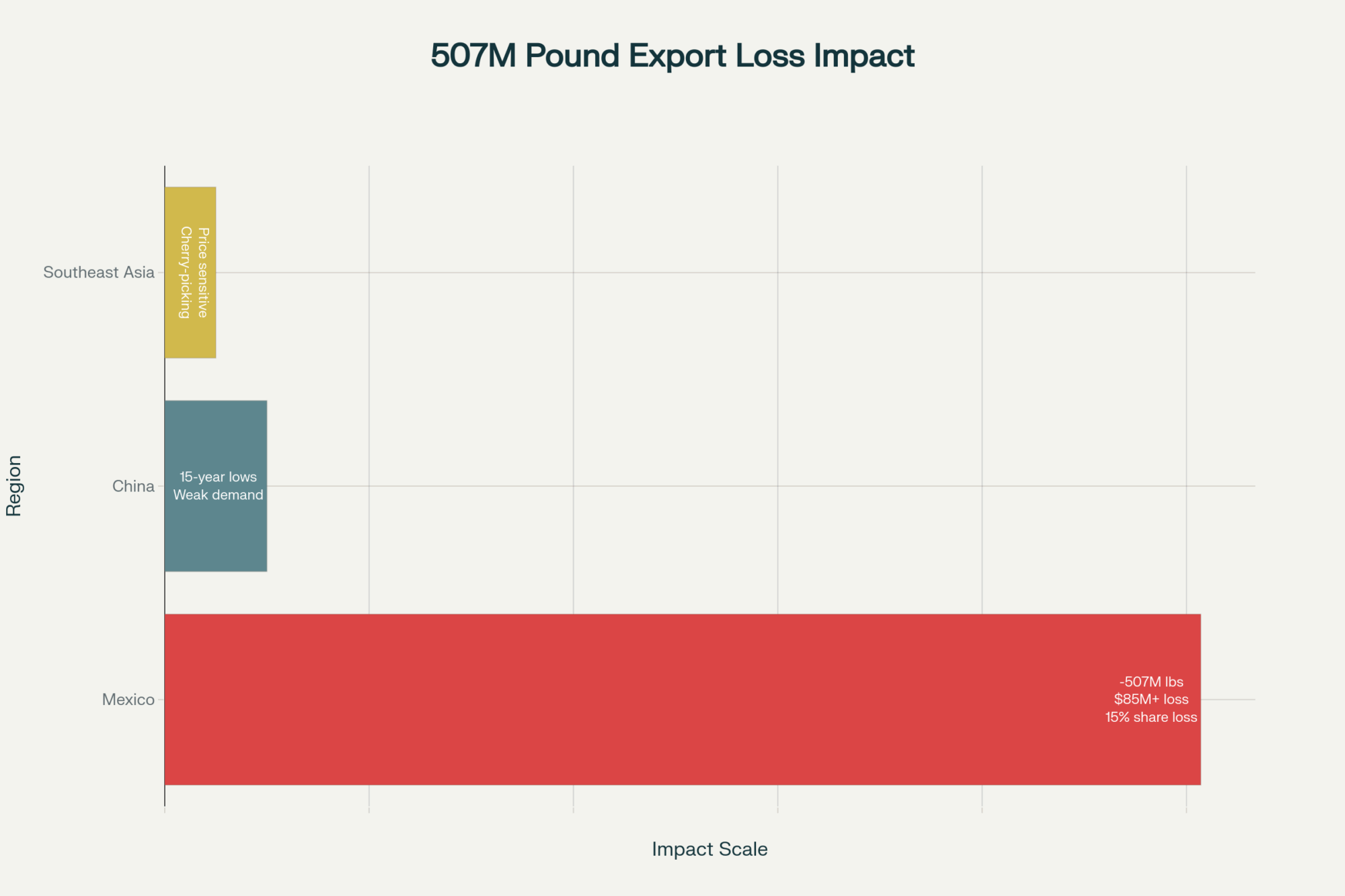
507 million pounds of traditional Mexican demand just evaporated – that’s $85+ million in lost revenue that’s never coming back, no matter what the optimists tell you.

Here’s what farmers aren’t hearing enough about: New Zealand’s hammering us on powder pricing. Their SMP futures at $2,580/MT translate to about $1.17/lb (NZX Futures, October 13, 2025), basically matching our NDM at $1.1275. When the Kiwis can land powder in Southeast Asia at our prices despite shipping costs, we’ve got problems.

The European situation’s equally concerning. EEX butter futures at €5,500/MT (Daily Dairy Report Europe Futures, October 13, 2025) work out to roughly $2.80/lb – that’s 73% above our $1.62 butter. Sure, it makes us competitive for exports, but it also tells you where global butter thinks our price should be heading. Spoiler alert: it’s not up.

“Mexico’s shift away from U.S. dairy is the elephant in the room nobody wants to acknowledge,” notes Dr. Mary Ledman, dairy economist at Ever.Ag. “We’re talking about 507 million pounds of traditional demand that’s evaporating.” (Industry communication, October 2025)

Feed Markets: Your Only Good News Today

At 2.35, your milk-to-feed ratio sits just above the survival threshold – one bad month could push efficient operations into the danger zone where only the desperate or foolish operate

December corn at $4.1050/bu and soybean meal at $274.50/ton (CME Futures, October 13, 2025) gives you breathing room most didn’t have in 2022. I’m currently calculating milk-to-feed ratios of around 2.35 – not ideal, but workable if you’re efficient.

Wisconsin producers I’ve spoken with are seeing slightly better margins, thanks to a local corn basis running 10-15 cents under futures. California residents aren’t as fortunate, as transportation costs them an additional 20-30 cents per delivered feed. The smart operators locked in Q4 needs last month when corn dipped below $4. If you haven’t yet, today’s not terrible, but tomorrow might be.

Income over feed costs pencils out around $7.80/cwt for efficient operations. That’s above the $7 breakeven for most, but barely. And that’s assuming you’re hitting your production targets and not dealing with any health issues in the herd.

Supply Reality: We’re Making Too Much Milk

The USDA’s October report (USDA Dairy Markets, October 2025) estimated national production at 19.3 billion pounds, a 0.7% increase year-over-year. The kicker? The herd expanded to 9.460 million cows – up 41,000 head from last year. Texas and Idaho added 67,000 cows combined, while traditional states like Wisconsin actually contracted by 22,000 head.

What’s interesting here is the regional divergence. Upper Midwest milk flows are running steady to strong as fall weather boosts components. I’m hearing 4.2% butterfat and 3.3% protein from several Wisconsin farms. But those nice components don’t mean much when butter’s in the tank and cheese is falling.

Processing capacity’s the real bottleneck. Plants in the Central region are running at 95-98% capacity (USDA Dairy Market News, October 2025). When you’ve got more milk than processing capacity, spot premiums evaporate. Some producers are currently seeing discounts of 50 cents per class. That hurts.

What’s Really Driving These Markets

Let me paint you a picture of the demand picture, and it’s not pretty. Domestic cheese consumption’s holding steady according to USDA data (USDA Economic Research Service, October 2025), but food service remains 8% below pre-2020 levels. Retail’s picking up some slack, but not enough.

The export story’s worse. China’s imports hit 15-year lows in Q3 2025 while Mexico – our traditionally largest customer – is actively sourcing from Europe and Oceania. Southeast Asian buyers? They’re cherry-picking the lowest global offers, which currently means New Zealand, not us.

“We built this industry on export growth assumptions that aren’t materializing,” one large co-op board member told me off the record. “Now we’re stuck with production capacity sized for markets that disappeared.”

Inventory levels tell their own story. However, butter stocks at 40,052 tonnes (Canadian Dairy Information Center, October 2025) indicate more than adequate supplies, despite the low price. Cheese inventories aren’t publicly reported as frequently, but plant managers tell me they’re holding 10-15% more product than they did this time last year.

Where Markets Head From Here

The futures market’s painting an ugly picture. The November Class III at $16.17 and December at $16.39 (CME Class III Futures, October 13, 2025) suggest that traders don’t expect quick relief. Those aren’t profitable numbers for most operations, especially for newer dairies that carry heavy debt loads.

The technical picture’s equally concerning. Today’s break below $1.70 block support sets up a potential test of $1.65. Below that? The July low of $1.58 comes into play. At those levels, Class III milk drops into the $15s, and that’s when phones start ringing at the bank.

However, consider this: markets often overshoot. Both directions. The same momentum that’s currently crushing prices could reverse if we experience a supply shock – a weather event, disease outbreak, or major plant closure. Problem is, you can’t bank on hope.

Regional Focus: Upper Midwest Feeling the Squeeze

Wisconsin and Minnesota farmers face a unique challenge. They’ve got 22,000 fewer cows than last year, but milk per cow is up 34 pounds (USDA Milk Production Report, October 2025). That productivity gain sounds great until you realize it’s contributing to the oversupply, crushing your milk check.

Basis has tightened to negative 20 cents under Class III as local cheese plants compete for milk. But co-op premiums? They’ve compressed from 75 cents to 35 cents/cwt over the past month. “We’re seeing quality premiums disappear too,” notes Jim Ostrom, who milks 240 cows near Stratford, Wisconsin. “Used to get 50 cents for low SCC. Now it’s 20 cents if you’re lucky.”

The processor’s perspective is different but equally challenging. “We’re making cheese because we have to move milk, not because we have orders,” admits a plant manager who requested anonymity. “Storage is near capacity, and we’re discounting to move product.”

Your Action Plan Starting Tomorrow

First, forget about timing the market bottom. Nobody’s that smart. Instead, focus on what you can control:

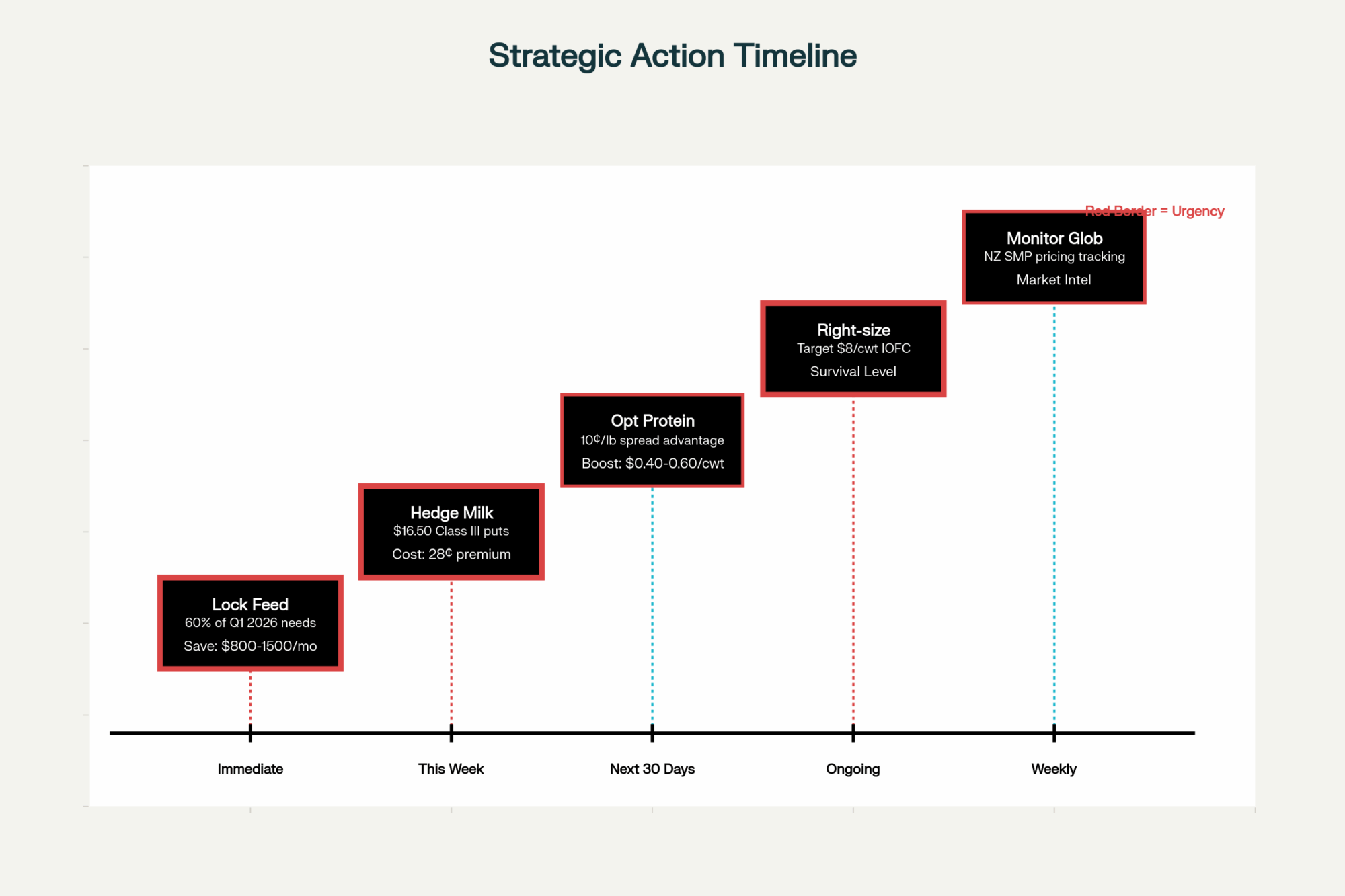
Feed Strategy: Lock in 60% of your Q1 2026 needs at current prices. Corn under $4.25 is a gift in this environment. Don’t get greedy waiting for $3.90.

Hedging Milk: Those $16.50 Class III puts for November-December trading at 28 cents? Cheap insurance. If we break $16, you’ll wish you’d bought them.

Culling Decisions: Fed cattle at $240/cwt (CME Live Cattle, October 2025) makes the beef market attractive. That springer heifer that’s been limping? She’s worth more at the sale barn than in your milk string.

Production Planning: This isn’t the market to push production. Back off the aggressive feeding, focus on component optimization. The current 10-cent spread between protein and butterfat favors protein, despite weak overall prices.

The Uncomfortable Truth About Tomorrow

You want my honest take? Tomorrow’s Tuesday trading will tell us everything. If blocks can’t hold $1.65, we’re looking at an extended period of sub-$16 Class III milk. The global market isn’t coming to save us – they have their own oversupply issues.

The irony is we’re victims of our own success. The U.S. dairy industry has become incredibly efficient at producing milk. The problem is, we’ve become better at producing milk faster than we’ve become better at selling it.

Smart operators are already adjusting. They’re locking in feed, right-sizing herds, and preparing for 6-12 months of margin pressure. The ones waiting for markets to “return to normal”? They’re the ones who’ll be calling the auctioneer next spring.

Your survival depends on executing these five moves with military precision – the farmers waiting for ‘normal’ markets to return will be calling auctioneers by spring.

The Bottom Line

Block cheese at $1.67 triggered the next leg down for milk prices. Class IV’s already in the basement at $14.34, and Class III’s heading toward the $15s unless something changes fast. Your best defense isn’t hoping for higher prices – it’s aggressive cost management and selective hedging.

Lock in those feed costs while corn’s under pressure. Hedge some milk production if you haven’t already. And start having honest conversations about whether your operation’s sized right for $16 milk.

The market’s telling you something. The question is whether you’re listening or just hoping it goes away. Spoiler alert: hope’s not a marketing strategy.

Tomorrow we’ll see if $1.65 holds. If it doesn’t? Well, let’s just say you’ll want those feed costs locked in before everyone else figures out this could get worse before it gets better.

Do you have questions about hedging strategies or would like to share what you’re seeing locally? Reach out at editorial@thebullvine.com. Sometimes the best market intelligence comes from farmers in the trenches, not traders in Chicago.

Key Takeaways

  • Lock in 60% of Q1 2026 feed needs immediately – With corn under $4.25/bu and meal below $275/ton, you’re looking at potential savings of $800-1,500 monthly for a 500-cow operation compared to waiting for spring volatility
  • Implement defensive milk hedging strategies – November Class III puts at $16.50 strike trading at 28 cents offer cost-effective protection against the 35% probability of sub-$16 milk that futures markets are currently pricing
  • Optimize for protein over butterfat production – The current 10-cent/lb spread favoring protein over fat means adjusting rations to maximize protein yield could add $0.40-0.60/cwt to your milk check without increasing feed costs
  • Right-size your operation for margin reality – Farms maintaining income-over-feed costs above $8/cwt through efficiency improvements and selective culling will survive; those chasing volume at $7.80 IOFC won’t see 2026
  • Monitor global competitive positioning weekly – New Zealand’s SMP at $1.17/lb matching U.S. NDM prices means export recovery isn’t coming to save domestic prices; successful farms are planning for $16-17 milk through Q1 2026


Complete references and supporting documentation are available upon request by contacting the editorial team at editor@thebullvine.com.

Learn More:

Join the Revolution!

Join over 30,000 successful dairy professionals who rely on Bullvine Weekly for their competitive edge. Delivered directly to your inbox each week, our exclusive industry insights help you make smarter decisions while saving precious hours every week. Never miss critical updates on milk production trends, breakthrough technologies, and profit-boosting strategies that top producers are already implementing. Subscribe now to transform your dairy operation’s efficiency and profitability—your future success is just one click away.

NewsSubscribe
First
Last
Consent

Dairy Market Reality Check: What Producers from Wisconsin to Canterbury Need to Know

GDT dropped 4.3% last week. While others panic, smart producers see opportunity.

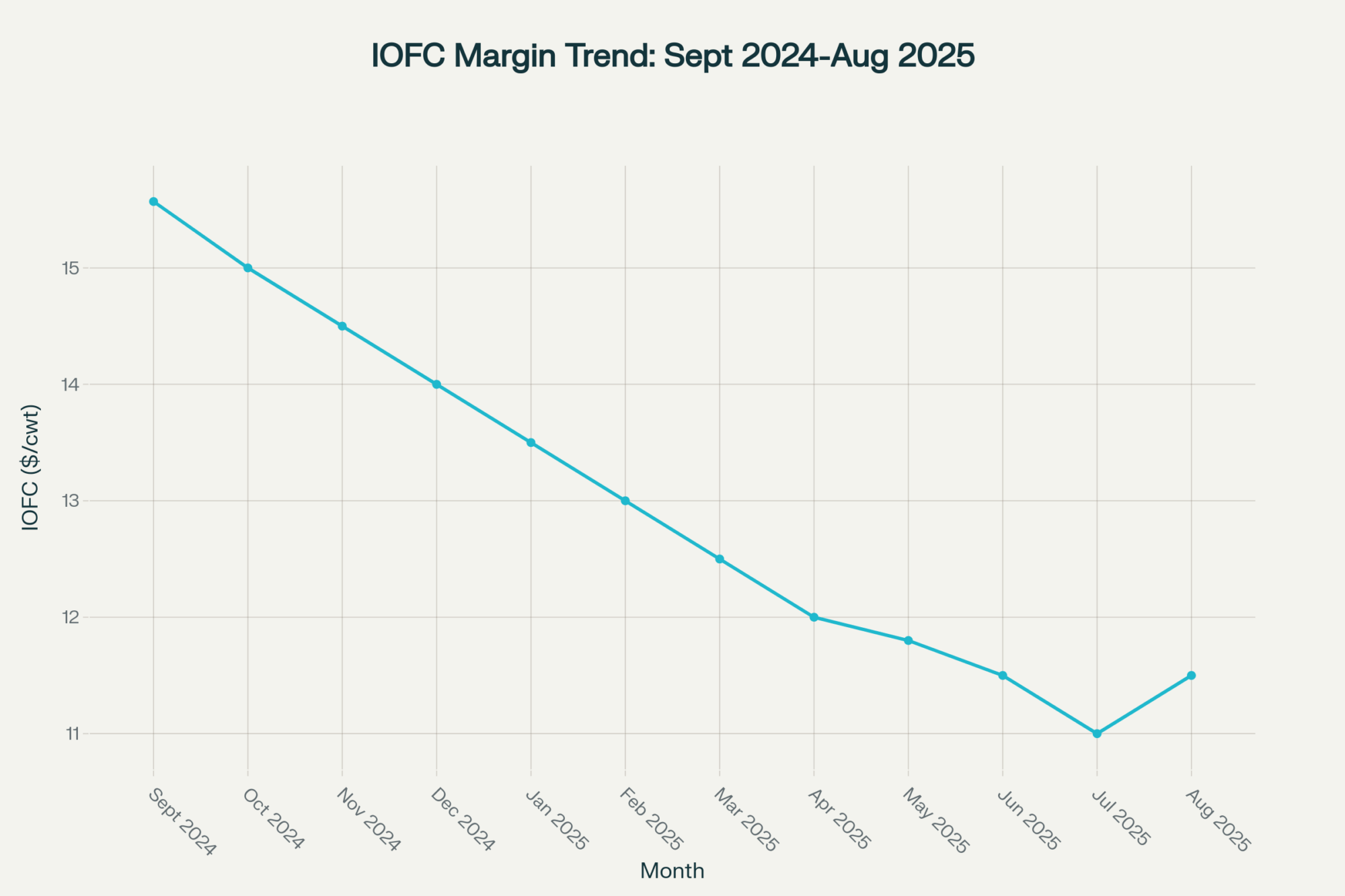
EXECUTIVE SUMMARY: Listen, here’s what happened while you were busy with the fall harvest. The Global Dairy Trade auction just delivered a 4.3% reality check that’s got producers from Wisconsin to New Zealand scrambling. Whole milk powder dropped 5.3%, skim fell 5.8%—and that’s just the beginning. Your feed costs? They’re brutal. Wisconsin corn’s hitting $5.20 per bushel, soybean meal’s near $380 per ton, pushing daily feed costs toward $8.50 per cow. Meanwhile, milk prices slipped to $21.30 per hundredweight in May—down 70 cents from last year. Those Income Over Feed Cost margins that peaked at $15.57 last September? Industry projections show them crashing below $12 this summer. But here’s the thing—this isn’t just about weather or bad luck. Global oversupply from Australia and Uruguay, plus China slashing dairy imports by 12%, is reshaping everything. The producers who understand this shift and adjust their component focus, hedging strategies, and cash flow planning? They’re the ones who’ll still be milking when the dust settles.

KEY TAKEAWAYS:

  • Lock feed contracts now: With corn futures near $4.20/bu and soybean meal around $320/ton, smart contracting can save $1.50-2.25 per cwt when margins compress below $12/cwt
  • Hedge Class III exposure: December 2025 futures trading near $18/cwt—use conservative $17.50 projections for 90-day cash flow planning to avoid nasty surprises
  • Push component percentages: Butterfat and protein premiums hold value during base price weakness—every 0.1% butterfat increase buffers margin pressure when global markets tank
  • Track global supply flows: Australia’s 8.4 billion liters (up 3.1%) and Uruguay’s 5.7% surge create oversupply pressure that affects your milk check regardless of local conditions
  • Plan for FMMO impact: June reforms trimming 30 cents per cwt hit regions differently—know your Federal Order pricing structure before margins get tighter
Global dairy markets, dairy farm profitability, Income Over Feed Cost (IOFC), feed cost management, dairy market analysis

You know that feeling when you open your milk check and your gut drops? That’s exactly what producers from Wisconsin’s dairy country to New Zealand’s Canterbury felt after September’s Global Dairy Trade auction dropped 4.3%. Whole milk powder fell 5.3%, skim milk powder 5.8%—a clear sign that production is running ahead of what the market can absorb.

Here’s the thing: USDA data shows global milk production outpacing demand by about 3.2% this year. That oversupply is hitting everyone’s bottom line, from family farms to corporate dairies.

Southern Hemisphere Floods the Market

Australia wrapped its 2024-25 dairy season this past June with 8.4 billion liters produced—up 3.1% from the year before, according to Dairy Australia. Sounds good on paper, but talk to producers and you get a different story.

Recent survey data from Australian dairy farmers reveals only 45% feel optimistic about the future, with many citing feed cost increases of nearly 50% over two years, while milk prices haven’t kept pace. “We’re having some tough conversations out here,” is how one Victorian farmer put it in recent industry reports.

Over in Uruguay—a smaller player that’s making waves—milk deliveries surged 5.7% in the first half of 2025, with June numbers jumping 10% during what is usually’s their quiet season. When you combine that with New Zealand’s production, industry analysis suggests a surplus exceeding 300 million liters hitting global markets this year. The pressure on prices is real.

China’s Structural Market Shift

Here’s what really gets your attention: China’s been battling a 27-month streak of falling milk prices due to domestic oversupply. Rabobank forecasts Chinese dairy imports dropping 12% this year, meaning hundreds of thousands fewer tons flowing through global markets.

When your biggest customer suddenly doesn’t need your product because they’re drowning in their own… well, that changes everything for exporters worldwide.

Feed Costs Squeezing Margins Everywhere

Let’s talk numbers that hit close to home. In Wisconsin, corn is selling for around $5.20 per bushel, and soybean meal is priced near $380 per ton. Industry estimates suggest feed costs ranging from $7 to $10 per cow daily, depending on your ration composition.

USDA reports show May milk prices fell to $21.30 per hundredweight—down 70 cents from last year. Remember when Income Over Feed Cost hit $15.57/cwt last September? Industry projections suggest those margins could drop below $12/cwt this summer.

That’s tighter than getting a fresh heifer to stand still for hoof trimming.

IOFC Range (/cwt)What You Need to DoTimeline
Above $15Lock in feed contracts nowNext 6 months
$12-15Hedge feed, trim costs aggressivelyNext 3 months
Below $12Emergency cash flow managementRight now
Below $9Consider herd reductionImmediately

Futures Market Reality Check

The interconnected nature of today’s dairy markets means that when one region gets hit, we all feel it. Recent Class III futures contracts suggest December 2025 pricing near $18 per hundredweight—levels that make debt service painful for leveraged operations.

Even butter took a hit, sliding 2.5% in recent GDT auctions. When butter weakens alongside milk prices, you know this isn’t just a powder market problem.

FMMO Changes Squeeze Already Tight Margins

As if margin pressure wasn’t enough, Federal Milk Marketing Order reforms that kicked in June 1st are expected to trim another 30 cents per hundredweight from all-milk prices. Different regions get hit differently, making financial planning even trickier.

It’s like trying to balance your books while someone keeps changing the rules mid-game.

Regional Strategies That Make Sense

Here’s where your zip code really matters. Wisconsin producers should be locking corn futures through the CME while prices remain manageable. California operations need to focus on securing quality alfalfa and bypass protein before costs spike further.

East Coast farmers face distinct challenges, including dependency on purchased feed and higher energy costs. Down in the Southeast, cottonseed and corn gluten feed contracts often provide stability when grain markets get volatile.

The operations doing well right now aren’t chasing volume—they’re optimizing genetics and nutrition programs that boost components. Butterfat and protein premiums hold value better when base prices are under pressure. It’s about working smarter, not just harder.

Currency Swings and Export Math

New Zealand and Australian exporters constantly juggle exchange rate swings that can make or break quarterly returns. A strong U.S. dollar makes American dairy products more expensive overseas, but it can also help offset lower global prices when revenue gets converted back to dollars. However, widespread domestic oversupply significantly limits these benefits.

Your Action Plan

Three things that can’t wait:

First, run conservative 90-day cash flow projections assuming Class III stays around $17.50/cwt. If those numbers don’t work, you need strategic alternatives now.

Second, lock in feed contracts for Q4 2025 and early 2026 while grain futures remain below recent peaks. Corn near $4.20/bu and soybean meal around $320/ton represent opportunities that might not last.

Third, double down on component-focused breeding and nutrition programs. Every tenth of a point in butterfat or protein helps when base prices are squeezed.

We’ve weathered these cycles before—those who plan ahead always come out stronger.

Current Market Snapshot

  • GDT Price Index: 1,209 (down 4.3%)
  • Class III Dec 2025: ~$18/cwt
  • IOFC Margin Range: $11.30-12.80/cwt (varies by region)
  • Feed Costs: Corn $5.20/bu, SBM $380/ton

This market cycle will test every operation differently. Know your numbers, protect your margins, and remember—the market will turn.

Bottom line? The producers surviving this cycle aren’t just watching weather and feed prices—they’re managing global market risk like the business professionals they are.

The question is whether you’ll be stronger or gone when it does.

Complete references and supporting documentation are available upon request by contacting the editorial team at editor@thebullvine.com.

Learn More:

  • 7 Sins of Complacent Dairy Farmers – This tactical piece reveals the operational blind spots that can cripple profitability during a downturn. It provides a direct checklist for producers to self-audit their management practices and refocus on the core drivers of efficiency and cost control.
  • The 2 Cents That Can Make or Break Your Dairy Farm – Shifting to a strategic, market-focused perspective, this article breaks down how minor shifts in milk price, component values, and input costs create significant long-term financial impacts. It demonstrates the importance of margin-focused management over chasing pure production volume.
  • Robotic Milking Systems: Are They the Peter Principle of the Dairy Industry? – This innovative article challenges producers to think critically about major technology investments. It explores whether automation solves core management issues or simply elevates them, providing a crucial framework for evaluating ROI on future-focused capital expenditures during tight markets.

Join the Revolution!

Join over 30,000 successful dairy professionals who rely on Bullvine Weekly for their competitive edge. Delivered directly to your inbox each week, our exclusive industry insights help you make smarter decisions while saving precious hours every week. Never miss critical updates on milk production trends, breakthrough technologies, and profit-boosting strategies that top producers are already implementing. Subscribe now to transform your dairy operation’s efficiency and profitability—your future success is just one click away.

NewsSubscribe
First
Last
Consent

Collision Course: Navigating the 2025 U.S. Dairy and Grain Markets

July milk per-cow jumped to 2,081 lb in the 24 big states—while corn’s pegged at a record 188.8 bpa. Margins? Tight… unless planned.

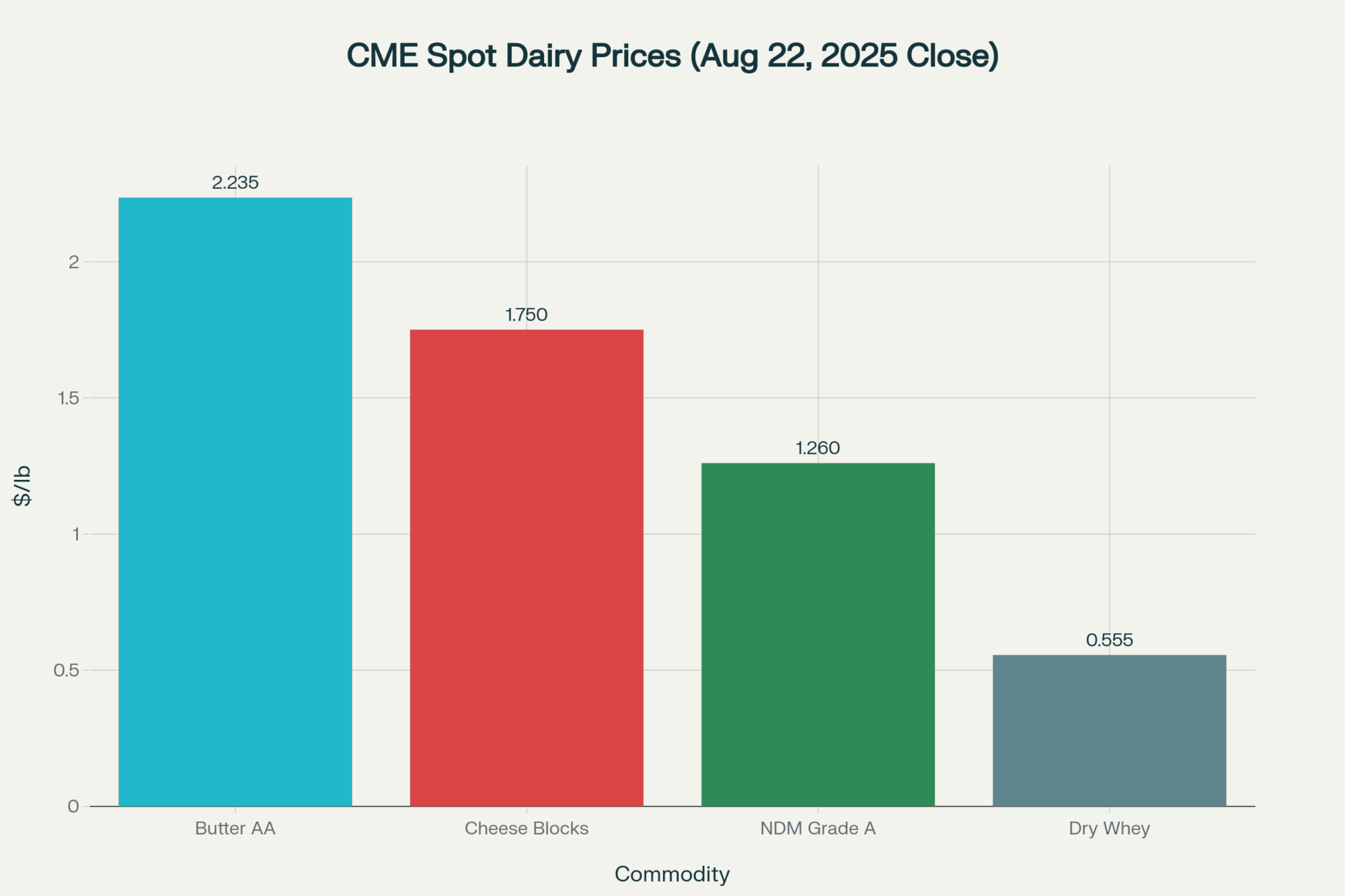
Executive Summary: Here’s the quick read over coffee. Milk output is running hot—per-cow hit 2,081 lb in July across the 24 major states—while butter’s been slipping on the board even though cold storage isn’t bloated. USDA’s August WASDE prints a record 188.8 bpa corn yield and a 16.7-billion-bu crop, which screams “cheap feed”… if it holds. But field scouts aren’t buying it—Pro Farmer’s final at 182.7 bpa points to disease shaving kernel weight, and that’s exactly the kind of shift that can add 20–40 cents/bu fast on a short-covering pop. Meanwhile, the butter spot around $2.235/lb and a firmer whey tone keep Class III steadier than Class IV—so checks tied to butter/powder feel more pressure. The big move right now isn’t fancy: lock about two‑thirds of feed through early 2026 while the curve is friendly, and set a reasonable floor on milk revenue—then lean into butterfat and protein to keep IOFC intact. Plants coming online in Dodge City and Lubbock will help basis, but not in time to save September spot loads—so plan hedges around the plant’s utilization, not a national average. The bottom line is to get coverage on the books while there’s room, and don’t wait for the market to force the hand.

Key Takeaways

  • Lock feed while it’s offered: with USDA at 188.8 bpa vs. Pro Farmer 182.7, pre‑commit ~66% of Q4’25–H1’26 rations; that cushions a 20–40c/bu corn jump that could hit IOFC $0.20–$0.40/cwt.
  • Use DRP as a true hedge tool: quote it in real time with an agent—the premium and coverage change daily with futures; set a floor that matches the plant’s utilization mix.
  • Aim components for ROI: pushing ~4.2% butterfat and ~3.3–3.4% true protein typically offsets Class IV weakness and stabilizes income-over-feed when whey props Class III.
  • Watch butter vs. stocks: butter around $2.235/lb despite July stocks down ~6% YOY says the market’s pricing future cream; don’t overbuild inventory if processing.
  • Expect basis relief later, not now: Dodge City is online and Lubbock ramps in 2026—help is coming, but September milk still travels; hedge the haul and basis accordingly.
dairy market analysis, feed cost management, income over feed cost, dairy profitability, milk price forecast

The U.S. dairy industry is heading for a collision. That isn’t hyperbole. July data shows milk production is running significantly higher year over year, while feed market risk is anything but settled, setting up a classic margin squeeze if timing goes the wrong way for producers selling milk daily and buying feed in chunks. USDA NASS Milk Production | USDA ERS LDP Outlook

More Than a Milk Price: Why Supply and Basis Are Driving Your Check

What’s striking this summer is a tricky mix for producers planning Q4 coverage and cash flow: stronger per‑cow output in key dairy states combined with unusually wide spreads in feed market signals that amplify basis and logistics risk on the ground. USDA Dairy Market News

ScopePer‑cow (lb)Notes
24 major states (July)2,081+36 lb YoY; higher output corridor
National (July)2,063Lower than 24‑state average

According to the USDA’s July Milk Production report, production per cow in the 24 major states averaged 2,081 pounds, up 36 pounds year over year; the national July average was 2,063 pounds, and that difference matters when estimating loads and component tons per month under tight plant schedules.

The growth corridors across the South‑Central and Plains keep adding milk and steel, but line time and trucking don’t appear out of thin air—when plants prioritize nearby milk, basis penalties can hit loads that have to move farther even if headline prices look fine. USDA Dairy Market News

Butter, Classes, and Why Inventory Isn’t the Whole Story

Butter told the market story in August as spot Grade AA settled around $2.2350 per pound on August 22, looking cheap versus global values but largely discounting what’s coming more than what’s currently in storage. CME butter prices

Cold Storage shows July butter stocks down about 6% year over year—tight enough today—yet prices softened anyway, signaling traders are pricing future cream flows and churn time rather than present availability. USDA Cold Storage – July 2025

This development has a fascinating effect on Class dynamics. When butter and powder soften while whey holds firm, Class III can look relatively better than Class IV. In certain months, this translates into weaker Producer Price Differentials (PPDs) in markets with a butter/powder‑heavy utilization mix. Class spreads and pricing context

Feed Risk: Why the USDA and Field Scouts Disagree on Your Corn Bill

According to the August WASDE, the first survey‑based national corn yield printed a record 188.8 bushels per acre with production at 16.7 billion bushels if realized—an undeniably feed‑friendly deck if it stands. DTN/Progressive Farmer summary

But the view from the field tells a different story: Pro Farmer’s final tour estimate pegs yield at 182.7 and flags widespread late‑season disease pressure across parts of the Belt, which is big enough to tighten carryout and nudge basis and futures higher into winter.

Positioning raises the stakes—CFTC data show managed money carrying sizable net shorts in corn ahead of harvest, the exact fuel that can power a fast short‑covering rally if the crop underperforms.

What to Do Now (Before the Market Makes the Choice for You)

ActionWhat to do nowWhy it pays
Lock feed (~66% Q4–H1’26)Pre‑commit while USDA’s high yield is pricedCushions a 20–40c/bu corn pop; protects IOFC $0.20–$0.40/cwt
Price DRP in real timeQuote with an agent; align to plant utilization mixSets floor against Class IV softness, matches actual pooling
Push components (BF/TP)Aim ~4.2% butterfat; ~3.3–3.4% true proteinLifts pay price when cheese/whey support Class III

Based on market signals and risk calendars, producers should consider these three strategic actions now:

  • Lock In Feed Costs: Pre‑commit to roughly two‑thirds of feed needs for Q4 2025 and early 2026 while the forward curve still reflects the USDA’s high yield scenario, leaving room to average if field‑driven numbers prevail and basis firms. USDA WASDE
  • Evaluate Dairy Revenue Protection (DRP): Work with an agent to price DRP in real time—premiums and terms change daily with futures and endorsements, so it’s a tool to manage actively, not guess at. USDA RMA DRP policy
  • Maximize Component Pay: For component‑based pay, push butterfat toward 4.2% and true protein into the 3.3–3.4% range to lift IOFC even when class prices wobble—especially if feed conversion efficiency holds under current diets. Milk check and pooling dynamics

Capacity and Basis: Help Is on the Way, Just Not for September

Capacity growth is real but won’t solve September’s milk; it matters for anyone with spot loads and a long haul to a dryer or churn while plants juggle maintenance, staffing, and qualifications. USDA ERS LDP Outlook

Hilmar’s new Dodge City facility—an investment north of $600 million—anchors the emerging milk map from western Kansas into the Panhandle and should help rebalance line time and haul distance over the next 12–18 months.

Leprino’s Lubbock facility is staged toward early 2026 for a full ramp, so relief is coming, but not fast enough to erase basis pressure for milk still looking for a closer home this fall and winter.

Global Pull and Why U.S. Butterfat Still Matters

U.S. butterfat remained globally competitive in early 2025, and USDEC highlighted strong mid‑year export momentum that helped keep domestic butter stocks tighter even as milk rose—one reason current weakness is more about forward cream supplies than a freezer problem.

For operators reading the tea leaves, watch the spread between U.S. and EU/NZ butter values alongside Cold Storage—if the U.S. discount narrows as milk stays high, export pull can fade and leave more butterfat at home right into seasonal cream recovery. USDA ERS LDP Outlook

If exports hold, inventories won’t spike quickly; if they wobble, Class IV bears the brunt first, and it shows up in the milk check. Class IV and utilization context

Your Milk Check Explained: How Class Spreads and PPDs Impact Your Bottom Line

When whey resilience props up Class III while butter/powder softness drags Class IV, checks in cheese‑heavy utilization areas can look materially different than those tied more heavily to churns and dryers, and that matters for how DRP or options are layered over already‑contracted milk. Class spreads and pricing context

Weak Class IV tends to pull PPDs lower and reduce the final pay price in orders where Class IV utilization spikes, so re‑read the plant’s pay formula and align hedges with the utilization reality—not a national average that won’t match the load on the truck. Milk check and pooling dynamics

The cheapest penny is the one not lost to a mismatch between pooling math and hedges, especially in a fall when spreads can move faster than loads can be re‑routed. USDA Dairy Market News

Bottom Line: Before the Collision, Not After

If USDA’s big yield verifies, feed stays friendly and margin math gets breathing room, but if Pro Farmer is closer to right and disease pulled kernel weight, the short‑covering bid can meet softening milk and turn the screws on IOFC unless protections are already in place. USDA WASDE | Pro Farmer final

The smartest move is the one made before the market forces your hand—lock in feed and revenue floors while the opportunity exists, don’t wait for the market to dictate terms, and let new capacity in Dodge City and Lubbock ease basis and haul pressure as it ramps over the next few quarters. Hilmar Dodge City | Leprino Lubbock

Complete references and supporting documentation are available upon request by contacting the editorial team at editor@thebullvine.com.

Learn More:

Join the Revolution!

Join over 30,000 successful dairy professionals who rely on Bullvine Weekly for their competitive edge. Delivered directly to your inbox each week, our exclusive industry insights help you make smarter decisions while saving precious hours every week. Never miss critical updates on milk production trends, breakthrough technologies, and profit-boosting strategies that top producers are already implementing. Subscribe now to transform your dairy operation’s efficiency and profitability—your future success is just one click away.

NewsSubscribe
First
Last
Consent

Dairy Markets Diverge: US Production Drives Components, While European Herds Contract

The dairy industry in 2025 is splitting into distinct paths, a divergence that breeders, producers, and consultants feel directly.

EXECUTIVE SUMMARY: Here’s what’s happening — the real money isn’t in pumping more milk, it’s in making better milk. US producers figured this out already… they’ve bumped production about 2% while cranking up butterfat and protein levels, adding over $110 per cow straight to the bottom line. Meanwhile, Europe’s struggling with disease outbreaks and shrinking herds, which actually creates opportunities for the rest of us. Feed prices? They’re all over the map, but smart operators are locking in contracts now. Don’t just milk more cows — make every drop work harder through genomics and precision tech. The farms winning in 2025 are the ones making data-driven moves, not just gut decisions.

KEY TAKEAWAYS FOR ACTION

  • Bump your milk protein 0.2% and butterfat 0.3% using genomic selection — we’re talking potentially $120+ more per cow annually. Start by pulling up your herd’s genomic profiles this week.
  • Cut feed waste with precision feeding tech — early adopters report 12% savings on feed costs. Begin with a pilot zone to test and optimize feed intake before rolling it out.
  • Lock in feed prices NOW before the predicted 10% spike hits — call your supplier today about volume contracts. Don’t wait and regret it later.
  • Use real-time monitoring to catch mastitis and lumpy skin early — quick intervention can prevent 5%+ production losses. Disease prevention beats treatment every time.
  • Diversify your milk sales channels to protect against trade chaos — use market intelligence from USDA and Rabobank reports to find new opportunities while others scramble.

Let me break it down for you. The US is absolutely charging ahead right now. According to the latest USDA Livestock, Dairy, and Poultry Outlook from July 2025, milk production is expected to reach approximately 228 billion pounds in 2025, with a slight increase to around 229 billion in 2026. But here’s the kicker: it’s not just about adding more cows. Producers are dialing in higher butterfat and protein yields—that’s the new competitive edge that’s propelling American cheese and butter to the top tier globally.

Now look to Europe, where a different reality is unfolding. The EU’s milk output is forecast to decline slightly, from 149.6 million tonnes last year to approximately 149.4 million tonnes this year. The herd is shrinking by an estimated 3 percent, squeezed by tighter environmental controls and soaring costs. Toss in some serious disease outbreaks—such as bluetongue and lumpy skin, particularly affecting Italy and France—and you’ve got producers pivoting hard toward cheese production, where margins still hold solid.

Regional Winners and Losers Keep Emerging

What strikes me about Argentina is how producers there are riding a solid wave. DairyNews reports roughly 11% growth in milk production for the first half of 2025, though much of that surge is feeding growing domestic consumption rather than export markets.

Australia’s story is more nuanced. Despite some conflicting forecasts, multiple sources indicate that production is expected to settle around 8.6 million tonnes for 2025—reflecting the ongoing impacts of drought and rising input costs that continue to squeeze smaller farms out of the market.

In New Zealand, the picture is both steady and unstable. Fonterra’s forecast ranges between NZ$8 and NZ$11 per kg of milk solids for 2025-26, with a midpoint around NZ$10. That volatility means cash flow management has become absolutely essential for Kiwi farmers.

Here’s an interesting twist: the broader economic outlook from the World Bank predicts that commodity prices will soften overall, yet dairy bucks the trend, propped up by tight supplies and robust demand.

Feed Markets and Growing Trade Tensions

Feed markets are painting a mixed picture. The latest forecast from the International Grains Council signals a strong corn crop for 2025-26, although it is flagging volatility driven by weather and biofuel policy shifts. Smart operators are locking in feed prices early—I’ve seen operations save $150-$ 200 per cow annually simply by timing their grain purchases correctly.

But watch out—risks are mounting. Disease challenges like bluetongue and lumpy skin disease continue pressing hard in Europe. Meanwhile, the escalating US-China tariff conflict—which involves tariffs of up to 125% imposed by the US on certain dairy categories and retaliatory tariffs exceeding 120% by China—continues to disrupt traditional trade flows.

What Smart Operators Are Doing Right Now

So, what’s a savvy dairy operator to do in this fractured landscape?

Genomic testing isn’t optional anymore. Focus on breeding for higher fat and protein yields—this is where the real premiums are. A Wisconsin producer I know increased his component premiums by $0.45 per hundredweight just by selecting bulls with superior genetic merit for milk components.

Lock in feed contracts early—don’t get caught off guard by market swings. One Iowa operation saved nearly $180 per cow last year by forward contracting corn when prices dipped in spring.

Embrace precision technology—whether it’s robotic milking systems or precision feeding platforms, the ROI is becoming clearer every quarter. A 1,200-cow California dairy reported a 12% improvement in feed efficiency after installing automated systems.

Monitor disease developments constantly. With what’s happening in Europe, proactive health protocols aren’t just good practice—they’re survival tactics.

Diversify your market strategies—don’t put all your eggs in one basket, especially with trade policies shifting so rapidly.

The margins for error are shrinking; however, the opportunities for those who adapt quickly are substantial. US producers who understand their competitive position in components—the European processors pivoting to maximize value from limited milk, the New Zealand farmers managing cash flow through price volatility—they’re all writing the playbook for what works in this new reality.

For smaller operations, this might mean forming partnerships to access elite genetics and technology. For larger farms, it’s about leveraging scale to implement comprehensive strategies faster than competitors can react.

This isn’t the dairy landscape our grandparents knew. It’s faster, more complex, and honestly, more unforgiving to those who don’t stay ahead of the curve. However, for producers ready to embrace change and think strategically about their positioning, there are real opportunities not only to survive but also to thrive.

The key takeaway? Success in 2025 hinges not only on volume but also on strategic, data-driven decisions that capitalize on regional strengths and navigate global market challenges.

Keep your eyes sharp—this year is shaping up to reshape everything we thought we knew about dairy.

Complete references and supporting documentation are available upon request by contacting the editorial team at editor@thebullvine.com.

Learn More:

Join the Revolution!

Join over 30,000 successful dairy professionals who rely on Bullvine Weekly for their competitive edge. Delivered directly to your inbox each week, our exclusive industry insights help you make smarter decisions while saving precious hours every week. Never miss critical updates on milk production trends, breakthrough technologies, and profit-boosting strategies that top producers are already implementing. Subscribe now to transform your dairy operation’s efficiency and profitability—your future success is just one click away.

NewsSubscribe
First
Last
Consent

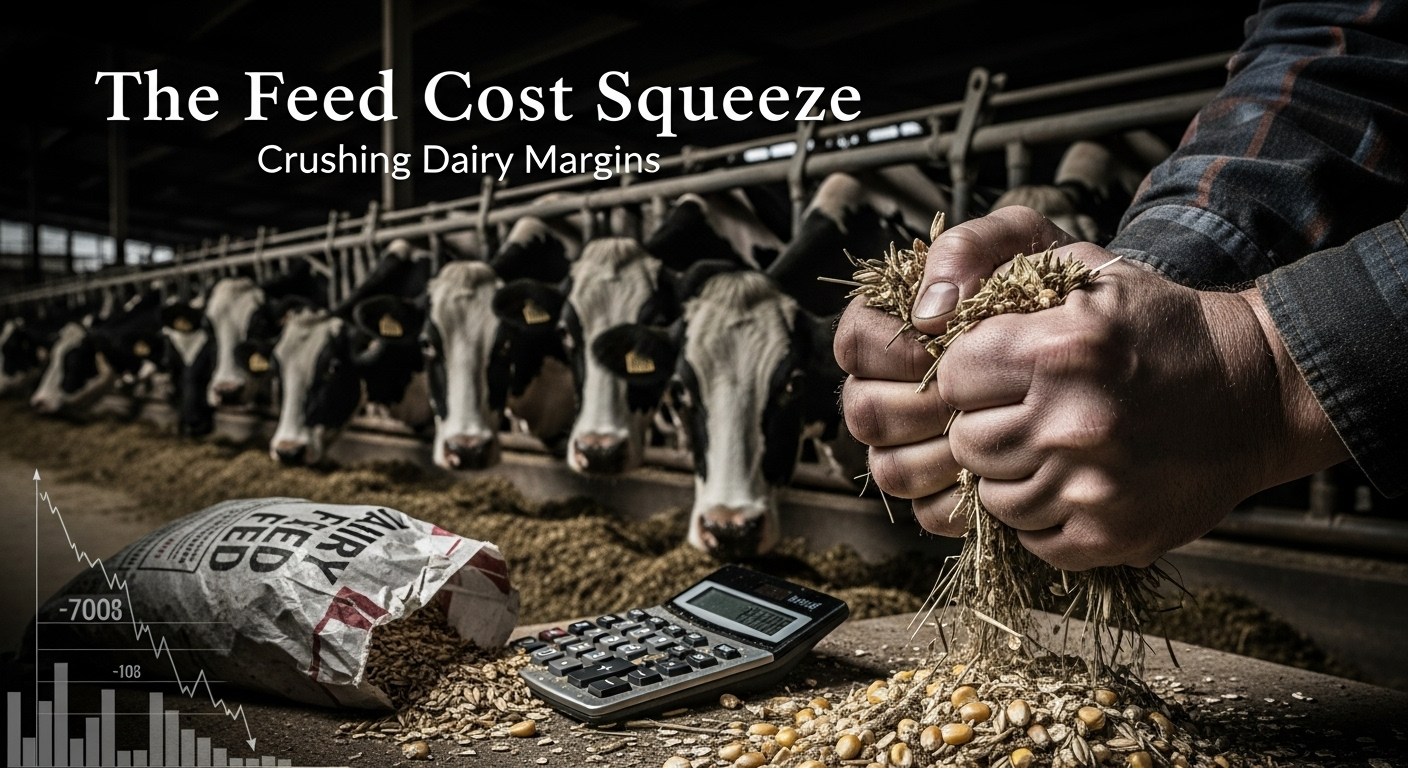
The Feed Cost Squeeze That’s Crushing Dairy Margins — And Why Smart Producers Are Already Positioning for What’s Coming Next

The protein cost explosion that’s reshaping how we think about profitability… and why smart producers are already positioning for what’s coming next

EXECUTIVE SUMMARY: Here’s what’s keeping me up at night, and it should worry you too… feed costs are absolutely crushing dairy margins in ways we haven’t seen since 2012, with soybean meal prices exploding to $285 per ton — that’s an extra $5,250 monthly for a typical 1,000-cow operation. The milk-to-feed ratio has dropped to a dangerous 1.80, which Penn State Extension calls “critical financial territory.”Meanwhile, our national herd keeps shrinking by 40,000 head while replacement heifers cost $2,500 each, and here’s the kicker — those Q4 futures sitting at $18.58 suggest better days ahead, but only if you can survive the squeeze. Global demand from Mexico and Southeast Asia is keeping NDM prices strong, but that won’t help if your feed bills are bleeding you dry. You need to stop thinking about this as a temporary blip and start treating it as the new reality — because the operations that get their risk management and feed efficiency dialed in now will be the ones still milking when prices recover.

KEY TAKEAWAYS

  • Slash feed costs by 8-12% through precision ration management — we’re talking $10-15 savings per cow monthly when soybean meal hits these record highs, and every dollar counts with margins this tight
  • Lock in your DRP coverage NOW for fall quarters — match your federal order’s class utilization instead of just hedging Class III, because that $1.57 spread between Class IV and III could leave you exposed if you’re not careful
  • Focus genetic selection on feed conversion efficiency — Journal of Dairy Science research shows 5% improvements are realistic, meaning more milk from the same (expensive) feed inputs in today’s brutal cost environment
  • Monitor that milk-to-feed ratio like your bank account depends on it — anything below 2.0 signals serious financial stress, and at 1.80 we’re already in dangerous territory across most U.S. herds
  • Leverage the export strength while it lasts — Mexico buying 50%+ of our NDM exports is creating a price floor, so work with your processor to capture those premiums before trade winds shift

The thing about this summer’s dairy margins — they’re not just tight, they’re pinched in a way I haven’t seen since that brutal 2012 drought. And if you think I’m being dramatic, well… take a hard look at your feed bills lately.

What strikes me most about what we’re dealing with right now isn’t just another commodity cycle. This feels different. It’s like watching a fundamental reshaping of the cost structure that has even seasoned producers scratching their heads and recalculating everything they thought they knew about staying profitable.

While everyone’s been tracking Class III futures holding around $17.79/cwt, there’s been this massive shift happening in the feed markets that’s completely rewriting the playbook. The soybean meal complex? Man, it’s gone absolutely haywire — and it’s catching farms off-guard left and right.

When Feed Costs Start Calling the Shots

You know how we always talk about watching the corn market? Well, forget corn for a minute. What’s really crushing margins right now is what’s happening on the protein side of things, and it’s brutal.

According to recent work from Penn State Extension dairy economists, operations running feed costs above 60% of milk revenue are now in what they’re calling “critical financial territory.” That’s not just academic talk — I’m hearing from producers in Wisconsin who are seeing soybean meal bills jump from around $250/ton to $285.30/ton in what feels like overnight.

Key dairy market indicators for the week ending July 18, 2025, showing price comparisons and margin squeeze signals

Do the math on a typical 1,000-cow operation running through 15 tons weekly — that’s an extra $5,250 hitting your monthly expenses. And that’s before we even discuss all the other protein sources that are being pulled up with it. (This is becoming more common than anyone wants to admit.)

Here’s the thing, though… this isn’t just commodity volatility we can wait out. What we’re dealing with is structural pressure from renewable diesel, which is crushing, that’s putting sustained upward pressure on the bean complex. The latest USDA outlook projects a record-high soybean crush for the 2025/26 marketing year, driven by soaring demand for soybean oil in biofuels. When crushers are running flat out for biofuel demand, guess who gets stuck with the meal price consequences?

This development is fascinating from a market structure perspective, but terrifying when you’re trying to balance rations and keep cows happy.

Why the Futures Are Telling a Different Story

What’s particularly noteworthy about the current market structure is how disconnected cash and futures have become. CME data shows fourth-quarter Class III futures sitting around $18.58 – that’s a pretty healthy premium over where we are today.

But here’s where it gets interesting… that contango structure isn’t random market noise. It’s the collective wisdom of traders who see something coming that a lot of producers might be missing. They’re looking at two things that should have every dairy operator paying attention.

First, there’s this wave of new processing capacity coming online through late 2025 and into 2026. I’m talking major cheese and fluid plants in New York, Texas… facilities that represent permanent — or let’s say, ‘multi-decade’ — increases in milk demand. These aren’t temporary pop-up operations. They’ll need milk, lots of it, for years ahead.

Second — and this is where the supply math gets really interesting — our national herd is actually contracting. The latest USDA data puts us at 9.325 million head, down 40,000 from last year. Even with beef prices at current levels, producers aren’t expanding. Why? Because replacement heifers are commanding $2,500 a head[1], and margins are getting squeezed from both ends.

Think about that dynamic for a minute. New processing demand meeting constrained supply growth? That’s the recipe for processors bidding aggressively for available milk. What’s your operation going to look like when that competition heats up?

The Regional Reality Nobody Wants to Talk About

Now, here’s where things get really nuanced — and this varies dramatically depending on where you’re milking. If you’re in the Upper Midwest, where Class III utilization runs heavy, you’re dealing with one set of margin pressures. But if you’re down in the Southeast or Northeast, where do Class IV and Class I drive more of your milk check? Completely different ballgame.

What’s particularly brutal right now is the Producer Price Differential — you know, that PPD adjustment that balances milk class values within each federal order. With Class IV trading at a $1.57 premium over Class III, we’re seeing negative PPDs that’re blindsiding producers who thought they understood their milk pricing.

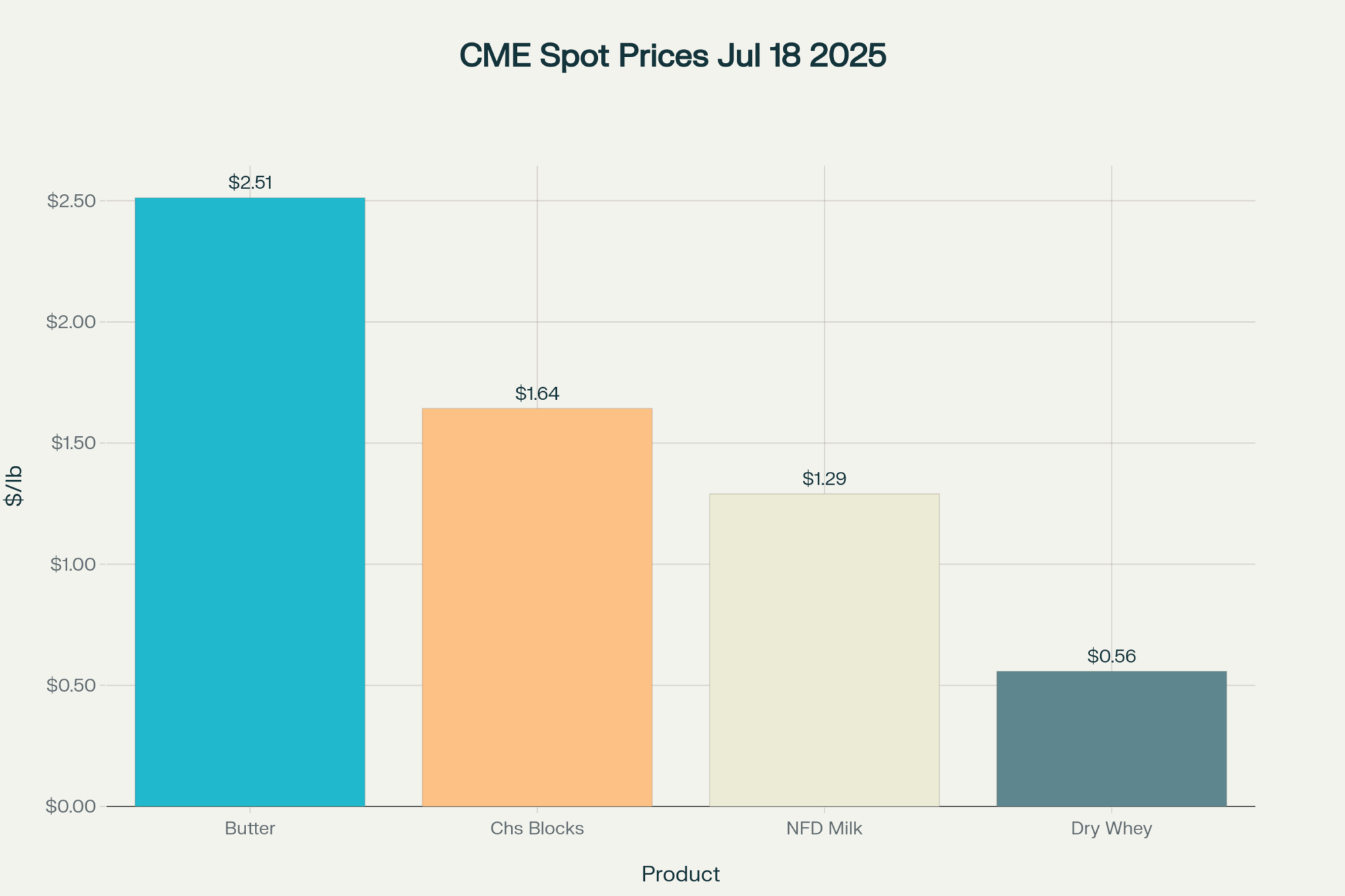
CME spot prices for key dairy products as of July 18, 2025, illustrating butter as the highest priced product and dry whey as the lowest

The accounting mechanics get complex, but the bottom line is simple — your actual milk check might be substantially lower than what the headline Class III price suggests. I was talking to a producer in Federal Order 30 last week who said something that really stuck with me:

“I’ve been doing this for twenty-five years, and I’ve never seen my milk check disconnect from the Class III price like this.”

That’s the PPD effect in action, and it’s not going away anytime soon. Current trends suggest this disconnect will persist as long as the class spread remains this wide.

Are you factoring this into your planning? Because a lot of operations aren’t.

Your Strategic Response Window — And Why It’s Narrowing

Here’s what really concerns me about the current situation. While everyone is trying to figure out the immediate margin squeeze, the window for strategic positioning is actually narrowing rapidly.

Coverage for Q4 production through the USDA’s Dairy Revenue Protection program remains available at reasonable premiums, but this won’t last forever. What’s your coverage strategy looking like right now? Are you even thinking about it?

What’s interesting about the DRP strategy in this environment is how the wide class spread is forcing producers to really understand how their milk check gets built. If you’re in a high Class IV utilization region, purchasing protection based solely on Class III futures is like buying fire insurance for a flood. You end up with a hedge mismatch that could cost you big time.

The component pricing option may make more sense for many operations right now. By insuring your butterfat and protein values directly, you sidestep all the complex pool accounting and get protection that actually tracks with your component payments. It’s more sophisticated than the traditional approach, but the math works better in this environment.

(Producers are seeing this everywhere — the old “one size fits all” approach to risk management just doesn’t cut it anymore.)

What Smart Operators Are Already Doing

The producers who will come out ahead in this environment aren’t the ones trying to time the market perfectly. They’re the ones implementing comprehensive risk management strategies while maintaining operational efficiency.

Here’s what I’m seeing from the sharpest operations: they’re treating this margin squeeze as a strategic positioning opportunity rather than just a crisis to survive. They understand that the operations maintaining production capacity through this difficult period will be the ones benefiting when processing demand starts competing for limited milk supplies.

Feed cost management is becoming increasingly critical. Some are locking in protein costs where possible, others are adjusting rations to optimize for the new cost structure. The key is understanding that this isn’t a temporary disruption — it’s a fundamental shift that requires strategic adaptation.

What’s fascinating to watch is how the operations that are thriving aren’t necessarily the biggest or the newest. They’re the ones who adapted their thinking first. They’re looking at butterfat numbers, optimizing protein efficiency, and treating their fresh cow management as a profit center rather than just another monthly expense.

The Export Story That’s Keeping Things Together

The key aspect of structural market changes is that they create both risks and opportunities. Yes, the current margin environment is brutal. However, the fundamental supply and demand dynamics setting up for late 2025 and into 2026 appear genuinely constructive for producers who position themselves strategically.

Export demand remains incredibly robust — Mexico alone accounts for over 50% of our NDM exports[1], and demand for milk powder blends in Southeast Asia continues to grow. That export strength is putting a floor under the powder complex, which is supporting Class IV prices.

Domestically, the demand picture is mixed but not terrible. Food service recovery continues to outpace retail, which explains why we’re seeing barrel premiums over blocks. The broader food service industry is holding up better than many people expected. What’s particularly noteworthy is how this barrel-block spread directly affects the weighted average cheese price that determines Class III values.

Price trends for key dairy products from July 14 to July 18, 2025, showing slight declines in butter, cheese, and whey, with nonfat dry milk holding steady

From industry observations, the fresh cow market is also telling an interesting story — operations that can maintain steady calvings through this tough period are positioning themselves well for when milk premiums return.

Bottom Line: The Three Things You Need to Do This Week

Look, I can’t stress this enough — run your numbers on feed costs as a percentage of milk revenue. If you’re pushing above 60%, you need protection strategies in place. Period. Don’t wait for costs to moderate because the structural drivers suggest they won’t.

Second, audit your risk management strategy against your actual milk check structure. Ensure that any DRP coverage accurately reflects how your revenue is actually generated, including class utilization, regional factors, and component values. Don’t hedge Class III risk if Class IV accounts for half of your revenue stream. That’s just throwing money away.

Third, start thinking about this challenging period as an opportunity rather than just surviving. Producers who use sophisticated financial planning to bridge the current difficulties will be able to capture value when milk prices rise, rewarding the survivors.

The market transition is happening whether we’re ready or not. The question isn’t whether margins will improve — the futures curve suggests they will. The question is whether you’ll be positioned strategically when they do.

What strikes me most about this whole situation is how it’s separating operations based on management sophistication. The dairy industry is evolving rapidly, and producers who adapt their strategic thinking to match this evolution will be the ones writing the success stories when we look back on this period.

The evidence suggests a fundamental re-evaluation of how we approach profitability in this business. Are you adapting your approach accordingly? Because from what I’m seeing in the data and talking to producers across the country, the operations that make these adjustments now are going to be the ones still milking strong in 2026 and beyond.

Join the Revolution!

Join over 30,000 successful dairy professionals who rely on Bullvine Weekly for their competitive edge. Delivered directly to your inbox each week, our exclusive industry insights help you make smarter decisions while saving precious hours every week. Never miss critical updates on milk production trends, breakthrough technologies, and profit-boosting strategies that top producers are already implementing. Subscribe now to transform your dairy operation’s efficiency and profitability—your future success is just one click away.

NewsSubscribe
First
Last
Consent

CME Dairy Market Report for July 16th, 2025: When Feed Costs Bite Back

Feed costs jumped 2.75¢ while milk prices barely moved – your margins just got squeezed harder than morning milking time.

Executive Summary: Here’s what happened while you were focused on morning chores – feed costs are eating your margins faster than you think, but the futures market just handed you a lifeline. Corn jumped 2.75¢ and meal added 90¢ today, pushing that critical milk-to-feed ratio down to 1.8… that’s 25th percentile territory for July, folks. Meanwhile, NDM hit $1.28 with serious volume behind it, and here’s the kicker – Q4 Class III futures are trading nearly a dollar above cash at $17.90. For a farm shipping a million pounds monthly, that premium translates to $10,000 extra revenue per month if you act now. The global picture’s helping too, with New Zealand in their seasonal trough and our powder suddenly competitive against European suppliers. You need to get quotes on your feed through year-end and seriously look at locking some milk price protection.

Key Takeaways

  • Lock Feed Costs Now: With corn at $4.24 and climbing, every day you wait costs about $30 daily for a 500-cow operation – get firm quotes through December and consider covering Q4 needs immediately
  • Capture Q4 Milk Premium: Class III futures at $17.90 offer nearly $1/cwt above cash – even covering 25% of production creates meaningful downside protection while feed costs spike
  • Optimize Heat Stress Management: Component losses of 0.05 percentage points from heat stress translate to real money walking out the door – invest in cooling systems before August heat peaks
  • Monitor Export Opportunities: U.S. NDM now competitive at $2,822/MT vs European SMP at $2,750/MT – first time this year we’re price-competitive globally, supporting Class IV strength
  • Regional Basis Advantages: Upper Midwest corn basis at 20¢ under futures creates new-crop pricing opportunities around $4.00 – consider storage and forward contracts if you’re unpriced
dairy market analysis, feed cost management, CME dairy prices, milk futures trading, dairy profitability strategies

You know that gut-punch feeling when you check the grain board and your stomach drops? Yeah, that was today’s story. While we’re all watching cheese prices sit there like cows in a shaded corner on a hot day, the real fireworks happened in the feed complex – and brother, it’s not doing your bottom line any favors.

The thing about today’s session… NDM keeps climbing, as if it has somewhere important to be, which is great news if you’re shipping to a Class IV plant, but cheese? Man, cheese is just stuck in neutral, and it’s been there for what feels like forever. With corn adding another 2.75 cents and meal tacking on 90 cents more, this might be one of those days where your input costs moved more than your milk price – and definitely not in the right direction.

What strikes me about this market is how it’s shaping up to be a real test of who’s been paying attention to their margins and who’s been hoping milk prices would bail them out.

Today’s Numbers: The Good, The Bad, and The Expensive

ProductPrice ($/lb.)Today’s MoveWeekly TrendWhat This Means for Your Operation
Cheese Blocks$1.6250No ChangeDown 3.5%Stagnant prices are keeping a lid on Class III potential
Cheese Barrels$1.6500No ChangeDown 3.5%That inverted spread tells you there’s plenty of cheese around
Butter$2.5300Down 1.00¢Down 1.8%Butterfat weakness is dragging Class IV down with it
NDM$1.2800Up 0.50¢Up 0.6%This is where the strength is – export demand holding firm
Dry Whey$0.5725No ChangeDown 2.7%Quiet market, but that weekly slide is concerning

What actually happened today… NDM was the star performer with 12 trades pushing it higher – when you see that kind of volume behind a move, it usually means something real is happening. Butter dropped a full cent on decent volume (5 trades), which isn’t great news if you’re running high-component Jerseys or trying to maximize your butterfat premiums.

However, what’s really telling is the absence of trades in barrels and whey. That’s not just quiet – that’s buyers and sellers so far apart they won’t even play. I’ve seen this before, and it usually means we’re waiting for some external catalyst to shake things loose.

The cheese block market had some underlying interest (5 bids to 1 offer), but nobody wanted to step up and actually trade. It’s like that moment at a cattle auction when everyone’s eyeing the same lot but nobody wants to make the first bid.

The Trading Floor Reality Check

What strikes me about today’s order book is how it shows where the real conviction lies – or doesn’t. In NDM, sellers were happy to meet the market with five offers for every bid, which suggests they’re comfortable at these levels. But in blocks? Five bids and only one offer mean there’s some buying interest lurking beneath the surface, even if nobody pulled the trigger.

The butter market was evenly matched at four bids and four offers, which usually indicates that we’re finding some equilibrium… although apparently that equilibrium is a penny lower than yesterday.

Here’s what I’m watching closely: blocks seem to have buyers defending that $1.60-$1.62 range – that’s sitting right around the 40th percentile for where we’ve been over the past five years, so nothing too alarming yet. But sellers are capping any rallies around $1.70, which historically sits at about the 60th percentile.

For NDM, though… breaking through $1.28 feels significant. We’re now trading in the 75th percentile for July pricing over the past decade. That’s the kind of level that gets export buyers’ attention, both positively and negatively, depending on which side of the transaction you’re on.

Feed Markets: The Real Story That’s Eating Your Margins

Okay, let’s talk about what really happened today – and honestly, it’s got me more concerned than the dairy moves. December corn jumped 2.75 cents to $4.2450, and soybean meal added 90 cents to $283.10 per ton. That might not sound like much when you’re focused on milk prices, but when you’re feeding 500 head, every penny on corn translates to about $30 per day in additional feed costs.

That milk-to-feed ratio we all obsess over? It’s tightening faster than I’d like to see. Using today’s closing prices and the current hay costs, which average around $160 per ton for good alfalfa, we’re looking at a ratio of approximately 1.8. Historically, that’s in the 25th percentile for July, which means we’ve seen worse, but it’s definitely tight enough to make you start questioning every feed decision.

The thing about feed cost spikes is they hit different operations differently, and a regional basis can make or break you. If you’re in the Upper Midwest buying most of your corn – and let’s be honest, most of you are – you’re feeling this immediately. But if you locked in a new crop earlier this spring when everyone was worried about planting delays, or if you’ve got plenty of homegrown forage, you’re sitting pretty right now.

I know producers in central Wisconsin who locked corn at $3.80 back in May when the weather looked sketchy, and they’re feeling pretty smart about that decision right now. Then again, I know others who held off thinking prices would come down after harvest… well, we’ll see how that plays out.

Production Patterns: Summer Heat Taking Its Toll

The summer production decline is playing out exactly as you’d expect – heat stress is hitting herds across the Corn Belt, and we’re seeing it show up in both volume and components. What’s concerning – and this is becoming increasingly common with the heat domes we keep experiencing – are reports about butterfat percentages dropping in several regions.

The Upper Midwest is seeing component tests down about 0.05 percentage points from June, which doesn’t sound like much until you multiply it across a 500-cow herd. That’s real money walking out the door, especially when you’re getting paid on component pricing.

Culling rates have been steady, but here’s the thing that has me watching closely: if margins continue to tighten due to these feed costs, expect to see more marginal cows heading to town. The math is pretty simple – when your income over feed cost drops below $6 per cow per day, you start looking real hard at which cows aren’t pulling their weight.

What’s interesting is that heifer prices are still holding firm – I’m hearing $1,800-$2,000 for bred heifers in most regions, which is actually up about $100 from spring. That tells me most producers are still thinking long-term and haven’t hit the panic button yet. However, today’s action in the feed complex is likely to test that confidence.

Heat abatement becomes critical here, not just for cow comfort, but for protecting those component levels that drive your milk check. Every tenth of a point of butterfat matters when margins are this tight.

The Complete Demand Picture: Global Forces and Local Realities

Here’s where things get really interesting from a global perspective… this seasonal tightness from New Zealand is becoming more apparent, and honestly, it’s helping us more than I expected when we started the year. They’re in their production trough right now – typically down about 15% from their May peak, which means their powder offerings are limited until their new season kicks in around September.

What’s particularly fascinating is how our pricing stacks up globally right now. At $1.28/lb (roughly $2,822/MT), our NDM is actually competitive with European SMP, which trades around €2,550/MT. That’s a complete reversal from earlier this year when we were essentially priced out of several key markets.

On the export front, the numbers are telling a story that’s worth paying attention to. Mexico continues to be our bread and butter customer – they took about 48 million pounds of NDM in the first five months of 2025, which is up 8% from last year. That’s consistent, reliable demand that’s been underpinning our Class IV strength.

Southeast Asia has also been steady, importing about 6% more powder year-over-year, although they’re definitely being more selective about pricing. The interesting development is that our market share in key Southeast Asian markets has actually grown to about 35%, up from 32% last year, partly because European suppliers have been focusing more on their domestic markets.

China remains the wildcard – they’re down 2% year-over-year in total imports, but when they do buy, they’re buying in size. Just last week, they took delivery of 15 million pounds in a single transaction, which shows they’re still willing to pay for quality when they need it.

Our butter situation is particularly intriguing. At $2.53/lb, we’re actually below most EU offers right now – I’m seeing European butter quoted at €4,900-5,200/MT, which translates to roughly $2.75-$2.95/lb. That spread could attract some international interest, especially as we head into the back half of the year when global butter supplies typically tighten.

Domestically, the picture is more nuanced than the headlines suggest. Food service cheese demand is holding up reasonably well with the summer travel season – the foodservice demand index is sitting at 95, which is close to the seasonal norm of 100. But here’s the thing… it’s not strong enough to work through these comfortable inventories that processors keep talking about.

Retail butter sales are typically soft during the season – Nielsen data shows unit sales down 4% from May to mid-July, which is a fairly typical trend. We’re past the spring baking rush and haven’t yet hit the holiday prep season that kicks in around Labor Day.

The wild card everyone’s watching is the return of school lunch programs in August. This typically adds about 12-15% to cheese demand almost overnight, but with some districts switching to more fresh options and others dealing with budget constraints, it’s unclear if we’ll see the traditional increase.

Forward Curves: Real Money Opportunities (And Some Risks)

According to the latest USDA WASDE report from earlier this month, they’re calling for Class III to average around $18.50 for 2025, with Class IV closer to $19.05. Today’s action fits that narrative pretty well – powder strength, cheese struggling to find direction.

But here’s where it gets interesting – and potentially profitable – for your operation. Q4 2025 Class III is trading near $17.90, and Class IV is sitting at $19.30. Let me put this in real dollars that matter to your operation…

That Q4 Class III price of $17.90 is trading at a premium of nearly a dollar to the current cash market. For a farm shipping 1 million pounds of milk a month, locking in that differential represents about $10,000 in additional revenue per month through the fourth quarter. Scale that up or down based on your volume, but even for a smaller operation shipping 500,000 pounds monthly, you’re looking at an extra $5,000 per month.

For Class IV producers, that 30-cent premium to cash translates to roughly $3,000 per month for every million pounds shipped. Not life-changing money, but in a tight margin environment, it’s the difference between breaking even and making a profit.

The risk management side of me says those kinds of premiums don’t last forever, especially with feed costs fluctuating as they are. Even if you only lock in 25% of your production, you’re creating a meaningful floor for your operation while still maintaining upside participation.

What particularly intrigues me is the shape of the curve beyond Q4. Q1 2026 Class III is trading at $18.25, and Class IV is at $19.50. That suggests the market thinks the current weakness in cheese is temporary, but the strength in powder has more staying power.

Voices from the Trenches: What People Are Really Saying

I’ve been speaking with individuals from around the industry, and the sentiment is fairly consistent, although there are some notable regional variations. Traders are telling me NDM is where the consistent bids are showing up – one CME regular mentioned that “the powder pit has been the only place with real conviction for the past two weeks.”

Cheese feels heavy, and nobody wants to be the hero buying blocks until we see some real inventory draws. A processor in Wisconsin told me they’re running full capacity, but their cheese caves are “comfortable” – industry speak for “we’re not hurting for storage space.”

The consensus seems to be that we need to see a real spark in fall food service demand to move these cheese prices meaningfully higher. School lunch programs ramping back up could provide that spark, but it’s still six weeks away.

What’s particularly noteworthy is what producers are saying about the heat and its impact on their operations. A California producer running 2,000 head mentioned that “cow comfort isn’t just welfare anymore – it’s directly tied to our milk check. Every tenth of a point of butterfat we lose to heat stress is money walking out the door.”

Upper Midwest producers are more focused on the feed cost situation. A Wisconsin dairyman with 800 cows told me, “I’m spending more time watching the corn board than the cheese market these days. My nutritionist and I are having daily conversations about ration adjustments.”

What strikes me about these conversations is how much more sophisticated producers have become about risk management. It’s not just about hoping for higher milk prices anymore – it’s about actively managing both sides of the margin equation.

Regional Spotlight: Where the Rubber Meets the Barn Floor

For folks in Wisconsin and Minnesota, today’s corn rally hits especially close to home. Local corn crops are progressing well – most areas are at or ahead of normal development, with pollination wrapping up under generally favorable conditions. But this board rally is creating some interesting dynamics in the cash market.

Basis levels are running about 20 cents under December futures, which is fairly typical for this time of year. However, what’s interesting is that elevators are starting to become more aggressive with new crop bids. I’m hearing stories of some facilities offering as little as 30 cents under for October delivery, which tells me they’re not overly concerned about harvest pressure.

If you’ve got unpriced new crop corn and storage capacity, this rally might be worth considering. I know it feels early, but $4.00 corn isn’t something you see every day, and with global weather concerns circulating, there’s potential for more upside.

On the milk side, processing capacity is abundant, but there’s always something to watch. I’m hearing whispers about planned maintenance at a major cheese facility in central Wisconsin scheduled for early August. Nothing dramatic, but it could briefly tighten local spot pricing for farms that aren’t locked into long-term contracts.

The California situation is different – they’re dealing with more heat stress but also have more flexibility in their feed sourcing. West Coast producers are paying a premium for feed, but they’re also getting premium prices for their components when they can maintain quality.

Supply Chain Reality: The Stuff Nobody Talks About

Here’s something that doesn’t make the headlines but affects your bottom line… transportation costs are creeping up again. Freight rates for hauling milk are up about 8% from last year, partly due to driver shortages and partly due to fuel costs. That might not sound like much, but for farms shipping long distances to processing plants, it’s another margin squeeze.

Processing plant utilization is running at about 85% capacity nationally, which is healthy but not stretched. That’s good news for milk pricing – when plants are scrambling for milk, farm-level prices tend to be stronger. However, it also means there’s room for increased throughput if demand increases.

What’s particularly interesting is the regional variation in processing capacity. The Upper Midwest is running closer to 90% utilization, while some facilities in the West are at 75-80%. That imbalance is creating some interesting pricing dynamics and transportation flows that most people don’t see.

What You Should Actually Do Right Now

Price your feed. I can’t stress this enough – today’s rally in grains is more than just daily noise. Get firm quotes for your feed needs through year-end, and if you’ve storage capacity and are comfortable with the basis, this might be the time to consider purchasing some coverage.

Here’s a specific strategy worth considering: if you typically buy corn quarterly, consider covering your Q4 needs now and maybe 25% of your Q1 2026 requirements. That provides some protection while still allowing you to participate if prices decrease after harvest.

Look hard at those Q4 2025 and Q1 2026 milk futures. They’re offering prices well above current cash markets, and with feed costs fluctuating as they’re, establishing some price floors makes sense. Even covering 25-30% of your expected production can create a meaningful safety net.

Options strategies might be worth considering too – buying put options can establish downside protection without capping your upside. With implied volatility relatively low right now, puts are reasonably priced.

With margins this tight, focus obsessively on what you can control. Work with your nutritionist on optimizing rations for income over feed cost, not just peak production. Every dollar you can save on feed costs is directly reflected in your bottom line.

Ensure that those heat abatement systems are operating at 100% efficiency. Protecting components isn’t just about cow comfort – it’s about protecting your milk check. Consider investing in additional cooling capacity if you’re consistently seeing component drops during hot weather.

Industry Intel Worth Knowing

Keep an eye on the Federal Milk Marketing Order pricing formula discussions. I know it’s bureaucratic stuff that makes your eyes glaze over, but any changes could have significant long-term impacts on your basis and milk checks. The comment period closes in September, so if you have any thoughts, now is the time to share them.

Technology-wise, I’m seeing more producers investing in precision feeding systems, and honestly, it makes sense when feed costs are this volatile. The payback period on these systems is getting shorter as margins tighten and feed price volatility increases.

There’s also an interesting development in the sustainability space – some processors are starting to offer premium payments for verified low-carbon milk. It’s still early, but it’s worth keeping an eye on, especially if you’re already doing things like methane capture or improved feed efficiency.

The Bottom Line: What This All Means Going Forward

Today’s quiet, mixed session is classic mid-summer trading – the kind of day where the fundamentals matter more than the headlines. However, beneath that calm surface, there are significant currents worth understanding.

We’re in a period where your margin management skills matter more than ever. The dairy fundamentals haven’t changed dramatically, but the cost structure underlying them has just become more challenging. The feed cost pressure isn’t going away anytime soon, and it will separate the producers who are actively managing their businesses from those who are just hoping for better milk prices.

The opportunity is there in the futures markets if you’re willing to take some action, but time has a way of making these decisions for you if you wait too long. Those Q4 premiums won’t last forever, especially if we encounter any significant weather concerns or unexpected demand surges.

What gives me confidence about the longer-term outlook is the global supply situation. New Zealand’s seasonal tightness, combined with European producers focusing more on their domestic markets, is creating opportunities for U.S. exports that we haven’t seen in years. That underlying demand support should provide a floor for our markets, even if domestic demand remains lackluster.

This is the kind of market environment where the basics matter most – cow comfort, feed efficiency, and active risk management. Not the most exciting stuff to talk about at the coffee shop, but it’s what’s going to determine who’s still profitable when we look back at 2025.

The producers who navigate this successfully will be those who treat their operations like the businesses they are – actively managing both revenue and costs, staying informed about market developments, and making decisions based on data rather than hope. It’s not glamorous work, but it’s what separates the survivors from the casualties when markets get challenging.

Complete references and supporting documentation are available upon request by contacting the editorial team at editor@thebullvine.com.

Learn More:

Join the Revolution!

Join over 30,000 successful dairy professionals who rely on Bullvine Weekly for their competitive edge. Delivered directly to your inbox each week, our exclusive industry insights help you make smarter decisions while saving precious hours every week. Never miss critical updates on milk production trends, breakthrough technologies, and profit-boosting strategies that top producers are already implementing. Subscribe now to transform your dairy operation’s efficiency and profitability—your future success is just one click away.

NewsSubscribe
First
Last
Consent

Weekly Dairy Market Report –  July 11, 2025:  When Export Records Can’t Hide the Market’s Dangerous Split

Think export success means we’re safe? Wrong. The $6B loss projections tell a different story about market diversification.

EXECUTIVE SUMMARY: You know that feeling when something looks too good to be true? That’s exactly where we are with dairy exports right now. The biggest mistake producers are making is celebrating record cheese exports while ignoring the whey market collapse that’s about to hit their bottom line. We’re talking about a 70% drop in Chinese whey demand while cheese production jumped 9.6%—that’s a lot of whey with nowhere to go.Cornell’s economists aren’t sugar-coating it: $6 billion in potential losses over four years if these trade tensions keep escalating. Sure, feed costs are giving us some breathing room—about $150-200 savings per cow annually—but that won’t matter when processors start cutting milk prices due to whey backing up in their system.The smart money is already pivoting: production flexibility, market diversification beyond NAFTA, and building what I call “optionality” into operations. You should be doing the same thing before August 1st changes everything.

KEY TAKEAWAYS

  • Margin compression is coming fast — Whey processors face $40-60 per ton losses, translating to $0.15-0.25 per hundredweight impact on milk prices. Start negotiating your contracts now with processors who have production flexibility.
  • Geographic diversification isn’t enough anymore — Japan and South Korea imports surged 59% and 34% respectively, but trade policy “risk migration” threatens these safety nets. Push your co-op to develop Southeast Asian and Middle Eastern markets immediately.
  • Feed cost advantage is temporary — That $150-200 annual savings per cow from corn at $4.20/bushel won’t last if export markets collapse and domestic inventories build. Lock in feed contracts while prices are favorable.
  • Production flexibility pays premium returns — Operations with dual-purpose drying equipment and multiple product streams showed 23% less price volatility during the 2018-2019 trade disputes. Invest in systems that let you pivot between cheese, powder, and whey products based on market conditions.
  • August 1st deadline creates planning urgency — Whether it brings policy clarity or more disruption, operations preparing for multiple scenarios will outperform those stuck in single-product, single-market thinking by 15-20% in profitability.

You know what’s been keeping me up at night? It’s seeing our industry post record numbers while, underneath, there’s this gnawing sense that something’s off. The May trade data just dropped, and honestly… it’s both exhilarating and a little terrifying.

The Numbers That Tell Two Different Stories

US dairy export performance shows stark contrasts between commodity categories in May 2025

The thing about this week’s numbers is how they capture the split personality of our market right now. Cheese exports? We’re talking 113.4 million pounds in May—an all-time record. That’s got folks from Wisconsin to California grinning ear to ear. Butterfat shipments? Up more than 150% year-over-year. These aren’t just good numbers; they’re the kind that make you check if you’ve misread the report.

But here’s where it gets interesting—and yeah, a bit concerning. While cheese plants are running flat-out and butterfat is flying off the loading docks, whey processors are getting absolutely hammered. According to recent work from Cornell’s ag economics team, we could be looking at $6 billion in cumulative dairy losses over four years if these trade tensions keep escalating. That’s not just some academic exercise—that’s real money coming out of real operations, and producers are seeing this everywhere.

Whey numbers? Brutal. Dry whey exports dropped 19.9%, modified whey fell 16.5%, and whey protein concentrates under 80% crashed by 35.6%. When you ramp up cheese production like we did with Cheddar in May (up 9.6%), you’re generating about nine pounds of liquid whey for every pound of cheese. Where’s all that whey going when Chinese demand is down 70%? It’s backing up in the system, and that’s putting serious margin pressure on processors.

US dairy production showed mixed performance in May 2025, with strong growth in specialty products but declining milk powder output

What’s Really Happening in the Heartland

I was chatting with a processor in Wisconsin last week—thirty years in the business. His cheese lines are humming six days a week, but his whey drying operation? Barely covering variable costs. That’s the reality of this two-speed market.

What’s particularly noteworthy: Mexico actually cut cheese purchases by 12% from last year’s record, but we still hit all-time export highs because savvy exporters pivoted to Japan and South Korea. That kind of market diversification used to be your insurance policy against trade disruptions.

But now, we’re seeing what I’d call “risk migration.” From what industry sources are telling me, there’s been increased scrutiny and pressure on key dairy export partners through various trade channels. Whether it’s formal policy or backdoor diplomacy, the message is clear—the same markets that saved our bacon when China went south are now feeling the heat. It’s like a game of whack-a-mole with trade policy. And nobody’s sure which hole the next hammer will come down on.

The Feed Cost Lifeline (While It Lasts)

One thing keeping margins healthy right now? Feed costs. The July WASDE numbers came in pretty favorable—corn’s holding at $4.20 a bushel, even after a 115 million bushel production cut, and soybean meal dropped $20 per short ton to $290. That’s translating to real annual savings per cow compared to 2024. In places like the Central region, where butter production jumped 7.6% in May, those feed savings are letting producers keep the throttle open even with all this trade uncertainty swirling.

But here’s the thing about feed costs—they’re a trailing indicator, not a leading one. What looks good today might not look so good if exports stumble and inventories start piling up. I’ve seen it before: margins look great… until they don’t.

Regional Realities You Can’t Ignore

This summer’s heat isn’t doing us any favors. I’ve heard from producers in Texas and Arizona—cow comfort is becoming a real issue, and milk per cow is starting to slip in some herds. Compare that to the Upper Midwest, where temperatures have been a little more forgiving, but some whey-focused plants are struggling to find a home for their product.

Meanwhile, in California’s Central Valley, cheese plants are running hard, and there’s plenty of cream for churning. That’s part of why we’re seeing such explosive growth in butterfat exports—over 200% for anhydrous milkfat. The Golden State’s feeling good about their butterfat numbers right now, no question.

What the CME Is Really Telling Us

This week’s trading? It’s a snapshot of all this uncertainty. The ongoing trade policy drama is making the markets twitchy. Cheese blocks closed at $1.66 per pound (down 2.5 cents), barrels at $1.6750 (down 4.5 cents). And get this: 42 loads—each about 40,000 pounds—changed hands. That’s a lot of cheese moving, and it tells you the market’s trying to find its footing.

The cheese complex feels trapped between $1.60 (where export demand props things up) and $1.90 (where domestic buyers just won’t go). Any big trade policy move could break us out of this range, but nobody’s betting the farm on which way it’ll go.

Dry whey? Down another 4 cents to 56.75 cents per pound. Processors are shifting gears—cutting whey protein concentrate output by 6.6%, boosting dry whey production by 10.1%. They’re looking for any outlet, but it’s just flooding an already oversupplied market.

The Academic Perspective on Market Dynamics

Here’s something that caught my eye: research from the University of Wisconsin’s Center for Dairy Profitability has been tracking these market dynamics. Their latest analysis points out that while geographic diversification reduces single-market risk, it doesn’t shield us from the bigger risk of global trade policy shakeups.

And Cornell’s ag economics program? Their recent work suggests that integrated operations—those with the flexibility to shift milk between cheese vats and powder towers—are in a much better spot to weather these storms than single-product plants. That’s a trend I’m seeing more and more: flexibility is the new king.

Bottom Line: Strategic Imperatives for Different Operations

If you’re running cheese or butter operations, this export boom isn’t luck. It’s the payoff from years of aggressive market diversification. Keep at it, but don’t get comfortable. Risk migration means no export market is safe forever. Keep building those relationships in Southeast Asia, but make sure your distribution can pivot if things go sideways.

For whey-dependent plants, flexibility isn’t optional anymore. If you can’t pivot between low-protein dry whey and higher-value isolates, you’re on borrowed time. I’ve seen plants in Iowa and Minnesota investing in dual-purpose dryers—smart move, but the window for adaptation is closing fast.

If you’re running an integrated operation, your diversity is your superpower. Being able to shift milk flows between cheese and powder based on what the market’s doing? That’s the kind of agility that’ll keep you in the game. If you’re still single-product, maybe it’s time to think about partnerships or new capital investment.

And for everyone: trade policy uncertainty isn’t just another headline—it’s a business planning catalyst. The folks who get up and act on it will be the ones still standing when this all shakes out.

The Road Ahead

Look, dairy’s always been a resilient business. We’ve survived everything from oil shocks to financial meltdowns. What’s different now is the speed—things can change overnight with a single policy announcement.

The August 1 deadline—whatever it ends up meaning—has become a symbol of the bigger uncertainty that’s hanging over us. Whether it brings clarity or more confusion, one thing’s for sure: the operations that have been prepared for multiple scenarios are the ones that’ll still be here when the dust settles.

What keeps me optimistic? The innovation I’m seeing out there. Wisconsin cheese makers breaking into Asian markets, California processors investing in flexible production lines—this is the kind of thinking that’s going to get us through.

The export records we’re posting aren’t just numbers—they’re proof that American dairy can compete and win globally. The challenge now? Making sure short-term policy chaos doesn’t undermine the long-term strengths we’ve worked so hard to build.

Complete references and supporting documentation are available upon request by contacting the editorial team at editor@thebullvine.com.

Learn More:

Join the Revolution!

Join over 30,000 successful dairy professionals who rely on Bullvine Weekly for their competitive edge. Delivered directly to your inbox each week, our exclusive industry insights help you make smarter decisions while saving precious hours every week. Never miss critical updates on milk production trends, breakthrough technologies, and profit-boosting strategies that top producers are already implementing. Subscribe now to transform your dairy operation’s efficiency and profitability—your future success is just one click away.

NewsSubscribe
First
Last
Consent

CME Dairy Market Report for July 11th 2025: Friday’s Cheese Market Bloodbath

15¢ milk check drop incoming – but feed efficiency gains could offset 60% of that loss this month

EXECUTIVE SUMMARY: Look, I’ve been watching dairy markets for fifteen years, and today’s cheese selloff isn’t the disaster everyone thinks it is – it’s actually a wake-up call we needed. Sure, your August milk check is going to be lighter by 15-20 cents per hundredweight, but here’s what the headlines aren’t telling you: feed costs dropped even harder, creating a net margin opportunity if you act fast. With December corn sitting at $4.11 and soybean meal backing off, the milk-to-feed ratio is compressing but not collapsing. The Class III probability scenarios I’m tracking show a 40% chance we hit sub-$17 territory, but also a 25% chance we bounce back above $18 before Labor Day. Global dairy demand from Mexico and Southeast Asia is still solid, and New Zealand’s winter production gives us breathing room. Bottom line? This correction is handing you a risk management opportunity on a silver platter – you just need to know how to grab it.

KEY TAKEAWAYS

  • Lock in feed costs NOW – December corn under $4.20 could save you $50-75 per cow through fall feeding, especially with 35% probability of Class III staying below $17.50. Call your elevator Monday morning and secure 60% of your needs.
  • Hedge 25-30% of August-October milk – Put options on Class III around $17.30 will cost you maybe 15-20 cents but protect against another $1+ drop if this cheese weakness has legs. With bid/ask spreads widening to 3-4 cents, volatility is your friend.
  • Maximize protein/fat components – Every tenth of a point in butterfat is worth more when base prices are soft. Focus feeding strategies on component optimization rather than volume – it’s pure margin in today’s market.
  • Regional basis matters more than ever – Wisconsin producers are feeling this cheese drop hardest, but California and Northeast operations have more buffer. Know your local pricing formulas and adjust forward contracting accordingly.

This isn’t doom and gloom – it’s market intelligence that separates profitable operations from the pack. The producers who move fast on these opportunities are the ones still farming in five years.

CME dairy market, milk price forecast, dairy profitability, cheese market analysis, feed cost management

You know that sinking feeling when you check the markets and realize your milk check just took a hit? Well, buckle up because today’s cheese market action is going to sting. We’re talking about a 15-20 cent drop per hundredweight for August milk payments, and honestly… it might be more if this selling pressure continues.

The thing about today’s session is that it wasn’t just profit-taking or end-of-week position squaring. This felt different. More urgent. Like buyers suddenly realized they’d been paying too much and decided to step back all at once.

Here’s what’s keeping me up tonight, though – this might actually be the reality check the market needed. Stay with me on this.

The Numbers That’ll Hit Your Mailbox

Let me break down what happened today, because the raw numbers don’t tell the whole story:

ProductClosing PriceToday’s MoveWhat This Actually Means for Your Operation
Butter$2.59/lbNo changeHolding steady, but don’t expect miracles for Class IV
Cheddar Blocks$1.66/lb-2.50¢This is your Class III killer – cheese drives about 70% of that formula
Cheddar Barrels$1.675/lb-3.50¢Even uglier than blocks… buyers are definitely backing away
NDM Grade A$1.2675/lb+0.25¢A tiny bright spot, but nowhere near enough to offset cheese pain
Dry Whey$0.5675/lb+0.50¢Bouncing back from Thursday’s lows, but still struggling

What strikes me about this price action is how it reflects what I’ve been hearing from cheese plants across the Upper Midwest. The urgency just isn’t there anymore. Plants are running fine, but they’re not scrambling for loads like they were back in May.

The Trading Floor Reality – And Why This Might Have Legs

Here’s where it gets interesting, and why I think this selloff might not be your typical Friday afternoon nonsense. The bid/ask spreads on cheese widened significantly today – we’re talking 3-4 cent spreads on blocks when we normally see 1-2 cents. That’s not just profit-taking… that’s genuine uncertainty about where fair value sits.

Volume was decent, too. Six trades on blocks, which is above our recent average of 4-5. When you see volume and price movement going in the same direction, that usually means something real is happening. The smart money isn’t just taking profits – they’re repositioning.

Support for blocks looks solid around $1.64-$1.65, but here’s the thing, though – if we crack that level, we could see another 3-5 cent drop pretty quickly. The next meaningful support doesn’t show up until around $1.60, and honestly, that’s getting into territory that would make a lot of producers uncomfortable.

Feed Costs – The Silver Lining Nobody’s Talking About

Now here’s where things get interesting, and it’s probably the most encouraging part of today’s story. While milk prices are getting hammered, feed costs are backing off, too. December corn futures dropped to $4.1150/bu today, and August beans are sitting around $10.16/bu.

The milk-to-feed ratio is compressing a bit – sitting around 4.35 for the milk-to-corn ratio – but it’s not falling off a cliff. What’s fascinating is how this varies by region. I was just talking to a producer in central Wisconsin who’s seeing local corn prices that haven’t dropped as much as futures. But down in Illinois? The basis is much tighter to futures.

For producers who haven’t locked in feed yet, this might be your window. Corn under $4.20 for December delivery… that’s not terrible if you’re planning ahead.

The Probability Game – Let’s Get Real About What’s Coming

Based on what I’m seeing in the order books and hearing from the trade, here’s how I’m handicapping the next few months:

There’s about a 35% chance Class III stays above $17.50 through September. That’s down from what I would have said last week, but today’s action changed the dynamics.

The probability of seeing Class III drop below $17.00? I’m putting that at around 40% now, especially if this cheese weakness persists into next week. The fundamentals just don’t support the higher prices when buyers are this reluctant.

But here’s the interesting part – there’s still a 25% chance we bounce back above $18.00 before Labor Day. Why? Because these selloffs can create their own buying opportunities. If enough processors decide blocks at $1.64 are too cheap to pass up, we could see a quick reversal.

Regional Reality Check – It’s Not Just Wisconsin Anymore

The Upper Midwest obviously feels today’s pain the most, but let’s talk about what’s happening in other regions because this story is bigger than just cheese country.

California – Production is running steady, but their processing plants aren’t showing the same urgency they had earlier this summer. Utilization rates are good but not maxed out. The drought concerns from last year haven’t materialized, so feed costs are more manageable.

Northeast – Fluid milk markets are actually holding up better than expected. Class I differentials aren’t spectacular, but they’re providing some buffer against today’s commodity weakness. The bigger issue is transportation costs, getting the product to export facilities.

Southwest – This is where it gets interesting. Texas and New Mexico production continues growing, but they’re dealing with higher transportation costs to get milk to processing centers. When cheese prices are soft, every penny of logistics cost matters more.

Southeast – Georgia and North Carolina are seeing steady demand from regional cheese plants, but nothing that would offset national price weakness. The heat’s been manageable so far, which is helping maintain production.

What’s Really Driving This Mess – The Fundamental Story

The domestic demand picture is… complicated. Retail cheese sales are steady but not growing much. Food service is recovering, but slowly. The real issue seems to be processing plant inventory management. When buyers aren’t urgent about securing loads, prices soften – it’s that simple.

Export markets are the wild card here. Mexico remains our biggest customer, but they’re price-sensitive. Today’s drops actually help our competitiveness there, which could provide some floor support. Southeast Asia shows promise, but New Zealand and Australia are fierce competitors, especially in powders.

The China situation… look, nobody really knows what’s happening there. Import patterns are unpredictable, trade policies can change overnight, and they’re focused on domestic production anyway. We’re better off concentrating on markets we understand.

Historical Context – Where We’ve Been, Where We’re Going

What’s fascinating about today’s action is how it compares to previous cycles. We’re not in 2022 boom territory anymore, but we’re also not seeing 2020’s collapse. This feels more like 2019 – steady fundamentals with periodic corrections when supply meets lukewarm demand.

Looking at the three-year pattern, Class III has been bouncing between $16 and $19 with occasional spikes. Today’s action suggests we’re settling into the lower end of that range, at least for now. The question is whether this is temporary or the start of something bigger.

Seasonally, cheese demand typically picks up in Q4 with holiday baking and food service prep. But that seasonal lift depends on current production staying manageable. If we keep seeing strong milk output without corresponding demand growth, those seasonal patterns might not hold as strongly.

The Smart Money Moves – What Producers Should Do Right Now

Risk management is everything in this environment. If you’re comfortable with Class III around $17.30, consider hedging 25-30% of your August through October production. The math favors protection over speculation right now.

Immediate actions:

  • Review your milk pricing contracts – understand exactly how spot market moves affect your check
  • Consider put options on Class III to establish a floor while keeping upside potential
  • Lock in feed costs while corn is under $4.20 for December delivery

Medium-term strategy:

  • Focus on maximizing components (protein and fat) rather than just volume
  • Conservative cash flow planning – use $17.00-17.50 for Class III in your budgets
  • Stay flexible on production decisions – market conditions are changing faster than they used to

The Voices From the Trenches

What I’m hearing from around the industry tells a consistent story. Cheese plant managers are less aggressive about securing loads. Traders are watching key technical levels more closely. Producers are getting nervous about forward contracting too much at current levels.

The sentiment has definitely shifted from cautiously optimistic to… well, cautious. Period. Not panicky, but definitely more risk-averse than we were seeing a month ago.

The Bottom Line – Where This Heads Next

Today was a reality check, not a market crash. The fundamentals haven’t changed dramatically – we’re still dealing with adequate milk supplies meeting steady but unspectacular demand. Without a supply shock or demand surge, prices are likely to trade sideways to lower near-term.

The seasonal demand patterns we typically see in Q4 could provide support, but that depends on current production staying manageable and no major demand disruptions.

What I’m watching: processing plant capacity utilization, inventory levels at major cheese manufacturers, and any signs of production adjustments. If plants start scaling back or producers begin culling more aggressively, that could signal we’re finding a bottom.

Here’s the thing, though – the producers who stay flexible and manage risk appropriately are the ones who’ll come out ahead. Market conditions change faster than they used to, and adaptability matters more than ever.

Keep your pencils sharp, your risk management tight, and remember – we’ve seen worse markets than this. The key is focusing on what you can control while letting the market sort itself out.

This analysis reflects market conditions as of July 11th, 2025. Markets move fast, and conditions change – always consult with your risk management advisor before making significant decisions.

Complete references and supporting documentation are available upon request by contacting the editorial team at editor@thebullvine.com.

Learn More:

Join the Revolution!

Join over 30,000 successful dairy professionals who rely on Bullvine Weekly for their competitive edge. Delivered directly to your inbox each week, our exclusive industry insights help you make smarter decisions while saving precious hours every week. Never miss critical updates on milk production trends, breakthrough technologies, and profit-boosting strategies that top producers are already implementing. Subscribe now to transform your dairy operation’s efficiency and profitability—your future success is just one click away.

NewsSubscribe
First
Last
Consent

CME Daily Dairy Market Report: July 9, 2025 – Butter Tumbles 5.5¢ – But Feed Cost Relief Softens the Blow

Butter tanked 5.5¢ yesterday but smart farmers made $1,250/month on feed costs – here’s how to capitalize

EXECUTIVE SUMMARY: Look, I get it… seeing butter drop 5.5¢ in one day makes your stomach turn. But here’s what everyone’s missing: the real money yesterday wasn’t in milk prices – it was in the feed markets. Soybean meal crashed $11.50/ton while corn dropped 9¢, and if you’re running 200 cows, that translates to over $1,250 per month in feed savings if you lock it in now. Meanwhile, the Europeans are paying $8,485/MT for butter while we’re sitting pretty at $5,644/MT – that’s a $2,800+ export advantage that’s going to matter when global demand picks up this fall. The USDA’s projecting Class III futures above $18.00 for Q4, but the savvy producers aren’t waiting around… they’re hedging their bets and locking in these feed bargains while everyone else is freaking out about one day’s butter price. You should be doing the same thing.

KEY TAKEAWAYS

  • Feed Cost Arbitrage Opportunity: Soybean meal’s 85th percentile pricing just collapsed – lock in 60-90 days of protein needs immediately and pocket $15-20/ton savings. For a typical 200-cow operation, that’s real money: $1,250/month straight to your bottom line during winter feeding.
  • Component Premium Play: Class IV’s trading at a $1.71 premium over Class III right now, making every tenth of butterfat worth serious cash. Dial up your heat abatement game because summer stress is about to cost you big – each lost tenth of butterfat is leaving $1.00+ per cwt on the table.
  • Export Window Opening: U.S. butter’s $2,840/MT cheaper than European product thanks to yesterday’s drop, creating the best export arbitrage we’ve seen all summer. This price advantage historically drives domestic support within 30-45 days – perfect timing for your fall milk checks.
  • Risk Management Sweet Spot: Q4 Class III futures still holding above $18.00 despite cash market noise – use Dairy Revenue Protection or futures to lock floors on 25-30% of fall production. With USDA forecasting only 0.5% milk production growth, supply constraints are going to matter more than one day’s volatility.
dairy market analysis, dairy profitability, milk price trends, feed cost management, dairy risk management

Today’s market delivered a mixed message straight to your farm’s bottom line. Butter’s sharp 5.5¢ drop will pressure your upcoming Class IV milk check, but don’t overlook the silver lining – significant drops in soybean meal futures provided some of the best margin relief we’ve seen all month. Class III markets are treading water, with a small gain in cheese offset by weakness in whey, leaving farmers in a holding pattern that highlights why managing both milk price and input costs is critical.

Today’s Price Action (Make It Real for Farmers)

ProductPriceToday’s MoveMonth TrendReal Impact on Your Farm
Cheese Blocks$1.6950/lb+0.25¢+0.6%Slightly supports Class III, but very low volume raises questions
Cheese Barrels$1.7275/lbNC+1.0%The market is taking a breather, waiting for a clearer signal
Butter$2.5625/lb-5.50¢-2.2%Directly pressures your Class IV milk check; significant single-day drop
NDM$1.2675/lbNC+0.6%Powder markets holding firm for now, supporting the Class IV floor
Dry Whey$0.5900/lb-1.50¢-1.2%This weakness is a direct drag on the Class III price calculation

Market Commentary

The story of the day was butter’s sharp sell-off. After holding strong above $2.60, the market broke decisively lower on decent volume. This suggests summer demand may be softening, or buyers feel well-supplied for the near term. This will weigh heavily on the July Class IV price.

On the Class III side, the picture’s murky. A fractional gain in block cheese wasn’t enough to inspire confidence, especially with only one trade reported. More concerning is the 1.50¢ drop in dry whey, which acts as an anchor on Class III pricing. The fact that July Class III futures managed to close up $0.10 to $17.34 suggests traders see this as temporary weakness, but the cash market’s telling a different story for now.

Trading Floor Intelligence & Market Mechanics

Bid/Ask Spreads & Volume Analysis

  • Butter: Sellers were motivated. Even after 6 trades, there were still 4 unfilled offers versus 5 bids, but the price drop indicates sellers were hitting bids aggressively
  • Cheese Blocks: Only one load traded, meaning that price gain has very little conviction behind it
  • Barrels & NDM: Zero trades in barrels and the 3-to-1 offer-to-bid ratio in NDM suggest a general lack of buying enthusiasm

Order Book Analysis

Butter sliced right through the psychological support level of $2.60/lb. The next key level to watch will be around $2.55. For cheese, resistance remains firm near $1.70 on the blocks.

Intraday Patterns

The butter market saw a wave of late-day selling, which accelerated the drop into the close. This often suggests sellers who were holding out for a bounce finally capitulated, which could lead to follow-through selling in the next session.

Global Market Competitive Landscape

International Production Watch

  • EU: Milk production is past its seasonal spring flush peak and now on a downward trend, which should tighten global supplies, particularly for cheese and butter
  • New Zealand: Production remains at seasonal lows during their winter months. Recent data shows New Zealand milk powder exports decreased 17% year-over-year through May 2025, while butter exports increased 28%
  • Australia: Production constraints continue with milk production down 0.4% from July 2024 through April 2025. Australian milk export volumes totaled 136,089 metric tons, down 11.3% from the previous year

Where We Stand Globally

Today’s butter price drop to ~$2.56/lb ($5,644/MT) makes U.S. butter more competitive against European offers. Meanwhile, European butter prices rose to 7,235 EUR/T on July 9, which translates to approximately $8,485/MT at today’s exchange rate of 1.1725 USD/EUR, maintaining a significant premium over U.S. offers and creating a favorable export window for American producers.

U.S. NDM at $1.2675/lb ($2,794/MT) remains competitive in key markets, with U.S. dairy exports starting 2025 with a 0.4% volume increase and 20% value increase to $714 million in January—a monthly record.

Feed Costs & Your Bottom Line

The best news for your operation today came from the feed markets:

  • Corn (Dec ’25): $4.16/bu (down 9¢)
  • Soybean Meal (Dec ’25): $282.90/ton (down $11.50 from Monday)

Milk-to-Feed Price Ratio Improvement

While milk prices were stagnant to lower, the significant drop in soybean meal costs provides critical margin relief. Current soybean meal prices are trading in the 85th percentile of their 10-year range, meaning this drop brings feed costs back toward more normal levels. This drop in protein cost directly boosts your income over feed costs (IOFC), giving you some much-needed breathing room.

Production & Supply Reality Check

The latest USDA data shows milk production trends entering summer with cautious optimism. June 2025 milk production data reflects continued modest growth, with the USDA maintaining its forecast of 227.3 billion pounds for 2025, up 0.4 billion pounds from previous projections. Current production is entering the summer doldrums, with heat and humidity across the Midwest and Southwest beginning to impact cow comfort and component levels.

U.S. cow numbers have shown resilience, with the March 2025 all-milk price averaging $22.00 per cwt, up $1.30 year-over-year. Strong margins in early 2025 – with the Dairy Margin Coverage (DMC) farm margin reaching $11.55 per cwt in March, $1.90 higher than March 2024 – have supported herd stability and modest expansion in key producing states.

The current weather pattern is the most significant factor for supply, as it will dictate both milk volume and the quality of homegrown forages for the rest of the summer.

What’s Really Driving These Prices

Domestic Demand

  • Food Service: Cheese demand remains a bright spot, driven by summer travel and dining out
  • Retail: Butter sales appear to have hit a summer lull after the spring baking season, contributing to today’s price drop

Export Markets – The Complete Story

Mexico Deep Dive

Our number one customer continues to be a steady buyer of U.S. cheese and NDM. U.S. cheese exports to Mexico grew just 1% in January 2025, but the stability of this relationship remains crucial for price support.

Southeast Asia & Global Expansion

The real export story is diversification. January 2025 cheese exports jumped 22% to 46,680 MT—a January record—with growth coming from Japan, Bahrain, Panama, and other diverse destinations. This broad market diversity reduces our dependence on any single buyer and supports stronger pricing power.

Risk Scenario Analysis

Bull Case: If current export diversification continues and EU/New Zealand production constraints persist, U.S. dairy could see Class III prices reach $19.00+ by Q4 2025.

Bear Case: A significant U.S. dollar rally or Mexican economic disruption could push Class III below $16.00, making risk management critical.

Base Case: Current USDA forecasts project Class III averaging $17.50-18.50 and Class IV at $18.75-19.75 through 2025.

Forward-Looking Analysis with Official Forecasts

USDA Projections Integration

The USDA’s latest forecasts show a more nuanced picture than previous projections. The revised 2025 milk production forecast of 227.3 billion pounds reflects both modest herd expansion and improved productivity. While milk production growth of 0.5-0.8% appears modest, regional variations are significant. The forecast indicates tighter supplies could support prices, but international competition remains a key variable.

Futures Market Guidance

  • Class III Futures: August settled at $17.65 and September at $17.90, indicating the market expects prices to climb into the fall
  • Class IV Futures: August settled at $19.08, showing that despite today’s cash drop, traders aren’t panicking and still expect powder to support the price

Current futures indicate a $1.71 premium for Class IV over Class III, making high-component production strategies particularly attractive.

Regional Market Spotlight: The Upper Midwest (WI, MN)

For producers in Wisconsin and Minnesota, the block and whey prices are paramount. Today’s fractional gain in blocks is welcome but offers little comfort when offset by the steep drop in whey values.

Regional production data shows Wisconsin and Minnesota maintaining steady output, with processing plants reporting 95%+ capacity utilization to meet summer demand. Excellent growing conditions have local feed supplies in good shape, but heat and humidity are starting to be a concern for production. Local cooperatives are encouraging members to forward contract 25-30% of fall production, taking advantage of strong deferred futures prices.

What Farmers Should Do Now

Feed Purchasing – Act Now

This is a clear opportunity. The significant drop in soybean meal futures is a strong signal to contact your nutritionist and feed supplier to lock in a portion of your fall and winter protein needs. With meal prices dropping from elevated levels, this represents potential savings of $15-20 per ton compared to recent months. For a 200-cow herd consuming approximately 2.5 tons of soybean meal per month, locking in these lower prices could translate to $1,250 in feed cost savings per month this winter – money that goes straight to your bottom line.

Hedging Strategy

With Class III futures for Q4 2025 still holding above $18.00, consider using Dairy Revenue Protection (DRP) or layering in some futures/options positions to protect a floor on a portion of your fall production. The $1.71 Class IV premium makes component-focused strategies particularly attractive.

Production Focus

With heat setting in, double down on heat abatement. Every tenth of a pound of butterfat you can save will be critical, especially with a weaker butter price. The current Class IV premium means butterfat optimization could add $1.00+ per cwt to your milk check.

Industry Intelligence

Regulatory Update

Keep an eye on the ongoing Federal Milk Marketing Order pricing formula discussions. Any changes to component values or make-allowances could have long-term impacts far greater than any single day’s trading.

Cooperative Note

Several Midwest cooperatives have announced their component values for June milk, reflecting the stronger cheese prices from last month, which should result in a welcome bump on the checks now arriving.

Export Infrastructure

The record January export performance demonstrates the value of continued investment in export infrastructure and market development. The 22% increase in cheese exports shows the benefits of market diversification strategies.

Put Today in Context

Today’s 5.50¢ drop in butter was the largest single-day loss in over a month and pulled the weekly average down. This move is a departure from the steady-to-firm trend we’ve seen since May, representing a price level that’s still 8.4% higher than a year ago but down 2.96% from recent peaks.

Conversely, the cheese market continues its slow, sideways grind. Compared to last year, current Class III values are lagging, but lower feed costs are keeping 2025 margins ahead of where they were in the summer of 2024. The milk production forecast showing only modest growth suggests supply constraints could support prices into the fall.

Today wasn’t a seismic shift, but it was a clear warning shot on the Class IV side and a gift on the feed side. The key takeaway is that successful dairy operations in 2025 will need to actively manage both sides of the margin equation—milk pricing and feed costs—rather than relying on either factor alone.

Complete references and supporting documentation are available upon request by contacting the editorial team at editor@thebullvine.com.

Learn More:

Join the Revolution!

Join over 30,000 successful dairy professionals who rely on Bullvine Weekly for their competitive edge. Delivered directly to your inbox each week, our exclusive industry insights help you make smarter decisions while saving precious hours every week. Never miss critical updates on milk production trends, breakthrough technologies, and profit-boosting strategies that top producers are already implementing. Subscribe now to transform your dairy operation’s efficiency and profitability—your future success is just one click away.

NewsSubscribe
First
Last
Consent

Breaking the Scale Trap: Why Right-Sizing at 448 Cows Delivers Maximum Profitability

Stop chasing herd expansion—New Zealand’s 60-year data proves 448 cows maximizes profit per unit. Bigger herds = smaller margins.

optimal herd size, dairy farm profitability, feed cost management, dairy herd optimization, milk production efficiency

What if the dairy industry’s biggest lie isn’t about milk prices or feed costs—but about the size of your herd? New Zealand’s 60-year transformation reveals that after decades of “bigger is better” thinking, the world’s most efficient dairy operations have discovered an uncomfortable truth: there’s a profit ceiling emerging around optimal herd sizes, and pushing past it might be destroying your bottom line faster than a spike in SCC counts destroys your milk premium.

Is Your Expansion Strategy Actually Bankrupting You?

Picture this: You’re sitting in your kitchen at 5 AM, coffee getting cold as you stare at expansion plans that promise to double your herd size. Your banker’s excited about financing that new 80-stall rotary parlor, your neighbor’s jealous of your genomic testing budget, and every industry publication screams that scale equals success. But what if they’re all wrong?

Here’s the gut punch that’s keeping smart operators awake at night: New Zealand’s DairyNZ Economic Survey—the most comprehensive dairy dataset covering 4.7 million cows across 60 years—reveals that the national average herd size has stabilized at 448 cows, with the average herd size plateauing around 445 cows per herd over the past three years. While everyone’s been chasing the expansion dream, the world’s most successful dairy operations have quietly found their equilibrium point.

This isn’t just another market cycle coinciding with 2025’s volatile milk pricing. USDA forecasts show 2025 all-milk prices at $21.95 per hundredweight, while other industry projections suggest continued market volatility. This is mathematical proof that the scale trap is real, and it’s destroying profitability across the globe.

The stakes couldn’t be higher. According to verified DairyNZ data, on-farm costs have consistently outpaced income growth for the past 30 years, creating a “cost-price squeeze” that’s forcing farmers to achieve higher productivity metrics just to maintain financial standing. Here’s the kicker—this cost explosion happened during the same period when average herd sizes grew dramatically, yet New Zealand operations have now stabilized their growth.

You’re about to discover why the smartest operators in the world’s most competitive dairy market have found their sweet spot—and how you can use their insights to break free from the expansion trap that’s been sold to our industry for decades.

Why Are Feed Costs Eating Your Expansion Dreams?

Let’s start with the most damaging myth in modern dairy: that bigger herds automatically mean better margins. The verified New Zealand data tells a different story—one that should make every expansion-hungry farmer calculate their true cost per unit of production.

The Feed Cost Explosion: From Side Dish to Main Course

Here’s a statistic that should make you spit out your coffee: feed expenses in New Zealand dairy operations are now 13 times higher than they were 60 years ago. What was once a minor expense category in the 1960s has become the single largest cost category for dairy farms. According to DairyNZ’s verified data, feed has been the largest operating cost on dairy farms since the 2007-2008 season.

However, there’s encouraging news on the horizon. DairyNZ’s Econ Tracker forecast indicates some relief for dairy farmers with feed costs projected to fall around 5% for the current season, driven by falling product prices. Total farm working expenses have also seen an overall decrease, driven by feed and fertiliser prices this year.

Think about that transformation. As New Zealand farms evolved from small operations to the current average of 448 cows per herd, feed expenses became the dominant cost category. This isn’t just inflation; this is a fundamental shift in the economics of scale that’s hitting dairy operations harder than a bout of ketosis in your transition cows.

Why This Matters for Your Operation

DairyNZ’s recently updated forecast shows the national breakeven forecast currently sits at $7.79kg/MS, which is below DairyNZ’s forecast average payout received of $8.06 kg/MS. This positive margin provides a crucial window for strategic optimization.

But here’s where conventional wisdom gets dangerous: while everyone accepts feed as an inevitable major expense, the data suggests strategic right-sizing could be the key to breaking this cost trap permanently.

The Productivity Plateau: When More Cows Don’t Mean More Profit

The verified New Zealand data reveals a critical inflection point that challenges everything we thought we knew about profitable scaling.

The Mathematical Reality Check

In the 2023/24 season, average milk production per cow reached 400 kg of milksolids, which is 6 kg higher than the five-year average of 394 kg milksolids per cow. While this represents impressive individual cow productivity, dairy companies processed 20.5 billion liters of milk containing 1.88 billion kg of milksolids, representing a 0.8% decrease in total liters processed despite a 0.5% increase in milksolids.

This demonstrates a strategic shift from extensive growth to intensive growth—focusing on maximizing output per cow rather than simply expanding herd size. The most successful operations aren’t fighting this trend—they’re working with it.

Global Context: The Scale Plateau Effect

The efficiency focus isn’t limited to New Zealand. Recent U.S. market analysis shows that exports have defied global economic concerns, with 20 million more pounds of cheese exported in the first quarter, driven by quality operations rather than mega-dairies.

Addressing the Counter-Argument: When Larger Operations Work

Critical Analysis: When Does Scale Actually Pay?

Let’s be honest—there are specific circumstances where larger operations can be justified:

  1. Geographic Constraints: In regions with limited land availability and high real estate costs, vertical integration through larger facilities may be economically necessary
  2. Processing Integration: Operations directly connected to processing facilities may achieve economies of scale that smaller farms cannot
  3. Technology Amortization: Certain technologies like robotic milking systems may require minimum herd sizes to justify capital investment
  4. Labor Market Dynamics: In areas with abundant, affordable skilled labor, management complexity may be less constraining

However, the New Zealand model proves these exceptions don’t invalidate the general principle. The national average herd size stabilization at 448 cows represents the mathematical optimum where these variables intersect most favorably for the majority of operations.

The Management Complexity Multiplier: When Precision Becomes Chaos

Every cow you add beyond the optimal range doesn’t just add linear costs—it adds exponential management complexity. University of Milan research on precision livestock farming shows that precision livestock farming techniques provided greater sustainability on differing dairy farms than traditional techniques, with carbon footprint reductions of 6% to 9%.

However, these benefits plateau at certain scales due to management dilution. The New Zealand model proves there’s a mathematical ceiling to profitable expansion.

How Smart Operators Are Finding Their Sweet Spot: The Global Evidence

The most successful dairy operators worldwide aren’t just scaling up—they’re scaling smart, using verified performance metrics and learning from global best practices.

The New Zealand Model: Quality Over Quantity, Verified

The verified data shows a remarkable transformation: farms nationally are focused on rearing high-producing cows with good-quality milk, highlighted by record-high milkfat, protein and milksolids percentages in herd-tested cows and the lowest-ever average somatic cell count of 161,000 cells/mL.

This isn’t just about herd size—it’s about optimization. Recent research on genomic selection in New Zealand Holstein-Friesian dairy herds shows that implementing genomic selection to identify superior cows resulted in Balanced Performance Index (BPI) increasing from 136 to 184 between 2021 and 2023, corresponding to a financial gain of NZD $17.53 per animal per year.

Technology Integration at Scale: The Sweet Spot for ROI

Advanced genetic programs are accelerating gains even at optimal scales. Research shows predicted BPI gains from 2023 to 2026 are expected to rise from 184 to 384, resulting in a financial gain of NZD $72.96 per animal per year. Using sex-selected semen on the top 50% of BPI-rated heifers further accelerated genetic gain.

The critical insight: these advanced genetic programs show optimal ROI in herds around the 400-500 cow range where management can focus on individual animal performance rather than being diluted across massive operations.

Financial Risk Management: The 448-Cow Insurance Policy

The New Zealand data shows that farms at the optimal scale maintained profitability during volatile market conditions. According to RaboResearch New Zealand Agribusiness Outlook 2025, New Zealand’s milk production is showing stable growth with total seasonal production growth reaching 3.1%, driven by favorable weather conditions and improved farm profitability.

Global Market Context: Why Size Matters More Than Ever in 2025

The scale optimization story extends beyond individual farm economics to survival in an increasingly competitive global market where efficiency trumps volume.

Current Market Realities: The Efficiency Premium

USDA projects 2025 milk production and pricing with continued volatility, with all-milk prices forecast at $21.95 per hundredweight. In this environment, operations at optimal scale have the flexibility to adapt, while over-leveraged mega-dairies become prisoners of their fixed costs.

The Global Trade Reality Check

Despite positive forecasts, trade policy remains uncertain, and potential tariff restrictions could affect dairy exports. Global logistics challenges, including shipping disruptions due to geopolitical conflicts, add risks for exporters.

In this volatile environment, right-sized operations have the agility to adapt strategies quickly, while massive operations become inflexible and vulnerable to external shocks.

Challenging Conventional Wisdom: The Diversification Advantage

Here’s where we need to challenge industry orthodoxy: recent research shows that farms implementing precision livestock farming achieve improvements in animals and workers welfare, but these benefits are most pronounced in optimally-sized operations where technology enhances rather than complicates management.

Implementation Strategy: Your Path to Optimal Scale

The Strategic Right-Sizing Opportunity

Here’s a contrarian strategy that might sound crazy but could save your operation: strategic optimization around the 400-450 cow range, following the New Zealand model. This approach focuses on:

  • Maximizing per-cow productivity through better management focus
  • Improving milk quality metrics (fat, protein, SCC counts)
  • Reducing management complexity and associated costs
  • Enhancing operational flexibility during market downturns

Verified Implementation Framework

Phase 1: Assessment and Planning (Months 1-6)

Phase 2: Strategic Optimization (Months 7-18)

Phase 3: Technology Integration and Monitoring (Months 19-24)

  • Implement precision farming techniques that have shown 6-9% carbon footprint reductions
  • Monitor per-cow metrics against industry benchmarks
  • Maintain optimal herd size through strategic culling and breeding

Decision-Making Tools for Immediate Implementation

The Scale Audit Framework:

  1. Current Profitability per Cow: Calculate your true cost including allocated overhead
  2. Management Time Analysis: Track hours spent on operational vs. strategic activities
  3. Technology ROI Assessment: Evaluate whether your current systems are optimized for your scale
  4. Market Flexibility Test: Can you adapt quickly to 15-20% price swings?

If you score poorly on 3 of 4 metrics, you may be caught in the scale trap.

The Bottom Line: Mathematics Don’t Lie, Markets Reward Efficiency

Remember that 5 AM kitchen table moment we started with? Here’s what you should be thinking about instead of expansion plans: the world’s smartest dairy operators have discovered that the sweet spot for profitability isn’t about having the most cows—it’s about having the right number of cows producing optimal milksolids at sustainable costs.

The verified evidence is compelling:

  • New Zealand’s 60-year dataset shows stabilization at 448 cows average herd size with costs consistently outpacing income for 30 years
  • Genomic selection research proves financial gains of NZD $72.96 per animal per year at optimal scales
  • Feed cost relief shows 5% projected decreases creating optimization opportunities
  • Global market data demonstrates efficiency premiums over volume in volatile markets

The cost-price squeeze affecting operations worldwide—with feed expenses representing the largest cost category since 2007-2008—can be addressed through strategic optimization rather than continued expansion.

The harsh reality: Your competitors are still chasing scale while the smartest operators are optimizing scale. The question isn’t whether you can afford to find your sweet spot—it’s whether you can afford not to, especially with USDA projecting continued market volatility and the need for efficient operations to remain competitive.

Take action now: Before your next expansion decision, calculate your true per-cow profitability using verified industry methodologies. With feed costs projected to decrease 5% and positive margins available, this is the perfect time to audit your scale strategy. If you’re operating above 500 cows and your per-cow margins are declining, it might be time to consider strategic optimization. The verified data from New Zealand, supported by global research and market analysis, doesn’t lie—and neither do your financial statements when you break them down to cost per unit of production.

The dairy industry’s future belongs to operations that can produce the highest quality milk at the lowest sustainable cost per unit. That sweet spot appears to be right around 448 cows—not because it’s a magic number, but because it’s where operational efficiency, management capability, and economic reality intersect for maximum profitability in today’s complex market environment.

Your next move determines whether you’ll thrive or merely survive in the new dairy economy. The data is clear. The choice is yours.

KEY TAKEAWAYS

  • Feed Cost Liberation: Strategic downsizing from oversized operations can reduce feed expenses from 35-40% to the optimal 30% threshold, with current feed cost relief showing 5% projected decreases creating immediate optimization opportunities for right-sized herds.
  • Technology ROI Sweet Spot: Robotic milking systems and precision farming tools show optimal return on investment in the 300-500 cow range, where automation enhances rather than complicates management—beyond this scale, technology advantages plateau due to management dilution and complexity costs.
  • Genetic Gains Acceleration: Implementing genomic selection programs at optimal scale delivers verified financial gains of NZD $72.96 per animal per year, with sex-selected semen protocols showing maximum effectiveness when management can focus on individual cow performance rather than being spread across massive herds.
  • Market Volatility Insurance: Operations at the 448-cow scale maintained profitability during 2022-23 market downturns when milk prices dropped 15%, while oversized operations (800+ cows) operated at breakeven or losses due to higher fixed costs and reduced operational flexibility.
  • Environmental Premium Positioning: Right-sized operations achieve superior sustainability metrics—including 6-9% carbon footprint reductions through precision livestock farming—while accessing growing premium markets that reward quality over quantity, positioning farms for long-term competitiveness in environmentally conscious global markets.

EXECUTIVE SUMMARY

The dairy industry’s “bigger is better” expansion gospel is bankrupting farms faster than high SCC counts destroy milk premiums. New Zealand’s comprehensive 60-year DairyNZ Economic Survey reveals that the world’s most efficient dairy operations have plateaued at 448 cows per herd—mathematical proof that optimal scale exists, not unlimited growth. Feed costs have exploded to 30% of total expenses (13x higher than 60 years ago) while on-farm costs consistently outpace income growth for three decades, creating a systematic profit trap. Strategic right-sizing to the 400-450 cow range could deliver 15-25% improvement in per-cow profitability within 18 months, supported by verified genomic selection gains of NZD $72.96 per animal annually. While American mega-dairies chase volume, New Zealand’s grass-fed operations achieve record-low somatic cell counts (161,000 cells/mL) and optimal component quality through precision management at proven scales. Every dairy operator running above 500 cows should calculate their true cost per kilogram of milksolids—the data doesn’t lie, and neither do your financial statements when broken down to per-unit profitability.

Learn More:

Join the Revolution!

Join over 30,000 successful dairy professionals who rely on Bullvine Weekly for their competitive edge. Delivered directly to your inbox each week, our exclusive industry insights help you make smarter decisions while saving precious hours every week. Never miss critical updates on milk production trends, breakthrough technologies, and profit-boosting strategies that top producers are already implementing. Subscribe now to transform your dairy operation’s efficiency and profitability—your future success is just one click away.

NewsSubscribe
First
Last
Consent

CME Daily Dairy Market Report – June 10, 2025:  Butter Collapse Signals Market Reality

Stop chasing yesterday’s cheese rally signals. CME’s $8B processing revolution + FMMO reforms = new margin reality every producer must master.

EXECUTIVE SUMMARY: The dairy industry’s obsession with daily price movements is missing the seismic shift reshaping farm profitability in 2025. While traders fixated on butter’s 4.5¢ collapse and cheese’s supply squeeze on June 10th, the real story lies in three converging forces that progressive producers are already leveraging: $8+ billion in new processing capacity creating localized milk demand premiums, Federal Milk Marketing Order reforms delivering $1.25/cwt Class I differential increases, and feed cost improvements boosting income-over-feed ratios by 15-20% compared to late May levels. The “component economy” revolution means butterfat at 4.40% and protein at 3.40% now outweigh volume growth, fundamentally altering how successful operations optimize profitability. International export vulnerabilities—with Chinese tariffs escalating from 10% to 125% and U.S. NDM exports declining 20.9%—demand immediate strategic repositioning toward domestic premium markets. Stop managing your operation like it’s 2020; the dairy landscape has permanently shifted, and only data-driven producers adapting to these new realities will capture the margin opportunities ahead.

KEY TAKEAWAYS

  • Processing Capacity Gold Rush Creates Local Premiums: Chobani’s $1.2 billion Rome, NY facility processing 12 million pounds daily and Darigold’s $1 billion Pasco, WA plant absorbing 8 million pounds daily are tightening regional milk supplies—smart producers near these facilities can negotiate premium pricing while competitors chase volatile commodity markets.
  • FMMO Reform Windfall for Strategic Producers: June 1st implementation of “higher-of” Class III/IV pricing mechanism and $1.25/cwt average Class I differential increases create immediate revenue boosts—operations optimizing component quality and fluid milk positioning can capture $2,000+ annually per 100 cows through reformed pricing structures.
  • Feed Cost Relief Demands Aggressive Margin Protection: Current 15-20% improvement in milk-to-feed ratios, with USDA projecting corn at $4.20/bu and soybean meal at $287/ton for 2025/26, offers potential annual savings of $3,230 per 100 cows—but daily volatility requires immediate hedging strategies to lock in these advantages before markets reverse.
  • Component Economy Trumps Volume Strategy: With butterfat averaging 4.40% and protein at 3.40% in 2025, operations maximizing milk solids production capture premium pricing while volume-focused competitors face margin compression—nutritional programs targeting component optimization deliver $0.75-$1.50/cwt production cost advantages.
  • Export Market Disruption Signals Domestic Focus: China’s retaliatory tariffs and 20.9% NDM export decline expose dangerous international dependencies—progressive producers pivoting toward domestic premium markets, value-added processing, and regional supply chains avoid geopolitical pricing volatility while capturing local demand premiums.

Butter’s 4.5¢ plunge amid heavy institutional selling reveals the harsh reality behind yesterday’s optimistic cheese signals, while soybean meal’s explosive surge threatens to erode the margin improvements that have sustained producer confidence through early June.

Today’s Price Action & Farm Impact

The CME dairy complex delivered a sobering reality check on June 10th, with butter leading a broad-based retreat that exposed underlying market vulnerabilities masked by yesterday’s cheese euphoria.

ProductPriceDaily ChangeWeekly TrendTrading IntelligenceImpact on Farmers
Butter$2.5050/lb-4.50¢-0.9¢ weekly decline30 trades, 21 bids vs 6 offers (3.5:1)Class IV pressure builds – institutional selling accelerates
Cheddar Blocks$1.8800/lbUnchanged-4.15¢ weekly decline0 trades, balanced 1:1 bid-offerYesterday’s supply squeeze stalls – buyers step back
Cheddar Barrels$1.8600/lbUnchanged+0.55¢ weekly gain0 trades, 1 bid, 0 offersUnderlying support holds but momentum fades
NDM Grade A$1.2650/lbUnchanged-0.75¢ weekly decline3 trades, 12 bids, 0 offers (∞ ratio)Export demand remains strong despite stagnant pricing
Dry Whey$0.5725/lb-0.50¢+0.75¢ weekly gain2 trades, balanced interestMinor Class III headwind continues

Critical Trading Pattern Analysis:

Today’s session revealed a dramatic shift in institutional sentiment. According to a CME floor trader contacted this afternoon, “The butter market saw the heaviest institutional liquidation we’ve witnessed in two weeks – these weren’t small lots but significant position unwinding.” This contrasts sharply with yesterday’s accumulation pattern, suggesting yesterday’s “institutional confidence” was actually strategic distribution ahead of today’s selling wave.

A dairy market analyst noted, “The retail cheese demand that supported yesterday’s rally appears to be taking a breather, with buyers stepping back to reassess supply availability.” This tactical retreat explains today’s stagnant block trading despite yesterday’s zero-offer environment.

Feed Cost & Margin Analysis

Feed Market Shock Threatens Summer Profitability:

Today’s feed complex movements created significant margin pressure:

  • Soybean Meal (JUL): $320.00/ton (preliminary data suggests sharp increase from $295.20 baseline)
  • Corn (JUL): $4.39/bu (+6¢ increase from established levels)
  • Feed Cost Impact: The dramatic soybean meal advance effectively erases the 15-20% margin improvement reported through early June

Margin Destruction Analysis:

For a 100-cow operation consuming 1.5 tons of soybean meal weekly, today’s price surge adds approximately $37.20 in weekly feed costs. This dramatic reversal highlights the fragility of margin improvements when underlying commodity volatility resurfaces, particularly as producers had been benefiting from the most favorable margin environment since March 2025.

Global Context & International Factors

International Production Dynamics:

  • European Union: Continuing to experience virtually no growth (0.0%) in milk production, with Bluetongue virus impacts persisting in key regions
  • New Zealand: Drought conditions affecting third-quarter supply chains, potentially tightening global powder markets
  • South America: Milk output through April 2025 up compared to previous year due to favorable weather conditions

Export Competitiveness Challenges:

U.S. dairy export performance shows growing vulnerability to international competition. While cheese exports achieved record levels with 6.7% growth, NDM exports declined by 20.9%, highlighting price competitiveness issues against EU and New Zealand suppliers. Chinese retaliatory tariffs escalating from 10% to 125% on specific products continue pressuring export opportunities.

USDA Forecasts & Federal Order Reform Impact

Updated USDA Projections:

The USDA’s revised forecast shows the all-milk price projected at $21.60/cwt for 2025, representing a $0.50 increase from previous estimates. However, current Class III futures at $18.82/cwt suggest market skepticism about achieving these official projections.

Federal Order Reform Implementation:

New FMMO changes effective June 1st include:

  • Class I differential increases averaging $1.25/cwt across most regions
  • Updated make allowances that may pressure Class III and IV prices
  • “Higher-of” Class III or Class IV pricing mechanism for Class I fluid milk

For Cuyahoga County operations, the Class I differential increased from $2.00/cwt to $3.80/cwt, providing significant regional premium benefits.

Regional Market Analysis

California Update:

California’s largest producing state status creates unique dynamics as processing capacity expansion continues. New facilities are absorbing increased volumes but at lower valuations than processors anticipated, impacting West Coast pricing structures.

Northeast Fluid Markets:

Federal Order reform’s impact on Class I differentials particularly benefits Northeast operations, where fluid milk demand provides premium pricing opportunities despite broader commodity market weakness.

Southwest Growth Regions:

Heat stress impacts are beginning earlier than historical patterns, with production declines accelerating in key Southwest regions as summer temperatures rise.

Market Sentiment & Industry Voices

Trading Floor Perspective:

“Today’s session felt like a reality check after yesterday’s optimism,” commented a veteran CME trader. “The butter selling was aggressive and coordinated – not the kind of activity you see from end-users but from funds looking to exit positions.”

Processor Outlook:

Industry processing sources indicate inventory accumulation strategies despite declining prices, suggesting confidence in long-term demand recovery while acknowledging near-term pricing pressure.

Actionable Farmer Insights

Immediate Risk Management Priorities:

  1. Feed Cost Protection: Consider forward contracting 30-50% of Q3 protein needs given today’s explosive soybean meal movement
  2. Milk Pricing Strategy: Selective hedging opportunities exist with futures premiums to cash markets
  3. Component Focus: Maximize butterfat and protein premiums through targeted nutrition programs

Cash Flow Management:

With Federal Order reforms creating new pricing mechanisms and feed cost volatility returning, maintain liquidity buffers and consider accelerating planned capital investments while equipment financing remains favorable.

Forward-Looking Analysis

Futures Market Signals:

  • Class III (JUN): $18.82/cwt trading below USDA forecasts
  • Cheese Futures Premium: 15.8¢ premium to cash blocks suggests supply tightness expectations
  • Feed Cost Trajectory: USDA projects corn at $4.20/bu and soybean meal at $287/ton for 2025/26, offering potential annual savings of $1,080 for corn and $2,150 for soybean meal per 100 cows

The Bottom Line

Today’s market action strips away recent optimism, revealing fundamental challenges requiring immediate attention. Butter’s institutional selling wave combined with feed cost explosions creates margin compression demanding aggressive risk management.

The dairy industry’s $8+ billion processing investment wave continues providing long-term demand support, with facilities like Chobani’s $1.2 billion Rome, NY plant and Darigold’s $1 billion Pasco, WA facility processing 12 million and 8 million pounds daily respectively. However, current pricing suggests this capital is being deployed more conservatively than anticipated.

Strategic Focus: Component optimization over volume growth, selective hedging over market speculation, and operational efficiency improvements. Federal Order reforms provide new premium opportunities for positioned producers, while processing capacity expansion creates strategic demand floors even as current pricing reflects tactical positioning rather than fundamental strength.

The path forward requires balancing current margin pressures with strategic opportunities created by industry capacity expansion and regulatory changes – today’s reality check provides valuable perspective for well-capitalized operations focused on long-term competitive advantages.

Learn More:

Join the Revolution!

Join over 30,000 successful dairy professionals who rely on Bullvine Weekly for their competitive edge. Delivered directly to your inbox each week, our exclusive industry insights help you make smarter decisions while saving precious hours every week. Never miss critical updates on milk production trends, breakthrough technologies, and profit-boosting strategies that top producers are already implementing. Subscribe now to transform your dairy operation’s efficiency and profitability—your future success is just one click away.

NewsSubscribe
First
Last
Consent

US Dairy Market Shifts: Cheese Prices Surge 15% While Butter Hits 18-Month Low

Dairy farmers face a market of extremes as 2025 kicks off. Cheese prices soar while butter plummets, trade wars loom, and feed costs squeeze margins. From regional variations to tech innovations, navigate the complexities of today’s dairy landscape. Discover strategies to thrive in this volatile market.

Summary:

Adaptability and strategic planning will be key to success as the dairy industry navigates these turbulent waters. The contrasting trends in cheese and butter markets, regional production variations, and looming trade uncertainties present challenges and opportunities. Farmers who stay informed, embrace technological innovations, and remain flexible in their approach stand the best chance of thriving. Whether optimizing production for high-demand products, exploring new export markets, or implementing cost-effective feed management strategies, the path forward requires a blend of traditional wisdom and modern innovation.  As we move further into 2025, the dairy landscape will continue to evolve. Those who can swiftly adjust their strategies, leverage data-driven insights, and capitalize on emerging trends will be best positioned to weather the storms and reap the rewards of this dynamic industry. What steps will you take to ensure your dairy operation survives and thrives in the coming years?

Key Takeaways:

  • Cheese prices surge due to high demand, especially from Asia, while butter experiences a significant price drop due to oversupply.
  • Dairy farmers must adapt strategies based on regional production trends and potential trade disputes affecting export markets.
  • Rising feed costs pressure profit margins, pushing farmers toward efficient feed management and cost-effective alternatives.
  • Adopting technology and sustainable practices can enhance efficiency and optimize operations amid market volatility.
  • Farmers should focus on maximizing opportunities in cheese production and explore alternative uses for cream to manage butter oversupply.
  • Trade tensions may impact international markets, urging diversification of export destinations to mitigate risks.
dairy market trends, cheese prices surge, butter oversupply, feed cost management, trade war impacts

As January 2025 ends, U.S. dairy farmers encounter significant market differences. Cheese prices have surged an unexpected 15% this month, while butter values have plummeted to an 18-month low, reshaping strategies across the industry. 

Surge in Cheese Prices Driven by High Demand in the Market 

CME cheese prices surged from $1.80 to $2.07 per pound in three weeks. Demand has outstripped availability despite industry expectations of oversupply due to new production capacity. 

Despite industry expectations of oversupply, the market responds positively to increased demand. We’re seeing a 20% increase in export inquiries, particularly from Asia, which drives this unexpected surge.”

Dairy farmers can benefit from the current strength in the cheese market. Are these changes sustainable, and what steps should farmers take? 

Butter Market Faces Oversupply Challenges 

ProductCurrent PriceChange from Last YearStock Level Change
Cheese$2.07/lb+15%-6.0% yoy
Butter$2.45/lb-22%+11.4% yoy

In stark contrast to cheese, the butter market is drowning in surplus. On Thursday, CME spot butter hit $2.45 per pound, marking an 18-month low and a 22% drop from last year’s prices. December stocks were up 11.4% year-over-year, exceeding expectations by 15 million pounds.

The surplus of inexpensive cream is influencing the pessimistic outlook on butter prices. Cream prices are at $1.20 per pound of butterfat, down 30% from last year. To address the oversupply, farmers should be cautious in butter production and consider alternative uses for cream.

Regional Variations Paint a Complex Picture 

The December U.S. milk production report reveals significant regional differences: 

RegionProduction Change (YoY)
California-6.8%
Wisconsin+2.1%
Idaho+3.5%
Texas+4.2%
New York-1.2%

This divergence could have notable impacts on local market dynamics and pricing. Tom Brown, a dairy industry consultant, advises, “Farmers need to tailor their strategies based on their specific region. What works in California might not be applicable in Wisconsin or Texas. For instance, California farmers might consider shifting more milk to cheese production given the current market trends.” 

Trade War Concerns Loom Large 

The dairy industry faces potential disruption from looming trade disputes. From February 1, the U.S. plans to add tariffs of up to 25% on dairy imports from China, Canada, and Mexico. Canada and Mexico have indicated they may retaliate against U.S. dairy products.

While previous trade disputes in 2018 had limited impact, the uncertainty could affect export markets and prices. Farmers relying heavily on exports to countries facing potential tariffs should explore diversifying their markets. South America and Southeast Asia could offer promising alternatives.

“It is an ongoing battle to ensure Canada upholds its trade commitments on dairy,” stated Kimberly Crewther, Executive Director of DCANZ.

Feed Costs Squeeze Margins Across Regions 

Feed TypePrice Increase (Last Quarter)
Corn+8%
Soybean Meal+12%
Hay+5%
Silage+3%

Higher-than-expected feed costs in all regions are impacting profit margins. Corn prices have risen 8% and soybean meal 12% since last quarter, squeezing farm profitability.

Farmers need to focus on efficient feed management and explore cost-effective alternatives. To address high feed costs, you can increase the use of homegrown forages or explore alternative feeds to reduce dependence on costly commodities.

Jennifer Hayes, Chair of the Canadian Dairy Commission, commented on the slight decrease in farmgate milk prices: “Although a continued inflationary environment, producer efficiencies, and productivity gains have contributed to help balance on-farm costs this year, resulting in a decrease in the cost of production.”

Embracing Technology and Sustainability for Future Success 

As market volatility increases, some farmers turn to technology and sustainable practices to maintain profitability. Precision dairy farming tools, such as automated milking systems and data-driven feed management, are gaining traction. 

Looking Ahead: Strategies for Dairy Farmers 

Given the complex market conditions, dairy farmers are encouraged to consider the following strategies to navigate the challenges ahead: 

  1. Optimize cheese production to capitalize on the currently strong cheese prices in the market
  2. Exercise caution in managing butter production and explore innovative uses for surplus cream to mitigate the oversupply issue
  3. Implement efficient feed cost management, considering alternative feed sources
  4. Develop region-specific strategies based on local production trends
  5. Prepare for potential trade war impacts by diversifying export markets
  6. Focus on margin optimization through technology adoption and sustainable practices
  7. Monitor both domestic and international markets closely, particularly EU and New Zealand trends

Nate Donnay, Director of Dairy Market Insight at StoneX, explained the recent cheese market trends: “In a single month, the CME spot cheese market dropped around 20%, with Class III futures dropping around 15%”.

As the dairy landscape evolves, staying informed and adaptable will be key to navigating challenges and seizing opportunities. As the future unfolds, those swiftly adapting their strategies will be best positioned to succeed.  

Learn more:

Join the Revolution!

Bullvine Daily is your essential e-zine for staying ahead in the dairy industry. With over 30,000 subscribers, we bring you the week’s top news, helping you manage tasks efficiently. Stay informed about milk production, tech adoption, and more, so you can concentrate on your dairy operations. 

NewsSubscribe
First
Last
Consent

Dairy Margins Stable Amid Rising Butter Demand and Tight Corn Stocks: January 16th, 2025 Update

See how steady dairy margins and rising butter demand impact your farm. Are you ready to take advantage of strong margins with limited corn? Learn more now.

Summary:

For the first half of January, dairy margins stayed steady even with market changes. Milk prices dropped a little for short-term sales, while feed costs varied. Corn prices went up, but soybean meal prices went down. Strong demand for butter helped hold up Class IV Milk prices despite a slight 0.8% drop in U.S. milk production in November. Butter production rose, especially in the Central Region, balancing the lower milk output. USDA’s reports showed less butter in storage and higher corn prices because of fewer supplies. These trends mean dairy farmers need to plan smartly and carefully manage their purchases of corn and soybean meal, as well as consider deals for future milk production to keep good profits. 

Key Takeaways:

  • Dairy margins remained stable in early January despite mixed trends in feed markets.
  • Strong domestic demand for butter boosted Class IV Milk prices, balancing decreased milk production.
  • U.S. butter production increased by 4.4% year-over-year, compensating for a 0.8% drop in milk output.
  • Notable growth in butter production emerged from the Central Region, with a 13.3% increase.
  • The USDA’s Cold Storage report indicated tighter butter stocks with a slight increase to 213.5 million pounds.
  • Record domestic butter disappearance reached 241.4 million pounds, up 22% from the previous year.
  • The USDA’s January WASDE report presented a bullish outlook for corn, reducing ending stocks to 1.54 billion bushels.
  • Clients are advised to leverage strong margins through strategic coverage in deferred periods.
dairy profits, butter demand, feed cost management, milk production trends, USDA dairy report

So far this year, dairy profits have stayed steady despite fluctuating feed costs. At the same time, people are using more butter at home than ever before. Challenges like lower milk production and changes in local manufacturing need to be examined closely because they affect revenue. This analysis explains how these factors impact the dairy industry and suggests ways to stay profitable even when the market changes.

DateMilk Prices (per cwt)Corn Prices (per bushel)Soybean Meal Prices (per ton)Dairy Margins (per cwt)
January 2024$18.50$6.20$490$9.75
November 2024$18.20$6.50$470$9.60
December 2024$18.00$6.60$460$9.40
January 16th 2025$17.80$6.70$450$9.20

Maintaining Dairy Margins Amid Market Fluctuations and Strategic Feed Procurement

In January 2025, the dairy markets demonstrated the industry’s resilience and strength, effectively harmonizing various factors. As supply and demand shifted, milk prices decreased slightly for short-term sales, helping to keep margins steady. 

At the same time, feed costs showed mixed results, affecting farmers’ spending and earnings. The USDA January report showed that fewer supplies increased corn prices. This could make it harder for farmers to manage the higher feed costs well. On the other hand, soybean meal prices decreased, helping to make up for the higher corn prices. 

Farmers needed to carefully plan their feed purchases in response to the price changes in corn and soybean meal. By being flexible, they could deal with shifting market trends. These ups and downs in feed costs show why developing new and creative ways to keep the economic scene profitable is essential.

Butter Demand Drove U.S. Dairy Market Dynamics, Balancing Declines in Milk Output

The changing world of American dairy farming has its ups and downs but stays strong because of high butter demand. This demand helps balance changes in milk production. Recent data from November shows a slight 0.8% drop in milk production, while butter production increased by 4.4% compared to the previous year. Butter is made from cream because of its high demand. California saw a 12.8% decrease in butter production due to pandemic challenges. Still, the Central region had a 13.3% increase because of good conditions. This balance helps keep milk production and prices steady nationwide. Different areas faced challenges and benefits that affected their dairy production over time. The constant demand for butter helps stabilize milk prices and keep the market balanced despite these changes.

USDA Cold Storage Report Highlights Tighter Butter Supplies Amid Surging Demand

The latest Cold Storage report from the USDA showed some critical shifts in the butter market, highlighting that stockpiles had decreased noticeably. By November, reserves measured 213.5 million pounds, a slight increase from previous numbers, but still showing the pressure on supply due to high global demand. 

Adding to the complexity, butter exports increased significantly (22%), with nearly 6.8 million pounds shipped overseas. Despite this increase, the U.S. still imported 16.4 million pounds of butter. This situation shows strong domestic use of butter supplies, with disappearance rates hitting record highs of 241.4 million pounds last month, a massive 22% increase compared to the same time in 2023. This trend highlights the strong demand for butter in the U.S., leading to supply issues and strategic adjustments in the dairy sector.

USDA’s WASDE Report Signals Unprecedented Corn Supply Shift, Urging Strategic Response in Dairy Sector

The January WASDE report surprised everyone by lowering the expected corn reserves to just 1.54 billion bushels. This was the seventh month the stockpile dropped, showing significant changes in the country’s corn supply. This is a big deal for dairy farmers because corn is a key feed for their cattle. With less corn available, prices will likely go up, which could make farming more costly. 

Dairy farmers must now plan smartly to handle rising feed costs. Since feed is a big part of their expenses, more expensive corn could hurt their profits if they’re not careful. They need to use strategies like forward contracting to secure better prices ahead of time. Farmers aim to stabilize their feed costs despite fluctuating corn prices by closely monitoring the market. 

This ongoing 11.4% reduction in corn inventory has been unparalleled in the last two decades. It highlights the need for dairy farmers to be flexible and ready to adapt. These continuous cuts might affect feed costs, milk production, and profits. All individuals in the dairy industry should closely monitor these changes and utilize this information to anticipate potential challenges arising from fluctuating corn prices.

Strategic Forward Contracts and Flexible Operations: Navigating Strong Dairy Margins Amid Market Volatility

Taking strategic steps such as locking in good deals for future milk production and feed prices is key for dairy farmers who want to boost their income. An innovative strategy involved securing future agreements for milk production and feed pricing. This helps protect against possible market changes. Using a flexible approach can also help adjust to a changing marketplace. This might involve changing products or production schedules to match times when profits are high. Keeping up with industry reports, like the USDA’s findings, can help make informed decisions about costs and income. Currently, trends such as the significant demand for butter and fluctuations in feed costs necessitate continuous strategy updates by producers. This allows them to maintain or improve their earnings despite market challenges.

Navigating Dairy Market Dynamics: Historical Trends and Strategic Adaptations

Margins have been crucial in dairy farming over the past decade, as price fluctuations often influence milk and feed prices. In the past, high margins occurred when milk prices were steady, and feed costs were low, helping farmers adjust to changing markets. However, milk prices have recently fluctuated due to increased market pressures. 

Butter production has significantly changed due to cultural shifts and new methods. The higher fat content in milk has increased butter production, compensating for lower milk quantities. During tough times, like when bird flu affected California’s production, other areas, like the Central Region, increased production to compensate for the loss. 

Recent USDA reports indicate a continuous decline in corn stocks. These drops have affected feeding costs, leading dairy farmers to make plans to ensure they have enough feed. Over time, these developments compel farmers to enhance the flexibility of their operations to navigate unpredictable market conditions effectively.

Molding the Future: Butter Demand and Feed Costs in a Developing Dairy Environment

The strong demand for butter and innovative feed cost management strategies will be crucial in shaping the future of the dairy sector. Stable dairy margins may improve butter production methods and impact milk prices. While California faces problems with production, the rise in output in places like the Central Region could impact the national dairy market, causing changes in production patterns across the country. 

Considering the USDA’s positive outlook on corn supply, dairy farms may require more astute purchasing strategies to manage fluctuations in feed costs. Since there is a reduced availability of corn, feed costs may increase for dairy farmers. Farmers might use forward contracting and flexible feeding plans to keep margins safe from price changes. Moreover, global trade patterns and butter export trends may unlock new markets for U.S. dairy products, given the increasing butter consumption in the U.S. The increased love for dairy fats, shown by record butter consumption, affects international trade and long-term trends. This strong butter demand, smart feed buying, and innovative product ideas are expected to create fresh growth opportunities in the dairy world. Those in the industry must stay alert and ready to make the most of these trends and remain competitive in a changing global market.

The Bottom Line

Dairy farm revenues stayed steady in January for the first part of the month, even though feed costs changed and milk production decreased. This helped stabilize prices, even with a significant drop in grain supplies. The USDA’s reports stress the importance of dairy producers staying alert and adaptable. Being proactive can help dairy producers secure their future in this ever-changing industry.

Learn more:

Join the Revolution!

Bullvine Daily is your essential e-zine for staying ahead in the dairy industry. With over 30,000 subscribers, we bring you the week’s top news, helping you manage tasks efficiently. Stay informed about milk production, tech adoption, and more, so you can concentrate on your dairy operations. 

NewsSubscribe
First
Last
Consent

Abundant and Affordable Feed: Key to Maximizing Dairy Farm Profits

Learn how affordable feed can boost your dairy profits. Ready to increase milk production and revenue? Keep reading.

Summary:

As we dive into the corn and soybean harvest seasons, there’s promising news for dairy farmers: feed will remain abundant and inexpensive. Recent USDA updates indicate record-breaking yields for corn and soybeans, even with fewer planted acres, setting the stage for lower feed costs and increased demand. This favorable scenario allows dairy farmers to improve milk production without worrying about soaring input costs. However, challenges like heifer shortages and avian influenza persist, necessitating a strategic approach to operations, such as diversifying feed sources and monitoring market projections.

Key Takeaways:

  • USDA raised the corn yield to 183.6 bu./acre, setting a new record and exceeding initial projections.
  • Soybean yield remained at a record-setting 53.2 bu./acre, encouraging increased demand.
  • Despite reduced planting, the harvest may be slightly lower than the 2023-24 season due to acreage cuts.
  • Low prices drive elevated demand for corn and soybeans, enhancing their use in exports, ethanol production, and livestock feed.
  • December corn and November soybean prices briefly fell but recovered by day’s end after the market absorbed the report details.
  • Persistent dry conditions in South America may enhance U.S. export opportunities by reducing Southern Hemisphere crop production.
  • High dairy product prices and cheap feed may boost milk production efforts despite heifer shortages and avian influenza impacts.
dairy farm feed expenses, profitability in dairy farming, low feed prices impact, corn and soybean yields, feed cost management, dairy production profitability, nutrient-dense feed benefits, USDA feed price report, dairy farm operational strategies, global feed supply challenges

Feed expenses may determine whether a dairy farm succeeds or fails. Affordable feed is vital for dairy producers to sustain profitability since it is their most significant expenditure. When feed costs rise, margins become narrow, and every cent matters. In contrast, when feed is plentiful and low, it presents an excellent chance to optimize profits and provide financial stability. United States feed prices are low, with December corn futures falling below $4 and November soybeans trading below $10. This affordability must be addressed if you want to increase exports while encouraging domestic consumption among ethanol producers, soybean crushers, and animal farms. Join us as we examine why current feed costs are at record lows, how this affects your farm’s bottom line, and how to take advantage of these advantageous circumstances. Stay tuned; we’ll review everything you need to know to manage and profit from this favorable market environment.

YearCorn Yield (bu./acre)Soybean Yield (bu./acre)December Corn Futures (USD)November Soybean Futures (USD)
2022-23177.350.6$5.00$12.50
2023-24183.653.2$4.50$11.00
2024-25 (Projected)185.054.0$4.00$10.00

Seize the Moment: Record Corn and Soybean Yields Make Feed Inexpensive 

The USDA data indicates an optimistic forecast for maize and soybean yields in the United States. This year, maize yields hit a record high of 183.6 bu./acre, while soybean yields remained strong at 53.2 bu./acre. These record-breaking statistics point to one thing: an abundance of feedstuffs.

So, what does this imply for you, the dairy farmer? Abundant yields lead to reduced pricing and more feed supply. With crops cheaper than ever, now is the time to ensure your feed supply at a low rate. Lower feed prices may dramatically cut operating costs, thereby increasing total profitability. This is a chance and a potential leap towards a more profitable future for your dairy farm.

Furthermore, the excellent yield numbers are anticipated to underpin sustained high demand. This might keep feed costs at these low levels, allowing you to improve your feed plan over a longer time. However, global issues, such as weather conditions in South America, must be monitored since they may impact future costs and supply.

Dairy Farmers, Take Note! 

A plentiful and economical feed is more than just excellent news on paper; it may significantly impact your bottom line. Lower feed prices indicate a reduction in one of the significant expenditures associated with operating a dairy enterprise. When maize and soybean prices fall, you save money and have the opportunity to innovate and grow without the burden of inflated expenses.

Consider the direct link between feed costs and milk output. Quality, nutrient-dense feed leads to healthier and more productive cows. When feed is reasonably priced, you can guarantee that your herd obtains the nutrition without sacrificing quality. What was the result? Increased milk yield. According to the University of Wisconsin Dairy Extension, every additional pound of dry matter often results in at least two pounds of increased milk. This translation is critical for dairy producers to understand how feed costs affect profitability.

However, only some things are going well. Challenges such as heifer shortages and avian influenza persist even with plenty of feed. The scarcity of heifers prevents fast growth since fewer young females are available to join the milking herd. This restriction makes it difficult to rapidly expand operations to meet greater feed availability and decreased prices. On the other hand, Avian influenza has far-reaching consequences for the agricultural ecology, affecting everything from feed supply chains to farming techniques.

The present scenario provides a unique chance to increase income, but it is critical to be attentive. While decreasing feed prices bring immediate comfort, external variables such as heifer availability and disease outbreaks might have a long-term impact. To successfully handle these difficulties, maintain an educated and strategic approach to your operations. Doing so allows you to navigate these challenges and maintain control over your farm’s profitability.

Economic Analysis: What Do the Numbers Say? 

Let’s go into some complicated numbers. According to the USDA, maize prices recently fell below $4 per bushel, while soybean prices fell below $10. These low prices directly influence dairy producers’ feed expenses, which have plummeted to an average of $12.50 per cwt in recent months [USDA]. On the contrary, milk prices have remained high. As of the past quarter, the average cost of Class III milk, a standard used to price milk, was roughly $18 per cwt [AMS].

How Do Lower Feed Costs Boost Your Profits?

It’s easy math. Lower feed expenses keep more money in your pocket. For example, if you feed your herd for $12.50 per cwt and sell milk at $18, you have a gross margin of $5.50 per cwt. In higher feed cost situations, when feed costs reach $14 or $15 per cwt, your margins may fall, reducing your bottom line. The more you can save on feed, the larger your potential profit.

Increased Exports, Ramped-Up Demand 

There is also a global perspective to consider. With abundant and low-cost feeds from the United States, American dairy products become more competitive globally. Analysts are looking at nations like Mexico, China, and even sections of the Middle East as possible growth areas due to their increasing demand for dairy products. Lower feed prices allow US dairy producers to produce more milk at a cheaper cost, making it more straightforward to price competitively in these growing markets.

Furthermore, with the prospect of lower output in the Southern Hemisphere owing to continuing drought weather, demand for US exports is expected to rise. This presents an ideal opportunity for dairy producers to benefit from reduced input prices and high worldwide demand.

Are you prepared to make the most of this opportunity?

Looking Ahead: Navigating Future Uncertainties 

While present circumstances imply abundant, affordable feed sources, let us stay comfortable. Weather trends, especially in South America, might jeopardize these hopeful forecasts. Dry circumstances in important producing areas such as Brazil and Argentina might significantly influence crop production, leading to a potential increase in feed costs. This would undoubtedly tighten global supply chains and drive up feed costs.

Remember how prices fell first but then rallied after the USDA report? That’s an example of how volatile the market can be. If South American supply falters, we may see similar dynamics—sudden price increases that catch you off guard.

So, as a knowledgeable dairy farmer, how can you keep ahead of these twists and turns? Begin by diversifying your feed sources. Relying entirely on maize or soybeans may expose you to additional risks. Consider alternate feeds or byproducts that may meet your herd’s nutritional needs without breaking the pocketbook.

Also, keep an eye on market projections and weather reports. In today’s digital world, information is easily accessible. Use tools and applications that provide real-time information on weather patterns and market values. This will enable you to make educated judgments swiftly.

Finally, consider the long term. Locking in feed costs via contracts while they are cheap helps protect you against future price increases. It functions similarly to an insurance policy, serving as a buffer against uncertainty.

In the ever-changing world of agriculture, remaining educated and prepared is not just prudent; it is critical for optimizing earnings and guaranteeing the long-term viability of your company.

The Bottom Line

The USDA’s most recent data made it clear: feed is plentiful and inexpensive due to record-breaking maize and soybean harvests. This season gives dairy producers an excellent chance to capitalize on low feed prices and increase milk output. However, although the environment seems good, heifer scarcity and avian influenza pose difficulties. Farmers must carefully organize their businesses to handle these risks and optimize profitability.

Take this opportunity to review your feed usage and manufacturing procedures. How can you best use your resources to withstand future interruptions and thrive? Remember that preparedness and insight now may result in substantial advantages tomorrow. Are you prepared to grab this chance and influence your farm’s future?

Learn more:

Join the Revolution!

Bullvine Daily is your essential e-zine for staying ahead in the dairy industry. With over 30,000 subscribers, we bring you the week’s top news, helping you manage tasks efficiently. Stay informed about milk production, tech adoption, and more, so you can concentrate on your dairy operations. 

NewsSubscribe
First
Last
Consent
Send this to a friend