








Haugen runs an organic dairy across the highway from Joint Base Lewis-McChord. 9% of U.S. farmers served. Just 0.4% of them milk cows. That gap is roughly 3,700 trained operators dairy isn’t recruiting.
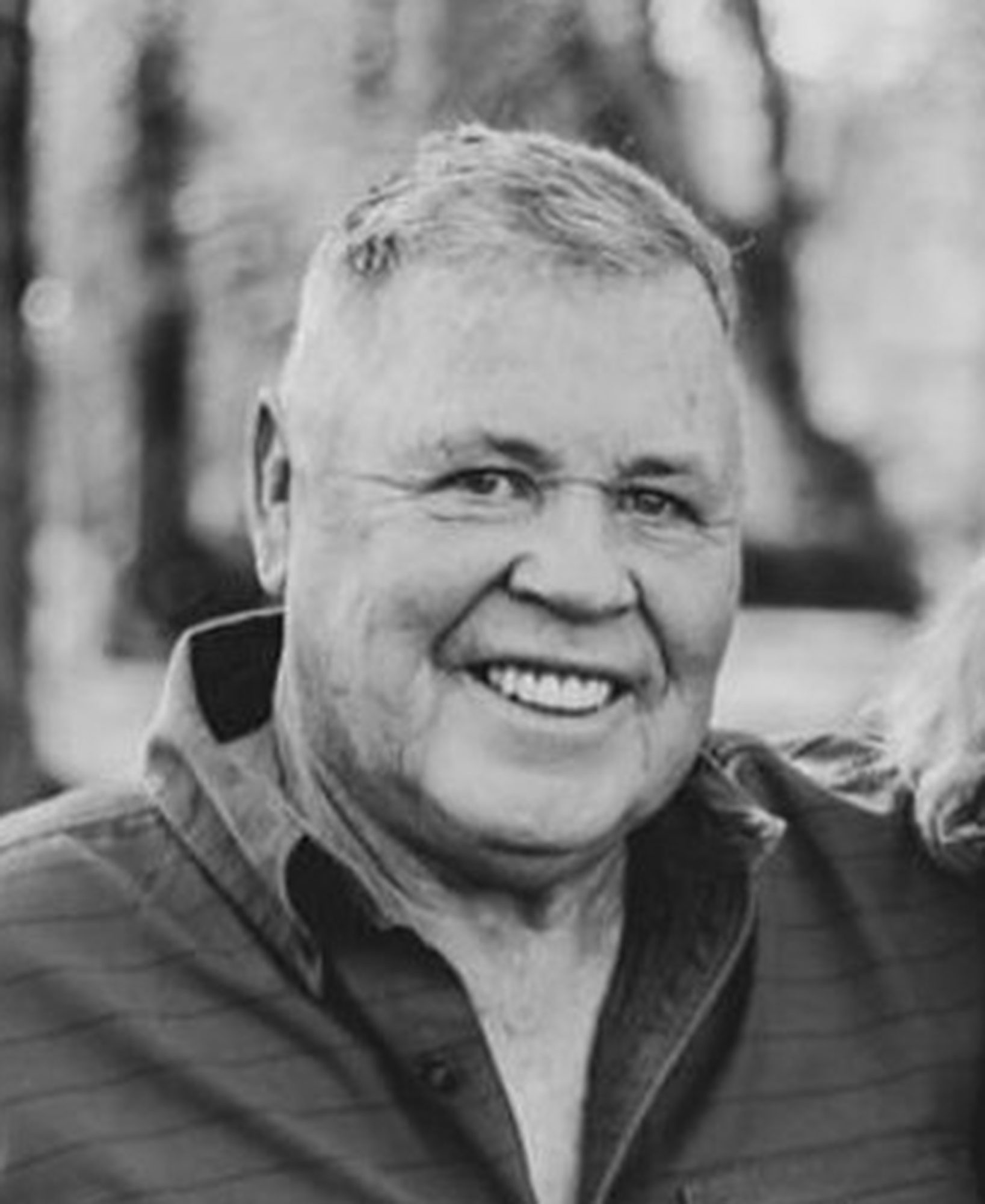
Burt Haugen at his organic dairy near Buckley, Washington — across the highway from Joint Base Lewis-McChord, where the helicopters still pull him back to 1968. Drafted into the 4th Battalion, 9th Infantry — the Manchus — and wounded twice during Tet, Haugen spent thirty years trying to outrun the war. The parlor is what finally let him stop. He’s one of the 0.4%.
Burt Haugen has spent most Memorial Day mornings of the last half-century at his organic dairy near Buckley, Washington — across the highway from Joint Base Lewis-McChord. He was a draftee in 1968. A machine gunner and radio operator with the 4th Battalion, 9th Infantry — the Manchus — in-country during Tet, when 49 men in his battalion were killed in a single day. He was wounded twice. A bullet went through the webbing of his helmet. He spent thirty years trying to forget what came after that.
He doesn’t anymore.
What pulled him out, he told this magazine in 2013, wasn’t a program. It wasn’t a counselor. It was the parlor.
“I like to work by myself. It’s quiet when you’re milking in the morning.” — Burt Haugen, Buckley, Washington
Haugen calls it “a living and a healing.” Busy hands, busy mind. He credits the rhythm of dairying — and the fraternity of fellow Manchus, with whom he reconnected through a brigade reunion website — with helping him live with PTSD and survivor’s remorse for half a century. The cows did what no civilian career could.
The 0.4% Problem
Haugen is one of 305,753 U.S. farm producers with military service counted in the 2022 Census of Agriculture. That’s 9% of every producer in America, working 289,372 operations and roughly 108 million acres (USDA NASS, Producers with Military Service, 2024). Across every sector of the U.S. economy, agriculture over-indexes hard for veterans. Dairy is the exception. That’s the story.
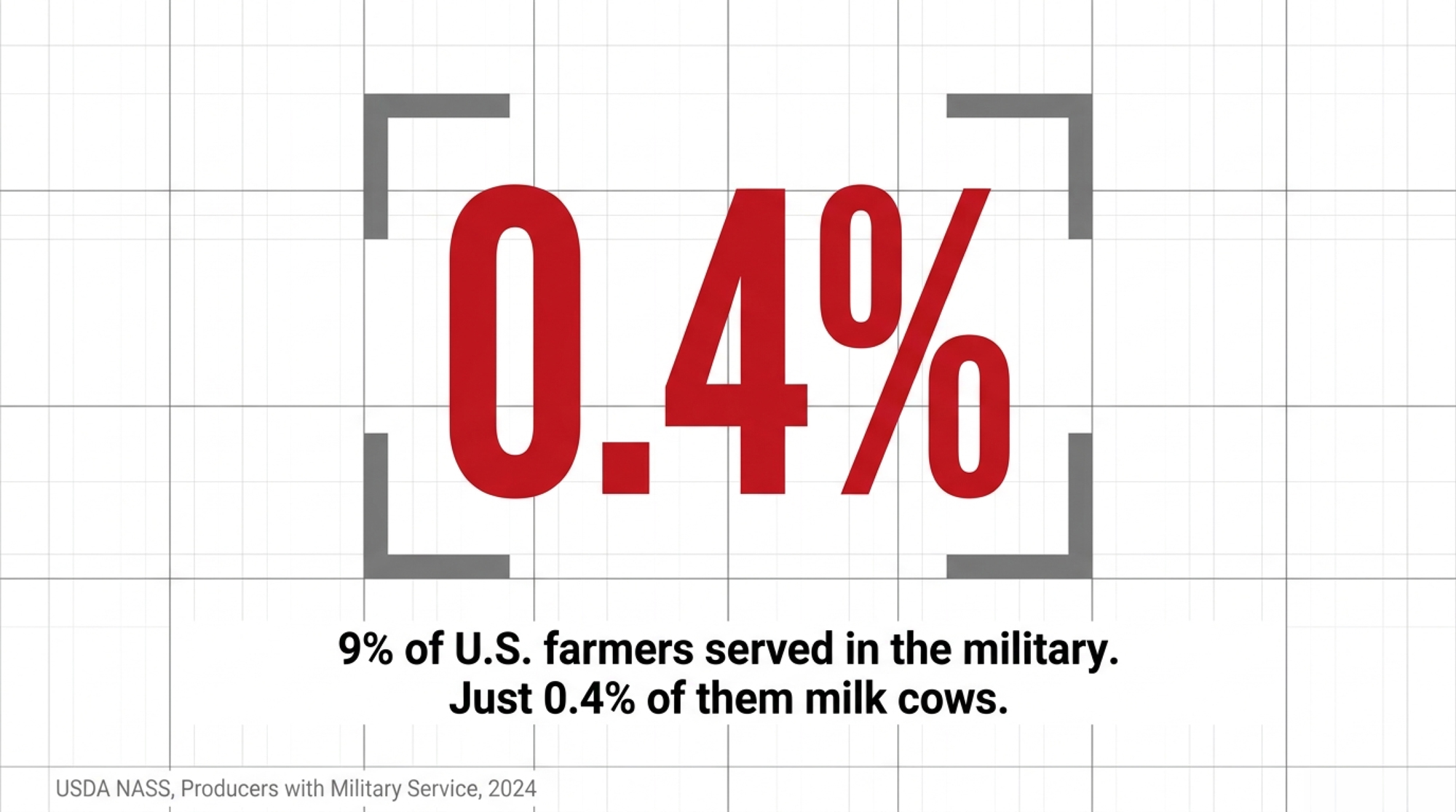
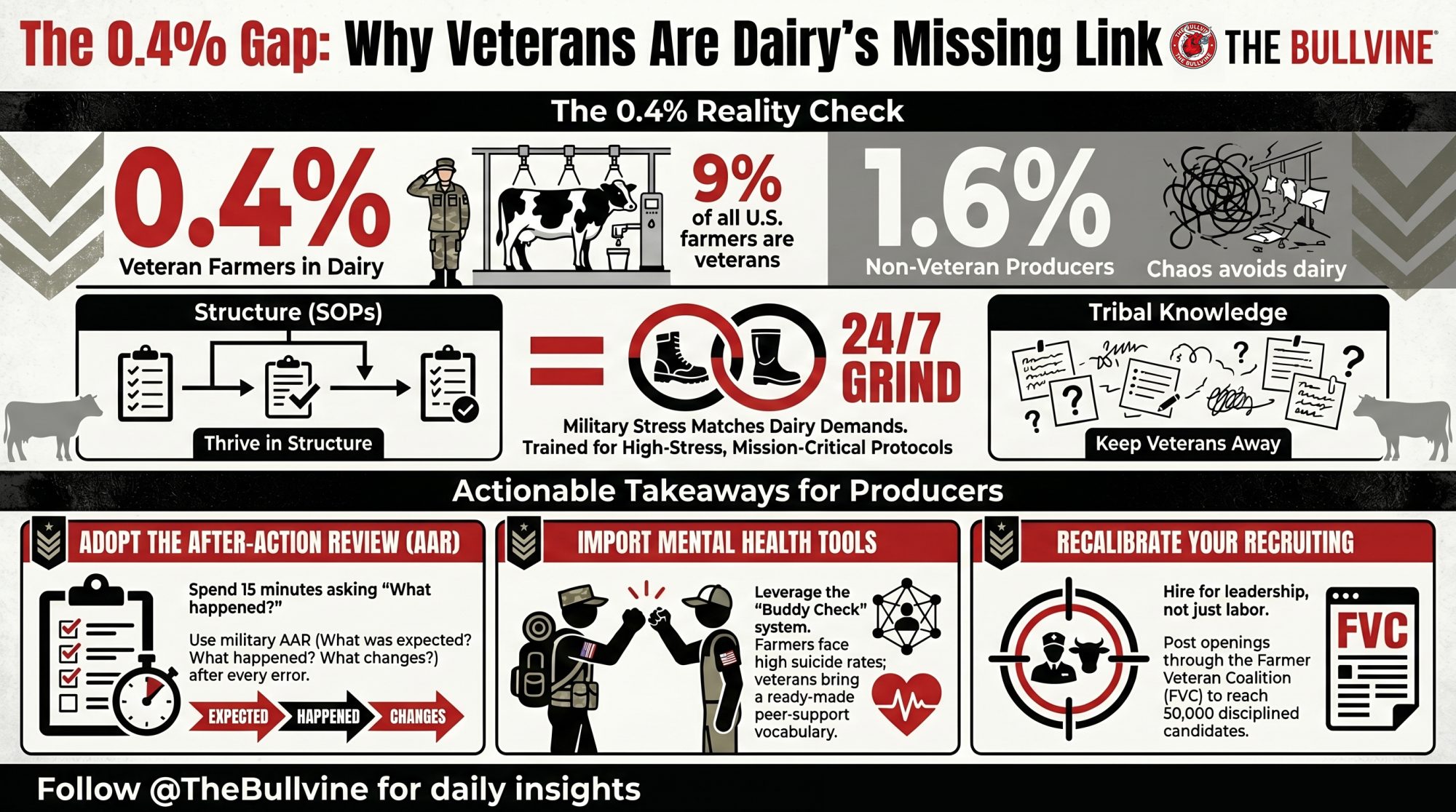
In the 2022 Census, 0.4% of veteran producers named dairy cattle and milk production as their primary commodity. Among non-veteran producers, the share was 1.6% (Farm Credit Administration analysis of the 2022 Census). Read it the way a recruiter would: a veteran who chooses agriculture is four times less likely than a civilian entering agriculture to land in dairy.
Where do they go instead? Beef cattle (28.4%), hay and field crops (27.1%), grains (12.7%) — pastures and combines and tractors, almost anywhere but the parlor (FCA, 2024).
The Two Flags Don’t Sit Easy
Every veteran in dairy carries two identities at once. The soldier and the dairyman. The medic and the calf manager. The flag at the door goes up, the boots go on, the parlor turns at 4 a.m. — Memorial Day, Christmas, the Tuesday after a funeral. The two flags don’t sit easy on the same pole.
Haugen’s version is the one nobody puts in a press release. Farm work — its solitude, its physical labor, its predictable rhythm — has quietly become one of the most effective and least-funded therapeutic environments combat veterans access in this country. The Farmer Veteran Coalition has been documenting that since 2008 (FVC History).
“We talk about our experiences. It’s almost embarrassing to talk with anyone else.” — Burt Haugen
The “we” is other Vietnam vets. The talking happens in barns and shops and parlors. Not in waiting rooms.
When his Manchus brigade visited the Vietnam Memorial together, the wall listed 600 of “my guys” killed during Tet — more than 100 of them from Haugen’s battalion alone. He learned about PTSD and survivor’s remorse the way a lot of Vietnam vets eventually did — through VA classes, decades after the fact. Helicopters in the distance from Joint Base Lewis-McChord still pull him back to the medevac runs of the war. Some things you don’t forget. You just learn to milk through them.
What Does Air Force Discipline Look Like in a 10,000-Cow Parlor?
What works for one man and a small organic herd at dawn doesn’t necessarily scale. Or does it? Drive across the country to Trenton, Florida, and you’ll find the same operating discipline running at a different altitude entirely.
Adam Jackanicz at the calf pens at Alliance Dairies in Trenton, Florida — about 10,000 cows under his hand at any given time. Veterinarian by training, Public Health Officer for the 932nd Medical Squadron, U.S. Air Force Reserve by commission. He runs his shifts the way the Air Force taught him to run a flight line: pre-shift brief, written checklist, after-action review. His regret about the uniform? “Not signing up sooner.”
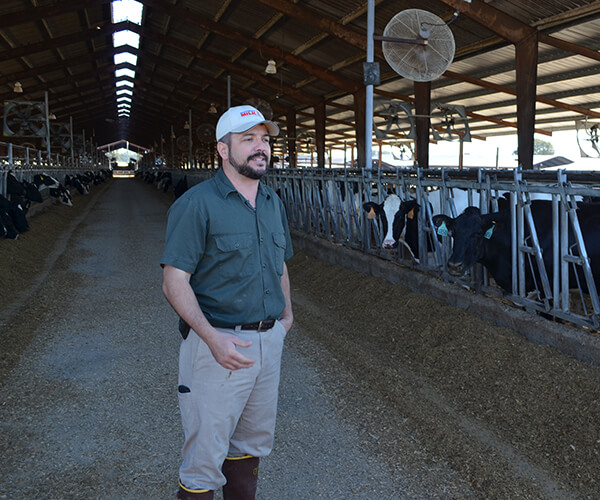
Adam Jackanicz is a veterinarian and the Public Health Officer for the 932nd Medical Squadron, U.S. Air Force Reserve (The Bullvine, 2024). For years, he ran milk quality and animal health for Alliance Dairies in Trenton — about 10,000 cows under his hand at any given time.
Picture a Tuesday at 5:40 a.m. in the office off the parlor. The day-shift lead’s notebook is open on the desk. Pre-shift brief — three minutes, standing. What changed overnight? Which fresh cows need eyes today? Where did yesterday’s somatic cell trend on the bulk tank? It’s the same checklist culture that runs a flight line, transplanted into rubber boots. Jackanicz says the Air Force values of integrity and excellence are “indispensable” in a 10,000-cow string — not as a slogan but as the reason the same mistake doesn’t repeat in the parlor on Wednesday.
He enlisted during veterinary school after being told his eyesight ruled out aviation. He re-enlisted as fast as the paperwork would clear after 9/11, moved from enlisted to a commission, served until 2009, and came back in 2020 — in the middle of a pandemic that landed on his family and his herd at the same time. His regret? “Not signing up sooner.”
You don’t run 10,000 cows on vibes. You run them on briefs and after-action reviews and somebody who knows what to do at 2 a.m. when the calving doesn’t go right. That’s the gift a veteran brings to a parlor. Not the war movie. The way the chores actually get run.
So Why Aren’t Veterans Choosing Dairy?
Read the standard list of reasons and none of it actually fits the candidate. Capital requirements. The 24/7 cycle. Hard physical labor. Long stretches without a day off. That’s not what scares a veteran. That’s basic training with a milking schedule.
Veterans are entirely comfortable with 24/7 shifts, grueling labor, and high stress — if there’s a clear mission and a clear structure. They’ve already lived 18-month deployments on rotating watch. They’ve already done it in 110°F with 80 pounds on their back. The 4 a.m. milking isn’t the obstacle.
The obstacle is what the 4 a.m. milking is run on. Dairy, more often than industries the military funnels people into, runs on tribal knowledge instead of written protocol. The protocol lives in one person’s head. The chain of command shifts depending on who’s in the parlor that morning. The same mistake repeats on Wednesday because nobody documented what went wrong on Tuesday. To a veteran, that isn’t difficulty. That’s chaos.
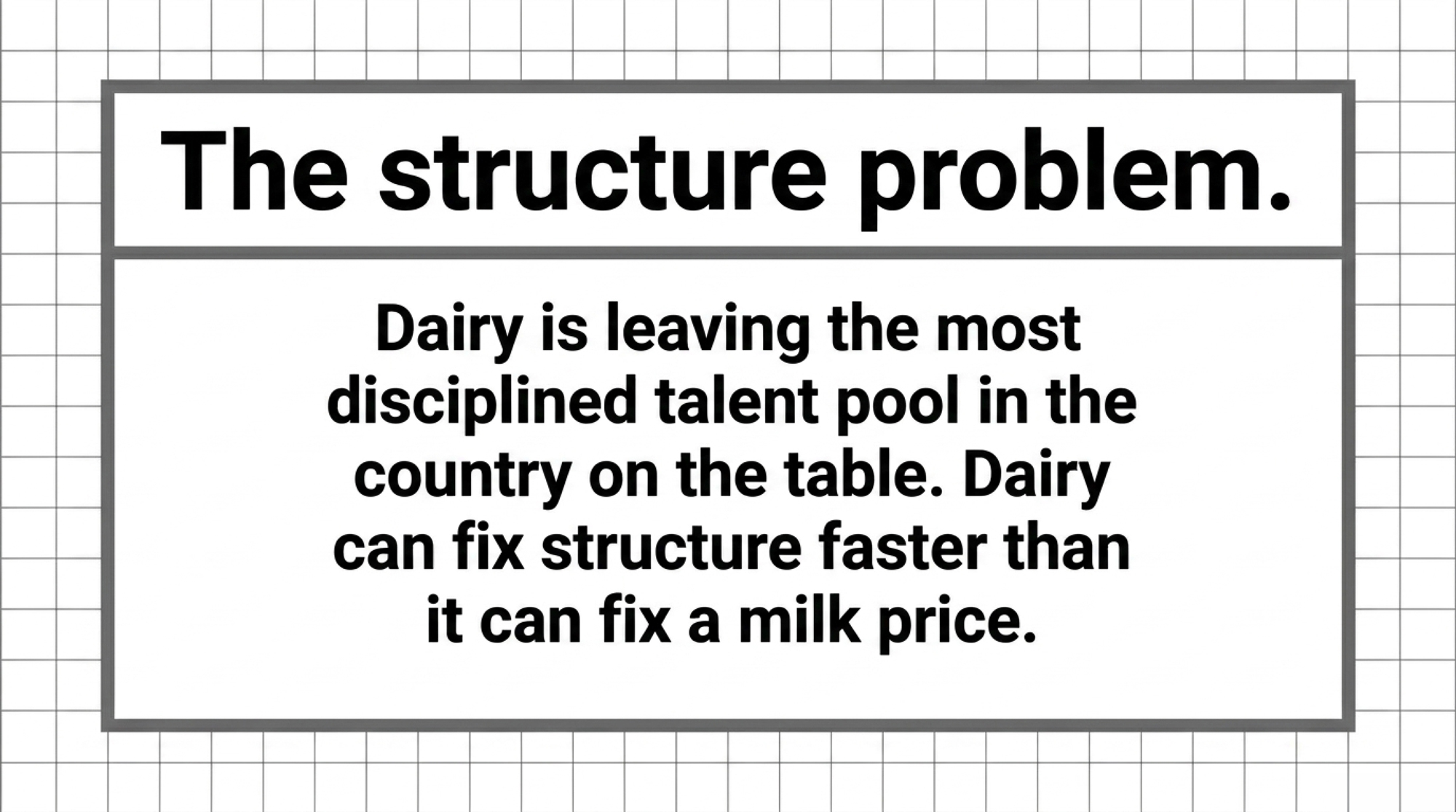
The Farmer Veteran Coalition’s own programming — Fellowship Fund grants, Homegrown By Heroes, mentor networks — is built around the same observation: veterans entering ag want documented systems, not improvisation. The 0.4% number isn’t a labor problem. It’s a structure problem. And dairy can fix structure faster than it can fix a milk price.
A Family That Started With a Boot Camp
Haugen carried discipline into a one-parlor operation. Jackanicz carried it into a 10,000-cow string. In northeast Texas, Kyle Hayes carried it into the next generation — into a son who works inside the operating manual every day.
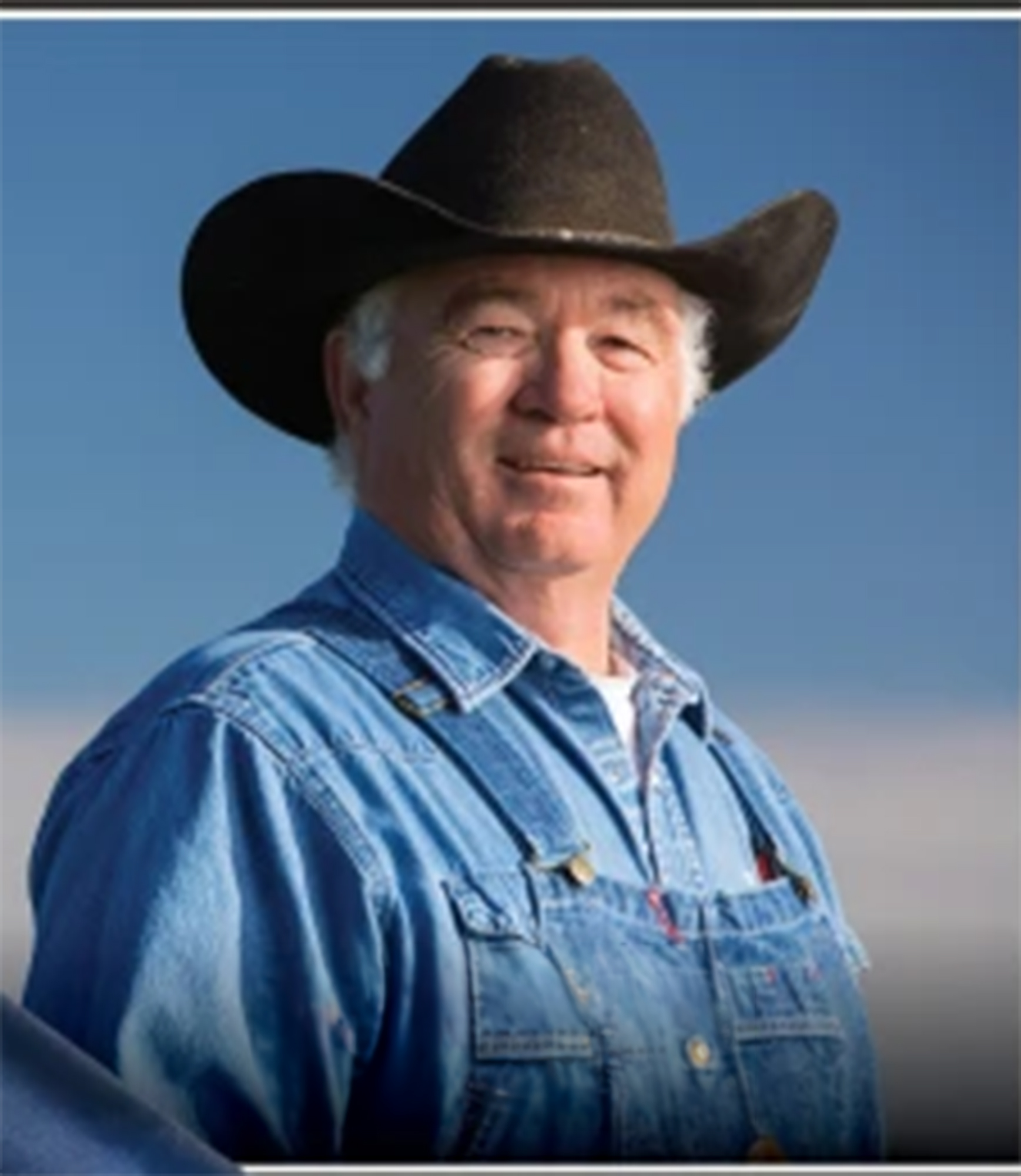
Kyle Hayes on his northeast Texas dairy — a first-generation operation he’s kept running for more than thirty years, while the U.S. herd count fell from 130,800 farms in 1992 to 24,470 by the end of 2023. Navy, 1971 to 1975. Beef cattle first, then dairy. He calls boot camp “reminiscent of a scene from Forrest Gump” and the parlor the same education in a different uniform. His son Kyle Jr. works alongside him now — raised inside the operating manual his father brought home from the service.
Hayes served in the Navy from 1971 to 1975, came home to beef cattle, switched to dairy more than thirty years ago, and built a first-generation operation by hand. His son, Kyle Jr., works alongside him now (The Bullvine, 2024).
Hayes describes boot camp as a transformative experience — “reminiscent of a scene from Forrest Gump,” in his words — and dairying as the same education in a different uniform. Hard work. Sacrifice. A job that doesn’t care if you’re tired. The discipline he learned in the Navy is what’s kept a Texas dairy alive for three decades, while the U.S. dairy farm count fell from 130,800 herds in 1992 to 24,470 by the end of 2023 — a national contraction Texas hasn’t escaped.
That’s the second flag. The one that doesn’t get a uniform of its own. Kyle Jr. didn’t follow him into the Navy. But he was raised inside the operating manual his father brought home from it. Multiply that by 289,372 farms with at least one producer who served, and you start to see what’s actually sitting inside American agriculture’s organizational DNA.
How Many Veteran Producers Actually Choose Dairy?
Here’s the uncomfortable barn math.
If you run a 1,200-cow herd and you’re trying to fill a herdsperson opening this spring, the U.S. veteran producer pool is about 305,753 people deep. The dairy slice of that pool? Roughly 1,223 veterans listed dairy as their primary commodity in the 2022 Census (305,753 × 0.4%). If veterans had chosen dairy at the same rate as non-veteran producers — 1.6% — that number would sit closer to 4,900. The gap is roughly 3,700 trained, leadership-tested workers who chose any commodity but the parlor.
Now run those numbers against the talent picture dairy keeps complaining about. McKinsey’s January 2025 dairy executive analysis put talent as the top priority for 67% of dairy leaders — up from 44% in 2022 (McKinsey, January 2025). The same complaint shows up every quarter in The Bullvine’s labor and leadership coverage.
Dairy is leaving the most disciplined mid-career talent pool in the country on the table. Every year. And then asking where the herdspeople went.
What Could a Veteran Hire Actually Fix on Your Operation?
Read what a 1,200-cow operation needs from a manager in 2026, and the overlap is almost unfair:
- Lead 8 to 15 people across language and shift barriers. That’s a squad. Veterans run squads.
- Execute a written checklist under pressure. Vaccination protocols, fresh-cow handling, mastitis treatment SOPs. Each one’s a battle drill in different clothes.
- Make a clean call at 2 a.m. on a hard calving. Triage. The military trains exactly that.
- Lead younger people through a crisis you’ve never personally seen. HPAI in the tank, a tunnel-fan failure in 102°F, a positive antibiotic test you have to dump on. That’s an after-action review made flesh.
Veterans don’t bring magic. They bring muscle memory for stress.
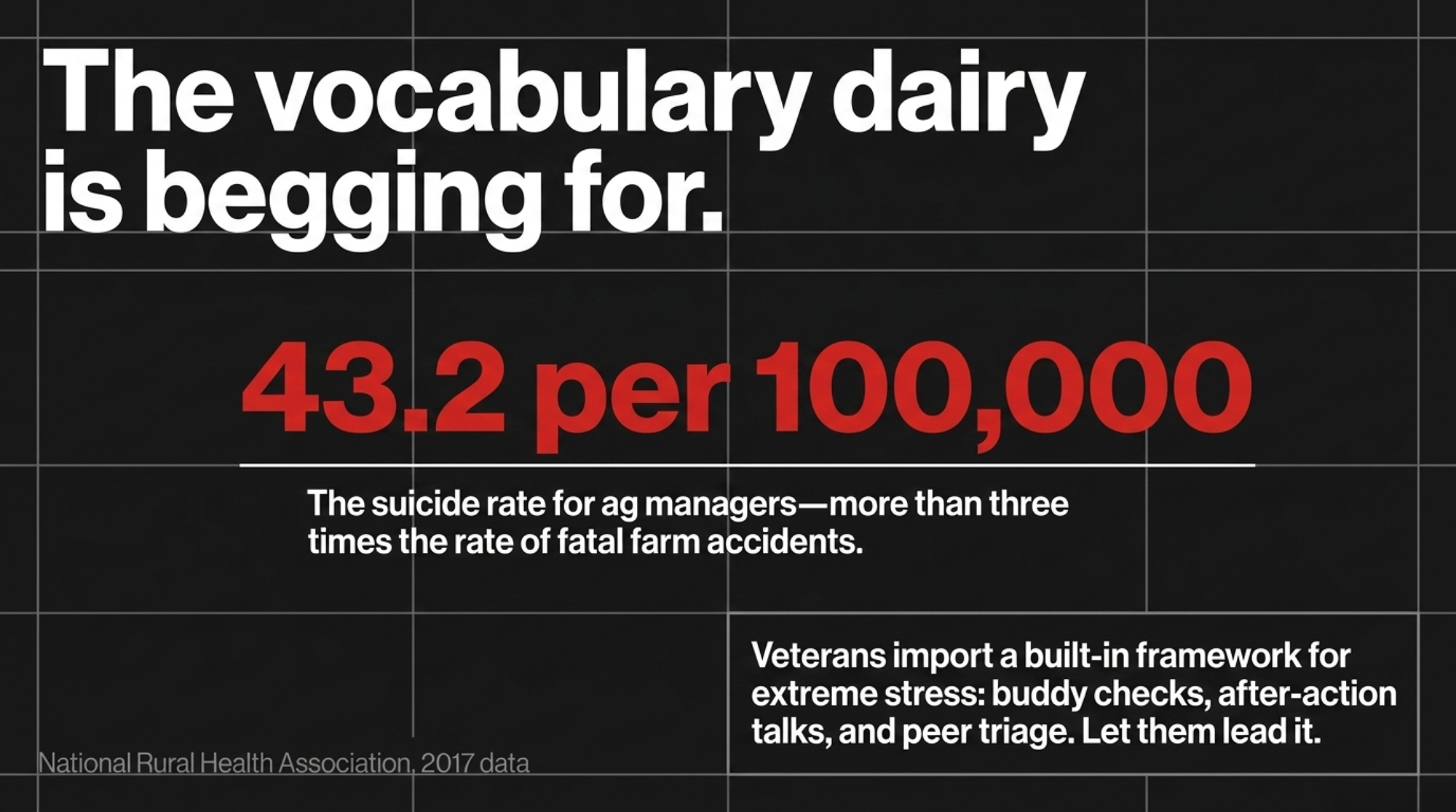
Here’s the part dairy still under-discusses out loud. In 2017 occupational data, male farmers, ranchers, and agricultural managers died by suicide at a rate of 43.2 per 100,000 — roughly 3.5 times the general population, and more than three times the rate of fatal farm accidents (12.4 per 100,000) (The Bullvine, January 2026, citing the National Rural Health Association).
Combat veterans have spent years inside formal frameworks for that exact risk. Buddy checks. After-action talks. VA peer groups. Haugen calls his fellow Manchus “a fraternity, ’cause you can relate.” A dairy that hires a veteran isn’t just hiring a herdsperson. It’s importing a mental-health vocabulary the industry has been begging for — and refusing to write down.
The Programs Exist. Dairy Has Barely Touched Them.
The Farmer Veteran Coalition has been operational since 2008, when founder Michael O’Gorman left commercial organic farming to run it full-time. The Coalition crossed 50,000 members nationwide in August 2024 — Fellowship Fund recipients, Homegrown By Heroes-certified producers, mentor-network participants, and state-chapter members (FVC, August 2024). USDA’s veteran-farmer provisions, established under the 2014 Farm Bill, opened microloans and conservation programs to veterans on preferred terms. NCAT’s Armed to Farm program, running since 2013, has now supported more than 3,500 military-veteran farmers through trainings, workshops, networking events, and one-on-one technical assistance (NCAT Armed to Farm).
Most of those success stories are produce, beef, mushrooms, value-added meat. The dairy column’s thin. The Coalition’s 2024 highlight reel surfaced one prominent dairy-side example: Army Captain Bob Miller, who resigned his commission in 2009 after two tours in Iraq with the 10th Mountain Division and launched Nice Farms Creamery on his family’s 201-acre Maryland farm — a pasture-based A2/A2 Jersey operation selling milk, butter, yogurt, and ice cream to local markets (Farmer Veteran Coalition, September 2024).
One feature. In a year. In a sector with 24,470 commercially licensed dairy farms as of the end of 2023. That’s a business-development gap, not a values gap.
Here’s what the FVC milestone actually means in barn terms. Even 1% of that 50,000-member network — recruited into U.S. dairy as herdspeople, parlor leads, calf managers, or first-generation operators — is roughly 500 trained, leadership-tested workers entering an industry where 67% of executives say they can’t find the talent they need. Won’t fix 24,470 farms. But it’s more than most operators are pulling from any single recruiting channel today.
Options and Trade-Offs for Your Operation
Four paths. Each one starts on a different scale, and each one carries its own honest trade-off.
Path 1 — Run your first After-Action Review (AAR) within 30 days.
- When it makes sense: Any operation, any size. Even before you hire a single veteran.
- What it requires: 15 minutes after something goes wrong — a missed heat-detection batch, a milk fever cluster, a tank dump. Three questions: What did we expect? What happened? What changes? No blame.
- The trade-off: It’ll feel awkward the first three times. The senior person in the room has to be the one who admits a mistake first to break the blame culture. Then it becomes the most exportable tool from the military to dairy — and almost no dairy uses it.
- Forward signal: Operators we’ve talked to who run AARs tend to have written SOPs in place within a year. Path 1 leads to Path 3.
Path 2 — Post your next hire through the Farmer Veteran Coalition member network.
- When it makes sense: Any herdsperson, parlor lead, feed crew lead, or assistant manager opening you’d otherwise list on Indeed or AgCareers.
- What it requires: A free listing through a 50,000-member national network.
- The trade-off: The candidate pool is smaller than a major job board. But it’s pre-screened for ag intent and often shows up with formal leadership experience already on the résumé. Cheapest recruiting experiment you can run this year.
Path 3 — Convert one verbal protocol into a written SOP this month.
- When it makes sense: Every operation that’s ever lost a step because the person who knew it was off that day.
- What it requires: An hour with whoever currently runs that protocol.
- The trade-off: Small ego cost on the front end — the person you ask is usually proud of holding the protocol in their head. The veterans you eventually hire won’t just follow SOPs. They’re the ones who’ll finally make you build them.
Path 4 — Treat mental-health vocabulary as an imported skill, not a soft one.
- When it makes sense: Any operation with a crew.
- What it requires: Identifying the veterans already on your payroll — most won’t volunteer it; ask — and letting them lead the conversation when a colleague is struggling.
- The trade-off: This only works if you take crew mental health as seriously as you take a parlor breakdown. They’ve had buddy checks drilled into them since basic. Your nutritionist hasn’t.
If you’re a veteran-owned dairy reading this, get on the FVC member map this week. Homegrown By Heroes certification, buyer relationships, peer connections, and Fellowship Fund eligibility most dairy producers don’t even know exist — one online form opens all of it.
Key Takeaways
- If you’ve had any operational misstep in the last 30 days, you have everything you need to run an AAR this week. Three questions. No software. No consultant.
- If your next hire is a herdsperson, parlor lead, or assistant manager, post the opening through Farmer Veteran Coalition before you pay for a third-party listing. Free, targeted, leadership-screened — pulling from a 50,000-member national pool.
- If your operation runs on verbal protocols that live in one person’s head, that’s a single-point-of-failure problem a veteran-grade SOP will fix. Pick the one that scares you most. Write it down this month.
- If you’ve ever lost a colleague, neighbor, or employee to suicide — or come close — the buddy-check vocabulary your veterans already speak is the most underused mental-health tool in dairy. Ask who served. Let them lead.
- If you’re a veteran-owned dairy and you’re not on the FVC member map, you’re leaving certification, peer support, and program eligibility on the table every week. That fix is a single online form.
The Last Flag
Nathan Roth — Vietnam-era Navy veteran, second-generation dairyman, 250 cows and 1,600 acres in Mountain Grove, Missouri, alongside his children. A year in country, then home on the G.I. Bill for an accounting degree before the family operation pulled him back. He carries the dual identity openly: veteran and dairyman, neither one a hobby. The uniform on a hanger, the hand on the herd.
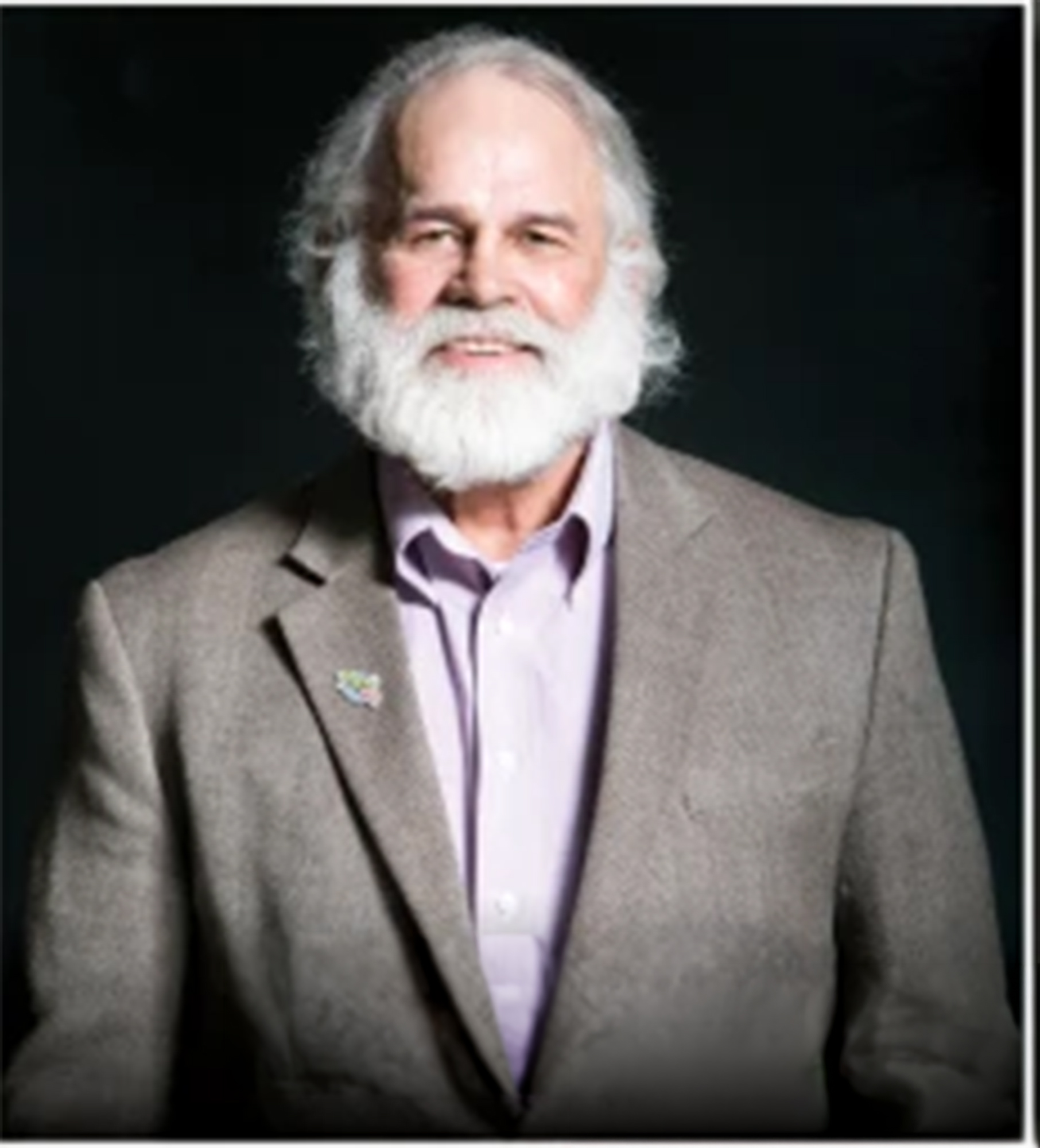
Nathan Roth — a Vietnam-era Navy veteran who served a year in country and came home to use the G.I. Bill on an accounting degree before turning back to the family operation — runs 250 cows and 1,600 acres in Mountain Grove, Missouri, alongside his children (The Bullvine, 2024). He carries the dual identity openly: Vietnam veteran and second-generation dairyman, neither one a hobby. Kyle Hayes and Kyle Jr. are still working that northeast Texas dairy, a first-generation operation that outlasted most of the state’s. Adam Jackanicz, somewhere between his Reserve drill and his veterinary work, lives the same calendar as everybody else in dairy — uniform on a hanger, hand on the herd.
And near Buckley, Washington, the parlor where Burt Haugen learned to live with what Tet left him will turn the way it has turned for half a century — in the kind of quiet that, fifty-eight years ago, didn’t exist for him.
So here’s the question worth carrying past this Memorial Day: when you ran your last after-action review, who was in the room? And if the honest answer is we don’t run those yet — what would change next year if the person you hired had run a hundred of them before they ever set foot in your parlor?
Methodology Note
This article draws on the 2022 U.S. Census of Agriculture (USDA NASS, Producers with Military Service, released April 2024); Farm Credit Administration analysis of that release; McKinsey’s January 2025 article “Dairy industry executives are pressured but optimistic for 2025,” reporting the 2024 dairy executive survey results; occupational suicide-mortality data aggregated by The Bullvine in January 2026 from the National Rural Health Association (reflecting 2017 U.S. data for male farmers, ranchers, and agricultural managers); the U.S. dairy herd count from Progressive Dairy’s 2024 U.S. Dairy Statistics; the Farmer Veteran Coalition’s August 2024 50,000-member milestone announcement; NCAT’s Armed to Farm program reporting on its 3,500+ veteran reach; and prior Bullvine reporting on veteran dairy producers (2013 and July 2024). All named individuals (Burt Haugen, Adam Jackanicz, Kyle Hayes, Nathan Roth, Bob Miller) are drawn from previously published profiles linked in-line. Veteran-share figures are national averages — concentration varies meaningfully by state. Corrections, additions, or veteran-dairy stories we should be covering: editor@thebullvine.com.
Learn More
- When 112 Milkers Averaged 49%: What Rodriguez’s Training Study Says You’re Leaving Per Cow in the Parlor.— Delivers a surgical parlor auditing method to capture six figures in leaked milk by backing up written SOPs with active crew training, shaving 25–43 seconds off milking times per cow and stabilizing herd somatic cell counts.
- Crushing the Labor Crisis: How Smart Dairies Transform Recruiting into a $50K+ Annual Advantage — Arms you with a structured 90-day onboarding framework that expands your talent pool by 300% using skills-based hiring for non-traditional candidates like veterans, slashing turnover costs to secure a $50,000+ annual workforce advantage.
- Robots Won’t Save Your Dairy If You’re Alone: 5 Hard Truths About Labor and Robotic Milking ROI Under 500 Cows — Exposes the financial gap between automated trade-show promises and real barn-floor returns, proving why high-tech setups still require a disciplined management bench to achieve a 20–40% labor efficiency gain before buying robots.
The Sunday Read Dairy Professionals Don’t Skip.

Every week, thousands of producers, breeders, and industry insiders open Bullvine Weekly for genetics insights, market shifts, and profit strategies they won’t find anywhere else. One email. Five minutes. Smarter decisions all week.




