





Archive for dairy make allowance

USDA’s Make Allowance Just Pulled $105,000 From a 400‑Cow Milk Check – Nobody Sent a Bill

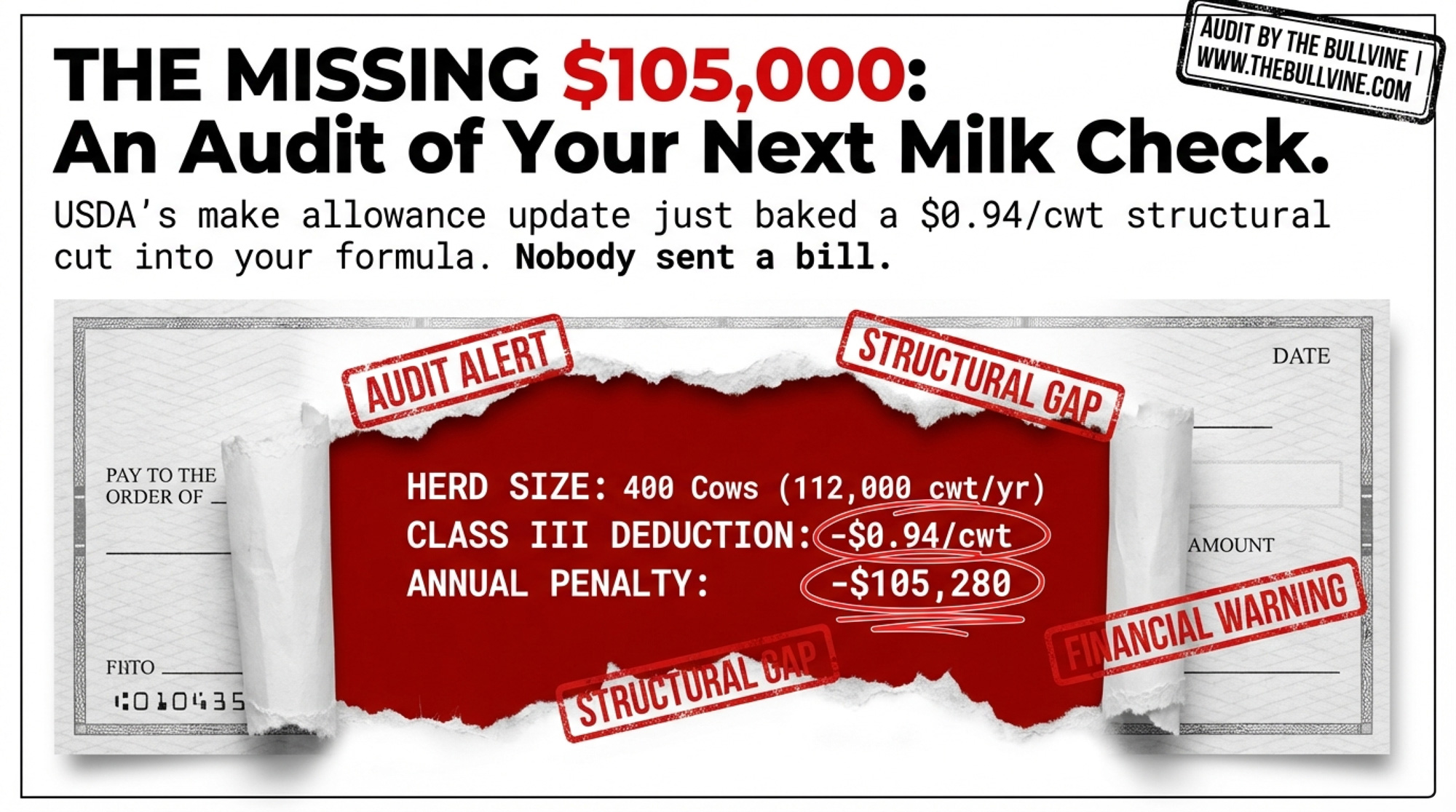
USDA’s make allowance update structurally cut Class III minimum prices by $0.94/cwt — and the mandatory survey that’s supposed to bring transparency could lock those numbers in for a decade.

Executive Summary: USDA’s June 2025 make allowance increases baked a $0.94/cwt structural cut into every Class III milk check — not a market swing, a formula constant that hits at any commodity price. On a 400-cow herd, that’s $105,280 a year gone before your component values are even calculated. The cheese allowance alone jumped 25.8% — the first reset since 2008 — despite a 12% improvement in plant yield efficiency over that same stretch. Now add the All-Milk/mailbox gap, which has widened to roughly .00/cwt: DMC is measuring a margin your bank account doesn’t actually see. The real fight is the OBBBA’s mandatory processing cost survey, now in rulemaking, where USDA’s approach to cost categories will either audit these allowances down or lock them in for years. If your DSCR drops below 1.2 after you model this $0.94 deduction, the lender conversation needs to happen before the survey results — not after.
We ran the math ourselves — on the June 2025 FMMO change, month by month, through March 2026. Using USDA’s published pricing formulas and commodity prices from AMS Dairy Product Mandatory Reporting, The Bullvine calculated the make allowance impact independently.

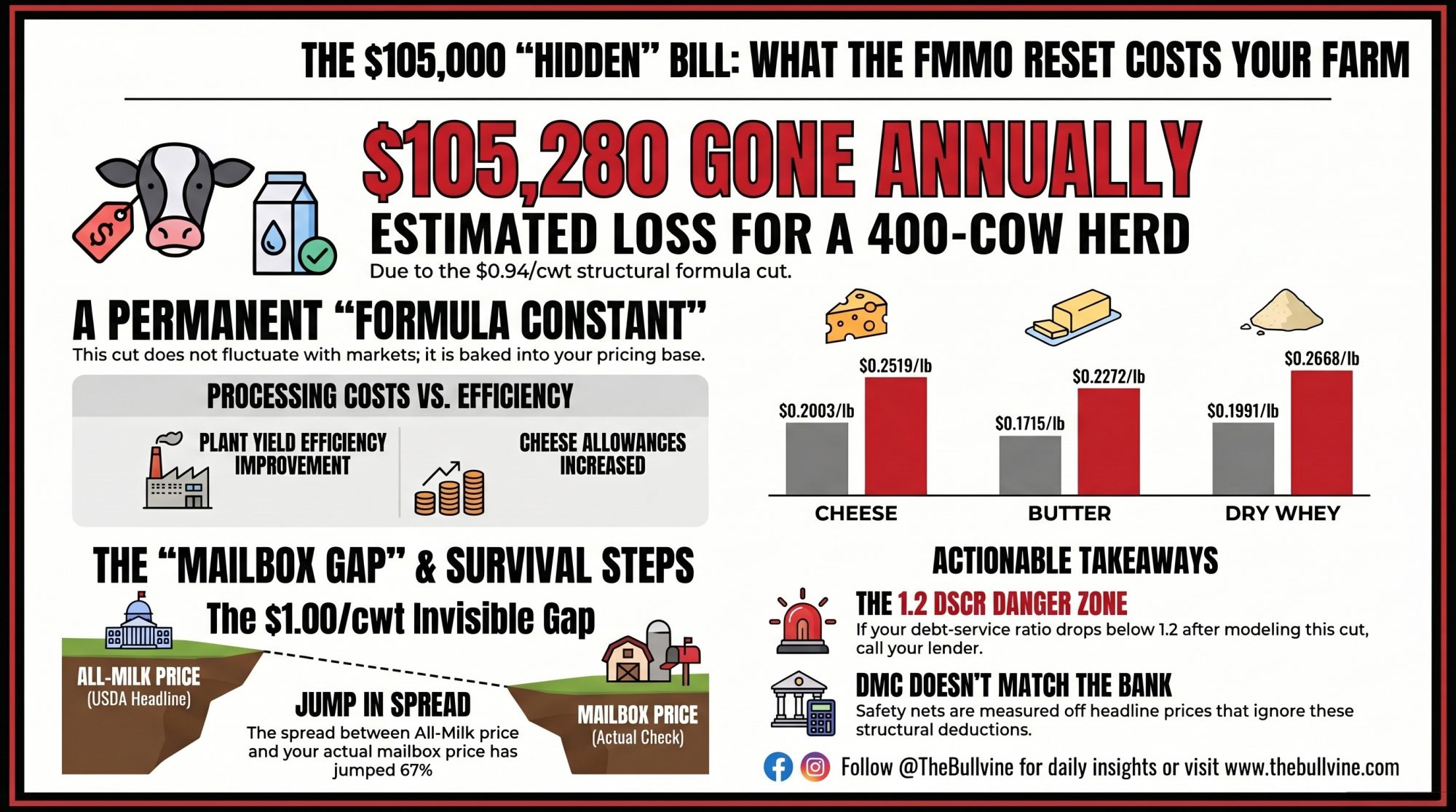
The result: $0.94 per cwt stripped from every Class III milk check, and $0.87 per cwt from every Class IV check. Every single month. It doesn’t fluctuate with cheese or butter markets — it’s baked into the formula constants. For a 400‑cow Holstein herd shipping about 112,000 cwt a year, the Class III hit alone works out to $105,280 per year at standard component tests, and closer to $112,000 at actual pool test levels.

“Dairy farmers remain the only participants in the supply chain without the ability to set prices or recover costs through a built‑in mechanism,” says Laurie Fischer, CEO of the American Dairy Coalition. “In practical terms, that’s a multi-dollar deduction built into the pricing system on the front end.”

The comfortable story in 2025 was that FMMO modernization gave everyone something. The formula math says processors got a margin reset. Family herds got deeper into a hole.
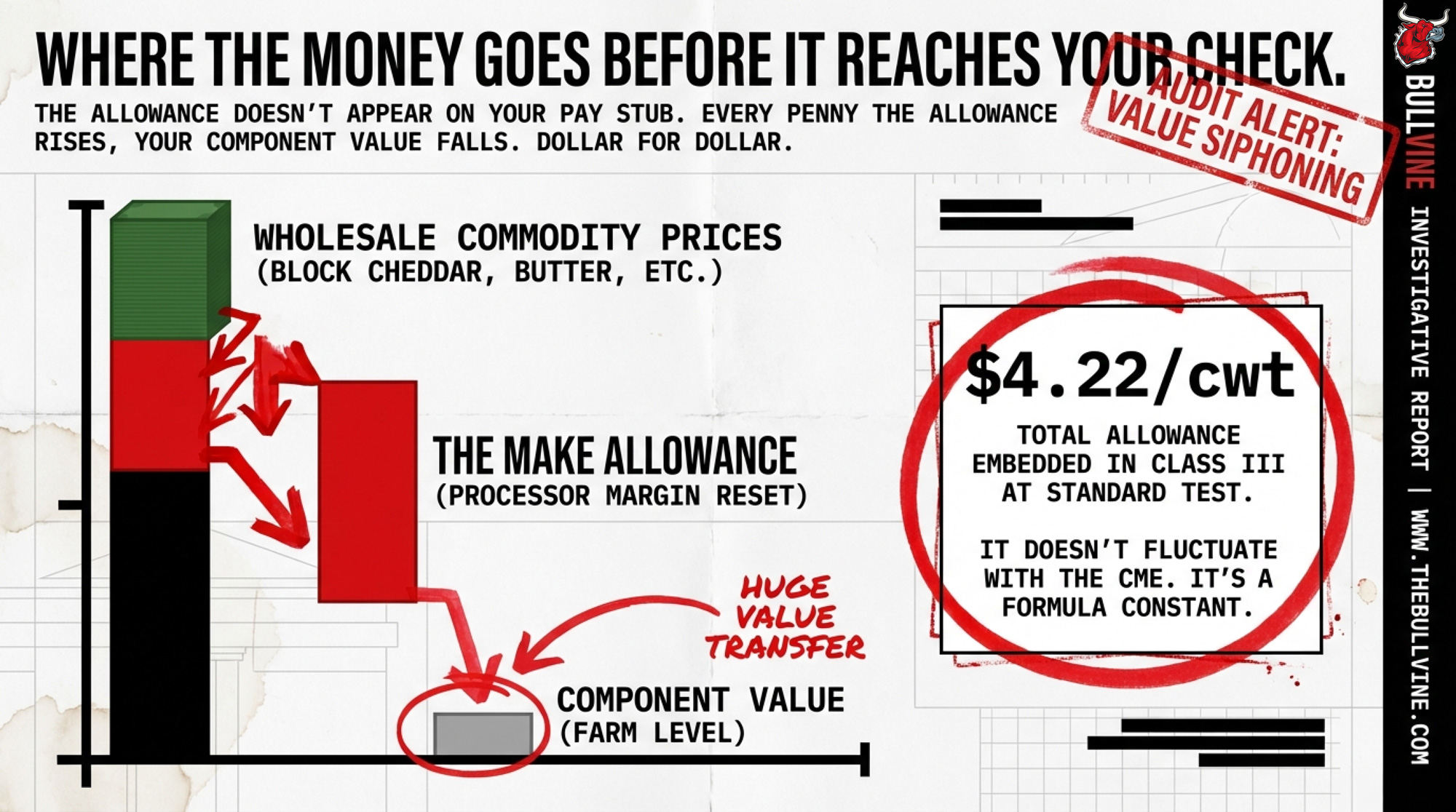
Where the Money Goes Before It Reaches Your Check

The allowance doesn’t appear on your pay stub. USDA starts with wholesale commodity prices — block cheddar, butter, nonfat dry milk, dry whey — then subtracts the make allowance before calculating component prices. Every penny the allowance rises, your component value falls. Dollar for dollar.
The June 2025 increases, finalized in rule 90 FR 6600 and effective across all 11 federal orders, were not pennies:
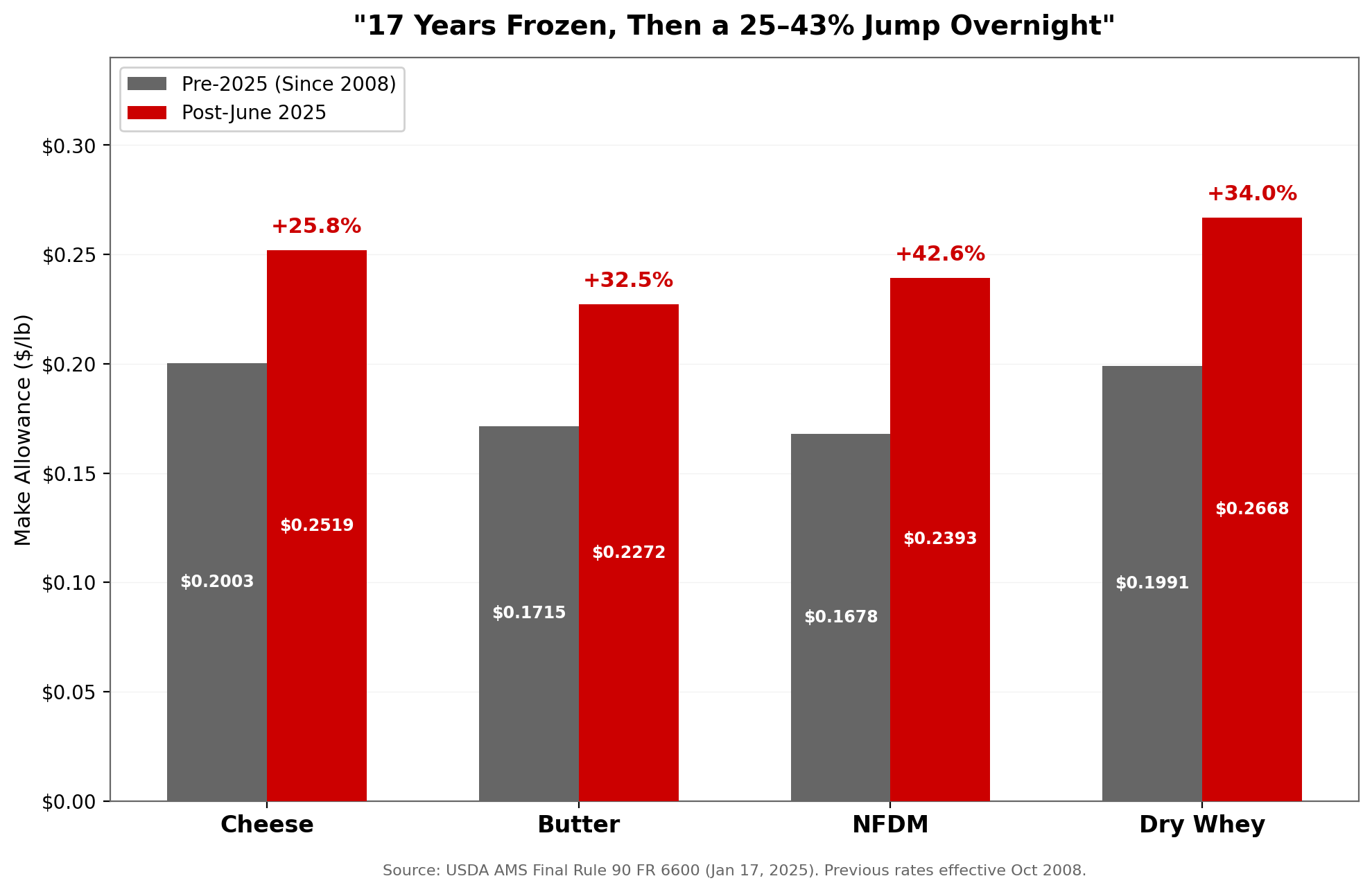
ProductPre‑2025Post‑2025Increase
Cheese$0.2003/lb$0.2519/lb+25.8%
Butter$0.1715/lb$0.2272/lb+32.5%
Nonfat Dry Milk$0.1678/lb$0.2393/lb+42.6%
Dry Whey$0.1991/lb$0.2668/lb+34.0%

Source: USDA AMS Final Rule 90 FR 6600, January 17, 2025. Previous rates had been in effect since October 2008.

Run those rates through the published Class III and IV pricing formulas, and the total allowances embedded in Class III come to $4.22/cwt at standard test (3.5% BF, 3.3% protein), $3.09/cwt in Class IV. At actual pool component levels — butterfat running north of 4.0% nationally — those totals climb higher. ADC’s calculation, using published USDA NASS and AMS data at the pool-average test, puts the range at $3.22 to $5.04/cwt, directionally consistent with our independent figures.

What you feel on the farm: a protein price weaker than expected, a butterfat value that doesn’t track the CME board, and a blend that keeps missing your mental target. Almost none of it is labeled “make allowance.” All of it is influenced by it.

Who Held the Pencil — and Why It Matters Now

USDA set these allowances after a record‑long national hearing in Carmel, Indiana, from August 2023 into early 2024. The agency acknowledged it didn’t have mandatory, audited manufacturing cost surveys when it issued the final rule. It set allowances using voluntary and commissioned data, with full intent to backfill with better surveys later.

Processor groups have been clear about their side. IDFA and others warned that allowances set below actual manufacturing costs risk financial strain and potential plant closures, especially at aging facilities in high‑cost orders. Some pointed to episodes where co‑ops imposed production limits because plant capacity couldn’t keep pace — arguing that realistic make allowances were part of keeping plants open, modern, and able to accept all members’ milk. For producers in those orders, that’s not just a processor problem. A closed plant or a capped intake is a market‑access problem that lands right back on the farm.

The trade‑off is real: you gain plant stability and market access when allowances cover true manufacturing costs, but you give up milk price when those allowances overreach into specialty overhead. The formula math tells you which side of that line we’re on. Using the 2025 average Class III price of $18.01/cwt (from USDA AMS monthly class price announcements, CLS series), the $0.94/cwt structural increase represents a 5.2% reduction in the minimum regulated value of Class III milk. Under the old allowances, every one of those months would have paid producers $0.94 more per hundredweight — no commodity rally required.

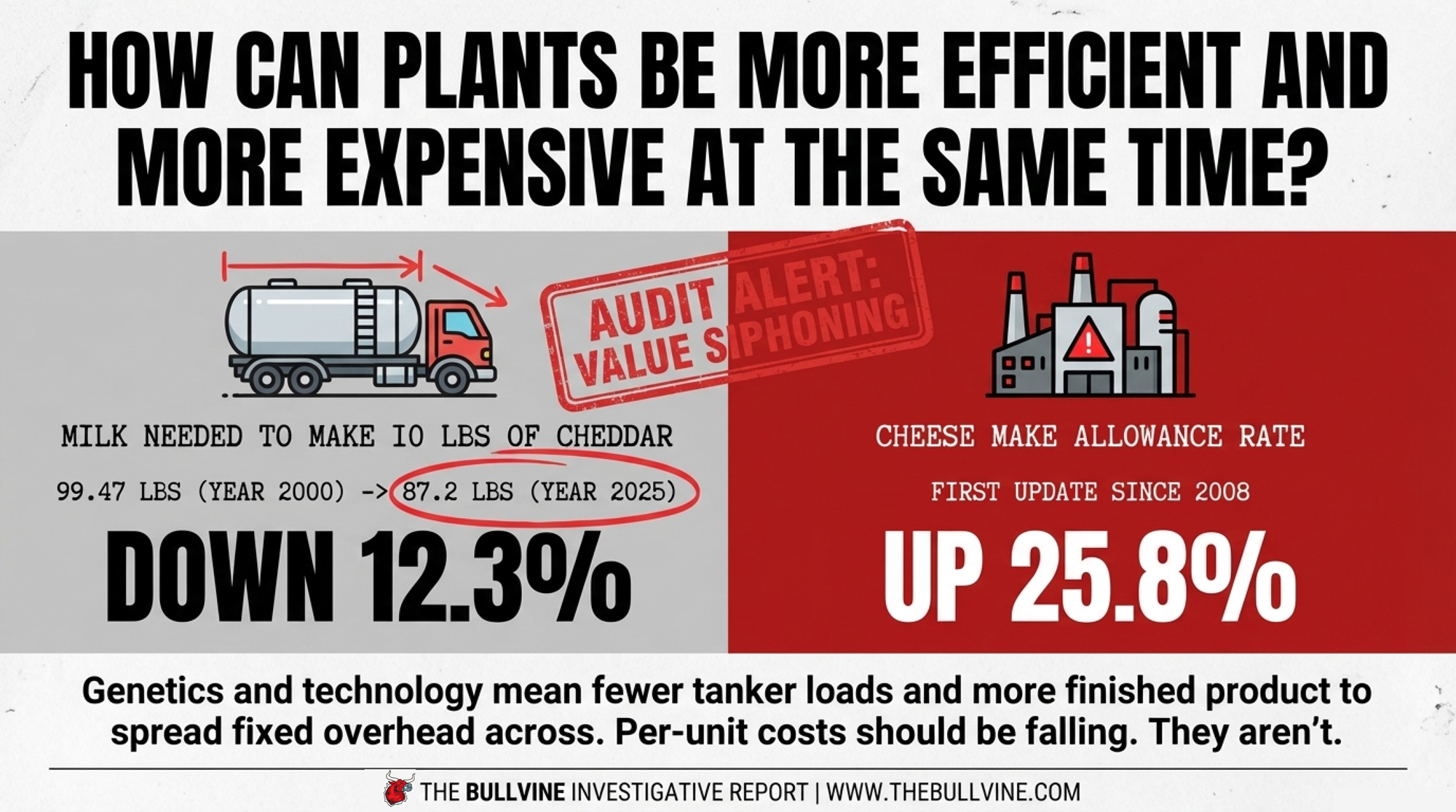
How Can Plants Be More Efficient and More Expensive at the Same Time?

Calvin Covington — retired CEO of Southeast Milk and longtime pricing expert formerly with National All‑Jersey — compiled yield data that creates the sharpest contradiction in this fight.
In 2000, it took 99.47 pounds of milk to produce 10 pounds of 38% moisture cheddar. By 2025, that dropped to 87.2 pounds — a 12.3% improvement driven by genetics pushing components higher and decades of plant‑level technology. Independent analysis by CoBank’s lead dairy economist Corey Geiger, using USDA and FMMO data, corroborates this trend: cheese yield per hundredweight grew from 10.14 to 11.24 pounds between 2000 and 2022, a 10.8% gain. Extrapolating that trajectory through 2025’s record component levels — national butterfat averaged 4.15%, a new high — Covington’s endpoint falls well within the expected range. Fewer tanker loads. Less volume through receiving and storage. More finished products to spread fixed overhead across.
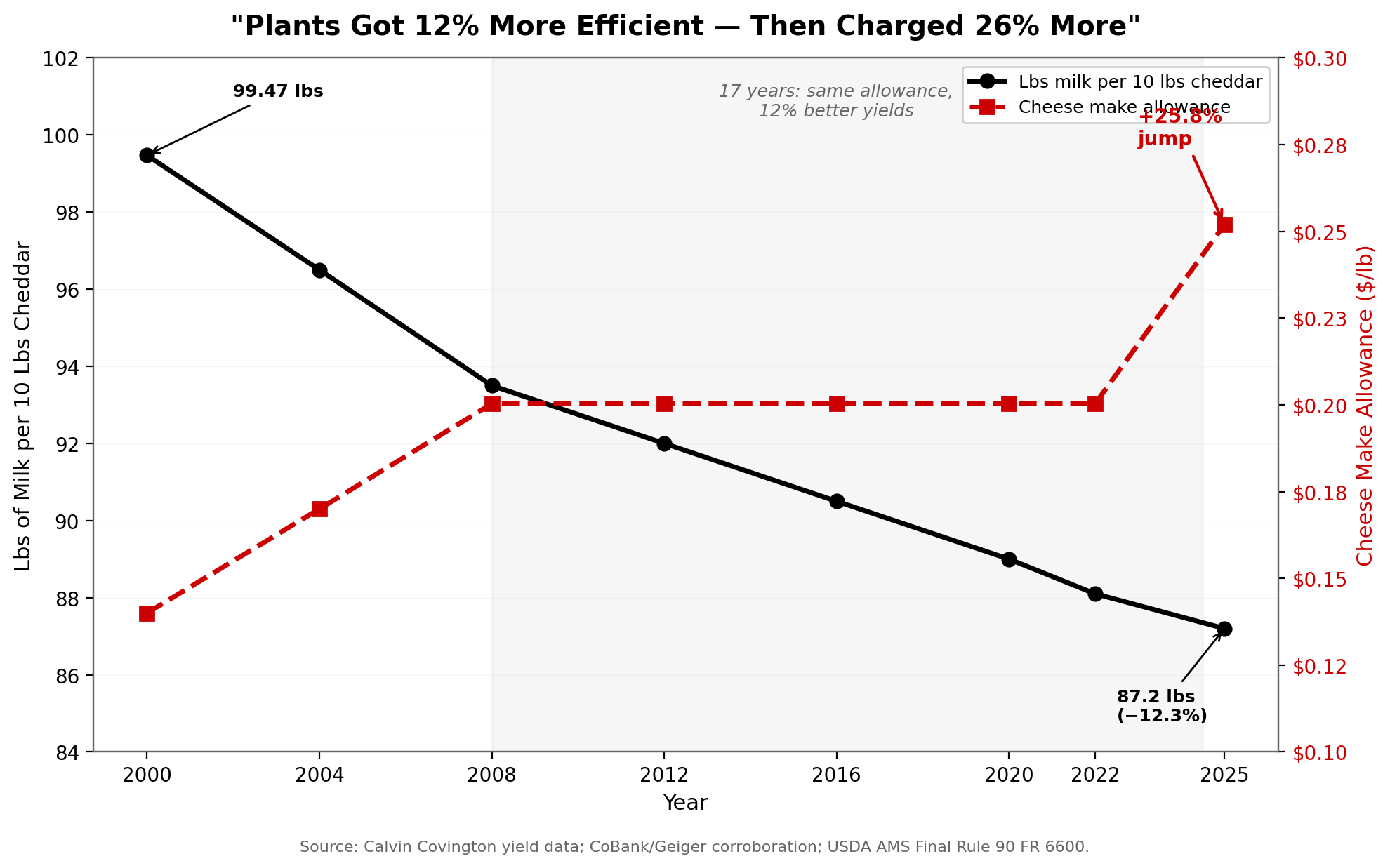
If per‑unit costs should be falling with those efficiency gains, why did the cheese make allowance jump 25.8%? NFDM, 42.6%?

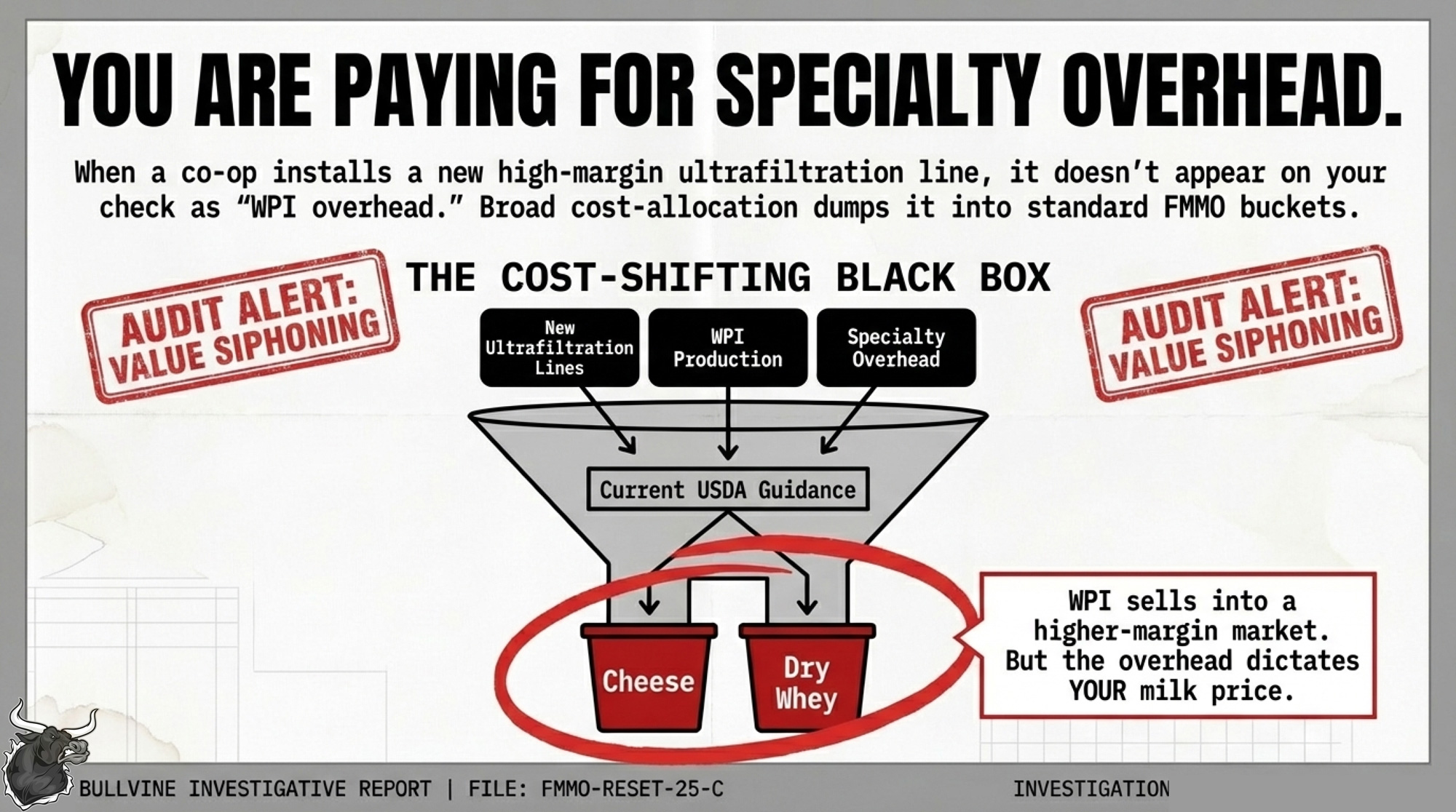
Nobody’s arguing that plants haven’t seen real inflation in labor, energy, and compliance. The question is whether the mandatory survey will separate those costs from overhead tied to high‑margin specialty products — WPI, MPC, ultrafiltered milks — that don’t determine your milk price.

When a co‑op installs a new ultrafiltration line, that capital expenditure doesn’t appear on your check as “WPI overhead.” It shows up in the total plant cost. If overhead is allocated broadly across all product streams, some of it lands in the cheese and dry whey buckets that feed the FMMO formulas — even though WPI sells into a completely different, higher‑margin market.

ADC calls this “cost shifting.” Processors say their allocation methods follow current USDA guidance. That’s exactly why the survey definitions and allocation rules matter: what USDA writes now will determine which costs land in your make allowance for years.

⚠️ Lender Alert: The DSCR Threshold You Can’t Ignore

Before the playbook — one number that should stop you cold.
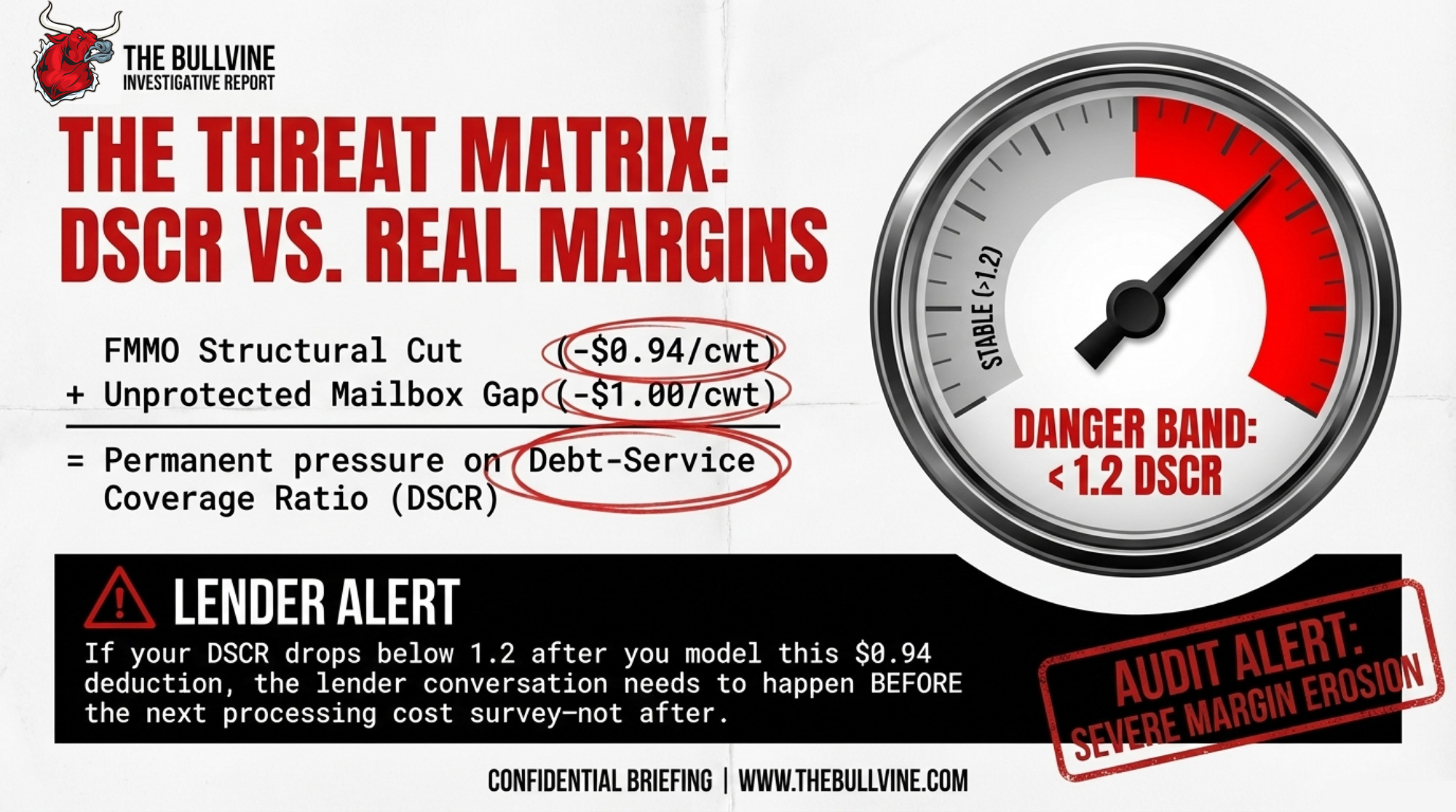
If your debt‑service coverage ratio stays above 1.5 after you model a $0.94/cwt hit from structural make allowance deductions, you’ve got room to absorb survey surprises. Below 1.2 — a level extension and lender materials commonly flag as a minimum comfort zone for leveraged dairies — you’re in a risk band that justifies a hard conversation with your lender before the next survey results lock in.

The 2025 allowances already shifted $0.94/cwt from every Class III check and $0.87/cwt from every Class IV check — permanently, at any commodity price level. Fischer sees a real possibility that if the new survey rules don’t narrow cost‑allocation practices, a future update could push allowances higher again.

That’s an outlook, not a guarantee. But your capital plan shouldn’t pretend it’s impossible.
Why DMC Is Measuring a Margin You Don’t Actually Receive

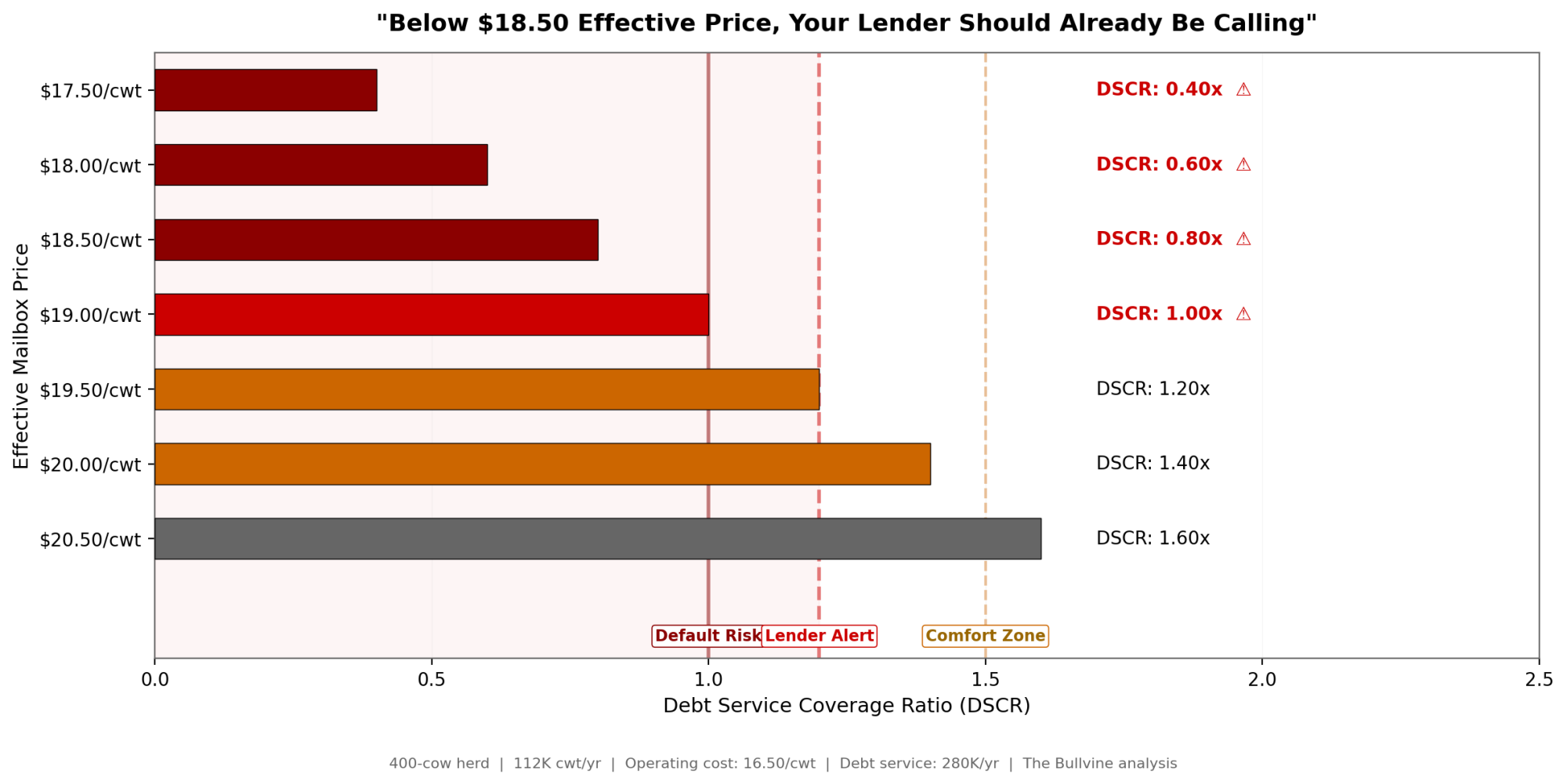
Dairy Margin Coverage calculates your margin by subtracting a formula feed cost from the NASS All‑Milk price — a gross number that ignores make allowance deductions, hauling, co‑op retains, and basis. Your actual realized price, the mailbox price, runs lower.
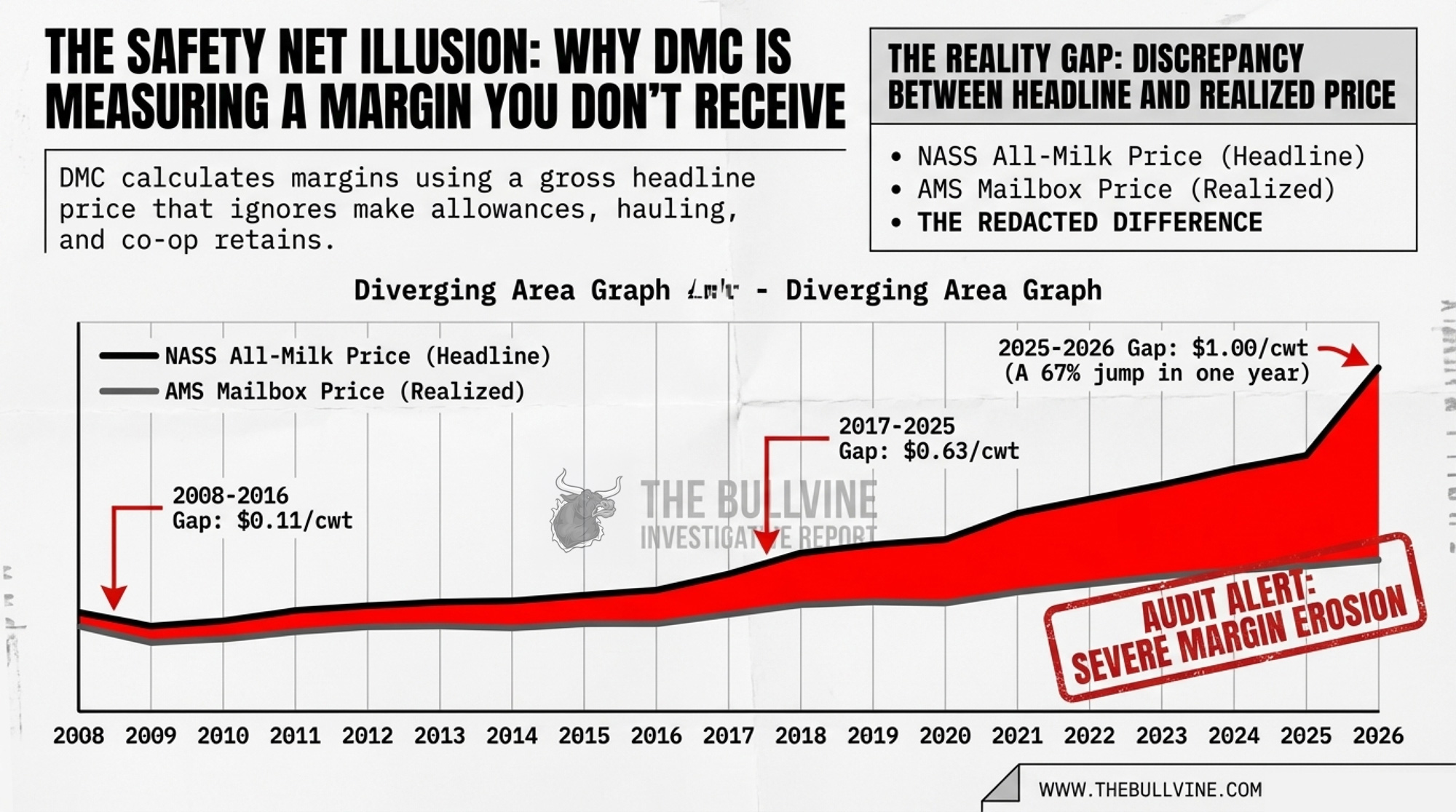
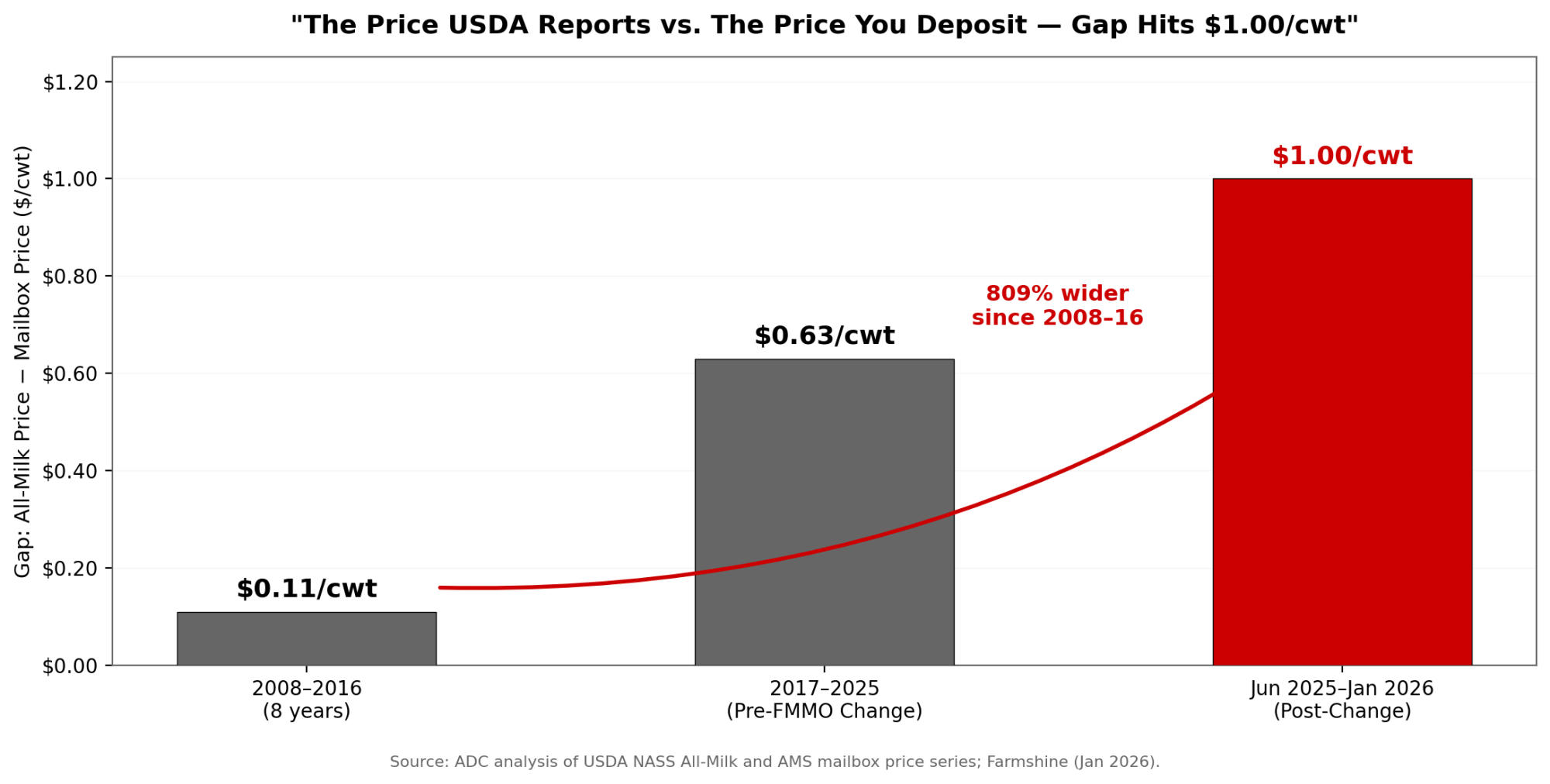
ADC compared published USDA NASS All‑Milk and AMS mailbox price series and found the gap has quietly widened: about $0.11/cwt in 2008–2016, $0.63/cwt in 2017–2025, and roughly $1.00/cwt from June 2025 to January 2026 — a 67% jump in one year. The most recent trend is corroborated by Farmshine’s January 2026 report, which confirmed that the USDA mailbox price had plummeted by $5.23 from a year earlier. For additional context, Covington’s own 2019 analysis of the same USDA mailbox data in Progressive Dairy showed the 2018 weighted national average mailbox price at $15.72/cwt — with NASS All‑Milk for that year averaging approximately $16.26/cwt, a gap of roughly $0.54/cwt that falls within ADC’s reported $0.63 average for the 2017–2025 window.
AFBF economist Daniel Munch notes that DMC has distributed roughly $2.7 billion in net support since 2019, but total production costs reached about $23.65/cwt in 2024 — meaning many producers were underwater even when DMC margins sat above trigger levels. OBBBA raised Tier I coverage from 5 million to 6 million pounds and created a 25% premium discount for multiyear enrollment (2026–2031), but it didn’t change the All‑Milk margin calculation itself.

Your safety net is being measured off a headline price that’s drifting farther from what actually hits your bank account. And the 2025 allowance changes are a big reason why.

What Does a $0.94/cwt Make Allowance Hit Mean for a 400‑Cow Herd?
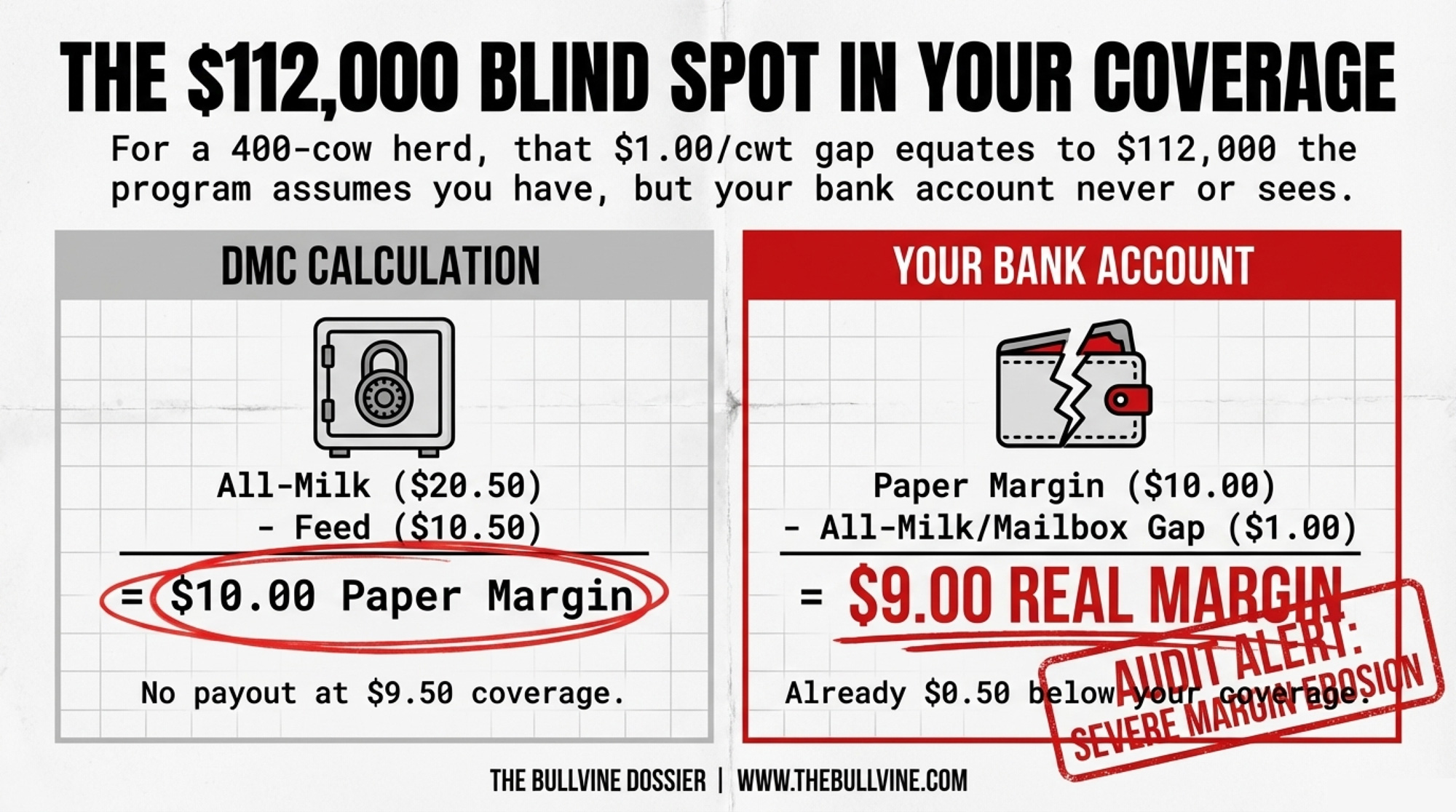
  • Herd: 400 cows, 28,000 lb/cow/year ≈ , 112,000 cwt
  • Scenario: All‑Milk at $20.50/cwt, formula feed at $10.50/cwt

DMC sees a $10.00/cwt margin — no payment at $9.50 coverage.

But with a $1.00/cwt All‑Milk/mailbox gap:

  • Mailbox: ~$19.50/cwt → Real margin: $9.00/cwt — already $0.50 below your coverage
  • Annual unprotected gap: 112,000 × $1.00 = ~$112,000 the program assumes you have, but your bank account doesn’t

Tighten it. All‑Milk drops to $19.75, feed stays at $10.50:

  • DMC margin: $9.25/cwt → 25¢ indemnity at $9.50 coverage
  • Mailbox: ~$18.75 → Real margin: $8.25/cwt — a full $1.25 below the margin you insured
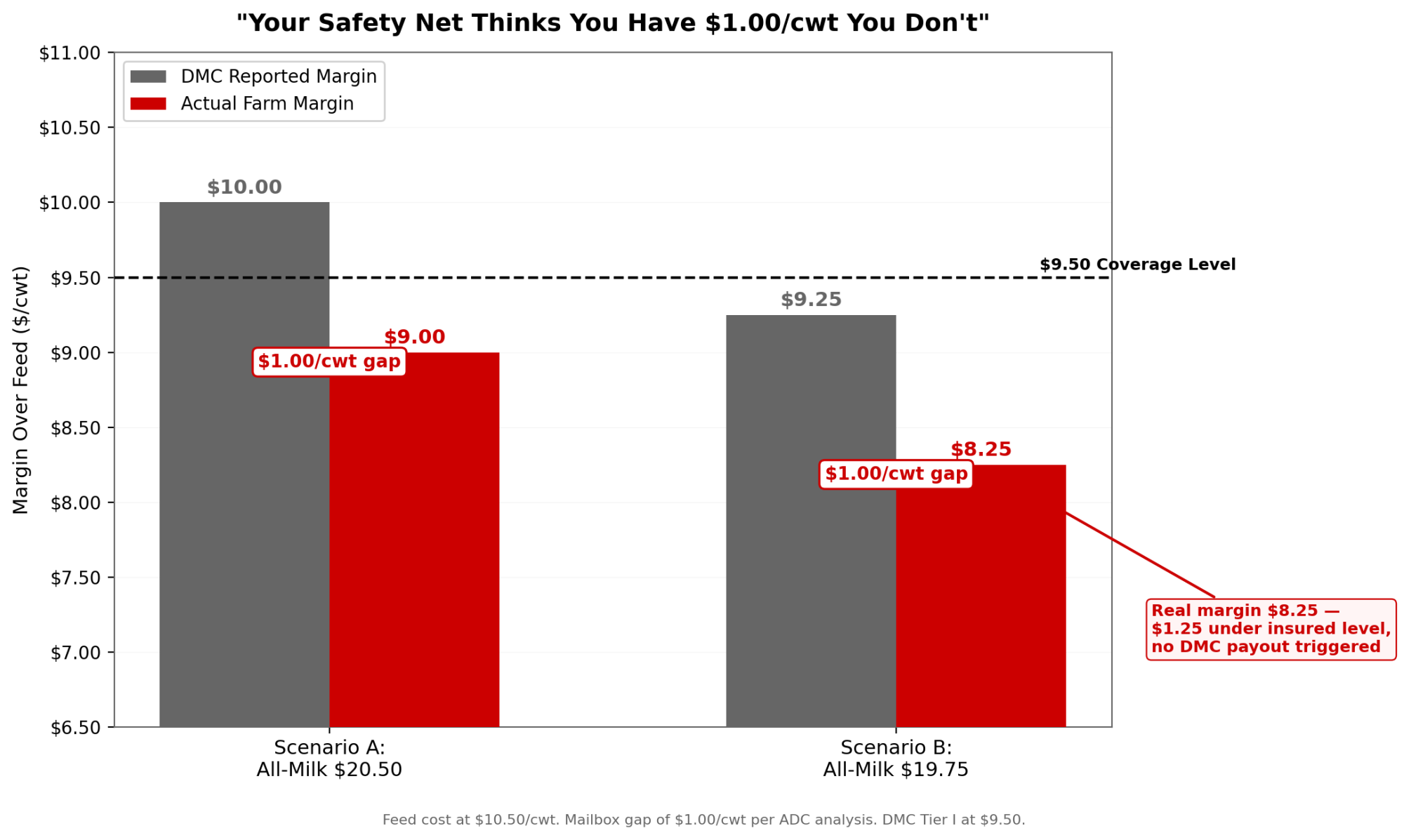
Same herd. Same feed. Same coverage. The only variable: the spread between a national headline price and what actually hits your account.

Will the OBBBA Survey Fix the Make Allowance Problem — or Freeze It In?

The One Big Beautiful Bill Act authorized mandatory surveys of dairy processing costs and yields under Section 10314. According to AFBF’s Munch, those surveys are supposed to be biennial to prevent another 17‑year gap between major resets.
In February 2026, AMS published an Advance Notice of Proposed Rulemaking in the Federal Register to outline the survey design. ADC requested a 60‑day extension; AMS didn’t grant it. Fischer’s team filed formal comments by the March deadline.

Producer groups want a narrow scope: physical conversion costs for four formula products, clear product‑line cost separation, and standardized allocation rules. Processors argue they need flexibility to reflect varied plant types and product mixes. “There is a real expectation that this survey will provide transparency,” Fischer says. “USDA needs to ensure that the expectation is met.”

If the categories and allocation rules come out too loose, the survey could ratify those high allowances and give them fresh, “audited” cover. That’s the real battleground of 2026.

Three Questions to Put in Front of Your Co‑Op Board

Many of the cost‑allocation choices that matter most occur within organizations that still call themselves farmer‑owned. For a 400‑cow member already $105,000 lighter from the formula change, your co‑op’s processing margin and your milk check draw from the same pool.

Ask — in writing:

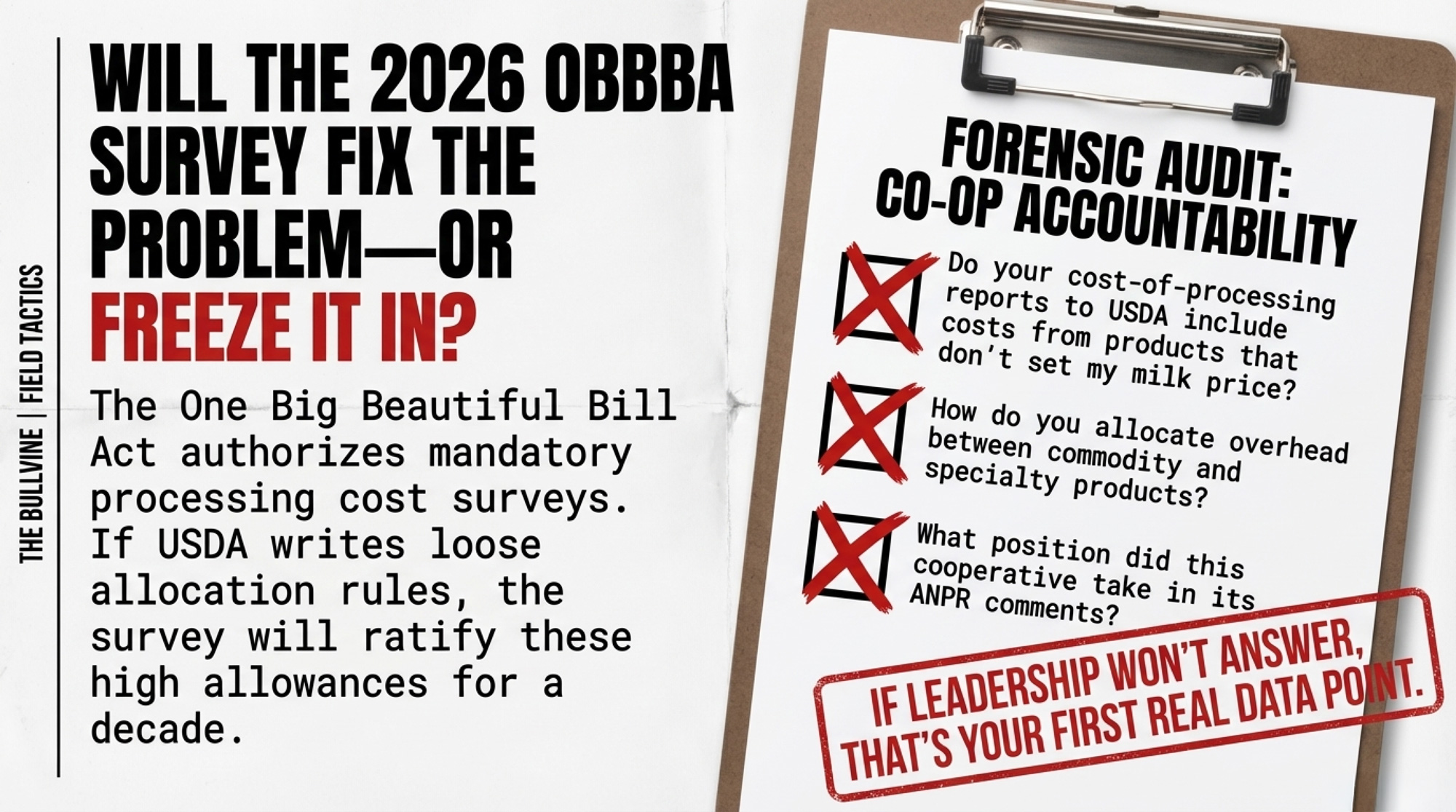
  • “Do your cost‑of‑processing reports to USDA include costs from products that don’t set my milk price?”
  • “How do you allocate overhead between commodity and specialty products, and can members see that schedule?”
  • “What position did this cooperative take in its ANPR comments?”

If leadership won’t answer clearly, that’s your first real data point.

What Should Your Dairy Do in the Next 30, 90, and 365 Days?
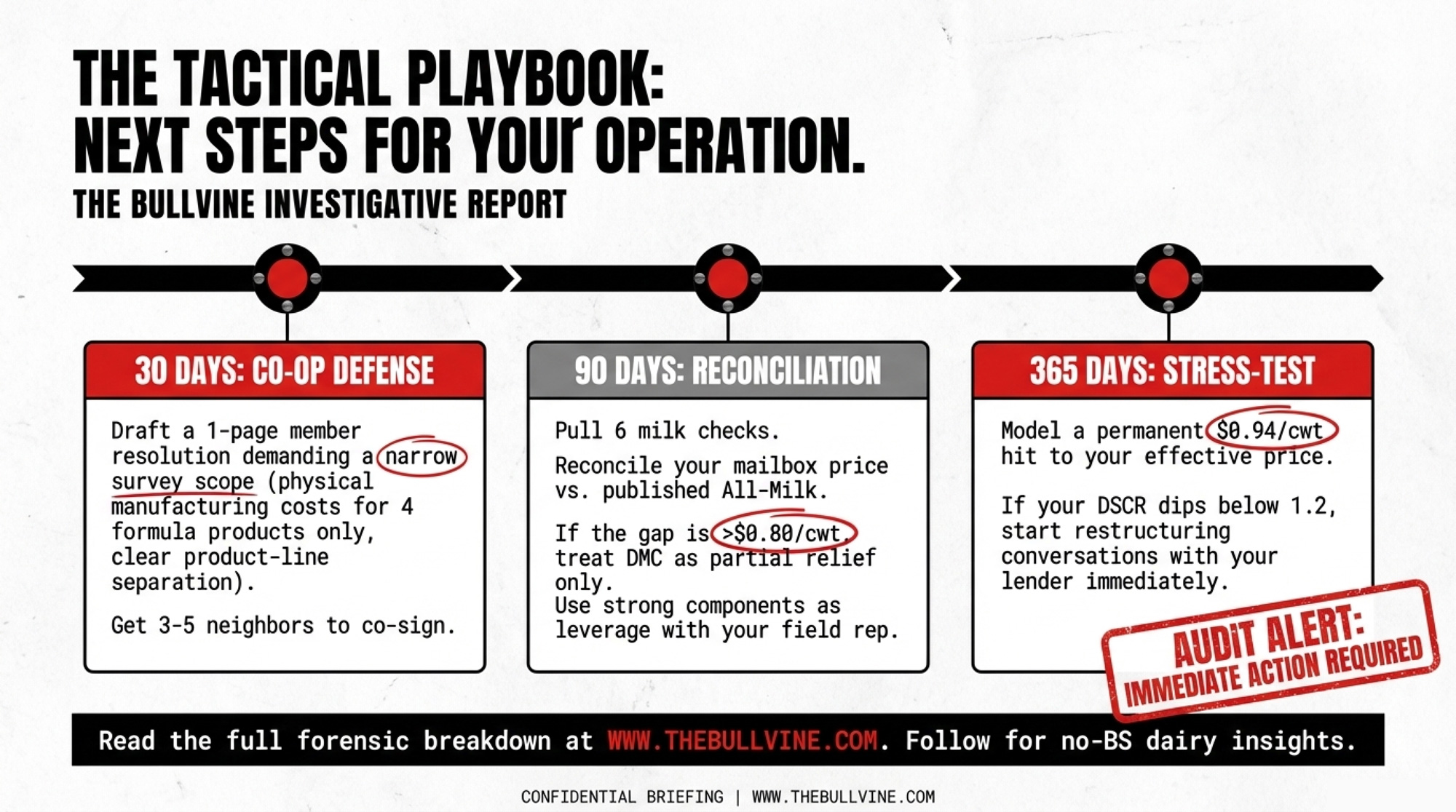
Next 30 Days

  • Draft a one‑page member resolution calling for a narrow survey scope — physical manufacturing costs for four formula products only, clear product‑line separation, and standardized allocation methods. Get three to five neighbors to co‑sign and push your board to adopt it.
  • Ask for your co‑op’s ANPR position in writing. If management won’t share it, that tells you something.

Next 90 Days

  • Run your own All‑Milk/mailbox reconciliation. Pull six checks and compare your mailbox to the published All‑Milk for your state. If the gap averages more than $0.80/cwt, treat DMC as partial relief, not a margin backstop — and walk your lender through the math. If they’ve never heard the term “make allowance,” that conversation itself is the point.
  • Use strong components as leverage. If your butterfat and protein run well above pool, the make allowance bite is proportionally bigger — but so is your ability to negotiate component premiums. Bring those numbers to your next field‑rep meeting.

Next 365 Days

  • Stress‑test with your banker. What happens to your DSCR if your effective milk price drops another $0.94/cwt from structural deductions, even with decent futures? Below 1.2, start restructuring conversations now.
  • Be careful what you build on. If you’re penciling big projects on today’s over‑order premiums, stress‑test against a world where premiums get trimmed but structural deductions stay. Premiums are discretionary. Make allowance deductions held from 2008 to 2025.

What This Means for Your Operation

  • Make allowances are a structural risk line, not background noise. They reset your pricing base for years. You can’t hedge them with futures or negotiate them with your field rep.
  • The DMC printout doesn’t match your bank account. If your All‑Milk/mailbox gap is near $1.00/cwt, that gap needs to show up in every capital, coverage, and hiring decision you make.
  • Your co‑op voice matters right now. Once the OBBBA survey categories lock in, you live with those numbers in your milk check for the next cycle.
  • Get your lender on the same page early. A banker who understands the make allowance drag is more likely to work with you than one who only sees DMC margins on paper.
Key Takeaways

  • If your DSCR falls below 1.2 when you model a $0.94/cwt structural hit, you’re in the danger band — and lender conversations shouldn’t wait for the next survey round.
  • If your All‑Milk/mailbox gap has averaged $0.80/cwt or more over the last six months, your DMC coverage is quietly under‑insuring the margin you actually live with.
  • If your co‑op runs commodity and specialty lines, you have a direct financial stake in how it allocates overhead in survey responses — and a right to see that logic in writing.

Pull your last six milk checks. Find your mailbox price. Compare it to the All‑Milk number USDA published for those same months. That gap — not the futures board, not the co‑op newsletter, not the DMC margin printout — is the number that tells you how much of your income sits on the other side of formulas you didn’t write and still can’t fully audit.

Complete references and supporting documentation are available upon request by contacting the editorial team at editor@thebullvine.com.

Learn More

The Sunday Read Dairy Professionals Don’t Skip.

Every week, thousands of producers, breeders, and industry insiders open Bullvine Weekly for genetics insights, market shifts, and profit strategies they won’t find anywhere else. One email. Five minutes. Smarter decisions all week.

NewsSubscribe
First
Last
Consent

2,800 Farms Will Close in 2025. Here’s Why USDA’s ‘Golden Age’ Isn’t Saving Them

My kids could make more at Target, and they’d get Christmas off.’ Why 2,800 dairy families are making the hardest decision.

EXECUTIVE SUMMARY: At kitchen tables across dairy country, third and fourth-generation families are asking whether they should be the ones to step away. While Agriculture Secretary Rollins proclaimed a ‘golden age’ for dairy Monday, 2,800 farms will close in 2025 as margins compress to $11.55/cwt—down from $15.57 just six months ago. A typical 300-cow Wisconsin operation that netted $10,000 annually is now losing $61,000 after June’s make allowance changes shifted $82 million from producers to the processors industry-wide. USDA’s four-pillar response—dietary guideline updates, being ‘more vocal’ on interest rates, facilitating processor investments, and export expansion—offers no direct relief while processors invest $11 billion in facilities optimized for mega-dairies. Mid-sized operations face an 18-month decision window: gamble $2-3 million on expansion, pursue increasingly scarce niche markets, or execute an orderly exit while equity remains. The math increasingly points to one conclusion: the economics of their scale no longer work in a system optimized for different objectives.

You know, the conversations we’re having around kitchen tables these days are different from those we had even five years ago. I’m talking with third and fourth-generation producers who are looking at their numbers and wondering if maybe—just maybe—they should be the ones to step away. That’s a hard conversation, and it’s happening more than you’d think.

When Agriculture Secretary Brooke Rollins stood up at the National Milk Producers Federation meeting in Arlington on Monday, she spoke of a “golden age” for dairy and outlined a four-pillar action plan. But here’s what’s interesting—and I’ve been hearing this from producers all week—the view from the barn looks pretty different from the view from that podium.

The latest numbers from Rabobank and what we’ve been tracking suggest we’re looking at about 2,800 dairy farms closing in 2025. That’s somewhere between 7 and 9 percent of what’s left. Meanwhile, if you’re following the Dairy Margin Coverage program like most of us are, margins are sitting at $11.55 per hundredweight as of March, down from that nice $15.57 we saw back in September.

What I’ve found is we’re not just going through another rough patch here. This feels different. The gap between what’s being announced in Washington and what’s happening in the milk house…well, it’s pretty wide.

Let’s Talk Numbers

The brutal math: A typical 300-cow operation that barely broke even ($10K) is now bleeding $61K annually after June’s FMMO changes shifted $82M industry-wide from producers to processors

So I’ve been sitting down with producers, running through their books, and the pattern is remarkably consistent. Take your typical 300-cow Wisconsin operation—and there are still a lot of them out there.

The 300-Cow Reality Check: Annual P&L Breakdown

Revenue & ExpensesAmount
Gross Milk Revenue (8.2M lbs @ current prices)$1,480,000
Feed Costs ($10.45/cwt DMC calculation)-$857,000
Labor (family plus hired help)-$240,000
Debt Service (2010s expansion loans)-$112,000
Operating Expenses (vet, supplies, utilities, repairs, insurance, property tax)-$261,000
Net Farm Income$10,000
After Make Allowance Increases (June 2025 FMMO changes)-$61,000

“My kids could make more at Target, and they’d get Christmas off.”
— Minnesota dairy producer, 400 cows

And here’s where it gets really tough. Those Federal Milk Marketing Order changes that kicked in June 1st—the make allowance increases that processors can deduct from our checks—are another 85 to 90 cents per hundredweight gone. For that 300-cow operation? We’re talking $71,000 less per year. The Farm Bureau calculated it out, and industry-wide, that’s $82 million moving from producers to processors.

Breaking Down the Four Pillars

Let’s look at what Secretary Rollins is actually proposing here.

Pillar 1: Dietary Guidelines—Playing the Long Game

The idea is that updating the Dietary Guidelines for Americans will boost consumption. Current guidelines already recommend three servings of dairy daily for adults. Problem is—and the National Dairy Council has documented this—only about 12 percent of Americans actually follow those recommendations.

Key trend: USDA’s Economic Research Service shows we’ve gone from 247 pounds of fluid milk per person back in 1975 to about 128 pounds in 2023. That’s a 48 percent drop, despite dietary guidelines supporting dairy the whole time.

The Whole Milk for Healthy Kids Act letting whole milk back into schools? That’s positive. But school lunch participation is still down by 2.2 million kids from 2013, according to USDA data. Those are milk drinkers who just aren’t there anymore.

Pillar 2: Input Costs—Good Intentions, Limited Tools

Secretary Rollins acknowledging input cost pressures—that’s important. Since 2020, NASS data shows:

  • Seed costs: Up 18%
  • Fuel: Up 32%
  • Fertilizer: Up 37%
  • Interest expenses: Up 73% (the real killer)

When they asked for specifics at the NMPF meeting, the response was that Secretary Rollins would “be more vocal” with the Federal Reserve about interest rates. A producer with 400 cows in Minnesota summed it up: “Being vocal doesn’t pay the feed bill.”

Pillar 3: Processing Investments—Complicated Picture

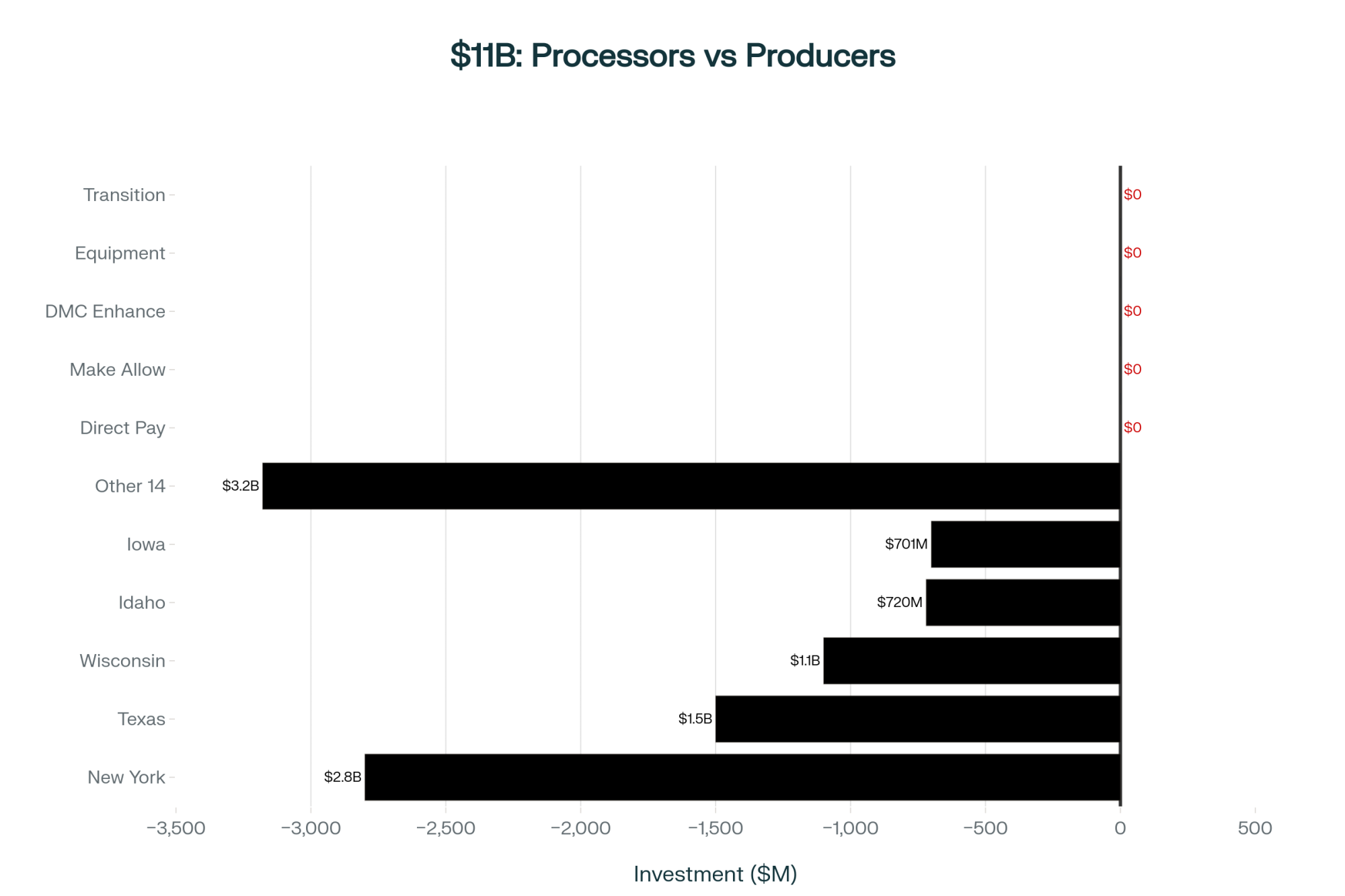
The International Dairy Foods Association announced $11 billion in processing investments across 19 states through early 2028. New infrastructure, expanded capacity—sounds great.

But these announcements came right after processors secured those make allowance increases worth $82 million annually. Hard not to connect those dots.

“These plants are being built for tomorrow’s farms, not today’s. And tomorrow’s farms don’t look like most of my members.”
— Wisconsin cooperative manager

What concerns me for mid-sized operations is the nature of these investments. A new cheese plant designed to handle 2 million pounds daily? They want five operations milking 2,000-plus cows each, not 50 different 300-cow farms.

Pillar 4: Export Markets—Progress with Risk

Exports are showing real growth. U.S. Dairy Export Council reports:

  • Volume: Up 2% year-to-date
  • Value: Up 16% year-to-date
  • Indonesia: Now the 7th-largest market at $246 million

But China still has retaliatory tariffs on our products. Mexico takes nearly 40 percent of our cheese exports—that’s a lot riding on one relationship with the USMCA review coming in 2026.

The View from Up North

You know what Secretary Rollins didn’t mention? What’s happening in Canada. Their Dairy Commission data shows they’re maintaining about 12,000 operations averaging 85 cows, with debt-to-asset ratios around 16 percent.

Sure, quota runs about $24,000 Canadian per cow-equivalent. Consumers pay more. But Canadian producers can plan facility upgrades five, seven years out because they know what their milk price will be.

“I focus on production efficiency and cow comfort, not price volatility.”
— Ontario dairy producer at World Dairy Expo

Can you imagine?

When margins collapsed in 2009, USDA deployed $3.5B in direct relief. In 2025’s “golden age”? Zero dollars—just promises to be “more vocal” with the Federal Reserve while 2,800 farms close

How Support Has Changed: 2009 Crisis vs. 2025 Action Plan

2009 Dairy Crisis Response2025 USDA Action Plan
$3.5 billion in direct support (MILC payments + product purchases)No direct financial support announced
Government bought 379 million pounds of nonfat dry milkNo product purchase program
Direct payments to farmers when prices crashed“Being more vocal” with the Federal Reserve
Emergency intervention during the 36% price collapsePolicy speeches during steady consolidation
Processors are pouring $11B into 50+ new facilities optimized for mega-dairies producing 2M+ lbs daily, while farmers facing closure get “vocal advocacy” and zero financial support

The 18-Month Reality Check

From 37,100 farms in 2017 to a projected 10,200 by 2030—the mid-size operations (200-999 cows) are vanishing fastest, down 72% as scale economics favor mega-dairies with $3-4/cwt cost advantages

Industry folks I trust keep pointing to the next 18 months as make-or-break time for operations in that 200-to-700 cow range. Several things are converging:

  • June 2026: Environmental regulations tighten in key states
  • Ongoing: Processing contracts getting renegotiated with new volume requirements
  • Now: Farms that survived 2020-2024 by burning through working capital are running on fumes

Regional differences are striking:

  • Southeast: Heat stress management costs change the economics completely
  • Northeast: Higher land values and stricter environmental rules
  • Mountain West: Water rights add another layer of complexity
  • California: Even modernized operations face $4-5/cwt disadvantage versus mega-dairies

I know producers in California’s Central Valley—good farmers, 425 cows, modernized everything. University of California Extension studies show they’re still $4 to $5 per hundredweight higher in costs than the 3,000-cow operation down the road. As one told me, “We’re not bad farmers. We’re just the wrong size.”

RegionTypical Herd SizeCost per CWTCost Disadvantage vs Mega-DairiesPrimary Cost DriversFarms Lost 2022-202518-Month Survival Outlook
California Central Valley1,200-3,000$18.50-19.20$4.00-4.50Water/Environmental Regs-425Critical
Pacific Northwest600-1,500$19.50-20.00$5.00-5.50Transportation/Labor-280Severe
Southeast (Georgia/Florida)400-800$20.00-21.50$6.00-7.00Heat Stress/Mortality-320Severe
Northeast (PA/Vermont)250-500$19.00-20.50$4.50-5.50Land Values/Phosphorus-380Critical
Upper Midwest (WI/MN)300-700$17.50-18.50$3.50-4.00Property Tax/Labor-630Critical
Mountain West (ID/UT)2,000-5,000$15.50-16.50$1.00-2.00Scale Efficiency-140Moderate
Southwest (TX/NM)2,500-10,000$15.00-16.00$0.50-1.50Lowest Input Costs-95Stable

What This Means for Different Scales

Operations Under 500 Cows: The Hard Math

Calculate your true per-hundredweight costs, including fair wages for family labor. Can you survive with margins below $12? Looking at CME futures, that might be reality through mid-2026.

Your three main options:

  • Scaling up: $2-3 million minimum investment, 7-10 year payback if margins improve
  • Going organic: 7-year conversion, many regions already oversupplied per the National Organic Program
  • On-farm processing: Budget at least $500,000, plus you’re starting a new business

Sometimes preserving equity through an orderly exit makes more sense than operating at a loss for two more years. It’s math, not judgment.

Operations Over 700 Cows: Better Positioned but Not Immune

You’re better positioned, but every percentage-point improvement in feed conversion or component efficiency matters now. Watch for opportunities when neighbors exit. Some successful operations grow incrementally through local consolidation rather than through massive expansions.

Decision PointAction RequiredEquity at StakeOptions Remaining
Month 0: First Negative MarginCalculate true cost per cwt including family labor$0 (Starting Point)All paths open
Month 3: Review Break-Even AnalysisAnalyze 3-year profit/loss trend, equity burn rate-$15,000 to -$45,000All paths open
Month 6: Critical Assessment WindowCan you secure processing contracts post-2026?-$45,000 to -$120,000All paths feasible
Month 9: Processor Contract DecisionCommit to scale-up ($2-3M) OR niche market pivot-$90,000 to -$200,000Costs rising for delayed decision
Month 12: Go/No-Go Decision PointFinal decision: Invest, pivot, or orderly exit-$150,000 to -$320,000Window closing rapidly
Month 15: Implementation BeginsBegin facility upgrades OR market transitionStabilizing or decliningCommitted to chosen path
Month 18: Irreversible CommitmentCapital deployed, path locked inPath dependentNo turning back
Month 24+: Forced Exit (if waited)Emergency liquidation, lost equity-$380,000 average loss vs. Month 12 exitEmergency measures only

Five Critical Questions to Answer Before January 2026

If you’re facing these decisions, start with question one and work through them honestly:

1. What’s your true breakeven, including family living expenses?
Not just covering cash flow—actually supporting your family at a reasonable standard.

2. Can you secure processing contracts beyond 2026?
If your processor is building new facilities, are you the size they want long-term?

3. At current margins, how fast are you burning through equity?
If you’re losing $50,000 annually, when does your debt-to-asset ratio become problematic?

4. If succession is planned, are you handing over a viable business or debt?
Be honest about what the next generation would actually inherit.

5. What does orderly exit today look like versus forced exit in 18 months?
Compare land values, equipment depreciation, and herd values in both scenarios.

Finding Ways Forward

Not everyone’s giving up. A Pennsylvania producer with 380 cows went from losing $40,000 annually to breaking even. “We renegotiated every contract, switched to seasonal calving to reduce labor peaks, and started custom raising heifers for cash flow. It’s not pretty, but we’re still here.”

In Vermont, three neighbors with 200-cow operations formed a joint venture. They share equipment and labor but keep separate ownership. Their combined 600 cows achieve better economics without anyone taking on massive debt.

Down in Texas, smaller operations are finding success with direct institutional sales. One producer’s getting a $2 premium per hundredweight from a regional hospital system valuing local sourcing. For a 300-cow operation, that’s $164,000 additional annual revenue.

These aren’t miracles. They’re grinding it out, getting creative, adapting.

The Reality We’re Facing

Current policy seems optimized for large-scale operations and export competitiveness rather than for preserving mid-sized farms. That $11 billion in processor investments signals confidence in dairy’s future—but it’s a future with fewer, larger farms producing for global commodity markets.

The 300-cow operations that built our rural communities are becoming harder to sustain economically. Not because they’re bad at farming, but because the system increasingly favors scale.

Practical Steps That Work

Surviving operations share common traits. It’s not about the newest equipment—it’s about eliminating every unnecessary expense. Some are forming partnerships, sharing resources, even merging herds while keeping separate ownership.

Market development works when you find specific buyers—hospitals, schools, regional chains—who value local sourcing enough to pay premiums. Financial creativity matters too. Equipment leases, custom work arrangements, conservation easements—everything’s worth considering.

Resources Worth Checking

Financial Planning:

  • DMC Decision Tool at dairymarkets.org
  • Federal Milk Marketing Order info at ams.usda.gov
  • Your state Extension dairy program for cash flow templates

Support When Needed:

  • Farm Financial Standards Council: ffsc.org
  • National Young Farmers Coalition: youngfarmers.org
  • Farm Aid hotline: 1-800-FARM-AID
Margins crashed $4.02/cwt in six months—but DMC offers zero protection until you hit $9.50. Mid-size farms are bleeding in the $2+ gap between their breakeven and federal safety nets

The Bottom Line

Secretary Rollins’ “golden age” might happen for large operations positioned for exports, processors with efficient new plants, and input suppliers serving bigger customers. This infrastructure will make U.S. dairy more globally competitive.

But for many 300-cow Wisconsin operations, 450-cow Pennsylvania farms, 250-cow Vermont dairies, this isn’t a golden age. It’s a countdown. Not because they failed, but because the economics of their scale don’t work in the current system.

These families need honest analysis and practical tools, not just optimism. The next 18 months will reshape American dairy more than any period since the 1980s. Whether mid-sized producers find ways to stay viable or choose to preserve value through exit, they’re making rational decisions in challenging circumstances.

At kitchen tables across dairy country tonight, families are making choices that can’t wait for the next farm bill or election. They’re using real numbers, actual margins, and making generational decisions. Whatever they choose, they’re not failing. They’re adapting to reality.

The industry that emerges will be different. Understanding that—both the challenges and opportunities—helps us all navigate this transition better. That’s the conversation we need to be having, with clear eyes and respect for the tough choices our neighbors are making.

Because at the end of the day, we’re all trying to figure out the best path forward in an industry we love, even when it’s testing us like never before.

KEY TAKEAWAYS:

  • The $71,000 shift: June’s make allowance changes moved $82M from producers to processors—turning a typical 300-cow operation from barely profitable ($10K) to bleeding cash (-$61K)
  • Your 18-month decision window: By January 2026, choose your path—invest $2-3M to scale up, transition to niche markets, or execute an orderly exit while preserving equity
  • Why USDA’s “support” won’t save you: The four-pillar plan (dietary guidelines, export expansion, processor investments, “vocal” interest rate advocacy) offers no direct financial relief as 2,800 farms close
  • The permanent disadvantage: Operations under 700 cows face $4-5/cwt structural cost gap versus mega-dairies that no amount of belt-tightening can overcome
  • Five critical questions to answer now: True breakeven with family wages? Processing contracts beyond 2026? Equity burn rate? Succession viability? Exit value today vs. 18 months?

Complete references and supporting documentation are available upon request by contacting the editorial team at editor@thebullvine.com.

Learn More:

The Sunday Read Dairy Professionals Don’t Skip.

Every week, thousands of producers, breeders, and industry insiders open Bullvine Weekly for genetics insights, market shifts, and profit strategies they won’t find anywhere else. One email. Five minutes. Smarter decisions all week.

NewsSubscribe
First
Last
Consent
Send this to a friend