




Archive for dairy herd dispersal

191 Cows Sold at Sedgemoor. Seven Years Later, the Macphersons Won British Friesian Herd of the Year.

Fifty buyers. £1,409.52 all-in. The Macphersons lost the rented ground, but four Beaufort bulls were already placed at Genus ABS (the UK arm of the US-based bull stud) before the gavel fell. That’s what carried the pedigree to 2026.
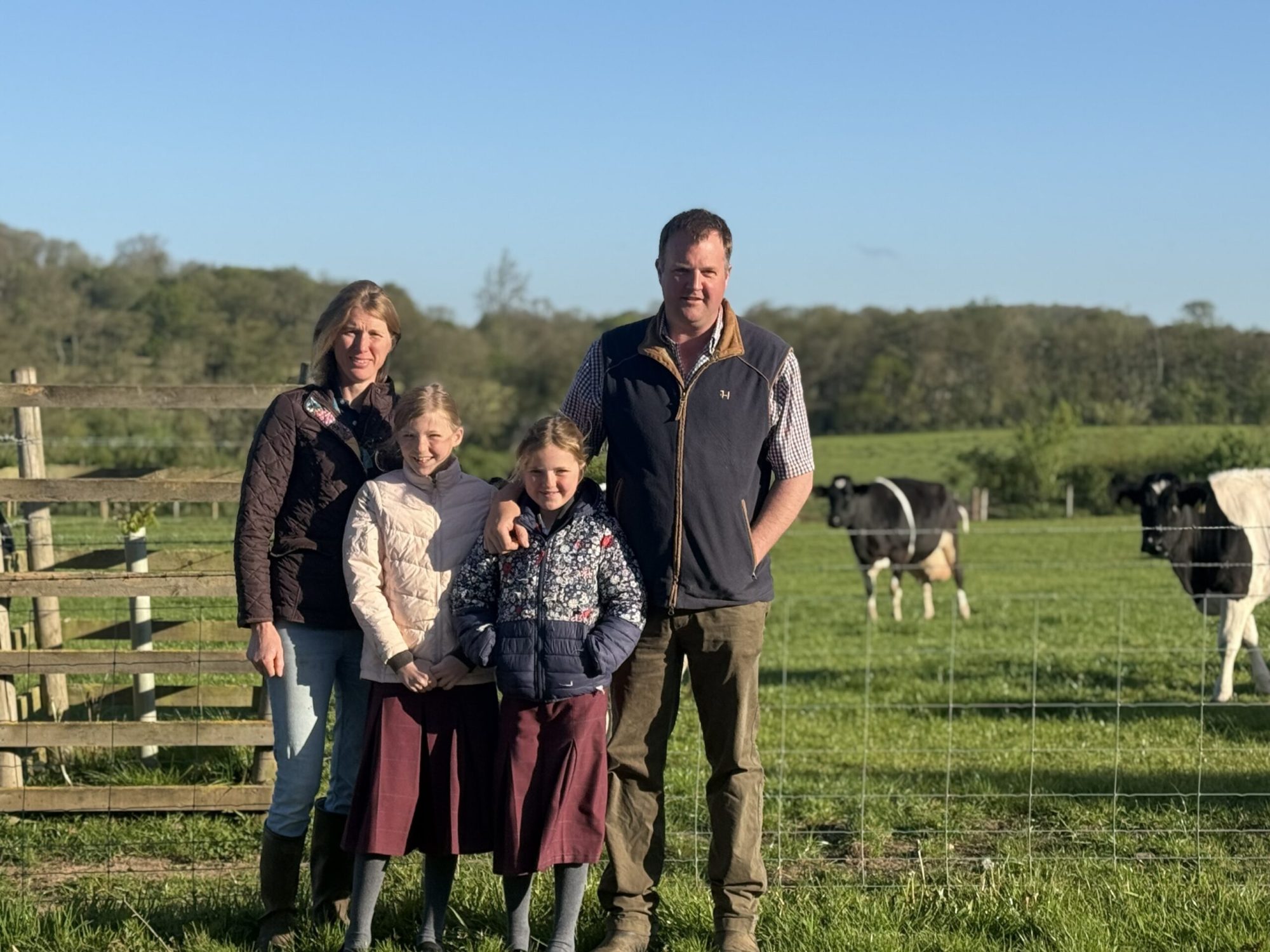
Beaufort British Friesians
James and Louise Macpherson with daughters at their Staffordshire unit near Burton-on-Trent, home to the 290-cow Beaufort British Friesian herd named Holstein UK’s British Friesian Herd of the Year 2026 — seven years and eight months after the family’s 2018 Sedgemoor dispersal.

On 16 August 2018, the Beaufort British Friesian herd of James and Louise Macpherson was dispersed at Sedgemoor Market, Somerset. Farmers Weekly’s coverage of the sale attributed the dispersal to the loss of rented ground supporting the Macphersons’ Dorset County Council tenancy at Burley Road Farm.

Fifty buyers turned up. Bidders came from Cornwall, Carmarthen, Cumbria and across Ireland. A fifth-lactation Rodbrook Milkmaid daughter of Beaufort Milkman sold for 2,600gns (roughly £2,730 at 2018 conversion). The topper hit 3,000gns twice — about £3,150 each — once for the bull Beaufort Kriminal, once for Goonhilly Chad Verity, EX92 in her fourth lactation. All-in average: £1,409.52. Seven years and eight months later, Holstein UK named the rebuilt Beaufort herd the British Friesian Herd of the Year for 2026 — 290 cows near Burton-on-Trent, Staffordshire, four homebred bulls in the Genus ABS catalogue.

The headline reads forced dispersal to national award in seven years. The real story is why the published pedigree survived the trip.

📌 The 50-Cow Test
If you lost your rented ground tomorrow, which 50 cows would rebuild your herd? Not the 50 you like. Not the 50 you’d keep for sentimental reasons. The 50 whose documented maternal families carry enough production, classification, and transmitting ability to rebuild across a 5–7 year window. If you can’t name them in 20 minutes, the breeding plan lives in your head — and the plan evaporates the day the auctioneer shows up.

Forced Dispersals Are the Industry’s Quiet Tail Risk

Forced dispersals are the tail risk the trade press rarely covers — quiet, abrupt, and built into every tenancy agreement, every rented block, and every bTB test. They don’t care how good your cows are. Per FW’s 2018 coverage, the Macphersons lost rented ground that year. Yours might be a landlord selling up, a council estate reviewing its holdings, a bTB breakdown, or a bank conversation you’ve been putting off.

AHDB recorded the GB milking herd at 1.63 million head in October 2025 — the lowest October figure on record, down 0.9% year-on-year — with the total GB dairy herd falling 1.3% to 2.51 million. Producers are leaving, one tenancy and one breakdown at a time.

Breed context sharpens the stakes for British Friesian breeders in particular. AHDB registration figures show British Friesian calf registrations dropped from roughly 100,000 in 2014 — about 7% of GB dairy registrations — to 58,500 in 2023, about 4%. Holstein UK launched the British Friesian Herd of the Year award in 2021 — see how the award has been judged since its 2021 launch — and judges it on classification combined with production.

Inside a shrinking breed, the herds still winning are the ones treating their published pedigree as a capital asset, not a hobby.

What the Beaufort Record Looked Like on Dispersal Day

FW’s 2019 council-farms feature and FarmingUK’s 2026 award coverage report that the Macphersons began in Dorset by buying 55 cows in 2012 — the Rodbrook herd, purchased as a voluntary complete-herd sale from Cheshire breeder Chris Pemberton. A complete-herd acquisition, not a pick-and-choose at auction. You don’t rebuild from documented maternal lines by buying individual animals you like the look of. You rebuild from families.

By the time the sale ring opened in 2018, the young end of the Beaufort herd — 137 cows in their first three lactations — was averaging 8,696kg at 5.03% fat and 3.28% protein on a somatic cell count of 172,000, per FW’s sale report. That’s a working, composition-led British Friesian herd on the numbers, not a show string. The Langley and Goonhilly lines had been added alongside the Rodbrook foundations across six Dorset years, according to FarmingUK’s 2026 award coverage. The EX92 Goonhilly cow that tied for top price is the documented proof the base was deep.

A composition-led herd with VG and EX depth on paper isn’t a trophy cabinet. It’s a portable balance sheet.

Don’t Put All Your Eggs in One Bulk Tank
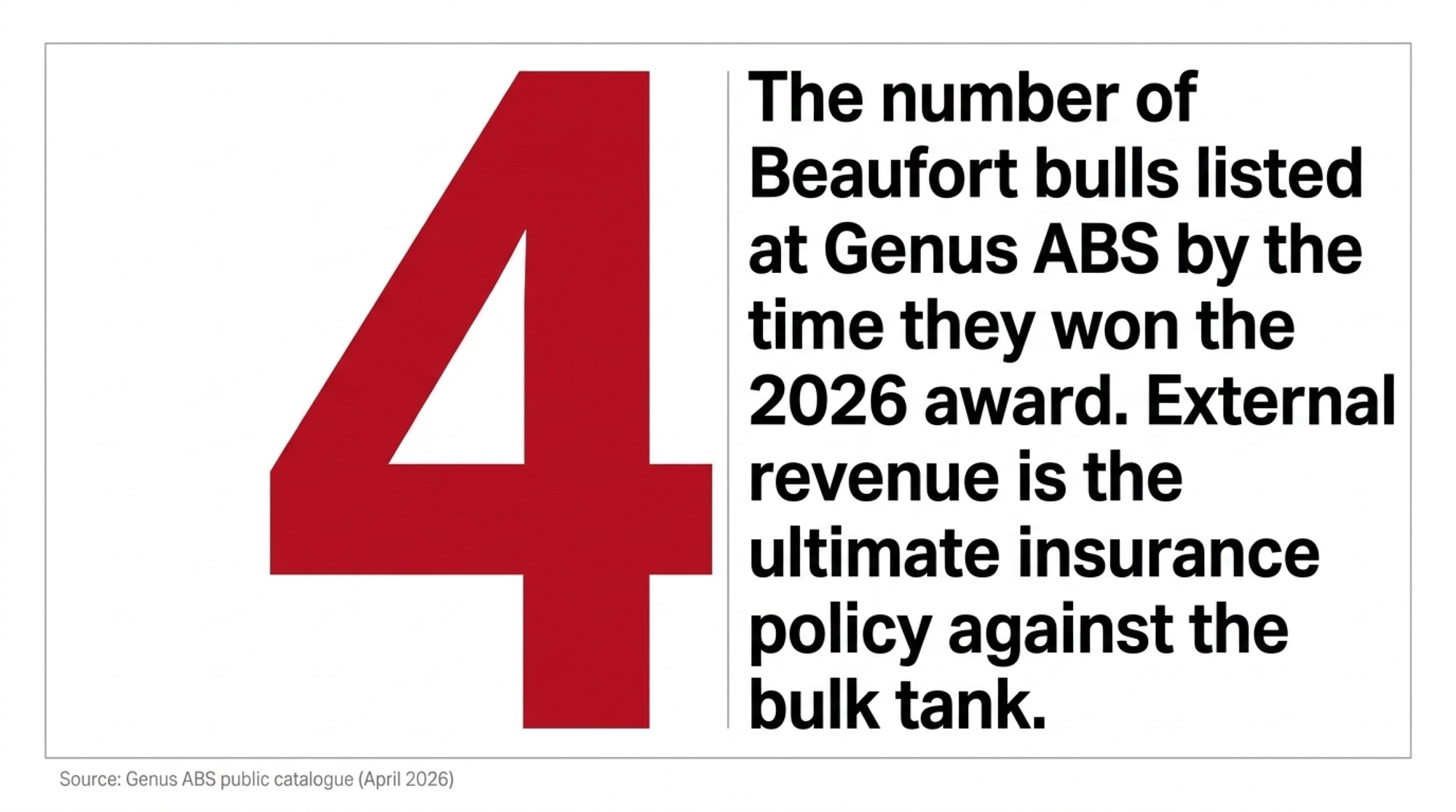
Here’s what the award coverage didn’t put up front. By the time the sale ring opened in 2018, Beaufort genetics were already moving commercially through Genus ABS — the UK arm of the US-based bull stud. Beaufort Milkman — son of Blackisle Maverick-ET out of Rodbrook Milkmaid 8, whose sire was Rodbrook Barney — was listed Proven in the Genus ABS catalogue. FW’s 2018 dispersal report noted Beaufort Kriminal had “two brothers already at Genus” when he topped the sale at 3,000gns.
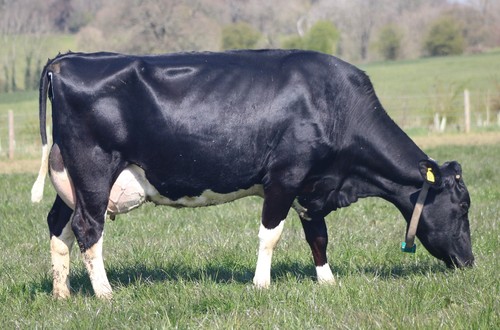
DAU: Beaufort Milkman Jess-4yrs, 3rd Lactation

Revenue diversification is the insurance policy. If every penny of your cash flow leaves through the bulk tank, one disruption — lost ground, a bTB breakdown, a processor renegotiation — can pull the whole operation down. The public record shows Beaufort spread risk across the milking herd, the AI contract at Genus, and the wider pedigree market for surplus heifers and bulls. By 2026, four Beaufort bulls are listed with Genus ABS across two proof generations.

The Beaufort Genetic Engine (public record, as of April 2026)

BullStatusKey MetricRole in the Rebuild
Milkman(BF1088 / 29HO17260)ProvenMaverick-ET × Rodbrook Milkmaid 8Established the Beaufort prefix inside other herds before the dispersal.
Karactacus(BF1085 / 29HO17242)ProvenBorn March 2014Second Proven Beaufort sire working commercially through Genus.
Supersonic(BF1279 / 29HO20412)GenomicAHDB April 2025 run: £306 PLI; 3rd in BF PLI rankings; +395kg milk, +29kg combined F+P; Kappa Casein AAElite genomic ranking keeping the prefix current post-rebuild.
Jackery (BF1285 / 29HO20413)GenomicKappa Casein AB; Red Carrier (*RC); released August 2024Niche-market value inside the closed-herd breeding plan.

The pedigree architecture that carried the herd through the dispersal is the same architecture earning AI income outside the farm. Those aren’t two separate strategies — they’re one. For the long-game logic behind tracking recessives like Red Carrier inside a closed pedigree herd, our Sir Inka May piece covers exactly that kind of decision.

“Our milk buyer is looking for high fat and the Friesians are really good for this — our herd average for 220 cows is 8,400kg at 5.1% fat.” — James Macpherson, quoted in FarmingUK, April 2026
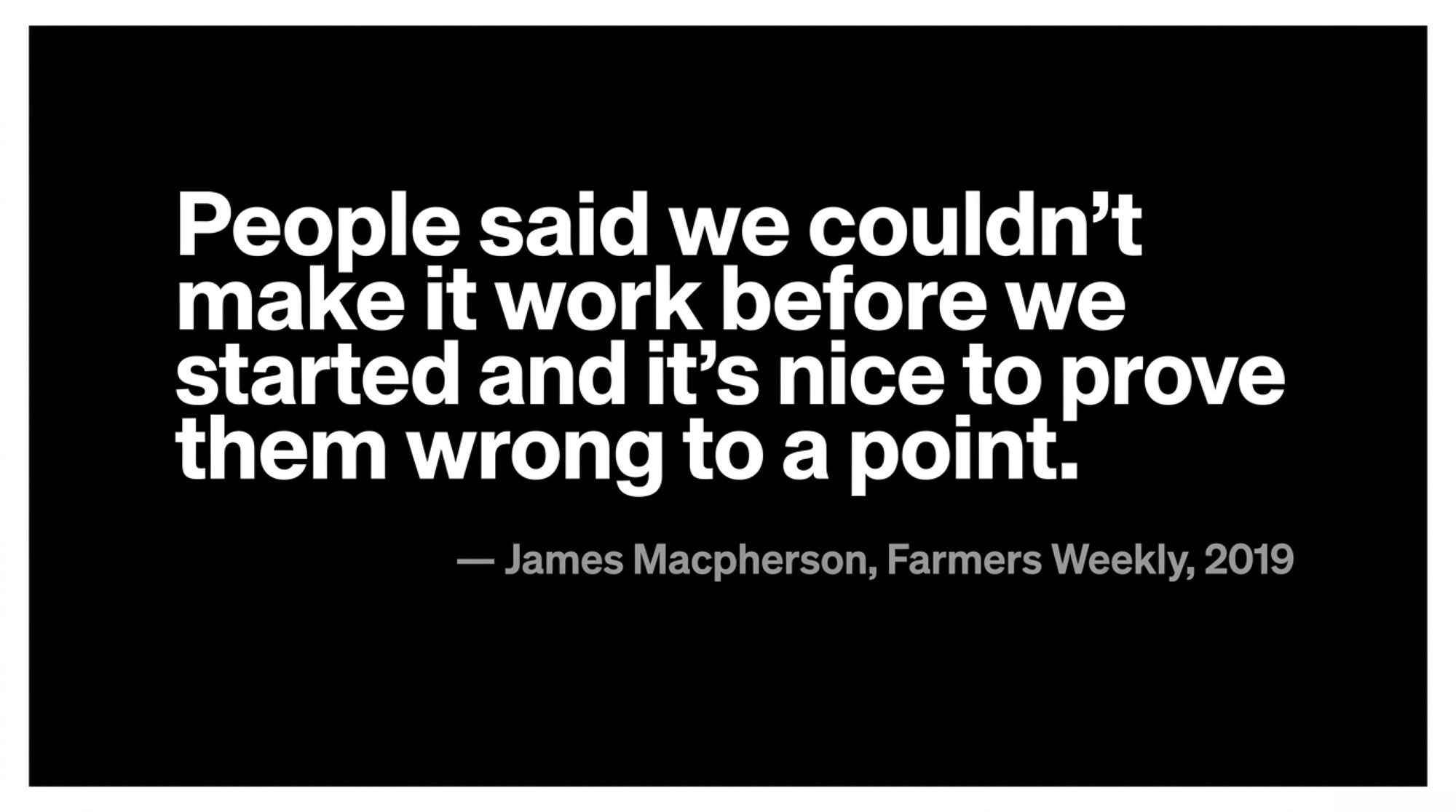
“People said we couldn’t make it work before we started and it’s nice to prove them wrong to a point. It’s an all-consuming life but it’s well worthwhile and I’ve no complaints about it whatsoever.” — James Macpherson, quoted in Farmers Weekly, 2019

Which Cow Families Do You Keep When You Have to Start Over?

The answer visible in the public record is the ones already documented. Rodbrook Milkmaid, the Rodbrook foundation cows, the Langley and Goonhilly lines — all present in FarmingUK’s 2026 award coverage and FW’s 2018 sale report. The specific Beaufort families retained through the move haven’t been publicly itemised, but the Rodbrook Milkmaid, Goonhilly and Langley lines surface in every post-dispersal sale-ring and award reference on the record. A Rodbrook Milkmaid daughter of Beaufort Milkman sold for 2,600gns at Sedgemoor because the rest of the industry could read the same pedigree the Macphersons were reading.

That’s the signal you want your own top families to send — a price outside buyers will pay without needing to see the cow first. For a parallel on how cow-family continuity compounds across generations, our Babe and Britany piece is the cleanest case study on the site.

The £700,000 Ghost: What Does a 290-Cow Rebuild Actually Cost?

The income gap is the figure that stops most breeders cold. Based on 2019 UK pricing, a 290-cow herd losing a full year of production is staring at a hole in the balance sheet north of £700,000. A dispersal cheque is a band-aid; the published pedigree and the outside AI revenue are a far bigger part of the cure.

Exact Beaufort rebuild figures aren’t public and won’t be invented here. Orders of magnitude are still useful if you’re running anything bigger than a hobby herd. The table below stacks the 2018 Sedgemoor cheque against the scale of a single-year income hole at 2019 milk prices and a 2018 infrastructure comparator.

Dispersal Cheque vs. Rebuild Hole

LineFigureSource / Formula
2018 Sedgemoor gross (all published lots)~£306,000217 lots at £1,409.52 all-in average, FW 17 Aug 2018
2018 UK greenfield new-build (structures + silage only)£1.1m+FW 2018 build feature
2019 UK farmgate milk price band28.80–29.35 pplDefra monthly releases via AHDB
2019 Beaufort NMR Gold Cup qualifying-year average8,629kg across 218 lactationsNMR Gold Cup release
290-cow zero-milk-cheque year (Defra 2019 ppl band)~£703,000–£712,000290 × 8,629kg × 0.97 L/kg × 28.80–29.35 ppl
150-cow zero-milk-cheque year (illustrative at 8,000kg / 29 ppl)~£340,000150 × 8,000kg × 0.97 L/kg × 29 ppl — illustrative comparator; not sourced to a specific 150-cow herd

Litre-per-kilogram conversion of 0.97 applied throughout, consistent with roughly 4% fat / 3.3% protein British Friesian composition.

Plug your own yield and current milk price into the same formula to see what a zero-milk-cheque year costs on your farm. A sale cheque of that scale doesn’t close a hole that size on its own. Operations that rebuild after a forced dispersal typically combine retained-heifer value, pre-placed AI revenue, and land capital committed ahead of the sale. FW’s 2019 council-farms coverage notes the Macphersons had bought their Staffordshire land before the Sedgemoor sale.

For the full cost-per-cow economics across herd sizes, we’re building that Tier 3 model as a dedicated Bullvine Weekly feature — see our earlier UK farmgate milk price coverage for the input side of the same equation.

Options and Trade-Offs for Pedigree Breeders

Most pedigree breeders will never run a dispersal. The mechanics visible in the Beaufort public record still apply if you’re facing a tenancy renewal, a bTB test, a succession event, or a landlord conversation you’ve been putting off.

1. Document your top cow families — and rank them by production depth, not individual EX score. (30-day move.) Pull two generations of NMR records this month. Rank your maternal lines by average combined fat-and-protein yield across the family. Write down the top three. As a rule of thumb — not a breed-society standard — any family that hasn’t produced a VG87+ daughter in two consecutive lactations isn’t a top family; it’s a decent family. There’s a difference, and a dispersal exposes it. Risk: you may find you have one deep family and a lot of average cows. That’s useful information. Act on it now, not after.

2. Build external revenue from your best genetics — before the farm needs the money. Per FW’s 2018 reportingand the Genus ABS public catalogue, Beaufort Milkman was listed Proven at Genus before Sedgemoor, and Kriminal had two brothers already placed. If getting a homebred bull into a national stud feels out of reach, the small version of the test still works: have you ever sold semen, embryos, or pedigree heifers off your top family at a premium to the commercial market? If the answer is no, your genetics haven’t been priced by anyone outside your fence. For the same arc told through an AI stud’s lens, our “65 Cows to 10,000” feature is worth the detour. Risk: takes years to build and requires genetics that are genuinely competitive, not just registered.

3. Bank stored semen from your best homebred bulls out of your deepest families. Not every homebred bull justifies it. Pick the ones out of your deepest families. As a rule of thumb — not a breed-society standard — a reasonable floor is 20 doses minimum from any bull out of a VG88+ dam with three generations of confirmed production depth. For context on what genetic influence looks like when it’s fully separated from the home farm, our Walkway Chief Mark piece is the benchmark. Risk: storage and collection cost is real money, and the insurance doesn’t pay out unless something goes wrong.

4. Close the herd now — while the decision is still voluntary. Closed-herd discipline forces better selection because you can’t buy your way out of a weakness. FarmingUK’s 2026 coverage notes the Beaufort rebuild ran with Collycroft and Catlane lines introduced in measured steps alongside the Rodbrook, Langley and Goonhilly foundations. Trade-off to name honestly: closed-herd discipline buys you genetic continuity; open-herd flexibility buys you speed of correction. You can fix a known weakness faster with the right imported semen than by breeding it out over four generations. Risk: closed herds with shallow family depth compound weakness fast. This only works if the documentation from move #1 is real.

What This Means for Your Operation

An 80-cow pedigree herd doesn’t rebuild from the same playbook as a 400-cow one, but the audit questions are identical. On a smaller herd, your top three families probably represent most of your milking string — documentation matters more, not less, because you have no redundancy. On a 200-cow herd, the risk isn’t depth; it’s that average cows from average families are eating feed that should be going to your foundation animals. On a 400-cow herd, the risk is that nobody on the farm can name the top families off the top of their head, because day-to-day management has moved past individual cow recognition.

Run the same audit at any scale. If a forced decision took you to 50 cows next month, which 50 would you keep — and are they on paper?

Key Takeaways

  • If you can’t name your top three cow families from memory by production-and-classification depth, your breeding plan isn’t documented. Spend an afternoon on it this month.
  • If your farm closed tomorrow and none of your genetics would still be working in somebody else’s barn, that’s your gap. Start building external revenue now, not after a disruption forces the question.
  • If you’re running a closed pedigree herd without banked semen from your best homebred bulls out of your top families, you’re carrying physical risk you don’t need to carry. Rule-of-thumb floor: 20 doses per bull, VG88+ dam families, three generations of production depth.
  • If you haven’t mapped your rented-ground exposure as a percentage of your total feed base, you don’t know what your dispersal trigger looks like. Do that this quarter, not after the landlord letter arrives.
  • If your breed’s classification and production thresholds have moved in the last three years and you haven’t updated your selection criteria, you’re breeding against yesterday’s standard. Check the current Holstein UK British Friesian Herd of the Year criteria and use it as a benchmark, not just an award target.
  • If your 30-day, 90-day, and 365-day breeding plan all live only in your head, that’s the single biggest fragility in your operation. A rebuild starts with what’s documented, not what’s remembered.

The Real Question

The Beaufort herd won Herd of the Year because what got sold at Sedgemoor wasn’t the whole of what mattered. What mattered was already documented in the Genus ABS catalogue, in NMR’s qualifying record, and in the Rodbrook, Langley and Goonhilly lines FarmingUK’s coverage traces back to 2012. Awards come and go. The documentation either exists or it doesn’t — and you find out which one on the day somebody else decides how fast you have to move.

When was the last time you actually audited your maternal lines on paper rather than in memory? And if a buyer called tomorrow about your best homebred bull, what would the documentation you send them actually say?
Sources: publicly reported coverage in Farmers Weekly (2018), Farmers Weekly (2019), FarmingUK (April 2026), the Holstein UK 2026 award release, the Genus ABS public catalogue, and public records from AHDB, NMR and Defra. James and Louise Macpherson were not interviewed for this piece.

Learn More

The Sunday Read Dairy Professionals Don’t Skip.

Every week, thousands of producers, breeders, and industry insiders open Bullvine Weekly for genetics insights, market shifts, and profit strategies they won’t find anywhere else. One email. Five minutes. Smarter decisions all week.
NewsSubscribe
First
Last
Consent

40 Years of Breeding. One Müller Letter. Six Figures Gone.

Neil Taylor’s Puddle Hill herd went through the ring after 12 months’ notice. Now up to 100 more UK farms just got the same letter — and your milk contract’s fine print decides whether you lose $260,000 or $78,000.

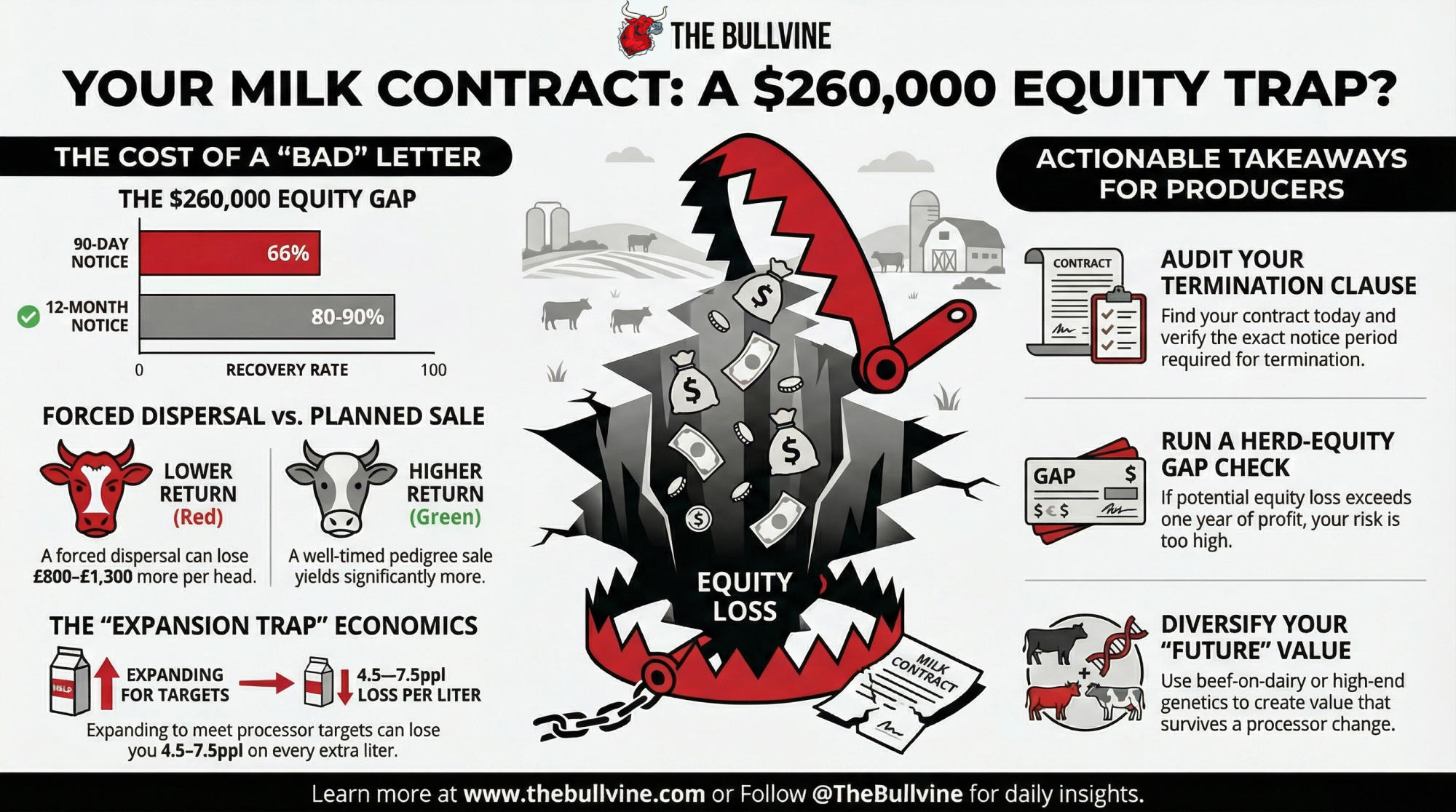
Executive Summary: On a 200-cow herd, the difference between a 12-month and a 90-day termination notice is roughly $260,000 in equity — about 2–3 years of profit gone on timing alone. Müller just proved it again: on March 30, 2026, the processor issued 12-month notices to an estimated 50–100 UK farms in North Wales and Scotland, two years after Neil Taylor’s four-generation Derbyshire herd went through the ring as commercial dispersal cattle under the same kind of letter. This isn’t only a UK pattern — Horizon Organic and Maple Hill dropped 135 Northeast organic farms in 2021–22, and most had even less warning than Taylor got. The expansion trap is equally ugly: at Müller’s current 34.5ppl, adding volume to hit a processor’s target means losing 4.5–7.5ppl on every extra liter before you touch a loan payment. And real auction data shows the gap between a forced dispersal and a well-timed pedigree sale runs £800–£1,300 a head — so how you exit matters almost as much as whether you have to. Pull your contract, run your herd-equity gap against a year of net income, and talk to your lender this month — that checklist applies whether you’re shipping to Müller, a US co-op, or anyone in between.

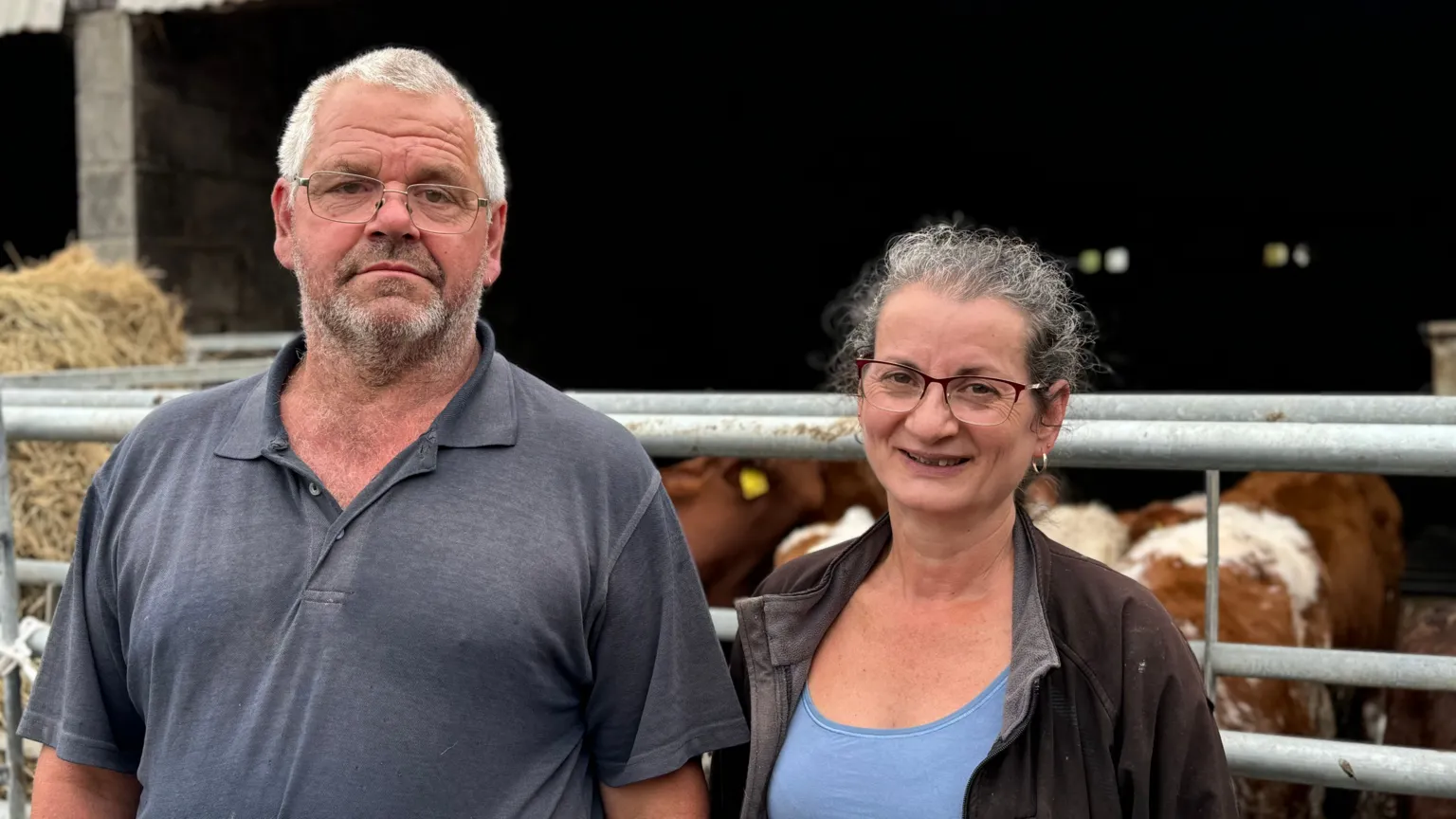
Neil Taylor is the fourth generation to milk cows at Puddle Hill Farm near Matlock in Derbyshire. He told BBC Farming Today: “I’ve bought them, reared them, I can remember their mums, their grandmas.” Then Müller sent a letter: hit a new production target by the following year, or the contract ends in 12 months. (BBC, July 2024Farmers Guide, July 2024)

“When I asked how far I’d got to get, they said probably double to what you’re sending now next year,” Taylor told BBC Farming Today. “I couldn’t do it.” Müller has not publicly disclosed the specific volume targets it set for individual farms.

Taylor saw the gap between what Müller was paying and what expansion would actually cost. He sent his cows to market. He and his wife, Bev, have since bought six dairy cows back and plan to raise them for beef. But the dairy herd — the cow families, the genetic equity, four generations of selection — went through the ring as commercial dispersal cattle.

“It’s absolutely devastating,” Taylor told the BBC. “I’ve had 40 years of breeding cows and just to have it taken away from you, it’s a bitter pill to swallow.”

Not Just One Farm: Müller’s Letters Keep Landing

Taylor’s story hit the news in July 2024, but he was just the first to speak up. He told BBC Farming Today he was one of “over a dozen” smaller family farms facing termination. Müller described those affected as “a very small number” of suppliers not meeting its sustainability, welfare, or volume standards, and said all received a full 12-month notice period.

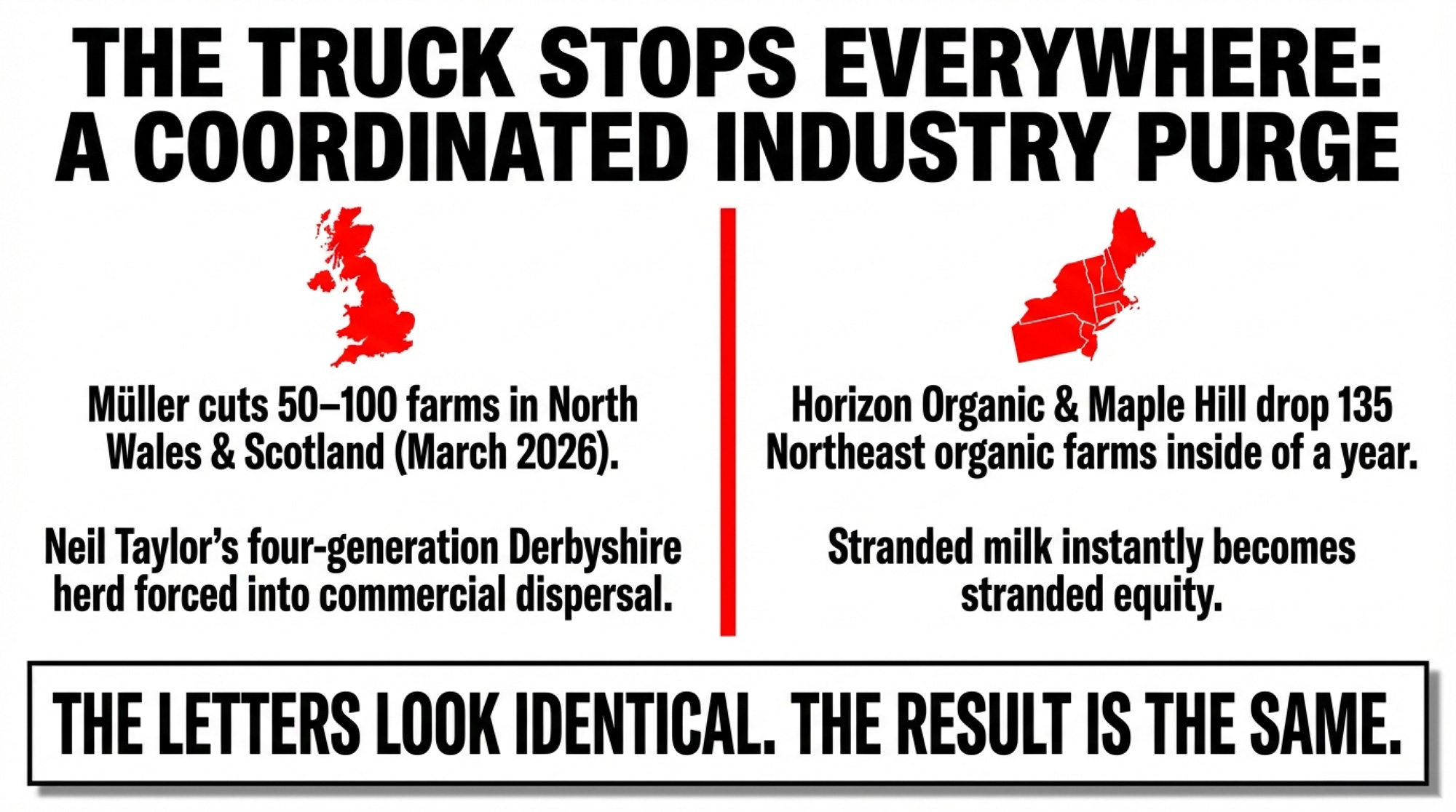
Then on 30 March 2026, a bigger wave landed. Farmers Weekly reported that Müller issued 12-month termination notices to producers in North Wales and Scotland, with the last milk collections set for 31 March 2027. Industry sources told Farmers Weekly the number is likely between 50 and 100 producers, with more than half offered the option to move to a lower-value ingredients-only contract instead. Grant Hartman, chairman of dairy producer organization MMG Dairy Farmers, confirmed the scope: “There are a number of our members who have unfortunately been served the full 12 months’ notice.” (Farmers Weekly, March 31, 2026)

The NFU confirmed Müller’s cuts affect roughly 1% of its current milk volumes — a small share of the supply base, but a very large share of the affected farms’ futures. (NFU, March 31, 2026)

Müller’s agricultural director, Richard Collins, wrote to affected producers: “To ensure we manage our supply of raw milk responsibly and maintain a sustainable balance between milk intake and processing demand, we have no choice but to make adjustments to our supply base.” At the same time, Müller’s Advantage price for March 2026 sits at 34.5ppl— a 1ppl cut from February. For smaller herds already operating on thin margins, those two envelopes arrived in the same period. (IPMS/FarmingUK, January 2026)

When 135 Northeast Dairy Farms Got the Same Kind of Letter

FactorMüller (UK, 2024–2026)Horizon/Maple Hill (US Northeast, 2021–22)
Farms affectedEst. 50–100 (2026 wave) + prior cases135 farms (89 Horizon + 46 Maple Hill)
Notice given12 months (full legal minimum)Horizon: ~12 months; Maple Hill: shorter
Regulatory backstopUK Fair Dealing Regs 2024 (new)None — private contract terms only
Processor rationale“Balance intake and processing demand”Organic market oversupply
Price at termination34.5ppl (Müller Advantage, Mar 2026)Organic premium shrinking vs. conventional
Alternative found?Some offered ingredients-only contractOrganic Valley absorbed ~90 of 135 farms
Farms that exited anywayNeil Taylor + unknown numberSome sold herds, left organic, or quit entirely
Farmer quote“40 years of breeding…a bitter pill” — Taylor“I could see this coming…not this quick” — Conant
Key lessonNotice ≠ rescue. Time helps, not guarantees.Alternative buyer ≠ guaranteed. Speed kills equity.

If you’re reading this from North America and thinking, “That’s a UK problem,” it isn’t.

In August 2021, Danone’s Horizon Organic sent termination letters to 89 organic dairy farms across the Northeast — including 28 in Vermont14 in Maine17 in Washington County, New York, and the balance in New Hampshire and other New York counties — with contracts ending August 31, 2022. Vermont Agriculture Secretary Anson Tebbetts told VTDigger the terminations were “a significant problem because these farmers have few choices on where to sell their milk.” Dean Conant, who’d been selling milk to Horizon for 14 years from his farm in Randolph, Vermont, began reaching out to other buyers when he received the letter. Nobody had room. (VTDigger, August 2021)

“I could see this coming,” Conant told VTDigger. “I didn’t think it was gonna be this quick.”

Then Maple Hill terminated contracts with an additional 46 organic farmers in eastern New York. That’s 135 farm families in one region, inside of a year, told their buyer was done with them. Organic Valley eventually offered to pick up as many as 90 of those farms — but by the time the offer came, some had already sold herds, exited organic, or quit entirely. (VTDigger, March 2022)

Abbie Corse, an organic dairy farmer on the board of the Northeast Organic Farming Association of Vermont, put it plainly: “These aren’t just jobs. These aren’t just pieces of the economy. These are entire lives that are tied up in a farm.” If you want a closer look at what happens when the truck stops showing up with zero warning, AMPI’s Paynesville plant shutdown is a case study in how fast stranded milk turns into stranded equity.

The Rulebook Helped on Paper — Not in the Parlor

Part of the backdrop here is the UK’s new Fair Dealing Obligations (Milk) Regulations 2024. Those rules require processors to give at least 12 months’ notice to terminate a milk-supply contract, offer farmers at least 21 days to consider new contracts, and spell out transparent pricing mechanisms instead of one-sided “take it or leave it” terms.

On those measures, Müller complied. Taylor and the 2026 wave of affected farms all received the full year’s notice. The NFU confirmed this: “Where producers receive no less than 12 months’ notice of any no-fault termination, milk buyers are likely to be complying with that aspect of the regulations.” But the NFU also urged affected producers to seek independent legal advice and contact the Supply Chain Adjudicator if anything seemed off.

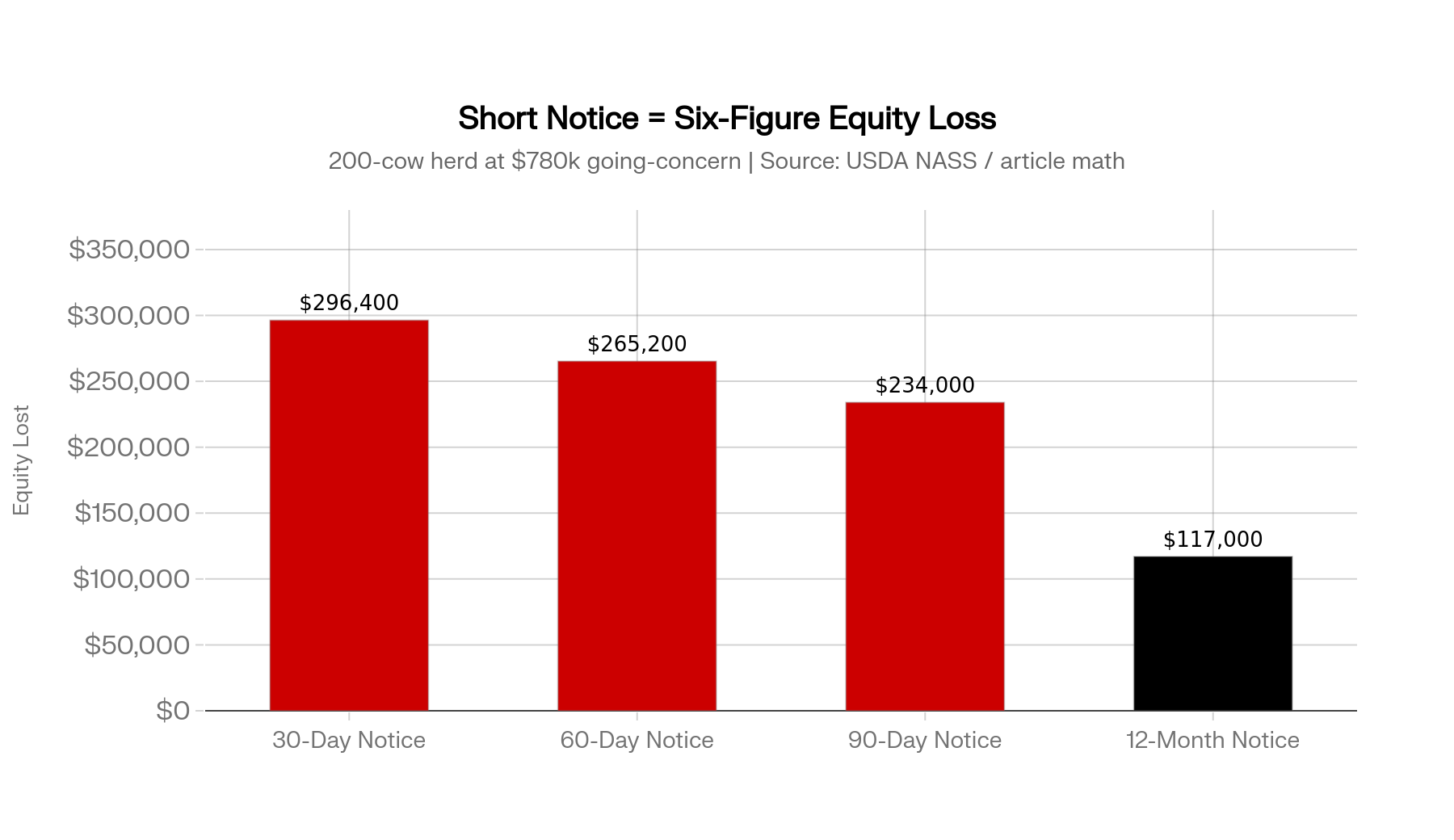
Notice PeriodJurisdiction ExampleHerd Recovery RateEquity Lost (200-cow/$780k)Risk Level
30 daysUS — some private contracts~60–65%$273,000–$312,000🔴 CRITICAL
60 daysUS — some state minimums~65–68%$250,000–$273,000🔴 HIGH
90 daysPennsylvania (state rule)~68–72%$218,000–$250,000🔴 HIGH
6 monthsSome UK pre-2024 contracts~75–80%$156,000–$195,000🟡 ELEVATED
12 monthsUK Fair Dealing Regs 2024~82–88%$94,000–$140,000🟡 MANAGEABLE
18+ monthsBest-practice co-op bylaws~90–95%$39,000–$78,000🟢 LOW

The trouble is, the regulations protect the process of being dropped more than the equity you’ve built. They can’t turn an uneconomic expansion into a good bet. And they don’t guarantee you’ll have the time or market conditions to sell decades of breeding as anything more than commercial dairy cows.

On this side of the Atlantic, even that level of protection often doesn’t exist. Federal Milk Marketing Orders deal with minimum price formulas, not private contract terms or notice periods. In Pennsylvania, the state Milk Marketing Board pushed a change from the old 28-day minimum to a 90-day notice for contracts covered by state rules, after some farmers received short-notice terminations and struggled to find new buyers. In many other regions, your “notice period” is whatever your co-op bylaws or individual milk contract says — and for some, that’s still 30 or 60 days, or nothing in writing at all.

How Does Expansion at 34.5ppl Actually Pencil?

Taylor’s supposed option was simple on paper: expand enough to meet Müller’s volume expectations, and the truck keeps coming. But the economics behind that “option” aren’t theoretical.

Cost-of-production estimates vary widely by farm, region, and method. Albert Goodman’s 2025 farming profitability review noted that the AHDB average farmgate price topped 46.56ppl in October 2025 and that “many dairy farms making healthy profits well over £1,000 per cow” — but also warned that with global oversupply pushing prices down, “there is already talk of it going below 30 pence per litre, which is below current breakeven price for many dairy farmers.” Kite Consulting’s climate-resilience work, based on data from over 850 UK dairies, adds another 2.4ppl over ten years for the average farm to cover slurry storage, silage capacity, and land improvements — roughly £472,539 per farm over that period, based on an average herd of 236 cows. (Albert Goodman, February 2026)

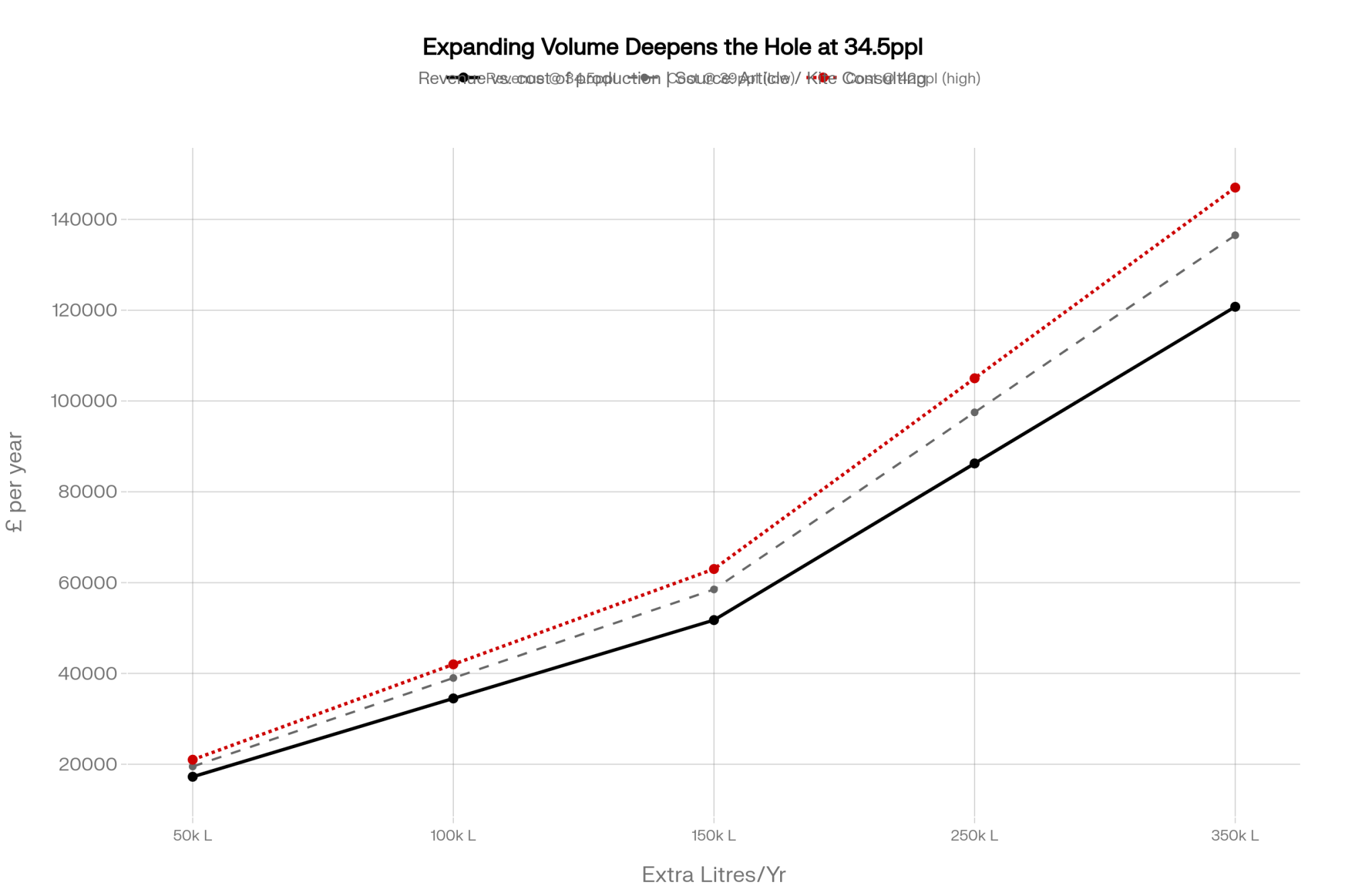
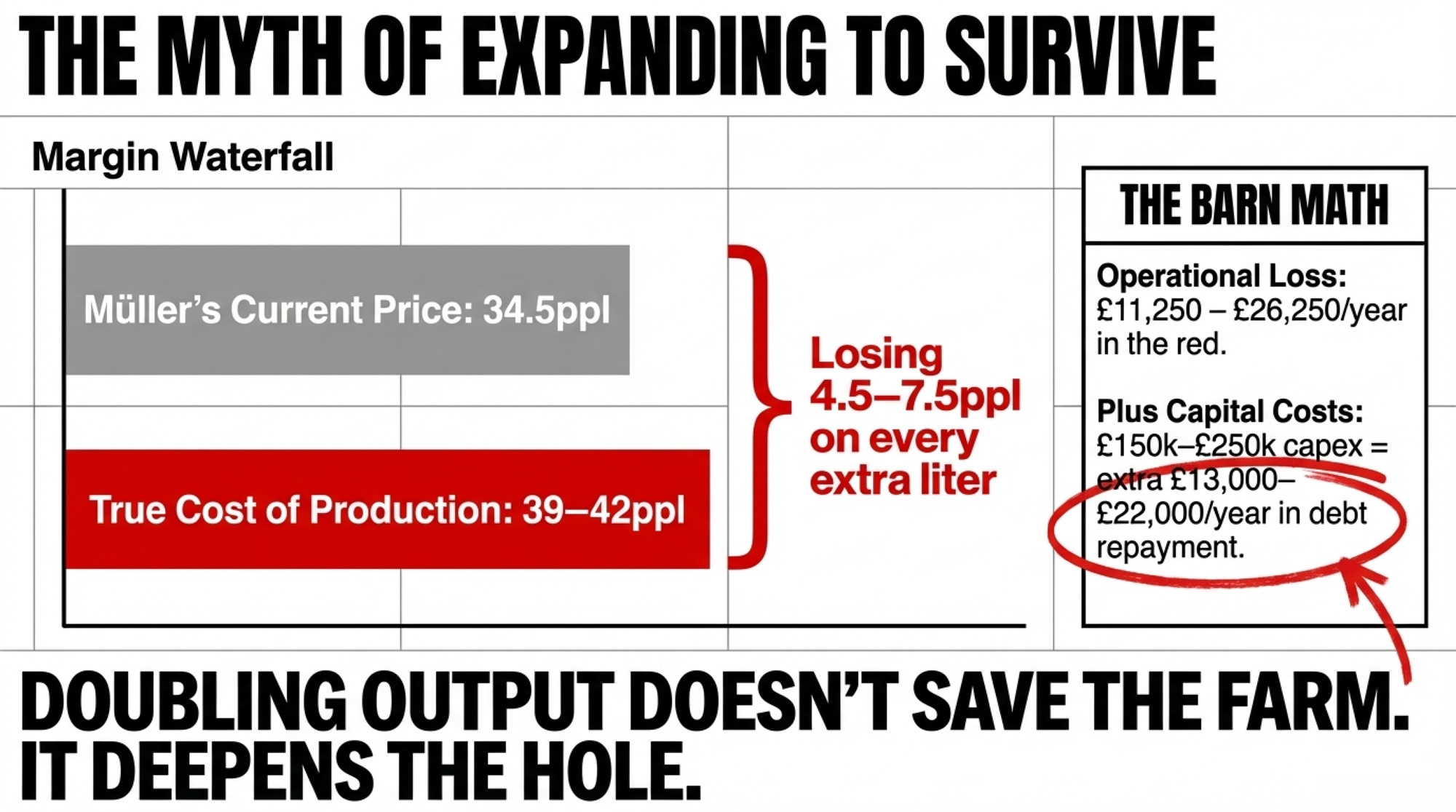
Run a quick barn-math check on the kind of expansion someone in Taylor’s position would face. Say you add 250,000–350,000 liters a year to hit a new target. At 34.5ppl, that extra milk brings in about £86,250–£120,750. If your true cost of production — even at the lower end of current estimates, say around 39–42ppl once you include resilience investments — those same liters cost somewhere in the range of £97,500–£147,000 to produce. You’re losing roughly 4.5–7.5ppl on every extra liter. That’s somewhere between £11,250 and £26,250 a year in the red — before you make a single loan payment on the new capacity.

Now layer on the capital. For a smaller operation looking at a more modest step — buying 30–50 cows at £1,800–£2,500 a head plus the housing, slurry, and parlor upgrades those extra cows need — you’re easily into a £150,000–£250,000 capital project. Farm borrowing costs have risen significantly from the ultra-low levels of recent years, and HCR Law noted in February 2026 that “the longer-term ‘floor’ for rates appears higher than before.” At current farm lending rates, that kind of project adds roughly £13,000–£22,000 a year in repayments. (HCR Law, February 2026)

Taylor told the BBC he “couldn’t do it.” Under those prices and costs, doubling output doesn’t save the farm. It deepens the hole. Grant Hartman’s advice to the 2026 cohort echoes that: don’t make “knee-jerk reactions,” but “take stock, assess the position.”

How Much Does Losing 60 Days of Notice Actually Cost Per Cow?

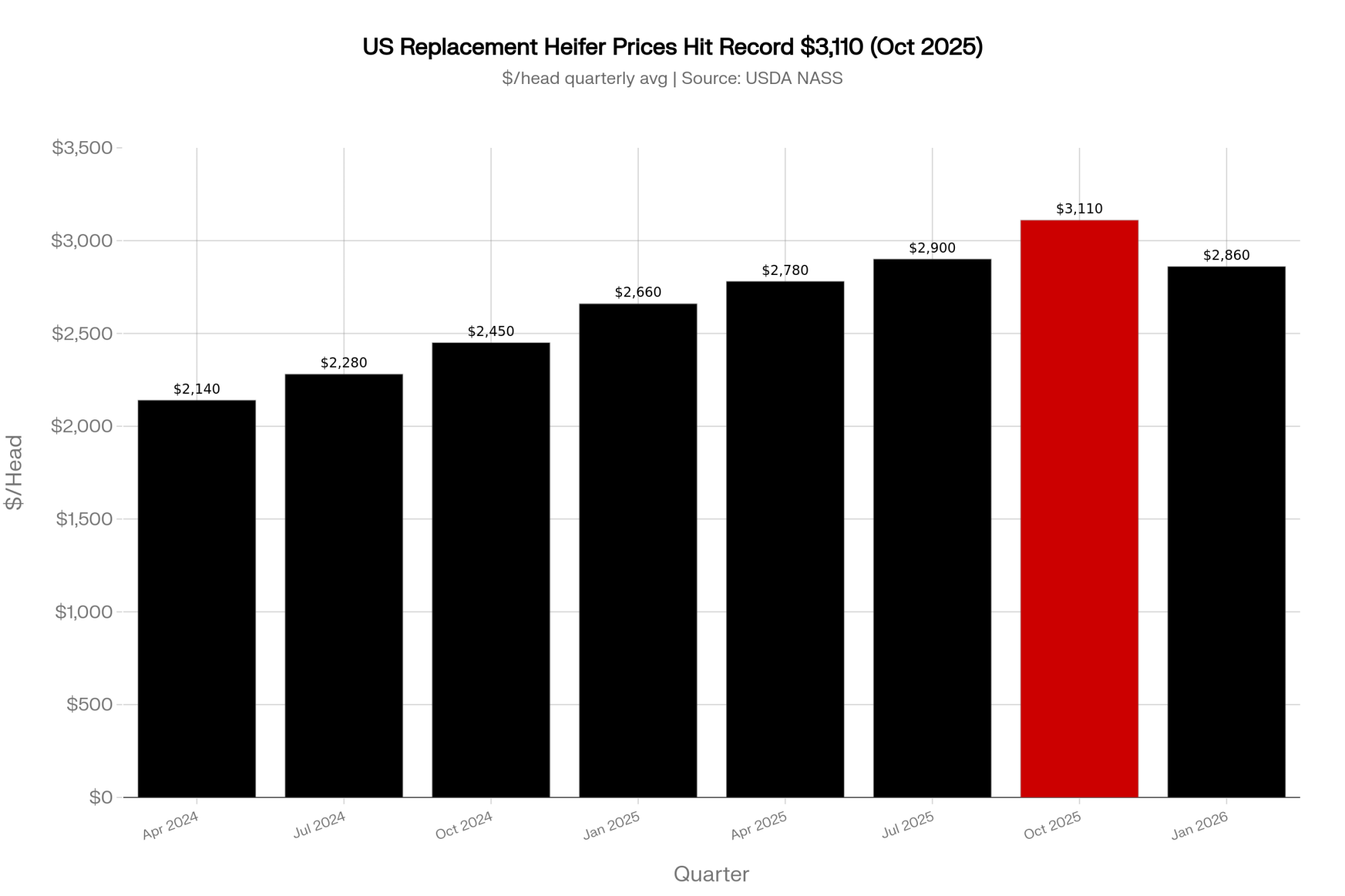
Notice periods look like lawyer talk until you hang them on a real herd. Take a 200-cow US dairy with about 80 replacements and peg the going-concern value off USDA-tracked replacement prices. Those have climbed steeply — from about $2,140 per head in April 2024 to $2,660 in January 2025 and a record $3,110 in October 2025, according to USDA NASS quarterly estimates. By January 2026, the average eased back to $2,860 per head. For a deeper look at what those per-head numbers mean for your culling and replacement decisions, the $3,110 heifer trap is worth your time.

Using recent prices, a reasonable working herd value for 200 cows plus 80 replacements sits in the neighborhood of $700,000–$870,000.

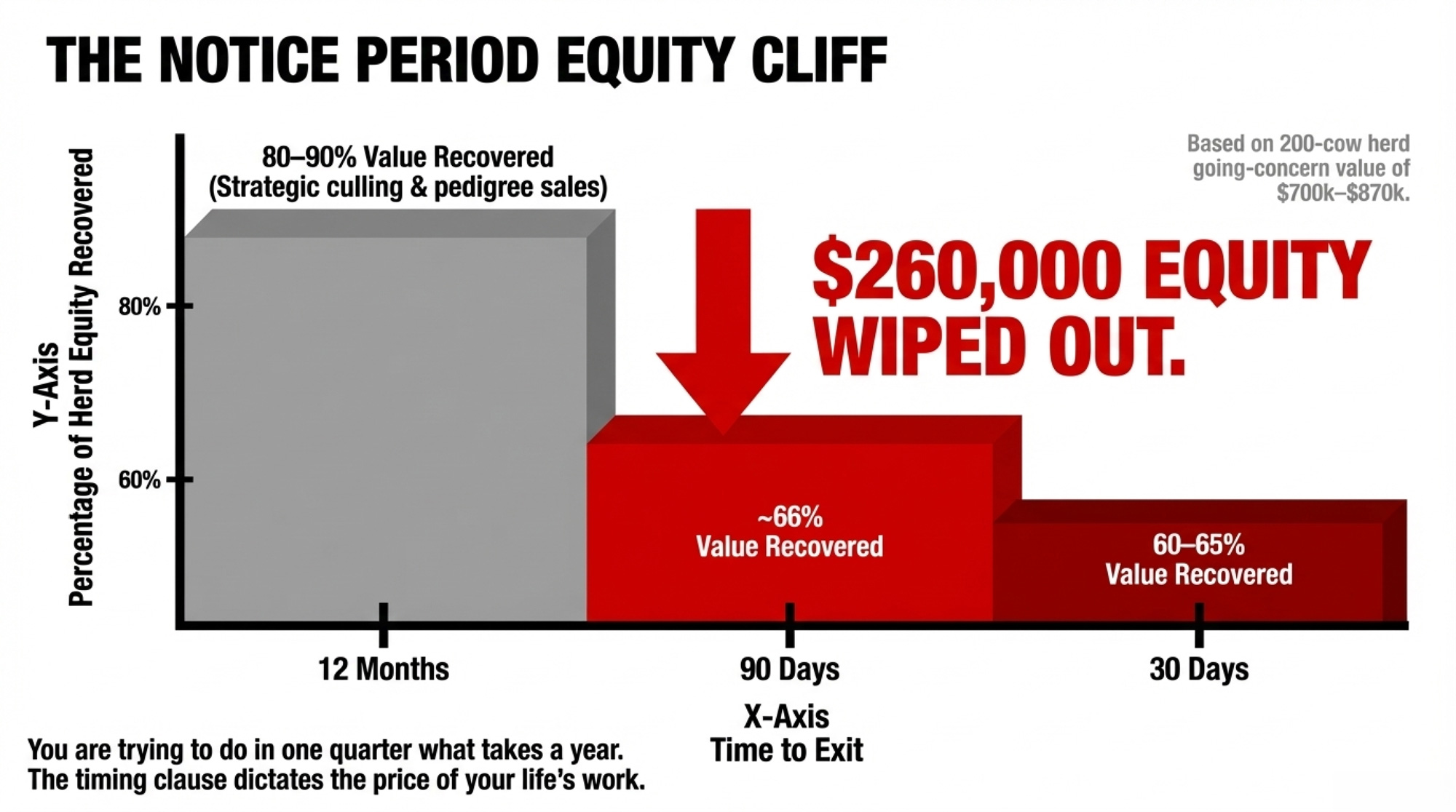
With a genuine 12-month notice period and a plan, you can often recover something like 80–90% of going-concern value. That means time to market cows privately, structure a going-concern sale, and time to cull and heifer sales into stronger points in the price cycle.

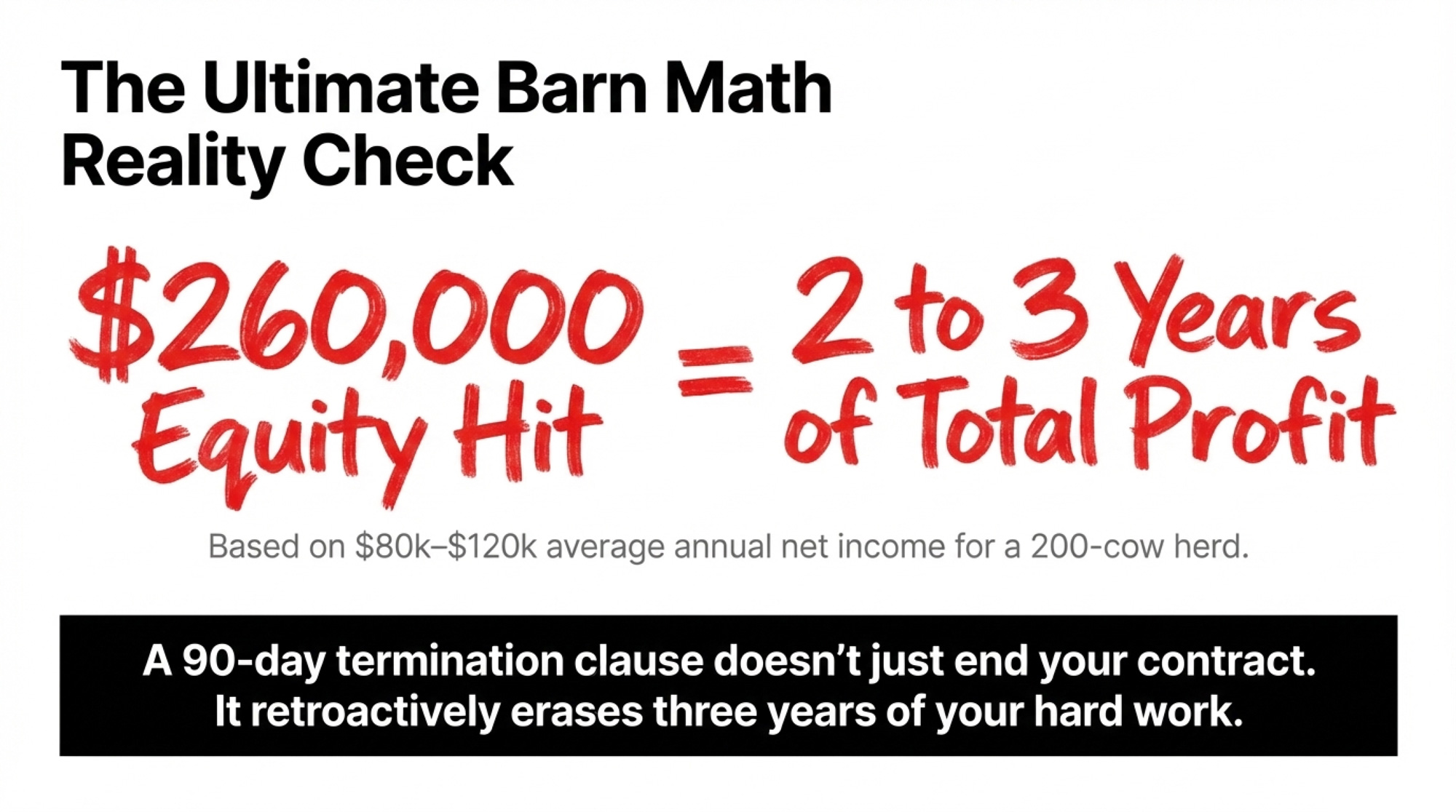
On a 90-day clock, it changes fast. You’re trying to do in one quarter what usually takes a year or more. In many dispersal situations, recovery drops toward two-thirds of the going-concern value. On a herd valued at roughly $780,000 (midpoint of our range), that gap works out to around $260,000 in equity wiped out — compared to maybe $78,000–$156,000 left on the table with a full year’s notice. Tighten that to 30 days, the kind of window some producers saw in past contract terminations, and you may only see 60–65% of going-concern value.

Here’s the barn math in plain language. If that 200-cow herd generates somewhere in the range of $80,000–$120,000 a year in net income — a figure that swings enormously by region, debt load, and management — a $260,000 equity hit from a 90-day forced dispersal represents roughly 2–3 years of profit gone because of how much time your notice clause gave you. The UK’s 12-month rule didn’t save Taylor’s herd. But it gave him time to organize the dispersal and protect more value than many North American producers could on 60 or 90 days’ notice.

Options and Trade-Offs for Farmers

Stack those numbers up — Taylor’s four-generation herd, 50–100 more UK farms on the clock, 135 Northeast organics dropped in a single year — and the pattern is obvious. Processors will continue reshaping their supply bases. You can’t control that. You can control how exposed your equity is when they do.

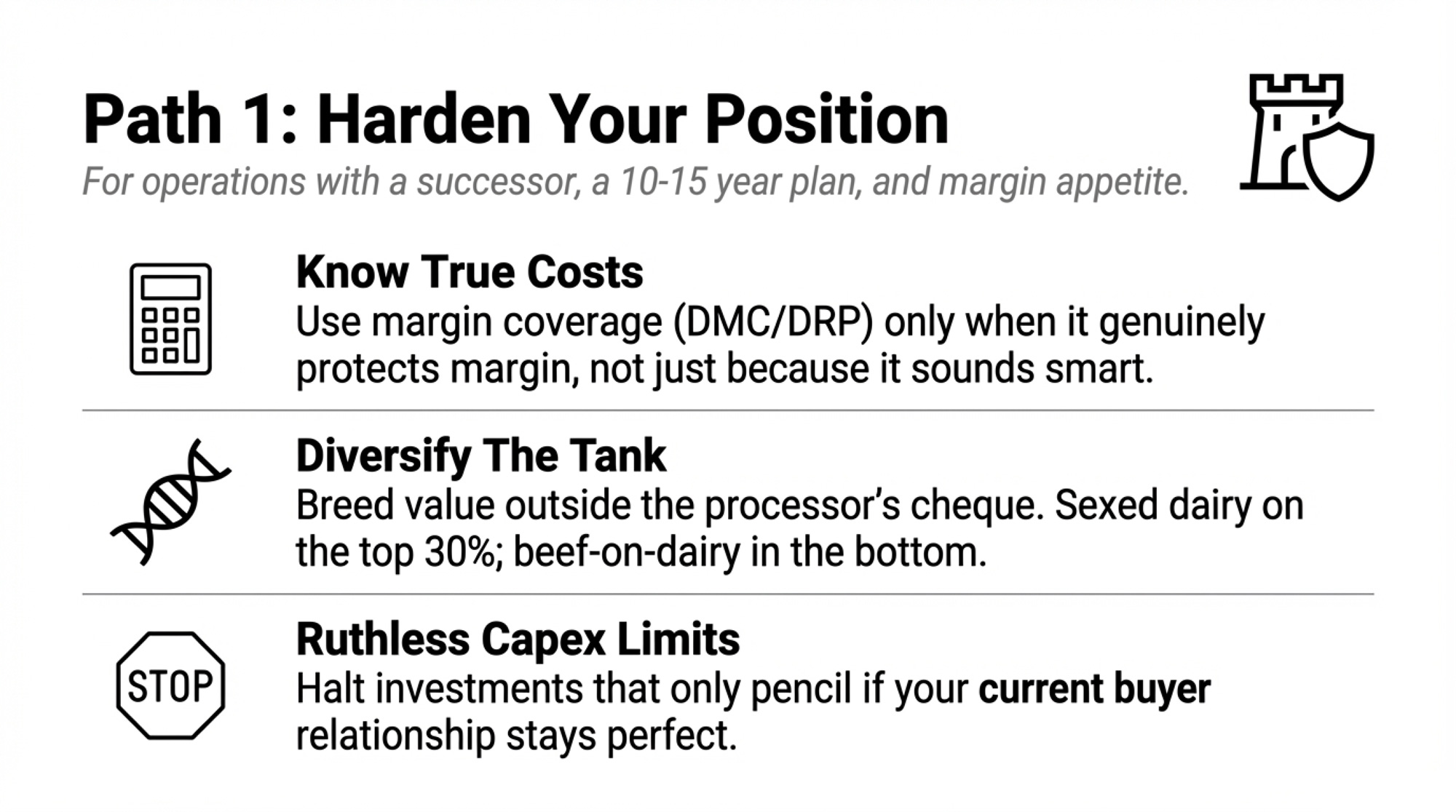
Path 1: Harden to stay with your current buyer

When it makes sense: You’ve got a successor, a clear 10- to 15-year plan, and enough appetite to reinvest if the margin is there. You want to be one of the suppliers they fight to keep.

What it requires:

  • Knowing your true cost of production — and using tools like Dairy Margin Coverage or DRP only when they actually protect margin at your volumes, not because they sound smart. If you’ve never looked at who really controls the cheque in consolidated markets, that context matters here.
  • Breeding so little of your future lives only in the bulk tank: more sexed dairy on the top 30–40% of the herd, more beef-on-dairy in the bottom end, and at least a pocket of genetics that holds value outside your processor’s cheque.
  • Being ruthless on capex that only makes sense if this exact relationship stays perfect — those extra stalls, parlor extensions, or robots that don’t improve your flexibility or exit options.
  • Quietly building secondary outlets. A standing conversation with another plant in your hauling radius. A limited on-farm product line. Even just being a known quantity to another co-op, so you’re not a total stranger if you ever need to call.

Risks and limits: You may give up expansion speed. You might watch a neighbor add 150 cows while you spend money on slurry storage and debt structure. But if the truck stops coming, you’re the one with a safer notice clause, a clear equity number, and a lender who already knows you’ve thought about this.

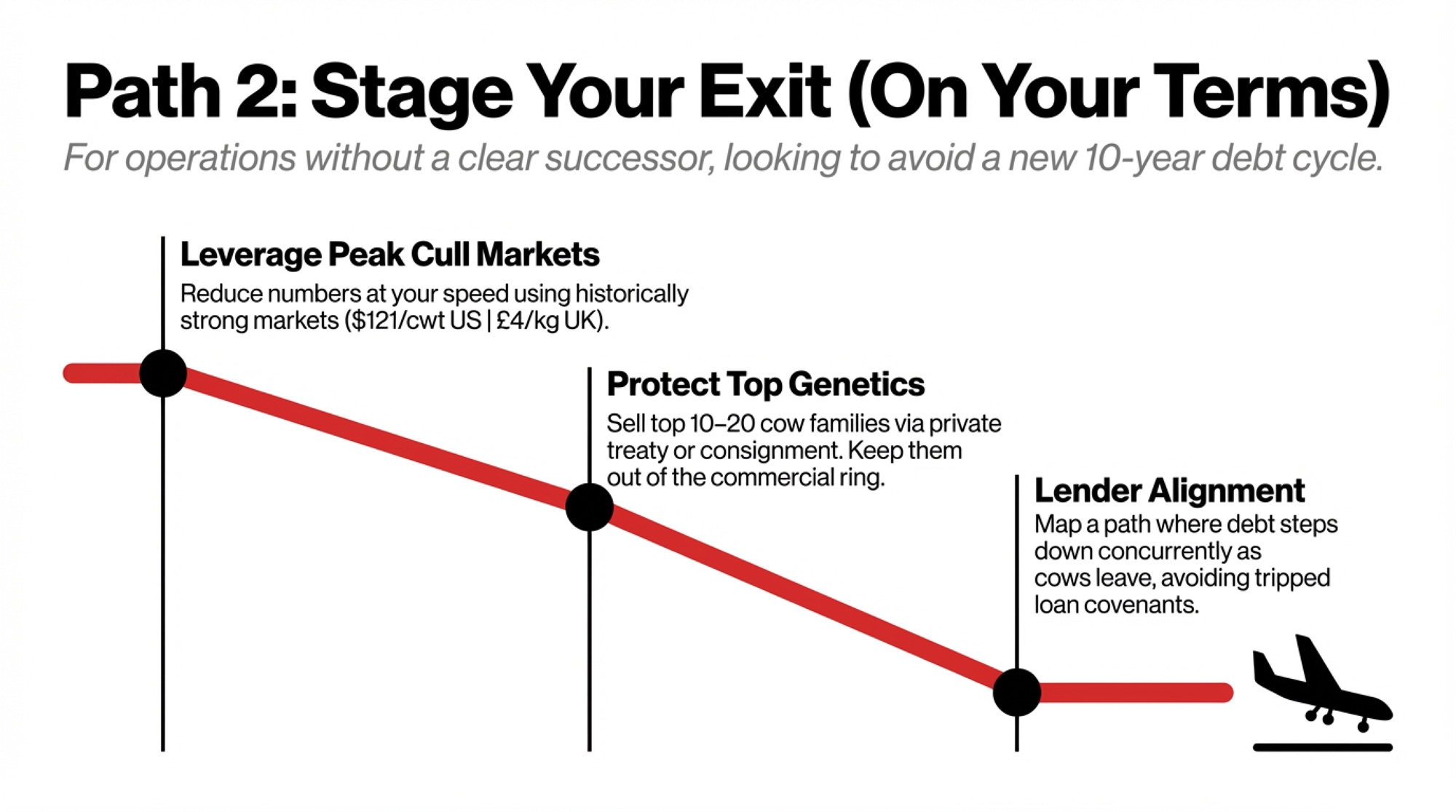
Path 2: Stage an exit on your terms, not in 90 days

When it makes sense: You don’t see a clear successor. You’re not keen to start another long debt cycle in your 50s or 60s. When you look at the barn math on a forced sale, the equity you stand to lose is more than a year or two of net profit.

What it requires:

  • Using today’s strong cull and beef markets to reduce numbers at your speed, not under a deadline. The USDA reported 2024 annual average cull cow prices at $127/cwt — the highest on record —, and while December 2024 eased to $121/cwt, the market remains historically strong. Albert Goodman’s UK review noted beef prices “continued to increase” with liveweight cattle around £4/kg and supply down 1% year-over-year. Conditions like these won’t last forever.
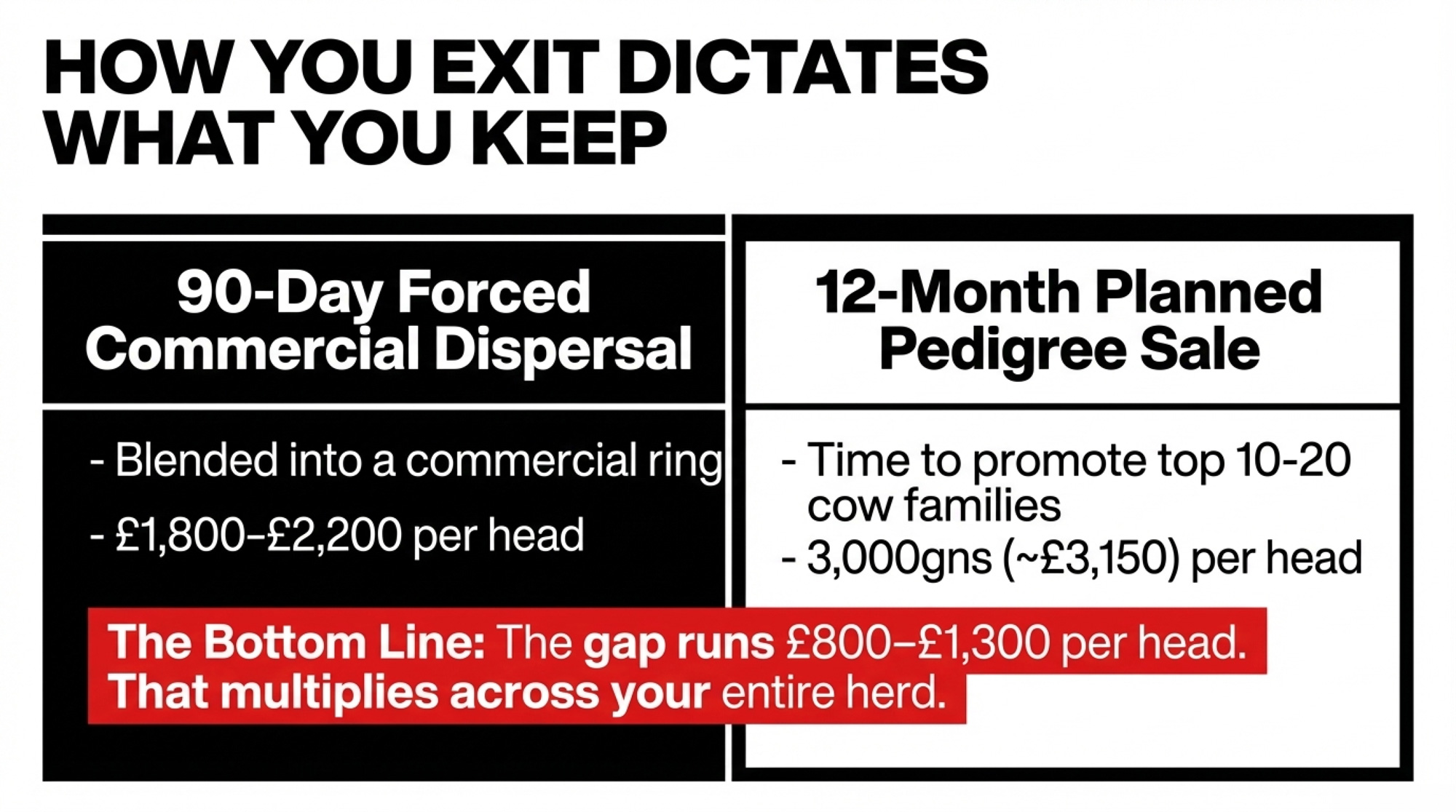
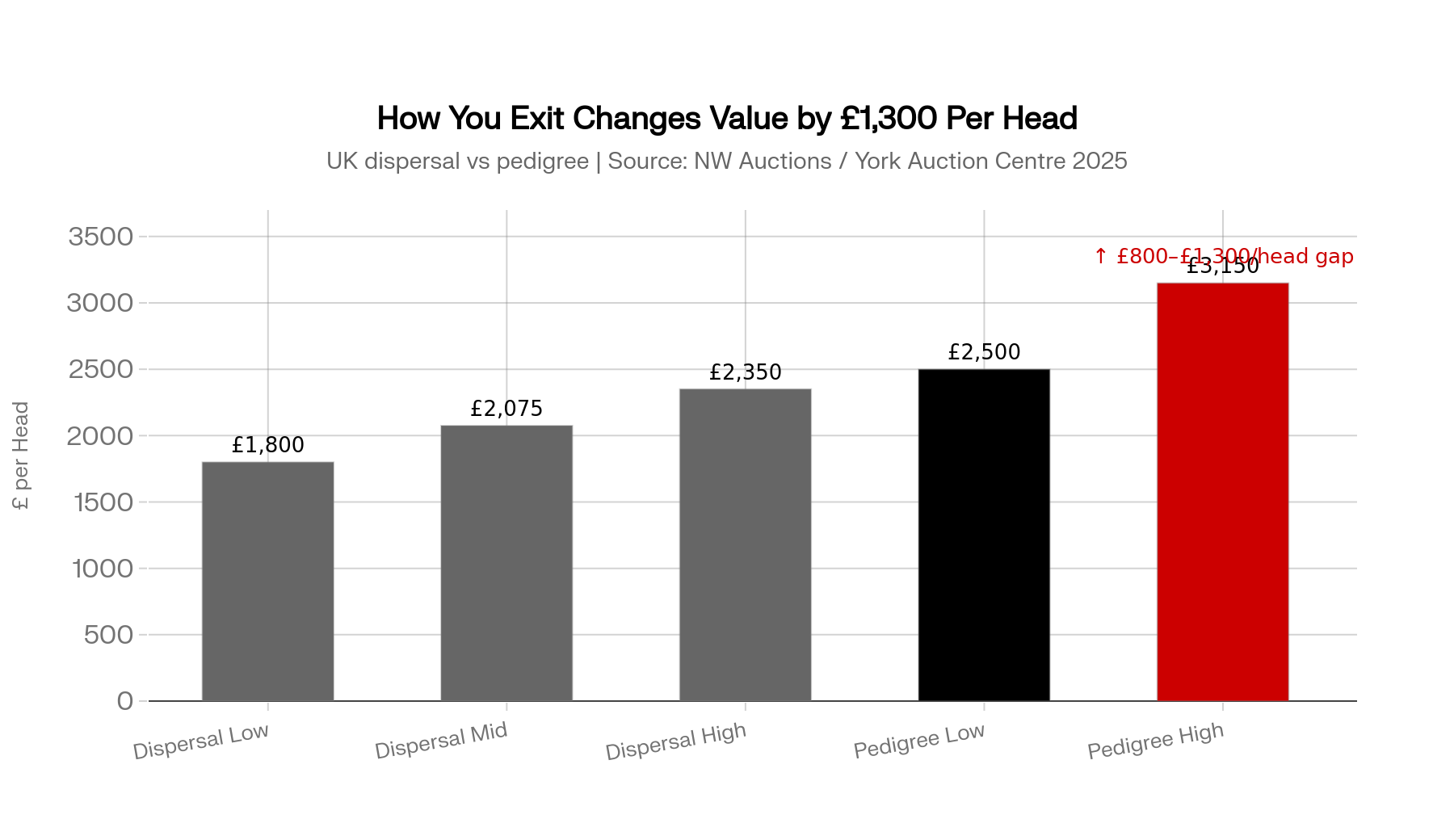
  • Identifying your top 10–20 cow families and selling them differently — private treaty or consignment sales with time to promote, rather than letting them blend into a commercial ring. Taylor’s herd went through dispersal as commercial cattle. To see what that gap looks like in practice: at the July 2025 WB Winder & Co dispersal at Crooklands (J36), Holstein Friesians topped at £2,350 for a second-calver, with most of the herd selling £1,800–£2,200. Compare that to pedigree dairy cattle at York Auction Centre the same period clearing 3,000gns (roughly £3,150) for a fresh-calved cow. The gap between a dispersal and a well-marketed pedigree sale can run £800–£1,300 a head — and it multiplies across an entire herd. (North West Auctions, July 2025York Auction Centre, October 2025)
  • Sitting down with your lender to map a “glide path” where debt comes down as cows leave, so one bad letter doesn’t trip loan covenants or force a land sale.

Risks and limits: Emotionally, this is the hardest path. Shrinking or planning to wind down can feel like failure. The reality is the opposite: it’s protecting what decades of work have built, rather than gambling it on someone else’s procurement strategy.

Forward-looking signal for both paths: If you see your buyer trimming price while issuing termination notices to “non-aligned” suppliers — as Müller has done in both 2024 and 2026 — move this from “someday” to “now.” If organic plants or speciality processors in your region are consolidating, as Horizon and Maple Hill did across the Northeast, don’t assume your contract is immune. Those are your early-warning lights.

Path 3 (30-Day Action): Know your clause and your gap

Even if you’re not sure which camp you’re in, there’s one path that fits almost every operation — and you can do it within the next 30 days.

  • Pull your processor or co-op contract — or call and get a copy — and mark the termination and notice sections. If you’ve never actually read the termination clause in your milk contract, this is the week to find it. The NFU’s advice to UK farmers applies everywhere: seek independent legal advice if anything about the notice terms is unclear.
  • Run a simple herd-equity gap: use a realistic replacement value per head in your region (USDA’s latest quarterly estimates have ranged from $2,860–$3,110 over the past two quarters), subtract a realistic cull value ($121/cwt was the US average in December 2024 per USDA), multiply by your total cows and heifers, and compare that number to your average annual net profit. If the gap is bigger than a year of profit, you’re carrying serious processor risk. For a deeper look at how that replacement-vs-cull math works at the cow level, the $3,000 Heifer Hangover breaks it down.
  • Book a short meeting with your lender and lead with, “We’re not in trouble, but we want to understand how exposed our herd equity is if our buyer changes terms or drops us.” That one conversation often decides whether you have options if something shifts — or whether you feel boxed in.

Key Takeaways

  • If the herd equity you’d lose in a forced exit is bigger than a year of net profit, you’re not fine — you’re exposed. That’s your threshold to either harden your position or start staging an exit instead of hoping your contract always renews.
  • If your contract gives you less than 90 days’ notice, time is your most valuable asset. You might not fix the clause tomorrow, but you can make sure you have a cull plan, a lender plan, and at least one potential alternative outlet lined up before you ever need them.
  • If most of your future is priced as anonymous bulk milk, shift some of it into value that survives a processor change. Beef-on-dairy calves, a pocket of genetics that sell on their own merit, a modest direct-sale channel — none of these replace the milk cheque, but they give you more landing spots when buyers move.
  • If your next big capex project only pencils with this buyer and this route, hit pause and rerun the numbers with your equity gap on the table. Grant Hartman’s advice to the latest wave of Müller farmers — don’t make “knee-jerk reactions,” but “take stock” — applies to expansion decisions too.

The Bottom Line

Asked whether he’ll ever retire, Taylor told BBC Farming Today he hopes to be fit enough to keep farming for “another 20 odd years.” He isn’t leaving farming. He’s leaving a contract that didn’t pencil — and starting over with six cows and a beef plan.

The question for you isn’t whether Müller treated him fairly under the law. It’s whether you’re running your numbers as if your processor could give you 90 days — or as if they’ll always need your milk the way they do today. If you want the deeper math on how to calculate your own processor-dependency ratio and which contract clauses move the needle most, keep an eye on the Bullvine newsletter and the upcoming playbook on processor risk. And if you want a gut-check on how fast milk can become unmarketable when trucks or buyers disappear, the Henschels’ story is the case study you don’t forget.

Complete references and supporting documentation are available upon request by contacting the editorial team at editor@thebullvine.com.

Learn More

The Sunday Read Dairy Professionals Don’t Skip.

Every week, thousands of producers, breeders, and industry insiders open Bullvine Weekly for genetics insights, market shifts, and profit strategies they won’t find anywhere else. One email. Five minutes. Smarter decisions all week.
NewsSubscribe
First
Last
Consent
Send this to a friend