




Canada’s dairy tariffs land September 8: what the fight is actually worth on your herd — and what already cost you four times more
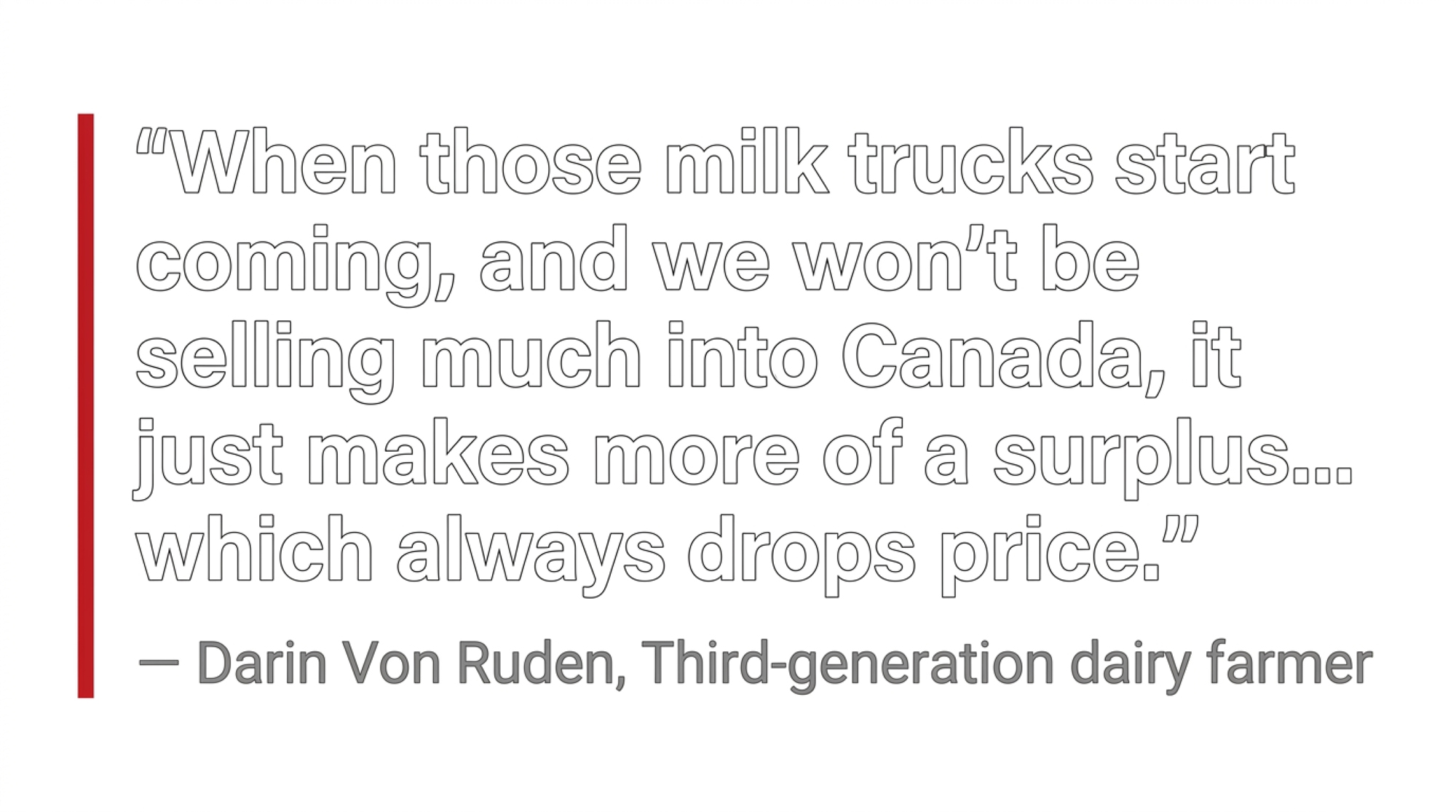
Darin Von Ruden is a third-generation dairy farmer near Westby, Wisconsin, and president of the Wisconsin Farmers Union, a producer advocacy group. On August 25, he told WEAU what he’s watching for, and it wasn’t the tariff itself. “A month from now, six weeks from now, when those milk trucks start coming, and we’re hit with that probability that we won’t be selling much dairy product into Canada, just makes more of a surplus in the United States, which always drops price.”
Surplus. That’s the mechanism, and it’s the part the trade headlines keep skipping. Canada’s counter-tariffs on U.S. dairy take effect at 12:01 a.m. on September 8, 2026 — 50% on milk and cream powders, whey and milk protein concentrates, casein; 25% on cheese and curd. And the Canadian market access the U.S. is fighting to open? Smaller than the headlines suggest.
What Actually Got Signed, and What It Covers
Three things stacked up this summer, and they don’t mean what the coverage implied.
The USMCA hit its first mandatory joint review on July 1, 2026, under Article 34.7. USTR Ambassador Jamieson Greer said the U.S. “did not agree to renew the USMCA in its current form.” That reads as the deal died. It didn’t — the agreement stays fully in force, with annual reviews now running through 2036, per White & Case’s client alert dated July 1, 2026. Nothing about your milk cheque changed that day.
On July 20, three proclamations followed under Section 338 of the Tariff Act of 1930. Proclamation 11047 is the dairy one, adding 50% duties on Canadian dairy ingredients — milk and cream powders, whey, milk protein concentrate, casein, lactose. Not retail milk. Not the cheese in a grocery cooler. Inputs. Those went live August 22 after a three-day delay, once talks in Washington collapsed on August 21.
Canada’s answer, published by the Department of Finance and updated August 26, matches dollar for dollar across $27.6 billion in U.S. goods — dairy alongside steel, appliances, agricultural equipment, pulp and paper, and electronics. The dairy lines are specific: HS 0402 milk and cream powders at 50%, HS 0404 whey and whey protein concentrate at 50%, HS 3501 casein at 50%, HS 3502.20 milk albumin and whey protein concentrates at 50%, HS 3504 milk protein substances at 50%, and every named cheese category under HS 0406 at 25% — cheddar, mozzarella, brie, gouda, parmesan, provolone, havarti, Swiss, gruyère, camembert, romano. Both within and over access commitment, on every one of them.
| HS code | Product | Surtax | Who feels it first |
|---|---|---|---|
| 0402 | Milk and cream powders | 50% | Powder plants and co-op marketing arms |
| 0404 | Whey and whey protein concentrate | 50% | Cheese-plant whey streams, ingredient buyers |
| 0406 | All named cheeses (cheddar, mozzarella, gouda, Swiss) | 25% | Cheese exporters — Canada’s largest U.S. dairy line |
| 3501 / 3502.20 | Casein; milk albumin, whey protein concentrates | 50% | Ingredient processors on both sides of the line |
| 3504 | Milk protein substances | 50% | MPC and protein-blend manufacturers |
| Not listed | Semen, embryos, livestock genetics | None | Confirm your own HS codes with a customs broker |
How Much Is the Access Fight Actually Worth to You?
Here’s the math, assumptions on the table, because the number only means something if you can check it against your own herd.
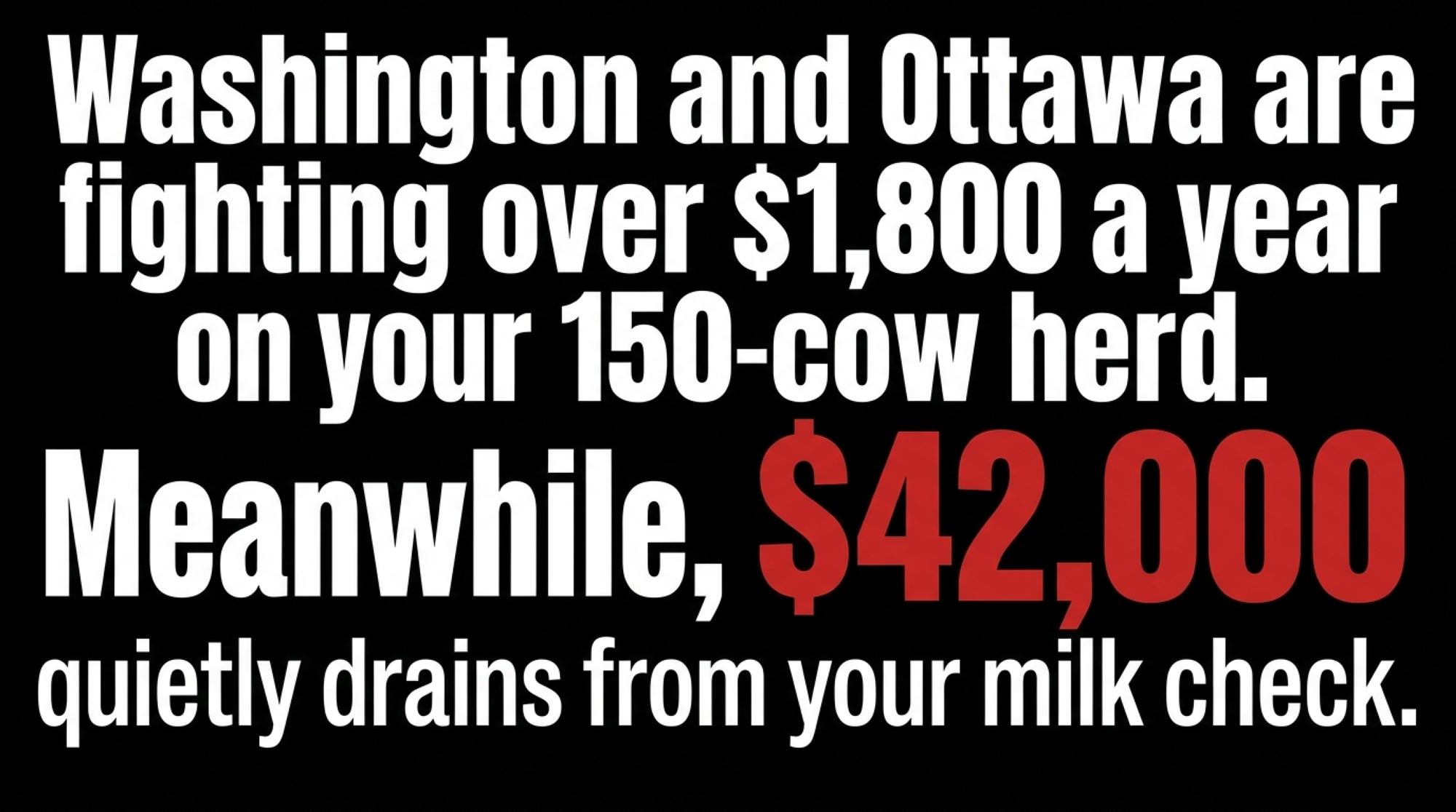
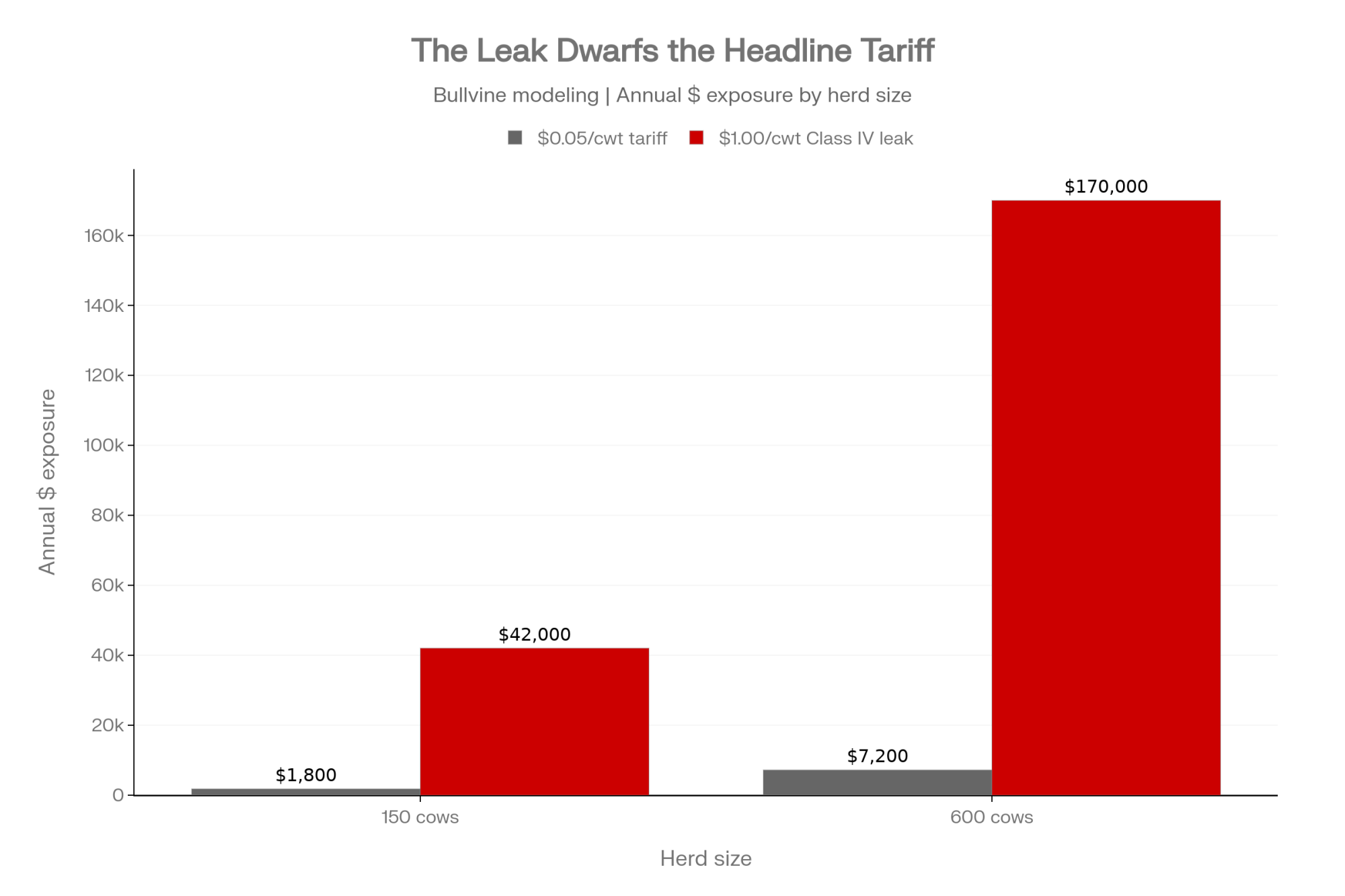
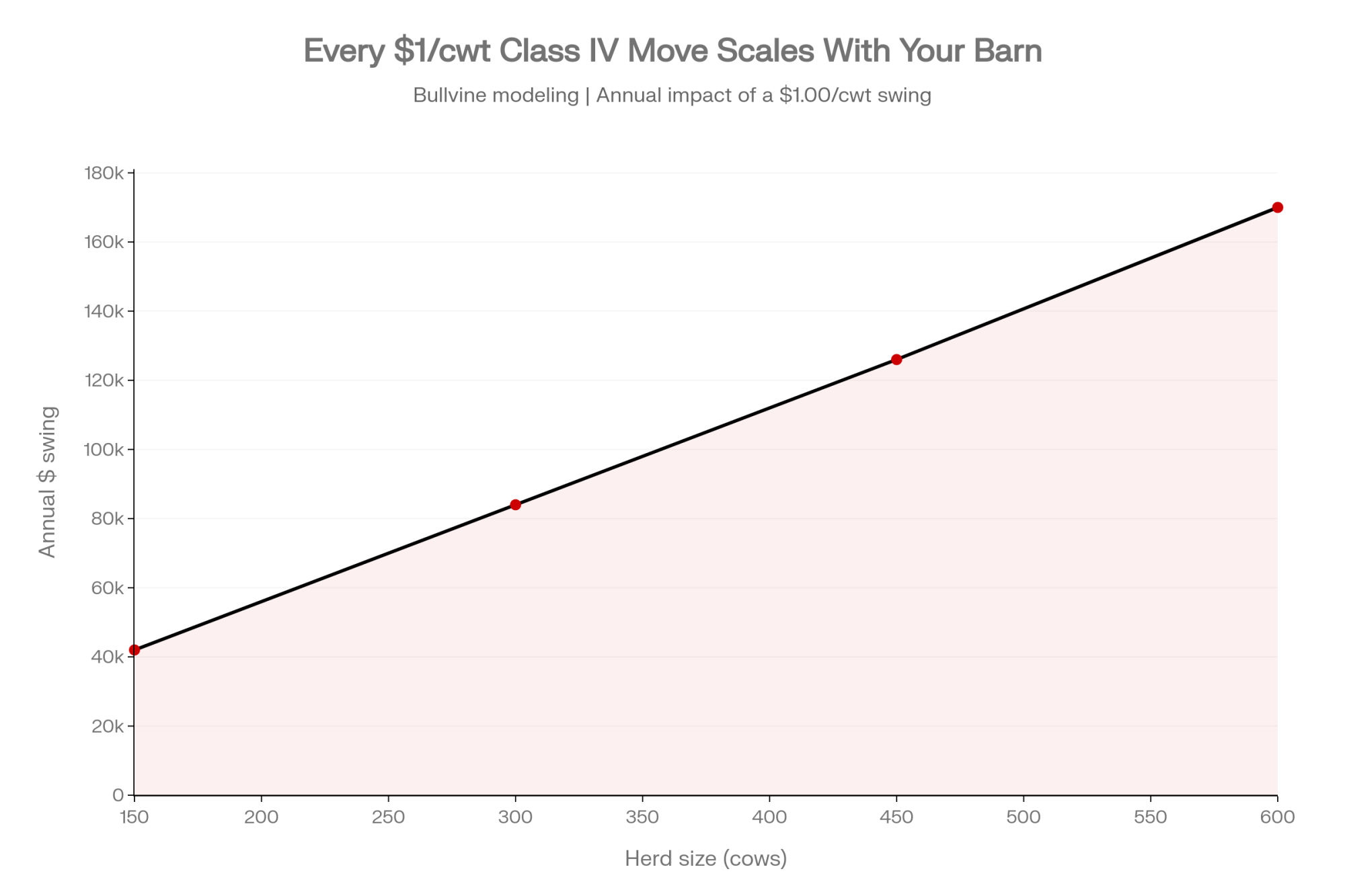
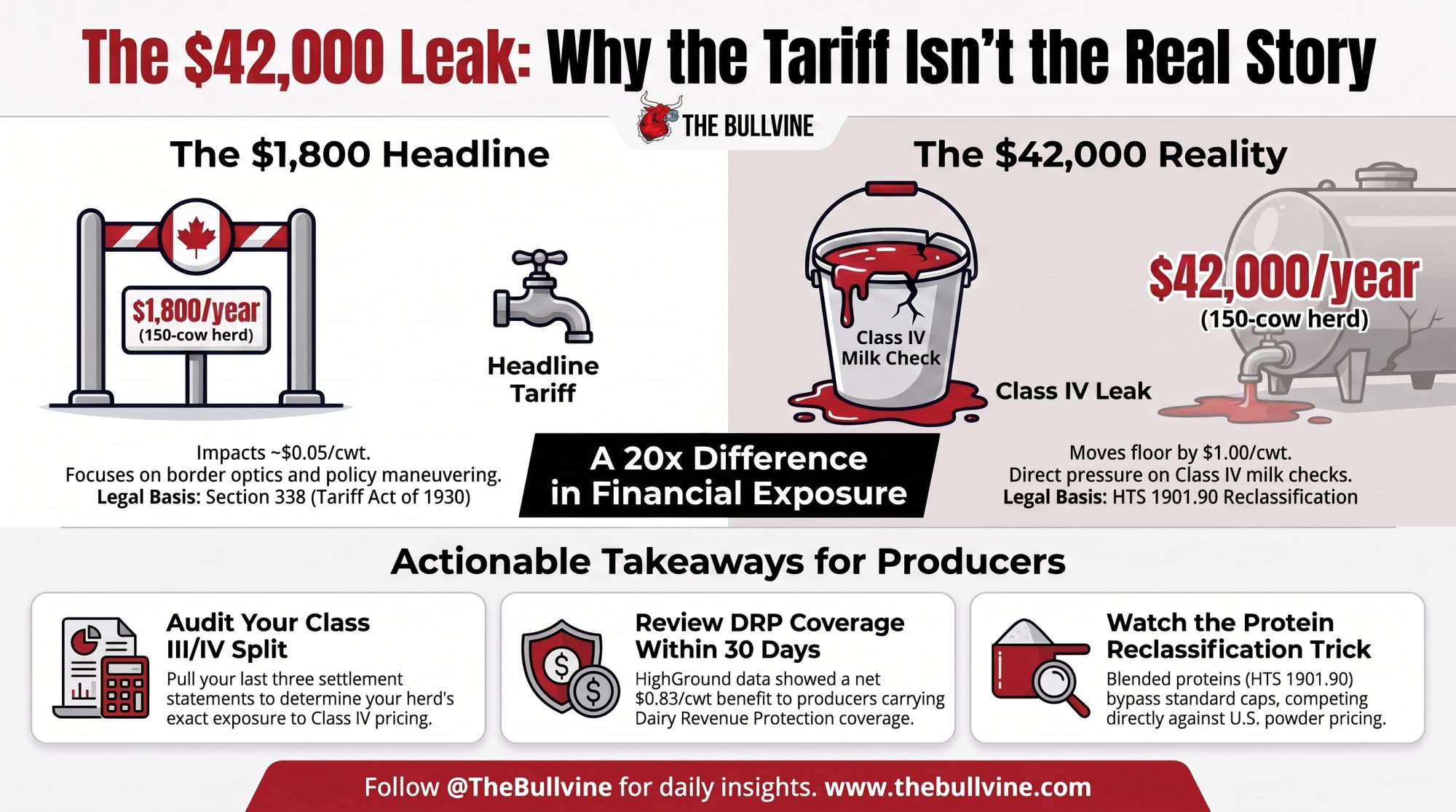
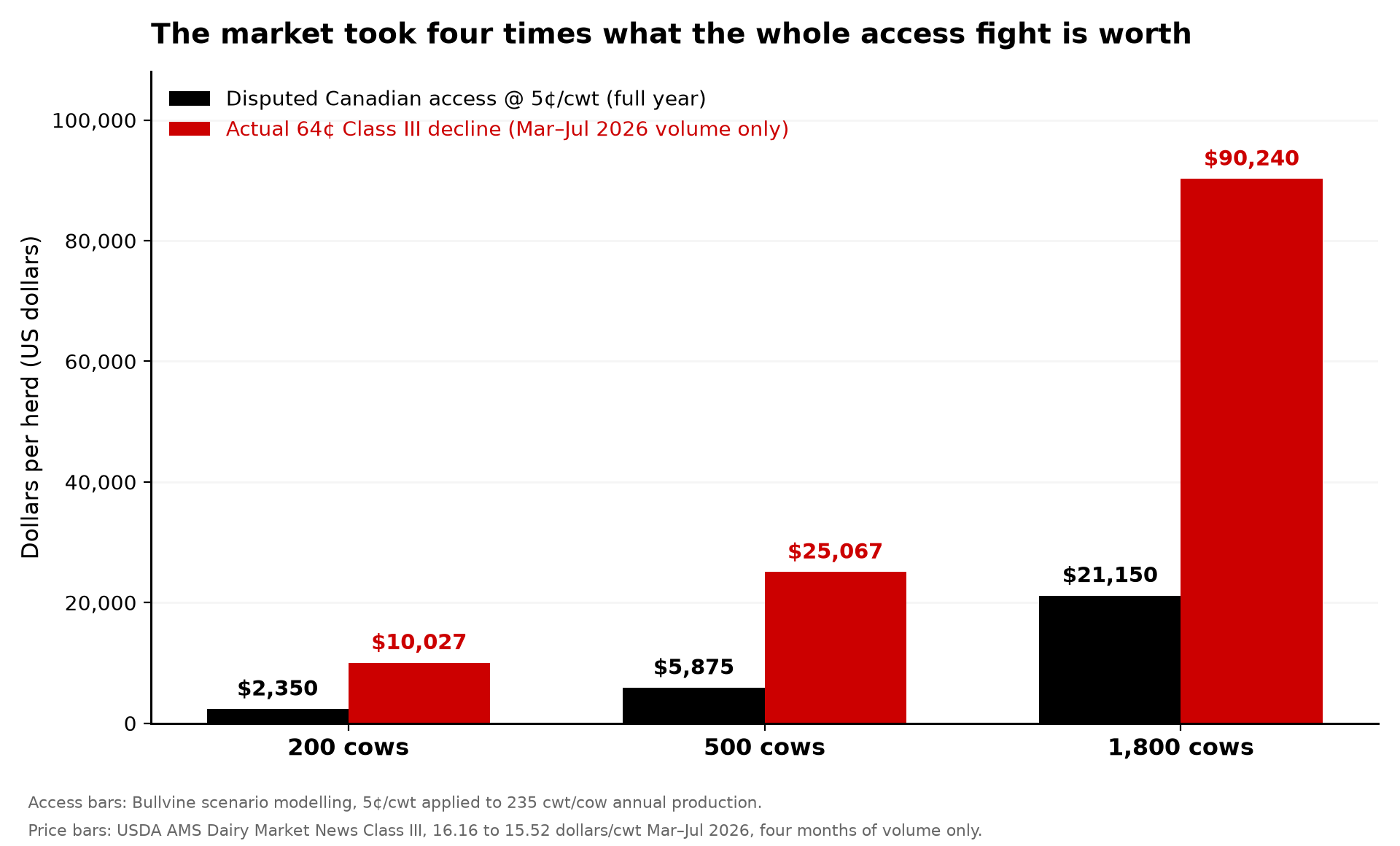
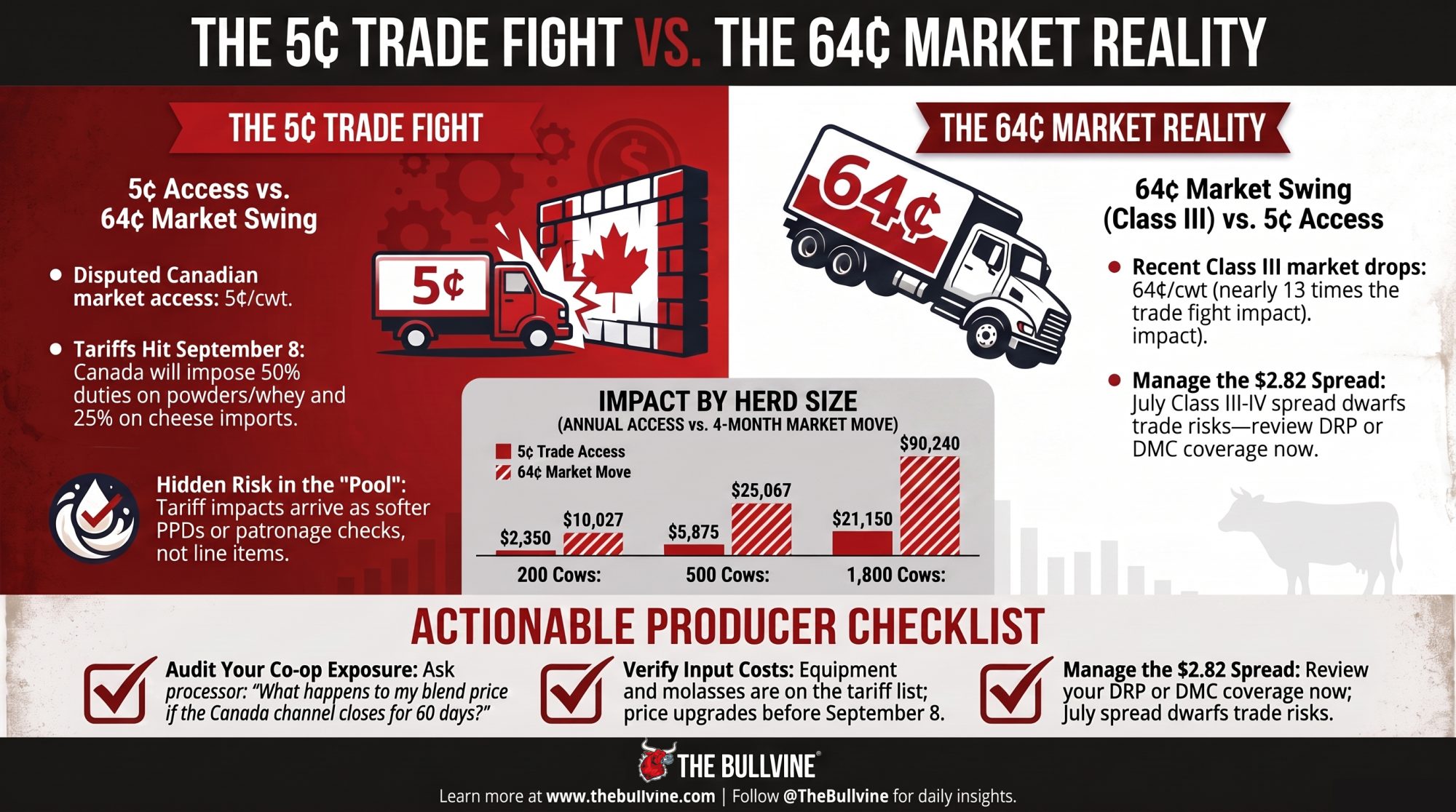
Using USDA Foreign Agricultural Service trade data, The Bullvine’s own scenario modelling puts the value of fully enforcing the disputed Canadian dairy access at roughly 5¢/cwt nationally. Model your herd at 235 cwt per cow annually — that’s our stated assumption, roughly 23,500 lbs, and you should substitute your own rolling herd average. Then set the disputed access beside what Class III actually did between March and July of this year: $16.16/cwt down to $15.52, a 64¢ drop over four months, per USDA AMS Dairy Market News.
| Herd size | Annual production | Access @ 5¢/cwt (year) | Actual 64¢ Class III move (4 months) |
|---|---|---|---|
| 200 cows | 47,000 cwt | $2,350 | $10,027 on 15,667 cwt |
| 500 cows | 117,500 cwt | $5,875 | $25,067 on 39,167 cwt |
| 1,800 cows | 423,000 cwt | $21,150 | $90,240 on 141,000 cwt |
| Per cwt | 235 cwt/cow assumed | $0.05 | $0.64 — 12.8x the access value |
Access column: 5¢/cwt Bullvine scenario modelling applied to annual production at 235 cwt/cow. Price column: the actual 64¢ Class III decline applied to four months of production only — matching the window the price move covers, not annualized. Assumes even monthly production; real herds swing seasonally.
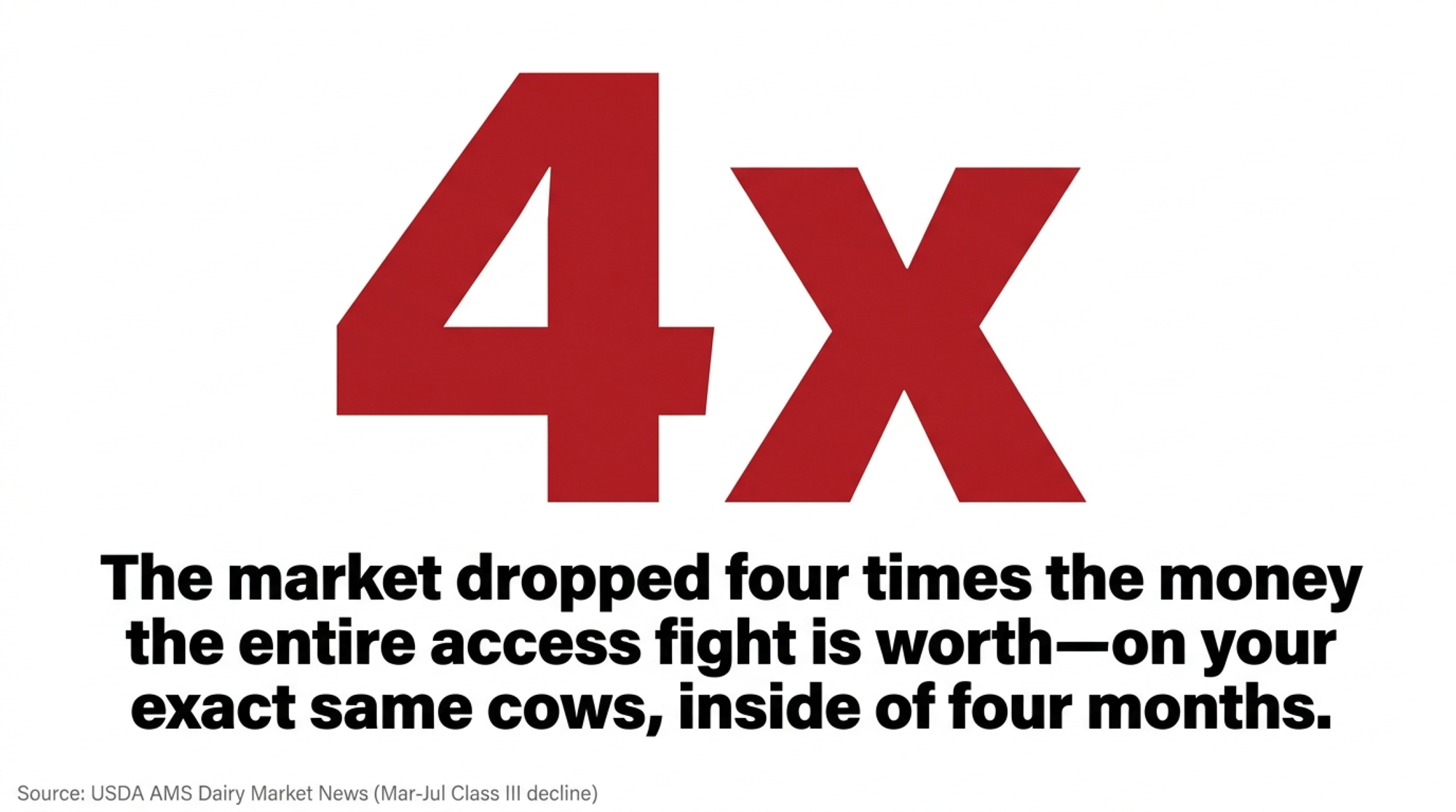
Read across any row. The market moved more than four times the money the entire access fight is worth, on the same cows, inside four months. Where does your breakeven sit right now? For most operations, the honest answer has very little to do with Canada.
That 5¢ figure is a scenario, not a published USDA number. We built it, and we’re labelling it. No government agency or land-grant university publishes a per-cwt dollar figure for unrealized USMCA dairy access, which is exactly why the number carries its label every time it appears.
One Law and One Clause Nobody’s Pricing In
Two structural facts explain why this won’t resolve the way the rhetoric implies.
The first is a statute. Bill C-282 — amending the Department of Foreign Affairs, Trade and Development Act — received Royal Assent June 26, 2025, per Parliament of Canada’s LEGISinfo record. It bars Canada’s Foreign Affairs Minister from committing to expand supply-managed dairy quotas or cut over-quota tariffs in trade negotiations. That’s not a posture a government softens under pressure. It’s a law Parliament would have to unwrite. U.S. producers waiting for Canadian negotiators to cave eventually are waiting on a law to change, not a mind.
The second is the retailer clause, and it’s the part that gets lost in the political coverage. Under Canada’s CETA agreement with the European Union, EU cheese enters through a retailer-eligible quota of roughly 16 to 17.7 million kilograms, per Global Affairs Canada’s TRQ notice. Under USMCA, U.S. cheese quota goes to processors and distributors — retailers excluded. The Globe and Mail reported July 20, 2026, that this asymmetry appears in Proclamation 11047’s own stated rationale. That gap is the actual legal complaint underneath the politics.
| Access feature | U.S. cheese under USMCA | EU cheese under CETA | Why it matters at farm level |
|---|---|---|---|
| Eligible channel | Processors and distributors only | Retailer-eligible quota | Retail shelf access decides whether volume moves |
| Quota volume | 6,250 t (2025) to 7,113 t by Year 19 | About 16 to 17.7 million kg | The EU pool dwarfs the U.S. cheese TRQ |
| Over-quota tariff | About 245% MFN | Preferential under CETA | 245% is a wall, not a price |
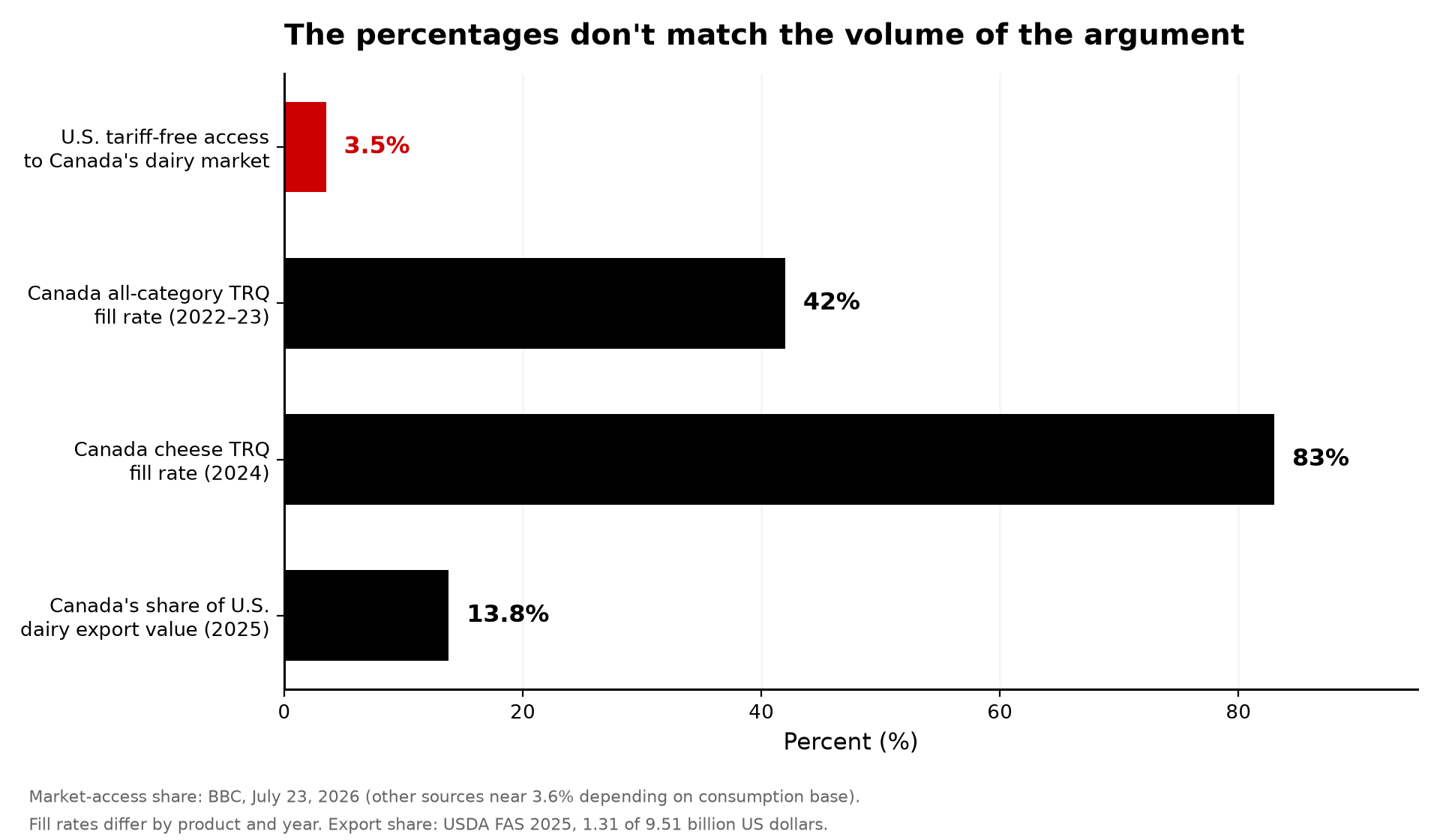
| Fill performance | Cheese ran 83% in 2024 | Not directly comparable | All-category fill near 42% in 2022–23 — ask which product |
| Total market access | About 3.5% of Canada’s market | Larger and retail-facing | The whole fight is over a sliver |
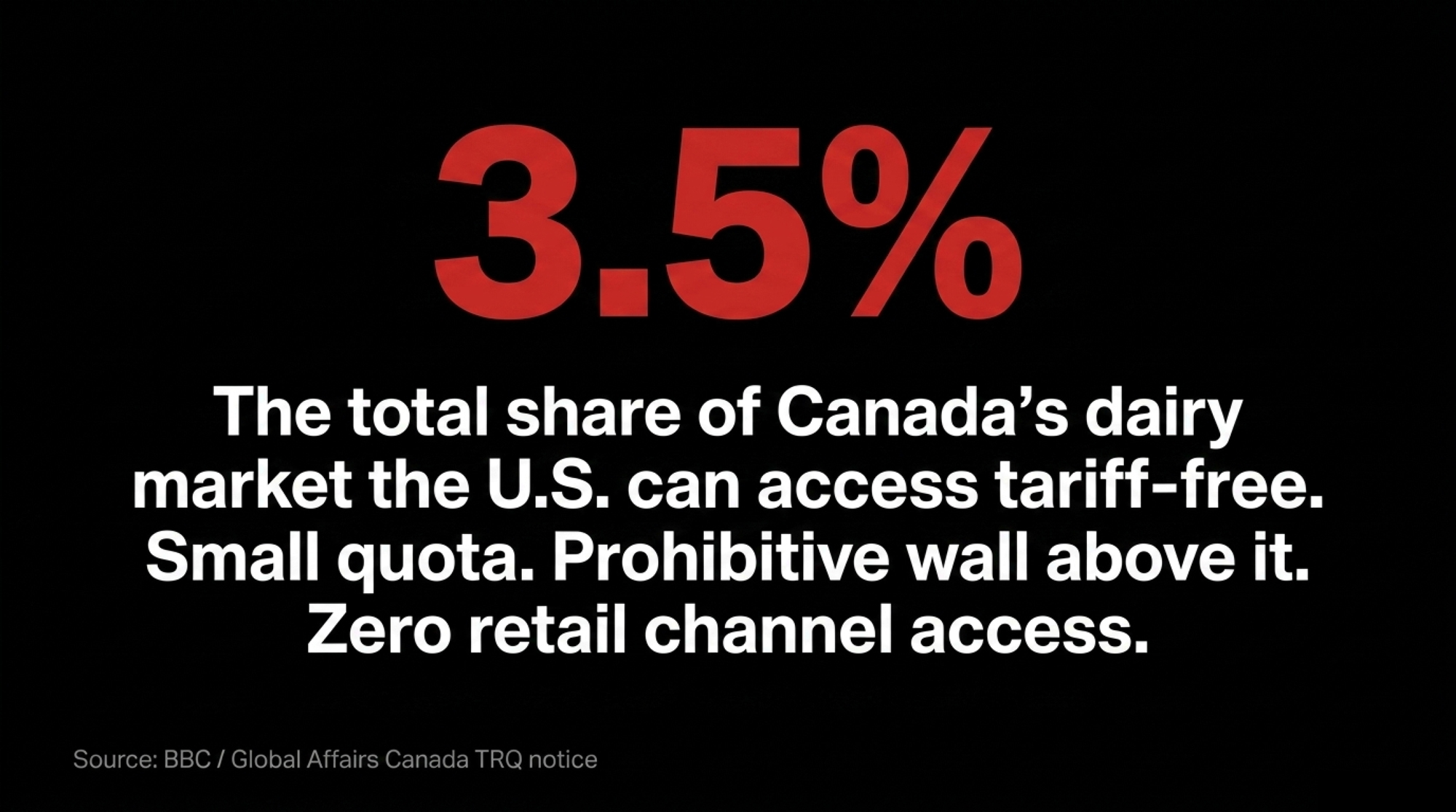
Scale tells you the rest. UW-Madison Extension puts the 2025 USMCA cheese TRQ for U.S. exports at 6,250 metric tonnes, rising to 7,113 tonnes by Year 19, with an over-quota MFN rate near 245%. BBC reported July 23, 2026, that U.S. producers hold tariff-free access to about 3.5% of Canada’s market — other sources put it nearer 3.6%, depending on the consumption base used. Small quota, prohibitive wall above it, no retail channel. That’s the architecture, and it also explains why you’ll see Canadian fill rates quoted two contradictory ways: cheese ran 83% in 2024, while the all-category average sat near 42% in 2022–23. Both real. Different products.
Is Your Real Risk Even Visible in Your Milk Cheque?
Probably not, and that’s the part worth sitting with.
Most U.S. milk moves through Federal Milk Marketing Order pooling before it reaches a processor. Your cheque reflects Class I–IV utilization in your marketing order — not where the finished cheese or powder eventually sells. Export exposure lives downstream, at the plant or the co-op’s marketing arm. So your milk cheque is pooled. Your risk isn’t.
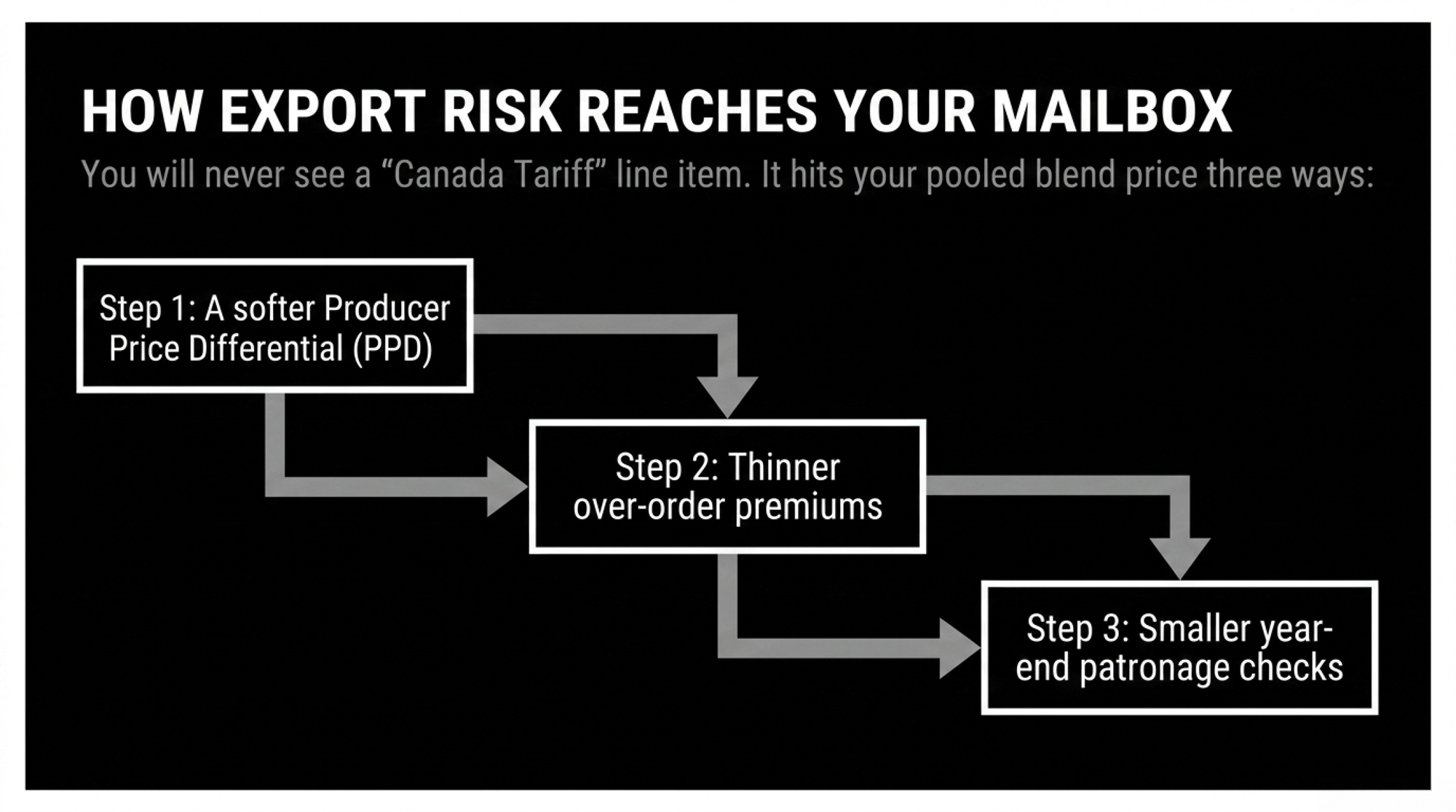
Here’s how that risk actually reaches your mailbox. You won’t see a line item that says “Canada tariff.” If your co-op takes a margin hit on powder or cheese it was moving north, that shows up in the blend — a softer Producer Price Differential, thinner over-order premiums, or a smaller patronage cheque at year-end. Same money, three degrees of separation, no label on it.
So ask your co-op or processor three things: how much of what you ship gets exported, how much of that goes to Canada, and what happens to your blend price if that channel closes for sixty days. No public dataset breaks this down at the plant level — we looked. That information sits in member communications, not government data, which means the only way to get it is to ask.
Options and Trade-Offs for Farmers
Pull the Finance Canada list and check your purchase orders—within 30 days. The document is public, free, and specific down to the tariff item. If you’re a Canadian producer buying U.S. cane molasses (HS 1703.10, 50%), polyethylene sacks and bags (HS 3923.21.90, 50%), or milk-protein inputs, it tells you exactly what changes on September 8. Costs you an hour and your purchase records. Here’s the part worth knowing: goods already in transit to Canada on September 8 are exempt, so what matters isn’t when you ordered — it’s whether the truck crosses before the clock runs out.
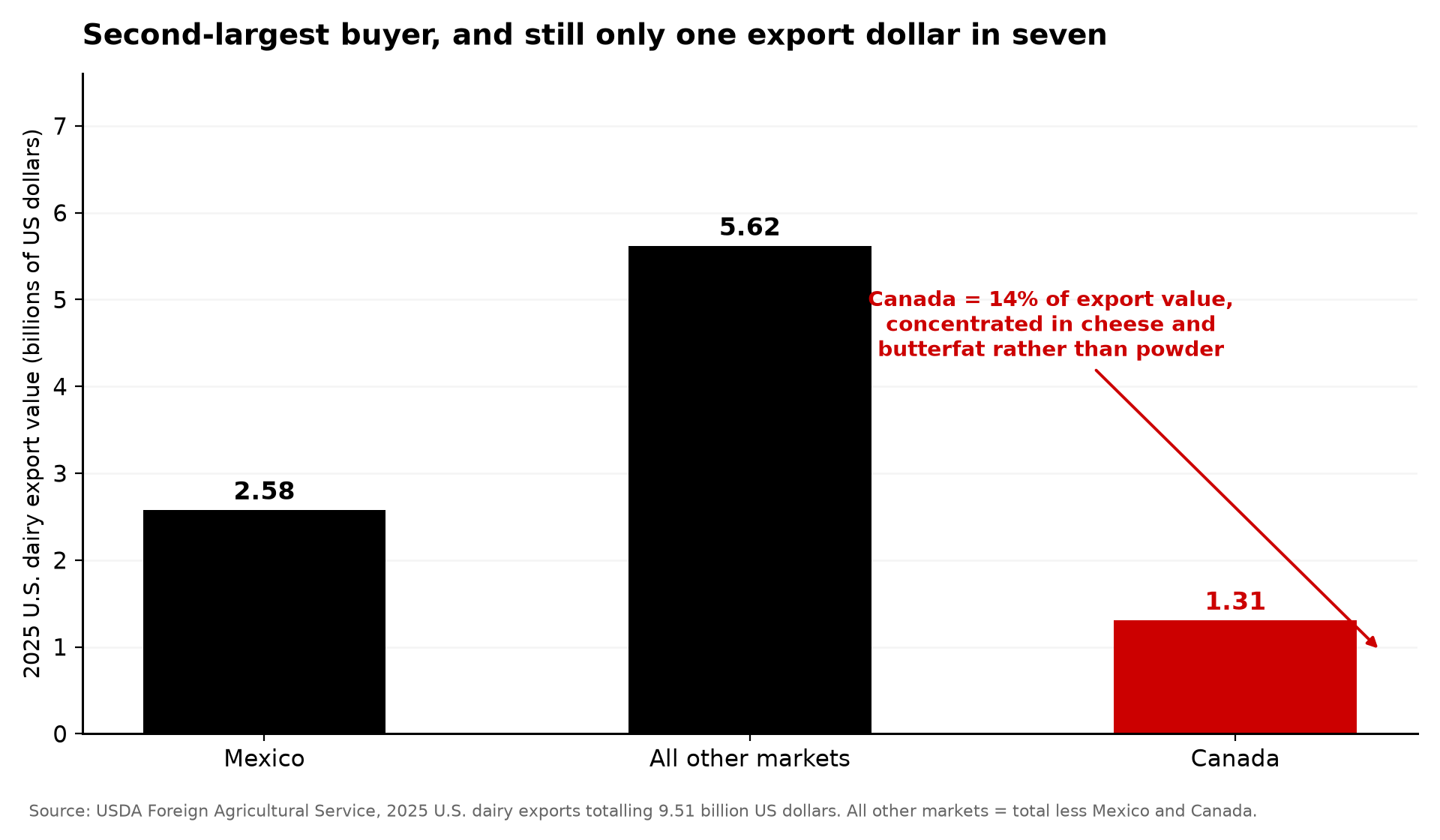
Quantify your Canada exposure before you react. Canada took $1.31 billion in U.S. dairy exports in 2025 out of $9.51 billion total, per USDA FAS — roughly 14%, second behind Mexico at $2.58 billion on the same dataset. Agriculture and Agri-Food Canada figures reported by the Western Producer on May 4, 2026 put butterfat and cheese at approximately CA$500 million of the CA$1.06 billion Canada recorded. So this concentrates in cheese and butterfat channels rather than spreading evenly across the industry. The catch is the pooling problem above — your own exposure isn’t visible in your own cheque.
The Class III–IV spread ran $2.82/cwt in July 2026, which is the real argument for reviewing your DRP or DMC coverage. That volatility already dwarfs anything this dispute realistically moves. It’s also the argument against buying coverage in a panic — a conversation with your risk advisor beats a reaction to a headline. Where this path fails: coverage priced off a news cycle tends to cost more than it protects. And the squeeze runs both directions on a farm, which is the part Von Ruden put plainly: “It’s a double edged sword that farmers deal with all the time, knowing that our price is lower, but going to the grocery store, buying milk, cheese, butter, ice cream, and having to pay more for it than we did two months ago.”
Agricultural equipment is on Canada’s list, so if you’ve got a parlour upgrade or a mixer order pending, price it against September 8 before you sign. That’s the tighter clock of the two cross-border paths. Genetics look clearer — semen, embryos, and livestock genetics don’t appear anywhere in Canada’s surtax list, and Proclamation 11047 covers dairy ingredient lines rather than breeding stock. But get your customs broker to confirm your specific HS codes instead of assuming the exemption covers your product.
Key Takeaways
For U.S. producers — export exposure and risk
- If you don’t know your co-op’s Canada-export share, that’s a phone call this week, not a headline to react to.
- If your co-op moves powder or cheese north, ask specifically what a sixty-day closure does to your blend price — the hit arrives as a softer PPD or a thinner patronage cheque, never as a tariff line item.
- If your annual cwt × 5¢ comes to less than one Class III swing on your own herd, the access fight isn’t where your margin is going. Look somewhere else.
- If you haven’t looked at DRP or DMC since spring, the $2.82/cwt Class III–IV spread in July is the reason to — not the tariff.
For Canadian producers — inputs and equipment
- If you buy any U.S. inputs, check your next 60 days of purchase orders against the Finance Canada list before September 8.
- If an order is already moving, find out whether it crosses before September 8 — goods in transit that day are exempt, so the shipping date, not the order date, is what counts.
- If you’ve got a parlour upgrade or mixer order pending, price it against the September 8 date before you sign. Agricultural equipment is on the list.
- If you’re financing quota in Ontario or Quebec at the capped CA$24,000/kg BF, this dispute isn’t what moves that number — provincial cap policy and pooled revenue are.
For both sides of the line
- If someone quotes you a single Canadian quota fill rate, ask which product category and which year before you act. Cheese ran 83% in 2024; the all-category average was near 42% in 2022–23.
- If you ship genetics either direction, get your customs broker to confirm your HS codes rather than assuming the exemption holds for your specific product.
Structural decline arguments make for good op-eds and bad forward contracts. The C.D. Howe Institute — which advocates market liberalization in its published policy work, so read it as a position rather than neutral data — argued in April 2026 that Canada’s supply management will eventually disappear on economic grounds. No source attaches a date to that. The next USMCA joint review is 2027. That’s the only clock in this story with an actual number on it.
Von Ruden is watching milk trucks, not press conferences. That’s the right instinct, and it points to the two numbers worth chasing this week — neither of them a tariff rate. What share of your co-op’s volume actually goes to Canada, and where does your rolling herd breakeven sit today? Stop trading on trade-war headlines and get both. We’re running the full per-cwt model by herd size and province, with assumption tables visible, in next week’s Bullvine Weekly — that’s where the barn math lives.
Complete references and supporting documentation are available upon request by contacting the editorial team at editor@thebullvine.com.
Learn More
- Class III Milk Price, DRP, and Your Spring 2026 Risk Plan — Arms you with a concrete framework to separate price-pool exposure from real margin risk, sorting your herd into actionable DRP coverage tiers to defend against five-figure monthly mailbox swings.
- Dairy Showdown: Canadian Quotas vs. American Free Market — Exposes the structural divide between Canada’s capital-intensive quota fortress and America’s volume-driven export model, delivering the fundamental policy drivers behind ongoing trade friction and long-term producer competitiveness.
- Transform Your Dairy Legacy: Strategic Succession Planning When Quota Outweighs Everything Else — Dismantles conventional farm transfer models when production rights eclipse cow value, showing how revenue-based payout structures and automated technology cut successor default risk by 40% to 60%.
The Sunday Read Dairy Professionals Don’t Skip.

Every week, thousands of producers, breeders, and industry insiders open Bullvine Weekly for genetics insights, market shifts, and profit strategies they won’t find anywhere else. One email. Five minutes. Smarter decisions all week.