




Archive for Bovaer 2027 contract

The Hydrogenobody Quietly Rewrote Your 2027 Methane Contract – Before You Even Signed It

Same ration. Same additive. Same paperwork. A Science paper in April just explained the 35-50 kg/day gap — and it’s the slice of methane your 2027 Bovaer contract assumed didn’t exist.

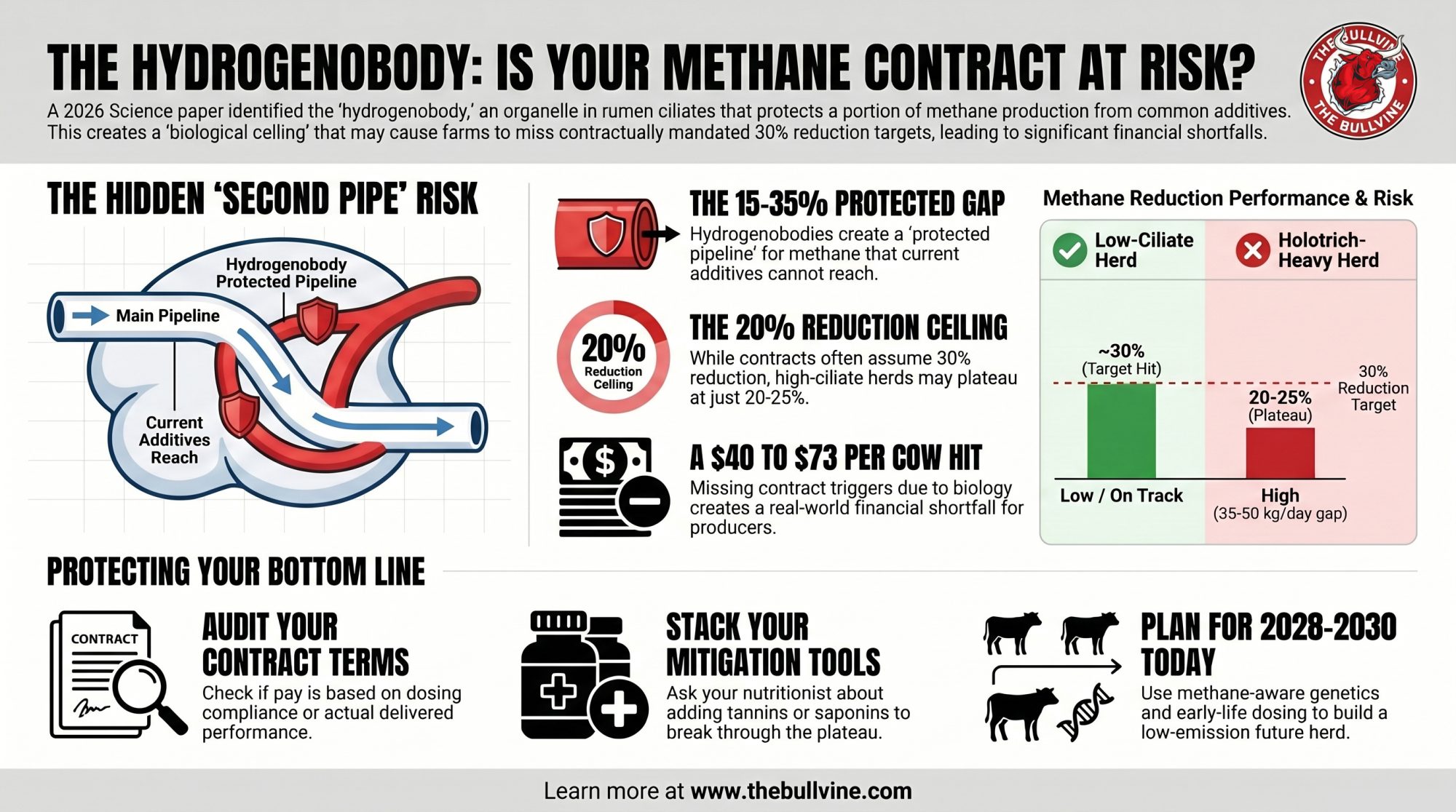
Executive Summary: A Science paper in April identified a new organelle inside rumen ciliates — the hydrogenobody — that powers an estimated 15-35% of enteric methane through a pathway 3-NOP can’t fully reach, which means every flat-30% Bovaer-linked 2027 contract on the continent is carrying biological risk nobody priced in. Two 500-cow herds on the same TMR and the same additive can now sit 35-50 kg of methane per day apart, purely on ciliate community: a low-ciliate herd can honestly land near a 30% reduction, while a holotrich-heavy herd ceilings around 20-25% and burns the difference straight through the contract’s minimum trigger. The hit lands somewhere between and a cow on most deals, depending on dose, premium tier, and carbon price — real money on a 500-cow shipper. Single-additive tools like Bovaer aren’t broken; they’re working on one of two hydrogen pipelines, which is why asparagopsis, nitrates, and most next-gen inhibitors hit the same plateau. The 30-day move is pulling your contract and reading three lines: who owns the shortfall, whether payment triggers on dosing or delivered performance, and whether there’s a re-opener clause for new science. The 90-day move is deciding whether early-life 3-NOP dosing through 14 weeks plus methane-aware Lactanet/CDCB sire selection are on the table for replacements — that’s where the structural reductions for your 2028-2030 contracts actually live.
hydrogenobody methane contract

A Science paper in April identified a cell structure inside rumen ciliates that powers an estimated 15-35% of enteric methane through a pathway current feed additives can’t fully reach — and every flat-30% Bovaer deal on the continent now carries biological risk that wasn’t priced in.

Picture a 500-cow Holstein dairy in southern Ontario — the kind of mid-size family operation you find every twenty minutes off Highway 401. Late last year, the owner signed a 2027 Bovaer-linked carbon and premium deal. The front-page math looked clean: feed 3-NOP, hit a modeled 30% reduction in enteric methane, collect a per-cwt sustainability premium, and a per-head carbon credit through Elanco’s Athian marketplace. Six months in, the cows are eating it, the milk is shipping, and the owner is starting to wonder whether the rumen ever read the contract.
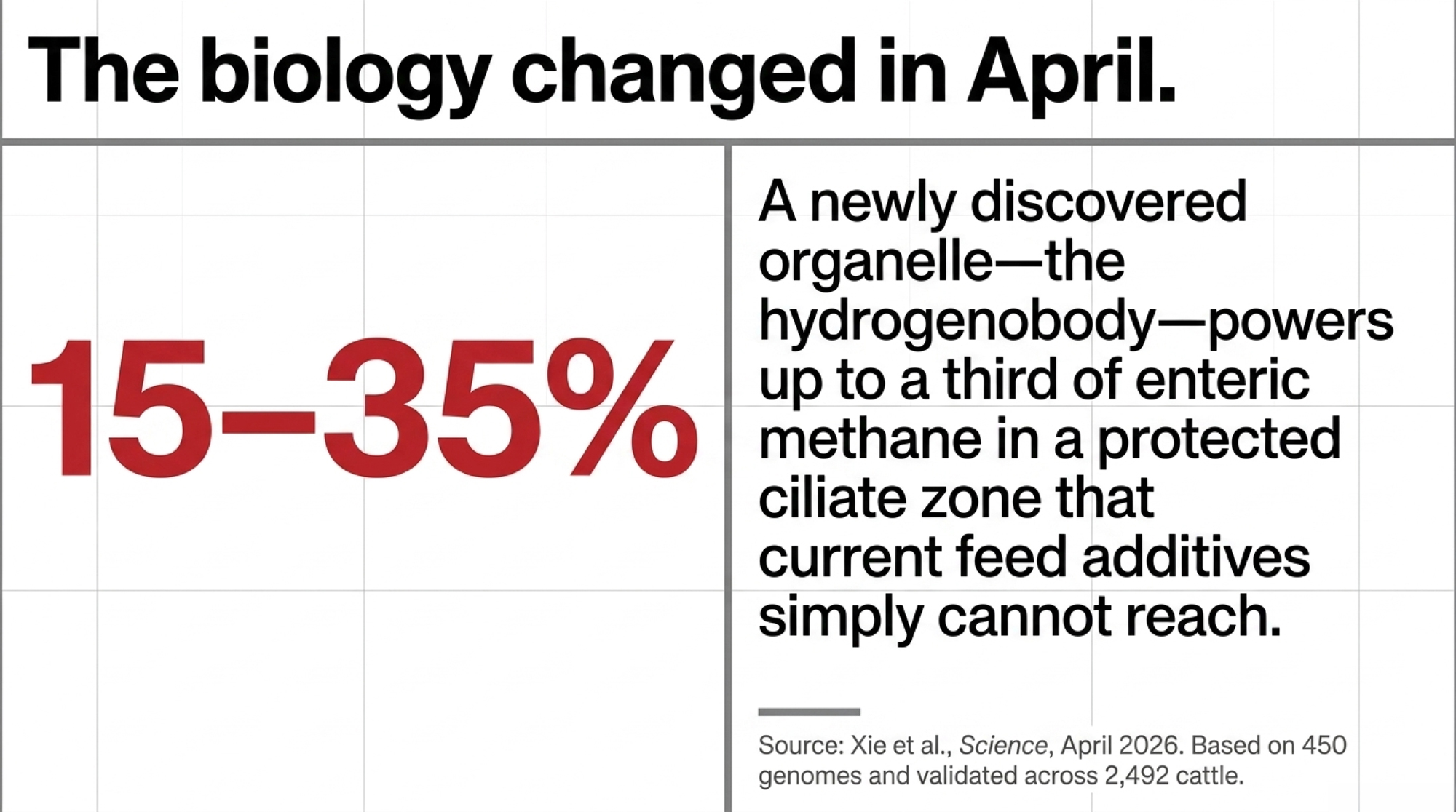
In April, a paper in Science dropped a new piece of biology into the middle of every methane deal on the continent. Fei Xie and colleagues identified a previously unknown organelle inside rumen ciliates — the hydrogenobody — that helps power an estimated 15-35% of total enteric methane through a pathway current feed additives can’t fully reach (Xie et al., Science, April 2026). If you’ve already signed, or you’re about to, that single discovery rewrites the risk math on your contract.

What’s Changing and Why

For two decades, the industry has treated enteric methane as basically one pipe. Fermentation makes hydrogen, free-living methanogens in rumen fluid turn that hydrogen into methane, an inhibitor like 3-NOP knocks them back, and you book a reduction. That single-pipe assumption is baked into the 20-30% headline quoted for Bovaer in dairy cows and into the carbon methodologies that pay on it.
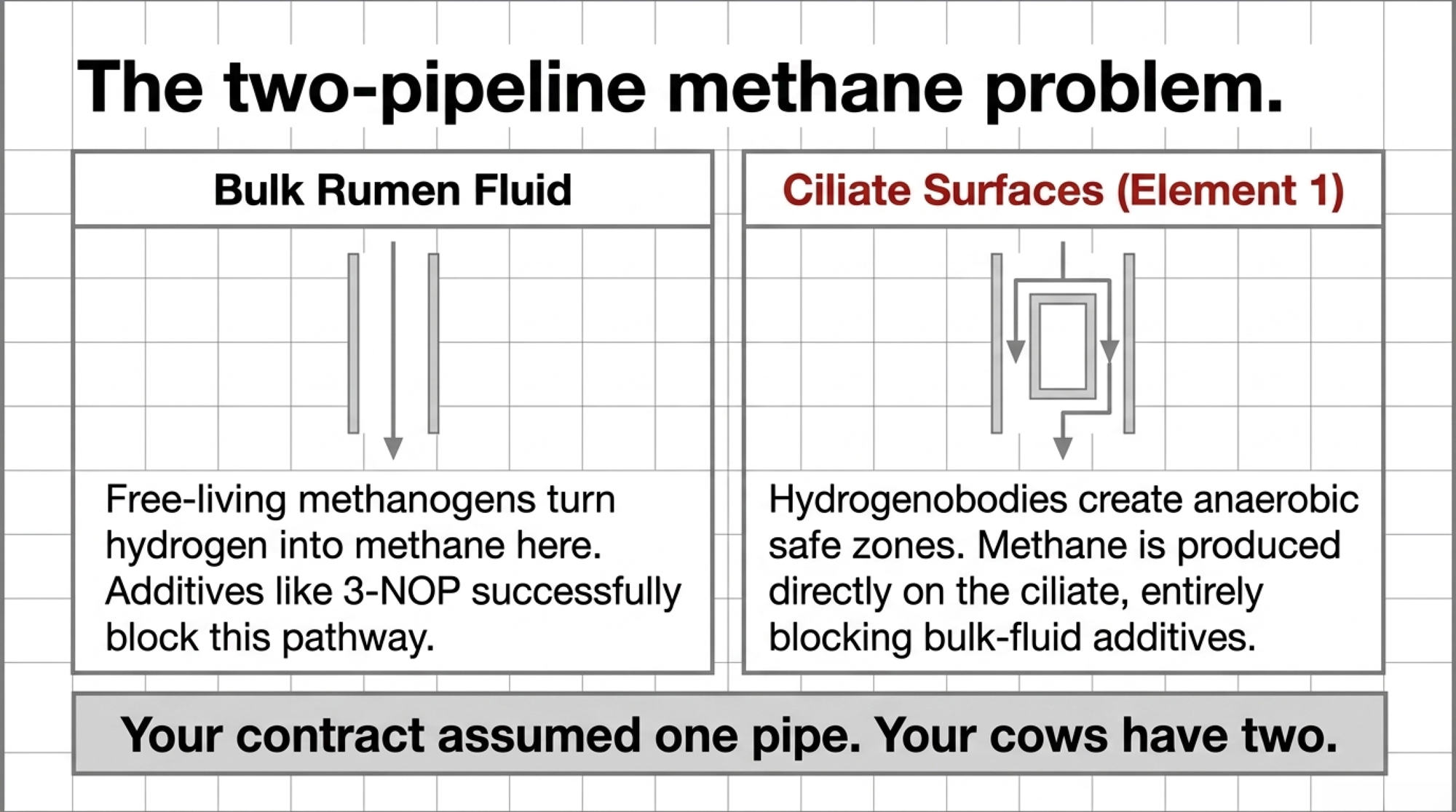
The April 2026 study — built on 450 rumen ciliate genomes and validated against 2,492 cattle across five countries — showed there’s a second pipe. Rumen ciliates, the protozoa that make up roughly half of rumen microbial biomass, carry a single-membrane organelle at the base of their cilia. That organelle produces hydrogen and strips oxygen at the same time, creating tiny anaerobic safe zones where attached methanogens churn out methane right on the ciliate surface.

Most current feed additives weren’t designed for that micro-zone. They work where hydrogen is floating in bulk rumen fluid, not where it’s being handed cell-to-cell. Translated to a feed bunk: a chunk of your methane lives in a part of the rumen your contract assumed your additive could reach. The new paper puts that estimated share at 15-35% of total enteric methane, and higher in herds loaded with holotrich ciliates like Dasytricha.

How This Plays Out on Real Farms

Two 500-cow Holstein dairies on the same TMR, shipping to the same processor, can now end up on very different sides of the same contract. The Xie study found high-methane sheep on the same diet carried nearly 100 times more Dasytricha than low-methane sheep, and each of those cells packed about 28 times the hydrogenobody density of a common low-emission ciliate genus. On a dairy, that means a holotrich-hot herd is running more of its methane through the protected pipeline. Same additive program, lower ceiling.

These reduction ceilings aren’t measured outcomes from a single trial. They’re inferences from layering the hydrogenobody paper’s two-pipeline framing on top of published 3-NOP efficacy ranges. The directional logic is solid. The precise plateau on your farm will depend on your herd’s ciliate profile — and the only way to know which barn you’re standing in is a rumen fluid sample run for ciliate community composition, still primarily a research-lab service today, but one your nutritionist or extension specialist can route through a university partner if you want a real answer rather than an industry assumption.
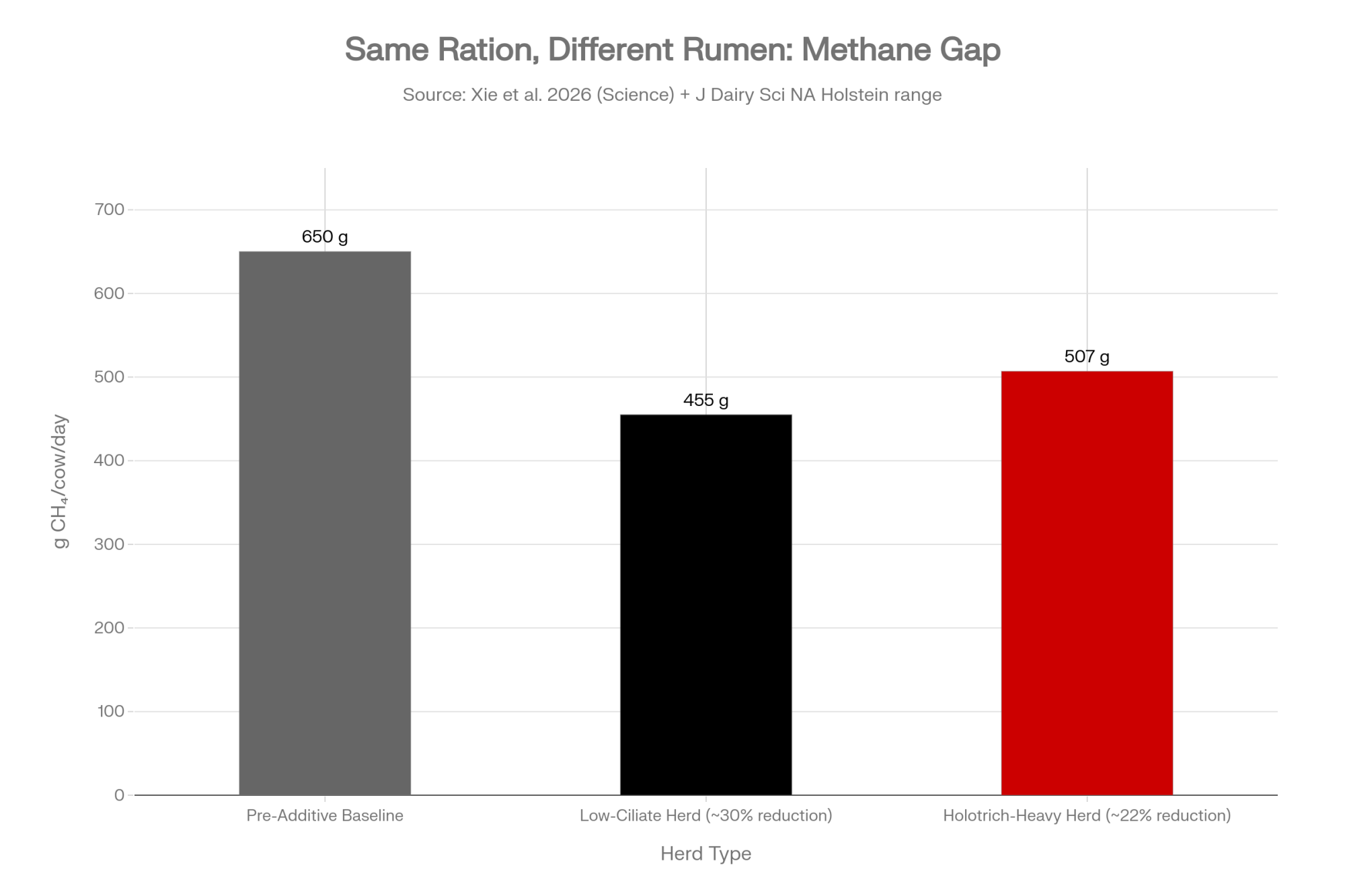
Here’s the barn math at the methane level. Set the dollars aside for a moment. Take a higher-producing Holstein at roughly 600-700 g of enteric methane per cow per day — a range consistent with peer-reviewed Journal of Dairy Science enteric-methane work on NA lactating cows fed typical TMRs. A lower-ciliate herd may have about 20% of its methane locked in hydrogenobody zones, so a well-run 3-NOP program can honestly land near the 30% headline reduction — putting it around 430 g/cow/day post-additive. A holotrich-heavy herd, with 30-35% of methane in that protected zone, can do everything right and still plateau around 20-25%, landing closer to 530 g/cow/day. Same ration, same additive, same paperwork — different rumen.

Two 500-Cow Herds, Same Ration, Different Rumens

Rumen Ciliate ProfileMethane in Protected ZoneRealistic 3-NOP ReductionPost-Additive Methane per Cow/DayTotal Herd Methane per Day (500 cows)Contract Shortfall Risk
Low-ciliate herd~20%~30% (target hit)~430 g~215 kgLow / on track
Holotrich-heavy herd30-35%20-25% (plateau)~530 g~265 kgHigh — 35-50 kg/day gap

Inputs: ~600-700 g/cow/day pre-additive baseline (peer-reviewed NA lactating Holstein range, J Dairy Sci); reduction percentages reflect inferred biological ceiling under the two-pipeline framing of Xie et al. 2026, not measured trial outcomes. Per-cow and per-herd numbers scale linearly to your own herd size and baseline.
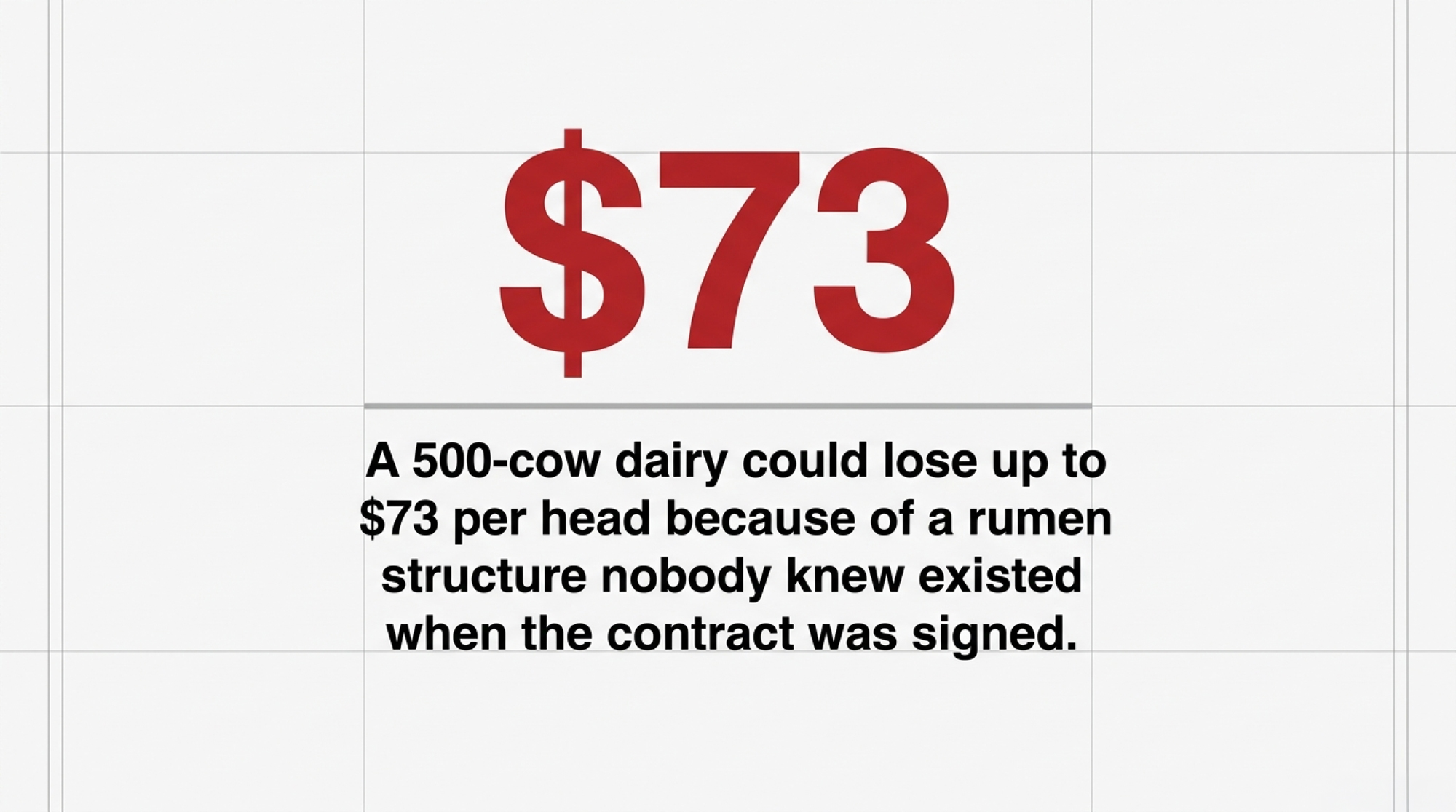
That kilogram gap is what your contract’s dollar math sits on top of. Whether it costs you something closer to $40 a cow or something closer to $73 a cow depends on dose, premium tier, and carbon price — and the full cow-by-cow teardown runs in next week’s Methane Contract Files.

The Mechanics Behind the Outcomes

Picture two hydrogen economies in the same rumen. The first is the open one. Hydrogen released into rumen fluid, picked up by free-living methanogens, is turned into methane. 3-NOP, the active ingredient in Bovaer, inhibits methyl-coenzyme M reductase in those methanogens, and that’s where most of its 20-30% reduction comes from.

The second economy is the ciliate one. The hydrogenobody, sitting at the base of the hair-like cilia, generates hydrogen and scrubs oxygen out of its immediate neighborhood. Methanogens latch onto the ciliate surface and tap that hydrogen directly. They never really mix it into the open rumen fluid. An inhibitor floating in bulk fluid has a hard time reaching reactions in those nanometre-scale pockets.

That’s why the reduction curve from a single additive bends. You get a steep early drop as the bulk-fluid pathway is suppressed. Then the line flattens as more of the remaining methane sits in the ciliate-protected pipeline. Genetics, early-life colonization, and feed history all shape how big that protected slice is — host genes like SPINK5, which influence rumen wall structure and local oxygen gradients, help decide which ciliates can colonize and thrive. In other words, your herd’s methane ceiling is partly baked in long before any product hits the feed bunk.

Why This Goes Beyond Bovaer
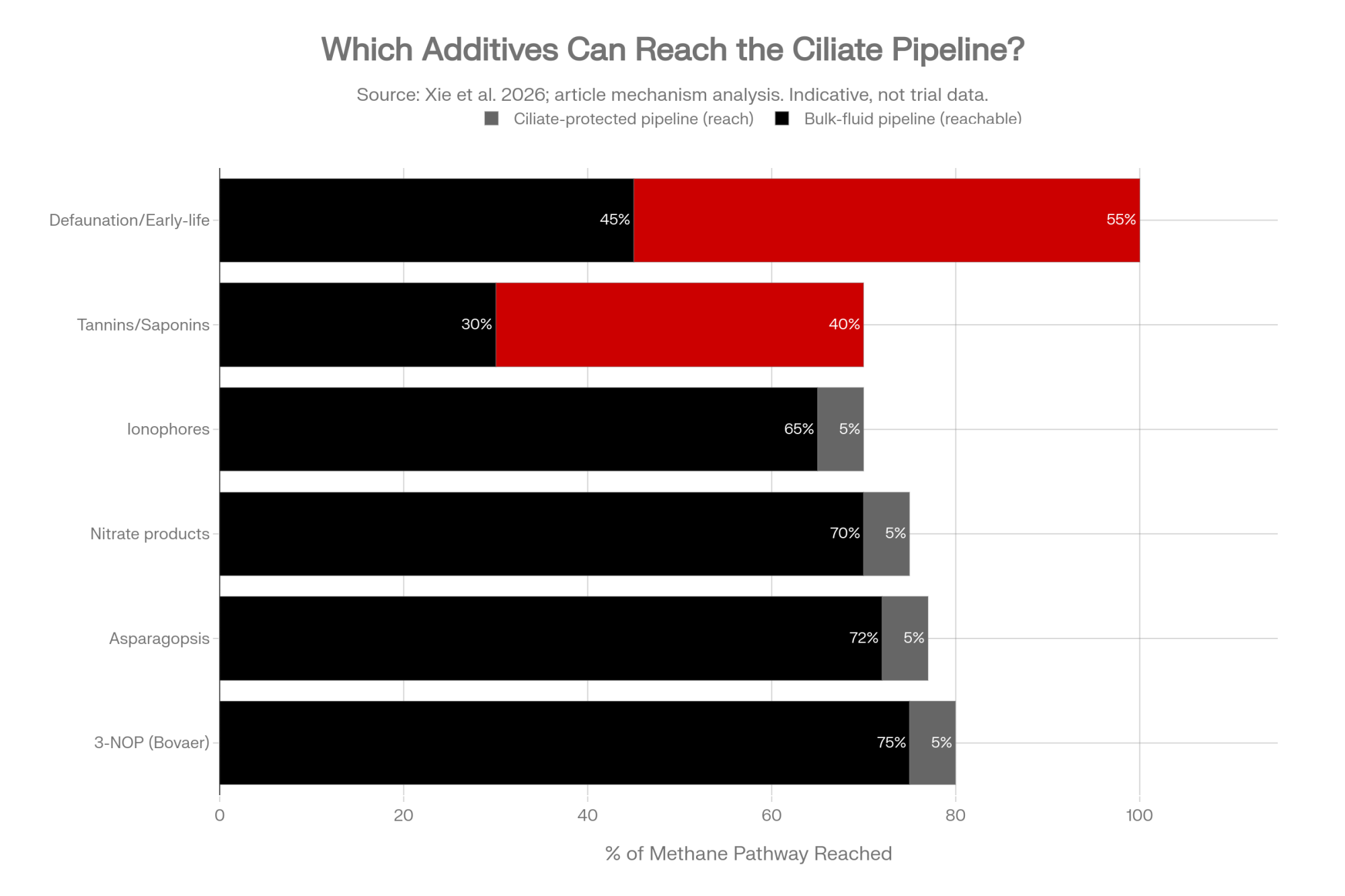
This isn’t just a 3-NOP problem. Any additive that works primarily on free-living methanogens in bulk rumen fluid runs into the same wall. Asparagopsis seaweed, nitrate-based products, certain ionophores, and most next-gen inhibitors in commercial trials all share that mechanism family. The two-pipeline framing applies to every one of them.

Ciliate-targeting tools — tannins, saponins, defaunation strategies, and the early-life microbiome interventions now in research — work on the other pipe. That’s why the Science paper matters beyond a single product launch. It reframes the entire commercial methane stack as a hydrogen-supply problem with two valves, not one inhibitor problem with a 30% ceiling. Your 2027 contract may be priced on Bovaer, but the next contract cycle will be written on a stack.

Options and Trade-Offs for Farmers

There’s no single move that fixes this. There are four practical paths, and most operations will end up combining pieces of them.

PathBest For30-Day Action2027 Contract Risk2030 Impact
1. Single-tool, stress-test contractAlready signed, dosing dialled inPull contract; find performance trigger languageHIGH if payment on delivered reductions — holotrich herd may plateau at 20–25%Low — no structural change
2. Stack 3-NOP + tannins/saponinsNutritionist sees holotrich-dominant profilesAdd tannin/saponin layer; monitor DMI + NDF digestibilityMODERATE — may close gap to high 20s, not close it fullyModerate — partial ceiling lift
3. Genetics + early-life dosingRaising your own replacementsDose calves 0–14 wks; audit sire lineup for methane indicesLow for 2027 — no near-term impactHIGH VALUE — structural reduction baked into 2030 herd
4. Renegotiate nowSigned before April 2026 Science paperDocument compliance data; bring Xie et al. to repCRITICAL — waiting means underwriting the biological shortfall aloneHigh — sets correct baseline for next contract cycle

Sources: Article (Hydrogenobody/Xie et al. 2026); Meale et al. 2021, Scientific Reports (early-life 3-NOP); article’s four-path framework.

  • Path 1 — Stay single-tool, but stress-test the contract. When it makes sense: you’ve already signed, and dosing is dialed in. What it requires: a 30-day contract teardown. Risks/limits: if the deal pays on delivered reductions with a hard floor rather than dosing compliance, you’re carrying biological risk that wasn’t priced. Pull the contract this month, find the language on performance triggers, minimum reductions, and clawbacks, and map them against a realistic 20-25% biological ceiling for a ciliate-heavy herd.
  • Path 2 — Stack a second mechanism on top of 3-NOP. When it makes sense: your nutritionist sees holotrich-dominant rumen profiles. What it requires: a moderate, well-managed tannin or saponin program. Risks/limits:gains are conditional on dose, ration, and whether you can hold DMI and fiber digestibility steady. Used carefully, this may move a holotrich-heavy herd from a 22-25% wall toward the high 20s. This is a nutritionist conversation, not a “throw it in the TMR” decision.
  • Path 3 — Invest in the next herd, not just this one. When it makes sense: you raise your own replacements. What it requires: early-life 3-NOP dosing plus methane-aware sire selection. Risks/limits: won’t move 2027 numbers — it changes what your 2030 contract can honestly promise. Calves dosed with 3-NOP from birth through about 14 weeks held lower methane out to at least 60 weeks of age in published trials (Meale et al., 2021, Scientific Reports), with shifts in the underlying microbial community.
  • Path 4 — Renegotiate now, while the science is fresh. When it makes sense: you signed before the Sciencepaper hit. What it requires: documented compliance, real reduction data, and the hydrogenobody science walked into the room. Risks/limits: relationship cost — your rep or broker may push back hard. The alternative is eating the gap quietly for the next four years.

How Much Does Waiting 30 Days Actually Cost?

On a 500-cow herd already running a single-additive program, the cost of waiting hides in two places: contract risk and lost renegotiation timing.

Run it on your own deal. Every month you wait to tighten the contract, layer in a second mechanism, or formally flag the biological risk to your rep is another month you’re underwriting a reduction your rumen may not deliver — without anyone else on the contract sharing that exposure. The faster you put the hydrogenobody science in front of the people who wrote the deal, the cleaner the conversation about who eats the shortfall.

Is Your Herd’s Genetic Strategy Already Behind?

Methane and feed-efficiency traits are now available in mainstream NA sire indices through Lactanet and CDCB, but uptake data and A.I. sales mix suggest most herds still rank sires primarily on production, components, type, and health. If your processor or carbon partner is steering toward stricter methane targets through 2030, that gap shows up later as a herd whose rumen architecture quietly fights your mitigation stack.

The practical move this month is small but real. Ask your genetics rep where your active sire lineup sits on whatever methane or feed-efficiency indices they offer, and whether they can flag bulls already in your list that lean lower-emission without giving up milk or fertility. You don’t have to rebuild your mating plan tomorrow. But you want to know whether the daughters entering your parlor in three years will make your two-pipeline strategy easier or harder.
Key Takeaways

  • If your contract assumes a flat 30% reduction with a single additive, treat that as a working hypothesis, not a guarantee — the hydrogenobody work suggests an estimated 15-35% of enteric methane sits in a ciliate-protected pipeline that current tools can’t fully reach.
  • Pull your current contract this month and check three lines: who owns the shortfall if reductions come in low, whether payment triggers on dosing or on delivered performance, and whether there’s a re-opener clause for new science.
  • If you’re running 3-NOP solo on a holotrich-heavy herd, model a 20% reduction scenario against your contract’s minimum trigger before you sign anything new — that’s the realistic biological floor, not the 30% headline.
  • If your nutritionist sees holotrich-dominant rumen profiles, ask about a tannin or saponin layer — but only with NDF digestibility, DMI, and component impacts on the same spreadsheet.
  • If you raise replacements, decide within 90 days whether early-life 3-NOP dosing through about 14 weeks and methane-aware sire selection are on the table — that’s where the structural reductions live for 2028-2030 herds.

📋 4 Questions to Ask Before Signing Your Next Methane Deal

  1. Where does your model account for the protected ciliate pipeline?
  2. Is my payout based on strict dosing compliance, or on delivered methane performance metrics?
  3. How does this contract handle baseline shortfalls in high-ciliate (holotrich-dominant) herds?
  4. Do you credit stacked mitigation mechanisms (for example, 3-NOP + tannins) separately?

What This Looks Like at Your Bunk

The question isn’t whether your contract still works on the slide deck. It’s whether your specific rumen, on your specific ration, with your specific replacements, can deliver the number your processor and broker are quietly counting on. Where does your breakeven sit if you only hit 22% instead of 30% — and how much of that gap is your operation willing to wear before someone else has to come back to the table?

Run Your Numbers

Component Value Tracker — Before you sign a flat-30% Bovaer-linked premium, run your fat, protein, and other solids through the Component Value Tracker to see what each per-cwt sustainability premium is actually worth on your milk check — and how much margin a 22% rumen plateau eats into before the contract bonus catches up.

Complete references and supporting documentation are available upon request by contacting the editorial team at editor@thebullvine.com.

Learn More

The Sunday Read Dairy Professionals Don’t Skip.

Every week, thousands of producers, breeders, and industry insiders open Bullvine Weekly for genetics insights, market shifts, and profit strategies they won’t find anywhere else. One email. Five minutes. Smarter decisions all week.
NewsSubscribe
First
Last
Consent

 Your 2027 Bovaer Contract Prices 30%. Denmark’s Real Number Doesn’t Exist Yet.

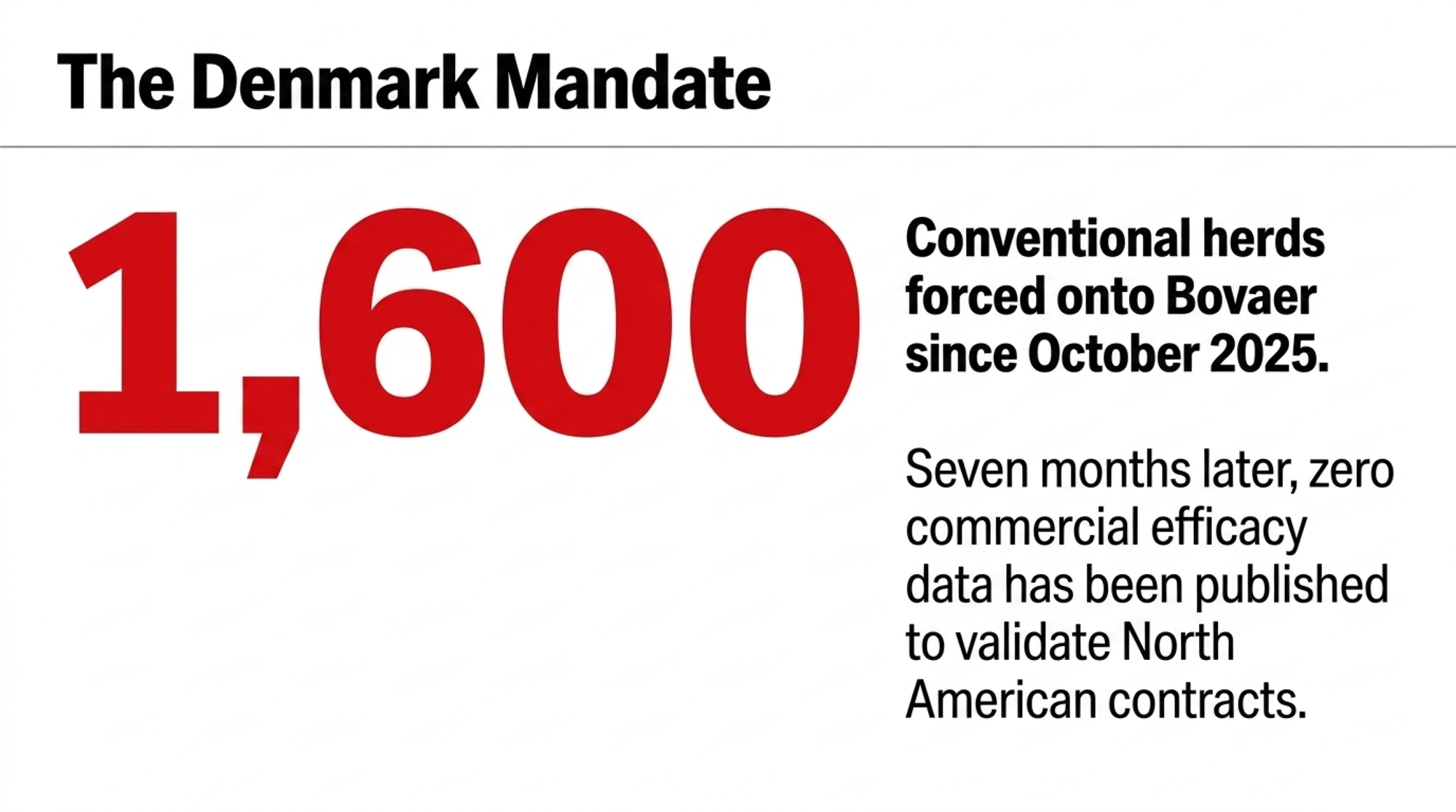
Roughly 1,600 Danish herds. Seven months on Bovaer. Zero published efficacy data. Wageningen’s year-long field number ran 21–27%. Your contract assumes 30%. Who eats the gap?

Executive Summary: Denmark mandated Bovaer across roughly 1,600 conventional herds starting October 1, 2025, and seven months in, the commercial methane reduction figure North American 2027 contracts are pricing against still hasn’t been published — not by Aarhus, not by SEGES, not by EFSA. The 30% claim driving those contracts is an EFSA controlled-trial figure; the only year-long field measurement that exists, Wageningen’s, ran 21–27%, and FrieslandCampina’s 158-farm Netherlands pilot landed at 28%. A late-April 2026 Science paper helped explain why: a newly identified rumen ciliate organelle called the hydrogenobody runs upstream of where 3-NOP can reach, making 28–30% a structural ceiling rather than a target. At $0.45/cow/day — $164.25/cow/year on a 1,000-cow herd — the deficit at field-realistic 24% efficacy lands near $97/cow, or about $97,000/year a producer absorbs unless the processor backstops the input cost the way FrieslandCampina and the Danish government did. Verra’s VM0041 audits dosing, not delivered methane, so an ERF set at 30% on a herd delivering 22% is invisible to verification until a downstream buyer commissions independent supply-chain checks. Producers signing 2027 contracts now are pricing a regulatory necessity Denmark won’t actually measure until the 2030 climate-tax deadline forces it, while Lactanet RBV (April 2023), Zoetis RUMiN (April 2026 DWP$ update), and VikingGenetics’ Nordic Methane Index already let you build a permanent genetic reduction at zero incremental cost. If your aggregator can’t put 24% in writing as a downside scenario, the contract isn’t priced for your barn.

Bovaer 2027 contract

There’s a 2027 Bovaer contract sitting in dairy mailboxes from Wisconsin to Ontario right now, priced against a 30% methane reduction assumption. Meanwhile, in Europe, roughly 1,600 conventional Danish herds have been on the additive for seven months under a regulatory mandate — and the commercial efficacy figure that would actually validate those North American contracts hasn’t been published. Not by Aarhus. Not by SEGES. Not by EFSA. Not in peer-reviewed form anywhere.

That’s the strange shape of the largest real-world test of an enteric methane additive ever run. The mandate started on October 1, 2025. Compliance was legally required. A national subsidy softened the additional cost — the structure of North American contracts notably doesn’t replicate. By any measure, this should have produced the field efficacy figure that aggregators have spent two years promising producers. It hasn’t. And the contracts being offered for 2027 are priced as if they had.

What Denmark’s Mandate Actually Tested

The Danish climate law required conventional herds with 50 or more cows to feed Bovaer for at least 80 days a year, or switch to a high-fat diet. Compliance checks. Fines for non-compliance. National subsidy on the additional cost.

Here’s the part most coverage has missed: the mandate was designed around climate tax compliance, not methane measurement. Farms weren’t required to install GreenFeed units, SF6 tracer systems, or any direct enteric measurement device. So the world’s biggest commercial Bovaer deployment is producing exactly the data the mandate asked for — proof of dosing — and not the data the contracts in your inbox depend on.

What did show up: a SEGES Innovation survey of several hundred Danish dairy herds in autumn 2025 reported hundreds of farms describing milk yield declines and reduced dry matter intake, with substantial overlap reporting both at once. Self-reported, not peer-reviewed. The European Commission ordered EFSA to reassess safety, with a data deadline of April 10, 2026, and as of mid-May, the reassessment opinion was still pending.

In May 2026, Aarhus University released the first formal study from the deployment. An Aarhus team examined 73 farms and concluded that within the available data, there was no clear influence of Bovaer on production, disease rate, or mortality. The team hedged the finding explicitly. The study could not prove the opposite either, and the herds studied varied greatly.

The Aarhus team studied welfare and mortality. Not methane.

Where Does the 30% Number Actually Come From?

The 30% figure didn’t fall from the sky. EFSA established it through its 2021 safety and efficacy opinion, drawing on DSM-Firmenich’s controlled trial submissions. EFSA evaluated efficacy under defined conditions: consistent TMR, label dose, controlled feeding systems. That figure became the EU authorization basis, the sales deck headline, and now the contract pricing assumption.

DSM-Firmenich has consistently maintained the 30% figure as a controlled-trial result under EFSA-evaluated conditions, and the company is participating in EFSA’s ongoing reassessment process. That’s the public position the contract math rests on.

The Ceiling Nobody’s Pricing Around

In late April 2026, four weeks before Aarhus was published, the science changed.

A team reporting in Science cataloged rumen ciliate genomes and identified a previously undescribed organelle inside those single-celled microbes — the hydrogenobody. It produces hydrogen and scrubs oxygen from its immediate environment, creating a perfect microenvironment for methanogens operating right at the cell surface.

Bovaer (3-NOP) targets the methanogens floating in bulk rumen fluid. The hydrogen body sits upstream, at the hydrogen supply origin, where 3-NOP concentrations don’t reach therapeutic levels.

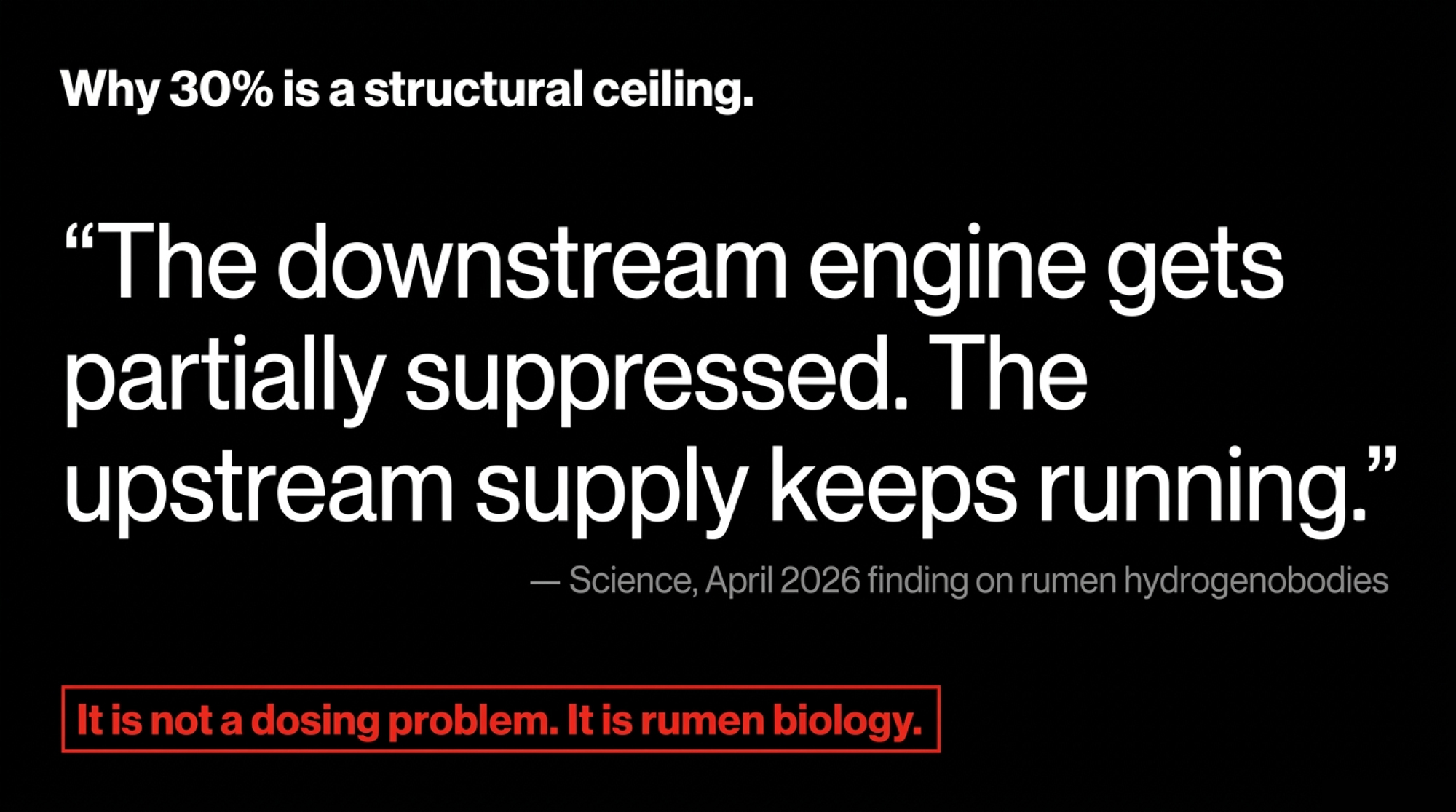
The sheep data carries the punchline. High-methane animals on identical rations carried far more Dasytricha ciliates — a high-hydrogenobody genus — than low-methane animals on the same feed. Penn State research has separately documented that 3-NOP suppresses methanogenesis effectively while free rumen hydrogen accumulates rather than dissipating. The downstream engine gets partially suppressed. The upstream supply keeps running.

That’s the practical 28–30% ceiling, mechanistically explained. It’s not a dosing problem. It’s a structural one — the Science finding maps why field results consistently land below the controlled-trial number, and why animal-genetics researchers are already framing the work as an opening to modulate the rumen microbiome more precisely rather than as a verdict on Bovaer itself.

The Field Record Versus the Sales Number

Here’s the evidence hierarchy a producer should weigh before signing:

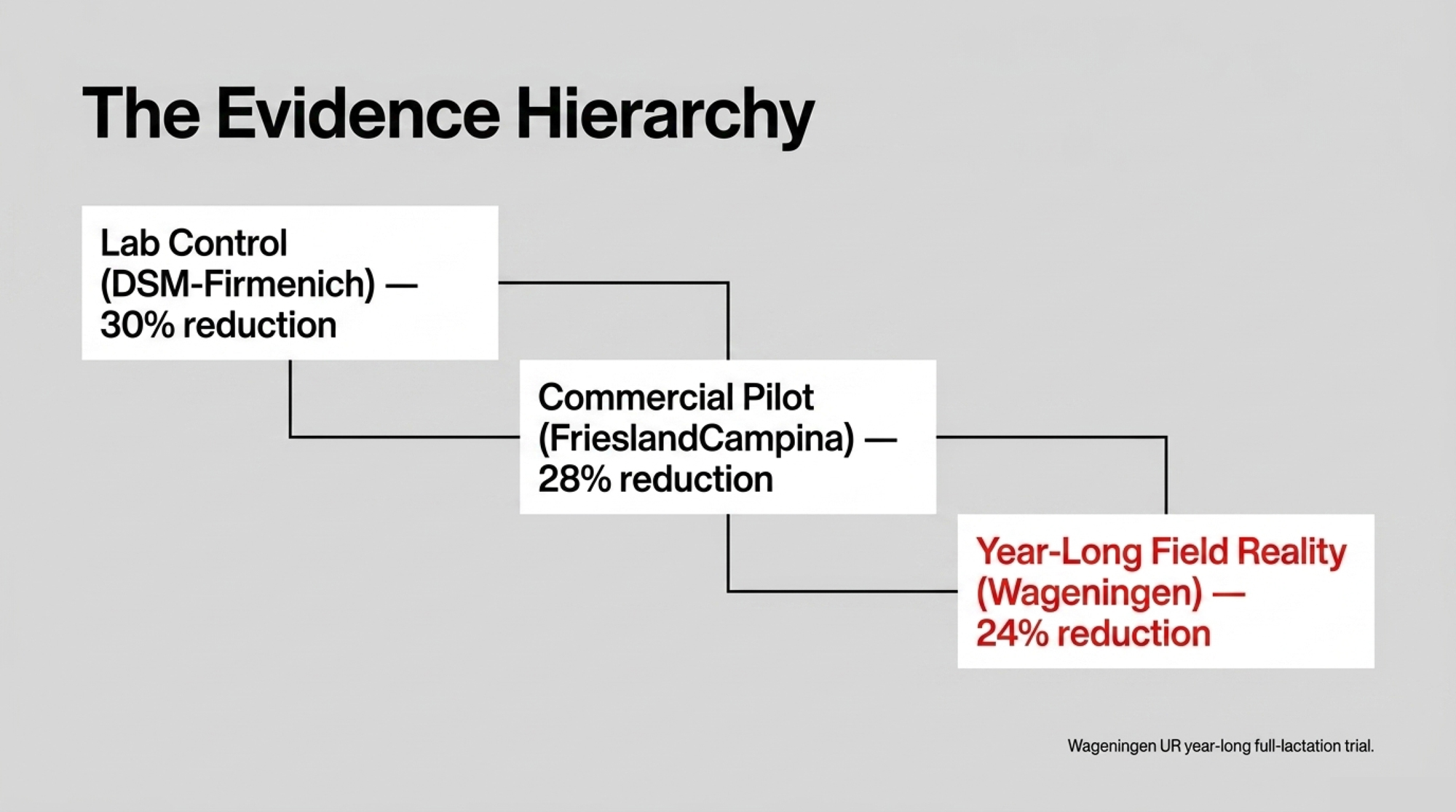
  • DSM-Firmenich published claim, controlled trials: 30%
  • Elanco/Athian via FDA review (September 2025), controlled: ~30%, or 1.2 MT CO2e/cow/year
  • Kebreab et al. controlled-trial meta-analyses: results cluster in the high twenties to low thirties
  • FrieslandCampina Netherlands pilot, 158 farms, six months: 28% — the best large-scale commercial figure that exists
  • Wageningen year-long full-lactation trial: 21–27%, with efficacy declining within the lactation
  • Denmark mandatory deployment, ~1,600 herds, seven months: not measured, not published

The Wageningen year-long study is the outlier precisely because it was long enough to capture what short controlled trials can’t — efficacy drift across a full lactation as ration composition, lactation stage, and microbial population shift.

The Barn Math at $0.45 Per Cow Per Day

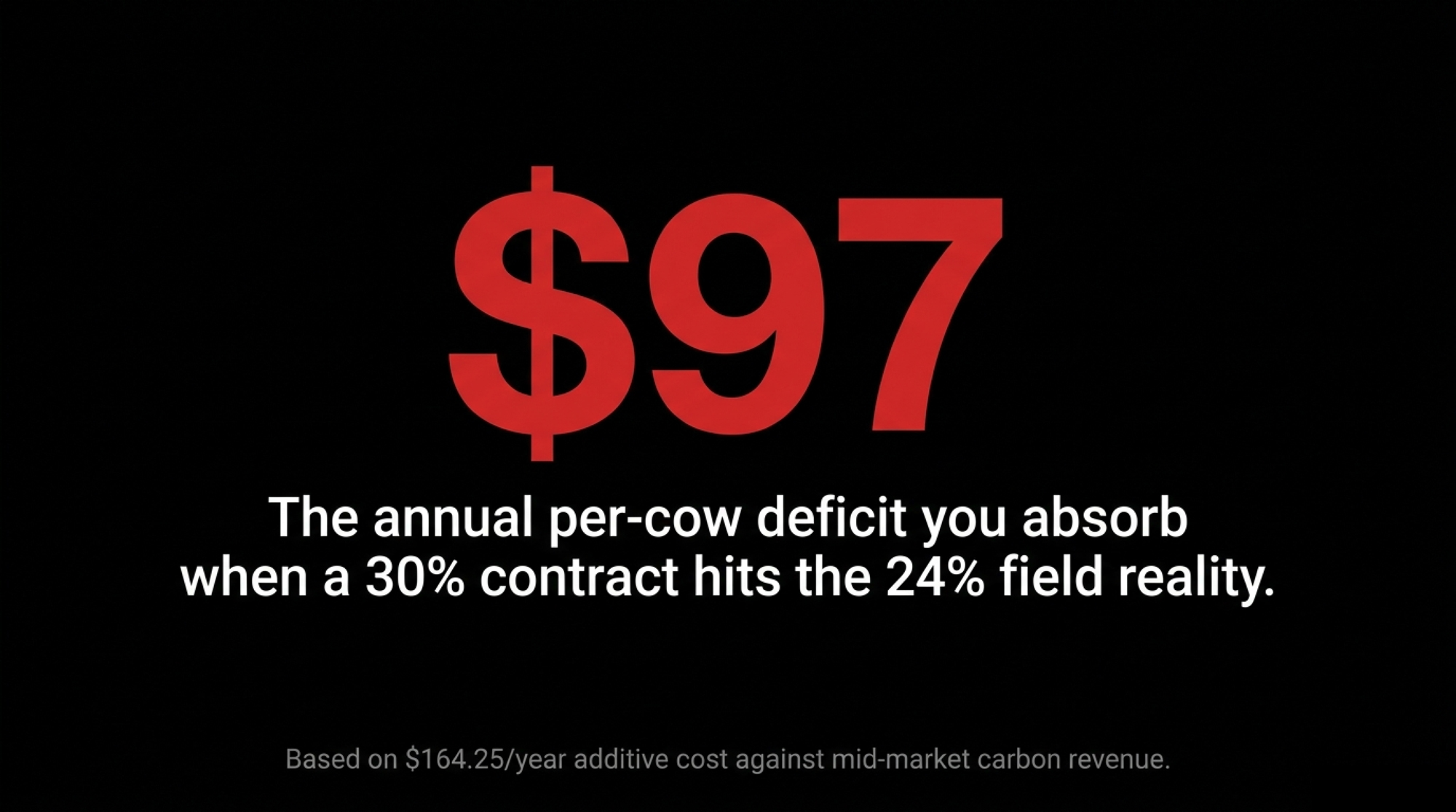
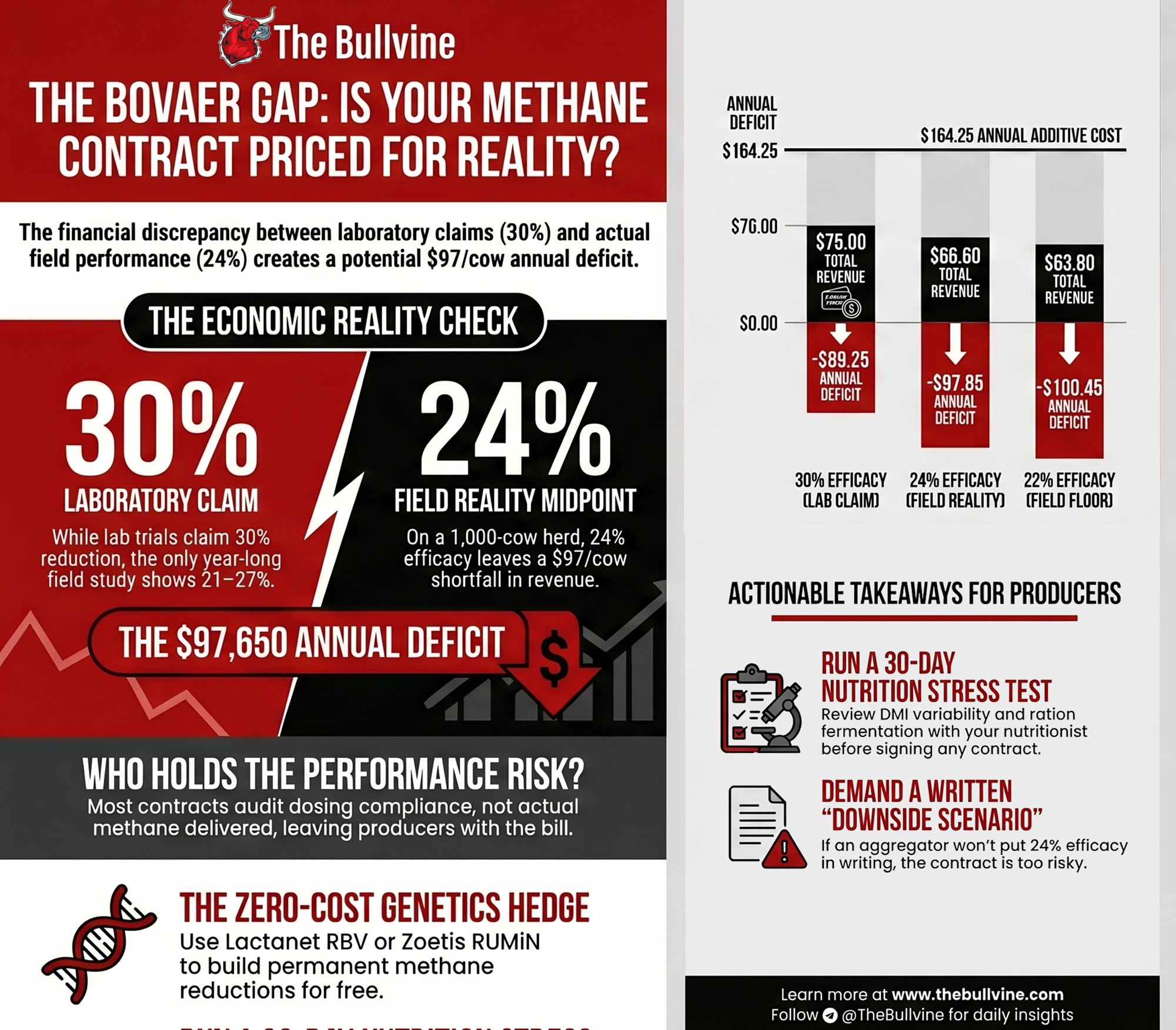
Run the numbers honestly on a 1,000-cow herd. Annual additive cost at $0.45/cow/day, the contract pricing The Bullvine has modeled across this franchise: $164.25 per cow, $164,250 total.

Revenue side, modeled at $35/tonne supply-chain inset pricing (mid-market) plus a sustainability premium of $0.10–$0.15/cwt typical of current US program structures. Using the midpoint ($0.125/cwt) at 75 lbs/day, the premium works out to about $34/cow/year, rounded to $33 in the table for readability:

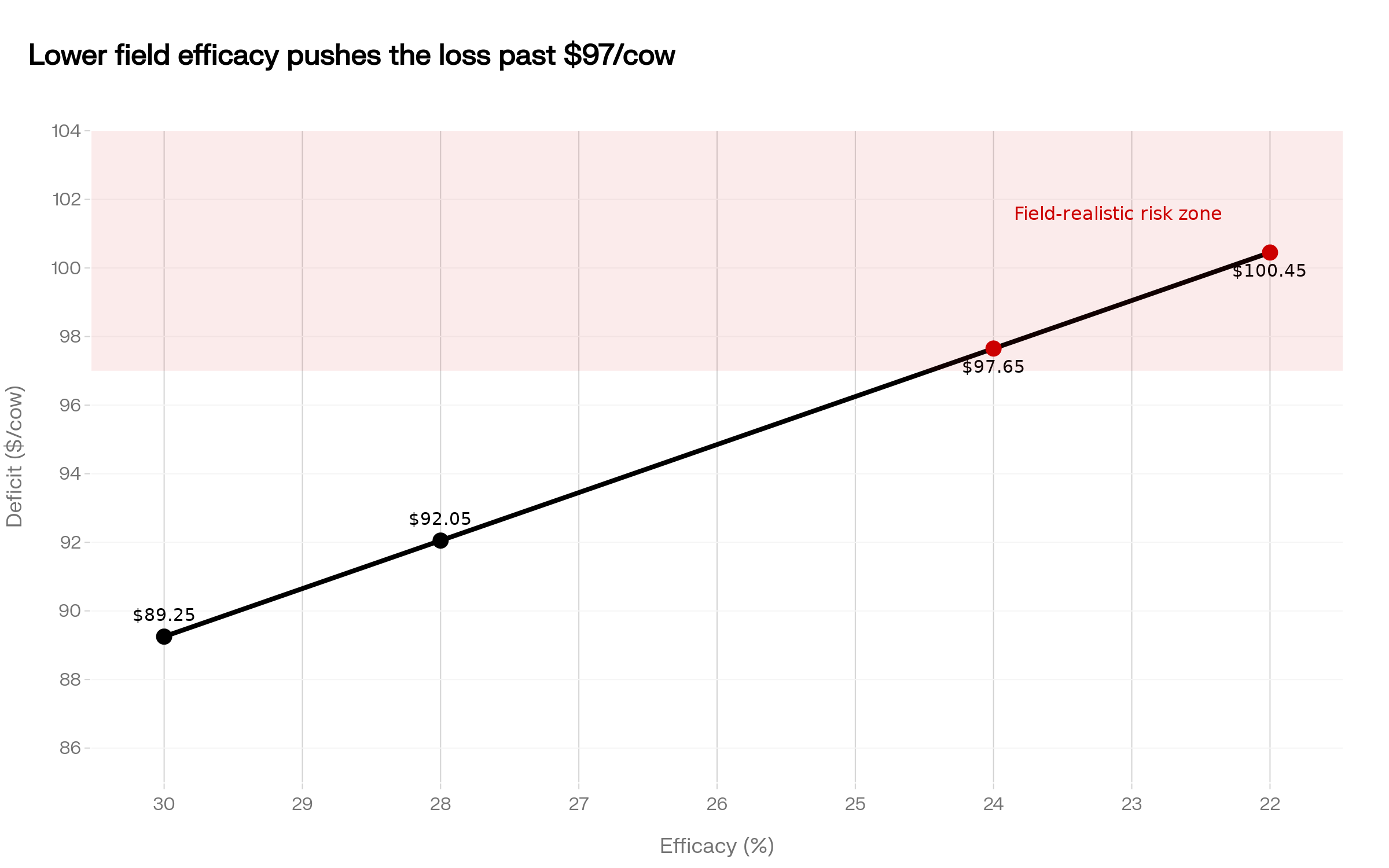
Efficacy LevelDelivered CO2e / Cow / YrCarbon Revenue (@ $35/T)Sustainability PremiumTotal RevenueAnnual Deficit / Cow
30% (Claimed)1.20 MT$42.00$33.00$75.00$89.25
28% (NL Pilot)1.12 MT$39.20$33.00$72.20$92.05
24% (Wageningen Midpoint)0.96 MT$33.60$33.00$66.60$97.65
22% (Field Floor Model)0.88 MT$30.80$33.00$63.80$100.45

The honest number to model isn’t 30%. It’s 24% — the midpoint of the only year-long full-lactation field measurement that exists. That puts the deficit at roughly $97/cow on a 1,000-cow operation, or about $97,000 a year that has to come from somewhere outside the carbon revenue stack. Stress-test it at 22%, and the deficit climbs past $100/cow.

If the contract uses Elanco’s projection of approximately $20/cow through Athian instead of $35/tonne tonnage pricing, the deficit is fixed at roughly $111/cow regardless of efficacy, which makes the efficacy risk invisible until verification fails.

Who’s Bearing the Performance Risk

VM0041 — Verra’s dominant methodology for enteric methane credits — calculates issuance from an emission reduction factor (ERF) that the project proponent establishes at project start. Not from real-time methane sensors on your farm. Auditors verify dosing compliance, not delivered performance.

If your herd delivers 22% but the ERF is set at 30%, the gap is structurally invisible to the verification process — until a downstream credit buyer commissions independent supply-chain verification and discovers their Scope 3 claim is overstated. Verra is acknowledging this gap. The proposed VM0041 v3.0 revision, currently under expert review, would tighten how ERFs get established. It is not in force.

That revision helps producers in one specific way and creates a new exposure in another. Tighter ERFs shrink clawback risk — a 24% ERF with verified 22% delivery is a 2-point gap, not 8. But fewer credits per cow means lower carbon revenue. The additive cost doesn’t change. Marginal contracts that pencil out at 30% ERFs may no longer be commercially viable to offer at all under the revised framework.

What the Six Pre-Enrollment Questions Look Like

The Danish field reports that should sit on every nutritionist’s desk are the severe ones. Whole-herd diarrhea. Milk drops that pulled production materially below baseline. Cattle losses on individual operations. Recovery shortly after Bovaer was discontinued, according to Danish reporting — a pattern more consistent with pharmacological clearance than lasting microbiome damage, though the specific day-by-day timelines haven’t been published.

Worth keeping in proportion: those severe cases are real, but the broader Aarhus safety study across 73 farms found no clear influence of Bovaer on production, disease rate, or mortality at the population level. The severe pattern represents extreme herd-specific management and ration interactions, not a universal baseline. The point isn’t that Bovaer breaks every herd. The point is that some herd contexts are far worse candidates than others, and the contract structure makes that distinction the producer’s risk to identify.

The mechanism researchers are working through: 3-NOP suppresses the final step of methanogenesis, hydrogen accumulates in the rumen, and what happens next depends on whether the resident microbial population can productively redirect that hydrogen toward propionate. In a tightly managed TMR herd, it usually can. In a herd with variable intake, recent antibiotic exposure, or a forage-heavy ration, that buffer thins fast — and falling intake creates a feedback loop where the cows still eating receive a higher effective dose per kg DMI than the trial protocol assumed.

That’s why the FrieslandCampina Netherlands pilot reported no production changes while Denmark’s mandated, speed-ramped deployment generated hundreds of yield-decline reports. The molecule didn’t change. The deployment context did.

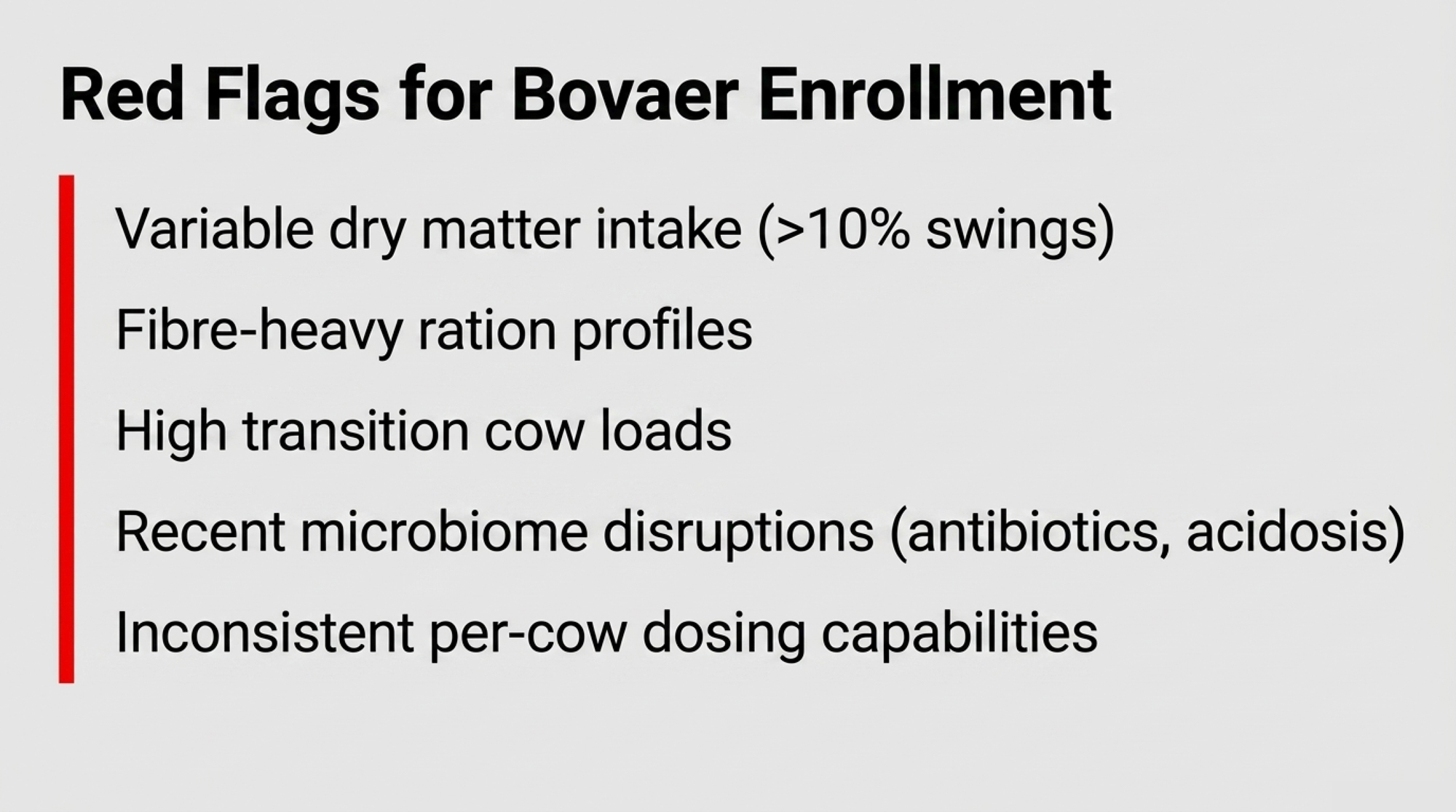
Before enrollment, the conversation a 1,200-cow operator should be having with their nutritionist:

  • Baseline dry matter intake variability. What’s our DMI coefficient of variation, and does it move more than 10% seasonally? Tight, consistent intake gives you a buffer. Wide variation doesn’t.
  • Ration fermentation profile. Is our fermentation pattern starch-driven (more propionate-producing capacity, better hydrogen capture) or fiber-driven (closer to the Danish grass-clover diet that didn’t deliver the same results)?
  • Transition cow load. What percentage of the lactating group is within 60 days of freshening at any given time? Fresh cows are the worst candidates for an initial intake suppression event.
  • Recent microbiome disruptions. Have we had broad-spectrum antibiotic treatments, ration reformulations, or acidosis events in the last 90 days?
  • Per-cow dose consistency. If intake drops 15% in a cohort, what happens to their effective 3-NOP concentration — and can our delivery system respond in real time?
  • Exit protocol if intake signals show in the first 21 days. What’s the threshold that triggers protocol review, who makes the call, and what’s the contract penalty for early exit?

If more than two of those answers are “we’d have to watch and see,” that’s a signal to pause enrollment, not push through it.

What Closes the Gap — and Who Actually Has That Lever

Three things can close the $97-per-cow deficit at 24% efficacy. Only one of them sits in the producer’s control.

The first is a processor subsidy on the input cost. The contracts that pencil, pencil because the processor is absorbing part of the additive cost directly — flat per-cow subsidy, milk price premium that offsets additive spend, or full input coverage with the producer taking a smaller credit revenue share. FrieslandCampina structured it that way in the Netherlands. Denmark’s government did it via national subsidy. North American contracts where the producer eats the full $164.25/cow don’t pencil at any realistic efficacy number under current carbon pricing. Ask in writing: what’s my net additive cost after program subsidies?

The second is the OFCAF cost-share. USDA’s program covers 65–85% of practice costs, but caps at $75,000 per farm. On a 1,000-cow operation’s annual $164,250 additive cost, the cap covers roughly 46% — closing about half the gap in year one. Larger herds hit the cap faster. The program is competitive, requires application and conservation activity documentation, and depends on appropriations. A contract that pencils only with OFCAF is a contract that doesn’t pencil without it — and that risk lands on the producer, not the aggregator.

The third is carbon price appreciation, and most operators don’t realize they’re making this bet. For the gap to close on carbon economics alone, inset pricing would need to roughly double from current mid-market levels while additive costs hold flat. That’s a market call, not a farm economics calculation.

The Genetics Hedge That Costs Nothing Incrementally

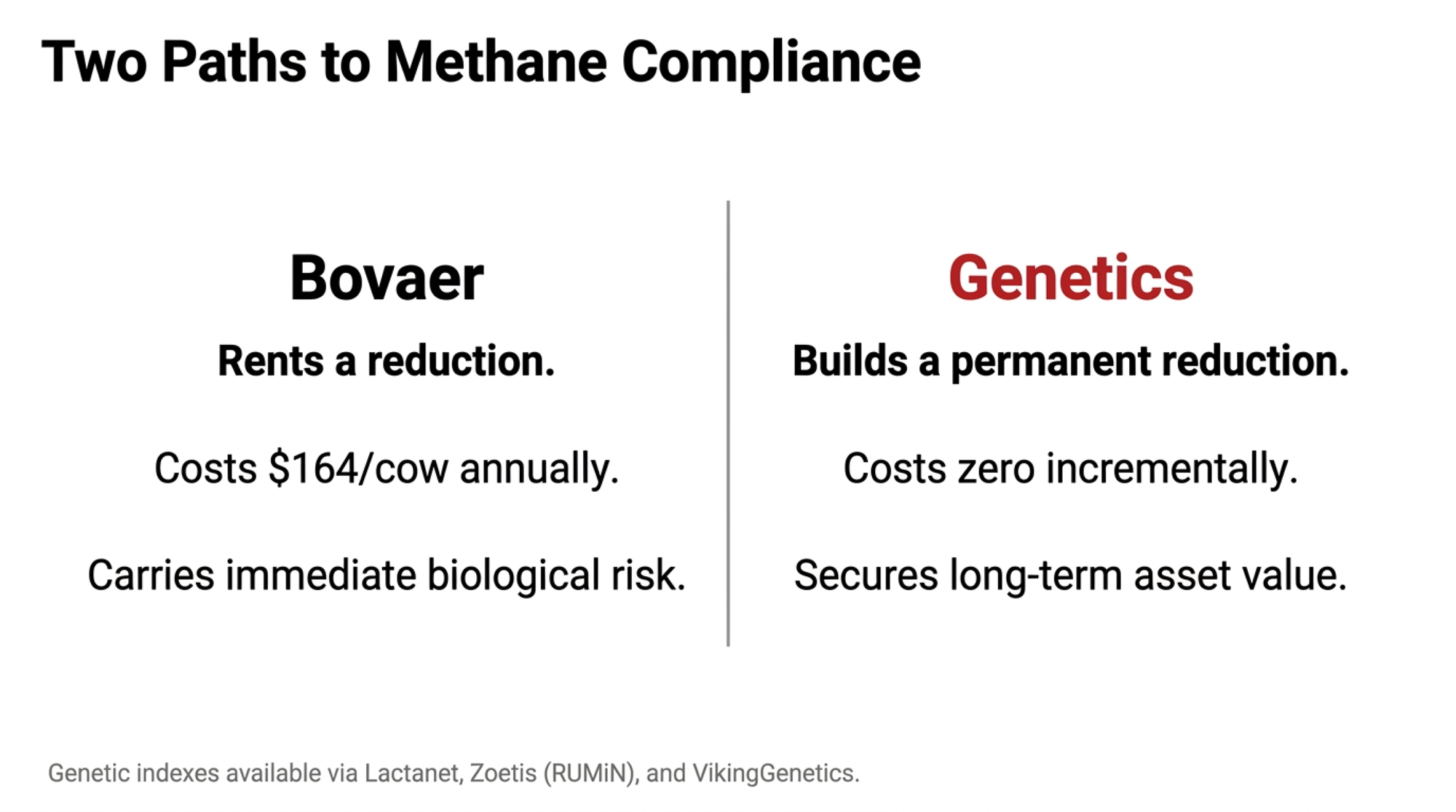
Bovaer rents a reduction. Genetic selection builds a permanent one. The two strategies aren’t mutually exclusive — and treating them as either-or usually serves the seller more than the producer.

Lactanet’s Methane Efficiency RBV has been published on Holstein females in eDHI since April 2023, with genomic reliability strong enough on young bulls to drive sire selection decisions. Zoetis RUMiN was integrated into the April 2026 DWP$ update. VikingGenetics’ Nordic Methane Index draws on automated sniffer data from a large-scale commercial database across Denmark, Sweden, and Finland, producing breeding values with strong correlation to directly measured methane.

Timeline to herd-level expression: 5–7 years from a sire selection change. Not fast. But filtering 2026 sire decisions on methane breeding values costs nothing incrementally — and it builds a documented genetic trajectory that will matter when outcome-based verification standards tighten in the late 2020s, with no recurring additive spend attached.

The April Science paper makes the genetics path more interesting, not less. If high-hydrogenobody ciliate density is genetically influenced — which the paper implies but hasn’t yet quantified in cattle at scale — then selecting against high-methane phenotypes may also be selecting against the ciliate composition that caps Bovaer’s ceiling. That’s a hypothesis, not a confirmed finding. But it’s worth carrying into the next conversation about what your herd is being bred for.

What This Means for Your Operation

  • If your contract assumes 30% efficacy, model it at 24% before you sign. The midpoint of the only year-long full-lactation field study puts the deficit at roughly $97/cow on a 1,000-cow operation. If the math doesn’t work at field-realistic numbers, the contract isn’t priced for your barn.
  • If your payment trigger is delivered methane performance, not dosing compliance, you’re holding 100% of the biological risk. Confirm in writing which structure your contract uses. Verra’s VM0041 verification audits dosing — your contract may not.
  • If your processor is not absorbing part of the additive cost, the contract probably doesn’t pencil.FrieslandCampina did it in the Netherlands. Denmark did it via national subsidy. North American producers signing without that backstop are eating the full $164.25/cow.
  • If you can’t answer four of the six pre-enrollment nutrition questions with certainty, pause the enrollment. The herds that reported problems in Denmark weren’t randomly distributed. Variable DMI, fiber-heavy rations, recent microbiome disruptions, and high transition cow load are the risk markers.
  • If your 2026 sire decisions don’t already filter on methane breeding values, change that in this proof run.Lactanet RBV, Zoetis RUMiN, and VikingGenetics Methane Index cost nothing incrementally. The genetic trajectory you build now is the asset you’ll have when outcome-based verification tightens in the late 2020s.
  • If EFSA’s reassessment opinion lands during your contract term, who absorbs the regulatory cost? The April 10 data deadline has passed. The opinion is still pending. Build a 90-day exit-with-cause clause before you need it.
  • If VM0041 v3.0 passes during your contract term, who bears the ERF adjustment cost? Tighter ERFs shrink clawback risk and shrink credit revenue at the same time. Get the answer in writing.

Key Takeaways

  • If the contract pencils only with OFCAF cost-share, it doesn’t pencil. USDA’s $75,000 per-farm cap covers roughly 46% of a 1,000-cow operation’s annual additive cost in year one. Year two depends on appropriations that the aggregator can’t guarantee.
  • If your aggregator quotes 30%, ask them to put 24% in writing as a downside scenario. A refusal tells you which side of the table is holding the efficacy risk.
  • Within 30 days, pull your last six months of DMI records and run the six pre-enrollment questions with your nutritionist. That’s the lowest-cost stress test of your herd’s candidacy that exists.
  • Within 30 days, filter your next proof run’s sire shortlist on methane breeding values. Lactanet RBV, Zoetis RUMiN as integrated into the April 2026 DWP$ update, and VikingGenetics Methane Index are all available now at no incremental cost.
  • If a contract structure makes the efficacy risk invisible until verification fails, that’s the structure — not a feature. The 1,600-herd Danish dataset will eventually surface a real commercial efficacy number. North American producers signing now are pricing against laboratory conditions, not real-world barns.

So here’s where this lands. The 1,600-herd Danish dataset will eventually give us the real commercial efficacy numbers we need. Denmark’s tax structure makes that measurement a regulatory necessity by 2030. Until those figures land in peer-reviewed form, every offer being signed in North America is pricing against a flawless laboratory environment, not a real-world barn. If your aggregator can’t tell you in writing what you’re paid on at 24% delivered efficacy, what’s the contract really pricing — and which side of the table is holding the bag?

Run Your Numbers

Health ROI Calculator — Before you sign a 2027 Bovaer contract, pressure-test the math at field-realistic 22–24% efficacy, not the 30% on the sales sheet. The tool puts a per-cow dollar value on the additive spend, the credit revenue, and the gap your processor isn’t backstopping — so you walk into the contract conversation knowing exactly which number has to move.

Learn More

The Sunday Read Dairy Professionals Don’t Skip.

Every week, thousands of producers, breeders, and industry insiders open Bullvine Weekly for genetics insights, market shifts, and profit strategies they won’t find anywhere else. One email. Five minutes. Smarter decisions all week.
NewsSubscribe
First
Last
Consent
Send this to a friend