Archive for A.I. Industry

Your Genetics Rep Has Bad News – But Won’t Tell You Until January

Your genetics supplier might not exist in 12 months. Here’s why

You recall the conversation with your genetics representative about two-year contracts at “special pricing”? Those field service delays that keep cropping up?

There’s a bigger story here, and honestly, it caught me off guard, too.

What farmers are discovering is that the global genetics market just shifted in ways we haven’t seen before. The Eurasian Economic Commission’s October report dropped a bombshell—Russia, Belarus, Kazakhstan, Armenia, and Kyrgyzstan cut their breeding animal imports by 64% between 2022 and 2024. Russia alone boosted domestic poultry breeding production by 9.1 million head while cutting imports by 70%.

These aren’t temporary adjustments, folks. These markets are gone.

I’ve been digging into this with producers across different regions, and what I’ve found is… the ripple effects are way bigger than anyone expected.

The Numbers Tell a Wild Story

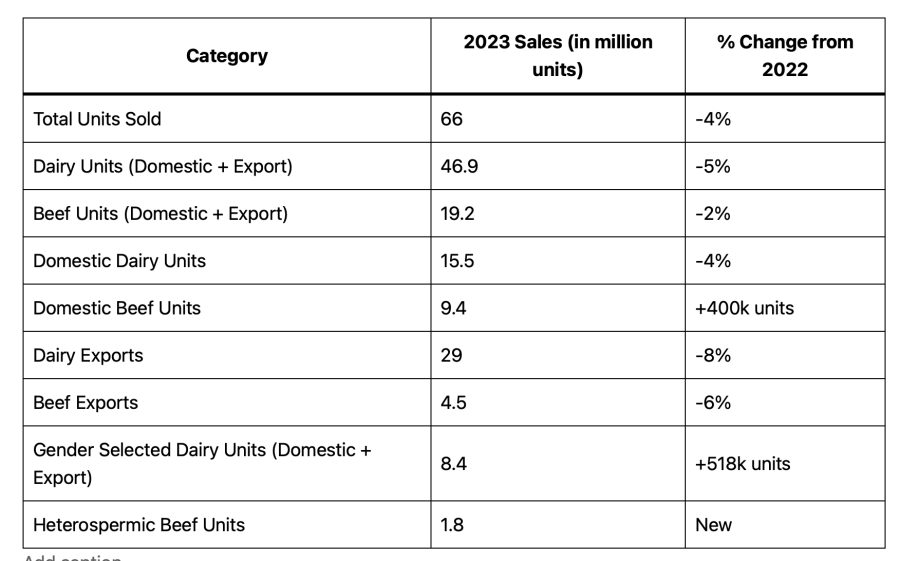
So here’s what’s interesting. Examining the National Association of Animal Breeders’ latest 2024 data, something doesn’t add up at first. Total U.S. bovine semen sales actually grew 4%, hitting nearly 69 million units. That’s a comeback after two years sliding backward.

But dig deeper—dairy exports reached 30.8 million units, up 5% from 2023, with a record value of $326 million according to NAAB’s March report. China’s still buying big, Brazil’s second, but companies are scrambling. They’re expanding into Western Europe, Central Asia, the Middle East… essentially anywhere to replace their Eastern European business.

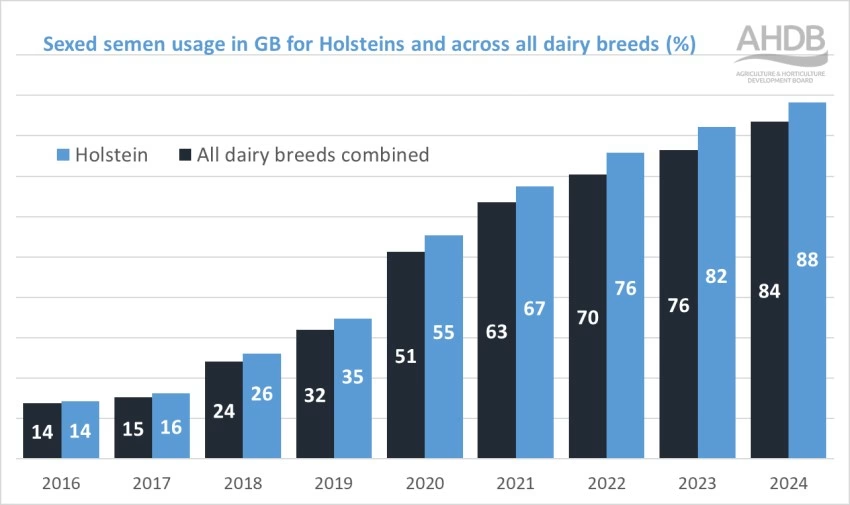
And get this—gender-selected dairy semen jumped 18% to 9.9 million units, while beef-on-dairy hit 7.9 million units. Here’s the connection most folks are missing: The loss of volume in Eastern markets is forcing genetics companies to chase premium domestic sales, which—combined with record-high replacement costs—has created a perfect storm. We’re seeing semen price hikes and a surge in sexed semen demand because, let’s face it, producers can’t afford mistakes at these heifer prices.

The $4,000 Heifer Reality

Your replacement heifers now cost more than a new pickup truck – and the pain is just beginning

I nearly spit out my coffee when I saw the July USDA numbers. Dairy replacements averaged $3,010 per head. You probably know this already, but back in April 2019? We paid $1,140. That’s nearly triple in six years.

But those are just averages. California and Minnesota auction reports from August show quality heifers bringing over $4,000. Four grand for a heifer that hasn’t even freshened yet!

Think about what that means for your breeding program… every straw matters now. Every conception counts. No wonder sexed semen sales are exploding, even with the premium pricing.

How Companies Are Scrambling

Let me share what’s happening with genetics companies—because as many of us have seen, their moves directly affect our breeding decisions.

Select Sires and STgen announced their intent to combine back in August 2023. They signed a letter of intent to create a new company that’ll combine production and R&D while maintaining independent sales networks. The companies stated that they’re working through regulatory approvals, although the current status is not entirely clear. What’s worth noting is this isn’t your typical business combination—it’s STgen’s sexed semen technology meeting Select’s distribution network.

Alta Genetics (URUS) made a significant investment in international markets. When URUS bought Genex in 2020, that was the canary in the coal mine. Industry observers suggest their international focus could be challenging with these market shifts—and that makes sense when you think about it. I’m hearing from Midwest producers that Alta service territories are already being restructured.

STgen built their business around sexed semen technology and premium pricing. They focused on innovation over volume, which… honestly, seems to be paying off now.

ABS Global—owned by Genus plc since ’99—has been pushing what they call an “industrial genetics model.” Basically, treating dairy more like their pig and poultry operations. But you and I both know dairy doesn’t work that way. We manage individual cows, not pens. With markets shrinking, their high-volume approach faces new challenges. Several California producers mentioned they’re seeing fewer ABS reps lately.

Your Monthly Genetics Bill Is About to Get Interesting

Here’s where global disruption hits your checkbook. Industry reports suggest premium Holstein semen prices have been climbing steadily. What cost in the mid-thirties to mid-forties per dose eighteen months ago? Many producers are now seeing upper forties to low fifties. Top genomic bulls? Some markets report prices of $60 to $75 per dose.

Add sexed semen—generally running another fifteen to twenty bucks per dose, depending on your supplier. A 500-cow operation utilizing enhanced genetics could easily see breeding costs increase by thousands of dollars annually. The exact amount depends on your program, but… we’re talking serious money here.

And if that Select-STgen combination goes through? The worldwide battle will become even more deadly.

What Other Regions Figured Out (That We Didn’t)

The Journal of Dairy Science has published fascinating research on Brazilian Gyr cattle, which maintain production when Holsteins struggle with heat stress. What’s encouraging is that Australia’s DataGene introduced genomic breeding values for heat tolerance back in 2017. They saw climate change coming and took action.

Now, I’m not saying dump your Holsteins—that’d be crazy. But while we chased production records, others developed solutions for real-world challenges. There’s something to learn there.

90-Day Action Plan

Weeks 1-2: Know Your Supplier

  • Evaluate their technology position (proprietary vs. distribution)
  • Check international exposure and market focus
  • Assess financial stability indicators

Weeks 3-4: Do the Math

  • Calculate true breeding costs, including replacements
  • Factor in potential market changes
  • Build scenarios for different pricing levels

Month 2: Find Your Tribe

  • Contact neighbors about buying groups
  • Explore state dairy association programs
  • Pool for 10,000+ dose volume discounts

Month 2-3: Lock It Down (Carefully)

  • Negotiate while companies need cash flow
  • Prioritize technology and stability over price
  • Consider 18-36 month contracts

Month 3: Tech Up

  • Evaluate automated heat detection (18-24 month ROI)
  • Reduce dependence on external service
  • Build on-farm breeding capability

Regional Reality Check

This hits different depending on where you farm:

Wisconsin, California, Pennsylvania—you’ve got genetics infrastructure. Service will probably stay decent. These companies can’t afford to abandon major dairy regions.

Expansion areas, remote locations—brace yourself. Changes often show up there first. If service has always been marginal… well, time for Plan B.

Southern operations—here’s the silver lining. This disruption might accelerate heat tolerance research you’ve needed for years. I’m hearing increased interest in adapted genetics from producers dealing with heat stress, especially in Texas and Florida.

The Bottom Line

The genetics market we’ve known for decades just shifted fundamentally. That’s not pessimism—it’s reality. We’re watching the restructuring of how genetics gets developed, priced, and delivered. The Select-STgen combination, if it is approved, is likely just the beginning.

But here’s what thirty years in this industry taught me—dairy farmers adapt better than anyone when we understand what’s happening. And now you do.

Those waiting for “normal” to return? They’ll be waiting a long time. Those who recognize this shift and position accordingly? They’ll look back at this moment as when they secured a competitive advantage.

Your breeding decisions over the next few months matter more than usual. Not just which bulls you use, but which companies you bet your future on.

What you do with this information… that’s your call. But at least now you’re making it with eyes wide open.

Resources & Next Steps

Keep Learning

You’ll find NAAB market statistics and annual reports at naab-css.org, which is great for tracking trends. For those interested in heat tolerance research, the Journal of Dairy Science papers are a valuable resource.

Get Connected

Your state Extension dairy specialist offers free genetics strategy consultations—seriously, use them. They’re a great resource. Consider joining or forming a buying group through your state dairy association. Many Midwest producers report good results with this approach. Keep an eye on the Select-STgen combination for regulatory updates… it could change everything. And those ROI calculators at Penn State and Wisconsin Extension websites? They’re actually pretty helpful for running scenarios.

Share What You’re Seeing

The industry needs producers talking about these changes. Your insights could help another farm navigate this disruption. Connect with your regional dairy organizations or reach out through industry forums. We’re all in this together, after all.

KEY TAKEAWAYS: 

  • Your breeding program costs could increase by $12,000 annually starting in January.
  • Your genetics supplier might not exist in 2026—Alta’s restructuring, Select needs a merger to survive, ABS model failing
  • You have 90 days to act before January price explosions: smart producers locking contracts and forming buying groups NOW
  • The $100M question: Russia/China stopped buying genetics—guess who’s paying to fill that hole? (Hint: Check your mirror)
  • Your action plan: Evaluate supplier stability TODAY, join buying group THIS WEEK, lock contract THIS MONTH

EXECUTIVE SUMMARY: 

Your genetics rep has bad news they won’t share until January: Russia and five other nations stopped buying American genetics, creating a $100 million hole that YOU’RE filling through higher prices. With heifers at $3,010 (triple 2019) and beef and dairy calves at record prices, your breeding costs could jump $12,000 annually—and that’s before the Select-STgen merger reduces competition further. Alta’s restructuring after international losses, ABS is hemorrhaging market share, and three suppliers might not exist by 2026. Wisconsin producers pooling 10,000-dose orders are locking 15% discounts NOW, while those waiting will pay premium prices to fewer suppliers. Your 90-day action window: evaluate supplier stability, join buying groups, and lock contracts before this hidden disruption becomes your financial crisis.

Complete references and supporting documentation are available upon request by contacting the editorial team at editor@thebullvine.com.

Learn More:

  • Beef-on-Dairy: Real Talk on Turning Calves into Serious Profit – This guide reveals how to implement the strategic shift mentioned in the main article, providing a practical playbook for using sexed semen on top genetics and beef on the rest. Learn the financial sweet spot and how to net an extra $90,000 annually by transforming calf revenue.
  • Genetic Gatekeepers: The High-Stakes Gamble of Dairy’s Elite Bloodlines – Extends the market consolidation analysis by exposing the hidden $1 billion inbreeding tax caused by narrow genetics and restrictive contracts among the five major suppliers. It provides strategies for building genetic independence and reducing the $23 per cow loss from rising inbreeding.
  • The Digital Dairy: How Precision Agriculture is Redefining Farm Profitability – This article provides a strategic look at how technology mitigates market risk, detailing the ROI of precision agriculture and automated systems. It breaks down how data-driven tools, including health monitoring and feed efficiency, drive gains that buffer against the cost hikes discussed in the main piece.

Join the Revolution!

Join over 30,000 successful dairy professionals who rely on Bullvine Weekly for their competitive edge. Delivered directly to your inbox each week, our exclusive industry insights help you make smarter decisions while saving precious hours every week. Never miss critical updates on milk production trends, breakthrough technologies, and profit-boosting strategies that top producers are already implementing. Subscribe now to transform your dairy operation’s efficiency and profitability—your future success is just one click away.

NewsSubscribe
First
Last
Consent

Charlie Will’s Comeback: How One Rejection Letter Created Holstein History

Charlie Will helped build the dairy industry’s greatest genetic empire. All because Select Sires told him no.

Listen, I’ve been in this industry long enough to know that rejection letters rarely lead to revolutions. But Charlie Will’s story… this one hits different.

Spring of ’74—Nixon’s still in office, gas is 55 cents a gallon—and Charlie’s sitting there with his fresh University of Illinois dairy science degree. Select Sires, the largest AI company in the industry, tells him, “Thanks, but no thanks.” No openings in their Sire Department.

Here’s what gets me, though. Most of us would’ve taken that rejection and gone into feed sales, maybe found a nice co-op job. Not Charlie.

Fast forward to this week—the National Association of Animal Breeders just announced Charlie as their 2025 Pioneer Award winner. After nearly 40 years with Select Sires (yeah, the same company that wouldn’t hire him), his bulls have sold millions of units worldwide. We’re talking about genetics that influence basically every Holstein pedigree you’ll pull up today.

Learning Cattle the Old-School Way

Southern Illinois dairy country in the 1960s wasn’t exactly genetic headquarters, but it’s where Charlie learned cattle. Growing up on the family’s commercial Holstein farm, working those twice-daily milkings. You know that barn smell—silage, sawdust, and that sweet-sour mix of fresh milk and manure—that’s where Charlie’s education started.

The neighbors at Walkway Farms—Foster Walkway ran that place—had cattle worth the drive from Chicago. Charlie spent a considerable amount of time studying those genetics.

At the University of Illinois, Charlie made the dairy judging team. While everybody else was doing… well, whatever college kids did in the early ’70s, he was evaluating cattle across the Midwest.

Spring ’74 comes around. Charlie sends resumes to every AI stud in North America. Every single one says no.

The Wisconsin Detour That Changed Everything

So Charlie’s reading the classifieds in Hoard’s when he spots this tiny ad. MABC—that’s a Select Sires member cooperative—needed a sales rep for Western Indiana.

Not glamorous. Not what he wanted. But here’s the thing—MABC was connected to Select Sires.

Two years later, they asked him to move to Wisconsin. Green Bay area. Open new territory as both a sales rep and SMS evaluator. Northern Wisconsin winters aren’t exactly Miami Beach, but this was real dairy country where farmers knew their genetics.

Four years, Charlie worked those territories, building relationships farm by farm. Word started getting back to Select Sires headquarters in Plain City, Ohio—that massive complex off US Highway 42 with bull barns stretching across the landscape.

When a sire analyst position finally opened in 1978, Dick Chitester took what he called “a risk” and hired Charlie. The guy they’d rejected was finally inside.

Learning From the Veterans

Charlie’s first bull selection was Walkway Chief MARK from back home. The bull worked—good daughters, exceptional brood cows.

But the real education came from the veterans. Ron Long, who Charlie called “one of the greatest cowmen to this day that I have ever met”. George Miller, the marketing director.

The early Select Sires dairy sire team, foundational to the company’s success: (L-R) Rodger Hoyt, John Hecker, Charlie Will, and Ron Long. This group established the industry-leading standards for sire sampling and correct semen usage, providing the framework for Charlie’s future million-unit bulls.

According to company records and those who worked with him, Miller’s philosophy was simple: genetics isn’t about what looks good in catalogs—it’s about solving problems for farmers.

The BLACKSTAR Breakthrough

Spring 1988. Picture the scene—Select Sires’ genetics department, everyone crowded around those old dot-matrix printers that sounded like typewriters on steroids. The proofs are coming out for a bull Charlie had acquired called To-Mar BLACKSTAR.

BLACKSTAR didn’t just prove good—he topped both domestic and international rankings. This wasn’t just any Holstein bull with the typical black and white patches. We’re talking about a bull built like a freight train—wide chest, strong legs, the kind of frame that screams power. Within days, every AI stud on the planet wanted BLACKSTAR sons.

The 1985 Select Sires Sire Analyst Team, including Ron Long (back left), Charlie Will (back center), Rodger Hoyt (back right), Scott Johnson (front left), and John Hecker (front right). This was the team, guided by mentors like Ron Long, within which Charlie honed his skills and, shortly after, acquired the groundbreaking bull, BLACKSTAR.

At the next proof meeting, Dick Chitester stands up with a letter signed by the entire sire team. The message: Charlie was officially off probation.

A few weeks before his death, the legendary To-Mar BLACKSTAR, whose proofs in 1988 topped global rankings, secured Charlie Will’s position at Select Sires. The bull was described as being “built like a freight train—wide chest, strong legs, the kind of frame that screams power.”

Ten years. He’d been at Select Sires for ten years, and management had been watching, evaluating whether this guy who’d come in through the back door could really deliver. They’d been waiting for him to prove he belonged.

Finding Diamonds in the Rough

After BLACKSTAR, Charlie could’ve played it safe. Instead, he looked for bulls others had passed on.

Take ELTON—7H2236 Emprise Bell ELTON. His dam scored Good Plus with a Good udder. Today, that wouldn’t even get you past the first sort. But Charlie drove to Minnesota in February to see ELTON’s daughters himself.

Walking into that barn—you know how it is, that warm, humid air hits you after the bitter cold outside, steam rising off the cows’ backs, the rhythmic sound of milkers running. What he found—exceptional udders with that deep cleft you want to see, rear attachments high and wide like someone had engineered them, feet and legs built for longevity.

The legendary 7H2236 Emprise Bell ELTON. His dam scored only Good Plus, but Charlie Will’s personal inspection of his daughters in the barn—not the catalog—revealed the exceptional udders and strong feet and legs that made ELTON the sire of DURHAM and maternal grandsire of OMAN, influencing Holstein genetics for decades.

ELTON became the sire of DURHAM, who produced 5,039 Excellent daughters. Also became maternal grandsire of OMAN.

Speaking of OMAN—O-Bee MANfred Justice—he delivered what the industry was crying for in the early 2000s. Better calving ease, improved health traits, and increased production.

The impact of his selections is staggering when you look at the unit sales :

  • OMAN: Over 1,000,000 units sold
  • MATHIE: 1,000,000+ units
  • MILLION: 1,000,000+ units
  • INTEGRITY: 1,500,000+ units
  • BLITZ: Over 1.52 million units—still the Select Sires record
Charlie Will (left) with Brian and Wendy Fust, breeders of Fustead Emory BLITZ, at Select Sires. Behind them, Fustead Emory BLITZ himself stands as a testament to Charlie’s eye for “diamonds in the rough”—a bull that would go on to sell over 1.52 million units for Select Sires, a company record.

The Teacher Who Packed Barns from Tokyo to Turin

By the late ’90s, Charlie wasn’t just selecting bulls—he was the industry’s educator. Presented in 49 states and 18 countries.

I remember hearing about one of his seminars in Wisconsin—standing in front of 200 dairy farmers, Charlie pulls out a chart and says, “Forget everything you think you know about linear traits for a minute”. Then he’d walk them through how a bull scoring +2.0 for udder depth actually translates to daughters that milk two lactations longer. Made it real, you know? Not just numbers on paper.

Scott Ruby from World Wide Sires captured it perfectly: “He had an incredible gift for taking complex genetic concepts and making them understandable to every dairy farmer”.

When Genomics Changed the Game

The thing about 2008 and genomics—it completely upended how we’d done business for decades.

The old-timers were skeptical. Charlie, approaching 60, could’ve resisted. Instead, he embraced it.

As he explained, before genomics, parent averages gave you maybe a 50-50 shot. Genomic markers? Way better odds.

But here’s what Charlie also recognized—everyone chasing the same high genomic bulls was narrowing the genetic base. Take a look at what’s happening now… Recent studies indicate that Holstein inbreeding levels are approaching a critical threshold in elite lines. “We need to be stewards of the breed,” Charlie argued.

Under his guidance, Select Sires deliberately used bulls with lower indexes but diverse pedigrees. Cost them money, but as Charlie said, “If we don’t maintain genetic diversity, who will?”.

The results? Between 2008 and 2019, genomics added $50 per cow per year in genetic value, totaling $4 billion. We now run over a million genomic tests annually.

What This Means Right Now

October 2025, and the industry Charlie helped build faces some real challenges.

Milk’s at $17.19/cwt according to CME—not exactly lighting anyone’s world on fire. The government shutdown’s affecting USDA services, making things harder for everyone. Nestlé has recently withdrawn from a global methane reduction initiative, sparking widespread discussion.

But here’s what’s interesting—despite everything, about 75% of farmers expect to be profitable this year. We’ve got $8 billion in new dairy processing coming online. Beef-on-dairy is absolutely booming.

And look at the genetics we’re working with now. The April 2025 base change was the largest in Holstein history—45 pounds of rollback on butterfat and 30 on protein. That means our cows are improving at a faster rate than ever. The average Holstein today? She’s more moderate in stature—not those skyscraper cows from 20 years ago—but producing more efficiently than ever.

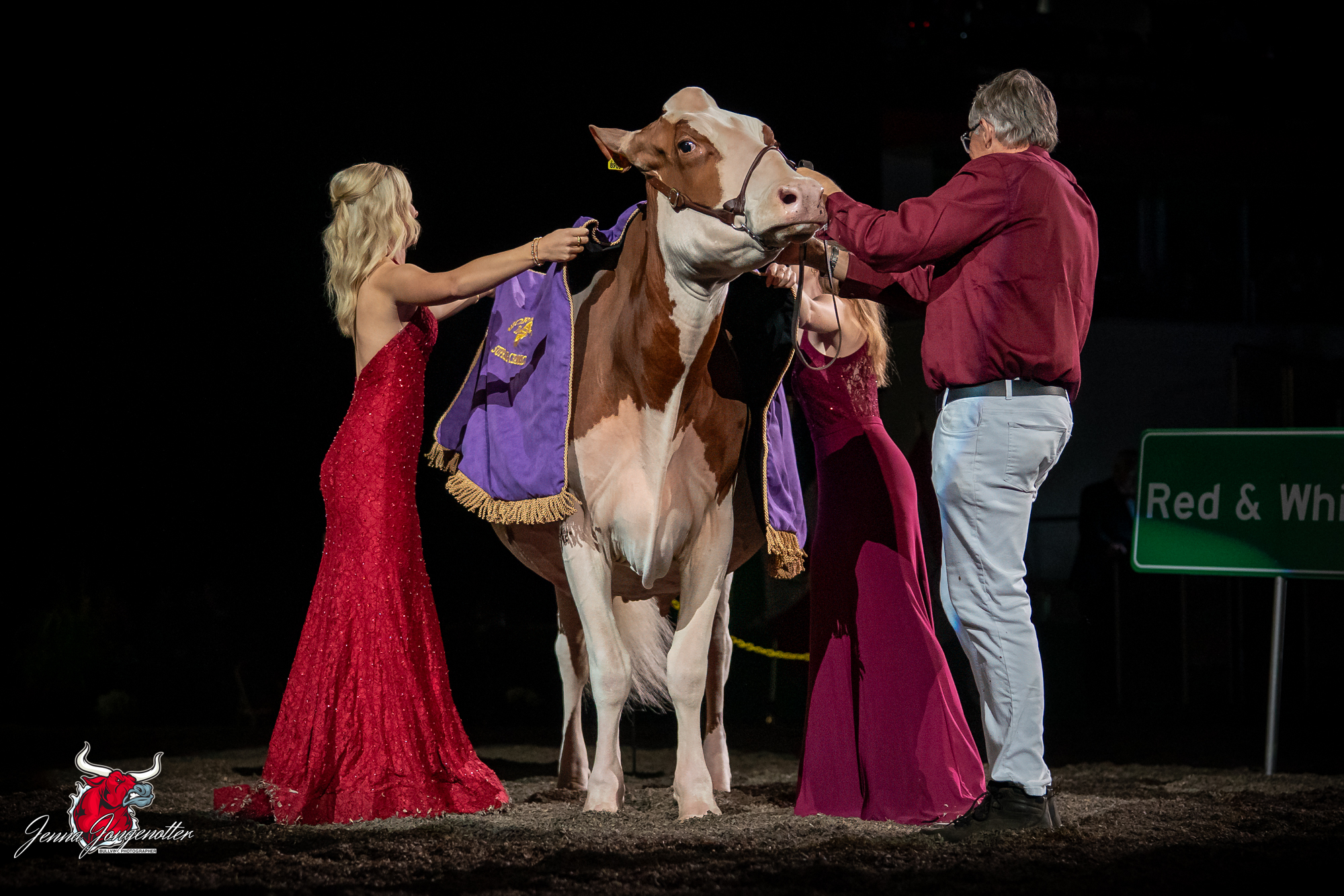
Golden-Oaks Temptres-Red-ET, crowned Supreme Champion at World Dairy Expo last week, exemplifies the ongoing genetic progress in the Holstein breed. This first Red & White Supreme Champion in 20 years visually confirms how the genetics championed by pioneers like Charlie Will continue to influence elite cattle, even decades later.

At World Dairy Expo last week, Golden-Oaks Temptres-Red-ET took Supreme Champion. First Red & White in 20 years. You look at genetics like that, and you’re seeing the influence of bulls Charlie championed decades ago.

The Philosophy That Built Success

Young people always ask Charlie what his secret is. His answer never changes.

“It’s the people,” he says. The mentorship from Dick Chitester, Ron Long, and George Miller.

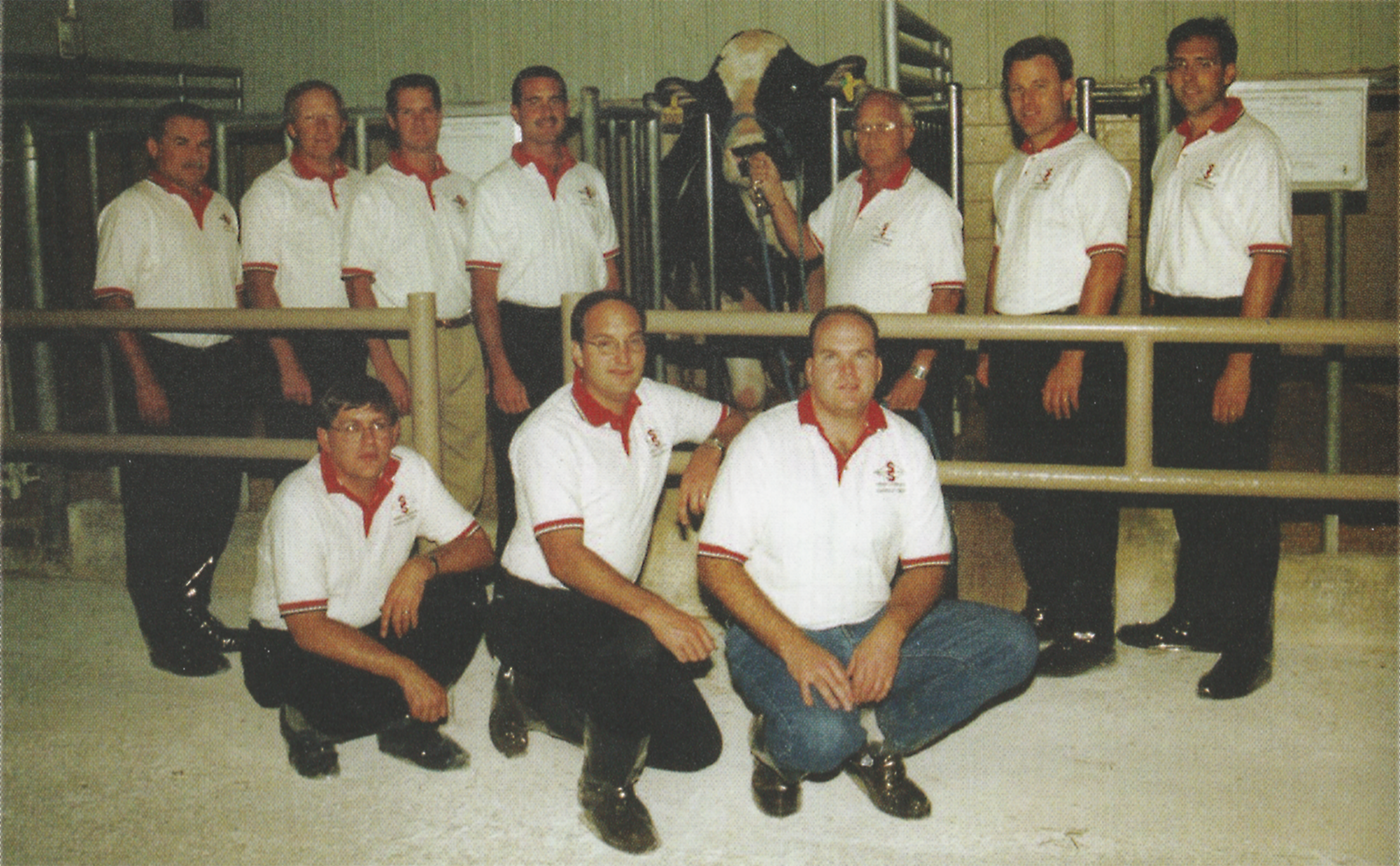
The Select Sires Sire Department in 2000, illustrating the stability and mentorship Charlie Will valued. Pictured (back row, second from left) is Charlie Will, alongside long-time colleagues like Ron Long (back row, second from right). The fact that seven of the ten members were still active 15 years later underscores the power of the team-based philosophy Charlie credited for his success.

But also three principles :

  • Find the right people—not just smart ones, but people who understand genetics is about improving farms.
  • Work as a team—Select Sires is farmer-owned, every decision affects someone’s livelihood.
  • Embrace new tools—genomics, IVF, sexed semen, whatever comes next.

But the real secret? Customer focus. Charlie didn’t select bulls for catalogs. He selected for what worked in barns.

The Bottom Line for Today’s Industry

7H3707 Paradise-R Cleitus MATHIE represents another “million-unit club” bull, hand-picked by Charlie Will. His genetics, prized for combining strong type with significant milk production improvement, helped shape the modern Holstein herd under Charlie’s guidance at Select Sires.

Charlie Will’s story teaches us something crucial right now.

That rejection letter from Select Sires could’ve ended everything. But Charlie found another way through MABC. Spent four years in Wisconsin proving himself. Waited ten years for Select Sires to acknowledge he belonged. Then, they spent the next thirty years changing how the world breeds dairy cattle.

For young people trying to break in—and I know it’s tough with the current job market—Charlie’s message is clear : Your first job won’t be your dream job. Use it as education. Build your reputation. When the right opportunity comes, you’ll be ready.

Look, we’re facing real challenges. Milk prices aren’t great, input costs are still high, and now we’ve got this government shutdown complicating everything. But we’ve been through worse. And the genetics Charlie helped develop? They’re part of why we’ll get through this, too.

The 2025 NAAB Pioneer Award recognizes Charlie Will’s massive contribution. But walk through any dairy barn today—breathe in that familiar mix of silage and sawdust, look at those moderate-framed Holsteins producing like champions—and you’re seeing his real legacy.

The farm kid from Southern Illinois who couldn’t get hired didn’t just prove Select Sires wrong.

He revolutionized the way the world breeds dairy cattle.

One bull at a time. 

Key Takeaways:

  • The backdoor strategy works: Charlie’s path from rejection → MABC sales → Wisconsin territory → Select Sires pioneer proves alternative routes beat giving up
  • Challenge conventional wisdom: ELTON’s “Good Plus” dam produced genetics that created 5,039 Excellent daughters—look beyond the obvious
  • Embrace disruption at any age: At 60, Charlie championed genomics while peers resisted. Result? $4 billion industry impact
  • Solve real problems, not catalog dreams: OMAN’s million+ units came from fixing calving ease, not chasing show ring extremes
  • Today’s application: With $17/cwt milk and margins tight, Charlie’s “customer-first” genetics philosophy is your survival guide

Executive Summary:

Charlie Will got rejected by Select Sires in 1974. Today, his bulls influence virtually every Holstein pedigree on the planet. After sneaking in through a Wisconsin sales territory nobody wanted, Charlie spent 40 years finding genetic diamonds others dismissed—like ELTON, whose “Good Plus” dam produced 5,039 Excellent granddaughters through DURHAM. His selections shattered records: BLACKSTAR topped global rankings in ’88, OMAN solved the calving crisis with over a million units sold, and BLITZ became Select Sires’ all-time bestseller. When genomics disrupted everything in 2008, 60-year-old Charlie embraced what his younger peers fought, contributing to today’s $4 billion industry transformation. With current milk at $17/cwt and margins tighter than ever, Charlie’s philosophy—pick bulls that solve real problems, not catalog dreams—is your blueprint for survival. This week’s NAAB Pioneer Award just confirms what the pedigrees already prove: the farm kid nobody would hire revolutionized how the world breeds dairy cattle.

Learn More:

  • The Practical Application of the Genetic Tools We Have Today – This tactical article reveals methods for leveraging modern selection indexes (like NM$ and TPI) to prioritize the functional, profitable traits—health, fertility, and longevity—that Charlie Will championed throughout his career. It demonstrates how to align complex genetic numbers with real-world barn profitability.
  • Beef on Dairy is Still the Best Way to Use Low Genetic Females – Expanding on the booming Beef-on-Dairy trend mentioned in the article, this strategic analysis provides producers with actionable steps to maximize revenue from the bottom end of their herd. It offers a clear framework for optimizing inventory and genetics to boost overall farm gate returns in a $17/cwt market.
  • Is Holstein Inbreeding Level A Bigger Concern Than You Think? – This innovative piece explores the modern data behind Charlie Will’s foresight on genetic diversity, offering a deep-dive analysis into the specific risks and economic costs associated with rising inbreeding levels. It provides strategic context on why his deliberate use of diverse pedigrees continues to be essential for breed stewardship.

Join the Revolution!

Join over 30,000 successful dairy professionals who rely on Bullvine Weekly for their competitive edge. Delivered directly to your inbox each week, our exclusive industry insights help you make smarter decisions while saving precious hours every week. Never miss critical updates on milk production trends, breakthrough technologies, and profit-boosting strategies that top producers are already implementing. Subscribe now to transform your dairy operation’s efficiency and profitability—your future success is just one click away.

NewsSubscribe
First
Last
Consent

Trans Ova  Purchase of ReproLogix: The Genetics Consolidation Nobody’s Talking About

Think you’re choosing bulls? Think again. You’re choosing corporate platforms that own your breeding future.

EXECUTIVE SUMMARY: We’ve been tracking genetics consolidation for months, and the Trans Ova-ReproLogix acquisition just confirmed what our analysis suggested: traditional AI competition is disappearing faster than most producers realize. Recent NAAB data shows gender-selected semen sales jumped 17% to 9.9 million units while beef-on-dairy held at 7.9 million units – but here’s what matters: these aren’t just sales figures, they’re dependency indicators. When you need sexed semen for genetic elite and beef semen for everything else, you’re not buying products anymore… you’re buying into integrated platforms that control both technology and catalogs. The math is stark – USDA shows median herd size jumped from 180 to 1,260 cows between 2000-2021, creating a two-tier market where large operations negotiate custom packages while smaller farms become price takers. University of Wisconsin data proves the complexity: top herds hitting 30-40% pregnancy rates require sophisticated reproductive management, most operations can’t develop independently. We’re looking at market structures where reproductive decisions become platform selections, not product purchases. The producers who understand this shift and position themselves accordingly won’t just survive the consolidation – they’ll profit from it.

KEY TAKEAWAYS:

  • Diversify your genetic suppliers now – even if it costs 10-15% more upfront. We’re seeing operations maintain relationships with multiple companies as insurance against service disruptions and pricing changes. Start these conversations before your next breeding season while you still have negotiating leverage.
  • Invest in reproductive monitoring technology to reduce platform dependencies and enhance overall efficiency. Recent advances in estrus detection and pregnancy monitoring give you flexibility in genetic sourcing decisions. Operations using independent monitoring report 15-20% better pregnancy rates and more supplier options.
  • Build internal genomic evaluation capabilities using your own herd data. With testing costs dropping significantly, progressive farms are developing genetic databases that reduce dependence on supplier recommendations. This creates decision-making independence that becomes more valuable as consolidation continues.
  • Consider genetic marketing opportunities as consolidation creates scarcity. NAAB data shows heterospermic products doubled to 2.8 million units – operations preserving genetic diversity can profit from selling embryos and bred heifers to farms needing genetic infusion.
  • Negotiate flexible contracts that preserve switching options. Volume commitments might offer short-term savings, but flexible agreements serve as insurance in a rapidly changing market. The extra cost becomes cheap insurance against reduced choice and higher prices.
 genetics consolidation, dairy farm management, AI, dairy herd profitability, reproductive technology

Something happened on September 18th that most producers missed entirely. Trans Ova quietly completed their acquisition of ReproLogix down in Fort Scott, Kansas, and if you think this is just another corporate handshake, you’re not paying attention to what’s really happening in the genetics game.

This isn’t about two companies getting together. It’s about URUS Group – the folks who dropped $170 million on Trans Ova back in 2022 – systematically building something that’s going to change how breeding decisions get made on your farm. Whether you realize it or not.

The question isn’t whether genetic consolidation is happening. It’s whether you’re prepared for what comes next.

The NAAB Numbers Tell a Different Story

Let me show you what’s actually moving in the marketplace, because the data tells a story that most people are completely missing. Total bovine semen sales reached nearly 69 million units in 2024, representing 4% growth from the previous year. Business as usual? Not exactly.

Gender-selected dairy semen jumped to 9.9 million units – we’re talking about 1.5 million more units than last year. Meanwhile, beef semen flowing to dairy operations held steady at 7.9 million units. Think about what this means for your breeding program.

When you need sexed semen for your genetic elite (and increasingly, everyone does), you’re not just buying semen anymore. You’re buying into companies that control both the sorting technology AND the genetic catalogs. That’s a completely different negotiation than the AI rep visits we used to know.

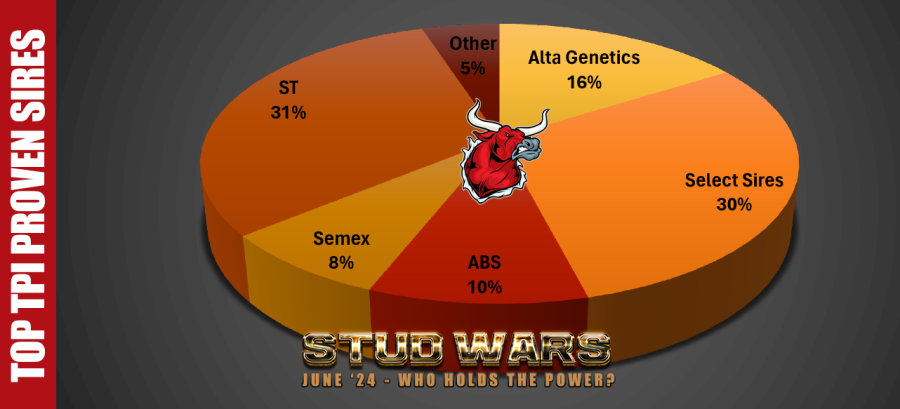
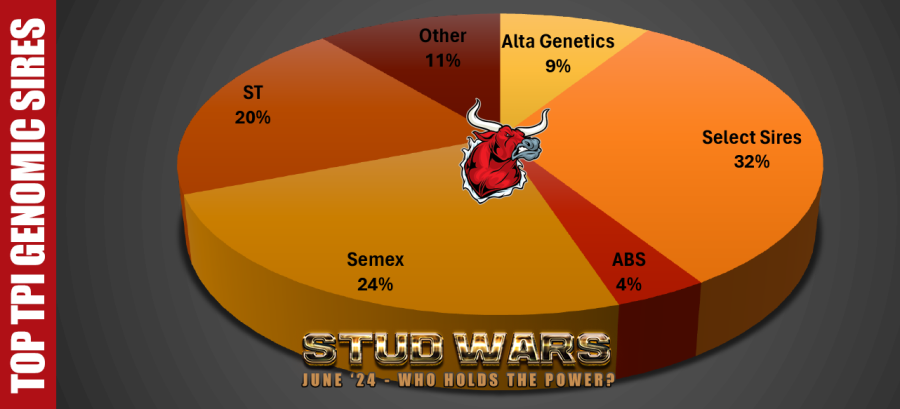
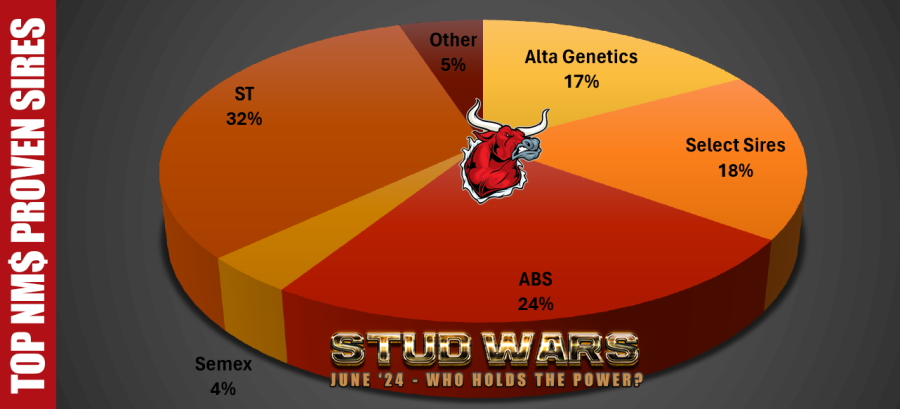
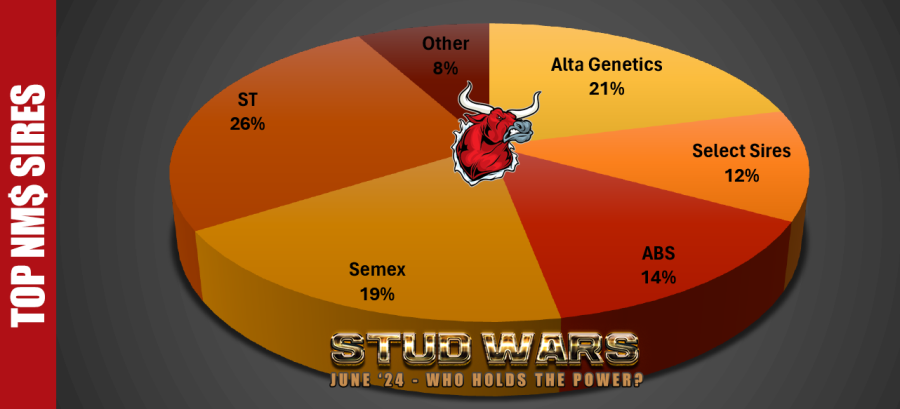
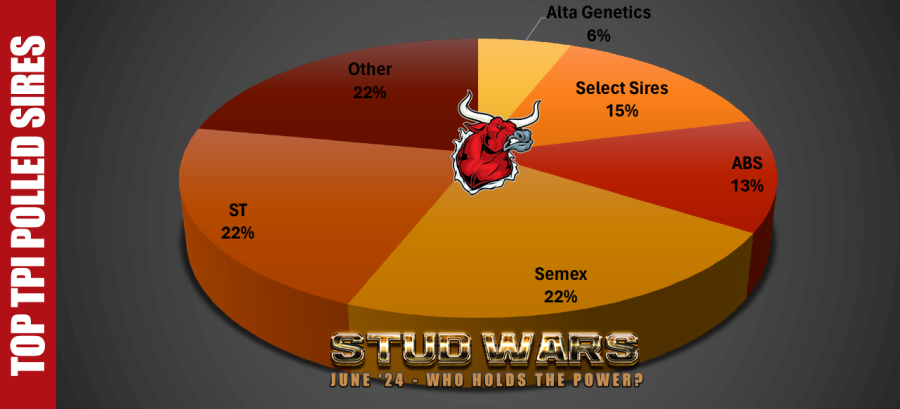
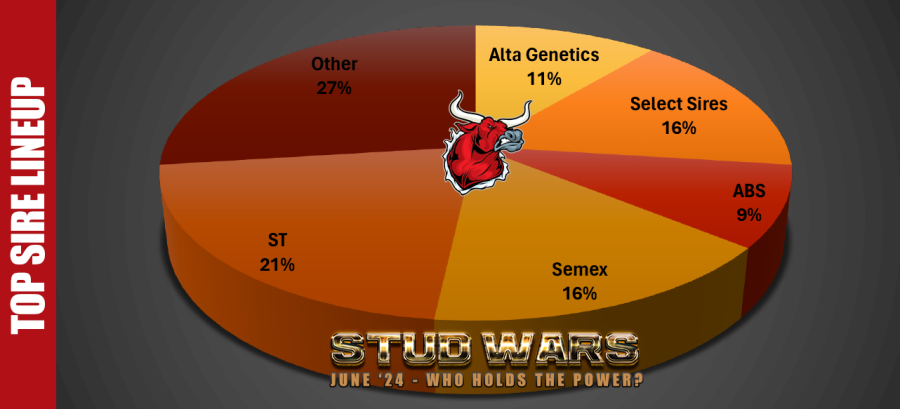
What’s happening is that major players appear to be reshaping this entire industry: URUS/Trans Ova with their “we do everything” approach, STGen awaiting regulatory approval for their Select Sires merger, ABS Global leveraging its international reach, and Semex maintaining a strong position thanks to its ownership of Boviteq.

Why Traditional Competition Is Disappearing

Think about any mid-sized family operation – the kind that’s been the backbone of dairy production for generations. During peak breeding season, you’re making breeding decisions constantly. Used to be, you could play AI companies against each other. Get competitive quotes, negotiate volume pricing, and maybe squeeze out some extra service calls.

Those days are ending faster than most people realize.

The new reality is platform integration. Your genetic evaluation software talks to your synchronization protocols, which connect to your pregnancy monitoring system, which links back to your semen supply. It’s convenient, sure… but when everything’s bundled together, switching becomes more complex.

University of Wisconsin research demonstrates this complexity – they report average 21-day pregnancy rates of 21.6%, with the best herds hitting 30-40%. Getting those kinds of numbers requires sophisticated reproductive management that most operations can’t develop independently. So you lean on the platform providers…

The Beef-on-Dairy Factor Nobody Anticipated

What’s really accelerating this consolidation is the explosive growth in beef-on-dairy. Journal of Dairy Science research shows it becomes profitable when crossbred calf prices exceed dairy calf values by 2:1, assuming you maintain pregnancy rates above 20%.

Heterospermic beef products more than doubled to 2.8 million units just last year. We’re not dealing with simple breeding choices anymore. You need reliable conception rates from both dairy sexed semen AND beef semen to make the economics work. This complexity plays right into the hands of companies offering integrated platforms.

Think about the logistics during peak breeding season – typically May through August in many northern regions. You’ve got fresh cows needing proven genetics with sexed semen, second and third lactation animals getting your best conventional dairy genetics, and everything else getting beef semen for those premium calf values. Managing that across a lactating herd requires systems that most operations simply don’t have in-house.

Market Structure Changes Are Real

The consolidation isn’t hitting everyone the same way. Understanding these differences matters for your planning… Large operations may be able to leverage scale for direct negotiations with genetic companies, maintaining negotiating leverage that smaller operations often lack. Custom service packages become possible when you’re talking serious volume.

Seasonal factors matter too. Many regions still see concentrated breeding seasons where service availability becomes critical. When you have fewer suppliers and more platform dependencies, bottlenecks during peak demand periods become a real risk.

The USDA data backs up broader structural changes: operations under 50 cows declined 79% over two decades, while farms with 1,000+ cows increased 60%. Median herd size jumped from 180 cows in 2000 to 1,260 cows by 2021. This shift changes everything about genetic supplier relationships.

Farm SizePrimary StrategyKey ActionsInvestment LevelTimeline
300-800 cowsDiversify SuppliersMaintain 2+ genetic relationships, negotiate flexible contracts10-15% cost premiumBefore next breeding season
800-1,500 cowsPartial IntegrationInvest in reproductive monitoring, develop partnerships$15K-25K annually6-12 months
1,500+ cowsScale LeverageDirect negotiations, in-house capabilities, genetic marketing$50K+ investment12-24 months

Platform Dependencies: Innovation or Lock-In?

Companies position this as a technological advancement – and there’s truth there. Trans Ova’s integrated approach bundles IVF, embryo transfer, sexed semen, cloning, and donor housing under unified service contracts. For operations managing complex reproductive programs, that integration offers genuine value.

But most of this “innovation” focuses on platform lock-in rather than genetic improvement. Once you’re dependent on their systems for critical breeding decisions, switching becomes economically complex even when better alternatives exist.

Some operations are reportedly developing internal capabilities to maintain independence. Progressive farms are building genomic evaluation systems using their own data to maintain genetic selection independence while still accessing advanced reproductive technologies.

Strategic Responses for Different Operations

Producers who recognize these trends aren’t fighting consolidation – they’re positioning themselves to maintain negotiating leverage within the new market structure.

Mid-size operations can maintain relationships with multiple genetic suppliers despite higher costs. Negotiating flexible contracts that preserve switching options serves as insurance against service disruptions or pricing changes. Starting these conversations early in your planning cycle makes sense.

Larger operations might consider partial platform integration while preserving genetic sourcing flexibility. Investment in reproductive monitoring technology reduces service dependencies. Some are developing partnerships with similar-sized operations to leverage volume purchasing and maintain access to multiple genetic suppliers for core breeding programs.

The biggest operations can leverage scale for direct negotiations with genetics companies. Many are developing comprehensive reproductive management capabilities in-house while exploring genetic marketing opportunities as consolidation creates scarcity value for diverse genetics.

Where This Might Be Heading

Let’s be honest – regulatory intervention isn’t coming to save competitive genetics markets. These acquisitions proceed largely unchallenged while other industries face antitrust scrutiny. Current market patterns may indicate continued consolidation as remaining independent operations either scale up, find acquisition partners, or exit.

Large operations negotiate directly with genetics companies for customized services. Smaller farms become price takers in commodity markets. It creates a two-tier system where reproductive choices depend on operational scale rather than management competence.

The Real Question for Your Operation

The Trans Ova-ReproLogix acquisition signals that genetics consolidation may be far from over. We’re looking at market structures where reproductive decisions become platform selections rather than product purchases.

What keeps me thinking about this… it’s not whether consolidation will continue – the evidence makes that possibility obvious. It’s whether individual operations will maintain enough decision-making independence to optimize genetic progress for their specific circumstances.

Operations that understand these trends can position themselves advantageously. Those operating under historical competitive assumptions may find their options increasingly constrained – often without understanding why their negotiating position deteriorated.

The industry benefits from technological advancement and service integration. But it also faces risks from reduced competition and increased operational dependencies. The producers who thrive will be those who leverage the benefits of consolidation while preserving strategic flexibility.

That’s not easy to balance, but it’s becoming essential as the genetics industry continues its transformation. The question isn’t whether this consolidation serves your operation’s interests. The question is how you’re going to navigate it successfully.

Because ready or not, the genetics game just changed. Again.

Complete references and supporting documentation are available upon request by contacting the editorial team at editor@thebullvine.com.

Learn More:

  • AI and Precision Tech: What’s Actually Changing the Game for Dairy Farms in 2025? – This article provides a forward-looking perspective on how advanced technologies like AI, robotics, and sensors are changing the game. It demonstrates how these tools offer scalable, innovative solutions to labor and health challenges, complementing the main article’s focus on technological platform dependencies by offering concrete examples of how to leverage innovation for operational independence.
  • 5 Actionable Strategies to Future-Proof Your Dairy Operation – This piece is a tactical guide for producers, offering practical steps to enhance profitability and resilience. It provides actionable advice on managing everything from biosecurity to workforce protocols, giving readers the hands-on, operational insights needed to navigate a consolidating market and protect their bottom line.
  • Why ‘Profitability per Cow’ is the Wrong Metric for 2025 – This strategic article challenges traditional economic metrics and forces producers to re-evaluate their business models. It reveals how market shifts and consolidation make herd-level profitability a more valuable metric, helping readers understand the long-term implications of these trends and position themselves for sustainable success.

Join the Revolution!

Join over 30,000 successful dairy professionals who rely on Bullvine Weekly for their competitive edge. Delivered directly to your inbox each week, our exclusive industry insights help you make smarter decisions while saving precious hours every week. Never miss critical updates on milk production trends, breakthrough technologies, and profit-boosting strategies that top producers are already implementing. Subscribe now to transform your dairy operation’s efficiency and profitability—your future success is just one click away.

NewsSubscribe
First
Last
Consent

DOC Just Made History: The First Showcase Bull to Hit a Million Units

Everyone said you can’t breed for both the show ring AND the milk tank. DOC just proved them all wrong.

EXECUTIVE SUMMARY: We’ve been tracking DOC for years, but what he just accomplished changes everything we thought we knew about elite genetics. This Showcase™ bull proved that exceptional type and massive commercial success aren’t mutually exclusive – something most of us figured was impossible. Here’s what matters to your operation: DOC’s daughters delivered +982 lbs Milk with 99% reliability across 54,563 daughters in 10,067 herds worldwide, while simultaneously dominating major shows from Japan to Denmark. One daughter sold for $1.925 million, validating that crossover genetics aren’t just marketing hype—they’re profit drivers. The global trend we’re seeing suggests that farmers won’t accept the old trade-offs anymore; they want cattle that perform well in both the parlor and the show ring. DOC’s million-unit milestone as the first Showcase sire to reach this level tells us the market is ready for genetics that deliver comprehensive excellence, not just single-trait optimization.

KEY TAKEAWAYS

  • Market Validation at Scale: DOC’s million-unit sales prove that elite type genetics can drive massive commercial demand – his sustained popularity across 10+ years shows these genetics work in real farming conditions, not just perfect environments
  • Crossover Economics Work: When daughters consistently deliver both production (+982 lbs Milk) and type excellence (purple banners globally), you’re looking at cattle that maximize both milk checks and genetic value – start evaluating bulls for comprehensive performance, not either/or scenarios
  • Global Adaptability Matters: DOC’s success from Japan to Denmark to progressive U.S. dairies demonstrates that truly elite genetics translate across diverse management systems – look for sires with proven international performance when making breeding decisions
  • Health Traits Drive Longevity: DOC’s genetics included improved mastitis resistance and productive life, contributing to his sustained demand – prioritize bulls offering robust health packages alongside production and type in your 2025 breeding program
  • Strategic Breeding Investment: With daughter S-S-I Doc Have Not 8784-ET selling for $1.925 million, DOC proved that superior genetics create exponential value – focus on sires with proven transmission ability rather than chasing the latest genomic predictions
 elite dairy genetics, dairy breeding strategy, increasing milk yield, sire selection criteria, crossover genetics profit

Look, we’ve seen some incredible bulls over the years, but what DOC just pulled off? This changes everything about how we think about elite genetics.

So here’s what happened. Woodcrest King DOC (EX-90) just became the first Select Sires Showcase™ sire to sell over 1,000,000 units of semen. Yeah, you read that right – a million units. And he did it while carrying that Showcase designation, which, honestly, most of us thought would never happen.

The thing about DOC is… well, he broke all the rules we thought existed in this business.

From Day One, This Bull Was Different

DOC came from solid genetics – 7HO12198 KINGBOY out of WCD-ZBW Mack Daddy (VG-88-VG-MS) at Woodcrest Dairy up in Lisbon, New York. The Cruikshank family knew they had something special when his dam was putting up impressive milk numbers and became a barn favorite. But honestly? Nobody predicted this level of success.

What made DOC stand out wasn’t just one trait – it was everything. Most bulls offer either production or type. You pick your lane and live with it. DOC said “forget that” and delivered both. We’re talking +982 lbs Milk with 99% reliability from 54,563 daughters across 10,067 herds. Those aren’t theoretical numbers from a computer model… that’s real milk in real tanks from real farms.

The Crossover Revolution

Here’s where it gets interesting. DOC’s daughters became the poster children for what we call “crossover cows” – cattle that absolutely crush it in progressive dairies while also claiming purple banners at major shows. This used to be impossible. You either bred for the parlor or the show ring, never both.

DOC’s daughters didn’t just participate in shows; they dominated them. From Japan and Korea to Spain, Italy, Great Britain, Belgium, the Netherlands, Germany, Denmark, Australia, Canada, and across the U.S., his genetics proved they could adapt to any system. That’s the mark of truly elite genetics – when they work everywhere, not just in perfect conditions.

What’s fascinating is how Select Sires positioned him as a patriarch of their Showcase™ program. This wasn’t honorary… DOC earned it by consistently delivering daughters that mattered to real dairy operations.

The $1.925 Million Proof

Nothing validates genetics quite like someone writing a massive check. DOC’s daughter S-S-I Doc Have Not 8784-ET (EX-96-EX-MS-DOM) sold for $1.925 million. That’s not just expensive – that’s the market screaming “these genetics matter.”

This cow exemplified everything DOC transmitted: elite type, impressive genomics with a +2742 GTPI, and proven transmission ability with three offspring already exceeding +3035 GTPI. She traced back 10 generations to Snow-N Denises Dellia EX-95, connecting modern genetics to historical greatness. When you see lineage like that performing at this level, you know it’s not luck.

Breaking the Showcase Barrier

The Showcase™ program recognizes sires with outstanding breed-leading type or show-winning pedigrees. It represents decades of strategic matings to create influential, breed-altering sires from impressive maternal lines. DOC becoming the first bull in this category to reach millionaire status? That’s huge.

Previous Select Sires millionaires typically achieved their status through broad commercial appeal – think workhorse bulls that every farm could use. DOC proved that elite-type transmission could drive equivalent demand. That changes how we evaluate genetics going forward.

The Million-Unit Club Context

Since Fisher-Place Mandingo first hit a million units back in 1994, only 42 other Holstein bulls had joined this club by 2010. The U.S. leads with 20 millionaire bulls, Canada has 12. Select Sires has consistently contributed to this group with bulls like PLANET-ET, MILLION-ET, and SHOT Laser-ET.

But DOC’s achievement stands apart. He reached millionaire status while maintaining his Showcase™ designation, proving that exceptional type and massive commercial success aren’t mutually exclusive.

Global Impact That Actually Matters

The numbers tell DOC’s story better than any marketing campaign. Over 673,000 doses sold globally, ranking among Select Sires’ bestsellers throughout his career. Scott Ruby from World Wide Sires noted that “Doc is a bull that has expanded his popularity every year of his life,” – which is unusual since most sires peak early and then fade.

What’s particularly noteworthy is DOC’s sustained demand. His genetics addressed the complex needs of modern dairy operations, including elite production, superior type, and robust health traits such as improved mastitis resistance and a productive life. That’s what keeps the bulls relevant year after year.

What This Means for Breeding Decisions

DOC’s success offers a blueprint for evaluating future elite sires. The most valuable genetics aren’t always the most extreme – they’re the ones delivering consistent, profitable performance across diverse environments and management systems.

Here’s the thing, though… DOC proved that show ring champions and commercial superstars can come from the same genetic foundation. His daughters dominated major shows while driving profits in progressive dairies, shattering the false choice between type and production that had limited breeding decisions for decades.

The Legacy Continues

DOC passed away in June 2025, just months before reaching his millionaire milestone. But his influence on Holstein genetics keeps expanding. His daughters worldwide prove his genetic worth daily, each lactation adding evidence that comprehensive excellence is achievable in dairy breeding.

Rick VerBeek, senior Holstein sire analyst at Select Sires, captured DOC’s significance: “Today’s A.I. industry is fast-paced. The speed of genetic advancement is unprecedented. Much of this advancement is driven by young sires, and while our GForce™ program continues to grow, influential daughter-proven genetics will always be our goal. It’s both exciting and gratifying to see DOC achieve this monumental milestone”.

Kevin Jorgensen, senior Holstein sire analyst, emphasized DOC’s unique contribution: “Within the Showcase program, DOC defined crossover for the past decade. He expertly transmits yield, components, type, and udder conformation to his offspring. His daughters continue to top the charts, and they’re extremely competitive in the show ring”.

Where We Go from Here

DOC’s millionaire achievement signals a shift in the industry. His ability to generate massive commercial demand while maintaining elite-type credentials proves that modern dairy breeding can deliver both profitability and phenotypic excellence simultaneously.

The success of DOC’s genetics validates Select Sires’ Showcase™ program approach and suggests that future breeding strategies should focus on comprehensive genetic packages rather than single-trait optimization. His legacy demonstrates that elite genetics can achieve both immediate commercial success and long-term breed improvement.

What strikes me about this whole story is how DOC changed the conversation. We’re not debating type versus production anymore – we’re looking for genetics that deliver both. That’s a fundamental shift in how we approach breeding decisions.

As the dairy industry continues evolving, DOC’s achievement stands as proof that exceptional genetics, strategic marketing, and consistent performance can create breeding legends that influence the industry for generations. The King’s millionaire status isn’t just a sales milestone – it’s validation that excellence in dairy breeding truly knows no limits.

Learn More:

  • The Ultimate Guide to Sire Selection – This guide offers a tactical framework for applying the lessons from DOC’s success. It provides practical strategies for balancing production, type, and health traits in your own herd to maximize genetic gain and long-term profitability.
  • Does Type Still Pay? The Financial Realities of Breeding for the Show Ring – This article dives into the market economics behind DOC’s crossover appeal. It analyzes the financial ROI of elite type, helping you understand how to leverage show-winning genetics to drive higher returns from both milk sales and genetic marketing.
  • Genomics: The Great Promoter or the Great Pretender? – DOC’s story champions daughter-proven reliability. This piece explores how to strategically use genomic data without getting lost in the hype, revealing methods for blending the best of proven sires with the potential of high-genomic young stock.

Join the Revolution!

Join over 30,000 successful dairy professionals who rely on Bullvine Weekly for their competitive edge. Delivered directly to your inbox each week, our exclusive industry insights help you make smarter decisions while saving precious hours every week. Never miss critical updates on milk production trends, breakthrough technologies, and profit-boosting strategies that top producers are already implementing. Subscribe now to transform your dairy operation’s efficiency and profitability—your future success is just one click away.

NewsSubscribe
First
Last
Consent

Genetic Gatekeepers: The High-Stakes Gamble of Dairy’s Elite Bloodlines

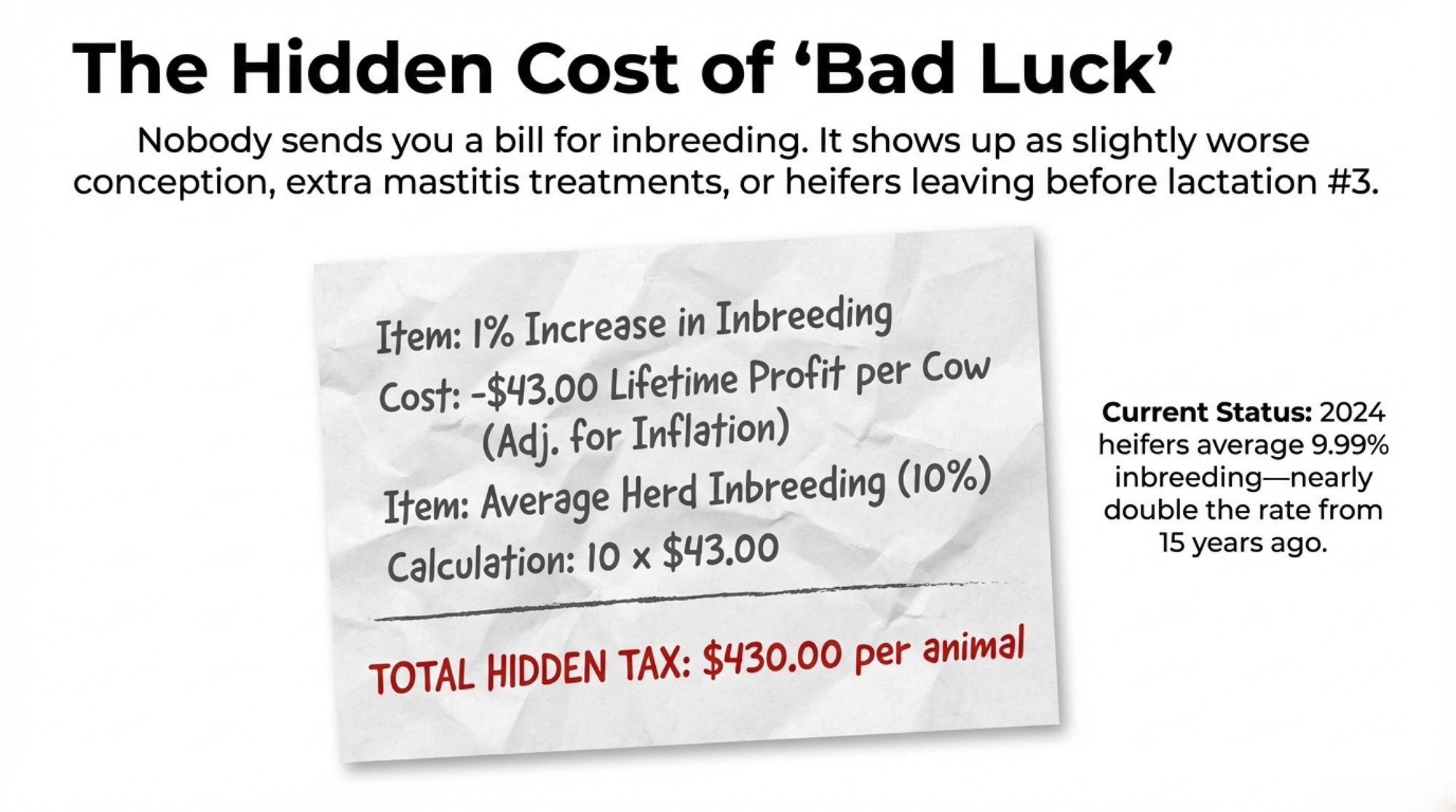
Every 1% increase in inbreeding costs you $23 per cow—and most herds don’t even know their levels.

We’ve uncovered something that’ll make you rethink every breeding decision you’re making. Genomic selection doubled our genetic gains to per cow annually, but it’s created a billion inbreeding tax that’s quietly draining operations nationwide. Here’s the math that matters: every 1% increase in genomic inbreeding costs about per cow in lost lifetime profit, and Holstein levels have jumped from 5% to over 15% in just fifteen years. Meanwhile, five companies now control nearly 90% of the elite genetics market, using restrictive contracts to keep the best bloodlines in their own pipelines. The producers who start building genetic independence now, while outcross options are still available, will have the most resilient and profitable herds by 2030. Time to stop following the crowd and start protecting your genetic future.

Rising inbreeding coefficients in Holstein cattle since genomic selection began in 2009, with corresponding economic costs calculated at $23 per 1% inbreeding increase

Three Critical Things Every Producer Needs to Know Right Now

  • Genomic selection doubled our genetic gains from $40 to $85 annually per cow in Net Merit—sounds great, right? But here’s what nobody talks about…
  • Genomic inbreeding levels shot from 5% to over 15% in just fifteen years, creating a hidden tax of $23 per cow per percentage point. That’s potentially $230 lost per cow over her lifetime.
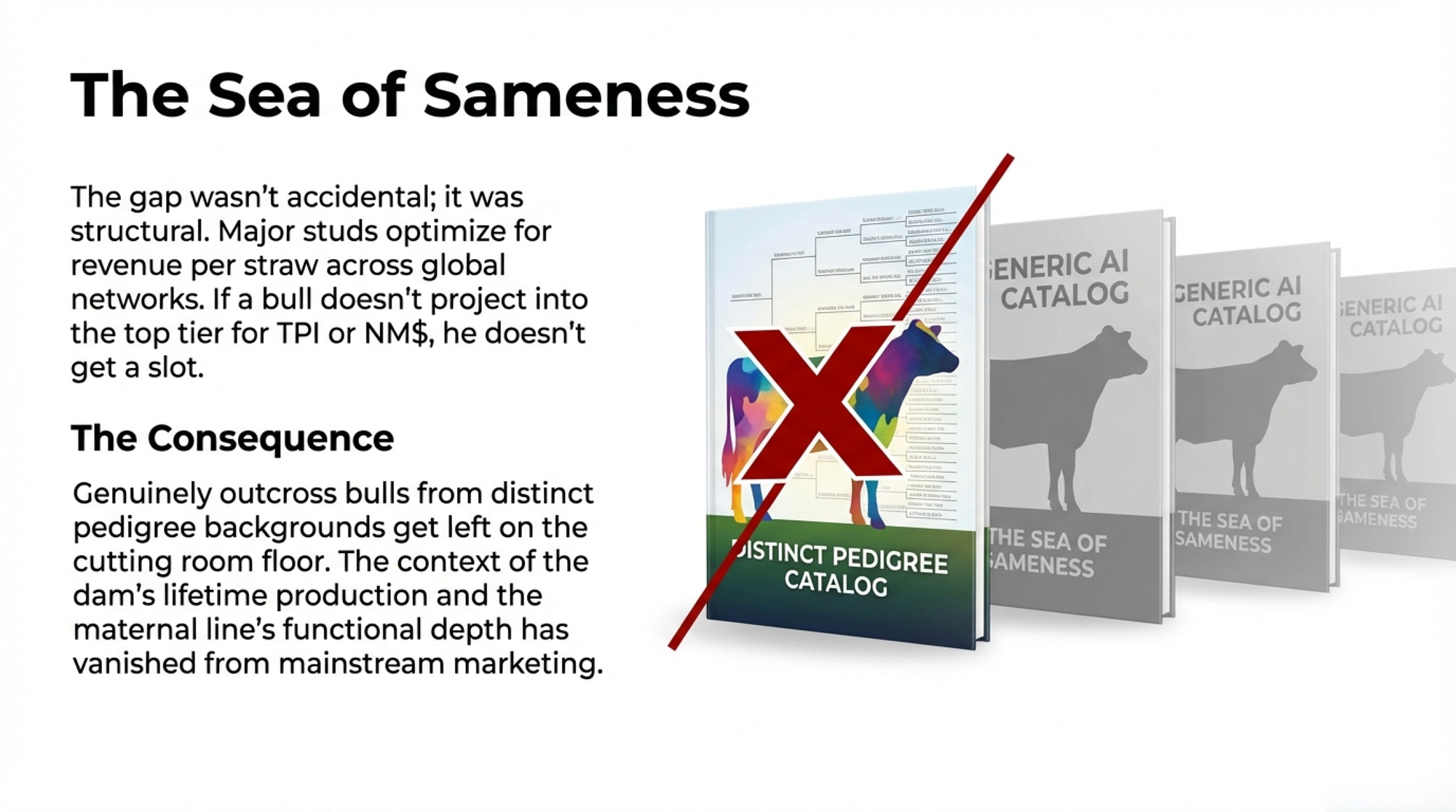
  • Five companies now control nearly 90% of elite genetics, yet they’re all selling us essentially the same bloodlines under different names.

The math is brutal when you scale it up. A 500-cow herd averaging 12% inbreeding is bleeding roughly $80,500 annually compared to herds maintaining 5% inbreeding levels. That’s real money walking out your barn door every day.

The coffee-break test: are the same grandsires showing up everywhere?

Grab the last 50 breedings and map sires back two generations; if “Captain,” “Lionel,” “Frazzled,” or “Medley” keep popping up, that déjà vu isn’t a coincidence—it’s what concentrated genomic selection looks like when the whole market chases the same leaderboard. The financial math is simple enough to make a nutritionist wince: at $23 per 1% inbreeding, a 300-cow herd moving from 5% to 12% is quietly leaving roughly $48,300–$69,000 on the table over those cows’ lifetimes, and that’s before counting the drag on productive life and calving intervals that comes with each tick upward.

How the genomic promise became a trap—fast

The thing about 2009–2010 is that progeny testing’s long wait time suddenly became, well, optional: hair sample in, predictions out, generation intervals shrank, and selection intensity went through the roof, which is exactly why genetic gain jumped from ~ to ~ per year. What strikes many producers in hindsight is how standardized indices and the speed of genomic turnover trained everyone on the same targets at the same time, so the “best” bulls were used everywhere—by design—driving a rapid, global convergence around a narrow set of families.

The genomic selection revolution doubled annual genetic gain in Holstein cattle but came at the cost of reduced effective population size, highlighting the fundamental trade-off between rapid progress and genetic diversity

Follow the incentives: concentrated suppliers, concentrated pedigrees

Here’s what’s interesting when you line up the genomic NM$ lists: STgenetics now commands about 53.5% of the genomic NM$ sire share, with the other majors making up most of the rest—a pretty strong signal that the elite sire stream runs through just a few gates. Price reinforces the funnel: value-based pricing ties semen cost to index standing, so rational buyers who want higher herd profitability are nudged to pile into the same top sires—again and again—tightening pedigree overlap as a side effect of “doing the smart thing.”

The contract loop: control doesn’t end at the tank

What’s particularly noteworthy is how early-access or VIP semen agreements can limit resale, restrict use to the buyer’s herd, and even reserve first option on exceptional progeny, which keeps the very best genetics circling back to internal pipelines while everyone else gets the later waves. It creates a two-speed market: a nucleus racing ahead on the newest lines and a broader commercial base buying in after those lines already saturate—pushing inbreeding faster within and across regions than pedigree tools alone will show.

The regional reality check producers keep bringing up

Upper Midwest: large Wisconsin and Minnesota herds often show eerily similar sire stacks despite different nutritionists and management styles—proof of how the same handful of bull families can dominate selection decisions regionally when everyone buys off the same lists. Central Valley: California operations battling heat and water variability point out that many top-index bulls weren’t bred for their climate; producers who need “slick”/heat-tolerant or pasture-efficient genetics still find the elite commercial stream light on those outcross options. Southeast: Georgia and Florida dairies working through heat, humidity, and parasites are increasingly experimenting with crossbreeding and genuine outcross bulls—quietly—because the high-input, confinement-optimized mainstream isn’t built for their reality.

The case that should still give everyone pause: Pawnee Farm Arlinda Chief

The legendary sire Pawnee Farm Arlinda Chief. His genetics advanced production for millions, but his widespread use also spread a lethal recessive gene, highlighting the costly hidden risks of a narrow gene pool.

Chief’s influence was historic—16,000 daughters and millions of descendants—but baked into that legacy was HH1, a lethal APAF1 nonsense mutation that, when homozygous, produced a devastating number of spontaneous abortions across the breed. Between 2016 documentation and subsequent reporting, the best estimates now peg global losses at roughly half a million calf abortions and hundreds of millions of dollars in cost—while his production upside still made him a net positive, which is exactly the cultural trap: normalize the risk as “manageable.” (Read more: The $4,300 Gamble That Reshaped Global Dairy Industry: The Pawnee Farm Arlinda Chief Story)

Why pedigree tools understate today’s risk—and how genomic F_ROH tells the real story

EFI and F_ROH represent two fundamentally different approaches to measuring inbreeding that dairy breeders need to understand and use together for optimal breeding decisions. EFI (Expected Future Inbreeding) is a relative, forward-looking measure that estimates how inbred offspring would be if an animal were mated to the general population—essentially measuring how related that animal is to today’s breed average. However, EFI has a critical flaw: it uses a constantly shifting baseline that becomes more inbred each year, meaning an animal can appear “low inbreeding” simply because the entire population has become more inbred around it. In contrast, F_ROH measures the actual homozygosity present in an individual’s DNA right now—the real stretches of identical genetic material that indicate true genomic inbreeding, regardless of population trends. For practical breeding decisions, savvy dairy producers should use EFI for population-level planning and relative comparisons within their current genetic pool, while relying on F_ROH to understand the absolute genomic risk and long-term genetic health of their animals. Think of EFI as your “how does this bull compare to others available today” tool, while F_ROH tells you “how much genetic diversity has this animal actually lost”—and with Holstein genomic inbreeding having tripled from 5% to 15% in just 10 years while EFI metrics lagged behind, using both measures together gives breeders the complete picture they need to avoid painting themselves into a genetic corner.

Low Inbreeding Sires in the top 200 gTPI to consider:

Naab CodeReg Name TPINet MeritPTA MilkPTA Fat% FatPTA Pro% ProPTA TypeSire x MGS x MGGS
515HO00587Ruann Northstar-ET34279111323990.16590.061.01Gen Percival x Gameday x Rapid
250HO17387Aurora Sheepster POplar-ET3421829862900.2430.051.05Sheepster x Ahead x Medley
014HO17945Wet Sheepster Madcap-ET3415945683930.24480.090.62Sheepster x Gameday x Renegade
007HO17807Matcrest Sundance Ledger-ET33999668091040.26470.080.84Sundance x Payload x Renegade
200HO13425Beyond Nightingale3397857680830.2460.091.17Harmony x Esquire x Parsly
200HO13174Adaway Beyond Fitness-ET33929081153920.16600.080.63Sheepster x Parsly x TRy Me
007HO17380Melarry Sheepster Dijon-ET338193716121050.14680.050.52Sheepster x Drive x TRy Me
202HO02006TRophy-ET3380742394730.21430.110.94TRooper x Spot Lite x Renegade
551HO06233Genosource Maritime-ET338010191301970.16540.040.58Undertone x Upside x Captain
029HO22342Pine-TRee Mervyn-ET337898912641130.22570.060.02Mirrorimage x Foxcatcher x Legendary

The reality is that most of today’s highest-ranking sires likely have elevated F_ROH values because 90% of the top genomic bulls trace back to Oman, Planet, or Shottle in their first few generations. This concentration means finding truly outcross sires among the elite ranks is increasingly difficult.

Producers who believe they’re “mixing it up” with pedigrees are often shocked when genomic runs of homozygosity (F_ROH) uncover more overlap than expected, especially post-2010, as generation intervals tightened and popular sires cycled faster. Studies show that pedigree-based inbreeding underestimates true autozygosity. Meanwhile, ROH trends in North American Holsteins rose sharply through the genomic era—resulting in more small ROH per year—and the last five years of the 1990–2016 period nearly doubled prior rates.

The hidden ledger lines producers actually feel—every season

From industry observations and Holstein/extension economics, each 1% inbreeding pings profitability by about $23 per cow in lifetime Net Merit, while correlated effects—milk yield drags, shorter productive life, and stretched calving intervals—compound quietly across cohorts. When you aggregate that across 500–1,000 cows, the numbers move from “annoying” to “we should fix this now,” especially if replacements are tight and every fresh cow’s butterfat checks are paying the feed bill this month.

A practical 30-day audit producers are using this fall

  • Week 1: Pull 100 recent services and map three generations; flag repeat grandsires and calculate genomic inbreeding if available through herd tools or nominator portals tied into CDCB pipelines.
  • Week 2: Run the inbreeding tax math at $23 per 1% and project five-year costs; identify the top five most related families in the herd and where they sit in production and health.
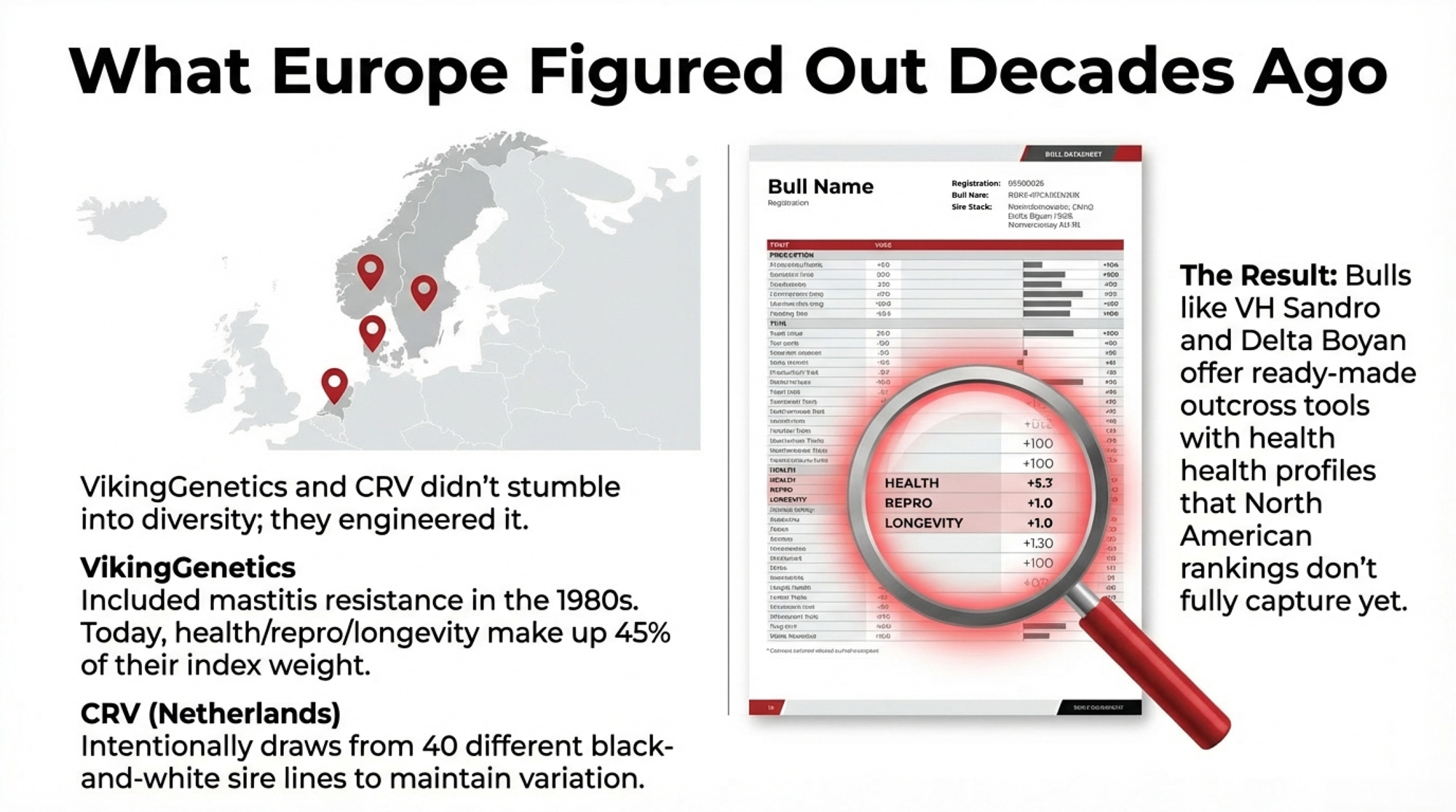
  • Week 3: Shortlist genuine outcross sires (yes, some will be 100–200 points lower on index) and heat/pasture-adapted options for stress seasons; check cooperative or European sources where appropriate.
  • Week 4: Set genomic inbreeding targets (<8% herd average is a good working mark), define a portfolio breeding plan for the next 90 days, and lock in performance tracking beyond yield—DPR, mastitis events, days open.

The portfolio breeding approach—used by herds that won’t trade tomorrow for today

What’s working in the field is a 40–40–20 split: forty percent “income insurance” on proven, high-index bulls for the best cows in optimal windows; forty percent balanced performers from less-related families; and twenty percent true diversity builders—outcross or strategic crossbreeding to bank hybrid vigor. On timing, spring is a great window for diversity (fresh cows, better heats); in summer heat, some herds test heat-tolerant outcrosses precisely because conception is lower anyway; and in fall, producers blend a higher percentage of index leaders to set up spring calving while keeping 30–40% in the diversity lane.

The tech curve by 2030—what actually looks useful on-farm

CDCB and national partners continue to expand trait coverage and data quality in the National Cooperator Database—now powering evaluations on tens of millions of animals—which is the backbone for making inbreeding and diversity metrics more visible in everyday tools. Expect two practical shifts: breeder-facing dashboards that surface F_ROH and “relatedness risk” at mating-time, and multi-objective AI suggestions that trade a modest drop in index points for measurable herd-level gains in fertility, livability, and inbreeding control.

The Bottom Line

First, write a hard target for genomic inbreeding and enforce it at mating-time with tools tied to CDCB-powered data; don’t let the last click be a guess. Second, treat outcross doses like an insurance premium: they don’t always top the list, but they pay when volatility hits—heat waves, disease pressure, or a hidden recessive hiding in plain sight like HH1 did. Third, negotiate “diversity bundles” or step outside the usual catalogs—cooperative and European options exist—and remember that saving $115 per cow by avoiding 5% extra inbreeding beats chasing 100 index points that never make it to your milk check.

Why this matters more than it feels like it should

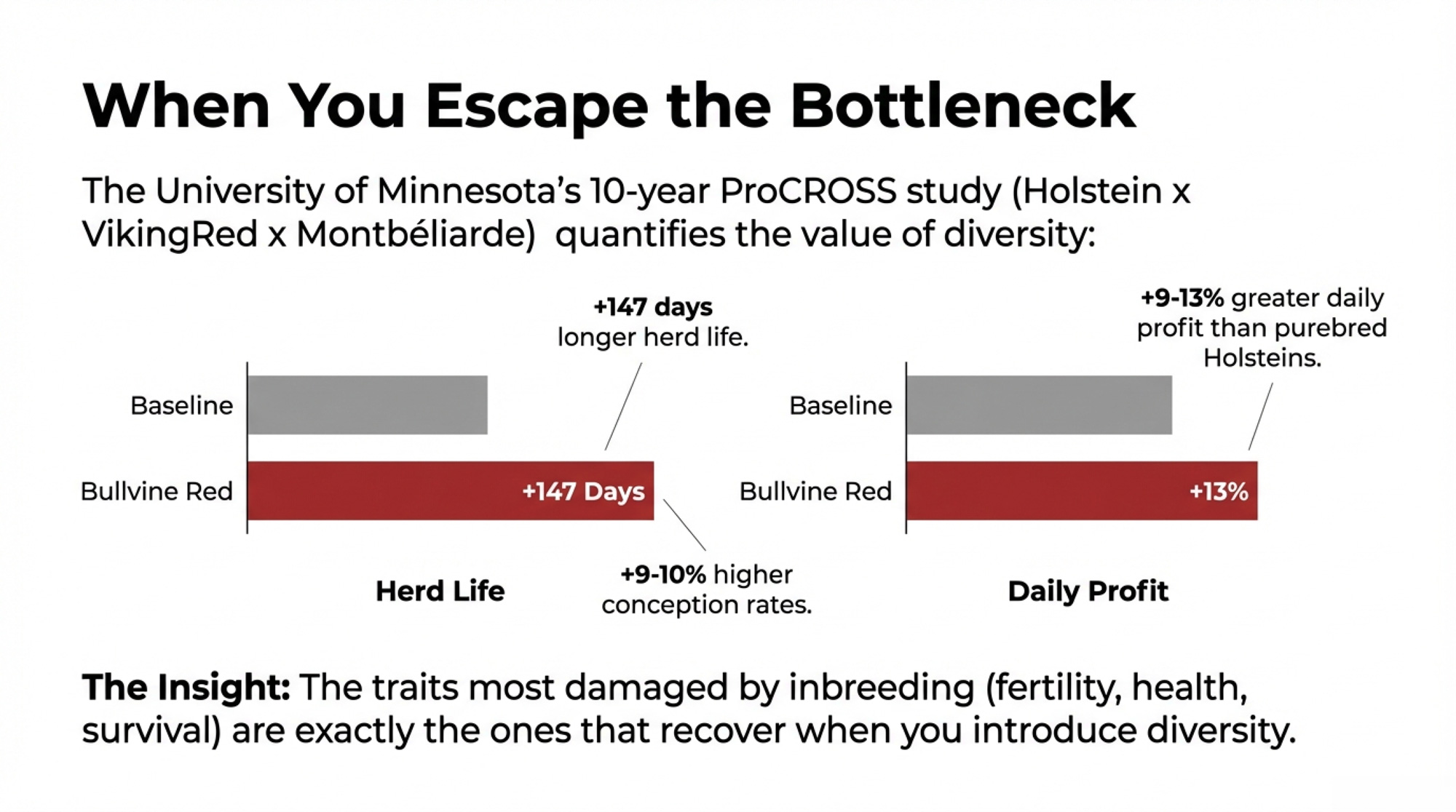
Producers don’t feel inbreeding depression in one big wreck; it shows up in a few more open cows, a mastitis flare that pushes great cows out a lactation early, or a herd that just doesn’t breed back like it used to—and by the time it’s obvious, it’s expensive to unwind. The evidence points to a simple truth: a little less index today, with diversity baked in, often pays more in three years than another lap around the same pedigrees ever will.

KEY TAKEAWAYS

  • Your inbreeding level is costing you real money right now — Calculate your herd’s genomic inbreeding using CDCB-linked tools, then multiply each percentage point above 5% by $23 per cow to see what you’re losing annually
  • Break free from the genetic funnel with portfolio breeding — Mix 40% proven high-index bulls, 40% solid performers from different families, and 20% true outcross genetics to hedge your bets and boost long-term profitability
  • Demand transparency from your AI providers — Ask for genomic relationship data, challenge restrictive contracts, and consider cooperative breeding programs that put farmer interests ahead of corporate profits
  • Track what actually pays the bills long-term — Monitor fertility rates, productive life, and mastitis alongside milk weights because the cows that stay healthy and breed back are the ones generating real profit per stall

Join the Revolution!

Join over 30,000 successful dairy professionals who rely on Bullvine Weekly for their competitive edge. Delivered directly to your inbox each week, our exclusive industry insights help you make smarter decisions while saving precious hours every week. Never miss critical updates on milk production trends, breakthrough technologies, and profit-boosting strategies that top producers are already implementing. Subscribe now to transform your dairy operation’s efficiency and profitability—your future success is just one click away.

NewsSubscribe
First
Last
Consent

Learn More:

  • Boost Your Dairy Profits: Proven Breeding Strategies Every Farmer Must Know – This article provides tactical advice on sire selection, heat detection, and using sexed and beef semen. It offers practical strategies for improving conception rates and calf value, directly complementing the main article’s call for a more diverse breeding portfolio.
  • Unlock Hidden Dairy Profits Through Lifetime Efficiency – Shifting to a strategic, long-term view, this piece reveals how integrating genetics with precision nutrition creates significant financial gains. It demonstrates how to cut feed costs and boost margins, reinforcing the main article’s theme of finding profitability beyond index chasing.
  • Genomics Meets Artificial Intelligence: Transforming Dairy Cattle Breeding Strategies – Looking to the future, this article explores how AI is revolutionizing genomic data analysis. It details how emerging technologies can help execute the complex, multi-objective breeding strategies needed to manage inbreeding risk and enhance long-term herd resilience and profitability.

Ready or not, AI Is Picking Your Embryos (And Let’s Be Honest—Gut Feelings Have Never Been This Outscored)

What if your phone knows your next best cow before you do? Would you trust it—or fall behind?

EXECUTIVE SUMMARY: You know, here’s the thing nobody really wants to admit: AI just beat the “expert eye” at embryo grading with 95% agreement in real decisions—76% exact matches, too. That’s not someone’s fancy PowerPoint—those are Journal-of-IVF-Worldwide numbers, and the jump in conception rates is no joke. We’re talking herds picking up 10% better pregnancy rates and fresh cows putting $15,000 worth of top genetics in the tank every year.What’s remarkable is that this isn’t just Silicon Valley hype. Aussie barns, Brazilian crossbred herds over 4,500 kg, Iowa IVF labs—this tech is setting the pace. Even carbon credits are stacking up: $84,000+ for some of the smart operators cutting methane and those in their first calving age.Look, it isn’t magic beans, and you’ll need to fight through some training headaches—but if you’re tired of costly flush misses, this is the upgrade nobody else warned you about. Try it, track your own numbers, and see if your “eye” can really keep up. The future’s up for grabs, but you’ve gotta be in the race to win.

KEY TAKEAWAYS

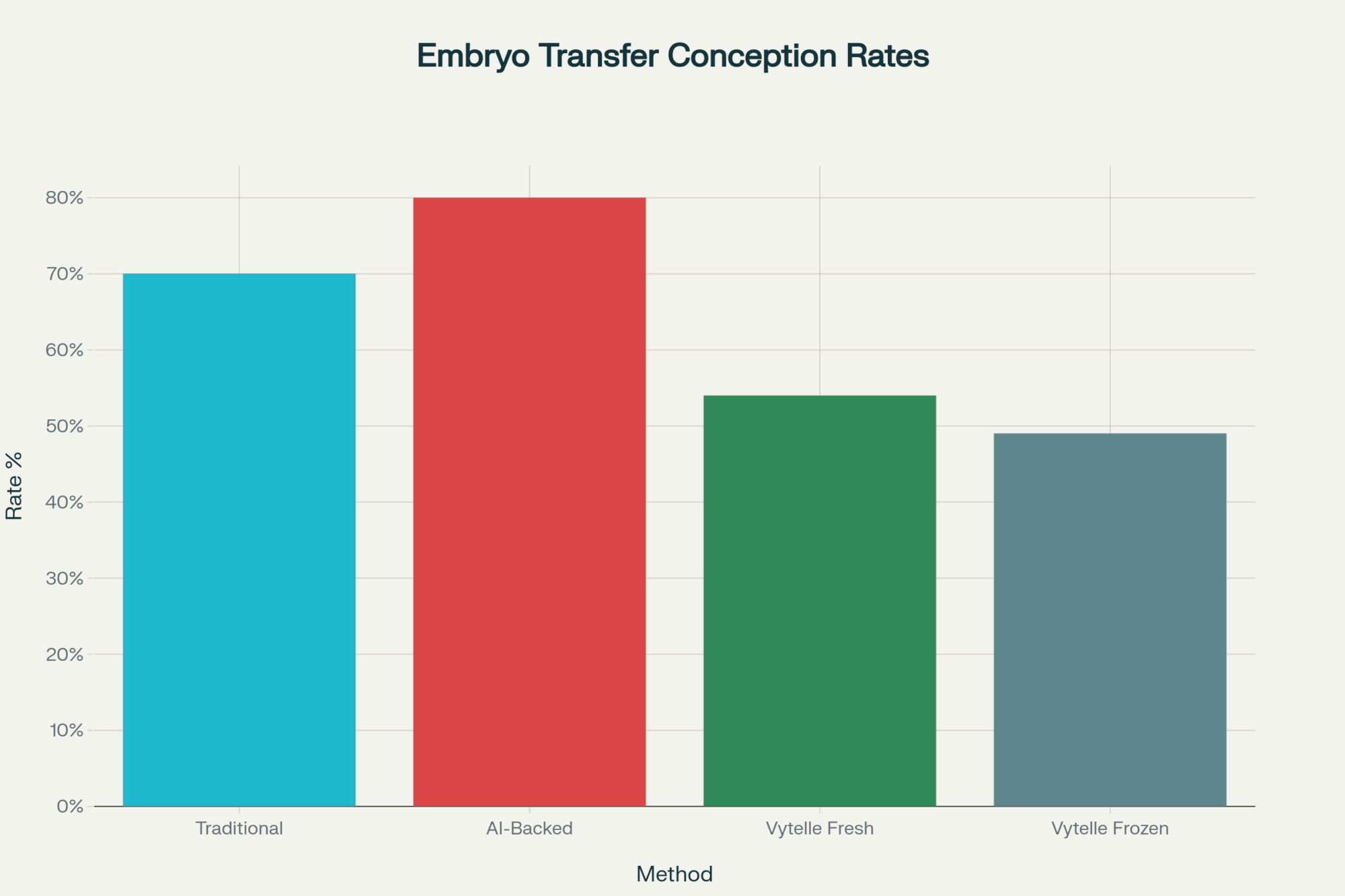
  • AI embryo selection jumps transfer success rates by 10%—think 54% fresh, 49% frozen, from real-world Vytelle benchmarks. Producers can start by calibrating their video protocols and benchmarking against last year’s results.
  • Operational ROI isn’t theory—Brazilian dairies claim $84,000 in carbon credits and herds crossing 4,500 kg yields. (Embrapa, Animal Reproduction, JIVF) If you want to achieve those efficiencies, start logging carbon metrics with your extension specialist.
  • Training and barn buy-in matter more than gadgets. Herds that succeed build feedback loops—so start with regular video review sessions and track pregnancy outcome by technician.
  • 2025’s market rewards the daring—carbon, genetics, sustainability. That means now’s the time to invest in system upgrades, retrain your best people, and align with the right AI partners.
  • Old-school “gut checks” just aren’t enough with $2,000+ per flush in play. If you haven’t updated your embryo game, you’re not just leaving money behind—you’re letting your neighbor’s genetics lap you by 2027.
AI embryo selection, dairy reproduction technology, bovine IVF, dairy farm profitability, genetic improvement

Pull up a chair. Let’s talk shop. If you’re not asking hard questions and demanding higher ROIs from every flush, now’s your chance to get ahead before the next bull proof drops.

The buzz from my recent trip to Watertown, Wisconsin, wasn’t about the show ring—it was about an iPhone. Imagine this: the vet there snapped a video through her microscope and, before her coffee even steamed up her glasses, had an AI score predicting which embryo would actually become a calf. Meanwhile, her old-school embryologist with two decades in the trenches was still making the same calls he’s made since Butterfat was king.

Let’s be clear—what’s happening isn’t science fiction. The tools are here, and these little AI-assisted videos are stacking up more science than most of those old barn-bet “eyes” ever brought to the table. It’s working, and it’s quietly cutting through the noise.

In the Trenches: Is AI Just a Gimmick?

Some folks still think AI’s just for Silicon Valley. Truth is, it’s all over barns from Dodge County, Wisconsin, to Colac, Victoria. What’s smart about the new systems is how they pull from thousands of data points—embryo development speed, cell movements, not just the “good day/bad day” look. You don’t need to buy the marketing. Just ask around—guys are already quietly running more repeatable, more profitable flushes because of it.

Of course, producers talk. One fellow I bumped into over by Fox Lake admitted, “We ran by eye for years, but even our trusted ET guy says the numbers don’t lie anymore—if the data says ‘try it,’ we’re game.” That’s the way change actually happens on a U.S. Midwest dairy.

The Data That Turned the Tide (And Should Have Years Ago)

Here’s the meat: A well-done 2024 field trial stacked AI scoring against human grading using 558 bovine embryos. The AI’s exact-match agreement with the experts was 76%. But here’s what carried weight with me—on real, “should-I-transfer-or-not” decisions, AI and humans landed on the same call 95% of the time, even if they bickered about the details.

Now, if you’re wondering how sharp the “human eye” really is—average embryologist agreement is only about 60% when they’re staring at the exact same embryos. Let that roll around in your mind the next time two “experts” have different gut reactions to your $2,000 flush.

The ROI: How Data Outperforms “Gut Feel”

Traditional grading methods hover between 65-75% accuracy—if you’re lucky or using the best tech around. The newer AI-backed assessments are achieving exact matches in the upper 70s, and, in tandem with good management, reach into the mid-80s for practical agreement. You’re still spending the same 10-15 minutes per eval on the traditional side. Meanwhile, apps using routine smartphone videos and reliable barn data are getting cows bred for less money—and actually holding pregnancies.

Look, nobody’s running a check just for “cool factor.” You want results. The spillover? Some operations are seeing better call rates across bred cows, fewer repeats, and real dollars back in the system—especially when they’re replacing subjectivity with calibrated, farm-specific AI feedback.

The Implementation Reality

You probably heard, “AI is easy—just plug and play.” Let’s get real. There’s an upfront headache: if you aren’t investing in staff training, you’re begging for confusion. Every herd that succeeds in ramping up this data-driven approach told me the game changer wasn’t software—it was nailing the routine. Consistent video quality. Weekly troubleshooting. No shortcuts on feedback.

That learning curve, as Wisconsin Extension folks will point out, is where most folks lose their patience. Six months feels long, but for those who stick with it, results tick steadily upward.

Dialed-in herds—especially those in Iowa rolling through Vytelle’s Midwest lab—are logging fresh embryo conception rates right around 54% and frozen at 49%, which checks out globally. For most North American dairies, that’s a jump of 5-10 points over their “by-eye” baseline—not fantasy, but extra cash in the payout line.

When Climate, Region, or Protocols Make the Difference

RegionKey MetricAI Impact or TrendSource
Midwest/USA+10% conception rate, 54% fresh embryo, 49% frozen (Vytelle)Benchmarking and calibration show improvementVytelle 2024, UW Extension
Victoria/Aus>60% national milk, IVF fits with calving cyclesAffordable elite ET, fits seasonal herdsAgriculture Victoria, Holstein Australia
Brazil4500+ kg Girolando lactation, $84K carbon credits, 33% less methaneSelective breeding, environmental profitEmbrapa, Animal Reproduction, JIVF

Here’s what’s wild about Victoria, Australia: farms there are putting out more than 60% of the country’s milk, and IVF is fitting perfectly into their controlled calving calendars. Take a look at Calderbrae Holsteins near Colac—165 cows, pedigree since before most of us even listened to ET podcasts. ET science didn’t just bump their production—it gave them affordability and access to top-line genetics.

Go one hemisphere over: Brazil. Over half a million embryos in a year, but the Girolando crossbreds are the big surprise. Modern, carefully selected Girolando herds are now pushing well past 4,500 kg a lactation, proving you don’t need to bend to heat stress—you can select for it.

The Stuff Nobody Tells You (But should)

Don’t get tricked by smooth marketers. AI’s not going to save you from sloppy barn habits. If your routine shifts don’t shoot quality video? Results will dive. Summer heat, fried Wi-Fi in the calving shed—AI can’t fix that. Your calving proof’s only as good as your record-keeping. That’s not me being picky; it’s what every extension agent worth their salt will tell you.

The Carbon, Credibility, and Competitive Edge

Serious point: this technology isn’t just about making more pregnancies. Brazilian teams reduced the first calving age from 48 to 24 months, resulting in over $84,000 in carbon credits and a 33% or more reduction in herd emissions. In the U.S., with co-ops and buyers wanting sustainability digits on your records, that leverage is starting to matter.

Not Every Farm Wins—And That’s the Reality

Here’s the straight dope: not every farm that tries AI holds on. Extension professionals will say a fair chunk drop out or fall flat on returns—mostly from poor training, muddled communication, or giving up at the first glitch. Upfront costs can sting, but the ones who plan, calibrate, and stick it out usually end up in the win column.

Successful herds? They make AI just another reliable tool—track every call, compare pregnancies, work hand-in-hand with their vet, and AI reps. The rest? They get left behind, plain and simple.

Here’s My Two Cents

Forget sci-fi headlines—this is the here and now. If you’re still grading embryos on gut and tradition while others let AI crunch their data, well… that’s all you, friend.

Want the tech to work? Treat barn data like a business, double down on staff training, and ride out the rough opening months. Expect hiccups. Learn from herds that didn’t bail. Remember, you don’t get windfall results overnight.

The bottom line is simple: producers building better systems, not just buying fancier apps, are the ones pulling ahead. It’s time to decide if you’re going to lead this change or wake up one day to find you’ve been left behind.

Complete references and supporting documentation are available upon request by contacting the editorial team at editor@thebullvine.com.

Learn More

  • IVF Real World Results vs The Hype – This piece cuts through the marketing to deliver a tactical playbook, revealing the on-farm management and benchmarks required to turn IVF potential into measurable profit. It’s essential for building a program that actually works in the real world.
  • The Index Wars: Is The Tail Wagging The Dog? – This strategic analysis challenges you to look beyond a single technology and question your entire genetic plan. It reveals how to leverage indexes for true profitability, ensuring your high-tech embryos build a resilient and economically sound herd for the future.
  • Is Technology The Great Dairy Disruptor? – This article zooms out to show how AI embryo selection fits into the larger tech revolution reshaping dairy. It provides a forward-looking perspective on how data, automation, and genomics are creating the new winners and losers in the industry.

Join the Revolution!

Join over 30,000 successful dairy professionals who rely on Bullvine Weekly for their competitive edge. Delivered directly to your inbox each week, our exclusive industry insights help you make smarter decisions while saving precious hours every week. Never miss critical updates on milk production trends, breakthrough technologies, and profit-boosting strategies that top producers are already implementing. Subscribe now to transform your dairy operation’s efficiency and profitability—your future success is just one click away.

NewsSubscribe
First
Last
Consent

Stop Blaming the Bulls: The $50,000 Fertility Reality Check Every Dairy Needs Right Now

71% of AI breedings now use genomic bulls under 2 years old. Your conception problems? Probably not the bull’s fault.

EXECUTIVE SUMMARY: Look, here’s what I’ve learned talking to producers across the Midwest: blaming bulls for fertility problems is costing you serious cash and missing the real issues. We’re talking $5 per day for every cow that takes an extra 10 days to breed—that’s $25,000 walking out the gate on a 500-cow operation. The genomic revolution means today’s bulls are vetted harder than ever, with less than 10% failing quality checks after intense pre-selection. Meanwhile, the real fertility killers are hiding in plain sight: cows slipping into negative energy balance, heat stress knocking 15-20% off conception rates, and AI technicians whose skills can swing results by 10 percentage points. Smart producers are shifting focus to body condition scoring, environmental controls, and timed AI protocols that actually move the needle. With feed costs high and weather getting more extreme in 2025, you can’t afford to keep chasing the wrong problems.

KEY TAKEAWAYS

  • Save $25K annually by preventing breeding delays — Start weekly body condition scoring to catch cows dropping below 3.0 BCS before they hit negative energy balance. With current feed prices, keeping cows in proper condition is your best ROI move for 2025.
  • Boost conception rates 1.5% with better semen handling — Train your AI techs on precise thawing protocols (95-98°F for exactly 45 seconds) and invest in calibrated thermometers. As genomic sires flood the market, proper cryopreservation handling is non-negotiable.
  • Combat heat stress cutting fertility up to 20% — Upgrade cooling systems and shift feeding to cooler hours. Monitor your Temperature Humidity Index daily and consider Timed AI protocols to work around weather challenges hitting dairy regions harder each year.
  • Close the sexed semen fertility gap (now 85-90% of conventional) — Use TAI protocols specifically designed for sexed semen timing. With producers demanding more heifer calves and beef crosses, mastering sexed semen management is becoming essential for profitability.
dairy cow fertility, improving conception rates, dairy farm profitability, body condition scoring, genomic selection

You know that moment when you’re standing around the coffee pot at a dairy conference and someone starts venting about their conception rates? Last month, I had exactly that conversation with a Wisconsin producer running about 500 head. His numbers had dropped 15 percentage points over six months, and his first instinct was to point fingers at the AI company.

“Must be the bulls,” he said, shaking his head. “Quality’s just not what it used to be.”

Here’s the thing that’s got me fired up—that knee-jerk reaction to blame the bull isn’t just outdated thinking, it’s costing dairy operations serious money. And honestly, after digging into the latest research and talking with folks across the industry, I think it’s time we had a blunt conversation about where fertility failures actually originate.

Because here’s the brutal math: every cow that takes an extra 10 days to get bred costs you roughly $5 per day after 100 days in milk. On a 500-cow dairy running 65% conception rates instead of 75%? That’s $25,000 walking out your gate annually. And that’s before you factor in additional semen costs, vet bills, and the compounding effect of delayed rebreeding.

The Bull Factor: More Bulletproof Than Ever

Let me start with something that might surprise you. By 2021, a staggering 71% of all AI breedings in U.S. dairy herds were using genomic young sires—bulls that didn’t even have milking daughters yet[1]. But here’s what that actually means inside the AI stud, and why it changes everything.

Industry insiders will tell you that twenty years ago, the typical collection bull was a mature powerhouse, often over 4 years old, producing between 800 to 1,000 doses per collection. Today? The median age has dropped dramatically to under 2 years, which means we’re shifting from relying on a few high-output older bulls to many younger bulls, each producing fewer doses — typically 300 to 500 per collection — but boasting superior genetics.

This shift goes hand in hand with unprecedented early-life control over these bulls. Leading AI studs don’t just scout for promising prospects at a few months old; they nurture their best genetics from birth. Many bull calves are brought into AI facilities around 6 weeks of age, while still on milk, enabling precise management of nutrition and health — a level of care unimaginable a generation ago. By the time that semen straw hits your farm tank, it’s the survivor of an elimination process that literally starts moments after birth.

What strikes me about this shift is how it’s fundamentally changed the reliability equation. Instead of waiting 4-7 years to figure out if a bull’s any good, AI companies can now analyze tens of thousands of DNA markers right after birth and pick the genetic elite early. The competition is so fierce that most major AI studs are now screening out 10-20 genetically inferior bull calves for every single one that makes it into their collection program.

The genetic screening is so ruthless that the idea of a bull just “not being fertile” is almost off the table. What is the failure rate for young bulls entering the system? Less than 10% don’t make the grade—because the genetic duds have already been identified and removed from the pipeline.

The scientific side has evolved dramatically as well. Yeah, cryopreservation still kills about 40-50% of sperm cells—that’s just the brutal reality of freezing and thawing. But modern extenders aren’t your grandfather’s egg yolk mixture. Today’s formulations are packed with antioxidants, including glutathione, resveratrol, and vitamins, that actively protect sperm DNA and membranes during the freeze-thaw cycle.

And here’s something concrete: the industry’s shift from 0.5cc to 0.25cc straws isn’t just about convenience. The smaller diameter allows for more uniform cooling and heating, resulting in a measurable 1.5% improvement in conception rates. Not earth-shattering, but in a business where every percentage point matters, it makes a significant difference.

Quality control has become ruthlessly objective. Computer-assisted sperm analysis (CASA) systems track hundreds of individual sperm cells, measuring parameters such as progressive motility (minimum 30%) and morphology (minimum 70% normal). Leading studs go even further with DNA fragmentation testing and flow cytometry to identify subtle issues that could impact fertility in the future. They’re even analyzing why a bull might produce great conventional semen but struggle to make a high-fertility sexed product, or vice versa. That’s the level of microscopic detail they’re managing before a single straw is cleared for sale.

Where the Real Action Is: The Cow’s Metabolic Tightrope

This is where things get complicated—and honestly, where I see the biggest opportunities for improvement. The modern dairy cow is performing an almost impossible balancing act, especially during the critical weeks leading up to calving.

Picture this: your fresh cow is producing 80+ pounds of milk while recovering from calving, regaining her reproductive system, and maintaining her body condition. It’s like asking someone to run a marathon while doing calculus. Something’s got to give, and usually, it’s fertility.

Negative Energy Balance (NEB) is the technical term, but what it really means is your cow is burning more calories than she’s consuming. This isn’t just about looking thin—it’s about hormonal chaos. When a cow slips into deep NEB, her hypothalamic-pituitary-ovarian axis basically hits the pause button.

The most practical way to monitor this? Body Condition Scoring. Research consistently shows that cows with a BCS below 3.0 at first breeding have significantly lower conception rates compared to those at 3.0 or higher. I’ve seen herds where getting serious about BCS management—really serious, not just eyeballing it—improved first-service conception by 8-12 points.

But here’s what keeps me up at night: the cascade effect of postpartum health problems. A difficult calving isn’t just a bad day—it’s the starting gun for weeks or months of reproductive challenges. Metritis alone can knock 20% off your first-service conception rate, while dystocia and retained placentas typically cost you 4-10%.

Then you add heat stress to the mix… and that’s a fertility killer if there ever was one. We’re seeing 15-20% drops in conception rates during hot summer months across much of the country. Texas, Arizona, and even parts of Wisconsin and New York during heatwaves—it doesn’t discriminate by geography.

And then there’s lameness—the silent fertility assassin. Lame cows have elevated cortisol levels that actively suppress reproductive hormones. I’ve walked through barns where 15-20% of the cows had some degree of lameness, and the owners couldn’t figure out why their conception rates were in the tank.

The Human Element: Where Small Mistakes Make Big Differences

Even with perfect genetics and healthy cows, poor management can torpedo your conception rates faster than you can say “heat detection.”

That semen straw is stored in liquid nitrogen at -196°C. At this temperature, all biological processes stop—but damage from ice recrystallization starts at just -130°C. That means even brief exposure to the warmer temperatures in your tank’s neck can be cumulative and irreversible.

The thawing protocol isn’t negotiable: a 95-98°F water bath for a minimum of 45 seconds, using a calibrated thermometer and timer. No pocket thawing, no “warming it up in the cow,” no shortcuts.

But here’s something that really gets my attention: the skill gap between AI technicians. Studies show that individual inseminator performance can create 5-10% swings in conception rates. That’s enormous in a business where 2-3% improvements can transform profitability.

The Game-Changer: Your Fertility Action Plan

Here’s where we get tactical. Instead of playing defense and reacting to problems, I want you to think offense. Here’s the systematic approach I use with operations that are serious about fertility:

Week 1: Semen Management Audit

  • Calibrate your thermometer and timer
  • Observe every AI technician’s thawing protocol
  • Check tank nitrogen levels and straw organization
  • Document any deviations from standard protocol

Week 2: Body Condition Scoring Blitz

  • Score every cow in the breeding pen
  • Identify cows below 3.0 BCS
  • Adjust rations for thin cows immediately
  • Set up a weekly BCS monitoring system

Week 3: Postpartum Health Review

  • Pull health records for the last 6 months
  • Calculate the incidence of metritis, retained placenta, and dystocia
  • Meet with your vet to tighten prevention protocols
  • Train staff on early disease detection
Conception Rate Over 6 Months: Timely AI vs Heat Detection

Week 4: Heat Detection Analysis

  • Review breeding records for missed heats
  • Consider activity monitors or tail paint systems
  • Evaluate the timing of the current AI relative to the observed heat
  • Plan transition to TAI if heat detection is inadequate

Week 5: Environmental Controls

  • Install or service cooling fans and water systems
  • Provide adequate shade for all holding areas
  • Adjust feeding times to cooler parts of the day
  • Monitor Temperature-Humidity Index daily

Week 6: Staff Training and Protocols

  • Retrain all AI technicians on proper technique
  • Standardize record-keeping procedures
  • Establish accountability measures for conception rates
  • Create an ongoing training schedule

Each week builds on the previous one. By week six, you’ve systematically addressed every major controllable factor in your fertility program.

The Bottom Line: It’s About Systems, Not Scapegoats

The evidence is crystal clear: in modern dairy reproduction, the bull is rarely the primary limiting factor. The intensive genomic selection, advanced semen processing, and rigorous quality control systems have mitigated mainly the risks associated with the male contribution.

Instead, conception success hinges on three manageable factors: cow readiness, precise management, and the strategic deployment of reproductive technologies.

The farms that get this right aren’t necessarily spending more money. They’re spending it more strategically, focusing on the factors that actually drive reproductive success rather than chasing ghosts.

So the next time someone in your area starts complaining about bull fertility, maybe suggest they look a little closer to home first. The answers are usually there—in the feed bunk, the breeding barn, and the protocols that govern how everything comes together.

Because at the end of the day, that $25,000 you’re potentially losing? It’s not walking out the gate because of the bull. It’s walking out because of decisions and systems you can actually control.

Take a stand on the things that matter. Your bottom line depends on it.

Complete references and supporting documentation are available upon request by contacting the editorial team at editor@thebullvine.com.

Learn More:

  • The Dairy Producer’s Guide to Breeding Synchronization Programs – This guide offers a tactical deep-dive into implementing Timed AI. It breaks down the pros and cons of different protocols, helping you choose and execute the most cost-effective system to reduce days open and maximize pregnancy rates in your herd.
  • Is Beef on Dairy the Answer to Volatile Milk Prices? – Explore the strategic economics of a “beef-on-dairy” program. This article reveals how to segment your herd to create high-value beef-cross calves from lower-genetic-merit animals, turning a reproductive decision into a powerful secondary revenue stream.
  • Beyond the Pedometer: How AI is Revolutionizing Dairy Fertility – Look to the future with this analysis of precision fertility technologies. It demonstrates how AI-powered sensors are moving beyond simple activity monitoring to predict health issues and pinpoint ovulation, offering a glimpse at the next leap in reproductive efficiency.

Join the Revolution!

Join over 30,000 successful dairy professionals who rely on Bullvine Weekly for their competitive edge. Delivered directly to your inbox each week, our exclusive industry insights help you make smarter decisions while saving precious hours every week. Never miss critical updates on milk production trends, breakthrough technologies, and profit-boosting strategies that top producers are already implementing. Subscribe now to transform your dairy operation’s efficiency and profitability—your future success is just one click away.

NewsSubscribe
First
Last
Consent

The End of an Era: Holstein Royalty Falls as Woodcrest King DOC Passes Away

The dairy world just lost its undisputed genetic monarch. King DOC’s death marks the end of a breeding dynasty that redefined what it means to be a complete Holstein sire – and his final straws are flying off the shelves faster than his daughters dominated show rings.

Holstein breeding genetics, dairy sire selection, crossover cows profitability, Select Sires bulls, dairy genetics investment

The bull who lived up to his royal title took his final bow. Select Sires announced the passing of 250HO12961 Woodcrest King DOC (EX-90), the internationally recognized Holstein sire who died just months shy of his tenth birthday. But here’s the thing – calling this just another bull obituary would be like calling the Mona Lisa just another painting.

When Genetics Meet Greatness

DOC wasn’t bred by accident. This was calculated excellence from day one. Born from the strategic mating of 7HO12198 KINGBOY and WCD-ZBW Mack Daddy (VG-88-VG-MS) at Woodcrest Dairy LLC in Lisbon, New York, DOC represented everything modern dairy breeding should aspire to achieve.

What made DOC special wasn’t just his stellar pedigree – though tracing back ten generations to the legendary Glenridge Citation Roxy EX-97 certainly didn’t hurt. It was his ability to deliver on every promise his genetics suggested and then exceed expectations by miles.

The numbers tell the story: +982 lbs Milk with 99% reliability from 54,563 daughters across 10,067 herds. But production was just the opening act. His +2.43 PTAT score, backed by 99% reliability from over 30,000 daughters, proved he could transmit elite type alongside those milk checks.

The Million-Dollar Proof Point

Perhaps nothing validates a sire’s worth like cold, hard cash changing hands. DOC’s daughter S-S-I Doc Have Not 8784-ET (EX-96-EX-MS-DOM) sold for a record-breaking $1.925 million. This wasn’t just a high price – it was the market’s emphatic statement that DOC’s genetics were worth betting the farm on.

That sale represented something unprecedented in modern dairy breeding: a cow that could command show ring respect while delivering commercial dairy profits. S-S-I Doc Have Not 8784-ET exemplified DOC’s unique ability to sire what the industry calls “crossover cows” – animals that thrive in progressive dairies while claiming purple banners at national shows.

The Crossover King’s Legacy

Here’s where DOC revolutionized dairy breeding thinking. For decades, the industry accepted a false choice: breed for production or breed for type. DOC shattered that paradigm by proving you could have both – and his daughters proved it every day in herds worldwide.

His role as a patriarch of Select Sires’ Showcase™ program wasn’t honorary – it was earned through consistent delivery. His daughters didn’t just win shows; they built breeding programs. They didn’t just produce milk; they produced profits. This dual appeal made DOC invaluable to an industry that had grown tired of choosing between form and function.

Global Impact, Local Results

The scope of DOC’s influence reads like a dairy industry atlas. His genetics reached every corner of the dairy world – from Japan and Korea to Spain, Italy, Great Britain, Belgium, the Netherlands, Germany, Denmark, Australia, Canada, and across the United States. With over 673,000 doses sold globally, DOC wasn’t just one of Select Sires’ bestsellers – he was proof that superior genetics know no borders.

Scott Ruby from World Wide Sires captured it perfectly: “Doc is a bull that has expanded his popularity every year of his life.” That’s not typical. Most sires peak early, then fade. DOC’s sustained demand reflected his consistent ability to deliver results as more daughters entered production.

The Breeding Blueprint

DOC’s success offers a roadmap for evaluating future sires. His comprehensive genetic package addressed the multifaceted needs of modern dairy operations: elite production superior type, and robust health traits, including improved mastitis resistance and productive life.

More importantly, he demonstrated that the most valuable genetics aren’t always the most extreme but rather those that deliver consistent, profitable performance across diverse environments and management systems.

The Bottom Line

King DOC’s death marks the end of a remarkable genetic journey, but his influence on the Holstein breed is just beginning. His daughters worldwide continue proving his genetic worth daily, each lactation adding to the evidence that comprehensive excellence is achievable in dairy breeding.

The King is dead, but his dynasty lives on.

Revolutionary Sperm Testing Exposes Hidden Bull Fertility Crisis Draining Dairy Profits by $8,000+ Per Operation

Stop trusting 1950s bull fertility tests. Time-dependent analysis exposes hidden subfertility costing dairy operations $8,000+ annually.

EXECUTIVE SUMMARY: Traditional bull fertility testing is deceiving dairy farmers into accepting massive financial losses through “hidden subfertility” – bulls passing standard BSE evaluations yet consistently failing to deliver conception rates that impact milk production efficiency and genetic progress. Revolutionary time-dependent sperm motility analysis now reveals these fertility killers, exposing bulls whose sperm rapidly deteriorate under the low-oxygen conditions of the cow’s reproductive tract that conventional atmospheric testing completely misses. Research demonstrates that semen selected using Sustained Motility Lifetime (SML) exceeding two hours achieves 47.07% conception rates compared to 39.37% for inferior batches – a 7.8% improvement translating to ,000+ annual savings for 200-cow operations. Nordic dairy operations already achieve 35% higher fertility rates through advanced genetic selection protocols that prioritize metabolic resilience over basic motility snapshots, while U.S. producers remain trapped by outdated testing methods that fail to predict real-world reproductive performance. Time-dependent analysis reveals the metabolic stress failures that kill sperm during the critical 45-minute to 12-hour journey to fertilization, providing actionable data that transforms breeding decisions from guesswork into precision management. Progressive operations embracing this technology gain sustainable competitive advantages in conception rates, genetic progress, and profitability while traditionalists unknowingly accept fertility losses from bulls classified as “satisfactory breeders” under obsolete industry standards.

KEY TAKEAWAYS

  • Hidden Economic Drain: Every missed conception from subfertile bulls costs €90 per cow through extended calving intervals and reduced weaning weights, with “satisfactory” bulls secretly draining $8,204 annually from 200-cow operations despite meeting conventional 30% progressive motility thresholds that ignore metabolic resilience under physiological stress conditions.
  • SML Technology Breakthrough: Sustained Motility Lifetime testing under simulated low-oxygen conditions (2-10% vs. atmospheric 20%) identifies sperm that maintain functionality during the critical fertilization window, delivering 8-10% conception rate improvements that directly enhance milk production efficiency and genetic advancement through superior reproductive performance.
  • International Competitive Gap: Nordic dairy operations achieve 35% higher fertility rates through systematic focus on daughter pregnancy rates and metabolic robustness assessment, while VikingGenetics bulls dominate global fertility rankings with 8 of the 10 highest-performing bulls in U.S. markets, demonstrating the competitive advantage of advanced fertility prediction over traditional snapshot testing.
  • Precision Implementation Strategy: Time-dependent analysis provides actionable SML interpretation guidelines (STOP 2 hours) that enable real-time breeding decisions, optimize AI protocol timing, and identify storage condition problems before they impact conception rates and compromise expensive genetic investments.
  • Sexed Semen Optimization Opportunity: Current sexed semen programs show 24% conception rate gaps compared to conventional semen (76% relative performance), but time-dependent analysis could identify superior batches with enhanced metabolic longevity, potentially narrowing performance gaps and improving ROI on premium female genetics for strategic heifer breeding programs.

Bull fertility testing hasn’t evolved since the 1950s, yet one in five bulls is secretly subfertile despite passing standard evaluations – costing progressive dairy operations up to $8,000 annually in missed conceptions. While Nordic dairy operations achieve 35% higher fertility rates through advanced genetic selection and emerging time-dependent analysis delivers 8-10% conception improvements, most producers remain trapped by outdated testing that misses the metabolic stress failures killing sperm in real-world conditions.

Here’s a brutal reality that’s been hiding in plain sight across dairy operations worldwide: approximately one in five bulls fails fertility testing regardless of age or breed, yet most of these failures stem from issues that conventional Breeding Soundness Evaluations completely miss. We’re talking about bulls that meet the minimum 30% progressive sperm motility requirement yet consistently underperform when it actually counts – during the critical hours when sperm must survive and function in the cow’s reproductive tract.

But here’s the question that should keep every dairy farmer awake at night: How many of your “satisfactory” bulls are secretly draining thousands from your operation through hidden subfertility?

This isn’t just about missing a few pregnancies. This is about a systematic blind spot in how we evaluate bull fertility that’s costing the industry millions. A single missed estrous cycle costs approximately €90 per cow, factoring in reduced calf weight at weaning and additional breeding costs. For a 200-cow dairy operation, even a modest 7.8% drop in conception rates translates to potential losses of £8,204 – roughly £41 per cow that should have conceived but didn’t.

Why Traditional Bull Testing is Like Judging Marathon Runners by Their Starting Sprint

The Snapshot Problem That’s Killing Your Conception Rates

Think about evaluating a marathon runner’s endurance by watching them sprint the first 100 meters. That’s essentially what conventional semen analysis does – it provides a single moment assessment under laboratory conditions that bear zero resemblance to the physiological gauntlet sperm face in the cow’s reproductive tract.

Traditional Breeding Soundness Evaluations measure parameters like initial sperm motility and morphology under atmospheric oxygen levels (approximately 20%), while the female reproductive tract maintains oxygen concentrations between just 2% and 10%. This disconnect creates a critical blind spot where bulls can demonstrate excellent initial motility numbers yet have sperm that rapidly deteriorate under the low-oxygen stress conditions they’ll encounter during actual breeding attempts.

Here’s where it gets really frustrating: research published in Human Reproduction confirms that conventional semen analysis has questionable discriminatory capacity to identify fertile and infertile males. Yet we’re still relying on these flawed methods to make breeding decisions worth thousands of dollars.

The current U.S. dairy industry has been experiencing challenges with conception rates that directly impact profitability. With USDA’s latest forecast showing 2025 milk production at 226.9 billion pounds and all-milk price projected at $21.10 per cwt, dairy operations can’t afford to lose conception opportunities. Every empty cow represents lost genetic progress and delayed income from calf sales that could fetch premium prices, especially with beef crossbred calves earning double the value of purebred Holstein bull calves.

The Economic Reality of Subfertile Bulls in Modern Dairy Operations

Let me paint you a picture that’ll hit you right in the wallet. Studies tell us one out of every eight to 10 bulls is subfertile. That means at least one out of every eight to 10 herds is losing over 2 tons of calves not produced each year just because of the bull. That cheap, subfertile bull not only costs $500 to $600 to carry each year, but he also costs his owner over $5,000 per year in lost revenue.

Research published in the Journal of Animal Science confirms that subfertile bulls are often classified as satisfactory breeders in conventional BSE evaluations, yet field fertility differences between bulls can be substantial even when conventional semen analysis parameters appear similar. This phenomenon, termed “hidden subfertility,” creates a false sense of security that costs operations real money through extended calving intervals, increased culling rates, and reduced genetic progress.

How many of your current “approved” bulls are actually costing you money instead of making it?

Global Perspectives: Learning from International Innovation

Nordic Excellence: How Scandinavian Dairy Operations Achieve Superior Fertility

While U.S. operations struggle with hidden subfertility, Nordic countries have revolutionized bull fertility assessment through a systematic focus on daughter fertility and comprehensive data collection. The results speak for themselves: VikingGenetics bulls dominate global fertility rankings, with 8 of the 10 highest-ranking bulls for daughter pregnancy rates in the United States being VikingGenetics bulls.

Nordic Success Strategies:

  • Fertility weighting in the total merit index increased from 0.18 in 1989 to 0.36 in 2019 for the Holstein evaluation
  • Extensive and accurate registration of inseminations for each bull
  • Integration of activity data from pedometers for precise heat detection
  • Focus on achieving pregnancy with the fewest possible semen doses

The Nordic approach demonstrates what’s possible when fertility becomes a primary selection criterion rather than an afterthought. VikingGenetics has initiated ‘The Digit Bull’ project specifically to evaluate semen quality from young bulls and improve male fertility assessment.

New Zealand’s Precision Breeding Model

New Zealand’s seasonal calving system creates unique pressure for reproductive efficiency, driving innovation in fertility prediction technologies. Economic modeling published in the Journal of Dairy Science shows that proper fertility management can increase farm net profit by 10-12% between good and poor fertility herds.

Key New Zealand Insights:

Why aren’t we applying these proven international models to improve U.S. dairy reproductive efficiency?

Understanding the Physiological Marathon Sperm Must Complete

The Low-Oxygen Challenge Your Bulls Must Overcome

Picture this: you’re asking an athlete to perform at peak levels while gradually reducing their oxygen supply by 70%. That’s exactly what happens when sperm enter the cow’s reproductive tract, where oxygen levels plummet from atmospheric 20% to a mere 2-10%.

This isn’t just a minor environmental difference – it’s a fundamental test of metabolic resilience that determines whether sperm can maintain functionality for the 45 minutes to 12 hours required to reach and fertilize the oocyte successfully. Sperm must transition from aerobic to anaerobic metabolism while navigating this hypoxic environment, maintaining motility and structural integrity throughout their journey.

The implications for modern dairy breeding programs are significant. With the April 2025 genetic base changes updating merit index values and fertility weighting adjustments in the NM$ index, you need bulls whose sperm can actually deliver on their genetic promise. Recent changes show that the weight of the daughter pregnancy rate decreases by 2.0% while the feed saved emphasis increases by 3.6%, making fertility efficiency even more crucial for realizing genetic gains.

The Metabolic Stress Test That Separates Winners from Losers

Sperm cells require continuous ATP production to power flagellar movement, much like a dairy cow needs consistent energy to maintain milk production throughout lactation. In the low-oxygen environment of the female reproductive tract, sperm must shift from aerobic respiration to anaerobic metabolism using substrates like glucose or fructose – similar to how cows adapt their metabolism during transition periods.

Research published in Reproduction in Domestic Animals demonstrates that bulls with good freezability show better sperm viability and motility, with lower levels of reactive oxygen species and intracellular calcium before cryopreservation. This metabolic resilience correlates directly with higher field fertility as measured by 90-day non-return rates.

Sperm with compromised metabolic health, membrane damage, or insufficient antioxidant defenses experience rapid motility decline under low-oxygen conditions, just as cows with poor transition management see decreased peak milk production and increased health issues.

Time-Dependent Analysis: The Breakthrough Science Behind Hidden Subfertility Detection

Beyond the Snapshot: Dynamic Sperm Assessment That Predicts Real Performance

Time-Dependent Semen Analysis (TDSA) represents the most significant advancement in bull fertility assessment since artificial insemination itself. Instead of relying on a single measurement point, this approach tracks progressive sperm motility and swimming speed over extended periods under simulated low-oxygen conditions that mirror the cow’s reproductive tract.

The scientific principle involves loading fresh ejaculate into specialized, pre-warmed, sealed channel slides where the sperm themselves consume available oxygen, creating a gradual and physiological reduction in oxygen concentration over time. This process maintains consistent temperature while automated systems measure light intensity fluctuations, converting them into precise quantitative parameters.

Think of it like monitoring a cow’s rumination patterns over time rather than just checking if she’s chewing cud at one specific moment. The power of technology becomes evident when real-world cases are examined. A December 2024 case study in the UK showed bulls that failed to achieve pregnancies despite passing traditional veterinary assessments displayed dramatically different patterns under time-dependent analysis.

Bull 1 displayed initial progressive motility around 50-70%, dropping to 0% within 15 minutes. Bull 2 showed similar rapid decline patterns across multiple ejaculates. In contrast, a successful bull maintained 75% progressive motility throughout the 15-minute testing period.

Sustained Motility Lifetime: The New Gold Standard for Fertility Prediction

The breakthrough metric emerging from this technology is Sustained Motility Lifetime (SML) – defined as the time it takes for initial progressive sperm motility to decrease by one-half. This isn’t just another number to track; it directly predicts field fertility that correlates with real-world conception rates.

Here’s the data that should grab every producer’s attention: When semen is selected based on SML data, specifically samples with SML exceeding two hours, conception rates improve by an average of 8-10%. An on-farm study involving over 2,000 cows across seven herds validated this: semen batches with SML longer than two hours achieved 47.07% conception rates compared to 39.37% for batches with shorter SML – a 7.8% advantage that translates directly to profitability.

Research published in Frontiers in Animal Science confirms that current industry semen evaluation relies predominantly on sperm motility and morphology, with limited ability to predict field fertility differences. The study found that some low-SCR bulls had good blastocyst production rates, highlighting the disconnect between conventional analysis and actual fertility potential.

SML Performance Guide:

  • SML less than 1 hour (STOP): Like finding ketones in fresh cow urine – indicates serious problems requiring immediate action, including tank audits and supplier consultation
  • SML 1-2 hours (CAUTION): Similar to borderline protein levels – demands careful management with individual straw thawing and immediate insemination, best reserved for your most fertile cows
  • SML exceeding 2 hours (GO): Like optimal body condition scores – demonstrates superior performance, earning confidence for use across the entire herd

When did you last question whether your “satisfactory” bulls were performing at their genetic potential?

The Technology Landscape: Multiple Approaches to Time-Dependent Testing

Current Commercial Options and Development Pipeline

Several companies are developing automated systems capable of time-dependent semen analysis, though the technology is still in relatively early commercial stages. The approach requires specialized equipment that maintains controlled temperature and oxygen conditions while providing objective, repeatable measurements over extended periods.

Key Technology Requirements:

  • Sealed sample chambers to enable natural oxygen depletion
  • Precise temperature control (37.5°C) with minimal fluctuation
  • Automated measurement systems with high precision
  • User-independent, objective data collection
  • Rapid results delivery (typically 3-15 minutes)

Current systems can accommodate measurements from 1 to 550 million cells/mL for progressive motility and up to 1,000 million cells/mL for concentration, making them suitable for diverse semen quality scenarios encountered in field conditions.

Implementation Challenges and Adoption Barriers

Despite promising research results, several barriers limit widespread adoption of time-dependent analysis:

Equipment Investment:

  • Initial capital costs can exceed $10,000 for automated systems
  • Training requirements for proper operation and interpretation
  • Need for regular calibration and maintenance

Standardization Gaps:

  • Limited industry-wide standards for SML measurement protocols
  • Variability in testing conditions between laboratories
  • Need for larger validation studies across different breeds and environments

Integration Challenges:

  • Existing BSE protocols would require modification
  • Veterinary practice workflow adjustments are needed
  • Data management system updates for new metrics

However, veterinary professionals are already integrating available technology into comprehensive bull evaluations, combining time-dependent measurements with traditional physical and health assessments.

The Economics of Enhanced Fertility Testing: Hard Numbers vs. Real Costs

Quantifying Return on Investment in Real Dairy Terms

The financial case for advanced fertility testing becomes compelling when examining real-world cost structures, but it’s not a simple calculation. While research demonstrates clear conception rate improvements, implementation requires careful economic analysis.

For an all-year-round calving herd of 200 cows, increasing conception rates by 7.8% through SML-based semen selection results in financial savings of £8,204, assuming an industry standard cost of £5 per day for delayed conception. This calculation factors in reduced calf weight at weaning and additional breeding costs, representing real money that stays in your operation rather than being lost to reproductive inefficiency.

Real-World Economic Impact Example: Consider a 200-cow dairy operation with current conception rates of 40%:

  • Current scenario: 200 services × 40% = 80 pregnancies
  • With SML-optimized semen: 200 services × 47% = 94 pregnancies
  • Net gain: 14 additional pregnancies × $590 value per pregnancy = $8,260 annual improvement

The Investment Reality Check

However, these benefits must be weighed against implementation costs and practical limitations:

Direct Costs:

  • Equipment purchase or testing service fees
  • Training and certification costs
  • Time investment for additional testing procedures
  • Data management system updates

Hidden Costs:

  • Potential delays in breeding decisions
  • Learning curve productivity impacts
  • Potential over-reliance on single metrics

Traditional semen evaluation services currently cost around $50 per sample with additional collection and mileage fees. Advanced testing options may cost significantly more initially, though prices are expected to decrease as technology matures and adoption increases.

Consider this comparison: a dairy operation spending $10,000 annually on breeding costs (semen, synchronization, veterinary services) could see that investment protected and enhanced through SML-based semen selection. If properly implemented and validated for specific operational conditions, the 8-10% conception rate improvement could justify additional testing costs within a single breeding season.

Addressing the Sexed Semen Challenge: Where Traditional Methods Fail Most

The Hidden Weakness in Sexed Semen Programs

Here’s where conventional testing fails spectacularly: sexed semen. Current industry data shows sexed semen conception rates averaging 76% relative to conventional semen, creating significant economic challenges when paying premium prices for female genetics.

Research published in the Journal of Dairy Science demonstrates the economic complexities: pregnancy per AI was greater for cows inseminated with conventional semen than for those inseminated with sexed semen (59.9% vs. 45.5%). However, the study also revealed important variables: the magnitude of the difference between conventional and sexed semen was apparently less for bulls processed at facilities near the laboratory (60.3% vs. 50.2%) than for shipped ejaculates (58.6% vs. 40.7%).

But what if that gap isn’t inevitable? What if some of those “failed” sexed semen services are actually due to selecting batches with poor metabolic resilience that would fail regardless of the sorting process?

Time-dependent analysis could help identify sexed semen batches with superior longevity, potentially narrowing conception gaps and making sexed semen more economically viable for heifer breeding programs.

Strategic Implementation for Sexed Semen Optimization

Progressive Implementation Approach:

  1. Baseline establishment: Test current sexed semen inventory for time-dependent patterns
  2. Supplier collaboration: Work with genetic companies to provide enhanced quality data
  3. Strategic allocation: Reserve highest-quality sexed semen for most fertile animals
  4. Performance tracking: Monitor conception rate improvements and economic outcomes

This isn’t just theoretical – progressive operations are already questioning whether standard metrics adequately predict sexed semen performance under real-world conditions.

Challenging the Sacred Cow: Why the Industry Resists Change

The Uncomfortable Truth About Traditional Testing

Here’s the controversial truth that needs saying: the dairy industry’s continued reliance on conventional BSE testing isn’t just outdated – it’s professionally negligent when better tools exist. We wouldn’t accept milk quality testing that only looked at appearance and ignored somatic cell counts, yet we’re doing exactly that with fertility assessment.

Research published in Human Reproduction has explicitly questioned the discriminatory capacity of conventional semen analysis to identify fertile and infertile males, calling it an “unreliable tool.” Additional research in the Journal of Animal Science confirms that conventional analysis cannot explain field fertility differences between bulls. Yet veterinary professionals continue recommending, and producers continue accepting these inadequate assessments because “that’s how we’ve always done it.”

The Professional Ethics Question: If you knew a diagnostic approach existed that could save your clients thousands of dollars in lost pregnancies, wouldn’t you have an obligation to explore it?

Breaking Through the Resistance Barriers

The barriers to adoption aren’t primarily technical – they’re psychological and economic. Veterinarians worry about equipment costs and learning curves. Producers question whether the investment justifies the benefits. Genetic companies fear disruption to existing sales models.

But here’s the reality: early adopters are already exploring these approaches while traditionalists cling to methods they know are inadequate. The question isn’t whether enhanced fertility testing will become more common – it’s whether you’ll be ahead of the curve or playing catch-up.

Critical Questions for Progressive Producers:

  • How do you currently verify the quality of semen you’re purchasing?
  • What would a 7.8% improvement in conception rates mean for your operation’s profitability?
  • Are you prepared to compete against operations using superior fertility prediction methods?

International Market Leadership: Lessons from Global Champions

European Integration Models

European dairy operations have pioneered integrated reproductive management approaches that combine multiple diagnostic technologies with comprehensive record-keeping systems. Countries like Denmark and the Netherlands have achieved conception rates 15-20% higher than U.S. averages by systematically applying advanced fertility assessment tools.

Key European Strategies:

  • Mandatory fertility testing documentation for breeding bulls
  • Government-subsidized advanced diagnostic equipment access
  • Cooperative sharing of genetic performance data
  • Integration with national breeding programs

Learning from New Zealand’s Success

New Zealand’s Livestock Improvement Corporation (LIC) has demonstrated the economic benefits of precision breeding, reporting a 35% profit increase, reaching $39.1 million in six months. Their success stems from building balanced animals that thrive without breaking down or requiring excessive veterinary intervention.

New Zealand Model Benefits:

  • Seasonal breeding intensity lessons for year-round operations
  • Cooperative breeding evaluation programs
  • Technology adoption incentive structures
  • Integration of economic modeling with genetic selection

Why aren’t we applying these proven international models to improve U.S. dairy reproductive efficiency?

The Bottom Line: Your Fertility Strategy Determines Your Future

The evidence is clear: traditional semen analysis fails to predict real-world fertility performance, leaving dairy operations vulnerable to hidden subfertility that costs thousands in lost profits. Time-dependent semen analysis, anchored by the Sustained Motility Lifetime metric, provides insights into sperm performance under conditions that mirror the cow’s reproductive tract.

Here’s what you need to know: Research demonstrates that semen with SML exceeding two hours delivers 8-10% higher conception rates, translating to potential financial benefits exceeding $8,000 annually for a 200-cow operation. However, these improvements require careful implementation, proper equipment, and integration with existing management systems.

The action steps are evolving: Explore time-dependent semen analysis as part of comprehensive fertility assessment protocols. Whether you’re using AI or natural service, the scientific approach works with both fresh and frozen semen to reveal the fertility potential that traditional methods miss. However, implementation requires investment in equipment, training, and system integration.

Critical Questions for Your Operation:

  1. What’s the real cost of your current conception rate gaps?
  2. How do you currently verify semen quality beyond basic BSE parameters?
  3. Would conception rate improvements justify additional testing costs?
  4. Are you prepared for competitors who adopt superior fertility prediction methods?

Implementation Considerations:

  • This quarter: Research available time-dependent analysis options and costs
  • Next season: Consider pilot testing with a subset of bulls or semen batches
  • Long-term: Evaluate integration with comprehensive reproductive management strategy
  • Ongoing: Monitor industry developments and technology maturation

The competitive advantage is emerging: Operations that successfully integrate enhanced fertility testing into their breeding programs will gain advantages through improved conception rates, enhanced genetic progress, and stronger financial performance. However, those advantages depend on proper implementation, cost management, and integration with proven management practices.

Your fertility testing strategy today determines your preparation for tomorrow’s competitive landscape. In an industry where milk prices at $21.10 per cwt and input costs create razor-thin margins, can you afford to miss conception opportunities due to inadequate fertility prediction? The science exists, the technology is developing, and the results are promising. How will you evaluate and potentially integrate these advances to strengthen your operation’s reproductive success.

The dairy industry stands at a crossroads where traditional methods meet emerging science. The question isn’t whether to adopt every new technology immediately – it’s whether you’ll thoughtfully evaluate advances and implement those that deliver proven benefits for your specific operation. The window for competitive advantage may be opening, but success depends on careful analysis rather than technological enthusiasm alone.

Learn More:

  • 5 Steps To Maximize Your Dairy Cattle Breeding Program – Practical implementation strategies for establishing breeding objectives, selecting superior genetics, and monitoring progress that complement advanced fertility testing with proven herd management protocols for immediate operational improvements.
  • Maximizing Dairy Cow Fertility Through Genetic Selection – Strategic genetic selection approaches from Nordic and Scandinavian markets that demonstrate how systematic fertility focus achieves superior reproductive performance, providing the broader breeding context for implementing time-dependent semen analysis effectively.
  • Sexed Semen – Genomic innovations and strategic breeding technologies that reveal how sexed semen optimization through advanced genetic selection creates additional revenue streams while addressing the conception rate gaps that time-dependent analysis could help narrow for maximum profitability.

Join the Revolution!

Join over 30,000 successful dairy professionals who rely on Bullvine Weekly for their competitive edge. Delivered directly to your inbox each week, our exclusive industry insights help you make smarter decisions while saving precious hours every week. Never miss critical updates on milk production trends, breakthrough technologies, and profit-boosting strategies that top producers are already implementing. Subscribe now to transform your dairy operation’s efficiency and profitability—your future success is just one click away.

NewsSubscribe
First
Last
Consent

AI for AI: Why Your Breeding Program Might Be Stuck in the Dark Ages

AI isn’t just tech jargon—it’s revolutionizing dairy breeding. Farms ignoring it risk falling behind as competitors harness genetic precision and profit.

AI dairy breeding, genomic selection, dairy herd management, precision breeding, dairy farm technology

Artificial intelligence isn’t just transforming tech industries—it’s revolutionizing dairy breeding by delivering unprecedented precision in genetic selection, reproductive management, and health monitoring. Yet most farms continue using outdated breeding approaches based more on tradition than data. The uncomfortable truth? If you’re not leveraging AI in your breeding program today, you’re almost certainly leaving money on the table while your more progressive neighbors race ahead.

The acronym “A.I.” has long been familiar to dairy farmers worldwide—standing for artificial insemination, a cornerstone technology that transformed breeding programs decades ago. But today, there’s a new “AI” making waves across dairy farms—artificial intelligence—and its impact promises to be even more revolutionary than its namesake.

I recently witnessed this revolution firsthand while sitting at a farm management meeting. The dairy was progressive and forward-thinking, bringing together experts from various fields. After discussing issues tied to health, fertility, and milk production—looking at all potential causes and solutions—they began considering what set them apart from other dairies in the area.

The conclusion hit like a heavy blow: their genetics were poor. Despite all their effort, precision, and good planning, they would still achieve poorer outcomes than their neighbors simply because their genetics were weaker on average.

This reality check highlights why using the best tools available for your breeding program is critical. As someone once told me, “Always fight fairly, but don’t accept fair fights. Make sure you have an edge to win.” If your genetics aren’t strong, you’re starting with a disadvantage that’s hard to overcome.

Let’s be brutally honest: most dairy farmers still make breeding decisions like a decade ago, while the industry’s innovators have moved light-years ahead with AI-powered approaches.

Finding Hidden Inbreeding with Precision That Counts

Inbreeding is the silent productivity killer lurking in many herds, influencing everything from fertility to disease resistance. And it’s not always obvious—even with careful pedigree analysis, subtle genetic relationships can slip through undetected.

This is where AI’s pattern recognition capabilities shine. By analyzing complete genomic data, AI can identify obvious and hidden genetic similarities between animals, uncovering inbreeding risks that traditional methods miss entirely.

The stakes couldn’t be higher. Holstein cows already have extremely limited genetic diversity—equivalent to having just 100-150 animals in the entire breed’s gene pool. Recent research from industry analyses published in The Bullvine reveals a troubling trend: genomic inbreeding (FROH) in elite Holstein bulls skyrocketed from approximately 5.7% in 2010 to 15.2% in 2020, while the number of active AI sires plummeted by 61%—from 2,734 to just 1,079—creating what experts call a “dangerous genetic bottleneck” that threatens the long-term viability of the breed.

The economic impact? According to studies published in peer-reviewed journals such as the Journal of Dairy Science, each 1% increase in inbreeding has been associated with decreases in lifetime milk production by 177-400 pounds and a reduction in Net Merit by $23-$25. A cow with 15% genomic inbreeding compared to one at 5% could translate to a lifetime profit loss of $1,035-$1,890.

Why traditional inbreeding detection falls short

Traditional pedigree-based inbreeding calculations (FPED) have significant limitations. They rely on the completeness and accuracy of pedigree information and can’t capture the actual extent of homozygosity resulting from distant common ancestors or Mendelian sampling.

AI-powered genomic tools provide a more precise measure through what geneticists call “Runs of Homozygosity” (ROH)—contiguous segments of homozygous genotypes in an individual’s DNA. The cumulative length of these segments gives a direct and accurate measure of an animal’s true inbreeding level (FROH).

Have you looked beyond your pedigree-based inbreeding calculations lately? The genetic time bomb ticking in your herd might not show up until it explodes into fertility problems and production losses.

While natural or artificial selection may eventually purge harmful recessive mutations from a population over time, recent inbreeding is especially damaging because newer harmful mutations haven’t had sufficient time to be eliminated. Researchers from the Netherlands demonstrated in their study of Dutch Holstein-Friesian cattle that recent inbreeding is considerably more harmful than ancient inbreeding. AI helps track recent genetic relationships and spot inbreeding risks early, reducing the chance of problems like lower health, fertility, and productivity.

By removing the guesswork, AI offers farmers actionable insights that allow them to act quickly, maintaining essential genetic diversity while still making rapid genetic progress.

Predicting Genetic Outcomes: The Crystal Ball of Breeding

Imagine identifying which bulls will sire the next generation of productive, healthy cows, taking your farm’s specific environment into account. This isn’t science fiction—it’s what AI-powered genomic prediction is already delivering.

Let’s confront an uncomfortable truth: your “expert eye” for selecting animals isn’t nearly as good as you think it is. Dairy farmers are no strangers to making breeding decisions based on a blend of experience, intuition, and instinct. Many breeding companies already use genetic data to predict breeding outcomes. But AI takes this to an entirely new level by integrating genetic information and epigenetics, gene expression, and environmental factors—all while continuously refining its predictions through machine learning.

The proof is in the numbers. The annual genetic gain for Net Merit ($NM) in U.S. Holstein bulls surged from an average of just $13.50 per year during the traditional progeny testing era (2000-2004) to a remarkable $83.33 per year in the genomic era (2010-2022), as documented by research from the USDA Agricultural Research Service. That’s a six-fold increase in the rate of genetic improvement.

Charlie Will from Select Sires shared a compelling study in which he ranked bulls solely on genomic results and then tracked their actual daughter performance. The findings were remarkable—bulls predicted to be in the lowest quartile of their class never finished in the top quartile and vice versa. This predictive power translates directly into more efficient breeding decisions.

When was the last time you truly evaluated your breeding program’s rate of genetic gain? Are you sure you’re keeping pace with industry leaders, or are you falling further behind each year while telling yourself that your tried-and-true methods are good enough?

Fueled by genomics and biological data, AI can analyze complex patterns that would take years for humans to decipher. By integrating data from genomics, epigenetics, and gene expression, AI can predict traits like milk yield, udder health, and even temperament with unprecedented precision.

Optimizing Breeding Decisions: The Ultimate Strategy

If we can predict genetic outcomes accurately, why not optimize our choices between conventional, sexed, and beef semen? This is where AI shines by helping you develop a comprehensive breeding strategy tailored to your herd goals.

One of the economic risks of using beef-on-dairy is the potential reduction in heifer inventory, which can leave your dairy without adequate replacements for future milk production. AI can mitigate this risk by forecasting the genetic potential of your current replacement animals, ensuring a steady supply of genetically superior animals.

By optimizing breeding decisions, AI helps balance the need for beef calves—often used to capture premium markets—while maintaining a strong inventory of replacement heifers to keep your dairy operation sustainable.

Genetic Merit LevelBest Semen ChoiceExpected Outcome
Top 25%Sexed DairyMaximize genetic progress with high-quality replacement heifers
Middle 50%ConventionalBalance between replacements and operating cost
Bottom 25%BeefPremium crossbred calves with higher market value

A case study in accelerated genetic gain

Consider this compelling example from New Zealand: By combining genomic selection with strategic use of sex-selected semen on the top 50% of heifers (ranked by Breeding Worth), a dairy operation achieved in just three years what would have traditionally taken approximately eight years of genetic progress.

The predicted genetic gain increased from 184 to 384 BPI points, translating to an estimated financial benefit of NZD 72.96 per animal per year. Multiply that across an entire herd, and you’re looking at a substantial return on investment.

Are you still applying the same semen strategy to your entire herd? If so, you’re almost certainly wasting money on sexed semen for poor-genetic-merit animals while missing opportunities to maximize the value of your best genetics.

Uncovering Hidden Problems in Your Breeding Program

Sometimes, despite our best efforts, something’s off in the breeding program. Cows might not be getting pregnant as efficiently, or perhaps milk production or components are holding you back. It’s hard to pinpoint the issue without a deep dive into the data. This is where AI becomes a game changer.

AI can analyze thousands of variables—from cow health data to environmental factors to industry comparisons—and highlight patterns or anomalies that point to underlying issues. Maybe it’s a problem with heat detection or a genetic bottleneck you didn’t know existed.

Unlike human analysis, which can be subjective and limited by the number of factors we can mentally juggle, AI excels at finding needles in haystacks of data. It can detect subtle relationships between variables that might otherwise go unnoticed.

The industry’s secret is that most farms operate with significant inefficiencies they don’t even know exist. The days of relying solely on hunches are behind us—AI helps solve the puzzles we can’t see, helping you take corrective action before small issues snowball into bigger challenges.

Determining Voluntary Waiting Period with Data, Not Guesswork

One of the most challenging decisions in breeding is determining the right voluntary waiting period (VWP) for each cow in your herd and the optimal age at which to breed heifers.

If the period is too short, you might negatively affect the cow’s productivity in subsequent lactations and lose valuable milk. You lose valuable production time in the next lactation if it’s too long. This delicate balance has traditionally been managed with blanket herd policies that fail to account for individual animal variations.

Why are we still applying the same voluntary waiting period to every cow in the herd when we know each animal responds differently based on their genetic makeup, health history, and production level?

Think about it: you’ve got Cow A, a high-producing, second-lactation Holstein, cycling back strong at 30 DIM, practically begging to be bred. Next to her is Cow B, a first-calver still fighting her way out of negative energy balance at 50 DIM. Does a blanket 60-day VWP make a lick of sense for both? AI doesn’t just suggest “no”; it screams it, and the missed milk cheques or added days open are the proof.

Research from groups like Lactanet indicates extending the VWP can improve first-service conception rates, particularly in first-lactation animals. However, it may also delay the overall time of pregnancy for some cows. AI systems now help determine the optimal VWP based on each cow’s unique health, recovery, and performance data. By analyzing individual cow data in real-time—including genetic potential, health history, current body condition score, and recent production patterns—AI helps eliminate guesswork and enables well-informed, data-backed decisions that can be fine-tuned for each animal.

The real breakthrough comes from AI’s ability to dynamically assess which animals would benefit most from different reproductive approaches. For instance, cows exhibiting strong, early estrous activity during the VWP and having good health status might be eligible for insemination sooner. In contrast, cows that have experienced health issues or are in poor body condition might benefit from an extended VWP.

Comparing Actual Outcomes with Genomic Predictions

Most farmers use some form of genetic data to guide decisions aimed at optimizing future performance. But how often do we truly know if the predictions hold true in the real world?

What if AI could consider your specific environmental situation? For instance, a cow that might thrive under heat stress might not perform well in a cold-weather climate. By comparing actual farm outcomes with predictions made using parentage or genomic data, AI can help you assess the true outcomes of your breeding decisions.

How do your actual milk yield, fertility rates, and cow longevity compared to the predicted values derived from genomics? AI will help you refine these decisions over time, tailoring them specifically to your farm, your management style, and your environmental conditions.

Your farm isn’t a textbook operation, so why are you still using textbook solutions? This creates a powerful feedback loop that allows you to continuously improve your breeding strategy, ensuring you’re making the most accurate and efficient decisions possible.

Early Warning Systems: Detecting Disease and Distress Before Clinical Signs

Beyond breeding decisions, AI is revolutionizing how we monitor animal health and welfare. AI algorithms continuously analyze diverse data streams collected from various sensors (monitoring parameters like activity levels, body temperature, rumination patterns, and feeding behavior) to recognize when an animal deviates from its normal patterns.

The results are impressive: research published in Dairy Global demonstrates that machine learning models have achieved the ability to predict mastitis cases with accuracies as high as 72%. In comparison, deep learning network models have shown an average accuracy of 96.1% in mastitis detection. The Lactanet milk quality monitoring system, which incorporates AI, reportedly led to a 25% reduction in mastitis incidence through early detection and targeted interventions.

Similarly, AI systems have proven effective in identifying cows at high risk of metabolic disorders. At the same time, computer vision techniques can detect illness based on subtle changes in facial expressions or features that human observers might miss.

This capability for early detection allows for prompt, often less invasive interventions that can significantly reduce the severity and duration of illnesses, minimize associated production losses, lower treatment costs, and enhance animal welfare by alleviating suffering more rapidly.

We’re still diagnosing disease through visual observation when technology can detect health issues days before we see the first clinical sign. How many cases of mastitis or ketosis could you prevent if you knew they were coming 48-72 hours in advance?

From Monitoring to Personalized Care

The rich, multi-modal data collected and analyzed by AI systems paves the way for truly personalized animal management. By combining an animal’s genetic predispositions, health history, real-time physiological data, behavioral patterns, and environmental conditions, AI can help construct comprehensive, individualized health risk profiles and management plans for each animal in the herd.

This capability allows for the development of tailored veterinary care plans where preventative measures, diagnostic approaches, and treatment protocols are customized to each animal’s specific needs, risks, and predicted responses rather than applying a generalized, herd-level strategy.

The ability to provide this level of individualized care at scale—something previously impossible without AI—creates tremendous value for breeding programs. Animals that receive personalized care can express their genetic potential better, providing more accurate phenotypic data for subsequent genetic evaluations and breeding decisions.

Looking to the Future: Advanced Phenotyping and Novel Trait Selection

AI is pushing the boundaries of what’s possible in phenotyping—the measurement of physical and behavioral traits—allowing breeders to select for characteristics that were previously difficult or impossible to measure effectively.

Computer vision systems employing 2D and 3D cameras, thermal imaging, and various sensors collect detailed data that AI algorithms then process to extract meaningful phenotypic information.

These systems enable automated, non-invasive, and high-throughput assessment of complex traits like feed efficiency, methane emissions, heat tolerance, and behavioral characteristics. For example, machine learning models have demonstrated high accuracy (R²>0.9) in predicting body mass and condition score from morphological measurements obtained via imaging.

The ability to measure and select for previously intractable complex traits fundamentally expands the range of characteristics available for genetic improvement. By moving beyond traditional production traits to include welfare indicators, environmental impact factors, and resilience measures, AI is helping dairy breeding programs address the multifaceted demands of future farming systems.

What This Means for Your Operation

ROI Potential: Inbreeding Management

For a 100-cow herd with average genomic inbreeding of 10%, implementing AI-driven mating strategies to reduce inbreeding by just 3% could deliver:

  • Increased milk production: +681 pounds per cow per lactation
  • Improved fertility: -2.7 days open per cow
  • Financial impact: +$23,000-$25,000 herd-wide annually

This conservative estimate doesn’t include additional benefits from improved health, reduced calf mortality, and enhanced longevity.

Practical Steps: Implementing AI in Your Breeding Program

Despite its tremendous potential, the widespread adoption of AI in dairy breeding faces significant challenges that must be addressed. Here are practical steps you can take to begin implementing AI technologies in your operation:

  1. Start with data integration: The first step is to ensure your various data sources—milk recording, health records, reproductive data, genetic information—are accessible in formats that can be integrated and analyzed.
  2. Partner with progressive genetic providers: Work with breeding companies that are actively incorporating AI into their genetic evaluation systems and can provide farm-specific recommendations.
  3. Invest in sensor technologies: Consider implementing automated activity monitoring systems, rumination sensors, or other technologies that provide continuous data streams that AI can analyze.
  4. Begin with focused applications: Rather than trying to implement all aspects of AI at once, start with a specific challenge area, such as improving reproductive efficiency or reducing mastitis incidence.
  5. Build internal capacity: Invest in training for yourself and your staff to better understand and utilize the insights generated by AI systems.
  6. Collaborate with other producers: Form or join discussion groups with other progressive farmers who are implementing similar technologies to share experiences and lessons learned.

The Bottom Line: Are You Leading or Following?

The dairy industry is rapidly dividing into two groups: those who embrace AI technologies and those who will eventually be forced to catch up or be left behind. Our mission must be to transform AI from a mere buzzword into a powerful tool—a “cheat code” that helps dairy farmers achieve their visions for their herds.

AI allows farmers to make smarter, data-driven choices that improve herd health, boost productivity, and enhance profitability. With AI’s ability to analyze vast amounts of data, we’re not just working harder—we’re working smarter to unlock the full potential of dairy farming.

The potential of AI in breeding programs is immense. It’s a game changer for dairy farmers and will only improve. Beyond breeding, AI has the potential to revolutionize other areas of dairy farm management. For example, automation of classification for type traits traditionally done by technicians could be standardized through AI and camera systems, eliminating technician bias and variations in data collection.

Where will your farm be in five years? Leading the pack with cutting-edge AI technologies or scrambling to implement what your competitors have already mastered?

As we look to the future, the question isn’t whether AI will play a role in dairy farming but how quickly we can harness its power to transform the industry. By embracing AI today, we can unlock a brighter tomorrow for dairy farmers, where data-driven decisions drive success and innovation meets tradition to create a more sustainable, productive, and profitable future.

Take action now: Identify one aspect of your breeding program that could benefit from AI enhancement and take the first step this week. Whether it’s exploring genomic testing for your herd, implementing an activity monitoring system, or connecting with a progressive genetics provider, the time to start is today. The farms that embrace AI technologies now will likely be the industry leaders of tomorrow, enjoying competitive advantages in productivity, sustainability, and profitability that traditional approaches simply can’t match. Don’t get left behind in this breeding revolution—the future of dairy is intelligent, and that future is already here.

Key Takeaways:

  • AI detects genomic inbreeding risks traditional methods miss, preventing $1,890+/cow lifetime losses
  • Accelerates genetic gain 6x through precise genomic predictions (Net Merit $83 vs $13/year pre-AI)
  • Customizes reproductive strategies using real-time data – optimizes VWP, semen choices, and $72/head/year returns
  • Identifies subclinical health issues 48hrs before visible symptoms through sensor pattern analysis
  • Transition from “gut-feel” breeding to AI-powered decisions is now critical for herd competitiveness

Executive Summary:

Artificial intelligence is transforming dairy breeding through six game-changing applications: detecting hidden inbreeding with genomic precision, predicting genetic outcomes like milk yield and fertility, optimizing semen strategies, uncovering herd management blind spots, personalizing voluntary waiting periods, and validating genomic predictions against real-world performance. By analyzing vast datasets from sensors, genomics, and farm records, AI enables data-driven decisions that accelerate genetic progress by 6x compared to traditional methods while preventing costly inbreeding pitfalls. Early adopters gain significant competitive advantages in productivity and profitability, while lagging farms face mounting genetic bottlenecks and missed revenue opportunities. The article urges producers to implement AI tools now to future-proof their operations.

Learn more:

Join the Revolution!

Join over 30,000 successful dairy professionals who rely on Bullvine Weekly for their competitive edge. Delivered directly to your inbox each week, our exclusive industry insights help you make smarter decisions while saving precious hours every week. Never miss critical updates on milk production trends, breakthrough technologies, and profit-boosting strategies that top producers are already implementing. Subscribe now to transform your dairy operation’s efficiency and profitability—your future success is just one click away.

NewsSubscribe
First
Last
Consent

Stop Treating AI Like a Commodity: The Hidden Profit Engine Most Dairies Neglect

AI isn’t just breeding-it’s your hidden profit engine. Most dairies waste thousands through sloppy semen handling and outdated practices. Time to upgrade.

EXECUTIVE SUMMARY: Artificial insemination (AI) is a strategic profit driver, not just a reproductive tool, offering dairy operations access to elite genetics and tighter calving windows. Most programs fail due to preventable errors: mishandling liquid nitrogen tanks, inconsistent thawing practices, and untrained technicians. Excellence requires treating semen like high-value inventory, adopting precision protocols, and integrating synchronization tech. A 10% boost in conception rates can yield five-figure savings, while poor technique silently drains profits. Progressive dairies leverage AI as a science, not a chore-prioritizing equipment care, data-driven decisions, and technician mastery to outpace competitors.

KEY TAKEAWAYS:

  • Semen = Liquid Gold: Monitor LN2 tanks weekly; frost signals $40k genetic waste.
  • Technicians Need Coaching: 25% accuracy jumps to 67% post-retraining-track conception rates by staff.
  • Thawing Is Make-or-Break: 90°F water, 40 seconds, single-straw focus-deviate and kill viability.
  • Sync or Sink: Timed AI cuts days open, but split protocols (heat detection + TAI) maximize pregnancies.
  • Profit ≠ Conception Rate Alone: 55% vs. 65% = $10k+/year in a 500-cow herd via reduced culls and days open.
dairy artificial insemination, AI conception rates, dairy genetics, semen handling best practices, dairy reproductive management

While you obsess over a tenth point in butterfat or a few pounds of production, you’re likely hemorrhaging thousands in botched AI techniques and sloppy semen handling. Most dairy operations view artificial insemination as merely a reproductive necessity rather than what it truly is – a strategic profit center with massive untapped potential. Your DHI data might show respectable services per conception numbers, but don’t be fooled – the gap between mediocre and excellence-focused AI programs isn’t just a few percentage points. It represents potentially hundreds of thousands in lifetime profits across your herd.

The Economics of AI Excellence: Far Beyond Conception Rates

The cold, hard truth? Most dairy operations leave serious money on the table by accepting mediocre AI programs. The difference between a 55% and 65% conception rate might seem modest, but it translates to substantial economic impact when amplified across a 500-cow herd over multiple breeding seasons.

This isn’t just about getting more cows pregnant faster – though that alone would justify improvement. With each additional day open costing $4-6 in lost milk revenue and additional heifer replacement costs, those percentages quickly translate to five-figure sums. It’s about capturing the full value of your genetic selection decisions, maximizing the productive lifespan of each animal in your milking string, and reducing the hidden costs of reproductive inefficiency that silently drain profitability like a poorly adjusted pulsator.

Are you tracking your actual AI costs? Beyond the obvious expenses of semen and labor, inefficient AI programs generate cascading costs that never show up as line items in your accountant’s monthly report: extended days open, increased culling for reproductive failure, additional inseminations, lost genetic progress in lifetime component yields, and reduced productive life. When these factors are properly quantified, the return on investment for excellence in AI implementation becomes as obvious as the difference between a properly mixed TMR and one that causes acidosis.

Let me be clear: If you’re letting your AI program coast along with “acceptable” results while focusing management attention on milk production or component percentages, you’re neglecting one of the highest-leverage profit drivers in your operation. You’d never tolerate a 10% variance in your parlor performance or feed efficiency – why accept it in your reproductive program?

Why Are So Many Dairy AI Programs Fundamentally Flawed?

Is Your Team Treating Liquid Nitrogen as Just Another Farm Supply?

The disconnect is startling. Dairy producers who meticulously balance rations to the gram and track components to the hundredth of a percent often handle their genetic investments with surprising carelessness. Is that liquid nitrogen tank gathering dust in the corner of your breeding barn? It’s housing thousands of dollars in genetic potential from elite Holstein, Jersey, and crossbred sires that are degrading every time it’s improperly handled.

Here’s what’s happening in most operations: Tanks are stored directly on concrete floors in the milk house (which corrodes the aluminum shell faster than mastitis spreads in a poorly maintained parlor), LN2 levels aren’t monitored weekly with measuring sticks, and inventories aren’t properly maintained. The result? Temperature fluctuations cause cumulative, irreversible damage to sperm cells, turning your investment in that +2000 GTPI Mogul son into nothing more than expensive straw dust. Even worse, this damage is invisible until it shows up as disappointing conception rates months later when your vet performs pregnancy checks.

When was the last time someone checked your tank’s LN2 level? If the answer isn’t “within the past week,” you’re gambling with your genetic future like a dairy betting its entire future on Class III futures. Research shows that frost accumulating around the neck or lid area indicates vacuum failure and rapid nitrogen loss – by the time you notice this, it’s often too late to save your $40/straw sexed semen inventory.

Are Your Technicians Unknowingly Sabotaging Your Genetic Investments?

Let’s address an uncomfortable truth: AI technique quality varies dramatically, and many inseminators develop bad habits over time that go uncorrected for years. Think your long-time technician, who’s been breeding cows since before genomics existed, is beyond needing evaluation? The research suggests otherwise. One revealing study demonstrated that even “experienced” technicians often missed their target, with initial accuracy of proper semen deposition in the uterine body at only 25% – worse odds than correctly guessing which quarter has subclinical mastitis without a CMT test.

This isn’t just academic – it directly impacts your bottom line more than a tenth point drop in butterfat. When a technician misses the uterine body and deposits semen in a uterine horn, they’re essentially playing reproductive roulette with your high-value genetics. If the cow happens to ovulate from the opposite ovary (which occurs roughly half the time), conception becomes nearly impossible regardless of semen quality or timing.

When was your AI technician’s technique last evaluated? If they haven’t had a refresher training since sexed semen became commercially available, statistical probability suggests their technique has drifted toward inefficiency. This isn’t about questioning their dedication – it’s about recognizing that even professional athletes need coaches to maintain peak performance. Your milkers get regular procedure checks – shouldn’t the people responsible for your genetic pipeline receive the same scrutiny?

Is Your Thawing Protocol Based on Science or Folklore?

The thawing process represents perhaps the most critical control point after semen is removed from liquid nitrogen. Yet on many dairies, thawing procedures resemble folklore more than science, with practices passed down without questioning or updating based on research, like continuing to pre-dip with iodine just because “that’s how we’ve always done it.”

The facts are clear: The industry standard for thaw water temperature is precisely 90-95°F (32-35°C), measured with a calibrated thermometer, for exactly 40-45 seconds using a timer. Yet how many operations measure water temperature with calibrated equipment or time the process precisely? More commonly, water temperature is estimated by touch (the “feels warm enough” method), timing is approximated (“about half a minute”), and multiple straws are thawed simultaneously despite research showing these compromises conception rates as surely as feeding moldy silage compromises milk production.

Do you have a written thawing protocol that specifies exact temperatures, timing, and handling procedures? If not, you’re introducing needless variability into a process where precision directly correlates with pregnancy rates and profitability. Would you let your milkers decide individually how long to post-dip? Of course, not – so why allow such critical inconsistency in your AI program?

The Excellence Framework: Transforming Your AI Program

Liquid Gold Management: Treating Semen Like the Investment It Is

Elite dairies have revolutionized their approach to semen storage and handling, treating it with the same precision as other high-value farm inputs. This starts with proper tank management:

  • Tanks are elevated on wooden pallets or thick cardboard to prevent concrete-induced corrosion
  • Nitrogen levels are checked weekly with a wooden measuring stick and documented in a log alongside your bulk tank tests
  • Tank locations are chosen for security, cleanliness, and proper ventilation – never in the same room as footbath chemicals or iodine storage
  • Detailed inventory maps are maintained so technicians know exactly where each bull’s straws are located (sorted by sire, breed, and conventional/sexed/beef), minimizing search time and exposure

The return on these simple procedures is substantial. By eliminating temperature fluctuations that cause undetected sperm damage, conception rates improve by 5-10 percentage points – translating directly to more pregnancies, fewer services per conception, and accelerated genetic progress toward your breeding goals, whether that’s maximizing components for cheese production or improving daughter pregnancy rate.

What about tank handling? Progressive operations train all staff who handle tanks to understand that the temperature gradient in the neck is steep – like the difference between fresh cow and far-off dry cow nutrition requirements. The “8-second rule” – never keeping canisters elevated above the frost line for more than 8 seconds – becomes standard practice, not just a guideline. This precision approach recognizes that cumulative damage from repeated brief exposures is just as harmful as a single extended exposure – much like how multiple briefcases of subacute rumen acidosis can cause as much damage as a single severe case.

Thawing Excellence: The Science-Based Protocol

Forward-thinking dairy managers have implemented standardized thawing stations equipped with the following:

  • Thermostatically controlled water baths with calibrated thermometers (the same attention to detail you’d give to pasteurizer temperature verification)
  • Digital timers with audible alarms (as precise as your milk cooling time monitoring)
  • Protected locations away from sunlight, drafts, and temperature extremes – no more thawing next to the open barn door in January
  • Written, step-by-step protocols posted visibly near the station, as detailed as your milking procedures

This systematic approach eliminates variability in the thawing process, ensuring every straw – from your $8 conventional Holstein to your $50 sexed Jersey – receives identical treatment:

  1. Water temperature is verified at exactly 90-95°F before retrieving straws
  2. Straws are thawed individually for precisely 40-45 seconds
  3. Straws are thoroughly dried with clean paper towels to remove all water (which is spermicidal)
  4. Thawed straws are protected from temperature fluctuations and UV light

The timing discipline of elite programs is equally impressive: Cows are only caught and restrained before the semen is thawed, ensuring the critical 15-minute window between thawing and insemination is never compromised. The semen is treated as a perishable, valuable product, not an afterthought in the breeding process. You wouldn’t let fresh cow treatments sit out before administration – why treat valuable genetics with less care?

Technician Excellence: Beyond Basic Training

Progressive dairies recognize that AI technician skill isn’t binary – it exists on a spectrum that requires ongoing investment and evaluation, just like your parlor efficiency or milk quality programs. They’ve moved beyond the “trained once, qualified forever” mindset to implement:

  • Annual retraining and technique evaluation for all technicians, whether they’re breeding 10 or 100 cows weekly
  • Data-driven performance tracking at the technician level, monitoring conception rates by technician with the same rigor as SCC by milker
  • Compensation structures that reward conception rate excellence, not just the volume of cows bred
  • Partnership with veterinarians or AI companies for regular technique assessment

The most successful operations recognize that slight variations in technique – depth of deposition, gentleness of cervical manipulation, speed of semen delivery – can meaningfully impact conception rates. By treating AI as a precision skill that requires ongoing refinement rather than a commodity service, these operations maintain consistently higher conception rates, lower days open, and tighter calving intervals.

Why does retraining matter so much? Remember that study showing only 25% initial accuracy for semen placement among experienced technicians? After retraining, accuracy improved dramatically to 67%, which directly translates to more pregnancies and greater reproductive efficiency. That’s the difference between a 67% versus a 25% first-service conception rate – potentially worth tens of thousands in reduced days open and heifer replacement costs on even a mid-sized dairy.

Comparing Traditional vs. Progressive AI Management

AreaTraditional ApproachProgressive Excellence ApproachImpact on the Bottom Line
Tank ManagementIrregular LN2 checks, tanks on concrete, minimal inventory trackingWeekly LN2 monitoring with logs, tanks elevated, detailed inventory maps, an 8-second rule enforced5-10% higher conception rates, saved semen inventory during emergencies, reduced semen waste
Thawing ProcessEstimated water temperature, approximated timing, multiple straws thawed simultaneouslyCalibrated thermometers, precise timing, single-straw thawing, thorough drying, thermal protection3-7% higher conception rates, consistent results regardless of ambient conditions
Technician DevelopmentInitial training only, no performance tracking, focus on speedRegular retraining, technique evaluation, conception rate tracking by technician, focus on precision over speed5-15% higher conception rates, reduced costly technique-related failures
Timing ProtocolsFlexible timing windows, convenience-based breedingStrict adherence to optimal timing, Ovsynch, and Pre-synch protocols based on physiologyShorter calving intervals, more concentrated calving periods, improved labor efficiency
Integration with NutritionSeparate management areas with minimal coordinationNutritional programs aligned with reproductive goals, DCAD balancing for transition cows, body condition score targets for breedingImproved cyclicity, stronger heats, higher conception rates, reduced metabolic issues

Technology Integration: The Next Frontier in AI Excellence

The most progressive dairies aren’t just perfecting traditional techniques – they’re leveraging technology to enhance reproductive outcomes further. These operations recognize that AI excellence isn’t about choosing between technology and technique but strategically integrating both.

Activity Monitoring Systems: Beyond Basic Heat Detection

Advanced activity monitoring systems have evolved far beyond simple pedometers. Today’s sophisticated systems from companies like Allflex, SCR, and CowManager use machine learning algorithms to analyze multiple data points – activity patterns, rumination time, and eating behavior – to identify optimal breeding windows accurately.

Elite operations use these systems for heat detection and identify the precise optimal AI timing window for each animal. This represents a paradigm shift from the traditional “AM/PM rule” to data-driven, cow-specific insemination timing that accounts for individual variation in estrus duration and ovulation patterns.

What’s the payoff? Early adopters report conception rate improvements of 5-8 percentage points when combining activity monitoring technology with excellent AI techniques. The systems effectively eliminate human error in heat detection while optimizing the physiological timing of insemination. One 1,200-cow Wisconsin dairy reported reducing their days to first service by 11 days and services per conception by 0.4 simply by integrating activity monitoring with their existing reproductive protocols – an annual value of over $43,000.

Integrated Management Software: Connecting the Reproductive Dots

Forward-thinking dairies have moved beyond standalone reproductive records to implement comprehensive management software that integrates:

  • Reproductive events and outcomes
  • Milk production data
  • Health records and DairyComp treatment protocols
  • Nutritional group assignments
  • Genetic information and genomic test results

This integrated approach allows for sophisticated analysis that reveals previously hidden relationships between management decisions and reproductive outcomes. Patterns emerge that show, for example, how specific DCAD balancing strategies during the transition period correlate with subsequent conception rates or how subtle changes in voluntary waiting period impact profitability differently across genetic lines.

By connecting these data points, elite operations can make evidence-based decisions about reproductive management that go far beyond the typical “one-size-fits-all” approach still common in the industry. Like using individual cow data to adjust concentrate feeding in the parlor rather than feeding all cows identically, this precision approach recognizes that reproductive management should be equally customized.

The Future Economics of Reproductive Excellence

The economic landscape of dairy production continues to evolve, with increasing emphasis on efficiency, sustainability, and precision. In this environment, reproductive excellence – particularly AI program optimization – represents one of the highest-leverage investment opportunities available to dairy operations.

Why Excellence Will Matter Even More Tomorrow

Several converging trends make AI program excellence increasingly valuable:

  1. Genetic acceleration: As genomic selection advances, the economic value of getting more pregnancies from your highest-genetic-merit animals increases proportionally. The genetic gap between average and elite animals continues to widen – we’re seeing +200-300 GTPI point differences within the same herd – making each conception decision more economically significant. The difference between using Average Joe or Genomic Giant on your best heifers and getting them pregnant the first time could mean thousands in lifetime production value.
  2. Labor challenges: With farm labor becoming scarcer and more expensive, the efficiency of your reproductive program directly impacts labor economics. Excellence-focused AI programs achieve more pregnancies with fewer inseminations, reducing labor requirements while improving outcomes. Imagine breeding 20% fewer cows for the same number of pregnancies – labor that could be redirected to transition cow management or calf care.
  3. Sustainability metrics: As the industry faces growing pressure to demonstrate sustainability, reproductive efficiency becomes a key metric. Better conception rates mean fewer replacement animals needed, reduced methane output per unit of milk produced, and improved feed efficiency across the herd. Every 0.1 service reduction per conception represents gallons of diesel not burned, tons of feed not consumed, and a smaller environmental footprint per hundredweight.
  4. Market volatility: In an era of milk price volatility, reproductive efficiency provides a buffer against market downturns by maintaining optimal days in milk across the herd and ensuring consistent cash flow. A herd with excellent reproductive performance doesn’t experience the extreme DIM swings that can devastate component yields when milk prices are strongest.

The operations positioned to thrive in this evolving landscape aren’t just those with the biggest rotary parlors or latest robotic milkers – they’re the ones that execute reproductive fundamentals with excellence and precision, treating AI as a strategic science rather than a routine chore that happens between milkings.

Building Systems, Not Just Implementing Techniques

The most important insight from elite reproductive programs isn’t any single technique or technology – it’s the systematic approach that integrates all elements into a cohesive whole, much like how a well-managed dairy integrates nutrition, housing, milking procedures, and cow comfort into a comprehensive management system.

These operations have created:

  • Comprehensive written protocols that specify exact procedures for every aspect of AI, as detailed as their milking or treatment protocols
  • Training programs that ensure all team members understand not just what to do but why it matters
  • Monitoring systems that track key performance indicators and identify deviations quickly
  • Continuous improvement processes that refine approaches based on outcomes, using conception rates the way others use SCC to identify improvement opportunities
  • Cultural emphasis on reproductive excellence as a core operational value

This systems-based approach transcends the technical details of AI to create an environment where excellence becomes the natural outcome rather than a constant struggle. When every element – from liquid nitrogen management to technician training to cow preparation – is optimized and integrated, the results aren’t just additive; they’re multiplicative, just as proper prefresh transition management multiplies the benefits of a well-balanced lactation diet.

The Bottom Line: From Necessity to Strategic Advantage

The gap between mediocre and excellent AI programs represents one of the largest untapped profit opportunities in most dairy operations. By shifting your perspective from viewing AI as a necessary reproductive procedure to recognizing it as a precision science with massive economic implications, you position your operation for significantly enhanced profitability and sustainability.

The path forward is clear:

  1. Audit your current practices against the excellence standards outlined here. Be brutally honest about where gaps exist as you evaluate your milking procedures or cooling system efficiency.
  2. Invest in your team’s knowledge through regular training and technique evaluation. Remember that even experienced technicians benefit from refresher training, just as your most senior milkers benefit from periodic procedure reviews.
  3. Implement precise protocols for semen handling, storage, and thawing. Document and make these protocols visible, treating them equally as your treatment protocols or milk quality standards.
  4. Track reproductive outcomes rigorously, including technician-specific conception rates, and use this data to drive continuous improvement. Monitor trends with the same attention you give to your bulk tank components or SCC patterns.
  5. Create a culture that values and rewards reproductive excellence at every level of your operation, from the technicians performing the inseminations to the nutritionist balancing rations for optimal fertility.

The operations that make this transition – from treating AI as a commodity to embracing it as a strategic science – will have a decisive competitive advantage in an increasingly challenging dairy landscape. The question isn’t whether you can afford to pursue AI excellence; it’s whether you can afford not to when the difference could mean hundreds of thousands in lifetime profitability across your herd. Like investing in quality genetics or top-tier nutrition, excellence in AI implementation isn’t a cost – it’s an investment with returns that compound with each pregnant cow.

Learn more:

Join the Revolution!

Join over 30,000 successful dairy professionals who rely on Bullvine Weekly for their competitive edge. Delivered directly to your inbox each week, our exclusive industry insights help you make smarter decisions while saving precious hours every week. Never miss critical updates on milk production trends, breakthrough technologies, and profit-boosting strategies that top producers are already implementing. Subscribe now to transform your dairy operation’s efficiency and profitability—your future success is just one click away.

NewsSubscribe
First
Last
Consent

Stud Wars: April 2025 – The Genetic Force Awakens

Sexing Tech’s 40% NM$ empire vs ABS’s 68% polled coup – the dairy genetics galaxy will never be the same.

The battle for Holstein genetic supremacy rages on in a galaxy not so far away. As we unveil the April 2025 sire share analysis, prepare to embark on an epic journey through the stars of bovine excellence. From the rise of a new empire to the resilience of the Rebel Alliance, our tale is one of innovation, strategy, and the relentless pursuit of genetic perfection. So, grab your lightsabers or your iPhone and join us as we explore the forces reshaping the Holstein universe.

Methodology: Expanding the Genetic Battlefield

In our analysis of the Holstein genetic landscape, we deliberately expanded our battlefield to include the top 200 sires for TPI, NM$, and PTAT rankings. This methodological choice reflects the incredibly tight competition at the elite level of Holstein genetics in 2025. As our data reveals, merely 31 NM$ points separate the 100th from the 200th ranked bull, with even smaller gaps between consecutive rankings further down the list. These minimal differences represent mere “parsecs” in the vast genetic universe, yet they can significantly impact how market dominance is measured. By widening our scope to 200 sires per category, we capture a more comprehensive and accurate representation of each stud’s true genetic firepower, preventing the distortion that would occur if we limited our analysis to a smaller elite force. This expanded approach better reflects the practical reality faced by dairy farmers, who often select beyond the top 100 to find bulls with the specific trait combinations best suited for their herds. For R&W PTAT and Polled NM$ are still just top 100, as the variance in those lists is much greater. (All sires must be over 1 year of age and have a NAAB code as active)

The TPI Saga: A New Empire Rises

Genomic TPI: The Force Awakens

StudSire Share (%)
Sexing Technologies39.5%
Select Sires21.5%
Semex Alliance15.0%
GENEX8.0%
Others16.0%

In a stunning display of genetic prowess, Sexing Technologies has emerged as the new Galactic Empire of genomic TPI, increasing its sire share from 20% in June 2024 to an impressive 39.5% in April 2025. This 19.5% surge represents a seismic shift in the balance of power. The once-dominant Select Sires has seen its influence wane, dropping from 32% to 21.5%, while Semex Alliance’s share has contracted from 24% to 15%. GENEX has entered the fray as a new contender, capturing 8% of the sires.

Proven TPI: The Old Guard Stands Firm

StudSire Share (%)
Sexing Technologies25.5%
Select Sires18.0%
Alta Genetics13.5%
Semex Alliance13.0%
Others30.0%

The proven TPI battlefield shows Sexing Technologies consolidating its power, increasing from 20% to 25.5%. Select Sires maintains a strong position, while Alta Genetics has emerged as a formidable new player, capturing 13.5% of the sires. The “Others” category, representing the diverse rebel forces, still holds a 33.5% share of sires.

Total TPI: The New Balance of Power

StudSire Share (%)
Sexing Technologies32.5%
Select Sires19.8%
Semex Alliance14.0%
Alta Genetics9.0%
Others24.7%

The combined TPI rankings reveal Sexing Technologies’ ascendancy to the throne, with their share skyrocketing from 21% to 32.5%. Once the ruling dyad, Select Sires and Semex Alliance are now in a pitched battle for second place. Alta Genetics has joined the fray as a significant force, while the “Others” have seen their collective influence diminish.

The NM$ Chronicles: Economic Battles in the Genetic Galaxy

Genomic NM$: The Imperial Takeover

StudSire Share (%)
Sexing Technologies53.5%
GENEX11.5%
ABS Global11.0%
Semex Alliance8.0%
Others16.0%

In a move that would make Emperor Palpatine proud, Sexing Technologies has seized control of the genomic NM$ sector, their share of sires exploding from 20% to an overwhelming 53.5%. This 33.5% increase represents the most dramatic power grab in our saga. Semex Alliance, once a significant power, has seen its influence plummet from 34% to a mere 8%. GENEX and ABS Global have emerged as new contenders in this economically crucial battleground.

Total NM$: The New Economic Order

StudSire Share (%)
Sexing Technologies26.5
ABS Global16.5%
Alta Genetics12.0%
GENEX11.5%
Others33.5%

The total NM$ rankings show Sexing Technologies’ dominance extending across the economic landscape, with their share holding steady at 26%. ABS Global has staged a remarkable comeback, rising from obscurity at 2.5% to claim 16.5% of the sires. Alta Genetics and GENEX have also secured strong positions in this vital index.

Total NM$ – The Economic Theater

StudSire Share (%)
Sexing Technologies40.0%
Alta Genetics11.8%
ABS Global11.5%
GENEX11.5%
Others25.2%

In the economic theater of the Stud Wars, Sexing Technologies has executed a Death Star-level takeover of the NM$ galaxy, crushing rivals to claim 40% share of sires—a stunning 14% surge since 2024. ABS Global emerges as the rebellion’s surprise hero, blasting from 2.5% to 11.5% dominance, while Alta Genetics (11.8%) and GENEX (11.5%) form a fragile alliance to hold the line. The “Others” faction—scattered rebel forces—clings to 25.2% territory, their dwindling influence underscoring the Empire’s tightening grip on profit-driven genetics. For dairy commanders, this consolidation signals a new era: choose your fleet wisely, for the NM$ arms race determines galactic profitability.

The PTAT Rebellion: Diversity in the Face of Empire

Genomic PTAT: A New Hope for the Alliance

StudSire Share (%)
Semex Alliance21.0%
ASCOL13.5%
Blondin Sires12.5%
Select Sires10.0%
Others48.5%

In a twist worthy of a Jedi mind trick, Semex Alliance has strengthened its position in genomic PTAT, increasing from 12% to 21%. ASCOL has emerged as a new power with a 13.5% share of sires. Sexing Technologies’ influence has waned in this sector, dropping from 24% to 7%. The “Others” category controls nearly half the sires, representing the diverse rebel forces.

Proven PTAT: The Rise of Unexpected Heroes

StudSire Share (%)
Blondin Sires, Inc.15.5%
ASCOL10.0%
Alta Genetics9.0%
Sexing Technologies8.0%
Others57.5%

In a plot twist rivaling the revelation of Luke’s parentage, Blondin Sires, Inc. has emerged from obscurity to lead the proven PTAT category with a 15.5% share of sires. Sexing Technologies has dramatically reduced its influence from 24% to 8%. The “Others” category, representing the diverse rebel alliance, controls 57.5% of the market.

Total PTAT Share: The Rebel Alliance Strikes Back

StudSire Share (%)
Blondin Sires, Inc.14.0%
Semex Alliance13.0%
ASCOL12.0%
Select Sires9%
Others52%

In the conformation galaxy’s last stand against genetic consolidation, Blondin Sires, Inc. (14%) emerges as the Luke Skywalker of type traits, leading a ragtag alliance with Semex Alliance (13%) and ASCOL (12%) against the Empire’s homogenizing forces. The “Others” faction dominates 52%—the largest rebel territory—proving PTAT remains the Hoth of diversity, where niche studs wield lightsabers of specialized genetics. This starkly contrasts with NM$’s imperial rule, offering dairy commanders a strategic dilemma: join the rebellion’s type-trait insurgency or succumb to the Dark Side of economic consolidation.

Specialty Forces: Niche Battles in the Genetic Galaxy

Red & White PTAT: The Colored Rebellion

StudSire Share (%)
Semex Alliance38.0%
Select Sires18.5%
ABS Global11.0%
Sexing Technologies7.5%
Others25.0%

Semex Alliance has significantly strengthened its hold on the Red & White PTAT sector, increasing from 21% to 38%. This 17% surge represents a significant shift in this specialized battleground. Select Sires has seen its influence decrease from 27% to 18.5%, while ABS Global and Sexing Technologies maintain smaller but significant footholds.

Polled NM$: The Horn-Free Revolution

StudSire Share (%)
ABS Global68.5%
Select Sires9.0%
Sexing Technologies7.5%
Semex Alliance4.0%
Others11.0%

In a move that would make even the Death Star envious, ABS Global has seized control of the Polled NM$ sector, their sire share skyrocketing from 22% to an overwhelming 68.5%. This 46.5% increase represents our entire saga’s most dramatic power grab. Semex Alliance has seen its influence in this sector nearly obliterated, dropping from 22% to 4%.

The Final Frontier: Overall Sire Dominance

Total Genomic Sires: The Clone Army’s Last Stand

StudSire Share (%)
Sexing Technologies23.0%
ABS Global19.7%
Semex Alliance17.2%
Select Sires13.1%
Others26.9%

In the genomic theater of the Stud Wars, Sexing Technologies’ clone army (23%, 230 sires) faces a blitzkrieg from ABS Global’s 19.7% surge (197 sires) – a Vader-esque power grab since 2024. The Rebel Alliance, led by Semex Alliance (17.2%, 172 sires) and Select Sires (13.1%, 131 sires), battles alongside scattered resistance (26.9%, 268 sires), while mid-tier factions like GENEX (4.2%) exploit cracks in the Empire’s armor. Yet Sexing’s genomic grip pales against their Death Star-level 53% NM$ dominance, revealing a strategic vulnerability: will rebels seize this opening, or will the Empire’s SNP chips crush all resistance? The fate of genetic diversity hangs in hyperspace.

Total Proven Sires: The Rebellion’s Hidden Fleet

StudSire Share (%)
Sexing Technologies20.0%
Alta Genetics13.0%
Select Sires12.3%
Semex Alliance9.3%
Others45.4%

While Sexing Technologies commands 20% of proven genetics (120 sires), their Death Star-like genomic dominance cracks here—Alta Genetics (13%, 78) and Select Sires (12.3%, 74) lead a rebel stronghold, flanked by Semex Alliance (9.3%, 56). The real threat to imperial forces? A fragmented “Others” armada (45.4%, 273 sires) comprising 28 studs—ABS Global (8%, 48) and GENEX (6.7%, 40) lurk as sleeper cells, Blondin Sires (5.3%, 32) deploy stealth specialists in PTAT skirmishes, and CRV (4.3%, 26) operates a European foreign legion. For dairy rebels, this sector offers hope: JLG (3.5%, 21) and ASCOL (3.3%, 20) prove small forces matter. But beware—Sexing’s 20% beachhead signals genomic tactics invading proven territory. The rebellion must rally or face assimilation.

Total Overall Share of Sires

StudSire Share (%)
Sexing Technologies22%
ABS Global15%
Semex Alliance14%
Select Sires13%
Others36%

A new order has emerged as the dust settles on this latest chapter of the Galactic Stud Wars. Sexing Technologies has become the dominant force, maintaining its overall share of sires from 22%. ABS Global has staged a remarkable comeback, surging from 9% to 15% share of sires. The once-dominant Select Sires has seen its influence wane but remains a significant player.

The Bottom Line: The Force Awakens in Holstein Genetics

As we conclude this epic tale of genetic warfare, one thing is clear: the force of progress is stronger than ever. The dramatic shifts we’ve witnessed – from Sexing Technologies’ ascension to galactic dominance to ABS Global’s mastery of polled genetics – herald a new era in dairy breeding.

For the Jedi Masters of dairy cattle breeding and the Padawans of genomic matings alike, these changes offer both challenges and opportunities. Consolidating power among the top AI companies may seem daunting, but remember: even a small farm can strike a mighty blow for progress in genetics.

As we look to the future, one can’t help but wonder what the next episode will bring. Will we see the return of the “Others,” striking back against the genetic empires? Or will new alliances form, creating even more potent combinations of traits and technologies?

Whatever lies ahead, one thing is sure: the saga of Holstein genetics is far from over. May the Force be with you as you navigate these exciting times in dairy breeding. And remember, in the immortal words of Master Yoda, “Do or do not. There is no try” – especially when building the perfect herd.

Key Takeaways

  • Sexing Tech’s genomic NM$ dominance (+33.5%) reshapes profit genetics
  • ABS Global’s polled coup (+46.5%) creates near-monopoly in horn-free sires
  • PTAT remains rebellion territory (51.7% “Others”) favoring specialty studs
  • Market consolidation crushes small players (“Others outside the top 5” shrinks from 30% → 12.8%)
  • Strategic breeding now requires balancing genomic powerhouses vs niche specialists

Executive Summary

The April 2025 Holstein genetics showdown reveals seismic power shifts: Sexing Technologies dominates genomic sire lists (53.5% NM$), while ABS Global conquers polled genetics with 68.5% control. Traditional leaders like Select Sires face decline, while niche players thrive in PTAT’s fragmented battlefield (45% “Others”). Market consolidation accelerates, with top 4 companies now controlling 87% of sire influence. Dairy producers must navigate this new galactic order where genomic prowess battles proven reliability.

Learn more

Join the Revolution!

Join over 30,000 successful dairy professionals who rely on Bullvine Daily for their competitive edge. Delivered directly to your inbox each week, our exclusive industry insights help you make smarter decisions while saving precious hours every week. Never miss critical updates on milk production trends, breakthrough technologies, and profit-boosting strategies that top producers are already implementing. Subscribe now to transform your dairy operation’s efficiency and profitability—your future success is just one click away.

NewsSubscribe
First
Last
Consent

GENETIC GIANTS DETHRONED: How Dairy Farmers and Beef Upstarts Hijacked 75% of the Beef-on-Dairy Gold Rush

Traditional genetics companies are caught sleeping while dairy farmers and beef upstarts steal 75% of the booming beef-on-dairy market. Who’s winning?

The titans of dairy genetics have been caught with their pants down, and they’re scrambling to cover up as a new breed of competitors eats their lunch. While most of the big dairy genetics companies were busy selling premium dairy semen and collecting awards for high TPI bulls, an entirely new market emerged right under their noses. Today, beef-on-dairy inseminations represent a staggering portion of the US market, with traditional genetics companies controlling only about 25% of this booming segment. The real winners? It was a scrappy collection of non-traditional players who saw an opportunity while the industry giants were asleep at the wheel. This massive market disruption has forced established dairy genetics providers  into multiple layoffs as they desperately try to adapt to a shifting landscape beneath their feet.

The Market Upheaval Traditional Companies Never Saw Coming

Let’s be brutally honest: the established genetics companies missed the boat. They spent decades perfecting their dairy genetic evaluation systems, building elaborate genomic indexes, and commanding premium prices while assuming their market dominance was untouchable. Meanwhile, innovative dairy producers and beef-focused upstarts quietly created a parallel genetic supply chain to capture three-quarters of the explosive beef-on-dairy market.

The shift happened with breathtaking speed. According to peer-reviewed research published in January 2023, the contribution of dairy steers to the U.S.-fed beef supply has increased from 6.9% to 16.3% over the last two decades. This dramatic rise is attributed partly to declining beef cow numbers and the increased use of sexed dairy semen to produce genetically superior replacement heifers from the best dairy cows. What was once a secondary market has become the primary breeding strategy for millions of dairy cows.

The economic drivers behind this transformation are clear. In 2016, Holstein bull calves had almost no value, and significant U.S. beef packers actively rejected Holstein-fed animals. Facing this economic reality, dairy farmers were forced to seek alternatives – beef semen provided the perfect solution.

The New Breed of Genetic Providers

While the genetics establishment was busy calculating genomic indexes and marketing premium dairy sires, a diverse group of entrepreneurs seized the beef-on-dairy opportunity.

Grimmius Cattle Company: From Cattle Feeder to Genetic Powerhouse

Once known primarily as a cattle-feeding operation that handled dairy steers and heifers since the 1960s, Grimmius has transformed itself into a genetic force by aggressively acquiring premium Angus genetics. Their strategy? Purchase high-selling bulls from elite breeders, including Hoover Angus Farm, Spring Cove Ranch, and Gardner Angus Ranch. Rather than trying to build a genomic program from scratch, they’ve gone straight to proven genetics that delivers in the feedlot—something they understand better than most dairy-focused genetic companies ever could.

Dairy Producers Turn Genetics Suppliers

The boldest move in this market revolution comes from giant dairy operations like Riverview and Faria that have completely bypassed traditional genetics providers. With thousands of cows under management, these operations have determined it’s more economical to develop their semen production facilities than to purchase from established companies.

Faria now produces all its beef semen, leveraging its massive scale to justify the investment in collection facilities and bull maintenance. The economics are simple and devastating for traditional dairy genetics providers: at a sufficient scale, in-house production eliminates markup, allows customized genetic selection, and creates potential for additional revenue by selling excess inventory to neighboring operations.

The Economic Bloodbath for Traditional Companies

The financial consequences for established genetics companies have been severe and are getting worse. As beef-on-dairy breeding has exploded, the market for conventional dairy semen has contracted significantly. This market evaporation coincided with inflationary pressures that increased operational costs.

The math doesn’t work for companies structured around high-volume sales with substantial overhead. Their business model was built around a specific blend of sales and volumes that the beef-on-dairy revolution has wholly undermined.

The brutal reality? Traditional genetics companies now face higher per-unit costs for dairy semen production because their fixed expenses must be spread across fewer units sold. Meanwhile, their beef programs lack the specialized expertise and market connections that give focused beef genetics providers their competitive edge.

The Fundamental Disconnect Fueling the Revolution

This market transformation is fascinating because of the vast disconnect between dairy and beef producers’ evaluation of genetic merit. Dairy producers have traditionally selected which cows to breed to beef based primarily on reproductive performance, lactation number, and milk production.

For many producers, the criteria for selecting beef semen are remarkably straightforward: cost, conception rate, calving ease, and solid black hair coat. This “black calf syndrome” represents both a market failure and an enormous opportunity.

Many dairy producers don’t fully appreciate the significant differences between dairy and beef cattle carcasses. Scientific research shows that dairy steers have lower dressing percentages and yield 2%—12% less red meat than beef steers due to a better ratio of bone to muscle, internal fat, organ size, and gastrointestinal tract weight. Also, Holstein carcasses are more extended, while Jersey carcasses are typically lighter than beef breeds.

Does this create unique challenges in the beef packing industry? Well-designed beef × dairy crossbreeding strategies can address these. Well-designed crossbreeding can improve feed efficiency (gain-to-feed ratio) and red meat yield from dairy-origin animals.

The Angus Association attempted to address this by developing specific indexes for beef-on-dairy. In contrast, a joint venture between the Holstein Association USA and the American Simmental Association has developed the HOLSim index for selecting Simmental, and Angus crossed bulls for use on Holstein females. These indexes emphasize calving ease, marbling, muscle conformation, and appropriate carcass length.

However, adoption has been limited as “dairy people don’t think like beef people.” This fundamental disconnect creates inefficiencies and opportunities for providers who can bridge this knowledge gap.

The Future Belongs to the Specialists

The genetics marketplace is undergoing a fundamental restructuring that traditional companies cannot ignore. Most beef-on-dairy crosses reported use Angus semen, demonstrating how concentrated this market has become.

For traditional genetics companies to survive, they must either dramatically downsize their operations or develop specialized beef genetics divisions that can compete with focused providers. Major genetics companies have already moved in this direction by expanding their beef operations, but they’re playing catch-up in a market where specialist providers have established significant advantages.

Meanwhile, innovative dairy producers will continue moving toward vertical integration for their dairy and beef genetics supply. The economics are too compelling to ignore – why pay premium prices for genetics when you can produce custom-tailored semen in-house at a fraction of the cost?

The opportunity is enormous for specialized beef genetics providers. By focusing exclusively on the beef-on-dairy segment and developing products optimized for this specific market niche, they can deliver superior economic outcomes compared to generic “black calf” programs. The real innovation will come from providers bringing dairy-style genomic evaluation to beef-on-dairy breeding decisions.

Understanding the Economics: Dairy vs. Beef Carcass Differences

CharacteristicDairy SteersBeef SteersPotential Improvement with Optimized Beef × Dairy Breeding
Dressing PercentageLowerHigher2-5% improvement
Red Meat Yield2-12% lessBaseline3-8% improvement
Carcass LengthLonger (Holstein)StandardCan be addressed with proper sire selection
Carcass WeightLighter (Jersey)StandardCan be addressed with proper sire selection
Quality GradeMore desirable on averageVariableMaintains advantage with proper genetics
Performance PredictabilityHigh uniformityMore variableMaintains advantage with proper genetics

Source: Based on peer-reviewed research published January 2023

Looking Ahead: Winners and Losers in the New Genetics Landscape

As this market transformation accelerates, clear winners and losers are emerging. The winners? Nimble, specialized beef genetics providers who understand both dairy production systems and beef quality requirements. These providers are both large dairy operations with sufficient scale to justify in-house semen production and innovative crossbreed specialists who can optimize results for both dairy and beef traits.

The losers are traditional genetics companies that fail to adapt quickly enough. The market share they’ve already lost is likely gone forever—the only question is whether they can stabilize their position or continue losing ground.

This transformation creates both opportunities and challenges for dairy producers. The proliferation of genetic sources provides more options but requires a more sophisticated evaluation of potential partners. Those who approach beef-on-dairy breeding with the same analytical rigor they apply to their dairy breeding program will capture significantly more value than those settling for commodity black calves.

5 Questions Dairy Farmers Should Ask When Evaluating Beef Genetics Providers

  1. Beyond black hide and calving ease, what specific genetic traits does your program select that will maximize my calves’ value in the beef chain?
  2. What data can you provide on feedlot performance and carcass characteristics of your sires’ progeny?
  3. When selecting bulls, do you use specific beef-on-dairy indexes like $AxH or HOLSim?
  4. What price premiums are your beef-on-dairy calves averaging compared to generic black calves?

Can you provide references from dairy producers who’ve seen measurable economic benefits from using your genetics?

Conclusion: The Revolution is Permanent

The beef-on-dairy revolution has permanently altered the genetics landscape. What was once a market dominated by a handful of large genetics companies has transformed into a diverse ecosystem where specialized providers and vertically integrated dairy operations play increasingly important roles.

The established genetic providers have been caught flat-footed by this transformation. While they’ve begun adjusting their strategies, the question remains whether they can adapt quickly enough to capture market share from the upstarts who first recognized this opportunity.

For The Bullvine readers, the message is clear: the genetic marketplace is more competitive and diverse than ever before. Whether you’re a large-scale operator considering vertical integration or a medium-sized producer evaluating breeding options, the days of defaulting to traditional genetics providers are likely over. The genetics industry has been disrupted, and innovative producers will leverage this disruption to capture more value from every breeding decision.

Key Takeaways

  • Beef-on-dairy has grown dramatically, with dairy steers increasing from 6.9% to 16.3% of the U.S.-fed beef supply over two decades.
  • Traditional genetics companies were caught unprepared for this market shift and now control only a minority share of the beef-on-dairy market.
  • Large-scale dairy operations like Riverview and Faria have vertically integrated by producing their beef semen, bypassing traditional providers entirely.
  • Many dairy producers select beef sires based primarily on simple criteria (black coat, calving ease) rather than comprehensive genetic merit that would maximize calf value.
  • Asking targeted questions about specific genetic traits, feedlot performance data, and specialized beef-on-dairy indexes can help producers capture significantly more value from crossbreeding programs.

Executive Summary

The dairy genetics industry is experiencing a seismic shift as beef-on-dairy breeding has exploded to approximately 40% of all dairy inseminations. Still, surprisingly, traditional genetics companies control only about 25% of this rapidly growing segment. While established players focused on high-value dairy genetics, innovative dairy operations and specialized beef providers recognized the opportunity and created alternative supply chains that now dominate the market. This transformation has permanently altered the competitive landscape, with large dairy operations developing semen production capabilities and specialized beef genetics providers delivering targeted solutions. This disruption means more options for dairy producers but requires more sophisticated evaluation when selecting genetic partners to maximize the value of beef-on-dairy crossbred calves.


Download “The Ultimate Dairy Breeders Guide to Beef on Dairy Integration” Now!

Are you eager to discover the benefits of integrating beef genetics into your dairy herd? “The Ultimate Dairy Breeders Guide to Beef on Dairy Integration” is your key to enhancing productivity and profitability. This guide is explicitly designed for progressive dairy breeders, from choosing the best beef breeds for dairy integration to advanced genetic selection tips. Get practical management practices to elevate your breeding program. Understand the use of proven beef sires, from selection to offspring performance. Gain actionable insights through expert advice and real-world case studies. Learn about marketing, financial planning, and market assessment to maximize profitability. Dive into the world of beef-on-dairy integration. Leverage the latest genetic tools and technologies to enhance your livestock quality. By the end of this guide, you’ll make informed decisions, boost farm efficiency, and effectively diversify your business. Embark on this journey with us and unlock the full potential of your dairy herd with beef-on-dairy integration. Get Started!

Learn more

Join the Revolution!

Join over 30,000 successful dairy professionals who rely on Bullvine Daily for their competitive edge. Delivered directly to your inbox each week, our exclusive industry insights help you make smarter decisions while saving precious hours every week. Never miss critical updates on milk production trends, breakthrough technologies, and profit-boosting strategies that top producers are already implementing. Subscribe now to transform your dairy operation’s efficiency and profitability—your future success is just one click away.

NewsSubscribe
First
Last
Consent

Heart of America DHIA Members Approve Merger with CentralStar Cooperative

Dairy industry shakeup: Heart of America DHIA merges with CentralStar Cooperative, creating a powerhouse in DHI services. With cutting-edge tech and expanded reach, this union promises enhanced support for dairy farmers across 15 states. What does this mean for the future of dairy management?

Summary:

The U.S. dairy industry is set for a major change with Heart of America DHIA merging into CentralStar Cooperative by March 3, 2025. This merger will expand CentralStar’s service to 15 states, aiding over 2,070 farms and overseeing 700,000 cows. With advanced Dairy Herd Information services and a top-tier lab in Wisconsin processing millions of samples annually, the merger aims to boost farmer profitability and support through integrated solutions. This merger is expected to ensure a smooth transition for existing HOA members and expand support across the Midwest and Great Plains, reshaping industry practices and standards nationwide.

Key Takeaways:

  • Effective records management is crucial for dairy farmers to navigate regulatory standards successfully.
  • Proper record-keeping enhances operational efficiency and supports strategic decision-making.
  • Conducting regular audits can ensure adherence to record-keeping protocols and identify areas for improvement.
  • Ongoing staff training on best practices in record management is essential for maintaining data integrity.
  • The merger between Heart of America DHIA and CentralStar Cooperative aims to leverage technological advancements for better service delivery to dairy farmers.
  • This partnership is expected to drive innovation and offer expanded services across 15 states, promising a vibrant future for the dairy sector.

In a unanimous vote, Heart of America (HOA) DHIA members have approved a merger with CentralStar Cooperative, significantly expanding the cooperative’s reach across the Midwest and Great Plains regions of the United States.

The merger, set to take effect on March 3, 2025, will extend CentralStar’s services to dairy producers in Kansas, Arkansas, Colorado, Nebraska, Iowa, Oklahoma, Missouri, Minnesota, North Dakota, and South Dakota. This expansion will increase CentralStar’s service coverage to more than 2,070 farms and 700,000 cows across 15 states, solidifying its position as the country’s most extensive Dairy Herd Information (DHI) organization.

“Our board and senior management team recently worked together on a strategic vision for CentralStar. This merger aligns with that vision and reinforces our ongoing commitment to supporting dairy producers and the industry,” said CentralStar Board President Paul Trierweiler.

The merger comes at a time of significant change in the dairy industry, with CentralStar positioning itself to provide enhanced services and support to dairy producers facing various challenges.

Smooth Transition and Expanded Services

HOA members can expect a seamless transition to CentralStar DHI Services. Both organizations process records through the Dairy Records Management Service (DRMS), ensuring continuity in report types and delivery methods. This consistency will allow producers to maintain their current reporting systems without disruption.

Milk sample processing will gradually shift to CentralStar’s state-of-the-art laboratory in Kaukauna, Wisconsin. Built-in 2017, this facility processes over 4.2 million samples annually and employs advanced analytical techniques, including:

  • Infrared spectroscopy
  • Flow cytometry
  • Enzyme-linked immunoassay (ELISA)
  • Polymerase chain reaction (PCR)

These methods enable comprehensive analysis of milk samples for various components and characteristics, including butterfat, protein, somatic cell count, solids-non-fat, milk urea nitrogen, and detecting diseases such as Johne’s disease and bovine viral diarrhea.

“The successful vote to merge ensures long-term support for dairy producers in this region,” said CentralStar Director of DHI Services Kevin Haase. “We appreciate the dairy producers’ trust in this decision and are excited about the expanded services and support CentralStar will be able to provide.”

CentralStar’s Growth and Innovation

CentralStar began providing DHI Services in 2000 with the merger of Michigan DHIA and Fox Valley DHI. Since then, the cooperative has consistently grown, becoming the largest DHI affiliate in the United States and the most prominent member of DRMS[1][4]. Significant innovations in milk diagnostics and analysis have accompanied this growth.

The cooperative has pioneered several advancements in the field, including:

  1. Development of the Johne’s milk ELISA test in 2000
  2. Collaboration with IDEXX to validate the milk pregnancy test in 2011
  3. Recent development of novel diagnostic tests for bovine leukosis virus, A2 milk, and mastitis organisms

These innovations have allowed dairy producers to gain valuable insights from routine DHI samples, eliminating the need for additional on-farm labor and enhancing overall herd management efficiency.

Impact on Dairy Farmers

For dairy farmers in the newly added states, this merger brings several benefits:

  1. Access to CentralStar’s comprehensive range of services, including advanced DHI services, state-of-the-art milk analysis, genetic and reproduction consultation, and artificial insemination technician services.
  2. Improved technology and diagnostics through CentralStar’s advanced laboratory capabilities.
  3. Continuity of service for existing HOA members, with no report types or delivery method changes.
  4. Long-term support and ongoing innovation in herd management and diagnostic testing.
  5. Potential for improved profitability through integrated solutions and expert consultation.

Industry Context and Future Outlook

This merger comes at a crucial time for the U.S. dairy industry. The USDA has recently revised its 2025 U.S. milk production forecast downward, with production now expected to reach 227.2 billion pounds, about 0.8 billion pounds less than previously predicted. Despite these challenges, CentralStar’s commitment to research and development, coupled with its expanded reach, positions the cooperative to play a significant role in helping dairy producers navigate these market conditions.

“As the landscape of the industry continues to change, we felt it prudent to merge with CentralStar to take advantage of economies of scale to allow continued access to affordable DHI services,” said Terry Hopper, General Manager of Dairy Lab Services, reflecting on a similar merger in 2022.

The Bottom Line

The merger between Heart of America DHIA and CentralStar Cooperative represents a significant development in the U.S. dairy industry. By combining resources and expertise, the expanded organization aims to provide enhanced support to dairy producers across a wider geographic area. As the industry continues to face challenges and evolve, this merger positions CentralStar to play a crucial role in supporting dairy farmers and driving innovation in herd management and milk analysis.

Other industry players will likely closely monitor the success of this merger, potentially setting a precedent for further consolidation and cooperation among dairy service providers. As CentralStar continues to grow and innovate, its impact on the dairy industry in the Midwest and Great Plains regions is expected to substantially influence industry practices and standards nationally.

Learn more:

Join the Revolution!

Bullvine Daily is your essential e-zine for staying ahead in the dairy industry. With over 30,000 subscribers, we bring you the week’s top news, helping you manage tasks efficiently. Stay informed about milk production, tech adoption, and more, so you can concentrate on your dairy operations. 

NewsSubscribe
First
Last
Consent

CRV’s 2023-24 Financial Report: Challenges and Opportunities for Global Dairy Farmers

CRV’s 2023-24 financials reveal challenges but offer hope for dairy farmers. Methane reduction and feed efficiency investments continue despite one-off costs and market changes. How will this impact your herd’s future? Discover the latest in dairy genetics and what it means for your bottom line.

Summary:

Cooperative Royal CRV had a tough year in 2023-2024 because of unexpected costs and market challenges. Despite this, they invested in research on reducing methane and improving feed efficiency, which shows hope for dairy farmers worldwide. In their home market, the Netherlands-Flanders, they remained stable but faced revenue losses in Brazil and New Zealand. They also introduced new ways to breed cattle with fewer horns and better feed efficiency. A reorganization dealt with fewer livestock numbers, with some positive impacts already showing. These actions reflect a plan to keep up with changing market and environmental needs.

Key Takeaways:

  • CRV had a challenging fiscal year due to one-off costs and adverse market conditions, especially in Brazil and New Zealand.
  • Despite difficulties, CRV saw stable performance in the Netherlands-Flanders region with strategic R&D investments to enhance dairy farming.
  • Key financials reflected a net turnover of €185.4 million, operating loss of €-4.2 million, and net loss of €-4.1 million after tax.
  • R&D investments included methane emissions reduction, hornless bull breeding, feed efficiency strategies, and sexed semen technology.
  • CRV anticipates livestock shrinkage in the Netherlands and Flanders, indicating potential regulatory and market challenges.
  • Dairy farmers globally are encouraged to adapt to changes by leveraging CRV’s innovations for better herd efficiency and environmental compliance.
  • Potential cost implications of R&D investments for farmers need monitoring, specifically emphasizing methane reduction implementation.

Cooperative Royal CRV, u.a. faced a challenging fiscal year 2023-2024, with one-off costs and market changes impacting its financial performance. Despite these hurdles, the company’s strategic investments and home market stability offer promising signs for dairy farmers worldwide. 

Market Performance 

CRV’s home market in the Netherlands-Flanders demonstrated resilience, maintaining turnover and controlling costs despite intense inflationary pressures. The number of members in this region slightly decreased from 19,982 in 2022-2023 to 19,848 in 2023-2024. 

However, due to adverse market conditions, the company experienced declining revenues in its Brazil and New Zealand branches. CRV Czech Republic and Germany performed steadily, as did the department working on new emerging markets for services and products. 

Financial Overview 

Financial Metric2023-20242022-20232021-2022
Number of Members in Netherlands and Flanders19,84819,98220,621
Number of Employees1,3631,3421,339
Net Turnover Before Member Benefits (x €1 million)185.4188.5179.5
Operating Result (x €1 million)-4.20.31.6
Net Result After Tax (x €1 million)-4.1-1.00.7
Equity (x €1 million)0.75.47.2

Key financial figures for 2023-2024 include: 

  • Net turnover before member benefits: €185.4 million
  • Operating result: €-4.2 million
  • Net result after tax: €-4.1 million
  • Equity: €0.7 million

These results were impacted by: 

  • One-off costs, including reorganization expenses and legal fees
  • Unfavorable exchange rate developments
  • Declining revenues in specific international markets

Despite these challenges, CRV maintained its margins in the home market and continued to invest in R&D. 

Research and Development Initiatives 

CRV invested in several R&D projects during the 2023-2024 fiscal year: 

  1. Methane Emissions Research: A new breeding value for methane was introduced in April 2024, enabling farmers to select bulls that produce offspring with lower methane emissions.
  2. Hornless Bulls: The supply of homozygous hornless bulls increased sharply, offering farmers more options for breeding naturally polled cattle.
  3. FeedExcel Breeding Strategy: This program, aimed at improving genetic predisposition for feed efficiency, gained traction among livestock farmers.
  4. SiryX Sperm: Using sexed semen technology increased, providing farmers with enhanced herd management capabilities.

Industry Outlook 

CRV anticipates a shrinkage of livestock numbers in the Netherlands and Flanders, prompting a reorganization to adapt to these changes. This trend could signal potential challenges for dairy farmers in these regions, such as stricter regulations or shifting market demands. 

Regional Implications 

North America 

Dairy farmers in North America should consider how CRV’s innovations, particularly in methane reduction and feed efficiency, align with USDA guidelines and Federal Milk Marketing Order (FMMO) requirements. 

Latin America 

For “ambos inteligentes” (smart dairies) in Latin America, CRV’s FeedExcel strategy and SiryX sperm technology could significantly improve herd management and productivity. 

European Union 

EU dairy farmers should consider how CRV’s methane emissions research aligns with European Dairy Association (EDA) regulations and European Milk Market Observatory (EPMO) benchmarks for sustainability. 

Expert Analysis 

Financial director Egon Verheijden stated, “We already see the revenues of this reflected in positive results for the first four months of the current financial year”. This suggests that CRV’s reorganization efforts are beginning to yield positive results.

Implications for Dairy Farmers 

Given these developments, dairy farmers worldwide should consider: 

  • Explored CRV’s new breeding technologies to improve herd efficiency and reduce environmental impact.
  • Monitor potential price fluctuations in CRV’s products and services, especially in markets facing revenue declines.
  • Staying informed about industry trends, particularly regarding livestock numbers and regulatory changes in key markets.

Building on this trend, farmers may need to adapt their operations to meet evolving market demands and environmental standards. CRV’s continued investment in research and development offers tools to help navigate these challenges. 

Counterpoints 

While CRV’s R&D investments are presented as positive, some farmers might question whether these costs contribute to higher product prices. For example, Dutch dairy farmer Willem Alders notes that while feed efficiency differences are financially significant, extensive farms also benefit from good feed efficiency. 

Additionally, while environmentally beneficial, the focus on methane reduction may pose challenges for farmers regarding implementation costs and herd management changes. 

Local vs. Global Impact 

While CRV’s home market in the Netherlands-Flanders remains stable, the global dairy industry faces varying challenges. Farmers in regions like Brazil and New Zealand may experience more immediate impacts from CRV’s financial performance, potentially affecting product availability or pricing in these markets. 

The Bottom Line

Cooperative Royal CRV U.A. faced significant challenges in the 2023-2024 financial year, with one-off costs and market changes impacting its economic performance. Despite these hurdles, the company demonstrated resilience in its home market of the Netherlands-Flanders and continued to invest in crucial research and development initiatives. 

Key takeaways for dairy farmers include: 

  1. CRV’s ongoing commitment to innovation, particularly in areas like methane emissions reduction and feed efficiency, could help farmers adapt to evolving environmental regulations and improve operational efficiency.
  2. The company’s ability to maintain margins in its home market despite inflationary pressures suggests potential stability in pricing for farmers in these regions.
  3. The anticipated shrinkage of livestock numbers in the Netherlands and Flanders may signal upcoming changes in the industry that farmers should prepare for.
  4. Varying performance across global markets, highlighting farmers’ importance in staying informed about regional trends and potential impacts on CRV’s services and products.

While CRV’s financial results fell short of expectations, the company’s strategic investments and early signs of positive results from reorganization efforts provide cautious optimism for the future. Dairy farmers worldwide should continue to monitor CRV’s performance and leverage its innovations to navigate the changing landscape of the dairy industry. 

Learn more:

Join the Revolution!

Bullvine Daily is your essential e-zine for staying ahead in the dairy industry. With over 30,000 subscribers, we bring you the week’s top news, helping you manage tasks efficiently. Stay informed about milk production, tech adoption, and more, so you can concentrate on your dairy operations. 

NewsSubscribe
First
Last
Consent

Who Really Invented Artificial Insemination?

Unveil the intriguing journey of artificial insemination. Who led the way in revolutionizing dairy farming? Discover the breakthroughs and advancements here.

Summary:

Artificial insemination isn’t just a scientific breakthrough; it’s a story that weaves through centuries of human curiosity, innovation, and determination. From the earliest anecdotal tales of Arabian tribes to researchers like Leeuwenhoek and Ivanow, A.I. reflects the quest to understand genetics. This rich history transcends borders, seeing key developments in countries like Russia, Japan, and the United States, each shaping today’s dairy industry. Pioneering efforts, lessons from nature, and relentless research have turned A.I. into an indispensable tool for modern dairy farming. It challenges us to think about A.I.’s future in agriculture. From historical observations and global innovations to modern implications, AI has enhanced genetic advancements and dairy production. AI has been vital to dairy farming, improving milk production through selective breeding traced back to ancient stories and early scientific achievements by Spallanzani, Heape, and Ivanow. Contributions from Japan, Denmark, and Italy in the 1930s further refined this technology.

Key Takeaways:

  • Artificial insemination (AI) in animals represents a significant human innovation inspired by natural processes observed in insects.
  • The foundational work of figures like Leeuwenhoek, Spallanzani, and Ivanow spearheaded the understanding and application of AI despite its gradual progression over the centuries.
  • Global efforts in Russia, Japan, Denmark, and Italy played pivotal roles in advancing AI technology and influencing its spread and effectiveness.
  • The development of semen storage methods, including yolk-based extenders and antibiotics, enabled A.I. to become a commercially viable option globally.
  • Technological advancements, such as cryopreservation and improved semen packaging, significantly enhanced the logistics and storage of genetic material, paving the way for contemporary practices.
  • A.I. democratized access to superior genetic traits in livestock, particularly dairy cows, transforming industry standards and capabilities in genetic selection.
  • Evaluation methods for sperm quality evolved, focusing on motility, morphology, and volume, crucial for ensuring the successful dissemination of desirable traits.
  • Sustainable practices in A.I. continue to evolve, balancing genetic advancements with environmental considerations in dairy farming.
artificial insemination, dairy farming, genetic selection, semen freezing, livestock quality, selective breeding, genomic selection, environmental sustainability, milk production, reproductive science

Imagine the transformative power of a technology that has been quietly revolutionizing dairy farming for years. Artificial insemination (AI) is not just a scientific concept but a game-changer in the industry. It empowers you to select the best genes for your herd, leading to superior milk production and healthier calves. This isn’t a distant dream; it’s a reality shaping the present of dairy farming. AI is not just a tool; it’s a beacon of hope for the future of dairy farming

From ancient breeders’ tales to the cutting-edge methods we employ today, AI has always been about pushing boundaries. It has fundamentally transformed the dairy industry, enhancing productivity and revolutionizing farming practices. The history of AI is not just a collection of old stories and experiments but a testament to human ingenuity and the relentless pursuit of progress that has shaped the dairy industry we know today.

The Natural Pioneers of Artificial Insemination: Lessons from the Hive

In nature, artificial insemination (AI) isn’t just a human invention; it’s a fundamental aspect of life, particularly in insects like bees. Bees employ AI when they gather nectar and pollinate plants. Their movement of pollen from one flower to another facilitates plant reproduction on a large scale, sustaining many plants and ecosystems. This seemingly simple process is similar to how humans use AI to breed animals. 

How bees work with flowers reminds us of how we can learn from nature. While bees mix plant genetics naturally, humans use AI in farming to improve crops and animals. For dairy farmers, watching nature has helped us develop better breeding programs. Now, we can choose the best traits in livestock, which has dramatically improved farming today.

From Tribal Legends to Scientific Breakthroughs: The Evolution of Artificial Insemination 

Diving into ancient stories, we find fascinating tales of early attempts at artificial insemination hidden in the stories of tribal rivalry. One repeated story tells of Arab horse breeders who would sneak into enemy camps—not to steal horses—but to gather the sperm of champion stallions. They used this sperm to inseminate their mares, hoping to breed strong winners from afar. While these stories might seem more like legends than facts, they show an early idea of selective breeding, a practice that would become scientific much later. 

The transition of artificial insemination from myth to science marks a significant milestone in its history. This shift was not immediate but a result of years of study and discovery. By the 17th century, scientists like Leeuwenhoek began delving into the microscopic world, observing tiny ‘animalcules’ or sperm. These discoveries formed the basis for the scientific pursuit of AI, replacing myths with empirical research. This thirst for knowledge led to a scientific understanding of reproduction, paving the way for the methods used in the 19th and 20th centuries. As dreams turned into experiments, new pioneers emerged, ready to turn stories into reality. The rigorous research supplanted the mythical beginnings of AI, eager to harness this power to enhance agriculture.

Through the Lens of a Draper: The Unseen Genesis of Artificial Insemination 

The journey into the artificial insemination of animals started not in scientific labs but with a curious Dutch cloth maker named Antonie van Leeuwenhoek. He was famous for making lenses that let scientists see tiny organisms for the first time. His discovery of “animalcules,” now known as sperm, was a huge step in understanding reproduction. Leeuwenhoek’s fantastic skill in making microscopes gave scientists the tools to explore life’s tiny details. This critical shift prepared the way for artificial insemination (AI) in animals. 

Lazzaro Spallanzani, an Italian priest turned scientist, wasn’t satisfied with watching life’s building blocks; he wanted to work with them. In 1784, he successfully artificially inseminated a dog, putting theory into practice. His big experiment showed that sperm could be preserved and used later to inseminate a female dog. This was the first time anyone showed that humans could help sperm and eggs meet without natural mating. 

As the timeline moves forward, so does our understanding. Walter Heape, a reproductive scientist from Britain, was a key figure in connecting early efforts with modern science. He did more than just experiments. He studied how animals breed in different seasons and how this relates to fertility. His work helped us understand how an animal’s environment affects its reproduction ability. This was not just academic knowledge; it helped shape modern reproductive management and AI methods. 

The work of these early scientists forms a key trio that guided people through the challenges of understanding reproduction. Leeuwenhoek’s microscope gave the world a way to see reproduction at the cellular level. Spallanzani’s daring experiments showed that it could be applied in real life. Heape’s biological studies ensured that AI became a proven scientific method. The work of these pioneers has been vital in transforming AI from a scientific curiosity to a widely used tool in systematic breeding today.

Russia’s Revolutionary Compiler of Genetic Codes: Ivanow’s AI Transformation 

In the late 1800s and early 1900s, Russia witnessed a significant transformation in animal breeding thanks to the innovative ideas of Ivanow. His contributions to artificial insemination (AI) were far-reaching, as he developed new animal breeding methods that propelled Russia to the forefront of AI advancements

Ivanow invented semen extenders, which were essential for keeping sperm healthy on long trips. These extenders helped spread good genes over large areas, improving breeding programs and livestock quality. 

Seeing the need for skilled workers, Ivanow started training programs. He taught technicians how to select the best stallions, ensuring that breeding animals were more substantial and improved. This allowed good traits to spread quickly. 

Ivanow’s ideas reached beyond Russia. They inspired research worldwide and encouraged scientists like Japan’s Dr. Ishikawa to start similar projects. His work ignited interest and helped spread new reproductive biology technologies worldwide. 

Ivanow’s legacy includes not only his technical skills but also his long-term impact on global agriculture. By improving semen preservation and training, he laid a solid foundation for artificial intelligence, which led to significant genetic improvements in animal reproduction and greatly influenced this science field for years.

The Era of Global Diffusion and Innovation: Japan, Denmark, and Italy Transform AI.

After the Russian breakthroughs in artificial insemination (AI), the world experienced new ideas and techniques. Japan, Denmark, and Italy made significant contributions. This period was about sharing knowledge and technology, which led to developments that forever changed the dairy industry. 

Ivanow’s work inspired Dr. Ishikawa in Japan, where they began an AI program with horses in 1912. When he returned, he expanded AI to cattle, sheep, goats, swine, and poultry. Although language barriers kept this knowledge within Japan for a while, translations by Niwa and Nishikawa later opened these breakthroughs to the rest of the world. 

Denmark was an early leader in dairy farming. Eduard Sorensen and Gylling-Holm from the Royal Veterinary College started the first cooperative dairy AI group 1936. Their efforts showed that AI worked slightly better, with a 59% success rate in cows, than natural breeding. This success helped spread AI to the United States and other Western countries. 

In Denmark, the rectovaginal fixation technique was a significant innovation. It allowed accurate placement of semen deep in the cervix or uterus, making sperm usage more efficient. Danish innovation also led to the creation of semen straws. Originally made from oat straws, these were updated to cellophane straws after a clever idea from a birthday party observation. Cassou later commercialized them, influencing AI worldwide. 

In Italy, progress in AI was driven by Amantea and Bonadonna. They developed an artificial vagina for dogs and promoted research across different species. These efforts resulted in international cooperation, highlighted by the first International Congress on AI and Animal Reproduction in Milan in 1948. This event unified scientific goals and established AI essential for agricultural and veterinary advancement. 

The combination of ideas from various countries and old and new methods paved the way for today’s AI practices. Each nation contributed unique ideas and technologies, setting a course for improved efficiency and genetics in dairy farming.

America’s AI Revolution: A Decade of Innovation and Industry Transformation

The 1940s in America were crucial for artificial insemination (AI). AI wasn’t just about using new technology; it was about transforming the dairy industry and setting new standards for breeding worldwide. Farmers who were used to traditional methods suddenly found themselves in a new world where science played a significant role in farming. 

This change started with AI cooperatives, which were like a movement led by people who saw the potential of AI to transform dairy farming. 1938, the first AI cooperative began in New Jersey, inspired by Denmark’s success. Soon after, another cooperative started in New York, paving the way for a network that spread nationwide. 

These cooperatives were more than just organizations; they were partnerships between farmers and researchers. They allowed farmers to work directly with experts like Cornell University to boost productivity. This teamwork involved large-scale testing of insemination techniques, focusing on choosing the correct sires and refining semen handling to increase fertility. 

Such efforts led to significant improvements in evaluating semen quality. They standardized the assessment of sperm health and movement, which was crucial for ensuring that AI worked effectively in the market. 

The cooperative model was also great for spreading access to top genetics. Farmers of all financial backgrounds could use the best breeding animals. This approach quickly improved the quality of milk production across many herds, showing AI’s power to level the agricultural playing field. 

So, the 1940s were more than just a time of change; they showed how science and teamwork could update old farming methods into modern successes. AI in America became a symbol of progress in farming and demonstrated the impact of innovative partnerships in transforming an entire industry.

The Magnifying Glass: Evaluating the Silent Architects of Genetic Progress

Checking semen quality is essential for artificial insemination, especially in the dairy industry. To understand semen quality, you must see how many sperm move correctly. This needs precise tools, like a good microscope, to look closely. The main things checked are sperm movement, concentration, and volume, all crucial for successful insemination. 

Frozen semen complicates things. It’s essential to check how well sperm survive after being thawed. During semen checking, measuring the ejaculate volume and sperm concentration is key. Accuracy is crucial. Initially, people used graduated containers, but now, weight is often used for more detailed results. 

Moving forward, the invention of semen extenders marked tremendous progress in AI technology. At first, the challenge was keeping semen good long enough for shipping and use in different places. This led to yolk-phosphate extenders, and Salisbury and others improved them with sodium citrate to keep the egg yolk stable. These improvements kept semen valid for up to three days at 5°C, making it useful worldwide in cattle breeding. 

Later, adding glycerol for freezing changed AI a lot, making long-term semen storage possible. As specific bull semen became more in demand, finding ways to make each ejaculate go further was essential. Lowering the sperm needed per insemination to 4 million per dose changed things significantly. Moving from calling it “dilution” to “extension” better described the process, showing it improved rather than lessened semen’s value. 

These developments, especially using egg yolk-based extenders, significantly increased the practicality and efficiency of AI, setting new industry standards. The many doses each bull could provide, together with better sperm survival over distances and time, led to a new era of genetic improvement in dairy cattle. This wasn’t just a technical success but key for advancing breeding programs and boosting dairy production efficiency.

From Frosty Beginnings: Cryopreservation’s Cold War on Dairy Genetics

The discovery of semen freezing is a big deal for the dairy industry. It changed breeding methods and helped improve cattle genetics like never before. Scientists found a way to freeze chicken sperm using glycerol, a protective chemical, and soon used the same technique for bull sperm. This shielded the sperm during freezing. 

This new method allowed sperm to be stored for a long time at -196°C, as frozen sperm stays stable. It also allowed breeders to send cattle genetics over long distances and organize breeding programs using the best bull genes without worrying about the sperm’s shelf life

But getting here wasn’t easy. Frozen sperm was first stored in glass tubes that often broke. Innovators like Cassou made stronger and easier-to-use plastic straws instead. They also created a unique tool for using these straws in breeding, making it practical for farmers. 

Another big step was switching from solid carbon dioxide to liquid nitrogen. This kept the temperature low enough to keep sperm healthy for a long time. At first, liquid nitrogen tanks needed constant refills, which was a hassle. Thanks to investments from people like J. Rockefeller Prentice, companies improved these tanks, making them more efficient. 

Cryopreservation, or freezing sperm, has dramatically changed the dairy industry. Large farms can now plan and improve their herds’ genetics to increase productivity and profits. This process starts with the precise art and science of storing and managing sperm.

Genetic Alchemy: How AI Empowered Dairy Farmers to Rewrite the Blueprint of Milk Production

The shift brought by artificial insemination (AI) changed how dairy farmers pick the best bulls, making it possible for all farmers to obtain top-quality genetics. Before AI, only the wealthy could afford the best bulls. With AI, everyone could access these, leveling the playing field. 

As AI grew, scientists developed better ways to choose bulls based on their genetic potential. Genomic selection became vital, using DNA markers to predict a young bull’s value before it had offspring, which sped up breeding and genetic improvements. 

Progeny testing was once the best way to judge bulls, assessing them based on their daughters’ performance. But this was slow. As AI progressed, new methods gave more precise tests for a bull’s worth in areas beyond milk production, like fertility and health. This helped farmers better select traits to boost herd productivity and resilience. 

In short, AI improved dairy genetics, giving farmers control over their herds’ future and setting the stage for today’s advanced dairy farming, which is based on high-producing cattle.

Navigating the AI Odyssey: Balancing Genetics, Sustainability, and Technology in Modern Dairy Farming 

As we look forward to new technology in the dairy industry, artificial insemination (AI) remains a crucial tool. It helps farmers improve the genetic quality of their herds and increase productivity. However, the journey is not complete. Today’s AI landscape is complex and brings new challenges that we must address creatively. 

Combining AI with genetics has recently opened up tremendous possibilities in selective breeding. This combination allows farmers to choose traits like disease resistance and milk production accurately. But there are challenges. Relying on the same top genetic lines worldwide could lead to less genetic diversity, making herds vulnerable to new issues. 

Environmental sustainability is also essential in modern dairy farming. As consumers want more eco-friendly farming, AI must help sustainable agriculture grow. AI can decrease the environmental impact by improving how animals convert feed and reducing methane emissions from milk production. However, achieving these goals requires research, policy support, and investment in farmer education. 

Automation and digital tools could significantly improve AI in dairy farming. Precision farming, using sensors and data, can improve timing and efficiency in insemination. AI programs could provide real-time insights into cow health to reduce mistakes and improve breeding. However, challenges exist, like high costs, the need for technical skills, and concerns about data privacy. 

Ultimately, the future of AI in dairy farming is full of opportunities and responsibilities. As we move forward, it’s crucial to balance technology with preserving genetic diversity and to stay committed to sustainability and ethical practicesDairy industry leaders have the power to create a future where innovation aligns with environmental health and productivity thrives. 

The Bottom Line

The journey from old myths to modern farming shows our endless curiosity and drive to improve. From watching nature to inventing new science, this history highlights our effort to understand and control life. The development of artificial insemination (AI) has changed farming, especially in improving genetics and crops. 

But as we move forward, we must ask: How far can we go—or should we go—with these technologies? While they bring bigger crops and more money, we must consider what’s right and good for the planet. Can we handle controlling life better than understanding its effects? For today’s dairy farmers and farming experts, this isn’t just about getting the most milk and efficiency. It’s also a conversation about old ways, science, and ensuring we have food for the future.

Learn more:

Join the Revolution!

Bullvine Daily is your essential e-zine for staying ahead in the dairy industry. With over 30,000 subscribers, we bring you the week’s top news, helping you manage tasks efficiently. Stay informed about milk production, tech adoption, and more, so you can concentrate on your dairy operations. 

NewsSubscribe
First
Last
Consent

Charlie Will Receives CentralStar Cooperative Pioneer Award

The CentralStar Cooperative Board of Directors, representing member-stockowners across Wisconsin, Michigan, and Indiana, is pleased to announce Charlie Will, Marysville, Ohio, as the recipient of the 2024 Pioneer Award.

The CentralStar Cooperative Board of Directors, representing member-stockowners across Wisconsin, Michigan, and Indiana, is pleased to announce Charlie Will, Marysville, Ohio, as the recipient of the 2024 Pioneer Award. (Courtesy Photo)

LANSING, Mich. — The CentralStar Cooperative Board of Directors, representing member-stockowners across Wisconsin, Michigan, and Indiana, is pleased to announce Charlie Will, Marysville, Ohio, as the recipient of the 2024 Pioneer Award. Established in 1977, the Pioneer Award honors individuals whose dedication and leadership have significantly advanced the cooperative and its members’ success.

“For more than four decades, Charlie’s passion and leadership elevated the genetics available to dairy producers across the globe,” shared CentralStar Board of Directors President Paul Trierweiler, Westphalia, Mich. “His unwavering commitment to improving the economic possibilities of producers has left a permanent mark on our cooperative and the dairy industry.”

Born and raised on a southern-Illinois dairy farm, Will’s passion for cattle led him to a sales role at Michigan Animal Breeders Cooperative (MABC), now CentralStar Cooperative. Will’s career began with cold calls and closed doors as the first sales representative in northeastern Wisconsin. While initially faced with resistance, his persistence and dedication built a loyal customer base, paving the way for the growth of the cooperative.

In 1978 Will joined Select Sires, Inc. as an assistant sire analyst and later became Holstein sire program manager, having a hand in shaping the genetics of the Holstein breed. Under his leadership, iconic dairy bulls such as 7HO980 MARK, 7HO1897 BLACKSTAR, 7HO6417 O MAN, 7HO5157 DURHAM, 7HO2236 ELTON, 7HO1118 ROTATE, and 7HO5708 BLITZ set new standards. “Bulls like these truly made a difference for dairymen,” reflected Will, “and that’s what I’m most proud of.”

Through decades of work, Will helped shape Select Sires’ legacy, while staying focused on one key goal: to improve the economic viability of dairy producers across the globe. His legacy is one of dedication and a deep commitment to serving dairy producers, traits that have left a lasting imprint on the industry.

CentralStar’s mission of enhancing producer profitability through integrated solutions for mutual success is fulfilled by incorporating an array of products and services critical to dairy-and-beef-farm prosperity. CentralStar’s product and service offerings include Accelerated Genetics, GenerVations, and Select Sires genetics; extensive artificial-insemination (A.I.) technician service; genetic, reproduction, and dairy-records consultation; DHI services; diagnostic testing; herd-management products; research and development; and more. CentralStar’s administration and warehouse facilities are located in Lansing, Mich., and Waupun, Wis., with laboratories in Grand Ledge, Mich., and Kaukauna, Wis. The cooperative serves dairy and beef producers throughout Wisconsin, Michigan, and Indiana, with additional DHI territory in various surrounding states. For more information, visit CentralStar Cooperative Inc. at www.mycentralstar.com.

ABS Acquires De Novo: Strategic Move for Sale or Survival?

Why did ABS buy De Novo? Is it a survival tactic or part of a bigger plan? Find out more.

The recent purchase of De Novo by ABS has sent waves across the dairy farming business. For those who study trends, this shift presents a critical question: Is this a deliberate move for future expansion or an indication that ABS is preparing for a sale? The stakes are high, and the consequences are significant. This is not simply another commercial deal; it can change the competitive environment. But what does this entail for the stakeholders? Everyone believes they are broke, particularly after the significant staff cuts earlier this year. However, purchases like De Novo may signal that something far more significant is at work.

The timing and circumstances of this transaction raise several questions. On the one hand, it might represent ABS’s effort to strengthen its genetics portfolio and stay competitive in a changing industry. On the other hand, it may be arranging itself nicely for sale, presenting all its assets in a clean, enticing package. This could benefit stakeholders significantly, offering them a brighter future in the industry.

To understand the full scope, let’s break down the components: 

  • Consolidation of intellectual property.
  • Potential market strategy shifts.
  • Industry rumors and speculations.

As we explore these aspects more, it’s crucial to consider what this implies for you and your company. Is ABS laying the groundwork for innovation, or are they prepared to transfer the baton? Understanding these implications is vital for your company’s future decisions and strategies.

What’s the Real Strategy Behind ABS Global’s Recent Moves and What Could They Mean for Stakeholders and Potential Investors

ABS Global, a subsidiary of UK-based Genus PLC, has recently been navigating turbulent seas. Earlier this year, the corporation cut off many of its personnel, stoking speculation of financial difficulties. Industry insiders have speculated if ABS is on the verge of collapse. However, the current purchase has provided an exciting twist to the narrative.

Genus PLC, recognized for its diverse interests in swine genetics and biotechnology, has long sought to increase pig production efficiency. Their significant efforts in swine research have resulted in improved, more inexpensive protein production—a vital need in today’s global market. This strategy shift has fueled speculation that Genus may emphasize its successful swine business and sell off its meat and dairy divisions. Enter the chatter about Chinese purchasers.

Why is China interested in ABS’ swine technology? The solution is found in the need for protein and cost efficiency. China’s enormous population is constantly struggling to create enough inexpensive protein. ABS’s superior swine technology may be the answer, enabling Chinese farmers to modify pig genetics for increased protein production easily. This technology isn’t just about satisfying immediate requirements; it’s also about future-proofing against rising demand as China’s middle class grows.

If the reports are accurate, savvy investors may see a jackpot. Genus intends to unload these areas to concentrate on swine technology. With China’s booming market in mind, these assets would be stunning. Furthermore, some believe ABS’s recent layoffs and strategic purchases are preparation actions. These actions make ABS a more appealing investment or connect more closely with Genus’ swine-focused objectives.

Who Could Be Eyeing ABS Global Next? The Strategic Arms Race Between URUS and STgen

Regarding prospective ABS purchasers, two names stand out: URUS and STgen. Both have different objectives and strategic goals that profit significantly from the purchase.

URUS: This corporation, already a dairy and cattle genetics industry behemoth, has lately made significant financial advances. They received support from UK bankers CVC, indicating they are preparing for something huge. Could they be planning to buy ABS? Is this consistent with their “complete solution” approach? URUS is now dominant in genetics but underrepresented in feed and nutrition. Adding ABS to their portfolio may bring the same advantages as expanding into feed and nutrition sectors, providing a full range of services to dairy producers and growing market share.

STgen, on the other hand, has acquired a sizable fortune from its intellectual property in sexed semen. It has been a market leader in that segment. Interestingly, ABS already has a sexed semen product, so this may seem paradoxical. However, the purchase may exacerbate STgen’s monopolistic fears. At the same time, the company awaits the US government’s judgment on its merger with Select Sires. Owning ABS might lead to severe antitrust difficulties.

The Critical Question: Can ABS Global Regain Its Former Glory?

ABS Global’s market dominance waned during the 2000s, which is no secret. ABS was once a dominant force in the dairy business in the United States. Still, substantial reductions have been seen in recent years. This raises the question: where does ABS fit today?

ABS Global has taken exact steps to recover some control. They have been active in their pursuit of intellectual property. Why is this important? In today’s market, having complete control over product creation is critical. Companies such as Alta Genetics with their Peak program, STgen with their program, and Select Sires and Semex with their separate programs share one feature: They have complete control over their female programs from beginning to end.

So, what does this imply for ABS? This approach allows ABS to control its product development entirely, making it more appealing to prospective customers. This is especially important if they want to sell. Demonstrating ownership and control over manufacturing is a significant selling factor.

ABS’s recent purchase of De Novo supports this plan. Initially, the agreement was pricey, securing Desu’s genetic influence. However, owning De Novo removes expensive royalties and enables ABS to incorporate this intellectual property into its business fully. It’s more than simply a cost-cutting measure; it’s a deliberate move to improve their market share.

While ABS may no longer have the clout, it once had in the 2000s, its purchase of intellectual property and efforts to regain total control over product development are deliberate steps toward reclaiming its industry relevance. This potential for resurgence makes ABS an intriguing player, sparking interest in its future trajectory.

Looking Ahead: What Does the Acquisition of De Novo Imply for ABS Global’s Future? 

Looking forward, the purchase of De Novo represents a major strategic shift for ABS Global. This measure might boost ABS’s attractiveness to prospective purchasers. By acquiring complete control of De Novo, ABS acquires exclusive access to significant intellectual property, notably genetic developments. This represents them as a more self-sufficient and inventive organization, resulting in a better market value. Consequently, the dairy and beef segments may witness a change in emphasis, leading us to the next important question: will they keep, divest, or reform these sectors?

This purchase might simplify operations for the dairy sector and enable more consistent genetic improvements, aligning ABS with industry leaders such as STgen and URUS. A buyer interested in dairy genetics may view this as a chance to profit from ABS’s newly discovered capabilities.

The swine market may benefit from a targeted emphasis on genetic excellence. However, suppose reports regarding ABS’s divestment intentions are accurate. In that case, the future of the company’s swine operations might be wholly dependent on another firm. This might lead to specialist swine genetics businesses targeting Genus/PIC for purchase.

The more significant implications for the sector are compelling: an ABS focused on innovation and control may force rivals to boost their game. Dairy producers and experts may have access to cutting-edge genetic tools and increased herd performance. In contrast, selling the cattle and dairy divisions may generate new dynamics as various industry participants take over. In any case, the dairy and beef genetics landscape is likely to change significantly.

The Bottom Line

ABS’s ownership of De Novo resolves some of the conjectures regarding their future but still leaves many concerns unexplained. The purchase indicates a goal to consolidate intellectual property and reclaim control over product development, which might make them an intriguing acquisition target. ABS’s recent troubles and layoffs starkly contrast this investment, indicating a complicated, multifaceted approach. ABS’s efforts to establish a niche in a competitive field may signal either a new age of growth or a planned departure strategy. What are your thoughts?

Key Takeaways:

  • ABS Global’s acquisition of De Novo sparks speculations about its financial status and possible sale.
  • Market rumors suggest ABS is focused on its swine operations and may sell off its beef and dairy segments.
  • Potential buyers like URUS and STgen could be strategic fits for ABS’s dairy and beef sectors.
  • Acquiring De Novo gives ABS greater control over its product development, possibly making it more appealing to investors.
  • The move aligns ABS with the industry trend of owning and developing proprietary female programs.
  • ABS has experienced a market position decline since the ’90s; this acquisition could be a step toward regaining some lost ground.

Summary:

In the ever-evolving world of agribusiness, ABS Global’s recent acquisition of De Novo raises eyebrows and sparks intense speculation. This move comes on the heels of significant staffing layoffs and leads many to question the company’s financial health and strategic direction. Are they broke and desperate, or is this a calculated move to make the company more attractive for sale? Rumors swirl that Genus, ABS Global’s parent company, may be preparing for a significant deal with Chinese buyers, specifically interested in Genus’s intellectual property related to swine operations. On the other hand, giants like URUS and STgen could be positioning themselves to acquire ABS’s beef and dairy segments, adding even more intrigue to the unfolding drama. When it comes to agricultural markets, strategic acquisitions often signal deeper intentions and future transformations in market dynamics. The timing and circumstances of the transaction raise several questions, including whether ABS is consolidating intellectual property, preparing for market strategy shifts, and presenting all assets in a clean package. ABS, a subsidiary of Genus PLC, known for its diverse interests in swine genetics and biotechnology, aims to enhance pig production efficiency, attracting China’s interest due to its need for cost-effective protein production. This acquisition could make ABS more appealing to prospective buyers or align it more closely with Genus’ swine-focused objectives.

Learn more:

Join the Revolution!

Bullvine Daily is your essential e-zine for staying ahead in the dairy industry. With over 30,000 subscribers, we bring you the week’s top news, helping you manage tasks efficiently. Stay informed about milk production, tech adoption, and more, so you can concentrate on your dairy operations. 

NewsSubscribe
First
Last
Consent

ABS Strengthens Genetic Portfolio with Full Ownership of De Novo

ABS’s full ownership of De Novo Genetics boosts dairy innovation and profitability. How will this strategic move impact your dairy operations?

Summary:

ABS Global has taken a significant step forward by attaining full ownership of De Novo Genetics LLC, marking a monumental milestone in its quest for genetic excellence. This strategic investment not only underlines ABS’s commitment to advancing genetic progress but also ensures full control over its dairy genetics engine, promising faster innovation and enhanced product quality. Jeff Low, ABS COO, emphasized, “This investment enables us to deliver on our commitment to excellence, allowing us to innovate faster, improve quality, and respond effectively to the needs of our customers.” Established as a joint venture with De-Su Holsteins in 2016, De Novo has introduced over 800 bulls into the market, with the highest quality genetics still in the pipeline. As ABS incorporates these genetics into its strategic framework, dairy farmers can expect an influx of superior traits, improved profitability, and access to cutting-edge technologies like CRISPR, ensuring a wider choice of customized product solutions. Operational adjustments include relocating most ABS embryo donors to ABS facilities for better quality standards while continuing to collaborate with third-party facilities like De-Su Holsteins.

Key Takeaways: 

  • Enhanced Innovation: Full ownership allows ABS to accelerate product development and innovation, meeting customer demands more efficiently.
  • Stronger Control: ABS gains complete control over De Novo Genetics, ensuring alignment with its long-term strategic goals.
  • Ongoing Partnership: Despite full ownership, ABS will continue collaborations with entities like De-Su Holsteins to advance genetic progress.
  • Increased Genetic Development: Most embryo donors will be housed at ABS facilities, streamlining the genetic enhancement process.
  • Commitment to Quality: ABS’s investment underscores its dedication to delivering superior genetics and maintaining industry leadership.
dairy genetics, ABS Global acquisition, De Novo Genetics, genetic development, bovine genetics technology, CRISPR genomic techniques, next-generation sequencing, genetic selection process, improved bull performance, agricultural innovation

ABS Global’s recent purchase of full ownership of De Novo Genetics LLC demonstrates its steadfast commitment to genetic development. Technological developments customized to market demands are also on the way. “This investment enables us to deliver on our commitment to excellence, allowing us to innovate faster, improve quality, and respond effectively to the needs of our customers,” said Jim Low, ABS’s chief operating officer.

ABS Global Reinforces Industry Leadership with Strategic Full Ownership of De Novo Genetics

ABS Global Inc. (ABS) has long been a leader in bovine genetics and is dedicated to promoting dairy and beef genetics worldwide. ABS has maintained its position as a key industry leader by relentlessly pursuing genetic quality and innovation.

In 2016, ABS took a significant step in its genetic development objective by forming De Novo Genetics LLC with De-Su Holsteins, a highly regarded dairy farm company in New Albin, Iowa. This cooperative venture has played a crucial role in establishing a solid foundation for dairy genetics and improving the genetic options accessible to dairy producers, contributing significantly to ABS’s growth.

Since its inception, De Novo Genetics has made significant strides in developing an impressive roster of over 800 dairy bulls. These bulls have successfully entered the market via ABS or are awaiting their debut. Among these outstanding sires, ENTITY and VENTURE stand out as daughter-proven sires. At the same time, BENEFIT and LEEDS are the promising young bulls in their inventory. These initiatives have bolstered ABS’s status as a top source of high-quality dairy genetics and demonstrated the success and impact of De Novo Genetics.

The Strategic Importance of ABS’s Full Ownership of De Novo Genetics 

ABS’s complete ownership of De Novo Genetics is a strategic move that aligns with its long-term product strategy and unwavering commitment to genetic development. This decision allows ABS to have direct control over a crucial component of its genetic engine, ensuring alignment and eliminating competing agendas.

ABS’s full control over De Novo Genetics brings several benefits. It accelerates decision-making, leading to faster innovation and adoption of new technology. This control also allows ABS to seamlessly integrate De Novo’s high-quality genetics into its product line, creating a more unified and rapid development environment.

Furthermore, the strategic decision allows ABS to maintain and improve the quality of its genetic supplies. ABS has complete control of De Novo, allowing it to manage all aspects of product development, from early research to final market release. This monitoring guarantees that the company’s high standards are maintained and that genetic advancements are accomplished without compromise.

The advantages of this transaction extend to ABS’s clients, who will benefit from faster genetic developments and a wider choice of customized product solutions. By maximizing De Novo’s genetic potential, ABS is poised to provide farmers with bulls with more excellent performance, improved health features, and increased profitability. This is an exciting time for our clients, as they can look forward to a future of enhanced genetic solutions that meet their specific needs.

Finally, ABS’s complete ownership of De Novo aligns with its strategic aims of leading the industry in genetic excellence and innovation. It strengthens the company’s position as a leader in dairy genetics, ensuring further success and revolutionary improvements for its worldwide client base.

Appreciating Partnerships and Embracing Future Innovations: ABS’s Strategic Takeover of De Novo Genetics

“We would like to thank Darin and the entire Meyer family for their great partnership and strong support over these years, and we wish them continued success as we work together,” says Katie Olson, ABS Senior Director, Global Bovine Product Development.

“We are excited to take full control of De Novo, a critical component of our long-term product strategy,” says Jim Low, CEO of ABS. “This investment helps us to deliver on our promise to excellence by helping us to develop quicker, increase quality, and more effectively meet our customers’ demands. Our team is actively working on additional features and upgrades to differentiate De Novo in the market.”

ABS’s Vision for the Future: Pushing the Boundaries of Bovine GeneticsABS intends to use cutting-edge technologies to push the frontiers of what is possible in bovine genetics. ABS intends to speed the creation of high-performance genetic characteristics by investing in breakthrough genomic techniques such as CRISPR and next-generation sequencing technology. This accelerates the invention cycle and improves the accuracy and quality of existing genetic products. Consider the possibilities: faster-growing, healthier, and more productive herds suited to the specific demands of dairy producers.

Furthermore, ABS plans to use advanced data analytics and machine learning algorithms to improve its genetic selection process. These technologies will allow farmers to make more exact forecasts about genetic potential, ensuring they maximize their investment. Understanding patterns and trends in genetic data allows ABS to give practical solutions tailored to particular farm needs.

One promising area of growth is the advancement of embryo transfer procedures. ABS intends to improve In Vitro Fertilization (IVF) and Embryo Transfer (ET) techniques, boosting efficiency and success rates. This will increase the number of high-quality calves born yearly, accelerating genetic progress in dairy herds.

These technical breakthroughs allow ABS to respond more quickly to market needs, ensuring their products stay at the forefront of genetic progress. This means higher yields, improved milk quality, and more profitability for dairy producers. The future of dairy production is bright, with ABS and De Novo leading the way in genetic innovation.

Revolutionizing Operations: Strategic Relocation and Enhanced Collaboration

Following the purchase, we anticipate many substantial operational adjustments consistent with ABS’s strategic aims. One of the most significant improvements will be relocating most ABS embryo donors to ABS facilities, resulting in tighter control and better quality standards. Furthermore, third-party facilities such as De-Su Holsteins will continue to play an essential role in creating a collaborative environment for genetic progress.

On the ground, this implies that thousands of ET (Embryo Transfer) and IVF (In Vitro Fertilization) calves will continue to be born every year across a growing coalition of cooperator recipient herds. This network of herds is critical because it provides the infrastructure required to expand genetic breakthroughs and fulfill the expectations of dairy producers worldwide.

These operational changes reflect ABS’s larger vision for the future, in which genetic development is not just a goal but a must. ABS intends to expedite genetic advancements by combining and streamlining its facilities and collaborations, resulting in practical advantages for dairy farmers.

The Bottom Line

ABS’s purchase of De Novo Genetics is more than a business move; it demonstrates the company’s dedication to pushing the frontiers of dairy genetics. This transfer gives ABS complete control over De Novo’s operations, resulting in speedier innovation and quality improvements. With complete ownership, ABS is better positioned to address customer demands and increase dairy profitability via superior genetic innovations.

Consider this: if ABS adds De Novo’s high-quality genetics to its inventory, what does this imply for the future of your herd? The sector is about to undergo a massive upheaval, and those that remain ahead of the curve will surely gain. Remain connected and educated, and, most importantly, be ready to use these innovations to improve your dairy farming operations.

Learn more: 

Join the Revolution!

Bullvine Daily is your essential e-zine for staying ahead in the dairy industry. With over 30,000 subscribers, we bring you the week’s top news, helping you manage tasks efficiently. Stay informed about milk production, tech adoption, and more, so you can concentrate on your dairy operations. 

NewsSubscribe
First
Last
Consent

The Legacy of Edg RUBICON: How a Pioneering Sire Transformed ST Genetics and the Dairy Industry

How did Edg RUBICON transform dairy farming forever? Discover his legacy and impact on the industry.

dairy production, Edg RUBICON-ET, STgenetics, genetic profile, TPI sire, NM$ sire, gender-sorted sperm, dairy breeding, genomics in breeding, sustainable dairy farming

The dairy industry mourns the passing of a giant. Edg RUBICON-ET, the bull that altered STgenetics and revolutionized dairy production, has died. His impact on the industry and his contribution to STgenetics’ early success are incalculable. Join us as we look at RUBICON’s extraordinary impact, from his groundbreaking contributions to gender-sorted sperm technology to his long-lasting legacy in genomics, as well as how RUBICON shaped the genetic landscape of dairy farming and spearheaded advances in sustainability and profitability. “RUBICON was a standout from the beginning, and as one of the first sires available in gender-sorted semen, he helped prove the value of this innovative technology to the global market,” said Juan F. Moreno, CEO and founder of STgen. Join us as we commemorate this famous sire’s legacy and reflect on the lessons he left for future dairy producers.

Remember the First Time You Heard About the Rubicon? 

Remember when you first heard about RUBICON? It’s like recalling the early days when a rookie became a legend. RUBICON was founded to set new standards for dairy breeding.

RUBICON was born with a superb genetic profile, instantly drawing dairy specialists’ attention. He has all of the characteristics of a game-changer from the start. But what distinguishes him? Juan F. Moreno, CEO and creator of STgenetics® said, “RUBICON was a standout from the start due to his genomic package. We realized we had something special on our hands.

Within his first several years, RUBICON swiftly progressed through the ranks. He wasn’t simply one of many sires. He was the top TPI (Total Performance Index) and NM$ sire, demonstrating the quality of his genetic package. This sparked a surge of hope and enthusiasm among breeders who saw the potential of their herds. His early success may be measured as over 38,000 daughters in 6,200 herds, counting [source]. This is not just remarkable; it’s incredible. Imagine the dependability and stability he gave to several dairy farms. It was like a domino effect, except for cows and milk outputs.

RUBICON’s impact grew beyond numbers as additional farms adopted his genetics. His fast acceptance demonstrated the breeders’ faith in him. According to studies, RUBICON helped demonstrate the importance of gender-sorted sperm. Technology, which was once in its infancy, has evolved into a trusted instrument, owing mainly to one bull demonstrating its promise. He was a pioneer among sires, forging a new, more efficient way across genetically unexplored territory.

There’s no doubt that RUBICON has had a pivotal role in influencing the future of dairy breeding. His early days serve as a reminder that sometimes you can tell when something—or someone—is destined for greatness.

Celebrating Rubicon’s Pioneering Legacy 

When considering Rubicon’s pioneering achievements, it is hard to miss his essential involvement in the field of gender-sorted sperm. He was a pioneer in the field, selling approximately 500,000 doses of gender-sorted semen. This breakthrough enabled dairy producers worldwide to attain more predictable and lucrative herd compositions, dramatically improving herd management procedures.

Furthermore, Rubicon demonstrated the power of genomics with great success. As a previous #1 TPI and NM$ sire, he confirmed using genetic data in breeding operations, as shown by his 38,000 daughters scattered throughout over 6,200 herds. His genetic blueprint resulted in exceptional offspring performance, confirming his top NM$ ranking among sires with over 30,000 daughters.

Rubicon also helped to make dairy farming more sustainable. As a renowned EcoFeed® sire, he was at the forefront of feed conversion efficiency, encouraging sustainability and profitability. This emphasis on eco-responsibility reflects his legacy of advocating for a more sustainable dairy sector.

The Rubicon’s inventions and successes influenced genetic developments and established new industrial norms. His tremendous and far-reaching influence continues to resound throughout the dairy farming sector.

Rubicon’s Influence: A Global Beacon of Genetic Excellence 

RUBICON’s impact extended beyond boundaries, reaching dairy farms all over the globe thanks to its remarkable genetic brilliance. His robust production profile and high components established a new benchmark for dairy breeding, improving herd performance worldwide. With almost 38,000 daughters in 6,200 herds, RUBICON’s genetic legacy is undeniable. He maintained his supremacy, ranking as the top NM$ sire in his age category among those having over 30,000 daughters in progeny proofs. Furthermore, RUBICON became the first industry sire to sell 500,000 doses of gender-sorted semen, demonstrating his worldwide popularity and long-term value in contemporary dairy production.

More Than Just Genetics: Rubicon’s Legacy in Sustainability and Profitability 

RUBICON was an expert in genetics and a pioneer in dairy farmer sustainability and profitability. His effect on feed conversion efficiency established a standard in the dairy sector. By enhancing the efficiency with which feed is converted into milk, RUBICON dramatically lowered feed expenditures, which account for a considerable amount of dairy farm expenses. This efficiency translates directly into lower carbon footprints since more excellent feed conversion requires fewer resources and produces less waste.

These developments resulted in substantial advantages for dairy farmers globally. For example, RUBICON’s offspring needed less nutrition to produce the same quantity of milk as daughters from other locations. This efficiency decreased operating costs and improved agricultural sustainability by reducing environmental impact. In a period when sustainability is just as important as profitability, RUBICON’s genetics provided a double edge, making him a top option for forward-thinking farmers.

Furthermore, his pioneering position as an EcoFeed® sire helped to promote environmentally beneficial methods. EcoFeed®-emphasized sires such as RUBICON promoted sustainable farming by choosing features that lead to better feed use. Consequently, farms that used these traits reported decreased feed inputs per unit of milk produced, which helped improve overall farm sustainability.

In short, RUBICON’s influence extended beyond genetic brilliance; he advocated for techniques that combined environmental responsibility with commercial benefit. His legacy of promoting sustainability via feed conversion efficiency has impacted the dairy farming industry, demonstrating how innovation can promote profitability and environmental responsibility.

Reflecting on Rubicon’s Legacy: What Truly Set Him Apart? 

As we consider Rubicon’s enduring impact, it is apparent that his achievements dramatically altered the landscape of contemporary dairy production. But what made the Rubicon so unique? Was it his unrivaled TPI and NM$ ratings or the incredible trust he gained among breeders worldwide?

Rubicon’s genetic brilliance highlighted the vast possibilities of genomics early on. This was more than a personal milestone; it established a standard for future sires and the business. With almost 38,000 daughters in 6,200 herds, his high-performance genetics are currently used in dairy companies worldwide. This vast effect assures that his exceptional characteristics, such as production efficiency and component quality, will benefit farmers for centuries.

However, the narrative continues with genetics. Rubicon was also an innovator in the field of technology. As the first sire to sell 500,000 doses of gender-sorted semen, he demonstrated the financial potential of this groundbreaking breeding technology. Thanks to its demonstrated profitability and sustainability, the use of gender-sorted sperm has subsequently become commonplace.

Looking forward, Rubicon’s legacy goes beyond stats and medals. His work to promote Feed Conversion Efficiency via EcoFeed® programs has sparked a sustainability wave in dairy production. This unique emphasis increases revenue while reducing the industry’s carbon impact, critical in today’s ecologically sensitive society.

Rubicon’s genetics and the technology he popularized will indeed stimulate future innovation. As dairy production changes, we can be sure that Rubicon’s effect will endure, paving the way for a more efficient and sustainable future.

The Bottom Line

The significance of the Rubicon cannot be emphasized. Rubicon has made an unmistakable impression on the dairy sector, establishing milestones for genetic developments and pioneering the use of gender-sorted semen. His genetic brilliance and sustainability successes have paved the way for future progress, showing how innovative breeding may result in profitability and environmental stewardship.

As we move ahead, we must ask ourselves: What else can we do to build on this legacy? How can we capitalize on Rubicon’s achievements to change dairy farming further? The future will undoubtedly provide new problems, but we have a solid basis for building with sires like Rubicon establishing the standard. The issue today is: Who will be the next Rubicon?

Summary:

Edg RUBICON-ET wasn’t just any sire; he was a legend who carved his name into the annals of the dairy industry. From being a pivotal figure in gender-sorted semen technology to influencing over 38,000 daughters across more than 6,200 herds, RUBICON left an indelible mark. His innovations and successes set new standards, and his legacy of promoting sustainability through feed conversion efficiency has made a lasting impact, proving that innovation can drive both profitability and environmental responsibility. Juan F. Moreno, CEO of STgen™, aptly remarked, “RUBICON was a standout from the beginning… congratulations to his breeders on providing us with such a monumental sire”. Celebrating his incredible achievements and pioneering legacy, we see how RUBICON’s influence continues to shape the future of dairy breeding, making him a global beacon of genetic excellence.

Key Takeaways:

  • Edg RUBICON-ET was a pivotal sire for STgenetics®, leaving a remarkable impact on dairy genetics worldwide.
  • He was instrumental in proving the value of gender-sorted semen technology.
  • His legacy includes over 38,000 daughters across more than 6,200 herds, demonstrating his dominance in genetic quality.
  • RUBICON was the first sire to sell 500,000 doses of gender-sorted semen, setting a benchmark in the industry.
  • He played a key role in advancing sustainability through Feed Conversion Efficiency.
  • STgenetics® continues to champion improved herd genetics, sustainability, and profitability for dairy farmers globally.

Learn more: 

Join the Revolution!

Bullvine Daily is your essential e-zine for staying ahead in the dairy industry. With over 30,000 subscribers, we bring you the week’s top news, helping you manage tasks efficiently. Stay informed about milk production, tech adoption, and more, so you can concentrate on your dairy operations. 

NewsSubscribe
First
Last
Consent

Bull Fertility in Dairy Production: Why Genetic Evaluations Matter More Than Ever

Explore how enhancing bull fertility with genetic evaluations can elevate dairy production efficiency. Can improved semen quality and genomic tools revolutionize your herd?

Summary:

Assessing bull fertility is paramount to enhancing the efficiency of dairy production systems. This involves shifting the focus from traditional female-centric genetic evaluations to include male fertility traits. Key metrics such as scrotal circumference, semen quality, and sperm characteristics are essential indicators. Genetic and genomic evaluations provide powerful tools for identifying and culling young bulls with undesirable fertility traits, thereby boosting the herd’s reproductive success and economic viability. With advances in technology like computer-assisted semen analysis, the precision of these assessments has improved significantly. Currently, the industry relies heavily on scrotal circumference for fertility measurements, but incorporating additional markers like sperm volume, concentration, and motility can further enhance reproductive efficiency. Ongoing research continues to uncover vital genetic markers linked to male fertility, offering hope for future advancements in breeding programs. Ultimately, optimizing bull fertility improves conception rates and offspring performance and enhances the overall profitability of dairy operations.

Key Takeaways:

  • Accurate bull fertility assessment is crucial for enhancing the efficiency of dairy production systems.
  • Current US dairy industry genetic evaluations primarily focus on female fertility traits, limiting potential genetic gains from male fertility improvements.
  • Scrotal circumference is the primary phenotype used in genetic evaluations of bull fertility but is insufficient.
  • Advancements in technology, such as computer-assisted semen analysis, offer more objective and precise measures of semen quality.
  • Genetic factors, including single nucleotide polymorphisms associated with male fertility traits, play a significant role in evaluating bull fertility.
  • Selection for traits like scrotal circumference can positively impact fertility, such as calving interval and daughter pregnancy rates.
  • Accurate fertility evaluations require considering factors like age, nutrition, temperature, and semen collection methods.
  • Incorporating genomic predictions can significantly enhance the predictive power of bull fertility assessments.
  • Improving bull fertility can lead to increased conception rates, better offspring performance, and reduced costs per pregnancy for dairy producers.
bull fertility, dairy production, genetic advancement, reproductive efficiency, artificial intelligence in breeding, semen quality assessment, genetic prediction in bulls, conception rates, dairy farm profitability, improving bull genetics

Understanding the pivotal role of bull fertility in dairy production is crucial, as it directly impacts genetic advancement and economic outcomes. Traditionally, genetic evaluations in the US dairy industry have primarily focused on females, overlooking the significance of young bulls. To enhance efficiency, it’s essential to evaluate young bulls for sperm abnormalities and semen quality. Bull fertility is not just an economic necessity; it’s the cornerstone of genetic development and agricultural earnings. Neglecting it could lead to severe consequences. Improving bull fertility benefits dairy producers by boosting conception rates, enhancing offspring performance, and reducing pregnancy costs. Currently, the industry’s reliance on scrotal circumference as a measure of fertility overlooks vital markers such as sperm volume, concentration, and motility.

Join us in advocating for the integration of genetic and genomic studies of bull fertility into breeding operations. This holistic approach is key to improving reproductive efficiency, increasing genetic gain, and promoting profitability for dairy farms.

Bull Fertility: The Driving Force Behind Successful Conception and Genetic Advancement 

Bull fertility is a driving force behind successful conception and genetic advancement. It improves conception rates, leading to more successful pregnancies and increased herd reproductive efficiency, thereby facilitating a smooth cycle of production and growth.

Bull fertility affects progeny qualities. Choosing high-fertility bulls promotes good genetic features, including improved milk production and illness resistance, ultimately improving herd performance.

High fertility rates lead to lower pregnancy costs. Producers save on insemination expenses and reduce resources spent on futile efforts, resulting in more lucrative operations. This potential for increased profitability is a promising aspect of the future of dairy production.

Individual bull care and artificial insemination are vital for achieving genetic advances. A.I. enables the widespread spread of better bull genetics, accelerating genetic progress. Individual bull service allows for more regulated breeding, which improves genetic results. Both strategies are crucial for optimizing bull fertility, achieving genetic gains, and assuring sustainable dairy production.

Reevaluating Bull Fertility: Beyond Scrotal Circumference in Genetic Evaluations

Bull fertility assessment has traditionally centered on scrotal circumference measurements in the United States dairy business. This restricted method reveals a more significant difficulty in genetic tests, which mainly focus on female reproductive features. Scrotal circumference gives crucial information about a bull’s reproductive potential.

Selecting for a larger scrotal circumference has shown substantial advantages. Bulls with bigger scrotal circumferences often have shorter calving intervals, which improves reproductive efficiency. This feature has also been associated with increased pregnancy rates in their daughters, indicating hereditary benefits beyond immediate reproductive results. Incorporating scrotal circumference into genetic assessments may improve production and genetic gain in dairy cows.

Challenges in Accurate Bull Fertility Assessment: Navigating Subjectivity and External Influences

Despite breakthroughs in genetic and genomic studies, precisely determining bull fertility remains difficult. The subjective aspect of semen quality features such as motility, shape, and concentration might result in inconclusive assessments and skewed genetic predictions. These problems highlight the need for more objective evaluation approaches, such as computer-assisted sperm analysis (CASA).

External influences confound genetic assessments. Age is significant, with younger bulls potentially lacking mature semen production and older bulls displaying decreased fertility. Nutrition is critical; well-nourished bulls produce superior semen. Extreme temperatures may have a harmful influence on semen quality and production rates.

The timing and manner of collecting sperm impact sperm characteristics. The collector’s experience, collection frequency, and even tiny differences in the method all contribute to diversity. Technologies such as computer-assisted sperm analysis (CASA) provide more objective results. However, widespread adoption is required to handle these difficulties effectively.

Technological Advancements: Ushering in a New Era of Precision in Bull Fertility Assessment 

Recent scientific developments have not only improved but revolutionized how we measure bull fertility, ushering in a new age of accuracy and impartiality. Computer-assisted semen analysis (CASA) offers trustworthy data for dairy farmers and geneticists, improving genetic assessments. This reassures us that the future of dairy production is in good hands.

These technologies allow for improved selection in breeding operations by measuring semen qualities directly related to fertility and quantifying sperm motility and morphology, which aids in identifying genetic markers for enhanced fertility, allowing for more informed breeding choices and faster genetic gains. Incorporating CASA into breeding operations also improves assessment efficiency. It reduces labor requirements, enabling geneticists to examine more enormous datasets quickly and precisely.

Integrating scientific developments into bull fertility tests helps dairy producers optimize herd genetics, enhance conception rates, and minimize expenditures per pregnancy, leading to increased production and profitability.

Understanding the Intricacies of Semen Production and Quality Traits in Bull Fertility: A Key to Informed Decision MakingSemen output and quality qualities are critical factors in predicting bull fertility. Scrotal circumference, readily measured by wrapping a tape around the broadest section of the scrotum, measures the bull’s sperm production capability and influences female reproductive features. A bigger scrotal circumference correlates with shorter calving intervals and higher pregnancy rates in daughters, making it an important selection factor.

Post-collection, semen volume is the overall amount of ejaculate from a single collection. In contrast, concentration represents the sperm density within it. High quantities and concentrations improve insemination success. Volume is measured using calibrated containers, while a spectrophotometer often determines concentration.

Computer-assisted semen analysis (CASA) devices quantify motility, or the capacity of sperm to move. These technologies provide exact, unbiased estimates of the motile sperm fraction and velocity. High motility is required for fertilization since sperm must reach and fertilize the ovum.

The percentage of abnormalities is the fraction of malformed sperm detected by microscopic inspection. A high number of anomalies typically indicates diminished fertility. Accurate evaluations aid in identifying bulls with superior genetic quality and reproductive potential.

These qualities are crucial for successful genetic selection and better reproductive outcomes. Advanced technology in semen analysis improves accuracy, allowing dairy farmers to make more educated breeding selections that increase genetic gain, fertility, and production efficiency.

Leveraging Genetic Correlations in Bull Fertility: An Indirect Approach to Maximizing Reproductive Success

Genetic connections are an essential topic in bull fertility. They demonstrate how multiple qualities share genetic components, implying that picking one feature may enhance another related trait. In bull fertility, these connections are critical for indirect selection tactics, which include improving visible attributes to increase harder-to-measure traits, resulting in better reproductive success.

For example, choosing bulls with bigger scrotal diameters may improve reproductive attributes. Research indicates that having a larger scrotal diameter leads to shorter calving intervals, higher daughter pregnancy rates, and more significant average daily gain. Focusing on quantitative features such as scrotal diameter might indirectly improve complex attributes required for success.

Additionally, sperm motility often corresponds with sperm concentration. Producers may also increase sperm concentration by selecting for greater sperm motility, which can be measured via modern semen analysis. This comprehensive method improves bull fertility, which drives genetic advancement in dairy herds.

Harnessing the Power of Genomic Prediction: Transforming Bull Fertility Evaluation

Genomic prediction is a novel technique that uses an individual’s genome to assess bull fertility. Researchers sequence the bull’s DNA to find single nucleotide polymorphisms (SNPs), minor genetic differences affecting fertility. Advanced computer algorithms then use this data to anticipate the bull’s breeding potential precisely.

This strategy enables early and precise selection of bulls with superior genetic features. It accelerates genetic growth in dairy cows while improving overall reproductive efficiency and production.

The genes NYD-SP5 and PIAS1 on chromosome 1 play a vital role in sperm formation and are associated with male fertility. The genes TMEM119 on chromosome 17 and PIWIL3 are crucial for sperm production and function. COX7A2L on chromosome 11 and SLC25A31 also affect sperm motility by regulating energy metabolism. CDH18 promotes cell-to-cell adhesion and sperm motility, whereas KCNU1 regulates sperm shape and movement.

Dairy farmers may improve breeding efficiency by incorporating genetic information into their selections. Genomic studies’ predictive capacity drives breakthroughs in herd genetics, assuring dairy production’s long-term sustainability and profitability.

Maximizing Economic Gains Through Enhanced Bull Fertility: A Pivotal Strategy for Dairy Farmers

The economic relevance of bull fertility for dairy production cannot be overstated. Improved bull fertility corresponds with higher conception rates, increasing herd production and milk output. A viable bull ensures that more inseminations result in successful conceptions, optimizing the herd’s reproductive cycle. This leads to less energy wasted on unsuccessful mating attempts and a more efficient lactation cycle, crucial for optimal milk production.

Furthermore, increasing bull fertility leads to better herd health. Bulls with good sperm quality and genetic traits are more likely to produce healthy calves. This amounts to lower veterinary expenses and fewer disease outbreaks, which might result in significant economic losses. Healthier cows are more productive, increasing milk yield and herd efficiency.

Improved bull fecundity benefits profitability and return on investment (ROI). Better fertility rates lower the cost per pregnancy, an essential metric for dairy farmers. Farmers may transfer resources to other vital areas of their company by getting pregnancies more efficiently, enhancing overall production and profitability. Furthermore, genetic advancement generated by choosing high-fertility bulls may improve the overall quality of the herd, resulting in long-term gains in milk production and cattle quality.

Bull fertility, economic efficiency, and ROI convergence are crucial to long-term dairy production. Dairy farmers may utilize strategic selection and breeding programs to promote bull fertility, resulting in immediate increases in conception rates and milk outputs and long-term benefits in herd health and profitability. The economic ripple effect shows that investing in genetic and genomic evaluations of bull fertility is vital for improving dairy sector profitability.

Global Practices in Bull Fertility and Genetic Evaluations: Integrating Innovation and Tradition 

Globally, bull fertility and genetic assessments in dairy production systems demonstrate various techniques that reflect common ideas and distinct approaches. In the United States, genetic examination focuses mainly on the female population, with minimal use of male fertility characteristics such as scrotal diameter. Although helpful to some degree, this strategy may overlook crucial genetic features in bulls that impact total herd fertility.

Countries such as Canada and certain European nations, notably the Netherlands and Germany, use comprehensive genetic screening procedures that include both male and female reproductive features. These nations often include substantial data from male fertility characteristics, such as semen quality attributes and sperm motility, in their genetic analyses. Notably, these areas prioritize research and technological innovation, introducing advanced technologies like computer-assisted sperm analysis (CASA) sooner and more extensively than their American equivalents.

In New Zealand and Australia, the focus on bull fertility corresponds closely to pasture-based dairy systems. Genetic assessments often concentrate on features that improve fertility and adaptation to specific environmental situations. Integrating genomic data is critical, focusing on discovering single nucleotide polymorphisms (SNPs) related to reproductive features across various climatic situations, guaranteeing robust and resilient dairy production.

These worldwide techniques are similar in that they all aim to improve reproductive efficiency and genetic gain. All major dairy-producing nations acknowledge the importance of genetic and genomic techniques in increasing reproductive qualities but with varied degrees of focus on male vs. female assessments. Furthermore, the convergence in using technology improvements to acquire more objective assessments of reproductive features demonstrates a shared path toward precision dairy production.

However, the variances are also significant. The United States remains relatively unusual in its female-centric genetic examination technique. At the same time, other major dairy countries use a more balanced approach, which may provide a broader tapestry of genetic insights. This emphasizes the significance of a more integrated assessment approach that captures various reproductive parameters and fully utilizes genetic technology to promote future dairy production efficiency.

The Bottom Line

The significance of increasing bull fertility in dairy production cannot be understated. Genetic and genomic assessments provide critical insights into sperm quality and reproductive features, influencing conception rates and herd genetic gain. Using scrotal circumference as the only male fertility indicator suggests the possibility for an increase via detailed trait assessments.

Subjectivity and factors such as age, diet, and temperature challenge traditional sperm quality measurements—sophisticated technology, such as computer-assisted sperm analysis, results in more objective assessments. Genetic relationships among fertility parameters help guide indirect selection approaches for improving reproductive success.

Genomic discoveries have found gene markers related to male fertility, highlighting the potential for precision breeding programs. To optimize these advances, a matching emphasis on dairy cow reproductive characteristic phenotypes is required. This comprehensive strategy will improve reproductive efficiency and profitability, securing the future of dairy production in a competitive agricultural market.

Learn more:

Join the Revolution!

Bullvine Daily is your essential e-zine for staying ahead in the dairy industry. With over 30,000 subscribers, we bring you the week’s top news, helping you manage tasks efficiently. Stay informed about milk production, tech adoption, and more, so you can concentrate on your dairy operations. 

NewsSubscribe
First
Last
Consent

Breaking Down Blondin Sires’ Meteoric Rise in the AI Industry

Explore how Blondin Sires became Canada’s fastest-growing AI company. Understand their strategies, challenges, and successes.

dairy cow genetics, Blondin Sires, dairy breeding industry, genetic products, market share increase, genomics technology, distribution network, high-type sires, competitive advantage, innovative breeding methods

Blondin Sires, Canada’s fastest-growing dairy genetics company, has grown from a small startup to a well-known worldwide brand. Their creative method blends cutting-edge technology with traditional breeding goals and strategies, and has propelled their rapid growth. This strategic execution has seen them increase their Canadian market share from 2.8% in 2022 to a staggering 4.9% in 2023—a 75% increase. Are you intrigued about the secrets behind their incredible growth? Read on to learn about the path, methods, and discoveries that have propelled Blondin Sires to the front line of dairy genetics.

The Serendipitous Genesis: From Scarcity to Necessity 

Blondin Sires strated from a clear need, like a coincidental alignment of shortages and potential in the dairy breeding business. The team at Ferme Blondin faced a growing dilemma: the bulls on the market did not fulfill their demanding requirements for high-type sires with full pedigrees and highly classified dams. This remarkable lack prompted a brave move. 

The first phase was riddled with challenges that might demoralize even the most resilient spirits. They had to create a distribution network from scratch, like sailing unknown seas. These also had to compete for top sires with much larger AI companies who had more extensive distribution networks. Despite these formidable obstacles, their determination remained unwavering. 

Ferme Blondin’s choice to start an AI firm was more than a financial endeavor. There was widespread frustration felt among many breeders for bulls that met their breeding needs, servicing this need fueled the Blondin Sires rapid growth. Their story highlights a critical realization that innovation often starts when motivated people solve a common need by taking things into their own hands.

Forging the Path: Milestones Marking Blondin Sires’ Formative Years 

Blondin Sires’ early accomplishments demonstrate the company’s endurance and devotion. The journey started with theacquiring their marketing code (799), which was a watershed moment in making their goal a reality. This stage was far from straightforward since negotiating the complexity of the AI sector without previous knowledge presented a significant learning curve. However, their unwavering effort paid off.

Another watershed moment came when a strong distribution network was built from the ground up. Initially, the team worked hard to understand logistics and create relationships with breeders and distributors. Their commitment led to developing an effective distribution system, ensuring that breeders throughout Canada had access to bulls with elite conformation, full pedigrees, and excellent performance. These early results provided the groundwork for Blondin Sires’ future expansion and success in the competitive AI business.

Thriving Through Agility: Blondin Sires’ Blueprint for Rapid Growth and Efficiency

Blondin Sires has shown resilience and adaptation in the face of increasing competition, distinguishing itself via swift decision-making and proactive employment methods. Unlike many firms, Blondin Sires focuses on its capacity to make quick, significant choices. For example, they publicaly release new sires as young as 11 months old, substantially earlier than the industry average of 15 to 18 months. This quick deployment guarantees their customers get genetic benefits sooner, which is crucial in the fast-paced dairy breeding business.

The aggressive employment drive, led by co-founder, Simon Lalande, has also been critical. Lalande swiftly grew Blondin Sires’ sales staff from a few to 25 salespeople throughout Canada. Its proactive employment strategy has provided breeders in Canada with rapid access to its genetic products, giving them a competitive advantage in availability and distribution. Such strategic measures demonstrate how Blondin Sires constantly adapts to market demands while establishing new norms for speed and efficiency in the AI business. This proactive approach to employment instills confidence in the company’s growth and future success.

Harnessing the Digital Age: The Tech-Driven Ascendancy of Blondin Sires 

Blondin Sires’ spectacular success may be attributed in large part to technology. Two technical cornerstones, genomics, and social media, have simplified operations and considerably expanded their market reach.

Both genetics and actual performance have been fundamental to the company’s strategy when selecting bulls. Blondin Sires uses advanced genetic testing to thoroughly assess prospective sires, assuring they have the needed qualities. The capacity to distinguish between full brothers and choose the one with the most promising genetic composition from new high-merit cow families has given them a competitive advantage.

Blondin Sires’s clever use of social media has also had a significant impact. It recognized that conventional marketing approaches would be insufficient in today’s digital age, so they used social media channels to communicate with breeders all over the globe. Their strong online presence enables them to publish engaging material and frequent updates, fostering a vibrant community around their brand. This digital involvement not only broadens market reach and builds customer loyalty but also makes the audience feel engaged and part of the community, enhancing its image as a forward-thinking, breeder-focused organization.

This dual-focus approach keeps them at the forefront of dairy genetic improvements while fostering a tight, interactive connection with their worldwide clients.

A Game-Changing Acquisition: The DMV Genetiq Stake

Blondin Sires overcame a significant challenge by purchasing a share in DMV Genetiq, an AI stud in Drummondville, Quebec. This action was transformational. Previously, housing bulls in the United States necessitated bringing semen back to Canada, which significantly hampered timely delivery. Breeders wanted instant access to the bulls, not in two months. Blondin Sires’ activities were simplified after purchasing a share in DMV Genetiq. Once all health regulations have been met, they may now collect and ship semen within a day in Canada, minimizing delays due to transportation. This shift increased speed and efficiency, facilitating their quick expansion and dedication to client satisfaction.

Strategic Global Partnerships: Expanding Reach and Ensuring Excellence

Another critical component of Blondin Sires’ approach is its worldwide distribution network. Establishing and nurturing connections with talented, devoted distributors worldwide has been beneficial. These partners understand and support Blondin Sires’ goal and have the commercial skills to promote and sell their goods in various international markets successfully. This vast network enables Blondin Sires to expand its reach without a physical presence, concentrating on breeding programs, bull selection, marketing, and supplying semen. At the same time, its global partners manage regional sales and customer interactions.

Equally significant are the breeders who work with Blondin Sires. These breeders provide the desired genetics and exemplify the company’s objective of excellence in dairy breeding. Their support for Blondin Sires’ goals and involvement in the genetic pool significantly boosts its reach and services. Blondin Sires collaborates with breeders to provide high-merit genetics that satisfy the demands of focused and modern dairy farmers.

These collaborations provide a solid basis for Blondin Sires’ further development. They enable the organization to maintain high quality and efficiency standards while increasing its worldwide impact and capabilities. In an industry where connections are as meaningful as technology, Blondin Sires distinguishes itself by utilizing strategic collaborations to generate innovation and success.

Celebrating Milestones: Achievements That Define Blondin Sires’ Success 

BLONDIN RD UNSTOPABULL MAPLE appeared to have no limits in a three-day period she took home Grand Champion of the Red and White Show, The Holstein Show and then Supreme Champion at the 100th Royal Winter Fair. Unfortunately, this month she passed away at 4 years old.  She was owned by K Doeberiener, L Bowen,  W Schilling & T&S Abbott.

BLONDIN RD UNSTOPABULL MAPLE, sired by Blondin Sires’ sire Riverdown Unstopabull-Red and bred by Blondin, Riverdown, and Villyvon, appeared to have no limits. In a three-day period, she took home Grand Champion of the Red and White Show and the Holstein Show and then Supreme Champion at the 100th Royal Winter Fair. She was exhibited by R&F Livestock, K Doeberiener, L Bowen, & W Schilling.

Reflecting on their path, Blondin Sires has achieved some astonishing milestones demonstrating their spectacular development. One such accomplishment is their success with Riverdown Unstopabull-Red, who won the Premier Sire title in Madison, Wisconsin. In addition, BLONDIN RD UNSTOPABULL MAPLE was named Intermediate and Reserve Grand Champion International Holstein Show. Dann Brady, General Manager and Co-Founder of Blondin Sires, remember that winning Premier Sire at Madison with Riverdown Unstopabull-Red was one of the company’s early successes.  Dann shares, “We are a small firm, and having him do that early in our careers was a huge accomplishment.”

These accomplishments demonstrate the exceptional quality of their bull line-up and indicate their dedication to supplying outstanding genetics to breeders globally. Their success in the show ring and the deliberate expansion of their sales staff demonstrate their devotion and foresight.

Unexpected Triumphs: Robella Major and Claynook Zeus 

Looking back on Blondin Sires’ history, some of the most thrilling and unexpected results have come from bulls like Robella Major in past years and today with Claynook Zeus. Fulfilling and surpassing expectations, contributing to Blondin Sires’ reputation as a source of high-quality genetics in the dairy cattle breeding sector.

Robella Major, an outstanding bull at Blondin Sires, exemplified the value of balanced genetics and powerful cow families. Initial expectations were high, but his vast popularity was a pleasant surprise. Robella Major’s success was due to his genetic qualities, which elicited many positive reactions from breeders. Early daughter reports have highlighted his superb Conformation, validating his use for many dairy farmers.

In 2024, Claynook Zeus rapidly became the breed’s #2 GPA LPI Sire, with a remarkable +11 in Conformation and approximately +4000 GPA LPI. This blend of index, conformation, and production makes him a bull for a wide variety of herds. Zeus’ success has instilled confidence and commitment in breeders toward Blondin Sires.

These surprising successes highlight the value of extensive research and the courage to take reasonable risks. Robella Major and Claynook Zeus’s outstanding performance and potential have increased sales. They have strengthened the company’s reputation for supplying exceptional genetics customized to the demands of individual breeders. These bulls have strengthened customer trust by delivering on their quality promise, demonstrating Blondin Sires’ reliability as a source of exceptional dairy genetics.

The Bottom Line

Blondin Sires’ comprehensive strategy, which combines cutting-edge technology, thorough genetic analysis, and strong community participation, guarantees that they stay ahead of the curve and set the standard in the dairy genetics sector. Their commitment to constantly improving the art of breeding promises to generate breakthroughs that will define the future of dairy cattle breeding and benefit both breeders and the industry.

Blondin Sires’ dramatic climb demonstrates the need within the market for correct and functional cattle to stand the test of time while combining traditional breeding techniques with cutting-edge technology. They have established a new benchmark for agility and efficiency in artificial insemination by forming critical relationships and adopting speedy decision-making. Their dedication to exceptional genetics, as shown by the success of bulls such as Rivertown Unstopabull-Red and Claynook Zeus, strengthens their worldwide reputation for excellence.

As we look forward, the question remains: How can Blondin Sires continue to alter and transform the dairy genetics marketplace?

Key Takeaways:

  • Blondin Sires has rapidly increased its market share, showcasing a 75% growth from 2022 to 2023.
  • The company combines cutting-edge technology with traditional breeding methods to achieve high-quality dairy genetics.
  • Quick decision-making and rapid product deployment are crucial strategies that have helped Blondin Sires stay competitive.
  • Strategic acquisitions, such as DMV Genetiq, have streamlined operations, enhancing efficiency and inventory management.
  • Key partnerships with distributors and breeders worldwide have been instrumental in Blondin Sires’ growth and global reach.
  • Blondin Sires’ focus on superior genetics, including conformation and productivity, underpins its success in the AI industry.
  • The company’s effective use of genomics and social media has significantly contributed to its market presence and customer engagement.
  • Blondin Sires continually adapts to market demands, ensuring rapid delivery and customer satisfaction.
  • Blondin Sires aims to maintain its niche in high-quality genetics, distinguishing itself from competitors by not treating semen as a mere commodity.

Summary:

Blondin Sires, Canada’s fastest-growing AI dairy firm, has rapidly increased its market share from 2.8% in 2022 to 4.9% in 2023, a 75% boost. This growth stems from strategic decisions, advanced genetic technology, strong partnerships, and rapid decision-making. Originally founded to address the scarcity of high-quality bulls, Blondin Sires overcame early challenges by setting up stud codes and distribution networks. They further leveraged genomics and social media to streamline operations and expand their market reach. Their commitment to heritage and innovation ensures long-term stability for breeders, combining cutting-edge technology, thorough genetic analysis, and robust community participation.

Learn more: 

Join the Revolution!

Bullvine Daily is your essential e-zine for staying ahead in the dairy industry. With over 30,000 subscribers, we bring you the week’s top news, helping you manage tasks efficiently. Stay informed about milk production, tech adoption, and more, so you can concentrate on your dairy operations. 

NewsSubscribe
First
Last
Consent

Polled, Red and ultra-elite genetics among Select Sires’ 12 new daughter-proven graduates

 Select Sires Inc. continues to dominate the ranks for world-renowned indexes, including Herd Health Profit Dollars® (HHP$®), Cheese Merit (CM$) and TPI® while also topping the charts for component yields, fertility and health traits. The new class of graduates includes sires that fit the bill for specialty markets including Polled, Red & White and desired caseins. Twelve graduates from four different breeds bring unique genetic opportunities to the Select Sires, Accelerated Genetics and GenerVations genetic lineups.

HOLSTEIN HIGHLIGHTS

  • Each of the six Holstein graduates boast HHP$ values greater than +710 with 7HO15471 ZZ TOP (+1,132 HHP$), 7HO15606 EVERYHOUR (+1,126) and 7HO15396 HUCK (+1,084) leading the charge. 
  • 14HO15369 TRUMPET-RED and 250HO15525 MCDONALD-P-RED qualify for the Mastitis ResistantPRO® designation. Daughters of Mastitis ResistantPRO sires have the genetic potential to experience less mastitis events, thereby boosting milk quality and saving on treatment costs. 
  • Highly anticipated MCDONALD-P-RED combines Red and Polled with health and wellness (+778 HHP$). 
  • 7HO15440 HANDY-RED hails from an impressive pedigree. He’s a Webster-P *RC son with a Very Good (88) dam, grandam and third dam. He also excels for sire fertility (+2.0 SCR) and earns Select Sires’ FertilityPRO® designation. 
  • HUCK debuts as a top-30 TPI sire (+3041) and offers an elite combination of production, components (+0.12% Fat), Type (+1.50), Productive Life (+6.1) and low Somatic Cell Score (2.69).
  • Select Sires improved their RobotPRO® designation qualifications in August to include Milking Temperament and Udder Floor. HANDY-REDZZ TOPEVERYHOURTRUMPET-RED and MCDONALD-P-RED each earn the RobotPRO designation and will create daughters designed for automated milking systems.

JERSEY HIGHLIGHTS

  • Dairies have an opportunity to replenish heifer inventories by leveraging gender SELECTED semen. Each of the new Jersey graduates has sex-sorted semen available, including 7JE1930 DABO-P7JE1939 GRADUATE14JE1921 JX CRISPIN {5} and 14JE1929 JX SKALSKI {5}-P.
  • After popular young sire careers, DABO-P and JX SKALSKI {5}-P graduated to the proven ranks with impressive data. Both hail from successful maternal lines and offer outstanding milk yield and components in a Polled package.
  • GRADUATE is siring daughters with tremendous mammary systems, reflecting his elite Jersey Udder Index (+15.2 JUI). 
  • Get a boost in daughter fertility by adding JX CRISPIN {5} to mating rosters (+2.8 DPR).

AYRSHIRE HIGHLIGHT

  • 9AY130 DYNAMIC is a Showcase sire with +0.7 PTAT. His daughters are stylish with strong fore udders and high, wide rear udders. He is 98.26% Ayrshire.

BROWN SWISS HIGHLIGHTS

  • 9BS923 POWERBALL is a balanced sire with favorable PTAT (+0.6), UDC (+0.69) and Mobility (+0.6). He hails from a maternal line known for outstanding mammary systems and is an exciting Showcase sire. 

For more information about individual sires, visit www.selectsires.com and use the Advanced Sire Search to locate and sort sires that match your genetic goals. To access sires conveniently on the go, download Select Sires Mobile from your app store today!

6 Trends in the AI Industry That Every Dairy Farmer Needs to Know

Discover how economic changes and new breeding practices are affecting global bovine semen sales and boosting dairy farm profits.

Summary: Are you curious about the latest buzz in the global bovine semen market? The 2023 trends reveal a roller coaster ride for dairy and beef semen sales, shaped by economic twists, innovative breeding techniques, and shifting geopolitical landscapes. As we delve into the details, a 4% drop in total semen sales marks the second consecutive year of decline; domestic dairy semen sales fell by 5%, while beef semen sales increased slightly; critical markets like China and Russia faced economic and geopolitical challenges, reshaping export dynamics; notably, gender-selected dairy semen and heterospermic beef semen usage surged, reflecting strategic shifts in reproductive practices. Despite challenges, the overall value of exported semen reached a record $306 million, driven by a rise in average blend prices. “The high value of young beef crossbred calves makes it very appealing to dairy producers to produce F1 calves for the feedlots amidst rising costs of raising a heifer,” explained Jay Weiker, president of NAAB.

  • Despite a 4% total decline, the value of exported semen soared to a record $306 million.
  • Domestic dairy semen sales continued to fall by 5%, while beef semen sales saw a minor increase.
  • Economic and geopolitical struggles in critical markets like China and Russia significantly impacted export volumes.
  • Innovations such as gender-selected dairy semen and heterospermic beef semen demonstrated notable growth.
  • Producers increasingly turned to crossbred calves to offset the rising costs of raising heifers.
Unlock dairy profits by exploring the latest trends in global bovine semen sales. How are economic shifts and new breeding practices impacting your farm's success?

The cow semen business is continually developing, owing to technological advancements, market needs, and creative reproductive procedures. U.S. producers are capitalizing on new chances to accelerate genetic development and herd profitability. The National Association of Animal Breeders (NAAB) statistics give insight into current and upcoming trends. Dairy farmers must be up to date on industry developments. It allows you to traverse the market more successfully. It guarantees you use the finest reproductive techniques to attain your financial objectives. So, what key trends will impact the worldwide bovine semen market in 2023? Let’s delve in and look at the elements influencing the future of your dairy and beef businesses.

Category2023 Sales (in million units)% Change from 2022
Total Units Sold66-4%
Dairy Units (Domestic + Export)46.9-5%
Beef Units (Domestic + Export)19.2-2%
Domestic Dairy Units15.5-4%
Domestic Beef Units9.4+400k units
Dairy Exports29-8%
Beef Exports4.5-6%
Gender Selected Dairy Units (Domestic + Export)8.4+518k units
Heterospermic Beef Units1.8New

Slumping in Bovine Semen Sales

The year 2023 has seen substantial developments in the bovine sperm business. According to the National Association of Animal Breeders (NAAB), overall unit sales fell 4%, indicating that a slump was building after COVID-19. Economic uncertainty and geopolitical concerns have played a significant influence. For example, domestic dairy semen sales fell by 4%, continuing their four-year decline. Dairy producers’ shift to beef genetics and higher production expenses have contributed to the decline. On the other hand, the domestic beef semen market broke the trend, increasing by 400,000 units, mainly owing to the incorporation of beef genetics into dairy herds to generate higher-quality crossbred calves.

Globally, factors such as China’s economic downturn and Russia’s geopolitical concerns have reduced demand for imported sperm. Despite these challenges, the overall value of exported semen reached a record $306 million, representing an increase in average blend prices. Overall, the landscape is characterized by strategic changes and a drive for novel reproductive techniques, such as the increased use of gender-selected and heterospermic sperm.

Total bovine semen sales fell 4% in 2023 to 66 million units. Dairy units declined by 5%, losing around 2.5 million units and totaling 46.9 million. Beef units were just a little behind, with a 2% decrease that eliminated 400,000 units, culminating in 19.2 million units sold. Both industries are suffering, but the causes for these declines are complex: the post-COVID economic crisis, increased manufacturing costs, and changing foreign demand. Adaptability and creativity are more crucial than ever.

Domestic Dairy Sales Are Sliding, But There’s a Beefy Silver Lining 

Let’s chat about what’s going on at home. The stats don’t lie: domestic dairy semen sales are gradually falling. Over the last four years, we’ve witnessed a 3.7 million unit decline. This year was no better, with sales sliding by 700,000 to 15.5 million. This troubling trend raises many issues about the future of dairy production in the United States.

On the other hand, the domestic beef semen market presents a different picture. It has shown remarkable resilience, with a growth of 400,000 units in 2023, reaching 9.4 million. This increase is primarily driven by dairy farmers who have turned to beef genetics to maximize their herds. And it’s paying off: 7.9 million beef units were used in dairy animals. Why? The combination of beef and dairy genetics produces high-value crossbred calves. These calves thrive in feedlots and command higher market prices, providing a reassuring outlook for the beef semen market.

So, what is the approach for this shift? It all comes down to economics. Raising heifers is costly; getting them to their first calving requires significant resources. Producers may increase the value of their calves for beef production by adding cattle genetics, providing them with a financial safety net. Using beef semen in dairy herds may balance the requirement for replacement heifers and create money from high-value crossbred calves.

Global Politics and Economics Shake Up the Bovine Semen Market

Have you ever considered how the global pulse of politics and economics might shake up even the bovine sperm market? It’s intriguing. Let us start with China. China, formerly a dairy import powerhouse, has seen a significant decrease in demand for foreign genetics due to the economic downturn. This downturn, primarily driven by [specific economic factors], has led to A substantial drop in U.S. bovine semen exports to this critical market, compelling producers to seek alternate markets for their goods.

Now, let us focus our attention on Russia. Geopolitical concerns and the weight of economic sanctions have also dampened the market. The result? A significant decrease in agricultural imports, especially U.S. bovine sperm. These sanctions have effectively shut off what was previously a vibrant market, adding another degree of difficulty for U.S. exporters.

And then there is Brazil. While the country’s cattle sector is a worldwide powerhouse, transitioning to beef production, notably Zebu-type genetics, has decreased reliance on traditional bovine semen imports. This strategic move, driven by [specific reasons], implies fewer options for U.S. exporters to enter Brazil’s market, further complicating the export environment. These instances demonstrate how intertwined the bovine semen market is with global economic and political trends. From economic downturns to strategic moves in livestock breeding, every turn of the globe influences the demand and supply of bovine genetics.

Gender-Selected Dairy Semen Is Becoming the New Norm 

Now, let’s explore the changing landscape of bovine semen types. Have you noticed the strategic nature of our breeding choices? One of the most significant developments 2023 is the increasing popularity of gender-selected dairy semen. Producers are increasingly opting for this type because it enhances the likelihood of having female progeny, which is crucial for replacing old dairy cows and boosting milk production. According to the 2023 Semen Sales Report, domestic consumption of gender-selected dairy semen surged by 7%, totaling 518,000 units! Imagine the potential for refining your herd’s genetic composition and enhancing overall efficiency, instilling a sense of optimism in the industry’s future.

But that is not all. Have you ever heard of heterospermic beef semen? This innovative product combines sperm from different bulls to increase genetic diversity within the herd. In 2023, this type of semen gained significant traction, with 1.8 million units sold. Why is this shift significant? It provides a strategic advantage by reducing the risk of genetic abnormalities and enhancing herd performance. Using heterospermic sperm increases the likelihood of superior offspring characteristics, improving overall herd health and production.

The strategic reasons for these adjustments are evident. By using gender-selected sperm, dairy producers can accurately plan for future herd needs, guaranteeing that they produce the exact number of replacement heifers required. At the same time, the use of heterospermic sperm represents a more significant trend toward genetic innovation to create more robust, productive, and genetically diverse herds. These strategies address urgent economic needs while laying the groundwork for long-term herd management.

The Rise of Heterospermic Beed Semen

Among new advances in reproductive management, the increased usage of heterospermic sperm stands out. Heterospermic semen, a mixture of sperm from many bulls, is gaining popularity because of its capacity to add genetic variety and improve herd health.

Producers are increasingly using heterospermic semen to lessen the danger of genetic abnormalities by integrating the genetic features of many bulls. This mixing guarantees no one genetic line dominates, increasing genetic diversity and promoting reproductive success and disease resistance. This simplified administration promotes consistent and desired results, making the investment profitable.

Finally, the utilization of heterospermic semen represents a fundamental change in reproductive control approaches. Producers may improve their operations’ efficiency and production by using genetic variety and focused breeding tactics, as well as the genetic resilience of their herds.

Crossbred Bulls Have Rocketed to the Top

Did you know mixed bulls have become the third-largest dairy breed in the current NAAB dairy cross-reference database? What’s remarkable is that these bulls, born and reared in the United States, are seldom exported to other markets that prefer purebred or dual-purpose animals. Crossbreeding has taken off since 2020, with a significant increase in the sale of dairy crossbred semen. We have also noticed increased beef crossbred semen sales, which began in 2018. In the dairy industry, Holstein-Jersey crosses predominate, but beef crossbreds are mainly labeled composites.

The United States is the only area where crossbreds are evaluated genomically due to dependable anticipated transmitting ability and expected progeny differences. This allows mixed bulls to compete with purebreds in terms of marketing. U.S. producers prioritize commercial cow profitability instead of focusing on a specific breed. But remember to consider the value of purebred connections. They continue to play an essential part in the United States’ genetic assessment system, which has traditionally depended on phenotypic data from breed organizations and the Dairy Herd Improvement Association (DHIA).

The Bottom Line

Overall, the 2023 Bovine Semen Sales Report presents many problems and possibilities. We’ve witnessed a noticeable decrease in overall unit sales but a significant rise in high-value categories such as gender-selected and heterospermic semen. Global economic forces continue to influence the industry. Still, creative breeding tactics and technology are emerging as critical instruments for remaining competitive. Are you using gender-selected sperm to maximize your herd’s composition? Have you explored the economic advantages of introducing cattle genetics into your dairy operation? These tactics may be the key to achieving improved efficiency and profitability. So, what will your next step be?

Learn more:

Benjamin Styer Awarded 2024 George Miller Memorial Scholarship

Benjamin Styer, an animal science student at the University of Minnesota, has been awarded with the 2024 George Miller Memorial Scholarship.

Benjamin Styer of Menominee, Wisconsin has been selected as the 2024 George Miller Memorial Scholarship recipient. He was recognized during the Junior Awards Breakfast at the 2024 National Holstein Convention in Salt Lake City, Utah. The scholarship was established in 2023 to honor George Miller and his significant contributions to the dairy and A.I. industries.

“I hope my future role will enable me to develop genuine relationships, advocate for agriculture, and make a positive difference in the dairy industry,” Benjamin says. “While I never met Goerge Miller, from what I’ve heard and read about his life, these goals could suite George’s life too. He was a friend to all, honest, and passionate about the Holstein cow: qualities I hope I can emulate.”

Benjamin is attending the University of Minnesota, pursuing a bachelor’s degree in animal science. He grew up on his family’s Alfalawn Farms active in showing dairy cattle and dairy judging. Benjamin is still pursuing these passions and was a member of the first-place team overall and first-place individual overall at the 2023 National Intercollegiate Dairy Cattle Judging Contest.

Benjamin hopes to pursue a career in dairy genetics, before later returning home to his family’s dairy farm to develop the herd’s genetic programs.

“We were thoroughly impressed with all the applicants for the George Miller Scholarship,” says Jeff Ziegler, vice president of dairy cattle breeding at Select Sires Inc. “We are assured our industry is in great hands with future leaders like Benjamin.”

The George Miller Scholarship fund is hosted by the Holstein Foundation, awarded by Holstein Association USA, and supported by Select Sires Inc., who has been allocating funds for this scholarship from semen sales of 7HO15807 GEORGE MILLER, a previous NxGEN® sire. 

About the Award
George Miller made significant contributions to the dairy and A.I. industries throughout his lifetime. He exhibited an unmatched passion for good cows and the breeders he worked beside. George grew up helping on his uncle’s dairy farm, the birthplace of 7HO58 Round Oak Rag Apple ELEVATION (EX-96-GM). George Miller was a pioneer for genetic advancement in the dairy industry and played a major role in the breeding decisions that produced ELEVATION.

George Miller attended Virginia Polytechnic Institute, earning a degree in animal husbandry and a master’s degree in dairy science. George spent most of his career at Select Sires joining the staff in 1973 where he worked as the cooperative’s marketing manager before retiring in 1991.

Australia’s Legendary Holstein Bull Maebull Retires After Remarkable Career

Learn about Maebull, Australia’s famous Holstein bull, as he retires after fathering over 4500 daughters. How did he impact dairy farming?

One of Australia’s best-known and most reliable Holstein bulls, Maebull, has retired from active service. 

Genetics Australia’s Holstein, Calister Maebull, leaves a legacy with more than 4500 milking daughters and countless others in non-herd-tested herds. Maebull was recently retired just shy of his 12th birthday. 

Maebull was the oldest bull at the center and one of the last to move from Parwan Park to Glenormiston quarantine property after TLG was purchased in 2021. 

Selected for progeny testing in 2013, Maebull has built a stellar career both in Australia and internationally, known for siring daughters with impressive health and management traits. Genetics Australia CEO Anthony Shelly shared that Maebull was fortunate to be selected for progeny testing. 

“When we picked teams in 2013, genomic testing was still new, and our bulls were mainly chosen based on genomics,” Mr. Shelly said. “Maebull was the lowest-ranked bull on our team, and we debated long and hard about proceeding with him. But his cow family stood out to us, and we felt he added a unique factor to our team, so we decided to move forward. We’re glad we did; he exceeded expectations and outlasted all his peers.” 

Mr. Shelly noted that Genetics Australia was delighted with its decision, and many farmers in Australia and abroad also appreciated Maebull, who scored 99 percent reliability for most traits. 

He has daughters milking in New Zealand, and his first daughters are now calving in Pakistan, where he has been used for heat stress resilience, given his 104 Australian Breeding Value for heat tolerance. 

“He lays a solid foundation in herds. His medium-sized, black daughters with high fertility and low cell counts are why farmers repeatedly choose him,” Mr. Shelly said. 

Maebull originally came from Calister Holsteins in Calivil, northern Victoria, as an embryo imported from the US by Craig Lister. 

“I had great faith in the Lead Mae cow family he came from,” said Mr. Lister. “I’ve admired that family for a long time, so when importing embryos was cost-effective, I targeted them. In this business, you get used to bulls not always meeting expectations, but Maebull was a pleasant surprise.” 

Calister Holsteins has many Maebull daughters in their herd. “I judge him by the performance of his daughters,” Mr. Lister said. “He produced robust, functional cows with all the necessary health traits for modern dairy. He exemplifies our breeding goals. I have many Maebull daughters who validate my trust in him. His oldest daughter is classified as Excellent and still thriving.”

Summary:

Calister Maebull, Australia’s most reliable Holstein bull, has retired just before his 12th birthday. With over 4500 milking daughters and numerous others in non-herd-tested herds, Maebull has a stellar career both in Australia and internationally. He was selected for progeny testing in 2013 and has been used for heat stress resilience due to his 104 Australian Breeding Value for heat tolerance. Maebull’s medium-sized, black daughters with high fertility and low cell counts are why farmers repeatedly choose him. Born to Calister Holsteins in Calivil, northern Victoria, Maebull produced robust, functional cows with all the necessary health traits for modern dairy. Calister Holsteins has many Maebull daughters in their herd, with the oldest daughter being classified Excellent and still thriving.

Ireland Achieves World’s Highest Sexed Semen Conception Rates

Find out how Ireland reached the highest sexed semen conception rates worldwide. Get insights from NCBC CEO Doreen Corridan on how to breed dairy cows for better performance.

According to National Cattle Breeding Centre (NCBC) CEO Doreen Corridan, Ireland has shockingly reached the highest sexed semen conception rates worldwide at 60%. She said this last Thursday at Portlaoise’s Irish Grain and Feed Association (IGFA) conference.

“The advantage of the high fertility that’s natural in our current dairy herd at the moment is that we’re getting the highest conception rates worldwide with sexed semen,” she said.

Emphasizing Ireland’s dairy herd’s natural fertility, Corridan ranked the country above others with bovine reproductive performance. She also covered the critical ramifications for cattle control and environmentally friendly dairy operations.

Aiming not just at assuring a lifetime of exceptional performance but also at optimizing dairy cow breeding, Corridan’s speech centered on the urgent need to maximize immediate production. This all-encompassing strategy, underlined at the Irish Grain and Feed Association (IGFA) conference in Portlaoise, is crucial to creating a sustainable dairy business that harmonizes economic viability with efficiency and animal health.

One main benefit of Ireland’s dairy herd’s great fertility is the increased efficiency and production it offers for dairy producers. Ireland establishes a worldwide standard with the most excellent conception rates utilizing sexed semen, therefore promoting sustainability and economic growth. This increase in fertility guarantees a continuous supply of heifer calves, thus supporting the excellent genetic quality of the herd.

These successes have global relevance. Ireland’s developments in genetic selection and reproductive technologies are a worldwide model. The global dairy sector sees Ireland’s targeted breeding initiatives as a road map for better, more efficient dairy cows, which supports environmental and economic goals.

When examining Corridan’s idea for the future sustainable cow, economics takes center stage. A productive cow emphasizes the wise use of resources and helps the farmer maintain economic stability. Equally important is carbon efficiency, which fits the increasing requirement to reach environmental goals and reduce the dairy sector’s carbon footprint.

Profitability and labor efficiency go hand in hand as a cow that needs less intervention and management results in reduced running expenses and more simplicity of farm operations. Long lifespan and health are natural; a healthy cow lowers the frequency and cost of replacements, promoting long-term sustainability.

Furthermore, it is impossible to overestimate the ability to generate valuable calves. Whether these calves support the meat sector or replace the dairy herd, their inherent worth remains excellent. Farmers match market needs and improve general herd output by producing fewer male dairy calves and more valuable heifer and beef calves.

Although this technique meets the market’s needs and general herd output, it is still essential to underline the double value of dairy and beef calves. Heifer calves are precious to dairy producers as replacements so that their herds may be kept growing and improved. These heifer calves constitute a significant investment in the future of the dairy business because of their possible high milk output and better genetic features. On the other hand, beef calves taken from the dairy herd must also satisfy quality criteria if they are meant to keep or raise their market worth. This dual-focus approach emphasizes the crucial part sexed semen technology plays in fulfilling the many demands of contemporary cow farming, hence improving both the immediate and long-term output of dairy and beef enterprises.

Corridan underlined the importance of sexed semen use in Ireland and the fact that over thirty of the replacement herds now result from its application. Driven by the dual benefits of increasing heifer calves from genetically better cows and lowering undesired male calf numbers, this adoption rate marks a radical change in herd management. Farmers improve the genetic quality of their replacement heifers and solve urgent problems related to animal welfare and the carbon economy by carefully using sexed semen. Thus, this approach leads the front stage in contemporary cow breeding as it fits more general sustainability and profitability objectives in the dairy industry.

For dairy herd owners, the advantages of sexed semen go well beyond essential herd growth. Sexed semen helps farmers significantly speed genetic improvement by providing a better chance of heifer calves from higher Economic Breeding Index (EBI) cows. This emphasis on genetic quality implies that cows with higher milk output and efficiency will occupy ever more of the future herd. Often presenting management and market value issues, this deliberate breeding method dramatically lowers the number of male calves.

Moreover, lowering male calves directly helps to meet higher animal welfare criteria and significantly improves farm carbon footprint. Reducing the percentage of less desirable male dairy calves can help farmers better control their cattle numbers, lessen the environmental impact, and match their activities with sustainable objectives. Thus, the use of sexed semen is a vital driver of economic and environmental improvements within the dairy sector, thereby demonstrating its essential function in contemporary, ethical herd management.

From over 30% to a paltry 3% of the calf population, this decrease represents a radical change in dairy production methods. The significant decline in male dairy calves increases the total value obtained from the herd and helps to solve the problems related to controlling extra males. Dairy producers may concentrate on raising high-value heifer calves and improving their production methods as fewer male calves allow them. This strategy change so encourages more sustainable and effective herd management, thereby matching economic incentives with environmental needs.

Corridan claims they achieved a historic first in Irish dairy farming last year when meat from the dairy herd exceeded dairy calves for the first time. This change highlights the rising tendency of dairy producers to include beef output in their activities. From 2013 to present, “Beef from the dairy herd has doubled and makes over 65% of all beef output. Angus and Hereford breeds account for 85% of this rise,” she said.

This trend shows a notable change in herd management techniques, where the dual use of dairy cows is being fully appreciated. Dairy producers may generate a more substantial percentage of beef calves by using sexed semen and high fertility rates. Therefore satisfying market needs while maintaining lucrative and efficient operations. This deliberate change thereby diversifies revenue sources and advances environmentally friendly agricultural methods.

Finally, figures show a fantastic increase in beef coming from dairy herds. Comprising nearly 65% of all the meat produced, the count of beef calves from dairy cows has risen since 2013. With 85% of the beef calves coming from Angus and Hereford breeds, particularly highlighting the strategic integration of dairy and beef output to satisfy changing market needs effectively,

Key Takeaways:

  • Ireland leads globally in bovine sexed semen conception rates, highlighting the high fertility of its current dairy herd.
  • A sustainable cow of the future must be profitable, carbon efficient, labor efficient, healthy, and capable of producing valuable calves.
  • Approximately 30% of the replacement herd in Ireland is now sourced using sexed semen, significantly reducing male dairy calves.
  • The number of beef calves from the dairy herd has doubled since 2013, surpassing the number of dairy calves from the dairy herd last year.
  • Angus and Hereford beef calves account for 85% of the calves from the dairy herd, emphasizing their growing significance in the market.

Summary:

Ireland has the highest sexed semen conception rates globally, thanks to its natural fertility and focus on bovine reproductive performance. National Cattle Breeding Centre CEO Doreen Corridan highlighted the importance of cattle control and environmentally friendly dairy operations at the Irish Grain and Feed Association (IGFA) conference. Ireland’s high fertility benefits dairy producers by increasing efficiency, promoting sustainability, and economic growth. This increase in fertility ensures a continuous supply of heifer calves, supporting the excellent genetic quality of the herd. Corridan’s idea for the future sustainable cow emphasizes economics, carbon efficiency, and long lifespan and health. Farmers can match market needs by producing fewer male dairy calves and more valuable heifer and beef calves. Over thirty replacement herds have been resulting from sexed semen use in Ireland, improving the genetic quality of replacement heifers and solving animal welfare and carbon economy problems. Corridan claims that meat from the dairy herd exceeded dairy calves for the first time in Irish dairy farming last year.

Select Sires Member Cooperative and CowManager Strengthen Partnership 

Select Sires Member Cooperative (SSMC) and CowManager® continue to strengthen the marketing development of the cow monitoring system in the SSMC 27-state territory and Mexico.  Chief Executive Officer Chris Sigurdson acknowledges, “The CowManager system is the most innovative and highly researched herd monitoring system available.  Our partnership with the team at CowManager is a key element of serving our member-owners with the best genetic and reproductive technologies and services to assist them meeting their herd performance goals.”  As a key partner in the growth of the cooperative, CowManager sales have continued to expand across our entire territory, including the west.  The new dashboard usability, insemination window indicators, continuous addition of new attributes as well as the way CowManager interfaces with most of the dairy herd software programs and technology like sort gates (including our soon to launch proprietary sorting system) and robots, make it an ideal solution for many of our member-owner customers.  

The unique needs and scale of the western dairy market have driven the two companies to expand their focus and attention to serving these needs with a Sales Acceleration Manager.  This new position will develop programs to recruit and support our large herd customers.  This person will lead the internal teams in training and education with outstanding service as customers have come to expect from the cooperative.  In addition, guiding this growing workforce and championing the use of this technology to create member centric use and implementation plans to maximize their benefit of this investment will drive the work of this person daily.  

Details of the position can be found on the SSMC Indeed page as well as LinkedIn and our website.  Select Sires Member Cooperative strives to inspire the excellence of producers, herds and our communities using collaborative technologies, knowledge, and highly trained resource teams.  SSMC and CowManager share the same dedication, passion, and goals, and promise to work together towards member-owners long-term success.  

Canadian AI Market Share in Dairy: 2023 Sire Semen Controller Stats

Uncover the 2023 AI market share among Canadian AI companies. Which studs lead statistics for registered heifers this year? Delve into the national and provincial trends for a comprehensive analysis.

Lactanet’s recent report highlights the National and Provincial AI Market Share Statistics for A.I. semen controllers of registered dairy heifers born in Canada in 2023. Notably, Semex Alliance leads with a 59.5% market share, Select Sires Genervations holds a significant 19.4% share.

AI CenterTotal2023  Market Share2022 Market Share% change
Semex Alliance  121,32745.90%47.00%-1.10%
Select Sires GenerVations51,33519.40%19.50%-0.10%
Alta Genetics20,7857.90%8.60%-0.70%
Stgenetics17,2076.50%7.30%-0.80%
ABS Global 16,5876.30%6.30%0.00%
Blondin Sires12,8204.90%2.80%2.10%
Validity Genetic Testing8,5023.20%2.90%0.30%
CRI/Genex8,0663.10%1.30%1.80%


The recent trends show notable shifts in market sharesSemex Alliance experienced a slight decline of 1.1%, while Blondin Sires and CRI/Genex saw increases of 2.1% and 1.8%, respectively. These movements underscore the dynamic nature of the AI semen controller market in Canada, illustrating how competitive pressures and evolving breeder preferences are reshaping market dynamics.

Archives

Select Sires Inc. Welcomes Six Summer Interns

Select Sires Inc. welcomes six interns eager to learn more about the A.I. industry. Veterinary interns Claire Lutz and Matthew Holton will learn from staff veterinarians and livestock teams to perform routine herd health checks. Mackenzie Corbin will assist with day-to-day care and collection of sires as a livestock technician intern. Abigail Foster will expand her research and quality control knowledge as the semen processing and research laboratory technician intern. Ansley Kozarec will refine her communications skills while expanding her copywriting, photography and graphic design skillsets as the corporate communications intern. Eleanor Enright will work with teams throughout the federation as the talent development intern.

“We offer internships in all divisions of Select Sires,” said David Thorbahn, president and CEO of Select Sires Inc. “It is this breadth and depth of our internship experience that allows students to focus on their specific interests and passions. We try to tailor internship experiences to the interest of each student, often creating individual experiences to fit the needs of the student and company.”

Originally from Hugo, Minnesota, Claire Lutz, a third-year veterinary student at the University of Minnesota, will work as a veterinary intern. Lutz completed her undergraduate degree at the University of Wisconsin-River Falls where she majored in dairy science with a minor in chemistry. Outside of her veterinary school commitments, Lutz serves as treasurer for the Production Animal Medicine Club and is a member of the Christian Veterinary Fellowship Club. In addition, she works for the University of Minnesota’s blood lab that provides essential services to the dairy facility. Lutz joins the Select Sires veterinary department with a wealth of experience through her time working at the university and shadowing local large animal veterinarians within her hometown. Lutz is no stranger to the dairy or agriculture industry. She grew up on a dairy farm and continued to stay involved in agricultural events while completing her undergraduate degree. During her time at Select Sires, Lutz will shadow Elizabeth Lahmers, DVM, Justin Tank, DVM and other individuals on the veterinary team to provide health care for the bulls at the Plain City, Ohio facilities.

Matthew Holton, a Dawsonville, Georgia native, is joining the Select Sires team as a veterinary intern. Holton will enter his third year as a veterinary student at the University of Georgia College of Veterinary Medicine this fall. While in veterinary school, Holton stays involved through service as the Omega Tau Sigma Professional Veterinary Fraternity president, treasurer of the Student Chapter of American Association of Bovine Practitioners, president of the Theriogenology Club, team captain of the Bovine Palpation team and works as an ambassador for the College of Veterinary Medicine. Prior to veterinary school, Holton obtained a Master of Science in Animal Science with an emphasis in bovine reproductive physiology from the University of Georgia. Through his internship experiences, Holton hopes to learn more about the veterinarian’s role in the semen collection process.

Mackenzie Corbin, from Greenfield, Ohio, will be joining Select Sires as a livestock technician intern at the Darby Creek facility. Corbin attends Wilmington College where she will be a sophomore in the fall. Corbin is studying agricultural business and is involved in the Sigma Alpha Professional Agricultural Sorority, Aggies Collegiate 4-H, Ag Ed Society and serves as an admissions ambassador for the college. Corbin’s background in agriculture, including her experiences through FFA, helped to prepare her for the livestock technician internship. Throughout the summer, Corbin will assist with all facets of care for the sires at Select Sires.

From Farmersville, Ohio, Ansley Kozarec joins the communications department as the corporate communications intern. Kozarec is entering her senior year at The Ohio State University, majoring in animal science with a minor in agricultural communications. As a student, Kozarec serves as secretary to the Saddle and Sirloin Livestock Club, director of public relations to Sigma Alpha Professional Agricultural Sorority and dedicates time as a peer mentor for the College of Food, Agricultural and Environmental Sciences. She has gained experience managing social media platforms as well as graphic design. Her passion for the agriculture industry started at a young age. She grew up showing pigs across the state and U.S. through 4-H and was heavily involved in her local FFA chapter. Kozarec’s roles this summer include designing and creating Select Sires’ breeding calendars, assisting with crafting social media posts and helping with photography and videography.

From Wakefield, Rhode Island, Abigail Foster will be the semen processing and research laboratory technician intern. Foster is a 2024 graduate of Oklahoma State University with a major in animal science and a minor in agribusiness and economics. While completing her undergraduate degree, Foster was involved in the Dairy Science Club, Collegiate 4-H Club, Butter Churning Club and Special Olympics. Foster joins the Select Sires team with a plethora of experience including professional A.I. training. She was an FFA state officer, competed in Dairy Challenge and participated in quiz bowls through Oklahoma State. This summer Foster will spend her time assisting Select Sires’ laboratory technicians with semen processing and research.

Joining from Yardley, Pennsylvania, Eleanor Enright will serve as this year’s talent development intern. In the fall, Enright will be a junior at Colorado State University where she is studying animal science. Enright is an ambassador for the College of Agricultural Sciences, a meat processing technician at Colorado State’s Global Food Innovation Center and a member of Colorado State’s honors program. Enright has gained strong communication skills and teamwork abilities. Despite not growing up in the agriculture industry, Enright’s college experiences have allowed her to develop a passion for the industry, especially in cattle genetics and reproduction. This summer, Enright will be working with the talent development team to create courses for Select University and explore all aspects of Select Sires Inc.

Based in Plain City, Ohio, Select Sires Inc. is committed to enhancing the productivity and profitability of dairy and beef producers. Highly fertile semen and genetic consultation are provided by three farmer-owned and -controlled cooperatives domestically, while World Wide Sires, Ltd. delivers international service. As the industry leader, Select Sires Inc. supplies farmers and ranchers with the world’s best genetics, services and programs.

# # #
®Your Success Our Passion. and the Select Sires logo are registered trademarks of Select Sires Inc.

Paul Larmer’s Visionary Leadership Recognized with Canadian Agricultural Hall of Fame Induction

Learn how Paul Larmer helped make Semex a global leader. How has his leadership affected Canadian farming? Find out more.

Celebrating his significant contributions to agriculture, Paul Larmer will be inducted into the Canadian Agricultural Hall of Fame. This esteemed prize honors those who have significantly influenced Canadian agriculture. Paul’s vision and leadership have greatly helped raise Canadian farmer-owned businesses in the worldwide cattle breeding sector. His relentless commitment guarantees that Canadian DNA is valued and sought after worldwide.

From Dairy Cattle Sire Analyst to Visionary Leader: The Formative Years of Paul Larmer 

Starting as a dairy cow sire analyst, Paul Larmer’s path in cattle genetics evolved from one of a sharp eye for detail, and extensive knowledge of dairy cattle breeding to one of His subsequent contributions were shaped in great part by this function, which gave him a thorough understanding of genetic ideas and their practical applications. Paul perfected the identification of outstanding genetic features by studying sire performance and offspring outcomes. His decisive leadership, which established Canada as a global leader in cattle genetics and raised industry standards, sprang from this knowledge.

Semex Alliance: Birth of a Global Powerhouse in Cattle Genetics 

The founding of the Semex Alliance signaled a turning point in the worldwide cattle breeding sector. It spurred many creative ideas that now define the organization’s unique history. Under Paul Larmer’s sharp direction,in his capacity as CEO of Gencor and a founding partner of Semex, many Canadian AI centers came together to create a powerful and coherent whole. The Semex Alliance aimed to strengthen competitive advantage, seek worldwide growth, and improve genetic offers for Canadian producers. Larmer’s vision transcended boundaries and committed efforts to improve Canada’s reputation in cattle genetics using relentless quality, sustainability, and innovation.

Transformative Leadership: Paul Larmer’s 17-Year Tenure at Semex 

Paul Larmer was a remarkable 17-year Semex CEO who embodied transforming leadership distinguished by strategic understanding and commitment to excellence. Larmer encouraged creativity by prioritizing infrastructure and modern technologies, positioning Semex in a leading position in cattle genetics research. Under his direction, the business grew internationally and sold genes to more than eighty nations.

Among other strategic choices Larmer made were long-term alliances with SwissGenetics and others, which were vital for furthering genetic research and improving product variety. He also supported environmental projects, best seen by the Methane Efficiency Index’s 2023 debut in collaboration with Lactanet.

Semex, under his direction, brought 70 Holstein Premier Sire flags from the World Dairy Expo and the Royal Winter Fair. Larmer transformed herd health and welfare by including technologies like the genetic testing program Elevate, ensuring Semex’s preeminence in the world of cow breeding. His continuing influence on the business is shown by his ability to move Semex from a national organization to a worldwide cattle genetics supplier.

Under Larmer, Semex changed from selling Canadian genetics to offering complete worldwide solutions in cow genetics. This change comprised customized agricultural methods and breeding plans for many climates. Collaborating with Lactanet, Semex’s release of the Methane Efficiency Index emphasizes its dedication to sustainability and responsible genetic innovation.

Larmer’s emphasis on innovative research and development significantly improved the quality and variety of Semex’s products. Semex provides genetic answers that increase herd health, productivity, and profitability globally by using cutting-edge technologies and encouraging a culture of ongoing improvement. Semex’s genes are employed in over 80 countries today, reflecting Larmer’s innovative leadership and ongoing influence.

A Mentor and Beacon: Paul Larmer’s Enduring Legacy in Cattle Genetics 

Paul Larmer’s impact goes well beyond his management responsibilities; he has become a motivating teacher in the cattle genetics field. His commitment and welcoming style have created conditions for creativity and personal development. Young professionals benefited from his coaching and were inspired to propel industry growth from the original points of view.

Larmer has taught the next generation of leaders technical innovation, ethical behavior, and sustainability first importance. Many of his protégés now hold important roles globally, thanks mainly to his mentoring of many successful careers. Larmer has strengthened Canada’s continuing reputation in cattle genetics by pushing for cooperation and technical innovation.

Rooted in Guelph: Paul Larmer’s Agricultural Journey and Semex’s Recognition

Living in Guelph, Ontario, Paul Larmer combines his farming skills personally and professionally. Semex nominated him for the Canadian Agricultural Hall of Fame based on his close ties to farming and devotion, highlighting his significant contributions to cattle genetics and Canada’s worldwide industry leadership.

The Bottom Line

From a dairy cattle sire analyzer, Paul Larmer’s career shows his development into a pioneer in worldwide cattle genetics. He was instrumental in creating the Semex Alliance, turning a Canadian company into a global powerhouse. Larmer prioritized cutting-edge technology and sustainable practices—like the Methane Efficiency Index and Immunity+- during his 17 years as CEO. Through his mentoring, Semex developed a culture of excellence that gained international acclaim and several honors. Larmer’s admission into the Canadian Agricultural Hall of Fame underlines his significant influence on the field, supporting Canada’s position in developments in cow breeding.

Other inducties include:

Dr. Bruce Coulman is an award-winning forage crop researcher who developed 24 novel forage crop varieties throughout his 40+ year professional career. Bruce’s forage breeding work shaped the future for the profitable production of forage seed and forage crops for cattle feed as a researcher at McGill University and then at Agriculture and Agri-Food Canada’s Saskatoon Research Centre. Many of his forage varieties were industry firsts including bloat-reduced alfalfa, hybrid bromegrass and smooth-awned forage barley. Dr. Bruce Coulman lives in Saskatoon, SK and was nominated by the Crop Development Centre at the University of Saskatchewan.

Dr. Michael Eskin is a trailblazing canola researcher whose work made groundbreaking contributions to the early development and refinement of canola oil. A distinguished professor at the University of Manitoba, Michael’s work helped transform the quality and stability of canola oil, expanding the market for this quintessential Canadian crop on an international scale. He also played a pivotal role in establishing canola oil as an important heart healthy addition to the Canadian diet, extending the benefits of this golden oil to include producers, the economy and consumers. Dr. Michael Eskin lives in Winnipeg, MB and was nominated by the University of Manitoba.

Dr. Charles Vincent is an internationally respected leader in agricultural entomology. A research scientist with Agriculture and Agri-Food Canada, and accomplished science communicator, Charles has spent 40 years studying insects of economic impact on Canadian food production, guided by a vision for developing sustainable agricultural systems that are commercially viable with the lowest environmental impact possible. His work, including the development of the first viral insecticide registered for use in Canada, provides practical tools that have considerably reduced the quantity of insecticides used in commercial production, including apples, grapes and blueberries. Dr. Charles Vincent lives in Saint-Lambert, QC and was nominated by Co-Lab R&D division d’Ag-Cord inc.

The 2024 induction ceremony will be held on Saturday, November 2 at the Liberty Grand in Toronto. 

The Canadian Agricultural Hall of Fame Association (CAHFA) honours and celebrates Canadians for outstanding contributions to the agriculture and food industry. Portraits are on display in the Canadian Agricultural Hall of Fame Gallery located at the Royal Agricultural Winter Fair. The CAHFA also publicizes the importance of inductee achievements to Canada. The Association was organized in 1960 and is administered by a 12-person volunteer Board of Directors residing in regions across Canada.

Key Takeaways:

  • Paul Larmer has been a pivotal figure in the improvement of cattle genetics and the establishment of Canada as an international leader in this field.
  • From his beginnings as a dairy cattle sire analyst to his strategic oversight in forming the Semex Alliance, Larmer has shown unwavering commitment to agricultural excellence.
  • During his 17-year tenure as CEO of Semex, he transitioned the company from a Canadian-centric entity to a global provider of cattle genetics solutions.
  • Larmer’s mentorship has influenced many within the industry, guiding professionals who continue to uphold his high standards.
  • Living in Guelph, ON, Larmer was nominated for the Canadian Agricultural Hall of Fame by Semex, underscoring his enduring impact on the sector.

Summary:

Paul Larmer, a dairy cattle sire analyst, will be inducted into the Canadian Agricultural Hall of Fame for his significant contributions to agriculture. Larmer’s vision and leadership have helped raise Canadian farmer-owned businesses in the global cattle breeding sector. His founding of the Semex Alliance marked a turning point in the industry, spurring creative ideas that now define the organization’s unique history. Under Larmer’s leadership, many Canadian AI centers united to strengthen competitive advantage, seek global growth, and improve genetic offers for Canadian producers. Larmer’s 17-year tenure at Semex led to the company growing internationally and selling genes to over 80 nations. He also became a motivating teacher in the cattle genetics field, teaching young professionals technical innovation, ethical behavior, and sustainability. His nomination for the Hall of Fame highlights his significant influence on the field and supports Canada’s position in cow breeding developments.

Learn More:

In commemorating Paul Larmer’s induction into the Canadian Agricultural Hall of Fame, it becomes imperative to understand the depth of his influence and achievements within the sphere of cattle genetics. His journey is intricately tied to the remarkable evolution of the Semex Alliance, a company that has become synonymous with excellence in global cattle genetics. For a comprehensive perspective on the origins and historical milestones of Semex, consider exploring Semex Celebrates 50 Years with Bull Parade and Tribute to Rich History

Great Britain World Leaders in Adoption of Sexed Dairy Semen

Explore the transformative impact of sexed semen on Great Britain’s dairy industry, driving remarkable genetic advancements and enhancing beef output. Learn how this strategic shift is revolutionizing farming practices and benefitting dairy farmers.

Great Britain is setting the standard in dairy production by employing sexed dairy semen and thereby creating new international guidelines. Not just a trend, but also a major development with significant consequences for the industry. Farmers may now selectively breed their best females with modern breeding methods, quickening genetic development.

“UK dairy farmers should be congratulated on their progressive attitude to adopting modern technologies to improve their herd efficiencies; they are leading the world in accepting sexed semen.” Head of Animal Genetics, AHDB Marco Winters

Discover how this innovative strategy is reshaping the dairy and beef supply chains, thereby fostering a brighter future for both consumers and farmers.

Transformative Breeding: The Rise of Sexed Dairy Semen and Its Impact on the Dairy Sector

AHDB, a key player in the industry, has been instrumental in promoting the acceptability of sexed dairy semen. Their most recent survey indicates a notable increase in its usage, underlining the dairy sector’s progressive attitude to reproductive technologies. Sales of sexed semen rose from 76% in 2023 to 84% in 2024. This trend reveals the sector’s ambition to increase herd efficiency and hasten genetic progress. The increased use of sexed semen is changing breeding strategies by selecting top females and modifying the genetic geography of British dairy farms.

The Unrivaled Reign of Holsteins: Leading the Charge in Genetic Advancement

Leading the dairy industry with 88% of all Holstein semen sold today sexed, the breed is ahead of the average of 84%. This highlights its main contribution to advancing efficient and genetically altered farming techniques.

Driving Forces Behind the Surge in Beef Semen Sales 

Increasing beef semen sales result from many significant developments altering the dairy industry. Farmers have been able to focus their breeding on outstanding females for dairy replacements using sexed dairy semen. This exact husbandry produces a surplus of genetic potential in the rest of the herd, enabling further use of beef semen.

Now, considering 52% of all semen sent to dairy farms, sales of beef semen surpass those of dairy goods for the first time. This shift alludes to a trend wherein dairy farmers generate highly sought-after beef crosses, increasing the economic value of non-replacement animals. This economic advantage, coupled with the genetic benefits, makes the use of sexed semen a compelling choice for dairy farmers.

Technologies like SexedULTRA4M accelerate these advances by consistently producing female dairy calves and steering other breeding projects toward beef crosses. This approach enhances dairy herd genetics and significantly boosts the beef supply chain, stressing the innovative synergy between dairy and beef production. This forward-looking breeding method increases profitability and output for farmers across the agricultural land.

The Strategic Application of Selective Breeding Through Sexed Semen Technology

Dairy farmers stand to gain significantly from the strategic use of sexed semen technology. By enabling the deliberate selection of superior females for reproduction, farmers can ensure that only the best genetic traits are passed on to future dairy replacements. This focused breeding accelerates genetic development, bolstering milk supply, lifetime, and overall herd health. 

Moreover, sexed semen significantly increases the likelihood of female calves, which are naturally more lucrative for dairy companies. Farmers may focus their efforts on raising females predisposed to superior performance requirements through this optimization. This approach not only guarantees long-term sustainability and profitability but also genetic development through a more efficient and productive herd with every generation. The use of sexed semen is not just a short-term solution but a strategic investment in the future of the dairy industry.

The proper use of sexed semen in breeding efforts allows dairy farmers to promptly and effectively maximize genetic advantages. This forward-looking attitude highlights how dedicated the dairy industry is to using innovative technologies for exceptional herd performance and creative expression.

The Bottom Line

Great Britain’s strength in agricultural innovation is shown in its use of sexed dairy semen. Especially among Holsteins, a jump to 84% in sexed semen usage reveals a deliberate focus on genetic quality. More beef crosses enhance dairy genetics and the beef market, ensuring farmers remain competitive and efficient.

Dairy producers should use genomic studies and the Herd Genetic Report published by the AHDB to maximize breeding initiatives. The adoption of these cutting-edge technologies will constantly propel genetic development, increase herd efficiency, and maintain the dairy industry’s worldwide leadership.

Key Takeaways:

  • Sales of sexed dairy semen reached 84% of all dairy semen sold over the 12 months leading up to April 2024, up from 76% in 2023.
  • The Holstein breed stands out, with sexed semen accounting for 88% of all their semen sales.
  • The use of sexed dairy semen has facilitated an increase in the adoption of beef semen, which now constitutes 52% of all semen sold to dairy farms.
  • This trend empowers dairy farmers to selectively breed their elite females for dairy replacements, enhancing genetic progress within the herd.
  • Dairy farmers are encouraged to leverage genomic evaluations and the AHDB’s Herd Genetic Report to identify top females for breeding decisions.
  • The growing production of beef crosses in the dairy sector has positive implications for the beef supply chain and the overall efficiency of dairy herd genetics.

Summary: Great Britain is utilizing sexed dairy semen to boost dairy production, resulting in a significant increase in sales from 76% in 2023 to 84% in 2024. This innovative approach allows farmers to selectively breed their best females, accelerating genetic development. The Holstein breed is leading the charge in genetic advancement, with 88% of all Holstein semen sold sexed. This shift in the dairy industry also leads to a rise in beef semen sales, as farmers can focus on outstanding females for dairy replacements using sexed dairy semen, resulting in a surplus of genetic potential in the rest of the herd.

Low Carbon Technologies partners with Resonant to offer products that boost economic and environmental vitality

Low Carbon Technologies (LCT) and Resonant Technology® Group have entered into a distribution agreement to expand LCT’s product offering to maximize the productivity and sustainability of livestock operations. LCT was founded in 2023 as Select Sires Inc.’s sustainability division, committed to helping producers add value to cattle raised efficiently through low carbon practices. The extensive portfolio of manure management and animal health solutions have been developed with advanced SOP® Inside technology. SOP Lagoon specifically is the only natural manure conditioner that delivers immediate operational benefits and cost savings to producers, while mitigating harmful emissions and odors.

“The new partnership with Resonant further expands our efforts to offer new solutions to customers while pairing environmental progress with real value for dairy herds of all sizes,” said Ron Schuller, chief operating officer, Low Carbon Technologies, LLC.

The partnership announcement also marks the start of extensive SOP Lagoon field trials at seven farms across the U.S. and Canada. In 2023, joint research from the University of Milan and University of California, Davis, reported that within weeks of the first use of SOP Lagoon on a commercial 530-head dairy in Northern Italy, SOP Lagoon reduced lagoon methane (CH4) emissions by 80% and carbon dioxide (CO2) by 75%. Commencing in June 2024, the North American product evaluations will further validate the immediate effectiveness of SOP Lagoon while assessing the potential operational cost savings it delivers.

“Collaborating with Low Carbon Technologies and producers to conduct these product trials presents a remarkable opportunity to reinforce the value of SOP Inside technology and its tangible impact on the bottom lines of agricultural operations,” said Michael Hoffman, partner at Resonant Technology Group. “Leveraging the distribution power of Select Sires Inc. will not only broaden our global reach but enable countless farmers and ranchers to experience the product’s unparalleled economic and environmental benefits.”
In addition to SOP Lagoon, dairy and beef producers have access to a growing list of animal health solutions that fortify animal hygiene and environmental conditions to decrease incidence of disease, costly treatments and bedding turnover.
Based in Plain City, Ohio, Low Carbon Technologies, LLC is the leading provider of certified sustainability solutions, helping producers contribute to improved sustainability while earning a premium for low carbon production practices. Low Carbon Technologies’ first-of-their-kind certification programs measure and evaluate the net total GHG emissions from the entire life cycle of cattle.

Also located in Plain City, Ohio, Select Sires Inc. is committed to enhancing the productivity and profitability of dairy and beef producers. Highly fertile semen and genetic consultation are provided by three farmer-owned and -controlled cooperatives domestically, while World Wide Sires, Ltd. delivers international service. As the industry leader, Select Sires Inc. supplies farmers and ranchers with the world’s best genetics, services and programs.

Resonant Technology Group, based in Park City, Utah, leads in the development of advanced natural technology solutions for the agriculture sector. With a focus on increasing efficiency and reducing environmental impact, Resonant’s innovative SOP Inside products and services streamline farm operations and improve farmer profitability, sustainability and animal welfare. Since its inception in 2001, SOP Inside products have been at the forefront of integrating technology with traditional farming practices.

Pon Holding to Sell Majority Stake in €600M Urus Group to CVC: Potential Merger Ahead

Uncover why Pon Holding plans to sell a majority stake of Urus Group to CVC. How might this potential merger shape the future of this €600M agricultural powerhouse?

 Pon Holding

Pon Holding, led by Wijnand Pon, plans to sell a majority stake in the Urus Group to British investment firm CVC. This deal, reported by Het Financieele Dagblad, is valued at over 600 million euros and may lead to future mergers in the sector. 

Urus Group includes Alta, Genex, Jetstream, Trans Ova Genetics, Peak, SCCL, and VAS (DairyComp 305). With 2,100 employees, the company reported 427 million euros in turnover last year, half of which came from the United States. Brazil is also a key market for Urus’ meat branch. Stay tuned as we explore the impact of this deal.

Pon Holding: The Strategic Powerhouse Behind the Urus Group Transformation 

Pon Holding is a dynamic and influential company renowned for its varied portfolio and solid experience.  The Urus Group, a critical player in genetics and agriculture, is home to companies like Alta, Genex, and Jetstream, which specialize in genetic research and cattle productivity.  Trans Ova Genetics excels in reproductive technologies, while Peak focuses on breeding better livestock. SCCL handles essential colostrum processing for newborn calves, and VAS, known for DairyComp 305, provides advanced farm management solutions.  Together, these companies drive innovation, pushing Urus Group to the top of the agricultural and genetics industries, instilling confidence in their potential for growth and success.

Significant Stake Transfer: Pon Holding Eyes CVC for Urus Group Acquisition

Pon Holding’s latest strategic move involves selling a majority stake in the Urus Group, reportedly valued at over 600 million euros. This significant decision, which comes with the involvement of the British investment powerhouse, CVC, is expected to bring substantial financial benefits to Pon Holding. According to anonymous sources cited by Het Financieele Dagblad, the acquisition process has already seen substantial progress, pointing towards a significant reshuffle in cattle genetics and farm management. However, details regarding the exact percentage and conditions of the stake transfer are yet to be disclosed.

Urus Group Merger Talks: A Potential Game-Changer in Cattle Genetics and Farm Management

According to Het Financieele Dagblad, merging Urus could reshape the cattle genetics and farm management industry. While details are scarce, sources indicate that talks are ongoing. CVC, the new owner, aims to merge Urus with another key player in the sector. This potential merger could lead to the formation of strategic partnerships that could further enhance Urus’s market position and innovation capabilities, benefiting the company and the industry as a whole. 

This move could create a powerhouse in cattle genetics, combining resources and technology to spur innovation. The mystery merger partner, which is yet to be disclosed, keeps everyone guessing. However, industry insiders speculate that the best match for Urus could be a company with complementary strengths and a shared vision for the future of the industry. 

If successful, this merger would significantly boost Urus’s capabilities and set new industry standards. With advancements in DNA markers and the required investments for top-tier technology, this merger could make Urus an industry leader, enhancing its ability to deliver innovative solutions and drive the future of cattle genetics and farm management. 

This promises improved services and innovations in cattle genetics for stakeholders, employees, and customers. As talks continue, the industry will watch closely for clues about the potential merger partner.

Financial Performance: A Testament to Urus Group’s Strategic Market Positioning

Urus Group’s financial performance is a testament to its strategic market positioning. Last year, they achieved a turnover of 427 million euros, with the United States being their largest market, contributing to half of their sales. Brazil also plays a crucial role in its meat division, showcasing Urus Group’s global influence and financial stability, providing reassurance to potential investors.

Urus Group’s Workforce: The Unsung Heroes Behind Its Global Success 

Urus Group is a significant employer with over 2,100 dedicated staff. This diverse team is critical to the company’s success across genetics, colostrum processing, and automation. Their commitment and expertise help maintain Urus Group’s innovation and excellence globally.

The Bottom Line

Pon Holding is eyeing a significant shift for the Urus Group by selling a majority stake to CVC, a British investment firm. This move values Urus at over 600 million euros and hints at upcoming mergers, bringing innovations and market consolidation. 

Urus’s diverse portfolio, which includes Alta, Genex, and Trans Ova Genetics, positions it well to harness new synergies. The company has shown strong financial performance, especially in the US and Brazil, with a dedicated workforce of over 2,100 employees. 

CVC’s takeover sets the stage for Urus’s growth and enhanced competitiveness. This strategic move solidifies Urus’s market position and opens new avenues for technological advancements and expansion, potentially redefining the cattle genetics and farm management landscape. While the exact impact on the Urus Group’s global influence is yet to be seen, it is expected that the company’s international operations, particularly in the US and Brazil, will continue to thrive under CVC’s ownership, further strengthening Urus’s global influence.

Key Takeaways:

  • Pon Holding plans to sell the majority stake of Urus Group to British firm CVC, leveraging a potential market value exceeding 600 million euros.
  • The Urus Group includes subsidiaries such as Alta, Genex, Jetstream, and Trans Ova Genetics, showing a diverse portfolio in the cattle and genetics industry.
  • Half of Urus Group’s 427 million euros in annual turnover originates from the United States, emphasizing its strong market presence there.
  • The impending merger could signify a significant shift in the cattle genetics and farm management sectors, aiming to enhance Urus’s strategic market position and innovation capabilities.
  • Urus employs over 2,100 people globally, with Brazil being a notable market for its meat division.

Summary: Pon Holding is set to sell a majority stake in the Urus Group to British investment firm CVC, valued at over 600 million euros. The deal is expected to bring substantial financial benefits to Pon Holding and may lead to future mergers in the sector. Urus Group includes companies like Alta, Genex, Jetstream, Trans Ova Genetics, Peak, SCCL, and VAS. The company reported 427 million euros in turnover last year, half of which came from the United States. Merger talks between Pon Holding and CVC are ongoing, with talks pointing towards a significant reshuffle in cattle genetics and farm management. The new owner, CVC, aims to merge Urus with another key player in the sector, leading to strategic partnerships that could further enhance Urus’s market position and innovation capabilities.

STUD WARS: Which AI Company Holds the Power in the Dairy Cattle Genetics Universe

Find out which AI company is the leader in dairy cattle genetics. Compare the top sires and see who really dominates the industry. Who has the most power in this genetic competition?

A long time ago in a galaxy not so far away, the fate of dairy cattle genetics was firmly in the hands of farmers and breeders. Today, the balance of power has shifted dramatically. Artificial Insemination (AI) companies now command unrivaled control over the genetic future of dairy herds worldwide. Much like the interstellar battles in Star Wars, these AI giants wield incredible influence, shaping the destiny of dairy cattle and the dairy industry. But one question remains: Who holds the most power among these titans? 

As these companies duel with pedigree charts in one hand and genomic test results in the other, the landscape of dairy cattle genetics has become a battleground for supremacy. Each AI company claims to have the best sire lineups. Like the legendary clashes between the Sith and the Jedi, only one can truly dominate the genetic universe. So, let’s embark on this journey to uncover which AI company reigns supreme.

TPI

URUSSelect SiresABSSemexSTgenOther
Proven TPI1630108315
Genomic TPI9324242011
TPI256214325116

Select Sires holds the largest market share at 31%, featuring a well-balanced group of both proven and genomic sires. Hot on their heels is STgen with a 25.5% share, boasting the strongest proven sire TPI lineup. Semex completes the top studs with a 16% market share, driven by an impressive genomic sire lineup.

NM$

ListURUSSelect SiresABSSemexSTgenOther
Proven NM$1718244325
Genomic NM$2564342011
NM$422428385216

STgen shows impressive strength with a 26.5% share of top NM$ sires. Meanwhile, URUS steps up with a robust NM$ lineup, claiming 21% of the top sires. Rounding out the top, Semex holds a solid 19% and a very strong genomic NM$ sire lineup.

PTAT

URUSSelect SiresABSSemexSTAscolBlondin SiresOther
Proven PTAT774224111530
Genomic PTAT597121612930
PTAT1216111440232460

STgen leads the PTAT rankings with a commanding 20% market share, showcasing a robust lineup of proven sire PTATs. Next is the specialist AI stud Blondin Sires, which boasts the second strongest lineup, combining both proven and genomic lists, capturing a 12% share. Completing the top three, Ascol holds a 12.5% share, demonstrating its impressive offerings.

Red & White

Alta GeneticsSelect SiresABSSemexSTAscolBlondin SiresOther
Red & White41052156742

When it comes to the most diverse list of top Red & White PTAT sires, Semex takes the lead with 21% of the top sires. Right behind them are Select Sires with 10% and ST with 13%.

Polled

Alta GeneticsSelect SiresABSSemexSTOther
Polled61513222222

Similar to the Red & White list, the top 100 polled sires feature a diverse range of ownership. A notable shift from the past is that major AI companies have now significantly strengthened their lineups. Semex and ST each command 22%, closely followed by Select Sires at 15%.

Genomic Sire Lineup

Alta GeneticsSelect SiresABSSemexSTOther
49723311383155

When it comes to the major players in the genomic sire market, Semex undeniably takes the lead, boasting a formidable 22% of the top genomic sires. Trailing behind them is STgen with 16%, and Select Sires at 14%. This marks a significant shift from our previous analysis when Select Sires held the top position with 19%, followed by ABS Global at 18%, and STgen at 14%. Semex has clearly upped their game, immensely strengthening their genomic lineup.

Proven Sire Line Up

Alta GeneticsSelect SiresABSSemexSTOther
405538148766

In the proven sires’ category, STgen is leading the pack, boasting 29% of the top sires. Trailing behind, Select Sires holds an 18% share, while Alta Genetics and ABS are tied at 13%. It’s also worth noting that Semex, with a 5% share, explains why they have been focusing heavily on genomic sires to revamp their overall lineup.

Overall Line Up

Alta GeneticsSelect SiresABSSemexSTOther
8912771127170216

STgenetics leads the pack with a commanding 21% share of the top sires. Their robust genomic and proven lineup underscores the value of ongoing investment in superior genetics. Tied for second place are Select Sires and Semex, each holding 16% of the top sires with 127 entries apiece. Despite arriving at the same percentage, they employ markedly different strategies. Semex has ramped up their genomic investments to compensate for a relatively weaker proven lineup compared to their competitors. Interestingly, our analysis reveals a significant shift in the last couple of years. ABS, previously holding an 18% share, now only 9%. Meanwhile, Ascol and Blondin Sires have each doubled their market share from 2% to 4%.

The Bottom Line

The genetics universe of dairy cattle is vast and continuously evolving. Our journey through the galaxies of TPI, NM$, PTAT, Red & White, Polled, Genomic, and Proven Sire Lineups has revealed the power dynamics of the major players and the emergent contenders. STgen, Semex, ABS Global, and the Select Sires federation remain strong forces, innovating and adapting their strategies to maintain dominance. Meanwhile, new entrants like Blondin Sires and Ascol are trying to shake the status quo, offering tantalizing glimpses of the future. 

As you navigate the cosmic landscape of dairy cattle genetics, the key takeaway is balancing both proven and genomic sires. Keeping an eye on emerging trends, understanding the strengths and weaknesses of each player, and making informed decisions will steer your herd toward stellar success. The universe may be unpredictable, but you can chart a course toward prosperity with the right choices. May the force of informed decision-making be with you!

Summary: The landscape of dairy cattle genetics is evolving rapidly, with major players like STgen, Select Sires and Semex, and new entrants such as Blondin Sires and Ascol making significant strides across various segments. While traditional metrics like TPI and NM$ still hold weight, the focus on specialized categories such as Red & White, Polled, and genomic sires shows a dynamic shift towards more targeted breeding strategies. Companies like Validity Genetics are carving out notable shares, particularly in the genomic Polled segment, indicating a competitive and diverse market. This evolving competition among Artificial Insemination companies highlights the increasing importance of niche segments and innovative genetic offerings, reshaping the power dynamics in the dairy cattle genetics universe.

Semex Celebrates 50 Years with Bull Parade and Tribute to Rich History

Join Semex’s 50th anniversary celebration with a grand bull parade and tributes to its founding fathers. Curious about the legacy and festivities? Discover more here.

Celebrating a milestone like a 50th anniversary is a big deal. For Semex, it marks 50 years of significant impact in the agricultural and livestock industry. Since its start, Semex has been known for innovation, quality, and excellence, continually setting new standards and pushing the industry forward. This success wouldn’t have been possible without the dedication and hard work of the Semex staff from around the world and industry partners. To celebrate this special occasion this past week, staff from and partners gathered at their offices in Guelph for an impressive bull parade followed by a recap of their rich history.

Reflecting on this milestone, Robert Chicone, former CEO  of Semex, remarks, ‘Has it been 50 years already?’ Having been part of the industry when Semex was founded, I now have the privilege of witnessing its vibrant 50th birthday. The time has truly flown by! If I were to summarize my thoughts in one paragraph, I would say this: Semex’s 50th anniversary is not just a celebration of a company, but a testament to the resilience and innovation of the Canadian genetics industry, which continues to lead despite a relatively small population of dairy animals. The company’s longevity results from its innovation, research, leadership, service excellence, and collaboration among various industry stakeholders. 

Semex’s Rich 50-Year History

The 1940s marked a turning point for bovine artificial insemination in Canada. Dairy producers began using fresh semen but faced challenges due to its short shelf life. Many local centers, often co-ops, started to emerge. In the 1950s, frozen semen trials began. In 1954, a significant breakthrough occurred at the co-op in Waterloo, near Guelph, Ontario. Thanks to the University of Guelph, Waterloo became the first to use only frozen semen. This technology allowed for long-term storage of semen, making it possible to make the best use of top bulls and to combine small centers despite geographical distances.


Frozen semen also made inter-provincial and international trade easier. In 1955, Ontario centers started trading semen across provinces, and by 1959, Canadian semen reached the University of Munich in Germany. This milestone was highlighted in Roy G. Snyder’s book, “Fifty Years of Artificial Insemination in Canada.” The 1960s saw the development of progeny testing programs for young dairy bulls, which sped up genetic improvements. Ontario also led global frozen semen exports through the Ontario Association of Animal Breeders (OAAB) under Roy G. Snyder’s leadership. 

As interest from abroad grew, so did OAAB’s business strategies, resulting in partnerships with other Canadian centers. By 1974, recognizing the need for a name reflecting national supply, ‘Semen Exports Canada’ became ‘Semex Canada.’ The 1970s and 1980s were golden years for Semex as Canadian genetics gained global prominence. Semex played a pivotal role in this transition, with north American Holstein genetics replacing European black-and-white Friesians, which was helped by favorable health regulations, giving Semex a leading role in international trade. 

During this period, promotional events and technological advances, primarily through Boviteq, highlighted Semex’s leadership. However, increased competition from Europe and the U.S. in the 1990s posed challenges, leading to the creation of the Semex Alliance in 1997. This was a testament to their resilience and adaptability, as they unified Canadian resources to adapt to changing market demands under leaders like Paul Larmer. This spirit of resilience and adaptability continues to guide them as they look towards the future. 

In the following years, Semex successfully navigated international regulations and diversified its revenue streams, preparing for the genomics era and ensuring Canada’s continued leadership in bovine genetics. Semex’s journey spans the Atlantic to the Pacific, showcasing the team’s collaboration and dedication. 

Semex’s 50-year journey is a powerful story of innovation, perseverance, and community.

To explore the profound impact of Semex’s commitment to genetic progress and technological innovation on the AI industry, we invite you to read more in Celebrating 50 Years of Semex: A Symbol of Genetic Progress and Technological Innovation. We hope this content will inspire you and deepen your understanding of their journey.

Summary: Semex celebrates its 50th anniversary in the agricultural and livestock industry, marking a significant milestone in the industry’s history. The company has been known for innovation, quality, and excellence, setting new standards and pushing the industry forward. The company’s longevity is a testament to the resilience and innovation of the Canadian genetics industry, which continues to lead despite a relatively small population of dairy animals. The company’s rich 50-year history began in the 1940s with the introduction of frozen semen trials, which allowed for long-term storage of semen and improved inter-provincial and international trade. The 1960s saw the development of progeny testing programs for young dairy bulls, and the Ontario Association of Animal Breeders (OAAB) led global frozen semen exports. Semex played a pivotal role in the transition to north American Holstein genetics, replacing European black-and-white Friesians. The creation of the Semex Alliance in 1997 reflects the company’s resilience and adaptability in navigating international regulations and diversified revenue streams.

Celebrating 50 Years of Semex: A Symbol of Genetic Progress and Technological Innovation

Explore the transformative journey of Semex over the last half-century. Curious about the key factors driving their groundbreaking innovations and sustained leadership in the genetics field? Continue reading to uncover their story.

Success stories in innovation always pique our interest, especially from traditional fields like livestock improvement. Over the past half-century, one company has consistently impressed with its innovative approach and unwavering determination to push the boundaries. That company is Semex, a name that sparks curiosity and invites us to delve deeper into its unique methods. 

Semex’s journey is a saga of resilience, innovation, and progress. For over 50 years, they have led the way in genetic innovation, introducing solutions that have reshaped the global dairy sector. Their pioneering approach has transformed once-unthinkable practices into industry norms, a testament to their unwavering determination and forward-thinking. As we explore Semex’s journey, you’ll be inspired by their resilience and progress, sparking your innovative thinking. 

How Semex’s Humble Beginnings Sparked a Revolution in the Dairy Sector. 

In May 1974, Semex embarked on its journey in cattle breeding with a humble team of six employees, exporting just over 200,000 doses of semen. Today, it is a testament to the power of determination and innovation—this leading cooperative exports genetics to over 80 countries. With an annual turnover exceeding 180 million USD, Semex is supported by a global team of more than 1,800 workers and 110 distributors. Their growth and success are a source of admiration and Inspiration for all. 

A revolution in livestock breeding began in 1953 with the innovation of deep-freezing semen, moving beyond the limitations of fresh semen’s short preservation. By 1959, the first Canadian semen was exported to Germany, marking a significant milestone. Roy G. Snyder, then secretary-manager of the Ontario Association of Animal Breeders, oversaw the export of 17,016 doses to nine countries by 1967, laying the groundwork for what would become Semex. 

The inception of Semex in 1974 was a monumental development led by Snyder’s vision, creating a Canadian cooperative to export top genetics. Unifying all Canadian AI studs, Semex Canada sold 209,354 doses to 31 countries in its first year, cementing Canada’s influence in the international cattle genetics market. 

Committed to a journey of continuous improvement, Semex has invested heavily in research and development, enhancing the quality and diversity of its product lineup. In 1986, Semex established Boviteq, which specializes in embryo transfers and in vitro fertilization. Located in St. Hyacinthe, Quebec, Boviteq quickly gained a global reputation for its pioneering work in embryology and semen quality research, significantly contributing to Semex’s growth and future success. 

Today, Semex employs 400 personnel across five divisions, reflecting its dedication to excellence in multiple fields.

Uncover the Practices That Made Semex a Unique Player in Genetics 

What sets Semex apart in a competitive market? It’s its unique practices and commitment to exemplary service. Since its inception, Semex has defied traditional dairy and beef genetics through innovative strategies. Technological advancements, such as the launch of their genomic testing service, Elevate(TM), have set new industry standards. These examples of Semex’s innovative practices demonstrate their relentless focus and determination. 

Semex’s strategic partnerships have enhanced genetic diversity and fostered industry growth. Collaborations with global breed associations have enriched their genetic offerings and promoted sustainability within the dairy and beef sectors, a testament to Semex’s collaborative and forward-thinking approach.

Technology is at the heart of Semex’s growth. The launch of their genomic testing service, Elevate, is a prime example. By using advanced genetic science to breed animals with more robust immune responses, Semex has revolutionized herd health and welfare. Their commitment to quality ensures only the highest-standard sires make it into their catalog, providing exceptional products for customers and setting new industry standards.

Enter Matt McCready, the new CEO, in 2024, who provides a unique perspective on Semex’s vast reach. “More than merely boasting the title as one of the world’s premier genetics providers, Semex has demonstrated its prowess as a global leader in offering comprehensive solutions, including advanced activity monitoring systems, for over 15 years,” he states. 

“The key to enduring success lies in adaptability and the relentless pursuit of excellence,” asserts Matt McCready. Ingrained in Semex’s narrative, this principle defines the company’s ascent from humble beginnings to global leadership in bovine genetics. Semex’s journey epitomizes the power of vision, collaboration, and an unwavering commitment to quality.

In an impressive stride towards sustainability, Semex, in partnership with Lactanet, launched the world’s first Methane Efficiency Index in April 2023. This innovative solution, paired with the Immunity+ brand Semex, offers clients the dual benefit of reducing methane emissions and healthier animals, thereby scaling down antibiotic use and demonstrating their commitment to responsible and sustainable practices.

Meet the Millionaire Sires: Semex’s Prolific Contributors to Genetic Excellence

Let’s explore the magnificent story of Semex’s 13 millionaire sires, a testament to the breeders’ satisfaction with Semex genetics and the indisputable quality they represent. 

SireContributions
Hanoverhill InspirationIt began with Hanover-Hill Inspiration, the first semen millionaire Semex introduced. Inspiration, a remarkable son of Triple-Threat Lulu EX-96, was born in 1981 and became the first bull to produce 1 million semen doses by 1995.  He pioneered exceptional genetic traits, contributing significantly to dairy cattle excellence.
Madawaska AerostarNotable for enhancing milk production and dairy cattle robustness.
Startmore RudolphRecognized for his contributions to improving overall herd quality.
Comestar LeeOver 183,000 daughters, impacting global dairy cattle breeding significantly.
Comestar LeaderOver 111,000 daughters, solidifying Semex’s global influence in dairy breeding.
Crackholm FeverRenowned for superior genetic traits and enhancing dairy cattle lineage.
Mainstream ManifoldNoted for his genetic excellence and contribution to herd improvement.
R-E-W BuckeyePlayed a critical role in advancing dairy genetics and production capabilities.
Ladino Park Talent *RCPraised for his role in producing robust and high-yielding dairy cattle.
Comestar OutsideA pivotal sire in enhancing genetic quality and herd performance.
Comestar LherosMade significant strides in improving dairy breeding programs worldwide.
Stouder MortyKnown for his lasting contributions to genetic excellence in dairy cattle.
Oliveholme AerolineRemarkable for his role in advancing dairy cattle genetics and productivity.

Since 1979, Semex has proudly received 70 Holstein Premier Sire banners at the World Dairy Expo and the Royal Winter Fair, illustrating their consistent excellence in genetics. 

Numerous Gold Medal Sires, recognized by The Holstein Association of America for their superior milk, fat, and protein production and conformation, add to Semex’s accolades.

Revolutionizing Dairy Farming: Key Technological Breakthroughs

The narrative of Semex’s transformational impact on dairy farming is intricately linked with its zealous pursuit of scientific innovation and technological advancements. One of the critical breakthroughs has been the integration of genomic selection. This technology allows breeders to analyze the DNA of dairy cattle, offering unprecedented accuracy in predicting an animal’s genetic potential. By identifying superior traits early, Semex has dramatically enhanced its ability to develop elite sires and dams, streamlining the propagation of desirable characteristics throughout dairy herds

Another cornerstone is the advanced reproductive technique known as embryo transfer. This enables Semex to amplify the genetic contributions of their top-tier females, vastly improving herd genetics. Superior embryos from high-genetic-merit cows are implanted into recipient cows, expediting the spread of valuable genes and accelerating genetic gain. 

Furthermore, Semex’s commitment to innovation exemplifies its adoption of proprietary software tools. These platforms meticulously track and analyze herd performance data. By leveraging big data analytics, Semex refines its breeding programs, ensuring comprehensive, real-time insights inform selection decisions. This approach optimizes individual animal performance and enhances overall herd productivity. 

In addition, Semex invests in state-of-the-art infrastructure. Their laboratories, equipped with cutting-edge technology, support research and practical applications. This investment underscores their dedication to remaining at the forefront of the dairy genetics field. 

These technological advancements provide Semex with an unparalleled toolkit for transforming dairy farming. By staying at the vanguard of genetic science and technology, Semex fulfills its mission of enhancing the global dairy industry and contributes significantly to the sustainability and efficiency of agricultural practices worldwide.

Semex Works by Working with Others

Partnerships and collaboration are the foundation of Semex’s strategy. The creation of the Semex Alliance in 1997 highlights this focus. Major alliances were formed, including with SwissGenetics in 2004 and 2005, securing the production and distribution rights for sexed semen.

The International Livestock Management School is another landmark, with people from over 130 countries improving cattle farming through its Canadian-designed programs. These collaborations have fueled Semex’s expansion and innovation. 

McCready elaborates, “What sets Semex apart is its scientific expertise and ability to form symbiotic relationships with farmers, researchers, and other stakeholders worldwide.” This underscores a critical factor in Semex’s success: its extensive geographical and relational reach. By fostering an inclusive network of collaborators, Semex has strengthened its genetic programs and ensured its innovations are cutting-edge. McCready’s insight highlights that Semex’s true strength lies in its expansive and integrated approach to genetic excellence, which has driven the company’s sustained growth and impressive global footprint.

“Semex’s commitment to infrastructure and genetics remains steadfast,” McCready emphasizes. Market challenges, including production costs, persist, but global reach aids client engagement. 

Semex continues to grow. “We have expanded our sexed semen lab and sire housing,” McCready notes. BoviTeq’s swift growth and new partnerships with DataMars and the MILC group in 2023 promise long-term benefits for clients. 

In 2024, Semex will integrate Brazilian companies Semex Brazil, Tairana, and Cenatte, unlocking new growth avenues. In summary, Semex’s fifty-year journey is marked by genetics, innovation, and resilience, paving the way for future success.

Influential Leaders at Semex – Pillars of Greatness 

Understanding Semex’s success is only possible by acknowledging the tremendous leaders who laid the groundwork and navigated the ship through innovation and ingenuity. Influential figures were present at every twist and turn. 

  • Roy Snyder’s pivotal contribution cannot be overlooked. As the founder, Snyder, a visionary dairy farmer from Ontario, recognized the potential of artificial insemination in dairy farming. His leadership integrated this groundbreaking technology into Semex’s genetic improvement strategies, establishing a unique space in a competitive industry.
  • Dr. Moe Freeman propelled Semex toward its current stature in genetic innovation. His strategic implementation of advanced genetic techniques and innovative practices set new industry standards, making Freeman a key architect of Semex’s modern-day pre-eminence.
  • Robert Chicoine combined cattle breeding strategies with innovative leadership, capitalizing on partnerships and alliances to fortify Semex’s global footprint. He was instrumental in forming the Semex Alliance, broadening access to high-quality genetic material.
  • Paul Larmer served over four decades in the industry, 17 years as Semex’s CEO. Larmer maintained an edge through innovation, quality, and customer satisfaction. He fostered global collaborations, expanding Semex’s impact and supporting genetic advancements. His legacy extends beyond his tenure, laying the foundation for ongoing innovation.

Community Impact: Semex’s Role in Local and Global Communities

Semex’s influence extends beyond laboratories and dairy barns, deeply embedding within local and global communities. Central to Semex’s community efforts is an unwavering commitment to sustainability and social responsibility. This dedication is displayed through support for local agricultural education and global initiatives addressing food insecurity. By partnering with educational institutions, Semex ensures that future agricultural professionals have the essential skills and knowledge for innovation. 

Semex’s commitment to fostering future agricultural leaders shines through its support for youth and 4-H programs. By investing in these organizations, Semex provides essential learning experiences and growth opportunities. Sponsoring 4-H events and offering scholarships, Semex empowers young agricultural enthusiasts, ensuring a continuous flow of talent and innovation. This commitment strengthens the farming community and maintains a legacy of excellence. Many of Semex’s top executives are from youth events sponsored by Semex and their co-op owners.

This holistic approach to community impact reflects Semex’s belief in collective progress. Brad Sayles, Chief Operating Officer, captures this ethos: “Our success is intrinsically linked to the well-being of the communities we serve. We aim to create a ripple effect benefiting local and global populations by fostering inclusivity and innovation.”

Learn About the Future Vision of Semex – What’s Next? 

Embarking on the next stage of its journey, Semex is still in progress; its leaders envision a future that harnesses advanced and emerging technologies. Be it artificial intelligence, genomics, or innovative breeding techniques, each technological advance presents a new opportunity. 

Guided by Chief Operating Officer Brad Sayles, optimism for the future is palpable. “Our priorities have always been centered on delivering genetic solutions that improve herd profitability while ensuring animal well-being and sustainability. We believe in the power of innovation and collaboration to drive progress in the dairy industry,” says Sayles. “Innovation drives every decision we make.” 

The Semex Board of Directors’ steadfast commitment to innovation, quality, and partnerships has been the backbone of the company’s success. Sayles and the Semex team intend to uphold and surpass this ethos as they surge into the future. 

Semex’s promising partnerships and alliances across international borders are fundamental to its continued success. With a commitment to innovation and maintaining high-quality relationships, Semex’s rich history appears as promising as its future. That’s fifty years in the making, and it’s just the beginning. Buckle up and join the journey as Semex carves a new chapter in the story of genetic innovation.

The Bottom Line

Semex’s half-century success in genetics underscores its innovative approaches, strong leadership, and effective teamwork. Led by visionaries like Robert Chicoine, Paul Larmer, Moe Freeman, and Roy Snyder, the company has excelled through strategic partnerships and a steadfast commitment to excellence. Looking ahead, Semex remains dedicated to collaboration, honoring its legacy, and maintaining market leadership. This narrative highlights the fusion of science, business acumen, and human ingenuity.  As Semex marks this milestone, it continues to lead in cattle breeding, advance genetics and set new standards through unwavering partnership and customer collaboration.

Key Takeaways:

  • A global leader: Established in 1974, Semex has grown into a powerhouse, exporting genetics to over 80 countries worldwide.
  • Legacy of innovation: With roots tracing back to 1953, the company has continually pushed the boundaries of livestock breeding and genetic research.
  • Pioneering exports: The first Canadian semen was exported by Semex to Germany in 1959, marking a significant milestone in the industry’s history.
  • Unified excellence: In 1974, Semex Canada unified all Canadian AI studs, creating a cohesive and formidable entity in the field of genetics.
  • Investment in R&D: Significant investments in research and development have allowed Semex to enhance the quality and diversity of its product lineup consistently.
  • Advanced reproductive technologies: The establishment of Boviteq in 1986, specializing in embryo transfers and in vitro fertilization, exemplifies Semex’s commitment to cutting-edge advancements.
  • Strategic integration: The planned integration of Semex Brazil, Tairana, and Cenatte in 2024 signals new growth avenues and expanded influence.
  • Commitment to community: Beyond its genetic advancements, Semex impacts both local and global communities, emphasizing its holistic approach to industry leadership.

Summary: Semex, a leading dairy company, has been a trailblazer in genetic innovation for over 50 years. Established in 1974, the company exports genetics to over 80 countries and has made significant contributions to livestock breeding since 1953. The first Canadian semen was exported to Germany in 1959, and Semex Canada unified all Canadian AI studs in 1974. The company has invested heavily in research and development, enhancing the quality and diversity of its product lineup. In 1986, Semex established Boviteq, specializing in embryo transfers and in vitro fertilization. Semex remains dedicated to its clients and industry partners. The company plans to integrate Brazilian companies Semex Brazil, Tairana, and Cenatte in 2024, unlocking new growth avenues. The Semex Board of Directors’ commitment to innovation, quality, and partnerships has been the backbone of the company’s success. Semex’s 13 millionaire sires demonstrate consistent excellence in genetics, and the company’s community impact extends beyond laboratories and dairy barns.

Taking Cue from Taylor Swift: How Dairy Breeders Can Assert Their Rights Against AI Companies in the Bull Business

Discover how Taylor Swift battled for her music rights. Dairy breeders, it’s time to stand up for your rights against AI companies!

In our modern era of streaming and digitization, a new wave of challenges regarding intellectual property rights has surged, impacting everyone from musicians to dairy breeders. Case in point is pop icon Taylor Swift, who made headlines with her fierce battle to reclaim control over her masters. Her saga is not simply high-level celebrity drama but a powerful lesson encapsulating the importance of control and ownership. Interestingly, it resonates far beyond the reach of the music industry. A striking parallel can be drawn between the issues faced by artists like Swift and the current plight confronting dairy breeders in their battles with Artificial Insemination (AI) companies in the bull industry. Both stories underline one fundamental truth: the battle for control and ownership is a shared struggle, transcending industries, sectors, and professions. 

The Problem in the Bull Industry 

Considering the advancements artificial insemination (AI) has spurred in dairy farming, it’s hard not to appreciate the revolution it has spurred. Technological evolution has given breeders access to high-quality genetics on a global scale, an unprecedented stride that has significantly boosted productivity, efficiency, and profits. However, every coin has two sides, and the seemingly bright and promising future isn’t exempt. 

Over the years, the bull industry has had a subtle yet drastic shift. The once diverse landscape is slowly transforming into a consolidated sector under the control of a few dominant AI companies. This industry consolidation presents a looming challenge that’s hard to ignore. Once breeders sway over their livestock, a wave of high-tech enterprises gains control, commands choice, and direction, and casts a shadow over this traditional industry. 

Like the room’s proverbial elephant, the control issue is complex and multifaceted. Control over the bloodlines, control over the genetic data and control over the very future of the industry. Breeders find themselves battling for these rights in a terrain that is becoming increasingly steep and challenging to navigate. This is the flipside – the dark underside of the otherwise bright narrative of AI revolutionizing the dairy industry

The critical question becomes, how do dairy breeders assert their rights in such a landscape? How do they reclaim control? Well, it turns out, they might want to take a leaf out of Taylor Swift’s book.

Issues Faced by Dairy Breeders 

  • Ownership of genetics: When dairy breeders sell their bull genetics to AI companies, they risk losing control over their usage. This can be disheartening, as years of careful breeding and genetics management could be redirected at the whim of AI companies.
  • Market consolidation: An adverse effect is that the bull semen market has significantly reduced to a handful of AI companies. This narrowing landscape stifles competition, creating an imbalance in the marketplace.
  • Intellectual property concerns: There’s more. AI companies might enforce stringent contracts, shackling breeders and limiting their freedom to market their genetics independently. This adds another layer of complexity and restricts breeders from potentially exploring innovative routes.
  • Royalty compensation: Last but certainly not least, the question of appropriate compensation remains. Breeders could be the recipients of a raw deal, garnering modest royalties compared to the hefty profits pocketed by AI companies.

These are the hurdles in the path of dairy breeders. But remember, the battle isn’t lost. Not yet. As Taylor Swift demonstrated, unexpected allies can emerge from the shadows, and new strategies can turn the table. Your move, dairy breeders. 

Drawing Parallels: What Dairy Breeders Can Learn from Taylor Swift

Taylor Swift’s struggle underscored the critical importance of understanding and securing ownership rights. When Scooter Braun obtained her masters, Swift took the extraordinary measure of re-recording her albums, thereby reclaiming control over her creative assets. This bold move emphasized the intrinsic value of retaining command over one’s intellectual output. 

For dairy breeders, this analogy transcends mere cleverness—it is imperative. Just as Swift pursued dominion over her music, breeders must ensure the ownership of their bull genetics and associated data. AI companies are poised to eclipse breeders, seizing essential intellectual property for their own commercial advantage. 

Advanced analytics and deep learning endow AI companies with profound insights, akin to how record companies exploit artists’ works. Following Swift’s example means demanding transparency and equitable contract terms. It is crucial to comprehend the conditions under which genetic material and data are shared. Scrutinize agreements meticulously to secure fair compensation and control, ensuring royalty terms reflect the true value of your genetic contributions. 

Push for enhanced visibility and transparency from AI companies. Swift galvanized her supporters and a wider community to back her cause. Similarly, dairy breeders must vocalize their concerns, advocate for transparency in the use of genetics, and form alliances with fellow breeders to build a robust coalition.

Taking Cue from Taylor Swift in The Music Industry 

To think outside the box, let’s momentarily detour into the music world. After all, dairy breeders aren’t the only ones fighting to maintain control over their creations. Artists also face their fair share of battles to control the distribution rights of their work. Perhaps the most notorious instance is that of pop sensation Taylor Swift facing off against Big Machine Records, grappling to gain ownership of her master recordings—the heartbeat of her oeuvre. 

Does this narrative seem strikingly familiar? That’s probably because you, as breeders, often experience a similar difficulty. Despite pouring your blood, sweat, and tears into breeding and rearing top-tier bulls, you usually find yourselves stuck with limited control over the culmination of your tireless efforts. 

Swift’s Fight for Rightful Ownership 

No mountain is insurmountable for a determined climber—and Taylor Swift is a testament to that spirit. Swift dove headfirst into murky waters to take on an industry notorious for its intricate webs of ownership rights. For her, accepting the status quo wasn’t an option. Harnessing her global fame, she embarked on a brave quest to reclaim her master recordings. Swift’s solution? Rerecording her old tracks—a laborious yet impactful endeavor. 

Swift’s version, aptly dubbed ‘Taylor’s Version,’ telegraphed more than just a retelling of past albums—it highlighted the entertainment industry’s deeply rooted issues. This wasn’t just a subversive act; it was a daring leap towards artist autonomy. Through her indomitable spirit, Swift demonstrated that the trials and tribulations characteristic of any industry aren’t roadblocks but rather stepping stones toward a more equitable future.

Breeders Can Assert Their Rights Too 

Swift’s sheer grit and determination to reclaim her work send a strong message, not just to her peers in the music industry but to all those needing inspiration to fight for their rights. And this includes you, dear dairy breeders. You, too, face a struggle for control over your prized bulls. But remember, the fight is far from hopeless. 

Swift’s path can serve as a roadmap for you. Make her fight your fight. Assert your rights, reclaim control, and think outside the box for innovative solutions to challenge the status quo. The world is waiting for your move. 

Just as Taylor Swift stood her ground against the corporate giant, you, too, dairy breeders, can intensely fight for your rights. Here’s how. 

  1. Empower through education: The essential first step towards empowerment is educating yourself and your peers about the terms and implications of contracts with AI companies. Organize awareness campaigns, conduct seminars, and share informative resources to disseminate essential knowledge among breeders.
  2. Strength in unity – Unions and associations: Alone, you may be a small fish in a vast pond. But together, you could be a force to reckon with. Form or bolster existing breeders’ associations to negotiate as a collective unit. This gives you better leverage in discussions with AI agencies.
  3. Disrupt with innovation: In a rapidly advancing world, innovation drives the wheel of progress. You can compete on a level playing field with industry giants by establishing breeders-owned AI companies. Adopting new and fairer licensing models could also ensure the preservation of your sovereign claim over genetics.
  4. Contract negotiations – Believe in fairness: Ensure that contracts aren’t just pieces of legal jargon but fair arrangements that offer value to both parties. Urge for fair royalty rates that genuinely reflect your genetic contributions. Also, negotiate the terms and restrictions on genetic use and sublicensing of genetics by AI companies.
  5. Using technology as an ally: Technology should serve man, not vice versa. Use it to your advantage. Implement blockchain technology to track the usage and distribution of your genetics, which could guarantee reasonable compensation. What’s more, also consider building direct sales platforms to connect with farmers directly, bypassing unnecessary middlemen.
  6. Legal measures – Asserting intellectual property rights: Never underestimate the power of legality. Intellectual property rights can be a secure armor in this battle of rights. Engage legal counsel and explore options for patenting or trademarking your valuable genetics. Remember, it’s not just about protecting your interests but also about setting precedents for the industry.

Your fight is just as brave as Taylor Swift’s. Embrace these strategies and rise up to assert your rightful place in the dairy breeding industry. The world will take notice, just as it did with Swift. 

The Bottom Line 

 Just as Taylor Swift’s battle wasn’t merely a dispute with a record label, the fight dairy breeders face isn’t solely about conflict within the bull industry. Both scenarios hinge on the universal principles of autonomy, control, and equitable reward. Draw lessons from Swift’s campaign, where she tenaciously guarded her creative rights; you, too, need to take strides in the same spirit – stakeholders in the bull industry, take note! 

Embrace innovation and think outside the box! Consider alternative ownership structures to establish stronger control over your rightful assets. The technology is there for the taking! Leverage it to defend your interests, negotiate fairer contract terms, and secure your rights. It’s part of your competitive advantage and a means of achieving data-driven decision-making. Be not just the breeders but also the guardians of your bulls’ genetics. With these maneuvers, the once-skewed power dynamics in the bull industry can take a turn for the better. 

Inspired by Swift’s famous lyrics, being a dairy breeder, you have the power to “shake off” the old, unfair norms. You can stride ahead, parting ways with practices that put you at risk for financial losses. Assert control over your invaluable genetics. Change the public perception and bring much-needed transparency in the bull industry. Remember, safeguarding your genetics will cast an impact far beyond your business – it’s about shaping a fair, equitable future for the entire industry. 

 It’s a battle worth waging, not just for public interest and public perception but also for the future of the bull industry. Given the weight of the issue, data security should be your topmost priority. Much is at stake with the depth of big data requiring substantial storage, processing capabilities, and advanced analytics tools for actionable intelligence. It’s about protecting your competitive advantage, maintaining privacy, and delivering an accurate economic analysis. 

So stand up, battle the challenges head-on, and engineer an inter-relationship with AI companies rooted in mutual respect and fairness. Just like Taylor Swift, it’s time for you to claim your rights, ensure a brighter, more equitable future for yourself, and redefine the bull industry.

Key Takeaways:

  • Control and Ownership: Just as Taylor Swift fought for her music masters, dairy breeders must reclaim and protect their ownership rights over bull genetics against AI companies’ encroachments.
  • Market Power Imbalance: AI companies’ dominance in the bull industry creates an unfair marketplace, limiting breeders’ autonomy and profitability.
  • Intellectual Property: Safeguarding genetic data and negotiating fair contracts are crucial for dairy breeders to maintain control over their innovations.
  • Royalties and Compensation: Breeders should advocate for fair royalty structures that reflect the true value of their genetic contributions.
  • Strategic Inspiration: Dairy breeders can draw strategic inspiration from Swift’s assertiveness and resilience in protecting her creative assets.

Summary: In the modern era of streaming and digitization, intellectual property rights have become a significant challenge for artists and dairy breeders. Taylor Swift’s battle to reclaim control over her masters serves as a powerful lesson in the importance of control and ownership. The bull industry has experienced a subtle yet drastic shift, with AI companies gaining control and casting a shadow over the traditional industry. The issue of control is complex and multifaceted, encompassing control over bloodlines, genetic data, and the future of the industry. Dairy breeders face several challenges in asserting their rights in such a landscape. Ownership of genetics is a key issue faced by dairy breeders when selling their bull genetics to AI companies. Market consolidation has further stifled competition, creating an imbalance in the marketplace. Intellectual property concerns arise from AI companies enforcing stringent contracts, shackling breeders and limiting their freedom to market their genetics independently. Royalty compensation remains a challenge, as breeders may receive modest royalties compared to the hefty profits pocketed by AI companies. By taking inspiration from Swift’s battles and embracing new strategies, dairy breeders can work towards a more equitable future for their livestock and the music industry.

2023 Global Bovine Semen Sales: Trends, Declines, and Market Shifts

Explore the evolving trends in global bovine semen sales for 2023. How are economic fluctuations and innovative breeding practices reshaping the dairy and beef sectors?

The 2023 Semen Sales Report from the National Association of Animal Breeders (NAAB) offers a detailed examination of the prevailing economic and genetic patterns within the global bovine semen industry. With NAAB members representing approximately 95% of the U.S. Artificial Insemination market, these statistics are indispensable for understanding semen sales trends in dairy and beef breeds, especially in light of the ongoing post-Covid challenges. 

“After reaching new records for units sold in 2021 and successfully managing two years of disruptions to the supply chain and public health challenges during Covid, the global downturn post-Covid continues to impact the genetics industry, resulting in a second consecutive year of a decline in total dairy and beef units sold,” says Jay Weiker, president of NAAB.

This article delves into critical themes: 

  • Decline in total unit sales.
  • Shifts in semen types used by U.S. dairy producers.
  • Economic and geopolitical factors impacting exports.
  • Emerging trends in heterospermic semen usage.

We offer a thorough analysis of the current market landscape and the evolving preferences of producers that are shaping the future of the bovine semen industry. 

Join us as we scrutinize the decline in total dairy and beef semen units sold in 2023, investigate the shift in reproductive management practices, and dissect the impact of global economic and geopolitical factors on semen sales.

Introduction to 2023 Bovine Semen Sales Trends

To provide a clearer understanding, the relevant data can be broken down as follows: 

Category2023 Sales (in million units)% Change from 2022
Total Units Sold66-4%
Dairy Units (Domestic + Export)46.9-5%
Beef Units (Domestic + Export)19.2-2%
Domestic Dairy Units15.5-4%
Domestic Beef Units9.4+400k units
Dairy Exports29-8%
Beef Exports4.5-6%
Gender Selected Dairy Units (Domestic + Export)8.4+518k units
Heterospermic Beef Units1.8New

“The data clearly reflects the ongoing adjustments within the industry as producers respond to economic pressures, challenges in international markets, and the evolving demands of reproductive management programs.” – Jay Weiker, President of NAAB


The U.S. bovine semen industry experienced a 4% decline in total unit sales in 2023, dropping to 66 million units—a reduction of 2.9 million units compared to the previous year. Despite this downturn, the value of exported semen soared to a record $306 million, marking an increase in the average blend price. 

Dairy unit sales plummeted by 5%, amounting to 46.9 million units—2.5 million units fewer than in 2022. Similarly, beef unit sales fell by 2% to 19.2 million units, a decrease of over 400,000 units year over year. These figures underscore the industry’s evolving landscape, prompting a need for strategic adjustments and innovation.

Examining the Decline in Domestic Dairy Semen Sales

The 2023 Semen Sales Report offers a comprehensive look at the current trends and challenges within the global bovine semen industry. With data reflecting a significant decline post-COVID-19 and evolving market dynamics, the report provides valuable insights for breeders, producers, and industry stakeholders. 

The persistent downward trajectory of domestic dairy semen sales has been evident over the past four years, accumulating to a 3.7 million unit decline. In 2023, the market saw a further 4% decrease, equating to nearly 700,000 fewer units and reducing the domestic market size to 15.5 million units. 

In stark contrast, the domestic beef semen market demonstrated resilience with a 400,000-unit increase in 2023, reaching 9.4 million units. Remarkably, 7.9 million of these units were utilized within dairy herds, as dairy producers strategically integrated beef genetics to yield high-value beef crossbred calves. 

The shift towards gender-selected dairy semen showed notable growth, with a 7% increase of 518,000 additional units in 2023. This segment now comprises 54% of the total domestic dairy units, enabling producers to effectively manage herd compositions and accelerate genetic advancements. 

These evolving dynamics highlight the strategic adaptations of U.S. dairy producers in response to market fluctuations, economic pressures, and state-of-the-art advancements in reproductive management technology.

Challenges in Dairy and Beef Exports

The downturn in dairy and beef semen exports can be attributed to multifaceted economic and geopolitical issues afflicting key markets. Once a dominant dairy importer, China has experienced an economic slump that has curtailed dairy production and diminished the demand for imported genetics. 

Russia, a pivotal market for U.S. bovine semen, is grappling with geopolitical tensions and stringent economic sanctions, resulting in a significant drop in agricultural imports. 

In Brazil, a strategic pivot towards beef production—particularly favoring Zebu—type genetics—has reduced reliance on conventional bovine semen imports. 

These challenges underscore the intricate nature of the global export environment, necessitating a calculated and strategic reassessment to stabilize and rejuvenate semen export volumes.

Global Challenges: Production Costs and Labor Shortages

The evolving landscape of reproductive management practices is shaped by escalating production costs, labor shortages, and the imperative to curtail the carbon footprint of livestock production. Financial limitations galvanize the quest for breeding strategies that are both cost-effective and efficient. 

Labor shortages necessitate automation and innovation, with nations like Japan and Australia pioneering robotic milking and automated feeding systems. 

Sustainability initiatives are increasingly directed towards mitigating the environmental impact of livestock breeding. Utilizing gender-selected semen and beef semen in dairy herds emerges as a pivotal strategy. 

Global trends underscore the critical need for adopting innovative reproductive management practices to enhance the resilience and growth of the livestock industry.

Dairy vs. Beef: Shifts in Semen Sales

The 2023 semen sales report highlights significant shifts in both dairy and beef semen markets, driven by global economic factors and changing agricultural practices. These shifts are evident in the nuanced data concerning the sales of dairy versus beef semen. 

Category2022 (Units)2023 (Units)% Change
Total Dairy Semen Sales49.4 million46.9 million-5%
Total Beef Semen Sales19.6 million19.2 million-2%
Beef on Dairy Semen Sales6.4 million7.9 million+23%
Beef on Beef Semen Sales13.2 million11.3 million-14%
Gender Selected Dairy Semen7.9 million8.4 million+7%
Conventional Dairy Semen41.5 million38.5 million-7.2%

“The preference for gender-selected and beef on dairy semen reflects a broader trend towards optimizing herd management and economic returns,” observes industry expert, Sophie Eaglen.


The dichotomy between dairy and beef semen sales has evolved, mirroring broader market and economic trends. The 4% decline in the U.S. bovine semen industry, totaling 66 million units, underscores this shift. The dairy sector saw a 5% reduction, losing about 2.5 million units to settle at 46.9 million units. The beef sector experienced a modest 2% decline, totaling 19.2 million units. This shift underscores the growing preference for beef semen among producers, driven by economic efficiency. 

The adoption of beef-on-dairy breeding strategies is a pivotal indicator, with sales increasing by 1.5 million units both domestically and internationally. This strategic move aims to enhance economic returns, with crossbred calves substantially boosting feedlot profitability. In contrast, pure beef-on-beef semen sales fell by 1.4 million units, building on a previous 4 million unit decline in 2022, reflecting shifting market demands. 

The rising costs associated with raising heifers to their first calving age compel dairy producers to balance replacement heifer production with generating high-value beef crossbred calves. This balance is achieved through the pragmatic use of gender-selected beef semen, offering a financial lifeline amidst escalating costs. 

In 2023, U.S. dairy producers pivoted towards gender-selected dairy semen, reaching 8.4 million units, surpassing beef on-dairy units at 7.9 million and conventional dairy units at 7 million. This strategic shift optimizes genetic progress and economic viability, aiming to produce precisely the number of replacement heifers needed. 

The introduction of heterosporic semen, with 1.8 million units sold and 1.3 million domestically, marks a significant innovation, positioning it as the second most popular beef ‘breed’ following Angus. 

Global market dynamics significantly influence these trends. The rising demand for high-quality dairy and beef products pressures U.S. producers to innovate continuously. While domestic demand for conventional dairy semen diminishes, robust demand from the export sector sustains reliance on U.S. genetics. The industry’s strategies balance enhancing domestic production efficiencies and meeting robust international market demands.

The Rise of Gender-Selected Dairy Semen

The rise in gender-selected dairy semen usage marks a strategic evolution in the reproductive methodologies of dairy farmers. This technology, which significantly increases the likelihood of female progeny, is intrinsically tied to the economic demands of contemporary dairy farming, enhancing operational efficiency and maximizing output. 

Domestically, a rise of 518,000 units in usage underscores a global pattern driven by international markets prioritizing precision and efficiency. With 54% of U.S. dairy units now consisting of gender-selected semen, we observe a considerable transformation within the industry. 

Below is a detailed look at the rise of gender-selected dairy semen, both domestically and in export markets: 

CategoryUnits Sold (Million)
Gender-selected Dairy (Domestic)8.4
Gender-selected Dairy (Export)8.6
Total Gender-selected Dairy17.0

This shift not only propels genetic advancements but also facilitates targeted breeding strategies that elevate herd quality and boost milk production. Addressing the substantial costs of raising heifers offers a pragmatic approach to achieving predictable breeding outcomes. 

The global embrace of this trend is evident, with 8.6 million units exported and significant uptake in markets like China and Brazil. This widespread adoption underscores a universal pivot towards optimized dairy operations leveraging advanced reproductive technologies. 

Embracing gender-selected semen epitomizes the shift towards sustainable and economically sound dairy farming practices. As technology advances, its integration into reproductive management programs is set to expand, cementing its pivotal role in contemporary dairy breeding.

Heterospermic Semen: A New Player in the Market

The 2023 Semen Sales Report sheds light on several significant trends reshaping the U.S. bovine semen industry. Notably, the inclusion of heterospermic semen statistics has garnered attention, indicating its growing popularity among producers. Heterospermic semen, a combination of sperm from different bulls, seems to be establishing itself as a notable player in the market. Below are the detailed statistics for 2023: 

CategoryTotal Units SoldDomestic UnitsExport Units
Heterospermic Beef1.8 million1.3 million0.5 million

“This makes heterospermic beef the second largest ‘breed’ of beef semen sold, following Angus in first place.”

Emerging as a significant trend within the 2023 semen sales statistics, heterospermic semen has made a marked impact on the market. Traditionally focused on purebred genetics, introducing heterospermic semen—a fusion of sperms from different bulls—has captivated breeders by enhancing genetic diversity and improving overall herd performance. 

This innovative product addresses critical issues such as reducing genetic defects and optimizing the efficiency of breeding programs. In 2023, heterospermic beef semen saw substantial adoption, with 1.8 million units sold, including 1.3 million in the domestic market, making it the second most popular option after Angus. 

The shift towards heterospermic semen marks a strategic evolution in breeding practices. It enables more effective genetic diversification while mitigating the risks associated with single-sire insemination. This approach harmonizes sustainability, productivity, and genetic health within herds. 

The rapid market penetration of heterospermic semen illustrates the industry’s adaptability. It provides a solution that meets both economic and genetic improvement goals. To support this growth, it is essential to integrate heterospermic semen into global breeding programs. 

Ultimately, the success of heterospermic semen highlights the sector’s dynamic nature. It is poised to revolutionize traditional breeding practices and pave new pathways for genetic advancement worldwide.

Top International Markets 

RankCountryUnits ImportedValue (USD)
1China8,400,000$108,000,000
2Brazil7,600,000$96,000,000
3United Kingdom6,200,000$92,000,000
4European Union5,900,000$88,000,000
5Russia5,400,000$84,000,000

The international landscape for U.S. bovine semen exports has significantly shifted in the past year. For the third consecutive year, China has cemented its position as the leading export market in total units and dollar value, underscoring its growing reliance on U.S. genetic material to bolster its dairy and beef industries.

Despite a reduction of 718,000 units from 2022, Brazil maintains its status as the second-largest importer by volume, driven by a strategic focus on Zebu type genetics. This shift clearly indicates Brazil’s evolving genetic preferences and market strategies. 

The United Kingdom has become the second-highest market regarding dollar value, overtaking Russia. This change reflects the intricate geopolitical and economic challenges that have impacted Russia’s import capabilities. 

There’s been a notable increase in high-value importers, with 37 international markets each importing over $1 million worth of U.S. bovine semen in 2023, and 16 countries exceeding the $5 million threshold, up from 11 countries in 2022. This surge in high-value importers signifies the broadening acceptance and robust demand for U.S. genetic material across diverse markets. 

These top 37 markets collectively accounted for 92% of the total export units and 94% of the dollar value. These statistics underscore these key regions’ concentrated yet lucrative nature and highlight the expansive global footprint of U.S. bovine genetics. Moreover, they reflect ongoing adjustments by countries worldwide to optimize livestock production in the face of evolving economic and environmental challenges.

The Bottom Line

In the wake of a challenging economic landscape, the 2023 semen sales report delineates crucial trends and transformations within the bovine genetics arena. The ongoing global decline post-COVID has significantly impacted dairy and beef units, culminating in a 4% reduction in total sales. This decline, exacerbated by geopolitical dynamics such as China’s economic downturn and the instability in Russia, has led to a tepid performance in export sales, notwithstanding a record-breaking value in exports. 

Domestic dairy semen sales continue their four-year descent, driven chiefly by a considerable shift towards beef units. This trend mirrors producers’ adaptive reproductive strategies to enhance economic outcomes amidst soaring heifer-rearing costs. 

The rise of gender-selected and heterospermic semen products epitomizes the industry’s shift towards more specialized solutions. While domestic producers are increasingly turning to gender-selected dairy semen, the strong export demand for conventional semen underscores the diverse requirements of the global market. 

The U.S. bovine genetics market’s resilience is demonstrated by the continued importation of high-value semen by leading international markets, despite various economic and logistical challenges. The emergence of heterospermic semen highlights the industry’s innovative approaches to addressing intricate market demands. These insights reaffirm the bovine genetics sector’s agility and deep connection to global economic conditions and industry performance.

Key Takeaways:

The 2023 Bovine Semen Sales Report highlights significant shifts and trends within the global genetics industry, reflecting both challenges and opportunities that lie ahead for producers and policymakers. The report, compiled by the National Association of Animal Breeders (NAAB), underscores pivotal changes in market dynamics, influenced by economic uncertainties, technological advancements, and evolving breeding strategies worldwide. 

  • Decline in Total Unit Sales: The global downturn post-COVID continues to impact the genetics industry, resulting in a 4% decline in total unit sales, marking a second consecutive year of reduced sales.
  • Record Value of Exports: Despite a decrease in the number of units sold, the value of exported semen reached a new high of $306 million, indicating an increase in average blend price.
  • Differential Impact on Dairy and Beef Sectors: Dairy semen sales experienced a substantial 5% decline, whereas beef semen sales saw a modest 2% decrease, with nuanced shifts between beef on dairy and beef on beef sales.

“The high value of young beef crossbred calves makes it very appealing to dairy producers to produce F1 calves for the feedlots, amidst rising costs of raising a heifer,” explained Jay Weiker, president of NAAB.

  • Rise of Specific Semen Products: Gender-selected dairy semen and heterospermic semen units emerged as significant categories, with notable increases and market share, particularly within the U.S. market.
  • Export Market Dynamics: While traditional markets like China and Brazil remain significant, geopolitical and economic challenges in regions like Russia have reshaped the export landscape, with the UK emerging as a top market by dollar value.
  • Global Producer Challenges: Issues related to production costs, labor shortages, and environmental considerations are driving changes in reproductive management practices and the types of semen products utilized around the world.


Summary: 

The 2023 Semen Sales Report from the National Association of Animal Breeders (NAAB) reveals a 4% decline in total dairy and beef semen sales, largely due to economic and geopolitical issues. Domestic dairy sales have been declining for four years, while the domestic beef semen market showed resilience, with a 400,000-unit increase in 2023. The shift in the industry is influenced by broader market and economic trends, with the dairy sector experiencing a 5% reduction and the beef sector experiencing a modest 2% decline. The introduction of heterosporic semen, the second most popular beef ‘breed’, is a significant innovation. The rise in gender-selected dairy semen usage is driven by international markets prioritizing precision and efficiency. Heterospermic semen, a fusion of sperms from different bulls, has also seen substantial adoption.

Celebrating 150 Years of Innovation and Progress: The Success Story of Coöperatieve Rundveeverbetering

Discover how Coöperatieve Rundveeverbetering’s 150 years of innovation has revolutionized dairy farming. Will their new polled bulls change the game further?

As we usher in 2024, we get ready to light the candles on a magnificent milestone; the 150th anniversary of the esteemed Coöperatieve Rundveeverbetering (CRV). This is not just your typical celebration, rather it’s an acknowledgment of a century and a half of dedication coupled with remarkable innovation. Over this period, CRV has been a beacon of reliable figures, steering Dutch and Flemish dairy farmers towards significant progress in breeding. 

CRV states: “In the first proof run of the anniversary year, through their daughters’ performance, our bulls confirm their genomic breeding values and the value of the reliable CRV breeding programme.”

This assertion not only amplifies the success of CRV’s breeding programme but also emphasizes the early commitment to new developments. For instance, it’s intriguing to observe how this commitment has translated into a fascinating array of new polled bulls for the FeedExcel breeding strategy in the proof run. 

  • Dependable innovation and accurate figures leading to breeding advancement
  • Celebration of 150 years marked by the success of CRV bulls in the first proof run
  • Early dedication driving the generation of new polled bulls for the FeedExcel breeding strategy

So, as we raise a glass to toast to CRV’s 150 years, let’s also take a moment to appreciate the relentless pursuit of excellence and continuous adaptability that will no doubt pave the way for many more successful years to come.

Summary: The 150th anniversary of Coöperatieve Rundveeverbetering (CRV) is a significant milestone in the history of Dutch and Flemish dairy farming. CRV has been a beacon of reliable figures, driving significant progress in breeding over the past century. In the first proof run of the anniversary year, the success of CRV’s breeding program was confirmed through the performance of their daughters’ bulls. This underscores the early commitment to new developments, such as the generation of new polled bulls for the FeedExcel breeding strategy. The celebration of CRV’s 150 years is not just about celebrating its achievements, but also about appreciating the relentless pursuit of excellence and continuous adaptability that will pave the way for many more successful years to come.

Send this to a friend