


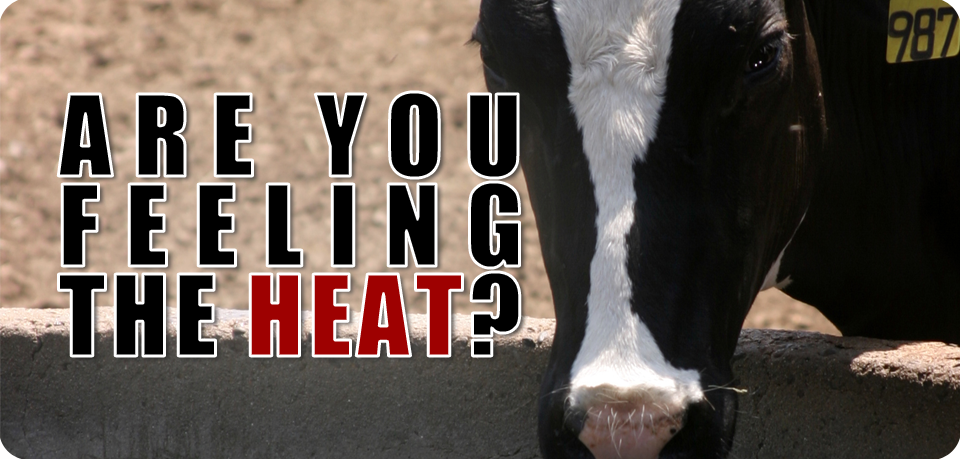




There is no question your cattle are feeling the heat and, as a result, so is your pocket book. One of the greatest challenges facing many dairy farmers, especially those in the southeastern United States is the effects of heat-stress on their cattle. The loss in production during the hot summer months can have a huge effect on profitability. The following are some ways you can improve the performance of your herd, during the hot summer months.
Environment
Three things send your profits spiraling down: increasing air temperature, temperature-humidity index and rising rectal temperature above critical thresholds. These three can cause decreased dry matter intake (DMI) and milk yield and reduce efficiency of milk yield. In other words, as temperatures go up your profits go down. Fortunately, modifications including shade, barns which enhance passive ventilation and the addition of fans and sprinklers help to increase body heat loss, lower body temperature and, thus, increase DMI.
- Shading
One of the first steps that should be taken to moderate the stressful effects of a hot climate is to protect the cow from direct and indirect solar radiation. Get them out of direct sun! It was estimated that total heat load could be reduced from 30 to 50% with a well-designed shade. Shading is one of the more easily implemented and economical methods to minimize heat from solar radiation. Cows in a shaded versus no shade environment had lower rectal temperatures (38.9 and 39.4°C) and reduced respiratory rate (54 and 82 breaths/min), and yielded 10% more milk when shaded. Numerous types of shading are available, from trees (which are easily killed by high cow density), to metal and synthetic materials (shade cloth). - Cooling for Dairy Cows
Although shade reduces heat accumulation from solar radiation there is no effect on air temperature or relative humidity and additional cooling is necessary for lactating dairy cows in a hot, humid climate. A number of cooling options exist for lactating dairy cows based on combinations of convection, conduction, radiation, and evaporation. Air movement (fans), wetting the cow, evaporation to cool the air, and shade to minimize transfer of solar radiation are used to enhance heat dissipation. Any cooling system that is to be effective must take into consideration the intense solar radiation, high ambient temperature, and the typically high daytime relative humidity, which increases to almost saturation at night. These challenging conditions tax the ability of any cooling system to maintain a normal body temperature for the cow. Most air conditioning systems tend to be cost prohibitive and most misting systems tend to increase (not decrease) the relative humidity and can cause large amounts of wasted water that must be dealt with. Now you’ve got heat and water, two things pathogens love. - Cooling Dry Cows
While many producers tend to focus on lactating cows, it is important not to forget about your dry cows as well. In a research study, when cows shaded during the dry period were compared with unshaded control animals. The shaded cows delivered calves that were 3.1 kg heavier and yielded 13.6% more milk for a 305 d lactation, even though all cows were handled similarly following calving. The shaded cows had lower rectal temperature, respiratory rate, and heart rate and altered hormone patterns during the dry period. Similarly, cows that were cooled using sprinklers and fans during the dry period maintained lower body temperatures and delivered calves that were 2.6 kg heavier and cows averaged 3.5 kg more milk daily for the first 150 d of lactation than shade only controls. - Heat Stress Effects On Heifers
Heifers generate far less metabolic heat than cows, have greater surface area relative to internal body mass and would be expected to suffer less from heat stress. However, research from the southern United States and Caribbean regions indicates that Holstein females raised at latitudes less than 34°N weighed 6 to 10% less at birth and average approximately 16% lower BW at maturity than those in more northern latitudes, even when sired by the same bulls. Immunity may also be compromised in newborns during hot weather, and calves born in February and March. Calves born to heat-stressed dams were less vigorous, less likely to nurse immediately after birth, and consequently the colostrum from the first milking was of higher quality due to little or no nursing. Hot conditions may also compromise the ability of the calf to absorb immunoglobulins. (For more on this check out 10 Ways Cool Calves Beat the Heat)
Genetic Selection
There are many aspects of genetics that influence the response to heat stress, and variation among breeds is large. One of the challenges associated with managing high producing cattle in a hot environment is that selection for increased performance is often in conflict with maintaining homeothermy. The maintenance of body temperature is heritable through characteristics including sweating competence, low tissue resistance, coat structure and color. Selection for heat tolerance without selection for an accompanied greater productivity would likely result in lower overall performance by the animal. Sweating response was found to be negatively correlated with metabolic rate, suggesting the difficulty in combining desirable traits of heat adaptation and metabolic potential in cattle.
Because genetic variation exists for traits important to thermoregulation, the potential to select sires that can transmit important traits must be considered. Genetic selection for heat tolerance may be possible, but continued selection for greater performance in the absence of consideration for heat tolerance will result in greater susceptibility to heat stress.
Nutritional Management
There is no question that during the hot summer months you need to change what you are feeding your cattle. With reduced dry matter intake you must reformulate your rations to account for the greater nutrient requirements during the hot weather.
Intake of DM usually declines with hot weather and nutrient density of the diet must increase. The tendency is to increase dietary protein concentration above requirements, but there is an energetic cost associated with feeding excess protein. The most limiting nutrient for lactating dairy cows during summer is usually energy intake and a common approach to increase energy density is to reduce forage and increase concentrate content of the ration. The logic is that less fiber (less bulk) will encourage intake, while more concentrates increase the energy density of the diet. High fiber diets may indeed increase heat production, demonstrated by work showing that for diets containing 100, 75, or 50% of alfalfa, with the remainder being corn and soybean meal, efficiency of conversion of ME to milk was 54, 61, and 65%, respectively. While heat increment is a consideration for high fiber diets, total intake has a much greater impact on metabolic heat production by the animal. During hot weather, declining DMI and high lactation demand requires increased dietary mineral concentration. However, alterations in mineral metabolism also affect the electrolyte status of the cow during hot weather.
Water is arguably the most important nutrient for the dairy cow. Water intake is closely related to DMI and milk yield, but minimum temperature was the second variable to enter a stepwise regression equation (after DMI), indicating the influence that ambient temperature exerts on water consumption. Clean ambient water must be easily available to animals at all times.
The nutritional needs of the cow change during heat stress, and ration reformulation to account for decreased DMI, the need to increase nutrient density, changing nutrient requirements, avoiding nutrient excesses and maintenance of normal rumen function is necessary.
The Bullvine Bottom Line
Extended periods of high ambient temperature coupled with high relative humidity compromise the ability of the lactating dairy cow to dissipate excess body heat. Cows with elevated body temperature exhibit lower DMI and milk yield and produce milk with lower efficiency, reducing profitability for dairy farms in hot, humid climates. Maintaining cow performance in hot, humid climatic conditions in the future will likely require improved cooling capability, continued advances in nutritional formulation, and the need for genetic advancement which includes selection for heat tolerance or the identification of genetic traits which enhance heat tolerance. If producers must focus their efforts, during times of heat stress, then they should focus on those cows that are three weeks before and six weeks after calving.
For more on this check out “Effects of Heat-Stress on Production in Dairy Cattle” from the Journal of Dairy Science








Leave a Reply
You must be logged in to post a comment.