



Archive for Select Milk Producers

2,000 Cows, a $21 Million Settlement, and Fairlife’s Woodcrest Dairy Traceability Gap

New Mexico can track every cow that left Woodcrest Dairy. It can’t tell you which bottle their milk ended up in. That gap is your problem too.

Sometime in 2025, roughly 2,000 dairy cows left Woodcrest Dairy near Roswell, New Mexico — not to be confused with the New York breeding operation of the same name, known for Select Sires’ Woodcrest King DOC. Livestock records reviewed by KOB-TV show that those Roswell animals were sold to Harry Dewit of Westland Dairy in Clovis. KOB-TV reported that the sale occurred shortly before the release of an undercover video from the facility. There is no public evidence indicating Dewit was aware of the pending investigation at the time of the transaction. Federal business filings list Dewit — a past Innovative Dairy Farmer of the Year honoree who milks 4,400 cows at High Plains Dairy in Texas — as CEO of Blue Sky Farms and as a director and treasurer of Select Milk Producers, the cooperative that helped launch the Fairlife milk brand before Coca-Cola acquired full ownership in 2020. Dewit has not been named as a defendant in the federal welfare lawsuit, and no public allegations of wrongdoing have been made against him personally.
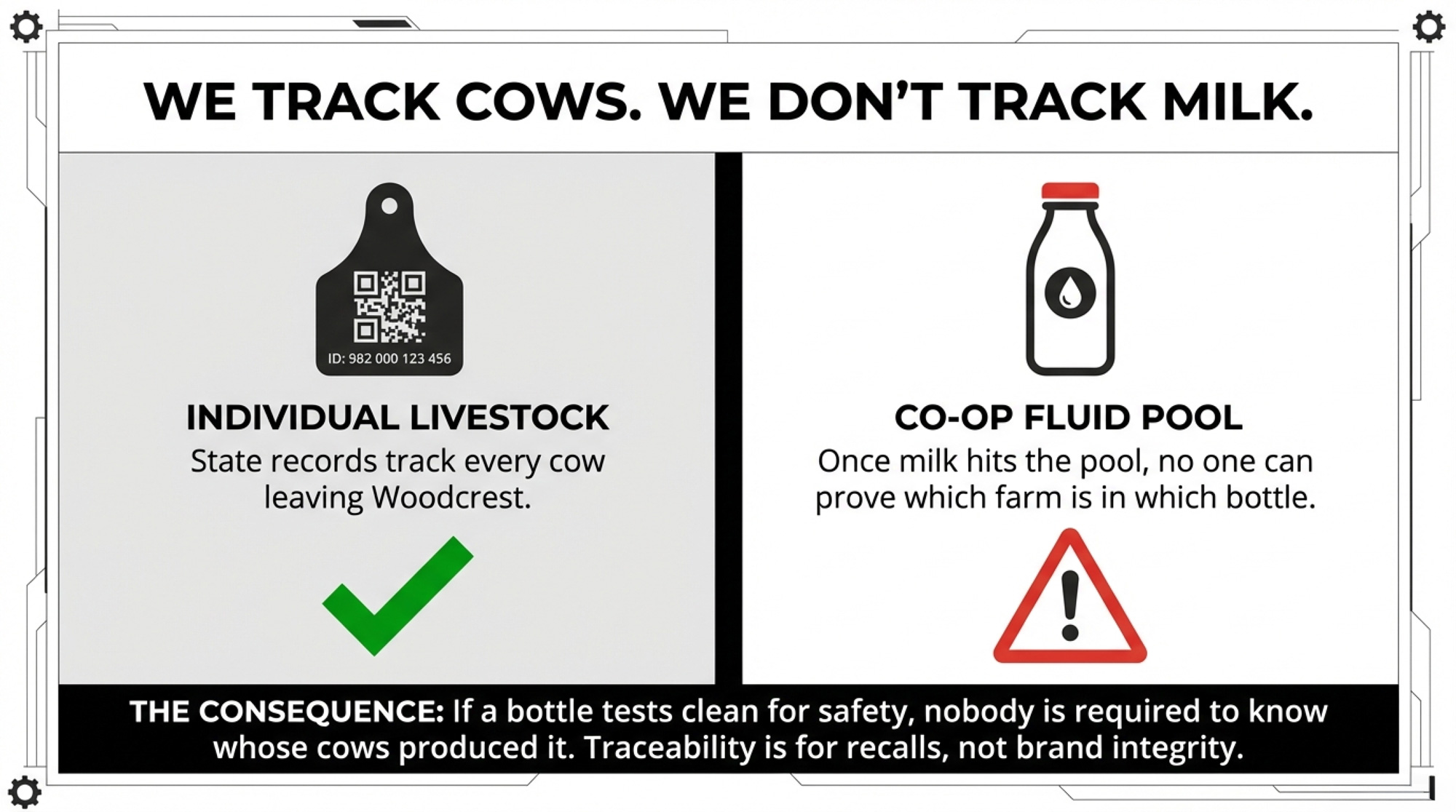
Here’s the problem that should keep every co-op member awake tonight: New Mexico has no system for tracking which dairy’s milk ends up in which branded bottle on which store shelf. That’s not a welfare story. That’s a supply chain story. And it has direct implications for every producer whose milk moves through a cooperative network.

The $21 Million Promise

In 2022, Fairlife and Coca-Cola paid $21 million to settle a class-action lawsuit accusing the company of misleading consumers with marketing that suggested cows received “extraordinary care and comfort.” The companies denied wrongdoing but agreed to implement animal welfare standards and third-party audits as part of the court-approved settlement.

Animal Recovery Mission says those reforms didn’t work. ARM alleges its operative — hired as a milker at Woodcrest and later promoted to the birthing and medical units — recorded footage from December 2024 through approximately March 2025 that ARM describes as showing workers striking cows with shovels and wrenches, forcing metal rods down animals’ throats, and dragging calves through dirt. These allegations, first reported publicly by ARM and subsequently by KOB-TV (February 22, 2026), are now part of a federal lawsuit proceeding in the Central District of California. The Bullvine has not independently verified them, and no criminal charges have been filed as of publication. ARM presented its findings to six agencies — the Chaves County Sheriff’s Department, the New Mexico Livestock Board, the FDA, the New Mexico Department of Agriculture, the USDA, and the FSIS — in May 2025, before going public. ARM says it has investigated other dairies linked to Fairlife in the past.

Fairlife says Woodcrest was not a supplier during 2024 or 2025. ARM’s investigation claims Woodcrest was “directly tied to Coca-Cola’s bottling operations in Dexter, NM, with frequent raw milk pickups by Ruan Trucking.” Those two claims are difficult to reconcile — and the federal lawsuit will likely examine exactly how Fairlife defines “supplier” and whether the cooperative pooling structure creates connections the company’s statement doesn’t acknowledge.

Where Did the Cows Go?

This is where the welfare story becomes a supply chain story — and where The Bullvine’s angle diverges from every other outlet covering this.

KOB-TV’s investigation traced the roughly 2,000 cows from Woodcrest to Westland Dairy, which operates within the Select Milk Producers network. NM Livestock Board investigative records show that by early summer 2025, Woodcrest’s pens were empty, and remaining animals were set to be sold within weeks. Cows from that redistribution remain within the broader Select Milk cooperative framework. But here’s the gap: New Mexico doesn’t track milk from individual dairies to retail brands. The state can trace cows — livestock records document the transfers. What it can’t trace is the milk those cows produce once it enters the cooperative pipeline.

Translation: if a Fairlife bottle tests clean for safety, nobody is required to know whose cows produced it. That’s a food safety system, not a brand integrity system.

The FDA’s FSMA Food Traceability Rule, which took effect January 20, 2026, addresses traceability for high-risk foods — but fluid milk isn’t on the Food Traceability List. Ultra-filtered products like Fairlife’s fall into a regulatory gap: the Pasteurized Milk Ordinance addresses safety, but farm-to-brand sourcing remains voluntary and processor-controlled. The industry’s Innovation Center for U.S. Dairy has built traceability infrastructure, but it’s designed for processor-lot tracking and recall response — not for answering the question “which farm’s milk is in this bottle?”

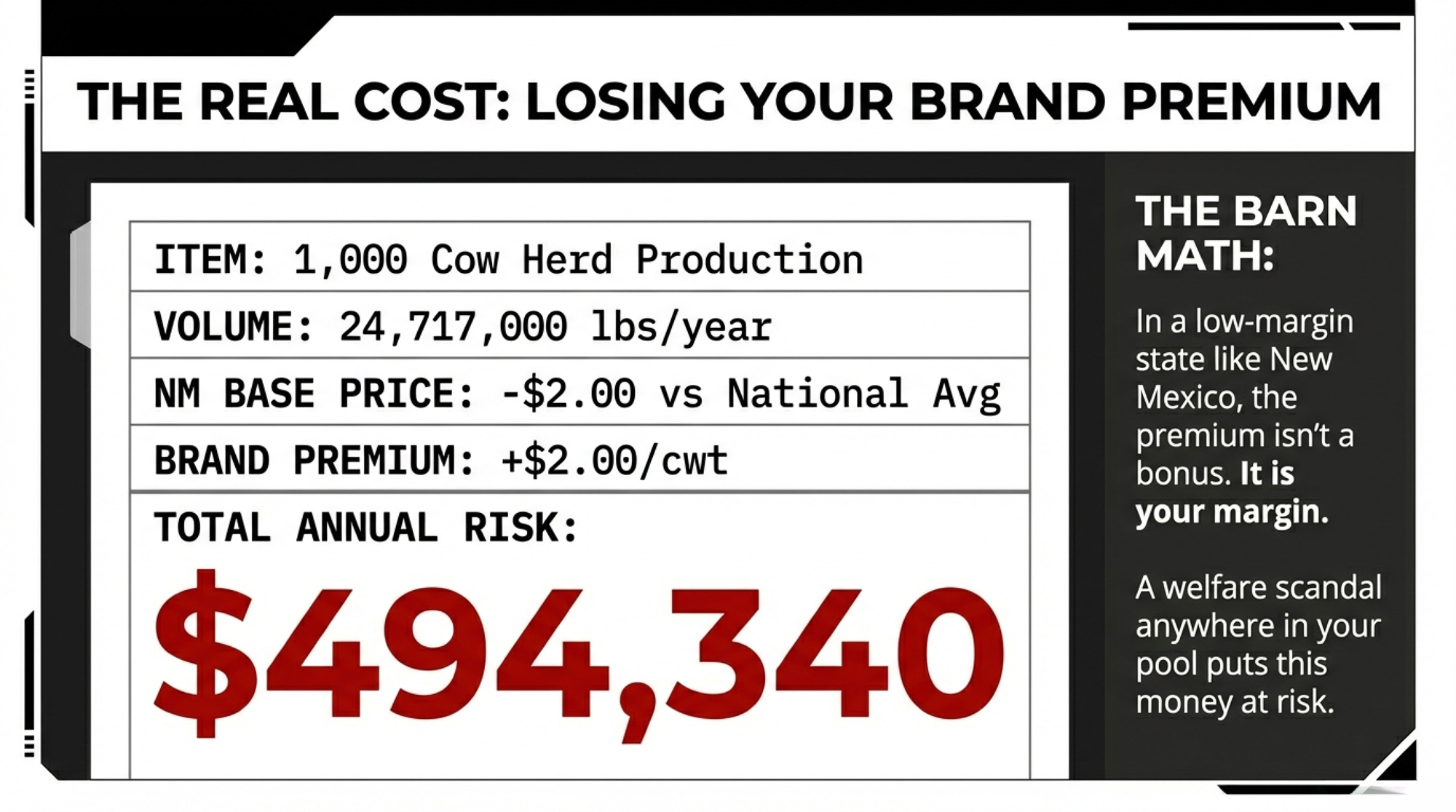
New Mexico runs roughly 95 dairy operations milking approximately 240,000 cows as of 2024, down from 150 farms a decade ago — a 37% decline even as the state’s cow numbers fell 26% from 323,000 (USDA 2025). Average herd size exceeds 2,500 — among the largest in the nation. These are big operations where co-op relationships and brand supply chains matter enormously to the bottom line. And New Mexico’s mailbox milk prices already run roughly $2.00/cwt below the national average — among the lowest in the country, according to USDA data. When your base price is already that thin, the brand premium isn’t a bonus. It’s your margin.

MetricNew MexicoU.S. National Average
Mailbox Price Disadvantage$2.00/cwt BELOW national avg
Operating Dairies (2014→2024)150 → 95 farms (−37%)−26% nationally
Cow Inventory (2014→2024)323K → 240K (−26%)Slight increase nationally
Average Herd Size2,500+ cows (among largest in U.S.)~350 cows

Can Your Co-op Prove Your Milk Is Clean?

That’s the question this story forces into the open. And the honest answer, for most co-op members, is probably not.

Select Milk Producers — a cooperative of 99 family dairy farm members based in Texas and New Mexico — said in a statement to KOB-TV: “Select Milk Producers is committed to the highest standards of animal care.” In court filings, Select argues that plaintiffs have not shown Woodcrest was supplying milk to Fairlife at the time of the alleged abuse. Fairlife has similarly stated that Woodcrest was not a supplier during 2024 or 2025 and said its supplying farms are subject to animal welfare standards and third-party audits.

The structural problem remains: when cows transfer between operations within the same cooperative network — as 2,000 did from Woodcrest — and when state regulators can’t trace milk to brands, the burden of proving supply chain integrity falls on the processor’s word. Not on verifiable records. Not on independent audit trails.

The owner of Woodcrest declined to comment on camera to KOB-TV and distanced himself from Fairlife, directing questions to his former co-op, Select Milk Producers. According to KOB-TV’s reporting, Select Milk did not respond to specific questions about Dewit’s business affiliations or the co-op’s role in the sale of the cows.

If you’re a co-op member — in New Mexico or anywhere — this matters to you even if your operation has never been within 1,000 miles of Roswell. The question isn’t whether you treat your cows right. The question is whether your co-op can prove, with documentation, that the milk carrying a premium brand label actually came from farms that met that brand’s welfare standards. The Woodcrest situation raises the question of whether most can.

Double Legal Exposure in the Same District

The welfare lawsuit isn’t the only legal problem facing Select Milk Producers in federal court in New Mexico.
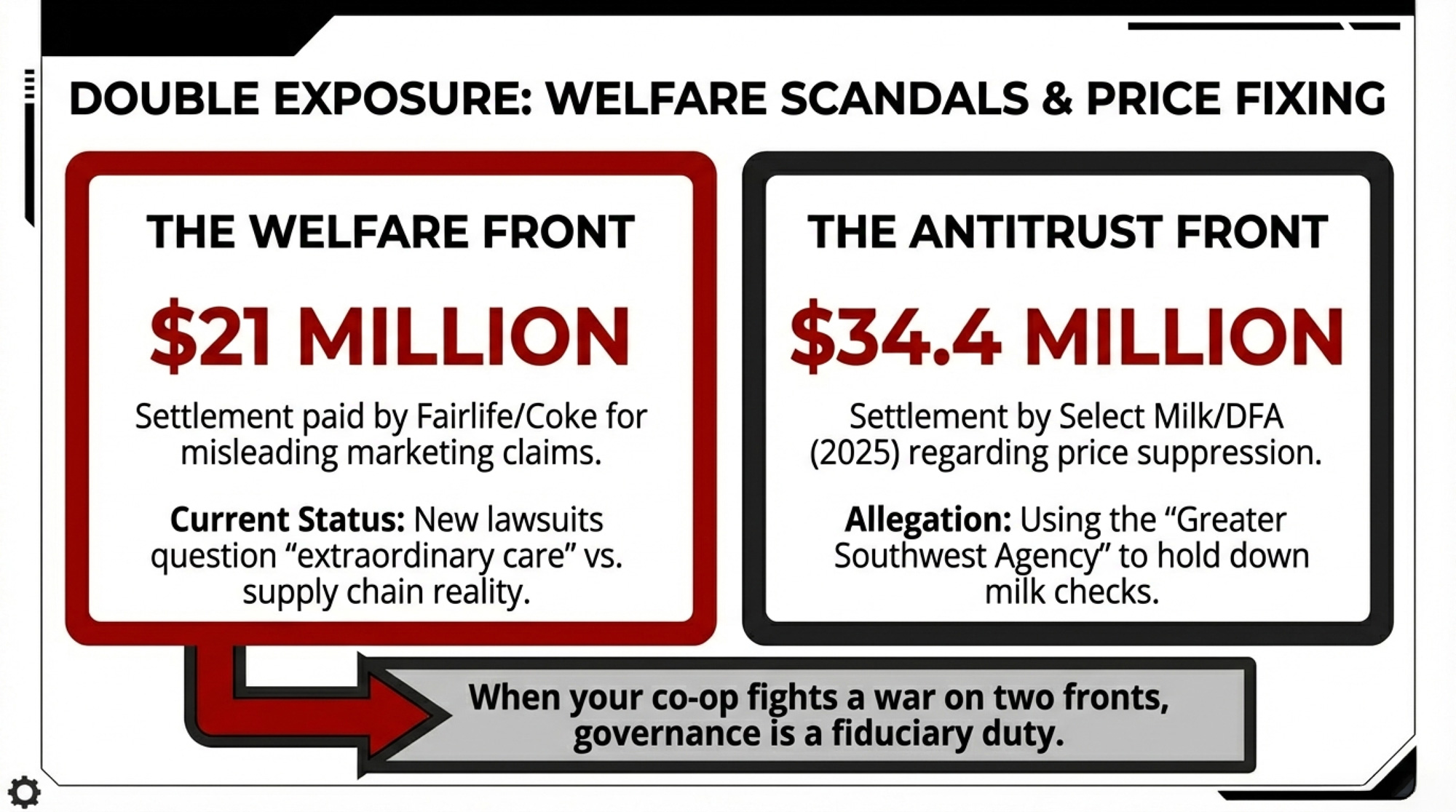
In a separate case (Othart Dairy Farms LLC et al v. DFA Inc. et al, No. 2:22-cv-00251, filed April 2022), dairy farmers including Othart Dairy Farms of Veguita, New Mexico, along with Pareo Farm, Desertland Dairy of Vado, Del Oro Dairy of Mesquite, Bright Star Dairy, and Sunset Dairy alleged that DFA and Select Milk conspired through their Greater Southwest Agency to suppress milk prices paid to producers in New Mexico and portions of Texas, Arizona, Kansas, and Oklahoma from January 2015 through at least June 2025. Judge Margaret Strickland ruled the case could proceed in March 2024. A $34.4 million settlement — $24.5 million from DFA and $9.9 million from Select Milk — received preliminary judicial approval in the summer of 2025. Neither cooperative admitted liability. The complaint alleged that DFA and Select controlled at least 75% of all raw Grade A milk in the Southwest, and that more than 85% of the region’s milk moves through cooperatives.

Beyond the settlement payments, both co-ops agreed to dissolve Greater Southwest Agency — the joint marketing entity the lawsuit alleged was the main vehicle for the conspiracy — and to implement antitrust training for marketing staff and better pay transparency for members (August 2025). DFA has a history of antitrust litigation. The cooperative paid $140 million to settle a price-fixing suit in the Southeast in 2013 (without admitting liability) and $50 million in the Northeast in 2015 (also without admission). Combined with the Southwest settlement, DFA’s total antitrust settlement obligations across three regions now exceed $225 million.

Two federal lawsuits in the same district, involving the same cooperative network — one alleging welfare failures in the supply chain, the other alleging price suppression. Whether that’s a coincidence or something more structural is a question Select Milk’s members deserve to ask. The Bullvine explored the real math behind who controls your milk check in “The American Dairy Heist: Who Really Owns Your Milk Check.”

The Barn Math

Here’s where this gets personal for your operation. Brand-premium milk programs — Fairlife included — typically command $1.50 to $2.50/cwt above commodity pricing for qualifying farms (exact premiums vary by contract and aren’t publicly disclosed). On a 1,000-cow herd producing at New Mexico’s state average of 24,717 lbs/cow/year, a $2.00/cwt premium works out to roughly $494,000 per year.

That premium exists because consumers pay more for a brand that promises higher welfare standards. A welfare investigation — at your farm, your co-op partner’s farm, or anywhere in your cooperative’s supply chain — puts the brand at risk. And when that happens, the premium is what evaporates. Not the base milk price. The premium. In a state where mailbox prices already sit $2.00/cwt below the national average, that premium isn’t extra income — it’s the difference between positive margins and red ink. The question isn’t whether you can afford traceability — it’s whether you can afford not to have it. (For more on how management alone can’t close the gap when structural economics shift, read “Exposing Dairy’s Biggest Lie: Management Can’t Save You.”)
Herd SizeAnnual Production (lbs)Premium Value ($2.00/cwt)Potential Loss
500 Cows12,358,500$247,170A New Tractor
1,000 Cows24,717,000$494,340A New Parlor Wing
2,500 Cows61,792,500$1,235,850The Entire Margin

And here’s the other number worth sitting with: that $34.4 million price-fixing settlement — in which, again, neither cooperative admitted liability — covers roughly 8,000 producers who marketed milk during the affected timeframe (per the settlement class definition). That works out to approximately $4,300 per farm before legal fees. The potential brand-premium loss from a welfare scandal dwarfs that. Unlike a one-time settlement, premium erosion compounds every month the brand stays damaged.

What Corporate Statements Actually Tell You

Fairlife’s position, stated to KOB-TV and multiple other outlets: “Woodcrest Dairy in New Mexico is not a supplier to fairlife” during the period in question, and the company has “zero tolerance for animal abuse.” Select Milk Producers maintains it is “committed to the highest standards of animal care.”
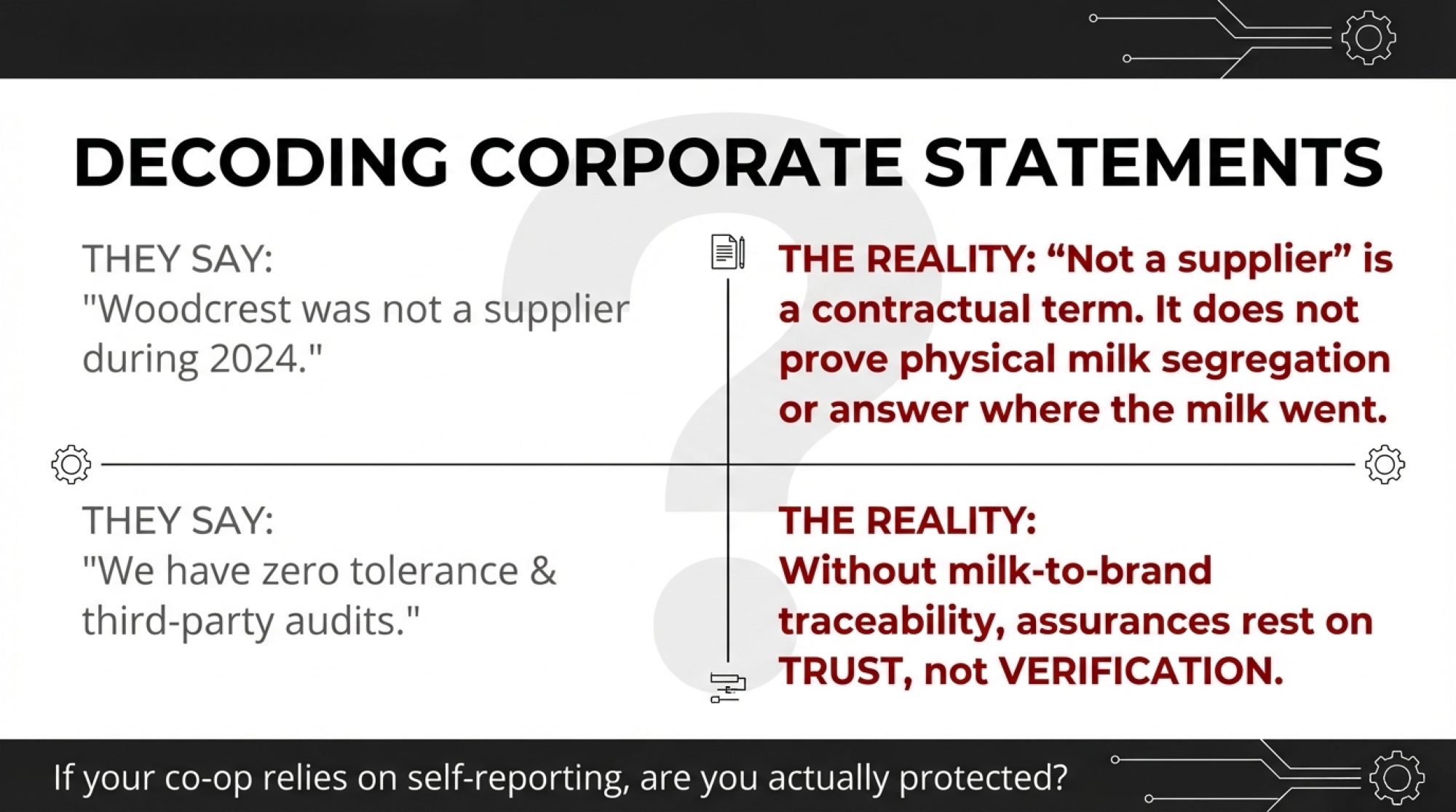
These are the corporate statements as provided. But note what they don’t address: the structural traceability gap. Saying Woodcrest “is not a supplier” is a claim about a business relationship. And in an industry where “not a supplier” can have multiple contractual meanings — not a direct supplier, not during a specific period, not under a particular agreement — the precision of the language deserves closer scrutiny than the reassurance it may offer. That traceability gap isn’t Fairlife’s creation — it’s a structural feature of how cooperative milk marketing works in most states. But it does mean that corporate assurances about supply chain integrity rest on voluntary self-reporting rather than on independently verifiable records.

The judge overseeing the welfare case recently dismissed certain claims against Coca-Cola and Select Milk but allowed others tied to Fairlife’s branding and consumer assurances to proceed. Plaintiffs have been given time to amend their complaint. On the state level, KOB-TV confirmed the Livestock Board has an active investigation — spokesperson Belinda Garland told the station, “The Woodcrest Dairy is an ongoing investigation in this agency,” adding, “We’ll hold them accountable if we feel that we have probable cause and the evidence to support it.” Garland noted that proving extreme animal cruelty can be difficult, particularly when allegations surface after the fact. The Chaves County Sheriff’s Office referred the matter to the NM Livestock Board. Woodcrest Dairy itself has since shut down — pens empty, cows dispersed across the network.

For a deeper look at how the dairy industry’s darkest moments expose structural weak spots, read “Locked From the Inside: Dairy’s Darkest Crimes and the Weak Spots They Exploited.”

Options and Trade-Offs for Your Operation

Within 30 days: Audit your own audit. Call your cooperative and ask three questions: Who selects your third-party welfare auditor? How often are audits conducted? Can you get the most recent audit summary for every farm in your pool? Get the answers in writing. If your co-op can’t or won’t answer, that tells you something.

Audit QuestionWhy This MattersRed Flag Answer
Who selects your third-party welfare auditor?If the co-op picks its own auditor, independence is compromised. Best practice: member-elected oversight board selects auditor.“Management handles that” or “We don’t know”
How often are member farms audited?Annual audits are industry standard for premium brands. Less frequent = gaps where problems can develop undetected.“Every 2-3 years” or “Only problem farms get audited”
Can you access audit summaries for every farm in your pool?If you can’t see audit results, you can’t verify supply chain integrity. Transparency = accountability.“That’s confidential” or “Only management sees those”
Does your marketing agreement address brand-contamination risk from other member farms?Without explicit clauses, you carry exposure from other farms’ welfare failures but have no legal recourse for lost premiums.“We don’t have specific language on that” or “Never thought about it”

Within 90 days: Review your marketing agreement. Look for brand-contamination clauses — language that addresses what happens to your premiums if another member farm in your supply chain gets investigated. If that language doesn’t exist, you’re carrying risk you haven’t priced. Talk to your ag attorney.

Within 12 months: Push for traceability infrastructure. This is the harder conversation, and it costs money. Canada’s DairyTrace program, launched in 2021, tracks individual animals from birth to disposal — it’s a livestock traceability system, not a milk-to-brand system — and it’s further than what most U.S. cooperatives have built. The real gap is at the processor level: can your co-op’s system document which farms’ milk went into which branded product on which date? The Woodcrest situation raises that question for every cooperative in the country. That gap is a business risk that will only grow as consumers, regulators, and plaintiffs’ attorneys get more sophisticated about dairy supply chain questions. If you’re rethinking your operation’s positioning in that environment, “Transform Your Dairy Before Consolidation Decides for You” maps out the decision framework.

The trade-off is real. Better traceability protects premiums but adds cost. Voluntary industry programs are cheaper to implement but harder to defend in court. And waiting for regulators to mandate traceability means you’re letting someone else set the terms.

Key Takeaways

  • If your co-op can’t tell you who audits its member farms or when, your premium is built on trust, not verification. That’s fine until it isn’t.
  • If your milk marketing agreement doesn’t address brand-contamination risk from other member farms, you’re exposed. The Woodcrest situation shows how one operation’s investigation can call into question the entire cooperative network’s brand relationships.
  • The traceability gap is real and unregulated. Most states — including New Mexico — can’t trace milk from individual farms to retail brands. That means the burden of proving “clean” supply chains rests entirely on processor self-reporting. Ask yourself: Is that enough?
  • Two federal lawsuits in the same cooperative network raise questions that Select Milk’s members deserve to ask. When your co-op is simultaneously settling antitrust claims and facing welfare allegations, governance isn’t optional — it’s fiduciary.

The Gap Nobody’s Closing

The dairy industry spent decades building a system optimized for food safety and efficient pooling. That system works — it moves milk safely from farm to shelf on an enormous scale. But it wasn’t built to answer the question premium branding now requires: whose milk is this, and can you prove the cows that produced it were treated as the label promises?

Woodcrest Dairy is shut down. The cows are dispersed across the Select Milk network. The lawsuits are proceeding in narrowed form after some claims were dismissed and others allowed to continue. And somewhere between Roswell and a Fairlife bottle on a grocery store shelf, there’s a traceability gap that no settlement check, no third-party audit, and no corporate press statement has closed.

Your operation might never make national news. But your co-op’s ability to prove where your milk went — and that it came from farms meeting the standards your brand premiums depend on — is now a question with a dollar sign attached. Can yours?

Executive Summary:

A New Mexico welfare investigation at Woodcrest Dairy has exposed a deeper problem: once 2,000 cows were sold out of that herd, nobody could clearly trace which branded products their milk now supplies. Fairlife and Coca-Cola previously paid $21 million to settle animal welfare marketing claims and now say Woodcrest wasn’t a supplier in 2024–25, while ARM’s undercover footage and new federal filings paint a murkier picture of what “supplier” actually means in this system. At the same time, Select Milk Producers is dealing with a separate $34.4 million price-fixing settlement it reached with DFA in the Southwest, without admitting liability, after farmers accused it of using a joint agency to hold down milk checks. For you, the real risk isn’t the courtroom drama — it’s what happens to brand premiums that can be worth around $494,000 a year on a 1,000-cow New Mexico herd if a welfare scandal hits your co-op’s supply chain. Because New Mexico can trace cattle movements but not milk from farm to brand, most co-op members still can’t independently prove where their milk went or whether every supplying farm actually met a premium label’s welfare standards. This piece breaks down that traceability gap and gives you concrete moves — from grilling your co-op on audit practices in the next 30 days to stress-testing your marketing agreement for brand-contamination clauses — so you’re not finding out about your exposure when the premium disappears.

Update, 25/02/2026: Fairlife responded to The Bullvine’s request for comment. A Fairlife spokesperson stated: “Woodcrest Dairy is not a supplier to fairlife, which means no milk from this dairy is received by fairlife for fairlife products.” Fairlife did not address questions regarding the transfer of approximately 2,000 Woodcrest cows to Westland Dairy, milk-to-brand traceability within cooperative pools, Harry Dewit’s role within Select Milk Producers, or the company’s welfare verification process.

This article is based on published reporting by KOB-TV (February 22, 2026), federal court filings, USDA data, and other public sources cited throughout. Fairlife’s and Select Milk Producers’ positions are presented as stated to KOB-TV and in court filings. Harry Dewit has not been named as a defendant in the federal welfare lawsuit.

Learn More

The Sunday Read Dairy Professionals Don’t Skip.

Every week, thousands of producers, breeders, and industry insiders open Bullvine Weekly for genetics insights, market shifts, and profit strategies they won’t find anywhere else. One email. Five minutes. Smarter decisions all week.

NewsSubscribe
First
Last
Consent

Why Some US Consumers Are Skeptical of Fairlife’s Filtration Process

Learn why some US consumers are wary of Fairlife’s unique milk filtration process. Is the “Frankenstein of milk” worth the higher cost? Find out more.

Imagine a milk bottle with 50% more protein, 30% more calcium, and half the sugar. Coca-Cola and Select Milk Producers created Fairlife in 2012. Fairlife separates and recombines milk components using a “proprietary filtering process,” including water, butterfat, protein, vitamins and minerals, and lactose. While some customers like these perks, others believe they are excessively changed. “Milk is seen as naturally healthy,” said Lianne van den Bos, a Euromonitor food expert. “Pulling it apart makes it less logical.” This highlights a critical issue: innovation vs customer perception. Fairlife’s reception will reveal if the market is ready for such changes or whether conventional attitudes will prevail.

Redefining Dairy: The Birth of Fairlife through Innovative Filtration

Fairlife, a joint venture between Coca-Cola and Select Milk Producers, was formed in December 2012 with a mission to innovate in the dairy business. This collaboration birthed a unique milk using a patented, proprietary filtering technique. The process disassembles whole milk into water, butterfat, protein, vitamins and minerals, and lactose, creating a lactose-free milk with 50% more protein, 30% more calcium, and half the sugar of conventional milk. This approach not only caters to customers with lactose sensitivity but also addresses the increasing demand for nutritionally enriched products. Fairlife’s identity is anchored in its superior filtering method, setting it apart from typical milk products as a healthful and inventive dairy choice.

Safety and Innovation: Evaluating Fairlife’s Proprietary Filtration Process 

Fairlife’s patented filtering method conforms with FDA rules, guaranteeing that the milk is safe for consumption. This technique carried out using tight quality control methods, improves nutritional features by raising protein and calcium levels while decreasing sugar. This invention transforms Fairlife into a safe and nutritionally better alternative to regular milk.

Consumer Skepticism: Perceived Compromise of Milk’s Natural Qualities 

Consumers are skeptical of Fairlife’s approach because they believe it damages the natural purity of milk. Lianne van den Bos, Euromonitor’s food analyst, emphasized this by adding, “The advantage with milk is that it is already seen as inherently beneficial for you. But when you start pulling it apart, customers may not view it as a natural match with milk.” This reflects the main issue: despite its scientific validity, some believe the proprietary filtering technique detracts from milk’s natural properties. Labels like “Frankenstein of Milk” enhance this uneasiness, implying that the food is more artificial than natural.

Economic Implications: Navigating Premium Pricing in a Commodity Market

The economic repercussions of Fairlife’s premium pricing cannot be ignored. Fairlife, which sells for more than double the price of conventional milk, seeks a niche market that challenges the traditional perception of milk as a daily essential. This high price is a deterrent for customers who expect milk to be inexpensive. While some may pay more for supposed nutritional advantages, others are unwilling to spend more on what they consider a fundamental requirement. This price sensitivity might restrict Fairlife’s appeal, particularly among budget-conscious buyers who prefer cheaper private brands.

Market Penetration and Consumer Retention: The Path Ahead for Fairlife

Since its debut in 2014, Fairlife has made significant strides in the market, securing placements at major retailers such as Walmart, Kroger, Safeway, and Meijer. Initial test markets have shown promise, and customer enthusiasm has fueled its expansion. Despite being more expensive than conventional milk, Fairlife’s superior nutritional content has garnered a loyal following. However, the sustainability of its appeal remains uncertain. While current buzz and interest drive trial purchases, long-term success hinges on customers discovering value beyond novelty. With private-label milk brands dominating, Fairlife must continually justify its higher pricing to maintain loyalty as the initial excitement wanes.

Industry Experts Weigh In: The Future of Fairlife’s Consumer Appeal 

Industry experts, including Lianne van den Bos, highlight Fairlife’s environmental problems. Van den Bos observes that although there is enthusiasm about Fairlife’s ideas, maintaining that pace is challenging. ‘A big percentage of people just want to test this product. ‘I’m just not sure how sustainable it will be after the novelty wears off,’ she remarked. This reflects the complicated customer behavior in the dairy sector, which is heavily commodified. However, there is also potential for Fairlife to expand into international markets, which could provide a new source of growth and sustainability.

Furthermore, van den Bos argues that Fairlife’s premium pricing is both a strength and a danger. While it promotes Fairlife as high-quality, it may turn off price-sensitive customers. “People just want to buy a bottle of milk, not pay twice the price,” she said, citing the prevalence of private-label milk. Fairlife must constantly defend its worth to customers who are used to cheaper alternatives to maintain its market share.

Analysts believe that for Fairlife to thrive long-term, it must maintain interest through continuous innovation and transparent disclosure of its unique features. As the initial hype fades, intelligent marketing and price adjustments will be crucial to remaining competitive in this crowded industry. Educating consumers about the benefits of Fairlife’s innovation and the reasons behind its premium pricing will be key to building trust and retaining market share.

The Bottom Line

Fairlife exists at the intersection of innovation and consumer emotion. It represents the promise of cutting-edge dairy technology and the public’s ambivalent reaction. Fairlife’s breakthrough filtering technique transforms conventional milk by improving its nutritional profile. Yet, some customers are concerned about the perceived departure from milk’s natural essence. Through observations and comments, we investigated Fairlife’s origins, market development, and premium price implications. The findings show a split customer base—some like the novelty and health advantages.

In contrast, others see it as ‘Frankenstein’ milk. Experts believe that, although Fairlife has established a niche, its long-term sustainability depends on keeping customer attention beyond the initial unrest. Fairlife’s viability in the US market will be determined by combining innovation and natural appeal, educating people about its advantages, and competing in a market where conventional milk is still widely used. Fairlife’s future will be shaped by changing customer tastes and how it responds.

Key Takeaways:

  • Fairlife milk is produced using a proprietary filtering process, dividing milk into its five key components and recombining them in different proportions to boost nutritional content.
  • Despite its innovative approach, some consumers are skeptical, perceiving the filtration process as an unnatural modification of a traditionally wholesome product.
  • Fairlife offers lactose-free milk with 50% more protein, 30% more calcium, and half the sugar compared to regular milk.
  • The product was developed by a team including Fairlife co-founder Mike McCloskey and has been on the market since December 2014, experiencing favorable results in several test markets.
  • Fairlife is available in various formats, including whole, 2% reduced fat, skim, and chocolate, and is stocked by major US retailers such as Walmart and Kroger.
  • However, the premium pricing of Fairlife milk, which is more than double that of regular milk, may limit its long-term consumer retention and market share.
  • While some consumers are indifferent to the processing method, the sustainability of Fairlife’s popularity remains uncertain as the novelty of the product wears off.

Summary:

Fairlife, a milk bottle with 50% more protein, 30% more calcium, and half the sugar, was created in 2012 by Coca-Cola and Select Milk Producers. Its unique filtering process separates and recombines milk components using a proprietary technique, including water, butterfat, protein, vitamins and minerals, and lactose. This approach caters to lactose sensitivity and addresses the increasing demand for nutritionally enriched products. Fairlife’s patented filtering method conforms with FDA rules, but consumers are skeptical, believing it damages milk’s natural purity. The premium pricing of Fairlife, more than double the price of conventional milk, challenges the traditional perception of milk as a daily essential. It may deter budget-conscious customers who prefer cheaper private brands. Fairlife has been successful in market penetration and consumer retention since its debut in 2014, but its sustainability remains uncertain. Industry experts highlight Fairlife’s environmental problems and potential expansion into international markets. In conclusion, Fairlife’s premium pricing is both a strength and a danger, and intelligent marketing and price adjustments are crucial to remain competitive in the crowded dairy industry.

Learn more:

The Journey of Fairlife Milk: From Farm to Your Fridge

Follow the journey of Fairlife milk from farm to fridge. Learn how it ensures quality and sustainability. Explore the process that delivers premium dairy to you.

Imagine a world where milk is not just a dietary staple but a powerhouse of nutrition, ethical production, and innovation. This is the world of Fairlife Milk, a game-changer in the dairy industry. With its high-protein, ultra-filtered milk, Fairlife offers a product that stands out. It provides 50% more protein and 50% less sugar and is lactose-free, making it a unique and superior choice. Its commitment to advanced dairy technology and animal welfare is truly remarkable. 

In an era where consumers are increasingly mindful of their diet and the environment, Fairlife offers an ideal solution. Its production methods not only enhance nutritional value but also reduce environmental impact. Fairlife is set to redefine industry standards as a pioneer in sustainable dairy farming. Its innovative approach not only boosts health benefits but also adheres to ethical farming practices, making it a choice that resonates with the environmentally conscious. 

Understanding Fairlife’s production is essential for those making informed choices about nutrition and environmental impact. Let’s explore how Fairlife transforms our milk, one glass at a time.

Fairlife: Revolutionizing Dairy with Innovation, Sustainability, and Ethics 

Fairlife, famed for its ultra-filtered milk with enhanced nutritional benefits, stemmed from a desire to innovate the dairy industry. Mike and Sue McCloskey co-founded Fairlife in 2012. They aimed to improve dairy quality, sustainability, animal welfare, and environmental stewardship. Mike’s veterinary background and Sue’s expertise in food science propelled their mission to transform dairy farming practices

Fairlife has demonstrated a strong commitment to responsible farming through its partnership with Select Milk Producers. This commitment is reflected in their products, which meet consumer demands for higher protein and lower sugar while ensuring top animal care and sustainability standards. Their rigorous filtration techniques set new industry standards, enhancing milk’s nutritional profile and reassuring consumers of its quality. 

Fairlife embraced a holistic approach to dairy farming, using state-of-the-art technology and best practices in animal welfare. Their farms in Indiana and operations like Nathan Chittenden’s in upstate New York ensure ample space, comfortable bedding, and well-ventilated barns, aligned with the Five Freedoms principle. 

Fairlife’s pioneering efforts have earned a reputation for quality and ethical farming, driven by the McCloskeys’ dedication to innovation, animal respect, and environmental care, solidifying Fairlife’s leadership in the modern dairy industry.

A Glimpse into Chittenden Farm: A Paragon of Ethical Dairy Practices 

At the core of Fairlife’s dedication to quality milk production is its partnership with meticulously managed farms like the Chittenden farm in upstate New York. Nathan Chittenden and his family care for 1,500 Jersey cows in spacious, well-ventilated barns that ensure the animals’ comfort and protection. Milking occurs three times daily, taking about as long as reciting “The Farmer in the Dell.”

Fairlife’s commitment to animal welfare is unwavering. By adhering to the ‘Five Freedoms’ and ensuring clean bedding, ample space, and ventilated housing, they foster a healthy environment for their cows. Fairlife also ensures humane treatment with protocols for stress-free euthanasia when necessary. This rigorous and compassionate approach results in superior, ethically produced milk and garners support from consumers who value such practices.

The Journey of Fairlife Milk: From Farm to Table 

Milk collection starts on the farm and extends to processing facilities, ensuring high quality and safety. Milking is done using automated systems, making the process efficient and stress-free for cows, with strict hygiene standards in place. After milking, milk is rapidly cooled to around 37-39°F (3-4°C) in refrigerated bulk tanks, maintaining quality and preventing bacterial growth. 

Transportation involves stainless steel milk tankers that keep the milk cool and contamination-free. These tankers use advanced tracking and temperature monitoring systems, maintaining milk integrity from farm to processing plant. Upon arrival, the milk undergoes tests for safety and quality, including checks for antibiotics, ensuring it meets high standards. 

This rigorous, disciplined approach to milk collection builds consumer trust and supports sustainability and ethical practices from farm to table.

Innovation in Every Drop: Fairlife’s Ultra-Filtration Process Redefines Dairy 

At the core of Fairlife’s innovative milk offering is its proprietary ultra-filtration process, which redefines traditional milk production. This method begins with regular milk, meticulously filtered to separate water, minerals, lactose, protein, and fats. Using advanced filtration membranes, Fairlife ensures precise isolation of these components, allowing for custom recombination of nutrients. 

What sets Fairlife apart is its impressive protein content. The ultrafiltration process concentrates proteins, resulting in milk with 50% more protein, 30% more calcium, and less sugar than conventional milk, all without artificial additives. This process also removes lactose, making the milk suitable for lactose-intolerant individuals. 

Every phase of this process reflects Fairlife’s commitment to quality. High-pressure pumps and specialized filters ensure that only desirable molecules are retained, achieving an elevated standard of purity. By fine-tuning the balance of components, Fairlife exceeds industry benchmarks for dairy nutrition, enhancing the milk’s texture and taste. 

Fairlife’s ultra-filtration technology blends innovation with tradition, merging science with values of quality and sustainability. This process sets a new industry standard and exemplifies Fairlife’s dedication to delivering superior, nutritious products.

Nutritional Superiority: Elevated Protein, Calcium, and Reduced Sugar 

Fairlife milk has an enhanced nutritional profile and offers significant advantages over conventional dairy products. Its high protein content delivers 50% more protein per serving, aiding muscle repair and growth for active individuals. Additionally, Fairlife milk boosts calcium content by 30%, ensuring consumers meet their daily nutritional needs for strong bones and teeth. This fortified calcium is particularly beneficial for those with lactose intolerance or dietary restrictions. Furthermore, Fairlife reduces sugar content by up to 50% through an ultra-filtration process that removes lactose, adding back a controlled amount of sugar. This makes Fairlife a healthier and pleasantly sweet alternative for those monitoring their sugar intake.

Quality Assurance: The Bedrock of Fairlife’s Dairy Excellence 

At the core of Fairlife’s commitment lies a robust quality assurance framework, ensuring every milk bottle meets the highest standards. This begins on the farm, with stringent protocols for optimal cow conditions. Regular veterinary check-ups, comprehensive emergency plans, and adherence to the five freedoms—freedom from thirst, hunger, discomfort, pain, and fear—are integral. These principles enable cows to engage in natural behaviors. 

Fairlife collaborates with exemplary farms like Chittenden Farm and Walmoore Holsteins, which adopt best practices in dairy farming, including energy conservation and advanced ventilation systems. These innovations ensure cows live comfortably and are milked efficiently, blending modern technology with traditional ethics. Every milking process element is carefully timed and monitored to maintain animal welfare and milk quality, upholding best practices in herd management.

Fairlife’s ultra-filtration process epitomizes its pursuit of perfection, enhancing the milk’s nutritional profile and ensuring it meets strict safety and quality standards. Regular lab tests and rigorous quality checks throughout the supply chain underscore Fairlife’s dedication to delivering a trusted product. By combining cutting-edge technology, ethical farming, and comprehensive quality control measures, Fairlife redefines the excellence of the dairy industry.

Fairlife’s Commitment to Environmental Sustainability: A Holistic Approach 

Fairlife’s commitment to environmental sustainability weaves through all operations, emphasizing minimizing its ecological footprint while setting new eco-friendly benchmarks. Partnering with farms like Walmoore Holsteins in West Grove, Pennsylvania, which uses LED lighting and solar panels, Fairlife showcases how modern dairy farming can align with environmental stewardship. Their animal welfare practices address cows’ physical and emotional needs, highlighting a holistic approach to sustainability. 

Advanced agricultural technologies reduce dairy farming’s environmental impact. Precision farming optimizes water and feed use, minimizing waste and conserving resources. Fairlife’s innovative packaging solutions, which are recyclable and biodegradable, further exemplify their commitment to waste reduction

Fairlife ensures that the entire supply chain upholds high environmental standards. From farm to table, they work to lower carbon emissions and invest in community-based ecological initiatives. These efforts establish Fairlife as a leader in sustainable dairy production, setting a new industry standard and reinforcing their dedication to a greener future.

Preserving Perfection: Fairlife’s Advanced Packaging and Distribution Strategies 

Fairlife’s dedication to quality extends from the farm to packaging and distribution. After ultra-filtration, the milk is placed into sterile, light-blocking containers that preserve its nutritional content and freshness. This method extends shelf life and reduces food waste, aligning with Fairlife’s sustainability goals. Using advanced refrigerated logistics, Fairlife maintains optimal temperatures during distribution, ensuring the milk’s quality until it reaches retailers. Strategic partnerships with local distributors enable nationwide access to their innovative dairy products, providing customers receive them promptly and in excellent condition.

Customer Testimonials: A Testament to Fairlife’s Excellence in Quality and Ethics 

Consumers have consistently praised Fairlife milk for its exceptional taste and nutritional benefits. Jessica L. shared, “Fairlife milk has transformed my morning routine. With its elevated protein content and reduced sugar, I feel energized and healthier without compromising taste.” Mark S. appreciated the brand’s commitment to sustainability, stating, “Knowing that Fairlife prioritizes animal welfare and environmental sustainability makes me feel good about my purchase. It’s not just delicious milk; it’s milk produced with a conscience.” Parents have also expressed their gratitude for Fairlife’s offerings. Samantha K., a busy mother of three, said, “Fairlife’s high-calcium, high-protein milk makes it easier to meet my kids’ dietary needs without the added sugars found in other brands.”

Moreover, athletes and fitness enthusiasts have praised the brand. John A., a personal trainer, commented, “Fairlife milk is my go-to recovery drink post-workout. Its higher protein content aids muscle recovery, and the taste is fantastic.” These testimonials highlight that Fairlife milk is not just a beverage but a superior nutritional choice that aligns with ethical and health-conscious values.

The Bottom Line

One central theme stands out throughout this exploration of Fairlife’s approach to dairy production: the blend of innovation, ethical practices, and sustainability that distinguishes Fairlife in the dairy industry. The journey from cows at Chittenden Farm to the ultra-filtered milk on your table reflects an unwavering commitment to quality, nutrition, and environmental stewardship. From farms dedicated to animal welfare, every step is managed to ensure superior quality. The ultra-filtration process enhances nutritional content by elevating protein and calcium while reducing sugar, showcasing Fairlife’s dedication to healthier dairy options. Sophisticated packaging and distribution ensure every bottle of Fairlife milk remains as fresh and nutritious as the moment it leaves the farm. Choosing Fairlife is more than a grocery decision; it invests in a dairy production model that prioritizes animal well-being, consumer health, and planet sustainability. At the crossroads of dietary choices and environmental responsibility, let Fairlife guide us toward a conscientious and healthful way of living. Embrace Fairlife’s vision and step toward a future where dairy excellence means ethical and sustainable practices.

Key Takeaways:

  • Fairlife leverages innovative, ethical, and sustainable dairy practices to revolutionize the milk industry.
  • Chittenden Farm exemplifies ethical dairy farming, emphasizing animal welfare and quality production.
  • Fairlife’s ultra-filtration process sets new standards in dairy, enhancing nutritional content while reducing sugar.
  • The brand prioritizes quality assurance through rigorous standards from farm to table.
  • Fairlife’s environmental sustainability efforts encompass holistic approaches, including advanced packaging and distribution strategies.
  • Customer testimonials reinforce Fairlife’s commitment to exceptional quality and ethical practices.

Summary:

Fairlife Milk, founded in 2012 by Mike and Sue McCloskey, is a dairy product that offers high-protein, ultra-filtered milk with enhanced nutritional benefits. They partner with Select Milk Producers, a cooperative committed to responsible farming. They introduce products that meet consumer demands for higher protein and lower sugar while maintaining high animal care and sustainability standards. Fairlife’s rigorous filtration techniques set new industry standards, enhancing milk’s nutritional profile. Their holistic approach to dairy farming includes state-of-the-art technology and best practices in animal welfare. Their farms in Indiana and upstate New York use automated systems for efficiency and hygiene. Their proprietary ultra-filtration process concentrates proteins, resulting in milk with 50% more protein, 30% more calcium, and less sugar than conventional milk. Fairlife’s commitment to environmental sustainability is holistic, with innovative packaging solutions that are recyclable and biodegradable.

Learn more:

Send this to a friend




